Article

Manganese Peroxidase Catalyzed Removal of Phenol and Simple Alkylphenols from Water

by
Samira Narimannejad
1,*,
Nihar Biswas
1,
Elizabeth E. Hood
2,† and
Keith E. Taylor
3,*
1
Department of Civil and Environmental Engineering, University of Windsor, Windsor, ON N9B 3P4, Canada
2
GreenLab, Inc., Jonesboro, AR 72404, USA
3
Department of Chemistry and Biochemistry, University of Windsor, Windsor, ON N9B 3P4, Canada
*
Authors to whom correspondence should be addressed.
Current address: Hood Biosolutions LLC, Jonesboro, AR 72404, USA.
Appl. Sci. 2026, 16(11), 5540; https://doi.org/10.3390/app16115540
Submission received: 14 April 2026 / Revised: 8 May 2026 / Accepted: 20 May 2026 / Published: 2 June 2026
(This article belongs to the Section Chemical and Molecular Sciences)

Abstract

Phenol (Ph), bisphenol A (BPA), and cresol isomers (o-, m-, p-C) are pollutants widely detected in industrial effluents and resistant to conventional treatment. This study investigated the catalytic potential of manganese peroxidase (MnP), derived from Phanerochaete chrysosporium and expressed in corn, for the removal, via oxidative oligomerization and precipitation, of these compounds from water. Batch experiments were conducted under controlled pH, hydrogen peroxide concentration, and enzyme activity to achieve ≥95% substrate conversion. The optimized MnP system nearly achieved this under stepwise hydrogen peroxide addition. Kinetic analyses revealed short half-lives for initial degradation phases, with BPA and p-C showing near-instantaneous transformation. Mass spectrometry confirmed the formation of soluble and insoluble oligomers (to hexamers for BPA, octamers for p-C, dodecamers for the rest), confirming radical-mediated polymerization pathways. These findings highlight MnP as a robust and eco-friendly biocatalyst for efficient treatment of phenolic pollutants, offering significant potential for integration into advanced wastewater treatment systems.

1. Introduction

The widespread industrial use and environmental persistence of phenol (Ph), bisphenol A (BPA; 2,2-Bis(4-hydroxyphenyl)propane), o-cresol (o-C), m-cresol (m-C), and p-cresol (p-C) present a significant and multifaceted public health and ecological problem. Phenol and cresols are listed as priority pollutants by the US Environmental Protection Agency (EPA) [1,2,3,4] in its Toxics Release Inventory (TRI) [5,6,7] due to their recognized hazardous properties and prevalence in industrial effluents. Ph and its methyl derivatives, the cresols, are extensively used in chemical manufacturing, leading to substantial wastewater discharges and accidental releases that threaten both freshwater and marine ecosystems. Ph and cresols exhibit pronounced ecotoxicity, affecting a wide range of aquatic organisms and disrupting ecological balance through mechanisms such as oxidative stress, enzyme inhibition, and interference with cellular signaling pathways [1]. Cresols are generally more toxic than Ph, with p-C being the most potent isomer, capable of rapidly depleting intracellular glutathione and forming reactive intermediates that bind to cellular proteins, thereby exacerbating cellular injury [8,9]. The chronic exposure to these compounds, even at low concentrations, can lead to bioaccumulation and long-term adverse effects on both wildlife and humans [10,11,12].
BPA is widely used in the production of plastics and resins, resulting in its ubiquity in the environment and in human biological samples. BPA is an endocrine disruptor, with mounting evidence linking it to oxidative stress, developmental toxicity, and interference with metabolic and hormonal pathways [13,14,15,16]. Notably, BPA and p-C can interact at the level of biotransformation, with gut microbial metabolites such as p-C modulating the metabolism and toxicity of BPA, thereby complicating risk assessments and highlighting the need for integrated toxicological studies [14]. BPA has been prohibited in packaging materials in China, Canada, the European Union, and the United States [15].
The health risks associated with these compounds are particularly concerning for vulnerable populations, such as patients with chronic kidney disease, who exhibit impaired elimination and higher systemic exposure to phenolic toxins [13]. The inclusion of Ph, BPA, and cresols in the TRI emphasizes the regulatory recognition of their toxicity and the necessity for ongoing monitoring, risk mitigation, and the development of safer alternatives. Specific regulatory limits for phenol and cresols do not exist for drinking and surface water at the federal level in Canada, Europe, and the US; for mono- and dihydric phenols, Canada has a surface water guideline of 4 µg/L [17]; for BPA, the current European drinking water limit is 2.5 µg/L and ongoing discussion for surface water is suggesting that it should be in the range of 0.034–0.17 ng/L [18]. The persistence, bioactivity, and complex interactions of these chemicals in the environment and within biological systems demand urgent attention from both scientific and regulatory communities to prevent further ecological degradation and protect public health.
Conventional wastewater treatment methods, such as primary sedimentation, biological activated sludge, and standard anaerobic or aerobic processes, are largely inadequate for the effective removal of Ph, BPA, o-C, m-C, and p-C from industrial and municipal effluents [19,20,21,22,23,24,25]. These compounds are often present at concentrations that can inhibit microbial activity, thereby reducing the efficiency of biological treatment systems. BPA is also poorly removed by conventional methods, as it resists biodegradation and can persist through standard treatment processes, leading to its frequent detection in treated effluents and the environment [23]. Recent reviews emphasize that advanced treatment technologies—such as membrane separation, advanced oxidation processes, and specialized adsorbents—are required to achieve high removal efficiencies for BPA and phenolic compounds, as conventional methods fail to address their chemical stability and low biodegradability [19,20,23,26,27]. These advanced methods, too, have drawbacks such as high energy use and/or sludge generation [28,29,30]. Furthermore, the presence of these compounds in saline or complex industrial wastewaters further complicates their removal, as high salinity and the presence of other toxicants can further inhibit microbial degradation pathways [31].
Enzymatic treatment has emerged as a highly promising and sustainable approach for the removal of Ph, BPA, o-C, m-C, and p-C from wastewater, offering significant advantages over conventional methods in terms of efficiency, selectivity, and environmental compatibility [20,22,26,32,33]. Recent advances in enzyme immobilization have greatly enhanced the stability, reusability, and catalytic performance of enzymes such as peroxidases and tyrosinases for the treatment of phenolic pollutants [20]. The peroxidase process, utilizing hydrogen peroxide as an oxidant, converts these hazardous phenolic compounds into less toxic polymeric products, which can be readily separated from water. A recent report on sulfate radical-induced coupling of chlorophenols [34], another on laccase-catalyzed coupling of chlorophenols [35], and a review of chemical oxidative coupling of phenols in water treatment [36] validate the oligomerization–precipitation pathway, which is the central hypothesis of the current study. A recent perspective article further supports the concept [37]. Peroxidase systems exhibit substrate specificity, with p-C being particularly amenable to rapid enzymatic conversion, while o- and m-C are also efficiently oxidized under optimized conditions [33,38]. The green chemistry profile of enzymatic treatment—characterized by mild operating conditions, minimal hazardous byproducts, and compatibility with a wide range of phenolic substrates—addresses many of the shortcomings of traditional physicochemical and biological methods, which often suffer from incomplete removal, high operational costs, and secondary pollution. Furthermore, the adaptability of enzymatic systems to immobilization and integration into continuous flow reactors may enhance their practical applicability for large-scale wastewater treatment [20,22].
Manganese peroxidase (MnP), a ligninolytic enzyme, has demonstrated significant potential for catalyzing the oxidative conversion of a wide range of phenolic contaminants with high efficiency and reduced toxicity of transformation products [27]. Moreover, MnP-based treatment offers the prospect of being substrate-agnostic because the substrate conversion is effected non-enzymatically by Mn3+, which is produced by the enzyme and hydrogen peroxide. The resting enzyme undergoes 2-electron oxidation by peroxide to form a reactive intermediate, Compound I; then in two successive 1-electron steps with Mn2+, via Compound I and thence Compound II, the enzyme returns to the resting state with formation of two Mn3+. Wariishi et al. [39,40] characterized the fundamental kinetics: Compound I formation is irreversible with a rate constant 2.0 × 10⁶ M−1·s−1 (5–10-fold slower than other heme peroxidases); Compound I can also be reduced directly by phenols such as p-cresol (as for other heme peroxidases, rate constant 1.8 × 10³ M−1·s−1) or by Mn2+ (a saturable process with Kd 0.33 mM, rate constant 0.7 s−1); Compound II is only reduced very slowly by p-cresol (rate constant 9.5 × M−1·s−1) or Mn2+ (a saturable process with Kd 0.44 mM, rate constant 0.14 s−1); the Mn3+ produced is stabilized by chelating ligands, such as lactate. Thus, in reaction with a reducing phenolic substrate present, the Compound I step can be independent of Mn2+, whereas the Compound II step to complete the peroxidase cycle effectively cannot. It is hypothesized that for other heme peroxidases and laccases [41], when the phenoxyl radicals produced by reacting with the Mn3+ couple via O-C and/or C-C bond formation with ortho-/para-orientation, the resulting dimers can undergo successive MnP cycles until they reach their solubility limit and precipitate. The Mn couple thus acts as a mediator in the conversion of phenolic compounds [42]. Novelty in this study resides in the MnP used here, a heterologous expression product from corn [43] (the same gene product characterized by Wariishi, Dunford, MacDonald and Gold [39], as cited above, and the high-resolution crystal structure) [44], thus offering all the economic advantages of an agricultural commodity. This study aims to systematically evaluate the removal efficiency and operational parameters of MnP-mediated treatment for Ph, the cresols, and BPA, as well as to provide evidence for the oligomerization–precipitation pathway (another novelty of the work), thereby providing a scientific basis for the development of an advanced enzymatic process for industrial and municipal wastewater management.

2. Materials and Methods

2.1. Materials

Crude liquid MnP (E.C. 1.11.1.13), derived from the MnP1 gene of Phanerochaete chrysosporium heterologously expressed in corn [43], was procured from GreenLab Inc. (Jonesboro, AR, USA). The following chemicals, each with a purity of 99% or higher, were obtained from Sigma Aldrich (Oakville, ON, Canada): Ph, BPA, p-C, m-C, o-C, sodium L-tartrate dibasic dihydrate, sulfuric acid, tartaric acid, sodium hydroxide (NaOH), manganese sulfate, 2,6-dimethoxyphenol, formic acid, and bovine liver catalase. 4-Aminoantipyrine (4-AAP) was obtained from BDH Inc. (Toronto, ON, Canada). Hydrogen peroxide (30% w/v, stored at 4 °C) was supplied by ACP Chemicals Inc. (Montreal, QC, Canada). HPLC-grade water and acetonitrile (ACN) were obtained from Fisher Scientific (Ottawa, ON, Canada). Polyethersulfone syringe filters (0.22 μm pore size, 26 mm diameter) were acquired from Sarstedt (Montreal, QC, Canada). Symmetry C18 columns (100 Å, 5 μm, 4.6 mm × 150 mm) were supplied by Waters Ltd. (Mississauga, ON, Canada).

2.2. Buffer Preparation

A 0.5 M tartrate buffer was prepared for pH 4.5 using either sodium L-tartrate dibasic dihydrate and sulfuric acid or tartaric acid and NaOH.

MnP Activity Assay

MnP activity was measured in standard catalytic units (U/mL), with 1.0 U equal to the amount of enzyme required for consumption of 1.0 µmol of H2O2 per minute. Oxidative dimerization of 2,6-dimethoxyphenol (2,6-DMP) in the presence of manganese (II) sulfate (MnSO4), H2O2 and MnP produces a pink chromophore at 469 nm (ε = 53,200 M−1·cm−1). The initial rate of this reaction is used for MnP activity and measured by a built-in kinetic rate calculation function in the UV–Vis spectrometer. The reagent was prepared in buffer containing 10 mM 2,6-DMP (5.0 mL), 100 mM H2O2 (50 µL), 5 mM manganese (II) sulfate (MnSO4; 5.0 mL) and 0.5 M tartrate buffer (4.0 mL), made up to 50 mL with water [45].
A 50-fold diluted solution of the enzyme as received from GreenLab Inc. was prepared and 50 µL of it was added into a quartz cuvette followed by quick addition of 950 uL of freshly prepared reagent (described in the preceding paragraph). Then, in kinetic mode of the spectrophotometer, the change in absorbance at 469 nm was monitored at room temperature from 0 s to 30 s at 5 s intervals. Spectrometer software (Breeze, version 2.0) calculated rate in Δ A469·min−1 and activity in U/mL.

2.3. Analytical Equipment

An Agilent (Mississauga, ON, Canada) diode array UV–Vis spectrophotometer (model 8453 controlled by a Hewlett Packard Vectra ES/12 computer), with a range of 190–1100 nm and 1 nm resolution, was applied to measure the λmax of each compound, as well as to observe the reactions and the enzyme activity. The λmax for each compound was further used in HPLC analysis of the samples. Quartz cuvettes with 1 cm path length, type 104-QS, were obtained from Hellma (Concord, ON, Canada) for analysis in the UV region.
Substrate concentrations were calculated using a Waters HPLC system with model 2489 dual-wavelength absorbance detector, model 2707 auto-sampler, and model 1525 binary pumps, equipped with Symmetry C18 Columns, 100 Å, 5 μm, 4.6 mm × 150 mm from Waters Ltd. (Mississauga, ON, Canada). The HPLC is run by Breeze 2.0 software. Choice and ratio of the mobile phases, detection wavelength and flow rate used for each substrate are given in Table 1 [45]. The injection volume was 10 μL for all samples.
High-resolution mass spectrometry was conducted at Brock University (St. Catharines, ON, Canada) using an Agilent 1290 Infinity II LC (Agilent Technologies, Inc., Waldbronn, Germany) system equipped with a quaternary pump and coupled to an Agilent 6546 QTOFMS (Agilent Technologies, Inc., Waldbronn, Germany). The pH meter was Oakton pH 700 benchtop meter with pH resolution of 0.01 and pH range from 0.00 to 14.00 (Vermon Hills, IL, USA), connected to a Thermo Scientific Orion pH Probe (9110DJWP, Refillable/DJ/Semi-Micro/Glass) (Thermo Fisher Scientific, Waltham, MA, USA) with ±0.02 pH accuracy. Calibration buffers (pH 4.00, 7.00 and 10.00) were from ACP Chemicals Inc. Centrifugation was performed on a Corning LSETM compact centrifuge with 6 × 50 mL and 6 × 15 mL centrifuge tubes and a maximum speed of 6000 rpm (New York, NY, USA). VWR International Inc. (Mississauga, ON, Canada) supplied the Micro V magnetic stirrers (0–1100 rpm, model 4805-00) and VWR Magstirrers (100–1500 rpm, model 82026-764). The magnetic stir bars were from Cole-Parmer Canada Inc. (Montreal, QC, Canada). Model K-550-G vortex mixer (50/60 Hz, 0.5 Amps, 120 volts) was from Scientific Industries, Inc. (Bohemia, NY, USA).

2.4. Batch Reactions Using MnP

To conduct all reactions, 30 mL open glass batch reactors were used. The reactions were performed at about 19–25 °C and were not temperature-controlled. The enzymatic treatment of synthetic wastewater was planned for 95% removal of each substrate in 20 mL solution. The reaction medium contained 0.5 or 1.0 mM of a single substrate in 40 mM buffer, along with 0.20 mM manganese sulfate plus variable activities of MnP as appropriate. Hydrogen peroxide was added last, either as a single addition or as seven aliquots to give 1.0 mM each at 10 min intervals. After stirring the mixture for 180 min, the reaction was stopped with catalase (100 µL of a 10 mg/mL stock solution) and samples were filtered as mentioned above before HPLC measurements.
The reaction parameters, enzyme activity, hydrogen peroxide concentration and reaction time were studied for all substrates. For pH, the reactions were run at pH 4.5, the optimum pH for MnP [43]. Every set of batch reactors had a pair of controls, formulated in the same way as samples. One did not have hydrogen peroxide to check the effect of enzymes alone on the substrate, and the other one lacked enzymes, to observe the effect of hydrogen peroxide alone on the substrate. The reactions were run for 180 min, stopped with catalase and microfiltered before HPLC analysis.
Enzyme optimization was followed by hydrogen peroxide optimization. The reaction was formulated for 95% removal of the target compound at optimum pH 4.5. The same controls were run.
Reaction time was studied using optimal pH, enzyme activity, and hydrogen peroxide concentration for 180 min. Batch reactors with 30 mL volume were prepared. Samples (5 mL) were taken at time intervals, quenched with catalase and vortexed to stop the reaction. Then, samples were microfiltered and analyzed for residual substrate by HPLC.

2.5. Identification of Products

Reaction mixtures were analyzed by high-resolution mass spectrometry (MS) to identify polymerization products. A batch reactor was prepared under optimal conditions of pH, enzyme activity, and hydrogen peroxide concentration, using 10 mM of the respective buffer. The buffer concentration was reduced to minimize interference from buffer ions during MS analysis. After three hours, the reaction was quenched with catalase and centrifuged at 4000 rcf for 20 min.
A 1.0 mL portion of the aqueous reaction mixture was collected, mixed with 4.0 mL of acetonitrile (ACN), vortexed several times over the course of one hour, and then filtered. This filtrate, along with the remaining filtered supernatant, was analyzed by MS under the same instrumental conditions.

3. Results and Discussion

pH plays a particularly critical role in MnP’s catalytic mechanism, as it impacts both the redox potential of the manganese couple and the stability of the enzyme and reaction intermediates. MnP achieves its maximum catalytic efficiency at pH 4.5, under which the enzyme’s active site conformation, substrate ionization, and electron transfer kinetics are all favorably aligned [43]. Therefore, in the current study, pH was not optimized for the compounds studied but kept at 4.5, since their conversion is non-enzymatic.

3.1. MnP Optimization

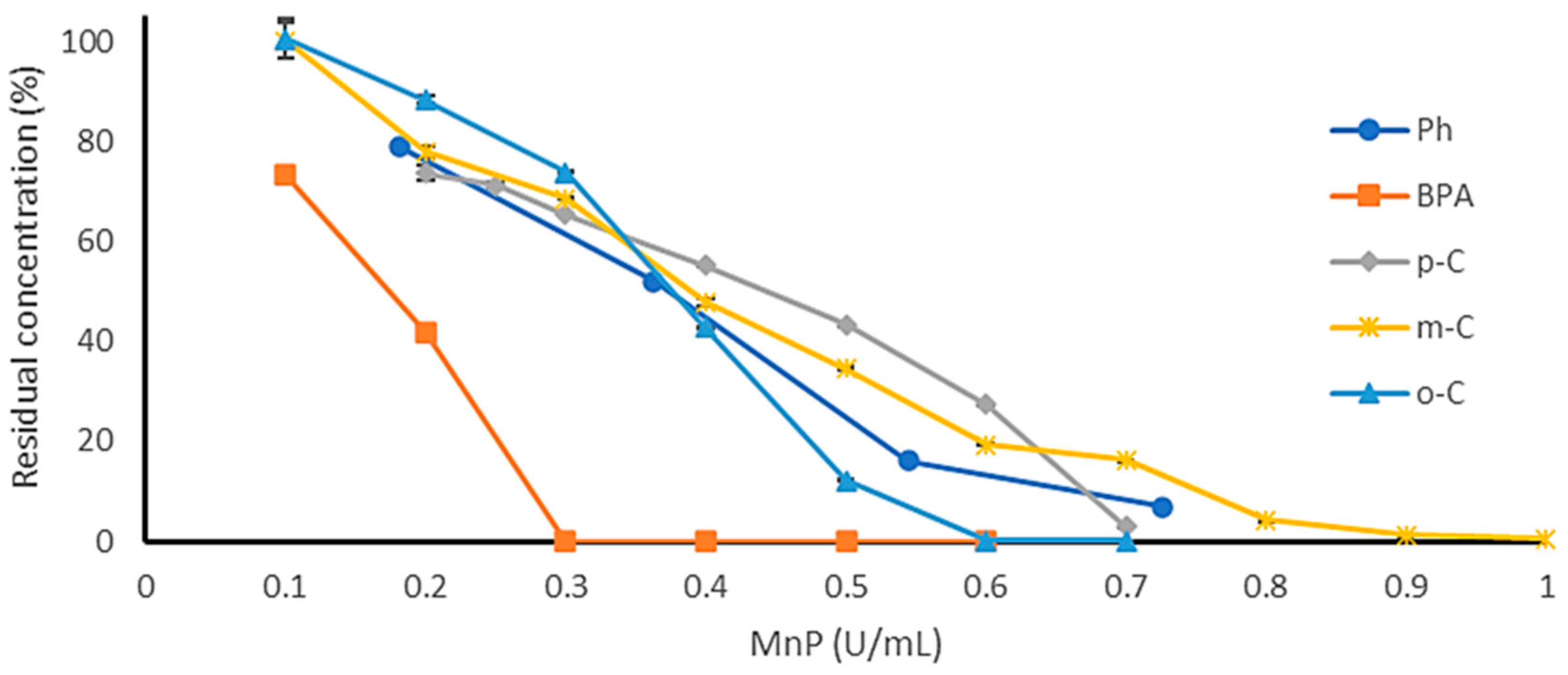
To determine the minimum enzyme activity required for 95% removal of the target organic contaminants, enzyme optimization experiments were conducted under uniform conditions: 40 mM buffer at pH 4.5, supplemented with 0.20 mM manganese sulfate, hydrogen peroxide as detailed below and allowed to proceed over 3 h. The choice of Mn2+ concentration, at 20% of the substrate molar concentration, was arbitrary for this initial study but consistent with literature reports in the millimolar range [46,47]. Future work would systematically investigate the Mn2+ concentration dependence of the enzymatic reactions and the rates of Mn3+ with the phenols (the chemical coupling reaction). For initial conversions, hydrogen peroxide was added to a total concentration of 7.0 mM, administered in 1.0 mM aliquots at 10 min intervals, for up to 60 min. The stepwise addition strategy (E. Hood, private communication; stepwise peroxide addition has been reported previously with HRP treatment of phenol [48]) helped maintain a favorable oxidative environment while minimizing potential enzyme inactivation from excess hydrogen peroxide, thereby sustaining catalytic activity throughout the reaction and enabling near-complete contaminant conversion. Unless stated otherwise, all subsequent mentions of 7 mM hydrogen peroxide or its incremental addition, in the text or figure captions, implies the protocol, of 1.0 mM aliquots at 10 min intervals. In cases where samples were taken to estimate residual substrate in a time course, the sample was taken immediately before the next aliquot of peroxide was added.
As illustrated in Figure 1, with substrates at 1.0 mM, except for BPA at 0.5 mM (which is 1.0 mM in phenolic groups), the highest removal efficiencies were achieved at MnP activities (U/mL) as follows: Ph 0.73 (93%), o-C 0.60 (100%), m-C 0.80 (96%), p-C 0.70 (97%), and BPA 0.30 (100%). It is noteworthy that these levels of conversion imply cycling of the sub-stoichiometric Mn couple. The optimal MnP activities for each compound were used in subsequent experiments.

3.2. Hydrogen Peroxide Optimization

In the peroxidase catalytic cycle, a single mole of H2O2 serves as the oxidizing agent to convert two moles of Mn2+ to Mn3+, which subsequently reacts with the phenol. This would predict a peroxide:phenol stoichiometry of 0.5. An oligomerization–precipitation mechanism would predict a stoichiometry of 1.0 [49].
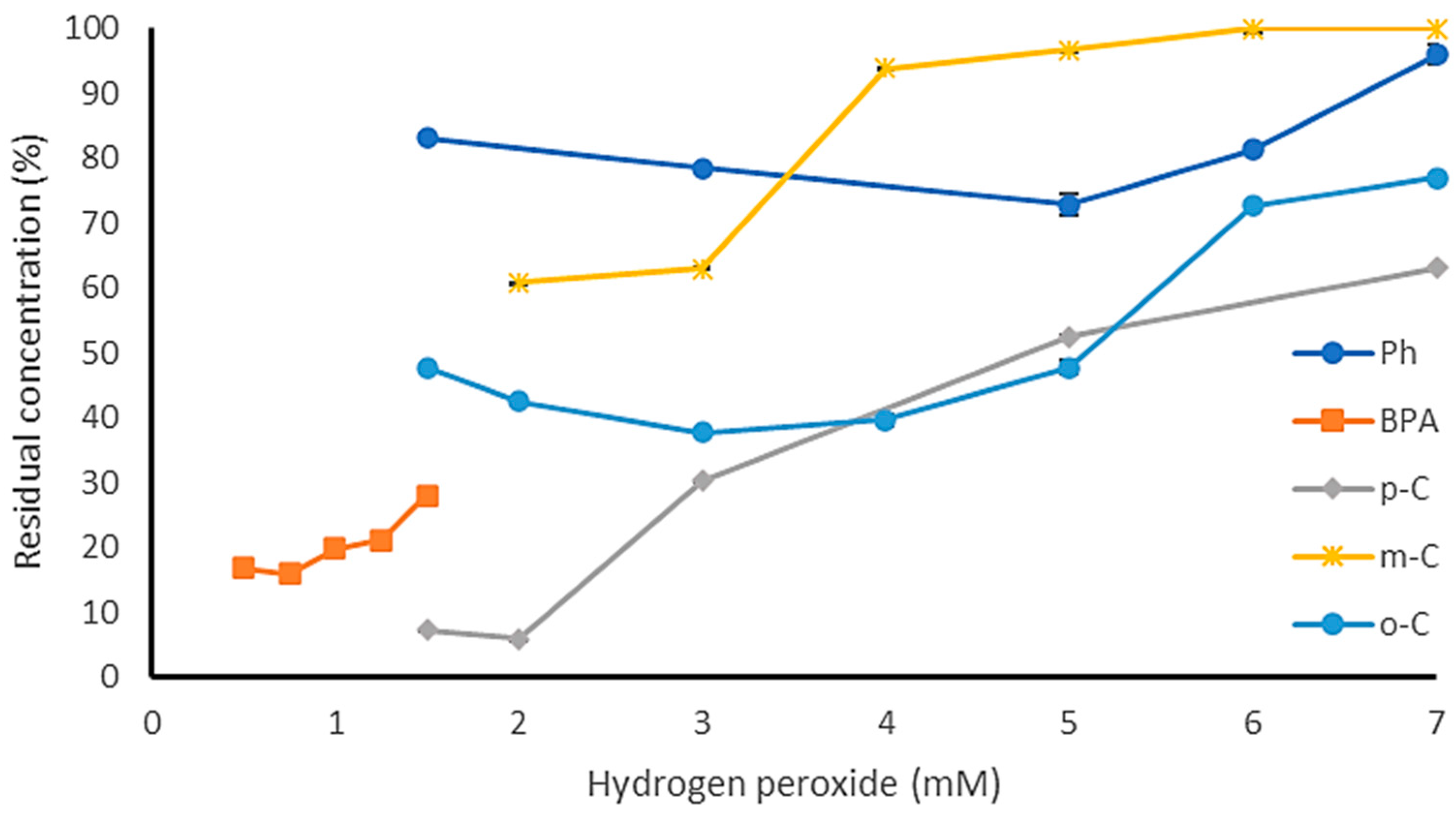
Figure 2 presents the evaluation of H2O2 dependence of the target compounds at pH 4.5 and at their optimal MnP activity, where the entire amount of H2O2 was introduced as a single initial aliquot. The results indicate that higher initial H2O2 concentration did not yield a substantial improvement in removal efficiency. This observation suggests that the substrate requires the peroxide to be supplied incrementally to achieve more effective conversion. As can be seen in Figure 2, only p-C was efficiently removed under this condition, achieving 94% conversion and BPA was also fairly well removed, whereas the others were ineffectively removed.
A likely explanation, besides oligomerization as mentioned above, lies in the interaction between the enzyme and the peroxide during the oxidation process. Some substrates are considered relatively slow-reacting for MnP (strictly speaking, they are actually slow partners in the chemical reaction with Mn3+). When a high concentration of H2O2 is introduced at once, two possible inhibitory pathways may occur: the rapid generation of a burst of Mn3+ may result in oxidative inactivation of the enzyme before sufficient substrate turnover can take place, and/or the excess peroxide itself can directly, but reversibly, inactivate the enzyme through over-oxidation to Compound III [50,51]. Both pathways would reduce MnP catalytic activity, thereby limiting substrate removal despite the increased availability of oxidants. In addition, endogenous catalase activity of MnP could consume any peroxide remaining from the initial 1.0 mM aliquot. This outcome highlights the importance of a peroxide addition strategy in MnP-catalyzed systems, particularly when treating substrates with slower oxidation kinetics, by stepwise addition of H2O2. Future work should examine the peroxide dependence of these reactions in more detail.
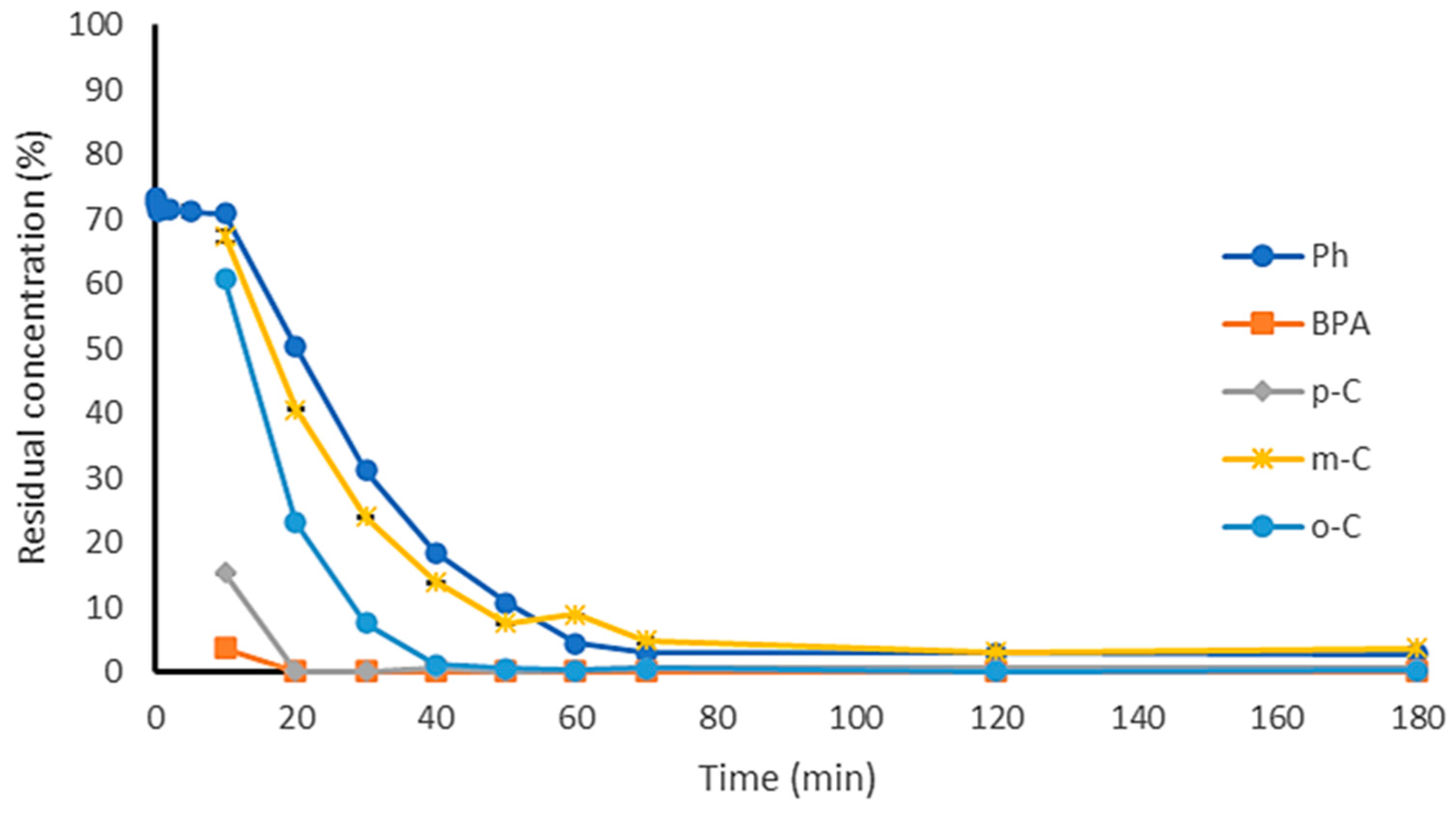
A stepwise hydrogen peroxide addition strategy for substrate removal under optimal MnP activity is presented in Figure 3. Sampling was conducted every 10 min prior to the addition of each subsequent 1.0 mM H2O2 aliquot. Qualitatively, Figure 3 shows reactivity in the order BPA > p-C > o-C > m-C, Ph. Within the cresols, the relative order is consistent with steric influence on radical coupling; BPA and p-C are mutual analogs, with an aliphatic substituent para to the phenolic group. For Ph, the reaction profile exhibited an initial burst in the first 5 s, followed by a lag phase to 10 min, then monotonic decay thereafter. The burst roughly accounts for rapid conversion of the Mn2+ present to Mn3+ and its conversion of the equivalent concentration of phenol; excess peroxide at this stage likely converts the enzyme to its reversibly inactivated form, Compound III, or is consumed through the enzyme’s endogenous catalase activity [50]. The lag shown explicitly for phenol (and likely for the cresols), which ended with the addition of a second aliquot of 1.0 mM aliquot of peroxide, is consistent with the return of native enzymes from Compound III; the slow phase beginning at 10 min and not as a set of successive bursts is governed by that rate. The fact that the lag ended once more peroxide was available gives credence to the suggestion that catalase activity of MnP decomposed much of the initial aliquot of peroxide. Following the lag phase, Ph removal proceeded, achieving approximately 97% conversion within the first 70 min. Beyond this point, no further improvement in removal efficiency was observed over the remainder of the 3 h reaction window, indicating that the reaction had approached completion or was limited by residual substrate recalcitrance, depletion of enzyme activity, and/or product inhibition.
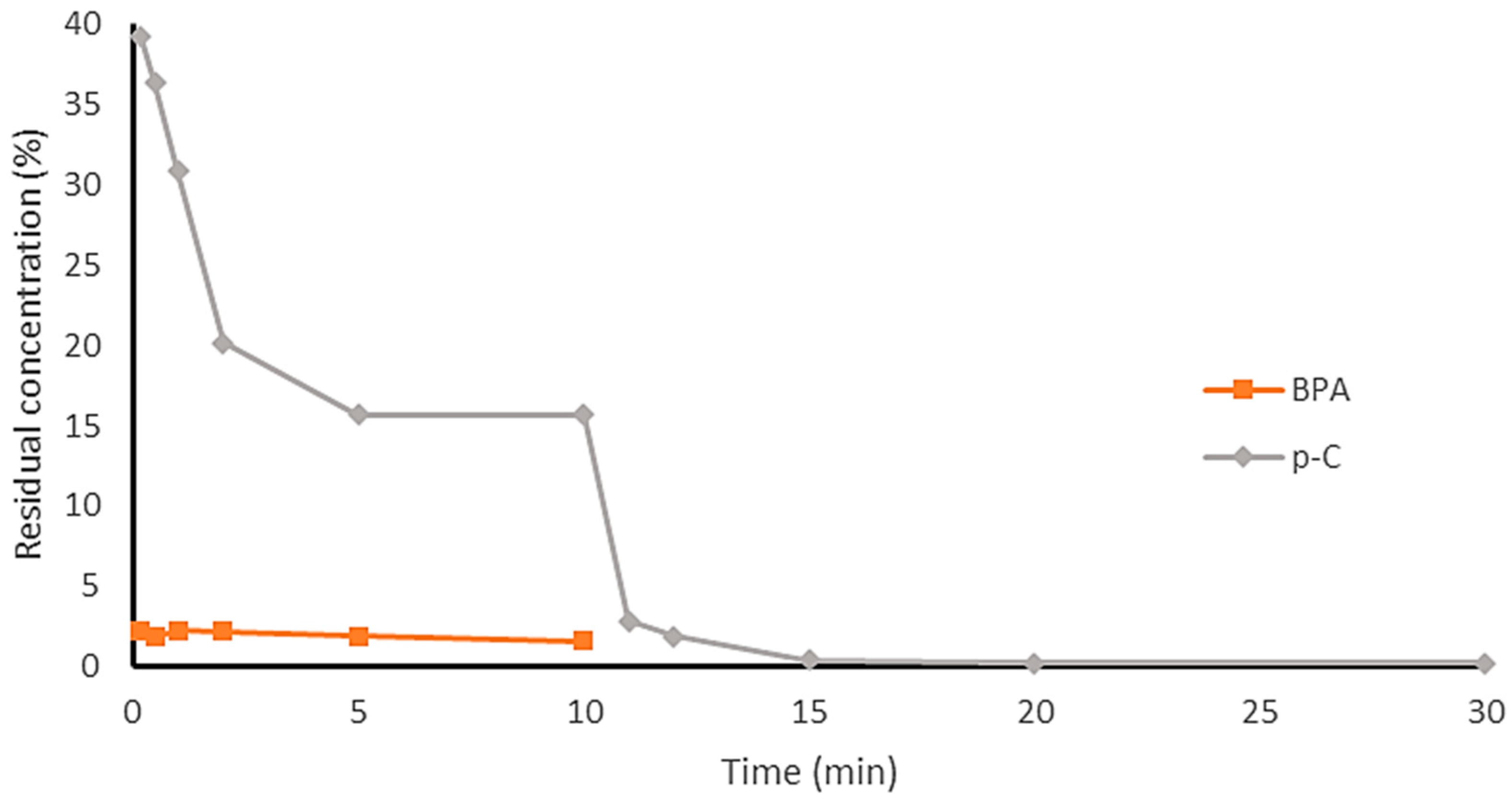
For BPA under optimal reaction conditions, the initial 1.0 mM aliquot of H2O2 was sufficient to achieve 96% conversion (Figure 3). Complete removal of p-C (100%) was achieved within 20 min using only 2.0 mM H2O2 (short-time data is given for BPA and p-C in Figure 4 below). In contrast, the full 7.0 mM H2O2 was required to obtain 95% removal of m-C and Ph within 70 min. For o-C, 4.0 mM H2O2 was sufficient to achieve a 99% reduction within 40 min. Accordingly, these peroxide concentrations were designated as optimal for subsequent experiments.

3.3. Summary of Optimum Conditions for Substrate Treatment

The ideal circumstances for removing various aqueous substrates using MnP at room temperature are displayed in Table 2. Where both single-aliquot and stepwise additions of hydrogen peroxide are reported, stepwise addition increased removal.
The treatment efficiencies in Table 2 were normalized by dividing the optimum enzyme activity by the corresponding substrate concentration. The range of normalized efficiencies shows the MnP reaction to be nearly substrate agnostic, as might be expected from the intermediacy of the Mn couple. For BPA, however, note that it is a bisphenol and, thus, the efficiency as shown in the table is actually for 1 mM of BPA’s phenolic groups. The normalized efficiencies may be compared with those of 32 other compounds, with soybean peroxidase compiled by Haghighatnama, Narimannejad, Biswas and Taylor [33] (Table S1), where it is seen, firstly, that both enzymes have comparable efficiencies for the cresols and, secondly, that both enzymes fall in the high efficiency range (<1 U/mL) amongst the compounds in the table. The efficiencies in Table 2 could be used in conjunction with a recent estimate for production of the MnP used here [52] to calculate a pro forma cost of a treatment under various scenarios.

3.4. Time Course of Reaction

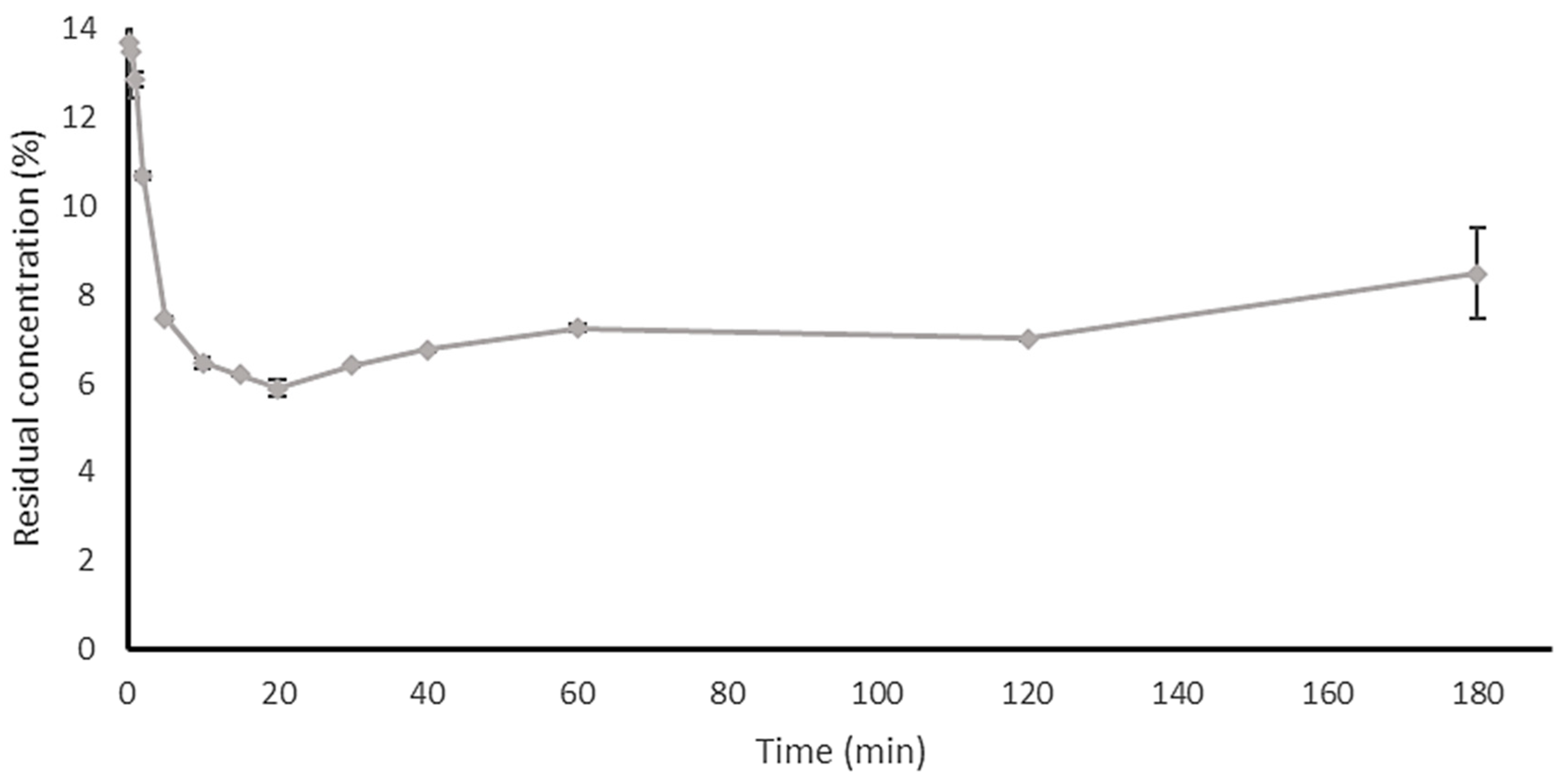
Time-course experiments for BPA and p-C conversion (Figure 4) show the majority of BPA transformation occurring almost instantaneously. At the first sampling point (0.2 min), BPA conversion had already reached approximately 98%. For p-C, Figure 4 shows that conversion was complete within 15 min using two 1.0 mM aliquots of H2O2.
First-order treatment of the data in Figure 3 and Figure 4 was used to calculate fast-phase (first two data points, except for o-C and m-C) and slow-phase half-lives for the substrates, as shown in Supplementary Information Figures S1 and S2. For fits using only the first two data points, the calculated rate constants are lower limits; hence, the derived half-lives are upper limits. Phenol, for example, showed fast and slow half-lives of ≤0.186 min (Figure S1) and 14 min (Figure S2), respectively.
Among the cresols, only p-C exhibited efficient removal by the initial 1.0 mM H2O2 (84% conversion at 5 min). An additional time-course experiment for p-C at 1.5 mM H2O2 (Figure 5) gave 93% conversion within 5 min (note that the first data point is at 10 s, showing 14% residual p-C).
In Figure S3, the first-order fit using the first two data points gives p-C’s initial conversion half-life as ≤0.05 min, less than half that calculated from Figure 5 at 1.0 mM H2O2.

3.5. Summary of Enzyme Initial Kinetic Efficiencies

Kinetic efficiencies, based on the half-lives calculated from the preceding time courses, are summarized in Table 3. Additionally, half-lives were normalized with respect to substrate concentration so that the slow-phase half-lives can be compared with those of several compounds treated by soybean peroxidase (Table S2). On that scale, the normalized half-life of BPA is very short, whereas those of the others fall in the moderate normalized half-life range, in order of decreasing reactivity p-C > o-C > m-C, Ph. From a radical-generation perspective, it is not surprising that p-C and BPA (also a para-alkyl-substituted phenol) are very reactive; however, from a radical-coupling perspective, steric consideration of the available ortho-carbon or ring-oxygen sites would suggest that coupling be preferentially O-C rather than C-C (O-O coupling product is not stable) [41]. Future work shall involve the detailed development of a kinetic mechanism using the existing pre-steady-state rate constants for the MnP cycle, as well as rate constants of Mn3+ non-enzymatic reaction with the phenols.

3.6. Polymerization Products

The oxidative transformation of phenolic compounds by MnP can result in the formation of a wide range of polymeric products through radical-mediated coupling reactions. The phenoxyl radicals undergo C–C or C–O bond formation with ortho-, para-orientation. The structure and complexity of the resulting polymers are influenced by the substituents on the parent molecules and the specific oxidation conditions applied. The peroxidase cycle proceeds until the oligomers reach their solubility limit [53].
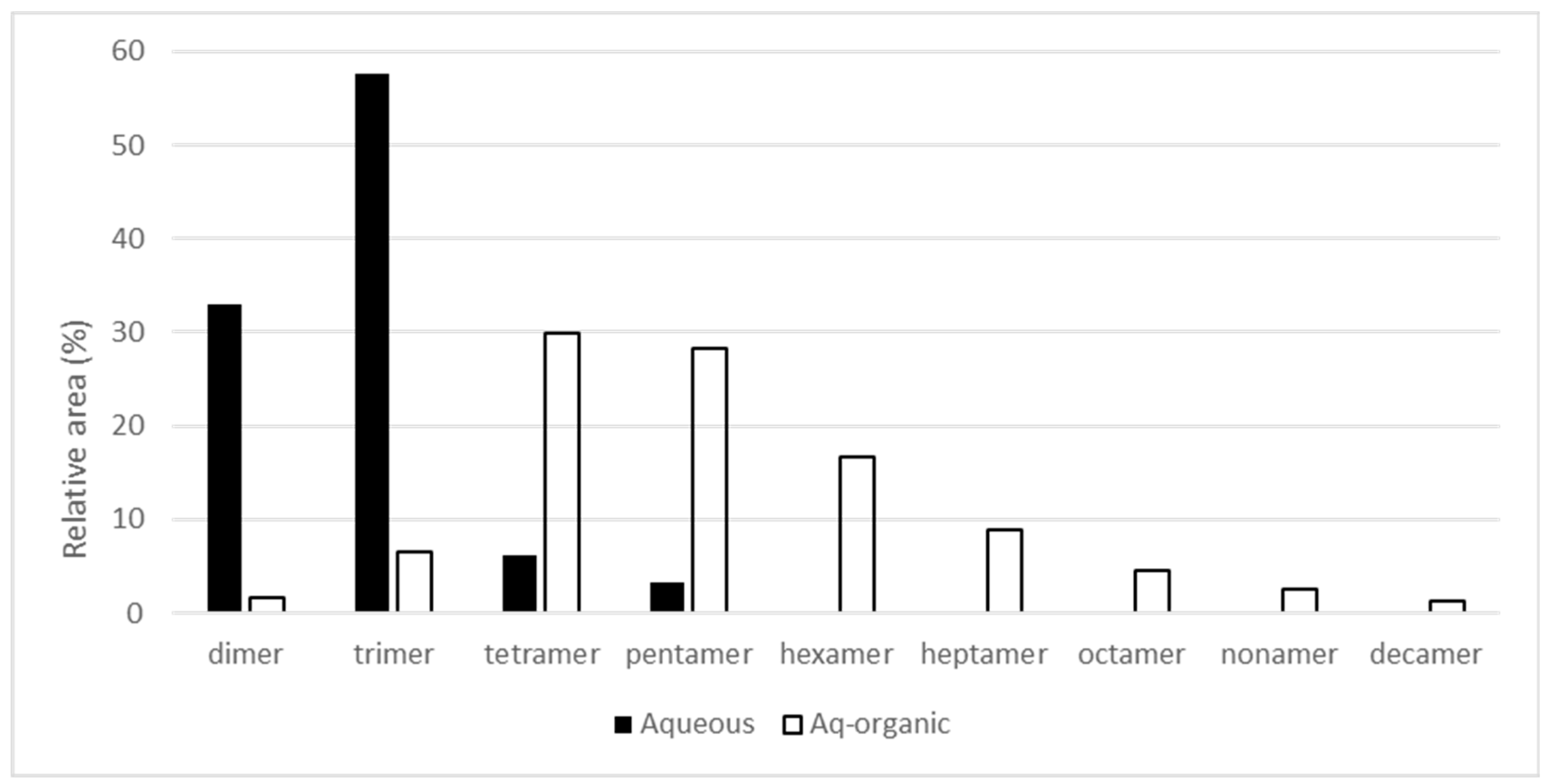
To identify and characterize these polymerization products, liquid chromatography coupled with high-resolution mass spectrometry (LC-HRMS) was used on filtered reaction mixtures following enzymatic treatment (up to pentadecamers were sought). However, the MS technique could not directly analyze the reaction solids. To confirm the formation of precipitated oligomers, a portion of the reaction suspension was diluted with acetonitrile (80% acetonitrile and 20% sample), allowed to stand with occasional vortexing for one hour, and then filtered. The premise was that some or all of the reaction solids would dissolve in aqueous acetonitrile, allowing the detection of higher oligomers in the MS analysis.
This approach enabled the separation and precise mass detection of both soluble oxidative oligomers and their precipitated forms, providing insights into the coupling pathways and transformation products. Table 4 shows MS analysis of the filtered samples, indicating the highest oligomers detected.
The table shows that this strategy was clearly effective, as evidenced by the presence of higher oligomer peaks in the solvent extract; moreover, all peaks in the extracts were 1–3 orders of magnitude more abundant as judged by the summed oligomeric peak integrals under the same instrumental conditions. Qualitatively, this indicates that concentrations in the aqueous reaction mixtures were much lower than in the respective extracts. Supplementary Table S3 gives the relative area distributions, and the one for phenol is plotted in Figure 6. The analogous figures for BPA and the cresols are given in Figures S4–S7. In all instances, these ratios shift toward higher oligomers in the solvent extract, confirming that higher-molecular-weight products were successfully re-dissolved and recovered from the precipitated fraction. The occurrence of oligomers is consistent with the oligomerization–precipitation pathway and with what was found with the cresols and soybean peroxidase [33], but it is at variance with a breakdown pathway suggested by others [54].
The presence and position of substituents on phenol molecules significantly influence polymerization patterns, affecting both the degree of polymerization and the solubility of the resulting products. Methyl, methoxy, and halogen substituents alter the reactivity and selectivity of oxidative polymerization, with steric and electronic effects playing key roles [55,56,57]. For example, halogenated phenols can undergo dehalogenation during polymerization, and their electron-withdrawing nature can promote the formation of specific oligomeric structures, such as precipitable tetramers [58]. Methoxy groups, being electron-donating, tend to allow for a broader distribution of oligomeric products and can influence the solubility and linearity of the resulting polymers [58,59,60]. The bulkiness and electronic properties of substituents at ortho- and para-positions are particularly important, as they can either hinder or facilitate coupling reactions, thus shaping the molecular weight and solubility of the polymers formed [41,55,57,59]. In the present work, alkyl groups in o-cresol, p-cresol, and BPA (para-substituents) exclude those ring carbons as coupling sites.
The toxicity of any soluble products after oligomerization-precipitation has not been determined here, but should be in future work, given the results of HRP-catalyzed treatment of several phenols [61] and reactive oxygen species-based oligomerization of 2,4-dimethylphenol [62]. Further details regarding the treatment efficiencies and initial kinetics of various other substrates are outlined in Tables S1 and S2 [33,63,64,65,66,67,68,69,70,71,72,73,74,75,76,77,78].

4. Conclusions

This study demonstrates that manganese peroxidase is highly effective for removing phenol, BPA, and cresol isomers from aqueous solutions under mild conditions. The main contributions supporting this statement are as follows: (a) Optimized enzyme activity and controlled hydrogen peroxide concentration were critical for sustaining catalytic performance and avoiding enzyme inactivation; more work is needed on peroxide dependence and the possible involvement of MnP Compound III, and on Mn2+ dependence. (b) Near-complete conversion of BPA and p-C was achieved within short reaction times, supported by rapid first-order kinetics. (c) Mass spectrometric analysis further confirmed the transformation of substrates into higher oligomers, consistent with a radical-driven oligomerization-precipitation mechanism. Overall, MnP provides a versatile, sustainable, and scalable strategy for phenolic wastewater remediation, overcoming many limitations of conventional treatment technologies. Its integration into engineered systems has strong potential to advance industrial and municipal wastewater management.

Supplementary Materials

The following supporting information can be downloaded at: https://www.mdpi.com/article/10.3390/app16115540/s1. Figure S1: First-order conversion of substrates at the beginning of the reaction—fast phase—presented in Figure 3; Figure S2: First-order conversion of substrates after 10 min of the reaction—slow phase—presented in Figure 3; Figure S3: First-order conversion of p-C presented in Figure 5 (1.5 mM H2O2); Figure S4: Oligomer distribution for Bisphenol A in aqueous reaction mixture and in aqueous-organic extract. Enzymatic reaction mixture was filtered directly for aqueous sample; for the extract, reaction mixture was diluted 4-fold with acetonitrile, vortexed for an hour, then filtered. MS peak areas (all isomers) are expressed as a% of the total set of areas (Table S3); Figure S5: Oligomer distribution for o-cresol in aqueous reaction mixture and in aqueous-organic extract. Enzymatic reaction mixture was filtered directly for aqueous sample; for the extract, reaction mixture was diluted 4-fold with acetonitrile, vortexed for an hour, then filtered. MS peak areas (all isomers) are expressed as a% of the total set of areas (Table S3); Figure S6: Oligomer distribution for m-cresol in aqueous reaction mixture and in aqueous-organic extract. Enzymatic reaction mixture was filtered directly for aqueous sample; for the extract, reaction mixture was diluted 4-fold with acetonitrile, vortexed for an hour, then filtered. MS peak areas (all isomers) are expressed as a% of the total set of areas (Table S3); Figure S7: Oligomer distribution for p-cresol in aqueous reaction mixture and in aqueous-organic extract. Enzymatic reaction mixture was filtered directly for aqueous sample; for the extract, reaction mixture was diluted 4-fold with acetonitrile, vortexed for an hour, then filtered. MS peak areas (all isomers) are expressed as a% of the total set of areas (Table S3); Table S1: Treatment efficiencies of various substrates with SBPa in synthetic wastewater; Table S2: Treatment initial kinetics of various SBPa substrates; Table S3: Relative area ratios (%) for oligomers in enzymatic reaction mixture, directly or in aqueous-organic extract.

Author Contributions

S.N., K.E.T., N.B. and E.E.H. contributed to the study conception, design and analysis. Material preparation and data collection were performed by S.N.; The first draft of the manuscript was written by S.N.; K.E.T., N.B. and E.E.H. commented on and contributed to subsequent versions of the manuscript. All authors have read and agreed to the published version of the manuscript.

Funding

Financial support from GreenLab, Inc., the Natural Sciences and Engineering Research Council of Canada (Discovery grant, RGPIN-2019-04426, to N. Biswas), and the University of Windsor (graduate assistantship to S. Narimannejad) is gratefully acknowledged.

Institutional Review Board Statement

Not applicable.

Informed Consent Statement

Not applicable.

Data Availability Statement

The original contributions presented in this study are included in the article/Supplementary Materials. Further inquiries can be directed to the corresponding authors.

Acknowledgments

GreenLab, Inc. is thanked for donation of the MnP used in this study.

Conflicts of Interest

Nihar Biswas and Keith E. Taylor declare no relevant financial or non-financial competing interests. Samira Narimannejad and Elizabeth E. Hood are co-applicants on World/US Patent application PCT/US2024/056724, entitled “Compositions and methods for degradation of pollutants by plant-produced manganese peroxidase”. Elizabeth E. Hood is a shareholder in GreenLab, Inc. and in Hood BioSolutions, LLC.

References

  1. Duan, W.; Meng, F.; Cui, H.; Lin, Y.; Wang, G.; Wu, J. Ecotoxicity of phenol and cresols to aquatic organisms: A review. Ecotoxicol. Environ. Saf. 2018, 157, 441–456. [Google Scholar] [CrossRef] [PubMed]
  2. Sas, O.G.; Castro, M.; Domínguez, Á.; González, B. Removing phenolic pollutants using deep eutectic solvents. Sep. Purif. Technol. 2019, 227, 115703. [Google Scholar] [CrossRef]
  3. Del Olmo, M.; Diez, C.; Molina, A.; De Orbe, I.; Vilchez, J. Resolution of phenol, o-cresol, m-cresol and p-cresol mixtures by excitation fluorescence using partial least-squares (PLS) multivariate calibration. Anal. Chim. Acta 1996, 335, 23–33. [Google Scholar] [CrossRef]
  4. Tumu, K.; Vorst, K.; Curtzwiler, G. Endocrine modulating chemicals in food packaging: A review of phthalates and bisphenols. Compr. Rev. Food Sci. Food Saf. 2023, 22, 1337–1359. [Google Scholar] [CrossRef]
  5. U.S. Department of Health and Human Service. Toxicological Profile for Phenol. 2008. Available online: https://www.atsdr.cdc.gov/toxprofiles/tp115.pdf?utm_source.com (accessed on 9 May 2026).
  6. EPA. TRI Basic Data Files Documentation. 2018. Available online: https://nepis.epa.gov/Exe/ZyPDF.cgi/P100W681.PDF?Dockey=P100W681.PDF (accessed on 9 May 2026).
  7. EPA. Bisphenol A Action Plan. 2010. Available online: https://www.epa.gov/sites/default/files/2015-09/documents/bpa_action_plan.pdf (accessed on 9 May 2026).
  8. Thompson, D.; Perera, K.; Fisher, R.; Brendel, K. Cresol isomers: Comparison of toxic potency in rat liver slices. Toxicol. Appl. Pharmacol. 1994, 125, 51–58. [Google Scholar] [CrossRef]
  9. Devillers, J. Acute toxicity of cresols, xylenols, and trimethylphenols to daphnia magna straus 1820. Sci. Total Environ. 1988, 76, 79–83. [Google Scholar] [CrossRef] [PubMed]
  10. Flint, S.; Markle, T.; Thompson, S.; Wallace, E. Bisphenol A exposure, effects, and policy: A wildlife perspective. J. Environ. Manag. 2012, 104, 19–34. [Google Scholar] [CrossRef]
  11. Chen, Z.; Li, X.; Gao, J.; Liu, Y.; Zhang, N.; Guo, Y.; Wang, Z.; Dong, Z. Reproductive toxic effects of chronic exposure to bisphenol A and its analogues in marine medaka (Oryzias melastigma). Aquat. Toxicol. 2024, 271, 106927. [Google Scholar] [CrossRef]
  12. John, M.; Okhyun, L.; Maciej, T.; Arthur, D.; Tetsuhiro, K. Acute Toxicity, Teratogenic, and Estrogenic Effects of Bisphenol A and Its Alternative Replacements Bisphenol S, Bisphenol F, and Bisphenol AF in Zebrafish Embryo-Larvae. Environ. Sci. Technol. 2017, 51, 12796–12805. [Google Scholar] [CrossRef]
  13. González-Parra, E.; Herrero, J.A.; Elewa, U.; Bosch, R.J.; Arduán, A.O.; Egido, J. Bisphenol a in chronic kidney disease. Int. J. Nephrol. 2013, 2013, 437857. [Google Scholar] [CrossRef]
  14. Peng, B.; Zhao, H.; Keerthisinghe, T.P.; Yu, Y.; Chen, D.; Huang, Y.; Fang, M. Gut microbial metabolite p-cresol alters biotransformation of bisphenol A: Enzyme competition or gene induction? J. Hazard. Mater. 2022, 426, 128093. [Google Scholar] [CrossRef]
  15. Long, F.; Ren, Y.; Bi, F.; Wu, Z.; Zhang, H.; Li, J.; Gao, R.; Liu, Z.; Li, H. Contamination characterization, toxicological properties, and health risk assessment of bisphenols in multiple media: Current research status and future perspectives. Toxics 2025, 13, 109. [Google Scholar] [CrossRef] [PubMed]
  16. Government of Canada. Bisphenol A in the Canadian Environment; 2020. Available online: https://www.canada.ca/content/dam/eccc/documents/pdf/pded/bpa-canadian-environment/BPA%20Canadian%20Environment.pdf (accessed on 9 May 2026).
  17. Canadian Council of Ministers of the Environment. Canadian Water Quality Guidelines for the Protection of Aquatic Life—Mono- and Dihydric Phenols. 1999. Available online: https://ccme.ca/en/res/phenols-en-canadian-water-quality-guidelines-for-the-protection-of-aquatic-life.pdf (accessed on 9 May 2026).
  18. EurEau. Bisphenol-A and Drinking Water. 2025. Available online: https://www.waternewseurope.com/eureau-position-paper-bisphenol-a-and-drinking-water/ (accessed on 9 May 2026).
  19. Huang, J. Treatment of phenol and p-cresol in aqueous solution by adsorption using a carbonylated hypercrosslinked polymeric adsorbent. J. Hazard. Mater. 2009, 168, 1028–1034. [Google Scholar] [CrossRef]
  20. Sellami, K.; Couvert, A.; Nasrallah, N.; Maachi, R.; Tandjaoui, N.; Abouseoud, M.; Amrane, A. Bio-based and cost effective method for phenolic compounds removal using cross-linked enzyme aggregates. J. Hazard. Mater. 2021, 403, 124021. [Google Scholar] [CrossRef] [PubMed]
  21. Veeresh, G.S.; Kumar, P.; Mehrotra, I. Treatment of phenol and cresols in upflow anaerobic sludge blanket (UASB) process: A review. Water Res. 2005, 39, 154–170. [Google Scholar] [CrossRef]
  22. Xu, D.-Y.; Yang, Z. Cross-linked tyrosinase aggregates for elimination of phenolic compounds from wastewater. Chemosphere 2013, 92, 391–398. [Google Scholar] [CrossRef]
  23. Godiya, C.B.; Park, B.J. Removal of bisphenol A from wastewater by physical, chemical and biological remediation techniques. A review. Environ. Chem. Lett. 2022, 20, 1801–1837. [Google Scholar] [CrossRef]
  24. Jaiswal, V.K.; Gupta, A.D.; Verma, V.; Singh, R.S. Degradation of p-cresol in the presence of UV light driven in an integrated system containing photocatalytic and packed bed biofilm reactor. Bioresour. Technol. 2023, 387, 129706. [Google Scholar] [CrossRef]
  25. Jaiswal, V.K.; Sonwani, R.K.; Singh, R.S. Construction and performance assessment of recirculating packed bed biofilm reactor (RPBBR) for effective biodegradation of p-cresol from wastewater. Bioresour. Technol. 2023, 384, 129372. [Google Scholar] [CrossRef] [PubMed]
  26. Alshabib, M.; Onaizi, S.A. A review on phenolic wastewater remediation using homogeneous and heterogeneous enzymatic processes: Current status and potential challenges. Sep. Purif. Technol. 2019, 219, 186–207. [Google Scholar] [CrossRef]
  27. Wang, M.; Chen, Y.; Kickhoefer, V.A.; Rome, L.H.; Allard, P.; Mahendra, S. A vault-encapsulated enzyme approach for efficient degradation and detoxification of bisphenol A and its analogues. ACS Sustain. Chem. Eng. 2019, 7, 5808–5817. [Google Scholar] [CrossRef] [PubMed]
  28. Adesina, O.B.; William, C.; Oke, E.I. Evolution in water treatment: Exploring traditional self-purification methods and emerging technologies for drinking water and wastewater treatment: A review. World News Nat. Sci. 2024, 53, 169–185. [Google Scholar]
  29. Jun, L.Y.; Yon, L.S.; Mubarak, N.; Bing, C.H.; Pan, S.; Danquah, M.K.; Abdullah, E.; Khalid, M. An overview of immobilized enzyme technologies for dye and phenolic removal from wastewater. J. Environ. Chem. Eng. 2019, 7, 102961. [Google Scholar] [CrossRef]
  30. Salehi, S.; Abdollahi, K.; Panahi, R.; Rahmanian, N.; Shakeri, M.; Mokhtarani, B. Applications of biocatalysts for sustainable oxidation of phenolic pollutants: A review. Sustainability 2021, 13, 8620. [Google Scholar] [CrossRef]
  31. Rea, V.S.G.; Bueno, B.E.; Cerqueda-García, D.; Sierra, J.D.M.; Spanjers, H.; van Lier, J.B. Degradation of p-cresol, resorcinol, and phenol in anaerobic membrane bioreactors under saline conditions. Chem. Eng. J. 2022, 430, 132672. [Google Scholar] [CrossRef]
  32. Feng, C.-Y.; Wang, K.-H.; Li, S.; Liu, D.-S.; Yang, Z. Use of tyrosinase-inorganic salt hybrid nanoflowers and tyrosinase-MOF hybrid composites for elimination of phenolic pollutants from industrial wastewaters. Chemosphere 2023, 317, 137933. [Google Scholar] [CrossRef] [PubMed]
  33. Haghighatnama, M.; Narimannejad, S.; Biswas, N.; Taylor, K. Biocatalytic treatment of cresols in aqueous solution with soybean peroxidase. RSC Adv. 2026, 16, 5079–5087. [Google Scholar] [CrossRef]
  34. Wang, H.; Glasgow, A.; Wei, H. Probing early-stage polymerization of chlorophenols in advanced oxidation processes. Environ. Sci. Technol. Lett. 2025, 13, 144–150. [Google Scholar] [CrossRef]
  35. Yin, Q.; Dai, W.; Liu, C.; Sun, K.; Zhou, G.; Si, Y. Fungal enzyme-driven precipitation polymerization: Trapping estrogenic chemicals to block vegetable contamination. J. Hazard. Mater. 2026, 505, 141547. [Google Scholar] [CrossRef]
  36. Qian, J.; Zhang, X.; Jia, Y.; Xu, H.; Pan, B. Oxidative polymerization in water treatment: Chemical fundamentals and future perspectives. Environ. Sci. Technol. 2025, 59, 1060–1079. [Google Scholar] [CrossRef] [PubMed]
  37. Zhang, Y.-J.; Yu, H.-Q. Mineralization or polymerization: That is the question. Environ. Sci. Technol. 2024, 58, 11205–11208. [Google Scholar] [CrossRef] [PubMed]
  38. Yadav, M.; Rai, N.; Yadav, H.S. The role of peroxidase in the enzymatic oxidation of phenolic compounds to quinones from Luffa aegyptiaca (gourd) fruit juice. Green Chem. Lett. Rev. 2017, 10, 154–161. [Google Scholar] [CrossRef]
  39. Wariishi, H.; Dunford, H.B.; MacDonald, I.; Gold, M.H. Manganese peroxidase from the lignin-degrading basidiomycete Phanerochaete chrysosporium: Transient state kinetics and reaction mechanism. J. Biol. Chem. 1989, 264, 3335–3340. [Google Scholar] [CrossRef]
  40. Wariishi, H.; Valli, K.; Gold, M.H. Manganese (II) oxidation by manganese peroxidase from the basidiomycete Phanerochaete chrysosporium. Kinetic mechanism and role of chelators. J. Biol. Chem. 1992, 267, 23688–23695. [Google Scholar] [CrossRef]
  41. Uyama, H. Synthesis of poly (aromatic) s I: Oxidoreductase as catalyst. In Enzymatic Polymerization Towards Green Polymer Chemistry; Springer: Berlin/Heidelberg, Germany, 2019; pp. 267–305. [Google Scholar]
  42. Singh, A.; Sharma, R.; Rajput, V.D.; Ghazaryan, K.; Minkina, T.; Mohammad Said Al-Tawaha, A.R.; Agrawal, S.; Varshney, A.; Al-Tawaha, A.R.; Karnwal, A. Microbial Manganese Peroxidase: Ligninolytic Enzymes for Bioremediation. In Microbial Applications for Environmental Sustainability; Springer: Berlin/Heidelberg, Germany, 2024; pp. 189–199. [Google Scholar]
  43. Clough, R.C.; Pappu, K.; Thompson, K.; Beifuss, K.; Lane, J.; Delaney, D.E.; Harkey, R.; Drees, C.; Howard, J.A.; Hood, E.E. Manganese peroxidase from the white-rot fungus Phanerochaete chrysosporium is enzymatically active and accumulates to high levels in transgenic maize seed. Plant Biotechnol. J. 2006, 4, 53–62. [Google Scholar] [CrossRef]
  44. Sundaramoorthy, M.; Gold, M.H.; Poulos, T.L. Ultrahigh (0.93 Å) resolution structure of manganese peroxidase from Phanerochaete chrysosporium: Implications for the catalytic mechanism. J. Inorg. Biochem. 2010, 104, 683–690. [Google Scholar] [CrossRef]
  45. Hood, E.E.; Narimannejad, S. Compositions and Methods for Degradation of Pollutants by Plant-Produced Manganese Peroxidase. U.S. Patent Application WO2025111370A1, 22 May 2025. [Google Scholar]
  46. Champagne, P.-P.; Ramsay, J.A. Contribution of manganese peroxidase and laccase to dye decoloration by trametes versicolor. Appl. Microbiol. Biotechnol. 2005, 69, 276–285. [Google Scholar] [CrossRef]
  47. Rekik, H.; Jaouadi, N.Z.; Bouacem, K.; Zenati, B.; Kourdali, S.; Badis, A.; Annane, R.; Bouanane-Darenfed, A.; Bejar, S.; Jaouadi, B. Physical and enzymatic properties of a new manganese peroxidase from the white-rot fungus Trametes pubescens strain i8 for lignin biodegradation and textile-dyes biodecolorization. Int. J. Biol. Macromol. 2019, 125, 514–525. [Google Scholar] [CrossRef]
  48. Wilberg, K.d.Q.; Nunes, D.G.; Rubio, J. Removal of phenol by enzymatic oxidation and flotation. Braz. J. Chem. Eng. 2000, 17, 907–914. [Google Scholar] [CrossRef]
  49. Wright, H.; Nicell, J.A. Characterization of soybean peroxidase for the treatment of aqueous phenols. Bioresour. Technol. 1999, 70, 69–79. [Google Scholar] [CrossRef]
  50. Timofeevski, S.L.; Reading, N.S.; Aust, S.D. Mechanisms for protection against inactivation of manganese peroxidase by hydrogen peroxide. Arch. Biochem. Biophys. 1998, 356, 287–295. [Google Scholar] [CrossRef] [PubMed]
  51. Wariishi, H.; Akileswaran, L.; Gold, M.H. Manganese peroxidase from the basidiomycete Phanerochaete chrysosporium: Spectral characterization of the oxidized states and the catalytic cycle. Biochemistry 1988, 27, 5365–5370. [Google Scholar] [CrossRef] [PubMed]
  52. Aguirre Saltos, M.B.; Duque, E.; Hood, N.; Hood, E.E. Fabric treatments with recombinant enzymes from the corn production system. Ind. Biotechnol. 2026; in press. [CrossRef]
  53. Xu, F.; Koch, D.E.; Kong, I.C.; Hunter, R.P.; Bhandari, A. Peroxidase-mediated oxidative coupling of 1-naphthol: Characterization of polymerization products. Water Res. 2005, 39, 2358–2368. [Google Scholar] [CrossRef]
  54. Saroj, S.; Agarwal, P.; Dubey, S.; Singh, R. Manganese peroxidases: Molecular diversity, heterologous expression, and applications. In Advances in Enzyme Biotechnology; Springer: Berlin/Heidelberg, Germany, 2013; pp. 67–87. [Google Scholar]
  55. Higashimura, H.; Fujisawa, K.; Moro-oka, Y.; Namekawa, S.; Kubota, M.; Shiga, A.; Uyama, H.; Kobayashi, S. “Radical-controlled” oxidative polymerization of phenols. Substituent effect of phenol monomers on the reaction rate. Polym. Adv. Technol. 2000, 11, 733–738. [Google Scholar] [CrossRef]
  56. Ohashi, S.; Iguchi, D.; Heyl, T.R.; Froimowicz, P.; Ishida, H. Quantitative studies on the p-substituent effect of the phenolic component on the polymerization of benzoxazines. Polym. Chem. 2018, 9, 4194–4204. [Google Scholar] [CrossRef]
  57. Tonami, H.; Uyama, H.; Kobayashi, S.; Kubota, M. Peroxidase-catalyzed oxidative polymerization of m-substituted phenol derivatives. Macromol. Chem. Phys. 1999, 200, 2365–2371. [Google Scholar] [CrossRef]
  58. Dec, J.; Haider, K.; Bollag, J.-M. Release of substituents from phenolic compounds during oxidative coupling reactions. Chemosphere 2003, 52, 549–556. [Google Scholar] [CrossRef]
  59. Mita, N.; Tawaki, S.-i.; Uyama, H.; Kobayashi, S. Structural control in enzymatic oxidative polymerization of phenols with varying the solvent and substituent nature. Chem. Lett. 2002, 31, 402–403. [Google Scholar] [CrossRef]
  60. Takechi, S.; Oshima, T.; Nakano, A.; Higashimura, H. Enzyme model-catalyzed oxidative polymerization of 5-cyano-2-methoxyphenol, a new phenolic monomer with cyano substituent. Chem. Lett. 2024, 53, upae007. [Google Scholar] [CrossRef]
  61. Aitken, M.D.; Massey, I.J.; Chen, T.; Heck, P.E. Characterization of reaction products from the enzyme catalyzed oxidation of phenolic pollutants. Water Res. 1994, 28, 1879–1889. [Google Scholar] [CrossRef]
  62. Zhang, Z.; Li, L.; Dong, H.; Pei, Z. Aqueous transformation of phenolic pollutants on biochar via dissolved oxygen-driven polymerization. Water Res. 2025, 290, 125020. [Google Scholar] [CrossRef]
  63. Caza, N.; Bewtra, J.; Biswas, N.; Taylor, K. Removal of phenolic compounds from synthetic wastewater using soybean peroxidase. Water Res. 1999, 33, 3012–3018. [Google Scholar] [CrossRef]
  64. Cordova Villegas, L.G.; Mazloum, S.; Taylor, K.E.; Biswas, N. Soybean Peroxidase-Catalyzed Treatment of Azo Dyes with or without Fe° Pretreatment: Villegas et al. Water Environ. Res. 2018, 90, 675–684. [Google Scholar] [CrossRef] [PubMed]
  65. Cordova-Villegas, L.G.; Cordova-Villegas, A.Y.; Taylor, K.E.; Biswas, N. Response surface methodology for optimization of enzyme-catalyzed azo dye decolorization. J. Environ. Eng. 2019, 145, 04019013. [Google Scholar] [CrossRef]
  66. Kaur, A.; Taylor, K.E.; Biswas, N. Soybean peroxidase-catalyzed degradation of a sulfonated dye and its azo-cleavage product. J. Chem. Technol. Biotechnol. 2021, 96, 423–430. [Google Scholar] [CrossRef]
  67. Li, J.; Peng, J.; Zhang, Y.; Ji, Y.; Shi, H.; Mao, L.; Gao, S. Removal of triclosan via peroxidases-mediated reactions in water: Reaction kinetics, products and detoxification. J. Hazard. Mater. 2016, 310, 152–160. [Google Scholar] [CrossRef]
  68. Mashhadi, N.; Taylor, K.E.; Biswas, N.; Meister, P.; Gauld, J.W. Oligomerization of 3-substituted quinolines by catalytic activity of soybean peroxidase as a wastewater treatment. Product formation and computational studies. Chem. Eng. J. 2019, 364, 340–348. [Google Scholar] [CrossRef]
  69. Mashhadi, N.; Taylor, K.E.; Biswas, N.; Meister, P.; Gauld, J.W. Biocatalytic oligomerization of azoles; experimental and computational studies. Environ. Sci. Water Res. Technol. 2021, 7, 1103–1113. [Google Scholar] [CrossRef]
  70. Mashhadi, N.; Taylor, K.E.; Jimenez, N.; Varghese, S.T.; Levi, Y.; Lonergan, C.; Lebeau, E.; Lamé, M.; Lard, E.; Biswas, N. Removal of selected pharmaceuticals and personal care products from wastewater using soybean peroxidase. Environ. Manag. 2019, 63, 408–415. [Google Scholar] [CrossRef]
  71. Mukherjee, D.; Bhattacharya, S.; Taylor, K.E.; Biswas, N. Enzymatic treatment for removal of hazardous aqueous arylamines, 4,4′-methylenedianiline and 4,4′-thiodianiline. Chemosphere 2019, 235, 365–372. [Google Scholar] [CrossRef]
  72. Mukherjee, D.; Taylor, K.; Biswas, N. Soybean peroxidase-induced treatment of dye-derived arylamines in water. Water Air Soil Pollut. 2018, 229, 283. [Google Scholar] [CrossRef]
  73. Mukherjee, D.; Taylor, K.; Biswas, N. Soybean peroxidase-catalyzed oligomerization of arylamines in water: Optimization, kinetics, products and cost. J. Environ. Chem. Eng. 2020, 8, 103871. [Google Scholar] [CrossRef]
  74. Narimannejad, S. Treatment of Synthetic Wastewater Catalyzed by Manganese Peroxidase and Soybean Peroxidase. Ph.D. Thesis, University of Windsor, Windsor, ON, Canada, 2025. [Google Scholar]
  75. Pishyar, S.; Narimannejad, S.; Taylor, K.E.; Biswas, N. Enzymatic Removal of Diclofenac and Aceclofenac from Water by Soybean Peroxidase. Molecules 2025, 30, 1817. [Google Scholar] [CrossRef]
  76. Sharifzadeh, M.; Narimannejad, S.; Taylor, K.E.; Biswas, N. Enzymatic removal of the sulfa drugs sulfamethoxazole and sulfamerazine from synthetic wastewater by soybean peroxidase. Environ. Sci. Pollut. Res. 2024, 31, 64760–64771. [Google Scholar] [CrossRef] [PubMed]
  77. Zhang, X. Enzymatic Treatment of Selected Pesticides in Aqueous System. Ph.D. Thesis, University of Windsor, Windsor, ON, Canada, 2019. [Google Scholar]
  78. Ziayee Bideh, N.; Mashhadi, N.; Taylor, K.E.; Biswas, N. Elimination of selected heterocyclic aromatic emerging contaminants from water using soybean peroxidase. Environ. Sci. Pollut. Res. 2021, 28, 37570–37579. [Google Scholar] [CrossRef] [PubMed]
Figure 1. MnP optimization. Conditions: 1.0 mM Ph, o-C, m-C, p-C, or 0.5 mM BPA; 7 mM hydrogen peroxide, 40 mM buffer, pH 4.5, 0.2 mM manganese sulfate, incremental addition of hydrogen peroxide, 3 h reaction, room temperature, triplicate experiments (error bars, if not visible are smaller than the symbols), analysis by HPLC.
Applsci 16 05540 g001
Figure 2. Hydrogen peroxide optimization. Conditions: using either 1.0 mM Ph, p-C, m-C, o-C, or 0.5 mM BPA, optimal U/mL MnP, except for BPA which is 0.2 U/mL, not 0.3; 40 mM buffer, pH 4.5, 0.2 mM manganese sulfate, hydrogen peroxide added as a single aliquot at the start, 3 h reaction, room temperature, triplicate experiments (error bars, if not visible are smaller than the symbols), analysis by HPLC.
Applsci 16 05540 g002
Figure 3. Hydrogen peroxide optimization; Conditions: using either 1.0 mM Ph, p-C, m-C, o-C, or 0.5 mM BPA, optimal U/mL MnP (0.3 U/mL for BPA), 7 mM hydrogen peroxide; 40 mM buffer, pH 4.5, 0.2 mM manganese sulfate, incremental addition of hydrogen peroxide, 3 h reaction, room temperature, triplicate experiments (error bars, if not visible are smaller than the symbols), analysis by HPLC.
Applsci 16 05540 g003
Figure 4. Time dependences of conversion of p-C and BPA. Conditions: 1.0 mM p-C or 0.5 mM BPA, optimal U/mL MnP, incremental addition of 2 mM and 1 mM hydrogen peroxide, respectively; 40 mM buffer, pH 4.5, 0.2 mM manganese sulfate, 3 h reaction, room temperature, triplicate experiments (error bars, if not visible are smaller than the symbols), analysis by HPLC.
Applsci 16 05540 g004
Figure 5. Time dependence of conversion of p-C. Conditions: 1.0 mM p-C, 0.7 U/mL MnP, with 1.5 mM H2O2 added as a single aliquot at the start; 40 mM buffer, pH 4.5, 0.2 mM manganese sulfate, 3 h reaction, room temperature, triplicate experiments (error bars, if not visible, are smaller than the symbols), analysis by HPLC.
Applsci 16 05540 g005
Figure 6. Oligomer distribution for phenol in aqueous reaction mixture and in aqueous-organic extract. The enzymatic reaction mixture was filtered directly for the aqueous sample; for the extract, the reaction mixture was diluted 4-fold with acetonitrile, vortexed for an hour, then filtered. MS peak areas (all isomers) are expressed as a % of the total set of areas (Table S3).
Applsci 16 05540 g006
Table 1. HPLC conditions for substrates run under isocratic elution.
SubstrateMobile Phase RatioFlow mL/minλmax nm
Pump APump B
Phenol65% formic acid (0.1%)35% ACN1.0270
Bisphenol A50% formic acid (0.1%)50% ACN + formic acid (0.1%)1.0275
p-cresol50% formic acid (0.1%)50% ACN + formic acid (0.1%)1.0275
m-cresol50% formic acid (0.1%)50% ACN1.0270
o-cresol50% formic acid (0.1%)50% ACN1.0270
Table 2. Optimized conditions—MnP-catalyzed removal.
Compound (mM)MnP (U/mL)H2O2
Single Aliquot
(mM)
Remaining
%
Time (min)H2O2 Stepwise (mM)Remaining
%
Time (min)
Phenol
(1.0)
0.737961807370
Bisphenol A (0.5)0.20 & 0.30 *0.75160.2120.2
p-cresol (1.0)0.701.5752015
m-cresol (1.0)0.8071001807570
o-cresol (1.0)0.604401804140
* 0.2 U/mL corresponds to addition of a single H2O2 aliquot; 0.3 U/mL corresponds to stepwise H2O2 addition, wherein H2O2 was added to a total concentration of 7.0 mM, administered in 1.0 mM aliquots at 10 min intervals, for up to 60 min.
Table 3. Half-lives and normalized half-lives of various MnP substrates.
Compound (mM)MnP (U/mL)Rate Constant a (min−1)Normalized Rate Constant (min−1)Half-Life (min)Normalized Half-Life b
(min.U/mL)
Remaining
%
Phenol
(1.0)
0.73≥3.7
0.048
≥5.12
0.066
≤0.19
14
≤0.13
11
3
Bisphenol A (0.5)0.30≥23
- c
≥77
-
≤0.030
-
≤0.0090
-
2
-
p-cresol
(1.0)
0.70≥5.6 and ≥12 d
0.37 and 0.129
≥8.1 and ≥17
0.53 and 0.18
≤0.12 and ≤0.058
1.87 and 5.36
≤0.084 and ≤0.041
1.3 and 3.75
7 and 0
m-cresol
(1.0)
0.80-
0.054
-
0.065
-
13
-
11
-
5
o-cresol
(1.0)
0.60-
0.12
-
0.2
-
5.8
-
3.5
-
1
a Rate constant within either short reaction time (fast phase) or long reaction time (slow phase). b Half-lives were normalized by multiplying by substrate concentration. c Dashes (-) denote absence of the respective phase: upper, fast phase; lower, slow phase. d Rate constant when hydrogen peroxide was added initially as 1.0 (Figure S1) or 1.5 mM (Figure S3), respectively.
Table 4. Mass spectrometry analysis of filtered samples.
SampleAqueous aSolvent a
PhenolPhPentamerDecamer
Bisphenol ABPATrimerHexamer
o-cresolo-CTetramerDecamer
m-cresolm-CTetramerDecamer
p-cresolp-CHexamerOctamer
a Highest oligomers are given; relative LC–MS peak area ratios for dimer, trimer, tetramer, etc., were calculated and are given in Table S3. The sums of the oligomeric MS ion current areas (solvent:aqueous, pro-rated for dilution) for the samples as listed were 27, 88, 15, 329, and 14, respectively.
Disclaimer/Publisher’s Note: The statements, opinions and data contained in all publications are solely those of the individual author(s) and contributor(s) and not of MDPI and/or the editor(s). MDPI and/or the editor(s) disclaim responsibility for any injury to people or property resulting from any ideas, methods, instructions or products referred to in the content.