Scour-Dependent Fragility of Railway Bridges: From Component Response to System Reliability Under Seismic Loading




Abstract
1. Introduction
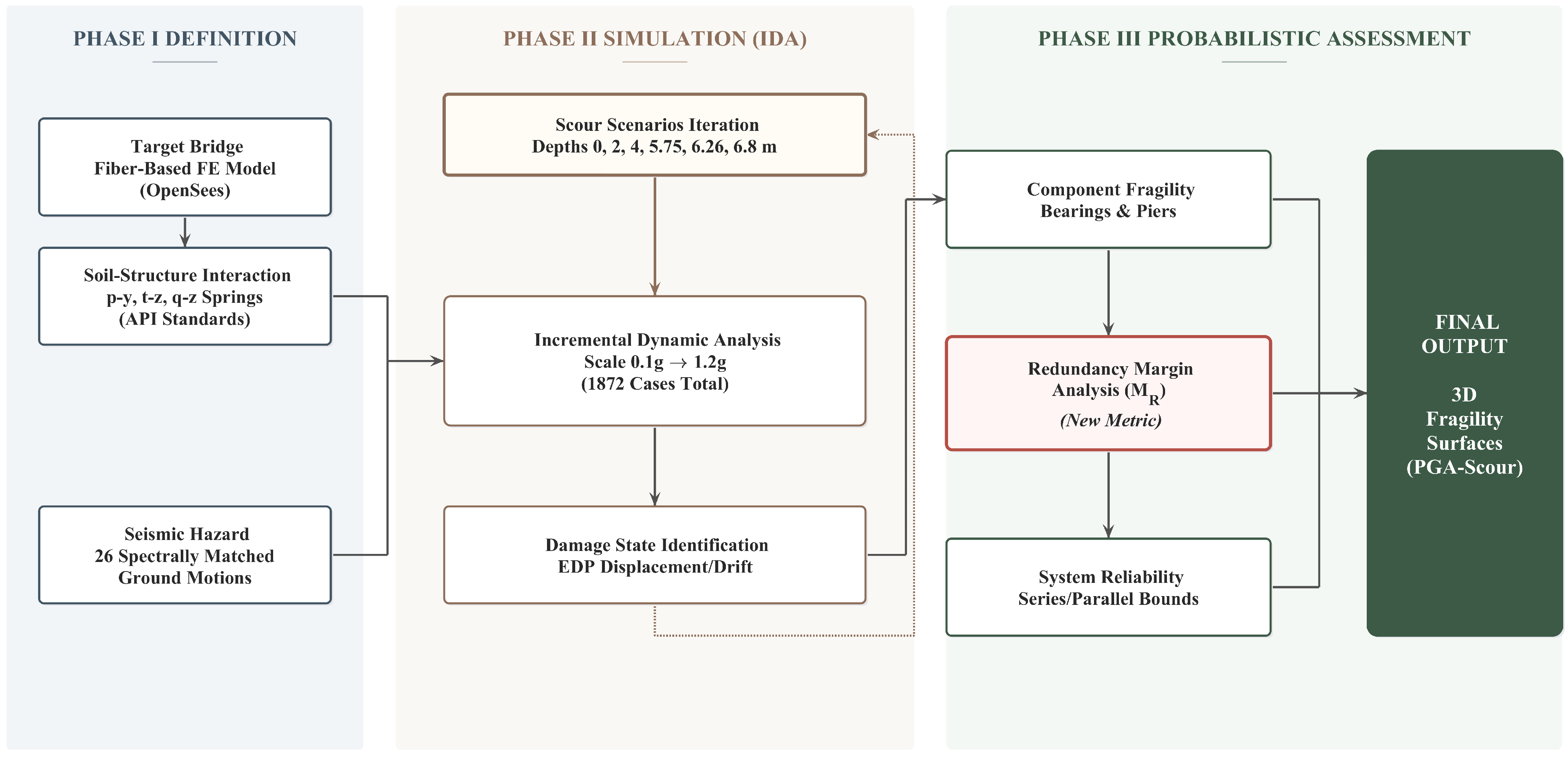
2. Methods
2.1. Scour Hazard
2.2. Fragility Analysis Method
2.3. System-Level Seismic Fragility Assessment
3. Numerical Modelling and Analysis Procedures
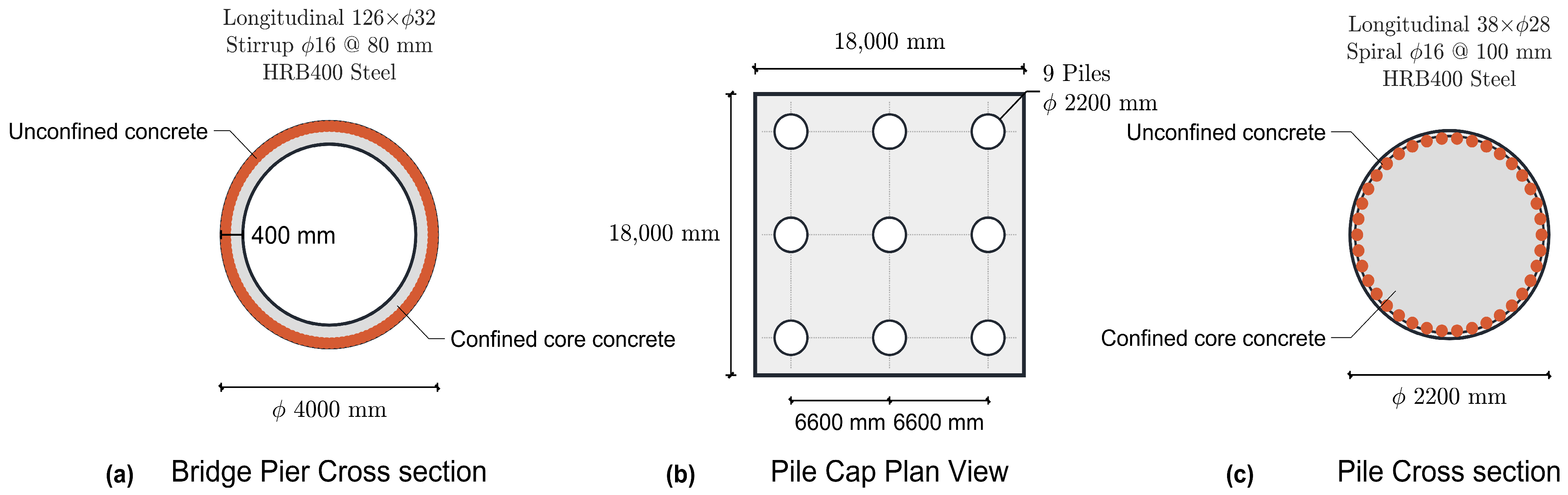
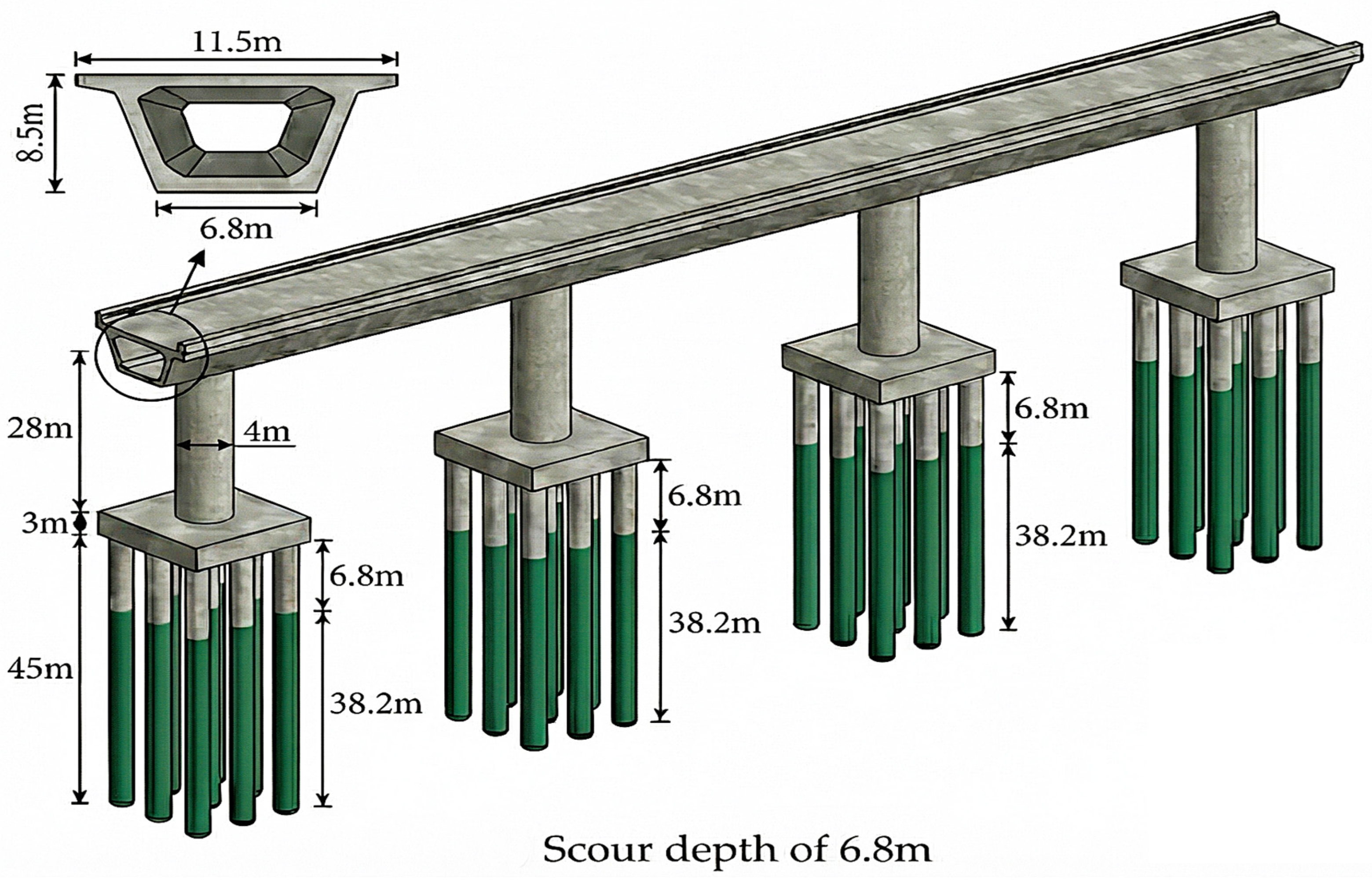
3.1. Bridge Description
3.2. Finite Element Modelling
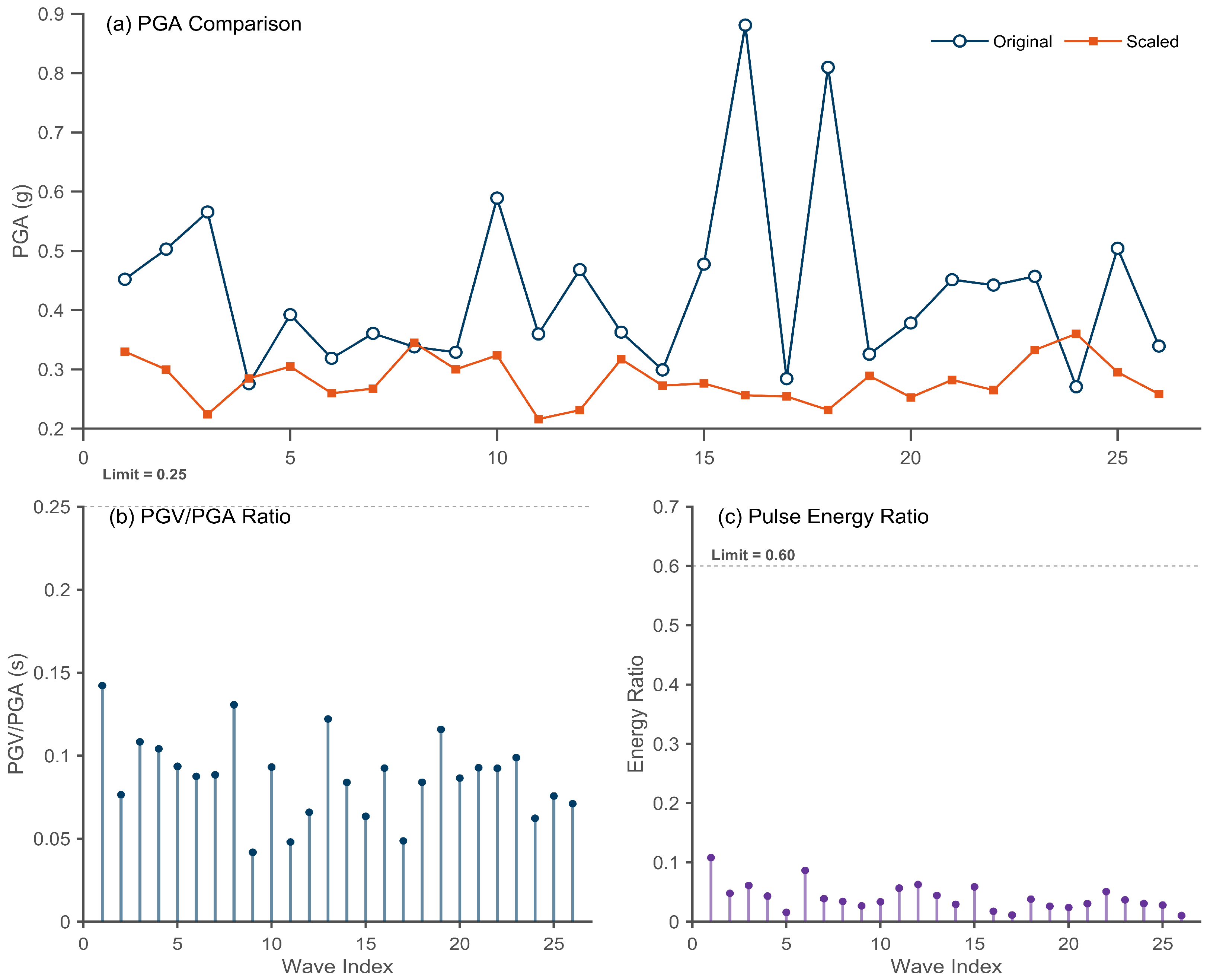
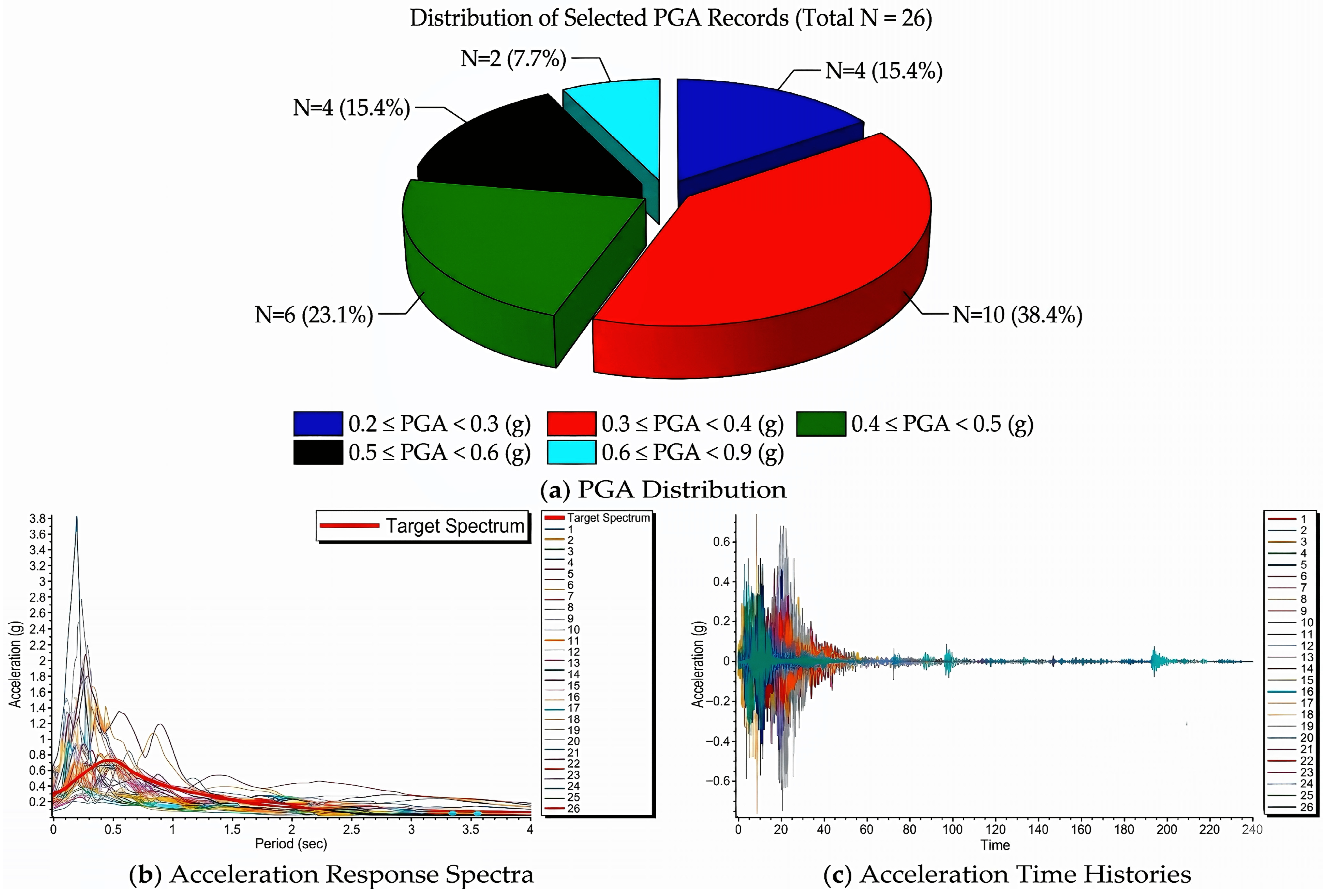
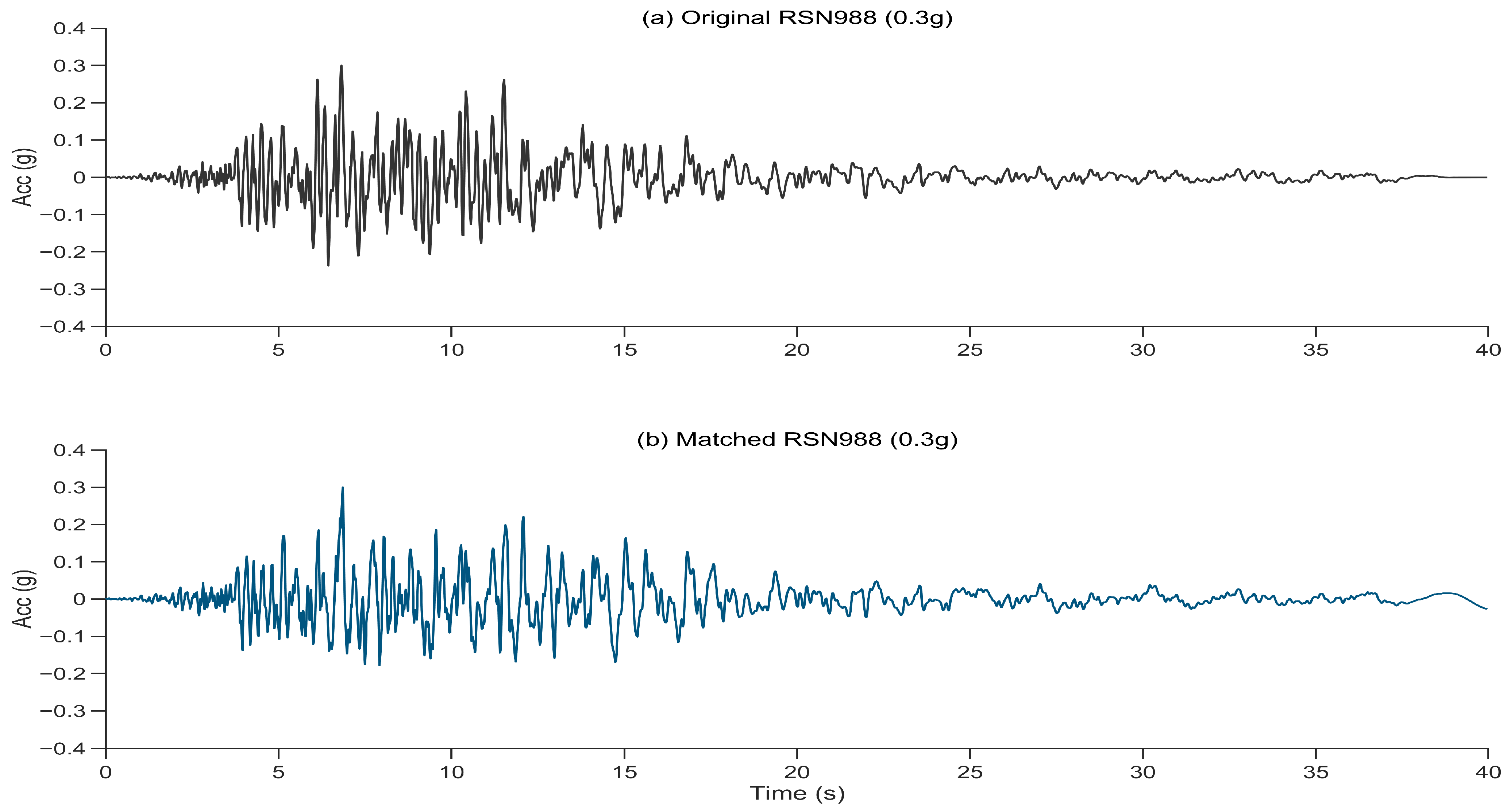
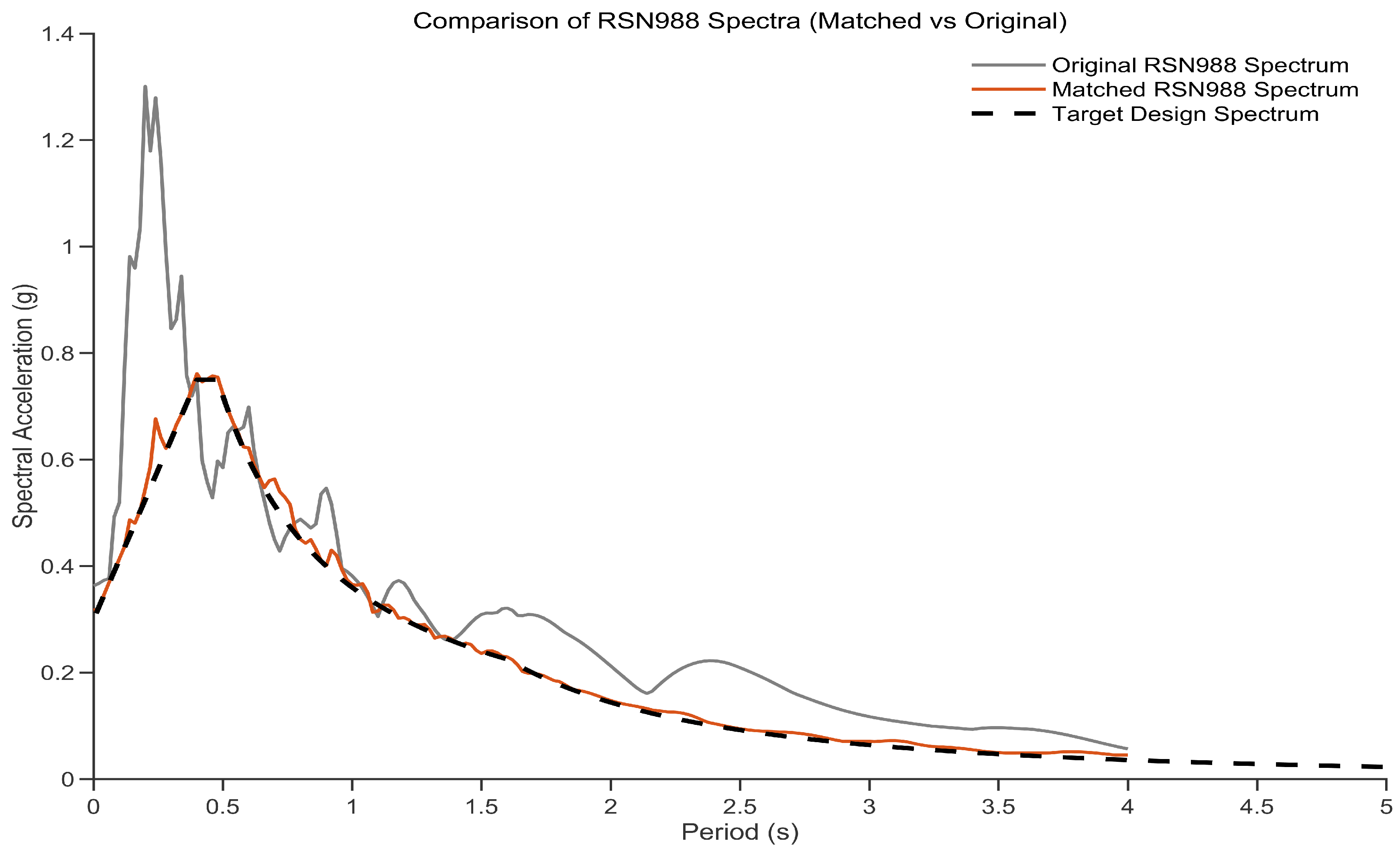
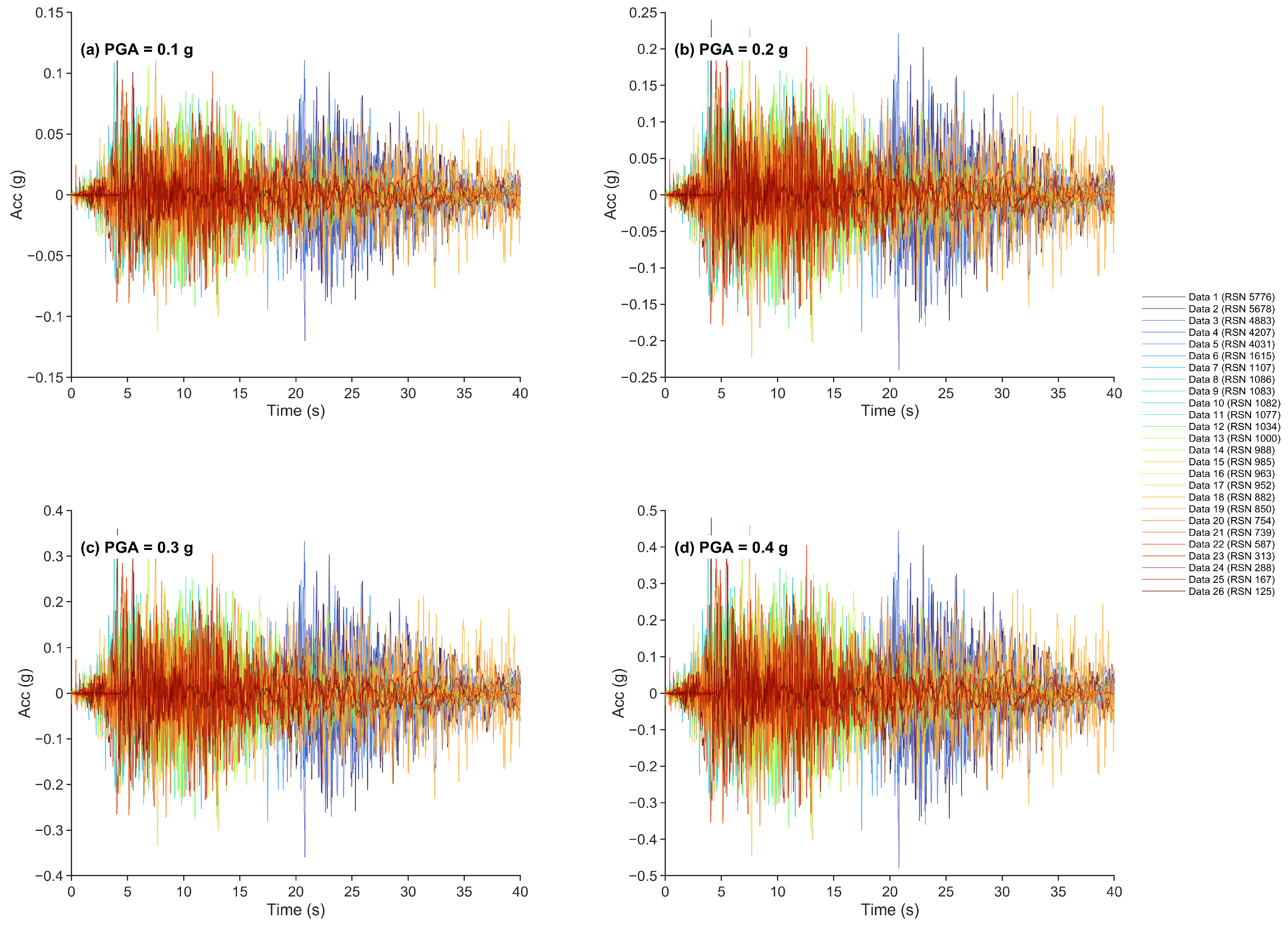
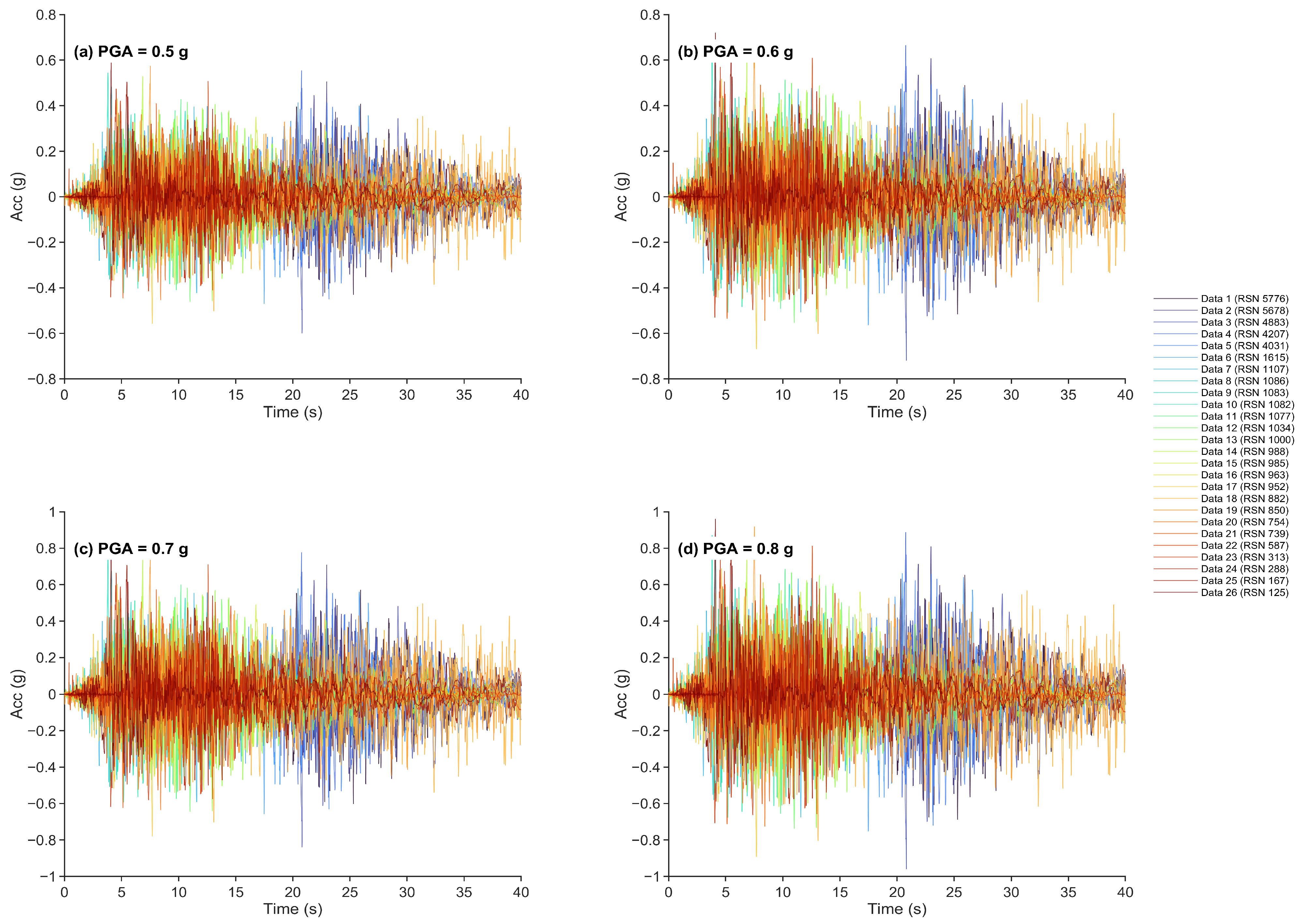
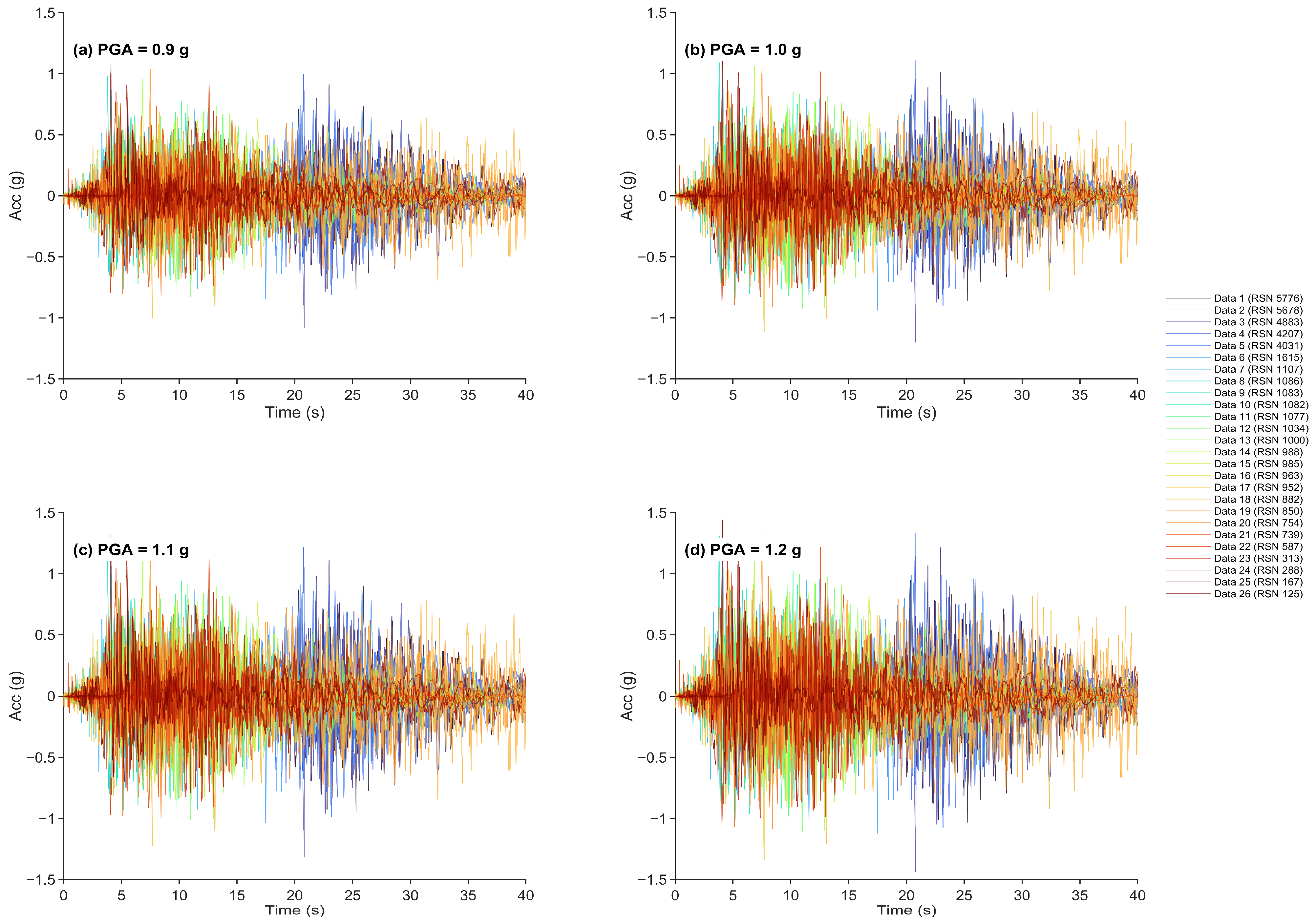
3.3. Ground Motion Selection
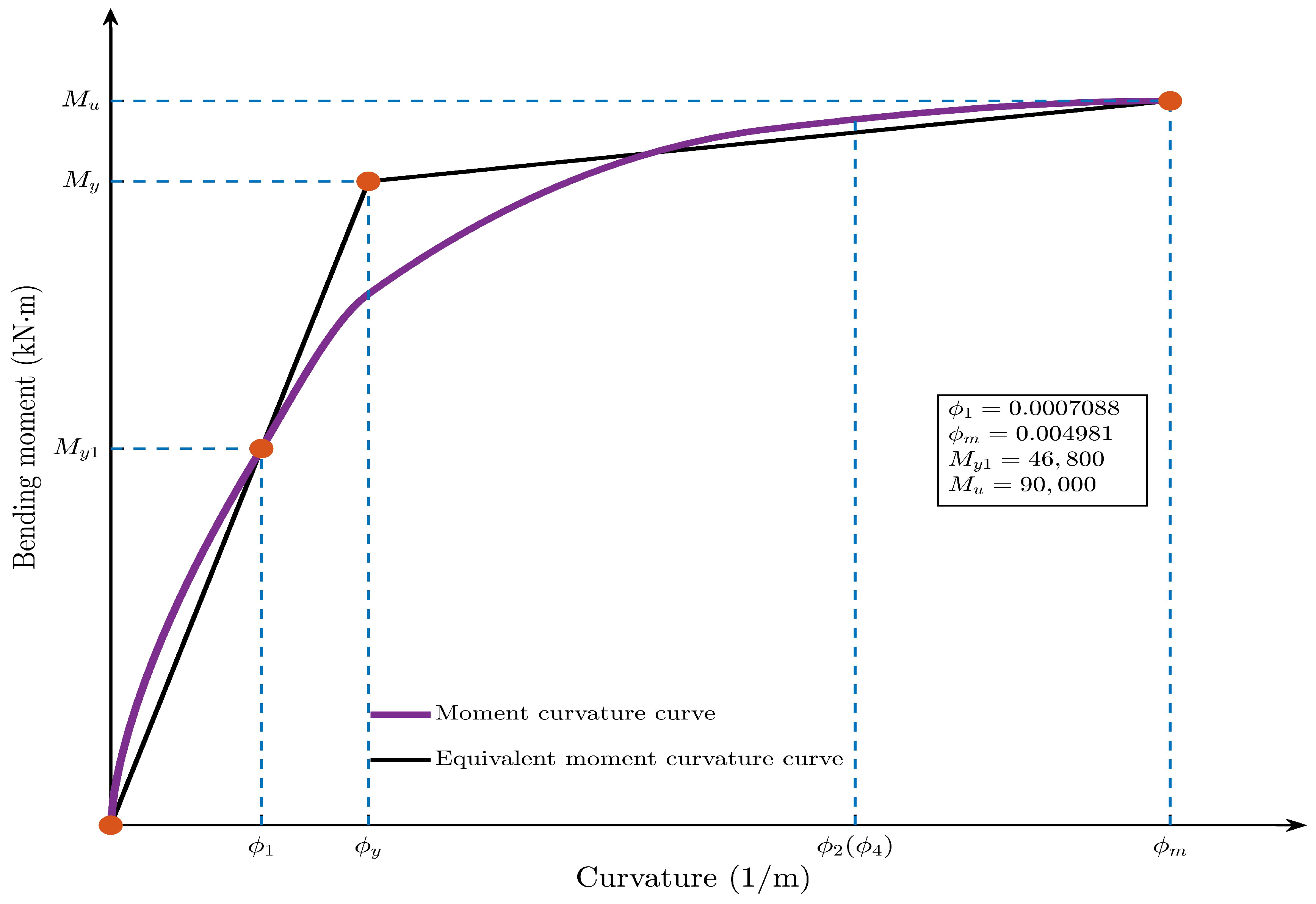
3.4. Limit State Definition
- First Yield (): The curvature associated with the first yield of the longitudinal reinforcement.
- Equivalent Yield (): The curvature marking the formation of the plastic hinge.
- Ultimate Capacity (): The curvature at which the concrete reaches its ultimate compressive strain limit.
- Intermediate States (): Curvatures corresponding to concrete compressive strains of 0.002 and 0.004, respectively.
4. Numerical Results
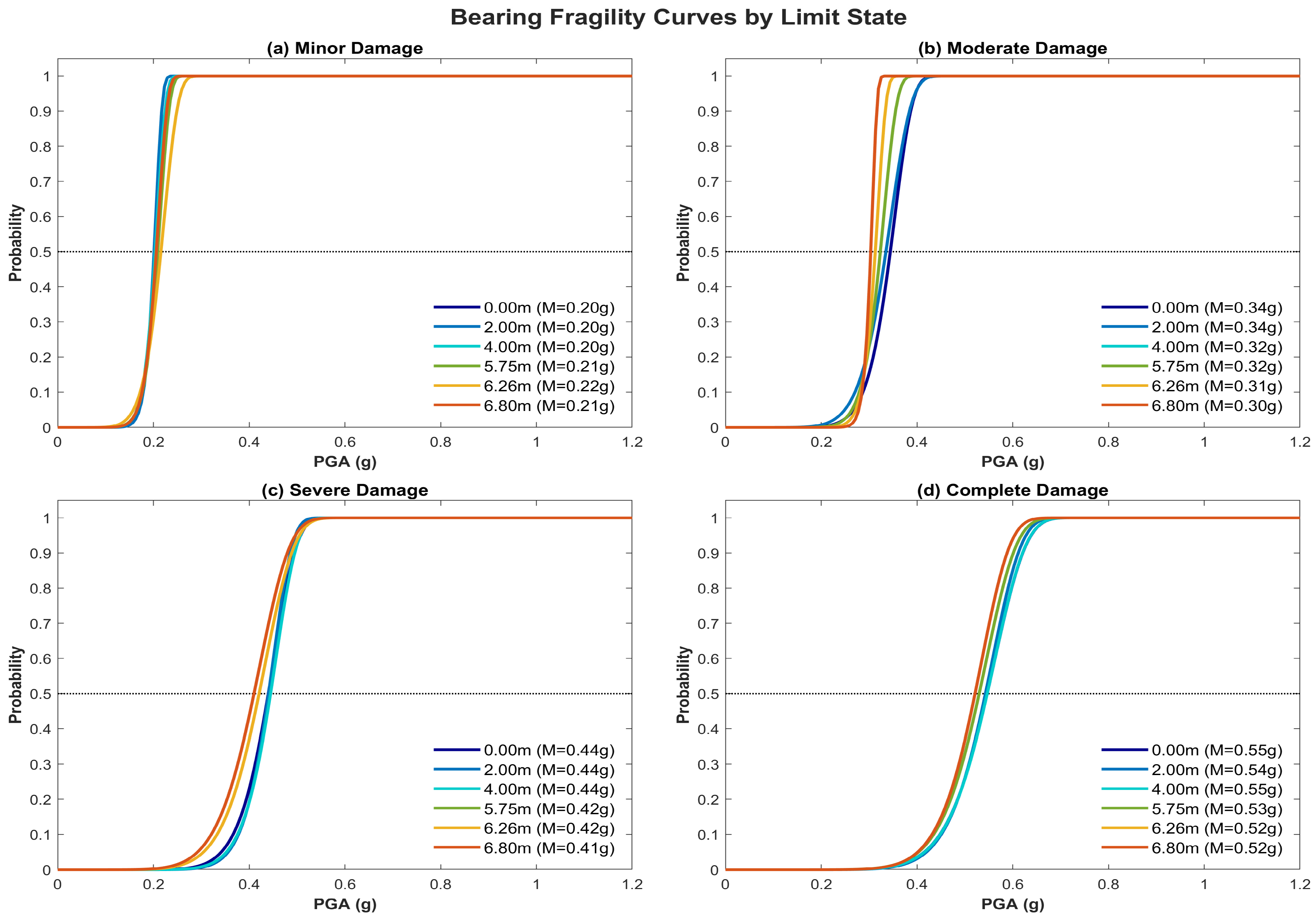
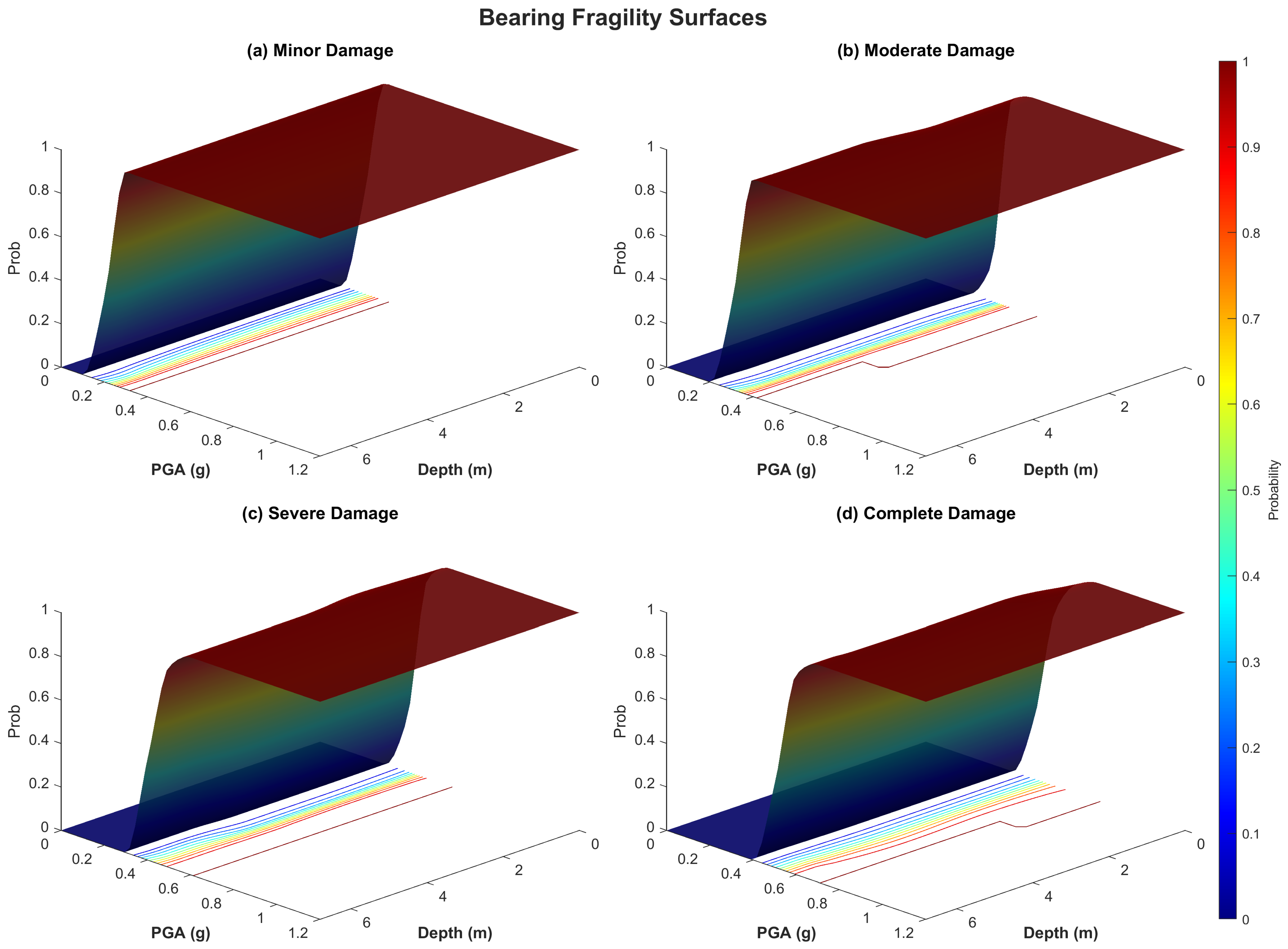
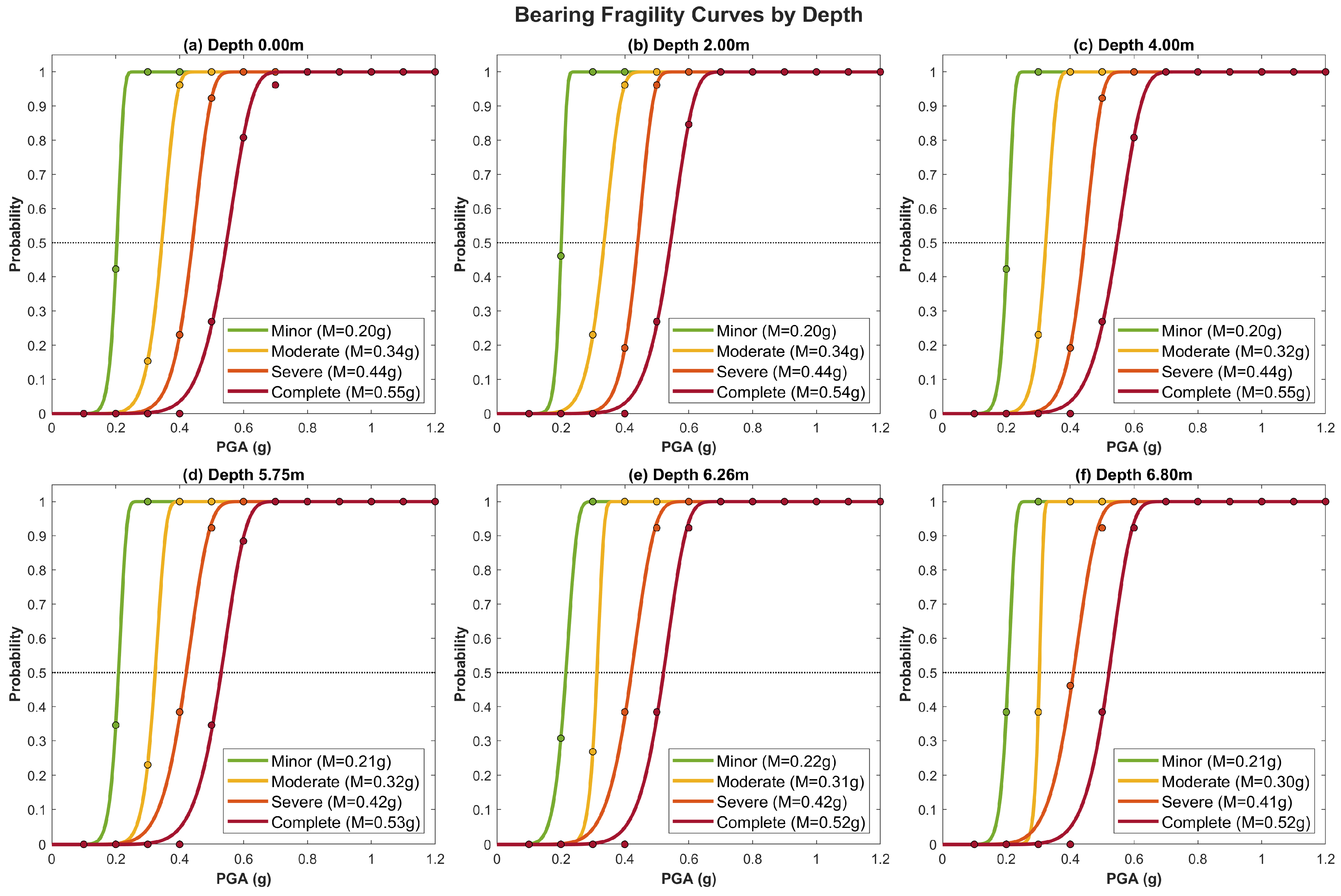
4.1. Bearing Fragility Results
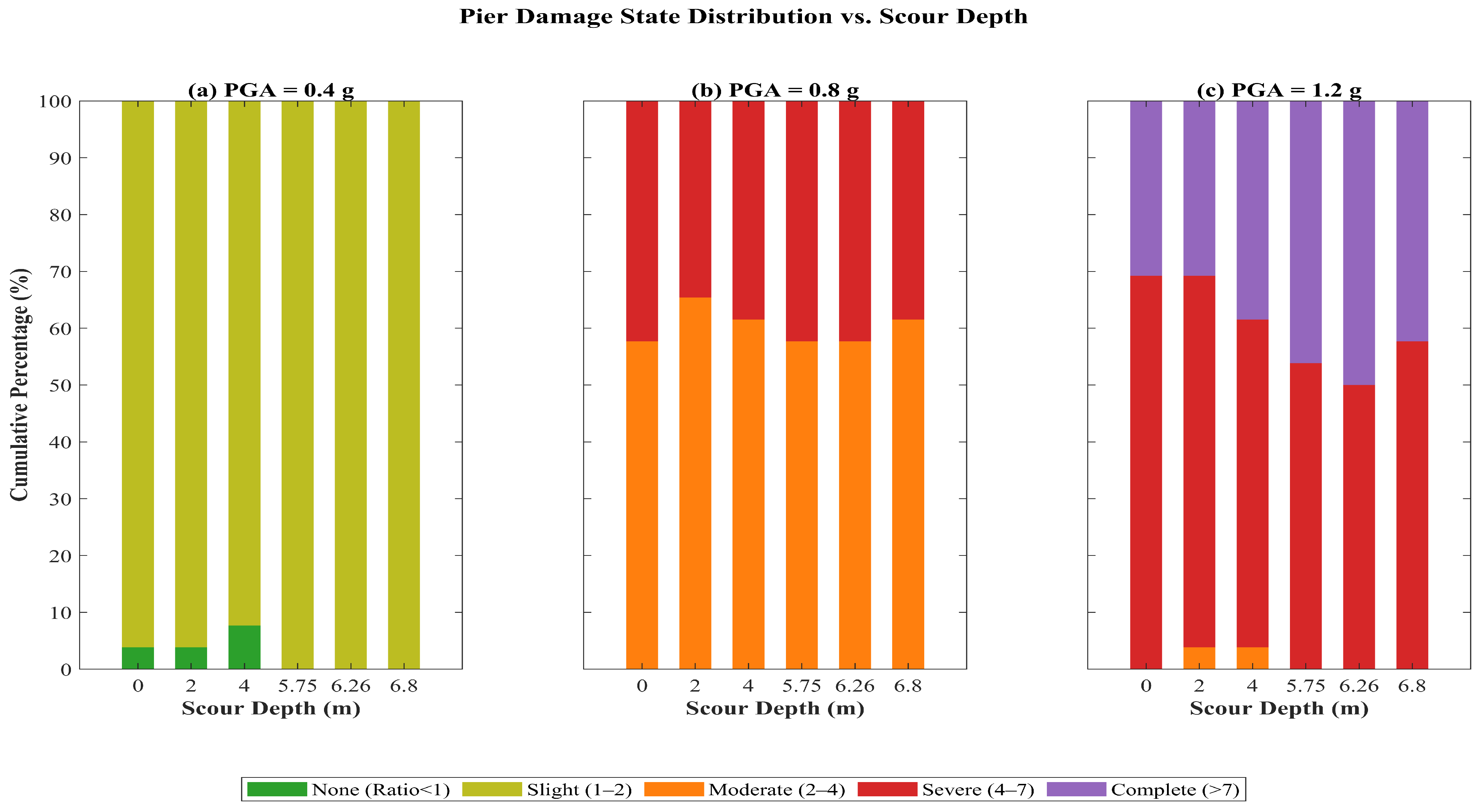
4.2. Pier Fragility Results
5. Reliability Analysis and Discussion
5.1. Bootstrap Uncertainty Quantification
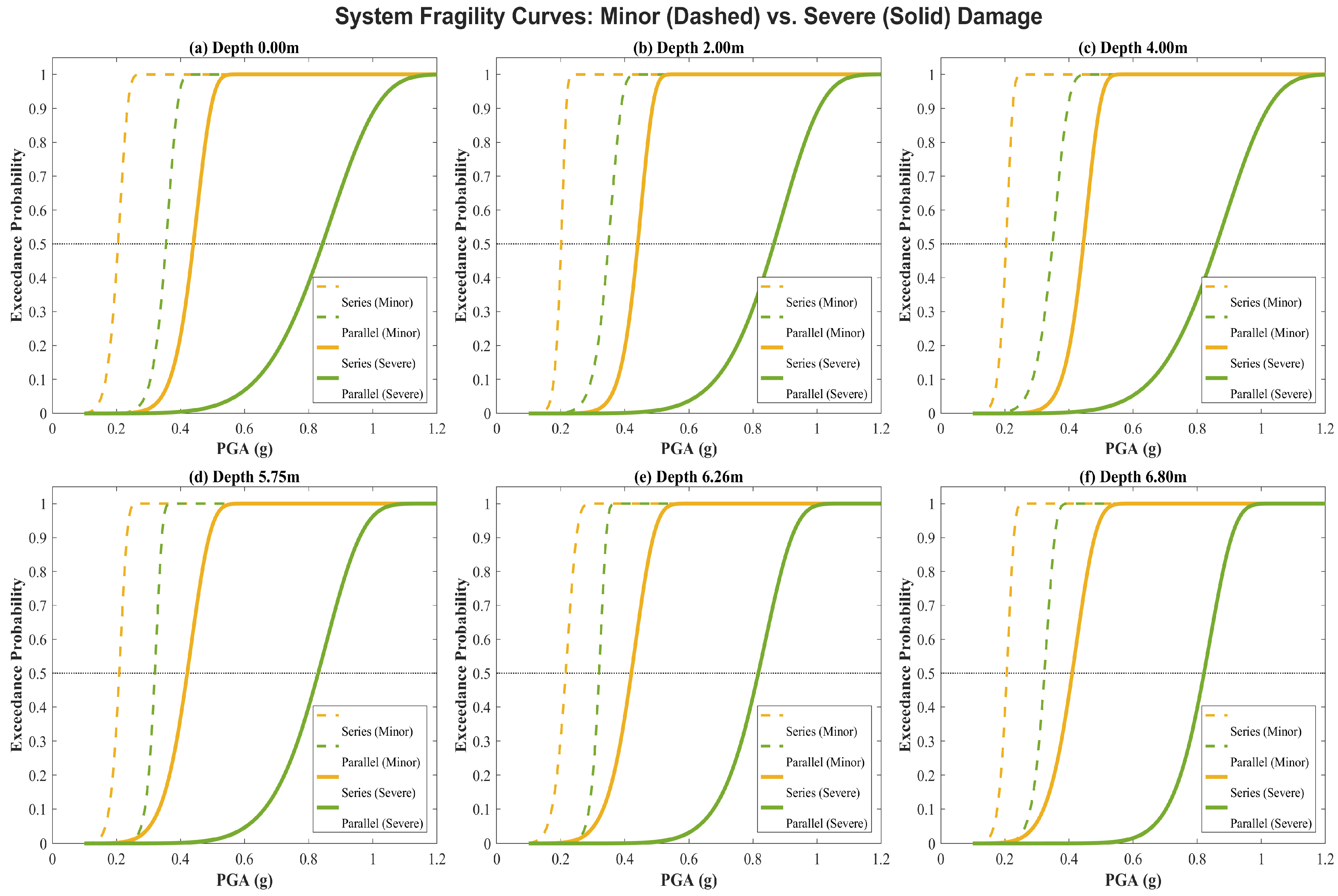
5.2. System Fragility
5.3. Discussion on the Interpretation of Scour-Induced Failure
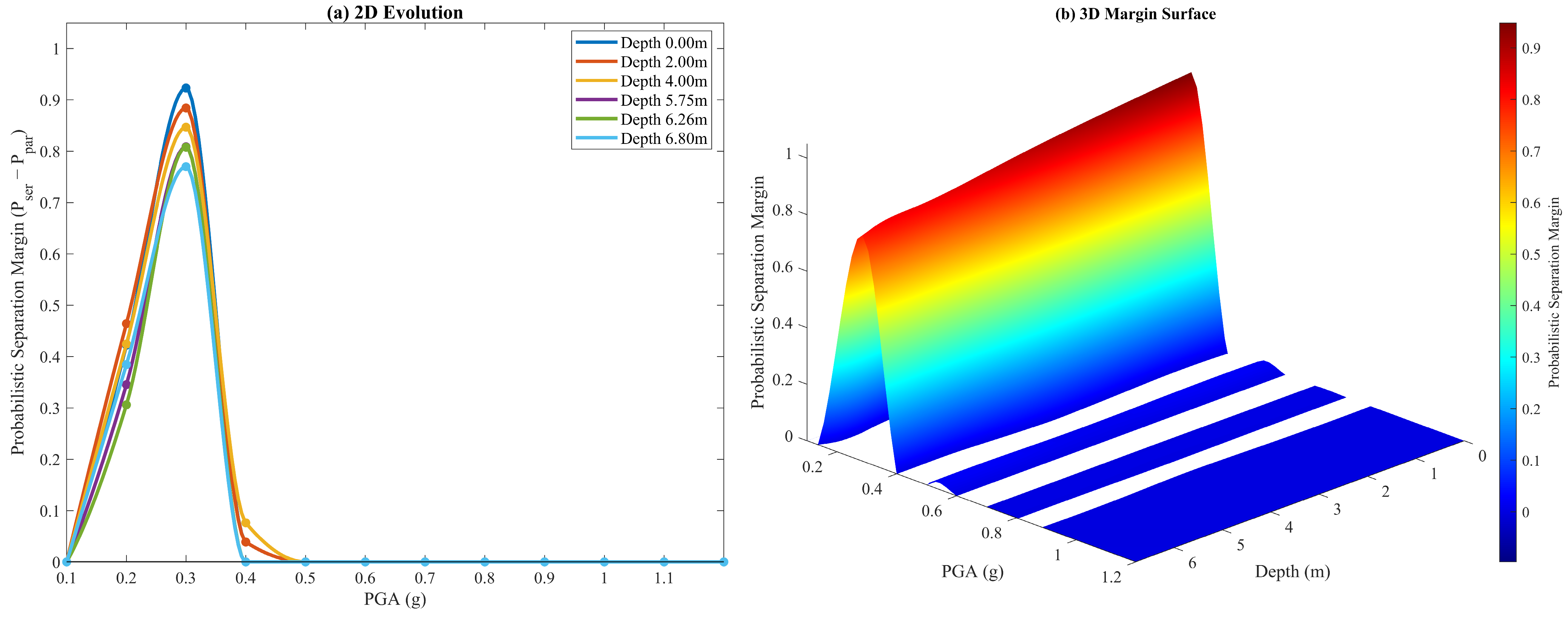
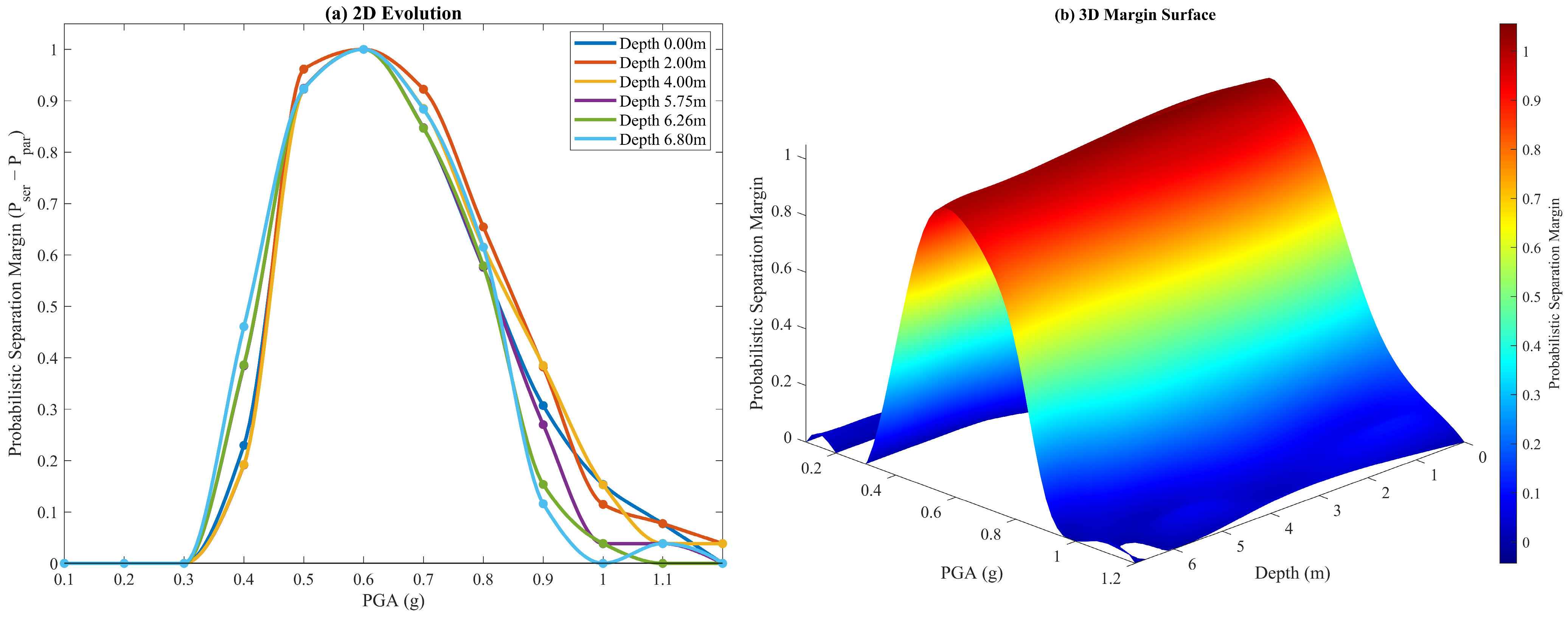
5.4. Discussion on the System Level
6. Conclusions
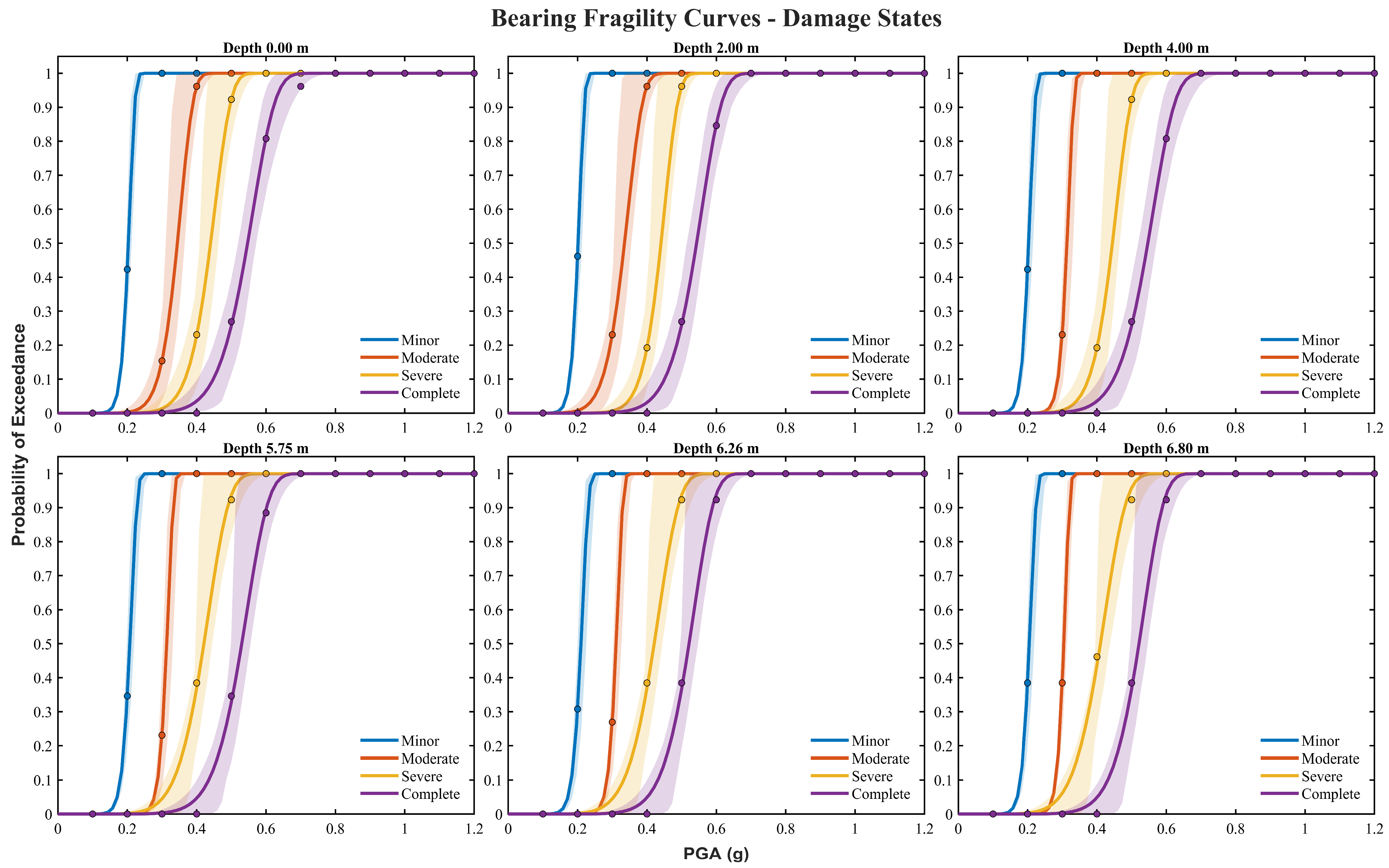
- Scour has minimal impact on bearing fragility under minor damage but markedly increases exceedance probabilities for moderate-to-complete damage states by amplifying displacement demands at the isolation layer.
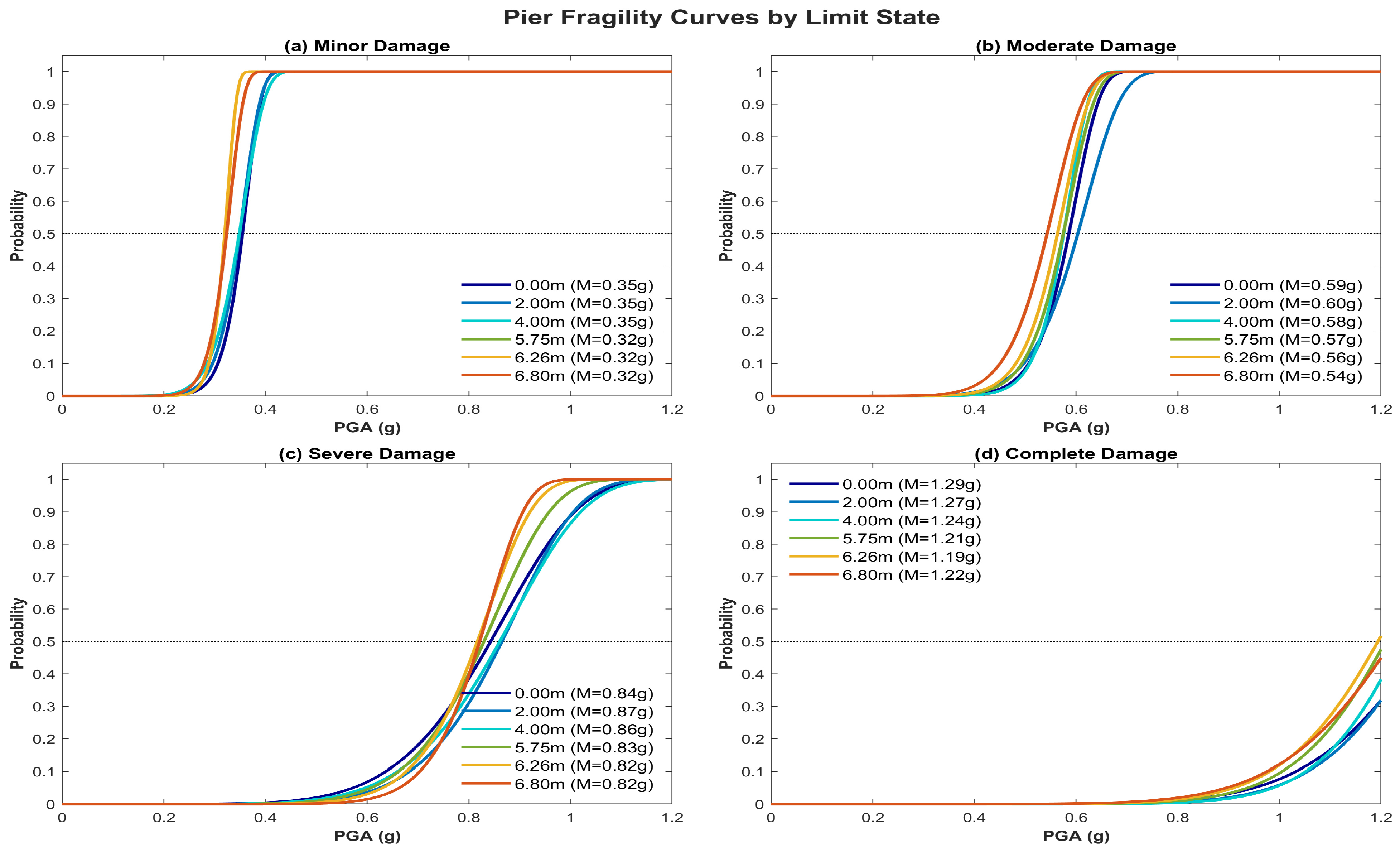
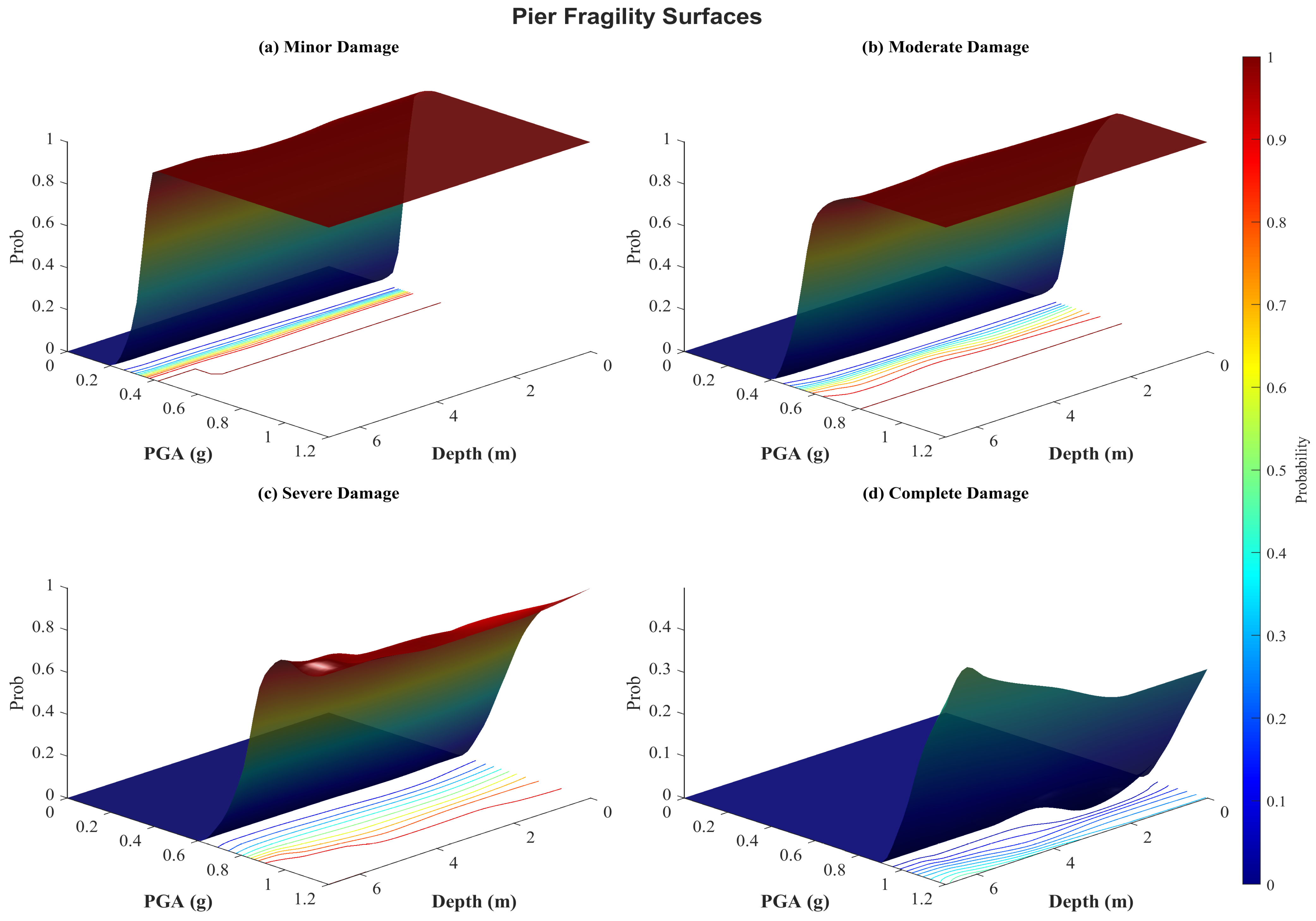
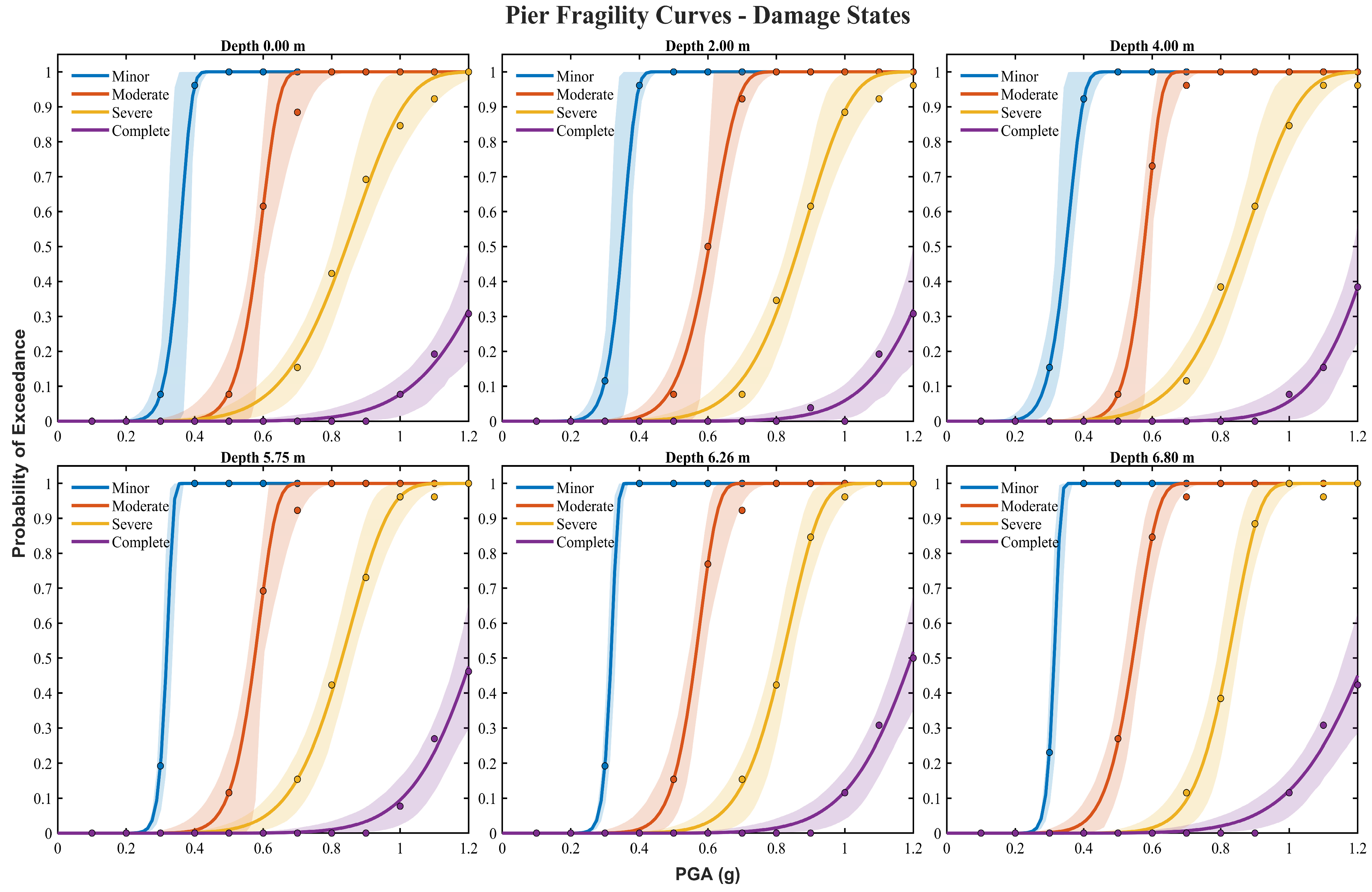
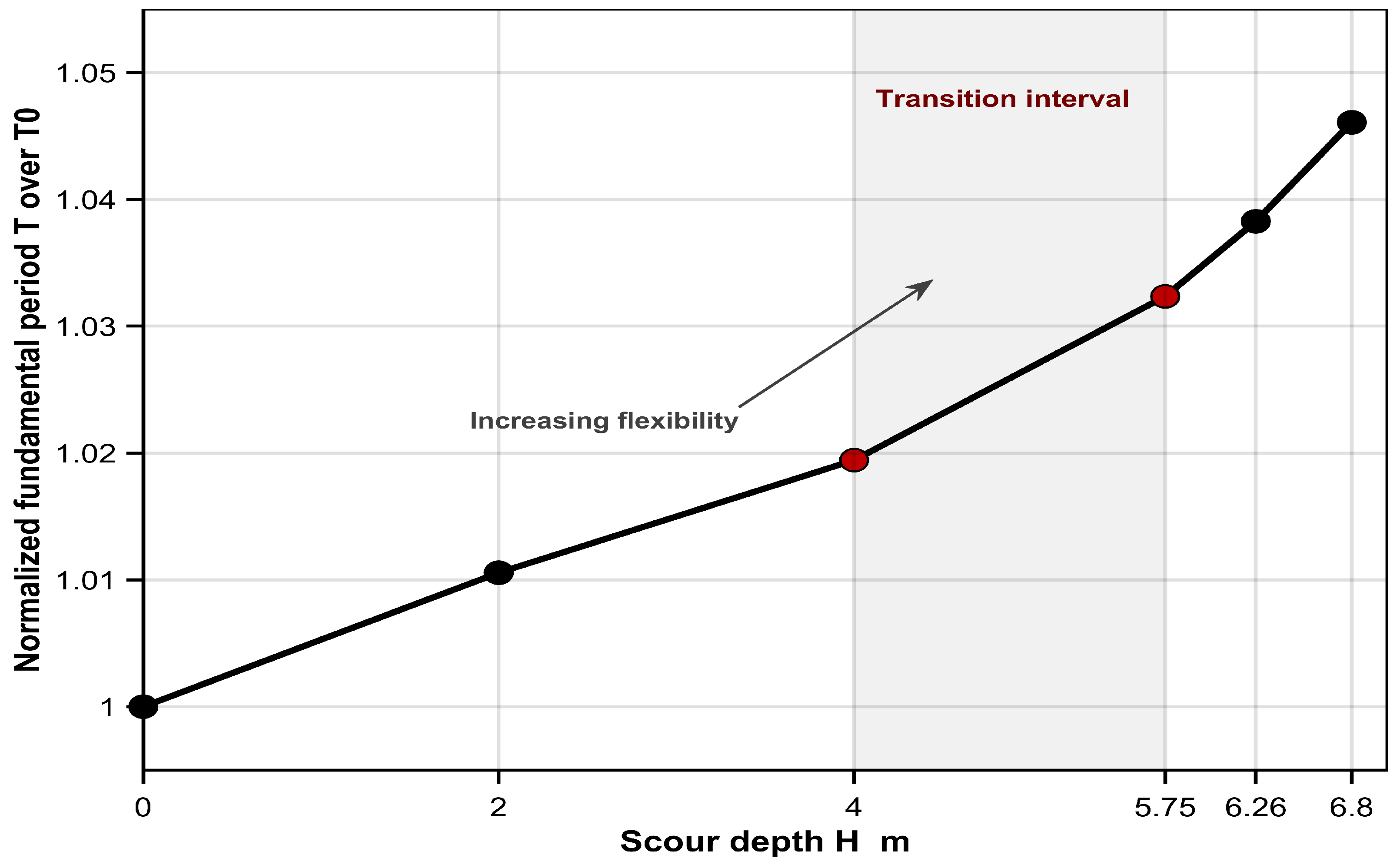
- Scour consistently increases pier vulnerability across all limit states, with fragility shifting to lower PGA values and exhibiting a nonlinear escalation. The identified transition range between approximately 4.00 m and 5.75 m corresponds to a noticeable acceleration in modal-period elongation caused by scour-induced foundation flexibility. This behaviour suggests that the pile-group system gradually transitions from a relatively stiff foundation-controlled response toward a more flexible deformation-dominated regime. Consequently, seismic demand redistribution becomes more pronounced beyond this scour range, leading to the accelerated increase in component exceedance probability observed in the fragility surfaces.
- The results indicate that scour primarily alters the interaction hierarchy between bearings and piers by modifying the relative progression of component exceedance probabilities under increasing seismic intensity. The mechanism involves shifting dominance from bearings at low-to-moderate PGA (series response) to piers at higher PGA (parallel response), while decreasing probabilistic separation margin and altering component interaction effects. This interaction evolution becomes increasingly pronounced under severe scour conditions, leading to larger probabilistic separation between early functionality loss and global collapse-related exceedance.
Author Contributions
Funding
Institutional Review Board Statement
Informed Consent Statement
Data Availability Statement
Acknowledgments
Conflicts of Interest
Appendix A


Appendix B


References
- Chan, R.; Schofer, J.L. Measuring Transportation System Resilience: Response of Rail Transit to Weather Disruptions. Nat. Hazards Rev. 2016, 17, 05015004. [Google Scholar] [CrossRef]
- Lewis, T.G. Critical Infrastructure Protection in Homeland Security: Defending a Networked Nation; John Wiley & Sons Inc.: Hoboken, NJ, USA, 2020; ISBN 9781119614531. [Google Scholar]
- Pescaroli, G.; Alexander, D. Critical Infrastructure, Panarchies and the Vulnerability Paths of Cascading Disasters. Nat. Hazards 2016, 82, 175–192. [Google Scholar] [CrossRef]
- Rathnayaka, B.; Robert, D.; Siriwardana, C.; Adikariwattage, V.V.; Pasindu, H.R.; Setunge, S.; Amaratunga, D. Identifying and Prioritising Climate Change Adaptation Measures in the Context of Electricity, Transportation and Water Infrastructure: A Case Study. Int. J. Disaster Risk Reduct. 2023, 99, 104093. [Google Scholar] [CrossRef]
- Koks, E.E.; Rozenberg, J.; Zorn, C.; Tariverdi, M.; Vousdoukas, M.; Fraser, S.A.; Hall, J.W.; Hallegatte, S. A Global Multi-Hazard Risk Analysis of Road and Railway Infrastructure Assets. Nat. Commun. 2019, 10, 2677. [Google Scholar] [CrossRef]
- Mastroianni, E.; Lancaster, J.; Korkmann, B.; Opdyke, A.; Beitelmal, W. Mitigating Infrastructure Disaster Losses through Asset Management Practices in the Middle East and North Africa Region. Int. J. Disaster Risk Reduct. 2021, 53, 102011. [Google Scholar] [CrossRef]
- Kameshwar, S.; Padgett, J.E. Multi-Hazard Risk Assessment of Highway Bridges Subjected to Earthquake and Hurricane Hazards. Eng. Struct. 2014, 78, 154–166. [Google Scholar] [CrossRef]
- Wei, K.; He, H.; Zhang, J.; Yang, C.; Qin, S. An Endurance Time Method-Based Fragility Analysis Framework for Cable-Stayed Bridge Systems under Scour and Earthquake. Ocean Eng. 2021, 232, 109128. [Google Scholar] [CrossRef]
- Argyroudis, S.A.; Mitoulis, S.A. Vulnerability of Bridges to Individual and Multiple Hazards- Floods and Earthquakes. Reliab. Eng. Syst. Saf. 2021, 210, 107564. [Google Scholar] [CrossRef]
- Chen, L.; Gan, S.; Xiao, L.; Zhang, W.; Suo, S.; Xie, X.; Wu, X.; Qi, W.; Wang, Y.; Wang, D. Liquefaction-Induced Ground Failure and Structural Damage Following the March 28, 2025 M 7.9 Myanmar Earthquake. Earthq. Eng. Eng. Vib. 2025, 24, 875–889. [Google Scholar] [CrossRef]
- Ozkula, G.; Dowell, R.K.; Baser, T.; Lin, J.-L.; Numanoglu, O.A.; Ilhan, O.; Olgun, C.G.; Huang, C.-W.; Uludag, T.D. Field Reconnaissance and Observations from the February 6, 2023, Turkey Earthquake Sequence. Nat. Hazards 2023, 119, 663–700. [Google Scholar] [CrossRef]
- Fioklou, A.; Alipour, A. Significance of Non-Uniform Scour on the Seismic Performance of Bridges. Struct. Infrastruct. Eng. 2019, 15, 822–836. [Google Scholar] [CrossRef]
- Qi, W.G.; Gao, F.P.; Randolph, M.F.; Lehane, B.M. Scour Effects on p–y Curves for Shallowly Embedded Piles in Sand. Géotechnique 2016, 66, 648–660. [Google Scholar] [CrossRef]
- Liang, F.; Zhang, H.; Chen, S. Effect of Vertical Load on the Lateral Response of Offshore Piles Considering Scour-Hole Geometry and Stress History in Marine Clay. Ocean Eng. 2018, 158, 64–77. [Google Scholar] [CrossRef]
- Lin, C.; Han, J.; Bennett, C.; Parsons, R.L. Analysis of Laterally Loaded Piles in Soft Clay Considering Scour-Hole Dimensions. Ocean Eng. 2016, 111, 461–470. [Google Scholar] [CrossRef]
- Banerjee, S.; Ganesh Prasad, G. Seismic Risk Assessment of Reinforced Concrete Bridges in Flood-Prone Regions. Struct. Infrastruct. Eng. 2013, 9, 952–968. [Google Scholar] [CrossRef]
- He, L.-G.; Hung, H.-H.; Chuang, C.-Y.; Huang, C.-W. Seismic Assessments for Scoured Bridges with Pile Foundations. Eng. Struct. 2020, 211, 110454. [Google Scholar] [CrossRef]
- Banerjee, S.; Shinozuka, M. Nonlinear Static Procedure for Seismic Vulnerability Assessment of Bridges. Comput.-Aided Civ. Infrastruct. Eng. 2007, 22, 293–305. [Google Scholar] [CrossRef]
- Chen, M.; Mangalathu, S.; Jeon, J.-S. Bridge Fragilities to Network Fragilities in Seismic Scenarios: An Integrated Approach. Eng. Struct. 2021, 237, 112212. [Google Scholar] [CrossRef]
- Choi, E.; DesRoches, R.; Nielson, B. Seismic Fragility of Typical Bridges in Moderate Seismic Zones. Eng. Struct. 2004, 26, 187–199. [Google Scholar] [CrossRef]
- Tavares, D.H.; Padgett, J.E.; Paultre, P. Fragility Curves of Typical As-Built Highway Bridges in Eastern Canada. Eng. Struct. 2012, 40, 107–118. [Google Scholar] [CrossRef]
- Klinga, J.V.; Alipour, A. Assessment of Structural Integrity of Bridges under Extreme Scour Conditions. Eng. Struct. 2015, 82, 55–71. [Google Scholar] [CrossRef]
- Zaky, A.; Özcan, O.; Avşar, Ö. Seismic Failure Analysis of Concrete Bridges Exposed to Scour. Eng. Fail. Anal. 2020, 115, 104617. [Google Scholar] [CrossRef]
- Wang, Z.; Padgett, J.E.; Dueñas-Osorio, L. Risk-Consistent Calibration of Load Factors for the Design of Reinforced Concrete Bridges under the Combined Effects of Earthquake and Scour Hazards. Eng. Struct. 2014, 79, 86–95. [Google Scholar] [CrossRef]
- Antonopoulos, C.; Tubaldi, E.; Carbonari, S.; Gara, F.; Dezi, F. Dynamic Behavior of Soil-Foundation-Structure Systems Subjected to Scour. Soil Dyn. Earthq. Eng. 2022, 152, 106969. [Google Scholar] [CrossRef]
- Franciolini, S.; Aimar, M.; Civera, M.; Martinelli, L.; Foti, S.; Chiaia, B. Seismic behavior of a viaduct affected by foundation scour: A numerical study. In Proceedings of the 10th ECCOMAS Thematic Conf. on Computational Methods in Structural Dynamics and Earthquake Engineering (COMPDYN 2025), Rhodes Island, Greece, 15–18 June 2025; Proceedings; Eccomas Proceedia: Paris, France, 2025; pp. 4675–4680. [Google Scholar] [CrossRef]
- Kumar, R.; Gardoni, P. Effect of Seismic Degradation on the Fragility of Reinforced Concrete Bridges. Eng. Struct. 2014, 79, 267–275. [Google Scholar] [CrossRef]
- Zhou, M.; Liao, J.; An, L. Effect of Multiple Environmental Factors on the Adhesion and Diffusion Behaviours of Chlorides in a Bridge with Coastal Exposure: Long-Term Experimental Study. J. Bridge Eng. 2020, 25, 04020081. [Google Scholar] [CrossRef]
- Dehghanpoor, A.; Thambiratnam, D.; Zhang, W.; Dong, Y.; Kargar, M.; Chan, T.; Taciroglu, E. Performance Assessment of Reinforced Concrete Bridges Under Coupled Horizontal and Vertical Ground Motions Using Fragility Surfaces. J. Earthq. Eng. 2024, 28, 2801–2823. [Google Scholar] [CrossRef]
- Liang, Y.; Yan, J.L.; Cheng, Z.Q.; Chen, P.; Ren, C. Time-Varying Seismic Fragility Analysis of Offshore Bridges with Continuous Rigid-Frame Girder under Main Aftershock Sequences. J. Bridge Eng. 2020, 25, 04020055. [Google Scholar] [CrossRef]
- Wu, D.; Li, Z.-X.; Ding, Y.; Su, J. Time-Dependent Seismic Fragility and Resilience Assessment of a Sea-Crossing Cable-Stayed Bridge under Combined Effects of Corrosion and Scour. Eng. Struct. 2025, 340, 120702. [Google Scholar] [CrossRef]
- Fioklou, A.; Alipour, A. Probability of Failure Estimation for Highway Bridges under Combined Effects of Uncorrelated Multiple Hazards. Resilient Cities Struct. 2022, 1, 79–93. [Google Scholar] [CrossRef]
- Li, Y.; Chen, H.; Yi, M.; Li, J.; Fang, C. Seismic Vulnerability Analysis of Bridges Incorporating Scour Uncertainty Using a Copula-Based Approach. Ocean Eng. 2025, 323, 120598. [Google Scholar] [CrossRef]
- Du, A.; Padgett, J.E. Investigation of Multivariate Seismic Surrogate Demand Modelling for Multi-Response Structural Systems. Eng. Struct. 2020, 207, 110210. [Google Scholar] [CrossRef]
- Eurocode 8 EN 1998-2; Eurocode 8—Design of Structures for Earthquake Resistance—Part 2: Bridges. European Committee for Standardisation: Brussels, Belgium, 2005.
- TB 10002-2017; Code for Design on Railway Bridge and Culvert (English Version). National Railway Administration: Beijing, China, 2017.
- Federal Highway Administration. HEC-18 Evaluating Scour at Bridges Fifth Edition; Federal Highway Administration: Washington, DC, USA, 2012.
- Johnson, P.A. Comparison of Pier-Scour Equations Using Field Data. J. Hydraul. Eng. 1995, 121, 626–629. [Google Scholar] [CrossRef]
- Hu, H.; Huang, Y.; Zhao, L.; Xiong, M. Shaking Table Tests on Slope Reinforced by Anchored Piles under Random Earthquake Ground Motions. Acta Geotech. 2022, 17, 4113–4130. [Google Scholar] [CrossRef]
- Su, C.; Liu, X.; Li, B.; Huang, Z. Inelastic Response Analysis of Bridges Subjected to Non-Stationary Seismic Excitations by Efficient MCS Based on Explicit Time-Domain Method. Nonlinear Dyn. 2018, 94, 2097–2114. [Google Scholar] [CrossRef]
- Zhou, S.; Song, G.; Wang, R.; Ren, Z.; Wen, B. Nonlinear Dynamic Analysis for Coupled Vehicle-Bridge Vibration System on Nonlinear Foundation. Mech. Syst. Signal Process. 2017, 87, 259–278. [Google Scholar] [CrossRef]
- Cao, X.-Y.; Feng, D.-C.; Beer, M. Consistent Seismic Hazard and Fragility Analysis Considering Combined Capacity-Demand Uncertainties via Probability Density Evolution Method. Struct. Saf. 2023, 103, 102330. [Google Scholar] [CrossRef]
- Zhang, J.; Huo, Y. Evaluating Effectiveness and Optimum Design of Isolation Devices for Highway Bridges Using the Fragility Function Method. Eng. Struct. 2009, 31, 1648–1660. [Google Scholar] [CrossRef]
- Chen, L.; Huang, C.; Chen, H.; Zheng, Z. Seismic Fragility Models of a Bridge System Based on Copula Method. Earthq. Spectra 2022, 38, 1417–1437. [Google Scholar] [CrossRef]
- Xie, Y. Impact of Component Damage Correlations on Seismic Fragility and Risk Assessment of Multi-Component Bridge Systems. Struct. Saf. 2025, 117, 102635. [Google Scholar] [CrossRef]
- Cornell, C.A. Bounds on the Reliability of Structural Systems. J. Struct. Div. 1967, 93, 171–200. [Google Scholar] [CrossRef]
- Nielson, B.G.; DesRoches, R. Seismic Fragility Methodology for Highway Bridges Using a Component Level Approach. Earthq. Eng. Struct. Dyn. 2007, 36, 823–839. [Google Scholar] [CrossRef]
- Nowak, A.S.; Collins, K.R. Reliability of Structures; CRC Press: Boca Raton, FL, USA, 2012; ISBN 9780429107467. [Google Scholar]
- Ghosn, M.; Moses, F.; Wang, J. Design of Highway Bridges for Extreme Events; National Academy Press: Washington, DC, USA, 2003; ISBN 9780309087506. [Google Scholar]
- Antonopoulos, C.; Tubaldi, E.; Carbonari, S.; Gara, F.; Dezi, F. Dynamic Behaviour and Seismic Response of Scoured Bridge Piers. Infrastructures 2025, 10, 75. [Google Scholar] [CrossRef]
- Tubaldi, E.; Antonopoulos, C.; Mitoulis, S.A.; Argyroudis, S.; Gara, F.; Ragni, L.; Carbonari, S.; Dezi, F.; Vratsikidis, A.; Pitilakis, D.; et al. Field Tests and Numerical Analysis of the Effects of Scour on a Full-Scale Soil–Foundation–Structural System. J. Civ. Struct. Health Monit. 2023, 13, 1461–1481. [Google Scholar] [CrossRef]
- Ma, M.; Wang, X.; Liu, N.; Song, S.; Wang, S. Nested Copula Model for Overall Seismic Vulnerability Analysis of Multispan Bridges. Shock Vib. 2022, 2022, 3001933. [Google Scholar] [CrossRef]
- Mander, J.B.; Priestley, M.J.N.; Park, R. Theoretical Stress-Strain Model for Confined Concrete. J. Struct. Eng. 1988, 114, 1804–1826. [Google Scholar] [CrossRef]
- Biazar, S.; Kameshwar, S.; Balomenos, G.P. Multi-Hazard Fragility Modelling Framework for Bridges with Shallow Foundations Subjected to Earthquake, Scour, and Vehicular Loading. Soil Dyn. Earthq. Eng. 2024, 178, 108482. [Google Scholar] [CrossRef]
- Liu, C.L.; Ai, Z.Y.; Tang, M.X.; Hu, H.S.; Wang, L.J. Scour Effects on the Vertical Dynamic Response of Single Piles in Transversely Isotropic Soils. Ocean Eng. 2023, 280, 114535. [Google Scholar] [CrossRef]
- Tawadros, H.W.S.; Farag, M.M.N.; Mehanny, S.S.F. Extent and Hierarchy of Seismic Induced Inelastic Demands in the Substructure System of Bridges on Piled Foundation Crossing Waterways. Bull. Earthq. Eng. 2022, 20, 3889–3919. [Google Scholar] [CrossRef]
- Noori, H.R.; Memarpour, M.M.; Yakhchalian, M.; Soltanieh, S. Effects of Ground Motion Directionality on Seismic Behaviour of Skewed Bridges Considering SSI. Soil Dyn. Earthq. Eng. 2019, 127, 105820. [Google Scholar] [CrossRef]
- PEER Pacific Earthquake Engineering Research (PEER) Centre. Ground Motion Database. Available online: https://apps.peer.berkeley.edu/publications/peer_reports/reports_2013/webPEER-2013-03-Ancheta.pdf (accessed on 10 February 2026).
- Bray, J.D.; Rodriguez-Marek, A. Characterisation of Forward-Directivity Ground Motions in the near-Fault Region. Soil Dyn. Earthq. Eng. 2004, 24, 815–828. [Google Scholar] [CrossRef]
- Kang, X.; Jiang, L.; Bai, Y.; Caprani, C.C. Seismic Damage Evaluation of High-Speed Railway Bridge Components under Different Intensities of Earthquake Excitations. Eng. Struct. 2017, 152, 116–128. [Google Scholar] [CrossRef]
- Sehhati, R.; Rodriguez-Marek, A.; ElGawady, M.; Cofer, W.F. Effects of Near-Fault Ground Motions and Equivalent Pulses on Multi-Story Structures. Eng. Struct. 2011, 33, 767–779. [Google Scholar] [CrossRef]
- Davoodi, M.; Jafari, M.K.; Hadiani, N. Seismic Response of Embankment Dams under Near-Fault and Far-Field Ground Motion Excitation. Eng. Geol. 2013, 158, 66–76. [Google Scholar] [CrossRef]
- GB 50111-2006; Chinese Code for Seismic Design of Railway Engineering. MOC: Munich, Germany, 2006.
- Muntasir Billah, A.H.M.; Shahria Alam, M. Seismic Fragility Assessment of Highway Bridges: A State-of-the-Art Review. Struct. Infrastruct. Eng. 2015, 11, 804–832. [Google Scholar] [CrossRef]
- Hwang, H.; Liu, J.B.; Chiu, Y.H. Seismic Fragility Analysis of Highway Bridges. In 9th ASCE Speciality Conference on Probabilistic Mechanics and Structural Reliability; Mid-America Earthquake Center: Champaign, IL, USA, 2001. [Google Scholar]
- Jara, J.M.; Galván, A.; Jara, M.; Olmos, B. Procedure for Determining the Seismic Vulnerability of an Irregular Isolated Bridge. Struct. Infrastruct. Eng. 2013, 9, 516–528. [Google Scholar] [CrossRef]
- Liu, Z.; Li, S.; Guo, A.; Li, H. Comprehensive Functional Resilience Assessment Methodology for Bridge Networks Using Data-Driven Fragility Models. Soil Dyn. Earthq. Eng. 2022, 159, 107326. [Google Scholar] [CrossRef]
- Ramanathan, K.; DesRoches, R.; Padgett, J.E. A Comparison of Pre- and Post-Seismic Design Considerations in Moderate Seismic Zones through the Fragility Assessment of Multispan Bridge Classes. Eng. Struct. 2012, 45, 559–573. [Google Scholar] [CrossRef]
- Yan, J.; Guo, A.; Li, H. Comparative Analysis of Different Types of Damage Indexes of Coastal Bridges Based on Time-Varying Seismic Fragility. Mar. Struct. 2022, 86, 103288. [Google Scholar] [CrossRef]
- Yi, J.-H.; Kim, S.-H.; Kushiyama, S. PDF Interpolation Technique for Seismic Fragility Analysis of Bridges. Eng. Struct. 2007, 29, 1312–1322. [Google Scholar] [CrossRef]
- Li, L.; Wu, W.; Huang, J.; Wang, L. Study on System Vulnerability of Medium Span Reinforced Concrete Continuous Girder Bridge under Earthquake Excitation. Tumu Gongcheng Xuebao/China Civ. Eng. J. 2012, 45, 152–160. [Google Scholar]
- Nettis, A.; Di Mucci, V.M.; Ruggieri, S.; Uva, G. Seismic Fragility and Risk Assessment of Isolated Bridges Subjected to Pre-Existing Ground Displacements. Soil Dyn. Earthq. Eng. 2025, 194, 109335. [Google Scholar] [CrossRef]







| Top Depth (m) | Bottom Depth (m) | Soil Type | () | |
|---|---|---|---|---|
| 0 | 10 | Silt Sand | 18 | 25 |
| 10 | 20 | Clay | 19 | 15 |
| 20 | 35 | Medium Sand | 20 | 35 |
| 35 | 45 | Weathered Rock | 22 | 45 |
| Scenario Description | Return Period (Years) | Discharge * Q ( | Scour Depth ** (m) |
|---|---|---|---|
| Probabilistic Flood Events | |||
| 10-year Flood Event | 10 | 2500 | 5.75 |
| 50-year Flood Event | 50 | 3500 | 6.26 |
| 200-year Flood Event | 200 | 5000 | 6.80 |
| Fixed Scour Scenarios (Sensitivity) | |||
| No Scour (Baseline) | 0.00 | ||
| Fixed Scour Depth (2 m) | 2.00 | ||
| Fixed Scour Depth (4 m) | 4.00 | ||
| Scour Depth (m) | Mode 1 (s) | Mode 2 (s) | Mode 3 (s) | Mode 4 (s) |
|---|---|---|---|---|
| 0.00 | 1.9600 | 1.8445 | 1.1832 | 0.8455 |
| 2.00 | 1.9807 | 1.8636 | 1.1983 | 0.8555 |
| 4.00 | 1.9981 | 1.8792 | 1.2127 | 0.8657 |
| 5.75 | 2.0234 | 1.9019 | 1.2351 | 0.8826 |
| 6.26 | 2.0350 | 1.9123 | 1.2457 | 0.8910 |
| 6.80 | 2.0503 | 1.9262 | 1.2602 | 0.9027 |
| No | RSN | Earthquake Name | Year | Magnitude | Rjb (km) | Rrup (km) | Vs30 (m/s) | PGA (m/s2) | PGV (m/s) |
|---|---|---|---|---|---|---|---|---|---|
| 1 | 125 | Friuli, Italy-01 | 1976 | 6.5 | 14.97 | 15.82 | 505.23 | 0.45 | 0.32 |
| 2 | 167 | Imperial Valley-06 | 1979 | 6.53 | 13.52 | 15.3 | 259.86 | 0.50 | 0.37 |
| 3 | 288 | Irpinia, Italy-01 | 1980 | 6.9 | 22.54 | 22.56 | 561.04 | 0.57 | 0.35 |
| 4 | 313 | Corinth, Greece | 1981 | 6.6 | 10.27 | 10.27 | 361.4 | 0.28 | 0.27 |
| 5 | 587 | New Zealand-02 | 1987 | 6.6 | 16.09 | 16.09 | 551.3 | 0.39 | 0.36 |
| 6 | 739 | Loma Prieta | 1989 | 6.93 | 19.9 | 20.26 | 488.77 | 0.32 | 0.29 |
| 7 | 754 | Loma Prieta | 1989 | 6.93 | 20.44 | 20.8 | 295.01 | 0.36 | 0.31 |
| 8 | 850 | Landers | 1992 | 7.28 | 21.78 | 21.78 | 359 | 0.34 | 0.38 |
| 9 | 882 | Landers | 1992 | 7.28 | 26.84 | 26.84 | 344.67 | 0.33 | 0.27 |
| 10 | 952 | Northridge-01 | 1994 | 6.69 | 12.39 | 18.36 | 545.66 | 0.59 | 0.28 |
| 11 | 963 | Northridge-01 | 1994 | 6.69 | 20.11 | 20.72 | 450.28 | 0.36 | 0.33 |
| 12 | 985 | Northridge-01 | 1994 | 6.69 | 23.5 | 29.88 | 297.07 | 0.47 | 0.29 |
| 13 | 988 | Northridge-01 | 1994 | 6.69 | 15.53 | 23.41 | 277.98 | 0.36 | 0.30 |
| 14 | 1000 | Northridge-01 | 1994 | 6.69 | 27.82 | 31.33 | 304.68 | 0.30 | 0.36 |
| 15 | 1034 | Northridge-01 | 1994 | 6.69 | 26.77 | 33.67 | 349.54 | 0.48 | 0.31 |
| 16 | 1077 | Northridge-01 | 1994 | 6.69 | 17.28 | 26.45 | 336.2 | 0.88 | 0.42 |
| 17 | 1082 | Northridge-01 | 1994 | 6.69 | 5.59 | 10.05 | 320.93 | 0.28 | 0.26 |
| 18 | 1083 | Northridge-01 | 1994 | 6.69 | 12.38 | 13.35 | 402.16 | 0.81 | 0.33 |
| 19 | 1086 | Northridge-01 | 1994 | 6.69 | 1.74 | 5.3 | 440.54 | 0.33 | 0.42 |
| 20 | 1107 | Kobe, Japan | 1995 | 6.9 | 22.5 | 22.5 | 312 | 0.38 | 0.33 |
| 21 | 1615 | Duzce, Turkey | 1999 | 7.14 | 9.14 | 9.14 | 338 | 0.45 | 0.39 |
| 22 | 4031 | San Simeon, CA, USA | 2003 | 6.52 | 5.07 | 6.22 | 410.66 | 0.44 | 0.41 |
| 23 | 4207 | Niigata, Japan | 2004 | 6.63 | 4.22 | 12.81 | 274.17 | 0.46 | 0.47 |
| 24 | 4883 | Chuetsu-oki, Japan | 2007 | 6.8 | 27.83 | 29.91 | 254.68 | 0.27 | 0.29 |
| 25 | 5678 | Iwate, Japan | 2008 | 6.9 | 5.09 | 11.12 | 398.59 | 0.50 | 0.38 |
| 26 | 5776 | Iwate, Japan | 2008 | 6.9 | 25.15 | 25.16 | 477.55 | 0.34 | 0.47 |
| Component_Demand_Parameter | Minor | Moderate | Severe | Complete | Reference |
|---|---|---|---|---|---|
| Pier Curvature ductility | 1.29 | 2.1 | 3.52 | 5.24 | [47] |
| 1 | 5.11 | 7.5 | 9 | [68] | |
| 1 | 2 | 4 | 7 | [20] | |
| 1.29 | 2.1 | 3.52 | 5.24 | [67] | |
| 1 | 2.73 | 4.54 | 6.5 | [66] | |
| 1 | 1.08 | 1.76 | 3 | [54] | |
| 1 | 2 | 4 | 7 | [69] | |
| Bearing Displacement (mm) | 30 | 60 | 150 | 300 | [21] |
| 30 | 100 | 150 | 255 | [68] | |
| 50 | 100 | 150 | 255 | [20] | |
| 100 | 150 | 200 | 250 | [67] | |
| 30 | 60 | 150 | 300 | [54] | |
| 0 | 50 | 100 | 150 | [43] | |
| 90 | 150 | 200 | 300 | [71] | |
| 100 | 130 | 160 | 200 | [60] |
| Damage State | Displacement dx (mm) (Bearings) | Curvature Ductility Ratio (Piers) | Curvature Ductility Coefficient (Piers) |
|---|---|---|---|
| No damage | dx ≤ 100 | ||
| Minor damage | 100 < dx ≤ 150 | ||
| Moderate damage | 150 < dx ≤ 200 | ||
| Severe damage | 200 < dx ≤ 250 | ||
| Complete damage | dx > 250 |
Disclaimer/Publisher’s Note: The statements, opinions and data contained in all publications are solely those of the individual author(s) and contributor(s) and not of MDPI and/or the editor(s). MDPI and/or the editor(s) disclaim responsibility for any injury to people or property resulting from any ideas, methods, instructions or products referred to in the content. |
© 2026 by the authors. Licensee MDPI, Basel, Switzerland. This article is an open access article distributed under the terms and conditions of the Creative Commons Attribution (CC BY) license.
Share and Cite
Mu, H.; Matos, J.C.; Patrício, H.; Freire, L.; Dang, S.N. Scour-Dependent Fragility of Railway Bridges: From Component Response to System Reliability Under Seismic Loading. Appl. Sci. 2026, 16, 5538. https://doi.org/10.3390/app16115538
Mu H, Matos JC, Patrício H, Freire L, Dang SN. Scour-Dependent Fragility of Railway Bridges: From Component Response to System Reliability Under Seismic Loading. Applied Sciences. 2026; 16(11):5538. https://doi.org/10.3390/app16115538
Chicago/Turabian StyleMu, Hongxu, Jose C. Matos, Hugo Patrício, Luís Freire, and Son N. Dang. 2026. "Scour-Dependent Fragility of Railway Bridges: From Component Response to System Reliability Under Seismic Loading" Applied Sciences 16, no. 11: 5538. https://doi.org/10.3390/app16115538
APA StyleMu, H., Matos, J. C., Patrício, H., Freire, L., & Dang, S. N. (2026). Scour-Dependent Fragility of Railway Bridges: From Component Response to System Reliability Under Seismic Loading. Applied Sciences, 16(11), 5538. https://doi.org/10.3390/app16115538