1. Introduction
Digital workflows are widely used in implant prosthodontics because they improve clinical efficiency and patient comfort [
1,
2]. Intraoral scanners are currently used in prosthodontics, implant dentistry, orthodontics, and restorative workflows because they facilitate digital data transfer, improve patient comfort, reduce material distortion associated with conventional impressions, and enable integration with CAD/CAM manufacturing systems. However, obtaining accurate, complete-arch digital implant impressions remains challenging because cumulative stitching errors progressively increase across long-span edentulous arches [
3]. These inaccuracies may compromise prosthetic fit and lead to biological or mechanical complications [
4,
5].
Previous studies have demonstrated that intraoral scanner accuracy decreases in complete-arch rehabilitations compared with short-span or single-implant situations [
6,
7,
8,
9]. Factors such as long interimplant distances, implant angulation, absence of stable anatomical landmarks, and edentulous surfaces may increase geometric complexity during image acquisition and alignment procedures [
10,
11]. Consequently, scanner performance may vary substantially depending on implant spatial configuration and image-stitching algorithms.
Most previous investigations evaluating intraoral scanner accuracy have relied on direct STL mesh comparisons with reference datasets [
12]. However, triangulation artifacts, tessellation irregularities, and surface-smoothing procedures may introduce methodological bias in deviation analysis. To minimize these limitations, the present study incorporated a CAD replacement workflow using scan body library files prior to three-dimensional comparison, enabling a more standardized geometric evaluation of implant positions [
13,
14,
15,
16,
17,
18].
Alternative digital registration systems based on photogrammetry have been introduced to minimize cumulative stitching distortion in complete-arch implant rehabilitations. Nevertheless, intraoral scanners remain more widely used in routine clinical workflows due to their accessibility and integration with digital restorative protocols [
19,
20,
21].
Therefore, the aim of this in vitro study was to evaluate the influence of implant spatial configuration on the trueness of complete-arch digital implant impressions obtained using current-generation intraoral scanners [
22]. Three clinically relevant edentulous models representing different implant distributions and angulations were analyzed using seven intraoral scanners.
The null hypotheses were that: (1) implant spatial configuration would not influence scan trueness; (2) scanner type would not affect trueness; and (3) no interaction would exist between scanner technology and implant configuration. Understanding how implant spatial complexity affects scan trueness may help improve scanner selection and optimize digital workflows for complete-arch implant rehabilitations.
2. Materials and Methods
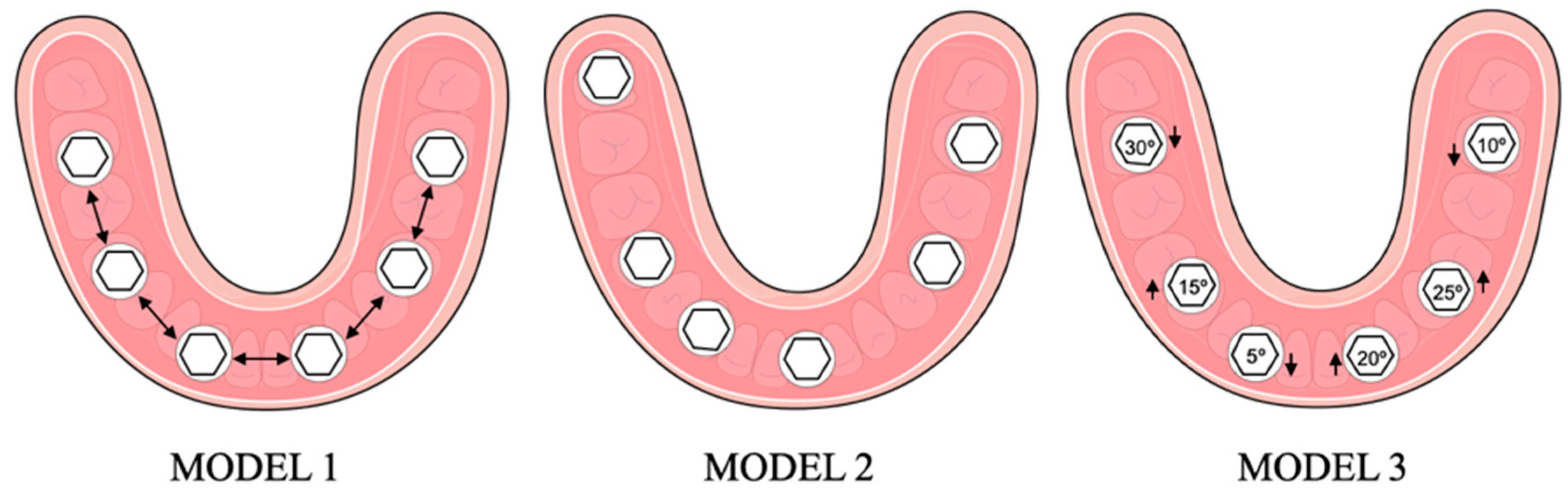
Three edentulous mandibular models (BoneModels, S.L., Lleida, Spain) with six internal hexagonal implants were fabricated to simulate different implant spatial configurations. Model 1 (M1) consisted of six closely spaced parallel implants located in the anterior region. Model 2 (M2) included six parallel implants distributed across the complete arch. Model 3 (M3) incorporated six implants with different angulations to reproduce geometrically complex clinical situations (
Figure 1). Although M3 incorporated greater local angular complexity, M2 represented the largest complete-arch span and reduced geometric continuity during sequential image acquisition. These configurations were selected to represent different levels of spatial complexity during complete-arch digital acquisition.
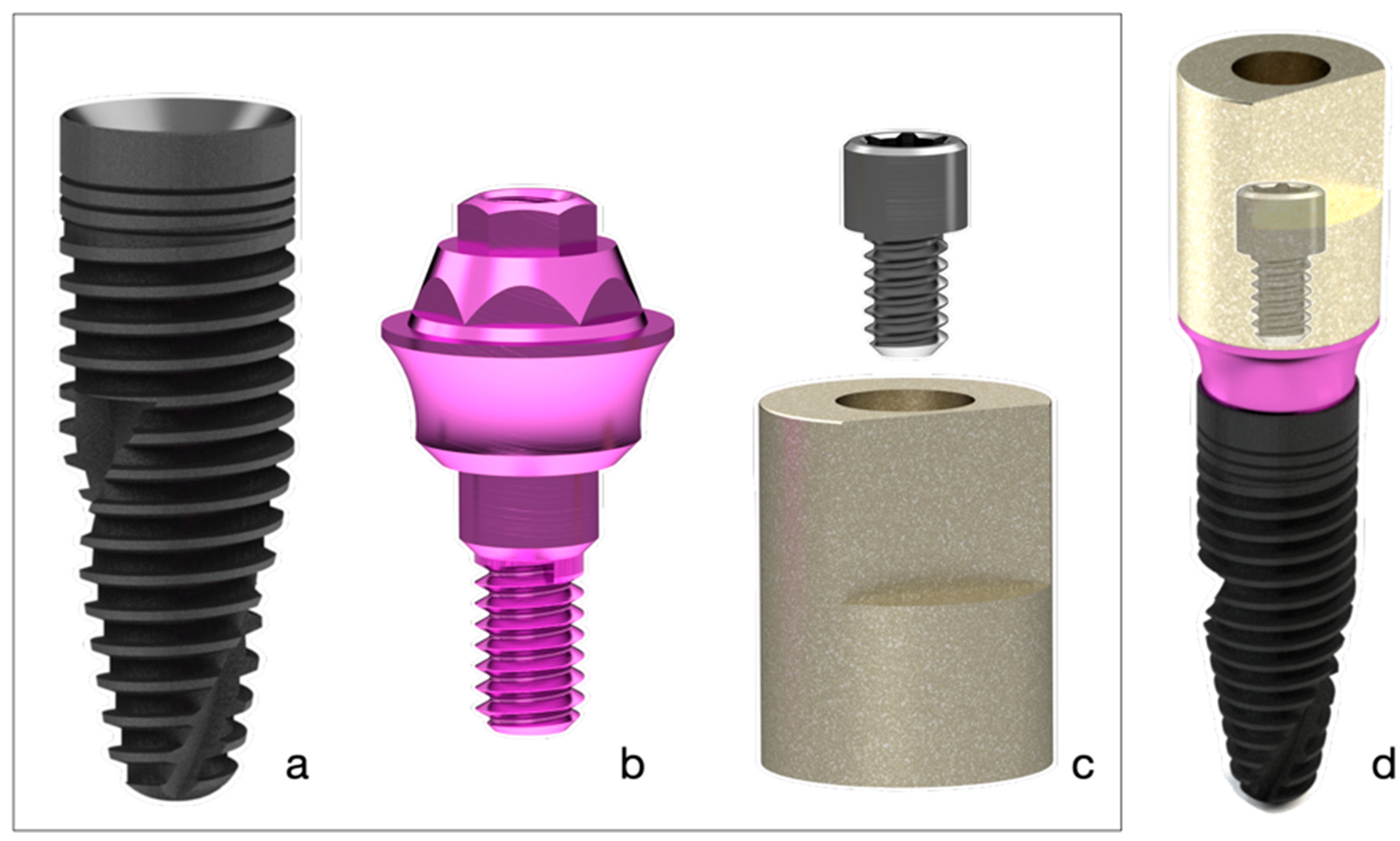
Standardized 8-mm matte metal scan bodies (Ibodontit, S.L., Zaragoza, Spain) connected to universal straight multiunit abutments were used in all models to standardize scan body geometry throughout all acquisitions (
Figure 2). A conventional scan body design was intentionally selected to minimize confounding effects of scan body geometry and isolate the influence of implant spatial configuration on scan trueness. Although alternative scan body designs such as horizontal or reverse scan bodies have been proposed for complete-arch implant scanning, these systems were not evaluated in the present investigation.
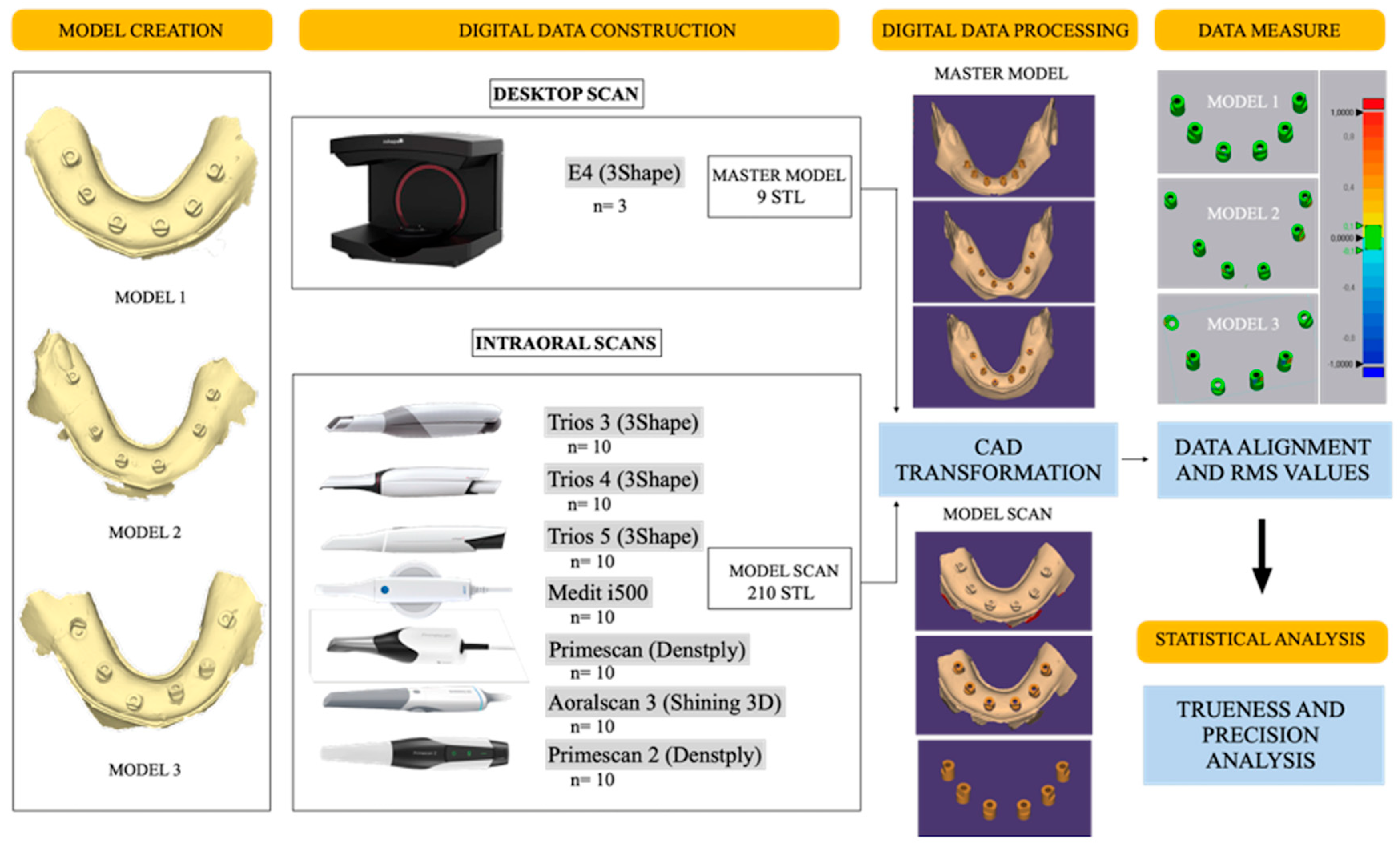
Each master model was scanned three times using a laboratory scanner (E4; 3Shape A/S, Copenhagen, Denmark) with a reported accuracy of 4 µm to generate the reference datasets. Repeated acquisitions were performed to confirm the reproducibility of the reference dataset before comparison with intraoral scan datasets.
Seven intraoral scanners were evaluated: Trios 3, Trios 4, Trios 5 (3Shape A/S, Copenhagen, Denmark), Medit i500 (Medit Corp., Seoul, South Korea), Primescan 1 and Primescan 2 (Dentsply Sirona, Bensheim, Germany), and Aoralscan 3 (Shining 3D Tech Co., Ltd., Hangzhou, China). These scanners were selected because they represent different optical acquisition principles and technological generations currently implemented in clinical practice (
Table 1).
All scanners were calibrated according to the manufacturer’s recommendations before each acquisition session. Scanning procedures were performed by a single experienced operator to reduce operator-related variability under standardized ambient lighting conditions (1000 lux; 4100 K). Manufacturer-recommended scan strategies were followed for each device to minimize protocol-related variability.
Ten scans were acquired for each model with each scanner (n = 10), resulting in 210 STL datasets. All scanners were operated using the latest software versions available at the time of the investigation.
A CAD replacement workflow was performed before deviation analysis. All STL datasets were imported into dental CAD software, exocad Dentalcad 3.2 Elefsina (exocad GmbH, Darmstadt, Germany), where the scan body meshes were replaced using the corresponding scan body library geometries. The replacement procedure was performed by manually identifying the scan body geometries within each STL dataset and substituting them with the corresponding manufacturer library files using the best-fit alignment function available in the CAD software. After replacement, the resulting geometries were exported as standardized STL datasets for deviation analysis. This procedure was intended to minimize potential inaccuracies arising from STL tessellation artifacts and mesh irregularities, enabling a standardized geometric comparison between datasets.
Trueness evaluation was performed using three-dimensional inspection software (Geomagic Control X 2022; 3D Systems Inc., Rock Hill, SC, USA). Each intraoral scan dataset was aligned to the corresponding reference dataset using an initial prealignment followed by iterative closest point (ICP) best-fit alignment based on scan body geometries. The ICP procedure was performed using a geometry-based best-fit algorithm with automatic point sampling and iterative minimization of surface discrepancies until convergence, according to the default software parameters. Root-mean-square (RMS) deviation values were calculated as a quantitative measure of three-dimensional discrepancies between datasets. Precision was determined by calculating the variability among repeated scans within each scanner-model group.
To assess methodological reproducibility, 10% of the datasets were randomly reprocessed on different days following the same workflow.
RMS values were statistically analyzed to evaluate the effects of implant configuration and scanner type on scan trueness (SPSS 27, IBM Corp., Armonk, NY, USA). A two-way analysis of variance (ANOVA) was conducted to assess the effects of implant configuration and scanner type on RMS deviation values after verifying the normality and homogeneity of variances of the collected data using the Shapiro–Wilk and Levene tests, respectively. Pairwise comparisons were made using the least significant difference (LSD) post hoc test. The significance level was set at α = 0.05. Lower RMS values indicated higher trueness.
Figure 3 illustrates the experimental workflow.
3. Results
Significant differences in RMS deviation values were observed among scanners (F(6,181) = 25.685,
p < 0.001, partial η
2 = 0.460), implant configurations (F(2,181) = 71.450,
p < 0.001, partial η
2 = 0.443), and the interaction between both factors (F(12,181) = 5.529,
p < 0.001, partial η
2 = 0.270). Post hoc comparisons identified significant differences among scanners and implant configurations (
p < 0.05). Mean RMS values and standard deviations for each scanner and implant configuration are presented in
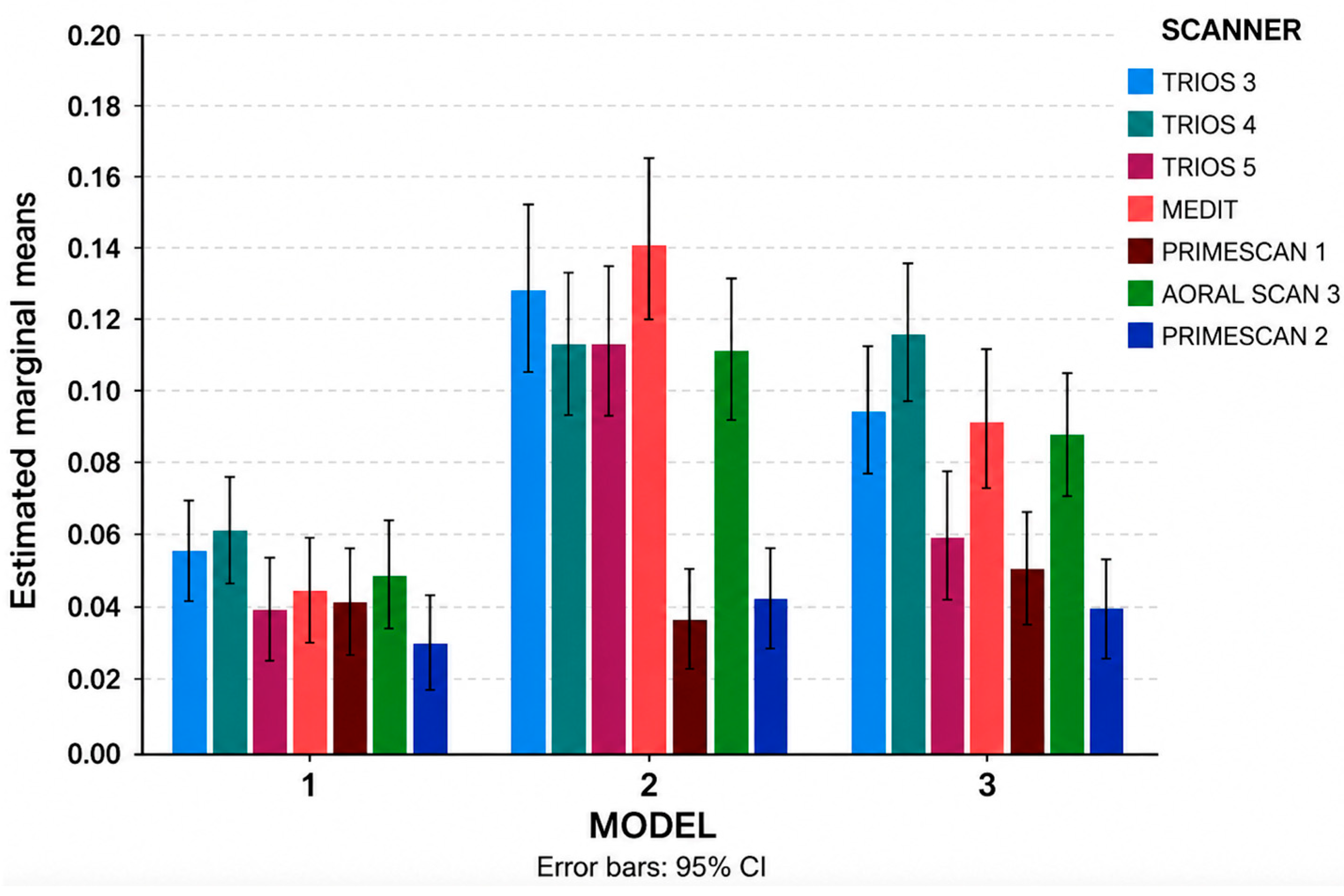
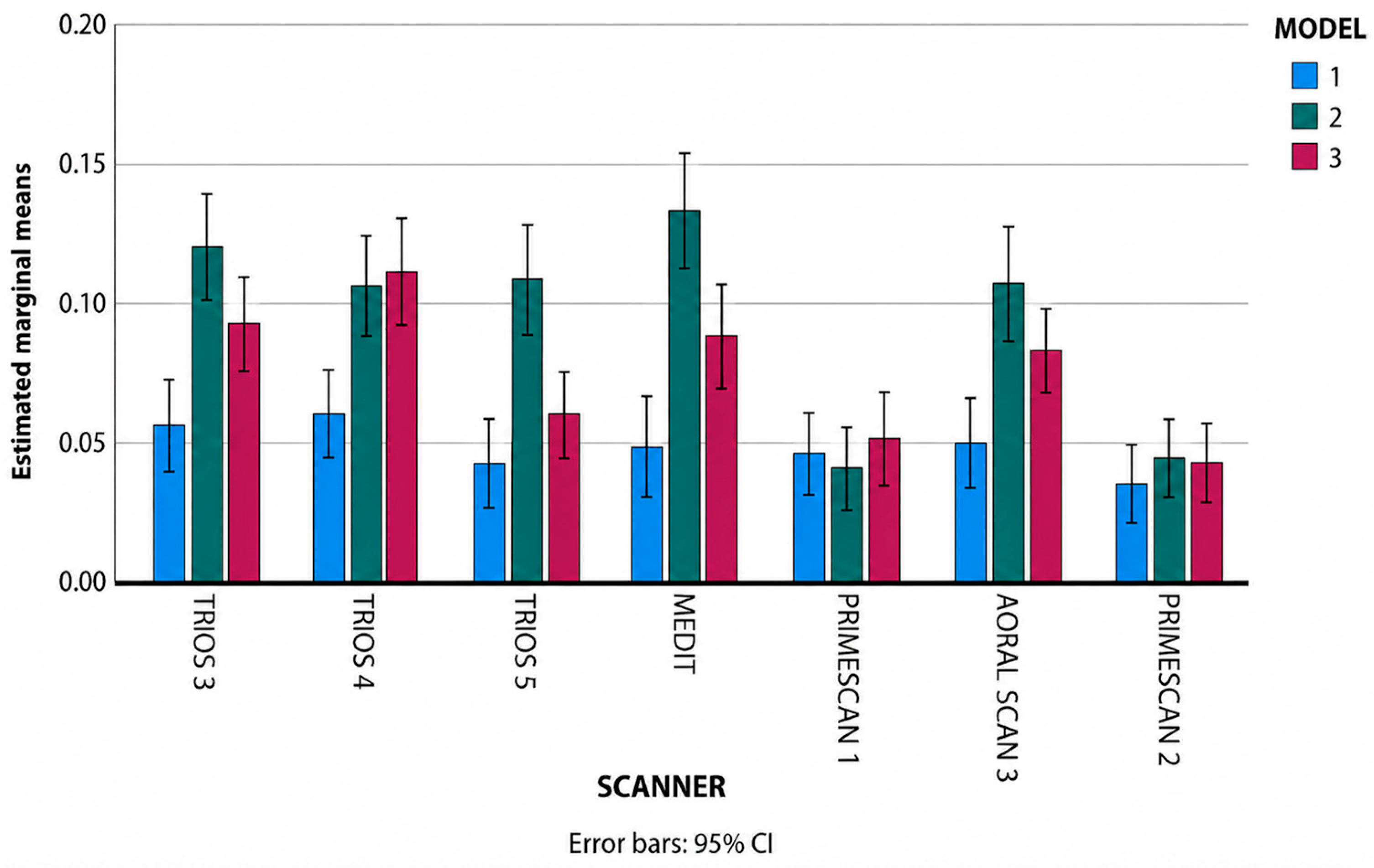
Table 2. Estimated marginal means according to scanner type and implant configuration are shown in
Figure 4 and
Figure 5, respectively.
The analysis of the main effects showed that both scanner technology and implant spatial configuration contributed substantially to the observed differences in scan trueness. The significant effect of implant configuration indicates that the geometric distribution of the implants was not a neutral factor during complete-arch acquisition. Similarly, the significant scanner effect confirms that the evaluated intraoral scanners did not respond uniformly under the same experimental conditions. The significant scanner × configuration interaction further indicates that differences among scanners became more pronounced with increasing spatial complexity of the implant arrangement, rather than remaining constant across the three models.
Lower RMS deviation values were generally observed in Model 1, representing closely spaced parallel implants, compared with Models 2 and 3. Model 2, corresponding to widely distributed implants, showed the highest RMS values across most scanners (
Figure 4).
In Model 1, RMS values remained comparatively low for all scanners, suggesting that a reduced interimplant distance and a more compact anterior distribution provided more favorable conditions for image stitching. In contrast, Model 2 generated a marked increase in RMS deviation values for most devices, indicating that long interimplant distances and complete-arch distribution increased the cumulative effect of stitching distortion. Model 3, which incorporated implant angulation, also produced greater deviations than Model 1; however, for several scanners, the deviations were lower than those observed in Model 2. Model 2 showed higher RMS deviation values than Model 3 for most scanners.
Primescan 1 and Primescan 2 demonstrated consistently lower RMS deviation values across all implant configurations. Trios 5 showed lower RMS deviation values than Trios 3 and Trios 4, particularly in the angulated implant configuration (
Figure 5).
When the scanners were compared across the three implant configurations, Primescan 1 and Primescan 2 showed the most stable behavior across implant configurations, with relatively small changes in RMS values between models. In contrast, Trios 3, Trios 4, Medit i500, and Aoralscan 3 showed a more pronounced increase in RMS deviation values in the more demanding configurations, particularly in Model 2. Trios 5 exhibited intermediate behavior, with improved performance over previous Trios generations, especially in Model 3.
Interaction analysis revealed that the effect of implant configuration on RMS deviation varied by scanner type. Most scanners showed higher RMS values as implant spatial complexity increased, whereas Primescan 1 and Primescan 2 showed smaller increases in RMS deviation across configurations (
Figure 4 and
Figure 5). Standard deviation values indicated lower variability across repeated scans for Primescan 1 and Primescan 2 than for the remaining scanners (
Table 2). Primescan 1 and Primescan 2 also demonstrated the lowest overall variability across repeated acquisitions, whereas Medit i500 showed the greatest variability among repeated scans.
Overall, the results indicate that the loss of trueness associated with complete-arch digital implant impressions was configuration-dependent and varied among scanners. The greatest increase in RMS deviation occurred when implants were distributed over a wider arch span, whereas implant angulation produced a less consistent effect across devices.
4. Discussion
The present findings demonstrated that implant spatial configuration significantly influenced the trueness of complete-arch digital implant impressions. RMS deviation values increased with implant spatial complexity, particularly in models with widely distributed implants and reduced geometric reference areas. These findings suggest that cumulative image-stitching distortion remains a major limitation of complete-arch intraoral scanning despite recent technological improvements in current-generation scanners.
The rejection of the three null hypotheses indicates that complete-arch digital implant scan trueness is not determined by a single isolated factor, but rather by the interaction between implant spatial arrangement and scanner-specific acquisition performance. This finding is clinically relevant because complete-arch implant rehabilitations frequently involve varying implant distributions, interimplant distances, and angulations based on the available bone anatomy and prosthetic design. Therefore, the same intraoral scanner may not provide equivalent accuracy under all clinical configurations, and scanner performance should be interpreted in relation to the geometric complexity of the implant arrangement.
Although statistically significant differences were identified among scanners and implant configurations, the clinical relevance of these discrepancies should be interpreted cautiously. In complete-arch implant rehabilitations, even relatively small positional deviations may contribute to prosthetic misfit accumulation across long-span frameworks. However, no universally accepted clinical threshold currently exists for RMS deviation values in complete-arch digital implant impressions, and the relationship between global RMS discrepancies and long-term prosthetic outcomes remains incompletely established.
Model 2 exhibited the highest RMS deviation values across most scanners, suggesting that long interimplant distances and complete-arch distribution increased cumulative stitching distortion during image acquisition [
3,
7,
8,
9,
11]. In edentulous arches, the reduced availability of stable anatomical landmarks may compromise sequential image alignment and favor progressive distortion across the scan pathway. In contrast, the closely spaced implant configuration of Model 1 provided more continuous geometric references, resulting in lower RMS deviation values for most scanners. These findings suggest that implant distribution across the arch may exert a stronger influence on complete-arch trueness than localized geometric complexity alone.
Although implant angulation negatively affected trueness, its influence appeared less pronounced than that of implant distribution [
10,
23]. Widely distributed parallel implants produced greater deviations than several angulated configurations, suggesting that long-span image reconstruction may contribute more substantially to cumulative distortion than angular discrepancies alone [
24,
25].
Primescan 1 and Primescan 2 exhibited lower RMS deviations across all configurations, indicating greater stability during complete-arch acquisition [
26]. Their more stable performance across the three implant configurations suggests that certain scanner systems may be less sensitive to increased spatial complexity during scanning. This behavior may be associated with differences in the overall acquisition and reconstruction strategies implemented by the evaluated scanner systems. However, because the present investigation compared complete scanner systems rather than isolated technological components, the specific factors responsible for the observed differences cannot be determined. The results indicate an association between scanner type and resistance to progressive scan deviation, but they do not identify the specific hardware or software factor responsible for this behavior.
The lower RMS deviation values observed with Trios 5 compared with earlier Trios generations may reflect the influence of progressive software optimization and acquisition improvements on complete-arch scanning performance.
Unlike many previous investigations that relied on direct STL mesh comparisons, the present study incorporated a CAD replacement workflow using scan body library geometries prior to deviation analysis. This approach was intended to reduce the influence of tessellation artifacts and mesh irregularities, thereby enabling a more standardized comparison of implant position discrepancies among datasets. Nevertheless, this workflow represents a controlled analytical method and may not fully reproduce all sources of error involved in clinical prosthesis fabrication.
The present findings are consistent with previous investigations reporting reduced trueness in complete-arch implant scans compared with short-span rehabilitations [
3,
8,
20]. Keul and Güth [
3] demonstrated progressive distortion across complete arches, whereas Mangano et al. [
8] reported increased discrepancies as scan extension increased. Similarly, Gómez-Polo et al. [
10] identified interimplant distance and implant angulation as relevant factors affecting scan accuracy in complete-arch implant rehabilitations.
Alternative digital systems based on photogrammetry have been proposed to reduce cumulative stitching distortion during complete-arch implant acquisition. Unlike intraoral scanners, which reconstruct datasets through sequential image stitching, photogrammetry systems directly calculate implant positions from spatial coordinate acquisition. Nevertheless, intraoral scanners remain more broadly integrated into restorative digital workflows and continue to be widely used in clinical practice.
Several limitations should be considered when interpreting the present findings. The investigation was conducted under controlled in vitro conditions without saliva, patient movement, or intraoral soft-tissue dynamics. In addition, scans were performed by a single operator and only one scan body geometry was evaluated, which may limit the generalizability of the findings. Although the CAD replacement workflow was intended to standardize geometric comparisons, this methodology may not fully reproduce clinical restorative workflows, and no intraoral validation was performed. Another limitation is that only global RMS deviation values were analyzed. While RMS provides a useful summary of three-dimensional discrepancy, it does not identify the direction or localization of distortion. Additional linear and angular analyses at the implant-platform level would provide a more detailed characterization of the deviation pattern.
From a clinical perspective, the present findings suggest that implant spatial distribution should be considered when selecting digital acquisition systems for complete-arch rehabilitations, particularly in cases involving long edentulous spans, widely distributed implants, or reduced anatomical landmarks [
27]. Intraoral scanning may be more predictable when implants are closely spaced, providing continuous geometric references during acquisition. In more demanding configurations, clinicians may consider additional strategies to reduce cumulative distortion, such as strict adherence to scanner-specific acquisition protocols, use of auxiliary geometric references, verification scans, or alternative registration systems when high prosthetic accuracy is required. These results do not imply that intraoral scanners cannot be used for complete-arch implant impressions, but rather that their reliability may depend on the interaction between scanner technology and implant spatial configuration.
Future investigations should evaluate the influence of alternative scan body geometries, clinical intraoral conditions, photogrammetry-assisted workflows, and in vivo acquisition protocols on complete-arch implant scan trueness.
5. Conclusions
Within the limitations of this in vitro study, implant spatial configuration significantly influenced the trueness of complete-arch digital implant impressions. The results show that RMS deviation values depend not only on the intraoral scanner used but also on the geometric distribution of the implants within the edentulous arch.
The closely spaced parallel implant configuration produced the lowest deviations overall, whereas the widely distributed parallel implant configuration generated the highest RMS values for most scanners. This finding suggests that long interimplant distances and reduced geometric continuity may have a greater negative effect on complete-arch scan trueness than implant angulation alone. Therefore, implant distribution should be considered a relevant factor when planning and interpreting complete-arch digital implant impressions.
Scanner performance varied by implant configuration. Primescan 1 and Primescan 2 exhibited the lowest overall RMS deviations and standard deviations across the three configurations, whereas the remaining scanners showed a more pronounced increase in deviation as implant spatial complexity increased. These findings suggest that current-generation intraoral scanners may differ in their resistance to cumulative image-stitching distortion during complete-arch acquisition.
The CAD replacement workflow used in the present study enabled standardized geometric comparisons using scan body library geometries and may serve as a useful methodological approach for future studies evaluating complete-arch digital implant accuracy. However, further clinical investigations are required to confirm whether these in vitro findings can be extrapolated to intraoral conditions and prosthetic outcomes.
Author Contributions
Conceptualization, B.P.-J., O.F.-A. and J.C.-T.; methodology, O.F.-A., J.C.-T. and B.P.-J.; software, B.P.-J.; validation, O.F.-A. and B.P.-J.; formal analysis, O.F.-A.; investigation, B.P.-J. and S.C.-P.; resources, B.P.-J. and S.C.-P.; data curation, B.P.-J.; writing—original draft preparation, B.P.-J. and O.F.-A.; writing—review and editing, O.F.-A., S.C.-P. and M.R.; visualization, B.P.-J.; supervision, J.C.-T. and O.F.-A.; project administration, M.R. All authors have read and agreed to the published version of the manuscript.
Funding
This research received no external funding.
Institutional Review Board Statement
Not applicable.
Informed Consent Statement
Not applicable.
Data Availability Statement
The data supporting the findings of this study are available from the corresponding author upon reasonable request. The raw dataset is not publicly available because it forms part of ongoing research by the authors; however, a minimal dataset sufficient to verify the results presented in this manuscript can be provided upon reasonable request.
Acknowledgments
During the preparation of this manuscript, the authors used ChatGPT (OpenAI, San Francisco, CA, USA; GPT-5.5 version, accessed May 2026) for language refinement and editorial assistance. The authors reviewed and edited all generated content and take full responsibility for the content of this publication. The authors would like to thank IBO (Ibodontit) for providing the scan bodies and related components used in this study. Their support made this research possible.
Conflicts of Interest
The authors declare no conflicts of interest.
Abbreviations
The following abbreviations are used in this manuscript:
| AI | Artificial Intelligence |
| ANOVA | Analysis of Variance |
| CAD | Computer-Aided Design |
| ICP | Iterative Closest Point |
| IOS | Intraoral Scanner |
| M1 | Model 1 |
| M2 | Model 2 |
| M3 | Model 3 |
| RMS | Root-Mean-Square |
| STL | Standard Tessellation Language |
References
- Espona, J.; Roig, E.; Ali, A.; Roig, M. Immediately loaded interim complete-arch implant-supported fixed dental prostheses fabricated with a completely digital workflow: A clinical technique. J. Prosthet. Dent. 2020, 124, 423–427. [Google Scholar] [CrossRef] [PubMed]
- Gomez-Polo, M.; Barmak, A.B.; Ortega, R.; Rutkunas, V.; Kois, J.C.; Revilla-Leon, M. Accuracy, scanning time, and patient satisfaction of stereophotogrammetry systems for acquiring 3D dental implant positions: A systematic review. J. Prosthodont. 2023, 32, 208–224. [Google Scholar] [CrossRef]
- Keul, C.; Guth, J.F. Accuracy of full-arch digital impressions: An in vitro and in vivo comparison. Clin. Oral Investig. 2020, 24, 735–745. [Google Scholar] [CrossRef] [PubMed]
- Angelone, F.; Ponsiglione, A.M.; Ricciardi, C.; Cesarelli, G.; Sansone, M.; Amato, F. Diagnostic Applications of Intraoral Scanners: A Systematic Review. J. Imaging 2023, 9, 134. [Google Scholar] [CrossRef] [PubMed]
- Gracis, S.; Appiani, A.; Noe, G. Digital workflow in implant prosthodontics: The critical aspects for reliable accuracy. J. Esthet. Restor. Dent. 2023, 35, 250–261. [Google Scholar] [CrossRef]
- Ellakany, P.; Aly, N.M.; Al-Harbi, F. A comparative study assessing the precision and trueness of digital and printed casts produced from several intraoral and extraoral scanners in full arch and short span (3-unit FPD) scanning: An in vitro study. J. Prosthodont. 2023, 32, 423–430. [Google Scholar] [CrossRef]
- Gomez-Polo, M.; Cascos, R.; Ortega, R.; Barmak, A.B.; Kois, J.C.; Revilla-Leon, M. Influence of arch location and scanning pattern on the scanning accuracy, scanning time, and number of photograms of complete-arch intraoral digital implant scans. Clin. Oral Implant. Res. 2023, 34, 591–601. [Google Scholar] [CrossRef] [PubMed]
- Mangano, F.G.; Hauschild, U.; Veronesi, G.; Imburgia, M.; Mangano, C.; Admakin, O. Trueness and precision of 5 intraoral scanners in the impressions of single and multiple implants: A comparative in vitro study. BMC Oral Health 2019, 19, 101. [Google Scholar] [CrossRef]
- Michelinakis, G.; Apostolakis, D.; Kamposiora, P.; Papavasiliou, G.; Ozcan, M. The direct digital workflow in fixed implant prosthodontics: A narrative review. BMC Oral Health 2021, 21, 37. [Google Scholar] [CrossRef]
- Gomez-Polo, M.; Ortega, R.; Sallorenzo, A.; Agustin-Panadero, R.; Barmak, A.B.; Kois, J.C.; Revilla-Leon, M. Influence of the surface humidity, implant angulation, and interimplant distance on the accuracy and scanning time of complete-arch implant scans. J. Dent. 2022, 127, 104307. [Google Scholar] [CrossRef]
- Paratelli, A.; Vania, S.; Gomez-Polo, C.; Ortega, R.; Revilla-Leon, M.; Gomez-Polo, M. Techniques to improve the accuracy of complete arch implant intraoral digital scans: A systematic review. J. Prosthet. Dent. 2023, 129, 844–854. [Google Scholar] [CrossRef]
- Schmidt, A.; Wostmann, B.; Schlenz, M.A. Accuracy of digital implant impressions in clinical studies: A systematic review. Clin. Oral Implant. Res. 2022, 33, 573–585. [Google Scholar] [CrossRef] [PubMed]
- Akl, M.A.; Daifallah, K.; Perez-Barquero, J.A.; Barmak, A.B.; Wee, A.G.; Revilla-Leon, M. Influence of interdental spaces and the palate on the accuracy of maxillary scans acquired using different intraoral scanners. J. Prosthodont. 2023, 32, 125–134. [Google Scholar] [CrossRef] [PubMed]
- Jin, G.; Kim, J.-E.; Nam, N.-E.; Shin, S.-H.; Shim, J.-S. Accuracy Improvement of Intraoral Scanning and Buccal Bite Registration Using Healing Abutment as Landmarks: An In Vitro Study. Appl. Sci. 2021, 11, 318. [Google Scholar] [CrossRef]
- Joda, T.; Ferrari, M.; Gallucci, G.O.; Wittneben, J.G.; Bragger, U. Digital technology in fixed implant prosthodontics. Periodontology 2000 2017, 73, 178–192. [Google Scholar] [CrossRef] [PubMed]
- Mangano, F.G.; Admakin, O.; Bonacina, M.; Lerner, H.; Rutkunas, V.; Mangano, C. Trueness of 12 intraoral scanners in the full-arch implant impression: A comparative in vitro study. BMC Oral Health 2020, 20, 263. [Google Scholar] [CrossRef]
- Ochoa-Lopez, G.; Cascos, R.; Antonaya-Martin, J.L.; Revilla-Leon, M.; Gomez-Polo, M. Influence of ambient light conditions on the accuracy and scanning time of seven intraoral scanners in complete-arch implant scans. J. Dent. 2022, 121, 104138. [Google Scholar] [CrossRef]
- Revilla-Leon, M.; Subramanian, S.G.; Ozcan, M.; Krishnamurthy, V.R. Clinical Study of the Influence of Ambient Light Scanning Conditions on the Accuracy (Trueness and Precision) of an Intraoral Scanner. J. Prosthodont. 2020, 29, 107–113. [Google Scholar] [CrossRef]
- Papaspyridakos, P.; Gallucci, G.O.; Chen, C.J.; Hanssen, S.; Naert, I.; Vandenberghe, B. Digital versus conventional implant impressions for edentulous patients: Accuracy outcomes. Clin. Oral Implant. Res. 2016, 27, 465–472. [Google Scholar] [CrossRef]
- Rutkunas, V.; Gedrimiene, A.; Akulauskas, M.; Fehmer, V.; Sailer, I.; Jegelevicius, D. In vitro and in vivo accuracy of full-arch digital implant impressions. Clin. Oral Implant. Res. 2021, 32, 1444–1454. [Google Scholar] [CrossRef]
- Siqueira, R.; Galli, M.; Chen, Z.; Mendonca, G.; Meirelles, L.; Wang, H.L.; Chan, H.L. Intraoral scanning reduces procedure time and improves patient comfort in fixed prosthodontics and implant dentistry: A systematic review. Clin. Oral Investig. 2021, 25, 6517–6531. [Google Scholar] [CrossRef] [PubMed]
- Azevedo, L.; Marques, T.; Karasan, D.; Fehmer, V.; Sailer, I.; Correia, A.; Gomez Polo, M. Influence of Implant ScanBody Material and Intraoral Scanners on the Accuracy of Complete-Arch Digital Implant Impressions. Int. J. Prosthodont. 2024, 37, 575–582. [Google Scholar] [CrossRef] [PubMed]
- Mangano, F.G.; Veronesi, G.; Hauschild, U.; Mijiritsky, E.; Mangano, C. Trueness and Precision of Four Intraoral Scanners in Oral Implantology: A Comparative in Vitro Study. PLoS ONE 2016, 11, e0163107. [Google Scholar] [CrossRef] [PubMed]
- D’Haese, R.; Vrombaut, T.; Roeykens, H.; Vandeweghe, S. In Vitro Accuracy of Digital and Conventional Impressions for Full-Arch Implant-Supported Prostheses. J. Clin. Med. 2022, 11, 594. [Google Scholar] [CrossRef]
- Spagopoulos, D.; Kaisarlis, G.; Spagopoulou, F.; Halazonetis, D.J.; Guth, J.F.; Papazoglou, E. In Vitro Trueness and Precision of Intraoral Scanners in a Four-Implant Complete-Arch Model. Dent. J. 2023, 11, 27. [Google Scholar] [CrossRef]
- Di Fiore, A.; Graiff, L.; Savio, G.; Granata, S.; Basilicata, M.; Bollero, P.; Meneghello, R. Investigation of the Accuracy of Four Intraoral Scanners in Mandibular Full-Arch Digital Implant Impression: A Comparative In Vitro Study. Int. J. Environ. Res. Public Health 2022, 19, 4719. [Google Scholar] [CrossRef]
- Ebeid, K.; Nouh, I.; Ashraf, Y.; Cesar, P.F. Accuracy of different laboratory scanners for scanning of implant-supported full arch fixed prosthesis. J. Esthet. Restor. Dent. 2022, 34, 843–848. [Google Scholar] [CrossRef]
| Disclaimer/Publisher’s Note: The statements, opinions and data contained in all publications are solely those of the individual author(s) and contributor(s) and not of MDPI and/or the editor(s). MDPI and/or the editor(s) disclaim responsibility for any injury to people or property resulting from any ideas, methods, instructions or products referred to in the content. |




 ,
,