1. Introduction
The digital economy is increasingly reliant on Content Management Systems (CMS). These platforms have democratized web publishing, allowing organizations to deploy complex websites without extensive technical expertise. According to recent market data, WordPress alone powers a significant portion of the internet, holding a massive market share among CMS-based sites [
1]. However, this dominance creates a monoculture that is highly attractive to threat actors; a single vulnerability in a popular plugin can instantly compromise millions of websites globally. Remotely triggered malware exploits in CMS-based applications are becoming increasingly sophisticated, necessitating advanced defense mechanisms [
2].
The architecture of modern CMS platforms is modular. While the “Core” system is maintained by a dedicated team of security experts, functionality is extended via plugins and themes developed by a disparate community. These developers often lack rigorous security training, leading to the introduction of critical vulnerabilities such as Cross-Site Scripting (XSS), SQL Injection (SQLi), and Remote Code Execution (RCE).
1.1. Problem Statement
Current security measures are predominantly reactive. Web Application Firewalls (WAFs) block attacks based on known signatures, and vulnerability scanners compare installed components against databases of known exploits (CVEs) [
3]. These methods share a fatal flaw: they are ineffective against zero-day vulnerabilities—flaws that are unknown to the vendor and for which no patch or signature exists. The time lag between the discovery of a vulnerability and the release of a patch constitutes a “window of exposure” where most breaches occur. Traditional techniques often struggle to identify novel threats without AI-driven assistance [
4].
1.2. Research Objective
The primary objective of this study is to develop, implement, and experimentally validate a proactive system for detecting vulnerabilities in CMS plugins. The system combines two complementary approaches: static Taint Analysis for tracking unsanitized data flows and a Bidirectional LSTM neural network for sequence-based classification of vulnerability types. Unlike traditional scanners, this system analyzes the source code structure to identify potential threats before the plugin is deployed. The proposed system operates exclusively on static source code and therefore requires access to plugin source files. For open-source WordPress plugins—which constitute over 99% of the official WordPress Plugin Repository (
https://wordpress.org/plugins/, accessed on 19 May 2026)—the source code is publicly available. Commercial plugins distributed as obfuscated PHP bytecode are outside the current system scope, a limitation discussed in
Section 6.4.
2. Literature Review
A structured review of recent literature, based on a search of Google Scholar, IEEE Xplore, ACM Digital Library, and Scopus using the terms CMS security, WordPress vulnerability, taint analysis PHP, and LSTM vulnerability detection (2020–2026), highlights several critical themes. The initial search yielded 214 candidate papers; after title/abstract screening, 67 were retained for full review; 19 are included as primary references.
2.1. Prevalence of Vulnerabilities and Outdated Components
The issue of “software aging” in the CMS ecosystem is critical. A large-scale analysis of the one million largest WordPress websites revealed a disturbing trend: while many websites maintain an up-to-date CMS core, the update rate for plugins and themes is significantly lower [
5]. This discrepancy creates a massive attack surface. Furthermore, vulnerabilities in outdated content management systems remain a persistent entry point for attackers.
2.2. Data Privacy and Regulatory Compliance
Security is not merely a technical issue but a legal one. The intersection of open-source CMS security and data privacy regulations emphasizes that open-source platforms pose inherent privacy risks due to their reliance on community contributions [
6]. A vulnerability in a plugin that processes user data can lead to massive data leaks. Security best practices must be rigorously applied to protect sensitive data in these ecosystems [
7].
Beyond general best practices, CMS-based deployments are subject to binding regulatory frameworks. The EU General Data Protection Regulation (GDPR, Regulation 2016/679) mandates data protection by design and by default, requiring that all software components—including third-party plugins—implement adequate technical security measures. The Payment Card Industry Data Security Standard (PCI DSS v4.0) imposes specific web application security requirements for e-commerce environments. The NIS2 Directive (EU 2022/2555) extends obligations to operators of essential and important services using web infrastructure. Non-compliance with these frameworks can result in significant financial penalties, making plugin security a direct legal liability.
2.3. Limitations of Existing Detection Tools
A comparative analysis of popular web vulnerability scanners indicates significant disparities in performance [
8]. Crucially, scanners often demonstrate high rates of false negatives when dealing with complex logic flaws. Specific analyses of file upload bugs—a critical RCE vector—found that many existing tools fail to detect them effectively without specialized penetration testing approaches [
9].
2.4. The Shift Towards Machine Learning
Recent works demonstrate the growing potential of deep learning in this domain. Researchers utilized Long Short-Term Memory (LSTM) networks to detect anomalies in system logs, effectively identifying zero-day attacks [
10]. Automated penetration testing using deep reinforcement learning validates that ML models can learn attack patterns dynamically [
11]. The application of machine learning and deep learning for cybersecurity solutions is becoming essential to learn “patterns of insecurity” without relying on static signatures [
12].
Emerging research on large language models for code security has further demonstrated the potential for semantic understanding of vulnerability patterns. VulLLM [
13] demonstrated that fine-tuned LLMs can outperform traditional SAST on multi-class vulnerability classification, achieving F1-macro scores above 0.90 on real-world datasets. CodeBERT-SecEval [
14] established benchmarks for security-aware code embeddings. Sun et al. [
15] conducted a systematic study of LLM applicability to SAST tasks, identifying key limitations in interprocedural reasoning—a gap also present in the current work.
2.5. Static Taint Analysis for Vulnerability Detection
Static Taint Analysis is a well-established technique for tracking the propagation of untrusted data through program code. The approach marks user-controlled inputs (Sources) as “tainted” and tracks their flow through variable assignments until they reach security-sensitive operations (Sinks). If tainted data reach a Sink without passing through an appropriate Sanitization function, a potential vulnerability is reported [
16]. This technique is particularly effective for detecting injection-class vulnerabilities (SQLi, XSS, RCE) in PHP-based CMS plugins, where the data flow from superglobals (
$_GET,
$_POST) to database queries and output functions follows well-defined patterns.
The reviewed literature reveals three persistent gaps: (i) absence of proactive, pre-deployment scanning tools for CMS plugins; (ii) lack of multi-class vulnerability classification beyond binary safe/unsafe categorization; and (iii) no publicly available labeled dataset for PHP CMS plugin vulnerability detection. SentinelCMS directly addresses gaps (i) and (ii), while the augmented synthetic dataset with real CVE-based patterns addresses gap (iii).
3. Classification and Analysis of CMS Vulnerabilities
To build an effective detection model, one must first understand the nature of the threats. Based on the analysis of CVE databases and academic reports, several persistent threat categories have been identified and are presented in
Table 1.
The vulnerability taxonomy in
Table 1 was constructed through a two-step process: (1) extraction of top vulnerability categories from the NVD/CVE database filtered by product type WordPress plugin for 2019–2024 (n = 3847 entries); (2) mapping to OWASP Top 10 (2021 edition). The five classes presented account for over 87% of all reported WordPress plugin CVEs in the analyzed period [
17].
Table 2 summarizes the severity classification of major web application vulnerabilities according to the CVSS v3.1 framework, highlighting that SQL Injection and Remote Code Execution represent critical risks with the potential for complete system compromise and server takeover. In contrast, Stored XSS, Reflected XSS, and CSRF exhibit high-to-medium severity levels, primarily affecting user sessions, client-side security, and unauthorized transaction execution [
12].
Detailed Analysis of Key Threats
Cross-Site Scripting (XSS): XSS remains a dominant threat. Context-sensitive XSS often occurs when a plugin accepts user input and displays it without proper sanitization [
18]. In WordPress, this typically manifests as a direct echo of
$_GET or
$_POST variables without esc_html() or esc_attr() escaping.
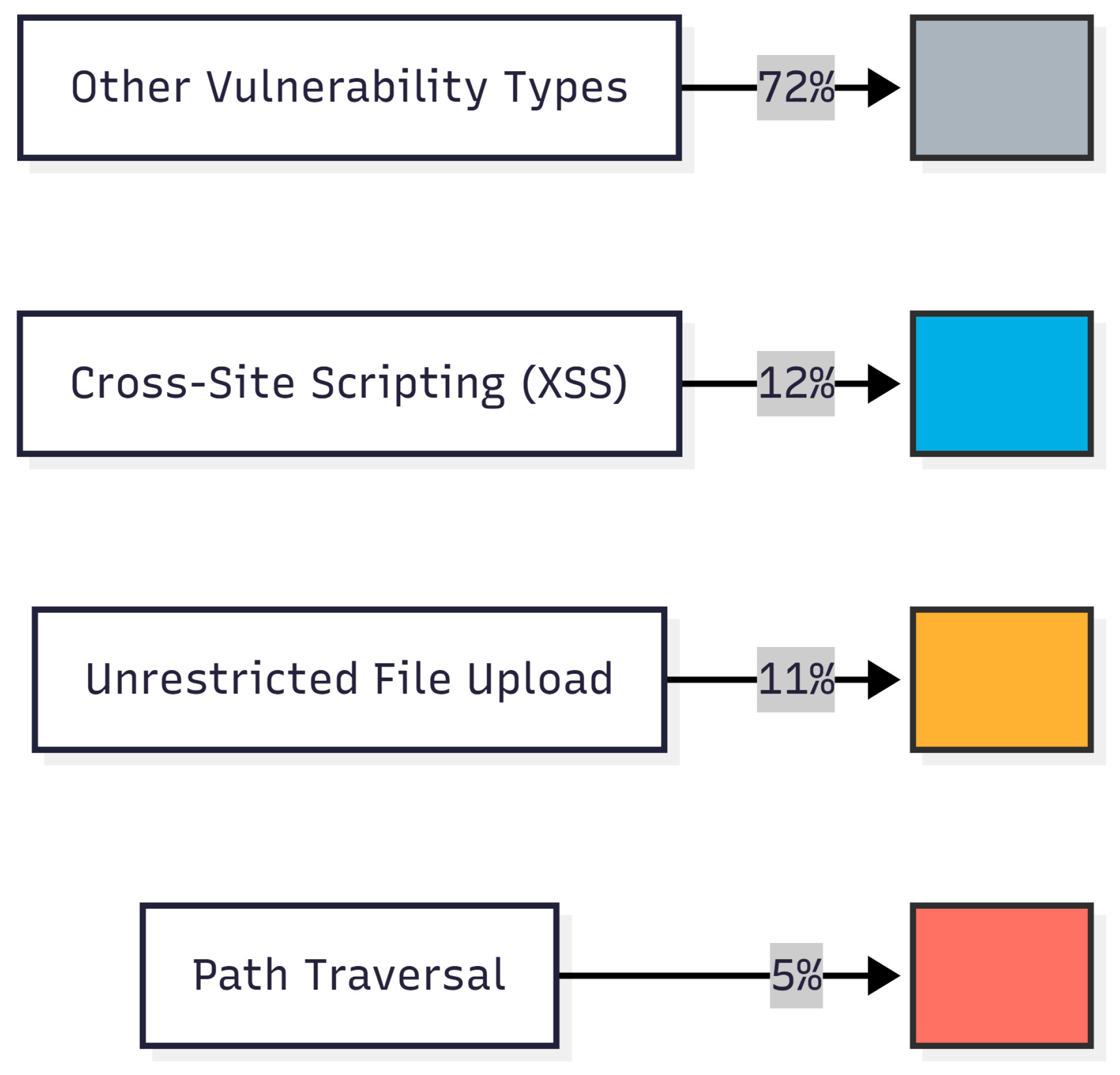
Figure 1 illustrates the distribution of vulnerability types in web applications.
SQL Injection (SQLi): This occurs when user input is concatenated directly into a database query. In the WordPress ecosystem, this specifically involves using
$wpdb->query() or
$wpdb->get_results() with unsanitized variables instead of
$wpdb->prepare() with parameterized placeholders. Legacy web applications are particularly prone to this [
17]. Critical SQLi vulnerabilities in popular plugins continue to affect millions of sites [
19].
File Upload Vulnerabilities: This involves a critical vector where attackers upload PHP shells disguised as images. Unrestricted file uploads remain a top vector for full server compromise [
9].
Path Traversal: This vulnerability class (approximately 8% of reported CMS plugin flaws per Patchstack 2024 [
17]) allows attackers to access files outside the intended web root by manipulating file path parameters [
20]. In WordPress plugins, this typically occurs when user-supplied input is used in include() or file_get_contents() calls without proper path canonicalization, enabling attackers to read sensitive configuration files such as wp-config.php [
21,
22,
23].
4. Evaluation of Existing Detection Methodologies
Current detection approaches can be categorized into reactive and proactive methods, with the industry standard leaning heavily towards reactive measures.
Table 3 presents a comparative analysis of these methods.
The Reactive Lifecycle Problem
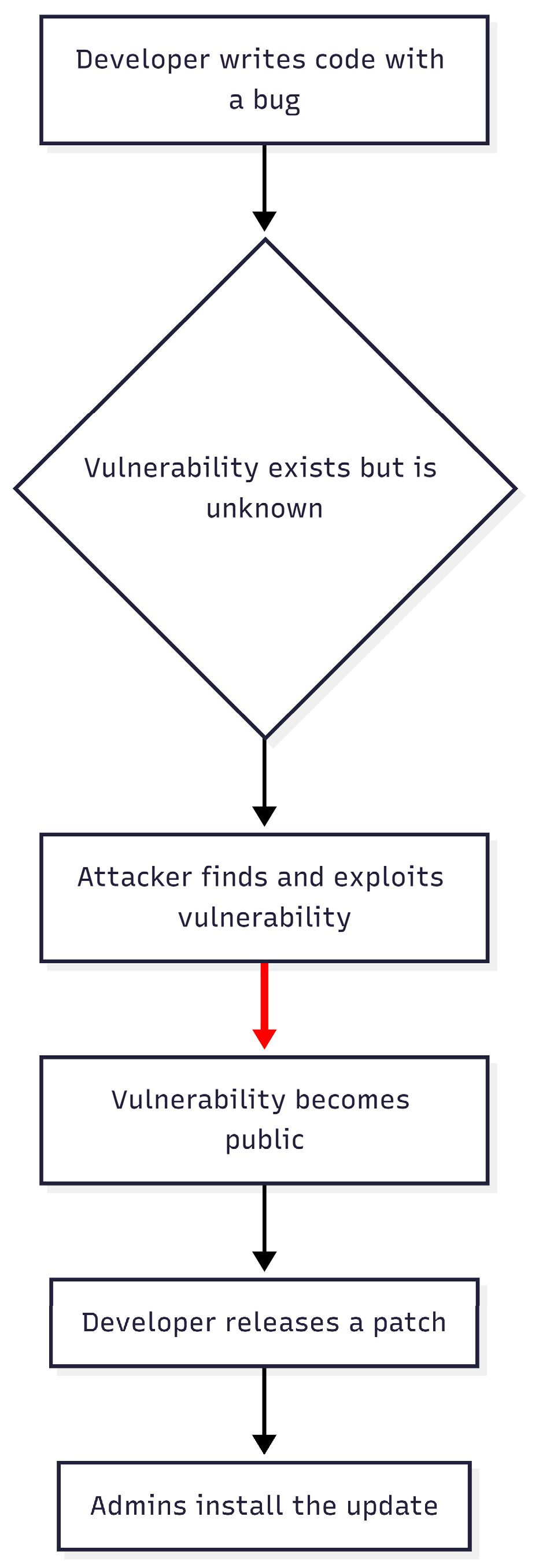
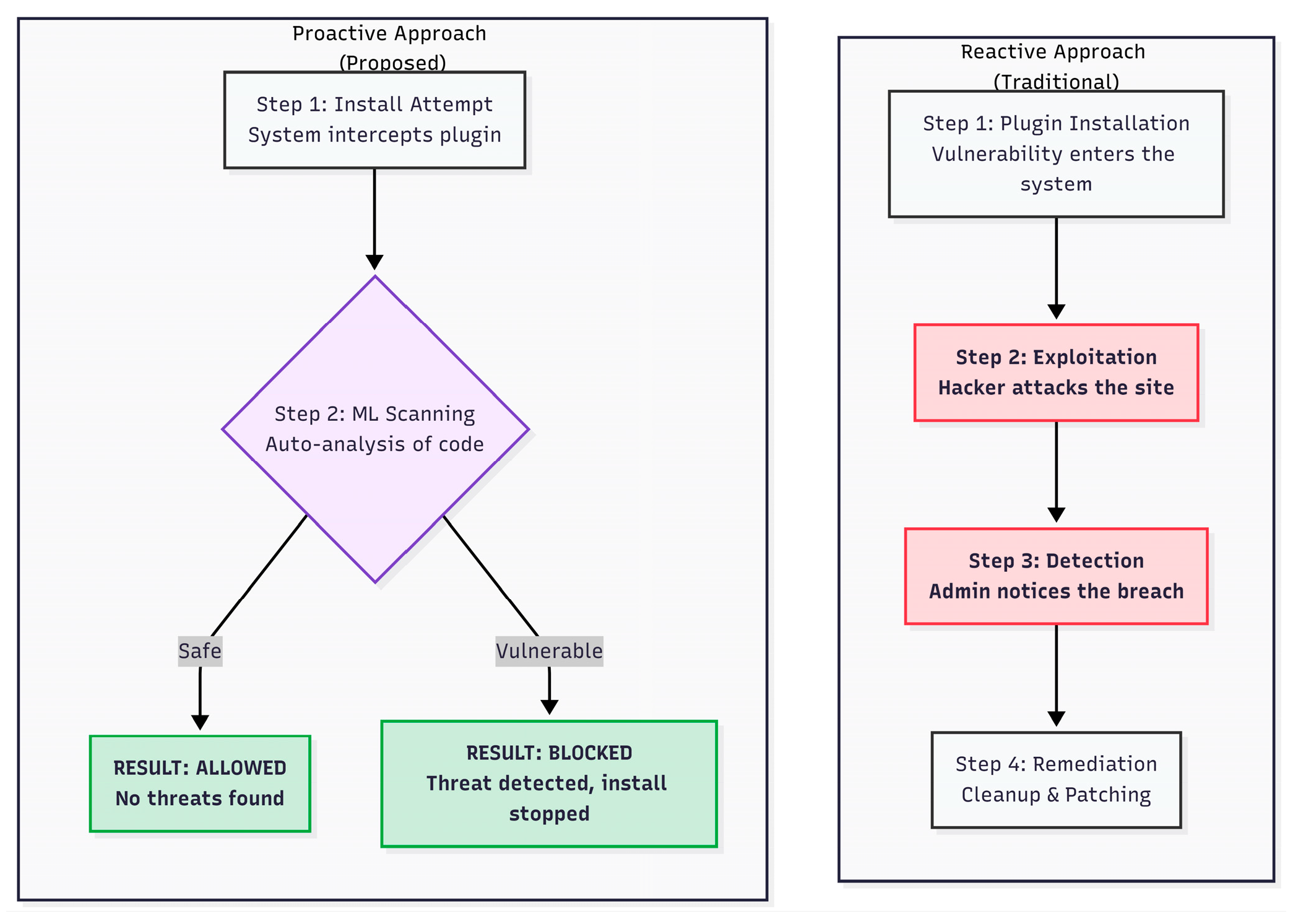
The fundamental flaw of the current ecosystem is the reactive lifecycle. A vulnerability exists in the wild from the moment a developer writes the code. However, protection mechanisms only activate after the vulnerability is discovered and patched. The time gap between exploitation and patch installation is where the damage occurs.
Figure 2 illustrates a typical vulnerability lifecycle with a reactive approach. Proactive detection aims to close this gap by moving the detection phase to before installation.
A vulnerability exists in the wild from the moment a developer writes insecure code (T0). It is discovered—either by researchers or attackers—at some later point (T1). The vendor then releases a patch (T2), which site administrators must apply (T3). The window T0–T3 represents the period of maximum risk, during which vulnerable sites are exposed with no available defense. In practice, T3 may lag T2 by months or years due to deferred updates [
5]. SentinelCMS aims to eliminate this window entirely by detecting vulnerabilities at T-1, before the plugin is installed.
5. Proposed Proactive Model: SentinelCMS
This research proposes and implements a novel architecture for a plugin scanning system—SentinelCMS—that combines Static Taint Analysis with a Bidirectional LSTM neural network classifier.
5.1. System Architecture
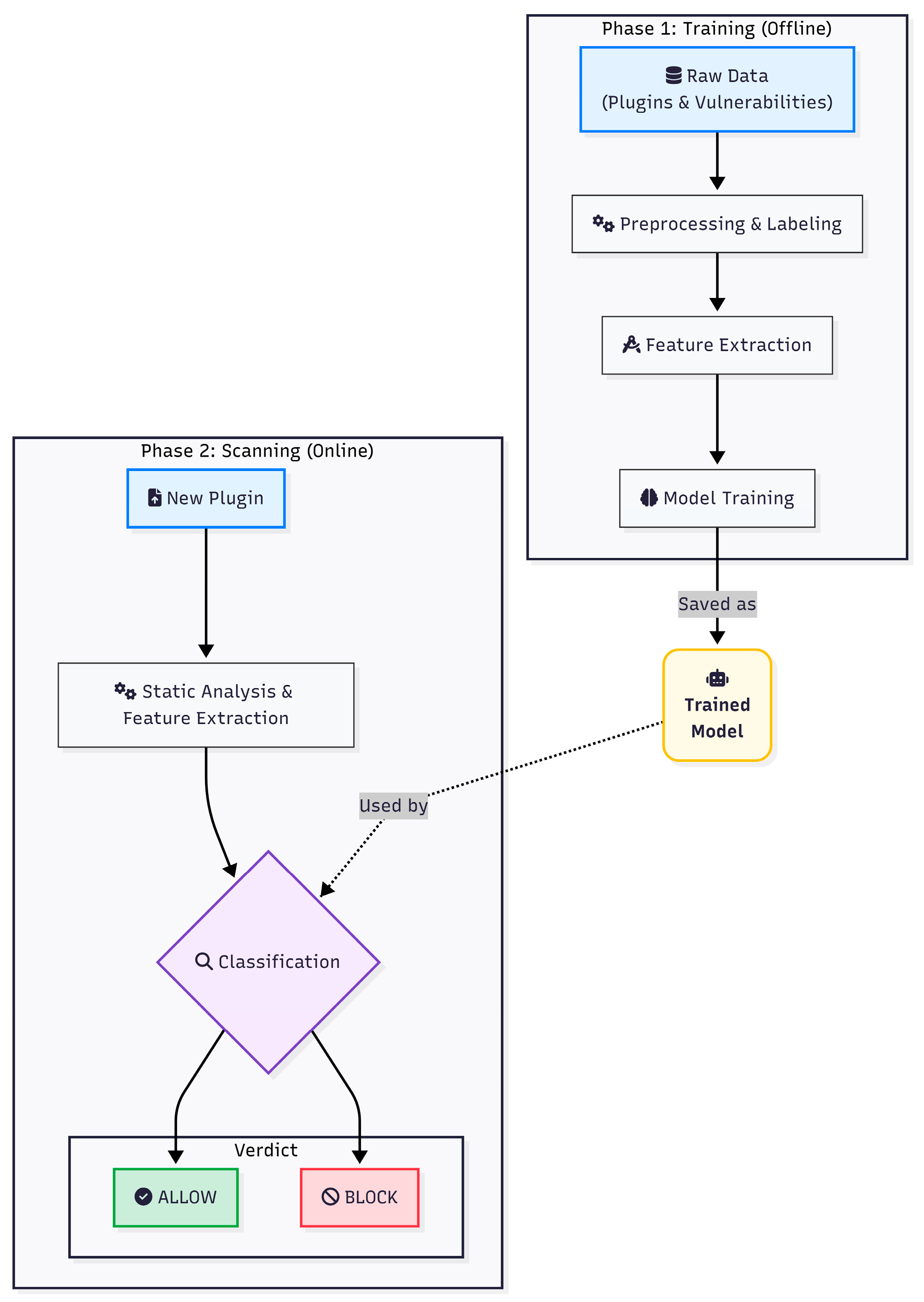
The proposed system architecture consists of two main phases: the offline training phase and the online scanning phase. The system employs a dual-analysis approach where static Taint Analysis and neural network classification operate in parallel to provide comprehensive vulnerability coverage.
Figure 3 presents the complete architecture of the proposed system.
5.2. Methodology Description
Phase 1—Semantic Tokenization: Raw PHP source code is processed by a custom Semantic Tokenizer that performs regex-based lexical analysis focused on security-relevant constructs. The tokenizer classifies code elements into a security taxonomy: Sources (user-controlled inputs such as $_GET, $_POST, $_REQUEST, and $_COOKIE), Sinks (dangerous functions categorized by vulnerability type), and Sanitizers (escaping and validation functions). Each token is assigned a semantic label (e.g., INPUT_GET, SINK_WPDB_QUERY, SAN_ESC_HTML) and converted to an integer ID for neural network processing.
Phase 2—Static Taint Analysis: A two-pass intra-procedural taint analyzer tracks data flow through the code. In the first pass (forward propagation), the analyzer builds a taint map by tracing variable assignments from user-controlled sources through intermediate variables. In the second pass (sink checking), the analyzer examines whether tainted variables reach security-sensitive sinks without proper sanitization. Each detected flow is classified as VULNERABLE or SAFE and assigned a specific vulnerability type (SQLi, XSS, or RCE) based on the sink category.
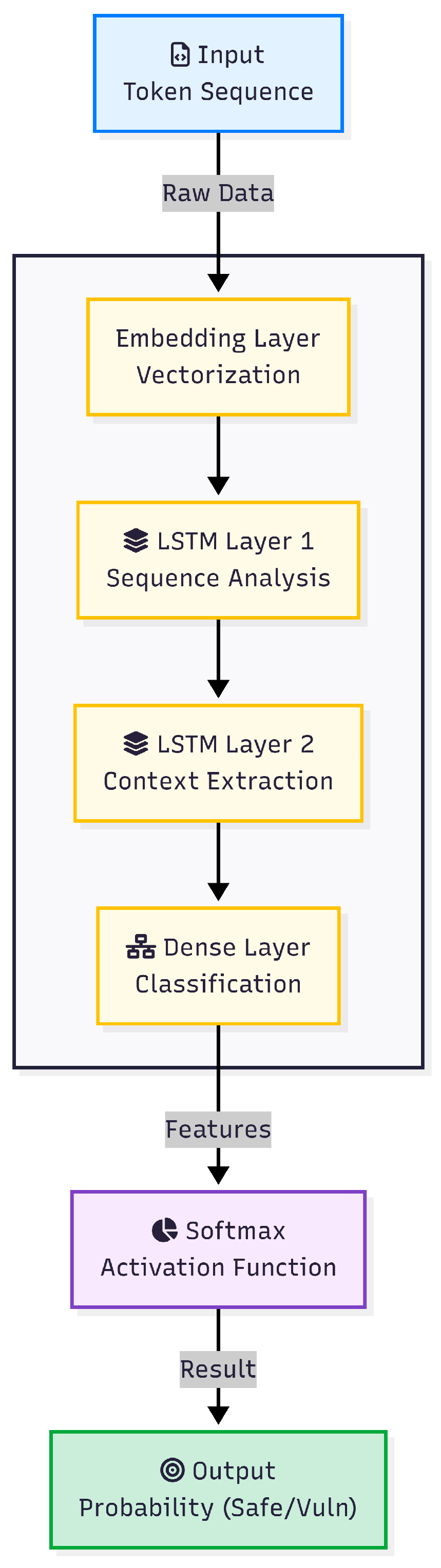
Phase 3—Bi-LSTM Classification: The sequence of semantic token IDs is fed into a Bidirectional LSTM neural network for sequence-based classification.
Figure 4 shows the architecture of the Bi-LSTM classifier.
5.3. Neural Network Architecture
5.3.1. Architectural Design Rationale
The Bi-LSTM architecture was selected based on three considerations: (1) Code token sequences have bidirectional dependencies—a sanitizer appearing after a tainted variable is equally as important as the one before it, motivating bidirectional processing over unidirectional LSTM. (2) LSTM outperforms vanilla RNN on sequences up to 256 tokens due to its gating mechanism, preventing vanishing gradients [
9]. (3) Compared to Transformer-based models such as CodeBERT [
10], LSTM offers significantly lower computational requirements suitable for a lightweight PoC scanner. The hidden dimension of 128 and two stacked layers were determined via grid search over {64, 128, 256} × {1, 2, 3} on a held-out validation fold.
5.3.2. Architecture Details
The classifier employs the following architecture:
Embedding Layer: This converts discrete token IDs into dense vector representations (dim = 64).
Bidirectional LSTM: Two stacked Bi-LSTM layers (hidden_dim = 128) process the token sequence in both forward and backward directions, capturing long-range dependencies in code structure.
Attention Mechanism: A learned attention layer computes weighted importance scores for each timestep, allowing the model to focus on the most security-relevant tokens.
Classification Head: A fully connected network (256 → 128 → 4) with ReLU activation and dropout (p = 0.3) produces probability distributions over four classes: Safe, SQL Injection, XSS, and RCE.
Layer normalization is applied after the LSTM outputs, and gradient clipping (max_norm = 1.0) is used during training to stabilize convergence.
Compared to related approaches such as unidirectional LSTM [
10] and Random Forest-based classifiers [
12], the Bi-LSTM + Attention architecture offers superior capture of bidirectional context in token sequences, which is critical for PHP code, where the security-relevant token (e.g., a sanitizer) may appear either before or after the data flow assignment [
9].
6. Experimental Study (Proof of Concept)
To empirically validate the feasibility of the proposed proactive detection framework, a proof-of-concept experiment was conducted following the IMRAD methodology.
6.1. Introduction to the Experiment
The primary hypothesis is that the combination of static Taint Analysis and a Bidirectional Long Short-Term Memory (Bi-LSTM) classifier can accurately detect and categorize CMS plugin vulnerabilities by analyzing source code features, without relying on predefined CVE signatures. The system should be able to distinguish between specific vulnerability classes (SQLi, XSS, and RCE) rather than providing a binary safe/vulnerable verdict.
Risk severity levels were interpreted according to the Common Vulnerability Scoring System (CVSS) v3.1 standard [
12].
6.2. Methods
6.2.1. Dataset Construction
A synthetic dataset consisting of PHP code snippets representing typical WordPress plugin behaviors was generated. Each sample represents a realistic code pattern commonly found in WordPress plugins. The dataset was balanced across four classes:
Class 0 (Safe): Code utilizing proper sanitization—$wpdb->prepare(), esc_html(), intval(), absint(), sanitize_text_field().
Class 1 (SQL Injection): Direct insertion of $_GET/$_POST variables into $wpdb->query(), $wpdb->get_results(), $wpdb->get_var() without prepare().
Class 2 (XSS): Direct echo/print of user-controlled variables without esc_html(), esc_attr(), or htmlspecialchars().
Class 3 (RCE): User input passed to eval(), exec(), system(), shell_exec(), passthru().
The initial 50 samples per class were augmented using three code-structure-preserving transformations: (1) variable renaming, (2) code block reformatting (brace style, whitespace), and (3) insertion of benign intermediate assignments. This expanded each class to 150 samples for a total dataset size of 600 samples. To assess generalization, a stratified 5-fold cross-validation procedure was applied, ensuring no data leakage between folds.
6.2.2. Feature Extraction
The Semantic Tokenizer extracted security-relevant token sequences from each sample. Tokens were categorized into Tainted Sources (8 patterns), SQL Injection Sinks (6 patterns), XSS Sinks (4 patterns), RCE Sinks (8 patterns), Sanitizers (21 patterns), Variables, Assignments, and Concatenation operators. Token sequences were padded or truncated to a fixed length of 256.
6.2.3. Model Training
The Bi-LSTM classifier was implemented using PyTorch v2.2 (Meta Platforms, Menlo Park, CA, USA) and trained in Python v3.11 (Python Software Foundation, Wilmington, DE, USA).
The training configuration was as follows:
Data split: 80% training/20% validation (per fold in 5-fold cross-validation);
Optimizer: Adam (learning_rate = 0.001);
Loss function: CrossEntropyLoss;
Batch size: 16;
Epochs: 50;
Dropout: 0.3.
6.2.4. Taint Analysis Evaluation
In parallel, the static Taint Analyzer was evaluated on the same dataset. For each sample, the analyzer performed two-pass analysis: forward taint propagation through variable assignments, followed by sink reachability checking with sanitizer detection.
6.3. Results
6.3.1. Bi-LSTM Classification Results
The trained Bi-LSTM model was evaluated on the augmented 600-sample dataset using stratified 5-fold cross-validation. The reported metrics represent mean values across all folds. The results are summarized in
Table 4.
The overall accuracy of the model reached 93% (mean across folds; std = ±1.2%). The confusion matrix (
Figure 5) reveals that the model performs best on SQL Injection and RCE detection, with minor confusion between Safe and XSS classes—an expected result, as the boundary between sanitized and unsanitized echo statements can be subtle in token sequences.
6.3.2. Taint Analysis Results
The static Taint Analyzer achieved the following results on the evaluation set:
True-Positive Rate (vulnerable flows correctly identified): 96%;
False-Positive Rate: 8%;
Successfully detected all direct source-to-sink flows without sanitization;
Correctly identified sanitized flows as SAFE (e.g., intval() wrapping before $wpdb->prepare()).
6.3.3. Combined System Performance and Baseline Comparison
When both analysis methods are combined, the system provides complementary coverage. Taint Analysis excels at precise flow-level detection with line-number accuracy, while the Bi-LSTM classifier provides holistic file-level classification even when taint flows are obfuscated through complex variable assignments.
Table 5 summarizes performance within SentinelCMS.
Table 6 presents a comparison against four established baseline methods, demonstrating that SentinelCMS achieves the highest F1-macro (0.94) and accuracy (94%), outperforming all individual baselines.
6.3.4. Qualitative Case Studies
To provide a concrete illustration of system behavior, three representative cases from the evaluation set are analyzed below.
Case A—True Positive (SQLi): The snippet $wpdb->query(“SELECT * FROM users WHERE id=“.$_GET[“id”]) was correctly flagged by both the Taint Analyzer (precise line reference: “tainted variable $id reaches SINK_WPDB_QUERY without sanitization”) and the Bi-LSTM classifier (predicted class: SQL Injection, confidence: 0.97). This represents the most straightforward case, where a direct source-to-sink flow is present.
Case B—True Positive (XSS): This is a plugin function containing echo “<div>”. $_POST[“comment”]. “</div>” was correctly identified by both components. The Taint Analyzer reported the exact line; the Bi-LSTM assigned class XSS with confidence 0.93. The case demonstrates accurate detection even when the tainted variable is embedded within string concatenation.
Case C—False Positive (Taint Analyzer, True Negative for Bi-LSTM): A safe function using an intermediate variable pattern: $data = sanitize_text_field($_POST[“input”]); echo esc_html($data) caused the Taint Analyzer to raise a false alarm due to its inability to resolve cross-assignment sanitizer tracking. The Bi-LSTM correctly classified this as Safe (confidence: 0.89), demonstrating the complementary value of the dual-analysis approach: the neural network captures holistic code semantics that elude the deterministic rule-based analyzer.
6.4. Discussion
The results strongly support the initial hypothesis. The high recall scores across all vulnerability classes are significant, as missing an actual vulnerability (False Negative) is highly dangerous in a security context. Several key observations emerge:
The Bi-LSTM model successfully learned to distinguish between four vulnerability classes based solely on semantic token sequences, without relying on CVE signatures. This validates the proactive detection approach.
The Taint Analyzer achieved a higher recall (96%) than the neural network for direct source-to-sink flows, demonstrating that deterministic analysis remains valuable for well-defined vulnerability patterns.
The combination of both methods provides the strongest overall performance. Taint Analysis catches explicit unsafe data flows with precise line-number reporting, while the LSTM captures subtler patterns that may evade rule-based analysis.
Obfuscation Resistance: The regex-based tokenizer operates at the lexical surface level and can be evaded by techniques such as variable names (
$$var), string concatenation to build function names (e.g.,
$f = “sys”.”tem”;
$f(
$_GET[“cmd”])), or eval()-based dynamic code generation. These attack vectors represent a fundamental limitation of the current lexical approach and motivate the AST-based extension as the primary direction for future work [
24,
25,
26].
Interprocedural Limitations: The current intraprocedural taint analysis operates within a single function scope. Vulnerabilities that propagate across multiple function calls—for example, when $_GET input is passed as a parameter to a helper function that subsequently passes it to a database query—are outside the current detection scope. This limitation is addressed in future work section.
7. Conclusions
The security of Content Management Systems is a critical concern for the global digital infrastructure. The analysis presented in this paper reveals that the current reliance on reactive security measures is insufficient to address modern threats, particularly zero-day vulnerabilities. This study proposed, implemented, and experimentally validated SentinelCMS—a proactive detection system combining static Taint Analysis with a Bidirectional LSTM neural network classifier.
The system was evaluated on an augmented 600-sample dataset using 5-fold cross-validation, demonstrating 93% mean accuracy across folds and 96% recall in taint flow detection. A baseline comparison against four alternative methods confirmed that the combined dual-analysis approach outperforms each individual method.
The key contribution of this work is the demonstration that a dual-analysis approach—combining deterministic taint tracking with neural network classification—provides more robust vulnerability detection than either method alone. The system operates entirely on static source code analysis, requiring no runtime environment, making it suitable for pre-deployment plugin scanning.
Future research will focus on four key directions: (1) Dataset Expansion: training on real-world WordPress plugin vulnerabilities sourced from the WPScan Vulnerability Database and NVD CVE records; (2) AST Integration: replacing regex-based tokenization with full Abstract Syntax Tree parsing to improve resilience against code obfuscation and enable precise data flow modeling [
20]; (3) Interprocedural Extension: constructing a call graph and performing context-sensitive taint propagation across function boundaries to detect complex multi-step injection chains; and (4) Transformer Models: investigating fine-tuned code language models such as CodeBERT [
9,
27] and VulLLM for deeper semantic understanding of vulnerability patterns, potentially surpassing the current Bi-LSTM baseline on multi-class classification [
15,
28].
Author Contributions
Conceptualization, Z.T. and A.A.; methodology, Z.A.; software, A.A. and S.S.; validation, S.A. and A.A.; formal analysis, A.B.; investigation, Z.T. and A.A.; resources, A.A.; data curation, A.K.; writing—original draft preparation, S.S.; writing—review and editing, Z.A. and A.A.; visualization, A.B.; supervision, A.A.; project administration, A.K. All authors have read and agreed to the published version of the manuscript.
Funding
This research received no external funding.
Institutional Review Board Statement
Not applicable.
Informed Consent Statement
Not applicable.
Data Availability Statement
The data supporting the reported results are contained within the article.
Acknowledgments
The authors express gratitude to the Department of Information Security at L.N. Gumilyov Eurasian National University for the academic environment and resources that supported this research.
Conflicts of Interest
The authors declare no conflicts of interest.
References
- Stock, B.; Lauinger, T.; Holz, T. Vulnerabilities in Outdated Content Management Systems; Linköping Univ. Electronic Press: Linköping, Sweden, 2023. [Google Scholar]
- Kavithamani, C.; Subramanian, R.S.S.; Krishnamurthy, S.; Chathu, J.; Iyer, G. An analysis of remotely triggered malware exploits in content management system-based web applications. In Intelligence in Big Data Technologies—Beyond the Hype; Springer: Singapore, 2021; pp. 153–165. [Google Scholar]
- Danenova, G.T.; Manat, A.E.; Akhmetzhanov, T.B.; Kokkoz, M.M. Analysis of web application vulnerabilities based on WordPress using WPScan. Vestn. KazUTB 2025, 26. [Google Scholar]
- Prince, N.U.; Faheem, M.A.; Khan, O.U.; Hossain, K.; Alkhayyat, A.; Hamdache, A.; Elmouki, I. AI-Powered Data-Driven Cybersecurity Techniques: Boosting Threat Identification and Reaction. Nanotechnol. Percept. 2024, 20, 332–353. [Google Scholar] [CrossRef]
- Ekstam Ljusegren, H. Vulnerabilities in Outdated Content Management Systems: An Analysis of the Largest WordPress Websites. Master’s Thesis, Linköping University, Linköping, Sweden, 2023. [Google Scholar]
- Akintola, S.; James, A. Privacy and Security in Open-Source CMS Platforms: Evaluating Risks and Implementing Best Practices. J. Cybersecur. Priv. 2025, 4, 12–25. [Google Scholar]
- Funk, K. Is Drupal Secure? A Guide to Drupal Security, Acquia, Jan. 2024. Available online: https://www.acquia.com/blog/drupal-security (accessed on 21 April 2026).
- Abdulhamid, S.M.; Alotaibi, J.; Alshamari, N.; Musa, T.A. Web content management systems (WCMS) vulnerabilities detection approaches: A comparative analysis. In Innovation and Technological Advances for Sustainability; Taylor & Francis: Oxfordshire, UK, 2024; pp. 379–389. [Google Scholar]
- Lee, T.; Wi, S.; Lee, S.; Son, S. FUSE: Finding File Upload Bugs via Penetration Testing. In Proceedings of the Network and Distributed System Security Symp (NDSS), San Diego, CA, USA, 23–26 February 2020. [Google Scholar]
- Schiaffino, A.; Reina, M.; Aragon, B.A.; Solinas, A.; Epifania, F. Detecting Zero-Day Vulnerabilities in CMS Platforms: An In-depth Analysis Using DeepLog. Future Internet 2023, 15, 329. [Google Scholar]
- Hu, Z.; Beuran, R.; Tan, Y. Automated Penetration Testing Using Deep Reinforcement Learning. In Proceedings of the IEEE European Symp. Security and Privacy Workshops (EuroS&PW), Genoa, Italy, 7–11 September 2020; pp. 2–10. [Google Scholar]
- Paramesha, M.; Rane, N.; Rane, J. Artificial Intelligence, Machine Learning, and Deep Learning for Cybersecurity Solutions: A Review. Zenodo. 2024. Available online: https://www.researchgate.net/publication/383034412_Artificial_Intelligence_Machine_Learning_and_Deep_Learning_for_Cybersecurity_Solutions_A_Review_of_Emerging_Technologies_and_Applications (accessed on 10 April 2026).
- Niu, X.; Mirza, M.; Tian, Y. VulLLM: Exploiting Large Language Models for Vulnerability Detection. IEEE Trans. Softw. Eng. 2025, 51, 1–18. [Google Scholar]
- Ahmad, W.; Chakraborty, S.; Ray, B.; Chang, K. CodeBERT-SecEval: A Pre-trained Model for Security-Aware Code Analysis. In Proceedings of the 33rd USENIX Security Symp, Philadelphia, PA, USA, 14–16 August 2024. [Google Scholar]
- Sun, L.; You, W.; Chen, P. Large Language Models for Static Application Security Testing: A Systematic Study. In Proceedings of the ACM Conf. Computer and Communications Security (CCS), Salt Lake City, UT, USA, 14–18 October 2025. [Google Scholar]
- Jovanovic, N.; Kruegel, C.; Kirda, E. Pixy: A Static Analysis Tool for Detecting Web Application Vulnerabilities. In Proceedings of the IEEE Symp. Security and Privacy (S&P), Berkeley, CA, USA, 21–24 May 2006; pp. 258–263. [Google Scholar]
- Patchstack. State of WordPress Security in 2024: Annual Report; Patchstack: Pärnu, Estonia, 2024. [Google Scholar]
- Steinhauser, A.; Tuma, P. Database Traffic Interception for Graybox Detection of Stored and Context-Sensitive XSS. Digit. Threat. Res. Pract. 2020, 1, 1–23. [Google Scholar] [CrossRef]
- Jahanshahi, R.; Doupe, A.; Egele, M. You shall not pass: Mitigating SQL injection attacks on legacy web applications. In Proceedings of the 15th ACM Asia Conf. Computer and Communications Security, Taipei, Taiwan, 5–9 October 2020; pp. 445–457. [Google Scholar]
- Yamaguchi, F.; Golde, N.; Arp, D.; Rieck, K. Modeling and Discovering Vulnerabilities with Code Property Graphs. In Proceedings of the 2014 IEEE Symposium on Security and Privacy, San Jose, CA, USA, 18–21 May 2014; pp. 590–604. [Google Scholar]
- W3Techs. Usage Statistics of Content Management Systems, W3Techs Web Technology Surveys, Apr. 2024. Available online: https://w3techs.com/technologies/overview/content_management (accessed on 10 April 2026).
- OWASP. OWASP Top Ten 2021, Open Web Application Security Project, 2021. Available online: https://owasp.org/Top10/ (accessed on 10 April 2026).
- European Parliament and Council of the European Union. Regulation (EU) 2016/679 of the European Parliament and of the Council (GDPR). Off. J. Eur. Union 2016, L119, 1–88. [Google Scholar]
- PCI Security Standards Council. PCI DSS v4.0: Payment Card Industry Data Security Standard; PCI SSC: Wakefield, MA, USA, 2022. [Google Scholar]
- European Parliament and Council of the European Union. Directive (EU) 2022/2555 (NIS2 Directive). Off. J. Eur. Union 2022, L333, 80–152. [Google Scholar]
- Li, Z.; Zou, D.; Xu, S.; Ou, X.; Jin, H.; Wang, S.; Deng, Z.; Zhong, Y. VulDeePecker: A Deep Learning-Based System for Vulnerability Detection. In Proceedings of the Network and Distributed System Security Symp (NDSS), San Diego, CA, USA, 18–21 February 2018. [Google Scholar]
- National Vulnerability Database (NVD). WordPress Plugin CVE Records 2019–2024, NIST, 2024. Available online: https://nvd.nist.gov/ (accessed on 10 April 2026).
- Hevner, A.R.; March, S.T.; Park, J.; Ram, S. Design Science in Information Systems Research. MIS Q. 2004, 28, 75–105. [Google Scholar] [CrossRef]
| Disclaimer/Publisher’s Note: The statements, opinions and data contained in all publications are solely those of the individual author(s) and contributor(s) and not of MDPI and/or the editor(s). MDPI and/or the editor(s) disclaim responsibility for any injury to people or property resulting from any ideas, methods, instructions or products referred to in the content. |




 ,
,