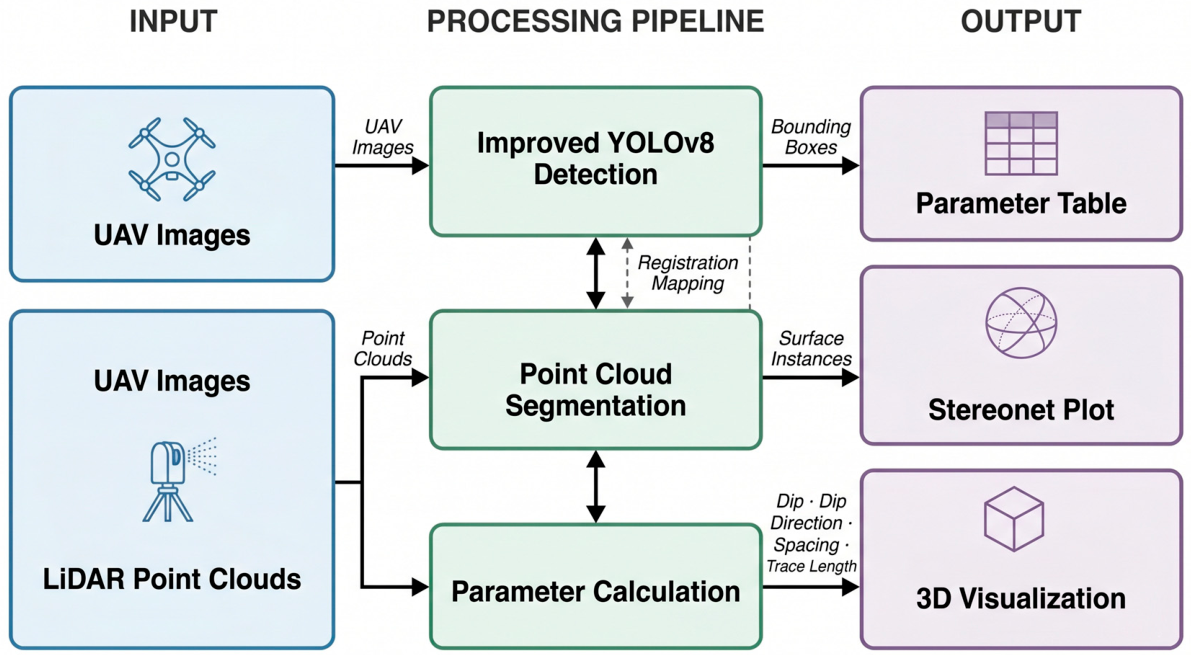
Figure 1.
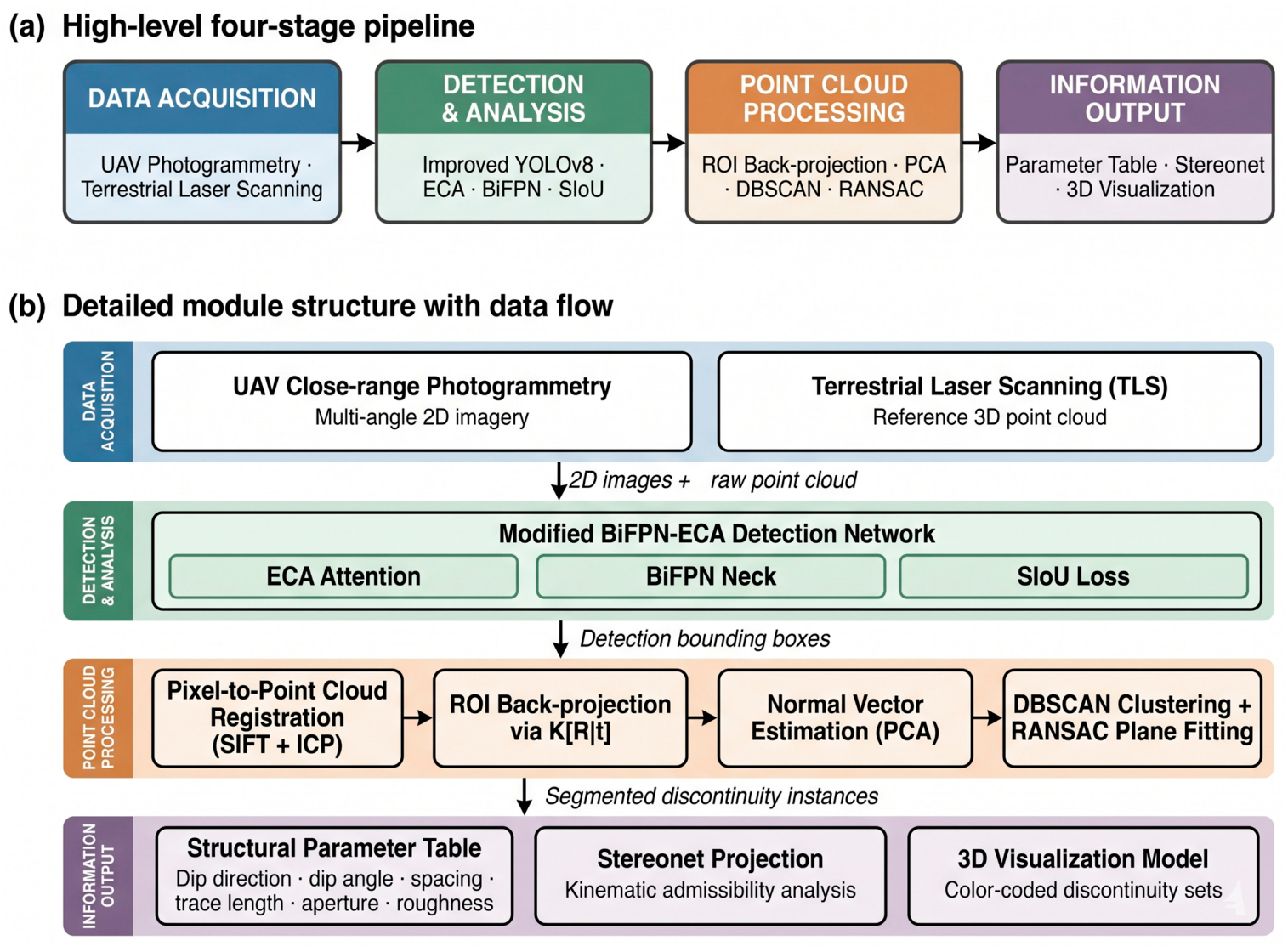
Overall architecture diagram of the intelligent recognition system for slope discontinuities. (a) High-level four-stage pipelinea; (b) Detailed module structure with data flow.
Figure 1.
Overall architecture diagram of the intelligent recognition system for slope discontinuities. (a) High-level four-stage pipelinea; (b) Detailed module structure with data flow.
Figure 2.
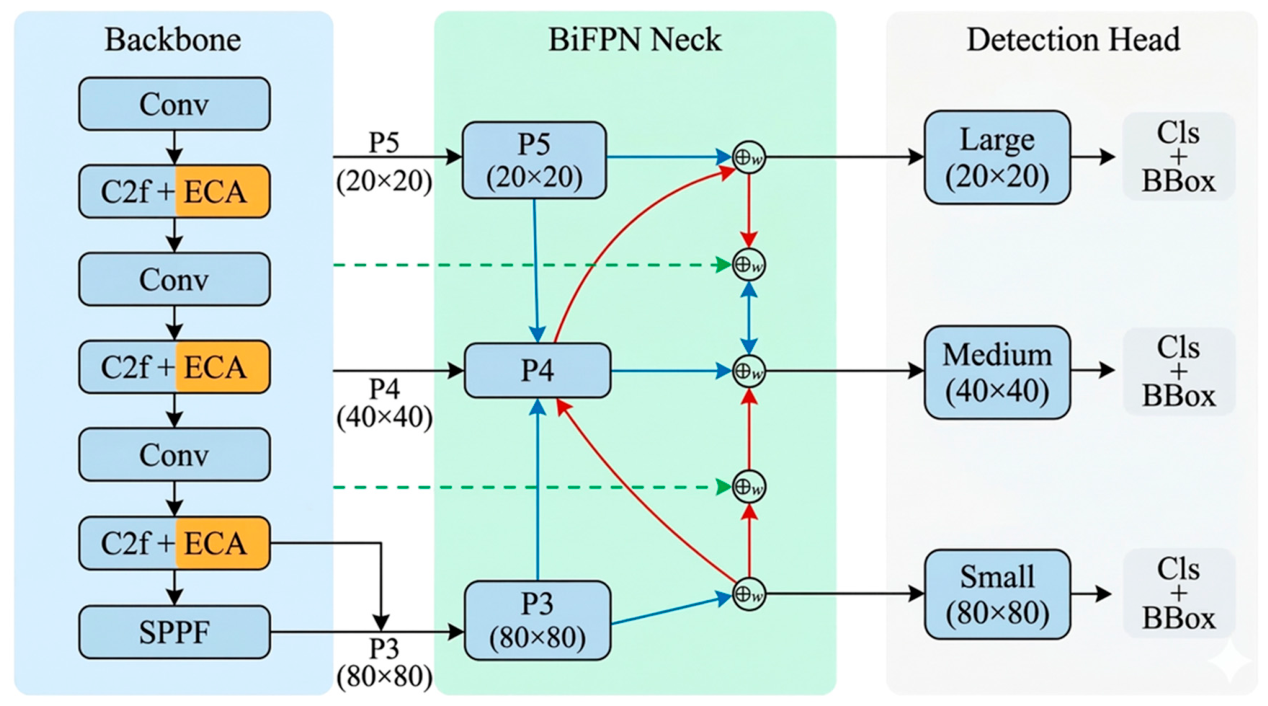
Schematic diagram of the improved YOLOv8 network structure.
Figure 2.
Schematic diagram of the improved YOLOv8 network structure.
Figure 3.
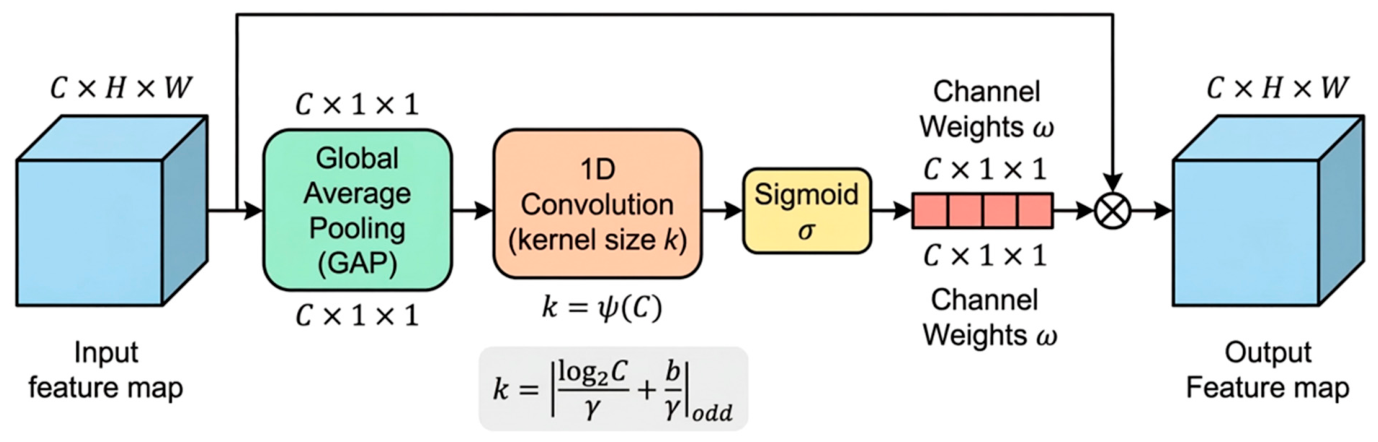
Structural diagram of the ECA channel attention module.
Figure 3.
Structural diagram of the ECA channel attention module.
Figure 4.
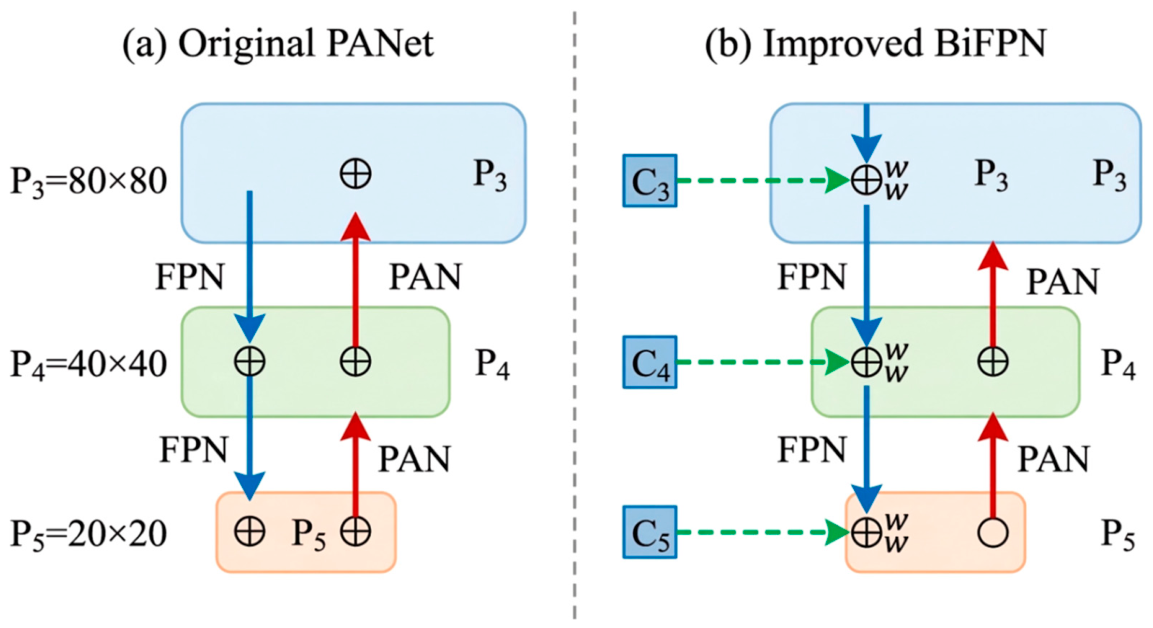
Comparison of the BiFPN neck network structure and original PANet. (a) Original PANet; (b) Improved BiFPN The blue and red arrows denote the top-down FPN and bottom-up PAN pathways, respectively, and the green dashed lines denote the same-level cross-node connections introduced by the BiFPN.
Figure 4.
Comparison of the BiFPN neck network structure and original PANet. (a) Original PANet; (b) Improved BiFPN The blue and red arrows denote the top-down FPN and bottom-up PAN pathways, respectively, and the green dashed lines denote the same-level cross-node connections introduced by the BiFPN.
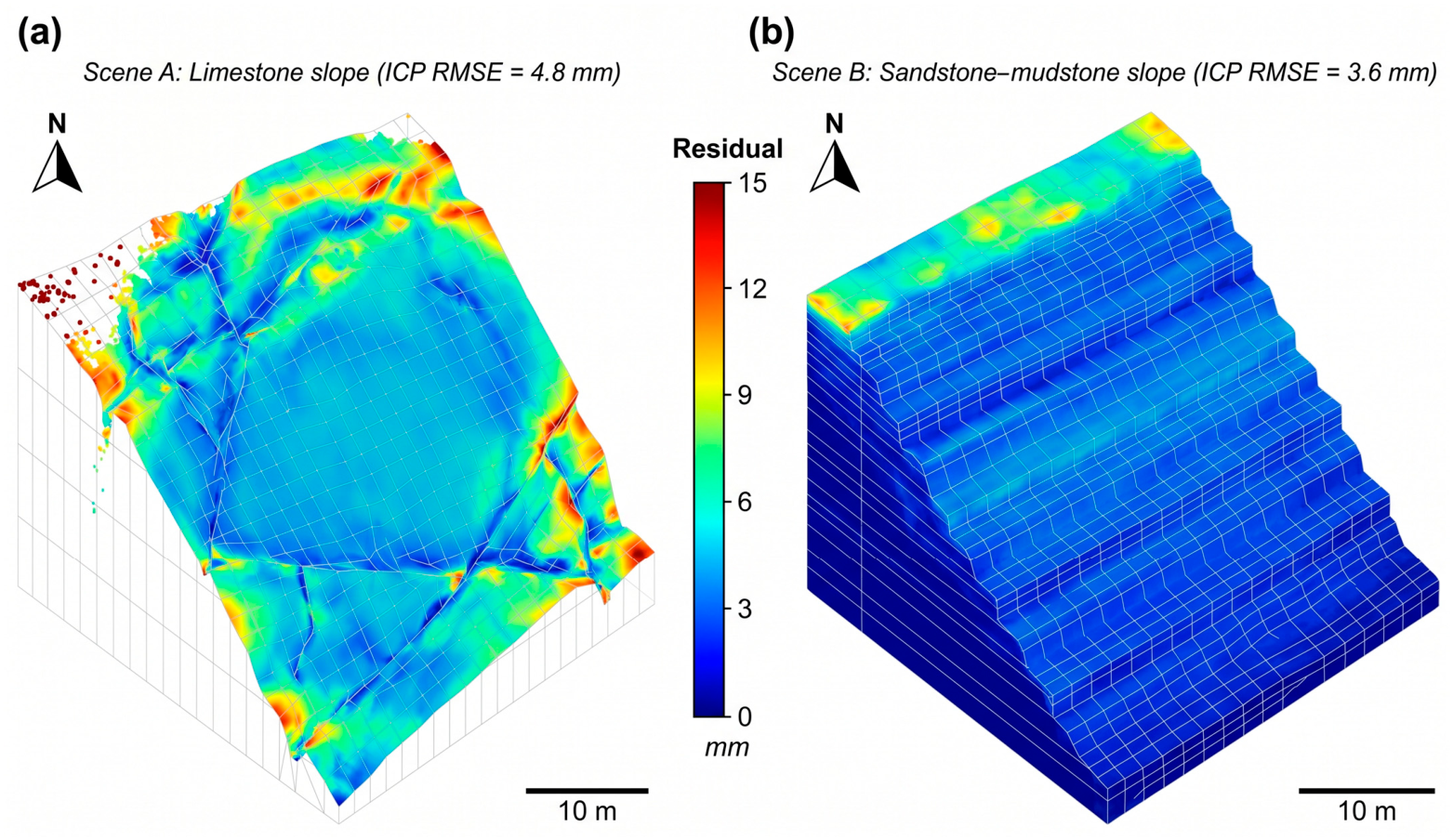
Figure 5.
Spatial distribution of point-to-plane registration residuals between UAV-derived and TLS reference point clouds. (a) Scene A (fragmented limestone slope, ICP RMSE = 4.8 mm); (b) Scene B (layered sandstone–mudstone slope, ICP RMSE = 3.6 mm). Color encodes residual magnitude in millimeters.
Figure 5.
Spatial distribution of point-to-plane registration residuals between UAV-derived and TLS reference point clouds. (a) Scene A (fragmented limestone slope, ICP RMSE = 4.8 mm); (b) Scene B (layered sandstone–mudstone slope, ICP RMSE = 3.6 mm). Color encodes residual magnitude in millimeters.
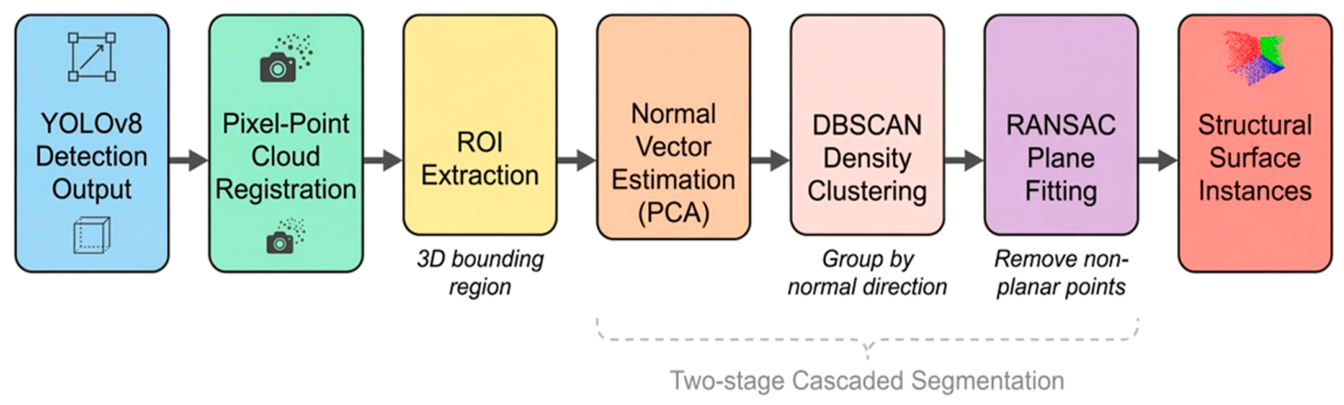
Figure 6.
Flowchart of detection-guided point cloud segmentation.
Figure 6.
Flowchart of detection-guided point cloud segmentation.
Figure 7.
End-to-end processing data flow diagram from raw data to engineering information.
Figure 7.
End-to-end processing data flow diagram from raw data to engineering information.
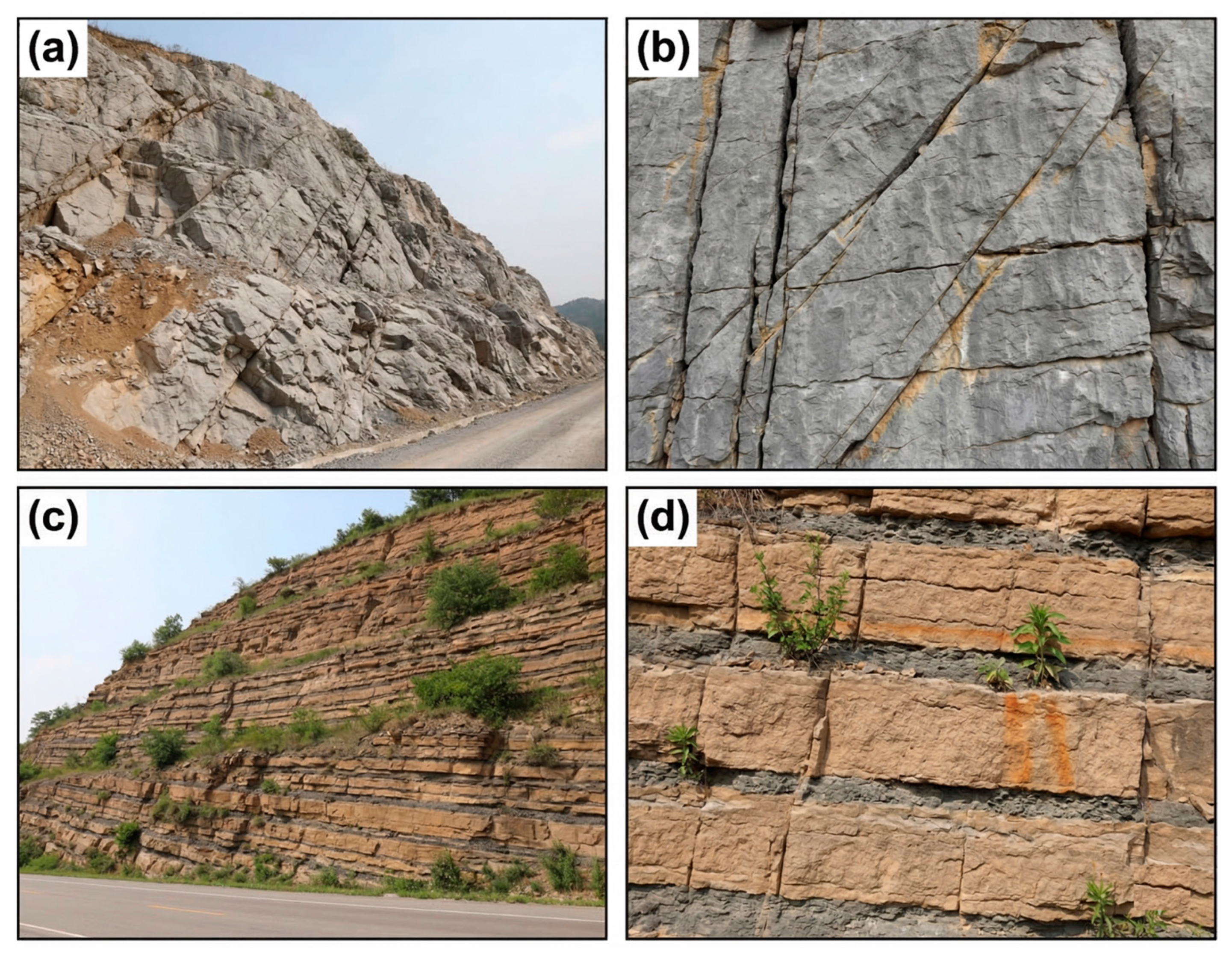
Figure 8.
Field photographs of the two study sites: (a) overall view of Scene A (fragmented limestone slope); (b) close-up of exposed discontinuity traces in Scene A; (c) overall view of Scene B (layered sandstone-mudstone slope); (d) close-up of structural surface distribution in Scene B.
Figure 8.
Field photographs of the two study sites: (a) overall view of Scene A (fragmented limestone slope); (b) close-up of exposed discontinuity traces in Scene A; (c) overall view of Scene B (layered sandstone-mudstone slope); (d) close-up of structural surface distribution in Scene B.
Figure 9.
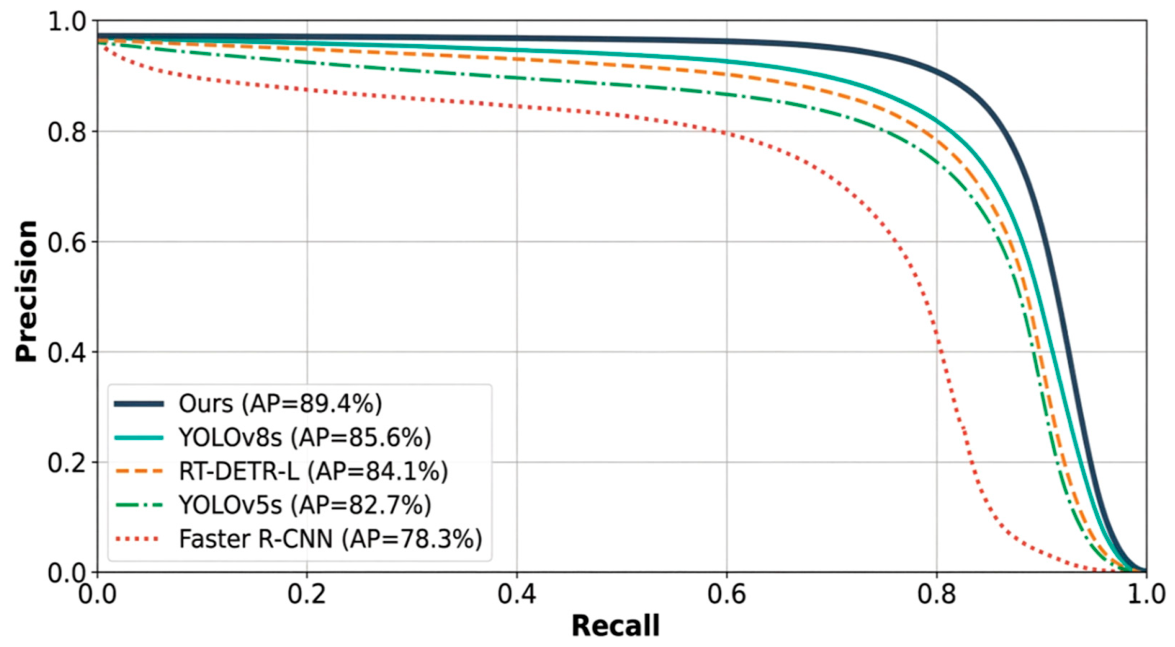
Precision–Recall curve comparison of detection models on the discontinuity test set.
Figure 9.
Precision–Recall curve comparison of detection models on the discontinuity test set.
Figure 10.
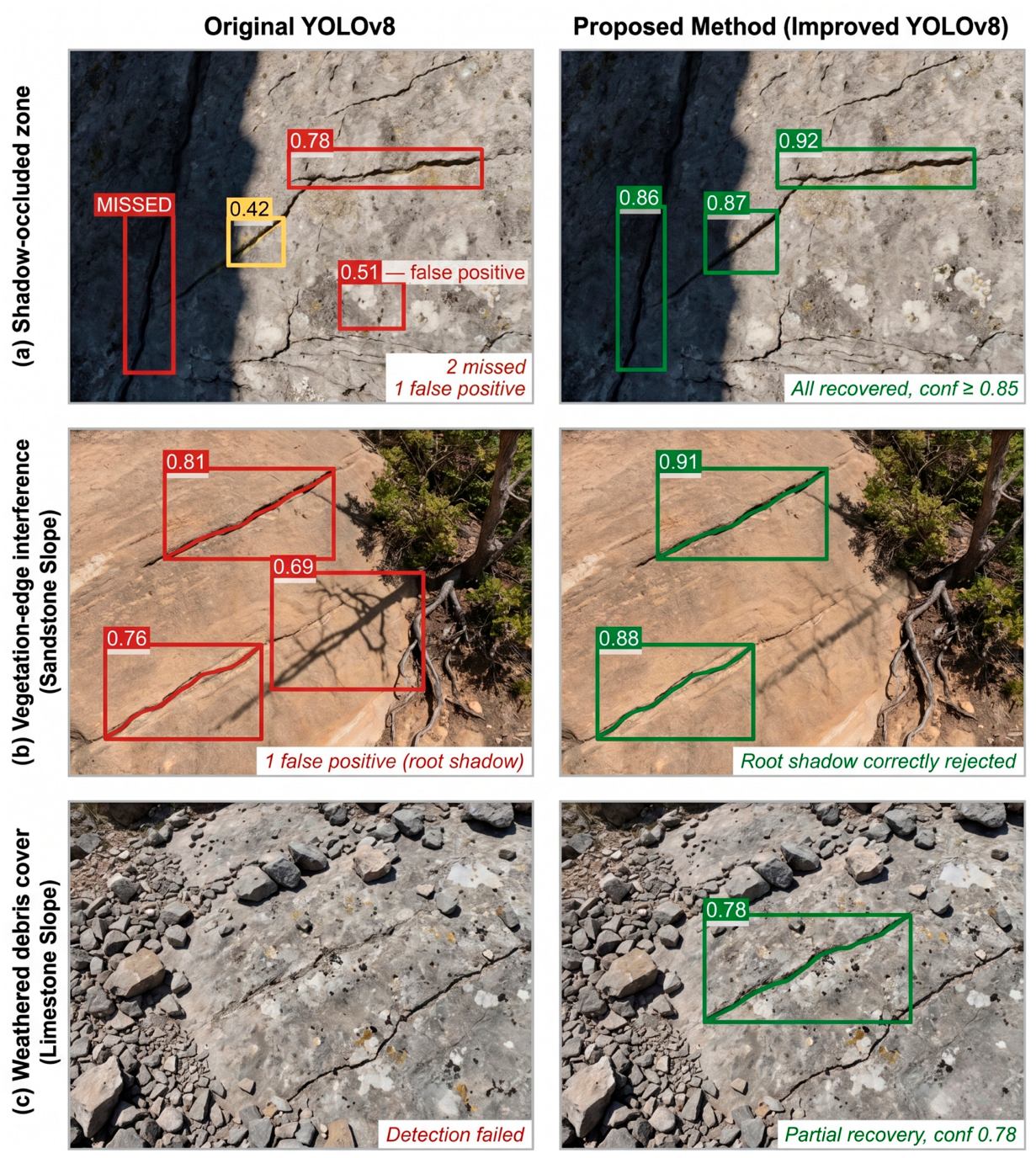
Comparison of detection performance in complex scenes. In each row the left column shows the original YOLOv8 and the right column the proposed method, for: (a) a shadow-occluded zone; (b) a vegetation-edge interference zone (sandstone slope); (c) a weathered debris-covered zone (limestone slope).
Figure 10.
Comparison of detection performance in complex scenes. In each row the left column shows the original YOLOv8 and the right column the proposed method, for: (a) a shadow-occluded zone; (b) a vegetation-edge interference zone (sandstone slope); (c) a weathered debris-covered zone (limestone slope).
Figure 11.
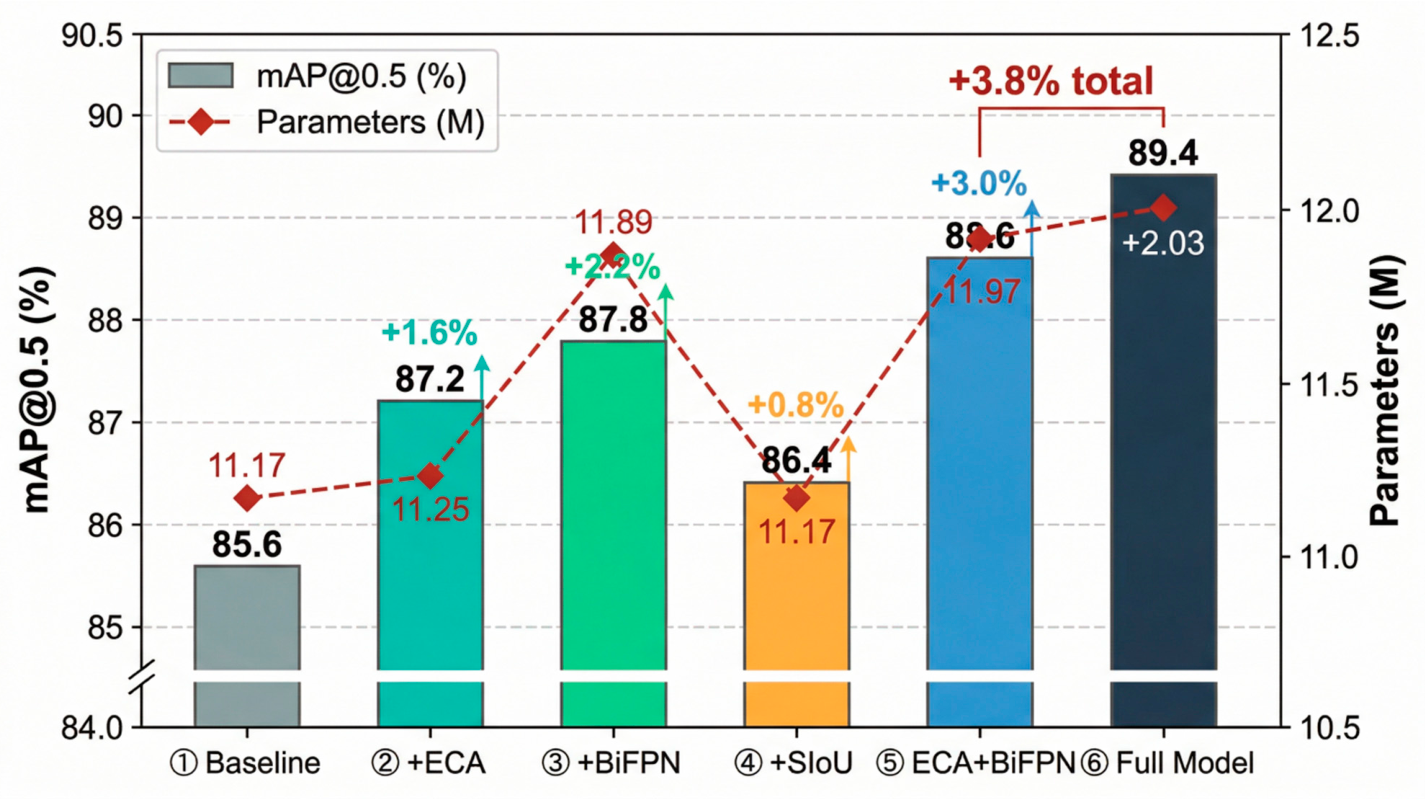
Waterfall chart of progressive mAP@0.5 improvement and parameter count variation across ablation configurations. The bars (left axis) give mAP@0.5, the green arrows mark the incremental accuracy gain contributed by each successive module, and the red dashed line (right axis) gives the parameter count.
Figure 11.
Waterfall chart of progressive mAP@0.5 improvement and parameter count variation across ablation configurations. The bars (left axis) give mAP@0.5, the green arrows mark the incremental accuracy gain contributed by each successive module, and the red dashed line (right axis) gives the parameter count.
Figure 12.
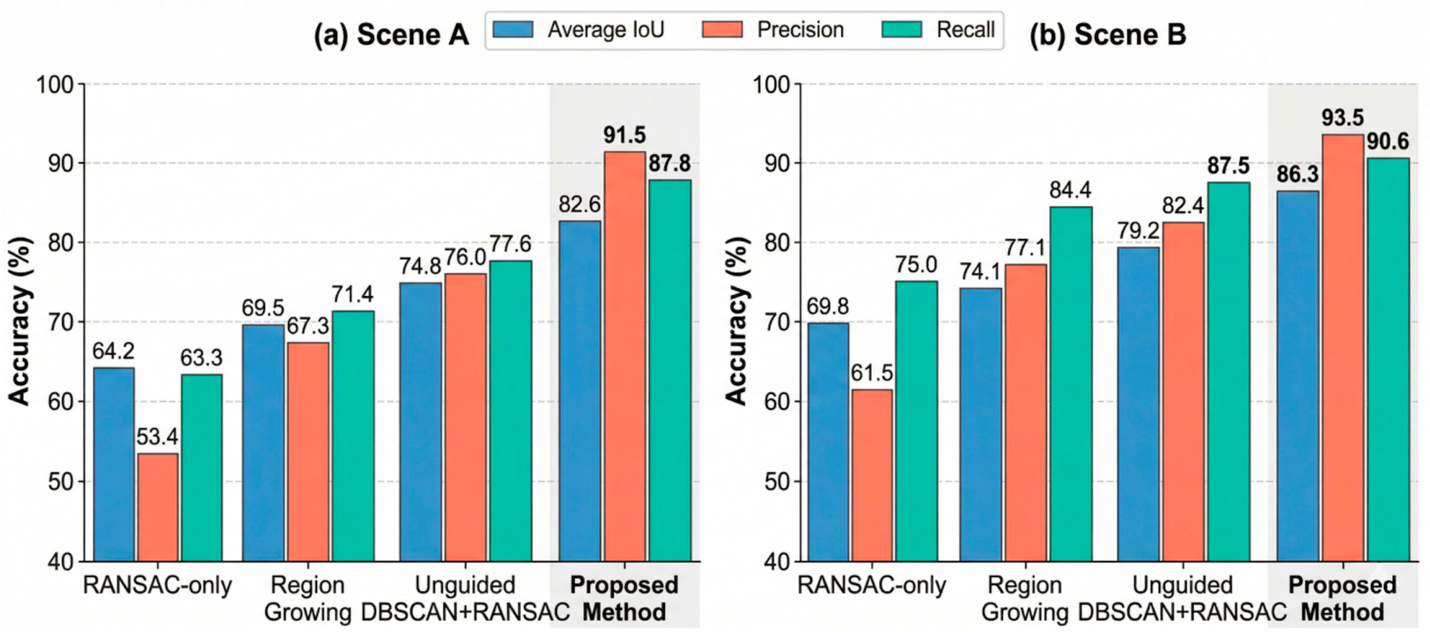
Grouped clustered bar chart comparison of point cloud segmentation accuracy metrics across methods for Scene A and Scene B. (a) Scene A; (b) Scene B. In each panel the proposed method is shown in bold for emphasis.
Figure 12.
Grouped clustered bar chart comparison of point cloud segmentation accuracy metrics across methods for Scene A and Scene B. (a) Scene A; (b) Scene B. In each panel the proposed method is shown in bold for emphasis.
Figure 13.
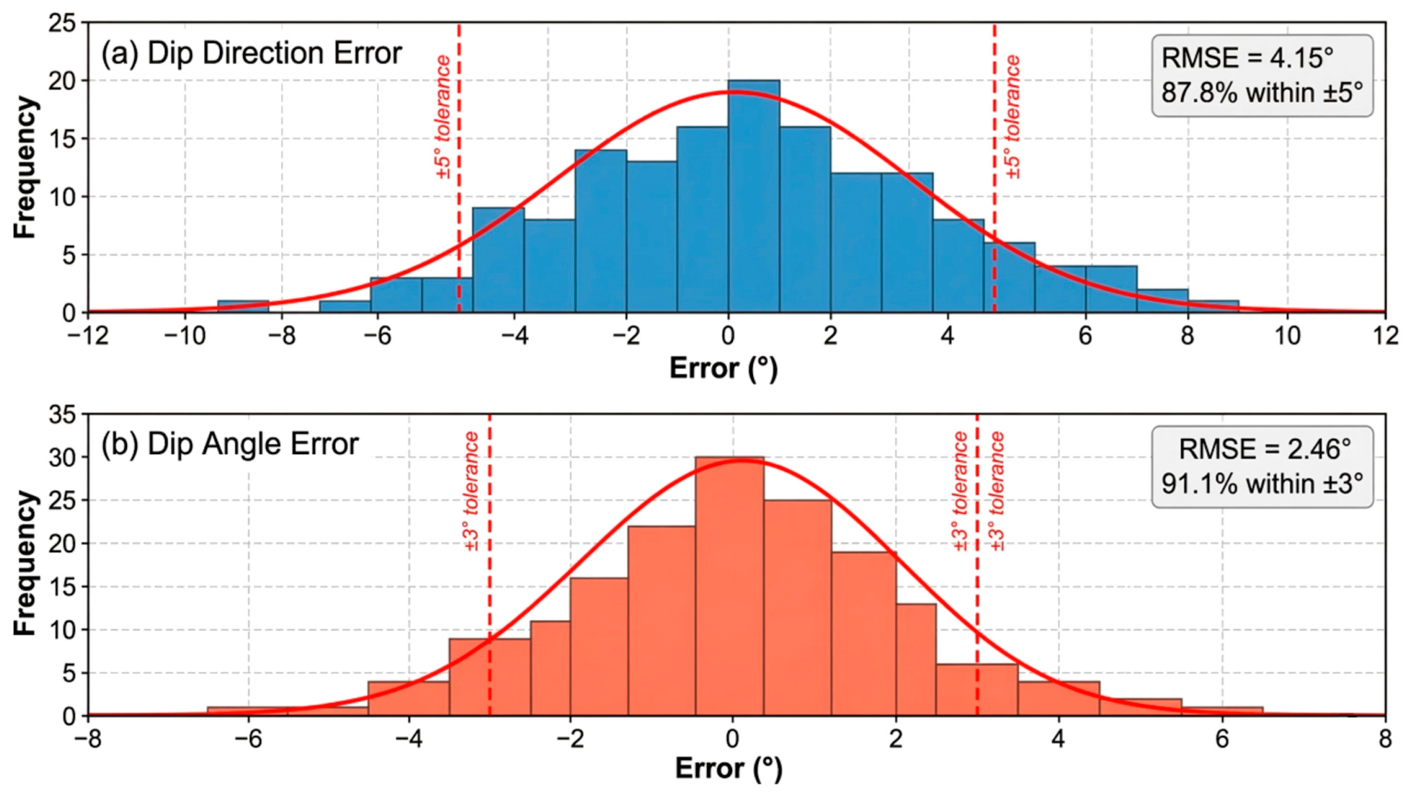
Error distribution histogram of orientation parameter extraction. (a) dip direction error; (b) dip angle error. The red curve is the fitted normal distribution, and the dashed lines mark the ±5° (dip direction) and ±3° (dip angle) tolerance bands.
Figure 13.
Error distribution histogram of orientation parameter extraction. (a) dip direction error; (b) dip angle error. The red curve is the fitted normal distribution, and the dashed lines mark the ±5° (dip direction) and ±3° (dip angle) tolerance bands.
Figure 14.
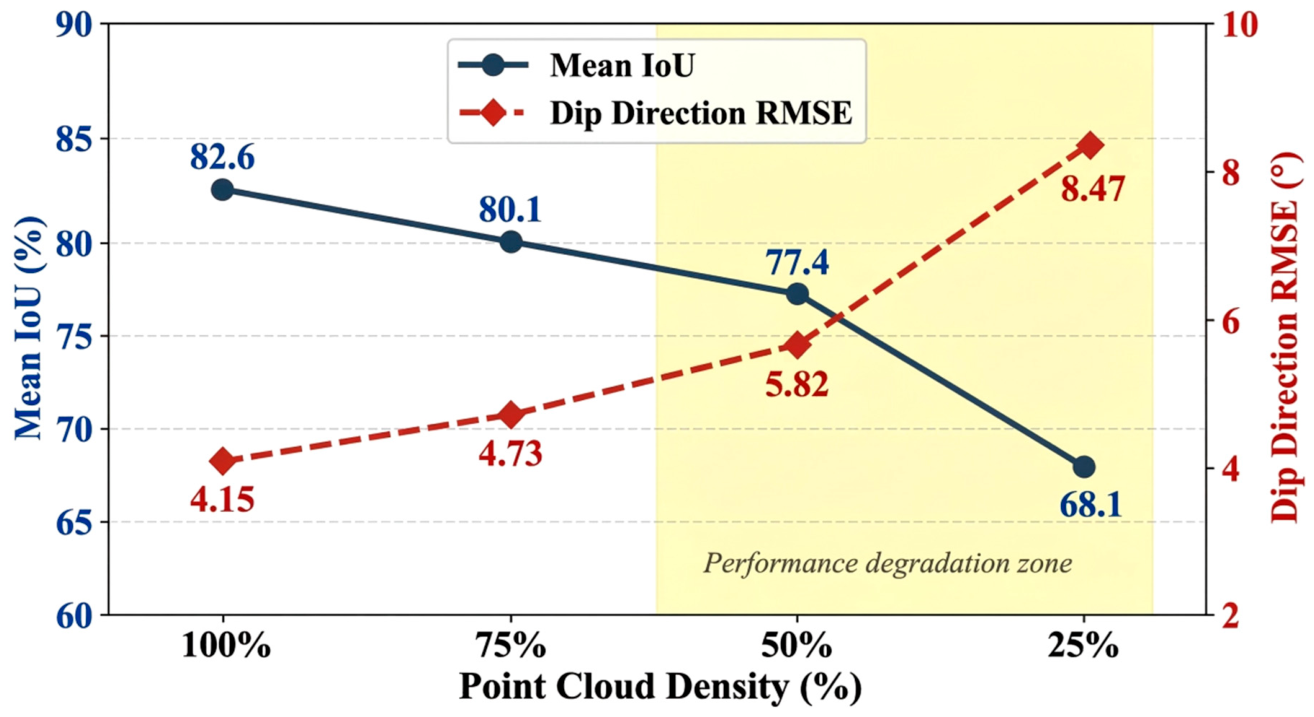
Variation curves of the segmentation accuracy and orientation error under different point cloud densities. The blue solid line with circles is the mean IoU (left axis) and the red dashed line with diamonds is the dip direction RMSE (right axis); the yellow shaded band marks the performance-degradation zone.
Figure 14.
Variation curves of the segmentation accuracy and orientation error under different point cloud densities. The blue solid line with circles is the mean IoU (left axis) and the red dashed line with diamonds is the dip direction RMSE (right axis); the yellow shaded band marks the performance-degradation zone.
Figure 15.
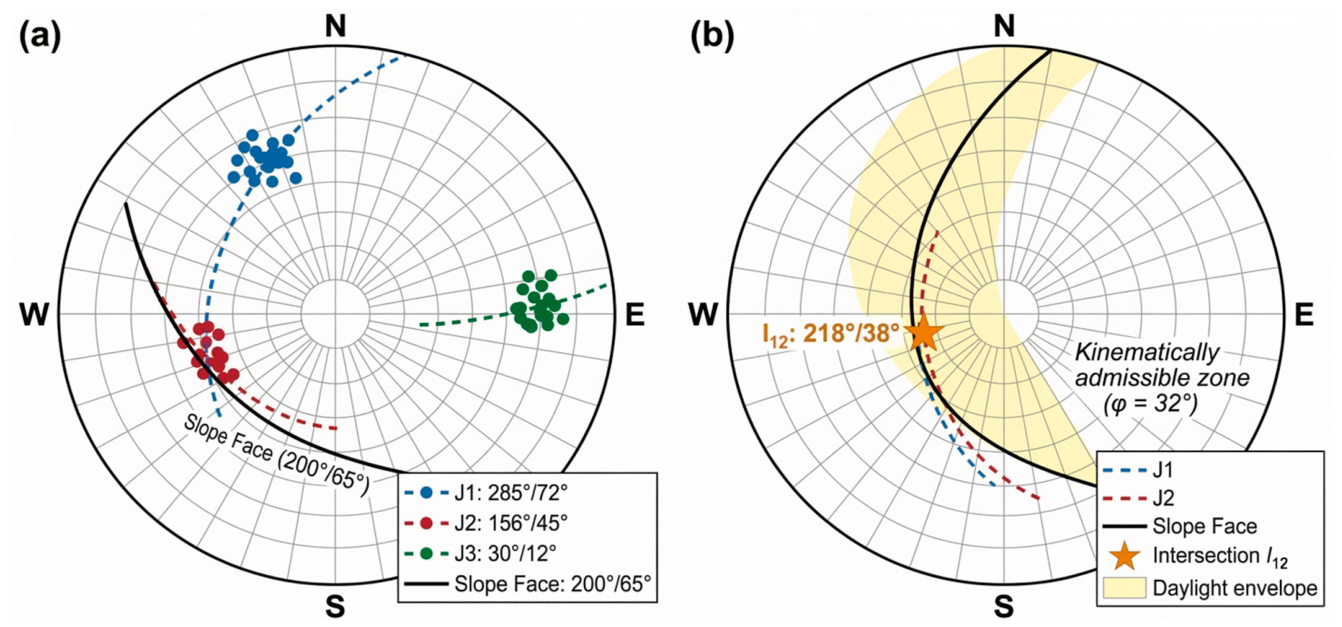
Equal-area lower-hemisphere stereonet projection of automatically extracted discontinuity orientations for Scene A, with kinematic analysis of the identified wedge failure block. (a) pole points and great circles of the three discontinuity sets (J1, J2 and J3) together with the slope face; (b) the J1–J2 intersection line I12 and the kinematically admissible daylight envelope.
Figure 15.
Equal-area lower-hemisphere stereonet projection of automatically extracted discontinuity orientations for Scene A, with kinematic analysis of the identified wedge failure block. (a) pole points and great circles of the three discontinuity sets (J1, J2 and J3) together with the slope face; (b) the J1–J2 intersection line I12 and the kinematically admissible daylight envelope.
Figure 16.
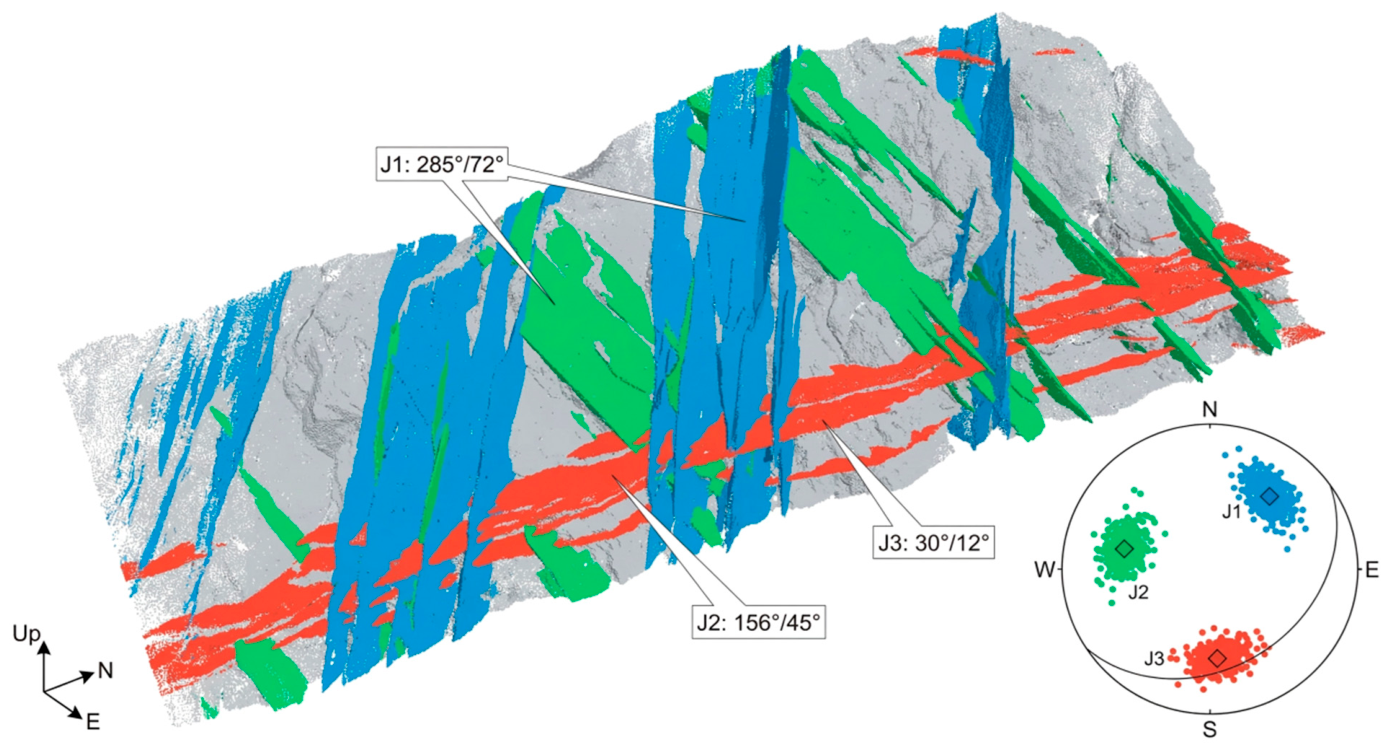
Three-dimensional recognition and parameter annotation visualization results of the slope discontinuities in Scene A. The blue, green and red point clusters denote discontinuity sets J1, J2 and J3, respectively, while the grey points represent the unclassified rock surface.
Figure 16.
Three-dimensional recognition and parameter annotation visualization results of the slope discontinuities in Scene A. The blue, green and red point clusters denote discontinuity sets J1, J2 and J3, respectively, while the grey points represent the unclassified rock surface.
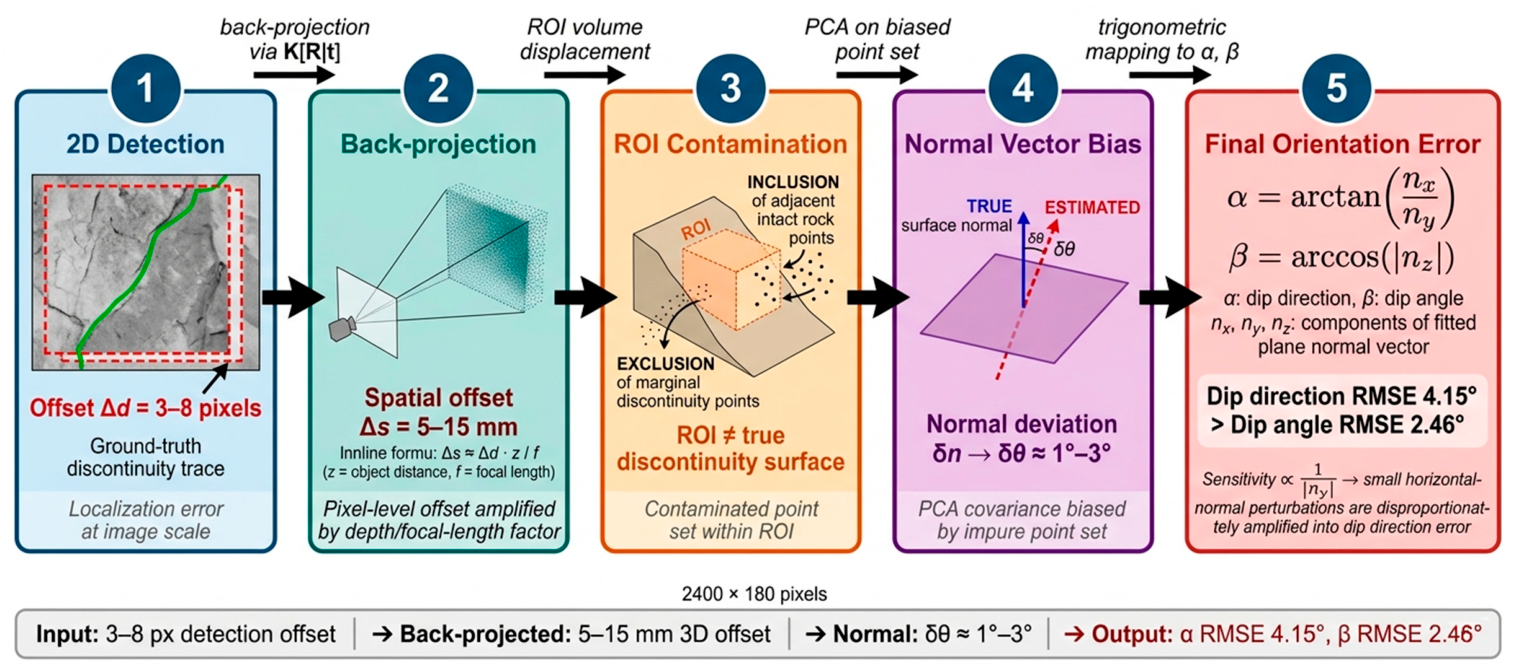
Figure 17.
Conceptual diagram of the cross-modal error propagation mechanism from 2D detection offset to 3D orientation parameter deviation. The numbered blue arrows mark the five sequential propagation stages, the dashed boxes delineate the back-projected region of interest, and the colors distinguish the included adjacent intact-rock points, the true discontinuity surface and the estimated surface normal.
Figure 17.
Conceptual diagram of the cross-modal error propagation mechanism from 2D detection offset to 3D orientation parameter deviation. The numbered blue arrows mark the five sequential propagation stages, the dashed boxes delineate the back-projected region of interest, and the colors distinguish the included adjacent intact-rock points, the true discontinuity surface and the estimated surface normal.
Table 1.
Quantitative registration accuracy between UAV-derived point cloud and TLS reference point cloud for the two study sites.
Table 1.
Quantitative registration accuracy between UAV-derived point cloud and TLS reference point cloud for the two study sites.
| Registration Metric | Scene A (Limestone) | Scene B (Sandstone–Mudstone) |
|---|
| SIFT inlier correspondences (mean ± SD) | 1420 ± 230 | 1680 ± 210 |
| RANSAC inlier ratio (%) | 71.4 | 78.9 |
| ICP point-to-plane RMSE (mm) | 4.8 | 3.6 |
| Median residual (mm) | 3.9 | 2.7 |
| 90th-percentile residual (mm) | 7.6 | 5.4 |
| Maximum residual (mm) | 14.7 | 11.2 |
| Proportion of residuals < 8 mm (%) | 92.1 | 95.4 |
Table 2.
Summary of automated calculation methods for key geometric parameters of discontinuities.
Table 2.
Summary of automated calculation methods for key geometric parameters of discontinuities.
| Parameter Name | Calculation Method | Input Data |
|---|
| Dip Direction/Dip Angle | Inverse trigonometric function of normal vector (Equation (4)) | RANSAC fitted plane normal vector |
| Spacing | Mean normal distance between adjacent planes of the same group | Plane equations of parallel discontinuity groups |
| Trace Length | Maximum extension length after projecting point cloud onto fitting plane | Individual discontinuity point cloud coordinates |
| Aperture | Normal distance between opposing point clouds on both sides of the discontinuity | Point cloud at discontinuity boundaries |
| Roughness | Root mean square of deviations from points to fitting plane | Individual discontinuity point cloud and fitting plane |
Table 3.
Cross-site and within-site generalization performance of the proposed detection network. “A → B” denotes training on Scene A and testing on Scene B, etc.
Table 3.
Cross-site and within-site generalization performance of the proposed detection network. “A → B” denotes training on Scene A and testing on Scene B, etc.
| Train/Test Configuration | mAP@0.5 (%) | Precision (%) | Recall (%) | Drop vs. Mixed Baseline (pp) |
|---|
| Mixed-scene (baseline, A + B → A + B) | 89.4 | 90.1 | 86.7 | — |
| Within-site (A → A) | 88.9 | 89.7 | 86.0 | −0.5 |
| Within-site (B → B) | 89.7 | 90.3 | 87.1 | +0.3 |
| Cross-site (A → B) | 80.7 | 82.1 | 78.4 | −8.7 |
| Cross-site (B → A) | 76.5 | 77.8 | 74.3 | −12.9 |
Table 4.
Performance comparison of different detection models on the slope discontinuity dataset.
Table 4.
Performance comparison of different detection models on the slope discontinuity dataset.
| Model | mAP@0.5 (%) | mAP@0.5:0.95 (%) | Precision (%) | Recall (%) | Parameters (M) | FPS |
|---|
| Faster R-CNN | 78.3 | 52.1 | 81.6 | 74.8 | 41.12 | 14.3 |
| YOLOv5s | 82.7 | 57.4 | 84.2 | 79.5 | 7.24 | 86.2 |
| RT-DETR-L | 84.1 | 60.8 | 85.9 | 80.3 | 32.01 | 42.7 |
| YOLOv8s (original) | 85.6 | 62.3 | 86.4 | 82.1 | 11.17 | 78.5 |
| Proposed Method | 89.4 | 67.2 | 90.1 | 86.7 | 12.03 | 71.8 |
Table 5.
Ablation study results of the improvement modules. In the table, a check mark (✓) indicates that the corresponding module is enabled and a dash (—) indicates that it is not enabled.
Table 5.
Ablation study results of the improvement modules. In the table, a check mark (✓) indicates that the corresponding module is enabled and a dash (—) indicates that it is not enabled.
| ID | Baseline | ECA | BiFPN | SIoU | mAP@0.5 (%) | mAP@0.5:0.95 (%) | Parameters (M) |
|---|
| ① | ✓ | — | — | — | 85.6 | 62.3 | 11.17 |
| ② | ✓ | ✓ | — | — | 87.2 | 64.5 | 11.25 |
| ③ | ✓ | — | ✓ | — | 87.8 | 65.1 | 11.89 |
| ④ | ✓ | — | — | ✓ | 86.4 | 63.7 | 11.17 |
| ⑤ | ✓ | ✓ | ✓ | — | 88.6 | 66.3 | 11.97 |
| ⑥ | ✓ | ✓ | ✓ | ✓ | 89.4 | 67.2 | 12.03 |
Table 6.
Comparative statistical results of point cloud segmentation accuracy for the two scenes.
Table 6.
Comparative statistical results of point cloud segmentation accuracy for the two scenes.
| Method | Scene | Identified Faces | Correctly Identified | Average IoU (%) | Precision (%) | Recall (%) |
|---|
| RANSAC-only [11] | A | 58 | 31 | 64.2 | 53.4 | 63.3 |
| RANSAC-only [11] | B | 39 | 24 | 69.8 | 61.5 | 75 |
| Region growing [12] | A | 52 | 35 | 69.5 | 67.3 | 71.4 |
| Region growing [12] | B | 35 | 27 | 74.1 | 77.1 | 84.4 |
| Unguided DBSCAN + RANSAC | A | 50 | 38 | 74.8 | 76 | 77.6 |
| Unguided DBSCAN + RANSAC | B | 34 | 28 | 79.2 | 82.4 | 87.5 |
| Proposed Method | A | 47 | 43 | 82.6 | 91.5 | 87.8 |
| Proposed Method | B | 31 | 29 | 86.3 | 93.5 | 90.6 |
Table 7.
Cross-modal fusion ablation experiment results (Scene A).
Table 7.
Cross-modal fusion ablation experiment results (Scene A).
| Mode | Identified Faces | Correct Faces | Average IoU (%) | Dip Angle RMSE (°) | Spacing Relative Error (%) | Processing Time (min) |
|---|
| Image-only | 45 | 41 | — | — | — | 1.2 |
| Point-cloud-only | 50 | 38 | 74.8 | 3.41 | 10.5 | 127.6 |
| Proposed cross-modal fusion | 47 | 43 | 82.6 | 2.46 | 6.8 | 86 |
Table 8.
Error statistics of automated orientation parameter extraction versus measured values.
Table 8.
Error statistics of automated orientation parameter extraction versus measured values.
| Parameter | Sample Size | Mean Error | Maximum Error | Root Mean Square Error (RMSE) | Standard Deviation |
|---|
| Dip Direction (°) | 180 | 3.27 | 9.84 | 4.15 | 2.61 |
| Dip Angle (°) | 180 | 1.83 | 6.21 | 2.46 | 1.64 |
Table 9.
Image-side robustness of the proposed detection network under brightness variation, in-plane rotation and reduced UAV image overlap rate.
Table 9.
Image-side robustness of the proposed detection network under brightness variation, in-plane rotation and reduced UAV image overlap rate.
| Perturbation Type | Perturbation Level | mAP@0.5 (%) | Δ vs. Baseline (pp) | Precision (%) | Recall (%) |
|---|
| Baseline (no perturbation) | — | 89.4 | — | 90.1 | 86.7 |
| Brightness variation | ±15% | 87.6 | −1.8 | 88.4 | 85.0 |
| Brightness variation | ±30% | 85.2 | −4.2 | 86.1 | 82.7 |
| In-plane rotation | ±5° | 88.1 | −1.3 | 88.9 | 85.6 |
| In-plane rotation | ±10° | 85.7 | −3.7 | 86.5 | 83.2 |
| In-plane rotation | ±15° | 82.9 | −6.5 | 83.8 | 80.5 |
| Image overlap (UAV) | 70% (slight reduction) | 88.7 | −0.7 | 89.5 | 85.9 |
| Image overlap (UAV) | 60% (moderate reduction) | 85.8 | −3.6 | 86.5 | 82.9 |
| Image overlap (UAV) | 50% (substantial reduction) | 81.3 | −8.1 | 82.0 | 78.5 |
Table 10.
Processing time statistics for each stage of the system’s complete workflow (Scene A).
Table 10.
Processing time statistics for each stage of the system’s complete workflow (Scene A).
| Processing Stage | Processing Time | Proportion (%) |
|---|
| Image Preprocessing and 3D Reconstruction | 42 min | 48.8 |
| Improved YOLOv8 Detection | 1.2 min | 1.4 |
| Pixel-to-Point-Cloud Registration | 5.6 min | 6.5 |
| Point Cloud Segmentation and Parameter Calculation | 33.4 min | 38.8 |
| Information Integration and Visualization Output | 3.8 min | 4.5 |
| Total Workflow | 86 min | 100 |
Table 11.
Comprehensive comparison of the proposed method with existing representative methods.
Table 11.
Comprehensive comparison of the proposed method with existing representative methods.
| Comparison Dimension | Kong, Wu [13] | Chen, Wu [12] | Sun, Zhu [17] | Proposed Method |
|---|
| Technical Pathway | Pure point cloud clustering | PointNet++ point cloud segmentation | RL-JointNet deep learning | Image detection + point cloud segmentation collaboration |
| Input Data | Single point cloud | Single point cloud | Single point cloud | Multi-source fusion of imagery + point cloud |
| Dip Direction RMSE (°) | 3.6 | — | 2.8 | 4.15 |
| Dip Angle RMSE (°) | 2 | — | 1.5 | 2.46 |
| Global Accuracy (GA/mIoU) | — | — | 98.7%/98.1% | 82.6~86.3% (IoU) |
| Training Annotation Required | No | Yes | Yes | Yes (image end only) |
| End-to-End Engineering Parameter Output | Partial | No | No | Yes |
| Processing Efficiency | Medium | Low | Medium | High |
Table 12.
Quantitative sensitivity of orientation parameter RMSE to detection bounding box offset and ICP registration residual under the acquisition geometry of Scene A (shooting distance 8–15 m, focal length equivalent 35 mm).
Table 12.
Quantitative sensitivity of orientation parameter RMSE to detection bounding box offset and ICP registration residual under the acquisition geometry of Scene A (shooting distance 8–15 m, focal length equivalent 35 mm).
| Detection Offset (pixel) | ICP Residual (mm) | Dip Direction RMSE (°) | Dip Angle RMSE (°) |
|---|
| 0 (ideal) | 0 (ideal) | 3.50 | 2.29 |
| 3 | 2 | 3.72 | 2.34 |
| 5 (current operating point) | 5 (current operating point) | 4.15 | 2.46 |
| 8 | 6 | 4.89 | 2.67 |
| 10 | 8 | 5.55 | 2.87 |