A Credible Blockchain-Based Framework for Traceability in the Down-Product Supply Chain


Featured Application
Abstract
1. Introduction
- The DPT framework for down supply chain traceability integrates blockchain, the InterPlanetary File System (IPFS), digital anti-counterfeiting watermarks (DW), Quick Response (QR) codes, and category-specific encryption strategies, enabling consumers to distinguish authentic from counterfeit products and enhancing enterprise brand reputation;
- The DPT framework is implemented based on Hyperledger Fabric as a decentralized, cross-platform web application compatible with mainstream operating systems, with the integration of user-friendly interfaces to enhance the end-user experience;
- Smart contracts are implemented to support core system functionalities, including the Tripartite Data Storage Architecture of down information and role-based access for reading and adding down traceability records;
- Extensive validation testing is conducted to ensure the correct functionality of the system.
2. Related Work
- Innovation should be oriented to practical applications rather than pursuing uniqueness for vanity. It should also take usability and ease of operation into account. For example, a simple and user-friendly interface is crucial, as end users are generally unfamiliar with blockchain technology;
- The designed system should maintain universality and, more importantly, be tailored to targeted scenarios to accelerate the transformation of technological innovation into practical benefits;
- The proposed framework and system should fully consider implementation costs and operational efficiency. While meeting the required performance standards, they should minimize resource consumption as much as possible.
- (1)
- To eliminate data errors before on-chain uploading, the proposed design abandons artificial intelligence (AI) and machine learning (ML) methods. Such approaches are known for high resource consumption and unsatisfactory practical performance. Instead, this scheme integrates a “1+1” review mechanism, mobile terminal sensor data, and digital watermarking technology to improve data accuracy prior to on-chain submission;
- (2)
- This paper proposes category-specific encryption strategies for different types of input data, which are embedded into the Tripartite Data Storage Architecture.
3. DPT Design
3.1. DPT Framework Overview & Architecture
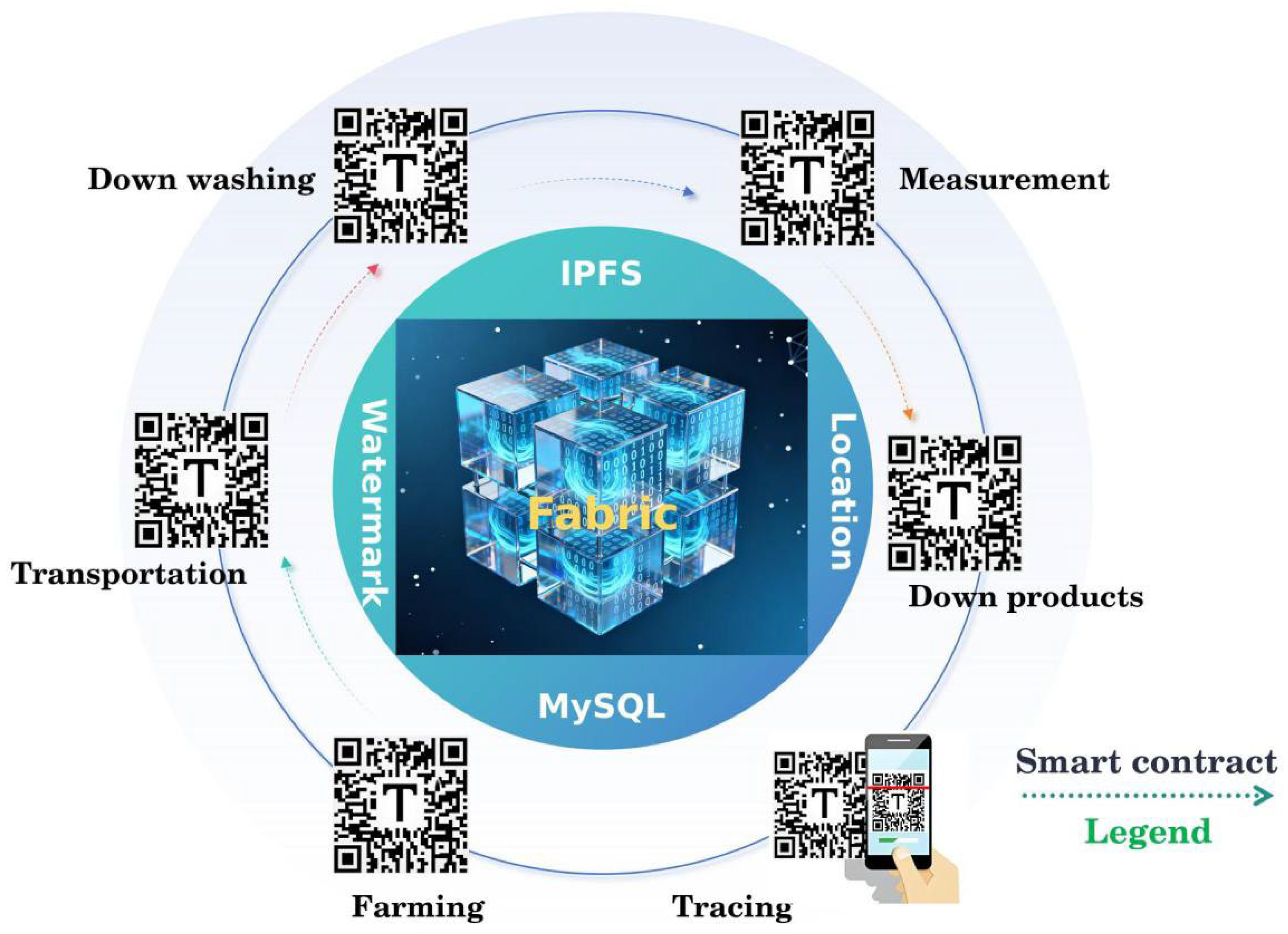
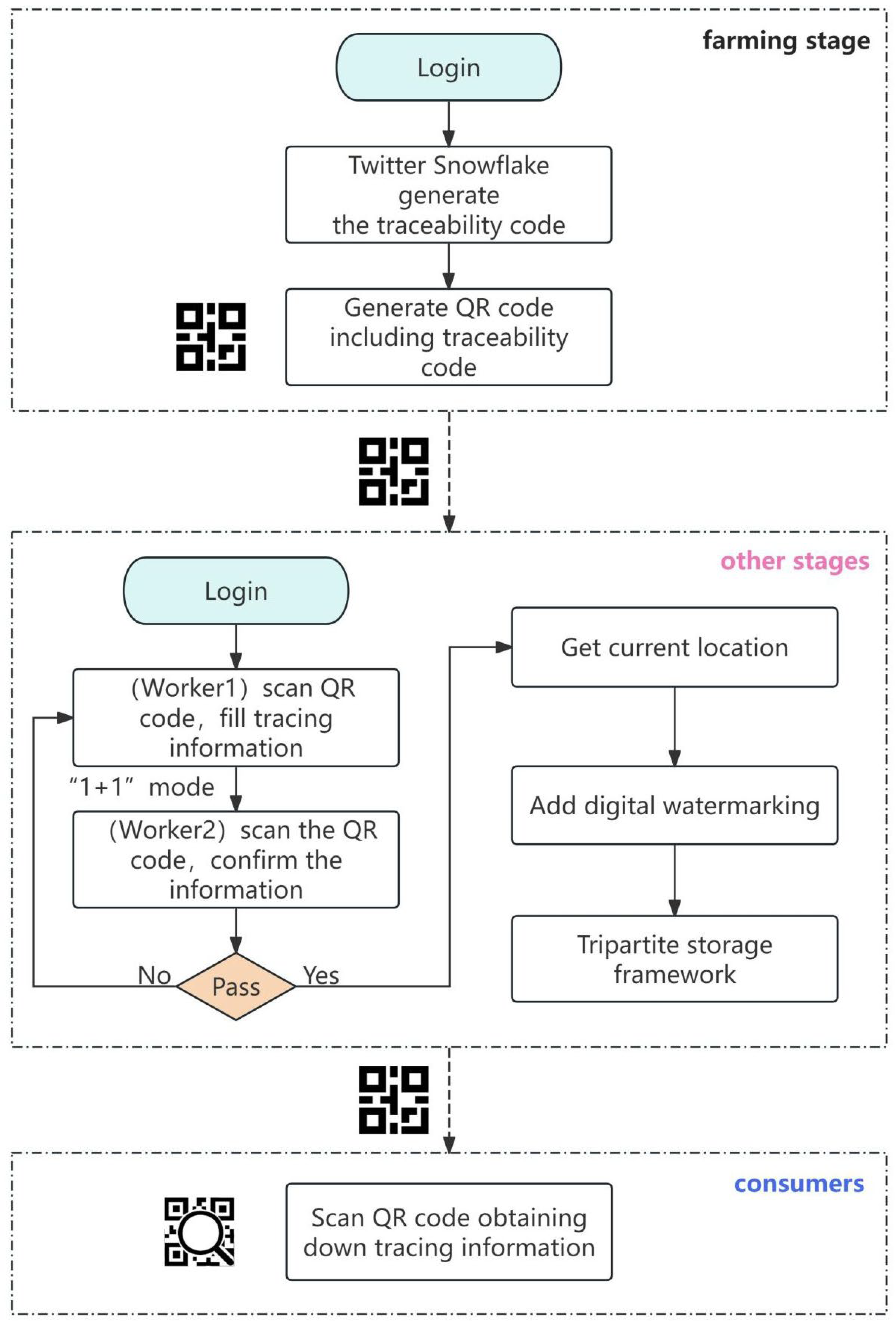
- Smart contract embedded with QR codes. The DPT framework provides system participants with a highly user-friendly QR code interaction interface. A QR code is generated at the initial stage of duck and goose farming. The smart contract ensures the continuity and integrity of this QR code throughout the entire supply chain—from poultry farming to finished down products. System participants can use smart terminals (e.g., mobile devices) to scan the QR code. This allows them to either input or access traceability data related to each specific phase of the supply chain;
- “1+1” information upload model for blockchain on-chain recording. To reduce the risk of human-induced data entry errors, the DPT framework sets a dedicated traceability information verification role at each stage of the supply chain. Only data verified by this role is allowed to be recorded on the blockchain;
- Real-time positioning via smart terminals. The DPT framework utilizes the built-in geolocation function of smart terminals. When users enter down-product traceability information, the system automatically captures location data. This ensures the authenticity and timeliness of the recorded location;
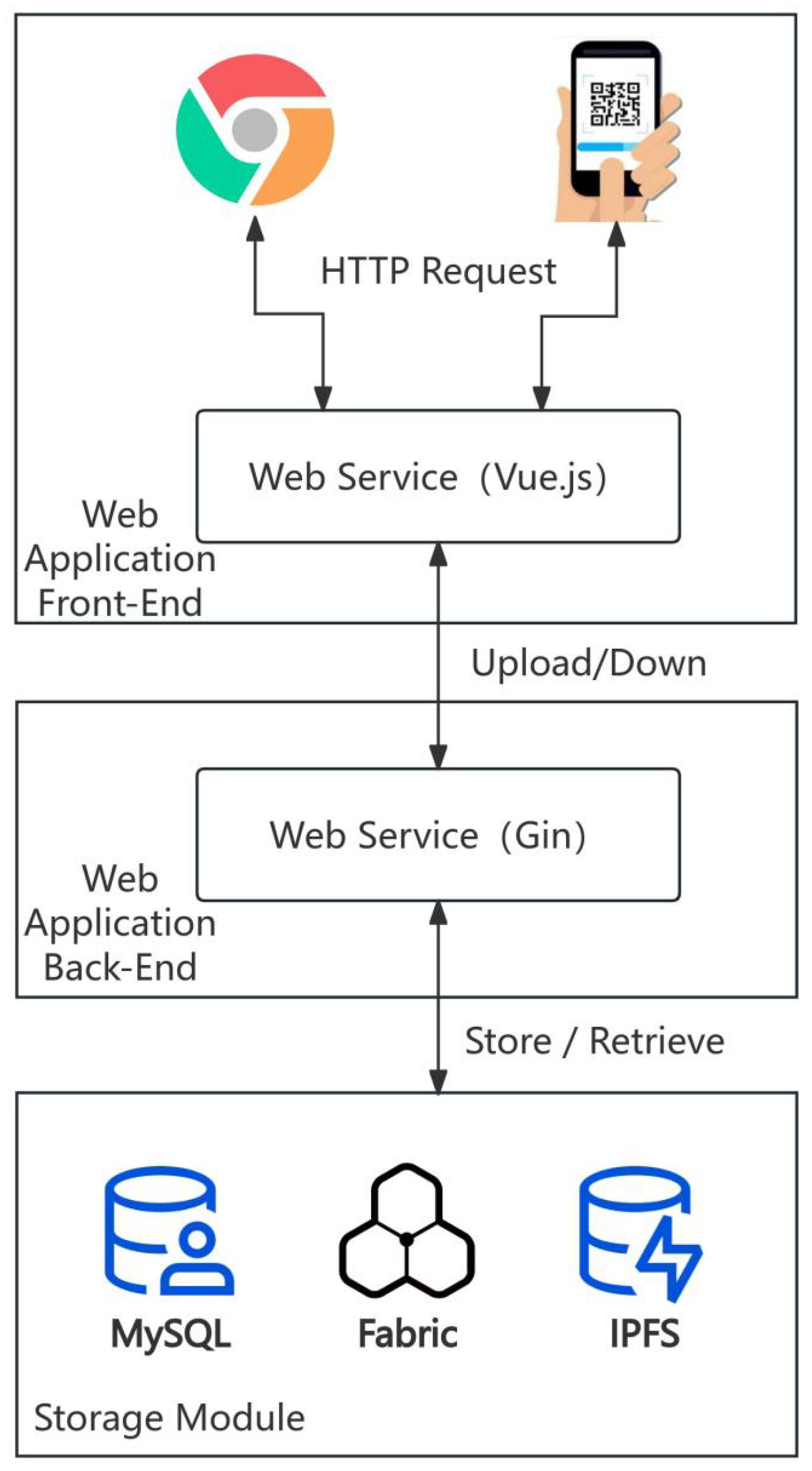
- Tripartite data storage architecture. The framework integrates the MySQL database, IPFS, and Fabric blockchain into a unified architecture. This architecture enables secure and efficient storage and retrieval of user information and down-product traceability data;
- Storage expansion based on IPFS. The DPT framework incorporates IPFS to expand the storage capacity of Fabric. It also improves Fabric’s storage efficiency and overcomes the inherent storage limitations of the Fabric architecture;
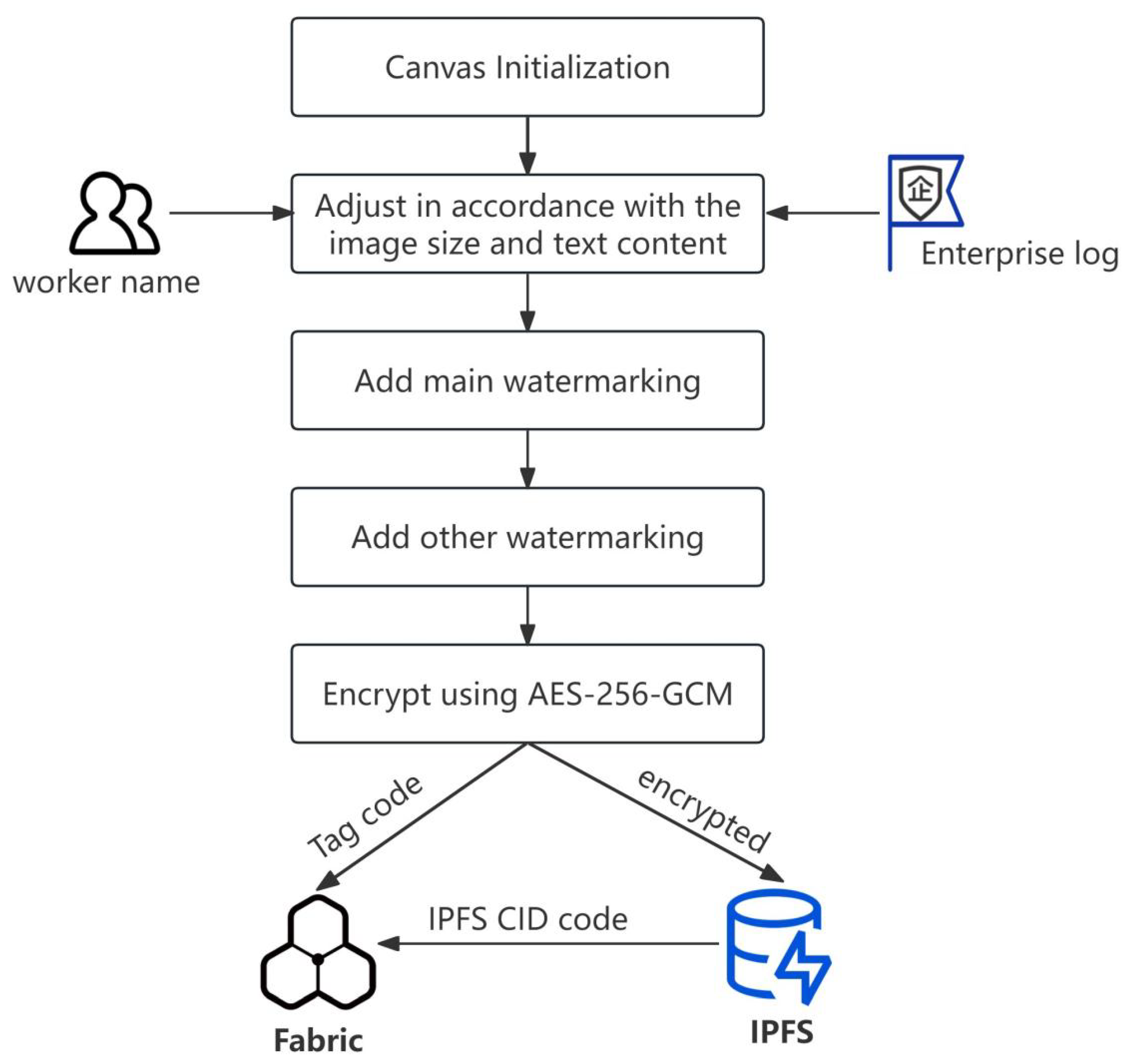
- Identity anti-counterfeiting based on digital watermarking. The DPT framework embeds digital watermarks to bind on-chain data with the original identity of the data generator. This ensures the operational accountability and source attribution of the down-product traceability information.
3.2. Implementation of the DPT Framework
3.2.1. The Smart Contract Within the DPT Framework
3.2.2. Tripartite Data Storage Architecture
| Algorithm 1: Steps of Tripartite Storage |
| Input: multimodal data X Output: (Credential-type data) a 256-bit hash value, stored in MySQL database and on Fabric. (Multimedia-type data) a tamper-proof association pair ({CID}, {Tag}), stored on Fabric. Watermarked and encrypted multimedia ciphertext in the IPFS. (Textual data) a 256-bit hash value, Stored on Fabric. Begin: (1): Obtain the multimodal data X to be stored. (2): Identify the type of multimodal data X through feature matching and predefined rules. (3): Direct the data X to its corresponding processing pipeline according to the type. (4): If (is Credential-type Data) (5): Argon2id(X), with parameters: Iteration count 3, Memory overhead 64 MiB, Parallelism degree 4, Salt addition 16-byte, producing a 256-bit hash value. (6): Store the 256-bit hash value in the off-chain MySQL database and Fabric. (7): If (is Multimedia-type Data) (8): Determine the digital watermark content (identity information, enterprise logos). (9): Embed the digital watermark into X in the spatial domain, transparency parameter α = 0.3. (10): Encrypt X with digital watermarks added using the AES-256-GCM algorithm, produce a 128-bit cryptographic authentication Tag. (11): Upload the encrypted multimedia ciphertext to the IPFS, and generate a Content Identifier (CID). (12): Construct a tamper-proof association pair ({CID}, {Tag}), and store it on Fabric. (13): If (is Textual Data) (14): SHA-256(X), generate a fixed-length 256-bit hash value. (15): Store the 256-bit hash value on Fabric. |
3.2.3. Digital Watermarking for Identity Anti-Counterfeiting
3.3. Formal Modeling of the DPT Framework
3.3.1. Finite-State Machine of a Traceability Record
3.3.2. Complexity Analysis of Core Operations
3.3.3. Formal Definition of Accountability in DPT
- The cryptographic key employed for data encryption was compromised prior to the record submission;
- The blockchain state suffered malicious tampering, a scenario inherently excluded by the Byzantine fault-tolerant consensus mechanism of Hyperledger Fabric.
3.4. Security and Trust Model
3.4.1. Threat Model (STRIDE-Based)
3.4.2. Key Management Lifecycle
- Generation: A unique 256-bit AES key is generated for each product batch. Key generation is implemented based on either a hardware security module (HSM) or a cryptographically secure pseudo-random number generator (CSPRNG) to ensure sufficient randomness and cryptographic strength;
- Distribution: Generated keys are securely delivered exclusively to authorized submitters and verifiers of the corresponding traceability stage via dedicated out-of-band secure channels, such as encrypted private emails and offline physical delivery. No key information is transmitted through the blockchain or IPFS network to avoid exposure risks;
- Storage: All encryption keys are preserved offline in HSM devices or password-protected air-gapped databases. The blockchain network only stores public verification data without retaining any private encryption keys;
- Rotation: Regular key rotation is performed quarterly. Immediate key rotation is triggered once key leakage or security compromise is suspected. Legacy keys are retained to support decryption and verification of historical traceability records but are prohibited for new data encryption;
- Revocation: When a product batch completes its full supply chain lifecycle (e.g., final sales or batch retirement), the corresponding encryption key is marked as revoked. Following a mandatory six-month retention period for post-market traceability auditing, the revoked key is permanently removed from active storage.
3.4.3. Attack Surface Enumeration
- Mobile/Web Front-End
- 2.
- IPFS Gateway
- 3.
- Hyperledger Fabric Peers and Orderers
- 4.
- MySQL Database
3.4.4. Cryptographic Trust Model and Assumptions
- Blockchain Layer: The Hyperledger Fabric network maintains an honest majority of ordering nodes under the Raft consensus protocol. No individual peer node can arbitrarily tamper with or reverse committed on-chain transactions;
- IPFS Layer: The IPFS network provides inherent content-addressed and tamper-evident storage properties. Notably, the framework does not rely on IPFS for data confidentiality; all sensitive data is fully encrypted before network uploading;
- End-User Devices: Mobile and web terminals for data submission and verification are assumed to be malware-free and trusted. Compromised user devices may compromise the reliability of the “1+1” dual verification mechanism;
- Key Secrecy: The overall security of AES-256-GCM encryption depends on the secrecy of batch-specific encryption keys. All key management operations are implemented off-chain following the lifecycle specifications in Section 3.4.2.
- Integrity: Ensured by the immutable Fabric ledger and verifiable AES-GCM authentication tags;
- Confidentiality: Guaranteed for sensitive information, including user credentials and multimedia traceability ciphertexts;
- Accountability: Implemented following the formal definition in Section 3.3.3.
3.4.5. Accountability in the DPT Context
4. Experiment and Performance Analysis
4.1. Overview
4.2. Performance Evaluation
4.2.1. Statistical Methodology
4.2.2. Statistical Analysis
4.3. User Feedback
4.3.1. Operational Duration and Transaction Volume
4.3.2. User Adoption and Feedback
5. Conclusions
6. Limitations and Future Work
Author Contributions
Funding
Institutional Review Board Statement
Informed Consent Statement
Data Availability Statement
Acknowledgments
Conflicts of Interest
References
- Priya, K.K.; Khadeer, S.A.; Mohan, C.R.; Kiran, S.; Kumar, A.A. A Deep Dive into Blockchain: A Systematic Literature Review on Transparency, Security, and Scalability Challenges. In Proceedings of the Third International Conference on Cognitive and Intelligent Computing, Volume 2. ICCIC 2023; Kumar, A., Ghinea, G., Merugu, S., Eds.; Cognitive Science and Technology; Springer: Singapore, 2025. [Google Scholar] [CrossRef]
- Hübschke, M.; Buss, E.; Holschbach, E.; Lier, S. Blockchain in supply chain management: A comprehensive review of success measurement methods. Manag. Rev. Q. 2025. [Google Scholar] [CrossRef]
- Ellahi, R.M.; Wood, L.C.; Bekhit, A.E.-D.A. Blockchain-Based Frameworks for Food Traceability: A Systematic Review. Foods 2023, 12, 3026. [Google Scholar] [CrossRef] [PubMed]
- Moeen ul Haque, S.; Sofi, S.A.; Sholla, S. A Comprehensive Survey on Blockchain-Based Privacy, Scalability, and Consensus Mechanism Techniques. SN Comput. Sci. 2026, 7, 269. [Google Scholar] [CrossRef]
- Liu, Y.; Hu, Y.; Lv, X.; Zhou, S.; Li, J.; Liu, S. A blockchain and IPFS-Aided anonymous traitor tracing scheme based on puncturable encryption in Industrial Internet of Things. Comput. Electr. Eng. 2025, 122, 109896. [Google Scholar] [CrossRef]
- Gu, Z.; Dib, O. Enhancing fraud detection in the Ethereum blockchain using ensemble learning. PeerJ Comput. Sci. 2025, 11, e2716. [Google Scholar] [CrossRef] [PubMed]
- Agarwal, U.; Rishiwal, V.; Shiblee, M.; Yadav, M.; Tanwar, S. Blockchain-based intelligent tracing of food grain crops from production to delivery. Peer-Peer Netw. Appl. 2024, 17, 3722–3749. [Google Scholar] [CrossRef]
- Katoon, P.M.; Turukmane, A.V. Interoperable blockchain network for healthcare data using Fabric, Ethereum and IPFS. Discov. Artif. Intell. 2025, 5, 308. [Google Scholar] [CrossRef]
- Grishkov, I.; Kromes, R.; Giannetsos, T.; Liang, K. ID-Based Self-encryption via Hyperledger Fabric Based Smart Contract. In Blockchain Technology and Emerging Technologies. BlockTEA 2022; Meng, W., Li, W., Eds.; Lecture Notes of the Institute for Computer Sciences, Social Informatics and Telecommunications Engineering; Springer: Cham, Switzerland, 2023; Volume 498. [Google Scholar] [CrossRef]
- Gu, S.; Pan, W.; Chung, T.; Huang, X. Blockchain-Based Model for Intelligent Supply Chain Production and Distribution. Wirel. Commun. Mob. Comput. 2022, 2022, 7503017. [Google Scholar] [CrossRef]
- Mohit; Kaur, S.; Singh, M. Design and implementation of blockchain-based supply chain framework with improved traceability, privacy, and ownership. Clust. Comput. 2023, 27, 345–2363. [Google Scholar] [CrossRef]
- Li, Z.; Liang, F.; Hu, H. Blockchain-Based and Value-Driven Enterprise Data Governance: A Collaborative Framework. Sustainability 2023, 15, 8578. [Google Scholar] [CrossRef]
- Li, Z.T.; Xu, H.; Lyu, R.X. Effectiveness analysis of the data-driven strategy of AI chips supply chain considering blockchain traceability with capacity constraints. Comput. Ind. Eng. 2024, 189, 109947. [Google Scholar] [CrossRef]
- Liu, J.; Jiang, P.; Zhang, J. A blockchain-enabled and event-driven tracking framework for SMEs to improve cooperation transparency in manufacturing supply chain. Comput. Ind. Eng. 2024, 191, 110150. [Google Scholar] [CrossRef]
- Swain, S.; Patra, M.R. Constructing an intelligent agent-centric framework for supply chain traceability with blockchain integration. Front. Eng. Manag. 2025, 12, 558–580. [Google Scholar] [CrossRef]
- Mohammed, M.; Alzahrani, M.; Hejjou, A.; Alharby, M. TrustChain: Trusted Blockchain-Based System for Supply Chain Traceability. Arab. J. Sci. Eng. 2025, 50, 891–909. [Google Scholar] [CrossRef]
- Yang, X.; Li, M.; Yu, H.; Wang, M.; Xu, D.; Sun, C. A trusted blockchain-based traceability system for fruit and vegetable agricultural products. IEEE Access 2021, 9, 36282–36293. [Google Scholar] [CrossRef]
- Alamsyah, A.; Widiyanesti, S.; Wulansari, P.; Nurhazizah, E.; Dewi, A.S.; Rahadian, D.; Ramadhani, D.P.; Hakim, M.N.; Tyasamesi, P. Blockchain traceability model in the coffee industry. J. Open Innov. Technol. Mark. Complex. 2023, 9, 100008. [Google Scholar] [CrossRef]
- Guo, X.; Zhang, G.; Zhang, Y. Blockchain-Based Information Sharing Mechanism for Complex Product Supply Chain. Electronics 2025, 14, 1780. [Google Scholar] [CrossRef]
- Jabbar, A.; Akhtar, P.; Ali, S.I. The interplay between blockchain and big data analytics for enhancing supply chain value creation in micro, small, and medium enterprises. Ann. Oper. Res. 2025, 350, 649–671. [Google Scholar] [CrossRef]
- Charles, V.; Emrouznejad, A.; Gherman, T. A critical analysis of the integration of blockchain and artificial intelligence for supply chain. Ann. Oper. Res. 2023, 327, 7–47. [Google Scholar] [CrossRef] [PubMed] [PubMed Central]
- Srivastava, S.; Pant, M.; Jauhar, S.K.; Nagar, A.K. Analyzing the Prospects of Blockchain in Healthcare Industry. Comput. Math. Methods Med. 2022, 2022, 3727389. [Google Scholar] [CrossRef] [PubMed] [PubMed Central]
- Kayal, S.; Rana, A.K.; Kundu, S. Blockchain Integration for Enhanced Trust and Security in Federated Learning for Healthcare 5.0. In The Convergence of Federated Learning and Healthcare 5.0 and Beyond: A New Era of Intelligent Health Systems; Shafik, W., Dutta, P.K., Pattanaik, P., Eds.; Studies in Computational Intelligence; Springer: Cham, Switzerland, 2026; Volume 1247. [Google Scholar] [CrossRef]
- Available online: https://github.com/PanJiaChen/vue-admin-template (accessed on 10 April 2025).
- Available online: https://github.com/gin-gonic/ (accessed on 10 April 2025).
- Available online: https://hyperledger-fabric.readthedocs.io/en/release-2.5/getting_started.html (accessed on 10 April 2025).
- Available online: https://docs.ipfs.tech/ (accessed on 10 April 2025).
- Available online: https://hyperledger-caliper.github.io/caliper/ (accessed on 10 April 2025).



| Reference | Key Contribution | Advantages | Limitations |
|---|---|---|---|
| Priya et al. [1] | a deep insight into the transparency issues in blockchain technology. | stress the importance of collaboration between developers, businesses, and regulatory bodies to develop robust software. | lack concrete, context-specific solutions for real-world implementation. |
| Hübschke, M. et al. [2] | a structured understanding of blockchain’s role in supply chain management. | a dynamic evaluation framework to assess blockchain. | rely on theory or case studies—lacking empirical data to assess blockchain‘s real-world impact. |
| Ellahi et al. [3] | understand how blockchain and other digital technologies are transforming the food supply chain. | map the current landscape of blockchain-based food traceability solutions to pinpoint actionable gaps and priority areas for advancement. | the proposed improvement points could be refined to better align with specific challenges and opportunities. |
| Moeen ul Haque et al. [4] | a structured taxonomy of blockchain types (public, private, consortium, hybrid) and methods, and evaluate performance metrics such as latency and throughput. | propose several novel frameworks and offer a clear roadmap for researchers by focusing on blockchain-based solutions. | the description of the software and hardware environment for implementing the proposed framework is not detailed enough. |
| Liu Y et al. [5] | a blockchain and IPFS-assisted puncturable-based anonymous traitor tracing scheme on the IIoT. | combine blockchain with the InterPlanetary File System (IPFS) to achieve storage space expansion. | the description of the verification environment could be enriched with more specific details to better support transparency and validation. |
| Gu Z et al. [6] | introduce an ensemble learning approach to accurately detect fraudulent Ethereum blockchain transactions. | remind the designers to pay attention to fraudulent transactions in the blockchain. | this method needs to be fully verified for its performance in actual environments. |
| Agarwal U et al. [7] | a blockchain-based framework to enhance the traceability of the food grain. | integrate sensors, Raspberry Pi units, IPFS, and Blockchain creates and enlighten designers to distinguish valid data from invalid data in the supply chain. | over-reliance on algorithms to identify errors before data is uploaded to the chain may result in the algorithms failing to detect input errors caused by human negligence, such as incorrect place names, product names, or weight values. |
| Katoon et al. [8] | a cross-chain middleware architecture facilitates secure and real-time synchronization of EHR data between Hyperledger Fabric and Ethereum Sepolia Testnet. | integrate AES-256 encryption and Inter Planetary File System (IPFS) as decentralized storage to enhance patient privacy. | there is no basis for adopting different security mechanisms based on the types of data to be placed on the chain. |
| Grishkov et al. [9] | propose an extension to the self-encryption scheme and embed the data owner’s identity into the encryption process. | ensure the permanent preservation of file ownership and establish an immutable, verifiable link between the encrypted data and its source. | lack a data-type-specific differentiation mechanism, thus limiting its adaptability to diverse data protection requirements |
| Shurui Gu et al. [10] | leverage supply chain optimization techniques to refine the production and distribution planning of supply chains. | underscores the importance of evaluating the efficacy and efficiency of algorithmic applications in real-world production contexts. | method obtained through system simulation; needs to be fully verified in the actual operating environment. |
| Mohit et al. [11] | a combined approach of symmetric key encryption and asymmetric key encryption is adopted to address the privacy protection issue of information sharing among supply chain members. | blockchain is applied to improve traceability, ownership, and trust. Moreover, it can solve the issue pertaining to counterfeits in the supply chain. | to protect users’ privacy information for different data types, more flexible and diverse encryption technologies need to be adopted. |
| Li, Z et al. [12] | optimize enterprise data governance on blockchain via a “Value–Standard–Process” collaborative framework—enhancing data security, task reliability, and value-transformation transparency. | integrate multiple interdependent dimensions spanning strategic alignment, operational standardization, and process automation. | its practical efficacy requires rigorous empirical validation under real-world industrial conditions. |
| Li, ZT et al. [13] | incorporate both blockchain technology and sales data to investigate the efficacy of data-driven strategies in the context of blockchain traceability and capacity constraints within the chip supply chain. | manufacturers adopting blockchain-based traceability systems can enhance consumers’ trust in product information | the validity of the research findings requires further empirical validation across additional domains and application contexts. |
| LIU J et al. [14] | propose a general blockchain-based, event-driven tracking (BET) framework to enhance transparency in manufacturing supply chains. | event-driven smart contracts are transferable and can be systematically adapted to domain-specific contexts. | more verification cases are needed. |
| Swain S et al. [15] | present a supply chain traceability framework with end-to-end workflow tracking and control. | integrating blockchain technology into supply chain management offers stakeholders enhanced security, traceability, and reliability. | the effectiveness of this supply chain traceability framework needs to be verified in more supply chains. |
| Mohammed M et al. [16] | propose a generic, blockchain-based traceability system for diverse product categories. | remind designers to take into account the implementation cost and resource consumption of the framework they design. | the system lacks robust security auditing and encryption mechanisms for product information prior to its on-chain registration. |
| Yang, X et al. [17] | propose a blockchain-based traceability system for fruits and vegetables. | reduce reliance on centralized databases and barcode scanning for product lookup. | it stores some data centrally—compromising decentralization and security—and lacks both system testing and cost analysis. |
| Alamsyah, A et al. [18] | propose a blockchain-based traceability model for the coffee supply chain. | blockchain technology is applied to trace the coffee supply chain, tracking the movement of coffee beans throughout the supply chain, from farmers to roasters to retailers. | it lacks implementation details, empirical evaluation, and a clear explanation of blockchain use. |
| Guo X et al. [19] | construct a blockchain-based complex product supply chain information sharing system. | economic viability and practical applicability must be treated as foundational criteria in blockchain technology innovation. | the potential of using blockchain to enhance transparency, ensure data security, and optimize cost-benefit decisions is huge, but the limitations of its application in the real world still need to be considered. |
| Jabbar A et al. [20] | explore the interplay between blockchain-based smart contracts and big data analytics for the supply chain value creation. | supply chain value creation and profit maximization are interlocked with how effectively companies utilize big data collected through blockchain-based smart contracts. | the virtual blockchain solution needs to be applied to more case studies. |
| Charles V et al. [21] | perform a state-of-the-art review of blockchain and AI in the field of supply chains. | the first to provide an overview and assessment of blockchain and AI integration. | the implementation of blockchain–AI applications in real life is still lacking. |
| Srivastava S et al. [22] | explore the secure organization of medical records using blockchain. | demonstrate the potential of blockchain to build resilient, trustworthy infrastructures. | a lack of specific discussion on combining blockchain with machine learning and the Internet of Things to optimize the healthcare system. |
| Bhardwaj T et al. [23] | explore the integration of blockchain technology with federated learning as a comprehensive solution to the ‘trust deficit’. | architectural frameworks utilize hybrid on-chain/off-chain models. | this framework still needs to be verified for its effectiveness in actual medical environments. |
| Threat | Affected Component(s) | Mitigation |
|---|---|---|
| Spoofing | Mobile login, role-based access control | Argon2 password hashing, JWT-based identity authentication, and smart-contract-enforced RBAC |
| Tampering | IPFS-stored multimedia images, on-chain traceability records | AES-256-GCM encryption with authentication tags; tamper-immutable ledger of Hyperledger Fabric |
| Repudiation | Traceability data submission behaviors | Identity-embedded watermarked images, blockchain timestamps, and the “1+1” dual verification mechanism (this provides practical accountability, not cryptographic non-repudiation) |
| Information Disclosure | MySQL credential storage, IPFS plaintext data transmission | Passwords stored exclusively as Argon2 hashes; all multimedia data encrypted via AES-256-GCM before IPFS uploading |
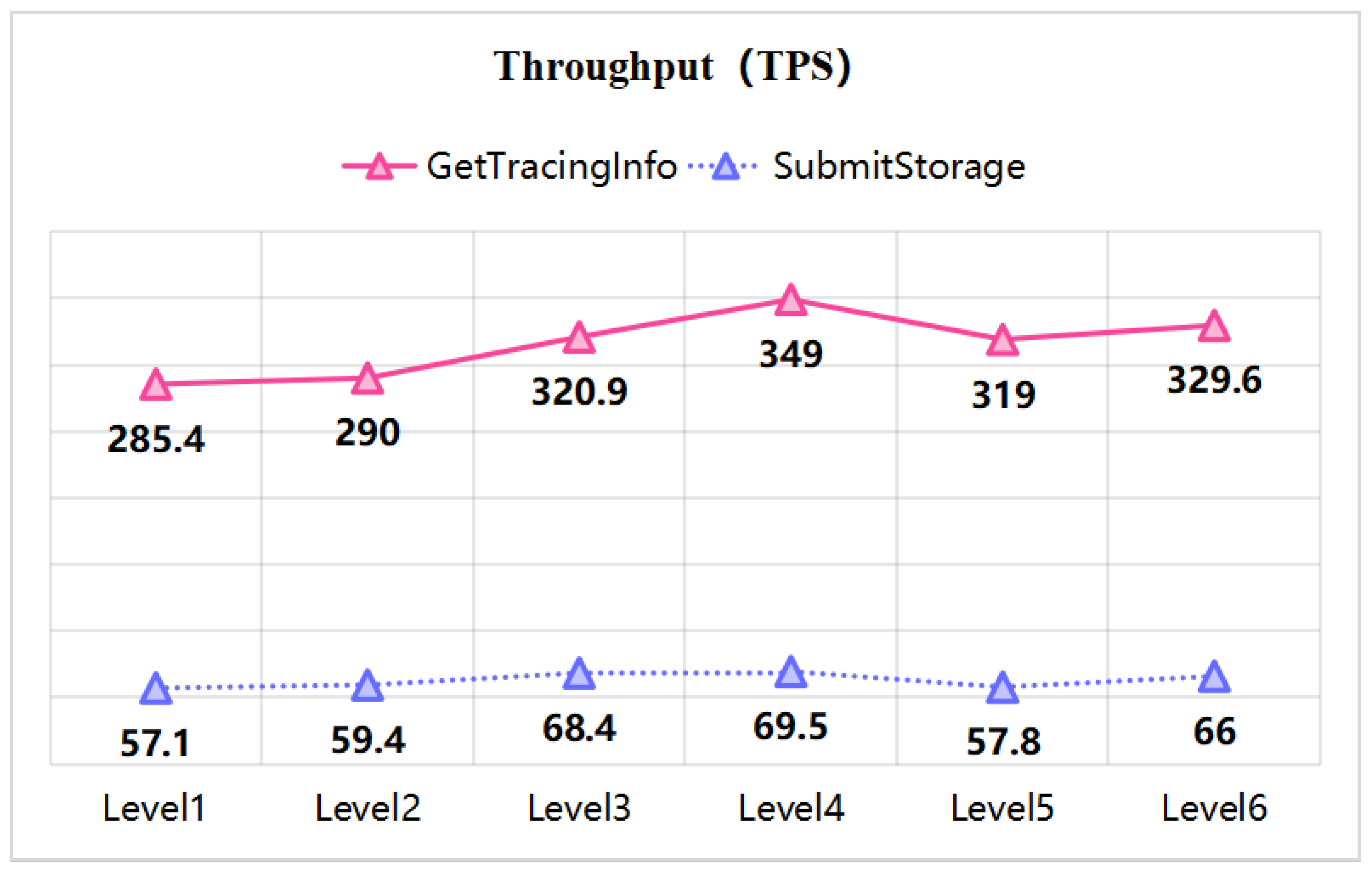
| Denial of Service (DoS) | IPFS gateway, Fabric peers | Rate limiting at application gateway; Caliper-tested capacity (max 349 TPS) |
| Elevation of Privilege | Multi-stage role permission management | Smart-contract-governed RBAC; independent submission and verification role separation across all traceability stages |
| Level | Experimental Configuration |
|---|---|
| 1 | workers:3,txDuration: 15,(Re)transactionLoad: 50,(Wr)transactionLoad: 50 |
| 2 | workers:3,txDuration: 20,(Re)transactionLoad: 80,(Wr)transactionLoad: 80 |
| 3 | workers:5,txDuration: 30,(Re)transactionLoad: 120,(Wr)transactionLoad: 100 |
| 4 | workers:5,txDuration: 60,(Re)transactionLoad: 200,(Wr)transactionLoad: 150 |
| 5 | workers:8,txDuration: 30,(Re)transactionLoad: 120,(Wr)transactionLoad: 100 |
| 6 | workers:3,txDuration: 60,(Re)transactionLoad: 200,(Wr)transactionLoad: 150 |
| Level | Write TPS | Read TPS | Write Latency (s) | Read Latency (s) | Success Rate (%) |
|---|---|---|---|---|---|
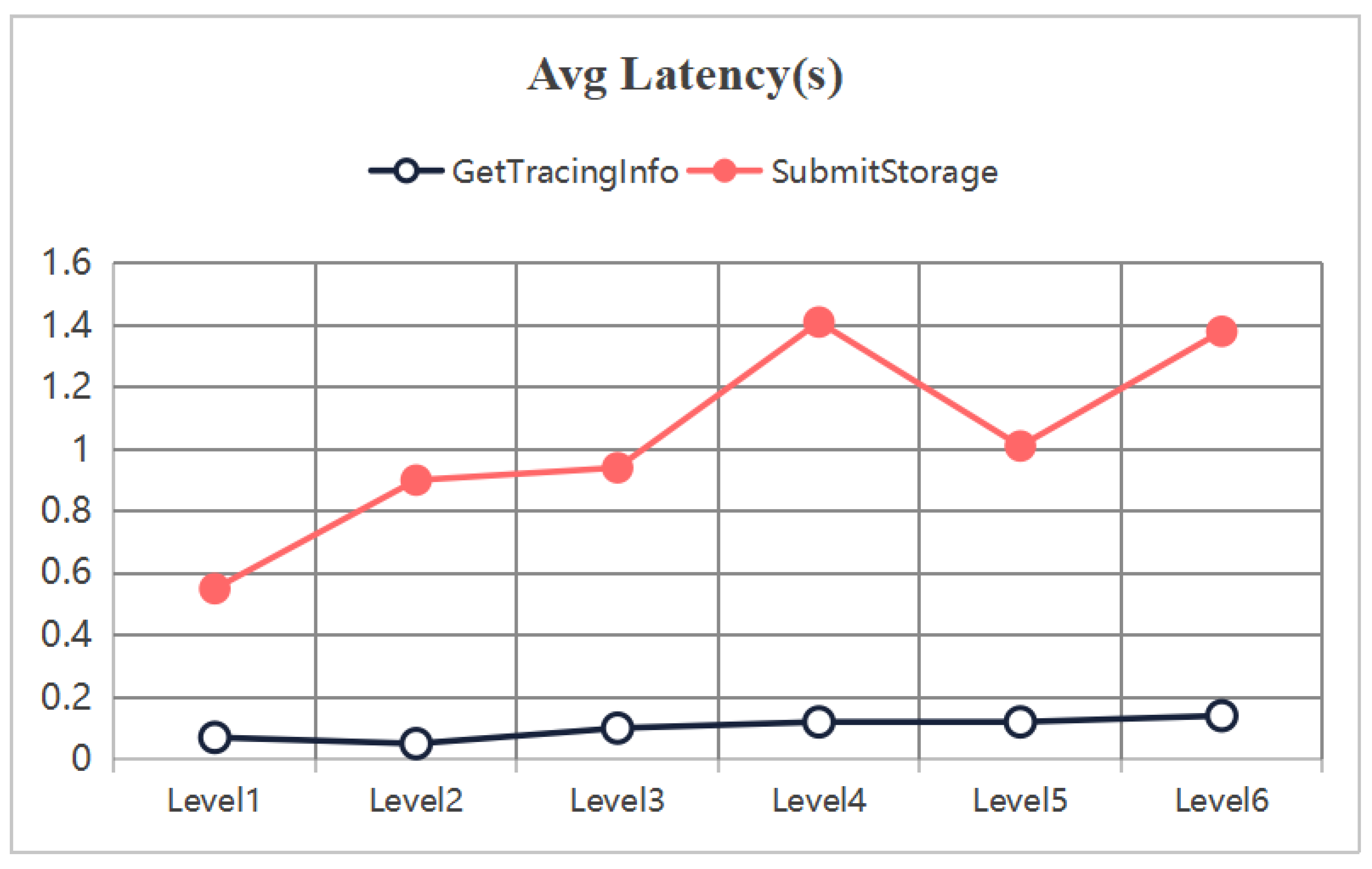
| 1 | 57.1 ± 1.4 | 285.4 ± 7.1 | 0.55 ± 0.04 | 0.07 ± 0.01 | 99.0 ± 0.5 |
| 2 | 59.4 ± 1.5 | 290.0 ± 7.3 | 0.90 ± 0.07 | 0.05 ± 0.01 | 99.0 ± 0.5 |
| 3 | 68.4 ± 1.7 | 320.9 ± 8.0 | 0.94 ± 0.07 | 0.10 ± 0.01 | 99.0 ± 0.5 |
| 4 | 69.5 ± 1.7 | 349.0 ± 8.7 | 1.41 ± 0.11 | 0.12 ± 0.01 | 99.0 ± 0.5 |
| 5 | 57.8 ± 1.5 | 319.0 ± 8.0 | 1.01 ± 0.08 | 0.12 ± 0.01 | 98.0 ± 0.8 |
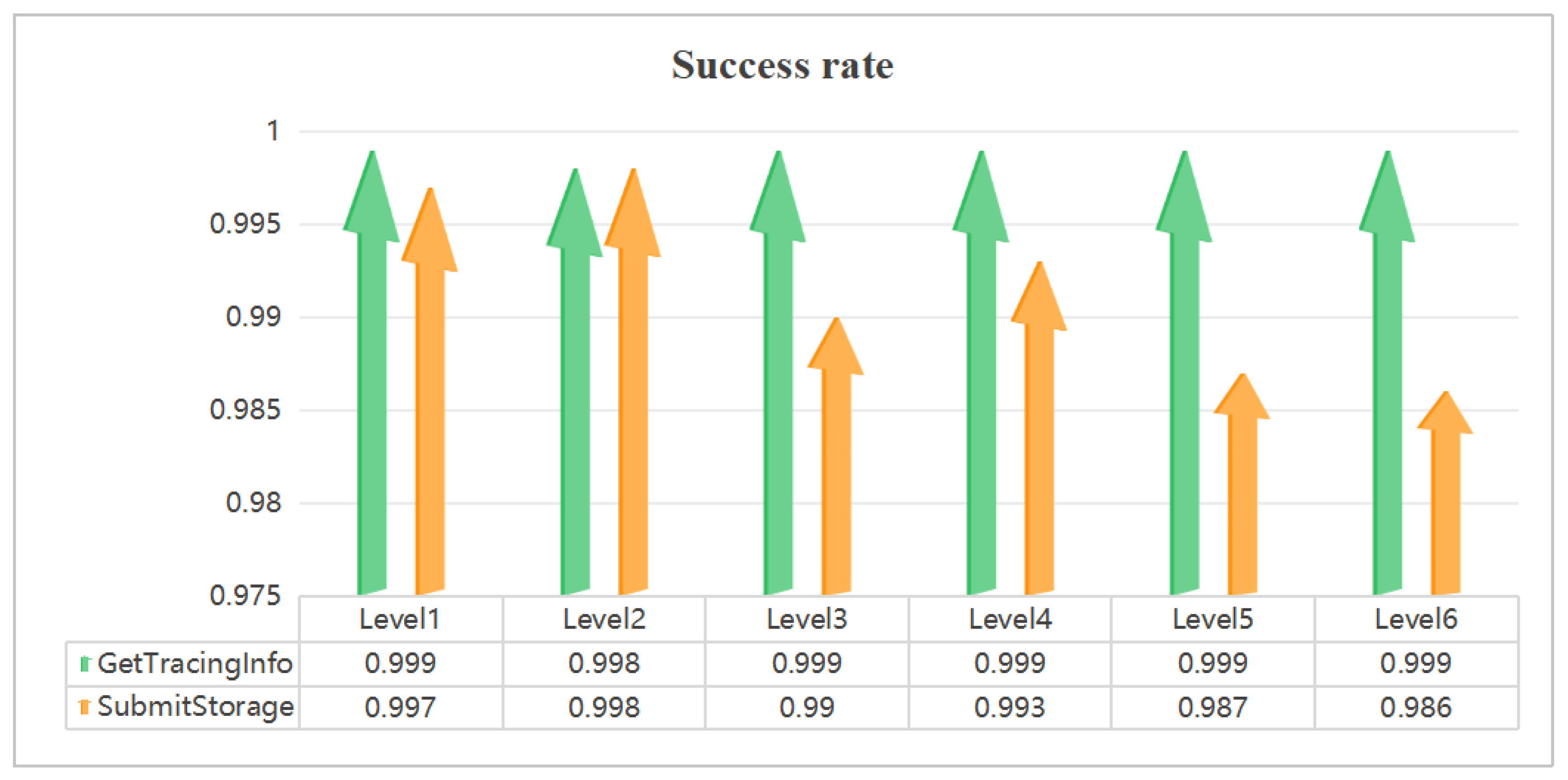
| 6 | 66.0 ± 1.7 | 329.6 ± 8.2 | 1.38 ± 0.10 | 0.14 ± 0.01 | 98.0 ± 0.8 |
Disclaimer/Publisher’s Note: The statements, opinions and data contained in all publications are solely those of the individual author(s) and contributor(s) and not of MDPI and/or the editor(s). MDPI and/or the editor(s) disclaim responsibility for any injury to people or property resulting from any ideas, methods, instructions or products referred to in the content. |
© 2026 by the authors. Licensee MDPI, Basel, Switzerland. This article is an open access article distributed under the terms and conditions of the Creative Commons Attribution (CC BY) license.
Share and Cite
Fan, Z.; Mai, R.; Jing, S.; Gao, X. A Credible Blockchain-Based Framework for Traceability in the Down-Product Supply Chain. Appl. Sci. 2026, 16, 5456. https://doi.org/10.3390/app16115456
Fan Z, Mai R, Jing S, Gao X. A Credible Blockchain-Based Framework for Traceability in the Down-Product Supply Chain. Applied Sciences. 2026; 16(11):5456. https://doi.org/10.3390/app16115456
Chicago/Turabian StyleFan, Zhihui, Ruoyi Mai, Shaowen Jing, and Xiaofeng Gao. 2026. "A Credible Blockchain-Based Framework for Traceability in the Down-Product Supply Chain" Applied Sciences 16, no. 11: 5456. https://doi.org/10.3390/app16115456
APA StyleFan, Z., Mai, R., Jing, S., & Gao, X. (2026). A Credible Blockchain-Based Framework for Traceability in the Down-Product Supply Chain. Applied Sciences, 16(11), 5456. https://doi.org/10.3390/app16115456