Article

A Credible Blockchain-Based Framework for Traceability in the Down-Product Supply Chain

School of Information Engineering, Henan University of Science and Technology, Luoyang 471023, China
*
Author to whom correspondence should be addressed.
Appl. Sci. 2026, 16(11), 5456; https://doi.org/10.3390/app16115456
Submission received: 30 March 2026 / Revised: 28 May 2026 / Accepted: 28 May 2026 / Published: 30 May 2026
(This article belongs to the Section Applied Industrial Technologies)

Featured Application

The findings presented in this paper can be applied to all supply chain traceability scenarios.

Abstract

To combat counterfeiting in down products and enhance enterprise credibility through technical means, this paper proposes a blockchain-based down quality traceability framework named DPT (down-product traceability). Built on Hyperledger Fabric, the framework integrates the InterPlanetary File System (IPFS), digital anti-counterfeiting watermarks (DW), QR codes, and category-specific encryption strategies to establish a trusted data chain throughout the entire supply chain. Role-based access control (RBAC) is adopted to ensure the secure submission and query of traceability information by all supply chain participants. A trinity data storage architecture is designed to achieve secure and efficient data management. A full-fledged application system was developed and deployed in cooperation with a leading down products enterprise to validate its practical applicability. Performance evaluation using Hyperledger Caliper 0.6.0, which focuses on throughput, latency, and resource utilization under stress testing, confirms that the DPT framework meets the requirements of real-world production. Furthermore, practical sales data verify that the proposed system effectively enhances consumer trust and mitigates counterfeiting behaviors in the market. Future work will focus on further optimizing write operation performance and evolving the system into a more robust clustered architecture.

1. Introduction

Counterfeit down products, represented by glue-bonded down, pose severe risks to consumers and the entire down industry. Such irregular practices infringe upon consumer rights and damage the reputation of legitimate down brands. Glue-bonded down means down fiber clusters artificially glued together with chemical adhesives. Unscrupulous merchants use this improper method to falsely inflate the labeled down content of products. Compared with genuine down, glue-bonded down has much poorer warmth retention and far lower bulkiness. Moreover, the adhesives contain formaldehyde and other harmful chemical ingredients. Long-term skin contact with such products may easily trigger health issues, including allergies, asthma, and dermatitis.
Traditional centralized systems are increasingly inadequate for addressing contemporary challenges, creating an urgent need for effective measures to combat counterfeiting and strengthen consumer trust. To implement robust anti-counterfeiting strategies and enable secure, transparent product traceability for both enterprises and consumers, innovative technological solutions are essential. In the current information era, among the various technologies available for data security and privacy, blockchain stands out as one of the most efficient due to its inherent properties of immutability and irreversibility [1]. Blockchain provides a secure, decentralized framework for end-to-end product tracking and tracing across the supply chain [2], effectively tackling this pressing issue. By enhancing visibility and transparency, it improves overall supply chain oversight. The immutability of blockchain records significantly hinders counterfeiters from introducing fraudulent goods into the market, thereby ensuring that consumers receive authentic products.
This paper addresses the aforementioned challenge by proposing a blockchain-based traceability framework, namely DPT (a framework for down-product traceability).
The main contributions of this article are summarized as follows:
  • The DPT framework for down supply chain traceability integrates blockchain, the InterPlanetary File System (IPFS), digital anti-counterfeiting watermarks (DW), Quick Response (QR) codes, and category-specific encryption strategies, enabling consumers to distinguish authentic from counterfeit products and enhancing enterprise brand reputation;
  • The DPT framework is implemented based on Hyperledger Fabric as a decentralized, cross-platform web application compatible with mainstream operating systems, with the integration of user-friendly interfaces to enhance the end-user experience;
  • Smart contracts are implemented to support core system functionalities, including the Tripartite Data Storage Architecture of down information and role-based access for reading and adding down traceability records;
  • Extensive validation testing is conducted to ensure the correct functionality of the system.

2. Related Work

The application of blockchain technology in product traceability has attracted extensive attention in multiple fields, including supply chain, Internet of Things (IoT), and healthcare, highlighting its potential to enhance transparency, security, and traceability. A comprehensive survey on blockchain applications was conducted [3,4]. These works offer clear insights for other researchers to leverage blockchain in addressing the challenges they face. In this section, the current state-of-the-art literature on diverse scenarios involving blockchain applications is reviewed. Concerning the intelligent industrial Internet of Things, Liu et al. [5] combine blockchain with the InterPlanetary File System (IPFS) to achieve storage space expansion and apply it to the industrial Internet of Things. Gu et al. [6] developed an ensemble learning method to detect fraudulent Ethereum transactions, improving detection accuracy through decentralized validation. In IoT-enabled supply chains, blockchain enables real-time tracking among producers, manufacturers, carriers, and retailers, offering a trustworthy solution. It replaces centralized architectures, enhancing trust among connected devices. Regarding food traceability, Agarwal et al. [7] present a blockchain-based system to enhance the traceability of food grains by integrating sensors, Raspberry Pi units, and IPFS. Regarding healthcare data, to ensure the security and interoperability of electronic health records (EHRs) across different blockchain platforms, the authors of [8] propose an architecture that integrates AES-256 encryption and IPFS to facilitate the secure and real-time synchronization of EHR data between Hyperledger Fabric and the Ethereum Sepolia testnet. IPFS provides a secure, immutable, and distributed off-chain storage solution capable of hosting diverse data types—including images, videos, and structured database files. When integrated with blockchain systems, IPFS effectively mitigates the inherent scalability limitations of on-chain storage. However, maintaining strict consistency between off-chain data (hosted on IPFS) and on-chain metadata (e.g., content identifiers, access permissions, or integrity proofs) remains a critical design requirement.
A comparative analysis of the strengths and limitations of existing approaches is presented subsequently (Table 1), along with derived insights to inform the design and development of our work.
To enhance the security of user data, Ilya Grishkov et al. [9] propose an extension to the self-encryption scheme, which directly embeds the data owner’s identity into the encryption process. This approach ensures the permanent preservation of file ownership and establishes an immutable, verifiable link between the encrypted data and its source. While this study provides a foundational framework for identity-aware security in decentralized systems, it lacks a data-type-specific differentiation mechanism, thus limiting its adaptability to diverse data protection requirements. Gu et al. [10] leverage supply chain optimization techniques to refine the production and distribution planning of supply chains, resulting in a reduction in both the total cost of suppliers and the delayed delivery rate. This methodology underscores the importance of evaluating the efficacy and efficiency of algorithmic applications in real-world production contexts. Mohit et al. [11] identify that the application of blockchain to address counterfeiting issues in supply chains gives rise to privacy concerns regarding information shared among supply chain members. To address this, this paper employs a hybrid approach combining symmetric and asymmetric key encryption, with explicit consideration of traceability and ownership. This methodology underscores the need for more flexible and diverse encryption techniques to safeguard user privacy information across different data types within blockchain systems. Li et al. [12] propose a “Value–Standard–Process” collaborative framework for blockchain-enabled enterprise data governance, designed to establish a value-driven, multi-tiered collaboration architecture that enhances the efficient allocation and circulation of production factors. While the framework integrates multiple interdependent dimensions—spanning strategic alignment, operational standardization, and process automation—its practical efficacy requires rigorous empirical validation under real-world industrial conditions. Manufacturers adopting blockchain-based traceability systems can enhance consumers’ trust in product information [13]. Liu et al. [14] propose a general blockchain-based, event-driven tracking (BET) framework to enhance transparency in manufacturing supply chains. Within this framework, a smart contract is formally specified to encode event-triggered cooperation tracking rules. The design methodology underlying such event-driven smart contracts is transferable and can be systematically adapted to domain-specific contexts—including down supply chains. Integrating blockchain technology into supply chain management offers stakeholders enhanced security, traceability, and reliability [15]. In [16], TrustChain is proposed as a generic, blockchain-based traceability system for diverse product categories. It leverages Ethereum smart contracts and the InterPlanetary File System (IPFS) to ensure product authenticity, end-to-end supply chain traceability, and resistance to counterfeiting. A comprehensive cost analysis is also conducted, quantifying both on-chain transaction expenses (gas consumption) and off-chain decentralized storage costs. However, the system lacks robust security auditing and encryption mechanisms for product information prior to its on-chain registration. In [17], the authors propose a blockchain-based traceability system for fruits and vegetables. It uses on-chain storage to reduce the reliance on centralized databases and barcode scanning for product lookup. However, it stores some data centrally—compromising decentralization and security—and lacks both system testing and cost analysis. In [18], the authors propose a blockchain-based traceability model for the coffee supply chain. However, it lacks implementation details, empirical evaluation, and a clear explanation of how blockchain is used—for example, in off-chain data integration, consensus selection, or smart contract design. Experimental evaluation in [19] reveals that, if blockchain implementation costs are excessively high, they significantly erode the total profit of the product supply chain. Consequently, economic viability and practical applicability must be treated as foundational criteria in blockchain technology innovation—particularly within supply chain applications. Blockchain enables decentralized, immutable transaction records [20] but ensures integrity only after entry—not data validity at input. Machine learning (ML) complements blockchain by verifying initial data quality. Integrating blockchain and ML enhances system robustness. Most existing studies are theoretical—they lay out ideas and frameworks [21]—but few have actually tested blockchain–AI applications in real-world supply chain settings. Srivastava et al. [22] explored organizing medical records securely using blockchain, demonstrating its potential to build resilient, trustworthy infrastructures. They suggest combining blockchain with ML and IoT for improved healthcare systems. Facing the transition to Healthcare 5.0—defined by the convergence of artificial intelligence (AI), cyber–physical systems, and real-time data connectivity—the authors propose a blockchain-enhanced federated learning framework to address three core challenges: safeguarding patient data privacy, establishing cross-institutional trust, and securing decentralized healthcare infrastructures. The framework adopts a hybrid on-chain/off-chain architecture to balance transparency, scalability, and computational efficiency. However, the performance of this solution needs to be further verified in actual medical environments.
From the literature review, it is evident that the implementation of blockchain technology can bring numerous significant benefits. The decentralized, immutable, and transparent nature of blockchain makes it an ideal solution for establishing reliable and efficient traceability systems across various sectors. However, based on the preceding discussion, three key conclusions can be drawn:
  • Innovation should be oriented to practical applications rather than pursuing uniqueness for vanity. It should also take usability and ease of operation into account. For example, a simple and user-friendly interface is crucial, as end users are generally unfamiliar with blockchain technology;
  • The designed system should maintain universality and, more importantly, be tailored to targeted scenarios to accelerate the transformation of technological innovation into practical benefits;
  • The proposed framework and system should fully consider implementation costs and operational efficiency. While meeting the required performance standards, they should minimize resource consumption as much as possible.
Unlike existing studies, the design objective of this paper is to meet the application requirements of down supply chain traceability, adhere to the principles of usability and ease of use, fully consider the characteristics of down supply chain traceability data, satisfy the requirements for storage capacity and read–write timeliness, and minimize implementation costs to the greatest extent.
In addition, this paper differs from existing research mainly in the following two aspects:
(1)
To eliminate data errors before on-chain uploading, the proposed design abandons artificial intelligence (AI) and machine learning (ML) methods. Such approaches are known for high resource consumption and unsatisfactory practical performance. Instead, this scheme integrates a “1+1” review mechanism, mobile terminal sensor data, and digital watermarking technology to improve data accuracy prior to on-chain submission;
(2)
This paper proposes category-specific encryption strategies for different types of input data, which are embedded into the Tripartite Data Storage Architecture.

3. DPT Design

This section delves into the design of the DPT framework. Initially, an overarching overview is presented, encompassing how various roles engage in the system. Subsequently, the key technologies employed in the implementation of the DPT framework are presented in detail, and the core algorithms are systematically described through a thorough analysis of the operational procedures and supplemented with a process flow diagram.

3.1. DPT Framework Overview & Architecture

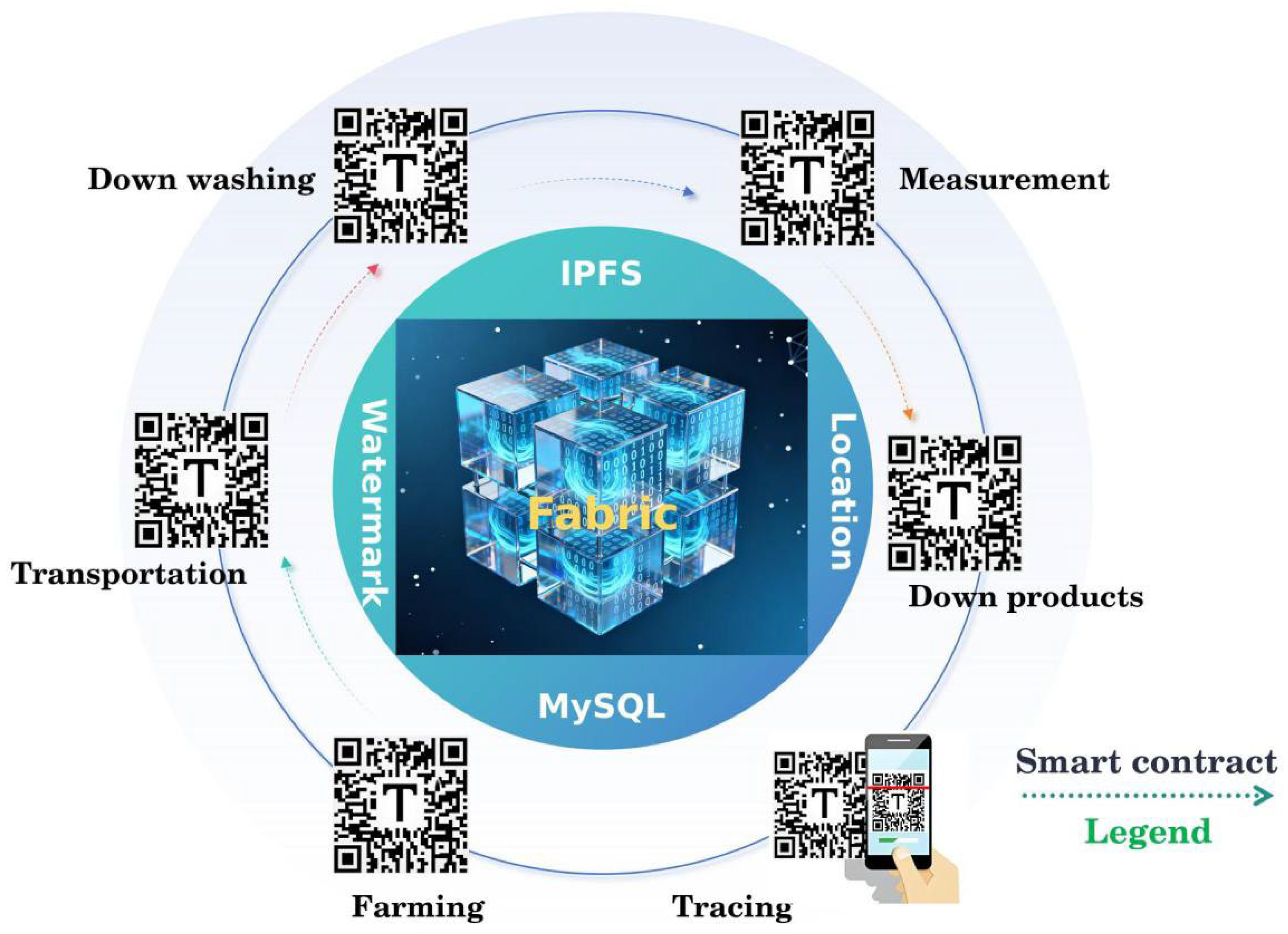
Figure 1 illustrates the holistic working relationship of the DPT framework, which includes five key stages: duck and goose farming, transportation of fresh down feathers, down washing, down quality measurement, and down-product manufacturing. The system involves six types of participants: staff from each of the five stages and consumers. Consumers can query the full traceability information of down products. This helps them better understand the down’s entire journey. However, they are not permitted to modify or add any data. In contrast, authorized personnel at each stage can both access and contribute traceability details. This ensures that all records are accurate and up-to-date. Smart contracts are employed to ensure that the DPT framework operates smoothly and in accordance with the predefined workflow.
The DPT framework comprises six technical highlights:
  • Smart contract embedded with QR codes. The DPT framework provides system participants with a highly user-friendly QR code interaction interface. A QR code is generated at the initial stage of duck and goose farming. The smart contract ensures the continuity and integrity of this QR code throughout the entire supply chain—from poultry farming to finished down products. System participants can use smart terminals (e.g., mobile devices) to scan the QR code. This allows them to either input or access traceability data related to each specific phase of the supply chain;
  • “1+1” information upload model for blockchain on-chain recording. To reduce the risk of human-induced data entry errors, the DPT framework sets a dedicated traceability information verification role at each stage of the supply chain. Only data verified by this role is allowed to be recorded on the blockchain;
  • Real-time positioning via smart terminals. The DPT framework utilizes the built-in geolocation function of smart terminals. When users enter down-product traceability information, the system automatically captures location data. This ensures the authenticity and timeliness of the recorded location;
  • Tripartite data storage architecture. The framework integrates the MySQL database, IPFS, and Fabric blockchain into a unified architecture. This architecture enables secure and efficient storage and retrieval of user information and down-product traceability data;
  • Storage expansion based on IPFS. The DPT framework incorporates IPFS to expand the storage capacity of Fabric. It also improves Fabric’s storage efficiency and overcomes the inherent storage limitations of the Fabric architecture;
  • Identity anti-counterfeiting based on digital watermarking. The DPT framework embeds digital watermarks to bind on-chain data with the original identity of the data generator. This ensures the operational accountability and source attribution of the down-product traceability information.

3.2. Implementation of the DPT Framework

3.2.1. The Smart Contract Within the DPT Framework

Smart contracts guarantee that the DPT framework operates according to the predefined workflow, which comprises four components:
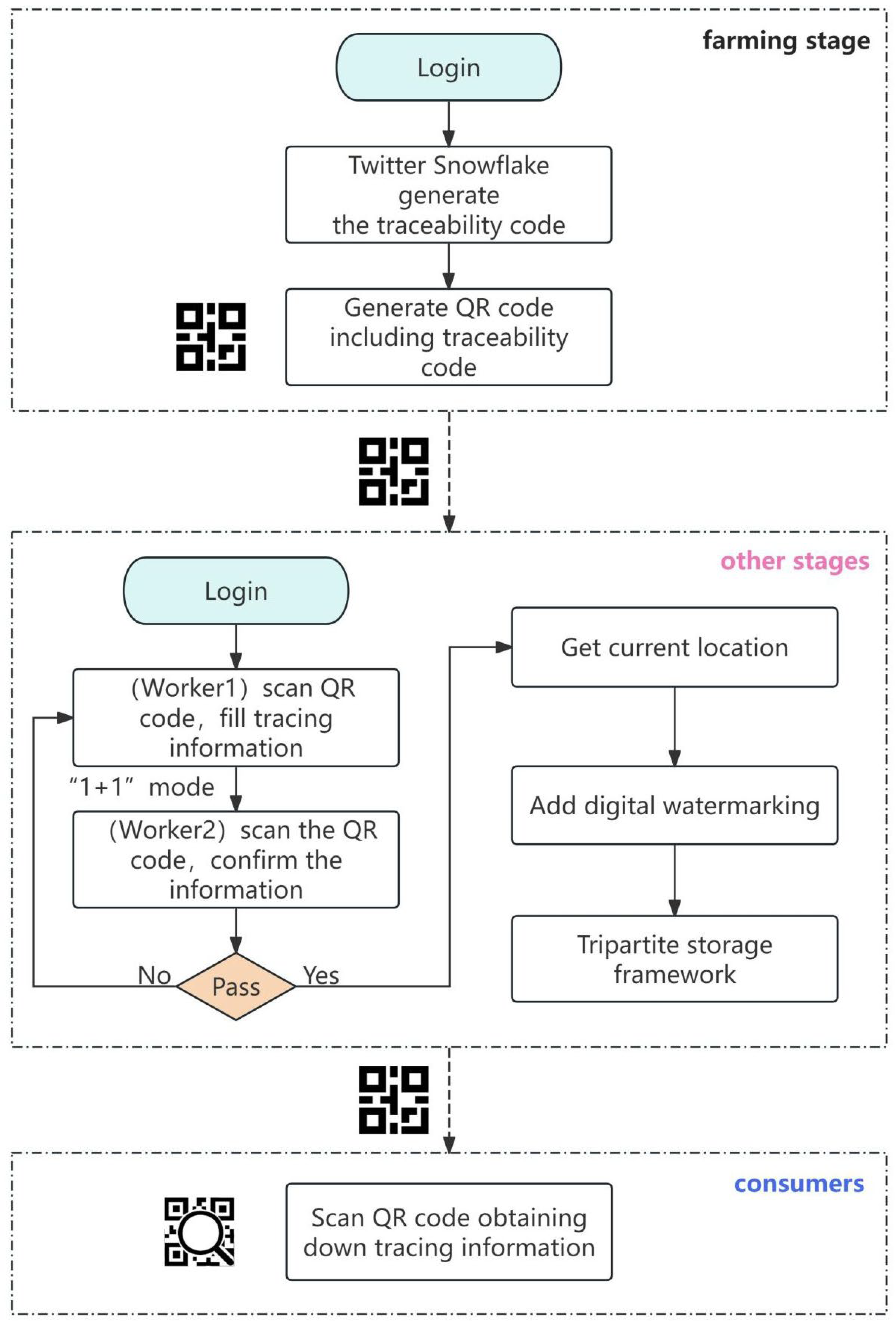
(1) In the goose and duck breeding stage, the Twitter Snowflake algorithm is used to generate a unique traceability code. Based on this code, a QR code-based user interface is created for subsequent stages. This QR code runs through the entire supply chain, spanning goose and duck breeding to down-product manufacturing. After successful identity verification, staff at each stage are authorized to input the corresponding traceability data according to their predefined roles;
(2) All down-traceability data submitted by staff at each stage must pass the “1+1” information verification mechanism before being stored in the storage system of the DPT framework. Under this mechanism, each workflow stage is equipped with two independent roles: one staff member inputs raw data, and another reviewer verifies data accuracy. The system only allows data storage after the verification is successfully completed.
Blockchain guarantees the immutability of on-chain data. However, it has inherent limitations in handling data errors generated before uplink, especially inaccuracies caused by manual entry. To ensure the credibility of traceability data in the DPT framework, this paper adopts a “1+1” information verification mechanism. The mechanism gives priority to automatic data collection through intelligent terminal sensors to reduce manual entry as much as possible. Meanwhile, to avoid new errors caused by reviewer revisions, the reviewers are granted verification-only permission and cannot modify raw data. If reviewers detect any data inconsistencies, they will return the records to the original submitter. The submitter must correct the errors and resubmit the revised data for a new round of review;
(3) To ensure the authenticity of traceability data, the smart contract automatically invokes the positioning function of the user’s intelligent terminal. It captures the real-time location of data entry personnel and embeds this geolocation information into the traceability record. Furthermore, to enable traceability-based accountability, the smart contract applies explicit digital watermarking to all images included in the traceability data. The technical implementation of this watermarking mechanism will be elaborated on in subsequent sections;
(4) The smart contract enforces the implementation of a “trinity” data storage model within the DPT framework. The underlying principles of this tripartite storage architecture will be elaborated on in the following section. The operational workflow of the smart contract is illustrated in Figure 2.

3.2.2. Tripartite Data Storage Architecture

The DPT framework integrates MySQL, IPFS, and Hyperledger Fabric to construct a “trinity” data storage architecture. This architecture enables secure and efficient data management. The framework is designed to store three categories of information: (1) personnel identity information at each stage, including identity type, username, and password, where data security is the primary requirement for this category; (2) textual traceability data, such as farming records, transportation details, down washing processes, quality inspection reports, and down-product specifications, where these data are inherently public and require minimal storage space; and (3) multimedia traceability data, including images and videos captured throughout the down supply chain. This category has high storage demands and strong identifiability, so it is suitable for embedding enterprise-specific digital watermarks.
It is widely acknowledged that Hyperledger Fabric ensures the immutability of data once recorded on the blockchain. However, data stored in Fabric is maintained in plaintext. This makes it inappropriate for storing sensitive information such as plaintext passwords directly on the chain. Additionally, Fabric has inherent limitations in storage capacity. Consequently, directly storing large volumes of multimedia content on the blockchain would lead to significant performance degradation. This includes system latency or even operational failure under high load. Therefore, the first category of data requires robust protection of authentication credentials. The second can be securely and transparently stored on the blockchain. The third demands an optimized approach to address storage efficiency and scalability.
To address these challenges, this paper proposes a “trinity” data storage architecture. The following section elaborates on how this framework resolves the aforementioned issues.
1. To address the challenge of user password security, the DPT framework employs the Argon2 algorithm. It hashes and encrypts user passwords before storing them in both Hyperledger Fabric and the MySQL database. Records are linked via the user ID. Argon2 is an advanced password-hashing algorithm designed to resist brute-force and side-channel attacks. Although the encryption process is computationally intensive, it significantly increases the difficulty of password cracking by orders of magnitude. This is compared to the minimal overhead incurred during legitimate use. By configuring optimal algorithm parameters, the encryption process remains transparent to end users. At the same time, it ensures robust security. In the DPT framework, the mobile application is configured to use 16 MB of memory and an execution time of 0.2 s. This achieves a balance between security and performance;
2. To address the challenge of storage efficiency for multimedia traceability information, the DPT framework leverages IPFS for storing images and videos. IPFS provides decentralized storage and high-performance data retrieval. This makes it a widely adopted solution for expanding the storage capacity of blockchain-based systems. Extensive documentation on IPFS is available in existing research, so a detailed overview is omitted here. However, IPFS stores data in plaintext. To enhance security, the DPT framework applies AES-256-GCM envelope encryption to images before uploading them to IPFS. Prior to encryption, explicit digital watermarks are embedded into the media files. AES-256 is a highly secure symmetric encryption standard. It is recognized as resistant to all known classical attacks for decades to come, except for advances in quantum computing. Furthermore, mainstream CPUs—including those from Intel and AMD—incorporate hardware-level optimizations such as the AES-NI instruction set. These optimizations enable extremely efficient encryption and decryption operations. The AES-256-GCM mode not only encrypts data but also generates an authentication tag. During decryption, this tag is verified before any data is released. If tampering occurs during transmission or storage, decryption fails immediately. This ensures the integrity of the ciphertext from its creation. Upon successful storage in IPFS, the generated Content Identifier (CID) is recorded on Hyperledger Fabric. This guarantees immutability. Through this approach, all of the data permanently stored on the blockchain are textual. They are either publicly accessible traceability records or encrypted representations of sensitive information. This constitutes the “trinity” data storage architecture of the DPT framework. The main steps of the tripartite storage are presented in Algorithm 1.
Algorithm 1: Steps of Tripartite Storage
Input: multimodal data X
Output:
(Credential-type data) a 256-bit hash value, stored in MySQL database and on Fabric.
(Multimedia-type data) a tamper-proof association pair ({CID}, {Tag}), stored on Fabric. Watermarked and encrypted multimedia ciphertext in the IPFS.
(Textual data) a 256-bit hash value, Stored on Fabric.
Begin:
(1): Obtain the multimodal data X to be stored.
(2): Identify the type of multimodal data X through feature matching and predefined rules.
(3): Direct the data X to its corresponding processing pipeline according to the type.
(4): If (is Credential-type Data)
(5):  Argon2id(X), with parameters: Iteration count 3, Memory overhead 64 MiB, Parallelism degree 4, Salt addition 16-byte, producing a 256-bit hash value.
(6):  Store the 256-bit hash value in the off-chain MySQL database and Fabric.
(7): If (is Multimedia-type Data)
(8):  Determine the digital watermark content (identity information, enterprise logos).
(9):  Embed the digital watermark into X in the spatial domain, transparency parameter α = 0.3.
(10): Encrypt X with digital watermarks added using the AES-256-GCM algorithm, produce a 128-bit cryptographic authentication Tag.
(11): Upload the encrypted multimedia ciphertext to the IPFS, and generate a Content Identifier (CID).
(12): Construct a tamper-proof association pair ({CID}, {Tag}), and store it on Fabric.
(13): If (is Textual Data)
(14): SHA-256(X), generate a fixed-length 256-bit hash value.
(15): Store the 256-bit hash value on Fabric.

3.2.3. Digital Watermarking for Identity Anti-Counterfeiting

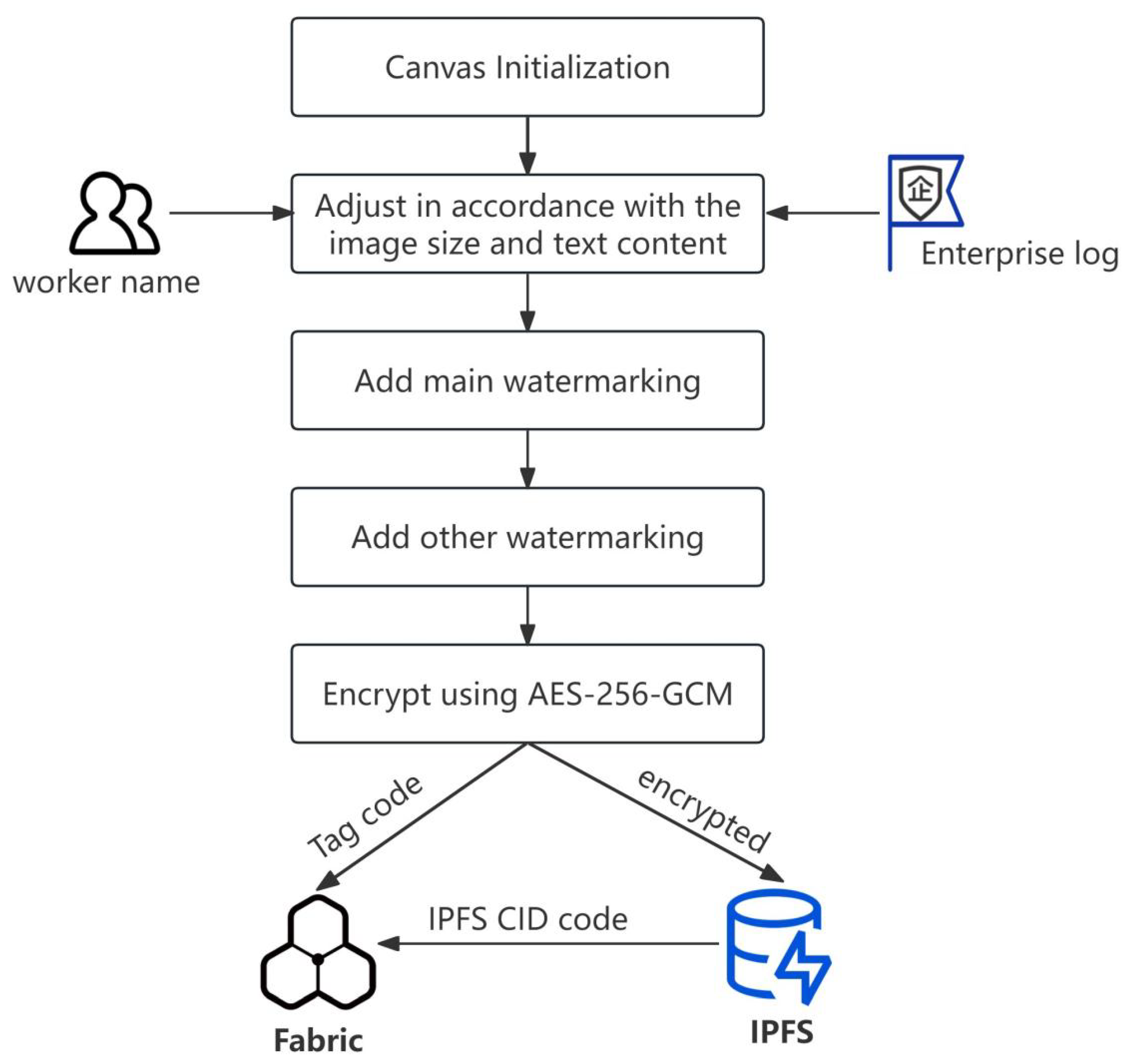
To ensure the operational accountability and source attribution of down-traceability information, the DPT framework uses explicit watermarking. It embeds the identities of data entry and review personnel into traceability images. It also embeds other enterprise identification details directly onto these images. This binding mechanism integrates three elements into a single, verifiable record. The three elements are personnel identity, organizational identifiers, and traceability data. This integration strengthens accountability and traceability assurance. Watermarks are embedded in the spatial domain rather than transform domains, such as DCT, to improve processing efficiency. Compared to frequency–domain methods, this approach reduces robustness. However, the framework compensates for this. It incorporates strong cryptographic protections. Specifically, it uses AES-256-GCM encryption and hash-based integrity verification. Together, these protections support accountability and tamper resistance.
The watermarking process is implemented using Canvas. It leverages Canvas’s precise positional control, flexible styling capabilities, wide compatibility, and high computational efficiency. After watermark embedding, traceability images are encrypted with the AES-256-GCM algorithm. They are then securely stored on the IPFS network. The authentication tag generated during encryption is recorded on the blockchain. This enables immutable and independently verifiable tamper detection. IPFS provides scalable, decentralized storage. It ensures efficient and reliable access to large-volume traceability data. The CID codes generated by IPFS are also stored on the blockchain. Any unauthorized modification or replacement of a traceability image will trigger significant changes. These changes occur in both the IPFS Content Identifier (CID) and the AES-256-GCM authentication tag. This makes such alterations easily detectable and forensically traceable. The DPT framework integrates three technologies synergistically. They are Canvas-based watermarking, AES-256-GCM encryption, and IPFS-based distributed storage. This integration establishes a multi-layered security architecture. The architecture achieves identity binding, data integrity, and high-performance storage simultaneously. The processing workflow is illustrated in Figure 3.
In the DPT framework, digital watermarking serves only as a supporting identity-binding and anti-counterfeiting mechanism, not as a primary robust watermarking scheme. A full robustness evaluation against attacks is beyond the scope of this work. The main security guarantees are provided by AES-256-GCM encryption and blockchain anchoring.

3.3. Formal Modeling of the DPT Framework

To establish a rigorous analytical foundation for the proposed framework, this section formulates a finite-state machine (FSM) for traceability records, analyzes the computational complexity of core operations, and provides a formal definition of accountability implemented in the DPT framework.

3.3.1. Finite-State Machine of a Traceability Record

The state S of a traceability record is defined within the following set:
S ϵ { C R E A T E D , V E R I F I E D , S T O R E D , Q U E R I E D , R E J E C T E D }
The initial state is CREATED, which is activated upon QR code generation during goose and duck farming procedures. All valid state transitions are governed by smart contract functions and are specified as follows:
CREATED → VERIFIED: Triggered upon the successful validation of submitted data via the “1+1” verification mechanism.
CREATED → REJECTED: Triggered when the “1+1” verification mechanism fails.
VERIFIED → STORED: Triggered upon the successful completion of tripartite storage across MySQL, IPFS, and Fabric.
STORED → QUERIED: Triggered when an authorized user retrieves the traceability record.
No additional state transitions are allowed. The proposed FSM ensures that all traceability records must pass mandatory verification before persistent storage and remain immutable after being stored. This mechanism effectively guarantees data integrity and the standardized workflow compliance of the DPT framework.

3.3.2. Complexity Analysis of Core Operations

Complexity assumption: the following analysis considers per-operation complexity under bounded input sizes (i.e., a single traceability record, one image, one credential, one transaction). Under this realistic engineering assumption, each operation processes a fixed amount of data, so its time does not grow with the total number of stored records n . Theoretical asymptotic factors (e.g., O ( log n ) for LSM-tree lookups) exist but are dominated by constant overheads in our implementation.
Let n denote the total number of traceability records in the system. The DPT framework mainly relies on two core operations for data processing. With bounded processing overhead for each individual record, both operations achieve constant time complexity, as analyzed in detail below.
1. Write Operation (SubmitStorage)
Argon2 credential hashing: O ( 1 ) (fixed-length input). The input length of identity credentials is fixed, leading to constant computational overhead.
AES-256-GCM multimedia data encryption: O ( 1 ) (fixed-size batch processing). The framework adopts fixed-size batch processing for single-image and multimedia files, ensuring stable, constant-time computation.
IPFS data upload: O ( 1 ) (amortized, fixed-size files). This benefits from the content-addressed storage mechanism of IPFS; file uploading eliminates linear correlation with total data volume.
Hyperledger Fabric transaction commit: O ( 1 ) (single transaction per record). Each traceability record corresponds to an independent single transaction with fixed processing logic.
The overall complexity of the write operation is O ( 1 ) .
2. Read Operation (GetTracingInfo)
Key-based Fabric query: The standard LSM-tree-based database query theoretically yields O log n complexity. However, this framework adopts explicit known-key indexing for targeted record retrieval, which achieves practical constant-time lookup (i.e., O(1)) under bounded operational constraints.
CID-based IPFS retrieval: O ( 1 ) . IPFS uniquely locates files via fixed content identifiers, enabling constant-time data fetching.
The overall complexity of the read operation is O ( 1 ) per query.
In summary, the throughput of the proposed DPT framework is constrained only by concurrent user capacity and underlying hardware performance, rather than the cumulative scale of stored traceability data. This feature validates the superior practical scalability and operational efficiency of the framework in long-term data accumulation scenarios.

3.3.3. Formal Definition of Accountability in DPT

This section defines a lightweight, application-oriented operational non-repudiation model. It does not achieve the rigorous cryptographic strength of traditional digital signature schemes and only provides accountability and attribution guarantees for practical down supply chain scenarios.
This subsection provides a formal operational definition of operational accountability and source attribution for the proposed DPT framework.
For any traceability record R embedded with a watermarked image I, once the corresponding IPFS Content Identifier (CID) and AES-256-GCM authentication tag are successfully anchored and stored on the Hyperledger Fabric blockchain, the data submitter cannot reasonably deny the submission of R, unless one of the following exceptional conditions can be proven valid:
  • The cryptographic key employed for data encryption was compromised prior to the record submission;
  • The blockchain state suffered malicious tampering, a scenario inherently excluded by the Byzantine fault-tolerant consensus mechanism of Hyperledger Fabric.
Compared with conventional digital signature-based non-repudiation schemes, the operational non-repudiation mechanism provides sufficient accountability for down supply chain traceability but does not constitute strict cryptographic non-repudiation in the classical sense, which is nevertheless sufficient for the targeted supply chain traceability use case. Nevertheless, it is sufficiently robust and tailored for downstream supply chain scenarios. The integrated “1+1” multi-party verification mechanism and tamper-proof on-chain records jointly establish a reliable accountability system, which meets the practical security and traceability requirements of the down-product supply chain supervision.

3.4. Security and Trust Model

This section comprehensively investigates the security properties of the proposed DPT framework, covering systematic threat modeling, standardized key management lifecycle, attack surface enumeration, and fundamental trust assumptions. A complete security and trust model is established to validate the framework’s reliability in supply chain traceability scenarios.

3.4.1. Threat Model (STRIDE-Based)

To systematically identify and mitigate potential security risks, this work adopts the classic STRIDE taxonomy to analyze potential threats targeting the DPT framework. The corresponding vulnerable components and tailored defense mechanisms are summarized in Table 2.

3.4.2. Key Management Lifecycle

The DPT framework leverages AES-256-GCM symmetric encryption to protect multimedia traceability data. To guarantee cryptographic security, the entire key lifecycle is standardized and strictly managed off-chain, covering generation, distribution, storage, rotation, and revocation phases.
  • Generation: A unique 256-bit AES key is generated for each product batch. Key generation is implemented based on either a hardware security module (HSM) or a cryptographically secure pseudo-random number generator (CSPRNG) to ensure sufficient randomness and cryptographic strength;
  • Distribution: Generated keys are securely delivered exclusively to authorized submitters and verifiers of the corresponding traceability stage via dedicated out-of-band secure channels, such as encrypted private emails and offline physical delivery. No key information is transmitted through the blockchain or IPFS network to avoid exposure risks;
  • Storage: All encryption keys are preserved offline in HSM devices or password-protected air-gapped databases. The blockchain network only stores public verification data without retaining any private encryption keys;
  • Rotation: Regular key rotation is performed quarterly. Immediate key rotation is triggered once key leakage or security compromise is suspected. Legacy keys are retained to support decryption and verification of historical traceability records but are prohibited for new data encryption;
  • Revocation: When a product batch completes its full supply chain lifecycle (e.g., final sales or batch retirement), the corresponding encryption key is marked as revoked. Following a mandatory six-month retention period for post-market traceability auditing, the revoked key is permanently removed from active storage.

3.4.3. Attack Surface Enumeration

This subsection identifies and analyzes four critical attack surfaces of the DPT framework, with the corresponding targeted mitigation strategies elaborated as follows.
  • Mobile/Web Front-End
Risks: User credential theft, session hijacking, and artificial QR code forgery.
Mitigation: End-to-end HTTPS transmission and short-term valid JWT tokens (1 h expiration) are adopted for access control. All traceability QR codes are programmatically generated by smart contracts, which cannot be forged without breaking the underlying blockchain consensus mechanism;
2.
IPFS Gateway
Risks: Man-in-the-middle (MITM) eavesdropping, network content poisoning, and gateway denial-of-service attacks.
Mitigation: AES-256-GCM encryption ensures the confidentiality and integrity of multimedia ciphertexts. The corresponding data CID is anchored on Hyperledger Fabric to provide immutable trusted verification references. All gateway services are deployed and maintained by authorized enterprises with standard TLS termination protection;
3.
Hyperledger Fabric Peers and Orderers
Risks: Malicious peer ledger tampering, consensus processing delay, and blockchain ledger forking.
Mitigation: The network adopts the Raft crash-fault-tolerant consensus mechanism. Only pre-authenticated authorized organizations can participate in network consensus and transaction validation. Mutual TLS authentication is enforced for all node communication;
4.
MySQL Database
Risks: SQL injection attacks and unauthorized offline dumping of credential hashes.
Mitigation: Parameterized queries are adopted to prevent SQL injection. User credentials are exclusively stored as Argon2 hashes without plaintext retention. Database security is further enhanced via dedicated firewall policies and least privilege account management.

3.4.4. Cryptographic Trust Model and Assumptions

The security and reliability of the DPT framework are built upon the following standardized cryptographic and system trust assumptions.
  • Blockchain Layer: The Hyperledger Fabric network maintains an honest majority of ordering nodes under the Raft consensus protocol. No individual peer node can arbitrarily tamper with or reverse committed on-chain transactions;
  • IPFS Layer: The IPFS network provides inherent content-addressed and tamper-evident storage properties. Notably, the framework does not rely on IPFS for data confidentiality; all sensitive data is fully encrypted before network uploading;
  • End-User Devices: Mobile and web terminals for data submission and verification are assumed to be malware-free and trusted. Compromised user devices may compromise the reliability of the “1+1” dual verification mechanism;
  • Key Secrecy: The overall security of AES-256-GCM encryption depends on the secrecy of batch-specific encryption keys. All key management operations are implemented off-chain following the lifecycle specifications in Section 3.4.2.
Based on the above trust assumptions, the DPT framework guarantees four core security properties throughout the traceability lifecycle:
  • Integrity: Ensured by the immutable Fabric ledger and verifiable AES-GCM authentication tags;
  • Confidentiality: Guaranteed for sensitive information, including user credentials and multimedia traceability ciphertexts;
  • Accountability: Implemented following the formal definition in Section 3.3.3.

3.4.5. Accountability in the DPT Context

As formally defined in Section 3.3.3, the operational accountability and source attribution capability of the DPT framework is jointly enabled by three core mechanisms: identity-embedded digital watermarking for submitter attribution, immutable on-chain storage of data CIDs and AES authentication tags, and the mandatory “1+1” dual verification workflow.
This integrated solution delivers sufficient operational accountability for down supply chain traceability scenarios, though it does not achieve the full cryptographic strength of conventional digital signature-based non-repudiation schemes. Therefore, we refer to this property as “accountability” or “evidence-based traceability”, rather than strict non-repudiation. To avoid the excessive computational overhead and complex key management caused by per-transaction signature verification, the framework currently omits individual transaction digital signatures. This optimization balances system efficiency and practical security.

4. Experiment and Performance Analysis

4.1. Overview

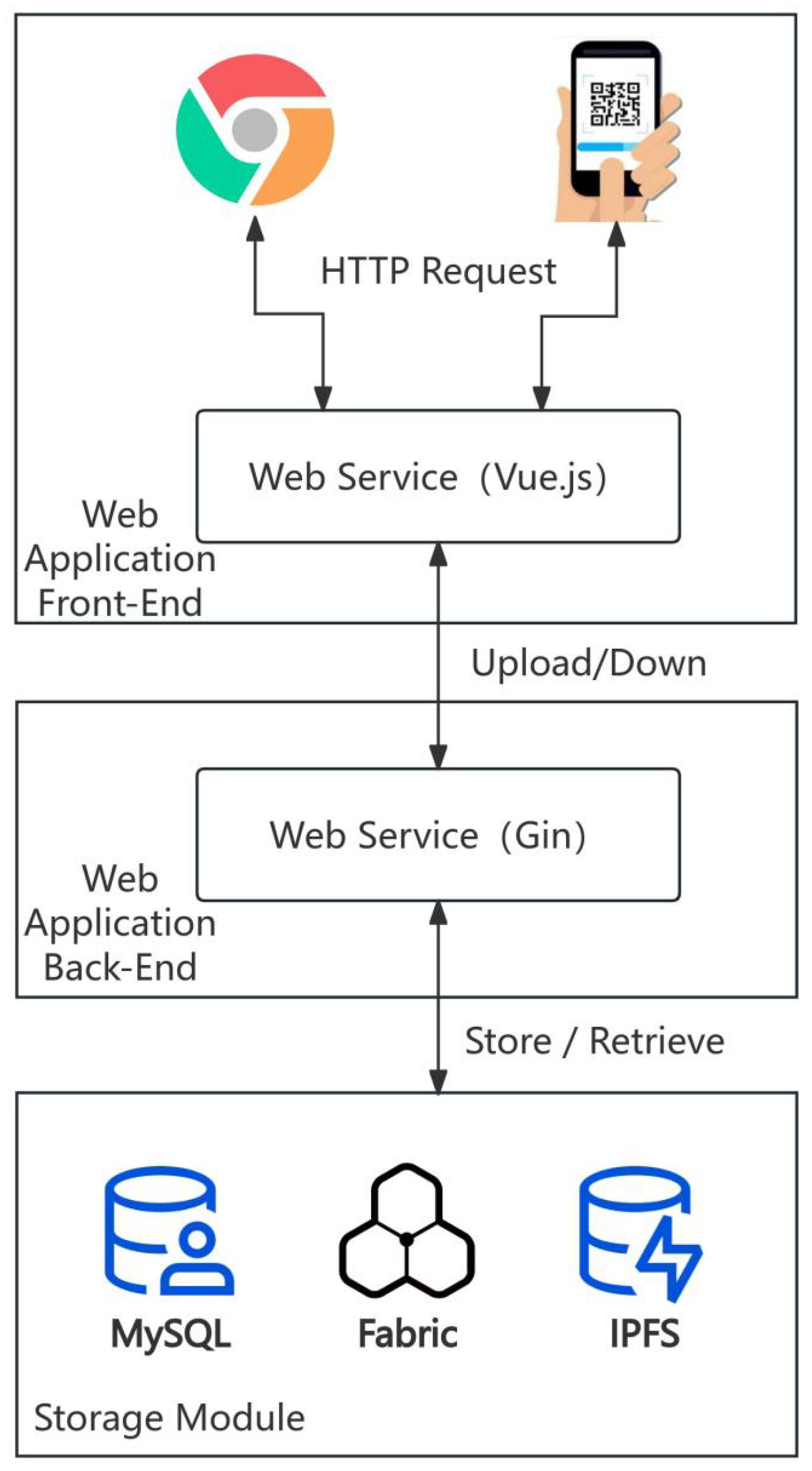
To evaluate the performance of the DPT framework, a performance verification model is constructed. This model consists of three components: the application front-end, the application back-end, and the storage module. The architectural relationship between these components is illustrated in Figure 4.
The application front-end of the DPT framework is developed using Vue-Admin-Template [24], a basic front-end template for back-end management systems built on Vue.js and Element-UI.
The application back-end of the DPT framework is implemented using the Gin framework [25], a lightweight, high-performance web framework written in Go. Gin offers a concise API interface and robust routing capabilities, which enable efficient handling of HTTP requests. Serving as an intermediary between the application front-end and the storage module, the application back-end defines precise mappings between URL paths and corresponding processing functions through route configuration.
The storage module of the DPT framework adopts a “trinity” storage architecture, integrating MySQL, Hyperledger Fabric, and IPFS. The official Hyperledger Fabric website [26] provides comprehensive implementation documentation and the complete fabric-sample codebase, while the official IPFS website [27] also offers rich documentation and reference codes.

4.2. Performance Evaluation

The DPT framework has been deployed at a top-tier down-product manufacturing enterprise. This section summarizes the core operational metrics collected over the initial eight months of real-world production deployment.
The Hyperledger Fabric blockchain network is configured as follows:
Peer nodes: six nodes, each corresponding to one stage of the down supply chain (breeding, raw feather transportation, down washing, quality inspection, finished-product manufacturing, and consumer traceability inquiry).
Orderer nodes: three nodes operating under the Raft consensus mechanism.
Organizations: five independent organizations covering core production phases; consumer-side queries are processed via an exclusive read-only peer node.
Registered users: 45 active users, including data entry personnel, quality verifiers, and system administrators.
Client devices: 30 Android tablets for on-site data collection and 15 web-based consoles for back-office operation.
All network nodes are hosted on virtual machines (4vCPUs, 16GB RAM per instance) within the enterprise’s private cloud infrastructure. The performance of the DPT framework is evaluated using Hyperledger Caliper [28].
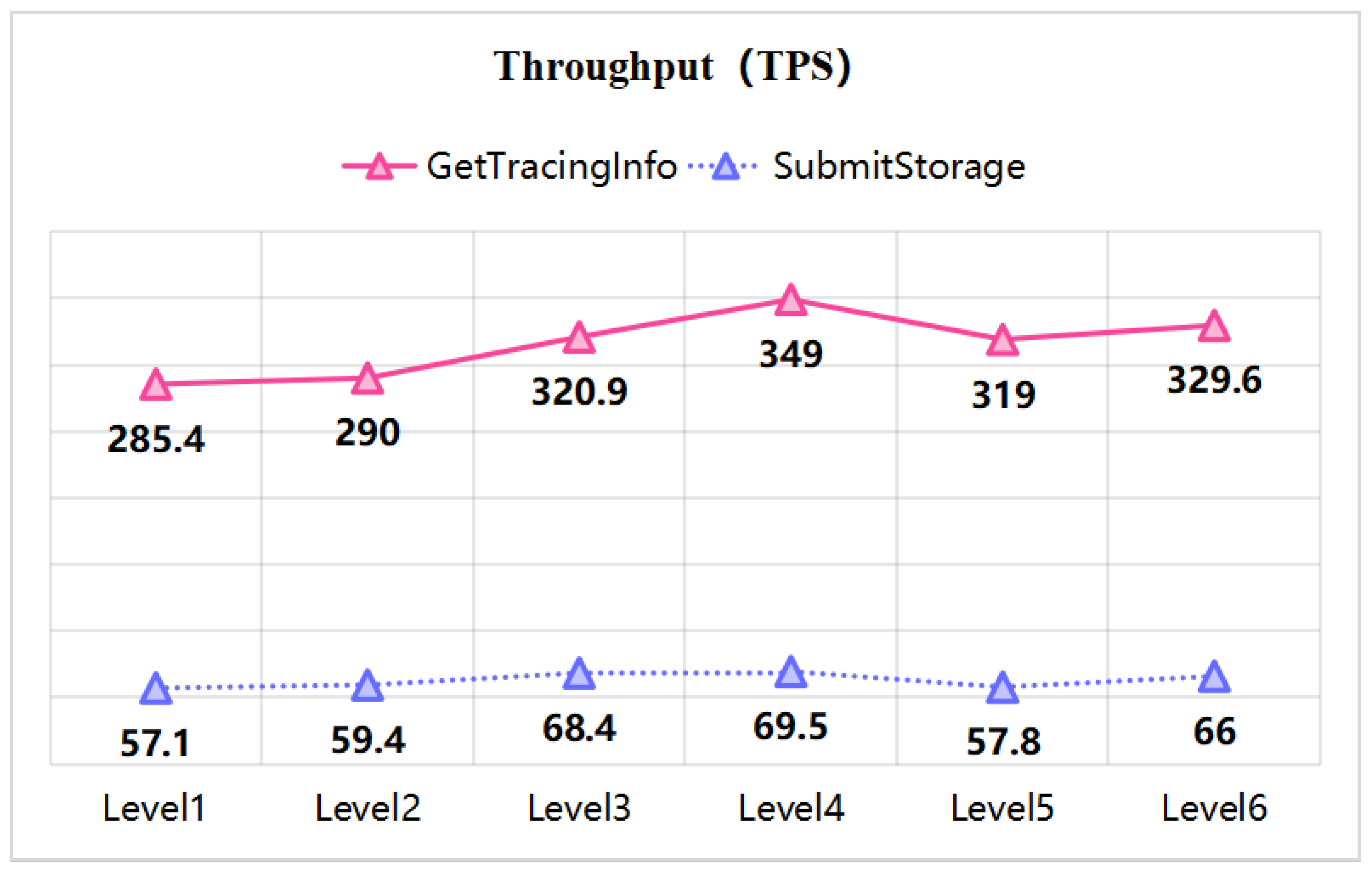
The test intensity is defined across six levels (Level 1 to Level 6), ranging from basic to long-term high-load conditions. The evaluated performance metrics include throughput and the latency of read operations (GetTracingInfo, Re) and write operations (SubmitStorage, Wr), which have the most significant impact on user experience. Additionally, resource consumption is assessed in terms of CPU, memory, and network usage, with measurements recorded for minimum, average, and maximum values. The configuration parameters for these six test intensity levels are detailed in Table 3.
Six test intensity levels (Level 1 to Level 6) are defined to simulate the operational conditions from baseline load to sustained high-load scenarios. The evaluated performance metrics encompass throughput and latency for read operations (GetTracingInfo, Re) and write operations (SubmitStorage, Wr), both of which critically influence user experience. In addition, resource consumption is assessed with respect to CPU usage and memory overhead. Configuration parameters corresponding to the six test levels are summarized in Table 3. These levels cover the typical and peak load ranges anticipated in practical production environments, representing most real-world operational scenarios the system may encounter.

4.2.1. Statistical Methodology

To guarantee the statistical validity and reproducibility of the performance evaluation, all benchmark experiments covering six load intensity levels (Level 1 to Level 6, defined in Table 3) were repeated ten times under identical hardware and software configurations. To eliminate residual system bias and carryover effects across trials, the entire framework was restarted, and all cached data were thoroughly cleared between consecutive test runs.
For all evaluated performance metrics, including throughput, latency, CPU utilization, memory consumption, and transaction success rate, three statistical indicators are reported to comprehensively quantify the system performance and result stability:
Mean (μ): The arithmetic average value calculated from ten independent test runs.
Standard deviation (σ): A statistical metric that quantifies the degree of data dispersion and result fluctuation.
Ninety-five percent confidence interval (CI): Computed based on the Student’s t-distribution to reflect the statistical reliability of experimental results. The calculation formula is defined as μ ± t 0.025 , n 1 · σ n , where the sample size n equals 10.
In summary, all performance metrics (throughput, latency, success rate, CPU, and memory) are reported as the mean ± standard deviation across 10 repeated runs. The 95% confidence intervals are computed where applicable, and Welch’s t-test is used for comparative analysis of write throughput between load levels. This statistical framework ensures reproducibility and transparency.

4.2.2. Statistical Analysis

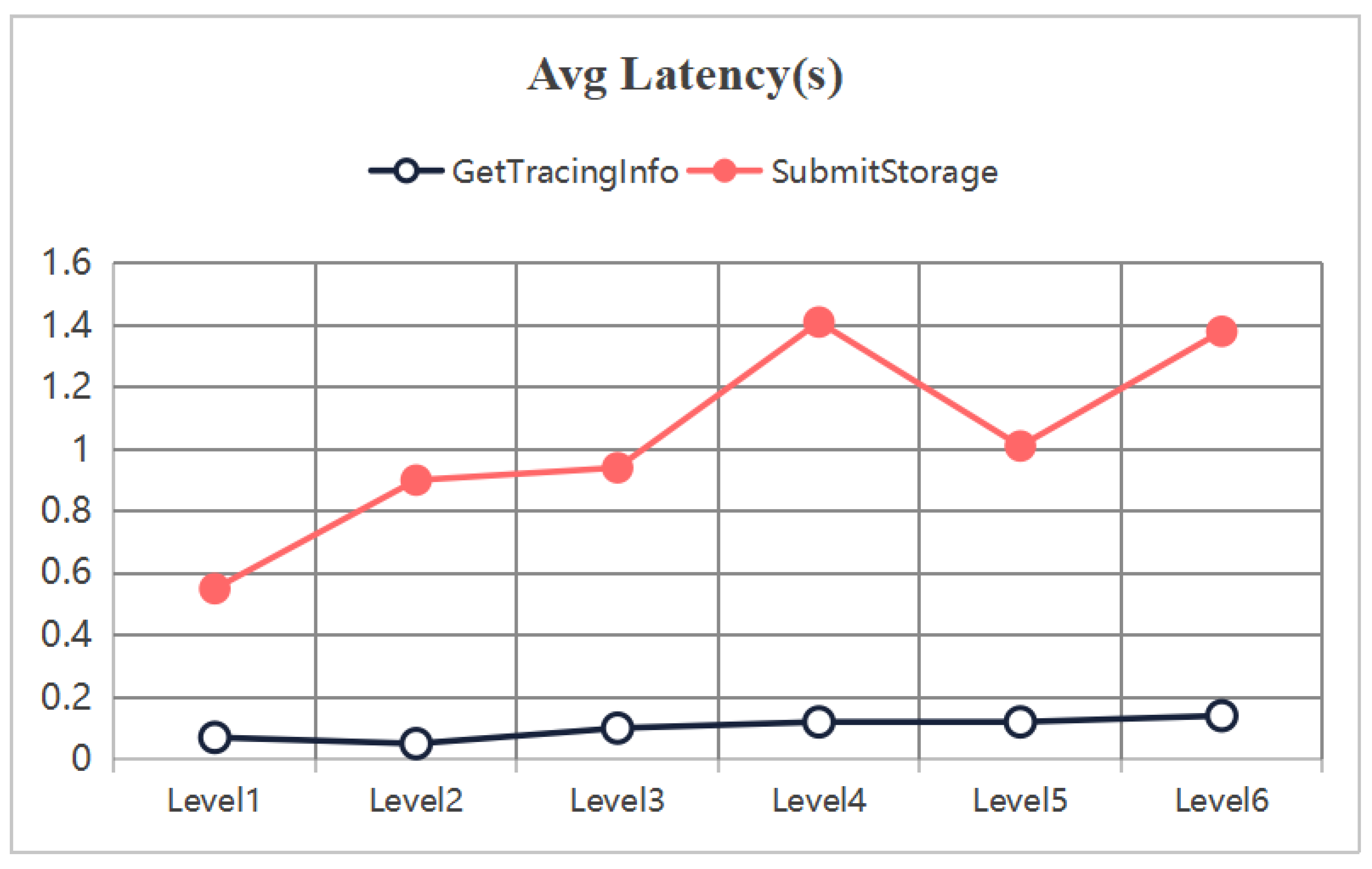
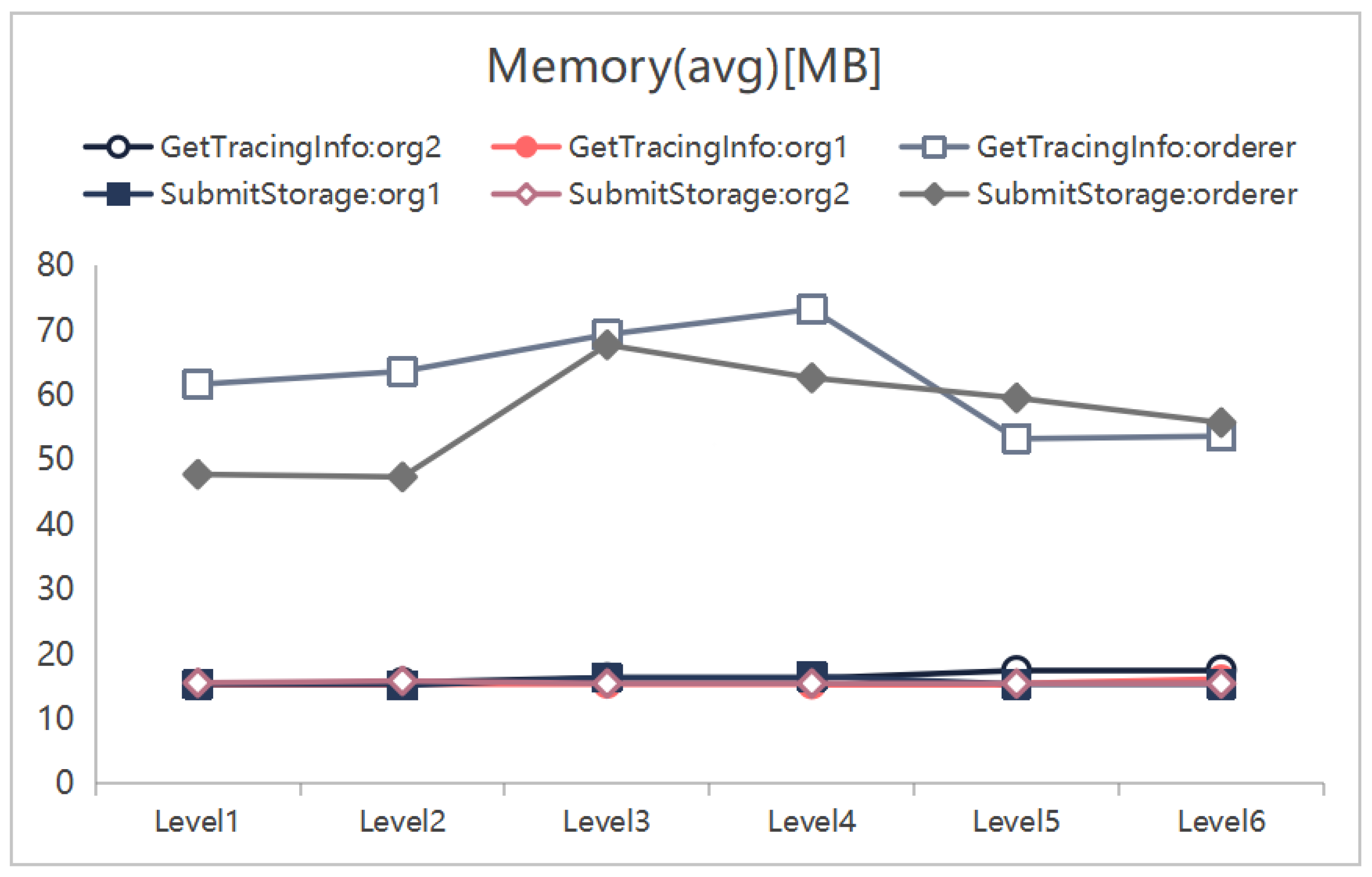
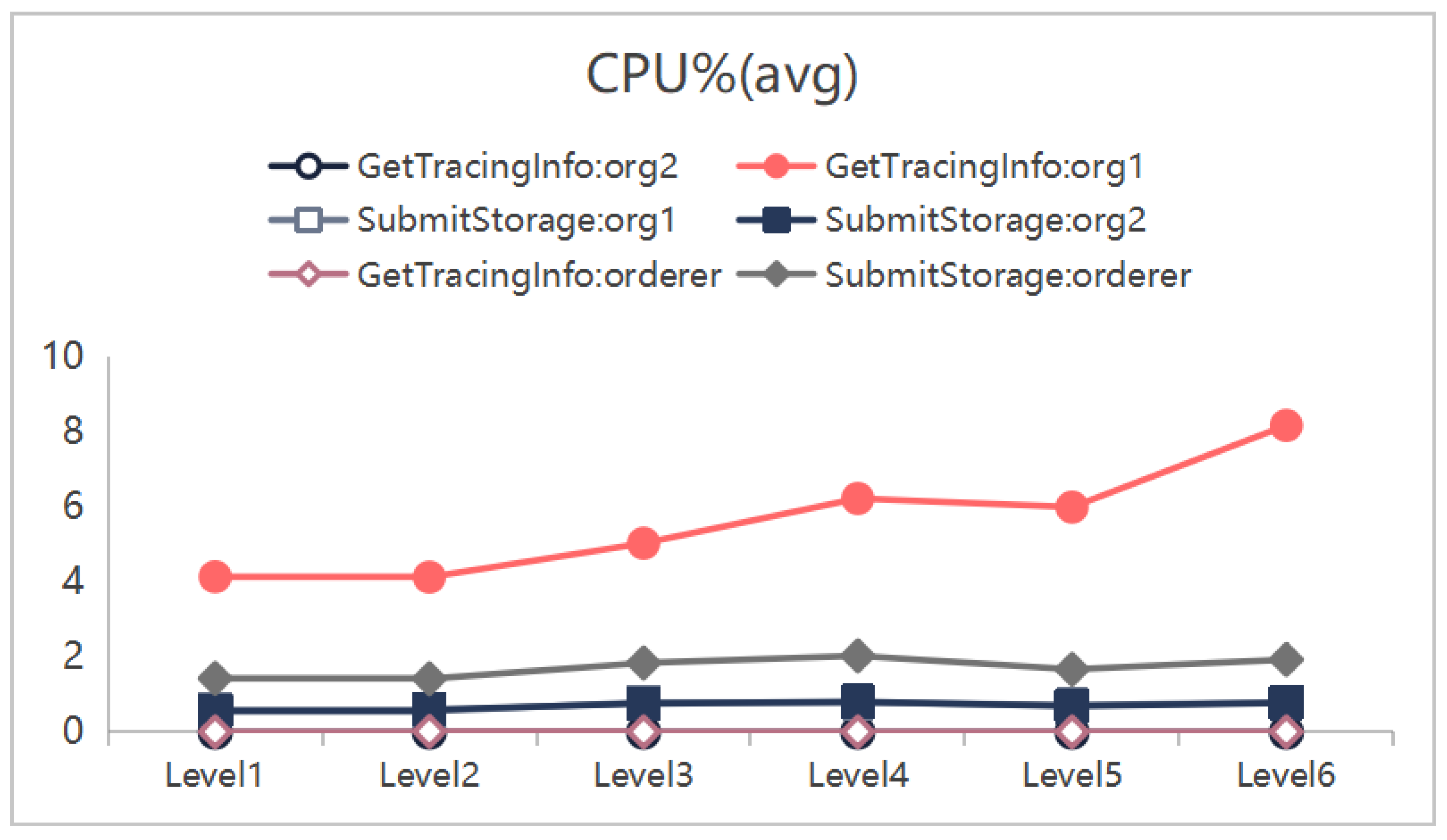
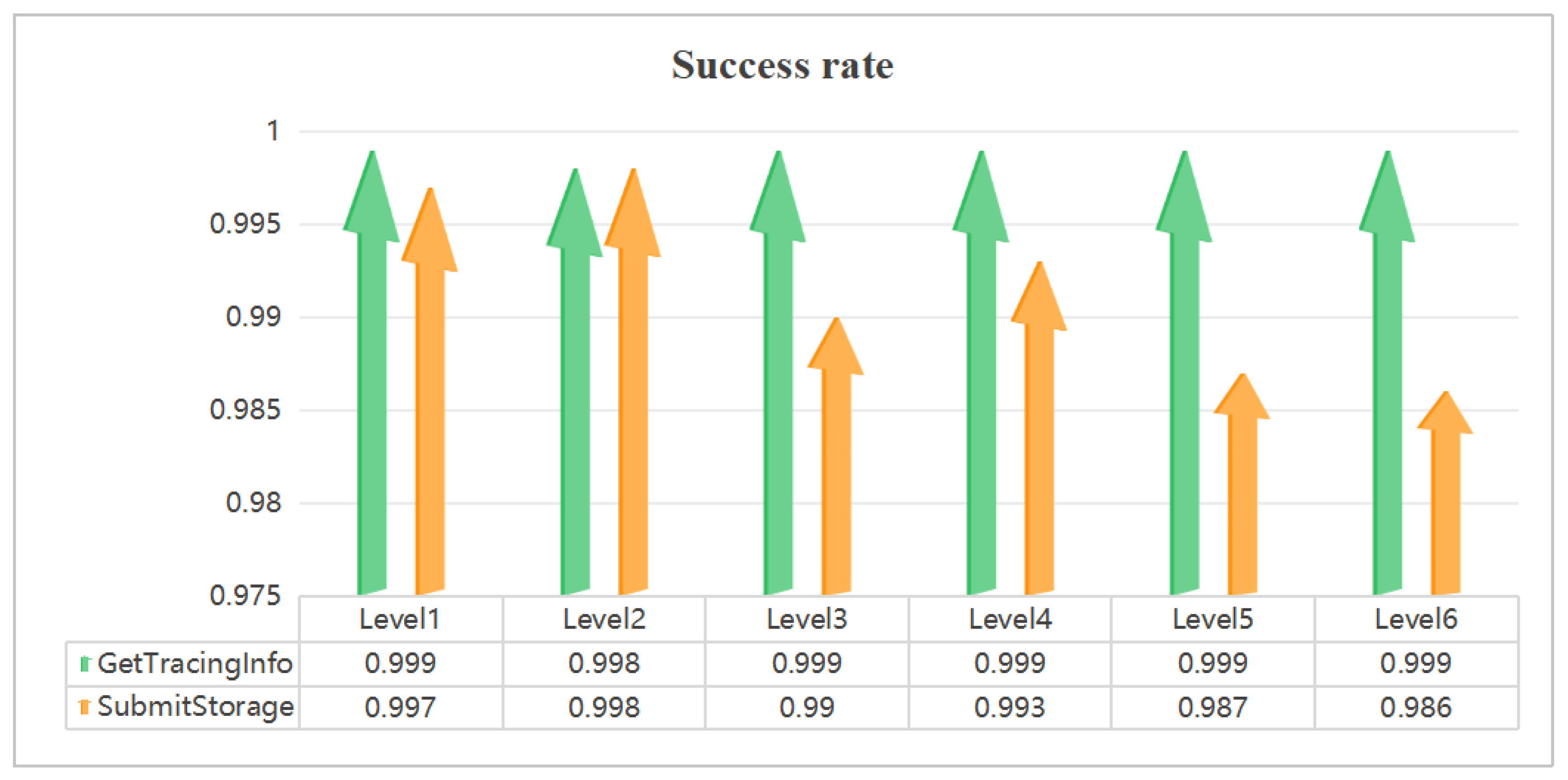
Table 4 presents the statistical summary of the key performance metrics. Subsequently, the throughput, latency, memory consumption, and CPU utilization illustrated in Figure 5, Figure 6, Figure 7, Figure 8 and Figure 9 are analyzed in detail.
Compared with the performance metrics of the baseline Proof-of-Work (PoW) mechanism reported in [4], which yields a throughput of 100–150 transactions per second (TPS), the proposed framework attains a throughput ranging from 285 to 349 TPS. As depicted in Figure 5, the throughput of read operations remains steadily above 285 TPS across all six tested load intensity levels, which satisfies the throughput requirement (≥200 TPS) for real-world production environments. Optimal overall performance is obtained at Level 4. Beyond this load intensity, further increases in testing load lead to a reduction in write throughput. Likewise, the write operation throughput maintains values higher than 55 TPS at all intensity levels, complying with the production-grade requirement of over 50 TPS, with its peak throughput also occurring at Level 4. A subsequent throughput degradation is observed once the load intensity exceeds this critical level.
Furthermore, heteroscedastic independent sample t-tests (Welch’s t-test) are adopted to quantitatively analyze the statistical variations in write throughput under successive load intensities, with the detailed results presented below.
1. Level 1 (57.1 ± 1.4) vs. Level 2 (59.4 ± 1.5): t(17.8) = 3.54, p = 0.002 (significant increase);
2. Level 2 (59.4 ± 1.5) vs. Level 3 (68.4 ± 1.7): t(17.9) = 12.55, p < 0.001 (significant increase);
3. Level 3 (68.4 ± 1.7) vs. Level 4 (69.5 ± 1.7): t(18.0) = 1.45, p = 0.164 (not significant);
4. Level 4 (69.5 ± 1.7) vs. Level 5 (57.8 ± 1.5): t(17.9) = 16.32, p < 0.001 (significant decrease);
5. Level 5 (57.8 ± 1.5) vs. Level 6 (66.0 ± 1.7): t(17.9) = 11.44, p < 0.001 (significant increase).
Note: The increase from Level 5 to Level 6 reflects a recovery in write throughput after the sharp drop at Level 5. The non-significant difference between Level 3 and Level 4 indicates that write throughput plateaued near its maximum under moderate load.
Compared with the performance metrics of the baseline PoW (latency < 300 ms) in [4], as shown in Figure 6, the latency of read operations remains consistently below 200 ms across all six test intensity levels, demonstrating stable and favorable performance. In contrast, the write operation latency increases progressively with a rising test intensity, indicating a need for further optimization. Despite this trend, the system still fulfills the requirements for operational usability.
As illustrated in Figure 7 and Figure 8, the average memory consumption remains consistently low across all test intensity levels. The overall average CPU utilization is also maintained at a low level, with only a marginal increase observed in the CPU usage of Read Operation org1 as test intensity increases.
Figure 9 presents the success rates of read and write operations across all six test intensity levels. The read operation success rate remains consistently close to 100% under all conditions, while the write operation achieves a success rate of nearly 99% even under extreme test intensities (Level 5 and Level 6). As demonstrated in the performance evaluation results (Figure 5, Figure 6, Figure 7, Figure 8 and Figure 9), the DPT framework proposed in this study effectively meets the requirements of real-world production environments and has successfully achieved the intended research objectives.
In addition to the above performance evaluation in terms of throughput, latency, CPU consumption, memory usage, and the success rates of read and write operations, this paper further statistically analyzes the survey data concerning down-product sales volume and user feedback since the system was put into practical operation.

4.3. User Feedback

4.3.1. Operational Duration and Transaction Volume

The system has run stably in continuous production mode for 8 months (September 2025–April 2026). The key data recorded by the end of March 2026 are listed below, with the total on-chain traceability records: 10,000 entries covering breeding logs, transportation records, washing processes, quality test results, and product specifications; total IPFS-stored assets: 2500 watermarked and encrypted image/video files; average daily write transactions: 47.6 (peak daily write transactions: 112); and average daily read queries: 128 (peak daily read throughput: 304). The observed transaction loads are substantially lower than the performance thresholds defined in Section 4.2 (write throughput ≥200/TPS, read throughput ≥50/TPS), verifying that the DPT framework fully satisfies the enterprise’s current production-grade performance requirements.
The investigation covers six down-product categories of the enterprise, among which three adopt blockchain-based data traceability, while the remaining three do not. A comparative analysis is conducted on the sales data of the six categories over two periods: from September 2025 to March 2026, and from September 2024 to March 2025. Statistics show that the sales volume of down categories with blockchain traceability increased by 25.3%, rising from 128 tons to 160 tons. Against the backdrop of a global economic downturn, such achievements are hard-won. By contrast, the sales volume of categories without blockchain traceability decreased by 7.6%, dropping from 132 tons to 122 tons. It is clear that this is not a strictly controlled experimental comparison, given that product sales are influenced by multiple confounding factors. Even so, the survey results still indicate to a certain degree that consumer trust in down products enabled with blockchain traceability has increased remarkably. Furthermore, as blockchain traceability makes product counterfeiting extremely difficult, quality complaints received by the enterprise for the three traceability-enabled product categories have dropped by more than 90%, falling from 13 cases to only 1 case, which has almost eliminated the phenomenon of counterfeit products.

4.3.2. User Adoption and Feedback

One-hundred percent of the intended operational staff (45/45) have completed system training and conduct daily business operations via the platform. For user satisfaction, an internal questionnaire survey with 32 valid participants yielded an overall satisfaction score of 4.2 out of 5.0. Users highly recognized the QR-code-enabled traceability interface for its simplicity and convenience, as well as the consumer-oriented anti-counterfeiting verification function. Regarding practical challenges, several frontline users initially regarded the “1+1” dual-verification mechanism as operationally redundant. Nevertheless, 85% of users acknowledged its contribution to enhanced data credibility after a two-week adaptation period. Combined with a 25.3% year-on-year sales growth and a 90% drop in counterfeit-related consumer complaints, these practical operational indicators validate that the DPT framework achieves robust technical reliability and outstanding real-world applicability within industrial production scenarios.

5. Conclusions

To tackle the counterfeiting of down products and enhance corporate credibility through technical means, this paper proposes an innovative blockchain-based traceability solution for down-product quality. A Hyperledger Fabric-based traceability framework is constructed to build a trusted data chain for down quality assurance. The framework integrates IPFS, DW, QR codes, envelope encryption, and other advanced technologies, and is deployed throughout the entire down-product supply chain. Supply chain participants are granted corresponding permissions to submit or query traceability information based on predefined roles, enabling secure role-based data management.
A down quality traceability application system is developed on the basis of the DPT framework and deployed in cooperation with a leading enterprise in the down industry to verify its practical applicability. This paper elaborates on the system implementation architecture, including the design and integration of front-end, back-end, and blockchain modules.
To conduct a comprehensive performance evaluation, Hyperledger Caliper 0.6.0 is adopted to test key indicators in core read–write operations, including throughput, latency, CPU, and memory resource utilization. Extensive stress test results verify that the proposed DPT framework can fully satisfy the operational requirements of practical production scenarios. Actual sales data from down enterprises further demonstrates that the system can effectively enhance user trust and curb counterfeiting activities in the market.

6. Limitations and Future Work

Enterprises are generally highly willing to invest in software and hardware to enhance their competitiveness. Operators’ inertia in usage habits has become a major obstacle to the system’s implementation and popularization.
The new system requires managers and technical staff to alter their long-established work habits, such as familiarizing themselves with new business workflows and operating intelligent terminals. To address this issue, enterprise management needs to reach a consensus, make firm decisions, and promote implementation through reward and punishment mechanisms. Furthermore, with regard to the proposed framework itself, subsequent research will focus on two primary directions. First, optimizing the write performance is set as a priority direction. The performance evaluation results show that the write latency increases significantly with the rise in test intensity, which indicates that targeted optimization is indispensable. Second, while the current multi-node deployment already provides basic fault tolerance via Raft consensus, we plan to further evolve the system into a more robust clustered architecture (e.g., with automatic failover and load balancing) to improve overall reliability and fault tolerance.

Author Contributions

Methodology, Z.F.; software, S.J.; validation, R.M. and X.G. All authors have read and agreed to the published version of the manuscript.

Funding

This work was supported by the Henan Institute of Logistics and Transportation Big Data Industry Technology, the Key Research and Development Program of Henan Province (Project No. 252102211082), and the Key Scientific Research Project of Institutions of Higher Education in Henan Province (Project No. 24B630008).

Institutional Review Board Statement

Not applicable.

Informed Consent Statement

Not applicable.

Data Availability Statement

The validation dataset was retrieved from the enterprise’s internal server and cannot be fully disclosed due to data security constraints. Key validation data have been presented in the manuscript.

Acknowledgments

The authors have reviewed and edited the output and take full responsibility for the content of this publication.

Conflicts of Interest

The authors declare no conflicts of interest.

References

  1. Priya, K.K.; Khadeer, S.A.; Mohan, C.R.; Kiran, S.; Kumar, A.A. A Deep Dive into Blockchain: A Systematic Literature Review on Transparency, Security, and Scalability Challenges. In Proceedings of the Third International Conference on Cognitive and Intelligent Computing, Volume 2. ICCIC 2023; Kumar, A., Ghinea, G., Merugu, S., Eds.; Cognitive Science and Technology; Springer: Singapore, 2025. [Google Scholar] [CrossRef]
  2. Hübschke, M.; Buss, E.; Holschbach, E.; Lier, S. Blockchain in supply chain management: A comprehensive review of success measurement methods. Manag. Rev. Q. 2025. [Google Scholar] [CrossRef]
  3. Ellahi, R.M.; Wood, L.C.; Bekhit, A.E.-D.A. Blockchain-Based Frameworks for Food Traceability: A Systematic Review. Foods 2023, 12, 3026. [Google Scholar] [CrossRef] [PubMed]
  4. Moeen ul Haque, S.; Sofi, S.A.; Sholla, S. A Comprehensive Survey on Blockchain-Based Privacy, Scalability, and Consensus Mechanism Techniques. SN Comput. Sci. 2026, 7, 269. [Google Scholar] [CrossRef]
  5. Liu, Y.; Hu, Y.; Lv, X.; Zhou, S.; Li, J.; Liu, S. A blockchain and IPFS-Aided anonymous traitor tracing scheme based on puncturable encryption in Industrial Internet of Things. Comput. Electr. Eng. 2025, 122, 109896. [Google Scholar] [CrossRef]
  6. Gu, Z.; Dib, O. Enhancing fraud detection in the Ethereum blockchain using ensemble learning. PeerJ Comput. Sci. 2025, 11, e2716. [Google Scholar] [CrossRef] [PubMed]
  7. Agarwal, U.; Rishiwal, V.; Shiblee, M.; Yadav, M.; Tanwar, S. Blockchain-based intelligent tracing of food grain crops from production to delivery. Peer-Peer Netw. Appl. 2024, 17, 3722–3749. [Google Scholar] [CrossRef]
  8. Katoon, P.M.; Turukmane, A.V. Interoperable blockchain network for healthcare data using Fabric, Ethereum and IPFS. Discov. Artif. Intell. 2025, 5, 308. [Google Scholar] [CrossRef]
  9. Grishkov, I.; Kromes, R.; Giannetsos, T.; Liang, K. ID-Based Self-encryption via Hyperledger Fabric Based Smart Contract. In Blockchain Technology and Emerging Technologies. BlockTEA 2022; Meng, W., Li, W., Eds.; Lecture Notes of the Institute for Computer Sciences, Social Informatics and Telecommunications Engineering; Springer: Cham, Switzerland, 2023; Volume 498. [Google Scholar] [CrossRef]
  10. Gu, S.; Pan, W.; Chung, T.; Huang, X. Blockchain-Based Model for Intelligent Supply Chain Production and Distribution. Wirel. Commun. Mob. Comput. 2022, 2022, 7503017. [Google Scholar] [CrossRef]
  11. Mohit; Kaur, S.; Singh, M. Design and implementation of blockchain-based supply chain framework with improved traceability, privacy, and ownership. Clust. Comput. 2023, 27, 345–2363. [Google Scholar] [CrossRef]
  12. Li, Z.; Liang, F.; Hu, H. Blockchain-Based and Value-Driven Enterprise Data Governance: A Collaborative Framework. Sustainability 2023, 15, 8578. [Google Scholar] [CrossRef]
  13. Li, Z.T.; Xu, H.; Lyu, R.X. Effectiveness analysis of the data-driven strategy of AI chips supply chain considering blockchain traceability with capacity constraints. Comput. Ind. Eng. 2024, 189, 109947. [Google Scholar] [CrossRef]
  14. Liu, J.; Jiang, P.; Zhang, J. A blockchain-enabled and event-driven tracking framework for SMEs to improve cooperation transparency in manufacturing supply chain. Comput. Ind. Eng. 2024, 191, 110150. [Google Scholar] [CrossRef]
  15. Swain, S.; Patra, M.R. Constructing an intelligent agent-centric framework for supply chain traceability with blockchain integration. Front. Eng. Manag. 2025, 12, 558–580. [Google Scholar] [CrossRef]
  16. Mohammed, M.; Alzahrani, M.; Hejjou, A.; Alharby, M. TrustChain: Trusted Blockchain-Based System for Supply Chain Traceability. Arab. J. Sci. Eng. 2025, 50, 891–909. [Google Scholar] [CrossRef]
  17. Yang, X.; Li, M.; Yu, H.; Wang, M.; Xu, D.; Sun, C. A trusted blockchain-based traceability system for fruit and vegetable agricultural products. IEEE Access 2021, 9, 36282–36293. [Google Scholar] [CrossRef]
  18. Alamsyah, A.; Widiyanesti, S.; Wulansari, P.; Nurhazizah, E.; Dewi, A.S.; Rahadian, D.; Ramadhani, D.P.; Hakim, M.N.; Tyasamesi, P. Blockchain traceability model in the coffee industry. J. Open Innov. Technol. Mark. Complex. 2023, 9, 100008. [Google Scholar] [CrossRef]
  19. Guo, X.; Zhang, G.; Zhang, Y. Blockchain-Based Information Sharing Mechanism for Complex Product Supply Chain. Electronics 2025, 14, 1780. [Google Scholar] [CrossRef]
  20. Jabbar, A.; Akhtar, P.; Ali, S.I. The interplay between blockchain and big data analytics for enhancing supply chain value creation in micro, small, and medium enterprises. Ann. Oper. Res. 2025, 350, 649–671. [Google Scholar] [CrossRef]
  21. Charles, V.; Emrouznejad, A.; Gherman, T. A critical analysis of the integration of blockchain and artificial intelligence for supply chain. Ann. Oper. Res. 2023, 327, 7–47. [Google Scholar] [CrossRef] [PubMed] [PubMed Central]
  22. Srivastava, S.; Pant, M.; Jauhar, S.K.; Nagar, A.K. Analyzing the Prospects of Blockchain in Healthcare Industry. Comput. Math. Methods Med. 2022, 2022, 3727389. [Google Scholar] [CrossRef] [PubMed] [PubMed Central]
  23. Kayal, S.; Rana, A.K.; Kundu, S. Blockchain Integration for Enhanced Trust and Security in Federated Learning for Healthcare 5.0. In The Convergence of Federated Learning and Healthcare 5.0 and Beyond: A New Era of Intelligent Health Systems; Shafik, W., Dutta, P.K., Pattanaik, P., Eds.; Studies in Computational Intelligence; Springer: Cham, Switzerland, 2026; Volume 1247. [Google Scholar] [CrossRef]
  24. Available online: https://github.com/PanJiaChen/vue-admin-template (accessed on 10 April 2025).
  25. Available online: https://github.com/gin-gonic/ (accessed on 10 April 2025).
  26. Available online: https://hyperledger-fabric.readthedocs.io/en/release-2.5/getting_started.html (accessed on 10 April 2025).
  27. Available online: https://docs.ipfs.tech/ (accessed on 10 April 2025).
  28. Available online: https://hyperledger-caliper.github.io/caliper/ (accessed on 10 April 2025).
Figure 1. Holistic work relationship of the DPT framework.
Applsci 16 05456 g001
Figure 2. Steps of Smart Contracts.
Applsci 16 05456 g002
Figure 3. Anti-counterfeiting based on digital watermarking.
Applsci 16 05456 g003
Figure 4. Performance verification model for the DPT framework.
Applsci 16 05456 g004
Figure 5. Throughput (TPS) under different test intensity levels.
Applsci 16 05456 g005
Figure 6. Avg Latency(s) under different test intensity levels.
Applsci 16 05456 g006
Figure 7. Memory(avg) [MB] under different test intensity levels.
Applsci 16 05456 g007
Figure 8. CPU%(avg) under different test intensity levels.
Applsci 16 05456 g008
Figure 9. Success rate under different test intensity levels.
Applsci 16 05456 g009
Table 1. Comparative analysis across related work.
ReferenceKey ContributionAdvantagesLimitations
Priya et al. [1]a deep insight into the transparency issues in blockchain technology.stress the importance of collaboration between developers, businesses, and regulatory bodies to develop robust software.lack concrete, context-specific solutions for real-world implementation.
Hübschke, M. et al. [2]a structured understanding of blockchain’s role in supply chain management.a dynamic evaluation framework to assess blockchain.rely on theory or case studies—lacking empirical data to assess blockchain‘s real-world impact.
Ellahi et al. [3]understand how blockchain and other digital technologies are transforming the food supply chain.map the current landscape of blockchain-based food traceability solutions to pinpoint actionable gaps and priority areas for advancement.the proposed improvement points could be refined to better align with specific challenges and opportunities.
Moeen ul Haque et al. [4]a structured taxonomy of blockchain types (public, private, consortium, hybrid) and methods, and evaluate performance metrics such as latency and throughput. propose several novel frameworks and offer a clear roadmap for researchers by focusing on blockchain-based solutions.the description of the software and hardware environment for implementing the proposed framework is not detailed enough.
Liu Y et al. [5]a blockchain and IPFS-assisted puncturable-based anonymous traitor tracing scheme on the IIoT. combine blockchain with the InterPlanetary File System (IPFS) to achieve storage space expansion.the description of the verification environment could be enriched with more specific details to better support transparency and validation.
Gu Z et al. [6]introduce an ensemble learning approach to accurately detect fraudulent Ethereum blockchain transactions.remind the designers to pay attention to fraudulent transactions in the blockchain.this method needs to be fully verified for its performance in actual environments.
Agarwal U et al. [7]a blockchain-based framework to enhance the traceability of the food grain.integrate sensors, Raspberry Pi units, IPFS, and Blockchain creates and enlighten designers to distinguish valid data from invalid data in the supply chain.over-reliance on algorithms to identify errors before data is uploaded to the chain may result in the algorithms failing to detect input errors caused by human negligence, such as incorrect place names, product names, or weight values.
Katoon et al. [8]a cross-chain middleware architecture facilitates secure and real-time synchronization of EHR data between Hyperledger Fabric and Ethereum Sepolia Testnet.integrate AES-256 encryption and Inter Planetary File System (IPFS) as decentralized storage to enhance patient privacy.there is no basis for adopting different security mechanisms based on the types of data to be placed on the chain.
Grishkov et al. [9]propose an extension to the self-encryption scheme and embed the data owner’s identity into the encryption process. ensure the permanent preservation of file ownership and establish an immutable, verifiable link between the encrypted data and its source. lack a data-type-specific differentiation mechanism, thus limiting its adaptability to diverse data protection requirements
Shurui Gu et al. [10]leverage supply chain optimization techniques to refine the production and distribution planning of supply chains. underscores the importance of evaluating the efficacy and efficiency of algorithmic applications in real-world production contexts. method obtained through system simulation; needs to be fully verified in the actual operating environment.
Mohit et al. [11]a combined approach of symmetric key encryption and asymmetric key encryption is adopted to address the privacy protection issue of information sharing among supply chain members.blockchain is applied to improve traceability, ownership, and trust. Moreover, it can solve the issue pertaining to counterfeits in the supply chain. to protect users’ privacy information for different data types, more flexible and diverse encryption technologies need to be adopted.
Li, Z et al. [12]optimize enterprise data governance on blockchain via a “Value–Standard–Process” collaborative framework—enhancing data security, task reliability, and value-transformation transparency.integrate multiple interdependent dimensions spanning strategic alignment, operational standardization, and process automation.its practical efficacy requires rigorous empirical validation under real-world industrial conditions.
Li, ZT et al. [13]incorporate both blockchain technology and sales data to investigate the efficacy of data-driven strategies in the context of blockchain traceability and capacity constraints within the chip supply chain. manufacturers adopting blockchain-based traceability systems can enhance consumers’ trust in product informationthe validity of the research findings requires further empirical validation across additional domains and application contexts.
LIU J et al. [14]propose a general blockchain-based, event-driven tracking (BET) framework to enhance transparency in manufacturing supply chains.event-driven smart contracts are transferable and can be systematically adapted to domain-specific contexts.more verification cases are needed.
Swain S et al. [15]present a supply chain traceability framework with end-to-end workflow tracking and control. integrating blockchain technology into supply chain management offers stakeholders enhanced security, traceability, and reliability.the effectiveness of this supply chain traceability framework needs to be verified in more supply chains.
Mohammed M et al. [16]propose a generic, blockchain-based traceability system for diverse product categories. remind designers to take into account the implementation cost and resource consumption of the framework they design.the system lacks robust security auditing and encryption mechanisms for product information prior to its on-chain registration.
Yang, X et al. [17]propose a blockchain-based traceability system for fruits and vegetables. reduce reliance on centralized databases and barcode scanning for product lookup.it stores some data centrally—compromising decentralization and security—and lacks both system testing and cost analysis.
Alamsyah, A et al. [18]propose a blockchain-based traceability model for the coffee supply chain. blockchain technology is applied to trace the coffee supply chain, tracking the movement of coffee beans throughout the supply chain, from farmers to roasters to retailers.it lacks implementation details, empirical evaluation, and a clear explanation of blockchain use.
Guo X et al. [19]construct a blockchain-based complex product supply chain information sharing system. economic viability and practical applicability must be treated as foundational criteria in blockchain technology innovation.the potential of using blockchain to enhance transparency, ensure data security, and optimize cost-benefit decisions is huge, but the limitations of its application in the real world still need to be considered.
Jabbar A et al. [20]explore the interplay between blockchain-based smart contracts and big data analytics for the supply chain value creation.supply chain value creation and profit maximization are interlocked with how effectively companies utilize big data collected through blockchain-based smart contracts.the virtual blockchain solution needs to be applied to more case studies.
Charles V et al. [21]perform a state-of-the-art review of blockchain and AI in the field of supply chains.the first to provide an overview and assessment of blockchain and AI integration.the implementation of blockchain–AI applications in real life is still lacking.
Srivastava S et al. [22]explore the secure organization of medical records using blockchain.demonstrate the potential of blockchain to build resilient, trustworthy infrastructures.a lack of specific discussion on combining blockchain with machine learning and the Internet of Things to optimize the healthcare system.
Bhardwaj T et al. [23]explore the integration of blockchain technology with federated learning as a comprehensive solution to the ‘trust deficit’.architectural frameworks utilize hybrid on-chain/off-chain models.this framework still needs to be verified for its effectiveness in actual medical environments.
Table 2. STRIDE threat analysis of the DPT framework.
ThreatAffected Component(s)Mitigation
SpoofingMobile login, role-based access controlArgon2 password hashing, JWT-based identity authentication, and smart-contract-enforced RBAC
TamperingIPFS-stored multimedia images, on-chain traceability recordsAES-256-GCM encryption with authentication tags; tamper-immutable ledger of Hyperledger Fabric
RepudiationTraceability data submission behaviorsIdentity-embedded watermarked images, blockchain timestamps, and the “1+1” dual verification mechanism (this provides practical accountability, not cryptographic non-repudiation)
Information DisclosureMySQL credential storage, IPFS plaintext data transmissionPasswords stored exclusively as Argon2 hashes; all multimedia data encrypted via AES-256-GCM before IPFS uploading
Denial of Service (DoS)IPFS gateway, Fabric peersRate limiting at application gateway; Caliper-tested capacity (max 349 TPS)
Elevation of PrivilegeMulti-stage role permission managementSmart-contract-governed RBAC; independent submission and verification role separation across all traceability stages
Table 3. Experimental configuration table.
LevelExperimental Configuration
1workers:3,txDuration: 15,(Re)transactionLoad: 50,(Wr)transactionLoad: 50
2workers:3,txDuration: 20,(Re)transactionLoad: 80,(Wr)transactionLoad: 80
3workers:5,txDuration: 30,(Re)transactionLoad: 120,(Wr)transactionLoad: 100
4workers:5,txDuration: 60,(Re)transactionLoad: 200,(Wr)transactionLoad: 150
5workers:8,txDuration: 30,(Re)transactionLoad: 120,(Wr)transactionLoad: 100
6workers:3,txDuration: 60,(Re)transactionLoad: 200,(Wr)transactionLoad: 150
Table 4. Statistical summary of key performance metrics (Mean ± SD, n = 10).
LevelWrite TPSRead TPSWrite Latency (s)Read Latency (s)Success Rate (%)
157.1 ± 1.4285.4 ± 7.10.55 ± 0.040.07 ± 0.0199.0 ± 0.5
259.4 ± 1.5290.0 ± 7.30.90 ± 0.070.05 ± 0.0199.0 ± 0.5
368.4 ± 1.7320.9 ± 8.00.94 ± 0.070.10 ± 0.0199.0 ± 0.5
469.5 ± 1.7349.0 ± 8.71.41 ± 0.110.12 ± 0.0199.0 ± 0.5
557.8 ± 1.5319.0 ± 8.01.01 ± 0.080.12 ± 0.0198.0 ± 0.8
666.0 ± 1.7329.6 ± 8.21.38 ± 0.100.14 ± 0.0198.0 ± 0.8
Note: Values are presented as mean ± standard deviation across 10 independent runs.
Disclaimer/Publisher’s Note: The statements, opinions and data contained in all publications are solely those of the individual author(s) and contributor(s) and not of MDPI and/or the editor(s). MDPI and/or the editor(s) disclaim responsibility for any injury to people or property resulting from any ideas, methods, instructions or products referred to in the content.