Review

Formation of Color Centers in Silicon Under Irradiation: Quantum Technologies and Defect Engineering Strategies


1
Department of Electrical and Computer Engineering, University of Thessaly, 38221 Volos, Greece
2
School of Chemistry, University of Nottingham, Nottingham NG7 2RD, UK
3
Institute of Informatics and Telecommunication, National Center for Scientific Research Demokritos, Agia Paraskevi, 15341 Athens, Greece
4
Institute of Nanoscience and Nanotechnology, National Center for Scientific Research Demokritos, Agia Paraskevi, 15310 Athens, Greece
5
Physics Department, Solid State Physics Section, National and Kapodistrian University of Athens, Panepistimiopolis Zografos, 15784 Athens, Greece
6
Department of Materials, Imperial College London, London SW7 2AZ, UK
*
Author to whom correspondence should be addressed.
Appl. Sci. 2026, 16(11), 5436; https://doi.org/10.3390/app16115436
Submission received: 13 March 2026 / Revised: 16 May 2026 / Accepted: 26 May 2026 / Published: 29 May 2026
(This article belongs to the Section Materials Science and Engineering)

Abstract

Irradiation can impact the properties of semiconductor materials and the function of microelectronic devices. In the present review, we consider how irradiation interacts with semiconductor materials important, primarily silicon (Si), focusing on the defect processes. These, in turn, will have an impact on the physical properties of the material and can impact important properties for devices such as the electrical conductivity and mechanical integrity. We consider the ways that irradiation impacts the operation of microelectronic devices. We thereafter review the defect engineering strategies and other ways to mitigate against the impact of irradiation in devices. Finally, we consider the potentially important role of irradiation defects as qubits in the emerging quantum technologies.

1. Introduction

The understanding of defect processes and external parameters such as irradiation is important to ensure the functionality of semiconductor devices. The main semiconductor material is Si, which dominated the field for nearly five decades, mainly because of the advantageous material properties of silicon dioxide (SiO2). The advantage of the very appropriate native oxide formed via thermal oxidation is no longer relevant as the technological advancement of chemical vapour deposition (CVD) and molecular beam epitaxy (MBE) led to the application of high-k dielectric materials [1,2,3,4,5,6,7]. The incorporation of gate dielectric materials also resulted in the industry’s consideration of alternative semiconductor materials, including germanium (Ge) and silicon germanium (Si1−xGex) with better carrier mobilities, lower dopant activation energies and smaller band gap [8,9,10,11,12,13].
A non-equilibrium concentration of intrinsic defects in semiconductors (for example, Si, Ge or Si1−xGex) can be typically formed during crystal growth but also in radiation environments [14,15,16,17,18,19,20]. The interaction of impurity atoms or dopants with the intrinsic defects, which are more populous in irradiated materials as compared to materials under equilibrium conditions, will lead to a significant concentration of defect centres and clusters [21,22,23,24,25,26,27,28,29]. The typical defects in Si, including the vacancy–oxygen pairs (known as the A-centre) and the divacancy, have been systematically studied for decades over a range of conditions such as annealing, pressure, different concentrations and irradiation (for example, [18,19,20] and references therein). At any rate, there is further interest from the community on these defects due to the advent of the defects for quantum computing. Hydrogen-, carbon- and oxygen-related defects are introduced in the Si lattice during crystal growth or/and material processing [21,22,23]. Their association leads to the formation of defects that are presently examined as quantum bits (qubits) in quantum technologies [24,25,26,27,28,29,30,31,32,33,34,35].
Radiation damage or/and thermal treatments in Czochralski Si that typically contain carbon and hydrogen result in the formation of colour centres with characteristic lines that can be detected in the spectra by luminescence spectroscopy. The main colour centres in Si are the T (935.1 meV), I (965.2 meV), M (760.8 meV), G (969.5 meV), C (789.4 meV), W (1018.9 meV), X (1040.9 meV) and P (767.3 meV) [24]. The colour centres in Si are technologically important defects due to their potential application in light emitting structures. Colour centres bind electrons to a very localized region and, importantly, they exhibit exceptional spin and optical properties [25,26,27]. It is these properties that have sustained the interest in colour centres in Si as a system for quantum computing, photonic memories, spin-to-phonon conversion and integrated single-photon sources [28,29,30,31]. This in essence includes a number of centres (G, C, W, T and M) in Si which are candidates for spin–photon interfaces. The key feature of these colour centres is that they can trap single electrons, which can emit photons at specific wavelengths. More formally, colour centres in Si form levels in the band gap with the transition of electrons from these levels via an external stimulus being accompanied by the emission of photons of specific frequencies. It is important that they possess a zero-phonon line (ZPL) within the telecommunications bands, and in particular, the O-band [32,33,34] that is in the range of 1260–1360 nm as this permits the transmission of a large amount of data with very high speed. A prerequisite for quantum communications, is for the colour centres to have ZPL transitions which split under the influence of a magnetic field, whereas their ground states need to have an unpaired electron spin [35]. Here we will consider key colour centres in Si that have been formed by irradiation [36,37,38,39,40,41,42], considering the related literature on the structural and physical properties of the defects but also focusing on the potential application as spin-defects for quantum applications [43,44,45,46,47,48,49,50,51,52,53,54,55,56,57,58,59,60,61,62,63,64,65,66,67,68,69,70,71,72,73].
In the present review, we (a) briefly consider main relations describing semiconductor properties under irradiation, (b) discuss the formation of the main irradiation-induced defects in Si and (c) the application of irradiation defects in Si as quantum defects.

2. Semiconductor Properties Under Irradiation

2.1. Impact of Irradiation

The impact of irradiation in semiconductor will depend upon its nature (wave-like: x-rays, gamma rays, alpha particle, neutrons, etc.), dose and energy (i.e., implantation energy). Irradiation can excite electrons or even disturb the crystal structure of the material.
Electron excitation can be defined as the energy excitation of the atoms’ electrons of the material, from ground state to excited states. These states can be divided, based on the type of particle responsible for their creation, to zones formed by self-interstitial particles and by interstitial impurities. Excitations, assuming the energy gap is fulfilled, can lead to the ionization of the targeted electrons and the increase of free electrons in the material.
As different types of radiation can produce similar effects to the material given the proper circumstances (environmental conditions, state of the material etc.), it is important to establish the forms of radiation, particle and electromagnetic, and their ability to intermingle during and after interactions with the target material. Charged particles such as electrons, protons and heavy ions can cause ionization or even displacement to target particles during interactions alongside possible photon emissions. Likewise, electromagnetic radiation (γ rays, x-rays, etc.) can ionize when carrying sufficient energy via photon, while pair production is a possible phenomenon. Furthermore, ionization of the targeted particle’s electrons may lead to subsequent atomic displacement [74].
Of particular importance stands the irradiation of semiconductor materials via neutron bombardment. The electrical neutrality that describes neutrons allows only nuclear interactions between them and the target particles, which, based on probability, are atomic nuclei rather than electrons. Though most of those interactions are primarily scattering events, situations where fragmentation of the nuclei poses a significant variable. On that note, the phenomenon of transmutation (neutron absorption and subsequent transformation of the target particle into a temporary isotope pending stabilization or rearrangement into a stable different particle) can cause significant disturbance in the crystal matrix [75,76].
The interaction of irradiation with the atoms of the crystal lattice can lead to the formation of a non-equilibrium concentration of point defects including vacancies, self-interstitials and antisite defects. This interaction can be direct when there is electron or neutron or ion irradiation and indirect for electromagnetic waves. In the latter case, the interaction of the electromagnetic waves with the lattice atoms may lead to the formation of free electrons and even pairs of electrons with positrons that can interact with the lattice.
As different circumstances are commonly involved in the formation of a specific defect, it is often difficult to accurately theorize as to the exact interactions responsible for said defect. As such, different theories and speculations are made to better understand the differences in interactions that each type of radiation produces. With particle radiation, characteristics such as electrical charge (if the radiated particle has), effective mass, quantity of contained energy (high or low relativistic speeds), intensity of irradiation, as well as others, must be taken into account in order to predict the generated defects. In the case of electromagnetic radiation, phenomena such as Compton scattering, photoelectric effect and pair production are responsible for the creation of free electrons and electron–positron pairs which can further dumper the crystal lattice and lead to defect formation.
Of great importance to the defect formation stand the environmental variables, with temperature T being among the most significant during irradiation and subsequently during possible annealing. In both circumstances or in cases where both particle and electromagnetic radiation are applied, repeated cascades of dislocations and primary defect formations in localised areas allow for easier mobility of said defects which can result in their interaction with other defects/impurities and the formation of more stable defects and defect clusters which can withstand annealing. These defects pose a significant role in the material’s properties as they can be active long after their formation [77].

2.2. Irradiation and Conductivity

The ability of semiconductor materials to conduct electricity under a controlled manner over a range of conditions has allowed for the creation of microelectronic devices. Irradiation at significant doses will impact the conductivity of semiconductor materials and in turn the operation of devices. To identify this impact, it is necessary to resort to the definition of conductivity:
σ = nee + nhh
where ne and nh are the concentrations of free electrons and holes, respectively; e is the electron charge; whereas μe and μh are the electron and hole mobilities.
In the case of the concentrations, it can be deduced that the ionization of electrons, due to the interaction of radiation and semiconductor materials at the atomic level, leads to an increase in the generation of free electrons and holes, which, in turn, increases the conductivity σ of the material temporarily. Furthermore, post-irradiation conductivity is decreased via the integration of radiated and displaced particles in the stabilized matrix.
In terms of mobilities, they can be defined as the speed at which the particle in question (electrons or holes) traverses the semiconductor under an electric field. Based on Drude’s model, mobility μ can be described by the following equation:
μ = (qτ)/m*
where q, τ and m* are the electric charge of the particle, the mean free time between consecutive scatterings and the effective mass of the particle, respectively. Electric charge q in both cases of free electrons and holes is defined as elementary charge e. Mean free time τ designates the time between scattering events and correlates to the mean free path l, the path the particle travels between the events. These events can be divided into three major divisions, which are present in semiconductors: lattice scattering (caused by lattice vibrations induced by the absorption of thermal energy), ionic scattering (caused by the ionization of impurities in the material) and neutral impurities-induced scattering [78]. For each division, a mean time can be calculated, thus allowing the calculation of the mean free time based on the following equation:
1/τ = (1/τL) + (1/τI) + (1/τN)
where τL, τI and τN are the mentioned mean times. Due to mobility being proportional to mean free time, the above equation can be written as:
1/μ = (1/μL) + (1/μI) + (1/μN)
This allows for a better understanding of the correlation between scatterings and overall mobility.
The effective mass m* can be defined as the mass the particle appears to possess when under the influence of a sum of forces. Different theorems for the approximation of the effective mass of a particle, usually electrons, allowing the m* to possess, based on its value, additional information about the direction of movement, induced electric field and other units based on the theorem.
Irradiation of semiconductor materials results in the disruption of the crystal matrix of the material, especially with the formation of point defects and defect clusters. The changes in mean free path I of the semiconductor carriers impacts the mean free time. Due to the nature of the impact usually being negative, τ decreases result in the reduction of the respective mobilities.
The Hall effect and its most known parameter, the Hall coefficient, RH, provides a useful way of understanding the changes introduced to the irradiated semiconductors [79]. Measuring the Hall voltage of the target material after irradiation allows the calculation of its Hall coefficient via the equation:
RH = (VH × t)/(I × B)
where VH is the measured Hall voltage, t is the sample’s thickness, I is the supplied current and B is the applied magnetic field. Using it, the carrier density can be found by:
n = 1/(RH × q)
where q is the elementary charge. Hall mobility μ H can then by determined via:
1/μ = (1/μL) + (1/μI) + (1/μN)
By comparing the mentioned parameters before and after the irradiation, changes crucial to the electrical properties of the material can be found [80].

2.3. Mechanical–Structural Effects

The mechanical integrity of semiconducting materials is primarily based on their structural characteristics. With most semiconducting materials all being used in some form of crystal structure, which gives them their preferred parameters values, it becomes apparent that any and all changes to its structure can impact these properties.
Displacement damage, which is the primary mechanism with which particle radiation disrupts the crystal lattice of the target, is defined as the distortion of a local crystal structure via scattering events resulting in vacancies, substitutionals and interstitials, as well as other forms of defects [74,81,82,83,84,85,86]. These defects, whether temporary or stable, weaken the crystal bonds of the structure, creating localized areas where parameters of the material such as stiffness, ductility and elasticity vary significantly in comparison to non-radiated areas. High-energy irradiated particles—among them, neutrons—are capable of creating primary knock-on atoms (PKA), which subsequently interact with other atoms. These consecutive collisions, which constitute a cascade phenomenon, can disrupt the crystal structure, producing under dense areas surrounded by dense areas of displaced atoms. Such cascade phenomena lead to the degeneration of the lattice and provide a path for more irradiated particle to follow. In cases where the radiation dose is enough to completely disrupt the crystal lattice, rendering it non-existent, amorphization (an area of material where no form of extended structural cohesion can be found) can be observed [87]. Areas which have undergone amorphization exhibit significant changes to all of their properties, such as lower stiffness, high brittleness and more.
In the case of electromagnetic radiation, its interactions result in the generation of excess free electrons and production of electron–hole pairs. Depending on the intensity and duration of the exposure, phenomena such as melting and surface deformation can be observed. Surface deformation stands for the product of the disruption of the ionic/covalent bonds of the crystal structure of the material after the pair production as well as the defect formation that can proceed afterwards. Both of those phenomena degrade the local structure of the material, resulting in lower mechanical capabilities.

2.4. Optical Effects

Semiconducting materials exhibit exceptional optical properties, such as photon absorption, emission and reflection, making them ideal for use in a variety of technologies, such as optoelectronics and photovoltaics. These properties depend on the specific structure of the target semiconductor and its energy band gap. Changes to any of them as a result of radiation, with defects being the primary source of these changes, alter optical parameters such as the refractive index n and the extinction coefficient k (attenuation of electromagnetic wave in the material) or absorption coefficient α (measure of absorbed light in the material as it propagates). Introducing certain energy levels, via defect formation, in the energy band gap results in increased absorption of light at specific wavelengths, causing them to lose their effectiveness for use in devices such as photodetectors.
Several methods of calculating these specific parameters have been investigated, which allow for a better understanding of the various discrepancies that result due to the existence of those defects. It is important to note that the correlation between extinction coefficient k and absorption coefficient α can be given by the following equation:
α = (4πk)/λ
where λ is the wavelength of the incident light [88]. Using these parameters, properties such as reflectance, transmittance and absorption can be calculated, allowing for better characterization of the radiation effects on the target material. Many theories and methods have been studied which attempt to correlate the effects of radiation (defect type, defect concentration, band gap tailing etc.), such as the Beer–Lambert law, which describes the absorbance A in relation to the concentration of the absorbing defects:
A = εcl
with ε being the molar attenuation coefficient; c, the molar concentration of the defects; and l , the optical path length [89]. This relationship results in better understanding of the effect the formed-light absorbing defects have on a characteristic property of the semiconductors.

2.5. Annealing Process

The destruction of defects after their formation poses a significant risk in their accurate and extensive documentation. The most significant process that results in the defects’ destruction is that of annealing.
Through the use of annealing, primarily a heat treatment of the target material, it becomes possible to remove any defects from the crystal lattice of the semiconductors while also recrystallizing the damaged region. Stages such as recovery, recrystallization and grain growth have been investigated over the years. Though annealing is usually part of the fabrication process, exposure to intense radiation can produce the necessary circumstances for annealing to occur [90]. The ability of different defect types to anneal under different temperatures allows certain defects to withstand the annealing process and continue affecting the semiconductors’ properties [91]. It is important to note that during annealing, certain primary radiation defects can become mobile and interact with other defects and adjacent particles, resulting in the formation of new, more stable defects. Such transformations, commonly referred to as secondary radiation defects, allow for the formation of more complex, and sometimes more advantageous to the researchers’ needs, defects.

3. Colour Centres in Silicon

3.1. Background

Radiation induced defects in Si have been investigated for decades due to their potential impact in microelectronic devices and they have more recently gained again traction as spin defects in quantum technologies [92,93,94,95,96,97,98,99,100,101,102,103]. The most promising way towards quantum technologies (i.e., computing, communication and sensing) is by employing spin dependent colour centres in semiconductors to form qubits [104,105]. The defect centres, which can function as single-photon sources (or spin–photon interfaces), possessing a spin degree of freedom, enable the formation and distribution of entangled photons in quantum networks, and this is required for quantum information science [106,107]. Qubits need to have strong transition dipole moments, minimal losses in the phonon sideband of the photoluminescence, long spin coherence times, high Debye-Waller (DW) factor, high optical coherence and ZPL in the telecom range [107,108,109].
A key aspect of Si as a host material for quantum is its mature integration capability, which is unmatched for any semiconductor system. Therefore, the community has focused on appropriate defects with favourable spin properties in Si. The focus is on the T-centre, G-centre, W-centre, C-centre and, more recently, on the M-centre [29,41,42,60,103,110,111,112]. The colour centres with lines in the spectra in the telecommunication wavelength (i.e., from 761 meV to 935 meV) form with thermal treatments and/or radiation damage in Si [30]. Importantly, they maintain their properties up to near room temperature [113]. The aim of the community is to form and control defect qubits along the wafer, paving the way for defect complexes where long-lived spin qubits can be encoded.
Although, the focus on colour centres was mainly on the T-centre, G-centre, W-centre and C-centre, there was only very limited information on the structure and properties of the M-centre. In particular, Jones et al. [21] experimentally determined the M-line in annealed (at T = 350 °C) electron-irradiated Si. The DFT study by Mattoni et al. [112] showed that the formation of clusters containing three carbon atoms are the backbone of the M-centre, which also requires the addition of hydrogen. In more recent theoretical work, the structure and the formation of the M-centre was studied using density functional theory assuming that the G-centre (CiCs) reacts with carbon and hydrogen present in the Si lattice to form the CsCiCsHi defect cluster [41,42]. Furthermore, Filippatos et al. [41] used state-of-the-art DFT with the r2SCAN functional to investigate theoretically the potential of the M-centre in quantum technologies. This was the first time that a detailed theoretical investigation was devoted on the M-centre, linking its promising excited state properties to quantum technologies.

3.2. Comparing the T-Centre to the M-Centre

Recent results illustrate that both T- and M-centres offer efficient spin–photon interfaces with ZPL transitions, which are relevant to the telecommunication window, and they additionally process a transition to paramagnetic quartet state that can be used for encoding of the quantum information.
When selecting a solid-state spin qubit host, wide-band gap materials are preferred as they shield the qubit from thermal excitations, and this is particularly important for low-temperature quantum operations [114]. Si has a relatively small band gap; nevertheless, it has advantages for communication and sensing applications in quantum technologies as (a) it is compatible with the mature semiconductor technology (i.e., scalable integration) and (b) it has a favourable spin bath.
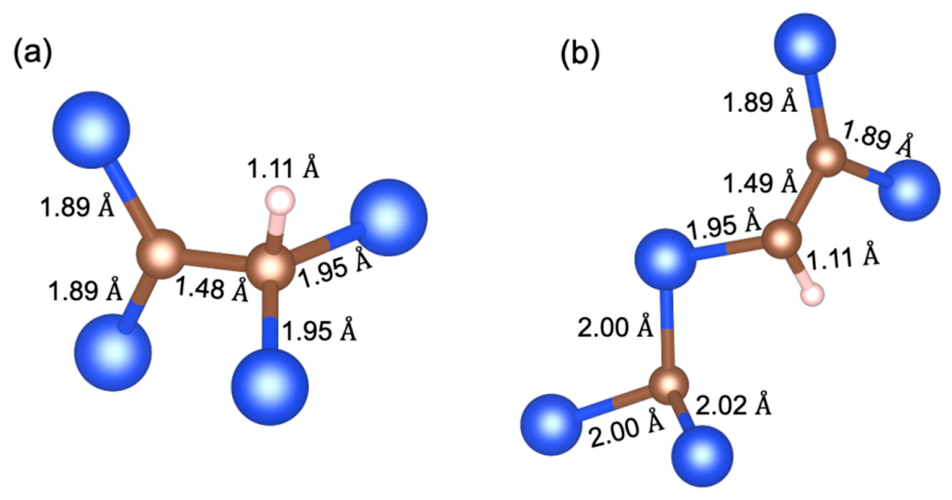
The structure of the T-centre in Si is well established as compared to the M-centre that was only recently clarified [41,42]. As it can be seen in Figure 1a, the T-centre consists of two C atoms: one at an interstitial site, the other at a substitutional site and a hydrogen atom connected to a carbon atom to form the CsCiHi defect cluster. The structure of the T-centre in Si has been extensively studied using a range of experimental methods (for example, magnetometry, stress studies and isotope-shift) [49,51,58]. Importantly, the T-centre emits in the fibre-optic O-band, and additionally, it exhibits spin-selective bound-exciton optical transitions at 0.93 eV [60,111]. Bergeron et al. [58] experimentally determined optically detected magnetic resonance and coherent spin control in T-centre defects in Si. From a technological viewpoint, Higginbottom et al. [62] implanted large arrays of telecom emitters in commercial silicon-on-insulator wafers, integrated with on-chip resonators and achieved enhanced emission and efficient fibre-optic coupling.
There is limited experimental information on the structure of the M-centre. In that respect, computational modelling is an efficient way to bridge the gap. The DFT calculations revealed that the M-centre has three carbon atoms [41,42]. Considering the formation of the M-centre, a way is to add one substitutional carbon atom into an existing CsCiHi defect cluster, as this would result in CsCiCsHi [41,42]. Figure 1b is the schematic representation of the lowest energy M-centre in Si as predicted by DFT [41]. The additional substitutional carbon atom resides at a next-nearest-neighbour site, as this reduces minimizes the local lattice strain and the electronic repulsion effects [41]. It is important for quantum applications that both the T- and M-centres have doublet ground states.
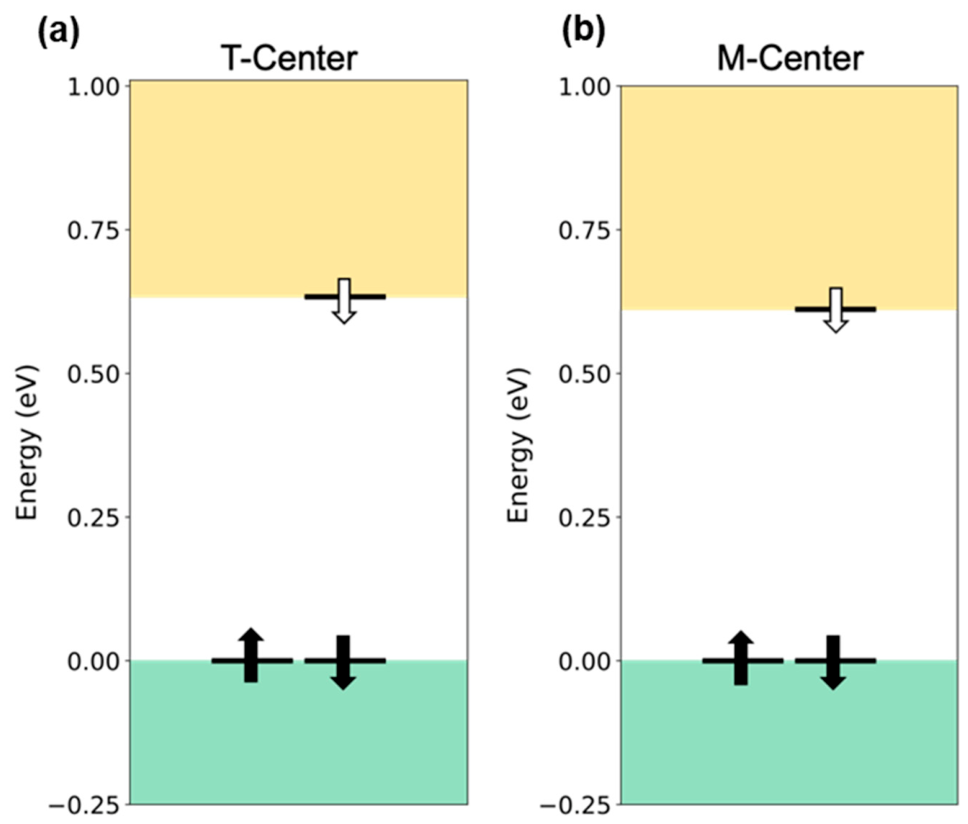
Filippatos et al. [41] used the r2SCAN functional approach to calculate the ground state electronic structure of the T- and M-centres calculated. Figure 2 is a schematic of the Kohn–Sham levels at the gamma point for the T-centre and the M-centre [41]. Comparing Figure 2a and Figure 2b, it can be inferred that the band characteristics, band gap and energy levels are very similar between the T- and M- centres [41]. It can be observed from Figure 2 that there are energy levels arising due to the defect complexes close to the conduction band minimum using the r2SCAN calculations [41]. Previous studies, based on more approximate DFT calculations (local density functional, “scissor-operator”), result in higher defect energies; however, the r2SCAN calculations are more transferable and agree better with HSE06 on the prediction of ZPL and other key properties [41,50]. The excitations are bound excitons, arising from the valence band maximum to the level close to the conduction band minimum [41]. The bound-excitons are formed via Coulomb-bound electron–hole pairs, and excitations are created by transitions between a delocalized band edge state and an unoccupied defect-localized state [41]. Unstable bound-excitons will undergo rapid dissociation into free carriers or nonradiative recombination, therefore for quantum applications it is important that the bound-excitons are stable. For the T-centre, the bound exciton binding energy was calculated to be 0.16 eV; therefore, it is stable at low temperatures [41].
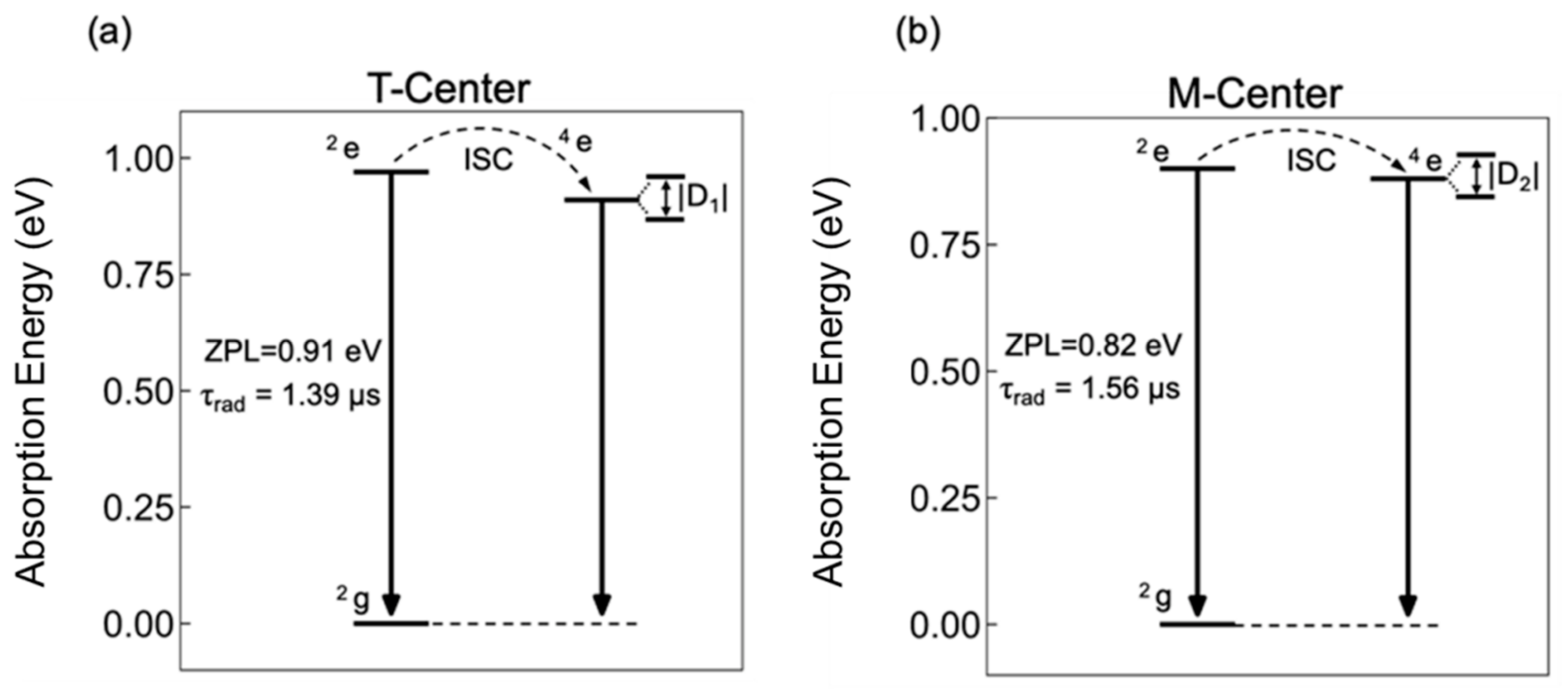
ZPL is an important optical property for the spin defects considered as qubits. Filippatos et al. [41] used the Δ-SCF approach to calculate the optical transitions. Employing the Franck–Condon principle, where the atoms have positions fixed to the ground state configuration and the electron is excited from the spin down channel, they performed geometry relaxation to calculate the vertical excitation [41]. Relaxing the atoms at the excited state allows the calculation of the ZPL as the energy difference between the relaxed excited and the ground state [41]. This method yielded for the T-centre a ZPL of 0.906 eV [41], in good agreement with the experiment (0.935 eV) [58] and HSE06 calculations (0.985 eV) [60]. As the r2SCAN method is well established and it corresponds to the experimental and hybrid results, it was also employed to calculate the ZPL of the M-centre, calculating a value of 0.82 eV [41]. The experimental work on the M-centre luminescence in hydrogenated Si yielded a ZPL of 0.761 eV [115]. Therefore, the theoretical calculations [41] are in agreement with the experiment [115] and are also consistent with the ground state being a paramagnetic doublet state.
Filippatos et al. [41] examined also the qubit operation protocol of the M-centre as compared to the T-centre in Si. The theoretically predicted qubit operation for the T-centre and the M-centre is given in Figure 3. It was predicted that both the T- and M-centre have ground states that are paramagnetic doublet states (denoted as 2g), whereas the first doublet excited is denoted as 2e [41]. The ZPL for this transition 2e ⟶ 2g is 0.91 eV and 0.82 eV for the T- and M-centre, respectively [41]. Compared to the archetypal defect the NV−1-centre in diamond that has a radiation lifetime of 4.4 ns, the T- and M-centre have significantly longer transitions (T-centre: 1.39 μs and M-centre: 1.56 μs) [41,70]. Previous simulations at the HSE06 level predicted a radiation lifetime for T-centre in the range between 1.3 μs and 5 μs [60]. Both centres have an intermediate quartet metastable state (T-centre: 0.91 eV and M-centre: 0.88 eV) that can be used for intersystem crossing transition [41]. Other computed properties by theory such as the zero-field splitting (ZFS) are also consistent with the experiment and in agreement with C complexes in Si [41,116]. Importantly, for both T- and M-centres, the quantum information can be encoded into the spin sublevels, whereas upon optical excitation, the system populates the doublet excited state [41]. The quartet excited states allow the potential for non-radiative pathways; however, the occupation of these states may occur either by the spin–orbit coupling (SOC) effects or by Herzberg–Teller effects [117,118,119]. As Si has weak SOC, the spin-flip to the quartet states can occur only via the Herzberg–Teller effect. The spin initialization and readout through spin-selective optical transitions can be considered similar to the NV centre in diamond.

3.3. Perspectives and Future Directions

From the description above there are some missing points that will need to be addressed. Future studies need to calculate the charge transition levels of the M-centre using HSE06 functionals. These are computationally expensive calculations but will yield a better understanding of the M-centre and how it compares with related defects in Si such as the T-centre. Additionally, there is limited theoretical information on the formation of these defects from the perspective of the kinetics. Ab initio molecular dynamics and Monte Carlo work should bridge this gap. The formation energy of the defects is of limited importance as it is typical in semiconductor materials to introduce defects even if it is energetically unfavourable under equilibrium conditions. Non-equilibrium conditions are introduced through growth and processing (i.e., irradiation, annealing, implantation etc), and these conditions can lead to the formation of defect clusters that would otherwise be kinetically and/or thermodynamically hindered.
The archetypal qubit system is the NV−1 centre in diamond; it was determined that it can be initialized and read-out with optical methods as the spin–photon interface can be utilized for quantum communication in the visible wavelength [117,119,120]. One of the hurdles in quantum technology is the introduction of qubits in a controlled manner because of the difficulty in forming defects due to the design requirements, the complexity of the manufacturing process and scalability issues [121,122,123]. Considering the NV−1 centre in diamond, it is these issues that degrade the quality of the quantum register, whereas in oxide materials, intrinsic point defects (for example, the oxygen vacancy) can have a negative impact on the properties of the device.
Two-dimensional (2D) single photon emitters and qubits do not show some of the issues exhibited by bulk materials as (a) have high quantum efficiency, (b) multi-functionality and (c) better surface chemistry [124]. A typical example is hBN in its 2D form, which is a system that has attracted considerable attention from the community [125,126,127]. Importantly, in hBN, carbon-related complexes have been related with qubits; however, there is still work that is required [125,126,127]. Additionally, spin defects in room temperature have been studied as single photon emitters in hBN, but their atomic scale characterization is not fully determined [128,129,130,131]. Experimental work (i.e., photoluminescence and optically detected magnetic resonance) in conjunction with density functional theory (DFT) is required to characterize and understand these defects at an atomistic scale. Quantum information may be encoded through different spin configurations and transition mechanisms [132]. Qubits operating at cryogenic temperatures just require one unoccupied state with the optical transition occurring from the valence band maximum (VBM) to this state (bound-exciton) [70], whereas room temperature qubits require at least two states (one occupied and one un-occupied) for the optical transition to occur [114]. The ground state of the defect should be a paramagnetic spin multiplet (triplet), although in recent work, diamagnetic ground states (i.e., singlets) have also been applied when intersystem crossing with a paramagnetic multiplet has taken place during the excitation process [133]. These considerations led to the investigation of a number of 2D systems that have been considered by the community. The bulk materials have not been ruled out as they also offer advantages. For example, recent studies considered alternative dopants, such as halogen atoms in diamond, whereas other classic systems, such as SiO2, spinel and silicon carbide, have been investigated using first-principles calculations [134,135,136,137]. Given the number, structural complexity and the numerous possible defects that will need to be examined, this leads to computationally intensive calculations, particularly at the hybrid functional level. In that respect, the r2SCAN is an efficient way to reduce the computational cost.
Another efficient way to tune the properties of materials is mechanical strain. It has been demonstrated that strain can improve the electronic and diffusion properties of a range of materials from oxides to semiconductors [138,139,140,141]. In quantum technologies, Hu et al. [134] recently employed first principles calculations to study quantum defects in 4H silicon carbide, and they predicted that strain is an effective tuning parameter enhancing readout contrast.

4. Increasing Radiation Tolerance in Silicon

4.1. Intrinsic Defects

The main intrinsic defects in Si are the vacancy (V) and the self-interstitial (SiI). It is these defects that impact a range of defect processes such as the formation of clusters, the diffusion of dopants, self-diffusion, electronic and mechanical properties. The high formation energies of intrinsic defects in Si leads to their low concentrations under equilibrium conditions; however, there are meaningful concentrations under irradiation. To systematically investigate radiation defects in Si irradiation electrons, neutrons, protons or gamma rays can be typically employed. Under irradiation conditions, there exist vacancies and self-interstitials at non-equilibrium concentrations [92]. Vacancies can typically form divacancies (V2) as, in this configuration, the total number of dangling bonds (every vacancy results in four dangling bonds in the lattice) is reduced from eight in isolated vacancies to six for nearest-neighbour V2. These non-equilibrium vacancies and self-interstitials are mobile and populous, so they can form pairs and/or larger defect clusters with each other or with impurities and dopant atoms that may be present in the Si lattice. In the presence of oxygen in the lattice, there is competition to the formation of V2 as vacancies can also be captured by oxygen atoms to form VO pairs. These VO pairs (A-centre) can subsequently form larger clusters such as VO2. Silicon interstitials can bind with carbon and oxygen impurities to form a range of important clusters such as the CiOi, the CiCs and the CiOi(SiI) [142,143].

4.2. A-Centre and Defect Engineering

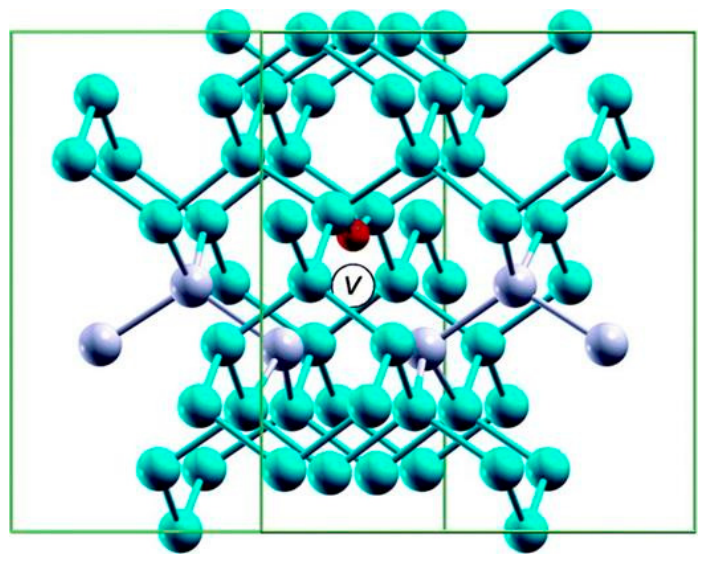
In silicon upon irradiation at room temperature, a non-equilibrium concentration of mobile vacancies and self-interstitials form. Most of the vacancies and self-interstitials are destroyed via the process V + SiI → 0. The surviving vacancies will form either V2, or if they are captured by oxygen interstitials (Oi), they form VO defects. The A-centre has a C symmetry with the oxygen atom being attached to the dangling bonds across the vacancy (refer to Figure 4). The oxygen atom essentially forms a Si-O-Si molecule, whereas the other two silicon atoms form a weak Si-Si molecular bond that can trap an electron and determines the electrical activity of the defect [144]. The trapping of the electron leads to the negative charge state of the A-centre and is consistent with what was proposed by experimental measurements by Watkins and Corbett [145]. The electron spin resonance determined that the wavefunction of the unpaired electron is highly localized and therefore it leads to an acceptor level at Ec—0.17 eV in the band gap [145]. The A-centre also has a neutral charge state [146]. It was previously predicted by hybrid functional DFT calculations that the A-centre can also form in the double negative charge state [147]. It should be stressed that in the A-centre, the oxygen atom is slightly away (by about 0.9 Å) from the vacancy site along the <100> direction [148].
Considering other group IV semiconductors, such as germanium, there are also A-centres forming that have considerably lower binding energies [14,149,150,151]. The smaller binding energies of A-centres in Ge as compared with the dominance of the divacancy are consistent with a smaller concentration of A-centres in Ge as compared to Si. An open field of research will be the stability and electronic properties of A-centres and related defects in group IV semiconductor alloys. For example, in previous studies, it was calculated that the arrangement of nearest-neighbour atoms strongly affected the binding energies of vacancy containing defects clusters in Si1−xGex alloys.
The A-centre evolves to the VO2 defect formed at temperatures ∼300 °C. The formation of the VO2 defect requires the migration of the VO centre until it is bound by an oxygen atom through the reaction VO + OiVO2 [143]. The VO2 structure has a D2d symmetry where the two Oi share equivalently the vacant site [143]. Each Oi is bonded with two Si atoms, whereas there is an increase in the O-V distance as compared to the O-V distance in the A-centre [143]. Conversely, the lengths of the Si-O bonds are shorter in the VO2 as compared to the VO defect, and this leads to the higher vibrating frequency (LVM frequency for the VO2 is ∼888 cm−1 as compared to ∼830 cm−1 for the VO defect) [143]. Importantly, the two oxygen interstitials in VO2 saturate all the dangling bonds of the vacancy and, as a consequence, this is an electrically inactive defect [143].
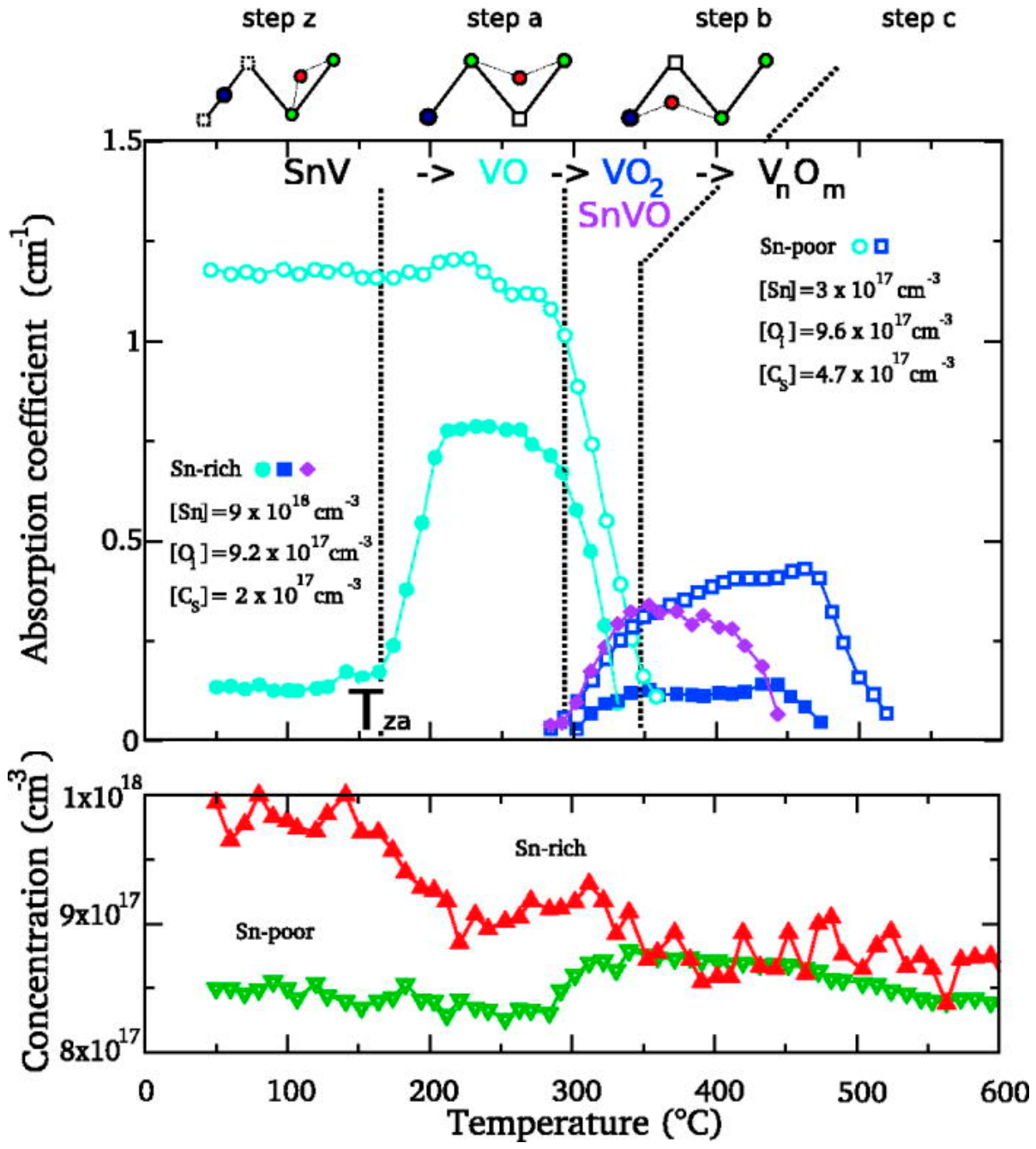
Thermal annealing leads further vacancies and oxygen interstitials to associate with the A-centre to form larger VmOn defects. There larger defects have a deleterious impact upon the material and device properties as they can lead to (A) leakage currents in p-n junctions [152,153,154], (B) V2O and V3O defects are recombination centres that contribute to the reduction of the minority carriers lifetime induced by irradiation [155], and (C) larger VOn (n = 4, 5, 6) clusters can act as heterogeneous nuclei that enhance oxygen precipitation in irradiated Si [156,157]. To avoid or at least contain the concentration of these larger defects, the community has proposed a number of defect engineering strategies in Si and related materials such as Ge [158,159,160,161,162]. As vacancies lie at the heart of the defect, a way to eliminate the impact of VmOn defects is to restrict the vacancies or limit their availability to form these larger defects containing multiple vacancies and oxygen atoms. A way to defect-engineer the vacancy content to suppress A-centre formation in silicon is via the introduction of oversized isovalent dopants such as tin (Sn) or lead (Pb). In particular, it was shown in previous investigations that large isovalent codopants can impact the dopant–defect interactions in Si and related group IV semiconductors [16,142,144,158,163]. It has been determined experimentally that isovalent impurities, such as Ge, Sn and Pb, influence the formation of VnOm complexes in Si [16,158]. As it can be observed in Figure 5, an increased concentration of Sn is an efficient way to contain the formation of A-centres by the formation of competitive SnVO defects [158]. From an energetic viewpoint, this can be explained as the oversized isovalent atoms’ gain from the space provided by the A-centre voids, so there is significant relaxation by the lattice atoms that surround them [158]. It is the high-binding energies that link the A-centres to the isovalent atoms to form DVO defects where D can be Ge or Sn or Pb [16,158]. Through the formation of the DVO defects, the A-centre is anchored and cannot migrate to form larger VnOm clusters [16,158].

5. Summary

Radiation, in all its forms, interacts with matter in a plethora of ways, altering certain characteristics of the materials. Such alterations in materials such as semiconductors can prove to be catastrophic for modern technologies which rely on very specific semiconductor characteristics. The use of such materials in areas with radiation exposure risks requires further investigation of the effects that radiation has on them, and by extension, to all semiconductor devices. Here, we reviewed the impact of radiation on semiconducting materials.
We first examined the ways radiation interacts with semiconducting materials and the effects those interactions result in, with the formation of defects being the most crucial. We also briefly described the effects of defects on the characteristics of the materials. Furthermore, we examined the effects of radiation on the electrical, mechanical/structural and optical properties of semiconductors with regards to the presence of radiation-induced defects. Any change to these properties poses a danger to all related semiconductor devices, with possible results ranging from degradation of performance to complete failure. Finally, the annealing process was reviewed in order to understand the standard process of defect removal.

Funding

This research received no external funding.

Institutional Review Board Statement

Not applicable.

Informed Consent Statement

Not applicable.

Data Availability Statement

Data sharing is not applicable to this article as no new data were created or analyzed in this study.

Conflicts of Interest

The authors have no conflicts to disclose.

References

  1. Kim, H.; Chui, C.O.; Saraswat, K.C.; McIntyre, P.C. Local epitaxial growth of ZrO2 on Ge(100) substrates by atomic layer epitaxy. Appl. Phys. Lett. 2003, 83, 2647. [Google Scholar] [CrossRef]
  2. Kita, K.; Suzuki, S.; Nomura, H.; Takahashi, T.; Nishimura, T.; Toriumi, A. Direct evidence of GeO volatilization from GeO2/Ge and impact of its suppression on GeO2/Ge metal-insulator-semiconductor characteristics. Jpn. J. Appl. Phys. 2008, 47, 2349. [Google Scholar] [CrossRef]
  3. Tsoutsou, D.; Panayiotatos, Y.; Sotiropoulos, A.; Mavrou, G.; Golias, E.; Galata, S.F.; Dimoulas, A. Chemical stability of lanthanum germanate passivating layer on Ge upon high-k deposition: A photoemission study on the role of La in the interface chemistry. J. Appl. Phys. 2010, 108, 064115. [Google Scholar] [CrossRef]
  4. Boscherini, F.; D’Acapito, F.; Galata, S.F.; Tsoutsou, D.; Dimoulas, A. Atomic scale mechanism for the Ge-induced stabilization of the tetragonal, very high-κ, phase of ZrO2. Appl. Phys. Lett. 2011, 99, 121909. [Google Scholar] [CrossRef]
  5. Chroneos, A.; Schwingenschlögl, U.; Dimoulas, A. Impurity diffusion, point defect engineering, and surface/interface passivation in germanium. Ann. Phys. 2012, 524, 123–132. [Google Scholar] [CrossRef]
  6. Trivedi, A.R.; Ando, T.; Singhee, A.; Kerber, P.; Acar, E.; Frank, D.J.; Mukhopadhyay, S. A Simulation Study of Oxygen Vacancy-Induced Variability in HfO2/Metal Gated SOI FinFET. IEEE Trans. Electron Devices 2014, 61, 1262. [Google Scholar] [CrossRef]
  7. Genath, H.; Schubert, M.A.; Yamtomo, H.L.; Krügener, J.; Osten, H.J. Epitaxial growth of Nd2O3 layers on virtual SiGe substrates on Si(111). J. Appl. Phys. 2024, 135, 115302. [Google Scholar] [CrossRef]
  8. Zangenberg, N.R.; Lundsgaard Hansen, J.; Fage-Pedersen, J.; Nylandsted Larsen, A. Ge Self-Diffusion in Epitaxial Si1−xGex Layers. Phys. Rev. Lett. 2001, 87, 125901. [Google Scholar] [CrossRef] [PubMed]
  9. Chroneos, A.; Skarlatos, D.; Tsamis, C.; Christofi, A.; McPhail, D.S.; Hung, R. Implantation and diffusion of phosphorous in germanium. Mater. Sci. Semicond. Proc. 2006, 9, 640–643. [Google Scholar] [CrossRef]
  10. Kilpeläinen, S.; Kuitunen, K.; Tuomisto, F.; Slotte, J.; Radamson, H.H.; Kuznetsov, A.Y. Stabilization of Ge-rich defect complexes originating from E centers in Si1−xGex:P. Phys. Rev. B 2010, 81, 132103. [Google Scholar] [CrossRef]
  11. Kube, R.; Bracht, H.; Lundsgaard Hansen, J.; Nylandsted Larsen, A.; Haller, E.E.; Paul, S.; Lerch, W. Composition dependence of Si and Ge diffusion in relaxed Si1−xGex alloys. J. Appl. Phys. 2010, 107, 073520. [Google Scholar] [CrossRef]
  12. Kipke, F.; Südkamp, J.K.; Prüssing, J.K.; Bougeard, D.; Bracht, H. Diffusion of boron in germanium at 800–900 °C revisited. J. Appl. Phys. 2020, 127, 025703. [Google Scholar] [CrossRef]
  13. Igumbor, E.; Olaniyan, O.; Dongho-Nguimdo, G.M.; Mapasha, R.E.; Ahmad, S.; Omotoso, E.; Meyer, W.E. Electronic properties and defect levels induced by n/p-type defect-complexes in Ge. Mater. Sci. Semicond. Proc. 2022, 150, 106906. [Google Scholar] [CrossRef]
  14. Markevich, V.P.; Hawkins, I.D.; Peaker, A.R.; Litvinov, V.V.; Murin, L.I.; Dobaczewski, L.; Lindström, J.L. Electronic properties of vacancy–oxygen complex in Ge crystals. Appl. Phys. Lett. 2002, 81, 1821. [Google Scholar] [CrossRef]
  15. Chroneos, A.; Londos, C.A. Interaction of A-centers with isovalent impurities in silicon. J. Appl. Phys. 2010, 107, 093518. [Google Scholar] [CrossRef]
  16. Sgourou, E.N.; Timerkaeva, D.; Londos, C.A.; Aliprantis, D.; Chroneos, A.; Caliste, D.; Pochet, P. Impact of isovalent doping on the trapping of vacancy and interstitial related defects in Si. J. Appl. Phys. 2013, 113, 113506. [Google Scholar] [CrossRef]
  17. Tahini, H.A.; Chroneos, A.; Murphy, S.T.; Schwingenschlögl, U.; Grimes, R.W. Vacancies and defect levels in III-V semiconductors. J. Appl. Phys. 2013, 114, 053517. [Google Scholar] [CrossRef]
  18. Pelenitsyn, V.; Korotaev, P. First-principles study of radiation defects in silicon. Comp. Mater. Sci. 2022, 207, 111273. [Google Scholar] [CrossRef]
  19. Liu, W.; Ivanov, V.; Jhuria, K.; Ji, Q.; Persaud, A.; Redjem, W.; Simoni, J.; Zhiyenbayev, Y.; Kante, B.; Lopez, L.G.; et al. Quantum Emitter Formation Dynamics and Probing of Radiation-Induced Atomic Disorder in Silicon. Phys. Rev. Appl. 2023, 20, 014058. [Google Scholar] [CrossRef]
  20. Kras’ko, M.; Kolosiuk, A.; Povarchuk, V.; Voitovych, V. Radiation-Enhanced Annealing of Vacancy-Oxygen Defects in Cz n-Si: Features of the Experiment, Factor of the Radiation Ionization, and a Possible Annealing Mechanism. Phys. Stat. Solidi A 2025, 222, 2400900. [Google Scholar] [CrossRef]
  21. Jones, C.E.; Johnson, E.S.; Dale Compton, W. Temperature, stress, and annealing effects on the luminescence from electron-irradiated silicon. J. Appl. Phys. 1973, 44, 5402–5410. [Google Scholar] [CrossRef]
  22. Davies, G. The optical properties of luminescence centres in silicon. Phys. Rep. 1989, 176, 83–188. [Google Scholar] [CrossRef]
  23. Davies, G.; Newman, R.C. Carbon in monocrystalline silicon. In Handbook on Semiconductors; Mahajan, S., Ed.; Elsevier Science B. V.: Amsterdam, The Netherlands, 1994; Volume 3, pp. 1557–1635. [Google Scholar]
  24. Leary, P.; Oberg, S.; Briddon, P.R.; Jones, R. Interstitial carbon-hydrogen defects in silicon. Mat. Sci. Forum 1997, 258–263, 265–270. [Google Scholar]
  25. Davies, G.; Hayama, S.; Murin, L.; Krause-Rehberg, R.; Bondarenko, V.; Sengupta, A.; Davia, C.; Kerpenko, A. Radiation damage in silicon exposed to high-energy protons. Phys. Rev. B 2006, 73, 165202. [Google Scholar] [CrossRef]
  26. Londos, C.A.; Antonaras, G.; Chroneos, A. Localised vibrational mode spectroscopy studies of self-interstitial clusters in neutron irradiated silicon. J. Appl. Phys. 2013, 114, 043502. [Google Scholar] [CrossRef]
  27. Wang, H.; Chroneos, A.; Londos, C.A.; Sgourou, E.N.; Schwingenschlögl, U. Carbon related defects in irradiated silicon revisited. Sci. Rep. 2014, 4, 4909. [Google Scholar] [CrossRef]
  28. Abdurrazaq, A.; Raji, A.T.; Meyer, W.E. Effect of Isovalent Doping on Hydrogen Passivated Vacancy-oxygen Defect Complexes in Silicon: Insights from Density Functional Theory. Silicon 2021, 13, 1969–1977. [Google Scholar] [CrossRef]
  29. Baron, Y.; Durand, A.; Herzig, T.; Khoury, M.; Pezzagna, S.; Meijer, J.; Robert-Philip, I.; Abbarchi, M.; Hartmann, J.M.; Reboh, S.; et al. Single G centres in silicon fabricated by co-implantation with carbon and proton. Appl. Phys. Lett. 2022, 121, 084003. [Google Scholar] [CrossRef]
  30. Filippatos, P.P.; Chroneos, A.; Londos, C.A. Re-examination of important defect complexes in silicon: From microelectronics to quantum computing. J. Appl. Phys. 2025, 137, 230701. [Google Scholar] [CrossRef]
  31. Simmons, S. A single silicon color center resolved. Nat. Electron. 2020, 3, 734–735. [Google Scholar] [CrossRef]
  32. Norman, V.A.; Majety, S.; Wang, Z.; Casey, W.H.; Curro, N.; Radulaski, M. Novel color center platforms enabling fundamental scientific discovery. InfoMat 2021, 3, 869–890. [Google Scholar] [CrossRef]
  33. Nikolskaya, A.; Korolev, D.; Michaylov, A.; Pavlov, D.; Sushkov, A.; Okulish, E.; Chizhova, A.; Konakov, A.; Yurin, P.; Okhapkin, A.; et al. Thermally stable photoluminescence centers at 1240 nm in silicon obtained by irradiation of the SiO2/Si system. J. Appl. Phys. 2024, 135, 215703. [Google Scholar] [CrossRef]
  34. Morse, K.J.; Abraham, R.S.; DeAbreu, A.; Bowness, C.; Richards, T.S.; Riemann, H.; Abrosimov, N.V.; Becker, P.; Rohl, H.-J.; Thewalt, M.L.W.; et al. A photonic platform for donor spin qubits in silicon. Sci. Adv. 2017, 3, e1700930. [Google Scholar] [CrossRef]
  35. Yan, X.; Gitt, S.; Lin, B.; Witt, D.; Abdolahi, M.; Afifi, A.; Azem, A.; Darcie, A.; Wu, J.; Awan, K.; et al. Spin photonic quantum platforms computing with spin qubits. APL Photon. 2021, 6, 070901. [Google Scholar] [CrossRef]
  36. Zhang, X.; Turiansky, M.E.; Razinkovas, L.; Maciaszek, M.; Broqvist, P.; Yan, Q.; Lyons, J.L.; Dreyer, C.E.; Wickramanatne, D.; Gali, A.; et al. First-principles calculations of defects and electron-phonon interactions: Seminal contributions of Audrius Alkauskas to the understanding of recombination processes. J. Appl. Phys. 2024, 135, 150901. [Google Scholar] [CrossRef]
  37. Khoury, M.; Abbarchi, M. A bright future for silicon in quantum technologies. J. Appl. Phys. 2022, 131, 200901. [Google Scholar] [CrossRef]
  38. Durant, A.; Baron, Y.; Redjem, W.; Benali, A.; Pezzagna, S.; Meijer, J.; Kuznetsov, A.Y.; Gerard, J.-M.; Robert-Philip, I.; Abbrarchi, M.; et al. Broad diversity of near-infrared single-photon emitters in silicon. Phys. Rev. Lett. 2021, 126, 083602. [Google Scholar] [CrossRef]
  39. Zhang, G.; Cheng, Y.; Chou, J.-P.; Gali, A. Material platforms for defect qubits and single-photon emitters. Appl. Phys. Rev. 2020, 7, 031308. [Google Scholar] [CrossRef]
  40. Sarihan, M.C.; Huang, J.; Kang, J.H.; Fan, C.; Liu, W.; Azizur-Rahman, K.M.; Liang, B.; Wong, C.W. Photophysis of O-band and transition metal color centers in monolithic silicon for quantum communications. arXiv 2023, arXiv:2310.19510. [Google Scholar]
  41. Filippatos, P.; Kuganathan, N.; Chroneos, A. First-principles investigation of the T- and M-centers in silicon using meta-GGA functionals. Adv. Theory Simul. 2026, 9, e01468. [Google Scholar] [CrossRef]
  42. Kuganathan, N.; Filippatos, P.P.; Apostolakopoulos, A.A.; Chroneos, A.; Londos, C.A. Re-examining the M-center in silicon. AIP Adv. 2025, 15, 105023. [Google Scholar] [CrossRef]
  43. Minaev, N.S.; Mudryi, A.V. Thermally-induced defects in silicon containing oxygen and carbon. Phys. Stat. Sol. 1981, 68, 561–565. [Google Scholar] [CrossRef]
  44. Weber, J.; Sauer, R. Photoluminescence study of thermally treated silicon crystals. Mat. Res. Soc. Symp. Proc. 1983, 14, 165–169. [Google Scholar] [CrossRef]
  45. Henry, A.; Monemar, B.; Lindstrom, J.L.; Bestwick, T.D.; Oehrlein, G.S. Photoluminescence characterization of plasma exposed surfaces. J. Appl. Phys. 1991, 70, 5597–5603. [Google Scholar] [CrossRef]
  46. Lightowlers, E.C.; Newman, R.C.; Tucker, J.H. Hydrogen-related luminescence centers in thermally Czochralski silicon. Semicond. Sci. Technol. 1994, 9, 1370–1374. [Google Scholar] [CrossRef]
  47. Safonov, A.N.; Lightowlers, E.C. Hydrogen related optical centers in radiation damaged silicon. Mater. Sci. Forum 1994, 143–147, 903–908. [Google Scholar]
  48. Irion, E.; Burger, N.; Thonke, K.; Sauer, R. The defect luminescence spectrum at 0.9351 eV in carbon-doped heat-treated or irradiated silicon. J. Phys. C Solid State Phys. 1995, 18, 5069–5082. [Google Scholar] [CrossRef]
  49. Safonov, A.N.; Lightowlers, E.C.; Davies, G.; Leary, P.; Jones, R.; Oberg, S. Interstitial-carbon hydrogen interaction in silicon. Phys. Rev. Lett. 1996, 77, 4812–4815. [Google Scholar] [CrossRef] [PubMed]
  50. Leary, P.; Jones, R.; Oberg, S. Interaction of hydrogen substitutional and interstitial carbon defects in silicon. Phys. Rev. B 1998, 57, 3887–3899. [Google Scholar] [CrossRef]
  51. Safonov, A.N.; Lightowlers, E.C. Photoluminesence characterization of hydrogen related centers in silicon. Mater. Sci. Eng. B 1999, 58, 39–47. [Google Scholar] [CrossRef]
  52. Schmidt, D.C.; Svensson, B.G.; Seibt, M.; Jagadish, C.; Davies, G. Photoluminescence, deep level transient spectroscopy and transmission electron microscopy measurements on MeV self-ion implanted and annealed n-type silicon. J. Appl. Phys. 2000, 88, 2309–2317. [Google Scholar] [CrossRef]
  53. Hayama, S.; Davies, G.; Tan, J.; Coutinho, J.; Jones, R.; Itoh, K.M. Lattice isotope effects on optical transitions in silicon. Phys. Rev. B 2004, 70, 035202. [Google Scholar] [CrossRef][Green Version]
  54. Cloutier, S.G.; Kossyrev, P.A.; Xu, J. Optical gain and stimulated emission in periodic nanopatterned crystalline silicon. Nat. Mater. 2005, 4, 877. [Google Scholar] [CrossRef] [PubMed]
  55. Berhanuddin, D.D.; Lourenço, M.A.; Gwilliam, R.M.; Homewood, K.P. Co-Implantation of Carbon and Protons: An Integrated Silicon Device Technology Compatible Method to Generate the Lasing G-Center. Adv. Funct. Mater. 2012, 22, 2709. [Google Scholar] [CrossRef]
  56. Londos, C.A.; Sgourou, E.N.; Chroneos, A. Impact of isovalent defect engineering strategies on carbon-related defects in silicon. J. Mater. Sci. Mater. Electron. 2013, 14, 1696–1701. [Google Scholar] [CrossRef]
  57. Wang, H.; Chroneos, A.; Londos, C.A.; Sgourou, E.N.; Schwingensclögl, U. G-centers in irradiated silicon revisited: A screened hybrid density functional theory approach. J. Appl. Phys. 2014, 115, 183509. [Google Scholar] [CrossRef]
  58. Bergeron, L.; Chartrand, C.; Kurkjian, A.T.K.; Morse, K.J.; Riemann, H.; Abrosimov, N.S.; Becker, P.; Pohl, H.-J.; Thewalt, M.L.W.; Simmons, S. Silicon integrated telecommunications photon-spin interface. PRX Quantum 2020, 1, 020301. [Google Scholar] [CrossRef]
  59. MacQuarrie, E.R.; Chartrand, C.; Higginbottom, D.B.; Morse, K.J.; Karasyuk, V.A.; Roorda, S.; Simmons, S. Generating T centers in photonic silicon-on- insulator material by ion implantation. New J. Phys. 2021, 23, 103008. [Google Scholar] [CrossRef]
  60. Dhaliah, D.; Xiong, X.; Sigahigil, A.; Griffin, S.M.; Hautier, G. First principles study of the T-center in silicon. Phys. Rev. Mater. 2022, 6, L053201. [Google Scholar] [CrossRef]
  61. Ivanov, V.; Simoni, J.; Lee, Y.; Liu, W.; Jjhuria, K.; Redjem, W.; Zhiyenbayev, Y.; Papapanos, C.; Qarony, W.; Kante, B.; et al. Effect of localization on photoluminescence and zero-field splitting of silicon color centers. Phys. Rev. B 2022, 106, 134107. [Google Scholar] [CrossRef]
  62. Higginbottom, D.B.; Kurkjian, A.T.K.; Chartrand, C.; Kazemi, M.; Brunelle, N.A.; MacQuarrie, E.R.; Klein, J.R.; Lee-Home, N.R.; Stacho, J.; Ruether, M.; et al. Optical observation of single spins in silicon. Nature 2022, 607, 266–270. [Google Scholar] [CrossRef] [PubMed]
  63. Higginbottom, D.; Asadi, F.K.; Chartrand, C.; Ji, J.-W.; Bergeron, L.; Thewalt, L.M.; Simon, C.; Simmons, S. Memory and Transduction for silicon T center devices. PRX Quantum 2023, 4, 020308. [Google Scholar] [CrossRef]
  64. Xiong, Y.; Bourgois, C.; Sheremetyeva, N.; Chen, W.; Dahliah, D.; Song, H.; Zheng, J.; Griffin, S.M.; Sipahigil, A.; Hautier, G. High-throughput identification of spin-photon interfaces in silicon. Sci. Adv. 2023, 9, eadh8617. [Google Scholar] [CrossRef]
  65. DeAbreu, A.; Bowness, C.; Alizadeh, A.; Chartrand, C.; Brunelle, N.A.; MacQuarrie, E.R.; Lee-Hone, N.R.; Ruether, M.; Kazemi, M.; Kurkjian, A.T.K.; et al. Waveguide-integrated T-centers. Opt. Express 2023, 31, 15045–15057. [Google Scholar] [CrossRef]
  66. Lee, C.M.; Islam, F.; Harper, S.; Buyukkaya, M.A.; Higginbottom, D.B.; Simmons, S.; Waks, E. High-Efficiency single photon emission from a silicon T-center in a nanobeam. ACS Photonics 2023, 10, 3844–3849. [Google Scholar] [CrossRef]
  67. Islam, F.; Lee, C.M.; Harper, S.; Rahaman, M.H.; Zhao, Y.; Vij, N.K.; Waks, E. Cavity enhanced emission from a silicon T-center. Nano Lett. 2024, 24, 319–325. [Google Scholar] [CrossRef]
  68. Johnston, A.; Felix-Rendon, U.; Wong, Y.-E.; Chen, S. Cavity-coupled telecom atomic source in silicon. Nat. Commun. 2024, 5, 2350. [Google Scholar] [CrossRef]
  69. Clear, C.; Hosseini, S.; Alizadehkhaledi, A.; Brunelle, N.; Woolverton, A.; Kanaganayagam, J.; Kazemi, M.; Chartrand, C.; Keshavarz, M.; Xiong, Y.; et al. Optical-transition parameters of the silicon T-center. Phys. Rev. Appl. 2024, 22, 064014. [Google Scholar] [CrossRef]
  70. Xiong, Y.; Mathew, M.; Griffin, S.M.; Sipahigil, A.; Hautier, G. Midgap state requirements for optically active quantum defects. Mater. Quantum Technol. 2024, 4, 013001. [Google Scholar] [CrossRef]
  71. Simmons, S. Scalable fault-tolerant quantum technologies with silicon color centers. PRX Quantum 2024, 5, 010102. [Google Scholar] [CrossRef]
  72. Aberl, J.; Novarrete, E.P.; Karaman, M.; Enriquez, D.-H.; Wilflingseder, C.; Solomon, A.; Primetzhofer, D.; Schubert, M.A.; Capellini, G.; Fromherz, T.; et al. All-epitaxial self-assembly of silicon color centers confined within sub-nanometer thin layers using ultra-low temperature epitaxy. Adv. Mater. 2024, 36, 2408424. [Google Scholar] [CrossRef]
  73. Jhuria, K.; Ivanov, V.; Polley, D.; Zhiyenbayev, Y.; Liu, W.; Persaud, A.; Redjem, W.; Qarony, W.; Parajuli, P.; Ji, G.; et al. Programmable quantum emitter formation in silicon. Nat. Commun. 2024, 15, 4497. [Google Scholar] [CrossRef] [PubMed]
  74. Fahey, P.M.; Griffin, P.B.; Plummer, J.D. Point defects and dopant diffusion in silicon. Rev. Mod. Phys. 1989, 61, 289. [Google Scholar] [CrossRef]
  75. Tanenbaum, M.; Mills, A.D. Preparation of Uniform Resistivity n-Type Silicon by Nuclear Transmutation. J. Electrochem. Soc. 1961, 108, 171. [Google Scholar] [CrossRef]
  76. Wesch, W.; Glaser, B.; Götz, G.; Karge, H.; Prager, R. Correlation between structural defects and optical properties in ion-implanted silicon. Phys. Stat. Sol. (A) 1981, 65, 225–232. [Google Scholar] [CrossRef]
  77. Stein, H.J. Defects in silicon: Concepts and correlations. Radiat. Eff. 1971, 9, 195–210. [Google Scholar] [CrossRef]
  78. Jain, V.K. Semiconductors. In Solid State Physics, 3rd ed.; Springer: Cham, Switzerland, 2022; pp. 295–330. [Google Scholar] [CrossRef]
  79. Levalois, M.; Marie, P. Damage induced in semiconductors by swift heavy ion irradiation. Nucl. Instr. Meth. B 1999, 156, 64. [Google Scholar] [CrossRef]
  80. Wesch, W.; Kamarou, A.; Wendler, E. Effect of high electronic energy deposition in semiconductors. Nucl. Instrum. Methods Phys. Res. B 2004, 225, 111–128. [Google Scholar] [CrossRef]
  81. Pearton, S.J.; Aitkaliyeva, A.; Xian, M.; Ren, F.; Khachatrian, A.; Ildefonso, A.; Islam, Z.; Jafar Rasel, M.A.; Haque, A.; Polyakov, A.Y.; et al. Radiation Damage in Wide and Ultra-Wide Bandgap Semiconductors. ECS J. Solid State Sci. Technol. 2021, 10, 055008. [Google Scholar] [CrossRef]
  82. Was, G.S. The Displacement of Atoms. In Fundamentals of Radiation Materials Science; Springer: New York, NY, USA, 2017; pp. 77–130. [Google Scholar] [CrossRef]
  83. Krasheninnikov, A.V.; Nordlund, K. Ion and electron irradiation-induced effects in nanostructured materials. J. Appl. Phys. 2010, 107, 071301. [Google Scholar] [CrossRef]
  84. Nordlund, K.; Zinkle, S.J.; Sand, A.E.; Granberg, F.; Averback, R.S.; Stoller, R.E.; Suzudo, T.; Malerba, L.; Banhart, F.; Weber, W.J.; et al. Primary radiation damage: A review of current understanding and models. J. Nucl. Mater. 2018, 512, 450–479. [Google Scholar] [CrossRef]
  85. Seebauer, E.G.; Kratzer, M.C. Trends in Charged Defect Behavior. In Charged Semiconductor Defects. Engineering Materials and Processes; Springer: London, UK, 2009; pp. 63–72. [Google Scholar] [CrossRef]
  86. Kuznetsov, V.I.; Lugakov, P.F. Study of radiation defect clusters, their structure and properties in, proton-irradiated silicon. Phys. Stat. Sol. (A) 1982, 70, 387–395. [Google Scholar] [CrossRef]
  87. Kamarou, A.; Wesch, W.; Wendler, E.; Undisz, A.; Rettenmayr, M. Swift heavy ion irradiation of InP: Thermal spike modeling of track formation. Phys. Rev. B 2006, 73, 184107. [Google Scholar] [CrossRef]
  88. Mistrik, J.; Kasap, S.; Ruda, H.E.; Koughia, C.; Singh, J. Optical Properties of Electronic Materials: Fundamentals and Characterization. In Springer Handbook of Electronic and Photonic Materials. Springer Handbooks; Kasap, S., Capper, P., Eds.; Springer: Cham, Switzerland, 2017; p. 1. [Google Scholar] [CrossRef]
  89. Buckner, H.B.; Perry, N.H. In Situ Optical Absorption Studies of Point Defect Kinetics and Thermodynamics in Oxide Thin Films. Adv. Mater. Interfaces 2019, 6, 1900496. [Google Scholar] [CrossRef]
  90. Penhale, L.G. Neutron-induced effects in semiconductors. Int. J. Appl. Radiat. Isot. 1963, 14, 305–325. [Google Scholar] [CrossRef]
  91. Vook, F.L.; Stein, H.J. Relation of Neutron to Ion Damage Annealing in Si and Ge. Radiat. Eff. 1969, 2, 23–30. [Google Scholar] [CrossRef]
  92. Londos, C.A.; Sgourou, E.N.; Hall, D.; Chroneos, A. Vacancy-oxygen defects in silicon: The impact of isovalent doping. J. Mater. Sci. Mater. Electron. 2014, 25, 2395–2410. [Google Scholar] [CrossRef]
  93. Kane, B.E. A silicon-based nuclear spin quantum computer. Nature 1998, 393, 133–137. [Google Scholar] [CrossRef]
  94. Tan, J.; Davies, G.; Hayama, S.; Harding, R.; Wong-Leung, J. Ion implantation effects in silicon with high carbon content characterized by photoluminescence. Phys. B 2003, 340–342, 714–718. [Google Scholar] [CrossRef]
  95. Zirkelbach, F.; Stritzker, B.; Nordlund, K.; Lindner, J.K.N.; Schmidt, W.G.; Rauls, E. Defects in carbon implanted silicon calculated by classical potentials and first-principles methods. Phys. Rev. B 2010, 82, 094110. [Google Scholar] [CrossRef][Green Version]
  96. Veldhorst, M.; Yang, C.H.; Hwang, J.C.C.; Huang, W.; Dehollain, J.P.; Muhonen, J.T.; Simmons, S.; Laucht, A.; Hudson, F.E.; Itoh, K.M.; et al. A two-qubit logic gate in silicon. Nature 2015, 526, 410–414. [Google Scholar] [CrossRef] [PubMed]
  97. Huang, W.; Yang, C.H.; Chan, K.W.; Tanttu, T.; Hensen, B.; Leon, R.C.C.; Forgarty, M.A.; Hwang, J.C.C.; Hudson, F.E.; Itoh, K.M.; et al. Fidelity benchmarks for two-qubit gates in silicon. Nature 2019, 569, 532–536. [Google Scholar] [CrossRef]
  98. Buckley, S.M.; Tait, A.N.; Moody, G.; Primavera, B.; Olson, S.; Herman, J.; Silverman, K.L.; Papa Rao, S.; Woo Nam, S.; Mirin, R.P.; et al. Optimization of photoluminescence from W centers in silicon-on-insulator. Opt. Express 2020, 28, 16057. [Google Scholar] [CrossRef]
  99. Madzik, M.T.; Laucht, A.; Hudson, F.E.; Jacob, A.M.; Johnson, B.C.; Jamieson, D.N.; Itoh, K.M.; Dzurak, A.S.; Morello, A. Conditional quantum operation of two exchange-coupled single-donor spin qubits in a MOS-compatible silicon device. Nat. Commun. 2021, 12, 181. [Google Scholar] [CrossRef]
  100. Udvarhelyi, P.; Somogyi, B.; Thiering, G.; Gali, A. Identification of a Telecom Wavelength Single Photon Emitter in Silicon. Phys. Rev. B 2021, 127, 196402. [Google Scholar] [CrossRef]
  101. Hollenbach, M.; Klingner, N.; Jagtap, N.S.; Bischoff, L.; Fowley, C.; Kentsch, U.; Hlawacek, G.; Erbe, A.; Abrosimov, N.V.; Helm, M.; et al. Wafer-scale nanofabrication of telecom single-photon emitters in silicon. Nat. Commun. 2022, 13, 7683. [Google Scholar] [CrossRef] [PubMed]
  102. Baron, Y.; Durand, A.; Udvarhelyi, P.; Herzig, T.; Khoury, M.; Pezzagna, S.; Meijer, J.; Robert-Philip, I.; Abbarchi, M.; Hartmann, J.M.; et al. Detection of single W-centers in silicon. ACS Photonics 2022, 9, 2337–2345. [Google Scholar] [CrossRef]
  103. Xiong, Y.; Zheng, J.; McBride, S.; Zhang, X.; Griffin, S.M.; Hautier, G. Computationally driven discovery of T center-like quantum defects in silicon. J. Am. Chem. Soc. 2024, 146, 30046–30056. [Google Scholar] [CrossRef]
  104. Atatüre, M.; Englund, D.; Vamivakas, N.; Lee, S.-Y.; Wrachtrup, J. Material platforms for spin-based photonic quantum technologies. Nat. Rev. Mater. 2018, 3, 38–51. [Google Scholar] [CrossRef]
  105. Acín, A.; Bloch, I.; Buhrman, H.; Calarco, T.; Eichler, C.; Eisert, J.; Esteve, D.; Gisin, N.; Glaser, S.J.; Jelezko, F.; et al. The quantum technologies roadmap: A European community view. New J. Phys. 2018, 20, 080201. [Google Scholar] [CrossRef]
  106. Chatterjee, A.; Stevenson, P.; De Franceschi, S.; Morello, A.; De Leon, N.P.; Kuemmeth, F. Semiconductor qubits in practice. Nat. Rev. Phys. 2021, 3, 157–177. [Google Scholar] [CrossRef]
  107. Ruf, M.; Wan, N.H.; Choi, H.; Englund, D.; Hanson, R. Quantum networks based on color centers in diamond. J. Appl. Phys. 2021, 130, 070901. [Google Scholar] [CrossRef]
  108. Pezzagna, S.; Meijer, J. Quantum computer based on color centers in diamond. Appl. Phys. Rev. 2021, 8, 011308. [Google Scholar] [CrossRef]
  109. Nangoi, J.K.; Turiansky, M.E.; Van de Walle, C.G. A CN complex as an alternative to the T center in Si. arXiv 2025, arXiv:2511.00754. [Google Scholar] [CrossRef]
  110. Udvarhelyi, P.; Pershin, A.; Deák, P.; Gali, A. An L-band emitter with quantum memory in silicon. npj Comput. Mater. 2022, 8, 262. [Google Scholar] [CrossRef]
  111. Deák, P.; Udvarhelyi, P.; Thiering, G.; Gali, A. The kinetics of carbon pair formation in silicon prohibits reaching thermal equilibrium. Nat. Commun. 2023, 14, 361. [Google Scholar] [CrossRef]
  112. Mattoni, A.; Bernardini, F.; Colombo, L. Self-interstitial trapping by carbon complexes in crystalline silicon. Phys. Rev. B 2002, 66, 195214. [Google Scholar] [CrossRef]
  113. Day, A.M.; Sutula, M.; Dietz, J.R.; Raun, A.; Sukachev, D.D.; Bhaskar, M.K.; Hu, E.L. Electrical manipulation of telecom color centers in silicon. Nat. Commun. 2024, 15, 4722. [Google Scholar] [CrossRef]
  114. Weber, J.R.; Koehl, W.F.; Varley, J.B.; Janotti, A.; Buckley, B.B.; Van De Walle, C.G.; Awschalom, D.D. Quantum computing with defects. Proc. Natl. Acad. Sci. USA 2010, 107, 8513–8518. [Google Scholar] [CrossRef]
  115. Safonov, A.N.; Lightowlers, E.C. The M-Line (760.8 me V) Luminescence System Associated with the Carbon-Hydrogen Acceptor Centre in Silicon. Mater. Sci. Forum 1997, 258–263, 259–264. [Google Scholar]
  116. Deák, P.; Li, S.; Gali, A. Quantum bit with telecom wave-length emission from a simple defect in Si. Commun. Phys. 2024, 7, 337. [Google Scholar] [CrossRef]
  117. Childress, L.; Gurudev Dutt, M.V.; Taylor, J.M.; Zibrov, A.S.; Jelezko, F.; Wrachtrup, J.; Hemmer, P.R.; Lukin, M.D. Coherent Dynamics of Coupled Electron and Nuclear Spin Qubits in Diamond. Science 2006, 314, 281–285. [Google Scholar] [CrossRef]
  118. Bernien, H.; Hensen, B.; Pfaff, W.; Koolstra, G.; Blok, M.S.; Robledo, L.; Taminiau, T.H.; Markham, M.; Twitchen, D.J.; Childress, L.; et al. Heralded entanglement between solid-state qubits separated by three metres. Nature 2013, 497, 86–90. [Google Scholar] [CrossRef]
  119. Doherty, M.W.; Manson, N.B.; Delaney, P.; Jelezko, F.; Wrachtrup, J.; Hollenberg, L.C.L. The nitrogen-vacancy colour centre in diamond. Phys. Rep. 2013, 528, 1–45. [Google Scholar] [CrossRef]
  120. Gali, A. Ab initio theory of the nitrogen-vacancy center in diamond. Nanophotonics 2019, 8, 1907–1943. [Google Scholar] [CrossRef]
  121. Greentree, A.D.; Fairchild, B.A.; Hossain, F.M.; Prawer, S. Diamond integrated quantum photonics. Mater. Today 2008, 11, 22–31. [Google Scholar] [CrossRef]
  122. Aharonovich, I.; Neu, E. Diamond Nanophotonics. Adv. Opt. Mater. 2014, 2, 911–928. [Google Scholar] [CrossRef]
  123. Clevenson, H.; Trusheim, M.E.; Teale, C.; Schröder, T.; Braje, D.; Englund, D. Broadband magnetometry and temperature sensing with a light-trapping diamond waveguide. Nat. Phys. 2015, 11, 393–397. [Google Scholar] [CrossRef]
  124. Tran, T.T.; Bray, K.; Ford, M.J.; Toth, M.; Aharonovich, I. Quantum emission from hexagonal boron nitride monolayers. Nat. Nanotechnol. 2016, 11, 37–41. [Google Scholar] [CrossRef] [PubMed]
  125. Mendelson, N.; Chugh, D.; Reimers, J.R.; Cheng, T.S.; Gottscholl, A.; Long, H.; Mellor, C.J.; Zettl, A.; Dyakonov, V.; Beton, P.H.; et al. Identifying carbon as the source of visible single-photon emission from hexagonal boron nitride. Nat. Mater. 2021, 20, 321–328. [Google Scholar] [CrossRef]
  126. Chejanovsky, N.; Mukherjee, A.; Geng, J.P.; Chen, Y.C.; Kim, Y.; Denisenko, A.; Finkler, A.; Taniguchi, T.; Watanabe, K.; Dasari, D.B.R.; et al. Single-spin resonance in a van der Waals embedded paramagnetic defect. Nat. Mater. 2021, 20, 1079–1084. [Google Scholar] [CrossRef]
  127. Stern, H.L.; Gu, Q.S.; Jarman, J.; Barker, S.E.; Mendelson, N.; Chugh, D.; Schott, S.; Tan, H.H.; Sirringhaus, H.; Aharonovich, I.; et al. Room-temperature optically detected magnetic resonance of single defects in hexagonal boron nitride. Nat. Commun. 2022, 13, 618. [Google Scholar] [CrossRef]
  128. Jungwirth, N.R.; Calderon, B.; Ji, Y.X.; Spencer, M.G.; Flatte, M.E.; Fuchs, G.D. Temperature Dependence of Wavelength Selectable Zero-Phonon Emission from Single Defects in Hexagonal Boron Nitride. Nano Lett. 2016, 16, 6052–6057. [Google Scholar] [CrossRef]
  129. Tawfik, S.A.; Ali, S.; Fronzi, M.; Kianinia, M.; Tran, T.T.; Stampfl, C.; Aharonovich, I.; Toth, M.; Ford, M.J. First-principles investigation of quantum emission from hBN defects. Nanoscale 2017, 9, 13575–13582. [Google Scholar] [CrossRef]
  130. Abdi, M.; Chou, J.-P.; Gali, A.; Plenio, M.B. Color Centers in Hexagonal Boron Nitride Monolayers: A Group Theory and Ab Initio Analysis. ACS Photonics 2018, 5, 1967–1976. [Google Scholar] [CrossRef]
  131. Bommer, A.; Becher, C. New insights into nonclassical light emission from defects in multi-layer hexagonal boron nitride. Nanophotonics 2019, 8, 2041–2048. [Google Scholar] [CrossRef]
  132. Gottscholl, A.; Kianinia, M.; Soltamov, V.; Orlinskii, S.; Mamin, G.; Bradac, C.; Kasper, C.; Krambrock, K.; Sperlich, A.; Toth, M.; et al. Initialization and read-out of intrinsic spin defects in a van der Waals crystal at room temperature. Nat. Mater. 2020, 19, 540–545. [Google Scholar] [CrossRef]
  133. Li, S.; Thiering, G.; Udvarhelyi, P.; Ivády, V.; Gali, A. Carbon defect qubit in two-dimensional WS2. Nat. Commun. 2022, 13, 1210. [Google Scholar] [CrossRef] [PubMed]
  134. Hu, H.B.; Bian, G.D.; Yi, A.L.; Jiang, C.H.; Tan, J.H.; Luo, Q.; Liang, B.; Liu, Z.T.; Nie, X.F.; Lu, D.W.; et al. Strain-Enhanced Spin Readout Contrast in Silicon Carbide Membranes. Phys. Rev. Lett. 2025, 135, 110601. [Google Scholar] [CrossRef] [PubMed]
  135. Filippatos, P.P.; Chroneos, A.; Kelaidis, N. A first-principles investigation of halogen doped diamond and its application to quantum technologies. J. Appl. Phys. 2025, 138, 094401. [Google Scholar] [CrossRef]
  136. Filippatos, P.P.; Irons, T.J.P.; Tsoukalas, L.H.; Chroneos, A. Ab initio investigation of Cr substitutional defect in α-quartz for quantum applications. J. Appl. Phys. 2025, 138, 224403. [Google Scholar] [CrossRef]
  137. Filippatos, P.P.; Irons, T.J.P.; Kuganathan, N.; Chroneos, A. First-principles calculations of quantum defects in bulk WS2: Effect of carbon doping in spin-photon interfaces. Phys. Rev. B 2026, 113, 165202. [Google Scholar] [CrossRef]
  138. Kilner, J.A. Ionic conductors: Feel the strain. Nat. Mater. 2008, 7, 838. [Google Scholar] [CrossRef]
  139. Korte, C.; Schichtel, N.; Hesse, D.; Janek, J. Influence of interface structure on mass transport in phase boundaries between different ionic materials: Experimental studies and formal considerations. Monatsh. Chem. 2009, 140, 1069–1080. [Google Scholar] [CrossRef] [PubMed]
  140. De Souza, R.A.; Ramadan, A.; Hörner, S. Modifying the barriers for oxygen-vacancy migration in fluorite-structured CeO2 electrolytes through strain; A computer simulation study. Energy Environ. Sci. 2012, 5, 5445–5453. [Google Scholar] [CrossRef]
  141. Saranya, A.M.; Morata, A.; Pla, D.; Burriel, M.; Chiabrera, F.; Garbayo, I.; Hornes, A.; Kilner, J.A.; Tarancon, A. Unveiling the outstanding oxygen mass transport properties of Mn-rich perovskites in grain boundary-dominated La0.8Sr0.2(Mn1-xCox)0.85O3±δ nanostructures. Chem. Mater. 2018, 30, 5621–5629. [Google Scholar] [CrossRef] [PubMed]
  142. Chroneos, A.; Londos, C.A.; Sgourou, E.N. Effect of tin doping on oxygen- and carbon-related defects in Czochralski silicon. J. Appl. Phys. 2011, 110, 093507. [Google Scholar] [CrossRef]
  143. Chroneos, A.; Sgourou, E.N.; Londos, C.A.; Schwingenschlögl, U. Oxygen defect processes in silicon and silicon germanium. Appl. Phys. Rev. 2015, 2, 021306. [Google Scholar] [CrossRef]
  144. Wang, H.; Chroneos, A.; Londos, C.A.; Sgourou, E.N.; Schwingenschlögl, U. Doping strategies to control A-centres in silicon: Insights from hybrid density functional theory. Phys. Chem. Chem. Phys. 2014, 16, 8487. [Google Scholar] [CrossRef]
  145. Watkins, G.D.; Corbett, J.W. Defects in Irradiated Silicon. I. Electron Spin Resonance of the Si-A Center. Phys. Rev. 1961, 121, 1001. [Google Scholar] [CrossRef]
  146. Bosomworth, D.R.; Hayes, W.; Spray, A.R.L.; Watkins, G.D. Absorption of oxygen in silicon in the near and the far infrared. Proc. R. Soc. Lond. Ser. A 1970, 317, 133–152. [Google Scholar] [CrossRef]
  147. Wang, H.; Chroneos, A.; Londos, C.A.; Sgourou, E.N.; Schwingenschlogl, U. A-centers in silicon studied with hybrid density functional theory. Appl. Phys. Lett. 2013, 103, 052101. [Google Scholar] [CrossRef]
  148. Pajot, B. Semiconductors and Semimetals. In Oxygen in Silicon; Shimura, F., Ed.; Academic: London, UK, 1994; Volume 42, p. 191. [Google Scholar]
  149. Coutinho, J.; Jones, R.; Briddon, P.R.; Öberg, S. Oxygen and dioxygen centers in Si and Ge: Density-functional calculations. Phys. Rev. B 2000, 62, 10824. [Google Scholar] [CrossRef]
  150. Markevich, V.P.; Litvinov, V.V.; Dobaczewski, L.; Lindström, J.L.; Murin, L.I.; Vetrov, S.V.; Hawkins, I.D.; Peaker, A.R. Vacancy–oxygen complex in Ge crystals. Phys. B 2003, 340–342, 844. [Google Scholar] [CrossRef]
  151. Chroneos, A. Dopant-vacancy cluster formation in germanium. J. Appl. Phys. 2010, 107, 076102. [Google Scholar] [CrossRef]
  152. Umeda, T.; Mochizuchi, Y.; Okonogi, K.; Hamada, K. Defects related to DRAM leakage current studied by electrically detected magnetic resonance. Phys. B 2001, 308–310, 1169. [Google Scholar] [CrossRef]
  153. Umeda, T.; Ohyu, K.; Tsukada, S.; Hamada, K.; Fujieda, S.; Mochizuchi, Y. Single silicon vacancy-oxygen complex defect and variable retention time phenomenon in dynamic random access memories. Appl. Phys. Lett. 2006, 88, 253504. [Google Scholar] [CrossRef]
  154. Liu, F.; Wang, T.; He, H.; Shi, T.; Bai, Y.R.; Zhou, P.G.; Chen, C.H.; He, C.H.; Zang, H. Origin of random telegraph noise in silicon-based devices: Insights from first-principles study. J. Appl. Phys. 2025, 138, 155704. [Google Scholar] [CrossRef]
  155. Hallen, A.; Keskitalo, N.; Masszi, F.; Nagl, V. Lifetime in proton irradiated silicon. J. Appl. Phys. 1996, 79, 3906. [Google Scholar] [CrossRef]
  156. Murin, I.; Lindstrom, J.L.; Markevich, V.P.; Misiuk, A.; Londos, C.A. Thermal double donor annihilation and oxygen precipitation at around 650 °C in Czochralski-grown Si: Local vibrational mode studies. J. Phys. Condens. Matter 2005, 17, S2237. [Google Scholar] [CrossRef]
  157. Akhmetov, V.; Kissinger, G.; von Ammon, W. Formation of vacancy and oxygen containing complexes in Cz-Si by rapid thermal annealing. Phys. B 2009, 404, 4572. [Google Scholar] [CrossRef]
  158. Chroneos, A.; Londos, C.A.; Sgourou, E.N.; Pochet, P. Point defect engineering strategies to suppress A-center formation in silicon. Appl. Phys. Lett. 2011, 99, 241901. [Google Scholar] [CrossRef]
  159. Dong, P.; Yu, X.G.; Chen, L.; Ma, X.Y.; Yang, D.R. Effect of germanium doping on the formation kinetics of vacancy-dioxygen complexes in high dose neutron irradiated crystalline silicon. J. Appl. Phys. 2017, 122, 095704. [Google Scholar] [CrossRef]
  160. Dong, P.; Yang, P.; Yu, X.G.; Chen, L.; Ma, Y.; Li, M.; Dai, G.; Zhang, J. Effect of Germanium Doping on the Production and Evolution of Divacancy Complexes in Neutron Irradiated Czochralski Silicon. J. Electron. Mater. 2018, 47, 5019–5024. [Google Scholar] [CrossRef]
  161. Kras’ko, M.; Kolosiuk, A.; Voitovych, V.; Povarchuk, A. Carrier Lifetime in 60Co Gamma and 1 MeV Electron-Irradiated Tin-Doped n-Type Czochralski Silicon: Conditions for Improving Radiation Hardness. Phys. Stat. Sol. A 2021, 218, 2100209. [Google Scholar] [CrossRef]
  162. Petrenko, T.l.; Bryksa, V.P.; Dyka, I. Hybrid density functional theory simulation of sodium impurity and impurity-vacancy defect complexes in germanium: Perspectives of defect engineering for activation of shallow donors. J. Appl. Phys. D Appl. Phys. 2024, 57, 255109. [Google Scholar] [CrossRef]
  163. Tahini, H.A.; Chroneos, A.; Grimes, R.W.; Schwingenschlögl, U.; Bracht, H. Point defect engineering strategies to retard phosphorous diffusion in germanium. Phys. Chem. Chem. Phys. 2013, 15, 367. [Google Scholar] [CrossRef]
Figure 1. Schematic representation of the relaxed structures of the (a) T-centre and (b) M-centres using the r2SCAN functional in Si [41].
Applsci 16 05436 g001
Figure 2. A schematic of the Kohn–Sham levels at the gamma point for the (a) T-centre and (b) the M-centre in Si [41].
Applsci 16 05436 g002
Figure 3. The theoretically predicted qubit operation for the (a) T-centre and (b) M-centre in Si [41].
Applsci 16 05436 g003
Figure 4. Schematic representation of the A-centre in the Si lattice. Blue spheres are the silicon atoms; the red sphere is the oxygen atom; V is the vacancy. Reproduced with permission from [144], Wang et al., Phys. Chem. Chem. Phys. 16, 8487 (2014). Copyright 2014 Royal Society of Chemistry.
Applsci 16 05436 g004
Figure 5. The thermal evolution of VO (circles), VO2 (squares) and SnVO (diamonds) defects for two Sn contents. The Sn-poor samples (open symbols) and Sn-rich samples (solid symbols) are given. The top part of the figure represents the defects where blue and green circles describe the D impurity and Si atoms; red circles, the oxygen atom; square and dotted squares, the V and semi-V, respectively. The bottom of the figure shows the thermal evolution of the oxygen interstitials for both Sn-poor (open triangle) and Sn-rich (solid triangle) conditions [158].
Applsci 16 05436 g005
Disclaimer/Publisher’s Note: The statements, opinions and data contained in all publications are solely those of the individual author(s) and contributor(s) and not of MDPI and/or the editor(s). MDPI and/or the editor(s) disclaim responsibility for any injury to people or property resulting from any ideas, methods, instructions or products referred to in the content.