Article

Effect of Processing and Gum Arabic Addition on the Composition and In Vitro Functional Properties of Faba Bean (Vicia faba L.) Pod Flour


by
Abel I. Barrial-Lujan
1,2,
María del Mar Camacho
2,
Nuria Martínez-Navarrete
2 and
Eva García-Martínez
2,*
1
Facultad de Ingeniería, Universidad Nacional José María Arguedas, Andahuaylas 03701, Peru
2
Food Investigation and Innovation Group, Food Technology Department, Universitat Politècnica de València, Camino de Vera s/n, 46022 Valencia, Spain
*
Author to whom correspondence should be addressed.
Appl. Sci. 2026, 16(11), 5437; https://doi.org/10.3390/app16115437
Submission received: 8 May 2026 / Revised: 25 May 2026 / Accepted: 27 May 2026 / Published: 29 May 2026
(This article belongs to the Special Issue Development and Research of Novel Food Products)

Abstract

The valorization of agri-food by-products as functional ingredients requires understanding how processing and formulation affect their nutritional and metabolic properties. This study evaluated the combined effects of drying method (hot air drying, HAD; freeze-drying, FD), particle size (80 and 500 µm), and gum Arabic (GA) addition on the compositional and metabolic functionality of faba bean (Vicia faba L.) pod flour. Proximate composition, total phenolic content (TPC), estimated glycemic index (eGI), glucose dialysis retardation index (GDRI), and enzyme inhibitory activities (α-glucosidase and pancreatic lipase) were determined. Results showed that all factors significantly affected eGI, with independent contributions, whereas GDRI was mainly influenced by particle size and GA, with significant interaction effects. GA addition consistently reduced eGI and increased GDRI, indicating improved modulation of both starch hydrolysis and glucose diffusion. HAD samples showed higher enzyme inhibitory activity, while FD combined with GA enhanced TPC. Particle size modulated structural properties affecting starch accessibility and glucose diffusion. Soluble dietary fiber and phenolic compounds were key contributors to in vitro metabolic functionality, while matrix structure determined their effectiveness. These results suggest that faba bean pod powders may serve as sustainable functional ingredients for food applications, contributing to the valorization of agri-food by-products within a circular economy approach.

1. Introduction

The generation of large amounts of agricultural waste, including crop residues and by-products from the agri-food industry, represents a major environmental and economic challenge. Beyond the loss of valuable resources, these materials contribute significantly to greenhouse gas emissions and environmental pollution [1], while also affecting food security and the economic sustainability of food systems by reducing the efficiency of resource use, increasing waste management costs, and discarding biomass that could be converted into value-added food ingredients [2]. In this context, the valorisation of agri-food by-products has emerged as a key strategy within the framework of the circular economy and the United Nations Sustainable Development Goals (SDGs), promoting more sustainable and resource-efficient food production systems. Among these by-products, faba bean (Vicia faba L.) pods represent an underutilized resource with significant potential for food applications. Recent studies have highlighted their nutritional value and their richness in bioactive compounds, particularly phenolic compounds, which are associated with antioxidant and health-promoting properties [3]. In addition, these compounds have been reported to modulate key digestive processes through the inhibition of enzymes such as α-amylase and α-glucosidase, involved in carbohydrate digestion, as well as pancreatic lipase, responsible for lipid hydrolysis properties [4,5]. Such properties are particularly relevant in the context of metabolic disorders, including type 2 diabetes and obesity, which affect hundreds of millions of people worldwide and represent a growing public health concern [6]. However, the functional potential of these by-products may be influenced by processing conditions, which can determine the stability, accessibility, and bioactivity of their compounds. In this sense, processing conditions can affect functional potential by modifying tissue structure, inactivating degradative enzymes, promoting or limiting oxidation, and altering the extractability and release of bioactive compounds during digestion [7]. In this regard, drying is a key unit operation for stabilizing plant materials, as it reduces microbial and enzymatic activity, extends shelf life, and facilitates storage and handling [8].
Hot air drying (HAD) and freeze-drying (FD) were selected as two contrasting dehydration strategies. HAD represents an economically accessible and industrially scalable technology widely used for plant-based powders, whereas FD was included as a reference method because of its superior ability to preserve thermosensitive compounds and porous matrix structure [6]. Although freeze-drying is generally considered an expensive technology due to its high energy demand and long processing times, previous studies demonstrated that optimization of process variables, particularly increasing shelf temperature, can considerably reduce drying time and energy consumption while maintaining product quality and bioactive compound retention [9].
In addition to drying, particle size reduction and the addition of encapsulating agents are important factors that can further modulate the physicochemical and functional properties of plant-based powders. Particle size influences surface area, matrix structure, and the accessibility of bioactive compounds, thereby affecting both extraction efficiency and digestive behavior. Likewise, gum Arabic (GA), a natural polysaccharide widely used in the food industry, has attracted considerable interest because of its film-forming, emulsifying, and encapsulating properties, as well as its low viscosity at relatively high concentrations [10]. Previous studies demonstrated the suitability of GA for improving the stability and quality of freeze-dried fruit-based products and powders [11]. These characteristics make GA suitable for stabilizing sensitive bioactive compounds, reducing hygroscopicity, improving storage stability, and modifying matrix structure and digestive behavior [12]. In addition, GA is rich in soluble polysaccharides and has been associated with beneficial effects on glycemic response and lipid metabolism, including delayed glucose diffusion and modulation of digestive processes [13,14]. Therefore, its addition may contribute not only to improving powder stability but also to modulating the in vitro functional properties of plant-based matrices.
Despite the growing interest in the valorisation of legume by-products, there is still limited knowledge on how processing variables such as drying method, particle size, and the use of encapsulating agents interact to influence both the composition and the in vitro functional properties of derived powders. In particular, understanding how these factors affect proximate composition, phenolic content (TPC), glucose diffusion and estimated glycemic index (eGI), as well as the inhibition of key digestive enzymes, is essential for developing and formulating value-added ingredients from faba bean pod by-products. Therefore, the aim of this study was to evaluate the combined effects of drying method (HAD and FD), particle size (80 and 500 µm), and GA addition on the nutritional composition and TPC of faba bean pod flour, as well as on its potential to modulate postprandial glycemic response, assessed through in vitro eGI and glucose diffusion (IRDG), and its inhibitory activity against α-glucosidase (α-GI) and pancreatic lipase (PLI). This work contributes to expanding knowledge on how drying method, particle size reduction, and GA addition affect the in vitro functional properties and health-promoting potential of faba bean pod powders, while supporting their potential valorization as sustainable food ingredients.

2. Materials and Methods

2.1. Raw Material and Reagents

Fresh broad bean (Vicia faba L.) pods (Criolla variety) were supplied by the Sol y Tierra cooperative (Campo de Cartagena, Murcia, Spain) in January 2024. Upon arrival, the pods were stored at 4 °C and processed within 4 days. Samples were selected at commercial maturity, ensuring the absence of visible mechanical damage or physiological defects. Food-grade GA powder (EssentQ, Scharlab S.L., Valencia, Spain) was used as a stabilizing agent in the formulation of the pod-based powders.

2.2. Preparation of Faba Bean Pod Powders

Faba bean (Vicia faba L.) pods were manually separated from the seeds, and non-edible parts (tips and visually damaged or discolored tissues) were removed. The cleaned pods were subjected to a blanching treatment at 100 ± 2 °C for 60 s to inactivate enzymes responsible for enzymatic browning and oxidative degradation. Immediately after blanching, samples were cooled in ice–water for 60 s until reaching approximately 25 °C, to stop the thermal treatment and subsequently surface-dried using absorbent paper. The treated pods were then homogenized using a high-speed cutter (Robot Coupe Blixer, 700 W, 3000 rpm, Vincennes, France) for 2 min to obtain a uniform puree.
Prior to drying, part of the puree was mixed with GA at a ratio of 0.45 g/g of dry solids, while the remaining fraction was kept without addition. Both formulations were then subjected to two different dehydration methods. For hot air drying (HAD), the puree was evenly spread (0.5 cm thickness) onto perforated baking paper and dried in a food dehydrator (PRO 800 W, Bergara, Gipuzkoa, Spain) at 50 °C for 8 h until reaching a final moisture content below 5 g water/100 g sample. For freeze-drying (FD), the puree was first frozen at −48 °C (Liebherr LGT 2325, Baden-Württemberg, Germany) for at least 48 h, then freeze-dried (Telstar LyoQuest-55, Barcelona, Spain) under a pressure of 0.050 mPa, with a condenser temperature of −50 °C and a shelf temperature of 50 °C for 7 h, also until a final moisture content below 5 g water/100 g sample was achieved.
The dried samples were subsequently milled using an ultracentrifugal mill (Retsch ZM 300, Haan, Germany) operating at 15,000 rpm, and sieved through ring sieves of 80 µm and 500 µm to obtain fine and coarse powders, respectively. The resulting samples were packaged in hermetic polyethylene bags, placed inside glass containers to minimize moisture exchange, and stored at 4 °C until further analysis.

2.3. Analytical Determinations

All analytical determinations were performed in triplicate, and results were expressed as mean ± standard deviation on dry solids, excluding the contribution of GA, to avoid dilution effects and enable comparison of the intrinsic composition of the faba bean pod matrix, unless otherwise stated.

2.3.1. Proximate Composition

The proximate composition of the flours, including moisture, ash, protein, fat, and dietary fiber, was determined using standard methods. Moisture content was measured by Karl Fischer coulometric titration (C10S, Mettler Toledo, Columbus, OH, USA). Fat was determined by Soxhlet extraction [15] (AOAC 920.39c), ash content by gravimetric analysis (AOAC 942.05), and protein content by the Kjeldahl method [15] (AOAC 955.04), using a nitrogen-to-protein conversion factor of 6.25. Starch content was determined by polarimetry according to the Ewers method (ISO 10520:1997) [16]. Dietary fiber fractions were determined as soluble (SDF) and insoluble (IDF) fiber using an enzymatic–gravimetric method (Sigma-Aldrich kit 1.12979.0001, Darmstadt, Germany), and total dietary fiber (TDF) was calculated as the sum of both fractions. Total carbohydrates were calculated by difference.

2.3.2. Estimated Glycemic Index (eGI)

The eGI was determined using an in vitro digestion model [17]. The procedure included a proteolytic step followed by enzymatic hydrolysis with pancreatic α-amylase (A3176-500U, Sigma-Aldrich, St. Louis, MO, USA) at 37 °C under dialysis conditions to simulate glucose diffusion through the intestinal barrier. Aliquots were collected at defined time intervals, and reducing sugars were quantified using the 3,5-dinitrosalicylic acid (DNS) method, with absorbance measured at 540 nm (VWR V-1200 spectrophotometer, Radnor, PA, USA). The amount of dialyzed glucose was used to construct hydrolysis curves. The hydrolysis index (HI) was calculated as the ratio between the area under the hydrolysis curve of the sample and that of the control (glucose), according to Equation (1):
HI   ( % )   =   ( Area   under   the   sample   hydrolysis   curve Area   under   the   reference   glucose   curve )     100
The eGI was subsequently derived using the predictive Equation (2) [13]:
eGI = 0.862 ∗ HI + 8.198

2.3.3. Glucose Dialysis Retardation Index (GDRI)

Firstly, to eliminate free sugars and obtain a fiber-rich fraction, samples were extracted with 85% ethanol (1:8, w/v) under stirring (G-M2A, Barcelona, Spain) at 65 °C for 10 min and centrifuged (Gyrozen 1236 R, Gyrozen Co., Ltd., Daejeon, Republic of Korea) at 1000 rpm for 10 min. This procedure was repeated twice. The residue was then dried at 50 °C for 12 h. The GDRI was determined as follows: 400 mg of the treated sample was mixed with 15 mL of distilled water containing 30 mg of glucose. A control solution containing glucose without a sample was prepared in parallel. The mixtures were stirred for 60 min and transferred to previously hydrated dialysis membranes (MWCO ~14,000 Da; Sigma-Aldrich, USA). The membranes were immersed in 400 mL of distilled water and incubated at 37 °C in a thermostatic water bath (Nüve TK 120, Ankara, Türkiye) under continuous agitation (120 oscillations per minute) for 60 min. After incubation, the glucose diffused into the external medium was quantified by HPLC. Samples were filtered (0.22 μm) prior to analysis. Chromatographic separation was performed using a Benson BP-800 Ca2+ carbohydrate column (5 μm, 4.6 mm × 250 mm; Scharlau SL, Barcelona, Spain), with double-distilled water as mobile phase, a flow rate of 0.4 mL/min, injection volume of 20 μL, and detection at 245 nm (Jasco MD-1510 UV–Vis detector, Cremella, Italy) at 25 °C. Glucose was identified by retention time and quantified using external standards.
The GDRI was calculated according to Equation (3):
G D R I = G C C o n t r o l G C s a m p l e G C C o n t r o l 100
where GC is the glucose concentration.

2.3.4. Total Phenolic Content (TPC)

Phenolic compounds were extracted using methanol:water (70:30, v/v) under magnetic stirring (200 rpm) for 30 min in the dark. The extracts were centrifuged at 10,000 rpm for 10 min at 4 °C (Gyrozen 1236 R, Gyrozen Co., Ltd., Daejeon, Republic of Korea), and the supernatants were collected [17]. TPC was determined using the Folin–Ciocalteu method, with absorbance measured at 765 nm (VWR V-1200 spectrophotometer, USA). Results were expressed as mg gallic acid equivalents (GAE)/g dry solids.

2.3.5. Pancreatic Lipase Inhibition (PLI)

PLI was determined according to De Camargo et al. (2016) [18], with modifications. Porcine pancreatic lipase (Type II) was dissolved in 0.1 mM Tris-HCl buffer (pH 8.5) at a concentration of 5 mg/mL and stirred for 30 min at 20 °C. After centrifugation (2000× g), the supernatant was used as the enzyme solution. Phenolic extracts (100 μL) were mixed with 4 mL of Tris-HCl buffer and 100 μL of enzyme solution, followed by incubation at 37 °C for 25 min. Subsequently, 100 μL of p-nitrophenyl octanoate substrate (5 mM in dimethyl sulfoxide) was added and incubated for an additional 25 min. After centrifugation (2000× g, 5 min), absorbance was measured at 412 nm. Blanks (without enzyme) and controls (without extract) were included. PLI (%) was calculated using Equation (4):
PLI   ( % ) = A C o n t r o l A s a m p l e A C o n t r o l 100

2.3.6. α-Glucosidase Inhibition (α-GI)

α-GI was determined using p-nitrophenyl-α-D-glucopyranoside as substrate, following Liu and Xu (2015) [19] with modifications. Phenolic extracts (50 μL) were mixed with 100 μL of phosphate buffer (0.1 M, pH 6.9) containing α-glucosidase (1.0 U/mL) and incubated at 25 °C for 10 min in a 96-well plate. Then, 50 μL of substrate (0.5 mM) was added, and the mixture was incubated for 5 min. Absorbance was measured at 405 nm using a microplate reader (SPECTROstar Nano, BMG LABTECH GmbH, Ortenberg, Germany).
α-GI (%) was calculated using Equation (5):
α G I ( % ) = A C o n t r o l A s a m p l e A C o n t r o l 100

2.3.7. Statistical Analysis

Data were analyzed by three-way analysis of variance (ANOVA) to evaluate the effects of drying method, particle size, and GA addition, as well as their interactions. When significant differences were detected (p < 0.05), mean comparisons were performed using Fisher’s least significant difference (LSD) test. Pearson correlation analysis and principal component analysis (PCA) were performed to explore relationships between variables and to assess sample grouping patterns. Statistical significance was established at p < 0.05. Statgraphics Centurion XVIII software was used for this purpose (Statgraphics Technologies, Inc., The Plains, VA, USA).

3. Results

3.1. Effect of Processing Conditions on Proximate Composition

The proximate composition of faba bean (Vicia faba L.) pod powders obtained under different processing conditions is presented in Table 1. All samples exhibited low moisture contents (3.00–4.20 g water/100 g), within the typical range for powdered products and well below the recommended threshold for safe storage (<14%), ensuring microbiological stability and extended shelf life [20].
The results of the three-way ANOVA (Table 1 and Table S1) revealed that drying method (D), particle size (S), and GA addition significantly affected most compositional parameters, with several significant interaction effects. These findings highlight that the observed variations cannot be attributed to a single factor, but rather to the combined influence of processing and structural modifications.
Protein content was significantly affected by D, S, and GA addition, as well as by all interaction terms (Table 1 and Table S1). HAD samples showed relatively stable protein values (~20–22 g/100 g), whereas FD samples exhibited greater variability, particularly in the absence of GA, where protein content decreased markedly (~9 g/100 g at 80 µm). This reduction may be associated with structural modifications induced during freezing and sublimation, which can affect the integrity and extractability of nitrogenous compounds [7]. Since proteins are not expected to be volatilized or extensively degraded during freeze-drying, the markedly lower protein values observed in FD samples without GA are more likely associated with reduced extractability or analytical recovery of nitrogenous compounds rather than with a true protein loss. Similar behavior has been reported in legumes subjected to freeze-drying [21]. In contrast, the addition of GA significantly increased protein content, particularly in FD samples, where values reached up to ~22.3 g/100 g at 500 µm. Although the compositional calculations were expressed excluding the contribution of added GA, the presence of minor protein fractions naturally associated with gum Arabic may have partially contributed to the observed increase. In addition, GA may exert a structural and protective effect, stabilizing the matrix and limiting the loss of soluble nitrogenous compounds during processing, thereby enhancing protein retention or extractability. Similar protective effects have been reported for encapsulating agents in dehydrated food matrices [22,23]. Coarser particles (500 µm) tended to show higher protein values in FD samples containing GA, which may be attributed to their lower surface area-to-volume ratio and reduced susceptibility to oxidative and structural damage during processing. This is consistent with previous findings indicating that larger particle sizes can better preserve macromolecular integrity due to lower oxygen exposure [24]. The protein values obtained are consistent with those reported for legume by-products [25,26].
Fat content remained low in all samples (0.32–1.25%), as expected for legume by-products, although significant effects of D, S, and GA, together with D × GA and S × GA interactions, were observed (Table 1 and Table S1). The addition of GA generally reduced fat values in HAD samples, particularly at 80 µm, whereas FD samples showed a less consistent behavior. These variations may be associated with differences in lipid extractability caused by matrix encapsulation and structural rearrangements during drying [7]. In addition, particle size significantly influenced fat values, with finer particles generally exhibiting greater extractability due to their higher surface-to-volume ratio [24]. Despite the low lipid content of faba bean pod powders, these differences may still influence the accessibility and interaction of lipophilic compounds within the matrix. Similar effects of drying and particle size on lipid accessibility have been previously reported in plant-based powdered systems [24].
Ash content was significantly affected by D, S, GA, and all interaction terms except D × S × GA (Table 1 and Table S1), indicating that mineral retention strongly depended on the combination of processing conditions. Higher ash values were generally observed in samples containing GA, particularly at 80 µm, reaching up to 12.57 g/100 g in FD samples. Since gum Arabic itself contains mineral constituents, part of this increase may be directly associated with its composition, although structural stabilization and reduced mineral losses during processing may also contribute. FD samples generally exhibited higher ash values than HAD samples under equivalent conditions, suggesting better preservation of mineral components during freeze-drying. The ash values obtained were higher than those previously reported for faba bean pods [26,27], possibly due to differences in cultivar, maturity stage, and processing conditions.
Total carbohydrate content, calculated by difference, decreased in samples with higher dietary fiber levels, particularly in GA-containing formulations. Although no ANOVA was performed for this parameter, the observed trend reflected the inverse relationship between fiber enrichment and available carbohydrate fractions.
Starch content was significantly influenced by D and GA addition, together with a significant D × GA interaction, whereas particle size did not exert a significant main effect (Table 1 and Table S1). HAD samples with GA showed the highest starch values (~26–28 g/100 g), suggesting that convective drying combined with matrix structuring promoted greater starch extractability. In contrast, FD samples exhibited more moderate variations, indicating that the preservation of native microstructure during freeze-drying may limit starch accessibility. These observations are consistent with previous reports indicating that drying processes can alter the structural organization of starch, affecting its physicochemical properties and enzymatic susceptibility [7,28]. These structural differences are particularly relevant, as starch accessibility is a key factor governing enzymatic hydrolysis and subsequent glycemic response.
Dietary fiber was the predominant fraction in all samples, with TDF values exceeding 80 g/100 g dry solids in samples containing GA (Table 1). According to the ANOVA results, GA addition was the main factor affecting TDF, together with significant D × S and D × GA interactions (Table 1 and Table S1). Although compositional calculations were expressed excluding the added GA fraction, gum Arabic itself is composed mainly of soluble polysaccharides and may therefore have partially contributed to the observed increase in dietary fiber values. In addition, the addition of GA may enhance matrix integrity and improve the preservation or extractability of structural polysaccharides during processing. These combined effects likely explain the marked increase in total and soluble dietary fiber observed in GA-containing samples. The distribution between soluble and insoluble dietary fiber was strongly affected by processing conditions. SDF was significantly affected by D, S, GA, and most interaction terms, whereas IDF showed significant effects of D and S, together with D × S and S × GA interactions. The addition of GA produced a marked increase in SDF values, reaching approximately 55–58 g/100 g dry solids, confirming that the functional behavior of the powders was mainly associated with the soluble fiber fraction. Finer particles tended to show slightly higher SDF values, likely due to improved extraction efficiency associated with their higher surface-to-volume ratio. From a functional perspective, the high SDF content is particularly relevant, as soluble fibers are known to form viscous systems that reduce glucose diffusion and delay carbohydrate digestion, contributing to a lower postprandial glycemic response [29]. In addition, non-digestible soluble polysaccharides have been associated with beneficial metabolic effects, including modulation of glycemia and lipid metabolism [22].

3.2. Effect of Processing Conditions on Glycemic Response and Glucose Diffusion

Carbohydrates play a key role in the human diet, contributing between 40 and 85% of total energy intake [30]. However, excessive carbohydrate consumption has been associated with an increased risk of type 2 diabetes and cardiovascular diseases [31]. In this context, the rate of carbohydrate digestion and absorption is commonly evaluated using the glycemic index (GI), which classifies foods as high (70–100), medium (56–69), or low (≤55), the latter being associated with slower glucose release and more stable postprandial glycemic responses [32]. To further evaluate the glycemic-related properties of the powders, the eGI and GDRI were determined, and the results are presented in Table 2. All samples exhibited low eGI values (16.1–23.3%), indicating a slow glucose release profile. According to the three-way ANOVA (Table 2 and Table S2), eGI was significantly affected by D, S, and GA addition, whereas no significant interaction effects were observed.
The addition of GA reduced eGI values across all treatments. This can be attributed to structural modifications in the matrix that limit enzymatic accessibility to starch. The formation of a more structured and viscous network likely restricts enzyme diffusion and substrate availability, in agreement with previous studies reporting that GA intake improves glycemic control, reducing plasma glucose and insulin levels [33]. According to the ANOVA results, both drying method and particle size significantly affected eGI values (Table 2 and Table S2). FD samples exhibited higher eGI values than HAD samples, suggesting that the more porous structure generated during freeze-drying may facilitate enzymatic access to starch. Likewise, finer particle sizes (80 µm) showed higher eGI values than coarser particles, likely due to their higher surface area-to-volume ratio, which enhances enzyme accessibility. These results may indicate that starch availability, rather than its total content, governs the glycemic response of the powders. Nevertheless, all treatments remained within the low glycemic range, with values markedly lower than those reported for conventional cereal flours and many legume-derived ingredients [30,34]. In line with FAO recommendations, foods with low GI are particularly suitable for the management of metabolic disorders such as diabetes and obesity [32]. Complementary information regarding glucose diffusion behavior was provided by GDRI, which ranged from 10.4 to 60.8%, reflecting marked differences in glucose diffusion behavior among treatments. According to the ANOVA results, GDRI was significantly affected by particle size and GA addition, as well as by D × GA and S × GA interactions (Table 2 and Table S2), whereas drying method alone did not show a significant effect. The addition of GA increased GDRI values, confirming the important contribution of soluble polysaccharides to glucose diffusion retardation. These results are consistent with previous studies reporting that dietary fiber-rich matrices reduce glucose diffusion and absorption by increasing viscosity and forming physical barriers that limit mass transfer in the intestinal environment [29]. The significant interaction effects indicate that the influence of GA on glucose diffusion depended on both drying method and particle size. HAD samples containing GA generally exhibited the highest GDRI values, suggesting that the denser matrix formed during hot-air drying may favor interactions between soluble fiber components and the aqueous medium. Particle size also played an important role, with coarser particles generally showing higher GDRI values than finer particles in the presence of GA. This behavior may be associated with greater matrix integrity and reduced structural disruption, which could enhance diffusion retardation mechanisms. Similar GDRI values have been reported for fiber-rich fruit and vegetable by-products, including orange peel and asparagus residues [35,36].

3.3. Effect of Processing Conditions on Phenolic Content and Enzyme Inhibitory Activity

The TPC ranged from 30.9 to 56.95 mg GAE/g dry solids (Table 3). According to the three-way ANOVA, TPC was significantly affected by D, S, and GA addition, whereas no significant interaction effects were observed (Table 3 and Table S3).
HAD samples generally exhibited higher TPC values than FD samples in the absence of GA. In contrast, the incorporation of GA increased TPC values in both drying methods, suggesting a protective effect on phenolic compound retention during processing. The stronger effect observed in FD samples may be associated with the porous microstructure generated during freeze-drying, which can increase internal surface area and favor the stabilization and accessibility of phenolic compounds within the matrix. Such structures may enhance the protective effect of GA compared to the denser matrices typically formed during hot-air drying. Although blanching was applied prior to drying to reduce enzymatic activity, residual activity of oxidative enzymes such as polyphenol oxidase or peroxidase cannot be completely excluded and may have contributed to phenolic degradation during the hot-air drying process. Similar effects of gum Arabic on phenolic preservation have been previously reported in dehydrated fruit and vegetable matrices [17,23,37]. Particle size also significantly influenced TPC, with finer particles generally showing higher values, likely because their higher surface area-to-volume ratio facilitates solvent penetration and phenolic extraction. Similar trends have been described in plant-based powders and agro-industrial by-products, where particle size reduction enhances the recovery of phenolic compounds and antioxidant activity [24]. The TPC values obtained in this study are comparable to those reported for legume by-products [38,39], although variability may arise from differences in genotype, maturity stage, and agronomic conditions [40].
PLI ranged from 9 to 23.7% (Table 3). According to the ANOVA results, lipase inhibition was significantly affected by D, S, and GA, whereas no significant interaction effects were detected (Table 3 and Table S3). HAD samples generally exhibited higher lipase inhibitory activity than FD samples, suggesting that structural changes induced during hot-air drying may improve the accessibility of inhibitory compounds or promote stronger enzyme–compound interactions. In contrast, the more porous structure of the FD samples may limit effective interactions between TPC and the enzyme, despite better preservation of compounds. The addition of GA significantly enhanced PLI across all treatments, possibly due to its influence on matrix organization and the stabilization of phenolic compounds. Moreover, finer particles tended to show higher inhibitory activity, likely associated with increased extractability of bioactive compounds resulting from their higher surface-to-volume ratio. Similar inhibitory effects of phenolic-rich plant matrices on pancreatic lipase activity have been previously reported for legume extracts and agro-industrial by-products [4,18,19]. Variations in inhibitory capacity may be attributed to differences in extraction methods and matrix composition, including metabolite profile and structural characteristics [41]. Additionally, GA has been associated with modulation of lipid metabolism through physicochemical mechanisms such as increased intestinal viscosity and interference with lipid absorption, together with biological effects involving the regulation of lipid metabolism-related pathways and cholesterol homeostasis [13,14,42].
α-GI ranged from 5.72 to 13.62% (Table 3). The ANOVA indicated significant effects of D, S, and GA, together with a significant D × GA interaction (Table 3 and Table S3). HAD samples generally showed higher inhibitory activity than FD samples, whereas the addition of GA significantly increased α-glucosidase inhibition, particularly in FD samples. This interaction effect indicates that the influence of GA on enzyme inhibition depended on the drying process, likely due to differences in matrix structure and compound accessibility. The addition of GA may contribute to improving the stabilization and availability of phenolic compounds within the matrix, favoring enzyme–inhibitor interactions. This behavior is consistent with previous reports indicating that gum Arabic-based systems can enhance enzyme inhibition and contribute to glycemic control [14]. Particle size also significantly affected α-GI, with finer particles generally showing higher inhibitory activity, probably due to improved extraction and accessibility of bioactive compounds. Although the inhibition values observed were lower than those reported for purified extracts or concentrated phenolic fractions, they are within the expected range for complex food matrices [4,41]. Differences in inhibitory efficacy are likely related to variations in phenolic composition, extraction conditions, and matrix structure [6,43]. The observed trends are consistent with the role of phenolic compounds as non-specific inhibitors of digestive enzymes through interactions with enzyme active sites or protein structures [44]. However, the lack of a strictly proportional relationship between TPC and enzyme inhibition suggests that bioactivity depends not only on phenolic concentration but also on compound composition, accessibility, and matrix interactions. Epidemiological studies have shown that diets rich in phenolic compounds are associated with a reduced risk of cardiovascular diseases and type 2 diabetes [45].

3.4. Correlation Analysis Between Composition, Glycemic Response and In Vitro Bioactivity

Pearson correlation analysis (Table S4) revealed clear associations between compositional, glycemic, and in vitro bioactivity parameters, providing insight into the mechanisms underlying the in vitro metabolic functionality of the faba bean pod powders. From a compositional perspective, strong positive associations were observed between TDF, starch, and ash (r = 0.71–0.84), suggesting that treatments richer in structural carbohydrates also concentrate mineral components. Notably, TDF was almost entirely driven by the soluble fraction (SDF) (r = 0.99). Functionally, TDF and particularly SDF showed strong negative correlations with the eGI (r = −0.95 and −0.92, respectively) and positive associations with the GDRI (r = 0.68 and 0.61), confirming that fiber-rich matrices reduce glucose release while enhancing diffusion retardation. These findings are consistent with previous studies reporting that soluble dietary fibers form viscous systems that slow digestion and attenuate postprandial glycemia [29,46]. The strong inverse relationship between eGI and GDRI (r = −0.79) further supports that these parameters reflect complementary mechanisms, specifically starch hydrolysis and glucose diffusion. In addition, the negative correlation between eGI and starch content (r = −0.69) suggests that glycemic response is more closely related to starch accessibility within the matrix than to its absolute content. TPC was positively associated with enzyme inhibitory activities, particularly α-GI (r = 0.73) and LPI (r = 0.54), while both enzymatic activities were strongly correlated (r = 0.94), suggesting that similar classes of compounds may be responsible for their inhibitory effects. As mentioned before, these results are in agreement with previous reports indicating that phenolic compounds can inhibit digestive enzymes through non-specific binding mechanisms [44], supporting their role in glycemic and lipid metabolism regulation [14,45]. Conversely, fat content showed negative correlations with key functional parameters, particularly SDF (r = −0.83) and TDF, suggesting that higher lipid levels may attenuate the beneficial effects of the matrix, possibly due to their influence on carbohydrate digestion kinetics [47]. Although the overall fat content of the samples was relatively low, these relationships indicate that even minor variations in lipid fraction may influence the functional behavior of the matrix. In contrast, protein and ash exhibited moderate correlations with functional variables, indicating a secondary contribution compared to soluble fiber and phenolic compounds.

3.5. Principal Component Analysis

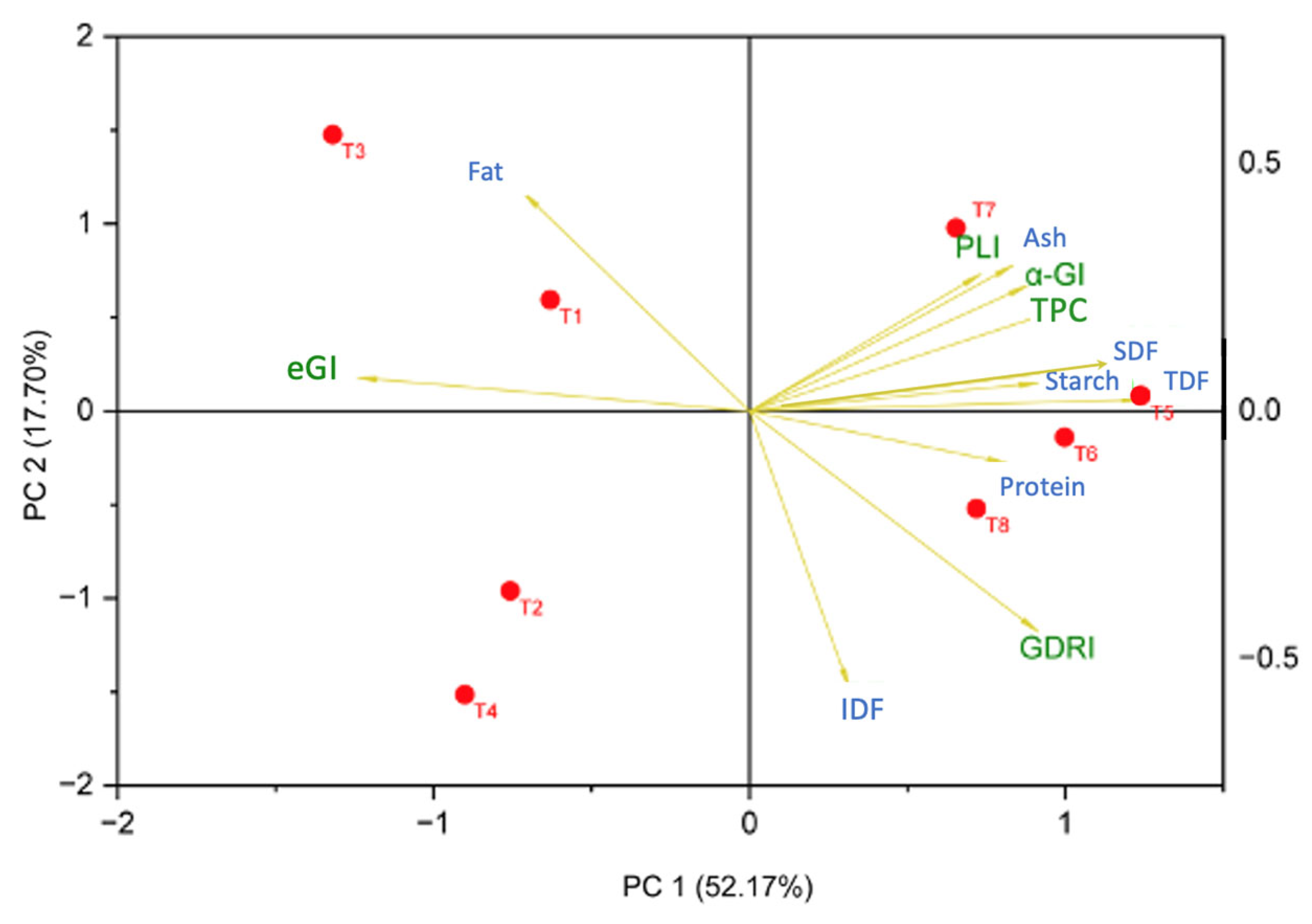
Principal component analysis (PCA) explained ~70% of the total variability (PC1 = 52.2%, PC2 = 17.7%), allowing a meaningful two-dimensional interpretation of the relationships among compositional, glycemic, and in vitro bioactivity variables (Figure 1). Although approximately 30% of the variance was not explained by the first two principal components, this level of explained variance is considered acceptable for complex food systems involving multiple compositional, structural, and functional variables. The remaining variance likely reflects the multifactorial nature of the powders and additional interactions not fully captured by PC1 and PC2. PC1 clearly separated samples according to their metabolic functionality. The positive side of PC1 was associated with higher values of TDF, SDF, TPC, GDRI, and enzyme inhibitory activities (α-GI and PLI), whereas the negative side was associated with higher eGI and fat content. This distribution confirms that fiber- and phenolic-rich matrices are strongly linked to improved functional properties, including reduced glycemic response and enhanced enzyme inhibition, in agreement with the correlation analysis (Section 3.4).
Treatments containing GA (T5–T8) were predominantly located on the positive side of PC1, together with variables related to SDF, GDRI, phenolic retention, and digestive enzyme inhibitory activities, showing a strong association between GA addition and these in vitro functional properties. In particular, T5 and T7 clustered in the positive quadrant of both PC1 and PC2, suggesting that SDF, GDRI, and enzyme inhibitory activities contributed strongly to their positioning in the PCA plot. This behavior suggests a synergistic effect between GA addition and fine particle size (80 µm), which enhances the retention and accessibility of bioactive compounds through matrix stabilization and increased surface area-to-volume ratio [37]. In contrast, treatments without GA (T1–T4) were located toward the negative side of PC1, associated with higher eGI and fat content, reflecting a less favorable metabolic profile. This distribution suggests that the absence of GA limits the structural stabilization of the matrix, potentially increasing starch accessibility and accelerating glucose release. PC2 provided a secondary level of discrimination related to structural characteristics. Treatments T6 and T8 (500 µm with GA) were positioned in the positive PC1 and negative PC2 quadrant, associated with protein, IDF, and GDRI. This indicates a denser and more structured matrix with enhanced glucose retention capacity, likely due to reduced starch accessibility and slower diffusion during digestion [35].

4. Conclusions

This study suggests that the in vitro functional properties of faba bean (Vicia faba L.) pod powders are modulated by both processing and formulation variables, with drying method, particle size, and GA addition exerting different effects depending on the compositional or functional parameter evaluated. Total phenolic content and lipase inhibitory activity were mainly governed by the independent effects of drying method, particle size, and GA addition, whereas α-GI and GDRI exhibited significant interaction effects involving GA, highlighting the role of matrix structure in modulating bioactivity. Among the factors studied, the addition of GA exerted a major influence on the in vitro functional properties of the powders, contributing to higher SDF and TPC, enhanced α-GI and LPI activities, increased GDRI values, and reduced eGI. Drying method influenced both composition and functionality, with HAD generally promoting higher enzyme inhibitory activity, while FD, particularly in combination with GA, favored phenolic preservation. Particle size acted as a structural modulator, where finer particles enhanced phenolic accessibility, while larger particles contributed to improving glucose diffusion retardation.
Correlation and multivariate analyses confirmed that SDF and TPC are the main contributors to in vitro metabolic functionality, while matrix structure governs their interaction with digestive enzymes and substrates. In particular, SDF was identified as the key factor controlling glycemic response, whereas TPC was primarily associated with enzyme inhibition. Particle size acted as a secondary structural factor, modulating starch digestibility and glucose diffusion. Although PCA and Pearson correlation analyses allowed identification of relevant associations among compositional and in vitro functional variables, future studies involving larger experimental datasets and additional formulation conditions may provide deeper insight through additional multivariate predictive analyses.
Taken together, these findings highlight the potential of the faba bean pod powders developed in this study as sustainable ingredients with in vitro functional properties, contributing to the valorization of agri-food by-products within a circular economy approach. Although the concentration of GA used in this study was selected to maximize its stabilizing and protective effects on the powder matrix, such levels could influence texture, mouthfeel, and formulation properties in final food applications. Therefore, future studies should optimize incorporation levels according to the target product and evaluate their technological and sensory impact in specific applications such as bakery products, snacks, or powdered formulations.

Supplementary Materials

The following supporting information can be downloaded at: https://www.mdpi.com/article/10.3390/app16115437/s1. Table S1: Three-way ANOVA results showing the effects of drying method (D), particle size (S), and gum arabic addition (GA), and their interactions on the proximate composition of faba bean (Vicia faba L.) pod powders.; Table S2: Three-way ANOVA results showing the effects of drying method (D), particle size (S), and gum arabic addition (GA) and their interactions on estimated glycemic index (eGI) and glucose dialysis retardation index (GDRI) of faba bean (Vicia faba L.) pod powders; Table S3: Three-way ANOVA results showing the effects of drying method (D), particle size (S), and gum arabic addition (GA) and their interactions on estimated total phenols and lipase and α-Glucosidase inhibition of faba bean (Vicia faba L.) pod powders; Table S4: Pearson correlation coefficients (r) among compositional, glycemic and bioactivity parameters of faba bean (Vicia faba L.) pod powders.

Author Contributions

Conceptualization, M.d.M.C., N.M.-N. and E.G.-M.; methodology, A.I.B.-L., M.d.M.C., N.M.-N. and E.G.-M.; formal analysis, A.I.B.-L. and E.G.-M.; investigation, A.I.B.-L. and E.G.-M.; data curation, A.I.B.-L.; writing—original draft preparation, A.I.B.-L. and E.G.-M.; writing—review and editing, E.G.-M.; supervision, M.d.M.C., N.M.-N. and E.G.-M.; project administration, M.d.M.C., N.M.-N. and E.G.-M.; funding acquisition, M.d.M.C., N.M.-N. and E.G.-M. All authors have read and agreed to the published version of the manuscript.

Funding

This research was funded by Ministerio de Ciencia e Innovación/Agencia Estatal de Investigación/10.13039/501100011033/ and “Fondo Europeo de Desarrollo Regional, UE” through the R&D&I project [PID2022-139711OB-C21].

Institutional Review Board Statement

Not applicable.

Informed Consent Statement

Not applicable.

Data Availability Statement

The original contributions presented in this study are included in the article/Supplementary Materials. Further inquiries can be directed to the corresponding author.

Conflicts of Interest

The authors declare no conflicts of interest.

Abbreviations

The following abbreviations are used in this manuscript:
ANOVAAnalysis of variance
α-GIα-glucosidase inhibition
DDrying method
eGIEstimated glycemic index
FDFreeze-drying
GAGum Arabic
GDRIGlucose dialysis retardation index
HADHot air drying
IDFInsoluble dietary fiber
PCAPrincipal component analysis
PLIPancreatic lipase inhibition
SParticle size
SDFSoluble dietary fiber
TDFTotal dietary fiber
TPCTotal phenolic content

References

  1. FAO. Food Loss and Waste. Available online: https://www.un.org/en/observances/end-food-waste-day (accessed on 10 March 2026).
  2. Lau, K.Q.; Sabran, M.R.; Shafie, S.R. Utilization of Vegetable and Fruit By-Products as Functional Ingredient and Food. Front. Nutr. 2021, 8, 661693. [Google Scholar] [CrossRef]
  3. Maja, L.; Krenz, M.; Grebenteuch, S.; Zocher, K.; Rohn, S.; Pleissner, D. Valorization of faba bean by-products. Biomass Convers. Biorefin. 2024, 14, 26663–26680. [Google Scholar] [CrossRef]
  4. Lu, Y.H.; Tian, C.R.; Gao, C.Y.; Wang, B.N.; Yang, W.Y.; Kong, X.; Chai, L.Q.; Chen, G.C.; Yin, X.F.; He, Y.H. Phenolic composition, antioxidant capacity and inhibitory effects on α-glucosidase and lipase of immature faba bean seeds. Int. J. Food Prop. 2018, 21, 2366–2377. [Google Scholar] [CrossRef]
  5. Ashraf, Z.U.; Shah, A.; Gani, A.; Gani, A. Effect of enzymatic hydrolysis of pulse protein macromolecules to tailor structure for enhanced nutraceutical properties. LWT 2024, 205, 116502. [Google Scholar] [CrossRef]
  6. Liu, Z.; Zhang, J.; Lu, S.; Tang, W.; Zhou, Y.; Quek, S.Y. Effects of different drying methods on phenolic components and in vitro hypoglycemic activities of pulp extracts from two Chinese bayberry (Myrica rubra Sieb. et Zucc.) cultivars. Food Sci. Hum. Wellness 2022, 11, 366–373. [Google Scholar] [CrossRef]
  7. Oyinloye, T.M.; Yoon, W.B. Effect of Freeze-Drying on Quality and Grinding Process of Food Produce: A Review. Processes 2020, 8, 354. [Google Scholar] [CrossRef]
  8. Xiao, H.W.; Mujumdar, A.S. Importance of drying in support of human welfare. Dry. Technol. 2020, 38, 1542–1543. [Google Scholar] [CrossRef]
  9. Silva-Espinoza, M.A.; Camacho, M.M.; Martínez-Monzó, J.; Martínez-Navarrete, N. Impact of the freeze-drying conditions applied to obtain an orange snack on energy consumption. Foods 2021, 10, 2726. [Google Scholar] [CrossRef]
  10. Ali, B.H.; Ziada, A.; Blunden, G. Biological effects of gum arabic: A review of some recent research. Food Chem. Toxicol. 2009, 47, 1–8. [Google Scholar] [CrossRef] [PubMed]
  11. Camacho, M.M.; Fernández-Vargas, N.; García-Martínez, E.; Martínez-Navarrete, N. Influence of the use of gum Arabic or OSA starch and the drying process on the quality of the fava bean (Vicia faba) pod flour. Food Hydrocoll. Health 2025, 7, 100201. [Google Scholar] [CrossRef]
  12. Silva-Espinoza, M.A.; García-Martínez, E.; Martínez-Navarrete, N. Protective capacity of gum Arabic, maltodextrin, different starches, and fibers on the bioactive compounds and antioxidant activity of an orange puree (Citrus sinensis (L.) Osbeck) against freeze-drying and in vitro digestion. Food Chem. 2021, 357, 129724. [Google Scholar] [CrossRef]
  13. Al-Jubori, Y.; Ahmed, N.T.B.; Albusaidi, R.; Madden, J.; Das, S.; Sirasanagandla, S.R. The efficacy of gum arabic in managing diseases: A systematic review of Evidence-Based Clinical Trials. Biomolecules 2023, 13, 138. [Google Scholar] [CrossRef]
  14. Bagheri, F.; Rahi, A. Anti-diabetic, anti-obesity, antimicrobial, and anticancer applications of gum Arabic: Pharmaceutical advances. Micro Nano Bio Asp. 2024, 3, 1–6. [Google Scholar] [CrossRef]
  15. AOAC. Official methods. In Official Methods of Analysis; AOAC: Washington, DC, USA, 1990. [Google Scholar]
  16. ISO 10520:1997; Native Starch—Determination of Starch Content—Ewers Polarimetric Method. International Organization for Standardization: Geneva, Switzerland, 1997.
  17. Barrial-Lujan, A.I.; García-Martínez, E.; Camacho, M.M.; Martínez-Navarrete, N. Unveiling the functional potential of fava bean pod powder: How particle size shapes bioactive properties. LWT—Food Sci. Technol. 2025, 238, 118825. [Google Scholar] [CrossRef]
  18. De Camargo, A.C.; Regitano-d’Arce, M.A.B.; Biasoto, A.C.T.; Shahidi, F. Enzyme-assisted extraction of phenolics from winemaking by-products: Antioxidant potential and inhibition of alpha-glucosidase and lipase activities. Food Chem. 2016, 212, 395–402. [Google Scholar] [CrossRef]
  19. Liu, R.; Xu, B. Inhibitory Effects of Phenolics and Saponins from Commonly Consumed Food Legumes in China Against Digestive Enzymes Pancreatic Lipase and α-Glycosidase. Int. J. Food Prop. 2015, 18, 2246–2255. [Google Scholar] [CrossRef]
  20. Mir, S.A.; Farooq, M.; Naseem, Z.; Mugabi, R. Techno-functional, nutritional, antioxidant and prebiotic potential of underutilized buck wheat flour from Western Himalayas of Jammu and Kashmir. Appl. Food Res. 2025, 5, 100723. [Google Scholar] [CrossRef]
  21. Li, S.; Liu, F.; Wu, M.; Li, Y.; Song, X.; Yin, J. Effects of Drying Treatments on Nutritional Compositions, Volatile Flavor Compounds, and Bioactive Substances of Broad Beans. Foods 2023, 12, 2160. [Google Scholar] [CrossRef] [PubMed]
  22. De Vos, P.; Faas, M.M.; Spasojevic, M.; Sikkema, J. Encapsulation for preservation of functionality and targeted delivery of bioactive food components. Int. Dairy J. 2010, 20, 292–302. [Google Scholar] [CrossRef]
  23. Laureanti, E.J.G.; Paiva, T.S.; Jorge, L.M.; Jorge, R.M. Microencapsulation of bioactive compound extracts using maltodextrin and gum arabic by spray and freeze-drying techniques. Int. J. Biol. Macromol. 2023, 253, 126969. [Google Scholar] [CrossRef] [PubMed]
  24. Salari, S.; Ferreira, J.; Lima, A.; Sousa, I. Effects of Particle Size on Physicochemical and Nutritional Properties and Antioxidant Activity of Apple and Carrot Pomaces. Foods 2024, 13, 710. [Google Scholar] [CrossRef]
  25. Millar, K.A.; Gallagher, E.; Burke, R.; Mccarthy, S.; Barry-Ryan, C. Proximate composition and anti-nutritional factors of fava-bean (Vicia faba), green-pea and yellow-pea (Pisum sativum) flour. J. Food Compos. Anal. 2019, 82, 103233. [Google Scholar] [CrossRef]
  26. Kalili, A.; El Ouafi, R.; Aboukhalaf, A.; Naciri, K.; Tbatou, M.; Essaih, S.; Belahyan, A.; Belahsen, R. Chemical composition and antioxidant activity of extracts from Moroccan fresh fava beans pods (Vicia faba L.). Rocz. Panstw. Zakl. Hig. 2022, 73, 79–86. [Google Scholar] [CrossRef]
  27. Mateos-Aparicio, I.; Redondo-Cuenca, A.; Villanueva-Suárez, M.J.; Zapata-Revilla, M.A.; Tenorio-Sanz, M.D. Pea pod, broad bean pod and okara, potential sources of functional compounds. LWT 2010, 43, 1467–1470. [Google Scholar] [CrossRef]
  28. Siddiqui, S.A.; Ucak, İ.; Jain, S.; Elsheikh, W.; Ali Redha, A.; Kurt, A.; Toker, O.S. Impact of drying on techno-functional and nutritional properties of food proteins and carbohydrates—A comprehensive review. Dry. Technol. 2024, 42, 592–611. [Google Scholar] [CrossRef]
  29. Goff, H.D.; Repin, N.; Fabek, H.; El Khoury, D.; Gidley, M.J. Dietary fibre for glycaemia control: Towards a mechanistic understanding. Bioact. Carbohydr. Diet. Fibre 2018, 14, 39–53. [Google Scholar] [CrossRef]
  30. Devindra, S.; Chouhan, S.; Katare, C.; Talari, A.; Prasad, G.B.K.S. Estimation of glycemic carbohydrate and glycemic index/load of commonly consumed cereals, legumes and mixture of cereals and legumes. Int. J. Diabetes Dev. Ctries 2017, 37, 426–431. [Google Scholar] [CrossRef]
  31. Mohan, V.; Unnikrishnan, R.; Shobana, S.; Malavika, M.; Anjana, R.; Sudha, V. Are excess carbohydrates the main link to diabetes & its complications in Asians? Indian J. Med. Res. 2018, 148, 531–538. [Google Scholar] [CrossRef]
  32. FAO. Pulses: Nutritious Seeds for a Sustainable Future; FAO: Rome, Italy, 2016. [Google Scholar]
  33. Bongartz, U.; Erlenbeck, C.; Wohlfahrt, I. The Effect of Gum Acacia on Post-Prandial Glucose and Insulin Levels in Healthy Subjects. Food Nutr. Sci. 2022, 13, 424–438. [Google Scholar] [CrossRef]
  34. Di Cairano, M.; Condelli, N.; Caruso, M.C.; Marti, A.; Cela, N.; Galgano, F. Functional properties and predicted glycemic index of gluten free cereal, pseudocereal and legume flours. LWT—Food Sci. Technol. 2020, 133, 109860. [Google Scholar] [CrossRef]
  35. Fuentes-Alventosa, J.M.; Rodríguez-Gutiérrez, G.; Jaramillo-Carmona, S.; Espejo-Calvo, J.A.; Rodríguez-Arcos, R.; Fernández-Bolaños, J.; Guillén-Bejarano, R.; Jiménez-Araujo, A. Effect of extraction method on chemical composition and functional characteristics of high dietary fibre powders obtained from asparagus by-products. Food Chem. 2009, 113, 665–671. [Google Scholar] [CrossRef]
  36. Liu, Y.; Fan, C.; Tian, M.; Yang, Z.; Liu, F.; Pan, S. Effect of drying methods on physicochemical properties and in vitro hypoglycemic effects of orange peel dietary fiber. J. Food Process. Preserv. 2017, 41, e13292. [Google Scholar] [CrossRef]
  37. Almayda, N.; Masruri, M.; Safitri, A. Effectiveness of Using Gum Arabic for Co-Microencapsulation of Ruellia tuberosa L. and Tithonia diversifolia Extracts as Encapsulating Agent and Release Studies. Scientifica 2024, 2024, 9097238. [Google Scholar] [CrossRef]
  38. Chaieb, N.; González, J.L.; López-Mesas, M.; Bouslama, M.; Valiente, M. Polyphenols content and antioxidant capacity of thirteen faba bean (Vicia faba L.) genotypes cultivated in Tunisia. Food Res. Int. 2011, 44, 970–977. [Google Scholar] [CrossRef]
  39. Nartea, A.; Kuhalskaya, A.; Fanesi, B.; Orhotohwo, O.L.; Susek, K.; Rocchetti, L.; Di Vittori, V.; Bitocchi, E.; Pacetti, D.; Papa, R. Legume byproducts as ingredients for food applications: Preparation, nutrition, bioactivity, and techno-functional properties. Compr. Rev. Food Sci. Food Saf. 2023, 22, 1953–1985. [Google Scholar] [CrossRef]
  40. Loizzo, M.R.; Bonesi, M.; Leporini, M.; Falco, T.; Sicari, V.; Tundis, R. Chemical Profile and In Vitro Bioactivity of Vicia faba Beans and Pods. Proceedings 2020, 70, 45. [Google Scholar] [CrossRef]
  41. Sreerama, Y.N.; Takahashi, Y.; Yamaki, K. Phenolic Antioxidants in Some Vigna Species of Legumes and their Distinct Inhibitory Effects on α-Glucosidase and Pancreatic Lipase Activities. J. Food Sci. 2012, 77, C927–C933. [Google Scholar] [CrossRef]
  42. Ahmed, A.A.; Musa, H.H.; Fedail, J.S.; Sifaldin, A.Z.; Musa, T.H. Gum arabic suppressed diet-induced obesity by alteration of mRNA expression of genes involved in lipid metabolism in mouse liver. Bioact. Carbohydr. Diet. Fibre 2016, 7, 15–20. [Google Scholar] [CrossRef]
  43. Bakar, A.; Abas, F.; Ismail, A.; Khatib, A. Effect of Different Drying Treatments and Solvent Ratios on Phytochemical Constituents of Ipomoea aquatica and Correlation with α-Glucosidase Inhibitory Activity. Int. J. Food Prop. 2016, 19, 2817–2831. [Google Scholar] [CrossRef]
  44. Zhang, B.; Deng, Z.; Ramdath, D.D.; Tang, Y.; Chen, P.X.; Liu, R.; Liu, Q.; Tsao, R. Phenolic profiles of 20 Canadian lentil cultivars and their contribution to antioxidant activity and inhibitory effects on α-glucosidase and pancreatic lipase. Food Chem. 2015, 172, 862–872. [Google Scholar] [CrossRef]
  45. Tan, Y.; Chang, S.K.C.; Zhang, Y. Comparison of α-amylase, α-glucosidase and lipase inhibitory activity of the phenolic substances in two black legumes of different genera. Food Chem. 2017, 214, 259–268. [Google Scholar] [CrossRef]
  46. Mindrican, C.B.I.; Khaled, Z.; Magdalena, M.; Oprea, E.; Neacșu, S.M.; Moroșan, E.; Dumitrescu, D.E.; Roșca, A.C.; DrăgănEscu, D.; Negrei, C. Therapeutic Benefits and Dietary Restrictions of Fiber Intake: A State of the Art Review. Nutrients 2022, 14, 2641. [Google Scholar] [CrossRef]
  47. De Araújo, F.F.; De Paulo Farias, D.; Neri-Numa, I.A.; Dias-Audibert, F.L.; Delafiori, J.; Gama de Souza, F.; Ramos, R.; do Sacramento, C.K.; Glaucia, M.P. Gastrointestinal bioaccessibility and bioactivity of phenolic compounds from araçá-boi fruit. LWT—Food Sci. Technol. 2021, 135, 110230. [Google Scholar] [CrossRef]
Figure 1. Principal component analysis (PCA) biplot of compositional, glycemic and in vitro bioactivity variables of faba bean (Vicia faba L.) pod powders under different processing conditions. TDF: total dietary fiber; SDF: soluble dietary fiber; IDF: insoluble dietary fiber; eGI: estimated glycemic index; GDRI: glucose dialysis retardation index; TPC: total phenols; α-GI: α-glucosidase inhibition; PLI: pancreatic lipase inhibition. Samples: T1 (HAD, 0% GA, 80 µm), T2 (FD, 0% GA, 80 µm), T3 (FD, 0% GA, 500 µm), T4 (FD, 0% GA, 500 µm), T5 (HAD, 45% GA, 80 µm), T6 (HAD, 45% GA, 500 µm), T7 (FD, 45% GA, 80 µm), T8 (FD, 45% GA, 500 µm).
Applsci 16 05437 g001
Table 1. Proximate composition of faba bean (Vicia faba L.) pod powders as affected by drying method, particle size, and gum Arabic addition.
Drying MethodParticle Size 80 µmParticle Size 500 µmSignificant Factors/Interactions
0 (GA)45 (GA)0 (GA)45 (GA)
ProteinHAD20.1 ± 1.121.76 ± 0.0520.24 ± 0.0422 ± 3D, S, GA; D × S, D × GA, S × GA, D × S × GA
FD9 ± 316.63 ± 0.0810.0 ± 0.722.3 ± 1.2
FatHAD1.06 ± 0.030.32 ± 0.030.53 ± 0.180.52 ± 0.04D, S, GA; D × GA, S × GA
FD1.25 ± 0.110.55 ± 0.030.40 ± 0.030.74 ± 0.03
AshHAD7.9 ± 0.411.13 ± 0.027.26 ± 0.099.53 ± 0.02D, S, GA; D × S, D × GA, S × GA, D × S × GA
FD9.2 ± 0.712.57 ± 0.018.7 ± 0.49.30 ± 0.15
Total carbohydratesHAD67.8 ± 0.562.99 ± 0.0368.27 ± 0.1064.6 ± 1.1-
FD76.9 ± 1.366.55 ± 0.0477.8 ± 0.461.9 ± 0.4
StarchHAD10.9 ± 0.326.6 ± 1.16.66 ± 0.0428 ± 3D, GA; D × GA
FD19 ± 324.19 ± 0.0821.7 ± 0.825.0 ± 1.2
Total dietary fiberHAD40.2 ± 0.682.99 ± 0.1332.6 ± 1.480 ± 3GA; D × S, D × GA
FD36.3 ± 3.176.44 ± 0.6544.8 ± 0.583.5 ± 0.4
Insoluble fiberHAD26.0 ± 1.026.9 ± 0.525.8 ± 0.425.3 ± 1.5D, S; D × S, S × GA
FD19 ± 321.2 ± 0.427.72 ± 0.0825.8 ± 0.3
Soluble fiberHAD14.1 ± 0.456.0 ± 0.37 ± 155.1 ± 1.6D, S, GA; D × S, D × GA, S × GA
FD17.67 ± 0.1055.3 ± 1.017.0 ± 0.557.78 ± 0.14
Data are expressed as mean ± standard deviation (n = 3) on g/100 g dry solids. Significant main effects and interactions according to three-way ANOVA (p < 0.05) are indicated. Detailed significance levels are presented in Table S1. HAD: hot air drying; FD: freeze-drying; D: drying method (HAD vs. FD); S: particle size (80 vs. 500 µm); GA: gum Arabic (0 and 45 g/100 g dry solids).
Table 2. Estimated glycemic index (eGI) and glucose dialysis retardation index (GDRI) of faba bean (Vicia faba L.) pod powders as affected by drying method, particle size and gum Arabic addition.
Drying MethodParticle Size 80 µmParticle Size 500 µmSignificant Factors/Interactions
0 (GA)45 (GA)0 (GA)45 (GA)
eGI (%)HAD22.1 ± 1.117.2 ± 0.621 ± 216.2 ± 1.4D, S, GA
FD23.3 ± 0.418.5 ± 1.722.4 ± 0.516.1 ± 0.3
GDRI (%)HAD13.8 ± 0.754.3 ± 0.846.7 ± 1.360.8 ± 1.3S, GA; D × GA, S × GA
FD10 ± 240.0 ± 0.947 ± 359.6 ± 0.6
Data are expressed as mean ± standard deviation (n = 3). Significant main effects and interactions according to three-way ANOVA (p < 0.05) are indicated. Detailed significance levels are presented in Table S2. HAD: hot air drying; FD: freeze-drying; D: drying method (HAD vs. FD); S: particle size (80 vs. 500 µm); GA: gum Arabic (0 and 45 g/100 g dry solids).
Table 3. Total phenolic content and enzyme inhibitory activity (lipase and α-glucosidase) of faba bean (Vicia faba L.) pod powders as affected by drying method, particle size and gum Arabic addition.
Drying MethodParticle Size 80 µmParticle Size 500 µmSignificant Factors/Interactions
0 (GA)45 (GA)0 (GA)45 (GA)
TPC
(mg GAE/g)
HAD50.9 ± 0.752.8 ± 0.345 ± 247 ± 3D, S, GA
FD35.56 ± 0.0956.95 ± 1.1530.9 ± 1.353.3 ± 1.8
PLI (%)HAD20 ± 223.7 ± 0.813.7 ± 0.622.3 ± 1.2D, S, GA
FD14.12 ± 1.916.33 ± 1.79 ± 311 ± 2
α-GI (%)HAD11.0 ± 0.213.62 ± 0.129.21 ± 1.0211.4 ± 0.5D, S, GA; D × GA
FD8.3 ± 0.610.0 ± 1.95.72 ± 1.019.0 ± 0.3
Data are expressed as mean ± standard deviation (n = 3). Significant main effects and interactions according to three-way ANOVA (p < 0.05) are indicated. Detailed significance levels are presented in Table S1. HAD: hot air drying; FD: freeze-drying; TPC: total phenols; α-GI: α-glucosidase inhibition; PLI: pancreatic lipase inhibition; D: drying method (HAD vs. FD); S: particle size (80 vs. 500 µm); GA: gum Arabic (0 and 45 g/100 g dry solids).
Disclaimer/Publisher’s Note: The statements, opinions and data contained in all publications are solely those of the individual author(s) and contributor(s) and not of MDPI and/or the editor(s). MDPI and/or the editor(s) disclaim responsibility for any injury to people or property resulting from any ideas, methods, instructions or products referred to in the content.