Review

Breast Cancer: Characteristics, Diagnostic and Therapeutic Options and the Potential of Nanoparticle Applications

by
Ahmed El-Mallul
1,
Małgorzata Katarzyna Kowalska
2,*,
Karolina Sawicka
1,
Sara Małgorzata Orłowska
1,
Łukasz Bednarczyk
1 and
Łucja Radziszewska
3
1
Department of Health Sciences and Physical Culture, Casimir Pulaski Radom University, Street Chrobrego 27, 26-600 Radom, Poland
2
Department of Chemistry, Casimir Pulaski Radom University, Street Chrobrego 27, 26-600 Radom, Poland
3
Faculty of Medicine, Medical University of Warsaw, 02-091 Warsaw, Poland
*
Author to whom correspondence should be addressed.
Appl. Sci. 2026, 16(11), 5416; https://doi.org/10.3390/app16115416 (registering DOI)
Submission received: 19 April 2026 / Revised: 25 May 2026 / Accepted: 27 May 2026 / Published: 29 May 2026

Abstract

Breast cancer is one of the most commonly diagnosed malignant tumors worldwide and represents a significant public health problem. This paper presents the characteristics of the disease, with particular emphasis on risk factors, mechanisms of development, and molecular classification. Current diagnostic methods and available therapeutic strategies, such as surgery, chemotherapy (CT), radiotherapy (RT), and targeted therapies, are discussed. Particular attention is given to nanotechnology as a promising direction for the development of modern medicine. The potential applications of nanoparticles (NPs) in the diagnosis and treatment of breast cancer are presented, taking into account their mechanisms of action, potential clinical benefits, and limitations related to safety and efficacy. NPs may contribute to increased diagnostic precision and therapeutic efficacy, indicating their significant potential in the future of oncology.

1. Introduction

Breast cancer, characterized by significant biological heterogeneity and diverse epidemiological trends, remains the most commonly diagnosed malignant neoplasm among women. It encompasses multiple disease entities with distinct biological and molecular features, which translate into variability in clinical and pathological presentation. Regardless of histological classification, gene expression studies have enabled the identification of molecular subtypes distinguished based on their receptor status [1].
In 2022, approximately 2.3 million new cases of breast cancer and 670,000 deaths attributable to the disease were reported worldwide [2]. Breast cancer is the most frequently diagnosed malignancy among women and represents the leading cause of cancer-related incidence in 157 countries and mortality in 112 countries worldwide [3]. Sex is the most significant risk factor for breast cancer, with approximately 99% of cases occurring in women and only 0.5–1% in men. Breast cancer remains a malignancy whose incidence clearly increases with age, which significantly shapes the epidemiological profile of this disease. The vast majority of diagnoses concern women over 50 years of age and the median age at diagnosis is 62 years. The highest risk of incidence is observed in the 70–79 age group; however, despite the peak incidence in this age range, the risk of death from breast cancer continues to increase in subsequent decades of life. This trend is confirmed by the fact that the median age of patients at the time of death is 69 years [2,4,5].
Given the presented epidemiological data, effective management of breast cancer remains one of the major challenges in modern oncology. A key prerequisite is accurate clinical classification at the diagnostic stage, based on molecular subtyping, including the assessment of hormone receptor status, particularly estrogen (ER) and progesterone (PR) receptors, which carry significant prognostic implications [6]. Consequently, due to its marked biological heterogeneity, this malignancy is classified into three main subtypes based on the expression of hormone receptors (ER, PR) and human epidermal growth factor receptor 2 (HER2 (ERBB2)) status: luminal tumors (ER/PR-positive), further subdivided into luminal A and B; HER2-positive; and triple-negative breast cancer (TNBC) [7].
The standard diagnostic approach to breast cancer is primarily based on physical examination, imaging studies and pathological assessment [8]. Breast palpation plays an important role in the initial clinical assessment, involving the identification of thickening, irregularities, asymmetry, skin erythema and palpable masses; however, it is characterized by limited diagnostic specificity, as the majority of lesions detected in this manner are benign, most commonly corresponding to fibroadenomas, cysts, or fibrocystic changes [4,9]. Similarly, imaging modalities used in the diagnosis of breast cancer, despite their fundamental role in detection, diagnosis and staging, exhibit significant diagnostic limitations. The primary imaging techniques include mammography, ultrasonography (US) and breast magnetic resonance imaging (MRI) with dynamic contrast enhancement [10]. Mammography, despite its well-established role in breast cancer screening programs, demonstrates limited sensitivity in certain patient populations, particularly in women with dense breast tissue, which is associated with a high risk of false-negative results and the potential to miss small neoplastic lesions [11,12]. This phenomenon highlights significant limitations in the effectiveness of current screening strategies, as a substantial proportion of breast cancers in women undergoing regular screening are diagnosed at an advanced stage, often with lymph node involvement or distant metastases at the time of diagnosis [11]. Histopathologic examination constitutes an integral component of standard breast cancer diagnostics, enabling confirmation of the diagnosis and characterization of the tumor’s biological features. In clinical practice, the acquisition of tissue for histopathological evaluation is primarily based on core needle biopsy, most commonly performed under ultrasonographic guidance or using stereotactic techniques; in cases of suspected lymph node involvement, fine-needle aspiration biopsy or core needle biopsy of lymphatic lesions is employed [13]. However, this approach is associated with significant diagnostic limitations, as obtaining adequate and representative tissue samples may be challenging and the molecular and genetic information derived from a single biopsy has limited utility in the context of early cancer detection, screening and long-term disease monitoring [11].
With the dynamic advancement of medical technologies, intensive efforts are being undertaken to develop new, more sensitive and specific diagnostic methods for neoplastic diseases. In parallel, therapeutic strategies enabling more selective targeting of tumor tissue are being developed. Particular attention has been focused on nanotechnology-based approaches, in which the application of NPs offers the potential to overcome the limitations of conventional methods, both in early cancer detection and in the treatment of breast cancer. Owing to their unique physicochemical properties, such as small size, high surface-to-volume ratio and the ability to be functionalized with molecular ligands, NPs can be utilized not only as carriers of contrast agents in advanced imaging techniques but also as platforms for targeted delivery of therapeutic agents, thereby reducing their non-selective activity and systemic toxicity [6,14]. The ability of NPs to integrate diagnostic and therapeutic functions makes them a particularly promising tool in the context of the biological heterogeneity of breast cancer. The aim of this study was to collect and analyze current knowledge regarding the diagnosis, mechanisms of development, and existing as well as emerging therapeutic approaches in breast cancer, with particular emphasis on the rationale for the development and application of nanotechnological techniques. The study discusses the potential use of NPs in the diagnosis and treatment of breast cancer, presenting their mechanisms of action, clinical potential, and limitations associated with their application.

2. Biological Basis of Breast Cancer Progression

Breast cancer carcinogenesis is a complex, multistep process influenced by genetic susceptibility, environmental exposures, and a wide range of risk factors [8,15] (Table 1). The heterogeneity of breast cancer may arise both from the neoplastic transformation of epithelial or myoepithelial cells and from the transformation of a stem cell capable of differentiating into both of these cell types [15]. In properly functioning tissues, cellular division is tightly regulated by control mechanisms, enabling the maintenance of appropriate tissue structure and function. In contrast, during neoplastic transformation, these mechanisms become permanently disrupted, leading to uncontrolled, sustained cell proliferation that is independent of physiological regulatory signals from the surrounding environment [15]. Initially, clonal cellular proliferations are identified in histopathological examination as ductal proliferations lacking features of atypia. Subsequently, increasing genomic instability promotes the transformation of precursor lesions into carcinoma in situ [8]. As neoplastic transformation progresses, breast cancer carcinogenesis involves not only changes occurring within epithelial cells but also dynamic remodeling of the tumor microenvironment (TME). The TME comprises stromal cells, including cancer-associated fibroblasts (CAFs), endothelial cells, pericytes, and components of the extracellular matrix (ECM), as well as numerous populations of infiltrating immune cells, such as tumor-associated macrophages (TAMs), tumor-associated neutrophils (TANs) and dendritic cells (DCs). Through complex cell–cell and cell–matrix interactions, these components are reprogrammed by signals derived from cancer cells, promoting the development of an immunosuppressive and proangiogenic environment that supports further tumor progression [16].
The complexity of breast cancer carcinogenesis, encompassing both the transformation of cancer cells and dynamic changes within the tumor microenvironment, necessitates the development of therapeutic strategies that enable selective and effective targeting of tumor tissue. The effectiveness of anticancer therapy depends on the precise delivery of the drug to cancer cells and the induction of the intended therapeutic effect. In the context of NPs, this is primarily achieved through two fundamental mechanisms: passive targeting and active targeting, which constitute the main strategies for their application in breast cancer therapy [17].
Although both direct therapeutic agents toward malignant cells, passive targeting relies on specific features of the TME, which promote the accumulation of the drug within tumor sites [17]. A characteristic feature of passive targeting is the enhanced permeability and retention (EPR) effect. Due to abnormal and rapid angiogenesis, tumors develop leaky vasculature, which facilitates the penetration and accumulation of NPs and macromolecules within tumor tissue compared with normal tissues [18]. Moreover, impaired lymphatic drainage, characteristic of tumor tissues, facilitates the prolonged retention of NPs within the tumor microenvironment. This mechanism offers clear advantages, as it exploits intrinsic vascular abnormalities that distinguish tumor tissue from normal vasculature, ultimately contributing to a reduction in systemic adverse effects [17]. Passively targeted therapies based on the EPR effect may be insufficient for effective tumor localization. Indeed, preclinical studies have shown that only a very small fraction of the administered nanoparticle dose ultimately accumulates within tumor tissue. Passive targeting is limited by the lack of precise control over drug distribution and concentration within the tumor. Additionally, heterogeneity of the EPR effect, both between patients and across different tumor regions, leads to uneven nanoparticle accumulation and reduced predictability of the therapeutic outcome [19].
Active targeting strategies are inherently more complex than passive approaches [19]. In contrast to passive delivery, active targeting relies on molecular recognition mechanisms. In this approach, therapeutic carriers are engineered with ligands that selectively interact with tumor-associated receptors or antigens, often overexpressed on cancer cells. A wide range of ligands can be employed for this purpose, including monoclonal antibodies, short peptides, small molecules and other high-affinity binding moieties, all designed to enhance specificity and cellular uptake [17]. Active targeting strategies face multiple challenges, including physiological barriers that limit nanoparticle transport, pronounced intratumoral heterogeneity and the demanding design and engineering required to construct such delivery systems. Although active targeting enhances cellular uptake through receptor-mediated interactions, it encounters barriers such as inefficient drug release, endosomal escape and the potential loss of nanoparticle “stealth” properties, which may result in rapid clearance by the reticuloendothelial system and reduced drug delivery to the tumor site [19].

3. Breast Cancer Classification Systems: Molecular Subtypes, BI-RADS and TNM Staging

As mentioned earlier, breast cancer is a complex and heterogeneous disease entity that encompasses many subtypes differing, among other things, in cellular structure, molecular characteristics and clinical course [20]. A number of factors influence patient prognosis and treatment efficacy, including the degree of histological differentiation, tumor type and size, the presence of lymph node metastases, as well as the presence or absence of hormone receptors, i.e., ER, PR and HER2 [20,21,22].
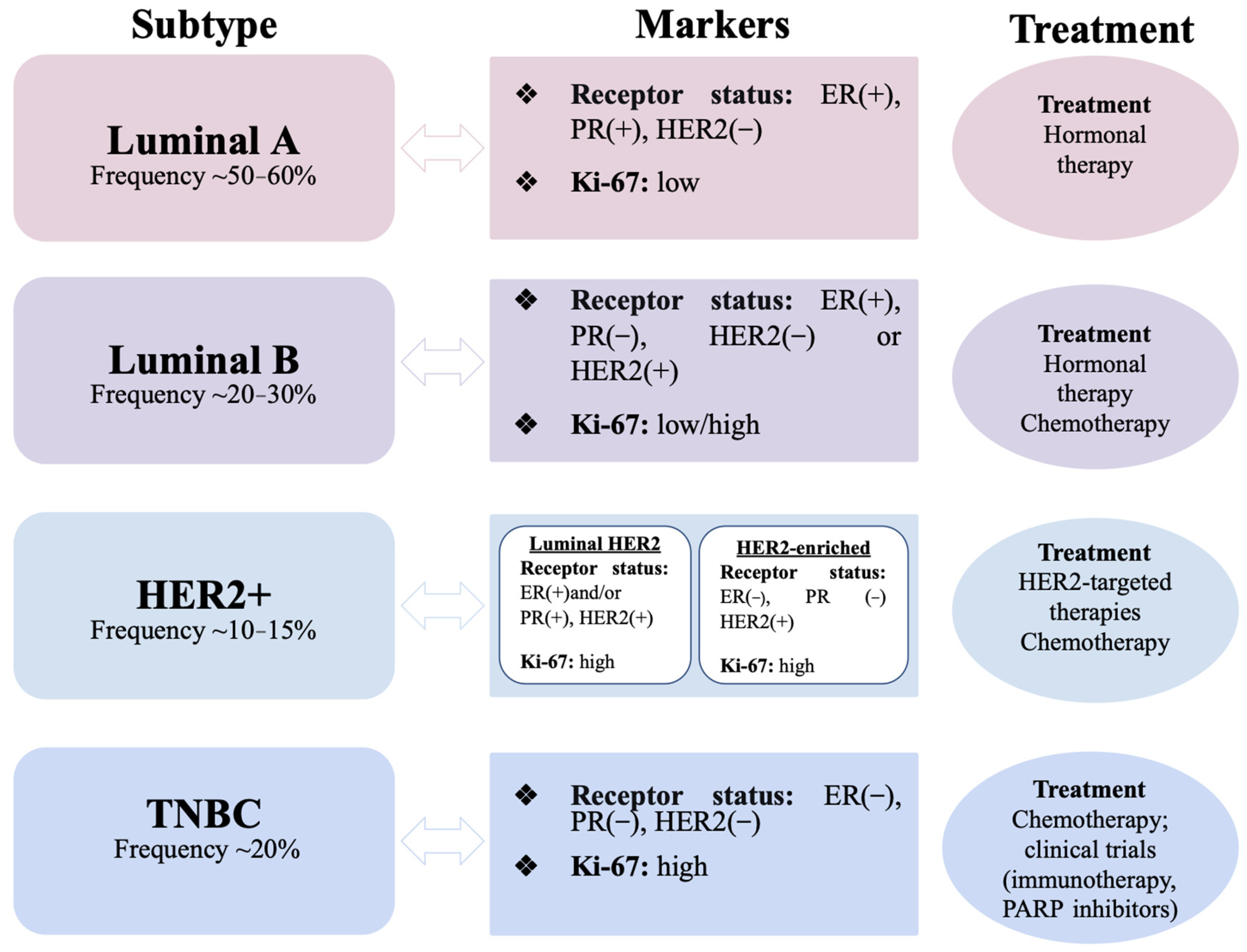
Molecular subtypes of breast cancer are determined based on the degree of histological differentiation and the presence of lymph node metastases, which are significant prognostic and predictive factors. For this reason, molecular identification of the tumor determines the choice of an appropriate therapeutic strategy [21,22]. In the process of classifying a specific breast cancer subtype, classical immunohistochemical markers such as ER, PR and HER2 receptors play a significant role [20]. Immunohistochemical classification has become a fundamental tool in assessing a tumor’s sensitivity to hormonal therapy. The initial introduction of markers for the ER and PR hormone receptors was a major breakthrough in the categorization of breast cancer [5,6,7]. Research has led to the identification of the main molecular subtypes of breast cancer: luminal A, luminal B, HER2-positive, and TNBC (Figure 1) [20,21,22,23].
The luminal A subtype is characterized by the presence of ER and/or PR, the absence of HER2 expression and a low level of the cell proliferation marker Ki-67—less than 20%—which indicates low tumor proliferation [5,6]. In this subtype, ER transcription factors activate genes whose expression is typical of the luminal epithelium lining the mammary ducts [23]. Clinically, these tumors are associated with a low degree of malignancy, grow slowly and have the best prognosis among all breast cancer subtypes, which is associated with a lower risk of recurrence and a higher survival rate [21,23]. This is the most common subtype of breast cancer, accounting for approximately 50–60% of all cases [22]. Hormonal therapy with tamoxifen or aromatase inhibitors is highly effective, whereas the benefits of CT remain limited [21]. From an imaging perspective, luminal A tumors often exhibit less aggressive features, including lower vascular perfusion, more homogeneous internal architecture, and reduced tissue stiffness on elastographic and contrast-enhanced examinations [27].
Luminal B-subtype tumors are associated with a higher degree of malignancy and a worse prognosis [23]. In most cases, luminal B tumors are characterized by positive ER expression, while at the same time they may not express PRs [21,23]. ER expression is similar in subtypes A and B, but remains crucial for distinguishing luminal from non-luminal cancers [23]. They are characterized by high Ki-67 expression (above 20%), which accelerates tumor growth and is associated with a poorer prognosis [22,28]. The increased proliferative potential of luminal B tumors is reflected not only at the molecular level but also in imaging characteristics. Higher Ki-67 expression has been associated with increased tumor stiffness heterogeneity and greater elastographic variability, particularly in shear wave elastography-derived parameters such as elasticity standard deviation (Esd), indicating more aggressive biological behavior [27].
According to the authors [24], the degree of Ki-67 expression can be used to differentiate luminal A tumors from the B subtype, which is important in terms of prognosis. Patients with breast cancer of the B subtype may benefit from hormone therapy combined with CT, as they respond to the administered CT to a greater extent than those with the luminal A subtype [21]. According to a study [28], luminal B-subtype tumors achieve a higher rate of complete pathological response after neoadjuvant CT.
Another molecular subtype of breast cancer is the HER2 subtype [22]. The HER2 acts as an oncoprotein; when stimulated, it activates the HER2 signaling pathway, leading to uncontrolled cell proliferation [22,25]. This group accounts for approximately 10–15% of breast cancers and is associated with high HER2 expression in the absence of ER and PR receptors [21]. These tumors grow faster than luminal-type cancers and the prognosis has improved due to the introduction and development of targeted therapies [21]. The HER2 subtype is associated with a worse prognosis but responds well to HER2-targeted therapies [28]. The consequence of HER2 overexpression at the cellular level is increased cell proliferation and survival, as well as enhanced neoangiogenesis associated with increased VEGF production [25]. The HER2 subtype is more likely than luminal A cancers to present as multifocal disease [25]. Ultrasound-based studies demonstrated that HER2-positive lesions often present with larger tumor diameter, heterogeneous echogenicity, extensive calcifications, and rapid contrast enhancement kinetics, reflecting their aggressive growth pattern and increased intratumoral necrosis. These findings support the close relationship between HER2 overexpression and tumor vascular remodeling [27].
Within the HER2 subtype, two groups are distinguished: luminal HER2 (ER+, PR+, HER2+ and Ki-67: 15–30%) and HER2-enriched (HER2+, ER-, PR-, Ki-67 > 30%). Both types show a high response rate to CT regimens [21]. Based on a literature review conducted in 2016, it was found that women with the HER2-enriched subtype achieved a higher rate of complete pathological response compared to those with the luminal HER2 subtype [29]. The same authors report that the rate of complete pathological response can be increased to over 70% with therapy using trastuzumab and lapatinib or trastuzumab and pertuzumab, in combination with anthracycline- and taxane-based CT [29].
The TNBC subtype constitutes a heterogeneous group of breast cancers accounting for approximately 20% of all breast cancers [21,23]. TNBC includes tumors that do not express hormone receptors or overexpress HER2. It is characterized by the absence of ER and PR expression and the absence of HER2 overexpression [23]. According to the authors [21], this subtype most commonly occurs in women under 40 years of age and in the African American population. The vast majority of breast cancers (80%) that develop in women with a BRCA1 germline mutation belong to the triple-negative group [23]. The TNBC group is highly diverse in terms of histological phenotypes, gene expression and treatment response [21]. Studies [22] confirm that TNBC can be divided into seven subtypes: basal (BL1 and BL2), low claudin expression (CL), mesenchymal (M), luminal with androgen receptor (LAR), immunomodulatory (IM) and mesenchymal stem-like (MSL). According to studies [22,29], the mesenchymal subtype is characterized by the least favorable treatment outcomes, while the immunomodulatory breast cancer group shows the best treatment results among TNBC subtypes. Distinguishing between basal-like and non-basal-like subtypes within TNBC is crucial for selecting CT treatment strategies. The authors [29] indicate that carboplatin and docetaxel are highly effective in treating basal-like TNBC subtypes, but are less effective in non-basal-like cases of metastatic disease.
TNBC tumors have an aggressive course, early recurrences and a greater tendency to occur in advanced stages. They are associated with high proliferation or defects in DNA repair genes [21]. Tumors belonging to the TNBC subtype are characterized by the presence of a central scar, tumor necrosis and are more often solitary compared to ER+/PR+/HER2+ tumors [25]. The rate of complete pathological response following CT with anthracyclines and taxanes was 25–35% in patients with TNBC, indicating a better prognosis [28].
Despite their highly aggressive biological behavior, TNBC lesions may exhibit imaging characteristics partially resembling benign tumors. Ultrasound examinations frequently demonstrate circumscribed or microlobulated margins, limited calcifications, and relatively reduced internal vascular signals due to rapid tumor proliferation accompanied by central necrosis [27]. Contrast-enhanced ultrasound studies further revealed that TNBC lesions may display sharply demarcated enhancement patterns, potentially complicating radiological differentiation from benign masses [27].
Recent studies additionally emphasize that molecular subtype classification correlates not only with differences in prognosis and therapeutic response, but also with distinct imaging phenotypes detectable using multimodal ultrasound techniques, including conventional ultrasound (CUS), shear wave elastography, and contrast-enhanced ultrasound. These imaging characteristics reflect differences in tumor vascularization, proliferation dynamics, tissue stiffness, and necrotic changes associated with individual molecular subtypes [27]. In particular, CEUS and SWE parameters have demonstrated associations with HER2 expression, Ki-67 proliferation index, and tumor angiogenesis, suggesting their potential utility in the non-invasive prediction of molecular subtype before treatment initiation [27].
Studies have been conducted to analyze how different molecular subtypes of breast cancer affect the efficacy of radiation therapy following breast-conserving surgery (BCS). The results of these analyses suggest that specific molecular subtypes may respond differently to radiation therapy, which has direct implications for optimizing further treatment [29]. In patients with luminal-subtype breast cancer who underwent RT, significant benefits were observed, including a reduced risk of local recurrence, regional recurrence and prolonged disease-free survival [30]. In contrast, patients with non-luminal-subtype tumors showed limited benefits. The authors [30] emphasize that, with regard to the risk of metastasis, RT reduced the likelihood of metastasis following BCS only in patients with luminal A breast cancer. The analyses indicate that the difference in the efficacy of RT across different molecular subtypes stems from significantly increased radiosensitivity in luminal breast cancer [30]. The authors [29] point to a correlation indicating that a higher Ki-67 index value is a predictor of local recurrence following RT after mastectomy. In the case of HER2-positive breast cancer and TNBC, strong radiation resistance has been demonstrated, which correlates with a poorer prognosis [30]. According to a study [29], patients with TNBC had the highest risk of local–regional recurrence compared to other biological subtypes. Studies of molecular mechanisms have revealed the existence of a HER2-NF-κB-HER2 loop responsible for adaptive resistance to radiation therapy [30]. It has been observed that a signaling pathway involving FAK kinase may modulate radiation sensitivity in HER2-overexpressing breast cancer [30]. Due to limitations in the treatment of patients with HER2-overexpressing breast cancer, in 2008 the Food and Drug Administration (FDA) approved trastuzumab as a humanized monoclonal antibody directed against HER2 [29]. The combination of trastuzumab with standard CT or neoadjuvant CT improves the prognosis of patients with HER2+ tumors [29]. In the context of TNBC, microRNAs play a significant role in regulating radiosensitivity and it has been demonstrated that elevated expression of miR-27a is critical for the response to RT in this patient group [30].
Recent studies using three-dimensional models of breast cancer spheroids further confirm the significant biological heterogeneity of individual molecular subtypes and indicate that their phenotypic behavior is more strongly associated with epithelial–mesenchymal transition (EMT) status than with molecular classification alone [31,32]. An analysis of nine cell lines representing luminal A and B, HER2-positive, basal-like, and claudin-low subtypes revealed distinct differences in spheroid morphology, growth dynamics, survival, and expression of EMT markers [31]. Luminal-type spheroids were characterized by a compact structure with high E-cadherin expression and an epithelial phenotype, whereas claudin-low lines and some HER2-positive and basal-like models formed loosely aggregated spheroids with mesenchymal phenotypic features associated with vimentin expression [31].
Importantly, the three-dimensional models retained key immunohistochemical features corresponding to the parental cell lines, including the expression of ER, PR, and HER2 receptors as well as the Ki-67 proliferation marker, confirming their high translational value in breast cancer research [31]. The authors emphasize that spheroids better replicate the in vivo tumor architecture, oxygen and nutrient gradients, proliferative heterogeneity, and cell–cell interactions than classical 2D cultures, making them a useful tool for studying the biology of subtypes, EMT processes, and treatment responses [32].
Altogether, contemporary breast cancer classification integrates histopathological, molecular and functional characteristics, reflecting the multidimensional heterogeneity of the disease [27]. While molecular classification provides critical insight into the biological heterogeneity, prognosis, and therapeutic responsiveness of breast cancer, comprehensive patient management also requires accurate imaging-based assessment. Therefore, alongside histopathological and molecular characterization, standardized radiological evaluation systems play a fundamental role in the diagnostic workflow and clinical decision-making process [21,23,31,33].
One of the most widely adopted imaging classification systems in breast oncology is the Breast Imaging Reporting and Data System (BI-RADS), developed by the American College of Radiology, is a standardized classification system used in breast imaging to improve the consistency and transparency of radiological reports [34]. Introduced in the 1990s in response to the growing use of mammography and significant variability in radiological interpretations, BI-RADS provides uniform terminology for describing imaging findings and assessing the risk of malignancy [35]. The system includes standardized descriptors of mammographic features, such as breast density, masses, calcifications, and architectural abnormalities, as well as final assessment categories ranging from BI-RADS 0 (incomplete assessment) to BI-RADS 6 (histopathologically confirmed cancer). Each category is associated with specific recommendations for further management and an estimated probability of cancer [33]. The BI-RADS classification system and its assessment categories are presented in Table 2.
Due to limitations in earlier editions of the BI-RADS system—which included, among other things, differences in report structure across imaging modalities and a lack of full integration of new diagnostic techniques—the sixth edition of the BI-RADS system was introduced in 2025. This update aimed to standardize reporting for mammography, US, MRI, and contrast-enhanced mammography (CEM), as well as to adapt the system to advancements in modern imaging methods, such as digital breast tomosynthesis (DBT) and abbreviated MRI protocols [35].
The implementation of the BI-RADS system significantly improved communication between radiologists and clinicians, facilitated clinical decision-making, and contributed to better quality control of breast cancer screening and diagnosis [34].
In addition to imaging-based assessment systems such as BI-RADS, an essential component of breast cancer evaluation is anatomical staging using the TNM system [36,37].
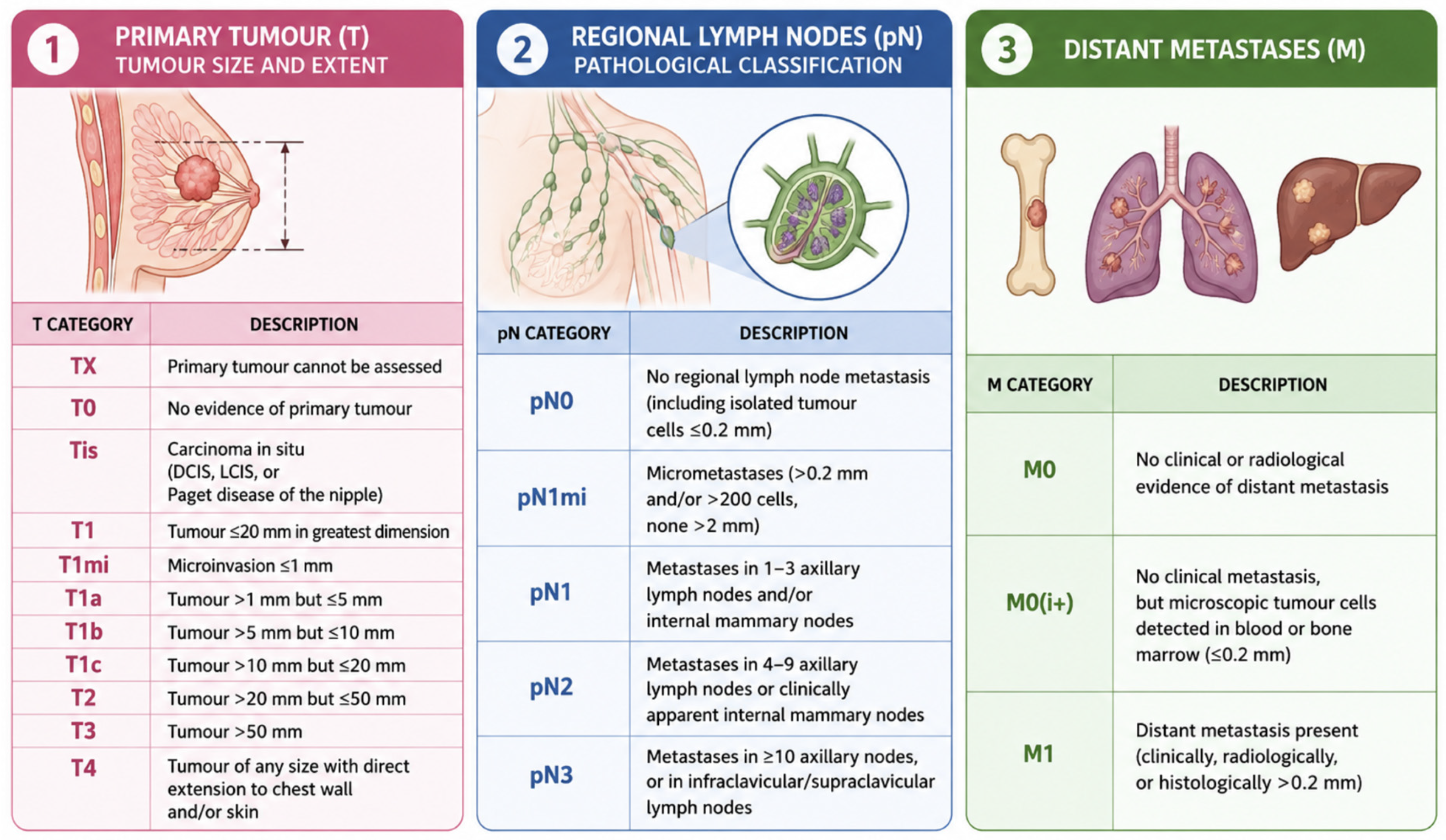
The stage of breast cancer is determined based on clinical and histopathological evaluation. Clinical staging is based on a physical examination and the results of imaging studies performed before the start of treatment, while histopathological staging is determined based on pathological examination of the primary tumor and regional lymph nodes following surgical treatment [36]. The goal of staging is to classify patients into risk groups that determine prognosis and help select appropriate therapeutic management for patients with a similar disease course. Breast cancer is classified according to the TNM system developed by the Union for International Cancer Control (UICC) and the American Joint Committee on Cancer, which takes into account the size of the primary tumor (T), the status of regional lymph nodes (N), and the presence of distant metastases (M) [36,37]. In the latest UICC TNM 9 classification, valid for cancers diagnosed on or after January 1, 2026, the existing classification principles have been retained while clarifying the definitions of individual categories [37]. The TNM classification system for breast cancer is summarized in Figure 2.
Overall, the integration of molecular subtyping, imaging-based BI-RADS assessment, and anatomical TNM staging provides a comprehensive framework for breast cancer characterization. These complementary classification systems enable precise tumor evaluation, improved prognostic stratification, and more individualized therapeutic decision-making [20,23,34,35,37].

4. Modern Approaches to Breast Cancer Diagnostics: The Role of Contrast-Enhanced MRI and Emerging Technologies

The development of modern diagnostic methods for breast cancer is currently focused on increasing the sensitivity and specificity of imaging tests while reducing their invasiveness and the burden on patients. The application of nanotechnology in imaging and perioperative procedures has enabled the introduction of new classes of contrast agents and localization systems, which are finding increasingly widespread clinical use. This paper presents the current possibilities for using nanoparticles in breast cancer diagnostics, including advanced MRI and magnetic techniques that support surgical treatment [16,25].
Contrast-enhanced magnetic resonance imaging (CE-MRI) of the breast is a valuable tool in the diagnosis and treatment of breast cancer [26]. It enables the staging of diagnosed breast cancer. CE-MRI has proven helpful in determining the stage of newly diagnosed breast cancer, planning surgical procedures and assessing response to treatment [38]. CE-MRI is used to detect multifocal lesions as well as lesions in the contralateral breast, which has a significant impact on treatment decisions. There are scientific reports confirming the role of CE-MRI in screening women who are at high genetic risk of developing breast cancer (including those with BRCA1/2 mutations). Furthermore, the sensitivity and specificity of MRI in the diagnosis of invasive cancer are significantly higher than those of mammography. The sensitivity of the method is 94–99%, while specificity ranges from 65 to 79% [26,38,39]. CE-MRI is an imaging method with higher sensitivity in detecting breast cancer than the combination of mammography and US [16]. Additionally, the use of CE-MRI is increasingly being considered for women with densely glandular breast tissue in whom other imaging methods have limited effectiveness [26]. Factors favoring the use of contrast-enhanced breast MRI include high sensitivity, no exposure to ionizing radiation, no breast compression and no significant side effects [40].
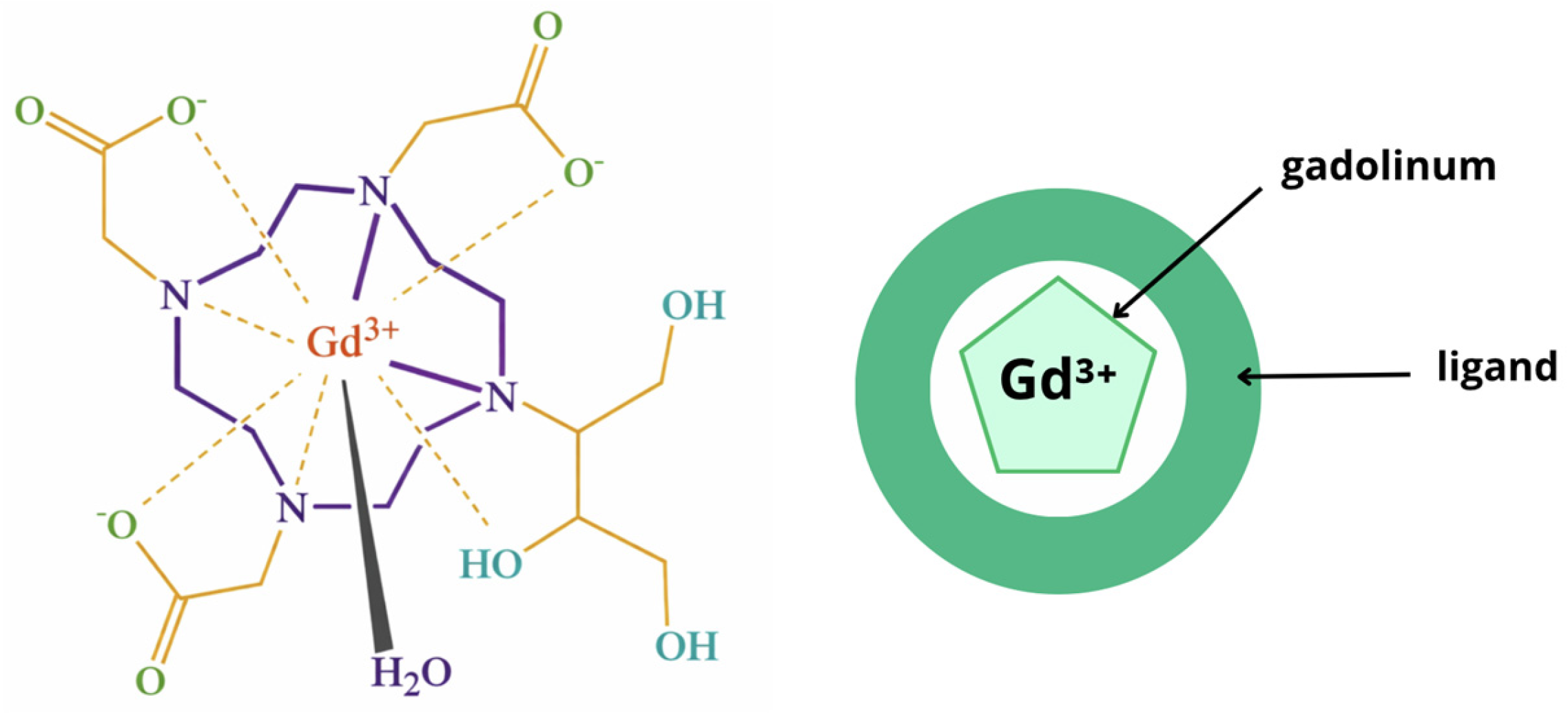
Gadolinium-based contrast agents have become widely used, as they enhance the sensitivity and specificity of MRI. They enable the visualization of tumor neoangiogenesis, which is a key feature of malignant lesions [26]. Gadolinium-based contrast agents are pharmaceutical products capable of selectively enhancing the signal from blood or tissues by influencing the signal-generating properties of hydrogen nuclei [26]. After intravenous administration and distribution to target tissues, gadolinium-based contrast agents cause an increase in signal intensity in T1-weighted images with an almost negligible effect on signal intensity in T2-weighted images [41]. Gadolinium-based contrast agents shorten the longitudinal relaxation time (T1) of water protons, which results in increased signal intensity in T1-weighted images and enhanced contrast between tissues [42]. This facilitates the precise identification of structures that are contrast-enhanced, thereby improving diagnostic sensitivity and specificity [26]. The main component of these contrast agents is the strongly paramagnetic gadolinium ion (Gd). Its key property is a strong paramagnetic effect resulting from the presence of seven unpaired electrons [41]. The trivalent Gd exhibits potential toxicity; due to its similar ionic radius, it can compete with the calcium ion (Ca2+) for binding sites in proteins and ion channels, thereby disrupting calcium-dependent cellular processes. Blocking these signaling pathways disrupts key biological processes controlled by calcium, such as muscle contraction, nerve conduction or enzymatic activation [42]. To minimize Gd toxicity, it is administered in the form of chelates with organic ligands. This form not only facilitates elimination from the body but also reduces the risk of undesirable biotransformation [26]. A gadolinium-based contrast agent is a stable complex in which the Gd acts as the active center (central metal) responsible for altering the MR signal, while the stability of the complex is ensured by an organic ligand (chelator) that binds the Gd3+ ion [43] (Figure 3).
A typical chelating ligand provides numerous donor atoms—most commonly in the form of oxygen or nitrogen atoms—that possess unpaired electrons. These atoms form coordinate bonds with the Gd3+ ion, replacing water molecules in its inner coordination sphere. This exchange results in a much more stable complex in which Gd is enclosed within the chelate structure [26]. The presence of a single water molecule in the inner coordination sphere of the Gd3+ ion is crucial to the contrast enhancement mechanism. The primary mechanism responsible for the contrast enhancement effect is the rapid exchange between intrasphere water molecules and water molecules in the surrounding tissues, which occurs up to a million times per second [26]. Gadolinium-based contrast agents are classified according to ligand chemical structure and ionic charge, as outlined in Table 3.
Gadolinium-based contrast agents are classified according to the structure of their chelating ligands (linear or macrocyclic) and their ionic charge (ionic or non-ionic) [41]. Linear agents have an open chelate structure, which makes them less stable and leads to the release of free Gd ions in vivo. In contrast, macrocyclic Gd contrast agents have a ring-shaped chelate structure, which makes them more stable and less prone to releasing free Gd [26].
The most commonly used agents in breast MRI are dimeglumine gadobate (MultiHance®), gadoteric acid (Dotarem®), and gadobutrol (Gadovist®) [26]. Some patients experience transient and harmless reactions at the injection site, such as pain or a sensation of warmth, but these symptoms subside quickly. According to statistics, their incidence ranges from 0.01% to 2.4% [41]. The most commonly reported adverse effects include nausea, headaches, vomiting, erythema, or a metallic taste in the mouth. The risk of moderate reactions is approximately 0.21%, including hives, itching, facial swelling, fluctuations in blood pressure or cardiac arrhythmias [26]. The greatest concerns associated with the use of gadolinium-based contrast agents stem from the occurrence of allergic reactions, nephrogenic systemic fibrosis and Gd accumulation in the body [45]. The hypothesis regarding the development of nephrogenic systemic fibrosis is linked to linear gadolinium-based contrast agents, which are more susceptible to the phenomenon of transmethylation, leading to the displacement of the toxic free Gd ion from the complex by endogenous ions. In the case of concomitant renal insufficiency in a patient (delayed renal excretion of the contrast agent), this leads to Gd deposition and the development of fibrosis [41]. This phenomenon is less likely with macrocyclic contrast agents, as they are significantly more stable [41].
Severe adverse reactions, which include anaphylaxis, cardiac problems and kidney damage, are extremely rare. Acute adverse reactions most often occur within an hour of contrast agent administration [26]. The authors [41] note that the risk of adverse reactions increases eightfold in patients with a history of moderate or severe reactions to gadolinium-based contrast agents. A higher risk of adverse reactions was also observed in groups of patients with asthma or atopy [41].
Furthermore, studies have confirmed the deposition of Gd in various organs and tissues of the body, including the brain, bones and skin [26]. Gd retention in bones, the liver, kidneys or skin has been confirmed by histological studies, as this phenomenon cannot be detected by MRI an exception is Gd in the brain, which has been noted in MRI images as focal T1-weighted hyperintensity in specific central nervous system structures, including the cerebellar flocculonodular nuclei and the globus pallidus [41]. Most linear agents have a greater tendency to accumulate in the brain; therefore, macrocyclic agents are currently used to minimize this phenomenon [45]. As the Food and Drug Administration (FDA) assures, despite the possible accumulation of Gd in the brain or other body tissues, no harmful clinical effects have been demonstrated [42].
Due to concerns about the adverse effects of gadolinium-based contrast agents, recent trends in breast imaging are increasingly focusing on methods that do not require their use [46].
One of the most promising methods is diffusion-weighted imaging (DWI), which is a high-speed MRI technique with an acquisition time of typically 2–3 min. DWI allows for the assessment of water molecule diffusion in biological tissues [47]. This method provides both qualitative and quantitative information regarding the cellular microenvironment, which is of particular importance in the diagnosis of breast cancer. DWI is increasingly being incorporated into clinical protocols as a complementary technique used in the detection and characterization of focal lesions, prognosis assessment, and monitoring of response to neoadjuvant therapy [48]. Furthermore, research is underway on the use of DWI as a standalone, contrast-free breast MRI screening method. Despite its numerous advantages, this technique has limitations, such as variable image quality, a lack of full standardization of acquisition parameters, and the occurrence of false-positive and false-negative results in certain types of tumors [48]. For this reason, intensive work is underway to optimize DWI protocols and standardize interpretation criteria, with the aim of increasing its reproducibility and diagnostic value in routine clinical practice [46,47].
Advanced techniques, such as the intravoxel incoherent motion (IVIM) model, diffusion tensor imaging (DTI), and kurtosis-weighted diffusion imaging (DKI), provide additional functional information regarding tumor cellularity, perfusion, and microstructural complexity, enhancing the ability to characterize lesions without the use of contrast [46].
IVIM allows for the separation of the pure water diffusion component (represented, among other things, by the D parameter) from the effects of microscopic blood perfusion in capillaries (D* and f parameters), while DKI describes deviations of water diffusion from the Gaussian model, which allows for a better reflection of the heterogeneity and complexity of tumor tissue. DTI, on the other hand, analyzes diffusion anisotropy, i.e., the directionality of water molecule movement in tissues, which is particularly important in assessing the structural organization of tissues [46,49].
A retrospective study involving 195 patients with histopathologically confirmed breast cancer demonstrated that the quantitative IVIM and DKI parameters can reflect the biological activity of breast cancer, including the expression of markers of proliferation and angiogenesis [49]. With regard to Ki-67, a marker of cell proliferation, the parameter D (the so-called free water diffusion coefficient) showed the highest predictive power, with an AUC of 0.724, while combined IVIM–DKI models achieved AUCs ranging from 0.852 to 0.923. AUC (area under the curve) refers to the area under the ROC (receiver operating characteristic) curve and serves as a measure of a diagnostic test’s effectiveness, where values closer to 1.0 indicate a very high ability to distinguish between groups (high and low biomarker expression) [49]. For VEGF, a marker of angiogenesis, the highest predictive value was obtained for the f parameter (fraction of perfusion) with an AUC of 0.882, with f values ≥ 29.82% correlating with high tumor vascular activity. Additionally, DKI parameters such as MD (mean diffusivity) and MK (mean kurtosis) provided information on the degree of diffusion restriction and the heterogeneity of the tumor tissue microstructure, complementing the data obtained from IVIM. These results indicate that a multiparametric approach, combining information on diffusion, perfusion, and microstructure, can significantly increase the accuracy of non-invasive assessment of tumor biology, particularly regarding proliferation (Ki-67), hypoxia (HIF-1α), and angiogenesis (VEGF) [49].
MRI techniques based on parametric tissue mapping, such as synthetic magnetic resonance imaging (SyMRI), also serve as an important complement; these allow for the generation of diagnostic images from a single scan, increasing the efficiency of the examination while eliminating the need for contrast agents [46,50]. SyMRI enables the quantitative assessment of tumor tissue properties by measuring basic relaxation parameters: T1, T2, and PD (proton density). The T1 parameter (longitudinal relaxation time) reflects the rate at which protons return to equilibrium after excitation; it is related to water content and tissue composition. The T2 parameter (transverse relaxation time) describes the loss of signal phase synchronization and depends on the aqueous environment and the structure of the tumor microenvironment. In turn, PD (proton density) corresponds to the density of protons in the tissue, and thus indirectly to the water content and cellular components. Additionally, the T1C parameter is analyzed, i.e., the T1 value after contrast administration, which reflects the degree of its accumulation in the tissue and, indirectly, vascularization and vascular permeability [48,50].
A study involving 582 patients demonstrated that tumors with a higher grade of malignancy and the ER-, PR-, and HER2+ subtypes were characterized by significantly higher T1, T2, and T1C values, indicating greater microstructural heterogeneity and altered water properties of tumor tissues. High expression of the Ki-67 proliferation marker was also associated with increased T1, T2, and T1C values, reflecting a more biologically active and rapidly proliferating tumor [50]. Among the evaluated factors, tumor histological grade had the greatest influence on SyMRI parameters. In practice, this means that the variability of SyMRI parameters most strongly reflects differences in tumor malignancy, confirming their potential as quantitative biomarkers for non-invasive breast cancer assessment and as a complement to conventional non-contrast imaging methods [50].
Dedicated breast positron emission tomography (dbPET) is an emerging imaging modality that may serve as a potential alternative to contrast-enhanced techniques [46]. dbPET uses radioisotope-labeled glucose ([18F]-FDG), which allows for the assessment of tumor metabolic activity. A study involving 2156 screening examinations demonstrated that dbPET achieves sensitivity comparable to digital mammography with tomosynthesis (DM-DBT) and breast ultrasound in detecting invasive breast cancer, with a specificity of 82.6%, slightly higher than that of DM-DBT (81.4%) [51]. Importantly, this method was particularly effective in detecting invasive lesions, but had lower sensitivity for ductal carcinoma in situ (DCIS), which results from limited FDG accumulation in lesions with low metabolic activity. In the context of functional imaging, dbPET may therefore serve as an alternative to contrast-enhanced studies, as it provides information on the biological activity of the tumor, including its glucose metabolism and degree of aggressiveness, without the need for gadolinium-based contrast agents. At the same time, its limitations include exposure to ionizing radiation and lower efficacy in detecting preinvasive lesions, which currently limits its use as a first-line method in breast cancer screening [51].
Modern breast cancer diagnostics is evolving toward methods that enable increasingly precise and simultaneously less invasive assessment of neoplastic lesions. CE-MRI remains one of the most important imaging methods, particularly in assessing disease stage and planning treatment. Concurrently, non-contrast techniques are being developed, such as DWI along with IVIM, DTI, and DKI models, which provide information on tumor microstructure and biology. SyMRI enables quantitative assessment of T1, T2, and PD parameters, while dbPET allows for the assessment of tumor metabolic activity. The combined use of these methods indicates a trend toward dual-parametric, functional breast cancer diagnostics [26,39,43,45,46,47,48,50].

4.1. Magnetic Systems for Locating Tumor Lesions and Sentinel Lymph Nodes in Breast Surgery

Currently, in breast surgery, there is a trend toward performing breast-conserving procedures, which require precise localization of both non-palpable nodular lesions and sentinel lymph nodes. Magnetic localization systems offer an effective alternative to techniques using radioactive isotopes [52,53,54]. The use of both a paramagnetic tumor marker and a sentinel lymph node marker enables the performance of BCS along with sentinel lymph node biopsy, which allows for a complete, safe and radiation-free surgical procedure [52].

4.1.1. Magnetic Tumor Markers—MagSeed®

To achieve accurate preoperative localization of the tumor, non-reactive markers such as MagSeed® have been introduced; this is a medical marker measuring 5.0 × 1.0 mm made of stainless steel with magnetic properties, approved by the FDA in 2018 for long-term implantation in the breast [52,53,54]. The MagSeed® marker is placed in the tissue using a sterile 18G needle up to 30 days before the planned procedure [53]. Under ultrasound or stereotactic mammography guidance, the marker is placed at the center of the tumor and is located during surgery using a magnetic detector [52]. The detection probe generates an alternating magnetic field that induces a transient magnetization in the marker. Furthermore, based on the strength of the magnetic field, the probe enables the marker to be located by determining the distance between the marker and the probe [54]. Correct placement of the marker can be confirmed by imaging studies, as the marker is echogenic on ultrasound and clearly visible on mammography [53]. Studies highlight the high efficacy of the Magseed® marker placement technique. The authors of the study [45] noted that nearly all markers were successfully implanted on the first attempt, which indicates the high precision and ease of application of this technique in clinical practice. Despite this high efficacy, in standard practice, when the marker is inserted the day before surgery, a follow-up imaging study (ultrasound or mammography) is performed on the day of the procedure to verify its position [54]. If migration was detected—defined as a difference of ≥10 mm between the initial and final distances of the marker from the lesion—the procedure required re-localization on the day of surgery [54]. Importantly, the long-term safety of the method is confirmed by the fact that even with an implantation time of up to 40 days, no complications or marker migration were reported [55]. In studies conducted using an animal model, no differences in accuracy or procedure duration were found compared to methods using a gamma camera [53]. Furthermore, the Magseed® marker is characterized not only by high intraoperative detection rates reaching 100% [53], but also by oncological efficacy comparable to other localization techniques. According to surgeons who perform the marker implantation procedure, this method is easy to master and allows for very precise localization of lesions, which is crucial for further management (treatment). As demonstrated by prospective studies [55], negative surgical margins were achieved in all 29 patients with implanted markers.
In another study, conducted on a group of 21 patients of Chinese descent, which retrospectively evaluated the effectiveness of magnetic localization and the completeness of tumor resection, the high effectiveness of this method was confirmed [54]. The implantation of the magnetic marker was successful in 19 patients, resulting in a success rate of 90.9% [24]. A limitation of the Magseed® marker method for breast cancer localization is the high cost of the markers, probes and necessary equipment. Additionally, there are contraindications in patients with pacemakers or other implanted cardiac devices due to the risk of interference. They are not recommended for patients with a nickel allergy [24]. The authors note that an important factor is the incompatibility of Magseed® markers with MRI, as they cause artifacts that affect image quality [55].

4.1.2. Magnetic Sentinel Lymph Node Markers—MagTrace®

Sentinel node biopsy (SNB) is an integral part of the diagnosis and treatment of early-stage breast cancer [56]. The SNB procedure is performed in several ways depending on the marker used to locate the sentinel node. The most commonly used marker is technetium-99. However, a recently developed alternative is superparamagnetic iron oxide [56]. Currently available is an inactive magnetic tracer designed for sentinel node identification—MagTrace® [52]. MagTrace® consists of a nanoparticle preparation of superparamagnetic iron oxide coated with carboxydextrin, which is transported through the lymphatic vessels and retained in the sentinel nodes. The superparamagnetic tracer is a rust-colored solution that can be administered between 20 min and 7 days prior to surgery [56]. The use of magnetic technology to identify sentinel nodes with a magnetic tracer is both safe and effective, just like the previously commonly used Tc99-nanocolloid [52]. Studies have confirmed that superparamagnetic iron oxide-based tracers enable accurate localization of the sentinel node, which can be detected using the Sentimag probe. Furthermore, the use of an iron tracer significantly reduces the time spent on preoperative preparation [56].
Studies have shown that the total duration of the operation and the level of pain were comparable to traditional methods, while the time required to remove the sentinel node was slightly shorter in the MagTrace® group [56]. The magnetic tracer achieves comparable lymph node detection rates compared to a standard radioisotope tracer [57]. When using MagTrace®, planning for sentinel node biopsy can be performed independently of the availability of nuclear medicine specialists and equipment, which benefits patients in rural and less urbanized areas without access to nuclear medicine [56].
The authors [52] note that retroareolar injection of MagTrace® may result in brown skin discoloration, which occurs in up to 60% of patients. Administering the tracer subcutaneously rather than intradermally may reduce the resulting discoloration [52]. In most cases, the discoloration gradually fades, but it may persist for over 15 months [56]. In addition, the accumulation of superparamagnetic iron oxide may affect the quality of MRI; this issue is currently the subject of research aimed at optimizing the dose, volume, and route of administration of Magtrace® [56]. The authors [52] also noted that the use of a combined magnetic procedure leads to the superimposition of the MagSeed® and MagTrace® signals, which facilitates tumor identification. However, this phenomenon may lead to an excessive increase in the volume of the excised breast segment. In such a situation, appropriate modifications to the procedure are required, including the administration of a liquid tracer to identify sentinel nodes at a different location and at an appropriate distance from the tumor [53].
The MagSeed® and MagTrace® magnetic localization systems represent a safe and effective alternative to radioisotope methods [53]. Their use contributes to increased patient comfort, shorter hospital stays and a reduction in the number of repeat visits to oncology centers [56]. The use of magnetic markers for locating cancerous lesions eliminates the need to follow radiation safety guidelines, thereby making it possible to avoid the need to comply with radiation safety regulations [55].

5. Current Therapeutic Strategies in Breast Cancer: Limitations of Conventional Treatment

Breast cancer treatment is currently based on a combination of local and systemic approaches, primarily including surgery, radiotherapy (RT) and CT [58,59,60]. The selection of an optimal therapeutic strategy depends on the histological grade of the tumor, its molecular characteristics and the clinical stage of the disease, which constitute key prognostic and predictive factors of treatment response [58,60]. In early-stage breast cancer, surgical treatment constitutes the cornerstone of management, performed either as BCS or mastectomy, whereas in patients with advanced disease, management typically includes CT, lumpectomy, or RT [13,61,62]. The aim of neoadjuvant therapy is not only to reduce tumor burden prior to surgical treatment but also to assess tumor sensitivity to the administered therapy, whereas adjuvant therapy is intended to reduce the risk of disease recurrence [63]. Despite significant advances in breast cancer treatment and improved patient survival, conventional therapeutic approaches, particularly surgical treatment, are associated with the risk of long-term complications that may substantially impair quality of life following therapy. One of the most frequently reported issues is chronic postoperative pain, referred to as post-mastectomy pain syndrome (PMPS), which, according to the literature, affects 10–20% of patients as moderate to severe pain and up to 20–60% of women after mastectomy when defined as pain persisting for more than three months in the chest wall, axilla, or upper limb [64].
RT constitutes an important component of adjuvant treatment both after BCS and after mastectomy in selected patient groups, contributing to a reduction in the risk of local recurrence and an improvement in overall survival [13,65,66]. RT remains one of the primary local treatment modalities for breast cancer; however, its clinical effectiveness is limited by the non-selective effects of ionizing radiation on healthy tissues surrounding the tumor. Radiation-induced damage and the associated organ toxicity constitute a significant barrier to dose escalation and optimization of the anticancer effect [14].
CT is associated with significant systemic consequences resulting from its effects on cells with high proliferative capacity. One of the key effects is immunosuppression, manifested by a reduction in leukocyte count, which increases patients’ susceptibility to infections. At the same time, CT inhibits fibroblast proliferation and collagen synthesis, leading to delayed and less effective wound healing, as well as endothelial dysfunction, which promotes increased platelet reactivity and the development of a prothrombotic state [67]. At the same time, CT and RT constitute fundamental components of breast cancer treatment, significantly contributing to the reduction in the risk of disease recurrence [68]. Despite their documented clinical efficacy, conventional therapeutic strategies in breast cancer are associated with numerous limitations, resulting, among others, from the lack of full selectivity toward cancer cells, cumulative treatment-related toxicity and the development of therapeutic resistance. These factors significantly affect the feasibility of dose escalation, long-term treatment outcomes and patients’ quality of life, thereby providing a rationale for the development of new, more precise and individualized therapeutic approaches, including nanotechnology-based strategies [69].

6. Nanoparticles in Breast Cancer Treatment: Mechanisms of Action and Therapeutic Potential

Recent advances in nanotechnology have considerably expanded the therapeutic potential of NPs in breast cancer beyond conventional drug delivery systems [18]. Modern nanoplatforms are increasingly designed as multifunctional systems capable of modulating oxidative stress, enhancing radiosensitivity, stimulating antitumor immune responses, enabling image-guided therapy, and improving treatment selectivity and safety. These developments reflect the transition from passive nanocarriers toward precision-oriented and theranostic nanomedicine strategies.

6.1. Nanoparticles as Modulators of Oxidative Stress and Enhancers of Radiotherapy in Breast Cancer

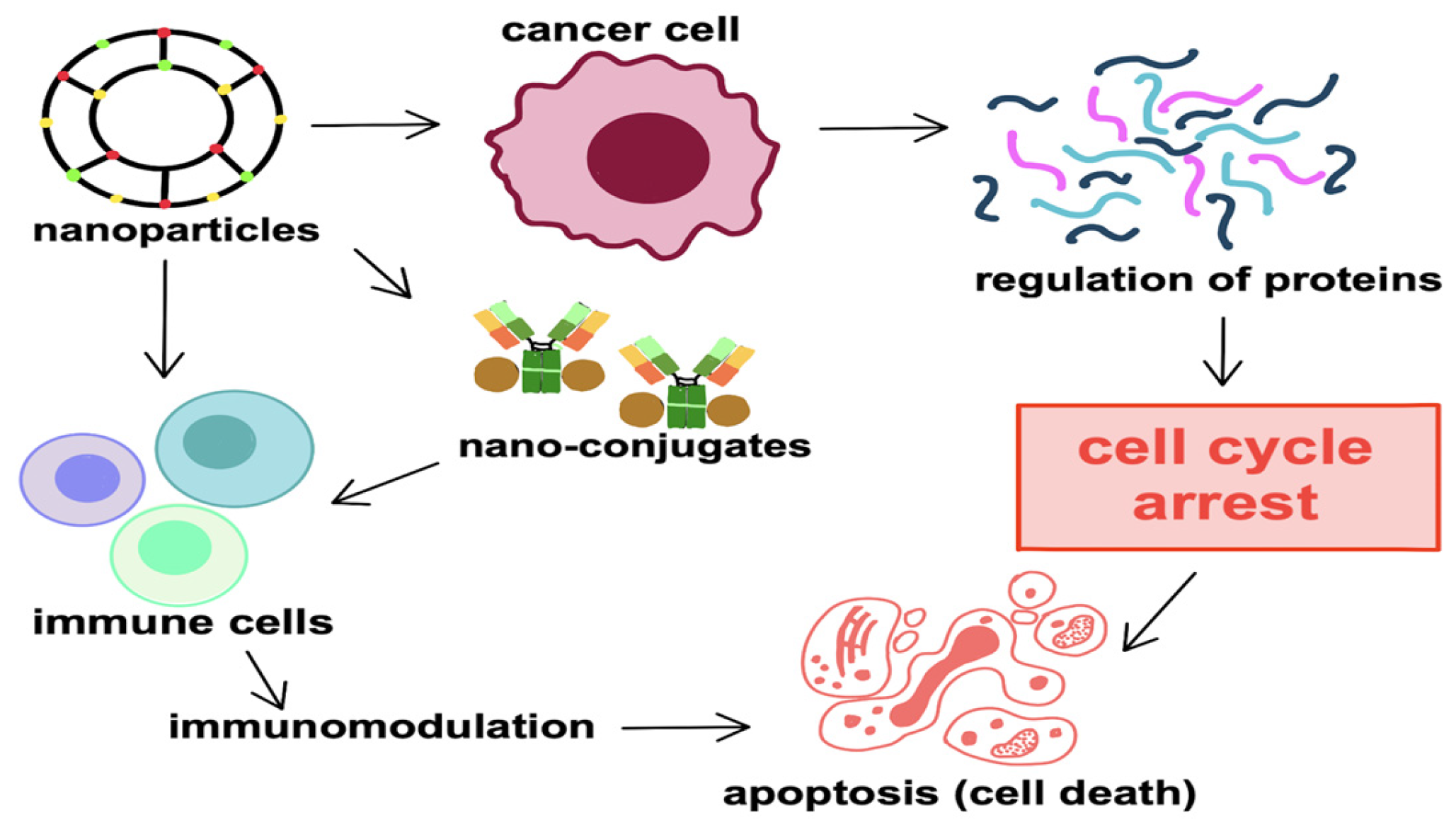
NPs are designed to induce apoptosis in cancer cells through various mechanisms, among which reactive oxygen species (ROS)-dependent pathways are the best characterized [14]. ROS-induced apoptosis represents one of the key mechanisms underlying the cytotoxic effects of NPs on breast cancer cells. ROS are highly reactive molecules that influence a wide range of cellular processes, and their effects largely depend on intracellular concentration. Excessive ROS production disrupts redox homeostasis and contributes to oxidative stress, which may trigger DNA damage, mitochondrial dysfunction, cell cycle arrest, and ultimately apoptosis or necrosis. Conversely, moderate or dysregulated ROS levels may promote tumor progression by activating signaling pathways that support proliferation, invasion, and metastasis, while simultaneously inhibiting programmed cell death [14].
The high efficacy of NPs in inducing apoptosis largely results from their physicochemical properties. Nanometer-sized particles are characterized by an increased surface area, which translates into higher reactivity and enhanced ROS generation. Under conditions of intensified oxidative stress, the release of intermediate inflammatory mediators occurs alongside the accumulation of DNA and protein damage, ultimately leading to cytotoxic effects on cancer cells (Figure 4) [70].
In the context of oxidative stress modulation, particular attention has been given to nanosystems enabling controlled regulation of ROS levels in cancer cells. An example of such systems is chitosan-based NPs, whose application in breast cancer therapy using natural antioxidants was described by Herdiana et al. [72]. Chitosan-based nanosystems are characterized by low immunogenicity and strong adhesive properties toward negatively charged cell membranes, which enhances their utility in biomedical applications [73]. Chitosan also exhibits intrinsic antioxidant properties, resulting from the presence of amino and hydroxyl groups involved in electron transfer reactions and the scavenging of ROS and free radicals. Encapsulation of antioxidants within chitosan NPs enhances their activity by improving solubility, stability, bioavailability, and more targeted delivery to specific tissues [72]. In breast cancer treatment using NPs, therapeutic approaches combining RT with the induction of ROS are also employed, with both mechanisms being closely interconnected at the molecular level. RT is a cancer treatment modality based on the use of high-energy X-ray radiation directed at the tumor area to deliver an effective therapeutic dose. Its anticancer effect primarily results from the induction of DNA damage and the generation of oxygen free radicals, ultimately leading to cancer cell death [74]. Conventional RT often fails to achieve optimal oncological outcomes, as non-selective irradiation also damages surrounding healthy tissues [14]. The cytotoxicity associated with RT represents a significant limitation to dose escalation and poses a major challenge in the optimization of cancer treatment planning [75]. Additionally, opsonization promotes the rapid clearance of radioisotopes from circulation, thereby limiting their therapeutic benefit. Incorporation of radioisotopes into nanoparticle-based carriers may overcome these challenges by reducing opsonization and prolonging systemic retention, primarily due to the EPR effect [14]. Modulation of tumor response to treatment and reduction in damage to healthy tissues can also be achieved through the use of NPs that enhance the sensitivity of cancer cells to ionizing radiation [76].
Another associated approach is nanoparticle-mediated photothermal therapy (PTT), a non-invasive treatment modality with considerable potential both as monotherapy and in combination with conventional anticancer treatments. In this technique, photosensitive NPs are administered intravenously and subsequently accumulate selectively within tumor tissue, which is then exposed to external laser irradiation with a wavelength tailored to the absorption range or plasmon resonance of the applied NPs. Upon irradiation, these NPs absorb photons and undergo electronic excitation; as electrons return to the ground state, the released energy is emitted as localized heat. This leads to the induction of hyperthermia, which irreversibly damages adjacent cancer cells and tissues [77,78].
Elimination of cancer cells during PTT results from elevated temperatures within the target tissue, with the mode of cell death depending on the achieved thermal threshold. From a safety and efficacy perspective, maintaining temperatures within the so-called apoptotic window (43 °C to 50 °C) is crucial. Temperatures above 50 °C promote necrosis, which is associated with uncontrolled release of intracellular components, an intensified inflammatory response, and a potential increase in metastatic spread, whereas apoptosis enables controlled cell elimination with minimal damage to surrounding tissues. Additionally, biological tissues differ in their capacity to absorb laser energy, which directly influences the efficacy and safety profile of PTT [79].
The effectiveness of PTT depends on the use of photosensitizers or molecules capable of absorbing electromagnetic radiation in the microwave, radiofrequency, near-infrared, and visible light ranges, and converting the absorbed energy into heat [78]. Among metallic NPs, gold nanoparticles (AuNPs) are considered particularly promising radiosensitizers due to the high atomic number of gold [75]. Gold exhibits a high photoelectric cross-section and a strong capacity to generate secondary electrons and associated free radicals, thereby enhancing the interaction of ionizing radiation with cancer cells [75]. Due to their high capacity for radiation absorption and efficient generation of secondary electrons, AuNPs increase the amount of energy deposited within tumor tissue and are considered promising radiosensitizing agents in cancer therapy. These properties have formed the basis for extensive research into the role of AuNPs as radiosensitizers in various types of malignant neoplasms, including breast cancer [74]. Mehrnia et al. in their study [66] conducted an evaluation of the potential radiosensitizing effect of AuNPs conjugated with the AS1411 aptamer (AS1411/GNPs) on breast cancer cells exposed to 4 MeV electron irradiation. The study demonstrated that the application of AS1411/GNPs significantly enhances the response of cancer cells to RT compared with irradiation alone. The AS1411 aptamer, by increasing the uptake of AuNPs by cancer cells, augments irradiation-induced cell death, which may translate into an improved therapeutic response [80]. Such ligand-mediated targeting strategies may improve selective nanoparticle uptake beyond passive accumulation associated solely with the EPR effect, thereby enhancing therapeutic precision and reducing off-target toxicity.
Gd, as previously mentioned in this study, has also found application as a nanoparticle-based radiosensitizer [81].
Gadolinium oxide nanoparticles (GONs) can be administered as intravenous (IV) or intratumoral (IT) injections. IT administration is shown to have greater biodistribution than IV. It has also been noted that GON combined with fractionated irradiation significantly increased the median survival of mice only when injected IT. Although IV injection of GONs altered tumor growth, it did not significantly prolong mice survival [82]. GONs are not inherently toxic; however, in combination with X-rays, they effectively inhibit colony formation in TNBC cells, thereby reducing their proliferative capacity. The observed anticancer effect was associated with a significant increase in ROS production, leading to an increased number of DNA double-strand breaks and, consequently, a higher rate of apoptosis in cancer cells. Gd also enhances the immune response through activation of the cGAS–STING pathway. This effect results in increased infiltration of CD8+ lymphocytes within the tumor; nevertheless, it was limited in immunocompromised models. Given the established use of Gd in radiology, GONs hold significant potential as a comprehensive tool in MRI-guided RT. An additional advantage of GONs is their more cost-effective production compared with gold- or platinum-based NPs [83]. Chelation of Gd with tannic acid in NPs results in a significantly enhanced MRI contrast at the same Gd dose. This enables determination of the optimal timing for RT activation through spatiotemporal control of treatment using MRI [84]. In study on mice, GONs administered IV were found in kidneys, however there was no significant retention of radiolabeled NPs in other organs, including the brain and liver, for both types of injections. In addition, faecal excretion was low, demonstrating that GONs do not interfere with gastrointestinal tract [82].
Moreover, RT modulates the immune response within the tumor microenvironment (TME), not only through the induction of ROS but also by triggering processes such as immunogenic cell death (ICD) [76]. The immunogenicity of NPs refers to their ability to elicit an immune response in a given host [85]. Biocompatible NPs can enhance antitumor responses by presenting or exposing tumor-associated antigens and stimulating immune activation, thereby contributing to the inhibition of cancer cell proliferation [14]. A broad range of studies has evaluated the immunogenic potential of various types of NPs, including gold [86], silica [87], and silver [88].
Inorganic NPs can modulate the immune system through complex mechanisms leading to both immunostimulation and immunosuppression [14]. A key role is played by the induction of oxidative stress, resulting in excessive production of ROS. This leads to lipid peroxidation, protein and DNA damage, and activation of inflammatory pathways [14]. NPs may also directly interact with cellular organelles such as mitochondria, lysosomes, and the endoplasmic reticulum, causing functional disruption, loss of membrane potential, and initiation of apoptotic pathways [85].
Another important mechanism involves activation of the NLRP3 inflammasome, triggered by lysosomal damage, release of cathepsin B, and mitochondrial dysfunction. This process promotes the secretion of proinflammatory cytokines, including interleukin-1β (IL-1β) [85]. The immunotoxicity of NPs may also manifest as an imbalance in Th1/Th2 responses and a reduction in key lymphocyte subpopulations [85]. Additionally, NPs can induce immunosuppression by inhibiting lymphocyte proliferation and reducing natural killer (NK) cell activity, thereby weakening the host’s ability to combat infections and cancer [85].
Their toxic potential is further associated with genotoxic effects and epigenetic alterations, including DNA strand breaks, micronuclei formation, and disruption of methylation patterns in genes regulating immune responses [46]. These molecular pathways may also contribute to the therapeutic and immunomodulatory effects observed in nanoparticle-based anticancer strategies [76]. Collectively, these findings indicate that contemporary nanoparticle-based radiosensitizers are evolving from passive drug carriers toward multifunctional platforms capable of simultaneously enhancing ROS-mediated cytotoxicity, modulating antitumor immunity, and enabling image-guided therapeutic control.

6.2. Nanoparticles as Platforms for Improving the Selectivity, Distribution, and Safety of Anticancer Therapy

Contemporary nanoparticle-based systems are increasingly developed to overcome limitations associated with conventional CT, including systemic toxicity, poor tumor selectivity, and limited bioavailability. Unlike earlier generations of nanocarriers, emerging nanoplatforms combine targeted delivery, controlled release, immune modulation, and imaging capabilities within a single therapeutic system. Ultimately, the immunotoxic effects of NPs depend on their physicochemical properties, biodegradability, and interactions with the microenvironment, which collectively determine whether the immune response will be predominantly stimulatory or suppressive [85]. Among the most commonly used nanocarriers are liposomes, polymeric NPs, dendrimers, hydrogels, metallic and inorganic NPs, as well as cell-derived NPs [89]. An example is liposomes, which have been used for many years as drug nanocarriers in cancer therapy, including breast cancer. Liposomes are spherical vesicular structures composed of an aqueous core surrounded by one or more phospholipid bilayers. Phospholipids are amphiphilic in nature, consisting of a hydrophilic, polar head and two hydrophobic lipid tails [90]. Drugs or bioactive compounds can be encapsulated within the nanoparticle core and transported to specific target sites. In the case of liposomes, their bilayer lipid structure enables the encapsulation of hydrophilic molecules within the aqueous interior, allowing for their efficient delivery [70]. Liposomes exhibit several advantageous properties, including an increased therapeutic index of anticancer drugs, enhancement of the EPR effect, favorable distribution, prolonged circulation time, and modulation of tumor angiogenesis [91]. One of the main cytotoxic agents used in breast cancer therapy is doxorubicin (DOX). Despite its well-documented efficacy, its clinical use is significantly limited by adverse effects, particularly cardiotoxicity and myelosuppression. Cardiotoxicity is the principal dose-limiting adverse effect and is closely associated with the cumulative dose. In clinical practice, the total cumulative dose of DOX is typically limited to 400–450 mg/m2, with subclinical cardiomyopathy potentially occurring at doses of approximately 300 mg/m2 [92]. In response to these limitations, strategies have been developed to modify drug delivery, particularly through encapsulation in liposomes, which allows for enhanced antitumor efficacy of DOX while improving its safety profile. Two formulations of liposomal DOX have been introduced into clinical practice: pegylated liposomal doxorubicin (PLD) (trade names: Doxil®, Lipodox®/generic equivalent of Doxil®, Caelyx® in Europe) and non-pegylated liposomal doxorubicin (Myocet®), used in Europe and Canada [92]. In addition to liposomal formulations, alternative nanotechnology-based approaches have also been explored to minimize the adverse effects associated with anthracycline therapy. A randomized clinical study [93] conducted in breast cancer patients demonstrated that administration of nanocurcumin during doxorubicin-based treatment was associated with less pronounced impairment of cardiac function parameters compared with placebo-treated individuals. These observations suggest that nanoparticle-assisted therapeutic strategies may contribute to reducing chemotherapy-related cardiotoxicity while preserving the anticancer activity of doxorubicin.
Studies are ongoing on the use of exosomes coated with silica NPs containing 3,3′-diindolylmethane and DOX in the treatment of TNBC [93]. Although, the use of DOX in therapy is significantly limited by its cardiotoxicity, it may also stimulate epithelial–mesenchymal transition in cancer stem cells, which is a key process in metastasis formation. In vitro and in vivo studies indicate that the use of NPs enables more efficient delivery of the drug to target sites, which may consequently reduce the risk of lung metastasis as well as its toxicity to other tissues in the body [93]. Similar observations [94] have also been reported for nanoparticle albumin-bound paclitaxel (nab-paclitaxel), which demonstrated improved intratumoral drug distribution compared with conventional solvent-based paclitaxel formulations while maintaining an acceptable toxicity profile in breast cancer patients. These findings further support the potential of nanoparticle-based delivery systems to optimize the therapeutic efficacy of conventional anticancer agents while reducing treatment-related adverse effects.
Liposomal carriers exhibit excellent biocompatibility, low toxicity, and protect the drug from degradation. Due to the fact that exosomes are more easily recognised as homogenous, they have greater endogenous tissue homing capability and are very effective in masking their contents. Since mesoporous silica nanoparticles (MSNs) are precise drug delivery systems, have a very high loading capacity (greater than that of polymer-based nanocarriers) and provide excellent control over drug release, in combination with exosomes they have bigger cellular uptake than NPs themselves. Moreover, MNSs can simultaneously transport drugs together with contrast agents and radiosensitizers [89]. They can improve the pharmacokinetics of certain anticancer agents such as resveratrol (Res), which is characterized by poor water solubility, low stability, limited bioavailability, a short half-life, rapid metabolism, and elimination. In a murine model, MSNs loaded with resveratrol (MSN-Res) resulted in greater reduction in breast tumor mass compared with Res alone. MSNs are nanocarriers with a high surface area, tunable particle and pore size, and good biocompatibility, which may enhance drug delivery to target cells [95].
Mesoporous titanium dioxide nanoparticles (mTNPs) have attracted intensive interest as inorganic sonosensitizers because of their stable physicochemical properties and relatively good biocompatibility. mTNPs conjugated with triphenyl phosphonium (TPP) pose as a mitochondria-targeting carrier. The release of L-argining (L-Arg) from T-mTNPs@L-Arg (nanoplatform composed of mesoporous titanium dioxide loaded with the nitric oxide donor precursor L-Arg) and the reaction of L-Arg with endogenously H2O2 generate nitric oxide (NO). NO has been demonstrated to inhibit mitochondrial complex IV through competitive binding with the O2 binding sites of cytochrome c oxidase (Cco), which could restrain hypoactive O2 metabolism. T-mTNPs without L-Arg loading have no inhibitory effect on the activity of Cco [96].
Despite the fact that titanium dioxide nanoparticles (TiO2 NPs) play a role in increasing efficiency of synergistic NO gas-sonodynamic therapy of breast cancer they are known to be highly hepatotoxic. They are likely to accumulate in the gastrointestinal tract, as well as penetrate the body circulation and reach distant organs. They accumulate in the liver and case oxidative dress and inflammatory reactions, resulting in pathological damage.

7. Current Challenges and Future Perspectives in Breast Cancer Nanomedicine

Recent advances in nanoparticle (NP)-based drug delivery systems have significantly expanded the therapeutic and diagnostic potential of breast cancer nanomedicine; however, despite numerous approved and ongoing clinical trials, substantial biological and translational challenges still limit their broader clinical implementation [97].
One of the major challenges associated with nanoparticle-based drug delivery is the need to overcome cellular barriers, particularly the cell membrane, which limits intracellular access of therapeutic agents. Many conventional chemotherapeutics must enter the cell to exert their effects, yet membrane transport is tightly regulated, restricting their efficient uptake [98]. Nanoparticle internalization depends on complex processes such as endocytosis or phagocytosis, which vary between cell types and can affect delivery efficiency. Importantly, the lack of clearly defined design criteria ensuring both high selectivity and efficient transport across the cell membrane remains a significant limitation for nanoparticle-based therapies [98]. Contemporary nanoparticle engineering increasingly aims to optimize not only the physicochemical properties of nanocarriers, but also the efficiency of their delivery to tumor tissue. Novel strategies, including actively targeted nanoparticles, stimuli-responsive systems, and nanoparticle-integrated microneedle platforms [99], are being developed to enhance intracellular uptake, improve biodistribution, and achieve more controlled and localized therapeutic release in breast cancer treatment.
Another important challenge is the rapid clearance of NPs from the circulation by the reticuloendothelial system. Following intravenous administration, NPs may be sequestered and phagocytosed by macrophages in key organs such as the liver, spleen, and lungs, which significantly limits their ability to reach target tissues. The liver, due to its dense microvasculature and the presence of Kupffer cells, plays a central role in nanoparticle uptake, while the complex microcirculation of the spleen promotes the trapping and removal of larger or rigid particles [98]. In addition, circulating phagocytic cells, including monocytes, contribute to the rapid elimination of NPs, thereby shortening their circulation half-life. Particle size constitutes another critical limitation, as excessively large particles may lead to vascular obstruction, whereas very small particles may extravasate prematurely or be removed from the bloodstream. Consequently, the design of nanoparticle-based delivery systems requires careful optimization of size and physicochemical properties to balance efficient circulation with effective tissue targeting [98].
In addition, tumor vasculature exhibits abnormal architecture, including discontinuous and chaotically organized vessels with uneven diameters and impaired hierarchical structure, which leads to slower and heterogeneous blood flow. These features, together with increased vascular permeability, contribute to uneven distribution of therapeutic agents within the tumor and thus limit the effectiveness of nanoparticle-based delivery. Differences in pressure and vessel composition between the necrotic core and the viable tumor periphery further exacerbate variability in drug accumulation [98]. Future nanoparticle engineering strategies increasingly focus on active targeting approaches designed to overcome the limitations of passive accumulation mediated solely by the EPR effect. Functionalization of nanocarriers with antibodies, aptamers, peptides, or receptor-specific ligands may improve selective uptake by breast cancer cells and enhance therapeutic precision while reducing off-target toxicity.
Future advances in breast cancer nanomedicine may increasingly rely on the integration of artificial intelligence (AI) with nanoparticle engineering. AI-assisted computational modeling and machine learning algorithms may facilitate optimization of nanoparticle physicochemical properties, including size, surface charge, morphology, biodistribution, and drug-release kinetics, thereby improving treatment precision and therapeutic efficacy. In addition, AI-driven predictive systems may support the development of personalized nanomedicine strategies by integrating imaging, molecular, and clinical data to optimize drug delivery and therapeutic response. The emergence of intelligent theranostic nanoplatforms capable of real-time monitoring and adaptive treatment modulation may further contribute to the transition toward more individualized and precision-oriented breast cancer management [100].
Furthermore, as highlighted by Milewska et al. [101], the application of nanoparticle-based therapies is associated with substantial economic and technological limitations. The high costs of advanced manufacturing processes and regulatory compliance may significantly increase production expenses, thereby restricting patient access. In addition, the industrial translation of nanomedicine remains challenging, as scaling-up can alter key physicochemical properties of NPs, affecting their stability, reproducibility, and therapeutic efficacy, while also requiring complex and tightly controlled production procedures.
Collectively, these findings indicate that future progress in breast cancer nanomedicine will depend not only on improving therapeutic efficacy, but also on overcoming challenges related to biodistribution, biological heterogeneity, large-scale reproducibility, and long-term biosafety. Continued development of multifunctional, actively targeted, and stimuli-responsive nanoplatforms may contribute to more personalized and clinically effective therapeutic strategies in breast cancer management.

8. Conclusions

The findings discussed in this review indicate that breast cancer is a disease of complex etiology and heterogeneous clinical course, which necessitates an individualized approach to diagnosis and treatment. Contemporary diagnostic methods and available therapeutic strategies allow for increasingly effective detection and disease control; however, they do not fully eliminate the limitations associated with treatment-related toxicity, tumor resistance, or delayed diagnosis.
The reviewed literature underscores the growing significance of nanotechnology as an innovative tool supporting both the diagnosis and treatment of breast cancer. Owing to their unique physicochemical properties, NPs may enhance the precision of therapeutic agent delivery and improve the effectiveness of tumor detection. At the same time, the analysis of available studies indicates that their application remains at an early stage of development, and comprehensive evaluation of their safety and efficacy requires further investigation.
Collectively, the reviewed evidence suggests that contemporary breast cancer nanomedicine is evolving beyond conventional drug delivery toward multifunctional and precision-oriented therapeutic platforms. Emerging strategies involving actively targeted nanoparticles, stimuli-responsive systems, theranostic nanoplatforms, and AI-assisted nanoparticle engineering may improve treatment selectivity, overcome biological delivery barriers, and support more personalized therapeutic approaches. Nevertheless, further research is required to optimize nanoparticle biodistribution, long-term biosafety, reproducibility, and clinical translation before these technologies can be broadly implemented in routine oncological practice.

Author Contributions

M.K.K., A.E.-M., S.M.O., K.S., Ł.B. and Ł.R. contributed equally to the conception, development, writing, editing, and analysis of this manuscript. All authors have read and agreed to the published version of the manuscript.

Funding

This research received no external funding.

Institutional Review Board Statement

Not applicable.

Informed Consent Statement

Not applicable.

Data Availability Statement

No new data were created or analyzed in this study. Data sharing is not applicable to this article.

Conflicts of Interest

The authors declare no conflicts of interest.

Abbreviations

MSNsmesoporous silica nanoparticles
ERestrogen receptor
PRprogesterone receptor
HER2human epidermal growth factor receptor 2
TNBCtriple-negative breast cancer
USultrasonography
MRImagnetic resonance imaging
TMEtumor microenvironment
CAFscancer-associated fibroblasts
ECMextracellular matrix
TAMstumor-associated macrophages
TANstumor-associated neutrophils
DCsdendritic cells
EPRenhanced permeability and retention
Ki-67cell proliferation marker
RTradiotherapy
CTchemotherapy
BCSbreast-conserving surgery
PMPSpost-mastectomy pain syndrome
ROSReactive oxygen species
PTTphotothermal therapy
AuNPsgold nanoparticles
AS1411/GNPsgold nanoparticles conjugated with the AS1411 aptamer nanoparticles
GdGadolinium
GONsGadolinium oxide nanoparticles
ICDimmunogenic cell death
IL-1βinterleukin-1β
NKnatural killer
DOXdoxorubicin
PLDpegylated liposomal doxorubicin

References

  1. Roheel, A.; Khan, A.; Anwar, F.; Akbar, Z.; Akhtar, M.F.; Khan, M.I.; Sohail, M.F.; Ahmad, R. Global Epidemiology of Breast Cancer Based on Risk Factors: A Systematic Review. Front. Oncol. 2023, 13, 1240098. [Google Scholar] [CrossRef] [PubMed]
  2. World Health Organization. Breast Cancer 2025; WHO: Geneva, Switzerland, 2025. [Google Scholar]
  3. Bray, F.; Laversanne, M.; Sung, H.; Ferlay, J.; Siegel, R.L.; Soerjomataram, I.; Jemal, A. Global Cancer Statistics 2022: GLOBOCAN Estimates of Incidence and Mortality Worldwide for 36 Cancers in 185 Countries. CA Cancer J. Clin. 2024, 74, 229–263. [Google Scholar] [CrossRef] [PubMed]
  4. Katsura, C.; Ogunmwonyi, I.; Kankam, H.K.; Saha, S. Breast Cancer: Presentation, Investigation and Management. Br. J. Hosp. Med. 2022, 83, 1–7. [Google Scholar] [CrossRef] [PubMed]
  5. Giaquinto, A.N.; Sung, H.; Newman, L.A.; Freedman, R.A.; Smith, R.A.; Star, J.; Jemal, A.; Siegel, R.L. Breast Cancer Statistics 2024. CA Cancer J. Clin. 2024, 74, 477–495. [Google Scholar] [CrossRef]
  6. Barzaman, K.; Karami, J.; Zarei, Z.; Hosseinzadeh, A.; Kazemi, M.H.; Moradi-Kalbolandi, S.; Safari, E.; Farahmand, L. Breast Cancer: Biology, Biomarkers, and Treatments. Int. Immunopharmacol. 2020, 84, 106535. [Google Scholar] [CrossRef]
  7. Loibl, S.; Poortmans, P.; Morrow, M.; Denkert, C.; Curigliano, G. Breast Cancer. Lancet 2021, 397, 1750–1769. [Google Scholar] [CrossRef]
  8. Jian, S.; Lin, W.; Tang, Y.; Yao, G. Breast Cancer Burden (1990–2040) in Individuals Aged 55 and Above: A GBD 2021 Analysis of Global Trends, Sex-Specific Risk Factors, and Intervention Impact. Front. Public Health 2025, 13, 1586497. [Google Scholar] [CrossRef]
  9. Beňačka, R.; Szabóová, D.; Guľašová, Z.; Hertelyová, Z.; Radoňák, J. Classic and New Markers in Diagnostics and Classification of Breast Cancer. Cancers 2022, 14, 5444. [Google Scholar] [CrossRef]
  10. Fowler, A.M.; Strigel, R.M. Clinical Advances in PET–MRI for Breast Cancer. Lancet Oncol. 2022, 23, e32–e43. [Google Scholar] [CrossRef]
  11. Lee, Y.; Ni, J.; Beretov, J.; Wasinger, V.C.; Graham, P.; Li, Y. Recent Advances of Small Extracellular Vesicle Biomarkers in Breast Cancer Diagnosis and Prognosis. Mol. Cancer 2023, 22, 33. [Google Scholar] [CrossRef]
  12. Zhang, Y.; Xia, K.; Li, C.; Wei, B.; Zhang, B. Review of Breast Cancer Pathologigcal Image Processing. BioMed Res. Int. 2021, 2021, 1994764. [Google Scholar] [CrossRef]
  13. Ayala De La Peña, F.; Antolín Novoa, S.; Gavilá Gregori, J.; González Cortijo, L.; Henao Carrasco, F.; Martínez Martínez, M.T.; Morales Estévez, C.; Stradella, A.; Vidal Losada, M.J.; Ciruelos, E. SEOM-GEICAM-SOLTI Clinical Guidelines for Early-Stage Breast Cancer (2022). Clin. Transl. Oncol. 2023, 25, 2647–2664. [Google Scholar] [CrossRef]
  14. Mundekkad, D.; Cho, W.C. Nanoparticles in Clinical Translation for Cancer Therapy. Int. J. Mol. Sci. 2022, 23, 1685. [Google Scholar] [CrossRef] [PubMed]
  15. Akram, M.; Iqbal, M.; Daniyal, M.; Khan, A.U. Awareness and Current Knowledge of Breast Cancer. Biol. Res. 2017, 50, 33. [Google Scholar] [CrossRef] [PubMed]
  16. Kundu, M.; Butti, R.; Panda, V.K.; Malhotra, D.; Das, S.; Mitra, T.; Kapse, P.; Gosavi, S.W.; Kundu, G.C. Modulation of the Tumor Microenvironment and Mechanism of Immunotherapy-Based Drug Resistance in Breast Cancer. Mol. Cancer 2024, 23, 92. [Google Scholar] [CrossRef]
  17. Basingab, F.; Alshahrani, O.; Alansari, I.; Almarghalani, N.; Alshelali, N.; Alsaiary, A.; Alharbi, N.; Zaher, K. From Pioneering Discoveries to Innovative Therapies: A Journey Through the History and Advancements of Nanoparticles in Breast Cancer Treatment. Breast Cancer Targets Ther. 2025, 17, 27–51. [Google Scholar] [CrossRef] [PubMed]
  18. Fan, D.; Cao, Y.; Cao, M.; Wang, Y.; Cao, Y.; Gong, T. Nanomedicine in Cancer Therapy. Signal Transduct. Target. Ther. 2023, 8, 293. [Google Scholar] [CrossRef]
  19. Subhan, M.A.; Yalamarty, S.S.K.; Filipczak, N.; Parveen, F.; Torchilin, V.P. Recent Advances in Tumor Targeting via EPR Effect for Cancer Treatment. J. Pers. Med. 2021, 11, 571. [Google Scholar] [CrossRef]
  20. Al-Thoubaity, F.K. Molecular Classification of Breast Cancer: A Retrospective Cohort Study. Ann. Med. Surg. 2020, 49, 44–48. [Google Scholar] [CrossRef]
  21. Orrantia-Borunda, E.; Anchondo-Nuñez, P.; Acuña-Aguilar, L.E.; Gómez-Valles, F.O.; Ramírez-Valdespino, C.A. Subtypes of Breast Cancer. In Breast Cancer; Mayrovitz, H.N., Ed.; Exon Publications: Brisbane, Australia, 2022; pp. 31–42. ISBN 978-0-6453320-3-2. [Google Scholar]
  22. Carvalho, E.; Canberk, S.; Schmitt, F.; Vale, N. Molecular Subtypes and Mechanisms of Breast Cancer: Precision Medicine Approaches for Targeted Therapies. Cancers 2025, 17, 1102. [Google Scholar] [CrossRef]
  23. Łukasiewicz, S.; Czeczelewski, M.; Forma, A.; Baj, J.; Sitarz, R.; Stanisławek, A. Breast Cancer—Epidemiology, Risk Factors, Classification, Prognostic Markers, and Current Treatment Strategies—An Updated Review. Cancers 2021, 13, 4287. [Google Scholar] [CrossRef] [PubMed]
  24. Smolarz, B.; Nowak, A.Z.; Romanowicz, H. Breast Cancer—Epidemiology, Classification, Pathogenesis and Treatment (Review of Literature). Cancers 2022, 14, 2569. [Google Scholar] [CrossRef]
  25. Nascimento, R.G.D.; Otoni, K.M. Histological and Molecular Classification of Breast Cancer: What Do We Know? Mastology 2020, 30, e20200024. [Google Scholar] [CrossRef]
  26. Pesapane, F.; Sorce, A.; Battaglia, O.; Mallardi, C.; Nicosia, L.; Mariano, L.; Rotili, A.; Dominelli, V.; Penco, S.; Priolo, F.; et al. Contrast Agents in Breast MRI: State of the Art and Future Perspectives. Biomedicines 2025, 13, 829. [Google Scholar] [CrossRef] [PubMed]
  27. Li, H.; Zhang, C.; Shao, H.; Pan, L.; Li, Z.; Wang, M.; Xu, S.-H. Prediction models of breast cancer molecular subtypes based on multimodal ultrasound and clinical features. BMC Cancer 2025, 25, 886. [Google Scholar] [CrossRef] [PubMed]
  28. Cho, N. Molecular Subtypes and Imaging Phenotypes of Breast Cancer. Ultrasonography 2016, 35, 281–288. [Google Scholar] [CrossRef]
  29. Wang, J.; Luo, J.; Jin, K.; Wang, X.; Yang, Z.; Ma, J.; Mei, X.; Wang, X.; Zhou, Z.; Yu, X.; et al. Biological Subtype Predicts Locoregional Recurrence after Postmastectomy Radiotherapy in Chinese Breast Cancer Patients. Cancer Med. 2020, 9, 2427–2434. [Google Scholar] [CrossRef]
  30. Hung, S.-K.; Yang, H.-J.; Lee, M.-S.; Liu, D.-W.; Chen, L.-C.; Chew, C.-H.; Lin, C.-H.; Lee, C.-H.; Li, S.-C.; Hong, C.-L.; et al. Molecular Subtypes of Breast Cancer Predicting Clinical Benefits of Radiotherapy after Breast-Conserving Surgery: A Propensity-Score-Matched Cohort Study. Breast Cancer Res. 2023, 25, 149. [Google Scholar] [CrossRef]
  31. Castro, M.M.; Maretti, L.; Esquível, C.; Sousa, B.; Jerónimo, C.; Ewald, A.J.; Paredes, J. From luminal to triple negative: 3D spheroids reveal molecular and phenotypic differences across breast cancer subtypes. Preprints 2026. [Google Scholar] [CrossRef]
  32. Domingues, M.; Leite Pereira, C.; Sarmento, B.; Castro, F. Mimicking 3D breast tumor-stromal interactions to screen novel cancer therapeutics. Eur. J. Pharm. Sci. 2023, 190, 106560. [Google Scholar] [CrossRef]
  33. American College of Radiology (ACR). BI-RADS® V2025 Manual—What’s New? American College of Radiology: Reston, VA, USA, 2025. [Google Scholar]
  34. Magny, S.J.; Shikhman, R.; Keppke, A.L. Breast Imaging Reporting and Data System. In StatPearls; StatPearls Publishing: Treasure Island, FL, USA, 2026. [Google Scholar]
  35. Shahi, A.; Mishra, S.S. Recent advances in breast imaging reporting: A review of the BI-RADS® sixth edition. Int. J. Community Med. Public. Health 2026, 13, 1543–1548. [Google Scholar] [CrossRef]
  36. Menon, G.; Alkabban, F.M.; Ferguson, T. Breast Cancer. In StatPearls; StatPearls Publishing: Treasure Island, FL, USA, 2026. [Google Scholar]
  37. Brierley, J.D.; Giuliani, M.; O’Sullivan, B.; Rous, B.; Van Eycken, L. (Eds.) TNM Classification of Malignant Tumours, 9th ed.; Wiley-Blackwell: Oxford, UK, 2025. [Google Scholar]
  38. Gordon, P.B. The Impact of Dense Breasts on the Stage of Breast Cancer at Diagnosis: A Review and Options for Supplemental Screening. Curr. Oncol. 2022, 29, 3595–3636. [Google Scholar] [CrossRef]
  39. Łuczyńska, E. Nowoczesne Metody Obrazowania Zmian Rozrostowych Sutka—Nadzieje i Pułapki. Pol. J. Pathol. 2014, 65, S9–S20. (In Polish) [Google Scholar]
  40. Sardanelli, F.; Cozzi, A.; Trimboli, R.M.; Schiaffino, S. Gadolinium Retention and Breast MRI Screening: More Harm Than Good? Am. J. Roentgenol. 2020, 214, 324–327. [Google Scholar] [CrossRef] [PubMed]
  41. Iacobellis, F.; Di Serafino, M.; Russo, C.; Ronza, R.; Caruso, M.; Dell’Aversano Orabona, G.; Camillo, C.; Sabatino, V.; Grimaldi, D.; Rinaldo, C.; et al. Safe and Informed Use of Gadolinium-Based Contrast Agent in Body Magnetic Resonance Imaging: Where We Were and Where We Are. J. Clin. Med. 2024, 13, 2193. [Google Scholar] [CrossRef]
  42. Bendszus, M.; Laghi, A.; Munuera, J.; Tanenbaum, L.N.; Taouli, B.; Thoeny, H.C. MRI Gadolinium-Based Contrast Media: Meeting Radiological, Clinical, and Environmental Needs. J. Magn. Reson. Imaging 2024, 60, 1774–1785. [Google Scholar] [CrossRef] [PubMed]
  43. Iyad, N.; Ahmad, M.S.; Alkhatib, S.G.; Hjouj, M. Gadolinium Contrast Agents—Challenges and Opportunities of a Multidisciplinary Approach: Literature Review. Eur. J. Radiol. Open 2023, 11, 100503. [Google Scholar] [CrossRef]
  44. Unruh, C.; Van Bavel, N.; Anikovskiy, M.; Prenner, E.J. Benefits and Detriments of Gadolinium from Medical Advances to Health and Ecological Risks. Molecules 2020, 25, 5762. [Google Scholar] [CrossRef]
  45. Foshag, K.; Tsiouris, A.J.; Prince, M.; Reichman, M. A Review of Gadolinium-Based Contrast Agents in the Setting of Repeated MRI for High Risk Breast Cancer Screening. Clin. Imaging 2025, 120, 110420. [Google Scholar] [CrossRef]
  46. Honda, M.; Iima, M.; Kataoka, M.; Ueda, D.; Saida, T.; Nishioka, K.; Kurokawa, R.; Ide, S.; Yanagawa, M.; Watabe, T.; et al. Breast cancer imaging without gadolinium-based contrast agent: A review of current applications and future trends. Diagn. Interv. Imaging 2026, 107, 51–61. [Google Scholar] [CrossRef] [PubMed]
  47. Partridge, S.C.; Amornsiripanitch, N. DWI in the assessment of breast lesions. Top. Magn. Reson. Imaging 2017, 26, 201–209. [Google Scholar] [CrossRef]
  48. Lo Gullo, R.; Partridge, S.C.; Shin, H.J.; Thakur, S.B.; Pinker, K. Update on DWI for breast cancer diagnosis and treatment monitoring. Am. J. Roentgenol. 2023, 222, e2329933. [Google Scholar] [CrossRef] [PubMed]
  49. Wang, Z.; Zhao, F.; Zhu, L.; Mao, N.; Wang, W.; Zhao, W.; Yu, H.; Li, Y.; Li, C.; Yue, X.; et al. A multifunctional MRI model based on IVIM and DKI predicts HIF-1α, Ki-67, and VEGF status in breast carcinoma. Front. Oncol. 2025, 15, 1652932. [Google Scholar] [CrossRef] [PubMed]
  50. Wang, J.; Li, Y.; Ma, X.; Zhao, Y.; Guo, J.; Yue, C.; Lu, H. Synthetic MRI parameters and breast cancer heterogeneity: A quantitative study. Acad. Radiol. 2025, 33, 415–426. [Google Scholar] [CrossRef] [PubMed]
  51. Yuge, S.; Miyake, K.K.; Ishimori, T.; Kataoka, M.; Matsumoto, Y.; Torii, M.; Yakami, M.; Isoda, H.; Takakura, K.; Morita, S.; et al. Performance of dedicated breast PET in breast cancer screening: Comparison with digital mammography plus digital breast tomosynthesis and ultrasound. Ann. Nucl. Med. 2023, 37, 479–493. [Google Scholar] [CrossRef]
  52. Van Haaren, E.R.M.; Martens, M.H.; Spiekerman Van Weezelenburg, M.A.; Van Roozendaal, L.M.; Frotscher, C.N.A.; Körver-Steeman, R.R.M.; Lobbes, M.B.I.; Van Bastelaar, J.; Vissers, Y.L.J.; Janssen, A. Combined Use of Magnetic Seed and Tracer in Breast Conserving Surgery with Sentinel Lymph Node Biopsy for Non-Palpable Breast Lesions: A Pilot Study Describing Pitfalls and Solutions. Surg. Oncol. 2023, 46, 101905. [Google Scholar] [CrossRef]
  53. Cieciorowski, M.; Wow, T.; Cieśla, S.; Kolacinska, A.; Murawa, D. Evaluation of Magseed Marker in Location of Non-Palpable Breast Lesions. Pol. J. Surg. 2022, 95, 40–46. [Google Scholar] [CrossRef]
  54. Fung, W.; Wong, T.; Chau, C.; Yu, E.L.; Chan, T.; Chan, R.L.; Yung, A.W.; Ma, J.K. Safety and Efficacy of Magnetic Seed Localisation of Non-Palpable Breast Lesions: Pilot Study in a Chinese Population. Hong. Kong Med. J. 2020, 26, 500–509. [Google Scholar] [CrossRef]
  55. Žatecký, J.; Kubala, O.; Coufal, O.; Kepičová, M.; Faridová, A.; Rauš, K.; Lerch, M.; Peteja, M.; Brát, R. Magnetic Seed (Magseed) Localisation in Breast Cancer Surgery: A Multicentre Clinical Trial. Breast Care 2021, 16, 383–388. [Google Scholar] [CrossRef]
  56. Shams, S.; Lippold, K.; Blohmer, J.U.; Röhle, R.; Kühn, F.; Karsten, M.M. A Pilot Study Evaluating the Effects of Magtrace® for Sentinel Node Biopsy in Breast Cancer Patients Regarding Care Process Optimization, Reimbursement, Surgical Time, and Patient Comfort Compared With Standard Technetium99. Ann. Surg. Oncol. 2021, 28, 3232–3240. [Google Scholar] [CrossRef]
  57. Oweis, R.; Anil, A.; Marinov, A.; Hamati, T.; Masudi, T. Use of Magtrace as an Alternative Approach in Staging the Axilla in Early-Stage Breast Cancer: A Single-Center Experience. Cureus 2024, 16, e75015. [Google Scholar] [CrossRef]
  58. Elston, E.W.; Ellis, I.O. Method for Grading Breast Cancer. J. Clin. Pathol. 1993, 46, 189–190. [Google Scholar] [CrossRef]
  59. Corti, C.; Batra-Sharma, H.; Kelsten, M.; Shatsky, R.A.; Garrido-Castro, A.C.; Gradishar, W.J. Systemic Therapy in Breast Cancer. Am. Soc. Clin. Oncol. Educ. Book 2024, 44, e432442. [Google Scholar] [CrossRef]
  60. Xiong, X.; Zheng, L.-W.; Ding, Y.; Chen, Y.-F.; Cai, Y.-W.; Wang, L.-P.; Huang, L.; Liu, C.-C.; Shao, Z.-M.; Yu, K.-D. Breast Cancer: Pathogenesis and Treatments. Signal Transduct. Target. Ther. 2025, 10, 49. [Google Scholar] [CrossRef]
  61. Leena Panigrahi, L.; Samal, P.; Ranjan Sahoo, S.; Sahoo, B.; Pradhan, A.K.; Mahanta, S.; Rath, S.K.; Arakha, M. Nanoparticle-Mediated Diagnosis, Treatment, and Prevention of Breast Cancer. Nanoscale Adv. 2024, 6, 3699–3713. [Google Scholar] [CrossRef]
  62. Sheikh, A.; Md, S.; Kesharwani, P. Aptamer Grafted Nanoparticle as Targeted Therapeutic Tool for the Treatment of Breast Cancer. Biomed. Pharmacother. 2022, 146, 112530. [Google Scholar] [CrossRef]
  63. Kerr, A.J.; Dodwell, D.; McGale, P.; Holt, F.; Duane, F.; Mannu, G.; Darby, S.C.; Taylor, C.W. Adjuvant and Neoadjuvant Breast Cancer Treatments: A Systematic Review of Their Effects on Mortality. Cancer Treat. Rev. 2022, 105, 102375. [Google Scholar] [CrossRef]
  64. Dzhantemirova, N.; Ahmedin, D.; Khasenov, D.; Khakimova, G.; Khakimova, S.; Bekisheva, A.; Mauletbaev, M.; Makishev, A. Novel Prevention Approaches of Breast Cancer Surgery Related Complications: Systematic Review and Network Meta-Analysis. Asian Pac. J. Cancer Prev. 2024, 25, 9–23. [Google Scholar] [CrossRef]
  65. Ding, F.; Zhao, J.; Wu, X.; Liu, X.; Yang, Y.; Li, Y.; Qiao, L.; Zhang, Y. Impact of Postmastectomy Radiotherapy on Locoregional Recurrence and Survival in Patients with ypN0 Breast Cancer after Neoadjuvant Chemotherapy: A Comprehensive Meta-Analysis and Systematic Review. J. Cancer Res. Ther. 2025, 21, 477–482. [Google Scholar] [CrossRef]
  66. Rajan, K.K.; Fairhurst, K.; Birkbeck, B.; Novintan, S.; Wilson, R.; Savović, J.; Holcombe, C.; Potter, S. Overall Survival after Mastectomy versus Breast-Conserving Surgery with Adjuvant Radiotherapy for Early-Stage Breast Cancer: Meta-Analysis. BJS Open 2024, 8, zrae040. [Google Scholar] [CrossRef]
  67. Lorentzen, T.; Heidemann, L.N.; Möller, S.; Bille, C. Impact of Neoadjuvant Chemotherapy on Surgical Complications in Breast Cancer: A Systematic Review and Meta-Analysis. Eur. J. Surg. Oncol. 2022, 48, 44–52. [Google Scholar] [CrossRef]
  68. Ye, F.; Dewanjee, S.; Li, Y.; Jha, N.K.; Chen, Z.-S.; Kumar, A.; Vishakha; Behl, T.; Jha, S.K.; Tang, H. Advancements in Clinical Aspects of Targeted Therapy and Immunotherapy in Breast Cancer. Mol. Cancer 2023, 22, 105. [Google Scholar] [CrossRef]
  69. Jain, V.; Kumar, H.; Anod, H.V.; Chand, P.; Gupta, N.V.; Dey, S.; Kesharwani, S.S. A Review of Nanotechnology-Based Approaches for Breast Cancer and Triple-Negative Breast Cancer. J. Control. Release 2020, 326, 628–647. [Google Scholar] [CrossRef]
  70. Raj, S.; Khurana, S.; Choudhari, R.; Kesari, K.K.; Kamal, M.A.; Garg, N.; Ruokolainen, J.; Das, B.C.; Kumar, D. Specific Targeting Cancer Cells with Nanoparticles and Drug Delivery in Cancer Therapy. Semin. Cancer Biol. 2021, 69, 166–177. [Google Scholar] [CrossRef]
  71. Aboeleneen, S.B.; Scully, M.A.; Harris, J.C.; Sterin, E.H.; Day, E.S. Membrane-Wrapped Nanoparticles for Photothermal Cancer Therapy. Nano Converg. 2022, 9, 37. [Google Scholar] [CrossRef]
  72. Herdiana, Y.; Husni, P.; Nurhasanah, S.; Shamsuddin, S.; Wathoni, N. Chitosan-Based Nano Systems for Natural Antioxidants in Breast Cancer Therapy. Polymers 2023, 15, 2953. [Google Scholar] [CrossRef]
  73. Kefayat, A.; Hosseini, M.; Ghahremani, F.; Jolfaie, N.A.; Rafienia, M. Biodegradable and Biocompatible Subcutaneous Implants Consisted of pH-Sensitive Mebendazole-Loaded/Folic Acid-Targeted Chitosan Nanoparticles for Murine Triple-Negative Breast Cancer Treatment. J. Nanobiotechnol. 2022, 20, 169. [Google Scholar] [CrossRef]
  74. Nosrati, H.; Salehiabar, M.; Charmi, J.; Yaray, K.; Ghaffarlou, M.; Balcioglu, E.; Ertas, Y.N. Enhanced In Vivo Radiotherapy of Breast Cancer Using Gadolinium Oxide and Gold Hybrid Nanoparticles. ACS Appl. Bio Mater. 2023, 6, 784–792. [Google Scholar] [CrossRef]
  75. Janic, B.; Brown, S.L.; Neff, R.; Liu, F.; Mao, G.; Chen, Y.; Jackson, L.; Chetty, I.J.; Movsas, B.; Wen, N. Therapeutic Enhancement of Radiation and Immunomodulation by Gold Nanoparticles in Triple Negative Breast Cancer. Cancer Biol. Ther. 2021, 22, 124–135. [Google Scholar] [CrossRef]
  76. Penninckx, S.; Heuskin, A.-C.; Michiels, C.; Lucas, S. Gold Nanoparticles as a Potent Radiosensitizer: A Transdisciplinary Approach from Physics to Patient. Cancers 2020, 12, 2021. [Google Scholar] [CrossRef]
  77. Liang, P.; Mao, L.; Dong, Y.; Zhao, Z.; Sun, Q.; Mazhar, M.; Ma, Y.; Yang, S.; Ren, W. Design and Application of Near-Infrared Nanomaterial-Liposome Hybrid Nanocarriers for Cancer Photothermal Therapy. Pharmaceutics 2021, 13, 2070. [Google Scholar] [CrossRef]
  78. Kim, D.; Kim, H. Optimization of Photothermal Therapy Treatment Effect under Various Laser Irradiation Conditions. Int. J. Mol. Sci. 2022, 23, 5928. [Google Scholar] [CrossRef]
  79. Mohammapdour, R.; Ghandehari, H. Mechanisms of Immune Response to Inorganic Nanoparticles and Their Degradation Products. Adv. Drug Deliv. Rev. 2022, 180, 114022. [Google Scholar] [CrossRef]
  80. Mehrnia, S.S.; Hashemi, B.; Mowla, S.J.; Nikkhah, M.; Arbabi, A. Radiosensitization of Breast Cancer Cells Using AS1411 Aptamer-Conjugated Gold Nanoparticles. Radiat. Oncol. 2021, 16, 33. [Google Scholar] [CrossRef]
  81. Brown, N.; Rocchi, P.; Carmès, L.; Guthier, R.; Iyer, M.; Seban, L.; Morris, T.; Bennett, S.; Lavelle, M.; Penailillo, J.; et al. Tuning Ultrasmall Theranostic Nanoparticles for MRI Contrast and Radiation Dose Amplification. Theranostics 2023, 13, 4711–4729. [Google Scholar] [CrossRef]
  82. Aloy, M.T.; Sidi Boumedine, J.; Deville, A.; Kryza, D.; Gauthier, A.; Brichart-Vernos, D.; Ollier, G.; La Padula, V.; Lux, F.; Tillement, O.; et al. Proof of Concept of the Radiosensitizing Effect of Gadolinium Oxide Nanoparticles in Cell Spheroids and a Tumor-Implanted Murine Model of Chondrosarcoma. Int. J. Nanomed. 2022, 17, 6655–6673. [Google Scholar] [CrossRef] [PubMed] [PubMed Central]
  83. Yu, B.; Lu, X.; Feng, X.; Zhao, T.; Li, J.; Lu, Y.; Ye, F.; Liu, X.; Zheng, X.; Shen, Z.; et al. Gadolinium Oxide Nanoparticles Reinforce the Fractionated Radiotherapy-Induced Immune Response in Tri-Negative Breast Cancer via cGAS-STING Pathway. Int. J. Nanomed. 2023, 18, 7713–7728. [Google Scholar] [CrossRef]
  84. Huang, H.; Fang, L.; Wansapura, J.; Prior, J.L.; Manion, B.; Xu, B.; Hongsermeier, C.; Gamadia, N.; Blasi, N.; Tang, R.; et al. Cancer-Targeted pro-Theranostic Bi-Metallic Organo-Coordination Nanoparticles. Theranostics 2025, 15, 1205–1220. [Google Scholar] [CrossRef]
  85. Sengupta, A.; Azharuddin, M.; Al-Otaibi, N.; Hinkula, J. Efficacy and Immune Response Elicited by Gold Nanoparticle-Based Nanovaccines against Infectious Diseases. Vaccines 2022, 10, 505. [Google Scholar] [CrossRef]
  86. Filipić, B.; Pantelić, I.; Nikolić, I.; Majhen, D.; Stojić-Vukanić, Z.; Savić, S.; Krajišnik, D. Nanoparticle-Based Adjuvants and Delivery Systems for Modern Vaccines. Vaccines 2023, 11, 1172. [Google Scholar] [CrossRef]
  87. Ninan, N.; Goswami, N.; Vasilev, K. The Impact of Engineered Silver Nanomaterials on the Immune System. Nanomaterials 2020, 10, 967. [Google Scholar] [CrossRef]
  88. Sun, L.; Liu, H.; Ye, Y.; Lei, Y.; Islam, R.; Tan, S.; Tong, R.; Miao, Y.-B.; Cai, L. Smart Nanoparticles for Cancer Therapy. Signal Transduct. Target. Ther. 2023, 8, 418. [Google Scholar] [CrossRef]
  89. Liu, S.; Li, J.; Gu, L.; Wu, K.; Xing, H. Nanoparticles for Chemoimmunotherapy Against Triple-Negative Breast Cancer. Int. J. Nanomed. 2022, 17, 5209–5227. [Google Scholar] [CrossRef]
  90. Trucillo, P.; Campardelli, R.; Reverchon, E. Liposomes: From Bangham to Supercritical Fluids. Processes 2020, 8, 1022. [Google Scholar] [CrossRef]
  91. Rani, R.; Malik, P.; Dhania, S.; Mukherjee, T.K. Recent Advances in Mesoporous Silica Nanoparticle-Mediated Drug Delivery for Breast Cancer Treatment. Pharmaceutics 2023, 15, 227. [Google Scholar] [CrossRef]
  92. Aloss, K.; Hamar, P. Recent Preclinical and Clinical Progress in Liposomal Doxorubicin. Pharmaceutics 2023, 15, 893. [Google Scholar] [CrossRef]
  93. Sarkar, R.; Biswas, S.; Ghosh, R.; Samanta, P.; Pakhira, S.; Mondal, M.; Dutta Gupta, Y.; Bhandary, S.; Saha, P.; Bhowmik, A.; et al. Exosome-Sheathed Porous Silica Nanoparticle-Mediated Co-Delivery of 3,3′-Diindolylmethane and Doxorubicin Attenuates Cancer Stem Cell-Driven EMT in Triple Negative Breast Cancer. J. Nanobiotechnol. 2024, 22, 285. [Google Scholar] [CrossRef] [PubMed]
  94. Futamura, M.; Ishihara, K.; Nagao, Y.; Ogiso, A.; Niwa, Y.; Nakada, T.; Kawaguchi, Y.; Ikawa, A.; Kumazawa, I.; Mori, R.; et al. Neoadjuvant Chemotherapy Using Nanoparticle Albumin-Bound Paclitaxel Plus Trastuzumab and Pertuzumab Followed by Epirubicin and Cyclophosphamide for Operable HER2-Positive Primary Breast Cancer: A Multicenter Phase II Clinical Trial (PerSeUS-BC04). Breast Cancer 2023, 30, 293–301. [Google Scholar] [CrossRef] [PubMed]
  95. Gu, Y.; Fei, Z. Mesoporous Silica Nanoparticles Loaded with Resveratrol Are Used for Targeted Breast Cancer Therapy. J. Oncol. 2022, 2022, 8471331. [Google Scholar] [CrossRef] [PubMed]
  96. Zuo, S.; Zhang, Y.; Wang, Z.; Wang, J. Mitochondria-Targeted Mesoporous Titanium Dioxide Nanoplatform for Synergistic Nitric Oxide Gas-Sonodynamic Therapy of Breast Cancer. Int. J. Nanomed. 2022, 17, 989–1002. [Google Scholar] [CrossRef] [PubMed] [PubMed Central]
  97. Mirza, Z.; Karim, S. Nanoparticles-Based Drug Delivery and Gene Therapy for Breast Cancer: Recent Advancements and Future Challenges. Semin. Cancer Biol. 2021, 69, 226–237. [Google Scholar] [CrossRef]
  98. Tanaka, T.; Decuzzi, P.; Cristofanilli, M.; Sakamoto, J.H.; Tasciotti, E.; Robertson, F.M.; Ferrari, M. Nanotechnology for Breast Cancer Therapy. Biomed. Microdevices 2009, 11, 49–63. [Google Scholar] [CrossRef]
  99. Colaco, V.; Datta, D.; Kudarha, R.; Singh, A.K.; Dhas, N. Microneedles as Gateways: Smart Nanoparticle Delivery for Enhanced Breast Cancer Treatment. ACS Omega 2025, 10, 42135–42150. [Google Scholar] [CrossRef]
  100. Shirzad, M.; Shaban, M.; Mohammadzadeh, V.; Rahdar, A.; Fathi-Karkan, S.; Hoseini, Z.S.; Najafi, M.; Kharaba, Z.; Aboudzadeh, M.A. Artificial Intelligence-Assisted Design of Nanomedicines for Breast Cancer Diagnosis and Therapy: Advances, Challenges, and Future Directions. BioNanoScience 2025, 15, 354. [Google Scholar] [CrossRef]
  101. Milewska, S.; Niemirowicz-Laskowska, K.; Siemiaszko, G.; Nowicki, P.; Wilczewska, A.Z.; Car, H. Current Trends and Challenges in Pharmacoeconomic Aspects of Nanocarriers as Drug Delivery Systems for Cancer Treatment. Int. J. Nanomed. 2021, 16, 6593–6644. [Google Scholar] [CrossRef]
Figure 1. Characteristics of molecular breast cancer subtypes. Abbreviations: ER—estrogen receptor; PR—progesterone receptor; HER2—human epidermal growth factor receptor 2; TNBC (triple-negative breast cancer); “+” positive expression; “−” negative expression; Ki-67—cell proliferation marker; PARP—poly (ADP-ribose) polymerase. Based on [21,22,23,24,25,26].
Applsci 16 05416 g001
Figure 2. Breast cancer TNM classification guide (UICC 9) based on [36,37]. DCIS, ductal carcinoma in situ; LCIS, lobular carcinoma in situ.
Applsci 16 05416 g002
Figure 3. Chemical structure and simplified diagram of a gadolinium-based contrast agent (Gd3+ ion surrounded by a ligand that stabilizes the complex and prevents the release of free gadolinium) based on [26,43,44].
Applsci 16 05416 g003
Figure 4. Mechanisms of nanoparticle-induced cell death in cancer, based on [14,71].
Applsci 16 05416 g004
Table 1. Determinants of breast cancer risk [4,7,8].
CategoryRisk Factors
GeneticGermline mutations: BRCA1, BRCA2, PALB2, TP53, PTEN, STK11, NF1, RAD51
Family history of breast, ovarian, pancreatic, or prostate cancer
Genetic predisposition/hereditary syndromes
Hormonal and reproductiveHigh cumulative number of menstrual cycles over a lifetime (early menarche, late menopause)
Nulliparity or low parity
Advanced age at first full-term pregnancy
Short duration of breastfeeding or absence of breastfeeding
Exposure to exogenous hormones: oral contraceptives, hormone replacement therapy
Exposure to endogenous hormones (elevated estrogen levels)
Breast-relatedHigh breast density
History of chest radiotherapy
Patient’s medical history of breast lesions
Non-proliferative lesions
Proliferative lesions without atypia
High-risk lesions (atypical ductal hyperplasia, lobular intraepithelial neoplasia)
History of breast cancer (ductal carcinoma in situ, invasive carcinoma)
Lifestyle and
environmental factors
Advanced age
Obesity
Diet high in fat and low in fiber
Alcohol consumption
Tobacco smoking
Low physical activity/sedentary lifestyle
Type 2 diabetes mellitus
Exposure to radiation
Exogenous steroids or hormonal agents
Table 2. BI-RADS breast ultrasound classification guide based on [33].
Category.AssessmentRisk of MalignancyAction
BIRADS 0IncompleteN/AAdditional imaging/comparison
BIRADS 1Negative0%Routine screening
BIRADS 2Benign0%Routine screening
BIRADS 3Probably benign<2%Short-term follow-up (6 months)
BIRADS 4aLow suspicion2–10%Biopsy recommended
BIRADS 4bModerate suspicion10–50%Biopsy recommended
BIRADS 4cHigh suspicion50–95%Biopsy recommended
BIRADS 5Highly suggestive of malignancy>95%Biopsy recommended/urgent action
BIRADS 6Known biopsy-proven malignancy100%Surgical/clinical management
Table 3. Gadolinium-based contrast agents based on [26,45].
Contrast-Agents (Commercial Name)Generic NameStructure TypeCharge
Gadovist®GadobutrolMacrocyclicNon-ionic
Clariscan®Gadoterate meglumineMacrocyclicIonic
Multihance®Gadobenate dimeglumineLinearIonic
Dotarem multidose®Gadoterate meglumineMacrocyclicIonic
Disclaimer/Publisher’s Note: The statements, opinions and data contained in all publications are solely those of the individual author(s) and contributor(s) and not of MDPI and/or the editor(s). MDPI and/or the editor(s) disclaim responsibility for any injury to people or property resulting from any ideas, methods, instructions or products referred to in the content.