Article

EMG Activity of the Biceps and Triceps Brachii During Basketball Chest Pass and Reception: Group Differences Based on Age, Experience, and Limb Dominance

by
Catarina M. Amaro
1,2,
Maria António Castro
2,3,4 and
Ana M. Amaro
2,*
1
University of Coimbra, Interdisciplinary Centre for the Study of Human Performance (CIPER), Faculty of Sport Sciences and Physical Education, 3040-248 Coimbra, Portugal
2
University of Coimbra, Centre for Mechanical Engineering, Materials and Processes (CEMMPRE)-ARISE, Department of Mechanical Engineering, 3030-788 Coimbra, Portugal
3
School of Health Sciences, ciTechCare, CDRSP, Polytechnic University of Leiria, 2411-901 Leiria, Portugal
4
RoboCorp Laboratory, Polytechnic Institute of Coimbra, 3046-854 Coimbra, Portugal
*
Author to whom correspondence should be addressed.
Appl. Sci. 2026, 16(11), 5385; https://doi.org/10.3390/app16115385
Submission received: 18 April 2026 / Revised: 23 May 2026 / Accepted: 26 May 2026 / Published: 28 May 2026

Featured Application

This exploratory study provides preliminary information on biceps brachii and triceps brachii activation during the execution and reception of the basketball chest pass. These findings may contribute to future research on the neuromuscular demands of passing and receiving actions in basketball.

Abstract

Understanding muscle activation patterns during sport-specific skills is essential for optimizing performance and training strategies. In basketball, upper limb actions such as passing and receiving require precise coordination and effective neuromuscular control. The main goal of this study was to analyze and compare the muscle activity of the biceps brachii and triceps brachii during the execution and reception of the two-handed chest pass in basketball players with different levels of competitive experience. Surface electromyography (EMG) data were collected from 14 federated athletes, aged between 11 and 29 years, using the BioSignal Plux system. Participants were allocated into two groups according to their playing experience. Muscle activation was analysed in terms of activation time (AT) and percentage of muscle activation (%MA), normalised to maximum voluntary contraction (MVC). A linear mixed model was used to evaluate the effects of experience level, limb dominance, and their interaction while accounting for repeated measures within participants. No significant differences were observed between dominant and non-dominant limbs for any variable. Significant differences between experience/age groups were identified mainly in the triceps brachii, particularly for activation time in the lateral head and %MA in the long head. In general, more experienced/aged athletes demonstrated higher levels of neuromuscular activation and shorter activation times, suggesting different motor control strategies. A significant positive association was found between years of practice and %MA of the long head of the triceps brachii. These findings provide novel insights into neuromuscular recruitment during both the execution and reception phases of the basketball chest pass and may inform training strategies aimed at enhancing technical efficiency across developmental stages.

1. Introduction

Basketball is one of the most widely practised sports worldwide, engaging players across all age groups and levels of competition. According to the International Basketball Federation (FIBA), more than 610 million people play basketball globally, including professional, amateur, and recreational players [1]. Since its inclusion in the Olympic Games in 1936, basketball has evolved into a high-intensity sport characterised by frequent upper-limb actions requiring strength, coordination, and precision [2]. When it comes to competition, in addition to technical and decision-making capacity, the precision and effectiveness of movements depend on the muscular strength of the muscles involved, especially in a highly skilled movement like the pass [3]. Among technical skills, passing plays a central role in maintaining ball possession, ensuring effective teamwork, and creating scoring opportunities. Successful passing is inseparably linked to effective reception, as secure ball control enables immediate continuation of offensive actions such as shooting, dribbling, or further passing [4]. A good pass reduces turnovers and facilitates the creation of shooting opportunities [5]. Likewise, secure ball reception enables players to respond quickly, whether by shooting, dribbling, or doing a subsequent pass. Together, these fundamental skills contribute to controlling the pace of the game, enhancing team organisation and increasing defensive difficulty for opponents. Passing and receiving are among the most frequently performed actions during both games and training, with approximately 284 passes per game reported in the 2020/21 NBA season (NBA stats). Passing is considered the second most important technical skill in this game [3], with the two-handed chest pass identified as the most commonly used technique [6]. Other studies have consistently highlighted passing as a key determinant of team performance, ball circulation, and tactical effectiveness in basketball [2,5,7,8]. Jia and Chen [9] proposed a new method for evaluating the competitive performance of basketball players, with a specific focus on passing technique, emphasising its relevance for training optimisation and skill development. Shooting remains a critical component of the game [10,11], and its effectiveness is closely dependent on the quality of the preceding reception.
Despite the abundance of biomechanical studies examining shooting and throwing in basketball [11,12,13,14,15,16,17], comparatively few investigations have analysed passing mechanics, and even fewer have addressed the reception phase of the pass. This gap is notable, considering that failed receptions are a common source of turnovers, particularly among younger and less experienced players.
From a biomechanical perspective, the two-handed chest pass involves rapid elbow extension combined with shoulder flexion, while the reception phase requires controlled eccentric action to decelerate the ball and reposition it close to the trunk. In both phases, the biceps brachii and triceps brachii play key roles as primary elbow flexors and extensors, respectively [6]. The timing and magnitude of their activation are expected to vary according to technical proficiency, neuromuscular coordination, and accumulated experience.
Many players begin practising basketball at a young age in order to accumulate the training hours required to refine the technical skills necessary for successful performance. Previous studies [18,19,20,21] suggest that more experienced players demonstrate greater accuracy across a range of basketball-specific movements. However, no studies were identified that specifically analyse the biomechanics of pass reception, despite its frequent occurrence in the game and its association with a considerable number of unsuccessful actions. This lack of success appears to be particularly evident in younger and less experienced players.
As technique is highly dependent on individual movement patterns, which are, in turn, influenced by underlying muscle activity [22], it is reasonable to assume that performance outcomes may be associated with the activation of key muscles involved in the task, such as the biceps brachii and triceps brachii.
Surface electromyography (sEMG) is a widely accepted method for investigating muscle recruitment patterns in dynamic sports movements [23,24,25,26,27,28,29,30]. Previous research in basketball and other sports [31,32,33], suggests that more experienced athletes often display more refined neuromuscular activation strategies, characterised by optimised activation timing and modulation of muscle recruitment.
However, evidence regarding upper-limb muscle activity during passing and reception, particularly across different developmental stages, remains scarce. Although several studies have examined passing in basketball, no studies were identified that specifically address ball reception, which is also a fundamental component of the game. Given the central role of both passing and receiving in performance, it is important to characterise the muscular activity associated with these actions. Therefore, the aim of the present study was to evaluate and compare muscle activation time and normalised muscle activation of the biceps brachii and triceps brachii during the execution and reception of the two-handed chest pass in federated basketball players, considering different levels of competitive experience and limb dominance. It was hypothesised that more experienced players would exhibit distinct neuromuscular activation patterns compared with less experienced players. In addition, it was hypothesised that no substantial differences would be observed between dominant and non-dominant limbs during the two-handed chest pass, due to the symmetrical and bilateral nature of the task.

2. Materials and Methods

The study was conducted in accordance with the Declaration of Helsinki to safeguard the ethical principles of clinical research involving human subjects, with the approval of the Ethics Committee (14_CEIPC2/2019). All participants provided written informed consent prior to participation. For underage participants, consent was also obtained from legal guardians.
Fourteen male amateur basketball players registered in the Portuguese Basketball Federation volunteered to participate. Athletes were competing in under 12 and under 18 classes and senior categories. Participants were divided into two distinct groups according to their years of federated experience. Group 1 (G1) ≤ 5 years of experience (n = 7) and group 2 (G2) > 5 years of experience (n = 7). Descriptive characteristics, the average value ( X ¯ ) and the standard deviation (SD), of both groups are presented in Table 1. It should be noted that experience level was intrinsically associated with age and maturation, which is considered in the interpretation of the results.
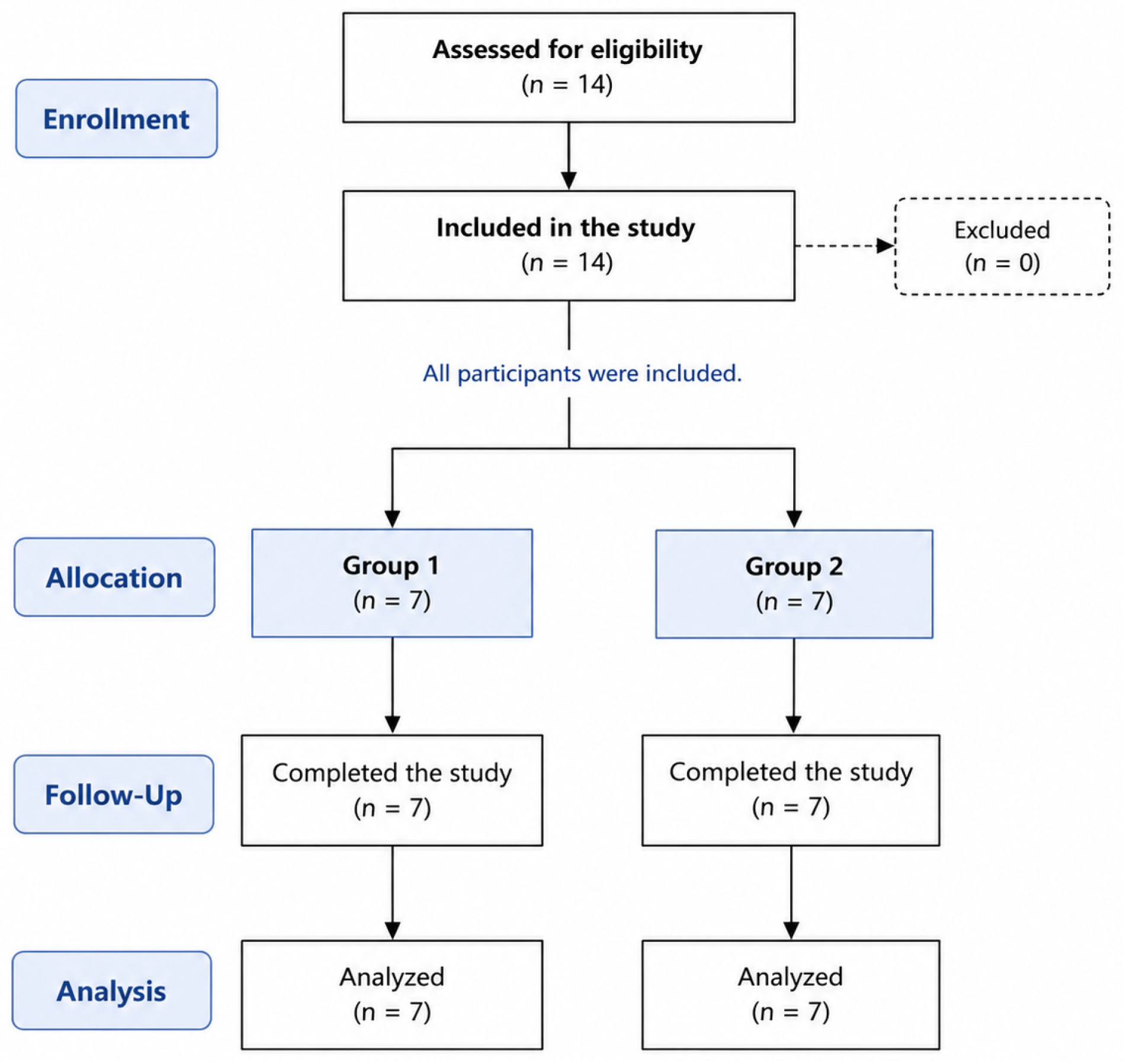
A total of 14 participants were assessed for eligibility, and all met the inclusion criteria and were enrolled in the study. Participants were allocated into two groups (n = 7 per group). All participants completed the study and were included in the final analysis (Figure 1).
Participants performed a standardised two-handed chest pass against a rigid wall positioned 3 m away. During the execution phase, athletes held the ball with both hands at chest level and projected it forwards by extending the elbows and pushing the ball in the intended direction. Following contact with the wall, participants executed the reception phase by positioning the palms facing the ball, absorbing the impact through controlled elbow flexion, and retracting the ball towards the chest. Each athlete performed a minimum of seven valid repetitions of the pass-reception sequence, resulting in a total of 196 recorded trials. To ensure consistency across participants, ball pressure was standardised for all trials, and athletes were instructed to perform the task at a comfortable, game-like intensity.
A detailed description of the experimental procedures, task standardisation, the trial validation criteria, the MVC protocol, electrode placement, and the EMG processing steps is provided in Supplementary Materials S1.
Muscle activity was recorded using the BioSignalPlus sEMG system [34,35,36], with a sampling frequency of 1000 Hz, with a wireless data acquisition unit attached to the player’s clothing. The system featured a common-mode rejection ratio of 100 dB.
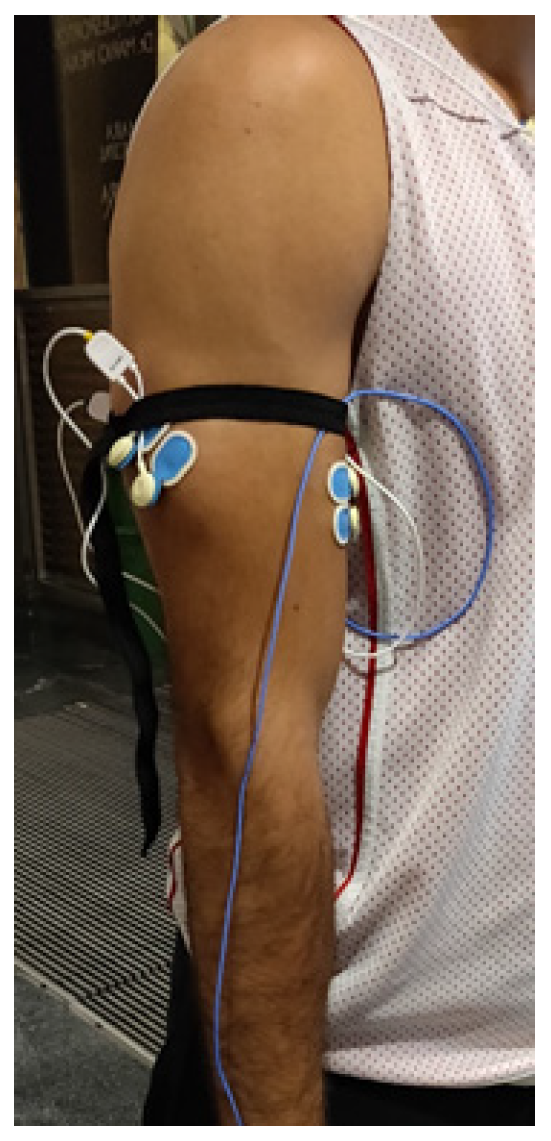
Bipolar surface electrodes (Al/AgCl) with a 20 mm inter-electrode distance were placed bilaterally over the biceps brachii, lateral head of the triceps brachii, and long head of the triceps brachii, following standard surface EMG recommendations [37]. For the biceps brachii, electrodes were positioned on the anterior aspect of the upper arm, over the muscle belly, and aligned with the longitudinal direction of the muscle fibres. For the lateral head of the triceps brachii, electrodes were placed on the posterolateral aspect of the upper arm, over the lateral triceps muscle belly. For the long head of the triceps brachii, electrodes were positioned on the posterior-medial aspect of the upper arm, over the long head muscle belly. In all muscles, electrodes were placed parallel to the presumed fibre orientation and away from tendon regions. The placement of the electrodes is illustrated in Figure 2. The reference electrode was placed on the clavicle. Skin preparation included shaving when necessary and cleansing with alcohol to minimise impedance [37]. All cables and the wireless acquisition unit were secured to the participant’s clothing to reduce movement artefacts and allow the task to be performed as naturally as possible.
Maximum voluntary contractions (MVCs) were recorded for each analysed muscle and limb, with three trials performed per muscle, and were used for EMG amplitude normalisation. For the biceps brachii, MVC was obtained during resisted elbow flexion at a right angle, with the forearm in supination. For the triceps brachii, MVC was obtained during resisted elbow extension with shoulder at 90° abduction. Verbal encouragement was provided during each trial, and rest periods were allowed between trials to reduce fatigue. The highest MVC value obtained for each muscle and limb was used for normalisation.
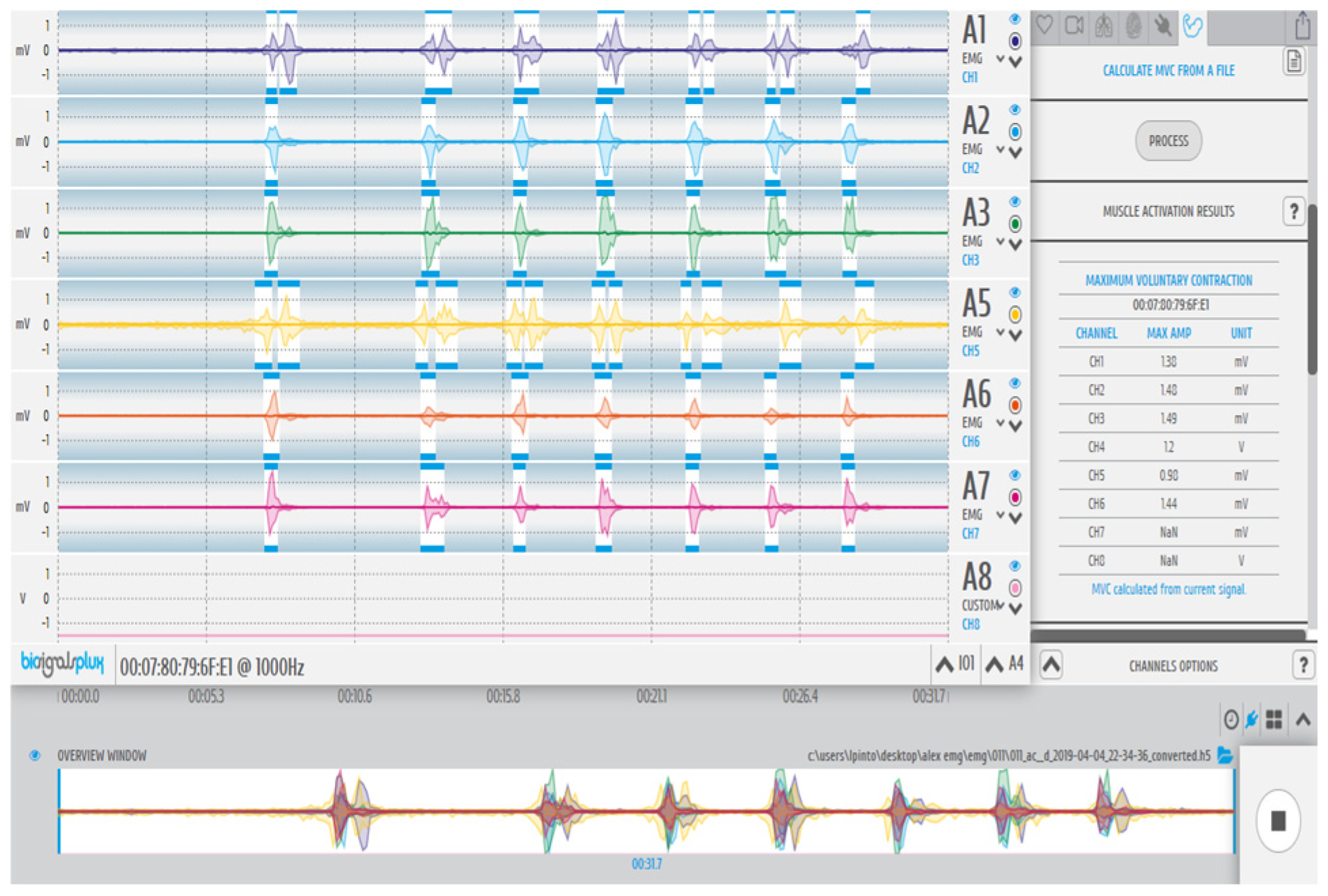
EMG signals were visually inspected during processing, band-pass-filtered between 20 and 400 Hz, full wave-rectified and smoothed using a low-pass filter (Butterworth 4th order digital filter) with the OpenSignals EMG Analysis add-on (BITalino/biosignalsplux). For each detected muscle activation event, RMS-based amplitude parameters were extracted from the processed EMG signal. The percentage of muscle activation (%MA) was calculated by normalising the RMS amplitude value obtained during the task to the corresponding MVC value of the same muscle and limb. The muscle activation time (AT) was obtained using the automatic onset detection procedure available in the OpenSignals EMG Analysis add-on, which identifies the start and end time of each muscle activation event (Figure 3). Trials with evident movement or impact artefacts that compromised EMG interpretation were excluded from the analysis. The same processing procedure was applied to all muscles, limbs, and participants.
Statistical analyses were performed using IBM SPSS Statistics 26.0 (IBM Corporation, New York, NY, USA) [38]. Descriptive data are presented as mean ± standard deviation. A linear mixed model was fitted to account for the hierarchical and repeated-measures structure of the data. Athlete identity was included as a random effect to account for inter-individual variability, while hand side (dominant vs. non-dominant) was treated as a within-subject repeated factor. Fixed effects included group (experience level), hand side, and their interaction. An appropriate covariance structure was selected based on model fit criteria. Denominator degrees of freedom were estimated using the Kenward–Roger approximation to improve inference in small samples. Effect sizes were reported as partial eta squared. The significance level was set at p < 0.05.

3. Results

Table 2 displays the average value ( X ¯ ) and the standard deviation (SD) for muscle activation time in seconds (AT) and percentage of muscle activity (%MA) normalized with MVC of each muscle, where G1 refers to the group with the least experience and G2 to the group with the most experience.
A very significant interaction with a large effect size is observed in the case of LTLO and LBB in terms of AT. In the case of LBB, in terms of %MA, the interaction does not reach significance but also has a huge effect size.
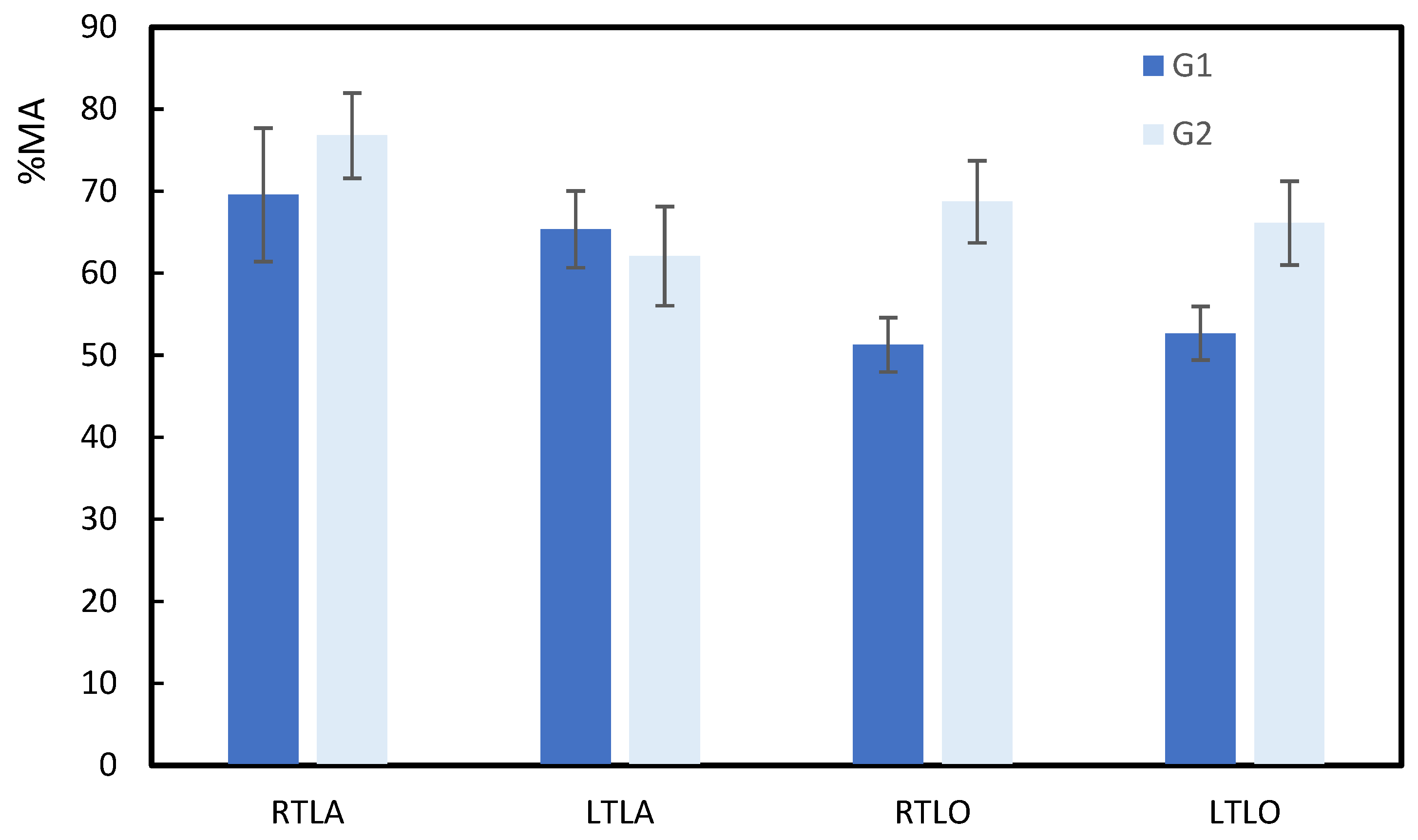
More experienced athletes tended to demonstrate significantly shorter activation times in the lateral head of the triceps brachii and higher %MA in the long head of the triceps brachii. Although several additional variables did not reach statistical significance, moderate-to-very-large effect sizes were observed, suggesting meaningful differences that may not have been fully detected due to sample size limitations. Figure 4 illustrates the difference observed for %MA for the 2 groups.

4. Discussion

The present study aimed to characterise upper-limb muscle activation during both the execution and reception phases of the basketball chest pass across different experience levels. Given the high frequency and technical relevance of these actions in basketball [3,39], a clearer understanding of their neuromuscular characteristics is of practical and scientific interest.
Skill acquisition in basketball is a complex and time-dependent process that involves the progressive refinement of motor control strategies, including changes in muscle activation timing, magnitude, and inter-muscle coordination [15,21]. Despite the recognised importance of passing, limited evidence exists regarding the neuromuscular demands of the reception phase, which is critical for maintaining ball possession and continuity of play. For this reason, muscle activation time (AT) and muscle activity (%MA) normalised to maximal voluntary contraction (MVC), were analysed during the execution and reception phases in athletes with different levels of experience.
The absence of differences between dominant and non-dominant limbs is consistent with the bilateral nature of the two-handed chest pass. In this task, both upper limbs contribute simultaneously and symmetrically to ball propulsion and control. From a motor control perspective, this symmetry likely reflects the operation of a shared neural control strategy governing both limbs during coordinated bilateral tasks. Consequently, minimal asymmetry in neuromuscular activation would be expected, provided no injury or functional limitation is present.
Most of the previous studies examining limb dominance in basketball have focused on unilateral actions, such as shooting or dribbling, where preferential limb use may lead to asymmetrical neuromuscular adaptations [40,41,42]. In contrast, the current results support the notion that symmetrical technical skills promote balanced neuromuscular activation patterns and do not necessarily lead to dominant–non dominant asymmetries. These findings are in line with previous research reporting negligible dominant–non-dominant differences during symmetrical upper-limb tasks [43], supporting the validity of pooling limb data in further analyses.
Differences between groups were observed mainly in the triceps brachii. More experienced athletes tended to demonstrate shorter activation times and higher levels of normalised activation, especially in the long head of the triceps brachii. These findings suggest differences in neuromuscular activation strategies rather than direct differences in muscular strength. From a motor control perspective, shorter activation times may reflect improved anticipatory control and more efficient timing of muscle recruitment, which are characteristics commonly associated with higher levels of skill acquisition. Similarly, higher normalised EMG amplitudes may indicate increased neural drive or more coordinated activation patterns during task execution. However, these findings should be interpreted with caution because the two groups differ not only in years of basketball experience, but also substantially in age (11.7 vs. 20.3 years), which represents an important limitation of the present study. Therefore, the differences observed cannot be attributed to experience or expertise alone. They may reflect a combination of accumulated practice, biological maturation, and age-related neuromuscular development. Since EMG activity and neuromuscular control are strongly influenced by growth, biological maturation, and motor development, it is not possible to attribute the observed differences exclusively to basketball experience or training background. Therefore, the findings should be interpreted with caution, as maturational factors may have contributed significantly to the EMG patterns identified. Previous studies have suggested that practice experience and expertise may be associated with changes in temporal coordination, muscle recruitment, and sport-specific motor performance [18,44]. However, in the present study, the shorter activation times and higher normalised activation values observed in the older and more experienced group should be interpreted as between-group differences rather than isolated effects of expertise. This interpretation is consistent with the exploratory nature of the study and with the known influence of maturation on neuromuscular function.
The long head of the triceps brachii showed the most pronounced experience/age-related differences. This observation is biomechanically plausible, as the long head plays a key role in elbow extension when movements involve concurrent shoulder flexion, as occurs during the chest pass [39,45]. In this movement, force generation occurs through a proximal-to-distal kinetic chain, in which movement is initiated in the lower limbs and trunk, transferred through the shoulder, and modulated distally at the elbow. In this context, the primary contributors to force generation at the shoulder are the pectoralis major and anterior deltoid, while the triceps brachii plays a key role in the final phase of elbow extension and force transmission. Increased activation in this muscle may therefore reflect improved coordination between shoulder and elbow joints in more experienced players, contributing to smoother and more efficient force transmission along the kinetic chain [46].
It should be emphasised that the group with greater basketball experience was also substantially older and therefore more biologically mature. This represents a major limitation of the study design. Consequently, the higher activation levels observed in the long head of the triceps brachii may reflect a combination of accumulated practice, neuromuscular maturation, age-related changes in muscle morphology, and differences in motor unit recruitment capacity, rather than experience alone. This distinction is important, as it precludes causal attribution exclusively to training history or expertise.
Several variables did not reach statistical significance but exhibited moderate-to-large effect sizes. Given the relatively small sample size, these findings may indicate meaningful differences that were not fully detected due to limited statistical power. However, effect sizes should be interpreted cautiously, as they may be inflated in small cohorts.
Effect size analysis (partial eta squared) indicated moderate-to-large effects for several variables; however, these should be interpreted cautiously given the small sample size.
Correlation analysis revealed weak to moderate associations between years of practice and several neuromuscular variables. In particular, negative correlations between experience and activation time (RTLA_AT and LTLA_AT) suggest a tendency for more experienced/aged athletes to exhibit faster muscle activation, which is consistent with improved neuromuscular efficiency. Moderate positive correlations observed for long-head triceps variables further support the role of this muscle in experience-related movement adaptations, although the absence of statistical significance indicates that these trends should be confirmed in larger samples.
Several limitations should be acknowledged when interpreting the findings of this study. The sample size was relatively small, which limits statistical power and increases the likelihood of inflated effect size estimates. Though multiple repetitions were collected per participant, these observations are not independent and therefore do not increase the effective sample size, which may limit the generalisability of the findings. Although several variables exhibited moderate-to-very-large effect sizes, these results should be interpreted with caution, as small cohorts may not fully capture inter-individual variability in neuromuscular behaviour. The experience level was intrinsically confounded with age and biological maturation. In addition, MVC normalisation should be interpreted cautiously because the ability to produce a true maximal voluntary contraction may differ between younger and older participants. Therefore, %MA comparisons between groups may have been influenced not only by task-related muscle activation, but also by age- and maturation-related differences in maximal voluntary activation capacity. The more experienced group was substantially older than the less experienced group, meaning that observed differences in muscle activation patterns may reflect not only accumulated practice but also neuromuscular development, hormonal maturation, and age-related changes in muscle morphology. Consequently, causality cannot be attributed solely to years of basketball experience. The study included only male athletes, which limits the generalisability of the findings to female basketball players. Sex-related differences in neuromuscular control and upper-limb biomechanics have been reported in the literature and should be examined in future research. The experimental task involved passing against a rigid wall, which, although necessary for standardisation, does not perfectly replicate the dynamic, interactive conditions of a real game. In particular, variations in pass speed, teammate positioning, and perceptual–decision demands were not represented and may influence muscle activation strategies during match play. The muscle activity assessment using surface electromyography, despite being a valid and widely accepted technique, is subject to limitations such as cross-talk, sensitivity to electrode placement, and the inability to directly quantify muscle force. The reception phase may also introduce movement- or impact-related artefacts due to ball contact. Although signals were visually inspected, filtered, and trials with evident artefacts were excluded, the possibility of residual mechanical noise cannot be completely ruled out. For this reason, activation time and %MA values during reception should be interpreted with caution. Additionally, EMG amplitude reflects neural activation rather than mechanical output; therefore, %MA should not be interpreted as a direct measure of muscle strength. Finally, the analysis focused exclusively on the biceps brachii and triceps brachii. Although these muscles are central to elbow flexion and extension, passing and reception involve coordinated contributions from the shoulder prime movers (e.g., pectoralis major and anterior deltoid), as well as forearm musculature and trunk segments, which together contribute to force generation through a proximal-to-distal kinetic chain. Inclusion of these segments in future studies would provide a more comprehensive understanding of inter-segmental coordination during basketball passing tasks. Despite these limitations, the study provides novel and meaningful insight into upper-limb neuromuscular activation during both the execution and reception of the basketball chest pass across developmental stages.
Taken together, the findings suggest that more experienced/older basketball players adopt distinct neuromuscular activation strategies during chest passing and reception, characterised primarily by modifications in triceps brachii activation. These differences likely reflect an interaction between practice-related motor learning and neuromuscular maturation, rather than isolated effects of experience alone.
Future studies should compare age- and maturation-matched groups, or statistically control for maturation status, in order to better isolate the effects of basketball practice and training experience on neuromuscular behavior.

5. Conclusions

Through this study and data analysis, several conclusions were drawn. No significant differences were observed between the dominant and non-dominant limbs during the execution and reception of the basketball chest pass. More experienced and aged basketball players tended to demonstrate higher levels of neuromuscular activation and shorter activation times in the triceps brachii, particularly in the long head; however, these findings should be interpreted with caution, as differences in age and biological maturation may have influenced the observed results. No significant experience-related differences were identified in biceps brachii activation, suggesting a secondary or stabilising role during the task. The most pronounced differences between groups were observed in the activation time of the triceps lateral head and %MA of the triceps long head.
These findings highlight the importance of neuromuscular coordination in successful passing and receiving actions and contribute novel evidence to a relatively unexplored area of basketball biomechanics. From a practical perspective, the results may assist coaches and practitioners in designing training programmes that account for developmental differences in neuromuscular control.

Supplementary Materials

The following supporting information can be downloaded at: https://www.mdpi.com/article/10.3390/app16115385/s1.

Author Contributions

Conceptualization, M.A.C. and A.M.A.; methodology, C.M.A.; validation, C.M.A., M.A.C. and A.M.A.; formal analysis, C.M.A.; investigation, C.M.A., M.A.C. and A.M.A.; writing—original draft preparation, C.M.A.; writing—review and editing, C.M.A., M.A.C. and A.M.A. All authors have read and agreed to the published version of the manuscript.

Funding

C.M.A. thanks the Foundation for Science and Technology (FCT), Portugal, for the financial support through the Doctoral Scholarship 2023.05546.BD.

Institutional Review Board Statement

The study was conducted in accordance with the Declaration of Helsinki and approved by Ethics Committee of Polytechnic Institute of Coimbra (14_CEIPC2/2019).

Informed Consent Statement

Informed consent was obtained from all subjects involved in the study.

Data Availability Statement

The data presented in this study are available on request from the corresponding author.

Acknowledgments

This research is sponsored by national funds through FCT—Fundação para a Ciência e a Tecnologia, under projects UID/00285—Centre for Mechanical Engineering, Materials and Processes and LA/P/0112/2020. M.A.C. acknowledges the research support provided by CEMMPRE by national funds through FCT—Fundação para a Ciência e a Tecnologia, under projects UID/00285/2025 and LA/P/0112/2020, CDRSP UID/04044/2025 DOI: https://doi.org/10.54499/UID/04044/2025 and ciTechCare UID/05704/2025 DOI: https://doi.org/10.54499/UID/05704/2025. The authors acknowledge the support of RoboCorp Laboratory, i2A, Polytechnic Institute of Coimbra and the student Alexandre Cavaleiro, for his collaboration in this work.

Conflicts of Interest

The authors declare that they have no known competing financial interests or personal relationships that could have appeared to influence the work reported in this paper.

References

  1. Available online: https://about.fiba.basketball/en/our-sport/basketball (accessed on 1 February 2026).
  2. Cao, S.; Liu, J.; Wang, Z.; Geok, S.K. The effects of functional training on physical fitness and skill-related performance among basketball players: A systematic review. Front. Physiol. 2024, 15, 1391394. [Google Scholar] [CrossRef] [PubMed] [PubMed Central]
  3. Maimón, A.Q.; Courel-Ibáñez, J.; Ruíz, F.J.R. The Basketball Pass: A Systematic Review. J. Hum. Kinet. 2020, 71, 275–284. [Google Scholar] [CrossRef] [PubMed] [PubMed Central]
  4. Arias, J.L.; Argudo, F.M.; Alonso, J.I. Effect of ball mass on dribble, pass, and pass reception in 9–11-year-old boys’ basketball. Res. Q. Exerc. Sport 2012, 83, 407–412. [Google Scholar] [CrossRef] [PubMed]
  5. Saputro, A.A. Efficiency of Problem-Based Learning Models to Improve Passing Skills in Basketball Games. J. Phys. Educ. Health Sci. 2025, 1, 1–6. [Google Scholar]
  6. Izzo, R.E.; Russo, L. Analysis of Biomechanical Structure and Passing Techniques in Basketball. Timis. Phys. Educ. Rehabil. J. 2011, 3, 41–46. [Google Scholar]
  7. Tomljanović, M.; Jelaska, G.; Prodanović, S. Differences in accuracy of passing the ball in young basketball players of different levels of competition. Sky-Int. J. Phys. Educ. Sports Sci. 2022, 110–122. [Google Scholar] [CrossRef]
  8. Caruso, M.; Cimmino, L.; Narducci, F.; Pero, C.; Ronga, G. Advancements in basketball action recognition: Datasets, methods, explainability, and synthetic data applications. Image Vis. Comput. 2025, 162, 105689. [Google Scholar] [CrossRef]
  9. Jia, J.; Chen, H. The Rating of Basketball Players’ Competitive Performance Based on RBF-EVAMethod. Int. J. Inf. Technol. Web Eng. 2023, 18, 1–16. [Google Scholar] [CrossRef]
  10. Amaro, C.M.; Castro, M.A.; Mendes, R.; Gomes, B.B. Visual Fixations in Basketball Shooting: Differences between Shooting Conditions. Appl. Sci. 2024, 14, 3168. [Google Scholar] [CrossRef]
  11. Olteanu, M.; Oancea, B.M.; Badau, D. Improving Effectiveness of Basketball Free Throws through the Implementation of Technologies in the Technical Training Process. Appl. Sci. 2023, 13, 2650. [Google Scholar] [CrossRef]
  12. Büttner, C.M.; Kenntemich, C.; Williams, K.D. The power of human touch: Physical contact improves performance in basketball free throws. Psychol. Sport Exerc. 2024, 72, 102610. [Google Scholar] [CrossRef]
  13. Bulahan, M.; Chister, R.; Balongcas, L.; Almero, C.; Erodias, M.; Tondo, J.; Sabidalas, M.; Grace, M.; De, G.; Cruz, L. Enhancing free-throw shooting through body positioning: Inputs for basketball training program. Psychol. Educ. Multidiscip. J. 2024, 18, 856–862. [Google Scholar] [CrossRef]
  14. Zhao, C.; Liu, N.; Li, S. Study on the relationship between fixation characteristics and hit rate in psychological procedure training of free throw. PLoS ONE 2024, 19, e0293436. [Google Scholar] [CrossRef] [PubMed]
  15. Fan, P.; Yang, Z.; Wang, T.; Li, J.; Kim, Y.; Kim, S. Neuromuscular Control Strategies in Basketball Shooting: Distance-Dependent Analysis of Muscle Synergies. J. Sports Sci. Med. 2024, 23, 571–580. [Google Scholar] [CrossRef] [PubMed] [PubMed Central]
  16. Amaro, C.M.; Castro, M.A.; Mendes, R.; Rice, H.; Gomes, B.B. Influence of Jump and Ball Release Parameters on Shooting Accuracy in Basketball Under Varying Constraints. J. Funct. Morphol. Kinesiol. 2025, 10, 459. [Google Scholar] [CrossRef]
  17. Li, S.; Yang, J.; Mi, J.; Li, Y. The effects of repeated sprints on mid-range and three-point jump shot biomechanics in elite basketball players. PeerJ 2025, 13, e19983. [Google Scholar] [CrossRef] [PubMed] [PubMed Central]
  18. Pakosz, P. Emg Signal Analysis of Selected Muscles During Shots and Passes in Basketball. J. Health Promot. Recreat. Rzesz. 2011, 2, 8–14. [Google Scholar]
  19. Marcolin, G.; Camazzola, N.; Panizzolo, F.A.; Grigoletto, D.; Paoli, A. Different intensities of basketball drills affect jump shot accuracy of expert and junior players. PeerJ 2018, 6, e4250. [Google Scholar] [CrossRef] [PubMed] [PubMed Central]
  20. Kalén, A.; Pérez-Ferreirós, A.; Costa, P.B.; Rey, E. Effects of age on physical and technical performance in National Basketball Association (NBA) players. Res. Sports Med. 2021, 29, 277–288. [Google Scholar] [CrossRef]
  21. Wei, L.; Zheng, Y.; Li, M.; Dai, S.H. Testing The Effects of Player Matching in Basketball Matches and Small-Sided Game Training Scenarios Based on The Relative Age Effect: A 6-Month Study on Physical Performance and Skill Adaptations. J. Sports Sci. Med. 2025, 24, 397–405. [Google Scholar] [CrossRef]
  22. Mir, I.A.; Mohd Jamali, M.N.Z.; Humayra, S.; Chong, K.W.; Amalnerkar, T.; Sirajudeen, M.S. Partial versus full range of motion triceps strength training on shooting accuracy among recreational basketball players: A randomized controlled trial. BMC Sports Sci. Med. Rehabil. 2025, 17, 41. [Google Scholar] [CrossRef] [PubMed] [PubMed Central]
  23. Muyor, J.M.; Martín-Fuentes, I.; RodríguezRidao, D.; Antequera-Vique, J.A. Electromyographic activity in the gluteus medius, gluteus maximus, biceps femoris, vastus lateralis, vastus medialis and rectus femoris during the Monopodal Squat, Forward Lunge and Lateral Step-Up exercises. PLoS ONE 2020, 15, e0230841. [Google Scholar] [CrossRef] [PubMed]
  24. Beretta-Piccoli, M.; Cescon, C.; D’Antona, G. Evaluation of performance fatigability through surface EMG in health and muscle disease: State of the art. Arab J. Basic Appl. Sci. 2021, 28, 21–40. [Google Scholar] [CrossRef]
  25. Amaro, C.M.; Castro, M.A.; Roseiro, L.; Mendes, R.; Amaro, A.M. Gastrocnemius Activation throughout the Competitive Season in Athletes of Different Experience Levels. Appl. Sci. 2021, 11, 984. [Google Scholar] [CrossRef]
  26. Matsunaga, N.; Oshikawa, T. Muscle synergy during free throw shooting in basketball is different between scored and missed shots. Front. Sports Act. Living 2022, 4, 990925. [Google Scholar] [CrossRef] [PubMed] [PubMed Central]
  27. Amaro, C.M.; Nolasco, S.; Roseiro, L.; Amaro, A.M.; Castro, M.A. sEMG Analysis of Upper Limb Muscles during Backhand Smash Using Badminton Rackets of Different Stiffness. Appl. Sci. 2022, 12, 9483. [Google Scholar] [CrossRef]
  28. Cosendey, K.; Mongold, S.; Petieau, M.; Cheron, G.; Cebolla, A.M. Sleep-push movement performance in elite field hockey champions with and without training specialization. Front. Psychol. 2023, 14, 1199448. [Google Scholar] [CrossRef] [PubMed] [PubMed Central]
  29. Li, Z.; Zhang, B.; Wang, H.; Gouda, M.A. Surface Electromyography Monitoring of Muscle Changes in Male Basketball Players During Isotonic Training. Sensors 2025, 25, 1355. [Google Scholar] [CrossRef]
  30. Ma, X.; Chen, S.; Li, Q. Identification of lower limb muscle fatigue in basketball players based on sEMG signals. Front. Physiol. 2025, 16, 1689324. [Google Scholar] [CrossRef]
  31. Pakosz, P.; Konieczny, M. Time Analysis of Muscle Activation During Basketball Free Throws. Cent. Eur. J. Sport Sci. Med. 2016, 15, 63–69. [Google Scholar] [CrossRef]
  32. Pakosz, P.; Domaszewski, P.; Konieczny, M.; Bączkowicz, D. Muscle activation time and free-throw effectiveness in basketball. Sci. Rep. 2021, 11, 7489. [Google Scholar] [CrossRef]
  33. Jiang, J.; Li, H.; Xiu, C. Characterization of Muscle Activation and Muscle Synergism in the ‘Forward Lunge’ Gait Movement of Badminton Players Using Surface Electromyography Sensors. Sensors 2025, 25, 1644. [Google Scholar] [CrossRef]
  34. De Luca, C.J. The Use of Surface Electromyography in Biomechanics. J. Appl. Biomech. 1997, 13, 135–163. [Google Scholar] [CrossRef]
  35. Rashid, D.M.S.; Faraj, S.M.S.; Hedayatpour, N. The effect of triceps brachii fatigue on shot accuracy of male and female basketball players. Int. J. Perform. Anal. Sport 2020, 20, 206–218. [Google Scholar] [CrossRef]
  36. Zhou, Q.; Wu, S.; Zhang, J.; Pan, Z.; Kang, Z.; Ma, Y. Research on the Impact of Shot Selection on Neuromuscular Control Strategies During Basketball Shooting. Sensors 2025, 25, 4104. [Google Scholar] [CrossRef] [PubMed]
  37. Konrad, P. The ABC of EMG—A Practical Introduction to Kinesiological Electromyography; Noraxon Inc.: Scottsdale, AZ, USA, 2025. [Google Scholar]
  38. Ghasemi, A.; Zahediasl, S. Normality Tests for Statistical Analysis: A Guide for Non-Statisticians. Int. J. Endocrinol. Metab. 2012, 10, 486–489. [Google Scholar] [CrossRef] [PubMed]
  39. Kholinne, E.; Zulkarnain, R.F.; Sun, Y.C.; Lim, S.; Chun, J.M.; Jeon, I.H. The different role of each head of the triceps brachii muscle in elbow extension. Acta Orthop. Traumatol. Turc. 2018, 52, 201–205. [Google Scholar] [CrossRef] [PubMed] [PubMed Central]
  40. Cohen, J. Statistical Power Analysis for the Behavioral Sciences, 2nd ed.; Lawrence Erlbaum Associates: Hillside, NJ, USA, 1988. [Google Scholar]
  41. Gualdi-Russo, E.; Rinaldo, N.; Pasini, A.; Zaccagni, L. Hand Preference and Performance in Basketball Tasks. Int. J. Environ. Res. Public Health 2019, 16, 4336. [Google Scholar] [CrossRef] [PubMed] [PubMed Central]
  42. Onodera, K.; Takeda, M. Hand Selection in Dribbling Phases: An Analysis of Non-Dominant Hand Usage and Dribble Change in Basketball. Sports 2023, 11, 226. [Google Scholar] [CrossRef]
  43. Kuhtz-Buschbeck, J.P.; Keller, P. Muscle activity in throwing with the dominant and non-dominant arm. Cogent Med. 2019, 6, 1678221. [Google Scholar] [CrossRef]
  44. Jin, P.; Ge, Z.; Fan, T. Research on visual search behaviors of basketball players at different levels of sports expertise. Sci. Rep. 2023, 13, 1406. [Google Scholar] [CrossRef]
  45. Hussain, J.; Sundaraj, K.; Subramaniam, I.D. Cognitive stress changes the attributes of the three heads of the triceps brachii during muscle fatigue. PLoS ONE 2020, 15, e0228089. [Google Scholar] [CrossRef]
  46. Tavares, N.; Castro, M.A.; Vilas-Boas, J.P. An Electromyographic Analysis of Shoulder Muscles in Scapular Punches Exercise in Swimmers. In Proceedings of the 10th Congress of the Portuguese Society of Biomechanics: CNB 2023; Martins Amaro, A., Roseiro, L., Messias, A.L., Gomes, B., Almeida, H., Castro, M.A., Neto, M.A., de Fátima Paulino, M., Maranha, V., Eds.; Lecture Notes in Bioengineering; Springer: Cham, Switzerland, 2023. [Google Scholar]
Figure 1. Participant flow diagram.
Applsci 16 05385 g001
Figure 2. Electrode placement in the athlete (biceps and triceps).
Applsci 16 05385 g002
Figure 3. Example of muscle activity during 7 repetitions.
Applsci 16 05385 g003
Figure 4. Average %MA and SD for both groups (G1 and G2).
Applsci 16 05385 g004
Table 1. Descriptive characteristics of both groups.
GroupAge (Years)Height (cm)BMI (kg/m2)Wingspan (cm)
111.7 ± 1.63148.7 ± 12.718.0 ± 2.9149.2 ± 12.3
220.3 ± 4.82184.1 ± 7.6022.0 ± 3.0187.4 ± 7.5
BMI—Body mass index.
Table 2. AT and %MA considering the different experience groups.
G1
(Mean ± SD)
G2
(Mean ± SD)
Group
Effect (F, p)
Hand Side
Effect (F, p)
Group * Hand Side Effect
(F, p)
Effect Size for Group η p 2
RTLA_AT (s)0.583 ± 0.0430.478 ± 0.015F = 3.810, p = 0.075F = 0.001, p = 0.980F = 0.000, p = 0.9910.240986717Large
RTLA_%MA69.555 ± 8.12476.775 ± 5.206F = 0.252, p = 0.625F = 1.438, p = 0.254F = 0.008, p = 0.9320.020568071Irrelevant
RTLO_AT (s)0.521 ± 0.2110.472 ± 0.017F = 2.794, p = 0.120F = 1.411, p = 0.258F = 0.683, p = 0.4250.188860349Large
RTLO_%MA51.274 ± 3.30668.708 ± 5.019F = 5.212, p = 0.041F = 1.944, p = 0.188F = 0.389, p = 0.5440.302811992Large
RBB_AT (s)0.582 ± 0.0750.617 ± 0.058F = 0.008, p = 0.929F = 4.044, p = 0.067F = 0.465, p = 0.5080.000666223Irrelevant
RBB_%MA53.954 ± 5.23858.560 ± 5.450F = 0.977, p = 0.343F = 4.242, p = 0.062F = 0.068, p = 0.7980.075287046Irrelevant
LTLA_AT (s)0.606 ± 0.0450.493 ± 0.013F = 3.635, p = 0.081F = 2.964, p = 0.111F = 2.909, p = 0.1140.232491206Large
LTLA_%MA65.365 ± 4.68062.091 ± 6.049F = 0.008, p = 0.931F = 0.297, p = 0.596F = 1.986, p = 0.1840.000666223Irrelevant
LTLO_AT (s)0.478 ± 0.0260.493 ± 0.015F = 0.137, p = 0.717F = 0.201, p = 0.662F = 5.415, p = 0.0380.011287798Irrelevant
LTLO_%MA52.680 ± 3.26066.106 ± 5.119F = 2.766, p = 0.122F = 0.324, p = 0.580F = 1.567, p = 0.2340.187322227Large
LBB_AT (s)0.610 ± 0.0450.532 ± 0.031F = 1.643, p = 0.224F = 1.917, p = 0.191F = 6.332, p = 0.0270.120428058Moderate
LBB_%MA51.566 ± 4.71564.838 ± 5.140F = 2.178, p = 0.166F = 0.563, p = 0.468F = 4.614, p = 0.0530.153618282Moderate/Large
* RTLA—Right lateral triceps brachii; RTLO—Right long triceps brachii; LTLA—Left lateral triceps brachii; LTLO—Left long triceps brachii; RBB—Right biceps brachii; LBB—Left biceps brachii; AT—Muscle activation time; %MA—Percentage of muscle activation. η p 2 = partial eta squared; For all F-tests (Group, Side, and Interaction), degrees of freedom were df (1, 12).
Disclaimer/Publisher’s Note: The statements, opinions and data contained in all publications are solely those of the individual author(s) and contributor(s) and not of MDPI and/or the editor(s). MDPI and/or the editor(s) disclaim responsibility for any injury to people or property resulting from any ideas, methods, instructions or products referred to in the content.