Influence of Spool Impact on Preloaded Threaded Plugs in Hydraulic Valves


Abstract
1. Introduction
2. Methods
2.1. Measurements
2.2. Force Calculations
2.3. FE Models of the Original Plug–Valve Connections
3. Results and Discussion
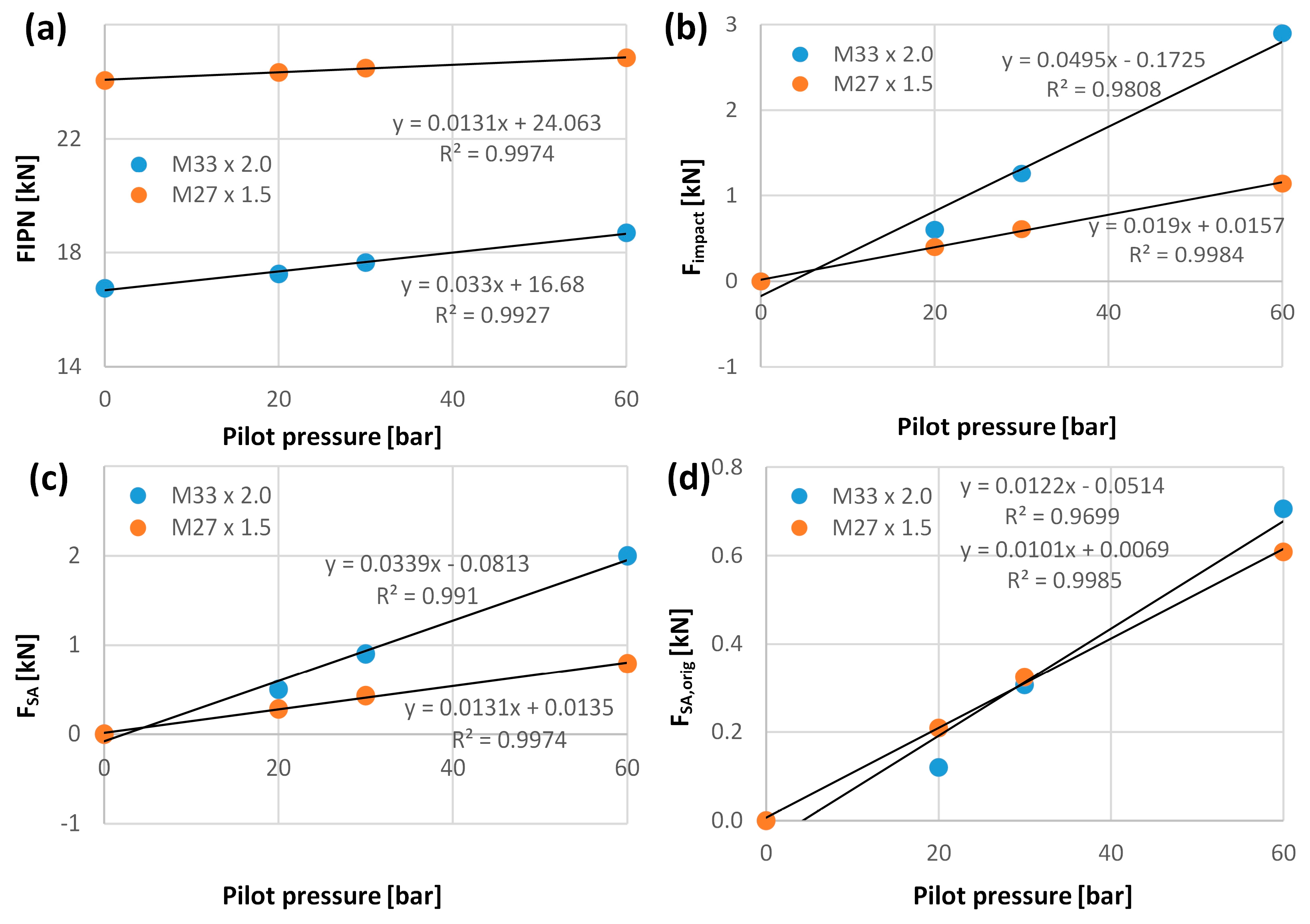
3.1. Stabilized Forces and Stiffness Ratios in Dependence from Pilot Pressure
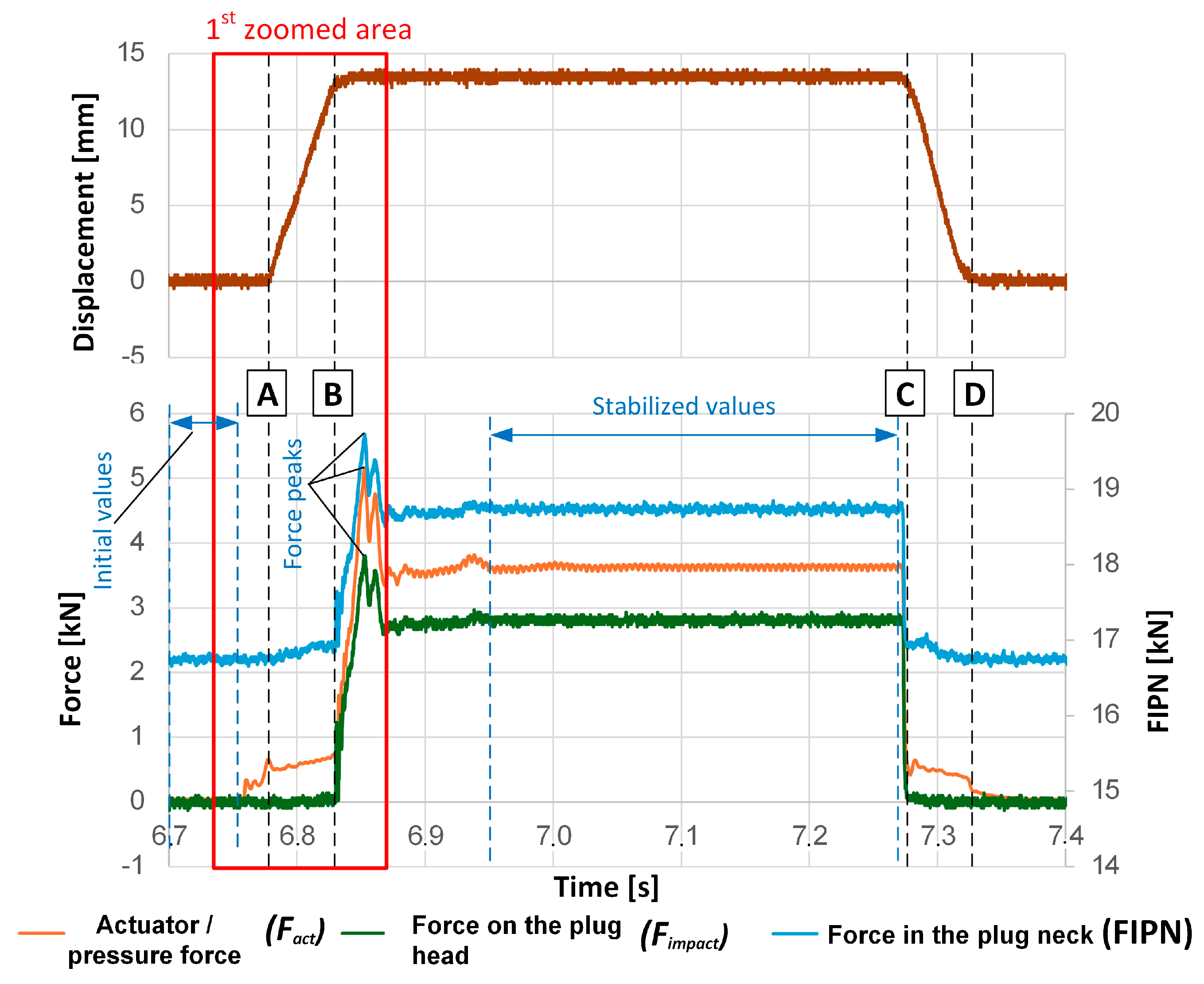
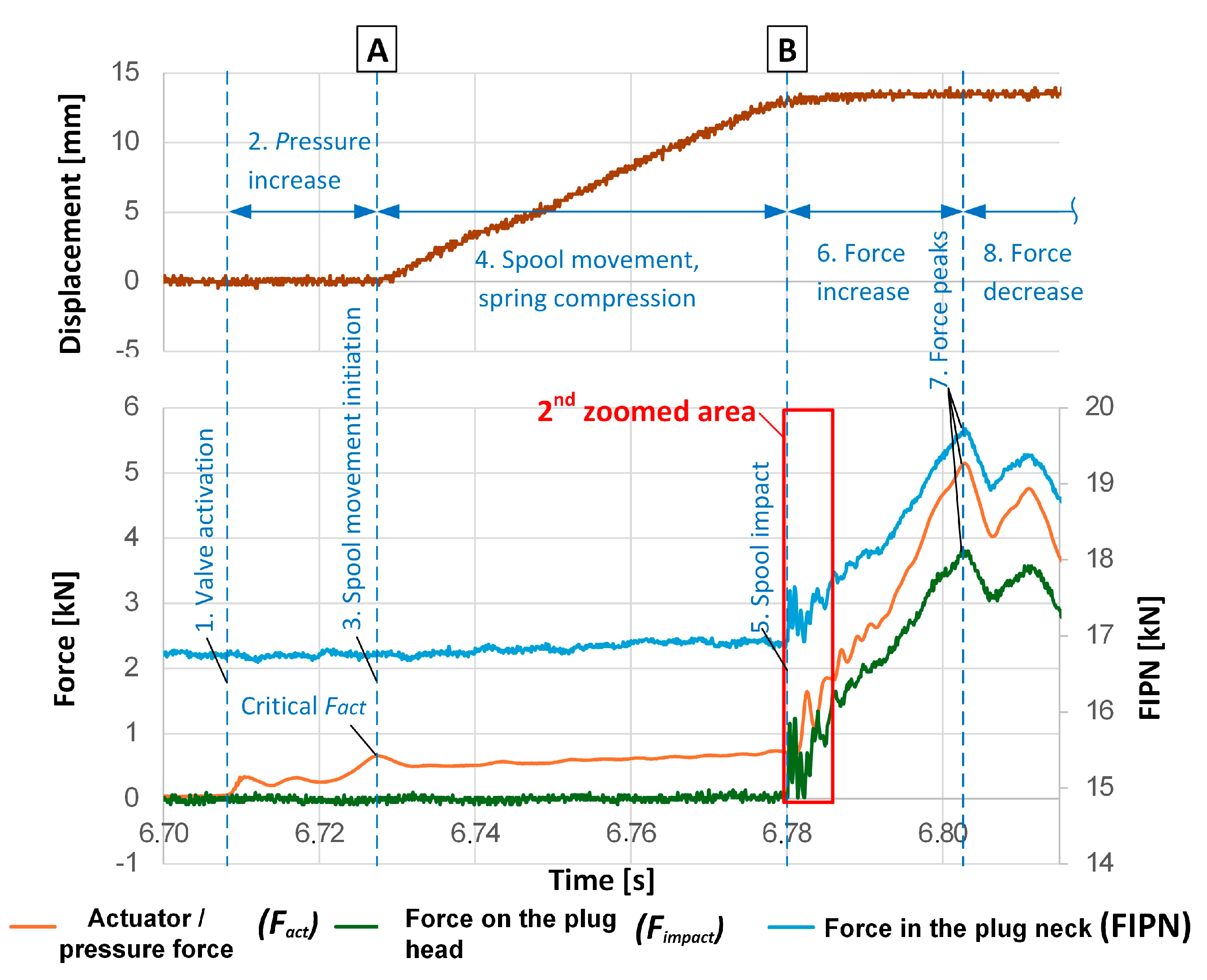
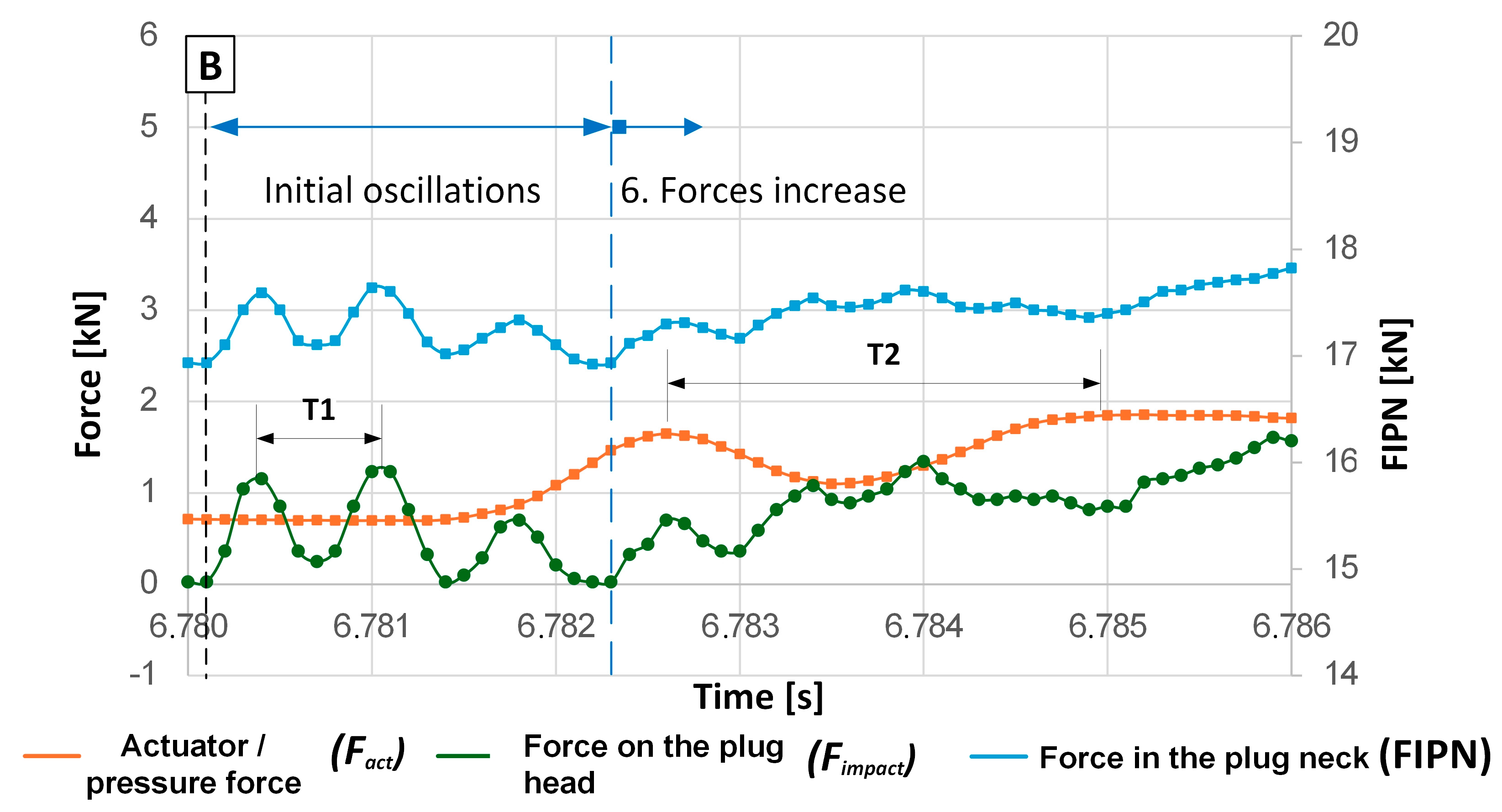
3.2. Zoomed Forces
3.3. Design Recommendations and Practical Considerations
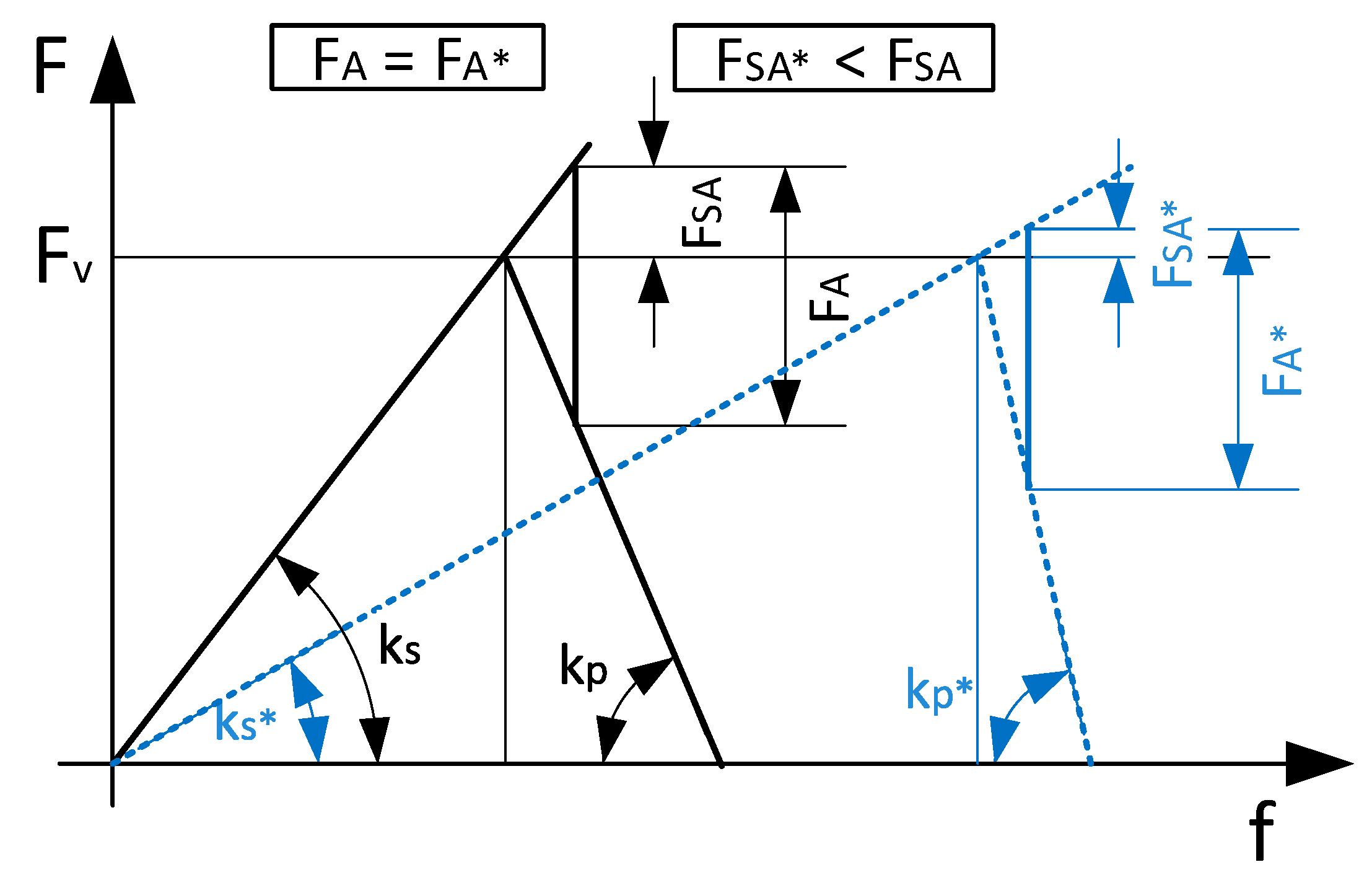
- Changes in design: The stiffness ratio corresponds directly to the ratio between the additional and actual external load applied to a preloaded connection (see Equation (10)). This implies that the fatigue strength of a plug–valve connection can be increased by decreasing its stiffness ratio. This can be achieved by decreasing the stiffness of the tensioned parts (plug stud) and increasing the stiffness of the clamped parts (valve housing), as recommended for preloaded bolts [30] (Figure 3). If the plug stiffness is reduced solely by decreasing its cross-sectional area, the stress in the plug will increase, which in turn will reduce its fatigue strength. Therefore, it is rather suggested to extend the stud of the plug in order to reduce its stiffness. However, such design changes also influence the sealing force, and should therefore be carefully balanced with the applied preload. Moreover, notch effects have a major influence on fatigue strength and should be minimized as much as possible.
- Preload stability: The preload may decrease over time, especially after repeated tightening of the plugs, which may also affect their life expectancy. To maintain stable preload, self-loosening of the plugs should be prevented. In case of repeated tightening of the plugs, they should be correctly retightened, considering the changed relationship between tightening torque and preload [24].
- Pressure peak consideration: For determination of the influence of on the additional load in the plug , the stabilized “static” values of the spool impact forces were used, rather than their peak values. This way the force–pressure relations were determined on a higher number of data points and were thus more reliable. Also, possible dynamic and other impact effects were avoided this way. However, in real-life applications, hydraulic valves can be connected to different hydraulic systems that express different pilot pressure peaks at the same nominal pressure. Although the user uses the valves at the prescribed nominal pressure, its peaks may be much higher, which may cause unexpected fatigue failures if these peaks are not considered in the valve design. Therefore, to achieve the expected life expectancy of the plugs, these pressure peaks should be considered in the plug–valve dimensioning.
3.4. Discussion on Measurement and Result Uncertainty
3.5. Assumption of Same Stabilized Spool Impact Force in the Modified and Original Plug
3.6. Future Studies
4. Conclusions
Author Contributions
Funding
Data Availability Statement
Acknowledgments
Conflicts of Interest
Nomenclature
| Symbol | Definition | Unit |
| Latin symbols | ||
| a | Spool acceleration | m/s2 |
| Uncertainty of i-th quantity | - | |
| A | Spool area exposed to pilot pressure | mm2 |
| Sensitivity coefficients | - | |
| Spool diameter | mm | |
| f | Spring contraction/measured quantity | mm |
| Actuator force acting on the spool | N | |
| External load | N | |
| Back-pressure force acting on the spool | N | |
| Hydraulic drag force | N | |
| Friction force between the spool and valve housing | N | |
| Spool impact force | N | |
| FIPN | Force in the plug neck | N |
| Reference force applied on sensors | N | |
| Spring force | N | |
| Additional load increase due to the external load | N | |
| Preload | N | |
| Gravitational acceleration | m/s2 | |
| Stiffness of the spring | N/mm | |
| Stiffness of the bolt | N/mm | |
| Stiffness of the clamping parts | N/mm | |
| L1 | Lever arm between pivot and calibrated sensor | mm |
| L2 | Lever arm between pivot and weight application | mm |
| m | Spool mass | kg |
| Calibration mass | kg | |
| p | Pilot pressure | bar |
| R2 | Coefficient of determination | - |
| T | Time period | s |
| Total combined standard uncertainty | N | |
| Standard uncertainties of the input quantity estimates | - | |
| Source of uncertainty | - | |
| Greek symbols | ||
| δp | Compliance of the clamping parts | mm/N |
| δs | Compliance of the tensioned parts | mm/N |
| Stiffness ratio | - | |
| Eigenvalue frequency | s−1 | |
| Subscripts | ||
| 0 | Initial value | - |
| f | Final value | - |
| orig | Value of the original plug–valve connection | - |
Appendix A. Measurement Uncertainty


| Quantity | Combined Measurement Uncertainty [N] |
|---|---|
| 91.0 | |
| FIPN | 92.0 |
| 12.3 |
| i | Source of Measurement Uncertainty | Standard Uncertainty | Sensitivity Coefficient | Uncertainty Contribution [N] |
|---|---|---|---|---|
| 1 | Calibration weights | 5.77 × 10⁻³ kg | 66.96 m/s2 | 0.4 |
| 2 | Ref. force location | 2.89 × 10⁻³ m | −13,166 N/m | −38.0 |
| 3 | Approx. function | 3.6 N | 1 | 3.6 |
| 4 | Repeatability | 24.8 N | 1 | 24.8 |
| i | Source of Measurement Uncertainty | Standard Uncertainty | Sensitivity Coefficient | Uncertainty Contribution [N] |
|---|---|---|---|---|
| 1 | Calibration weights | 5.77 × 10⁻³ kg | 67.26 m/s2 | 0.4 |
| 2 | Ref. force location | 2.89 × 10⁻³ m | −13,221 N/m | −38.2 |
| 3 | Approx. function FIPN | 6.2 N | 1 | 6.2 |
| 4 | Repeatability FIPN | 24.8 N | 1 | 24.8 |
| i | Source of Measurement Uncertainty | Standard Uncertainty | Sensitivity Coefficient | Uncertainty Contribution [N] |
|---|---|---|---|---|
| 1 | Pilot pressure | 5.77 × 10⁻³ Nmm−2 | 615.8 mm2 | 6.2 |
| 2 | Spool diameter | 5.77 × 10⁻² mm | 263.9 Nmm−1 | 26.4 |
References
- Čelik, A.; Jerman, B.; Majdič, F. Design guidelines for non-standard plugs. In Proceedings of the International Conference Fluid Power 2023, Maribor, Slovenia, 20–21 September 2023. [Google Scholar]
- Budynas, R.G.; Nisbett, J.K. Shigley’s Mechanical Engineering Design, 10th ed.; McGrawHill: New York, NY, USA, 2015. [Google Scholar]
- Schmid, S.R.; Hamrock, B.J.; Jacobson, B.O. Fundamentals of Machine Elements, 3rd ed.; CRC Press: Boca Raton, FL, USA, 2014. [Google Scholar]
- Bickford, J. An Introduction to the Design and Behavior of Bolted Joints, 3rd ed.; Revised and Expanded; Taylor & Francis: New York, NY, USA, 1995. [Google Scholar]
- Schütz, W. A history of fatigue. Eng. Fract. Mech. 1996, 54, 263–300. [Google Scholar] [CrossRef]
- Chapman, I.; Newnham, J.; Wallace, P. The Tightening of Bolts to Yield and Their Performance under Load. J. Vib. Acoust. 1986, 108, 213–221. [Google Scholar] [CrossRef]
- Croccolo, D.; De Agostinis, M.; Vincenzi, N. Failure analysis of bolted joints: Effect of friction coefficients in torque-preloading relationship. Eng. Fail. Anal. 2011, 18, 364–373. [Google Scholar] [CrossRef]
- Kraemer, F.; Klein, M.; Oechsner, M. Fatigue strength of metric steel screws depending on pre-load and nut type. Eng. Fail. Anal. 2020, 112, 104484. [Google Scholar] [CrossRef]
- Mínguez, J.M.; Vogwell, J. Effect of torque tightening on the fatigue strength of bolted joints. Eng. Fail. Anal. 2006, 13, 1410–1421. [Google Scholar] [CrossRef]
- Jiang, Y.Y.; Zhang, M.; Park, T.W.; Lee, C.H. An experimental study of self-loosening of bolted joints. J. Mech. Des. 2004, 126, 925–931. [Google Scholar] [CrossRef]
- VDI 2230; Systematic Calculation of High Duty Bolted Joints—Joints with One Cylindrical Bolt. Verein Deutscher Ingenieure (VDI): Düsseldorf, Germany, 2014.
- Shigley, J.E.; Mitchell, J.D. Mechanical Engineering Design, 4th ed.; McGraw-Hill: New York, NY, USA, 1983. [Google Scholar]
- Motosh, N. Development of Design Charts for Bolts Preloaded up to Plastic Range. J. Eng. Ind. 1976, 98, 849–851. [Google Scholar] [CrossRef]
- Arghavani, J.; Derenne, M.; Marchand, L. Sealing performance of gasketed bolted flanged joints: A fuzzy decision support system approach. Int. J. Adv. Manuf. Technol. 2001, 17, 2–10. [Google Scholar] [CrossRef]
- Duffey, T.A. Optimal Bolt Preload for Dynamic Loading. Int. J. Mech. Sci. 1993, 35, 257–265. [Google Scholar] [CrossRef]
- Kashyzadeh, R.K.; Ghorbani, S.; Kasimovich, A.-A.M. Common causes of failures in the industrial bolt and nut connections. Eng. Fail. Anal. 2025, 173, 109431. [Google Scholar] [CrossRef]
- Feng, X.-Z.; Liu, X.-C.; Chen, X.; Zhou, W.; Tao, Y.-L.; Zhang, A.-l. Fatigue performance of Grade 10.9 M20 high-strength bolts in L-shaped component connections. Eng. Fail. Anal. 2026, 187, 110583. [Google Scholar] [CrossRef]
- Feghhi, M. Experimental and Finite Element Studies of Shock Transmission Through Bolted Joints. Ph.D. Thesis, Uneversity of Nevada, Las Vegas, NV, USA, 2007. [Google Scholar] [CrossRef]
- Somasundaram, D.S.; Trabia, M.B.; O’Toole, B.J. A methodology for predicting high impact shock propagation within bolted-joint structures. Int. J. Impact Eng. 2014, 73, 30–42. [Google Scholar] [CrossRef]
- Zhang, Y.; Jiang, W.; Guo, D.M.; Zhao, Z.F.; Yin, Z.H. Study on dynamic mechanical properties of prestressed bolt group under impact load. Structures 2024, 67, 107024. [Google Scholar] [CrossRef]
- Amir, B.; Lomnitz, A.; Kochavi, E.; Gruntman, S.; Sadot, O. Experimental and numerical studies on dynamic mechanical properties of threads under impact loads. Int. J. Impact Eng. 2023, 176, 104555. [Google Scholar] [CrossRef]
- Zheng, M.P.; Liu, Z.F.; Yan, X.; Niu, N.N.; Zhang, T.; Li, Y. Initial losing behavior of pre-tightening force for threaded fastener during repeated tightening. Eng. Fail. Anal. 2022, 134, 106021. [Google Scholar] [CrossRef]
- Zheng, Q.; Guo, Y.C.; Wei, Y.P.; Wang, Y.C.; Wang, X. Loosening of steel threaded connection subjected to axial compressive impact loading. Int. J. Impact Eng. 2020, 144, 103662. [Google Scholar] [CrossRef]
- Hladnik, J.; Majdic, F.; Celik, A.; Jerman, B. Dependence of the Preload on the Tightening Torque for Hydraulic Plugs. Appl. Sci. 2024, 14, 11920. [Google Scholar] [CrossRef]
- Zhou, W.; Wu, T.; Meng, M.; Huang, F.; Zhang, D. Loosening mechanism and evaluation method of double shear connecting bolts under lateral vibration. Eng. Fail. Anal. 2026, 185, 110380. [Google Scholar] [CrossRef]
- Herakovič, N. Flow-force analysis in a hydraulic sliding-spool valve. Strojarstvo 2009, 51, 555–564. [Google Scholar]
- Bordovsky, P.; Schmitz, K.; Murrenhoff, H. CFD Simulation and Measurement of Flow Forces Acting on a Spool Valve. In Proceedings of the 10th International Fluid Power Conference, Dresden, Germany, 8–10 March 2016. [Google Scholar]
- Li, R.; Sun, Y.; Wu, W.; Zhang, P.; Li, D.; Lin, J.; Xia, Y.; Sun, Q. Review of the Research on and Optimization of the Flow Force of Hydraulic Spool Valves. Processes 2023, 11, 2183. [Google Scholar] [CrossRef]
- NI Corp. LabVIEW User Manual. Available online: https://www.ni.com (accessed on 11 May 2026).
- Okorn, I.; Nagode, M.; Klemenc, J.; Oman, S. Analysis of Additional Load and Fatigue Life of Preloaded Bolts in a Flange Joint Considering a Bolt Bending Load. Metals 2021, 11, 449. [Google Scholar] [CrossRef]
- Sun, Y.J.; Liao, R.D. The Effect of Helix on the Nonlinear Analysis of Threaded Connection. Adv. Mater. Res. 2011, 148–149, 1741–1744. [Google Scholar] [CrossRef]
- Chen, J.-J.; Shih, Y.-S. A Study of the Helical Effect on the Thread Connection by Three Dimensional Finite Element Analysis. Nucl. Eng. Des. 1999, 191, 109–116. [Google Scholar] [CrossRef]
- Lehnhoff, T.F.; Bunyard, B.A. Effects of Bolt Threads on the Stiffness of Bolted Joints. J. Press. Vessel. Technol. 2001, 123, 161–165. [Google Scholar] [CrossRef]
- Sethuraman, R.; Kumar, T.S. Finite Element Based Member Stiffness Evaluation of Axisymmetric Bolted Joints. J. Mech. Des. 2009, 131, 011012. [Google Scholar] [CrossRef]
- Cardoso, R.C.; Nascimento, B.L.; Thompson, F.F.; Griza, S. Study of Bolted Joint Axial Stiffness Using Finite Element Analyses, Experimental Tests, and Analytical Calculations. Proc. Inst. Mech. Eng. Part C J. Mech. Eng. Sci. 2020, 234, 4671–4681. [Google Scholar] [CrossRef]
- Zhang, Y.; Wang, Q.; Liu, H. Stiffness Calculation Model of Thread Connection Considering Friction Factors. Math. Probl. Eng. 2019, 2019, 8424283. [Google Scholar] [CrossRef]
- JCGM 100:2008; Evaluation of Measurement Data—Guide to the Expression of Uncertainty in Measurement. Joint Committee for Guides in Metrology: Geneva, Switzerland, 2008.




| Plug | M33 × 2.0 | M27 × 1.5 |
|---|---|---|
| Spring stiffness, [N/mm] | 17.5 | 14.4 |
| Initial spring contraction, [mm] | 24.6 | 6.5 |
| Final spring contraction, [mm] | 38.1 | 10.0 |
| Initial spring force, [N] | 430 | 94 |
| Final spring force, [N] | 666 | 144 |
| Spool diameter, [mm] | 28 | 16 |
| Spool cross-section, [mm2] | 616 | 201 |
| Part | Material | Young’s Modulus [GPa] | Poisson Ratio [/] | Yield Strength [MPa] | Tangential Modulus [GPa] | Elongation at Break [%] |
|---|---|---|---|---|---|---|
| Housing | Cast iron (EN 1563) | 174 | 0.275 | 380 | 1.74 | 1.0 |
| Plug | Automatic steel (EN 10087) | 210 | 0.300 | 410 | 2.10 | 6.0 |
| Measured Parameters | Calculated Parameters | ||||||||
|---|---|---|---|---|---|---|---|---|---|
| p [bar] | FIPN [kN] | [kN] | [kN] | [kN] | [kN] | [/] | [/] | [kN] | |
| Eq. | / | / | / | 3 | 5 | FIPN− | 10 | 8 | 7 |
| M33 × 2.0 | 0 | 16.75 | 0.00 | 0.00 | 0.00 | 0.00 | / | / | 0.00 |
| 20 | 17.25 | 0.60 | 1.23 | 0.84 | 0.50 | 0.60 | 0.20 | 0.12 | |
| 30 | 17.65 | 1.26 | 1.85 | 1.50 | 0.90 | 0.60 | 0.24 | 0.31 | |
| 60 | 18.70 | 2.90 | 3.69 | 3.14 | 1.95 | 0.62 | 0.24 | 0.71 | |
| M27 × 1.5 | 0 | 24.05 | 0.00 | 0.00 | 0.00 | 0.00 | / | / | 0.00 |
| 20 | 24.33 | 0.40 | 0.40 | 0.45 | 0.28 | 0.62 | 0.52 | 0.21 | |
| 30 | 24.48 | 0.61 | 0.60 | 0.66 | 0.43 | 0.65 | 0.53 | 0.33 | |
| 60 | 24.84 | 1.14 | 1.21 | 1.19 | 0.79 | 0.66 | 0.53 | 0.61 | |
Disclaimer/Publisher’s Note: The statements, opinions and data contained in all publications are solely those of the individual author(s) and contributor(s) and not of MDPI and/or the editor(s). MDPI and/or the editor(s) disclaim responsibility for any injury to people or property resulting from any ideas, methods, instructions or products referred to in the content. |
© 2026 by the authors. Licensee MDPI, Basel, Switzerland. This article is an open access article distributed under the terms and conditions of the Creative Commons Attribution (CC BY) license.
Share and Cite
Hladnik, J.; Majdič, F.; Čelik, A.; Jerman, B. Influence of Spool Impact on Preloaded Threaded Plugs in Hydraulic Valves. Appl. Sci. 2026, 16, 5366. https://doi.org/10.3390/app16115366
Hladnik J, Majdič F, Čelik A, Jerman B. Influence of Spool Impact on Preloaded Threaded Plugs in Hydraulic Valves. Applied Sciences. 2026; 16(11):5366. https://doi.org/10.3390/app16115366
Chicago/Turabian StyleHladnik, Jurij, Franc Majdič, Anže Čelik, and Boris Jerman. 2026. "Influence of Spool Impact on Preloaded Threaded Plugs in Hydraulic Valves" Applied Sciences 16, no. 11: 5366. https://doi.org/10.3390/app16115366
APA StyleHladnik, J., Majdič, F., Čelik, A., & Jerman, B. (2026). Influence of Spool Impact on Preloaded Threaded Plugs in Hydraulic Valves. Applied Sciences, 16(11), 5366. https://doi.org/10.3390/app16115366