1. Introduction
The EU energy policy and directives are the European supranational regulatory framework governing the energy transition. Since 2018, the EU Clean Energy Package set the EU energy efficiency and renewable energy ambitions for the 2030 horizon, namely by the REDII (EU 2018/2001) [
1] and IEMD Directives (EU 2019/944) [
2], where guidelines were introduced for renewable energy communities (RECs) and communities of energy citizens (CECs). As a result, the Member-States were given a roadmap to adapt their policy and regulatory framework for the growth of the energy communities (ECs) [
3]. Also, the Member-states were mobilized to reach EU targets for ECs. As a political example, the 2022 EU Solar Energy Strategy [
4] sets the objective of at least one renewables-based energy community in every municipality with a population over 10,000 by 2025. Additionally, in a declaration from May 2022, the European Commission estimated that half of the EU’s citizens could produce up to 50% of the EU’s renewable energy by 2050 [
5]. This causes urgency for momentum in the EC rollout, due to evidence that the climate strategic policy in a context of global wars in energy key territories questions our self-sufficiency, the EU is criticized by the European Court of Auditors for the lack of acceleration of the ECs [
6], and only 0.8% of the EU Solar Energy target has been reached in Portugal in 2024.
Energy communities can be understood as niche innovations within a dominant techno-centric energy regime, combining technological experimentation with new social, organizational, and governance arrangements. They have developed in this formal EU concept since 2018, but in some countries they have already existed for several decades (e.g., UK) as “community energy” initiatives [
7], and they precisely started with these arrangements from radical innovations. Their development reflects broader sustainability transition processes, which normally span over 50 years prior to completion, involving not only technological change but also shifts in markets, user practices, policy frameworks, and cultural meanings [
8,
9]. In this sense, energy communities represent both an innovation system—with a small-scale distributed market—and a sociotechnical transition phenomenon, where the co-evolution between technological solutions and user environments remains critical [
10]. For correcting the misalignment between co-evolution between technology and the user environment, Leonard-Barton et al. previewed a need to act in the technical, delivery system and performance criteria aspects. Indeed, energy communities are a niche aiming to become integrated into a stable sociotechnical system within sociotechnical regimes.
In the innovation literature, two major strands of conceptual and empirical work address technological change and system transformation: innovation systems approaches and the literature on sociotechnical transitions [
11]. Innovation systems, particularly Technological Innovation Systems (TIS), focus on the development, diffusion, and use of specific technologies, analyzing how functions such as knowledge development, market formation, and resource mobilization emerge from interactions between actors and institutions [
12,
13]. While these approaches provide valuable insights into system performance, they have been criticized for their relatively static nature and limited attention to micro-level agency and dynamic processes [
13], which are typical of niche innovations.
In contrast, the sociotechnical transitions literature conceptualizes systemic change [
9] through frameworks such as the Multi-Level Perspective (MLP), Strategic Niche Management (SNM), and Transition Management (TM). The MLP distinguishes between niches, regimes, and the sociotechnical landscape, in which niches act as protected spaces for radical innovation, regimes represent stabilized configurations of technologies, institutions, and practices, and landscapes exert broader exogenous pressures [
8]. Transitions occur through interactions across these levels but are often hindered by lock-in mechanisms and path dependency within regimes. SNM emphasizes internal niche processes—such as learning, network building, and expectation alignment [
14], allowing to study the micro-level agency—while TM focuses on governance strategies to steer transitions towards sustainability (e.g., [
15,
16]) and leveraging niche policies [
17,
18]. Within these perspectives, if the niche is transversal, so are the sociotechnical regimes understood as multi-dimensional configurations, encompassing technological, policy, scientific, financial, and user-related rules and practices [
8].
Future directions in transition studies have been addressed by four interconnected strands of research [
9]. First, the need to understand the agency of different actor groups. How do individuals, organizations, or collective movements intentionally act, influence, and shape the direction, speed, and outcome of structural change? Second, issues of power and politics in transition research also have needed awareness:
“Key questions pertain to issues such as, where (with whom) does power reside in transition processes? How are power and agencies performed in transition processes? Whose voices and narratives remain unheard?”
Third, geographical differentiation of regime, niche, and innovation systems also has called for thorough research of transition in specific regions of the world. Fourth, the conceptual frameworks and methodological underpinnings have continued to need elaboration and clarification.
This manuscript aims to study a central tension standing between technology-driven innovation pathways and cooperative, socio-governance foundations characteristic of energy communities in the Portuguese geography. The main innovation of this manuscript is using Portugal to study this central tension. Although the first wave of transition studies was focused on national spatial scales [
19,
20], Portugal is an underrepresented case in the international literature on energy communities. While Portugal is one of the top performers in the EU-27 in renewable energy penetration [
21]—and the leading one in the Mediterranean Member States—it remains one of the worst performers in energy communities penetration [
6], both in the Mediterranean Member States and in the EU-27, which is dominated by Nordic, German, and (former EU) British cases. Contributing to the study of this country offers insights that are from a context of weak governance and with a need for all kinds of intermediate actors to support the policies, despite a large promotion of renewable energy sources.
As a second innovative aspect, this manuscript used a combined analytical framework, contributing to the study of this central tension. We opted to employ Critical realism (CR) to understand the reality transmitted by our corpus, which gave us a stratified organization of the topic. Strategic Niche Management theory (SNM) was then combined with the CR synthetical findings to interpret possible mechanisms and generative dynamics of the Portuguese EC niche.
In Portugal, the opportunity for the growth of the DG and self-consumption is concealing a divergence between the growth trend of DG (Solar PV data available) and the more exponential growth trend of Large-scale Solar PV Generation in this country [
22]. To overcome the lock-in mechanisms and path dependency within the sociotechnical regime, we use the SNM to answer the following question:
What niche dynamics are possibly present in Portugal for the transformative potential of the energy communities?
To explore the answer to this question, we developed a heuristic framework connecting ideas from the CR and the SNM methodologies. To explore the agency of different actor groups, but also issues of power and politics in transition, two specific questions may precede the former:
How has knowledge production on energy communities, together with EU and Portuguese regulatory developments, shaped the technological, organizational, and governance conditions for their implementation in Portugal?
How do interactions between R&D actors (as intermediaries), incumbent utilities, and socio-organizational communities enable or constrain the convergence of technological, regulatory, and participatory processes across the literature?
After formulating our research problem in this introduction, we move on to
Section 2. Materials and Methods of the manuscript. In
Section 2.1. Literature Review Procedure, we present the schematic research protocol and the nature of the review, the documentary corpus, inclusion/exclusion criteria, data quality, and data extraction. In
Section 2.2. Selection of Horizon Europe Projects, we detail our research procedure for this particular theme. In
Section 2.3. Theoretical Framework and Analytical Procedure: CR and SNM, we demonstrate the rationale for our data analysis and synthesis. In
Section 3. Results and Discussion, we present the analysis and synthesis. In
Section 4. Conclusions, we summarize our discussion and present research proposals as well as the limitations of our study.
2. Materials and Methods
2.1. Literature Review Procedure
This study conducts a systematized narrative review [
23,
24,
25] interpreted through a combined CR–SNM analytical framing, aiming to determine, from the literature corpus, the possible mechanisms that generate the actual state of energy community (EC) development in Portugal since 2020. A systematized narrative review cannot legitimately claim to execute a sequential two-step CR and SNM methodology in the same way a primary empirical study could. But CR and SNM are mobilized as complementary interpretive and analytical lenses applied to the same documentary corpus in a combined framing. Our contribution was to use an accepted philosophical method for understanding reality (CR), combined with an accepted method to evaluate the reality of niche dynamics (SNM). Starting from CR gave us a conceptual lens to understand reality that we could synthetically use to apply SNM afterwards.
We adopted a stratified analysis of the literature in a corpus made of peer-reviewed and conference papers and European R&D projects involving Portuguese partners. Narrative reviews may be more prone to bias than other methods, particularly with regard to the inclusion and exclusion of research and the weighting of evidence. In terms of the hierarchy of evidence from qualitative studies, we are aware that this article is focused on the single case study of the country of Portugal. We acknowledge that we rely only on secondary data. The data are not interviews, observations, or primary field data, and therefore, there is no empirical field study in the strict sense to consolidate our documentary evidence.
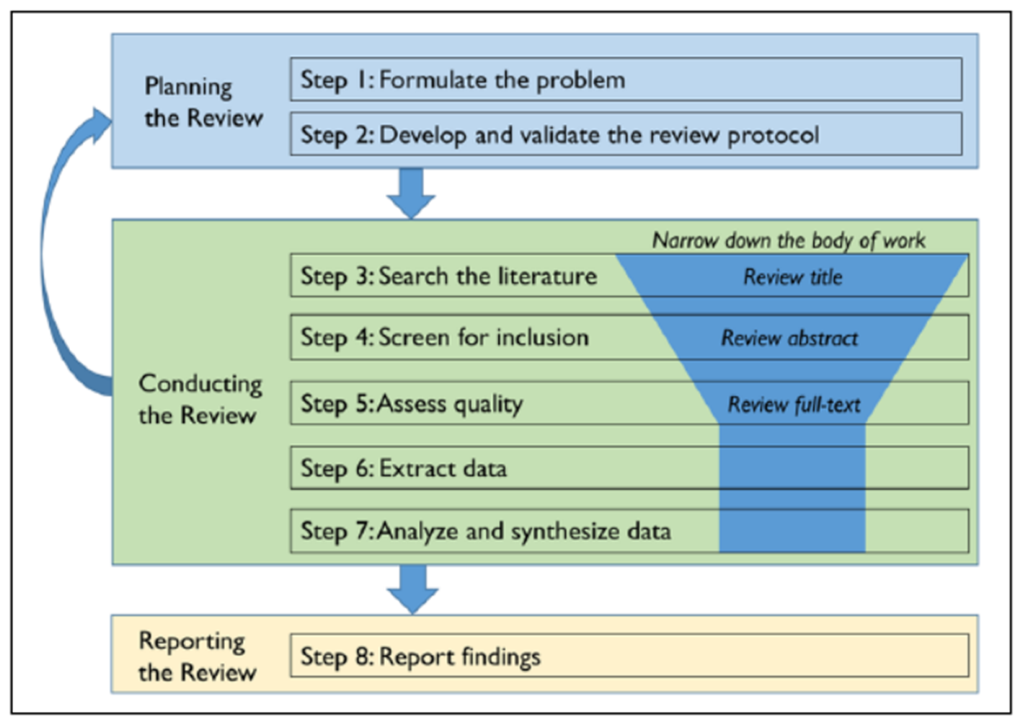
By adopting a systematized review approach, we incorporated certain methodological elements of systematic reviews to enhance the rigor and transparency of the process. A step-by-step procedure based on previous best practices was followed [
25,
26]. The roadmap for our research follows the guidelines of Xiao and Watson (2019) [
26] (
Figure 1).
A structured literature search was conducted across Scopus (
https://www.scopus.com) and Web of Science (
https://www.webofscience.com) databases using a combination of keywords and Boolean operators. Inclusion and exclusion criteria were defined in advance to guide article selection. The synthesis was based on a critical analysis of the data, and some PRISMA 2020 principles (
https://www.prisma-statement.org/prisma-2020-statement, (accessed on 16 March 2026)) were adapted to improve the transparency of the report [
24]. However, this review does not meet all the requirements of a systematic review, particularly regarding search exhaustiveness and standardized risk assessment of bias.
To avoid presenting repetitions of the revision structure for each research theme, we chose to present in detail the theme of the review that addresses energy communities in Portugal, and to present the others in summary form, because the number of articles found for the other research themes was very small.
Search the literature
The topic of energy communities is already quite large. A Scopus search using the exact expressions TITLE-ABS-KEY ((“energy community”) OR (“energy communities”) OR (“community energy”)) yields 6529 documents. However, the alignment of actors within energy communities is a topic that is difficult to uncover in the scope of the literature using search keywords in TITLE-ABS-KEY to narrow our search procedure. Nevertheless, two criteria guided our investigation:
1—One way to assess the State of the Art in the literature on this topic of alignment was to focus on the literature concerning the regulatory framework since the creation of the RED II and IEMD Directives (not just for Portugal), as this the regulatory level is a coordination frame where all the actors appear to be interacting implicitly. It is by studying the regulatory framework that we can begin to perceive the already formal dynamics between the actors.
2—If we search for articles where the country is Portugal, or written in Portuguese research units, we will find specific articles of interest to our purpose among the results of the document population for EC.
Our first query stemmed from criterion 1 by combining the EC with the regulatory framework at the international level. In addition, we identified research among documents in English, and in the time interval 2018–2026—since the EU RED II and IEMD Directives were published. We chose to refine and narrow our search using keywords addressing criterion 1, “Regulation”, “Regulatory framework” and “Regulatory frameworks”, which explicitly strengthened the focus of the research. Thus:
S1. TITLE-ABS-KEY ((“energy community” AND regulatory) OR (“energy communities” AND regulatory) OR (“energy communities” AND regulation) OR (“energy community” AND regulation)) AND (LIMIT-TO (LANGUAGE, “English”) OR LIMIT-TO (LANGUAGE, “Portuguese”)) AND (LIMIT-TO (EXACTKEYWORD, “Regulation”) OR LIMIT-TO (EXACTKEYWORD, “Regulatory Framework”) OR LIMIT-TO (EXACTKEYWORD, “Regulatory Frameworks”)) AND PUBYEAR > 2017 AND PUBYEAR < 2025—which narrowed to 87 documents.
Our second query derived from criterion 2. On the one hand, by checking the first search that obtained 6529 documents, when we filter the search by country “Portugal”, we find a mix of documents (363 results) that are not about Portugal but are published by researchers based in Portugal, along with other articles that allow us to understand what is really happening in Portugal. Therefore, we preferred to include the term “Portugal” in the search phrase, obtaining a much more precise scope for contributions to the study of energy communities in Portugal. In addition, we identified research among documents in English, and in the time interval 2018–2026—since the EU RED II and IEMD Directives were published. Thus:
S2. TITLE-ABS-KEY ((“Energy community” OR “Energy communities” OR “Community energy”) AND Portugal) AND (LIMIT-TO (LANGUAGE, “English”)) AND PUBYEAR > 2017 AND PUBYEAR < 2025—yielded 73 documents.
Our third query stemmed from understanding where Portuguese institutions fit into criterion 1. This is a way to rationalize the Portuguese contribution to this criterion, in order to prepare the inclusion step. We finally restricted the search to English-language publications and the publication years between 2018 and 2026. Thus:
S3. TITLE-ABS-KEY ((“energy community” AND regulatory) OR (“energy communities” AND regulatory) OR (“energy communities” AND regulation) OR (“energy community” AND regulation)) AND (LIMIT-TO (AFFILCOUNTRY, “Portugal”)) AND (LIMIT-TO (LANGUAGE, “English”)) AND PUBYEAR > 2017 AND PUBYEAR < 2025—and we obtained 51 documents.
The fourth query was also derived from applying criterion 2 to criterion 1. Within the regulatory framework of the EC that allows us to deepen our understanding of the actors coordination, we just added the word “Portugal” in the query string. This allows us to define the case study of Portugal in concrete terms, independently of the location from which the research is published. We restricted the search to English-language publications and the publication years between 2018 and 2026. Thus:
S4. TITLE-ABS-KEY (Portugal AND ((“energy community” AND regulatory) OR (“energy communities” AND regulatory) OR (“energy communities” AND regulation) OR (“energy community” AND regulation))) AND (LIMIT-TO (LANGUAGE, “English”)) AND PUBYEAR > 2018 AND PUBYEAR < 2024—obtaining 14 documents.
For the fifth query, we searched for documents on an alternative platform—Web of Science (WOS). This revealed both new and duplicate articles. Since searches by topic are permitted on WOS, we added the word “development” to the words already searched on Scopus in relation to criterion 2. Indeed, the topic “development” helps to identify a dynamic for ECs and their stakeholders. Thus:
W1. Topic—Development; Energy; Communities; Portugal—we obtained 78 results.
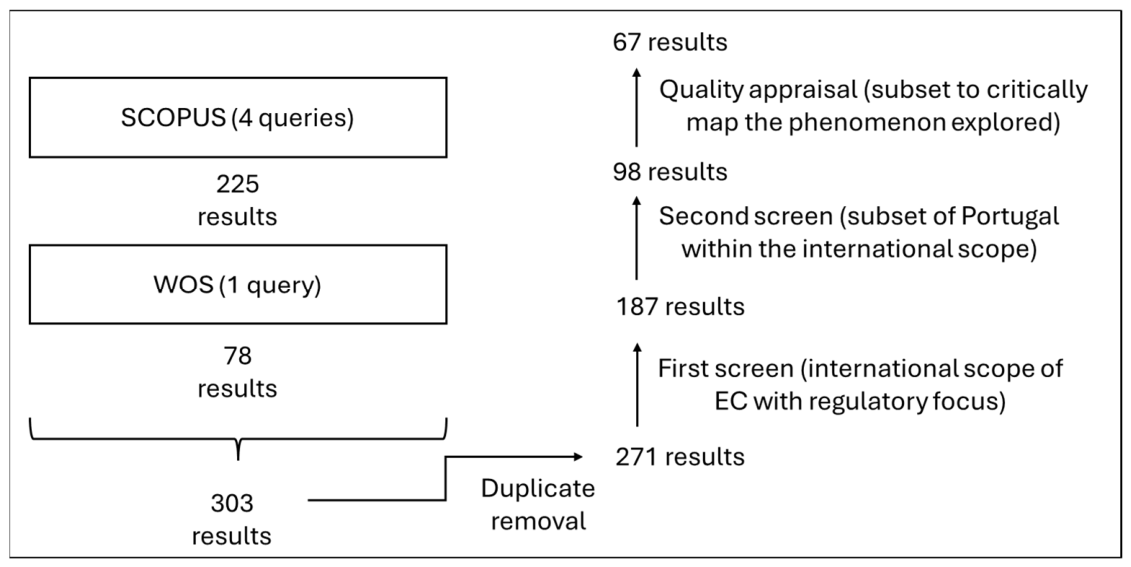
By selecting articles from these five queries, we thus have the scope of energy communities focused on the regulatory level (international and only for Portugal and from Portuguese research units), and the scope of articles on energy communities in Portugal, which jointly allows us to better characterize the empirical phenomenon of coordination and the technological and social perspectives of the actors. After retrieving a joint total of 303 results, we removed the duplicates and obtained 271 documents in the database search for these five queries.
Screen for inclusion
In the first screening, we read the titles and abstracts of every document and removed the ones that did not write about energy communities as a theme of study, being off-topic. We obtained 187 selected documents representing the international literature about EC, with a focus on the regulatory framework connections. In a second round screening, from browsing through the full texts of the 187 documents, we included only those that were explicative of aspects of Portuguese ECs (both connected to the regulatory framework and to other topics, obtaining 98 documents.
Assess quality
We considered quality assessment not mandatory in our study. It was considered not necessary to recognize differences in methodological quality among studies to characterize the phenomenon from a critical realist perspective. Rather, by viewing our study as a narrative review analysis, where the research questions and themes are interdisciplinary, we aim to uncover all the studies that allow us to delve into the phenomenon. From the sub-set of 98 documents, a detailed reading was performed to judge how the subject(s) or sections in the document could provide a contribution for extracting data. This selection was thus oriented towards preparing the extraction with data from technological, economic, social, sociotechnical and normative layers, where materials to understand energy communities would be found. In the final process before extracting data, 67 full-text documents were selected from the group of 98 because they were considered in tune to answer the research questions. Data would then be extracted from these 67 and included in the analysis. For this final group of 67 documents, the representativeness approach for citations in the manuscript was to avoid including all references within the article, but to include the most relevant articles or those offering the most diverse perspectives on the phenomenon under study.
Therefore, these were the results (
Figure 2) from which we extracted the data in the full texts, after literature search, screening for inclusion, and our representativeness approach for the quality of the documents.
Extract Data
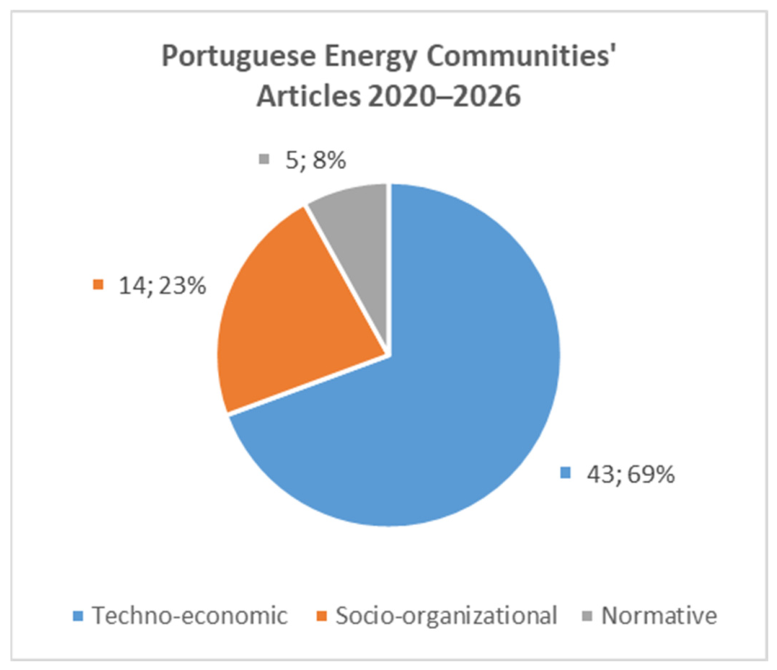
For a critical realist analysis, we want to identify possible mechanisms, contexts, actors, outcomes, governance dynamics, barriers/enablers, and theoretical explanations of ECs in Portugal. We opted to encode our materials, categorizing the manuscripts by principal focus, in three categories (
Figure 3), which reveal tendencies about the Portuguese ECs in the literature of the R&D system. The categories, and their underlying topics, are:
- −
Techno-economic—energy sharing, techno-economic feasibility, conception and design, modeling, ICT, P2P, LEM, flexibility, storage.
- −
Normative—regulatory framework.
- −
Socio-organizational—transition, social participation, services, empowerment, energy poverty, governance, intermediation, sustainability.
In this sense, we can better understand the points of view in the different existing structures, dividing our analytical lens and using these categories to characterize the phenomenon. Here, as reliability test for the encoding, the same researcher coded the same data twice at different times to test consistency.
Other literature searches
Additional research was conducted because ECs are not only regarded in scientific publications, but also in dedicated research projects (e.g., EU-funded), which are searchable in specific ways. We devoted a part of our search work to the related Horizon Europe Projects, and the
Section 2.2 explains this process in detail.
Besides this, as ECs are a niche innovation included in a scenario of sustainability transition between one sociotechnical system and another, there was a need to cover other topics, conceptual and from a broader scope of application than just about ECs. Our searches with mixed approaches, which we estimated as the most adequate towards our goals, were the following:
A. Sustainability transitions of sociotechnical systems
1. Identify a highly cited article with seminal authors [
27].
2. Perform research on relevant manuscripts for these authors’ profiles and for their co-authors’ articles (SCOPUS), whose literature is directed towards our research topic (niche innovation of EC) at different lenses of sociotechnical analysis. (e.g., Frank W. Geels, René Kemp, Jochen Markard).
3. Perform a backwards and forward search from these manuscripts.
B. Intermediation in the sociotechnical transition
1. SCOPUS—TITLE-ABS-KEY “sociotechnical transition” AND intermediaries—obtaining 17 documents. Inclusion criteria for selection—highly cited, from seminal authors and relevant to the study—3 articles selected [
28,
29,
30].
C. Critical realism for the sociotechnical transition
1. WOS—Topics—socio-technical transition; critical realism;—6 results—Inclusion criteria for selection—relevant to the study—1 article selected [
31] and Google Scholar search “critical realism”—Inclusion criteria—highly cited and available for reading—1 book selected [
32].
2. SCOPUS—TITLE-ABS-KEY “socio-technical transition” AND “critical realism”—4 results—4 articles selected, relevant to the study [
31,
33,
34,
35].
3. A relevant PhD thesis found on a Google search on CR and sociotechnical transitions [
36].
2.2. Selection of Horizon Europe Projects
In addition to academic publications, the study selected European Union-funded research and innovation projects, under the Horizon Europe program and involving Portuguese partners, for analysis. We acknowledge that Horizon Europe projects are less suitable for the evaluation of consolidated structural patterns. Nevertheless, they can be useful for strategic niche management analysis. First, because they still can contribute to assessing the niche developments in the making. We could perform an assessment of their expected results and institutional partnerships. Second, EU Directives RED II and IEMD were published respectively in 2018 and 2019, and particularly, the transposition to the Portuguese RF entered into force from January 2022, so the EC topic was not the object of development in the EU cycle of H2020 (2014–2020). The results of H2020 projects, when available, have already enabled the publication of a number of specific peer-reviewed articles—which we retrieved after searching the literature—so adding the analysis of the Horizon Europe projects was considered appropriate to add more insight.
The project identification was conducted through the CORDIS database [
37] and project websites using the keywords “energy communit*”—encompassing “energy community” and “energy communities”. The project starting time was filtered from early January 2022 up to now, and with Portugal as a participant country. The choice of this time frame arose from the fact that we studied the development of the ECs in Portugal, and this came into force only after the issue of the Decree-Law 15/2022, in January 2022, with the transposition of RED II and IEMD Directives.
A total of 13 Horizon Europe projects, involving Portuguese entities, were identified and included in the analysis.
For each project, the following information was collected:
Project objectives and scope.
Technological focus and (when declared) Technology Readiness Level (TRL).
Governance, market design or social innovation components.
Portuguese participating organizations and their institutional type.
Relevant deliverables, dissemination outputs, and related, relevant peer-reviewed articles.
Projects were grouped into thematic clusters (categories and topics—see
Section 3—Step 1), with the original encoding arising from these projects’ assessment. This encoding was then extended to all the documents in the literature queries, for the thematic clustering (see
Section 2.1—Extract data). This clustering enabled the identification of technological priorities and emphasis on social or organizational innovation.
The analysis considered the frequency of participation and, where applicable, in-depth research about the relevance of each partner in consortia. While this mapping does not constitute a formal social network analysis, it allows identification of structural patterns in actor participation and potential asymmetries in their influence within R&D processes.
Our analysis, according to the perspective of [
38], accounted for all the partner entities from the Horizon Europe projects, as potential intermediation entities fostering the ECs.
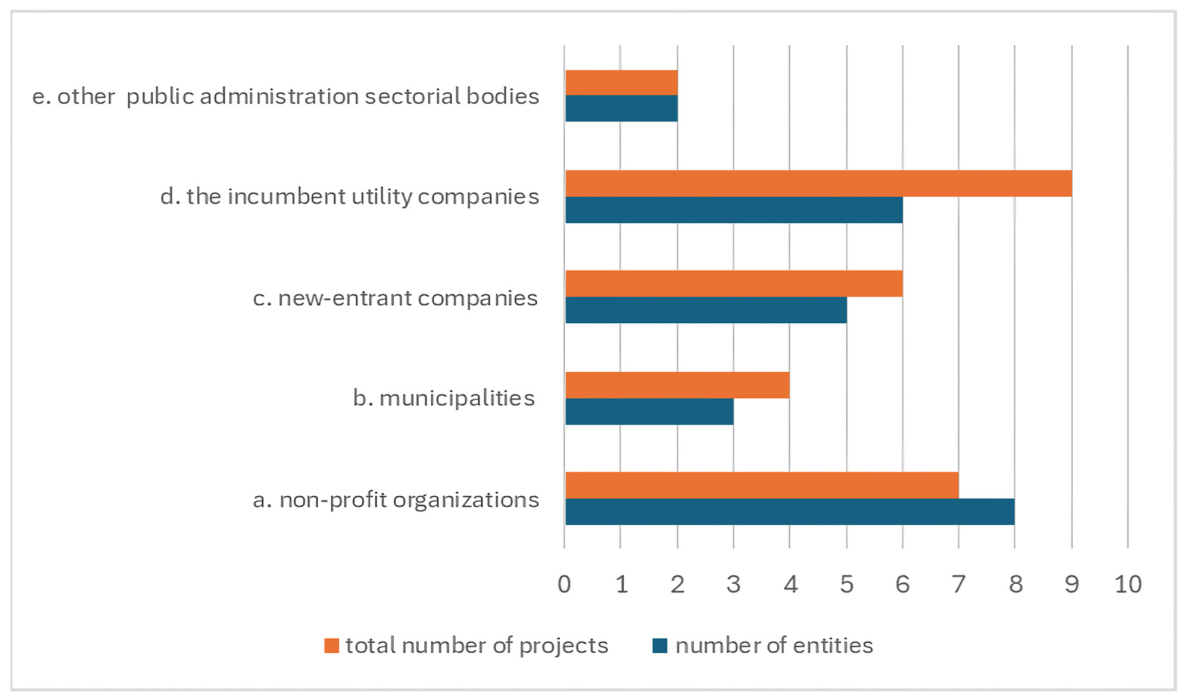
To assess the role of intermediaries, Portuguese project partners were classified into institutional categories: non-profit organizations (universities and research centers), municipalities, new entrant companies in the energy sector, energy incumbents or incumbent-linked entities, and other public authorities.
This approach enables examination of whether R&D partnerships reinforce established market actors or facilitate broader diversification of actors involved in energy community development (
Figure 4).
If intermediation has the effect of facilitation (e.g., [
30]), and the power roles of the non-incumbent intermediaries are more questioned (e.g., [
38]), the intermediation from incumbents may also exert positive effects on transition [
30]. As we will see further, the R&D system lies at the core of the system, influencing positively the transition. The presence of universities, together with the research centers from the incumbent and the research and innovation with the new firms in the sector, drives the partnerships in the most advanced projects in the making, which encompass the Horizon Europe (
Table 1).
An intermediation is difficult to define [
30,
38]. Who is the de facto intermediary towards sustainability? The money, knowledge, tools and opportunities at stake leave room for conflict and power struggle both within and between groups of social actors. Within the R&D system, the investment decisions are part of game-like moves between actors, as new regulations, new technologies introduction and new scientific hypotheses proposals are played in action-reaction dynamics [
8]. When engaged in R&D partnerships, the ethics of intermediation become uncertain and difficult to theorize in accordance with a specific definition. For instance, for a case study of transition in the energy sector in Finland [
29], it is shown that convening intermediation by innovation champions from different constituencies will promote transition. It will also entail great responsibilities, because it disturbs existing rules, structures, practices and networks, renegotiating regime rules and disrupting existing R&D alliances [
29].
From the actors identified in the Horizon Europe partnerships—universities, as autonomous entities of the R&D system—have more responsibility to play as systemic intermediaries [
39]. The universities produce the knowledge that places them as strategic actors organizing the discourse and creating learning conditions for ECs’ expertise. Even if the growth of ECs is still contradictory in Portugal, the Portuguese ECs would be classified (at least in some form) in the acceleration phase already, and not an emergent innovation system anymore, because innovations exist in pilot studies [
28].
2.3. Theoretical Framework and Analytical Procedure: CR and SNM
Earlier critiques of the sociotechnical transition theories pointed to insufficient attention to politics, power, and actor strategies. Smith et al. (2005) [
15] stated and Genus and Coles (2008) [
40] have reiterated the message that MLP underestimates the role of agency and policy, suggesting a greater incorporation of constructivist approaches such as the Social Construction of Technology (SCOT) and Actor-Network Theory (ANT) (e.g., [
41]).
More recent debates emphasize epistemological challenges, arguing that process-based narratives often remain descriptive and require stronger explanatory foundations. Geels, who primarily developed the sociotechnical framework of MLP, acknowledged that the ontological foundations of MLP deserve to be made explicit [
31,
42]. Sorrell (2018) [
34] identifies the implicit ontological and epistemological presuppositions of MLP and assesses their consistency with critical realism—showing that CR can clarify the strengths and weaknesses of MLP-based research—including the consistency of claims about the nature of sociotechnical systems and the validity of causal explanations. CR was found to be well-suited to the phenomenological characteristics of sociotechnical transitions. The critical realism (CR) introduces its reflexivity about causality and explanation into sociotechnical transitions research [
31]. Hence, the more profitable use of critical realism lies in using complex causality mechanisms, although we can also study transitions with the usual linear causality [
43], to explain, particularly, the long-term processes of transition.
This article adopts an agentic-processual [
31] version of critical realism to analyze the development of energy communities in Portugal as a sociotechnical niche. Based on the reviewed publications, energy communities are a particularly fertile ground for ontological contributions. Indeed, they simultaneously mobilize deep structural mechanisms (energy regimes, policies, markets); dynamics of meaning (collective identity, energy citizenship); and forms of distributed agency (citizens, technologies, institutions). Critical realism tries to synthesize useful elements of traditional ontologies while avoiding their reductionisms [
44]. This ontology provides ‘generative causality’ because it explains how surface phenomena (empirical events) are generated by interactions between entities, causal mechanisms, and underlying structures [
31]. CR distinguishes between the domains of the real, the actual, and the empirical [
32,
36]. In CR, “The real relates to underlying structures and mechanisms that possess causal powers. These structures contain affordances and constraints that enable or limit the development of energy communities independently of whether they are observed. The actual refers to the effects once these powers are activated and the empirical where these effects are being experienced” [
36].
A methodological approach with CR followed by SNM can be a contribution that we have not encountered in the analysis of sociotechnical transition theories [
25,
31,
41,
42]. The MLP distinguishes three analytical levels: niches as sites of radical innovations, locked-in sociotechnical regimes, and the exogenous sociotechnical landscape. The SNM allows for a detailed understanding of niche dynamics, which is of particular interest to us for ECs. To address the reflexivity weaknesses in MLP frameworks, the CR is applied first, and then its results are used to apply the SNM lens to ECs in the Portuguese context. CR provides an ontological investigation method that SNM presupposes but does not explicitly state. The sequential logic of CR followed by SNM is not triangulation but a two-step application. Instead of adding constructivist approaches as Genus and Coles (2008) [
40] suggested, CR is used as a method of ontological investigation. Applying CR first reveals possible generative mechanisms and deep structures of the niche. SNM then intervenes not as an ontology but as a framework for assessing the maturity and alignments of the niche, the results of which are now ontologically grounded quite differently from other heuristic combined approaches to SNM that we found in the literature on EC (e.g., [
45]).
To build a connection between CR and the SNM in the sociotechnical transition framework, we developed a scheme of analysis in five steps: (1) Empirical; (2) Structures; (3) Mechanisms; (4) Causality; (5) Explanatory synthesis. This is in accordance with the logic of what Sayer (1999) [
46] calls the movement from the concrete to the abstract and then back to the concrete. Rather than aiming at statistical generalization, the objective is to identify dominant thematic orientations, structural patterns, and potential misalignments.
Step 1—Empirical characterization of the phenomenon. The analysis begins by mapping the empirical dynamics of energy communities in Portugal across technological, regulatory, and social dimensions. This includes the review of regulatory literature, ICT-based studies, social sciences studies and Horizon Europe projects, organized into three sub-themes (A: technology-focused ECs; B: governance and social-oriented ECs; C: third-party/DSO and system-level innovation).
Step 2—Identification of structural conditions. Identifies the key structural domains shaping the growth of energy communities: (i) EU policy and regulatory frameworks; (ii) the Portuguese regulatory system; (iii) national governance structures; (iv) large-scale incumbent utility companies; (v) the R&D and innovation system; and (vi) socio-organizational communities. These structures define the conditions of possibility and constraint for action across technological, governance, and participation dimensions.
Our movement from Step 1 to Step 2 is ontologically necessary according to Bhaskar (e.g., [
47])—what is observable does not exhaust what is real.
Step 3: Activation of generative mechanisms through actor interactions. Explains how niche processes and interactions among key actors produce differentiated pathways in the growth of energy communities.
Moving from structures (Step 2) to their activation requires examining how actors interact within and across the identified structural domains. Crucially, as Danermark et al. (2002) [
48] explicitly state, “retroduction operates on descriptions of phenomena, whether those descriptions come from interviews, statistics, or prior research.” This legitimizes a corpus-based approach. What the corpus provides is not raw empirical events but textual representations of causal processes, which, in Sayer’s (1999) [
46] terms, is entirely consistent with an intensive CR research design that works from secondary accounts. Applied to energy communities in Portugal, this means identifying how specific actors activate or inhibit the generative mechanisms underlying niche development, as recurrently reported in the corpus, from regulatory asymmetries, path dependencies, and resource constraints.
Step 4: Causal configurations shaping differentiated development trajectories. Identifies the causes by which the generative mechanisms produce different pathways.
This step draws on the CR concept of causal explanation through the retroductive identification of conjunctural configurations—that is, the specific combinations of activated mechanisms and contextual conditions that together produce observable outcomes. Step 4 moves beyond listing mechanisms (Step 3) to explaining why similar structural conditions produce different EC development trajectories across research strands or actor types in Portugal. This analytical level is supported by Pawson and Tilley’s (1997) [
49] realistic evaluation framework, which holds that outcomes are always the product of a mechanism operating within a context—denoted as CMO (Context-Mechanism-Outcome) configuration.
Step 5: Explanatory Synthesis of Transition Dynamics. Integrate structures, mechanisms, and niche processes to explain the misalignment constraining the transformative potential of energy communities, explicitly mobilizing critical realism and SNM (shielding, nurturing, empowerment), connected to MLP.
At this stage, the ontological grounding, provided by CR (Steps 1–4), is connected to the normative and strategic dimensions of the SNM framework [
14,
50]. The SNM concepts of shielding (protecting niches from market pressures), nurturing (supporting learning and network building), and empowerment (scaling up successful innovations) provide an evaluative grammar for interpreting what the CR analysis has uncovered. As Sayer (2000) [
46] argues, CR does not stop at explanation—it also identifies structural conditions that are open to transformation. By connecting CR-derived explanations to SNM’s transition management vocabulary, Step 5 ensures that the study’s findings are not merely descriptive of the Portuguese EC context but also comparable in terms of policy and niche governance recommendations.
Operationally, the identification of generative mechanisms followed a three-stage retroductive procedure applied to the documentary corpus. First, recurrent patterns were identified—findings, actor configurations, or structural features that appear consistently across multiple studies and Horizon Europe projects, rather than in isolated cases. Second, for each recurrent pattern, the retroductive question was applied: what structural conditions or causal powers must exist at the level of the real for this pattern to be systematically produced? Third, the inferred mechanism was tested for consistency across Sub-themes A, B, and C. A mechanism was retained when it was consistent with patterns across the three sub-themes and when no simpler explanation adequately accounted for the observed regularity. This procedure follows Danermark et al.’s (2002) [
48] operationalization of retroduction as a movement from described patterns to inferred causal structures, applied here to secondary documentary evidence rather than primary field data.
The mechanisms discussed in this study should be understood as retroductively inferred explanatory tendencies derived from patterns identified in the reviewed corpus, rather than as definitively verified causal structures. In line with critical realist epistemology, these mechanisms are treated as potentially real but only partially accessible through secondary documentary evidence.
3. Results and Discussion
Step1. Empirical phenomenon. The empirical phenomenon consists of the evolving growth of energy communities in Portugal, as observed through the R&D knowledge production, either regulatory, technology-based, and socio-organizational. Special attention is paid to the central tension between the actors for commanding the EC as innovation in the ongoing Horizon Europe projects. Following Bhaskar’s (1975) [
47] distinction between empirical observation and deeper structural and causal levels, this step maps the observable dynamics of energy community R&D in Portugal without yet inferring their underlying determinants. The empirical corpus comprises regulatory literature, ICT-based studies, social sciences studies, and Horizon Europe projects, organized into three sub-themes.
Mature technologies such as solar PV are strongly advocated economically [
51,
52,
53,
54], strong advances are being made in modeling energy sharing, showing both efficiency gains [
55,
56] and emerging projections of inequality among EC members, as well as scalability and regulatory constraints (e.g., [
57,
58,
59]). A strong simulation environment exists for emergent technologies such as P2P [
60,
61,
62] and LEM [
61,
63,
64]. Regulatory studies identify a progressive but incomplete legal framework, where key elements such as P2P trading or flexibility services remain underdeveloped, limiting effective implementation [
65,
66,
67]. In Horizon Europe projects, Sub-theme A is characterized by high technological intensity, focusing on AI, blockchain, P2P trading, and data spaces ([
68,
69,
70,
71,
72]), with limited integration of governance and social dimensions, despite the deployment of pilot studies. Sub-theme B presents a more balanced configuration, oriented within territorial planning and architecture, where projects combine mature technologies with participatory governance, energy poverty mitigation, and municipal involvement [
73,
74,
75], yet the pilot studies do not test a complex configuration of technologies in depth. Sub-theme C, in contrast, is dominated by system-level technological experimentation, including AI validation, digital twins, and testing environments, largely excluding energy communities as active participants and focusing on DSOs and technology providers [
76,
77,
78,
79,
80]. Overall, Sub-theme A addresses mature and new EC challenges but neglects user perspectives, Sub-theme B leverages on urban pilots to deploy EC with mature technology addressing groups of vulnerable users, and Sub-theme C raises the technology challenges and commodifies the EC scenarios (
Table 2).
Taken together, the observed empirical pattern reveals a strong technological development, but institutional and social unevenness. Even though innovation is abundant, participatory realization remains unsatisfactory, and integration into governance structures is consistently criticized across the literature, while remaining largely unaddressed in Horizon Europe projects. These recurring patterns—rather than isolated incidents—suggest the operation of structural conditions and suggested generative mechanisms examined in Steps 2 and 3.
Step 2. Identification of structural conditions. Following the critical realist principle that observable phenomena are produced by structures and mechanisms operating at deeper levels of reality [
46,
47], this step identifies the structures where the conditions of possibility and constraint build the energy communities in Portugal. These structures are heterogeneous in nature, encompassing material infrastructures, formal regulatory frameworks, and social relations of power, each operating through distinct causal logics across six interacting domains that we identify [
81]. The structures in these domains are causally efficacious independently of whether they are observed or recognized by the actors they condition [
32].
At the supranational level, the EU policy and funding framework shapes the strategic orientation of innovation by prioritizing digitalization, market integration, and scalability, directing funding through ongoing Horizon Europe projects. It sets targets for the Member States’ performance [
4,
5] and is internally assessed for optimization of its policies [
6].
At the national level, the Portuguese regulatory system (DGEG, ERSE) provides the formal legal basis for collective self-consumption and energy communities, through successive legislative developments, up to the present (Decree-Law 15/2022 [
82] and Regulation 815/2023 [
83]). Yet, it remains incomplete in key areas such as P2P trading, flexibility services, and organizational support, thereby constraining implementation [
65,
66,
67]. Within the national Regulatory Framework, individual and collective prosumers with small-scale energy projects are then allowed to enter the national electric system with either RECs, CECs or the overarching energy sharing initiatives’ model called collective self-consumption (CSC) [
66].
The governance of the Portuguese State further mediates these conditions through public policies and political involvement and support, although regulatory literature highlights limitations in administrative capacity and energy literacy, which affect citizen engagement and institutional effectiveness [
65,
84]. The Portuguese governance structure is characterized by a chronic under-resourcing of public institutions that constitutes a structural constraint, independently of the actors who momentarily occupy those positions [
38].
At the same time, the large-scale electricity sector structure (incumbent utilities, DSOs, TSOs), particularly incumbent actors such as EDP, appears to constitute a dominant structural layer. These actors do not engage against maintaining centralized system logics and potentially exert significant influence over infrastructure, regulatory evolution, and participation in R&D networks [
38]. This sector’s primary interest lies in the stability of sociotechnical systems that support large-scale renewable energy projects, even as it monitors energy communities as a potentially significant emerging niche [
85,
86,
87,
88]. However, the literature about this sector suggests concerns regarding potential declines in electricity sales and market share due to the increasing number of consumers transitioning into prosumers [
89].
The R&D and innovation system (universities, research units linked with large-scale incumbency, new entrant companies), driven by Horizon Europe and compliant with the RF, is in this field dominated by ICT research and research of social acceptance of the EC. The development of solutions privileges high-TRL technologies, computational modeling, and experimental validation environments, often focusing on optimization and system performance, rarely on scalability [
57,
59]. This entity responds to the demands of the aforementioned four entities for performing the research projects and needs their investment, thereby. It also attempts to mediate policymaking with knowledge production [
90], being very important to help overcome governance issues. In the R&D system, there is a general coexistence of newly entrant ESCOs in research partnerships, seeking to accelerate the diffusion of the EC, with the R&D units of the large-scale incumbency intending to maintain incremental innovation (Ref. [
91] cited in [
38]). Taken together, the resolution of the problems of the State affects distinct levels—legal, social, organizational, and technological—and the R&D system is significantly shaped by the structural tensions among the diverse actors within its network [
29]. More, no R&D consortium appears sufficiently multidisciplinary to drive the rollout of energy communities into a full sociotechnical transition. Nonetheless, two strands of research have been developed. One is grounded in a techno-centric view towards the commodification of EC. The second, towards the social acceptance of energy communities by the users and other stakeholders, based on the definition of the EU Directives and the Portuguese RF.
Socio-organizational communities—comprising energy communities, citizens, NGOs, energy agencies, and local governments—represent a structural domain constituted by informal collective practices, where local needs, social objectives, and shared energy goals converge. Most importantly, these are communities of early adopters and committed users who have autonomously appropriated research infrastructures and knowledge resources. These communities developed a structural capacity for bottom-up innovation that remains nonetheless constrained by energy literacy gaps and institutional marginalization. Research about the social acceptance of the EC conceptual model is well developed in aspects such as addressing energy poverty [
75,
92] and social participation [
93,
94,
95,
96], though work on the empowerment of these actors often overlooks technological literacy. The energy literacy issue hinders the bottom-up potential of this entity, and the implications for the energy democracy are not sufficiently stressed. This group lies at the core of the issue of the social appraisal of technology and the potential dissent of innovation [
97], which deserves attention. Their projects are unique and bound to the local contexts, and the energy transition in Europe follows different pathways, addressing their human dimensions [
98]. Despite an increasing technological maturity and a regulatory formalization, the social growth of the energy communities’ movement remains comparatively limited in Portugal [
22].
Step 3. Activation of generative mechanisms through actor interactions. While SNM identifies learning, network building, and expectation articulation as the core niche mechanisms [
99], critical realism asks under what structural conditions these mechanisms are activated, by whom, and with what causal powers—moving beyond description of niche processes toward explanation of their differentiated effects. In this scenario, we distinguish by whom the niche is activated. The key actors of these interactions are particularly R&D intermediaries, incumbent utilities, public authorities, and socio-organizational communities.
Learning processes are predominantly driven by the R&D system, especially within Horizon Europe projects, where R&D intermediaries such as universities, research centers, and technology providers aggregate and produce knowledge. In conducting research projects, R&D intermediaries respond to the demands of all structures in the hierarchy and rely on funding. They also seek to bridge knowledge production and policymaking [
90], playing a key role in addressing governance challenges. In practice, they strongly emphasize ICT-based modeling, optimization algorithms, AI systems, and digital platforms. This concentration of learning activity reinforces a technocentric direction of innovation [
98], privileging system efficiency and market design over organizational and social embedding. At the same time, public authorities contribute more weakly to knowledge production, focusing primarily on formal regulatory framing rather than strategic guidance for sociotechnical transition [
100]. Socio-organizational communities, in turn, remain largely receivers of knowledge, with limited access to advanced technical expertise, which constrains bottom-up energy literacy and participation.
Network building and coordination are also structured through R&D partnerships, particularly within Horizon Europe consortia. These networks connect diverse actors—including DSOs, firms, municipalities, and community organizations—but are often shaped by existing institutional hierarchies and incumbent utilities’ participation, thereby tending to reproduce asymmetric power relations and constraining—rather than categorically limiting—the influence of grassroots actors [
29,
38,
85,
86]. The recurrent co-presence of incumbent-linked entities across both regime-level governance and niche-level R&D networks—documented across multiple Horizon Europe consortia [
69,
70,
71,
72,
74,
77,
78,
79,
80] and confirmed by the literature on incumbent strategies in energy transitions [
37,
88,
89]—points to a generative mechanism that cannot be explained by coincidence or actor choice alone. Applying the retroductive question—what must be true at the structural level for this pattern to be systematically reproduced?—we infer a possible mechanism of dual positioning: incumbent actors occupy simultaneously regime-level positions oriented toward centralized system logics and market share, and niche-level positions as R&D partners and project leaders. This dual embeddedness is structurally reproduced because it serves the incumbent’s interest in monitoring and selectively absorbing niche innovations while maintaining regime stability—a tendency consistent across Sub-themes A and C, and partially visible in Sub-theme B through the relative absence of incumbent actors from participatory governance configurations.
While coordination mechanisms enable technological experimentation, they remain uneven in their capacity to integrate social actors and governance processes. For instance, Sub-theme A networks are primarily oriented toward technological development, while Sub-theme C networks are confined to specialized testing environments with minimal engagement of end-users. But from the socio-organizational communities, an emergent mechanism of coordination, such as the national network of “Espaços Energia” [
101], illustrates an attempt to use the local SME’s to foster energy literacy and citizen engagement. However, while this network currently represents the most significant effort to broaden coordination toward user engagement in Portugal, its knowledge production remains limited in scale and depth.
Expectation articulation further reflects the influence of intermediaries, as R&D projects and scientific outputs promote visions of scalable, digitalized, and market-integrated energy communities. These expectations guide both technological development and policy discourse but tend to marginalize alternative trajectories centered on social innovation, collective governance, and energy justice. Sub-theme B partially counterbalances this trend by incorporating participatory approaches, co-creation processes, and energy poverty mitigation into project design, thereby expanding the scope of expectations toward more socially embedded models.
Despite these dynamics, the capacity of intermediaries to perform a brokering role between niche innovation and institutional change remains limited. While they do support experimentation and knowledge production, they are less effective in translating these into regulatory alignment and organizational scaling. This limited institutional embedding contributes to a persistent gap between technological maturity and real-world deployment [
65,
66].
The same generative mechanisms—learning, network building and coordination, expectation articulation—produce differentiated outcomes depending on which actors activate them, under which structural conditions, and with what resources and institutional support. This context-sensitivity, central to critical realist explanation [
49], accounts for the three co-existing trajectories observed in the Portuguese niche.
First, Sub-theme A reflects a technological–market trajectory, where strong learning dynamics and dense R&D networks drive innovation in digital platforms, peer-to-peer trading, AI-based optimization, and local energy markets (e.g., [
57,
68,
102]). However, incomplete regulatory frameworks—particularly regarding P2P trading and flexibility services—constrain the institutionalization of these innovations, resulting in high technological maturity but limited deployment.
Second, Sub-theme B represents a socio-governance trajectory, where technological components are more effectively integrated with participatory governance, local institutional arrangements, and social objectives such as energy poverty mitigation [
74,
75]—involving municipalities, civil society actors, and local stakeholders, which partially counterbalance incumbent dominance (e.g., [
65,
93]).
Third, Sub-theme C constitutes a techno-infrastructural trajectory, driven largely by incumbent-linked actors and technology developers focusing on system-level optimization, data infrastructures, and grid management tools. Here, learning processes are highly advanced but occur within specialized and relatively closed environments, resulting in weak interaction with community actors and limited contribution to niche expansion.
Taking them together, these trajectories reveal a fragmented transition dynamic. While technological innovation advances rapidly, its convergence with regulatory frameworks and participatory governance remains partial and uneven. The coexistence of these pathways demonstrates that the development of energy communities in Portugal is not shaped by a single transition logic, but by the interaction of possible differentiated mechanisms and actor configurations, which simultaneously enable innovation and constrain its transformative potential.
Step 4. Causal configurations shaping differentiated development trajectories. The differentiated trajectories identified across Sub-themes A, B, and C can be explained through distinct configurations of interacting generative mechanisms operating within specific structural contexts. These mechanisms—learning processes, network building, expectation articulation, and coordination—are activated through actor interactions and shape the direction of niche development [
7,
99]. Rather than emerging independently, the observed pathways result from the possible combined and uneven alignment of these mechanisms across technological, regulatory, and socio-organizational domains.
In Sub-theme A, the technological–market trajectory is driven by a configuration in which technocentric learning mechanisms, led by R&D intermediaries, dominate knowledge production through ICT modeling, optimization algorithms, and digital platforms (e.g., [
57,
68,
102]. These learning processes interact with incumbent-influenced network structures, characteristic of European R&D collaborations where recurrent actors consolidate central positions and shape innovation agendas (e.g., [
38,
103]). At the same time, expectation articulation is oriented toward market integration, scalable commodification, and efficiency, particularly in relation to P2P trading and local energy markets (e.g., [
69,
70]. However, the absence of corresponding regulatory development—especially in areas such as flexibility services and peer-to-peer exchange—constrains the institutionalization of these innovations [
66,
67]. This misalignment results in high technological maturity without equivalent deployment capacity, reinforcing incremental innovation trajectories rather than systemic transformation [
38].
In Sub-theme B, learning processes are supported by more inclusive network-building practices and stakeholder coordination. In this pathway, expectation articulation is aligned with collective value creation, energy justice, and local empowerment, reflecting the normative orientation of energy communities as defined in EU frameworks (e.g., [
7]). However, this configuration remains structurally constrained by limited resource mobilization for advanced energy sharing configurations and weak integration into dominant R&D funding structures, which continue to prioritize technological innovation over social replication [
103,
104]. As a result, although alignment between technological, organizational, and social dimensions is stronger, the capacity for scaling and replication remains limited.
By contrast, Sub-theme C reflects a techno-infrastructural trajectory shaped by the interaction of advanced technical learning mechanisms—including AI validation, digital twins, and large-scale data infrastructures—with highly specialized and closed network configurations, typically dominated by incumbent-linked actors and system operators [
76,
77,
78,
80]. Within this configuration, expectations are primarily oriented toward system efficiency, grid optimization, and infrastructure resilience, rather than community participation or governance innovation. While these processes generate significant technological capabilities, the lack of coordination with socio-organizational actors and limited engagement with community-level needs reduce the contribution of this pathway to niche expansion and diffusion. Energy communities conceptually oppose the new research program to be developed within the framework of these partnerships—the former envisioning an energy democracy: popular sovereignty, participatory governance and civic ownership [
105], the latter assigning a secondary role to the concepts which are at the origin of the ECs.
Across these configurations, a recurring causal pattern can be identified: technocentric learning processes and incumbent-structured networks suggestively outweigh mechanisms related to social embedding, participatory governance, and institutional coordination [
30,
87]. This imbalance reflects broader structural dynamics in innovation systems, where R&D funding and knowledge production tend to prioritize technological advancement over socio-organizational integration. At the same time, the limited capacity of intermediaries to effectively broker between technological innovation, regulatory development, and community practices constrains the alignment necessary for niche stabilization and expansion [
7,
90,
99].
The causal logic connecting these configurations to their outcomes can be stated explicitly. In Sub-theme A, the combination of technocentric learning, incumbent-structured networks, and absent regulatory coupling is not merely correlated with limited deployment—it causally produces it, because without regulatory anchoring, technologically mature innovations lack the institutional infrastructure required for scaling. In Sub-theme B, the relative absence of incumbent dominance in network formation enables a different activation of the same learning mechanism, producing stronger sociotechnical alignment, which confirms that the mechanism itself is not deterministic but context-sensitive, consistent with Pawson and Tilley’s (1997) [
49] Context-Mechanism-Outcome logic. In Sub-theme C, the closure of networks around incumbent-linked actors and system operators causally excludes the community participation that SNM’s empowerment process requires, structurally preventing niche expansion regardless of technical capability. These are not correlational observations, but causal inferences grounded in the structural conditions identified in Step 2 and the mechanism activations traced in Step 3.
A suggested transversal causal mechanism consistent with all three configurations is the dual positioning of incumbent actors: simultaneously embedded in regime structures—defending centralized logics and market stability—and active in niche R&D networks—shaping innovation agendas and potentially constraining competing trajectories. This dual activation appears to enable incumbents to engage selectively with niche innovations that complement regime stability while coping with the diffusion of the innovation coming from their challengers.
On the one hand, the incumbent utilities appear, especially through the Horizon Europe projects, to support learning, coordination, and knowledge diffusion [
7,
99]. On the other hand, their embeddedness within existing institutional and funding structures positions them as stabilizers of regime-aligned pathways (e.g., [
38,
86,
90,
98]). This structural duality activates a possible mechanism of selective innovation absorption: incumbents enable and shape niche experimentation while potentially filtering out trajectories that threaten regime stability.
Therefore, the fragmentation observed in the development of energy communities in Portugal is only partly incidental, resulting from the suggestion of a selective activation and misalignment of key generative mechanisms across structural domains. While technological innovation progresses rapidly, the insufficient coupling with regulatory frameworks and socio-organizational processes limits the transformative potential of energy communities, maintaining them within a constrained niche despite favorable policy intentions [
22,
66].
Following Sayer’s (1999) [
46] distinction between necessary and contingent relations, the dominance of technocentric mechanisms cannot be attributed solely to particular actor choices but appears consistent with the tendencies of an innovation system structured around the incumbent’s leadership and ICT-oriented funding priorities—tendencies that would require structural transformation, not merely policy adjustment, to alter.
Step 5. Explanatory Synthesis of Transition Dynamics. Building on the structural conditions and possible generative mechanisms identified through critical realist analysis in Steps 2–4, this synthesis applies the SNM framework and its overarching theory of Multi-Level Perspective (MLP), as an evaluative lens—not to discover new mechanisms, but to assess the degree to which niche processes are aligned with the structural conditions previously identified.
In SNM terms, niche evolution depends on the interaction of three core processes—shielding, nurturing, and empowerment—which together determine the capacity of innovations to stabilize and scale within dominant sociotechnical regimes [
14].
Processes of nurturing are strongly developed, particularly within the R&D system, where intermediaries drive learning, experimentation, and network formation through Horizon Europe projects. These processes are most visible in the advancement of ICT-based solutions, optimization models, AI tools, and digital platforms for energy communities [
57,
68,
102]. Nurturing also extends, albeit more selectively, to social and organizational dimensions in Sub-theme B, where participatory governance, co-creation practices, and energy poverty mitigation are integrated into project design [
74,
75]. However, this nurturing process is structurally biased toward technological learning, reflecting the priorities of innovative systems and European R&D funding, which tend to privilege high-TRL development and system optimization.
Processes of shielding, understood as the creation of protected spaces for experimentation, are partially present through regulatory provisions, pilot projects, and experimental frameworks for collective self-consumption and energy communities [
22]. Horizon Europe projects further contribute to shielding by enabling testing environments and demonstration sites. However, this protection is primarily oriented towards technological experimentation rather than institutional or social embedding, limiting the capacity of niches to develop stable organizational forms and governance structures. Moreover, regulatory incompleteness—particularly regarding peer-to-peer trading, flexibility services, and market integration—reduces the effectiveness of shielding by exposing niche actors to structural uncertainties [
66,
67].
By contrast, processes of empowerment, which involve the scaling, diffusion, and institutionalization of niche innovations, remain weak and uneven. Despite technological maturity and increasing knowledge production, energy communities face significant barriers to broader deployment, including limited regulatory alignment, insufficient organizational support, and constrained participation of socio-organizational actors [
22,
65]. The significant presence of incumbent actors within R&D networks and energy system governance may channel innovation toward incremental optimization rather than transformative decentralization, potentially constraining niche expansion [
38]. This dynamic suggestively reflects the broader tendency of sociotechnical regimes to stabilize existing configurations through path dependency and lock-in mechanisms [
8].
From an MLP, these dynamics indicate that energy communities remain largely confined to the niche level, with limited impact on the dominant regime. While landscape pressures—such as EU decarbonization targets and policy directives—create favorable conditions for niche development [
4,
5], the interaction between niche innovations and regime structures remains insufficiently transformative. The regime, composed of incumbent utilities, regulatory institutions, and established market logics, continues to exert strong stabilizing pressures, shaping both the direction and speed of innovation [
8,
9]. Importantly, intermediaries play a dual role within this process, as identified in Scenarios 3 and 4. This duality helps explain why technological advancement coexists with limited transformative rollout. As a bridge between top-down and bottom-up structures, the R&D system bears the responsibility of overcoming this duality.
From a critical realist perspective, the SNM and MLP observations mentioned above are not purely descriptive; they suggest deeper structural mechanisms at work in reality. The observed pattern of technocentric learning over social grounding is consistent with—rather than proof of—inherent tendencies of an innovation system structured around incumbent utilities, ICT-driven funding logics, and the dual positioning of these utilities between regime stability and niche experimentation. These mechanisms limit the emancipation of niches not through the intentions of individual actors, but through structural conditions that reproduce themselves independently of their awareness—what Archer (1995) [
81] calls structural conditioning—the first phase of the morphogenetic cycle, in which pre-existing structures shape the situations and opportunities available to actors independently of their intentions. Drawing on Sayer’s (1999) [
46] distinction between necessary and contingent structural relations, transforming this dynamic requires not policy adjustments, but structural elaboration: changes in funding logics, governance architectures, and institutional rules that currently favor incremental innovation over transformative innovation. This imbalance constrains the convergence of technological, regulatory, and participatory dimensions required for a full sociotechnical transition (e.g., [
106]). As a result, energy communities in Portugal exhibit the characteristics of a controlled niche, where innovation is sustained but not sufficiently empowered to achieve niche stabilization and regime-level impact, despite the exogenous pressures of climate change. Taken together, the analysis suggests that technology-oriented actors need to converge with those prioritizing user engagement to drive transition in Portugal. The transformative potential of energy communities depends on the alignment of nurturing, shielding, and empowerment processes across structural domains, as well as on the capacity of intermediaries, such as the R&D system and policy frameworks, to bridge technological innovation with social and organizational change. Without such alignment, energy communities risk remaining confined to experimental and fragmented pathways, especially in contexts—like Portugal—where governance capacity and community resources remain structurally limited.
4. Conclusions
This article examines the deployment of energy communities in Portugal through an analytical framework combining critical realism and strategic niche management, contributing to the study of the agency of some of the actors—especially from the R&D system—that are involved in the development of the ECs niche in Portugal. Starting with the documented phenomenon and moving towards an analysis of possible structural conditions, generative mechanisms, causal configurations, and finally, an evaluative lens of SNM, those findings are both grounded and specific to the documented corpus.
In terms of the documented evidence, the niche of Portuguese energy communities is characterized by strong technological dynamism and a fragmented research landscape, organized around three coexisting trajectories: a technological and commercial trajectory (sub-theme A), a socio-governance trajectory (sub-theme B), and a techno-infrastructural trajectory (sub-theme C). These trajectories are not isolated research choices; they reflect the structural architecture within which innovation is produced and directed. Moreover, these choices may not be specific to Portugal but may suggest, at least, analogous research strands in the Member-States belonging to the same EU consortia, in the quality of research partners. However, the relative strength of these strands, or even additional strands, within those Member-States, may distance itself or approximate from the Portuguese context.
At a structural level, six interacting areas—the EU policy and funding framework, the Portuguese regulatory system, state governance, the large-scale electricity sector, the R&D and innovation system, and socio-organizational communities—constitute both the enabling and constraining conditions for the development of energy communities. Their synergy creates an effect of technological experimentation, while systematically underfunding the institutional and participatory dimensions necessary for transformative deployment. Nevertheless, these dimensions were found presently in two of the three coexisting trajectories in which ongoing Horizon Europe projects take place, which may reveal an effort from the R&D system to progress steadily towards a synergistic effect.
At the mechanistic level, the activation of learning processes, network building, and the expression of expectations is possibly shaped by a cross-cutting generative mechanism: the dual positioning of incumbent actors, simultaneously at the regime level and within niche R&D networks. This dual positioning allows for the selective absorption of innovation: incumbent actors engage in niche experimentation and shape it in a way that consolidates the regime’s stability, while trajectories that challenge their logic remain constrained. Thus, while the development of the ECs is in line with the research agendas of the incumbent, it is still unpredictable how the incumbent will boost the growth of the EC. It may seem that due to their core activity, their research agendas tend to focus on the technological aspects at the mechanistic level. However, the whole R&D system, integrating incumbency and non-incumbency actors, could bear a structural responsibility to overcome this dual positioning and act as an enabler between institutional top-down funding structures and the social bottom-up needs of communities.
At the causal configuration level, the same mechanisms produce different arrangements across the three sub-themes, depending on the actors who activate them and the structural conditions. Hence, the technological and commercial trajectory (sub-theme A) reaches a high level of technological maturity and limited economic and institutional deployment. The results from this research strand may be due to the internal priorities of the incumbent companies in the energy sector. But the ongoing achievements may be the ground for an institutional convergence in the short term and for future market regulation for the energy communities, therefore connecting with the deployment offered by the socio-governance trajectory (sub-theme B). Sub-theme B achieves stronger sociotechnical alignment and more institutional and community readiness but appears to remain on a constrained scale. On the contrary, the techno-infrastructural trajectory (sub-theme C) generates significant technical capacities within closed environments that largely exclude community actors. Because of this exclusion, it seems that for this trajectory, the dual positioning of the intermediary actors, led by the incumbent companies, could be less constrained for attaining their research goals. Comparatively, it would also give them a more prominent role to promote an institutional articulation for implementing these specific innovations into the future normative framework and market economy.
As a sociotechnical evaluation lens, the SNM framework highlights that support processes are highly developed but technological learning may precede other learning processes; protection is partial and primarily focused on technological rather than institutional safeguards; and empowerment remains weak and insufficient to ensure niche stabilization and regime-level impact. Energy communities in Portugal, thus may exhibit the characteristics of a controlled niche: innovation is supported and technically mature, but may lack sufficient autonomy to sustain its growth. This geographical context may corroborate the laggard status that Portugal statistically has shown for energy communities, despite the exogenous pressure of European decarbonization targets. Meanwhile, other Member-States continue to reshape their sociotechnical regime towards the establishment of the energy communities niche progressively as part of the regime.
Eventually, this study contributed to the debate on the central tension between technology-driven innovation pathways and the other cooperative, socio-governance foundations characteristic of energy communities. The body of knowledge studied has boosted the implementation of technologies at various maturity levels, which can be deployed at full scale or tested in the field or virtually. Supporting this implementation on the organizational and governance plans of energy communities requires significant additional work. In the literature, case studies involving process convergence within communities remain underdeveloped (e.g., [
22]). Actors in the R&D system have made theoretical and applied contributions, particularly in Horizon Europe projects, to try to activate all the processes between the structures influencing energy communities. However, the dominant presence of established companies within the R&D system tends to push technological development and its implementation and could promote a misalignment between the production of technological knowledge and the organizational and governance plan. Energy communities belonging to project consortia involving other EU Member States rely more heavily on technological learning, although a social and organizational dimension is present through co-creation. Technological experimentation is protected, but the lack of institutional and social integration exposes niche actors to structural uncertainties. Empowerment processes favor incremental optimization over transformative decentralization. The dual positioning, between niche and regime, of the most dynamic structural actors in the R&D system could be the driving force for fully exploiting the transformative potential of energy communities, which, however, exhibit slow and uneven growth in the socio-technical transition.
Three implications arise for future research and policy. First, the R&D program requires not only future research consortia to be explicitly designed to link technology-centric research and social acceptance, but also more funding for the development of regulatory, participatory, and governance dimensions. An emphasis on pragmatic approaches to research could benefit the development of the socio-organizational communities with the help of the R&D system. Second, the regulatory framework requires not gradual completion, but deliberate structural development in the areas of peer-to-peer trading, flexibility services, and organizational support for community governance—changes that would alter the conditions for empowerment, rather than simply adjusting existing provisions. Third, the relative undervaluation of socio-organizational community aspirations within Horizon Europe projects represents a structural gap that risks promoting an energy literacy deficit and limiting the bottom-up potential of the transition. Organizational networking initiatives such as “Espaços Energia” could offer a coordination model that might deserve increased institutional and financial support.
This study has limitations inherent in its methodological design: it relies on secondary data—published literature and Horizon Europe project documentation—rather than direct fieldwork. The interpretations concerning the influence of established actors, power asymmetries, and structural conditioning, while consistent with trends observed across the corpus and supported by the applied theoretical frameworks, cannot be considered definitive causal statements. They constitute a CR framing about the systematized review of second-hand literature comprehending original cases and first-hand data from other authors, which permitted the generation of hypotheses about the mechanisms at play, the full empirical validation of which would require primary research combining document analysis, interviews with key actors, and longitudinal observation of niche dynamics. It would also be advisable to perform a systematic comparison with other alternative explanatory pathways of the empirical phenomenon under study. These limitations are seen as an invitation to further empirical investigation, not as a challenge to the present analysis, which contributes as one theoretically suggestive mapping of the structural conditions and generative mechanisms that shape the development of energy communities in Portugal. It should be noted that the empirical object of this research is the production of knowledge and institutional mediation surrounding energy communities rather than the direct performance of individual energy communities themselves; consequently, the study aims to identify structural tendencies within research and policy environments rather than to evaluate specific local implementation outcomes. Finally, the study focuses on a subset of Horizon Europe projects involving Portuguese partners and therefore does not aim to provide an exhaustive mapping of all R&D and innovation initiatives related to energy communities.