Review

Strategies to Boost Photocatalytic Degradation of Emerging Contaminants Using ZnO Heterostructure Photocatalysts

1
Department of Physics and Semiconductor Science, Gachon University, Seongnam-si 13120, Republic of Korea
2
Gachon Bionano Research Institute, Gachon University, Seongnam-si 13120, Republic of Korea
*
Author to whom correspondence should be addressed.
Appl. Sci. 2026, 16(11), 5279; https://doi.org/10.3390/app16115279
Submission received: 15 April 2026 / Revised: 14 May 2026 / Accepted: 22 May 2026 / Published: 25 May 2026
(This article belongs to the Special Issue Application of Nanomaterials in the Field of Photocatalysis)

Abstract

Industrial modernization has generated a wide range of toxic contaminants in industrial wastewater and domestic effluents. The increasing presence of emerging contaminants and endocrine disruptors in aquatic environments poses serious threats to ecosystems and human health. Accordingly, effective strategies are urgently needed for the removal of emerging organic pollutants, including dyes and antibiotics in pharmaceutical wastewater. Photocatalysis has attracted considerable interest as a versatile and sustainable remediation approach because photocatalysts are often cost-effective, earth-abundant, and capable of utilizing solar energy. This review summarizes recent advances in ZnO-based photocatalysts, focusing on compositional tuning and heterostructure engineering to enhance pollutant degradation. The major photocatalytic degradation mechanisms are also discussed. Despite significant progress, challenges remain, including limited light absorption, poor catalytic stability, and obstacles to practical application in wastewater treatment. This review provides an updated perspective on the development of ZnO-based photocatalysts for emerging pollutant removal.

1. Introduction

The discharge of organic contaminants from domestic and industrial sources poses serious environmental challenges. Rapid industrialization and urbanization have accelerated the use of a wide range of organic chemicals, leading to the generation of polluted wastewater [1]. Common organic pollutants in wastewater include organic solvents, pharmaceutical residues, dyes, phenolic compounds, fluorinated compounds, and pesticides [2]. Their toxicity is closely related to their chemical structure and composition [3], and many of these contaminants are highly persistent, remaining in the environment for prolonged periods [4].
Various conventional strategies, including adsorption [5], biodegradation [6] coagulation [7], and membrane filtration [8], have been employed to remove organic pollutants from wastewater. However, these methods often suffer from important limitations, such as incomplete removal of emerging contaminants, poor effectiveness toward trace-level pollutants, and high operational costs [9,10]. Therefore, aeffective and sustainable approaches are urgently needed to transform these synthetic chemicals into less toxic species or to achieve their complete mineralization, thereby minimizing their environmental impact.
Among the available remediation technologies, photocatalysis has emerged as a highly promising strategy because it can utilize sunlight as an abundant and sustainable energy source for organic decontamination [11]. By driving diverse photoredox reactions, photocatalysis can be exploited not only for the degradation of organic pollutants but also for the synthesis of value-added chemicals, depending on the intended application [12,13]. Owing to their structural stability, light-harvesting ability, tunable surface and bulk properties, and generally low toxicity, photocatalysts have attracted considerable interest in wastewater treatment to remove organic waste. Photocatalyst materials have also emerged to remove harmful antibiotics from wastewater [14].
Photocatalysts can be applied directly for pollutant degradation through photo-Fenton, photoelectrochemical, and slurry-based processes [15,16]. Indirectly, they can also be used to generate valuable oxidants, such as hydrogen peroxide (H2O2) and peroxydisulfate (PDS), which play key roles in advanced oxidation processes (AOPs) [17,18]. In situ generation of hydrogen peroxide (H2O2) is also an important strategy for wastewater treatment [19,20].
AOPs have gained significant attention because they enable the generation of highly reactive species, particularly hydroxyl radicals (OH) and sulfate radicals (SO4•−) [21], which possess strong oxidation potential and can degrade a broad spectrum of organic pollutants.
In semiconductor photocatalysis, light irradiation excites the photocatalyst and generates electron-hole pairs. These charge carriers actively participate in photodegradation pathways. Photogenerated holes can directly oxidize organic molecules, whereas photogenerated electrons can drive oxygen reduction reactions to produce H2O2, which subsequently serves as a precursor for OH radical generation. Direct reduction in O2 to superoxide radicals is another important intermediate, which can be reduced further to H2O2 [22]. In addition, conduction-band electrons may contribute to the formation of singlet oxygen, another highly reactive oxygen species (ROS) effective for pollutant degradation [23,24]. Therefore, careful tuning of the surface and bulk properties of photocatalysts is essential for promoting charge separation and controlling the generation of ROS.
A wide range of photocatalytic materials has been investigated for organic pollutant degradation, including metal oxides [25,26], metal-organic frameworks (MOF) [27,28,29], and organic semiconductors, such as g-C3N4 [30,31]. Among these, metal oxides offer a particularly stable platform for photocatalytic and antimicrobial applications [32]. Stability of oxides has also facilitated their use as protective layer for electrocatalytic applications [33]. Among various oxides, Zinc oxide (ZnO) is especially attractive because it is earth-abundant, inexpensive, and widely used in photochemical and photoelectrochemical systems. However, despite its structural stability under illumination, ZnO suffers from several intrinsic limitations. Its wide band gap (~3.37 eV) restricts light absorption primarily to the ultraviolet region, which constitutes only a small fraction of the solar spectrum [34]. In addition, ZnO exhibits rapid recombination of photogenerated charge carriers, which significantly reduces photocatalytic efficiency.
Intrinsically ZnO is susceptible to photo corrosion phenomena in solution-based photochemical reactions. The photogenerated holes at the surface could be responsible for the formation of O-O bond at the surface of ZnO, triggering the release of Zn2+ at the surface. The released Zn2+ may form Zn(OH)2 at the surface of ZnO; it may reduce the photocatalytic activity of ZnO. The dissolution of ZnO is also affected by pH; under alkaline pH, the dissolution can begin at pH 10, and it could be more severe under highly alkaline pH [35]. Furthermore, acidic pH is not suitable for ZnO, and pH < 4.0 can accelerate the dissolution of ZnO [36].
Constructing ZnO-based heterostructures with other semiconductors offers an effective route to overcome these limitations. Such heterostructure engineering can broaden optical absorption into a wider wavelength range, improve charge separation, and ultimately enhance photocatalytic performance. In this context, the present review provides an overview of recent advances in ZnO-based heterostructured photocatalysts for the degradation of organic pollutants. Particular emphasis is placed on structure-property relationships and on the catalytic features that govern favorable degradation pathways. A systematic summary of recent developments in ZnO-based heterostructures for photocatalytic wastewater treatment is presented below.

2. ZnO-Based Binary Heterostructure

2.1. ZnO/Chalcogenides Composites

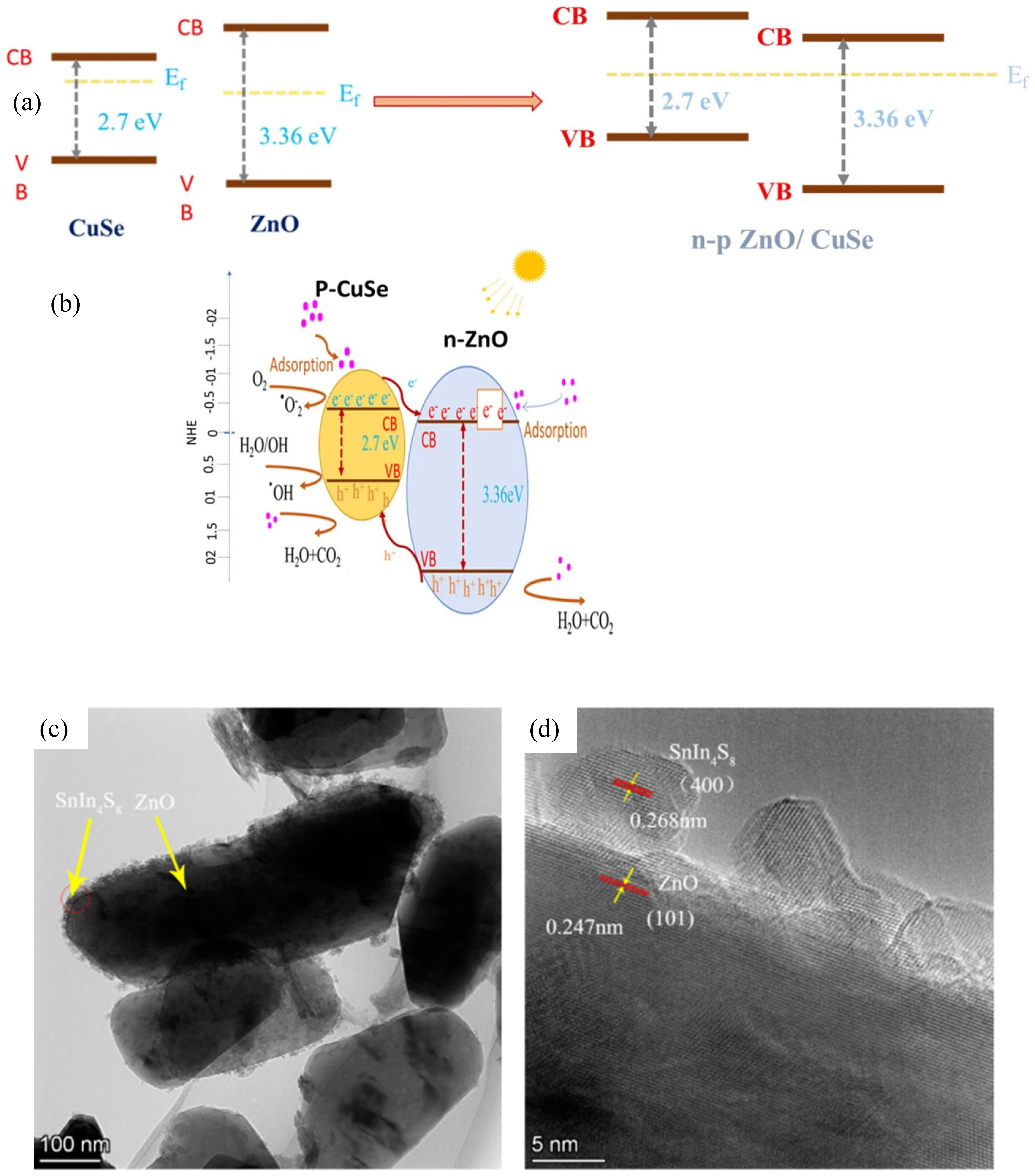
Metal selenides narrow band gap materials are attractive for diverse catalytic application [37]. Mubeen et al. [38] have designed a heterostructure photocatalyst composed of ZnO/CuSe and applied it for the degradation of methyl blue dye. The composition of the heterostructure photocatalyst was adjusted by varying the ratio of CuSe from 10 to 50%. For the sake of comparison, ZnO and CuSe were also prepared and tested for the degradation test. The precipitation synthesis strategy was adopted for the preparation of photocatalysts, which is a facile approach for material preparation. The objective of this work was to tune the band gap and enhancing charge separation of the designed heterostructure. The narrow band gap of CuSe was helpful to lower the band gap of ZnO/CuSe. The band gap of heterostructure was observed in the range of 2.42 eV to 2.62 eV, and was significantly lower compared to that of pristine ZnO, being 3.36 eV. The formation of the P-N junction between the ZnO and CuSe heterostructure photocatalyst has enabled effective separation of photoinduced charge carriers. The separation of charge carriers through the formation of heterostructure is shown in Figure 1a,b. In the proposed mechanism for photocatalysis, the authors have suggested that photogenerated electrons were transferred from conduction band (CB) of p type CuSe to n type ZnO, whereas the photogenerated holes were transported in the opposite way from valence band (VB) of ZnO to VB of CuSe. Such charge transfer could be helpful in preventing the recombination of photoinduced charge carriers. It was depicted in corresponding improvement in the kinetics of photodegradation of methyl blue, that the heterostructure ZnO/CuSe has reflected six times faster degradation when compared to pristine ZnO. The authors have suggested the involvement of superoxide (O2) and hydroxyl (OH) radicals, which have played an important role in photodegradation of methyl blue dye. Improvement in photocatalytic activity was due to formation of the P-N junction, extended separation of charge carriers and extending the light absorption in the visible region.
A Z-scheme photocatalyst composed of SnIn4S8@ZnO has been developed using hydrothermal method [39]. The composite photocatalyst with a ZnO to SnIn4S8 ratio of 800 demonstrated optimum performance for degrading methylene blue dye. ZnO nanoflakes were obtained using a hydrothermal method and SnIn4S8 nanoparticles were deposited on top of ZnO. The formation of the heterojunction interface is shown in Figure 1c,d. The designed catalyst has demonstrated rapid degradation of dye within 20 min, and 91% of dye was removed. This work shows controlled deposition SnIn4S8 for regulating the photocatalytic activity of ZnO.
Formation of the heterojunction between SnIn4S8 and ZnO has reduced recombination, as observed from decreased PL intensity. Furthermore, combining ZnO with SnIn4S8 has improved the optical absorption characterstics as reflected from shortening of the band gap from 3.22 to 3.19 eV. TOC analysis has shown 18% of TOC removal after 20 min, reflecting partical mineralization using SnIn4S8@ZnO. XRD analysis before and after photodegradation has shown no significant change reflecting the structural stability. However, during the cycling test it was osberved that after third cycle the degradation efficiency was reduced to 68%. The possible surface change could be responsible for decline in activity.
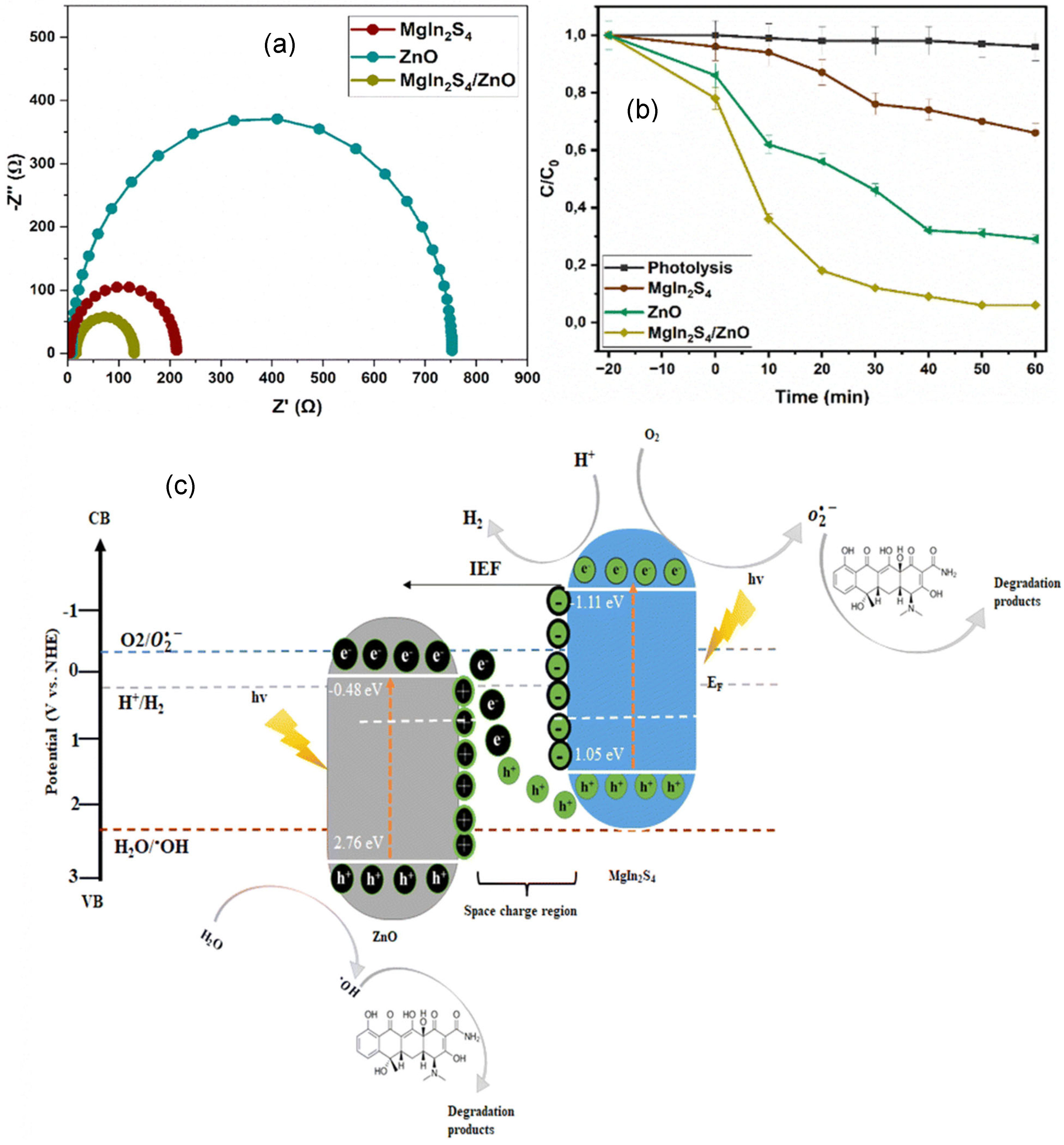
Yusuf et al. have demonstrated Z-schem heterojunction composed of MgIn2S4/ZnO to degrade tetracycline (TCE) under illumination. The band positions of both components are appropriate for charge transfer [40]. It has resulted in effective separation of photoinduced charges and improved photocatalytic activity significantly. The composite photocatalyst efficiency for removal of tetracycline was observed to be 1.4 and 3.9 times higher as compared to MgIn2S4 and ZnO, respectively (Figure 2a). For the synthesis of the heterojunction photocatalyst, ZnO nanocrystals were first prepared using the hydrothermal method. It was followed by dispersing ZnO nanoparticles in DI water, introducing precursors of MgIn2S4 and being subjected to hydrothermal treatment. Formation of heterojunction greatly enhanced the surface area; the surface area of MgIn2S4/ZnO, ZnO and MgIn2S4 was observed as 101.81, 2.84 and 45.26 m2/g, respectively. The higher surface area has improved the photocatalytic performance as compared to pristine ZnO and MgIn2S4. After 60 min of irradiation nearly 65% of TOC was removed, reflecting the mineralization capability of MgIn2S4/ZnO. The formation of the S-scheme configuration separated the photogenerated charges. This was supported by the electrochemical impedance spectroscopy, reflecting reduced resistance in the Nyquist plot, shown in Figure 2b. The heterojunction photocatalyst has demonstrated the minimum diameter of semi-circles as compared to individual photocatalysts. Use of various scavengers has identified superoxide and hydroxyl radicals actively participating in photodegradation process as shown in Figure 2c. This work demonstrates the effective integrating of oxide and sulfide photocatalysts for effective separation of photoinduced charge carries and degradation of organic contaminants.
Cadmium sulfide commonly applies to photocatalysts, the narrow band gap and visible light absorption make it an interesting candidate. However, this suffers from the drawbacks of high recombination and the photo corrosion phenomena. Making the heterojunction with other semiconductors provides a feasible strategy for overcoming the intrinsic drawbacks of CdS. Metal organic frameworks (MOF) provide a feasible route for synthesizing nanomaterials for catalytic applications. Zeolite imidazolate framework materials (ZIFs), based on MOF, is commonly applied for the fabrication of ZnO. Zhu et al. have demonstrated fabrication of the Fe-doped ZnO/CdS photocatalyst for degrading the ciprofloxacin (CIP) from pharmaceutical waste [41]. A Z-scheme configuration was helpful to separate photogenerated charges resulting in superior performance. The rate observed for photodegradation of CIP over Fe-ZnO/CdS was found to be 4.3 and 20 times higher when compared to pristine CdS and Fe-doped ZnO. The formation of Fe-ZnO/CdS has demonstrated significant improvement in photocatalytic activity. Furthermore, heterojunction has shown stability; during cycling testing of the prepared photocatalyst, it has retained 82% of activity after five cycles. Exploiting the dual strategy of introducing Fe dopant and making heterojunction with CdS has resulted in significant improvement in photocatalytic activity of ZnO. ESR analysis with radical trapping has confirmed the formation of O2 as ROS involved in degradation of CIP. A Z-scheme heterojuction was formed instead of forming type-ii hetrostructure. It retained the strong reduction potential of Fe-ZnO. Forming the Z-scheme structure and interfacial charge transfer was helpful to improve the catalystic stability, which was evident from corresponding XRD analysis reflecting no significant change before and after the photodegradation test.
ZnS is a wideband gap material with its conduction band position more negative. Sunaina et al. have applied ZnS as a sensitizer for ZnO by adopting the solid state method, by heating ZnO with thiourea as a source of sulfur [42]. The ZnO-ZnS heterostructure has demonstrated suppression in recombination and charges, and reflected efficient degradation of p-nitrophenol and rhodamine B organic dye. Reduced recombination was confirmed through reduction in PL intensity.
Molybdenum disulfide (MoS2) has two dimensional layered structures stacked by van der waals forces [43]. It is an attractive candidate for combining with other semiconductor photocatalysts to boost photocatalytic performance [44]. MoS2/ZnO heterostructure formation prepared through a simplified approach of sonication has demonstrated enhanced performance for the degradation of methylene blue MV dyes and industrial wastewater [45]. For optimizing the appropriate ratio of MoS2 and ZnO, different weight proportions of each catalyst were mixed, the sample prepared with MoS2:ZnO with 4:1, referred as MoZ41 has shown the best performance for degradation of organic waste. After combining with MoS2 the band gap value of ZnO reduced from 3.01 to 2.41 eV, which has resulted in enhancement in absorption of light and hence promoted photocatalytic activity. A radical scavenger test has confirmed that hydroxyl radicals have played a key role as reactive oxygen species, whereas superoxide radicals have participated less actively during the degradation process. In another finding ZnO/MoS2-PMMA polymeric nanocomposite prepared by adopting polymethyl methacrylate as supporting matrix has demonstrated efficient degradation of Rhodamine B and sodium dodecyl sulfate (SDS) as an organic pollutant and Escherichia coli bacteria [46]. During degradation hydroxyl radicals and photogenerated holes have played an important role. ZnO/MoS2-PMMA has shown enhanced photodegradation activity as compared to ZnO-PMMA matrix. Combining ZnO with MoS2 has shown significant reduction in recombination as observed from the corresponding decrease in PL intensity, which has favored higher photocatalytic performance. A summary of ZnO/Chalcogenides composites is presented in Table 1.

2.2. ZnO/Metal Halide Composite

Metal halides, such as AgCl and AgBr, are applied as potential candidates for photodecomposition of organic pollutants and antibiotics in wastewater. A simplified synthesis of AgCl/ZnO composite using a co-precipitations approach demonstrated effective degradation of antibiotic ofloxacin (OFL) from the wastewater [47]. Among various loading amounts of AgCl, 30 wt % of AgCl has demonstrated best performance for photodegradation of OFL. It has shown significant improvement when compared to pristine AgCl and ZnO. The improvement in catalytic performance of AgCl/ZnO is due to efficient separation of charge carriers. Higher activity for AgCl/ZnO is due to strong interfacial charge seperation and improvement in light absorption as compared to pristine ZnO. For comparison, AgCl/ZnO was also modified with noble metals, such as Au and Pt; however, it was not helpful to enhance the degradation activity. It was observed that degradation efficiency was dependent upon pH values, and that acidic PH was found more favorable as compared to neutral and alkaline conditions. Radical scavenger testing has revealed that superoxide radicals as reactive oxygen species effectively participated in degrading OFL.
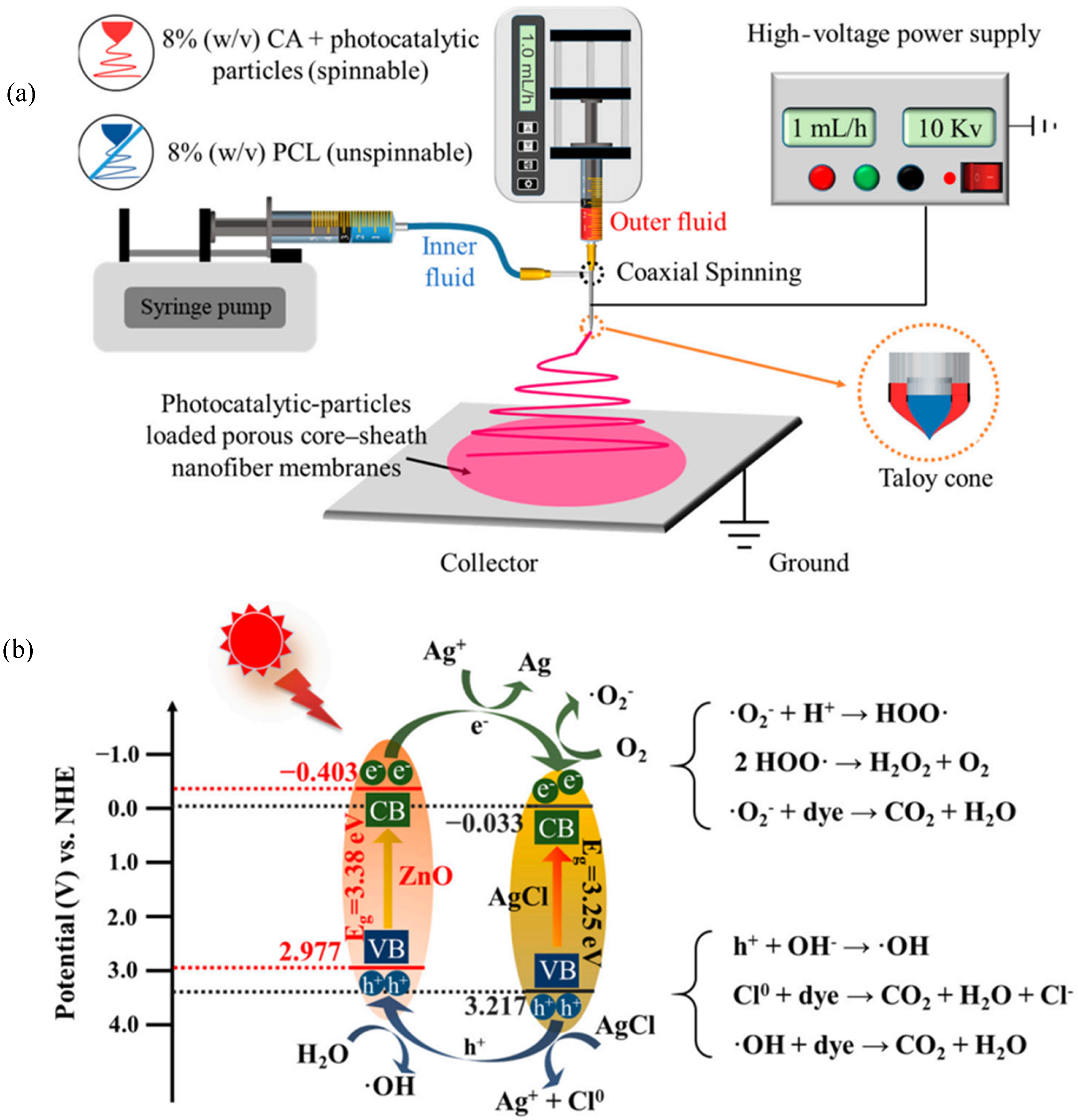
Electrospinning is a versatile approach for fabricating nanofibers for diverse applications. Yang et al. has employed a co-axial electrospinning strategy to design core shell nanofibrous membrane for removal of organic dyes [48]. The porous structure of nanofibers provides a suitable substrate for loading a photocatalyst on it. In this work, the nanofiber was produced using cellulose acetate (CA) and polycaprolactone (PCL). On these nanofibers a composite photocatalyst composed of AgCl/ZnO was loaded. The fabrication process of photocatalytic membrane is described in Figure 3a.
At first, AgCl/ZnO nanocomposite was prepared with molar ratios of AgCl:ZnO as 1:9, 3:7 and 5:5. CA and HFIP was mixed with AgCl:ZnO nanocomposites to obtain the sheath fluid, and for comparison, ZnO and AgCl solutions were also prepared. The XRD patterns have confirmed the appearance of both AgCl and ZnO phases in the composite. The nanofibrous membrane loaded with AgCl/ZnO (MAgCl:MZnO = 5:5 photocatalyst) has shown the highest performance for photocatalytic degradation of methylene blue. The higher activity of nanocomposite photocatalyst was due to effective separation of electron and hole pairs as shown in the schematic diagram. Mechanistic investigation has revealed that superoxide radical anion from oxygen reduction and hydroxyl radical production by valence band has participated as reactive oxygen species to decompose methylene blue. Laokul et al. have applied AgBr to TiO2/ZnO composite for enhancing the charge suppression and promoting photocatalytic activity [49]. For sample preparation, TiO2/ZnO were dispersed in PVP, and Ag and Br precursors were introduced to it in the presence of Ethylene glycol under stirring at 60 °C. As a result, AgBr decorated TiO2/ZnO nanocomposite was obtained. The formation of AgBr was confirmed through XRD patterns. When tested for photodegradation of organic dye methylene blue, AgBr/TiO2/ZnO ATZ-(3:1) has shown significant improvement in performance compared to individual components of ZnO, AgBr and TiO2. A decrease in PL intensity of ATZ-(3:1) has confirmed reduced recombination, which has resulted in enhanced photocatalytic efficiency. Higher surface area of ATZ-(3:1) (70.25 m2g−1) compared to ZnO (27.94 m2g−1) and TiO2 (60.95 m2g−1) also improved the catalytic performance. The degradation mechanism finding has revealed that superoxide and hydroxyl as reactive oxygen species participated in degrading the dye. XRD patterns and morphology investigation before and after photocatalytic experiments has shown a slight decrease in the intensity of peaks reflecting stable structure. This finding demonstrates the significance of metal halide-based photocatalysts to design heterostructure photocatalysts for boosting catalytic activity.
Besides demonstration of AgBr in heterostructure engineering for removal of organic pollutants, it has also shown promise as an anti-microbial agent and disinfectant. Tata et al. have applied AgBr/ZnO nanocomposite for disinfectant. They have demonstrated the dual role of AgBr as photosensitizer and as an antimicrobial agent [50]. One dimensional ZnO nanorods were grown on Si substrate on spin-coated seed layer followed by heating in Zin nitrate and hexamine solution at a mild temperature of 95 °C. Ag-TOAB as a precursor of AgBr was spin coated on ZnO NR followed by calcination at 260 °C. For preparing the optimum loading amount, the loading amount of Ag-TOAB was varied from 10–50 mL. Anti-bacterial activity of prepared nanocomposite was tested against E. coli under dark and illumination. Under illumination ZnO NRs/AgBr-30 nanocomposite has shown significant improvement to disinfect E. coli when compared to that of pristine ZnO NR, and within 15 min of irradiation E. coli was completely disinfected. EPR analysis has confirmed the active role of hydroxyl radicals in the disinfection process. A summary of ZnO/ Metal Halide catalysts is presented in Table 2.

2.3. ZnO/Oxyhalide Composites

Bismuth oxyhalides BiOX, X=Cl, Br, I are important types of bismuth containing photocatalyst materials. These photocatalysts have demonstrated their capabilities for environmental remediations. BIOCl is a stable candidate for photocatalytic applications; however, it has wide optical band of ca 3.4 eV. Because of its wide band gap it can absorb only UV irradiation. In order to improve its light absorption characteristic and to reduce recombination of charges, Yang et al. have introduced S doping to BiOCl and made its composite with ZnO to obtain ZnO/S-BiOCl [51]. Formation of type II heterojunction has resulted in efficient removal of antibiotic tetracycline (TC) and tetracycline hydrochloride (TC-HCl). Hydrothermal method was adopted for the preparation of ZnO/S-BiOCl. The existence of both ZnO and BiOCl in the heterostructure were confirmed by XRD analysis. PL decay analysis has reflected an elongated lifetime of carriers with the following increasing order of average lifetimes, ZnO/S-BiOCl (2.36 ns) > ZnO/BiOCl (1.69) > S-BiOCl (1.76) > ZnO (1.46 ns). ZnO/S-BiOCl has also demonstrated higher photocurrent generation as compared to other samples. It reflects enhanced separation of photoinduced charge carriers. As a result, ZnO/S-BiOCl has demonstrated higher performance to degrade tetracycline. Superoxide and hydroxyl radicals were identified as the main reactive oxygen species responsible for the degradation of tetracycline. This finding highlights the advantages of simulators exploiting dopant and heterostructure formation to boost the catalytic performance for degradation of antibiotics from wastewater.
BiOClXI1-X is a solid solution catalyst providing the advantages of tuning the band gap. Chen et al. have demonstrated the application of ZnO/BiOCl0.8I0.2 composite photocatalyst for photodegradation of TC antibiotic [52]. A S-scheme catalyst was formed, and mass ratio of 20% for BiOCl0.8I0.2 to ZnO has shown best performance. Firstly, ZnO hollow spheres were obtained, which was then coated with BiOCl0.8I0.2 using the hydrothermal method. An improvement in charge collection efficiency of ZnO/ BiOCl0.8I0.2 was observed by measuring the photocurrent response. The composite catalyst also reflected inferior impedance during EIS analysis. As a result, ZnO/ BiOCl0.8I0.2 has shown almost 2.07 and 1.82-times higher performance for degradation of tetracycline as compared to pristine ZnO hollow spheres and BiOCl0.8I0.2. This finding highlights the significance of simultaneous exploitation of solid solutions and heterojunction for the degradation of antibiotics. Compared to BiOCl, the BiOI has a narrow band gap (2.4 eV), which makes it an interesting candidate for designing visible light photocatalysts. Making the heterostructure of BiOI with wide band gap materials, such as ZnO, provides a useful strategy to tune the band gap and extend the light absorption properties. Several studies have demonstrated the fabrication of ZnO/BiOI heterojunction to enhance photocatalytic decomposition of organic compounds. For instance, Ashiegbu et al. have demonstrated almost 5-fold improvement in rate constant for degradation of 2-chlorobiphenyl, a persistent organic pollutant over ZnO-[10%]BiOI compared to pristine ZnO [53]. The ZnO/BiOI-0.5 heterojunction photocatalyst also demonstrated excellent performance for degradation of Rhodamine B organic dye [54]. Thanks to superior separation of photogenerated charges, the rate constant for photodegradation of RhB was found to be 31 and 142 times higher compared to pristine ZnO and BiOI. Superoxide and hydroxyl radicals were identified as the main reactive oxygen species playing a dominant role to degrade the RhB. The higher performance of composite photocatalyst was due to development of an in-built electric field and efficient charge transfer. The composite photocatalyst has demonstrated inferior impedance during EIS analysis and higher charge collection performance during photocurrent measurement, reflecting significant improvement. A summary of ZnO/Oxyhalide catalysts is presented in Table 3.
Since the catalyst recovery is an issue for re-using, supporting the catalyst on a suitable support can resolve this issue. ZnO/BiOI has been embedded in stainless steel mesh to fabricate BiOI@ZnO@SSM using electrodeposition technique [56]. Forming the P-N junction catalyst has boosted photocatalytic performance, and as a result photodegradation efficiency for Rhodamine B removal was observed as 1.5 times higher compared to ZnO@SSM. Furthermore, improvement in photodegradation performance of the prepared catalyst has shown high performance for separating water–oil emulsion and maintained 99.6% of separation efficiency after 10 cycles. This finding demonstrates utilizing membrane-based approaches for embedding the P-N junction photocatalyst as a useful platform for environmental remediations. Nickel foam provides a three-dimensional porous substrate, an appropriate substrate for hosting nanomaterial for diverse catalytic applications [58].
Li et al. demonstrated the fabrication of BiOBr/ZnO composite on Ni/NiO foam using solvothermal method [57]. The prepared structure has been exploited to degrade organic dye methyl orange. It was observed that photocatalytic performance was greatly influenced by [Br/Zn] ratio; among different samples prepared with variable Br and Zn proportions, the [Br/Zn]0.75 has shown the highest performance. The rate constant for MO degradation over [Br/Zn]0.75 was found to be 3.3 times higher as compared to pristine BiOBr, highlighting the advantages of three-dimensional support and heterojunction formation with ZnO. A radical scavenger test has revealed that superoxide radicals were the dominant species involved in photodegradation process.
Combining p- and n-type of photocatalysts to form P-N junction is another useful strategy commonly adopted to improve the separation of charge carriers. Yang et al. have fabricated the formation of BiOCl/ZnO p-n junction photocatalysts to achieve the in-built electric field at the interface [55]. The formation of heterojunction has separated the charge carriers and improved the photocatalytic activity for the degradation of organic dye RhB, tetracycline and ciprofloxacin. The formation of BiOCl/ZnO was achieved by a simple hydrothermal method. The appearance of both BiOCl and ZnO phases were confirmed by XRD analysis. PN junction formation provides a feasible approach to design the effective photocatalyst, and the strategy adopted in this work could be applied to diverse combinations for improving the photocatalytic activity of semiconductor photocatalysts.

2.4. ZnO/Metal Oxide Heterostructures

Formation of the heterojunction between different metal oxides is another promising approach to exploit the synergetic effect and integrating the beneficial features of different catalysts [59]. Introducing metal ions as dopant to the wide band gap metal oxides provides a feasible strategy for boosting the photodegradation of organic dyes. Careful selection of dopants can be useful to enhance the visible light absorption, and it can also promote the separation of charge carriers. Rezvaneh Amrollahi et al. have demonstrated the doping of Cu into three different metal oxides, TiO2, NiO and ZnO, to boost their performance for photodegradation of organic dyes methyl orange and methylene blue [60]. Among these, Cu/TiO2 has shown the best performance. The formation of superoxide radical anion and hydroxyl radicals as reactive oxygen species has played an important role for effective degradation of organic dyes. Furthermore, external addition of H2O2 during photocatalysis has been shown to promote the formation of hydroxyl radicals, a highly active intermediate with the capability to drive photodegradation. Although the current finding exploits the external addition of H2O2 for promoting the decomposition process, in an ideal case, the design of a photocatalyst that can generate H2O2 from oxygen reduction reaction, and can activate it to hydroxyl radical, is more promising. It can get rid of the additional use of sacrificial electron donors. A summary of ZnO/Metal Oxide catalysts is presented in Table 4.
Umukoro et al. exploited the synergetic effect of P-N junction formation between NiO-ZnO and Ag as a plasmonic photocatalyst to demonstrate efficient degradation of Eosin yellow dye [61]. A simplified one-pot hydrothermal synthesis strategy was adopted for the preparation of Ag-NiO/ZnO nanocomposite. For the sake of comparison, ZnO and NiO/ZnO were also prepared and tested for degradation of organic dye Eosin. Introducing Ag and NiO to ZnO has resulted in improvement in the optical absorption characteristics. The band gap of composite photocatalyst reduced to 2.77 eV is lower than that of pristine ZnO (3.16 eV). Formation of P-N junction between NiO/ZnO supported the suppression of the recombination of photoinduced charge carriers because of formation of the in-built electric field. This was further responsible for boosting the photocatalytic degradation of Eosin when compared to pristine ZnO.
Authors have proposed the mechanism of photocatalytic degradation as follows. Surface plasmon resonance effect (SPR) can be activated by use of Ag nanostructures. Photogenerated electrons in ZnO are trapped in Ag, wherein photoinduced oxygen reduction reaction occurs resulting in the formation of superoxide radicals (O2). These O2 radicals further react with protons and undergoes decomposition to produce hydroxyl radicals, which actively take part in their role in the degradation process. Holes present in the valence bond of NiO also take in hydroxyl radical generation, which also contribute in generation of hydroxyl radical and degradation of Eosin. This work highlights the significance of exploiting simulatively the effect of PN junction formation and surface plasmon resonance effect for efficient degradation of organic contaminants. Abbady et al. have demonstrated the formation of nanocomposite of Cd0.4Mn0.6XO by combining with a variety of metal oxides (X = ZnO, SnO, CuO, Al2O3, Fe2O3, NiO, and CoO) to investigate the effect of composite formation on photocatalytic degradation of organic dye methylene blue [63]. They have concluded that among various metal oxide composites, the Cd0.4Mn0.6O-ZnO has demonstrated highest performance resulting in the removal of about 97.94% of methylene blue within 3 h.
CuO is a p-type semiconductor having a narrow band gap. It has been combined with ZnO to make pn junction ZnO-CuO photocatalyst for tuning the band gap and reducing the recombination of photoinduced charges ultimately for enhancing photocatalytic activity [64]. CuO/ZnO was prepared by hydrothermal method using Zn and Cu precursors followed by annealing at 300 °C for 4 h. For making samples with optimized performance, the CuO weight percent varied as 0,5, 10, 15 and 100% and referred as ZnO, CZ-5, CZ-10, CZ-15, and CuO, respectively. Among these samples CZ-10 has shown a shortening of band gap to 3.13 eV. The CZ-10 has demonstrated performance for degradation of organic contaminants, methylene blue (MB) and Orange G (OG), almost twice as much compared to pristine ZnO. Photoluminescence spectra reveal that significant reduction in PL intensity and hence recombination was achieved for CZ-10 compared to pristine ZnO. It has greatly influenced the photocatalytic performance of ZnO-CuO photocatalyst. A radical scavenger test has confirmed that hydroxyl radicals have played an important role in degradation of organics contaminants.
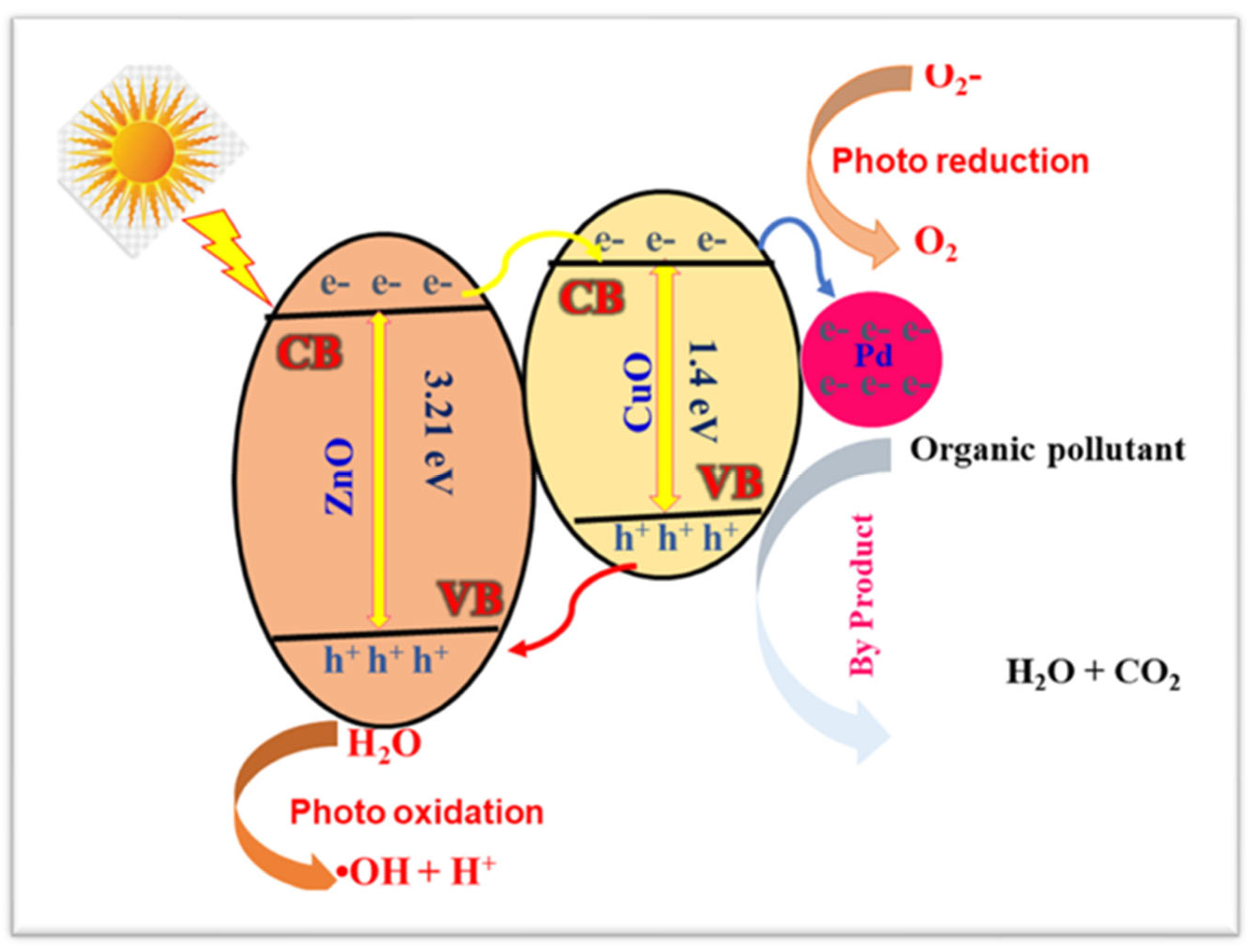
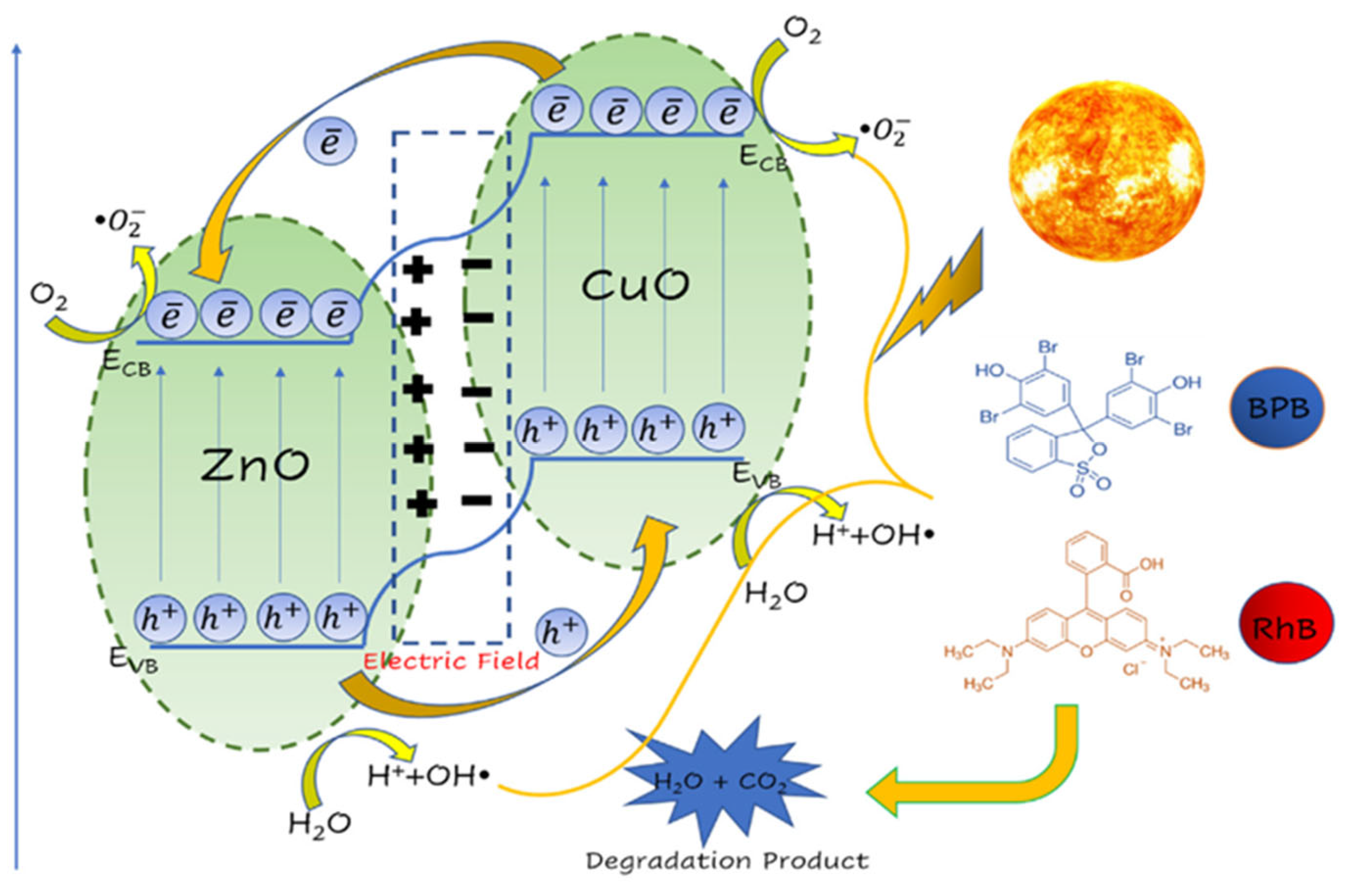
Siddiqui et al. have demonstrated the efficient degradation of organic dyes of bromophenol blue (BPB) and rhodamine B over ZnO/CuO prepared through simplified strategy of co-precipitation [62]. An in-built charge separation was achieved through the formation of heterojunction as shown in Figure 4. Furthermore, the formation of ZnO/CuO heterojunction has been further extended by introducing Pd to produce the ZnO/CuO-Pd nanostructure using a hydrothermal method [65]. Introducing Pd was supportive to enhance the photocatalytic decomposition of azocarmine and neutral dye mixture. The mechanism of photodegradation over ZnO/CuO-Pd is presented in Figure 5.
Both TiO2 and ZnO are wide band gap materials that facilitate the formation of heterojunction for effective separation of photoinduced charge carriers. Backer et al. have exploited a strategy for introducing carbon as a dopant to ZnO and formation of heterojunction with TiO2 to boost the photocatalytic performance for the removal of antibiotic Ofloxacin (OFX; C18H20FN3O4) [66]. In order to achieve the optimum performance, the ratio of Zn:Ti was adjusted and 1:2 was observed as optimum ratio. The carbon doping to ZnO was achieved from the Polyvinylpyrrolidone (PVP), which was used as a structure directing agent in the hydrothermal approach, followed by annealing at 350 °C to achieve the carbon-doped ZnO (C-ZnO). For the preparation of the C-ZnO/TiO2 hybrid structure, the pristine C-ZnO was mixed with titanium (iv) isopropoxide as a precursor for TiO2 and subjected to hydrothermal treatment. For introducing different proportions of Ti, the Zn to Ti precursor ratio was varied as (1:1; 1:2; 1:4 and 1:6) and the resulting samples were labelled as ZT1, ZT2, ZT4, and ZT6, respectively. BET surface area measurement has shown that making hybridization with TiO2 increases surface area significantly. The surface area of ZT1, ZT2, ZT4, and ZT6 were observed as 97.95, 86.11, 98.31, m2/g, which are quite higher as compared to C-ZnO, being only 20.88 m2/g. It also had an impact on the optical absorption properties. C-ZnO has shown an optical band gap of 3.09 lower than pristine ZnO, which is around 3.2 eV. Carbon doping has resulted in the shortening of the ZnO band gap, which was slightly reduced further by combining with TiO2. The band gap of ZT1, ZT2, ZT4, and ZT6 were observed as 3.04, 3.04, and 3.037 eV, respectively. The photodegradation performance evaluation has confirmed that optimum performance was exhibited by ZT2, which was found to be about 1.6 times higher than C-ZnO. Investigation has revealed the following order of reactivity of reactive oxygen species participating in the degradation process .O2 > h + > OH. > e. The significance of current findings demonstrates the synergy of carbon as dopant to ZnO and heterostructure formation with TiO2 for boosting the photocatalytic activity for efficient degradation of antibiotics. Simultaneous exploitation of doping and heterojunction formation is not limited to making ZnO composite with other oxides. This approach has also been exploited to introduce Cr as dopant to ZnO and fabrication of hybrid structure with lignin as carbon-based materials for approaching the efficient degradation of organic dye methylene blue and antimicrobial activity to disinfect Escherichia coli [67]. While making the heterojunction between TiO2 and ZnO, the crystalline phase of TiO2 could play an important role. Anatase and Rutile phases of TiO2 differ in their valence and conducting band positions, which can impact on electron transfer and separation of charges. With the help of DFT calculations, Das et al. have suggested that higher band offsets of aTiO2-ZnO, as compared to rTiO2-ZnO, could be more favorable for separation of charge carriers [68].
One of the drawbacks associated with the dispersed powder-based photocatalyst for degradation of environmental pollutants is the challenge of recovery of the catalyst after use. However, use of magnetic material provides benefits of easier separation of the photocatalyst after the degradation experiment. In this regard, use of magnetically separable materials provides useful benefits. Sitadi et al. have demonstrated the formation of the heterojunction photocatalyst composed of ZnO/NiFe2O4 using a hydrothermal approach [69]. A narrow band gap of NiFe2O4 (1.71 eV), suitable band edge position for separation electron and hole pairs after combining with ZnO, and magnetic behavior of NiFe2O4 are key merits of this finding. Superoxide and hydroxyl radicals produced during photocatalysis have played an active role in the degradation process. Whereas the composite photocatalyst has shown quite stable performance during repeated degradation tests. This finding demonstrates the important role of utilizing magnetically separable photocatalysts that are more suitable for practical applications.

3. ZnO-Based Ternary Heterostructures

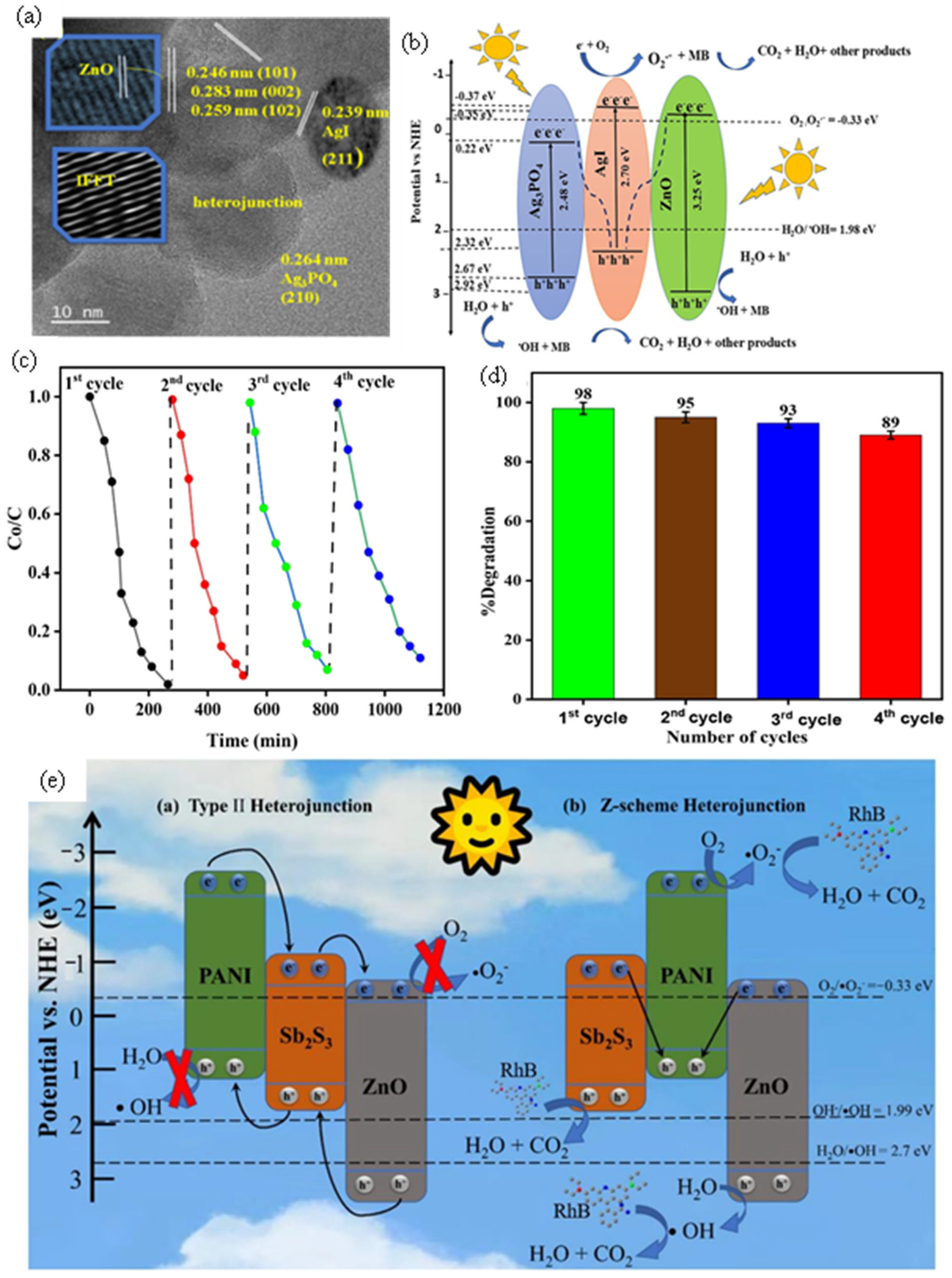
Heterojunction formation has been expanded to triple phase materials to exploit the benefits of each component. Gindose et al. have fabricated the ternary heterojunction of Ag3PO4-AgI-ZnO forming a Z-scheme photocatalyst for efficient degradation of methylene blue [70]. Ternary nanocomposite was prepared by adopting the sol gel method, composed of mixing Ag, Zn and phosphate precursors in the presence of poly vinyl alcohol. The powder was obtained by heating at mild temperature at 110 °C and followed by calcination at high temperature of 400 °C. For comparison the individual materials of Ag3PO4, AgI, and ZnO were also prepared and tested for their performance of photocatalytic degradation experiments. The formation of ternary heterojunction photocatalyst was confirmed by the TEM analysis as shown in Figure 6a. The XRD analysis has also confirmed the appearance of Ag3PO4, AgI and ZnO components. The authors have observed that formation of ternary heterojunction photocatalyst has resulted in higher surface area of 100.11 m2/g, significantly higher as compared to individual components being only 7.12, 11.321 and 14.11 m2/g for the case of ZnO, AgI and Ag3PO4 photocatalysts, respectively. The ternary-structured catalyst has reflected extended separation of charges as observed by reduced charge transfer resistance in the Nyquist plot and EIS analysis. It has resulted in efficient degradation of methylene blue as compared to individual components. Furthermore, the prepared ternary-structured photocatalysts have maintained photocatalytic activity by reflecting very slight change in performance after the fourth cycles of the degradation test confirming catalytic stability over longer use. The proposed mechanism for ternary heterostructure photocatalyst is shown in Figure 6b. The designed catalyst has shown stable performance during the recycling test and retained the degradation performance of about 89% as shown in Figure 6c,d. The current finding demonstrates the integration of the ternary component photocatalyst for separating photoinduced charge carriers and boosting the photocatalytic activity for degradation of organic pollutants.
This work can be extended to develop an efficient ternary heterostructure photocatalyst for efficient performance. A ternary heterostructure was constructed by integrating Zn0.6Cd0.4S, with ZnO and graphitic carbon nitride to fabricate Zn0.6Cd0.4S/ZnO/g-C3N4 as a dual z-scheme photocatalyst for efficient removal of organic dyes methylene blue, rhodamine B and tetracycline [71]. It exploits the advantages of each of the photocatalysts to demonstrate the synergetic effect for boosting photocatalytic performance. The interface between the composite material was supportive to achieve the separation of photogenerated electrons and holes.
CdS is a well-known semiconductor that can function under visible light illumination because of its narrow band gap. The formation of solid solution ZnxCd1 − xS (0 < x < 1) provides advantages of tuning the band gap properties. Therefore, Zn0.6Cd0.4S was adopted in this study, and it was combined with C3N4 and ZnO to boost the catalytic performance. At first C3N4 was obtained by thermal condensation of melamine, which was mixed with Zn, Cd and sulfur precursors to prepare Zn0.6Cd0.4S/ZnO/g-C3N4 using the hydrothermal method. A significant decrease in band gap of Zn0.6Cd0.4S/ZnO/g-C3N4 was observed being 2.14 eV, which was found to be much lower as compared to g-C3N4 (2.65 eV) and ZnO (3.16 eV). The shortening of band gap reflects extended absorption of solar radiation, a key advantage of making a composite photocatalyst. Besides improvement in optical absorption, the formation of the heterojunction photocatalyst was supportive to achieve the separation of charge carriers. The suitable band position of the ternary heterostructure photocatalyst has been proposed to form a double Z-scheme configuration. During photocatalysis, superoxide and hydroxyl radicals were identified as potential reactive oxygen species taking part in the degradation process. The confirmation of forming these reactive oxygen species was confirmed using spin trapping electron spin resonance spectroscopic analysis. This finding presents the formation of a dual Z-scheme catalyst by using a solid solution-based photocatalyst for efficient degradation of organic dyes and antibiotics. A dual Z-scheme ternary-structured photocatalyst has been developed by using organic–inorganic hybrid components composed of PAN/PANI–Sb2S3-ZnO, as shown in Figure 6e [72]. In this structure, polyacrylonitrile (PAN) played the role of matrix, whereas a polyaniline (PANI) was adopted as organic photocatalyst. The hybrid catalyst has shown excellent performance to degrade four organic dyes (RhB, MB, CR and MO). It was identified that hydroxyl and superoxide radicals have played an active role in photodegradation. A summary of ZnO-based ternary heterostructured catalysts is presented in Table 5.
A ternary heterostructure of CdS QD@ZnS/ZnO composite has been prepared using a microwave-assisted hydrothermal method [73]. In this method, at first, three- dimensional ZnO particles were prepared. These were mixed with Zn(CH3COO)2 and 0.5 mmol of C2H5NS, followed by adding different amounts of prepared CdS QDs and treated hydrothermally in a microwave reactor to obtain the ternary heterostructure photocatalyst. ZnO were formed in the form of a flower shape composed of a rod-like structure, and the interface between ZnS and ZnO was confirmed with HRTEM analysis. Cds were existent in the form of quantum dots. During synthesis procedure, oxygen vacancies were introduced to ZnO, which narrowed the band gap. The forming of oxygen vacancies was confirmed with the help of XPS analysis and EPR analysis. The synergetic effect of oxygen vacancies, coupled with ZnS and the quantum confinement effect of CdS were exploited to enhance photocatalytic performance. Among various samples having different proportions of CdS QDs, the CdS QDs@ZnS/ZnO-0.15 has shown best performance for degradation of Organic dye Rhodamine B. It made a dual S-scheme heterojunction photocatalyst, responsible for achieving the higher separation of photoinduced charges in ternary-structured photocatalysts. It was reflected from reduced recombination tendency in photoluminescence intensity, lowest impedance in EIS analysis and highest response of photocurrent density observed for the CdS QDs@ZnS/ZnO-0.15 compared to other samples. Furthermore, BET surface area of CdS QDs@ZnS/ZnO-0.15 was observed as 40.69 m2/g, which was higher compared to ZnO (16.81 m2/g) and ZnS/ZnO-0.50 (28.29 m2/g). All of these factors were contributing in boosting the catalytic activity of ternary-structured CdS QDs@ZnS/ZnO-0.15. This finding highlights the formation of ternary-functioned heterostructures with simultaneously exploiting oxygen defects and quantum confinement effects.
Figure 6. (a) HRTEM image of PC4 nanocomposite and (b) proposed the mechanism of MB using, (c) Plots of (a,b) recyclability and (d) stability test of AgI-ZnO-Ag3PO4 heterojunction reproduced from reference [70] copyright 2025, Elsevier, and (e) schematic diagram of the organic dye removal mechanism with traditional type-II heterojunction and Z-scheme heterojunction charge transfer pathway reproduced from reference [72] copyright 2023, MDPI.
Applsci 16 05279 g006
Nguyen et al. have adopted microwave-assisted synthesis of a Fe2O3/Ce-doped ZnO/GO (FCZG) ternary-structured photocatalyst for degradation methylene blue dye [74]. In this work Ce doping has been adopted for improving the intrinsic activity of Zn, whereas making a hybrid structure with Fe2O3 and graphene oxide was supportive for improving the light absorption capabilities, enhancing the BET surface area and achieving the higher degree of charge separation during photocatalysis. The synergetic effect of these factors was favorable to achieve accelerated photodegradation of methylene blue as compared to Ce doped pristine ZnO (CEZ). The evidence of enhanced separation could be related to inferior impedance of FCZG and exhibition of higher photocurrent density when compared to pristine Fe2O3, CEZ and Fe2O3/CEZ (FCZ) photocatalysts. It confirmed the benefits of the ternary-structured photocatalyst for improving photocatalytic activity. Another feature of this catalyst was its separable nature because of its magnetic properties of Fe2O3 component. It allows easier separation and collection of the photocatalyst after the degradation experiment. On account of stability of the designed catalyst, on repeating the five degradation cycles, only a slight decrease in activity (from 98.05 to 96.88%) was observed, reflecting the stable nature of photocatalyst.
Magnetic properties of ferrite materials, such as ZnFe2O4, make them attractive candidates for photocatalytic removal of organic waste [78]. Their main advantage is to separate them from the solution using a magnet, making their reuse easier [79]. Ahmadi et al. have integrated four different components for designing a magnetically separable photocatalyst, which was composed of ZnO/RGO/α-Fe2O3/ZnFe2O4 (ZRFZ-MMs) heterostructures for efficient degradation of crystal violet and Rhodamine B dyes [75]. Extended separation of charge carriers through forming effective heterostructure has prevented recombination tendency. The RGO used in this work has been assigned to play the role of electron mediator. As a result of the synergetic effect of efficient electron transportation and heterostructure-induced charge separation, extended absorption of light has collectively influenced the efficient photodegradation of organic dyes in the presence of a mercury lamp, as well as natural sun light irradiation.
Carbon based aerogel and hydrogels owing to a high surface area and porous structure provides an ideal platform of hosting catalyst materials for environmental remediations [80,81]. Cellulose is present as abundant biomass material; as an affordable and valuable material it has great significance for catalytic applications. Hasanpour et al. have demonstrated the fabrication of a ternary photocatalyst composed of cellulose/graphene oxide/zinc oxide aerogel C/GO/ZnO aerogel for photocatalytic removal of methyl orange dye [76]. Thanks to the porous structure of C/GO/ZnO aerogel, high BET surface area was observed being 183.72 m2/g. Whereas the other samples have shown lower surface area, being C aerogel (82.34 m2/g), GO (66.88 m2/g), C/ZnO aerogel (154.21 m2/g), C/GO aerogel (90.33 m2/g). The higher surface area observed for C/GO/ZnO aerogel was supportive to achieve higher performance during the photodegradation process. The catalytic efficiency of C/GO/ZnO aerogel was observed to be pH dependent, and the following increasing order was observed at different pH levels, 3 > 7 > 11. Higher activity under acidic pH as compared to neutral and alkaline pH has been assigned to higher amounts of hydroxyl radical generation. Furthermore, higher stability of photocatalyst was observed after five cycles of degradation without significant loss in performance. The current finding is important from the aspect of utilizing cellulose for catalytic applications, which is abundantly present in nature and can be utilized for preparing affordable catalysts for environmental applications.
In a recent finding, Rosman et al. have exploited the concept of photocatalytic membrane by introducing a ternary photocatalyst composed of ZnO/Ag2CO3/Ag2O into PVDF-based mixed-matrix membrane (MMMS) [82]. The catalyst loading amount varied to tune the degradation performance. The catalyst loading was adopted from 0.5 to 2.91 weight percent. The resulting samples were labeled as PVDF-ZAA0.5, PVDF-ZAA1, PVDF-ZAA2, and PVDF-ZAA3, which represents ZnO/Ag2CO3/Ag2O concentrations of 0.5, 0.99, 1.96, and 2.91 wt%, respectively. The catalyst samples obtained were evaluated for photodegradation of ibuprofen (IBF). During the photodegradation test, PVDF-ZAA2 was identified as an optimum loading for efficient degradation of IBF. Utilizing photocatalyst-embedded membrane offers unique advantages for removing pharmaceutical contaminants form wastewater.
A Z-scheme-based ternary-structured photocatalyst composed of Bi7O9I3/g-C3N4/ZnO has demonstrated efficient removal of organic dye Rhodamine B and anti-bacterial activity against E coli and S. aureus [77]. Wide band gap ZnO turns on optical absorption and photocatalytic activity in the UV region. Integrating ZnO with Bi7O9I3 and g-C3N4 photocatalysts results in promoting visible light absorption. Whereas interface engineering could promote the separation of photogenerated charges. As a result, effective removal of methyl orange was observed. EPR analysis has confirmed that super oxide and hydroxyl radicals have played important roles as reactive oxygen species during degradation process. The appearance of EPR signals in the presence of probe molecules only under illumination conditions reflects that radical generation were executed as a result of photo redox reactions. No radical generation was observed under dark conditions. The designed ternary-structured photocatalyst has also demonstrated excellent antibacterial activity. Furthermore, the designed catalyst has demonstrated stable performance during cyclic tests. The current finding demonstrates a simplified strategy for fabricating a ternary-structured photocatalyst with stable performance for degrading organic dye, as well as antibacterial capabilities.

4. Conclusions and Outlook

This review summarizes recent advances in ZnO-based binary and ternary heterostructures designed to address the intrinsic limitations of pristine ZnO. Particular emphasis has been placed on interfacial engineering strategies that enhance light harvesting, facilitate charge separation, and improve the photocatalytic degradation of organic pollutants. The major photodegradation pathways and the roles of dominant reactive oxygen species have also been discussed. Overall, this review provides an updated perspective on ZnO heterostructure engineering for the efficient photocatalytic removal of organic contaminants.
ZnO is a nontoxic, stable, earth-abundant, and low-cost metal oxide semiconductor with strong potential for photocatalytic wastewater treatment. Nevertheless, the practical use of pristine ZnO remains restricted by its wide band gap (~3.37 eV), which limits light absorption mainly to the UV region, and by the rapid recombination of photogenerated charge carriers, which lowers photocatalytic efficiency. Future research should therefore focus on bandgap engineering to extend visible-light absorption through the rational selection of secondary materials that also promote interfacial charge transfer. In particular, the development of Z-scheme, S-scheme, and ternary heterostructured photocatalysts offers a promising route to enhance charge separation while preserving strong redox capability.
When metal sulfides, selenides and silver-based photocatalysts, which have narrow band gap, have been integrated with ZnO, they suffer the serious problem of photo-corrosion, which limits their practical applications. Surface passivation strategies should be adopted for providing protective coating and preventing the long-term corrosion phenomena. ZnO itself is susceptible to chemical dissolution under strong acidic and alkaline pH, which reflects intrinsically poor stability. In order to improve chemical corrosion behavior, it is suggested to integrate ZnO with such kind of materials that can simultaneously boost the activity and stability of ZnO under extreme chemical conditions.
When evaluating the activity of heterostructure-based photocatalysts for removal of organic contaminants, attention should be paid on probing the degradation mechanism using advanced analytical techniques, such as EPR analysis, for investigating the reactive intermediates actively participating in degradation process. The degradation process should be followed by detection of intermediate degradation products using HPLC or LCMS techniques. Furthermore, other than decolorization, removal of total organic compounds should be monitored. The catalytic stability test should be investigated deeply rather than a simple few cycling tests. The catalytic stability should be examined for a longer duration and structural stability tests should be performed before and after the degradation test.
For practical implementation, effective immobilization strategies should be developed to anchor photocatalysts onto suitable substrates or support matrices, thereby enabling facile recovery and reuse from slurry-based systems. In summary, ZnO-based heterojunction photocatalysts represent a promising platform for the photodegradation of organic contaminants. Future efforts should focus on material- and device-level innovations that suppress recombination losses and maximize solar-energy utilization, while also advancing scalable solutions for solar-assisted industrial wastewater treatment.

Author Contributions

Z.H.: Conceptualization, Methodology, Data curation, Formal analysis, Investigation, Writing—original draft. H.J.: Conceptualization, Validation, Investigation, Resources, Writing—review and editing, Visualization, Supervision, Funding acquisition. All authors have read and agreed to the published version of the manuscript.

Funding

This work was supported by the National Research Foundation of Korea (NRF) grants funded by the Korean government (MSIT) (No. RS-2023-00279149).

Data Availability Statement

No new data were created or analyzed in this study.

Conflicts of Interest

There are no conflicts of interest to declare.

References

  1. Pandis, P.K.; Kalogirou, C.; Kanellou, E.; Vaitsis, C.; Savvidou, M.G.; Sourkouni, G.; Zorpas, A.A.; Argirusis, C. Key points of advanced oxidation processes (AOPs) for wastewater, organic pollutants and pharmaceutical waste treatment: A mini review. ChemEngineering 2022, 6, 8. [Google Scholar] [CrossRef]
  2. Nazir, A.; Huo, P.; Wang, H.; Weiqiang, Z.; Wan, Y. A review on plasmonic-based heterojunction photocatalysts for degradation of organic pollutants in wastewater. J. Mater. Sci. 2023, 58, 6474–6515. [Google Scholar] [CrossRef]
  3. Yatoo, A.M.; Hamid, B.; Sheikh, T.A.; Ali, S.; Bhat, S.A.; Ramola, S.; Ali, M.N.; Baba, Z.A.; Kumar, S. Global perspective of municipal solid waste and landfill leachate: Generation, composition, eco-toxicity, and sustainable management strategies. Environ. Sci. Pollut. Res. 2024, 31, 23363–23392. [Google Scholar] [CrossRef] [PubMed]
  4. Li, L.; Chen, C.; Li, D.; Breivik, K.; Abbasi, G.; Li, Y.-F. What do we know about the production and release of persistent organic pollutants in the global environment? Environ. Sci. Adv. 2023, 2, 55–68. [Google Scholar] [CrossRef]
  5. Benhadj, M.; Alouiz, I.; Amarouch, M.Y.; Sennoune, M.; Mazouzi, D. From lignocellulosic biomass to activated carbon: Impact of composition, structure and activation on the adsorption of organic pollutants. Sci. Afr. 2026, 31, e03249. [Google Scholar] [CrossRef]
  6. Bhat, S.A.; Sher, F.; Hameed, M.; Bashir, O.; Kumar, R.; Vo, D.-V.N.; Ahmad, P.; Lima, E.C. Sustainable nanotechnology based wastewater treatment strategies: Achievements, challenges and future perspectives. Chemosphere 2022, 288, 132606. [Google Scholar] [CrossRef] [PubMed]
  7. Kadhim, S.H.; Almansoory, A.F.; Al-Baldawi, I.A.; Abdullah, S.R.S.; Abbas, K.F.; Imron, M.F.; Kurniawan, S.B. Optimization of Coagulation–Flocculation Treatment for Fish Farm Effluent Using Green Coagulants and Recovery of the Produced Sludge. Environments 2026, 13, 88. [Google Scholar] [CrossRef]
  8. Esenli, B.; Keskin, B.; Eryildiz-Yesir, B.; Al-Shaeli, M.; Irani-nezhad, M.H.; Khataee, A.; Koyuncu, I.; Vatanpour, V. Enhancing the Performance of PVC Ultrafiltration Membranes Using Biotite and Biotene: Antifouling Properties and Separation Efficiency in Removal of Organic Pollutants. J. Appl. Polym. Sci. 2026, 143, e70516. [Google Scholar] [CrossRef]
  9. Ali, I.; Asim, M.; Khan, T.A. Low cost adsorbents for the removal of organic pollutants from wastewater. J. Environ. Manag. 2012, 113, 170–183. [Google Scholar] [CrossRef] [PubMed]
  10. Costa, F.C.R.; dos Santos, C.R.; Amaral, M.C.S. Trace organic contaminants removal by membrane distillation: A review on mechanisms, performance, applications, and challenges. Chem. Eng. J. 2023, 464, 142461. [Google Scholar] [CrossRef]
  11. Sasikumar, K.; Rajamanikandan, R.; Ju, H. Z-scheme charge transfer heterostructure with NiV2O6@ gC3N4 nanocomposite: A competent photocatalyst for boosting the photodegradation of antibiotics. J. Taiwan Inst. Chem. Eng. 2025, 168, 105960. [Google Scholar] [CrossRef]
  12. Liu, H.; Song, M. Techno-Economic Assessment and Process Design Considerations for Industrial-Scale Photocatalytic Wastewater Treatment. Water 2026, 18, 221. [Google Scholar] [CrossRef]
  13. Haider, Z.; Archana, R.; Ju, H. Recent Advancements in Photocatalytic Synthesis of Five Membered Nitrogen Heterocycles and Their Derivatives. Molecules 2025, 30, 3490. [Google Scholar] [CrossRef] [PubMed]
  14. Sasikumar, K.; Rajamanikandan, R.; Ju, H. Construction of Z-Scheme ZIF67/NiMoO4 heterojunction for enhanced photocatalytic degradation of antibiotic pollutants. Materials 2024, 17, 6225. [Google Scholar] [CrossRef] [PubMed]
  15. Patel, V.; Kumar, V.; Indra, A. Single-Atom Cocatalyst-Loaded Semiconductors for Photo-Fenton-Like Wastewater Treatment. Chem.–Asian J. 2026, 21, e70684. [Google Scholar] [CrossRef]
  16. Fu, Y.; Wang, H.; Fan, L.; Zhou, Y.; Zhang, S.; Di, N.; Yu, D. A photoelectrochemical synergistic catalytic three-dimensional electrode system for the treatment of tetracycline pollution in marine wastewater. J. Electroanal. Chem. 2026, 1006, 119858. [Google Scholar] [CrossRef]
  17. Nakajima, T.; Hagino, A.; Nakamura, T.; Tsuchiya, T.; Sayama, K. WO3 nanosponge photoanodes with high applied bias photon-to-current efficiency for solar hydrogen and peroxydisulfate production. J. Mater. Chem. A 2016, 4, 17809–17818. [Google Scholar] [CrossRef]
  18. Miao, Y.; Shao, M. Photoelectrocatalysis for high-value-added chemicals production. Chin. J. Catal. 2022, 43, 595–610. [Google Scholar] [CrossRef]
  19. Jin, L.; Deng, M.; Gao, J.; Wang, L.; Zhou, Q.; Tang, X.; Li, Q.; Du, H.; Hao, D.; Wang, Q. A crystalline triazine covalent organic framework with partial fluorination for efficient hydrogen peroxide production toward water treatment. Chem. Eng. J. 2025, 515, 163722. [Google Scholar] [CrossRef]
  20. Gao, J.; Wang, L.; Huang, S.; Du, H.; Zhu, H.; Hao, D.; Wu, Y.; Wang, Q.; Jin, L. Optimizing exciton interactions in covalent organic frameworks for boosting photocatalytic hydrogen peroxide production toward water decontamination. Chin. Chem. Lett. 2025, 37, 112283. [Google Scholar] [CrossRef]
  21. Lee, J.; von Gunten, U.; Kim, J.-H. Persulfate-Based Advanced Oxidation: Critical Assessment of Opportunities and Roadblocks. Environ. Sci. Technol. 2020, 54, 3064–3081. [Google Scholar] [CrossRef]
  22. Deng, Y.H.; Liu, W.; Xu, R.; Gao, R.; Huang, N.; Zheng, Y.; Huang, Y.P.; Li, H.; Kong, X.Y.; Ye, L.Q. Reduction of Superoxide Radical Intermediate by Polydopamine for Efficient Hydrogen Peroxide Photosynthesis. Angew. Chem.-Int. Ed. 2024, 63, e202319216. [Google Scholar] [CrossRef] [PubMed]
  23. Nosaka, Y.; Nosaka, A.Y. Generation and Detection of Reactive Oxygen Species in Photocatalysis. Chem. Rev. 2017, 117, 11302–11336. [Google Scholar] [CrossRef] [PubMed]
  24. Demyanenko, A.V.; Bogomolov, A.S.; Dozmorov, N.V.; Svyatova, A.I.; Pyryaeva, A.P.; Goldort, V.G.; Kochubei, S.A.; Baklanov, A.V. Singlet Oxygen 1O2 in Photocatalysis on TiO2. Where Does It Come from? J. Phys. Chem. C 2019, 123, 2175–2181. [Google Scholar] [CrossRef]
  25. Sasikumar, K.; Rajamanikandan, R.; Ju, H. Hierarchical 2D/2D Bi2MoO6/Nb2CTx Schottky heterojunction for enhanced photocatalytic removal of antibiotics. Ceram. Int. 2025, 51, 64431–64441. [Google Scholar] [CrossRef]
  26. Sasikumar, K.; Rajamanikandan, R.; Ju, H. NiMoO4 Nanostructures for Efficient Photocatalytic Removal of Ciprofloxacin: The Impact of Morphology. Curr. Appl. Phys. 2026, 86, 1–10. [Google Scholar] [CrossRef]
  27. Karamat, S.; Akhter, T.; Hassan, S.U.; Faheem, M.; Mahmood, A.; Al-Masry, W.; Razzaque, S.; Ashraf, S.; Kim, T.; Han, S.-K. Recycling of polyethylene terephthalate to bismuth-embedded bimetallic MOFs as photocatalysts toward removal of cationic dye in water. J. Ind. Eng. Chem. 2024, 137, 503–513. [Google Scholar] [CrossRef]
  28. Chen, S.; Gao, J.; Wang, P.; Shan, S.; Li, L.; Wang, Q.; Tang, X.; Wang, E.; Li, X.; Zhu, H.; et al. In-situ synthesis of SU-102@Ti3C2 Ohmic heterojunction for water purification. Sep. Purif. Technol. 2025, 378, 134672. [Google Scholar] [CrossRef]
  29. Du, H.; Shen, B.; Zhang, J.; Jin, Q.; Li, Q.; Zhang, Z.; Hao, D.; Shen, L.; Wang, Q. Breaking redox compromise in real scale up wastewater with Cr(VI) and antibiotic: Interfacial charge regulation mechanism. Water Res. 2026, 289, 124804. [Google Scholar] [CrossRef]
  30. Muhmood, T.; Ahmad, I.; Haider, Z.; Haider, S.K.; Shahzadi, N.; Aftab, A.; Ahmed, S.; Ahmad, F. Graphene-like graphitic carbon nitride (g-C3N4) as a semiconductor photocatalyst: Properties, classification, and defects engineering approaches. Mater. Today Sustain. 2024, 25, 100633. [Google Scholar] [CrossRef]
  31. Son, S.; Haider, Z.; Lee, D.-Y.; Kim, S.; Thai, N.V.; Kim, H.-i. Ambivalent photocatalytic strategies for plastic waste conversion: Alkalinized carbon nitride for H2O2 production and complete mineralization. Appl. Catal. B Environ. Energy 2025, 365, 124847. [Google Scholar] [CrossRef]
  32. Mahmood, A.; Munir, T.; Hashmi, K.; Mumtaz, S.; Bajaber, M.A.; El-Rayyes, A.; Ali, I. Pristine and polymer functionalized cerium oxide nanoparticles for antimicrobial and anticancer Activities. Mater. Chem. Phys. 2025, 348, 131591. [Google Scholar] [CrossRef]
  33. Wang, B.; Yang, J.; Meng, H.; Cai, G.; Yu, R.; Xia, Z.; Wang, Y.; Zhang, Y. Optimization of strain-correlated electronic modulation and interfacial microenvironment for oxide-shielded PdGa nanosheets toward bifunctional electrocatalysis. J. Colloid Interface Sci. 2026, 711, 140072. [Google Scholar] [CrossRef]
  34. Ahmad, M.R.; Ansari, A.A.; Dhayal, M.; Lv, R. Bandgap engineering of ZnO nanomaterials for enhanced electrochemical and photocatalytic efficiency. Renew. Sustain. Energy Rev. 2025, 219, 115767. [Google Scholar] [CrossRef]
  35. Dimitropoulos, M.; Aggelopoulos, C.A.; Sygellou, L.; Tsantis, S.T.; Koutsoukos, P.G.; Yannopoulos, S.N. Unveiling the photocorrosion mechanism of zinc oxide photocatalyst: Interplay between surface corrosion and regeneration. J. Environ. Chem. Eng. 2024, 12, 112102. [Google Scholar] [CrossRef]
  36. Valtiner, M.; Borodin, S.; Grundmeier, G. Stabilization and Acidic Dissolution Mechanism of Single-Crystalline ZnO(0001) Surfaces in Electrolytes Studied by In-Situ AFM Imaging and Ex-Situ LEED. Langmuir 2008, 24, 5350–5358. [Google Scholar] [CrossRef]
  37. Inayat, A.; Hussain, A.; Khan, A.; Al Abbad, S.S.; Zahrani, A.A.-A.A.; Abbas, S.M.; Faizan, M. Synergistic enhancement of sodium-ion storage performance in WSe2/Ti3C2Tx@C heterostructure anode via improved electronic conductivity and structural stability. J. Energy Storage 2026, 161, 121923. [Google Scholar] [CrossRef]
  38. Mubeen, K.; Safeen, K.; Irshad, A.; Safeen, A.; Ghani, T.; Shah, W.; Khan, R.; Ahmad, K.; Casin, R.; Rashwan, M. ZnO/CuSe composite-mediated bandgap modulation for enhanced photocatalytic performance against methyl blue dye. Sci. Rep. 2023, 13, 19580. [Google Scholar] [CrossRef] [PubMed]
  39. Luo, Q.; Sun, C.; Zhao, J.; Cai, Q.; Yao, S. Highly efficient SnIn4S8@ ZnO Z-Scheme heterojunction photocatalyst for methylene blue photodegradation. Materials 2023, 16, 6380. [Google Scholar] [CrossRef]
  40. Yusuf, T.L.; Olatunde, O.C.; Masekela, D.; Saliu, O.D.; Modibane, K.D.; Onwudiwe, D.C. Interfacial S-scheme charge transfer in MgIn 2 S 4/ZnO heterojunction for enhanced photodegradation of tetracycline and efficient water splitting. Nanoscale Adv. 2025, 7, 4876–4885. [Google Scholar] [CrossRef]
  41. Zhu, X.; Li, Z.; Liang, B.; Xing, S.; He, H.; Li, X.; Liang, S.-X. MOF derived rod-shaped Fe-ZnO/CdS Z-type heterostructure with efficient photocatalytic degradation of ciprofloxacin. Appl. Surf. Sci. 2026, 730, 166377. [Google Scholar] [CrossRef]
  42. Sunaina; Devi, S.; Nishanthi, S.T.; Mehta, S.K.; Ganguli, A.K.; Jha, M. Surface photosensitization of ZnO by ZnS to enhance the photodegradation efficiency for organic pollutants. SN Appl. Sci. 2021, 3, 689. [Google Scholar] [CrossRef]
  43. Anwar, U.; Alburaih, H.A.; Abid, A.Y.; Noor, N.A.; Mumtaz, S. Structural and functional analysis of MoS2 nanoparticles: A multi-temperature approach to impedance and X-band shielding applications. Mater. Today Commun. 2025, 47, 113188. [Google Scholar] [CrossRef]
  44. Zhang, L.; Li, Y.; Xin, J.; Chen, P.; Huang, Z.; Zhou, Y. MoS2-decorated CdS nanorods for efficient photocatalytic degradation of organic pollutants. CrystEngComm 2026, 28, 942–950. [Google Scholar] [CrossRef]
  45. Mahak, M.; Kumar, A. MoS2/ZnO nanocomposites for efficient degradation of organic dyes and real industrial wastewater via photocatalytic process. Mater. Sci. Eng. B 2026, 329, 119400. [Google Scholar] [CrossRef]
  46. Cantarella, M.; Spanò, V.; Zimbone, M.; Giuffrida, F.; Lufrano, E.; Strano, V.; Franzò, G.; Sfuncia, G.; Nicotra, G.; Alberti, A.; et al. ZnO–MoS2-PMMA polymeric nanocomposites: A harmless material for water treatment. Mater. Today Chem. 2024, 36, 101912. [Google Scholar] [CrossRef]
  47. Hong, G.-B.; Xie, Y.-y.; Lin, W.-D. Visible-light-driven photocatalytic degradation of ofloxacin using AgCl/ZnO heterojunction composites. Desalination Water Treat. 2026, 326, 101719. [Google Scholar] [CrossRef]
  48. Yang, Y.; Zhou, S.; Cao, X.; Lv, H.; Liang, Z.; Zhang, R.; Ye, F.; Yu, D. Coaxial electrospun porous core–shell nanofibrous membranes for photodegradation of organic dyes. Polymers 2024, 16, 754. [Google Scholar] [CrossRef]
  49. Laokul, P.; Kanjana, N. AgBr-decorated TiO2/ZnO nanocomposites for enhanced photodegradation of methylene blue under low-power UV-A and visible light. Colloids Surf. A Physicochem. Eng. Asp. 2026, 731, 139034. [Google Scholar] [CrossRef]
  50. Tata, P.; Ganesan, R.; Ray Dutta, J. Amplifying bactericidal activity: Surfactant-mediated AgBr thin film coating over two-dimensional vertically aligned ZnO nanorods for dark-light dual mode disinfection. J. Photochem. Photobiol. B Biol. 2024, 250, 112815. [Google Scholar] [CrossRef]
  51. Yang, X.; Sun, S.; Ye, L.; Yun, D.; Liu, C.; Guo, Y.; Yang, B.; Yang, M.; Yang, Q.; Liang, S.; et al. One-pot integration of S-doped BiOCl and ZnO into type-II photocatalysts: Simultaneously boosting bulk and surface charge separation for enhanced antibiotic removal. Sep. Purif. Technol. 2022, 299, 121725. [Google Scholar] [CrossRef]
  52. Chen, H.; Yu, F.; Duan, X.; Tian, X.; Ren, J.; Zhang, J.; Feng, C.; Li, C.; Zhang, J.; Tang, X.; et al. Study on the preparation of nanostructured ZnO/BiOCl0.8I0.2 composite and its photocatalytic behavior on the degradation of tetracycline. J. Alloys Compd. 2024, 982, 173798. [Google Scholar] [CrossRef]
  53. Ashiegbu, D.C.; Moloto, N.; Potgieter, H. Improved photocatalytic activity of ZnO- 10% BiOI and ZnO-10% WO3 heterostructure in the destruction of 2-chlorobiphenyl. Environ. Sci.-Adv. 2023, 2, 325–338. [Google Scholar] [CrossRef]
  54. Feng, M.; Tong, Z.; Quan, Y.; Liu, M.; Ren, C.; Wang, Z. Pyrolysis preparation of ZnO/BiOI composite photocatalyst with enhanced photocatalytic performance. Next Mater. 2026, 10, 101499. [Google Scholar] [CrossRef]
  55. Yang, X.; Sun, S.; Cui, J. One-pot construction of robust BiOCl/ZnO p–n heterojunctions with semi-coherent interfaces toward improving charge separation for photodegradation enhancement. Nanoscale Adv. 2021, 3, 4851–4857. [Google Scholar]
  56. Yang, J.; Li, X.; Yang, M.; Zhao, Y.; Jiang, B.; Wang, H. Flower-like ZnO/BiOI p–n heterojunction composite membrane composed of nanosheets for enhanced photodegradation of water-soluble pollutant and high efficiency oil–water emulsion separation. Appl. Surf. Sci. 2025, 680, 161460. [Google Scholar] [CrossRef]
  57. Li, D.; Li, L.; Liu, Y.; Wang, Y.; Li, H.; Hou, Z.; Lin, H.; Asghar, Z.; Zhang, Y.; Hou, J. The effect of [Br/Zn] content on the structure and photocatalytic performance of BiOBr/ZnO based composite coatings on NiO/Ni foam. Sol. Energy 2025, 287, 113226. [Google Scholar] [CrossRef]
  58. Arifeen, W.U.; Hameed, M.U.; Rosaiah, P.; Gilani, S.J.; Faizan, M.; Hussain, I.; Safeen, A. Ni–GaOOH Nanoplates on Nickel Foam as an Electrode Material for Supercapacitors. Microsc. Res. Tech. 2026, 89, 784–790. [Google Scholar] [CrossRef]
  59. Wang, N.; Luo, H.; Lu, L.; Wu, P.; Kang, G.; Chen, J.; Xia, T.; Zhou, H.; Zhang, S. One-step calcination decomposition synthesis of Bi5O7NO3/β-Bi2O3 for efficient degradation of norfloxacin: Performance, mechanism and toxicity insights. Chem. Eng. J. 2025, 524, 169507. [Google Scholar] [CrossRef]
  60. Amrollahi, R. Comparison of photocatalytic activity of Cu/TiO2, Cu/NiO and Cu/ZnO nanocomposites for the degradation of organic dyes. Appl. Catal. O Open 2024, 195, 207010. [Google Scholar]
  61. Umukoro, E.H.; Akintunde, T.A.; Jeje, S.O.; Shongwe, M.B.; Afolabi, O.R.; Adekunle, A.S.; Oluwafemi, O.S. Photocatalytic removal of eosin yellow dye in wastewater using silver-nickel oxide modified zinc oxide (Ag-NiO/ZnO) nanocomposite. Next Mater. 2025, 8, 100896. [Google Scholar] [CrossRef]
  62. Siddiqui, V.U.; Ansari, A.; Ansari, M.T.; Akram, M.K.; Siddiqi, W.A.; Alosaimi, A.M.; Hussein, M.A.; Rafatullah, M. Optimization of Facile Synthesized ZnO/CuO Nanophotocatalyst for Organic Dye Degradation by Visible Light Irradiation Using Response Surface Methodology. Catalysts 2021, 11, 1509. [Google Scholar]
  63. Abbady, G.; Sedky, A.; Alraih, A.M.; Almohammedi, A.; Afify, N.; Abd-Elnaiem, A.M. Comparative study of optical properties and photocatalytic performance of Cd0. 4Mn0. 6O nanocomposites incorporated with different metal oxides. Inorg. Chem. Commun. 2024, 170, 113385. [Google Scholar] [CrossRef]
  64. Sajib, M.; Ehsan, M.F.; Jaman, A.; Islam, M.M.; Susan, M.A.B.H.; Miran, M.S. Lotus-Shaped CuO/ZnO Nanocomposites with Tunable Band Gap for UVA-Induced Photocatalytic Degradation of Organic Dyes. ACS Omega 2026, 11, 19258–19270. [Google Scholar] [CrossRef]
  65. Bonthula, S.; Ibrahim, M.F.; Al-Jaber, A.O.; Al-Siddiqi, A.-D.F.; Pothu, R.; Chowdhury, T.; Siddiqui, Y.; Boddula, R.; Radwan, A.B.; Al-Qahtani, N. Facile Fabrication of Pd-Doped CuO-ZnO Composites for Simultaneous Photodegradation of Anionic and Neutral Dyes. Physchem 2024, 4, 181–196. [Google Scholar] [CrossRef]
  66. Backer, S.N.; Oussadou, S.E.; Almanassra, I.W.; Mousa, M.K.; Atieh, M.A.; Shanableh, A. Effect of energy band alignments in carbon doped ZnO/TiO2 hybrid heterojunction photocatalyst on the photodegradation of ofloxacin. Results Eng. 2023, 20, 101432. [Google Scholar]
  67. Shakeel, M.; Amjad, F.; Zahra, M.; Nazir, M.S.; Rafique, A.; Ijaz, M.; Umar, M.I.; Mahmood, A.; Al-Masry, W.; Ali, Z.; et al. Sustainable dual-functional lignin-Cr/Zn oxide nanocomposite for organic pollutant removal: A Box-Behnken approach. Int. J. Biol. Macromol. 2025, 306, 141017. [Google Scholar] [CrossRef]
  68. Das, A.; Liu, D.; Wu, Y.; Abzakh, B.A.; R, M.; M, P.; Kazakova, E.A.; Vasenko, A.S.; Prezhdo, O.V. Origin of the improved photoelectrochemical and photocatalytic activity in a ZnO-TiO2 nanohybrid revealed by experimental and density functional theory studies. J. Phys. Chem. Lett. 2024, 15, 7524–7532. [Google Scholar]
  69. Stiadi, Y.; Wendari, T.P. Tuning the structural, magnetic, and optical properties of ZnO/NiFe2O4 heterojunction photocatalyst for simultaneous photodegradation of Rhodamine B and Methylene Blue under natural sunlight. Environ. Eng. Res. 2022, 28, 220074. [Google Scholar]
  70. Gindose, T.G.; Gebreslassie, G.; Derbe, T.; Ashebr, T.G.; Daba, Y.T.; Mtunzi, F.M.; Xaba, T.; Rutto, H.; Zereffa, E.A.; Atisme, T.B. Charge separation enhancement of triple-phase Ag3PO4-AgI-ZnO heterojunction for dye photodegradation. Results Chem. 2025, 16, 102327. [Google Scholar] [CrossRef]
  71. Dong, Y.; Qiao, Q.-a.; Wang, R.; Yang, Y.; Cai, H.; Gao, H. Facile fabrication of Zn0.6Cd0.4S/ZnO/g-C3N4 dual Z-scheme heterostructures with enhanced performance under visible light: An experimental and theoretical study. Sci. Rep. 2025, 15, 18084. [Google Scholar] [CrossRef]
  72. Yu, T.; Wang, D.; Li, L.; Song, W.; Pang, X.; Liang, C. A Novel Organic/Inorganic Dual Z-Scheme Photocatalyst with Visible-Light Response for Organic Pollutants Degradation. Catalysts 2023, 13, 1391. [Google Scholar] [CrossRef]
  73. Cao, Z.; Zhang, C.; Jiang, S.; Liu, H.; Yu, Y.; Li, L. Bifunctional CdS QDs@ ZnS/ZnO composites with double S-scheme heterojunctions and oxygen-rich vacancies for enhanced photocatalysis. New J. Chem. 2026, 50, 3037–3051. [Google Scholar]
  74. Nguyen, V.V.; Luu, T.V.H.; Dao, N.N.; Pham, N.C.; Nguyen, Q.B.; Nguyen, T.H.C.; Dao, N.H.; Nguyen, T.K. Microwave-assisted synthesis of recoverable Fe2O3/Ce-doped ZnO/graphene oxide ternary photocatalyst for efficient solar-light-driven mineralization of organic dye in water. Inorg. Chem. Commun. 2026, 186, 116329. [Google Scholar] [CrossRef]
  75. Key-Ahmadi, Z.; Mahmoudi-Qashqay, S.; Zamani-Meymian, M.-R. Innovative magnetic micromotor ZnO/RGO/α-Fe2O3/ZnFe2O4 for efficient visible light photodegradation of dyes. Results Eng. 2025, 28, 108392. [Google Scholar] [CrossRef]
  76. Hasanpour, M.; Hatami, M.; Jing, D. Preparation of cellulose/zinc oxide/graphene oxide ternary hybrid aerogel to photodestruction of anionic dye from aqueous environment. Sci. Rep. 2026, 16, 10676. [Google Scholar]
  77. Sharma, J.; Kumar, A.; Lai, C.W.; Sharma, G.; Wang, T.; Kondal, N.; Dhiman, P. Bi7O9I3/g-C3N4/ZnO ternary heterojunction: Dual-function efficiency for boosted photocatalytic methyl orange degradation and antibacterial activity. Eng. Environ. 2026, 20, 74. [Google Scholar] [CrossRef]
  78. Rasheed, S.; Nadeem, S.; Nawaz, R.; Razzaque, S.; Mahmood, A.; Zidan, A.; Al-Masry, W.; Javed, M.; Ditta, N.A.; Bahadur, A.; et al. Revolutionizing textile wastewater treatment: Enhanced degradation of dyes using bimetallic Zinc Ferrite-GO nanocomposites. J. Mol. Struct. 2025, 1320, 139480. [Google Scholar] [CrossRef]
  79. Ehsanizadeh, S.A.; Ahmadi-Kashani, M.; Salavati-Niasari, M.; Alsultany, F.H.; Hamza, H.H. Synthesis and characterization of magnetically separable ZnFe2O4/Fe2O3/chitosan ternary nanocomposites and their application as visible nano-photocatalyst for degradation of water-soluble organic pollutants. Appl. Water Sci. 2025, 15, 144. [Google Scholar] [CrossRef]
  80. Guo, Y.; Xu, Y.; Zhou, Y.; Hu, C.; Ding, C.; Abulizi, A. Cotton linter cellulose based carbon aerogel embedded CuS/Bi2S3 heterojunction promote the photodegradation of methylene blue. Int. J. Biol. Macromol. 2026, 352, 151162. [Google Scholar] [CrossRef]
  81. Bhuyan, M.M.; Ahmed, M. Effective hydrogel surfaces for adsorption of pharmaceutical and organic pollutants—A mini review. Surfaces 2025, 8, 61. [Google Scholar] [CrossRef]
  82. Rosman, N.; Mohd Norddin, M.N.A.; Wan Salleh, W.N.; Jaafar, J.; Mohamed, M.A.; Yusof, N.; Saadon, S.; Azali, M.A.; Abdul Rahman, M.F. Visible-Light-Responsive ZnO/Ag-Based Ternary Heterojunction Photocatalyst Embedded in Polymeric Membranes for Enhanced Ibuprofen Degradation. Arab. J. Sci. Eng. 2026, 1–20. [Google Scholar] [CrossRef]
Figure 1. Schematic diagram of (a) the band gap energy structure of the ZnO/CuSe heterojunction and (b) the mechanism of degradation of MB by ZnO/CuSe photocatalyst reproduced from reference [38], copyright 2023 Springer Nature (c) TEM and (d) HRTEM photos of ZS800 reproduced from reference [39], copyright 2023 MDPI.
Applsci 16 05279 g001
Figure 2. (a) Photocatalytic degradation profile of TCE by MgIn2S4, ZnO, and MgIn2S4/ZnO, (b), EIS spectra of MgIn2S4, ZnO, and MgIn2S4/ZnO heterojunction and (c) proposed S-scheme charge transfer mechanism for MgIn2S4/ZnO heterojunction reproduced from reference [40] copyright 2025, Royal Society of Chemistry.
Applsci 16 05279 g002
Figure 3. (a) Schematic diagram of the preparation process of electrospun nanofibers and (b) possible photocatalytic mechanism of the degradation reproduced from reference [48] copyright 2024, MDPI.
Applsci 16 05279 g003
Figure 4. Schematic representation of the photocatalytic degradation of BPB and RhB over the ZnO/CuO nanocomposite reproduced from reference [62] copyright 2021, MDPI.
Applsci 16 05279 g004
Figure 5. Possible microscopic mechanism of the ZnO/CuO-Pd nanocomposites for degradation of organic pollutants reproduced from reference [65] copyright 2024 MDPI.
Applsci 16 05279 g005
Table 1. Compartive evaluation of the photocatalytic performance of ZnO/Chalcogenides catalysts for removal of organic contaminents.
CatalystPollutant Light Source Species Involved in DegradationDegradation Rate Constant 1/minDegradation Efficiency %Structure TypeRef.
ZnO/CuSemethyl blue, (25 mL, 12 ppm) catalyst dosage, 0.1 mg400 W, Xe lampOH-98.8% in 15 min.P-N junction [38]
SnIn4S8@ZnOmethylene blue, (100 mL, 10 mg/L)UV lamp (36 W, 365 nm)O2, OH, h+0.121 min−191% in 20 min.Z-scheme[39]
MgIn2S4/ZnOTetracycline, 10 mg L−1; 50 mL, catalyst dosage 30 mg150 W Osram lampO2, OH, h+4.05 × 10−294% in 60 min.S-scheme [40]
Fe-ZnO/CdSCiprofloxacin, 50 mL of 20 mg/L, catalsyt dosage, 20 mg 420 W xenon lamp with UV filter (λ > 300 nm)O20.0147 min−190% in 120 min.Z-scheme[41]
ZnO–ZnSp-nitrophenol, 100 mL of 1 mM, catalyst dosage, 1 mg/L300 W Xenon lamp (390 nm filter)O20.037 min−190.9% in 60 min.heterostructures[42]
ZnO/MoS2-PMMARhodamine B, 2 mL, 1.5 × 10⁻⁵ MUV lamp centered at 365 nm, 10 mW/ cm2h+2.41 ± 0.12 × 10−375% in 4 h. [46]
Table 2. Comparative evaluation of the photocatalytic performance of ZnO/Metal Halide catalysts for removal of organic contaminents.
CatalystPollutantLight SourceROSDegradation Rate Constant 1/minDegradation Efficiency %Structure TypeRef.
AgCl/ZnOOfloxacin
Mg/L, catalyst dosage, 0.2 g/L, pH 3.4
18 W Xe lamps (380–780 nm)O20.0156 80% in 180 min.heterojunction[47]
AgBr/TiO2/ZnOMethylene blue, 1 × 10⁻⁵ M, (100 mL), catalyst dosage 50 mg UV-A, 8 W × 4, λ ≈ 375 ± 5 nmO2, OH7.56 × 10−297.91% in 40 min.heterojunction[49]
ZnO NRs/AgBr-30Visible light (250 W)2 mL 0.9% NaCl, 20 μL E. coli. (∼106 CFU/mL)OH-complete disinfection in 15 min.heterojunction[50]
Table 3. Comparative evaluation of the photocatalytic performance of ZnO/Oxyhalide catalysts for removal of organic contaminents.
CatalystPollutantLight SourceROSDegradation Rate Constant 1/minDegradation Efficiency %Structure TypeRef.
ZnO/S-BiOClTetracycline, (20 mg L−1, 50 mL), catalyst dosage 20 mgVisible lightO2, OH0.0306 min−191.3% in 60 min.type-ii junction[51,55]
ZnO/BiOCl0.8I0.2tetracycline, 30 mg/L (40 mL), catalyst dosage 0.05 g Xe lamp, 100 mW/cm2O2, OH, h+0.0664 min−189.8% in 30 min.S-scheme[52]
ZnO-[10%]BiOI2-chlorobiphenyl, 10 ppm, (100 mL)solar simulator
AM 1.5 G 100 mW cm−2
O2, OH,0.0054 min−156% in 180 min.P-N junction[53]
ZnO/BiOI-0.5Rhodamine B, 50 mL of RhB solution (10 mg/L), catalyst dosage 50 mg70 W metal halide lamp, (λ > 400 nm)O2, OH, h+0.0527 min−1Nearly 100% in 80 min.heterjunction[54]
BiOI@ZnO@SSMRhodamine B,
(10 mg/L)
-O2, OH-99.0% in 80 min.P-N junction[56]
BiOBr/ZnOmethyl orange, 30 mL, 0.1 g/L250 W xenon lampO2,0.01351 h−191% in 90 min. [57]
Table 4. Comparative evaluation of the photocatalytic performance of ZnO/Metal Oxide catalysts for removal of organic contaminents.
CatalystPollutantLight SourceROSDegradation Rate Constant 1/minDegradation Efficiency %Structure TypeRef.
Cu/TiO2methylene blue, 50 mL of dye (10 mgL−1) 0.05 g of catalyst dosage300 W xenon lampO2,-88% for MB in 180 min Metal-metal oxide[60]
Ag-NiO/ZnOEosin yellow, 20 ppm (100 mL), catalyst dosage, 0.05 g 100 W LED light (λ > 420 nm)O2, OH0.016 min−195% in 60 min.P-N junction[61]
ZnO/CuORhodamine B, 50 mL, 10 mgL−140 W LEDO2, OH0.07091 min−198% in 60 min.P-N junction[62]
Cd0.4Mn0.6O-ZnOmethylene blue, 10 mL, 10 mg/L (2.65 × 10⁻⁵ M) artificial sunlight simulator,450 W/m2O2, OH0.0206 min−197.94% in 180 min.heterostructure[63]
CuO/ZnOmethylene blue
orange G
100 mL of 10 ppm
UVAOH0.06 min−1
(methylene blue)
0.03 min−1
Nearly 100% methylene blue in 90 min.
96% of orange G in 90 min.
S-scheme[64]
Pd-doped CuO-ZnOazocarmine and neutral red dyes, 50 mL of 50 ppm of each, catalyst dosage 3 mgDay light O2, OH-80.61% in 120 min.P-N heterostructures[65]
Table 5. Comparative evaluation of the photocatalytic performance of ZnO-based ternary heterostructured catalysts for removal of organic contaminents.
CatalystPollutantLight SourceROSDegradation Rate Constant 1/minDegradation Efficiency % Structure TypeRef.
Ag3PO4-AgI-ZnORhodamine B, 10 mg/L, 200 mL, catalyst dosate, 110 mg60 W LED lamp, visble light (400–700 nm)O2, OH-98% in 180 min.Z-scheme[70]
PAN/PANI–Sb2S3–ZnORhB, MB, CR, MO, (12 mg L−1) 60 mL, catalsyt 0.2 gVisible light 20 mW (cm2)−1O2, OH59.8 × 10−3 min−1 (RhB)
45.1 × 10⁻³ (MB)
38.4 × 10⁻³ (CR)
36.7 × 10⁻³ (MO)
>99% RhB in 40 min.Z-scheme[72]
Zn0.6Cd0.4S/ZnO/g-C3N4Methylene blue 20 mg/L, 50 mL catalyst (0.6g/L)
Rhodamine B20 mg/L, 50 mL
catalyst (0.6 g/L)
Tetracycline
20 mg/L, 100 mL
catalyst (0.3 g/L)
xenon lamp (300 W, λ ≥ 420 nm)O2, OH0.0396 min−1 MB
 
0.0908 min−1 RhB
 
0.1120 min−1 TC
98.52% MB in 90 min.
99.45% RhB in 60 min.
98.20% TC in 30 min.
Z-scheme[71]
Cds QD@ZnS/ZnORhodamine B, 90 mL (50 mg·L−1), catalyst dosage, 150 mg.xenon lamp (300 WO2, OH, h+-91.3% in 120 min.S-scheme [73]
Fe2O3/Ce-doped ZnO/GOMethylene blue, 10 ppm, 250 mL, catalyst dosage 1.0 g/L Hg lamp (0.37 W/cm2OH-98% in 120 min.heterojunction[74]
ZnO/RGO/α-Fe2O3/ZnFe2O4crystal violet and
Rhodamine B, 5 g/L, catalyst dosage, 1 g/L.
500 W, mercury lamp (1000 Wm−2) O2, OH0.00846 min−195.69% RhB in 360 min.
95.9% CV in 100 min.
Z-scheme[75]
C/GO/ZnO aerogelmethyl orange, 15 mg/L, (100 mL) catalyst dosage, 20 mg50 WOH-94.54% in 120 min.Ternary heterostrucutre[76]
Bi7O9I3/g-C3N4/ZnO methyl orange, 10 mg/L100 mL, catalyst dosage 50 mg.500 W xenonO2, OH0.0707 min−199.13% MO in 60 min. [77]
Disclaimer/Publisher’s Note: The statements, opinions and data contained in all publications are solely those of the individual author(s) and contributor(s) and not of MDPI and/or the editor(s). MDPI and/or the editor(s) disclaim responsibility for any injury to people or property resulting from any ideas, methods, instructions or products referred to in the content.