Article

Coordinate Interleaved OFDM with Joint Mode and Repeated Index Modulation

School of Information Science and Engineering, Shenyang Ligong University, Shenyang 110158, China
*
Authors to whom correspondence should be addressed.
Appl. Sci. 2026, 16(11), 5269; https://doi.org/10.3390/app16115269
Submission received: 5 May 2026 / Revised: 22 May 2026 / Accepted: 22 May 2026 / Published: 25 May 2026

Abstract

Index-modulated orthogonal frequency division multiplexing (OFDM-IM) has been recognized as a promising multicarrier transmission scheme due to its flexibility and favorable bit error rate (BER) performance. However, for future wireless communication systems requiring high reliability, high spectral efficiency, and low complexity, existing OFDM-IM schemes still face challenges in simultaneously improving spectral efficiency, maintaining diversity gain, and controlling detection complexity at the receiver. To address these issues, this paper proposes a joint-mode and repeated-index modulation-based coordinate interleaved OFDM scheme (MRIM-CI-OFDM). Building upon the shared subcarrier activation pattern (SAP) and coordinate interleaving structure, the proposed scheme introduces cross-cluster mode-pair indexing, enabling information bits to be jointly carried by the SAP domain, mode domain, and constellation symbol domain. This design enhances spectral efficiency while preserving the diversity advantages of coordinate interleaving. Furthermore, a rotated multi-mode constellation construction method based on inter-constellation minimum product distance is developed to improve mode separability. By exploiting the equivalent real-valued orthogonal structure introduced by coordinate interleaving, low-complexity maximum likelihood (ML) and three-stage Max-Log detectors are constructed. Simulation results demonstrate that the proposed low-complexity detectors achieve near-ML detection performance. Additionally, at a spectral efficiency of 1.25 bps/Hz, MRIM-CI-OFDM achieves approximately 3 dB SNR gain over the coordinate-interleaved/repeated-index benchmarks and more than 5 dB gain over conventional OFDM-IM.

1. Introduction

With the development of 6G and next-generation wireless communication systems, emerging applications such as vehicular networks, unmanned platform communications, and integrated space–air–ground networks impose increasingly stringent requirements on the spectral efficiency, reliability, and implementation complexity of wireless transmission [1,2,3]. Orthogonal frequency-division multiplexing (OFDM) effectively combats frequency-selective fading and offers low-complexity frequency-domain equalization, making it widely adopted in broadband wireless communication systems [4,5,6]. However, conventional OFDM primarily relies on constellation symbols on each subcarrier to carry information. To further increase the transmission rate, it is typically necessary to either expand the bandwidth or adopt higher-order modulation, which reduces the minimum Euclidean distance between constellation points and degrades bit error rate (BER) performance under fading channels and noise. Therefore, improving spectral efficiency and transmission reliability simultaneously under limited spectral resources remains a critical challenge in multicarrier system design.
Index modulation (IM) provides an additional information-carrying dimension by mapping a portion of the input bits onto the index states of resource elements [7,8,9]. In the frequency domain, OFDM with index modulation (OFDM-IM) is a representative IM-assisted multicarrier scheme, where information bits are conveyed through both subcarrier activation patterns and conventional constellation symbols [10]. However, conventional OFDM-IM activates only a subset of subcarriers within each subblock, leaving the remaining subcarriers silent. Although this structure improves energy efficiency, it may also cause spectral-efficiency loss, limiting its ability to meet high-throughput requirements. For coordinate-interleaved OFDM-IM systems, a unified design is further needed to enhance spectral-efficiency configuration while preserving diversity gain and avoiding excessive receiver detection complexity, especially when additional index or mode dimensions are introduced.
Motivated by this need, this paper proposes a mode and repeated-index modulated coordinate-interleaved OFDM scheme, referred to as MRIM-CI-OFDM. The proposed scheme retains the shared SAP and coordinate-interleaving structure of RIM-CI-OFDM while introducing an additional cross-cluster mode-indexing dimension. Specifically, the two clusters share the same SAP set to maintain the one-to-one pairing required by coordinate interleaving. Meanwhile, the mode-pair selection determines the constellation sets employed for the two interleaved symbol groups, allowing additional information bits to be carried in the mode domain. Unlike CI-OFDM-RIQIM/IQIM, the proposed scheme does not rely on multiple independent I/Q SAP decisions. Instead, it introduces mode-pair indexing within the shared SAP structure, enhancing spectral-efficiency configuration while preserving the repeated-index coordinate-interleaving framework.
The main contributions of this paper are summarized as follows:
  • An MRIM-CI-OFDM transmission scheme is proposed. The proposed scheme introduces cross-cluster mode-pair indexing within the shared SAP and coordinate-interleaving structure, jointly utilizing the SAP domain, mode domain, and constellation symbol domain for information transmission. Compared with CI-OFDM-RIQIM/IQIM, the proposed scheme avoids multiple independent I/Q SAP decisions while maintaining the repeated-index coordinate interleaving mapping, thus enhancing the spectral efficiency configuration capability.
  • A rotated multi-mode constellation construction method for MRIM-CI-OFDM is designed. To address the need for reliable discrimination among different constellation sets in the mode domain, this paper employs a minimum product distance-based design criterion to improve separability between modes while preserving the set-related distance properties required by the coordinate interleaving structure.
  • A low-complexity detection method for MRIM-CI-OFDM is developed. Based on the equivalent real-valued orthogonal structure introduced by coordinate interleaving, a low-complexity ML detector and a three-stage Max-Log detector are designed. This approach avoids exhaustive joint search over SAP, mode pairs, and constellation combinations while maintaining near-ML performance.
  • Theoretical analysis and simulation verification are provided. The BER upper bound is derived under finite discrete input conditions, and the achievable rate is analyzed. Simulation results validate the effectiveness of the proposed MRIM-CI-OFDM scheme in enhancing spectral efficiency via mode-domain extension while preserving good BER performance under both perfect and imperfect CSI.
The remainder of this paper is organized as follows. Section 2 reviews related works. Section 3 presents the system model, constellation construction, and low-complexity detection methods of MRIM-CI-OFDM. Section 4 provides the performance analysis. Section 5 presents the numerical results, and Section 6 concludes the paper.

2. Related Work

Existing studies related to the proposed MRIM-CI-OFDM scheme mainly fall into three categories, namely index-domain enhanced OFDM-IM schemes, mode-domain enhanced OFDM-IM schemes, and coordinate-interleaved OFDM-IM schemes.
Based on the original OFDM-IM framework [10], subsequent studies have investigated the achievable rate, low-complexity detection, and differential detection of OFDM-IM systems [11,12,13]. These works improved the theoretical understanding and receiver implementation of OFDM-IM. To further enhance spectral efficiency, various index-domain enhancement methods have been developed. Jaradat et al. [14] proposed hybrid-number OFDM with index modulation, which conveys information through both the number and positions of activated subcarriers. Yarkin et al. [15] introduced index and composition modulation by mapping bits into energy composition patterns. Li et al. [16] proposed layered OFDM-IM using multi-layer SAP selection to increase the number of index bits. Arslan et al. [17] developed sparse-coded codebook index modulation from a codebook design perspective. Omri et al. [18] proposed frequency-domain index modulation by exploiting non-transmission states. In addition, OFDM-IM has been applied to NOMA, integrated communication and sensing, optical wireless communications, cognitive radio, and vehicular networks [19,20,21,22,23,24]. These index-domain methods improve the flexibility of OFDM-IM and expand its application scenarios. However, they usually require additional index candidate patterns, energy states, layers, or codebooks. As a result, the receiver needs to distinguish a larger set of index configurations, which increases the detection burden and may cause index misdetection under high spectral-efficiency configurations.
Mode-domain enhanced OFDM-IM schemes have been developed to reduce the spectral-efficiency loss caused by inactive subcarriers. Mao et al. [25] proposed dual-mode OFDM, in which a second distinguishable constellation is employed to modulate originally silent subcarriers, enabling all subcarriers to participate in information transmission. Later, generalized dual-mode OFDM was proposed to improve system flexibility by varying the number of subcarriers modulated in different modes [26]. Building upon this idea, Wen et al. [27] proposed multiple-mode OFDM-IM, where multiple distinguishable constellations and their permutation patterns are used to transmit mode index bits. Its generalized version further allows different modes to employ constellations of different sizes [28]. To expand the mode-domain index space, Q-ary multi-mode OFDM-IM, maximum-distance separable modulation, super-mode OFDM-IM, composite multi-mode OFDM-IM, and cascade-index modulation schemes have also been proposed [29,30,31,32,33]. Moreover, index and mode modulated OFDM and its generalized forms jointly exploit the index and mode domains to improve spectral efficiency [34,35], and dual-mode index modulation has been extended to non-orthogonal multicarrier systems [36]. These studies show that mode-domain indexing is an effective way to improve spectral efficiency without relying solely on higher-order modulation. However, as the number of modes and indexing dimensions increases, the valid candidate set grows rapidly. The receiver must jointly distinguish SAPs, mode combinations, and constellation symbols, which increases detection complexity. In addition, the geometric separability among different mode-dependent constellation sets becomes a key factor affecting mode detection reliability.
Coordinate-interleaved OFDM-IM schemes have been investigated to improve transmission reliability under multipath fading channels. Basar [37] proposed coordinate-interleaved OFDM-IM, which maps the real and imaginary components of data symbols onto different subcarriers, allowing the two components to experience relatively independent fading processes and thereby achieve diversity gain. Le et al. [38] introduced repeated-index modulation with coordinate interleaving, where the same SAP is shared across two clusters to improve index-bit detection reliability and BER performance. Subsequently, power-distribution index modulation and repeated in-phase/quadrature index modulation were incorporated into coordinate-interleaved OFDM to further enhance diversity or increase the number of index bits [39,40]. Among these schemes, CI-OFDM-RIQIM and its extended version CI-OFDM-IQIM employ repeated or independent index modulation on the I/Q components, improving both the number of IM bits and the error performance [40]. These coordinate-interleaved schemes improve the diversity performance of OFDM-IM and enhance reliability under fading channels. However, RIM-CI-OFDM provides only limited independent index bits because the two clusters share the same SAP. In contrast, CI-OFDM-RIQIM/IQIM increases the number of index bits by introducing repeated or independent I/Q index modulation, but it requires multiple correlated SAP decisions for I/Q components, leading to higher receiver complexity.
Overall, prior studies have improved OFDM-IM systems from the perspectives of index-domain enhancement, mode-domain extension, and coordinate-interleaving-based diversity improvement. Nevertheless, a unified design that can jointly exploit shared SAPs, coordinate-interleaving diversity, and mode-domain indexing while maintaining low receiver complexity has not been fully investigated. In particular, how to introduce additional mode-domain information within the repeated-index coordinate-interleaved structure without relying on multiple independent I/Q SAP decisions remains insufficiently addressed. To address this gap, this paper proposes an MRIM-CI-OFDM scheme that introduces cross-cluster mode-pair indexing into the shared-SAP coordinate-interleaved framework. The proposed scheme jointly utilizes the SAP domain, mode domain, and constellation symbol domain for information transmission, while a rotated multi-mode constellation design and low-complexity detectors are developed to improve mode separability and reduce receiver detection complexity.

3. System Model of MRIM-CI-OFDM

3.1. System Model

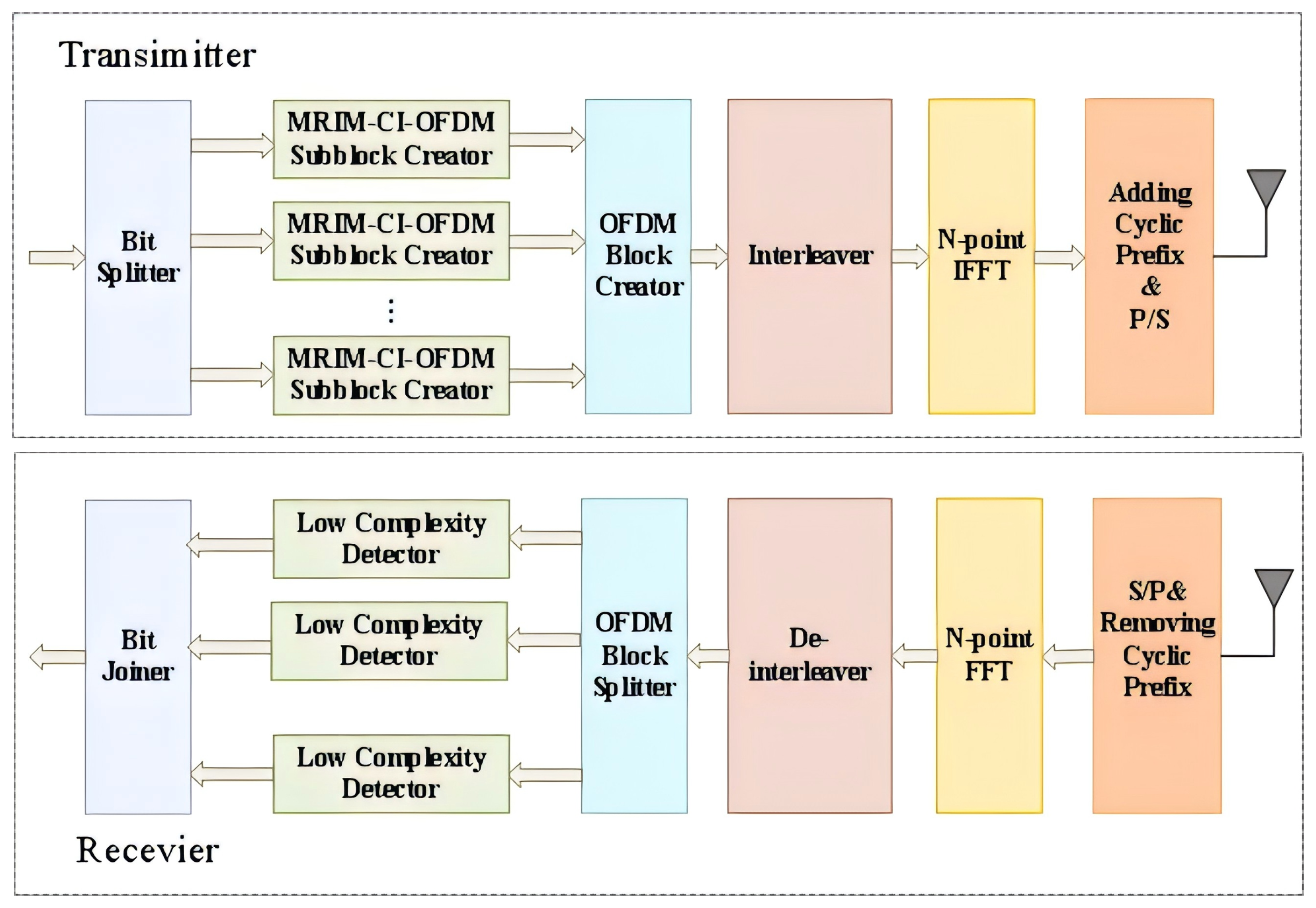
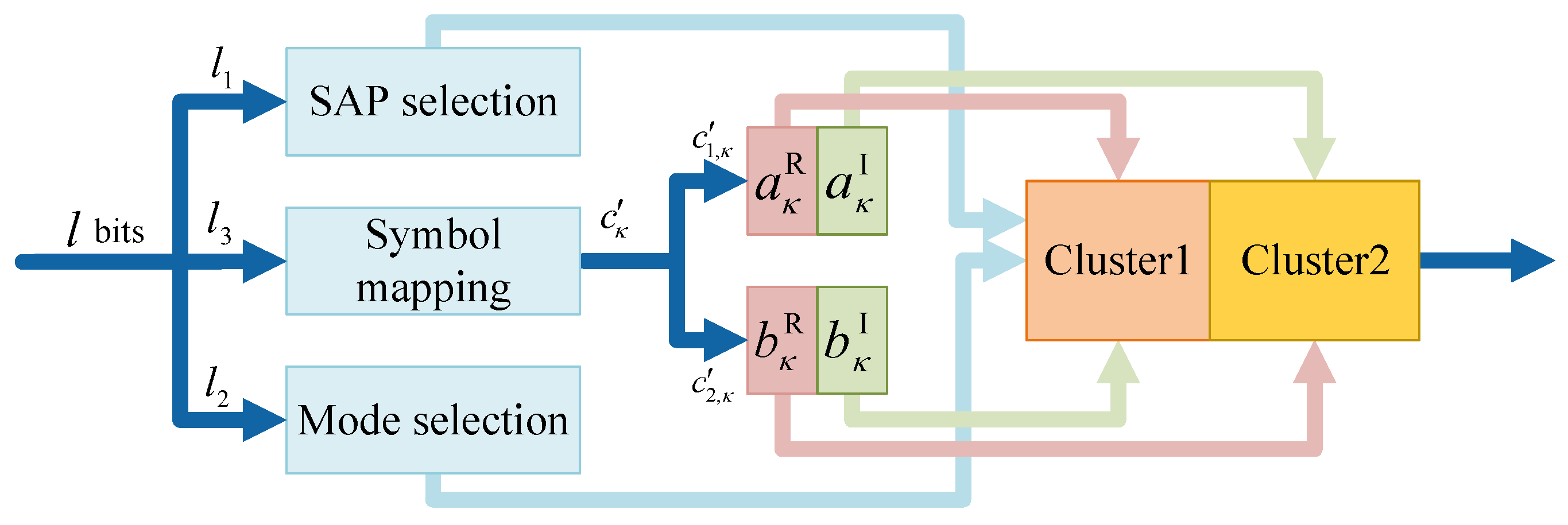
The system model of MRIM-CI-OFDM is illustrated in Figure 1. This system is based on OFDM and has a total of N subcarriers. Similar to the conventional OFDM-IM scheme, the N subcarriers are divided into G subblocks, so that the number of subcarriers in each subblock is n s = N / G (with n s being an even number greater than 2). Similarly, the L bits to be transmitted are evenly allocated to the G subblocks, so that each subblock needs to transmit l = L / G bits. The subblock generator is shown in Figure 2. Since the indexing rule and modulation method are identical for all subblocks and the subblock construction processes are mutually independent, we describe the construction process of the α -th subblock without loss of generality, where α = 1 , 2 , , G . For the α -th subblock, the n s subcarriers are further divided into two equal-length clusters, with cluster 1 occupying the first n g = n s / 2 subcarrier positions and cluster 2 occupying the remaining n g subcarrier positions. In each cluster, k active subcarriers are selected ( 1 k n g ), while the remaining n g k subcarriers remain inactive, so that each subblock has a total of 2 k active subcarriers.
The l bits to be transmitted are divided into three parts, corresponding to the subcarrier activation pattern selection, cross-cluster pattern selection, and data symbol selection, with the corresponding bit allocations as l 1 = log 2 n g k , l 2 = log 2 W 2 , and l 3 = 2 k log 2 M , respectively, satisfying l = l 1 + l 2 + l 3 . Here, W denotes the number of distinguishable constellation sets, and M is the modulation order. Therefore, the spectral efficiency of the system (in bits/s/Hz) is
η = log 2 n g k + log 2 W 2 + 2 k log 2 M 2 n g .
Specifically, when W = 1 , l 2 = 0 , the freedom in cross-cluster pattern selection disappears, and the system degenerates to the conventional RIM-CI-OFDM [38]. When W 2 , based on the indexing modulation and symbol modulation of the system, an additional cross-cluster pattern indexing dimension is introduced. Given a specific parameter configuration, this provides extra design freedom to balance between spectral efficiency and error performance.
Specifically, first, the l 1 SAP bits determine the unique active positions through a lookup table or combinatorial numbering method [10], forming the set Ψ α = { ψ α , 1 , ψ α , 2 , , ψ α , k } , where ψ α , κ { 1 , , n g } , κ = 1 , , k . In this scheme, the two groups share the same active position set Ψ α , i.e., cluster 1 and cluster 2 are activated at the same k subcarrier positions, in order to maintain the paired coordinate interleaving relationship between the two groups, while also allowing the receiver to jointly exploit the indexing information of both groups for detection. Next, the l 2 cross-cluster pattern selection bits, via joint mapping, determine the pattern pair ( m α , 1 , m α , 2 ) { 1 , , W } 2 , which decides the constellation sets S m α , 1 and S m α , 2 used by the active symbols in the symbol vectors a α and b α . All k symbols within each symbol vector share the same constellation set. Based on this, the l 3 symbol bits are equally divided into 2 k groups, with the first k groups mapped to the symbol vector a α = [ a α , 1 , , a α , k ] T C k × 1 , a α , κ S m α , 1 , and the remaining k groups mapped to the symbol vector b α = [ b α , 1 , , b α , k ] T C k × 1 , b α , κ S m α , 2 . Then, according to the coordinate interleaved orthogonal design (CIOD) rule, for each symbol pair, the real and imaginary parts are assigned to the two groups, resulting in the interleaved symbols
c α , 1 , κ = a α , κ R + j b α , κ I , c α , 2 , κ = b α , κ R + j a α , κ I ,
where ( · ) R and ( · ) I denote the real and imaginary parts, respectively.
Through the interleaving manner, the real and imaginary parts of each original symbol are assigned to different subcarriers for transmission, experiencing independent channel fading, thereby obtaining a diversity gain of 2. Furthermore, the interleaved symbols are mapped to the subcarrier activation positions Ψ α in each cluster determined by l 1 . The inactive subcarriers remain silent and do not transmit symbols. Therefore, the obtained two frequency-domain vectors c α , 1 and c α , 2 C n g × 1 have their i-th elements as
[ c α , q ] i = c α , q , κ , i = ψ α , κ Ψ α 0 , i Ψ α ,
where q = 1 , 2 , i = 1 , , n g . Then, the transmitted frequency-domain vector of the α -th subblock is
s α = [ c α , 1 T , c α , 2 T ] T C n s × 1
For ease of understanding, we provide an example of the mapping of the α -th subblock with fixed parameters, where n s = 8 , k = 2 , W = 2 , M = 4 , then l 1 and l 2 are both 2 bits. That is, each cluster has 4 subcarriers, from which two subcarriers are selected to be active. The l 1 = 2 bits determine 4 possible activation position combinations through a lookup table, and the l 2 = 2 bits are jointly mapped to 4 possible cross-cluster pattern pairs, which determine the constellation set combinations of the symbol vectors a α and b α . The two groups share the same activation position set, while the constellation patterns are independently determined by the cross-cluster pattern bits and do not affect the activation positions. Table 1 lists all possible SAP bits, cross-cluster pattern bit combinations, and the corresponding symbol arrangements. a κ μ , R denotes the real part of the κ -th symbol in the symbol vector a α , which adopts the μ -th constellation pattern in the constellation set, where μ = 1 , 2 .
All G subblocks undergo the same processing and are concatenated to form the complete MRIM-CI-OFDM symbol. Therefore, the output of the subblock generator is s = [ s 1 T , s 2 T , , s G T ] T . Next, after passing through the G × n s block interleaver as shown in [37], the interleaved symbol vector s ˜ is obtained. Then, applying an N-point IFFT converts the frequency-domain vector to the time domain, resulting in the time-domain signal
u = F H s ˜ ,
where F is the N × N DFT matrix. Subsequently, a cyclic prefix of length L c p L t 1 is added to eliminate inter-symbol interference (ISI), where L t denotes the channel tap number. Based on this, the parallel-to-serial conversion is performed to obtain the transmitted signal.
The signal then passes through L t taps of frequency-selective Rayleigh fading channels. The channel impulse response is given by h T = [ h T ( 1 ) , h T ( 2 ) , , h T ( L t ) ] T , where the coefficients are mutually independent, and h T ( β ) are circularly symmetric complex Gaussian random variables, h T ( β ) CN ( 0 , 1 / L t ) , β = 1 , 2 , , L t . The received time-domain signal is
r ˜ s = h T u c p + n ,
where u c p is the transmitted signal after adding the cyclic prefix, ∗ denotes linear convolution, and n is additive Gaussian noise. Each component of n follows CN ( 0 , σ n t 2 ) , where σ n t 2 is the variance of the time-domain noise.
At the receiver, the received signal r ˜ s undergoes processing corresponding to the operations at the transmitter. First, the received serial signal is converted to parallel and the cyclic prefix is removed. Then, an N-point fast Fourier transform (FFT) is applied to convert the received time-domain signal into the frequency domain. Next, block-wise deinterleaving is performed to obtain the corresponding received frequency-domain symbol vectors r , with the input-output relationship expressed as
r = H s + n F ,
where s = [ s 1 T , s 2 T , , s G T ] T C N × 1 is the frequency-domain symbol vector, and n F CN ( 0 , σ n 2 ) is the additive Gaussian noise vector in the frequency domain, with σ n 2 denoting the noise variance.
Here, H = diag ( h F ( 1 ) , h F ( 2 ) , , h F ( N ) ) C N × N is the diagonal frequency-domain channel matrix obtained via FFT. Its diagonal elements are the frequency-domain channel response vector h F , which is derived from the time-domain channel vector h T by zero-padding followed by an N-point DFT, expressed as
h F = [ h F ( 1 ) , h F ( 2 ) , , h F ( N ) ] T = DFT h T 0 ( N L t ) × 1 .
Due to the addition of the cyclic prefix at the transmitter, the linear convolution in the time domain is equivalent to subcarrier-wise multiplication in the frequency domain. Therefore, the received signal at the n-th subcarrier can be further expressed as
r ( n ) = h F ( n ) s ( n ) + n ( n ) , n = 1 , 2 , , N .
Subsequently, the received frequency-domain vector is demultiplexed according to the subblock structure and sent to the detector, which recovers the active subcarrier set Ψ α , the cross-cluster pattern pair ( m α , 1 , m α , 2 ) , and the data symbol vectors a α and b α for each subblock.

3.2. Rotated Constellation Set Construction

Since there are W 2 modulation modes, considering only the intra-constellation minimum distance is insufficient to guarantee reliable separation among different modes. Therefore, a joint design of the constellation sets is required to simultaneously account for both intra-constellation minimum distance and inter-constellation distinguishability. Accordingly, this paper constructs the constellation sets considering both intra-constellation distance optimization and inter-constellation separability enhancement.
For coordinate-interleaved transmission, the real and imaginary components of a symbol are transmitted through different subcarriers and experience different fading coefficients. Therefore, the separability between two constellation points should be evaluated not only by their Euclidean distance in the complex plane, but also by the separations of their real and imaginary components. If two points from different constellation sets have close or overlapping projections on either the real or imaginary axis, their Euclidean distance may still be nonzero, whereas the product distance after coordinate interleaving can become very small or even zero. In such cases, the mode discrimination reliability and diversity-related error performance may be degraded. This motivates an inter-constellation design criterion that jointly accounts for separability in both real and imaginary dimensions.
Specifically, the intra-constellation rotation angle θ in directly adopts the optimal M-QAM constellation results given in [37], ensuring good minimum product distance within a single constellation. To guarantee inter-constellation distinguishability and avoid overlap of constellation points in the real or imaginary directions, which would lead to zero product distance, this paper adopts the Inter-constellation Minimum Product Distance (IMPD) criterion for inter-constellation design, defined as
IMPD = min m m e S m , e S m R ( e e ) · I ( e e ) ,
where e and e denote arbitrary constellation points in S m and S m , and m and m are the indices of different modulation modes. Compared with the criterion based solely on the Euclidean distance in the complex plane, this criterion simultaneously constrains the minimum separation in both the real and imaginary directions, making it more suitable for the joint design of multiple constellation sets.
Thus, the m-th constellation set can be expressed as
S m = S f e j [ θ in + ( m 1 ) θ rot ] , m = 1 , 2 , , W ,
where S f denotes the base constellation set, and θ rot is the inter-constellation rotation angle. The optimal inter-constellation rotation angle is
θ rot * = arg θ rot max min m m e S m , e S m | R ( e e ) | · | I ( e e ) | .
For the given M and W, the optimal inter-constellation rotation angle θ rot * is obtained through an offline search and stored as a system parameter at both the transmitter and receiver. Considering the 90 ° rotational symmetry of M-QAM constellations, the search is limited to the ( 0 ° , 90 ° ) range. To balance search accuracy and computational complexity, a two-stage search strategy is adopted in this paper. First, a coarse search is performed with a step size of 1 ° to determine the interval containing the optimal angle. Then, a fine search is conducted with a step size of 0.1 ° to obtain the final optimal result.
This construction method preserves the intra-constellation minimum distance characteristics while enhancing the geometric separability among different constellations corresponding to different modulation modes. Furthermore, since the rotation operation does not change the constellation size, the average transmit power of each constellation set remains consistent with the base constellation set, and no additional power normalization is required.

3.3. Low-Complexity ML Detector for MRIM-CI-OFDM

The traditional ML detector performs exhaustive joint search over all valid candidates, and its decision rule can be expressed as
( Ψ ^ α , m ^ α , 1 , m ^ α , 2 , a ^ α , b ^ α ) = arg min Z ω = 1 n s | r α ( ω ) H α ( ω ) s α ( ω ) | 2 ,
where ω = 1 , 2 , , n s , and Z = ( Ψ α , m α , 1 , m α , 2 , a α , b α ) is the set of all valid detection candidates. As k and M increase, the search complexity grows exponentially. It is noted that the coordinate-interleaved mapping has a natural separable structure in the equivalent real domain, which allows the joint search to be restructured hierarchically to reduce complexity.
After coordinate interleaving, the real and imaginary parts of each active subcarrier come from the two groups separately. Therefore, in the detection process, for each candidate SAP, the corresponding observation model is constructed. For the j-th valid SAP candidate Ψ j , the four-dimensional real-valued observation vector corresponding to the κ -th active position in the α -th subblock is
r ¯ α , κ ( j ) = [ r α , 1 R ( Ψ j , κ ) , r α , 1 I ( Ψ j , κ ) , r α , 2 R ( Ψ j , κ ) , r α , 2 I ( Ψ j , κ ) ] T R 4 × 1 ,
where r α , q R ( Ψ j , κ ) and r α , q I ( Ψ j , κ ) denote the real and imaginary parts of the received signal at the Ψ j , κ position of the q-th cluster in the α -th subblock.
For the κ -th active subcarrier, combining the frequency-domain received signal model in Equation (9) with the coordinate interleaving mapping in Equation (2), the real-valued linear observation model of the received signal is
r ¯ α , κ ( j ) = H ˜ α , 1 , κ ( j ) a α , κ + H ˜ α , 2 , κ ( j ) b α , κ + n ¯ α , κ ( j ) .
Here, a ¯ α , κ = [ a α , κ R , a α , κ I ] T , b ¯ α , κ = [ b α , κ R , b α , κ I ] T , where a α , κ R , a α , κ I , b α , κ R , and b α , κ I denote the real and imaginary parts of the κ -th component of the symbol vectors a α and b α , respectively. The equivalent channel matrices H ˜ α , 1 , κ ( j ) and H ˜ α , 2 , κ ( j ) are constructed from the real and imaginary parts of the frequency-domain channel responses h α , 1 , κ and h α , 2 , κ . Then, the equivalent real-valued channel matrices in Equation (15) can be explicitly written as
H ˜ α , 1 , κ ( j ) = R ( h α , 1 , κ ) 0 I ( h α , 1 , κ ) 0 0 I ( h α , 2 , κ ) 0 R ( h α , 2 , κ ) , H ˜ α , 2 , κ ( j ) = 0 I ( h α , 1 , κ ) 0 R ( h α , 1 , κ ) R ( h α , 2 , κ ) 0 I ( h α , 2 , κ ) 0 .
Due to the structure of coordinate interleaving, it can be verified that the two equivalent channel matrices satisfy the column-wise orthogonality condition:
( H ˜ α , 1 , κ ( j ) ) T H ˜ α , 2 , κ ( j ) = 0 .
Therefore, the corresponding decision metric depends only on a ¯ α , κ and b ¯ α , κ . Furthermore, to reflect the channel gain of the two real-valued components along each dimension, the two corresponding branch correlation matrices are defined as
G α , 1 , κ ( j ) = ( H ˜ α , 1 , κ ( j ) ) T H ˜ α , 1 , κ ( j ) , G α , 2 , κ ( j ) = ( H ˜ α , 2 , κ ( j ) ) T H ˜ α , 2 , κ ( j ) .
The observation vector r ¯ α , κ ( j ) is then projected onto these two subspaces, resulting in the corresponding equivalent observation statistics.
z ˜ α , 1 , κ ( j ) = G α , 1 , κ ( j ) 1 H ˜ α , 1 , κ ( j ) T r ¯ α , κ ( j ) , z ˜ α , 2 , κ ( j ) = G α , 2 , κ ( j ) 1 H ˜ α , 2 , κ ( j ) T r ¯ α , κ ( j ) .
Due to the orthogonality property in Equation (17), z ˜ α , 1 , κ ( j ) and z ˜ α , 2 , κ ( j ) contain only the corresponding branch symbol components and equivalent noise. Therefore, the original joint symbol ML metric can be equivalently decomposed into two independent single-symbol minimum distance searches. It should be noted that the received signal energy at inactive positions and the associated local constants may affect the fair comparison among different SAP candidates and should therefore be retained in the decision metric.
For the j-th valid SAP candidate Ψ j and the mode pair ( m α , 1 , m α , 2 ) , the corresponding ML decision metric is
D j ( m α , 1 , m α , 2 ) = κ = 1 k C α , κ ( j ) + min χ S m α , 1 z ˜ α , 1 , κ ( j ) R ( χ ) I ( χ ) T G α , 1 , κ ( j ) z ˜ α , 1 , κ ( j ) R ( χ ) I ( χ ) + min ξ S m α , 2 z ˜ α , 2 , κ ( j ) R ( ξ ) I ( ξ ) T G α , 2 , κ ( j ) z ˜ α , 2 , κ ( j ) R ( ξ ) I ( ξ ) + E i a ( Ψ j ) ,
where C α , κ ( j ) denotes the local constant unrelated to the candidate symbol, which can be expressed as
C α , κ ( j ) = r ¯ α , κ ( j ) 2 ( H ˜ α , 1 , κ ( j ) ) T r ¯ α , κ ( j ) T ( G α , 1 , κ ( j ) ) 1 ( H ˜ α , 1 , κ ( j ) ) T r ¯ α , κ ( j ) ( H ˜ α , 2 , κ ( j ) ) T r ¯ α , κ ( j ) T ( G α , 2 , κ ( j ) ) 1 ( H ˜ α , 2 , κ ( j ) ) T r ¯ α , κ ( j ) .
Here, E i a ( Ψ j ) represents the received signal energy at all inactive subcarrier positions corresponding to the SAP candidate Ψ j , i.e.,
E i a ( Ψ j ) = c Ψ j | r α , 1 ( c ) | 2 + | r α , 2 ( c ) | 2 .
Furthermore, by taking the minimum over all possible mode pairs, the overall decision metric for the j-th SAP candidate is obtained as
D j = min ( m α , 1 , m α , 2 ) D j ( m α , 1 , m α , 2 ) .
Then, the final detection result is
j ^ = arg min j D j , Ψ ^ α = Ψ j ,
with the corresponding mode estimates ( m ^ α , 1 , m ^ α , 2 ) and symbol estimate sets { a ¯ α , b ¯ α } κ = 1 k .

3.4. Low-Complexity Three-Stage Max-Log Detector for MRIM-CI-OFDM

Although the improved ML detector reduces the complexity of the traditional joint ML detection, it still requires exhaustive search over all valid SAP candidates and all valid mode pairs. To further reduce complexity, a three-stage Max-Log detector is proposed based on the equivalent real-valued observation model. This detector first performs SAP decision using soft metrics for each position, and then, under the detected SAP, sequentially completes mode detection and symbol recovery, thereby avoiding repeated search over mode and symbol conditions for each valid SAP candidate.
In the first stage, the SAP decision is performed based on the projection statistics in Equation (19). For any subcarrier position c { 1 , 2 , , n g } in the α -th subblock, assuming it is active, the single-symbol minimum distance metrics for the two branches under the constellation set S m corresponding to mode m are
d α , 1 ( m ) ( c ) = min s S m z ˜ α , 1 ( c ) R ( s ) I ( s ) G α , 1 ( c ) 2 ,
d α , 2 ( m ) ( c ) = min ξ S m z ˜ α , 2 ( c ) R ( ξ ) I ( ξ ) G α , 2 ( c ) 2 ,
where · 2 denotes the weighted squared norm, and G α , q ( c ) = x T G x is the corresponding branch correlation matrix.
Combining the two branches and introducing the inactive baseline, the soft decision statistic for the SAP at position c is
Λ α ( c ) = E α ( c ) d α * ( c ) ,
where E α ( c ) = | r α , 1 ( c ) | 2 + | r α , 2 ( c ) | 2 is the sum of the received signal energy from the two groups at position c, and d α * ( c ) is the conditional activation metric obtained by taking the optimum over all modes, which can be written as
d α * ( c ) = min m 1 , m 2 { 1 , , W } d α , 1 ( m 1 ) ( c ) + d α , 2 ( m 2 ) ( c ) + C α ( c ) .
A larger Λ α ( c ) indicates a higher likelihood that position c is active. The soft metrics are computed for all n g positions, and the candidate positions with the largest accumulated soft metrics within the valid SAP candidate set are selected as the estimated active subcarrier set, i.e.,
Ψ ^ α = arg max Ψ c Ψ Λ α ( c ) .
It is worth noting that the search space in Equation (29) contains 2 l 1 valid SAPs. However, since the soft metric Λ α ( c ) is independently computed for each position, the accumulation does not require repeated search over the symbol layer.
In the second stage, mode decision is performed. After obtaining the SAP estimate Ψ ^ α , the conditional accumulated metric is computed for all W 2 mode pairs as
D α ( m 1 , m 2 ) = κ = 1 k d α , 1 ( m 1 ) ( Ψ ^ α , κ ) + d α , 2 ( m 2 ) ( Ψ ^ α , κ ) ,
and the cross-cluster mode estimate is
( m ^ α , 1 , m ^ α , 2 ) = arg min m 1 , m 2 D α ( m 1 , m 2 ) .
At this stage, since the SAP is fixed as Ψ ^ α , the mode search is performed only over the W 2 candidate pairs, and the metrics for each position can be directly reused from the intermediate calculations in Equations (25) and (26) without repeated projection operations.
In the third stage, symbol decision is performed. Given the SAP estimate Ψ ^ α and the mode estimates ( m ^ α , 1 , m ^ α , 2 ) , for each active position κ = 1 , , k , independent single-symbol minimum distance decisions are performed on the corresponding constellation sets S m ^ α , 1 and S m ^ α , 2 ,
a ^ α , κ = arg min s S m ^ α , 1 z α , 1 ( Ψ ^ α , κ ) R ( s ) I ( s ) G α , 1 ( Ψ ^ α , κ ) 2 ,
b ^ α , κ = arg min s S m ^ α , 2 z α , 2 ( Ψ ^ α , κ ) R ( s ) I ( s ) G α , 2 ( Ψ ^ α , κ ) 2 .
For each active position, the a and b branches are independently detected. The candidate set size is M.

4. Performance Analysis

4.1. Upper Bound on BER

Since the MRIM-CI-OFDM system conveys information jointly through the index domain, mode domain, and symbol domain, we adopt a union bound method to analyze the system’s error performance. Similarly, because the construction of each subblock is identical and the detection process treats each subblock as a basic unit, we only analyze the α -th subblock. The corresponding diagonal transmit matrix is
S α = diag ( s α ) ,
and based on the input-output relationship in Equation (7), the received model for the α -th subblock can be expressed as
r α = S α H α + n F , α .
Meanwhile, the active subcarrier set corresponding to SAP is Ψ α = { ψ α , 1 , ψ α , 2 , , ψ α , k } , and the cross-cluster mode pair ( m α , 1 , m α , 2 ) along with the symbol vectors a α and b α form the valid transmit codeword set C α . Any valid codeword is denoted as
c = ( Ψ α , m α , 1 , m α , 2 , a α , b α ) .
This codeword uniquely corresponds to a transmit vector S α ( c ) and its diagonal matrix S α ( c ) . If the transmitted codeword c is erroneously detected as c ˜ , the corresponding Conditional Pairwise Error Probability (CPEP) is
PEP ( c c ˜ | H α ) = Q S α ( c ) H α S α ( c ˜ ) H α 2 2 N 0 , F ,
where Q ( · ) denotes the standard Gaussian Q-function.
Let P e ( c , c ˜ ) denote the set of all active subcarriers contributing to non-zero errors. For any active subcarrier p in this set, the corresponding symbol differences on the two branches are
Δ a α p = a α p a ˜ α p , Δ b α p = b α p b ˜ α p .
If a certain active position exists only in the true SAP but not in the estimated SAP, the corresponding symbol on the other branch is regarded as zero. From the column-wise orthogonality of the equivalent observation model in Section 3.3, the error distance contribution of this active subcarrier can be expressed as
d p 2 ( H α ) = | H α , 1 , i p | 2 A p + | H α , 2 , i p | 2 B p ,
where
A p | Re ( Δ a α p ) | 2 + | Im ( Δ b α p ) | 2 , B p | Im ( Δ a α p ) | 2 + | Re ( Δ b α p ) | 2 .
Thus, for the α -th subblock under the error event c c ˜ , the total equivalent squared error distance is
d 2 ( H α ; c , c ˜ ) = p P e ( c , c ˜ ) | H α , 1 , p | 2 A p + | H α , 2 , p | 2 B p .
Therefore, Equation (37) can be further expressed as
PEP ( c c ˜ | H α ) = Q d 2 ( H α ; c , c ˜ ) 2 N 0 , F .
Using the Chernoff bound Q ( x ) 1 2 e x 2 / 2 , we have
PEP ( c c ˜ | H α ) 1 2 exp d 2 ( H α ; c , c ˜ ) 2 N 0 , F .
When the interleaving and the correlation between subcarriers are negligible, the fading components corresponding to different active positions can be approximated as independent. In this case, taking the expectation over the channel yields the unconditional pairwise error probability (UPEP) upper bound as
PEP ( c c ˜ ) 1 2 p P e ( c , c ˜ ) 1 1 + A p ρ 4 · 1 1 + B p ρ 4 ,
where ρ = E s / N 0 , F denotes the SNR in the frequency domain.
Furthermore, under high SNR conditions ρ 1 , Equation (44) can be approximated as
PEP ( c c ˜ ) 1 2 p P e ( c , c ˜ ) 16 A p B p ρ 2 | P e ( c , c ˜ ) |
By applying the union bound, the average bit error probability (BEP) upper bound for the α -th subblock is
P b , α 1 l | C α | c C α c ˜ C α d H ( c , c ˜ ) · PEP ( c c ˜ ) ,
where d H ( c , c ˜ ) denotes the Hamming distance between the corresponding codewords.
If all error events are further categorized into four types: SAP errors, mode-pair errors, symbol errors, and mixed errors, then Equation (46) can be decomposed as
P b , α P b , α SAP + P b , α MP + P b , α SYM + P b , α MIX ,
where, each term represents the BEP upper bound for the corresponding subset of error events. It can be seen that the proposed MRIM-CI-OFDM BER upper bound not only reflects the overall code performance, but also reveals the distinct impacts of SAP errors, cross-mode errors, and symbol-domain errors in the three-dimensional information domain.

4.2. Achievable Rate Analysis

The achievable rate represents the actual upper bound on information throughput under finite SNR conditions and can be used to fairly compare different schemes under the same spectral efficiency constraint. Following the achievable rate analysis method for OFDM-IM under finite-input conditions, for the proposed MRIM-CI-OFDM system, since each subblock is transmitted independently and the valid codeword is jointly determined by the active subcarrier pattern, cross-cluster mode pair, and two-branch data symbols, the single-subblock transmission can be modeled as a MIMO channel with discrete input and continuous output. Let the set of all valid transmit vectors for a subblock be
S = { s ( 1 ) , s ( 2 ) , , s ( 2 l ) } ,
then the system achievable rate can be expressed as
R = 1 n s l 1 2 l i = 1 2 l E H , n F log 2 j = 1 2 l e Ω ,
where Ω = H ( s ( i ) s ( j ) ) + n F 2 n F 2 N 0 , F , H is the frequency-domain diagonal channel matrix, n F is the frequency-domain additive Gaussian noise vector, N 0 , F is the noise variance in the frequency domain, and E H , n F ( · ) denotes the expectation over both the channel matrix H and the noise vector n F .
From Equation (49), it can be seen that the system achievable rate not only depends on the total number of bits l transmitted per subblock in theory, but also relates to the separability of different valid codewords under the channel effects. In the MRIM-CI-OFDM system, valid codewords are jointly determined by the shared SAP, the cross-cluster mode pair, and the coordinate interleaving of the two-branch data symbols. Therefore, the achievable rate is intrinsically determined by the shared SAP structure, the mode-domain design, and the Euclidean distance properties of the interleaved codewords. Compared with reference schemes that do not exploit the mode-selection dimension, the proposed system expands the candidate codeword space through mode-domain design. Under the same spectral efficiency constraint, the geometric separation between codewords can be further increased by appropriately reducing the modulation order M, thereby mitigating codeword collisions under moderate-to-low SNR conditions and effectively enhancing the practical achievable rate of the system.

4.3. Complexity Analysis

To further illustrate the detection features of the proposed MRIM-CI-OFDM scheme, this section compares it with RIM-CI-OFDM and CI-OFDM-RIQIM in terms of detection methods. Table 2 presents the complexity comparison for different approaches.
From Table 2, it can be observed that although CI-OFDM-RIQIM can improve spectral efficiency by expanding the index dimension, its low-complexity detection is sensitive to the modulation order. When the system requires further enhancement of spectral efficiency, increasing M often leads to a significant increase in complexity. In contrast, MRIM-CI-OFDM introduces the mode-dimension W, transferring part of the spectral efficiency gain from increasing the modulation order to increasing the degree of freedom for mode selection. As a result, it can maintain relatively high spectral efficiency with a lower modulation order, thereby reducing detection complexity. Therefore, MRIM-CI-OFDM mitigates the complexity growth problem caused by high-order modulation, achieving a better trade-off among spectral efficiency, error performance, and detection complexity.

5. Numerical Results

In this section, MATLAB R2022b simulations are conducted to verify the performance of the proposed MRIM-CI-OFDM scheme in terms of bit error rate (BER), achievable rate, error event distribution, and transmission performance under imperfect channel state information (CSI). Unless otherwise specified, all schemes are compared under a 10-tap frequency-selective Rayleigh fading channel, and the receiver adopts the corresponding low-complexity detector or maximum-likelihood (ML) detector. The main simulation parameters are summarized in Table 3.
For fair comparison, all compared constellation sets were normalized to the same average symbol energy. The rotated multi-mode constellation sets preserve the average power of the corresponding base constellation because constellation rotation does not change the symbol energy.
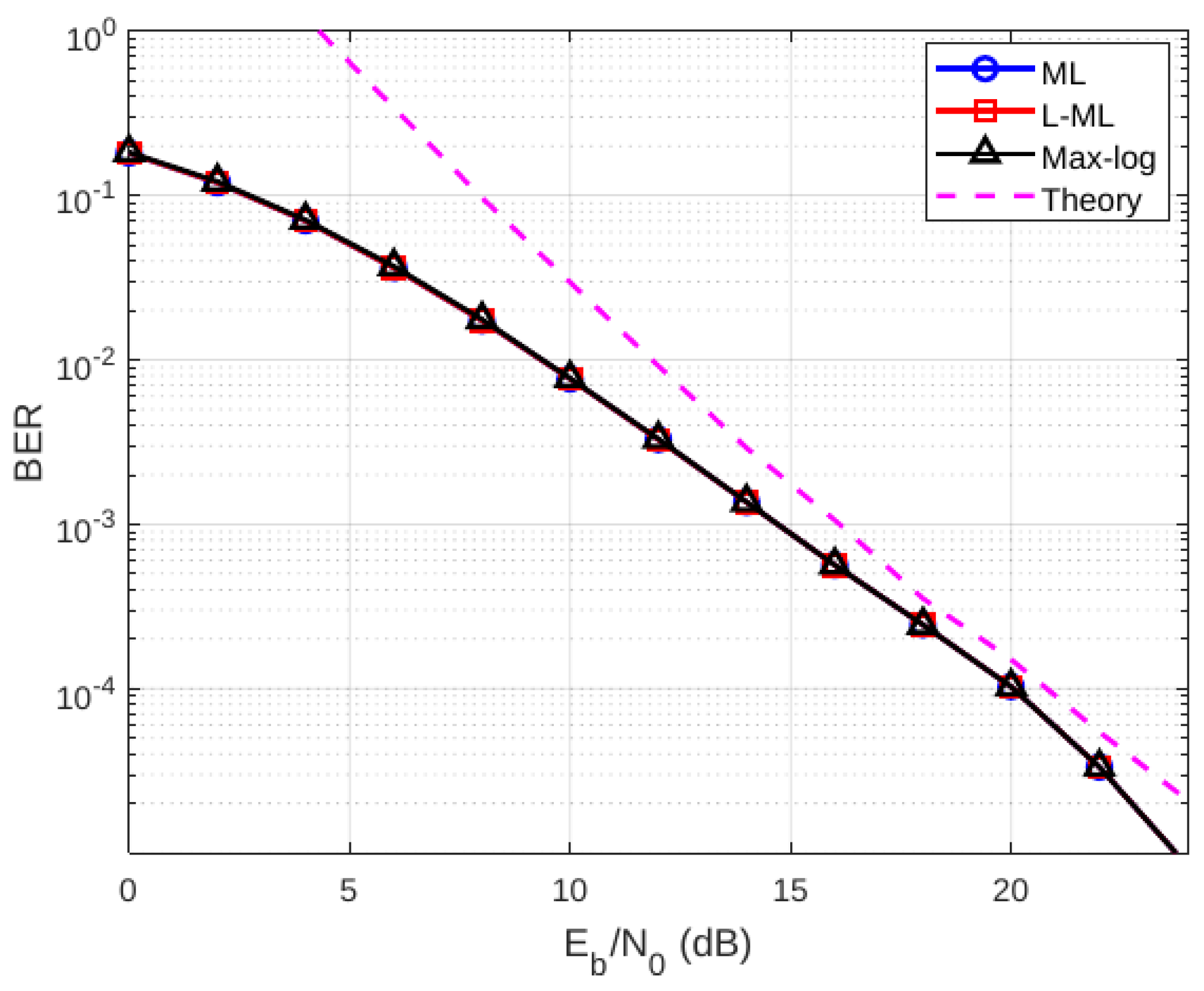
Figure 3 presents the BER performance of the ML detector, the low-complexity ML detector (L-ML), and the three-stage Max-Log detector. The three simulated BER curves are almost superimposed over the entire SNR range, indicating that the proposed low-complexity detectors can achieve near-ML performance with negligible degradation. Specifically, at a BER of 10 3 , the SNR gap among the three detectors is less than 0.2 dB. The analytical BER upper bound is relatively loose in the low-SNR region but gradually approaches the simulated curves as the SNR increases. This behavior is a common limitation of union-bound-based BER analysis. At low SNR, many pairwise error events have relatively high probabilities, and the accumulation of these events may overestimate the actual error probability. As the SNR increases, the error performance is dominated by fewer significant error events, and therefore the analytical upper bound becomes closer to the simulated BER curves.
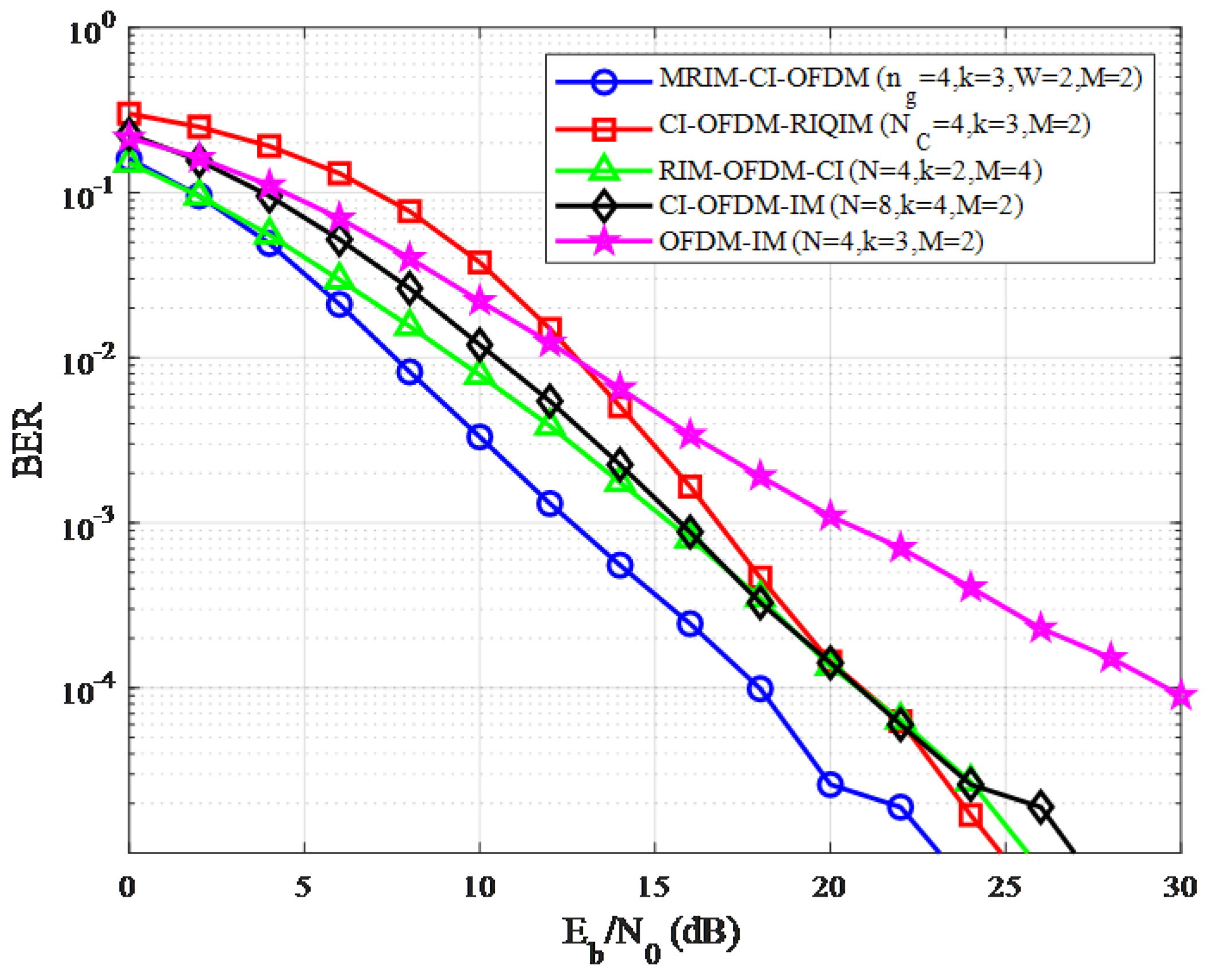
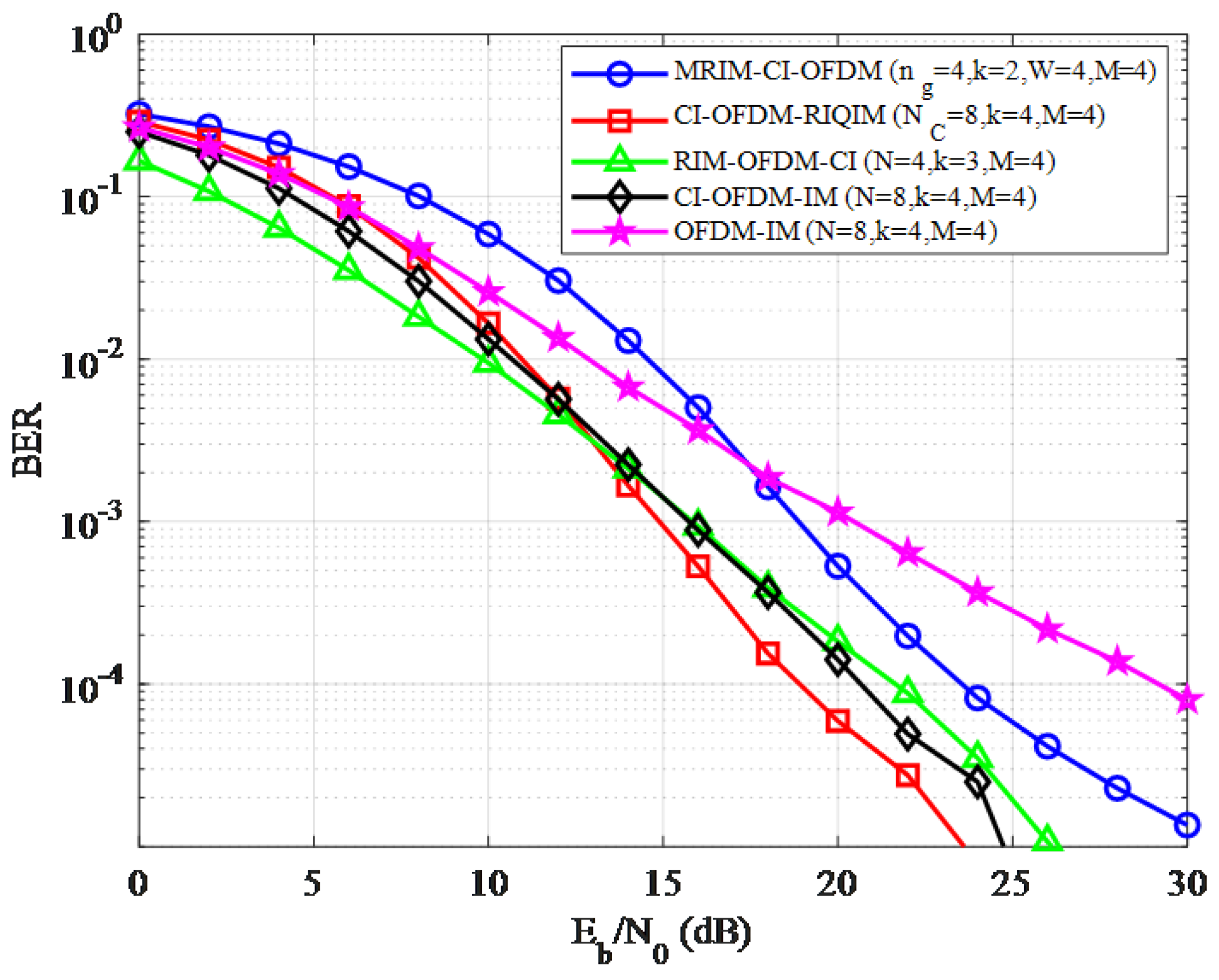
Figure 4 shows the BER performance at a spectral efficiency of 1.25 bps/Hz. The proposed MRIM-CI-OFDM achieves the best error performance among all considered schemes. At a BER of 10 3 , MRIM-CI-OFDM requires approximately 13 dB, providing about 3 dB SNR gain over the coordinate-interleaved and repeated-index benchmarks and more than 5 dB gain over OFDM-IM. This gain arises from the joint use of SAP, mode-domain selection, and coordinate interleaving. The additional mode-pair index bits are introduced within the shared-SAP and coordinate-interleaved structure, so that the spectral-efficiency improvement does not rely solely on increasing the constellation order. As a result, the diversity benefit of coordinate interleaving can still be preserved under this spectral-efficiency configuration.
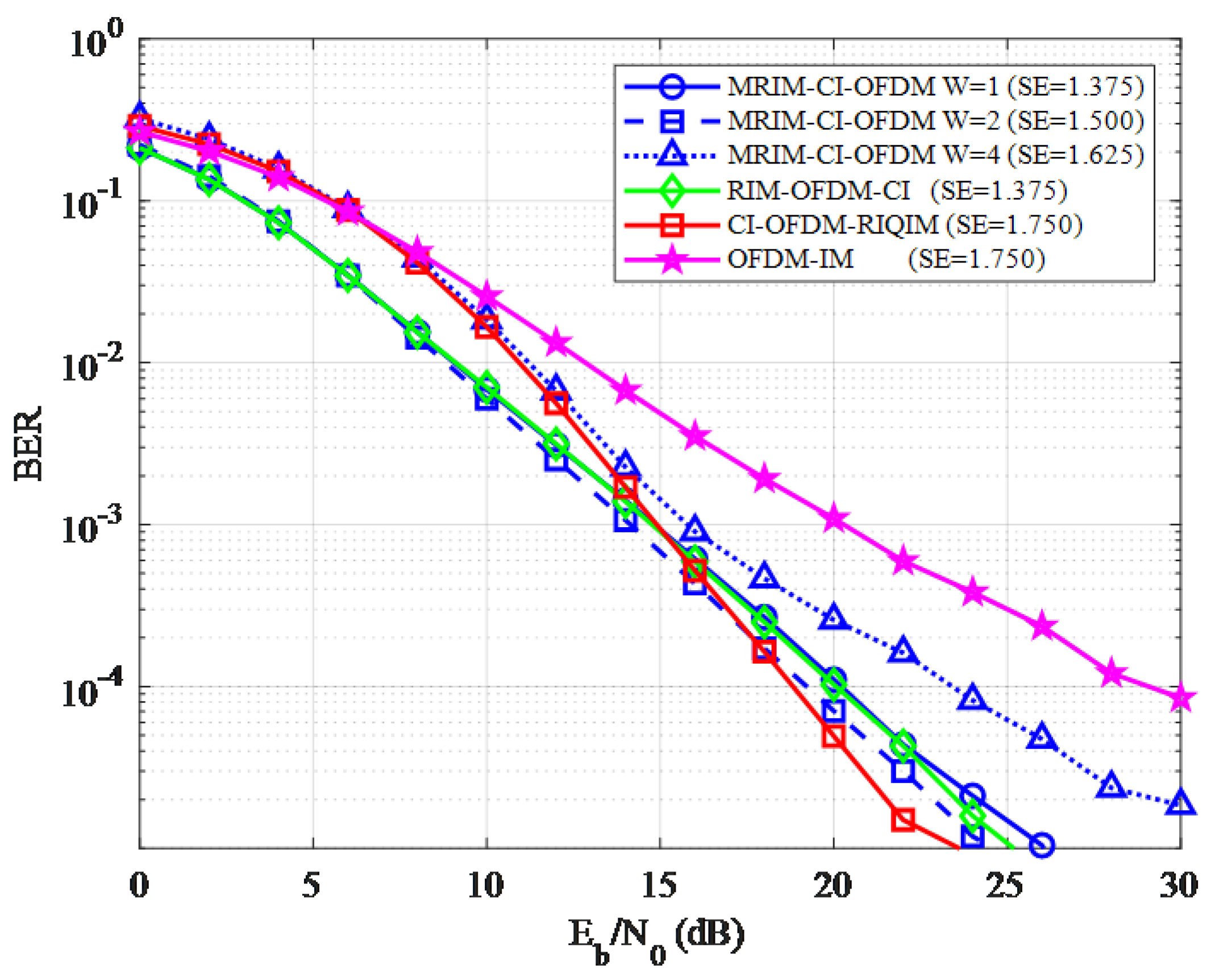
Figure 5 presents the comparison at 1.75 bps/Hz. In this case, the proposed MRIM-CI-OFDM is no longer the best BER curve, because the larger mode set increases the difficulty of mode-pair discrimination at the receiver. Nevertheless, MRIM-CI-OFDM still clearly outperforms OFDM-IM. For example, at BER = 10 3 , MRIM-CI-OFDM obtains about 2 dB SNR gain over OFDM-IM, while it is around 2–3 dB behind CI-OFDM-RIQIM. These results indicate that the mode-domain extension provides additional flexibility in spectral-efficiency configuration by increasing the number of available mode-pair indices. However, a larger W also enlarges the mode-pair candidate space and increases the ambiguity among different mode pairs, making mode-pair discrimination at the receiver more difficult. Therefore, the performance at higher spectral efficiency is jointly affected by the additional index gain and the reduced separability among different mode pairs.
Figure 6 presents the BER performance of different schemes under the fixed configuration ( n g , k , M ) = ( 8 , 4 , 4 ) . When W = 1 , the BER curve of the proposed MRIM-CI-OFDM scheme coincides with that of RIM-CI-OFDM, since the mode-selection freedom disappears and the proposed scheme reduces to RIM-CI-OFDM. As W increases from 1 to 2, the spectral efficiency rises from 1.375 to 1.500 bps/Hz, corresponding to a 9.1% increase, while the additional SNR required to achieve a BER of 10 3 is within approximately 0.5 dB. When W further increases to 4, the spectral efficiency reaches 1.625 bps/Hz, which is 18.2% higher than that for W = 1 . However, the BER performance degradation becomes more pronounced, which can be attributed to the reduced inter-mode separability and the increased ambiguity in joint detection.
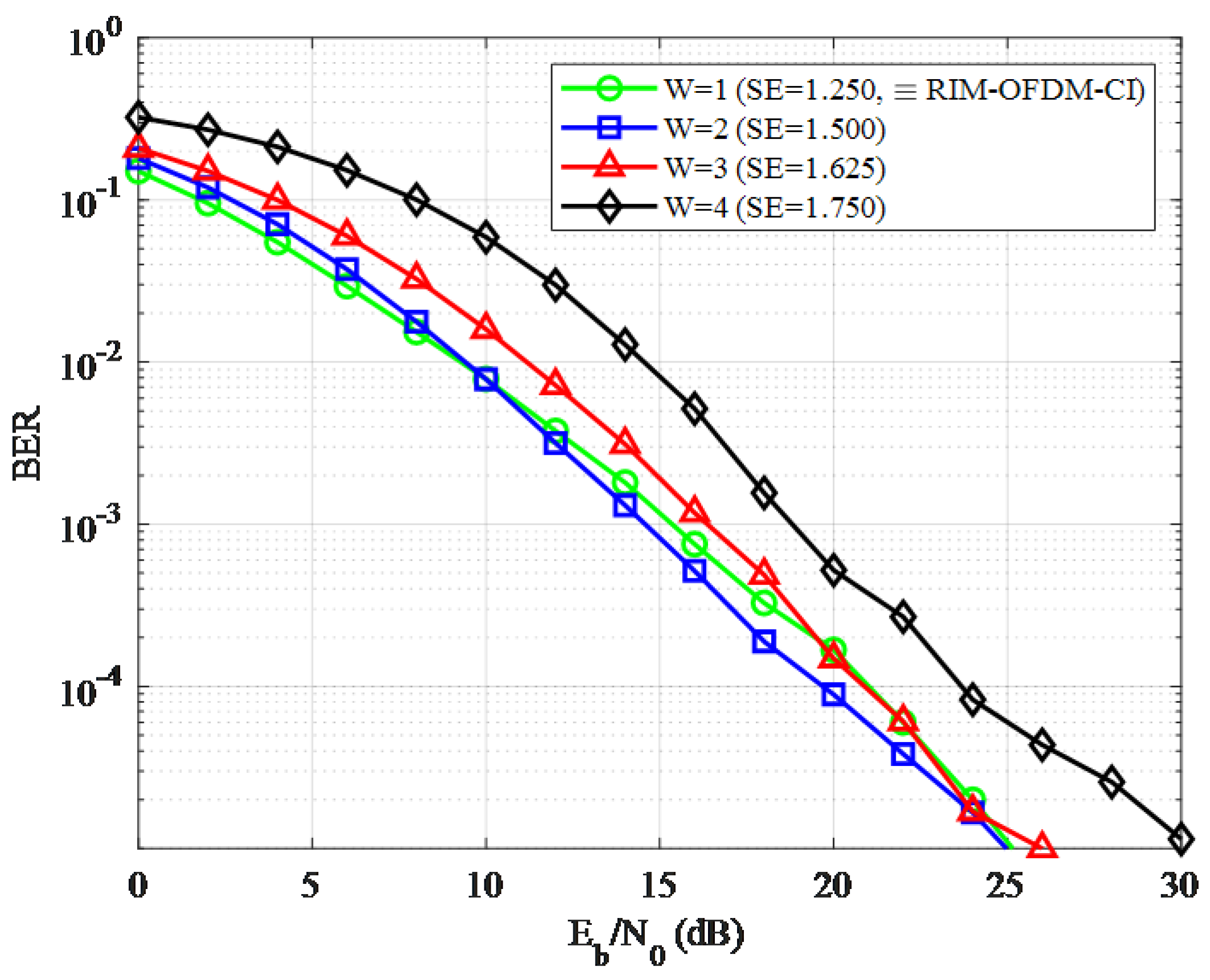
Figure 7 shows the BER curves of the proposed MRIM-CI-OFDM scheme for different values of W under the fixed configuration ( n g , k , M ) = ( 4 , 2 , 4 ) . Increasing W from 1 to 2 raises the spectral efficiency from 1.25 to 1.50 bps/Hz, i.e., by 20%, while maintaining the best BER performance in the medium-to-high SNR region. For W = 4 , the spectral efficiency is 1.75 bps/Hz, which is 40% higher than that for W = 1 , but an additional SNR of approximately 5 dB is required compared with W = 2 at a BER of 10 3 . These results confirm that the mode-domain parameter W provides a flexible degree of freedom for rate-reliability adaptation. In general, the value of W should be selected according to the target spectral efficiency and reliability requirement. When the required spectral efficiency is relatively low, W = 1 is preferable because the proposed scheme reduces to RIM-CI-OFDM and avoids mode-domain detection ambiguity. For moderate spectral-efficiency requirements, W = 2 provides a favorable trade-off between rate improvement and BER performance. It introduces additional mode-pair index bits while maintaining sufficient inter-mode separability, and therefore achieves the best or near-best BER performance in the considered configurations. When a higher spectral efficiency is required, W = 4 can further increase the number of mode-domain bits, but it is not always optimal in terms of BER. The degradation for W = 4 mainly results from the enlarged mode-pair candidate space and the reduced geometric separability among different rotated constellation sets. As W increases, more constellation sets must be placed within the same complex plane, which makes their real and imaginary projections closer after coordinate interleaving. This increases the probability of mode-pair misdetection and weakens the advantage of the mode-domain extension. Therefore, W = 4 is more suitable for rate-oriented configurations, whereas W = 2 is generally preferred when both spectral efficiency and BER performance are considered.
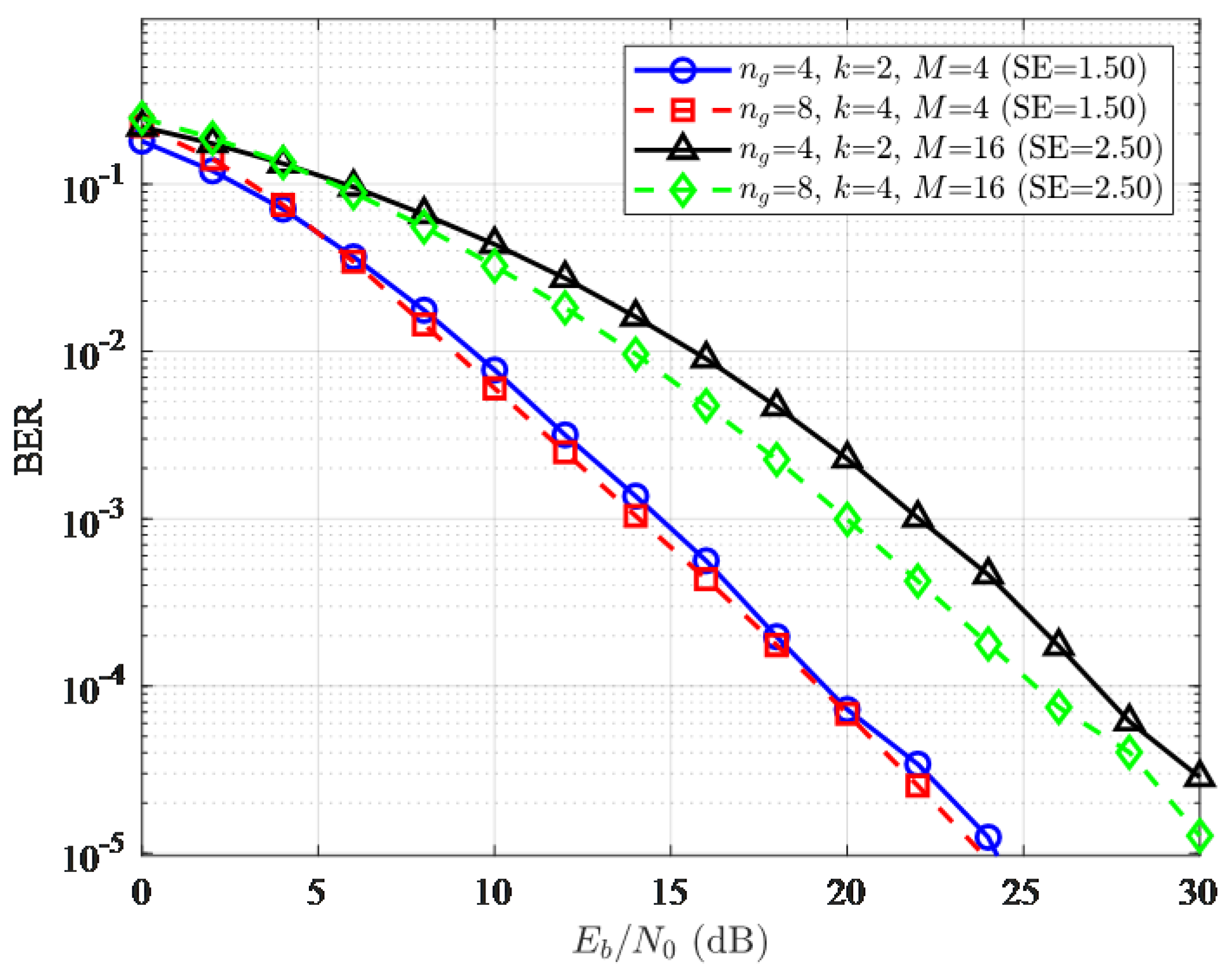
Figure 8 presents the BER performance of the proposed MRIM-CI-OFDM scheme under different subblock sizes. At a spectral efficiency of 1.50 bps/Hz, the BER curves for n g = 4 and n g = 8 are close to each other, indicating that the proposed structure is relatively insensitive to moderate changes in the subblock size. At a spectral efficiency of 2.50 bps/Hz, increasing n g from 4 to 8 provides an SNR gain of approximately 2 dB at a BER of 10 3 . This improvement can be attributed to the fact that a larger subblock provides a larger codeword construction space and generates more high-rank error events, thereby enhancing the robustness of the system against frequency-selective fading.
The above results also provide useful guidelines for selecting the main system parameters. The subblock size, the number of active subcarriers, and the modulation order should be jointly determined according to the target spectral efficiency, BER requirement, and receiver complexity. For the activation ratio, k / n g = 0.5 provides a balanced configuration, since it offers sufficient SAP candidates while keeping the detection search space moderate. A larger n g increases the subblock construction space and may improve BER performance at high spectral efficiency, as observed in Figure 8, but it also increases the number of valid SAP candidates and therefore the detection complexity. The modulation order M controls the number of symbol-domain bits. Increasing M improves spectral efficiency but reduces the constellation distance and may degrade BER performance. Therefore, when additional mode-domain bits are introduced through W, a relatively low modulation order is preferred to maintain symbol separability and control detection complexity. In the considered simulations, ( n g , k ) = ( 4 , 2 ) is suitable for moderate-complexity configurations, whereas ( n g , k ) = ( 8 , 4 ) can be used when higher spectral efficiency or improved high-rate BER performance is required. Overall, the parameters ( n g , k , M , W ) should be selected jointly rather than independently, so as to balance spectral efficiency, reliability, and implementation complexity.
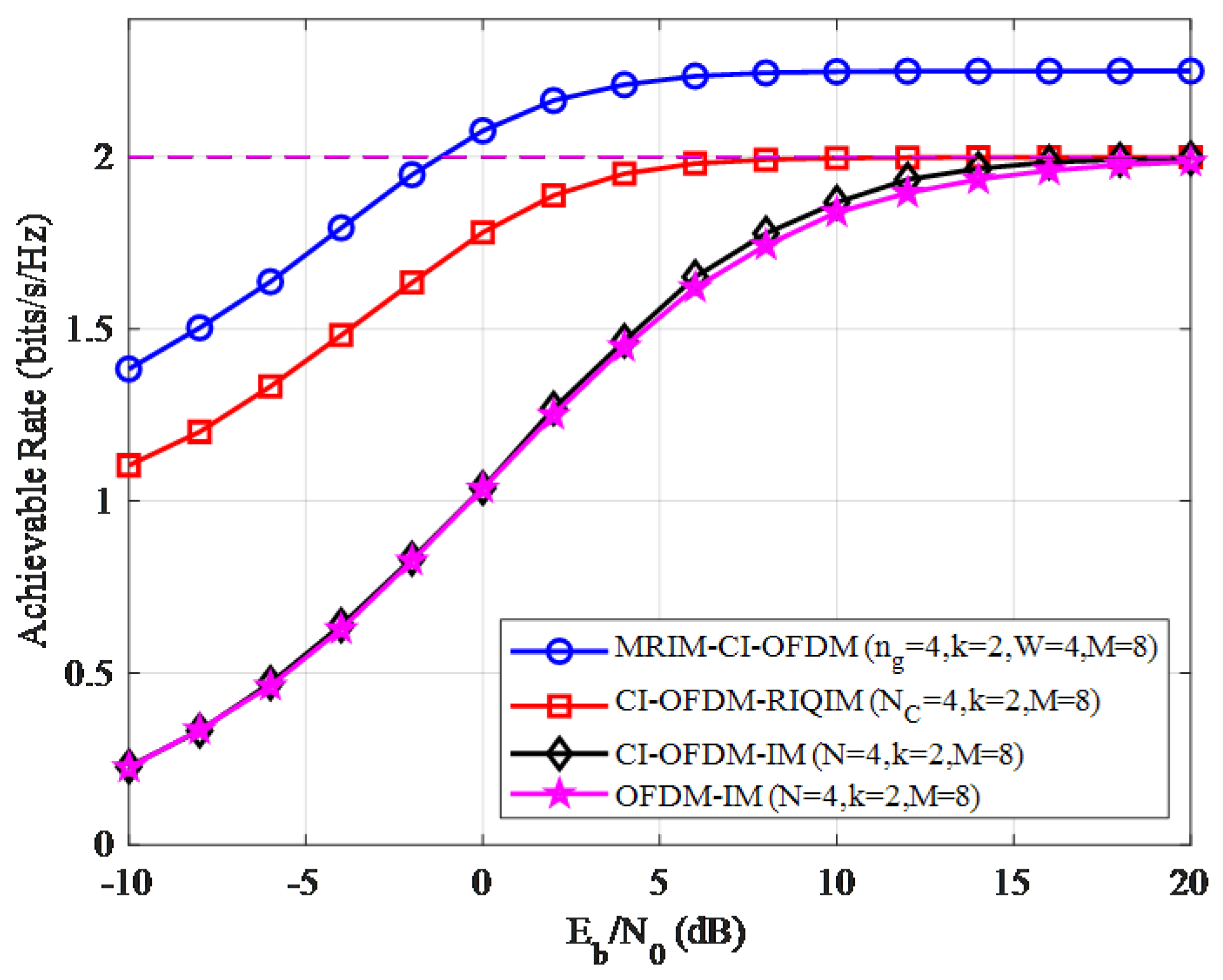
Figure 9 shows the achievable-rate performance of different schemes. All curves increase with E b / N 0 and gradually saturate due to the finite-cardinality input alphabet. Compared with the benchmark schemes, the proposed MRIM-CI-OFDM scheme converges to the saturation region more rapidly and achieves a higher asymptotic achievable rate. Specifically, the high-SNR achievable rate of MRIM-CI-OFDM approaches 2.25 bps/Hz, which is 12.5% higher than the 2.00 bps/Hz saturation level of the compared schemes. Around E b / N 0 = 0 dB, MRIM-CI-OFDM already achieves approximately 2.0 bps/Hz, which is higher than that of CI-OFDM-RIQIM and nearly twice those of OFDM-IM and CI-OFDM-IM under the same simulation setting. The rate advantage is consistent with the proposed codeword construction, where the valid transmit vectors are determined not only by the shared SAP and data symbols, but also by the cross-cluster mode pair. The introduced mode-domain index enlarges the finite input set and improves the achievable information rate under finite discrete-input conditions. Meanwhile, the rotated multi-mode constellation design enhances the geometric separability among different mode-dependent constellation sets, thereby helping to maintain the distinguishability of valid codewords in the moderate-to-high SNR region.
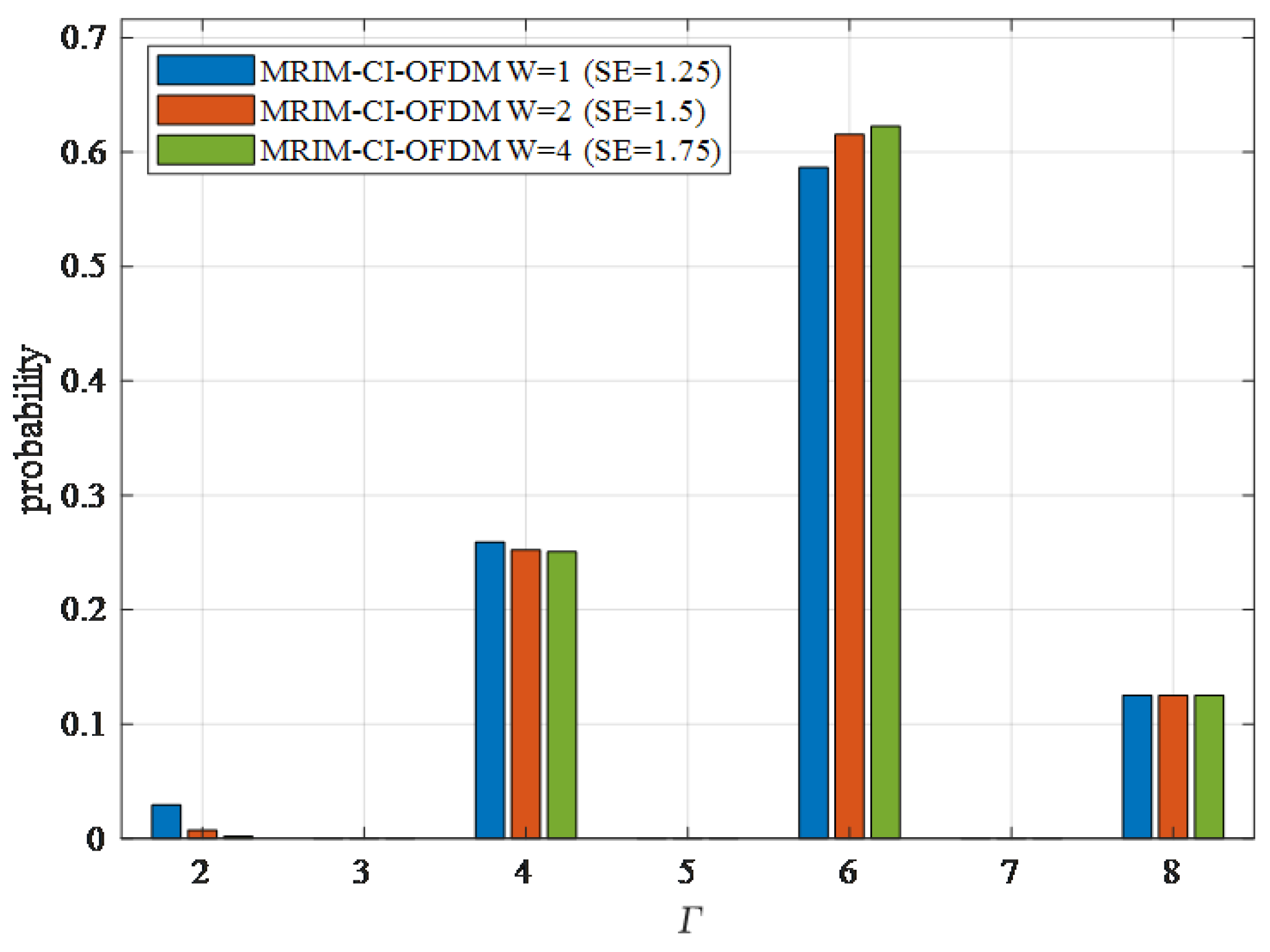
Figure 10 shows the rank distribution of error events for different values of W. The dominant error events are concentrated at Γ = 6 , whose proportion is approximately 0.59–0.62 for all tested W values, while the Γ = 8 events maintain a stable proportion of about 0.13. Overall, the error events with Γ 6 account for more than 70% of all error events. Meanwhile, the low-rank Γ = 2 events remain below approximately 3% and do not increase as W grows. The rank distribution therefore suggests that increasing W does not noticeably change the diversity-related error-event structure of the proposed scheme. Hence, the BER degradation observed for larger W is more likely caused by the increased ambiguity in mode-pair discrimination and the reduced inter-mode separability, rather than by a reduction in diversity order.
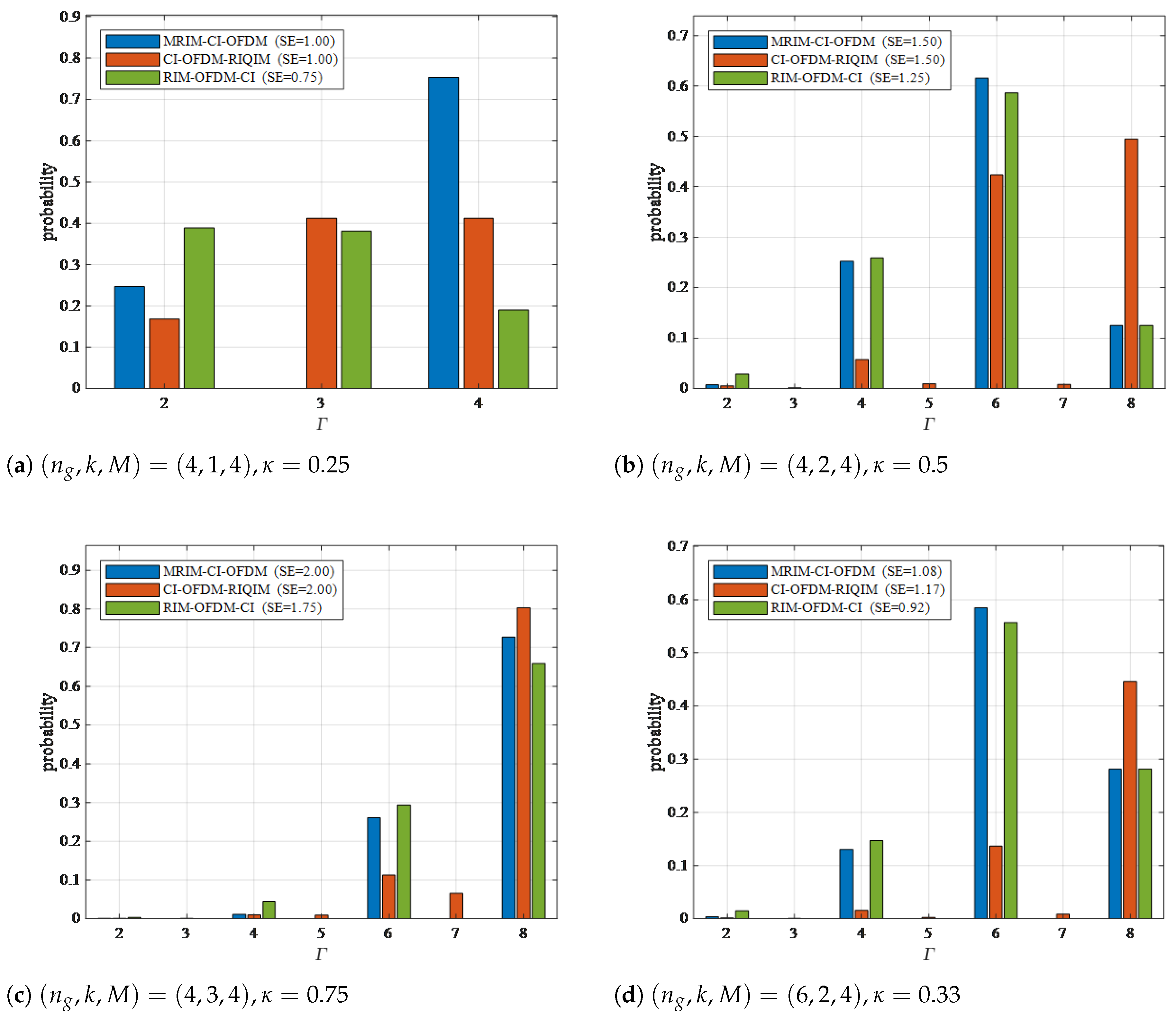
Figure 11 presents the rank distributions of error events under different activation ratios. As κ increases, the distribution of the proposed MRIM-CI-OFDM scheme shifts toward higher-rank regions, indicating an enhanced potential diversity gain. For example, when ( n g , k , M ) = ( 4 , 3 , 4 ) , high-rank error events dominate the overall distribution, and the proposed scheme maintains a higher proportion of high-rank events than the reference schemes. These results indicate that the introduced mode-domain mapping can provide additional spectral-efficiency flexibility without significantly weakening the high-rank error-event structure under different activation configurations.
To evaluate the robustness of the proposed scheme under imperfect channel state information (CSI), an additive Gaussian channel-estimation error model is adopted in the simulations. Specifically, the estimated frequency-domain channel coefficient is modeled as h ^ F ( n ) = h F ( n ) + Δ h F ( n ) , where h F ( n ) is the true channel coefficient and Δ h F ( n ) CN ( 0 , σ e 2 ) denotes the CSI estimation error independent of h F ( n ) . The received signal is generated using the true channel, while the receiver performs detection based on the estimated channel h ^ F ( n ) .
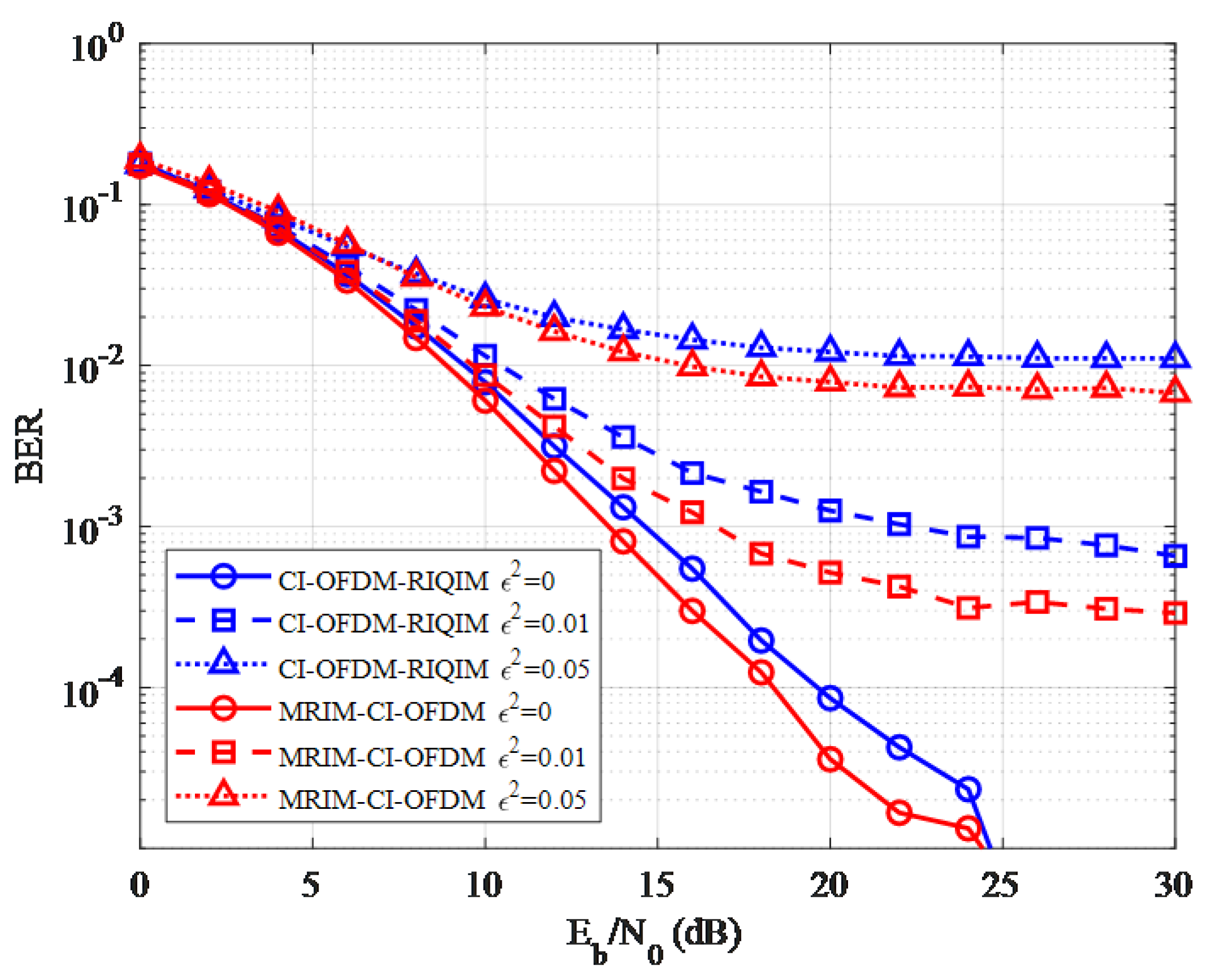
Figure 12 presents the BER performance under imperfect CSI conditions. As the channel-estimation error variance increases from 0 to 0.01 and 0.05, all schemes suffer noticeable BER degradation and gradually exhibit error floors in the high-SNR region. This is because channel-estimation errors introduce a mismatch between the equivalent channel model used at the receiver and the actual transmission channel, thereby affecting SAP detection, mode-pair discrimination, and symbol recovery. Nevertheless, the proposed MRIM-CI-OFDM scheme still maintains better BER performance than the benchmark scheme under different CSI error levels, indicating its robustness to channel-estimation errors owing to the joint effect of shared SAP, coordinate interleaving, and mode-domain mapping.
To provide a concise summary of the BER simulation results, Table 4 lists the main observations of the proposed MRIM-CI-OFDM scheme under different spectral-efficiency configurations.
To further summarize the overall performance trade-off, Table 5 compares representative OFDM-IM-based schemes in terms of BER performance, spectral efficiency, and normalized-energy characteristics.
In Table 5, the normalized-energy characteristic refers to the performance comparison under the same average symbol-energy normalization, rather than an independently defined bit-per-joule metric. In the simulations, all compared constellation sets are normalized to the same average symbol energy. Under this condition, the proposed MRIM-CI-OFDM improves the effective information-carrying capability by introducing cross-cluster mode-pair indexing, instead of increasing the transmit power. Therefore, the proposed scheme provides a favorable trade-off among BER performance, spectral-efficiency configuration, and normalized-energy utilization.

6. Conclusions and Future Work

In this paper, we propose a coordinate-interleaved OFDM scheme with mode-pair indexing and repeated-index modulation, termed MRIM-CI-OFDM, to address the difficulty of jointly improving spectral efficiency, maintaining error performance, and controlling receiver complexity in OFDM-IM systems. In the proposed scheme, the two clusters share the same SAP, while cross-cluster mode-pair indexing is introduced as an additional information-bearing dimension, so that information bits are conveyed through the SAP domain, the mode domain, and the constellation symbol domain. Meanwhile, coordinate interleaving assigns the real and imaginary components of symbols to different subcarriers, preserving the diversity benefit under frequency-selective fading. To improve the reliability of mode-domain detection, a rotated multi-mode constellation construction method based on the inter-constellation minimum product distance is designed. By exploiting the equivalent real-valued orthogonal structure induced by coordinate interleaving, low-complexity ML and three-stage Max-Log detectors are further developed to reduce the joint detection complexity of SAPs, mode pairs, and data symbols. In addition, the BER upper bound and the achievable rate under finite discrete-input conditions are derived to characterize the system performance. Simulation results show that the proposed low-complexity detectors achieve near-ML performance, with an SNR gap of less than 0.2 dB at a BER of 10 3 . Under a representative spectral efficiency of 1.25 bps/Hz, MRIM-CI-OFDM provides about 3 dB SNR gain over the coordinate-interleaved and repeated-index benchmark schemes and more than 5 dB gain over conventional OFDM-IM. Moreover, the high-SNR achievable rate of MRIM-CI-OFDM approaches 2.25 bps/Hz, which is about 12.5% higher than the 2.00 bps/Hz saturation level of the benchmark schemes. These results demonstrate that MRIM-CI-OFDM can improve spectral-efficiency configuration capability and transmission reliability while maintaining low receiver complexity. It should also be noted that the mode-domain extension introduces a design trade-off: increasing the number of modes W provides more flexibility in rate configuration, but also enlarges the mode-pair candidate space and reduces the separability among different mode pairs, which may increase mode-domain decision errors. Therefore, W should be selected according to the target spectral efficiency, reliability requirement, and receiver complexity.
The present work focuses on the fundamental transmission performance of MRIM-CI-OFDM, including BER, achievable rate, and receiver detection complexity. Future work will investigate adaptive mode-pair selection, constellation optimization, and channel-coded low-complexity MRIM-CI-OFDM transmission under time-varying fading and interference-limited conditions. Owing to its shared SAP structure, coordinate-interleaving diversity, and mode-pair indexing flexibility, the applicability of the proposed scheme to complex scenarios such as UAV-assisted wireless links will also be further explored.In addition, security-aware operation, RF-based signal identification, interference-aware transmission, and UAV-specific propagation effects will be considered in future extensions of the proposed MRIM-CI-OFDM framework.


Author Contributions

Conceptualization, B.S. and Y.F.; methodology, B.S.; software, B.S.; validation, B.S., Q.Y., Y.F. and B.Q.; writing—original draft preparation, B.S.; writing—review and editing, B.S., Q.Y., Y.F., B.Q. and B.T. All authors have read and agreed to the published version of the manuscript.

Funding

This work is partially supported by National Natural Science Foundation of China under Grant No. 61971291 (for conceptualization and investigation), partially supported by Xingliao Talents Plan under Grant No. XLYC2202013, Natural Science Foundation of Liaoning Province under Grant No. 2024-MS-113 (for formal analysis and validation) and partially supported by Liaoning Provincial Department of Education Science and Technology Innovation Team Project under Grant No. LJ 222510144001 (for validation and results verification).

Institutional Review Board Statement

Not applicable.

Informed Consent Statement

Not applicable.

Data Availability Statement

The raw data supporting the conclusions of this article are available from the corresponding authors upon reasonable request.

Conflicts of Interest

The authors declare no conflicts of interest.

References

  1. Akbar, M.S.; Hussain, Z.; Ikram, M.; Sheng, Q.Z.; Mukhopadhyay, S.C. On challenges of sixth-generation (6G) wireless networks: A comprehensive survey of requirements, applications, and security issues. J. Netw. Comput. Appl. 2025, 233, 104040. [Google Scholar] [CrossRef]
  2. Lang, P.; Tian, D.; Han, X.; Zhang, P.; Duan, X.; Zhou, J.; Leung, V.C.M. Towards 6G vehicular networks: Vision, technologies, and open challenges. Comput. Netw. 2025, 257, 110916. [Google Scholar] [CrossRef]
  3. Zhang, P.; Chen, S.; Zheng, X.; Li, P.; Wang, G.; Wang, R.; Wang, J.; Tan, L. UAV communication in space–air–ground integrated networks (SAGINs): Technologies, applications, and challenges. Drones 2025, 9, 108. [Google Scholar] [CrossRef]
  4. Wu, M.; Yu, Y.; Wan, F.; Lin, Y.; Li, Y.; Zheng, Z. Decoding of polar-coded OFDM systems over multipath fading channels with interleaving and channel state information. Sci. Rep. 2024, 14, 30286. [Google Scholar] [CrossRef] [PubMed]
  5. Zhu, Z.; Zhu, Y.; Xu, X.; Wang, W.; Chai, L.; Zheng, Y. Achieving Enhanced Spectral Efficiency for Constant Envelope Transmission in CP-OFDMA Framework. Sensors 2025, 25, 7257. [Google Scholar] [CrossRef]
  6. Sayed, M.S.; Zakaria, H.M.; Abdelhady, A.M. Enhancing flexibility and system performance in 6G and beyond: A user-based numerology and waveform approach. Digit. Commun. Netw. 2024, 11, 975–991. [Google Scholar] [CrossRef]
  7. Li, J.; Dang, S.; Wen, M.; Li, Q.; Chen, Y.; Huang, Y.; Shang, W. Index modulation multiple access for 6G communications: Principles, applications, and challenges. IEEE Netw. 2023, 37, 52–60. [Google Scholar] [CrossRef]
  8. Doğan-Tusha, S.; Tusha, A.; Althunibat, S.; Qaraqe, K. Orthogonal time frequency space multiple access using index modulation. IEEE Trans. Veh. Technol. 2023, 72, 15858–15866. [Google Scholar] [CrossRef]
  9. Mesleh, R.; Althunibat, S. Index modulation multiple access in multi-user MIMO systems. Phys. Commun. 2025, 73, 102822. [Google Scholar] [CrossRef]
  10. Başar, E.; Aygölü, Ü.; Panayırcı, E.; Poor, H.V. Orthogonal frequency division multiplexing with index modulation. IEEE Trans. Signal Process. 2013, 61, 5536–5549. [Google Scholar] [CrossRef]
  11. Wen, M.; Cheng, X.; Ma, M.; Jiao, B.; Poor, H.V. On the achievable rate of OFDM with index modulation. IEEE Trans. Signal Process. 2015, 64, 1919–1932. [Google Scholar] [CrossRef]
  12. Li, J.; Li, Q.; Dang, S.; Wen, M.; Jiang, X.-Q.; Peng, Y. Low-complexity detection for index modulation multiple access. IEEE Wirel. Commun. Lett. 2020, 9, 943–947. [Google Scholar] [CrossRef]
  13. Xiao, L.; Liu, G.; Xiao, P.; Jiang, T. Error probability analysis for rectangular differential OFDM with index modulation over dispersive channels. IEEE Wirel. Commun. Lett. 2021, 10, 2795–2799. [Google Scholar] [CrossRef]
  14. Jaradat, A.M.; Hamamreh, J.M.; Arslan, H. OFDM with hybrid number and index modulation. IEEE Access 2020, 8, 55042–55053. [Google Scholar] [CrossRef]
  15. Yarkin, F.; Coon, J.P. Index and composition modulation. IEEE Commun. Lett. 2020, 25, 911–915. [Google Scholar] [CrossRef]
  16. Li, J.; Dang, S.; Wen, M.; Jiang, X.-Q.; Peng, Y.; Hai, H. Layered orthogonal frequency division multiplexing with index modulation. IEEE Syst. J. 2019, 13, 3793–3802. [Google Scholar] [CrossRef]
  17. Arslan, E.; Dogukan, A.T.; Basar, E. Sparse-encoded codebook index modulation. IEEE Trans. Veh. Technol. 2020, 69, 9126–9130. [Google Scholar] [CrossRef]
  18. Omri, A.; Fernandez, J.H.; Di Pietro, R. A Spectral and Energy Efficient Transmission Scheme for OFDM-based Communication Systems. Comput. Netw. 2025, 260, 111101. [Google Scholar] [CrossRef]
  19. Tusha, A.; Doğan, S.; Arslan, H. A hybrid downlink NOMA with OFDM and OFDM-IM for beyond 5G wireless networks. IEEE Signal Process. Lett. 2020, 27, 491–495. [Google Scholar] [CrossRef]
  20. Chen, X.; Wen, M.; Dang, S. On the performance of cooperative OFDM-NOMA system with index modulation. IEEE Wirel. Commun. Lett. 2020, 9, 1346–1350. [Google Scholar] [CrossRef]
  21. Şahin, M.M.; Gurol, I.E.; Arslan, E.; Basar, E.; Arslan, H. OFDM-IM for joint communication and radar-sensing: A promising waveform for dual functionality. Front. Commun. Netw. 2021, 2, 715944. [Google Scholar] [CrossRef]
  22. Azim, A.W.; Le Guennec, Y.; Chafii, M.; Ros, L. Enhanced optical-OFDM with index and dual-mode modulation for optical wireless systems. IEEE Access 2020, 8, 128646–128664. [Google Scholar] [CrossRef]
  23. Li, J.; Peng, Y.; Yan, Y.; Jiang, X.-Q.; Hai, H.; Zukerman, M. Cognitive radio network assisted by OFDM with index modulation. IEEE Trans. Veh. Technol. 2019, 69, 1106–1110. [Google Scholar] [CrossRef]
  24. Ren, X.; Wei, Y.; Zhu, L.; El Korso, M.N. Traffic and scenario adaptive OFDM-IM for vehicular networks: A fuzzy logic based optimization approach. Sensors 2025, 25, 663. [Google Scholar] [CrossRef] [PubMed]
  25. Mao, T.; Wang, Z.; Wang, Q.; Chen, S.; Hanzo, L. Dual-mode index modulation aided OFDM. IEEE Access 2016, 5, 50–60. [Google Scholar] [CrossRef]
  26. Mao, T.; Wang, Q.; Wang, Z. Generalized dual-mode index modulation aided OFDM. IEEE Commun. Lett. 2016, 21, 761–764. [Google Scholar] [CrossRef]
  27. Wen, M.; Basar, E.; Li, Q.; Zheng, B.; Zhang, M. Multiple-mode orthogonal frequency division multiplexing with index modulation. IEEE Trans. Commun. 2017, 65, 3892–3906. [Google Scholar] [CrossRef]
  28. Wen, M.; Li, Q.; Basar, E.; Zhang, W. Generalized multiple-mode OFDM with index modulation. IEEE Trans. Wirel. Commun. 2018, 17, 6531–6543. [Google Scholar] [CrossRef]
  29. Yarkin, F.; Coon, J.P. Q-ary multi-mode OFDM with index modulation. IEEE Wirel. Commun. Lett. 2020, 9, 1110–1114. [Google Scholar] [CrossRef]
  30. Yarkin, F.; Coon, J.P. Modulation based on a simple MDS code: Achieving better error performance than index modulation and related schemes. IEEE Trans. Commun. 2021, 70, 118–131. [Google Scholar] [CrossRef]
  31. Dogukan, A.T.; Basar, E. Super-mode OFDM with index modulation. IEEE Trans. Wirel. Commun. 2020, 19, 7353–7362. [Google Scholar] [CrossRef]
  32. Li, J.; Dang, S.; Huang, Y.; Chen, P.; Qi, X.; Wen, M.; Arslan, H. Composite multiple-mode orthogonal frequency division multiplexing with index modulation. IEEE Trans. Wirel. Commun. 2022, 22, 3748–3761. [Google Scholar] [CrossRef]
  33. Hu, Z.; Yang, J.; Guo, P.; Li, Q. Orthogonal frequency division multiplexing with cascade index modulation. IET Commun. 2022, 16, 1057–1070. [Google Scholar]
  34. Sengupta, I.; Dasgupta, S.; Das Barman, A. Index and mode modulated orthogonal frequency division multiplexing with enhanced spectral efficiency. Trans. Emerg. Telecommun. Technol. 2023, 34, e4735. [Google Scholar] [CrossRef]
  35. Sengupta, I.; Dasgupta, S.; Das Barman, A. Generalized index and mode modulated OFDM with improved spectral and energy efficiency. Trans. Emerg. Telecommun. Technol. 2024, 35, e4973. [Google Scholar] [CrossRef]
  36. Sarwar, M.S.; Ramatryana, I.N.A.; Ahmad, M.; Shin, S.Y. Dual-mode index modulation for non-orthogonal frequency division multiplexing. IEEE Trans. Wirel. Commun. 2023, 22, 7712–7726. [Google Scholar] [CrossRef]
  37. Başar, E. OFDM with index modulation using coordinate interleaving. IEEE Wirel. Commun. Lett. 2015, 4, 381–384. [Google Scholar] [CrossRef]
  38. Le, T.T.H.; Tran, X.N.; Ngo, V.-D.; Le, M.-T. Repeated index modulation-OFDM with coordinate interleaving: Performance optimization and low-complexity detectors. IEEE Syst. J. 2020, 15, 3673–3681. [Google Scholar] [CrossRef]
  39. Dogukan, A.T.; Tugtekin, O.F.; Basar, E. Coordinate interleaved OFDM with power distribution index modulation. IEEE Commun. Lett. 2022, 26, 1908–1912. [Google Scholar] [CrossRef]
  40. Tugtekin, O.F.; Dogukan, A.T.; Arslan, E.; Basar, E. Coordinate interleaved OFDM with repeated in-phase/quadrature index modulation. IEEE Trans. Wirel. Commun. 2023, 23, 117–127. [Google Scholar] [CrossRef]
Figure 1. MRIM-CI-OFDM system model.
Applsci 16 05269 g001
Figure 2. MRIM-CI-OFDM subblock creator.
Applsci 16 05269 g002
Figure 3. Comparison of different detectors.
Applsci 16 05269 g003
Figure 4. BER performance of different schemes at 1.25 bps/Hz.
Applsci 16 05269 g004
Figure 5. BER performance of different schemes at 1.75 bps/Hz.
Applsci 16 05269 g005
Figure 6. BER performance of different schemes for fixed ( n g , k , M ) = ( 8 , 4 , 4 ) .
Applsci 16 05269 g006
Figure 7. BER performance of MRIM-CI-OFDM with different W.
Applsci 16 05269 g007
Figure 8. BER performance under different subblock sizes.
Applsci 16 05269 g008
Figure 9. Achievable rate performance of different schemes.
Applsci 16 05269 g009
Figure 10. Rank distribution of error events for different values of W under ( n g , k , M ) = ( 4 , 2 , 4 ) , κ = 0.5 .
Applsci 16 05269 g010
Figure 11. Rank distribution of error events under different activation ratios.
Applsci 16 05269 g011
Figure 12. BER performance under imperfect CSI.
Applsci 16 05269 g012
Table 1. MRIM-CI-OFDM subblock realizations for ( k , W , M ) = ( 2 , 2 , 4 ) .
l 1 l 2 Ψ α Cluster 1Cluster 2
0000[1,2] [ a 1 1 , R + j b 1 1 , I a 2 1 , R + j b 2 1 , I 0 0 ] [ b 1 1 , R + j a 1 1 , I b 2 1 , R + j a 2 1 , I 0 0 ]
0001[1,2] [ a 1 1 , R + j b 1 2 , I a 2 1 , R + j b 2 1 , I 0 0 ] [ b 1 1 , R + j a 1 2 , I b 2 1 , R + j a 2 1 , I 0 0 ]
0010[1,2] [ a 1 2 , R + j b 1 1 , I a 2 2 , R + j b 2 1 , I 0 0 ] [ b 1 2 , R + j a 1 1 , I b 2 2 , R + j a 2 1 , I 0 0 ]
0011[1,2] [ a 1 2 , R + j b 1 2 , I a 2 2 , R + j b 2 2 , I 0 0 ] [ b 1 2 , R + j a 1 2 , I b 2 2 , R + j a 2 2 , I 0 0 ]
0100[2,3] [ 0 a 1 1 , R + j b 1 1 , I a 2 1 , R + j b 2 1 , I 0 ] [ 0 b 1 1 , R + j a 1 1 , I b 2 1 , R + j a 2 1 , I 0 ]
0101[2,3] [ 0 a 1 1 , R + j b 1 2 , I a 2 1 , R + j b 2 1 , I 0 ] [ 0 b 1 1 , R + j a 1 2 , I b 2 1 , R + j a 2 1 , I 0 ]
0110[2,3] [ 0 a 1 2 , R + j b 1 1 , I a 2 2 , R + j b 2 1 , I 0 ] [ 0 b 1 2 , R + j a 1 1 , I b 2 2 , R + j a 2 1 , I 0 ]
0111[2,3] [ 0 a 1 2 , R + j b 1 2 , I a 2 2 , R + j b 2 2 , I 0 ] [ 0 b 1 2 , R + j a 1 2 , I b 2 2 , R + j a 2 2 , I 0 ]
1000[2,4] [ 0 a 1 1 , R + j b 1 1 , I 0 a 2 1 , R + j b 2 1 , I ] [ 0 b 1 1 , R + j a 1 1 , I 0 b 2 1 , R + j a 2 1 , I ]
1001[2,4] [ 0 a 1 1 , R + j b 1 2 , I 0 a 2 1 , R + j b 2 2 , I ] [ 0 b 1 1 , R + j a 1 2 , I 0 b 2 1 , R + j a 2 2 , I ]
1010[2,4] [ 0 a 1 2 , R + j b 1 1 , I 0 a 2 2 , R + j b 2 1 , I ] [ 0 b 1 2 , R + j a 1 1 , I 0 b 2 2 , R + j a 2 1 , I ]
1011[2,4] [ 0 a 1 2 , R + j b 1 2 , I 0 a 2 2 , R + j b 2 2 , I ] [ 0 b 1 2 , R + j a 1 2 , I 0 b 2 2 , R + j a 2 2 , I ]
1100[1,3] [ a 1 1 , R + j b 1 1 , I 0 a 2 1 , R + j b 2 1 , I 0 ] [ b 1 1 , R + j a 1 1 , I 0 b 2 1 , R + j a 2 1 , I 0 ]
1101[1,3] [ a 1 1 , R + j b 1 2 , I 0 a 2 1 , R + j b 2 2 , I 0 ] [ b 1 1 , R + j a 1 2 , I 0 b 2 1 , R + j a 2 2 , I 0 ]
1110[1,3] [ a 1 2 , R + j b 1 1 , I 0 a 2 2 , R + j b 2 1 , I 0 ] [ b 1 2 , R + j a 1 1 , I 0 b 2 2 , R + j a 2 1 , I 0 ]
1111[1,3] [ a 1 2 , R + j b 1 2 , I 0 a 2 2 , R + j b 2 2 , I 0 ] [ b 1 2 , R + j a 1 2 , I 0 b 2 2 , R + j a 2 2 , I 0 ]
Table 2. Comparison of Detection Complexity for Different Methods.
MethodDetection MethodComputational Complexity
RIM-CI-OFDMlow-ML O ( 2 l 1 M k )
CI-OFDM-RIQIMLow-Complexity Detection O ( M 2 )
MRIM-CI-OFDMML O ( 2 l 1 W 2 M 2 k )
MRIM-CI-OFDMLow-Complexity ML O ( 2 l 1 W 2 k M )
MRIM-CI-OFDMThree-Stage Max-Log O ( n g W 2 M + 2 l 1 k + W 2 k M )
Table 3. Simulation Parameters.
ParameterValue
Number of subcarriers128
Cyclic prefix length16
Subcarrier spacing15 kHz
Sampling frequency1.92 MHz
OFDM symbol duration75  μ s
Monte Carlo trials100,000
Modulation order2, 4, 8, 16, 64
Channel model10-tap frequency-selective Rayleigh fading channel
Table 4. Summary of BER results for the proposed MRIM-CI-OFDM scheme under different spectral efficiencies.
Spectral
Efficiency
ConfigurationBER Observation
1.25 bps/Hz ( n g , k , M , W ) = ( 4 , 2 , 4 , 1 ) Baseline repeated-index CI structure without mode-domain ambiguity.
1.50 bps/Hz ( n g , k , M , W ) = ( 4 , 2 , 4 , 2 ) 20% rate gain and best BER in the medium-to-high SNR region.
1.75 bps/Hz ( n g , k , M , W ) = ( 4 , 2 , 4 , 4 ) About 5 dB SNR loss compared with W = 2 at BER = 10 3 .
1.375 bps/Hz ( n g , k , M , W ) = ( 8 , 4 , 4 , 1 ) Equivalent to RIM-CI-OFDM.
1.500 bps/Hz ( n g , k , M , W ) = ( 8 , 4 , 4 , 2 ) 9.1% rate gain with less than 0.5 dB SNR loss.
1.625 bps/Hz ( n g , k , M , W ) = ( 8 , 4 , 4 , 4 ) 18.2% rate gain with more pronounced BER degradation.
2.50 bps/Hz n g : 4 8 About 2 dB SNR gain at BER = 10 3 .
Table 5. Comparison of representative schemes in terms of BER performance, spectral efficiency, and normalized-energy characteristics.
SchemeBER PerformanceSpectral EfficiencyNormalized-Energy Characteristic
OFDM-IMRelatively poorLimited by inactive subcarriersSome subcarriers are silent, but rate loss occurs
CI-OFDM-IMImproved by CI diversityModerateDiversity gain without increasing transmit power
RIM-CI-OFDMGood reliabilityLow-to-moderateShared SAP improves index reliability under normalized energy
CI-OFDM-RIQIM/IQIMStrong at high rateModerate-to-highMore index bits, but higher SAP detection burden
MRIM-CI-OFDMFavorable BER trade-offFlexible via mode-pair indexingMore bits conveyed under the same average symbol-energy normalization
Disclaimer/Publisher’s Note: The statements, opinions and data contained in all publications are solely those of the individual author(s) and contributor(s) and not of MDPI and/or the editor(s). MDPI and/or the editor(s) disclaim responsibility for any injury to people or property resulting from any ideas, methods, instructions or products referred to in the content.