Article

Acute Effects of Exercise Across Individualized Intensity Zones on Multidimensional Soccer Shooting Performance


1
Centre of Research, Education, Innovation and Intervention in Sport, (CIFI2D), Faculty of Sport, University of Porto, 4200-450 Porto, Portugal
2
Porto Biomechanics Laboratory (LABIOMEP), University of Porto, 4200-450 Porto, Portugal
3
Institute of Physical Education and Training, Capital University of Physical Education and Sports, Beijing 100191, China
4
Institute of Artificial Intelligence in Sports, Capital University of Physical Education and Sports, Beijing 100191, China
5
College of Physical Education, Shanghai Normal University, Shanghai 201418, China
*
Authors to whom correspondence should be addressed.
Appl. Sci. 2026, 16(11), 5228; https://doi.org/10.3390/app16115228 (registering DOI)
Submission received: 27 April 2026 / Revised: 20 May 2026 / Accepted: 22 May 2026 / Published: 23 May 2026

Abstract

This study examined whether acute exercise performed within individualized physiological intensity zones affects multidimensional soccer shooting performance. Twenty male collegiate soccer players completed a Yo-Yo Intermittent Recovery Test Level 1 with portable gas analysis to determine the ventilatory threshold (VT) and respiratory compensation point (RCP). Three individualized zones were defined: Low (<VT), Moderate (VT–RCP), and High (>RCP). In a randomized design, players completed three 3 min shuttle-running bouts, each followed immediately by the 356 Soccer Shooting Test. Ball velocity (BV), shooting accuracy (SA), and shooting quality (SQ) were analyzed using repeated-measures ANOVA. Exercise condition significantly affected SA (p = 0.013) and SQ (p = 0.007), but not BV (p = 0.216). Bonferroni-adjusted comparisons showed that SA and SQ were lower in High than in Low, whereas no pairwise BV comparison reached significance. A sensitivity analysis using all ten recorded attempts rather than the original best-seven scoring approach showed an overall condition effect for BV without a significant pairwise comparison, retained overall effects for SA and SQ, and showed that the Low–High contrast remained robust only for SQ. Baseline comparisons were not significant. These findings indicate condition-specific shooting responses, with the clearest evidence for lower SQ after High compared with Low, supportive evidence for lower SA, and no significant primary condition effect for BV.

1. Introduction

Soccer is characterized as a high-intensity intermittent sport, requiring players to repeatedly alternate between high-intensity running bouts and brief recovery periods [1,2], while executing soccer-specific skills under substantial physiological stress [3,4]. Shooting represents a key technical action and is frequently performed under high-intensity match conditions [5]. Consequently, its execution quality may be influenced by the physiological load accumulated during play [6]. A player’s shooting performance is typically characterized by ball velocity (BV) and shooting accuracy (SA) [7,8]. BV primarily reflects the mechanical output of the kicking limb, including joint angular velocities and force generation [9]. In contrast, SA is closely related to impact control, segmental coordination, and stability of the supporting leg [7]. Although both contribute to overall shooting quality (SQ), they may be regulated by partially distinct neuromuscular mechanisms. As a composite outcome, SQ may therefore be useful because it reflects how SA and BV jointly determine the theoretical difficulty for a goalkeeper to prevent the goal [10].
Previous studies have generally shown that fatigue reduces shooting performance, with several studies reporting decreases in ball velocity following fatigue [11,12], while findings regarding accuracy remain inconsistent [13,14]. However, these studies typically induce fatigue through exhaustive running protocols [15,16] or match simulations [13,17], implicitly assuming that exercise intensity is sufficient to elicit technical deterioration. Relatively little attention has been given to distinguishing the differential effects of individualized physiological intensity zones on technical performance [18,19]. Evidence suggests that physiological adaptations and performance responses are proportional to the magnitude of the imposed training load, reflecting a dose–response relationship [20]. However, in team sports, athletes exposed to similar external loads may experience substantially different internal physiological stress due to differences in aerobic capacity and recovery characteristics [21,22]. Given that professional soccer training typically exposes players to training loads across different intensity zones—including low, threshold, and high intensity [23], understanding how technical performance responds across these zones holds important practical implications.
From the perspective of exercise physiology, exercise intensity is generally conceptualized as distinct physiological zones defined by metabolic thresholds, rather than arbitrary percentage-based descriptors [24]. These zones are separated by identifiable transition thresholds that reflect progressive disturbances of metabolic homeostasis [23]. In applied practice, such thresholds are commonly used to define individualized intensity zones, enabling external workload to be interpreted relative to internal physiological stress [23,25]. The ventilatory threshold (VT) marks the transition from metabolic steady state to non–steady-state conditions, whereas the respiratory compensation point (RCP) reflects further H+ accumulation and compensatory hyperventilation [24]. Crossing these thresholds reflects a transition toward progressively greater disturbance to metabolic homeostasis rather than merely an increased perception of effort [20]. Accordingly, defining intensity zones based on individualized thresholds may allow external workload to be interpreted relative to internal physiological stress, facilitating intensity-specific interpretation of performance responses.
Soccer match play involves a broad spectrum of exercise intensities, resulting in substantial variation in internal physiological stress [26]. Exercise performed below the RCP typically allows partial stabilization of metabolic processes, whereas exercise exceeding this threshold is characterized by progressive lactate accumulation and ventilatory compensation [27,28]. Such physiological disturbances may compromise motor performance [29]. As shooting performance involves both force generation and precise inter-segmental timing [9], physiological stress across different intensity zones may differentially influence these performance components. Despite these theoretical considerations, previous studies have largely treated fatigue as a uniform stimulus without distinguishing exercise intensity based on individualized physiological thresholds [12,30,31]. Therefore, the present study aimed to examine the acute effects of exercise performed within individualized physiological intensity zones defined by each player’s VT and RCP on multidimensional shooting performance, including BV, SA, and SQ. These zones were operationalized as three randomized exercise conditions: Low (<VT), Moderate (VT–RCP), and High (>RCP). The main contribution of this study was to move beyond a uniform fatigue model by testing whether shooting responses differ across randomized exercise conditions based on individualized physiological intensity zones. We hypothesized that shooting performance would show condition-specific responses, with the clearest differences expected between the Low and High conditions.

2. Materials and Methods

2.1. Participants

Twenty male soccer players (age: 20.3 ± 0.9 years; height: 1.78 ± 0.06 m; body mass: 70.8 ± 6.8 kg) from a university team competing in the China University Football Association (CUFA) volunteered to participate in this study. All players had extensive competitive experience (≥10 years of systematic training) and were engaged in regular team training (≥4 sessions per week) at the time of data collection, which occurred during a preparatory phase of the season. The sample comprised 7 defenders, 7 midfielders, and 6 forwards; goalkeepers were not included. No official match was scheduled within 24 h before testing, and players were instructed to avoid strenuous training during this period. Foot dominance was determined based on self-reported preferred shooting leg, with 19 players identified as right-foot dominant and 1 as left-foot dominant. Players were required to be actively competing at the university level and free from any lower-limb musculoskeletal injury within the six months prior to testing. All participants followed the established annual competition schedule, which typically included three official tournament-style events. Prior to participation, players were informed of all experimental procedures and provided written informed consent. The study was conducted in accordance with the Declaration of Helsinki and was approved by the Ethics Committee of Capital University of Physical Education and Sports (Approval Number: 2025A150).

2.2. Yo-Yo IR1 and Determination of Physiological Thresholds

The Yo-Yo Intermittent Recovery Test Level 1 (Yo-Yo IR1) was conducted according to the protocol described by Bangsbo et al. [32]. All players were familiar with the Yo-Yo IR1 and had performed the test at least once prior to commencement of the study.
During the Yo-Yo IR1, players wore a portable gas analyzer (MetaMax 3B, Cortex Biophysik GmbH, Leipzig, Germany) and a wireless heart-rate transmitter belt (Polar H10, Polar Electro Oy, Kempele, Finland) to continuously record respiratory gas exchange and heart rate (HR). The MetaMax 3B has previously been shown to provide valid and reliable measurements of VO2, VCO2, and ventilation compared with Douglas bag systems [33]. Rating of perceived exertion (RPE) was assessed using the Borg 6–20 scale during predefined stage intervals or recovery periods.
Breath-by-breath gas-exchange data were smoothed using a 10 s rolling average to improve interpretability while preserving the temporal structure of the response. VT and RCP were identified from the smoothed gas exchange data using standard ventilatory equivalent criteria. VT was determined as the point at which VE/VO2 increased without a concomitant increase in VE/VCO2, accompanied by a departure from linearity of VE. RCP was defined as the point at which both VE/VO2 and VE/VCO2 increased simultaneously [34]. Threshold identification was performed independently by two experienced investigators. In cases of disagreement, the two investigators reviewed the gas-exchange curves together and reached a consensus on the final threshold location. Three individualized physiological intensity zones were defined based on VT and RCP: low-intensity (below VT), moderate-intensity (between VT and RCP), and high-intensity (above RCP). The corresponding HR values were used as practical reference values for monitoring and regulating exercise intensity. To enhance reliability, HR at VT and RCP was defined as the mean HR within a 30 s window centered on the identified threshold time point (±15 s).

2.3. Soccer Shooting Test

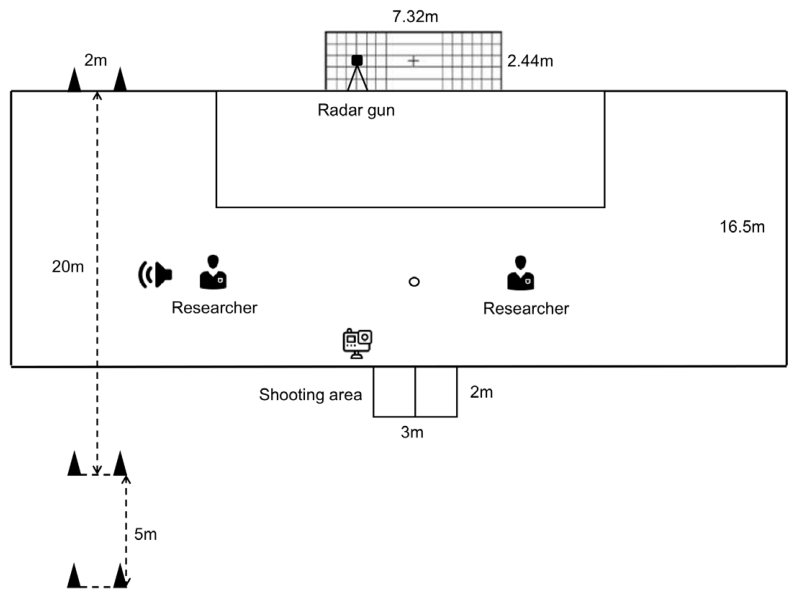
Soccer shooting performance was assessed using a modified 356 Soccer Shooting Test (356-SST), based on the original protocol described by Radman et al. [10]. Players performed 10 shots from a marked 2 × 3 m shooting area located on the 16.5-m line in front of a standard goal (7.32 × 2.44 m) (Figure 1). Each attempt consisted of a two-step approach and two ball contacts (a preparatory touch followed by the shot). Players used their preferred foot and were instructed to aim at the opposite half of the goal relative to the kicking leg; for the single left-footed player, the target side was mirrored accordingly. Approximately 6 s separated consecutive attempts.
BV was measured using a hand-held radar gun (Bushnell 101911, Bozeman, MT, USA) positioned behind the goal near the central shooting axis. Before each attempt, the investigator oriented the radar gun as closely as possible toward the anticipated ball trajectory to reduce potential cosine error. This device has demonstrated excellent agreement with reference radar systems for ball-speed assessment [35]. For accuracy assessment, each half of the goal was divided into 30 equal scoring zones (48.8 × 48.8 cm), with pre-determined distances from each zone to the goal center defined according to the original 356-SST framework [10]. SA was calculated as the average radial distance (m) from the ball-entry zone to the goal’s center. In this test, higher SA values do not denote proximity to a central target; rather, they indicate placement in more distal goal zones that are theoretically more difficult for a goalkeeper to save [10]. Two researchers independently recorded ball-entry locations; discrepancies were resolved via video review using a GoPro Hero 7 Black (240 fps) (GoPro, San Mateo, CA, USA) positioned in front of the goal. In accordance with the original 356-SST scoring logic, attempts with BV below 64 km·h−1 or attempts that did not enter the predefined scoring space were retained among the recorded attempts but assigned an SA score of 0 m for accuracy-related scoring. The final BV, SA, and SQ scores were calculated as the mean values of the same seven attempts selected according to the scored SA distance, consistent with the original 356-SST procedure [10]. Zero-scored attempts were therefore retained in the dataset and were not treated as missing data. To examine whether the best-seven scoring approach masked low-performing attempts, a sensitivity analysis recalculating BV, SA, and SQ across all 10 recorded attempts was conducted.
SQ was calculated as follows:
S Q   =   S A t
t = s B V
The ball-trajectory length (s) was derived as follows:
s   =   S A 0.75 ) 2 273.74
SQ is expressed in m·s−1 and reflects the theoretical speed at which a goalkeeper would need to move from the goal center to prevent scoring. Here, s represents the theoretical ball-trajectory length, t represents the theoretical ball-flight time, and BV represents the ball velocity. The value of t was calculated as s/BV. A higher SQ value, therefore, indicates a shot that is more difficult to save because it combines a more challenging placement with higher ball velocity [10].

2.4. Procedure

All testing sessions were conducted on the same outdoor artificial-turf pitch under stable environmental conditions. Participants were instructed to maintain their habitual training routines, avoid strenuous exercise within 24 h prior to the test, and refrain from consuming caffeine on the day of the test. Sessions were supervised by the same investigators and scheduled between 14:00 and 18:00 to minimize circadian variation.
Prior to the formal experiment, participants completed a familiarization and physiological calibration session. During this session, all players were familiarized with the 356-SST, including the task sequence, timing constraints, shooting area, and target-zone scoring procedures, to reduce possible learning effects during formal testing. Three individualized physiological intensity zones were determined based on VT and RCP. The HRs corresponding to these thresholds were used as individualized reference values for monitoring and adjusting the exercise bouts. Initial running speeds were derived from the Yo-Yo IR1 stage speeds corresponding to each threshold: the Low condition was initiated at 2 km·h−1 below the VT stage speed, the Moderate condition at the mean of the VT and RCP stage speeds, and the High condition at 2 km·h−1 above the RCP stage speed.
The formal experiment employed a randomized Latin square design. After a standardized warm-up, participants first completed a post-warm-up baseline 356-SST. Within the same formal experimental session, they then completed three acute exercise conditions (Low, Moderate, High), corresponding to the individualized physiological intensity zones, in randomized order. For each condition, participants completed a 3 min shuttle-running bout using the same shuttle pattern and change-of-direction demands; only running speed differed between conditions. A duration of 3 min was chosen to allow cardiopulmonary responses to develop under the specified exercise conditions, given that VO2 kinetics and the emergence of domain-specific response patterns are typically evident within the first 2–3 min of exercise [36,37].
HR was continuously monitored as a practical indicator of internal load [38]. Stage speeds identified during the incremental test were used to set the initial pace. Running speed was then adjusted when needed according to the HR response, because speed alone may not reproduce equivalent physiological strain in a randomized design. Therefore, HR was used as a practical monitoring indicator of the physiological response associated with VT and RCP, rather than as a direct representation of metabolic thresholds.
Terminal HR was recorded during the final 5 s of the 3 min bout, followed immediately by RPE assessment (Borg 6–20). The 356-SST was initiated immediately after the RPE assessment to evaluate acute post-exercise shooting performance. In the standardized testing sequence, the first shot typically began within approximately 10 s after completion of the 3 min shuttle-running bout, although this interval was not timed prospectively for each trial. A standardized 10 min passive recovery period was initially provided between exercise conditions. After this period, HR and RPE were checked against each player’s individual reference values recorded after the warm-up and before the baseline 356-SST. The next bout was initiated only when both HR and RPE had returned to the reference level. If either value had not returned to the reference level, passive recovery was extended before the next bout.

2.5. Statistical Analysis

One-way repeated-measures analysis of variance (RM-ANOVA) was used for the primary analysis of the three randomized exercise conditions (Low, Moderate, and High). Separate RM-ANOVAs were conducted for BV, SA, and SQ. The post-warm-up baseline test was not included in the primary model because it was always performed before the randomized exercise sequence and was therefore not counterbalanced; instead, exploratory paired-samples comparisons between Pre and each exercise condition were conducted with Holm adjustment. When a significant main effect was observed, Bonferroni-adjusted pairwise comparisons were performed, with mean differences, 95% confidence intervals, exact p-values, and Cohen’s dz reported. Assumptions were evaluated using Shapiro–Wilk tests for residual normality and Mauchly’s test for sphericity. To address the potential influence of the best-seven scoring procedure, a sensitivity analysis recalculating BV, SA, and SQ from all ten recorded attempts was conducted using the same RM-ANOVA framework. The number of zero-scored attempts across conditions was compared using the Friedman test with Holm-adjusted Wilcoxon post hoc tests. Terminal HR and RPE were summarized as manipulation checks to support the differentiation of internal load across exercise conditions, and an exploratory order-effect analysis was conducted to examine whether condition order influenced the main findings. Effect sizes are reported as partial eta squared (ηp2) for omnibus tests and Cohen’s dz for pairwise comparisons. Descriptive statistics are presented as mean ± standard deviation. Statistical analyses were performed using Jamovi (Version 2.6), with significance set at p < 0.05.

3. Results

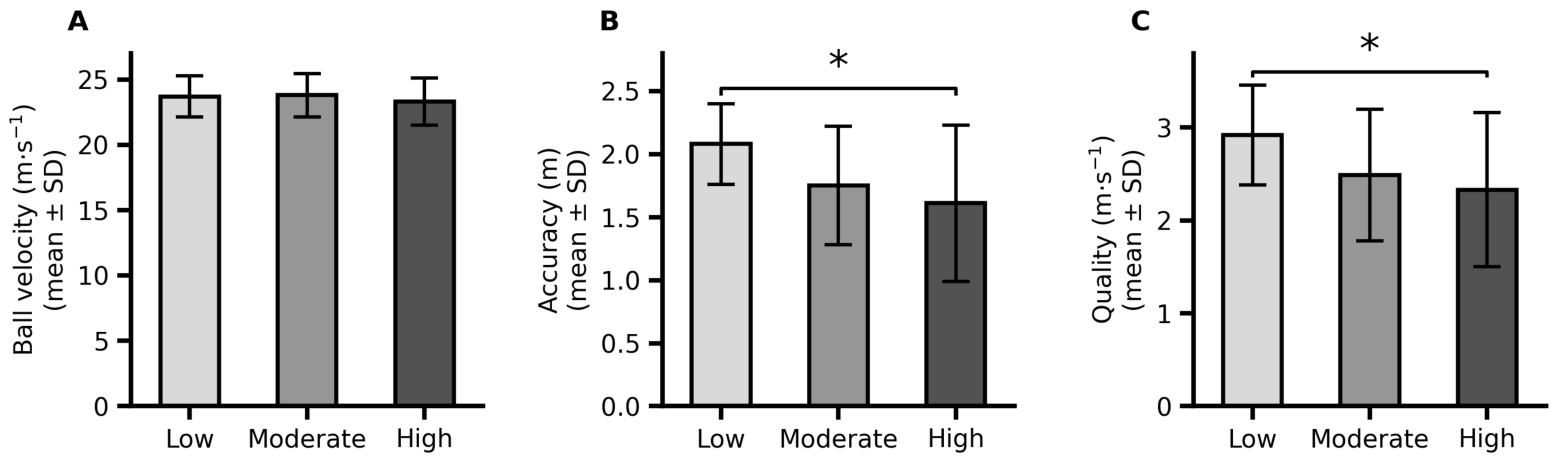
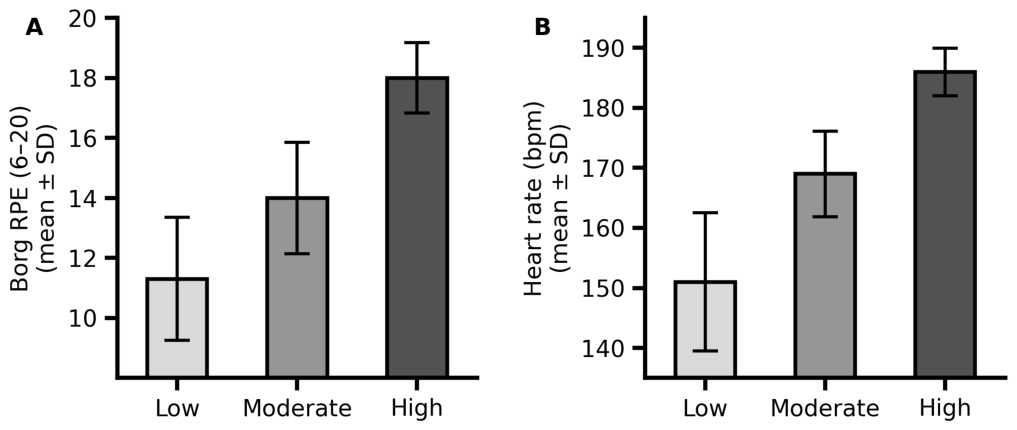
Assumption checks did not indicate violations of normality or sphericity (all p > 0.05). Exercise condition had no significant effect on BV (F = 1.60, p = 0.216, ηp2 = 0.078) but had significant effects on SA (F = 4.86, p = 0.013, ηp2 = 0.204) and SQ (F = 5.58, p = 0.007, ηp2 = 0.227) (Table 1). Bonferroni-adjusted pairwise comparisons showed that SA and SQ were significantly lower in the High condition than in the Low condition (p = 0.026 and p = 0.014, respectively), whereas no Bonferroni-adjusted BV comparison reached significance (Table 2; Figure 2). In the sensitivity analysis including all 10 recorded attempts, BV showed a significant overall condition effect but no significant pairwise comparison, whereas overall condition effects remained significant for SA and SQ. Only the Low–High contrast for SQ remained significant after correction; the corresponding SA comparison showed the same direction but was attenuated (Table S1). Zero-scored attempts differed across conditions (Friedman χ2(2) = 6.86, p = 0.032), with fewer zero-scored attempts in Low than Moderate after Holm adjustment (p = 0.032); only five attempts across the full dataset fell below the 64 km·h−1 criterion (Low = 2, Moderate = 1, High = 2; Table S2). Exploratory comparisons with the post-warm-up baseline showed no significant differences between Pre and any exercise condition for BV, SA, or SQ (Table S3). HR and RPE increased progressively across Low, Moderate, and High conditions, supporting the intended differentiation of internal load between conditions (Figure 3). Exploratory order-effect analyses showed no significant effect of condition order for BV, SA, or SQ.

4. Discussion

The present study examined shooting performance after randomized exercise conditions based on individualized physiological intensity zones. Overall, shooting responses differed across conditions, with the clearest difference observed for SQ. In the primary best-seven analysis, SQ and SA were lower after the High condition than after the Low condition. In contrast, BV did not show a significant condition effect. The all-ten sensitivity analysis showed that the SQ result was more stable, while the SA contrast depended more on the original best-seven scoring rule. Because SQ integrates SA-related spatial information with BV, the SQ result should be interpreted as a stable composite response rather than evidence that SA and BV changed independently. Exploratory comparisons with the post-warm-up baseline were not significant. Therefore, the observed Low–High differences should be interpreted as relative differences between exercise conditions, rather than a confirmed decline from baseline performance.
Previous studies manipulating exercise intensity have reported divergent patterns in shooting performance. Radman et al. [18] used individualized physiological thresholds, a progressive incremental protocol, and the 356-SST. They found reductions in both ball velocity and accuracy once exercise exceeded the second lactate threshold. Because intensity increased sequentially, exposure to the severe domain occurred under accumulating physiological strain, potentially amplifying impairments in both mechanical output and movement control. In contrast, Ferraz et al. [19] applied a randomized intensity order, but exercise intensity was regulated through subjectively defined pacing conditions rather than individualized physiological thresholds. In addition, their 11 m penalty-style kick used a stationary ball and few time constraints. This may have made the task less demanding than the 356-SST. Although ball velocity declined after the most intense circuit, shooting accuracy remained unchanged, possibly reflecting limited task sensitivity to detect fatigue-related disturbances in movement control. These differences across studies are likely related to how intensity was structured (progressive vs. discrete exposure), how physiological domains were defined, and how sensitive the shooting task was. By combining individualized threshold-based delineation with randomized exposure, the present design was intended to limit the influence of cumulative fatigue while retaining the characteristics of a more ecologically valid shooting task. It allowed performance responses to be interpreted within discrete physiological domains. This design may help explain why the clearest Low–High differences were found for SA and SQ, while BV showed no significant condition effect.
Beyond methodological differences across studies, the physiological characteristics associated with exercise performed above the RCP may provide one possible explanation for the observed Low–High contrast. Exercise above this threshold is generally considered to closely approach the severe-intensity domain, where metabolic steady state becomes difficult to maintain and systemic perturbation is amplified [39,40]. High-intensity exercise can suppress vagal-related heart rate variability and delay parasympathetic reactivation, with recovery kinetics depending on exercise intensity and metabolic stress [41,42]. These responses could contribute to incomplete physiological recovery and may increase neuromuscular fatigability, which in turn could challenge the regulation of precision-dependent actions [43]. In soccer, technical actions are often performed under physical load [44]. In the present protocol, the 16.5 m shooting distance combined with temporal and placement constraints may have increased spatial-control demands. BV mainly reflects short-duration mechanical output of the kicking limb [9]. In contrast, SA is more closely linked to impact control, inter-segmental coordination, and spatial placement [45,46], while SQ integrates this spatial information with BV [10]. These differences may help explain why the clearest pairwise contrasts were observed for SA and SQ rather than BV alone.
Although previous studies have reported reductions in BV following exhaustive or prolonged exercise [12,16,31], the present findings provide weaker evidence for condition-related changes in BV than for SA and SQ. One possible explanation is that the 3 min bouts, even within the High condition, may have been insufficient to produce a clear reduction in maximal lower-limb output. BV decrements reported previously may therefore be more closely associated with cumulative or prolonged fatigue than with discrete short-term exposures. Moreover, the randomized order of intensity conditions and the absence of a significant order effect suggest that progressive fatigue accumulation was limited. However, residual carry-over cannot be fully excluded. The scoring approach also influenced the BV result: the primary best-seven analysis showed no significant condition effect, whereas the all-ten sensitivity analysis showed a significant overall effect but no significant pairwise comparison. Therefore, BV should be interpreted as less robust and more scoring-dependent than SA and SQ.
From a practical perspective, the Low condition may be more suitable before shooting drills that emphasize SA and SQ. The Moderate condition may provide an intermediate option when coaches aim to increase physical demand without imposing the same challenge as the High condition. The High condition may be useful when the aim is to practise shooting under greater physiological strain, such as repeated high-intensity running actions or rapid transition phases [47]. However, the present findings do not show that the High condition necessarily impairs rested shooting performance. Instead, the results show condition-specific differences. The evidence was clearest for SQ, supportive for SA, and weaker for BV, which varied across the scoring approaches. Therefore, coaches should not rely solely on BV when evaluating shooting performance across the randomized exercise conditions. SQ and SA should also be considered alongside BV.
This study has several limitations. First, the relatively small and homogeneous sample, consisting only of male collegiate outfield players, and the exclusive assessment of dominant-leg shooting limit the generalizability of the findings. Future studies should include larger cohorts, different competitive levels, female players, and assessments across both limbs. Second, although a post-warm-up baseline test was collected, it was not randomized or repeated across exercise conditions; therefore, the present study cannot determine the magnitude of change from a fully counterbalanced no-exercise control condition. Third, direct metabolic, autonomic, neuromuscular, and biomechanical measures were not collected. Although terminal HR and RPE were consistent with the intended differentiation of internal load across conditions, intermediate HR traces were not retained for post hoc time-in-zone analysis; therefore, the exact duration spent within each target HR zone, particularly above the RCP-related HR in the High condition, could not be quantified. Fourth, although a randomized order and a criterion-based recovery procedure were used to reduce residual fatigue between conditions, the influence of some residual fatigue could not be completely ruled out.

5. Conclusions

The present study shows that acute shooting responses differed across randomized exercise conditions based on individualized physiological intensity zones. The clearest differences were observed between the low-intensity and high-intensity conditions. In the primary analysis, shooting accuracy and shooting quality were lower after the high-intensity condition than after the low-intensity condition. In contrast, ball velocity did not show a significant condition effect. Sensitivity analysis indicated that the contrast between the low-intensity and high-intensity conditions was most robust for the composite shooting-quality outcome. At the same time, the corresponding accuracy difference was more dependent on the original best-seven scoring procedure. These findings should therefore be interpreted as condition-specific differences across exercise conditions, rather than as evidence of a generalized decline from rested or baseline shooting performance. From a practical perspective, the low-intensity condition may be more suitable before shooting tasks focused on shooting quality, especially when accuracy-related performance is emphasized. In contrast, the high-intensity condition may be useful when coaches aim to expose players to shooting under greater physiological strain. Coaches should consider composite shooting quality and accuracy-related outcomes alongside ball velocity when evaluating shooting performance across individualized physiological intensity zones.

Supplementary Materials

The following supporting information can be downloaded at https://www.mdpi.com/article/10.3390/app16115228/s1. Table S1: The table presents the sensitivity analysis, including all ten recorded attempts. Table S2: The table presents the zero-scored attempts and attempts below the 64 km·h−1 velocity criterion across exercise conditions. Table S3: The table presents the exploratory comparisons between the post-warm-up baseline and each exercise condition.

Author Contributions

Conceptualization, W.P., J.P.V.-B. and J.R.; Methodology, W.P., J.P.V.-B. and J.R.; Formal analysis, W.P.; Investigation, W.P., D.Z. and Y.S.; Data curation, W.P. and D.W.; Visualization, D.W.; Writing—original draft preparation, W.P.; Writing—review and editing, D.Z., Y.S., D.W., J.P.V.-B. and J.R.; Supervision, J.P.V.-B. and J.R. All authors have read and agreed to the published version of the manuscript.

Funding

This research received no specific project grant. The authors affiliated with the Centre of Research, Education, Innovation and Intervention in Sport (CIFI2D) acknowledge institutional support from national funds through the Portuguese Foundation for Science and Technology (FCT), I.P., under the project UIDB/05913/2020 (DOI: 10.54499/UIDB/05913/2020).

Institutional Review Board Statement

The study was conducted in accordance with the Declaration of Helsinki and approved by the Ethics Committee of Capital University of Physical Education and Sports (Approval No. 2025A150; date of approval: 12 November 2025)

Informed Consent Statement

Informed consent was obtained from all subjects involved in this study.

Data Availability Statement

The dataset supporting the findings of this study is available from the corresponding author upon reasonable request.

Conflicts of Interest

The authors declare no conflicts of interest.

References

  1. Bradley, P.S.; Carling, C.; Archer, D.; Roberts, J.; Dodds, A.; Di Mascio, M.; Paul, D.; Gomez Diaz, A.; Peart, D.; Krustrup, P. The Effect of Playing Formation on High-Intensity Running and Technical Profiles in English FA Premier League Soccer Matches. J. Sports Sci. 2011, 29, 821–830. [Google Scholar] [CrossRef]
  2. Clemente, F.M.; Couceiro, M.S.; Lourenço Martins, F.M.; Ivanova, M.O.; Mendes, R. Activity Profiles of Soccer Players during the 2010 World Cup. J. Hum. Kinet. 2013, 38, 201–211. [Google Scholar] [CrossRef][Green Version]
  3. Bangsbo, J.; Mohr, M.; Krustrup, P. Physical and Metabolic Demands of Training and Match-Play in the Elite Football Player. J. Sports Sci. 2006, 24, 665–674. [Google Scholar] [CrossRef]
  4. Cerda-Kohler, H.; Burgos-Jara, C.; Ramírez-Campillo, R.; Valdés-Cerda, M.; Báez, E.; Zapata-Gómez, D.; Andrade, D.C.; Izquierdo, M. Analysis of Agreement between 4 Lactate Threshold Measurements Methods in Professional Soccer Players. J. Strength Cond. Res. 2016, 30, 2864–2870. [Google Scholar] [CrossRef] [PubMed]
  5. Stafylidis, A.; Mandroukas, A.; Michailidis, Y.; Vardakis, L.; Metaxas, I.; Kyranoudis, A.E.; Metaxas, T. Key Performance Indicators Predictive of Success in Soccer: A Comprehensive Analysis of the Greek Soccer League. J. Funct. Morphol. Kinesiol. 2024, 9, 107. [Google Scholar] [CrossRef]
  6. Dambroz, F.; Clemente, F.M.; Teoldo, I. The Effect of Physical Fatigue on the Performance of Soccer Players: A Systematic Review. PLoS ONE 2022, 17, e0270099. [Google Scholar] [CrossRef]
  7. Lees, A.; Asai, T.; Andersen, T.B.; Nunome, H.; Sterzing, T. The Biomechanics of Kicking in Soccer: A Review. J. Sports Sci. 2010, 28, 805–817. [Google Scholar] [CrossRef]
  8. Kellis, E.; Katis, A. Biomechanical Characteristics and Determinants of Instep Soccer Kick. J. Sports Sci. Med. 2007, 6, 154–165. [Google Scholar] [PubMed]
  9. De Witt, J.K.; Hinrichs, R.N. Mechanical Factors Associated with the Development of High Ball Velocity during an Instep Soccer Kick. Sports Biomech. 2012, 11, 382–390. [Google Scholar] [CrossRef] [PubMed]
  10. Radman, I.; Wessner, B.; Bachl, N.; Ruzic, L.; Hackl, M.; Baca, A.; Markovic, G. Reliability and Discriminative Ability of a New Method for Soccer Kicking Evaluation. PLoS ONE 2016, 11, e0147998. [Google Scholar] [CrossRef]
  11. Ferraz, R.; Van Den Tillaar, R.; Marques, M.C. The Effect of Fatigue on Kicking Velocity in Soccer Players. J. Hum. Kinet. 2012, 35, 97–107. [Google Scholar] [CrossRef]
  12. Izquierdo, J.M.; De Benito, A.M.; Araiz, G.; Guevara, G.; Redondo, J.C. Influence of Competition on Performance Factors in Under-19 Soccer Players at National League Level. PLoS ONE 2020, 15, e0230068. [Google Scholar] [CrossRef] [PubMed]
  13. Stevenson, E.J.; Watson, A.; Theis, S.; Holz, A.; Harper, L.D.; Russell, M. A Comparison of Isomaltulose versus Maltodextrin Ingestion during Soccer-Specific Exercise. Eur. J. Appl. Physiol. 2017, 117, 2321–2333. [Google Scholar] [CrossRef] [PubMed]
  14. Stone, K.J.; Oliver, J.L. The Effect of 45 Minutes of Soccer-Specific Exercise on the Performance of Soccer Skills. Int. J. Sports Physiol. Perform. 2009, 4, 163–175. [Google Scholar] [CrossRef] [PubMed]
  15. Katis, A.; Kellis, E.; Lees, A. Bilateral Leg Differences in Soccer Kick Kinematics Following Exhaustive Running Fatigue. Asian J. Sports Med. 2017, 8, e33680. [Google Scholar] [CrossRef]
  16. Maly, T.; Sugimoto, D.; Izovska, J.; Zahalka, F.; Mala, L. Effect of Muscular Strength, Asymmetries and Fatigue on Kicking Performance in Soccer Players. Int. J. Sports Med. 2018, 39, 297–303. [Google Scholar] [CrossRef]
  17. Gopalakrishnan, J.; Dharanirajan, K.; Brewart Petra, Z.; Silambanan, S.; Alwar, T.; Sivaraman, A. Biomarkers of a Football Match-Play-Internal Load Analysis Using Technical Soccer Specific Aerobic Field Test (TSAFT90). Int. J. Med. Biochem. 2024, 7, 26–32. [Google Scholar] [CrossRef]
  18. Radman, I.; Wessner, B.; Bachl, N.; Ruzic, L.; Hackl, M.; Prpic, T.; Markovic, G. The Acute Effects of Graded Physiological Strain on Soccer Kicking Performance: A Randomized, Controlled Cross-over Study. Eur. J. Appl. Physiol. 2016, 116, 373–382. [Google Scholar] [CrossRef]
  19. Ferraz, R.; Van Den Tillar, R.; Marques, M.C. The Influence of Different Exercise Intensities on Kicking Accuracy and Velocity in Soccer Players. J. Sport Health Sci. 2017, 6, 462–467. [Google Scholar] [CrossRef][Green Version]
  20. Manzi, V.; Bovenzi, A.; Franco Impellizzeri, M.; Carminati, I.; Castagna, C. Individual Training-Load and Aerobic-Fitness Variables in Premiership Soccer Players during the Precompetitive Season. J. Strength Cond. Res. 2013, 27, 631–636. [Google Scholar] [CrossRef]
  21. Manzi, V.; D’Ottavio, S.; Impellizzeri, F.M.; Chaouachi, A.; Chamari, K.; Castagna, C. Profile of Weekly Training Load in Elite Male Professional Basketball Players. J. Strength Cond. Res. 2010, 24, 1399–1406. [Google Scholar] [CrossRef] [PubMed]
  22. Reinhardt, L.; Schulze, S.; Kurz, E.; Schwesig, R. An Investigation into the Relationship between Heart Rate Recovery in Small-Sided Games and Endurance Performance in Male, Semi-Professional Soccer Players. Sports Med. Open 2020, 6, 43–51. [Google Scholar] [CrossRef]
  23. Algrøy, E.A.; Hetlelid, K.J.; Seiler, S.; Pedersen, J.I.S. Quantifying Training Intensity Distribution in a Group of Norwegian Professional Soccer Players. Int. J. Sports Physiol. Perform. 2011, 6, 70–81. [Google Scholar] [CrossRef]
  24. Jamnick, N.A.; Pettitt, R.W.; Granata, C.; Pyne, D.B.; Bishop, D.J. An Examination and Critique of Current Methods to Determine Exercise Intensity. Sports Med. 2020, 50, 1729–1756. [Google Scholar] [CrossRef]
  25. Cardoso, F.; Monteiro, A.S.; Vilas-Boas, J.P.; Pinho, J.C.; Pyne, D.B.; Fernandes, R.J. Effects of Wearing a 50% Lower Jaw Advancement Splint on Biophysical and Perceptual Responses at Low to Severe Running Intensities. Life 2022, 12, 253. [Google Scholar] [CrossRef]
  26. Ellis, M.; Penny, R.; Wright, B.; Noon, M.; Myers, T.; Akubat, I. The Dose–Response Relationship between Training-Load Measures and Aerobic Fitness in Elite Academy Soccer Players. Sci. Med. Footb. 2021, 5, 128–136. [Google Scholar] [CrossRef] [PubMed]
  27. Robergs, R.A. A Critical Review of the History of Low- to Moderate-Intensity Steady-State VO2 Kinetics. Sports Med. 2014, 44, 641–653. [Google Scholar] [CrossRef]
  28. De Jesus, K.; Sousa, A.; De Jesus, K.; Ribeiro, J.; Machado, L.; Rodríguez, F.; Keskinen, K.; Vilas-Boas, J.P.; Fernandes, R.J. The Effects of Intensity on V . O2 Kinetics during Incremental Free Swimming. Appl. Physiol. Nutr. Metab. 2015, 40, 918–923. [Google Scholar] [CrossRef]
  29. Behrens, M.; Gube, M.; Chaabene, H.; Prieske, O.; Zenon, A.; Broscheid, K.-C.; Schega, L.; Husmann, F.; Weippert, M. Fatigue and Human Performance: An Updated Framework. Sports Med. 2023, 53, 7–31. [Google Scholar] [CrossRef] [PubMed]
  30. Vieira, L.P.H.; Carling, C.; Kalva, C.A.; Santinelli, F.B.; Velluto, L.A.G.; da Silva, J.P.; Clemente, F.M.; Kellis, E.; Barbieri, F.A. Recovery of Kicking Kinematics and Performance Following Repeated High-Intensity Running Bouts in the Heat: Can a Rapid Local Cooling Intervention Help Young Soccer Players? J. Sports Sci. 2023, 41, 430–440. [Google Scholar] [CrossRef]
  31. Kellis, E.; Katis, A.; Vrabas, I.S. Effects of an Intermittent Exercise Fatigue Protocol on Biomechanics of Soccer Kick Performance. Scand. J. Med. Sci. Sports 2006, 16, 334–344. [Google Scholar] [CrossRef] [PubMed]
  32. Bangsbo, J.; Iaia, F.M.; Krustrup, P. The Yo-Yo Intermittent Recovery Test. Sports Med. 2008, 38, 37–51. [Google Scholar] [CrossRef]
  33. Vogler, A.J.; Rice, A.J.; Gore, C.J. Validity and Reliability of the Cortex MetaMax3B Portable Metabolic System. J. Sports Sci. 2010, 28, 733–742. [Google Scholar] [CrossRef] [PubMed]
  34. Chicharro, J.L.; Hoyos, J.; Lucía, A. Effects of Endurance Training on the Isocapnic Buffering and Hypocapnic Hyperventilation Phases in Professional Cyclists. Br. J. Sports Med. 2000, 34, 450–455. [Google Scholar] [CrossRef] [PubMed]
  35. Makar, P.; Silva, A.F.; Silva, R.M.; Janusiak, M.; Smoter, M.; Clemente, F.M. The Agreement between Bushnell and Stalker Radar Guns for Measuring Ball Speed in Throwing and Kicking. Appl. Sci. 2024, 14, 10476. [Google Scholar] [CrossRef]
  36. Buchheit, M.; Laursen, P.B. High-Intensity Interval Training, Solutions to the Programming Puzzle. Sports Med. 2013, 43, 313–338. [Google Scholar] [CrossRef]
  37. Poole, D.C.; Jones, A.M. Oxygen Uptake Kinetics. Compr. Physiol. 2012, 2, 933–996. [Google Scholar] [CrossRef]
  38. Bourdon, P.C.; Cardinale, M.; Murray, A.; Gastin, P.; Kellmann, M.; Varley, M.C.; Gabbett, T.J.; Coutts, A.J.; Burgess, D.J.; Gregson, W.; et al. Monitoring Athlete Training Loads: Consensus Statement. Int. J. Sports Physiol. Perform. 2017, 12, S2-161–S2-170. [Google Scholar] [CrossRef]
  39. Coates, A.M.; Joyner, M.J.; Little, J.P.; Jones, A.M.; Gibala, M.J. A Perspective on High-Intensity Interval Training for Performance and Health. Sports Med. 2023, 53, 85–96. [Google Scholar] [CrossRef]
  40. Hill, D.W.; McFarlin, B.K.; Vingren, J.L. Exercise above the maximal lactate steady state does not elicit a V . O2 slow component that leads to attainment of V . O2max. Appl. Physiol. Nutr. Metab. 2021, 46, 133–139. [Google Scholar] [CrossRef]
  41. Hani, A.H.; Laursen, P.B.; Said, A.; Martin, B. Nocturnal Heart Rate Variability Following Supramaximal Intermittent Exercise. Int. J. Sports Physiol. Perform. 2009, 4, 435–447. [Google Scholar] [CrossRef]
  42. Stanley, J.; Peake, J.M.; Buchheit, M. Cardiac Parasympathetic Reactivation Following Exercise: Implications for Training Prescription. Sports Med. 2013, 43, 1259–1277. [Google Scholar] [CrossRef] [PubMed]
  43. O’Leary, T.J.; Collett, J.; Howells, K.; Morris, M.G. Endurance Capacity and Neuromuscular Fatigue Following High- vs Moderate-intensity Endurance Training: A Randomized Trial. Scand. J. Med. Sci. Sports 2017, 27, 1648–1661. [Google Scholar] [CrossRef]
  44. Fanchini, M.; Azzalin, A.; Castagna, C.; Schena, F.; Mccall, A.; Impellizzeri, F.M. Effect of Bout Duration on Exercise Intensity and Technical Performance of Small-Sided Games in Soccer. J. Strength Cond. Res. 2011, 25, 453–458. [Google Scholar] [CrossRef]
  45. Katis, A.; Giannadakis, E.; Kannas, T.; Amiridis, I.; Kellis, E.; Lees, A. Mechanisms That Influence Accuracy of the Soccer Kick. J. Electromyogr. Kinesiol. 2013, 23, 125–131. [Google Scholar] [CrossRef]
  46. Naito, K.; Fukui, Y.; Maruyama, T. Energy Redistribution Analysis of Dynamic Mechanisms of Multi-Body, Multi-Joint Kinetic Chain Movement during Soccer Instep Kicks. Hum. Mov. Sci. 2012, 31, 161–181. [Google Scholar] [CrossRef] [PubMed]
  47. Stølen, T.; Chamari, K.; Castagna, C.; Wisløff, U. Physiology of Soccer: An Update. Sports Med. 2005, 35, 501–536. [Google Scholar] [CrossRef] [PubMed]
Figure 1. Schematic representation of the 356 Soccer Shooting Test and experimental setup.
Applsci 16 05228 g001
Figure 2. Shooting performance across the randomized exercise conditions. Note: (A) ball velocity; (B) shooting accuracy; (C) shooting quality. Data are presented as mean ± SD across the Low, Moderate, and High conditions. * indicates a significant difference between conditions..
Applsci 16 05228 g002
Figure 3. Internal load responses across the randomized exercise conditions. Note: (A) rating of perceived exertion (RPE); (B) heart rate. Data are presented as mean ± SD across the Low, Moderate, and High conditions.
Applsci 16 05228 g003
Table 1. Shooting performance across the randomized exercise conditions and repeated-measures ANOVA results.
VariableLow
(Mean ± SD)
Moderate
(Mean ± SD)
High
(Mean ± SD)
F (2, 38)pηp2
Ball velocity (m·s−1)23.67 ± 1.7023.87 ± 1.6323.50 ± 1.821.600.2160.078
Shooting accuracy (m)2.08 ± 0.321.75 ± 0.471.60 ± 0.634.860.0130.204
Shooting quality (m·s−1)2.92 ± 0.542.49 ± 0.712.21 ± 0.845.580.0070.227
Table 2. Bonferroni-adjusted pairwise comparisons for shooting outcomes across the randomized exercise conditions.
OutcomeComparisonMean Difference95% CIpCohen’s dz
BVLow–Moderate−0.20−0.69 to 0.291.000−0.19
BVLow–High0.17−0.18 to 0.530.9340.23
BVModerate–High0.38−0.09 to 0.840.3320.37
SALow–Moderate0.330.06 to 0.600.0620.57
SALow–High0.480.14 to 0.830.0260.65
SAModerate–High0.15−0.21 to 0.521.0000.20
SQLow–Moderate0.430.04 to 0.820.0930.52
SQLow–High0.710.24 to 1.170.0140.71
SQModerate–High0.28−0.21 to 0.760.7340.27
Note: Mean differences are expressed as the first condition minus the second condition. Confidence intervals are unadjusted 95% confidence intervals for the mean differences; adjusted p-values are Bonferroni corrected.
Disclaimer/Publisher’s Note: The statements, opinions and data contained in all publications are solely those of the individual author(s) and contributor(s) and not of MDPI and/or the editor(s). MDPI and/or the editor(s) disclaim responsibility for any injury to people or property resulting from any ideas, methods, instructions or products referred to in the content.