Article

Effect of the Internal Architecture of Titanium Interbody Cages on Signal Loss Artifacts at 3.0 T Magnetic Resonance Imaging


by
Katarzyna Skierbiszewska
1,
Krzysztof Jankowski
2,
Tomasz Jasiński
1,
Bernard Turek
1,
Marta Borowska
3 and
Małgorzata Domino
1,*
1
Department of Large Animal Diseases and Clinic, Institute of Veterinary Medicine, Warsaw University of Life Sciences, 02-787 Warsaw, Poland
2
Institute of Mechanics and Printing, Warsaw University of Technology, 02-524 Warsaw, Poland
3
Institute of Biomedical Engineering, Faculty of Mechanical Engineering, Białystok University of Technology, 15-351 Bialystok, Poland
*
Author to whom correspondence should be addressed.
Appl. Sci. 2026, 16(10), 5148; https://doi.org/10.3390/app16105148
Submission received: 10 April 2026 / Revised: 19 May 2026 / Accepted: 20 May 2026 / Published: 21 May 2026
(This article belongs to the Special Issue Advanced Techniques and Applications in Magnetic Resonance Imaging)

Abstract

Interbody cages are employed in spinal surgery to enhance segmental stability and facilitate decompression of the spinal cord and nerve roots. As these devices are commonly made of titanium, they produce metal-induced artifacts during postsurgical magnetic resonance (MR) imaging. This study aims to provide a descriptive comparison of five titanium interbody cage prototypes regarding the spatial extent of signal loss artifacts produced during MR imaging under phantom conditions. Five cage prototypes, 3D-printed from a titanium alloy, were imaged using a 3.0 T MR system in accordance with the F2119-07 standard of the American Society for Testing and Materials (ASTM), with advanced metal artifact reduction applied. The cages had identical external geometries but differed in metal volume, contact surface, layout, porosity, and, when applicable, hole geometry. The extent of the studied artifacts demonstrated high to very high repeatability and good to excellent reliability across all MR imaging settings. The quantified extent of signal loss artifacts was lowest for the cage prototype with a solid frame and an interior net structure. Under specific phantom MR imaging conditions, the porous cage with a frame-net layout, but without a centrally positioned hole, produces signal loss artifacts with the smallest spatial extent, which may be advantageous. However, the potential clinical translation of these findings is limited and requires future investigation.

1. Introduction

In spinal surgery, interbody fusion is commonly employed to stabilize a painful motion segment and facilitate decompression of the spinal cord and nerve roots [1]. Enhanced segmental stability may be accomplished through the implantation of interbody cages, which promote interbody fusion by restoring disk height and increasing neuroforaminal volume [2,3]. The first application of interbody cage spacers was reported in the treatment of equine Wobbler’s disease, in which cervical spine arthrodesis was performed using a distraction–compression technique [4,5]. This first implant was constructed from stainless steel and designed as a cylindrical, fenestrated device [3,6]. Over time, modifications have been made to the materials, geometry, and internal architecture of interbody cages, and nowadays, multiple designs are utilized in both human [7,8] and equine [9] medicine.
One important modification involves using titanium as a material, owing to its magnetic resonance (MR) compatibility, corrosion resistance, and biocompatibility [10]. Given that MR imaging is the gold standard for evaluation of soft tissues of the postoperative spine [11], the MR compatibility of titanium significantly facilitates the assessment of both spine stabilization and neural decompression outcomes [12]. Consequently, titanium has become the material of choice for the manufacture of spinal interbody cages in a variety of internal architectures and geometries. It has been demonstrated that a porous internal architecture promotes bone ingrowth through the implant and reduces stress shielding [3,13], whereas a solid external geometry supported by the frame structure minimizes stress peaks and localized stress concentrations [14]. Further advancements have enabled the implementation of three-dimensional (3D) printing technologies to design and produce porous biomimetic implants that more closely replicate the biomechanical properties of cortical bone [3]. Accordingly, 3D-printed porous titanium interbody cages exhibit enhanced bioactivity and biocompatibility compared with conventional titanium implants, thereby reducing subsidence rates and improving clinical outcomes [15,16].
However, as the structural design and material properties of interbody cages continue to evolve, parallel advancements in imaging modalities are required. On the one hand, MR imaging represents an important tool for postsurgical assessment in neurosurgery [11,12]. On the other hand, a major limitation of MR imaging is the occurrence of signal loss artifacts induced by metallic implants, including those composed of titanium. These artifacts produce local inhomogeneities in the main static magnetic field (B0), resulting in signal loss and pile-up, geometric distortion, and failure of fat suppression [17]. Consequently, metal-induced signal loss artifacts may substantially compromise the accuracy of postsurgical follow-up MR imaging of the spine in both human and veterinary medicine [17,18,19], given that spinal MR imaging is routinely performed following human spinal surgery [20] and has become increasingly available in equine veterinary medicine [21].
We hypothesize that implant design modifications aimed at increasing porosity and reducing overall metal volume influence the extent of metal-induced signal loss artifacts in MR images generated by spinal interbody cages. In accordance with the guidelines of American Society for Testing and Materials (ASTM) [22], expanded by the use of an advanced metal artifact reduction technique—the multiacquisition variable-resonance image combination (MAVRIC) sequence—this study aims to provide a descriptive comparison of five prototypes of titanium interbody cages regarding the spatial extent of signal loss artifacts produced during 3.0 T MR imaging under the phantom conditions and with respect to different orientations relative to the B0. The results of this study address a current gap in the literature regarding the relationship between the titanium implant coupled design and signal loss artifact formation on 3.0 T MR images. These results may help improve postsurgical MR imaging follow-up after spinal interbody cage placement in both human and veterinary medicine.

2. Materials and Methods

2.1. Interbody Cage Design

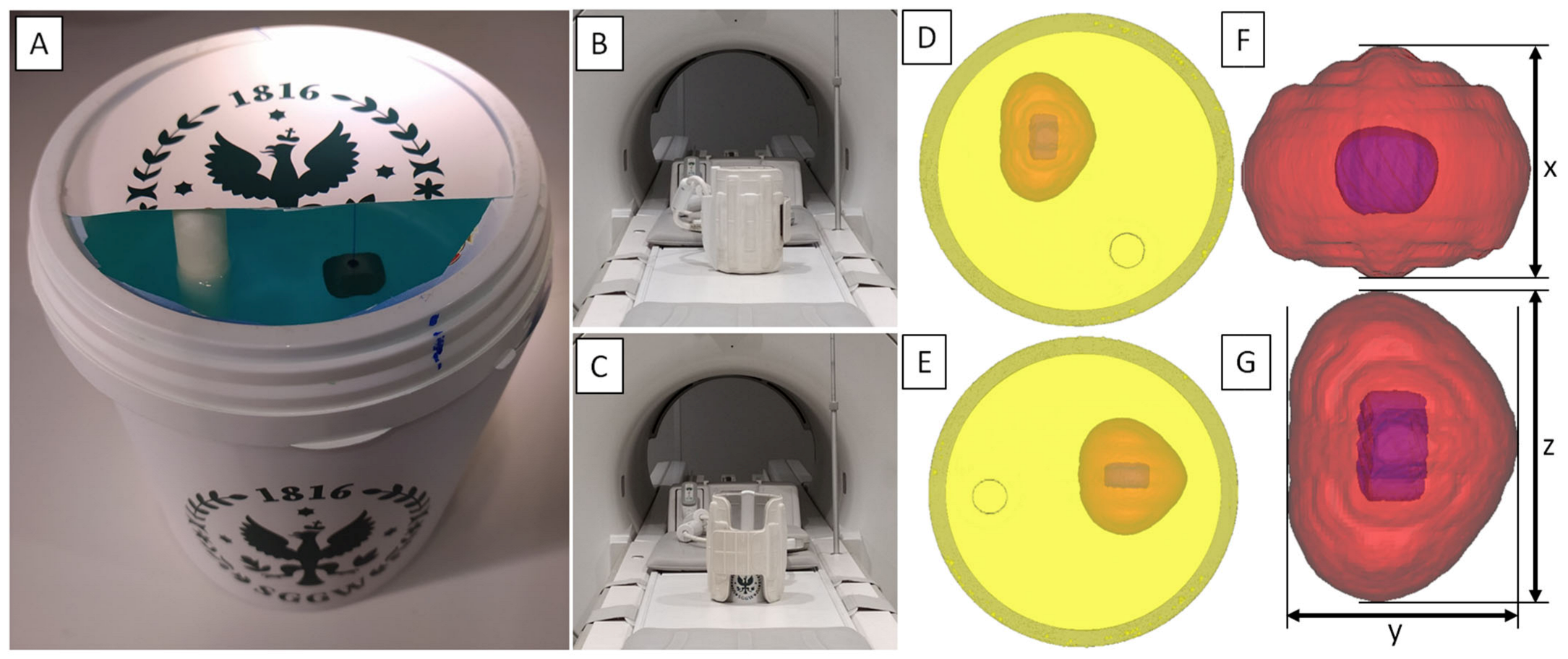
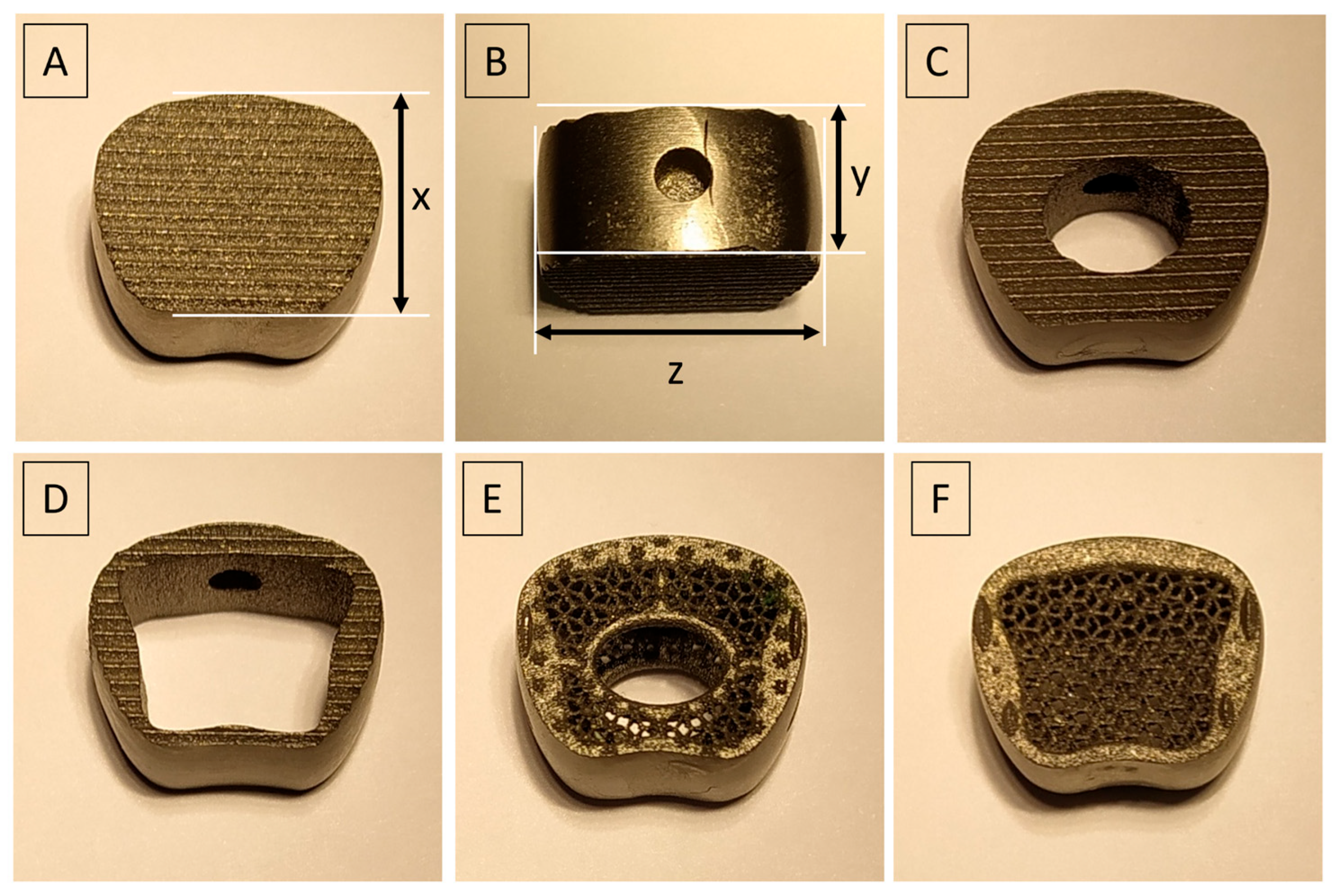
Five interbody cages with identical external geometry and different internal architectures were imaged using MR and computed tomography (CT). Interbody cages were manufactured from a titanium alloy (Ti64ELI; EOS GmbH Electro Optical Systems, Krailling, Germany) using the IsoFrame technology by 3D printing (Syntropiq s.r.o., Prague, Czechia). Studied interbody cages were MR-compatible. The external dimensions of each interbody cage were 13.30 mm in length (x), 8.75 mm in height (y), and 16.77 mm in width (z); while the internal architecture differed, as shown in Figure 1 and summarized in Table 1.
Interbody cages were represented by five coupled design variants that differed in metal volume, contact surface, layout (solid, frame-only, and frame-net), porosity, and hole geometry. The cage I prototype was a solid, non-porous cage with no metal volume reduction. The cage II prototype was a solid, non-porous cage with a central oval hole to reduce metal volume. The cage III prototype was a solid, non-porous frame with a central trapezoidal hole to reduce metal volume. The cage IV prototype was a solid frame with a porous internal net used to increase porosity and reduce metal volume, and a central oval hole used for the same purpose. The cage V prototype was a solid frame with a porous internal net used to increase porosity and reduce metal volume.

2.2. Interbody Cage Imaging

Interbody cages were imaged under the phantom conditions following the F2119-07 standard of the ASTM, characterizing the signal loss artifacts produced in an MR image by an implant that functions without the supply of electrical or external power (a passive implant) [22], expanded by the use of the advanced metal artifact reduction technique—the MAVRIC sequence. Two copies of the same prototype were imaged in three replicates, yielding six MR scan repetitions for each cage prototype.
The imaging phantom was made from a plastic container filled with a copper sulfate (CuSO4) (Siarczan Miedzi Pięciowodny; Biomus, Lublin, Poland) solution (2 g/L) to reduce T1 and maintain a reasonable repetition time (TR). A reference object in the form of a cylinder with a diameter of 13 mm and a length of 100 mm was manufactured from a non-distorting nylon (PA2200; EOS GmbH Electro Optical Systems, Krailling, Germany) by 3D printing (EOS Formiga P100 3D printer; EOS GmbH Electro Optical Systems, Krailling, Germany) and glued to the container lid. Interbody cages were sequentially immersed in a solution, as shown in Figure 2A, with >4 cm of clearance between the cage and each side of the container. Each cage was suspended on a surgical nylon thread (KRUUSE Nylon USP 2-0; KRUUSE, Langeskov, Denmark) and stabilized at the bottom of the container with an additional surgical nylon thread to prevent movement during transfer between scanners.
Each interbody cage prototype was MR-imaged for assessment of metal-induced signal loss artifacts and CT-imaged for precise visualization of cage position in the phantom.

2.2.1. Magnetic Resonance Imaging

MR imaging was performed using a high-field scanner (Discovery MR 750; GE Healthcare, Chicago, IL, USA) with a static field strength of 3.0 T and the ability to swap frequency directions. During MR imaging, GEM Flex Medium coil (GE Healthcare, Chicago, IL, USA), two pulse sequences—a spin-echo (SE) and gradient-echo (GRE), and an advanced metal artifact reduction technique—the MAVRIC sequence were used. The acquisition settings are summarized in Table 2 and used for SE and GRE sequences in accordance with the ASTM F2119-07 standard [22].
The phantom was positioned on the scanner table and leveled so that the solution mirror was parallel to the ground. The field of view was adjusted to encompass the entire interbody phantom. Each phantom with an interbody cage stably fixed inside was imaged in two orthogonal orientations relative to the B0, as shown in Figure 2B–E: the parallel orientation, with the long axis of the interbody cage positioned parallel to the B0; and the perpendicular orientation, with the long axis of the interbody cage positioned perpendicular to the B0. Images were saved in DICOM format. MR imaging of each cage prototype under the phantom conditions was performed by the same operator (K.S.).

2.2.2. Computed Tomography Imaging

CT imaging was performed using a multi-row scanner (Revolution CT, 64-rows; GE Healthcare, Chicago, IL, USA) and the following acquisition settings: helical scan mode, a current of 275 mA, a voltage of 120 kV, a gantry rotation of 0.08/s/HE+, a table travel of 39.4 mm/rotation, a pitch of 0.984:1, and a slice thickness of 0.625 mm. The phantom was positioned on the scanner table and leveled so that the solution mirror was parallel to the ground. The field of view and scan length were adjusted to encompass the entire phantom. Images were saved in DICOM format. CT imaging of each cage prototype under the phantom conditions was performed by the same operator (K.S.).

2.3. Image Processing

Image processing of both MR and CT images was performed using Materialise’s Interactive Medical Image Control System (MIMICS) software version 14.0 (Materialise HQ, Leuven, Belgium). Image processing was performed in two steps. The first step involves MR image processing to quantify signal loss artifacts (based on 3D models of voids and phantoms), while the second step involves superimposing MR and CT images to visualize signal-loss artifacts around the interbody cage prototype (also based on 3D models of voids, cages, and phantoms). Image processing was performed by the same researcher (K.J.).
To quantify signal loss artifacts, 3D models of voids and phantoms were generated from MR images. Voids represented areas around metal-made implants resulting from local inhomogeneities in the B0. During MR image processing, voids in each sequence and orientation to the B0 were thresholded to a fixed level, identical across all prototype types and series. For the SE sequence, the threshold level was 2700 Hounsfield units (HU); for the GRE sequence, the threshold level was 1800 HU; and for the MAVRIC sequence, the threshold level was 2500 HU. Threshold levels were fit visually to cover the entire extent of the black area in MR images, corresponding to voids. No additional manual correction was applied. As a result of image thresholding, 3D models of voids were obtained and integrated with 3D models of phantoms. Signal loss artifacts were quantified in the final MR-based 3D models by computing the following measurements: volume, surface area, and spatial extent (length (x) × height (y) × width (z)) of voids, as shown in Figure 2F,G.
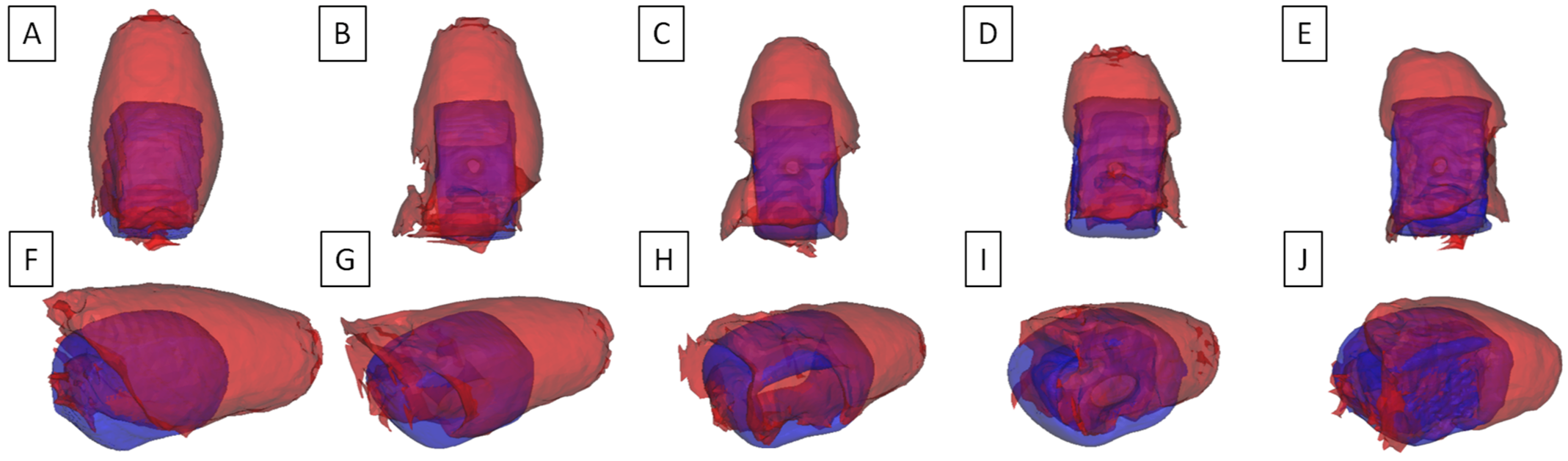
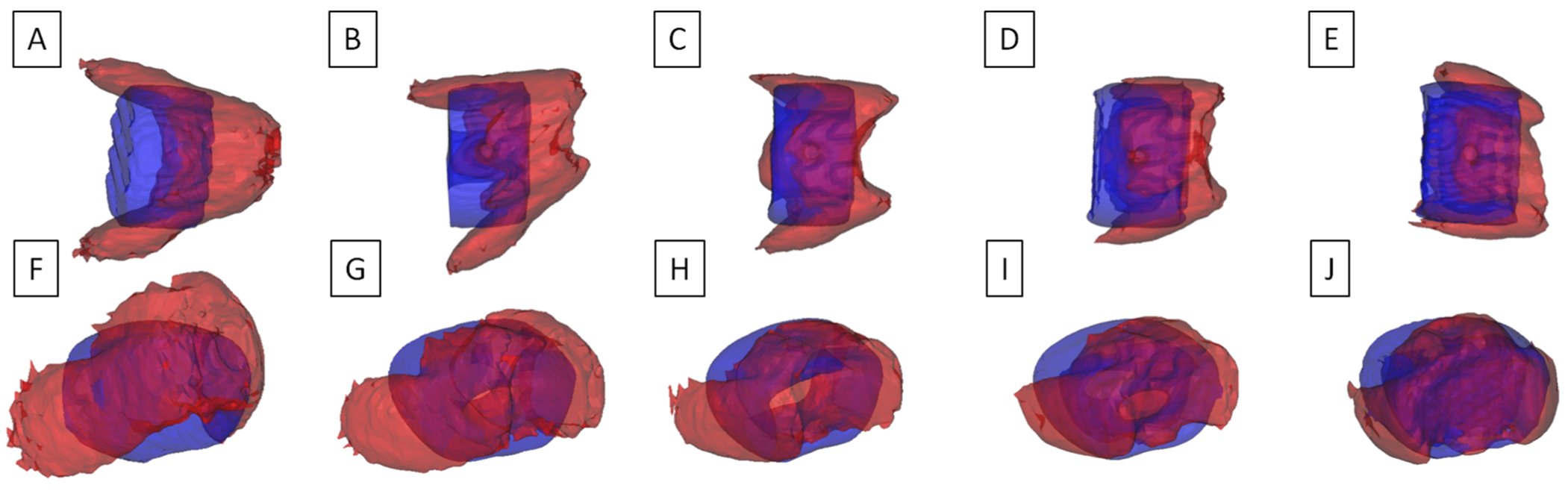
To visualize the position of the cage relative to the void, 3D models of cages and phantoms were created analogously from CT images, as interbody cages were not visible on MR images. Subsequently, MR-based 3D models and CT-based 3D models were superimposed at the same scale. The phantom border and the position of the reference object (a non-distorting nylon cylinder, with a diameter of 13 mm and length of 100 mm, always fixed in the same position within the phantom) were used as matching landmarks. Models matching was performed manually in GOM Inspect 2018 (GOM GmbH, Braunschweig, Germany). Consequently, signal loss artifacts were visualized relative to the corresponding void in the finally superimposed MR- and CT-based 3D models, presented in top and axonometric views.

2.4. Statistical Analysis

The dataset contained measurements from two copies of each prototype, with three replicates, yielding six realizations per cage prototype. Statistical analysis was performed in four steps. The first step involves calculating measurement repeatability; the second, reliability; the third, data distribution assessment; and the fourth, comparison of measurements across five prototypes of the interbody cage.
Repeatability was calculated to evaluate whether measurements were similar when repeated by using the same copy of each interbody cage prototype and imaging protocol. To assess repeatability, replicates (technical triplicates of the same imaging protocol) were evaluated by coefficient of variation (CoV) for the first (CoV 1) and second (CoV 2) copy of each cage prototype, where a lower CoV value indicates better repeatability. CoV < 5% indicated very high repeatability, and CoV < 10% indicated high repeatability [23].
Reliability was calculated to assess whether measurements were consistent when repeated across different copies of each interbody cage and the same imaging protocol. To assess reproducibility, cage replicates were evaluated using the intraclass correlation coefficient (ICC), with higher ICC values indicating better reliability. For ICC assessment, the single model most frequently encountered in clinical research was applied, assuming the same methods and operators perform the evaluations in all cases, since the same researcher carried out both MR and CT imaging on all the subjects (K.S.) and the same researcher carried out measurements on all the subjects (K.J.). ICC < 0.5 indicated poor reliability, ICC from 0.5 to 0.75 indicated moderate reliability, ICC from 0.75 to 0.9 indicated good reliability, and ICC > 0.90 indicated excellent reliability [24].
Data distribution was assessed for each measurement independently using the Kolmogorov–Smirnov test. Given that not all data series followed a normal distribution, results are presented as medians and ranges (minimum value; maximum value). Data series were compared as paired data using either a one-way repeated-measures ANOVA summary or a Friedman test, depending on distribution of the data. The repeated-measures ANOVA summary was applied when a normal distribution was confirmed for all compared data series. When at least one data series did not follow a normal distribution, the Friedman test was used. If significant differences were found, post hoc tests were performed. Holm–Sidak’s multiple comparisons test followed the repeated measures ANOVA summary, while Dunn’s multiple comparisons test followed the Friedman test. Differences were considered statistically significant at p < 0.05. Statistical analysis was performed using GraphPad Prism version 6 (GraphPad Software Inc., San Diego, CA, USA).

3. Results

3.1. Signal Loss Artifacts Around Interbody Cage Oriented Parallel to the B0

3.1.1. Signal Loss Artifacts in a Spin-Echo Sequence

Measures of voids around all interbody cage prototypes, imaged parallel to the B0 using a SE sequence, demonstrated high to very high repeatability and good to excellent reliability, as shown in Table 3.
When interbody cages were oriented parallel to the B0 and imaged with an SE sequence in the S/I frequency direction, the volume of signal loss artifacts decreased from prototype I to IV and V, with no difference between prototypes IV and V. The surface area of signal loss artifacts decreased from prototypes I and II to IV and V, with no difference between prototypes I and II, as well as prototypes IV and V. The length of signal loss artifacts was lower for prototype V than for prototypes I-III. The height of signal loss artifacts was lower for prototypes III-V than for prototypes I and II. The width of signal loss artifacts was lower for prototypes IV and V than for prototypes I and II, making the spatial extent of artifacts around prototype V most favorable.
When interbody cages were oriented parallel to the B0 and imaged with an SE sequence in the R/L frequency direction, the volume, length, and width of signal loss artifacts were lower for prototypes IV and V than for prototypes I and II. The surface area and height of signal loss artifacts decreased from prototype I to IV and V, with no difference between prototypes IV and V, making the spatial extent of artifacts around prototypes IV and V favorable.
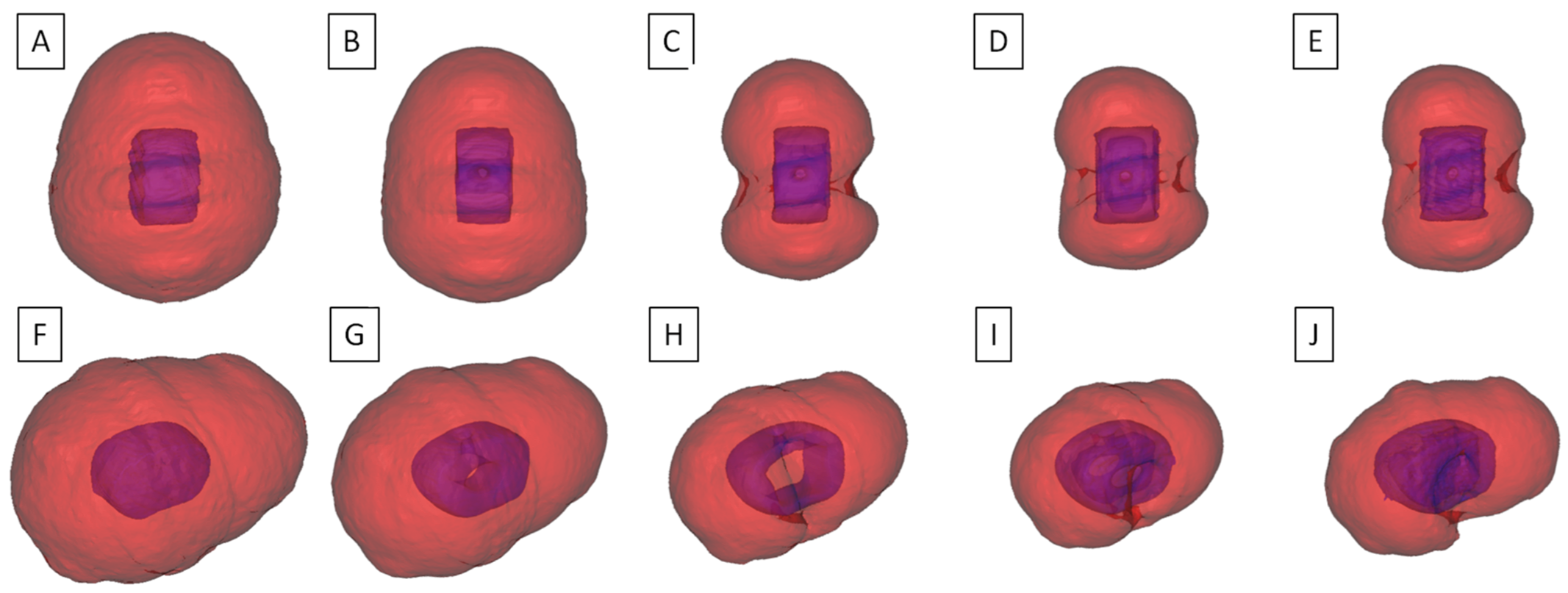
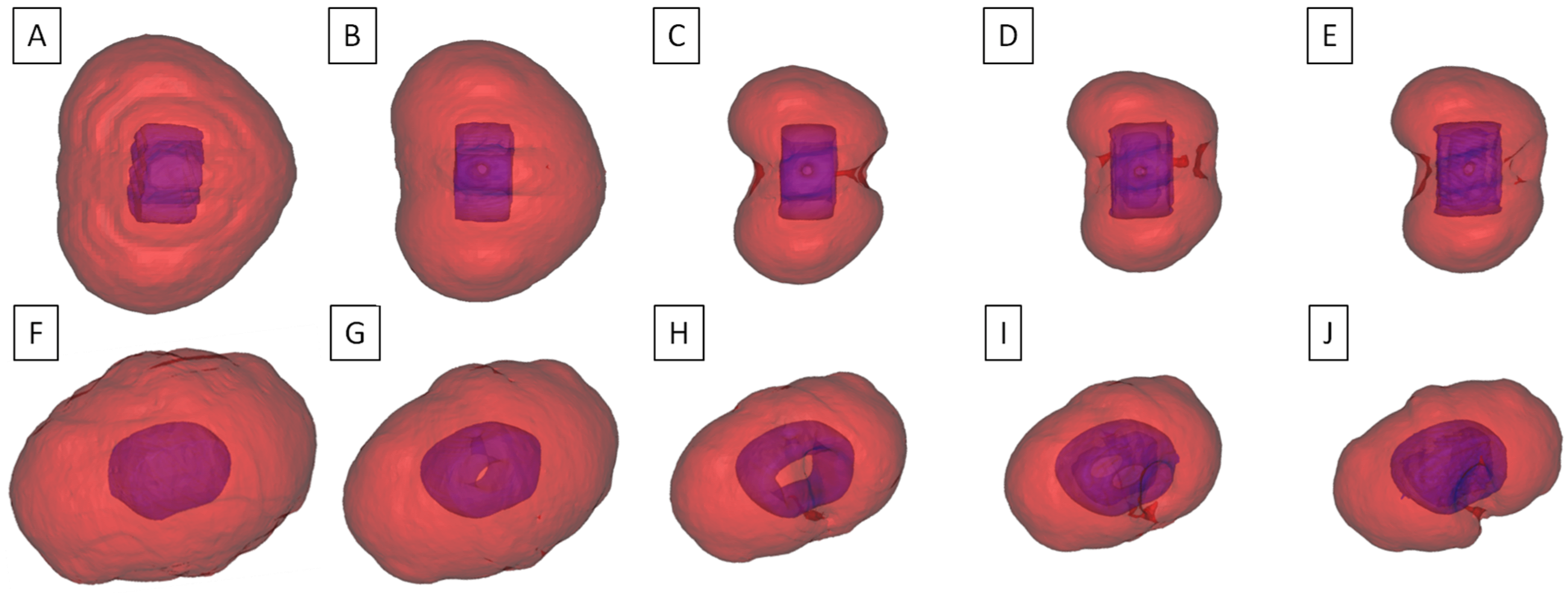
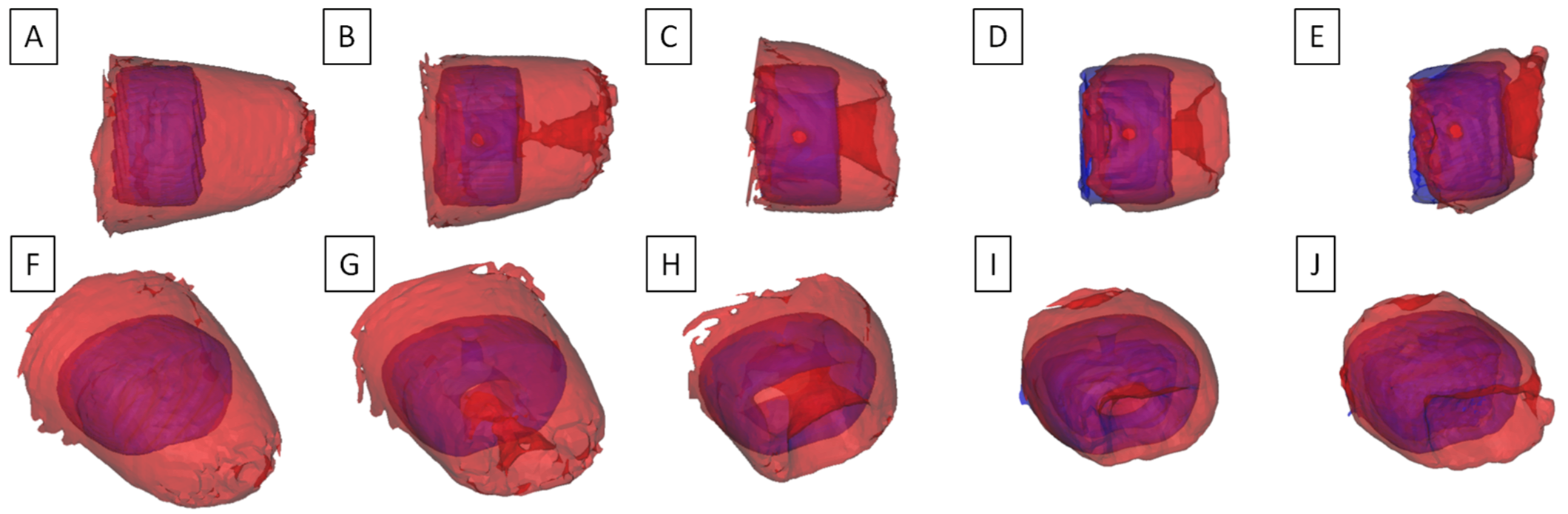
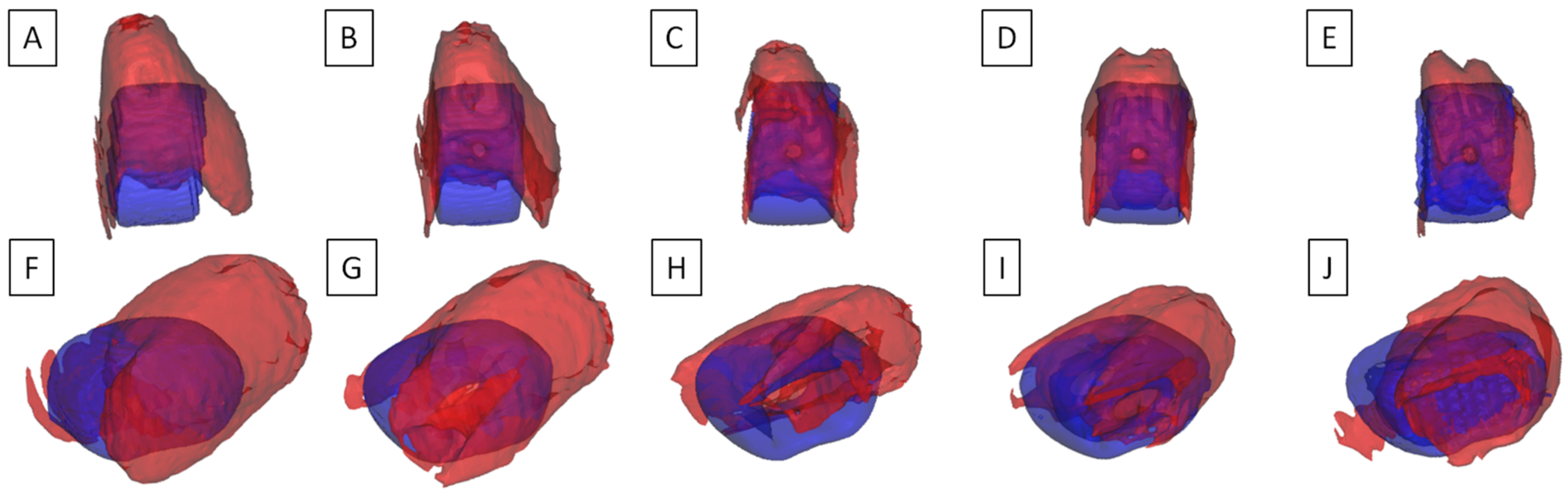
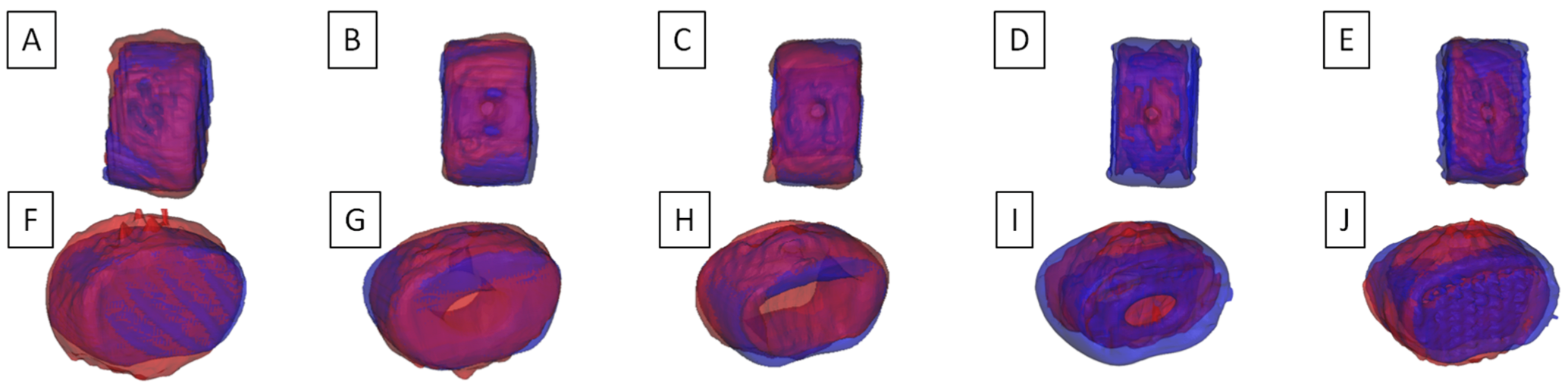
For this imaging condition, signal loss artifacts were quantified as shown in Table 4 and visualized in Figure 3 for the S/I frequency direction and in Figure 4 for the R/L frequency direction.

3.1.2. Signal Loss Artifacts in a Gradient-Echo Sequence

Measures of voids around all interbody cage prototypes, imaged parallel to the B0 using a GRE sequence, demonstrated high to very high repeatability and good to excellent reliability, as shown in Table 5.
When interbody cages were oriented parallel to the B0 and imaged with a GRE sequence in the S/I frequency direction, the volume and height of signal loss artifacts were lower for prototypes IV and V than for prototypes I and II. The surface area, length, and width of signal loss artifacts decreased from prototype I to IV and V, with no difference between prototypes IV and V, making the spatial extent of artifacts around prototypes IV and V favorable.
When interbody cages were oriented parallel to the B0 and imaged with a GRE sequence in the R/L frequency direction, the volume, height, and width of signal loss artifacts were lower for prototypes IV and V than for prototypes I and II. The surface area of signal loss artifacts decreased from prototype I to IV and V, with no difference between prototypes IV and V. The length of signal loss artifacts decreased from prototype I to IV and V, with no difference between prototypes III and IV, as well as between prototypes IV and V, making the spatial extent of artifacts around prototype V most favorable.
For this imaging condition, signal loss artifacts were quantified as shown in Table 6 and visualized in Figure 5 for the S/I frequency direction and in Figure 6 for the R/L frequency direction.

3.1.3. Signal Loss Artifacts in a MAVRIC Sequence

Measures of voids around all interbody cage prototypes, imaged parallel to the B0 using a MAVRIC sequence, demonstrated high to very high repeatability and good to excellent reliability, as shown in Table 7.
When interbody cages were oriented parallel to the B0 and imaged with a MAVRIC sequence in both frequency directions, no differences were observed between prototypes in the volumes, surface areas, lengths, or widths of signal-loss artifacts. No difference between prototypes was also observed for the height of signal loss artifacts imaged with the R/L frequency direction; however, when imaged with the S/I frequency direction, the height of signal loss artifacts was lower for prototype IV than for prototypes III and IV.
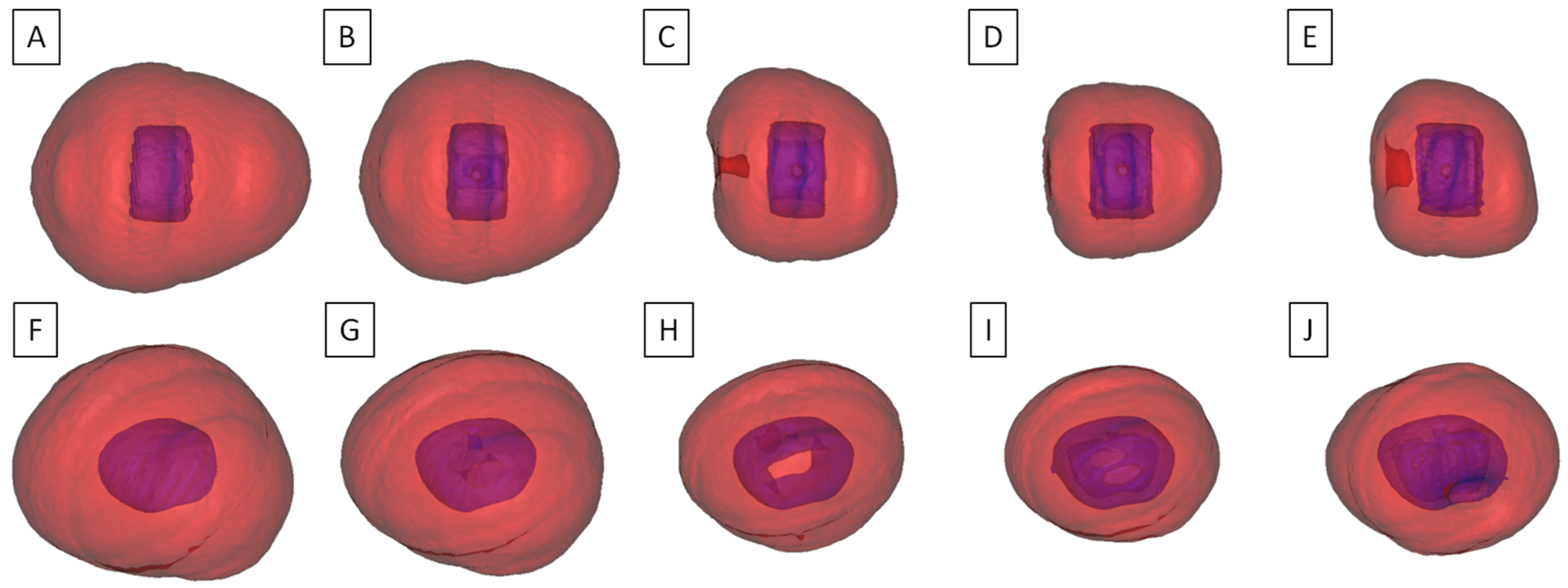
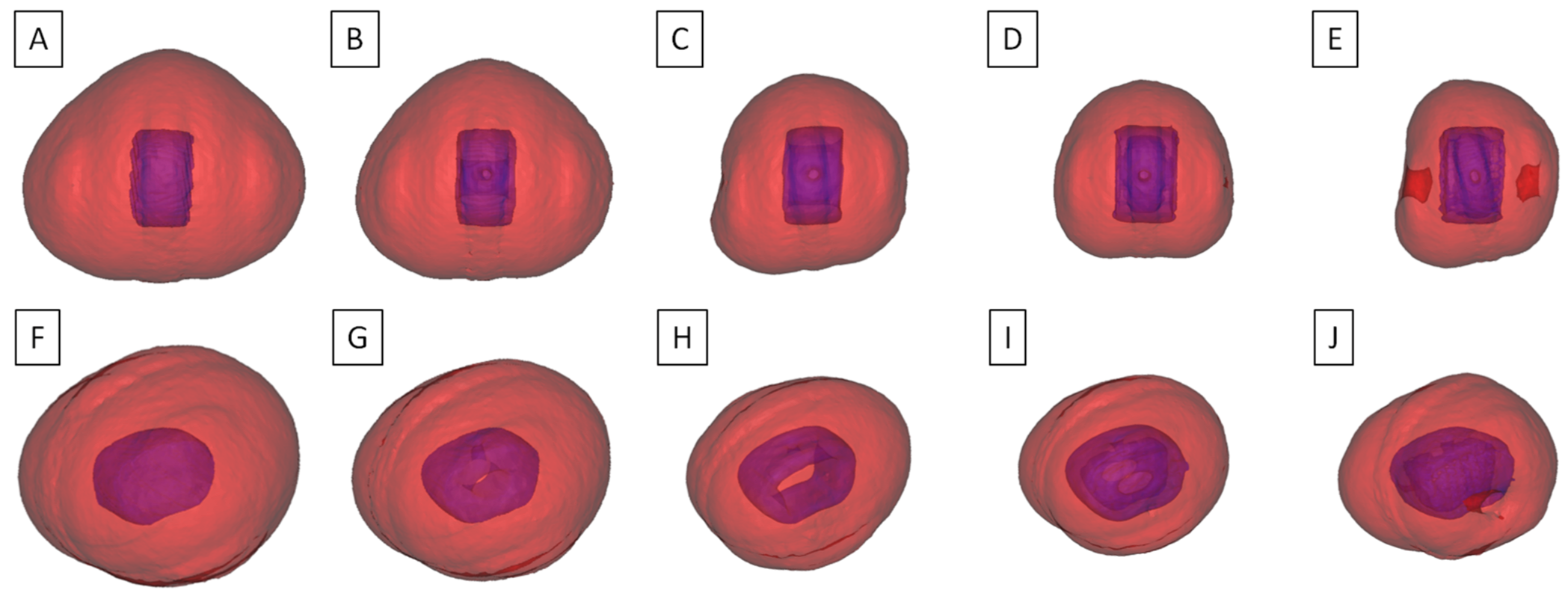
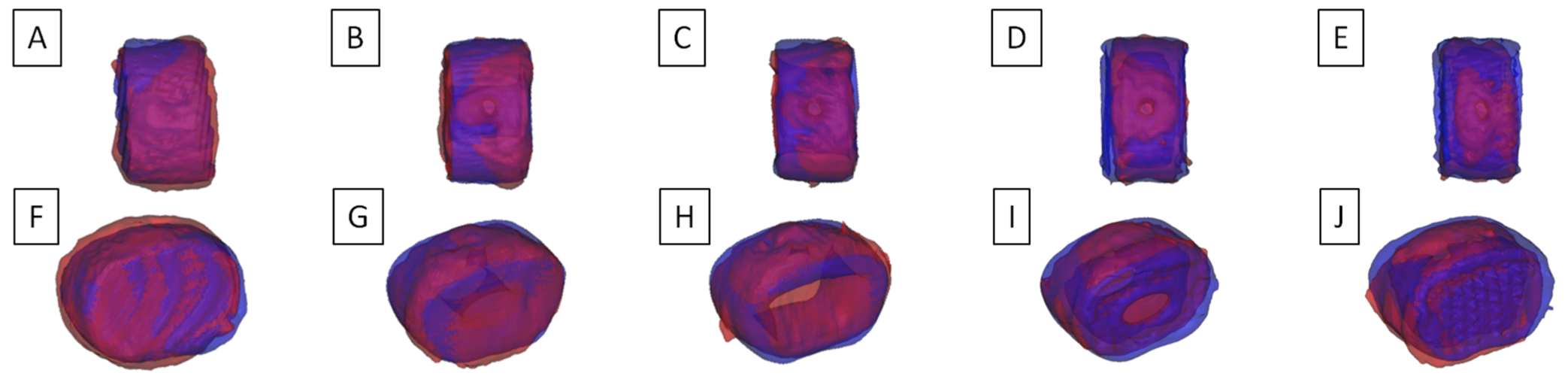
For this imaging condition, signal loss artifacts were quantified as shown in Table 8 and visualized in Figure 7 for the S/I frequency direction and in Figure 8 for the R/L frequency direction.

3.2. Signal Loss Artifacts Around Interbody Cage Oriented Perpendicular to the B0

3.2.1. Signal Loss Artifacts in a Spin-Echo Sequence

Measures of voids around all interbody cage prototypes, imaged perpendicular to the B0 using a SE sequence, demonstrated high to very high repeatability and good to excellent reliability, as shown in Table 9.
When interbody cages were oriented perpendicular to the B0 and imaged with a SE sequence in the S/I frequency direction, the volume of signal loss artifacts decreased from prototype I to V, making the spatial extent of artifacts around prototype V most favorable. The surface area of signal loss artifacts decreased from prototype I to IV and V, with no difference between prototypes IV and V. The length of signal loss artifacts was lower for prototype V than for prototypes I-III. The height and width of signal loss artifacts were lower for prototypes IV and V than for prototypes I and II.
When interbody cages were oriented perpendicular to the B0 and imaged with an SE sequence in the R/L frequency direction, the volume and length of signal loss artifacts decreased from prototype I to V, making the spatial extent of artifacts around prototype V most favorable. The surface area of signal loss artifacts was lower for prototype V than for prototypes I-III. The height of signal loss artifacts was lower for prototypes IV and V than for prototype I. The width of signal loss artifacts was lower for prototype IV than for prototype II.
For this imaging condition, signal loss artifacts were quantified as shown in Table 10 and visualized in Figure 9 for the S/I frequency direction and in Figure 10 for the R/L frequency direction.

3.2.2. Signal Loss Artifacts in a Gradient-Echo Sequence

Measures of voids around all interbody cage prototypes, imaged perpendicular to the B0 using a GRE sequence, demonstrated high to very high repeatability and good to excellent reliability, as shown in Table 11.
When interbody cages were oriented perpendicular to the B0 and imaged with a GRE sequence in the S/I frequency direction, the volume, length, and width of signal loss artifacts decreased from prototype I to IV and V, with no difference between prototypes IV and V. The surface area of signal loss artifacts decreased from prototype I to V, making the spatial extent of artifacts around prototype V most favorable. The height of signal loss artifacts was lower for prototypes IV and V than for prototypes I and II.
When interbody cages were oriented perpendicular to the B0 and imaged with a GRE sequence in the R/L frequency direction, the volume, surface area, and width of signal loss artifacts decreased from prototype I to IV and V, with no difference between prototypes IV and V. The length and height of signal loss artifacts were lower for prototypes IV and V than for prototypes I and II, making the spatial extent of artifacts around prototypes IV and V favorable.
For this imaging condition, signal loss artifacts were quantified as shown in Table 12 and visualized in Figure 11 for the S/I frequency direction and in Figure 12 for the R/L frequency direction.

3.2.3. Signal Loss Artifacts in a MAVRIC Sequence

Measures of voids around all interbody cage prototypes, imaged perpendicular to the B0 using a MAVRIC sequence, demonstrated high to very high repeatability and good to excellent reliability, as shown in Table 13.
When interbody cages were oriented perpendicular to the B0 and imaged with a MAVRIC sequence in the S/I frequency direction, the volume of signal loss artifacts decreased from prototype I to prototype V, making the spatial extent of artifacts around prototype V most favorable. The surface area of signal loss artifacts was lower for prototypes IV and V than for prototypes I and II. The length of signal loss artifacts was lower for prototype V than for prototype I. The width of signal loss artifacts was lower for prototype II than for prototypes I and III.
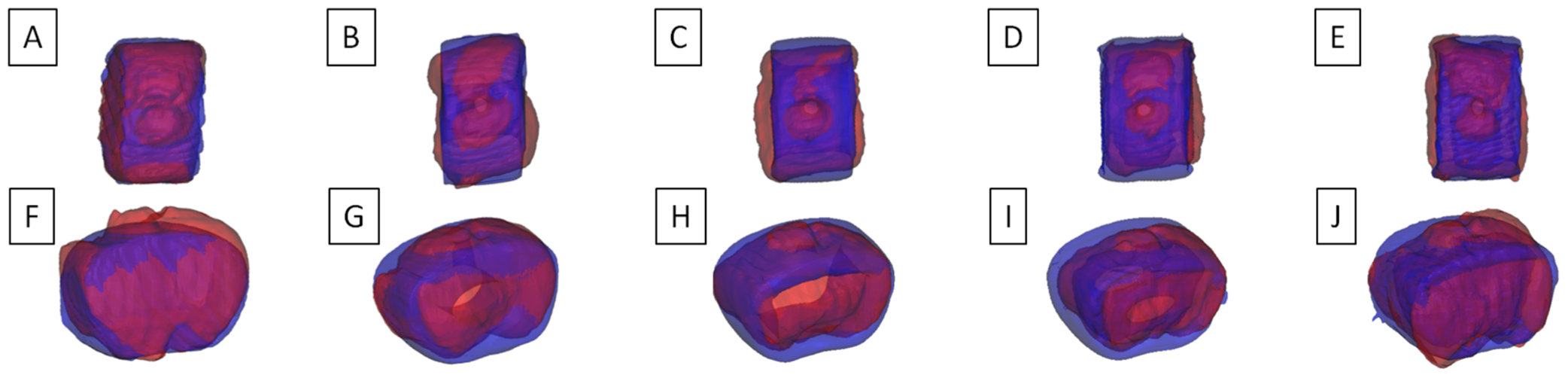
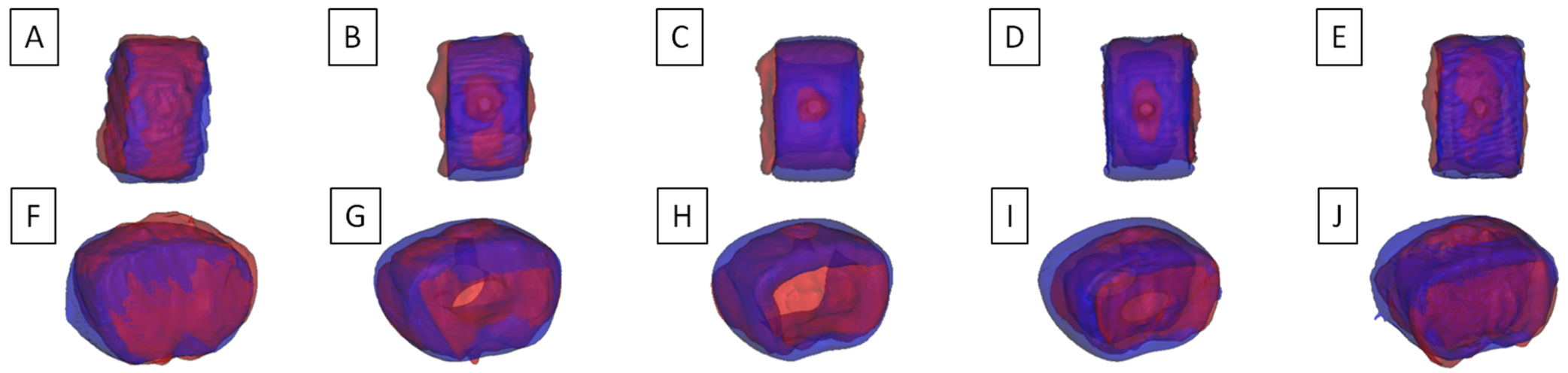
When interbody cages were oriented perpendicular to the B0 and imaged with a MAVRIC sequence in the R/L frequency direction, the volume of signal loss artifacts was lower for prototypes III-V than for prototypes I and II. The surface area of signal loss artifacts was lower for prototypes IV and V than for prototypes I and II. No difference between prototypes was observed in the length, height, and width of signal loss artifacts. For this imaging condition, signal loss artifacts were quantified as shown in Table 14 and visualized in Figure 13 for the S/I frequency direction and in Figure 14 for the R/L frequency direction.

4. Discussion

MR imaging is the gold standard for diagnostic purposes, particularly follow-up assessment after spinal surgical procedures, due to its excellent soft-tissue contrast and ability to evaluate muscles, ligaments, intervertebral disks, and neural structures [25,26].
In follow-up imaging, one of the primary goals in the postsurgical period is to detect potential complications. In the early period, MR imaging is most commonly indicated to detect surgical-related spinal cord injury or cord compression caused by incorrect implant placement and hemorrhage [12,26]. In the longer-term follow-up, MR imaging is indicated to identify infections and paraspinal fluid collections [12]. However, MR imaging of the region adjacent to a titanium implant is challenging due to the formation of metal-induced artifacts. These artifacts result from local inhomogeneities in the B0 magnetic field caused by differences in magnetic susceptibility between titanium implants and surrounding tissues [17]. Such an inhomogeneous B0 field may manifest as three main effects: signal loss and pile-up artifacts, geometric distortion of imaged structures, and failure of fat suppression [17,18].
In this study, geometric distortion and fat-suppression failure were not assessed due to the phantom-based study design. In this study type, a phantom filled with a homogeneous CuSO4 solution, in accordance with ASTM guidelines [22]. Fat suppression failure could not be evaluated due to the absence of fat within the imaging field of view, while no geometric distortion was detected in any phantom, either in the image of the homogeneous solution or in the image of the reference object positioned close to the interbody cage. Therefore, a descriptive comparison of five prototypes of titanium interbody cages regarding geometric distortion and fat-suppression failure should be investigated in future cadaveric or in vivo studies. Moreover, in this study, pile-up artifacts were modeled jointly with signal loss artifacts. Pile-up artifacts were observed only in SE sequences, appearing as narrow rims located on the edges of voids, and were effectively shifted by changing the frequency direction from S/I to R/L. In contrast, signal loss artifacts were most prominently observed in this experimental model, particularly in regions adjacent to titanium interbody cages. Moreover, the extent of these artifacts demonstrated high to very high repeatability and good to excellent reliability across all studied imaging sequences and orientations to the B0 field, enabling internal validation of the derived measurements. Therefore, it can be stated that the quantified extent of these artifacts varied between the cage prototypes, making prototype V—porous cage with an internal net structure, but without a centrally positioned hole—potentially most favorable for improving the diagnostic performance of 3T MR imaging around titanium implants.
Notable, the measured spatial extent of signal loss artifacts varied between cage prototypes when imaged with SE and GRE sequences; in this, it frequently decreased from prototype I to prototypes IV and V, with or without a difference between prototypes IV and V. One may observe that, unlike prototypes I-III, both favorable prototypes IV and V represented specific internal architectures composed of a solid frame with an interior net, enabling porosity. Consequently, prototypes IV and V were characterized by lower metal volume and higher contact surface. Although these results were obtained under phantom conditions, it may be suggested that, during in vivo MR imaging, diagnostically useful information can be obtained from tissues adjacent to the titanium cage when a prototype with a modified internal frame-net architecture is used. Interestingly, the cage prototype V, which produced the smallest signal loss artifacts, was characterized not only by the lowest metal volume but also by the largest contact surface area. This modification was achieved using IsoFrame technology—a 3D-printed method designed to reduce metal volume while maintaining high durability and increasing endplate contact surface area. This approach reflects current trends in implant manufacturing, where porous and frame-net designs are increasingly used in both human [27] and equine veterinary medicine [28]. Thus, the IsoFrame concept aligns with the broader shift toward optimizing implant architecture. The presented findings indicate that this modern modification of titanium interbody cage architecture—considering replacing a solid cage with a frame-net structure—not only improves the biomechanical properties of the implant, particularly osseointegration [27,29], while preserving implant functionality, but also enhances the clinical utility of MR imaging by reducing signal-loss artifacts. In this context, using the example of an interbody cage, our findings provide a valuable starting point for further research on how modifications of the coupled design of titanium implants influence the formation of signal-loss artifacts in MR imaging.
Moreover, the visual extent of signal loss artifacts varied depending on the imaging sequence used and the orientation relative to the B0 field. It should be noted that the visual extent of the observed artifacts was more extensive when imaged with a GRE sequence than with an SE sequence. This suggests that, during in vivo MR imaging, diagnostically useful information may still be obtained from tissues located close to the titanium cage when an SE sequence is used. Given that multiple sequences are clinically required for accurate MR image interpretation, modern MR imaging acquisition techniques—such as MAVRIC [17,30,31], view-angle tilting (VAT) [17,30], and slice encoding for metal artifact correction (SEMAC) [15,32]—have been developed for advanced metal artifact reduction. In this study, the MAVRIC sequence was applied and produced a visibly smaller extent of artifacts compared with both GRE and SE sequences. Since the MAVRIC sequence is specifically designed to reduce artifacts around metal implants, it is expected that the artifact void size would be reduced equally effectively across all cage prototypes. While this was largely true for imaging performed parallel to the B0 field, where predominantly no differences in void measurements were observed between prototypes, imaging performed perpendicular to the B0 field revealed numerous quantitative differences between cage prototypes, particularly in favor of prototypes IV and V. This observation indicates that, even when advanced metal artifact reduction techniques are applied, sequence optimization remains necessary [33].
This observation also has practical implications, suggesting that patients should be positioned so that the implant’s long axis is parallel to the B0 field [34]. However, in clinical practice, patient positioning is largely limited by bore size and constrained by standard imaging protocols, where the spine is aligned with the B0 field [27]. As a result, the implant is typically oriented perpendicular to the B0 field. Therefore, from a practical standpoint, the measurements obtained for the perpendicular orientation of the interbody cage are likely to be more clinically relevant. However, the clinical relevance of the obtained voids may be improved not only by reducing their size but also by altering their location. Appropriate adjustment of the frequency direction can shift the signal loss artifacts away from clinically important anatomical structures to less critical regions [17]. Accordingly, clear differences in artifact location were observed between the S/I and R/L frequency directions. Despite the less pronounced difference in the measurements of these artifacts between frequency directions, appropriate redirection of artifact position may be clinically useful. However, this hypothesis should also be further investigated in future cadaveric or in vivo studies.
It should be noted that, according to ASTM guidelines, a slice thickness of 3 mm is recommended [22]. However, in this experimental setup, the thinnest possible slice thickness was used—ranging from 1 mm for SE and GRE sequences to 1.8 mm for the MAVRIC sequence—to ensure accurate 3D modeling of the voids, cages, and phantoms. Nevertheless, it should be noted that, according to spinal imaging guidelines for humans, an axial slice thickness of 4 mm is recommended for 3.0 T MR imaging [32]. Similarly, in equine spinal cord imaging, a 5 mm axial slice thickness is commonly used [35]. Therefore, although the present study provides quantified and visualized geometries of signal-loss artifacts around titanium interbody cages, their clinical extent may differ not only because of the transition from phantom to in vivo conditions but also due to potential alterations in the true artifact geometry resulting from differences in slice thickness. Consequently, further studies are needed to determine the effect of slice thickness on the spatial extent of signal-loss artifacts under phantom conditions. Such investigations would help establish the range of artifact sizes expected during clinical MR imaging under conditions commonly encountered in follow-up assessments after spinal surgery. It should also be noted that the studied interbody cage prototypes represent a standard human cervical interbody cage design. Given that standard human lumbar interbody cages [2,3,7,8,16,25,26,36] and standard equine cervical interbody cages [5,9,37] are larger and differ from the studied prototypes in external architecture, future investigations of artifact size ranges should also address the effects of cage size and external cage architecture on final imaging outcomes. Therefore, the applicability of the present study’s results to spinal surgery in both humans and veterinary medicine is currently limited.
Therefore, the main limitation of this study is its potentially limited applicability to clinical spine surgery, particularly its narrow external validity and lack of cadaver or in vivo validation. Since the experiments were conducted strictly in accordance with the ASTM protocol [22], this was a homogeneous phantom study focused solely on signal-loss voids and does not establish in vivo performance, cadaveric relevance, diagnostic interpretability, or clinical utility. These limitations should be thoroughly addressed in future studies involving repeated measurements under conditions more closely resembling clinical practice, including cadaveric and subsequently in vivo investigations. For this reason, any claims of favorable spinal MR imaging follow-up or improved postsurgical monitoring remain speculative and should be interpreted cautiously, given the limitations inherent to the phantom study design. An additional limitation lies in the evaluation of only one type of interbody cage. This could be expanded to include a wider range of implants used in both human [36,38] and equine veterinary medicine [9,28,37,39]. Additional factors, such as implant size and geometry, are likely to influence artifact characteristics. For example, spinal interbody devices used in horses are often not simple symmetrical cages, but rather more complex constructs combining spacers, plates, and screws [9,40]. Including such designs in future studies would provide a more comprehensive understanding of how not only the internal implant architecture but also the overall implant design affects the spatial extent of signal loss artifacts during MR imaging, ultimately supporting the development of implants that are both biologically and radiologically optimal.

5. Conclusions

The spatial extent of metal-induced signal loss artifacts varied among the five titanium interbody cage prototypes studied under phantom conditions. Given the high to very high repeatability and good to excellent reliability across SE, GRE, and MAVRIC sequences, as well as in both parallel and perpendicular orientations to the B0 field, the obtained measurements likely reflect the true artifact geometry. The quantified extent of signal loss artifacts was most favorable for the prototype characterized by a specific internal architecture comprising a solid frame with an interior net structure that enabled porosity. Under the applied MR imaging settings, the porous cage with a frame-net layout, but without a centrally positioned hole, produced the lowest artifact volume, surface area, and dimensions of signal loss artifacts. However, the potential translation of these findings to clinical spine surgery remains limited, as the phantom conditions do not establish cadaveric relevance, in vivo performance, diagnostic interpretability, or clinical utility. These aspects should be addressed in future studies.

Author Contributions

Conceptualization, K.S., K.J. and T.J.; methodology, K.S., K.J. and T.J.; software, K.J.; validation, B.T. and M.B.; formal analysis, K.S., K.J. and T.J.; investigation, K.S., K.J., T.J., B.T., M.B. and M.D.; resources, K.S., K.J. and T.J.; data curation, K.S.; writing—original draft preparation, K.S., K.J., T.J., B.T., M.B. and M.D.; writing—review and editing, K.S., K.J., T.J., B.T., M.B. and M.D.; visualization, K.S. and K.J.; supervision, T.J., B.T. and M.D.; project administration, K.S. and T.J. All authors have read and agreed to the published version of the manuscript.

Funding

This research received no external funding.

Institutional Review Board Statement

Not applicable.

Informed Consent Statement

Not applicable.

Data Availability Statement

The data presented in this study are available upon request from the corresponding author.

Acknowledgments

The authors are sincerely grateful to Syntropiq s.r.o., especially Grzegorz Moczko, for providing interbody cages and professional on-site support.

Conflicts of Interest

The authors declare no conflicts of interest.

References

  1. Zdeblick, T.A.; Phillips, F.M. Interbody cage devices. Spine 2003, 28, S2–S7. [Google Scholar] [CrossRef]
  2. Chen, D.; Fay, L.A.; Lok, J.; Yuan, P.; Edwards, W.T.; Yuan, H.A. Increasing neuroforaminal volume by anterior interbody distraction in degenerative lumbar spine. Spine 1995, 20, 74–79. [Google Scholar] [CrossRef]
  3. Cheers, G.M.; Weimer, L.P.; Neuerburg, C.; Arnholdt, J.; Gilbert, F.; Thorwächter, C.; Laubach, M. Advances in implants and bone graft types for lumbar spinal fusion surgery. Biomater. Sci. 2024, 12, 4875–4902. [Google Scholar] [CrossRef]
  4. Bagby, G.W. Arthrodesis by the distraction-compression method using a stainless steel implant. Orthopedics 1988, 11, 931–934. [Google Scholar] [CrossRef]
  5. Walmsley, J.P. Surgical treatment of cervical spinal cord compression in horses: A European experience. Equine Vet. Educ. 2005, 17, 39–43. [Google Scholar] [CrossRef]
  6. Crecan, C.M. Equine cervical vertebral interbody fusion, a narrative review. Authorea Prepr. 2023, 1–10. [Google Scholar] [CrossRef]
  7. Chatham, L.S.; Patel, V.V.; Yakacki, C.M.; Dana Carpenter, R. Interbody spacer material properties and design conformity for reducing subsidence during lumbar interbody fusion. J. Biomech. Eng. 2017, 139, 051005. [Google Scholar] [CrossRef] [PubMed]
  8. Chung, S.S.; Lee, K.J.; Kwon, Y.B.; Kang, K.C. Characteristics and efficacy of a new 3-dimensional printed mesh structure titanium alloy spacer for posterior lumbar interbody fusion. Orthopedics 2017, 40, e880–e885. [Google Scholar] [CrossRef] [PubMed]
  9. Vercherin, A.; Lischer, C.J.; Schweitzer, A.C.; Gernhardt, J.; Rossignol, F. 3D-printed titanium cervical integrated spacer for C6-C7 fusion in a horse with discospondylitis. Vet. Surg. 2025, 54, 1257–1264. [Google Scholar] [CrossRef]
  10. Kumar, N.; Alathur Ramakrishnan, S.; Lopez, K.G.; Wang, N.; Madhu, S.; Vellayappan, B.A.; Kumar, A.S. Design and 3D printing of novel titanium spine rods with lower flexural modulus and stiffness profile with optimised imaging compatibility. Eur. Spine J. 2023, 32, 1953–1965. [Google Scholar] [CrossRef]
  11. Girão, M.M.V.; Miyahara, L.K.; Dwan, V.S.Y.; Baptista, E.; Taneja, A.K.; Gotfryd, A.; do Amaral e Castro, A. Imaging features of the postoperative spine: A guide to basic understanding of spine surgical procedures. Insights Imaging 2023, 14, 103. [Google Scholar] [CrossRef] [PubMed]
  12. Ortiz, A.O.; de Moura, A.; Johnson, B.A. Postsurgical spine: Techniques, expected imaging findings, and complications. Semin. Ultrasound CT MRI 2018, 39, 630–650. [Google Scholar] [CrossRef] [PubMed]
  13. Wang, X.; Xu, S.; Zhou, S.; Xu, W.; Leary, M.; Choong, P.; Xie, Y.M. Topological design and additive manufacturing of porous metals for bone scaffolds and orthopaedic implants: A review. Biomaterials 2016, 83, 127–141. [Google Scholar] [CrossRef]
  14. Zhang, H.; Fu, R.; Zhu, X. Multi-scale topology optimisation design and mechanical property analysis of porous interbody fusion cage. Biomed. Mater. Eng. 2025, 36, 110–123. [Google Scholar] [CrossRef] [PubMed]
  15. Lee, J.J.; Jacome, F.P.; Hiltzik, D.M.; Pagadala, M.S.; Hsu, W.K. Evolution of titanium interbody cages and current uses of 3D printed titanium in spine fusion surgery. Curr. Rev. Musculoskelet. Med. 2025, 18, 635–644. [Google Scholar] [CrossRef]
  16. Donaldson, C.; Santro, T.; Awad, M.; Morokoff, A. 3D-printed titanium alloy cage in anterior and lateral lumbar interbody fusion for degenerative lumbar spine disease. J. Spine Surg. 2024, 10, 22–29. [Google Scholar] [CrossRef]
  17. Feuerriegel, G.C.; Sutter, R. Managing hardware-related metal artifacts in MRI: Current and evolving techniques. Skelet. Radiol. 2024, 53, 1737–1750. [Google Scholar] [CrossRef]
  18. Germann, C.; Nanz, D.; Sutter, R. Magnetic resonance imaging around metal at 1.5 Tesla: Techniques from basic to advanced and clinical impact. Invest. Radiol. 2021, 56, 734–748. [Google Scholar] [CrossRef]
  19. Van Speybroeck, C.D.E.; O’Reilly, T.; Teeuwisse, W.; Arnold, P.M.; Webb, A.G. Characterization of displacement forces and image artifacts in the presence of passive medical implants in low-field (<100 mT) permanent magnet-based MRI systems, and comparisons with clinical MRI systems. Phys. Med. 2021, 84, 116–124. [Google Scholar] [CrossRef]
  20. Chiba, Y.; Murakami, H.; Sasaki, M.; Endo, H.; Yamabe, D.; Kinno, D.; Doita, M. Quantification of metal-induced susceptibility artifacts associated with ultrahigh-field magnetic resonance imaging of spinal implants. JOR Spine 2019, 2, e1064. [Google Scholar] [CrossRef]
  21. Janes, J.G.; Garrett, K.S.; McQuerry, K.J.; Pease, A.P.; Williams, N.M.; Reed, S.M.; MacLeod, J.N. Comparison of magnetic resonance imaging with standing cervical radiographs for evaluation of vertebral canal stenosis in equine cervical stenotic myelopathy. Equine Vet. J. 2014, 46, 681–686. [Google Scholar] [CrossRef]
  22. ASTM F2119-07; Standard Test Method for Evaluation of MR Image Artifacts from Passive Implants. ASTM International: West Conshohocken, PA, USA, 2007.
  23. Bertens, C.J.; van Mechelen, R.J.; Berendschot, T.T.; Gijs, M.; Wolters, J.E.; Gorgels, T.G.; Nuijts, R.M.M.A.; Beckers, H.J.M. Repeatability, reproducibility, and agreement of three tonometers for measuring intraocular pressure in rabbits. Sci. Rep. 2021, 11, 19217. [Google Scholar] [CrossRef]
  24. Koo, T.K.; Li, M.Y. A guideline of selecting and reporting intraclass correlation coefficients for reliability research. J. Chirop. Med. 2016, 15, 155–163. [Google Scholar] [CrossRef]
  25. Van Goethem, J.; Parizel, P.; Jinkins, J. MRI of the postoperative lumbar spine. Neuroradiology 2002, 44, 723–739. [Google Scholar] [CrossRef]
  26. Crocker, M.; Jones, T.L.; Rich, P.; Bell, B.A.; Papadopoulos, M.C. The clinical value of early postoperative MRI after lumbar spine surgery. Br. J. Neurosurg. 2010, 24, 46–50. [Google Scholar] [CrossRef]
  27. Duarte, R.; Ramos, A. Spine Interbody Fusion Cages: Concepts, Design Trends, and Emerging Personalized Solutions. Prosthesis 2026, 8, 27. [Google Scholar] [CrossRef]
  28. Tucker, R.; Anderson, J.; Schmidt, S.M.; Stavisky, J. Disorders of the cervical vertebral column part 2: Update on current surgical techniques. Equine Vet. Educ. 2026, 38, 46–57. [Google Scholar] [CrossRef]
  29. Fogel, G.; Martin, N.; Lynch, K.; Pelletier, M.H.; Wills, D.; Wang, T.; Jekir, M. Subsidence and fusion performance of a 3D-printed porous interbody cage with stress-optimized body lattice and microporous endplates-a comprehensive mechanical and biological analysis. Spine J. 2022, 22, 1028–1037. [Google Scholar] [CrossRef] [PubMed]
  30. Filli, L.; Jud, L.; Luechinger, R.; Nanz, D.; Andreisek, G.; Runge, V.M.; Farshad-Amacker, N.A. Material-dependent implant artifact reduction using SEMAC-VAT and MAVRIC: A prospective MRI phantom study. Invest. Radiol. 2017, 52, 381–387. [Google Scholar] [CrossRef] [PubMed]
  31. Jungmann, P.M.; Agten, C.A.; Pfirrmann, C.W.; Sutter, R. Advances in MRI around metal. JMRI 2017, 46, 972–991. [Google Scholar] [CrossRef] [PubMed]
  32. Sollmann, N.; Fields, A.J.; O’Neill, C.; Nardo, L.; Majumdar, S.; Chin, C.T.; Krug, R. Magnetic resonance imaging of the lumbar spine: Recommendations for acquisition and image evaluation from the BACPAC Spine Imaging Working Group. Pain Med. 2023, 24, S81–S94. [Google Scholar] [CrossRef]
  33. Buckwalter, K.A. Optimizing imaging techniques in the postoperative patient. Semin. Musculoskelet. Radiol. 2007, 11, 261–272. [Google Scholar] [CrossRef]
  34. Ganapathi, M.; Joseph, G.; Savage, R.; Jones, A.R.; Timms, B.; Lyons, K. MRI susceptibility artefacts related to scaphoid screws: The effect of screw type, screw orientation and imaging parameters. J. Hand Surg. Eur. Vol. 2002, 27, 165–170. [Google Scholar] [CrossRef]
  35. Mitchell, C.W.; Nykamp, S.G.; Foster, R.; Cruz, R.; Montieth, G. The use of magnetic resonance imaging in evaluating horses with spinal ataxia. Vet. Radiol. Ultrasound 2012, 53, 613–620. [Google Scholar] [CrossRef] [PubMed]
  36. Phan, K.; Mobbs, R.J. Evolution of design of interbody cages for anterior lumbar interbody fusion. Orthop. Surg. 2016, 8, 270–277. [Google Scholar] [CrossRef]
  37. Campos Schweitzer, A.; Vercherin, A.; Rossignol, F. Intervertebral fusion for the repair of articular cervical fractures in three horses. Vet. Surg. 2025, 54, 1477–1484. [Google Scholar] [CrossRef] [PubMed]
  38. Steffen, T.; Tsantrizos, A.; Fruth, I.; Aebi, M. Cages: Designs and concepts. Eur. Spine J. 2000, 9, S089–S094. [Google Scholar] [CrossRef]
  39. Zedler, S.; Jukic, C.; van Eps, A.; Stefanovski, D.; Genton, M.; Rossignol, F. Ex vivo biomechanical testing of a three-dimensional printed titanium plate and spacer construct and 4.5 mm locking compression plate for ventral cervical fusion of C4-C5 in the horse. Vet. Surg. 2025, 54, 1344–1352. [Google Scholar] [CrossRef] [PubMed]
  40. Aldrich, E.; Nout-Lomas, Y.; Seim, H.B., III; Easley, J.T. Cervical stabilization with polyaxial pedicle screw and rod construct in horses: A proof of concept study. Vet. Surg. 2018, 47, 932–941. [Google Scholar] [CrossRef]
Figure 1. Five prototypes of titanium interbody cages were used for metal-induced signal loss artifact assessment in a 3.0 T magnetic resonance (MR) under the phantom conditions. (A,B) Cage I prototype—a solid cage with marked external dimensions; (C) Cage II prototype—a solid cage with a central oval hole; (D) Cage III prototype—a solid frame only; (E) Cage IV prototype—a solid frame with internal net and central oval hole; (F) Cage V prototype—a solid frame with internal net.
Applsci 16 05148 g001
Figure 2. A standard setup used for interbody cage imaging in a 3.0 T magnetic resonance (MR) and metal-induced signal loss artifacts assessment. (A) Phantom with reference object and cage immersed in a copper sulfate solution. (B) Phantom positioned in the MR scanner parallel to the B0. (C) Phantom positioned in the MR scanner perpendicular to the B0. (D) Exemplary top view of a transparent phantom with a cage oriented parallel to the B0. (E) Exemplary top view of a transparent phantom with a cage oriented perpendicular to the B0. (F,G) Exemplary axonometric view of a transparent void with marked spatial extent.
Applsci 16 05148 g002
Figure 3. Visualization of signal loss artifacts around interbody cages oriented parallel to the B0 when imaged in a 3.0 T magnetic resonance (MR) using a spin-echo (SE) sequence and superior/inferior (S/I) frequency direction. (AE) Top view and (FJ) axonometric view of a transparent void with a cage inside. (A,F) Cage I prototype—a solid cage; (B,G) Cage II prototype—a solid cage with a central oval hole; (C,H) Cage III prototype—a solid frame only; (D,I) Cage IV prototype—a solid frame with internal net and central oval hole; (E,J) Cage V prototype—a solid frame with internal net.
Applsci 16 05148 g003
Figure 4. Visualization of signal loss artifacts around interbody cages oriented parallel to the B0 when imaged in a 3.0 T magnetic resonance (MR) using a spin-echo (SE) sequence and right/left (R/L) frequency direction. (AE) Top view and (FJ) axonometric view of a transparent void with a cage inside. (A,F) Cage I prototype—a solid cage; (B,G) Cage II prototype—a solid cage with a central oval hole; (C,H) Cage III prototype—a solid frame only; (D,I) Cage IV prototype—a solid frame with internal net and central oval hole; (E,J) Cage V prototype—a solid frame with internal net.
Applsci 16 05148 g004
Figure 5. Visualization of signal loss artifacts around interbody cages oriented parallel to the B0 when imaged in a 3.0 T magnetic resonance (MR) using a gradient-echo (GRE) sequence and superior/inferior (S/I) frequency direction. (AE) Top view and (FJ) axonometric view of a transparent void with a cage inside. (A,F) Cage I prototype—a solid cage; (B,G) Cage II prototype—a solid cage with a central oval hole; (C,H) Cage III prototype—a solid frame only; (D,I) Cage IV prototype—a solid frame with internal net and central oval hole; (E,J) Cage V prototype—a solid frame with internal net.
Applsci 16 05148 g005
Figure 6. Visualization of signal loss artifacts around interbody cages oriented parallel to the B0 when imaged in a 3.0 T magnetic resonance (MR) using a gradient-echo (GRE) sequence and right/left (R/L) frequency direction. (AE) Top view and (FJ) axonometric view of a transparent void with a cage inside. (A,F) Cage I prototype—a solid cage; (B,G) Cage II prototype—a solid cage with a central oval hole; (C,H) Cage III prototype—a solid frame only; (D,I) Cage IV prototype—a solid frame with internal net and central oval hole; (E,J) Cage V prototype—a solid frame with internal net.
Applsci 16 05148 g006
Figure 7. Visualization of signal loss artifacts around interbody cages oriented parallel to the B0 when imaged in a 3.0 T magnetic resonance (MR) using a multi-acquisition variable-resonance image combination (MAVRIC) sequence and superior/inferior (S/I) frequency direction. (AE) Top view and (FJ) axonometric view of a transparent void with a cage inside. (A,F) Cage I prototype—a solid cage; (B,G) Cage II prototype—a solid cage with a central oval hole; (C,H) Cage III prototype—a solid frame only; (D,I) Cage IV prototype—a solid frame with internal net and central oval hole; (E,J) Cage V prototype—a solid frame with internal net.
Applsci 16 05148 g007
Figure 8. Visualization of signal loss artifacts around interbody cages oriented parallel to the B0 when imaged in a 3.0 T magnetic resonance (MR) using a multi-acquisition variable-resonance image combination (MAVRIC) sequence and right/left (R/L) frequency direction. (AE) Top view and (FJ) axonometric view of a transparent void with a cage inside. (A,F) Cage I prototype—a solid cage; (B,G) Cage II prototype—a solid cage with a central oval hole; (C,H) Cage III prototype—a solid frame only; (D,I) Cage IV prototype—a solid frame with internal net and central oval hole; (E,J) Cage V prototype—a solid frame with internal net.
Applsci 16 05148 g008
Figure 9. Visualization of signal loss artifacts around interbody cages oriented perpendicular to the B0 when imaged in a 3.0 T magnetic resonance (MR) using a spin-echo (SE) sequence and superior/inferior (S/I) frequency direction. (AE) Top view and (FJ) axonometric view of a transparent void with a cage inside. (A,F) Cage I prototype—a solid cage; (B,G) Cage II prototype—a solid cage with a central oval hole; (C,H) Cage III prototype—a solid frame only; (D,I) Cage IV prototype—a solid frame with internal net and central oval hole; (E,J) Cage V prototype—a solid frame with internal net.
Applsci 16 05148 g009
Figure 10. Visualization of signal loss artifacts around interbody cages oriented perpendicular to the B0 when imaged in a 3.0 T magnetic resonance (MR) using a spin-echo (SE) sequence and right/left (R/L) frequency direction. (AE) Top view and (FJ) axonometric view of a transparent void with a cage inside. (A,F) Cage I prototype—a solid cage; (B,G) Cage II prototype—a solid cage with a central oval hole; (C,H) Cage III prototype—a solid frame only; (D,I) Cage IV prototype—a solid frame with internal net and central oval hole; (E,J) Cage V prototype—a solid frame with internal net.
Applsci 16 05148 g010
Figure 11. Visualization of signal loss artifacts around interbody cages oriented perpendicular to the B0 when imaged in a 3.0 T magnetic resonance (MR) using a gradient-echo (GRE) sequence and superior/inferior (S/I) frequency direction. (AE) Top view and (FJ) axonometric view of a transparent void with a cage inside. (A,F) Cage I prototype—a solid cage; (B,G) Cage II prototype—a solid cage with a central oval hole; (C,H) Cage III prototype—a solid frame only; (D,I) Cage IV prototype—a solid frame with internal net and central oval hole; (E,J) Cage V prototype—a solid frame with internal net.
Applsci 16 05148 g011
Figure 12. Visualization of signal loss artifacts around interbody cages oriented perpendicular to the B0 when imaged in a 3.0 T magnetic resonance (MR) using a gradient-echo (GRE) sequence and right/left (R/L) frequency direction. (AE) Top view and (FJ) axonometric view of a transparent void with a cage inside. (A,F) Cage I prototype—a solid cage; (B,G) Cage II prototype—a solid cage with a central oval hole; (C,H) Cage III prototype—a solid frame only; (D,I) Cage IV prototype—a solid frame with internal net and central oval hole; (E,J) Cage V prototype—a solid frame with internal net.
Applsci 16 05148 g012
Figure 13. Visualization of signal loss artifacts around interbody cages oriented perpendicular to the B0 when imaged in a 3.0 T magnetic resonance (MR) using a multi-acquisition variable-resonance image combination (MAVRIC) sequence and superior/inferior (S/I) frequency direction. (AE) Top view and (FJ) axonometric view of a transparent void with a cage inside. (A,F) Cage I prototype—a solid cage; (B,G) Cage II prototype—a solid cage with a central oval hole; (C,H) Cage III prototype—a solid frame only; (D,I) Cage IV prototype—a solid frame with internal net and central oval hole; (E,J) Cage V prototype—a solid frame with internal net.
Applsci 16 05148 g013
Figure 14. Visualization of signal loss artifacts around interbody cages oriented perpendicular to the B0 when imaged in a 3.0 T magnetic resonance (MR) using a multi-acquisition variable-resonance image combination (MAVRIC) sequence and right/left (R/L) frequency direction. (AE) Top view and (FJ) axonometric view of a transparent void with a cage inside. (A,F) Cage I prototype—a solid cage; (B,G) Cage II prototype—a solid cage with a central oval hole; (C,H) Cage III prototype—a solid frame only; (D,I) Cage IV prototype—a solid frame with internal net and central oval hole; (E,J) Cage V prototype—a solid frame with internal net.
Applsci 16 05148 g014
Table 1. Coupled design variants of five prototypes of titanium interbody cages used for metal-induced signal loss artifacts assessment in a 3.0 T magnetic resonance (MR) under the phantom conditions.
CageVolumeContact SurfaceInside Structure ModificationMetal Volume Reduction
I1573 mm3890 mm2nosolid, non-porousnonot applicable
II1209 mm31019 mm2nosolid, non-porousyescentral oval hole
III652 mm3950 mm2nosolid frame-only, non-porousyescentral trapezoidal hole
IV587 mm32323 mm2yessolid frame/internal net, porousyesnet, central oval hole
V561 mm32640 mm2yessolid frame/internal net, porousyesnet
Table 2. Acquisition settings used for five prototypes of titanium interbody cages imaging in a 3.0 T magnetic resonance (MR).
Settings/Pulse SequencesSE SequenceGRE SequenceMAVRIC Sequence
TR500 ms425 ms3666 ms
TE20 ms15 ms7.8 ms
Flip anglenot applicable30°85°
Frequency directionS/I; R/LS/I; R/LS/I; R/L
Bandwidth31.25 kHznot applicable
Matrix size256 × 256
Slice thickness1 mm; with no spacing1.8 mm; with no spacing
GRE—gradient-echo; MAVRIC—multiacquisition variable-resonance image combination; SE—spin-echo; S/I—superior/inferior; R/L—right/left; TR—repetition time; TE—echo time.
Table 3. Coefficient of variation (CoV) and intraclass correlation coefficient (ICC) of spatial extent measured of signal loss artifacts around interbody cages oriented parallel to the B0 when imaged in a 3.0 T magnetic resonance (MR) using a spin-echo (SE) sequence. CoV was calculated for first (CoV 1) and second (CoV 2) copy of each interbody cage prototype. Similarity measures were reported as CoV 1; CoV 2 (ICC).
Cage
Prototypes
Frequency DirectionVolumeSurface AreaLength (x) Height (y)Width (z)
IS/I1.1%; 2.2% (0.76)0.9%; 0.6% (0.87)0.9%; 0.6% (0.87)0.3%; 0.3% (0.84)3.5%; 2.1% (0.89)
R/L7.3%; 3.9% (0.82)2.1%; 2.3% (0.99)2.1%; 2.3% (0.97)0.2%; 0.1% (0.83)0.6%; 0.4% (0.83)
IIS/I2.6%; 2.5% (0.94)7.1%; 5.4% (0.91)5.1%; 4.5% (0.90)0.2%; 0.3% (0.79)3.6%; 3.4% (0.99)
R/L4.6%; 5.5% (0.89)4.1%; 2.9% (0.80)5.0%; 4.0% (0.91)0.1%; 0.1% (0.76)1.7%; 2.1% (0.92)
IIIS/I2.7%; 4.6% (0.90)1.9%; 2.4% (0.88)3.1%; 2.8% (0.94)3.0%; 2.9% (0.99)0.4%; 0.3% (0.84)
R/L2.2%; 2.2% (0.97)1.2%; 1.2% (0.96)8.6%; 6.3% (0.95)0.2%; 0.3% (0.82)2.0%; 1.3% (0.83)
IVS/I5.6%; 3.7% (0.93)1.9%; 1.8%(0.90)1.5%; 3.0% (0.77)5.3%; 3.4% (0.81)1.4%; 2.0% (0.87)
R/L5.3%; 5.0% (0.88)4.6%; 4.2% (0.91)5.3%; 7.4% (0.89)3.4%; 2.6% (0.93)1.5%; 1.3% (0.81)
VS/I3.4%; 3.1% (0.91)2.2%; 2.4% (0.98)5.3%; 5.0% (0.97)7.4%; 4.2% (0.86)1.6%; 1.0% (0.94)
R/L2.8%; 2.4% (0.95)3.7%; 2.4% (0.85)4.8%; 4.5% (0.97)2.8%; 4.0% (0.93)1.2%; 0.7% (0.82)
Cage I prototype—a solid cage; Cage II prototype—a solid cage with a central oval hole; Cage III prototype—a solid frame only; Cage IV prototype—a solid frame with internal net and central oval hole; Cage V prototype—a solid frame with internal net. Frequency directions: superior/inferior (S/I); right/left (R/L).
Table 4. The spatial extent (median and range (minimum value; maximum value)) of signal loss artifacts around interbody cages oriented parallel to the B0 when imaged in a 3.0 T magnetic resonance (MR) using a spin-echo (SE) sequence.
Frequency DirectionCage
Prototypes
Volume [cm3]Surface Area [cm2]Length (x) [mm] Height (y) [mm] Width (z) [mm]
S/II 3.92 (3.79; 3.96) a15.4 (15.3; 15.6) a15.2 (14.9; 15.2) a20.3 (20.2; 20.4) a30.5 (28.8; 30.6) a
II3.51 (3.37; 3.55) b15.9 (14.5; 16.7) a16.4 (15.3; 16.9) a19.3 (19.2; 19.4) a28.6 (27.2; 29.3) a
III2.87 (2.73; 2.99) c13.9 (13.5; 14.2) b15.1 (14.5; 15.5) a17.3 (16.5; 17.4) b25.8 (25.7; 26.0) ab
IV2.49 (2.43; 2.70) d12.6 (12.4; 13.0) c14.1 (13.5; 14.2) ab16.3 (15.6; 17.3) b24.4 (23.8; 24.7) b
V2.50 (2.41; 2.58) d12.8 (12.5; 13.1) c13.8 (13.4; 14.9) b17.3 (16.5; 19.1) b23.5 (22.7; 23.9) b
p value<0.0001<0.00010.00150.0003<0.0001
R/LI 2.46 (2.23; 2.58) a14.8 (14.6; 15.2) a22.3 (21.6; 23.1) a20.2 (20.2; 20.2) a24.9 (24.8; 25.1) a
II2.46 (2.31; 2.59) a13.7 (13.3; 14.3) b20.2 (19.5; 21.7) a13.9 (13.5; 14.2) b15.1 (14.5; 15.5) a
III2.25 (2.19; 2.31) ab 12.1 (11.9; 12.3) c16.1 (14.7; 17.4) ab12.6 (12.4; 13.0) c14.1 (13.5; 14.2) ab
IV2.16 (2.04; 2.26) b11.0 (10.3; 11.3) d14.7 (14.5; 16.7) b16.4 (16.2; 17.2) d20.5 (20.2; 20.8) b
V2.09 (2.01; 2.13) b10.6 (10.4; 11.2) d14.6 (14.1; 15.5) b16.4 (16.1; 17.4) d20.4 (20.2; 20.7) b
p value0.0001<0.00010.0001<0.00010.0001
Cage I prototype—a solid cage; Cage II prototype—a solid cage with a central oval hole; Cage III prototype—a solid frame only; Cage IV prototype—a solid frame with internal net and central oval hole; Cage V prototype—a solid frame with internal net. Frequency directions: superior/inferior (S/I); right/left (R/L). Lowercase letters (a–d) indicate differences between cage prototypes. Statistical significance was set at p < 0.05.
Table 5. Coefficient of variation (CoV) and intraclass correlation coefficient (ICC) of spatial extent measured of signal loss artifacts around interbody cages oriented parallel to the B0 when imaged in a 3.0 T magnetic resonance (MR) using a gradient-echo (GRE) sequence. CoV was calculated for first (CoV 1) and second (CoV 2) copy of each interbody cage prototype. Similarity measures were reported as CoV 1; CoV 2 (ICC).
Cage
Prototypes
Frequency DirectionVolumeSurface AreaLength (x) Height (y)Width (z)
IS/I 0.6%; 0.5% (0.99)0.5%; 0.2% (0.78)0.5%; 0.3% (0.95)1.8%; 1.2% (0.81)0.5%; 0.6% (0.82)
R/L0.5%; 0.7% (0.76)0.4%; 0.2% (0.77)0.3%; 0.4% (0.92)1.7%; 1.3% (0.83)0.8%; 0.7% (0.81)
IIS/I 0.5%; 1.1% (0.77)1.3%; 1.0% (0.77)2.3%; 2.0% (0.86)0.2%; 0.4% (0.89)3.6%; 3.4% (0.99)
R/L1.5%; 1.7% (0.96)1.9%; 1.2% (0.86)2.5%; 2.1% (0.97)1.4%; 1.3% (0.99)1.7%; 2.1% (0.92)
IIIS/I 1.3%; 1.1% (0.87)1.3%; 0.6% (0.77)1.5%; 2.4% (0.80)1.2%; 1.7% (0.96)0.5%; 0.6% (0.81)
R/L1.3%; 1.2% (0.81)1.2%; 0.7% (0.76)2.7%; 2.9% (0.97)0.1%; 0.1% (0.93)0.7%; 0.6% (0.87)
IVS/I 2.0%; 1.2% (0.79)0.5%; 0.6% (0.93)1.5%; 1.2% (0.90)1.7%; 1.6% (0.85)0.8%; 0.4% (0.79)
R/L2.0%; 1.4% (0.88)0.6%; 0.8%(0.95)1.7%; 1.6% (0.94)3.0%; 1.5% (0.77)0.9%; 0.6% (0.93)
VS/I 2.4%; 2.5% (0.99)1.9%; 2.5% (0.89)3.7%; 2.1% (0.87)1.5%; 1.5% (0.76)1.0%; 0.9% (0.96)
R/L2.6%; 2.4% (0.99)2.1%; 2.4% (0.91)3.2%; 2.7% (0.88)1.7%; 1.5% (0.99)0.7%; 0.8% (0.99)
Cage I prototype—a solid cage; Cage II prototype—a solid cage with a central oval hole; Cage III prototype—a solid frame only; Cage IV prototype—a solid frame with internal net and central oval hole; Cage V prototype—a solid frame with internal net. Frequency directions: superior/inferior (S/I); right/left (R/L).
Table 6. The spatial extent (median and range (minimum value; maximum value)) of signal loss artifacts around interbody cages oriented parallel to the B0 when imaged in a 3.0 T magnetic resonance (MR) using a gradient-echo (GRE) sequence.
Frequency DirectionCage
Prototypes
Volume [cm3]Surface Area [cm2]Length (x) [mm] Height (y) [mm] Width (z) [mm]
S/II 33.7 (33.5; 33.9) a52.6 (52.3; 52.8) a36.4 (36.3; 36.7) a39.9 (39.2; 40.7) a48.3 (47.9; 48.6) a
II27.7 (27.5; 28.1) a46.3 (45.8; 47.3) b32.4 (31.7; 33.3) b37.7 (37.5; 37.8) a46.2 (46.0; 46.3) b
III16.0 (15.8; 16.3) ab35.0 (34.6; 35.5) c25.6 (25.2; 26.4) c30.9 (30.8; 31.8) ab 40.7 (40.4; 41.0) c
IV13.8 (13.7; 14.3) b31.9 (31.7; 32.1) d24.7 (24.2; 24.9) d30.1 (29.6; 30.7) b37.7 (37.4; 38.0) d
V13.8 (13.2; 13.8) b32.0 (31.0; 32.4) d24.4 (23.9; 25.7) d30.3 (29.9; 30.7) b37.7 (37.1; 37.8) d
p value0.0001<0.0001<0.00010.0001<0.0001
R/LI 33.7 (33.5; 33.9) a52.7 (52.4; 52.8) a36.3 (36.2; 36.5) a39.9 (39.3; 40.8) a48.5 (48.1; 48.9) a
II27.7 (27.1; 28.1) a46.3 (45.7; 47.4) b32.5 (32.0; 33.7) b37.7 (36.9; 37.8) a46.3 (45.9; 46.6) a
III15.9 (15.7; 16.3) ab34.9 (34.6; 35.4) c25.9 (25.2; 26.7) c30.9 (30.8; 30.9) ab41.0 (40.7; 41.3) ab
IV13.9 (13.7; 14.3) b31.9 (31.6; 32.1) d25.3 (24.6; 25.4) cd29.8 (28.9; 30.7) b37.8 (37.5; 38.1) b
V13.8 (13.2; 13.8) b32.1 (31.1; 32.5) d24.9 (23.8; 26.3) d30.6 (29.8; 30.7) b37.9 (37.4; 37.9) b
p value0.0001<0.0001<0.00010.00010.0001
Cage I prototype—a solid cage; Cage II prototype—a solid cage with a central oval hole; Cage III prototype—a solid frame only; Cage IV prototype—a solid frame with internal net and central oval hole; Cage V prototype—a solid frame with internal net. Frequency directions: superior/inferior (S/I); right/left (R/L). Lowercase letters (a–d) indicate differences between cage prototypes. Statistical significance was set at p < 0.05.
Table 7. Coefficient of variation (CoV) and intraclass correlation coefficient (ICC) of spatial extent measured of signal loss artifacts around interbody cages oriented parallel to the B0 when imaged in a 3.0 T magnetic resonance (MR) using a multi-acquisition variable-resonance image combination (MAVRIC) sequence. CoV was calculated for first (CoV 1) and second (CoV 2) copy of each interbody cage prototype. Similarity measures were reported as CoV 1; CoV 2 (ICC).
Cage
Prototypes
Frequency DirectionVolumeSurface AreaLength (x) Height (y)Width (z)
IS/I 3.5%; 1.6% (0.83)3.0%; 2.0% (0.80)8.4%; 8.6% (0.82)4.5%; 3.0% (0.89)1.6%; 1.2% (0.88)
R/L4.9%; 4.1% (0.97)3.5%; 2.1% (0.87)8.9%; 9.5% (0.99)6.3%; 9.7% (0.92)3.1%; 2.0% (0.88)
IIS/I 8.0%; 3.3% (0.77)4.9%; 6.6% (0.97)2.6%; 3.9% (0.83)5.6%; 3.7% (0.88)2.7%; 3.0% (0.86)
R/L6.4%; 5.3% (0.89)4.1%; 5.0% (0.88)6.3%; 9.4% (0.92)5.2%; 3.1% (0.84)6.6%; 5.1% (0.94)
IIIS/I 2.1%; 3.4% (0.79)3.1%; 6.9% (0.76)2.6%; 3.7% (0.86)7.1%; 8.4% (0.98)1.5%; 1.2% (0.95)
R/L6.1%; 5.6% (0.95)5.4%; 8.3% (0.89)8.3%; 4.8% (0.88)5.1%; 4.4% (0.94)2.9%; 2.6% (0.93)
IVS/I 8.3%; 4.9% (0.87)3.7%; 2.2% (0.80)6.7%; 3.6% (0.83)0.7%; 0.4% (0.76)0.8%; 1.2% (0.83)
R/L6.8%; 5.7% (0.84)5.9%; 3.3% (0.84)3.7%; 4.2% (0.85)3.6%; 4.7% (0.97)1.9%; 1.5% (0.84)
VS/I 4.3%; 4.4% (0.93)3.4%; 2.5% (0.96)5.8%; 5.4% (0.89)9.4%; 4.9% (0.85)2.2%; 1.8% (0.91)
R/L2.8%; 3.7% (0.88)6.8%; 5.2% (0.93)4.8%; 2.5% (0.82)3.0%; 2.4% (0.98)5.1%; 2.8% (0.79)
Cage I prototype—a solid cage; Cage II prototype—a solid cage with a central oval hole; Cage III prototype—a solid frame only; Cage IV prototype—a solid frame with internal net and central oval hole; Cage V prototype—a solid frame with internal net. Frequency directions: superior/inferior (S/I); right/left (R/L).
Table 8. The spatial extent (median and range (minimum value; maximum value)) of signal loss artifacts around interbody cages oriented parallel to the B0 when imaged in a 3.0 T magnetic resonance (MR) using a multiacquisition variable-resonance image combination (MAVRIC) sequence.
Frequency DirectionCage
Prototypes
Volume [cm3]Surface Area [cm2]Length (x) [mm] Height (y) [mm] Width (z) [mm]
S/II 1.74 (1.69; 1.81) a8.21 (7.88; 8.32) a11.5 (10.3; 12.9) a17.0 (15.7; 17.1) ab17.2 (16.9; 17.4) a
II1.72 (1.52; 1.77) a8.01 (7.22; 8.19) a12.8 (12.2; 13.3) a15.6 (15.2; 16.9) ab16.9 (16.2; 17.4) a
III1.66 (1.59; 1.70) a7.97 (7.68; 8.76) a12.6 (12.2; 13.1) a17.2 (15.9; 18.8) a16.8 (16.4; 16.9) a
IV1.67 (1.59; 1.87) a 7.91 (7.54; 8.14) a12.4 (12.0; 13.6) a15.5 (15.3; 15.5) b16.7 (16.5; 16.9) a
V1.65 (1.59; 1.77) a7.81 (7.75; 8.23) a11.7 (10.6; 12.2) a17.3 (15.7; 18.9) a16.7 (16.3; 17.1) a
p value0.260.240.060.0030.10
R/LI 1.67 (1.61; 1.77) a7.77 (7.52; 8.06) a12.1 (10.3; 12.3) a16.9 (14.4; 17.2) a17.5 (16.7; 17.8) a
II1.68 (1.50; 1.73) a7.95 (7.44; 8.22) a12.9 (11.0; 13.6) a16.7 (15.3; 17.0) a17.5 (15.6; 17.8) a
III1.58 (1.53; 1.77) a7.68 (7.00; 8.27) a12.6 (11.2; 13.2) a16.1 (15.5; 17.1) a16.9 (16.3; 17.4) a
IV1.58 (1.52; 1.72) a7.67 (7.44; 8.29) a12.3 (11.4; 13.2) a15.7 (15.4; 16.8) a16.6 (16.3; 17.0) a
V1.63 (1.57; 1.70) a7.88 (7.71; 8.77) a11.7 (11.1; 14.0) a17.2 (16.5; 17.5) a16.5 (16.1; 17.7) a
p value0.550.280.220.170.18
Cage I prototype—a solid cage; Cage II prototype—a solid cage with a central oval hole; Cage III prototype—a solid frame only; Cage IV prototype—a solid frame with internal net and central oval hole; Cage V prototype—a solid frame with internal net. Frequency directions: superior/inferior (S/I); right/left (R/L). Lowercase letters (a, b) indicate differences between cage prototypes. Statistical significance was set at p < 0.05.
Table 9. Coefficient of variation (CoV) and intraclass correlation coefficient (ICC) of spatial extent measured of signal loss artifacts around interbody cages oriented perpendicular to the B0 when imaged in a 3.0 T magnetic resonance (MR) using a spin-echo (SE) sequence. CoV was calculated for first (CoV 1) and second (CoV 2) copy of each interbody cage prototype. Similarity measures were reported as CoV 1; CoV 2 (ICC).
Cage
Prototypes
Frequency DirectionVolumeSurface AreaLength (x) Height (y)Width (z)
IS/I 2.4%; 1.9% (0.86)1.1%; 1.5% (0.83)2.4%; 2.2% (0.98)0.7%; 1.1% (0.90)2.9%; 2.6% (0.90)
R/L1.5%; 2.3% (0.87)0.8%; 1.5% (0.79)1.4%; 2.3% (0.76)2.4%; 2.2% (0.98)1.3%; 2.2% (0.80)
IIS/I 4.8%; 2.7% (0.77)2.6%; 3.2% (0.89)3.5%; 2.5% (0.92)2.5%; 2.3% (0.98)5.6%; 7.0% (0.94)
R/L4.8%; 3.2% (0.88)9.6%; 9.2% (0.91)0.8%; 0.6% (0.78)2.7%; 1.6% (0.92)4.1%; 6.1% (0.87)
IIIS/I 2.9%; 1.6% (0.87)1.7%; 1.7% (0.96)3.9%; 3.4% (0.88)2.7%; 2.9% (0.96)4.1%; 4.6% (0.98)
R/L4.5%; 4.1% (0.96)9.1%; 6.6% (0.92)1.9%; 2.6% (0.87)2.7%; 2.6% (0.99)7.8%; 6.1% (0.76)
IVS/I 2.8%; 2.5% (0.98)1.5%; 1.1% (0.88)1.8%; 1.4% (0.97)2.4%; 3.2% (0.97)3.8%; 6.5% (0.89)
R/L6.4%; 6.2% (0.78)4.3%; 2.8% (0.93)2.0%; 1.9% (0.96)5.3%; 5.3% (0.99)7.3%; 7.7% (0.99)
VS/I 2.2%; 5.1% (0.78)4.2%; 4.7% (0.80)1.5%; 2.2% (0.91)2.5%; 2.8% (0.99)3.2%; 2.9% (0.96)
R/L4.5%; 3.2% (0.93)7.8%; 6.3% (0.95)2.0%; 1.5% (0.85)4.7%; 5.1% (0.99)6.8%; 5.4% (0.90)
Cage I prototype—a solid cage; Cage II prototype—a solid cage with a central oval hole; Cage III prototype—a solid frame only; Cage IV prototype—a solid frame with internal net and central oval hole; Cage V prototype—a solid frame with internal net. Frequency directions: superior/inferior (S/I); right/left (R/L).
Table 10. The spatial extent (median and range (minimum value; maximum value)) of signal loss artifacts around interbody cages oriented perpendicular to the B0 when imaged in a 3.0 T magnetic resonance (MR) using a spin-echo (SE) sequence.
Frequency DirectionCage
Prototypes
Volume [cm3]Surface Area [cm2]Length (x) [mm] Height (y) [mm] Width (z) [mm]
S/II 3.97 (3.88; 4.06) a16.5 (16.3; 16.8) a22.1 (21.7; 22.7) a21.3 (21.2; 21.7) a23.9 (23.0; 24.4) a
II3.47 (3.25; 3.58) b17.0 (16.4; 17.6) b21.8 (21.4; 22.9) a20.4 (20.3; 21.2) a20.5 (20.2; 23.0) a
III3.14 (3.10; 3.27) c16.6 (16.2; 16.8) c22.1 (21.7; 23.5) a19.3 (18.4; 19.5) ab18.3 (18.1; 19.8) ab
IV2.82 (2.75; 2.91) d13.6 (13.4; 13.8) d20.1 (20.1; 20.7) ab18.4 (17.4; 18.4) b16.8 (16.2; 18.3) b
V2.46 (2.33; 2.58) e12.7 (12.2; 13.7) d19.1 (18.8; 19.6) b18.4 (18.3; 19.2) b16.7 (15.9; 17.0) b
p value<0.0001<0.00010.00050.00030.0001
R/LI 3.03 (2.97; 3.10) a15.5 (15.2; 15.7) a27.6 (27.1; 28.3) a21.3 (21.2; 22.1) a15.9 (15.3; 16.0) ab
II2.70 (2.52; 2.74) b15.5 (13.4; 16.2) a26.4 (26.0; 26.5) b20.3 (20.2; 21.2) ab14.8 (14.4; 16.3) a
III2.28 (2.24; 2.45) c14.0 (13.6; 15.9) a25.0 (24.2; 25.5) c19.1 (18.2; 20.2) ab14.4 (13.1; 15.2) ab
IV1.96 (1.82; 2.14) d12.2 (11.8; 12.9) ab23.0 (22.3; 23.3) d18.3 (18.2; 19.1) b13.2 (12.9; 14.9) b
V1.69 (1.58; 1.72) e11.8 (10.5; 12.3) b22.4 (21.9; 22.9) e18.3 (17.3; 19.3) b14.6 (14.2; 16.2) ab
p value<0.00010.001<0.00010.00050.02
Cage I prototype—a solid cage; Cage II prototype—a solid cage with a central oval hole; Cage III prototype—a solid frame only; Cage IV prototype—a solid frame with internal net and central oval hole; Cage V prototype—a solid frame with internal net. Frequency directions: superior/inferior (S/I); right/left (R/L). Lowercase letters (a–e) indicate differences between cage prototypes. Statistical significance was set at p < 0.05.
Table 11. Coefficient of variation (CoV) and intraclass correlation coefficient (ICC) of spatial extent measured of signal loss artifacts around interbody cages oriented perpendicular to the B0 when imaged in a 3.0 T magnetic resonance (MR) using a gradient-echo (GRE) sequence. CoV was calculated for first (CoV 1) and second (CoV 2) copy of each interbody cage prototype. Similarity measures were reported as CoV 1; CoV 2 (ICC).
Cage
Prototypes
Frequency DirectionVolumeSurface AreaLength (x) Height (y)Width (z)
IS/I 1.0%; 0.8% (0.92)0.3%; 0.6% (0.76)0.4%; 0.5% (0.94)0.4%; 0.5% (0.92)0.5%; 0.4% (0.93)
R/L0.8%; 0.7% (0.95)0.3%; 0.5% (0.77)0.4%; 0.3% (0.77)0.8%; 1.4% (0.85)0.8%; 0.4% (0.77)
IIS/I 0.5%; 0.2% (0.84)0.8%; 0.5% (0.85)0.3%; 0.4% (0.78)0.1%; 0.1% (0.79)1.4%; 1.4% (0.92)
R/L0.7%; 0.7% (0.87)0.7%; 0.6% (0.81)0.5%; 0.8% (0.86)0.1%; 0.1% (0.80)0.8%; 1.0% (0.82)
IIIS/I 0.4%; 0.4% (0.77)0.2%; 0.4% (0.79)0.4%; 0.4% (0.96)0.1%; 0.2% (0.86)4.0%; 3.7% (0.91)
R/L0.1%; 0.2% (0.91)2.4%; 1.9% (0.90)0.2%; 0.3% (0.77)0.3%; 0.4% (0.83)3.8%; 2.4% (0.94)
IVS/I 0.5%; 1.0% (0.79)2.6%; 1.8% (0.92)1.0%; 0.5% (0.80)0.3%; 0.2% (0.93)3.8%; 4.9% (0.90)
R/L0.5%; 1.0% (0.76)1.3%; 1.3% (0.86)0.2%; 0.3% (0.77)1.5%; 1.0% (0.94)3.8%; 3.4% (0.97)
VS/I 4.5%; 3.2% (0.92)1.5%; 1.2% (0.92)1.2%; 1.0% (0.93)0.1%; 0.1% (0.97)2.2%; 2.2% (0.98)
R/L4.8%; 3.4% (0.93)1.6%; 0.7% (0.76)1.2%; 1.0% (0.98)1.5%; 2.0% (0.97)2.6%; 2.2% (0.97)
Cage I prototype—a solid cage; Cage II prototype—a solid cage with a central oval hole; Cage III prototype—a solid frame only; Cage IV prototype—a solid frame with internal net and central oval hole; Cage V prototype—a solid frame with internal net. Frequency directions: superior/inferior (S/I); right/left (R/L).
Table 12. The spatial extent (median and range (minimum value; maximum value)) of signal loss artifacts around interbody cages oriented perpendicular to the B0 when imaged in a 3.0 T magnetic resonance (MR) using a gradient-echo (GRE) sequence.
Frequency DirectionCage
Prototypes
Volume [cm3]Surface Area [cm2]Length (x) [mm] Height (y) [mm] Width (z) [mm]
S/II 36.0 (35.7; 36.4) a54.5 (54.2; 54.8) a41.6 (41.5; 41.9) a41.6 (41.5; 41.9) a44.4 (44.1; 44.6) a
II30.7 (30.5; 30.9) b48.9 (48.7; 49.5) b40.0 (39.9; 40.3) b39.7 (39.7; 39.8) a40.5 (40.2; 41.5) b
III20.0 (19.9; 20.1) c37.7 (37.6; 37.9) c35.7 (35.6; 35.9) c34.8 (34.7; 34.8) ab32.4 (31.5; 34.1) c
IV16.5 (16.4; 16.6) d33.4 (32.7; 33.6) d32.6 (32.4; 33.0) d32.7 (32.6; 32.8) b29.9 (29.3; 32.3) d
V16.5 (16.0;17.4) d32.8 (31.6; 33.3) e32.8 (32.5; 33.3) d32.8 (32.8; 32.9) b30.5 (29.5; 30.9) d
p value<0.0001<0.0001<0.0001<0.0001<0.0001
R/LI 36.2 (36.0; 36.6) a54.4 (54.2; 54.7) a41.7 (41.5; 41.9) a41.8 (41.8; 42.8) a44.6 (44.2; 44.9) a
II30.9 (30.5; 31.1) b48.9 (48.6; 49.4) b40.0 (39.5; 40.2) a39.7 (39.7; 39.8) a40.7 (40.4; 41.3) b
III20.1 (20.0; 20.1) c37.5 (36.8; 38.6) c35.8 (35.7; 35.9) ab34.7 (34.0; 34.9) ab32.3 (31.5; 33.9) c
IV16.5 (16.3; 16.6) d32.6 (32.3; 33.2) d32.5 (32.4; 32.7) b32.7 (31.9; 32.8) b30.1 (29.6; 31.8) d
V16.6 (16.0; 17.5) d33.3 (32.6; 33.6) d32.6 (32.5; 33.3) b32.8 (31.7; 32.9) b30.8 (29.8; 31.3) d
p value<0.0001<0.0001<0.00010.0001<0.0001
Cage I prototype—a solid cage; Cage II prototype—a solid cage with a central oval hole; Cage III prototype—a solid frame only; Cage IV prototype—a solid frame with internal net and central oval hole; Cage V prototype—a solid frame with internal net. Frequency directions: superior/inferior (S/I); right/left (R/L). Lowercase letters (a–e) indicate differences between cage prototypes. Statistical significance was set at p < 0.05.
Table 13. Coefficient of variation (CoV) and intraclass correlation coefficient (ICC) of spatial extent measured of signal loss artifacts around interbody cages oriented perpendicular to the B0 when imaged in a 3.0 T magnetic resonance (MR) using a multiacquisition variable-resonance image combination (MAVRIC) sequence. CoV was calculated for first (CoV 1) and second (CoV 2) copy of each interbody cage prototype. Similarity measures were reported as CoV 1; CoV 2 (ICC).
Cage
Prototypes
Frequency DirectionVolumeSurface AreaLength (x) Height (y)Width (z)
IS/I 1.2%; 2.6% (0.88)2.2%; 1.4% (0.76)2.9%; 2.3% (0.82)3.2%; 3.4% (0.95)4.1%; 6.1% (0.95)
R/L1.0%; 1.0% (0.80)1.2%; 0.6% (0.78)5.7%; 3.3% (0.89)3.6%; 5.4% (0.92)9.9%; 8.6% (0.89)
IIS/I 1.7%; 2.2% (0.96)1.4%; 1.2% (0.99)6.1%; 6.0% (0.94)4.0%; 6.5% (0.83)4.0%; 5.9% (0.81)
R/L3.1%; 4.2% (0.95)3.3%; 2.2% (0.90)3.0%; 4.9% (0.82)4.0%; 2.6% (0.95)5.0%; 4.8% (0.87)
IIIS/I 3.1%; 3.2% (0.92)3.4%; 4.3% (0.90)5.8%; 3.2% (0.88)4.7%; 3.5% (0.97)8.0%; 8.9% (0.82)
R/L1.6%; 3.3% (0.83)2.4%; 3.1% (0.86)2.9%; 3.8% (0.76)1.7%; 1.3% (0.83)8.0%; 6.7% (0.86)
IVS/I 8.3%; 7.5% (0.79)0.6%; 0.6% (0.82)3.2%; 3.2% (0.93)8.5%; 6.5% (0.76)6.4%; 8.2% (0.87)
R/L5.0%; 7.3% (0.95)2.5%; 2.2% (0.92)1.5%; 2.7% (0.88)4.2%; 2.6% (0.88)9.2%; 8.0% (0.93)
VS/I 2.6%; 2.8% (0.78)3.7%; 4.4% (0.80)4.0%; 2.2% (0.82)4.5%; 8.0% (0.87)3.9%; 1.9% (0.84)
R/L2.8%; 4.0% (0.86)2.1%; 1.4% (0.76)3.4%; 2.7% (0.92)8.5%; 9.3% (0.96)3.4%; 2.1% (0.92)
Cage I prototype—a solid cage; Cage II prototype—a solid cage with a central oval hole; Cage III prototype—a solid frame only; Cage IV prototype—a solid frame with internal net and central oval hole; Cage V prototype—a solid frame with internal net. Frequency directions: superior/inferior (S/I); right/left (R/L).
Table 14. The spatial extent (median and range (minimum value; maximum value)) of signal loss artifacts around interbody cages oriented perpendicular to the B0 when imaged in a 3.0 T magnetic resonance (MR) using a multi-acquisition variable-resonance image combination (MAVRIC) sequence.
Frequency DirectionCage
Prototypes
Volume [cm3]Surface Area [cm2]Length (x) [mm] Height (y) [mm] Width (z) [mm]
S/II 1.91 (1.89; 1.98) a9.13 (8.96; 9.41) a19.4 (18.8; 20.1) a19.8 (18.9; 20.2) a11.4 (10.4; 11.7) a
II1.87 (1.84; 1.92) b8.89 (8.70; 8.92) a18.5 (17.8; 20.2) ab18.8 (17.8; 20.3) ab9.6 (9.3; 10.4) b
III1.77 (1.71; 1.85) c8.84 (8.60; 9.36) ab19.1 (17.6; 19.8) ab18.5 (17.2; 18.8) ab12.2 (11.0; 13.8) a
IV1.66 (1.62; 1.71) d8.34 (7.95; 8.87) b18.3 (17.3; 18.7) ab17.2 (16.0; 18.7) b10.5 (9.9; 11.5) ab
V1.48 (1.34; 1.58) e8.02 (7.96; 8.09) b18.0 (17.2; 18.5) b16.5 (14.5; 18.0) b11.2 (10.8; 11.6) ab
p value0.00020.00040.020.0020.0006
R/LI 1.91 (1.89; 1.94) a8.84 (8.81; 9.01) a19.4 (17.8; 19.9) a17.2 (17.1; 18.8) a11.5 (10.3; 12.8) a
II1.94 (1.84; 2.00) a8.87 (8.47; 9.04) a18.9 (18.5; 20.3) a17.6 (17.3; 18.6) a10.8 (10.4; 11.4) a
III1.76 (1.71; 1.83) b8.57 (8.27; 8.87) ab18.8 (17.8; 19.2) a17.3 (17.1; 17.6) a12.4 (11.5; 13.7) a
IV1.67 (1.59; 1.83) b8.30 (8.02; 8.49) b18.7 (18.0; 18.9) a17.1 (17.0; 18.4) a11.6 (10.4; 12.6) a
V1.64 (1.55; 1.69) b8.17 (7.91; 8.30) b18.5 (17.5; 18.8) a17.3 (15.5; 18.9) a11.2 (10.7; 11.4) a
p value0.00060.0020.200.780.08
Cage I prototype—a solid cage; Cage II prototype—a solid cage with a central oval hole; Cage III prototype—a solid frame only; Cage IV prototype—a solid frame with internal net and central oval hole; Cage V prototype—a solid frame with internal net. Frequency directions: superior/inferior (S/I); right/left (R/L). Lowercase letters (a–e) indicate differences between cage prototypes. Statistical significance was set at p < 0.05.
Disclaimer/Publisher’s Note: The statements, opinions and data contained in all publications are solely those of the individual author(s) and contributor(s) and not of MDPI and/or the editor(s). MDPI and/or the editor(s) disclaim responsibility for any injury to people or property resulting from any ideas, methods, instructions or products referred to in the content.