Article

Assessing Urban Vulnerability Through a Multi-Hazard Framework with Independent Events Modelling


1
Department of Civil Engineering, University of Minho, ISISE, ARISE, 4800-058 Guimarães, Portugal
2
Department of Engineering, School of Computing and Engineering, University of Huddersfield, Queensgate, Huddersfield HD1 3DH, UK
3
Câmara Municipal de Lisboa, 1749-099 Lisbon, Portugal
*
Author to whom correspondence should be addressed.
Appl. Sci. 2026, 16(10), 5154; https://doi.org/10.3390/app16105154
Submission received: 24 April 2026 / Revised: 11 May 2026 / Accepted: 18 May 2026 / Published: 21 May 2026

Abstract

Natural hazards and their negative impacts on assets are increasing because of a variety of causes, including climate change, population expansion, and urbanization. Moreover, several areas are susceptible to multiple hazards that interact spatially and/or temporally, necessitating a multi-hazard assessment to adequately mitigate their effects. The goal of this study is to investigate the direct monetary losses produced by the simultaneous interaction of two independent hazards in Lisbon’s city centre, i.e., earthquake and pluvial flood. Seismic hazard has been assessed in terms of macro-seismic intensity, while flood scenario allows for the prediction of water depth for different return periods through a hydrologic-hydraulic model in HEC-RAS software. The seismic and flood vulnerability of the urban investigated compound was evaluated through MCDM methodology—specifically, AHP and TOPSIS methods. A framework for multi-hazard analysis was subsequently developed, explicitly accounting for the interaction between the two hazards and their joint occurrence probabilities based on historical data from the case study area. The results demonstrate that multi-hazard losses are 108 M€ for a 2-year return period and 232 M€ for a 475/500-year scenario, emphasizing that floods contribute more across all return periods in the research area; however, for longer return periods, the earthquake contribution increases significantly.

1. Introduction

Natural hazards are natural processes or phenomena that may hurt people and assets in various areas of the world, including earthquakes, landslides, floods, droughts, and wildfires [1,2]. According to the literature [3,4,5], these processes and their consequences are becoming more frequent and intense as a result of a variety of factors, most notably climate change, population growth, and urbanization. However, many places are susceptible to several hazards interacting spatially and/or temporally, necessitating a thorough evaluation and analysis of all relevant hazards and their interactions to effectively mitigate their effects [6]. These issues are commonly referred to as “multi-hazard” and, according to [6], such a concept was already introduced in the early 1990s to define comprehensive solutions for sustainable urban development, and more recently actively supported by the Hyogo Framework for Action [7] and the Sendai Framework for Disaster Risk Reduction [8], which aim to introduce integrated and multi-hazard approaches into disaster risk reduction.
However, while studies into single hazards are advanced, multiple hazards studies are still emerging due to the complexity of the topic that arises at each step of the analysis (hazard, vulnerability, exposure, and risk). Indeed, comprehending the relationships between different hazards is complex, and the fact that the types of interaction between threats may vary greatly, further complicates the issue [3,4]. In [2], for example, a distinction is made between independence, triggering, change conditions, compound hazard, and mutual exclusion interactions, all of which can influence impacts differently. Indeed, when multiple hazards occur, estimates based solely on single-hazard studies can be inaccurate, because the multi-hazard risk analysis may not correspond to the simple sum of the individual independent effects [5,6]. As a result, if a community is vulnerable to more than one hazard, it is important not to consider them separately. Instead, a multi-hazard framework should include the evaluation of the individual hazards relevant to a specific location, followed by characterization of all potential relationships between the identified hazards [9]. The term “multi-hazard” may be confusing, as it is frequently used differently by the scientific community. As highlighted in [9], the word “multi-hazard” is frequently used to denote the independent examination of multiple hazards in a specific location, as well as the identification of areas where different hazards overlap spatially. However, the latter approaches are more appropriately referred to as “multi-layer single-hazard”, which entails the assessment of different hazards independently, e.g., without taking into consideration their potential interactions, but harmonizing the evaluation procedures to make them comparable [9,10]. This approach can be used when two hazards are considered independent, i.e., induced by events that do not interact directly, in which the expected losses are evaluated isolated and then added [11]. This is the case, for example, of the joint analysis of earthquake and flood hazards, in which the total losses can be assessed in terms of cost aggregation [10,12,13]. However, when adopting a multi-hazard perspective, it should be important to account for the evolving nature of vulnerability. For instance, after an earthquake, the vulnerability of a building may be initially assessed based on seismic damage. However, if the same area is subsequently affected by flooding, the previously estimated vulnerability should be updated to reflect the additional effects induced by the flood on the same building sample which is already in damaged condition [12,13]. Some studies have attempted to solve this limitation [14,15], but the same remains a challenge for future progress. Another issue to take into consideration is the limitation of ignoring the statistical correlation between hazards when they occur simultaneously, since this limitation can have an impact on the combined frequency of different hazards as well as on the potential of loss [16,17].
Given the rising importance of assessing vulnerability and risk in a multi-hazard context, this paper provides an overview of a simplified approach to account for cumulative damage in case two independent events occur. Particularly, due to gaps identified in the literature regarding the consideration of statistical independence between two events, this research seeks to explore and understand how losses, resulting from two independent hazards (i.e., earthquakes and pluvial floods), can be calculated for an historical area in Lisbon.

2. Case Study Area in Central Lisbon

2.1. Exposure

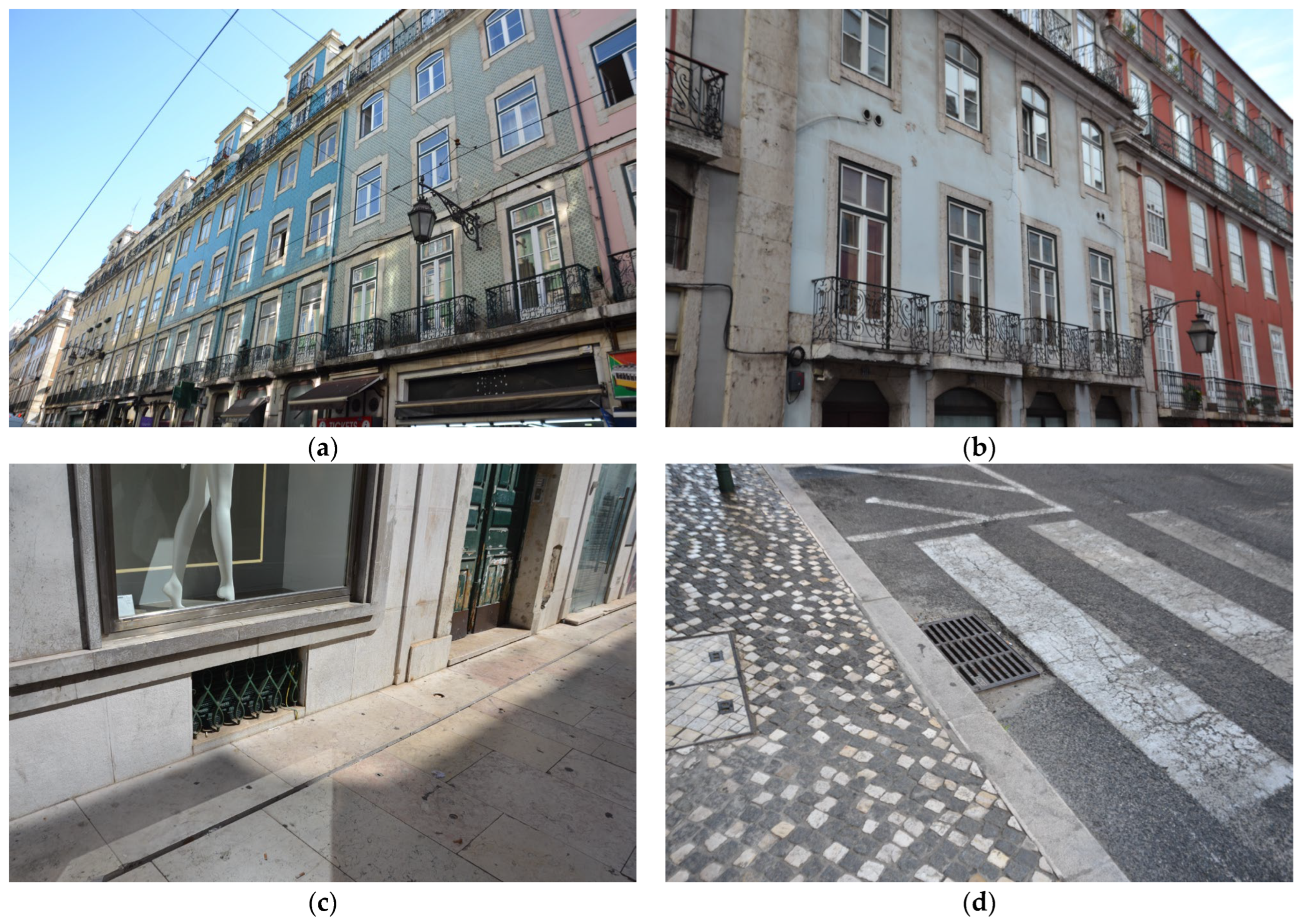
The Baixa Pombalina (Lisbon downtown) is a well know area (see Figure 1), which is part of the historical city centre of Lisbon (Portugal). The identification of the elements at risk and their main relevant characteristics (exposure analysis) were carried out using a combination of data sources (such as Google Earth, census data, historical records, and datasets provided by the Municipality of Lisbon), which were then integrated into a GIS platform [18] to enable more flexible and efficient inventory management. To strengthen the trustworthiness of the collected data, an on-site exterior inspection of the buildings was carried out in partnership with the Lisbon City Council as part of the ReSist project, using the QField application [19], which is directly connected to the processing QGIS file. This thorough and multi-source approach allowed for the update of the case study database reported in [13,20], resulting in a more accurate and consistent exposure assessment, which is especially well-suited for large-scale analysis.
In the area, 395 buildings were classified as ordinary (i.e., having uses such as residential, commercial, hotels or offices), with 315 (roughly 80%) classified as masonry structures (M3) and therefore the topic of this paper’s investigation. The M3 typology described above is based on the building classes in the Risk-UE methodology [21], that defines the M3.1 typology as URM—Wooden slabs buildings. Indeed, the Baixa Pombalina district is named after the Prime Minister Marquis of Pombal, who oversaw the city’s reconstruction following the well-known 1 November 1755, earthquake. However, during the reconstruction period, the so-called “Pombalino” structural typology was introduced, and the Baixa Pombalina area is the most representative example of this typology because all buildings were originally reconstructed as Pombalino [20,22,23]. This typology features a structural system consisting of a crossed timber frame filled with lower-quality masonry for interior walls (referred to as “frontal” walls), with rubble stone masonry walls for façades and walls between adjacent structures, while the slabs were made of timber [20,23].
The exposure of the examined buildings differs across the two hazards studied due to the varying impact induced by the hazard process [12]. Indeed, this is because the vulnerability functions for the two hazards were generated using two separate methodologies, given that a building’s negative consequences in the case of a hazardous event could be different. Section 3.4 shows that the flood hazard only affects the basement and ground floor levels; on the other hand, the damage for the seismic hazard is related to the entire above-ground building because the impact of an earthquake affects the entire structure rather than simply the bottom floor and basement [13,24].
Therefore, for the seismic hazard, the total monetary value was computed considering all levels above ground according to:
E i , E Q = V m , g f , i · A i + V m , u f , i · n i 1 · A i
where Ei,EQ is the total market value [€] of the i-th building for earthquake evaluation; Vm,gf,i is the market value per unit area [€/m2] of the ground floor; Ai is the building footprint area [m2]; Vm,uf,i is the market value per unit area [€/m2] of the upper floors; ni is the number of stories above ground. For the flood hazard, instead, given that the affected floors in flat floodplains are typically the ground and basement levels [12], the monetary exposure was calculated considering:
E i , F L = V m , g f , i · A i + V m , g f , i 4 · A b , i
where Ei,FL is the total market value [€] of the i-th building for flood evaluation; Vm,gf,i and Ai have already been defined, while Ab,i is the basement area [m2]. According to available census data, the market value for commercial areas (shops, bars, restaurants, offices, hotels, and tourist apartments) has been set at 6400 €/m2 [25], whereas the market value for residential, empty, and building site areas has been set at 3950 €/m2 [26]. Moreover, due to a lack of data, the market value of basements has been established at one-fourth of the market value of ground floors as suggested in [12], and reported in Equation (2).

2.2. Hazard Assessment

The Baixa Pombalina has a relevant seismic and flooding history. The area is famous for having been destroyed and subsequently reconstructed after the well-known 1 November 1755 earthquake, which was also followed by a tsunami and fires. Furthermore, Lisbon has been affected by floods in recent years (such as the most severe events on 25–26 November 1967, 18–19 November 1983, and 18 February 2008), which caused significant damage, including train service disruptions, road closures, power outages, as well as fatalities and displaced people [27].
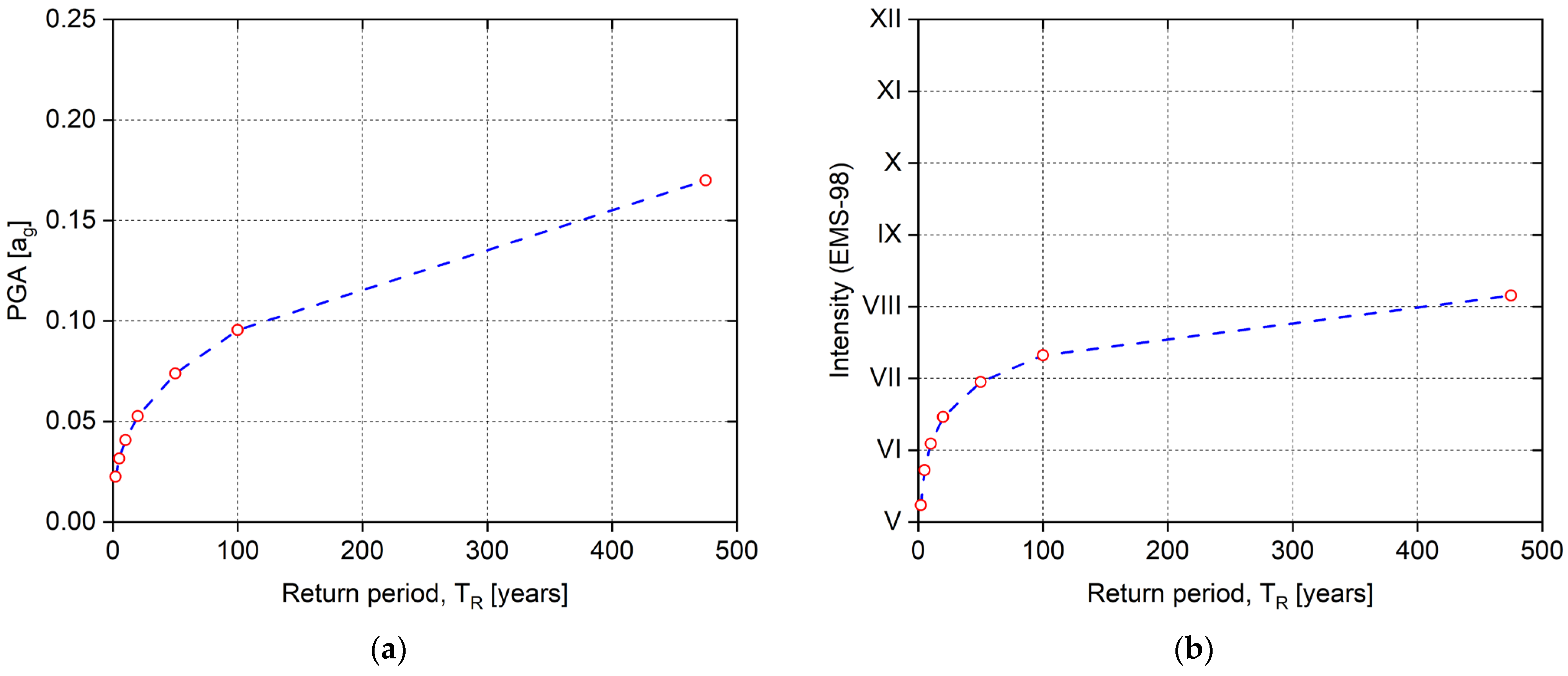
The seismic hazard assessment has been calculated in terms of macroseismic intensity through empirical formulations reported in [28] for seven return periods, i.e., 2–5–10–20–50–100–475 years, see Figure 2. Starting with the basic acceleration obtained from the Portuguese National Annex of Eurocode 8 [29] for Lisbon, i.e., an estimated PGA value of 0.17g at bedrock for a return period of 475 years, the expected PGAs for different return periods were computed, and then related with EMS-98 intensity as explained in [20,28]. To link the PGA intensity measure to the EMS-98 macroseismic intensity, the empirical formulation found in [28] has been properly used. Particularly, this formulation allowed the expected value of PGA to be correlated through empirical coefficients evaluated on historical earthquake data.
To have an overview of the estimated PGA level obtained using the empirical formulation provided in [28], a comparison with the 2020 European Seismic Hazard Model (ESHM2020) [30] was considered. In particular, Table 1 shows the PGA provided by the methodology found in [28] with the corresponding mean PGA values provided by [30], for three different return periods, i.e., 50, 100 and 475 years. The expected PGA values provided by [28] overestimates, for each return period, the PGA levels proposed by [30] within the range −21% < PGA < −53% of variation. This result strictly depends on the fact that the basic acceleration used in this study, i.e., 0.17 g according to the Portuguese Annex, is higher than the one evaluated in [30], (0.13 g) posing the assumption herein discussed in a safety side condition.
The current case study considers pluvial floods as flood hazard, ignoring alluvial floods that may occur along the Tagus River. This decision is based on data provided by the Portuguese Environmental Agency [31], which made available maps of inundation areas at the river district level for high, medium, and low probability scenarios (i.e., return periods of 20–100–1000 years). The maps were developed according to the European Union Floods Directive “2007/60/EC” and indicate that the Baixa Pombalina area is not affected by river-induced inundation for any return periods [12,13,32].
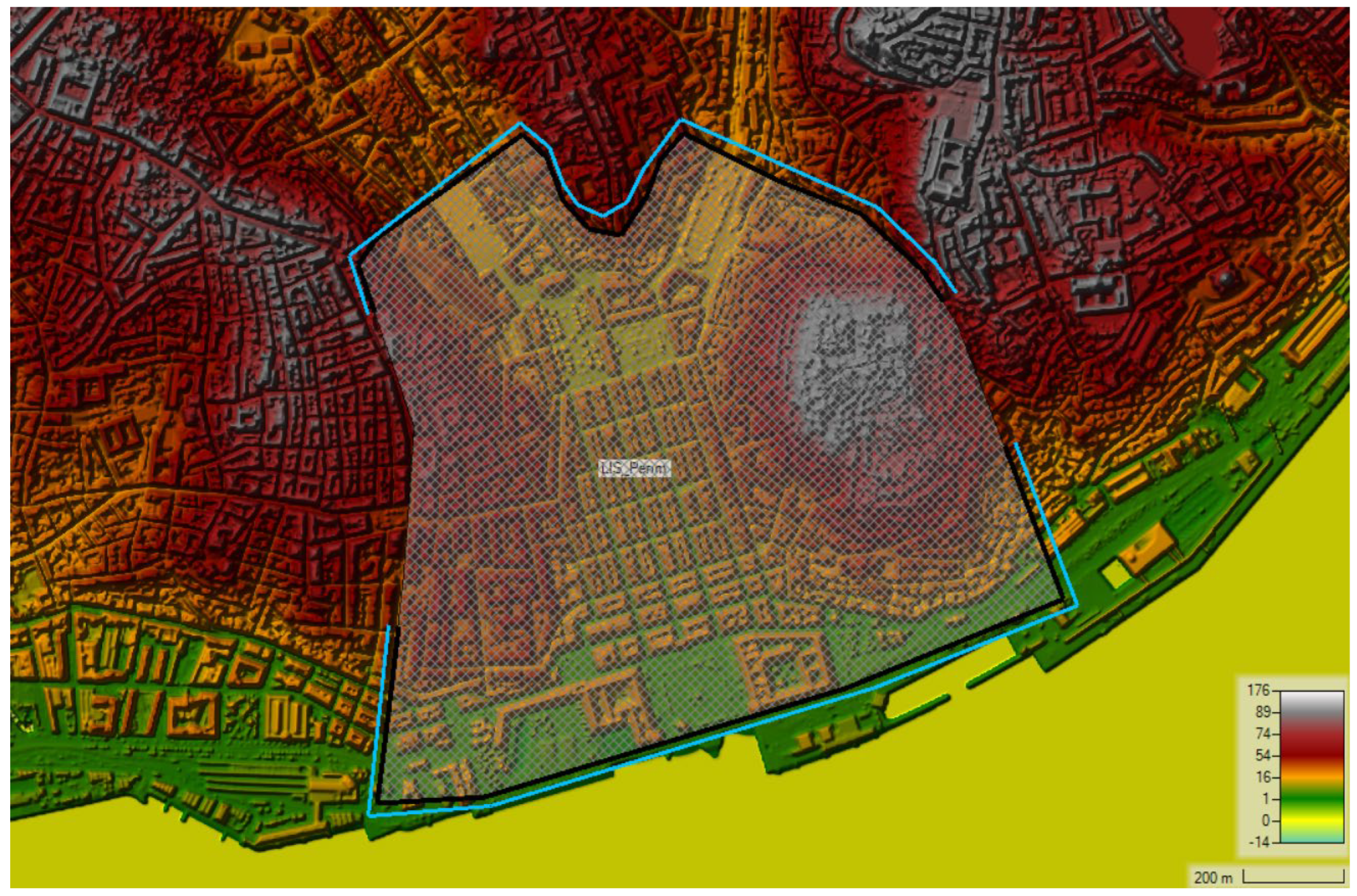
The flood hazard model was created by the authors in [32], briefly revised here. The pluvial flood was modelled through a hydrologic-hydraulic model using HEC-RAS software (v6.3.1) [33]. The Digital Surface Model of 2 m grid (DSM-2m) was downloaded from the Portuguese General Directorate of Territory data centre website [34].
RAS Mapper was used to generate the 2D Flow Area geometry with a 2 m × 2 m cell size. The upstream and downstream boundary conditions were set as pluvial flood hydrograph of the upstream urban catchment and normal depth, respectively (Figure 3).
The upstream boundary condition allows for pluvial rate from upstream contributing areas to reach the research area, while the downstream one considers flow propagation outside the area. Furthermore, the last version of the land cover map (2024) from the ESRI Land Cover website was downloaded [35], and a Manning’s n value of 0.016 was set to reflect the area’s high urbanization rate.
The simulations used two types of unsteady flow data: flood hydrographs (in m3/s) which represent water flowing from the upstream catchment into the area of interest, and rectangle hyetographs (in mm) that represent precipitation falling on the area. Recorded rainfall data for the Lisbon area provided by [36] specify the typical coefficients “a” and “b” for determining IDF curves (Intensity-Duration-Frequency) according to:
I   = a · D b
where I is the intensity in mm/h and D is the duration of the rainfall in minutes. In the present study, for different time durations (5–30 min, 30–360 min, and 360–2880 min), the “b” coefficient was calculated as an average of values in [36], while the “a” coefficient was recalibrated using the method of the least squares minimization, aimed at making the exponent “b” constant with the rainfall duration, for each selected return periods (2, 5, 10, 20, 50, 100, and 500 years), and so IDF curves were built [32]. With this approach, the pair of values “ab” ensure the constancy of the “b” parameter while the return period varies; the “a” parameter was considered as the product of a growth coefficient that depends on the return period and a mean coefficient indicating the 1-hour rainfall intensity for a unitary growth coefficient. Then, several rainfall durations of interest were defined (i.e., 30 min, 1 h, 2 h, 3 h, and 6 h), and the total precipitation (mm) for each return period was calculated by multiplying the intensity (mm/h) by the duration of interest (h). Then, rectangular hyetographs were created by dividing the total precipitation with 5-minute intervals for use as input precipitation data in HEC-RAS [32].
The flood hydrographs were calculated using the SCS-CN method (Soil Conservation Service Curve Number method) for each return period. For the purpose of brevity, the well-known SCS-CN approach is not discussed here; please see [37,38]. The average conditions AMC II were used as the Antecedent Moisture Condition (AMC), with a value of CN(II) equal to 90 to account for the area’s significant urbanization. To determine the most severe rainfall duration for the study area, a variational method was employed by running numerous simulations. It was discovered that the 2-hour rainfall duration was the scenario that maximized the water depth and velocity at each control section of the study area, so it was considered for evaluation. This is explained by the fact that the upstream catchment’s flood hydrographs make the greatest contribution, and, although producing lower cumulative rainfall depths, floods with shorter durations may spread at higher velocities and water depths due to their higher intensity [32].

3. Materials and Methods

3.1. Multi-Hazard Framework

As seen in the Section 1, when it comes to multi-hazards, risk assessment is a hard topic given the nature of hazards interrelations. Moreover, when numerous hazards affect a location (concurrently or consecutively), several factors may influence the magnitude and characteristics of the final impact, including the order in which the hazards occur, the time interval between them, and the recovery time of the damaged assets [39]. This paper attempts to assess the impact of two types of hazards that are independent at the hazard process level, which means that the two hazards can occur simultaneously or sequentially without having any trigger relationship. This phenomenon has occurred many times in different parts of the world, for example heavy rain events in the following years caused debris flows after the 12 May 2008 Wenchuan earthquake, causing difficulties in the reconstruction of the earthquake-affected area [40]. On 25 April 2015, the Gorkha earthquake (MW 7.8) devastated Nepal, while on 15 July 2017, a flash flood hit the same structures and lifelines that had been damaged by the earthquake [41].
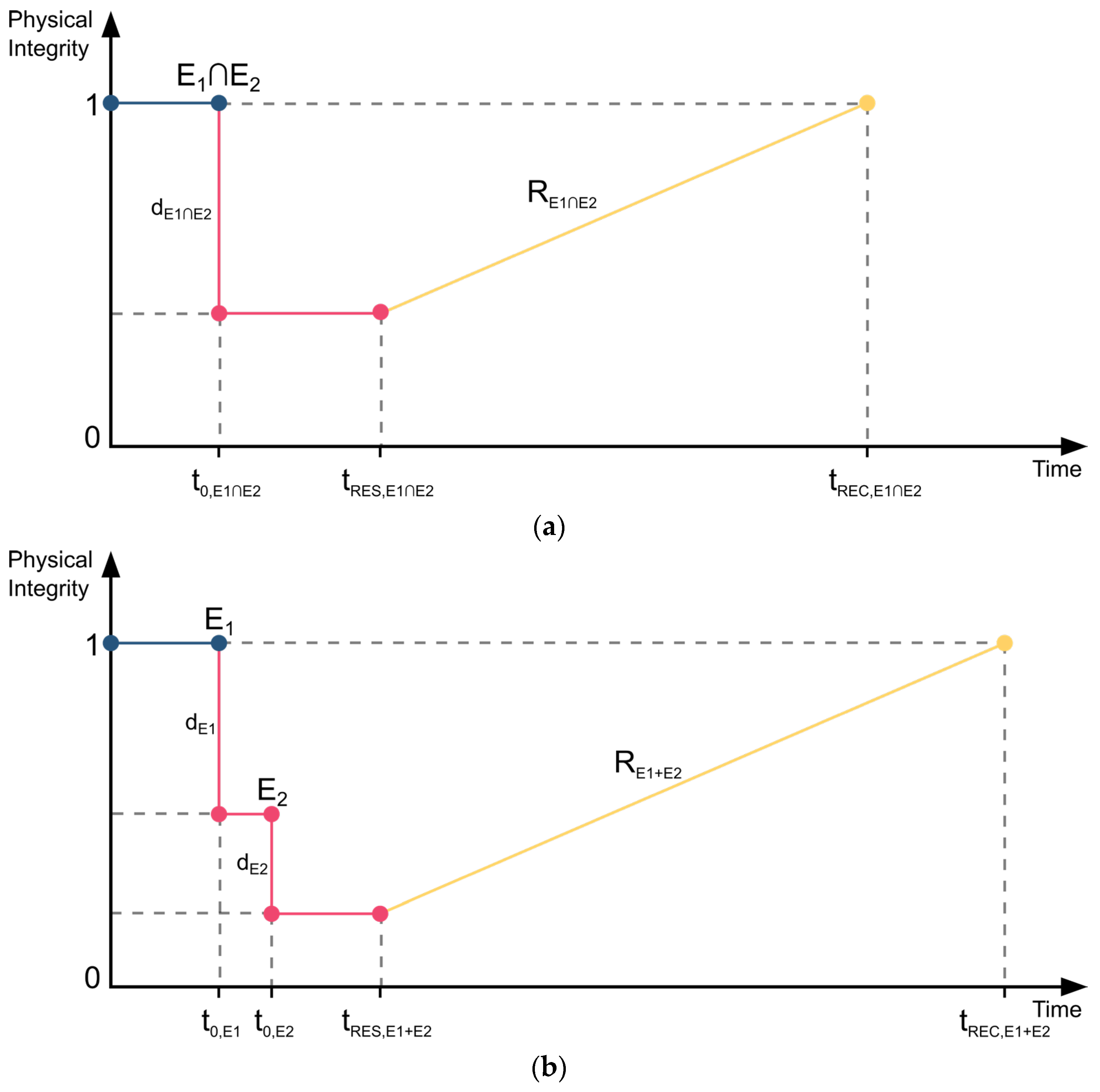
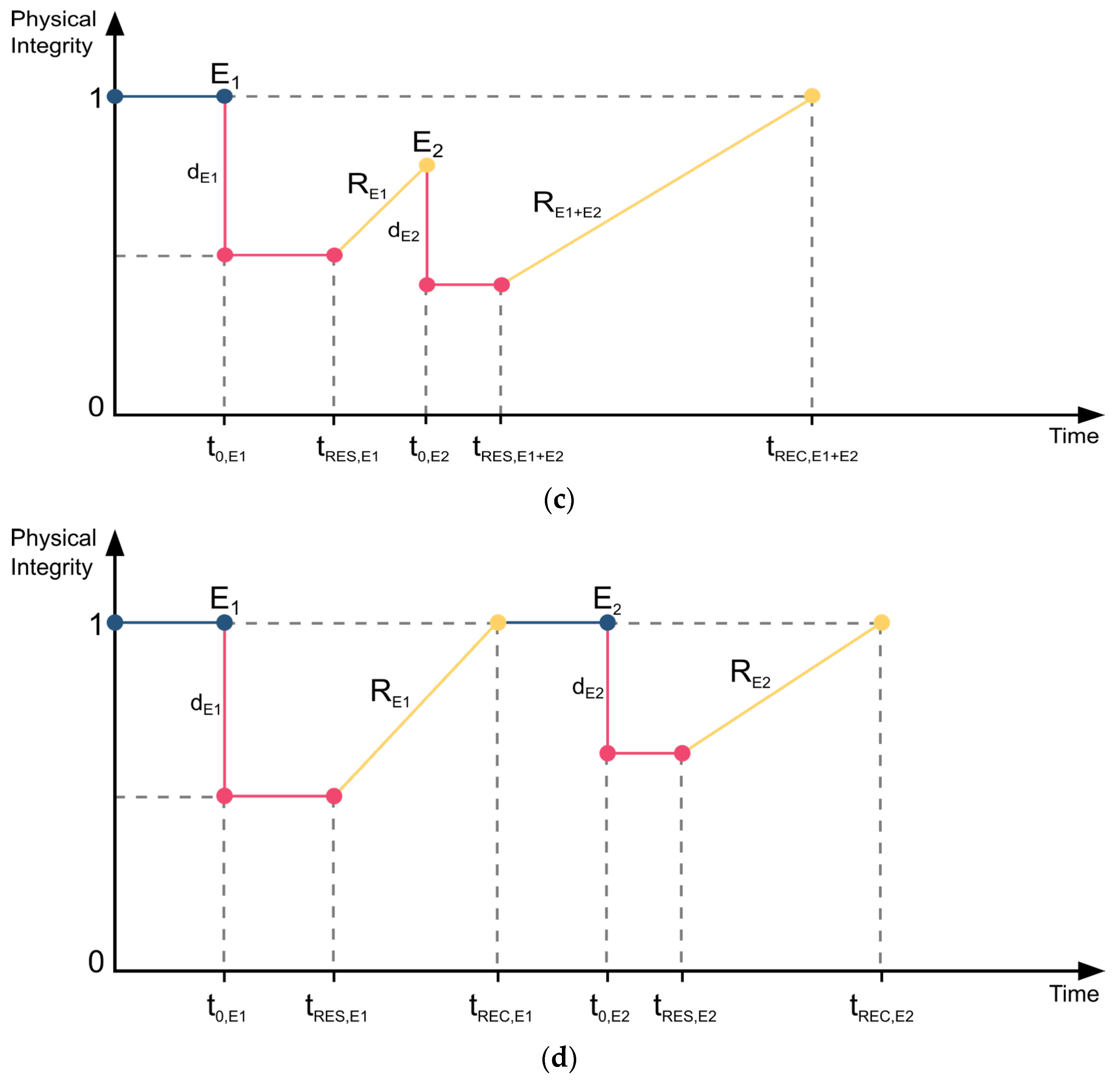
The present paper adopts and further expands the methodological framework proposed by [39]. As described there, the occurrence of two hazards in one place can give rise to three main categories of temporal relationship: concurrent, when hazards overlap completely or partially in time; consecutive, where hazards occur one after the other but at such a time interval that the damage has not been completely repaired from the first hazard; and independent, where hazards occur at such a time interval that the damaged elements had been restored to their original condition before the second hazard occurs [39]. This classification has been expanded in the present work to explicitly account for the statistical possibility of two completely independent hazards, in terms of natural process origin, occurring concurrently, as especially tailored for the case study that includes pluvial floods and earthquakes in the city centre of Lisbon. Theoretically, it is interesting to evaluate the probability that both events occur simultaneously, i.e., at the same time, in terms of joint probability, which is quite low, particularly for the case study, as shown in the body of the paper. It is important to emphasize that the primary objective of this work is to propose a methodology for estimating losses generated by two independent events occurring simultaneously. In the specific context of this study, which considers earthquakes and pluvial floods, such a scenario may arise when an earthquake occurs during an ongoing rainfall event, which can persist for several hours. Nevertheless, the authors aim to provide a broader conceptual framework that can also be applied to the estimation of losses associated with two distinct events occurring sequentially, rather than concurrently. Therefore, four scenarios have been herein considered to capture all possible time occurrences for the case study area: (i) statistically concurrent; (ii) short-term consecutive; (iii) long-term consecutive and (iv) independent. To better understand the distinction between the possible four occurrences listed above, a brief explanation follows. The statistically concurrent event happens when two hazards that are independent occur at the same time. The short-term consecutive event occurs when two hazards, occur one after the other before the recovery phase of the damaged property begins, such as when an earthquake strikes the city and a flood follows shortly thereafter, or vice versa. The long-term consecutive event occurs when two independent hazards strike one after the other but after the recovery phase of the damaged property has begun but not yet completed, such as an earthquake followed by a flood, or vice versa. The last one, the independent event, happens when two hazards occur one after the other specifically when the recovery phase is concluded, as an example an earthquake is followed by a flood after a long time, or vice versa. This framework aims to clearly and comprehensively outline all the possibilities that may develop in the event of an earthquake and pluvial flood, while also considering real recovery time frames. Figure 4 shows a graphical representation of the four possibilities outlined above, with E1 denoting the first event, which in this case study might be either a pluvial flood or an earthquake, and E2 denoting the second event, which is the remaining alternative.
To better comprehend the figures, it is crucial to note that t0 represents the time at which each event happens, tres represents the end of the response phase, and trec represents the end of the recovery phase. The subscript E1E2 denotes simultaneous statistical concurrency, whereas the subscript E1 + E2 shows consecutive event occurrence. Instead, d represents the damage, while R represents the recovery function which simulates the temporal dynamics of recovery from hazard-induced damage, which can take several pathways depending on socioeconomic, technological, infrastructural, and political factors [39]. For instance, ref. [42] identifies three types of recovery pathways: linear, exponential, and trigonometric. These approaches are dependent on the conditions of the impacted areas and the availability of data. For example, linear models, which assume a constant rate of recovery advancement across time, are best suited when no information is available and generally represent an average prepared community. Exponential models describe cases in which initial resource inflows are rapid but then the speed of recovery slows more getting to the end, normally representing a well-prepared community. Trigonometric models, on the other hand, show an initial difficulty caused by limited organization and/or resources, followed by a faster subsequent recovery normally representing a not well-prepared community [39,42]. More complex recovery patterns can be modelled, but this requires data that reflects real-world situations in specific contexts [39,42]. The general equation for the linear recovery function is explained in [42] and considered as:
f R E C t = a · t   t 0 , E T R E + b
where a, and b, are constant values for the definition of the curve, t0,E is the time when the event occurs, TRE is the recovery time required to return to pre-disaster conditions calculated from t0,E,while t is the time to make the assessment [42]. Given the paucity of relevant data and the explanatory objective of the paper, the idea of a linear recovery function has been adopted and simplified to calculate the amount of damage repaired starting from the end of the response phase as shown in Figure 4. The final formula is:
R i = t   t R E S , i t R E C , i t R E S , i
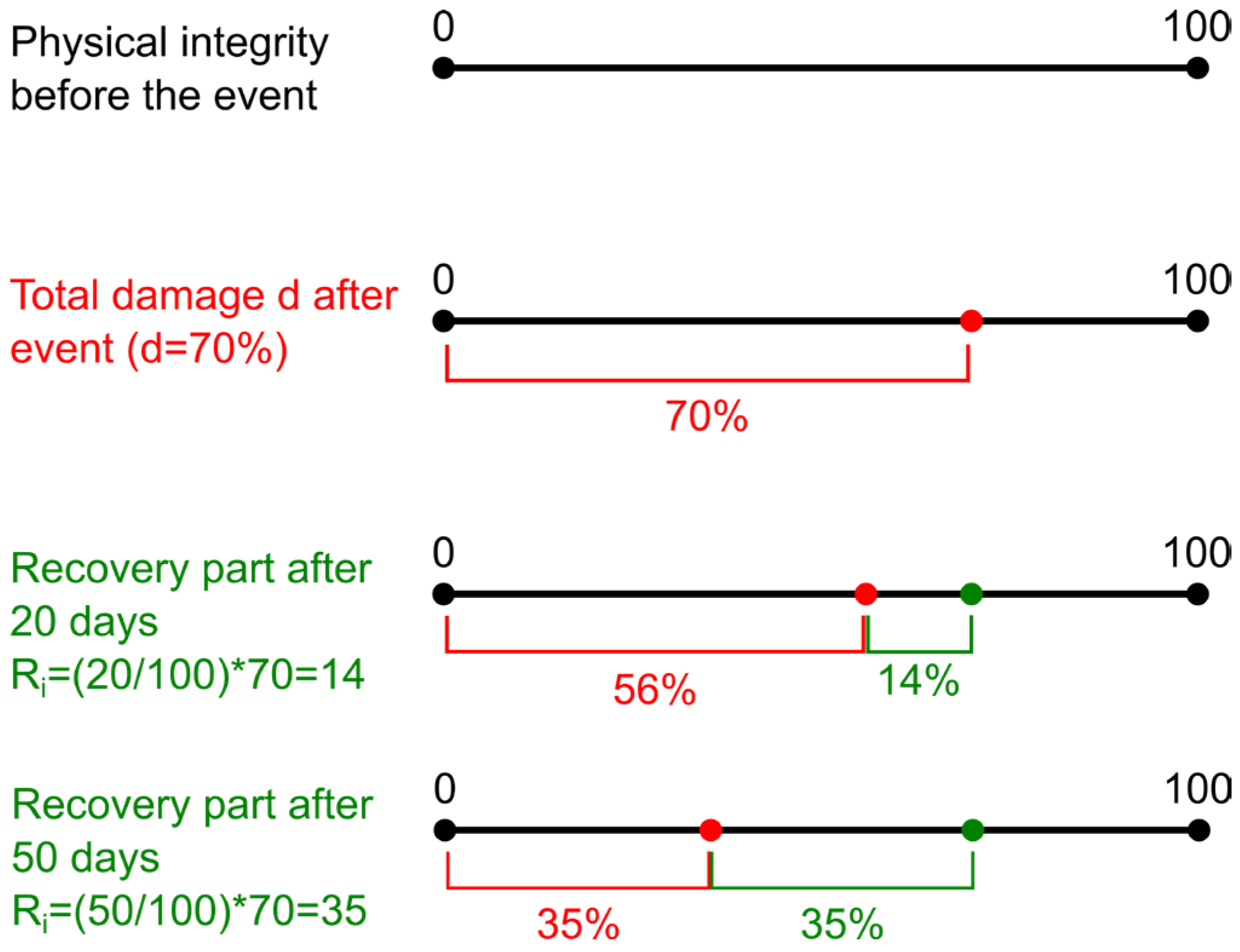
where t is the assessment time calculated starting from tRES,i, while tREC,ItRES,i is the total amount of time required to return to pre-disaster conditions after the recovery phase begins. As an example, if the total recovery time from the end of the response phase is 100 days, the calculation on the 50th day of work will return a recovered damage of 50% (0.5), whereas calculating the recovery on the 20th day will return a 20% recovered damage of the total damage. Later, by multiplying the value of Ri by the corresponding damage value, it is possible to determine the specific amount representing the recovered portion of the total value. To further comprehend this example, Figure 5 depicts the recovery function explained. Moreover, if the final damage (i.e., in the example case is 35% part in red) is multiplied by the exposure, the total residual loss can be obtained.
To implement this framework, a formulation for calculating cumulative damage has also been defined. However, it should be emphasized that, for independent events, when the second hazard occurs after the assets condition has been recovered to its initial form, the damage can be computed as the outcome of one hazard at a time assessment. Instead, in order to assess overall damage for statistically concurrent and consecutive events, it is important to consider how the two hazards interact as well as their consequent joint effect on exposed assets. Indeed, when two or more hazards overlap, the vulnerability of elements at risk can dynamically change. According to [43], three situations should be considered: (i) the fact that the characteristics of the building can contribute differently to vulnerability to different hazards, (ii) the modification of a building’s vulnerability in the event of simultaneous impact of multiple hazards, and (iii) the sequential events on a building that can change the vulnerability and have a cumulative effect of impacts since the structure is already compromised after the first hazard.
Therefore, when dealing with both statistically concurrent and consecutive events, it is important to consider how the interactions of the two hazards can affect the total consequences of exposed assets. However, understanding how building vulnerability can be dynamically modified in the event of simultaneous or sequential hazards is a challenging task that requires amount of data and/or experimental campaign and is therefore neglected in the present work. For example, the impact of an earthquake after a flood may be larger because water seeping in from the bottom or top of a wall (the latter in the case of a destroyed roof for instance) could reduce the strength of the structural material, resulting in a greater impact in the event of an earthquake. At the same time, earthquake damage, such as shattered windows and doors, might increase the building’s vulnerability to water [13,43,44].
Due to this limitation, a formula for statistically concurrent events that considers the joint probability of the two hazards is discussed in Section 3.5 and Section 3.6, which allows a simplified evaluation of total losses from a probabilistic point of view. When dealing with consecutive occurrences instead, both short-term and long-term, the final impact can be assessed in terms of cumulative damage, as [39] also proposed. The basic concept is that cumulative damage implies that a second event can only damage the remaining intact portion of the asset, preventing double counting [39,44]. The formula that represents this behaviour is:
d c u m = 1 i   = 1 n ( 1 d i )
where dcum is the total cumulative damage for multiple hazards, n represents the number of hazards considered and di is the damage for each individual hazards.
Based on what was said above and the framework established in [39], the formulas for calculating cumulative damage for the different cases are explained below.

3.1.1. Statistically Concurrent

The statistically concurrent schematization presented in this paper tries to capture the simultaneous concurrence of two events from a probabilistic point of view. When applied to the current case study, this model accounts for the possibility of an earthquake occurring during a rainfall event. In this case the formulas for cumulative damage are:
d c u m d E 1 E 2 t 0 , E 1 E 2 t   < t R E S , E 1 E 2 d E 1 E 2 · 1 R E 1 E 2 t R E S , E 1 E 2 t   < t R E C , E 1 E 2
It is important to note that, in this equation, d E 1 E 2 reflects the damage model used to quantify the consequences of two independent but concurrent hazards. The authors suggest calculating this with a simplified method through the joint probability of the two events (see Section 3.5 and Section 3.6).

3.1.2. Short-Term and Long-Term Consecutive

The short-term and long-term consecutive models attempt to capture the case in which the two hazards occur one after another, with the difference that in the short-term, the second hazard occurs before the beginning of the recovery phase of the first one, whereas in the long-term, the second hazard occurs after the recovery phase of the first one has already begun. This behaviour is represented in the following equations, which come from the cumulative damage described in Equation (6), and have been provided also by [39], though in a different form:
d c u m d E 1 t 0 , E 1     t   <   t R E S , E 1 d E 1 · 1     R E 1 t R E S , E 1 t   <   t 0 , E 2 1     1     d E 1 · 1     R E 1 · 1     d E 2 t 0 , E 2     t   <   t R E S , E 1   +   E 2 1     1     d E 1 · 1     R E 1 · 1     d E 2 · 1     R E 1   +   E 2 t R E S , E 1   +   E 2 t < t R E C , E 1   +   E 2
These equations account for cumulative damage and prevent double counting by assuming that a second event can only damage the remaining intact portion of the asset. These general equations can account for both short-term and long-term models, with the only difference being that in the short-term model, the term R E 1 will be equal to zero and intervals slightly change. However, to give a better understanding the formulation for the short-term case is also provided here, as:
d c u m d E 1 t 0 , E 1 t   < t 0 , E 2 1 1 d E 1 · 1 d E 2 t 0 , E 2 t   < t R E S , E 1 + E 2 1 1   d E 1 · 1 d E 2 · 1 R E 1 + E 2 t R E S , E 1 + E 2 t < t R E C , E 1 + E 2

3.1.3. Independent

The independent events model represents the fact that the earthquake or flood occurs first, followed by a second occurrence when the reconstruction phase is completed. In this scenario, the formulation, as in [39], is:
d c u m d E 1 t 0 , E 1 t   < t R E S , E 1 d E 1 · 1 R E 1 t R E S , E 1 t   <   t R E C , E 1 0 t R E C , E 1 t   < t 0 , E 2 d E 2 t 0 , E 2 t   < t R E S , E 2 d E 2 · 1 R E 2 t R E S , E 2 t   < t R E C , E 2
In this case, the two hazards are independent at both the hazard process and the damage level. As a result, the assessment of damage and losses can be evaluated separately based on the approach chosen for each hazard, as described next in Section 3.3 and Section 3.4.

3.2. MCDM Index-Based Method

In the current study, an index-based method is used for vulnerability assessment in the urban area of Baixa Pombalina. First, through an extensive literature review, twelve indicators for flood vulnerability assessment [45,46,47,48] and fourteen indicators for seismic vulnerability assessment [21,49,50,51] were established and then divided into four vulnerability classes, ranging from A (less vulnerable) to D (more vulnerable).
The class scores and parameter weights were then hierarchically structured using AHP (Analytic Hierarchy Process), a Multi-Criteria Decision-Making (MCDM) technique commonly used in vulnerability assessment studies requiring expert judgement [20,32,52,53]. To improve the robustness of the procedure, the hierarchy of classes and parameters was established based on input of a group of experts (for a total of 12, between earthquakes and floods) and the results were obtained by averaging the outcomes provided by the interviewees. For the sake of brevity, details on the AHP methodology are not provided here; however, it is important to highlight that when filling out the class matrices, the class scores should increase as the class progresses from A to D. Indeed, the four classes (A-B-C-D) are “ordered by importance”, with class D contributing more to vulnerability than class C, and so on. This “boundary condition” is derived from the methodological setup and is not used for the evaluation of parameter weights since the relative importance of the individual parameters is not preset and is entirely dependent on personal judgement. However, a reasonable degree of discretion was allowed to respondents in cases where the proposed classification was not considered fully representative and non-monotonic assessments were permitted [32].
Then, the TOPSIS method (Technique for Order Preference by Similarity to Ideal Solution) was used to assess the flood and seismic vulnerability index (IV,EQ and IV,FL). The AHP results were integrated into the TOPSIS method to perform the analysis and four main components are defined as [20,54]: (i) a set of alternatives, which in this case are represented by the analyzed buildings; (ii) the chosen attributes, which in this case are represented by the parameters; (iii) a performance rating that are their classes scores; and (iv) the weights of the parameters, which are the calculated parameter weights. Details about the adopted approach can be found in [54,55]; however, given the fact that, according to the method, the best solution is the one closest to the positive ideal solution and the furthest away from the negative ideal solution, it is important to point out that, in the current study, the methodology has been set so that the method provides an overall preference score that is equal to zero if the evaluated alternative represents the optimal solution (i.e., all classes of indicators assigned as A), and 1 if the alternative represents the most negative solution, i.e., from all the classes of indicators assigned as D [32].
The final phase of the MCDM study involved conducting a sensitivity analysis to assess how strongly the outcome was influenced by the decision maker’s subjective judgments. This analysis aimed to test the stability of the selected ranking, particularly the top-ranked alternative, which corresponds to the most vulnerable building, against changes in the weights assigned to the evaluation criteria. The methodology applied here mirrors the approach proposed by [56], in which, for each individual parameter, the analysis computed the minimum change in its assigned weight that would cause the top-ranked alternative to shift, meaning that the identity of the most vulnerable building would change. This minimum change in weight is referred to as the Absolute Top (AT), and the Percentage Top (PT) may be calculated by dividing the Absolute Top by the parameter’s initial weight. Finally, the sensitivity of the solution (S) is determined as the reciprocal of the Percentage Top value [32].

3.3. Seismic Loss Assessment

To quantify seismic losses, the expected damage of a building needs to be assessed. In the current study, the mean damage grade μD was estimated using the following mathematical formulation [57]:
μ D = 2.5 × 1 + t a n h I   + 6.25 V   13.1 Q
where I is the macroseismic intensity, V is the macroseismic vulnerability index, and Q is the ductility factor, herein assumed equal to 2.3 for masonry structures [57,58].
As explained in [20,59], a mathematical relationship between V, derived from the macroseismic approach [57], and the proposed IV,EQ vulnerability index, based on core parameters of the GNDT method [60], is required due to methodological differences in damage and intensity definition between the two methodologies, as justified in [59]. In [20], the correlation proposed is:
V E Q = 0.6125 + 0.008 × I V , E Q
It is important to note that to remain consistent with the macroseismic approach, IV,EQ must be reported on a scale of 0 to 100, multiplying it by 100.
After converting the IV,EQ, obtained by applying the TOPSIS method, to VEQ, the mean damage grade for all building samples present in the study area can be estimated for each return period (2–5–10–20–50–100–475 years). Six damage thresholds (Dk = 0, 1, 2, 3, 4, 5) were defined according to the EMS-98 damage scale [61,62], as follows [20]: D0, i.e., no damage (µD ≤ 0.5); D1, i.e., slight damage (0.5 < µD ≤ 1); D2, i.e., moderate damage (1.0 < µD ≤ 2.0); D3, i.e., substantial damage (2.0 < µD ≤ 3.0); D4, i.e., near collapse (3.0 < µD ≤ 4.0) and D5, i.e., collapse (4.0 < µD ≤ 5.0). This procedure allows the degree of damage—according to the EMS-98 scale—that buildings in Baixa Pombalina will experience in the event of an earthquake for the given return periods to be understood. Given this, the probability of having a damage of level k (Dk as previously defined) can be calculated through a binomial probability function, and the DPMs (Damage Probability Matrices) can be evaluated based on the weighted average of damages (μD) as [57,62]:
p k   =   5 ! k ! 5 k ! · μ D 5 k · 1 μ D 5 5 k μ D   =   k = 1 5 p k · k
To gain a complete knowledge of the seismic vulnerability of the building stock, the vulnerability index of the macroseismic method VEQ can be associated with a macroseismic vulnerability class (from A, the worst, to F, the best one) that adheres to the EMS-98 scale [63]. As explained in [64], masonry structures can typically be classified in classes A-B-C, whereas reinforced concrete buildings are typically classified as C, D, E, and, sometimes, F. Therefore, in the present work, three intervals have been established to associate every building to a macroseismic vulnerability class: A (VEQ ≥ 0.88); B (0.72 ≤ VEQ < 0.88) and C (0.56 ≤ VEQ < 0.72), see [64].
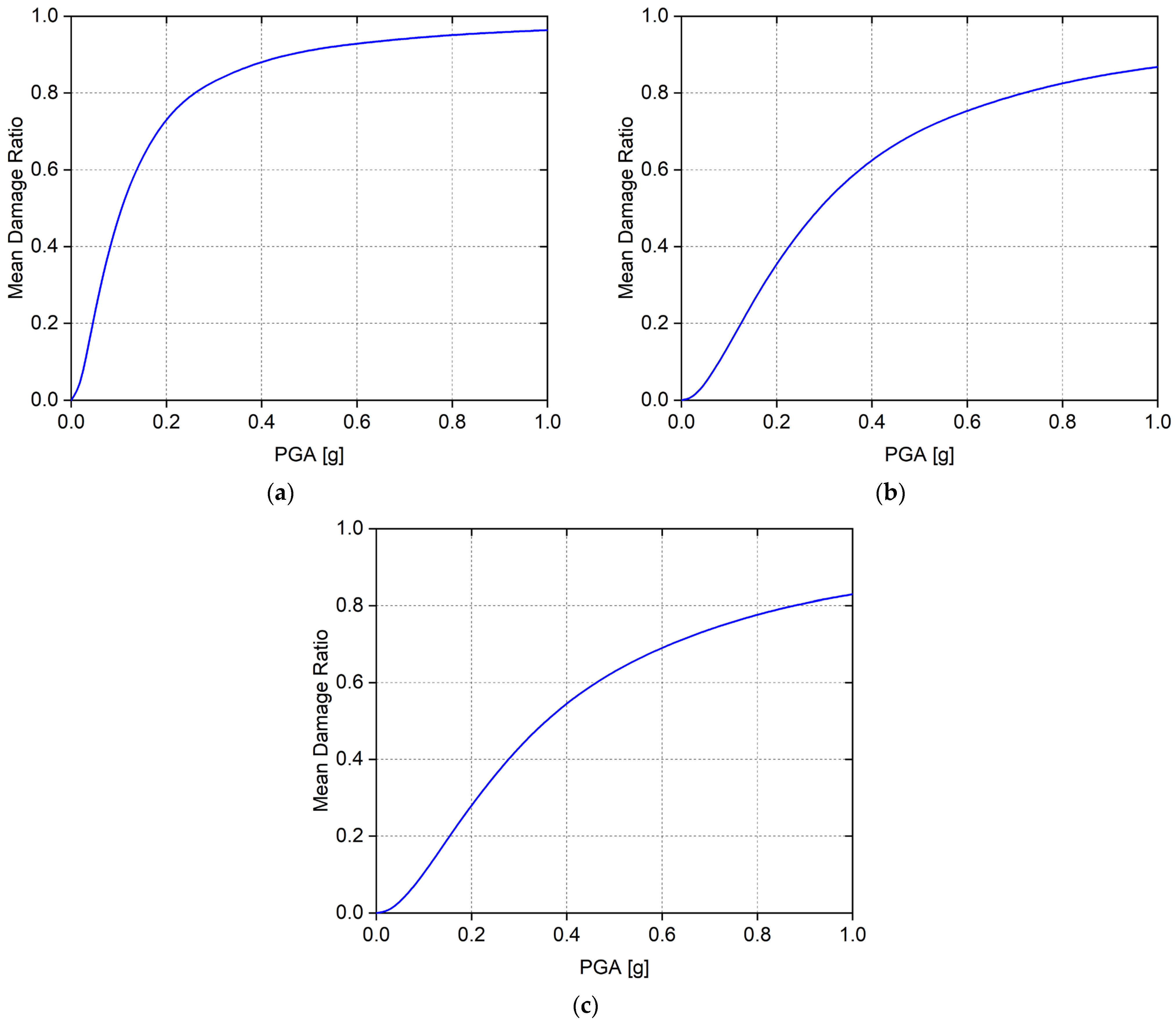
Subsequently, direct economic seismic losses in Baixa Pombalina were quantified using the Mean Damage Ratio (MDR) approach as explained in [65]. With this methodology, first the MDR for any seismic intensity (I) is determined by multiplying the probability of each damage state P(Dk|I) by the corresponding damage ratio DRDk [65]:
M D R D | I = D = 1 k P D k I × D R D k
The damage ratio (also known as Damage-to-Loss model or consequence model) can be defined as the ratio of a building’s repair cost to its replacement value determined for each damage state based on expert opinion or empirical post-earthquake data [65]. In this study the model in [66] has been used given the lack of experimental and post-earthquake damage data, for which: D1 = 0.01; D2 = 0.2; D3 = 0.4; D4 = 0.8; D5 = 1. With this approach, the MDR curves for each class (A, B, and C) may be generated and the expected consequences can be calculated in terms of monetary losses by multiplying the MDR by the replacement value of the buildings [20,66]. However, due to a lack of data about the replacement value, the market value was utilized instead, as in Equation (1) defined in the exposure model.

3.4. Flood Loss Assessment

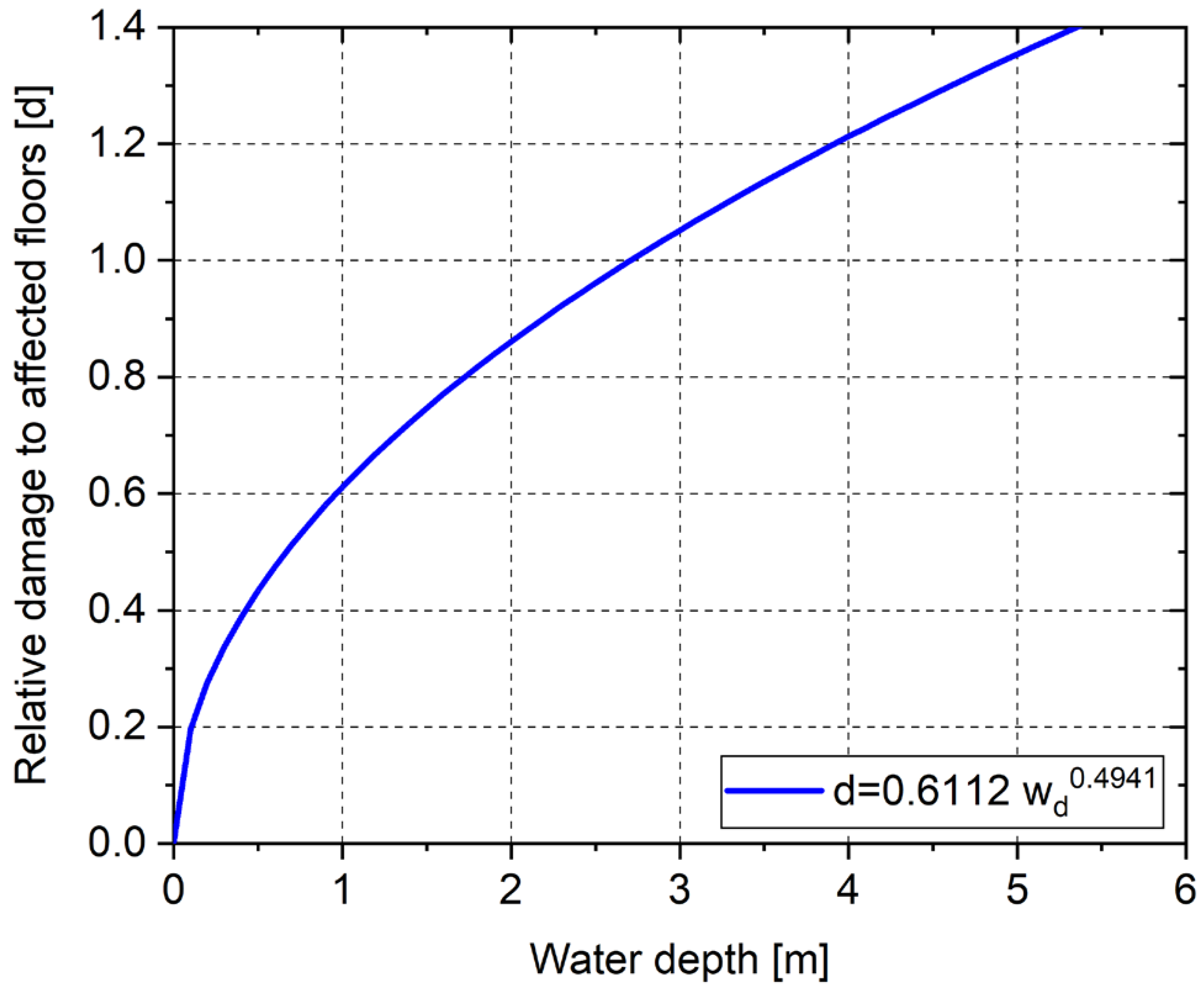
Flood assessment approaches may be classified in: methods based on matrices [67,68,69], vulnerability curve methods also called stage-damage curves [70,71], and index-based methods [45,52]. The most used approach is the stage-damage curve that relates one flood parameter (normally water depth) with the expected damage [12]. To assess the flood losses, a specific stage-damage curve for the M3 buildings in Baixa Pombalina is developed in [32], from the flood hazard simulated, as explained in Section 2.2, and the vulnerability index calculated with the application of AHP and TOPSIS methodology (Section 3.2). For the sake of brevity, the methodology is not reported here, and it is recommended to refer to [32], while the equation of the developed stage-damage curve (see Figure 6), for the i-th building in the l-th flood scenario is reported as:
d F L , i , l = 0.6112 × w d , i , l 0.4941
where wd,i,l is the water depth measured.
Finally, flood losses can be evaluated with:
L F L , i , l = E i , F L · d F L , i , l
where LFL,i,l is the economic loss; Ei,FL represents the economic exposure of the affected floors as in Equation (2); while dFL,i,l is relative damage derived from the stage-damage curve as explained above.

3.5. Probabilities Evaluation

As mentioned in Section 3.1, this study aims to provide a simplified probabilistic approach for estimating the expected losses deriving from two hazards: earthquakes and pluvial floods, in the hypothesis that both events occur simultaneously. To develop the probabilistic loss assessment framework, the law of total probability was applied by considering two independent events: E1 (earthquake) and E2 (pluvial flood). Since the two hazards are assumed to be statistically independent, the probability of their joint occurrence can be calculated as the product of their probabilities [72], i.e.:
P E 1 E 2 = P E 1 P ( E 2 )
where P(E1E2) is the probability of both independent events occurring at the same time, P(E1) is the probability of observing event E1 and P(E2) is the probability of observing event E2.
To find the single relative probabilities of the events E1 and E2, the following equation is considered [72]:
P E = N E N
where P(E) is the probability of observing the generic event E, N is the number of all possible outcomes and NE is the number of favourable outcomes for the event E [72]. Specifically, based on what has been introduced, N can be considered as the total number of occurrences of the hazards (i.e., for the specific case, the total number of occurred earthquakes or precipitation events, for earthquake and pluvial flood, respectively), whereas NE is the total number of favourable observations (i.e., all the earthquakes or pluvial events that occurred in the area higher than a threshold value of engineering interest).
Therefore, the probability of earthquakes P(EQ) and pluvial floods P(FL) can be assessed, as well as their intersection P(EQ) ∩ P(FL). The P(EQ) and P(FL) can be determined using Equation (18), by evaluating historical data of the events that occurred. Then, to determine which of the two events, earthquake or pluvial flood, has a greater influence on the global expected losses, the coefficients α and β, which represent the relative weight of each event concerning their joint probability, are used:
α   = P ( E Q ) P ( E Q ) P ( F L )
β = P ( F L ) P ( E Q ) P ( F L )
The coefficients α and β quantify the relative importance of an earthquake or flood, respectively, occurring individually compared to their simultaneous occurrence. They reveal the extent to which each hazard’s likelihood stands out when evaluated against the combined event, offering insight into its frequency or impact. By deriving α and β from historical data, the assessment can evaluate each hazard’s unique contribution to overall risk. Subsequently, the normalization, as reported in Equations (21) and (22), transforms α and β into values ranging between 0 and 1, making them directly interpretable as percentages or proportional contributions. The event with the higher normalized coefficient (e.g., αN or βN) indicates which of the two hazards has the dominant influence on expected losses, based on its relative probability:
α N = α α   + β
β N = β α + β
Finally, the contributions of earthquake and flood hazards can be combined by considering each scenario, utilizing, for earthquake, the MDR value for each earthquake vulnerability class (Equation (14)), herein identified as dEQ,i, and the flood damage deriving from stage-damage curve for each building (Equation (15)), herein identified as dFL,i, resulting in a final multi-hazard damage, dMH,i, for each return period, for the i-th building equal to:
d M H , i = α N · d E Q , i + β N · d F L , i
This final transformation enables the integration of seismic and flood vulnerabilities and hazard scenarios (defined by their return periods), weighted by the joint probability of co-occurrence, that can be interpreted as d E 1 E 2 defined in Equation (7).

3.6. Statistically Concurrent Losses

In general terms, the economic loss can be easily calculated by multiplying the percentage damage by the exposure of the asset [10]. As presented in Section 2.1, the monetary value of the examined buildings (exposure) differs across the two analyzed hazards due to the varying impact caused by the hazard process (Equations (1) and (2)). For this reason, the economic loss of the i-th building due to multi-hazard impact can be determined as:
L M H , i =   α N · d E Q , i · E i , E Q + β N · d F L , i · E i , F L
As shown in the above-introduced equation, the previously introduced probabilistic coefficients need to combine the losses to account for the joint probability of two independent hazards occurring at the same time.
It is important to note that losses can generally be defined as direct or indirect: direct losses are physical losses, such as damage to buildings and infrastructure, as well as casualties and injuries, whereas indirect losses are the result of an incidental effect, such as function interruption or disruption of commerce flow [10,12,20]. The direct economic asset losses resulting from an earthquake are fixed in nature, such as building damage. Instead, in the event of a flood, direct economic losses are more closely related to damage to contents than to the building, as well as indirect economic losses, such as interrupted commercial activities, that may be greater than direct damage [10,12,20]. However, due to a lack of data required to adequately account for indirect damage such as interruption of commercial flux or similar, only direct economic losses were examined in this study, leaving open the possibility of future research to address risk by including indirect losses.
Finally, to completely apply the methodology an example of recovery can be performed as explained in Equation (7). In this case, given the different nature of the exposure, Equation (24) would become:
L M H , i , r e s = α N · d E Q , i · 1 R E Q F L · E i , E Q +   β N · d F L , i · ( 1 R E Q F L ) · E i , F L
where LMH,i,res is the residual losses after recovery works have begun, while REQFL is the recovery function as explained in Equation (5).

4. Results

4.1. Single-Hazard Risk Assessment

4.1.1. Earthquake

Following the procedure described in Section 3.2, the final values for the class scores and parameter average weights were obtained with the AHP method (Table 2 and Table 3). For clarity, only the names of the indicators and their weights are provided, as well as the four classes and their weights. To get a better understanding of the meanings of the various indicators and classes, relevant references are provided close to each indicator.
The results for the M3 Pombalino building typology in the MCDM seismic vulnerability index show that 208 buildings have a vulnerability index (IV,EQ) between 0.1 and 0.2, 73 buildings between 0.2 and 0.3, eight buildings between 0.3 and 0.4, 19 buildings between 0.4 and 0.5, three buildings between 0.6 and 0.7, and four buildings between 0.7 and 0.8. The average result value is IV,mean,EQ = 0.21 with a standard deviation of σI_V,man,EQ = 0.11.
For an overview of seismic vulnerability, IV,EQ from TOPSIS have been converted to macroseismic VEQ as explained in Section 3.3 (Equation (12)) and consequently μD (Equation (11)) and DPM (Equation (13)) have been evaluated for each return period. Results show that three buildings have a macroseismic vulnerability index VEQ between 0.6 and 0.7, 260 buildings between 0.7 and 0.8, 19 buildings between 0.8 and 0.9, 33 buildings more than 0.9. The average result value is VEQ,mean = 0.78 with a standard deviation of σV,mean,EQ = 0.08.
Based on the sensitivity analysis, parameters PEQ1, PEQ2, PEQ3, PEQ4, PEQ5, and PEQ7 exhibit a sensitivity value of zero, indicating that variations in their weights have no impact on the top-ranked alternative and may therefore be considered robust. Parameters PEQ12 and PEQ14 show low sensitivity levels, with Sensitivity (S) values of 0.3% and 1.1%, respectively. These parameters may be considered adequately stable, as minor changes in their weights are unlikely to affect the overall ranking. On the other hand, parameters PEQ6, PEQ8, PEQ9, PEQ10, PEQ11, and PEQ13 have the highest sensitivity values, ranging from 1.5% to 5.5%. Among them, PEQ8 stands out as critical, exhibiting the highest sensitivity, which suggests that even a relatively small variation in its weight, driven by the decision maker’s judgement, may alter the outcome. As a result, this approach can be classified as reasonably stable; however, more sensitive criteria, specifically PEQ6, PEQ8, PEQ9, PEQ10, PEQ11, and PEQ13, should be given more attention.
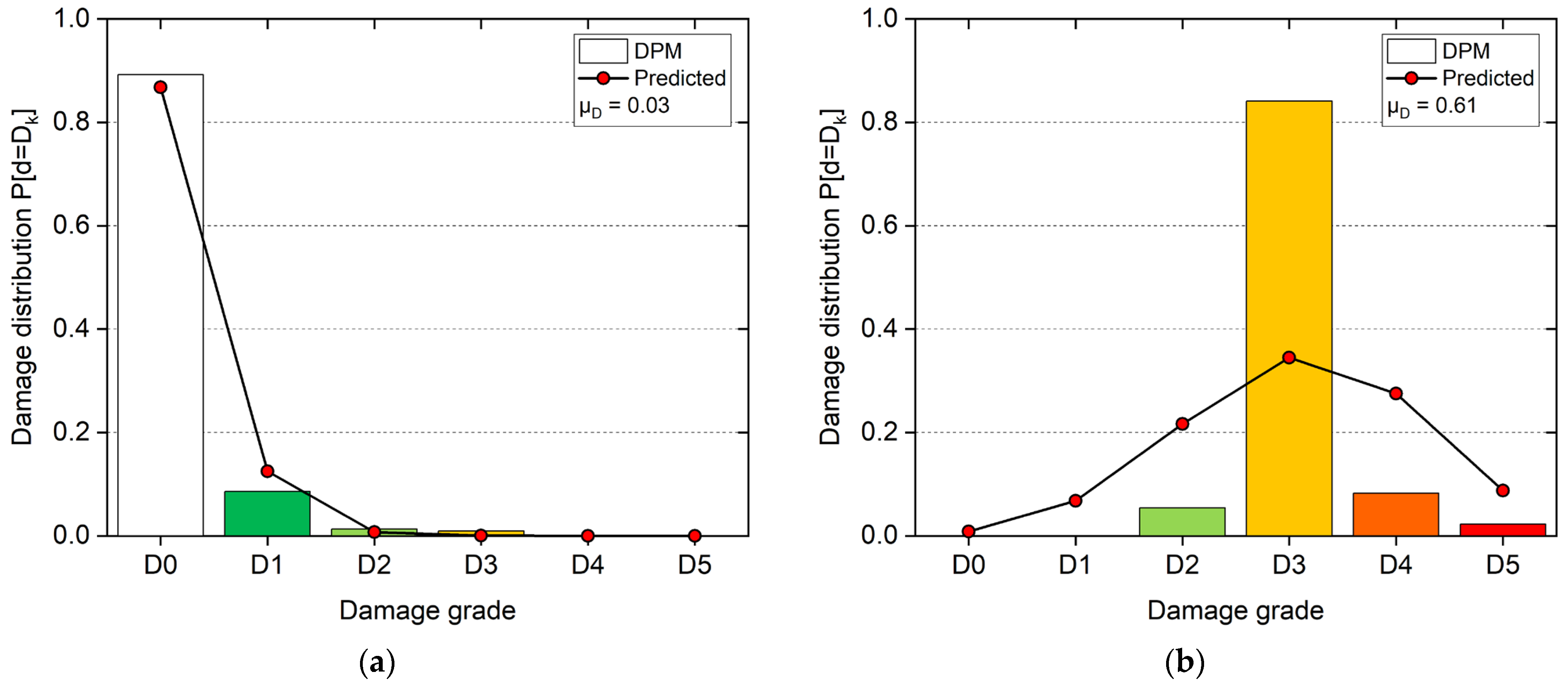
Regarding the expected damage grade, Figure 7 shows the total DPMs of the buildings analyzed for the 2-year and 475-year return periods, respectively.
As derived from the DPM, at a 2-year return period, most of the buildings suffer no damage (D0—281 buildings, 89%) or slight damage (D1—27 buildings, 9%), while the remaining seven buildings (2%) suffer D2 or D3 damage. At a 475-year return period 17 buildings (6%) suffer moderate damage D2, 265 buildings (84%) have substantial damage D3, 26 buildings (8%) near collapse D4, and seven buildings (2%) collapse D5. This pattern reflects the fact that for longer return periods, more buildings are likely to suffer severe damage, but for shorter return periods, no significant damage is expected.
The subdivision in A-B-C macroseismic vulnerability classes, as explained in Section 3.3, allowed us to classify the building sample as follows: 33 buildings (10%) belong to vulnerability class A (VEQ,mean,A = 0.99), 252 buildings (80%) belong to class B (VEQ,mean,B = 0.76), and 30 buildings (10%) belong to class C (VEQ,mean,C = 0.71).
Finally, the mean macroseismic vulnerability indexes for each class allowed the MDR of each class through Equations (11), (13) and (14) to be obtained (Figure 8).
The final losses have been calculated in terms of monetary losses of all buildings by multiplying the MDR of each class for each return period by the seismic exposure of the buildings as calculated in Equation (1). The total losses in M€ are summarized in Table 4.

4.1.2. Flood

As for the earthquake part, AHP matrices for the classes scores and parameter weights [32] provided the average results in Table 5 and Table 6.
The results for the M3 Pombalino building typology in the MCDM flood vulnerability index show that 69 buildings have a vulnerability index between 0.1 and 0.2, 110 buildings between 0.2 and 0.3, 119 buildings between 0.3 and 0.4, 11 buildings between 0.4 and 0.5, five buildings between 0.5 and 0.6 and one building between 0.6 and 0.7, with an average of IV,mean,FL = 0.28 and a standard deviation of σIv,mean,FL = 0.08 [32].
Parameters PFL1, PFL5, PFL10 and PFL12 have sensitivities equal to zero, indicating that they do not affect the best alternative when the criteria weight changes and can be considered robust. Parameters PFL2, PFL3, PFL6, PFL7, and PFL8 have very small sensitivity levels (between 0.4% and 1%), and results can be considered sufficiently stable. Conversely, parameters PFL4, PFL9 and PFL11 have the smallest percentage top (PT) and consequently, the highest sensitivity of the solution (from 1.5% to 3.5%), with parameter PFL9 being considered critical due to the highest sensitivity. As a result, this method can be classified as reasonably stable; however, sensitive criteria, i.e., PFL4, PFL9, and PFL11, should be addressed more carefully [32].
The final losses have been calculated according to Equation (16) and the total flood losses in M€ are summarized in Table 7.

4.2. Probabilities Coefficients

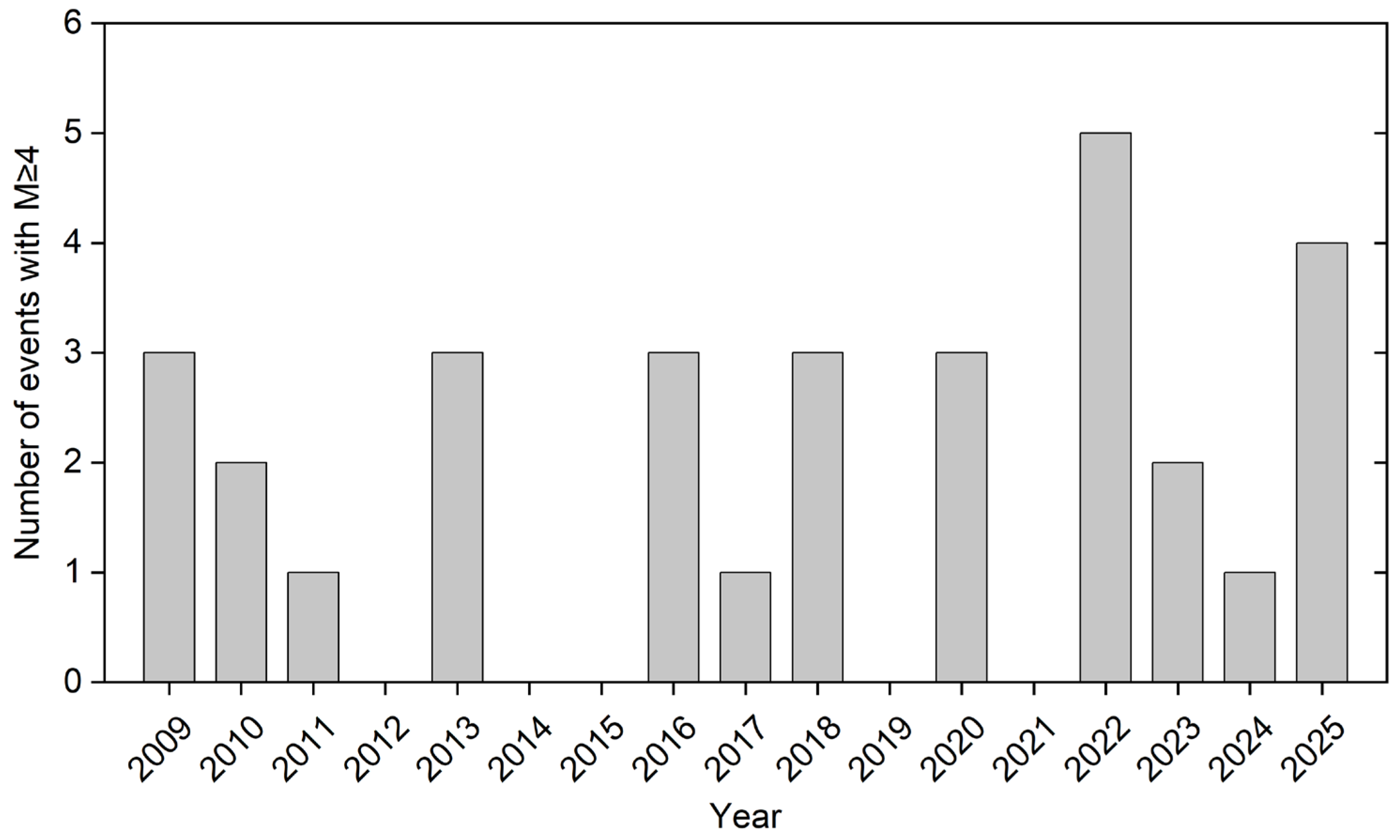
The seismic probability coefficient was calculated using data from past earthquakes that occurred in Portugal. The earthquake data were considered from the Instituto Português do Mar e da Atmosfera (IPMA, Portuguese Institute of the Sea and Atmosphere), which provided an archive of the ShakeMap of previous events. The ShakeMap archive [77] allowed for the analysis of event occurrences beginning in 2009, which are associated with a moment magnitude. At the time of the investigation, there were 439 events documented in the ShakeMap repository for Portugal’s mainland and Madeira islands between 2009 and 2025. The above-threshold value (see Section 3.5) for the probability evaluation (Equation (18)), was set at a magnitude of 4; therefore, 31 events were counted as equal to or greater than 4 (Figure 9). According to Equation (18) the probability of an earthquake occurrence relevant to the case study is around 7.1%.
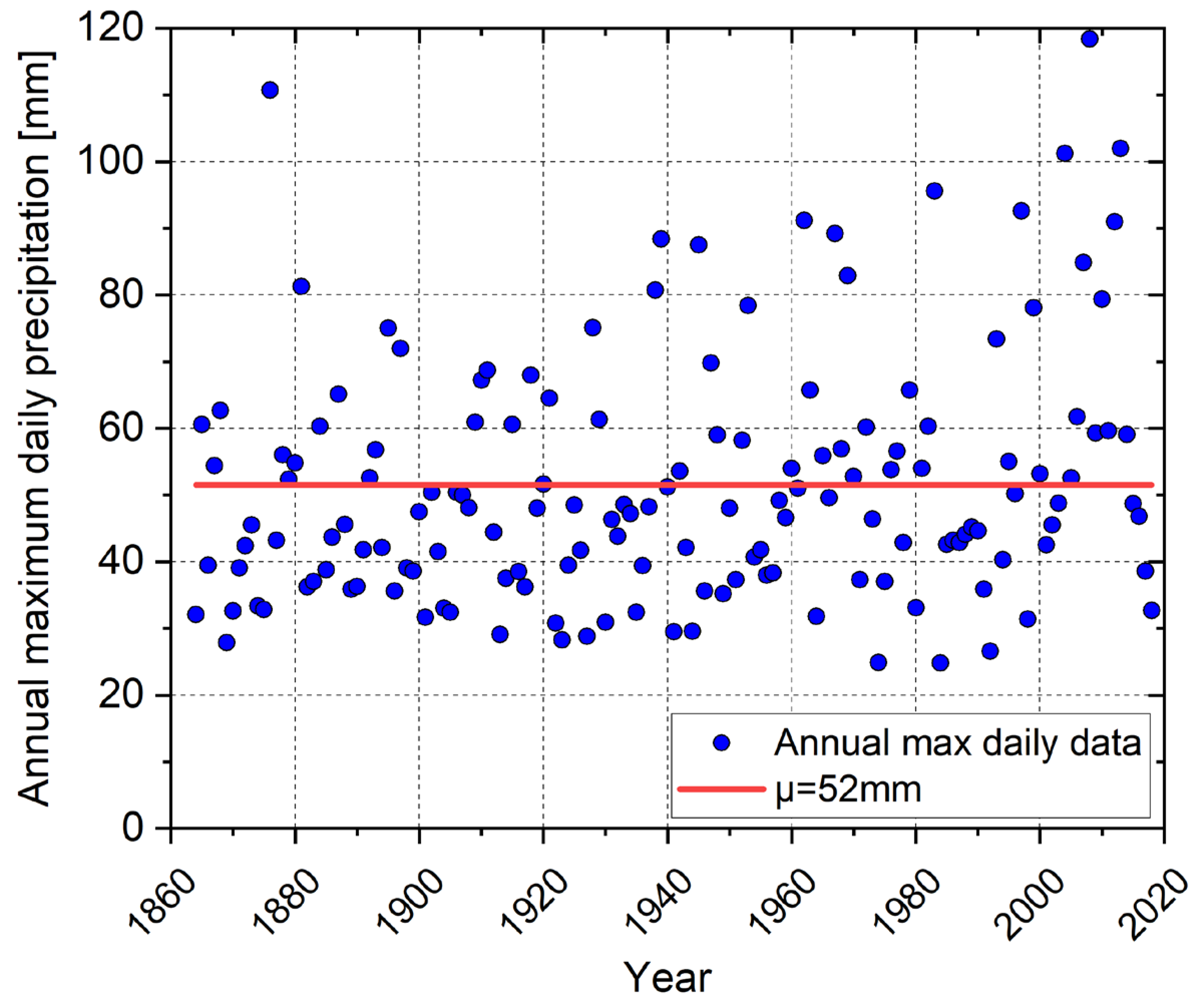
The pluvial flood probability coefficient was calculated using data from previous precipitation events in Portugal. The precipitation heights (mm) were again made accessible by IPMA, which provided recorded data of the daily precipitation (in mm) in Lisbon from 1864 to 2018 [78]. As threshold value, the average of the annual maximum daily rainfall events has been considered. This means that for each year, the maximum daily rainfall value in mm was taken, and the average in mm of all years was found (52 mm). Then, for the total number of events, in this case equal to the number of years analyzed (155), all annual maximum daily events equal to or greater than 52 mm were counted (61), see Figure 10. Consequently, based on Equation (18), the probability of a flood occurrence relevant to the case study is around 39.4%.
Subsequently, the intersection of two independent events (the probability of both events occurring) can be calculated according to the previously presented Equation (17), by multiplying the two single probabilities. The relevant terms for the probabilistic evaluation are summarized in Table 8. From the results, it is possible to observe that floods (P(FL) = 39.4%) occur more frequently than earthquakes (P(EQ) = 7.1%), with their joint occurrence being rare (P(EQFL) = 2.8%). Initial coefficients α = 2.54 and β = 14.08 highlight the flood’s higher relative influence. It is important to recall that normalization (Equations (21) and (22)) produces values between 0 and 1 that represent the proportional percentage contributions, of the two separate events. After normalization, coefficients αN = 0.15 (15%) and βN = 0.85 (85%) reveal that floods dominate the risk scenario, suggesting a priority focus on flood mitigation, even if earthquakes remain important, particularly for large events. These coefficients can be used in Equation (23), to assess the multi-hazard damage, by considering the combination of two independent events.
As described above the aim of this study is to examine the losses caused by the simultaneous occurrence of two completely independent events; they are summarized in terms of the normalized coefficients (αN and βN). For completeness, it is important to emphasize that possible weak interactions between the two events (i.e., treating them as not fully independent) may change the values of the alpha and beta coefficients. For example, an earthquake could cause bridges or embankments to collapse, thereby triggering a flood [12]. In this instance, new research might be done, using available data on possible dependencies between the two events, as well as alternative probabilistic formulations that account for such interactions, could be considered. However, since this likelihood is minimal and not relevant to the case study and given the different nature of the hazards examined (pluvial flooding and earthquakes) this work treats the two events as fully independent.

4.3. Multi-Hazard Risk Assessment

4.3.1. Vulnerability

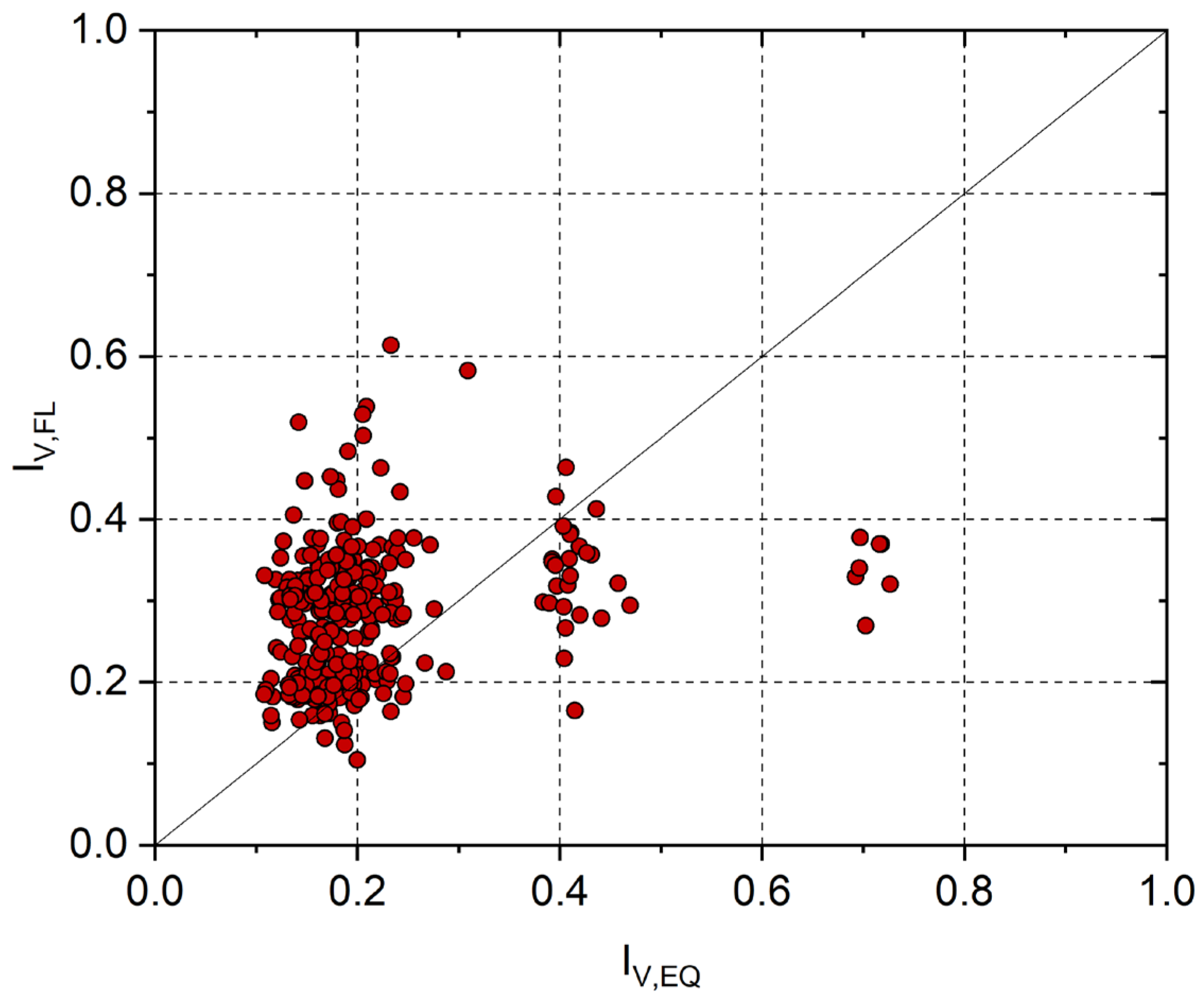
Based on the characteristics of the studied buildings acquired in the exposure model, the MCDM processes allowed for the determination of a vulnerability index ranging from 0 to 1 for earthquake IV,EQ and flood IV,FL. Figure 11 shows the MCDM earthquake and flood vulnerability indexes for the analyzed sample of buildings. The scatter plot shows the relationship between the flood vulnerability index (IV,FL) on the Y-axis and the seismic vulnerability index (IV,EQ) on the X-axis. Most points cluster in the lower-left quadrant, indicating low vulnerability to both flood and seismic hazards. A diagonal trend line suggests a weak positive correlation between areas with flood and seismic vulnerability. The concentration of points at low IV,FL and IV,EQ values also suggest that seismic effects are less influential, as fewer buildings show high vulnerability to earthquakes compared to floods.
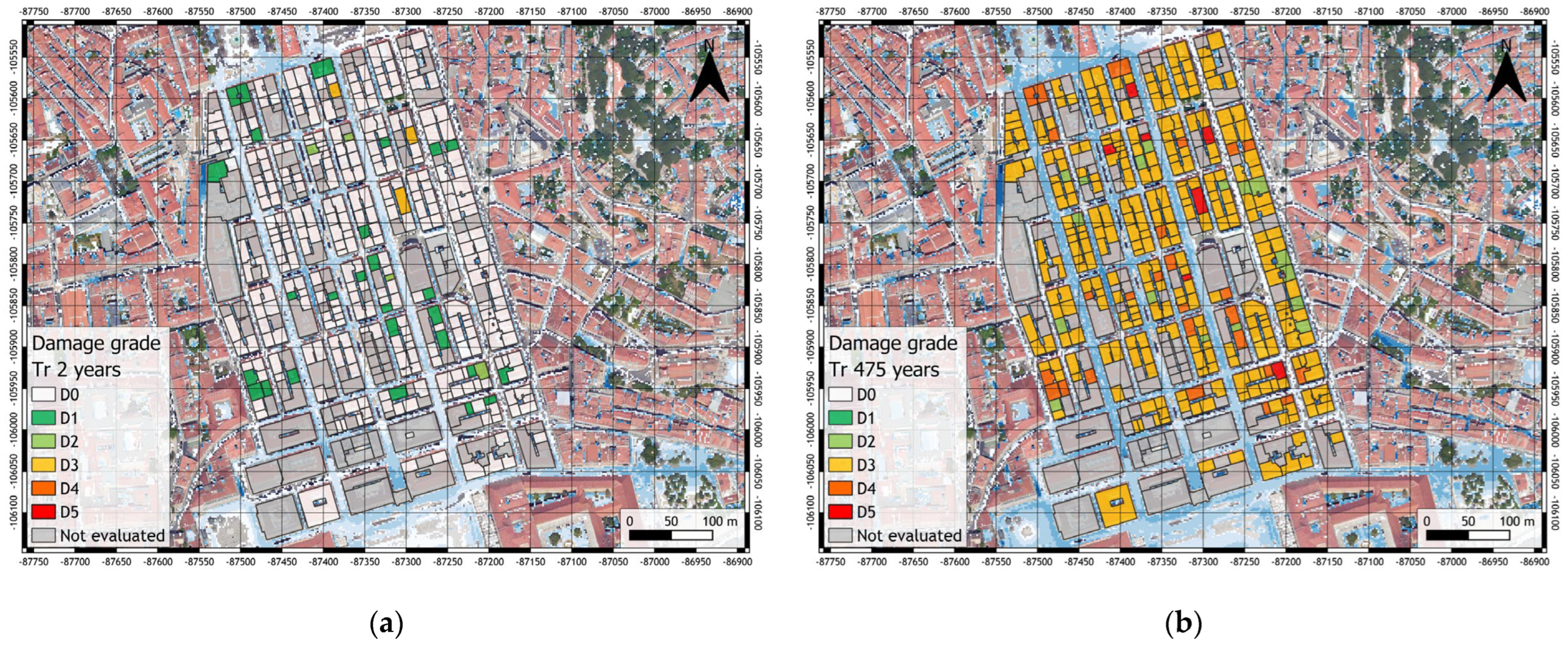
Graphically, QGIS maps have been derived to comprehensively show the building seismic damage and respective maximum water depth for each return period (Figure 12). These maps are useful for identifying the maximum water depth and earthquake damage Dk within the case study area, with the 2-year map showing short-term risks and the 475/500-year map highlighting long-term ones.

4.3.2. Statistically Concurrent Losses Assessment

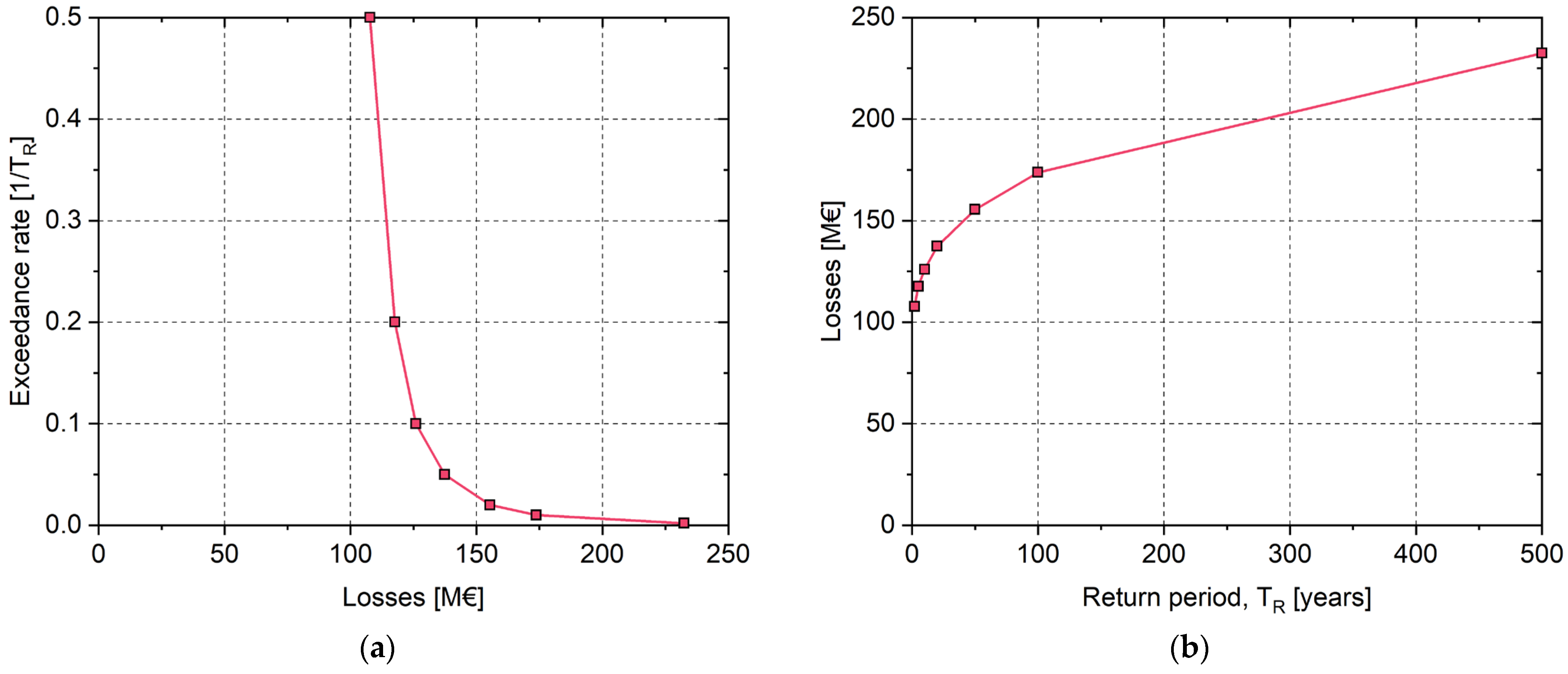
Multi-hazard losses have been calculated as in Equation (24) and have been represented in different ways. Figure 13a depicts the loss exceedance curve (LEC), which relates a given loss metric (usually economic) to the annual frequency of occurrence of that loss or a larger one (the inverse of the return period); while Figure 13b depicts the probable maximum loss (PML), which is the maximum expected loss for the exposed assets and is typically defined for a specific return period [10,79].
The results indicate that, for longer return periods, Baixa Pombalina’s multi-hazard losses due to earthquake and pluvial flood are higher, as expected: for a 2-year return period, MH losses are 108 M€, while for a 475/500-year scenario, MH losses are 232 M€.
It is important to recall that the calculated losses are the consequence of both the earthquake and the flood contributions. This is therefore determined by the level of physical vulnerability estimated for the two separate hazards, with most structures being more vulnerable to floods, both in terms of physical vulnerability (Figure 11) and frequency of occurrence (Table 8). Moreover, losses are also determined by the hazard scenario, so that in the event of a flood, if a building has no water level, no damage is assessed. Finally, losses are also related to exposure and given the nature of the hazard and its potential effect, exposure to earthquakes (2047 M€) is significantly larger than exposure to floods (418 M€). All these assumptions are incorporated into Equation (24), which considers vulnerability via the factors dEQ,i and dFL,i; the frequency of simultaneous occurrence via the αN and βN coefficients; and exposure (Ei,EQ and Ei,FL), which accounts for the different impacts that various hazards may have.
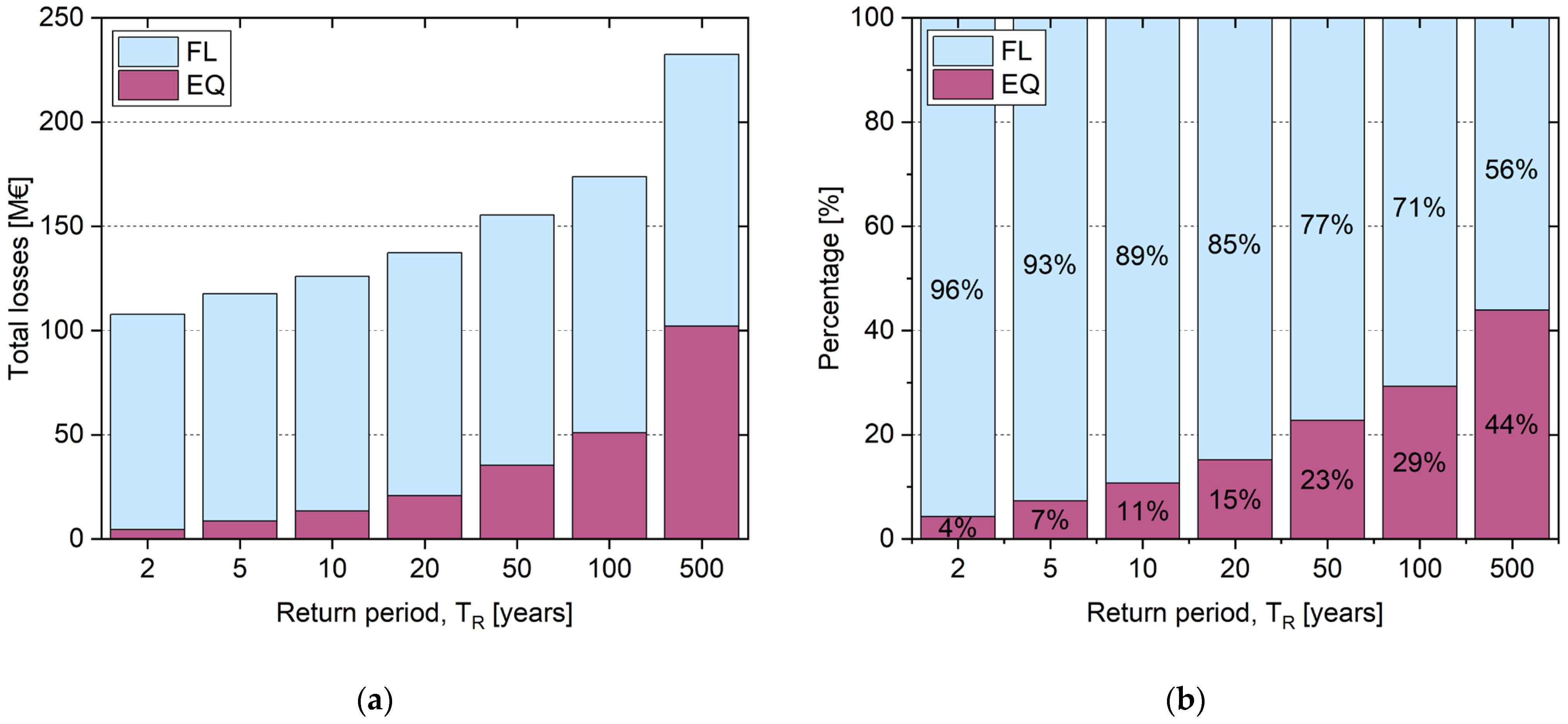
Figure 14 shows the independent results for the earthquake (EQ) and flood (FL) components, which means that the two different parts of Equation (24) are displayed in the graph, to determine how much the two hazards contributed to the global losses. The results indicate that floods contribute more for the Baixa Pombalina case study across all return periods; but, for longer return periods, the earthquake share grows significantly, as seen in Figure 14. As can be observed, absolute flooding losses increase relatively slightly with the return period, whereas earthquake losses grow significantly. This is mainly due to the damage assessment of the flood, which is determined by the water depth, as shown in Equation (15). As reported in the main reference [32], the proposed flood hazard model shows extremely modest changes in water levels for secondary roads across different return periods. As explained in [32] this is due to the high kinetic velocity of the water flow, which leads to limited lateral propagation of the flow from main roads to secondary roads, resulting in low differences in water depth in secondary roads and, as a result, limited variations in the loss estimate with the return period. Finally, as can be noted, the total losses assessed as a result of the simultaneous occurrence of both events are less than the simple sum of the losses caused by the earthquake and flood (see Table 4 and Table 7). This is due to the methodology’s conception, which seeks to take into account the likelihood of the two occurrences occurring simultaneously, as well as the resultant damage distribution between the earthquake and the flood. A lower total probability was indeed expected since, based on the principle of the total probability theorem, two independent events that occur together are much less frequent than the individual events.
As the last step for the complete application of the methodology, a simplified recovery phase has been assumed. For example, if it is considered that the recovery phase in the Baixa Pombalina has completed half of the total required time to restore the pre-initial scenario, the REQFL function will be 0.5. Using this coefficient in Equation (25), the residual losses will be as in Table 9.

4.3.3. Short-Term Consecutive Losses Assessment

For the purpose of completeness of the research, an example of a simple application of the methodology for the short-term consecutive event has been performed, if the earthquake strikes first (E1), followed by the flood (E2), before recovery operations begin. As stated in Section 3.1, the global damage caused by the two occurrences is computed using the second formula of Equation (9), and the total losses can be estimated by multiplying the total cumulative damage by the total exposure.
However, this case study is distinctive because the vulnerability functions adopted were developed for two different exposure configurations: the earthquake model considers all above-ground floors, whereas the flood model only accounts for the ground floor and any basement levels.
This aspect means that the standard formula for cumulative loss cannot be simply multiplied by total exposure; instead, coefficients must be included to match earthquake and flood losses to real exposure. This means, the real exposure should be calculated first, as follows:
E i , T O T = V m , g f , i · A i + V m , u f , i · n i 1 · A i   +   V m , g f , i 4 · A b , i
with all the terms defined as in Section 3.1 and resulting in the total value of all-above ground floors and basement, if any. Subsequently the second formula of Equation (9) must be transformed into:
d c u m , i , E E Q   +   E F L = 1 1 d E Q · E i , E Q E i , T O T · 1 d F L · E i , F L E i , T O T
The two introduced factors E i , E Q E i , T O T and E i , F L E i , T O T allow the fact that the earthquake damage and flood damage affect different parts of the building (and therefore different exposures) to be taken into consideration and relate the individual damages to the building as a whole. The total losses will then be:
L i , E E Q   +   E F L   =   d c u m , i , E E Q   +   E F L · E i , T O T
It is important to note that, if the exposure for both hazards is the same, the formula reverts to its original form, and the losses are calculated by multiplying the cumulative damage by the exposure. For the case study, the results of the short-term consecutive event in which the earthquake strikes first and a flood occurs are summarized in Table 10.
As shown in Table 10, the total multi-hazard losses for the short-term consecutive events (earthquake and flood) are less than the simple sum of the two single-hazard losses (Table 4 and Table 7), because it is assumed that a part of a building already damaged by the first event cannot withstand additional damage from the second event.

5. Discussion

The present paper evaluates the multi-hazard vulnerability and losses from the simultaneous occurrence of two independent hazards in Lisbon downtown, i.e., pluvial flood and earthquake. By using participatory multi-criteria decision-making methodologies (AHP and TOPSIS) a vulnerability index for each structure has been defined for both hazards.
Hazard simulations were performed to find the hazard intensities for the desired return periods (2–5–10–20–50–100–475/500-year). The flood water depth and extension maps were obtained by running pluvial simulations in HEC-RAS Software, while the earthquake hazard was assessed using empirical formulae to determine macroseismic intensity. Then, the MCDM method was used to assess flood and seismic vulnerability, respectively, by selecting a set of flood and earthquake-specific building parameters and then utilizing the AHP and TOPSIS procedures to weigh the vulnerability factors and calculate the vulnerability index. Twelve representative indicators for floods and fourteen representative indicators for earthquakes were selected based on a literature review and case study data.
Sensitivity analysis was performed to evaluate the robustness of the parameters and to identify the real effect of the decision maker’s opinion on the overall outcome for both earthquake and flood hazards. The method was found to be sufficiently stable.
A methodology for combining the two independent hazards has been proposed. Starting with analyzing available historical event data, floods have a 39.4% probability of occurrence, while earthquakes 7.1%, with a 2.8% probability of co-occurrence. The normalized coefficients αN (15%) and βN (85%) were used to estimate which event, earthquake or pluvial flood, had a higher impact on global expected losses. These coefficients represent the relative weight of each event concerning its joint probability.
Subsequent loss assessment for each return period was conducted by integrating the single damage value with their respective coefficients and multiplying by the hazard-specific exposure values. The multi-hazard loss estimates reveal a pronounced increase with return period, from 108 M€ for a 2 year-TR to 232 M€ for a 475/500 year-TR. Furthermore, an application of the proposed methodology to a short-term consecutive condition is presented, demonstrating that the resulting multi-hazard losses are lower than the simple sum of the two single-hazard losses, as the approach avoids double-counting the damage caused by the two events. This study presents a significant advancement in multi-hazard risk assessment by moving beyond a single-hazard paradigm. It introduces a probabilistic framework for estimating losses from the simultaneous occurrence of two independent hazards: earthquakes and pluvial flooding. The methodology is versatile, using a hazard-specific indicator-based approach to derive a composite vulnerability index for buildings in Lisbon’s historic centre. Given the natural characteristics of the Lisbon territory, this research is of practical significance for promoting multi-risk assessment and disaster reduction strategies including a better understanding of existing natural phenomena and their potential interrelationships, the implementation of structural strategies to reduce vulnerability, and the implementation of urban risk mitigation and emergency planning.
Nevertheless, certain limitations should be acknowledged, as they highlight the need for future research. The current model does not explicitly investigate interactions between physical vulnerabilities. Furthermore, the analysis is confined to direct economic losses, excluding indirect consequences such as business interruption. Lastly, the recovery function applied herein is a simplified implementation of the recovery function, with the assumption that the recovery work for the entire case study area was 50% complete. In order to achieve greater accuracy, data on the reconstruction phase should be collected through specific studies. This would allow residual losses to be verified at specific times of interest in the recovery phase, as well as a better knowledge of how much time is being spent. Accurate recovery functions, if provided, can differentiate the degree of damage to each building, providing loss recovery values that reflect the real level of damage. Addressing these aspects would provide a more comprehensive risk profile and represent a logical next step for the field. Still, the methodology framework proposal provides a beneficial tool for creating strategies for risk mitigation in areas that may be vulnerable to various hazards. The methodology presented herein is simple and adaptable to a variety of contexts, for stakeholders with decision authority who want to understand the consequences of two independent events occurring concurrently.

Author Contributions

Conceptualization, G.M. and N.C.; methodology, G.M. and N.C.; formal analysis, G.M.; investigation, G.M.; data curation, G.M.; writing—original draft preparation, G.M.; writing—review and editing, N.C., C.P. and P.B.L.; supervision, N.C., C.P. and P.B.L. All authors have read and agreed to the published version of the manuscript.

Funding

This work was supported by FCT—Fundação para a Ciência e Tecnologia, I.P. under grant agreement 2023.03899.BDANA and DOI identifier https://doi.org/10.54499/2023.03899.BDANA attributed to the 1st author.

Data Availability Statement

The data are made available only upon reasonable private request to the first author.

Acknowledgments

This work was also supported by FCT/MCTES under the R&D Unit Institute for Sustainability and Innovation in Structural Engineering (ISISE), under the references UID/4029/2025 (https://doi.org/10.54499/UID/04029/2025) and UID/PRR/04029/2025 (https://doi.org/10.54499/UID/PRR/04029/2025), and under the Associate Laboratory Advanced Production and Intelligent Systems ARISE under reference LA/P/0112/2020. The authors would like to thank Francesco Pugliese from the University of Naples Federico II for his invaluable support during the hydrologic-hydraulic modelling phase.

Conflicts of Interest

The authors declare no conflicts of interest.

References

  1. Gill, J.C.; Malamud, B.D. Anthropogenic Processes, Natural Hazards, and Interactions in a Multi-Hazard Framework. Earth-Sci. Rev. 2017, 166, 246–269. [Google Scholar] [CrossRef]
  2. Tilloy, A.; Malamud, B.D.; Winter, H.; Joly-Laugel, A. A Review of Quantification Methodologies for Multi-Hazard Interrelationships. Earth-Sci. Rev. 2019, 196, 102881. [Google Scholar] [CrossRef]
  3. De Angeli, S.; Malamud, B.D.; Rossi, L.; Taylor, F.E.; Trasforini, E.; Rudari, R. A Multi-Hazard Framework for Spatial-Temporal Impact Analysis. Int. J. Disaster Risk Reduct. 2022, 73, 102829. [Google Scholar] [CrossRef]
  4. Gallina, V.; Torresan, S.; Critto, A.; Sperotto, A.; Glade, T.; Marcomini, A. A Review of Multi-Risk Methodologies for Natural Hazards: Consequences and Challenges for a Climate Change Impact Assessment. J. Environ. Manag. 2016, 168, 123–132. [Google Scholar] [CrossRef]
  5. Wang, J.; He, Z.; Weng, W. A Review of the Research into the Relations between Hazards in Multi-Hazard Risk Analysis. Nat. Hazards 2020, 104, 2003–2026. [Google Scholar] [CrossRef]
  6. Johnson, K.; Depietri, Y.; Breil, M. Multi-Hazard Risk Assessment of Two Hong Kong Districts. Int. J. Disaster Risk Reduct. 2016, 19, 311–323. [Google Scholar] [CrossRef]
  7. UNISDR. Hyogo Framework for Action 2005–2015: Building the Resilience of Nations and Communities to Disasters. In The United Nations International Strategy for Disaster Reduction, Extract from the Final Report of the World Conference on Disaster Reduction (A/CONF. 206/6); UNISDR: Kobe, Japan, 2005; Volume 380, Available online: https://www.unisdr.org/files/1037_hyogoframeworkforactionenglish.pdf (accessed on 17 July 2025).
  8. UNISDR. Sendai Framework for Disaster Risk Reduction 2015–2030. In Proceedings of the 3rd United Nations World Conference on DRR, Sendai, Japan, 14–18 March 2015; United Nations Office for Disaster Risk Reduction: Geneva, Switzerland, 2015; Volume 1, Available online: https://www.undrr.org/media/16176/download?startDownload=20250717 (accessed on 17 July 2025).
  9. Gill, J.C.; Malamud, B.D. Hazard Interactions and Interaction Networks (Cascades) within Multi-Hazard Methodologies. Earth Syst. Dyn. 2016, 7, 659–679. [Google Scholar] [CrossRef]
  10. Tocchi, G.; Ottonelli, D.; Rebora, N.; Polese, M. Multi-Risk Assessment in the Veneto Region: An Approach to Rank Seismic and Flood Risk. Sustainability 2023, 15, 12458. [Google Scholar] [CrossRef]
  11. van Westen, C.J.; Greiving, S. Multi-Hazard Risk Assessment and Decision Making. In Environmental Hazards Methodologies for Risk Assessment and Management; Dalezios, N.R., Ed.; IWA Publishing: London, UK, 2017; ISBN 978-1-78040-713-5. [Google Scholar] [CrossRef]
  12. Arrighi, C.; Tanganelli, M.; Cristofaro, M.T.; Cardinali, V.; Marra, A.; Castelli, F.; De Stefano, M. Multi-Risk Assessment in a Historical City. Nat. Hazards 2023, 119, 1041–1072. [Google Scholar] [CrossRef]
  13. Mascheri, G.; Chieffo, N.; Arrighi, C.; Del Gaudio, C.; Lourenço, P.B. A Framework for Multi-Risk Assessment in a Historical Area of Lisbon. Int. J. Disaster Risk Reduct. 2024, 108, 104508. [Google Scholar] [CrossRef]
  14. Argyroudis, S.A.; Mitoulis, S.A. Vulnerability of Bridges to Individual and Multiple Hazards- Floods and Earthquakes. Reliab. Eng. Syst. Saf. 2021, 210, 107564. [Google Scholar] [CrossRef]
  15. Cavalieri, F.; Franchin, P.; Giovinazzi, S. Earthquake-Altered Flooding Hazard Induced by Damage to Storm Water Systems. Sustain. Resilient Infrastruct. 2016, 1, 14–31. [Google Scholar] [CrossRef]
  16. Liu, B.; Siu, Y.L.; Mitchell, G. Hazard Interaction Analysis for Multi-Hazard Risk Assessment: A Systematic Classification Based on Hazard-Forming Environment. Nat. Hazards Earth Syst. Sci. 2016, 16, 629–642. [Google Scholar] [CrossRef]
  17. Ming, X.; Liang, Q.; Dawson, R.; Xia, X.; Hou, J. A Quantitative Multi-Hazard Risk Assessment Framework for Compound Flooding Considering Hazard Inter-Dependencies and Interactions. J. Hydrol. 2022, 607, 127477. [Google Scholar] [CrossRef]
  18. QGIS.org. QGIS Geographic Information System, Version 3.36.3-Maidenhead; QGIS Association: Grüt, Switzerland, 2024. Available online: http://www.qgis.org (accessed on 20 November 2025).
  19. OPENGIS.ch. QField, Version 3.3.11-Darién; OPENGIS.ch: Laax, Switzerland, 2024. Available online: https://qfield.org/ (accessed on 30 August 2024).
  20. Mascheri, G.; Chieffo, N.; Lourenço, P.B. Multi-Attribute-Based Procedure for Seismic Loss Scenario in a Historical Area. Bull. Earthq. Eng. 2024, 22, 7323–7358. [Google Scholar] [CrossRef]
  21. Milutinovic, Z.V.; Trendafiloski, G.S. Risk-UE An Advanced Approach to Earthquake Risk Scenarios with Applications to Different European Towns. Contract EVK4-CT-2000-00014 WP4 Vulnerability of Current Buildings; European Commission: Brussels, Belgium, 2003; 110p, Available online: http://www.civil.ist.utl.pt/~mlopes/conteudos/DamageStates/Risk%20UE%20WP04_Vulnerability.pdf (accessed on 28 July 2025).
  22. Barchetta, L.; Petrucci, E.; Xavier, V.; Bento, R. A Simplified Framework for Historic Cities to Define Strategies Aimed at Implementing Resilience Skills: The Case of Lisbon Downtown. Buildings 2023, 13, 130. [Google Scholar] [CrossRef]
  23. Bernardo, V.; Sousa, R.; Candeias, P.; Costa, A.; Campos Costa, A. Historic Appraisal Review and Geometric Characterization of Old Masonry Buildings in Lisbon for Seismic Risk Assessment. Int. J. Archit. Herit. 2022, 16, 1921–1941. [Google Scholar] [CrossRef]
  24. Van Westen, C.J. Remote Sensing and GIS for Natural Hazards Assessment and Disaster Risk Management. Treatise Geomorphol. 2013, 3, 259–298. [Google Scholar] [CrossRef]
  25. INE. Volume de Vendas Médio por m2 de Área de Exposição e Venda (€) nas Unidades Comerciais de Dimensão Relevante por Localização Geográfica (NUTS—2013) e Setor de Atividade Económica; Annual—INE, Inquérito aos Estabelecimentos Comerciais—Unidades Comerciais de Dimensão Relevante. Período de Referência dos Dados: 2023; Instituto Nacional de Estatística: Lisbon, Portugal, 2023; Available online: https://www.ine.pt/xportal/xmain?xpid=INE&xpgid=ine_indicadores&indOcorrCod=0006950&contexto=bd&selTab=tab2 (accessed on 17 April 2025).
  26. INE. Valor Mediano Das Vendas Por M2 de Alojamentos Familiares Nos Últimos 12 Meses (€) Por Localização Geográfica (NUTS—2013) e Categoria Do Alojamento Familiar; Trimestral—INE, Estatisticas de Preços Da Habitação Ao Nível Local. Período de Referência Dos Dados 4o Trimestre de 2023; Instituto Nacional de Estatística: Lisbon, Portugal, 2023; Available online: https://www.ine.pt/xportal/xmain?xpid=INE&xpgid=ine_indicadores&indOcorrCod=0011364&contexto=bd&selTab=tab2 (accessed on 17 April 2025).
  27. Leal, M.; Ramos, C.; Pereira, S. Different Types of Flooding Lead to Different Human and Material Damages: The Case of the Lisbon Metropolitan Area. Nat. Hazards 2018, 91, 735–758. [Google Scholar] [CrossRef]
  28. Lantada, N.; Pujades, L.G.; Barbat, A.H. Earthquake Risk Scenarios in Urban Areas: A Review with Applications to the Ciutat Vella District in Barcelona, Spain. Int. J. Archit. Herit. 2018, 12, 1112–1130. [Google Scholar] [CrossRef]
  29. NP EN 1998-1:2010; Eurocódigo 8—Projecto de Estruturas para Resistência aos Sismos. Parte 1: Regras Gerais, Acções Sísmicas e Regras para Edifícios. Instituto Português da Qualidade: Caparica, Portugal, 2010.
  30. Danciu, L.; Nandan, S.; Reyes, C.; Basili, R.; Weatherill, G.; Beauval, C.; Rovida, A.; Vilanova, S.; Şeşetyan, K.; Bard, P.-Y.; et al. The 2020 Update of the European Seismic Hazard Model: Model Overview; EFEHR Technical Report 001; EFEHR: Zurich, Switzerland, 2021. [Google Scholar] [CrossRef]
  31. APA. Agência Portuguesa do Ambiente. Available online: https://apambiente.pt/ (accessed on 18 April 2025).
  32. Mascheri, G.; Chieffo, N.; Pugliese, F.; Pinto, C.; Lourenço, P.B. A GIS–MCDM–Based Framework for Flood Risk Scenario in Central Lisbon. Int. J. Archit. Herit. 2026, 1–21. [Google Scholar] [CrossRef]
  33. Hydrologic Engineering Center. HEC-RAS 2D Modeling User’s Manual; US Army Corps of Engineers: Davis, CA, USA, 2021. [Google Scholar]
  34. DGT Direção Geral do Território. MDS-2m. Available online: https://cdd.dgterritorio.gov.pt/dgt-fe/mapa?collection=MDS-2m (accessed on 27 October 2025).
  35. ESRI. Esri|Sentinel-2 10m Land Use/Land Cover Data by Esri and Impact Observatory. Esri Land Cover. Available online: https://livingatlas.arcgis.com/landcover/ (accessed on 4 November 2025).
  36. Brandão, C.; Rodrigues, R.; Costa, J.P. Análise de Fenómenos Extremos Precipitações Intensas em Portugal Continental; Direcção dos Serviços de Recursos Hídricos, Instituto da Água: Lisbon, Portugal, 2001; Available online: http://www.civil.ist.utl.pt/~mps/HRH/2015_2016%20desactivado/relatorio_prec_intensa.pdf (accessed on 27 October 2025).
  37. McCuen, R.H. Hydrologic Analysis and Design, 2nd ed.; Prentice Hall: Englewood Cliffs, NJ, USA, 1998. [Google Scholar]
  38. USDA. SCS Hydrology. In National Engineering Handbook; USDA: Washington, DC, USA, 1993. [Google Scholar]
  39. Borre, A. Modelling the Dynamic Impacts of Consecutive Natural Hazards: A Framework for Time-Evolving Vulnerability and Recovery Analysis. Doctoral Dissertation, Università degli Studi di Genova, Genoa, Italy, 2025. Available online: https://hdl.handle.net/20.500.14242/295854 (accessed on 10 February 2026).
  40. Tang, C.; Zhu, J.; Ding, J.; Cui, X.F.; Chen, L.; Zhang, J.S. Catastrophic Debris Flows Triggered by a 14 August 2010 Rainfall at the Epicenter of the Wenchuan Earthquake. Landslides 2011, 8, 485–497. [Google Scholar] [CrossRef]
  41. Gautam, D.; Dong, Y. Multi-Hazard Vulnerability of Structures and Lifelines Due to the 2015 Gorkha Earth-quake and 2017 Central Nepal Flash Flood. J. Build. Eng. 2018, 17, 196–201. [Google Scholar] [CrossRef]
  42. Cimellaro, G.P.; Reinhorn, A.M.; Bruneau, M. Framework for Analytical Quantification of Disaster Resilience. Eng. Struct. 2010, 32, 3639–3649. [Google Scholar] [CrossRef]
  43. Kappes, M.S.; Keiler, M.; von Elverfeldt, K.; Glade, T. Challenges of Analyzing Multi-Hazard Risk: A Review. Nat. Hazards 2012, 64, 1925–1958. [Google Scholar] [CrossRef]
  44. Luo, H.Y.; Zhang, L.M.; Zhang, L.L.; He, J.; Yin, K.S. Vulnerability of Buildings to Landslides: The State of the Art and Future Needs. Earth-Sci. Rev. 2023, 238, 104329. [Google Scholar] [CrossRef]
  45. Davis, L.; Larionova, T.; Patel, D.; Tse, D.; Baquedano Juliá, P.; Pinto Santos, P.; Ferreira, T.M. Flood Vulnerability and Risk Assessment of Historic Urban Areas: Vulnerability Evaluation, Derivation of Depth-Damage Curves and Cost–Benefit Analysis of Flood Adaptation Measures Applied to the Historic City Centre of Tomar, Portugal. J. Flood Risk Manag. 2023, 16, e12908. [Google Scholar] [CrossRef]
  46. Gandini, A.; Garmendia, L.; Prieto, I.; Álvarez, I.; San-José, J.-T. A Holistic and Multi-Stakeholder Methodology for Vulnerability Assessment of Cities to Flooding and Extreme Precipitation Events. Sustain. Cities Soc. 2020, 63, 102437. [Google Scholar] [CrossRef]
  47. Leal, M.; Reis, E.; Pereira, S.; Santos, P.P. Physical Vulnerability Assessment to Flash Floods Using an Indica-tor-Based Methodology Based on Building Properties and Flow Parameters. J. Flood Risk Manag. 2021, 14, e12712. [Google Scholar] [CrossRef]
  48. Salazar, L.G.F.; Figueiredo, R.; Romão, X. Flood Vulnerability Assessment of Built Cultural Heritage: Literature Review and Identification of Indicators. Int. J. Disaster Risk Reduct. 2024, 111, 104666. [Google Scholar] [CrossRef]
  49. Stefanini, S. Il Patrimonio Architettonico Delle Culture Del Maghreb a Rischio Di Scomparsa per Perdita Di Conoscenza Ed Aggressione Ambientale. Valutazione Delle Vulnerabilità e Del Rischio Sismico Della Medina Di Fes in Marocco. Doctoral Dissertation, University of Florence, Florence, Italy, 2020. Available online: https://hdl.handle.net/2158/1190289 (accessed on 22 April 2024).
  50. Vicente, R. Estratégias e metodologias para intervenções de reabilitação urbana: Avaliação da vulnerabilidade e do risco sísmico do edificado da baixa de Coimbra. Doctoral Dissertation, Universidade de Aveiro, Aveiro, Portugal, 2008. [Google Scholar]
  51. Formisano, A.; Florio, G.; Landolfo, R.; Mazzolani, F.M. Numerical Calibration of an Easy Method for Seismic Behaviour Assessment on Large Scale of Masonry Building Aggregates. Adv. Eng. Softw. 2015, 80, 116–138. [Google Scholar] [CrossRef]
  52. de Brito, M.M.; Evers, M.; Almoradie, A.D.S. Participatory Flood Vulnerability Assessment: A Multi-Criteria Approach. Hydrol. Earth Syst. Sci. 2018, 22, 373–390. [Google Scholar] [CrossRef]
  53. Fontenele, A.; Campos, V.; Matos, A.M.; Mesquita, E. A Vulnerability Index Formulation for Historic Facades Assessment. J. Build. Eng. 2023, 64, 105552. [Google Scholar] [CrossRef]
  54. Chakraborty, S. TOPSIS and Modified TOPSIS: A Comparative Analysis. Decis. Anal. J. 2022, 2, 100021. [Google Scholar] [CrossRef]
  55. Pathan, A.I.; Girish Agnihotri, P.; Said, S.; Patel, D. AHP and TOPSIS Based Flood Risk Assessment—A Case Study of the Navsari City, Gujarat, India. Environ. Monit. Assess. 2022, 194, 509. [Google Scholar] [CrossRef]
  56. Caterino, N. Analisi Decisionale Multicriterio per L’adeguamento Sismico di Edifici in C.A. Doctoral Dissertation, University of Naples Federico II, Naples, Italy, 2007. [Google Scholar] [CrossRef]
  57. Lagomarsino, S.; Giovinazzi, S. Macroseismic and Mechanical Models for the Vulnerability and Damage Assessment of Current Buildings. Bull. Earthq. Eng. 2006, 4, 415–443. [Google Scholar] [CrossRef]
  58. Chieffo, N.; Formisano, A.; Lourenço, P.B. Seismic Vulnerability Procedures for Historical Masonry Structural Aggregates: Analysis of the Historical Centre of Castelpoto (South Italy). Structures 2023, 48, 852–866. [Google Scholar] [CrossRef]
  59. Vicente, R.; Parodi, S.; Lagomarsino, S.; Varum, H.; Mendes Silva, J.A.R. Seismic Vulnerability and Risk Assessment: Case Study of the Historic City Centre of Coimbra, Portugal. Bull. Earthq. Eng. 2011, 9, 1067–1096. [Google Scholar] [CrossRef]
  60. GNDT. Rischio Sismico Di Edifici Pubblici–Parte I: Aspetti Metodologici; Centro Servizi Quasco: Bologna, Italy, 1993. [Google Scholar]
  61. Grünthal, G. European Macroseismic Scale 1998; Cahiers du Centre Européen de Géodynamique et de Séismologie; Conseil De l’Europe: Luxembourg, 1998; Volume 15, p. 101. Available online: https://media.gfz.de/gfz/sec26/resources/documents/PDF/EMS-98_Original_englisch.pdf (accessed on 3 February 2026).
  62. Chieffo, N.; Formisano, A.; Landolfo, R.; Milani, G. A Vulnerability Index Based-Approach for the Historical Centre of the City of Latronico (Potenza, Southern Italy). Eng. Fail. Anal. 2022, 136, 106207. [Google Scholar] [CrossRef]
  63. Bernardini, A.; Giovinazzi, S.; Lagomarsino, S.; Parodi, S. Vulnerabilità e Previsione Di Danno a Scala Territoriale Secondo Una Metodologia Macrosismica Coerente Con La Scala EMS-98. In Proceedings of the 12th Italian Conference on Earthquake Engineering-ANIDIS, Pisa, Italy, 10–14 June 2007; University of Canterbury, Civil and Natural Resources Engineering: Christchurch, New Zealand, 2007; Available online: http://hdl.handle.net/10092/4060 (accessed on 15 May 2024).
  64. Kassem, M.M.; Nazri, F.M.; Farsangi, E.N. The Seismic Vulnerability Assessment Method-ologies: A State-of-the-Art Review. Ain Shams Eng. J. 2020, 11, 849–864. [Google Scholar] [CrossRef]
  65. Nassirpour, A. Performance Based Seismic Assessment of Masonry Infilled Steel Frame Structures. Doctoral Dissertation, UCL University College London, London, UK, 2018. Available online: https://scholar.google.com/scholar?q=Performance%20Based%20Seismic%20Assessment%20of%20Masonry%20Infilled%20Steel%20Frame%20Structures.%20Doctoral%20Dissertation (accessed on 16 December 2025).
  66. Roca, A.; Goula, X.; Susagna, T.; Chávez, J.; González, M.; Reinoso, E. A Simplified Method for Vulnerability Assessment of Dwelling Buildings and Estimation of Damage Scenarios in Catalonia, Spain. Bull. Earthq. Eng. 2006, 4, 141–158. [Google Scholar] [CrossRef]
  67. Garrote, J.; Díez-Herrero, A.; Escudero, C.; García, I. A Framework Proposal for Regional-Scale Flood-Risk Assessment of Cultural Heritage Sites and Application to the Castile and León Region (Central Spain). Water 2020, 12, 329. [Google Scholar] [CrossRef]
  68. Yang, M.; Mohammad Yusoff, W.F.; Mohamed, M.F.; Jiao, S.; Dai, Y. Flood Economic Vulnerability and Risk Assessment at the Urban Mesoscale Based on Land Use: A Case Study in Changsha, China. J. Environ. Manag. 2024, 351, 119798. [Google Scholar] [CrossRef] [PubMed]
  69. Zanchetta, G.; Sulpizio, R.; Pareschi, M.T.; Leoni, F.M.; Santacroce, R. Characteristics of May 5–6, 1998 Volcaniclastic Debris Flows in the Sarno Area (Campania, Southern Italy): Relationships to Structural Damage and Hazard Zonation. J. Volcanol. Geotherm. Res. 2004, 133, 377–393. [Google Scholar] [CrossRef]
  70. Arrighi, C.; Mazzanti, B.; Pistone, F.; Castelli, F. Empirical Flash Flood Vulnerability Functions for Residential Buildings. SN Appl. Sci. 2020, 2, 904. [Google Scholar] [CrossRef]
  71. Carisi, F.; Schröter, K.; Domeneghetti, A.; Kreibich, H.; Castellarin, A. Development and Assessment of Uni- and Multivariable Flood Loss Models for Emilia-Romagna (Italy). Nat. Hazards Earth Syst. Sci. 2018, 18, 2057–2079. [Google Scholar] [CrossRef]
  72. Maity, R. Basic Concepts of Probability and Statistics. In Statistical Methods in Hydrology and Hydroclimatology; Maity, R., Ed.; Springer: Singapore, 2018; pp. 7–51. ISBN 978-981-10-8779-0. [Google Scholar] [CrossRef]
  73. Ferrini, M.; Melozzi, A.; Pagliazzi, A.; Scarparolo, S. Rilevamento della Vulnerabilità Sismica degli Edifici in Muratura. Manuale per la Compilazione Della Scheda GNDT/CNR di II livello. Versione Modificata Dalla Regione Toscana; Direzione Generale delle Politiche Territoriale e Ambientali. Settore–Servizio Sismico Regionale: Florence, Italy, 2003; Available online: https://www.abacomurature.it/pdf/01%20Manuale%20compilazione%20schede%20II%20liv_GNDT.pdf (accessed on 30 August 2024).
  74. Brando, G.; De Matteis, G.; Spacone, E. Predictive Model for the Seismic Vulnerability Assessment of Small Historic Centres: Application to the Inner Abruzzi Region in Italy. Eng. Struct. 2017, 153, 81–96. [Google Scholar] [CrossRef]
  75. Agliata, R.; Bortone, A.; Mollo, L. Indicator-Based Approach for the Assessment of Intrinsic Physical Vulnerability of the Built Environment to Hydro-Meteorological Hazards: Review of Indicators and Example of Parameters Selection for a Sample Area. Int. J. Disaster Risk Reduct. 2021, 58, 102199. [Google Scholar] [CrossRef]
  76. Carlier, B.; Puissant, A.; Dujarric, C.; Arnaud-Fassetta, G. Upgrading of an Index-Oriented Methodology for Consequence Analysis of Natural Hazards: Application to the Upper Guil Catchment (Southern French Alps). Nat. Hazards Earth Syst. Sci. 2018, 18, 2221–2239. [Google Scholar] [CrossRef]
  77. IPMA. Shakemaps Instituto Português do Mar e da Atmosfera, I.P. Available online: https://shakemap.ipma.pt/archive/ (accessed on 30 May 2025).
  78. IPMA. Lista de Estações Climatológicas de Superfície—Series Longas Instituto Português do Mar e da Atmosfera, I.P. Available online: https://www.ipma.pt/en/oclima/series.longas/list.jsp (accessed on 23 May 2025).
  79. Velásquez, C.A.; Cardona, O.D.; Mora, M.G.; Yamin, L.E.; Carreño, M.L.; Barbat, A.H. Hybrid Loss Exceedance Curve (HLEC) for Disaster Risk Assessment. Nat. Hazards 2014, 72, 455–479. [Google Scholar] [CrossRef]
Figure 1. External survey of typical buildings located in the case study area: (a) example of a URM building; (b) degradation of the main façade; (c) presence of basement; (d) pavement example and drainage system.
Applsci 16 05154 g001
Figure 2. Empirical expected seismic hazard relationships in Baixa Pombalina: (a) TR-PGA; (b) TR-EMS-98.
Applsci 16 05154 g002
Figure 3. Digital Surface Model with defined 2D Flow Area and boundary conditions.
Applsci 16 05154 g003
Figure 4. A schematic illustration of the potential time sequences for earthquakes and pluvial floods where E1 is the first event (either earthquake or pluvial flood) and E2 is the second event: (a) Statistically concurrent; (b) Short-term consecutive; (c) Long-term consecutive; (d) Independent.
Applsci 16 05154 g004aApplsci 16 05154 g004b
Figure 5. Linear recovery of a property following damage, illustrated at the 20th and 50th days within a total recovery period of 100 days.
Applsci 16 05154 g005
Figure 6. Stage-damage curve adopted for evaluating flood losses for M3 ordinary buildings in Baixa Pombalina.
Applsci 16 05154 g006
Figure 7. DPM for different return periods: (a) 2-year; (b) 475-year.
Applsci 16 05154 g007
Figure 8. MDR for different macroseismic vulnerability classes: (a) Class A; (b) Class B; (c) Class C.
Applsci 16 05154 g008
Figure 9. Earthquakes having a magnitude ≥ 4 occurred between 2009 and 2025, according to the IPMA database [77].
Applsci 16 05154 g009
Figure 10. Annual maximum daily precipitation between 1864 and 2018, according to IPMA database [78].
Applsci 16 05154 g010
Figure 11. Correlation between earthquake and flood vulnerability index displayed for the whole building sample.
Applsci 16 05154 g011
Figure 12. Maps showing maximum water depth and earthquake damage overlap for different return periods: (a) 2-year; (b) 475/500-year.
Applsci 16 05154 g012
Figure 13. Multi-hazard risk curves: (a) MH-LEC; (b) MH-PML.
Applsci 16 05154 g013
Figure 14. Combined losses (FL and EQ) at different return periods: (a) total MH-losses; (b) percentage distribution MH-losses.
Applsci 16 05154 g014
Table 1. Comparison between the estimated PGA valued using [28] and ESHM2020 model [30].
Return Period TR [Years]PGA
[28]
Mean PGA
[30]
Variation
[%]
500.074 g0.035 g−53
1000.096 g0.057 g−40
4750.170 g0.134 g−21
Table 2. Seismic AHP parameters weights.
Nr.ParameterWeight
PEQ1Nature of vertical structures [50]0.080
PEQ2Conventional strength [49,50,73]0.099
PEQ3Topographic condition [49,50,73]0.034
PEQ4Number of floors [50]0.045
PEQ5Horizontal diaphragms [49,50]0.083
PEQ6In-plane regularity [73]0.062
PEQ7Vertical regularity [73]0.055
PEQ8Wall façade openings and alignments [50]0.082
PEQ9Presence of adjacent buildings with different height [49,51]0.055
PEQ10Position of the building in the aggregate [49,51]0.077
PEQ11Structural or typological heterogeneity among adjacent structural units [49,51]0.052
PEQ12Percentage difference of opening areas among adjacent façades [51]0.049
PEQ13Conservation status [50]0.178
PEQ14Aggregate distance [74]0.049
Table 3. Seismic AHP classes scores.
ClassPEQ1PEQ2PEQ3PEQ4PEQ5PEQ6PEQ7PEQ8PEQ9PEQ10PEQ11PEQ12PEQ13PEQ14
A0.0700.0740.0660.0730.0540.0730.0690.0650.0810.0900.0890.1080.0600.089
B0.1440.1430.1290.1360.1130.1270.1350.1140.1360.1320.1280.1520.1100.110
C0.2610.2620.2460.2820.2940.2650.2740.2690.2370.2770.2190.2220.2750.244
D0.5250.5210.5590.5090.5390.5350.5210.5520.5460.5020.5630.5180.5550.557
Table 4. Total seismic losses calculated for Baixa Pombalina.
TR
[Years]
Total Losses
[M€]
230
556
1089
20136
50232
100334
475669
Table 5. Flood AHP parameter weights.
Nr.ParameterWeight
PFL1Structural typology [45]0.073
PFL2Number of floors [47,75]0.054
PFL3Façade exposure and openings on the ground floor [45,46]0.095
PFL4Presence of a basement [45]0.121
PFL5Façade material [45,46]0.044
PFL6Height thresholds for openings subjected to flooding [45,48]0.073
PFL7Conservation status [46,48]0.054
PFL8Surface condition of the nearby area [45]0.104
PFL9Drainage system condition [46]0.146
PFL10Ground floor activity [46,76]0.115
PFL11Population percentage lower than 14 years old and higher than 65 years old [76]0.063
PFL12Cultural value [48]0.058
Table 6. Flood AHP classes scores.
ClassPFL1PFL2PFL3PFL4PFL5PFL6PFL7PFL8PFL9PFL10PFL11PFL12
A0.0560.0660.0580.0550.0590.0550.0570.0580.0530.0510.1060.056
B0.1200.1210.1310.1190.1180.1150.1170.1220.1000.1270.1380.145
C0.2510.2620.2620.2830.2890.2790.2670.2710.2490.3350.2580.282
D0.5730.5510.5490.5430.5340.5510.5590.5490.5970.4870.4980.517
Table 7. Total flood losses calculated for Baixa Pombalina.
TR
[Years]
Total Losses
[M€]
2122
5129
10133
20138
50142
100145
500154
Table 8. Analysis of the main factors used for the case study area in terms of events probabilities and contribution coefficients.
P(EQ)P(FL)P(EQ ∩ FL)αβαNβN
7.1%39.4%2.8%2.5414.080.150.85
Table 9. Total residual losses for Baixa Pombalina at 50% of recovery phase.
TR
[Years]
Total Residual Losses
[M€]
254
559
1063
2069
5078
10087
475/500116
Table 10. Total multi-hazard losses for short-term consecutive event calculated for Baixa Pombalina.
TR
[Years]
Total Losses
[M€]
2150
5182
10216
20265
50357
100455
475/500773
Disclaimer/Publisher’s Note: The statements, opinions and data contained in all publications are solely those of the individual author(s) and contributor(s) and not of MDPI and/or the editor(s). MDPI and/or the editor(s) disclaim responsibility for any injury to people or property resulting from any ideas, methods, instructions or products referred to in the content.