Potential Application of Ferrate-Modified Commercial Biochar to Control Ammonia and Hydrogen Sulfide


Abstract
1. Introduction
2. Materials and Methods
2.1. Biochar and Activated Carbon
2.2. Odor Adsorption by Commercial Biochar
2.3. Surface Modification of Adsorbents
2.4. NH3 and H2S Adsorption Test with Modified Biochars
2.5. Analysis of Adsorbent Characteristics
3. Results
3.1. Odor Adsorption of Biochar and Effect of Pyrolysis Temperature
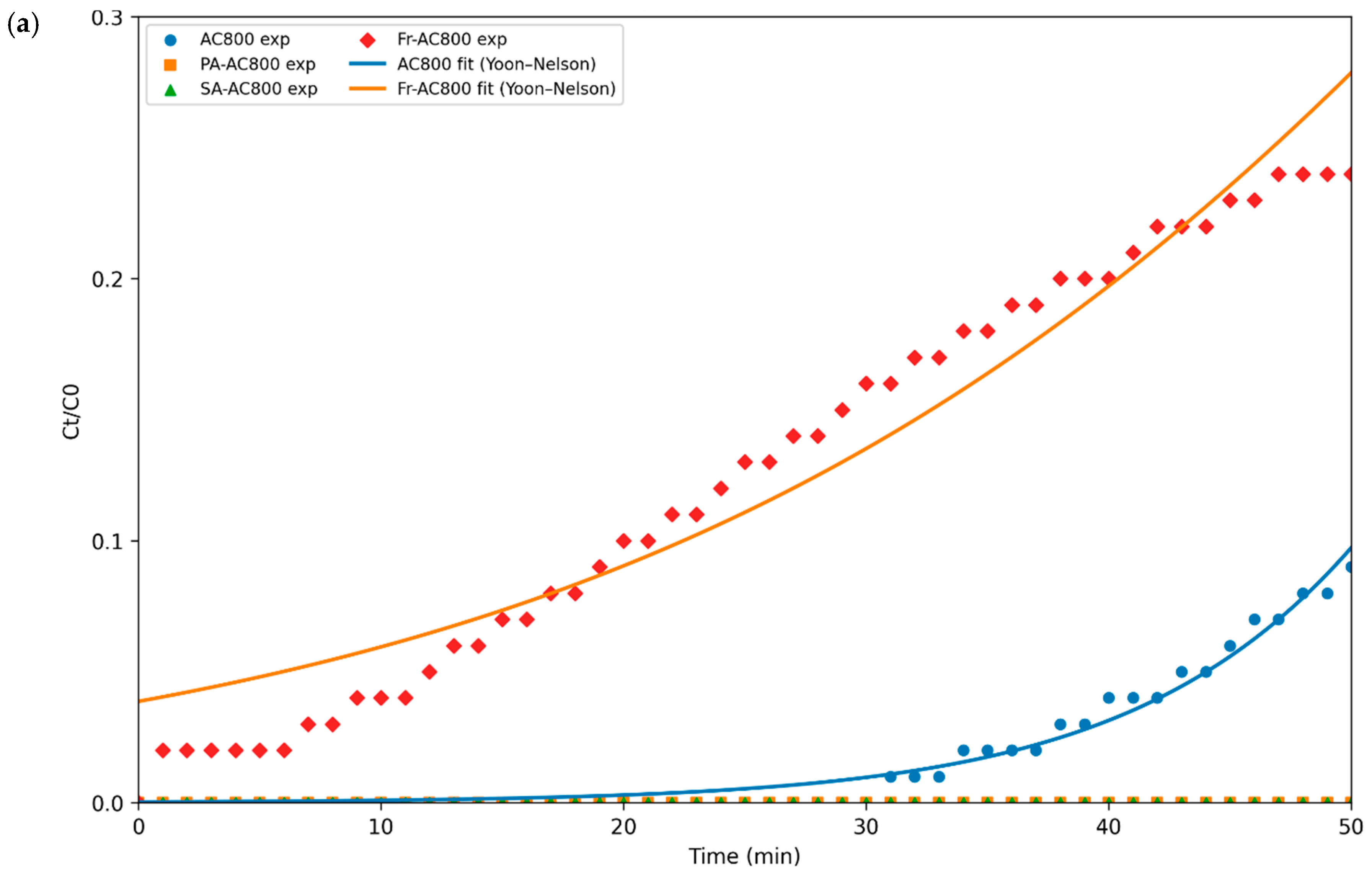
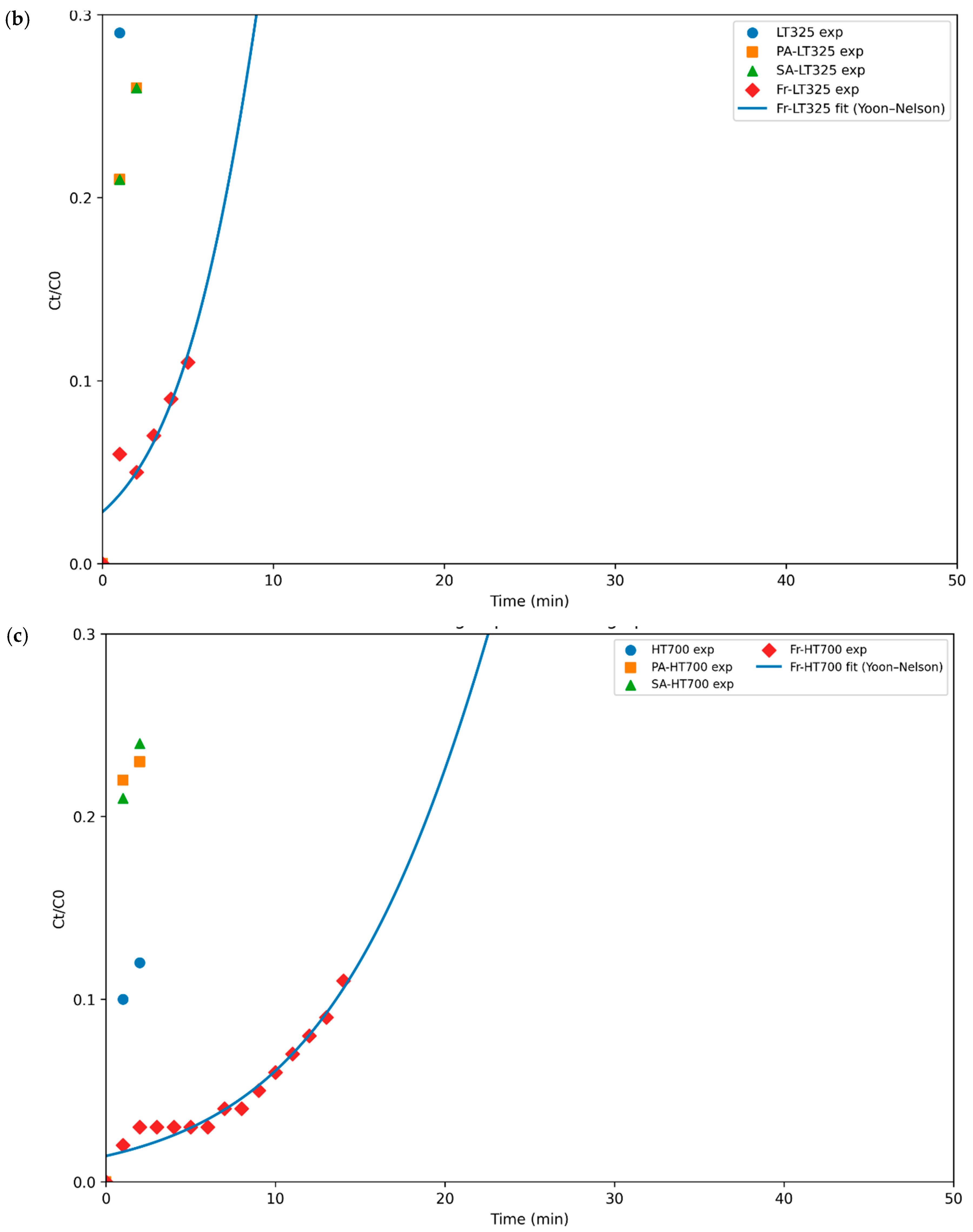
3.2. Adsorption by Surface-Modified Biochar
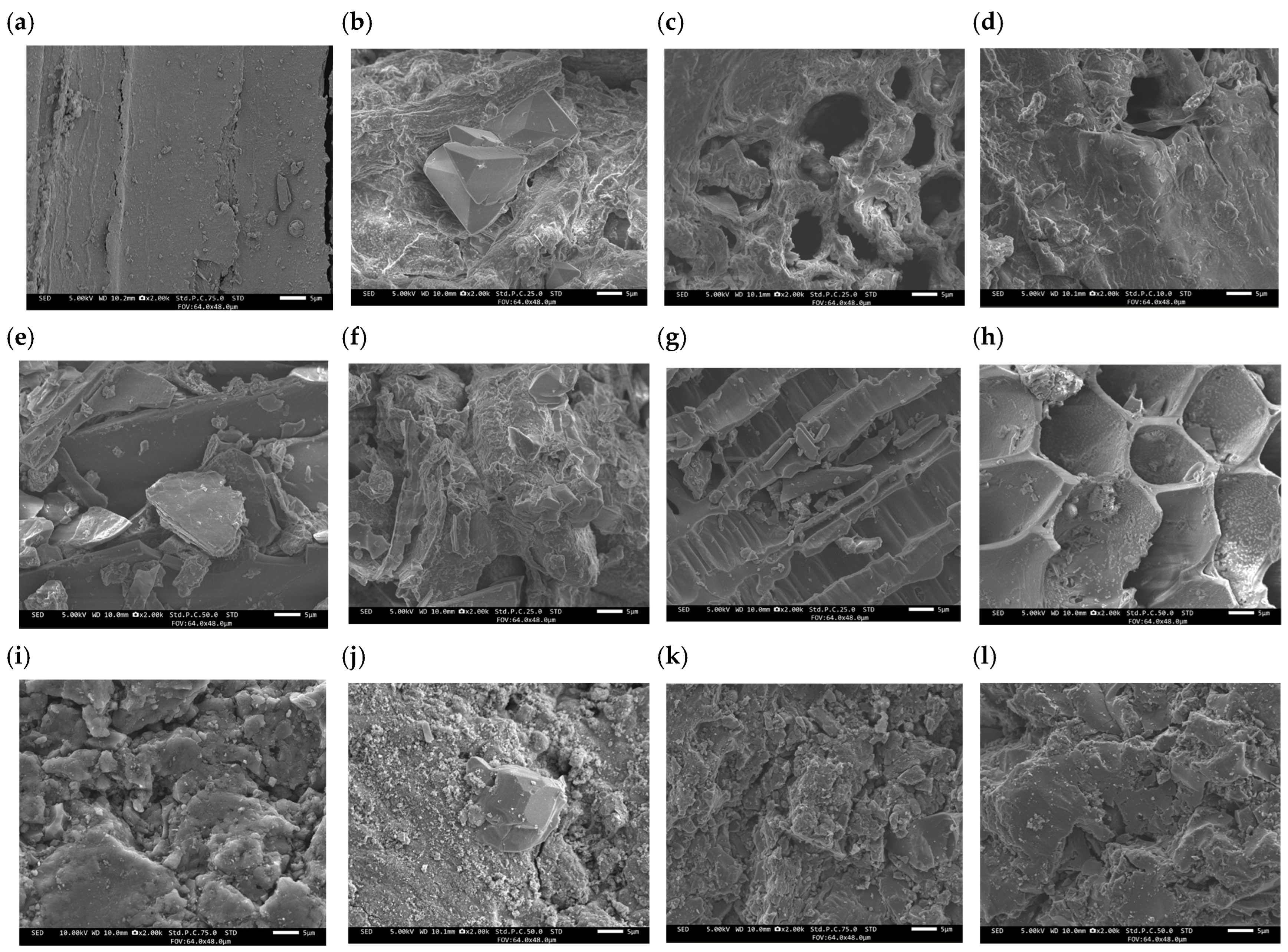
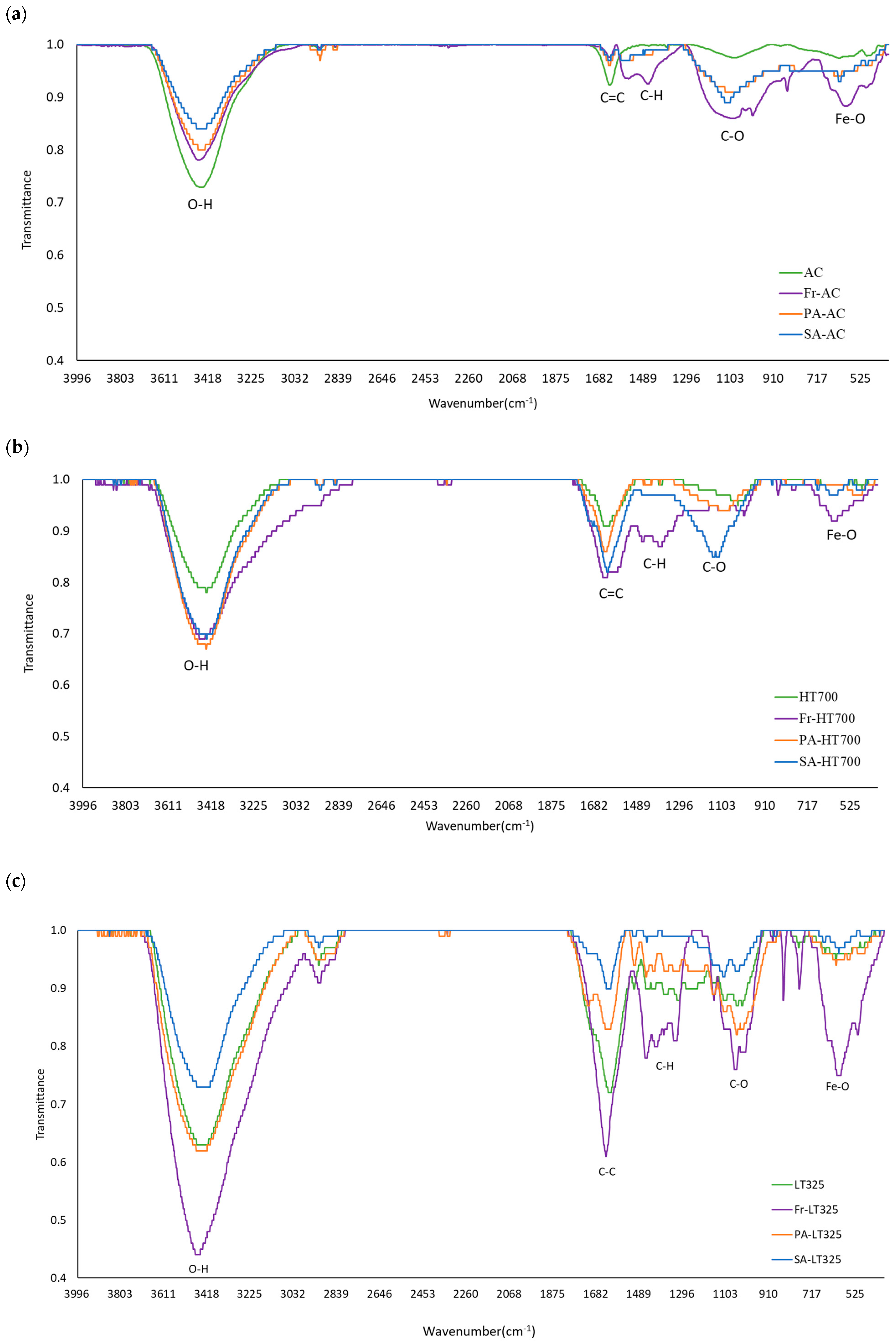
3.3. Surface Chemical Characteristics Induced by Modification
4. Discussion
4.1. Effect of Pyrolysis Temperature on Textural Parameters of Biochar
4.2. Influence of Surface Modification on Adsorption Capacity and Textural Properties
4.3. Adsorption Enhancement by Iron-Oxide and Its Surface Chemistry
5. Conclusions
- (1)
- Among the activated carbon and five commercially available biochars evaluated, HT800 exhibited superior ammonia adsorption performance compared to activated carbon despite possessing only one-tenth of its specific surface area. This result demonstrates the high efficiency of HT800 for ammonia removal and highlights its potential as an effective alternative to activated carbon without requiring additional modification.
- (2)
- Acid and ferrate modifications did not significantly affect the specific surface area of the adsorbents; however, they exhibited contrasting trends in ammonia adsorption performance. The adsorption efficiency of activated carbon increased following acid modification, whereas biochar showed improved ammonia removal efficiency after ferrate modification. These findings suggest that the effectiveness of surface modification for enhancing adsorption performance may vary depending on the intrinsic properties of the adsorbent, indicating the need for further investigation into adsorbent-specific modification strategies.
- (3)
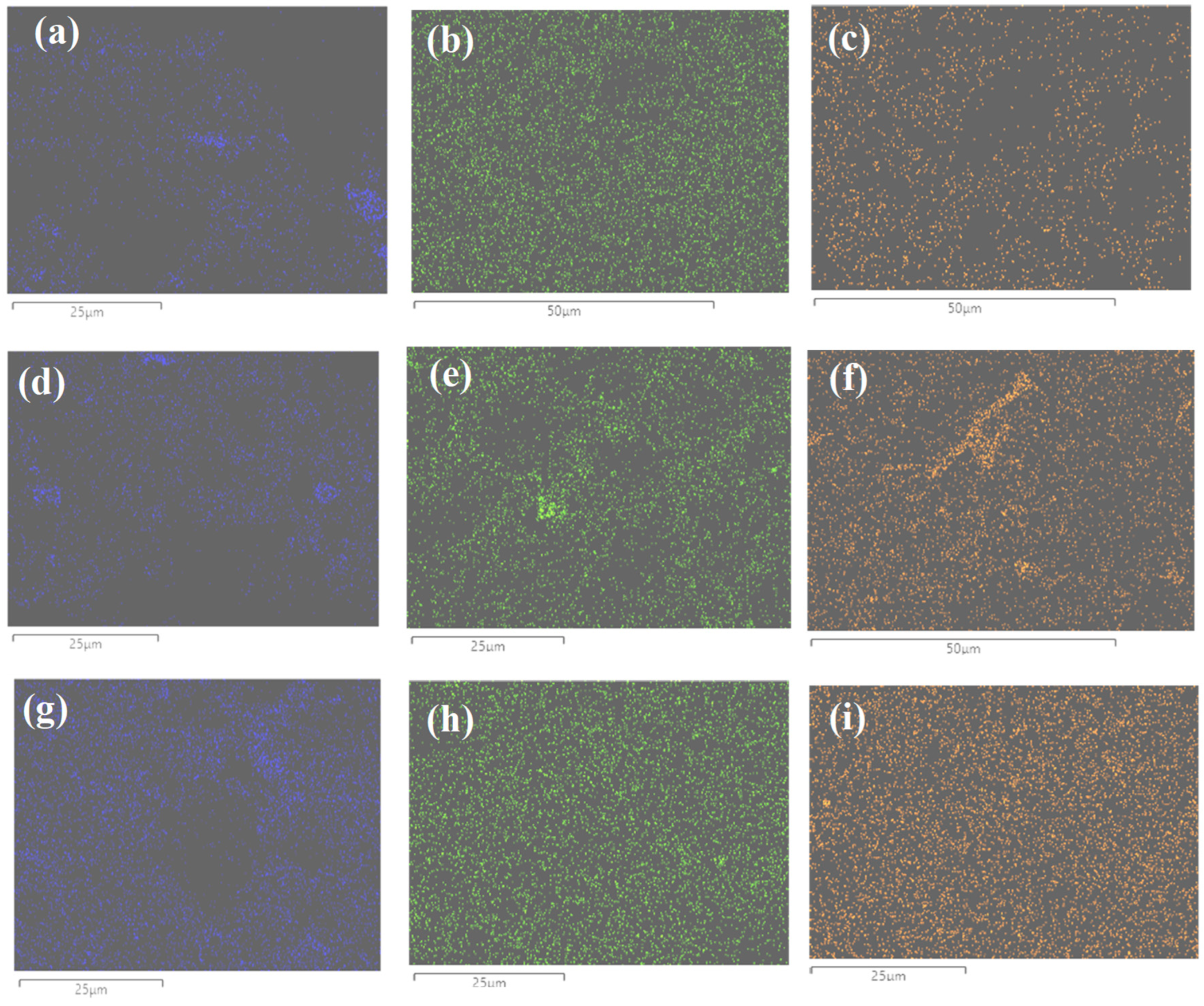
- FTIR analysis confirmed that ferrate modification significantly enhanced the formation of iron-based surface species and oxygen-containing functional groups on the biochar surface compared to activated carbon. These results suggest that the improved ammonia removal performance may not only be attributed to the roles of surface functional groups, such as carboxyl and hydroxyl groups introduced through surface modification, but also to the direct oxidative interactions of iron oxide species with ammonia during the deodorization process.
Author Contributions
Funding
Institutional Review Board Statement
Informed Consent Statement
Data Availability Statement
Conflicts of Interest
Abbreviations
| AC800 | Activated Carbon pyrolyzed at 800 °C |
| Fr | Ferrate |
| HT700 | Biochar pyrolyzed at 700 °C |
| HT800 | Biochar pyrolyzed at 800 °C |
| LT325 | Biochar pyrolyzed at 325 °C |
| LT350 | Biochar pyrolyzed at 350 °C |
| MT500 | Biochar pyrolyzed at 500 °C |
| PA | Phosphoric Acid |
| SA | Sulfuric Acid |
References
- Kadam, R.; Jo, S.; Lee, J.; Khanthong, K.; Jang, H.; Park, J. A review on the anaerobic co-digestion of livestock manures in the context of sustainable waste management. Energies 2024, 17, 546. [Google Scholar] [CrossRef]
- Ankathi, S.K.; Chaudhari, U.S.; Handler, R.M.; Shonnard, D.R. Sustainability of biogas production from anaerobic digestion of food waste and animal manure. Appl. Microbiol. 2024, 4, 418–438. [Google Scholar] [CrossRef]
- Phillip, A.; Bhat, S.M.; Sharma, N.; Poudel, B. Enhanced biogas production using anaerobic co-digestion of animal waste and food waste: A review. J. Sci. Res. Rep. 2024, 30, 761–781. [Google Scholar] [CrossRef]
- Miller, D.N.; Varel, V.H. In vitro study of the biochemical origin and production limits of odorous compounds in cattle feedlots. J. Anim. Sci. 2001, 79, 2949–2956. [Google Scholar] [CrossRef]
- Halder, J.N.; Lee, M.G. A review on techniques to control and mitigate odors in swine facilities. J. Agric. Life Environ. Sci. 2020, 32, 297–310. [Google Scholar] [CrossRef]
- Cho, S.; Hwang, O.; Park, S. Effect of dietary protein levels on composition of odorous compounds and bacterial ecology in pig manure. Asian Australas. J. Anim. Sci. 2015, 28, 1362–1370. [Google Scholar] [CrossRef]
- Zilio, M.; Orzi, V.; Chiodini, M.E.; Riva, C.; Acutis, M.; Boccasile, G.; Adani, F. Evaluation of ammonia and odour emissions from animal slurry and digestate storage in the Po Valley (Italy). Waste Manag. 2020, 103, 296–304. [Google Scholar] [CrossRef]
- Orzi, V.; Riva, C.; Scaglia, B.; D’Imporzano, G.; Tambone, F.; Adani, F. Anaerobic digestion coupled with digestate injection reduced odour emissions from soil during manure distribution. Sci. Total Environ. 2018, 621, 168–176. [Google Scholar] [CrossRef]
- Pedersen, J.; Hafner, S.D. Ammonia emissions after field application of anaerobically digested animal slurry: Literature review and perspectives. Agric. Ecosyst. Environ. 2023, 357, 108697. [Google Scholar] [CrossRef]
- Mochizuki, T.; Kubota, M.; Matsuda, H.; D’Elia Camacho, L.F. Adsorption behaviors of ammonia and hydrogen sulfide on activated carbon prepared from petroleum coke by KOH chemical activation. Fuel Process. Technol. 2016, 144, 164–169. [Google Scholar] [CrossRef]
- Zhou, X.; Moghaddam, T.B.; Chen, M.; Wu, S.; Adhikari, S. Biochar removes volatile organic compounds generated from asphalt. Sci. Total Environ. 2020, 745, 141096. [Google Scholar] [CrossRef]
- Kaikiti, K.; Stylianou, M.; Agapiou, A. Use of biochar for the sorption of volatile organic compounds (VOCs) emitted from cattle manure. Environ. Sci. Pollut. Res. 2021, 28, 59141–59149. [Google Scholar] [CrossRef]
- Piekarski, J.; Ignatowicz, K.; Dąbrowski, T.; Dąbrowski, B. Analysis of the possibility of applying biochars from biowaste as adsorbents to eliminate odors from wastewater treatment. Energies 2024, 17, 4129. [Google Scholar] [CrossRef]
- Chen, Y.; Zhang, X.; Chen, W.; Yang, H.; Chen, H. The structure evolution of biochar from biomass pyrolysis and its correlation with gas pollutant adsorption performance. Bioresour. Technol. 2017, 246, 101–109. [Google Scholar] [CrossRef]
- Sun, Y.; Wang, X.; Yang, C.; Xin, X.; Zheng, J.; Zong, T.; Dou, C. Effects of biochar on gaseous carbon and nitrogen emissions in paddy fields: A review. Agronomy 2024, 14, 1461. [Google Scholar] [CrossRef]
- Hwang, O.; Lee, S.R.; Cho, S.; Ro, K.S.; Spiehs, M.; Woodbury, B.; Silva, P.J.; Han, D.-W.; Choi, H.; Kim, K.-Y.; et al. Efficacy of different biochars in removing odorous volatile organic compounds (VOCs) emitted from swine manure. ACS Sustain. Chem. Eng. 2018, 6, 14239–14247. [Google Scholar] [CrossRef]
- Joshi, M.; Bhatt, D.; Srivastava, A. Enhanced adsorption efficiency through biochar modification: A comprehensive review. Ind. Eng. Chem. Res. 2023, 62, 13748–13761. [Google Scholar] [CrossRef]
- Lan, W.; Zhao, X.; Wang, Y.; Jin, X.; Ji, J.; Cheng, Z.; Yang, G.; Li, H.; Chen, G. Research progress of biochar modification technology and its application in environmental remediation. Biomass Bioenergy 2024, 184, 107178. [Google Scholar] [CrossRef]
- Chaisongkroh, N.; Chungsiriporn, J.; Bunyakan, C. Modeling and optimization of ammonia treatment by acidic biochar using response surface methodology. Songklanakarin J. Sci. Technol. 2012, 34, 423–432. [Google Scholar]
- Wang, S.; Ai, S.; Nzediegwu, C.; Kwak, J.-H.; Islam, M.S.; Li, Y.; Chang, S.X. Carboxyl and hydroxyl groups enhance ammonium adsorption capacity of iron (III) chloride and hydrochloric acid modified biochars. Bioresour. Technol. 2020, 309, 123390. [Google Scholar] [CrossRef]
- Ippolito, J.A.; Cui, L.; Kammann, C.; Wrage-Mönnig, N.; Estavillo, J.M.; Fuertes-Mendizabal, T.; Cayuela, M.L.; Sigua, G.; Novak, J.; Spokas, K.; et al. Feedstock choice, pyrolysis temperature and type influence biochar characteristics: A comprehensive meta-data analysis review. Biochar 2020, 2, 421–438. [Google Scholar] [CrossRef]
- Tu, P.; Zhang, G.; Wei, G.; Li, J.; Li, Y.; Deng, L.; Yuan, H. Influence of pyrolysis temperature on the physicochemical properties of biochars obtained from herbaceous and woody plants. Bioresour. Bioprocess. 2022, 9, 131. [Google Scholar] [CrossRef]
- Luo, Q.; Deng, Y.; Li, Y.; He, Q.; Wu, H.; Fang, X. Effects of pyrolysis temperatures on the structural properties of straw biochar and its adsorption of tris-(1-chloro-2-propyl) phosphate. Sci. Rep. 2024, 14, 25711. [Google Scholar] [CrossRef]
- Barszcz, W.; Łożyńska, M.; Molenda, J. Impact of pyrolysis process conditions on the structure of biochar obtained from apple waste. Sci. Rep. 2024, 14, 10501. [Google Scholar] [CrossRef]
- Elnour, A.Y.; Alghyamah, A.A.; Shaikh, H.M.; Poulose, A.M.; Al-Zahrani, S.M.; Anis, A.; Al-Wabel, M.I. Effect of pyrolysis temperature on biochar microstructural evolution, physicochemical characteristics, and its influence on biochar/polypropylene composites. Appl. Sci. 2019, 9, 1149. [Google Scholar] [CrossRef]
- Shabir, R.; Li, Y.; Megharaj, M.; Chen, C. Pyrolysis temperature affects biochar suitability as an alternative rhizobial carrier. Biol. Fertil. Soils 2024, 60, 681–697. [Google Scholar] [CrossRef]
- Chen, J.; Huang, L.; Sun, L.; Zhu, X. Desulfurization performance of MgO/rice straw biochar adsorbent prepared by co-precipitation/calcination route. BioResources 2020, 15, 4738–4752. [Google Scholar] [CrossRef]
- Manap, N.R.A.; Shamsudin, R.; Maghpor, M.N.; Hamid, M.A.A.; Jalar, A. Adsorption isotherm and kinetic study of gas-solid system of formaldehyde on oil palm mesocarp biochar: Pyrolysis effect. J. Environ. Chem. Eng. 2018, 6, 970–983. [Google Scholar] [CrossRef]
- Yuan, Y.; Huang, L.; Zhang, T.C.; Ouyang, L.; Yuan, S. One-step synthesis of ZnFe2O4-loaded biochar derived from leftover rice for high-performance H2S removal. Sep. Purif. Technol. 2021, 279, 119686. [Google Scholar] [CrossRef]
- Su, L.; Chen, M.; Zhuo, G.; Ji, R.; Wang, S.; Zhang, L.; Zhang, M.; Li, H. Comparison of biochar materials derived from coconut husks and various types of livestock manure, and their potential for use in removal of H2S from biogas. Sustainability 2021, 13, 6262. [Google Scholar] [CrossRef]
- Choudhury, A.; Lansing, S. Adsorption of hydrogen sulfide in biogas using a novel iron-impregnated biochar scrubbing system. J. Environ. Chem. Eng. 2021, 9, 104837. [Google Scholar] [CrossRef]
- Huang, D.; Wang, N.; Bai, X.; Chen, Y.; Xu, Q. The influencing mechanism of O2, H2O, and CO2 on the H2S removal of food waste digestate-derived biochar with abundant minerals. Biochar 2022, 4, 71. [Google Scholar] [CrossRef]
- Ma, Q.X.; Chen, W.H.; Jin, Z.H.; Chen, L.; Zhou, Q.Y.; Jiang, X. One-step synthesis of microporous nitrogen-doped biochar for efficient removal of CO2 and H2S. Fuel 2021, 289, 119932. [Google Scholar] [CrossRef]
- Pelaez-Samaniego, M.R.; Pérez, J.F.; Ayiania, M.; García-Pérez, T. Chars from wood gasification for removing H2S from biogas. Biomass Bioenergy 2020, 142, 105754. [Google Scholar] [CrossRef]
- Yakout, S.M.; Daifullah, A.E.H.M.; El-Reefy, S.A. Pore structure characterization of chemically modified biochar derived from rice straw. Environ. Eng. Manag. J. 2015, 14, 473–480. [Google Scholar] [CrossRef]
- Tam, N.; Liu, Y.; Bashir, H.; Yin, Z.; He, Y.; Zhou, X. Efficient Removal of Diclofenac from Aqueous Solution by Potassium Ferrate-Activated Porous Graphitic Biochar: Ambient Condition Influences and Adsorption Mechanism. Int. J. Environ. Res. Public Health 2020, 17, 291. [Google Scholar] [CrossRef]
- Feng, C.; Huang, M.; Huang, C. Specific chemical adsorption of selected divalent heavy metal ions onto hydrous γ-Fe2O3-biochar from dilute aqueous solutions with pH as a master variable. Chem. Eng. J. 2023, 451, 138921. [Google Scholar] [CrossRef]
- Ro, K.S.; Lima, I.M.; Reddy, G.B.; Jackson, M.A.; Gao, B. Removing Gaseous NH3 Using Biochar as an Adsorbent. Agriculture 2015, 5, 991–1002. [Google Scholar] [CrossRef]
- Altaf, A.R.; Teng, H.; Gang, L.; Adewuyi, Y.G.; Zheng, M. Effect of Sonochemical Treatment on Thermal Stability, Elemental Mercury (Hg0) Removal, and Regenerable Performance of Magnetic Tea Biochar. ACS Omega 2021, 6, 23913–23923. [Google Scholar] [CrossRef]
- El-Azazy, M.; Nabil, I.; Hassan, S.S.; El-Shafie, A.S. Adsorption Characteristics of Pristine and Magnetic Olive Stones Biochar with Respect to Clofazimine. Nanomaterials 2021, 11, 963. [Google Scholar] [CrossRef]
- Wystalska, K.; Kwarciak-Kozłowska, A. The Effect of Biodegradable Waste Pyrolysis Temperatures on Selected Biochar Properties. Materials 2021, 14, 1644. [Google Scholar] [CrossRef]
- Skic, K.; Adamczuk, A.; Gryta, A.; Boguta, P.; Tóth, T.; Jozefaciuk, G. Surface areas and adsorption energies of biochars estimated from nitrogen and water vapour adsorption isotherms. Sci. Rep. 2024, 14, 30362. [Google Scholar] [CrossRef]
- Long, L.; Xue, Y.; Hu, X.; Zhu, Y. Study on the influence of surface potential on the nitrate adsorption capacity of metal modified biochar. Environ. Sci. Pollut. Res. 2019, 26, 3065–3074. [Google Scholar] [CrossRef]
- Yuan, Y.; Wu, G.; Li, W.; Wang, Y.; Zhang, T.C.; He, G.; Yuan, S. In situ growth of MIL-100(Fe) onto the rice straw-derived biochar for efficient adsorption of gaseous ammonia. Sep. Purif. Technol. 2024, 342, 127034. [Google Scholar] [CrossRef]
- Qu, J.; Wu, Z.; Liu, Y.; Li, R.; Wang, D.; Wang, S.; Wei, S.; Zhang, J.; Tao, Y.; Jiang, Z.; et al. Ball milling potassium ferrate activated biochar for efficient chromium and tetracycline decontamination: Insights into activation and adsorption mechanisms. Bioresour. Technol. 2022, 360, 127407. [Google Scholar] [CrossRef]
- Hang, J.; Guo, Z.; Zhong, C.; Sun, A.; He, K.; Liu, X.; Song, H.; Li, J. A super magnetic porous biochar manufactured by potassium ferrate-accelerated hydrothermal carbonization for removal of tetracycline. J. Clean. Prod. 2024, 435, 140470. [Google Scholar] [CrossRef]
- Lee, S.; Lee, T.; Kim, D. Adsorption of Hydrogen Sulfide from Gas Streams Using the Amorphous Composite of α-FeOOH and Activated Carbon Powder. Ind. Eng. Chem. Res. 2017, 56, 3116–3122. [Google Scholar] [CrossRef]
- Hsu, D.; Lu, C.; Pang, T.; Wang, Y.; Wang, G. Adsorption of Ammonium Nitrogen from Aqueous Solution on Chemically Activated Biochar Prepared from Sorghum Distillers Grain. Appl. Sci. 2019, 9, 5249. [Google Scholar] [CrossRef]





| Adsorbent | Sample Name | Source Material | Pyrolysis Temperature (°C) | Shape | Surface Area (m2/g) | Pore Size (nm) |
|---|---|---|---|---|---|---|
| Activated carbon | AC800 | coal | 800 | 2~3 mm granules | 1006 | 2.02 |
| Biochar | LT325 | oak | 325 | Fragment | 12.7 | 5.25 |
| HT700 | wood | 700 | Coarse granules | 0.22 | 4.78 | |
| LT350 | forest byproducts | 350 | Fragment | 0.382 | 4.17 | |
| MT500 | forest byproducts | 500 | Small size fragment | 205.7 | 2.10 | |
| HT800 | Wood pellets | 800 | Coarse granules | 135.9 | 2.64 |
| Pyrolysis Temp (°C) | Catagory | Raw Material | Surface Area (m2/g) | Total Pore Volume (cm3/g) | Pore Size (nm) | Odor Compound | Adsorption Capa (mg/g) | Reference |
|---|---|---|---|---|---|---|---|---|
| 250 | Herbal | corn stover | 3.083 | 0.011 | 13.838 | tri-phosphate | 0.8837 | [23] |
| 300 | Fruits | apple | 14.4 | 0.015 | 4.323 | n.a. | n.a. | [24] |
| 300 | Woody | date palm | 2.040 | 0.0047 | n.a. | n.a. | n.a. | [25] |
| 325 | Woody | oak tree | 0.22 | 0.0003 | 5.49 | manure odor | 0.13 (NH3) | This study |
| 350 | Woody | forest byproduct | 0.382 | 0.0004 | 4.17 | manure odor | 0.08 (NH3) | This study |
| 350 | Herbal | corn stover | 14.284 | 0.020 | 5.688 | tri-phosphate | 1.0147 | [23] |
| 400 | Woody | Pinewood | 14.2 | n.a. | 3.64 | n.a. | n.a. | [26] |
| 400 | Woody | oak | 11.5 | n.a. | 3.24 | n.a. | n.a. | [26] |
| 400 | Woody | date palm | 5.535 | 0.0055 | n.a. | n.a. | n.a. | [25] |
| 400 | Herbal | Rice straw | 10.6 | 0.03 | 12.8 | SO2 | 11.1 | [27] |
| 500 | Herbal | parm mesocarp fiber | 19.8 | 0032 | 6.5 | formaldehyde | n.a. | [28] |
| 500 | Woody | Pinewood | 25.5 | n.a. | 4.52 | n.a. | n.a. | [26] |
| 500 | Woody | oak | 28.4 | n.a. | 5.32 | n.a. | n.a. | [26] |
| 500 | Woody | date palm | 123.625 | 0.0209 | n.a. | n.a. | n.a. | [25] |
| 500 | Herbal | corn stover | 215.937 | 0.135 | 2.492 | tri-phosphate | 1.1567 | [23] |
| 500 | Woody | forest byproduct | 205.7 | 0.1078 | 2.1 | manure odor | 0.17 (NH3) | This study |
| 500 | Fruits | Leftover rice | 2.76 | n.a. | n.a. | H2S | 12.11 | [29] |
| 500 | Organic waste | Cow dung | 7.01 | n.a. | n.a. | H2S | 29.81 | [30] |
| 500 | Fruits | Coconut husk | 0.18 | n.a. | n.a. | H2S | 30.44 | [30] |
| 500 | Woody | Maple wood | 161 | n.a. | n.a. | H2S | 6.1 | [31] |
| 600 | Herbal | parm mesocarp fiber | 8.59 | 0.013 | 5.9 | formaldehyde | n.a. | [28] |
| 600 | Woody | Pinewood | 142.7 | n.a. | 6.35 | n.a. | n.a. | [26] |
| 600 | Woody | oak | 138.4 | n.a. | 6.04 | n.a. | n.a. | [26] |
| 600 | Woody | date palm | 221.230 | 0.0317 | n.a. | n.a. | n.a. | [25] |
| 600 | Organic waste | Food waste digestate | 123.41 | 0.0938 | 4.0492 | H2S | 12.5 | [32] |
| 700 | Herbal | parm mesocarp fiber | 6.89 | 0.013 | 7.1 | formaldehyde | n.a. | [28] |
| 700 | Fruits | apple | 314.7 | 0.138 | 1.299 | n.a. | n.a. | [24] |
| 700 | Woody | Pinewood | 167.4 | n.a. | 6.87 | n.a. | n.a. | [26] |
| 700 | Woody | oak | 154.2 | n.a. | 6.49 | n.a. | n.a. | [26] |
| 700 | Woody | Saw dust | 524 | 0.45 | n.a. | H2S | 0.24 | [33] |
| 700 | Woody | date palm | 249.130 | 0.0308 | n.a. | n.a. | n.a. | [25] |
| 700 | Herbal | corn stover | 435.573 | 0.258 | 2.368 | tri-phosphate | 2.2574 | [23] |
| 700 | Woody | lumber | 12.67 | 0.0153 | 4.78 | manure odor | 0.14 (NH3) | This study |
| 725 | Woody | Wood logs | 385 | 0.2002 | n.a. | H2S | 18 | [34] |
| 800 | Herbal | parm mesocarp fiber | 5.48 | 0.01 | 7.1 | formaldehyde | n.a. | [28] |
| 800 | Woody | Pinewood | 154.4 | n.a. | 6.24 | n.a. | n.a. | [26] |
| 800 | Woody | oak | 152.4 | n.a. | 6.05 | n.a. | n.a. | [26] |
| 800 | Woody | wood pellet | 135.9 | 0.0898 | 2.64 | manure odor | n.d. | This study |
| 838 | Woody | Wood logs | 517 | 0.2888 | n.a. | H2S | 17.8 | [34] |
| Adsorbents | Surface Area (m2/g) | Pore Volume (cc/g) | Pore Size (nm) | Adsorption Capacity (mg/g) | |||
|---|---|---|---|---|---|---|---|
| Multi-Point | Micropore | Total | Meso | Micro | Average | - | |
| AC800 | 1006 | 857.6 | 0.5075 | 0.0879 | 0.3563 | 2.02 | 0.504 |
| Fr-AC800 | 706 | 570.2 | 0.3761 | 0.0901 | 0.2364 | 2.13 | 0.322 |
| SA-AC800 | 821.2 | 685.4 | 0.4435 | 0.1109 | 0.2842 | 2.16 | 1.036 |
| PA-AC800 | 866.5 | 724.7 | 0.4410 | 0.0868 | 0.3002 | 2.04 | 1.135 |
| HT700 | 12.7 | 12.1 | 0.0153 | 0.0105 | 0.0051 | 4.78 | 0.016 |
| Fr-HT700 | 13.76 | - | 0.0376 | 0.0359 | 0.0010 | 10.94 | 0.237 |
| SA-HT700 | 13.29 | - | 0.0335 | 0.0299 | 0.0005 | 10.07 | - |
| PA-HT700 | 10.31 | - | 0.0521 | 0.0503 | 0.0002 | 20.2 | - |
| LT325 | 0.22 | - | 0.0110 | 0.0104 | 0.0002 | 5.25 | 0.006 |
| Fr-LT325 | 3.88 | - | 0.0294 | 0.0278 | 0.0005 | 2.86 | 0.124 |
| SA-LT325 | 7.90 | - | 0.0225 | 0.0190 | 0.0002 | 9.62 | - |
| PA-LT325 | 6.93 | - | 0.0205 | 0.0167 | 0.0001 | 9.65 | - |
Disclaimer/Publisher’s Note: The statements, opinions and data contained in all publications are solely those of the individual author(s) and contributor(s) and not of MDPI and/or the editor(s). MDPI and/or the editor(s) disclaim responsibility for any injury to people or property resulting from any ideas, methods, instructions or products referred to in the content. |
© 2026 by the authors. Licensee MDPI, Basel, Switzerland. This article is an open access article distributed under the terms and conditions of the Creative Commons Attribution (CC BY) license.
Share and Cite
Kim, Y.; Kim, S.-H. Potential Application of Ferrate-Modified Commercial Biochar to Control Ammonia and Hydrogen Sulfide. Appl. Sci. 2026, 16, 5140. https://doi.org/10.3390/app16105140
Kim Y, Kim S-H. Potential Application of Ferrate-Modified Commercial Biochar to Control Ammonia and Hydrogen Sulfide. Applied Sciences. 2026; 16(10):5140. https://doi.org/10.3390/app16105140
Chicago/Turabian StyleKim, Younghee, and Sun-Hee Kim. 2026. "Potential Application of Ferrate-Modified Commercial Biochar to Control Ammonia and Hydrogen Sulfide" Applied Sciences 16, no. 10: 5140. https://doi.org/10.3390/app16105140
APA StyleKim, Y., & Kim, S.-H. (2026). Potential Application of Ferrate-Modified Commercial Biochar to Control Ammonia and Hydrogen Sulfide. Applied Sciences, 16(10), 5140. https://doi.org/10.3390/app16105140