1. Introduction
Investments in robotic automation have become strategically important in manufacturing and intralogistics systems due to objectives such as increased productivity, consistent quality, improved occupational safety, traceability and operational flexibility. However, the robot market is not limited to industrial manipulators; the proliferation of platforms such as collaborative robots and autonomous mobile robots has expanded the problem of selecting the right robot to a much broader technological and integration space.
Robot selection is by its nature a multi-criteria decision problem. Technical criteria such as payload capacity, reach, accuracy, speed and cycle time are considered alongside economic criteria such as purchase and integration costs, energy consumption and lifecycle costs. In addition, qualitative criteria such as supplier support, maintainability, compliance with safety standards, software ecosystem and compatibility with existing line or warehouse management systems directly affect the quality of the decision. Since a significant number of these criteria conflict with each other, approaches that optimize a single metric are insufficient in most applications. Therefore, robot selection in the literature is mostly addressed within the framework of Multi-Criteria Decision-Making (MCDM). MCDM methods bring transparency to the decision-making process in terms of weighting criteria, consistently comparing alternatives and modeling uncertain expert judgments. In particular, linguistic evaluations, which are common in practice, can be quantified using fuzzy set theory and its derivatives, allowing the methods to be applied under realistic conditions.
The shared studies primarily address robot selection from an MCDM perspective, framing it as a criterion-based ranking or selection problem in different application contexts. While early studies mostly focused on core criteria such as performance and cost, newer studies include system-level dimensions such as integration, safety, energy management, standardization, cloud architectures and cybersecurity in the selection set.
In robot selection problems, criteria can generally be grouped into six main categories. This set is expanded with sub-criteria such as navigation maturity, fleet management, charging strategies, and wireless communication performance. [
1,
2,
3,
4]. In the latter half of the 1990s and the beginning of the 2000s, scoring and hierarchical approaches, which could be considered more deterministic, came to the forefront for robot selection. Models that consider both objective and subjective criteria with revised forms of weighted sums and structured weighting and ranking based on the analytical hierarchy process (AHP) are typical examples of this trend [
1]. During the same period, studies emphasizing the investment evaluation dimension [
2] and studies relating it to performance measurement models [
3] contributed to integrating the selection problem with financial and operational goals.
Since 2010, the literature has expanded significantly in terms of both methodological diversity and hybridization. Studies comparing consensus ranking and outranking approaches [
4], distance-based selection approaches and extensions of the vIšeKriterijumska optimizacija I kompromisno rešenje (VIKOR) methodology in an intuitionistic fuzzy environment have shown that different decision logics can be adapted to robot selection. New methodological proposals that consider both objective and subjective criteria and solution proposals based on the multi-objective optimization by ratio analysis (MULTIMOORA) that model uncertainty with grey numbers support this diversification.
During this period, decision support systems [
5] and systematic literature reviews [
6,
7] both facilitated method selection for practitioners and clarified the conceptual boundaries of the research field. Studies such as interval-valued fuzzy TOPSIS [
8] and interval valued fuzzy complex proportional assessment (fuzzy COPRAS) [
4] are examples of how uncertainty is addressed with richer representations.
The 2015 to 2016 period saw a rise in the use of integrated fuzzy MCDM frameworks and outranking methods. Examples include integrated fuzzy approaches that consider both objective and subjective criteria [
9] and selection applications based on the preference ranking organization method for enrichment evaluation II (PROMETHEE II) [
10]. Adapted MCDM proposals under interval type-2 fuzzy sets [
11] and the extension of PROMETHEE for robot selection [
10] further advanced the logic of uncertainty modeling and outranking.
Uncertainty representation is central to the literature because robot selection decisions are often based on limited data, expert opinions and linguistic evaluations. Classical fuzzy numbers and intuitionistic fuzzy sets have expanded into more expressive structures such as interval-valued, type-2, pythagorean and q-rung orthopair fuzzy models [
10]. This expansion aims to incorporate the decision-maker’s levels of certainty or uncertainty into the model in a more flexible way.
There is a growing trend in studies using 2-tuple representations and q-rung orthopair fuzzy structures, particularly for more precise encoding of linguistic information. The application of the CODAS-based 2-tuple linguistic q-rung orthopair fuzzy approach to robot selection [
12] and the integration of the elimination et choix traduisant la realité (ELECTRE) based multi-attribute group decision-making (MAGDM) framework with linguistic q-rung orthopair information [
13] are noteworthy in terms of group decision-making and the formalization of linguistic scales. Recently, new operator proposals such as trigonometric Pythagorean fuzzy normal numbers and aggregation operators [
14] and fuzzy neural network-based analyses [
15] demonstrate the intersection of this field with data-driven or learning methods.
Compared with recent fuzzy MAGDM studies, including the Einstein aggregation operators for Pythagorean fuzzy soft sets proposed by Zulqarnain et al. [
16] and the interval-valued probabilistic linguistic T-spherical fuzzy TOPSIS-based cloud storage provider selection model developed by Gurmani et al. [
17], the present study differs in both methodological structure and application scope. These studies mainly focus on developing advanced fuzzy information aggregation or ranking mechanisms for general MAGDM problems. In contrast, this study develops an application-oriented PF-ITARA–PF-VIKOR framework for AMR selection in warehouse intralogistics. The proposed model emphasizes threshold-sensitive criterion weighting, compromise-based ranking, and the explicit inclusion of integration and cybersecurity requirements in AMR procurement decisions.
The focus of application in the literature has expanded over time from being solely for industrial manipulator selection to include newer robot classes such as cobots and AMRs. For cobot selection, a hybrid AHP-TOPSIS-based MCDM application [
18] emphasizes the need to naturally integrate human–robot interaction and safety constraints into the selection process. On the industrial robot side, fuzzy AHP and TOPSIS integrated frameworks [
19] and hybrid approaches combining objective weighting with criteria importance through intercriteria correlation (CRITIC) and consensus ranking with VIKOR [
20] demonstrate the maturity of methodological hybridization.
In mobile robot and AMR selection, the criteria set and system architecture become more distinct. Selecting mobile robots using fuzzy extended VIKOR in specific applications, such as hospital pharmacies [
21] is an example of context-oriented criteria formulation. Studies classifying the current state and research gaps for AMRs in intralogistics [
22] and studies examining the transferability of AMR functions to the cloud using AHP [
23] transform the selection problem into a robot and digital infrastructure collaborative design.
This expansion also incorporates issues such as energy storage and standardization into the selection problem. Studies discussing the power consumption, pack characteristics and future perspective of Li-ion batteries used in AMRs [
24] and the standard interface requirements in AGV/FTS systems [
25] show that the selection criteria have shifted from the product level to the ecosystem level. A study evaluating autonomous robot alternatives in warehouse optimization using AHP [
26] also demonstrates that the selection of AMR or autonomous robots can be directly linked to operational design decisions.
Finally, the risk and safety dimension of the selection problem is not limited solely to physical safety. Studies linking cybersecurity requirements in industrial machine control systems with functional safety [
27] emphasize that robot selection and integration decisions should be considered in conjunction with cyber-physical risk management. An integrated framework combining fuzzy TOPSIS with picture fuzzy combined compromise solution (CoCoSo) for AMR selection [
28] is a current example reflecting both methodological hybridization and the diversification of criteria within the context of AMR.
Despite these developments, the existing literature still presents several gaps regarding AMR selection for contemporary warehouse environments. First, many robot selection studies mainly emphasize conventional technical, operational, and economic criteria, whereas integration readiness and cybersecurity requirements are often treated as secondary or post-selection issues. Second, AMRs used in warehouse intralogistics increasingly operate as networked cyber-physical systems that interact with WMS, MES, ERP, fleet management platforms, communication infrastructures, and remote software services. However, the selection literature has not sufficiently incorporated these system-level and security-oriented requirements into a unified evaluation structure. Third, although fuzzy MCDM methods have been widely applied to robot selection problems, limited attention has been given to combining threshold-sensitive criterion weighting with compromise-based ranking under Pythagorean fuzzy uncertainty for cybersecurity- and integration-aware AMR selection.
To address these gaps, this study develops an integrated Pythagorean fuzzy MCDM framework for selecting autonomous mobile robots in warehouse operations. The proposed model evaluates AMR alternatives through a comprehensive criterion structure covering economic, technical, physical, software-related, integration-oriented, and security-related dimensions. Expert judgments obtained through linguistic assessments are modeled using Pythagorean fuzzy numbers to capture uncertainty and hesitation in the decision-making process. The Pythagorean Fuzzy Indifference Threshold-Based Attribute Ratio Analysis (PF-ITARA) method is employed to determine criterion weights because it considers the discriminative power of criteria through indifference thresholds and reduces exclusive dependence on subjective weighting judgments. Subsequently, the Pythagorean Fuzzy VIKOR (PF-VIKOR) method is used to rank the candidate AMR solutions because it provides a compromise-based ordering by simultaneously considering overall group utility and individual regret. This integrated structure enables the selection process to reflect both the relative importance of criteria and the need for a balanced AMR alternative under conflicting evaluation dimensions.
The main contributions of this study are threefold. First, it proposes a cybersecurity- and integration-aware AMR selection framework that extends conventional robot evaluation criteria by explicitly incorporating digital interoperability, access control, data protection, monitoring readiness, and vulnerability management requirements. Second, it introduces a hybrid PF-ITARA and PF-VIKOR decision model that combines Pythagorean fuzzy uncertainty modeling, semi-objective criterion weighting, and compromise-based alternative ranking. Third, it provides a practical decision-support structure for warehouse managers, automation engineers, IT/OT integration teams, and cybersecurity stakeholders by demonstrating how AMR procurement can be evaluated from a system-level perspective rather than a purely hardware-centered perspective. Taken together, the novelty of the study lies not in the isolated use of a single fuzzy MCDM method, but in the joint design of (i) a cybersecurity- and integration-aware AMR criterion architecture for warehouse intralogistics and (ii) a PF-ITARA–PF-VIKOR workflow that links threshold-sensitive weighting with compromise ranking under Pythagorean fuzzy uncertainty [
22,
25].
Accordingly, the problem addressed in this study can be stated as follows: given four candidate AMR alternatives for warehouse intralogistics and a set of 36 evaluation criteria grouped into economic, technical, physical, software, integration, and security dimensions, determine the most suitable AMR under uncertain and partly subjective expert judgments. The decision problem is inherently multi-criteria because the alternatives must be assessed simultaneously with respect to operational performance, implementation effort, digital interoperability, and cybersecurity readiness in a warehouse environment increasingly characterized by networked cyber-physical interactions [
22,
25]. To address this problem, the study employs a Pythagorean fuzzy PF-ITARA–PF-VIKOR framework in which criterion importance is derived through threshold-sensitive weighting and the alternatives are ranked according to a compromise solution logic [
28].
To clarify the positioning of the present study,
Table 1 compares representative fuzzy MCDM-based robot/AMR selection studies with the proposed framework in terms of application focus, methodological approach, evaluation scope, and the treatment of integration and cybersecurity dimensions.
The remainder of this paper is organized as follows.
Section 2 presents the methodological background and the proposed PF-ITARA and PF-VIKOR framework.
Section 3 describes the case study, including the AMR alternatives, evaluation criteria, expert panel, criterion weighting results, and alternative rankings.
Section 4 discusses the theoretical and managerial implications of the findings. Finally,
Section 5 concludes the study and outlines future research directions.
3. Case Study
This case study aims to systematically evaluate autonomous mobile robot (AMR) alternatives for warehouse operations by considering not only conventional technical and economic requirements but also software, integration, and cybersecurity-related concerns. As warehouses increasingly rely on digitalized and interconnected intralogistics systems, selecting an appropriate AMR has become a complex decision problem shaped by operational efficiency, system compatibility, safety, and data security considerations. In this context, four AMR alternatives were identified and comparatively assessed.
In order to reflect the diversity of warehouse AMR applications, the alternative set was deliberately composed of different solution types. MiR250 (A1) and OMRON LD-250 (A2) represent AMR solutions for flexible point-to-point material transport in dynamic intralogistics environments, where infrastructure-light navigation, adaptability to layout changes, and battery-supported continuous operation are critical [
22,
24]. HIKROBOT Forklift AGV (A3) represents a forklift-oriented autonomous vehicle class for pallet-oriented material handling; this class is associated with additional perception, pallet localization, and obstacle-detection challenges in warehouse settings [
22]. KUKA KMP 600-S diffDrive (A4) represents an intralogistics transport alternative in which interoperability, standardized communication, and integration with heterogeneous fleet-control structures become increasingly important [
25]. All alternatives were furthermore considered as networked industrial assets that must satisfy cybersecurity-related requirements such as secure access, update management, and protection against cyber-physical threats [
27]. Thus, the four alternatives were selected to provide heterogeneity in transport function, implementation burden, and digital integration exposure, allowing the proposed framework to be tested on a realistic warehouse decision set.
The evaluation framework was organized under six main criteria groups, namely economic, technical, physical and precision-related, software and functional flexibility, integration capability, and security dimensions, encompassing a comprehensive set of sub-criteria. The complete list of criteria considered in the study is presented in
Table 3.
To capture the uncertainty and hesitation inherent in expert judgments, the analysis was carried out within a Pythagorean fuzzy environment. Based on the evaluations of eight experts, the criterion weights were determined using the PF-ITARA method. These weights were then incorporated into the PF-VIKOR approach to rank the AMR alternatives. This hybrid framework was designed to address the multidimensional nature of the AMR selection problem and to provide decision-makers with a structured and practically relevant basis for prioritizing the most suitable alternative.
Within the scope of the study, an expert panel consisting of eight members was formed to strengthen the reliability and practical relevance of the evaluation process. The panel was deliberately balanced to include four experts from academia and four experts from the private sector in order to combine methodological knowledge with field-based operational experience. The selected experts had backgrounds related to warehouse automation, autonomous mobile robots, industrial engineering, intralogistics, enterprise systems integration, maintenance planning, and industrial cybersecurity. They contributed to the identification and refinement of the evaluation criteria, the assessment of their relative importance, and the appraisal of AMR alternatives under the proposed decision framework. Detailed information about the experts is presented in
Table 4.
The experts were selected using a purposive expert sampling approach, since the evaluation problem requires specialized knowledge rather than random stakeholder representation. Three eligibility criteria were considered in forming the panel: (i) direct academic or professional experience related to warehouse automation, AMR systems, robotics, intralogistics, system integration, maintenance, or cybersecurity; (ii) sufficient professional seniority to evaluate both technical and managerial aspects of AMR adoption; and (iii) familiarity with industrial decision-making processes involving technology selection or system implementation. The panel was intentionally structured to include both academic and private-sector perspectives. Academic experts contributed methodological knowledge on MCDM, robotics, cyber-physical systems, and uncertainty modeling, while private-sector experts provided practical insights into AMR deployment, commissioning, integration, maintenance, and cybersecurity operations. Therefore, the selected panel was considered appropriate for evaluating the multidimensional AMR selection problem addressed in this study.
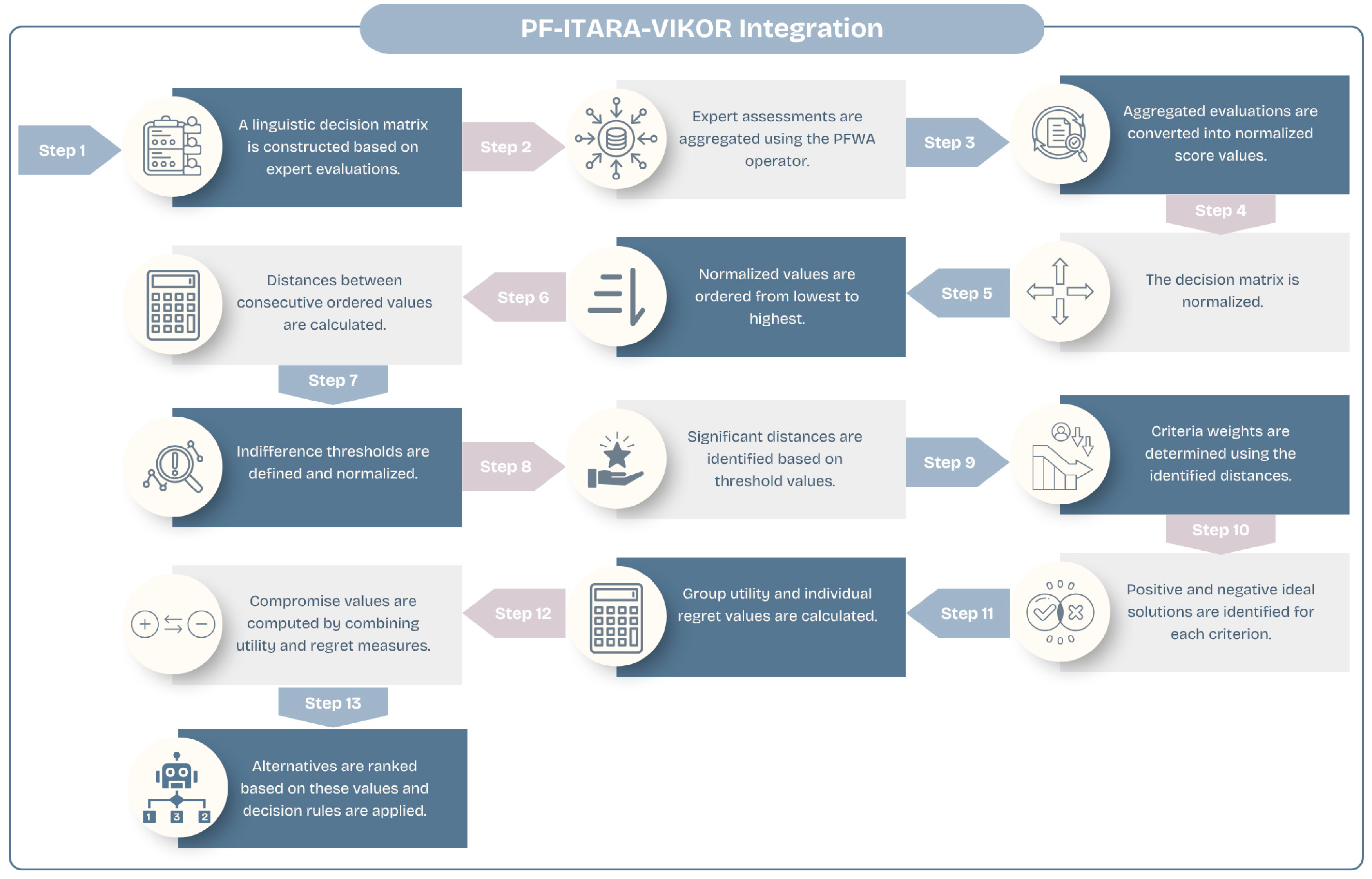
To determine the relative importance of the criteria, the evaluations provided by the eight experts were first transformed into Pythagorean fuzzy numbers (PFNs). Using the linguistic assessment scale defined in the study, the experts evaluated the criteria listed in
Table 3 according to their perceived importance (see
Table S1 in Supplementary Materials). The individual judgments were then aggregated using the PFWA operator. In this study, equal expert weights were assigned because all panel members satisfied the predefined eligibility requirements, including relevant professional or academic experience, domain knowledge in AMR selection, warehouse automation, system integration, or cybersecurity, and familiarity with industrial decision-making processes. In addition, the expert panel was deliberately balanced by including four academic experts and four private-sector professionals, thereby combining methodological and practical perspectives. Therefore, equal weighting was considered appropriate to avoid introducing additional subjective bias into the aggregation process and to reflect a consensus-based group decision-making structure. Following this aggregation process, integrated Pythagorean fuzzy values and their corresponding score values were obtained for each criterion. The resulting score values, derived from the consolidated expert assessments, are reported in
Tables S2 and S3 (Supplementary Materials). These results constituted the main input for the subsequent computation of criterion weights within the PF-ITARA procedure.
Based on the aggregated Pythagorean fuzzy values, score values were obtained for each criterion. These scores were then used to normalize the decision matrix so that the criteria could be evaluated on a comparable basis. After the normalization step, the criterion values were arranged in ascending order, and the distances between successive values were calculated. These ordered distances formed the basis of the threshold analysis. In accordance with expert assessments, an indifference threshold was assigned to each criterion and then normalized. Subsequently, the total importance scores of the criteria were computed, and the results are reported in
Table 5.
Using the consecutive differences, discriminative distances were derived and employed to identify the relative importance levels of the criteria. In the final step of the PF-ITARA procedure, the normalized weight coefficients of all criteria were calculated, and the resulting weights are given in
Table 6.
The obtained results show that Investment Cost received the highest weight (0.0648), indicating that the initial financial burden of AMR adoption is the most influential consideration in the evaluation process. This criterion is followed by Maneuverability (0.0538), Total Cost of Ownership (0.0525), Integration and Validation Requirements (0.0510), and Ease of Programming and Commissioning (0.0483). These findings suggest that decision makers attach particular importance not only to economic feasibility, but also to the practical deployability of AMR systems in real warehouse settings. In other words, alternatives that are cost-efficient, easy to integrate, and adaptable to operational conditions are evaluated more favorably.
The results also indicate that several security- and software-related criteria occupy relatively prominent positions. In particular, Data Confidentiality (0.0392), System Integrity (0.0391), Functional Flexibility and Reconfigurability (0.0352), Monitoring and Incident Response Readiness (0.0350), Infrastructure Compatibility (0.0347), Authentication Control (0.0342), and Authorization and Role-Based Access Control (0.0342) received notable weights. This pattern highlights that AMR selection is not shaped solely by mechanical or operational performance, but also by digital compatibility and cybersecurity readiness. By contrast, criteria such as Platform Stability (0.0109), Control Unit Resources (0.0112), Service Contract Coverage (0.0121), and Fleet Management System Compatibility (0.0122) were assigned comparatively lower weights. Overall, the weighting results demonstrate that the AMR selection problem is primarily driven by a combination of economic considerations, operational suitability, integration effort, and secure system deployment requirements.
Subsequently, the decision matrix was established by transforming the linguistic evaluations into Pythagorean fuzzy numbers. Since the assessment framework was built on a linguistic scale reflecting more favorable judgments through higher preference levels, all criteria were treated as benefit-type criteria in the PF-VIKOR analysis. After determining the aggregated evaluations and incorporating the final criterion weights obtained from the PF-ITARA procedure, the
,
, and
values were computed for each AMR alternative. In this stage, the weighted decision structure was used, meaning that the performance values of the alternatives were evaluated together with the corresponding criterion importance coefficients. In addition, the parameter
was set to 0.5 to ensure a balanced consideration of group utility and individual regret. The resulting
,
, and
values for the alternatives are reported in
Table 7, while the final ranking of the AMR alternatives, based on ascending
values, is presented in
Table 7.
The PF-VIKOR results reveal a clear separation among the AMR alternatives. A1 (MiR250) achieved the best overall performance and ranked first, with the lowest , , and values, indicating that it provides the most balanced compromise solution across the evaluated criteria. This result suggests that MiR250 offers a strong combination of economic feasibility, operational suitability, integration capability, and security-related performance. A2 (OMRON LD-250) ranked second, showing relatively strong performance, although it remained behind A1 in terms of both overall utility and regret measures. This indicates that, while A2 represents a competitive option, it does not achieve the same level of balance across the decision criteria as the top-ranked alternative. A4 (KUKA KMP 600-S diffDrive) ranked third, implying that its performance is less consistent within the overall evaluation framework, despite showing some acceptable criterion-specific strengths. A3 (HIKROBOT Forklift AGV) obtained the lowest rank, mainly due to its comparatively unfavorable compromise index and the highest regret value, which points to weaker performance under at least one critical criterion. Overall, the findings demonstrate that A1 constitutes the most suitable AMR alternative for the warehouse context considered in this study, while the remaining options exhibit varying degrees of limitation in achieving a similarly balanced performance profile.
6. Discussion
The results support the central premise of this study that AMR selection in digitally connected warehouse environments should not be evaluated solely through conventional technical and cost criteria, but also through integration feasibility and cybersecurity readiness. This interpretation is consistent with recent literature in which AMRs are increasingly considered components of broader intralogistics and cyber-physical systems rather than stand-alone transport devices [
22]. In this respect, the present findings reinforce the view that warehouse automation decisions are becoming progressively more system-oriented and digitally conditioned.
The weighting results show that investment cost, maneuverability, total cost of ownership, integration and validation requirements, and ease of programming and commissioning are the most influential criteria in the evaluated decision context. The prominence of investment- and lifecycle-related criteria is in line with earlier robot selection studies emphasizing economic feasibility and operational efficiency as primary drivers of technology adoption [
1,
2,
3,
5]. At the same time, the strong role of maneuverability and deployability is broadly consistent with recent warehouse and AMR studies, where navigation capability, implementation practicality, and operational adaptability are treated as essential considerations [
22,
26]. More importantly, the high weight assigned to integration and validation requirements suggests that implementation burden should be treated as part of the selection decision itself rather than as a purely post-selection engineering issue. This observation complements studies emphasizing standardized interfaces, interoperability, and system-level compatibility in AMR ecosystems [
25]. By contrast, the relatively low weights assigned to criteria such as platform stability and control unit resources may indicate that some technical characteristics are increasingly perceived as baseline expectations rather than major differentiators among current AMR alternatives.
A particularly notable result is the visible prominence of cybersecurity-related criteria in the final weighting structure. This is not merely symbolic within the model. Data confidentiality and system integrity ranked sixth and seventh, monitoring and incident response readiness ranked ninth, and authentication control together with role-based access control shared the eleventh position. Unlike much of the earlier robot selection literature, which primarily focuses on economic, technical, and operational dimensions [
5,
11], the present study demonstrates that cybersecurity has become a meaningful decision dimension in its own right. This result is compatible with recent work arguing that cybersecurity and functional safety are increasingly intertwined in industrial automation and control environments [
27]. However, the present study goes beyond that perspective by embedding cybersecurity directly into the AMR selection framework rather than treating it only as a deployment or governance concern. In this sense, the study also extends recent AMR-oriented fuzzy decision models by showing that cyber resilience should be evaluated explicitly at the procurement stage [
28].
From a methodological perspective, the PF-ITARA-VIKOR framework contributes to the robot selection literature by combining Pythagorean fuzzy modeling, semi-objective weighting, and compromise ranking within a single decision architecture. Previous robot selection studies have successfully employed TOPSIS, PROMETHEE, VIKOR, AHP-based hybrids, and other fuzzy MCDM extensions. Compared with many earlier approaches, the ITARA stage derives criterion importance through threshold-sensitive discrimination among alternatives, thereby reducing exclusive dependence on purely subjective weighting schemes [
11,
47]. The VIKOR stage, in turn, identifies a compromise solution by jointly considering group utility and individual regret [
41]. This combination is particularly valuable in AMR selection, where cost, operational performance, implementation effort, and cybersecurity requirements may conflict with one another and where expert judgments are inherently uncertain.
The alternative ranking results also merit closer discussion. MiR250 emerged as the leading alternative because it achieved the lowest S, R, and Q values, indicating the most balanced compromise across the evaluated criteria. OMRON LD-250 followed as a competitive option, yet its higher utility and regret values suggest a weaker overall balance than the top-ranked alternative. A more nuanced interpretation arises in the comparison between HIKROBOT Forklift AGV and KUKA KMP 600-S diffDrive. Although KUKA exhibited a better group utility value than HIKROBOT, its higher regret value and the worst compromise index indicate that it performs less favorably under at least one critical criterion. This explains why HIKROBOT ranked above KUKA in the final VIKOR ordering. This interpretation is fully consistent with the compromise logic of VIKOR, where the preferred alternative is the one closest to the ideal compromise rather than the one with the best-isolated performance [
41]. Overall, the ranking results suggest that AMR procurement decisions should prioritize balanced performance across economic, operational, integration, and security dimensions rather than isolated strengths in a limited number of criteria.
The findings also carry managerial implications. In the broader context of Industry 4.0, smart warehousing, and cyber-physical production systems, AMR selection increasingly shapes not only material-handling performance but also interoperability, digital resilience, and secure operational continuity. Accordingly, procurement decisions should not be made only by operations or industrial engineering teams. They should also involve IT/OT integration specialists, cybersecurity stakeholders, and maintenance personnel from the outset. Selection processes that overlook issues such as API/SDK quality, network segmentation compatibility, monitoring readiness, or update and vulnerability management may underestimate downstream integration effort, lifecycle cost, and cyber exposure [
25,
27]. Therefore, the present results suggest that AMR selection should be embedded within broader digital transformation and risk-governance practices.
Despite these contributions, several limitations should be acknowledged. The study is based on four AMR alternatives and expert judgments obtained from a limited panel, which may restrict the generalizability of the findings across different warehouse scales, industries, and operational conditions. In addition, although the unified linguistic structure enabled a coherent Pythagorean fuzzy analysis, treating all criteria as benefit-oriented simplifies the native structure of some variables, especially economic ones. Another limitation of the present study is that the proposed framework treats the evaluation criteria as independent. However, in real warehouse AMR selection problems, some criteria may influence one another. For instance, integration requirements may affect the total cost of ownership, cybersecurity readiness may be related to monitoring capability and system integrity, and infrastructure compatibility may shape commissioning efforts. Therefore, future studies may extend the proposed framework by incorporating interdependence analysis through DEMATEL, ANP, or correlation-based screening methods. Such extensions would help identify causal relationships, feedback effects, or redundant criteria and provide a more network-oriented decision model for AMR selection. Future research may therefore test the proposed framework on larger sets of AMR alternatives, apply it in different industrial domains, combine expert judgments with objective operational data, and compare its ranking stability with other advanced fuzzy and hybrid decision-making approaches. Further extensions may also explore adaptive, learning-supported, or digital twin-enabled decision structures for AMR selection in rapidly evolving intralogistics environments.




 ,
,