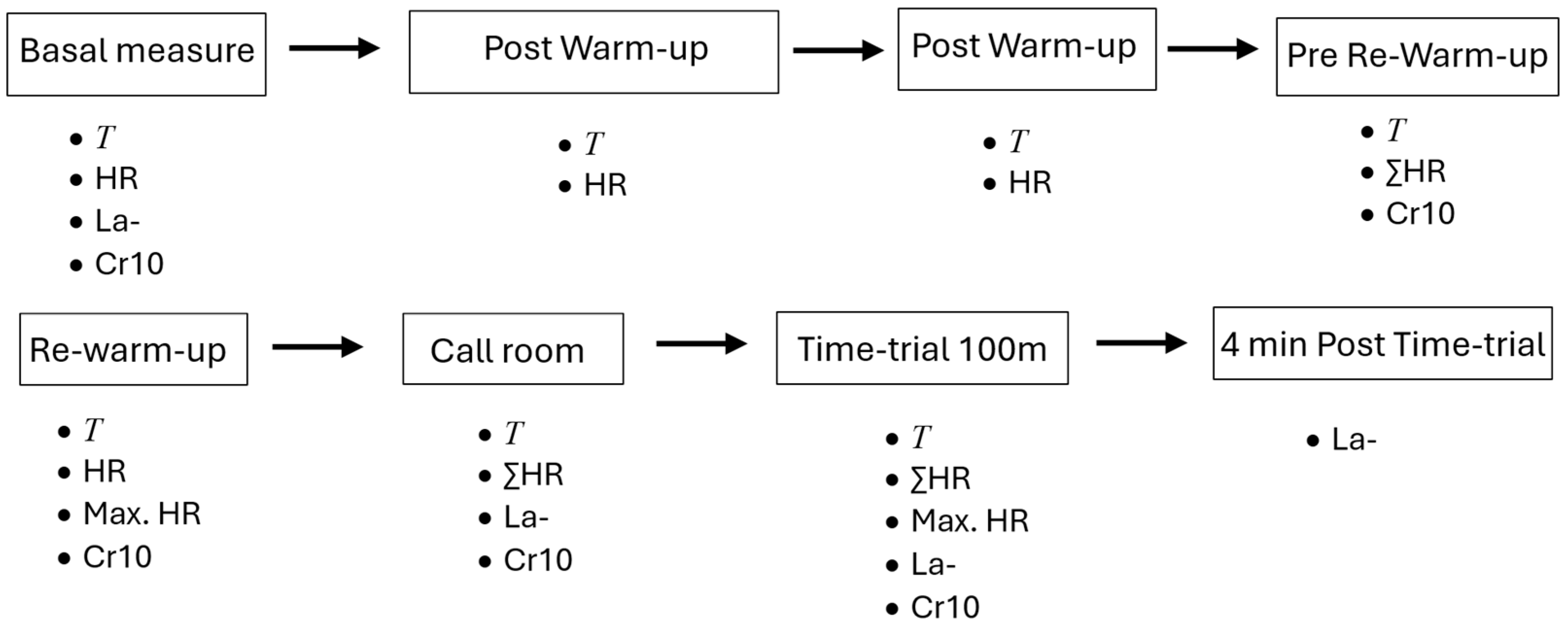
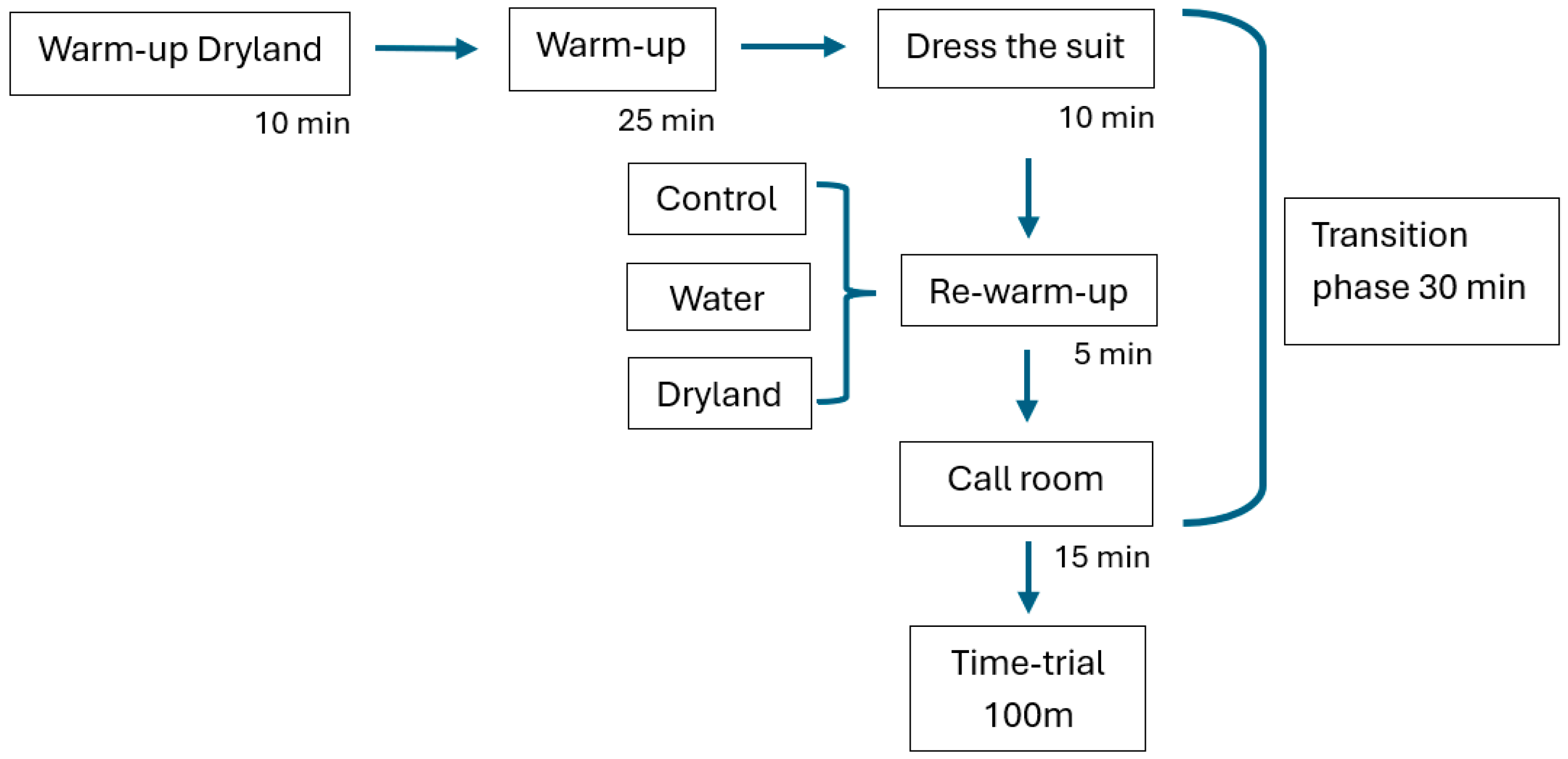
The Effect of Two Activation Protocols During the Transition Phase: Sprint Swimming Performance

 , ,
, ,  ,
,  ,
,  and
and 
Featured Application
Abstract
1. Introduction
2. Materials and Methods
2.1. Participants
2.2. Experimental Approach to the Problem
2.3. Trial Test
2.4. Anthropometry
2.5. Statistical Analysis
3. Results
3.1. Baseline Data
3.2. Performance Times
3.3. Kinematic Analysis
3.3.1. Stroke Rate
3.3.2. Stroke Length
3.3.3. Stroke Index
3.4. Physiological Variables
3.4.1. La−
3.4.2. La− Net
3.5. RPE
3.6. Heart Rate
3.7. Tympanic Temperature Data
3.8. Psychological Variables
Questionnaire: Self-Reported Preferences and Sensations
4. Discussion
5. Conclusions
Author Contributions
Funding
Institutional Review Board Statement
Informed Consent Statement
Data Availability Statement
Acknowledgments
Conflicts of Interest
Abbreviations
| SL | Stroke length |
| SR | Stroke rate |
| SI | Stroke index |
| RPE | Subjective perception of effort |
| T | Temperature |
| HR | Heart rate |
| La− | Blood lactate concentration |
| PAPE | Postactivation performance enhancement |
References
- Lätt, E.; Jürimäe, J.; Mäestu, J.; Purge, P.; Rämson, R.; Haljaste, K.; Keskinen, K.L.; Rodriguez, F.A.; Jürimäe, T. Physiological, biomechanical and anthropometrical predictors of sprint swimming performance in adolescent swimmers. J. Sports Sci. Med. 2010, 9, 398–404. [Google Scholar]
- Bishop, D. Warm Up I. Sports Med. 2003, 33, 439–454. [Google Scholar] [CrossRef]
- Neiva, H.; Morouço, P.; Silva, A.J.; Marques, M.C.; Marinho, D.A. The effect of warm-up on tethered front crawl swimming forces. J. Hum. Kinet. 2011, 29A, 113–119. [Google Scholar] [CrossRef] [PubMed][Green Version]
- McGowan, C.J.; Pyne, D.B.; Raglin, J.S.; Thompson, K.G.; Rattray, B. Current warm-up practices and contemporary issues faced by elite swimming coaches. J. Strength Cond. Res. 2016, 30, 3471–3480. [Google Scholar] [CrossRef] [PubMed]
- Woods, K.; Bishop, P.; Jones, E. Warm-Up and Stretching in the Prevention of Muscular Injury. Sports Med. 2007, 37, 1089–1099. [Google Scholar] [CrossRef]
- Racinais, S.; Oksa, J. Temperature and neuromuscular function. Scand. J. Med. Sci. Sports 2010, 20, 1–18. [Google Scholar] [CrossRef]
- Bagshaw, J. The Effects of a Dryland Activation Protocol During the Transition Phase on Elite Swimming Performance. Master’s Thesis, University of Victoria, Victoria, BC, Canada, 2019. [Google Scholar]
- McGowan, C.J.; Pyne, D.B.; Thompson, K.G.; Rattray, B. Evaluating Warm-Up Strategies for Elite Sprint Breaststroke Swimming Performance. Int. J. Sports Physiol. Perform. 2016, 11, 975–978. [Google Scholar] [CrossRef]
- Cuenca-Fernández, F.; López-Contreras, G.; Arellano, R. Effect on swimming start performance of two types of activation protocols: Lunge and YoYo squat. J. Strength Cond. Res. 2015, 29, 647–655. [Google Scholar] [CrossRef]
- Cuenca-Fernández, F.; Gay, A.; Ruiz-Navarro, J.J.; Morales-Ortiz, E.; López-Contreras, G.; Arellano, R. Protocolización de la post-activación potenciación estimulada (PAPE) en natación y su relación con la fuerza relativa. Rev. Andal. Med. Deporte 2020, 13, 150–154. [Google Scholar] [CrossRef]
- Zochowski, T.; Johnson, E.; Sleivert, G. Effects of Varying Post-Warm-Up Recovery Time on 200-m Time-Trial Swim Performance. Int. J. Sports Physiol. Perform. 2007, 2, 201–211. [Google Scholar] [CrossRef] [PubMed]
- Türkmen, D.; Günay, E.; Güdücü, Ç.; Öniz, A.; Bediz, C.Ş. Effect of Post-Warm-Up Three Different Duration Self-Selected Active Rests on 100 Meter Swimming Performance: Preliminary Findings. Montenegrin J. Sports Sci. Med. 2022, 11, 57–64. [Google Scholar] [CrossRef]
- Van Raalte, J.L.; Brewer, B.W.; Cornelius, A.E.; Keeler, M.; Gudjenov, C. Effects of a Mental Warmup on the Workout Readiness and Stress of College Student Exercisers. J. Funct. Morphol. Kinesiol. 2019, 4, 42. [Google Scholar] [CrossRef]
- McGowan, C.J.; Thompson, K.G.; Pyne, D.B.; Raglin, J.S.; Rattray, B. Heated jackets and dryland-based activation exercises used as additional warm-ups during transition enhance sprint swimming performance. J. Sci. Med. Sport 2015, 19, 354–358. [Google Scholar] [CrossRef] [PubMed]
- Galbraith, A.; Willmott, A. Transition-phase clothing strategies and their effects on body temperature and 100-m swimming performance. Eur. J. Sport Sci. 2018, 18, 182–189. [Google Scholar] [CrossRef] [PubMed]
- West, D.J.; Dietzig, B.M.; Bracken, R.M.; Cunningham, D.J.; Crewther, B.T.; Cook, C.J.; Kilduff, L.P. Influence of post-warm-up recovery time in international swimmers. J. Sci. Med. Sport 2013, 16, 172–176. [Google Scholar] [CrossRef]
- Paiva, D.; Marinho, D.; Neiva, H.; Rama, L. Warm-up in swimming competition: Characterization of the strategies used by Portuguese coaches. Motricidade 2024, 20. [Google Scholar] [CrossRef]
- Cuenca-Fernández, F.; Smith, I.C.; Jordan, M.J.; MacIntosh, B.R.; López-Contreras, G.; Arellano, R.; Herzog, W. Nonlocalized postactivation performance enhancement (PAPE) effects in trained athletes: A pilot study. Appl. Physiol. Nutr. Metab. 2017, 42, 1122–1125. [Google Scholar] [CrossRef]
- McKay, A.K.A.; Stellingwerff, T.; Smith, E.S.; Martin, D.T.; Mujika, I.; Goosey-Tolfrey, V.L.; Sheppard, J.; Burke, L.M. Defining training and performance caliber: A participant classification framework. Int. J. Sports Physiol. Perform. 2022, 17, 317–331. [Google Scholar] [CrossRef] [PubMed]
- Neiva, H.P.; Marques, M.C.; Barbosa, T.M.; Izquierdo, M.; Viana, J.L.; Marinho, D.A. Effects of 10 min vs. 20 min passive rest after warm-up on 100 m freestyle time-trial performance: A randomized crossover study. J. Sci. Med. Sport 2017, 20, 81–86. [Google Scholar] [CrossRef]
- Borg, G. Borg’s Perceived Exertion and Pain Scales; Human Kinetics: Champaign, IL, USA, 1998. [Google Scholar]
- Lohman, T.G.; Roche, A.F.; Martorell, R. Anthropometric Standardization Reference Manual; Human Kinetics: Champaign, IL, USA, 1988. [Google Scholar]
- Richardson, J.T.E. Eta squared and partial eta squared as measures of effect size in educational research. Educ. Res. Rev. 2011, 6, 135–147. [Google Scholar] [CrossRef]
- Kinnear, P.R.; Gray, C.D. IBM SPSS Statistics 18 Made Simple; Psychology Press: New York, NY, USA, 2010. [Google Scholar]
- McGowan, C.J.; Pyne, D.B.; Thompson, K.G.; Raglin, J.S.; Osborne, M.; Rattray, B. Elite sprint swimming performance is enhanced by completion of additional warm-up activities. J. Sports Sci. 2017, 35, 1493–1499. [Google Scholar] [CrossRef] [PubMed]
- Knight, J. Pre-Race Strategies to Maintain and Enhance the Physiological Effects of a Warm-Up in 100 m Freestyle Performance. Master’s Thesis, St Mary’s University, Twickenham, UK, 2017. Available online: https://research.stmarys.ac.uk/1884/ (accessed on 16 October 2025).
- Costa, M.J.; Santos, C.C.; Ferreira, F.; Arellano, R.; Vilas-Boas, J.P.; Fernandes, R.J. Association between elite swimmers’ force production and 100 m front crawl inter-lap pacing and kinematics. Front. Sports Act. Living 2023, 5, 1205800. [Google Scholar] [CrossRef] [PubMed]
- Cuenca-Fernández, F.; Ruiz-Navarro, J.J.; Polach, M.; Arellano, R.; Born, D.-P. Short-course performance variation across all race sections: How 100 and 200 m elite male swimmers progress between rounds. Front. Sports Act. Living 2023, 5, 1146711. [Google Scholar] [CrossRef]
- Morais, J.E.; Jesus, S.; Lopes, V.; Garrido, N.; Silva, A.; Marinho, D.; Barbosa, T.M. Linking Selected Kinematic, Anthropometric and Hydrodynamic Variables to Young Swimmer Performance. Pediatr. Exerc. Sci. 2012, 24, 649–664. [Google Scholar] [CrossRef] [PubMed]
- Sengoku, Y.; Shinno, A.; Kim, J.; Homoto, K.; Nakazono, Y.; Tsunokawa, T.; Hirai, N.; Nobue, A.; Ishikawa, M. The relationship between maximal lactate accumulation rate and sprint performance parameters in male competitive swimmers. Front. Sports Act. Living 2024, 6, 1483659. [Google Scholar] [CrossRef]
- Olstad, B.H.; Bjørlykke, V.; Olstad, D.S. Maximal Heart Rate for Swimmers. Sports 2019, 7, 235. [Google Scholar] [CrossRef]
- Rüst, C.A.; Knechtle, B.; Rosemann, T. Changes in body core and body surface temperatures during prolonged swimming in water of 10 °C—A case report. Extrem. Physiol. Med. 2012, 1, 8. [Google Scholar] [CrossRef]
- Nybo, L.; Rasmussen, P.; Sawka, M.N. Performance in the Heat—Physiological Factors of Importance for Hyperthermia-Induced Fatigue. Compr. Physiol. 2014, 4, 657–689. [Google Scholar] [CrossRef]


| Control | Water | Dryland | F (p #1) | η2p | |
|---|---|---|---|---|---|
| Temperature | 36.75 ± 0.39 | 36.65 ± 0.45 | 36.69 ± 0.40 | 0.936 (0.401) | 0.047 |
| La− | 2.3 ± 0.68 | 2.39 ± 0.87 | 2.28 ± 0.93 | 0.117 (0.890) | 0.006 |
| HR | 69.85 ± 14.85 | 72.45 ± 12.94 | 69.85 ± 13.25 | 0.981 (0.384) | 0.049 |
| Conditions | Mean ± SD | F (p #1) | η2p | Multiple Comparison | p#3 | |
|---|---|---|---|---|---|---|
| 100 m | Control | 56.36 ± 3.25 | 4.439 (0.019) | 0.189 | Control vs. Dryland | 0.009 * |
| Water | 56.07 ± 3.16 | Control vs. Water | 0.234 | |||
| Dryland | 55.98 ± 2.96 | Dryland vs. Water | 1.000 | |||
| Conditions | 50m1 | 50m2 | Condition | Moment | Condition × Moment | Multiple Comparison p #3 | ||||
|---|---|---|---|---|---|---|---|---|---|---|
| Mean ± SD | Mean ± SD | F (p #2) | η2p | F (p #2) | η2p | F (p #2) | η2p | |||
| Control | 26.99 ± 1.54 | 29.36 ± 1.80 | 4.308 (0.021 *) | 0.185 | 312.894 (<0.001 *) | 0.943 | 0.941 (0.399) | 0.047 | Control vs. Dryland | 0.011 * |
| Water | 26.95 ± 1.62 | 29.12 ± 1.60 | Control vs. Water | 0.250 | ||||||
| Dryland | 26.82 ± 1.68 | 29.16 ± 1.68 | Dryland vs. Water | 1 | ||||||
| Conditions | 50m1_SR | 50m2_SR | Condition | Moment | Condition × Moment | |||
|---|---|---|---|---|---|---|---|---|
| Mean ± SD | Mean ± SD | F (p #2) | η2p | F (p #2) | η2p | F (p #2) | η2p | |
| Control | 49.09 ± 3.25 | 47.20 ± 4.32 | 1.85 (0.469) | 0.039 | 10.12 (0.005 *) | 0.348 | 0.77 (0.171) | 0.089 |
| Water | 48.18 ± 3.47 | 47.20 ± 3.35 | ||||||
| Dryland | 49.02 ± 3.66 | 47.19 ± 4.32 | ||||||
| Conditions | 50m1_SL | 50m2_SL | Condition | Moment | Condition × Moment | |||
|---|---|---|---|---|---|---|---|---|
| Mean ± SD | Mean ± SD | F (p #2) | η2p | F (p #2) | η2p | F (p #2) | η2p | |
| Control | 2.28 ± 0.20 | 2.19 ± 0.23 | 1.457 (0.246) | 0.071 | 30.782 (<0.001 *) | 0.618 | 1.189 (0.316) | 0.059 |
| Water | 2.33 ± 0.20 | 2.20 ± 0.19 | ||||||
| Dryland | 2.30 ± 0.21 | 2.20 ± 0.22 | ||||||
| Conditions | 50m1_SI | 50m2_SI | Condition | Moment | Condition × Moment | |||
|---|---|---|---|---|---|---|---|---|
| Mean ± SD | Mean ± SD | F (p #2) | η2p | F (p #2) | η2p | F (p #2) | η2p | |
| Control | 4.25 ± 0.57 | 3.76 ± 0.56 | 3.105 (0.056 **) | 0.140 | 243.809 (<0.001 *) | 0.928 | 0.500 (0.611) | 0.026 |
| Water | 4.35 ± 0.59 | 3.80 ± 0.49 | ||||||
| Dryland | 4.31 ± 0.57 | 3.80 ± 0.52 | ||||||
| Conditions | La−_Pre-Trial | La−_Peak_Post-Trial | Condition | Moment | Condition × Moment | |||
|---|---|---|---|---|---|---|---|---|
| Mean ± SD | Mean ± SD | F (p #2) | η2p | F (p #2) | η2p | F (p #2) | η2p | |
| Control | 2.77 ± 1.26 | 14.05 ± 3.47 | 1.489 (0.238) | 0.073 | 374.386 (<0.001 *) | 0.952 | 1.706 (0.195) | 0.082 |
| Water | 2.44 ± 0.97 | 13.78 ± 2.80 | ||||||
| Dryland | 2.67 ± 1.35 | 14.87 ± 2.92 | ||||||
| Control | Water | Dryland | F (p #1) | η2p | |
|---|---|---|---|---|---|
| La− Net | 10.97 ± 3.74 | 11.34 ± 2.75 | 11.90 ± 2.85 | 1.164 (0.323) | 0.058 |
| Conditions | Mean ± SD | Median | χ2 | p#4 | Kendall’s W | |
|---|---|---|---|---|---|---|
| Post-re-warm-up | Control | 2.25 ± 1.12 | 2 | 5.833 | 0.054 | 0.146 |
| Water | 2.90 ± 0.91 | 3 | ||||
| Dryland | 2.90 ± 1.21 | 3 | ||||
| Pre-trial | Control | 1.83 ± 1.37 | 1 | 3.073 | 0.215 | 0.077 |
| Water | 2.15 ± 1.42 | 2 | ||||
| Dryland | 1.75 ± 1.02 | 1 | ||||
| Post-Trial | Control | 8.05 ± 1.05 | 8 | 1.227 | 0.541 | 0.031 |
| Water | 8.25 ± 0.97 | 8 | ||||
| Dryland | 8.15 ± 1.09 | 8 |
| Conditions | HR_Pre-Trial | HR_Peak | Condition | Moment | Moment × Trial | Comparison | p#3 | |||
|---|---|---|---|---|---|---|---|---|---|---|
| Mean ± SD | Mean ± SD | F (p #2) | η2p | F (p #2) | η2p | F (p #2) | η2p | |||
| Control | 114.20 ± 19.50 | 160.95 ± 11.91 | 5.450 (0.008 *) | 0.223 | 420.563 (<0.001 *) | 0.957 | 1.504 (0.235) | 0.073 | Control vs. Dryland | 0.063 |
| Water | 123.65 ± 15.40 | 163.1 ± 15.80 | Control vs. Water | 0.005 * | ||||||
| Dryland | 125.45 ± 15.90 | 164.45 ± 15.35 | Dryland vs. Water | 1 | ||||||
| Conditions | HR_Baseline | HR_Peak | Condition | Moment | Condition × Trial | |||
|---|---|---|---|---|---|---|---|---|
| Mean ± SD | Mean ± SD | F (p #2) | η2p | F (p #2) | η2p | F (p #2) | η2p | |
| Control | 69.85 ± 14.85 | 160.95 ± 11.91 | 1.004 (0.376) | 0.050 | 665.901 (<0.001 *) | 0.972 | 0.647 (0.529) | 0.033 |
| Water | 72.45 ± 12.94 | 163.1 ± 15.80 | ||||||
| Dryland | 69.85 ± 13.25 | 164.45 ± 15.35 | ||||||
| Conditions | Temp_Post_Re-Warm-Up | Temp_Pre_Trial | Condition | Moment | Condition × Trial | |||
|---|---|---|---|---|---|---|---|---|
| Mean ± SD | Mean ± SD | F (p #2) | η2p | F (p #2) | η2p | F (p #2) | η2p | |
| Control | 36.53 ± 0.48 | 36.68 ± 0.43 | 146.553 (<0.001 *) | 0.885 | 144.590 (<0.001 *) | 0.884 | 53.523 (<0.001 *) | 0.738 |
| Water | 34.49 ± 0.51 | 36.31 ± 0.48 | ||||||
| Dryland | 36.41 ± 0.53 | 36.76 ± 0.42 | ||||||
| Moment | Condition | Condition | p#3 |
|---|---|---|---|
| 1 | 1 | 2 | <0.001 * |
| 3 | 1.000 | ||
| 2 | 3 | <0.001 * | |
| 2 | 1 | 2 | 0.010 * |
| 3 | 0.970 | ||
| 2 | 3 | 0.003 * |
Disclaimer/Publisher’s Note: The statements, opinions and data contained in all publications are solely those of the individual author(s) and contributor(s) and not of MDPI and/or the editor(s). MDPI and/or the editor(s) disclaim responsibility for any injury to people or property resulting from any ideas, methods, instructions or products referred to in the content. |
© 2026 by the authors. Licensee MDPI, Basel, Switzerland. This article is an open access article distributed under the terms and conditions of the Creative Commons Attribution (CC BY) license.
Share and Cite
Paiva, D.; Rama, L.; Neiva, H.; Nunes, C.; Morais, J.E.; Marinho, D.A. The Effect of Two Activation Protocols During the Transition Phase: Sprint Swimming Performance. Appl. Sci. 2026, 16, 5089. https://doi.org/10.3390/app16105089
Paiva D, Rama L, Neiva H, Nunes C, Morais JE, Marinho DA. The Effect of Two Activation Protocols During the Transition Phase: Sprint Swimming Performance. Applied Sciences. 2026; 16(10):5089. https://doi.org/10.3390/app16105089
Chicago/Turabian StylePaiva, Daniel, Luís Rama, Henrique Neiva, Célia Nunes, Jorge E. Morais, and Daniel A. Marinho. 2026. "The Effect of Two Activation Protocols During the Transition Phase: Sprint Swimming Performance" Applied Sciences 16, no. 10: 5089. https://doi.org/10.3390/app16105089
APA StylePaiva, D., Rama, L., Neiva, H., Nunes, C., Morais, J. E., & Marinho, D. A. (2026). The Effect of Two Activation Protocols During the Transition Phase: Sprint Swimming Performance. Applied Sciences, 16(10), 5089. https://doi.org/10.3390/app16105089