Assessment of Functional Movement Competency in National-Level Foot Orienteers

 , , ,
, , ,  , and
, and
Abstract
1. Introduction
- -
- The cumulative score of the FMSTM test of FO is similar to that of track and field long-distance runners.
- -
- There is a relationship between the age of the participants and the FMSTM test results. The older (more experienced) the athletes, the better their test scores.
- -
- There are differences between females and males in FMSTM test scores. Females perform better than males.
- -
- There is a correlation between BMI and FMSTM test results. The lower the BMI, the better the test score.
2. Materials and Methods
2.1. Participants
2.2. Methods
2.3. Statistical Analysis
3. Results
3.1. Statistics for the Entire Group of Participants
3.2. Males Versus Females
3.3. Seniors Versus Juniors
3.4. Participants with a Lower BMI vs. Those with a Higher BMI
4. Discussion
- -
- The median score for females and males was 17 points [IQR = 2.0]. The mean value of the composite FMSTM test for the entire study group equals 17.0 ± 1.8 points.
- -
- No statistical difference for males and females was found.
- -
- The analysis of the FMSTM test scores according to the age criterion showed that the composite score did not differ between junior and senior FO.
- -
- Taking BMI as the criterion, the participants did not differ from each other in the composite FMS™ score.
- -
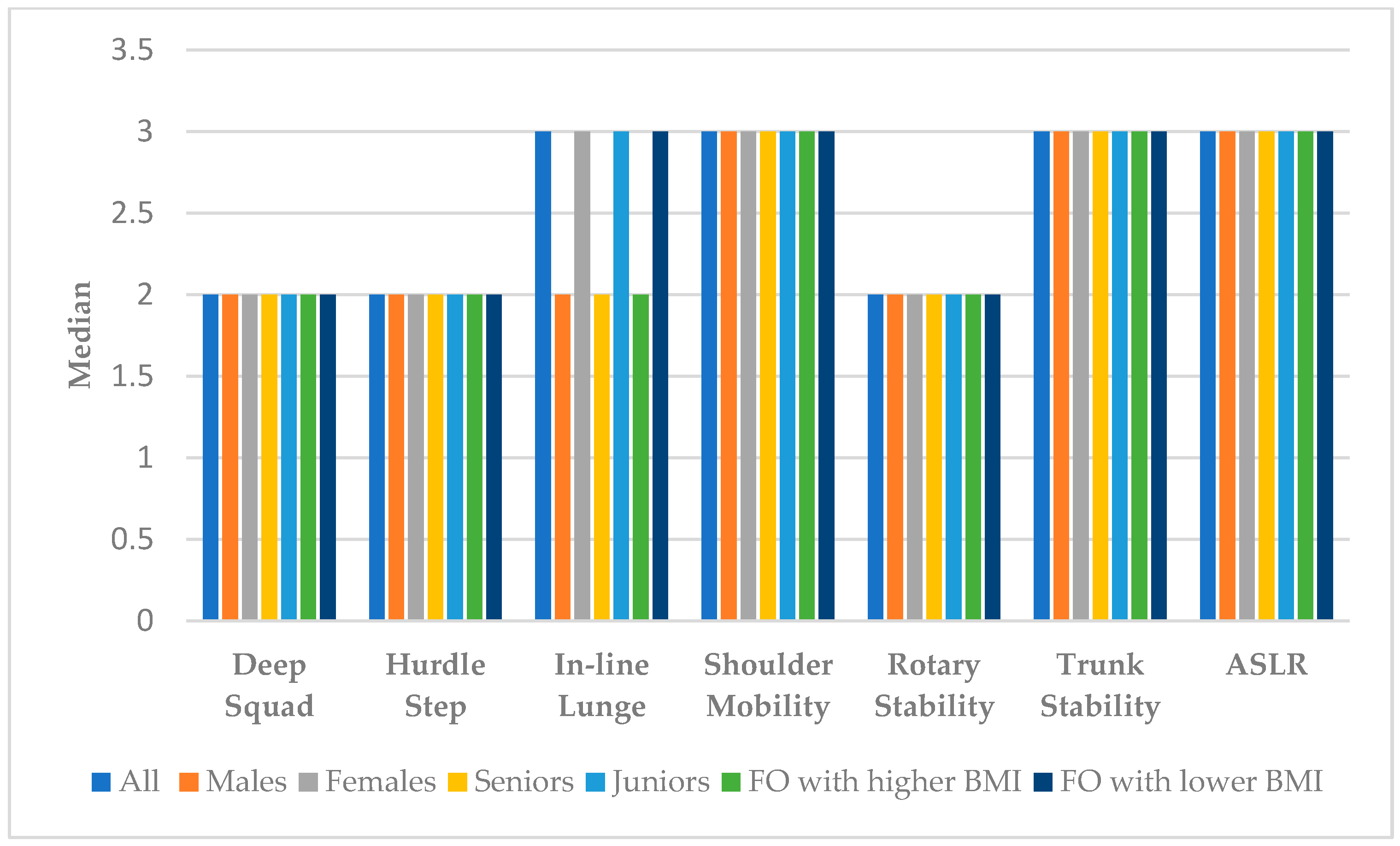
- Some deeper analyses showed that there were significant differences between subgroups of FO (males vs. females, juniors vs. seniors, participants with higher and lower BMI) for specific tests. Only the Hurdle Step Test and the Shoulder Mobility Test demonstrated correlations with age, sex, or BMI.
5. Conclusions
5.1. Practical Implications
5.2. The Limitations
Author Contributions
Funding
Institutional Review Board Statement
Informed Consent Statement
Data Availability Statement
Acknowledgments
Conflicts of Interest
Abbreviations
| BMI | body mass index |
| DXA | dual-energy X-ray absorptiometry |
| FFM | fat-free mass |
| FM% | fat mass percentage |
| FMS™ | Functional Movement Screen™ |
| FO | foot orienteers |
| ICCs | intraclass correlation coefficients |
References
- Batista, M.M.; Paludo, A.C.; Gula, J.N.; Pauli, P.H.; Tartaruga, M.P. Physiological and Cognitive Demands of Orienteering: A Systematic Review. Sport Sci. Health 2020, 16, 591–600. [Google Scholar] [CrossRef]
- Creagh, U.; Reilly, T. Physiological and Biomechanical Aspects of Orienteering. Sports Med. 1997, 24, 409–418. [Google Scholar] [CrossRef]
- Hébert-Losier, K.; Mourot, L.; Holmberg, H.-C. Elite and Amateur Orienteers’ Running Biomechanics on Three Surfaces at Three Speeds. Med. Sci. Sports Exerc. 2015, 47, 381–389. [Google Scholar] [CrossRef]
- Jensen, K.; Johansen, L.; Karkkainen, O.-P. Economy in Track Runners and Orienteers during Path and Terrain Running. J. Sports Sci. 1999, 17, 945–950. [Google Scholar] [CrossRef]
- Millet, G.Y.; Divert, C.; Banizette, M.; Morin, J.-B. Changes in Running Pattern Due to Fatigue and Cognitive Load in Orienteering. J. Sports Sci. 2010, 28, 153–160. [Google Scholar] [CrossRef]
- Larsson, P.; Burlin, L.; Jakobsson, E.; Henriksson-Larsen, K. Analysis of Performance in Orienteering with Treadmill Tests and Physiological Field Tests Using a Differential Global Positioning System. J. Sports Sci. 2002, 20, 529–535. [Google Scholar] [CrossRef]
- Cherepov, E.; Epishev, V.; Bykov, E.; Stoliarova, N.; Stovba, I. Assessment of the Stability of Body Functional Systems in Orienteers. J. Phys. Educ. Sport 2019, 19, 1686–1689. [Google Scholar] [CrossRef]
- Von Rosen, P.; Heijne, A.I.-L.M.; Frohm, A. Injuries and Associated Risk Factors Among Adolescent Elite Orienteerers: A 26-Week Prospective Registration Study. J. Athl. Train. 2016, 51, 321–328. [Google Scholar] [CrossRef] [PubMed]
- Loudon, J.K.; Parkerson-Mitchell, A.J.; Hildebrand, L.D.; Teague, C. Functional Movement Screen Scores in a Group of Running Athletes. J. Strength Cond. Res. 2014, 28, 909–913. [Google Scholar] [CrossRef] [PubMed]
- de Oliveira, R.R.; Chaves, S.F.; Lima, Y.L.; Bezerra, M.A.; Leão Almeida, G.P.; de Paula Lima, P.O. There Are No Biomechanical Differences between Runners Classified by the Functional Movement Screen. Int. J. Sports Phys. Ther. 2017, 12, 625–633. [Google Scholar]
- Bennett, H.; Fuller, J.; Milanese, S.; Jones, S.; Moore, E.; Chalmers, S. Relationship Between Movement Quality and Physical Performance in Elite Adolescent Australian Football Players. J. Strength Cond. Res. 2022, 36, 2824–2829. [Google Scholar] [CrossRef]
- Pfeifer, C.E. Functional Motor Competence, Health-Related Fitness, and Injury in Youth Sport. Doctoral Dissertation, University of South Carolina, Fullerton, CA, USA, 2017. [Google Scholar]
- Fitton Davies, K.; Sacko, R.S.; Lyons, M.A.; Duncan, M.J. Association between Functional Movement Screen Scores and Athletic Performance in Adolescents: A Systematic Review. Sports 2022, 10, 28. [Google Scholar] [CrossRef]
- Agresta, C.; Slobodinsky, M.; Tucker, C. Functional Movement ScreenTM—Normative Values in Healthy Distance Runners. Int. J. Sports Med. 2014, 35, 1203–1207. [Google Scholar] [CrossRef]
- Adamczyk, J.G.; Boguszewski, D.; Białoszewski, D. Functional Assessment of Male Track and Field Runners through Functional Movement Screen Test. Med. Sport 2015, 68, 563–575. [Google Scholar]
- Cook, G.; Burton, L.; Hoogenboom, B. Pre-Participation Screening: The Use of Fundamental Movements as an Assessment of Function—Part 1. N. Am. J. Sports Phys. Ther. NAJSPT 2006, 1, 62–72. Available online: https://pmc.ncbi.nlm.nih.gov/articles/PMC2953313/ (accessed on 6 March 2026).
- Machowska-Krupa, W.; Cych, P. Differences in Coordination Motor Abilities between Orienteers and Athletics Runners. Int. J. Environ. Res. Public Health 2023, 20, 2643. [Google Scholar] [CrossRef] [PubMed]
- ÖrsçeliK, A.; Apaydin, A.H.; Yildiz, Y. Can We Predict Success of Orienteering Athletes? Turk. Klin. J. Sports Sci. 2017, 9, 124–132. [Google Scholar] [CrossRef]
- Leandersson, J.; Heijne, A.; Flodström, F.; Frohm, A.; Von Rosen, P. Can Movement Tests Predict Injury in Elite Orienteerers? An 1-Year Prospective Cohort Study. Physiother. Theory Pract. 2020, 36, 956–964. [Google Scholar] [CrossRef] [PubMed]
- Martín-Moya, R.; Rodríguez-García, L.; Moreno-Vecino, B.; Clemente, F.M.; Liñán González, A.; González-Fernández, F.T. Differences and Relationship in Functional Movement Screen (FMSTM) Scores and Physical Fitness in Males and Female Semi-Professional Soccer Players. PeerJ 2023, 11, e16649. [Google Scholar] [CrossRef]
- Huotari, P.; Heikinaro-Johansson, P.; Watt, A.; Jaakkola, T. Fundamental Movement Skills in Adolescents: Secular Trends from 2003 to 2010 and Associations with Physical Activity and BMI. Scand. J. Med. Sci. Sports 2018, 28, 1121–1129. [Google Scholar] [CrossRef] [PubMed]
- Waite, S. Relationship of BMI and FMS Scores in College Athletes. J. Rehabil. Pract. Res. 2024, 5, 153. [Google Scholar] [CrossRef]
- Cook, G.; Burton, L.; Hoogenboom, B. Pre-Participation Screening: The Use of Fundamental Movements as an Assessment of Function—Part 2. N. Am. J. Sports Phys. Ther. NAJSPT 2006, 1, 132–139. Available online: https://pmc.ncbi.nlm.nih.gov/articles/PMC2953359/ (accessed on 6 March 2026). [PubMed]
- Fleiss, J.L. Measuring nominal scale agreement among many raters. Psychol. Bull. 1971, 76, 378–382. [Google Scholar] [CrossRef]
- Landis, J.R.; Koch, G.G. The measurement of observer agreement for categorical data. Biometrics 1977, 33, 159–174. [Google Scholar] [CrossRef] [PubMed]
- Verney, J.; Metz, L.; Chaplais, E.; Cardenoux, C.; Pereira, B.; Thivel, D. Bioelectrical Impedance Is an Accurate Method to Assess Body Composition in Obese but Not Severely Obese Adolescents. Nutr. Res. 2016, 36, 663–670. [Google Scholar] [CrossRef]
- Gärderud, I.; Hammarberg, J.; Larsson, Å. The Effects of a Branch-Specific Strength-Training for Orienteers. Sci. J. Orienteer. 1985, 1, 51–52. [Google Scholar]
- Kiesel, K.; Plisky, P.J.; Voight, M.L. Can Serious Injury in Professional Football Be Predicted by a Preseason Functional Movement Screen? N. Am. J. Sports Phys. Ther. NAJSPT 2007, 2, 147–158. [Google Scholar]
- Lusa, S.; Lonka, H. The Effects of Systematic Strength Training on the Physical Performance of Orienteers. Sci. J. Orienteer. 1988, 4, 56–57. [Google Scholar]
- Linde, F. Injuries in Orienteering. Br. J. Sports Med. 1986, 20, 125–127. [Google Scholar] [CrossRef]
- Folan, J. Orienteering Injuries. Br. J. Sports Med. 1982, 16, 236–240. [Google Scholar] [CrossRef][Green Version]
- Yuan, F.; Wu, X.; Song, M. Statistical Analysis and Study between Ankle Mobility and Basic Movements in FMS Test. In Proceedings of the Second International Conference on Statistics, Applied Mathematics, and Computing Science (CSAMCS 2022), Nanjing, China, 25–27 November 2022; Jin, S., Dai, W., Eds.; SPIE: Nanjing, China, 2023; p. 21. [Google Scholar]
- Gunay, E.; Oğuz, Ü.; İsmet, T.; Bediz, C.F. The Relationship between Functional Movement Screen and Swimming Performance. Sci. Mov. Health 2017, 17, 566–570. [Google Scholar]
- Tønnessen, E.; Svendsen, I.S.; Rønnestad, B.R.; Hisdal, J.; Haugen, T.A.; Seiler, S. The Annual Training Periodization of 8 World Champions in Orienteering. Int. J. Sports Physiol. Perform. 2015, 10, 29–38. [Google Scholar] [CrossRef] [PubMed]
- Duncan, M.J.; Stanley, M.; Leddington Wright, S. The Association between Functional Movement and Overweight and Obesity in British Primary School Children. Sports Med. Arthrosc. Rehabil. Ther. Technol. 2013, 5, 11. [Google Scholar] [CrossRef] [PubMed]
- Okely, A.D.; Booth, M.L.; Chey, T. Relationships between Body Composition and Fundamental Movement Skills among Children and Adolescents. Res. Q. Exerc. Sport 2004, 75, 238–247. [Google Scholar] [CrossRef] [PubMed]
- Falkel, J.E.; Sawka, M.N.; Levine, L.; Pimental, N.A.; Pandolf, K.B. Upper-Body Exercise Performance: Comparison between Women and Men. Ergonomics 1986, 29, 145–154. [Google Scholar] [CrossRef] [PubMed]


| Age [Years] | Body Height [m] | Body Mass [kg] | BMI [kg/m2] | |
|---|---|---|---|---|
| All (N = 51) | 21.86 ± 4.95 | 1.73 ± 0.09 | 62.07 ± 7.43 | 20.71 ± 1.84 |
| Males (N = 30) | 21.33 ± 4.15 | 1.79 ± 0.06 | 66.18 ± 4.85 | 20.76 ± 2.02 |
| Females (N = 21) | 22.62 ± 5.94 | 1.65 ± 0.07 | 56.21 ± 6.52 | 20.63 ± 1.58 |
| Seniors (N = 22) | 26.23 ± 4.68 | 1.72 ± 0.08 | 63.28 ± 7.75 | 21.45 ± 2.08 |
| Juniors (N = 29) | 18.55 ± 0.99 | 1.74 ± 0.10 | 61.16 ± 7.18 | 20.15 ± 1.42 |
| FO with lower BMI | 21.00 ± 4.72 | 1.73 ± 0.11 | 58.63 ± 6.89 | 19.37 ± 0.92 |
| FO with higher BMI | 22.69 ± 5.11 | 1.72 ± 0.08 | 65.39 ± 6.44 | 21.99 ± 1.57 |
| Deep Squat | Hurdle Step | In-Line Lunge | Shoulder Mobility | Rotary Stability | Trunk Stability Push-up | Active Straight Leg Raise | Total | ||
|---|---|---|---|---|---|---|---|---|---|
| All participants (N = 51) | Median, (IQR) | 2 (0) | 2 (1) | 3 (1) | 3 (0) | 2 (1) | 3 (1) | 3 (0) | 17 (2) |
| M ± SD | 1.88 ± 0.5 | 2.24 ± 0.5 | 2.53 ± 0.5 | 2.82 ± 0.5 | 2.24 ± 0.5 | 2.51 ± 0.7 | 2.80 ± 0.4 | 17.02 ± 1.8 | |
| Males (N = 30) | Median, (IQR) | 2 (0) | 2 (0) | 2 (1) | 3 (0) | 2 (0) | 3 (1) | 3 (0) | 17 (2.25) |
| M ± SD | 1.87 ± 0.5 | 2.13 ± 0.4 | 2.47 ± 0.5 | 2.87 ± 0.3 | 2.17 ± 0.5 | 2.53 ± 0.8 | 2.77 ± 0.5 | 16.80 ± 1.7 | |
| Females (N = 21) | Median, (IQR) | 2 (0) | 2 (1) | 3 (1) | 3 (0) | 2 (1) | 3 (1) | 3 (0) | 17 (3) |
| M ± SD | 1.90 ± 0.5 | 2.38 ± 0.5 | 2.62 ± 0.5 | 2.76 ± 0.7 | 2.33 ± 0.5 | 2.48 ± 0.7 | 2.86 ± 0.4 | 17.33 ± 1.8 | |
| Seniors (N = 22) | Median, (IQR) | 2 (0) | 2 (1) | 2 (1) | 3 (0) | 2 (0) | 3 (1) | 3 (0.25) | 17 (3) |
| M ± SD | 1.86 ± 0.5 | 2.36 ± 0.5 | 2.41 ± 0.5 | 2.73 ± 0.7 | 2.18 ± 0.4 | 2.36 ± 0.8 | 2.73 ± 0.6 | 16.64 ± 1.9 | |
| Juniors (N = 29) | Median, (IQR) | 2 (0) | 2 (0) | 3 (1) | 3 (0) | 2 (1) | 3 (1) | 3 (0) | 17 (3) |
| M ± SD | 1.90 ± 0.6 | 2.14 ± 0.4 | 2.62 ± 0.5 | 2.90 ± 0.3 | 2.28 ± 0.6 | 2.62 ± 0.6 | 2.86 ± 0.4 | 17.31 ± 1.6 | |
| BMI higher value (N = 26) | Median, (IQR) | 2 (1) | 2 (1) | 3 (1) | 3 (1) | 2 (0) | 3 (1) | 3 (0) | 17 (3) |
| M ± SD | 1.77 ± 0.5 | 2.23 ± 0.5 | 2.38 ± 0.5 | 2.65 ± 0.7 | 2.19 ± 0.4 | 2.50 ± 0.8 | 2.81 ± 0.5 | 16.54 ± 1.8 | |
| BMI lower value (N = 25) | Median, (IQR) | 2 (0) | 2 (0.5) | 3 (1) | 3 (0) | 2 (1) | 3 (1) | 3 (0) | 17 (3) |
| M ± SD | 2.00 ± 0.5 | 2.24 ± 0.4 | 2.68 ± 0.5 | 3.00 ± 0.0 | 2.28 ± 0.6 | 2.52 ± 0.7 | 2.80 ± 0.4 | 17.52 ± 1.6 |
Disclaimer/Publisher’s Note: The statements, opinions and data contained in all publications are solely those of the individual author(s) and contributor(s) and not of MDPI and/or the editor(s). MDPI and/or the editor(s) disclaim responsibility for any injury to people or property resulting from any ideas, methods, instructions or products referred to in the content. |
© 2026 by the authors. Licensee MDPI, Basel, Switzerland. This article is an open access article distributed under the terms and conditions of the Creative Commons Attribution (CC BY) license.
Share and Cite
Cych, P.; Machowska-Krupa, W.; Demidas, A.; Esteve-Ibáñez, H.; Drehmer-Rieger, E.; Vidal-González, P. Assessment of Functional Movement Competency in National-Level Foot Orienteers. Appl. Sci. 2026, 16, 2639. https://doi.org/10.3390/app16062639
Cych P, Machowska-Krupa W, Demidas A, Esteve-Ibáñez H, Drehmer-Rieger E, Vidal-González P. Assessment of Functional Movement Competency in National-Level Foot Orienteers. Applied Sciences. 2026; 16(6):2639. https://doi.org/10.3390/app16062639
Chicago/Turabian StyleCych, Piotr, Weronika Machowska-Krupa, Aneta Demidas, Héctor Esteve-Ibáñez, Eraci Drehmer-Rieger, and Pablo Vidal-González. 2026. "Assessment of Functional Movement Competency in National-Level Foot Orienteers" Applied Sciences 16, no. 6: 2639. https://doi.org/10.3390/app16062639
APA StyleCych, P., Machowska-Krupa, W., Demidas, A., Esteve-Ibáñez, H., Drehmer-Rieger, E., & Vidal-González, P. (2026). Assessment of Functional Movement Competency in National-Level Foot Orienteers. Applied Sciences, 16(6), 2639. https://doi.org/10.3390/app16062639