1. Introduction
Obstetrical emergencies such as postpartum hemorrhage (PPH), preeclampsia, and acute intrapartum complications require immediate situational awareness, prioritization of interventions, and accurate clinical judgment under pressure [
1]. In spite of their clinical importance, these scenarios are infrequently encountered by medical students during routine obstetrics and gynecology rotations, limiting opportunities for experiential learning in real-life settings [
2].
In many Romanian teaching hospitals, undergraduate exposure to obstetric emergencies is further constrained by ethical considerations, patient safety concerns, and the unpredictable nature of acute events. As a result, young medical specialists may enter clinical practice with limited experience of managing time-critical obstetric situations, despite having completed standard curricular requirements [
3]. This gap is particularly relevant given that newly graduated physicians may be among the first responders in emergency departments, rural settings, or on-call hospital environments where immediate obstetric expertise is not always available [
4].
In a report from the Organisation for Economic Cooperation and Development, we find out that in Romania, over 90% of medical physicians and nurses are located in urban areas. Subsequently, there is an uneven distribution of medical specialists in the country, with medical specialists such as gynecologists usually being more likely to establish work in more urban areas [
5]. This is one of the reasons why we need better preparation for our undergrad students, for them to be ready to face an obstetric emergency in their practice.
Simulation-based training has been increasingly adopted as a strategy to address these limitations by providing structured, reproducible exposure to high-risk clinical scenarios in a controlled environment [
6,
7]. High-fidelity obstetric simulators allow learners to practice emergency management algorithms, clinical prioritization, and technical skills without compromising patient safety [
8]. The existing literature has demonstrated that simulation can improve performance and confidence in obstetric care [
9,
10,
11]; however, most undergraduate studies have focused on routine delivery skills or global competence measures, with less attention to emergency-specific performance and the mechanisms underlying individual learning responses [
12,
13].
Recent global estimates reaffirm hemorrhage as a leading cause of maternal death in certain regions [
14]. Although most cases occur during the third and fourth stages of labor, early recognition and structured management are often challenged by diagnostic delay, underestimation of blood loss, and inadequate adherence to standardized protocols. Effective PPH management requires rapid assessment of maternal vital signs; identification of the underlying etiology, such as uterine atony, retained placental tissue, coagulation disorders or genital tract lacerations; and timely implementation of a coordinated management algorithm [
15]. For medical trainees, exposure to real-life PPH events is unpredictable and ethically constrained, limiting opportunities to develop structured emergency responses in a supervised setting.
Beyond technical execution, effective management of PPH depends on accurate self-assessment and alignment between perceived and actual competence. Miscalibration, particularly persistent overconfidence, has been associated with delayed decision-making and increased risk of error in acute care settings [
16,
17]. While confidence gains following simulation are well documented, fewer studies have examined how confidence calibration evolves in high-acuity obstetric contexts or how it relates to objective performance gains during emergency training [
18].
Moreover, learner responses to simulation-based emergency training are not uniform. Baseline skill level, prior exposure, and intrinsic interest in obstetrics may influence the magnitude and structure of learning gains [
19]. Understanding how improvements cluster across different emergency-related competencies, and identifying predictors of meaningful skill acquisition, may provide valuable insights for optimizing undergraduate curricula and targeting educational interventions more effectively.
The present study investigates the impact of simulation-based training on preparedness for PPH management in final-year medical students. Using objective performance assessments, confidence calibration analyses, and statistical modeling, we aimed to characterize emergency-related skill gains, explore alignment between perceived and actual competence, identify subgroups with differential learning trajectories and examine latent structures underlying emergency skill acquisition. By focusing on high-stakes obstetric scenarios, this study seeks to inform the integration of emergency-focused simulation as a core component of undergraduate medical education.
2. Materials and Methods
2.1. Study Design and Setting
A single-group prospective pre–post-educational intervention study was conducted at the University of Medicine and Pharmacy “Carol Davila”, Bucharest, Romania. This study evaluated the impact of simulation-based training on preparedness for PPH among final-year medical students following completion of their obstetrics and gynecology rotation. The present analysis focuses exclusively on emergency-related competencies extracted from a broader simulation-based training investigation. Outcomes related to physiological vaginal birth skills derived from the same investigation have been reported separately.
The study was approved by the institutional ethics committee of the University of Medicine and Pharmacy “Carol Davila” (approval no. 14354). All participants provided written informed consent prior to participation.
2.2. Participants
All sixth-year medical students enrolled in the obstetrics and gynecology rotation between May 2024 and June 2025 were invited to participate. From a total of 276 students attending the simulation sessions, 215 met the inclusion criteria and were included in the final analysis.
Inclusion criteria were the completion of the obstetrics and gynecology clinical rotation; attendance at both the theoretical and practical simulation sessions and provision of informed consent.
A total of 61 students were excluded from the final analysis due to incomplete participation in all stages of the simulation protocol, missing assessment data, or prior exposure to similar simulation-based training. These exclusions were primarily related to logistical factors, such as scheduling constraints or incomplete attendance, rather than performance-related criteria. However, complete baseline data were not consistently available for excluded participants; therefore, formal comparison analyses between included and excluded students could not be reliably performed. Where baseline data were available, no clear patterns suggested systematic differences between groups. Given that the exclusion rate represented approximately 22% of the initial cohort, a potential impact on selection bias cannot be fully excluded.
2.3. Simulation-Based Emergency Training Program
The training program was conducted in the university simulation center using a high-fidelity obstetric simulator (Victoria, Gaumard®, Miami, FL, USA). The intervention consisted of a structured sequence designed to address high-stakes, low-frequency obstetric emergencies, emphasizing early recognition, prioritization, and initial management.
The simulation scenario focused on postpartum hemorrhage during the third and fourth stages of labor. Two etiological pathways were incorporated: retained placental fragments and perineal lacerations, allowing students to differentiate between uterine and traumatic causes of bleeding while following a structured management algorithm.
The program included:
A brief theoretical recap covering emergency recognition and management principles;
Simulation scenarios focused on PPH, including emergency management decision points and vital sign assessment;
A simulation scenario with objective performance assessment;
Guided hands-on practice with faculty feedback;
A final simulation scenario used for objective performance assessment.
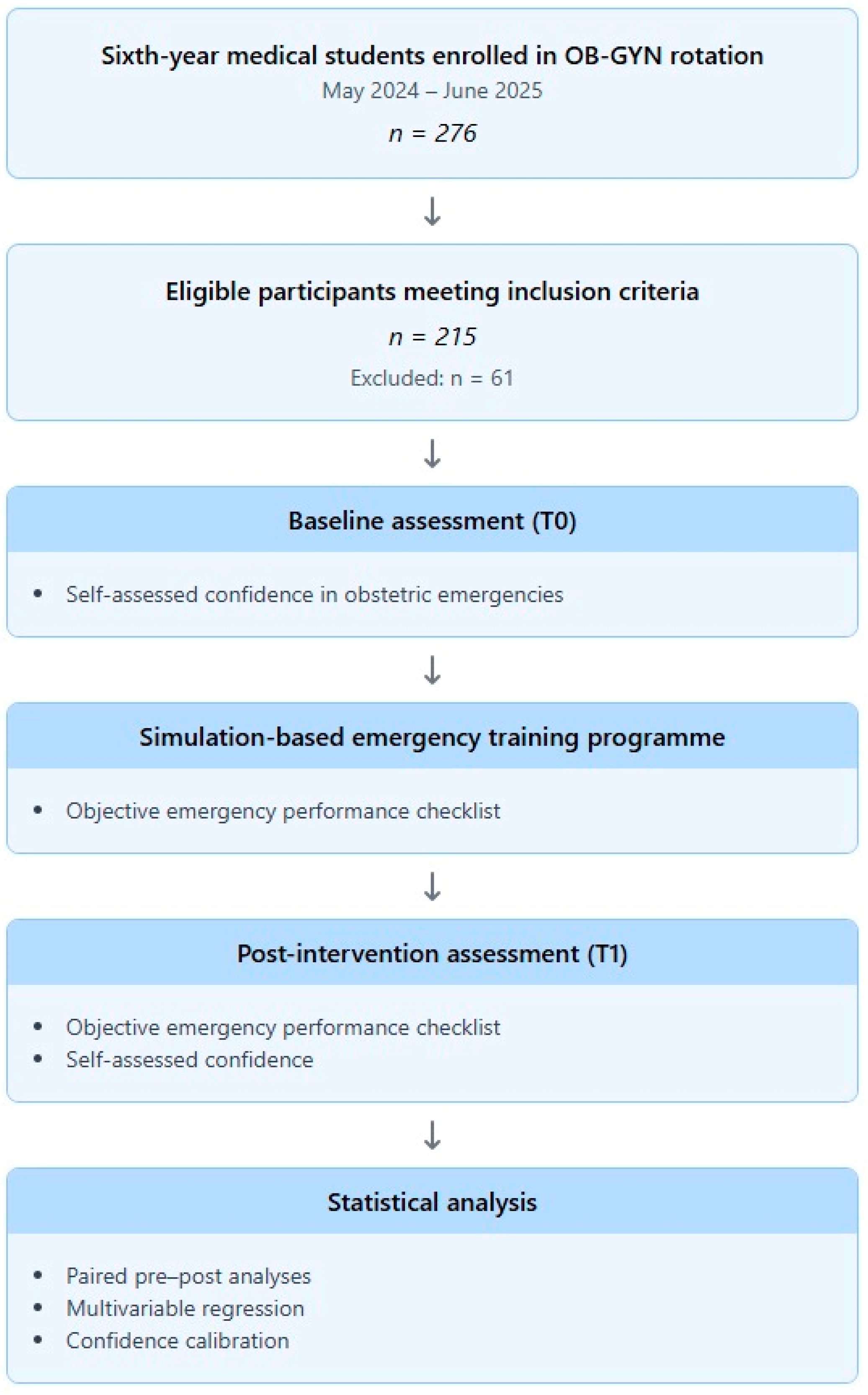
All scenarios were standardized and delivered using identical protocols across participants as shown in
Figure 1.
2.4. Outcome Measures
2.4.1. Objective Emergency Performance Assessment
Emergency-related practical skills were evaluated using a predefined faculty-scored checklist. The checklist focused on competencies relevant to acute obstetric care, including: recognition and management of PPH; assessment and interpretation of maternal vital signs; prioritization of clinical actions; and execution of appropriate emergency management steps.
Each item was scored according to predefined criteria, generating component-level scores and a composite emergency performance score.
All assessments were conducted by a single trained faculty evaluator to ensure procedural consistency. Assessments were conducted in structured sessions with a controlled workload to reduce the potential impact of evaluator fatigue. While this approach supports internal consistency, it does not allow for formal assessment of inter-rater reliability and does not fully exclude the possibility of observer bias. The checklists used can be seen in the
Supplementary Materials.
2.4.2. Confidence Assessment
Self-perceived confidence in managing obstetric emergencies was assessed using a structured Likert-scale questionnaire administered before and after the training. Confidence scores were analyzed both as continuous variables and in relation to objective performance to evaluate confidence–performance calibration.
2.4.3. Perceived Realism and Motivational Measures
Perceived realism was evaluated after the simulation session using a self-reported Likert-scale item included in the post-training questionnaire. Students rated how realistic and clinically immersive they perceived the simulation scenario to be on a 5-point scale ranging from 1 (“not realistic at all”) to 5 (“highly realistic”).
Changes in student interest toward obstetrics and gynecology were also assessed using pre- and post-training self-reported ratings. These variables were included in exploratory analyses examining predictors of motivational response following simulation-based training.
2.5. Data Processing and Statistical Analysis
Raw performance and confidence data were range-checked and rescaled to a 0–1 interval to allow for comparability across components with different maximum values. A composite PPH performance score was constructed from PPH management, placental management, emergency algorithm execution, and vital-sign assessment. Both raw (0–11) and scaled (0–1) composite values were computed, with scaled scores used for regression and subgroup analyses.
Pre–post paired differences were calculated for all performance and confidence outcomes. Changes over time were assessed using paired t-tests. Effect sizes were reported as paired Cohen’s dz, and 95% confidence intervals were calculated for mean differences.
Confidence calibration was evaluated by comparing scaled confidence and performance scores. Participants were categorized as calibrated, overconfident, or underconfident using a predefined ±0.1 threshold. This should be interpreted as an operational definition rather than a validated classification. Correlation coefficients and Brier scores were computed to assess alignment between perceived and objective competence.
To identify predictors of emergency skill acquisition, ordinary least squares regression models were applied using scaled PPH performance gain (post–pre difference) as the dependent variable. Baseline performance, baseline confidence, and prior clinical exposure were included as predictors.
A separate multivariable regression model examined predictors of interest gain, including baseline interest, PPH gain, lecturer evaluation, and perceived scenario realism.
Subgroup analyses were conducted using quartiles of baseline performance to explore differential learning effects and ceiling phenomena.
Statistical significance was set at p < 0.05 (two-tailed). All analyses were performed using Python (version 3.x) with the pandas, scipy, and statsmodels libraries.
Given the exploratory nature of component-level analyses, no formal correction for multiple comparisons was applied, and results should be interpreted accordingly.
3. Results
A total of 215 students were included in the analysis. The primary outcome (
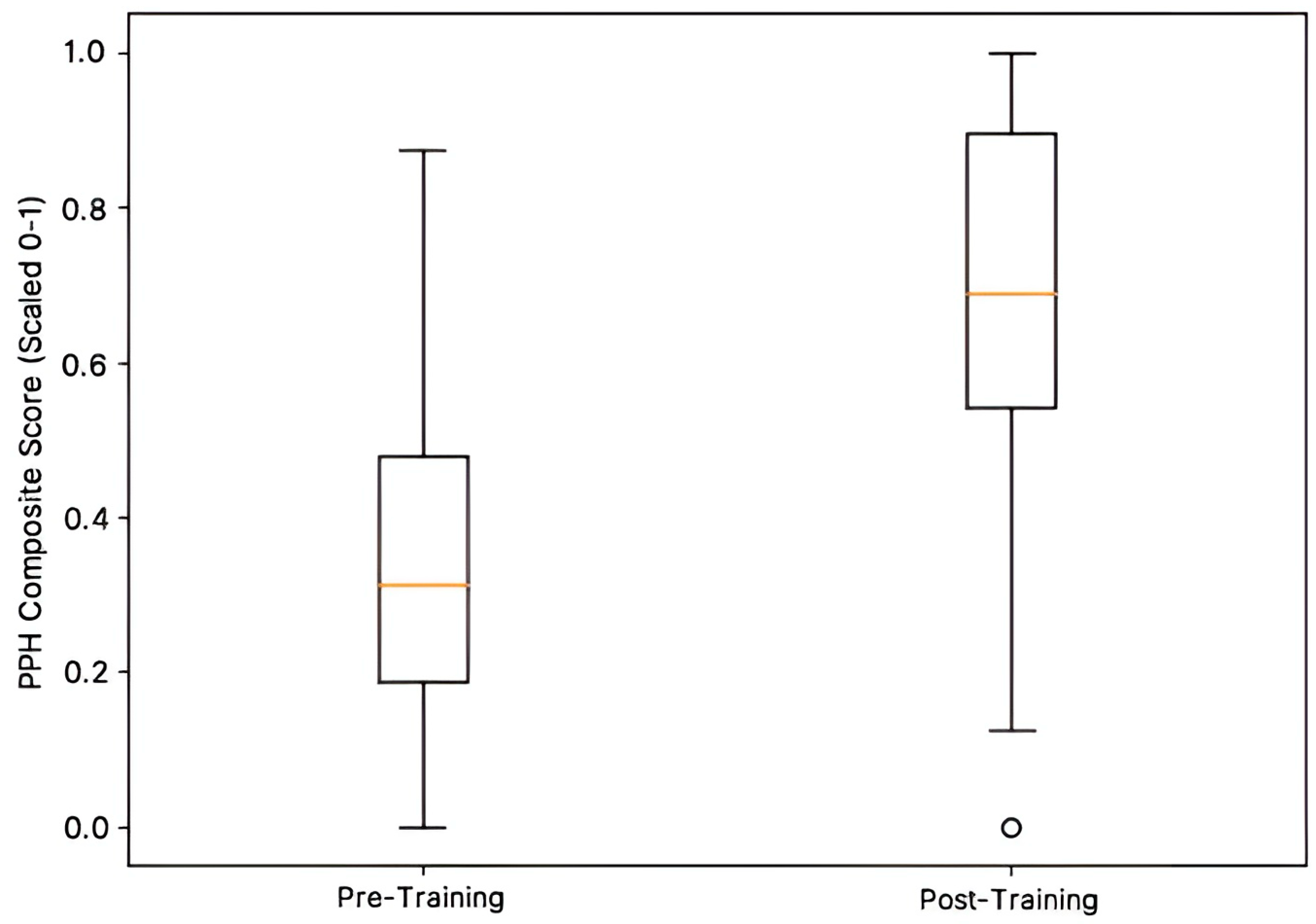
Table 1), a PPH composite performance score (0–11 points) derived from PPH management, placental management, emergency management, and vital-signs assessment, increased from 3.56 ± 2.17 at baseline to 7.34 ± 2.52 post-intervention (mean difference +3.79, 95% CI 3.42–4.15; paired t(214) = 20.30,
p < 0.001; Cohen’s dz = 1.38). Component-level analyses demonstrated significant improvements across all PPH-related domains, with the largest relative gain observed in emergency management (+166.7%) and substantial gains in vital-sign assessment (+116.2%) and third-stage management (+107.6%) (all
p < 0.001).
Calibration analysis revealed that prior to training, the majority of students were underconfident relative to their objective PPH performance (59.5%), with only 20.0% demonstrating adequate calibration. Following simulation, the proportion of underconfident students decreased, while overconfidence increased (39.5%), and the proportion of calibrated participants rose modestly to 24.2%.
The Brier score improved from 0.258 pre-intervention to 0.219 post-intervention, indicating enhanced alignment between self-perceived and objective performance. However, linear correlation between confidence and PPH composite performance (
Figure 2) remained weak and non-significant both before and after training (pre: r = −0.09,
p = 0.17; post: r = −0.04,
p = 0.51), suggesting that confidence–performance relationships are better captured through categorical calibration analysis rather than simple correlation metrics.
In multivariable regression analysis (
Table 2), baseline PPH performance was the only independent predictor of PPH skill gain (β = −0.67, 95% CI −0.81 to −0.53;
p < 0.001), indicating a ceiling effect whereby students with lower initial competence achieved larger improvements. Pre-training emergency confidence, prior birth exposure, baseline interest in obstetrics, and interest change were not independently associated with PPH gain (all
p > 0.05). The model explained 31.5% of variance in PPH gain (R
2 = 0.315).
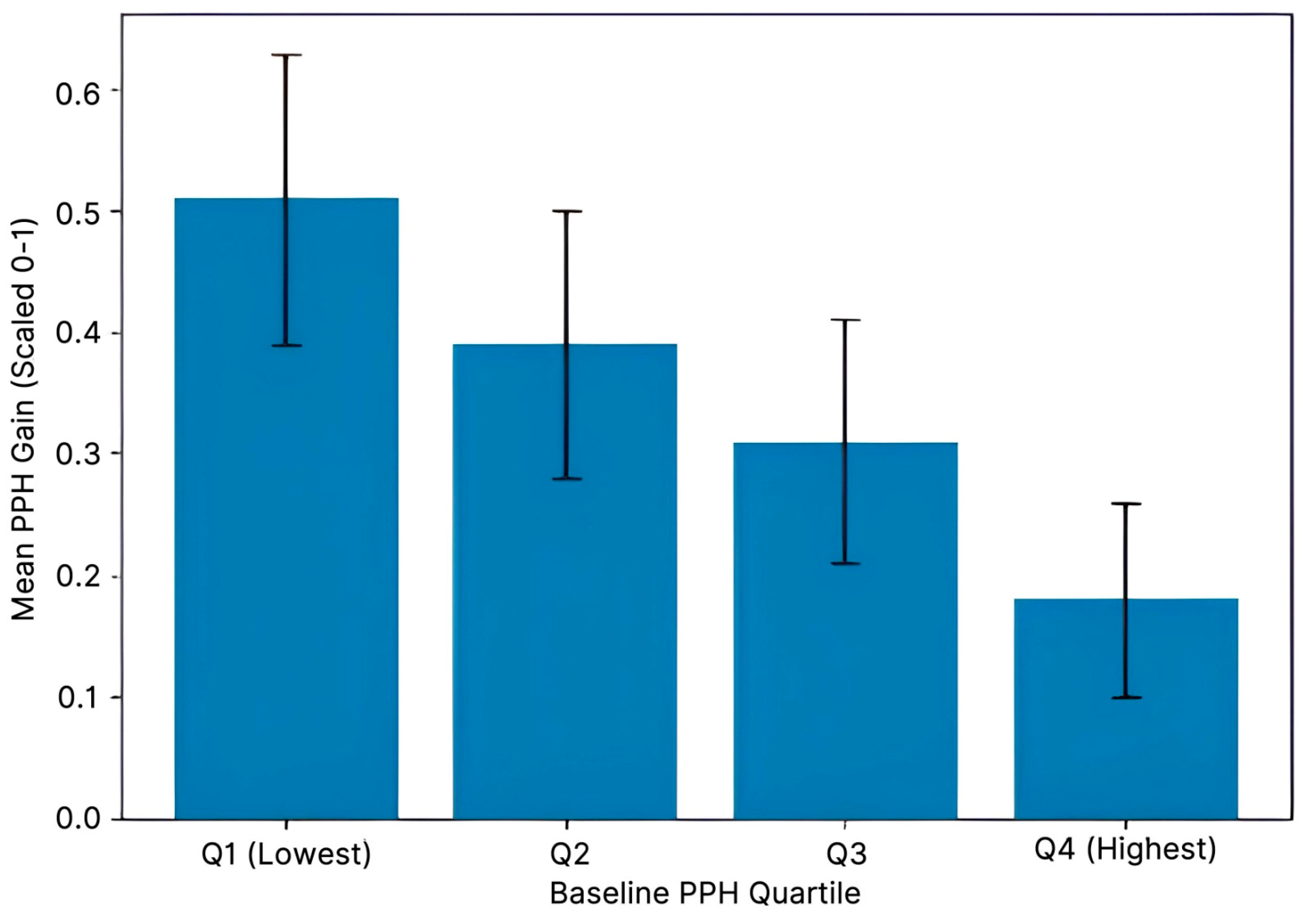
Quartile analysis further illustrated a pronounced ceiling effect as seen in
Figure 3. Students in the lowest baseline PPH quartile achieved the largest mean gain (0.51, scaled), whereas those in the highest quartile demonstrated substantially smaller improvements (0.18). This progressive reduction in gain across quartiles supports the regression finding that baseline competence strongly influences the magnitude of simulation-driven improvement. Differences in performance gain across quartiles were statistically significant (one-way ANOVA, F(3, 211) = 17.62,
p < 0.001).
Perceived lecturer quality and scenario realism were not significantly associated with PPH skill gain (all p > 0.05). However, perceived realism demonstrated a modest positive association with increased interest in obstetrics (r = 0.14, p = 0.036), suggesting that immersive fidelity may contribute to motivational engagement rather than objective performance gains.
In multivariable analysis (R
2 = 0.085,
p < 0.001), baseline interest in obstetrics was a significant negative predictor of interest gain (β = −0.24,
p < 0.001), indicating greater motivational growth among initially less-interested students. Perceived realism independently predicted increased interest (β = 0.24,
p = 0.012). PPH skill gain and lecturer evaluation were not associated with interest change (both
p > 0.60) as seen in
Table 3.
4. Discussion
4.1. Overall Effect of Simulation-Based Training
This study demonstrates that simulation-based training significantly improves undergraduate performance in structured PPH management during the third and fourth stages of labor. The magnitude of improvement was large (dz = 1.38), with gains observed across all PPH-related domains, particularly in emergency algorithm execution. These findings align with a growing body of evidence indicating that simulation training improves hemorrhage recognition, timely escalation, and protocol adherence in obstetric emergencies. For example, off-site PPH simulation for final-year medical students has been associated with improved post-training scores and higher self-reported confidence in applying PPH management steps, supporting the value of structured rehearsal even at the undergraduate level [
20]. In parallel, simulation and team-training interventions in clinical settings have shown measurable improvements in key PPH response processes (faster recognition and earlier delivery of first-line interventions), underscoring that time-critical behaviors are amenable to training [
21]. Beyond performance metrics, larger-scale obstetric teamwork curricula have demonstrated improvements in PPH management practices and reductions in severe morbidity indicators (e.g., massive transfusion), suggesting potential downstream patient-safety benefits when such training is implemented systematically [
22].
Our results are also consistent with evidence that technology-enhanced approaches (including VR-based training) can support undergraduate learning in PPH emergency management, particularly for rare procedures and structured algorithms that students may not encounter during routine rotations [
23]. Taken together, these convergent findings support the interpretation that simulation can compensate for limited clinical exposure by providing deliberate, protocol-based practice in a psychologically safe environment.
4.2. Magnitude of Skill Acquisition
The large effect size observed in PPH composite performance indicates that even a single structured simulation workshop can substantially enhance algorithm-driven emergency management in students.
The greatest relative gains were observed in emergency management and vital-sign assessment. These domains require rapid prioritization and structured decision-making under pressure, and these types of skills are difficult to develop through passive observation in clinical settings.
This supports the role of simulation as a compensatory educational strategy for time-sensitive obstetric scenarios with unpredictable clinical exposure.
This pattern is supported by recent evidence in healthcare simulation education. For example, a study investigating the role-structured simulation training in the management of obstetric emergencies (shoulder dystocia and preeclampsia) versus didactic teaching significantly improved recognition and management of emergency obstetric conditions compared to traditional didactic instruction, highlighting the added value of active rehearsal and feedback in developing complex decision-making skills [
24].
4.3. Ceiling Effect and Differential Learning Gain
Baseline PPH performance was the strongest predictor of skill gain, accounting for a substantial proportion of variance. Students with lower initial competence demonstrated the largest improvements, whereas those with higher baseline scores showed smaller incremental gains. Quartile analysis visually confirmed this ceiling phenomenon.
From a curricular perspective, this suggests that simulation may be particularly impactful for students with limited prior exposure and lower initial preparedness. Structured simulation may therefore serve as an equalizing mechanism in heterogeneous cohorts.
For example, stratified analyses in medical simulation training have documented that students beginning with lower baseline scores tend to demonstrate larger improvements in performance measures relative to their higher-performing peers, suggesting a robust ceiling effect when structured educational interventions are applied [
25].
From a practical teaching perspective, these findings suggest that students do not all benefit from the same type of feedback. Those who perform well but lack confidence may need reassurance and reinforcement to better trust their abilities. On the other hand, students who appear confident despite lower performance may benefit more from structured debriefing that encourages reflection on decisions and recognition of errors.
This underlines the importance of going beyond technical training and incorporating guided reflection into simulation sessions, so that students can develop not only their skills, but also a more accurate sense of their own competence.
Although baseline performance emerged as the only significant predictor of PPH skill gain, the model explained a moderate proportion of the observed variability. This is not unexpected in the context of educational research, where learning outcomes are typically influenced by multiple interacting factors.
Beyond the variables included in our analysis, differences in prior academic performance, variability in clinical exposure, individual learning approaches, and levels of motivation or engagement may all contribute to how students respond to simulation-based training. These influences are difficult to fully capture within a single model but are well recognized in the literature on medical education and simulation-based learning [
19,
25].
This finding may also reflect a limited discriminative capacity of the checklist at higher levels of performance. While the checklist was appropriate for undergraduate learners, it may not fully capture more advanced competencies in students with higher baseline skills. From an educational perspective, this suggests that more advanced or branching simulation scenarios, incorporating increased complexity and decision-making variability, may be beneficial for higher-performing students.
4.4. Confidence and Calibration
Although performance improved markedly, alignment between self-perceived and objective competence remained imperfect.
Confidence–performance correlation remained weak, and a subset of students demonstrated post-training overconfidence. This can suggest that while simulation enhances procedural performance, metacognitive calibration requires additional structured feedback and possibly repeated exposure.
The increase in overconfidence observed in a subset of students is clinically relevant, as inaccurate self-assessment in acute situations may affect decision-making and potentially impact patient safety.
This highlights the importance of structured debriefing following simulation sessions, particularly approaches that encourage reflection on decisions, identification of errors, and comparison between perceived and actual performance.
4.5. Motivational Outcomes: The Role of Realism
Interest gain was not associated with objective PPH performance improvement nor with lecturer evaluation. Instead, perceived realism independently predicted increased interest in obstetrics. This distinction is conceptually important.
Performance acquisition appears to depend primarily on structured practice and baseline competence, whereas motivational engagement appears more sensitive to experiential fidelity. Thus, immersive realism may function as a motivational amplifier rather than a direct driver of procedural competence. We do not interpret this as meaning that high-fidelity simulation serves only an engagement role. Rather, it suggests that different aspects of simulation may support learning in different ways.
In our case, performance improvements seem to be driven mainly by structured practice and repeated exposure to emergency algorithms, while realism appears to make the experience more engaging and meaningful for students. This may not translate immediately into better performance scores, but could still play an important role in maintaining motivation and supporting learning over time.
Systematic reviews of simulation training in emergency obstetric care indicate that enhancements in clinical skills and confidence are frequently accompanied by subjective improvements in perceived readiness, particularly when scenarios are perceived as authentic and relevant to clinical practice [
26]. Additionally, simulation tools including virtual and remote training environments have demonstrated feasibility and acceptability in low-volume practice settings, suggesting that realism and contextual relevance may be key drivers of engagement and sustained interest even when objective performance gains plateau [
27].
The findings suggest a dual-mechanism model: Skill acquisition is primarily determined by structured algorithmic rehearsal and baseline competence. Motivational engagement is influenced by immersive fidelity. For undergraduate curricula, this supports integrating structured PPH simulation early in training, particularly for students with limited exposure. However, ensuring accurate self-assessment may require iterative simulation and enhanced reflective components [
28].
4.6. Educational Implications and Patient Safety
Several studies have highlighted the critical role of effective training strategies in undergraduate medical education as a foundation for patient safety [
29,
30,
31,
32]. Whether the objective is acquiring a new clinical technique, strengthening knowledge retention, or improving coordination within multidisciplinary teams, the underlying goal remains constant: preparing future physicians to deliver safe, timely, and competent care [
21,
33,
34,
35,
36]. In this context, simulation-based education is not merely a pedagogical enhancement but an ethical commitment to ensuring that patients are entrusted to well-prepared clinicians from the earliest stages of independent practice.
A key implication of these findings concerns the universality of emergency preparedness in undergraduate education. Obstetric emergencies such as postpartum hemorrhage may occur in emergency departments, rural hospitals, or general clinical settings where immediate specialist availability is limited. Newly graduated physicians, regardless of future specialization, may be required to initiate life-saving interventions during the critical first minutes of hemorrhage.
The substantial performance gains observed in this cohort, particularly among students with low baseline competence, suggest that structured emergency simulation can serve as a foundational safety mechanism. Ensuring that all graduating medical students acquire basic algorithmic competence in managing PPH may represent not only a pedagogical enhancement but a patient safety imperative.
In healthcare systems characterized by uneven distribution of obstetric specialists, simulation-based emergency preparedness may mitigate disparities in early clinical response and reduce delays in escalation of care [
5].
While simulation allows for structured practice of emergency algorithms, it cannot fully replicate the pressure and complexity of real clinical situations. Therefore, improvements observed in this setting should be interpreted with caution in terms of direct transfer to clinical practice. We do not have follow-up data at this stage, but future research should explore how these skills translate into early clinical performance during residency.
4.7. Limitations
This study has several limitations that should be considered. First, the single-group pre–post design without a control cohort limits causal inference and does not fully exclude the contribution of test–retest effects. The proportion of excluded participants, although primarily due to logistical reasons, may have influenced the representativeness of the final sample. Outcomes were assessed immediately after the intervention, and long-term retention of emergency competencies was not examined. This is particularly relevant in the context of low-frequency, high-stakes events such as postpartum hemorrhage, where skill decay over time is a known concern. Future studies should include longitudinal follow-up to better understand the durability of these learning gains. Another limitation is that performance was measured within a simulated setting, which may not fully replicate the cognitive and emotional complexity of real obstetric emergencies. Also, the assessments were conducted by a single evaluator, which ensured consistency but precluded formal assessment of inter-rater reliability and may have introduced some degree of observer bias. Additionally, confidence, interest, and perceived realism were self-reported and may be subject to response bias. Finally, the study was conducted at a single academic center, potentially limiting generalizability to other educational contexts.
4.8. Future Directions
Future research should focus on several key directions. Longitudinal studies are needed to assess the retention of simulation-acquired skills over time. Also, incorporating controlled group study designs would help clarify the specific contribution of simulation compared to traditional teaching methods. Finally, further work is required to explore how simulation-based training translates into early clinical performance and decision-making in real obstetric emergencies.