Article

Geometry Alteration of Orthodontic Microimplants Following In Vivo Loading: Microanalysis on 3D Scans—A Cross-Sectional Study

by
Katarzyna Stefaniak
1,
Maciej Jedliński
1,
Katarzyna Tandecka
2 and
Joanna Janiszewska-Olszowska
1,*
1
Department of Interdisciplinary Dentistry, Pomeranian Medical University in Szczecin, Al. Powstańców Wielkopolskich 72, 70-111 Szczecin, Poland
2
Faculty of Mechanical and Power Engineering, Koszalin University of Technology, Ul. Racławcika 15-17, 75-620 Koszalin, Poland
*
Author to whom correspondence should be addressed.
Appl. Sci. 2026, 16(10), 5044; https://doi.org/10.3390/app16105044
Submission received: 7 April 2026 / Revised: 14 May 2026 / Accepted: 15 May 2026 / Published: 19 May 2026
(This article belongs to the Special Issue Advances in Orthodontics and Dentofacial Orthopedics)

Abstract

This study aimed to assess three-dimensional geometric alterations of orthodontic microimplants associated with clinical loading. Twenty orthodontic microimplants (AbsoAnchor SH 1312-08) were scanned with a blue-light 3D optical scanner at a resolution of 2 μm. After sterilization, the microimplants were inserted and immediately loaded in adult patients undergoing maxillary molar intrusion. Upon completion of treatment, the retrieved microimplants were rescanned and digitally superimposed on baseline scans using a best-fit alignment algorithm to quantify surface deviations relative to the original geometry. All analysed microimplants demonstrated statistically significant geometric alterations (p < 0.001). Analysis of 88,565 measurement points revealed mean deviations consistently indicating inward deformation or material loss, with 95% confidence intervals remaining entirely negative (−0.01032 to −0.00998). Maximum local deviations approached 100 μm, primarily affecting thread depth and axial elongation, while one microimplant exhibited pronounced bending deformation with an arched configuration. These findings indicate that orthodontic microimplants undergo statistically significant three-dimensional microgeometric changes following in vivo loading; however, no clinically relevant adverse outcomes were observed.

1. Introduction

Orthodontic mini-implants, also referred to as temporary anchorage devices (TADs), are widely used in contemporary orthodontics to enhance anchorage by either reinforcing the reactive unit (indirect anchorage) or eliminating its need altogether (direct anchorage) [1]. Their clinical application has substantially expanded orthodontic treatment possibilities by enabling controlled tooth movement that may be difficult to achieve using conventional mechanics or in patients with limited compliance.
The development of skeletal anchorage systems has evolved over several decades. The earliest reports of implant-based anchorage in orthodontics date back to Gainsforth and Higley (1945) [2], while the concept was further refined by Creekmore and Eklund (1983) [3]. The term “mini-implant” was later introduced by Kanomi [4], representing a key milestone in the evolution of temporary anchorage systems. Subsequent clinical applications, including those reported by Costa et al. [5], contributed to the development of dedicated systems such as the Aarhus Anchorage System [6], while Korean research groups introduced the AbsoAnchor orthodontic microimplant system [7].
Although the term “mini-implants” is more commonly encountered in the orthodontic literature, “microimplants” is the nomenclature adopted by the manufacturer of the device analysed and is therefore retained to ensure consistency with the product specifications. Thus, in the present study, the term “orthodontic microimplants” is used consistently.
In clinical practice, these devices are removed after completion of orthodontic treatment, as they are designed for temporary use. Their introduction has significantly broadened the scope of orthodontic biomechanics by allowing more predictable and efficient tooth movement strategies.
Owing to their favourable clinical performance, orthodontic micro-implants have been widely adopted and extensively investigated. Previous research has focused on the clinical effectiveness of various orthodontic mechanics [8], the identification of safe insertion sites [9], and the influence of loading protocols on primary stability [10]. Material-related studies have examined morphological, structural, and compositional changes in retrieved implants [11,12]. Furthermore, macrogeometric characteristics such as length, diameter, thread depth, pitch, helix angle, and body configuration (conical or cylindrical) have been identified as key determinants of primary stability and mechanical behaviour [13,14]. These design parameters are also critical in preventing mechanical failure, including plastic deformation and potential fracture.
Despite the extensive body of literature, quantitative evidence regarding three-dimensional geometric alterations of orthodontic micro-implants following clinical use remains limited. In this context, the use of three-dimensional scanning offers a significant advantage, as it enables precise measurements and objective assessment of dimensional changes that are difficult to obtain using conventional methods, such as microscopic analysis.
Therefore, the aim of this study was to quantitatively evaluate three-dimensional geometric alterations in orthodontic micro-implants following clinical use by comparing pre- and post-loading scans. These findings may provide clinically relevant insights into the mechanical behavior of orthodontic micro-implants under functional intraoral loading conditions.

2. Materials and Methods

2.1. Ethical Approval and Reporting Standards

The study design has been approved by the Bioethics Committee of the Pomeranian Medical University in Szczecin (KB-006/43/2025) and all orthodontic patients enrolled in the study have given their written informed consent. All the procedures were in accordance with the Helsinki Declaration (1964) and its later amendments or comparable ethical standards. The study followed STROBE guideline (Supplementary Material Table S1) and was registered at the US National Institutes of Health (ClinicalTrials.gov) ID no. NCT06743360.

2.2. Specimen Selection and Preparation

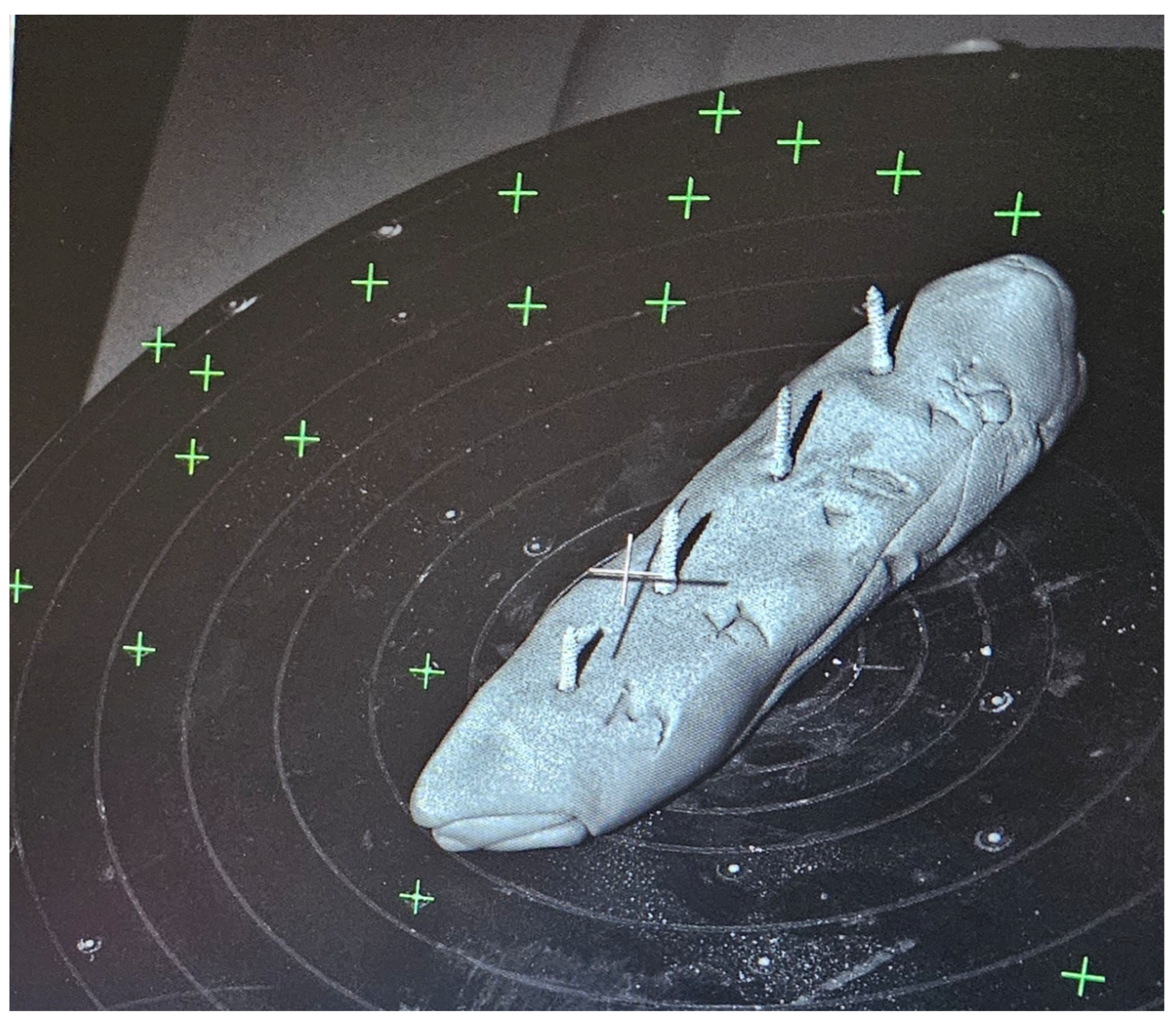
Twenty orthodontic micro-implants (n = 20) (AbsoAnchor SH 1312-08, Dentos, Daegu, South Korea) were randomly selected using a systematic sampling approach (every third screw from an initial pool of 60 specimens). The sample size (n = 20) was determined based on the number of consecutively available clinical cases that met the inclusion criteria during the study period. The implants were numbered consecutively and embedded in polyvinyl siloxane impression material Variotype heavy putty (Kulzer, Hanau, Germany) to enhance stability and ensure reproducibility of the scanning procedure. All screws were sputtered (0.6 µm CaCO4) to avoid light reflection (thus improving surface detection and measurement accuracy) and scanned in blue-light technology, using a 3D optical scanner (Atos III, Triple Scan, GOM, Germany) to the nearest 2 µm. Given regular manufacturer-recommended calibration procedures, a separate error study was not performed. Subsequently, the scans were superimposed using GOM Inspect Software v 7.5. (GOM, Braunschweig, Germany) in order to verify the shape and size alteration. Figure 1. shows an orthodontic microimplant specimen during three-dimensional scanning. The microimplants were embedded in silicone to minimize involuntary displacement.

2.3. Preclinical Processing and Clinical Procedure

After initial scanning, the microimplants were thoroughly cleaned with water spray, dried and have undergone the standard sterilization procedure (steam autoclaving 121 °C for 20 min) and were allocated for clinical use in a group of adult patients in the active phase of orthodontic treatment.
The inclusion criteria comprised patients aged 20–30 years with good general health and without systemic conditions affecting bone metabolism, as well as adequate local oral conditions for safe placement of temporary anchorage devices. The treatment plan included maxillary molar intrusion using temporary anchorage devices with a maximum movement of 2 mm. The exclusion criteria comprised patients not meeting the age criterion, as well as those presenting systemic or local conditions that could affect bone metabolism or implant stability. Additional criteria included insufficient oral hygiene, active inflammatory conditions in the oral cavity, or any clinical situation requiring deviation from the planned intrusion protocol. Patients requiring mandibular anchorage or alternative orthodontic mechanics were also excluded.
The size and design of the microimplants selected for the study (AbsoAnchor SH 1312-08), allowed intra-alveolar application for maxillary buccal alveolar region.

2.4. Surgical Procedure and Loading Protocol

The insertion procedure was preceded by obtaining participant’s written consent and administering local anaesthesia (Citocartin 100, Molteni Dental, Scandicci, Italy). Subsequently, the microimplant was inserted with the manual screwdriver (NLHD, Dentos, Daegu, South Korea) using one-step self-drilling method into the maxillary buccal alveolar region. A standard insertion approach as far as possible was applied to ensure comparable biomechanical conditions between clinical cases; the insertion angle was standardized to the greatest extent possible, considering individual anatomical variations. Primary stability was confirmed before immediate loading. The micro-implants were clinically loaded for an approximate period of 4–7 months; however, the exact duration of force action was not recorded. After completion of treatment tasks, microimplants have been retrieved, disinfected (Velox Spray Medisept, Lublin, Poland) and re-embedded in polivynyl siloxane impression material in preparation for re-scanning. Both insertion and retrieval procedures were performed by the same operator.

2.5. 3D Analysis and Data Processing

The retrieved microimplants were once again sputtered with 0.6 µm CaCO4 and scanned in 3D (Atos III, Triple Scan, GOM, Germany) and superimposed with initial scans to assess the morphologic, structural, and dimensional alterations. The software applied a best-fit algorithm based on multiple reference points automatically identified on the external surface of each specimen. The number of reference points ranged from 4372 to 4996. All deviations from the initial geometry were classified as positive (outward displacement relative to the original surface) or negative (inward deformation or material loss). The distribution of deviations was subsequently tabulated.
Sample size has been verified at the level of the microimplants number in order to evaluate the statistical sensitivity of the available dataset; a post hoc power analysis was performed using mean deviation values. Based on an observed mean deviation of −0.01017 mm, a between-implant standard deviation of 0.00619 mm and an effect size of d = 1.64, the power achieved for a two-sided one-sample t-test against zero at α = 0.05 was greater than 0.99.
The calculation of descriptive statistics was undertaken for surface deviation values obtained from the superimposed pre- and post-retrieval scans. For each specimen, the minimum, first quartile, median, third quartile, maximum, mean, standard deviation, and 95% confidence interval were calculated. The null hypothesis proposed that the mean surface deviation would not differ from zero, thus, indicating no deviation from the baseline geometry. Surface deviation values were analyzed descriptively, and mean deviations were compared with the reference value of zero using a one-sample Student’s t-test. The level of statistical significance was set at α = 0.05. Statistical analyses were performed using R statistical analysis software.

3. Results

Primary implant stability was achieved for all inserted screws. No microimplants were lost during the clinical phase; however, one implant (No. 11) could not be retrieved due to patient dropout and discontinuation of treatment.
During the initial assessment it was found that the initial microgeometry differed between individual specimens. Table 1 presents the descriptive statistical analysis of geometric alterations.
A total of 88,565 measurement points were analysed across 19 datasets, each comprising between 4372 and 4996 observations, indicating a high-density and robust sampling of surface geometry. All specimens exhibited statistically significant dimensional changes (p < 0.001). The 95% confidence intervals for the mean deviations of all specimens were entirely confined to negative values (−0.01032 to −0.00998), suggesting a uniform tendency towards material loss or inward geometric alteration across the analysed microimplant surfaces.
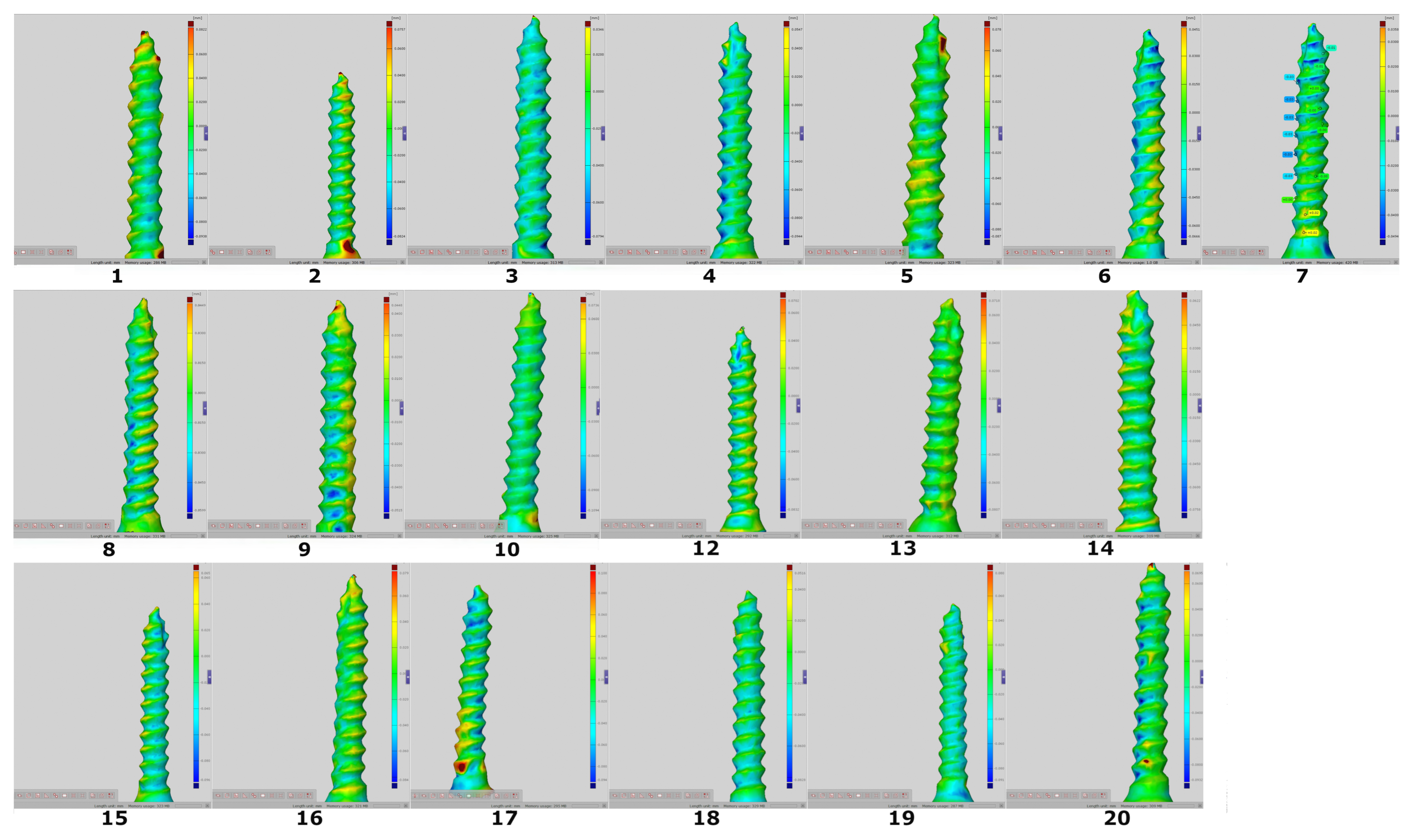
A graphical representation of the shape alterations observed in the retrieved specimens is shown in Figure 2. One microimplant (No. 11) was excluded due to patient dropout during the study. The remaining specimens are presented using colour-coded visualisation of surface changes based on a heat map scale. Warm colours (red, orange, and yellow) indicate areas of material gain, whereas cool colours (green-blue shades to blue) represent regions of material loss. The corresponding values are expressed in millimetres. Individual legends are provided for each implant due to differences in the range of measured values between specimens.
Overall, the specimens analyzed demonstrated consistent yet heterogeneous patterns of geometric alteration following clinical use, with variations in magnitude and localization of surface deviations.

4. Discussion

To the best of the authors’ knowledge, the present study is the first to compare, through superimposition of precise 3D scans, orthodontic microimplants before insertion and after removal. It is noteworthy that, in our study, the same screws were scanned prior to clinical use, clinically applied, retrieved, rescanned, and subsequently superimposed.
Retrieval analyses have recently gained considerable attention regarding material performance in the intended clinical environment and have primarily relied on comparisons between retrieved specimens and unused (as-received) controls [15,16,17].
However, the present study demonstrated that the initial geometry of individual AbsoAnchor screws varied significantly. This observation seems to be related the manufacturing process, namely the initiation of CNC thread cutting at different positions relative to the screw head circumference. Accordingly, geometric comparisons based on the superimposition of randomly selected new and retrieved microimplants should be interpreted with caution.
The AbsoAnchor microimplants used in this study were non-sterilized type to allow optical scanning prior to clinical use. The insertion in the surgical site was obligatory preceded by sterilization in accordance with the manufacturer’s recommendations (steam sterilization in temperature of 121 °C for a minimum duration of 20 min). Previous studies have shown that sterilization does not affect the mechanical properties of microimplants [18,19,20,21].
AbsoAnchor microimplants are made from medical-grade titanium alloy (Ti-6Al-4V). Although challenging to process, titanium alloys dominate current microimplant production due to their exceptional biocompatibility, high strength, corrosion resistance, and low weight [22]. The biocompatibility of titanium alloy allows for partial osseointegration, supporting stable fixation during service but potentially complicating removal. In contrast to prosthetic implants, full osseointegration seems not to be desired for the temporary orthodontic microimplants.
The selection of microimplant size was guided by clinical indications (maxilla, buccal region) and informed by previous studies (Table 2).
The alteration of microimplant tips (blunting) observed in the present study is consistent with previous reports on retrieved microimplants [12,16,25,26]. The loss of material likely occurs not only at the implant tip but also along its surface. This observation is consistent with the findings by Morais et al. [27], who reported vanadium ion release during the healing process of titanium alloy microimplants inserted in the tibiae of rabbits.
The elongation of microimplants observed in the present study has not been previously reported in the literature. One possible explanation for this phenomenon may relate to differences in torque values applied during clinical procedures. In vivo studies have reported that insertion torque tends to exceed removal torque, suggesting that removal torque may be influenced by osseointegration [11,28,29,30].
In contrast, in vitro studies typically demonstrate the opposite pattern, with removal torque being lower than insertion torque [31,32], highlighting the influence of bone–implant interactions present only in vivo. These observations emphasise the role of biological factors, such as bone adaptation and osseointegration, in determining the geometry alterations of orthodontic microimplants during clinical use.
One possible explanation of the observed elongation of screws might be attributed to de-twisting of the implant threads, a mechanical phenomenon analogous to the “paper clip effect”: torsional unwinding of a helical structure requires less mechanical load than axial compression of its coils. Helical geometries, such as coils and threads, respond differently to torsional versus compressive loads because torsion predominantly engages shear stresses along the material, whereas axial compression induces bending, contact stresses, and localised plasticity, requiring higher energy input to produce permanent deformation [33]. In microimplants, the helix corresponds to the threaded portion of the screw (body), and torsional stresses are imposed during removal from bone. Titanium implants have been shown to undergo measurable deformation under torsional loading, with permanent geometric changes occurring at clinically relevant torque levels [34]. However, the present study did not directly evaluate the underlying biomechanical mechanism.
In contrast, direct axial compression of the threaded helix is resisted by the coil geometry and its engagement with surrounding bone, producing higher localised stresses and earlier onset of plastic deformation under comparable load magnitudes. This is consistent with mechanical evaluations of helical structures, as described by classical spring mechanics analyses [33]. Consequently, the relative ease of torsional unwinding compared with axial compression offers a plausible mechanistic basis for the slight elongation of microimplants observed post-removal in the present study.
The arched deformation observed in orthodontic microimplant no. 17 is consistent with the dominant deformation mechanism reported in the literature, namely bending of the implant shaft in the neck and intraosseous portion. Lateral loading and bending moments may lead to permanent plastic deformation, particularly in microimplants with smaller diameters and at sites of stress concentration, such as the transition between the neck and the threaded portion [35,36,37]. This deformation is likely to have occurred during removal and may be attributed to several factors, including partial osseointegration, which may increase resistance during unscrewing; the mechanical behaviour of titanium alloys, which permits elastic–plastic deformation under torsional loading; and the presence of asymmetrical loading conditions. Under clinical conditions removal torque is rarely purely axial and may be accompanied by lateral forces and bending moments resulting from imperfect instrument alignment and heterogeneous bone structure [26,31,38,39]. It is also conceivable that the individual geometry of microimplant 17 may have contributed to its increased susceptibility to deformation, as subtle variations in thread morphology and core dimensions can lead to localised stress concentrations during torsional loading.
One possible approach to minimise the risk of implant bending could involve the use of microimplants with a greater diameter, given the well-established association between increasing diameter and enhanced resistance to plastic deformation and fracture [15,39,40,41]. Nevertheless, in interradicular applications, increasing implant diameter may entail a higher risk of complications, such as inadvertent root contact during insertion, potential damage to the periodontal ligament, compromised stability during clinical use, and increased bone trauma during removal.
Although statistically significant differences were identified, their interpretation should consider the large number of surface points generated by high-resolution 3D scanning, which increases sensitivity to detect even minimal geometric deviations. Therefore, statistical significance does not necessarily imply clinically meaningful deformation.
Importantly, the microimplant’s geometry alterations observed during the study were not associated with clinically relevant adverse outcomes. No screws’ fractures were recorded, and the absence of microimplant loss throughout the clinical phase suggests that adequate stability was maintained for the entire duration of the study. These findings indicate that the observed deformations remained limited in extent and did not compromise clinical performance. Overall, the AbsoAnchor microimplants applied in this study exhibited favourable mechanical performance and maintained structural integrity under the applied clinical conditions.
The present study has several limitations that should be considered when interpreting the results. First, the relatively small sample size (n = 20) may limit the generalisability of the findings. In addition, during both the initial and post-retrieval scanning procedures, the specimens were positioned manually, which may have introduced variability in the number and distribution of reference points used for surface alignment.
Furthermore, clinical factors such as bone density, exact implant insertion position, variations in insertion and removal torque, and the exact duration of clinical loading for each implant were not fully controlled and may have influenced both the magnitude and pattern of the observed deformation. These sources of variability are inherent to in vivo conditions and should therefore be taken into consideration when interpreting the results.
The present study extends current knowledge by providing a quantitative three-dimensional assessment of geometric alterations in orthodontic micro-implants following clinical use. While previous investigations have primarily focused on surface morphology or material properties, the applied approach based on high-resolution 3D scanning and surface superimposition allows for precise evaluation of both general and localized geometric changes.
Despite these findings, further research involving larger sample sizes and a broader range of micro-implant designs is required to verify the observed patterns and to better understand the variability of deformation under different clinical conditions.

5. Conclusions

Three-dimensional surface superimposition appears to be a suitable method for evaluating geometric changes in orthodontic micro-implants under clinical use. The observed alterations were predominantly manifested as changes in thread depth and axial geometry (elongation), with isolated cases of bending deformation. A variability in the initial geometry of unused micro-implants was identified, indicating that specimen-specific baseline scans are essential for accurate post-retrieval comparisons.
Despite the detected changes, no clinically significant adverse effects were observed in the evaluated specimens.
These findings may have potential clinical implications for improving the assessment of in vivo implant behaviour and understanding the mechanical response of orthodontic micro-implants under functional conditions. Further research could verify these observations in larger samples and explore their relevance across different clinical scenarios and implant designs.

Supplementary Materials

The following supporting information can be downloaded at: https://www.mdpi.com/article/10.3390/app16105044/s1, Table S1. STROBE checklist.

Author Contributions

Conceptualization, K.S. and J.J.-O.; methodology, J.J.-O. and K.T.; software, K.T.; validation, J.J.-O.; formal analysis, J.J.-O. and M.J.; investigation, K.S.; resources, K.S.; data curation, K.T. and M.J.; writing—original draft preparation, K.S.; writing—review and editing, J.J.-O.; visualization, K.T.; supervision, J.J.-O.; project administration, K.S.; funding acquisition, J.J.-O. All authors have read and agreed to the published version of the manuscript.

Funding

This research received no external funding.

Institutional Review Board Statement

The study was conducted in accordance with the Declaration of Helsinki, and approved by the Bioethics Committee of the Pomeranian Medical University in Szczecin (KB-006/43/2025). The study was registered at the US National Institutes of Health (ClinicalTrials.gov) ID no. NCT06743360.

Informed Consent Statement

Informed consent was obtained from all subjects involved in the study.

Data Availability Statement

The raw data used for this study are available on request from the corresponding author (due to a large capacity).

Conflicts of Interest

The authors declare no conflicts of interest.

Abbreviations

The following abbreviations are used in this manuscript:
MImini-implants, microimplants
TADTemporary anchorage device
Spec.Specimen

References

  1. Cope, J.B. Temporary anchorage devices in orthodontics: A paradigm shift. Semin. Orthod. 2005, 11, 3–9. [Google Scholar] [CrossRef]
  2. Gainsforth, B.; Higley, L. A study of orthodontic anchorage possibilities in basal bone. Am. J. Orthod. Oral Surg. 1945, 31, 406–417. [Google Scholar] [CrossRef]
  3. Creekmore, T.D.; Eklund, M.K. The possibility of skeletal anchorage. J. Clin. Orthod. 1983, 17, 266–269. [Google Scholar]
  4. Kanomi, R. Mini-implant for orthodontic anchorage. J. Clin. Orthod. 1997, 31, 763–767. [Google Scholar] [PubMed]
  5. Costa, A.; Raffaini, M.; Melsen, B. Miniscrews as orthodontic anchorage: A preliminary report. Int. J. Adult Orthod. Orthognath. Surg. 1998, 13, 201–209. [Google Scholar]
  6. Melsen, B.; Costa, A. Immediate loading of implants used for orthodontic anchorage. Clin. Orthod. Res. 2000, 3, 23–28. [Google Scholar] [CrossRef]
  7. Park, H.S. The skeletal cortical anchorage using titanium microscrew implants. Korean J. Orthod. 1999, 29, 699–706. [Google Scholar]
  8. Antoszewska-Smith, J.; Sarul, M.; Łyczek, J.; Konopka, T.; Kawala, B. Effectiveness of orthodontic miniscrew implants in anchorage reinforcement during en-masse retraction: A systematic review and meta-analysis. Am. J. Orthod. Dentofac. Orthop. 2017, 151, 440–455. [Google Scholar] [CrossRef] [PubMed]
  9. Chaimanee, P.; Suzuki, B.; Suzuki, E.Y. “Safe zones” for miniscrew implant placement in different dentoskeletal patterns. Angle Orthod. 2011, 81, 397–403. [Google Scholar] [CrossRef]
  10. Crismani, A.G.; Bertl, M.H.; Celar, A.G.; Bantleon, H.P.; Burstone, C.J. Miniscrews in orthodontic treatment: Review and analysis of published clinical trials. Am. J. Orthod. Dentofac. Orthop. 2010, 137, 108–113. [Google Scholar] [CrossRef]
  11. Eliades, T.; Zinelis, S.; Papadopoulos, M.A.; Eliades, G. Characterization of retrieved orthodontic miniscrew implants. Am. J. Orthod. Dentofac. Orthop. 2009, 135, 10.e1–10.e7. [Google Scholar] [CrossRef]
  12. Patil, P.; Kharbanda, O.P.; Duggal, R.; Das, T.K.; Kalyanasundaram, D. Surface deterioration and elemental composition of retrieved orthodontic miniscrews. Am. J. Orthod. Dentofac. Orthop. 2015, 147, S88–S100. [Google Scholar] [CrossRef]
  13. Walter, A.; Wendl, B.; Ploder, O.; Mojal, S.; Puigdollers, A. Stability determinants of bone-borne force-transmitting components in three RME hybrid expanders—An in vitro study. Eur. J. Orthod. 2017, 39, 76–84. [Google Scholar] [CrossRef]
  14. Jedliński, M.; Janiszewska-Olszowska, J.; Mazur, M.; Grocholewicz, K.; Suárez Suquía, P.; Suárez Quintanilla, D. How does orthodontic mini-implant thread minidesign influence stability? Systematic review with meta-analysis. J. Clin. Med. 2022, 11, 5304. [Google Scholar] [CrossRef]
  15. Stefaniak, K.; Jedliński, M.; Mazur, M.; Janiszewska-Olszowska, J. Fracture and deflection of orthodontic miniscrews—A systematic review. Appl. Sci. 2024, 14, 5577. [Google Scholar] [CrossRef]
  16. Jiman, P.A.; Prodan, D.; Moldovan, M.; Muntean, A.; Sarosi, C.; Tarmure, V.; Baciut, G.; Popa, C.; Pop, A.S. New and recovered temporary anchorage devices: In vitro assessment of structural and surface properties. Materials 2021, 14, 6271. [Google Scholar] [CrossRef] [PubMed]
  17. Ranjan, A.; Shetty, P.; Deshpande, R.; Biradar, A.; Khan, W.; Kulshrestha, R. A comparative surface evaluation of orthodontic mini-implants before and after en masse retraction—A SEM study. J. Orthod. Sci. 2023, 12, 15. [Google Scholar] [CrossRef] [PubMed]
  18. Hergel, C.A.; Acar, Y.B.; Ates, M.; Kucukkeles, N. In vitro evaluation of the effects of insertion and sterilization procedures on the mechanical and surface characteristics of miniscrews. Eur. Oral Res. 2019, 53, 25–31. [Google Scholar] [CrossRef] [PubMed]
  19. Gross, J.M.; Nascimento, G.G.; Araújo, V.C.; Bönecker, M.; Furuse, C. Mini-implants for orthodontic anchorage: Surface analysis after redrilling and sterilization—An in vitro study. J. Contemp. Dent. Pract. 2016, 17, 300–305. [Google Scholar] [CrossRef]
  20. Mattos, C.T.; Ruellas, A.C.; Sant’Anna, E.F. Effect of autoclaving on the fracture torque of mini-implants used for orthodontic anchorage. J. Orthod. 2011, 38, 15–20. [Google Scholar] [CrossRef]
  21. Alavi, S.; Asadi, F.; Raji, S.A.H.; Samie, S. Effect of steam and dry heat sterilization on the insertion and fracture torque of orthodontic miniscrews. Dent. Res. J. 2020, 17, 219–224. [Google Scholar] [CrossRef]
  22. Velasco-Ortega, E.; Jos, A.; Cameán, A.M.; Pato-Mourelo, J.; Segura-Egea, J.J. In vitro evaluation of cytotoxicity and genotoxicity of a commercial titanium alloy for dental implantology. Mutat. Res. 2010, 702, 17–23. [Google Scholar] [CrossRef] [PubMed]
  23. Vasoglou, M.; Chrysomali, E.; Zinelis, S.; Bitsanis, I.; Haralambakis, N.; Makou, M.; Eliades, G. Retrieval Analysis of Immediately Loaded Orthodontic Mini-Implants: Material and Tissue Characterization. Eur. J. Orthod. 2014, 36, 683–689. [Google Scholar] [CrossRef][Green Version]
  24. Kim, H.J.; Park, H.S. Long-Term Evaluation of Factors Affecting Removal Torque of Microimplants. Prog. Orthod. 2021, 22, 42. [Google Scholar] [CrossRef]
  25. Yun, S.D.; Choi, S.H.; Cha, J.Y.; Yu, H.S.; Kim, K.M.; Kim, J.; Hwang, C.J. Effects of recycling on the biomechanical characteristics of retrieved orthodontic miniscrews. Korean J. Orthod. 2017, 47, 238–247. [Google Scholar] [CrossRef]
  26. Chung, C.J.; Jung, K.Y.; Choi, Y.J.; Kim, K.H. Biomechanical characteristics and reinsertion guidelines for retrieved orthodontic miniscrews. Angle Orthod. 2014, 84, 878–884. [Google Scholar] [CrossRef] [PubMed]
  27. Morais, L.S.; Serra, G.G.; Muller, C.A.; Andrade, L.R.; Palermo, E.F.; Elias, C.N.; Meyers, M. Titanium alloy mini-implants for orthodontic anchorage: Immediate loading and metal ion release. Acta Biomater. 2007, 3, 331–339. [Google Scholar] [CrossRef] [PubMed]
  28. Büchter, A.; Wiechmann, D.; Gaertner, C.; Hendrik, M.; Vogeler, M.; Wiesmann, H.P.; Piffko, J.; Meyer, U. Load-related bone modelling at the interface of orthodontic microimplants. Clin. Oral Implant. Res. 2006, 17, 714–722. [Google Scholar] [CrossRef]
  29. Ma, J.; Zhang, W.; Wang, L.; Zhao, C.; Chen, W. Stability and bone response of immediately loaded microimplants in beagle dogs. Int. J. Oral Maxillofac. Implant. 2008, 23, 885–890. [Google Scholar]
  30. Chen, Y.; Lee, J.W.; Cho, W.H.; Kyung, H.M. Potential of self-drilling orthodontic microimplants under immediate loading. Am. J. Orthod. Dentofac. Orthop. 2010, 137, 496–502. [Google Scholar] [CrossRef]
  31. Sousa-Santos, P.; Sousa-Santos, S.; Oliveira, A.C.; Queirós, C.; Mendes, J.; Aroso, C.; Mendes, J.M. Evaluation of orthodontic mini-implants stability based on insertion and removal torques: An experimental study. Bioengineering 2025, 12, 549. [Google Scholar] [CrossRef]
  32. Pithon, M.M.; Nojima, M.G.; Nojima, L.I. In vitro evaluation of insertion and removal torques of orthodontic mini-implants. Int. J. Oral Maxillofac. Surg. 2011, 40, 80–85. [Google Scholar] [CrossRef]
  33. Michalczyk, K. Analysis of helical compression spring support influence on its deformation. Arch. Mech. Eng. 2020, 67, 349–362. [Google Scholar] [CrossRef]
  34. Teixeira, A.B.; Shimano, A.C.; Macedo, A.P.; Valente, M.L.; dos Reis, A.C. Influence of torsional strength on different types of dental implant platforms. Implant Dent. 2015, 24, 281–286. [Google Scholar] [CrossRef]
  35. Wilmes, B.; Panayotidis, A.; Drescher, D. Fracture resistance of orthodontic mini-implants: A biomechanical in vitro study. Eur. J. Orthod. 2011, 33, 396–401. [Google Scholar] [CrossRef] [PubMed]
  36. Scribante, A.; Montasser, M.A.; Radwan, E.S.; Bernardinelli, L.; Alcozer, R.; Gandini, P.; Sfondrini, M.F. Reliability of orthodontic miniscrews: Bending and maximum load of different Ti-6Al-4V titanium and stainless steel temporary anchorage devices. Materials 2018, 11, 1138. [Google Scholar] [CrossRef] [PubMed]
  37. Smith, A.; Hosein, Y.K.; Dunning, C.E.; Tassi, A. Fracture resistance of commonly used self-drilling orthodontic mini-implants. Angle Orthod. 2015, 85, 26–32. [Google Scholar] [CrossRef]
  38. Reicheneder, C.; Rottner, K.; Bokan, I.; Mai, R.; Lauer, G.; Richter, G.; Gedrange, T.; Proff, P. Mechanical loading of orthodontic miniscrews—Significance and problems: An experimental study. Biomed. Tech. 2008, 53, 242–245. [Google Scholar] [CrossRef] [PubMed]
  39. Al Mallah, M.R.; Salih Al Qassar, S.S.; Badran, I.B. Assessing the relationship between mini-screw implant shape and primary stability: An experimental study in orthodontics. J. Orthod. Sci. 2026, 15, 3. [Google Scholar] [CrossRef]
  40. Mohan, S.; Srinivasan, D.; Arumugam, E.; Devasahayam, D.; Kannan, R. Effect of Placement Angle, Diameter, Length and Bone Density on the Pull-Out Strength of Orthodontic Mini-Implants: An In Vitro Study. J. Orthod. 2022, 49, 143–150. [Google Scholar] [CrossRef]
  41. Sousa-Santos, C.; Sousa-Santos, S.; Mendes, J.; Coelho, C.; Aroso, C.; Sousa-Santos, P.; Mendes, J.M. The Influence of the Diameter of Orthodontic Mini-Implants on Primary Stability: Bending Tests-An In Vitro Study. Materials 2024, 17, 3149. [Google Scholar] [CrossRef]
Figure 1. 3D scanning of the specimen.
Applsci 16 05044 g001
Figure 2. The heterogeneous distribution of surface alterations across individual specimens, with variations in magnitude and localization of changeScan superimposition demonstrated that geometric deviations were limited, reaching a maximum of approximately 100 µm. Geometric alterations were predominantly observed in the threaded portion of the micro-implants, in contrast, the tip region showed comparatively fewer and less pronounced deviations. Alterations in surface morphology were predominantly observed as changes in thread depth and axial (tip) elongation of the microimplants, as illustrated in Figure 2. The greatest deviation was identified in specimen 17, which exhibited a curvature consistent with a flattened arc geometry. This distinct curvature of the implant axis compared to the remaining specimens is a representative example of non-uniform geometric alteration.
Applsci 16 05044 g002
Table 1. Distribution of geometric alterations of orthodontic microimplants.
Specimen Number No. of Reference PointsMinQ1MedianQ3MaxMeanSDpCI (95%)
Spec. 1.4435−0.1378−0.02278−0.0089040.0070990.1528−0.0057740.02933<0.001(−0.006638, −0.004911)
Spec. 2.4781−0.1264−0.01928−0.0050520.0092120.1653−0.003330.02636<0.001(−0.004077, −0.002583)
Spec. 3.4562−0.09681−0.03597−0.02269−0.0095910.1301−0.02240.01898<0.001(−0.02296, −0.02185)
Spec. 4.4751−0.1018−0.03665−0.01977−0.0040050.0683−0.019830.02486<0.001(−0.02054, −0.01912)
Spec. 5.4945−0.3927−0.01648−0.0028040.0093410.1407−0.0044240.0275<0.001(−0.005191, −0.003657)
Spec. 6.4372−0.08651−0.02259−0.0091630.0013560.05522−0.010770.01863<0.001(−0.01132, −0.01022)
Spec. 7.4629−0.05906−0.01588−0.0057590.0029890.08069−0.0068090.01419<0.001(−0.007218, −0.006401)
Spec. 8.4621−0.05987−0.01982−0.0083740.0045290.05058−0.0077390.01756<0.001(−0.008245, −0.007232)
Spec. 9.4511−0.06839−0.01327−0.0031530.0070050.05946−0.0033540.01605<0.001(−0.003822, −0.002885)
Spec. 10.4747−0.2136−0.03484−0.01851−0.0038140.1746−0.017870.0305<0.001(−0.01874, −0.017)
Spec. 12.4996−0.225−0.02323−0.004920.011860.08322−0.0065210.02556<0.001(−0.00723, −0.005812)
Spec. 13.4392−0.3834−0.01361−0.0013160.0088180.1421−0.0044580.02542<0.001(−0.00521, −0.003706)
Spec. 14.4909−0.188−0.02046−0.0069090.0061370.1389−0.0068220.023<0.001(−0.007466, −0.006179)
Spec. 15.4536−0.1101−0.03381−0.015310.0024470.06948−0.015470.02685<0.001(−0.01625, −0.01469)
Spec. 16.4682−0.2897−0.01788−0.0019980.015650.1436−0.0023340.02714<0.001(−0.003112, −0.001557)
Spec. 17.4828−0.09419−0.03645−0.014230.0092690.1754−0.011050.03709<0.001(−0.01209, −0.01)
Spec. 18.4590−0.09305−0.03006−0.01516−0.0014740.1474−0.015610.02241<0.001(−0.01626, −0.01496)
Spec. 19.4639−0.2509−0.03116−0.01717−0.0016550.144−0.016840.02469<0.001(−0.01755, −0.01613)
Spec. 20.4639−0.2159−0.02576−0.012470.0021930.1437−0.011860.02712<0.001(−0.01264, −0.01108)
All88,565−0.3927−0.02505−0.0096680.0045740.1754−0.010150.02575<0.001(−0.01032, −0.009981)
Table 2. Dimensions of miniscrews in previous studies.
Author, Year [Ref. No]Number of Subjects or SpecimensType of StudyMiniscrew Brand and DimensionsInsertion Site
Vasoglu et al., 2014 [23]70In vivo study
(retrieval analysis)
Aarhus ø1.5 mm
AbsoAnchor ø1.3 mm
Maxilla, mandible
Jiman et al., 2021 [16]15In vitro studyAbsoAnchor ø1.5 mmMaxilla, mandible, buccal area
Ranjan et al., 2023 [17]50In vivo study (retrieval analysis)AbsoAnchor ø1.8 mmMaxilla, buccal area
Kim and Park, 2021 [24] 327In vivo study (retrieval analysis)AbsoAnchor ø1.3 mm, ø1.4 mm, ø1.5 mmMaxilla, buccal area of posterior teeth
Disclaimer/Publisher’s Note: The statements, opinions and data contained in all publications are solely those of the individual author(s) and contributor(s) and not of MDPI and/or the editor(s). MDPI and/or the editor(s) disclaim responsibility for any injury to people or property resulting from any ideas, methods, instructions or products referred to in the content.