Article

Sex Differences in Exercise-Induced Arteriolar Remodeling of Skeletal Muscle

1
Doctoral School, Semmelweis University, 1091 Budapest, Hungary
2
Department of Internal Medicine and Oncology, Semmelweis University, 1083 Budapest, Hungary
3
Department of Physiology, Semmelweis University, 1094 Budapest, Hungary
4
Department of Obstetrics and Gynaecology, Semmelweis University, 1082 Budapest, Hungary
5
Department of Pathology, Forensic and Insurance Medicine, Semmelweis University, 1091 Budapest, Hungary
6
Heart and Vascular Center, Department of Experimental Cardiology and Surgical Techniques, Semmelweis University, 1122 Budapest, Hungary
7
Heart and Vascular Center, Department Cardiology, Semmelweis University, 1122 Budapest, Hungary
8
Department of Obstetrics and Gynaecology, University of Szeged, 6725 Szeged, Hungary
9
Workgroup for Science Management, Doctoral School, Semmelweis University, 1085 Budapest, Hungary
10
Department of Neurosurgery, Military Hospital, Hungary, 1134 Budapest, Hungary
*
Author to whom correspondence should be addressed.
These authors contributed equally to this work.
Appl. Sci. 2026, 16(10), 5041; https://doi.org/10.3390/app16105041 (registering DOI)
Submission received: 12 April 2026 / Revised: 8 May 2026 / Accepted: 15 May 2026 / Published: 19 May 2026

Abstract

Chronic exercise induces functional adaptations in skeletal muscle microcirculation, but whether these are accompanied by sex-specific histological remodeling of arterioles remains unclear. This study examined gracilis muscle arterioles in trained (Ex) and sedentary (Se) female (F) and male (M) Wistar rats after a 12-week intensive swimming program (Mex = 6, FEx = 6; MSed = 6, FSed = 5). Histological remodeling was assessed by quantitative colorimetry analysis of resorcin-fuchsin (elastica; n = 661) and SMA-DAB (smooth muscle actin; n = 692) staining, focusing on elastic fiber density, internal elastic lamina (IEL) characteristics, and smooth muscle density in intramuscular and intermuscular vessels. Elastic fiber density and IEL thickness were generally greater in female animals than in males (p < 0.05). IEL staining intensity showed significant effects of sex (p = 0.043), exercise (p = 0.021), and a significant sex-by-exercise interaction (p = 0.037), with exercised females exhibiting the highest IEL staining intensity. Smooth muscle density did not differ significantly by sex or training status, although it was higher in intermuscular than intramuscular arterioles (p < 0.001), and increased with vessel diameter primarily in the intermuscular group. These findings demonstrate exercise-induced, sex-specific histological remodeling of skeletal muscle arterioles, primarily affecting elastic components, with more pronounced elastic adaptation in females.

1. Introduction

Diseases of the cardiovascular system are among the leading causes of mortality worldwide. One of the most significant risk factors for the development of these diseases is sedentary lifestyle [1]. Regular physical activity benefits metabolism, reduces cardiovascular risk, and helps maintain mental health [2,3,4,5]. Exercise is known to induce both functional and structural changes in the vascular network supplying skeletal muscle. These changes include increased vessel diameter and decreased wall thickness, along with enhanced endothelial nitric oxide (NO) production, to ensure adaptation to elevated hemodynamic demands [6]. In order to maintain adequate blood supply to the growing skeletal muscle mass, angiogenic signaling pathways are activated [7].
Physical activity alters circulatory conditions in both large arteries and small arterioles of the skeletal muscles engaged during exercise [8,9,10,11,12]. Adequate oxygen delivery to muscles during exercise requires a complex, well-coordinated regulatory process that must function flawlessly. Impairment of any component of this process decreases exercise capacity [8]. Vascular aging is a well-known phenomenon in skeletal muscle circulation physiology that reduces exercise capacity. Age-related functional changes further compromise the circulatory system, exacerbating the damage in the already unhealthy microcirculation [13]. Training induces local functional adaptations in microcirculation that may reverse age-associated decline in vascular reactivity and increased vascular stiffness [14]. Elastic fiber density and smooth muscle density are key determinants of arteriolar compliance and tone, which directly influence flow regulation in exercise-induced hyperemia, making them key factors to investigate in arteriolar histological remodeling [15].
However, sex-related differences can be observed in the function of the skeletal muscle vasculature, most likely attributable to the presence or absence of estrogen. Male sex hormones are associated with increased vascular wall stiffness [16]. In premenopausal women, arterial stiffness, the prevalence of hypertension, and the incidence of cardiovascular diseases are lower compared to age-matched men. Interestingly, before puberty, arterial stiffness is higher in females than in males of the same age. With the onset of puberty, this difference disappears, only to re-emerge after menopause [17]. Sex differences are not only evident under physiological conditions but also appear in exercise-induced circulatory adaptations [18,19,20,21].
The effects of exercise on the circulatory system and the presence of sex differences are clearly demonstrated by the findings summarized above. However, it is important to emphasize that these results are primarily based on functional studies. The question of what histological changes occur in the vascular wall as an adaptation to the increased circulating volume induced by exercise—and whether these changes exhibit sex differences—remains unclear based on current literature. In addition to functional vascular studies and research aimed at uncovering cellular signaling pathways, our present study seeks to contribute to the understanding of exercise-induced cardiovascular adaptation and its sex-specific aspects from a novel perspective.
Based on previous findings [18,19,20,21], we hypothesized that long-term exercise induces histological changes in arteriolar elastic fiber and smooth muscle content that differ not only between trained and untrained groups, but also between sexes and arteriole location. Because arterioles located within muscle fibers may experience different mechanical and metabolic environments than those in connective tissue, we also examined whether histological adaptation differs between intra- and intermuscular arterioles.

2. Materials and Methods

2.1. Animals

Young adult male (n = 12) and female (n = 11) Wistar rats, aged 12 weeks, were housed in standard cages under stable temperature conditions (22 ± 2 °C) with a 12 h light–dark cycle. The rats were provided with unlimited access to regular rat diet and water. The housing and experimental protocols adhered to the recommendations outlined in the ‘Guide for the Care and Use of Laboratory Animals’ by the National Institutes of Health (NIH Publication No. 86-23, revised 1996) and complied with the European Union (Directive No. 2010/63/EU). The Animal Care Committee of Semmelweis University and Hungarian authorities granted approval for the experiment (permission number: PEI/001/2374-4/2015; approval date: 30 July 2015).

2.2. Chemicals

For anesthesia, pentobarbital (Euthasol, CEVA Santé Animale, Libourne, France) was administered at a dose of 45 mg/kg via intraperitoneal injection.

2.3. Intensive Swim Training Protocol

Following a one-week acclimatization period, animals were randomly assigned to four groups: male exercising (MEx, n = 6), female exercising (FEx, n = 6), male sedentary (MSed, n = 6), and female sedentary (FSed, n = 5). A graded, intensive swimming training protocol was implemented for the exercising groups (MEx and FEx) [22]. As rats are proficient swimmers and water is a natural environment for them, each animal was placed individually in a flat-walled water tank containing water maintained at 30–32 °C. The tank was divided into six lanes, each measuring 20 × 25 cm and 45 cm deep. Lane dimensions were selected to prevent the rats from contacting the walls or resting during swimming. The training began with 15 min of swimming per day, with the duration increased by 15 min daily until reaching 200 min, which was then maintained for the remainder of the experiment [22]. Over twelve weeks, trained rats swam five days per week and rested for two days. The 12-week training protocol was conducted concurrently with the sedentary groups (MSed and FSed), which swam for five minutes per day, five days per week [22]. No animals were lost, and no complications occurred during the training period. All animals remained healthy throughout the experiment.

2.4. Histology and Immunohistochemistry

Formalin-fixed tissue samples were embedded in paraffin and sectioned at 5 µm thickness. Following deparaffinization and endogenous peroxidase blocking, antigen retrieval using Tris-EDTA buffer (pH 9) was conducted for 30 min. Visualization of smooth muscle fibers was achieved using a smooth muscle actin (SMA) antibody (Cell Marque) at a 1:100 dilution, followed by DAB chromogen application, resulting in brown staining of smooth muscle fibers. Elastic fibers were detected using resorcin-fuchsin (RF) staining, which produced a magenta coloration of the elastic fibers. Selected coronal muscle sections were digitized and analyzed using the Case Viewer 2.4 software (3DHISTECH Ltd., Budapest, Hungary).

2.5. Image Analysis

15–30 intramuscular arteriolar cross-sections and an equal number of intermuscular arteriolar cross-sections were identified and photographed on each stained section at 40× magnification (pixel size 0.25 × 0.25 µm). Within each field of view, all eligible arterioles meeting predefined morphological criteria (intact cross-sectional morphology, clearly identifiable vessel wall boundaries, and absence of major sectioning or staining artifacts) were included. An intermuscular vessel was defined as any vessel surrounded by connective tissue over more than 50% of its circumference. Anything not belonging to the vessel wall was removed from the image prior to analysis. A total of 692 SMA-DAB immunostained and 661 RF-stained (elastica) vascular cross-sections were studied across the four experimental groups. Vascular cross sections were assigned to their respective groups and subjected to quantitative colorimetric analysis.
Quantitative colorimetry analyses were performed under Python 3.10.4 with packages NumPy 1.23., Pillow 9.4.0, and OpenCV 4.7.0. Vessel diameter was calculated from the image pixel dimensions and total vessel area. To account for processing-induced tissue shrinkage, a scaling factor of 1.25 was applied to all diameter measurements. This value was selected based on published reports indicating approximately 19–25% linear shrinkage in histologically processed tissues, depending on fixation and embedding protocols. [23,24,25,26].
For SMA-DAB sections, color channels were separated, and red values, blue values, and red-per-blue ratios were calculated for each pixel. Histograms for red-to-blue ratios were constructed for each vessel. Based on prior studies, DAB-positive pixels are characterized by red-to-blue values greater than 1.25 for weak staining and greater than 1.65 for dense staining [21]. In the present study, DAB positivity was defined as a red-to-blue ratio exceeding 1.65, and the percentage of vessel area exhibiting dense DAB-positive staining was calculated for each vessel.
For the resorcin-fuchsin (elastica) stained sections, green-channel intensity histograms were constructed following color separation. Preliminary analyses demonstrated that the magenta color of dense elastica staining suppresses the green color component, resulting in green intensity values below 40 (BMP RGB color intensity levels, 0–255) [21]. RF-positive staining was defined as green intensity values below 40, and the percentage of vessel area exhibiting RF-positive staining was calculated for each vessel. RF-positive and SMA-positive area percentages were compared across experimental groups and vessel locations.
To further quantify the structural and staining properties of vessel walls, the cross-sections were analyzed using a radial intensity profiling approach. From the lumen centroid, radial profiles were sampled uniformly around the vessel circumference. Wall thickness was estimated along each profile as the radial distance between the luminal boundary and the outer vessel boundary. Internal elastic lamina (IEL) thickness and intensity were quantified by identifying the local intensity minimum within the vessel wall, corresponding to the IEL. The surrounding wall intensity served as a baseline, and IEL prominence was expressed as the relative drop in intensity. IEL thickness was defined as the radial pixel span over which this intensity drop occurred, averaged across all radial profiles.

2.6. Statistical Analysis

Statistical analysis and graphing were done in R (v3.4.1; R Foundation for Statistical Computing), using the stats, tidyverse, car, lmerTest, performance, effectsize, and emmeans packages. The criterion for statistical significance was set at p < 0.05.
Data were analyzed using linear mixed-effects models, with sex, exercise, vessel location (intra- vs. intermuscular), vessel diameter, and relevant interaction terms included as fixed effects. Animal ID was included as a random intercept to account for repeated measurements within the same animal. Type III ANOVA tables with Satterthwaite’s approximation for degrees of freedom were used to evaluate fixed effects.
Post hoc pairwise comparisons and trend analysis were performed using estimated marginal means with Holm correction for multiple comparisons. Trend analyses examining associations between vessel diameter and staining intensity were performed using linear mixed-effects regression models. Partial eta squared ( η p 2 ) was calculated as a measure of effect size for fixed effects. Intraclass correlation coefficients (ICC) were calculated to estimate the proportion of variance attributable to between-animal clustering.
Model assumptions were evaluated using residual diagnostics, which indicated only small deviations from normality, making linear mixed-effects models appropriate for analysis, given their robustness to moderate departures from residual normality. Figures display animal-level means as individual data points and include estimated marginal means and 95% confidence intervals derived from the mixed-effects models.

3. Results

3.1. Elastic Fibers

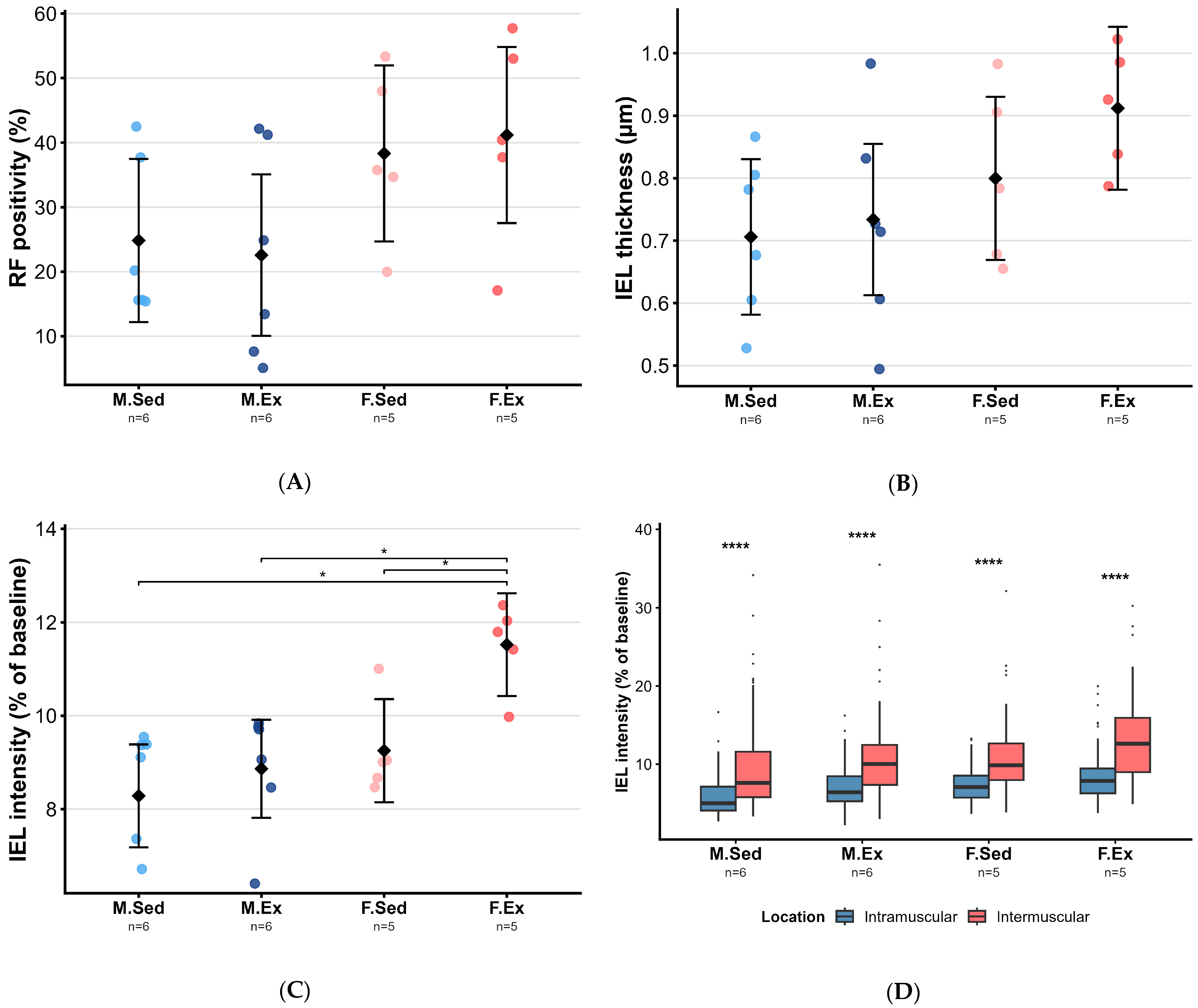
Overall Elastic Staining: Elastic fiber density was generally higher in females than in males across both sedentary and exercise conditions (model-estimated means: MSed 24.8%; FSed 38.0%; MEx 22.6%; FEx 41.2%; Figure 1A). The mixed-effects model demonstrated a significant main effect of sex (p = 0.019), with a moderate-to-large partial effect size ( η p 2 = 0.27). In contrast, there was no significant main effect of exercise and no significant sex-by-exercise interaction (p > 0.1). Post hoc comparisons did not identify statistically significant differences between individual subgroup pairs. The mixed-effects model showed moderate clustering at the animal level (adjusted ICC = 0.375), indicating that a substantial proportion of variance was attributable to between-animal variability.
Internal elastic lamina thickness: IEL thickness was generally greater in females than in males across both sedentary and exercise conditions (model-estimated means: MSed 0.706 µm; FSed 0.800 µm; MEx 0.729 µm; FEx 0.912 µm; Figure 1B). The mixed-effects model demonstrated a significant main effect of sex (p = 0.030), with a moderate-to-large partial effect size ( η p 2 = 0.23). In contrast, there was no significant main effect of exercise, and no significant sex-by-exercise interaction (p > 0.1). Post hoc comparisons did not identify statistically significant differences between individual subgroup pairs. The mixed-effects model showed mild clustering at the animal level (adjusted ICC = 0.131).
Internal elastic lamina staining intensity: IEL staining intensity was generally higher in females than in males and was highest in exercised females (MSed: 8.28%; FSed: 9.25%; MEx: 8.86%; FEx: 11.52%; Figure 1C). The mixed-effects model demonstrated significant main effects of both sex (p = 0.043, η p 2 = 0.21) and exercise (p = 0.021, η p 2 = 0.28), with a significant sex-by-exercise interaction (p = 0.037, η p 2 = 0.24). Post hoc comparisons showed significantly greater IEL staining intensity in exercised females compared with sedentary males (p = 0.014), sedentary females (p = 0.049), and exercised males (p = 0.028). No other pairwise comparisons reached statistical significance. The mixed-effects model showed minimal clustering at the animal level (adjusted ICC = 0.062).
Intra- vs. intermuscular arterioles: No significant differences were found in the overall elastic staining and IEL thickness of intra- and intermuscular arterioles (p > 0.05). For IEL staining intensity, the model demonstrated a significant main effect of location (p < 0.001, η p 2 = 0.10). IEL staining intensity was significantly higher in intermuscular arterioles than intramuscular arterioles for all groups (adjusted difference = 2.9%, p < 0.001; Figure 1D).

3.2. Smooth Muscle Fibers

Exercise and sex differences: Linear mixed-effects modeling showed no significant main effects of sex or exercise on smooth muscle fiber staining (p > 0.1). The model demonstrated mild-to-moderate clustering at the animal level (ICC = 0.176).
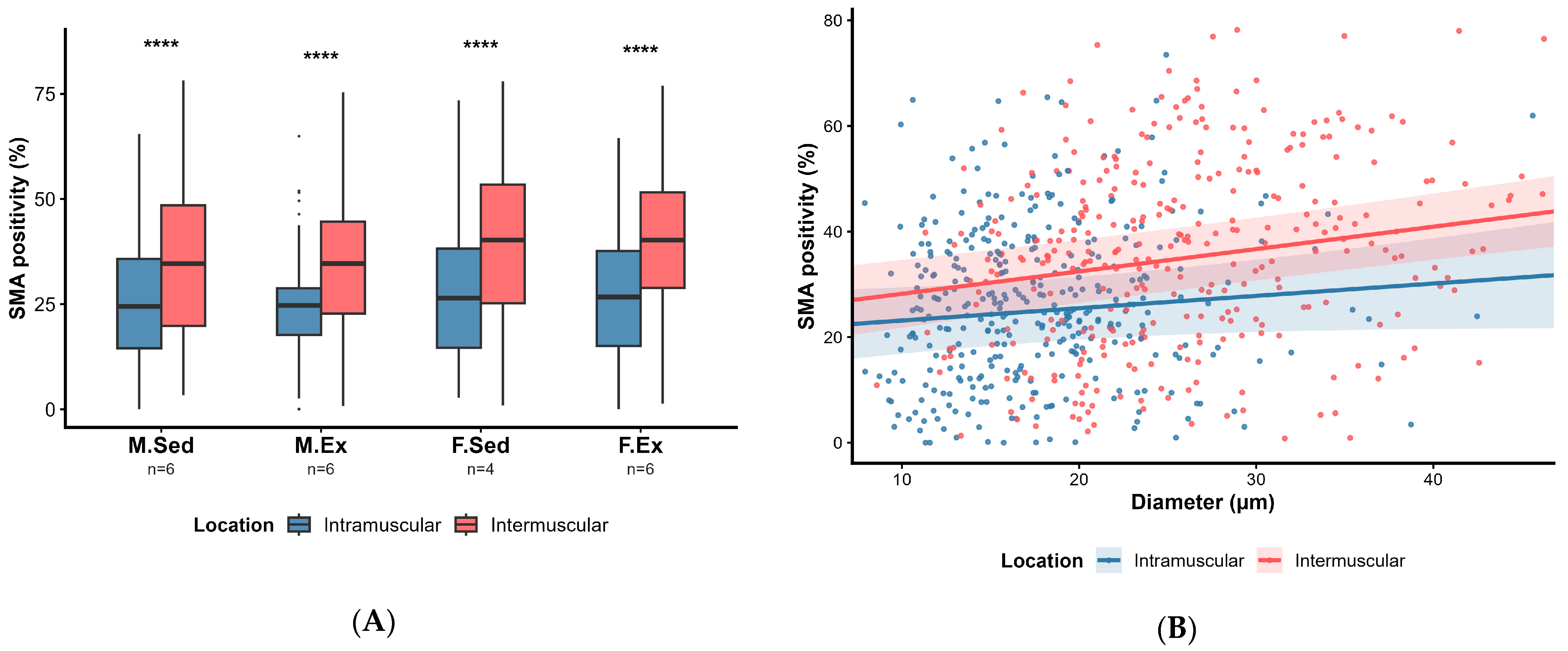
Differences in size and location: SMA positivity differed modestly by vessel location and vessel diameter (both η p 2 = 0.04). SMA positivity was significantly higher in intermuscular arterioles than intramuscular arterioles for all groups (adjusted difference = 6.9%, p < 0.001; Figure 2A).
Overall, SMA positivity increased significantly with vessel diameter (slope = 0.382 ± 0.069% per µm), and location-stratified mixed-effect regression analysis indicated that this association was primarily driven by intermuscular arterioles. In intermuscular arterioles, SMA positivity showed a significant positive association with diameter (slope = 0.445 ± 0.082% per µm, 95% CI [0.282, 0.604]), while no significant diameter dependence was observed in the intramuscular arterioles (slope = 0.206 ± 0.148% per µm, 95% CI [−0.085, 0.497]; Figure 2B).

4. Discussion

The present experiment investigated the effect of training on the histological structure of skeletal muscle arterioles in female and male rats, with a focus on sex differences. Additionally, the study aimed to determine whether histological changes differed between arterioles located within muscle fibers and those within the connective tissue between muscle fibers.
The most important results of our experiment: 1. We found significant sex differences in the density of elastic fibers. We observed higher density of elastic fibers in female animals than in males. 2. In response to training, females showed a significant increase in lamina elastica interna staining intensity. 3. Smooth muscle density did not change in response to exercise, and no sex differences were observed. However, we observed that smooth muscle density and internal elastic lamina staining intensity is dependent on position, while smooth muscle density is also dependent on vessel size.

4.1. Sex Differences

During movement, active hyperemia develops in the microvascular network of skeletal muscles, particularly in the muscle groups engaged in activity. The underlying processes, such as NO efflux and endothelial stress responses, have been extensively investigated in functional studies [27]. Our results suggest that sex-related vascular differenced may also be reflected at the histological level.
Resting and dilation characteristics of arterioles are determined by vascular basal tone as well as their minimum and maximum diameters. The mechanisms underlying the development of basal tone have been extensively described in functional studies. No fundamental sex-related differences have been identified in the minimum or maximum diameters of arterioles. These results were confirmed in various arterioles (coronary, diaphragmatic, cerebral) of non-exercising animals (rats, mice, pigs) [28,29,30,31,32,33,34].
The primary histological determinant of basal tone is the smooth muscle within the arteriolar wall. In our current experiment, we found no significant sex-related differences in smooth muscle density in either the sedentary animals or the exercising groups. However, analysis of smooth muscle density revealed that both vessel location and size influenced its distribution. In intermuscular vessels, smooth muscle density increased with larger vessel diameters, independent of sex or training status.
It is noteworthy that a recently published review focusing on calcium signaling pathways in vascular smooth muscle reported significant sex differences in intracellular signaling processes. These differences manifested as enhanced vasoconstriction in males and increased vasodilatory capacity in females [35]. These findings suggest that sex differences play an important role in vascular smooth muscle function; however, compared with our findings, such differences are not apparent at the histological level.
Sex-related differences in arteriolar responses to vasoconstrictive and vasodilatory agents have been well documented [36,37,38,39,40]. Females are generally less sensitive to vasoconstrictors and more responsive to vasodilators [8]. Based on these observations, one might expect the minimum diameter of skeletal muscle arterioles to be greater in females than in males; however, such a difference has not been observed [8]. It remains unclear whether this discrepancy is due to functional or mechanical factors.
Based on the previously mentioned data, no sex-related differences can be observed in diameter; however, the histological structure of the wall shows sex-related differences. In female animals, we found a higher overall density of elastic fibers and an increased thickness of the internal elastic lamina, independent of training effects.
In response to stimulated skeletal muscle contraction, a recent study found that there are no sex differences in the development of active hyperemia in female and male hamsters [8]. Sex hormones play a significant role in the manifestation of sex differences in vascular health, already at the level of epigenetic regulation [41]. Our results indicate that these processes are reflected not only at the molecular level but also at the histological level.

4.2. Exercise Differences

Chronic exercise increases the oxygen demand and metabolic activity of skeletal muscles. This demand is met by microcirculation in the skeletal muscles. There are two ways to meet oxygen demand. One is to increase microcirculation density through angiogenesis. During angiogenesis, various hypoxia-induced factors stimulate the formation of new capillaries [42,43]. The other mechanism is arteriogenesis, which involves stimulating existing blood vessels to grow. During arteriogenesis, the walls of capillaries and arterioles undergo remodeling, increasing their thickness and diameter to accommodate the increased blood flow [43]. Hemodynamic changes induced by exercise lead to increased activation of the endothelium and vascular smooth muscle, which promotes the development of vasoconstrictor and vasodilatory mechanisms necessary for enhanced regulation of blood flow. Additionally, it has been reported that regular exercise also reduces vascular wall stiffness [44]. In our current experiment, we observed no significant increase in smooth muscle density following exercise. On the other hand, we saw that the staining intensity of the internal elastic lamina increased significantly in female animals as a result of exercise.
In addition to sex- and exercise-related effects, IEL staining intensity was also significantly greater in intermuscular arterioles than intramuscular arterioles, regardless of sex or training status. This finding suggests that arterioles located within connective tissue may possess unique elastic structural characteristics compared with vessels embedded within muscle fibers.
In our current experiment, when examining both sex differences and the effects of training, we can see that elastic fibers show more significant differences than smooth muscle cells, which can be explained by the observations of Muller-Delp et al. In their experiment, they observed that skeletal muscle arterioles have significantly greater elasticity than those of other organ systems [15]. Thus, it can be assumed that the elastic properties of blood vessels also play an important role in meeting increased flow demands. The changes we observed may also contribute to the long-term healthy functioning of skeletal muscles.
In conclusion, it can be suggested that increased vascular elastic fiber density may help the vascular system adapt to increased blood flow, potentially reducing the harmful effects of shear stress on the endothelium. Although the molecular changes occurring in vascular smooth muscle as a result of exercise are known, these differences cannot be seen at the histological level.

5. Strengths and Limitations

In interpreting the results, we must take into account that we cannot associate our histological analysis results with our own functional test results. The presented data were obtained using an animal model, which limits their direct applicability to humans. The vascular system, lifespan, and environmental stimuli affecting animals do not fully replicate those in humans. In addition, to minimize animal sacrifice, the study was conducted with a relatively low sample size, which could influence statistical strength as well. Although physiological parameters were not monitored in the present study, the swimming protocol is widely validated in the literature and has previously produced clear physiological adaptations in our own experiments. Analyzing the sex differences, we must state that we did not monitor the estrous cycle of the female rats. Our results, however, provide a good insight into the basis of a complex process and how exercise causes histological changes in skeletal muscle arterioles. We would also like to highlight that our research aims to fill this gap that functional studies do not answer.

6. Conclusions

The aim of our study was to complement previous functional investigations of exercise-induced functional and molecular vascular adaptations with histological insight into exercise-related vascular alterations, and to determine whether the sex-related functional differences described in the literature are also reflected at the histological level. Although our study has limitations, as detailed above, we believe it provides valuable and previously limited histological information in this field. Our findings demonstrate that exercise induces more pronounced elastic histological remodeling in female animals than in males. Additionally, regardless of sex and exercise, intermuscular arterioles exhibited significantly higher smooth muscle density and internal elastic lamina staining intensity than intramuscular arterioles, and smooth muscle density increased with vessel size. Whether these structural differences correspond to functional differences in vessels remains an open subject for further research.

Author Contributions

Conceptualization, A.O., T.R., B.M., N.Á., S.V., A.J., and M.T.; methodology, A.O., T.R., B.M., N.Á., S.V., A.J., and M.T.; software, E.R.M.; validation, T.H., A.O., T.R., B.M., N.Á., S.V., A.J., and M.T.; formal analysis, T.H. and G.L.N.; investigation, T.H., G.L.N., and A.-M.T.; resources, T.H.; data curation, T.H., G.L.N., E.R.M., K.N., and A.-M.T.; writing—original draft preparation, T.H., G.L.N., and E.R.M.; writing—review and editing, T.H., G.L.N., E.R.M., A.O., T.R., B.M., N.Á., S.V., A.J., and M.T.; visualization, T.H., and G.L.N.; supervision, A.J. and M.T.; project administration, A.O., T.R., B.M., N.Á., S.V., A.J., and M.T.; funding acquisition, A.O., T.R., B.M., N.Á., S.V., A.J., and M.T. All authors have read and agreed to the published version of the manuscript.

Funding

This research was funded by the National Research, Development and Innovation Office (NKFIH) of Hungary (K135076 to B.M.); New National Excellence Program of the Ministry for Culture and Innovation from the source of the National Research, Development and Innovation Fund (ÚNKP-23-2-III); Semmelweis Science and Innovation Fund (STIA-OTKA-2021); the Hungarian Hypertension Society and by the János Bolyai Research Scholarship of the Hungarian Academy of Sciences (BO/00837/21).

Institutional Review Board Statement

Animal housing and experimental conditions followed the guidelines of the “Guide for the Care and Use of Laboratory Animals” by the National Institutes of Health (NIH Publication No. 86-23, revised 1996) and the European Union (Directive No. 2010/63/EU). The experiment was approved by the Animal Care Committee of Semmelweis University and Hungarian authorities (permission number: PEI/001/2374-4/2015; approval date: 30 July 2015).

Informed Consent Statement

Not applicable.

Data Availability Statement

The raw data supporting the conclusions of this article will be made available by the authors on request.

Conflicts of Interest

The authors declare no conflicts of interest.

References

  1. Consortium, G.C.R.; Magnussen, C.; Ojeda, F.M.; Leong, D.P.; Alegre-Diaz, J.; Amouyel, P.; Aviles-Santa, L.; Bacquer, D.D.; Ballantyne, C.M.; Bernabe-Ortiz, A.; et al. Global Effect of Modifiable Risk Factors on Cardiovascular Disease and Mortality. N. Engl. J. Med. 2023, 389, 1273–1285. [Google Scholar] [CrossRef]
  2. Brellenthin, A.G.; Lanningham-Foster, L.M.; Kohut, M.L.; Li, Y.; Church, T.S.; Blair, S.N.; Lee, D.C. Comparison of the Cardiovascular Benefits of Resistance, Aerobic, and Combined Exercise (CardioRACE): Rationale, design, and methods. Am. Heart J. 2019, 217, 101–111. [Google Scholar] [CrossRef]
  3. Deslandes, A.; Moraes, H.; Ferreira, C.; Veiga, H.; Silveira, H.; Mouta, R.; Pompeu, F.A.; Coutinho, E.S.; Laks, J. Exercise and mental health: Many reasons to move. Neuropsychobiology 2009, 59, 191–198. [Google Scholar] [CrossRef]
  4. Swift, D.L.; McGee, J.E.; Earnest, C.P.; Carlisle, E.; Nygard, M.; Johannsen, N.M. The Effects of Exercise and Physical Activity on Weight Loss and Maintenance. Prog. Cardiovasc. Dis. 2018, 61, 206–213. [Google Scholar] [CrossRef] [PubMed]
  5. Van Ochten, N.A.; Suckow, E.; Forbes, L.; Cornwell, W.K. The structural and functional aspects of exercise-induced cardiac remodeling and the impact of exercise on cardiovascular outcomes. Ann. Med. 2025, 57, 2499959. [Google Scholar] [CrossRef] [PubMed]
  6. Sun, H.; Zhang, Y.; Shi, L. Advances in exercise-induced vascular adaptation: Mechanisms, models, and methods. Front. Bioeng. Biotechnol. 2024, 12, 1370234. [Google Scholar] [CrossRef]
  7. Ross, M.; Kargl, C.K.; Ferguson, R.; Gavin, T.P.; Hellsten, Y. Exercise-induced skeletal muscle angiogenesis: Impact of age, sex, angiocrines and cellular mediators. Eur. J. Appl. Physiol. 2023, 123, 1415–1432. [Google Scholar] [CrossRef]
  8. Fletcher, N.M.; Murrant, C.L. Microvascular arteriolar reactivity in response to skeletal muscle contractions in female and male hamsters. Physiol. Rep. 2025, 13, e70655. [Google Scholar] [CrossRef]
  9. Hotta, K.; Behnke, B.J.; Arjmandi, B.; Ghosh, P.; Chen, B.; Brooks, R.; Maraj, J.J.; Elam, M.L.; Maher, P.; Kurien, D.; et al. Daily muscle stretching enhances blood flow, endothelial function, capillarity, vascular volume and connectivity in aged skeletal muscle. J. Physiol. 2018, 596, 1903–1917. [Google Scholar] [CrossRef]
  10. Laughlin, M.H.; Yang, H.T.; Tharp, D.L.; Rector, R.S.; Padilla, J.; Bowles, D.K. Vascular cell transcriptomic changes to exercise training differ directionally along and between skeletal muscle arteriolar trees. Microcirculation 2017, 24, e12336. [Google Scholar] [CrossRef] [PubMed]
  11. Cocks, M.; Wagenmakers, A.J. The effect of different training modes on skeletal muscle microvascular density and endothelial enzymes controlling NO availability. J. Physiol. 2016, 594, 2245–2257. [Google Scholar] [CrossRef] [PubMed]
  12. Joyner, M.J.; Casey, D.P. Regulation of increased blood flow (hyperemia) to muscles during exercise: A hierarchy of competing physiological needs. Physiol. Rev. 2015, 95, 549–601. [Google Scholar] [CrossRef] [PubMed]
  13. El Assar, M.; Álvarez-Bustos, A.; Sosa, P.; Angulo, J.; Rodríguez-Mañas, L. Effect of Physical Activity/Exercise on Oxidative Stress and Inflammation in Muscle and Vascular Aging. Int. J. Mol. Sci. 2022, 23, 8713. [Google Scholar] [CrossRef] [PubMed]
  14. Ghosh, P.; Mora Solis, F.R.; Dominguez, J.M., 2nd; Spier, S.A.; Donato, A.J.; Delp, M.D.; Muller-Delp, J.M. Exercise training reverses aging-induced impairment of myogenic constriction in skeletal muscle arterioles. J. Appl. Physiol. 2015, 118, 904–911. [Google Scholar] [CrossRef]
  15. Muller-Delp, J.; Spier, S.A.; Ramsey, M.W.; Lesniewski, L.A.; Papadopoulos, A.; Humphrey, J.D.; Delp, M.D. Effects of aging on vasoconstrictor and mechanical properties of rat skeletal muscle arterioles. Am. J. Physiol. Heart Circ. Physiol. 2002, 282, H1843–H1854. [Google Scholar] [CrossRef]
  16. Islam, R.A.; Khalsa, S.S.S.; Vyas, A.K.; Rahimian, R. Sex-Specific Impacts of Exercise on Cardiovascular Remodeling. J. Clin. Med. 2021, 10, 3833. [Google Scholar] [CrossRef]
  17. de Oliveira, A.A.; Priviero, F.; Delgado, A.; Dong, P.; Mendoza, V.O.; Gu, L.; Webb, R.C.; Nunes, K.P. Connecting Aortic Stiffness to Vascular Contraction: Does Sex Matter? Int. J. Mol. Sci. 2022, 23, 11314. [Google Scholar] [CrossRef]
  18. Merkely, P.; Bakos, M.; Bányai, B.; Monori-Kiss, A.; Horváth, E.M.; Bognár, J.; Benkő, R.; Oláh, A.; Radovits, T.; Merkely, B.; et al. Sex Differences in Exercise-Training-Related Functional and Morphological Adaptation of Rat Gracilis Muscle Arterioles. Front. Physiol. 2021, 12, 685664. [Google Scholar] [CrossRef]
  19. Török, M.; Monori-Kiss, A.; Pál, É.; Horváth, E.; Jósvai, A.; Merkely, P.; Barta, B.A.; Mátyás, C.; Oláh, A.; Radovits, T.; et al. Long-term exercise results in morphological and biomechanical changes in coronary resistance arterioles in male and female rats. Biol. Sex Differ. 2020, 11, 7. [Google Scholar] [CrossRef]
  20. Vezér, M.; Demeter, Á.; Szekeres, M.; Jósvai, A.; Bányai, B.; Oláh, A.; Balogh, F.; Horváth, E.M.; Radovits, T.; Merkely, B.; et al. Sex differences in rat renal arterial responses following exercise training. Am. J. Physiol. Heart Circ. Physiol. 2022, 322, H310–H318. [Google Scholar] [CrossRef]
  21. Hainzl, T.; Nádasy, G.L.; Márka, E.R.; Nagy, K.; Kollarics, R.; Tőkés, A.M.; Oláh, A.; Radovits, T.; Merkely, B.; Ács, N.; et al. Cerebral Resistance Artery Histological Remodeling After Training-Sex Differences. Life 2025, 15, 1304. [Google Scholar] [CrossRef]
  22. Radovits, T.; Oláh, A.; Lux, Á.; Németh, B.T.; Hidi, L.; Birtalan, E.; Kellermayer, D.; Mátyás, C.; Szabó, G.; Merkely, B. Rat model of exercise-induced cardiac hypertrophy: Hemodynamic characterization using left ventricular pressure-volume analysis. Am. J. Physiol. Heart Circ. Physiol. 2013, 305, H124–H134. [Google Scholar] [CrossRef] [PubMed]
  23. Roth, W.; Morgello, S.; Goldman, J.; Mohr, J.P.; Elkind, M.S.; Marshall, R.S.; Gutierrez, J. Histopathological Differences Between the Anterior and Posterior Brain Arteries as a Function of Aging. Stroke 2017, 48, 638–644. [Google Scholar] [CrossRef] [PubMed]
  24. Harada, H.; Tomioka, H.; Hirai, H.; Kuroshima, T.; Oikawa, Y.; Nojima, H.; Sakamoto, J.; Kurabayashi, T.; Kayamori, K.; Ikeda, T. MRI before biopsy correlates with depth of invasion corrected for shrinkage rate of the histopathological specimen in tongue carcinoma. Sci. Rep. 2021, 11, 20992. [Google Scholar] [CrossRef]
  25. Loraine Lowder, M.; Li, S.; Carnell, P.H.; Vito, R.P. Correction of distortion of histologic sections of arteries. J. Biomech. 2007, 40, 445–450. [Google Scholar] [CrossRef] [PubMed]
  26. Walton, L.A.; Sherratt, M.J.; Cruickshank, J.K.; Akhtar, R.; Derby, B.; Austin, C. P2.09: Chemical Fixation Alters the Macro- and Micro-Structure and Mechanical Behaviour of the Common Carotid Artery. Artery Res. 2013, 7, 121. [Google Scholar] [CrossRef]
  27. Mueller, B.J.; Roberts, M.D.; Mobley, C.B.; Judd, R.L.; Kavazis, A.N. Nitric oxide in exercise physiology: Past and present perspectives. Front. Physiol. 2025, 15, 1504978. [Google Scholar] [CrossRef]
  28. Geary, G.G.; Krause, D.N.; Duckles, S.P. Estrogen reduces mouse cerebral artery tone through endothelial NOS- and cyclooxygenase-dependent mechanisms. Am. J. Physiol. Heart Circ. Physiol. 2000, 279, H511–H519. [Google Scholar] [CrossRef]
  29. Heaps, C.L.; Bowles, D.K. Gender-specific K(+)-channel contribution to adenosine-induced relaxation in coronary arterioles. J. Appl. Physiol. 2002, 92, 550–558. [Google Scholar] [CrossRef]
  30. Horn, A.G.; Morrison, K.H.; Schulze, K.M.; Fenn, S.A.; Muller-Delp, J.; Poole, D.C.; Behnke, B.J. Effects of aging on the vasoconstrictor reactivity and potassium channel regulation of diaphragm arterioles from male and female Fischer-344 rats. J. Appl. Physiol. 2025, 139, 275–286. [Google Scholar] [CrossRef] [PubMed]
  31. Horn, A.G.; White, Z.J.; Hall, S.E.; Morrison, K.H.; Schulze, K.M.; Muller-Delp, J.; Poole, D.C.; Behnke, B.J. Ageing impairs endothelium-dependent vasodilatation and alters redox signalling in diaphragm arterioles from male and female Fischer-344 rats. J. Physiol. 2025, 603, 1439–1459. [Google Scholar] [CrossRef] [PubMed]
  32. Mayhan, W.G.; Sun, H.; Irvine, S.D. Influence of gender on dilatation of the basilar artery during diabetes mellitus. Brain Res. 2002, 930, 182–190. [Google Scholar] [CrossRef]
  33. Sun, H.; Mayhan, W.G. Sex difference in nitric oxide synthase-dependent dilatation of cerebral arterioles during long-term alcohol consumption. Alcohol. Clin. Exp. Res. 2005, 29, 430–436. [Google Scholar] [CrossRef] [PubMed]
  34. Wong, P.S.; Roberts, R.E.; Randall, M.D. Sex differences in endothelial function in porcine coronary arteries: A role for H2O2 and gap junctions? Br. J. Pharmacol. 2014, 171, 2751–2766. [Google Scholar] [CrossRef] [PubMed]
  35. Asunción-Alvarez, D.; Palacios, J.; Ybañez-Julca, R.O.; Rodriguez-Silva, C.N.; Nwokocha, C.; Cifuentes, F.; Greensmith, D.J. Calcium signaling in endothelial and vascular smooth muscle cells: Sex differences and the influence of estrogens and androgens. Am. J. Physiol. Heart Circ. Physiol. 2024, 326, H950–H970. [Google Scholar] [CrossRef]
  36. Pabbidi, M.R.; Kuppusamy, M.; Didion, S.P.; Sanapureddy, P.; Reed, J.T.; Sontakke, S.P. Sex differences in the vascular function and related mechanisms: Role of 17β-estradiol. Am. J. Physiol. Heart Circ. Physiol. 2018, 315, H1499–H1518. [Google Scholar] [CrossRef]
  37. Stallone, J.N.; Crofton, J.T.; Share, L. Sexual dimorphism in vasopressin-induced contraction of rat aorta. Am. J. Physiol. 1991, 260, H453–H458. [Google Scholar] [CrossRef]
  38. Gillis, E.E.; Sasser, J.M.; Sullivan, J.C. Endothelin, sex, and pregnancy: Unique considerations for blood pressure control in females. Am. J. Physiol. Regul. Integr. Comp. Physiol. 2016, 310, R691–R696. [Google Scholar] [CrossRef]
  39. De Silva, T.M.; Broughton, B.R.; Drummond, G.R.; Sobey, C.G.; Miller, A.A. Gender influences cerebral vascular responses to angiotensin II through Nox2-derived reactive oxygen species. Stroke 2009, 40, 1091–1097. [Google Scholar] [CrossRef]
  40. Robert, J. Sex differences in vascular endothelial cells. Atherosclerosis 2023, 384, 117278. [Google Scholar] [CrossRef]
  41. Lucas-Herald, A.K.; Touyz, R.M. Androgens and Androgen Receptors as Determinants of Vascular Sex Differences Across the Lifespan. Can. J. Cardiol. 2022, 38, 1854–1864. [Google Scholar] [CrossRef] [PubMed]
  42. Qi, C.; Song, X.; Wang, H.; Yan, Y.; Liu, B. The role of exercise-induced myokines in promoting angiogenesis. Front. Physiol. 2022, 13, 981577. [Google Scholar] [CrossRef] [PubMed]
  43. Prior, B.M.; Lloyd, P.G.; Yang, H.T.; Terjung, R.L. Exercise-induced vascular remodeling. Exerc. Sport. Sci. Rev. 2003, 31, 26–33. [Google Scholar] [CrossRef] [PubMed]
  44. Königstein, K.; Dipla, K.; Zafeiridis, A. Training the Vessels: Molecular and Clinical Effects of Exercise on Vascular Health—A Narrative Review. Cells 2023, 12, 2544. [Google Scholar] [CrossRef]
Figure 1. Exercise and sex effect on elastic fiber content of skeletal muscle arterioles. Animal sample sizes shown below each group. (AC) Symbols indicate Holm-adjusted significance levels (* = p < 0.05), arteriole sample sizes are shown below each group. Points represent animal-level means. Black diamonds indicate model-estimated group means, and error bars represent 95% confidence intervals. Arteriole sample sizes: M.Sed:175, M.Ex:165, F.Sed:127, F.Ex:198. (A) RF staining by group. (B) IEL thickness by group. (C) IEL staining intensity by group. FEx animals showed significantly greater IEL staining than all other groups. (D) IEL staining intensity by group and location. Symbols indicate Holm-adjusted significance levels (**** = p < 0.0001), comparing intramuscular and intermuscular arterioles within a group. Arteriole sample sizes (intra-/inter-muscular): M.Sed:82/93, M.Ex:78/87, F.Sed:56/71, F.Ex:85/113.
Applsci 16 05041 g001
Figure 2. Effects of vessel size and location on smooth muscle fiber content of skeletal muscle arterioles. (A) SMA staining by group and location. Intramuscular arterioles exhibited lower smooth muscle content than intermuscular arterioles, regardless of sex and training. Symbols indicate Holm-adjusted significance levels (**** = p < 0.0001), comparing intramuscular and intermuscular arterioles within a group. Animal sample sizes shown below x-axis. Arteriole sample sizes (intra-/inter-muscular): M.Sed:102/107, M.Ex:77/75, F.Sed:76/75, F.Ex:91/89. (B) Linear mixed-effects regression model of vessel diameter versus SMA-positive staining, separated by location. Intermuscular arterioles showed a significant positive association between diameter and SMA positivity.
Applsci 16 05041 g002
Disclaimer/Publisher’s Note: The statements, opinions and data contained in all publications are solely those of the individual author(s) and contributor(s) and not of MDPI and/or the editor(s). MDPI and/or the editor(s) disclaim responsibility for any injury to people or property resulting from any ideas, methods, instructions or products referred to in the content.