Article

Adaptation and Mechanical Validation of a COTS Telescope for LEO Hyperspectral Imaging Using an Additively Manufactured Structure †
1
Department of Mechanical and Industrial Engineering, Norwegian University of Science and Technology (NTNU), 7491 Trondheim, Norway
2
Department of Engineering Cybernetics, Norwegian University of Science and Technology (NTNU), 7491 Trondheim, Norway
3
The University Centre in Svalbard (UNIS), Kjell Henriksen Observatory, 9170 Longyearbyen, Norway
*
Author to whom correspondence should be addressed.
This paper is an extended version of our paper published in Øvrebø, H.H.; Hole, B.S.; Hauge, H.P.; Garrett, J.L.; Steinert, M.; Olsen, A. (2025). Enhancing Small Earth Observation Satellites with Space Grade Commercial-Off-The-Shelf (SCOTS) Telescope Payloads. In Proceedings of the 32nd IAA Symposium on Small Satellite Missions, Sydney, Australia, 29 September–3 October 2025. https://doi.org/10.52202/083084-0056.
Appl. Sci. 2026, 16(10), 5038; https://doi.org/10.3390/app16105038 (registering DOI)
Submission received: 19 February 2026 / Revised: 17 April 2026 / Accepted: 8 May 2026 / Published: 18 May 2026
(This article belongs to the Special Issue Recent Advances in Small Satellite Technologies: A LeanSat Approach)

Abstract

Small satellites provide cost-effective platforms for environmental monitoring. Open-source commercial off-the-shelf (COTS) hyperspectral payloads, such as those launched with HYPSO-1 and -2, have a ground sampling distance (GSD) of 100 m. However, detecting smaller features, such as water quality in lakes, requires a GSD below 10 m and a high signal-to-noise ratio. Terrestrial COTS Schmidt–Cassegrain telescopes lack launch-load stiffness and in-orbit refocus capability. This study presents a deployable modified COTS (MCOTS) Schmidt–Cassegrain telescope that uses the original optical COTS components, a 3D-printed high-performance polymer (HPP) structure, and a dual-lead-screw deployment and focusing mechanism. The telescope has a stowed length of 280 mm and deploys to an additional 110 mm, making integration into a 16U platform with a payload length of 290 mm feasible. The modified structure is evaluated using shock and sine-sweep vibration testing, with collimation and focus verified before and after testing. Collimation remained concentric within measurement uncertainty. Complementary random-vibration finite-element simulations predicted a  3 σ von Mises stress of 26.5 MPa, yielding a safety factor of 2.8. The results demonstrate a feasible pathway for adapting COTS telescopes toward space-grade COTS (SCOTS) payloads, bridging the gap between rapid production, cost efficiency, and performance for small Earth observation missions.

1. Introduction

This paper demonstrates that a Celestron C6 commercial off-the-shelf (COTS) telescope can be structurally adapted and mechanically validated through launch-relevant screening, as a step toward later launch qualification.
Over the past two decades, access to space has shifted from being dominated by national agencies to a broader ecosystem of commercial and academic actors [1]. Reductions in launch costs, the increasing availability of COTS components, and growing platform standardization, among other factors, have driven this shift. This development is visible through CubeSats and modular small-satellite architectures, which together lower the barrier to entry for early missions and technology demonstrations [1,2]. This NewSpace paradigm is enabled by approaches such as LeanSat [3,4]. Earth observation (EO) particularly benefits from NewSpace because low Earth orbit (LEO) constellations can combine fine ground sampling and frequent revisits, capabilities that are inherently harder to achieve from higher orbits. To enable EO operations at scale, it was traditionally necessary to use specialized optical hardware. However, this is time-consuming and expensive to develop because of the lead time and the specialized optics required for one-off satellite payloads. For each optical system, many engineering hours are dedicated to optimizing elements such as collimation, focus, signal, and resolution, resulting in a proprietary technology. There has been a strong push to achieve high-performance EO with shorter development time and lower cost than traditional missions. One strategy to lower the cost of the satellite itself is to utilize commercial off-the-shelf (COTS) components to build payloads, thereby avoiding the expense and long lead times associated with custom space hardware [5].
One particular EO technology with high potential for COTS use is hyperspectral imaging (HSI). HSI is a powerful EO tool that can resolve environmental phenomena through spectral details [6]. The HYPSO-1 and -2 missions (HYPerspectral Smallsat for Ocean Observation), for example, are 6U CubeSats that successfully carried an open-source HSI payload built largely from COTS components to monitor coastal water quality. Despite their small size, the HYPSO satellites can achieve a ground sampling distance (GSD) of approximately 150 m under favorable conditions. This mission proved that a low-cost, COTS-based hyperspectral imager can deliver valuable EO data from orbit, albeit at relatively coarse spatial resolution. The goal of the next HYPSO-3 mission is hyperspectral monitoring of smaller objects, such as water quality in lakes. For this goal to succeed, a GSD of less than 10 m and a signal-to-noise ratio (SNR) of over 100 are required. A sub-10 m GSD is needed so that small lakes and near-shore water regions are represented by multiple pixels rather than mixed land–water pixels, which improves the reliability of retrieved water-quality signatures. An SNR above 100 is needed so that subtle spectral differences in the recorded signal remain distinguishable from sensor noise, enabling robust interpretation of water-quality indicators. However, achieving sub-10 m GSD from a CubeSat-class platform is challenging, as it demands a longer focal length and larger aperture than those used in current 6U imagers. COTS refractive optics are heavy, complicated, and not widely available for focal lengths over 1000 mm. Reflective telescopes can achieve good GSD and SNR and are commercially available for focal lengths exceeding 1000 mm; however, they are not designed to withstand launch [7]. This means that COTS telescopes are delicate optics that require recollimation after handling and precise refocusing. This research aims to bridge this gap and enable the use of COTS telescopes in space.
Many telescopes have been launched into space. However, the size of a telescope increases with its focal length and aperture. Several compact telescopes on CubeSats have been launched [8,9,10,11]. Among the high-resolution telescopes deployed on CubeSats, only the KITSUNE mission has featured an adapted COTS design [10]. Deployable telescopes have been flown on small satellites [12] but not yet on CubeSat. A few designs have been proposed [13,14]. The hyperspectral satellite Cognisat-6 is equipped with a Simera Sense Hyperspectral camera, which achieves spatial resolution comparable to other CubeSat telescopes by using a filter rather than a slit, at the cost of spectral resolution [11]. Table 1 compares these different telescopes, and it includes the HYPSO-1 imager for comparison to a refractive lens.
One approach to enable COTS hardware for space use is to retrofit it using additively manufactured (AM) interfaces, housings, or support structures. AM enables complex geometries with short lead times and relatively low non-recurring cost [18,19]. The use of AM for spacecraft hardware has expanded in recent years, moving from prototyping toward qualified flight hardware. Flight demonstrations include a thin-walled Ti-6Al-4V camera structure validated for space applications [20], and reviews document AM’s effectiveness in producing lightweight, application-specific brackets and mounts [21,22]. Industry data further indicate substantial in-orbit adoption (e.g., 79 printed metal parts flown by Thales Alenia Space across several missions), suggesting maturation of AM for operational spacecraft hardware [23]. A recent review of additive manufacturing in astronomy hardware reports numerous space-based AM case studies (mirrors, optomechanical structures, and brackets). Still, it does not highlight examples where AM is used to modify/retrofit COTS optical hardware for space applications [22]. Prior work addresses the modification of COTS optics for space use [24]; however, these adaptations are not typically achieved via AM-enabled retrofit routes [18]. Most of the space-oriented AM literature focuses on metals. While polymer AM has long been proposed, its adoption in flight has only recently accelerated [19]. Consequently, further research is needed on polymer AM for space-relevant optomechanical structures, particularly when retrofitting COTS hardware. Moreover, limited organizational knowledge and experience with AM can hinder implementation in highly regulated domains such as space [25]. Metal AM is expensive and not widely available. Recently, however, the material extrusion (MEX) technology fused filament fabrication (FFF), sometimes referred to as fused deposition modeling (FDM), has emerged as a cost-effective and rapid alternative for testing and iteration, helping to reduce production barriers and overcome integration challenges in small-scale space missions [19]. High-performance polymers (HPPs) such as PA6-CF, Prusa PC Space Filament, and PEEK-CF enable rapid prototyping of complex parts and are increasingly credible candidates for space-relevant structures. In this study, such materials are treated as candidates for rapid structural iteration and launch-relevant screening, not as flight-qualified materials for the present configuration. Polymeric AM has already reached orbit in multiple forms, including a printed satellite structure using PEI [26] and an SLS-produced hybrid rocket propulsion unit for a CubeSat using polyamide [27]. Additional demonstrations include FFF-based conformal coating for radiation shielding [19] and LEO exposure tests of printed PEI, PLA, PA12, and ABS to assess mass loss over time [28,29]. Despite these advances, a gap remains between AM spacecraft structures and the practical adaptation of terrestrial COTS optical hardware for space use. In particular, the literature does not clearly report a deployable telescope concept in which polymer AM is used as the primary retrofit method to retain commercial optics. This paper addresses that gap by presenting a modified COTS Schmidt–Cassegrain telescope, fabricated around retained commercial optical elements using polymer AM, together with an iterative screening process that combines sine-sweep testing, a shock-surrogate test, and pre- and post-optical verification with random-vibration simulation to produce validated payloads.
In order to assess a modified COTS design for space use, rigorous testing is required, particularly when additively manufactured structural parts are introduced [30]. This testing is especially important for AM components because flight heritage is configuration-specific; even if a given process and component design has reached technology readiness level (TRL) 7, changing the material or geometry lowers the effective TRL until the modified configuration is re-demonstrated in a relevant environment [19]. Before a part can fly, it must undergo an extensive qualification campaign to verify that it meets the same performance and reliability standards as traditionally made parts. This includes mechanical tests that represent launch-relevant structural loads, such as sine-sweep vibration, random vibration, and shock testing [31]. In this study, validation refers to a TRL 3 demonstration of whether the redesigned telescope maintains optical alignment and functionality after an early-stage mechanical screening campaign comprising sine-sweep testing, an impact-based shock surrogate test, and complementary random-vibration response (RVR) analysis. RVR was treated as a simulation-based screening step at this stage to assess the global structural response before committing qualification-level vibration resources. The shock test used here is a robustness surrogate and does not constitute qualification shock testing or Shock Response Spectrum (SRS) verification. Qualification-level random vibration, instrumented shock, and environmental testing, including thermal-vacuum and outgassing assessment [10], remain future work. Vacuum-rated components such as bearings and actuators were therefore not yet used in the present prototype.
The rest of this paper details the redesign and mechanical screening campaign. Based on a preliminary study [7], the Celestron C6 (Celestron, Torrance, CA, USA) COTS telescope was selected for redesign due to its high potential GSD, long focal length, and Schmidt–Cassegrain design, which is a more general telescope configuration. This way, the findings for the redesign of the front lens, primary mirror, secondary mirror, and focusing mechanism are translatable to other telescope designs, such as reflector and other catadioptric telescopes. The paper contributes (i) a deployable MCOTS Schmidt–Cassegrain architecture that retains commercial optics, (ii) a polymer-AM retrofit route for the structural load path and deployment mechanism, and (iii) a staged screening workflow to produce validated payloads, linking launch-derived requirements to low-cost optical and mechanical screening tests. The methods used in this study build on the preliminary design and screening approach first reported in the IAC conference paper [32].

2. Telescope Design and Experiment Methods

2.1. COTS Modifications and Design

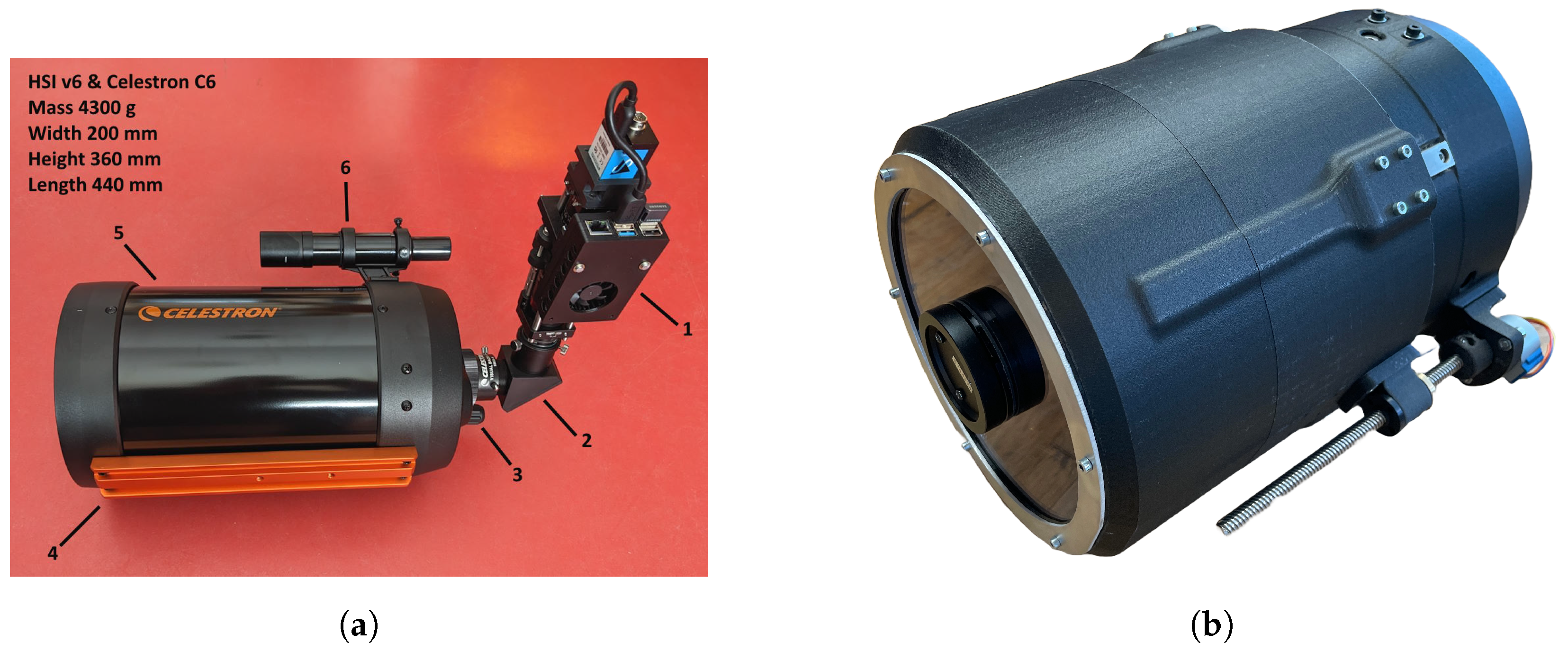
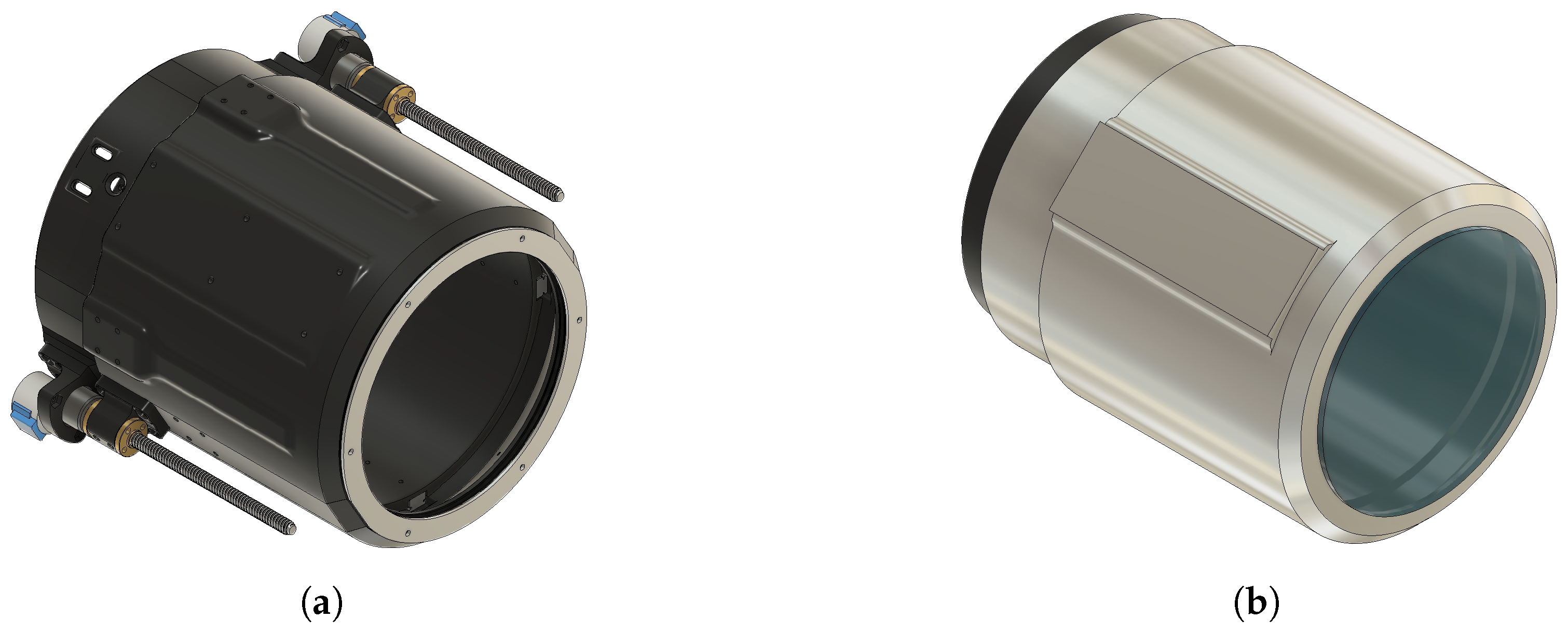
The Celestron C6 lacks sufficient mechanical integrity for launch and on-orbit conditions. To preserve optical performance, all optical elements are retained. The commercial tube, front housing, and front plastic lens plate are removed; only the corrector plate, secondary mirror, and primary mirror assembly are used. The change from the original to the modified configuration is shown in Figure 1.
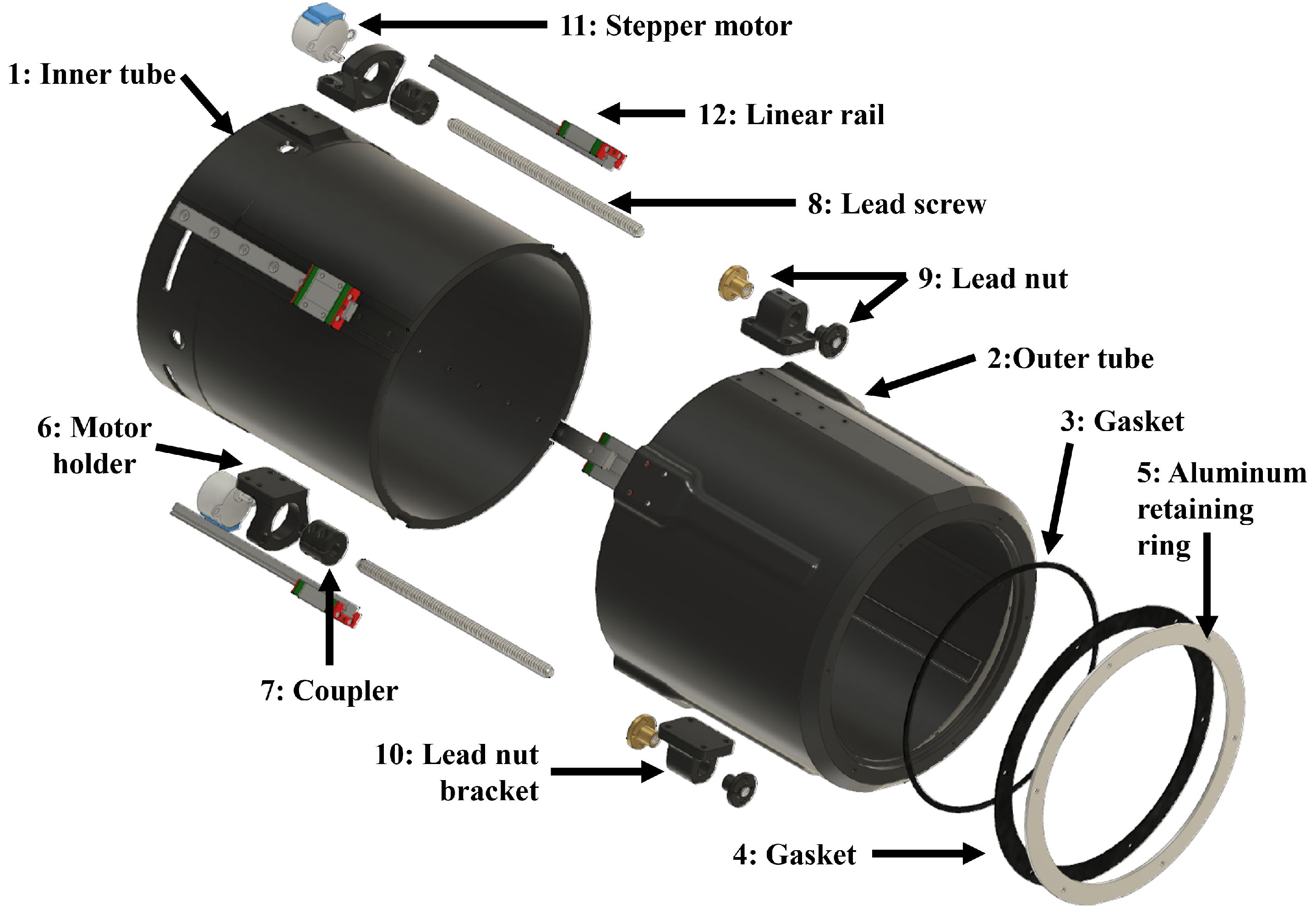
An exploded view of the modified body is shown in Figure 2. Table 2 summarizes which elements of the commercial telescope were retained, which were removed, and which were replaced by newly manufactured structural parts. The main body is a two-part, additively manufactured PA6-CF tube-in-tube structure. Inner (part 1) and outer tubes (part 2) are kinematically guided by four MGN12 rails (part 12) at 90° intervals. The drivetrain uses two stepper-motor-actuated lead screws.
Table 2 summarizes the disposition of the telescope components, ordered from retained COTS elements to newly added or replaced parts in the modified assembly.

2.1.1. Primary Mirror

The original cast aluminum primary back plate is retained and attached to a sleeve on the inner tube (part 1). The mirror is bonded with steel epoxy inside the back plate to secure the primary mirror in the COTS focus mechanism.

2.1.2. Schmidt Corrector Plate and Secondary Mirror

The secondary mirror remains fastened to the Schmidt corrector plate as in the original COTS. This assembly is mounted to the outer tube (part 2) and clamped between two FFF-printed TPE gaskets (parts 3 and 4) with an aluminum retaining ring (part 5). The compliant gaskets limit clamp load into the glass and isolate tube-induced stresses and vibrations.

2.1.3. Deployment and Focusing Mechanism

On-orbit deployment and refocus are required to enable 16U compliance, mitigate launch shift, and thermal drift for a telescope this size. The tube-in-tube retracts 110 mm, freeing ∼3.52 U during launch. The telescope occupies a diameter of 210 mm and a stowed length of 280 mm. Given a 16U platform with a 12U payload volume of 211 × 211 × 290 mm, the stowed telescope fits within this envelope. If additional platform constraints arise, the 163 mm aperture still leaves room for further reduction of the outer diameter through design optimization. The present geometry, therefore, supports integration in a 16U platform, pending final spacecraft-level verification. The modified telescope weighs 4.3 kg, while the original telescope weighs 2.86 kg. The present design fits within the stated 12U payload envelope; however, full spacecraft-level accommodation remains subject to final integration verification.
To translate an image-quality requirement into a focus-position tolerance, the diffraction-limited (quarter-wave/Rayleigh) depth of focus can be used as a first-order bound,
Δ z img ± 2 λ N 2 ,
where  λ is wavelength and  N = f / # is the f-number [33]. For  λ = 0.5 μ m and  f / # = 10 , this gives  Δ z img = 100 μ m . In a two-mirror Cassegrain-type telescope, the axial motion of the secondary mirror is “demagnified” at the secondary, meaning the paraxial focus shift  Δ z img at the final focus corresponds to a secondary mirror axial displacement  Δ z sec that scales as
Δ z sec Δ z img m 2
where m is the secondary magnification [34]. A Schmidt–Cassegrain telescope typically has a magnification  m = 5 [35], yielding a  Δ z sec requirement of 4  μ m .
To achieve this, two 28BYJ-48 motors (part 11) (2048 steps/rev) drive two TR8×8 lead screws (part 8). The nominal linear step is
Δ x = Lead Steps per revolution = 8 mm 2048 3.91 μ m .
Therefore, this setup has no safety margin. This focus-allocation calculation is intended as a first-order requirement translation for actuator sizing and not as a full end-to-end optical tolerance analysis of the telescope, detector chain, and on-orbit thermal environment. Optimization using a finer lead screw, gears, or stepper motors with higher steps per revolution is possible for future optimization.
The stepper motors are mounted on a PA6-CF printed motor holder (part 6), which is connected to the lead screw via printed motor couplers. The two TR8×8 hardened-steel lead screws (part 8) are connected to the outer tube with lead-nut brackets (part 10), each of which has two axially spaced nuts (part 9) to reduce backlash.

2.1.4. FFF-Specific Considerations

Parts are designed and oriented to minimize support on functional interfaces; critical mating surfaces are support-free. PA6-CF parts were manufactured by FFF using Polymaker PolyMide PA6-CF filament (Polymaker, Changshu, China) [36] on a Bambu Lab X1C printer (Bambu Lab, Shenzhen, China) with a 0.6 mm nozzle diameter and a 0.3 mm layer height, using the “strength” preset settings. The nozzle and bed temperatures were set to the manufacturer’s recommended values of 300 °C and 50 °C, respectively. The parts were printed with an enclosed chamber at 60 °C, and the filament was dried at 80 °C for 8 h before printing. Internal corners have fillets to reduce stress concentrations and reduce supports. The main structural tubes were oriented primarily for ease of printing; thus, the highest material strength was in the xy plane, while the z-direction was governed by lower interlayer strength. Slicing used 6 perimeter walls and 100% rectilinear infill. Threaded holes are printed undersized to allow direct tapping: 2.459 mm for M3 and 3.242 mm for M4 [37]. Tube-to-tube radial clearance is 1.5 mm. Rails are recessed to prevent derailment. Parts were not annealed, but they will be for later tests. The outer tube has a flat interface with six directly tapped holes (3.242 mm) for mounting a bracket on the vibration bench.

2.2. Launch Screening Campaign

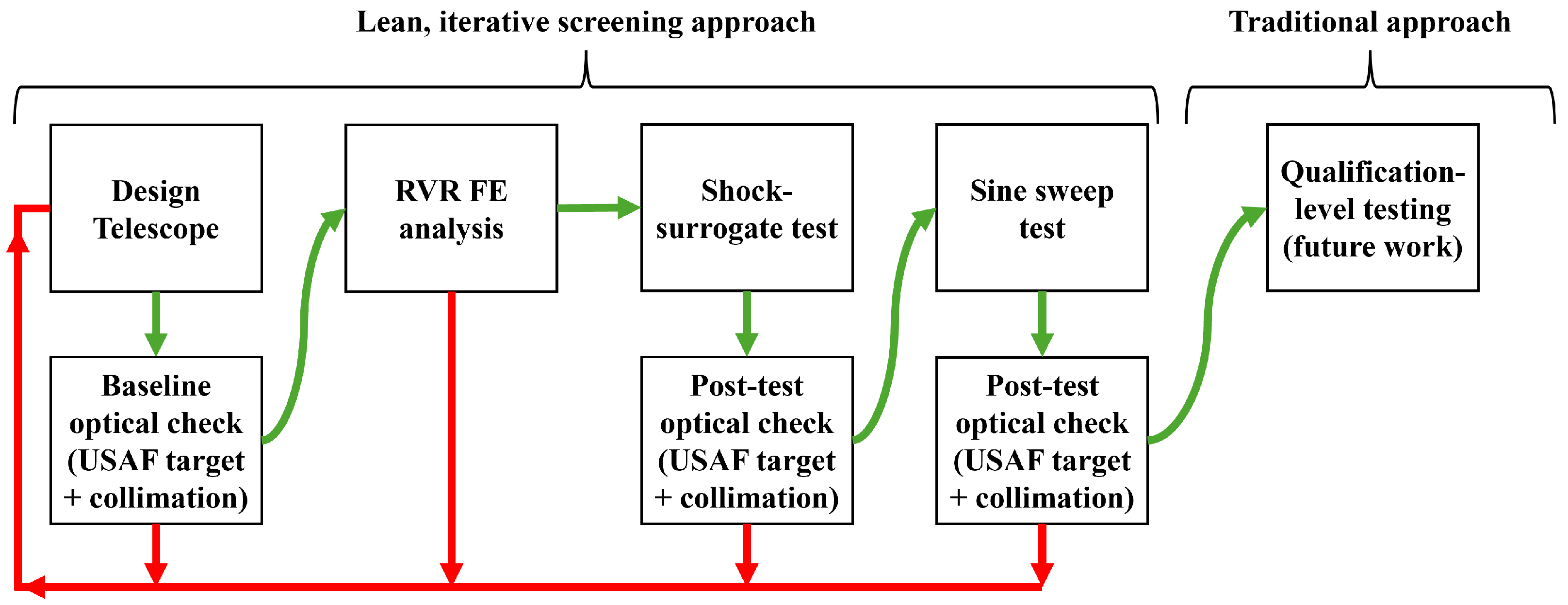
Throughout the development of the Modified COTS (MCOTS) design presented in the previous section, optical testing has been a key metric for assessing it. Because the principal design risk in the modified telescope is loss of focus or collimation rather than gross structural fracture, optical checks were used as the primary pass/fail criterion before and after each mechanical screening test. This optical testing has been a stage gate in the design process, with successful tests leading to progressively more rigorous tests. This workflow is presented in Figure 3.
With each iteration and test, progressively more complex optical tests were performed. The mechanical screening workflow was derived from ECSS-E-ST-10-03C and launch-provider guidance, but was intentionally simplified to support rapid in-house iteration at TRL 3 [31]. The ECSS standard was adapted to enable rapid, low-cost hardware testing as part of the iterative design methodology. Optimizing a design and then conducting higher-fidelity qualification tests can be a slower development approach because, if redesigns are needed, additional costly, time-consuming tests are required. The goal was not to fully reproduce qualification at this stage, but to translate the expected launch environment into screening tests that could reveal modal, mount, and alignment weaknesses early in the design process. Accordingly, sine sweep was used for modal screening and post-test optical verification, the shock test was reduced to an energy-based robustness surrogate for the mount and corrector-plate interfaces, and random vibration was treated as a complementary simulation-based screening step driven by the launch-provider PSD profile.
After confirming adequate image quality in baseline optical testing, a random-vibration response (RVR) simulation was performed to assess the main structural components prior to printing the parts. After this, physical testing, including shock and sine sweep testing, was conducted, as indicated by the green arrows. Each test is conducted as early as possible in the design process to learn early, expediting development while identifying design problems. If a test shows an issue, the red lines are followed for redesign. This methodology aligns with NASA’s fly-as-you-test and test-as-you-fly principle [38], as testing becomes part of the design phase. The reason for this simplified workflow compared to [31] is that, despite payloads completing qualification testing, there are examples of failure [39,40]. Incorporating lower-fidelity testing earlier results in more testing of both sub-components and assemblies. Therefore, the probability of successful deployment is higher if combined with standard qualification testing. Table 3 summarizes the derived test logic and success criteria used in this screening campaign. The following subsections detail each testing method. Figure 3 presents the chronological development workflow; however, the results below are organized by evidential relevance, with the primary experimental findings reported before the supporting RVR simulation.

2.2.1. Sine-Sweep Vibration Experiment

Sine-sweep testing was performed using a Brüel & Kjær electrodynamic shaker (Hottinger Brüel & Kjær A/S, Nærum, Denmark) driven by a Type 2707 power amplifier (Hottinger Brüel & Kjær A/S, Nærum, Denmark). A Keysight 33500B signal generator (Keysight Technologies, Santa Rosa, CA, USA) was used, and frequency logging was carried out with an Arduino Uno (Arduino S.r.l., Monza, Italy). Two 9-DoF IMUs (SparkFun Electronics, Boulder, CO, USA) measured the mounting bracket and telescope responses through an ESP32 (Espressif Systems, Shanghai, China). IMUs were mounted on the bracket to distinguish the test rig’s natural frequencies from those of the telescope. An initial sweep test was performed without the telescope mounted. The maximum acceleration at each step (1 Hz) in each range for each IMU was recorded.
For the telescope sweep tests, the sweep rate was 0.5 oct/min, with an amplitude of 2 g from 10 to 100 Hz and 5 g from 10 to 2000 Hz, corresponding to the low-frequency modal screening and the extended higher-frequency screening described in Table 3. The mean amplitudes measured in the tests were 1.85 g and 4.51 g, respectively.
To de-risk early iterations, the initial sine-sweep and shock-surrogate tests were performed with a 3.0 mm thick non-tempered dummy glass, rather than with the flight optics. Dummy weights heavier than the secondary mirror were mounted in the middle of the glass. This created a conservative load case for the glass and secondary mirror interface. The dummy-glass stage was therefore used as a conservative screening step before committing the real optical components to the same mechanical sequence. The assembly passed the sweep without damage, after which the flight optics were installed and tested in accordance with the test protocol. This was also carried out for the shock test.

2.2.2. Shock Test

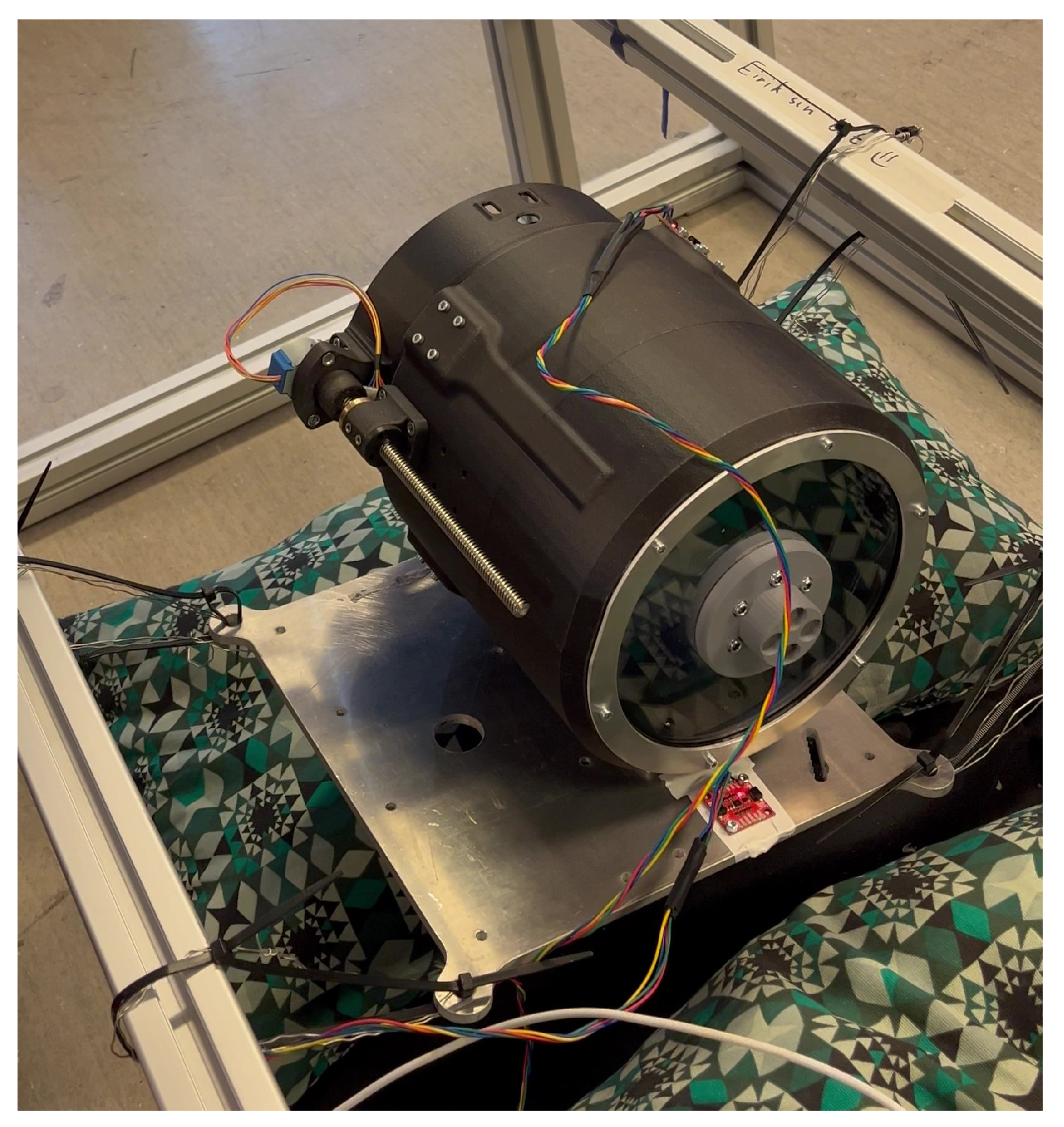
This test is a shock surrogate intended for early-stage robustness screening. The instrumentation bandwidth is limited and does not support qualification-level Shock Response Spectrum (SRS) reporting. The test was inspired by [42]. The purpose of the present shock campaign was therefore to assess whether the mount and optical interfaces could withstand representative disturbance events without observable loss of focus or collimation, rather than to establish qualification-level shock margins. The telescope was mounted on a steel plate suspended from an aluminum frame using nylon cables, as shown in Figure 4.
SparkFun 9DoF IMUs were mounted on the metal plate and on the top of the telescope, and connected similarly as described in Section 2.2.1. The data were recorded at 200 Hz with a maximum amplitude of ±16 g, which is insufficient for qualification-level shock characterization. The surrogate test is therefore interpreted as a robustness screening of mounts and post-test optical integrity, not as launcher-spec compliance. Because the applied beam-impact method provides an energy-based disturbance history rather than launcher pyroshock frequency content, the results cannot be directly extrapolated to formal launch-shock compliance.
Vertical shock was generated by dropping an aluminum beam weighing 2.4 kg from different heights. Lateral shocks were generated by holding the beam at an angle before swinging it and hitting the metal plate on the side. Details of the various shocks are shown in Table 4.

2.2.3. Random-Vibration Response Method

Random-vibration response was assessed in SolidWorks Simulation 2025 (Dassault Systèmes SolidWorks Corp., Waltham, MA, USA) using a linear dynamic finite element random-vibration analysis. A simplified model shown in Figure 5 was used to capture the global structural load path while keeping the finite-element model computationally tractable.
The spacecraft-interface plane at the mounting-bracket base plate was used as the excitation boundary, and the SpaceX PSD profile was applied as base excitation along the x-, y-, and z-axes [41]. Random vibration was simulated over 20–2000 Hz with a mesh of 17,492 nodes and 8978 elements; the solver used 75 frequency points per interval between adjacent modes for response output. Further mesh refinement did not change the simulation output. Because bonded interfaces were used and bolt preload/contact nonlinearity were not modeled, the FE result is interpreted as a screening-level estimate rather than a correlated qualification model. This assumption may overestimate interface stiffness relative to the hardware. The material used was 6061-T6 aluminum for the primary mirror mount, default glass for the front plate, and PA6-CF for the telescope body, based on the material parameters from the datasheet [36]. The simplified representation retained the corrector plate, the primary-mirror back plate, and the main PA6-CF structural shell. At the same time, small hardware components, local geometric details, and certain interface features were removed or idealized. Since FFF printed polymers are anisotropic, the lowest tensile strength in the z-direction is used as a validation criterion. Base excitations were applied in all three axes to simulate the potential vibrational loads during launch. Previous studies have placed PA6-CF’s damping factor between 1–4% [43], so this range was simulated, and the highest stress was seen in the simulation that used a 1% damping factor. Simulations of all axes were completed in the frequency range of 20 Hz to 2000 Hz. The simulation output is the von Mises root-mean-square (RMS) stress, which will be multiplied by three to increase the stress by  3 σ , similar to [44,45].

2.3. Optical Testing

This section details the optical tests used to screen the design for post-disturbance optical integrity.

2.3.1. Resolution

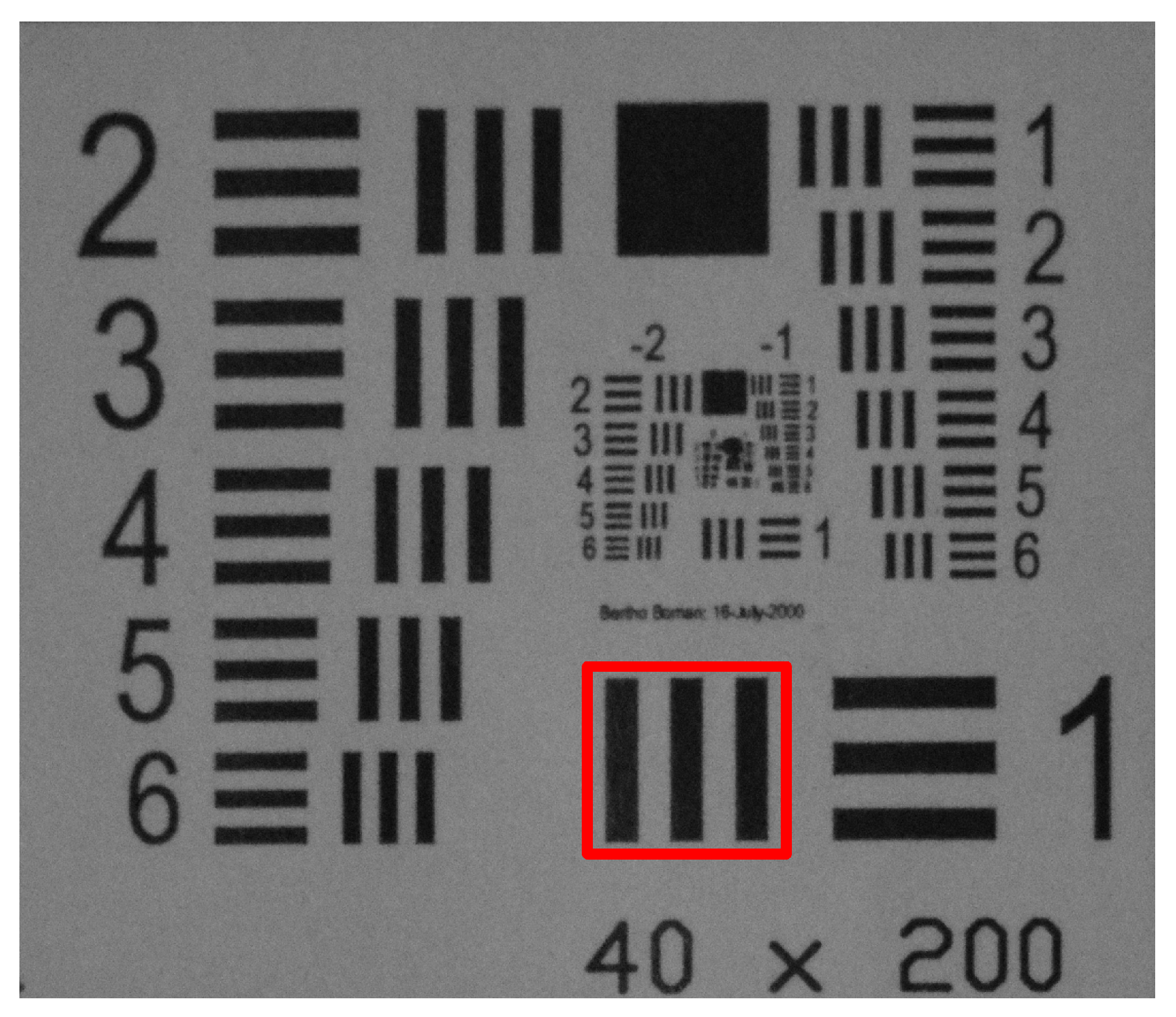
Pre- and post-test photos were taken using an illuminated USAF 1951 resolution target to assess whether the telescope maintained focus and alignment after mechanical testing [46]. The images were captured from 8 m away with a Nikon D5300 camera (Nikon, Tokyo, Japan), a shutter speed of 1/4000, and an ISO of 8000. A baseline photo is shown in Figure 6 and the red square indicates where a grayscale intensity analysis was performed [47]. This is carried out by extracting pixel values along a fixed horizontal line between the lines in the test target. The steeper the change, the better the focus. This method was used as a proxy for focus and alignment stability by comparing local grayscale transitions before and after testing; it was not intended to be a full modulation transfer function characterization.

2.3.2. Collimation Test

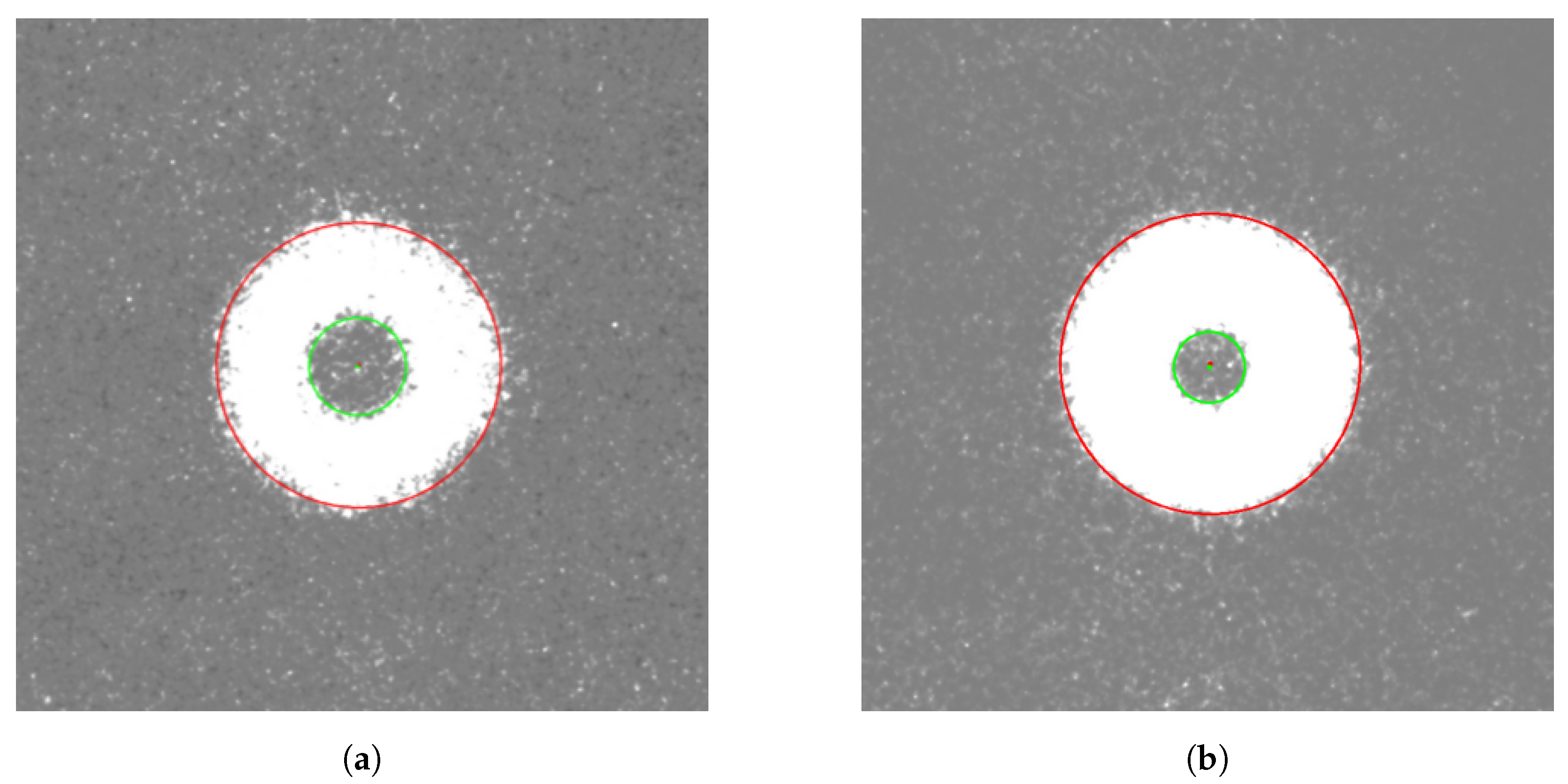
Collimation testing was carried out by focusing the telescope on a small white dot with a dark background. The telescope was then defocused, revealing the outer ring with the shadow of the secondary mirror at the center. Concentric doughnut-shaped circles indicate that the telescope is collimated [48]. To quantify this, the images were post-processed to saturation, separating light and dark pixels into white and black. Then an algorithm finds the inner and outer circles based on the transitions between black and white, where the pixels are 50% white. The center-point offset between the two circles is measured in pixels. Because the result depends on thresholding and circle placement settings, the reported offset change is interpreted alongside a sensitivity analysis rather than as a high-precision metrology result.

3. Results

3.1. Sine Sweep Vibration Results

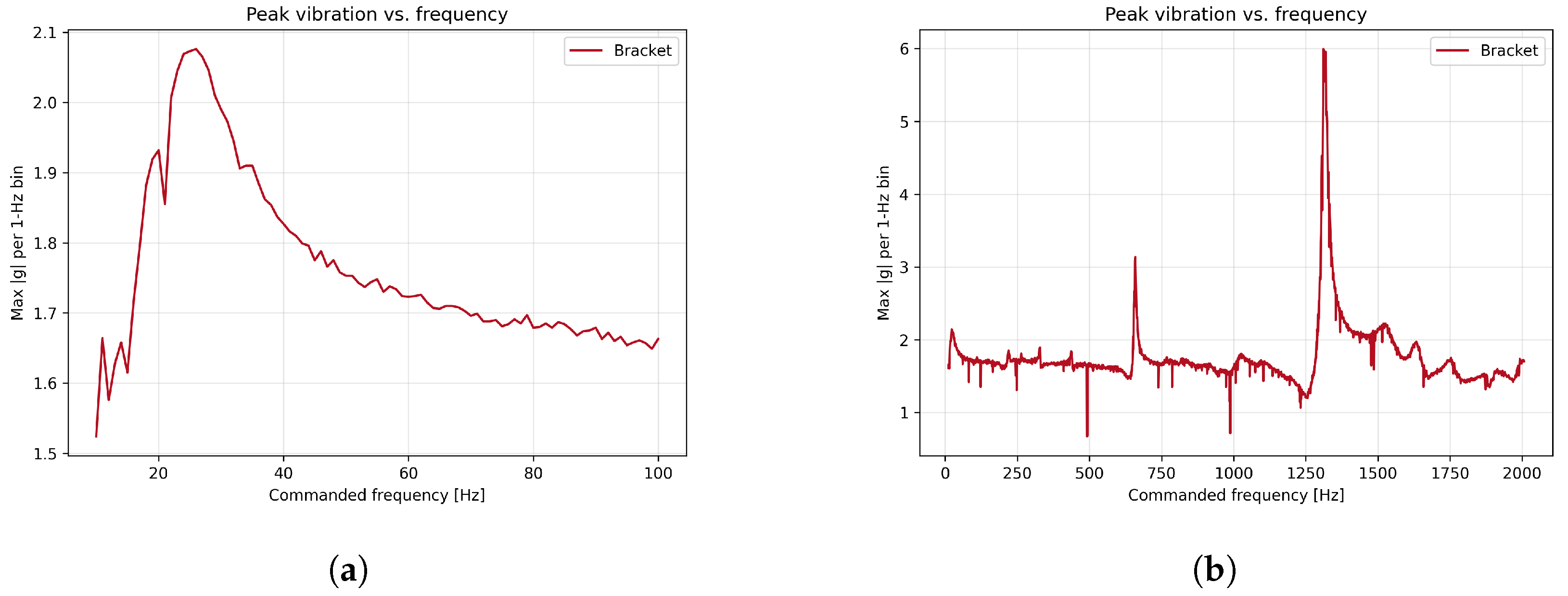
The sine sweep vibration results are shown in Figure 7 and they show the sweep of the frequencies between 10–100 Hz and 10–2000 Hz. The baseline IMU response from the rig, with nothing attached, is shown in Figure 7.
The rig’s bracket shows an increase in response around 25 Hz, 600 Hz, and 1350 Hz.
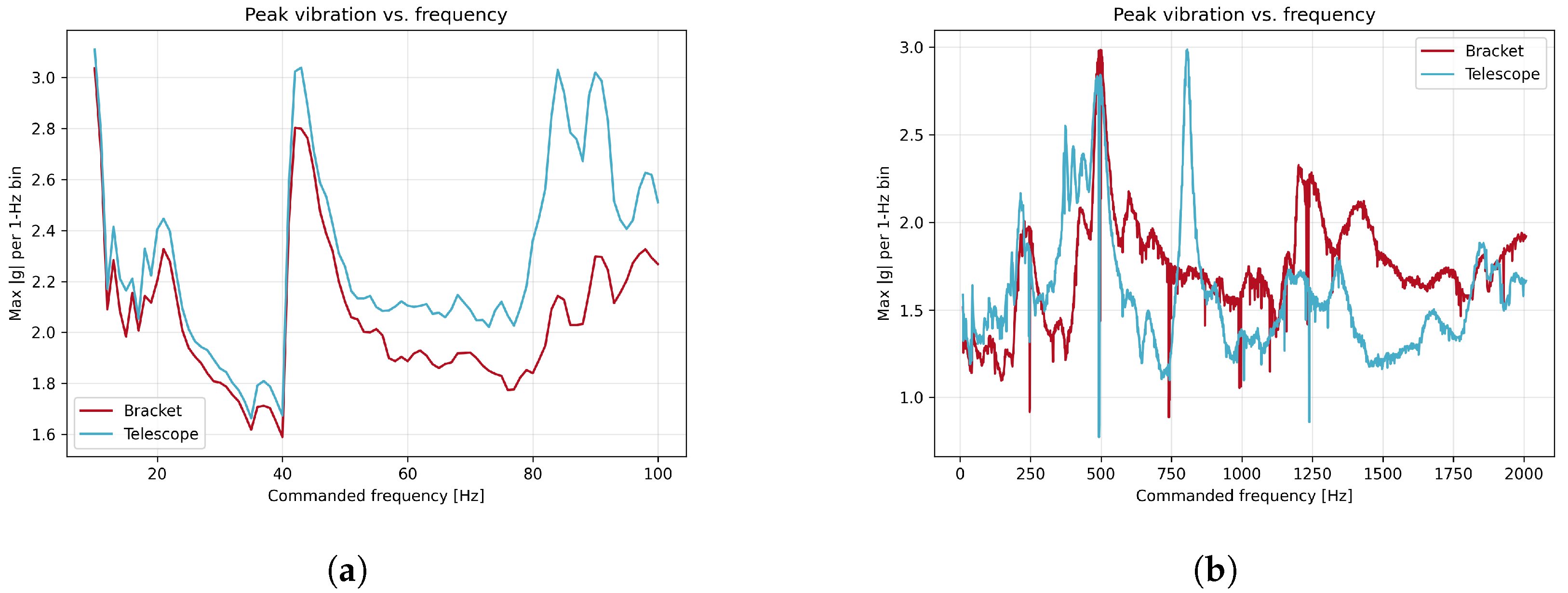
Figure 8 shows the combined response of the bracket on the rig and the telescope.
The system’s response shows similar increased responses at certain frequencies. However, at 91 Hz and 804 Hz, a distinct eigenfrequency is observed only for the telescope. The eigenfrequencies are summarized in Table 5.
The measured first eigenfrequency of 91 Hz exceeds the launcher guideline requirement of 40 Hz. The 43 Hz peak is interpreted primarily as a setup contribution, as it also appears in the bracket baseline.

3.2. Post Vibration Optical Test Results

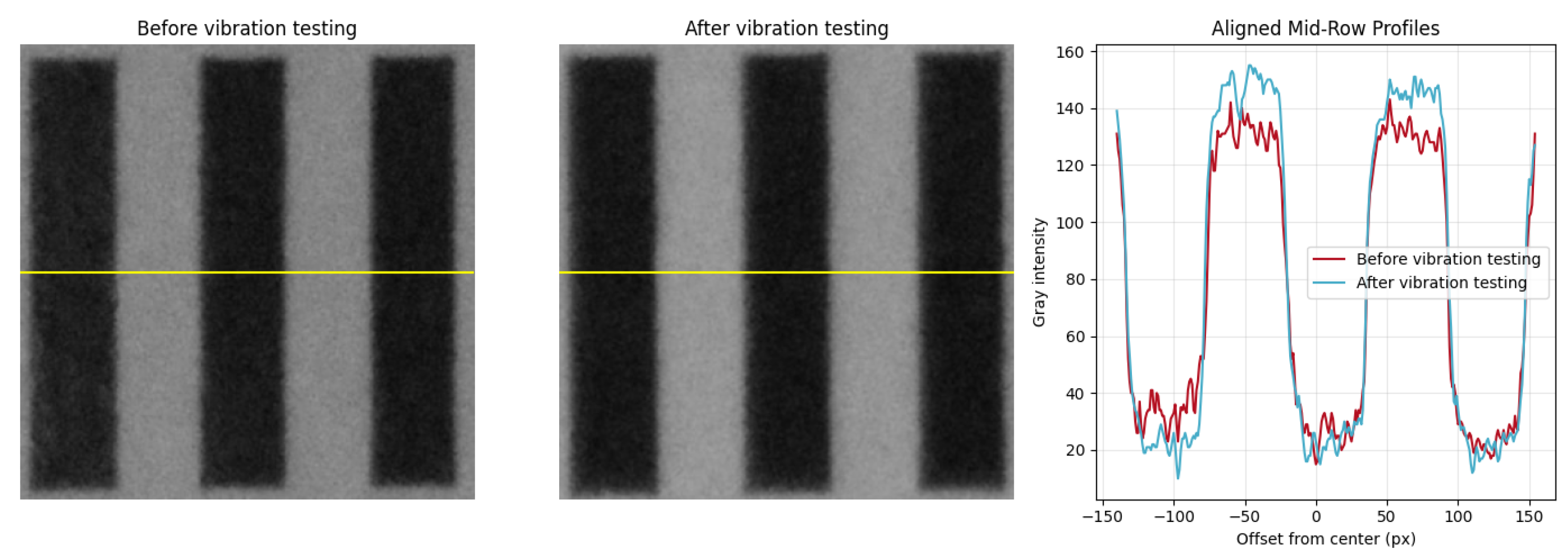
Figure 9 shows the cropped lines of the photos taken before and after the sine sweep test of the USAF 1951 resolution targets. In addition, the change in grayscale intensity along the line is plotted.
The intensity profiles show no observable degradation in the grayscale focus proxy between the pre- and post-vibration measurements. The observed peak differences are attributed to variations in lighting conditions.

3.3. Post-Vibration Collimation Test Results

The photos of the collimation test are shown in Figure 10.
The photos show concentric circles before and after the sine sweep test, with pixel offsets of 3.66 and 3.51, respectively. The difference between the two offsets is 0.15 pixels. A sensitivity analysis of the offset algorithm with ±5% shows an offset difference of 0.01–0.65 pixels. The difference in doughnut size is due to different defocusing before and after, which does not affect concentricity.

3.4. Shock Testing Results

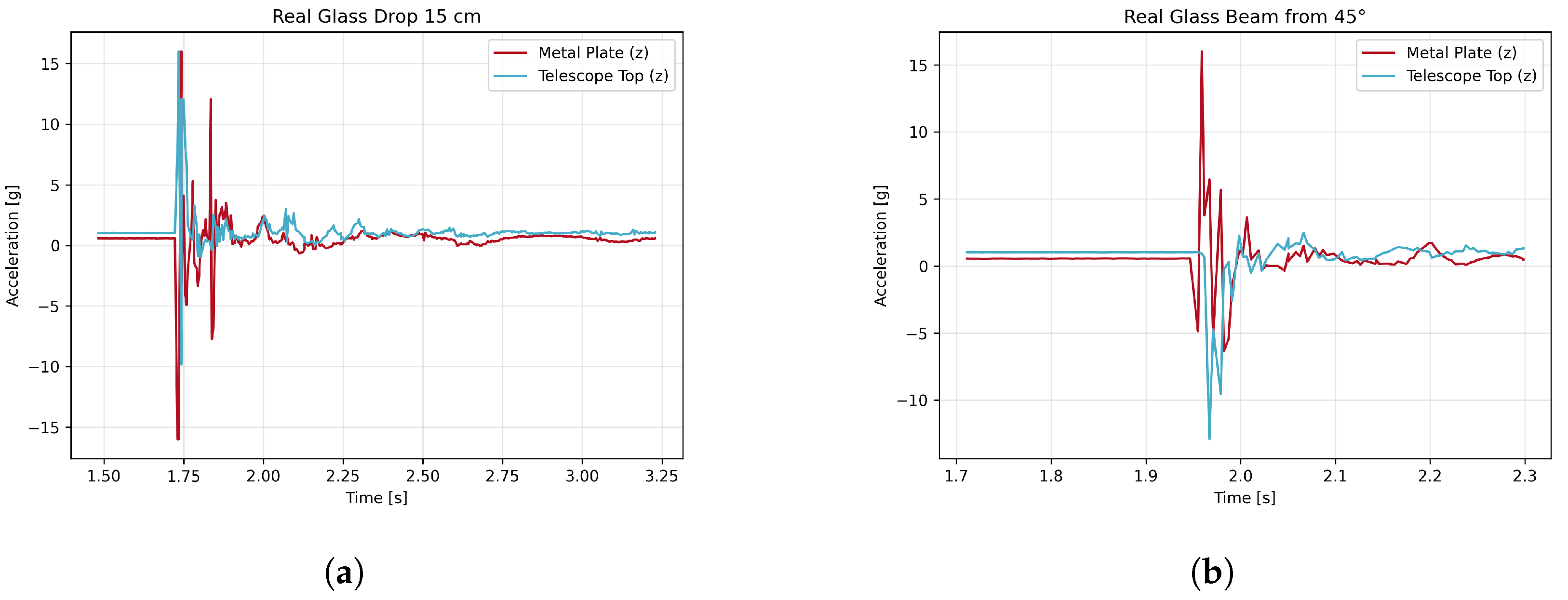
Figure 11 shows the IMU data for the shock tests with the corrector plate with a vertical drop of 15 cm and an angled drop from 45°, resulting in 3.53 J and 1.38 J of energy, respectively.
All plots shown in Figure 11 show that the data hit 16 g, which is the maximum value for the sensor, before the graphs settle down.
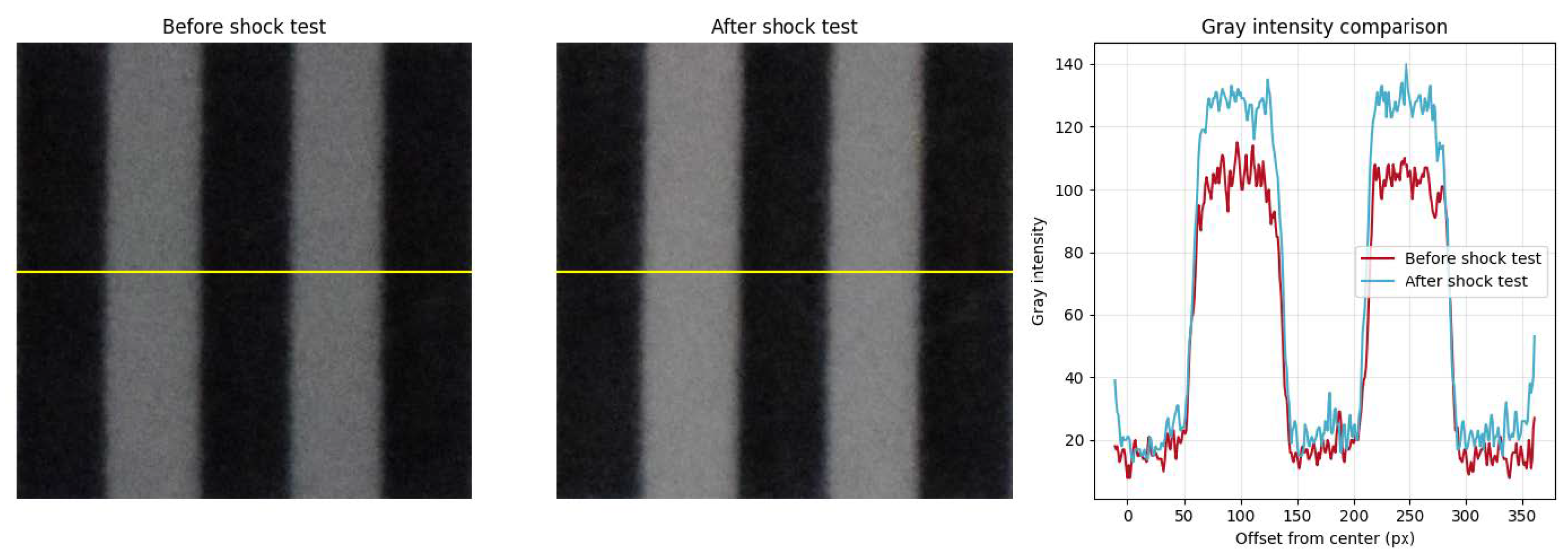
Figure 12 shows the USAF resolution targets before and after all shock tests. The photos are cropped to better view the test targets.
Similar to Figure 9, the focus of the two tests is similar, with the different peaks indicating different lighting conditions.

3.5. Random-Vibration Response Simulation

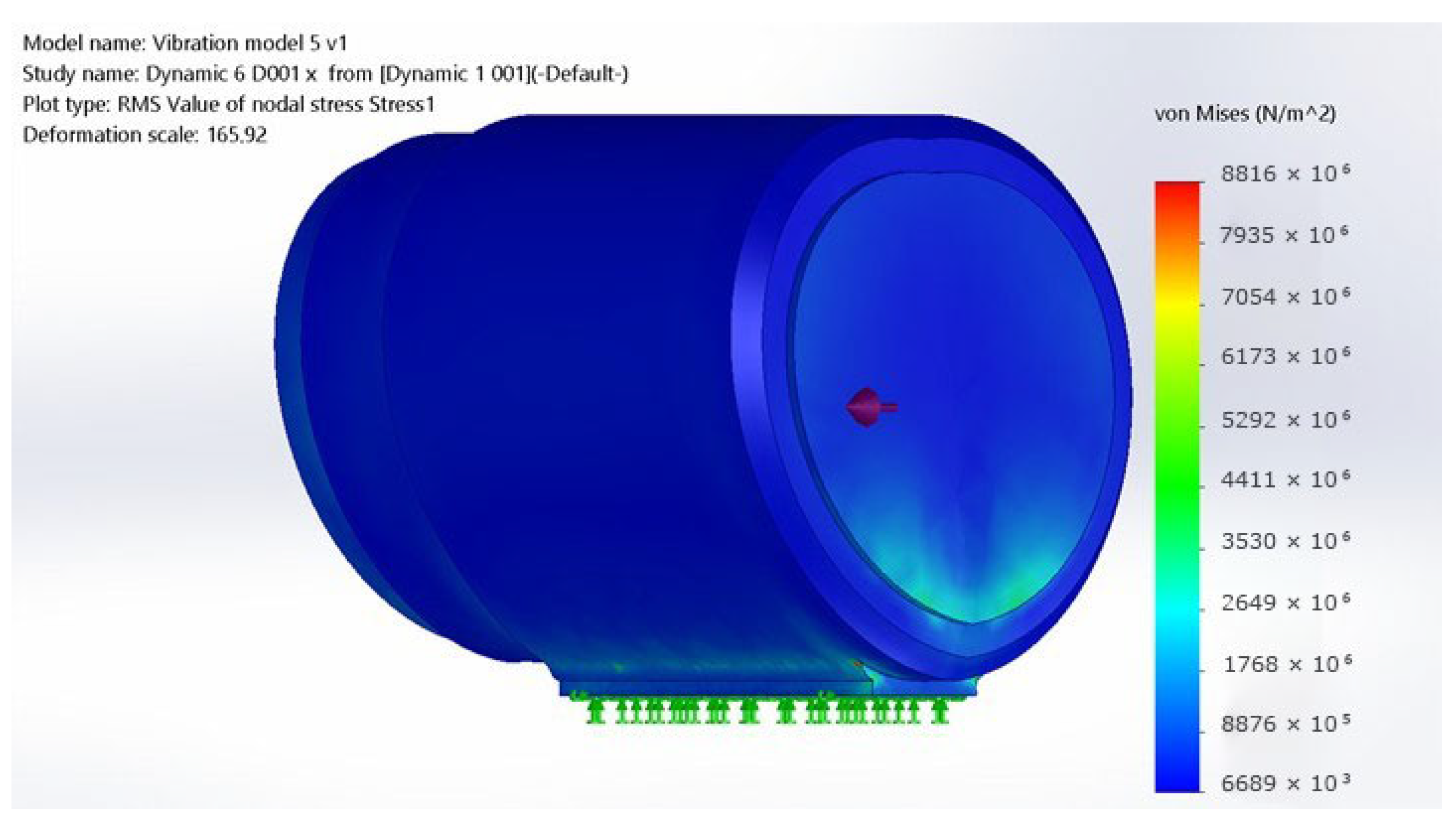
The highest RMS output stress recorded for the RVR simulation occurred for excitation along the x-axis, indicated by the red arrow in Figure 13.
The result showed a peak value of von Mises RMS stress of  8.86 MPa, with a  3 σ value of  26.5 MPa. This is below the tensile strength of the Polymaker PA6-CF filament, which is  105 ± 5.0 MPa in the xy direction and  67.7 ± 4.7 MPa in the z-direction. Mass participation exceeded 90% for all axes.

4. Discussion

4.1. Optical Evaluation of the Launch Validation Campaign

Optical testing after the sine-sweep and shock-surrogate campaigns indicates that the optical train remained aligned and that no observable degradation occurred in the optical screening metrics used here. The USAF 1951 target images show the same resolved elements before and after testing. Both images resolve group  2 , while group  1 is not resolved at element 1. The grayscale line profiles show differences consistent with illumination variation rather than defocus or structural shift.
The collimation images were taken with varying degrees of defocus, which were attributed to the different doughnut shapes. However, this does not affect concentricity. Brightness and contrast were adjusted in post-processing. In all cases, the inner shadow remains concentric with the outer ring, indicating collimation. The circle-fitting algorithm reports a  0.15 pixel offset change. This value depends on the thresholding used to binarize the image and on the placement algorithm. The sensitivity analysis shows the measurement uncertainty. The inferred 0.15 pixel change is within the measurement uncertainty of the threshold-based circle fitting, and no visually observable collimation change is present. This term is below contributors such as attitude knowledge and platform jitter. Any residual bias can be calibrated during commissioning. Consequently, it is reasonable to infer that the telescope can be deployed without collimation issues, although this conclusion remains to be confirmed by qualification tests.

4.2. Mechanical Screening Results

This section discusses each of the experimental and simulated results. Overall, the results in this paper show that the Schmidt–Cassegrain telescope structure can withstand sine loading and shock disturbances without measurable changes in collimation or resolution. In addition, random-vibration simulation indicates acceptable stress levels. Taken together, these mechanical screening results support the TRL 3 validation of the modified design.

4.2.1. Sine Sweep

The sine-sweep tests were performed to identify the modal response and to verify that the payload’s natural frequencies exceed 40 Hz. Response peaks were observed at approximately 91 Hz and 804 Hz, not present in the bracket baseline, indicating modes associated with the telescope. The 43 Hz peak appears in both the bracket and telescope configurations, which suggests a setup contribution. Despite 43 Hz being near the 40 Hz lower bound, margins can be increased by changes at the mount interface, rail integration, and boundary conditions when moving from a bench fixture to a CubeSat panel interface. Finally, the telescope underwent multiple sweeps with a total vibration exposure of about 60 minutes and accelerations reaching ≈10 g, without measured changes in collimation or resolution. Consequently, despite being made from a material with a lower Young’s modulus than, e.g., aluminum, the structure satisfied the present sine-screening criteria and supports progression to qualification-level sine testing.
In addition, AM enables generative design, enabling one to design for a maximized stiffness-to-weight ratio. Therefore, a structure redesign after a failed qualification test would consist of regenerating a stiffer structure with added material in key regions, and a new structure could be printed overnight for next-day testing. This approach reduces development time and effort for the optical payload, enabling faster development and a shorter time to launch.

4.2.2. Shock Testing Discussion

The shock tests applied eight shocks up to 5.89 J. The optical results before and after the shock tests show no change in focus or collimation. The shock testing provides evidence that the optical mounts, the bonded primary assembly, and the corrector plate interface tolerated the applied disturbance history. The next step is an instrumented shock test with a bandwidth sufficient to compute an SRS and compare against the launch requirements.

4.2.3. Random-Vibration Response Discussion

Random-vibration response simulations were performed as a screening-level assessment of the structure under the launch PSD profile. The predicted  3 σ von Mises stress of 26.5 MPa, compared with the material’s z-axis tensile strength of 67.7 MPa, yields a safety factor of 2.8. Additional margin is prudent because the result is based on a simplified model with bonded interfaces and no experimental model correlation. Full qualification remains incomplete without an experimental random-vibration campaign; therefore, this test will be carried out in future development.

4.3. Payload Design Methodology with COTS Components

The use of the CubeSat standard has made satellite integration into launchers easier. However, for each satellite, one of the main engineering challenges is designing a standard structure for a non-standard payload. With emerging space paradigms such as LeanSat and NewSpace, new product development strategies are necessary. This paper, therefore, employs a novel strategy in the literature by combining retained COTS optics, a polymer-AM structural retrofit, and staged early mechanical screening to accelerate learning during payload development. Using new manufacturing techniques and product development strategies, this paper illustrates how COTS-based, additively manufactured payload development can support faster iteration and lower development barriers in LeanSat-oriented projects. The method described here could be applied as the first step in designing future SmallSat optical payloads, thereby reducing the project’s development time and cost. Late-stage redesign is expensive and time-consuming; thus, incorporating early testing reduces those risks.
This testing supports validation rather than compliance. This work enabled the following: (i) identification of eigenfrequencies across runs and confirmation that no dominant modes occurred below 40 Hz, and (ii) verification that the focusing mechanism and optical alignment survived vibration and shock exposure. This supports test capability in laboratory settings and supports transition to a qualification campaign. The approach supports an iterative loop of test, learn, and redesign, and it enables a subsequent campaign with flight instrumentation.

Additive Manufacturing with COTS Components

This MCOTS telescope uses FFF AM to build a tube-in-tube structure with interfaces for rails, motors, and the corrector plate clamp. This supports iterative design with part consolidation and geometric freedom, compared with machining or composite tube assemblies. The workflow in Figure 3 is an idealized version of the development. In reality, many smaller functional prints were carried out in low-cost PLA to test subcomponents before printing the whole structure in PA6-CF.
Polymer FFF introduces risks, including anisotropy, environmental sensitivity, and dimensional stability issues such as moisture uptake and creep. The results support progression to future launch qualification testing, but environmental qualification will determine suitability for flight. Flight use would still require assembly-level outgassing assessment, including TML/CVCM-style verification, control of moisture uptake and creep, and thermal-vacuum verification of dimensional stability. If thermal vacuum or outgassing limits performance, the design can be transferred to space-qualified polymers such as PEEK-CF, with adjustments to tolerances and process parameters. For repeated manufacture, process control should include fixed print orientation, controlled filament drying and storage, locked slicing parameters, test samples, and dimensional inspection of critical interfaces.
The approach keeps COTS optics and redesigns the structure. This provides a path toward space-grade COTS payloads by retaining optical performance and enabling launch survivability through structural design.

4.4. Telescope Design Improvements and Future Work

During the development carried out for this paper, several design improvements were identified. Those improvements will be presented herein as future work.

4.4.1. Athermalization and Optics

Focus control in orbit is affected by launch shifts and thermal-induced dimensional changes. Athermalization strategies reduce focus drift by pairing materials with compensating thermal expansion coefficients. In this work, focus trimming is enabled by two actuators, thereby supporting the correction of launch shift and thermal drift.
The tube-in-tube architecture enables retraction during launch and extension in orbit, reducing length during launch loads and reducing excitation of bending modes compared with a fixed-length structure. This retraction enables the whole platform to potentially fit in a 16U CubeSat.
Thermal gradients across the tube-and-rail system remain a risk. If one side of the structure is colder than the other, differential expansion can introduce bending and tip tilt errors, which tilt the focal plane relative to the optical axis. The two-actuator concept corrects defocus and may not correct tilt aberrations. Tests show that the two actuators can correct collimation errors in the yaw axis. If three actuators are used, the structure could potentially correct collimation in both the pitch and yaw axes. This should be evaluated through thermal-vacuum testing with temperature gradients. If tilt still occurs, mitigations include thermal control using multi-layer insulation (MLI) and heaters.

4.4.2. Future Work

The following tasks are required to advance the telescope from early validation to flight-oriented qualification:
  • Thermal vacuum and environmental qualification: Focus on stability and alignment under thermal cycling and gradients; outgassing verification for the assembly, including adhesives and printed surfaces; and assessment of UV and atomic oxygen exposure, with mitigation using coatings.
  • Qualification mechanical testing: Random-vibration testing, instrumented shock testing with SRS comparison, and micro-vibration testing using reaction wheel disturbance inputs on a CubeSat mount.
  • Structural optimization: Reduction of mass and footprint through redesign of the primary mirror back-plate interface, changes to the retraction stroke, and part consolidation with optical tolerances.
  • Optical and HSI integration: Replacement of the DSLR surrogate with an HSI module, optical evaluation using modulation transfer function (MTF) and stray light, and verification of scan effects during slews.
  • System integration: Linkage between ADCS performance, exposure time, and jitter; evaluation of isolation concepts; and definition of commissioning and calibration procedures.

5. Conclusions

This study shows that a widely available 6-inch Schmidt–Cassegrain COTS telescope can be adapted into a mechanically screened CubeSat-class hyperspectral payload by preserving the commercial optics and redesigning the structure using additive manufacturing. The Modified COTS (MCOTS) design maintained the optical characteristics assessed in this study during the applied mechanical campaign as follows: sine-sweep and shock-surrogate testing produced no observable degradation in the USAF/grayscale analysis, and the collimation change was within the measurement uncertainty. Complementary random-vibration response analysis predicted a  3 σ von Mises stress of 26.5 MPa, corresponding to a safety factor of 2.8 against the interlayer tensile strength. Together, this TRL 3 validation supports a practical pathway toward space-grade COTS (SCOTS) optical payloads that can reduce development barriers by enabling faster, lower-cost structural iteration. At the same time, this work represents validation rather than full qualification. The next mandatory steps are payload-qualification-level random-vibration testing, instrumented SRS-capable shock testing, thermal-vacuum and outgassing verification, and spacecraft-level payload integration.

Author Contributions

H.H.Ø.: conceptualization; investigation; methodology; project administration; supervision; visualization; writing—original draft; writing—review and editing. H.P.H. and B.S.H.: conceptualization; data curation; formal analysis; investigation; software; validation; visualization; writing—original draft. M.S.: conceptualization; methodology; project administration; resources; supervision; writing—review and editing. A.O.: project administration; resources; supervision; writing—review and editing. F.S.: conceptualization; methodology; supervision; writing—review and editing. J.L.G.: conceptualization; funding acquisition; methodology; project administration; resources; supervision; validation; writing—original draft; writing—review and editing. All authors have read and agreed to the published version of the manuscript.

Funding

This research was funded by the Norwegian Space Agency (Direktoratet for romvirksomhet) under project TRS24094.

Institutional Review Board Statement

Not applicable.

Informed Consent Statement

Not applicable.

Data Availability Statement

The datasets generated and analysed during the current study are available from the corresponding author on reasonable request.

Conflicts of Interest

The authors declare no conflicts of interest.

Abbreviations

The following abbreviations are used in this manuscript:
AMAdditive Manufacturing
COTSCommercial Off-the-Shelf
MCOTSModified Commercial Off-the-Shelf
PCPolycarbonate
SCOTSSpace-Grade Commercial Off-the-Shelf
LEOLow Earth Orbit
EOEarth Observation
HSIHyperspectral Imaging
GSDGround Sampling Distance
SNRSignal-to-Noise Ratio
FFFFused Filament Fabrication
FDMFused Deposition Modeling
MEXMaterial Extrusion
PA6-CFCarbon-Fiber-Reinforced Polyamide 6
PA12Polyamide 12
PEEK-CFCarbon-Fiber-Reinforced Polyether Ether Ketone
PEIPolyetherimide
PLAPolylactic Acid
HPPHigh-Performance Polymer
ECSSEuropean Cooperation for Space Standardization
TRLTechnology Readiness Level
RVRRandom-Vibration Response
PSDPower Spectral Density
RMSRoot Mean Square
SRSShock Response Spectrum
MTFModulation Transfer Function
MLIMulti-Layer Insulation
UVUltraviolet
DoFDegrees of Freedom
IMUInertial Measurement Unit
ADCSAttitude Determination and Control System
USAFUnited States Air Force (1951 resolution test target)
3 σ Three-sigma statistical confidence level

References

  1. Ferrara, D.; Cicconi, P.; Minotti, A.; Trovato, M.; Caputo, A.C. New Space Engineering Design: Characterization of Key Drivers. Appl. Sci. 2025, 15, 8138. [Google Scholar] [CrossRef]
  2. Mathieu, E.; Rosado, P. A Record Number of Objects Went into Space in 2023. Our World in Data, 2024. Available online: https://ourworldindata.org/data-insights/a-record-number-of-objects-went-into-space-in-2023 (accessed on 7 May 2026).
  3. Pradhan, K.K.; Cho, M. Shortening of Delivery Time for University-Class Lean Satellites. J. Small Satell. 2020, 9, 881–896. [Google Scholar]
  4. Cho, M.; Hirokazu, M.; Graziani, F. Introduction to lean satellite and ISO standard for lean satellite. In Proceedings of the 2015 7th International Conference on Recent Advances in Space Technologies (RAST), 16–19 June 2015, Istanbul, Turkey; Institute of Electrical and Electronics Engineers (IEEE): Piscataway, NJ, USA, 2015; pp. 789–792. [Google Scholar] [CrossRef]
  5. Herbert, E.W.; Bradley, T.; Sega, R.; Herber, D.; Shahroudi, K.; Wise, D. Managing Risk in Commercial-off-the-Shelf Based Space Hardware Systems; Colorado State University Libraries: Fort Collins, CO, USA, 2024. [Google Scholar] [CrossRef]
  6. Bakken, S.; Henriksen, M.B.; Birkeland, R.; Langer, D.D.; Oudijk, A.E.; Berg, S.; Pursley, Y.; Garrett, J.L.; Gran-Jansen, F.; Honoré-Livermore, E.; et al. HYPSO-1 CubeSat: First Images and In-Orbit Characterization. Remote Sens. 2023, 15, 755. [Google Scholar] [CrossRef]
  7. Sigernes, F.; Øvrebø, H.; Hole, B.S.; Hauge, H.P.; Steinert, M.; Bakken, S.; Garrett, J.; Birkeland, R.; Johansen, T.A. Long-Range Hyperspectral Shooting. 2025. Available online: https://aurora.unis.no/doc/Reports/LongRangeHSI.html (accessed on 7 May 2026).
  8. Huang, P.H.; Chou, C.H.; Huang, Y.K.; Liao, S.F.; Li, T.; Lin, P.M. Compact Korsch-type CubeSat telescope for optical remote sensing. In Proceedings of the Earth Observing Systems XXIX; SPIE: Bellingham, WA, USA, 2024; Volume 13143, pp. 366–371. [Google Scholar] [CrossRef]
  9. Fleming, B.T.; France, K.; Nell, N.; Kohnert, R.; Pool, K.; Egan, A.; Fossati, L.; Koskinen, T.; Vidotto, A.A.; Hoadley, K.; et al. Colorado Ultraviolet Transit Experiment: A dedicated CubeSat mission to study exoplanetary mass loss and magnetic fields. J. Astron. Telesc. Instrum. Syst. 2018, 4, 014004. [Google Scholar] [CrossRef]
  10. Azami, M.H.B.; Orger, N.C.; Schulz, V.H.; Oshiro, T.; Alarcon, J.R.C.; Maskey, A.; Nakayama, K.; Fukuda, Y.; Kojima, K.; Yamauchi, T.; et al. Design and environmental testing of imaging payload for a 6 U CubeSat at low Earth orbit: KITSUNE mission. Front. Space Technol. 2022, 3, 1000219. [Google Scholar] [CrossRef]
  11. Rijlaarsdam, D.; Hendrix, T.; González, P.T.T.; Velasco-Mata, A.; Buckley, L.; Miquel, J.P.; Casaled, O.A.; Dunne, A. The next era for Earth observation spacecraft: An overview of CogniSAT-6. IEEE J. Sel. Top. Appl. Earth Obs. Remote Sens. 2024, 18, 2450–2463. [Google Scholar] [CrossRef]
  12. Pica, G.; Ciofaniello, L.; Mattei, S.; Santovito, M.R.; Gardi, R. High-resolution deployable telescope for satellite applications. In Proceedings of the Sensors, Systems, and Next-Generation Satellites VII; SPIE: Bellingham, WA, USA, 2004; Volume 5234, pp. 531–538. [Google Scholar] [CrossRef]
  13. Schwartz, N.; Brzozowski, W.; Milanova, M.; Morris, K.; Todd, S.; Ali, Z.; Sauvage, J.F.; Ward, A.; Lunney, D.; MacLeod, D. High-resolution deployable CubeSat prototype. In Proceedings of the Space Telescopes and Instrumentation 2020: Optical, Infrared, and Millimeter Wave; SPIE: Bellingham, WA, USA, 2020; Volume 11443, pp. 565–577. [Google Scholar] [CrossRef]
  14. Kempenaers, M.; Vandepitte, D. Deployable structure for a CubeSat-based Cassegrain telescope. J. Astron. Telesc. Instruments Syst. 2025, 11, 024002. [Google Scholar] [CrossRef]
  15. Jin, H.; Lim, J.; Kim, Y.; Kim, S. Optical design of a reflecting telescope for cubesat. J. Opt. Soc. Korea 2013, 17, 533–537. [Google Scholar] [CrossRef]
  16. Wojtanowski, J. High resolution satellite imaging 0.5 U-size freeform telescope for CubeSat. Adv. Opt. Technol. 2025, 14, 1568420. [Google Scholar] [CrossRef]
  17. Henriksen, M.B.; Prentice, E.F.; van Hazendonk, C.M.; Sigernes, F.; Johansen, T.A. Do-it-yourself VIS/NIR pushbroom hyperspectral imager with C-mount optics. Opt. Contin. 2022, 1, 427–441. [Google Scholar] [CrossRef]
  18. Ishfaq, K.; Asad, M.; Mahmood, M.A.; Abdullah, M.; Pruncu, C.I. Opportunities and challenges in additive manufacturing used in space sector: A comprehensive review. Rapid Prototyp. J. 2022, 28, 2027–2042. [Google Scholar] [CrossRef]
  19. NASA. State-of-the-Art of Small Spacecraft Technology—NASA; NASA/TP–20250000142; NASA: Washington, DC, USA, 2024. Available online: https://www.nasa.gov/smallsat-institute/sst-soa/ (accessed on 7 May 2026).
  20. Peng, J.; Liu, S.; Wang, D.; Xu, A.; Huang, X.; Ma, T.; Wang, J.; Li, H. Design and Optimization of Thin-Walled Main Support Structure for Space Camera Based on Additive Manufacturing. Micromachines 2024, 15, 211. [Google Scholar] [CrossRef] [PubMed]
  21. Samal, S.K.; Vishwanatha, H.M.; Saxena, K.K.; Behera, A.; Nguyen, T.A.; Behera, A.; Prakash, C.; Dixit, S.; Mohammed, K.A. 3D-Printed Satellite Brackets: Materials, Manufacturing and Applications. Crystals 2022, 12, 1148. [Google Scholar] [CrossRef]
  22. Chahid, Y.; Atkins, C.; Lister, G.; Tuck, R.; Watson, S.; Morris, K.; Isherwood, D.; Strachan, J.; Harman, J.; Chartsiriwattana, P.; et al. Additive manufacturing applications in astronomy: A review. arXiv 2024, arXiv:2407.19839. [Google Scholar] [CrossRef]
  23. Sacco, E.; Moon, S. Additive manufacturing for space: Status and promises. Int. J. Adv. Manuf. Technol. 2019, 105, 4123–4146. [Google Scholar] [CrossRef]
  24. Thompson, P.L.; Caroglanian, A.; Guzek, J.A.; Hall, S.A.; Lafon, R.E.; Olsen, K.C.; Paulson, D.A.; Safavi, H.; Sekulic, P.; Ta, O.; et al. NASA’s LCOT (low-cost optical terminal) FSOS (free-space optical subsystem): Concept, design, build, and test. In Proceedings of the Free-Space Laser Communications XXXV; SPIE: Bellingham, WA, USA, 2020; Volume 12413, pp. 262–279. [Google Scholar] [CrossRef]
  25. Borgue, O. Modelling the Integration of Additive Manufacturing Technologies in Design for Space Components. Licentiate’s Thesis, Chalmers University of Technology, Göteborg, Sweden, 2019. [Google Scholar]
  26. Becedas, J.; Caparrós, A.; Ramírez, A.; Morillo, P.; Sarachaga, E.; Martín-Moreno, A. Advanced Space Flight Mechanical Qualification Test of a 3D- Printed Satellite Structure Produced in Polyetherimide ULTEMTM. In Advanced Engineering Testing; Ali, A., Ed.; InTech Open Ltd.: London, UK, 2018. [Google Scholar] [CrossRef]
  27. McKnight, B.R.; Boyer, J.E.; Nardozzo, P.K.; Cortopassi, A.C.; DeSain, J.D.; Brady, B.B.; Hsu-Schouten, A.G.; Fuller, J.K.; Curtiss, T.J. Design and testing of an additively manufactured advanced hybrid rocket motor propulsion unit for cubesats (PUC). In Proceedings of the 51st AIAA/SAE/ASEE Joint Propulsion Conference, Orlando, FL, USA, 27–29 July 2015; American Institute of Aeronautics and Astronautics Inc., AIAA: Reston, VA, USA, 2015. [Google Scholar] [CrossRef]
  28. Nogales, C.; Grim, B.; Kamstra, M.; Campbell, B.; Ewing, A.; Hance, R.; Griffin, J.; Parke, S. MakerSat-0: 3D-Printed Polymer Degradation First Data from Orbit. In Proceedings of the 32nd Annual Small Satellite Conference, Logan, UT, USA, 4–9 August 2018. [Google Scholar]
  29. Campbell, B.; Nogales, C.; Grim, B.; Kamstra, M.; Griffin, J.; Parke, S. On-Orbit Polymer Degradation Results from MakerSat-1: First Satellite Designed to be Additively Manufactured in Space. In Proceedings of the 34th Annual Small Satellite Conference, Logan, UT, USA, 1–6 August 2020. [Google Scholar]
  30. Cho, D.H.; Choi, W.S.; Kim, M.K.; Kim, J.H.; Sim, E.; Kim, H.D. High-Resolution Image and Video CubeSat (HiREV): Development of Space Technology Test Platform Using a Low-Cost CubeSat Platform. Int. J. Aerosp. Eng. 2019, 2019, 8916416. [Google Scholar] [CrossRef]
  31. ECSS-E-ST-10-03C Rev.1; Space Engineering Testing; European Cooperation for Space Standardization: Noordwijk, The Netherlands, 2022; Available online: https://ecss.nl/wp-content/uploads/2022/05/ECSS-E-ST-10-03-Rev.1(31May2022).pdf (accessed on 7 May 2026).
  32. Øvrebø, H.H.; Hole, B.S.; Hauge, H.P.; Garrett, J.L.; Steinert, M.; Olsen, A. Enhancing Small Earth Observation Satellites with Space Grade Commercial-Off-The-Shelf (SCOTS) Telescope Payloads. In Proceedings of the 32nd IAA Symposium on Small Satellite Missions, Sydney, Australia, 29 September–3 October 2025. [Google Scholar] [CrossRef]
  33. Keller, C.U. Astronomical Observing Techniques Lecture 6: Optics. 2014. Available online: https://home.strw.leidenuniv.nl/~keller/Teaching/AOT_2014/AOT_2014_L06_Optics.pdf (accessed on 7 May 2026).
  34. Peters, W.N. Stellar figure sensor. Technical Report REPT-11455; NASA Contractor Report NASA-CR-132795; The Perkin-Elmer Corporation: Norwalk, CT, USA, 1973; prepared for Goddard Space Flight Center, Greenbelt, MD, USA. Available online: https://ntrs.nasa.gov/api/citations/19730022676/downloads/19730022676.pdf (accessed on 7 May 2026).
  35. Koenig, D. Light Collimating System for Schmidt Cassegrain Telescope. US Patent 7,595,942 B2, 29 September 2009. [Google Scholar]
  36. Polymaker. PA6-CF Polymaker Technical Datasheet; Polymaker: Changshu, China, 2026; Available online: https://polymaker.com/wp-content/uploads/lana-downloads/PolyMide_PA6_CF_TDS_V5.2.pdf (accessed on 7 May 2026).
  37. Oberg, E. Machinery’s Handbook, 28th ed.; Industrial Press: New York, NY, USA, 2008. [Google Scholar]
  38. NASA. Test as You Fly, Fly as You Test, and Demonstrate Margin; JPL: Flintridge, CA, USA, 1998. [Google Scholar]
  39. Cervone, A.; Topputo, F.; Franzese, V.; Pérez-Silva, A.R.; Leon, B.B.; Garcia, B.D.; Minacapilli, P.; Rosa, P.; Bay, G.; Radu, S. The path towards increasing RAMS for novel complex missions based on CubeSat technology. CEAS Space J. 2024, 16, 203–224. [Google Scholar] [CrossRef]
  40. Jacklin, S.A. Small-Satellite Mission Failure Rates. 2019. Available online: https://ntrs.nasa.gov/api/citations/20190002705/downloads/20190002705.pdf (accessed on 7 May 2026).
  41. SpaceX. Rideshare Payload User’s Guide. 2024. Available online: https://storage.googleapis.com/rideshare-static/Rideshare_Payload_Users_Guide.pdf (accessed on 7 May 2026).
  42. Yanagase, K.; Fukuda, T.; Iwasa, T.; Obata, Y. Study on the Tuning Method of Shock Test Condition for Spacecraft Instruments. Trans. Jpn. Soc. Aeronaut. Space Sci. Aerosp. Technol. Jpn. 2020, 18, 77–83. [Google Scholar] [CrossRef]
  43. He, F.; Ning, H.; Khan, M. Effect of 3D Printing Process Parameters on Damping Characteristic of Cantilever Beams Fabricated Using Material Extrusion. Polymers 2023, 15, 257. [Google Scholar] [CrossRef]
  44. You, R.; Gao, W.; Wu, C.; Li, H. Reliability Design of Spacecraft Antenna. In Technologies for Spacecraft Antenna Engineering Design; You, R., Gao, W., Wu, C., Li, H., Eds.; Springer: Singapore, 2021; pp. 249–292. [Google Scholar] [CrossRef]
  45. Øvrebø, H.H.; Eikevåg, S.W.; Steinert, M.; Birkeland, R.; Pedersen, G.Ø.; Daling, J.V.; Olsen, A. Exploring Low-Cost Manufacturing and Design for Space by Material Extrusion. Mech. Aerosp. Eng. 2026, 87, 10–20. [Google Scholar] [CrossRef]
  46. Boman, B. Vinland’s USAF-1951. 2011. Available online: https://www.vinland.com/usaf-1951.html (accessed on 7 May 2026).
  47. Barnes, A.C.; Kaluzienski, M.; Quang, T.; Chen, J.; Singh, S.; Smith, W.; Simcox, T.; Kworekwa, P.; Nansubuga, R.K.; Ssekitoleko, R.; et al. Development of a portable testing chamber to assess imaging performance of laparoscopes in low- and middle-income countries. J. Biomed. Opt. 2025, 30, 016001. [Google Scholar] [CrossRef]
  48. Orion. Collimation of Fixed-Primary Mirror Reflectors. 2014. Available online: https://www.astroshop.es/Produktdownloads/47645_6_Anleitung-Kollmination-EN.pdf (accessed on 7 May 2026).
Figure 1. Celestron C6 in original and modified form. (a) Original telescope with hyperspectral optical train: (1) HSI v6, (2) 90° diagonal mirror with 1.25-inch adapter, (3) focus knob, (4) dovetail, (5) optical tube assembly (OTA), and (6) finder scope. (b) Tube-in-tube telescope.
Applsci 16 05038 g001
Figure 2. Exploded view of the modified telescope assembly.
Applsci 16 05038 g002
Figure 3. Early-stage testing sequence for the MCOTS telescope. The top boxes represent process steps, and the bottom boxes represent optical decision gates. Early physical tests were performed with dummy glass before being repeated with the real optics. Green arrows indicate successful progression, while red arrows indicate redesign, retuning, or repetition of earlier steps.
Applsci 16 05038 g003
Figure 4. Shock testing setup.
Applsci 16 05038 g004
Figure 5. Comparison of real and simulation model. (a) Printed model. (b) Simplified model.
Applsci 16 05038 g005
Figure 6. USAF 1951 resolution targets used to quantify image focus. The red square marks the region used for the aligned mid-row grayscale analysis.
Applsci 16 05038 g006
Figure 7. Baseline sweep results. (a) Baseline vibrations for bracket (10–100 Hz). (b) Baseline vibrations for bracket (10–2000 Hz).
Applsci 16 05038 g007
Figure 8. Results of telescope vibration test. (a) Vibration sweep from 10 to 100 Hz. (b) Vibration sweep from 10 to 2000 Hz.
Applsci 16 05038 g008
Figure 9. Comparison between grayscale intensities before and after vibration test. The yellow line shows the pixel row used for the grayscale analysis.
Applsci 16 05038 g009
Figure 10. Comparison of telescope collimation with increased contrast for visibility. The red and green circular overlays mark the fitted inner and outer ring boundaries used for offset estimation. (a) Collimation before vibration test (3.66-pixel offset). (b) Collimation after vibration test (3.51-pixel offset).
Applsci 16 05038 g010
Figure 11. Acceleration data from shock test. (a) Metal beam dropped from 15 cm. (b) Metal beam dropped from 45°.
Applsci 16 05038 g011
Figure 12. Comparison of grayscale intensity for test target before and after shock test. The yellow line shows the pixel row used for the grayscale analysis.
Applsci 16 05038 g012
Figure 13. Results of random-vibration response simulation. The red arrow indicates the excitation direction associated with the reported peak RMS stress, and the green arrows indicate the other simulated excitation axes.
Applsci 16 05038 g013
Table 1. Small-satellite telescopes sorted by  f π r A 2 / V . The column f is focal length,  2 r A is aperture diameter, and V is satellite volume. * indicates not yet launched. In the COTS column, X indicates that the optical system is based on COTS hardware, while ≈ indicates partial COTS use.
f [mm] 2 r A [mm]V [U] f π r A 2 / V COTSRef.
2750300* 632.40 [13]
1600180* 66.79 [14]
2500400734.31 [12]
1500150* 161.65XThis paper
7259260.80 [8]
5809560.68[11]
68555* 30.54 [15]
25051* 10.51 [16]
4838860.49 [9]
3007560.22X[10]
501860.0021X[17]
Table 2. Parts retained, replaced, or added in the modified telescope assembly.
PartsChangePart Number/Note
Cast aluminum primary back plate and primary mirrorRetainedOriginal COTS; attached to sleeve on inner tube
Schmidt corrector plateRetainedOriginal COTS; mounted to outer tube
Secondary mirrorRetainedOriginal COTS; remains fastened to Schmidt corrector plate
Original telescope main body (weight: 796 g)/tubeReplacedReplaced by PA6-CF inner tube (part 1) and outer tube (part 2) (Total weight: 1.43 kg)
TPE gasketReplacedPart 4; clamp the corrector assembly
Aluminium retaining ringReplacedPart 5; retains corrector assembly against gaskets
TPE gasketAddedPart 3; reduce glass stress/vibration transfer
PA6-CF motor holdersAddedPart 6; mount the stepper motors
Printed motor couplersAddedPart 7; connect motors to lead screws
TR8 × 8 lead screwsAddedPart 8; dual lead-screw drive for deployment and refocus; standard components
Lead nutsAddedPart 9; two axially spaced standard nuts per side to reduce backlash
Lead-nut bracketsAddedPart 10; connect lead nuts to outer tube
28BYJ-48 stepper motorsAddedPart 11; dual-motor actuation; Shenzhen Maintex Intelligent Control Co., Ltd., Shenzhen, China
MGN12 linear railsAddedPart 12; four rails at 90° intervals guide tube-in-tube motion; Hiwin, Taichung City, Taiwan
Table 3. Summary of relevant mechanical tests and their subsequent derived requirements for this paper. Tests marked with * are required from SpaceX, while unmarked are optional [41].
TestLaunch Guide RequirementDerived Test MethodDerived Validation Requirement
Natural
frequency *
All elastic modes  > 40 Hz .Sine sweep.All elastic modes  > 40 Hz .
Low-level sine sweep *5–100 Hz; amplitude ≥ 1.5 g; sweep rate  3 oct / min .Sine sweep  10 - - 200 Hz @ 2 g; sweep rate  0.5 oct / min ; optical check pre/post.All elastic modes  > 40 Hz and no change in focus/collimation.
Sine sweep testNot defined over 100 HzSine sweep  10 - - 2000 Hz @ 5 g lateral (ZPL); optical check pre/post.No change in focus/collimation
Shock testShock exceeding the acceleration and frequency definedShock surrogate  3.53 J in relevant axis; optical check pre/post.No change in focus/collimation
Random vibration *Random vibration experiment following PSD profileRVR simulation driven by the same PSD profile; evaluate  3 σ stress. 3 σ von Mises  0.5 σ UTS , min .
Table 4. Drop tests with different height and shock energy.
Test No.Test TypeHeight/AngleGlass TypeShock Energy (J)
1Vertical Drop 10 cm Dummy Glass2.35
2Vertical Drop 15 cm Dummy Glass3.53
3Vertical Drop 20 cm Dummy Glass4.71
4Vertical Drop 25 cm Dummy Glass5.89
5Angled Drop 45 Dummy Glass1.38
6Angled Drop 90 Dummy Glass4.71
7Vertical Drop 15 cm Real Glass3.53
8Angled Drop 45 Real Glass1.38
Table 5. Sweep test results showing the largest natural frequencies and their amplitude from Figure 8.
RangeNatural Frequency (Hz)Measured gTelescope-Specific Mode
10–100432.90No
10–100912.70Yes
10–20002058.38No
10–20004729.76No
10–20008046.79Yes
Disclaimer/Publisher’s Note: The statements, opinions and data contained in all publications are solely those of the individual author(s) and contributor(s) and not of MDPI and/or the editor(s). MDPI and/or the editor(s) disclaim responsibility for any injury to people or property resulting from any ideas, methods, instructions or products referred to in the content.