


Abstract
Rapeseed press cake (RPC), the protein-rich residue from edible oil production, is currently underutilized and is primarily used as animal feed. This study aimed to investigate pressurized liquid extraction (PLE) for protein recovery from RPC using response surface methodology (RSM) with precipitation yield (PY) as the response variable. Following alkaline extraction, proteins were precipitated at their isoelectric point, and solid residues were freeze-dried to obtain protein powders. Conventional extraction (CE) under magnetic stirring at room temperature was used as a reference. The results demonstrated that increasing pH from 8 to 11 significantly enhanced protein extraction efficiency for both methods. PLE exhibited superior performance, achieving higher PY compared to CE while drastically reducing extraction time from 120 min (CE) to 6 min (PLE). Optimal conditions were identified at a solid-to-liquid ratio of 0.10 g/mL, 150 °C, and 6 min, yielding a PY of 14.9%, protein recovery in extract (PRE) of 43.8%, and protein recovery in precipitated mass (PRP) of 20.0%, with a protein content (PCP) of 647.2 mg albumin eq./g. RSM analysis identified extraction temperature as the most critical parameter for PLE, highlighting its dominant role in mass transfer. Finally, amino acid (AA) analysis revealed that protein powders were rich in essential AAs, with glutamic and aspartic acids being the most abundant. Additionally, PLE-derived protein powders exhibited enhanced solubility. This study confirms PLE as a highly promising and time-efficient technique for protein recovery from RPC, supporting the potential of sustainable valorization of agro-industrial by-products and promoting a circular economy model within the food industry.
1. Introduction
Plant proteins are gaining increasing interest in both scientific research and industrial applications, as they offer a viable strategy to meet consumer protein demands while reducing reliance on animal-based sources [1]. The escalating production and consumption of animal proteins are associated with significant human health risks, substantial environmental pollution, and other adverse effects, despite their established nutritional benefits [2]. Plant-derived proteins present an opportunity to limit these drawbacks; however, their nutritional quality and functional properties require rigorous evaluation [3]. In this context, oilseed press cakes, which are by-products that result from the mechanical extraction of oil, represent a promising, protein-rich resource worthy of investigation [4].
Rapeseed (Brassica napus L.) is the world’s second-largest oilseed crop, reaching 95.5 million metric tons for 2025-26, while yields substantial quantities of press cake (RPC) (51.1 million metric tons) [5], highlighting its potential as a significant alternative protein source [6,7]. RPC contains a high protein content of ~34%, making it a useful supplement in animal feed. The majority of protein in RPC is composed of two globular storage proteins: mostly cruciferin and smaller quantities of napin [8]. This by-product also possesses a balanced amino acid profile, as well as high content of fibers and antioxidant/antimicrobial compounds; therefore, it has been proposed as a human food additive [9]. Despite these attributes, RPC remains largely underutilized as a protein source due to the presence of antinutritional compounds and the limited extraction strategies [8].
The efficient extraction of proteins is a critical step in unlocking the potential of such alternative sources. Among the various extraction techniques available, alkaline extraction followed by isoelectric precipitation remains one of the most widely used methods due to its operational convenience, scalability, and high efficiency [10]. Under alkaline conditions, protein solubility is enhanced by increasing the net-negative charge of amino acid side chains. This charge augmentation enhances electrostatic repulsion between protein molecules and promotes the unfolding of tertiary structures, thereby improving extractability [11]. Increasing the pH value promotes this mechanism, often achieving higher yields. However, as this method constitutes a chemical modification, careful evaluation of the nutritional value and functionality of the extracted proteins is essential to ensure their suitability for food applications.
In recent years, pressurized liquid extraction (PLE) has emerged as an innovative extraction technique that utilizes elevated temperatures and pressures to maintain solvents in a liquid state below their critical point, thereby enhancing extraction efficiency and kinetics [12]. The mechanism of PLE relies on the combined effects of high temperature, which increases analyte solubility and mass transfer rates by reducing solvent viscosity and surface tension, and high pressure, which forces the solvent into the matrix pores, facilitating the release of target compounds [13]. For protein extraction, PLE provides multiple advantages compared to conventional extraction methods, such as lower solvent usage, reduced processing times, and enhanced extraction yields [14]. Additionally, the technique allows the use of green solvents, especially water, which aligns with principles of sustainable and environmentally friendly processing. Studies have demonstrated the successful application of PLE for protein extraction from diverse sources, including malt rootlets [15], brewer’s spent grain [16], and sunflower press cake [17], achieving comparable or superior yields relative to conventional methods with significantly reduced processing time and solvent usage. However, there is a literature gap regarding the application of PLE on RPC, offering a promising avenue for investigation.
Against this background, this study aims (i) to investigate the effect of pH during protein extraction from RPC by conducting experiments in two different alkaline pH (8 and 11); (ii) to compare PLE over conventional extraction (CE) for protein recovery; (iii) to optimize these methods using RSM under the most efficient pH value; and (iv) to evaluate protein extracts in terms of nutritional value (amino acid profiling), functionality (solubility), and color.
2. Materials and Methods
2.1. Materials and Chemicals
Rapeseed press cake (RPC) was supplied by Agroinvest S. A. (Athens, Greece). According to the industrial rapeseed oil production process, seeds are mechanically pressed prior to hexane solvent extraction. The recovered RPC is subsequently dried and ground by the supplier before delivery and further use.
Liquid hydrochloric acid (HCl) and sodium hydroxide (NaOH) used for alkaline extraction were obtained from Fischer Chemical (Leicestershire, UK). Folin–Ciocalteu’s reagent was purchased from Carlo Erba (Emmendingen, Germany), while bovine serum albumin (BSA) was sourced from Sigma-Aldrich (St. Louis, MO, USA). Sulfuric acid, potassium sulfate, and copper sulfate were supplied by Fischer Chemical (Leicestershire, UK). Distilled water was used throughout all experiments.
Amino acid derivatization prior to analysis was performed using the Waters AccQ·Tag Ultra Derivatization Kit (Waters, Milford, MA, USA), which includes the AccQ·Tag Ultra Reagent Powder containing 6-aminoquinolyl-N-hydroxysuccinimidyl carbamate (AQC) derivatization reagent, AccQ·Tag Ultra Borate Buffer, and AccQ·Tag Ultra Reagent Diluent. Amino acid hydrolysis was conducted using ultra-pure water (18.2 MΩ·cm, Milli-Q, Merck, Darmstadt, Germany), phenol crystals (≥99%, Sigma-Aldrich, St. Louis, MO, USA), and 6 M hydrochloric acid (ACS reagent grade, ≥37%, Sigma-Aldrich, St. Louis, MO, USA).
2.2. Extraction Methods for Protein Recovery from Rapeseed Press Cake
Protein extraction from RPC was carried out using a CE method and the innovative PLE technology. Two different alkaline pHs were investigated (8 and 11) to evaluate the effect of pH on extraction efficiency. To evaluate efficiency, the precipitation yield (PY, %) was used, which was calculated using the following equation:
where MP is the dry mass of the precipitated extract (g), and MRPC is the initial weight of RPC (g).
Experiments with the most efficient alkaline conditions were selected, and optimization of the extraction parameters using response surface methodology (RSM) was conducted to evaluate the relationship between dependent and independent parameters.
All extraction experiments followed the same protocol. Specifically, the RPC was mixed with distilled water at specific solid-to-liquid ratios, and the pH was adjusted to the selected pH (either 8 or 11) using 1M NaOH solution. After extraction, the mixture was centrifuged at 3500 rpm for 5 min. The supernatant was collected, and proteins were precipitated at their isoelectric point (pH 3.50). The mixture was then kept at 4 °C for 24 h to complete precipitation. The resulting precipitates were washed twice with distilled water (resuspended and then centrifuged at 3500 rpm for 5 min) to eliminate residual acid. Subsequently, the washed precipitates were freeze-dried under vacuum (Biobase Biodustry Co., Ltd., Jinan, Shandong, China) to obtain a protein powder.
2.2.1. Conventional Extraction
CE was conducted under magnetic stirring at ambient temperature. Optimization of the extraction parameters was achieved using RSM with a full factorial design. The two independent variables evaluated were solid-to-liquid ratio (0.03–0.10 g/mL) and extraction time (30–120 min), as summarized in Table 1.
Table 1.
PY (dependent variable) of the studied pH responses of RPC using CE based on a full factorial design.
2.2.2. Pressurized Liquid Extraction
PLE was applied for protein recovery from RPC, using the PLE® Pressurized Liquid Extraction system (Fluid Management Systems, Watertown, NY, USA). RPC and water were mixed under magnetic stirring until the pH was adjusted to the selected pH (either 8 or 11) using 1 M NaOH solution. After pH was stable at the selected value, the mixture was placed in a 100 mL stainless-steel extraction cell of the equipment, and pressure and temperature were set for different extraction times. Following preliminary tests, all experiments were conducted at a constant extraction pressure of 1750 psi. Optimization of the extraction parameters was performed using a Box–Behnken experimental design, which evaluated the effects of solid-to-liquid ratio (0.03–0.10 g/mL), extraction temperature (50–150 °C), and extraction time (3–10 min) (Table 2).
Table 2.
PY (%) (dependent variable) responses of RPC using PLE based on Box–Behnken design.
2.3. Characterization of Extracts
2.3.1. Protein Recovery and Content of Extracts
For the optimum extracts based on the results of RSM, protein recovery of the liquid extract (PRE, %), protein content in liquid extract (PCE, mg/g), protein recovery in precipitated mass (PRP, %), and protein content in precipitated mass (PCP, mg/g) were also determined.
Protein content of raw material (RPC) was determined using the Kjeldahl method following the standard AOAC 984.13 method [18], while PCE and PCP were measured through Lowry assay [19]. For PCP, powder was redissolved in a buffer solution of pH 10. The Lowry assay was selected, as it requires relatively small sample volumes and allows for rapid processing of multiple samples. The PRE and PRP were calculated using the following equations:
where PCRPC is the protein content of RPC (mg/g).
PRE is a measure of the extraction process’s ability to transfer protein molecules from the raw RPC matrix into the solvent. In contrast, PRP accounts for the combined efficiency of both extraction and precipitation steps, representing the percentage of protein recovered in the protein powder relative to the total protein content of the raw RPC material.
2.3.2. Protein Hydrolysis and HPLC Amino Acid Profiling
Amino acid (AA) profiling was performed using high-performance liquid chromatography (HPLC) following protein hydrolysis, according to the method described by Vasileiou et al. (2025) [17].
2.3.3. Solubility
Protein solubility measurements were performed for both methods (CE and PLE) at pH 11. A 0.025 g aliquot of the protein powder obtained after each extraction method was weighed into a beaker, and 25 mL of buffer solution (PanReac AppliChem, ITW Reagents, Barcelona, Spain) at three different pH values (4, 7, and 10) was added. The mixtures were stirred for 30 min using a magnetic stirrer (M 6.1, Ingenieurbüro CAT, M. Zipperer GmbH, Ballrechten-Dottingen, Germany). The undissolved protein was then separated by centrifugation at 3500 rpm for 5 min. Washing with deionized water followed and was repeated twice to remove salts. An aliquot of the supernatant was retained for the determination of the dissolved protein content using the Lowry method. The protein solubility percentage was calculated using the following equation:
2.3.4. Color
Protein color measurement was performed using a colorimeter (MiniScan™ XE, Model No. 45/0-S, Hunter Associates Laboratory Inc., Reston, VA, USA). The protein sample was placed in a thick, uniform layer without gaps on a white surface, and measurements were taken. Triplicate measurements were performed for each sample, from which the mean and standard error were calculated. The measured parameters were the L*, a*, and b* values. The L* value represents the lightness of a sample, with a value of 0 corresponding to black, and 100 to white. The a* value represents the saturation from green to red, with positive values indicating red saturation (redness), and negative values indicating green saturation (greenness). The b* value represents the saturation from yellow to blue, with positive values corresponding to yellow, and negative values to blue.
2.3.5. Experimental Design and Statistical Analysis
Response surface methodology (RSM) was employed to optimize protein extraction from RPC and to analyze the experimental data. All statistical analyses were conducted using StatSoft STATISTICA 12.0 software (Hamburg, Germany).
For CE, a full factorial design was implemented within the RSM framework, with solid-to-liquid ratio (g/mL, X1) and extraction time (min, X2) as independent variables. For PLE, a Box–Behnken design was applied to determine optimal conditions for three independent variables: solid-to-liquid ratio (g/mL, X1), extraction temperature (°C, X2), and extraction time (min, X3). Each experiment was performed in triplicate, with each variable coded at three levels (−1, 0, and 1). PY (%) served as the dependent variable. The experimental designs comprised 9 runs for CE (Table 1) and 15 runs for PLE (Table 2). The relationship between the response and the independent variables was described by the following second-order polynomial equation:
where Y represents the predicted PY (%); b0 is the intercept; bi, bii, and bij are the regression coefficients for linear, quadratic, and interaction terms, respectively; and Xi and Xj are the independent variables.
Analysis of variance (ANOVA) was performed to evaluate the statistical significance (p < 0.05) of the independent variables on PY, as described by Vasileiou et al. (2025) [17].
3. Results
3.1. Results of Protein Extraction
3.1.1. Evaluation of the Different Studied pH Values
According to the data presented in Table 1 and Table 2, PY at pH 11 was significantly higher than that at pH 8 (p < 0.05). At pH 8, PY ranged from 1.8 to 3.1% for CE, with the highest values observed in trials 6 (0.03 g/mL, 60 min), and 9 (0.03 g/mL, 120 min), and from 1.3 to 8.9% for PLE, with the maximum value recorded in trial 12, which was conducted under conditions of 150 °C, 6 min, and a ratio of 0.10 g/mL. Increasing the pH to 11 enhanced protein extraction efficiency, resulting in PY ranges of 3.2–6.6% for CE and 1.7–14.9% for PLE. The optimal conditions for CE were 0.04 solid-to-liquid ratio and 120 min extraction time (Run 8), while for PLE, the optimal conditions were a 0.10 g/mL ratio, 6 min, and 150 °C extraction temperature (Run 4).
Across both extraction methods, increasing the pH from 8 to 11 resulted in an approximately two-fold increase in PY (2.1- and 1.8-fold for CE and PLE, respectively). This trend is consistent with the principle that increased alkalinity enhances protein solubility due to a higher net charge, which promotes electrostatic repulsion and prevents protein aggregation [20,21]. Pezeshk et al. (2021) [22] found a similar trend investigating protein extraction from rainbow trout by-products, where PY also increased with pH up to 11.5. Additionally, Karimi et al. (2024) [23] found that PRP enhanced shifting pH from 9 to 12 (39.1 to 68.3%, respectively), while Zhang et al. (2020) [24] found that the values of PRE increased from approximately 30% to 60% for pH from 8 to 13.
3.1.2. Analysis of Variance
As described in Section 3.1.1, PY was enhanced at pH 11 compared to pH 8. Therefore, RSM was conducted on these results, and the corresponding analysis of variance for PY (%) is presented in Table 3 for both CE and PLE.
Table 3.
Analysis of variance for the response surface of PY (%) in CE and PLE.
The results from fitting the experimental data to the response surface model for PY of CE and PLE are presented in Table 3, and the coefficient of determination (R2) values for each model were 0.92 and 0.93, respectively. That indicates that the experimental data fit the model very well for both studied techniques. The F-values and p-values demonstrate the significance of each coefficient for the different terms, where higher F-values and lower p-values signify more influential factors [25]. For CE, the linear term for solid-to-liquid ratio (X1) had the most significant effect (F = 126.63, p < 0.001), followed by the linear (X2) and the quadratic (X22) terms for extraction time (F = 49.59 and 16.91, respectively, with p < 0.001). In contrast, the quadratic term for solid-to-liquid ratio (X12) and the interaction between solid-to-liquid ratio and extraction time (X1X2) did not show a significant impact (p > 0.05). These results emphasize the critical role of both independent variables in influencing PY. Previous studies from Ware et al. (2025) [26] and Vasileiou et al. (2025) [17] indicated that extraction time was also a key parameter for protein recovery from cotton and sunflower press cake, respectively. The results are also consistent with the studies of Patra and Arun Prasath (2024) [27] and Firatligil-Durmus and Evranuz (2010) [25] on cassava (Manihot esculenta L.) leaves and red pepper seeds, respectively.
Specifically, the linear term of extraction temperature (X2) exhibited the greatest effect (F = 334.98, p < 0.001), followed by the quadratic term of the same variable (X22). In contrast, neither the linear (X3) nor the quadratic term (X32) of extraction time showed a significant effect (p > 0.05). Among the remaining terms, all exerted a significant influence, apart from the interaction between extraction temperature and extraction time. These findings are in agreement with similar studies indicating that temperature is the dominant factor influencing protein recovery via PLE. For instance, Vasileiou et al. (2025) [17] demonstrated that temperature had the highest impact on protein extraction from sunflower press cake when testing temperature, ratio, and time. Similarly, Ho et al. (2007) [28] investigated temperature, solid-to-liquid ratio, pH, and the presence of a packaging material inside the PLE column for protein extraction from flaxseed meal, and also found temperature to be the most significant parameter. Comparable results were indicated by de la Fuente et al. (2021) [29], González-García et al. (2021) [16], Hernández-Corroto et al. (2020) [30], and Zhou et al. (2021) [31] when investigating protein extraction from seabass side streams, Brewer’s spent grain, pomegranate peel extracts, and spirulina, respectively.
Refined regression analysis was performed for both techniques, excluding the non-significant variable from the models. The updated response surface models are expressed in Equations (6) and (7):
3.1.3. 3D Response Surfaces and Contour Plots
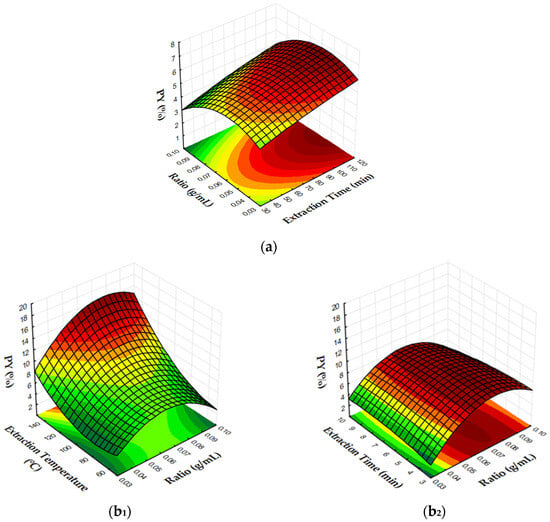
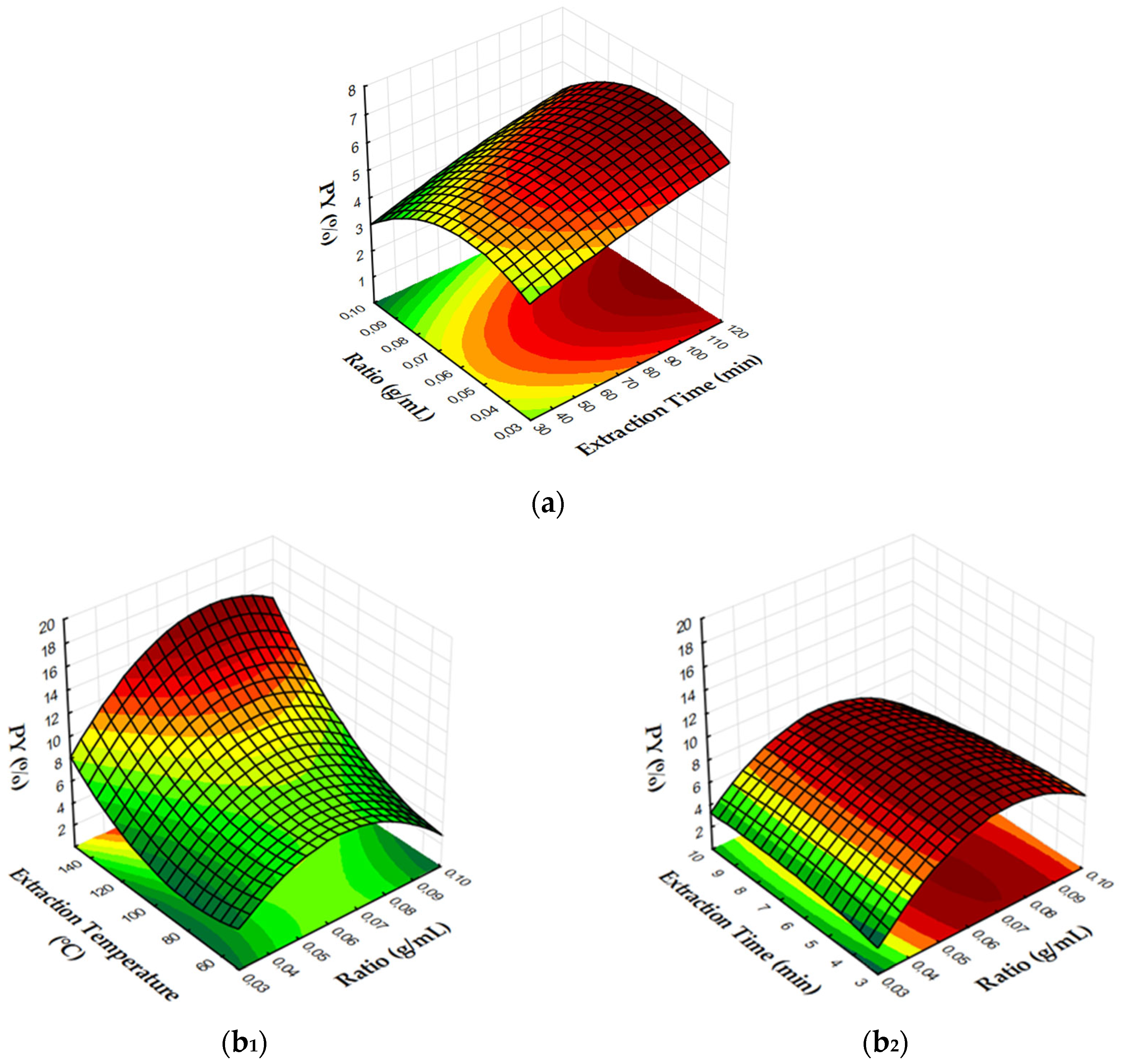
The three-dimensional (3D) response surfaces and contour plots in Figure 1 depict the relationship between the independent variables of each studied technique for protein extraction from RPC and the dependent variable of PY. Only interactions among independent variables that demonstrated statistical significance are depicted. These visual representations enable a clearer understanding of how changes in the independent variables influence the outcomes.
Figure 1.
Response surface and contour plots showing the effect of the independent variables of each extraction method on PY (%). (a) Ratio vs. extraction time (CE); (b1) extraction temperature vs. ratio with extraction time of 6 min (PLE); and (b2) extraction time vs. ratio with extraction temperature of 100 °C (PLE).
Figure 1a illustrates the combined effect of solid-to-liquid ratio and extraction time on PY through CE. Moderate values of solid-to-liquid ratio and longer extraction times lead to higher PY values. Specifically, the contour plot shows that a solid-to-liquid ratio of 0.04 g/mL, combined with an extraction time exceeding 120 min, produced the highest PY. This finding aligns with the experimental data, where Run 8 achieved the highest PY (6.6%) under optimal conditions. In a similar study on de-oiled sunflower press cake, Kaur et al. (2024) [32] reported a maximum PY of 23.3% under conditions of pH 9, 50 °C, 60 min, and 0.2% salt concentration.
Figure 1b1,b2 present the effect of PLE parameters on PY. Higher PY values were observed at elevated extraction temperatures combined with a high-to-moderate solid-to-liquid ratio, suggesting that increased temperatures enhance protein mass transfer [24]. Furthermore, within the experimental time range studied (3–10 min), extraction time had no significant effect. This can be explained by rapid extraction kinetics at elevated temperatures, whereby maximum PY was already achieved within the shortest extraction time tested. These findings validate the results of the analysis of variance described previously and confirm the optimum conditions identified in Run 4 (0.10 g/mL; 150 °C; 6 min), which produced the highest PY (14.9%). The observed effect of extraction time is consistent with the study by Vasileiou et al. (2025) [17], who investigated PLE for protein recovery from sunflower press cake; however, in that study, temperature and solid-to-liquid ratio had an opposite impact, with higher PY values observed at lower levels of both variables.
3.2. Optimum Extracts—Comparison
Both extraction methods, CE and PLE, were evaluated under the parameters of extraction time and solid-to-liquid ratio, and PLE was also examined under extraction temperature. The optimal conditions for each method, along with the results for PY (%), PRE (%), and PRP (%), are summarized in Table 4. PCE (mg/g) and PCP (mg/g) are also presented in the same table.
Table 4.
PY (%), PRE (%), PCE (mg albumin eq./g raw material), PRP (%), and PCP (mg albumin eq./g prec. mass) for all the studied extraction methods at their optimum conditions.
According to Table 4, each extraction method exhibits distinct behavior with respect to the common parameters studied (solid-to-liquid ratio and extraction time). Regarding the solid-to-liquid ratio, CE requires a larger solvent volume relative to RPC mass compared to PLE. Specifically, the optimal ratio for CE is 0.04 g/mL, whereas for PLE, it is 0.10 g/mL. Concerning the extraction time, CE requires considerably more time (120 min) than PLE (6 min). Consequently, the presence of elevated pressure and temperature in the PLE process efficient extraction while minimizing both solvent use and processing time.
The superior efficiency of PLE is further confirmed by comparing the two technologies. Regarding the variables concerning the liquid extract, PRE was 43.8% for PLE and 42.1% for CE, while PCE reached 137.2 mg/g for PLE, compared to 131.9 mg/g for CE. No significant differences were observed between the two methods for these variables; however, PLE achieved comparable protein extractability to CE while substantially reducing the extraction time. A comparison with the existing literature revealed that only data for CE were available. Investigating the same raw material, Zhang et al. (2020) [24] reported similar results, specifically finding a PRE of approximately 50% after 1 h of CE using a solid-to-liquid ratio of 0.10 g/mL at pH 11.
In contrast, the variables related to the final protein powder (PY, PRE, and PRP) showed significant differences between the two extraction methods. Specifically, PLE resulted in higher values for PY (14.9%), PRP (20.0%), and PCP (647.2 mg/g), compared to CE, which yielded 6.6%, 9.6%, and 461.4 mg/g, respectively. Đermanović et al. (2025) [33] and Östbring et al. (2019) [7] also investigated protein extraction from RPC through CE at pH 9, reporting PRP values of 20% after 1h and 29% after 3h, respectively.
PY, PRP, and PCP are determined not only by the efficiency of the extraction method but also by the precipitating potential of the extracted proteins. A deeper investigation into the RPC matrix is required to elucidate the differences between the methods. RPC contains two types of storage proteins, named napins and cruciferins. Napins are low-molecular-weight albumins (15–17 kDa) that are mainly soluble within the pH range of 4–10, whereas cruciferins are high-molecular-weight globulins (approximately 300 kDa) [23,34] and exhibit increased solubility in alkaline conditions. Also, the structure of cruciferins is more susceptible to structural changes and unfolding upon heating and pH changes compared to napins. Given that the exposure of RPC to high temperature and pressure during PLE leads to tissue disruption and protein aggregation, PLE may favor the extraction of cruciferins. Karimi et al. (2025) [23] found that crusiferins accounted for 82% of total storage proteins extracted from RPC. As a result, these structural alterations of the preferentially extracted cruciferins may facilitate their more efficient precipitation.
3.3. Amino Acid Profiling
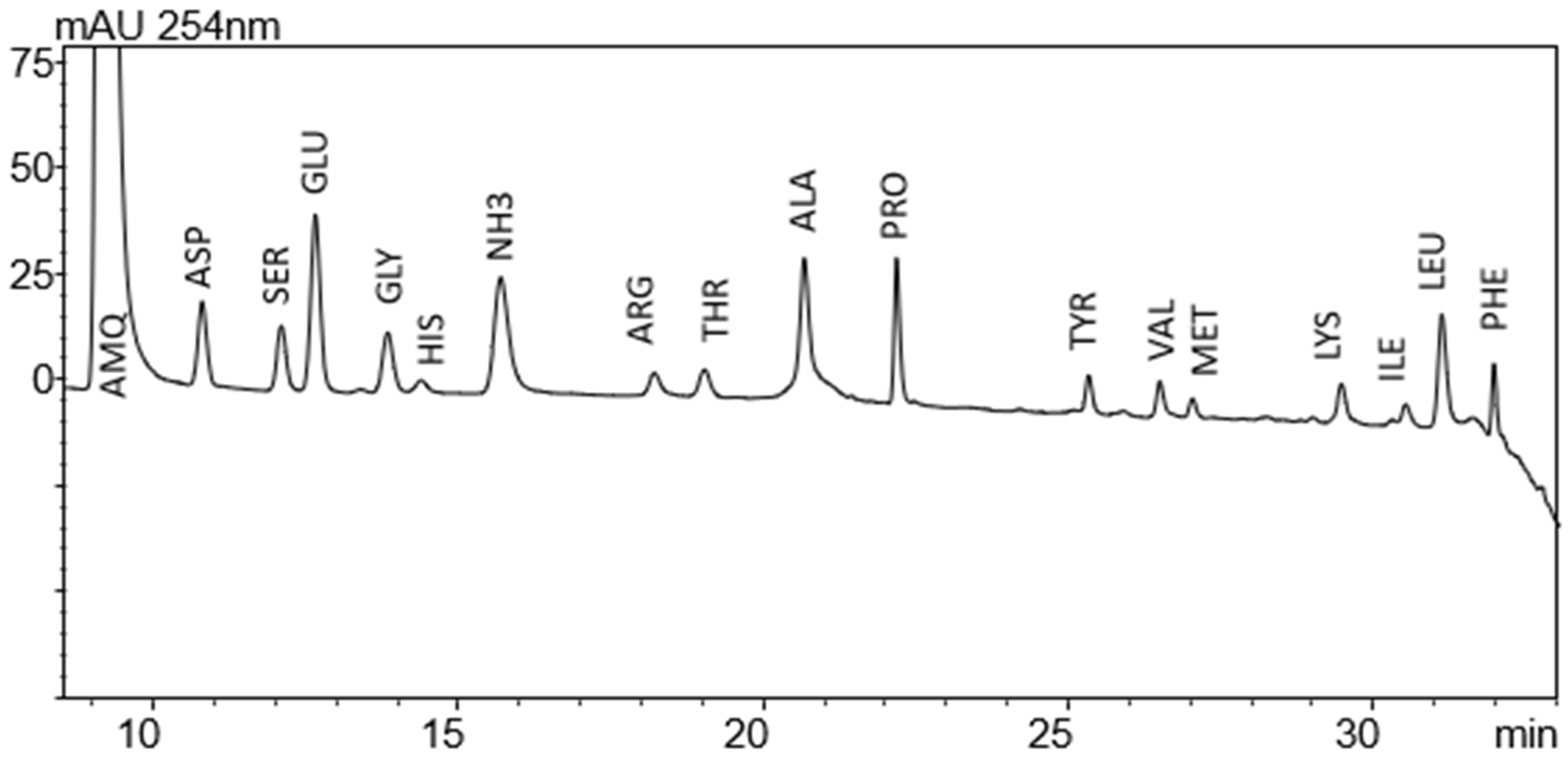
The HPLC-derived amino acid (AA) profile of the recovered protein powders revealed the presence of both essential and non-essential AAs: aspartic acid (ASP), serine (SER), glutamic acid (GLU), glycine (GLY), histidine (HIS), arginine (ARG), threonine (THR), alanine (ALA), proline (PRO), tyrosine (TYR), valine (VAL), methionine (MET), lysine (LYS), isoleucine (ILE), leucine (LEU), and phenylalanine (PHE). HPLC-derived AA are also present in Figure A1 (Appendix A). Table 5 shows the amino acid concentrations (mg AA/g protein powder) in the protein extracts from RPC obtained via different extraction methods, highlighting the differences in yield among CE and PLE techniques.
Table 5.
AA concentrations (mg/g) in RPC protein powders obtained using different extraction methods CE and PLE. Concentrations are expressed as mg of AA per g of protein powder obtained.
According to Table 5, PLE exhibited a higher total amino acid (AA) concentration (607.1 mg/g) than CE (456.1 mg/g), confirming the effect of elevated pressure and temperature inherent to this innovative extraction technique This result is also consistent with the higher PCP observed for PLE (Section 3.2), indicating that PLE-derived powder contains a greater protein fraction, of which amino acids are the constitutive components.
Beyond the higher concentrations of all individual amino acids in PLE, both extraction methods yielded similar AA profiles with comparable trends. Specifically, for both techniques, GLU was the most abundant AA, followed by ASP. For PLE, concentrations of GLU and ASP were 125.2 mg/g and 79.8 mg/g, respectively, while for CE, the corresponding values were 90.8 mg/g and 58.1 mg/g, respectively. These findings align with previous studies on rapeseed press cake [33,35,36,37]. Specifically, Warnakulasuriya et al. (2024) [35] reported GLU combined with GLN, and ASP combined with ASN, in liquid extract at concentrations of 194.3 mg/g and 79.4 mg/g, respectively, following hydrolysis of the protein fraction with 6N HCl after 1 h of alkaline extraction.
In addition to GLU and ASP as the most abundant AA, both AA profiles revealed a substantial content of essential amino acids, including HIS, LYS, MET, THR, ILE, LEU, PHE, and VAL. For PLE, LEU exhibited the highest concentration (45.4 mg/g), followed by aromatic amino acids (PHE and TYR; 44.3 mg/g), VAL (34.5 mg/g), and LYS (32.9 mg/g). For CE, aromatic amino acids were found at the highest concentration (34.4 mg/g), followed by LEU (33.6 mg/g), LYS (27.2 mg/g), and VAL (25.8 mg/g). Conversely, MET and HIS were the essential amino acids with the lowest concentrations for both methods, while TRP was not detected at all. These results are confirmed by other similar studies [33,35,36,37], all of which reported comparable findings regarding MET and HIS concentrations. Regarding TRP, Toghyani et al. (2015) [36] and Đermanović et al. (2025) [33] similarly did not detect this amino acid, whereas Warnakulasuriya et al. (2023) [35] and Fleddermann et al. (2013) [37] found it at low concentrations. These discrepancies may be attributed to differences in rapeseed varieties and the de-oiling process. Notably, high temperatures during de-oiling can induce denaturation and destruction of heat-sensitive amino acids, such as lysine [23,38].
3.4. Solubility
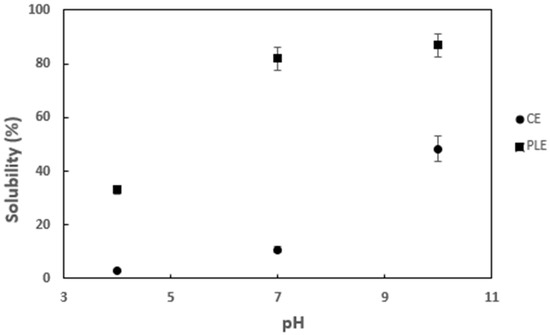
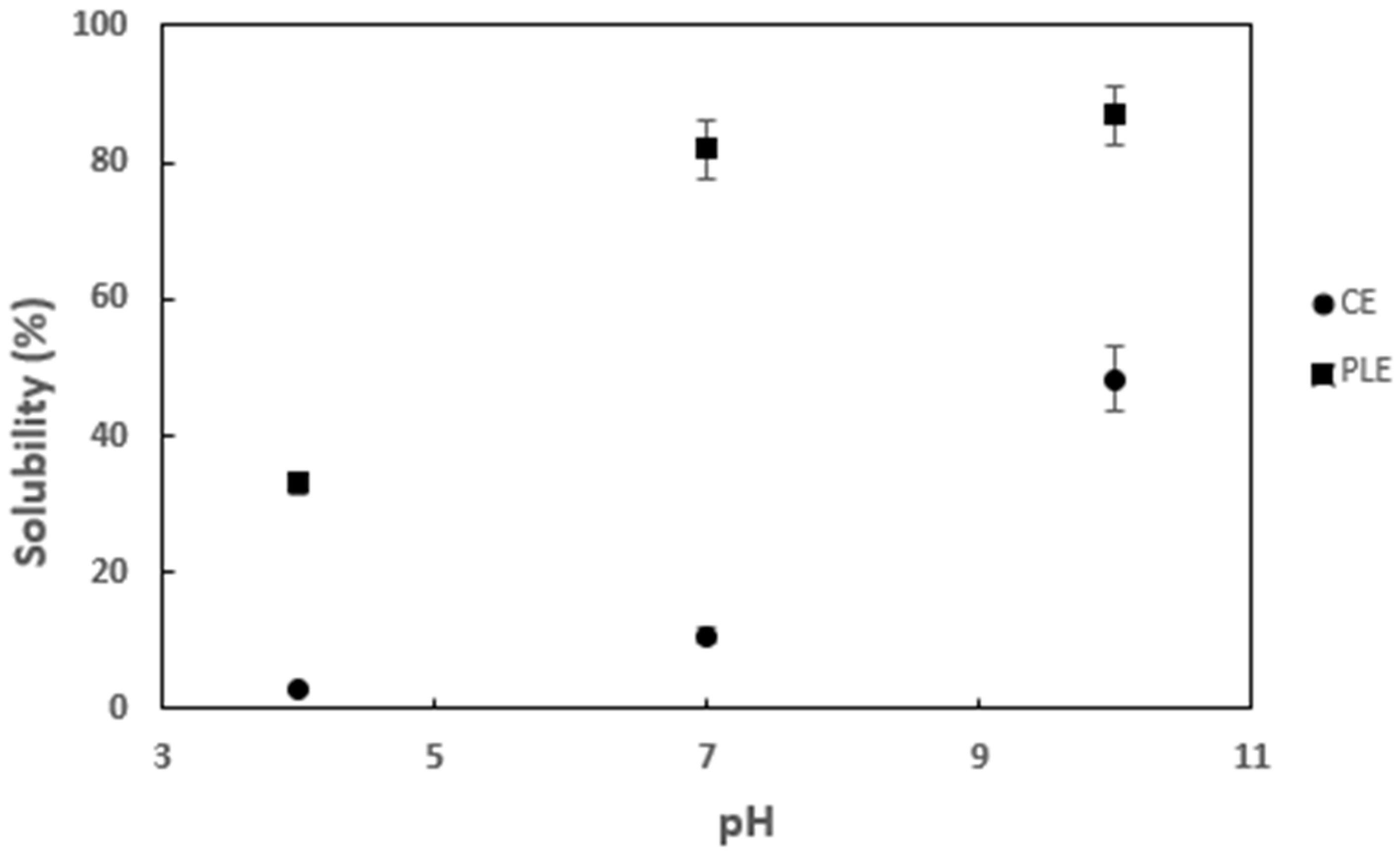
Figure 2 presents the solubility profiles as a function of pH for proteins obtained via CE and PLE at pH 11. Proteins extracted via PLE exhibited the highest solubility across all pH values tested, followed by those from CE. This enhanced solubility is attributed to partial protein unfolding in the alkaline medium, which exposes polar groups while limiting exposure of non-polar amino acids that could induce aggregation [23]. This effect is amplified during PLE due to the combination of alkaline conditions with elevated temperature and pressure.
Figure 2.
Solubility (%) of protein powders obtained via CE and PLE under optimal conditions at pH 11 for a pH range of 3–11.
Solubility was minimal at low pH for both methods and increased sharply with pH, reaching maximum values at the highest pH tested. Near the isoelectric point, minimal net charge reduces solubility and promotes aggregation, whereas alkaline pH confers a net-negative charge that prevents aggregation and enhances solubility, consistent with general protein behavior [39]. Under alkaline conditions, enhanced electrostatic repulsion and disruption of hydrogen bonds further increase solubility [23].
These solubility measurements are valuable for food applications, as they help predict protein behavior during formulation, processing, and storage. In particular, pH-dependent solubility directly influences key functional properties such as emulsification, gelation, and foaming. Although protein solubility at very high pH has limited direct relevance to final food products, it provides important insights into protein stability under extreme conditions. This is especially relevant for processing operations such as alkaline extraction, often combined with elevated temperature and pressure, as investigated in the present study.
3.5. Color
Color is a critical quality attribute for plant-derived protein ingredients, influencing consumer acceptance and application potential. Light-colored proteins are preferred for products requiring visual neutrality, such as beverages and dairy alternatives, whereas darker proteins may be acceptable in applications like meat analogs or baked goods [40]. However, excessive darkening often signals undesirable reactions, including phenolic oxidation and Maillard reactions, that can negatively affect flavor, nutritional value, and functionality [41]. Although strategies such as phenolic removal using polyvinylpyrrolidone (PVP) or reducing agents can improve color, they frequently reduce protein yields and fail to eliminate residual pigmentation due to strong protein–phenolic interactions [42,43,44]. Even after extensive processing, some coloration persists, underscoring the challenge of producing lightly colored rapeseed protein isolates.
Table 6 presents the results for the color measurement of protein powders from CE and PLE. According to the established method that followed, L*, a*, and b* are presented.
Table 6.
L*, a*, and b*, as color indicators, for protein powders from CE and PLE at pH 11.
The lightness (L*) of the protein powder was higher for CE than for PLE, with values of 25.1 and 21.8, respectively. In contrast, PLE yielded a higher a* than CE (10.0 and 9.5, respectively), indicating more intense red coloration, while b* values had no significant difference. Relative to similar studies on protein extracts from alternative plant sources, both powders can be characterized as relatively dark [45]. This pronounced darkening is primarily attributed to the alkaline extraction conditions, which promote co-extraction of phenolic compounds in the absence of any pretreatment for their removal [42,46]. Under these conditions, phenolic compounds are converted to quinones that form colored complexes with proteins through covalent and non-covalent interactions [42,47,48]. Additionally, PLE resulted in a darker powder than CE due to the applied elevated temperatures (150 °C). This thermal exposure accelerates both phenolic oxidation and Maillard reactions, leading to brown polymerization products [39,49]. Furthermore, thermal denaturation and aggregation may promote entrapment of chromophoric compounds, further reducing lightness [50]. Collectively, these findings indicate that process-specific factors, including pH and temperature, significantly influence pigment formation and retention, accounting for the observed color differences between CE and PLE.
4. Conclusions
The present study demonstrated the significant influence of alkaline conditions and PLE on protein recovery from RPC. Increasing pH from 8 to 11 significantly enhanced PY for both CE and PLE, while PLE clearly outperformed CE, achieving a maximum PY of 14.9% under optimal conditions (150 °C, 6 min, 0.10 g/mL), compared to 6.6% for CE (0.04 g/mL, 120 min). RSM further revealed that extraction temperature was the most influential parameter in PLE, whereas extraction time and solid-to-liquid ratio were more critical for CE.
PLE also resulted in higher PY, PCP, and total amino acid recovery than CE, while considerably reducing extraction time. GLU and ASP were the predominant amino acids in both extracts, whereas LEU was the most abundant essential amino acid in PLE-derived powders. Moreover, proteins extracted via PLE exhibited improved solubility across the tested pH range, likely due to enhanced protein unfolding and cruciferin solubilization under alkaline and high-temperature conditions. Regarding powder color, CE-derived powders showed higher lightness, while PLE powders presented more intense red coloration.
Overall, the combination of elevated pressure, temperature, and alkaline conditions in PLE represents a promising and efficient strategy for protein recovery from RPC, offering higher extraction efficiency, lower solvent consumption, and significantly shorter processing times compared to CE. Nevertheless, further investigation into protein techno-functionality, amino acid bioavailability, and process scalability is required to support industrial applications.
Author Contributions
Conceptualization, C.V. and C.D.; methodology, C.V., I.C.S. and C.D.; software, C.V. and C.D.; validation, C.V., C.S. and C.D.; formal analysis, C.V., I.C.S., C.S. and C.D.; investigation, C.V., C.S. and C.D.; resources, C.V. and C.D.; data curation, C.V., I.C.S., C.S. and C.D.; writing—original draft preparation, C.V., I.C.S. and C.D.; writing—review and editing, C.V. and C.D.; visualization, C.V. and C.D.; supervision, C.D. and M.K.; project administration, M.K.; funding acquisition, M.K. All authors have read and agreed to the published version of the manuscript.
Funding
This research is part of the DigInTraCE project that has received funding from the EU’s Horizon Europe research and innovation program under grant agreement No. 101091801.
Institutional Review Board Statement
Not applicable.
Informed Consent Statement
Not applicable.
Data Availability Statement
The original contributions presented in this study are included in this article; further inquiries can be directed to the corresponding author.
Conflicts of Interest
The authors declare no conflicts of interest.
Appendix A
Figure A1.
HPLC chromatogram showing the AA profile of protein powders from RPC, analyzed under optimal extraction conditions. Individual AA peaks are labeled.
References
- Aiking, H. Future Protein Supply. Trends Food Sci. Technol. 2011, 22, 112–120. [Google Scholar] [CrossRef] [Scilit]
- Tilman, D.; Clark, M. Global Diets Link Environmental Sustainability and Human Health. Nature 2014, 515, 518–522. [Google Scholar] [CrossRef] [Scilit]
- Day, L. Proteins from Land Plants—Potential Resources for Human Nutrition and Food Security. Trends Food Sci. Technol. 2013, 32, 25–42. [Google Scholar] [CrossRef] [Scilit]
- Lomascolo, A.; Uzan-Boukhris, E.; Sigoillot, J.-C.; Fine, F. Rapeseed and Sunflower Meal: A Review on Biotechnology Status and Challenges. Appl. Microbiol. Biotechnol. 2012, 95, 1105–1114. [Google Scholar] [CrossRef] [Scilit]
- Foreign Agricultural Service, United States Department of Agriculture. Production—Rapeseed [Data Set]. USDA Foreign Agricultural Service. Available online: https://Www.Fas.Usda.Gov/Data/Production/2226000 (accessed on 8 April 2026).
- Thorsen, J.S.; Bononad-Olmo, A.; Toft, A.M.; Sanden, N.C.H.; Agyenim-Boateng, K.G.; Poborsky, M.; Crocoll, C.; Halkier, B.A.; Bredie, W.L.P.; Xu, D. Utilizing Raw Rapeseed Press Cake in Foods: A Case Study on Sensory Quality and Profile of Selected Bitter Compounds in Snack Bars. bioRxiv 2026. [Google Scholar] [CrossRef] [Scilit]
- Östbring, K.; Tullberg, C.; Burri, S.; Malmqvist, E.; Rayner, M. Protein Recovery from Rapeseed Press Cake: Varietal and Processing Condition Effects on Yield, Emulsifying Capacity and Antioxidant Activity of the Protein Rich Extract. Foods 2019, 8, 627. [Google Scholar] [CrossRef] [Scilit]
- Baker, P.W.; Charlton, A. A Comparison in Protein Extraction from Four Major Crop Residues in Europe Using Chemical and Enzymatic Processes-a Review. Innov. Food Sci. Emerg. Technol. 2020, 59, 102239. [Google Scholar] [CrossRef] [Scilit]
- Mirpoor, S.F.; Giosafatto, C.V.L.; Porta, R. Biorefining of Seed Oil Cakes as Industrial Co-Streams for Production of Innovative Bioplastics. A Review. Trends Food Sci. Technol. 2021, 109, 259–270. [Google Scholar] [CrossRef] [Scilit]
- Anyiam, P.N.; Phongthai, S.; Kingwascharapong, P.; Pongsetkul, J.; Zhang, W.; Jung, Y.H.; Rawdkuen, S. A Comparative Review on Novel-Assisted Extraction Techniques for Retrieving Protein from Some Potential Plant Sources. NFS J. 2025, 40, 100239. [Google Scholar] [CrossRef] [Scilit]
- Long, R.; Huang, Y.; Dabbour, M.; Mintah, B.K.; Pan, J.; Wu, M.; Zhang, S.; Qin, Z.; He, R.; Ma, H. Physical Processing-Assisted PH Shifting for Food Protein Modification: A Comprehensive Review. Foods 2025, 14, 2360. [Google Scholar] [CrossRef] [Scilit] [PubMed]
- Richter, B.E.; Jones, B.A.; Ezzell, J.L.; Porter, N.L.; Avdalovic, N.; Pohl, C. Accelerated Solvent Extraction: A Technique for Sample Preparation. Anal. Chem. 1996, 68, 1033–1039. [Google Scholar] [CrossRef] [Scilit]
- Mustafa, A.; Turner, C. Pressurized Liquid Extraction as a Green Approach in Food and Herbal Plants Extraction: A Review. Anal. Chim. Acta 2011, 703, 8–18. [Google Scholar] [CrossRef] [Scilit] [PubMed]
- Muñóz-Almagro, N.; Gilbert-López, B.M.; Carmen, P.-R.; García-Fernandez, Y.; Almeida, C.; Villamiel, M.; Mendiola, J.A.; Ibáñez, E. Exploring the Microalga Euglena Cantabrica by Pressurized Liquid Extraction to Obtain Bioactive Compounds. Mar. Drugs 2020, 18, 308. [Google Scholar] [CrossRef] [Scilit] [PubMed]
- Galván, S.O.; González-García, E.; Marina, M.L.; García, M.C. Comparative Study of Factors Affecting the Recovery of Proteins from Malt Rootlets Using Pressurized Liquids and Ultrasounds. Curr. Res. Food Sci. 2022, 5, 1777–1787. [Google Scholar] [CrossRef] [Scilit]
- González-García, E.; Marina, M.L.; García, M.C. Impact of the Use of Pressurized Liquids on the Extraction and Functionality of Proteins and Bioactives from Brewer’s Spent Grain. Food Chem. 2021, 359, 129874. [Google Scholar] [CrossRef] [Scilit]
- Vasileiou, C.; Dimoula, M.; Drosou, C.; Kavetsou, E.; Stergiopoulos, C.; Gogou, E.; Boukouvalas, C.; Krokida, M. Valorization of Edible Oil Industry By-Products Through Optimizing the Protein Recovery from Sunflower Press Cake via Different Novel Extraction Methods. AgriEngineering 2025, 7, 146. [Google Scholar] [CrossRef] [Scilit]
- Helrich, K. Determination in Animal Feed: Copper Catalyst Kjeldahl Method 984.13. In Official Methods of Analysis, 15th ed.; AOAC International: Gaithersburg, MD, USA, 1990. [Google Scholar]
- Lowry, O.H.; Rosebrough, N.J.; Farr, A.L.; Randall, R.J. Protein Measurement with the Folin Phenol Reagent. J. Biol. Chem. 1951, 193, 265–275. [Google Scholar] [CrossRef] [Scilit]
- Chandran, A.S.; Kashyap, P.; Thakur, M. Effect of Extraction Methods on Functional Properties of Plant Proteins: A Review. eFood 2024, 5, e151. [Google Scholar] [CrossRef] [Scilit]
- Sultan, Z.; Ashfaq, A.; Jahan, K.; Qadri, O.S.; Younis, K.; Yousuf, O. PH Shift Extraction Technique for Plant Proteins: A Promising Technique for Sustainable Development. Energy Nexus 2024, 16, 100329. [Google Scholar] [CrossRef] [Scilit]
- Pezeshk, S.; Rezaei, M.; Hosseini, H.; Abdollahi, M. Impact of PH-Shift Processing Combined with Ultrasonication on Structural and Functional Properties of Proteins Isolated from Rainbow Trout by-Products. Food Hydrocoll. 2021, 118, 106768. [Google Scholar] [CrossRef] [Scilit]
- Karimi, A.; Bhowmik, P.; Yang, T.C.; Samaranayaka, A.; Chen, L. Extraction of Canola Protein via Natural Deep Eutectic Solvents Compared to Alkaline Treatments: Isolate Characteristics and Protein Structural and Functional Properties. Food Hydrocoll. 2024, 152, 109922. [Google Scholar] [CrossRef] [Scilit]
- Zhang, Z.; He, S.; Liu, H.; Sun, X.; Ye, Y.; Cao, X.; Wu, Z.; Sun, H. Effect of PH Regulation on the Components and Functional Properties of Proteins Isolated from Cold-Pressed Rapeseed Meal through Alkaline Extraction and Acid Precipitation. Food Chem. 2020, 327, 126998. [Google Scholar] [CrossRef] [Scilit]
- Firatligil-Durmus, E.; Evranuz, O. Response Surface Methodology for Protein Extraction Optimization of Red Pepper Seed (Capsicum frutescens). LWT 2010, 43, 226–231. [Google Scholar] [CrossRef] [Scilit]
- Ware, K.; Kashyap, P.; Gorde, P.M.; Yadav, R.; Sharma, V. Comparative Analysis of RSM and ANN-GA Based Modeling for Protein Extraction from Cotton Seed Meal: Effect of Extraction Parameters on Amino Acid Profile and Nutritional Characteristics. Food Bioprod. Process. 2025, 150, 63–77. [Google Scholar] [CrossRef] [Scilit]
- Patra, A.; Arun Prasath, V. Isolation of Detoxified Cassava (Manihot esculenta L.) Leaf Protein by Alkaline Extraction-Isoelectric Precipitation: Optimization and Its Characterization. Food Chem. 2024, 437, 137845. [Google Scholar] [CrossRef] [Scilit] [PubMed]
- Ho, C.H.L.; Cacace, J.E.; Mazza, G. Extraction of Lignans, Proteins and Carbohydrates from Flaxseed Meal with Pressurized Low Polarity Water. LWT 2007, 40, 1637–1647. [Google Scholar] [CrossRef] [Scilit]
- De la Fuente, B.; Pallarés, N.; Barba, F.J.; Berrada, H. An Integrated Approach for the Valorization of Sea Bass (Dicentrarchus labrax) Side Streams: Evaluation of Contaminants and Development of Antioxidant Protein Extracts by Pressurized Liquid Extraction. Foods 2021, 10, 546. [Google Scholar] [CrossRef] [Scilit]
- Hernández-Corroto, E.; Plaza, M.; Marina, M.L.; García, M.C. Sustainable Extraction of Proteins and Bioactive Substances from Pomegranate Peel (Punica Granatum L.) Using Pressurized Liquids and Deep Eutectic Solvents. Innov. Food Sci. Emerg. Technol. 2020, 60, 102314. [Google Scholar] [CrossRef] [Scilit]
- Zhou, J.; Wang, M.; Carrillo, C.; Zhu, Z.; Brncic, M.; Berrada, H.; Barba, F.J. Impact of Pressurized Liquid Extraction and Ph on Protein Yield, Changes in Molecular Size Distribution and Antioxidant Compounds Recovery from Spirulina. Foods 2021, 10, 2153. [Google Scholar] [CrossRef] [Scilit]
- Kaur, R.; Ghoshal, G.; Chauhan, S. Optimizing Conditions for Protein Isolation from De-Oiled Sunflower Meal Using Response Surface Methodology (RSM). J. Food Meas. Charact. 2024, 18, 3708–3719. [Google Scholar] [CrossRef] [Scilit]
- Đermanović, B.; Marić, A.; Sakač, M.; Tomić, D.; Dragojlović, D.; Popović, L.; Šarić, B.; Jovanov, P. Impact of Alkaline and Deep Eutectic Solvent Extraction on Rapeseed Protein Isolates Characteristics and in Vitro Digestibility. Curr. Res. Food Sci. 2025, 10, 101075. [Google Scholar] [CrossRef] [Scilit]
- Ntone, E.; Kornet, R.; Venema, P.; Meinders, M.B.J.; van der Linden, E.; Bitter, J.H.; Sagis, L.M.C.; Nikiforidis, C.V. Napins and Cruciferins in Rapeseed Protein Extracts Have Complementary Roles in Structuring Emulsion-Filled Gels. Food Hydrocoll. 2022, 125, 107400. [Google Scholar] [CrossRef] [Scilit]
- Warnakulasuriya, S.N.; Tanaka, T.; Wanasundara, J.P.D. Canola Meal Valorization via Acid Hydrolysis to Generate Free Amino Acids. J. Am. Oil Chem. Soc. 2024, 101, 41–57. [Google Scholar] [CrossRef] [Scilit]
- Toghyani, M.; Rodgers, N.; Iji, P.A.; Swick, R.A. Standardized Ileal Amino Acid Digestibility of Expeller-Extracted Canola Meal Subjected to Different Processing Conditions for Starter and Grower Broiler Chickens. Poult. Sci. 2015, 94, 992–1002. [Google Scholar] [CrossRef] [Scilit]
- Fleddermann, M.; Fechner, A.; Rößler, A.; Bähr, M.; Pastor, A.; Liebert, F.; Jahreis, G. Nutritional Evaluation of Rapeseed Protein Compared to Soy Protein for Quality, Plasma Amino Acids, and Nitrogen Balance—A Randomized Cross-over Intervention Study in Humans. Clin. Nutr. 2013, 32, 519–526. [Google Scholar] [CrossRef] [Scilit]
- Newkirk, R.W.; Classen, H.L.; Edney, M.J. Effects of Prepress-Solvent Extraction on the Nutritional Value of Canola Meal for Broiler Chickens. Anim. Feed Sci. Technol. 2003, 104, 111–119. [Google Scholar] [CrossRef] [Scilit]
- Rodriguez-Amaya, D.B. Food Carotenoids; John Wiley and Sons: Hoboken, NJ, USA, 2015; ISBN 9781118733301. [Google Scholar]
- Kurek, M.A.; Onopiuk, A.; Pogorzelska-Nowicka, E.; Szpicer, A.; Zalewska, M.; Półtorak, A. Novel Protein Sources for Applications in Meat-Alternative Products—Insight and Challenges. Foods 2022, 11, 957. [Google Scholar] [CrossRef] [Scilit] [PubMed]
- Rathnayake, D.; Nadolny, J.M.; Sultanbawa, Y.; Smyth, H.E. Then, Now, and Next: A Systematic Review of Colour Development in Plant-Based Meat Analogues through Natural Colourants. J. Future Foods, 2025; in press. [CrossRef] [Scilit]
- Xu, L.; Diosady, L.L. Removal of Phenolic Compounds in the Production of High-Quality Canola Protein Isolates. Food Res. Int. 2002, 35, 23–30. [Google Scholar] [CrossRef] [Scilit]
- Mansour, E.H.; Dworschák, E.; Perédi, J.; Lugasi, A. Preparation and Functional Properties of Proteins from Rapeseed and Pumpkin Seed. In Proceedings of the AOCS World Conference and Exhibition on Oilseed Technology and Utilization, Budapest, Hungary, September 1992; Available online: https://www.researchgate.net/publication/262675069_Preparation_and_functional_properties_of_proteins_from_rapeseed_and_pumpkin_seed (accessed on 10 May 2026).
- McCurdy, S.M. Effects of Processing on the Functional Properties of Canola/Rapeseed Protein. J. Am. Oil Chem. Soc. 1990, 67, 281–284. [Google Scholar] [CrossRef] [Scilit]
- Sosulski, F.; Humbert, E.S.; Bui, K.; Jones, J.D. Functional Propreties of Rapeseed Flours, Concentrates and Isolate. J. Food Sci. 1976, 41, 1349–1352. [Google Scholar] [CrossRef] [Scilit]
- Wanasundara, J.P.D.; McIntosh, T.C.; Perera, S.P.; Withana-Gamage, T.S.; Mitra, P. Canola/Rapeseed Protein-Functionality and Nutrition. OCL 2016, 23, D407. [Google Scholar] [CrossRef] [Scilit]
- Kieserling, H.; de Bruijn, W.J.C.; Keppler, J.; Yang, J.; Sagu, S.T.; Güterbock, D.; Rawel, H.; Schwarz, K.; Vincken, J.; Schieber, A.; et al. Protein–Phenolic Interactions and Reactions: Discrepancies, Challenges, and Opportunities. Compr. Rev. Food Sci. Food Saf. 2024, 23, e70015. [Google Scholar] [CrossRef] [Scilit]
- Zhang, R.; Fang, X.; Feng, Z.; Chen, M.; Qiu, X.; Sun, J.; Wu, M.; He, J. Protein from Rapeseed for Food Applications: Extraction, Sensory Quality, Functional and Nutritional Properties. Food Chem. 2024, 439, 138109. [Google Scholar] [CrossRef] [Scilit] [PubMed]
- Pasquet, P.L.; Julien-David, D.; Zhao, M.; Villain-Gambier, M.; Trébouet, D. Stability and Preservation of Phenolic Compounds and Related Antioxidant Capacity from Agro-Food Matrix: Effect of PH and Atmosphere. Food Biosci. 2024, 57, 103586. [Google Scholar] [CrossRef] [Scilit]
- Fetzer, A.; Müller, K.; Schmid, M.; Eisner, P. Rapeseed Proteins for Technical Applications: Processing, Isolation, Modification and Functional Properties—A Review. Ind. Crops Prod. 2020, 158, 112986. [Google Scholar] [CrossRef] [Scilit]

Disclaimer/Publisher’s Note: The statements, opinions and data contained in all publications are solely those of the individual author(s) and contributor(s) and not of MDPI and/or the editor(s). MDPI and/or the editor(s) disclaim responsibility for any injury to people or property resulting from any ideas, methods, instructions or products referred to in the content. |
© 2026 by the authors. Licensee MDPI, Basel, Switzerland. This article is an open access article distributed under the terms and conditions of the Creative Commons Attribution (CC BY) license.