1. Introduction
Rare-earth (RE)-based materials are used in a wide range of contemporary technologies and therefore remain the focus of sustained scientific interest, aimed both at elucidating structure–property relationships and at tailoring their functional response for new applications. Among the available strategies to engineer the properties of rare-earth-based materials, aliovalent or isovalent doping is particularly effective because it can markedly modify the local coordination environment, defect chemistry, and electronic structure, thereby influencing the macroscopic physical behavior of the host lattice. Furthermore, when rare-earth elements are involved, doping can also promote the formation and stabilization of carbonate-derived phases such as hydroxycarbonates and oxycarbonates, typically described by the general formulas RE(CO
3)(OH) and RE
2O
2CO
3, respectively. The former may adopt layered architectures exhibiting properties intermediate between those of the corresponding hydroxides and carbonates [
1,
2], whereas the latter commonly represents an intermediate phase accessible during the thermal decomposition of rare-earth hydroxycarbonates [
3].
A key advantage of rare-earth hydroxycarbonate hosts lies in their ability to accommodate dopant ions homogeneously, which is often beneficial for optimizing luminescent performance [
4]. In particular, the intra-4f electronic transitions characteristic of RE
3+ ions can yield narrow and intense emission bands, making these materials attractive for optical applications [
5,
6,
7]. Beyond photoluminescence, the literature also reports the combined use of multiple rare-earth elements to develop novel electrode materials for supercapacitors, targeting efficient energy-storage devices [
8], as well as their implementation in electro-optical, photoelectric, and piezoelectric technologies [
9,
10,
11]. Consistent with this wide range of applications, several synthesis routes have been explored to produce RE-based carbonates, hydroxycarbonates, and related oxides, including combustion methods [
12], hydrothermal treatments [
13,
14,
15], solid-state reactions [
16], citrate sol–gel [
17], and other wet chemical methods [
18,
19,
20].
In this work, for the first time, the synthesis of differently europium-doped lanthanum by combining the co-precipitation method and hydrothermal treatment is proposed, since in previous works [
14,
15] the authors have demonstrated that the adopted synthetic procedure represents the best option to fabricate rare-earth carbonates/hydroxycarbonates with controlled morphologies and pure phases. The electronic structure and optical properties of the synthesized materials were investigated through UV-Vis absorption spectroscopy, and the optical band gap,
Eg, was determined. The electronic transitions were analyzed using the Tauc method [
21,
22]. By comparing the linear regions of the (αην)
2 and (αην)
0.5 plots, the fundamental transitions were classified as either direct or indirect. In these rare-earth-based systems, direct transitions are typically expected due to the charge transfer processes between the oxygen 2p orbitals and the metal 4f/5d levels. Furthermore, the structural phase evolution, specifically the transition from hydroxycarbonate to oxycarbonate, has been correlated with the modulation of the energy gap. It is hypothesized that the removal of hydroxyl groups and the subsequent lattice condensation during thermal treatment led to a predictable narrowing of the band gap (red shift), while internal compositional variations within each phase series are expected to induce
Eg shifts due to lattice strain and structural distortions.
In this context, europium-doped lanthanum hydroxycarbonate systems represent a particularly interesting yet still insufficiently explored class of materials. La-based hydroxycarbonates can act as structurally flexible hosts, while Eu
3+ ions provide an optically active probe that is highly sensitive to the local coordination environment. The incorporation of Eu
3+ into a La-containing matrix, therefore, offers a useful route to investigate how dopant concentration affects crystallization, phase stability, morphology, and local structural disorder. Despite the extensive literature on Eu
3+-activated oxides and phosphors [
23,
24,
25], no studies have addressed Eu-doped lanthanum hydroxycarbonate precursors obtained under controlled wet-chemical and hydrothermal conditions with a systematic variation in dopant concentration. Most previous investigations on rare-earth carbonates and hydroxycarbonates have primarily focused on phase formation, particle morphology, or the conversion of hydroxycarbonate precursors into oxide products [
14,
26,
27]. Conversely, the combined effect of europium incorporation and hydrothermal processing on the structural and morphological features of lanthanum hydroxycarbonate remains not clearly established.
Thus, the main novelty of the present work lies in the synthesis of europium-doped lanthanum hydroxycarbonates with controlled composition and morphology. The combined co-precipitation/hydrothermal synthesis route is expected to favor homogeneous mixing of La and Eu species at the precursor stage, while promoting controlled crystallization under mild conditions. Additionally, the dual role of hydroxycarbonates as both functional materials and chemically versatile precursors for intermediate rare-earth oxycarbonates is highlighted. In fact, understanding the behavior of Eu-doped lanthanum hydroxycarbonates may provide useful information not only for the direct exploitation of carbonate-based materials, but also for the design of oxide systems derived from thermally treated precursors. Since precursor morphology and chemical homogeneity can strongly influence the properties of the final oxide, the ability to control these features at the hydroxycarbonate stage is of practical importance for the development of rare-earth-based materials with reproducible optical, catalytic, or electrochemical performance [
28,
29,
30].
Overall, the present study addresses a specific limitation in the current literature by providing a systematic study of Eu3+ concentration effects in lanthanum hydroxycarbonates synthesized through a controlled combined co-precipitation/hydrothermal route, contributing to a more detailed understanding of how dopant loading influences the formation, structure, and morphology of rare-earth hydroxycarbonates, while also establishing a reproducible synthetic pathway for the preparation of compositionally tuned La–Eu carbonate-derived materials such as oxycarbonates and oxides.
2. Materials and Methods
La(NO3)3∙6H2O and Eu(NO3)3∙5H2O (Purity > 99.9%, Sigma-Aldrich, Milan, Italy) were used as precursors of the hydroxycarbonate/oxycarbonate samples prepared in this study. Ammonium carbonate ((NH4)2CO3 (Purity > 95%, Sigma-Aldrich, Milan, Italy) was used as the precipitating/mineralizing agent for the co-precipitation/hydrothermal synthesis of the various samples. Particularly, three different Eu-doped La-based systems have been prepared, with 1, 3 and 5 at. % Eu on (Eu + La), respectively.
The molar ratio between carbonate ions and rare-earth cations upon precipitation was set to 2.5, starting from a 0.1 M cation-containing solution and a 0.5 M ammonium carbonate solution. These solutions were prepared by dissolving the proper amount of the precursors in deionized water under continuous stirring. For each sample, the co-precipitation was instantly obtained in a Teflon container by quick mixing of the proper volume of the two solutions under mild stirring. The Teflon container, sealed and held in an outer stainless-steel pressure vessel, is positioned in the oven for the hydrothermal treatment, where it rotates at approximately 25 rpm to ensure homogeneity of the reacting system during the treatment. The pH during the coprecipitation, evaluated by means of pH indicator strips, was around 8. The hydrothermal treatment was carried out on the samples at 140 °C for 24 h under autogenous pressure (approximately 3.5 bar based on the base of water vapor pressure). Further details on the procedure adopted in this study are available in our previous works [
14,
31].
The as-synthesized hydroxycarbonate systems were calcined in air at 500 °C for 0.5 h to obtain single-phase related oxycarbonates. A heating rate of 10 °C/min was used for both heating and cooling steps (with a corresponding overall calcination time of 2.5 h).
The following
Table 1 shows the details of the chemical formulas and the identifiers of all the samples, i.e., the as-synthesized and calcined ones.
Both as-synthesized and calcined powders were characterized in terms of crystalline structure and phase composition by XRD, using a Panalytical X’PERT MPD diffractometer, equipped with a graphite monochromator on the diffracted beam, with CuKa radiation and operating at 40 kV and 40 mA. The conditions of diffraction analysis were 2θ-range 10–80°, continuous scan type, step-size of 0.02° 2θ and Scan Step time of 1 s. Phase identification and pattern analysis were carried out using X’PERT HighScore software from Panalytical with PDF-2 database from ICDD. The lattice parameter of the various samples was calculated through a least-squares procedure using the UnitCellRefinement software [
32].
The thermal behavior of the hydroxycarbonate samples was examined through Differential Thermal Analysis and Thermogravimetric Analysis (DTA-TG) by using a Netzsch STA 409 thermal analyzer, with around 180 mg as mass of the samples, α-Al2O3 as reference and alumina crucibles. The conditions used for the analysis were: a heating rate of 10 °C/min, a temperature to 1200 °C and air as the atmosphere. The acquired data were analyzed using proprietary Netzsch software to identify all the relevant parameters of the thermograms.
The morphology of all systems was examined through Scanning Electron Microscopy (SEM) using a Philips XL30 microscope and equipped with Energy-Dispersive X-Ray Spectroscopy (EDS) apparatus Mod. Xplore 15 from Oxford Instruments. The used accelerated voltage was 30 kV. The samples for SEM observation and EDS analysis were prepared by graphite metallization.
The absorption measurements were performed with a Cary 100-Varian UV-Vis equipped with thermostated cells. Approximately 2 mg of solid powder was mixed with distilled water. The mixture was then vortexed for 1 min and the dispersion was placed in rectangular quartz cells of 1 cm path length. Absorption spectra were recorded at room temperature in the 200–345 nm wavelength region.
3. Results
3.1. Structural Characterization
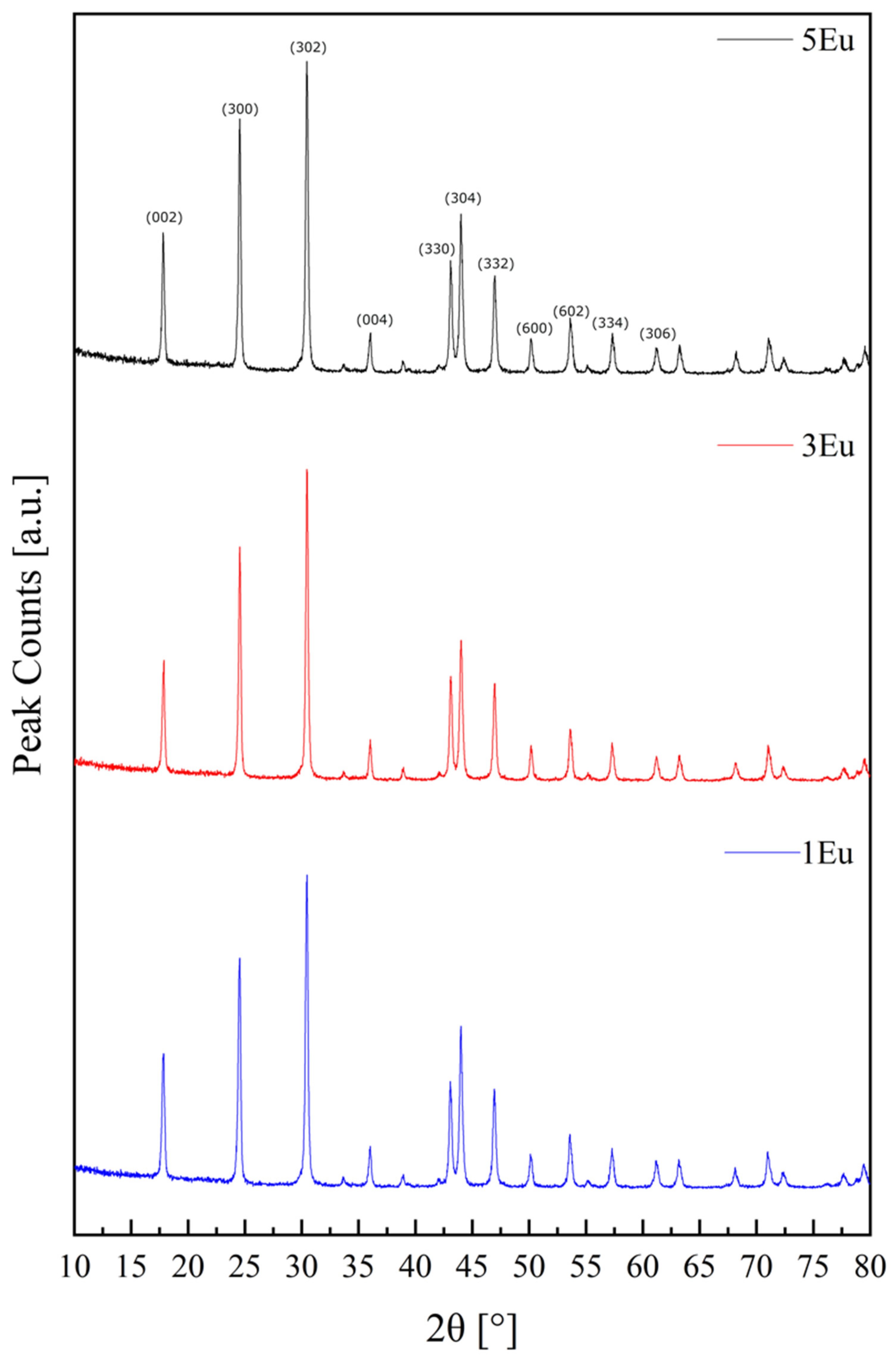
Figure 1 reports the diffraction patterns of 1Eu, 3Eu, and 5Eu, corresponding to the powders recovered immediately after the hydrothermal treatment at 140 °C for 24 h. This treatment promoted the formation of the target hydroxycarbonate host structure, demonstrating the robustness of the used synthesis protocol [
33]. These results also further confirm that the hydrothermal treatment of co-precipitated products obtained in an alkaline carbonate medium represents a simple yet effective route for inducing the crystallization of rare-earth carbonate-based compounds [
14,
15].
All diffraction peaks shown in
Figure 1 can be indexed to an anhydrous hexagonal lanthanum hydroxycarbonate phase, LaCO
3OH (ICDD Card No. 062–0030); for the major diffraction peaks, the Miller indices are also reported. A slight shift in peak positions, highlighted also by the interplanar distances reported in the picture, can be observed for each system, consistent with the different amount of the Eu dopant cation; this behavior may be regarded as indirect evidence of homogeneous substitutional solid-solution formation in all three systems.
To confirm further the effect of Europium content on the lattice geometry in the various samples, the lattice parameters and the unit cell volume were calculated by the UnitCellRefinement software, and the related data are reported in
Table 2.
As the unit cell is hexagonal for both sets of samples, the more useful parameter to reveal a trend of the unit cell geometry with the dopant content, i.e., Europium concentration, is the unit cell volume. The general trend of such parameter for the hydrothermally synthesized samples (from 1.3731 nm
3 to 1.3701 nm
3, see
Table 2) is consistent with the decrease in mean cationic radius in the samples with the increase in Eu content, because of the well-known lanthanide contraction.
3.2. Thermal Evolution of the Hydroxycarbonate Precursors
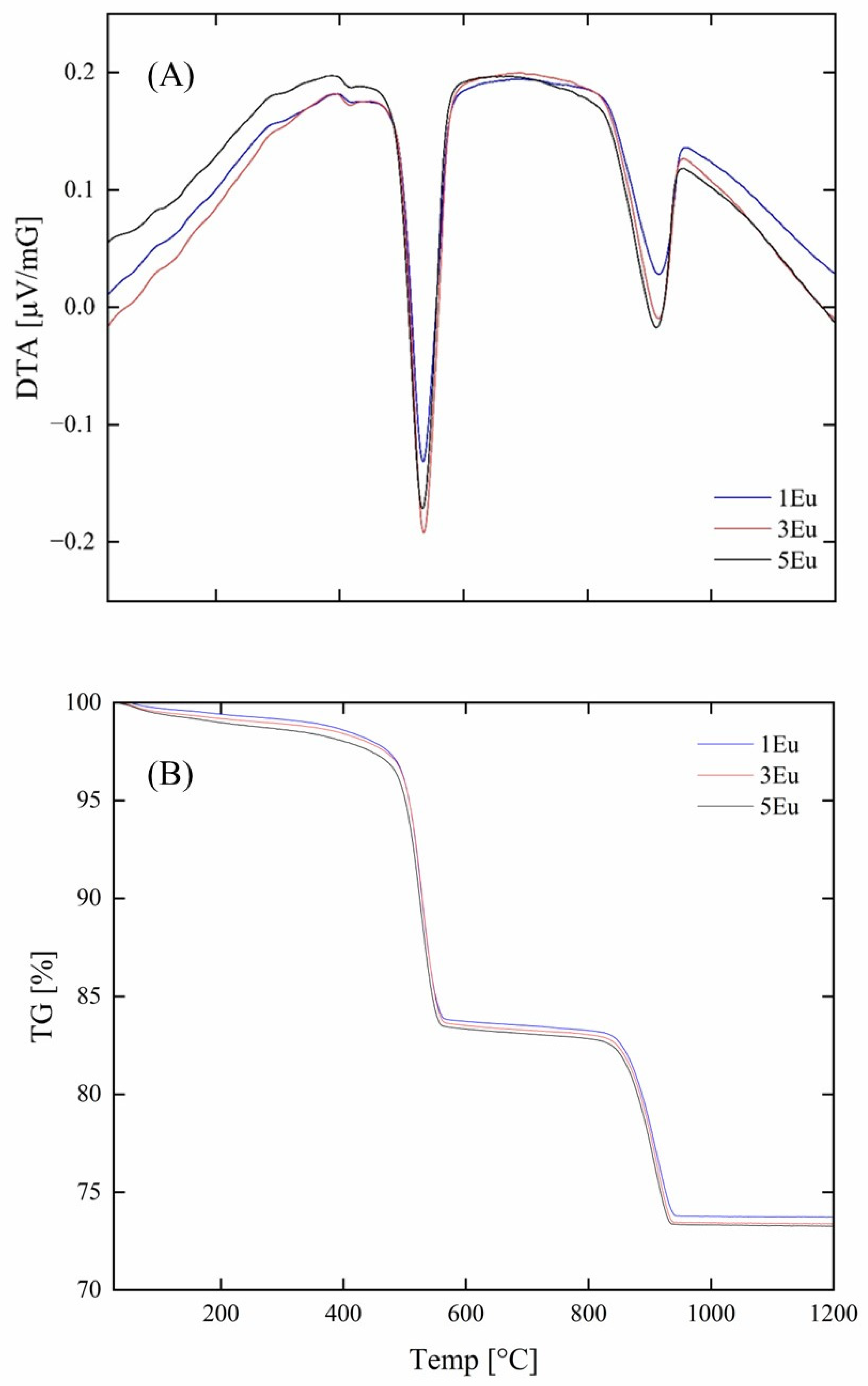
The DTA curves of the 1Eu, 3Eu and 5Eu samples, reported in
Figure 2A, display a relatively simple decomposition behavior, characterized by two main endothermic events. The first thermal event occurs at approximately 530 °C in all three systems and is associated with a mass loss of nearly 15% (
Figure 2B), whereas the second thermal event, observed at about 850 °C, corresponds to a further mass loss slightly exceeding 10%. It is noteworthy that almost no weight loss is detected below 400 °C, confirming that the as-synthesized hydroxycarbonates are effectively anhydrous.
On the basis of these results, together with previous findings reported in the literature [
33,
34], the thermal decomposition pathway of the Eu-doped hydroxycarbonate systems can be described as follows:
From a theoretical standpoint, reaction (1) should produce a mass loss of approximately 14.6%, while reaction (2) is expected to account for about 10.3%, in very close agreement with the experimental values measured for the three Eu-doped systems.
Based on that, a calcination protocol was defined to obtain the corresponding Eu-doped oxycarbonates: 500 °C for 0.5 h.
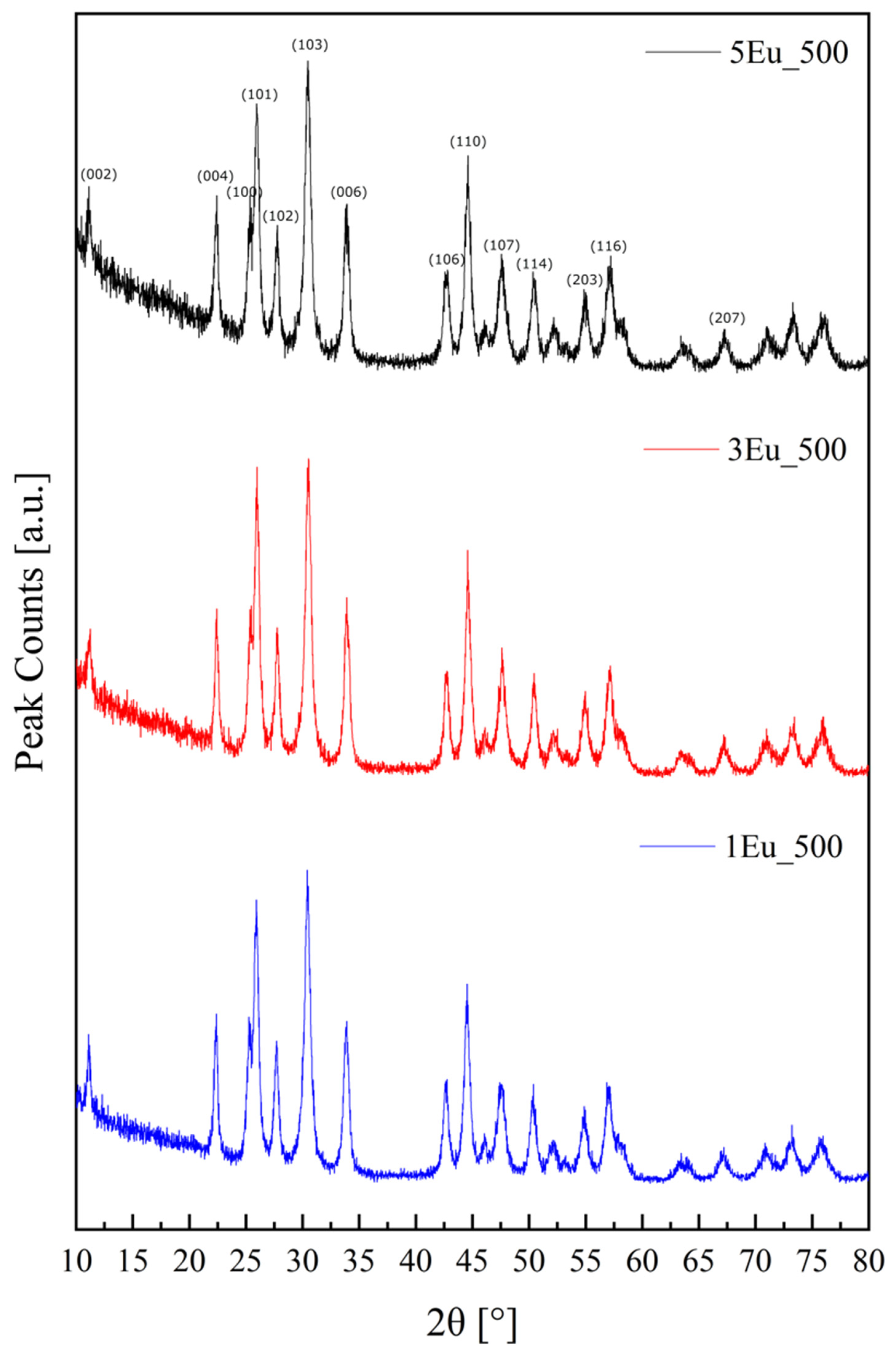
Figure 3 presents the diffraction patterns of the 1Eu_500, 3Eu_500, and 5Eu_500 systems obtained by calcination of the corresponding hydroxycarbonate precursors at 500 °C for 0.5 h. In all cases, the observed reflections are consistent with single-phase rare-earth oxycarbonates and can be fully indexed to undoped La
2O
2CO
3 (ICDD Card No. 037–0804).
For these oxycarbonate systems, too, a slight positive shift in peak positions (again ascertainable by the data reported in
Table 2, especially the Unit Cell Volume) is observed as a function of the dopant amount (Eu
3+ cationic radius is smaller than La
3+ cationic radius [
35]), indicating that the thermal decomposition process preserves the substitutional solid solution established during the co-precipitation and hydrothermal synthesis steps. Also, for this set of samples, the most direct evidence of the effect of Eu doping on the lattice geometry is given by the unit cell volume, reported in
Table 2, which progressively decreases from 0.2286 nm
3 to 0.2271 nm
3.
3.3. EDS Analysis
The EDS analysis results, performed on both the as-synthesized and calcined samples, are displayed in
Table 3. Such results globally confirm the nominal composition of all the samples because the maximum deviation from the nominal Eu content is around 0.5%. Indeed, considering the intrinsic limit of EDS analysis, we believe that such values are reasonably close to the nominal ones, confirming the effectiveness of the proposed synthesis route.
3.4. Optical Absorption Behavior and Band-Gap Evolution
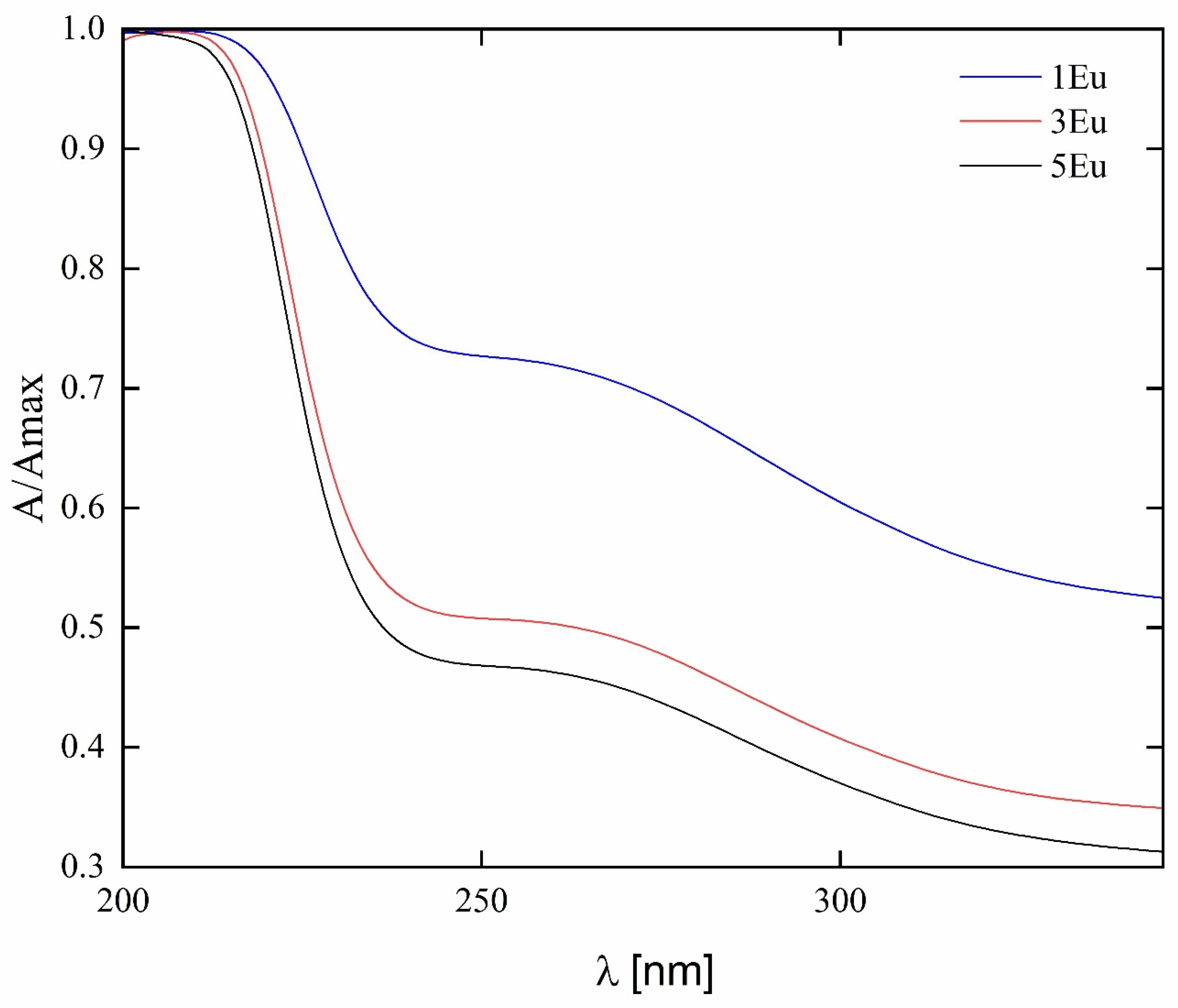
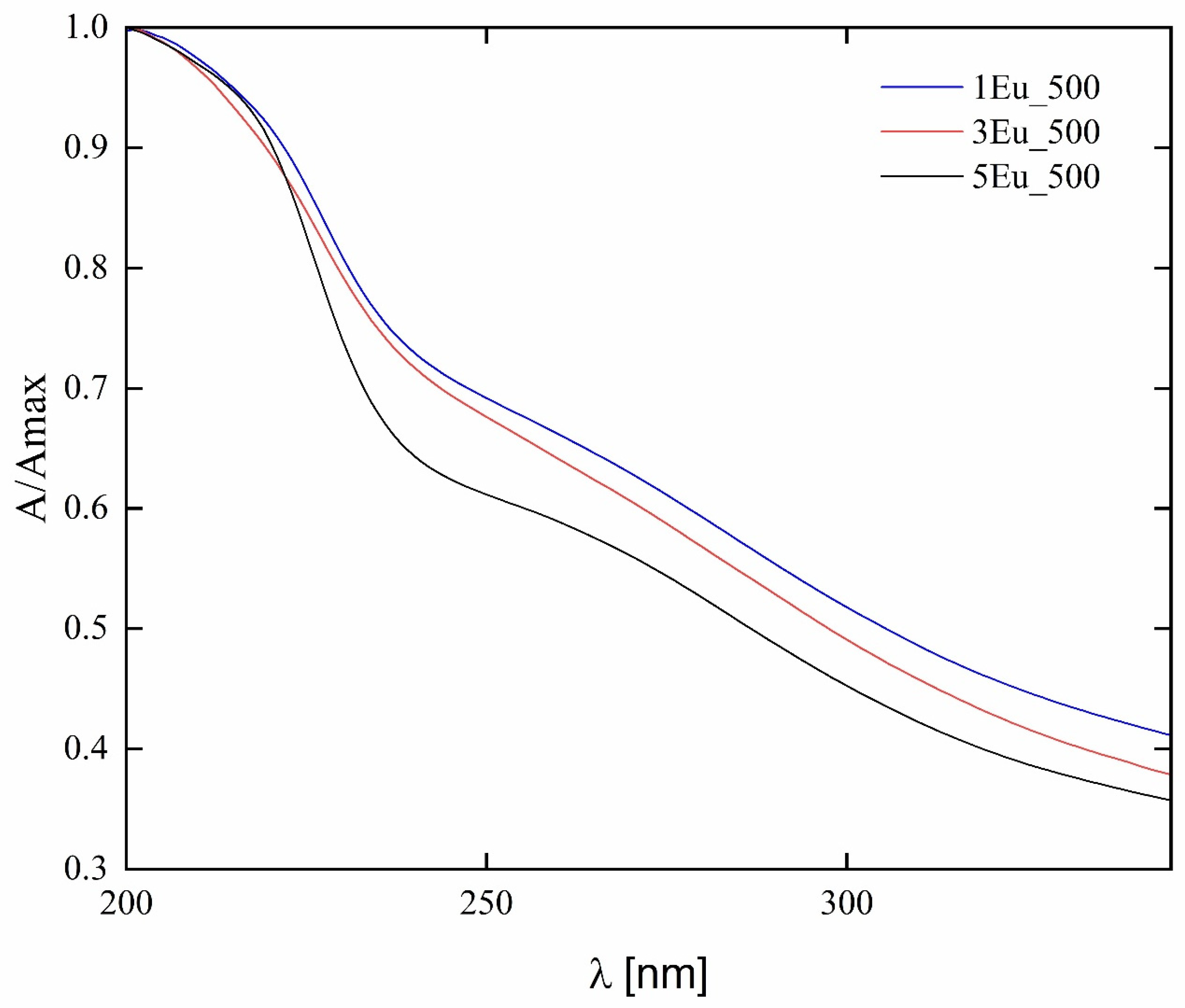
The optical properties of the differently prepared Eu-doped hydroxycarbonates and oxycarbonates are reported in
Figure 4 and
Figure 5. All absorption spectra exhibit a neat peak in the UV region and centered in the band 200–210 nm for hydroxycarbonates, while oxycarbonates present a narrower peak centered at 200 nm with a minimum red shift (~2 nm) for 1Eu. The broader absorption band for hydroxycarbonate dispersions can be attributed to a blue-shift effect of the peak with increasing europium content. In both sets of spectra, a secondary shoulder centered around 260 nm is also present, whose intensity decreases as the europium concentration is increased. UV absorption phenomena of these materials are attributed to electronic transitions to the conduction band states, as typically observed in semiconductors.
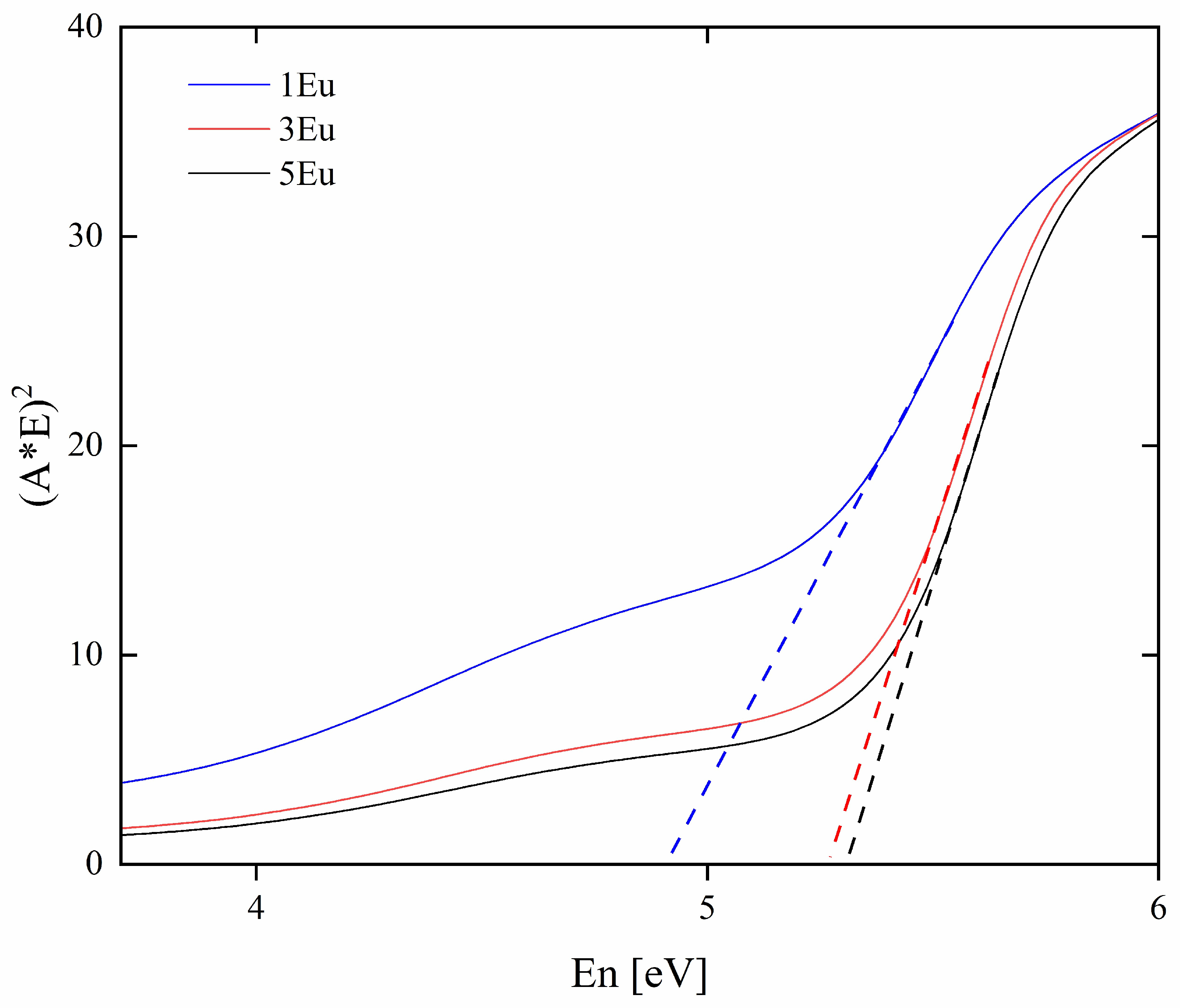
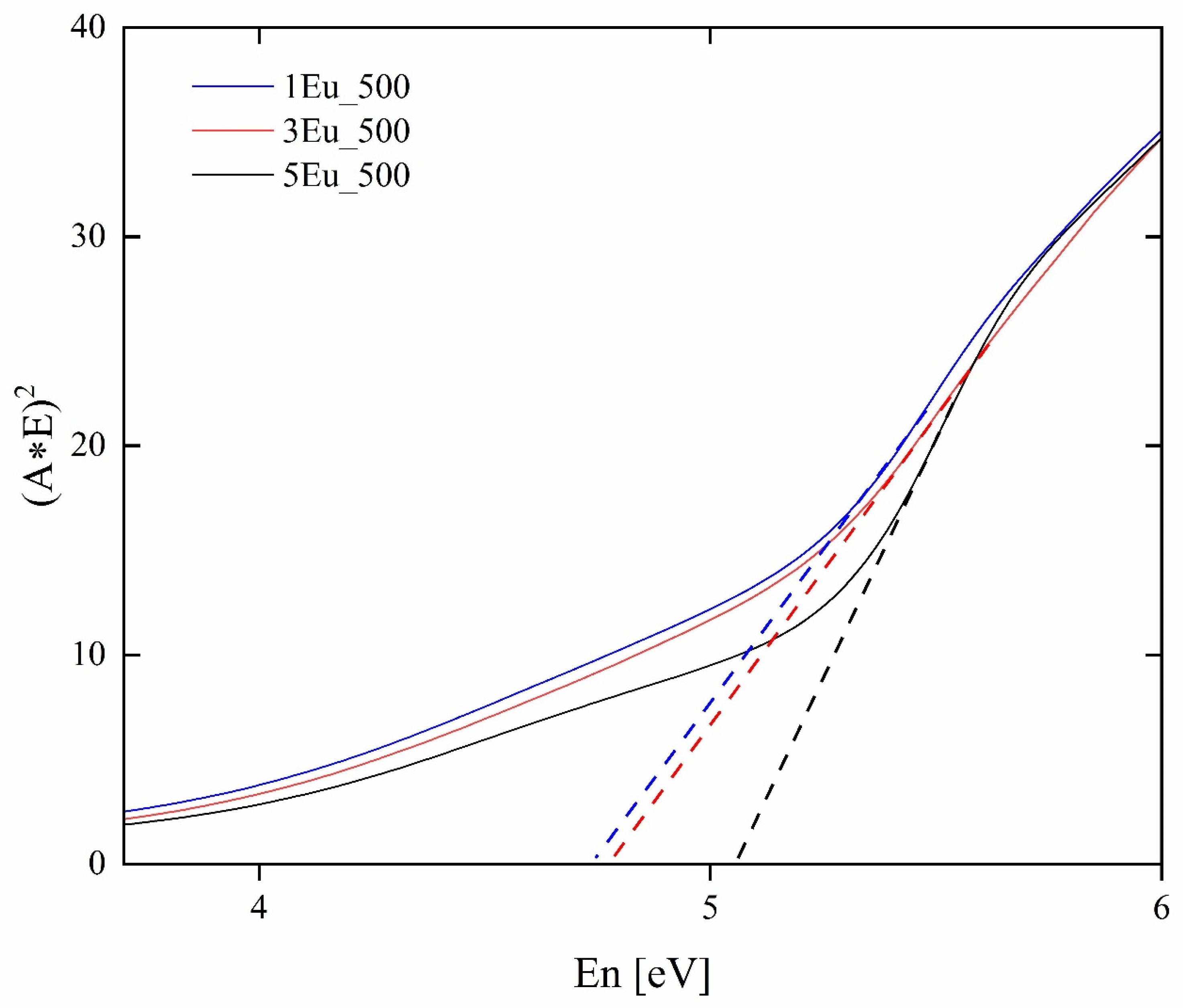
To further investigate the band-gap activation mechanisms, the Kubelka–Munk model was employed to estimate the photon energy associated with these transitions. Kubelka–Munk functions were derived from the absorption spectra and are shown in
Figure 6 and
Figure 7.
4. Discussion
Thermal characterization revealed that the various Eu-doped hydroxycarbonates undergo a well-defined two-step decomposition process. The first thermal event, occurring at approximately 530 °C, is attributable to the conversion of the hydroxycarbonate phase into the corresponding oxycarbonate, while the second event, observed at about 850 °C, is attributable to the final decomposition of the oxycarbonate into the parent rare-earth oxide. The measured mass losses were in close agreement with the theoretical values expected for these transformations, confirming the proposed decomposition pathway.
Structural analysis of the calcined powders confirmed the complete transformation of the hydroxycarbonate precursors into single-phase La
2O
2CO
3-based systems, demonstrating that such a precursor route also enables the preparation of Eu-doped oxycarbonate phases with preserved cationic homogeneity. The diffraction data confirmed the lanthanide contraction, related to the increase in Eu content (see unit cell volume in
Table 2). However, in our opinion, the unit cell volumes slightly deviate from Vegard’s law. In some respects, such a deviation is not surprising, since in rare-earth-doped systems several physical factors as lattice anisotropy, steric rearrangement of polyatomic anions (particularly due to the presence of planar CO
3−2 groups) and elastic strain interaction can lead to non-linear behavior.
The optical properties of the synthesized systems were further investigated by examining the nature of the electronic transitions. The absorption data were processed according to the following Tauc relation [
21,
22]:
where
A is the measured absorbance,
h is the Planck constant,
hv =
E is the energy of incident photons,
Eg is the band-gap energy and
n is the transition exponent. The
n value determines the nature of the gap [a, b]; that is,
n = 0.5 indicates that direct transitions are allowed, while
n = 2, on the contrary, indicates that indirect transitions are allowed.
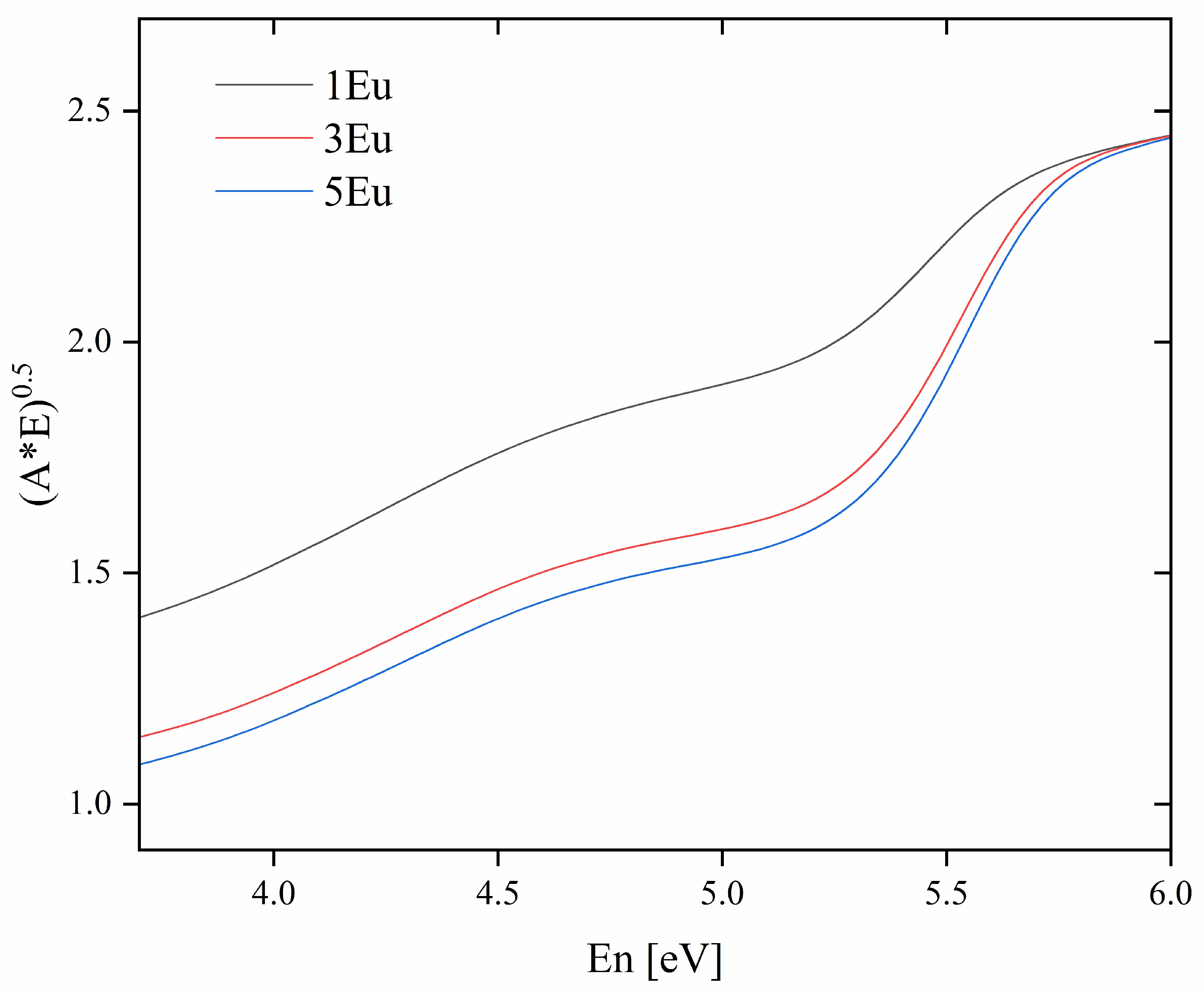
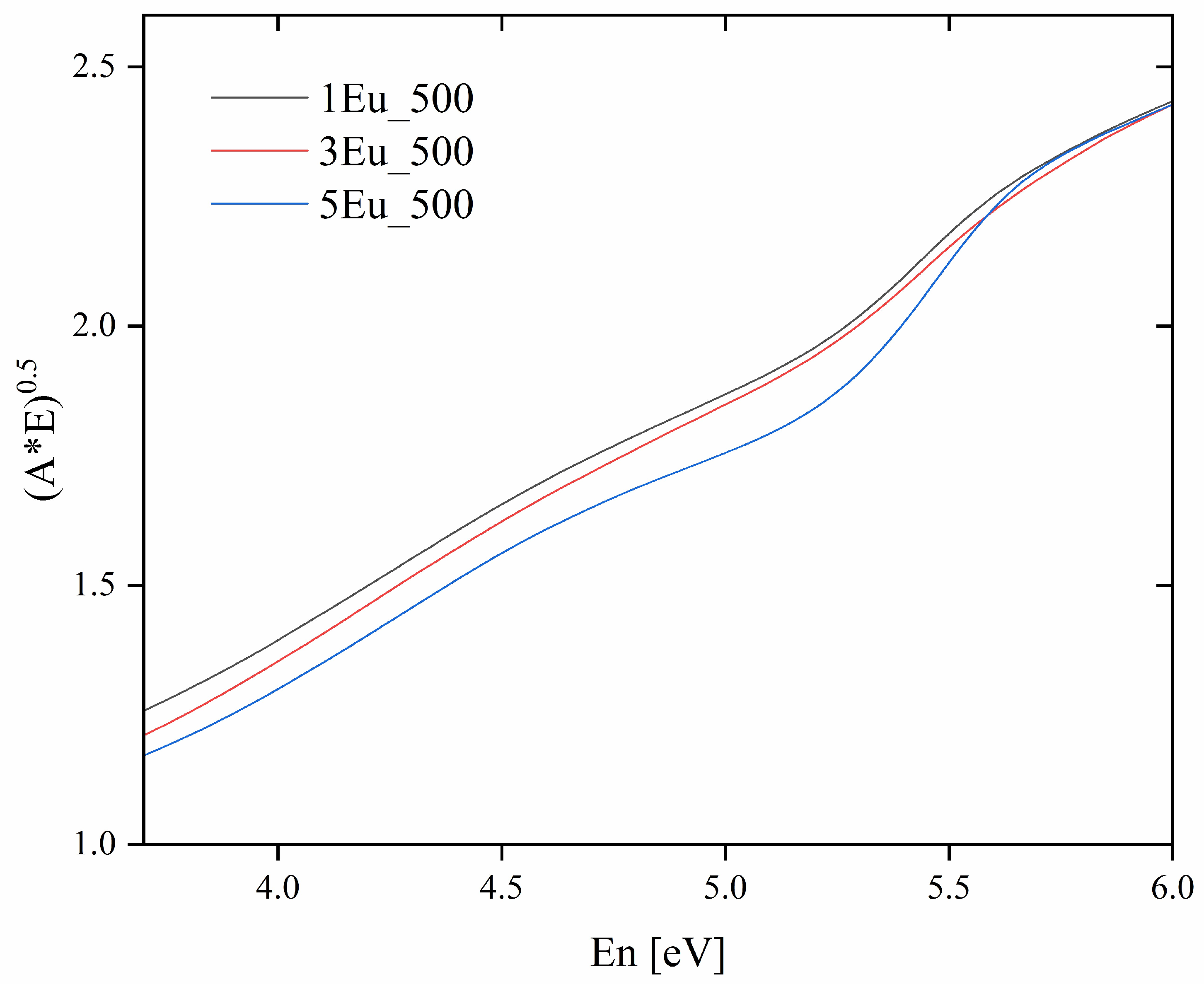
In
Figure 8 and
Figure 9, the experimental data were analyzed by plotting (AE)
0.5 vs. E (for indirect transitions), analogously to
Figure 6 and
Figure 7, where (AE)
2 vs. E (for direct transitions) have been plotted. A comparative analysis of these plots reveals that the linear regime is significantly more pronounced and extends over a wider energy range in the (AE)
2 representation. This observation provides conclusive evidence that the electronic transitions in these materials are direct in nature, involving a momentum-conserving excitation from the oxygen 2p valence band to the lanthanide 5d/4f conduction band.
In
Table 4 are collected the calculated
Eg values, where it is evident that hydroxycarbonates display the highest band-gap values, ranging from 4.9 to 5.4 eV. Indeed, the presence of the hydroxyl groups and the specific CO
3OH lattice arrangement fosters a highly ionic environment, which effectively widens the energy gap between the valence and conduction states. The observed blue shift (from 4.9 to 5.4 eV) in the band gap is attributed to structural distortions and lattice strain rather than the Burstein–Moss effect, given the insulating nature of the hydroxycarbonate matrix and the iso-electronic nature of the La
3+/Eu
3+ substitution.
Within the oxycarbonate family, a progressive increase in the band gap is observed, with values shifting from 4.7 eV to 5.1 eV. This blue shift correlates with the increasing carbonate content and the specific La/Eu stoichiometry in the samples. Such an increase is likely attributed to lattice strain and structural distortions induced by the incorporation of different ratios of Eu3+ and carbonate groups. These modifications alter the metal–oxygen bond lengths and angles, leading to a widening of the energy gap between the valence band (O2p) and the conduction band (Ln 5d/4f).
When comparing the two crystalline phases, a systematic reduction in the band gap is evident upon the thermal transformation from hydroxycarbonates to oxycarbonates. This decrease in Eg upon phase transition is a direct consequence of the lattice condensation. The removal of the hydroxyl groups (-OH) and the subsequent formation of a more compact oxide–carbonate framework lead to an increase in the electronic orbital overlap. This structural densification typically raises the energy of the valence band maximum, thereby narrowing the forbidden energy gap compared to the more open and ionic structure of the hydroxycarbonate precursors.
5. Conclusions
In this work, Eu-doped lanthanum hydroxycarbonates and the corresponding oxycarbonates were successfully synthesized through a combined co-precipitation/hydrothermal route followed by controlled calcination. Structural analysis confirmed that all as-synthesized samples crystallized as single-phase hexagonal LaCO3OH, while calcination at 500 °C for 0.5 h led to the formation of single-phase La2O2CO3. In both systems, the systematic shift in the diffraction peaks with increasing europium content indicated the formation and preservation of homogeneous substitutional solid solutions, with Eu3+ progressively replacing La3+ in the rare-earth cationic sublattice.
Thermal analysis showed that the hydroxycarbonate precursors undergo a well-defined two-step decomposition pathway. The first event, occurring at about 530 °C, was assigned to the transformation of LaCO3OH into La2O2CO3, whereas the second event, at about 850 °C, corresponded to the final decomposition into the rare-earth oxide.
The optical investigation of the synthesized systems revealed that both europium content and phase composition influence the UV absorption response. The estimated band-gap energy increased with Eu concentration, from 4.9 to 5.4 eV for the hydroxycarbonates and from 4.7 to 5.1 eV for the oxycarbonates. This blue shift was mainly attributed to lattice strain and local structural distortions induced by the substitution of La3+ with the smaller Eu3+ ion. Conversely, the transformation from hydroxycarbonate to oxycarbonate produced a systematic decrease in the band gap, likely related to lattice condensation and increased orbital overlap after hydroxyl group removal.
Overall, our results demonstrate that the specifically adopted synthesis route enables the preparation of phase-pure, compositionally controlled La–Eu carbonate-derived materials with tunable optical properties. The study provides useful insight into the relationship between europium incorporation, structural evolution, and band-gap modulation, supporting the potential use of these La–Eu systems as UV-responsive rare-earth-based functional materials and as homogeneous precursors for derived oxycarbonate systems.
Author Contributions
Conceptualization, L.S. and G.D.; methodology, G.D. and L.A.; validation, L.S. and G.D.; formal analysis, V.M. and A.d.N.; investigation, V.M. and A.d.N.; resources, G.D.; data curation, L.S. and A.d.N.; writing—original draft preparation, L.S., A.d.N. and L.A.; writing—review and editing, G.D.; project administration, L.S. and G.D.; funding acquisition, G.D. All authors have read and agreed to the published version of the manuscript.
Funding
This research received no external funding.
Data Availability Statement
Data will be available upon reasonable request.
Acknowledgments
Antonio de Nigris and Luigi Ambrosone thank the Consorzio Interuniversitario per lo Sviluppo dei Sistemi a Grande Interfase (CSGI-Firenze).
Conflicts of Interest
The authors declare no conflicts of interest.
References
- Rorif, F.; Fuger, J.; Desreux, J.F. Thermochemistry of selected trivalent lanthanide and americium compounds: Orthorhombic and hexagonal hydroxycarbonates. Radiochim. Acta 2005, 93, 103–110. [Google Scholar] [CrossRef]
- Subramani, T.; Nagarajan, S.K. Influence on the effect of Gd rare earth doped WO3 nanoparticles for enhanced photocatalytic and antibacterial activities: A nanoplate like morphology. Ceram. Int. 2024, 50, 50252–50262. [Google Scholar] [CrossRef]
- Suzuki, T.; Lauxmann, F.; Sackmann, A.; Staerz, A.; Weimar, U.; Berthold, C.; Barsan, N. Crystal Structure and CO2 Sensing Properties of Rare-earth oxycarbonates. In Proceedings of the 17th International Meeting on Chemical Sensors, Vienna, Austria, 15–19 July 2018; pp. 541–542. [Google Scholar]
- Subramani, T.; Nagarajan, S.K. Synergic effect of rare earth doped Sm doped WO3 nanoparticles for enhanced MB dye photocatalytic activities of wastewater treatment and antibacterial activities against Staphylococcus aureus. Ceram. Int. 2024, 50, 34226–34239. [Google Scholar] [CrossRef]
- Ntwaeaborwa, O.M.; Mofokeng, S.J.; Kumar, V.; Kroon, R.E. Structural, optical and photoluminescence properties of Eu3+ doped ZnO nanoparticles. Spectrochim. Acta Part A Mol. Biomol. Spectrosc. 2017, 182, 42–49. [Google Scholar] [CrossRef] [PubMed]
- Aznan, N.A.K.; Johan, M.R. Quantum size effect in ZnO nanoparticles via mechanical milling. J. Nanomater. 2012, 2012, 439010. [Google Scholar] [CrossRef]
- Barsisa, G.; Belay, A.; Beyene, G.; Seboka, C.; Gudishe, K. Synthesis europium (Eu3+) doped zinc oxide nanoparticles via the co-precipitation method for photocatalytic applications. Nano Biomed. Eng. 2022, 14, 58–70. [Google Scholar] [CrossRef]
- Al-Ghamdi, S.A.; Khasim, S.; Darwish, A.A.A.; Hamdalla, T.A.; Alsharif, M.; Aljohani, M.M.; Fathihy, K. Facile Biogenic synthesis of Europium doped lanthanum silicate nanoparticles as novel supercapacitor electrodes for efficient energy storage applications. Heliyon 2024, 10, e37943. [Google Scholar] [CrossRef]
- Hossain, M.K.; Hossain, S.; Ahmed, M.H.; Khan, M.I.; Haque, N.; Raihan, G.A. A review on optical applications, prospects, and challenges of rare-earth oxides. ACS Appl. Electron. Mater. 2021, 3, 3715–3746. [Google Scholar] [CrossRef]
- Sun, R.; Zhou, D.; Song, H. Rare earth doping in perovskite luminescent nanocrystals and photoelectric devices. Nano Sel. 2022, 3, 531–554. [Google Scholar] [CrossRef]
- Chen, Y.; Zhang, D.; Peng, Z.; Yuan, M.; Ji, X. Review of research on the rare-earth doped piezoelectric materials. Front. Mater. 2021, 8, 679167. [Google Scholar] [CrossRef]
- Priya, S.S.; Ferby, V.A. Investigation of photoluminescence properties of Eu3+ doped La(OH)3 nanopowder synthesized by combustion method. Mater. Lett. 2024, 368, 136717. [Google Scholar] [CrossRef]
- Onoda, H.; Funamoto, T. Hydrothermal treatment for preparation of europium-lanthanum phosphates and exploration of their fluorescence properties. J. Mater. Res. Technol. 2014, 3, 122–128. [Google Scholar] [CrossRef][Green Version]
- Spiridigliozzi, L.; Ferone, C.; Cioffi, R.; Bortolotti, M.; Dell’Agli, G. New insights in the hydrothermal synthesis of rare-earth carbonates. Materials 2019, 12, 2062. [Google Scholar] [CrossRef]
- Spiridigliozzi, L.; Accardo, G.; Frattini, D.; Marocco, A.; Esposito, S.; Freyria, F.S.; Dell’Agli, G. Effect of RE3+ on Structural Evolution of Rare-Earth Carbonates Synthesized by Facile Hydrothermal Treatment. Adv. Mater. Sci. Eng. 2019, 2019, 1241056. [Google Scholar] [CrossRef]
- Pianassola, M.; Loveday, M.; McMurray, J.W.; Koschan, M.; Melcher, C.L.; Zhuravleva, M. Solid-state synthesis of multicomponent equiatomic rare-earth oxides. J. Am. Ceram. Soc. 2020, 103, 2908–2918. [Google Scholar] [CrossRef]
- Arabacı, A. Citrate/nitrate combustion synthesis and electrical properties of rare earth co-doped Ce0.8Gd0.2−xNdxO1.90 electrolyte materials. Mater. Sci. Eng. B 2020, 260, 114646. [Google Scholar] [CrossRef]
- Parthasaradi, V.; Kavitha, M.; Sridevi, A.; Rubia, J.J. Novel rare-earth Eu and La co-doped ZnO nanoparticles synthesized via co-precipitation method: Optical, electrical, and magnetic properties. J. Mater. Sci. Mater. Electron. 2022, 33, 25805–25819. [Google Scholar] [CrossRef]
- Higashi, K.; Sonoda, K.; Ono, H.; Sameshima, S.; Hirata, Y. Synthesis and sintering of rare-earth-doped ceria powder by the oxalate coprecipitation method. J. Mater. Res. 1999, 14, 957–967. [Google Scholar] [CrossRef]
- Li, Q.; Han, Z.; Shao, M.; Liu, X.; Qian, Y. Preparation of cerium hydroxycarbonate by a surfactant-assisted route. J. Phys. Chem. Solids 2003, 64, 295–297. [Google Scholar] [CrossRef]
- Tauc, J.; Grigorovici, R.; Vancu, A. Optical properties and electronic structure of amorphous germanium. Phys. Status Solidi B 1966, 15, 627–637. [Google Scholar] [CrossRef]
- Viezbicke, B.D.; Patel, S.; Davis, B.E.; Birnie, D.P., III. Evaluation of the Tauc method for optical absorption edge determination. Phys. Status Solidi B 2015, 252, 1700–1710. [Google Scholar] [CrossRef]
- Nair, G.B.; Swart, H.C.; Dhoble, S.J. A review on the advancements in phosphor-converted light emitting diodes (pc-LEDs): Phosphor synthesis, device fabrication and characterization. Prog. Mater. Sci. 2020, 109, 100622. [Google Scholar] [CrossRef]
- Wang, W.; Zhu, P. Red photoluminescent Eu3+-doped Y2O3 nanospheres for LED-phosphor applications: Synthesis and characterization. Opt. Express 2018, 26, 34820–34829. [Google Scholar] [CrossRef]
- Lakde, J.; Mehare, C.M.; Pandey, K.K.; Dhoble, N.S.; Dhoble, S.J. Recent development of Eu3+-doped phosphor for white LED application: A review. J. Phys. Conf. Ser. 2021, 1913, 012029. [Google Scholar] [CrossRef]
- Panchula, M.L.; Akinc, M. Morphology of lanthanum carbonate particles prepared by homogeneous precipitation. J. Eur. Ceram. Soc. 1996, 16, 833–841. [Google Scholar] [CrossRef]
- Zhao, D.; Yang, Q.; Han, Z.; Sun, F.; Tang, K.; Yu, F. Rare earth hydroxycarbonate materials with hierarchical structures: Preparation and characterization, and catalytic activity of derived oxides. Solid State Sci. 2008, 10, 1028–1036. [Google Scholar] [CrossRef]
- Kaczmarek, A.M.; Van Hecke, K.; Van Deun, R. Nano-and micro-sized rare-earth carbonates and their use as precursors and sacrificial templates for the synthesis of new innovative materials. Chem. Soc. Rev. 2015, 44, 2032–2059. [Google Scholar] [CrossRef]
- Grace, A.N.; Jeong, S.K. Synthesis of rare earth hydroxycarbonate (LaOHCO3) nanocrystals with tuneable morphology and luminescence properties. Adv. Powder Technol. 2020, 31, 2366–2378. [Google Scholar] [CrossRef]
- Dell’Agli, G.; Spiridigliozzi, L.; Pansini, M.; Accardo, G.; Yoon, S.P.; Frattini, D. Effect of the carbonate environment on morphology and sintering behaviour of variously co-doped (Ca, Sr, Er, Pr) Samarium-doped Ceria in co-precipitation/hydrothermal synthesis. Ceram. Int. 2018, 44, 17935–17944. [Google Scholar] [CrossRef]
- Spiridigliozzi, L.; Bortolotti, M.; Accardo, G.; Vergara, A.; Frattini, D.; Ferone, C.; Dell’Agli, G. An in-depth multi-technique characterization of rare earth carbonates–RE2 (CO3)3·2H2O–owning tengerite-type structure. J. Rare Earths 2022, 40, 1281–1290. [Google Scholar] [CrossRef]
- Holland, T.J.B.; Redfern, S.A.T. Unit cell refinement from powder diffraction data; the use of regression diagnostics. Mineral. Mag. 1997, 61, 65–77. [Google Scholar] [CrossRef]
- Monfreda, V.; Muscatello, A.; Dell’Agli, G.; Esposito, S.; Spiridigliozzi, L. An effective synthesis protocol for differently-doped (Eu3+/Gd3+/Tb3+) luminescent La-hydroxycarbonates and their derivatives oxycarbonates and oxides. Ceram. Int. 2025, 51, 40657–40665. [Google Scholar] [CrossRef]
- Spiridigliozzi, L.; Dell’Agli, G. A novel high-entropy rare-earth hydroxycarbonate synthesized via facile hydrothermal synthesis with superior decomposition temperature. Mater. Lett. 2024, 372, 137090. [Google Scholar] [CrossRef]
- Shannon, R.D. Revised effective ionic radii and systematic studies of interatomic distances in halides and chalcogenides. Found. Crystallogr. 1976, 32, 751–767. [Google Scholar] [CrossRef]
| Disclaimer/Publisher’s Note: The statements, opinions and data contained in all publications are solely those of the individual author(s) and contributor(s) and not of MDPI and/or the editor(s). MDPI and/or the editor(s) disclaim responsibility for any injury to people or property resulting from any ideas, methods, instructions or products referred to in the content. |




 ,
,