Fever Burden After Liver Surgery: From Infection Diagnostics to Phenotyping of the Immunometabolic Response

 , , and
Abstract
1. Introduction
2. Literature Search and Narrative Synthesis
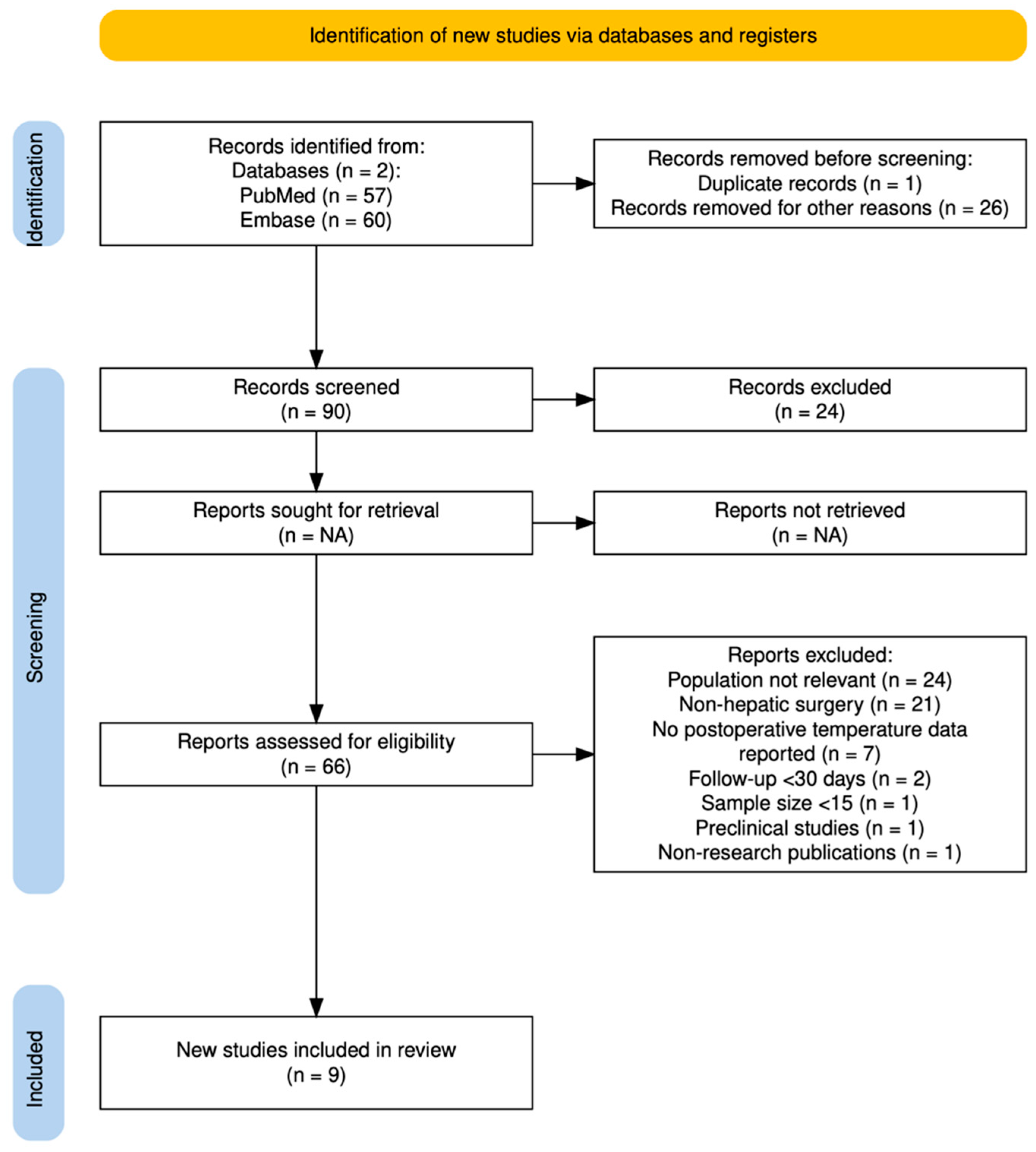
2.1. Scope of the Review and Study Selection Criteria
2.2. Information Sources and Search Strategy
2.3. Study Selection
2.4. Literature Synthesis
2.5. Critical Appraisal of the Literature
3. Results
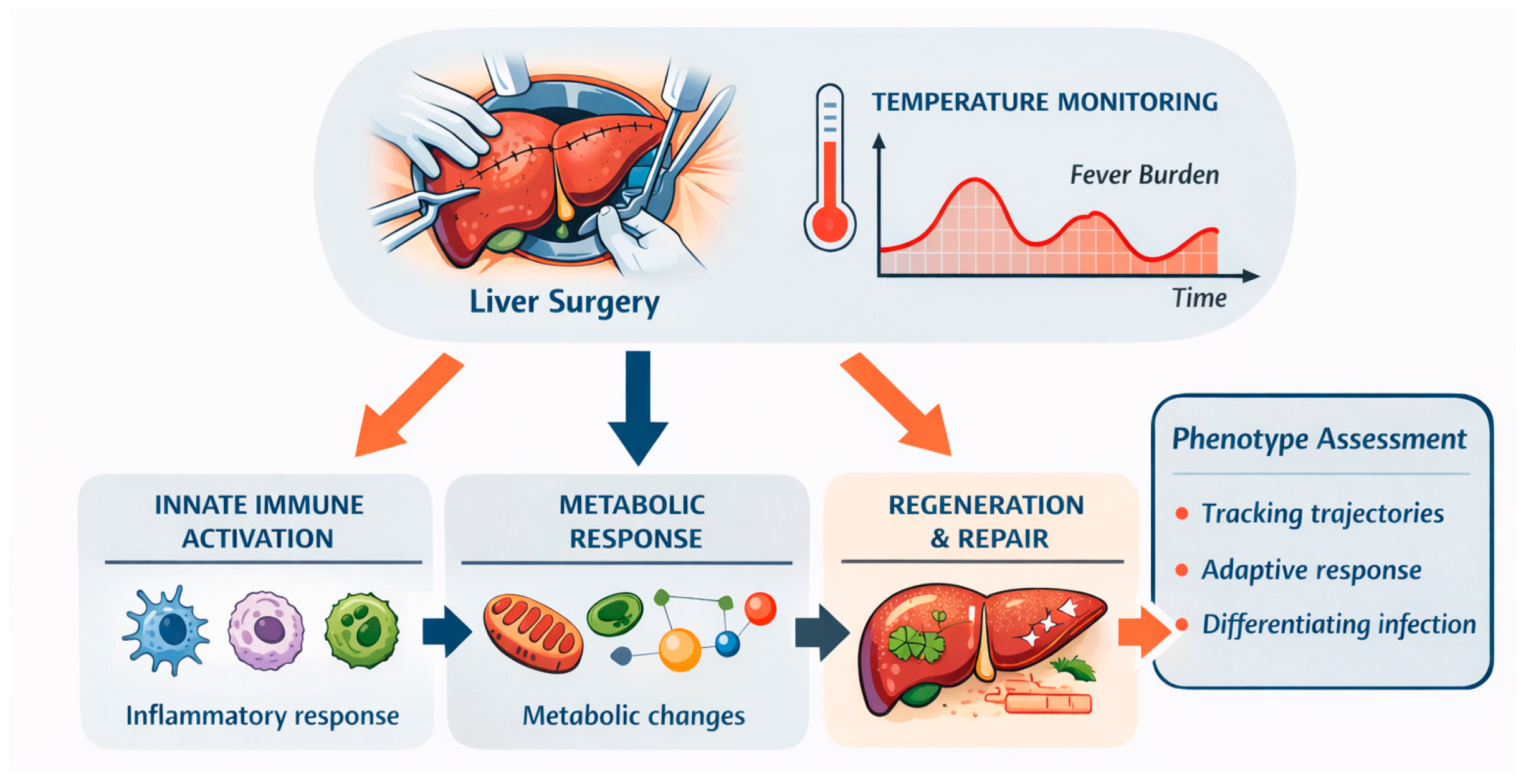
3.1. Fever as a Dynamic Immunometabolic Phenotype of Innate Immunity
3.2. Temperature as a Regulator of Signaling Pathways and Effector Functions
3.3. Clinical Significance of Fever and Fever Burden
4. Discussion
Limitations
5. Conclusions
Author Contributions
Funding
Institutional Review Board Statement
Data Availability Statement
Conflicts of Interest
Abbreviations
| IL-6 | Interleukin-6 |
| HSP70 | Heat shock protein 70 |
| IL-1β | Interleukin-1β |
| IL-10 | Interleukin-10 |
| COX-2 | Cyclooxygenase-2 |
| IFN-γ | Interferon-gamma |
| TNF-α | Tumor necrosis factor-alpha |
| STAT3 | Signal transducer and activator of transcription 3 |
References
- Evans, S.S.; Repasky, E.A.; Fisher, D.T. Fever and the thermal regulation of immunity: The immune system feels the heat. Nat. Rev. Immunol. 2015, 15, 335–349. [Google Scholar] [CrossRef]
- Lai, H.F.; Chau, I.Y.; Lei, H.J.; Chou, S.C.; Hsia, C.Y.; Kao, Y.C.; Chau, G.Y. Postoperative fever after liver resection: Incidence, risk factors, and characteristics associated with febrile infectious complication. PLoS ONE 2022, 17, e0262113. [Google Scholar] [CrossRef]
- Bhavani, S.V.; Carey, K.A.; Gilbert, E.R.; Afshar, M.; Verhoef, P.A.; Churpek, M.M. Identifying Novel Sepsis Subphenotypes Using Temperature Trajectories. Am. J. Respir. Crit. Care Med. 2019, 200, 327–335. [Google Scholar] [CrossRef]
- Ma, X.; Huang, T.; Chen, X.; Li, Q.; Liao, M.; Fu, L.; Huang, J.; Yuan, K.; Wang, Z.; Zeng, Y. Molecular mechanisms in liver repair and regeneration: From physiology to therapeutics. Signal Transduct. Target. Ther. 2025, 10, 63. [Google Scholar] [CrossRef] [PubMed]
- Chopra, S.S.; Haacke, N.; Meisel, C.; Unterwalder, N.; Fikatas, P.; Schmidt, S.C. Postoperative immunosuppression after open and laparoscopic liver resection: Assessment of cellular immune function and monocytic HLA-DR expression. J. Soc. Laparoendosc. Surg. 2013, 17, 615–621. [Google Scholar] [CrossRef]
- Wang, S.; Ji, G.; Feng, X.; Huang, L.; Luo, J.; Yu, P.; Zheng, J.; Yang, B.; Wang, X.; Zhao, Q. Temperature Measurement Timings and the Fever Detection Rate After Gastrointestinal Surgery: Retrospective Cross-Sectional Study. Interact. J. Med. Res. 2024, 13, e50585. [Google Scholar] [CrossRef]
- Nathansen, A.B.; Mølgaard, J.; Meyhoff, C.S.; Aasvang, E.K. Comparison of Wireless Continuous Axillary and Core Temperature Measurement after Major Surgery. Sensors 2024, 24, 4469. [Google Scholar] [CrossRef]
- Boyer, J.; Eckmann, J.; Strohmayer, K.; Koele, W.; Federspiel, M.; Schenk, M.; Weiss, G.; Krause, R. Investigation of Non-invasive Continuous Body Temperature Measurements in a Clinical Setting Using an Adhesive Axillary Thermometer (SteadyTemp®). Front. Digit. Health 2021, 3, 794274. [Google Scholar] [CrossRef] [PubMed]
- Wang, H.; Xi, Z.; Deng, L.; Pan, Y.; He, K.; Xia, Q. Macrophage Polarization and Liver Ischemia-Reperfusion Injury. Int. J. Med. Sci. 2021, 18, 1104–1113. [Google Scholar] [CrossRef]
- Kozłowski, H.M.; Sobocińska, J.; Jędrzejewski, T.; Maciejewski, B.; Dzialuk, A.; Wrotek, S. Fever-Range Hyperthermia Promotes Macrophage Polarization towards Regulatory Phenotype M2b. Int. J. Mol. Sci. 2023, 24, 17574. [Google Scholar] [CrossRef] [PubMed]
- Maloney, E.; Duffy, D. Deciphering the relationship between temperature and immunity. Discov. Immunol. 2024, 3, kyae001. [Google Scholar] [CrossRef] [PubMed]
- Cantet, J.M.; Yu, Z.; Ríus, A.G. Heat Stress-Mediated Activation of Immune-Inflammatory Pathways. Antibiotics 2021, 10, 1285. [Google Scholar] [CrossRef] [PubMed]
- Hasday, J.D.; Fairchild, K.D.; Shanholtz, C. The Role of Fever in the Infected Host. Microbes Infect. 2000, 2, 1891–1904. [Google Scholar] [CrossRef]
- Pietrzyk, B.; Mikolajczyk, J.; Joniec, A.; Fajferek, T.; Kaczara, S. The Role of Thermal Immunomodulation in Postoperative Wound Repair with a Focus on Hepatic Surgery. Int. J. Mol. Sci. 2026, 27, 1473. [Google Scholar] [CrossRef]
- Chong, D.L.W.; Shah, S.A.; Kutschenreuter, J.; Cusman, R.; Pillai, M.M.; Kirwan, D.E.; Gilman, R.H.; Friedland, J.S. Fever-Induced Heat Shock Protein-70 Regulates Macrophage IL-1β and IL-10 Secretion During Mycobacterium Tuberculosis Infection. Eur. J. Immunol. 2025, 55, e51963. [Google Scholar] [CrossRef]
- Wang, L.; Wang, D.; Zhang, T.; Ma, Y.; Tong, X.; Fan, H. The role of immunometabolism in macrophage polarization and its impact on acute lung injury/acute respiratory distress syndrome. Front. Immunol. 2023, 14, 1117548. [Google Scholar] [CrossRef]
- Lu, A.H.; Jain, V.; Chen, P.H.; Churpek, M.M.; Verhoef, P.A.; Quyyumi, A.A.; Bhavani, S.V. Temperature Trajectories Correlate with Cardiac Function in Patients with Sepsis. Crit. Care Explor. 2025, 7, e1282. [Google Scholar] [CrossRef]
- Wang, N.; Liang, H.; Zen, K. Molecular mechanisms that influence the macrophage m1-m2 polarization balance. Front. Immunol. 2014, 5, 614. [Google Scholar] [CrossRef]
- O’Neill, L.A.; Pearce, E.J. Immunometabolism Governs Dendritic Cell and Macrophage Function. J. Exp. Med. 2016, 213, 15–23. [Google Scholar] [CrossRef] [PubMed]
- Keitelman, I.A.; Sabbione, F.; Shiromizu, C.M.; Giai, C.; Fuentes, F.; Rosso, D.; Ledo, C.; Miglio Rodriguez, M.; Guzman, M.; Geffner, J.R.; et al. Short-Term Fever-Range Hyperthermia Accelerates NETosis and Reduces Pro-inflammatory Cytokine Secretion by Human Neutrophils. Front. Immunol. 2019, 10, 2374. [Google Scholar] [CrossRef]
- Kawai, T.; Ikegawa, M.; Ori, D.; Akira, S. Decoding Toll-like receptors: Recent insights and perspectives in innate immunity. Immunity 2024, 57, 649–673. [Google Scholar] [CrossRef]
- Lu, J.; Zhong, X.; Guo, C.; Tang, L.; Yu, N.; Peng, C.; Ding, Y.; Bao, X.; Zhou, J.; Shi, Y. TLR7-MyD88-DC-CXCL16 axis results neutrophil activation to elicit inflammatory response in pustular psoriasis. Cell Death Dis. 2023, 14, 315. [Google Scholar] [CrossRef]
- Cutolo, M.; Campitiello, R.; Gotelli, E.; Soldano, S. The Role of M1/M2 Macrophage Polarization in Rheumatoid Arthritis Synovitis. Front. Immunol. 2022, 13, 867260. [Google Scholar] [CrossRef]
- Singer, M.; Deutschman, C.S.; Seymour, C.W.; Shankar-Hari, M.; Annane, D.; Bauer, M.; Bellomo, R.; Bernard, G.R.; Chiche, J.D.; Coopersmith, C.M.; et al. The Third International Consensus Definitions for Sepsis and Septic Shock (Sepsis-3). JAMA 2016, 315, 801–810. [Google Scholar] [CrossRef]
- Beadle, J.L.; Perman, S.M.; Pennington, J.; Gaieski, D.F. An investigation of temperature and fever burdens in patients with sepsis admitted from the emergency department to the hospital. Acute Med. Surg. 2023, 10, e902. [Google Scholar] [CrossRef]
- Yehya, N.; Fitzgerald, J.C.; Hayes, K.; Zhang, D.; Bush, J.; Koterba, N.; Chen, F.; Tuluc, F.; Teachey, D.T.; Balamuth, F.; et al. Temperature Trajectory Sub-phenotypes and the Immuno-Inflammatory Response in Pediatric Sepsis. Shock 2022, 57, 645–651. [Google Scholar] [CrossRef]
- Drewry, A.M.; Fuller, B.M.; Bailey, T.C.; Hotchkiss, R.S. Body temperature patterns as a predictor of hospital-acquired sepsis in afebrile adult intensive care unit patients: A case-control study. Crit. Care 2013, 17, R200. [Google Scholar] [CrossRef] [PubMed]
- Nohra, E.; Appelbaum, R.D.; Farrell, M.S.; Carver, T.; Jung, H.S.; Kirsch, J.M.; Kodadek, L.M.; Mandell, S.; Nassar, A.K.; Pathak, A.; et al. Fever and infections in surgical intensive care: An American Association for the Surgery of Trauma Critical Care Committee clinical consensus document. Trauma Surg. Acute Care Open 2024, 9, e001303. [Google Scholar] [CrossRef] [PubMed]
- So, M.; Hand, J.; Forrest, G.; Pouch, S.M.; Te, H.; Ardura, M.I.; Bartash, R.M.; Dadhania, D.M.; Edelman, J.; Ince, D.; et al. White paper on antimicrobial stewardship in solid organ transplant recipients. Am. J. Transplant. 2022, 22, 96–112. [Google Scholar] [CrossRef] [PubMed]
- Wang, M.J.; Zhang, H.L.; Chen, F.; Guo, X.J.; Liu, Q.G.; Hou, J. The double-edged effects of IL-6 in liver regeneration, aging, inflammation, and diseases. Exp. Hematol. Oncol. 2024, 13, 62. [Google Scholar] [CrossRef]
- Lee, C.T.; Zhong, L.; Mace, T.A.; Repasky, E.A. Elevation in Body Temperature to Fever Range Enhances and Prolongs Subsequent Responsiveness of Macrophages to Endotoxin Challenge. PLoS ONE 2012, 7, e30077. [Google Scholar] [CrossRef]
- Derwin, R.; Patton, D.; Strapp, H.; Moore, Z. The effect of inflammation management on pH, temperature, and bacterial burden. Int. Wound J. 2023, 20, 1118–1129. [Google Scholar] [CrossRef]
- Liu, Y.; Zhao, Q.; Li, K.; Dowding, D. Use of continuous temperature data from wearable devices for fever or infection management in acute hospital settings: A scoping review protocol. BMJ Open 2025, 15, e103630. [Google Scholar] [CrossRef]
- Verma, N.; Haji-Abolhassani, I.; Ganesh, S.; Vera-Aguilera, J.; Paludo, J.; Heitz, R.; Markovic, S.N.; Kulig, K.; Ghoreyshi, A. A Novel Wearable Device for Continuous Temperature Monitoring & Fever Detection. IEEE J. Transl. Eng. Health Med. 2021, 9, 2700407. [Google Scholar] [CrossRef] [PubMed]
- Roberts, N.J., Jr.; Sarria, J.C. Recognizing the roles of fever in host survival and in medical intervention in infectious diseases. Am. J. Med. Sci. 2024, 368, 85–89. [Google Scholar] [CrossRef] [PubMed]
- Prescott, H.C. Identifying Sepsis Subtypes from Routine Clinical Data. Am. J. Respir. Crit. Care Med. 2019, 200, 272–273. [Google Scholar] [CrossRef]
- Grant, J.; Mcnulty, M.C.; Kinnard, K.; Nagin, D.; Robicsek, A.; Bashyal, R.; Padman, R.; Shah, N. Using Group-Based Trajectory Temperature Modeling to Predict Postoperative Infections after Total Knee Arthroplasty. Open Forum Infect. Dis. 2017, 4, S338–S339. [Google Scholar] [CrossRef][Green Version]
- Pile, J.C. Evaluating postoperative fever: A focused approach. Cleve. Clin. J. Med. 2006, 73, S62–S66. [Google Scholar] [CrossRef]
- Schäfer, L.; Dickel, F.; Strohmayer, K.; Koele, W.; Leber, B.; Sucher, R.; Stiegler, P. Early Detection of Postoperative Infections Using Continuous Temperature Monitoring: A Prospective Clinical Trial. J. Clin. Monit. Comput. 2025. [Google Scholar] [CrossRef]
- Fajferek, T.; Joniec, A.; Kaczara, S.; Mażul Kulesza, E.; Mikolajczyk, J.; Pietrzyk, B. Temperature Monitoring for Early Detection of Postoperative Wound Infections: A Narrative Review. Appl. Sci. 2025, 15, 12856. [Google Scholar] [CrossRef]



| Author, Year | Setting | Study Type | Fever/Temperature or Immune Assessment | Key Finding Relevant to This Review | Evidence Category |
|---|---|---|---|---|---|
| Lai et al., 2022 [2] | Liver resection | Retrospective clinical cohort study | Postoperative fever characteristics, including timing of fever onset, peak temperature, and recurrent febrile episodes | Delayed fever onset after postoperative day 2, peak temperature > 38.6°C, and recurrent febrile episodes were associated with febrile infectious complications after liver resection. This is the strongest direct liver-surgery-specific clinical evidence supporting the relevance of fever dynamics. | Direct liver-surgery clinical evidence |
| Chopra et al., 2013 [5] | Open versus laparoscopic liver resection | Experimental translational liver-surgery study | Monocytic HLA-DR expression and ex vivo-stimulated cytokine response after liver resection | Laparoscopic liver resection showed a trend toward better preservation of postoperative immune function compared with open surgery. These findings support biological plausibility linking surgical injury with postoperative host-response changes, but do not validate fever burden as a diagnostic or prognostic marker. | Direct liver-surgery mechanistic evidence |
| Wang et al., 2021 [9] | Liver ischemia–reperfusion injury | Review of experimental and translational evidence | Macrophage polarization in liver ischemia–reperfusion injury | Macrophage polarization is closely involved in liver ischemia–reperfusion injury and tissue repair. This supports the biological relevance of linking postoperative inflammatory temperature patterns with macrophage-mediated liver injury and regeneration, but remains mechanistic rather than clinical fever-burden evidence. | Liver-specific mechanistic evidence |
| Wang et al., 2024 [6] | Gastrointestinal surgery | Retrospective cross-sectional postoperative study | Fever detection according to different temperature measurement timings | Fever detection after gastrointestinal surgery depended strongly on timing and frequency of temperature measurements. This supports the methodological limitation of intermittent postoperative temperature assessment. | Non-hepatic postoperative monitoring evidence |
| Nathansen et al., 2024 [7] | Major abdominal surgery | Postoperative validation study | Wireless continuous axillary temperature monitoring compared with urinary bladder core temperature measurement | Wireless continuous axillary temperature monitoring was feasible after major abdominal surgery and was compared with urinary bladder core temperature measurement in 40 postoperative patients. This supports feasibility of high-temporal-resolution monitoring but does not validate fever burden in liver surgery. | Non-hepatic postoperative monitoring evidence |
| Boyer et al., 2021 [8] | Clinical temperature monitoring | Prospective multicentre validation study | Continuous non-invasive axillary temperature monitoring using SteadyTemp® | Adhesive axillary thermometer enabled continuous non-invasive temperature assessment in a clinical setting, supporting feasibility of wearable temperature monitoring technologies. | Temperature-monitoring technology evidence |
| Bhavani et al., 2019 [3] | Sepsis/critical care | Retrospective temperature-trajectory modelling study with validation | Longitudinal temperature trajectories | Temperature-trajectory clustering identified distinct sepsis subphenotypes with different clinical risk profiles. This supports the conceptual value of trajectory-based interpretation but represents hypothesis-generating extrapolation from non-hepatic critical illness. | Hypothesis-generating extrapolation from sepsis/critical care |
| Evans et al., 2015 [1] | Fever biology and immune regulation | Mechanistic narrative review | Thermal regulation of immune responses during fever | Fever-range temperatures modulate innate and adaptive immune responses and support interpretation of fever as an active biological response rather than a passive symptom. | Supportive mechanistic immunology evidence |
| Kozlowski et al., 2023 [10] | Fever-range hyperthermia and macrophage phenotype | Experimental mechanistic study | Fever-range hyperthermia exposure and macrophage polarization | Fever-range hyperthermia promoted macrophage polarization toward a regulatory M2b-like phenotype. This supports biological plausibility linking temperature elevation with macrophage phenotype modulation, but it is not direct liver-surgery clinical evidence. | Supportive mechanistic immunology evidence |
| Feature | M1-Like Macrophages (Early Inflammatory Phase) | M2-Like Macrophages (Regulatory/ Regenerative Phase) |
|---|---|---|
| Dominant triggers | Tissue injury, damage-associated molecular patterns (DAMPs), ischemia–reperfusion stress | Resolution signals, apoptotic cells, regenerative cues |
| Association with fever | Early increase in postoperative temperature, more pronounced febrile response, or persistent/recurrent fever episodes | Declining or moderate fever response accompanying resolution of postoperative inflammation |
| Cytokine profile | IL-1β, IL-6, TNF-α, COX-2 | IL-10, TGF-β, reduced IL-1β signalling |
| Metabolic state | Glycolysis-dominant metabolism with increased reactive oxygen species production | Oxidative phosphorylation and lipid metabolism predominance |
| Functional role | Amplification of inflammatory signalling, pathogen control, and clearance of damaged tissue | Resolution of inflammation, tissue repair, and support of regenerative processes |
| Potential impact on liver tissue | Persistent activation may contribute to exacerbation of ischemia–reperfusion injury | May support hepatocyte proliferation and tissue remodelling |
| Potential clinical interpretation | Potential association with persistent inflammatory activation and prolonged postoperative fever patterns | Potential association with regulated postoperative inflammatory response and recovery processes |
| Interpretation in liver surgery | May reflect an adaptive early inflammatory response, although persistent activation could indicate dysregulated postoperative inflammation | May reflect transition toward inflammation resolution and regenerative recovery processes |
Disclaimer/Publisher’s Note: The statements, opinions and data contained in all publications are solely those of the individual author(s) and contributor(s) and not of MDPI and/or the editor(s). MDPI and/or the editor(s) disclaim responsibility for any injury to people or property resulting from any ideas, methods, instructions or products referred to in the content. |
© 2026 by the authors. Licensee MDPI, Basel, Switzerland. This article is an open access article distributed under the terms and conditions of the Creative Commons Attribution (CC BY) license.
Share and Cite
Pietrzyk, B.; Majdak, P.; Pierzchała, W.; Janeczek, M.; Mikolajczyk, J. Fever Burden After Liver Surgery: From Infection Diagnostics to Phenotyping of the Immunometabolic Response. Appl. Sci. 2026, 16, 4883. https://doi.org/10.3390/app16104883
Pietrzyk B, Majdak P, Pierzchała W, Janeczek M, Mikolajczyk J. Fever Burden After Liver Surgery: From Infection Diagnostics to Phenotyping of the Immunometabolic Response. Applied Sciences. 2026; 16(10):4883. https://doi.org/10.3390/app16104883
Chicago/Turabian StylePietrzyk, Barbara, Paulina Majdak, Wiktor Pierzchała, Maksymilian Janeczek, and Jedrzej Mikolajczyk. 2026. "Fever Burden After Liver Surgery: From Infection Diagnostics to Phenotyping of the Immunometabolic Response" Applied Sciences 16, no. 10: 4883. https://doi.org/10.3390/app16104883
APA StylePietrzyk, B., Majdak, P., Pierzchała, W., Janeczek, M., & Mikolajczyk, J. (2026). Fever Burden After Liver Surgery: From Infection Diagnostics to Phenotyping of the Immunometabolic Response. Applied Sciences, 16(10), 4883. https://doi.org/10.3390/app16104883