1. Introduction
Artificial intelligence (AI) [
1,
2], computational intelligence (CI) [
3], artificial neural networks (ANNs) [
4,
5], machine learning (ML) [
6,
7,
8], and many other additional and intermediate fields collectively referred to by the two-letter abbreviation “AI” have already become an almost mandatory attribute and an integral component for most spheres of everyday life for a significant number of people, bringing many benefits and tangible advantages in solving an extremely wide variety of tasks and processes.
At the same time, a significant increase in the variety and complexity of the processes and problems solved with the help of these technologies (ANNs in particular) has led to a corresponding considerable increase in the computing power and resources required for their processing. In other words, there is an extremely relevant scientific and applied problem of optimizing resources when processing complex structural and functional components of artificial and computational intelligence, particularly ANNs. At the same time, the above-mentioned scientific–applied problem consists of a number of relevant scientific–applied tasks, capable, to one or another degree, of partially solving the former in its own appropriate way.
One such way is, in particular, the early-exit concept for deep neural networks (DNNs), proposed for the first time as part of the study [
9], the key essence of the original idea of which, according to its authors’ intent, was the implementation of “BranchyNet” as a new deep network architecture, which is supplemented with additional classifiers of side branches and allows predicting results based on the observation of unique features even in the early layers of the network.
Thus, the concept of early-exit DNNs, in fact, acts as a kind of a common “platform” that provides the possibility of the integrated use of relevant structural and functional components, capable of ensuring both the correctness of its functioning as well as its further development and/or improvement(s). At the same time, an urgent task within the framework of the early-exit DNN concept still remains: the task of improving existing methods, as well as finding new/alternative methods and means, of identifying so-called “exit points”. That is actually why, within the framework of this research, an alternative novel method of exit point identification for early-exit DNNs is proposed, which is based on the analysis of neural chains, the essence of which has been disclosed in detail in this study.
Let us consider the following main constituent components of the problem statement formalization in the scope of the considered research. In particular, the main global scientific and applied problem of DNN optimization could be represented as being a complex poly-subject dependence divided into subsections, one of the most relevant of which is an early-exit concept, in the scope of which there is an urgent need for developing new/alternative approaches, methods and means of identifying exit points, in particular those dedicated specifically for novice and inexperienced researchers and users who have only basic knowledge of DNNs. And looking ahead a bit, one such novel/alternative approach is, in fact, the one considered in this study, which is based on a special analysis of neural chains. The object of this research is the identification of exit points for early-exit DNNs based on the analysis of neural chains. The subject of the research are the methods and means of artificial and computational intelligence, as well as mathematical and computer modeling. The goal of the research is the development of a neural-chain-analysis-based exit point identification method for early-exit DNNs. In order to achieve the declared goal of the research, the following research tasks have been solved, in particular: a review and analysis of existing works in the researched subject area(s) of both DNN varieties as well as the early-exit concept; the development of a mathematical model, as well as a specialized algorithm, for identifying exit points of early-exit DNNs based on the analysis of neural chains; the development of a software implementation of the proposed method in order to ensure the possibility of computer modeling of the latter; as well as a practical approbation of the developed method on the example of solving a relevant practical applied problem of identifying early-exit points of a multilayer perceptron based on the analysis of reverse chains of maximal weights. Thus, the declared method is based on a developed mathematical model and a specialized algorithm, which, together, provide both the possibility of solving the declared scientific and applied problem as well as further software implementation of the considered method in order to ensure the possibility of computer modeling of the investigated processes, as well as practical approbation of the method itself. The developed method fills the gap, which consists in the lack of use of DNN neural chains (particularly, their linguistic structures) as an additional alternative way of identifying early-exit points, which uses significantly more simplified string logic instead of high-math logic, and due to this, it is more suitable for novice and inexperienced researchers, staff and users (who have only basic knowledge of DNNs), so does not require their additional narrowly specified training and/or extra expert knowledge.
The rest of this paper is structured as follows. A literature review is represented within
Section 2. The method development, including its main components—the developed mathematical model and the specialized algorithm—is described in detail within the relevant
Section 3. The main results obtained from the modeling and practical approbation of the developed method, including all necessary information about the used means, tools and data needed for the method’s modeling and approbation, as well as a comparison with the outcomes of the similar existing approaches are presented and discussed in
Section 4. The conclusions are provided in
Section 5.
2. Literature Review
At present, there is an extremely huge variety of artificial neural networks [
10], descriptions of their main operation principles [
11,
12], as well as their possible varieties [
13], classifications and types [
14], among which, as an example, we will list, in particular, such widely used variations of ANN as:
At the same time, a separate large class of ANN is the popular type already mentioned above, DNN. In general, a DNN is, in fact, any ANN containing several hidden layers between the input and output layers of neurons. Thus, DNNs, in fact, include such previously mentioned types of ANNs as CNN, RNN, LSTM, GAN, MLP, and any others that may contain several hidden layers of neurons within their architecture. That is, DNN represents a vast category of ANNs which combines their most popular and widely used subtypes.
In particular, the authors of [
25] provide insight into deep learning by analyzing its architectures, characteristics and limitations, considering in particular generative architectures, discriminative architectures and hybrid architectures, and analyzing different models of deep learning within these three approaches. At the same time, within the framework of another work [
26], the issue of DNN optimization is considered by adjusting hyperparameters and determining the optimal subset of data using genetic algorithms, which ensures quick selection of the optimal combination of hyperparameters when designing a DNN. In addition, the authors of another work [
27] investigate the relevant issues of DNN optimization in resource-constrained environments (RCEs), covering a wide range of optimization techniques, including network pruning, weight quantization, knowledge distillation, depthwise separable convolution, residual connections, factorization, dense connections, and complex scaling.
At the same time, the authors of [
28] emphasize the positive aspects and advantages of implementing the early-exit concept in DNN, providing such main arguments, in particular, as a valuable decrease in the inference time, minimizing overfitting and gradients vanishing tendencies, as well as the possibility of distribution across multi-level computing platforms. In addition, the authors of [
29] break down the early-exit DNN design methodology into its key components, considering the latest achievements in each of them, comparing early-exit methods with other efficient solutions for inference, and exploring potential ways to address current problems and the most promising future research directions in this area. At the same time, it is important to note and understand that the early exit is precisely the concept, which is quite often closely related to another popular approach of energy-efficient DNNs, presented, in particular, in recent related works [
30,
31,
32].
In addition, the authors of another work [
33] focus on the problem of the gap between training and testing of early-exit DNNs (caused primarily by neglecting early-exit behavior during testing) and propose a solution to this problem by using a sample-weighting approach, according to which simple samples that typically exit during the early stages of logical inference should contribute more to the training of early classifiers, whereas the training of more complex samples (mostly outputs from deeper layers) should be emphasized by late classifiers, as a result of which the authors proposed using a weight prediction network to balance the losses of different training samples at each output.
Meanwhile, the authors of [
34] present a new early-exit neural network that divides the studied DNN into branches in order to classify most samples at earlier branches, thereby reducing the inference cost, while more complex samples (that reach the final branch of the DNN) are subsequently classified using the rejection option, which, together, increase the reliability of the whole system; the authors also proposed an additional optimization mechanism, according to which the branches and rejection thresholds are selected as the result of a multi-objective optimization problem.
At the same time, another work [
35] combines partitioning and early exit into a single performance model to evaluate both the delay and the accuracy of the results of the investigated DNNs, which ultimately supports the hypothesis that flexibility in the number and position of partitioning points, along with placement under simultaneous available computing power limitations, plays an important role in determining and achieving the best result.
Also, the authors of [
36] present a new method that allows the obtainment of results at early-exit points at the expense of an acceptable level of accuracy, where the authors proposed Dynamic Early Exit (DEE)—a real-time online learning algorithm (based on contextual bandit analysis), which observes the performance at each exit point and decides whether to exit or continue processing, thereby addressing an additional issue caused by the fact that the characteristics of early-exit points are inevitably explored more than later ones and creating an imbalance between exploration and development.
And finally, perhaps one of the most fundamental recent works devoted to a detailed review of early-exit DNNs is [
37], where the authors revealed a wide range of aspects of this subject area, including, in particular, the history of the emergence and further evolution of both the concept itself and the architecture of early-exit DNNs; the main advantages of applying this concept to deep neural networks (in particular, accelerating inference, providing an alternative solution to the overtraining/overfitting problem, correcting the DNN overthinking problem, mitigating the vanishing gradient problem, providing a multilayered platform for training and deploying DNNs); DNN early-exit architecture and its components (in particular, a conventional DNN architecture, an early-exit DNN architecture, the design constraints, a branch structure, the location and the number of branches, as well as early-exit policies); learning/training strategies (namely, such strategies as joint, branch-wise, separate, two-stage, KD-based, and hybrid, as well as a comparison of all these strategies); inferences in early-exit DNNs (in particular, such aspects as static and dynamic/learnable early-exit policies and their comparison); as well as the practical application of early-exit DNNs (in particular, in such applied areas as computer vision, image classification, natural language processing, and distributed computing); as well as research challenges and future directions (in particular, in the context of such constituent aspects as expansion into new methods and applications, filling theoretical and practical gaps, optimal architecture design, optimal learning/training strategies, effective policies, as well as advancing towards explainable DNNs).
Thus, through their research, the authors of all the above-considered works reveal the complexity of the entire concept of early-exit DNNs and many aspects of its component, each of which, in fact, represents a spectrum of related relevant scientific and applied/practical problems. At the same time, the researchers emphasize that in order to achieve optimal performance, side branches must be carefully designed with appropriate neural layers and strategically placed along the backbone of the considered/investigated DNNs, thus emphasizing and highlighting the extreme urgency and the critical importance of the exit point identification problem.
3. Method Development
The proposed method (i.e., a neural-chain-analysis-based exit point identification method for early-exit DNNs) has been synthesized on the basis of a specialized algorithm and a mathematical model, developed and described in detail within the current section of this study.
The key fundamental idea of the proposed method is to identify exit points for early-exit DNNs precisely on the basis of an analysis of the neural chains (formed during the operation of previously trained DNNs at each individual iteration), which connects a specific activated neuron of the input layer with a specific activated neuron of the output layer through all activated neurons of all hidden layers of the investigated DNN(s).
Meanwhile, the key peculiarity of the developed method is that it works equally well for both “forward” neural chains (when neurons activated during DNN operation are added to the chain—starting from the input layer, continuing through all hidden layers in ascending order, and ending with the output layer), and for “reverse” neural chains (when neurons activated during DNN operation are added to the chain—starting from the output layer, continuing through all hidden layers in reverse order, and ending with the input layer), both of which are practiced in various DNN studies.
In particular, Equation (1) below demonstrates the basic representation of the chain of activated neurons for any studied DNN:
where
nci is the
і-th chain of active neurons for a particular (
і-th) iterations of the studied DNN operation;
і is the identifier variable of a specific neural chain;
actNeurlj is the activated
j-th neuron of the
l-th layer of the researched DNN;
j is the identifier variable of the activated neuron in the currently considered layer of the studied DNN;
j is the indicator variable for enumerating all layers of the considered/investigated DNN (including its input layer, all hidden layers, and output layer);
nL is the total number of all layers of the studied DNN (including its input layer, all hidden layers, and output layer).
At the same time, Equation (2) below represents the complete set of all neural chains obtained as a result of processing (by the researched DNN) all available various sets of input data: the training, test, and any inference datasets.
where
ANCx is the set of all neural chains obtained for the specific researched
x-th DNN;
і is the identifier variable of a specific researched DNN;
nci is the specific
і-th chain of active neurons of the considered researched DNN;
і is the identifier variable of a specific chain of activated neurons (within the framework of the researched DNN);
nDS is the total number of records in the considered dataset (representing all obtained neural chains within the researched DNN).
Meanwhile, Equation (3) below represents the function for counting the number of neural chains (among the available set of all neural chains obtained for the considered/researched DNN) within which all specific neurons, specified as function arguments, occur simultaneously:
where
count(
ANCx,
nil,
nh1,
…,
nhx,
nol) is the function for counting the number of neural chains (among the set of chains
ANCx of the researched DNN) within which all certain specific neurons, specified as function arguments (e.g.,
nil,
nh1,
…,
nhx,
nol), occur simultaneously;
n({
nci ∈
ANCx:{
nil,
nh1,
…,
nhx,
nol} ∈
nci}) is a simple function that returns the number of elements in the subset consisting only of those neural chains (within the set
ANCx,), which must necessarily include all of the listed neurons {
nil,
nh1,
…,
nhx,
nol};
nci is the specific
і-th chain of active neurons of the considered/researched DNN;
nil is the considered neuron of the input layer of the researched DNN;
nh1 is the considered neuron of the 1st hidden layer of the researched DNN;
nhx is the considered neuron of the last (within the particular current neural chain under consideration) hidden layer of the researched DNN (in this case, it does not always refer to the very last hidden layer of the whole DNN in general, but rather to the last one within the framework of the particular neural chain under current consideration, which means that this value is limited by the total number of hidden layers in the researched DNN, but is not necessarily equal to it);
nol is the considered neuron of the output layer of the researched DNN;
і is the identifier variable of the specific chain of activated neurons (within the framework of the researched DNN);
nDS is the total number of records within the considered dataset (representing all neural chains obtained for the researched DNN).
In addition, Equation (4) below represents the function for calculating the probability of achieving the desired result at the output of the researched DNN (that is, the activation of a specific desired neuron in the output layer of this DNN) for a given combination of activated neurons in the input and hidden layers:
where
ANCx,
nil,
nh1,
nhx,
nol,
i, and
nDS have exactly the same meaning as in Equation (3) above;
PF(
ANCx,
nil,
nh1,
…,
nhx,
nol) is the function for calculating the probability of activation of the neuron
nol in the output layer of the considered/researched DNN (represented by the appropriate set of neural chains
ANCx) in cases when there are already previously activated (during the operation of the considered/researched DNN) neurons, listed as arguments of this function, namely the activated neuron of the input layer
nil and the activated neuron
nh1 of the first hidden layer
h1 and activated neurons of all subsequent hidden layers up to the layer
hx (and, accordingly, its activated neuron
nhx);
count(
ANCx,
nil,
nh1,
…,
nhx,
nol) is the function for counting the number of neural chains (among the set of all neural chains
ANCx of the researched DNN), within which all certain specific neurons specified as function arguments (e.g.,
nil,
nh1,
…,
nhx) occur simultaneously, and, as a final result, the specific neuron
nol is activated in the output layer of the considered/researched DNN;
count(
ANCx,
nil,
nh1,
…,
nhx,
nolx) is the function for counting the number of neural chains (among the set of all neural chains
ANCx of the considered/researched DNN), within which all certain specific neurons specified as function arguments (e.g.,
nil,
nh1,
…,
nhx) occur simultaneously, and, as a final result, the specific neuron
nolx is activated in the output layer of the considered/researched DNN;
is the total number of all neural chains (among the set of all neural chains
ANCx of the researched DNN), within which all certain specific neurons specified as function arguments (e.g.,
nil,
nh1,
…,
nhx) occur simultaneously, and, as a final result, any of the neurons in the output layer (of the considered/researched DNN) are activated, with the exception of the single specific neuron
nol under consideration (condition
);
nolx is any neuron in the output layer of the researched DNN other than
nol;
olx is the counter variable for iterating over all neurons in the output layer of the researched DNN;
olN is the total number of neurons in the output layer of the researched DNN.
Thus, the aforementioned probability function PF() actually relies exclusively on the already existing ex post (i.e., post hoc) analysis of all de facto possible neural chain combinations obtained during the training process of the specific considered/researched DNN. Thus, this function works exclusively with actual (empirical/factual) data, without interfering in any way with the internal processes of the DNN operation itself, but instead naturally submitting to them.
Finally, Equation (5) below represents the DNN early-exit point identification function based on neural chain analysis:
where
ANCx,
nil, nh1, nolx,
olx, and
olN have exactly the same and absolutely identical meaning as in Equation (4) above;
EEPFn(
ANCx, nihx) is a logical binary function (that can only take binary values, namely: 1—i.e., “true”; or 0—i.e., “false”) for identifying the early-exit points of the researched DNN based on an analysis of its complete set of neural chains
ANCx;
nіhx is the indicator variable for enumerating all neurons in all hidden layers of the researched DNN, starting from its first hidden layer
h1 and continuing with all its subsequent hidden layers up to the penultimate one (condition
, where
ol is the output layer of the considered/researched DNN, and accordingly
ol-2 is its penultimate hidden layer);
PF(
ANCx, nil,
nh1,
…,
nіhx,
nol) is the function for calculating the probability of activation of the neuron
nolx in the output layer of the considered/researched DNN (represented by appropriate set of all neural chains
ANCx), in cases when there are already previously activated (during the operation of this considered/researched DNN) neurons listed as the remaining arguments of this function.
Thus, the introduced logical binary function EEPFn(ANCx, nihx) takes the value “1” (i.e., “true”) only for those specific neurons nihx (which serve as its arguments) of the researched DNN, whose presence in any neuron chain results in a 100% probability of achieving a particular outcome at the output. Or, rephrasing in other words, a neural chain fragment (i.e., “trimming“) ending with neuron nihx, regardless of all subsequent neurons in that chain, will always lead to the same result at the output of the considered/researched DNN (i.e., the same activated neuron in the output layer of this researched DNN).
It is worth noting right away that the behavior of the aforementioned EEPFn() function as the dataset size grows or diminishes depends primarily on the scalability properties of the probability function PF(), which depends on the scalability of the count() function, which, in turn, depends on the scalability of a specific instrument (from a variety of those existing today or in the future) and the algorithm that underlies it for analyzing the occurrences of particular substrings (i.e., trimmed neural chains) within a defined list of strings (i.e., full neural chains). In particular, within the framework of this research, the Python “in” operator was used as such an instrument, based on a built-in optimized algorithm which is a combination of Boyer–Moore and Horspool with linear scalability.
At the same time, it is important to note a quite obvious but, at the same time, extremely important feature of the developed method: the further the method “moves through” the researched DNN, from its first hidden layer up to its penultimate hidden layer, the more early-exit points it will identify. In this regard, the most useful and tangible optimization effect for the researched DNN operation will be achieved by those specific early-exit points (identified by the developed method) that are closest to the DNN input layer.
Thus, the set of Equations (1)–(5), in fact, represents the developed mathematical model of the proposed method for identifying early-exit points of DNNs based on neural chain analysis.
The next mandatory stage in the development of the proposed method is the creation of a specialized algorithm for identifying early-exit points of DNNs based on neural chain analysis. In particular,
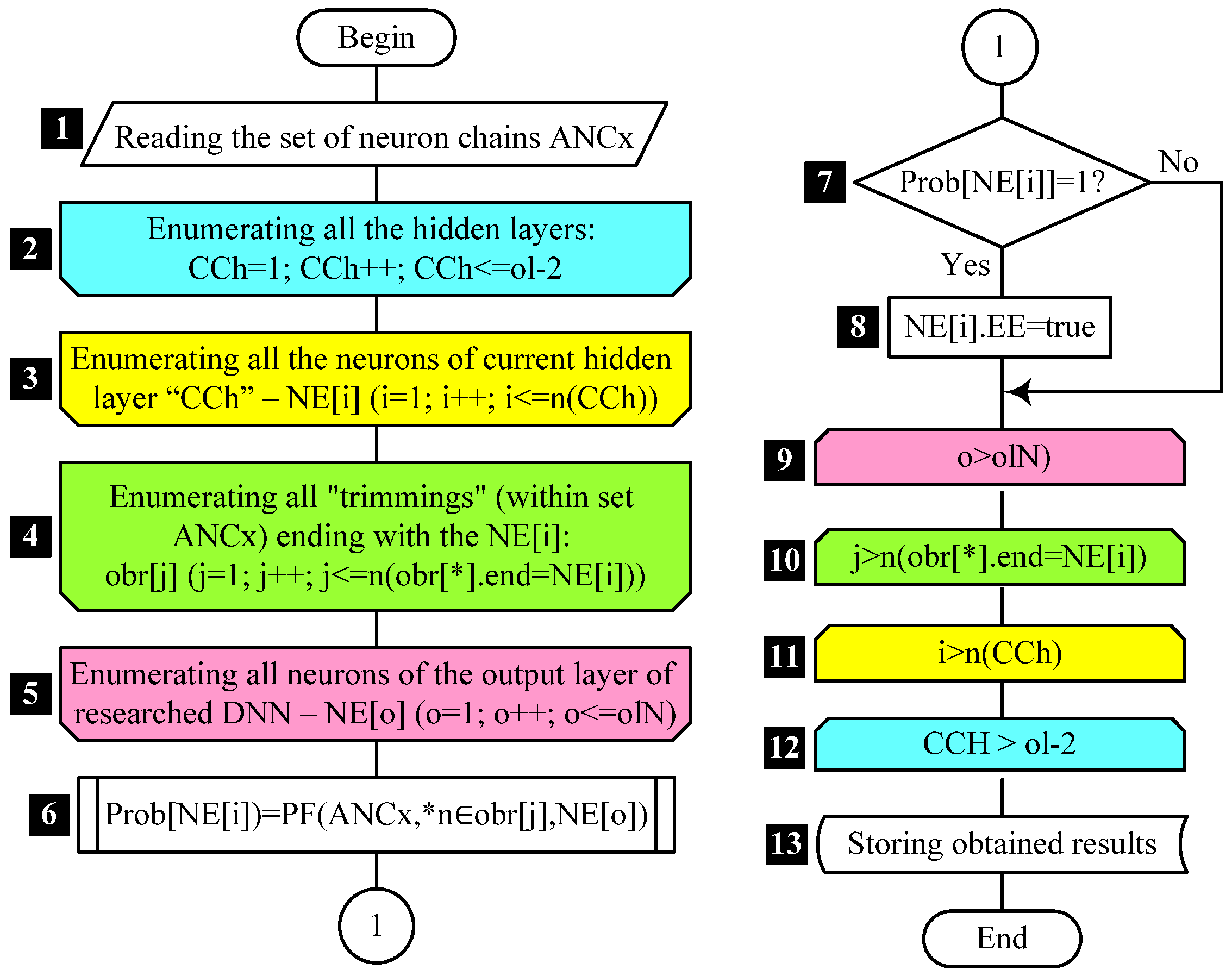
Figure 1 below represents a flowchart of such a developed specialized algorithm.
The operation of the developed algorithm begins with block “1”, which is responsible for reading the set of neural chains ANCx of the researched (and trained) DNN. Next, there is a combination of 4 consecutively encapsulated cycles (loops), which are detailed below. In particular, the first loop, represented by block “2”, is responsible for enumerating all hidden layers (of the researched DNN), from the first to the penultimate inclusively: CCh=1; CCh++; CCh<=ol-2 (where ol is the indicator of the output layer of the researched DNN). The second loop, represented by block “3”, is responsible for enumerating all neurons of the specific (currently considered) hidden layer CCh. The third loop, represented by block “4”, is responsible for enumerating all “trimmings” of all neural chains within the set ANCx, which (“trimmings”) end with the current neuron NE[i]: obr[j] (j=1; j++; j<=n(obr[*].end=NE[i])). Meanwhile, the fourth loop, represented by block “5”, is responsible for enumerating all neurons of the output layer of the researched DNN, marked with a variable NE[o] (o=1; o++; o<=olN). In turn, within the fourth loop, the following processes occur, namely: calculating the probability of achieving the only possible result (NE[o]) when performing an early exit from the considered neuron NE[i]—represented by block “6”; block “7” is responsible for analyzing the obtained value of Prob[NE[i]] to determine whether it is equal to 1, and if so, the currently considered neuron NE[i] is defined as an early-exit point for the considered/researched DNN: NE[i].EE=true (which is represented by block “8”). Moving further, block “9” is responsible for exiting the fourth loop, block “10” for exiting the third loop, block “11” for exiting the second loop, and block “12” for exiting the first loop. Finally, the storing of the obtained results is performed within block “13” of the developed algorithm.
The fundamental operational element of the developed specialized algorithm is actually the calculation (using the developed mathematical model, in particular, its functions PF()) of the probability (within the algorithm, this probability is denoted as “Prob[NE[i]]”) of achieving the only possible result (within the algorithm, this result is denoted as “NE[o]”) when performing an early-exit from the currently considered neuron (within the algorithm, such a neuron is denoted as “NE[i]”) of the currently considered hidden layer (within the algorithm, such hidden layer is denoted as “CCh”), and in case such probability equals “1” (i.e., 100%), an unambiguous identification of this currently considered neuron (NE[i]) as a defined early-exit point for the considered/investigated DNN is performed.
Thus, the developed mathematical model and the developed specialized algorithm, both together, form the developed neural-chain-analysis-based exit point identification method for early-exit DNNs, providing the possibility to solve the considered relevant scientific and applied problem, developing and complementing, thereby, the entire early-exit concept for DNNs as a whole, which, by the way, has thus been further developed.
Among the key positive aspects and advantages of the developed method, we note, in particular, the following:
No need to analyze and finalize the architecture of the studied DNNs in order to encapsulate additional intermediate branches as early-exit classifiers (as the classic early-exit DNN concept requires), because instead the method developed within the scope of this research directly identifies the neurons of the hidden layers (of the studied DNNs) as early-exit points, without requiring, thereby, the introduction of any other additional neurons, connections, relations, intermediate layers, branches, etc. and therefore it does not interfere with the architecture or structure of the studied DNNs;
The ability of the method developed within the scope of this research to process both “forward” and “reverse” neural chains equally well;
The simplicity of representation, understanding, application, and further software implementation of the developed method, which does not require its researchers and users to have thorough knowledge in the field of higher mathematics, being simply satisfied, instead, with only a common understanding of the basics of DNNs’ overall structure and functioning.
At the same time, it is important to note and understand that the developed method implements the possibility of identifying early-exit points (namely, neurons of hidden layers) precisely in the context of those specific fragments (“trimmings”) of neural chains of the researched DNN, for which they (the identified early-exit points/neurons) are the closing link/element (fragments).
4. Results and Discussion
The main results of the conducted research are considered, in particular, as results of the practical approbation of the developed method on the example of solving a relevant practical applied problem of identifying early-exit points of a multilayer perceptron based on the analysis of maximal weight reverse chains. In fact, the solution of the considered practical applied problem provides, to some extent, further development of another method (i.e., an impact factor reverse analysis method for software complexes’ support automation) [
38], which actively uses and produces exactly the reverse neural chains as the main result of its operation.
In addition, as part of the current study, the software implementation of the developed method (i.e., neural-chain-analysis-based exit point identification method for early-exit DNNs) has been additionally performed using the Python programming language (version 3.13.7) [
39] and the Thonny integrated development environment (version 4.1.7) [
40,
41]. This developed software implementation is able to successfully process the maximum weight reverse chains of neurons, demonstrating, in such a way, the universality of the developed method in general.
Thus, the input data for the considered practical applied problem being solved are the reverse neural chains, the inversion of which, by the way, provides the possibility of obtaining the counterparts of appropriate forward neural chains describing the propagation of the researched MLP DNN(s): from the input layer, through all hidden layers, and up to the output layer.
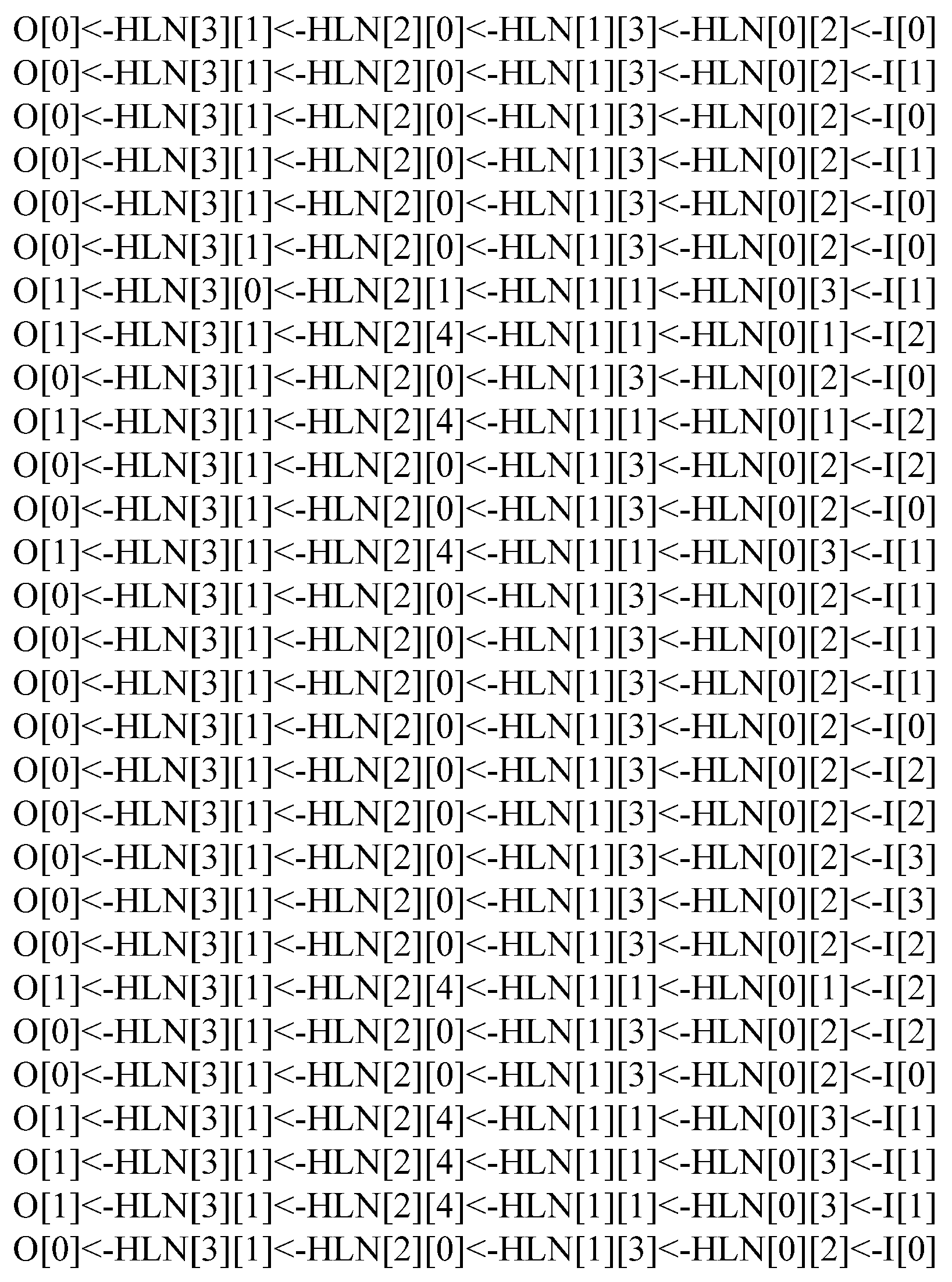
In particular,
Figure 2 below represents the input data structure.
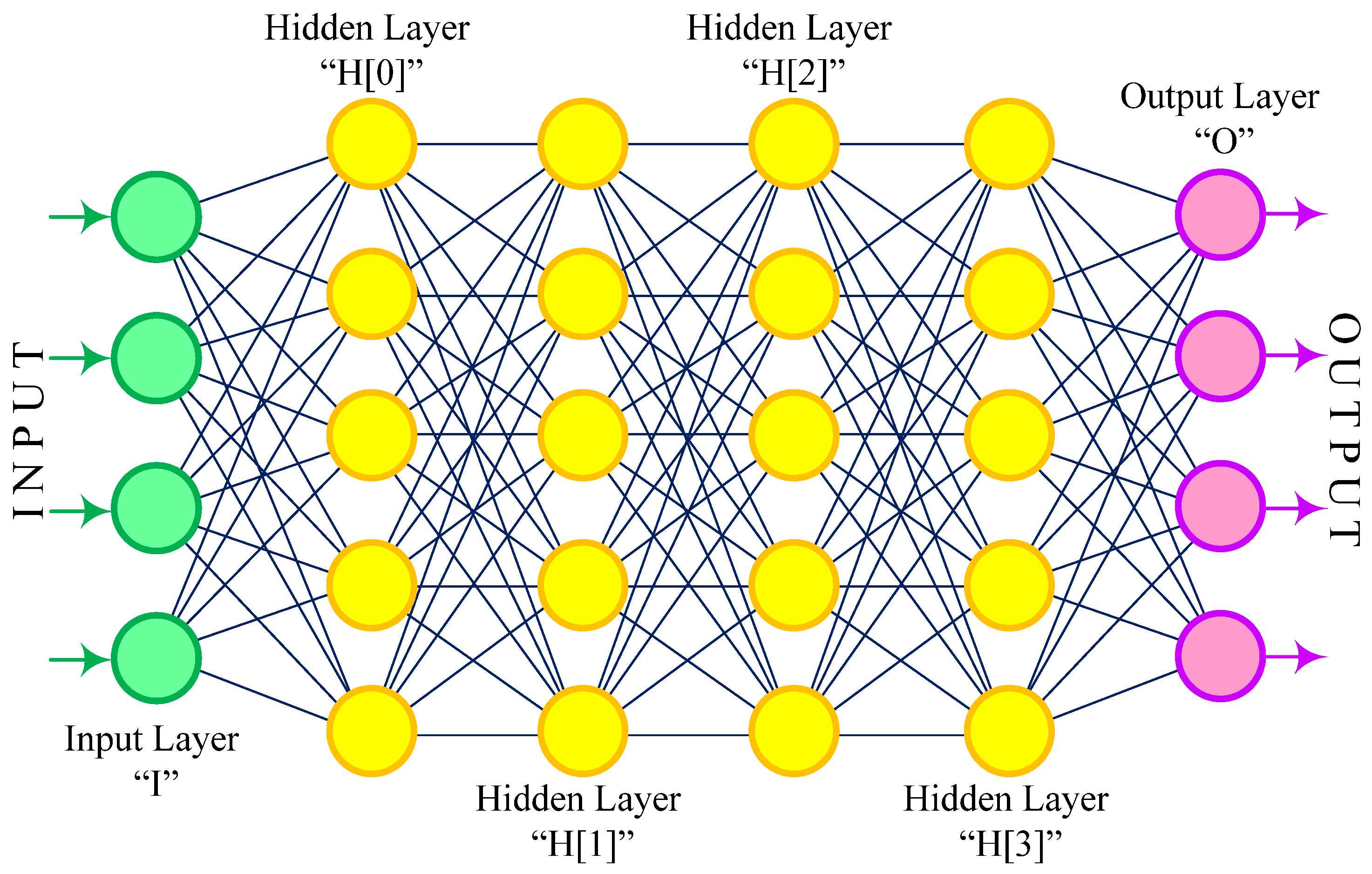
Meanwhile, the very structure of the researched MLP DNN itself (as part of the declared practical applied problem being solved) is shown below, in
Figure 3.
At the same time,
Table 1 below represents the distribution statistics of the dataset with reverse neural chains of the researched MLP DNN.
Meanwhile,
Table 2 below represents the results of identifying early-exit points for the researched MLP DNN.
Therefore, the obtained results fully confirm the important aspect of the study, aforementioned in the last paragraph of the previous section of this work, which consists in the fact that the developed method identifies neurons of hidden layers as early-exit points precisely in the context of specific fragments of the neural chains of the researched DNNs, of which they (the identified early-exit points/neurons) are the closing link (fragments).
Moreover, the same obtained results reveal an additional possibility of further improvement of the developed method based on extended verification of the identified early-exit points (i.e., hidden layer neurons) of the researched DNN regarding their belonging to only one particular single possible result, regardless of the context of the chain fragments they close and to which they belong.
Thus, having carried out such additional extended verification of the previously identified early-exit points for the considered researched MLP DNN, we will obtain several neurons of the hidden layers as some “independent” early-exit points for particular (appropriate for them) “only possible” results regardless of the context of the chain fragments they close and belong to (see
Table 3).
Therefore, according to the obtained results:
Neurons HLN[0][2] and HLN[1][3] are identified independent early-exit points of the researched MLP DNN for the only possible result О0 regardless of the context of the chain fragments they close and belong to;
Neuron HLN[1][0] is the identified independent early-exit point of the researched MLP DNN for the only possible result О2 regardless of the context of the chain fragments it closes and belongs to.
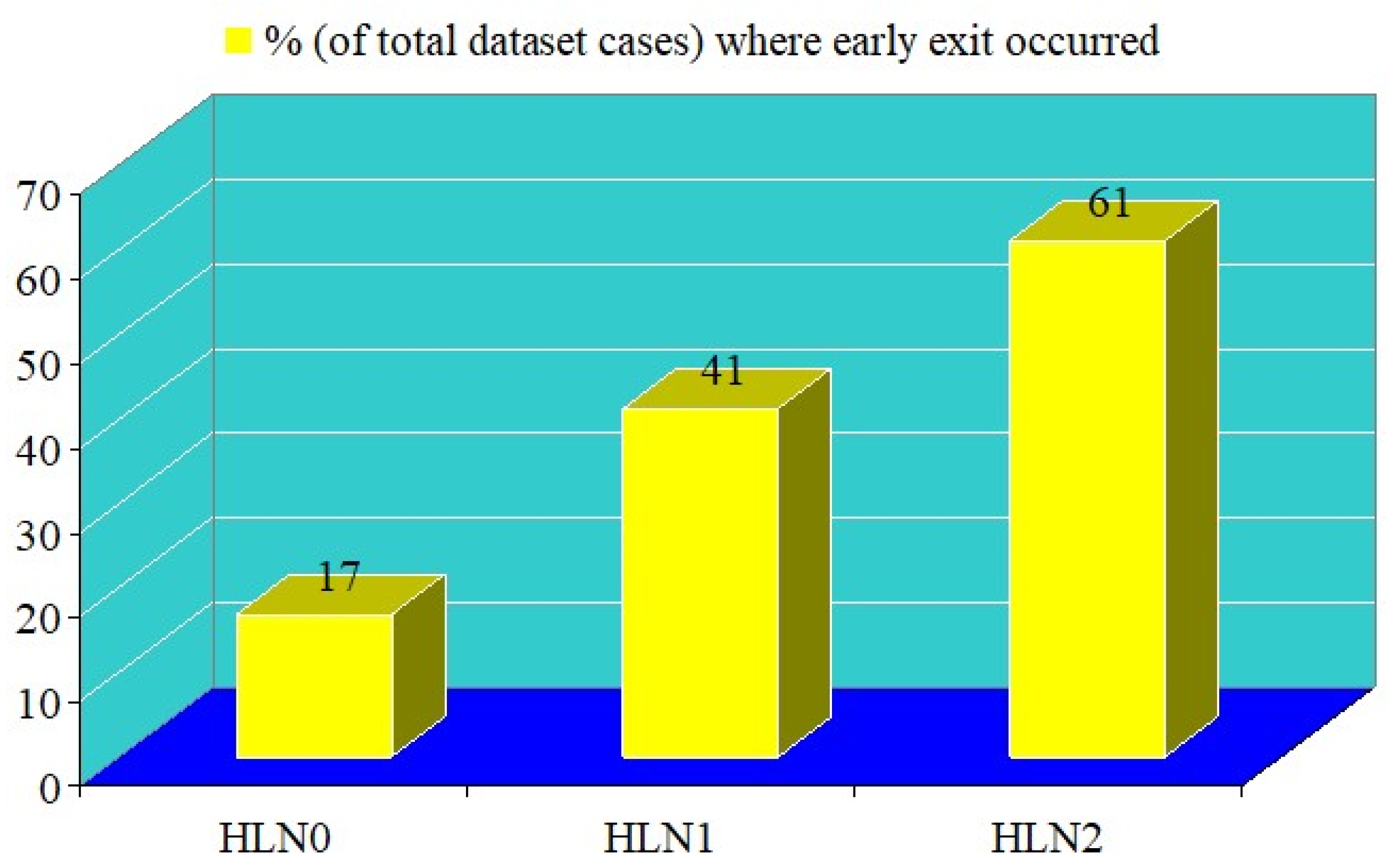
Thus, the early-exit points of the researched MLP DNN identified by the developed method provide the possibility for significant optimization of the computational and time resources of its operation, which is visually demonstrated by the corresponding illustrative diagram shown in
Figure 4 below.
The considered diagram (presented above in
Figure 4) demonstrates, as expected, a positive increasing trend in the number of those specific situational modeling cases (among the entire set available within the input dataset of neural chains), in which an early exit from the researched MLP DNN is possible (with a guaranteed correct final result of its operation in the output layer) without the need for additional processing of all subsequent hidden layers, which is precisely what the main optimization effect of identifying early-exit points (using the developed method) consists of.
In addition, as a logical finalization of the conducted research, a detailed analysis of the main benefits obtained in the context of the researched MLP DNN’s operation dynamics has been carried out based on a comparative analysis of the results of its operation before and after applying the developed method, or in other words with and without the use of the identified (by the developed method) early-exit points. This part of the research has been performed on a device with rather limited computing power by modern standards (in particular, with a processor frequency of 2 GHz, 3 Gb of DDR RAM, and the Windows 10 OS installed), since early-exit DNNs are quite often used on various portable devices with quite limited computing power.
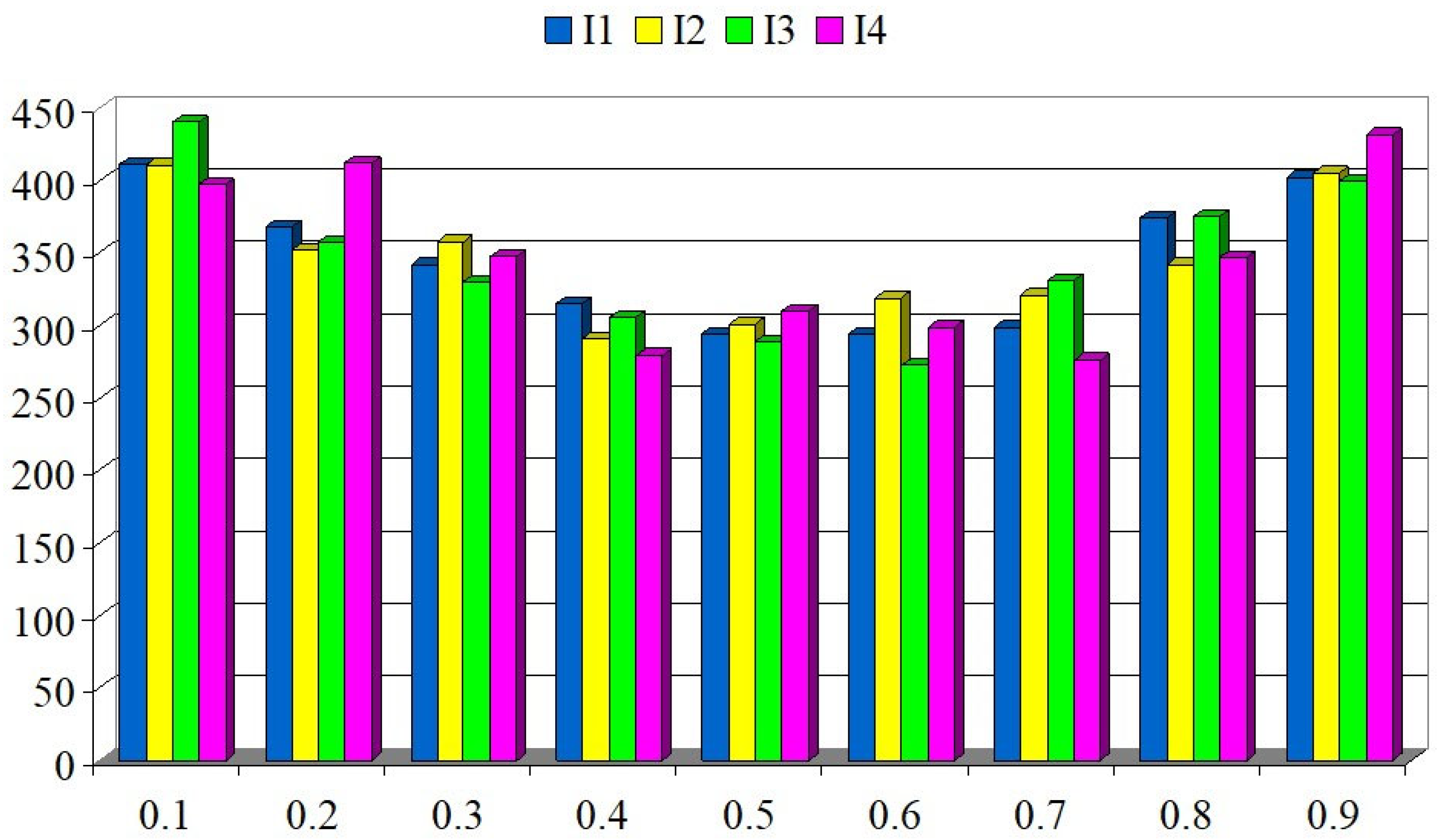
Thus, the same considered trained researched MLP DNN has been used to process input data within an appropriate research dataset, the distribution statistics of which are displayed below in
Figure 5.
Next, the operation of the researched MLP DNN has been repeatedly (i.e., for several times) simulated on the considered input dataset with a dimension of 3,100 records. In this case, the first stage of this simulation was performed without using the early-exit points identified by the developed method.
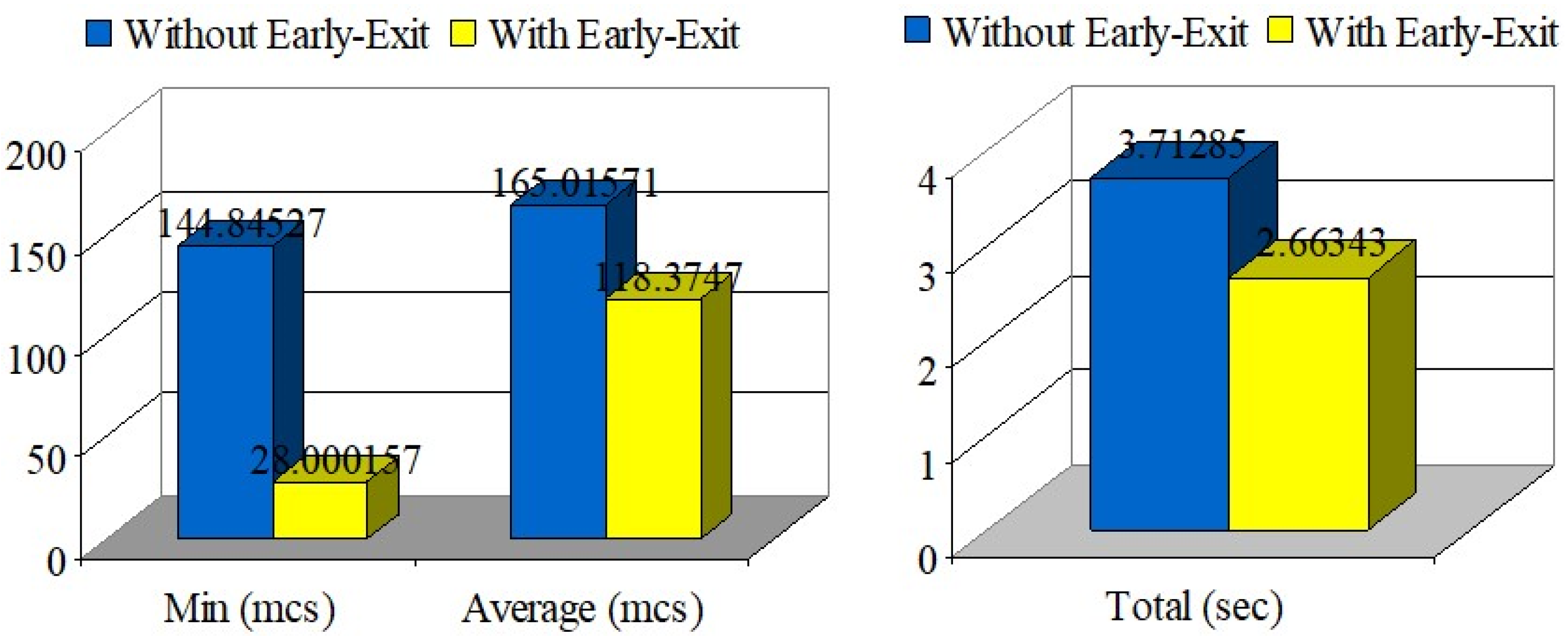
Meanwhile, the second stage of this simulation was performed using the early-exit points identified by the developed method. At the same time, the main resulting parameter of the simulation analysis was the time required by the researched MLP DNN to identify the final result at the output. In total, 22,500 particular simulation cases (based on the input dataset) have been processed by the researched MLP DNN (i.e., the input dataset has been processed several times).
Figure 6 below displays the obtained results of the comparative dynamics of operation of the researched MLP DNN before and after applying the developed method, including, for example, such key performance indicators as minimal time to obtain the final result, average time to obtain the final result, and the total time spent processing all 22,500 modeling cases in total.
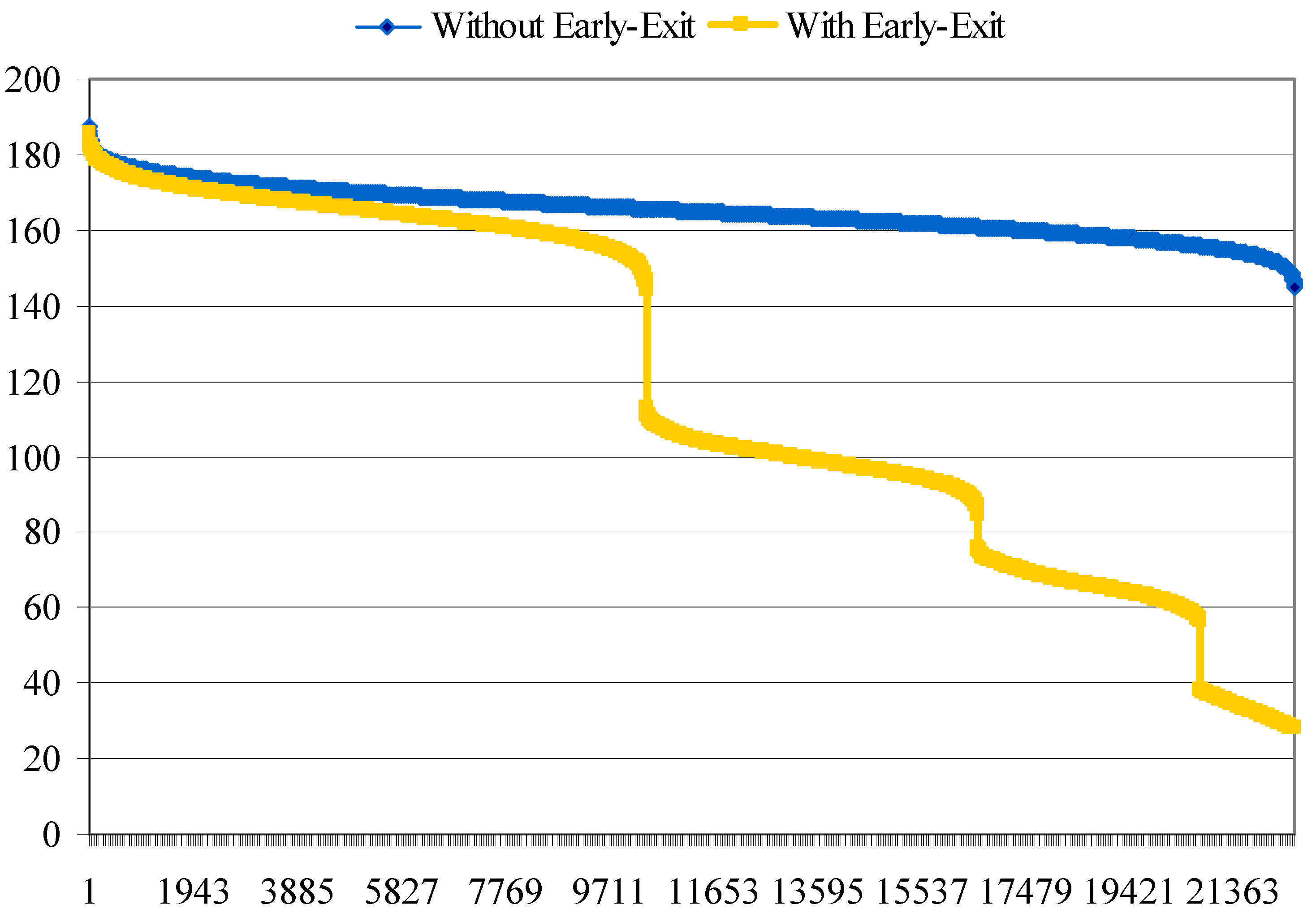
In addition,
Figure 7 below displays a comparative characteristic of the decreasing dynamics of the time needed to obtain the final result when processing modeling cases by the researched MLP DNN before (without early exit) and after (with early exit) applying the developed method.
Thus, we observe a clear trend in reducing the time needed to obtain the final result when processing modeling cases by the researched MLP DNN after the introduction of early-exit points, identified using the developed method, compared to the results of its operation without using this method.
Therefore, the obtained results of solving the declared practical applied problem (of identifying early-exit points of a multilayer perceptron based on the analysis of maximal weight reverse neural chains) actually confirm the successful practical approbation of the developed neural-chain-analysis-based exit point identification method for early-exit DNNs.
Additionally, let us consider the developed method in the context of its comparison with the outcomes of existing similar approaches. In particular, the authors of [
42] present an early-exit neural network architecture that provides possibilities for performing a budgeted classification operations (mainly image classification by computer vision methods and means) by dynamically selecting the most relevant exit point for each input sample of a dataset to achieve the best performance while adhering to a predefined computational quota (i.e., budget). The key contribution of the considered work is a new method that jointly studies the classifier model and the sample exit policy, in contrast to previous approaches that considered these components separately. In particular, the authors of the considered work present a two-level optimization structure that simultaneously optimizes the cross-entropy loss of the classifier and the probability of each sample’s exit at different stages of the researched networks. This approach allows for mutual optimization of classifier parameters and sample-dependent exit policy, leading to improved classification accuracy under computational constraints. The authors of the considered method evaluate it on three computer vision tests (namely: CIFAR-10, CIFAR-100 and ImageNet), demonstrating promising and robust results in budgeted classification (of images) compared to other existing early-exit strategies. The considered existing method is objectively successful and effective; however, at the same time, it requires an extremely deep understanding of complex mathematical processes, such as calibration of sample complexity, and many other relevant ones, thanks to which it actually gives such good results, but, at the same time, this significantly complicates its understanding for inexperienced researchers and users, as well as its further software implementation.
In contrast, the method based on neural chain analysis (proposed and developed within the scope of the current research) is extremely simple and understandable, just right for inexperienced researchers and users, providing the opportunity for them to implement their own basic DNN early-exit research, including in the context of its further software implementation and modeling.
At the same time, within the framework of related works [
43,
44], the authors proposed and developed a method of optimized training and scalable implementation of Early-Exit Conditional DNN (EECDNN) for fog-supported IoT applications, within the scope of which the authors: reviewed the basic EECDNN architectures and the characteristics of their computing power; considered three main algorithms for their training with a teacher (namely: end-to-end, layer-by-layer, and classifier learning algorithms); and compared the resulting compromises in the context of their fog-supported implementation. Moreover, after presenting the reference architecture for local classifiers that equip the considered EECDNNs, the authors additionally developed an optimized structure specifically for parallel and distributed tuning of decision thresholds for these classifiers. In addition to this, the authors also used a greedy algorithm for the efficient placing of early-exits inside the considered EECDNNs. Finally, the authors analytically characterized (in a closed form) and analyzed the energy efficiency of the optimal EECDNN mapping onto a fog. Only such a complex multi-stage process ensures the correct functioning of this existing considered method (proposed by the authors of the considered work), which undoubtedly ensures its effectiveness in the context of the specific subject area of EECDNN for fog-supported IoT applications; however, at the same time, this makes it extremely complex in the context of basic use by inexperienced specialists and also significantly limits its flexibility outside the aforementioned subject area.
Meanwhile, the neural-chain-analysis-based exit point identification method for early-exit DNNs (developed and presented within the scope of the current research) provides maximum flexibility in the context of its use in almost any scientific–applied or practical–applied areas or fields, since it does not interfere (in any arbitrary way or form) with the architecture of the researched DNNs themselves (adjusting them to its needs), but instead only uses any existing (arbitrary) architecture, merging with the latter as harmoniously as possible and supplementing existing hidden layer neurons, already present within its structure, with an additional “label” (or characteristic) of the identified early-exit point.
In turn, within the scope of another work [
45], the authors proposed an automated early-exit approach called SelfXit—an end-to-end automated early-exit solution to improve the performance of DNN-based view services in terms of computational complexity and inference latency, which is based on the idea of self-distillation of DNN models and early exits specifically for computer vision applications. In other words, the solution, proposed by the authors of the considered work, is an automated, unsupervised early-exit mechanism that allows performance of an early exit from DNN models during the inference time if the model is confident enough in one of the early exits for the final prediction. At the same time, this refers to an unsupervised early exit, according to which early-exit models do not require access to training data and work exclusively on the basis of the input data at runtime, which makes them suitable for applications that use pre-trained models. The results of experiments on the practical testing (using the example of processing two basic computer vision tasks, namely: image classification and object detection) of the considered existing approach show that, on average, early exit can reduce the computational complexity of these services (in terms of the number of FLOPs) and improve their inference latency, outperforming similar existing methods especially when processing complex models and large datasets. At the same time, despite all its undeniable advantages, the considered existing approach is a highly specialized solution specifically for the scientific and applied field of computer vision and has not been tested in detail in other subject areas, which limits the possibility of its universal application beyond the aforementioned subject area. In addition to that, the SelfXit solution has two additional limitations, the first of which concerns regression models and is closely related to the efficiency of knowledge distillation in such models, while the second consists in the fact that this considered existing approach, also, does not take into account the internal state of the backbone (if any, for example: hidden states in recurrent neural networks).
In contrast to that, the method based on neural chain analysis (developed within the framework of the current study) is devoid of similar restrictions on any architectural or structural features of arbitrary DNNs, working on a lower-level decomposition layer, namely, at the level of neurons of hidden layers.
Thus, summing up, it should be noted that the method developed within the framework of this study (i.e., neural-chain-analysis-based exit point identification method for early-exit DNNs), in the context of its comparison with the outcomes of existing similar approaches, has the following advantages, namely:
Maximal versatility—suitable for any type and variety of DNN;
Absence of any architectural and/or structural limitations of the studied (i.e., researched, investigated) DNNs, as well as limitations on the practical application areas of the latter;
Maximal simplicity of its representation and understanding, which ensures the possibility of working with this method even for those novice and/or inexperienced researchers and users who have only basic knowledge of DNNs;
Arbitrary (or any convenient) format for representing input data (neural chains of the researched DNNs);
Ability to equally effectively process both forward and reverse neural chains of the studied DNNs;
Simplicity of the software implementation and freedom of choice regarding specific software methods for processing input data (including, even, methods for processing string data).
It is also worth noting right away that exactly the MLP type of DNN has been chosen as the given example, since in all senses (historically, conceptually, architecturally, and functionally) it is, actually, MLP that is the most “pure”, fundamental, and basic type of DNN, while all other types (including, for example, such prominent types as CNN, RNN, and MNN) are to some extent its derivatives, whereas for the rest of the DNNs it actually plays the role of their core (i.e., the key functional and architectural component). Thus, since MLP is the most “pure” type of DNN, it provides the possibility for the most clear and illustrative representation of the proposed novel approach for identifying DNN early-exit points based on neural chain analysis. In fact, the key feature (and the significant advantage at the same time) of the developed approach is that it does not work directly with the DNNs themselves, but instead it actually works with the linguistic representations of the neural chains which those DNNs produce as a result of their operation. That is why, in the context of applying the developed method to any researched DNNs, the key point is actually not so much the type of the latter as their ability to produce neural chains (starting from the input layer, through all hidden layers, and up to the output layer). Therefore, this key feature of the developed approach ensures its maximum universality in the context of its application to any type of neural network of the DNN family, including such extremely relevant and evolutionary architectures as attention-based and transformer-based ones, described, in particular, within the scope of the recent works [
46,
47], respectively. At the same time, this key feature of the developed approach (of identifying DNNs early-exit points based on neural chains) additionally contributes to the prospects of its further development, improvement and intellectualization, since it provides for the possibility of involving appropriate, or specific, existing AI tools in the analysis of the neural chains themselves, represented by the corresponding linguistic constructs; however, this already concerns the prospects for the further development of the proposed approach.
In addition, the obtained computational complexity of the developed method is not limited by the latter itself, but instead, it mainly depends on the chosen algorithm for analyzing the occurrences of particular substrings (i.e., trimmed neural chains) into a defined list of strings (i.e., full neural chains); for example, within the framework of the conducted research, the Python operator “in” has been used (for this purpose), which uses a built-in optimized algorithm based on a combination of Boyer–Moore and Horspool with linear scalability, and the computational complexity of which approaches the arithmetic product of the total number of strings (i.e., full neural chains) in the array by the average length of the string in same array.
Nevertheless, considering the study limitations, it is worth noting right away the following main and most substantial ones, in particular:
A quite significant slowdown in the speed of the overall early-exit point identification process in comparison to existing approaches, caused by the usage of string operations in the former versus arithmetic operations in the latter;
A need to initially re-identify (from scratch) relevant early-exit points when completely retraining the researched DNN, since the proposed method is strongly tied to (and, in fact, naturally encapsulated in) the DNN training process, which, in turn, leads to the fact that previously defined early-exit points may remain unstable during different training initializations (especially in cases of complete/full training re-initializations);
An extremely high and rigid (i.e., inflexible) identification threshold, as the proposed method requires exclusively and only a 100% value of the probability function for the considered neuron in order to identify this neuron as an early-exit point within the considered/researched DNN, while any (even statistical) deviation from this value automatically deprives the considered neuron of the chance of being identified as an early-exit point within the scope of the appropriate researched DNN.
In addition to that, as a prospect for further research, we see the potential for further optimization and improvement of the developed method (in particular, refining the possibility of probability assessment for potentially possible additional early-exit points), as well as improving the software implementation of the method in order to provide expanded functionality for a more detailed investigation of the neural chains of the researched DNNs in the context of extra potential identifiers for the early-exit possibilities of the latter.