Systematic Annotation Framework for Robust Speech Recognition


Abstract
1. Introduction
2. Related Work
2.1. Evolution of Speech Recognition and Annotation Requirements
2.2. Dialect and Low-Resource Speech Corpora
2.3. Large-Scale Speech Annotation Standards
2.4. Annotation Requirements for Robust ASR
2.5. Research Gap and Problem Statement
3. Proposed Method
3.1. Design Principles
3.1.1. Linguistic Consistency
3.1.2. Machine Readability
3.1.3. Scalability
3.2. Multi-Level Annotation Framework
3.2.1. Lexical-Level Annotation
3.2.2. Sentence-Level Annotation
3.2.3. Pragmatic-Behavior Annotation
3.3. Handling Special Speech Phenomena
3.4. Quality Assurance and Validation
4. Case Study: Construction of the Hainan Lingao Dialect Corpus
5. Experimental Results and Analysis
5.1. Experimental Setup
5.2. Comparative Results
5.3. Ablation Study
5.4. Analysis of Dialect-Feature Annotation

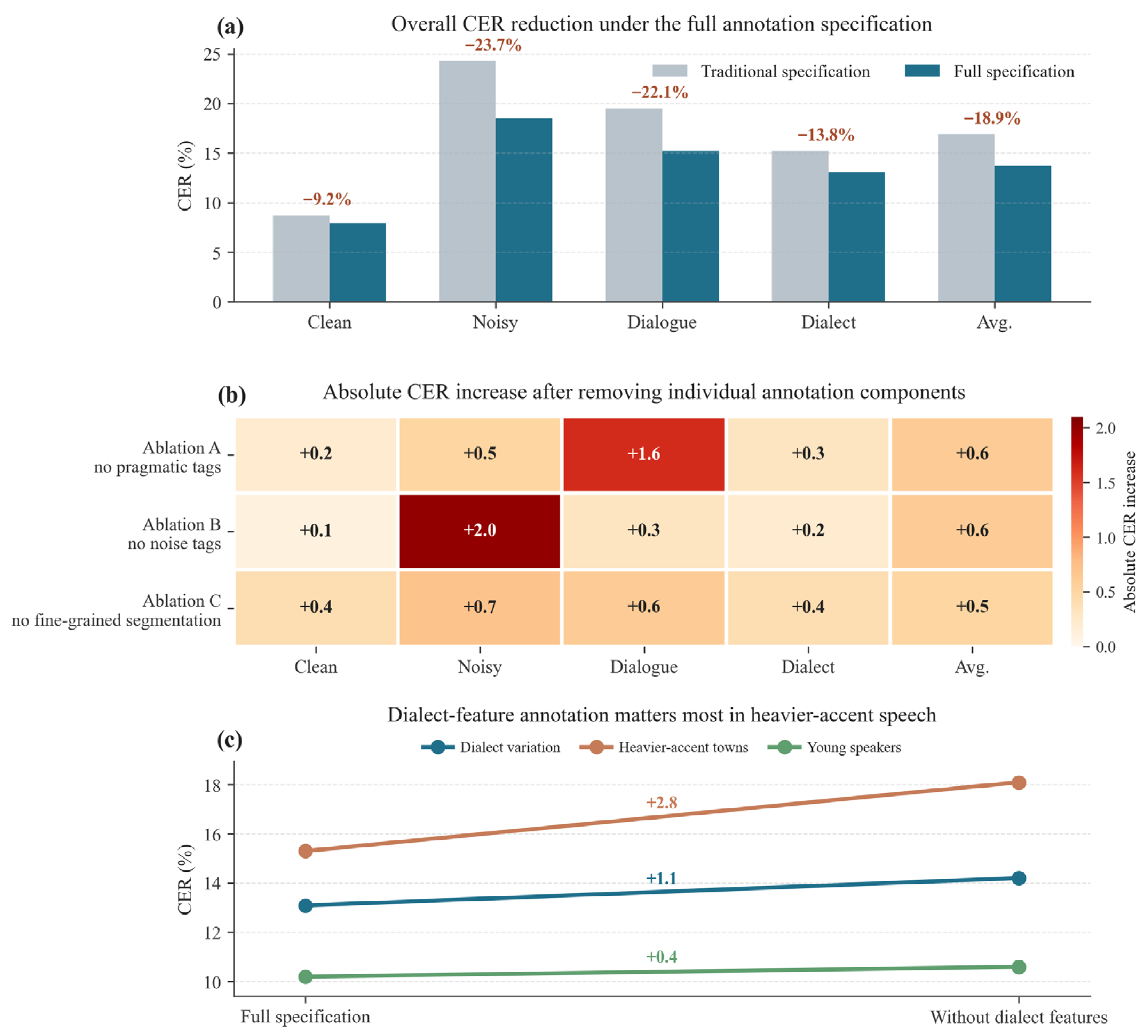
| Scenario | CER (Base) | CER (Full) | ΔCER | SER (Base) | SER (Full) | ΔSER |
|---|---|---|---|---|---|---|
| Clean | 8.7 | 7.9 | −0.8 | 17.5 | 15.2 | −2.3 |
| Noisy | 24.3 | 18.5 | −5.8 | 39.6 | 32.1 | −7.5 |
| Dialogue | 19.5 | 15.2 | −4.3 | 34.2 | 27.8 | −6.4 |
| Dialect variation | 15.2 | 13.1 | −2.1 | 28.3 | 24.5 | −3.8 |
| Setting | Scenario | CER | Δ vs. Full |
|---|---|---|---|
| Ablation A | Dialogue | 16.8 | +1.6 |
| Ablation B | Noisy | 20.5 | +2.0 |
| Ablation C | Clean | 8.3 | +0.4 |
| Ablation C | Noisy | 19.2 | +0.7 |
| No dialect features | Dialect variation | 14.2 | +1.1 |
5.5. Discussion
6. Conclusions
Author Contributions
Funding
Institutional Review Board Statement
Informed Consent Statement
Data Availability Statement
Acknowledgments
Conflicts of Interest
References
- Dua, M.; Akanksha; Dua, S. Noise robust automatic speech recognition: Review and analysis. Int. J. Speech Technol. 2023, 26, 475–519. [Google Scholar] [CrossRef]
- Baevski, A.; Zhou, H.; Mohamed, A.; Auli, M. wav2vec 2.0: A framework for self-supervised learning of speech representations. Adv. Neural Inf. Process. Syst. 2020, 33, 12449–12460. [Google Scholar]
- Xu, A.; Feng, T.; Bishop, S.; Lord, C.; Narayanan, S. End-to-end joint ASR and speaker role diarization with child-adult interactions. arXiv 2026, arXiv:2601.17640. [Google Scholar] [CrossRef]
- Peyghan, M.R.; Soleimani Roudi, S.; Zouashkiani, S.; Amini, S.; Rajabi, F.; Ghaemmaghami, S. Non-intrusive automatic speech recognition refinement: A survey. arXiv 2025, arXiv:2508.07285. [Google Scholar] [CrossRef]
- Dey, S.; Saha, G. Addressing the semi-open set dialect recognition problem under resource-efficient considerations. Speech Commun. 2023, 152, 102957. [Google Scholar] [CrossRef]
- Meng, Y.; Chen, N.; Li, H. Chinese dialect identification based on local and global feature fusion and multi-level feature aggregation. J. East China Univ. Sci. Technol. 2024, 50, 898–904. (In Chinese) [Google Scholar] [CrossRef]
- Li, Q.; Mai, Q.; Wang, M.; Ma, M. Chinese dialect speech recognition: A comprehensive survey. Artif. Intell. Rev. 2024, 57, 25. [Google Scholar] [CrossRef]
- Zu, Y.; Chen, Y.; Zhang, Y.; Zhou, L.; Shen, M.; Huang, J. A super phonetic system and multi-dialect Chinese speech corpus for speech recognition. In Proceedings of the International Symposium on Chinese Spoken Language Processing, Taipei, Taiwan, 23–24 August 2002; p. 48. Available online: https://www.isca-archive.org/iscslp_2002/zu02_iscslp.html (accessed on 31 March 2026).
- Lin, J.; Lu, S.; Huang, H.; Guan, W.; Xu, B.; Bu, H.; Hong, Q.; Li, L. MinSpeech: A corpus of Southern Min dialect for automatic speech recognition. In Proceedings of the Interspeech 2024, Kos, Greece, 1–5 September 2024; pp. 2330–2334. [Google Scholar] [CrossRef]
- Display Text Format Training Data. Available online: https://learn.microsoft.com/en-us/azure/ai-services/speech-service/how-to-custom-speech-display-text-format (accessed on 31 March 2026).
- Laboratory of Phonetics and Speech Science, Institute of Linguistics, Chinese Academy of Social Sciences. Discourse-CASS [Introduction: Chinese Spoken Discourse Corpus Discourse-CASS]. Available online: http://paslab.phonetics.org.cn/?p=7046 (accessed on 26 April 2026). (In Chinese)
- Rabiner, L.R. A tutorial on hidden Markov models and selected applications in speech recognition. Proc. IEEE 1989, 77, 257–286. [Google Scholar] [CrossRef] [PubMed]
- Vaswani, A.; Shazeer, N.; Parmar, N.; Uszkoreit, J.; Jones, L.; Gomez, A.N.; Kaiser, Ł.; Polosukhin, I. Attention Is All You Need. Adv. Neural Inf. Process. Syst. 2017, 30, 5998–6008. [Google Scholar]
- Gulati, A.; Qin, J.; Chiu, C.-C.; Parmar, N.; Zhang, Y.; Yu, J.; Han, W.; Wang, S.; Zhang, Z.; Wu, Y.; et al. Conformer: Convolution-augmented Transformer for speech recognition. In Proceedings of the Interspeech 2020, Shanghai, China, 25–29 October 2020; pp. 5036–5040. [Google Scholar] [CrossRef]
- Faruqui, M.; Hakkani-Tur, D. Revisiting the boundary between ASR and NLU in the age of conversational dialog systems. Comput. Linguist. 2022, 48, 221–232. [Google Scholar] [CrossRef]
- Liu, C.; Li, Q.; You, Z. An end-to-end Uyghur speech recognition based on multi-task learning. In Proceedings of the 2022 International Conference on Automation, Robotics and Computer Engineering, Wuhan, China, 16–17 December 2022; pp. 1–6. [Google Scholar] [CrossRef]
- ASR-CNanDiaCSC: A Chinese Nanchang Dialect Conversational Speech Corpus. Available online: https://magichub.com/datasets/nanchang-dialect-conversational-speech-corpus/ (accessed on 31 March 2026).
- Yu, T.; Frieske, R.; Xu, P.; Cahyawijaya, S.; Yiu, C.T.; Lovenia, H.; Dai, W.; Barezi, E.J.; Chen, Q.; Ma, X.; et al. Automatic speech recognition datasets in Cantonese: A survey and new dataset. In Proceedings of the Thirteenth Language Resources and Evaluation Conference, Marseille, France, 20–25 June 2022; pp. 6487–6494. Available online: https://aclanthology.org/2022.lrec-1.696/ (accessed on 31 March 2026).
- Dai, Y.; Zhang, Z.; Wang, S.; Li, L.; Guo, Z.; Zuo, T.; Wang, S.; Xue, H.; Wang, C.; Wang, Q.; et al. WenetSpeech-Chuan: A large-scale Sichuanese corpus with rich annotation for dialectal speech processing. arXiv 2025, arXiv:2509.18004. [Google Scholar] [CrossRef]
- Al-Sabbagh, R. Ramsa: A large sociolinguistically rich Emirati Arabic speech corpus for ASR and TTS. arXiv 2026, arXiv:2603.08125. [Google Scholar] [CrossRef]
- Zhang, Y.; Aiskar, A.; Mijiti, A. End-to-end speech recognition based on different units. J. Chin. Inf. Process. 2024, 38, 166–172. Available online: https://kns.cnki.net/kcms2/article/abstract?v=iO0L29morZlxR7VPnPpchnjGbQtNTC2gB00ZAFYUuxVa3bpXINau2F3d_FcBe9K-c8HDBDn2bSMtPMqT4Ek2w40NYqDcYBHHZIFG8iMN4yOAXhnMGVZVoC8ca06bvbG66pqMplAlomM7C98yZNfze7VaxHxDZcb9ViNGxfPL0Dk=&uniplatform=NZKPT (accessed on 26 April 2026).
- Gao, Y.; Feng, X.; Li, B.; Xie, Y.; Zhang, J.; Li, Y. Advancing speech data collection and annotation: General methods, practical experience, and future perspectives. J. Shanghai Jiaotong Univ. (Sci.) 2026. published online. [Google Scholar] [CrossRef]
- Ardila, R.; Branson, M.; Davis, K.; Kohler, M.; Meyer, J.; Henretty, M.; Morais, R.; Saunders, L.; Tyers, F.; Weber, G. Common Voice: A massively-multilingual speech corpus. In Proceedings of the Twelfth Language Resources and Evaluation Conference, Marseille, France, 13–15 May 2020; pp. 4218–4222. Available online: https://aclanthology.org/2020.lrec-1.520/ (accessed on 26 April 2026).
- Wang, C.; Riviere, M.; Lee, A.; Wu, A.; Talnikar, C.; Haziza, D.; Williamson, M.; Pino, J.; Dupoux, E. VoxPopuli: A large-scale multilingual speech corpus for representation learning, semi-supervised learning and interpretation. In Proceedings of the 59th Annual Meeting of the Association for Computational Linguistics and the 11th International Joint Conference on Natural Language Processing (Volume 1: Long Papers), Online, 1–6 August 2021; Association for Computational Linguistics: Kerrville, TX, USA, 2021; pp. 993–1003. [Google Scholar] [CrossRef]
- Dissen, Y.; Yonash, S.; Cohen, I.; Keshet, J. A front-end adaptation network for improving speech recognition performance in packet loss and noisy environments. IEEE/ACM Trans. Audio Speech Lang. Process. 2025, 33, 2175–2188. [Google Scholar] [CrossRef]
- Que, S.; Qian, L.; Li, M.; Wang, Q. OS-Denseformer: A lightweight end-to-end noise-robust method for Chinese speech recognition. Appl. Sci. 2025, 15, 12096. [Google Scholar] [CrossRef]
- Liu, D.; Nassereldine, A.; Xu, C.; Xiong, J. Towards pretraining robust ASR foundation model with acoustic-aware data augmentation. arXiv 2025, arXiv:2505.20606. [Google Scholar] [CrossRef]
- Wang, S.; Yu, W.; Chen, X.; Tian, X.; Zhang, J.; Lu, L.; Tsao, Y.; Yamagishi, J.; Wang, Y.; Zhang, C. QualiSpeech: A speech quality assessment dataset with natural language reasoning and descriptions. In Proceedings of the 63rd Annual Meeting of the Association for Computational Linguistics (Volume 1: Long Papers), Vienna, Austria, 27 July–1 August 2025; Association for Computational Linguistics: Kerrville, TX, USA, 2025; pp. 23588–23609. [Google Scholar] [CrossRef]
- Arora, S.; Lu, Z.; Chiu, C.-C.; Pang, R.; Watanabe, S. Talking Turns: Benchmarking audio foundation models on turn-taking dynamics. In Proceedings of the Thirteenth International Conference on Learning Representations, Singapore, 24–28 April 2025; Available online: https://openreview.net/forum?id=gainwDfkYH (accessed on 31 March 2026).
- Berez-Kroeker, A.L.; Gabber, S.; Slayton, A. Recent advances in technologies for resource creation and mobilization in language documentation. Annu. Rev. Linguist. 2023, 9, 195–214. [Google Scholar] [CrossRef]
- Brosa Rodríguez, A.; Jiménez López, M.D. Beyond the data: The impact of annotation inconsistencies in UD treebanks on typological universals and complexity assessment. In Proceedings of the 7th Workshop on Research in Computational Linguistic Typology and Multilingual NLP, Vienna, Austria, 31 July–1 August 2025; pp. 43–51. [Google Scholar] [CrossRef]
- Parsons, P.; Solberg, P.E.; Kvale, K.; Svendsen, T.; Salvi, G. Adding metadata to existing parliamentary speech corpus. In Proceedings of the Joint 25th Nordic Conference on Computational Linguistics and 11th Baltic Conference on Human Language Technologies (NoDaLiDa/Baltic-HLT 2025), Tallinn, Estonia, 2–5 March 2025; pp. 448–457. Available online: https://aclanthology.org/2025.nodalida-1.49/ (accessed on 31 March 2026).
- Ide, N.; Romary, L. International standard for a linguistic annotation framework. Nat. Lang. Eng. 2004, 10, 211–225. [Google Scholar] [CrossRef]
- Müller-Eberstein, M.; Van Der Goot, R.; Rogers, A. DECAF: A dynamically extensible corpus analysis framework. In Proceedings of the 63rd Annual Meeting of the Association for Computational Linguistics (Volume 3: System Demonstrations), Vienna, Austria, 27 July–1 August 2025; Association for Computational Linguistics: Kerrville, TX, USA, 2025; pp. 351–362. [Google Scholar] [CrossRef]
- Steingrímsson, S.; Barkarson, S.; Örnólfsson, G.T. IGC-Parl: Icelandic corpus of parliamentary proceedings. In Proceedings of the Second ParlaCLARIN Workshop, Marseille, France, 11 May 2020; pp. 11–17. Available online: https://aclanthology.org/2020.parlaclarin-1.3/ (accessed on 31 March 2026).



| Resource | Strength | Noise/Event | Dialogue/Pragmatic | Dialect/Low-Resource | Scalability | Main Limitation for This Study |
|---|---|---|---|---|---|---|
| Common Voice [23] | Massively multilingual crowdsourced speech corpus | Not systematic | Not designed | Broad coverage, but limited structured variation annotation | High | Lacks fine-grained annotation of acoustic events, interactional phenomena, and dialect-specific variation |
| VoxPopuli [24] | Large multilingual parliamentary speech corpus | Not systematic | Not designed for conversational interaction | Multilingual, but mainly formal parliamentary speech | High | Relatively homogeneous domain and interaction structure; limited coverage of spontaneous dialogue |
| Microsoft Azure [10] text-normalization guidelines | Practical normalization and customization support | Not designed | Not a primary layer | General ASR customization rather than dialect-specific annotation | High | Strong engineering usability but limited linguistic and interactional annotation depth |
| Discourse-CASS [11] | Rich discourse and spoken-interaction representation | Not a primary focus | Strong | Not optimized for low-resource dialect engineering workflows | Low to moderate | High annotation complexity and limited scalability for large-scale corpus construction |
| Representative dialect speech corpora (THUYG-20 [16], MDCC [18], WenetSpeech-Chuan [19]) | Valuable low-resource and regional speech resources | Inconsistent across corpora | Rarely included systematically | Strong dialect relevance | Moderate | Typically emphasize corpus collection and transcription rather than unified, systematic annotation frameworks |
| This study | Multi-level annotation framework for robust dialect ASR | Explicit | Explicit | Designed for low-resource dialect scenarios | Moderate to high | Currently validated on a single dialect corpus; broader cross-corpus evaluation remains future work |
| Category | Original Content/Example | Formatting Requirement | Converted Example/Notes |
|---|---|---|---|
| Numbers and Symbols | e.g., “2022年” (“year 2022”), “超过90%” (“more than 90%”), “@用户” (“@user”) | Arabic numerals are transcribed according to their spoken Chinese pronunciation; special symbols are transliterated according to common readings. | “二零二二年” (spoken Chinese form of “2022”), “超过百分之九十” (“more than ninety percent”), “艾特用户” (“at user”) |
| English Words and Letters | e.g., “good morning”, “PPT”, “A区” (“Zone A”) | English words are uniformly lowercase, and letters are separated by spaces; common abbreviations are written as one lowercase word if pronounced as a word, or spaced letter by letter if spelled out. | “good morning” (word), “p p t” (letter spelling), “a区” (“Zone A”; lowercase letter + Chinese) |
| Modal Particles and Fillers | e.g., “呃…我想想” (“Uh…let me think”), “嗯, 是的” (“Mm-hmm, yes”), “这个…那个…” (“this…that…”) | Use standardized characters with the “mouth” radical to distinguish modal particles; preserve natural pauses and prosody. | “呃…我想想” (“Uh…let me think”), “嗯, 是的” (“Mm-hmm, yes”), “这个…那个…” (“this…that…”) (distinguish hesitation/thinking from affirmation) |
| Proper Nouns | e.g., “清华大学” (“Tsinghua University”), “COVID-19”, slang term “hin好” (“hin-good”; hin = very) | Well-known entities should use their standard names; dialectal or colloquial items with no established Chinese characters should, after investigation, be represented with standardized surrogate or homophonous characters. | “清华大学” (“Tsinghua University”), “c o v i d 一九” (“COVID-19” spelled letter by letter + numeral), “hin好” (using “hin” to mean “very”) |
| Specification Dimension | Core Standard | Design Intent |
|---|---|---|
| Speaker Exclusivity | Strictly follow the principle that one audio segment contains clear speech from only one speaker; no overlap or mixed dialogue is allowed. | Eliminates interference from overlapping speech and improves the purity of the training data. |
| Semantic Completeness | Segmentation should be based on semantic units (such as complete sentences or clauses); recommended duration > 6 s and >20 characters. | Provide long-range context for end-to-end models and strengthen sequence learning. |
| Acoustic Environment Control | Retain natural pauses shorter than 1.5 s as speech-flow features; silence within a segment must not exceed 1.5 s; discard segments with overly low SNR (<50% recognizable content). | Faithfully reflect natural dialogue rhythm while removing invalid noise interference. |
| Symbol Set Restriction | Only comma (,), period (.), question mark (?), and exclamation mark (!) are allowed. | Avoid special symbols that are difficult for models to parse and ensure standardized, consistent input text. |
| Prosody Mapping |
| Make punctuation correspond strictly to speech pauses and semantic structure, provide accurate prosodic and syntactic boundary information, and improve the naturalness and coherence of synthesis or recognition results. |
| ||
|
| Acceptance Type | Acceptance Dimension | Acceptance Standard | Acceptance Method |
|---|---|---|---|
| Single Speaker | Language | Pure dialect; pronunciation covers the various local varieties of the dialect region in equal proportions. | Manual |
| Format | WAV | Automatic | |
| Channel | Mono | Automatic | |
| Sampling Rate | 16 kHz, 16 bit | Automatic | |
| Speech Amplitude | 3000–20,000 smpl; checked in Cool Edit. | Automatic | |
| Background Noise | <300 smpl; no abnormal interference sources such as echo or reverberation; checked in Cool Edit. | Automatic | |
| SNR | SNR > 20 (SNR = speech energy/noise energy); 15–20 may still pass if transcription is normal; checked in Cool Edit. | Automatic | |
| Duration | Typically 6–12 s per utterance after semantic segmentation; clips shorter than 6 s are automatically flagged for review. | Automatic | |
| Style | Use keyword-guided free speaking to closely reproduce the naturalness of free conversation; recording must be real, natural, and fluent, with no reading style. | Manual | |
| Audio Quality | Pronunciation is clear and full and can be transcribed normally. | Manual | |
| Batch | Gender | Male:female = 1:1 | Automatic |
| Age | Ages 18–25 account for 20%, 26–40 for 40%, and over 40 for 40%. | Automatic | |
| Number of Speakers Covered | Effective duration per speaker must not exceed 40 min (customizable as needed). | Automatic | |
| Accepted Duration | Counted after annotation. Effective duration = total duration with annotation results after removing invalid, non-transcribable speech. | Manual |
Disclaimer/Publisher’s Note: The statements, opinions and data contained in all publications are solely those of the individual author(s) and contributor(s) and not of MDPI and/or the editor(s). MDPI and/or the editor(s) disclaim responsibility for any injury to people or property resulting from any ideas, methods, instructions or products referred to in the content. |
© 2026 by the authors. Licensee MDPI, Basel, Switzerland. This article is an open access article distributed under the terms and conditions of the Creative Commons Attribution (CC BY) license.
Share and Cite
Wang, Z.; Cao, C.; Xie, X.; Chen, Y.; Guo, Y. Systematic Annotation Framework for Robust Speech Recognition. Appl. Sci. 2026, 16, 4850. https://doi.org/10.3390/app16104850
Wang Z, Cao C, Xie X, Chen Y, Guo Y. Systematic Annotation Framework for Robust Speech Recognition. Applied Sciences. 2026; 16(10):4850. https://doi.org/10.3390/app16104850
Chicago/Turabian StyleWang, Zhong, Chunjie Cao, Xia Xie, Yongqing Chen, and Yuanbo Guo. 2026. "Systematic Annotation Framework for Robust Speech Recognition" Applied Sciences 16, no. 10: 4850. https://doi.org/10.3390/app16104850
APA StyleWang, Z., Cao, C., Xie, X., Chen, Y., & Guo, Y. (2026). Systematic Annotation Framework for Robust Speech Recognition. Applied Sciences, 16(10), 4850. https://doi.org/10.3390/app16104850