1. Introduction
Globally, the sudden impact of seismic events has resulted in a wide range of structural failures, including diagonal wall cracking, column buckling, beam failures, structural pounding, soft-story collapse, and foundation displacement [
1,
2]. While traditional and prescriptive building codes are mainly calibrated to prevent total collapse and guarantee life safety [
3], they often fail to mitigate the broader range of the above-mentioned damages. Consequently, Performance-Based Seismic Design (PBSD) has gained significant popularity within the structural engineering community, controlling the structural damage through previously established performance levels [
4,
5]. Historically, PBSD philosophy focused on the seismic response in terms of inter-story drift [
6,
7], which is the primary cause of beam-column connection failures, structural instability, and shear wall degradation. However, evaluating seismic performance through floor acceleration is emerging as a critical research priority. High floor accelerations in buildings can provoke brittle failures such as slab-column punching. In addition, floor acceleration inflicts severe damage on acceleration-sensitive non-structural elements [
8,
9]. Thus, evaluating the building performance via floor acceleration is evolving into a keystone of PBSD research.
One of the most influential studies on floor accelerations in buildings with rigid diaphragms was conducted by Rodriguez et al. [
10], who demonstrated that floor accelerations generate inertia forces capable of causing structural damage and, in extreme cases, collapse, with peak values typically occurring at upper stories. Building on this foundation, subsequent research has focused on developing methodologies to estimate floor acceleration demands. For instance, Miranda and Taghavi [
11] proposed a practical approach to evaluate floor acceleration responses in multistory buildings, enabling the assessment of non-structural component performance across different performance levels. This methodology was later validated and extended by Taghavi and Miranda [
12], confirming its computational efficiency and applicability.
In steel structures, Wieser et al. [
13] investigated moment-resisting frames through incremental dynamic analyses, identifying key parameters governing acceleration demands and emphasizing the importance of bidirectional response spectra and improved code formulations. For reinforced concrete structures, parametric studies such as Petrone et al. [
14] revealed that provisions in Eurocode 8 [
15] may underestimate acceleration demands over a wide range of structural periods, leading to the proposal of refined approaches that incorporate higher-mode effects.
Complementary research has focused on simplified methodologies and experimental validation. Vukobratović and Fajfar [
16] developed approaches based on structural dynamics and empirical relationships to generate floor acceleration spectra, while Gonzalez et al. [
17] highlighted the sensitivity of acceleration demands to damping modeling. Studies involving instrumented buildings and experimental testing [
18,
19,
20] have confirmed the amplification of floor accelerations toward upper levels and validated amplification profiles used in seismic design. More recent contributions [
21,
22] have demonstrated the influence of diaphragm flexibility and retrofit strategies on acceleration demands, highlighting the role of energy dissipation mechanisms in improving seismic performance.
Despite significant advances in estimating floor acceleration demands, their integration into probabilistic seismic performance and structural reliability frameworks remains relatively limited. Several studies have addressed performance-based evaluation methodologies considering multiple performance levels, ranging from immediate occupancy to collapse prevention. For example, Maffei et al. [
23] validated approaches applicable to a wide range of structural systems using nonlinear dynamic analysis, while Jeong et al. [
24] developed fragility-based assessments for reinforced concrete buildings, enabling the estimation of limit-state exceedance probabilities under varying seismic intensities.
Further developments have incorporated specific phenomena and sources of uncertainty into probabilistic frameworks. Tubaldi et al. [
25] evaluated performance-based seismic risk considering structural pounding effects, demonstrating that viscous dampers significantly reduce interaction probabilities between adjacent structures. Similarly, Celarec and Dolšek [
26] investigated the influence of modeling uncertainties on seismic response, particularly the role of plastic hinge capacity in beams and columns. These concepts were later extended to high-rise buildings by Li et al. [
27], who showed that the stochastic nature of seismic input has a direct impact on collapse probability.
More recently, computationally efficient approaches have been proposed for structural reliability assessment. Mohsenian et al. [
28] introduced a methodology based on endurance time analysis, enabling accurate estimation of seismic performance with a significant reduction in computational cost compared to traditional incremental dynamic analyses. However, most existing studies have primarily focused on global response parameters such as inter-story drift. The explicit incorporation of floor accelerations as an engineering demand parameter within probabilistic reliability frameworks remains limited, which motivates the present study.
During the last five years (2021–2026), the shift toward performance-based seismic design (PBSD) has intensified, moving beyond prescriptive code requirements to address specific performance objectives such as building functionality and loss mitigation. Padalu and Surana [
29] provide a comprehensive framework for this transition, highlighting that PBSD allows designers to meet targeted criteria that exceed standard code prescriptions, which is particularly vital for lifeline structures like hospitals. Building on this framework, recent research has focused heavily on the seismic demand of acceleration-sensitive non-structural components. Muho et al. [
30] and Merino et al. [
31,
32] emphasize that accurate prediction of peak floor acceleration and floor response spectra is essential for a holistic resilience strategy. Specifically, Muho et al. [
30] established empirical expressions correlating peak floor acceleration with inter-story drift ratios, while Merino et al. [
31] expanded these methodologies to include the influence of masonry infills on RC frame response, ensuring consistency between absolute acceleration and relative displacement demands. Furthermore, the focus has shifted toward practical, analytical tools that reduce the computational burden of nonlinear time-history analyses. Merino et al. [
32] introduced an analytical approach to estimate floor response spectra without the need for preliminary numerical modeling, achieving mean relative errors below 20% across various structural performances. This need for simplified yet accurate assessment is echoed by Khedikar et al. [
33], who developed damage indices to quantify structural resilience in RC frames of varying heights, facilitating the achievement of Immediate Occupancy (IO) and Life Safety (LS) targets. Finally, the validation of these numerical and analytical models using real-world data remains a priority; Anajafi et al. [
34] utilized recorded responses from instrumented buildings to evaluate the influence of lateral force-resisting systems and inelastic behavior on nonstructural components demands. Collectively, these studies underscore a clear research trend (2021–2026) toward integrating acceleration-sensitive demands into displacement-based design frameworks to ensure building functionality and minimize economic losses.
While the reviewed literature provides a robust foundation for studying floor accelerations in buildings subjected to ground motions, several critical gaps remain. From a scientific perspective, there is still limited theoretical understanding of how floor acceleration demands influence the probabilistic seismic risk of different structural systems, particularly when comparing steel and reinforced concrete buildings. In addition, from an applied perspective, the lack of reliability-based metrics linked to floor accelerations restricts the ability to improve performance-based design strategies for reducing seismic damage in both structural and non-structural components. Specifically, comparative studies between the seismic acceleration demands of steel and reinforced concrete structures are scarce, and there is a lack of probabilistic research explicitly quantifying seismic risk in terms of reliability index across different performance levels. Consequently, the characterization of structural reliability under varying seismic intensities remains insufficiently explored. To address these gaps, this study proposes a novel performance-based assessment framework to evaluate floor accelerations induced by earthquakes. The methodology is applied to both steel and reinforced concrete buildings under three performance levels: immediate occupancy (IO), life safety (LS), and collapse prevention (CP), associated with return periods of 72, 475, and 2475 years, respectively. The inherent uncertainty of seismic floor accelerations is incorporated through the evaluation of their probability density functions (PDFs), enabling a probabilistic representation of seismic demand. As a result, the seismic risk of each structural system is quantified in terms of a reliability index, providing a consistent basis for performance-based comparison and design-oriented decision-making. The remainder of this paper presents the material and methods, followed by the proposed framework, results, discussion, and concluding remarks.
4. Discussion
The comparative analysis of the steel and RC structures reveals distinct behavioral patterns in both seismic demand and structural reliability. In this section, a comprehensive interpretation of the findings is documented through structural dynamics philosophy and probabilistic theory.
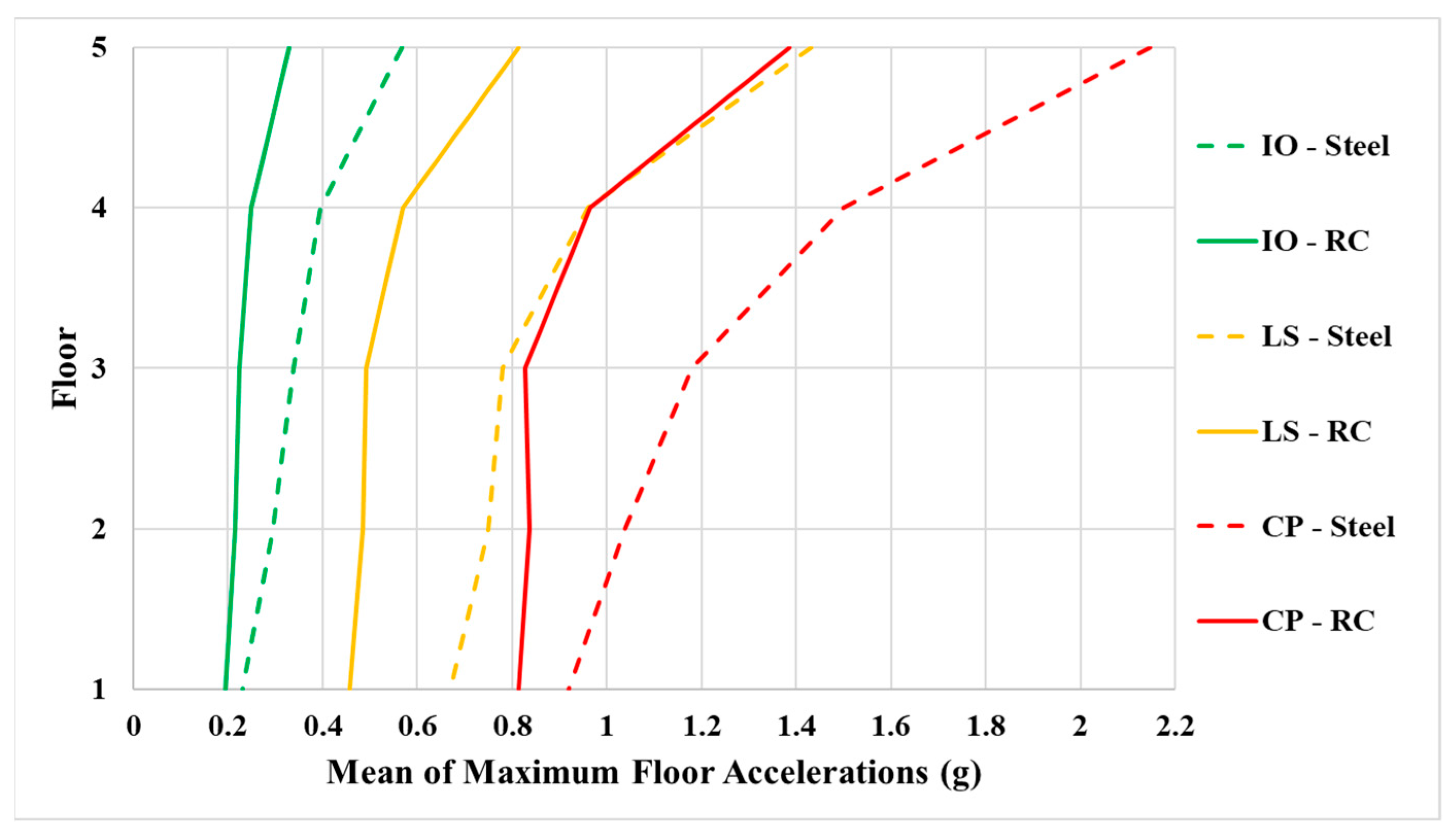
As reported in the previous section, the steel building consistently exhibited higher peak floor accelerations and greater statistical dispersion compared to the RC building. This sensitivity may be primarily driven by three physical factors. First, the mass-inertia effects are affecting the steel structure. In this sense, the steel frame possesses a significantly higher strength-to-weight ratio, resulting in lower total mass. Thus, the steel building requires less force to reach high acceleration peaks, whereas the heavy RC building benefits from greater inertial resistance. Second, the damping mechanisms can also affect floor accelerations. The steel building operates with lower inherent damping (2%), allowing high-frequency energy to propagate with minimal dissipation. In contrast, the RC building (5% damping) utilizes micro-cracking and material non-homogeneity to dampen acceleration spikes before they reach the upper floor levels. The third critical physical factors affecting the structural response in terms of floor acceleration is the Whipping Effect. The relative flexibility of the steel moment frame facilitates the propagation of higher-mode vibrations. This creates a whipping effect at the roof level, which was identified in
Figure 8 as the critical floor for both structures.
Another important part of the discussion is the relative to the probabilistic interpretation of the results of the previous section. A key finding of this study is the dominance of the Kernel PDF in characterizing the acceleration response for both buildings. Unlike parametric PDF (e.g., Normal or Lognormal), the Kernel PDF estimate does not assume a specific shape, allowing it to capture the irregular dispersion and tails inherent in seismic data. The high (>30%) across all performance levels confirms the substantial aleatory uncertainty associated with ground motion records. This variability suggests that structural safety cannot be viewed through a deterministic mode; the specific frequency content of an individual earthquake can produce outliers that parametric models might under-represent.
One more discussion must be stated about the obtained
values and the implication of
. This is discussed as follows. The reliability analysis summarized in
Table 6 and
Table 7 presented
values ranging from 0.9043 to
. The occurrence of
deserves specific technical clarification.
occurs when the structural response remains below the performance limit for every ground motion in the suite.
is equivalent to
. In these instances, the demand is so significantly lower than the capacity that the probability of exceedance cannot be quantified within the discrete sample size of the selected records. While
suggests a high safety margin, it is most prevalent in the RC building at the IO performance level. This indicates that for low-intensity seismic events (72-year return period), the RC building’s mass and stiffness act as a natural buffer, making it nearly immune to acceleration-sensitive damage at that hazard level.
In terms of design standards, the following can be documented.
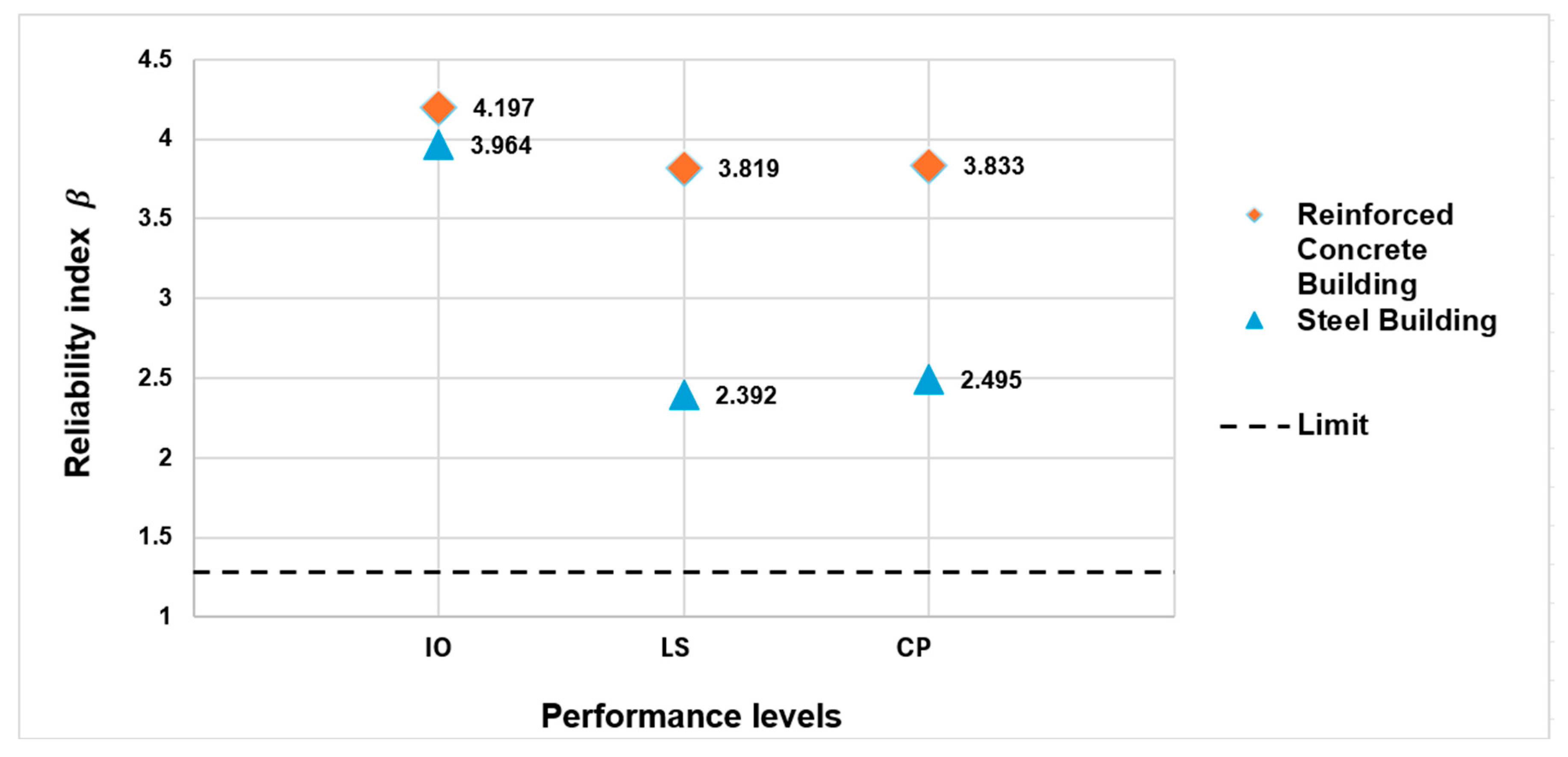
Figure 9 demonstrates that despite the steel building’s higher sensitivity, both structures maintain a mean reliability index above the code-specified threshold of 1.250 [
37]. At IO performance level, the reliability of both systems is comparable, as the ground motion intensities are insufficient to trigger the steel building’s higher-mode sensitivity. At LS and CP performance levels, the gap widens significantly. The RC building demonstrates superior robustness, maintaining high
values even as seismic demand increases. The steel building, while still safe, approaches the code limit more closely, highlighting its vulnerability to non-structural damage induced by high-frequency accelerations.
Finally, from a performance-based engineering perspective, the divergence in reliability indices () carries significant implications for the post-event functionality of the two buildings. While both structures achieve the fundamental objective of life safety, the RC building demonstrates superior performance in terms of damage limitation and serviceability. The lower peak floor accelerations recorded in the RC structure across all limit states translate to a higher protection level for acceleration-sensitive non-structural components, such as suspended ceilings, heating, ventilation, and air conditioning systems, and sensitive electronic equipment. Quantitatively, the higher values for the RC building at the IO performance level suggest that it is significantly more likely to remain fully operational following a moderate seismic event. Conversely, the steel structure, despite its adequate structural capacity, faces a higher risk. The elevated acceleration demands and lower reliability margins at the roof level indicate that the steel building may require extensive non-structural repairs and experience longer downtime even when the primary structural frame remains elastic. Consequently, when evaluated through a performance-based framework, the RC building offers a more resilient solution for facilities where business continuity and the protection of internal assets are as critical as structural integrity.




 ,
,