An Improved, Novel Musical Chairs Algorithm with Local Adaptive Exploration for MPPT of PV Systems


Abstract
1. Introduction
Related Work
- The implementation of a novel hybrid IMCA-LAE algorithm for MPPT. Examination of the concept of exploration and exploitation at the start and end of the optimization process, as well as the dynamic adaptive adjustable nature of LAE.
- Minimizing the complexity, convergence time, and oscillation at steady state and maximizing the accuracy of the proposed IMCA-LAE hybrid MPPT technique.
- Comparative analysis of INC, P&O, MCA, and GWWA with the proposed IMCA-LAE technique regarding five testing parameters: global maximum power point, convergence time, mismatch power loss, efficiency, and fill factor.
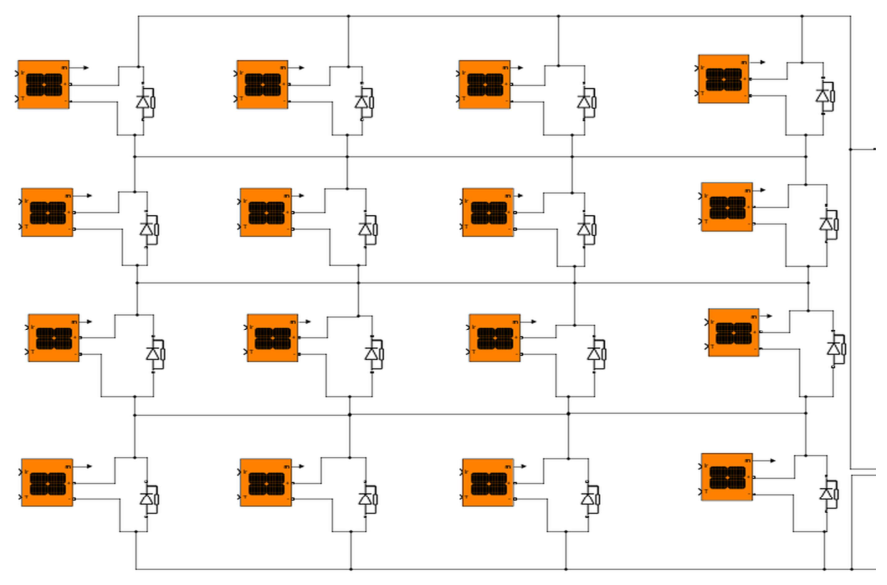
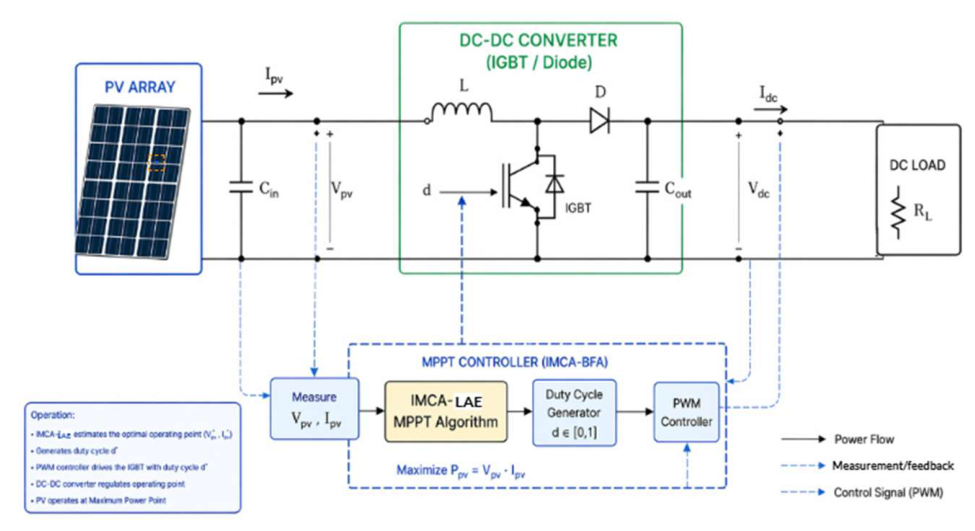
2. PV System Architecture
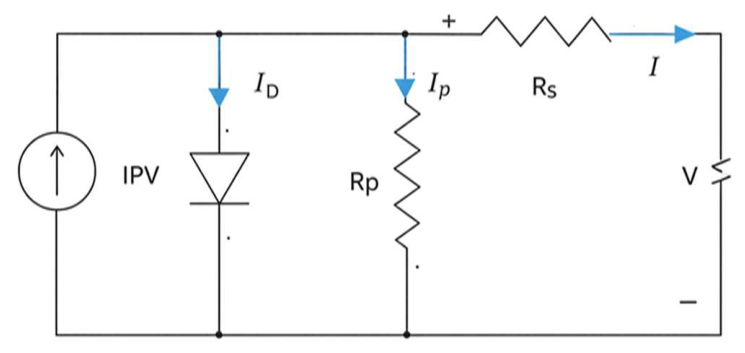
Mathematical Modeling of PV Cells
3. Methodology
3.1. Design Parameters
3.2. Performance Parameter
3.3. The Improved Musical Chairs Algorithm (IMCA)
3.4. Local Adaptive Exploration (LAE)
3.5. The Computational Complexity and Feasibility of the IMCA-LAE
3.5.1. Time Complexity Analysis
3.5.2. Space Complexity Analysis
3.5.3. Real-Time Implementation Feasibility
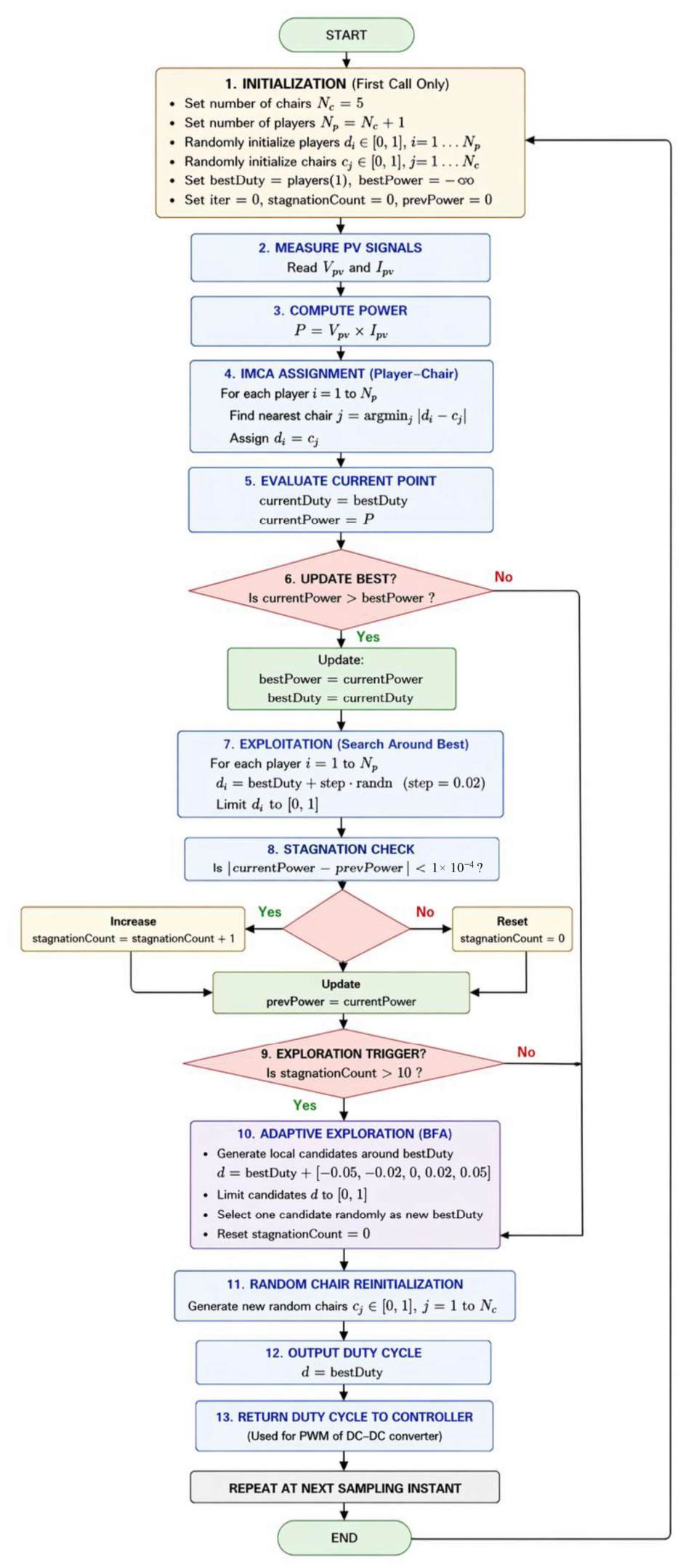
3.6. Algorithm and Flowchart
4. Results and Discussion
Limitations
5. Conclusions
Future Work
Author Contributions
Funding
Institutional Review Board Statement
Informed Consent Statement
Data Availability Statement
Conflicts of Interest
Abbreviations
| PSC | Partial shading condition |
| MCA | Musical chairs algorithm |
| MCG | Musical chairs game |
| IMCA | Improved musical chairs algorithm |
| BFA | Brute force algorithm |
| P&O | Perturb and observe |
| GWWA | Gray wolf and whale algorithm |
| INC | Incremental conductance |
| FF | Fill factor |
| GMPP | Global maximum power point |
| MPPT | Maximum power point tracking |
| LMMP | Local maximum power point |
| CV | Constant voltage |
| OCV | Open circuit voltage |
| SCC | Short circuit current |
| ARV | Adaptive reference voltage |
| RCC | Ripple correction control |
| LUT | Look up table |
| MP&O | Modified perturb and observe |
| FOCV | Fractional open circuit voltage |
| GA | Genetic algorithm |
| MMARV | Modified model adaptive reference voltage |
| RMRA | Robust model reference adaptive |
| GN | Gauss–Newton |
| FLC | Fuzzy logic gate |
| ANN | Artificial neural network |
| SMC | Slide mode controller |
| PSO | Particle swarm optimization |
| ACO | Ant colony optimization |
| GWO | Gray wolf optimization |
| CO | Cuckoo optimization |
| FSO | Fish swarm optimization |
| FFO | Firefly optimization |
| ABCO | Artificial bee colony |
| GHO | Grasshopper optimization |
| HHO | Harris Hawk optimization |
| MCU | Microcontroller unit |
| DSP | Digital signal processing |
| HIL | Hardware-in-the-loop |
| FPGA | Field programmable gate array |
References
- Kermadi, M.; Salam, Z.; Eltamaly, A.M.; Ahmed, J.; Mekhilef, S.; Larbes, C.; Berkouk, E.M. Recent developments of MPPT techniques for PV systems under partial shading conditions: A critical review and performance evaluation. IET Renew. Power Gener. 2020, 14, 3401–3417. [Google Scholar] [CrossRef]
- Nedumgatt, J.J.; Jayakrishnan, K.B.; Umashankar, S.; Vijayakumar, D.; Kothari, D.P. Perturb and observe MPPT algorithm for solar PV systems-modeling and simulation. In Proceedings of the 2011 Annual IEEE India Conference, Hyderabad, India, 16–18 December 2011; pp. 1–6. [Google Scholar] [CrossRef]
- Banu, I.V.; Beniugă, R.; Istrate, M. Comparative analysis of the perturb-and-observe and incremental conductance MPPT methods. In Proceedings of the 2013 8th International Symposium on Advanced Topics in Electrical Engineering (ATEE), Bucharest, Romania, 23–25 May 2013; pp. 1–4. [Google Scholar] [CrossRef]
- Bendib, B.; Belmili, H.; Krim, F. A survey of the most used MPPT methods: Conventional and advanced algorithms applied for photovoltaic systems. Renew. Sustain. Energy Rev. 2015, 45, 637–648. [Google Scholar] [CrossRef]
- Sera, D.; Mathe, L.; Kerekes, T.; Spataru, S.V.; Teodorescu, R. On the Perturb-and-Observe and Incremental Conductance MPPT Methods for PV Systems. IEEE J. Photovolt. 2013, 3, 1070–1078. [Google Scholar] [CrossRef]
- Yilmaz, U.; Kircay, A.; Borekci, S. PV system fuzzy logic MPPT method and PI control as a charge controller. Renew. Sustain. Energy Rev. 2018, 81, 994–1001. [Google Scholar] [CrossRef]
- Leedy, A.W.; Guo, L.; Aganah, K.A. A constant voltage MPPT method for a solar powered boost converter with DC motor load. In Proceedings of the 2012 IEEE Southeastcon, Orlando, FL, USA, 15–18 March 2012; pp. 1–6. [Google Scholar] [CrossRef]
- Ye, Z.; Wu, X. Compensation Loop Design of a Photovoltaic System Based on Constant Voltage MPPT. In Proceedings of the 2009 Asia-Pacific Power and Energy Engineering Conference, Wuhan, China, 27–31 March 2009; pp. 1–4. [Google Scholar] [CrossRef]
- Montecucco, A.; Knox, A.R. Maximum Power Point Tracking Converter Based on the Open-Circuit Voltage Method for Thermoelectric Generators. IEEE Trans. Power Electron. 2015, 30, 828–839. [Google Scholar] [CrossRef]
- Ankaiah, B.; Nageswararao, J. Enhancement of solar photovoltaic cell by using short-circuit current MPPT method. Int. J. Eng. Sci. Invent. 2013, 2, 45–50. [Google Scholar]
- Lasheen, M.; Rahman, A.K.A.; Abdel-Salam, M.; Ookawara, S. Adaptive reference voltage-based MPPT technique for PV applications. IET Renew. Power Gener. 2017, 11, 715–722. [Google Scholar] [CrossRef]
- Khanna, R.; Zhang, Q.; Stanchina, W.E.; Reed, G.F.; Mao, Z.-H. Maximum Power Point Tracking Using Model Reference Adaptive Control. IEEE Trans. Power Electron. 2014, 29, 1490–1499. [Google Scholar] [CrossRef]
- Bollipo, R.B.; Mikkili, S.; Bonthagorla, P.K. Hybrid, optimal, intelligent and classical PV MPPT techniques: A review. CSEE J. Power Energy Syst. 2020, 7, 9–33. [Google Scholar] [CrossRef]
- Malathy, S.; Ramaprabha, R. Maximum power point tracking based on look up table approach. Adv. Mater. Res. 2013, 768, 124–130. [Google Scholar] [CrossRef]
- Pendem, S.R.; Mikkili, S. Modeling, simulation and performance analysis of solar PV array configurations (Series, Series–Parallel and Honey-Comb) to extract maximum power under Partial Shading Conditions. Energy Rep. 2018, 4, 274–287. [Google Scholar] [CrossRef]
- Safari, A.; Mekhilef, S. Incremental conductance MPPT method for PV systems. In Proceedings of the 2011 24th Canadian Conference on Electrical and Computer Engineering (CCECE), Niagara Falls, ON, Canada, 8–11 May 2011; pp. 000345–000347. [Google Scholar] [CrossRef]
- Shang, L.; Guo, H.; Zhu, W. An Improved MPPT Control Strategy Based on Incremental Conductance Algorithm. Prot. Control Mod. Power Syst. 2020, 5, 14. [Google Scholar] [CrossRef]
- Mohamed, S.A.; El Sattar, M.A. A comparative study of P&O and INC maximum power point tracking techniques for grid-connected PV systems. SN Appl. Sci. 2019, 1, 174. [Google Scholar] [CrossRef]
- Ali, A.I.M.; Mohamed, H.R.A. Improved P&O MPPT algorithm with efficient open-circuit voltage estimation for two-stage grid-integrated PV system under realistic solar radiation. Int. J. Electr. Power Energy Syst. 2022, 137, 107805. [Google Scholar] [CrossRef]
- Hassan, A.; Bass, O.; Masoum, M.A. An improved genetic algorithm based fractional open circuit voltage MPPT for solar PV systems. Energy Rep. 2023, 9, 1535–1548. [Google Scholar] [CrossRef]
- Ahmad, J. A fractional open circuit voltage based maximum power point tracker for photovoltaic arrays. In Proceedings of the 2010 2nd International Conference on Software Technology and Engineering, San Juan, PR, USA, 3–5 October 2010; pp. V1-247–V1-250. [Google Scholar] [CrossRef]
- Baimel, D.; Tapuchi, S.; Levron, Y.; Belikov, J. Improved fractional open circuit voltage MPPT methods for PV systems. Electronics 2019, 8, 321. [Google Scholar] [CrossRef]
- Baroi, S.; Sarker, P.C.; Baroi, S. An Improved MPPT Technique—Alternative to Fractional Open Circuit Voltage Method. In Proceedings of the 2017 2nd International Conference on Electrical & Electronic Engineering (ICEEE), Rajshahi, Bangladesh, 27–29 December 2017; pp. 1–4. [Google Scholar] [CrossRef]
- Asim, M.; Tariq, M.; Mallick, M.A.; Ashraf, I. An improved constant voltage based MPPT technique for PMDC motor. Int. J. Power Electron. Drive Syst. 2025, 7, 1330–1336. [Google Scholar] [CrossRef]
- Lasheen, M.; Rahman, A.K.A.; Abdel-Salam, M.; Ookawara, S. Performance Enhancement of Constant Voltage Based MPPT for Photovoltaic Applications Using Genetic Algorithm. Energy Procedia 2016, 100, 217–222. [Google Scholar] [CrossRef]
- Díaz, N.; Luna, A.; Duarte, O. Improved MPPT short-circuit current method by a fuzzy short-circuit current estimator. In Proceedings of the 2011 IEEE Energy Conversion Congress and Exposition, Phoenix, AZ, USA, 17–22 September 2011; pp. 211–218. [Google Scholar] [CrossRef]
- Tariba, N.; Haddou, A.; El Omari, H.; El Omari, H. Design and implementation an Adaptive Control for MPPT systems using Model Reference Adaptive Controller. In Proceedings of the 2016 International Renewable and Sustainable Energy Conference (IRSEC), Marrakech, Morocco, 14–17 November 2016; pp. 165–172. [Google Scholar] [CrossRef]
- Manna, S.; Singh, D.K.; Akella, A.K.; Abdelaziz, A.Y.; Prasad, M. A novel robust model reference adaptive MPPT controller for Photovoltaic systems. Sci. Iran. 2022. [Google Scholar] [CrossRef]
- Yesudhas, A.A.; Joo, Y.H.; Lee, S.R. Reference model adaptive control scheme on PMVG-based wecs for MPPT under a real wind speed. Energies 2022, 15, 3091. [Google Scholar] [CrossRef]
- Premkumar, M.; Sowmya, R. Certain study on MPPT algorithms to track the global MPP under partial shading on solar PV module/array. Int. J. Comput. Digit. Syst. 2019, 8, 405–416. [Google Scholar] [CrossRef]
- Eltamaly, A.M. A novel musical chairs algorithm applied for MPPT of PV systems. Renew. Sustain. Energy Rev. 2021, 146, 111135. [Google Scholar] [CrossRef]
- Bollipo, R.B.; Mikkili, S.; Bonthagorla, P.K. Critical Review on PV MPPT Techniques: Classical, Intelligent and Optimisation. IET Renew. Power Gener. 2020, 14, 1433–1452. [Google Scholar] [CrossRef]
- Algarín, C.R.; Giraldo, J.T.; Alvarez, O.R. Fuzzy logic based MPPT controller for a PV system. Energies 2017, 10, 2036. [Google Scholar] [CrossRef]
- Hussain, M.T.; Sarwar, A.; Tariq, M.; Urooj, S.; BaQais, A.; Hossain, M.A. An Evaluation of ANN Algorithm Performance for MPPT Energy Harvesting in Solar PV Systems. Sustainability 2023, 15, 11144. [Google Scholar] [CrossRef]
- El Telbany, M.E.; Youssef, A.; Zekry, A.A. Intelligent Techniques for MPPT Control in Photovoltaic Systems: A Comprehensive Review. In Proceedings of the 2014 4th International Conference on Artificial Intelligence with Applications in Engineering and Technology, Kota Kinabalu, Malaysia, 3–5 December 2014; pp. 17–22. [Google Scholar] [CrossRef]
- Ramaprabha, R.; Balaji, M.; Mathur, B.L. Maximum power point tracking of partially shaded solar PV system using modified Fibonacci search method with fuzzy controller. Int. J. Electr. Power Energy Syst. 2012, 43, 754–765. [Google Scholar] [CrossRef]
- Pati, A.K.; Sahoo, N.C. A new approach in maximum power point tracking for a photovoltaic array with power management system using Fibonacci search algorithm under partial shading conditions. Energy Syst. 2016, 7, 145–172. [Google Scholar] [CrossRef]
- Yu, M.Q. Parameter Identification of Photovoltaic Cell Model Based on Perturbation and Observation and Modified Gauss-Newton Method. In Proceedings of the 2018 37th Chinese Control Conference (CCC), Wuhan, China, 25–27 July 2018; pp. 6127–6131. [Google Scholar] [CrossRef]
- Bouakkaz, M.S.; Boukadoum, A.; Boudebbouz, O.; Bouraiou, A.; Boutasseta, N.; Attoui, I. ANN based MPPT Algorithm Design using Real Operating Climatic Condition. In Proceedings of the 2020 2nd International Conference on Mathematics and Information Technology (ICMIT), Adrar, Algeria, 18–19 February 2020; pp. 159–163. [Google Scholar] [CrossRef]
- Renaudineau, H.; Donatantonio, F.; Fontchastagner, J.; Petrone, G.; Spagnuolo, G.; Martin, J.-P.; Pierfederici, S. A PSO-Based Global MPPT Technique for Distributed PV Power Generation. IEEE Trans. Ind. Electron. 2015, 62, 1047–1058. [Google Scholar] [CrossRef]
- Titri, S.; Larbes, C.; Toumi, K.Y.; Benatchba, K. A new MPPT controller based on the Ant colony optimization algorithm for Photovoltaic systems under partial shading conditions. Appl. Soft Comput. 2017, 58, 465–479. [Google Scholar] [CrossRef]
- Mohanty, S.; Subudhi, B.; Ray, P.K. A New MPPT Design Using Grey Wolf Optimization Technique for Photovoltaic System Under Partial Shading Conditions. IEEE Trans. Sustain. Energy 2016, 7, 181–188. [Google Scholar] [CrossRef]
- Ahmed, J.; Salam, Z. A Maximum Power Point Tracking (MPPT) for PV system using Cuckoo Search with partial shading capability. Appl. Energy 2014, 119, 118–130. [Google Scholar] [CrossRef]
- Mao, M.; Duan, Q.; Yang, Z.; Duan, P. Modeling and global MPPT for PV system under partial shading conditions using modified artificial fish swarm algorithm. In Proceedings of the 2016 IEEE International Symposium on Systems Engineering (ISSE), Edinburgh, UK, 3–5 October 2016; pp. 1–7. [Google Scholar] [CrossRef]
- Sundareswaran, K.; Peddapati, S.; Palani, S. MPPT of PV Systems Under Partial Shaded Conditions Through a Colony of Flashing Fireflies. IEEE Trans. Energy Convers. 2014, 29, 463–472. [Google Scholar] [CrossRef]
- González-Castaño, C.; Restrepo, C.; Kouro, S.; Rodriguez, J. MPPT Algorithm Based on Artificial Bee Colony for PV System. IEEE Access 2021, 9, 43121–43133. [Google Scholar] [CrossRef]
- Mansoor, M.; Mirza, A.F.; Ling, Q.; Javed, M.Y. Novel Grass Hopper optimization based MPPT of PV systems for complex partial shading conditions. Sol. Energy 2020, 198, 499–518. [Google Scholar] [CrossRef]
- Mansoor, M.; Mirza, A.F.; Ling, Q. Harris hawk optimization-based MPPT control for PV systems under partial shading conditions. J. Clean. Prod. 2020, 274, 122857. [Google Scholar] [CrossRef]
- Sher, H.A.; Murtaza, A.F.; Noman, A.; Addoweesh, K.E.; Al-Haddad, K.; Chiaberge, M. A New Sensorless Hybrid MPPT Algorithm Based on Fractional Short-Circuit Current Measurement and P&O MPPT. IEEE Trans. Sustain. Energy 2015, 6, 1426–1434. [Google Scholar] [CrossRef]
- Bataineh, K. Improved hybrid algorithms-based MPPT algorithm for PV system operating under severe weather conditions. IET Power Electron. 2019, 12, 703–711. [Google Scholar] [CrossRef]
- Harrag, A.; Messalti, S. Variable step size modified P&O MPPT algorithm using GA-based hybrid offline/online PID controller. Renew. Sustain. Energy Rev. 2015, 49, 1247–1260. [Google Scholar] [CrossRef]
- Kulaksız, A.A.; Akkaya, R. A genetic algorithm optimized ANN-based MPPT algorithm for a stand-alone PV system with induction motor drive. Sol. Energy 2012, 86, 2366–2375. [Google Scholar] [CrossRef]
- Messai, A.; Mellit, A.; Guessoum, A.; Kalogirou, S.A. Maximum power point tracking using a GA optimized fuzzy logic controller and its FPGA implementation. Sol. Energy 2011, 85, 265–277. [Google Scholar] [CrossRef]
- Katche, M.L.; Makokha, A.B.; Zachary, S.O.; Adaramola, M.S. A Comprehensive Review of Maximum Power Point Tracking (MPPT) Techniques Used in Solar PV Systems. Energies 2023, 16, 2206. [Google Scholar] [CrossRef]
- Abidi, H.; Sidhom, L.; Chihi, I. Systematic literature review and benchmarking for photovoltaic MPPT techniques. Energies 2023, 16, 3509. [Google Scholar] [CrossRef]
- Karami, N.; Moubayed, N.; Outbib, R. General review and classification of different MPPT Techniques. Renew. Sustain. Energy Rev. 2017, 68, 1–18. [Google Scholar] [CrossRef]
- Zemmit, A.; Loukriz, A.; Belhouchet, K.; Alharthi, Y.Z.; Alshareef, M.; Paramasivam, P.; Ghoneim, S.S.M. GWO and WOA variable step MPPT algorithms-based PV system output power optimization. Sci. Rep. 2025, 15, 7810. [Google Scholar] [CrossRef]
- Alhusseini, H.; Niroomand, M.; Dehkordi, B.M. A fuzzy–based adaptive p&o mppt algorithm for pv systems with fast tracking and low oscillations under rapidly irradiance change conditions. IEEE Access 2024, 12, 84374–84386. [Google Scholar] [CrossRef]
- Xia, K.; Li, Y.; Zhu, B. Improved photovoltaic MPPT algorithm based on ant colony optimization and fuzzy logic under conditions of partial shading. IEEE Access 2024, 12, 44817–44825. [Google Scholar] [CrossRef]
- Jamaludin, M.N.I.; Tajuddin, M.F.N.; Younis, T.; Thanikanti, S.B.; Khishe, M. Hybrid salp swarm maximum power point tracking algorithm for photovoltaic systems in highly fluctuating environmental conditions. Sci. Rep. 2025, 15, 650. [Google Scholar] [CrossRef]
- Abdelmalek, F.; Afghoul, H.; Krim, F.; Bajaj, M.; Blazek, V. Experimental validation of novel hybrid Grey Wolf Equilibrium Optimization for MPPT to improve the efficiency of solar photovoltaic system. Results Eng. 2025, 25, 103831. [Google Scholar] [CrossRef]
- Bonthagorla, P.K.; Mikkili, S. Optimal PV Array Configuration for Extracting Maximum Power Under Partial Shading Conditions by Mitigating Mismatching Power Losses. CSEE J. Power Energy Syst. 2022, 8, 499–510. [Google Scholar] [CrossRef]
- Bonthagorla, P.K.; Mikkili, S. Performance Investigation of Hybrid and Conventional PV Array Configurations for Grid-connected/Standalone PV Systems. CSEE J. Power Energy Syst. 2022, 8, 682–695. [Google Scholar] [CrossRef]
- Aljafari, B.; S, D.; C, B.; Balachandran, P.K.; Babu, T.S. Power enhanced solar PV array configuration based on calcudoku puzzle pattern for partial shaded PV system. Heliyon 2023, 9, e16041. [Google Scholar] [CrossRef]
- Eltamaly, A.M. Musical chairs algorithm for parameters estimation of PV cells. Sol. Energy 2022, 241, 601–620. [Google Scholar] [CrossRef]
- Enqvist, O.; Jiang, F.; Kahl, F. A brute-force algorithm for reconstructing a scene from two projections. In Proceedings of the CVPR 2011, Colorado Springs, CO, USA, 20–25 June 2011; pp. 2961–2968. [Google Scholar] [CrossRef]
- Mohammad, A.; Saleh, O.; Abdeen, R.A. Occurrences algorithm for string searching based on brute-force algorithm. J. Comput. Sci. 2006, 2, 82–85. [Google Scholar] [CrossRef]



| MPPT Techniques | Advantages | Disadvantages |
|---|---|---|
| Conventional | Simple to implement, low cost, low computational requirements, and good accuracy under uniform conditions. | High oscillation around MPP, low accuracy under PSCs, high failure rate, high convergence speed, and high power loss. |
| Intelligent | Fast convergence time under PSCs, low oscillation at MPP, low failure rate, and high efficiency under PSCs. | High complexity, a large amount of data is required for training, and increased implementation cost. |
| Metaheuristic | High efficiency under PSCs, fast convergence speed, minimal oscillation at steady state, scalability for a large PV array, and low failure rate. | High complexity and increased implementation cost. |
| Hybrid | Low failure rate, very high efficiency under PSCs, convergence time might be prolonged, reduced oscillation at steady state, low computational burden, and good for large-scale PV arrays. | High complexity and high implementation cost. |
| MPPT Techniques | Optimization Tool | Convergence Speed | Tracking Efficiency | Oscillation at Steady State | Computation Complexity | Step Size | No. of Control Parameters |
|---|---|---|---|---|---|---|---|
| IMCA-LAE | MATLAB R2021a | very high | very high | no | low | dynamic | 1 |
| MCA [31] | MATLAB R2021a | very high | very high | very low | medium | dynamic | 1 |
| GWWA [57] | MATLAB R2021a | high | high | low | high | adjustable | 2 |
| Adaptive P&O-FLC [58] | MATLAB R2021a | high | high | no | high | adaptive | 2 |
| AFO [59] | MATLAB R2021a | medium | high | low | medium | adjustable | 2 |
| SSA-HC [60] | MATLAB R2021a | high | high | low | medium | dynamic | 1 |
| GW-EO [61] | MATLAB R2021a | high | high | low | medium | adjustable | 2 |
| Parameter | Value |
|---|---|
| Description | 225 W monocrystalline module |
| Maximum power | 225 W |
| Open circuit voltage | 37 V |
| Short circuit current | 8.17 A |
| Voltage at maximum power point | 30 V |
| Current at maximum power point | 7.5 A |
| Diode saturation current | 1.1344 × 10⁻¹⁰ A |
| Diode ideality factor | 0.96161 |
| Shunt resistance | 106.8072 |
| Series resistance | 0.34059 |
| Design Parameter | Value |
|---|---|
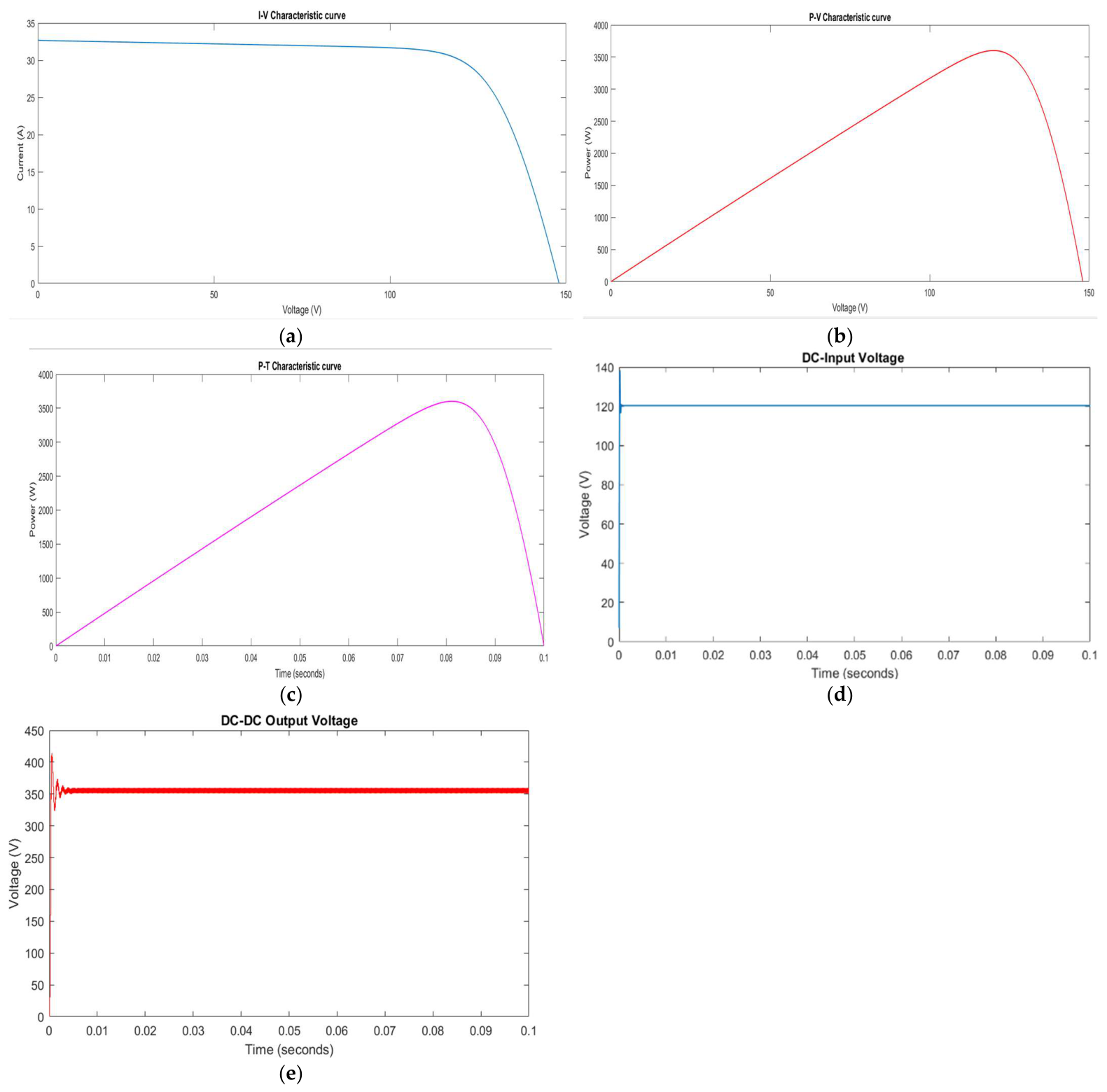
| PV array input voltage | 120 V |
| Boost converter output voltage | 350 V |
| Voltage and | 1% |
| Switching frequency | 10 MHz |
| Inductor | 2.660 × 10⁻⁵ A |
| Input capacitor | 2.350 × 10⁻⁴ A |
| Output capacitor | 3.132 × 10⁻¹⁰ A |
| Simulation time | 0.1 s |
| MPPT Algorithm | Time Complexity | Space Complexity | GMPP Guarantee | Steady State Oscillation | Real-Time Suitability |
|---|---|---|---|---|---|
| P&O | No | High | High | ||
| INC | No | Medium | High | ||
| PSO | Probabilistic | Medium | Moderate | ||
| GWO | Probabilistic | Low | Moderate | ||
| WOA | Probabilistic | Low | Moderate | ||
| MCA | Partial | Low | High | ||
| IMCA-LAE (Proposed) | Validated under simulated PSCs | Very low | High |
| Step | Algorithm Stage | Description/Operation |
|---|---|---|
| 1 | Start | Begin IMCA-LAE MPPT process |
| 2 | Input | Vpv (PV voltage), Ipv (PV current) |
| 3 | Parameter initialization | Set number of chairs Nc, players Np = Nc + 1, maximum iterations MaxIter, local adaptaive exploration interval LAE_int, Initialize players di ∈ [0, 1], Initialize chairs cj ∈ [0, 1], Set dbest = d1, Pbest = −∞, iter = 0, stagnationCount = 0, Pprev = 0 |
| 4 | Main procedure | Measure Vpv and Ipv, Compute P = Vpv × Ipv, iter = iter + 1 |
| 5 | IMCA assignment | For each player i: - Find nearest chair j* - di = cj* |
| 6 | Evaluation | dcurrent = dbest, Pcurrent = P If Pcurrent > Pbest: - Update Pbest and dbest |
| 7 | Exploitation: | di = dbest + 0.02 × randn Limit di ∈ [0, 1] |
| 8 | Stagnation check | If |Pcurrent − Pprev| < 1 × 10⁻⁴: - stagnationCount++ Else: - stagnationCount = 0 Pprev = Pcurrent |
| 9 | Local adaptive exploration (LAE) | If stagnationCount > 10: - Generate candidates around dbest - Limit candidates to [0, 1] - Select one randomly - Update dbest - Reset stagnationCount |
| 10 | Exploration enhancement | Randomly reinitialize chairs |
| 11 | Output | d = dbest Return d |
| Time | T1 | T2 | T3 | T4 | T5 | T6 | T7 | T8 | T9 | T10 | T11 | T12 | T13 | T14 | T15 | T16 |
|---|---|---|---|---|---|---|---|---|---|---|---|---|---|---|---|---|
| 0 | 25 | 50 | −2 | 22 | 35 | 11 | 25 | 41 | −14 | 25 | 25 | 3 | 25 | 36 | 25 | 0 |
| 0.02 | 30 | 0 | 66 | 14 | 25 | 25 | −5 | 12 | 16 | 6 | 25 | 45 | 9 | 43 | 4 | −12 |
| 0.05 | −10 | 20 | 9 | 1 | −7 | 22 | 47 | 25 | 8 | 34 | 25 | −3 | 34 | 28 | 33 | 3 |
| 0.1 | 2 | 25 | 15 | 40 | 18 | 9 | 13 | 32 | 26 | 11 | 25 | 22 | 30 | 30 | 16 | 7 |
| Time | G1 | G2 | G3 | G4 | G5 | G6 | G7 | G8 | G9 | G10 | G11 | G12 | G13 | G14 | G15 | G16 |
|---|---|---|---|---|---|---|---|---|---|---|---|---|---|---|---|---|
| 0 | 220 | 140 | 140 | 450 | 990 | 200 | 340 | 456 | 100 | 400 | 450 | 340 | 120 | 950 | 200 | 1000 |
| 0.02 | 100 | 940 | 450 | 560 | 321 | 340 | 220 | 400 | 200 | 300 | 200 | 320 | 420 | 230 | 300 | 100 |
| 0.05 | 250 | 650 | 350 | 910 | 245 | 110 | 120 | 890 | 1000 | 560 | 100 | 450 | 900 | 450 | 600 | 300 |
| 0.1 | 1000 | 800 | 600 | 340 | 100 | 300 | 500 | 900 | 450 | 200 | 400 | 130 | 100 | 600 | 100 | 400 |
| MPPT Algorithm | Power (W) | Voltage(V) | Time (s) |
|---|---|---|---|
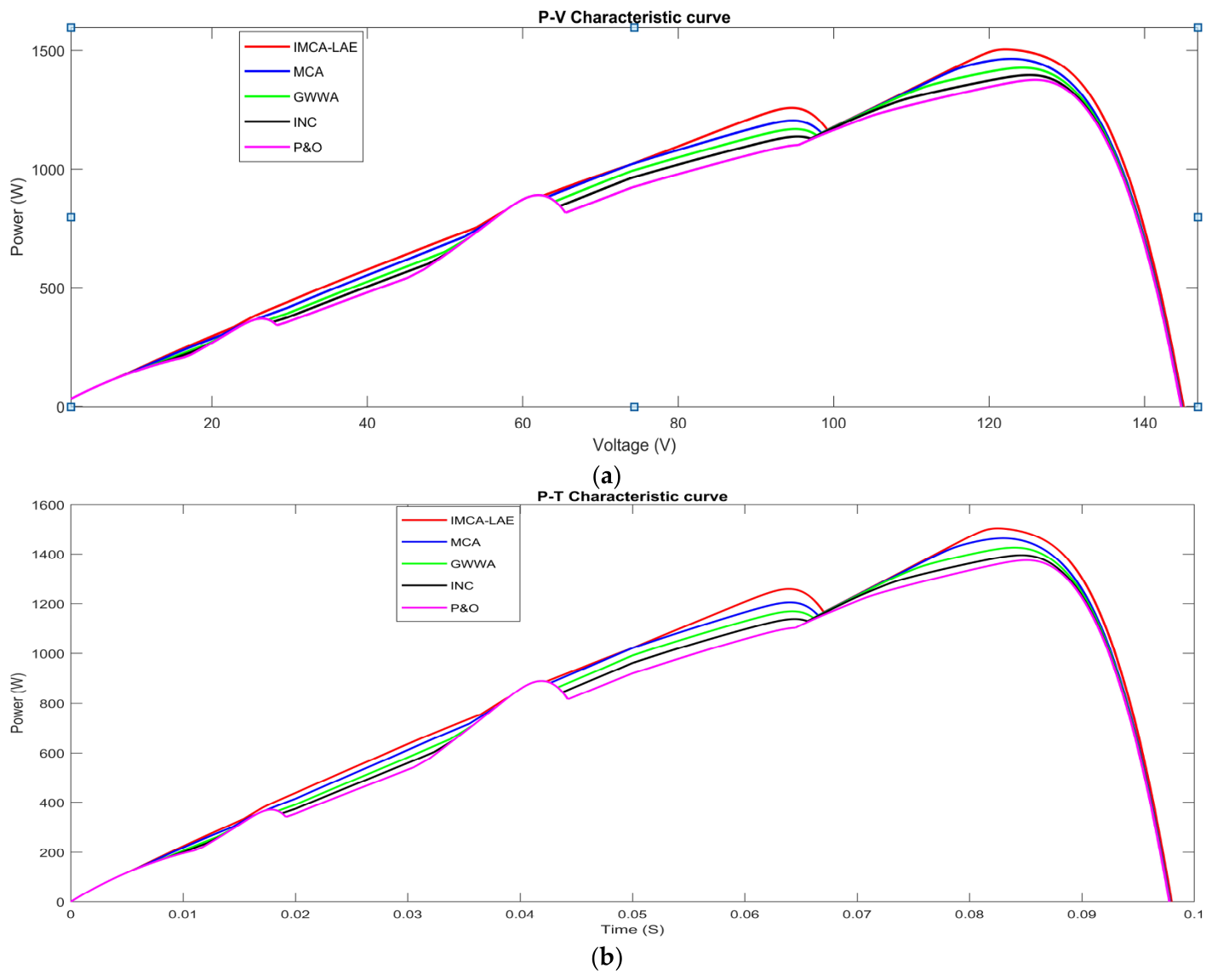
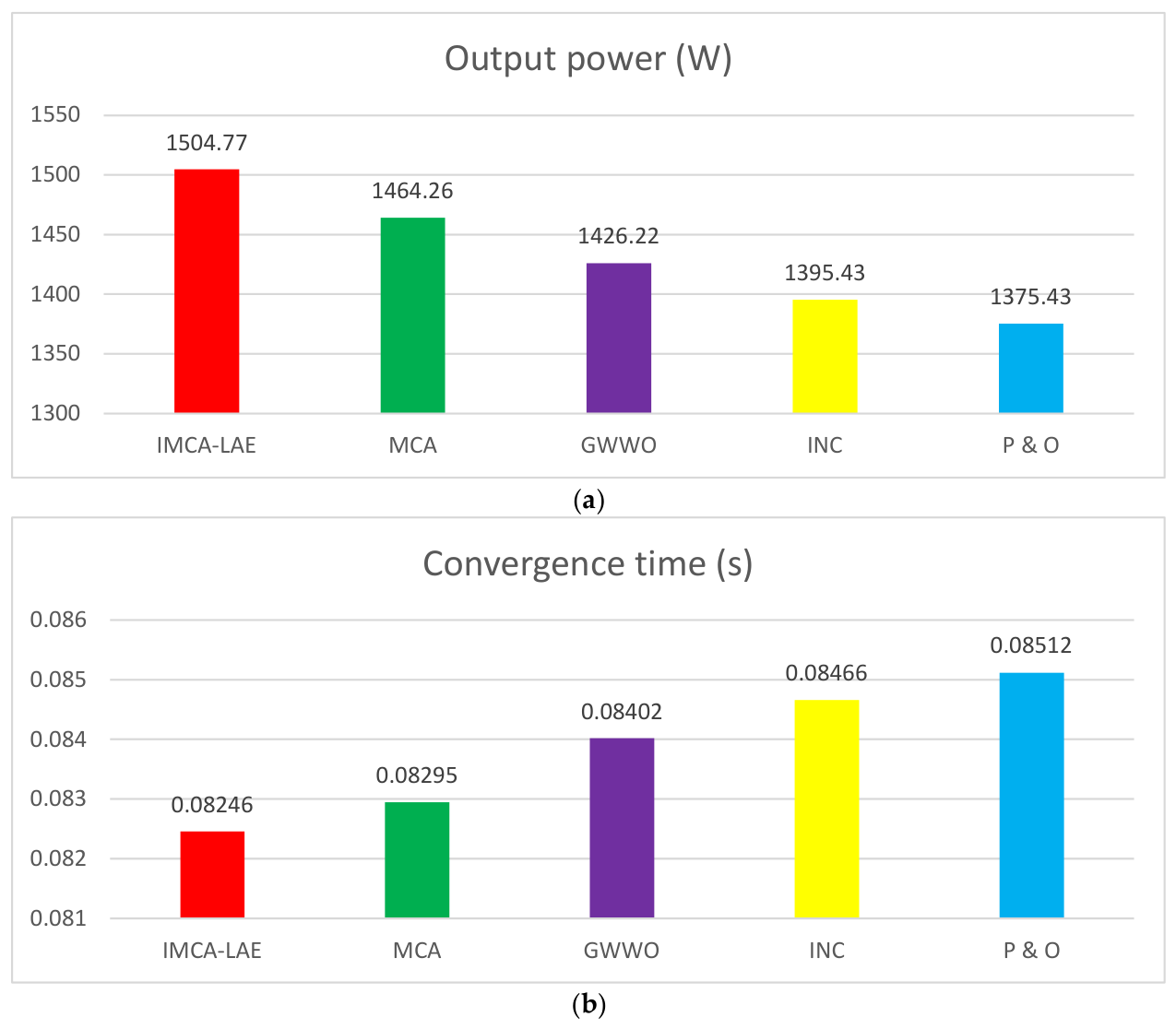
| IMCA-LAE | 1504.77 | 122.178 | 0.08246 |
| MCA | 1464.26 | 122.781 | 0.08295 |
| GWWO | 1426.22 | 124.39 | 0.08402 |
| INC | 1395.43 | 125.284 | 0.08466 |
| P&O | 1375.43 | 125.953 | 0.08512 |
| Time | T1 | T2 | T3 | T4 | T5 | T6 | T7 | T8 | T9 | T10 | T11 | T12 | T13 | T14 | T15 | T16 |
|---|---|---|---|---|---|---|---|---|---|---|---|---|---|---|---|---|
| 0 | 25 | 25 | 25 | 25 | 25 | 25 | 25 | 25 | 25 | 25 | 25 | 25 | 25 | 25 | 25 | 25 |
| 0.02 | 25 | 25 | 25 | 25 | 25 | 25 | 25 | 25 | 25 | 25 | 25 | 25 | 25 | 25 | 25 | 25 |
| 0.05 | 25 | 25 | 25 | 25 | 25 | 25 | 25 | 25 | 25 | 25 | 25 | 25 | 25 | 25 | 25 | 25 |
| 0.1 | 25 | 25 | 25 | 25 | 25 | 25 | 25 | 25 | 25 | 25 | 25 | 25 | 25 | 25 | 25 | 25 |
| Time | T1 | T2 | T3 | T4 | T5 | T6 | T7 | T8 | T9 | T10 | T11 | T12 | T13 | T14 | T15 | T16 |
|---|---|---|---|---|---|---|---|---|---|---|---|---|---|---|---|---|
| 0 | 50 | 45 | 36 | 66 | 37 | 30 | 28 | 34 | 45 | 88 | 36 | 100 | 55 | 66 | 56 | 45 |
| 0.02 | 26 | 46 | 46 | 32 | 28 | 42 | 46 | 27 | 29 | 50 | 42 | 27 | 36 | 39 | 34 | 39 |
| 0.05 | 32 | 48 | 56 | 41 | 51 | 26 | 51 | 34 | 35 | 34 | 67 | 32 | 31 | 40 | 56 | 55 |
| 0.1 | 27 | 39 | 44 | 36 | 39 | 51 | 32 | 41 | 60 | 61 | 90 | 44 | 54 | 52 | 43 | 49 |
| Time | T1 | T2 | T3 | T4 | T5 | T6 | T7 | T8 | T9 | T10 | T11 | T12 | T13 | T14 | T15 | T16 |
|---|---|---|---|---|---|---|---|---|---|---|---|---|---|---|---|---|
| 0 | 15 | 10 | 11 | 3 | 2 | 4 | 22 | 17 | 18 | 15 | 12 | 14 | 11 | 10 | 21 | 5 |
| 0.02 | 10 | 10 | 10 | 10 | 10 | 10 | 10 | 10 | 10 | 10 | 10 | 10 | 10 | 10 | 10 | 10 |
| 0.05 | 5 | 7 | 23 | 0 | 15 | 20 | 7 | 19 | 11 | 8 | 0 | 6 | 21 | 17 | 11 | 23 |
| 0.1 | 6 | 18 | 3 | 7 | 9 | 19 | 12 | 21 | 14 | 3 | 13 | 20 | 19 | 15 | 9 | 1 |
| IMCA-LAE | Power (W) | Voltage (V) | Time (s) |
|---|---|---|---|
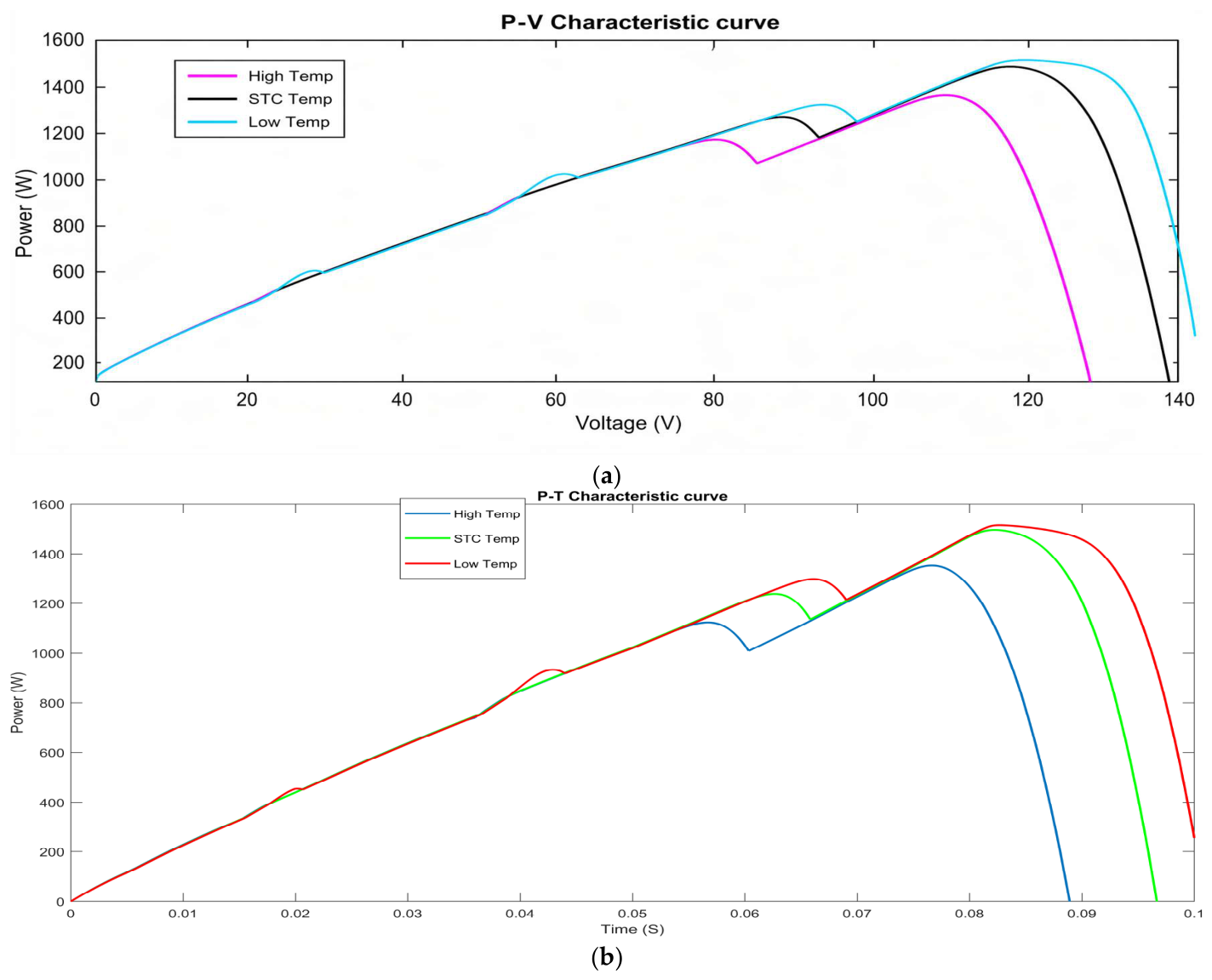
| STC temperature | 1495.42 | 121.612 | 0.08218 |
| High temperature | 1353.58 | 113.398 | 0.07666 |
| Low temperature | 1514.42 | 122.381 | 0.08273 |
| MPPT Algorithm | Power (W) | Time (s) | Mismatch Power Loss (%) | Efficiency (%) | Fill Factor (%) |
|---|---|---|---|---|---|
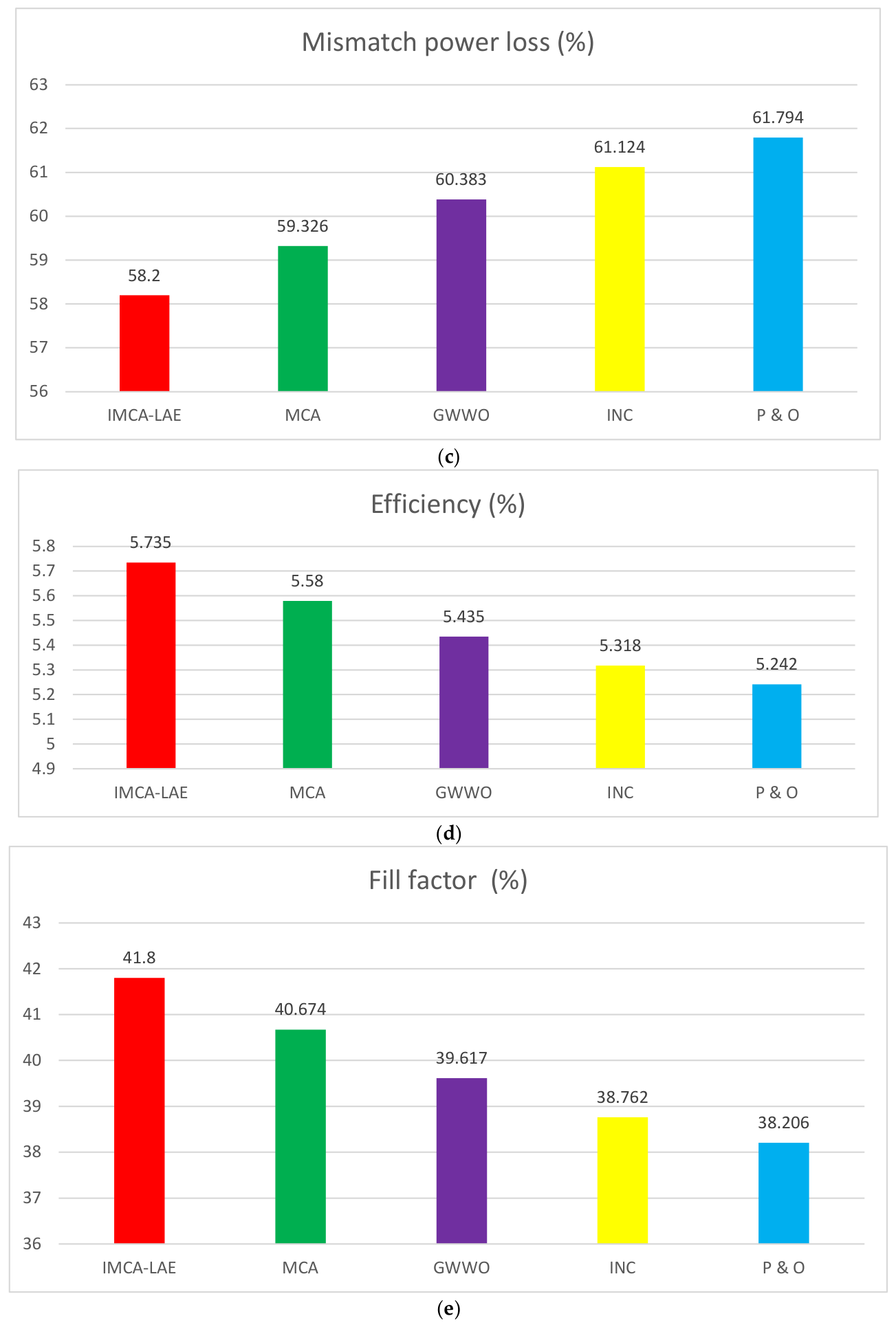
| IMCA-LAE | 1504.77 | 0.08246 | 58.200 | 5.735 | 41.800 |
| MCA | 1464.26 | 0.08295 | 59.326 | 5.580 | 40.674 |
| GWWA | 1426.22 | 0.08402 | 60.383 | 5.435 | 39.617 |
| INC | 1395.43 | 0.08466 | 61.124 | 5.318 | 38.762 |
| P&O | 1375.43 | 0.08512 | 61.794 | 5.242 | 38.206 |
Disclaimer/Publisher’s Note: The statements, opinions and data contained in all publications are solely those of the individual author(s) and contributor(s) and not of MDPI and/or the editor(s). MDPI and/or the editor(s) disclaim responsibility for any injury to people or property resulting from any ideas, methods, instructions or products referred to in the content. |
© 2026 by the authors. Licensee MDPI, Basel, Switzerland. This article is an open access article distributed under the terms and conditions of the Creative Commons Attribution (CC BY) license.
Share and Cite
Ishaya, M.M.; Jazayeri, M. An Improved, Novel Musical Chairs Algorithm with Local Adaptive Exploration for MPPT of PV Systems. Appl. Sci. 2026, 16, 4823. https://doi.org/10.3390/app16104823
Ishaya MM, Jazayeri M. An Improved, Novel Musical Chairs Algorithm with Local Adaptive Exploration for MPPT of PV Systems. Applied Sciences. 2026; 16(10):4823. https://doi.org/10.3390/app16104823
Chicago/Turabian StyleIshaya, Meshack Magaji, and Moein Jazayeri. 2026. "An Improved, Novel Musical Chairs Algorithm with Local Adaptive Exploration for MPPT of PV Systems" Applied Sciences 16, no. 10: 4823. https://doi.org/10.3390/app16104823
APA StyleIshaya, M. M., & Jazayeri, M. (2026). An Improved, Novel Musical Chairs Algorithm with Local Adaptive Exploration for MPPT of PV Systems. Applied Sciences, 16(10), 4823. https://doi.org/10.3390/app16104823