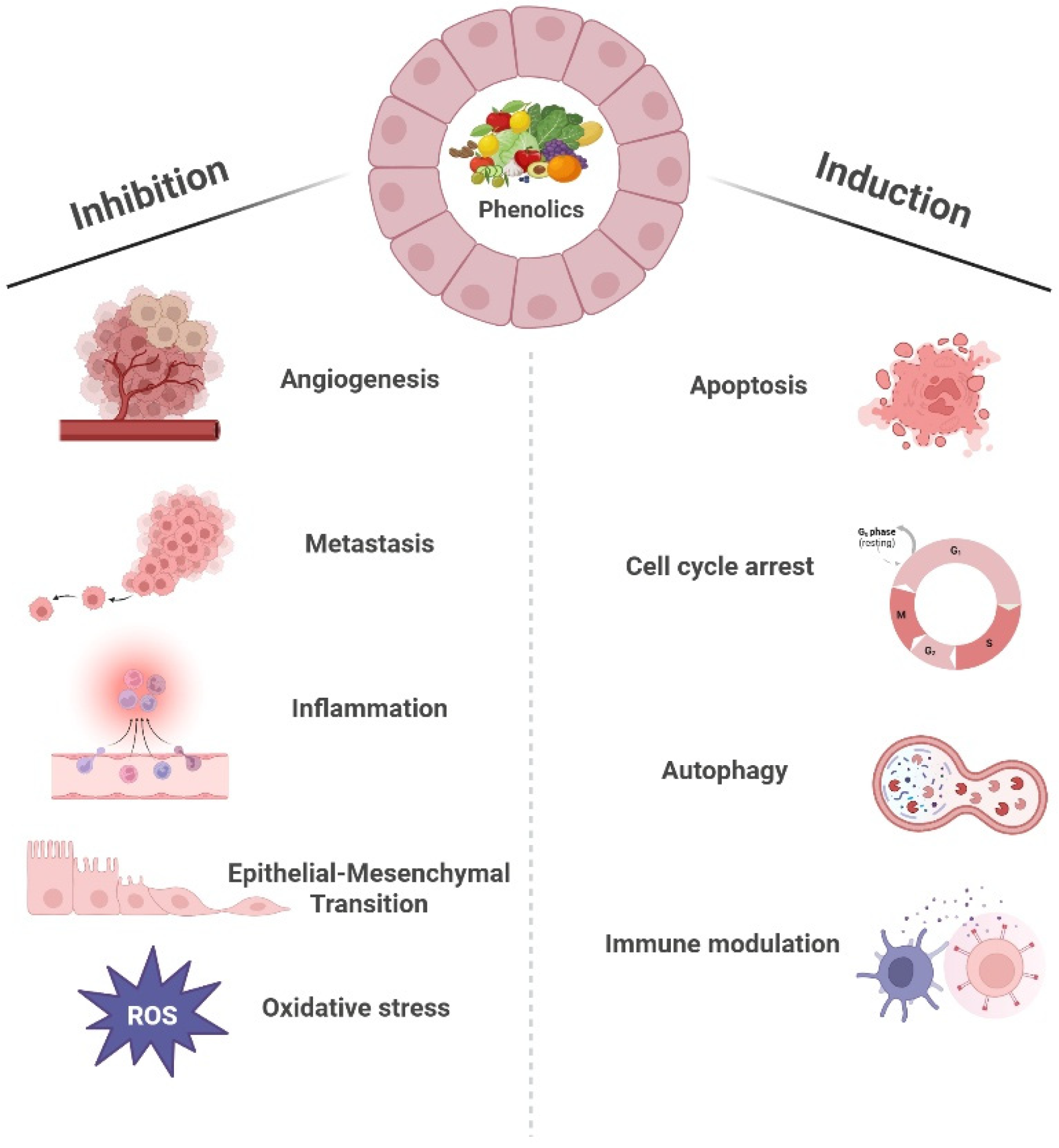
Nanoformulations of Polyphenol-Rich Anticancer Botanical Extracts
 and
and 
Abstract
1. Introduction
2. Botanical Extract with Anticancer Polyphenols
3. Anticancer Activities of Phenolic Compounds
3.1. Apoptosis and Anti-Metastasis
3.2. Oxidative Stress and Anti-Inflammatory Pathways
3.3. Hesperidin
3.4. Naringenin
3.5. Hydroxytyrosol
3.6. Oleuropein
3.7. Quercetin
4. Nanoformulations of Anticancer Botanical Extracts
5. Conclusions
Author Contributions
Funding
Institutional Review Board Statement
Informed Consent Statement
Data Availability Statement
Conflicts of Interest
References
- Latif, R.; Nawaz, T. Medicinal plants and human health: A comprehensive review of bioactive compounds, therapeutic effects, and applications. Phytochem. Rev. 2026, 25, 2299–2342. [Google Scholar] [CrossRef]
- Scott, K.A.; Ropek, N.; Melillo, B.; Schreiber, S.L.; Cravatt, B.F.; Vinogradova, E.V. Stereochemical diversity as a source of discovery in chemical biology. Curr. Res. Chem. Biol. 2022, 2, 100028. [Google Scholar] [CrossRef]
- Kumar, N.; Goel, N. Phenolic acids: Natural versatile molecules with promising therapeutic applications. Biotechnol. Rep. 2019, 24, e00370. [Google Scholar] [CrossRef]
- Atalay Ekiner, S.; Gęgotek, A.; Skrzydlewska, E. Natural compounds modulating redox metabolism and Inflammation: New insights in skin cancer prevention and therapy. Redox Biol. 2025, 88, 103913. [Google Scholar] [CrossRef] [PubMed]
- Liu, W.; Wang, Y.; Xia, L.; Li, J. Research Progress of Plant-Derived Natural Products against Drug-Resistant Cancer. Nutrients 2024, 16, 797. [Google Scholar] [CrossRef]
- Mansouri, H.; Irchad, A.; Rubaka, C.; Kisula, L.; Hamza, A.A.; Sauli, E. Botanical Adjuvants in Oncology: A Review on Natural Compounds in Synergy with Conventional Therapies as Next-Generation Enhancers of Breast Cancer Treatment. Curr. Issues Mol. Biol. 2026, 48, 170. [Google Scholar] [CrossRef]
- Bas, T.G. Dietary Polyphenols (Flavonoids) Derived from Plants for Use in Therapeutic Health: Antioxidant Performance, ROS, Molecular Mechanisms, and Bioavailability Limitations. Int. J. Mol. Sci. 2026, 27, 1404. [Google Scholar] [CrossRef]
- El-Saadony, M.T.; Saad, A.M.; Mohammed, D.M.; Alkafaas, S.S.; Abd El-Mageed, T.A.; Fahmy, M.A.; Ezzat Ahmed, A.; Algopishi, U.B.; Abu-Elsaoud, A.M.; Mosa, W.F.A.; et al. Plant bioactive compounds: Extraction, biological activities, immunological, nutritional aspects, food application, and human health benefits—A comprehensive review. Front. Nutr. 2025, 12, 1659743. [Google Scholar] [CrossRef]
- Oriol-Caballo, M.; Moreno-Murciano, M.P.; López-Blanch, R.; Estrela, J.M.; Obrador, E. Polyphenols: Potential Applications in Cancer Therapy. Mol. Nutr. Food Res. 2025, 69, e70011. [Google Scholar] [CrossRef] [PubMed]
- Kutasy, B.; Hegedűs, G.; Kiniczky, M.; Pallos, J.P.; Nagy, Á.; Pócsi, I.; Pákozdi, K.; Kállai, M.; Weingart, C.; Andor, K.; et al. Garlic Extracts Nanoliposome as an Enhancer of Bioavailability of ABA and Thiamine Content and as an Antifungal Agent Against Fusarium oxysporum f. sp. pisi Infecting Pisum sativum. Agronomy 2025, 15, 991. [Google Scholar] [CrossRef]
- Taouzinet, L.; Djaoudene, O.; Fatmi, S.; Bouiche, C.; Amrane-Abider, M.; Hind, B.; Rezgui, F.; Madani, K. Trends of Nanoencapsulation Strategy for Natural Compounds in the Food Industry. Processes 2023, 11, 1459. [Google Scholar] [CrossRef]
- Suthar, M.; Malik, A.; Marwal, A. Role of nanotechnology in cosmetic development and skin care. Next Nanotechnol. 2026, 9, 100422. [Google Scholar] [CrossRef]
- Attia, M.F.; Anton, N.; Wallyn, J.; Omran, Z.; Vandamme, T.F. An overview of active and passive targeting strategies to improve the nanocarriers efficiency to tumour sites. J. Pharm. Pharmacol. 2019, 71, 1185–1198. [Google Scholar] [CrossRef]
- Chehelgerdi, M.; Chehelgerdi, M.; Allela, O.Q.B.; Pecho, R.D.C.; Jayasankar, N.; Rao, D.P.; Thamaraikani, T.; Vasanthan, M.; Viktor, P.; Lakshmaiya, N.; et al. Progressing nanotechnology to improve targeted cancer treatment: Overcoming hurdles in its clinical implementation. Mol. Cancer 2023, 22, 169. [Google Scholar] [CrossRef]
- Ranjbar, S.; Emamjomeh, A.; Sharifi, F.; Zarepour, A.; Aghaabbasi, K.; Dehshahri, A.; Sepahvand, A.M.; Zarrabi, A.; Beyzaei, H.; Zahedi, M.M.; et al. Lipid-Based Delivery Systems for Flavonoids and Flavonolignans: Liposomes, Nanoemulsions, and Solid Lipid Nanoparticles. Pharmaceutics 2023, 15, 1944. [Google Scholar] [CrossRef]
- Jacob, S.; Kather, F.S.; Boddu, S.H.S.; Shah, J.; Nair, A.B. Innovations in Nanoemulsion Technology: Enhancing Drug Delivery for Oral, Parenteral, and Ophthalmic Applications. Pharmaceutics 2024, 16, 1333. [Google Scholar] [CrossRef]
- Parvin, N.; Aslam, M.; Joo, S.W.; Mandal, T.K. Nano-Phytomedicine: Harnessing Plant-Derived Phytochemicals in Nanocarriers for Targeted Human Health Applications. Molecules 2025, 30, 3177. [Google Scholar] [CrossRef]
- Petrovic, S.; Bita, B.; Barbinta-Patrascu, M.E. Nanoformulations in Pharmaceutical and Biomedical Applications: Green Perspectives. Int. J. Mol. Sci. 2024, 25, 5842. [Google Scholar] [CrossRef] [PubMed]
- Minh Hoang, C.N.; Nguyen, S.H.; Tran, M.T. Nanoparticles in cancer therapy: Strategies to penetrate and modulate the tumor microenvironment—A review. Smart Mater. Med. 2025, 6, 270–284. [Google Scholar] [CrossRef]
- Mi, P. Stimuli-responsive nanocarriers for drug delivery, tumor imaging, therapy and theranostics. Theranostics 2020, 10, 4557–4588. [Google Scholar] [CrossRef] [PubMed]
- El-Saadony, M.T.; Saad, A.M.; Mohammed, D.M.; Korma, S.A.; Alshahrani, M.Y.; Ahmed, A.E.; Ibrahim, E.H.; Salem, H.M.; Alkafaas, S.S.; Saif, A.M.; et al. Medicinal plants: Bioactive compounds, biological activities, combating multidrug-resistant microorganisms, and human health benefits—A comprehensive review. Front. Immunol. 2025, 16, 1491777. [Google Scholar] [CrossRef]
- Alelah, S.M.A.; Abdulrazzaq, A.I.; Hussein, M.O.; Nasser, S.J.; Mssdf, A.K. Overview of extraction methods for phytochemicals: Principles, applications, and future directions. Results Chem. 2026, 24, 103221. [Google Scholar] [CrossRef]
- Sun, S.; Yu, Y.; Jo, Y.; Han, J.H.; Xue, Y.; Cho, M.; Bae, S.-J.; Ryu, D.; Park, W.; Ha, K.-T.; et al. Impact of extraction techniques on phytochemical composition and bioactivity of natural product mixtures. Front. Pharmacol. 2025, 16, 1615338. [Google Scholar] [CrossRef]
- Shi, L.; Zhao, W.; Yang, Z.; Subbiah, V.; Suleria, H.A.R. Extraction and characterization of phenolic compounds and their potential antioxidant activities. Environ. Sci. Pollut. Res. Int. 2022, 29, 81112–81129. [Google Scholar] [CrossRef]
- Makarova, K.; Sajkowska-Kozielewicz, J.J.; Zawada, K.; Olchowik-Grabarek, E.; Ciach, M.A.; Gogolewski, K.; Dobros, N.; Ciechowicz, P.; Freichels, H.; Gambin, A. Harvest time affects antioxidant capacity, total polyphenol and flavonoid content of Polish St John’s wort’s (Hypericum perforatum L.) flowers. Sci. Rep. 2021, 11, 3989. [Google Scholar] [CrossRef] [PubMed]
- Nhu-Trang, T.T.; Nguyen, Q.D.; Cong-Hau, N.; Anh-Dao, L.T.; Behra, P. Characteristics and Relationships between Total Polyphenol and Flavonoid Contents, Antioxidant Capacities, and the Content of Caffeine, Gallic Acid, and Major Catechins in Wild/Ancient and Cultivated Teas in Vietnam. Molecules 2023, 28, 3470. [Google Scholar] [CrossRef] [PubMed]
- Addi, M.; Elbouzidi, A.; Malika, A.; Tungmunnithum, D.; Elamrani, A.; Hano, C. An Overview of Bioactive Flavonoids from Citrus Fruits. Appl. Sci. 2021, 12, 29. [Google Scholar] [CrossRef]
- Pyrzynska, K. Hesperidin: A Review on Extraction Methods, Stability and Biological Activities. Nutrients 2022, 14, 2387. [Google Scholar] [CrossRef]
- Lee, C.-D.; Kim, E.-A.; Rho, H.; Lee, S. Enzymatic Transformation of Secondary Metabolites in Abeliophyllum distichum Extract by Viscozyme L Treatment. Chemosensors 2025, 13, 331. [Google Scholar] [CrossRef]
- Mir-Cerdà, A.; Granados, M.; Saurina, J.; Sentellas, S. Olive tree leaves as a great source of phenolic compounds: Comprehensive profiling of NaDES extracts. Food Chem. 2024, 456, 140042. [Google Scholar] [CrossRef]
- Clodoveo, M.L.; Crupi, P.; Annunziato, A.; Corbo, F. Innovative Extraction Technologies for Development of Functional Ingredients Based on Polyphenols from Olive Leaves. Foods 2021, 11, 103. [Google Scholar] [CrossRef]
- Khalil, A.A.; Rahman, M.; Rauf, A.; Islam, M.R.; Manna, J.; Khan, A.; Ullah, S.; Akhtar, M.; Aljohani, A.; Al Abdulmonem, W.; et al. Oleuropein: Chemistry, Extraction Techniques and Nutraceutical Perspectives-An Update. Crit. Rev. Food Sci. Nutr. 2023, 64, 9933–9954. [Google Scholar] [CrossRef] [PubMed]
- López-Salas, L.; Expósito-Almellón, X.; Valencia-Isaza, A.; Fernández-Arteaga, A.; Quirantes-Piné, R.; Borrás, I.; Lozano-Sánchez, J. Eco-Friendly Extraction of Olive Leaf Phenolics and Terpenes: A Comparative Performance Analysis Against Conventional Methods. Foods 2025, 14, 3030. [Google Scholar] [CrossRef] [PubMed]
- Vollmannová, A.; Bojňanská, T.; Musilová, J.; Lidiková, J.; Cifrová, M. Quercetin as one of the most abundant represented biological valuable plant components with remarkable chemoprotective effects—A review. Heliyon 2024, 10, e33342. [Google Scholar] [CrossRef] [PubMed]
- Terao, J. Potential Role of Quercetin Glycosides as Anti-Atherosclerotic Food-Derived Factors for Human Health. Antioxidants 2023, 12, 258. [Google Scholar] [CrossRef]
- D’Urso, G.; Capuano, A.; Fantasma, F.; Chini, M.G.; De Felice, V.; Saviano, G.; Lauro, G.; Casapullo, A.; Bifulco, G.; Iorizzi, M. The Role of LC-MS in Profiling Bioactive Compounds from Plant Waste for Cosmetic Applications: A General Overview. Plants 2025, 14, 2284. [Google Scholar] [CrossRef]
- Caesar, L.; Cech, N. Synergy and antagonism in natural product extracts: When 1 + 1 does not equal 2. Nat. Prod. Rep. 2019, 36, 869–888. [Google Scholar] [CrossRef]
- Williamson, G. Bioavailability of Food Polyphenols: Current State of Knowledge. Annu. Rev. Food Sci. Technol. 2025, 16, 315–332. [Google Scholar] [CrossRef]
- Cao, H.; Saroglu, O.; Karadag, A.; Diaconeasa, Z.; Zoccatelli, G.; Conte-Junior, C.A.; Gonzalez-Aguilar, G.A.; Ou, J.; Bai, W.; Zamarioli, C.M.; et al. Available technologies on improving the stability of polyphenols in food processing. Food Front. 2021, 2, 109–139. [Google Scholar] [CrossRef]
- Singaravelan, N.; Tollefsbol, T.O. Polyphenol-Based Prevention and Treatment of Cancer Through Epigenetic and Combinatorial Mechanisms. Nutrients 2025, 17, 616. [Google Scholar] [CrossRef]
- Boehm, K.; Borrelli, F.; Ernst, E.; Habacher, G.; Hung, S.K.; Milazzo, S.; Horneber, M. Green tea (Camellia sinensis) for the prevention of cancer. Cochrane Database Syst. Rev. 2009, 2009, Cd005004. [Google Scholar] [CrossRef]
- Amawi, H.; Ashby, C.R.; Samuel, T.; Peraman, R.; Tiwari, A.K. Polyphenolic Nutrients in Cancer Chemoprevention and Metastasis: Role of the Epithelial-to-Mesenchymal (EMT) Pathway. Nutrients 2017, 9, 911. [Google Scholar] [CrossRef]
- Hu, C.; Li, M.; Guo, T.; Wang, S.; Huang, W.; Yang, K.; Liao, Z.; Wang, J.; Zhang, F.; Wang, H. Anti-metastasis activity of curcumin against breast cancer via the inhibition of stem cell-like properties and EMT. Phytomedicine Int. J. Phytother. Phytopharm. 2019, 58, 152740. [Google Scholar] [CrossRef]
- Maleki Dana, P.; Sadoughi, F.; Asemi, Z.; Yousefi, B. The role of polyphenols in overcoming cancer drug resistance: A comprehensive review. Cell. Mol. Biol. Lett. 2022, 27, 1. [Google Scholar] [CrossRef] [PubMed]
- Gasmi, A.; Mujawdiya, P.K.; Noor, S.; Lysiuk, R.; Darmohray, R.; Piscopo, S.; Lenchyk, L.; Antonyak, H.; Dehtiarova, K.; Shanaida, M.; et al. Polyphenols in Metabolic Diseases. Molecules 2022, 27, 6280. [Google Scholar] [CrossRef]
- Talebi, M.; Talebi, M.; Farkhondeh, T.; Samarghandian, S. Molecular mechanism-based therapeutic properties of honey. Biomed. Pharmacother. Biomed. Pharmacother. 2020, 130, 110590. [Google Scholar] [CrossRef] [PubMed]
- Shi, Z.; Liu, Y.; Hu, Z.; Liu, L.; Yan, Q.; Geng, D.; Wei, M.; Wan, Y.; Fan, G.; Yang, H.; et al. Effect of radiation processing on phenolic antioxidants in cereal and legume seeds: A review. Food Chem. 2022, 396, 133661. [Google Scholar] [CrossRef]
- Perron, N.R.; Brumaghim, J.L. A review of the antioxidant mechanisms of polyphenol compounds related to iron binding. Cell Biochem. Biophys. 2009, 53, 75–100. [Google Scholar] [CrossRef]
- Kruk, J.; Aboul-Enein, H.Y. Reactive Oxygen and Nitrogen Species in Carcinogenesis: Implications of Oxidative Stress on the Progression and Development of Several Cancer Types. Mini Rev. Med. Chem. 2017, 17, 904–919. [Google Scholar] [CrossRef] [PubMed]
- Heim, K.E.; Tagliaferro, A.R.; Bobilya, D.J. Flavonoid antioxidants: Chemistry, metabolism and structure-activity relationships. J. Nutr. Biochem. 2002, 13, 572–584. [Google Scholar] [CrossRef]
- Fakhri, K.U.; Sharma, D.; Fatma, H.; Yasin, D.; Alam, M.; Sami, N.; Ahmad, F.J.; Shamsi, A.; Rizvi, M.A. The Dual Role of Dietary Phytochemicals in Oxidative Stress: Implications for Oncogenesis, Cancer Chemoprevention, and ncRNA Regulation. Antioxidants 2025, 14, 620. [Google Scholar] [CrossRef]
- Hussain, T.; Tan, B.; Yin, Y.; Blachier, F.; Tossou, M.C.; Rahu, N. Oxidative Stress and Inflammation: What Polyphenols Can Do for Us? Oxidative Med. Cell. Longev. 2016, 2016, 7432797. [Google Scholar] [CrossRef]
- Behl, T.; Mehta, K.; Sehgal, A.; Singh, S.; Sharma, N.; Ahmadi, A.; Arora, S.; Bungau, S. Exploring the role of polyphenols in rheumatoid arthritis. Crit. Rev. Food Sci. Nutr. 2022, 62, 5372–5393. [Google Scholar] [CrossRef]
- Cheng, M.; Ding, F.; Li, L.; Dai, C.; Sun, X.; Xu, J.; Chen, F.; Li, M.; Li, X. Exploring the role of curcumin in mitigating oxidative stress to alleviate lipid metabolism disorders. Front. Pharmacol. 2025, 16, 1517174. [Google Scholar] [CrossRef]
- Razzaghi, T.; Hasanvand, S.; Ghaffari, S.-B.; Miran, M.; Mallillin, M.C.; Zhao, S.; Homapour, M.; Serpe, M.J.; Loebenberg, R.; Salami, M.; et al. Pomegranate (Punica granatum L.) and Disease-Related Enzyme Modulation. J. Phytomed. 2026, 1, 3. [Google Scholar] [CrossRef]
- Jang, Y.; Kim, M.; Hwang, S.W. Molecular mechanisms underlying the actions of arachidonic acid-derived prostaglandins on peripheral nociception. J. Neuroinflamm. 2020, 17, 30. [Google Scholar] [CrossRef]
- Zhang, X.-Y.; Li, W.-G.; Wu, Y.-J.; Gao, M.-T. Amelioration of doxorubicin-induced myocardial oxidative stress and immunosuppression by grape seed proanthocyanidins in tumour-bearing mice. J. Pharm. Pharmacol. 2005, 57, 1043–1051. [Google Scholar] [CrossRef] [PubMed]
- Jiang, C.H.; Sun, T.L.; Xiang, D.X.; Wei, S.S.; Li, W.Q. Anticancer Activity and Mechanism of Xanthohumol: A Prenylated Flavonoid from Hops (Humulus lupulus L.). Front. Pharmacol. 2018, 9, 530. [Google Scholar] [CrossRef]
- Siddiqi, A.; Saidullah, B.; Sultana, S. Anti-carcinogenic effect of hesperidin against renal cell carcinoma by targeting COX-2/PGE2 pathway in Wistar rats. Environ. Toxicol. 2018, 33, 1069–1077. [Google Scholar] [CrossRef] [PubMed]
- Mo’men, Y.S.; Hussein, R.M.; Kandeil, M.A. Involvement of PI3K/Akt pathway in the protective effect of hesperidin against a chemically induced liver cancer in rats. J. Biochem. Mol. Toxicol. 2019, 33, e22305. [Google Scholar] [CrossRef]
- Siddiqi, A.; Hasan, S.K.; Nafees, S.; Rashid, S.; Saidullah, B.; Sultana, S. Chemopreventive efficacy of hesperidin against chemically induced nephrotoxicity and renal carcinogenesis via amelioration of oxidative stress and modulation of multiple molecular pathways. Exp. Mol. Pathol. 2015, 99, 641–653. [Google Scholar] [CrossRef]
- Yeh, M.H.; Kao, S.T.; Hung, C.M.; Liu, C.J.; Lee, K.H.; Yeh, C.C. Hesperidin inhibited acetaldehyde-induced matrix metalloproteinase-9 gene expression in human hepatocellular carcinoma cells. Toxicol. Lett. 2009, 184, 204–210. [Google Scholar] [CrossRef] [PubMed]
- Wudtiwai, B.; Makeudom, A.; Krisanaprakornkit, S.; Pothacharoen, P.; Kongtawelert, P. Anticancer Activities of Hesperidin via Suppression of Up-Regulated Programmed Death-Ligand 1 Expression in Oral Cancer Cells. Molecules 2021, 26, 5345. [Google Scholar] [CrossRef] [PubMed]
- Cincin, Z.B.; Kiran, B.; Baran, Y.; Cakmakoglu, B. Hesperidin promotes programmed cell death by downregulation of nongenomic estrogen receptor signalling pathway in endometrial cancer cells. Biomed. Pharmacother. Biomed. Pharmacother. 2018, 103, 336–345. [Google Scholar] [CrossRef] [PubMed]
- Xia, R.; Sheng, X.; Xu, X.; Yu, C.; Lu, H. Hesperidin induces apoptosis and G0/G1 arrest in human non-small cell lung cancer A549 cells. Int. J. Mol. Med. 2018, 41, 464–472. [Google Scholar] [CrossRef]
- Noori, S.; Rezaei Tavirani, M.; Deravi, N.; Mahboobi Rabbani, M.I.; Zarghi, A. Naringenin Enhances the Anti-Cancer Effect of Cyclophosphamide against MDA-MB-231 Breast Cancer Cells via Targeting the STAT3 Signaling Pathway. Iran. J. Pharm. Res. IJPR 2020, 19, 122–133. [Google Scholar] [CrossRef]
- Askar, M.A.; El Shawi, O.E.; Abou Zaid, O.A.R.; Mansour, N.A.; Hanafy, A.M. Breast cancer suppression by curcumin-naringenin-magnetic-nano-particles: In vitro and in vivo studies. Tumour Biol. J. Int. Soc. Oncodev. Biol. Med. 2021, 43, 225–247. [Google Scholar] [CrossRef]
- Chang, H.L.; Chang, Y.M.; Lai, S.C.; Chen, K.M.; Wang, K.C.; Chiu, T.T.; Chang, F.H.; Hsu, L.S. Naringenin inhibits migration of lung cancer cells via the inhibition of matrix metalloproteinases-2 and -9. Exp. Ther. Med. 2017, 13, 739–744. [Google Scholar] [CrossRef]
- Kma, L.; Baruah, T. Naringenin Sensitizes Lung Cancer NCI-H23 Cells to Radiation by Downregulation of Akt Expression and Metastasis while Promoting Apoptosis. Pharmacogn. Mag. 2020, 16, s229–s235. [Google Scholar] [CrossRef]
- Dou, W.; Zhang, J.; Sun, A.; Zhang, E.; Ding, L.; Mukherjee, S.; Wei, X.; Chou, G.; Wang, Z.T.; Mani, S. Protective effect of naringenin against experimental colitis via suppression of Toll-like receptor 4/NF-κB signalling. Br. J. Nutr. 2013, 110, 599–608. [Google Scholar] [CrossRef]
- Calahorra, J.; Martínez-Lara, E.; Granadino-Roldán, J.M.; Martí, J.M.; Cañuelo, A.; Blanco, S.; Oliver, F.J.; Siles, E. Crosstalk between hydroxytyrosol, a major olive oil phenol, and HIF-1 in MCF-7 breast cancer cells. Sci. Rep. 2020, 10, 6361. [Google Scholar] [CrossRef]
- Costantini, F.; Di Sano, C.; Barbieri, G. The Hydroxytyrosol Induces the Death for Apoptosis of Human Melanoma Cells. Int. J. Mol. Sci. 2020, 21, 8074. [Google Scholar] [CrossRef]
- Cerezo, A.B.; Labrador, M.; Gutiérrez, A.; Hornedo-Ortega, R.; Troncoso, A.M.; Garcia-Parrilla, M.C. Anti-VEGF Signalling Mechanism in HUVECs by Melatonin, Serotonin, Hydroxytyrosol and Other Bioactive Compounds. Nutrients 2019, 11, 2421. [Google Scholar] [CrossRef]
- Yonezawa, Y.; Miyashita, T.; Nejishima, H.; Takeda, Y.; Imai, K.; Ogawa, H. Anti-inflammatory effects of olive-derived hydroxytyrosol on lipopolysaccharide-induced inflammation in RAW264.7 cells. J. Vet. Med. Sci. 2018, 80, 1801–1807. [Google Scholar] [CrossRef]
- Velotti, F.; Bernini, R. Hydroxytyrosol Interference with Inflammaging via Modulation of Inflammation and Autophagy. Nutrients 2023, 15, 1774. [Google Scholar] [CrossRef]
- Leo, M.; Muccillo, L.; Dugo, L.; Bernini, R.; Santi, L.; Sabatino, L. Polyphenols Extracts from Oil Production Waste Products (OPWPs) Reduce Cell Viability and Exert Anti-Inflammatory Activity via PPARγ Induction in Colorectal Cancer Cells. Antioxidants 2022, 11, 624. [Google Scholar] [CrossRef] [PubMed]
- Liu, L.; Ahn, K.S.; Shanmugam, M.K.; Wang, H.; Shen, H.; Arfuso, F.; Chinnathambi, A.; Alharbi, S.A.; Chang, Y.; Sethi, G.; et al. Oleuropein induces apoptosis via abrogating NF-κB activation cascade in estrogen receptor-negative breast cancer cells. J. Cell. Biochem. 2019, 120, 4504–4513. [Google Scholar] [CrossRef] [PubMed]
- Liu, M.; Wang, J.; Huang, B.; Chen, A.; Li, X. Oleuropein inhibits the proliferation and invasion of glioma cells via suppression of the AKT signaling pathway. Oncol. Rep. 2016, 36, 2009–2016. [Google Scholar] [CrossRef]
- Milanizadeh, S.; Reza Bigdeli, M. Pro-Apoptotic and Anti-Angiogenesis Effects of Olive Leaf Extract on Spontaneous Mouse Mammary Tumor Model by Balancing Vascular Endothelial Growth Factor and Endostatin Levels. Nutr. Cancer 2019, 71, 1374–1381. [Google Scholar] [CrossRef]
- Song, H.; Lim, D.Y.; Jung, J.I.; Cho, H.J.; Park, S.Y.; Kwon, G.T.; Kang, Y.H.; Lee, K.W.; Choi, M.S.; Park, J.H.Y. Dietary oleuropein inhibits tumor angiogenesis and lymphangiogenesis in the B16F10 melanoma allograft model: A mechanism for the suppression of high-fat diet-induced solid tumor growth and lymph node metastasis. Oncotarget 2017, 8, 32027–32042. [Google Scholar] [CrossRef] [PubMed]
- Goldsmith, C.D.; Bond, D.R.; Jankowski, H.; Weidenhofer, J.; Stathopoulos, C.E.; Roach, P.D.; Scarlett, C.J. The Olive Biophenols Oleuropein and Hydroxytyrosol Selectively Reduce Proliferation, Influence the Cell Cycle, and Induce Apoptosis in Pancreatic Cancer Cells. Int. J. Mol. Sci. 2018, 19, 1937. [Google Scholar] [CrossRef]
- Wang, W.; Wu, J.; Zhang, Q.; Li, X.; Zhu, X.; Wang, Q.; Cao, S.; Du, L. Mitochondria-mediated apoptosis was induced by oleuropein in H1299 cells involving activation of p38 MAP kinase. J. Cell. Biochem. 2019, 120, 5480–5494. [Google Scholar] [CrossRef]
- Giner, E.; Recio, M.C.; Ríos, J.L.; Cerdá-Nicolás, J.M.; Giner, R.M. Chemopreventive effect of oleuropein in colitis-associated colorectal cancer in c57bl/6 mice. Mol. Nutr. Food Res. 2016, 60, 242–255. [Google Scholar] [CrossRef] [PubMed]
- Erdogan, S.; Turkekul, K.; Dibirdik, I.; Doganlar, O.; Doganlar, Z.B.; Bilir, A.; Oktem, G. Midkine downregulation increases the efficacy of quercetin on prostate cancer stem cell survival and migration through PI3K/AKT and MAPK/ERK pathway. Biomed. Pharmacother. Biomed. Pharmacother. 2018, 107, 793–805. [Google Scholar] [CrossRef]
- Kedhari Sundaram, M.; Raina, R.; Afroze, N.; Bajbouj, K.; Hamad, M.; Haque, S.; Hussain, A. Quercetin modulates signaling pathways and induces apoptosis in cervical cancer cells. Biosci. Rep. 2019, 39, 720. [Google Scholar] [CrossRef]
- Ward, A.B.; Mir, H.; Kapur, N.; Gales, D.N.; Carriere, P.P.; Singh, S. Quercetin inhibits prostate cancer by attenuating cell survival and inhibiting anti-apoptotic pathways. World J. Surg. Oncol. 2018, 16, 108. [Google Scholar] [CrossRef]
- Zhang, J.; Teng, F.; Wu, T.; Li, S.; Li, K. Quercetin inhibits chronic stress-mediated progression of triple-negative breast cancer by blocking β(2)-AR/ERK1/2 pathway. Biomed. Pharmacother. Biomed. Pharmacother. 2024, 177, 116985. [Google Scholar] [CrossRef] [PubMed]
- Mukherjee, A.; Khuda-Bukhsh, A.R. Quercetin Down-regulates IL-6/STAT-3 Signals to Induce Mitochondrial-mediated Apoptosis in a Nonsmall-cell Lung-cancer Cell Line, A549. J. Pharmacopunct. 2015, 18, 19–26. [Google Scholar] [CrossRef] [PubMed]
- Conte, R.; De Luca, I.; Calarco, A.; Finicelli, M.; Peluso, G. Polyphenol-Loaded Nanodevices as Innovative Therapeutic Strategies for Dry Eye Disease: Advances and Perspectives. Antioxidants 2025, 14, 1280. [Google Scholar] [CrossRef]
- Ozkan, G.; Ceyhan, T.; Çatalkaya, G.; Rajan, L.; Ullah, H.; Daglia, M.; Capanoglu, E. Encapsulated phenolic compounds: Clinical efficacy of a novel delivery method. Phytochem. Rev. 2024, 23, 781–819. [Google Scholar] [CrossRef]
- Patra, J.K.; Das, G.; Fraceto, L.F.; Campos, E.V.R.; Rodriguez-Torres, M.D.P.; Acosta-Torres, L.S.; Diaz-Torres, L.A.; Grillo, R.; Swamy, M.K.; Sharma, S.; et al. Nano based drug delivery systems: Recent developments and future prospects. J. Nanobiotechnol. 2018, 16, 71. [Google Scholar] [CrossRef] [PubMed]
- Conte, R.; Foggia, R.; Valentino, A.; Di Salle, A.; Kandsi, F.; Calarco, A. Nanotechnology advancements transforming molecular diagnostics: Applications in precision healthcare. Int. J. Nano Dimens. 2024, 15. [Google Scholar] [CrossRef]
- Conte, R.; Marturano, V.; Peluso, G.; Calarco, A.; Cerruti, P. Recent Advances in Nanoparticle-Mediated Delivery of Anti-Inflammatory Phytocompounds. Int. J. Mol. Sci. 2017, 18, 709. [Google Scholar] [CrossRef] [PubMed]
- Zeb, A.; Rana, I.; Choi, H.I.; Lee, C.H.; Baek, S.W.; Lim, C.W.; Khan, N.; Arif, S.T.; Sahar, N.U.; Alvi, A.M.; et al. Potential and Applications of Nanocarriers for Efficient Delivery of Biopharmaceuticals. Pharmaceutics 2020, 12, 1184. [Google Scholar] [CrossRef]
- Wang, H.; Tang, C.; Zhang, H.; Guo, L.; Zou, C.; Zhang, S.; Liu, J.; Huang, Q.; Liu, Y.; Zhou, W.; et al. A biocompatible tea polyphenol nanoplatform for efficient cytosolic delivery of protein therapeutics. J. Control. Release Off. J. Control. Release Soc. 2025, 388, 114347. [Google Scholar] [CrossRef]
- Yang, B.; Dong, Y.; Wang, F.; Zhang, Y. Nanoformulations to Enhance the Bioavailability and Physiological Functions of Polyphenols. Molecules 2020, 25, 4613. [Google Scholar] [CrossRef]
- Anand, S.; Sowbhagya, R.; Ansari, M.A.; Alzohairy, M.A.; Alomary, M.N.; Almalik, A.I.; Ahmad, W.; Tripathi, T.; Elderdery, A.Y. Polyphenols and Their Nanoformulations: Protective Effects against Human Diseases. Life 2022, 12, 1639. [Google Scholar] [CrossRef] [PubMed]
- Tomar, R.; Das, S.S.; Balaga, V.K.R.; Tambe, S.; Sahoo, J.; Rath, S.K.; Ruokolainen, J.; Kesari, K.K. Therapeutic Implications of Dietary Polyphenols-Loaded Nanoemulsions in Cancer Therapy. ACS Appl. Bio Mater. 2024, 7, 2036–2053. [Google Scholar] [CrossRef]
- Magura, J.; Hassan, D.; Moodley, R.; Mackraj, I. Hesperidin-loaded nanoemulsions improve cytotoxicity, induce apoptosis, and downregulate miR-21 and miR-155 expression in MCF-7. J. Microencapsul. 2021, 38, 486–495. [Google Scholar] [CrossRef]
- Wolfram, J.; Scott, B.; Boom, K.; Shen, J.; Borsoi, C.; Suri, K.; Grande, R.; Fresta, M.; Celia, C.; Zhao, Y.; et al. Hesperetin Liposomes for Cancer Therapy. Curr. Drug Deliv. 2016, 13, 711–719. [Google Scholar] [CrossRef]
- Pandi, J.S.; Pavadai, P.; Panneerselvam, T.; Sankaranarayanan, M.; Kunjiappan, S. Enhanced anticancer activity of naringenin-encapsulated poly (lactic acid)/neem gum nanoparticles for breast cancer cells. Biomed. Mater. 2026, 21, 015017. [Google Scholar] [CrossRef]
- Imam, S.; Alshehri, S.; Ghoneim, M.; Zafar, A.; Alsaidan, O.; Alruwaili, N.; Gilani, S.; Rizwanullah, M. Recent Advancement in Chitosan-Based Nanoparticles for Improved Oral Bioavailability and Bioactivity of Phytochemicals: Challenges and Perspectives. Polymers 2021, 13, 4036. [Google Scholar] [CrossRef] [PubMed]
- Yan, T.; Fan, S.; Yun, Y.; Jiang, Z.; Liu, M.; Zhou, L. Oil-in-dispersion emulsions stabilized by electrostatic repulsions between surfactant and tea polyphenol nanoparticles. Chem. Commun. 2026, 62, 4337–4341. [Google Scholar] [CrossRef] [PubMed]
- Yao, Y.; Ma, L.; Yu, C.; Cheng, C.; Gao, H.; Wei, T.; Li, L.; Wang, Z.; Liu, W.; Deng, Z.; et al. The improvement of tyrosol bioavailability by encapsulation into liposomes using pH-driven method. Food Chem. 2024, 445, 138661. [Google Scholar] [CrossRef]
- Nardi, M.; Brocchini, S.; Somavarapu, S.; Procopio, A. Hydroxytyrosol oleate: A promising neuroprotective nanocarrier delivery system of oleuropein and derivatives. Int. J. Pharm. 2022, 631, 122498. [Google Scholar] [CrossRef] [PubMed]
- Huguet-Casquero, A.; Moreno-Sastre, M.; López Méndez, T.; Gainza, E.; Pedraz, J. Encapsulation of Oleuropein in Nanostructured Lipid Carriers: Biocompatibility and Antioxidant Efficacy in Lung Epithelial Cells. Pharmaceutics 2020, 12, 429. [Google Scholar] [CrossRef]
- Yadav, N.; Tripathi, A.K.; Parveen, A.; Parveen, S.; Banerjee, M. PLGA-Quercetin Nano-Formulation Inhibits Cancer Progression via Mitochondrial Dependent Caspase-3,7 and Independent FoxO1 Activation with Concomitant PI3K/AKT Suppression. Pharmaceutics 2022, 14, 1326. [Google Scholar] [CrossRef]
- Shen, M.; Wang, H.; Liu, J.; Zhou, Z.; Wu, X.; Fan, H.; Du, H.; Qiu, Y.; Liu, D.; Ma, D.; et al. Mesoporous Silica Nanoparticles for Quercetin-Controlled Delivery to Protect Cisplatin-Induced Ototoxicity. ACS Appl. Bio Mater. 2025, 8, 10419–10435. [Google Scholar] [CrossRef]
- Kaushik, A.; Khan, S.; Pharasi, N.; Mani, S. Dual pH and ultrasound responsive nanocarriers: A smart approach in cancer theranostics. J. Drug Deliv. Sci. Technol. 2024, 95, 105560. [Google Scholar] [CrossRef]
- El Sadda, R.R. Glutathione responsive nanomedicine leverages tumor redox imbalance for targeted cancer theranostics. Discov. Oncol. 2026, 17, 288. [Google Scholar] [CrossRef]
- Bezelya, A.; Küçüktürkmen, B.; Bozkır, A. Microfluidic Devices for Precision Nanoparticle Production. Micro 2023, 3, 822–866. [Google Scholar] [CrossRef]
- Conte, R.; Valentino, A.; De Luca, I.; Soares Pontes, G.; Calarco, A.; Cerruti, P. Thermo-Responsive Hydrogel Containing Microfluidic Chitosan Nanoparticles Loaded with Opuntia ficus-indica Extract for Periodontitis Treatment. Int. J. Mol. Sci. 2024, 25, 9374. [Google Scholar] [CrossRef]
- Zhang, Q.; Yue, Y.; Li, X.; Zhang, C.; Guo, Y.; Wang, Z.; Li, J. Advances in analytical techniques for bioactive compound quantification in medicinal Plants: Innovations, Challenges, and pharmaceutical applications. Microchem. J. 2025, 214, 114119. [Google Scholar] [CrossRef]


| Type of Cancer | Compound | Experimental Model | Outcome |
|---|---|---|---|
| Renal cancer | Hesperidin | In vivo—DEN-initiated & Fe-NTA-promoted renal carcinogenesis (Wistar rats) | ↑ GSH, GPx, GR, SOD, catalase; ↓ COX-2, VEGF |
| Hesperidin | In vivo—Fe-NTA-induced renal carcinogenesis (Wistar rats) | ↑ Caspase-3, -9, Bax; ↓ Bcl-2; ↓ NF-κB, iNOS, TNF-α | |
| Liver cancer | Hesperidin | In vitro- HEPG2 cells | ↓ MMP-9; ↓ NF-κB, AP-1 |
| Hesperidin | In vivo—DEN-induced HCC (Wistar rats) | ↓ PI3K, Akt, CDK-2 | |
| Oral cancer | Hesperidin | In vitro—HN6 and HN15 cells | ↓ STAT1, STAT3 |
| Uterus cancer | Hesperidin | In vitro—CRL-2923 cells | ↑ Caspase-3; ↑ Bax; ↓ Bcl-2; ↓ ERK/MAPK |
| Lung cancer | Hesperidin | In vitro—A549 cells | G0/G1 arrest; ↑ p21, p53; ↓ cyclin D1 |
| Naringenin | In vitro—A549 cells | ↓ Akt; ↓ MMP-2, MMP-9 | |
| Naringenin | In vitro—NCI-H23 cells | DNA damage; ↓ PI3K/Akt; ↓ Bcl-2/Bcl-xL; ↑ Bax, Caspase-3 | |
| Oleuropein | In vitro—H1299 cells | G2/M arrest; ↑ Bax; ↓ Bcl-2; ↑ Caspase-3 | |
| Quercetin | In vitro—A549 cells | ↓ NF-κB, IL-6, STAT3; ↑ Bax; ↓ Bcl-2 | |
| Breast cancer | Naringenin | In vitro—MDA-MB-231cells | ↑ Bax; ↓ Bcl-2; ↑ Caspase-3, -9; ↓ STAT3 |
| Naringenin | In vitro—MCF-7 cells | Cell cycle arrest; ↑ ROS; ↑ p53 and p21, ↓TNF-α | |
| Hydroxytyrosol | In vitro—MCF-7 cells | ↓ HIF-1; ↓ PI3K/Akt/mTOR | |
| Oleuropein | In vitro—MDA-MB-231 | ↓ NF-κB; ↓ cyclin D1, COX-2 | |
| Oleuropein | In vivo—Female BALB/c mice | ↓ VEGF | |
| Quercetin | In vivo (TNBC nude mice) & in vitro (MDA-MB-231, MDA-MB-468, 4T1) | ↓ ERK1/2, c-Myc, PCNA; ↓ MMP-2/-9; ↑ E-cadherin | |
| Skin cancer | Hydroxytyrosol | In vitro—A375 cells | ↑ p53; ↓ Akt |
| Oleuropein | In vivo—C57BL/6N mice | ↓ VEGF, HIF | |
| CNS cancer | Hydroxytyrosol | In vitro—U251 and A172 cells | ↓ Akt; ↑ Bax; ↓ Bcl-2; ↓ MMP-2/-9 |
| Pancreas cancer | Oleuropein | In vitro—MIA PaCa-2 | Cell cycle arrest; ↑ Bax; ↓ Bcl-2; ↑ Caspase-3/-7 |
| Colon cancer | Oleuropein | In vivo—C57BL/6 mice | ↓ IL-6, IFN-γ, TNF-α, IL-17A; ↓ COX-2; ↓ NF-κB, Wnt/β-catenin, PI3K/Akt, STAT3 |
| Hydroxytyrosol | In vitro—HCT116 and LoVo cells | ↓ NF-κB; ↓ TNF-α, IL-8 | |
| Prostate cancer | Quercetin | In vitro—PC3 and LNCaP cells | G1 arrest; ↓ PI3K/PTEN, MAPK, NF-κB |
| Quercetin | In vitro—DU-145 cells and PC3 cells | DU-145: ↑ ROS, ↓ Akt, ↑ Raf/MEK; PC3: ↓ ROS, ↑ Akt/NF-κB | |
| Cervix cancer | Quercetin | In vitro—Hella cells | G2/M arrest; DNA damage; ↓ PI3K, MAPK, Wnt |
| Breast cancer | Resveratrol (stilbene) | In vitro—MCF-7, MDA-MB-231 | ↑ p53; ↑ apoptosis; ↓ NF-κB, STAT3; ↓ EMT markers |
| Colon cancer | Resveratrol (stilbene) | In vivo—xenograft mice | ↓ tumor volume; ↓ COX-2; ↓ VEGF |
| Prostate cancer | Pterostilbene (stilbene) | In vitro—PC3 cells | G1 arrest; ↑ ROS; ↓ PI3K/Akt/mTOR |
| Lung cancer | Epigallocatechin gallate (EGCG, catechin) | In vitro—A549 cells | ↑ Bax; ↓ Bcl-2; ↓ VEGF; ↓ EMT |
| Breast cancer | EGCG (green tea extract) | In vivo—mouse xenograft | ↓ tumor growth (~40–60%); ↓ angiogenesis |
| Liver cancer | Curcumin (polyphenolic diketone) | In vitro—HepG2 | ↓ NF-κB; ↓ STAT3; ↑ caspase-3 |
| Pancreatic cancer | Curcumin (extract/phytosome) | In vivo—xenograft | ↓ tumor volume; ↓ metastasis |
| Breast cancer | Genistein (isoflavone) | In vitro—MCF-7 | ↑ p21; ↓ cyclin D1; ↓ ER signaling |
| Prostate cancer | Daidzein (isoflavone) | In vitro—LNCaP | ↓ androgen receptor signaling |
| Liver cancer | Silymarin (flavonolignan complex) | In vivo—rats | ↓ lipid peroxidation; ↓ TNF-α; hepatoprotection |
| Colon cancer | Chrysin (flavone) | In vitro—HT-29 | ↑ apoptosis; ↓ PI3K/Akt; ↓ MMPs |
| Breast cancer | Chalcone derivatives (plant-based extracts) | In vitro—MDA-MB-231 | ↑ ROS-mediated apoptosis; ↓ migration |
| Breast cancer | Anthocyanin-rich berry extract | In vivo—mice | ↓ tumor growth; ↑ antioxidant enzymes |
| Colon cancer | Lignans (enterolactone) | In vitro—HCT116 | ↓ estrogen signaling; ↓ proliferation |
| Lung cancer | Puerarin (isoflavone glycoside) | In vitro—A549 | ↓ EMT; ↓ TGF-β signaling |
| Breast cancer | Resveratrol (stilbene) | In vitro—MCF-7, MDA-MB-231 | ↑ p53; ↑ apoptosis; ↓ NF-κB, STAT3; ↓ EMT markers |
| Botanical Extract Source | Active Compound(s) | Nanocarrier/Device | Biological Action/Advantage | Reference |
|---|---|---|---|---|
| Citrus spp. (peel extracts) | Hesperidin | Nanoemulsion | Improved solubility, enhanced stability, increased cytotoxic activity in cancer cells | [99] |
| Citrus spp. (peel extracts) | Hesperidin | Liposomes | Enhanced cellular uptake and permeability, improved anticancer efficacy | [100] |
| Citrus spp. | Naringenin | PLA-based nanoparticles | Sustained release, enhanced antiproliferative activity in breast and colon cancer models | [101] |
| Citrus spp. | Naringenin | Chitosan-coated nanoparticles | Improved mucoadhesion, enhanced intestinal absorption and bioavailability | [102] |
| Tea polyphenol | epigallocatechin gallate | Nanoparticles | Facilitating effective cytosolic delivery through glutathione-responsive release mechanisms, allowing controlled intracellular activation | [95] |
| Tea polyphenol | Polyphenols (epigallocatechin) | Oil-in-dispersion emulsions | Prevention of droplet aggregation and enhanced colloidal stability | [103] |
| Olive (Olea europaea) | Tyrosol | Liposomes | Protection against oxidative degradation, enhanced cellular uptake | [104] |
| Olive (Olea europaea) | Hydroxytyrosol | Solid lipid nanoparticles (SLNs) | Sustained release, improved pharmacokinetics and systemic circulation | [105] |
| Olive (Olea europaea) | Oleuropein | Nanostructured lipid carriers (NLCs) | Increased bioavailability, enhanced antioxidant and anticancer activity (lung cancer models) | [106] |
| Various plant sources (onion, apple, capers) | Quercetin | PLGA nanoparticles | Enhanced cellular uptake, prolonged circulation time, improved anticancer efficacy | [107] |
| Various plant sources | Quercetin | Mesoporous silica nanoparticles | High loading capacity, controlled release, protection against drug-induced toxicity (e.g., cisplatin ototoxicity) | [108] |
Disclaimer/Publisher’s Note: The statements, opinions and data contained in all publications are solely those of the individual author(s) and contributor(s) and not of MDPI and/or the editor(s). MDPI and/or the editor(s) disclaim responsibility for any injury to people or property resulting from any ideas, methods, instructions or products referred to in the content. |
© 2026 by the authors. Licensee MDPI, Basel, Switzerland. This article is an open access article distributed under the terms and conditions of the Creative Commons Attribution (CC BY) license.
Share and Cite
Yazdanpanah, S.; Romano, S.; Debri, R.P.; Conte, R.; Peluso, G. Nanoformulations of Polyphenol-Rich Anticancer Botanical Extracts. Appl. Sci. 2026, 16, 4792. https://doi.org/10.3390/app16104792
Yazdanpanah S, Romano S, Debri RP, Conte R, Peluso G. Nanoformulations of Polyphenol-Rich Anticancer Botanical Extracts. Applied Sciences. 2026; 16(10):4792. https://doi.org/10.3390/app16104792
Chicago/Turabian StyleYazdanpanah, Sorur, Silvia Romano, Rita Paola Debri, Raffaele Conte, and Gianfranco Peluso. 2026. "Nanoformulations of Polyphenol-Rich Anticancer Botanical Extracts" Applied Sciences 16, no. 10: 4792. https://doi.org/10.3390/app16104792
APA StyleYazdanpanah, S., Romano, S., Debri, R. P., Conte, R., & Peluso, G. (2026). Nanoformulations of Polyphenol-Rich Anticancer Botanical Extracts. Applied Sciences, 16(10), 4792. https://doi.org/10.3390/app16104792