1. Introduction
Excellent mechanical properties and low density of composite materials have led to their increasing use in the production of critical components across various modern industries. However, their layered and heterogeneous structure makes them susceptible to specific types of damage, such as delamination, porosity, adhesive failure, and matrix cracking. The early detection of these defects is essential for structural integrity and operational safety [
1].
Among non-destructive testing (NDT) techniques, ultrasonic testing has proven to be one of the most effective for evaluating composite materials [
2]. In particular, guided wave ultrasonic testing offers the advantage of long-range inspection, making it suitable for large and complex structures [
3]. A key challenge in guided wave testing is the dispersive nature of wave propagation, which must be accurately accounted for through the calculation and application of dispersion curves [
4].
The dispersive behavior of ultrasonic waves is governed by the excitation frequency as well as the elastic properties and geometry of the test object [
5]. While analytical solutions for dispersion curves are well established for isotropic materials, they are generally not applicable to composites due to their anisotropic nature. The complexity increases further for hybrid metal-composite structures, such as GLARE (used in the aerospace industry) [
6] or Type III hydrogen pressure vessels [
7], where the material combination leads to strongly direction-dependent wave behavior.
Although dispersion curves can be determined using experimental, analytical, and numerical approaches, only the latter can be used effectively for multilayered waveguides [
8]. Among the most widely used approaches are the stiffness matrix method (SMM), the transfer matrix method (TMM), finite element method (FEM) and the semi-analytical finite element (SAFE) method [
9].
Matrix methods (TMM and SMM) are established approaches for dispersion curves calculation in layered media [
10,
11]. Maghsoodi A. et al. [
12] demonstrate their application to multilayered composites by employing TMM to investigate the influence of anisotropy and wave propagation direction on the mode spectrum (longtitudinal (pressure) waves, shear vertical waves and shear horizontal waves) in single- and double-layer metal-composite structures. However, TMM can be subject to numerical instability, particularly at high frequencies. SMM is an alternative that circumvents this issue. Muc et al. [
13] use SMM to perform a thorough analysis of seven-layer metal-polymer composites based on AW-6060 aluminum alloy. The authors conduct a parametric study on the effect of fiber orientation angle on phase and group velocities, complementing their calculations with finite element modeling (FEM) and experimental verification. Their results show that discrepancies between group velocities derived from dispersion curves and those obtained by FEM can reach 30% depending on fiber orientation, whereas experimental data align well with calculations, with deviations not exceeding 10%.
Spectral methods can be considered an alternative to matrix methods for calculating dispersion curves in waveguides with a simple cross-section. Quintanilla et al. [
14] use the spectral collocation method (SCM) to calculate dispersion curves in anisotropic media. The results of the study demonstrate that this method ensures no modes are missed and no false solutions are generated at volumetric wavenumbers, while maintaining numerical stability (i.e., the ‘fd problem’ does not occur for SCM). Therefore, SCM is free from the fundamental drawbacks of matrix partial wave root-finding methods. Subsequently, the application of SCM to multilayered composite structures has been considered. Mekkaoui et al. [
15] optimized the SCM for computing dispersion curves in multi-layered composites with a large number of layers by introducing a new balancing algorithm for the generalized eigenvalue problem, based on bilateral diagonal permutations and transformations [
16]. This significantly reduces matrix ill-conditioning and eliminates spurious eigenvalues, enabling the accurate and stable calculation of dispersion curves for structures with up to 200 layers. This has been validated against the Dispersion Calculator software. Bryansky et al. [
17] propose combining SCM with SMM to calculate dispersion curves for all-carbon fiber reinforced polymer honeycomb sandwiches. Comparison of these results with those obtained by FEM showed good agreement for phase velocities of fundamental modes, while discrepancies in group velocities were primarily observed for the A
0 mode in the low-frequency range. This was attributed to the complexity of separating wave packets in FEM.
One key advantage of methods based on the FEM is feasibility of their implementation in commercial software such as ABAQUS (Dassault Systèmes Simulia Corp., Providence, RI, USA), ANSYS (Ansys, Inc., Canonsburg, PA, USA) and COMSOL (COMSOL AB, Stockholm, Sweden), which enhances their accessibility for development. However, FEM-based methods are computationally inefficient for large-scale problems involving complex geometries and anisotropy. Zhu and Fang [
18] propose an approach based on Bloch’s theorem that reduces the problem to the calculation of the eigenfrequencies of a representative waveguide cell with periodic boundary conditions. This method was tested on isotropic plates, laminated composites, rods and honeycomb panels using ABAQUS 6.10 software. Sorohan et al. [
19] implemented an alternative method in ANSYS 12.0 software. This method is based on the frequency analysis of a finite-length structural segment with periodic boundary conditions. Varying the segment length yields a discrete set of points on the dispersion curves for plates, tubes and multilayered composites. Mode tracing is performed using the Modal Assurance Criterion (MAC) algorithm. In addition to standard formulations for calculating dispersion curves in layered structures, modelling wave processes in anisotropic materials is important, including wave excitation, propagation in a waveguide, scattering, and reception. In their work, Eremin et al. [
20] compared a multilayer model with two homogenized models (static and dynamic) in order to describe elastic waves in layered composites. The authors demonstrated that, while replacing a multilayer structure with a single-layer equivalent significantly reduces computational costs, it provides only qualitative agreement with the full anisotropic model. This is particularly evident when analyzing wave interaction with structural elements and evaluating received signals. This emphasizes the importance of using accurate, layer-by-layer and semi-analytical approaches to quantitatively predict dispersion properties and wave fields in composite structures.
Specialized software has been developed to facilitate the practical application of SMM and TMM. One example is the open-source Dispersion Calculator (v. 3.1, German Aerospace Center (DLR), Cologne, Germany) [
21], which uses both methods to calculate dispersion curves in isotropic and anisotropic layered structures.
Alongside matrix methods, SAFE methods have been actively developed. The main advantage of these methods is that they can model waveguides with arbitrary cross-sectional geometries, eliminating the need for a full 3D mesh. Bartoli et al. [
22] provide a classic implementation of the SAFE method. They extend the method to account for viscoelastic damping by introducing a complex elasticity tensor. Numerical experiments on a variety of structures, ranging from isotropic and orthotropic plates to adhesive joints and railway tracks, confirm the effectiveness and versatility of this approach for non-destructive testing and structural health monitoring.
In practice, non-destructive testing tasks involving guided waves can vary greatly. In some cases, Lamb waves are ineffective, such as when inspecting structures of variable thickness where wave propagation is accompanied by significant dispersion. Xue et al. [
23] demonstrate that the propagation velocity and signal shape of the symmetric and antisymmetric Lamb wave modes in waveguides with variable thickness experience significant dispersion. Conversely, the mode SH
0 does not exhibit such dispersion and is therefore preferable for solving inspection problems of this kind. The authors therefore emphasize the importance of accurately accounting for the object’s geometry when modeling and calculating dispersion characteristics, in order to effectively apply non-destructive testing methods to real-world engineering structures.
Furthermore, additional wave effects associated with mode coupling are observed in waveguides with a finite cross-section. Hu et al. [
24] demonstrate that SH and Lamb waves can become coupled, resulting in changes to wavelength, particle motion, and dispersion characteristics. These effects can significantly impact the accuracy of non-destructive testing. Mode coupling in waveguides with a finite cross-section complicates the interpretation of acquired signals and increases the demands on the reliability and accuracy of numerical calculations for predicting wave dispersion properties.
Considerable attention in the literature has also been devoted to improving the computational efficiency of semi-analytical methods. Zhang S. et al. [
25] propose a modification of the SAFE method that utilizes global discretisation (GDSA), which automatically satisfies boundary and interface conditions. The authors demonstrate that the computational efficiency of the proposed method is comparable to that of classical SAFE, with discrepancies for a two-layer ‘aluminium-ice’ system not exceeding 3%. A comparative analysis of various SAFE implementations for isotropic plates was conducted in [
26]. The study concludes that using high-order spectral elements enables accurate reproduction of dispersion curves (with a deviation from analytical solutions of less than 2%) at significantly lower computational cost, particularly for thick plates, compared to isoparametric elements.
An overview of the existing studies is presented in
Table 1.
Existing studies reveal a clear evolution towards more versatile and efficient numerical methods for calculating dispersion curves. Among the existing numerical methods, SAFE offered the best balance between computational efficiency and physical accuracy [
27]. An important advantage of SAFE methods is their efficient implementation through standard FEM software. As demonstrated in [
28] for anisotropic material, the SAFE problem can be implemented directly in commercial software, in particular COMSOL Multiphysics 3.2. While the potential of implementing the SAFE method in commercial FEM software has been recognized, there is a notable lack of detailed, step-by-step methodologies to enable its straightforward adoption for solving practical engineering problems. This paper addresses this issue and presents the implementation of the SAFE method for multilayered anisotropic composites using commercial FEM software. The aim of this study was to develop a reliable, accessible and accurate tool for calculating dispersion curves. To achieve this, we provide a transparent methodology and a detailed performance assessment. This tool would facilitate the development of more reliable and effective techniques for non-destructive testing and structural health monitoring of advanced composite structures.
Extending the SAFE method to multilayered structures facilitates comprehensive analyses that combine the calculation of dispersion curves for layered waveguides. Accordingly, we consider the implementation of the SAFE method in COMSOL Multiphysics using the Coefficient Form PDE module.
2. Materials and Methods
2.1. Dispersion Curve Calculation Using the SAFE Method
The propagation of an elastic harmonic wave with a cyclic frequency ω in a waveguide can be described by the following equation [
29]:
where u represents the displacement of the medium particles, and t represents time. This representation allows the variables to be separated in the waveguide, distinguishing two independent directions: the cross-section and the wave propagation axis. Consequently, the equation for the displacement of the medium particles takes the following form [
30]:
where C
ijkl are the components of the elasticity tensor.
Equation (2) can be reduced to the following eigenvalue problem [
31]:
The functions K1,2,3 and M in Equation (3) are double integrals over the waveguide cross-section and depend on the kinetic and potential energy transfer, and the global vector q represents the displacement of medium particles. Thus, an equation is obtained for the eigenvalue problem with parameters k and ω. Therefore, if the elastic constants of the material and the linear dimensions of the waveguide are known, the problem’s eigenvalues can be found. These are the frequencies (at a given wave number) or wave numbers (at a given frequency) that correspond to Lamb wave modes.
In an isotropic medium, there are no mechanisms for attenuating elastic waves. In this case, all values of the elasticity tensor C are real. Consequently, the eigenvalues are either real or complex conjugate pairs. The phase velocity of Lamb waves propagating along the z-direction in a waveguide can be determined using the following equation [
32]:
Thus, the curves k(ω) and cph(ω) can be found using the SAFE method by specifying the initial set of geometric and elastic constants of the waveguide and the frequency of the propagating wave.
COMSOL Multiphysics 6.2 provides the ability to solve user-defined partial differential equations (PDEs). In particular, the Coefficient Form PDE module solves equations of the following form within the framework of the eigenvalue problem λ [
28,
31,
32]:
2.2. Numerical Experiment
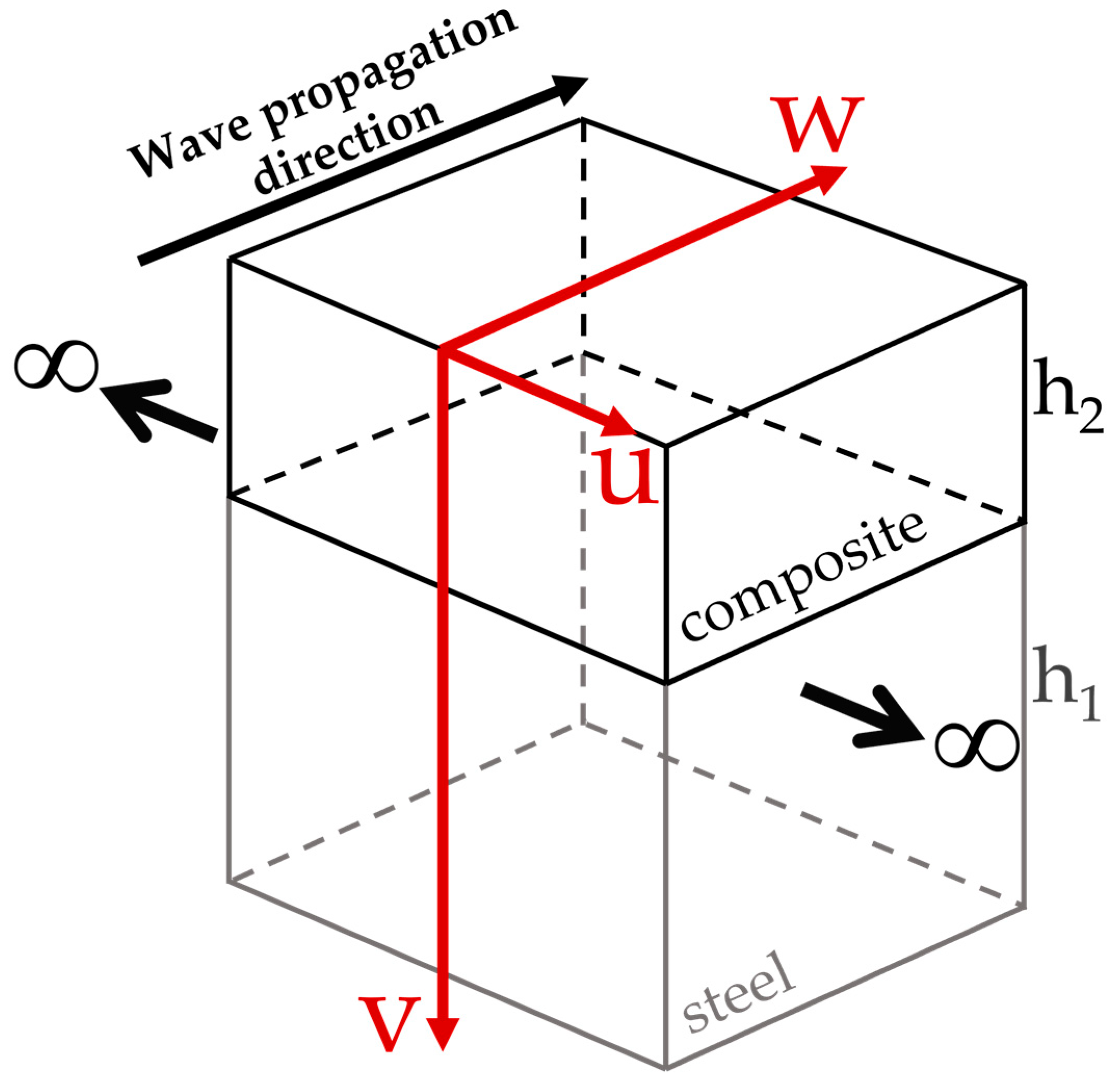
To calculate the dispersion curves, a two-layered metal-polymer composite plate with a thickness of 5.7 mm was considered (
Figure 1). It is assumed that guided wave propagation occurs in the w-direction. In the numerical experiment, a medium of infinite width is considered. However, a finite width can be defined if required for specific cases. Attenuation is not considered in this study. The materials are assumed to be linear, elastic and lossless. The only dispersion investigated is geometric dispersion, i.e., the frequency dependence of phase velocity due to the finite thickness of the waveguide and the presence of interfaces.
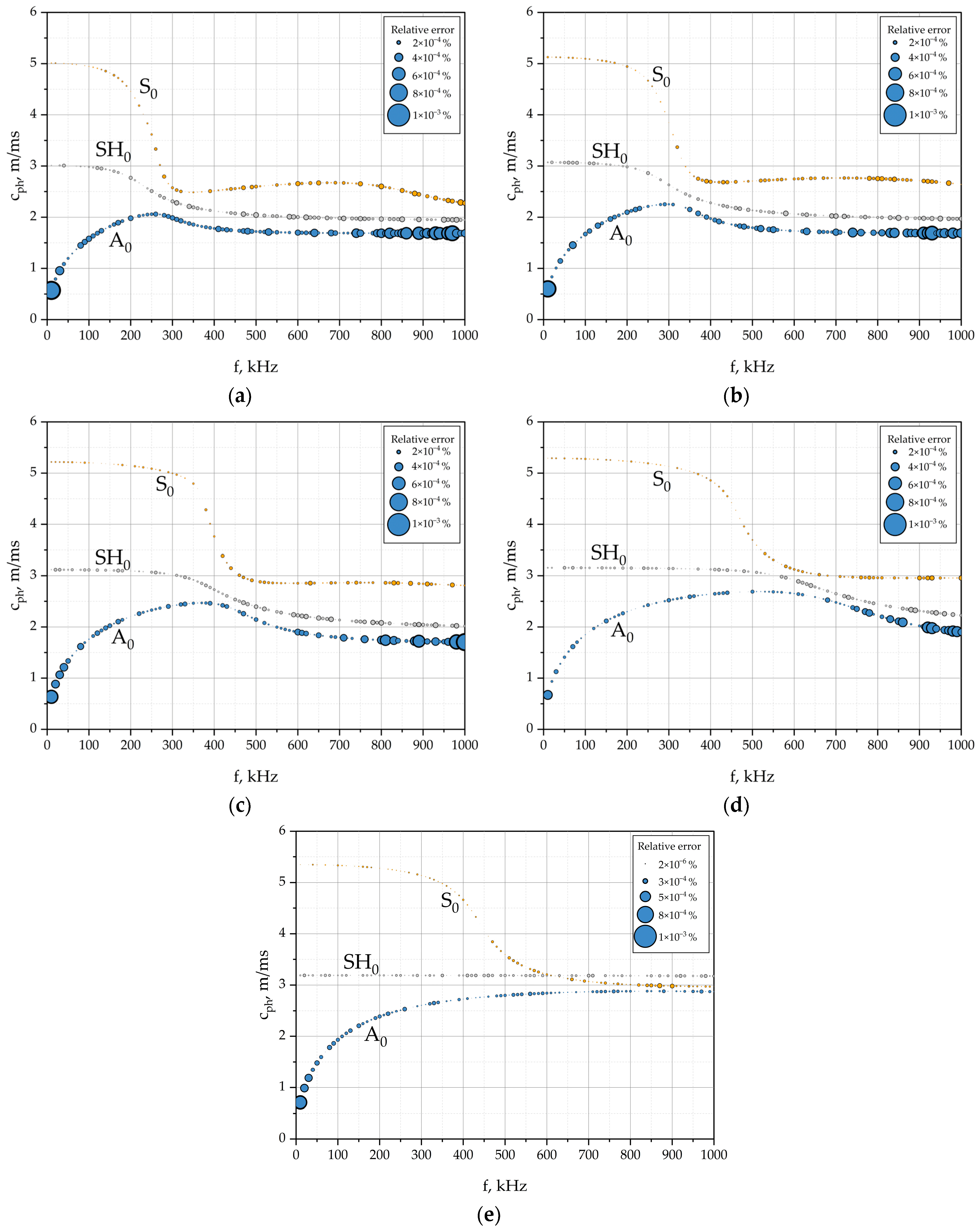
Five cases were considered, including the relationship between the thickness of the metal layer to the composite layer (δ), which was set to 0.90, 0.58, 0.36, 0.19 and 0.06. These values correspond to a metal layer thickness of 3.0, 3.6, 4.2, 4.8 and 5.4 mm, respectively.
The computational domain comprises several regions that define the cross-section of the waveguide. In this study, the geometry consists of two layers, as illustrated in
Figure 1. The linear dimension along the u-axis must be at least one-tenth of the total waveguide thickness. At the interface between the two layers, an ‘Identical boundary’ condition is imposed to ensure correct coupling between the two elastically dissimilar layers during the eigenvalue solution for k (denoted as λ in COMSOL terminology).
To set up the problem, the Coefficient Form PDE module is used. In this module, the following parameters and their dimensions are defined: dependent variables (particle displacements, in meters) and source terms (elastic force density, in N/m3). The dependent variable u field consists of six components u, v, w, ku, kv, and kw (Equation (6)).
Next, a separate node is defined for each layer, specifying the form of the governing equation (Equation (5)) and the coefficients that contain layer-specific elastic constants (Equation (7)). Free boundary conditions are applied to the upper and lower surfaces of the waveguide. The lateral boundaries of the domain are subject to a periodicity condition imposed on each variable in the u field, which mathematically describes the infinite extent of the waveguide along the u-axis, as shown in
Figure 1. Carbon fiber was considered for the composite layer, and stainless steel for the metal layer. The physical and mechanical properties of these materials are presented in
Table 2.
The Coefficient Form PDE module of the COMSOL Multiphysics software package was used for calculation, with a mesh size of 100 μm and a frequency range of 10 kHz to 1000 kHz in increments of 10 kHz. These frequencies are within the typical operating range for guided wave testing. The calculations were performed using a laptop equipped with an AMD Ryzen 5 3500U processor (4 cores, 8 threads, 2.1 GHz) and 8 GB of RAM. The average computation time required to obtain the dispersion curves for one multilayered structure (i.e., for a given metal-to-composite layer thickness ratio) was 9 min.
The filtering of the λ roots was performed using the following filtering expression:
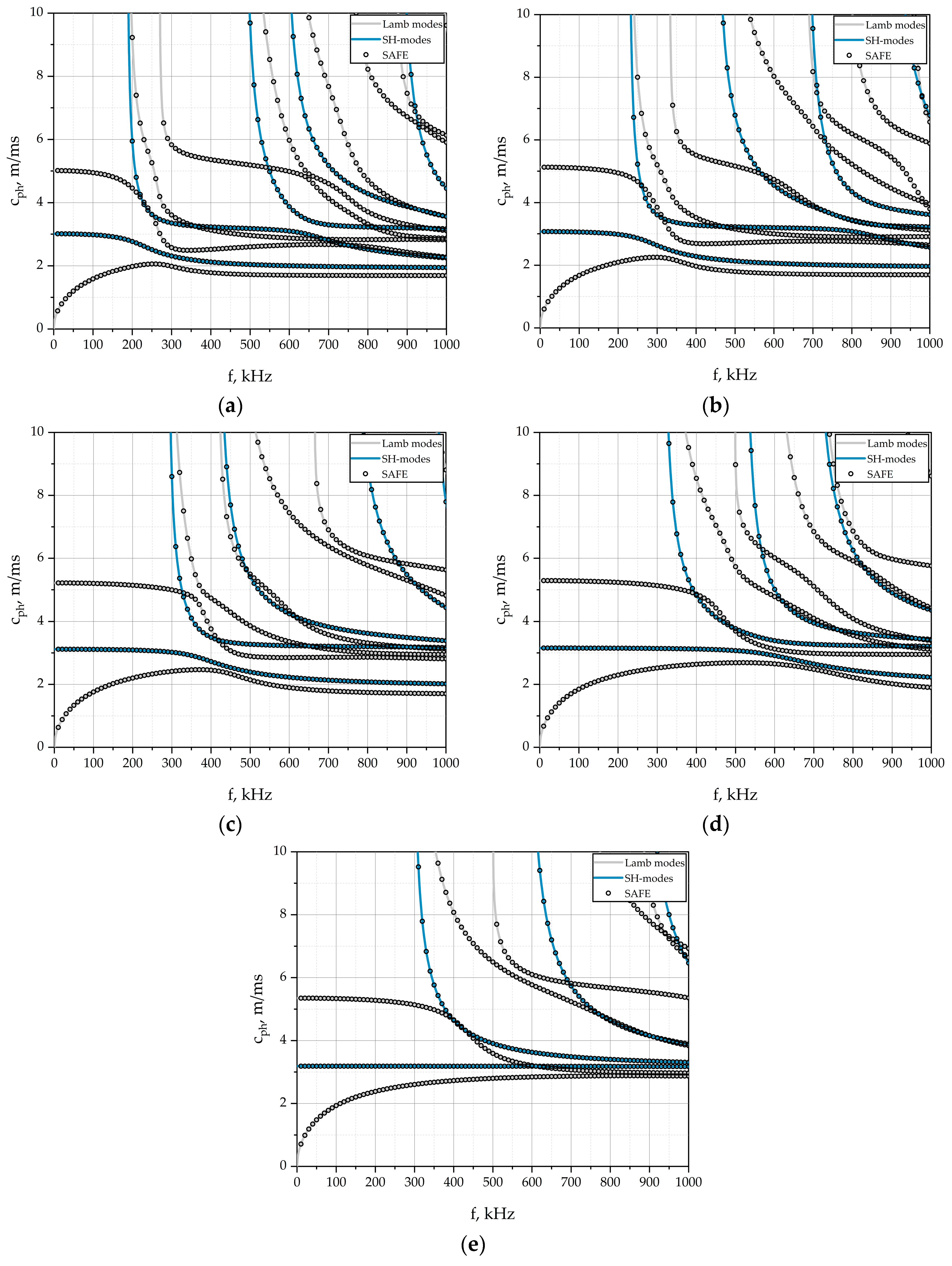
Similar calculations were performed using Dispersion Calculator 3.1 to evaluate the results; this tool is widely used in guided wave ultrasonic testing.
4. Discussion
The dispersion curves obtained using the proposed method for different guided wave modes in a metal-polymer plate clearly show how the thickness ratio of polymer and metal layers affects mode dispersion. As the thickness of the steel layer (h1) increases, the branches shift towards the region of higher phase velocities. This may be due to an increased contribution from material with higher elastic constants to the transfer of strain energy along the waveguide.
In the low-frequency range, the fundamental quasi-antisymmetric mode (A
0) exhibits strong dispersion due to the flexural deformation mechanism, as illustrated in
Figure 4.
As the thickness of the steel layer increases, the dispersion curves of the A0 mode converge with those of an equivalent homogeneous steel plate. This suggests that the mode’s sensitivity to the polymer layer’s mechanical properties diminishes as the steel layer thickens within the considered frequency range.
In contrast to the A0 mode, the fundamental quasi-symmetric mode (S0) exhibits significantly weaker dispersion across the entire calculated frequency range. Its phase velocity is governed primarily by the effective longitudinal stiffness of the composite waveguide, resulting in a lower sensitivity to variations in the metal-to-polymer thickness ratio. Nevertheless, an increase in the phase velocity of the S0 mode is also observed as the thickness of the metal layer increases (or as the proportion of metal in the cross-section grows).
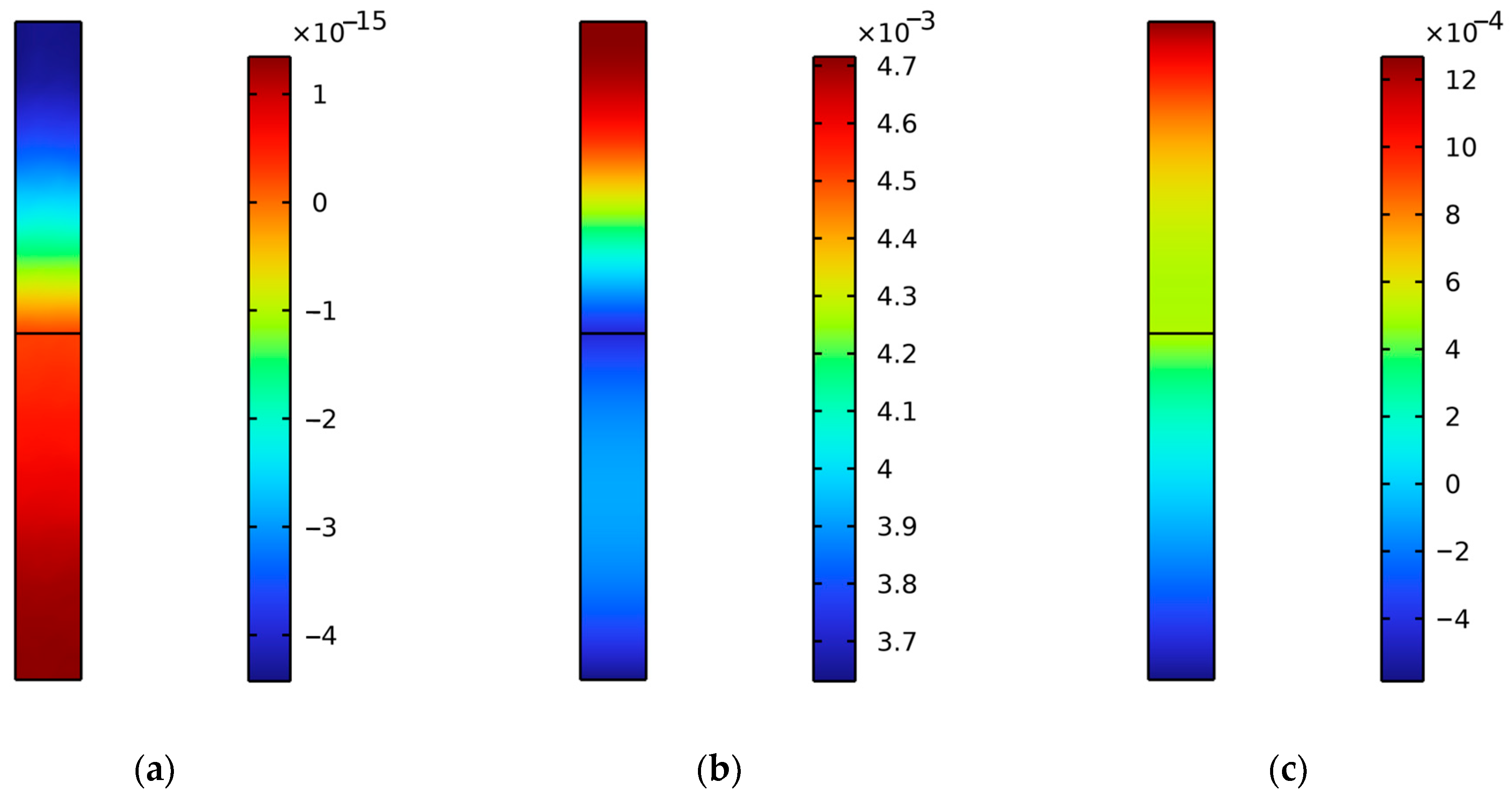
The dispersion characteristics of SH modes are found to be the least sensitive to variations in the metal-to-composite thickness ratio (δ). The horizontal polarization of the SH
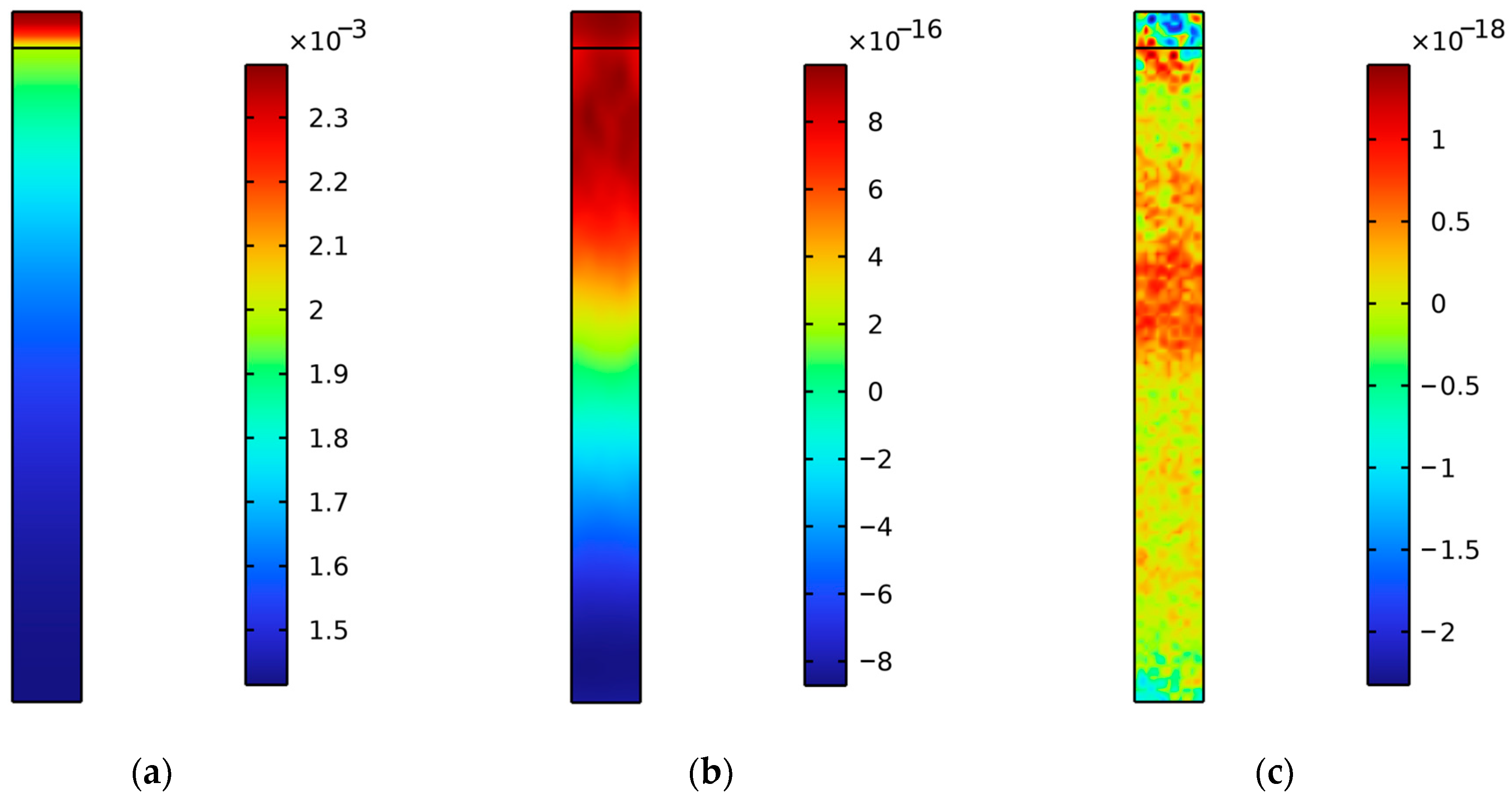
0 wave means that the elastic displacement vector is parallel to the plane of the layers. This imposes continuity conditions for tangential stress and displacement only at the interface between the media. As the acoustic impedance of the composite is substantially lower than that of steel, the displacement gradient (shear strain) in the composite layer must be significantly higher to satisfy the continuity of tangential stress. This results in elevated elastic energy density within this layer. Nevertheless, when the composite layer is thin (0.3 mm; δ = 0.06), the integral energy is predominantly concentrated in the steel layer due to its dominant volumetric contribution. However, the local strains and energy density in the carbon fibre-reinforced polymer remain higher than in steel, as shown in
Figure 5.
A comparison of the results obtained using the proposed approach with those calculated using Dispersion Calculator 3.1 showed an excellent agreement between the dispersion curves for all considered guided wave modes. The maximum relative deviation in phase velocity did not exceed 0.001%, which is significantly lower than the discrepancies typically reported in the literature when comparing various numerical and semi-analytical methods [
26,
33,
34]. This validates the correctness of the eigenvalue problem formulation in the Coefficient Form PDE module and the appropriate selection of the mesh for the calculations performed. It should be noted that the largest deviations are observed in regions where modes intersect or are closely spaced. In these regions, the numerical solution becomes more sensitive to discretization parameters (mesh density and frequency step) due to the proximity of the eigenmodes. Nevertheless, even in these regions, the discrepancies are negligible and cannot affect the practical interpretation of ultrasonic testing results.
Thus, the obtained dispersion curves not only demonstrate the physically consistent behavior of guided waves in a two-layer metal-polymer composite but also confirm the high accuracy and reproducibility of the SAFE method when implemented in COMSOL Multiphysics.
The above results show that the proposed implementation of the SAFE method in COMSOL Multiphysics is accurate. Excellent agreement with the Dispersion Calculator supports this conclusion. The parametric study shows that the steel-to-polymer thickness ratio significantly affects the A0 and S0 modes, while the SH0 mode remains largely unchanged. This behavior is consistent with the expected redistribution of elastic energy between the layers. The developed tool can be easily extended to anisotropic materials and geometrically complex waveguides. Future work will focus on the experimental validation of the proposed approach. Real engineering applications will also require the calculation of guided wave dispersion in viscoelastic layers, where attenuation will be taken into account by prescribing the elastic properties through a complex-valued stiffness tensor, rather than by geometry alone.
5. Conclusions
This study aimed to develop and verify a computationally efficient and versatile tool for calculating dispersion curves in multilayered media. Accordingly, we implemented the SAFE method using the Coefficient Form PDE module in COMSOL Multiphysics. The developed approach provides high computational efficiency in determining dispersion characteristics while eliminating the need for dedicated software code. Furthermore, it leverages the full capabilities of commercial finite-element modelling software, including optimized solvers and the flexibility to incorporate complex material properties (e.g., layer-specific anisotropy) and arbitrary geometries. In addition to implementing the method in the chosen software, the objectives of this study included a parametric study of the influence of the structure on the dispersion characteristics of the multilayered waveguide, as well as a comparative study of the developed approach against an established tool in the field.
First, the theoretical background and implementation details of the SAFE method within the COMSOL Multiphysics Coefficient Form PDE module were discussed. The proposed approach was applied to calculate the dispersion curves of guided waves in a two-layered metal-polymer composite plate over the ultrasonic frequency range of 10–1000 kHz. A parametric study was conducted to analyze the influence of the metal-to-polymer thickness ratio on the dispersion characteristics of the waveguide. The results demonstrate that varying this geometric parameter significantly affects the behavior of the quasi-antisymmetric and quasi-symmetric modes. These effects are attributed to the redistribution of elastic energy between the layers and consequent modification of the effective stiffness of the composite waveguide. In contrast, SH modes are the least sensitive to thickness variations due to their shear deformation mechanism and the localization of wave energy within the composite layer at higher frequencies.
The reliability of the obtained results was finally verified through quantitative comparison with calculations performed using Dispersion Calculator 3.1, a specialized software package that implements both SMM and TMM. The maximum relative deviation in phase velocity for all considered wave types did not exceed 0.001%, thereby confirming the high accuracy of the numerical implementation and the correctness of the eigenvalue problem formulation.
The findings confirm the applicability of the SAFE method for modeling guided wave propagation in multilayered metal-polymer structures and support its use in the development and optimization of ultrasonic non-destructive testing techniques for composite materials. The proposed approach can be readily extended to objects with complex geometry and structure, including those comprising a larger number of layers, each of which may exhibit pronounced anisotropic properties.