Article

Retrospective Analysis of an SIR Model Approach to Evaluate Vaccination Strategies in Early Pandemic Prevention


1
Department of Medical Sciences, Surgery and Neurosciences, University of Siena, 53100 Siena, Italy
2
Department of Molecular and Developmental Medicine, University of Siena, 53100 Siena, Italy
3
Direzione di Presidio Ospedaliero, Azienda USL Toscana Sud Est, 52100 Arezzo, Italy
4
Department of Medical Biotechnologies, University of Siena, 53100 Siena, Italy
5
Department of Information Engineering and Mathematics, University of Siena, 53100 Siena, Italy
*
Author to whom correspondence should be addressed.
Appl. Sci. 2026, 16(10), 4687; https://doi.org/10.3390/app16104687
Submission received: 17 April 2026 / Revised: 30 April 2026 / Accepted: 7 May 2026 / Published: 9 May 2026
(This article belongs to the Special Issue Data Statistics for Epidemiological Research—2nd Edition)

Abstract

During the 2020–2021 period, increasingly complex models have been developed to understand the impact of containment measures, to predict pandemic trends, and then to optimally allocate the few vaccines available. The objective of this study is to demonstrate the application of a time-varying age-dependent SIRD model for developing a vaccination strategy and for better allocating resources. We used a time-varying age-dependent SIRD model to identify the best vaccination strategy considering the percentages of each age group to be vaccinated. Italian public data were used to estimate the model and perform simulations. Simulations were carried out every 15 days from 27 December 2020 to 27 June 2021. Our projections suggest vaccinating those over 89 before other age groups, following a decreasing pattern, to minimise deaths. The cost function of infected individuals returns more unstable results. In general, to minimise infected individuals, it is necessary to assign vaccines to the over-89 and under-30 age groups. Optimal allocation of the limited available vaccine dose is useful to mitigate transmission and to reduce the mortality associated with it. The application of the mathematical model can be very useful at the beginning of an epidemic caused by a new pathogen, a time when it is important to make optimal use of scarce resources, such as vaccines, to best limit the epidemic by using a standardised approach.

1. Introduction

Over the past five years, there has been a significant increase in the scientific literature focusing on simulation studies of the impact of both vaccination and containment strategies for pandemic management. This is obviously due to the Severe Acute Respiratory Syndrome Coronavirus 2 (SARS-CoV-2) pandemic that represented an unprecedented global epidemiological threat, necessitating a coordinated international health response [1]. The rapid and widespread transmission of this novel coronavirus required the scientific community and national governments to prioritise the development of effective containment and treatment strategies [2]. Considering that global pandemics are becoming more frequent and severe, it is important to study and understand how to apply models that can be quickly developed and provide good decision support [3].
The SARS-CoV-2 pandemic demonstrated that it was exceedingly challenging to uncover therapy targets that may lessen the death rate. Without a vaccination, the major approach to minimize mortality and sickness rates was through non-pharmaceutical measures [4,5]. The global vaccination campaign began on 27 December 2020, with healthcare workers receiving the initial doses [6]. After this, vaccination efforts were expanded to include older people and individuals with other health problems. The focus shifted from stopping the spread of disease to lowering the death rate [7]. Beginning in June 2021, the vaccination program slowly began to include those under 40, making it available to younger groups. By September 2021, booster shots had been given to older people and others who were at risk.
Mathematical models have been central in understanding pandemic dynamics and designing effective responses [8,9]. These models include data-driven methodologies employing statistical and machine learning approaches, alongside deterministic models that utilize theoretical insights into disease transmission to generate pandemic scenarios [10]. Recently, novel hybrid models that mix deterministic and data-driven machine learning algorithms have been released [11]. Among deterministic approaches, SIR-type compartmental models remain widely used for their clarity and adaptability, and have been extensively applied during COVID-19 [12,13,14]. However, accurately predicting the effects of a pandemic often necessitates sophisticated modelling methodologies and an extensive understanding of the biology and epidemiological characteristics of the disease [15].
Compartmental models are highly sensitive to initial conditions and parameter choices, which are influenced by factors such as viral mutations and demographic differences, e.g., higher mortality in older adults and males [14,16]. Age-stratified models improve simulation accuracy by including factors like older patients’ higher susceptibility and mortality rates, as well as younger populations’ greater social interactions, which typically have a larger impact on disease transmission [17,18]. Standard compartmental models often assume a uniform contact rate across time [19], while time-varying formulations better capture pandemic phases shaped by waves, interventions, and mobility changes. Dividing the population into homogeneous subgroups (e.g., by age, gender, occupation, or activity patterns) helps identify priority targets and evaluate strategies for surveillance and control [13,20,21].
Models played a key role in designing vaccination strategies when doses were scarce, and the literature offers complementary insights from different methodological angles [22,23]. Kim and Lee [24] underscored the economic constraints of immunization programs, showing through time-series and panel data analyses that lengthening the interval between doses could curb cases and deaths while saving resources. Zhao et al. [25] used an SIR-type model focused on early Wuhan data and identified people over 65 as a priority group. MacIntyre et al. [26] applied a deterministic model with limited supply scenarios in New South Wales, concluding that vaccinating healthcare workers is crucial for system resilience, while age-targeted strategies alone yield limited impact. Cartocci et al. [27] adopted a compartmental framework to minimize QALY losses, finding that the optimal prioritization depends on epidemic conditions. All these studies indicate that when supply is limited, vaccination strategies must be carefully tailored to specific public health objectives.
This research constitutes a retrospective epidemiological study designed to rigorously evaluate an SIRD model as a decision support instrument for formulating vaccine strategies during the early stages of a novel pandemic, characterized by inadequate comprehension of the infectious agent and insufficient epidemiological data. The model employed in this study was constructed using data and information available during the investigated pandemic, rather than current knowledge. Compartmental models are dynamic systems sensitive to their initial conditions. Therefore, by creating multiple simulations closely spaced in time, it is possible to track the pandemic trend, which is also influenced by other rapid strategies such as containment and distancing, to take into account the actual doses already administered up to the starting date, and to see if the adopted vaccination strategy remains the same despite substantial differences in the spread of the pandemic.

2. Materials and Methods

2.1. Model Structure

A time-varying group-dependent SIRD model was used for simulation [27].
The model can be mathematically expressed as follows:
d S k ( t ) d t = b k ( t ) S k ( t ) I ( t ) N k = 1 , 2 , , N g
d I k ( t ) d t = b k ( t ) S k ( t ) I ( t ) N g k ( t ) I k ( t ) m k ( t ) I k ( t )
d R k ( t ) d t = g k ( t ) I k ( t )
d D k ( t ) d t = m k ( t ) I k ( t )
where S k ( t ) , I k ( t ) , R k ( t ) and D k ( t ) (k = 1, 2, …, Ng) are the susceptible, infected, recovered and deceased individuals for the kth group, respectively.
b k ( t ) , g k ( t ) and m k ( t ) are the time-varying model parameters thus defined. In particular, b k ( t ) represents the product between the average number of contacts per time unit of a subject belonging to group k and the probability of the infection transmission by contact between a susceptible and an infected individual, while g k ( t ) and m k ( t ) , are the group-dependent recovery and death rate, respectively.

2.2. Data

National public data from the Italian Istituto Superiore di Sanità (ISS), which publishes an approximately weekly bulletin, and from the Protezione Civile (PrCi), which publishes daily data, were used to estimate the parameters of the time-varying SIRD model [27,28,29]. The age of the newly infected and dead individuals, stratified in 10-year groups, was extracted from the ISS bulletins. From the PrCi database, the total number of infected, dead and recovered individuals was extracted. Daily data of modelled subjects were age-stratified by ISS distribution, except for recovered individuals whose age distribution was estimated using the modelling process detailed in Cartocci et al. [27].
The Italian special Commissioner for the COVID-19 emergency has made available data on vaccination, i.e., daily vaccines administered by age groups [30]. The time series analysed in this study range from 27 December 2020 to 27 June 2021. We decided to use the initial period because vaccination strategies were essential due to the scarcity of vaccines and because, during this period, there were variants with similar characteristics in terms of infectivity and mortality. Since September, with the arrival of the omicron variant, we have encountered many cases of reinfection, and to consider this phenomenon, we should have had much more information available, or we would have needed to make unrealistic assumptions. Moreover, we wanted to exclude the summer period because the simulations would have been much more constant due to the reduction in virus circulation, and therefore in Rt, and the increasing available doses.
The collected daily data were filtered to reduce noise and excess variability, using a 7-day moving average filter.
To model the pandemic trend, we considered 10 age classes, each spanning 10 years (i.e., 0–9, 10–19, 20–29, 30–39, 40–49, 50–59, 60–69, 70–79,80–89, ≥90). As for the simulation, the classes considered for estimating S, I, R, and D were always 10, but for the allocation of available vaccines, only 8 classes were considered (i.e., age >20–29) since the vaccines could not be administered to younger people in the period considered.

2.3. Simulation

Our simulation goals were to identify the optimal percentage distribution of subjects immunized by vaccine across age groups to minimize global deaths and infections, respectively.
Two different vaccination strategies were evaluated and optimised by separately minimising two cost functions, namely the number of infections and deaths. Comprehensive full-grid simulations were conducted, replicating all potential combinations of per-centages for each group at a 2% interval. The minimum value for each cost function was then identified.
We considered nine different scenarios with starting dates spaced 15 days apart. For each scenario, two simulations were carried out. The first scenario had 27 December 2020 as the starting date, which was the date of the first vaccination in Italy. The other scenario was 26 April 2021. For each scenario, the optimization procedure was carried out to obtain the best strategy for that specific moment; each simulation does not account for the previous ones, since it starts from observed data as the initial condition.
Each simulation spanned 60 days, during which the actual available vaccine doses specified in Table 1 for each scenario were administered, assuming an even distribution along all the simulation windows. A 60-day simulation was deemed a suitable duration to observe predicted vaccination dynamics across the course of the pandemic for the purpose of making informed health policy decisions.
The simulations take into account the four different vaccines available in Italy (i.e., Pfizer-BioNTech, Moderna, Vaxzevria, Janssen), the doses to be administered for each vaccine, the days between doses (i.e., 21 for Pfizer-BioNTech, 28 for Moderna and 84 for Vaxzevria), the efficacy after the first dose (i.e., 0.52 Pfizer-BioNTech, 0.51 Moderna, 0.53 Vaxzevria and 0.77 Janssen), the increased efficacy after the second dose (+0.43 Pfizer-BioNTech, +0.43 Moderna, +0.11 Vaxzevria) and the delay between administration and the start of vaccination coverage [31,32,33].
The Matlab software package, version R2021, was used for the numerical implementation of the SIRD model simulations.

3. Results

Figure 1 shows the b and the Rt parameters differentiated by age groups. In the b plot, we can observe that the >89 years line is higher than the others, up to the middle of February. After that, b undergoes little change over time, with a tendency to decline from mid-March. The 80–89 group, although characterized by significantly lower b values until mid-February, shows a qualitatively similar time course of b to that of the over 89s there-after. Moreover, the b parameter in these two groups is the lowest after mid-February, and differently from the other groups, b does not increase significantly. This is probably due to the vaccinations, because these two classes are the only ones in which around 25% of the population had already been vaccinated by the beginning of March.
The grey vertical lines shown in Figure 1 indicate the beginning of the simulations and make it possible to highlight the initial conditions of the simulations. In particular, the simulations of 27 December, 26 January, 10 February and 25 February begin in a phase of pandemic increase even though Rt is always lower than 1; those of 11 January and 12 March are in a peak phase, even though the first has an Rt of about 1, while the latter has an Rt greater than 1 in all age groups. The remaining simulations start in the downward phase of the peak.
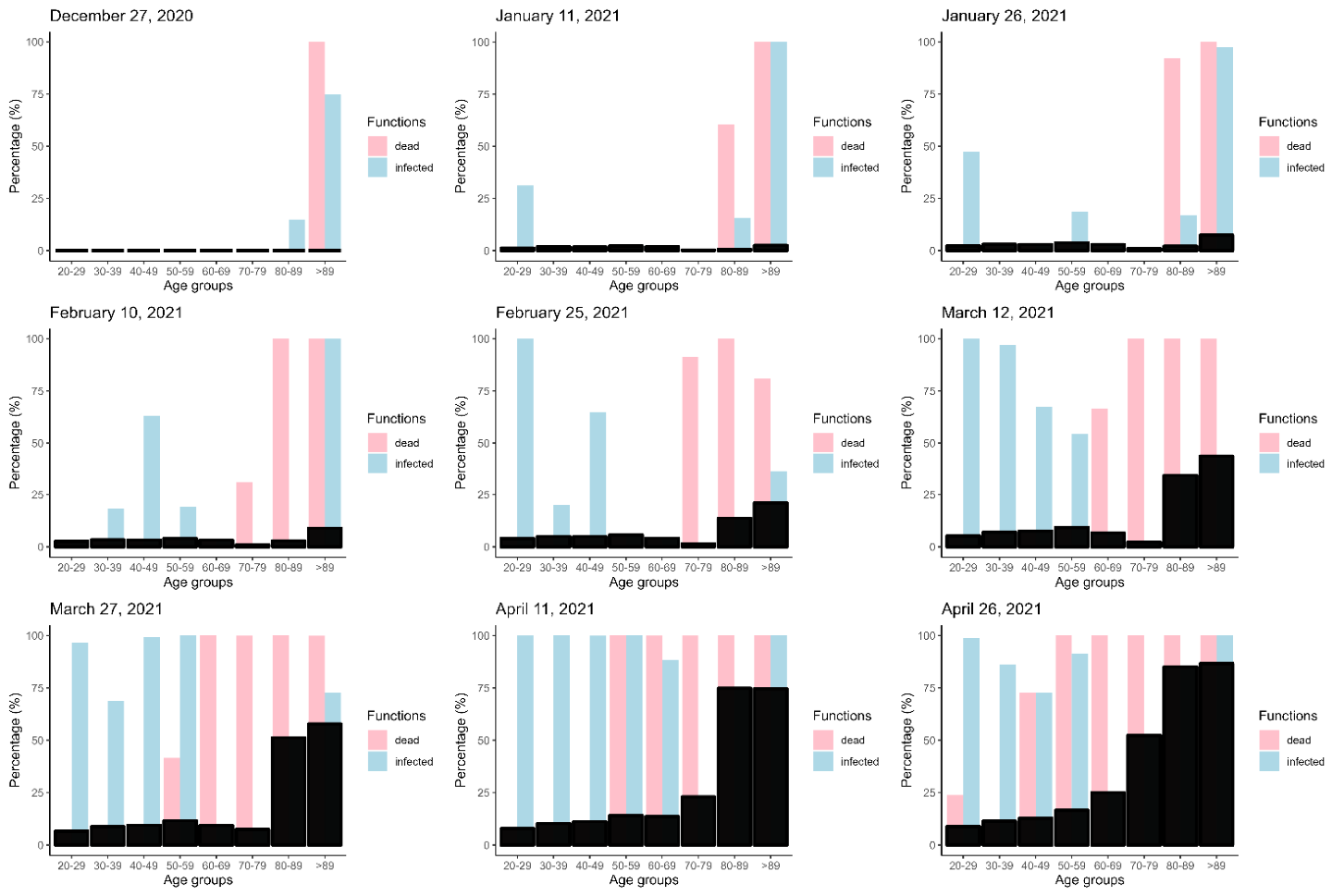
Figure 2 shows the simulation results together with their initial conditions in terms of doses already administered in each age group. The black rectangle indicates the percentage of first doses already administered up to the beginning of the simulations (percentage obtained from actual data). Considering the first scenario, only a hundred people were vaccinated on December 27th (the first day of the vaccination campaign in Italy), so the black rectangles are close to 0%. In the last scenario, by contrast, the 80–89 and >89 groups were mostly vaccinated. The pink and light blue bars indicate the percentage of people that had to be vaccinated for each age group to minimise deaths or infected people, respectively (model-based strategy). Considering the first scenario and the death-minimising simulation, the best strategy is to administer all the available doses to the elderly; however, the doses were not sufficient to cover all of the >89 age group. The infection-minimising simulation instead suggests administering about 80% of the doses to the >89 age group and the remaining to those aged 80–89.
We can observe that the minimisation of deaths brings a rather stable result and suggests vaccinating the over 89s and then the adjacent age classes in descending order. The only simulation that returns a different solution is that of 25 February. In this simulation, the model favours the 80–89 group (completed with 86%) rather than the over-89 group (only 60% vaccinated). On that day, while deaths decreased in all age groups, they were stable or increasing in the two groups. The cost function of infected individuals, on the other hand, returns more unstable results due to the sudden changes of contact and infections due to the reopening of schools and/or facilities. In general, minimisation of infected subjects leads to the allocation of vaccines to the over-89 and under-30 age groups. When the doses considerably increase in number, to minimise infected people, the simulation suggests allocating vaccines mainly to the under-60s and always vaccinating the over-89s.

4. Discussion

Optimally allocating scarce vaccine doses among population groups is crucial for mitigating transmission and reducing mortality. This is a task for which compartmental models are particularly well suited [15]. Our study applied an age-stratified SIRD model with time-varying parameters to early pandemic data from Italy, identifying adaptive vaccination strategies under limited vaccine availability.
We focused on the first months of 2021, when vaccination in Italy involved only two doses and viral variants displayed similar virulence and lethality. This period offered a controlled setting for testing model performance, as the population’s immunological status was relatively homogeneous and reinfections were negligible. From September 2021, the introduction of booster doses and the emergence of new variants increased heterogeneity in immune protection, which would have required additional assumptions and more complex modelling frameworks.
Group-based compartmental models can represent distinct population behaviours according to age, social activity, or occupation [11]. They provide policymakers with valuable insights for designing targeted and efficient interventions. In this context, our model identified vaccination strategies that dynamically adapt to the evolving pandemic, optimising either the reduction in infections or mortality depending on the specific public health goal.
Model parameters were estimated from real data and held constant during each 60-day simulation to assess medium-term vaccination effects. Although this reduced responsiveness to rapid behavioural or policy changes, it enabled the evaluation of longer-term strategic outcomes. Simulations showed that minimising deaths consistently prioritised older groups, especially those over 80, in descending age order. Conversely, minimising infections often assigned vaccines simultaneously to the oldest and youngest adults. This dual strategy reflects epidemiological evidence: older individuals are at greater risk of death, whereas younger, socially active adults drive transmission. Comparable conclusions were reached by Meehan et al. [34], who found that age-targeted allocation could halve vaccine requirements, and by Campos et al. [35], who observed that vaccinating younger groups reduces spread, whereas protecting the elderly lowers mortality.
In February 2021, the model detected an inversion in transmission dynamics (parameters b and Rt) among the 80–89 and >89 age groups, consistent with the Ministry of Health report describing an acceleration in incidence and a decrease in the median age of cases [36]. The mean age of SARS-CoV-2-positive deaths also declined during this period [37]. These patterns underline the model’s ability to capture changing epidemiological conditions and to adapt vaccination priorities accordingly.
The limited allocation of vaccines to the 60–79 age groups in our simulations can be interpreted by considering their lower contact rates and more cautious behaviour. Although these cohorts exhibit higher lethality, they are largely retired, generally self-sufficient, and engage in fewer close-contact activities. Therefore, vaccinating them earlier would have had limited impact on transmission reduction, consistent with behavioural and demographic evidence reported in previous works [11,27].
Real data exhibited sharper upward and downward fluctuations than simulated data due to the rapid impact of containment measures such as school or business closures. Vaccination, in contrast, exerts slower but cumulative effects, with significant divergence between vaccinated and unvaccinated scenarios emerging after approximately 60 days. This finding emphasises the importance of combining vaccination with non-pharmaceutical interventions to accelerate the decline in cases and deaths, as also noted by Davies et al. and Prem et al. [4,5]. Moreover, simulations confirmed that vaccination is most effective when initiated during a declining epidemic phase, following strong containment measures. It is worth noting that while compartmental models are known to be sensitive to initial conditions and often exhibit higher uncertainty during the early stages of an outbreak, reaching peak predictive value only when data approach the epidemic crest, our retrospective approach mitigates these issues. By using consolidated public health data to set the initial state of each simulation and by testing nine different scenarios across various pandemic phases, we ensured that the resulting vaccination priorities were not artifacts of initial parameter instability. The consistency of our findings across these scenarios reinforces the model’s utility as a robust decision support tool for public health policy.
A variety of compartmental models have been developed during the pandemic, ranging from the simplest, such as SIR, to the more complex, such as SEIHDR [38,39]. The choice of model depended primarily on the data made available by each state, the reference period and the assumptions made. Many articles, however, included the ‘exposed’ group, consisting of susceptible people who have been infected but are not yet infectious [40,41]. The onset of multiple variants made models more complex. In this case, the main approach was to divide the infection group in the compartmental models into two or more groups, depending on the number of variants considered, and apply different values to the mortality and infectiveness parameters. These group proportions were derived from empirical/clinical studies, since public data do not provide information on the number of infected individuals stratified by variant. However, this approach results in high variability due to the way the studies were set up. An alternative approach was to use simulations and test several distributions [36,37,42].
Another factor influencing these parameters is the clinical aspect. Older individuals and males have a higher mortality rate than younger subjects and females. Age-stratified models allow for more precise simulations by taking various factors into consideration, such as the increased vulnerability of older patients and their higher mortality rate, as well as the greater social activity of younger people, which has a greater impact on the spread of the disease.
The standard compartmental model assumes that the contact rate of a disease remains constant over time. However, for a pandemic such as that caused by SARS-CoV-2, which is characterised by successive waves, lockdowns and containment measures such as mask-wearing, time-varying parameter models are preferable as they can better track the trend of the pandemic. These models can continuously inform decision-makers of changes in epidemic traits and simulate the effects of targeted pandemic containment strategies, such as lockdown schemes and/or vaccination plans. In particular, stratifying the population into distinct homogeneous groups by factors such as gender, age, occupation and social activities makes it possible to understand which groups to target and to what extent in order to achieve predefined health policy objectives such as surveillance and control of epidemic dynamics [43]. Our results highlight the usefulness of mathematical modelling in the early stages of an epidemic, when limited information and scarce resources necessitate a standardised, data-driven approach [16,42]. The time-varying SIRD framework enables the monitoring of the evolution of pandemics and the identification of optimal vaccine allocation strategies throughout the different phases. Although the model has been simplified compared to the real world, its transparent structure allows it to be easily adapted to new information and objectives.
One limitation of this study is the underestimation of infections due to undetected asymptomatic cases. Adding asymptomatic or exposed compartments could improve model accuracy once sufficient data become available [41,42]. However, during the early phase, such information was not yet reliable, and simplicity was necessary to ensure timely guidance for vaccine allocation. As more data accrue, SIR-type models can be progressively refined to account for previously neglected subpopulations, improving predictive precision and policy relevance [12,13].
In conclusion, age-stratified compartmental models with time-varying parameters represent a practical decision support system for pandemic management. They can help decision-makers design effective vaccination and containment policies, optimising limited resources to minimise mortality and transmission. Although not a substitute for more complex hybrid models, these models strike a useful balance between interpretability, adaptability, and reliability [10,15,27]. Their application in the early stages of a pandemic can support rapid, evidence-based responses, providing a framework for continuous improvement as more epidemiological data become available.

Author Contributions

A.C.: conceptualization, methodology, writing, visualization, data analysis; V.L.: writing, data interpretation; D.A.: writing, review, data interpretation; G.M.: review, data interpretation; G.C.: conceptualization, data analysis, methodology, software, writing; P.B.: conceptualization, methodology, writing, review. All authors have read and agreed to the published version of the manuscript.

Funding

The authors declare that no funds, grants, or other support were received during the preparation of this manuscript.

Institutional Review Board Statement

Not applicable.

Informed Consent Statement

Not applicable.

Data Availability Statement

Data are available at https://github.com/pcm-dpc/COVID-19 (accessed on 5 March 2026).

Conflicts of Interest

The authors have no relevant financial or non-financial interests to disclose.

References

  1. COVID-19 Deaths|WHO COVID-19 Dashboard. Available online: https://data.who.int/dashboards/covid19/cases (accessed on 10 October 2024).
  2. Chen, S.; Yang, J.; Yang, W.; Wang, C.; Bärnighausen, T. COVID-19 Control in China during Mass Population Movements at New Year. Lancet 2020, 395, 764–766. [Google Scholar] [CrossRef]
  3. Poorolajal, J. The Global Pandemics Are Getting More Frequent and Severe. J. Res. Health Sci. 2021, 21, e00502. [Google Scholar] [CrossRef]
  4. Davies, N.G.; Kucharski, A.J.; Eggo, R.M.; Gimma, A.; Edmunds, W.J.; Centre for the Mathematical Modelling of Infectious Diseases COVID-19 working group. Effects of Non-Pharmaceutical Interventions on COVID-19 Cases, Deaths, and Demand for Hospital Services in the UK: A Modelling Study. Lancet Public Health 2020, 5, e375–e385. [Google Scholar] [CrossRef]
  5. Prem, K.; Liu, Y.; Russell, T.W.; Kucharski, A.J.; Eggo, R.M.; Davies, N.; Flasche, S.; Clifford, S.; Pearson, C.A.B.; Munday, J.D.; et al. The Effect of Control Strategies to Reduce Social Mixing on Outcomes of the COVID-19 Epidemic in Wuhan, China: A Modelling Study. Lancet Public Health 2020, 5, e261–e270. [Google Scholar] [CrossRef]
  6. Italian Ministry of Health. Norme (ID 21A01802, Prog 001). Available online: https://Www.Trovanorme.Salute.Gov.It/Norme/renderPdf.Spring?seriegu=SG&datagu=24/03/2021&redaz=21A01802&artp=1&art=1&subart=1&suart1=10&vers=1&prog=001 (accessed on 5 March 2026).
  7. Italian Ministry of Health. Norme (ID 21A01802, Prog 002). Available online: https://Www.Trovanorme.Salute.Gov.It/Norme/renderPdf.Spring?seriegu=SG&datagu=24/03/2021&redaz=21A01802&artp=1&art=1&subart=1&subart1=10&vers=1&prog=002 (accessed on 5 March 2026).
  8. Kucharski, A.J.; Russell, T.W.; Diamond, C.; Liu, Y.; Edmunds, J.; Funk, S.; Eggo, R.M.; Sun, F.; Jit, M.; Munday, J.D.; et al. Early Dynamics of Transmission and Control of COVID-19: A Mathematical Modelling Study. Lancet Infect. Dis. 2020, 20, 553–558. [Google Scholar] [CrossRef] [PubMed]
  9. Pagel, C.; Yates, C.A. Role of Mathematical Modelling in Future Pandemic Response Policy. BMJ 2022, 378, e070615. [Google Scholar] [CrossRef] [PubMed]
  10. Adiga, A.; Dubhashi, D.; Lewis, B.; Marathe, M.; Venkatramanan, S.; Vullikanti, A. Mathematical Models for COVID-19 Pandemic: A Comparative Analysis. arXiv 2020, arXiv:2009.10014v1. [Google Scholar] [CrossRef] [PubMed]
  11. Wang, L.; Chen, J.; Marathe, M. DEFSI: Deep Learning Based Epidemic Forecasting with Synthetic Information. Proc. AAAI Conf. Artif. Intell. 2019, 33, 9607–9612. [Google Scholar] [CrossRef]
  12. Enrique Amaro, J.; Dudouet, J.; Nicolás Orce, J. Global Analysis of the COVID-19 Pandemic Using Simple Epidemiological Models. Appl. Math. Model. 2021, 90, 995–1008. [Google Scholar] [CrossRef]
  13. Calafiore, G.C.; Novara, C.; Possieri, C. A Modified SIR Model for the COVID-19 Contagion in Italy. In Proceedings of the 2020 59th IEEE Conference on Decision and Control (CDC), Jeju Island, Republic of Korea, 14–18 December 2020; IEEE: New York, NY, USA, 2020; pp. 3889–3894. [Google Scholar]
  14. Ndaïrou, F.; Area, I.; Nieto, J.J.; Torres, D.F.M. Mathematical Modeling of COVID-19 Transmission Dynamics with a Case Study of Wuhan. Chaos Solitons Fractals 2020, 135, 109846. [Google Scholar] [CrossRef]
  15. Moein, S.; Nickaeen, N.; Roointan, A.; Borhani, N.; Heidary, Z.; Javanmard, S.H.; Ghaisari, J.; Gheisari, Y. Inefficiency of SIR Models in Forecasting COVID-19 Epidemic: A Case Study of Isfahan. Sci. Rep. 2021, 11, 4725. [Google Scholar] [CrossRef]
  16. Danielsen, A.C.; Lee, K.M.; Boulicault, M.; Rushovich, T.; Gompers, A.; Tarrant, A.; Reiches, M.; Shattuck-Heidorn, H.; Miratrix, L.W.; Richardson, S.S. Sex Disparities in COVID-19 Outcomes in the United States: Quantifying and Contextualizing Variation. Soc. Sci. Med. 2022, 294, 114716. [Google Scholar] [CrossRef] [PubMed]
  17. Ram, V.; Schaposnik, L.P. A Modified Age-Structured SIR Model for COVID-19 Type Viruses. Sci. Rep. 2021, 11, 15194. [Google Scholar] [CrossRef]
  18. Kumar, M.; Abbas, S. Age-Structured SIR Model for the Spread of Infectious Diseases Through Indirect Contacts. Mediterr. J. Math. 2021, 19, 14. [Google Scholar] [CrossRef]
  19. Hethcote, H.W. The Mathematics of Infectious Diseases. SIAM Rev. 2000, 42, 599–653. [Google Scholar] [CrossRef]
  20. Rao, I.J.; Brandeau, M.L. Optimal Allocation of Limited Vaccine to Control an Infectious Disease: Simple Analytical Conditions. Math. Biosci. 2021, 337, 108621. [Google Scholar] [CrossRef] [PubMed]
  21. Choi, W.; Shim, E. Optimal Strategies for Social Distancing and Testing to Control COVID-19. J. Theor. Biol. 2021, 512, 110568. [Google Scholar] [CrossRef]
  22. Pastor-Satorras, R.; Vespignani, A. Immunization of Complex Networks. Phys. Rev. E 2002, 65, 036104. [Google Scholar] [CrossRef] [PubMed]
  23. Tradigo, G.; Das, J.K.; Vizza, P.; Roy, S.; Guzzi, P.H.; Veltri, P. Strategies and Trends in COVID-19 Vaccination Delivery: What We Learn and What We May Use for the Future. Vaccines 2023, 11, 1496. [Google Scholar] [CrossRef]
  24. Kim, D.; Lee, Y.J. Vaccination Strategies and Transmission of COVID-19: Evidence across Advanced Countries. J. Health Econ. 2022, 82, 102589. [Google Scholar] [CrossRef]
  25. Zhao, Z.; Niu, Y.; Luo, L.; Hu, Q.; Yang, T.; Chu, M.; Chen, Q.; Lei, Z.; Rui, J.; Song, C.; et al. The Optimal Vaccination Strategy to Control COVID-19: A Modeling Study in Wuhan City, China. Infect. Dis. Poverty 2021, 10, 140. [Google Scholar] [CrossRef] [PubMed]
  26. MacIntyre, C.R.; Costantino, V.; Trent, M. Modelling of COVID-19 Vaccination Strategies and Herd Immunity, in Scenarios of Limited and Full Vaccine Supply in NSW, Australia. Vaccine 2022, 40, 2506–2513. [Google Scholar] [CrossRef]
  27. Cartocci, A.; Cevenini, G.; Barbini, P. A Compartment Modeling Approach to Reconstruct and Analyze Gender and Age-Grouped COVID-19 Italian Data for Decision-Making Strategies. J. Biomed. Inform. 2021, 118, 103793. [Google Scholar] [CrossRef]
  28. EpiCentro Coronavirus—News. Available online: https://www.epicentro.iss.it/coronavirus/aggiornamenti (accessed on 13 November 2025).
  29. Dipartimento Della Protezione Civile COVID-19 Data. Available online: https://github.com/pcm-dpc/COVID-19 (accessed on 13 November 2025).
  30. Italian Special Commissioner for the COVID-19 Emergency. COVID-19 Open Data Vaccinazione. Available online: https://github.com/italia/covid19-opendata-vaccini/tree/master/dati (accessed on 13 November 2025).
  31. Sadoff, J.; Gray, G.; Vandebosch, A.; Cárdenas, V.; Shukarev, G.; Grinsztejn, B.; Goepfert, P.A.; Truyers, C.; Fennema, H.; Spiessens, B.; et al. Safety and Efficacy of Single-Dose Ad26.COV2.S Vaccine against COVID-19. N. Engl. J. Med. 2021, 384, 2187–2201. [Google Scholar] [CrossRef]
  32. Polack, F.P.; Thomas, S.J.; Kitchin, N.; Absalon, J.; Gurtman, A.; Lockhart, S.; Perez, J.L.; Marc, G.P.; Moreira, E.D.; Zerbini, C.; et al. Safety and Efficacy of the BNT162b2 mRNA COVID-19 Vaccine. N. Engl. J. Med. 2020, 383, 2603–2615. [Google Scholar] [CrossRef]
  33. Voysey, M.; Costa Clemens, S.A.; Madhi, S.A.; Weckx, L.Y.; Folegatti, P.M.; Aley, P.K.; Angus, B.; Baillie, V.L.; Barnabas, S.L.; Bhorat, Q.E.; et al. Single-Dose Administration and the Influence of the Timing of the Booster Dose on Immunogenicity and Efficacy of ChAdOx1 nCoV-19 (AZD1222) Vaccine: A Pooled Analysis of Four Randomised Trials. Lancet 2021, 397, 881–891. [Google Scholar] [CrossRef]
  34. Meehan, M.T.; Cocks, D.G.; Caldwell, J.M.; Trauer, J.M.; Adekunle, A.I.; Ragonnet, R.R.; McBryde, E.S. Age-Targeted Dose Allocation Can Halve COVID-19 Vaccine Requirements. medRxiv 2020. medRxiv:2020.10.08.20208108. [Google Scholar] [CrossRef]
  35. Campos, E.L.; Cysne, R.P.; Madureira, A.L.; Mendes, G.L.Q. Multi-Generational SIR Modeling: Determination of Parameters, Epidemiological Forecasting and Age-Dependent Vaccination Policies. Infect. Dis. Model. 2021, 6, 751–765. [Google Scholar] [CrossRef]
  36. Cacciapaglia, G.; Cot, C.; de Hoffer, A.; Hohenegger, S.; Sannino, F.; Vatani, S. Epidemiological Theory of Virus Variants. Phys. A Stat. Mech. Its Appl. 2022, 596, 127071. [Google Scholar] [CrossRef] [PubMed]
  37. Rabil, M.J.; Tunc, S.; Bish, D.R.; Bish, E.K. Effective Screening Strategies for Safe Opening of Universities under Omicron and Delta Variants of COVID-19. Sci. Rep. 2022, 12, 21309. [Google Scholar] [CrossRef] [PubMed]
  38. Guirao, A. The COVID-19 Outbreak in Spain. A Simple Dynamics Model, Some Lessons, and a Theoretical Framework for Control Response. Infect. Dis. Model. 2020, 5, 652–669. [Google Scholar] [CrossRef]
  39. Aruffo, E.; Yuan, P.; Tan, Y.; Gatov, E.; Gournis, E.; Collier, S.; Ogden, N.; Bélair, J.; Zhu, H. Community Structured Model for Vaccine Strategies to Control COVID-19 Spread: A Mathematical Study. PLoS ONE 2022, 17, e0258648. [Google Scholar] [CrossRef] [PubMed]
  40. Chen, T.-M.; Rui, J.; Wang, Q.-P.; Zhao, Z.-Y.; Cui, J.-A.; Yin, L. A Mathematical Model for Simulating the Phase-Based Transmissibility of a Novel Coronavirus. Infect. Dis. Poverty 2020, 9, 24. [Google Scholar] [CrossRef] [PubMed]
  41. Mwalili, S.; Kimathi, M.; Ojiambo, V.; Gathungu, D.; Mbogo, R. SEIR Model for COVID-19 Dynamics Incorporating the Environment and Social Distancing. BMC Res. Notes 2020, 13, 352. [Google Scholar] [CrossRef] [PubMed]
  42. Gu, J.; Yin, G. Bayesian SIR Model with Change Points with Application to the Omicron Wave in Singapore. Sci. Rep. 2022, 12, 20864. [Google Scholar] [CrossRef]
  43. Calafiore, G.C.; Novara, C.; Possieri, C. A Time-Varying SIRD Model for the COVID-19 Contagion in Italy. Annu. Rev. Control 2020, 50, 361–372. [Google Scholar] [CrossRef]
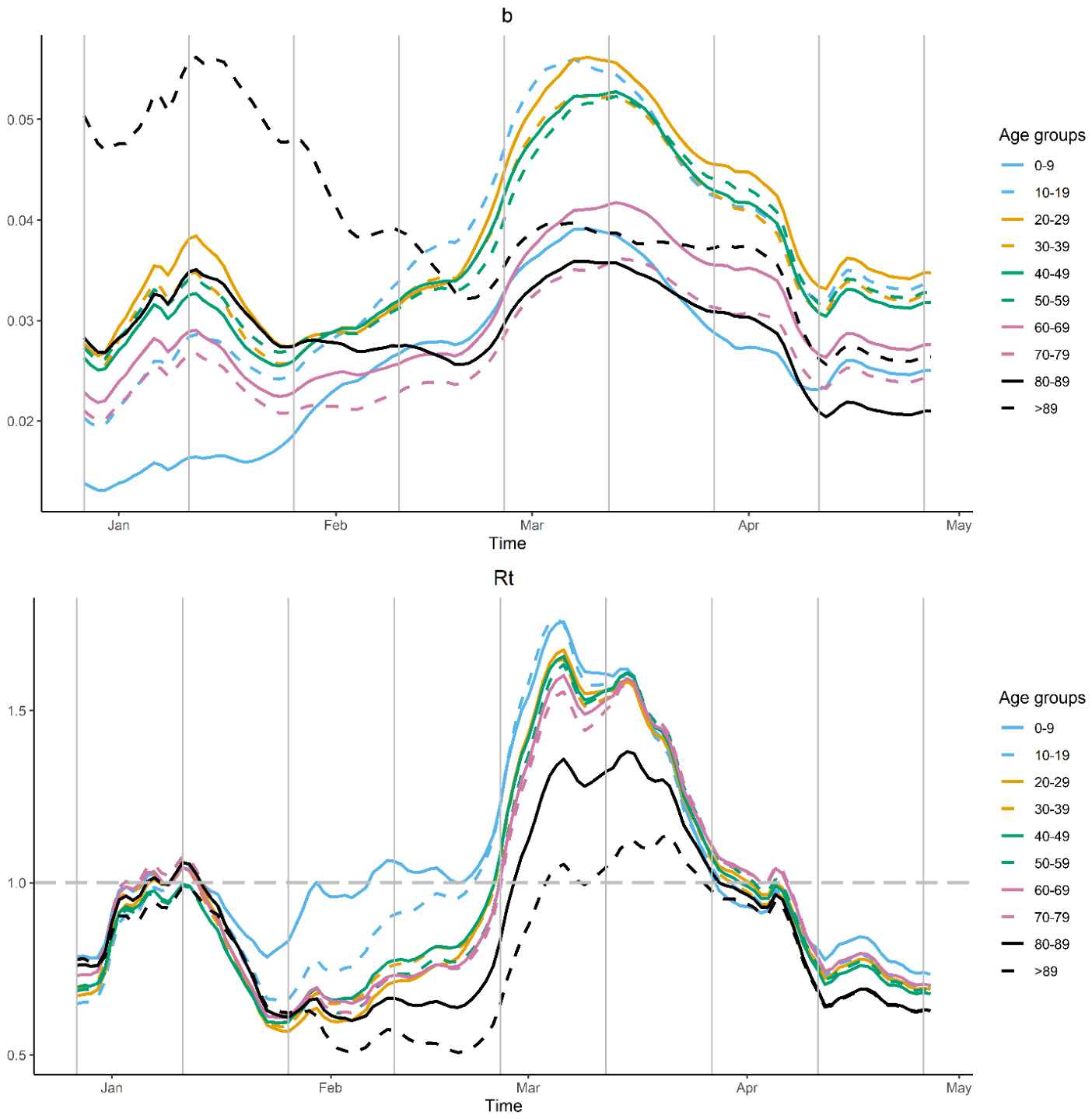
Figure 1. b and Rt distributed according to the age groups from 27 December 2020 to 26 April 2021. Vertical grey lines indicate the start of the simulations.
Applsci 16 04687 g001
Figure 2. The results of the dynamic simulation. The black rectangles indicate the percentage of subjects already vaccinated in each age group at the beginning of the simulation period. The pink and blue bars show the percentage distributions of the population by age group to be immunised by vaccination, obtained from the different simulations to minimise the number of deaths and the number of infections, respectively.
Applsci 16 04687 g002
Table 1. Millions of doses available for each company during each simulated scenario (SS).
Vaccine CompanySS #1SS #2SS #3SS #4SS #5SS #6SS #7SS #8SS #9
Astra_Zeneca0.62.85.07.711.211.411.811.511.0
Pfizer/Biontec10.913.416.620.527.126.626.026.726.5
Johnson_&_Johnson---0.00.01.63.34.96.6
Moderna0.30.81.32.53.44.24.74.64.5
Disclaimer/Publisher’s Note: The statements, opinions and data contained in all publications are solely those of the individual author(s) and contributor(s) and not of MDPI and/or the editor(s). MDPI and/or the editor(s) disclaim responsibility for any injury to people or property resulting from any ideas, methods, instructions or products referred to in the content.