1. Introduction
Underwater acoustic (UWA) channels pose severe challenges for high-rate communication, primarily due to multipath propagation and Doppler spreading. Multipath propagation gives rise to inter-symbol interference (ISI) as delayed replicas of the transmitted signal overlap with subsequent symbols, while Doppler spreading induces symbol dilation, stretching or compressing the signal waveform in time. Both effects significantly degrade signal integrity and increase the difficulty of reliable data recovery. Orthogonal frequency division multiplexing (OFDM), a widely adopted multicarrier technique that exploits subcarrier orthogonality, is particularly susceptible to Doppler-induced frequency shifts. These shifts violate the orthogonality condition and introduce inter-carrier interference (ICI), which can substantially compromise system performance, especially in mobile underwater environments [
1,
2,
3]. Therefore, accurate and efficient estimation of the Doppler frequency offset is a prerequisite for achieving robust OFDM reception in underwater acoustic communication (UAC). Over the past decade, a variety of estimation techniques have been proposed to tackle this problem, each with different trade-offs in terms of accuracy, latency, and computational cost [
4,
5,
6,
7,
8].
A real-time Doppler estimation method using hyperbolic frequency modulated (HFM) signals is proposed in [
9]. In this approach, two HFM signals with opposite sweep directions are placed before the data frame at the transmitter, while at the receiver, two corresponding matched filters are employed to estimate the Doppler factor. Although estimation accuracy is independent of the frame length, it degrades significantly in the presence of time-varying multipath. To address this issue, a correlation-peak-matching scheme is introduced in [
10] to improve estimation performance under time-varying multipath conditions. This approach necessitates that the two HFM signals exhibit identical autocorrelation properties, which comes at the cost of increased computational complexity. In [
11], a preamble signal based on superimposed linear frequency modulation (LFM) is designed, and a Doppler factor estimation algorithm that exploits the relationship between the Doppler factor and the matched-filter peak shift is proposed. Simulations and sea trials were conducted to validate both the designed preamble and the proposed Doppler estimation algorithm. Numerical results demonstrate that the proposed algorithm achieves accurate estimation performance.
The Doppler scaling factor estimation can be performed by maximizing the autocorrelation between the received cyclic prefix (CP) and the OFDM symbol. However, the accuracy of this approach is inherently limited by the sampling rate. Higher precision demands a higher sampling rate, which, in turn, increases computational complexity. To address this issue, an interpolation-based estimation algorithms derived from analytical approximations of the expected autocorrelation function are proposed in [
12]. Simulations and experimental decoding results validate the effectiveness and superiority of the proposed method. It is shown that while an oversampling factor of two yields significant performance gains, further increases beyond two offer only marginal improvements. In [
13], a least squares (LS) Doppler estimation method is proposed based on the error between the reconstructed and received signals when a known preamble is transmitted. This approach requires prior channel equalization and relies on an iterative solution, which limits its practicality in UWA communication systems.
In [
14], a BER-based Doppler estimation method was proposed to mitigate the mismatch between Doppler estimation and OFDM demodulation. Its effectiveness in adverse channels was validated through numerical simulations and experimental results. However, as a direct search algorithm that sweeps across Doppler grids to find the optimal BER, this approach requires a large number of search steps, resulting in high computational complexity. In [
15], a novel BER-based gradient descent algorithm is derived to iteratively estimate the Doppler frequency, thereby substantially reducing search time. Specifically, the Doppler estimate is updated along the negative gradient direction of the BER cost function to converge to the Doppler value that minimizes BER. To improve convergence and robustness, the algorithm replaces the instantaneous gradient with a smoothed version and employs variable step sizes to accelerate convergence, reduce complexity, and avoid local optima. The performance of this method can be sensitive to the initial parameter choice and hyper parameter settings; suboptimal configurations may compromise its robustness and lead to increased iteration counts in practice.
In [
16], a novel acoustic frequency comb (AFC) broadband signal is proposed for Doppler factor estimation in underwater acoustic applications. By leveraging the signal’s bandwidth, the frequency shifts of multiple spectral components can be extracted from a single measurement, enabling parallel Doppler estimates that are subsequently averaged to improve precision. However, frequency-selective fading and multipath interference may degrade the reception of individual AFC components, thereby compromising the accuracy and robustness of the estimation.
A common practice in existing systems is to embed two linear frequency modulation (LFM) probes into adjacent OFDM frames. The Doppler factor is then derived by measuring the change in the number of sampling points between the received probes [
17,
18,
19]. While operationally simple and easy to implement, this strategy has a major drawback: it must buffer the entire incoming packet before processing can begin, leading to substantial memory overhead. In summary, existing Doppler estimation methods for underwater acoustic OFDM systems often suffer from high computational complexity, reliance on full-packet reception, or limited tracking capability under time-varying Doppler conditions. To address these limitations, this paper proposes a hierarchical optimization scheme that combines FRFT-based initial estimation with CP-based fine tracking, enabling symbol-by-symbol Doppler compensation with reduced storage and hardware requirements.
In this paper, a coarse-to-fine Doppler estimation strategy is proposed for coded OFDM underwater acoustic communication systems. The proposed method operates in two interconnected stages that work in concert to achieve both efficiency and accuracy. In the first stage, the fractional Fourier transform (FRFT) is applied to an LFM probe to extract the chirp rate variation, from which a coarse Doppler factor estimate is derived. A key advantage of this stage is that it processes only the probe signal rather than the entire data packet, thereby significantly reducing storage requirements and hardware resource consumption. In the second stage, the cyclic prefix (CP) inherent to each OFDM symbol is used to refine the coarse estimate. Because CP correlation is performed symbol-by-symbol, the scheme can continuously track Doppler factor variations as they occur, rather than treating the entire frame as having a single Doppler value. This coarse-to-fine architecture makes the proposed method particularly well-suited for real-time underwater acoustic communication, where low latency and limited memory are critical constraints.
The main contributions of this paper are as follows: (1) a hierarchical Doppler estimation scheme combining FRFT-based initial estimation and CP-based refinement is proposed. (2) Symbol-by-symbol Doppler tracking is achieved without requiring the entire packet, reducing storage and hardware resources. (3) The proposed method is validated under both constant and time-varying Doppler conditions, showing performance comparable to Doppler-free systems.
The rest of the paper is organized as follows.
Section 2 introduces the proposed coarse-to-fine Doppler estimation strategy.
Section 3 describes the simulation environment and presents a thorough discussion of the numerical results.
Section 4 outlines the conclusions.
2. Coarse-to-Fine Doppler Estimation Framework
The proposed scheme comprises two steps: first, the FRFT is applied to the LFM signal to estimate the change in chirp rate, yielding an initial Doppler estimate. The second step refines the Doppler factor estimation using cyclic prefix correlation, enabling symbol-by-symbol tracking of Doppler changes. The advantage of the two-step design is that it does not require receiving the entire packet, thereby reducing storage and hardware requirements and enhancing its suitability for real-time implementation.
Figure 1 illustrates the frame structure adopted for this scheme.
2.1. Coarse Doppler Estimation via FRFT
In sonar communication systems, the LFM signal is commonly employed as a synchronization probe. Its mathematical representation is given by the following equation.
where
denotes the center frequency,
represents the chirp rate, the bandwidth is
, and
stands for a rectangular pulse of duration
. The instantaneous frequency follows a linear evolution:
When the signal propagates through a moving channel, the received instantaneous frequency is scaled by the Doppler factor:
where
denotes the frequency ratio of the received signal to the transmitted signal. The Doppler factor can be defined as
, with
being the relative velocity and
C the water sound speed.
The FRFT possesses a well-known energy concentration property for LFM signals. There is an optimal order of the FRFT that concentrates the energy of the chirp signal [
20]. By searching over a specific set of orders, the optimal order
that yields the maximum energy can be obtained.
The optimal FRFT order is searched over a range of with a resolution of 0.001, which corresponds to a chirp rate estimation accuracy of 0.1%. The search process terminates when the energy difference between consecutive orders falls below a threshold of , ensuring convergence.
Once
is found, the estimated chirp rate is obtained as:
where
is the true chirp rate of the transmitted LFM signal. Because the relative velocity in underwater environments is typically low,
satisfies
. Consequently, the initial Doppler factor estimate
can be approximated by
The
can be estimated as
Unlike conventional matched-filter-based approaches, FRFT-based estimation offers higher resolution and greater robustness under low-SNR conditions, thanks to its ability to concentrate chirp energy in the fractional Fourier domain. This property makes it particularly suitable for providing an accurate initial Doppler estimate for subsequent refinement.
2.2. Symbol-by-Symbol Refinement via Cyclic Prefix Correlation
After obtaining the coarse Doppler factor estimate and an initial estimation from the FRFT stage, the second component of the proposed scheme refines this value by exploiting the CP inherent to each OFDM symbol. This refinement is performed on a symbol-by-symbol basis, enabling continuous tracking of Doppler variations across the received frame.
Let
denote the received baseband signal. Its autocorrelation can be defined as
The magnitude
attains its maximum not only at
but also at the lag:
where
is the sampling interval at the transmitter,
is the sampling interval at the receiver, and
means the number of sampling points of one OFDM symbol.
Assuming that , then , and should have the maximum magnitude except for . So, the fine estimation of can be obtained by the following steps:
- (1)
Initialize with the coarse estimate from the previous stage:
- (2)
Define a search neighborhood around with radius :
where
is the step size controlling the search resolution.
- (3)
For each candidate , calculate the autocorrelation magnitude ; the candidate that maximizes the is selected as the refined estimate.
Finally, the fine estimation of is obtained by (11).
where
is the lag that yields the maximum correlation magnitude.
The autocorrelation calculations over the searching set
dominate the computational complexity of the second step. With a search radius
and an OFDM symbol length of
samples, the complexity is
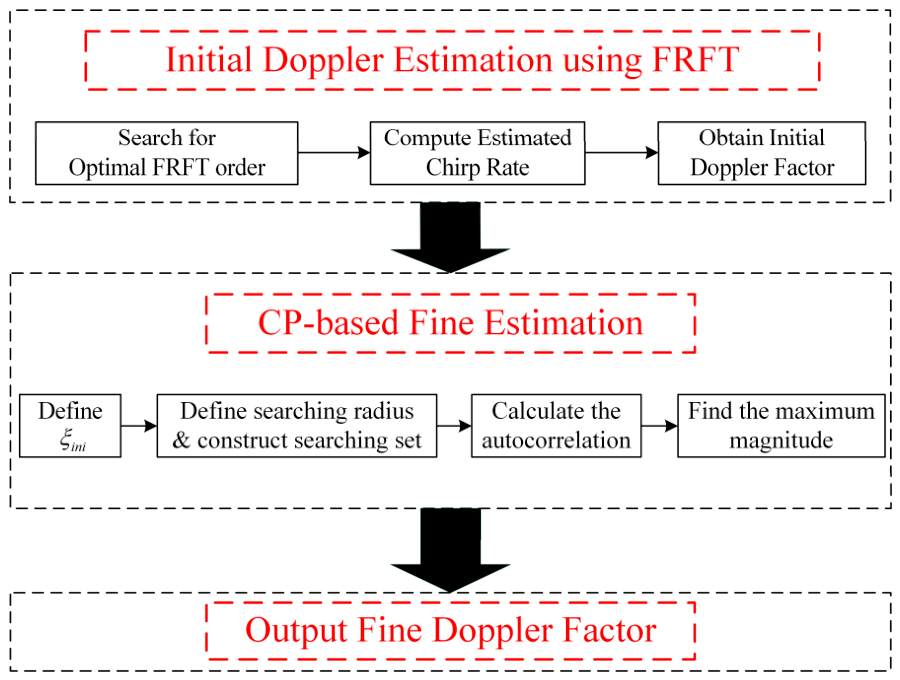
, which is significantly lower than full-packet resampling or iterative gradient descent methods that require multiple passes over the entire frame. The framework of the proposed scheme is shown in
Figure 2.
The pseudocode of the proposed algorithm is as follows (Algorithm 1).
| Algorithm 1: Hierarchical Doppler Estimation |
Input: Received LFM signal, OFDM symbols, search range
Output: Estimated Frequency ratio |
1: Compute FRFT of LFM signal over candidate orders over a range of with a resolution of 0.001.
2: Find optimal order maximizing energy concentration
3: Estimate the initial Frequency ratio using Equation (5)
4: For each OFDM symbol do
5: Define the searching set , where
6: Compute the autocorrelation for each
7: Select maximizing correlation magnitude
8: End for
9: Return |
2.3. Theoretical Performance Analysis
To complement the numerical evaluation, we present a concise theoretical analysis of the proposed hierarchical estimator and benchmark it against the Cramer–Rao Lower Bound (CRLB).
The received LFM probe in a Doppler-distorted channel can be modeled as
where
represents additive white Gaussian noise with power spectral density
. Under the moderate-SNR assumption, the CRB for the parameter
(and equivalently for
) is given by
where
. This expression highlights the strong dependence on the time-bandwidth product and on the integration time.
Denote by
the number of samples in the cyclic prefix and by
the sampling frequency, so that the CP duration is
. The CP-based Doppler estimator operates by locating the peak of the cyclic autocorrelation. Its CRB can be derived as
Remarkably, the bound depends only on
and SNR, independent of the sampling rate once the CP length is fixed in samples. Because the LFM synchronization probe and the CP segments of the OFDM symbols are separated in time, their observations are statistically independent. Consequently, the Fisher information adds, and the joint CRB for the two-stage estimator is the harmonic mean
Substituting the typical parameters (such as ) shows that is more than two orders of magnitude smaller than at the same SNR. Hence, the joint bound is essentially dictated by the CP stage: .
3. Numerical Performance Results and Discussion
In this section, numerical simulations are carried out to assess the feasibility and the performance of the proposed hierarchical optimization scheme. In this section, the main contents are divided into three parts: the main simulation environment, the Mean Squared Error (MSE), and the bit error rate (BER) performance of the proposed scheme.
3.1. Simulation Parameters
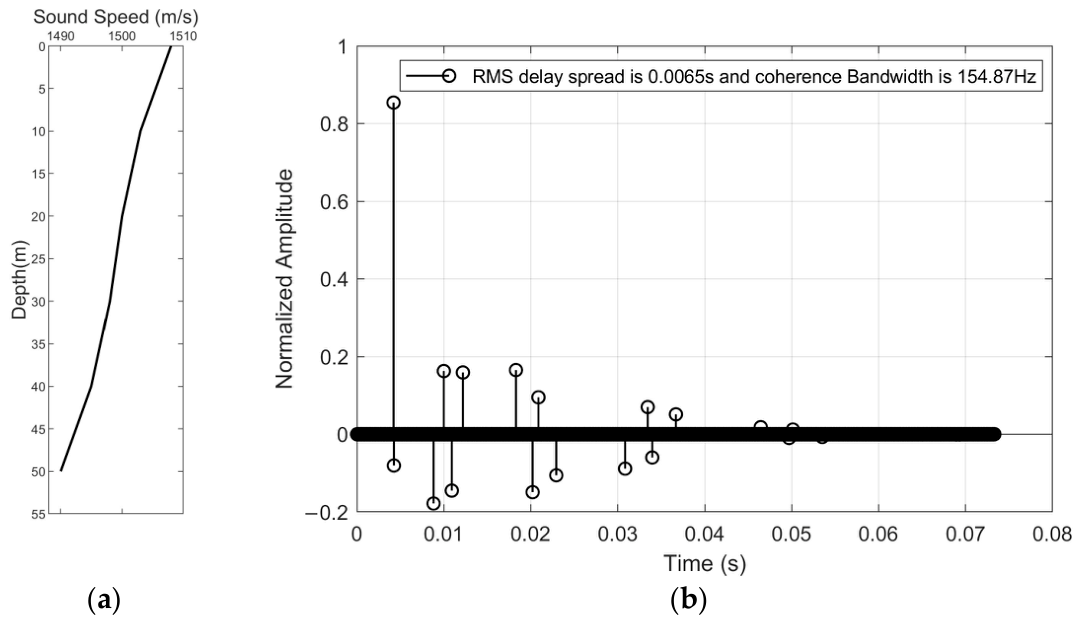
The multipath channel used in the simulation is generated using Bellhop, with transmitter and receiver placed at depths of 40 and 10 m, respectively.
Figure 3a shows the sound velocity gradient, and
Figure 3b displays the channel impulse response (CIR) with a 2 km separation between the transmitter and the receiver. The RMS delay spread of the generated multipath acoustic channel is 6.5 ms, and the coherent bandwidth is 154.87 Hz. The simulation parameters of the coded UWA OFDM system are given in
Table 1. The code rate of the channel coding methods is 1/2, and the sizes of the parity check matrices of Low-Density Parity Check (LDPC) codes are
and
. To make the comparison more reasonable, the interleaver lengths in Turbo coding are set to 1536 and 2304, respectively, corresponding to the two parity check matrices. The coding block lengths of the convolutional code are 768 and 1152, respectively, in order to make sure the coded data lengths are the same as the other two coding methods. All BER results are averaged over
independent Monte Carlo runs. Time-domain resampling and frequency-domain resampling are selected as the comparative approaches. The parameters of the UWA OFDM system are listed in
Table 1. The parameter selection balances the spectral efficiency, robustness to multipath, and hardware constraints.
3.2. Mean Squared Error Performance
The optimal order of the FRFT enables energy concentration for a chirp signal. However, the focusing performance varies with the signal length, which directly affects optimal-order estimation and, consequently, Doppler-factor estimation.
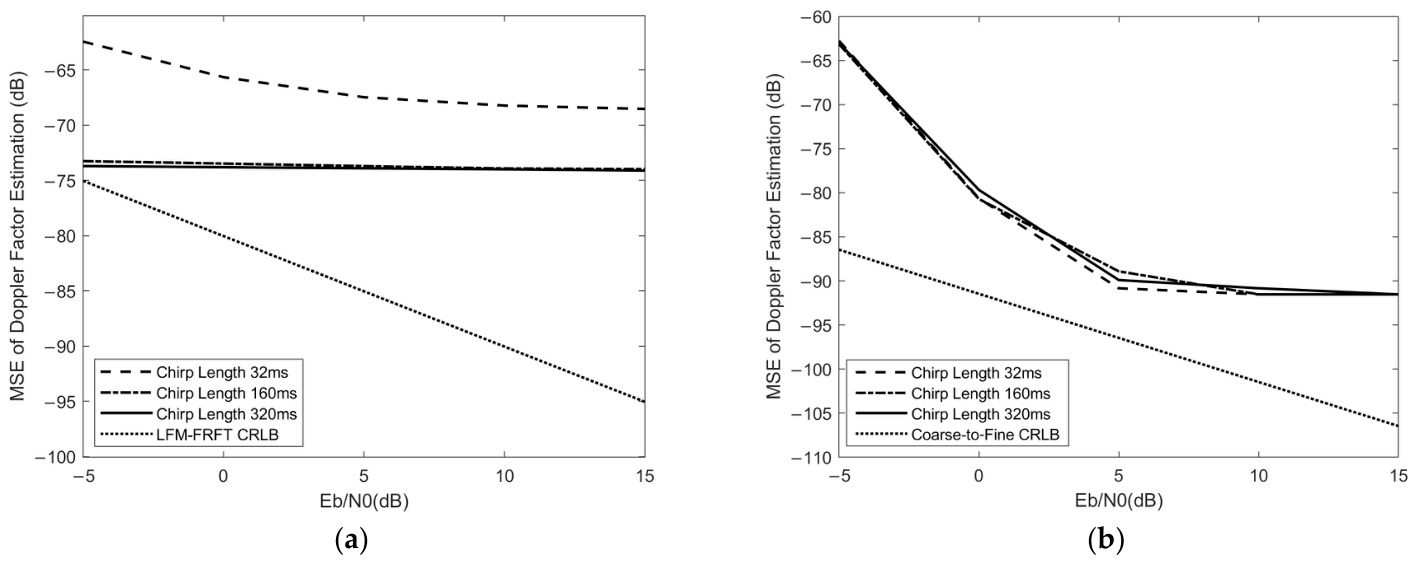
Figure 4a presents the MSE of the Doppler factor estimate obtained solely from the FRFT stage, evaluated for three different LFM lengths.
From the perspective of classical estimation theory, the initial FRFT-based estimator is expected to exhibit a variance that decays at least as with increasing LFM length , where the exact rate depends on the signal-to-noise ratio (SNR) and the search resolution of the FRFT order. In parallel, the CP-based refinement, which averages over samples in the correlation calculation, is expected to reduce the estimation variance at a rate proportional to . Consequently, the combined hierarchical estimator benefits from both a coarse-to-fine structure and the inherent variance reduction afforded by longer observation lengths and built-in redundancy.
Figure 4.
(a) MSE of the FRFT-based Doppler factor estimate versus SNR for different LFM durations; (b) MSE of the proposed coarse-to-fine estimator after CP refinement.
Figure 4.
(a) MSE of the FRFT-based Doppler factor estimate versus SNR for different LFM durations; (b) MSE of the proposed coarse-to-fine estimator after CP refinement.
As shown in
Figure 4a, the MSE increases monotonically as the LFM signal becomes longer. The curves for 160 ms and 320 ms are almost indistinguishable, while the 32 ms case yields an MSE that is 6~10 dB higher across the SNR range of interest. The dotted curve in
Figure 4a represents the CRLB calculated using Equation (13).
Figure 4b depicts the MSE of the complete two-stage estimator after CP refinement. Compared to the FRFT-only result, the refined scheme is much less sensitive to chirp length. Although at an extremely low SNR of −5 dB, the MSE is slightly worse than that of the FRFT-only estimator, the two-stage approach performs better at higher SNR values. Since an underwater acoustic OFDM system cannot operate reliably at −5 dB, this anomaly does not affect practical performance. The dotted curve in
Figure 4b represents the CRLB calculated using Equation (14).
It is worth noting that the relationship between the chirp duration and the channel delay spread inherently limits the robustness of the FRFT-based initial estimator under severe multipath. In our simulations, the chirp duration (32–320 ms) is significantly larger than the RMS delay spread (6.5 ms), ensuring that the dominant path remains distinguishable. For scenarios with delay spreads approaching or exceeding the chirp duration, the FRFT energy concentration may degrade; however, the subsequent CP-based refinement step can partially compensate for such degradation, as it operates independently on each OFDM symbol and is robust to multipath.
3.3. BER Performance of the Two-Step Scheme
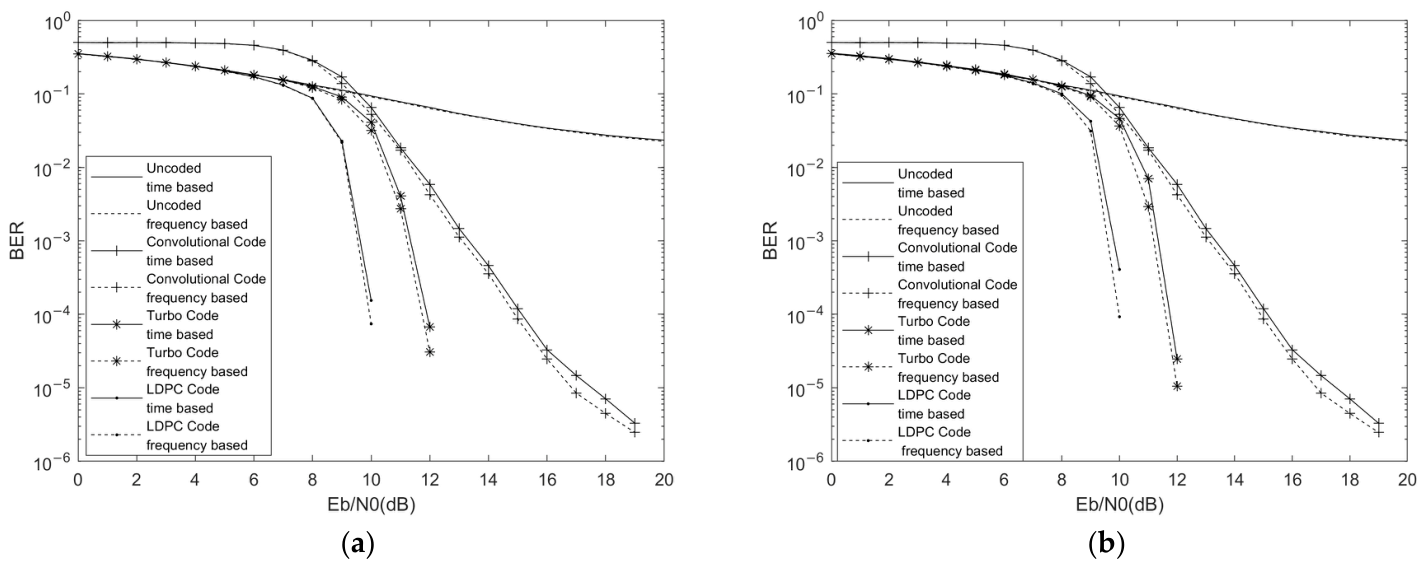
After the fine Doppler factor has been obtained via the proposed coarse-to-fine scheme, Doppler compensation is carried out using two state-of-the-art resampling techniques: one operating in the time domain and the other in the frequency domain.
Figure 5 compares their performance. The frequency-domain approach has a slight advantage over its time-domain counterpart, mainly because it avoids the need for an anti-aliasing filter. Therefore, the frequency-based resampling Doppler compensation scheme is adopted in the subsequent simulations.
The UAC OFDM system with three coding methods, which are convolutional code, Turbo code, and low-density parity-check code, was used to evaluate the BER performance of the two-step scheme. Numerical simulations are conducted with the constant Doppler and the symbol-rate time-varying Doppler.
3.3.1. Constant Doppler
The coded underwater acoustic OFDM systems with three coding methods, different constant Doppler factors, and different coding block lengths are passed through the multipath channel shown in
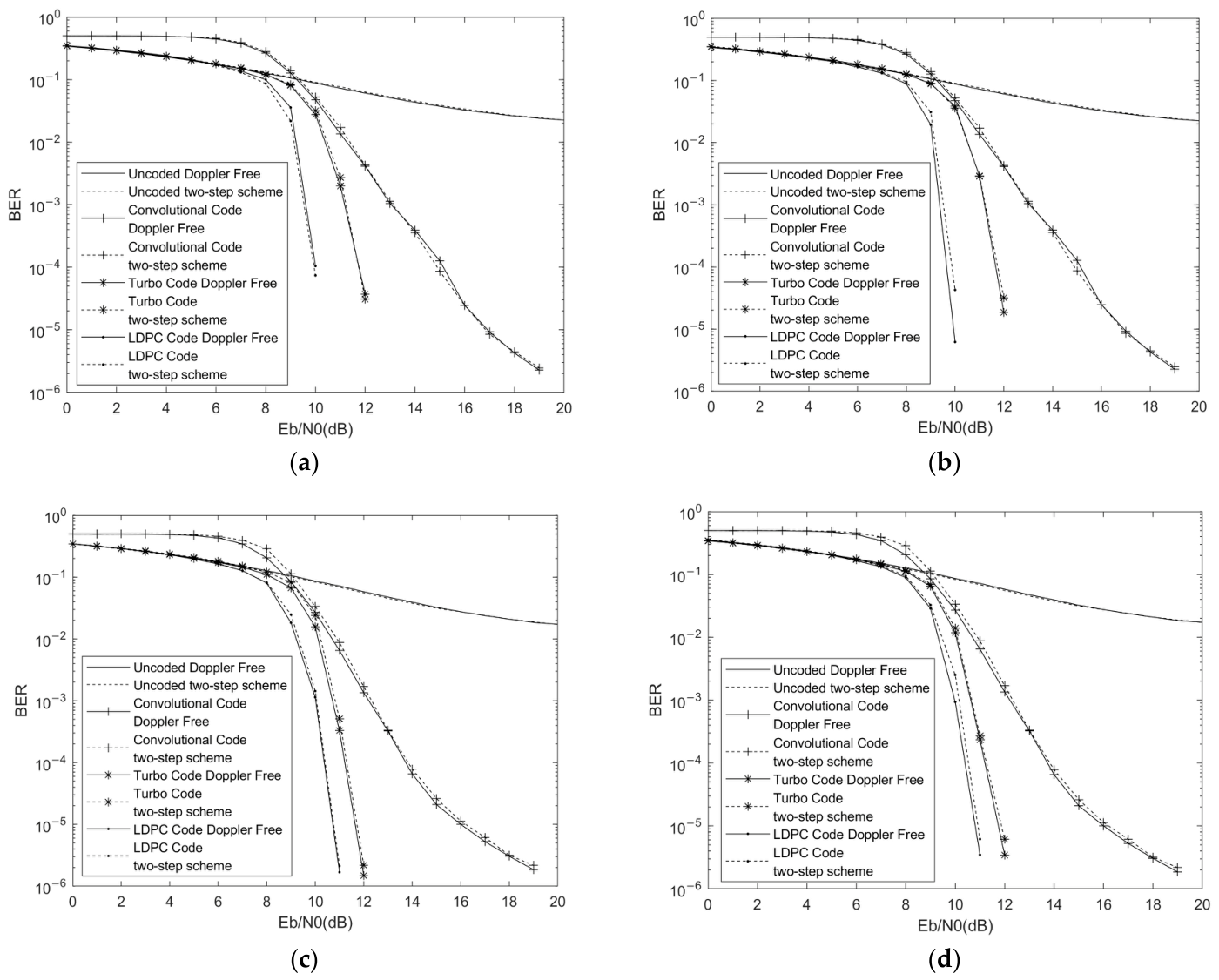
Figure 3b. The BER performance comparison between the proposed two-step scheme and the Doppler-free channel are shown in
Figure 6.
Figure 6a,b show the BER performance comparison of three coding methods with coding block lengths of 768 and 1152 through the multipath channel with Doppler factor
.
Figure 6c,d show the same coded OFDM system passed through the identical multipath channel with a different Doppler factor
.
Figure 6 presents the BER performance of the coded OFDM system under constant Doppler factors
and
with coding block lengths of 768 and 1152. In all subfigures, the proposed two-step method produces BER curves that closely follow those of the ideal Doppler-free reference. For convolutional codes (
Figure 6a,c), the SNR gap at BER = 10
−3 is within a fraction of a decibel for both block lengths and Doppler values, indicating that the coarse-to-fine estimation fully compensates the constant Doppler Effect.
The Turbo-coded system shows a similarly negligible gap, and its error floor remains unaffected by Doppler compensation. The LDPC-coded system, known for its sharp waterfall characteristic, exhibits virtually no observable degradation: the curves for the proposed scheme overlap with the Doppler-free curves across the entire SNR range for both block lengths and Doppler factors. The insensitivity to the specific Doppler value ( vs. ) demonstrates that the FRFT-based coarse step provides a robust initial estimate that, after CP refinement, is accurate enough to restore subcarrier orthogonality irrespective of the frequency shift magnitude within the tested range. Overall, these results confirm that the proposed scheme is compatible with various channel coding strategies and block sizes, and it essentially eliminates the Doppler-induced ICI penalty in constant-Doppler channels.
The numerical results presented in these four figures show that the BER performance of the proposed scheme is either the same as or slightly worse than that of the Doppler-free system. This suggests that, after completing the two estimation steps, the proposed approach can accurately estimate the Doppler factor. Its performance remains consistent with that of Doppler-free methods, regardless of the coding scheme or the Doppler factor used.
Figure 6.
The BER comparison of the coded OFDM system with three coding methods, between the two-step method and the Doppler-free channel shown in
Figure 3b. (
a,
b): Doppler factor
, with the coding block lengths 768 (
a) and 1152 (
b). (
c,
d): Doppler factor
, with the coding block lengths 768 (
c) and 1152 (
d).
Figure 6.
The BER comparison of the coded OFDM system with three coding methods, between the two-step method and the Doppler-free channel shown in
Figure 3b. (
a,
b): Doppler factor
, with the coding block lengths 768 (
a) and 1152 (
b). (
c,
d): Doppler factor
, with the coding block lengths 768 (
c) and 1152 (
d).
To further clarify the advantage of the proposed method over existing alternatives, we compare it with two reference schemes in the same constant-Doppler simulated environment. First, the conventional two-LFM method [
17], which estimates the Doppler factor from the time compression/expansion of two LFM probes and then performs full packet resampling. Second, the one-step FRFT-only estimator that uses the coarse estimate from
Section 2.1 without CP refinement.
The conventional two-LFM scheme achieves BER performance close to that of the proposed scheme, but at the cost of buffering the entire received packet and performing resampling across the entire frame, resulting in significant memory usage and processing latency. The one-step FRFT-only estimator, despite its low complexity, shows a noticeable BER degradation of approximately 1–2 dB at BER = 10−3 compared with the two-step method, especially for longer block lengths, because it cannot track small residual Doppler offsets. The novelty of this manuscript lies in its hierarchical coarse-to-fine architecture: the FRFT stage provides a reliable initialization without requiring full packet storage, and the CP-based refinement then corrects residual offsets symbol-by-symbol. This design achieves state-of-the-art BER performance while fundamentally reducing memory requirements and enabling real-time Doppler tracking, which is not possible with full-packet resampling or single-stage estimators alone.
3.3.2. Symbol-Rate Time-Varying Doppler
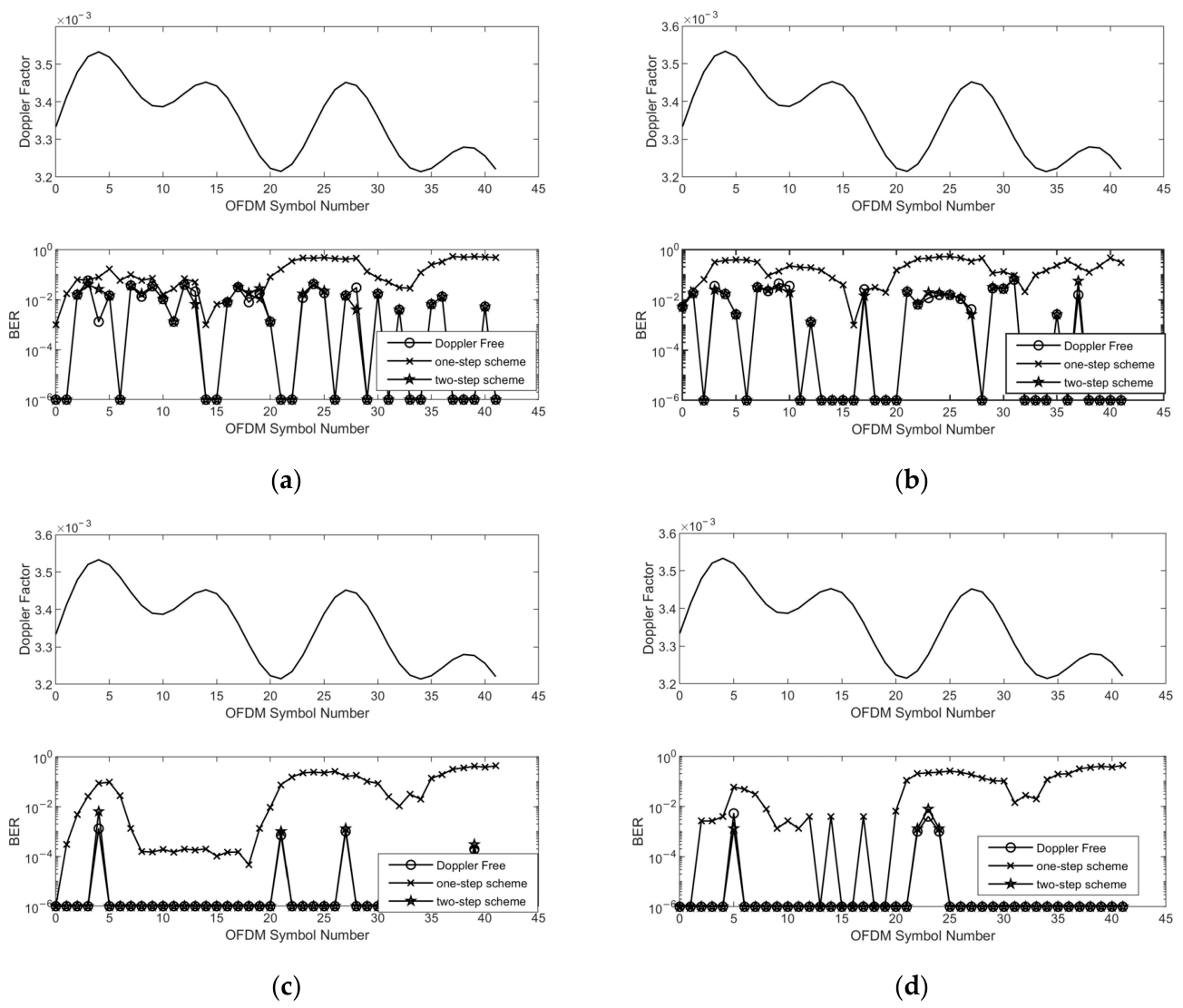
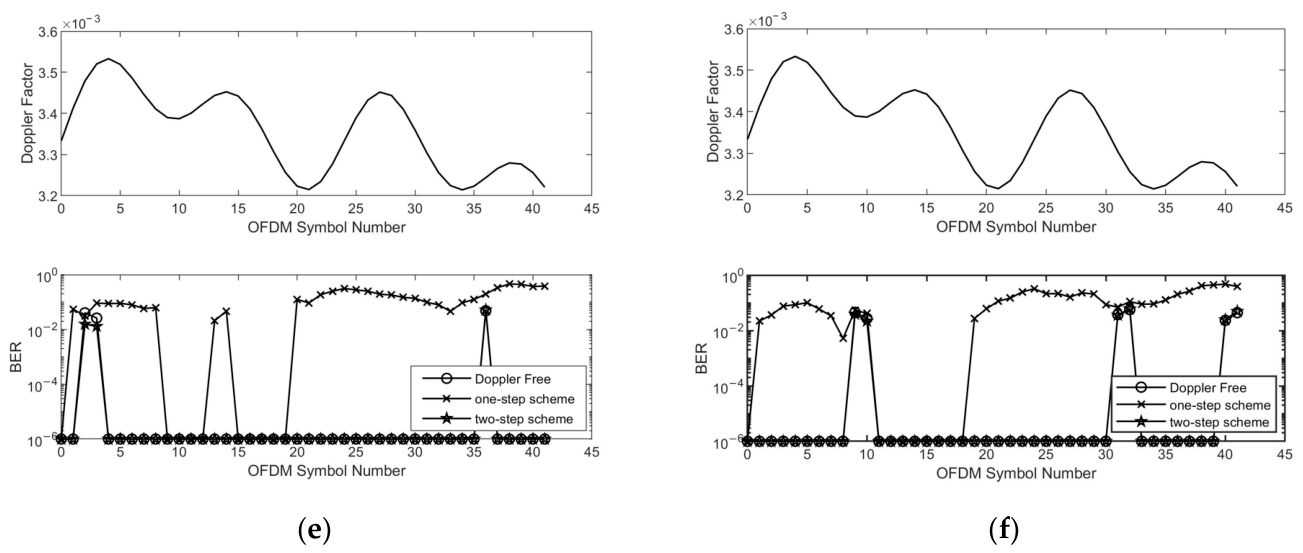
The symbol-rate time-varying Doppler contains a constant value, and a small range of fluctuations around this base value with a certain function, which is shown in every upper figure of
Figure 6. In this situation, we assume that the Doppler factor is changing between OFDM symbols, which means that the Doppler factor remains the same in one symbol.
In
Figure 7, the lower part shows the BER changes over OFDM symbols, and the means are set to zero to ensure continuity of the curves. To evaluate performance, we used three channel coding methods: convolutional code, Turbo code, and LDPC code. Each of these coding methods has been conducted a simulation with two different coding block lengths. The SNR of the convolutional-coded signal and the Turbo-coded signal is 12 dB, while that of the LDPC-coded signal is 10 dB, as the BER of the LDPC-coded signal in this simulation becomes zero when the SNR is 12 dB.
It can be seen that there are three curves in all these figures; the dash–dot one shows the BER results of the one-step scheme, which uses only the FRFT of the chirp probe signal to estimate the Doppler factor. The curve representing the two-step scheme is solid, and the Doppler-free is the dashed curve. It can be seen that the one-step scheme cannot track Doppler factor variation across OFDM symbols; it treats all symbols in a frame as having the same Doppler factor, resulting in the BER of each symbol being severely affected by Doppler factor changes. However, the proposed two-step scheme can distinguish between the two by updating the Doppler factor based on the cyclic prefix correlation of each symbol; its BER is close to that of the Doppler-free case.
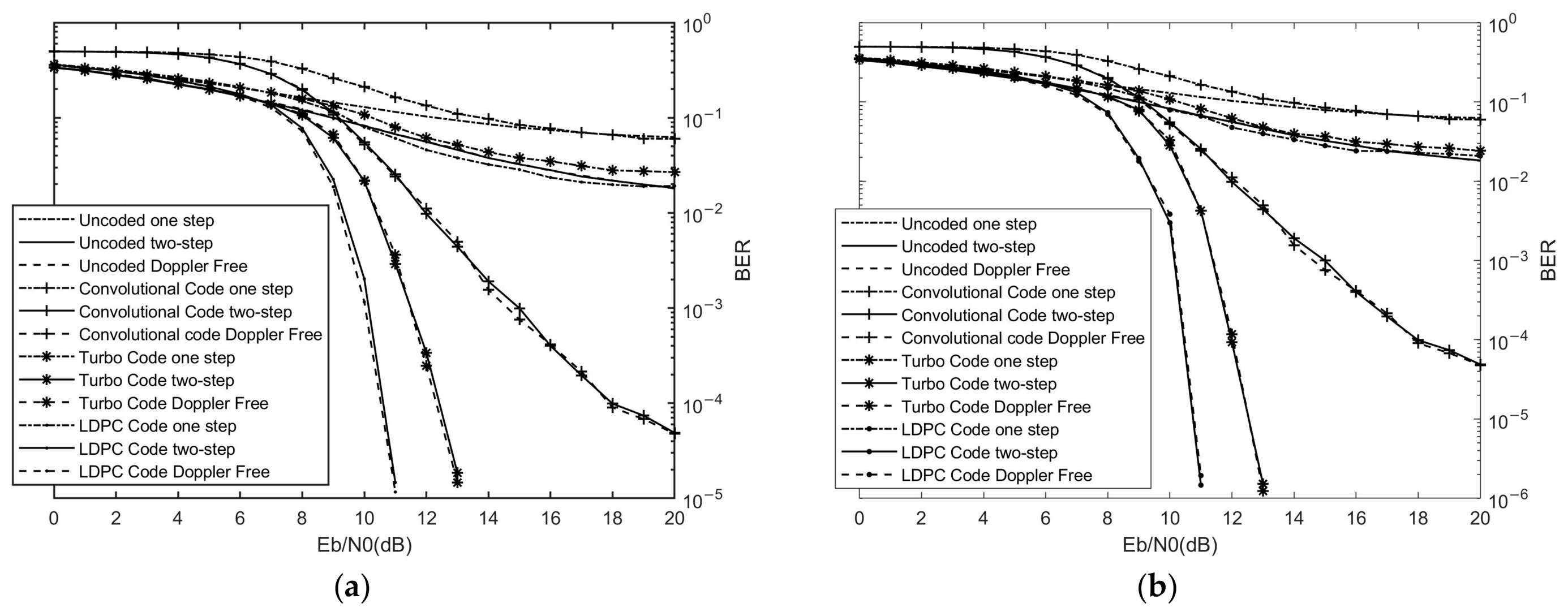
Figure 8 shows the total BER comparison among three schemes with different channel coding methods. It also demonstrates that the two-step scheme approximately matches the performance of the Doppler-free OFDM system with all three coding methods.
Unlike full-packet methods such as resampling-based or BER-gradient Doppler estimation, the proposed scheme operates symbol-by-symbol. It only requires the current OFDM symbol and its cyclic prefix to update the Doppler estimate, enabling true real-time processing without storing the entire frame. This characteristic makes it particularly suitable for hardware-constrained underwater acoustic modems, where low latency and reduced memory footprint are critical.
3.4. Robustness Margin Analysis
From
Figure 4a, it can be observed that the MSE of the FRFT-based initial estimator increases significantly when the SNR drops below 5 dB, indicating a threshold effect typical of parameter estimation under low-SNR conditions. The proposed two-step scheme mitigates this effect through CP-based refinement, allowing stable Doppler estimation down to SNR = 0 dB, as evidenced by the BER performance in
Figure 6. Specifically, at SNR = 0 dB, the BER degradation compared to the high-SNR case is approximately 1 dB, which we consider acceptable for robust operation. A more rigorous theoretical analysis of the SNR threshold and bias–variance trade-off is left for future work.
4. Conclusions
This paper introduces a coarse-to-fine Doppler estimation strategy for coded OFDM underwater acoustic communication systems. In the proposed approach, the fractional Fourier transform (FRFT) is first applied to an LFM synchronization probe to extract the chirp-rate variation, from which an initial Doppler-factor estimate is derived. This coarse estimate is then refined symbol-by-symbol using cyclic prefix (CP) correlation, enabling continuous tracking of time-varying Doppler shifts without the need to buffer the entire received packet. It can also track the Doppler changing via symbols when the Doppler is time-varying. The proposed two-stage scheme first applies the fractional Fourier transform to an LFM probe to obtain a coarse Doppler estimate, and then refines it symbol-by-symbol using cyclic-prefix correlation. Extensive simulations under both time-invariant and time-variant Doppler channels demonstrate that the proposed method can effectively compensate for Doppler-induced ICI, achieving communication reliability very close to that of an ideal Doppler-free reference, while significantly reducing memory requirements and processing latency compared with conventional full-packet approaches. The symbol-level tracking capability also makes the method inherently suitable for real-time operation in hardware-constrained underwater acoustic modems. Compared to existing full-packet resampling or iterative gradient-descent alternatives, the proposed framework offers comparable or superior accuracy while significantly reducing storage requirements and computational complexity. Importantly, because the scheme operates symbol-by-symbol and does not require full-packet reception, it is particularly well suited for real-time implementation in hardware-constrained underwater acoustic modems.
As part of future work, we plan to extend the proposed method to multi-input multi-output (MIMO) OFDM systems and to validate its performance through field trials in real underwater environments. In addition, we intend to explore machine learning techniques to further reduce the computational cost of the FRFT order search process.