Multi-Criteria Analysis of Different Renovation Scenarios Applying Energy, Economic, and Thermal Comfort Criteria



Abstract
1. Introduction
2. Materials and Methods
2.1. The Studied Building
2.2. Mathematical Formulation
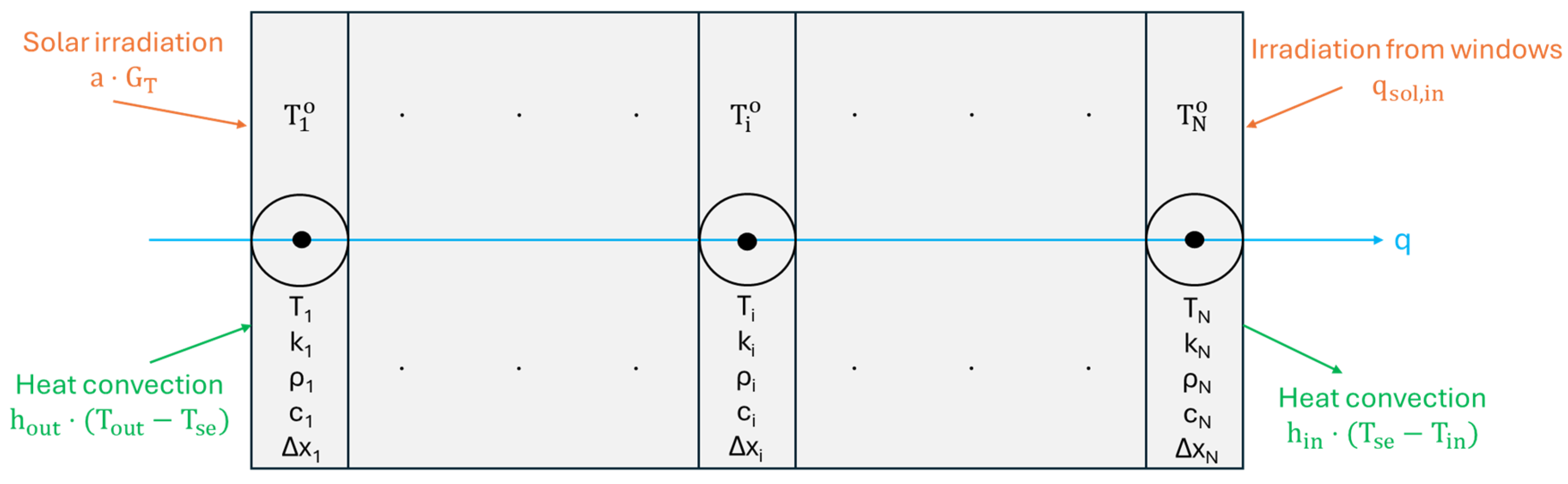
2.2.1. Building Envelope Thermal Modeling
Thermal Transfer Through Opaque Building Elements
Thermal Transfer Through Transparent Building Elements
Infiltration/Ventilation Thermal Losses
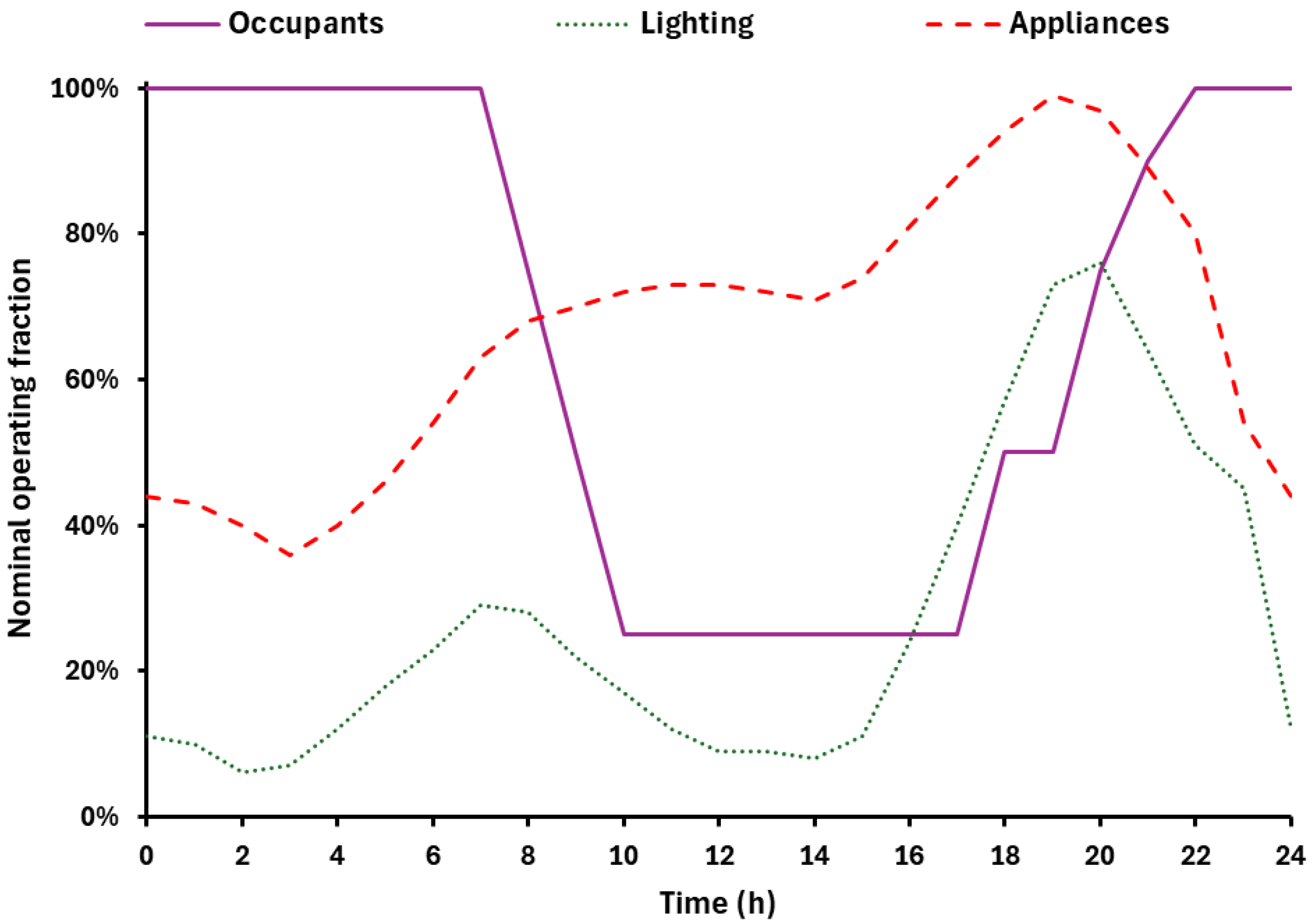
Internal Gains
2.2.2. Energy Systems Control for Heating/Cooling
Heating Period (Winter)
Cooling Period (Summer)
Energy Balance in the Indoor Space
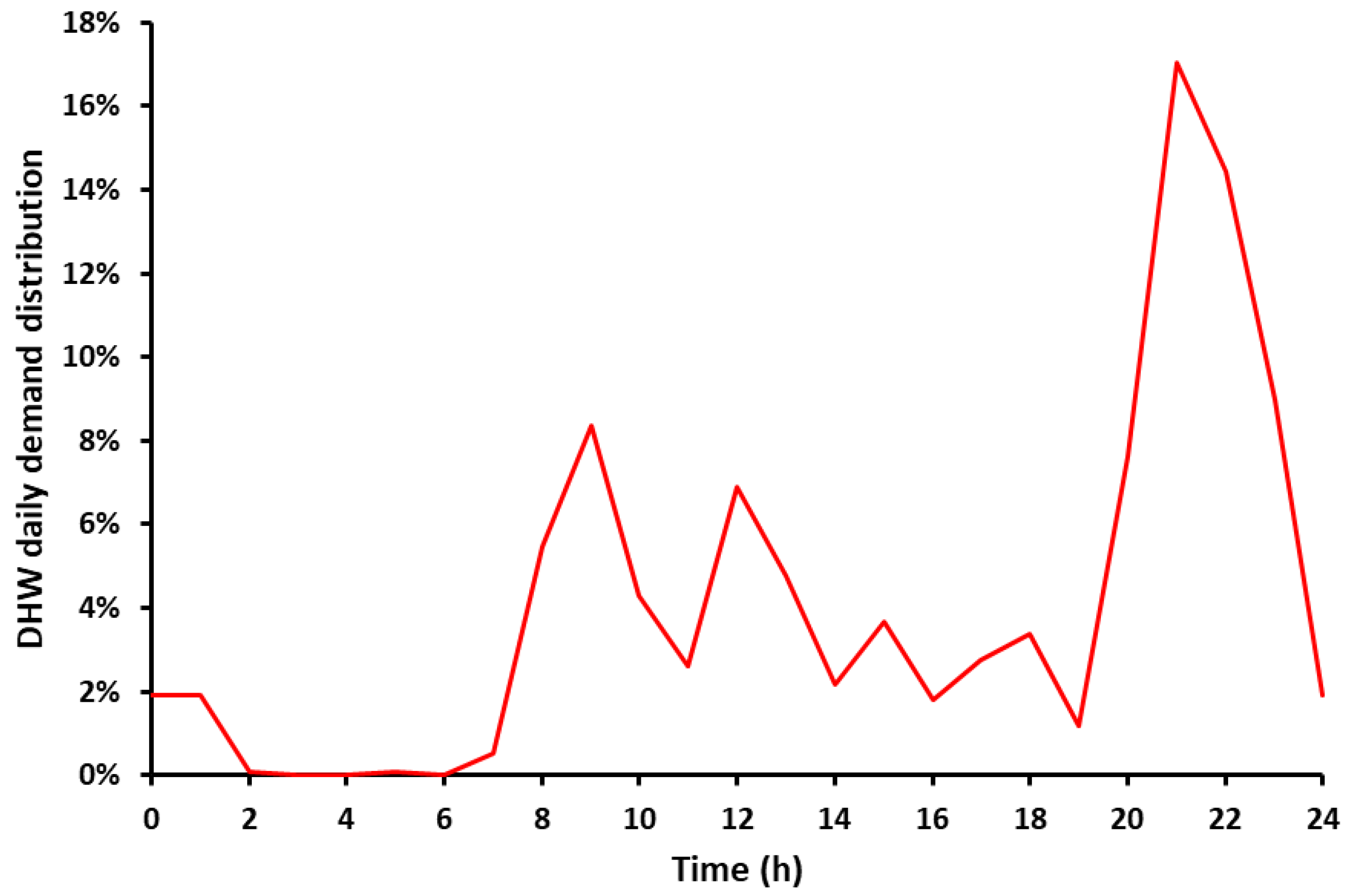
Domestic Hot Water (DHW) Demand Calculations
Efficiency Definitions for the Heat Pump for Heating/Cooling/DHW
Electrical Heaters for Domestic Hot Water
Electrical Demand Calculations
2.2.3. Thermal Comfort Analysis
2.3. Developed Model and Followed Methodology
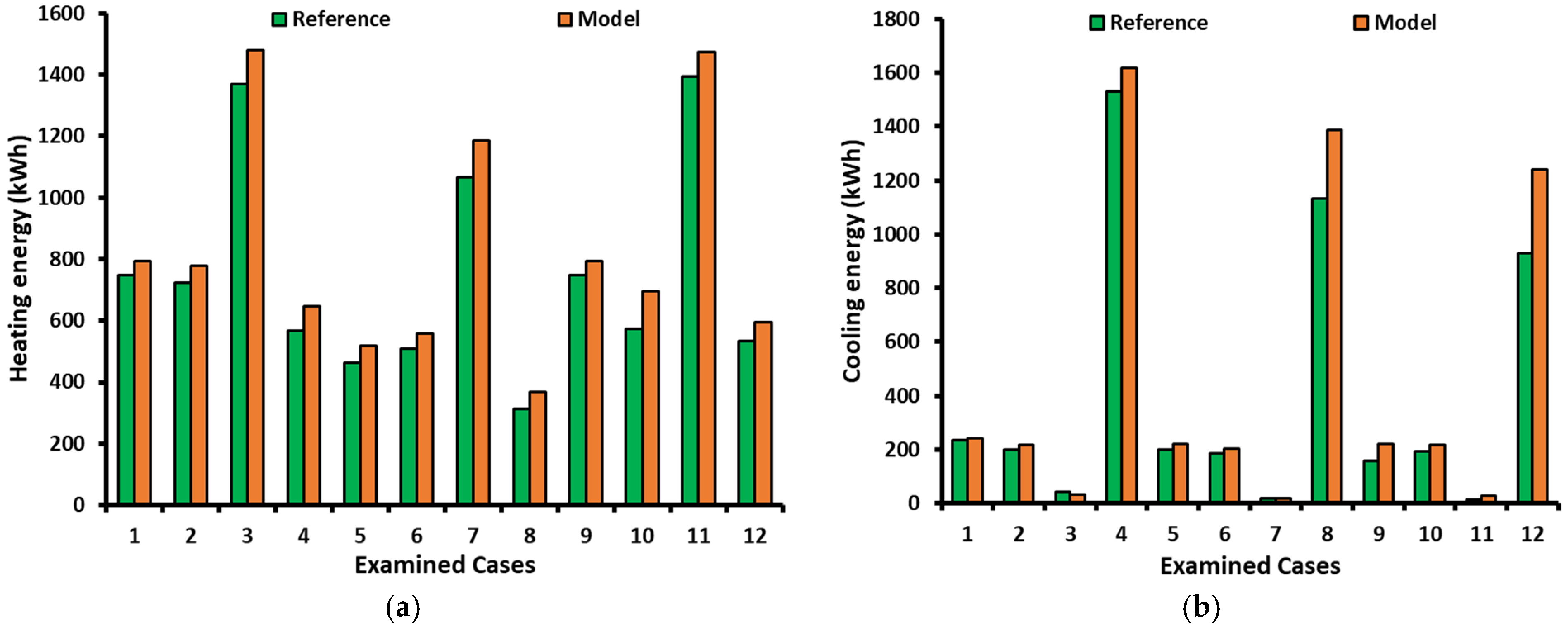
2.4. Model Validation
3. Results and Discussion
3.1. Optimal Insulation Thickness
3.2. Multicriteria Evaluation of the Different Retrofitting Scenarios
3.3. Dynamic Analysis
3.4. Sensitivity Multi-Criteria Analysis
4. Conclusions
- -
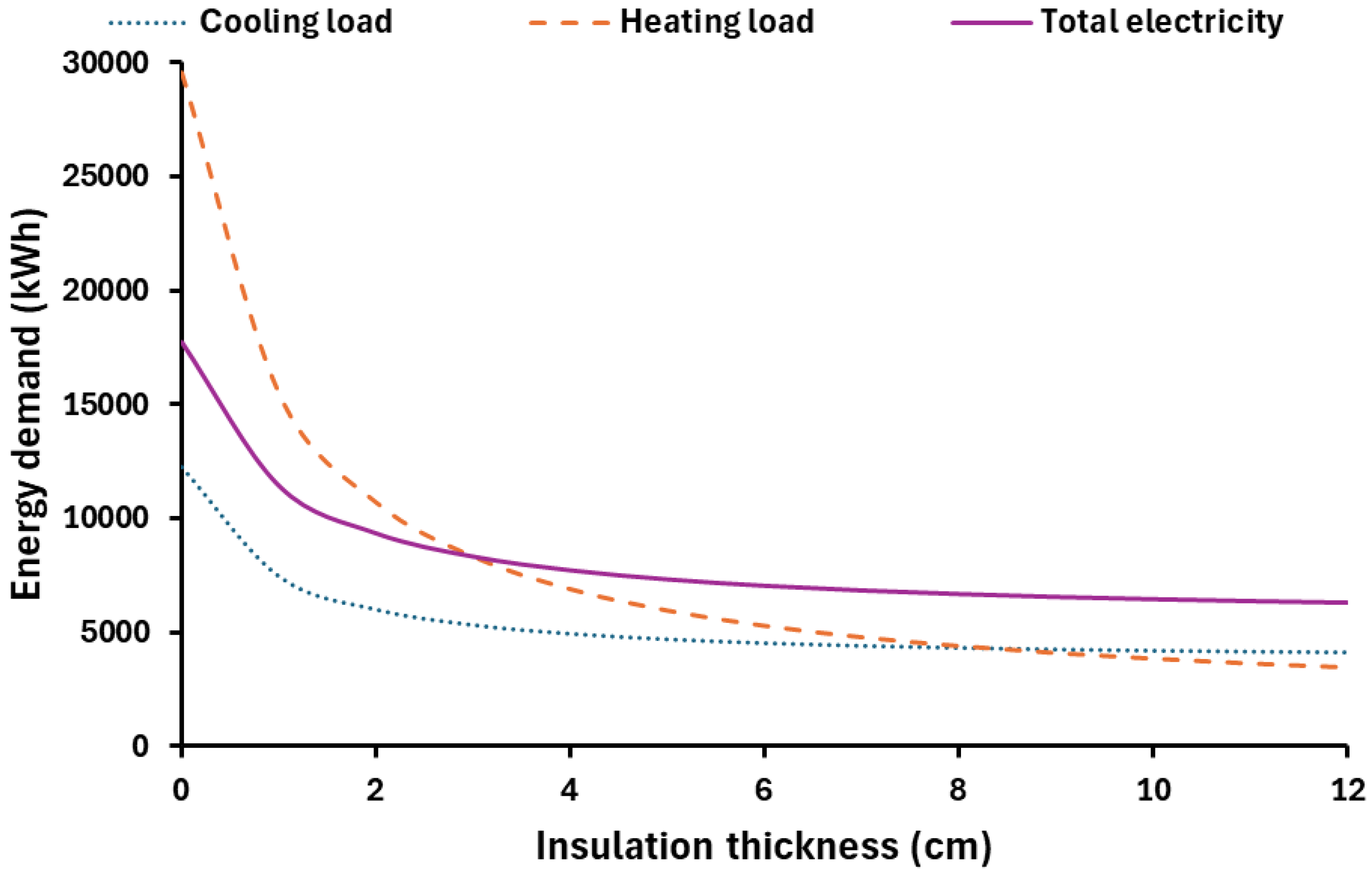
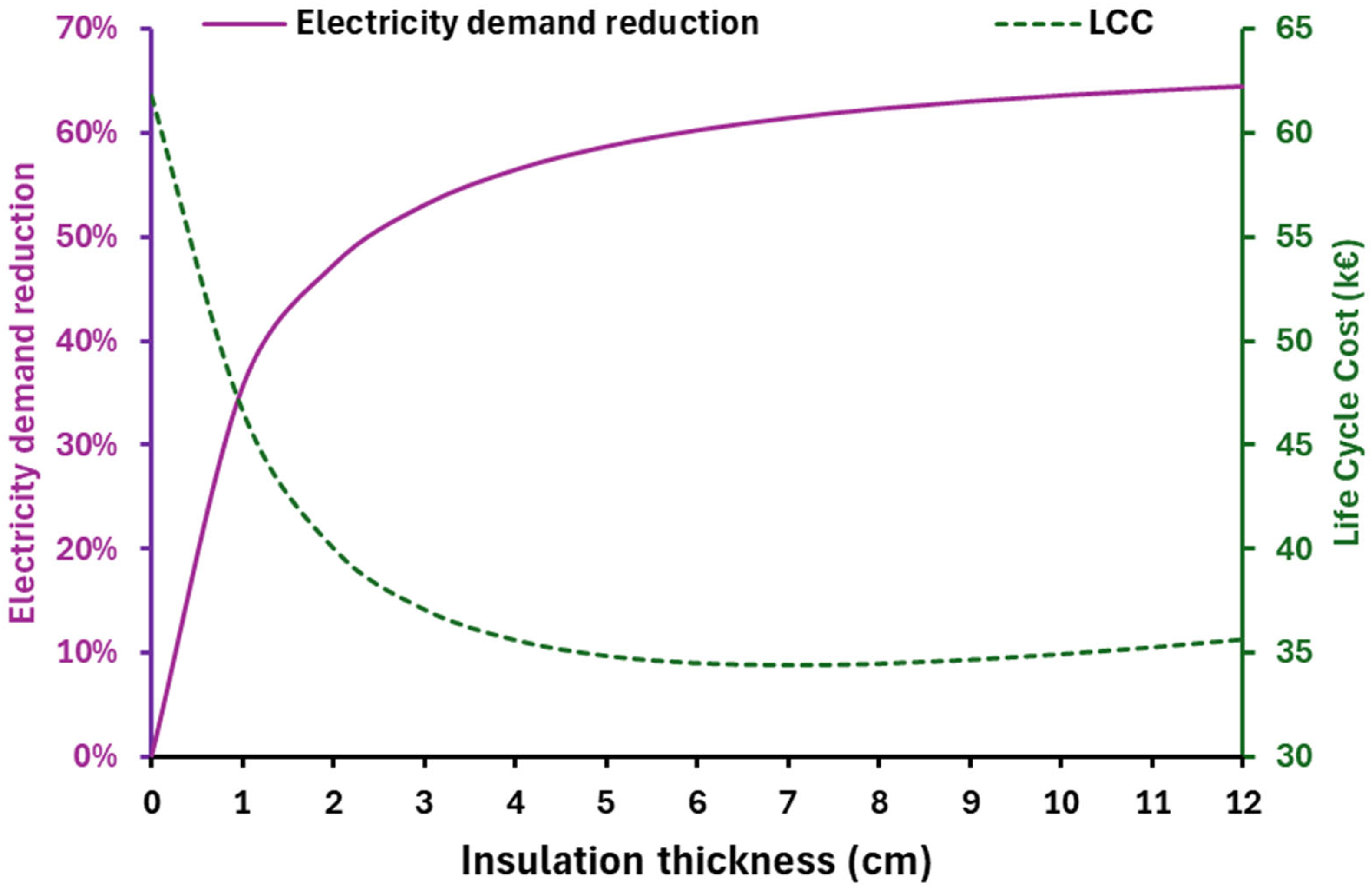
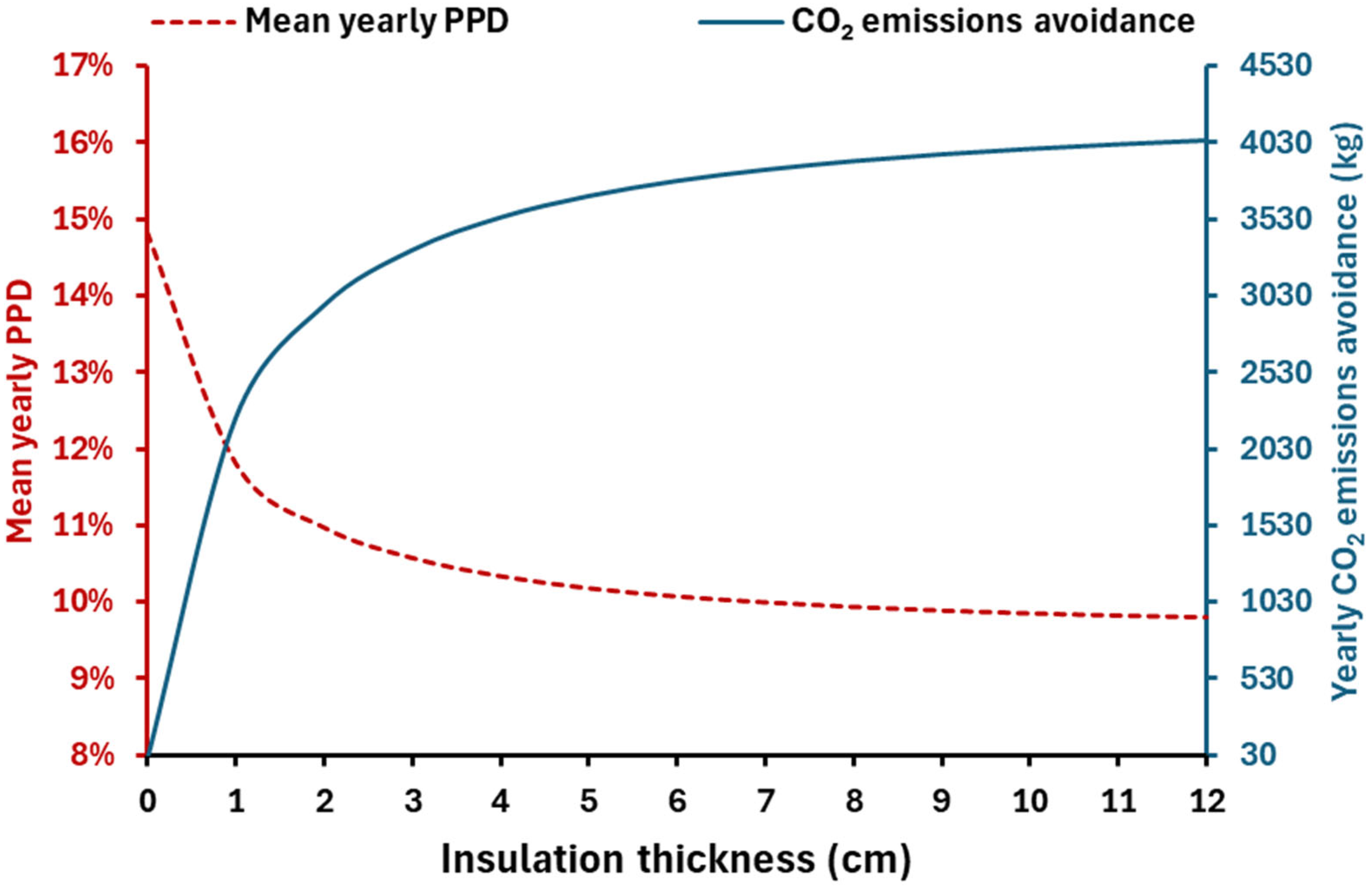
- The optimum economic insulation thickness is found to be 7 cm (minimization of LCC), and this design leads to an acceptable U-value according to Greek legislation for the studied climate zone.
- -
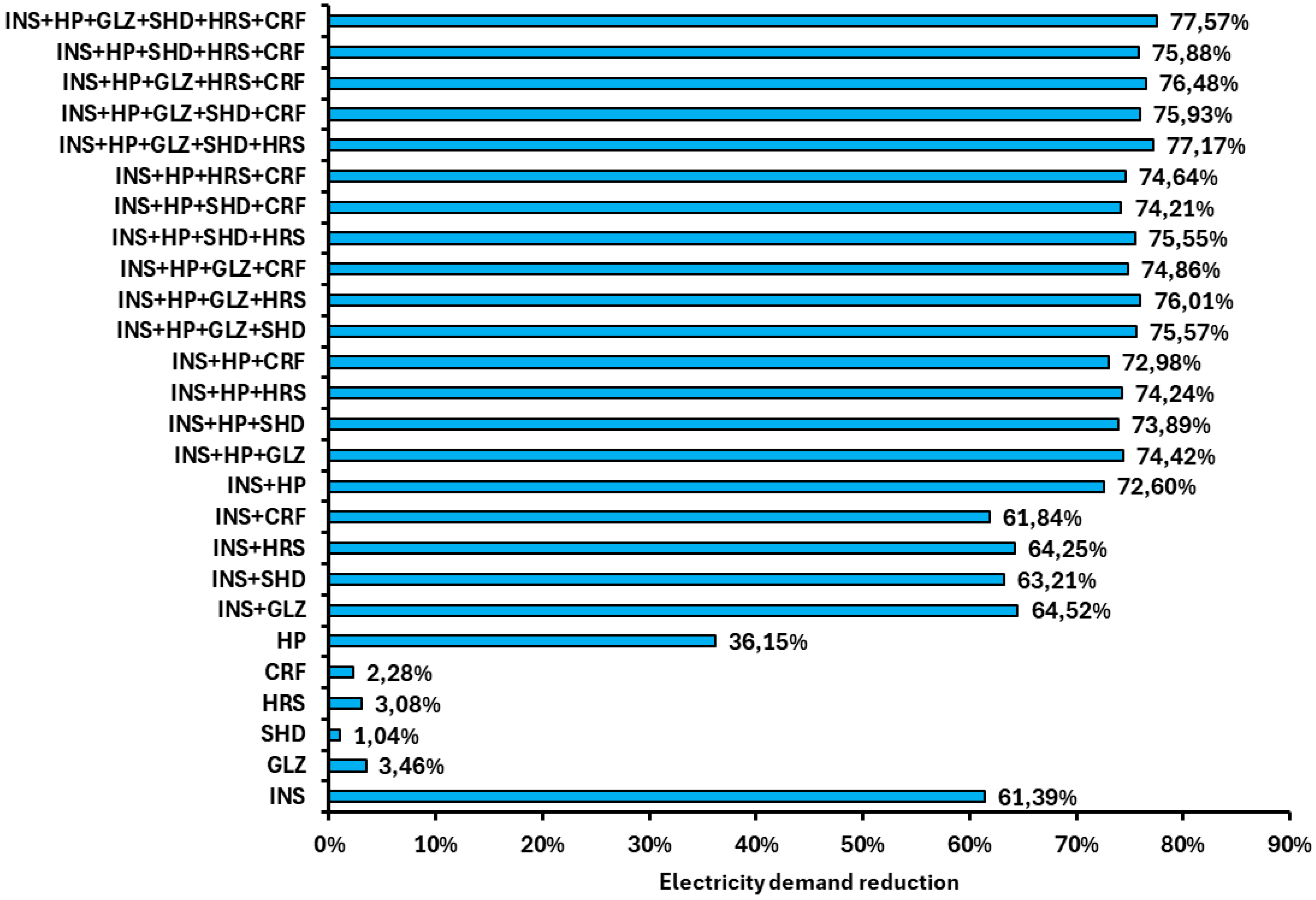
- Among the investigated single renovation action scenarios, the application of external insulation was found to be the most effective, while the replacement of the energy systems with an efficient heat pump is the second most effective solution. The rest of the renovation actions are not effective as stand-alone solutions if the building remains uninsulated.
- -
- The renovation scenarios with combined actions, including the addition of insulation, present a significant enhancement in energy, thermal comfort, and economic terms. Important synergies among the studied retrofitting actions exist, and so the combined renovation scenarios are more beneficial than the single retrofitting action scenarios.
- -
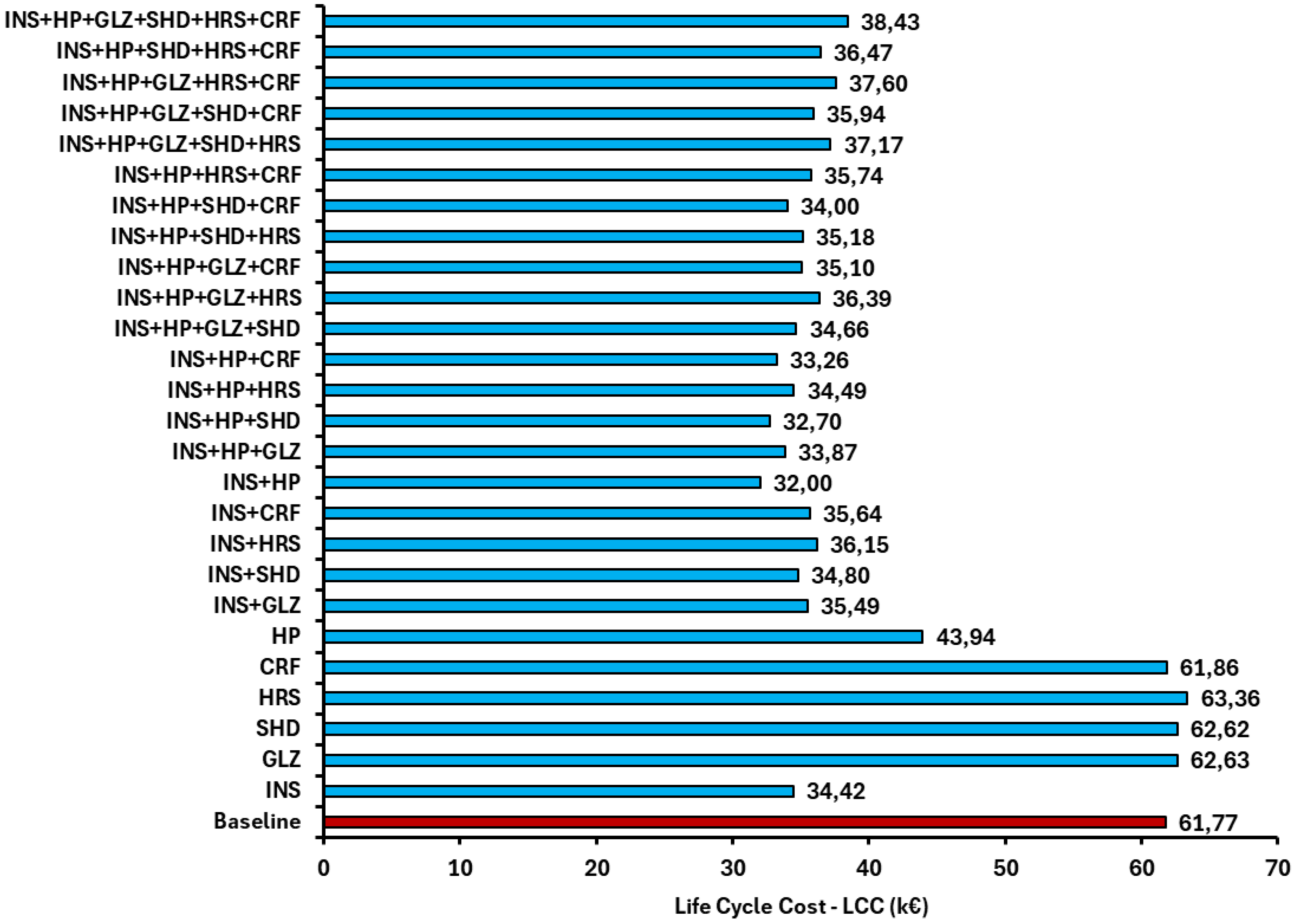
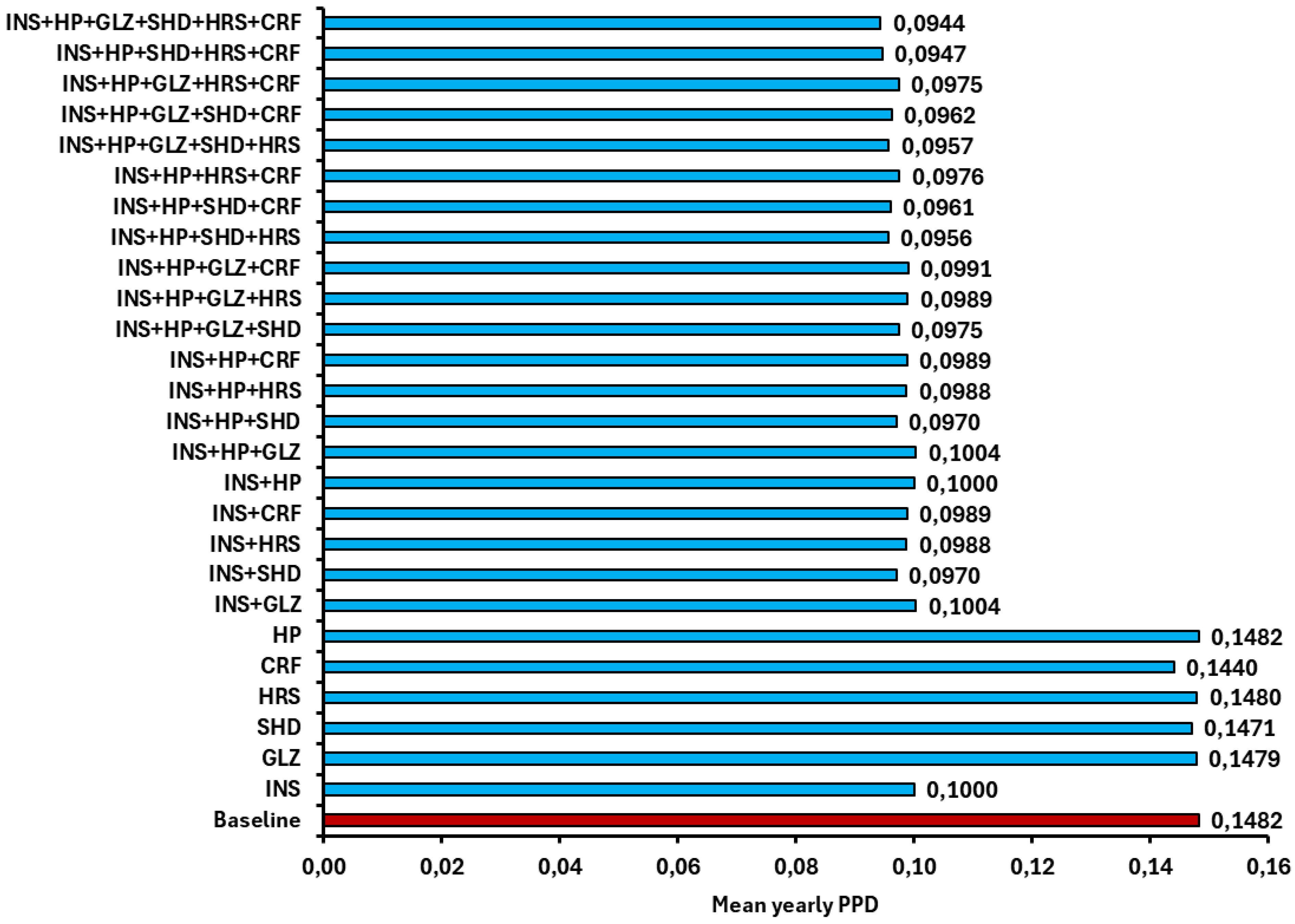
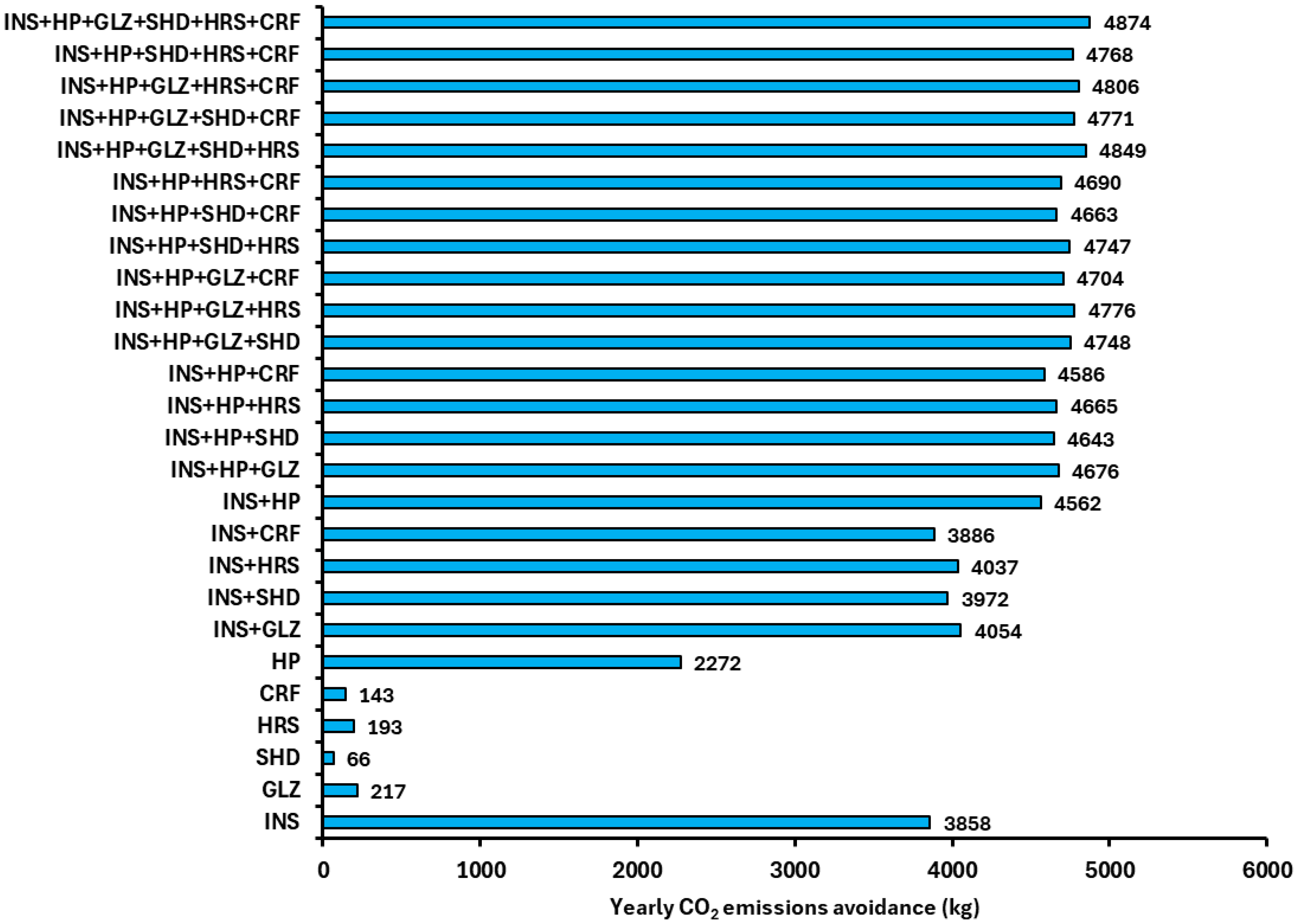
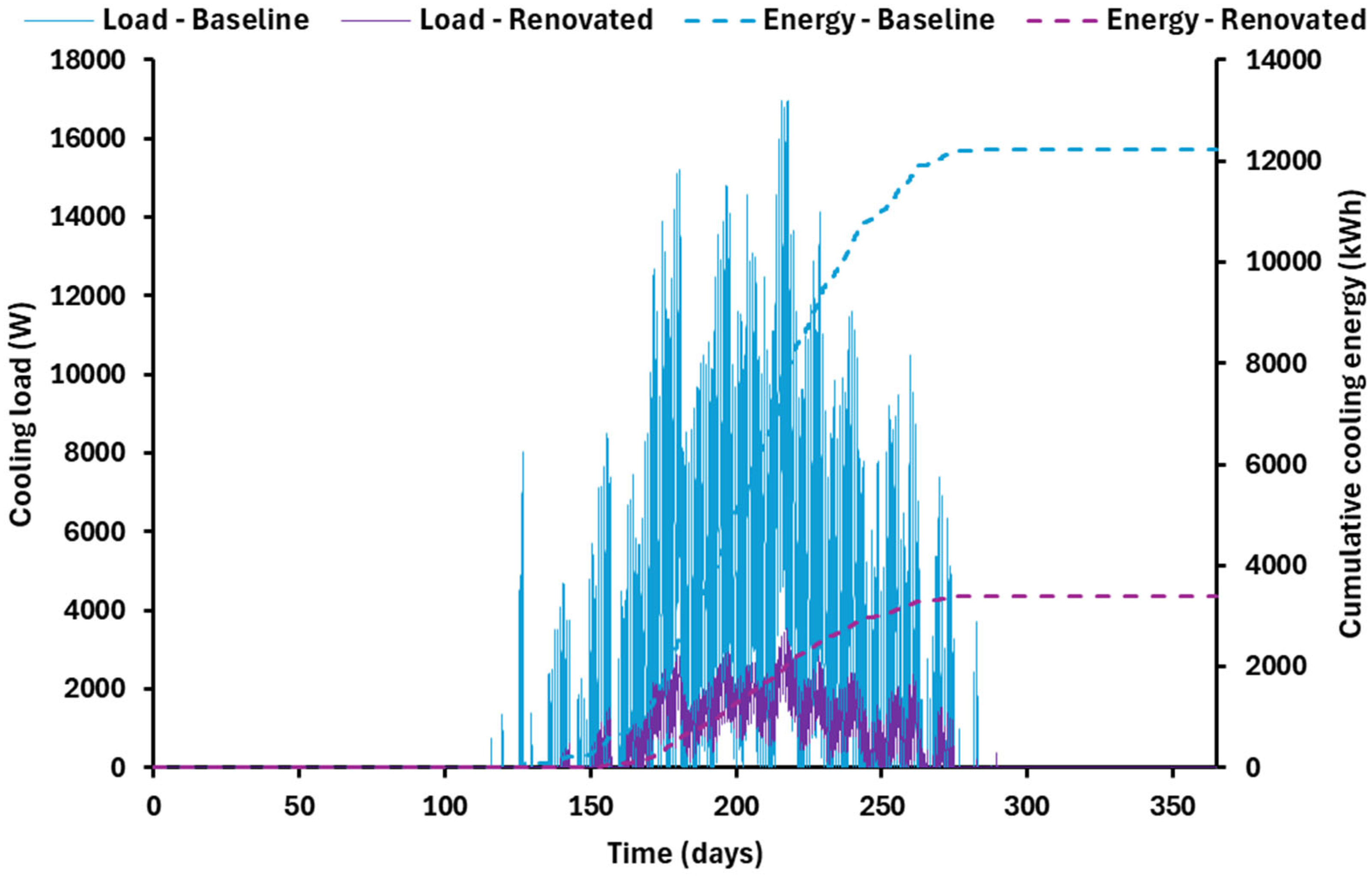
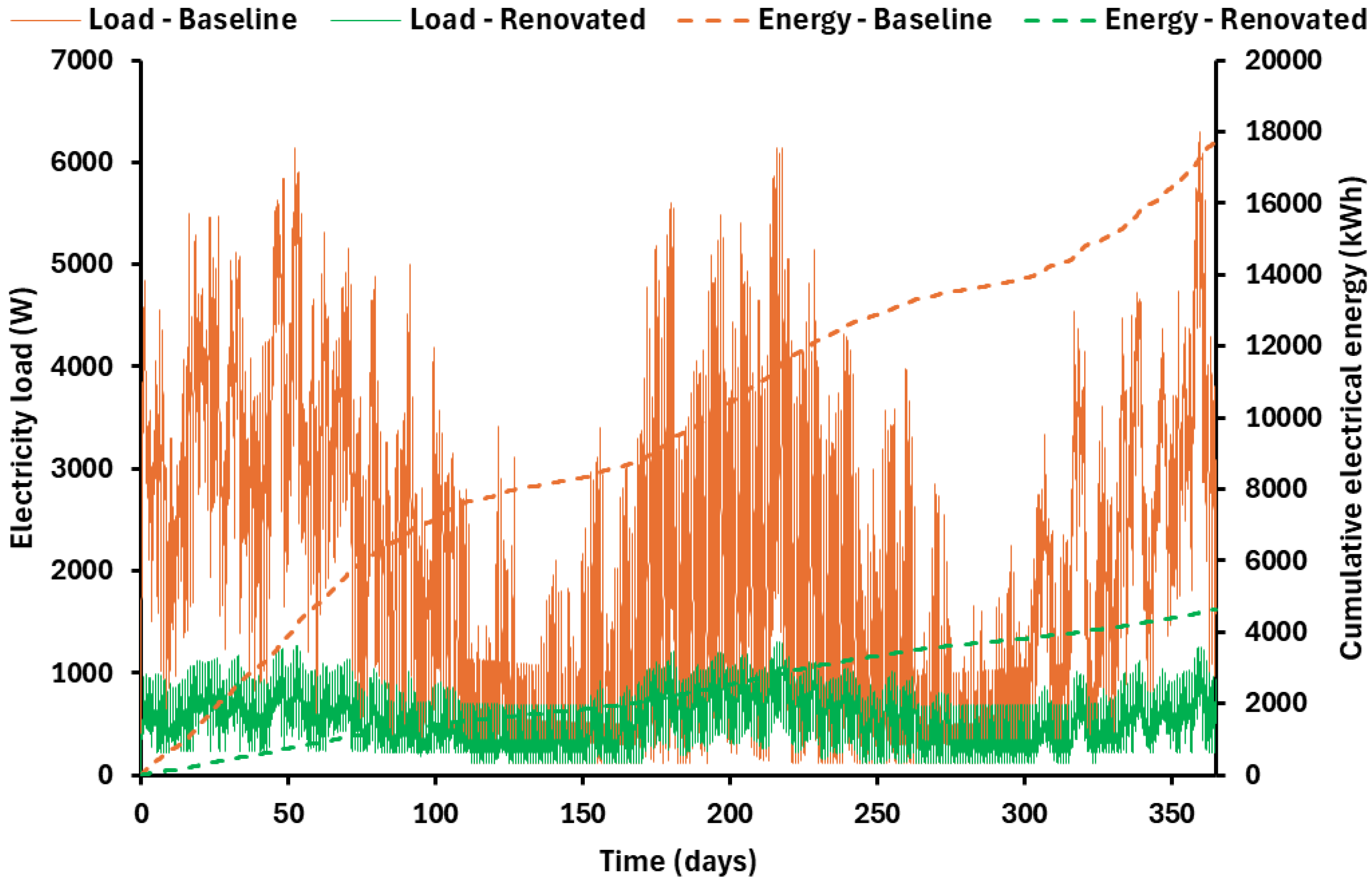
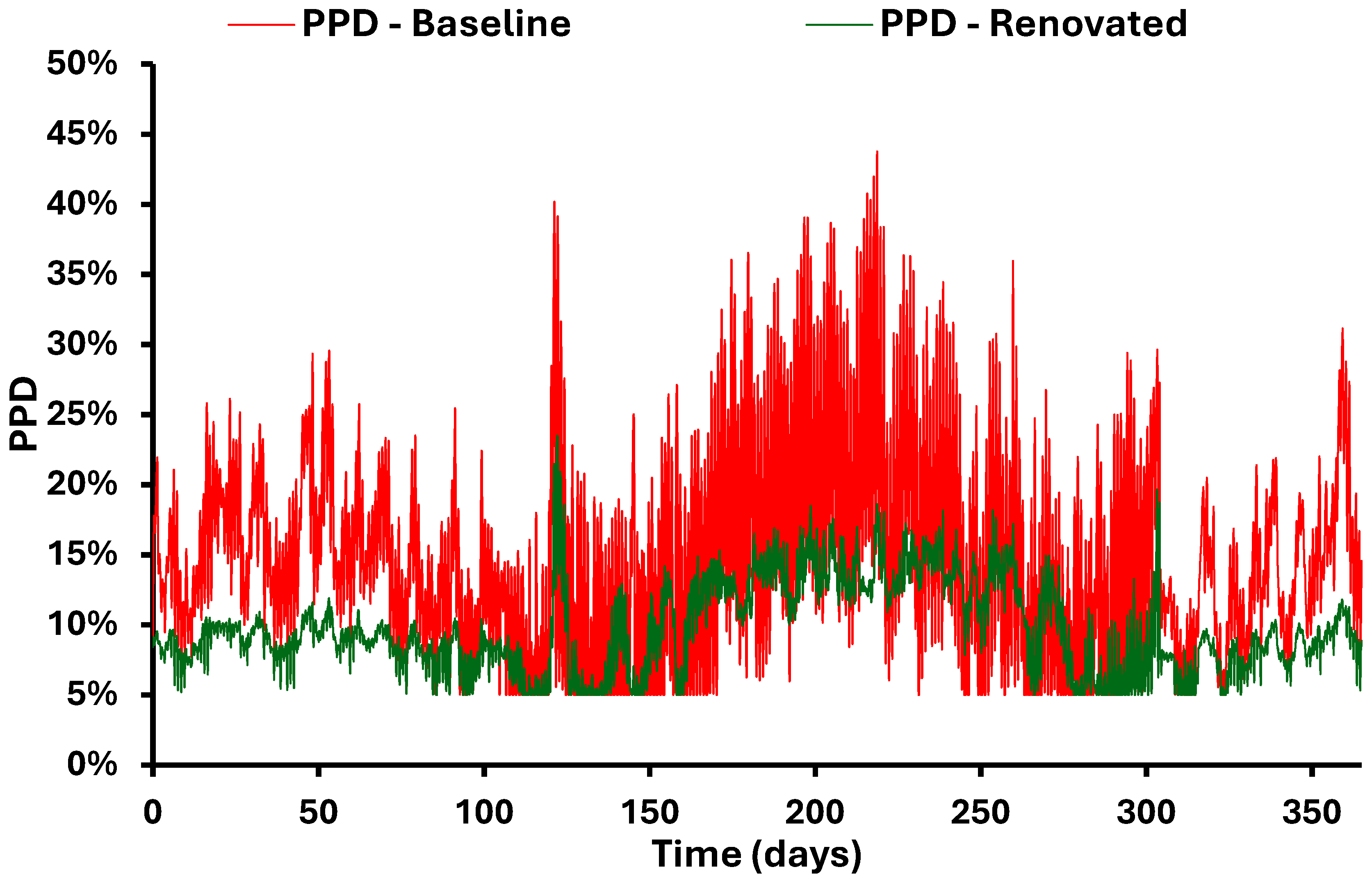
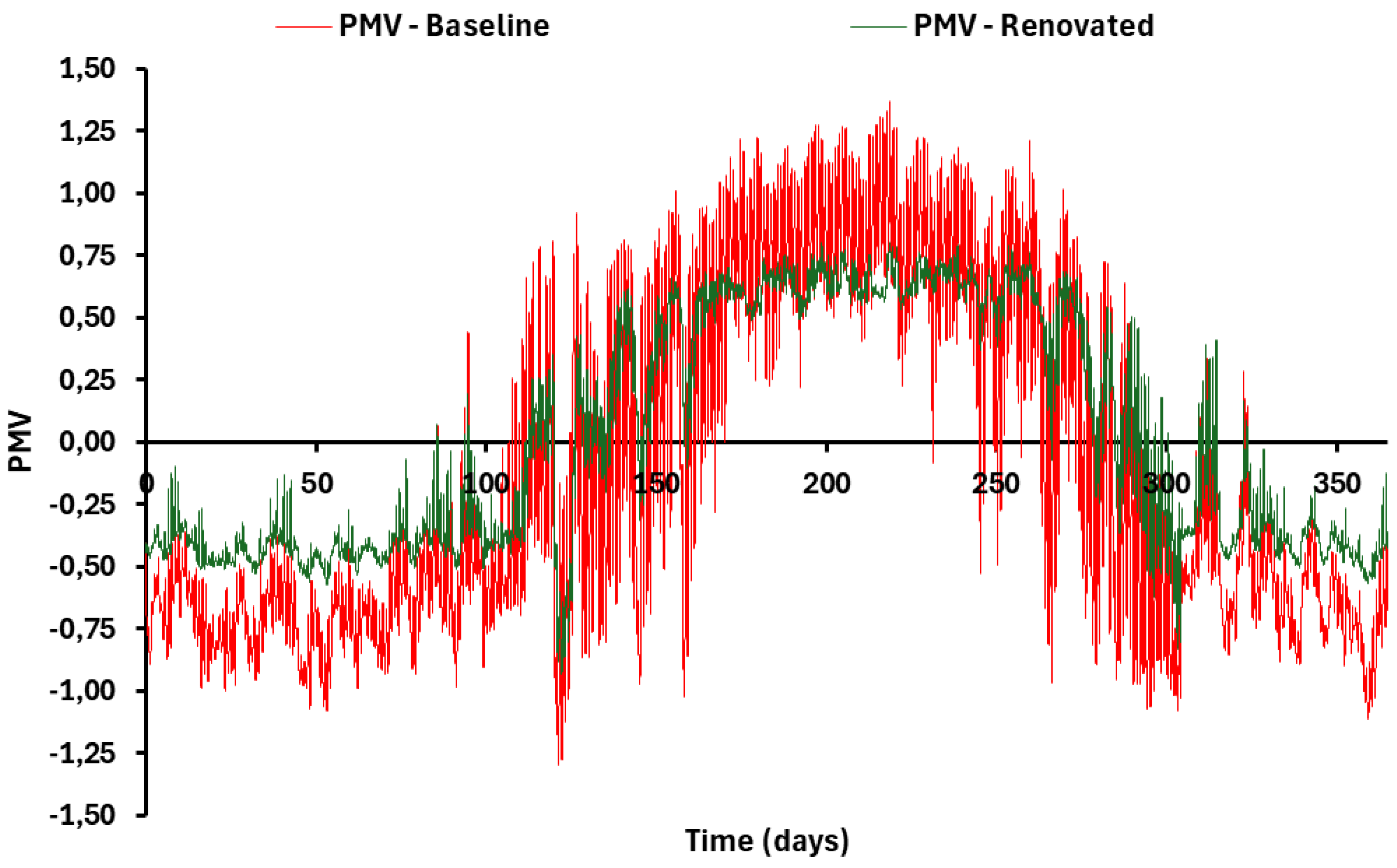
- According to the multi-criteria evaluation, the global optimal scenario is the one with external insulation, a new heat pump and summer shading (INS + HP + SHD). In this case, the calculated electricity savings were by 73.9% compared to the baseline scenario, the LCC was EUR 32.7 k, the simple payback period was 6.3 years, the yearly CO2 emissions avoidance was 4.6 tnCO2, and the mean yearly PPD was 9.7%.
- -
- The sensitivity analysis proved that most of the studied cases led to the same optimal solution (INS + HP + SHD). In the case that thermal comfort was a priority, the cool dyes in the roof could be added. Also, if the cost was not considered as a criterion, then the application of all the renovation actions was the optimal design.
- -
- Generally, the variation in the weights for the criteria in the objective function was not so important for the selection of the optimal renovation action. This fact proves that the (INS + HP + SHD) is a strong optimal solution for the present analysis.
Author Contributions
Funding
Institutional Review Board Statement
Informed Consent Statement
Data Availability Statement
Conflicts of Interest
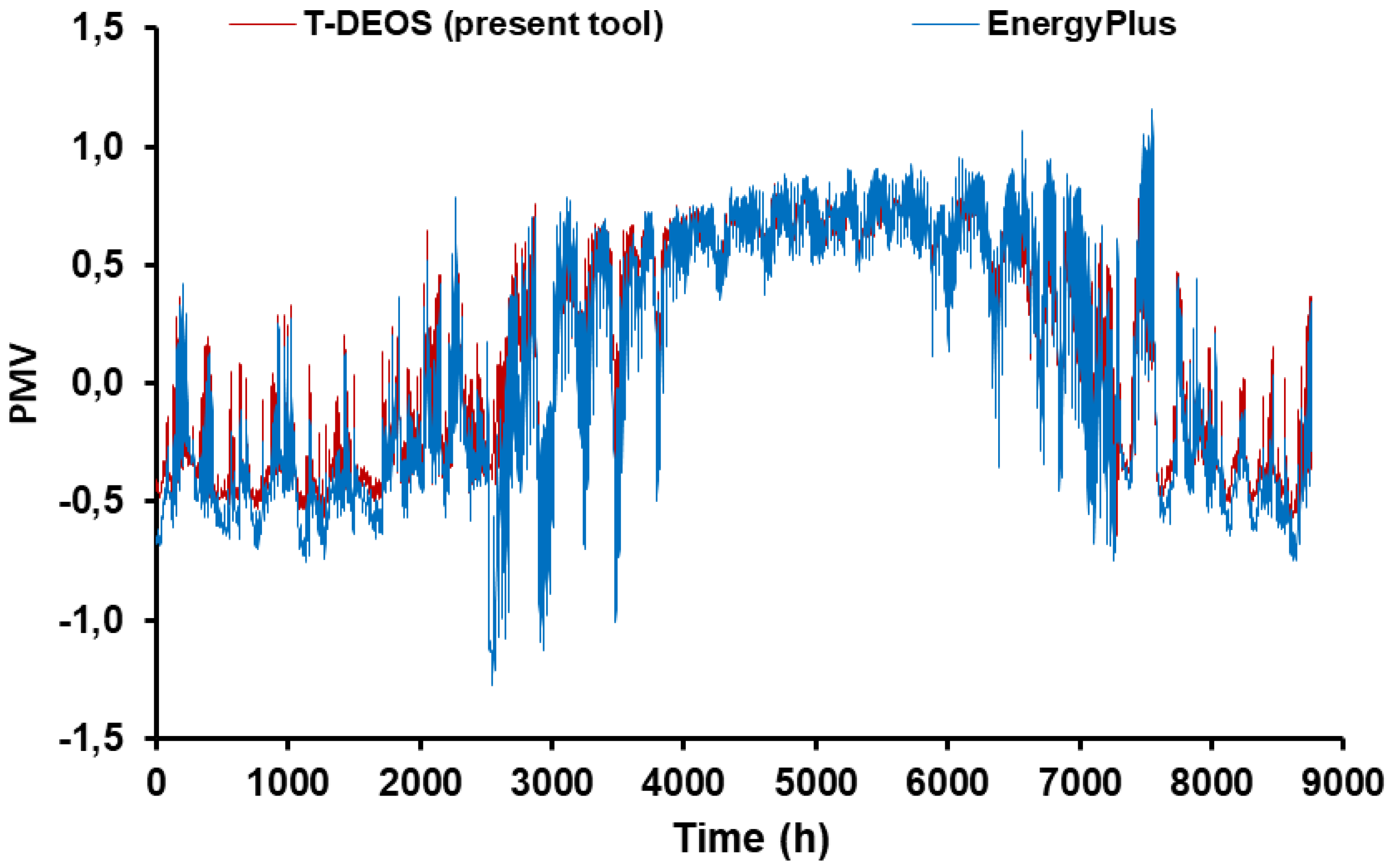
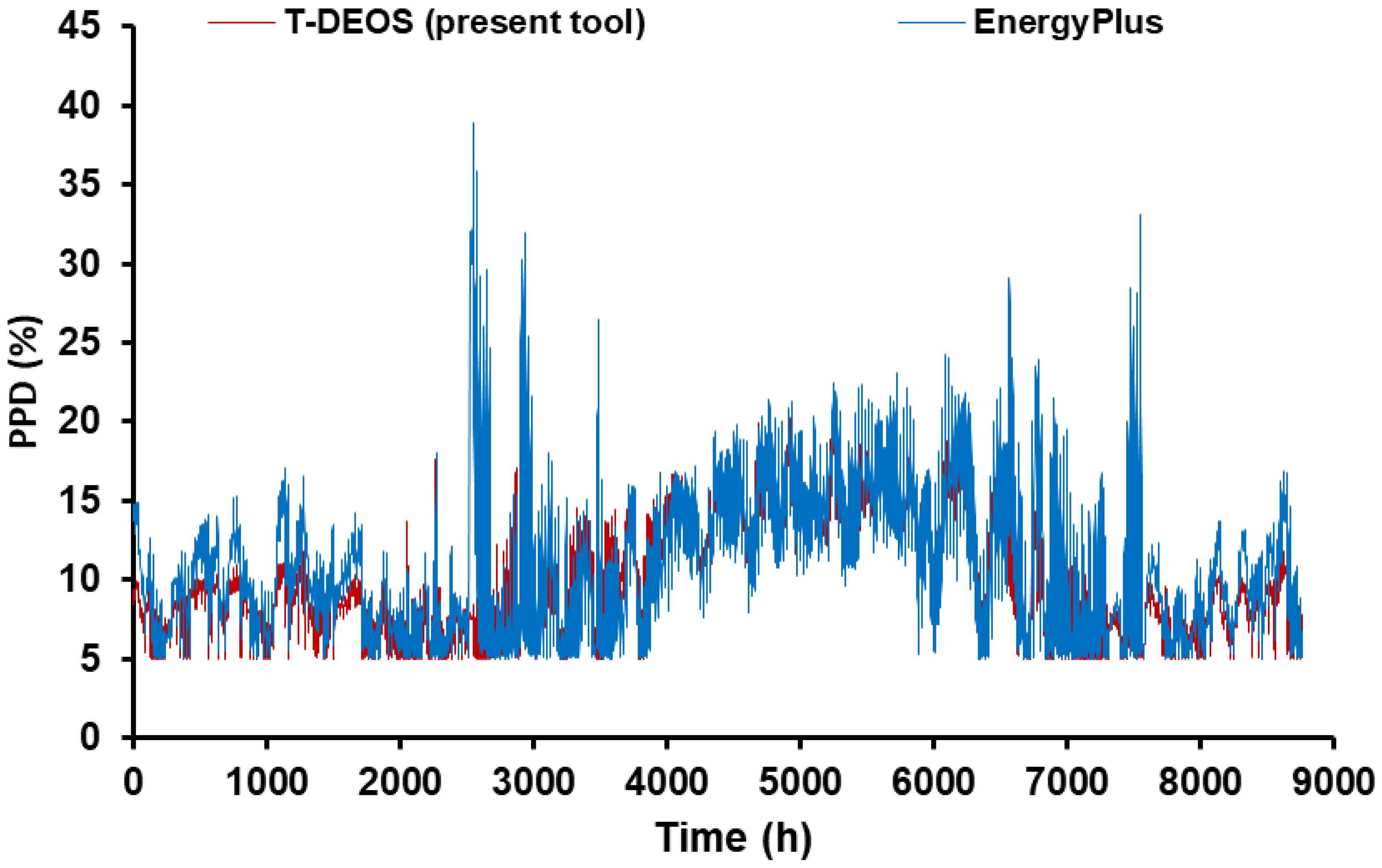
Appendix A. Tool Verification for Thermal Loads and Thermal Comfort
Appendix A.1. Description of the Building

| Parameters | Values |
|---|---|
| Groos floor area [m2] | 50 |
| Internal height [m] | 3 |
| South wall window-to-wall ratio [%] | 25 |
| East wall window-to-wall ratio [%] | 15 |
| External wall’s U-value [W/m2·K] | 0.628 |
| Rooftop U-value [W/m2·K] | 0.629 |
| Windows U-value [W/m2·K] | 2.5 |
| Windows g-value | 0.8 |
| Absorbance/emittance of external surfaces | 0.6/0.8 |
| Infiltration rate [ach] | 1.5 |
| Occupants | 1 |
| Specific load per occupant [W] | 80 |
| Occupancy average factor [%] | 75 |
| Specific load for lighting [W/m2] | 1 |
| Mean operation factor for lighting [%] | 39 |
| Specific load for appliances [W/m2] | 2 |
| Mean operation factor for appliances [%] | 48 |
| Heating/Cooling temperature setpoint [°C] | 20/26 |
Appendix A.2. Comparison Results Between the Tools
Appendix A.2.1. Energy Analysis Comparison
| Thermal Loads | EnergyPlus | Present Tool | Deviation |
|---|---|---|---|
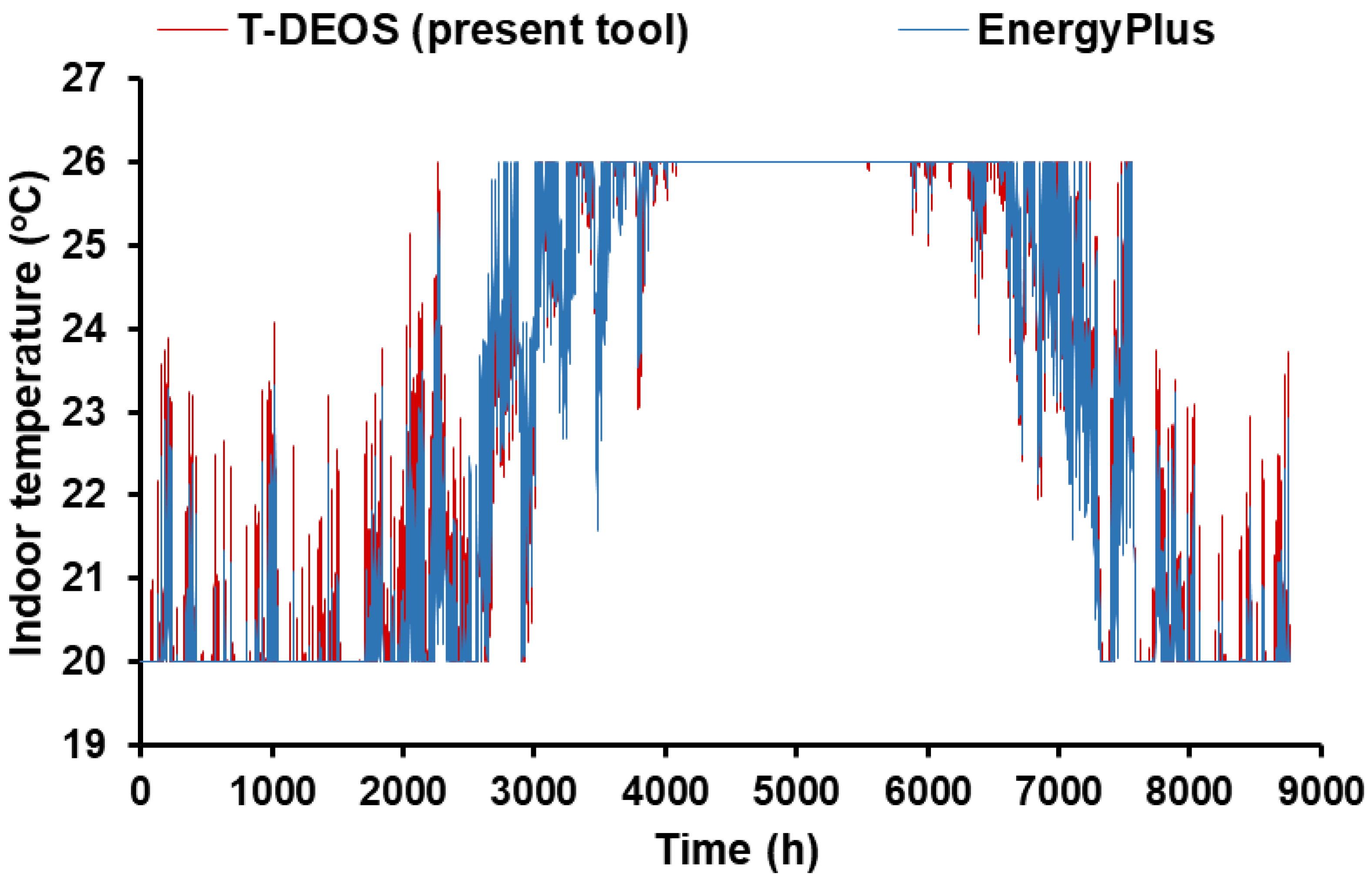
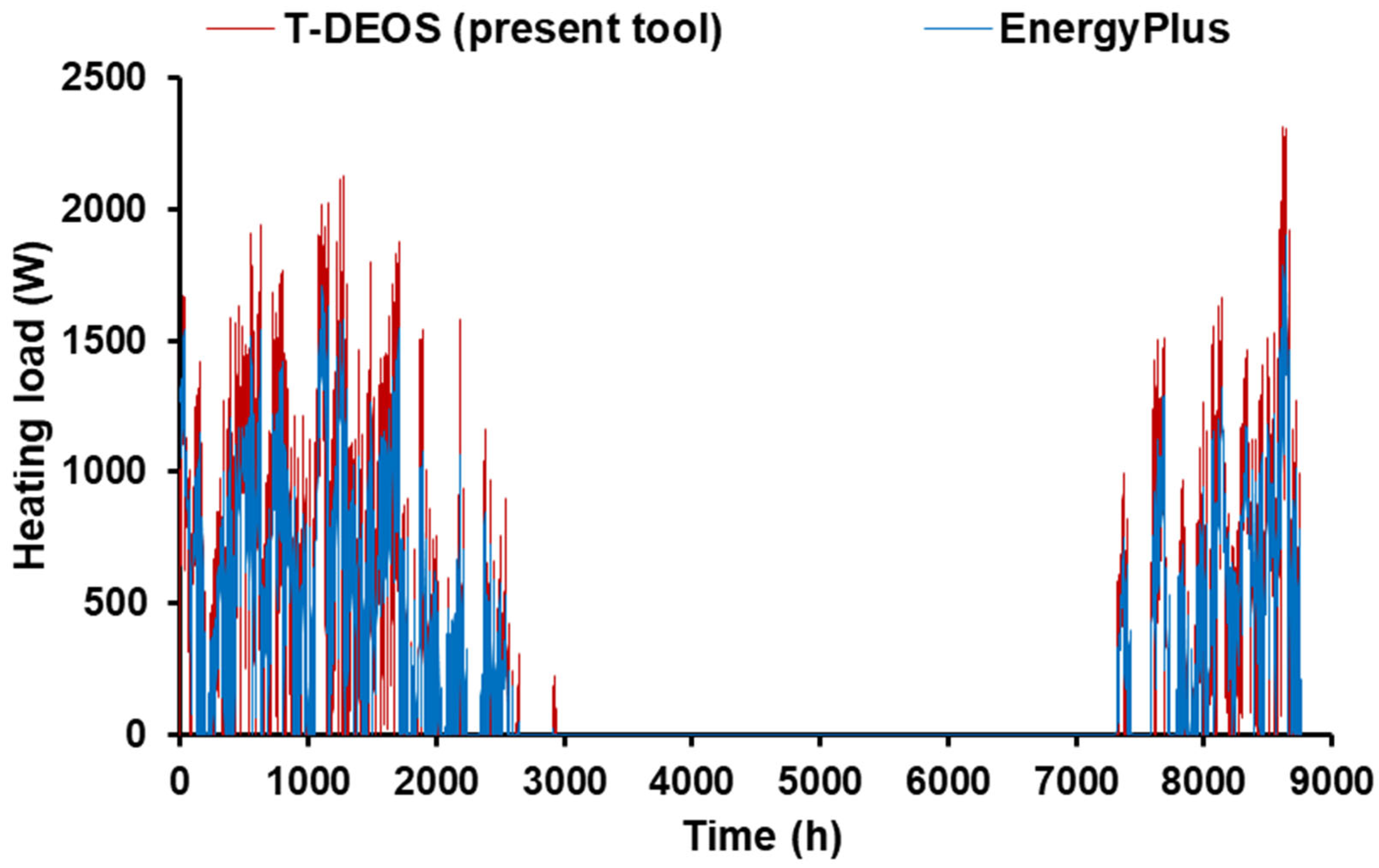
| Heating energy demand (kWh) | 2031.67 | 2192.65 | 7.92% |
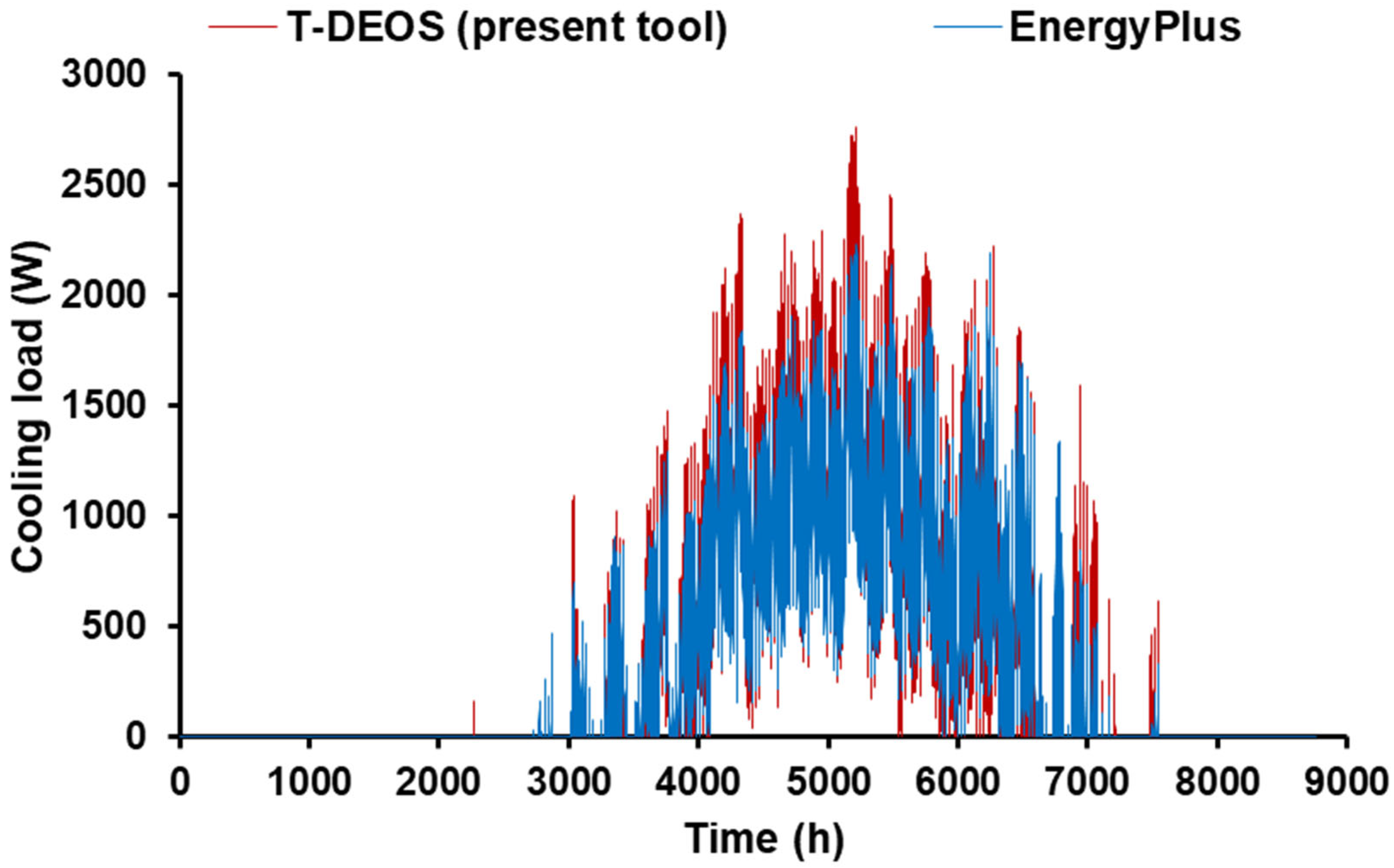
| Cooling energy demand (kWh) | 2739.70 | 2836.35 | 3.53% |


Appendix A.2.2. Thermal Comfort Analysis Comparison


References
- In Focus: Energy Efficiency in Buildings-European Commission. Available online: https://commission.europa.eu/news-and-media/news/focus-energy-efficiency-buildings-2020-02-17_en (accessed on 1 November 2025).
- Energy Performance of Buildings Directive. Available online: https://energy.ec.europa.eu/topics/energy-efficiency/energy-performance-buildings/energy-performance-buildings-directive_en (accessed on 1 November 2025).
- Beneito, L.; Konstantinou, T.; Torres-Ramo, J.; Sánchez-Ostiz, A. Towards decarbonisation in the built environment: A comparative analysis of conventional vs. industrialised façades in nearly zero-energy building renovations. Energy Build. 2025, 342, 115885. [Google Scholar] [CrossRef] [Scilit]
- Hu, X.; Jokisalo, J.; Kosonen, R.; Lehtonen, M. Cost-effective and low-carbon solutions for holistic rural building renovation in severe cold climate. Energy Build. 2025, 336, 115609. [Google Scholar] [CrossRef] [Scilit]
- Gepts, B.; Nuyts, E.; Verbeeck, G. Where is the potential for deep (energy) renovations? A large-scale study of the renovation activities of Belgian households between 2018 and 2022. Energy Build. 2025, 328, 115150. [Google Scholar] [CrossRef] [Scilit]
- Maiolo, M.; Pirouz, B.; Bruno, R.; Palermo, S.A.; Arcuri, N.; Piro, P. The Role of the Extensive Green Roofs on Decreasing Building Energy Consumption in the Mediterranean Climate. Sustainability 2020, 12, 359. [Google Scholar] [CrossRef] [Scilit]
- Rehman Hur Ramesh, R. Implication of building renovation and renewable integration on the energy resilience in the Nordic climate: Techno-economic analysis using questionnaire-based thresholds. Energy Build. 2026, 350, 116633. [Google Scholar] [CrossRef] [Scilit]
- Bellos, E.; Iliadis, P.; Papalexis, C.; Rotas, R.; Mamounakis, I.; Sougkakis, V.; Nikolopoulos, N.; Kosmatopoulos, E. Holistic renovation of a multi-family building in Greece based on dynamic simulation analysis. J. Clean. Prod. 2022, 381, 135202. [Google Scholar] [CrossRef] [Scilit]
- Synnefa, A.; Vasilakopoulou, K.; De Masi, R.F.; Kyriakodis, G.-E.; Londorfos, V.; Mastrapostoli, E.; Karlessi, T.; Santamouris, M. Transformation through Renovation: An Energy Efficient Retrofit of an Apartment Building in Athens. Procedia Eng. 2017, 180, 1003–1014. [Google Scholar] [CrossRef] [Scilit]
- Kyritsi, E.; Katsaprakakis, D.; Dakanali, E.; Yiannnakoudakis, Y.; Zidianakis, G.; Michael, A.; Michopoulos, A. Energy renovation of two historical buildings in Mediterranean area. J. Cult. Herit. 2025, 71, 106–113. [Google Scholar] [CrossRef] [Scilit]
- Kitsopoulou, A.; Ziozas, N.; Iliadis, P.; Bellos, E.; Tzivanidis, C.; Nikolopoulos, N. Energy performance analysis of alternative building retrofit interventions for the four climatic zones of Greece. J. Build. Eng. 2024, 87, 109015. [Google Scholar] [CrossRef] [Scilit]
- Mihalakakou, G.; Souliotis, M.; Papadaki, M.; Menounou, P.; Dimopoulos, P.; Kolokotsa, D.; Paravantis, J.A.; Tsangrassoulis, A.; Panaras, G.; Giannakopoulos, E.; et al. Green roofs as a nature-based solution for improving urban sustainability: Progress and perspectives. Renew. Sustain. Energy Rev. 2023, 180, 113306. [Google Scholar] [CrossRef] [Scilit]
- Łokczewska, W.; Cholewa, T.; Staszowska, A.; Wolszczak, P.; Guz, Ł.; Bocian, M.; Siuta-Olcha, A.; Balaras, C.A.; Deb, C.; Kosonen, R.; et al. On the influence of solar insolation and increase of outdoor temperature on energy savings obtained in heating system with forecast control. Energy Build. 2024, 320, 114650. [Google Scholar] [CrossRef] [Scilit]
- Apostolopoulos, V.; Mamounakis, I.; Seitaridis, A.; Tagkoulis, N.; Kourkoumpas, D.-S.; Iliadis, P.; Angelakoglou, K.; Nikolopoulos, N. An integrated life cycle assessment and life cycle costing approach towards sustainable building renovation via a dynamic online tool. Appl. Energy 2023, 334, 120710. [Google Scholar] [CrossRef] [Scilit]
- Dragonetti, L.; Papadaki, D.; Assimakopoulos, M.-N.; Ferrante, A.; Iannantuono, M. Environmental and Economic Assessment of Energy Renovation in Buildings, a Case Study in Greece. Buildings 2024, 14, 942. [Google Scholar] [CrossRef] [Scilit]
- Dascalaki, E.G.; Argiropoulou, P.A.; Balaras, C.A.; Droutsa, K.G.; Kontoyiannidis, S. Benchmarks for Embodied and Operational Energy Assessment of Hellenic Single-Family Houses. Energies 2020, 13, 4384. [Google Scholar] [CrossRef] [Scilit]
- Banias, G.F.; Karkanias, C.; Batsioula, M.; Melas, L.D.; Malamakis, A.E.; Geroliolios, D.; Skoutida, S.; Spiliotis, X. Environmental Assessment of Alternative Strategies for the Management of Construction and Demolition Waste: A Life Cycle Approach. Sustainability 2022, 14, 9674. [Google Scholar] [CrossRef] [Scilit]
- ISO 52016-1:2017; Energy Performance of Buildings—Energy Needs for Heating and Cooling, Internal Temperatures and Sensible and Latent Heat Loads. International Organization for Standardization: Geneva, Switzerland, 2017. Available online: https://www.iso.org/standard/65696.html (accessed on 1 November 2025).
- Greek Technical Chamber. ΤOΤΕΕ 20701-3 Technical Guidelines on Buildings’ Energy Performance; Greek Technical Chamber: Athens, Greece, 2010. [Google Scholar]
- Dincer, I. 1.7 Energy and Exergy Efficiencies. In Comprehensive Energy Systems; Elsevier: Amsterdam, The Netherlands, 2018; pp. 265–339. [Google Scholar] [CrossRef] [Scilit]
- JRC Photovoltaic Geographical Information System (PVGIS)-European Commission. Available online: https://re.jrc.ec.europa.eu/pvg_tools/en/tools.html#PVP (accessed on 1 November 2025).
- EN 15265:2007; Energy Performance of Buildings-Calculation of Energy Needs for Space Heating and Cooling Using Dynamic Methods-General Criteria and Validation Procedures. British Standards: London, UK, 2007. Available online: https://standards.iteh.ai/catalog/standards/cen/3b7d56e1-21c8-4f7f-8fe0-eb9a39c80893/en-15265-2007 (accessed on 1 November 2025).
- Zhang, Y.; Cohen, J.; Davidson, A.A.; Owens, J.D. Chapter 11—A Hybrid Method for Solving Tridiagonal Systems on the GPU. In GPU Computing Gems Jade Edition; Hwu, W.W., Ed.; Morgan Kaufmann: Boston, MA, USA, 2012; pp. 117–132. [Google Scholar] [CrossRef] [Scilit]
- Knovel-2017 ASHRAE Handbook-Fundamentals (I-P Edition). Available online: https://app.knovel.com/kn/resources/kpASHRAEP2/toc (accessed on 1 November 2025).
- Paatero, J.V.; Lund, P.D. A model for generating household electricity load profiles. Int. J. Energy Res. 2006, 30, 273–290. [Google Scholar] [CrossRef] [Scilit]
- Greek Technical Chamber. ΤOΤΕΕ 20701-1 Technical Guidelines on Buildings’ Energy Performance; Greek Technical Chamber: Athens, Greece, 2017. [Google Scholar]
- Deru, M.; Judkoff, R.; Neymark, J. Whole Building Energy Simulation with a Three-Dimensional Ground-Coupled Heat Transfer Model. ASHRAE Trans. 2003, 109, 551–559. [Google Scholar]
- Ahmed, K.; Pylsy, P.; Kurnitski, J. Hourly consumption profiles of domestic hot water for different occupant groups in dwellings. Sol. Energy 2016, 137, 516–530. [Google Scholar] [CrossRef] [Scilit]
- Bellos, E.; Lykas, P.; Tsimpoukis, D.; Korres, D.N.; Kitsopoulou, A.; Vrachopoulos, M.G.; Tzivanidis, C. Multicriteria Analysis of a Solar-Assisted Space Heating Unit with a High-Temperature Heat Pump for the Greek Climate Conditions. Appl. Sci. 2023, 13, 4066. [Google Scholar] [CrossRef] [Scilit]
- Kitsopoulou, A.; Zacharis, A.; Ziozas, N.; Bellos, E.; Iliadis, P.; Lampropoulos, I.; Chatzigeorgiou, E.; Angelakoglou, K.; Nikolopoulos, N. Dynamic Energy Analysis of Different Heat Pump Heating Systems Exploiting Renewable Energy Sources. Sustainability 2023, 15, 11054. [Google Scholar] [CrossRef] [Scilit]
- ISO 7730:2005; Ergonomics of the Thermal Environment—Analytical Determination and Interpretation of Thermal Comfort Using Calculation of the PMV and PPD Indices and Local Thermal Comfort Criteria. International Organization for Standardization: Geneva, Switzerland, 2005. Available online: https://www.iso.org/standard/39155.html (accessed on 19 February 2023).
- Olesen, B.W.; Parsons, K.C. Introduction to thermal comfort standards and to the proposed new version of EN ISO 7730. Energy Build. 2002, 34, 537–548. [Google Scholar] [CrossRef] [Scilit]
- Fanger, P.O. Thermal Comfort: Analysis and Applications in Environmental Engineering; Danish Technical Press: Copenhagen, Denmark, 1970. [Google Scholar]
- ISO 6946:2017; Building Components and Building Elements—Thermal Resistance and Thermal Transmittance—Calculation Methods. International Organization for Standardization: Geneva, Switzerland, 2017. Available online: https://www.iso.org/standard/65708.html (accessed on 1 November 2025).
- DAPEEP. Available online: https://www.dapeep.gr/dimosieuseis/eguiseis-proeleusis-energeiako/ (accessed on 1 November 2025).
- Available online: https://www.durostar.gr/ (accessed on 1 November 2025).
- Available online: https://www.neadomi.gr/ (accessed on 1 November 2025).
- Available online: https://www.synergashop.gr (accessed on 1 November 2025).
- Available online: https://kouremenos.net/ (accessed on 1 November 2025).
- Available online: www.anakainisis-spitiou.gr (accessed on 1 November 2025).
- Available online: https://www.mytenta.gr/ (accessed on 1 November 2025).
- Available online: https://tool.urbanproof.eu/urbanproof/uploads/help/energy_sector/cool_roofs.php?lang=&utm_source (accessed on 1 November 2025).
- Available online: https://ventilation.ro/ (accessed on 1 November 2025).
- Available online: https://www.andrianos.gr/en/ (accessed on 1 November 2025).
- EnergyPlus. Available online: https://energyplus.net/ (accessed on 1 November 2025).
- Zhang, L.; Tu, Q.; Gong, X.; He, Y.; Yuan, X.; Ji, C. Experimental study on cooling feasibility and indoor thermal comfort of multi-connected dry capillary radiant air conditioning system. Int. J. Low-Carbon Tech. 2021, 16, 1464–1478. [Google Scholar] [CrossRef] [Scilit]
- Technical Guidelines of Technical Chamber of Greece. TEE 2020. Available online: https://web.tee.gr/ (accessed on 1 November 2025).
- Kitsopoulou, A.; Bellos, E.; Sammoutos, C.; Lykas, P.; Vrachopoulos, M.G.; Tzivanidis, C. A detailed investigation of thermochromic dye-based roof coatings for Greek climatic conditions. J. Build. Eng. 2024, 84, 108570. [Google Scholar] [CrossRef] [Scilit]


| Parameters | Values |
|---|---|
| Building floor area | 100 m2 |
| Building dimensions | 10 m × 10 m × 3 m |
| Location | Athens, Greece (37.90° N, 23.73° E) |
| South–east–west window areas | 5 m2—2 m2—2 m2 |
| U-value of the structural elements | 3 W/m2 (uninsulated) |
| Absorbance | 60% |
| U-value of the windows | 6 W/(m2·K) (single windows) |
| g-value of the windows | 60% |
| Infiltration/ventilation rate | 0.3 ACH/0.5 ACH |
| Occupancy | Two occupants, 80 W/occupant, 75% occupancy |
| Appliances load | 2 W/m2—75% mean operation |
| Lighting load | 5 W/m2—30% mean operation |
| COP nominal value | 3.0 (Heating and Cooling) |
| Heating/Cooling set points | 20 °C/26 °C |
| DHW demand | 50 L/(day·person) at 45%, electrical heater |
| Parameters | Values | References/Calculation Method |
|---|---|---|
| Insulation placement specific cost | 20 EUR/m2 | [36,37] |
| Insulation material cost | 2 EUR/(m2·cm) | [38,39] |
| Total insulation cost | EUR 10,500 | Calculation |
| Windows replacement specific cost | EUR 3000 | [40] (specific cost around 330 EUR/m2) |
| Shading cost | EUR 1500 | [41] (for pieces) |
| Cool dyes cost | EUR 1500 | [42] (specific cost 15 EUR/m2) |
| Mechanical ventilation unit cost | EUR 3500 | [43] |
| Heat pump cost | EUR 4500 | [44] |
| Scenarios | Heating Demand | Cooling Demand | Electricity Demand | PMV | PPD | SPP | LCC | CO2 Avoidance | ER |
|---|---|---|---|---|---|---|---|---|---|
| (kWh) | (kWh) | (kWh) | (Years) | (EUR) | (kg/year) | (%) | |||
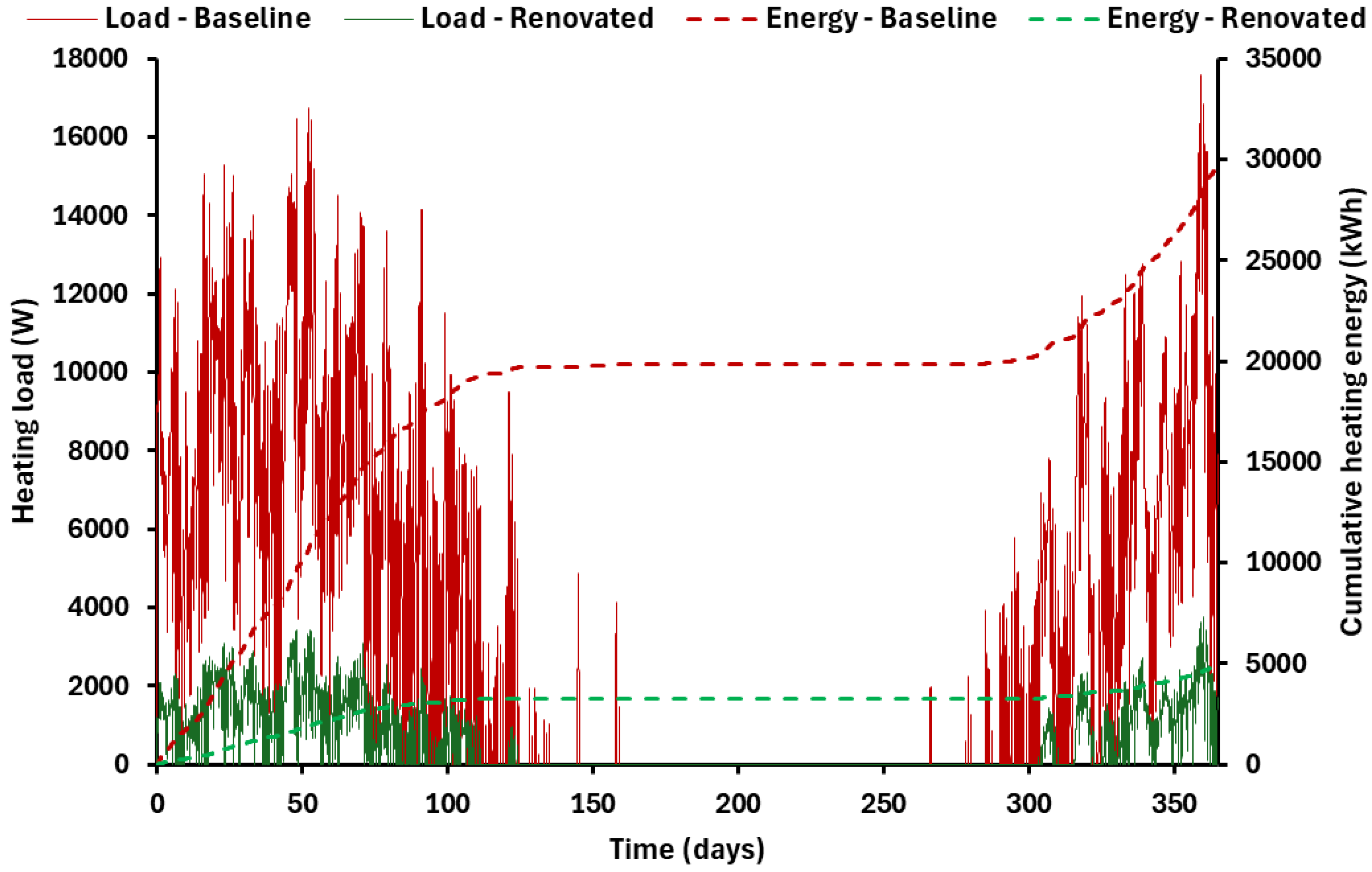
| Baseline | 29,595 | 12,242 | 17,735 | 0.6295 | 14.82% | - | 61,765 | - | - |
| INS | 4779 | 4394 | 6847 | 0.4566 | 10.00% | 4.86 | 34,419 | 3857.8 | 61.39 |
| GLZ | 28,059 | 11,937 | 17,121 | 0.6286 | 14.79% | 24.44 | 62,627 | 217.5 | 3.46 |
| SHD | 29,657 | 11,626 | 17,550 | 0.6259 | 14.71% | 40.57 | 62,621 | 65.5 | 1.04 |
| HRS | 28,118 | 12,082 | 17,189 | 0.6283 | 14.80% | 32.05 | 63,364 | 193.4 | 3.08 |
| CRF | 31,337 | 9289 | 17,331 | 0.6202 | 14.40% | 18.57 | 61,858 | 143.1 | 2.28 |
| HP | 29,595 | 12,242 | 11,324 | 0.6295 | 14.82% | 3.51 | 43,936 | 2271.6 | 36.15 |
| INS + GLZ | 3404 | 4107 | 6293 | 0.4609 | 10.04% | 5.93 | 35,491 | 4053.9 | 64.52 |
| INS + SHD | 4818 | 3390 | 6525 | 0.4378 | 9.70% | 5.39 | 34,799 | 3971.7 | 63.21 |
| INS + HRS | 3418 | 4234 | 6340 | 0.4473 | 9.88% | 6.18 | 36,155 | 4037.2 | 64.25 |
| INS + CRF | 5025 | 3911 | 6768 | 0.4501 | 9.89% | 5.50 | 35,645 | 3885.6 | 61.84 |
| INS + HP | 4779 | 4394 | 4860 | 0.4566 | 10.00% | 5.85 | 31,998 | 4561.8 | 72.60 |
| INS + HP + GLZ | 3404 | 4107 | 4537 | 0.4609 | 10.04% | 6.85 | 33,873 | 4676.2 | 74.42 |
| INS + HP + SHD | 4818 | 3390 | 4630 | 0.4378 | 9.70% | 6.32 | 32,699 | 4643.1 | 73.89 |
| INS + HP + HRS | 3418 | 4234 | 4569 | 0.4473 | 9.88% | 7.05 | 34,487 | 4664.7 | 74.24 |
| INS + HP + CRF | 5025 | 3911 | 4792 | 0.4501 | 9.89% | 6.40 | 33,262 | 4585.9 | 72.98 |
| INS + HP + GLZ + SHD | 3424 | 3228 | 4333 | 0.4442 | 9.75% | 7.30 | 34,664 | 4748.4 | 75.57 |
| INS + HP + GLZ + HRS | 2089 | 3947 | 4255 | 0.4485 | 9.89% | 8.00 | 36,391 | 4776.2 | 76.01 |
| INS + HP + GLZ + CRF | 3634 | 3595 | 4459 | 0.4547 | 9.91% | 7.37 | 35,101 | 4703.9 | 74.86 |
| INS + HP + SHD + HRS | 3441 | 3229 | 4336 | 0.4287 | 9.56% | 7.49 | 35,176 | 4747.2 | 75.55 |
| INS + HP + SHD + CRF | 5071 | 2952 | 4574 | 0.4324 | 9.61% | 6.87 | 34,004 | 4663.0 | 74.21 |
| INS + HP + HRS + CRF | 3643 | 3751 | 4497 | 0.4416 | 9.76% | 7.58 | 35,736 | 4690.3 | 74.64 |
| INS + HP + GLZ + SHD + HRS | 2099 | 3066 | 4048 | 0.4311 | 9.57% | 8.43 | 37,173 | 4849.2 | 77.17 |
| INS + HP + GLZ + SHD + CRF | 3665 | 2763 | 4268 | 0.4351 | 9.62% | 7.82 | 35,938 | 4771.4 | 75.93 |
| INS + HP + GLZ + HRS + CRF | 2293 | 3435 | 4171 | 0.4425 | 9.75% | 8.51 | 37,602 | 4805.6 | 76.48 |
| INS + HP + SHD + HRS + CRF | 3677 | 2791 | 4277 | 0.4227 | 9.47% | 8.02 | 36,469 | 4768.3 | 75.88 |
| INS + HP + GLZ + SHD + HRS + CRF | 2307 | 2602 | 3978 | 0.4230 | 9.44% | 8.93 | 38,426 | 4874.3 | 77.57 |
| Scenarios | Eheat | Ecool | Eel | PMV | PPD | LCC | SPP | CO2 Avoidance | Eel Reduction |
|---|---|---|---|---|---|---|---|---|---|
| (kWh) | (kWh) | (kWh) | (EUR) | (Years) | (kgCO2/year) | ||||
| INS + HP + SHD | 4818 | 3390 | 4630 | 0.4378 | 9.70% | 32,699 | 6.32 | 4643 | 73.89% |
| INS + HP + SHD + CRF | 5071 | 2952 | 4574 | 0.4324 | 9.61% | 34,004 | 6.87 | 4663 | 74.21% |
| INS + HP + GLZ + SHD | 3424 | 3228 | 4333 | 0.4442 | 9.75% | 34,664 | 7.30 | 4748 | 75.57% |
| INS + HP + SHD + HRS | 3441 | 3229 | 4336 | 0.4287 | 9.56% | 35,176 | 7.49 | 4747 | 75.55% |
| INS + HP + CRF | 5025 | 3911 | 4792 | 0.4501 | 9.89% | 33,262 | 6.40 | 4586 | 72.98% |
| INS + HP + HRS | 3418 | 4234 | 4569 | 0.4473 | 9.88% | 34,487 | 7.05 | 4665 | 74.24% |
| INS + HP | 4779 | 4394 | 4860 | 0.4566 | 10.00% | 31,998 | 5.85 | 4562 | 72.60% |
| Baseline | 29,595 | 12,242 | 17,735 | 0.6295 | 14.82% | 61,765 | - | - | - |
| Optimization Cases | w1 | w2 | w3 | Optimal Scenario |
|---|---|---|---|---|
| 1 | INS + HP + SHD | |||
| 2 | INS + HP + SHD | |||
| 3 | INS + HP + SHD | |||
| 4 | INS + HP + SHD | |||
| 5 | INS + HP + SHD | |||
| 6 | INS + HP + SHD + CRF | |||
| 7 | INS + HP + SHD | |||
| 8 | INS + HP + SHD | |||
| 9 | INS + HP + SHD | |||
| 10 | INS + HP + SHD | |||
| 11 | 0 | INS + HP + SHD | ||
| 12 | 0 | INS + HP + GLZ + SHD + HRS + CRF | ||
| 13 | 0 | INS + HP + SHD |
Disclaimer/Publisher’s Note: The statements, opinions and data contained in all publications are solely those of the individual author(s) and contributor(s) and not of MDPI and/or the editor(s). MDPI and/or the editor(s) disclaim responsibility for any injury to people or property resulting from any ideas, methods, instructions or products referred to in the content. |
© 2025 by the authors. Licensee MDPI, Basel, Switzerland. This article is an open access article distributed under the terms and conditions of the Creative Commons Attribution (CC BY) license.
Share and Cite
Bellos, E.; Gonidaki, D. Multi-Criteria Analysis of Different Renovation Scenarios Applying Energy, Economic, and Thermal Comfort Criteria. Appl. Sci. 2026, 16, 95. https://doi.org/10.3390/app16010095
Bellos E, Gonidaki D. Multi-Criteria Analysis of Different Renovation Scenarios Applying Energy, Economic, and Thermal Comfort Criteria. Applied Sciences. 2026; 16(1):95. https://doi.org/10.3390/app16010095
Chicago/Turabian StyleBellos, Evangelos, and Dimitra Gonidaki. 2026. "Multi-Criteria Analysis of Different Renovation Scenarios Applying Energy, Economic, and Thermal Comfort Criteria" Applied Sciences 16, no. 1: 95. https://doi.org/10.3390/app16010095
APA StyleBellos, E., & Gonidaki, D. (2026). Multi-Criteria Analysis of Different Renovation Scenarios Applying Energy, Economic, and Thermal Comfort Criteria. Applied Sciences, 16(1), 95. https://doi.org/10.3390/app16010095