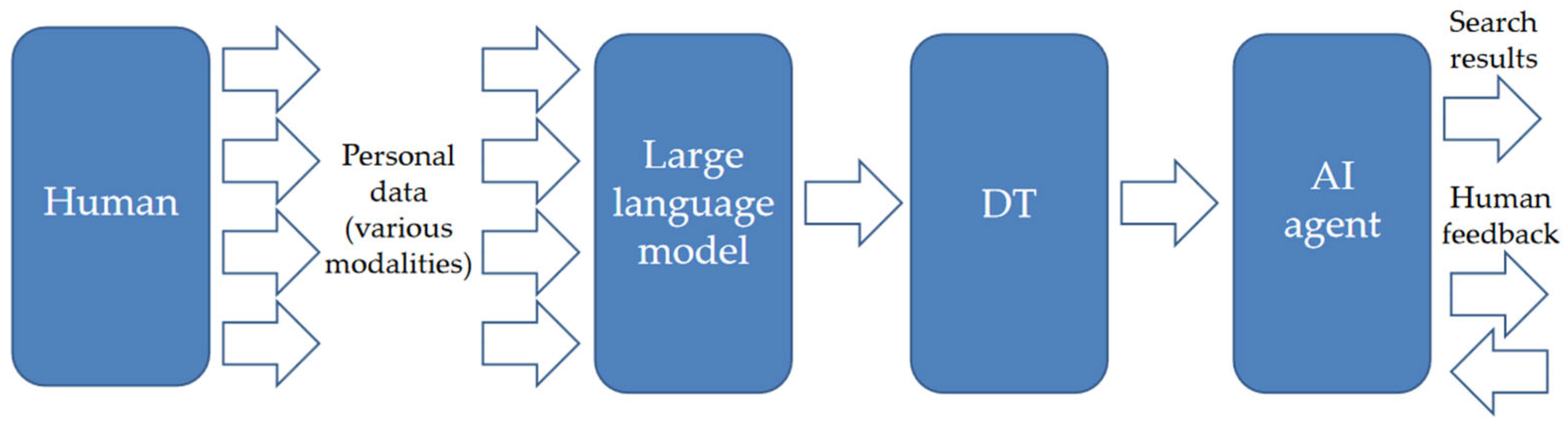
From Local to Global Perspective in AI-Based Digital Twins in Healthcare

 ,
,  ,
,  and
and
Featured Application
Abstract
1. Introduction
2. Materials and Methods
2.1. Data Set
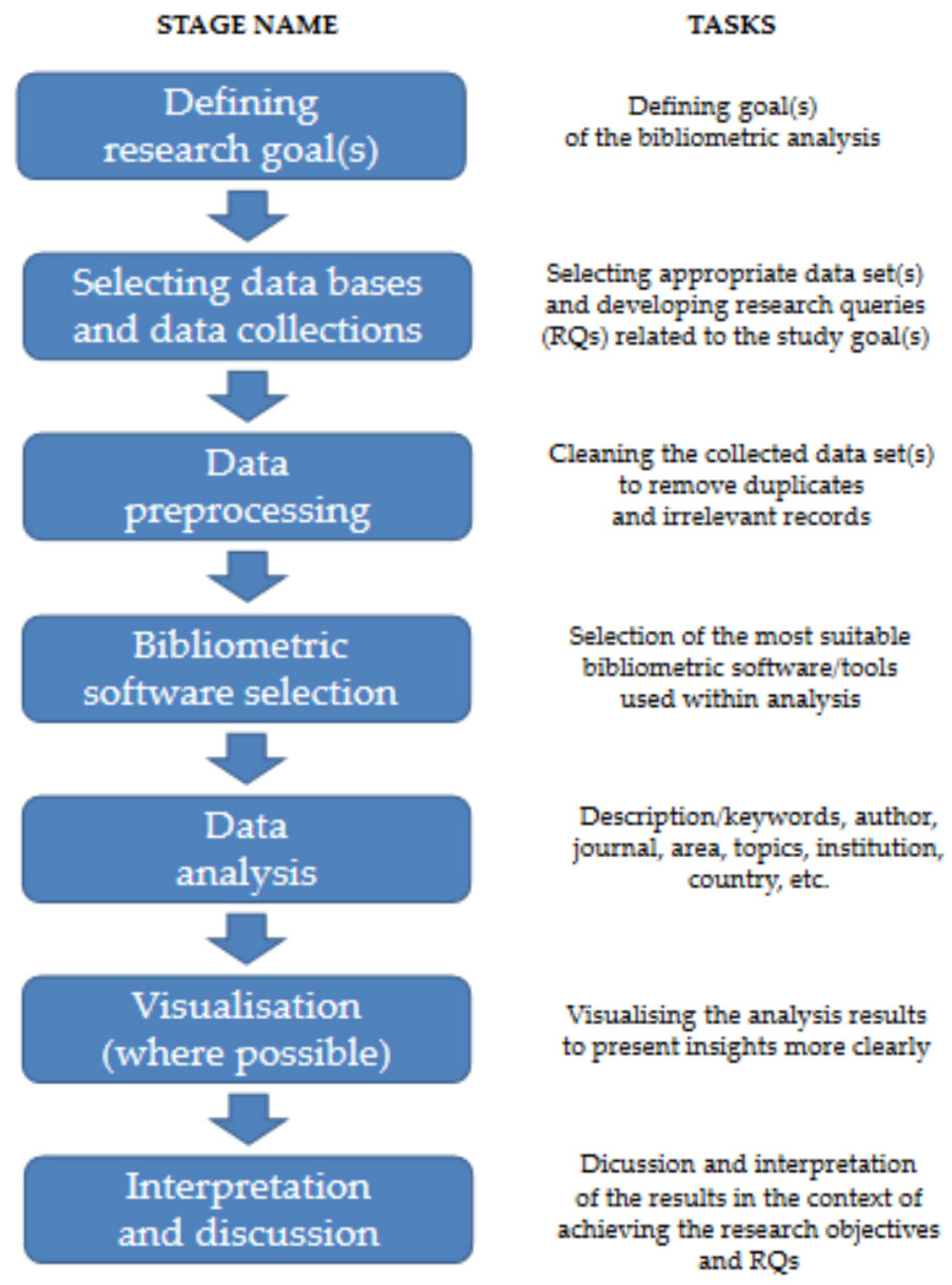
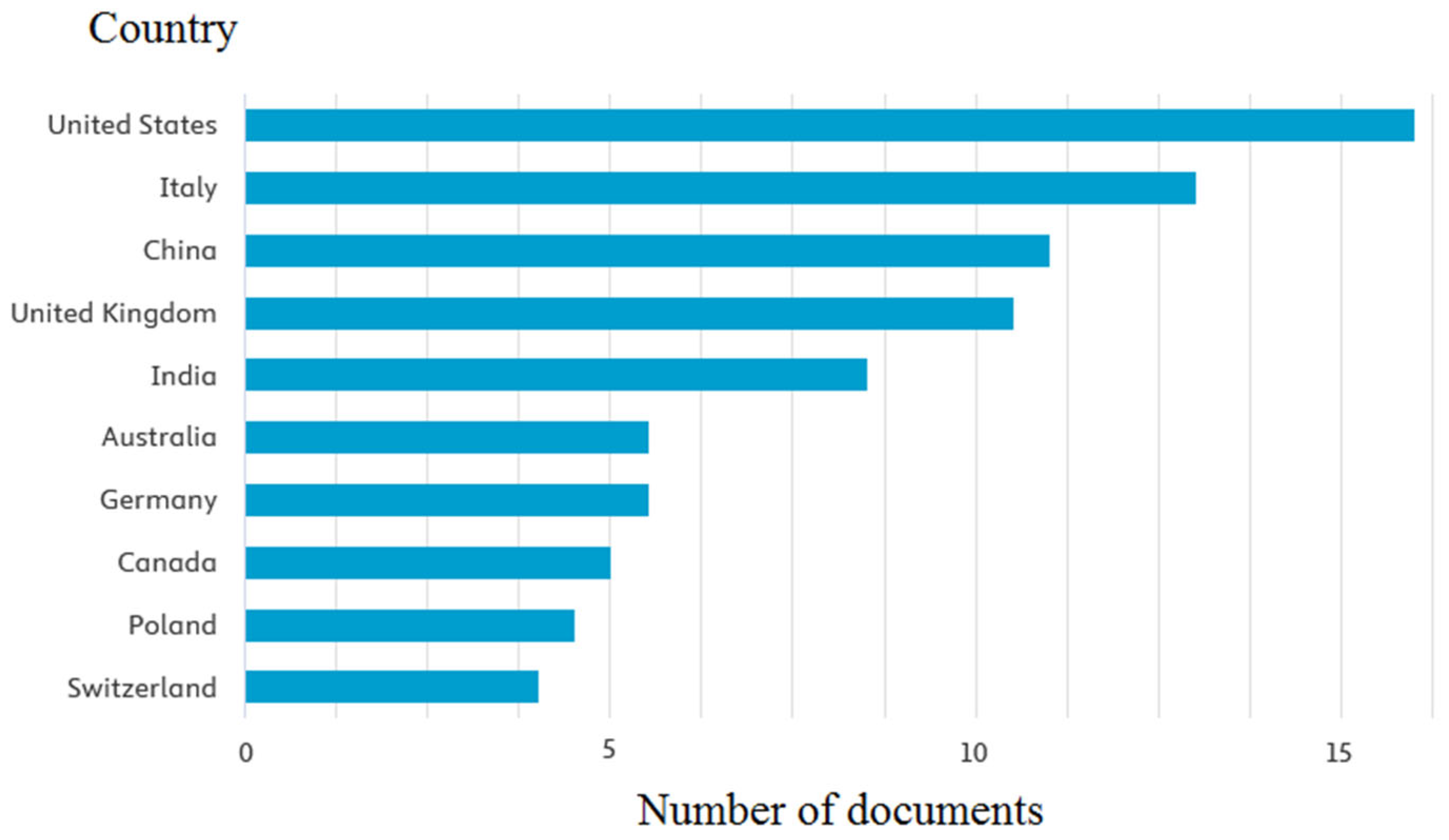
- RQ1: What is the most common origin of publications, broken down by affiliation/research unit and university, country and, if possible, sources of research and publication funding?
- RQ2: Can the most influential authors and their teams be identified?
- RQ3: What are the most popular research/publication topics and, if possible, how are they developing?
- RQ4: Which Sustainable Development Goals (SDGs, formulated by the UN to be achieved by 2030) are most commonly associated with the publications covered by the review?
2.2. Methods
- rationale (item 3);
- objectives (item 4);
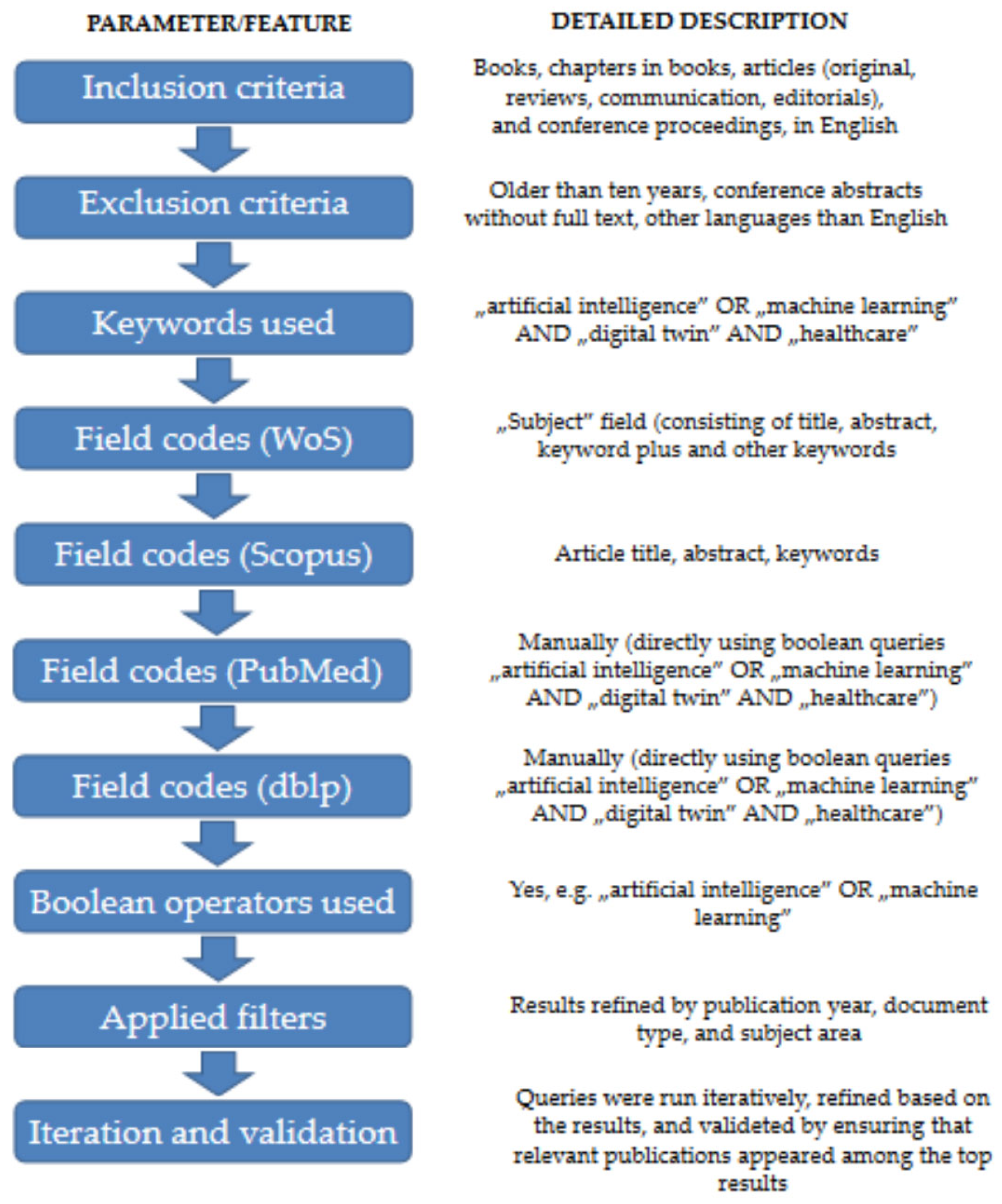
- eligibility criteria (item 5);
- sources of information (item 6);
- search strategy (item 7);
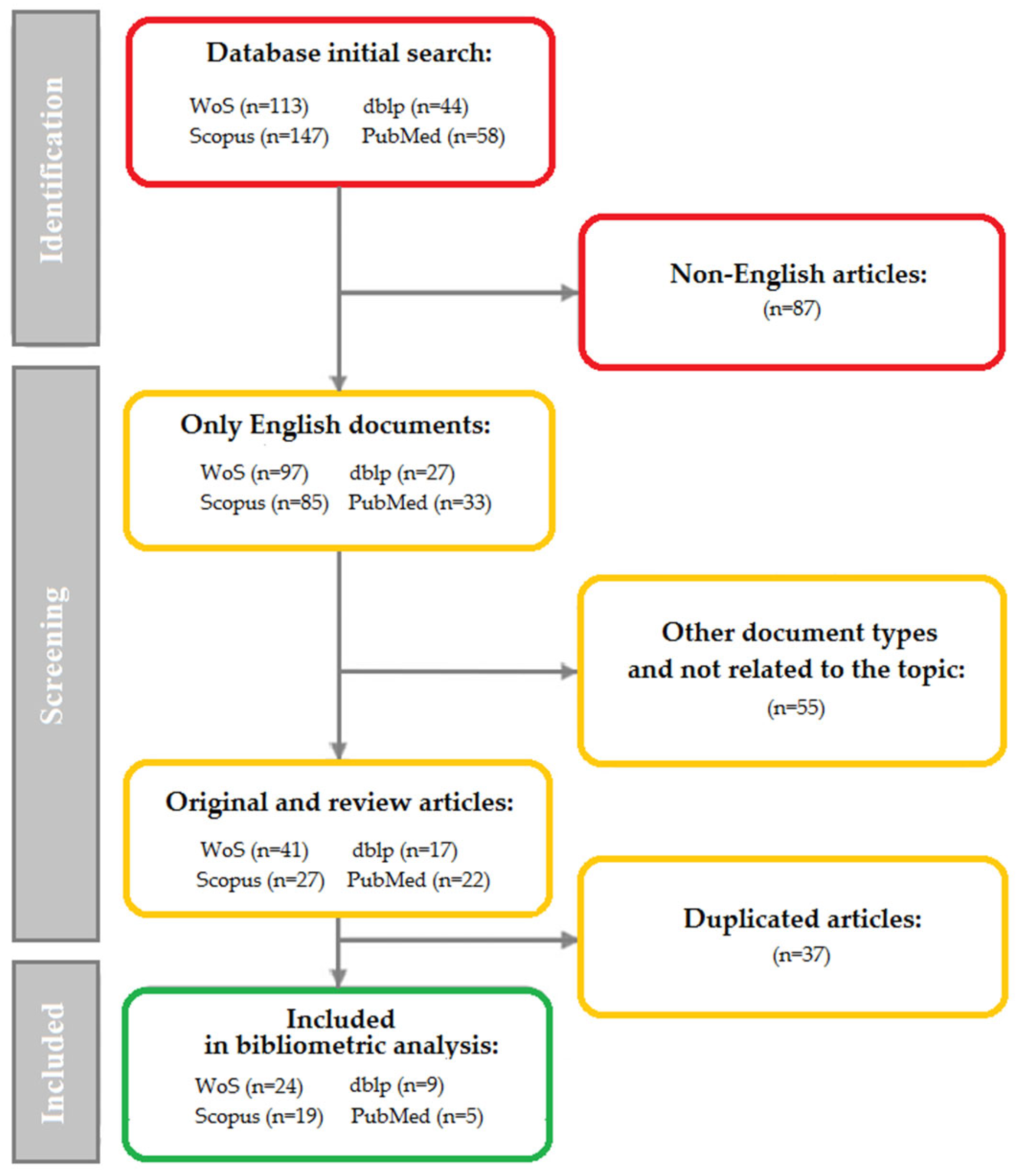
- selection process (item 8);
- data collection process (item 9);
- synthesis methods (item 13a);
- synthesis results (item 20b);
- discussion (item 23a).
3. Results
3.1. Data Sources
3.2. General Results of Analysis
3.3. Local Perspective
- Patient-specific DTs simulate a person’s physiological processes—such as cardiac dynamics, tumor growth, or metabolic regulation—allowing hospitals to test treatment response before implementing them in practice;
- DTs in hospital operations model patient flow, bed allocation, and staff utilization to optimize resource utilization and reduce wait times, particularly in regional healthcare systems under pressure;
- DTs for medical devices, including prostheses, exoskeletons, and implantable sensors, utilize AI-driven feedback loops to adapt device performance in real time to the patient’s biomechanical or neurological status;
- DTs for training and rehabilitation are leveraging the integration of AI and VR/BCI to create personalized therapeutic environments that improve recovery outcomes and support clinical education within locally available digital infrastructures.
3.4. Regional Perspective
3.5. National Level
3.6. International and Global Level
4. Discussion
4.1. Limitations
- more precise description of the mechanisms of dynamic molecular changes in DTs at various biological scales;
- prioritization of disease mechanisms and therapeutic targets;
- mutual learning of interoperable DTs systems;
- VR/AugR-based interfaces to DTs for medical professionals and patients/their families;
- global scaling of DTs technology to ensure equal access to healthcare;
- consideration of ethical and regulatory issues [82].
4.2. Technological Implications
4.3. Economic Implications
4.4. Societal Implications
4.5. Ethical and Legal Implications
4.6. Directions for Further Research
5. Conclusions
Supplementary Materials
Author Contributions
Funding
Data Availability Statement
Conflicts of Interest
Abbreviations
| AI | Artificial intelligence |
| DL | Deep learning |
| DT | Digital twin |
| EHR | Electronic health record |
| GenAI | Generative AI |
| IoHT | Internet of Healthcare Things |
| IoMT | Internet of Medical Things |
| IoNT | Internet of Nano-Things |
| IoT | Internet of Things |
| ML | Machine learning |
| SDG | Sustainable Development Goal |
| WoS | Web of Science |
| XAI | eXplainable AI |
References
- Attaran, M.; Attaran, S.; Celik, B.G. The impact of digital twins on the evolution of intelligent manufacturing and Industry 4.0. Adv. Comput. Intell. 2023, 3, 11. [Google Scholar] [CrossRef]
- Zhang, K.; Zhou, H.Y.; Baptista-Hon, D.T.; Gao, Y.; Liu, X.; Oermann, E.; Xu, S.; Jin, S.; Zhang, J.; Sun, Z.; et al. International Consortium of Digital Twins in Medicine. Concepts and applications of digital twins in healthcare and medicine. Patterns 2024, 5, 101028. [Google Scholar] [CrossRef] [PubMed]
- Laubenbacher, R.; Mehrad, B.; Shmulevich, I.; Trayanova, N. Digital twins in medicine. Nat. Comput. Sci. 2024, 4, 184–191. [Google Scholar] [CrossRef]
- Meijer, C.; Uh, H.W.; El Bouhaddani, S. Digital Twins in Healthcare: Methodological Challenges and Opportunities. J. Pers. Med. 2023, 13, 1522. [Google Scholar] [CrossRef]
- Papachristou, K.; Katsakiori, P.F.; Papadimitroulas, P.; Strigari, L.; Kagadis, G.C. Digital Twins’ Advancements and Applications in Healthcare, Towards Precision Medicine. J. Pers. Med. 2024, 14, 1101. [Google Scholar] [CrossRef] [PubMed]
- Padoan, A.; Plebani, M. Dynamic mirroring: Unveiling the role of digital twins, artificial intelligence and synthetic data for personalized medicine in laboratory medicine. Clin. Chem. Lab. Med. 2024, 62, 2156–2161. [Google Scholar] [CrossRef] [PubMed]
- Wickramasinghe, N.; Ulapane, N.; Sloane, E.B.; Gehlot, V. Digital Twins for More Precise and Personalized Treatment. Stud. Health Technol. Inform. 2024, 310, 229–233. [Google Scholar] [CrossRef]
- Nadeem, M.; Kostic, S.; Dornhöfer, M.; Weber, C.; Fathi, M. A comprehensive review of digital twin in healthcare in the scope of simulative health-monitoring. Digit. Health 2025, 11, 20552076241304078. [Google Scholar] [CrossRef]
- Singh, M.; Kapukotuwa, J.; Gouveia, E.L.S.; Fuenmayor, E.; Qiao, Y.; Murry, N.; Devine, D. Unity and ROS as a Digital and Communication Layer for Digital Twin Application: Case Study of Robotic Arm in a Smart Manufacturing Cell. Sensors 2024, 24, 5680. [Google Scholar] [CrossRef]
- Vallée, A. Digital Twins for Personalized Medicine Require Epidemiological Data and Mathematical Modeling: Viewpoint. J. Med. Internet Res. 2025, 27, e72411. [Google Scholar] [CrossRef]
- Saratkar, S.Y.; Langote, M.; Kumar, P.; Gote, P.; Weerarathna, I.N.; Mishra, G.V. Digital twin for personalized medicine development. Front. Digit. Health 2025, 7, 1583466. [Google Scholar] [CrossRef] [PubMed]
- Abdelmohsen, S.A.; Al-Jabri, M.M. Artificial Intelligence Applications in Healthcare: A Systematic Review of Their Impact on Nursing Practice and Patient Outcomes. J. Nurs. Scholarsh. 2025, 57, 957–966. [Google Scholar] [CrossRef] [PubMed]
- Chong, P.L.; Vaigeshwari, V.; Mohammed Reyasudin, B.K.; Noor Hidayah, B.R.A.; Tatchanaamoorti, P.; Yeow, J.A.; Kong, F.Y. Integrating artificial intelligence in healthcare: Applications, challenges, and future directions. Future Sci. OA 2025, 11, 2527505. [Google Scholar] [CrossRef] [PubMed]
- Kuriakose, S.M.; Joseph, J.A.R.; Kollinal, R. The Rise of Digital Twins in Healthcare: A Mapping of the Research Landscape. Cureus 2024, 16, e65358. [Google Scholar] [CrossRef]
- Stoumpos, A.I.; Talias, M.A.; Ntais, C.; Kitsios, F.; Jakovljevic, M. Knowledge Management and Digital Innovation in Healthcare: A Bibliometric Analysis. Healthcare 2024, 12, 2525. [Google Scholar] [CrossRef]
- Marinescu, Ș.A.; Oncioiu, I.; Ghibanu, A.I. The Digital Transformation of Healthcare Through Intelligent Technologies: A Path Dependence-Augmented-Unified Theory of Acceptance and Use of Technology Model for Clinical Decision Support Systems. Healthcare 2025, 13, 1222. [Google Scholar] [CrossRef]
- Vallée, A. Digital twin for healthcare systems. Front. Digit. Health 2023, 5, 1253050. [Google Scholar] [CrossRef]
- Ooka, T. The Era of Preemptive Medicine: Developing Medical Digital Twins through Omics, IoT, and AI Integration. JMA J. 2025, 8, 1–10. [Google Scholar] [CrossRef]
- Belbase, P.; Bhusal, R.; Ghimire, S.S.; Sharma, S.; Banskota, B. Assuring assistance to healthcare and medicine: Internet of Things, Artificial Intelligence, and Artificial Intelligence of Things. Front. Artif. Intell. 2024, 7, 1442254. [Google Scholar] [CrossRef]
- Mizna, S.; Arora, S.; Saluja, P.; Das, G.; Alanesi, W.A. An analytic research and review of the literature on practice of artificial intelligence in healthcare. Eur. J. Med. Res. 2025, 30, 382. [Google Scholar] [CrossRef]
- Aravazhi, P.S.; Gunasekaran, P.; Benjamin, N.Z.Y.; Thai, A.; Chandrasekar, K.K.; Kolanu, N.D.; Prajjwal, P.; Tekuru, Y.; Brito, L.V.; Inban, P. The integration of artificial intelligence into clinical medicine: Trends, challenges, and future directions. Dis. Mon. 2025, 71, 101882. [Google Scholar] [CrossRef] [PubMed]
- Rajagopal, D.; Subramanian, P.K.T. AI augmented edge and fog computing for Internet of Health Things (IoHT). PeerJ Comput. Sci. 2025, 11, e2431. [Google Scholar] [CrossRef]
- Quy, V.K.; Hau, N.V.; Anh, D.V.; Ngoc, L.A. Smart healthcare IoT applications based on fog computing: Architecture, applications and challenges. Complex Intell. Syst. 2022, 8, 3805–3815. [Google Scholar] [CrossRef]
- Silva, A.; Vale, N. Digital Twins in Personalized Medicine: Bridging Innovation and Clinical Reality. J. Pers. Med. 2025, 15, 503. [Google Scholar] [CrossRef] [PubMed]
- Dang, V.A.; Vu Khanh, Q.; Nguyen, V.H.; Nguyen, T.; Nguyen, D.C. Intelligent Healthcare: Integration of Emerging Technologies and Internet of Things for Humanity. Sensors 2023, 23, 4200. [Google Scholar] [CrossRef]
- Roopa, M.S.; Venugopal, K.R. Digital Twins for Cyber-Physical Healthcare Systems: Architecture, Requirements, Systematic Analysis and Future Prospects. IEEE Access 2025, 13, 44963–44996. [Google Scholar] [CrossRef]
- Sun, T.; Wang, J.; Suo, M.; Liu, X.; Huang, H.; Zhang, J.; Zhang, W.; Li, Z. The Digital Twin: A Potential Solution for the Personalized Diagnosis and Treatment of Musculoskeletal System Diseases. Bioengineering 2023, 10, 627. [Google Scholar] [CrossRef]
- Prokopowicz, P.; Mikołajewski, D.; Tyburek, K.; Mikołajewska, E. Computational gait analysis for post-stroke rehabilitation purposes using fuzzy numbers, fractal dimension and neural networks. Bull. Pol. Acad. Sci. Tech. Sci. 2020, 68, 191–198. [Google Scholar] [CrossRef]
- Kumar, R.; Gowda, C.; Sekhar, T.C.; Vaja, S.; Hage, T.; Sporn, K.; Waisberg, E.; Ong, J.; Zaman, N.; Tavakkoli, A. Advancements in Machine Learning for Precision Diagnostics and Surgical Interventions in Interconnected Musculoskeletal and Visual Systems. J. Clin. Med. 2025, 14, 3669. [Google Scholar] [CrossRef]
- Sahal, R.; Alsamhi, S.H.; Brown, K.N. Personal Digital Twin: A Close Look into the Present and a Step towards the Future of Personalised Healthcare Industry. Sensors 2022, 22, 5918. [Google Scholar] [CrossRef]
- Lozanovic, J.; Petrovic, M. From Concept to Practice: Unlocking the Potential of Digital Twins in Clinical Engineering. Stud. Health Technol. Inform. 2025, 324, 148–149. [Google Scholar] [CrossRef]
- Krotkiewicz, M.; Szynkaruk, A.; Stachyra, A. Digital transformation in healthcare management: From Artificial Intelligence to blockchain. Wiad. Lek 2025, 78, 578–583. [Google Scholar] [CrossRef]
- Czeczot, G.; Rojek, I.; Mikołajewski, D.; Sangho, B. AI in IIoT Management of Cybersecurity for Industry 4.0 and Industry 5.0 Purposes. Electronics 2023, 12, 3800. [Google Scholar] [CrossRef]
- Shah, D.; Rani, S.; Shoukat, K.; Kalsoom, H.; Shoukat, M.U.; Almujibah, H.; Liao, S. Blockchain Factors in the Design of Smart-Media for E-Healthcare Management. Sensors 2024, 24, 6835. [Google Scholar] [CrossRef] [PubMed]
- Othman, S.B.; Getahun, M. Leveraging blockchain and IoMT for secure and interoperable electronic health records. Sci. Rep. 2025, 15, 12358. [Google Scholar] [CrossRef] [PubMed]
- Manickam, P.; Mariappan, S.A.; Murugesan, S.M.; Hansda, S.; Kaushik, A.; Shinde, R.; Thipperudraswamy, S.P. Artificial Intelligence (AI) and Internet of Medical Things (IoMT) Assisted Biomedical Systems for Intelligent Healthcare. Biosensors 2022, 12, 562. [Google Scholar] [CrossRef]
- Sodhro, A.H.; Zahid, N. AI-Enabled Framework for Fog Computing Driven E-Healthcare Applications. Sensors 2021, 21, 8039. [Google Scholar] [CrossRef]
- Mikołajewska, E.; Mikołajewski, D. E-learning in the education of people with disabilities. Adv. Clin. Exp. Med. 2011, 20, 103–109. [Google Scholar]
- Elbagoury, B.M.; Vladareanu, L.; Vlădăreanu, V.; Salem, A.B.; Travediu, A.M.; Roushdy, M.I. A Hybrid Stacked CNN and Residual Feedback GMDH-LSTM Deep Learning Model for Stroke Prediction Applied on Mobile AI Smart Hospital Platform. Sensors 2023, 23, 3500. [Google Scholar] [CrossRef]
- Mathkor, D.M.; Mathkor, N.; Bassfar, Z.; Bantun, F.; Slama, P.; Ahmad, F.; Haque, S. Multirole of the internet of medical things (IoMT) in biomedical systems for managing smart healthcare systems: An overview of current and future innovative trends. J. Infect. Public Health 2024, 17, 559–572. [Google Scholar] [CrossRef]
- Mikołajewska, E.; Mikołajewski, D. Integrated IT environment for people with disabilities: A new concept. Cent. Eur. J. Med. 2014, 9, 177–182. [Google Scholar] [CrossRef]
- Wang, B.; Shi, X.; Han, X.; Xiao, G. The digital transformation of nursing practice: An analysis of advanced IoT technologies and smart nursing systems. Front. Med. 2024, 11, 1471527. [Google Scholar] [CrossRef] [PubMed]
- Tan, M.J.T.; Kasireddy, H.R.; Satriya, A.B.; Abdul Karim, H.; Al Dahoul, N. Health is beyond genetics: On the integration of lifestyle and environment in real-time for hyper-personalized medicine. Front. Public Health 2025, 12, 1522673. [Google Scholar] [CrossRef] [PubMed]
- Lin, B.; Wu, S. Digital Transformation in Personalized Medicine with Artificial Intelligence and the Internet of Medical Things. OMICS 2022, 26, 77–81. [Google Scholar] [CrossRef]
- Bourechak, A.; Zedadra, O.; Kouahla, M.N.; Guerrieri, A.; Seridi, H.; Fortino, G. At the Confluence of Artificial Intelligence and Edge Computing in IoT-Based Applications: A Review and New Perspectives. Sensors 2023, 23, 1639. [Google Scholar] [CrossRef]
- Ismail, L.; Buyya, R. Artificial Intelligence Applications and Self-Learning 6G Networks for Smart Cities Digital Ecosystems: Taxonomy, Challenges, and Future Directions. Sensors 2022, 22, 5750. [Google Scholar] [CrossRef]
- Hinostroza Fuentes, V.G.; Karim, H.A.; Tan, M.J.T.; AlDahoul, N. AI with agency: A vision for adaptive, efficient, and ethical healthcare. Front. Digit. Health 2025, 7, 1600216. [Google Scholar] [CrossRef]
- Mikołajewska, E.; Mikołajewski, D. Ethical considerations in the use of brain-computer interfaces. Cent. Eur. J. Med. 2013, 8, 720–724. [Google Scholar] [CrossRef]
- Sadée, C.; Testa, S.; Barba, T.; Hartmann, K.; Schuessler, M.; Thieme, A.; Church, G.M.; Okoye, I.; Hernandez-Boussard, T.; Hood, L.; et al. Medical digital twins: Enabling precision medicine and medical artificial intelligence. Lancet Digit. Health 2025, 7, 100864. [Google Scholar] [CrossRef]
- Triposkiadis, F.; Brutsaert, D.L. Evidence-Based Medicine: Past, Present, Future. J. Clin. Med. 2025, 14, 5094. [Google Scholar] [CrossRef]
- Nygren, P. Precision cancer medicine 2025: Some concerns. Acta Oncol. 2025, 64, 1202–1204. [Google Scholar] [CrossRef]
- Ryan, R.; Santesso, N.; Lowe, D.; Hill, S.; Grimshaw, J.; Prictor, M.; Kaufman, C.; Cowie, G.; Taylor, M. Interventions to improve safe and effective medicines use by consumers: An overview of systematic reviews. Cochrane Database Syst. Rev. 2014, 2014, CD007768. [Google Scholar] [CrossRef]
- Pasculli, G.; Virgolin, M.; Myles, P.; Vidovszky, A.; Fisher, C.; Biasin, E.; Mourby, M.; Pappalardo, F.; D’Amico, S.; Torchia, M.; et al. Synthetic Data in Healthcare and Drug Development: Definitions, Regulatory Frameworks, Issues. CPT Pharmacomet. Syst. Pharmacol. 2025, 14, 840–852. [Google Scholar] [CrossRef]
- Pashkov, V.M.; Harkusha, A.O.; Harkusha, Y.O. Artificial Intelligence in Medical Practice: Regulative Issues and Perspectives. Wiad. Lek 2020, 73, 2722–2727. [Google Scholar] [CrossRef]
- Paladugu, P.S.; Ong, J.; Nelson, N.; Kamran, S.A.; Waisberg, E.; Zaman, N.; Kumar, R.; Dias, R.D.; Lee, A.G.; Tavakkoli, A. Generative Adversarial Networks in Medicine: Important Considerations for this Emerging Innovation in Artificial Intelligence. Ann. Biomed. Eng. 2023, 51, 2130–2142. [Google Scholar] [CrossRef] [PubMed]
- Lagerburg, V.; van den Boorn, M.; Crane, R.F.; Welvaars, K.; Groen, J.M. Applying and validating a quality management system for in-house developed medical software. Front. Digit. Health 2025, 7, 1461107. [Google Scholar] [CrossRef]
- Gorelik, A.J.; Li, M.; Hahne, J.; Wang, J.; Ren, Y.; Yang, L.; Zhang, X.; Liu, X.; Wang, X.; Bogdan, R.; et al. Ethics of AI in healthcare: A scoping review demonstrating applicability of a foundational framework. Front. Digit. Health 2025, 7, 1662642. [Google Scholar] [CrossRef] [PubMed]
- Fraga-Lamas, P.; Lopes, S.I.; Fernández-Caramés, T.M. Green IoT and Edge AI as Key Technological Enablers for a Sustainable Digital Transition towards a Smart Circular Economy: An Industry 5.0 Use Case. Sensors 2021, 21, 5745. [Google Scholar] [CrossRef]
- Mikołajewska, E.; Mikołajewski, D. Wheelchair Development from the Perspective of Physical Therapists and Biomedical Engineers. Adv. Clin. Exp. Med. 2010, 19, 771–776. [Google Scholar]
- Singh, R.; Akram, S.V.; Gehlot, A.; Buddhi, D.; Priyadarshi, N.; Twala, B. Energy System 4.0: Digitalization of the Energy Sector with Inclination towards Sustainability. Sensors 2022, 22, 6619. [Google Scholar] [CrossRef]
- Rojek, I.; Mroziński, A.; Kotlarz, P.; Macko, M.; Mikołajewski, D. AI-Based Computational Model in Sustainable Transformation of Energy Markets. Energies 2023, 16, 8059. [Google Scholar] [CrossRef]
- Tortora, M.; Pacchiano, F.; Ferraciolli, S.F.; Criscuolo, S.; Gagliardo, C.; Jaber, K.; Angelicchio, M.; Briganti, F.; Caranci, F.; Tortora, F.; et al. Medical Digital Twin: A Review on Technical Principles and Clinical Applications. J. Clin. Med. 2025, 14, 324. [Google Scholar] [CrossRef]
- Kim, E.M.; Lim, Y. Mapping interconnectivity of digital twin healthcare research themes through structural topic modeling. Sci. Rep. 2025, 15, 31734. [Google Scholar] [CrossRef]
- Lim, Y.; Kim, E.M. Structural Topic Modeling Analysis of Digital Twin Study in Healthcare. Stud. Health Technol. Inform. 2025, 329, 1852–1853. [Google Scholar] [CrossRef] [PubMed]
- Henry, J.A. Population health management of human phenotype ontology. Front. Artif. Intell. 2025, 8, 1496935. [Google Scholar] [CrossRef]
- Henry, J.A. Global reform population health management as stewarded by Higher Expert Medical Science Safety (HEMSS). Front. Artif. Intell. 2025, 8, 1496948. [Google Scholar] [CrossRef] [PubMed]
- Henry, J.A. Population health management genomic new-born screens and multi-omics intercepts. Front. Artif. Intell. 2025, 7, 1496942. [Google Scholar] [CrossRef]
- Qu, Z.; Li, Y.; Liu, B.; Gupta, D.; Tiwari, P. DTQFL: A Digital Twin-Assisted Quantum Federated Learning Algorithm for Intelligent Diagnosis in 5G Mobile Network. IEEE J. Biomed. Health Inform. 2023, 2023, 3303401. [Google Scholar] [CrossRef] [PubMed]
- Seki, T.; Kawazoe, Y.; Ito, H.; Takiguchi, T.; Akagi, Y.; Ebara, M.; Ohe, K. Assessment of Medically Relevant Ageism Inherent in Large Language Models. Stud. Health Technol. Inform. 2025, 329, 603–607. [Google Scholar] [CrossRef]
- Maglogiannis, I.; Trastelis, F.; Kalogeropoulos, M.; Khan, A.; Gallos, P.; Menychtas, A.; Panagopoulos, C.; Papachristou, P.; Islam, N.; Wolff, A.; et al. AI4Work Project: Human-Centric Digital Twin Approaches to Trustworthy AI and Robotics for Improved Working Conditions in Healthcare and Education Sectors. Stud. Health Technol. Inform. 2024, 316, 1013–1017. [Google Scholar] [CrossRef]
- Alizadeh, M.; Jafar Sameri, M. Intelligent Assessment Systems in Medical Education: A Systematic Review. J. Adv. Med. Educ. Prof. 2025, 13, 173–190. [Google Scholar] [CrossRef]
- Wu, J.; Koelzer, V.H. Towards generative digital twins in biomedical research. Comput. Struct. Biotechnol. J. 2024, 23, 3481–3488. [Google Scholar] [CrossRef]
- Fekonja, L.S.; Schenk, R.; Schröder, E.; Tomasello, R.; Tomšič, S.; Picht, T. The digital twin in neuroscience: From theory to tailored therapy. Front. Neurosci. 2024, 18, 1454856. [Google Scholar] [CrossRef]
- Zackoff, M.W.; Davis, D.; Rios, M.; Sahay, R.D.; Zhang, B.; Anderson, I.; NeCamp, M.; Rogue, I.; Boyd, S.; Gardner, A.; et al. Tolerability and Acceptability of Autonomous Immersive Virtual Reality Incorporating Digital Twin Technology for Mass Training in Healthcare. Simul. Healthc. 2024, 19, e99–e116. [Google Scholar] [CrossRef] [PubMed]
- Thangaraj, P.M.; Benson, S.H.; Oikonomou, E.K.; Asselbergs, F.W.; Khera, R. Cardiovascular care with digital twin technology in the era of generative artificial intelligence. Eur. Heart J. 2024, 45, 4808–4821. [Google Scholar] [CrossRef] [PubMed]
- Sarp, S.; Kuzlu, M.; Zhao, Y.; Gueler, O. Digital Twin in Healthcare: A Study for Chronic Wound Management. IEEE J. Biomed. Health Inform. 2023, 27, 5634–5643. [Google Scholar] [CrossRef]
- Sangha, V.; Dhingra, L.S.; Aminorroaya, A.; Croon, P.M.; Sikand, N.V.; Sen, S.; Martinez, M.W.; Maron, M.S.; Krumholz, H.M.; Asselbergs, F.W.; et al. Identification of hypertrophic cardiomyopathy on electrocardiographic images with deep learning. Nat. Cardiovasc. Res. 2025, 4, 991–1000. [Google Scholar] [CrossRef]
- Andargoli, A.E.; Ulapane, N.; Nguyen, T.A.; Shuakat, N.; Zelcer, J.; Wickramasinghe, N. Intelligent decision support systems for dementia care: A scoping review. Artif. Intell. Med. 2024, 150, 102815. [Google Scholar] [CrossRef]
- Imam, N.H. Adversarial Examples on XAI-Enabled DT for Smart Healthcare Systems. Sensors 2024, 24, 6891. [Google Scholar] [CrossRef]
- Fuchs, B.; Studer, G.; Bode-Lesniewska, B.; Heesen, P. On Behalf of The Swiss Sarcoma Network. The Next Frontier in Sarcoma Care: Digital Health, AI, and the Quest for Precision Medicine. J. Pers. Med. 2023, 13, 1530. [Google Scholar] [CrossRef] [PubMed]
- Pinton, P. Impact of artificial intelligence on prognosis, shared decision-making, and precision medicine for patients with inflammatory bowel disease: A perspective and expert opinion. Ann. Med. 2023, 55, 2300670. [Google Scholar] [CrossRef] [PubMed]
- Li, X.; Loscalzo, J.; Mahmud, A.K.M.F.; Aly, D.M.; Rzhetsky, A.; Zitnik, M.; Benson, M. Digital twins as global learning health and disease models for preventive and personalized medicine. Genome Med. 2025, 17, 11. [Google Scholar] [CrossRef]
- Khatiwada, P.; Yang, B. An Overview on Security and Privacy of Data in IoMT Devices: Performance Metrics, Merits, Demerits, and Challenges. Stud. Health Technol. Inform. 2022, 299, 126–136. [Google Scholar] [CrossRef]
- Ghadi, Y.Y.; Mazhar, T.; Shahzad, T.; Amir Khan, M.; Abd-Alrazaq, A.; Ahmed, A.; Hamam, H. The role of blockchain to secure internet of medical things. Sci. Rep. 2024, 14, 18422, Erratum in Sci. Rep. 2024, 14, 21337. https://doi.org/10.1038/s41598-024-71990-3. [Google Scholar] [CrossRef]
- Bhasker, B.; Rao, P.M.; Saraswathi, P.; Patro, S.G.K.; Bhutto, J.K.; Islam, S.; Kareemullah, M.; Emma, A.F. Blockchain framework with IoT device using federated learning for sustainable healthcare systems. Sci. Rep. 2025, 15, 26736. [Google Scholar] [CrossRef]
- Xie, Q.; Ding, Z. Provably secure and lightweight blockchain based cross hospital authentication scheme for IoMT-based healthcare. Sci. Rep. 2025, 15, 6461. [Google Scholar] [CrossRef] [PubMed]
- Pelekoudas-Oikonomou, F.; Zachos, G.; Papaioannou, M.; de Ree, M.; Ribeiro, J.C.; Mantas, G.; Rodriguez, J. Blockchain-Based Security Mechanisms for IoMT Edge Networks in IoMT-Based Healthcare Monitoring Systems. Sensors 2022, 22, 2449. [Google Scholar] [CrossRef]
- Reason, T.; Klijn, S.; Rawlinson, W.; Benbow, E.; Langham, J.; Teitsson, S.; Johannesen, K.; Malcolm, B. Using Generative Artificial Intelligence in Health Economics and Outcomes Research: A Primer on Techniques and Breakthroughs. PharmacoEconomics-Open 2025, 9, 501–517. [Google Scholar] [CrossRef] [PubMed]
- Elkefi, S.; Asan, O. Digital Twins for Managing Health Care Systems: Rapid Literature Review. J. Med. Internet Res. 2022, 24, e37641. [Google Scholar] [CrossRef]
- Riahi, V.; Diouf, I.; Khanna, S.; Boyle, J.; Hassanzadeh, H. Digital Twins for Clinical and Operational Decision-Making: Scoping Review. J. Med. Internet Res. 2025, 27, e55015. [Google Scholar] [CrossRef]
- Popa, E.O.; van Hilten, M.; Oosterkamp, E.; Bogaardt, M.J. The use of digital twins in healthcare: Socio-ethical benefits and socio-ethical risks. Life Sci. Soc. Policy 2021, 17, 6. [Google Scholar] [CrossRef]
- Kaplan, B. Revisiting health information technology ethical, legal, and social issues and evaluation: Telehealth/telemedicine and COVID-19. Int. J. Med. Inform. 2020, 143, 104239. [Google Scholar] [CrossRef]
- Demiris, G. The diffusion of virtual communities in health care: Concepts and challenges. Patient Educ. Couns. 2006, 62, 178–188. [Google Scholar] [CrossRef]
- Huang, P.H.; Kim, K.H.; Schermer, M. Ethical Issues of Digital Twins for Personalized Health Care Service: Preliminary Mapping Study. J. Med. Internet Res. 2022, 24, e33081. [Google Scholar] [CrossRef]
- Keenan, A.J.; Tsourtos, G.; Tieman, J. The Value of Applying Ethical Principles in Telehealth Practices: Systematic Review. J. Med. Internet Res. 2021, 23, e25698. [Google Scholar] [CrossRef]
- Arslan, J.; Benke, K.K. Artificial Intelligence and Telehealth may Provide Early Warning of Epidemics. Front. Artif. Intell. 2021, 4, 556848. [Google Scholar] [CrossRef] [PubMed]
- MacIntyre, C.R.; Chen, X.; Kunasekaran, M.; Quigley, A.; Lim, S.; Stone, H.; Paik, H.Y.; Yao, L.; Heslop, D.; Wei, W.; et al. Artificial intelligence in public health: The potential of epidemic early warning systems. J. Int. Med. Res. 2023, 51, 3000605231159335, Erratum in J. Int. Med. Res. 2023, 51, 3000605231178098. https://doi.org/10.1177/03000605231178098. [Google Scholar] [CrossRef] [PubMed]
- Lin, T.Y.; Ming-Fang Yen, A.; Li-Sheng Chen, S.; Hsu, C.Y.; Yeh, Y.P.; Chen, T.H. Artificial intelligence for precision viral surveillance of emerging infectious disease (EID): Data-driven digital twin metaverse-envisioned study. Comput. Biol. Med. 2025, 196, 110877. [Google Scholar] [CrossRef]
- Tomičić, A.; Malešević, A.; Čartolovni, A. Ethical, Legal and Social Issues of Digital Phenotyping as a Future Solution for Present-Day Challenges: A Scoping Review. Sci. Eng. Ethics 2021, 28, 1. [Google Scholar] [CrossRef] [PubMed]
- Özdemir, V.; Hekim, N. Birth of Industry 5.0: Making Sense of Big Data with Artificial Intelligence, “The Internet of Things” and Next-Generation Technology Policy. OMICS 2018, 22, 65–76. [Google Scholar] [CrossRef]
- Ratti, E.; Morrison, M.; Jakab, I. Ethical and social considerations of applying artificial intelligence in healthcare-a two-pronged scoping review. BMC Med. Ethics 2025, 26, 68. [Google Scholar] [CrossRef] [PubMed]
- Ștefănigă, S.A.; Cordoș, A.A.; Ivascu, T.; Feier, C.V.I.; Muntean, C.; Stupinean, C.V.; Călinici, T.; Aluaș, M.; Bolboacă, S.D. Advancing Precision Oncology with Digital and Virtual Twins: A Scoping Review. Cancers 2024, 16, 3817. [Google Scholar] [CrossRef] [PubMed]
- Baldini, G.; Botterman, M.; Neisse, R.; Tallacchini, M. Ethical Design in the Internet of Things. Sci. Eng. Ethics 2018, 24, 905–925. [Google Scholar] [CrossRef]
- Denecke, K. An ethical assessment model for digital disease detection technologies. Life Sci. Soc. Policy 2017, 13, 16. [Google Scholar] [CrossRef]
- Sigawi, T.; Ilan, Y. Using Constrained-Disorder Principle-Based Systems to Improve the Performance of Digital Twins in Biological Systems. Biomimetics 2023, 8, 359. [Google Scholar] [CrossRef]
- Hu, H.; Wang, M.; Lei, Q.; Yang, K.; Sun, H.; Liu, X.; Wu, S. Digital twin hospitals: Transforming the future of healthcare. J. Biomed. Eng. 2024, 41, 376–382. [Google Scholar] [CrossRef]
- Haferlach, T.; Eckardt, J.N.; Walter, W.; Maschek, S.; Kather, J.N.; Pohlkamp, C.; Middeke, J.M. AML diagnostics in the 21st century: Use of AI. Semin. Hematol. 2025, 62, 226–234. [Google Scholar] [CrossRef]
- Alabdulatif, A.; Thilakarathne, N.N.; Lawal, Z.K.; Fahim, K.E.; Zakari, R.Y. Internet of Nano-Things (IoNT): A Comprehensive Review from Architecture to Security and Privacy Challenges. Sensors 2023, 23, 2807. [Google Scholar] [CrossRef]
- Adibi, S.; Rajabifard, A.; Shojaei, D.; Wickramasinghe, N. Enhancing Healthcare through Sensor-Enabled Digital Twins in Smart Environments: A Comprehensive Analysis. Sensors 2024, 24, 2793. [Google Scholar] [CrossRef]
- Iliuţă, M.-E.; Moisescu, M.-A.; Pop, E.; Ionita, A.-D.; Caramihai, S.-I.; Mitulescu, T.-C. Digital Twin—A Review of the Evolution from Concept to Technology and Its Analytical Perspectives on Applications in Various Fields. Appl. Sci. 2024, 14, 5454. [Google Scholar] [CrossRef]
- Chen, X.; Lai, Z.; Ruan, K.; Chen, S.; Liu, J. R-llava: Improving med-vqa understanding through visual region of interest. arXiv 2024, arXiv:2410.20327. [Google Scholar]
- Li, C.; Wong, C.; Zhang, S.; Usuyama, N.; Liiu, H.; Yang, J.; Naumann, T.; Poon, H.; Gao, J. Llava-med: Training a large language-and-vision assistant for biomedicine in one day. Adv. Neural Inf. Process. Syst. 2023, 36, 28541–28564. [Google Scholar]
- Sun, T.; He, X.; Li, Z. Digital twin in healthcare: Recent updates and challenges. Digit. Health 2023, 9, 20552076221149651. [Google Scholar] [CrossRef] [PubMed]
- Page, M.J.; McKenzie, J.E.; Bossuyt, P.M.; Boutron, I.; Hoffmann, T.C.; Mulrow, C.D.; Shamseer, L.; Tetzlaff, J.M.; Akl, E.A.; Brennan, S.E.; et al. The PRISMA 2020 statement: An updated guideline for reporting systematic reviews. BMJ 2021, 372, n71. [Google Scholar] [CrossRef] [PubMed]





| Parameter/Feature | Value |
|---|---|
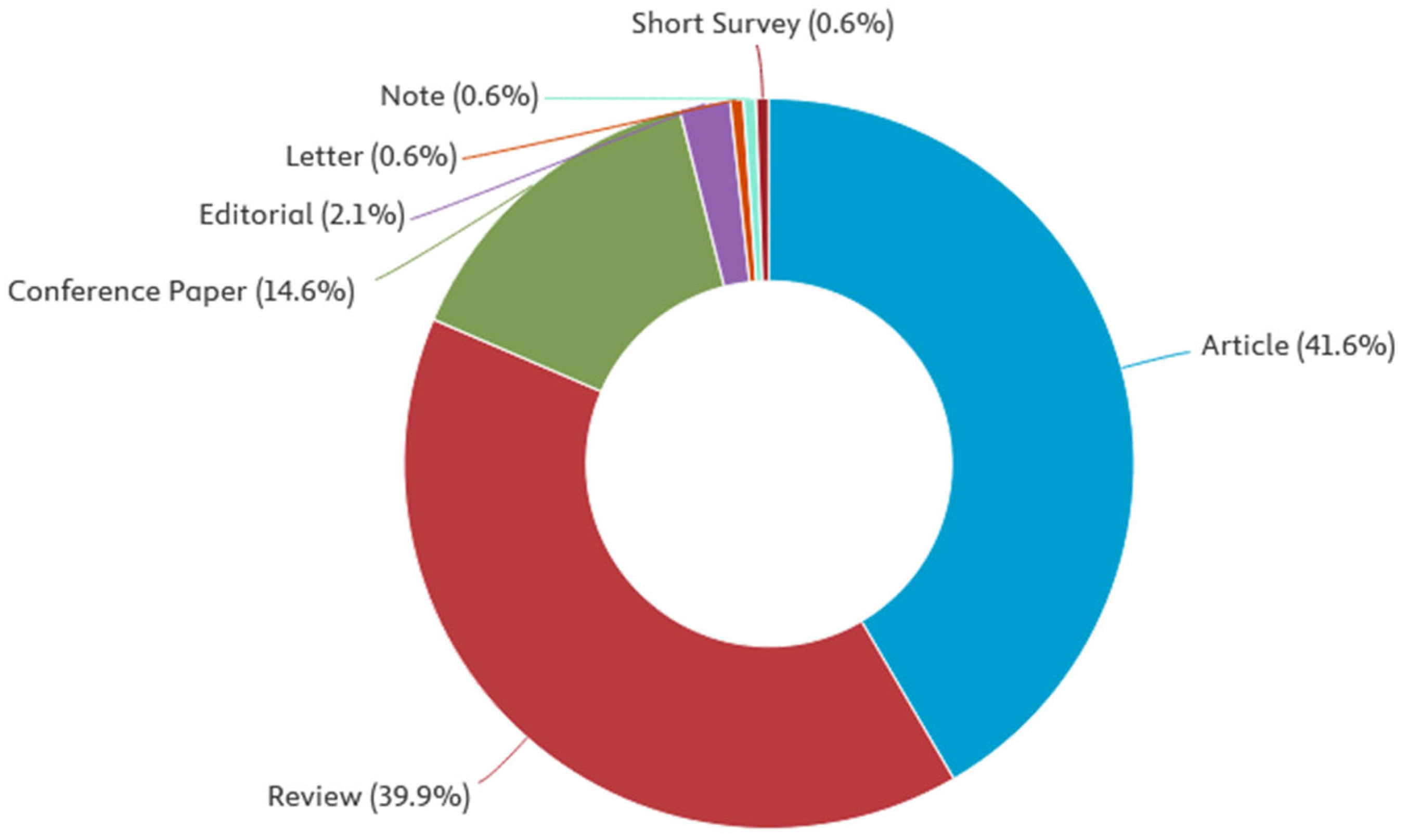
| Leading types of publication | Article (41.6%), review (39.9%), Conference paper (14.6%) |
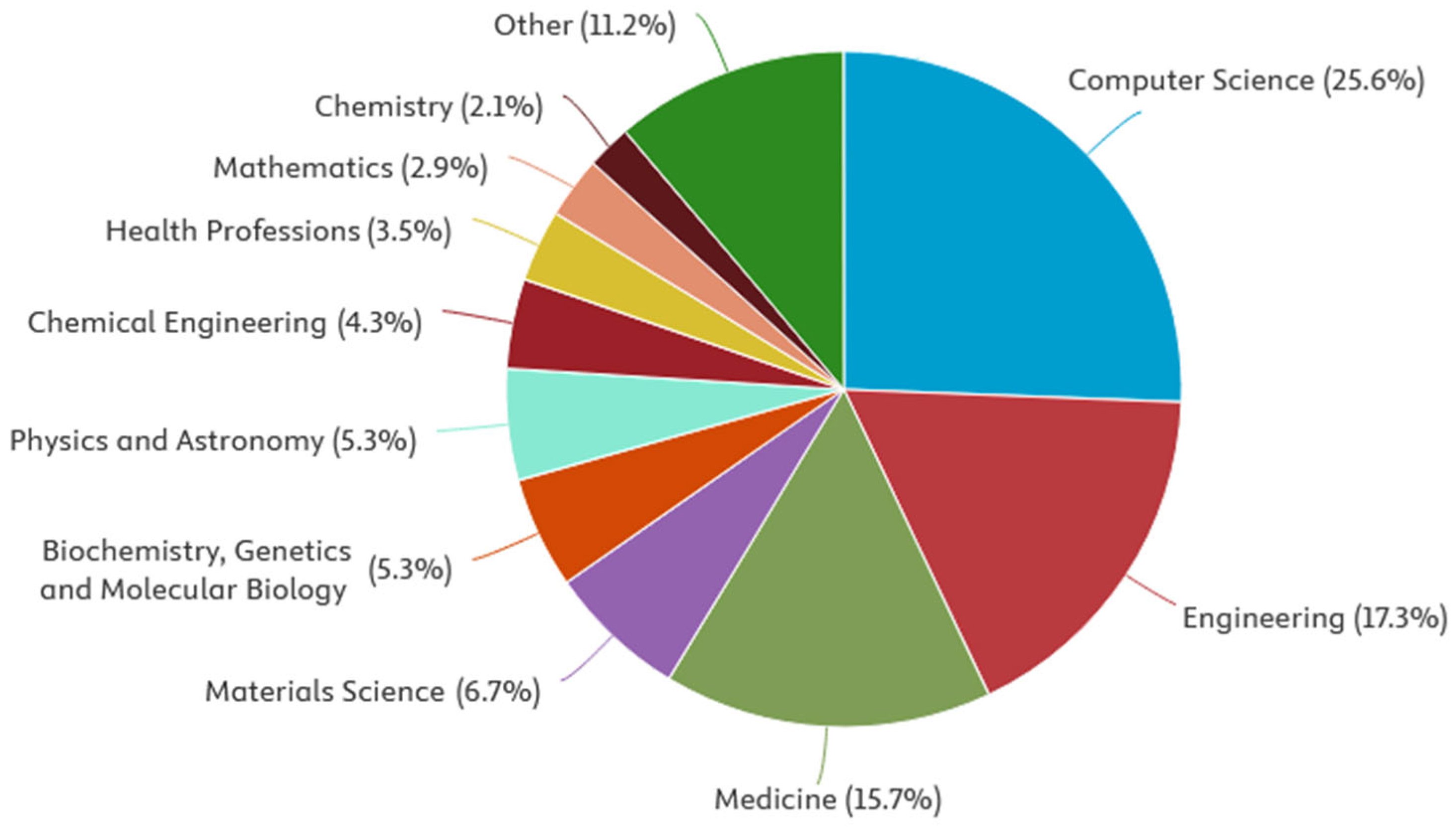
| Leading areas of science | Computer science (25.6%), Engineering (17.3%), Medicine (15.7%) |
| Leading countries | USA, Italy, China, UK |
| Leading scientists | Wicramasinghe N., Zelcer J., Fuchs B., Heesen P., Shuakat N., Ulapane N. |
| Leading affiliations | Harvard Medical School, La Trobe University, Zurich University, Consiglio Nazionale delle Recerche, Universita degli Studi della Campagna Luigi Vanvitelli, Massachusetts General Hospital, Swinburne University of Technology |
| Leading funders (where information available) | Horizon 2020 Framework Programme, Ministero dell’Instrucione, dell’Universita e della Ricerca, National Natural Science Foundation of China, UK Research and Innovation |
| Sustainable development goals | Industry innovation and infrastructure, Responsible consumption and production, Good health and well being |
| Perspective | Strengths | Weaknesses | Opportunities | Threats | Risk Mitigation Strategies |
|---|---|---|---|---|---|
| Local (hospitals, clinics, individual patients) | High personalization of care through patient-specific modeling Real-time data integration (EHR, wearables, imaging) Improvement of workflow efficiency and patient safety Predictive treatment planning | Limited data volume and diversity High implementation costs for infrastructure Staff training requirements Potential for local data silos | Enhancing personalized medicine Testing new clinical protocols virtually Generating synthetic data to overcome data gaps Building internal capacity for innovation | Data privacy breaches Technical failure affecting patient care Resistance to adoption by clinicians Overreliance on models. | Strong cybersecurity and anonymization measures Clinician-in-the-loop systems Regular audits and technical validation Staff training and change management programs |
| Regional (health systems, networks, provinces) | Aggregated population-level modeling Improved coordination between facilities Resource optimization across a broader area Early detection of regional health trends | Interoperability challenges between institutions Uneven data quality across sites Dependence on regional data-sharing agreements | Coordinated response to outbreaks - Better planning for emergency preparedness Targeted interventions in underserved communities Capacity forecasting | Data governance inconsistencies Political or administrative fragmentation - Infrastructure disparities between urban and rural areas | Standardized data-sharing protocols Establishment of regional governance frameworks Investing in interoperability and infrastructure upgrades Regular joint training and drills |
| National (government, policy, national health agencies) | Strategic planning at a system-wide level Evidence-based resource allocation National policy scenario testing Standardized data collection and interoperability | Bureaucratic delays in implementation Risk of centralization limiting flexibility High cost of nationwide deployment Data gaps in marginalized populations | Improving health system resilience National capacity planning (e.g., pandemics) Aligning policy with clinical innovation Large-scale AI research initiatives | Political shifts affecting continuity - Cybersecurity risks at national scale. Inequitable distribution of resources - Public mistrust or misuse of data | Robust legal and ethical frameworks Investment in cybersecurity and data infrastructure Inclusive national data strategies - Transparent public communication and stakeholder engagement |
| International/global (cross-border, global health networks, multinational research) | Integration of diverse datasets across borders Early global pandemic detection International research collaboration Harmonization of medical education and research | Differences in regulatory and ethical standards Data sovereignty issues Technological disparities between countries Language and cultural barriers | Global disease surveillance Accelerated AI innovation through shared knowledge Development of global health standards Cross-cultural training and research | Unequal access and benefits between high- and low-resource countries Data misuse or geopolitical tensions Lack of global governance mechanisms Privacy concerns at international scale. | Development of global ethical and interoperability standards. International treaties or agreements on data use Capacity building in low-resource settings Transparent and equitable data-sharing frameworks |
Disclaimer/Publisher’s Note: The statements, opinions and data contained in all publications are solely those of the individual author(s) and contributor(s) and not of MDPI and/or the editor(s). MDPI and/or the editor(s) disclaim responsibility for any injury to people or property resulting from any ideas, methods, instructions or products referred to in the content. |
© 2025 by the authors. Licensee MDPI, Basel, Switzerland. This article is an open access article distributed under the terms and conditions of the Creative Commons Attribution (CC BY) license.
Share and Cite
Piechowiak, M.; Goch, A.; Panas, E.; Masiak, J.; Mikołajewski, D.; Rojek, I.; Mikołajewska, E. From Local to Global Perspective in AI-Based Digital Twins in Healthcare. Appl. Sci. 2026, 16, 83. https://doi.org/10.3390/app16010083
Piechowiak M, Goch A, Panas E, Masiak J, Mikołajewski D, Rojek I, Mikołajewska E. From Local to Global Perspective in AI-Based Digital Twins in Healthcare. Applied Sciences. 2026; 16(1):83. https://doi.org/10.3390/app16010083
Chicago/Turabian StylePiechowiak, Maciej, Aleksander Goch, Ewelina Panas, Jolanta Masiak, Dariusz Mikołajewski, Izabela Rojek, and Emilia Mikołajewska. 2026. "From Local to Global Perspective in AI-Based Digital Twins in Healthcare" Applied Sciences 16, no. 1: 83. https://doi.org/10.3390/app16010083
APA StylePiechowiak, M., Goch, A., Panas, E., Masiak, J., Mikołajewski, D., Rojek, I., & Mikołajewska, E. (2026). From Local to Global Perspective in AI-Based Digital Twins in Healthcare. Applied Sciences, 16(1), 83. https://doi.org/10.3390/app16010083