MAK-BRNet: Multi-Scale Adaptive Kernel and Boundary Refinement Network for Remote Sensing Object Detection


Abstract
1. Introduction
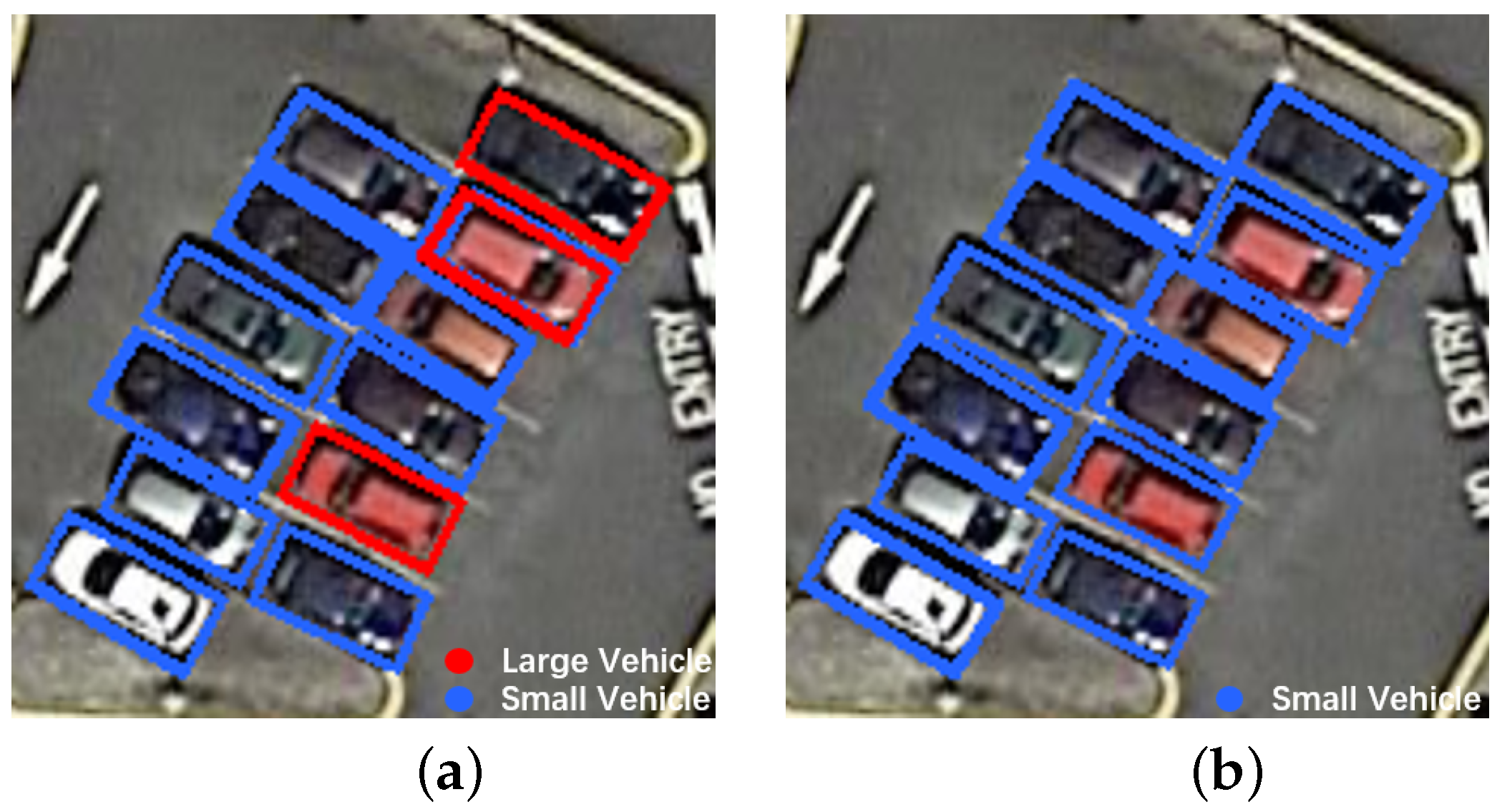
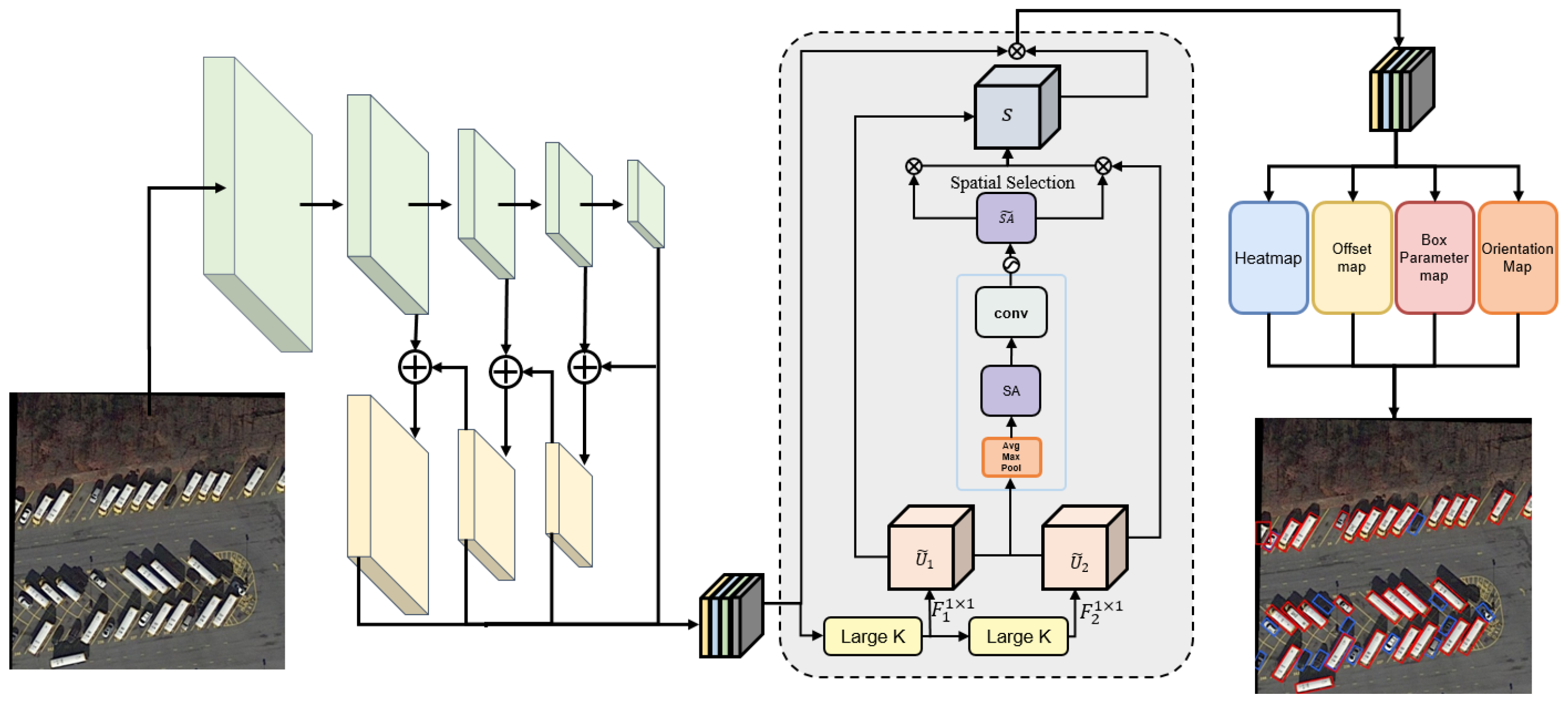
- The proposed single-stage anchor-free detection framework integrates an adaptive kernel module that dynamically adjusts the receptive field to capture contextually relevant features while ensuring high detection accuracy and efficient inference. Experiments on the DOTA and HRSC2016 datasets validate competitive performance with minimized computational resource requirements.
- Our framework integrates a feature pyramid for multi-scale object feature extraction and employs dual prediction heads to simultaneously determine object centroids and optimize boundary-aware vector representations, enhancing localization precision in remote sensing imagery. This approach is universally applicable to arbitrarily oriented objects through local coordinate system modeling for each instance, thereby achieving decoupling from the global coordinate system.
2. Related Work
2.1. Oriented Object Detection for Remote Sensing
2.2. Keypoint-Based Technology
2.3. Receptive Field Mechanism
3. Proposed Method
3.1. Architecture
3.2. Backbone Network
3.3. Adaptive Kernel
3.4. Boundary Refinement
3.4.1. Heatmap
3.4.2. Offset
3.4.3. Box Parameter
3.4.4. Orientation Map
4. Experiments
4.1. Datasets
4.2. Implementation Details
4.3. Ablation Experiments and Discussions
4.3.1. Ablation Study on DOTA-V1.0
4.3.2. Ablation Study on HRSC 2016
4.4. Comparison with the State-of-the-Art Detection Methods
4.4.1. Results on DOTA-V1.0
4.4.2. Results on HRSC2016
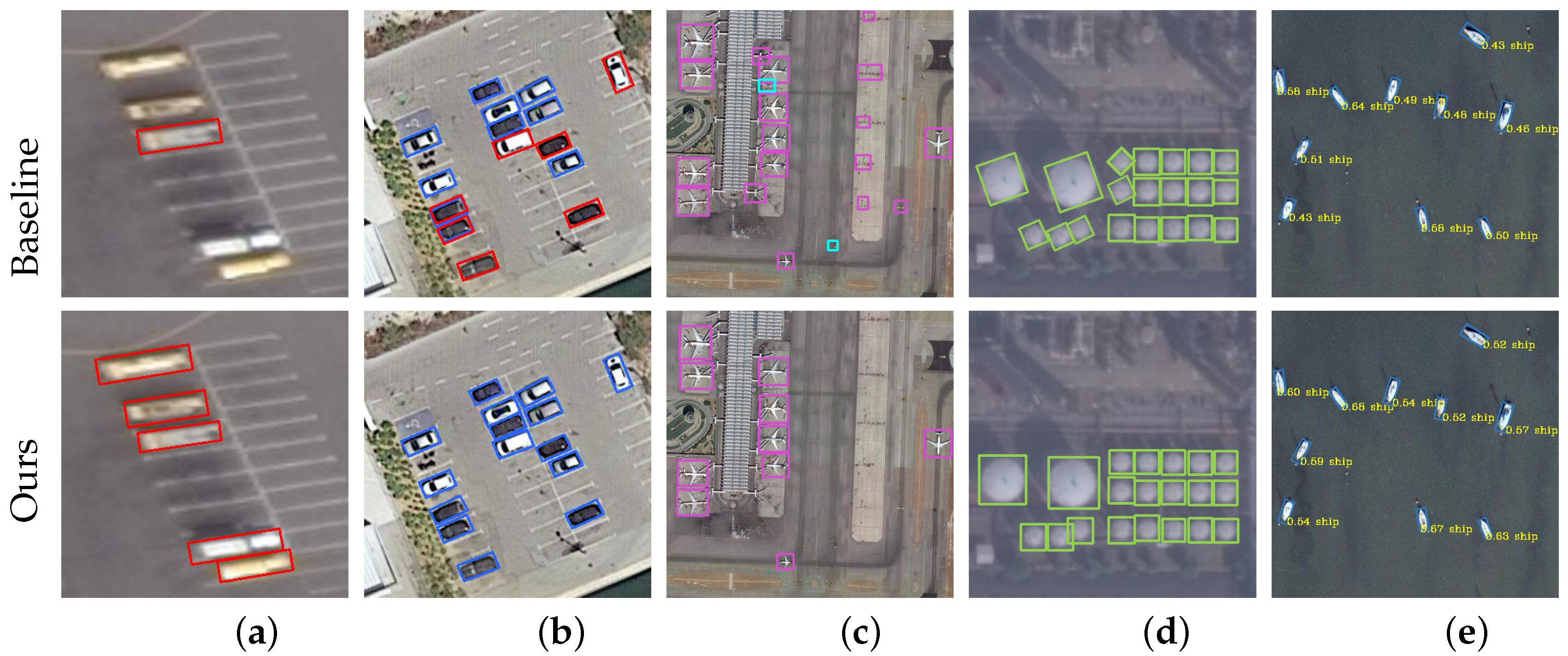
4.5. Comparison with Baseline Methods
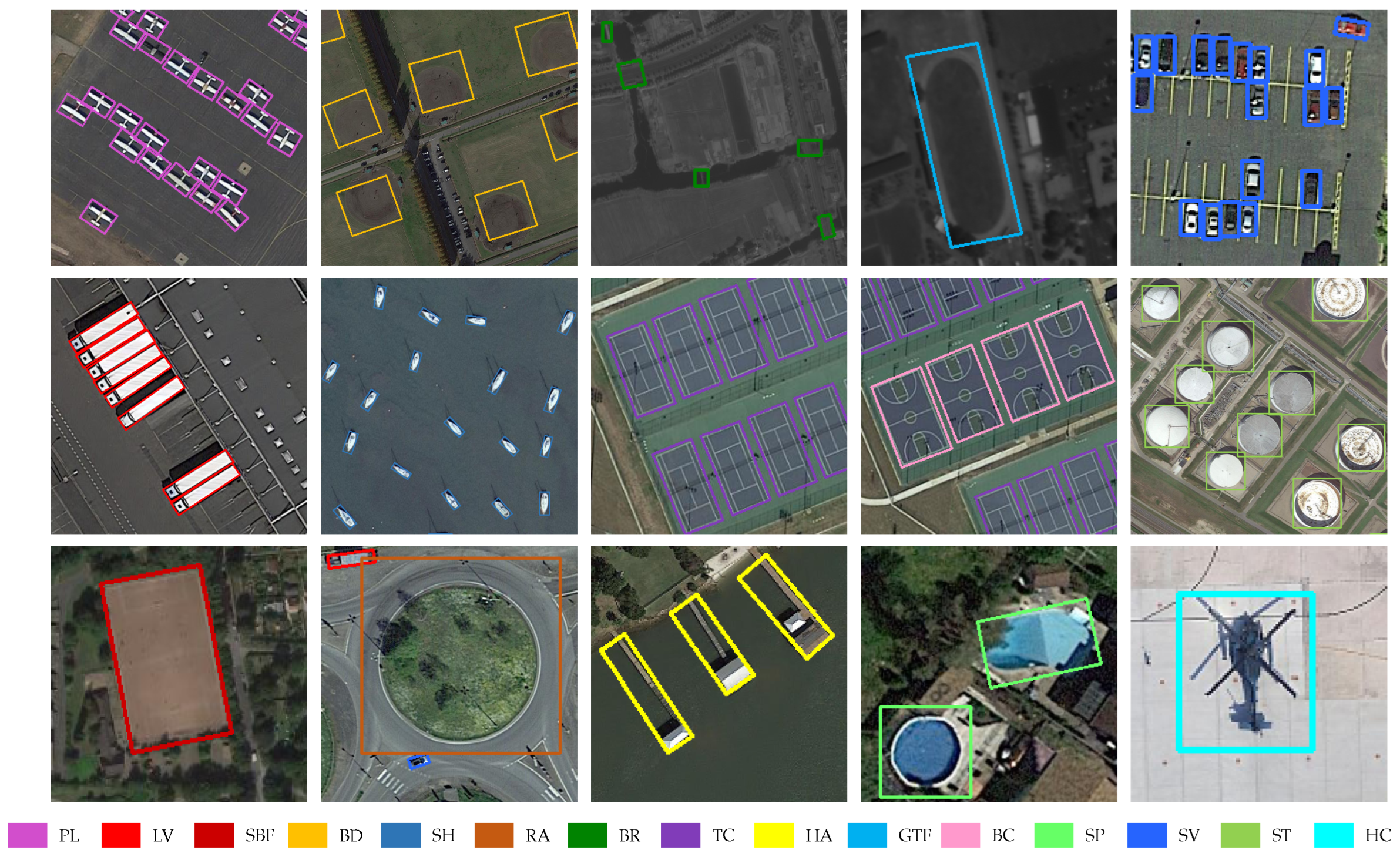
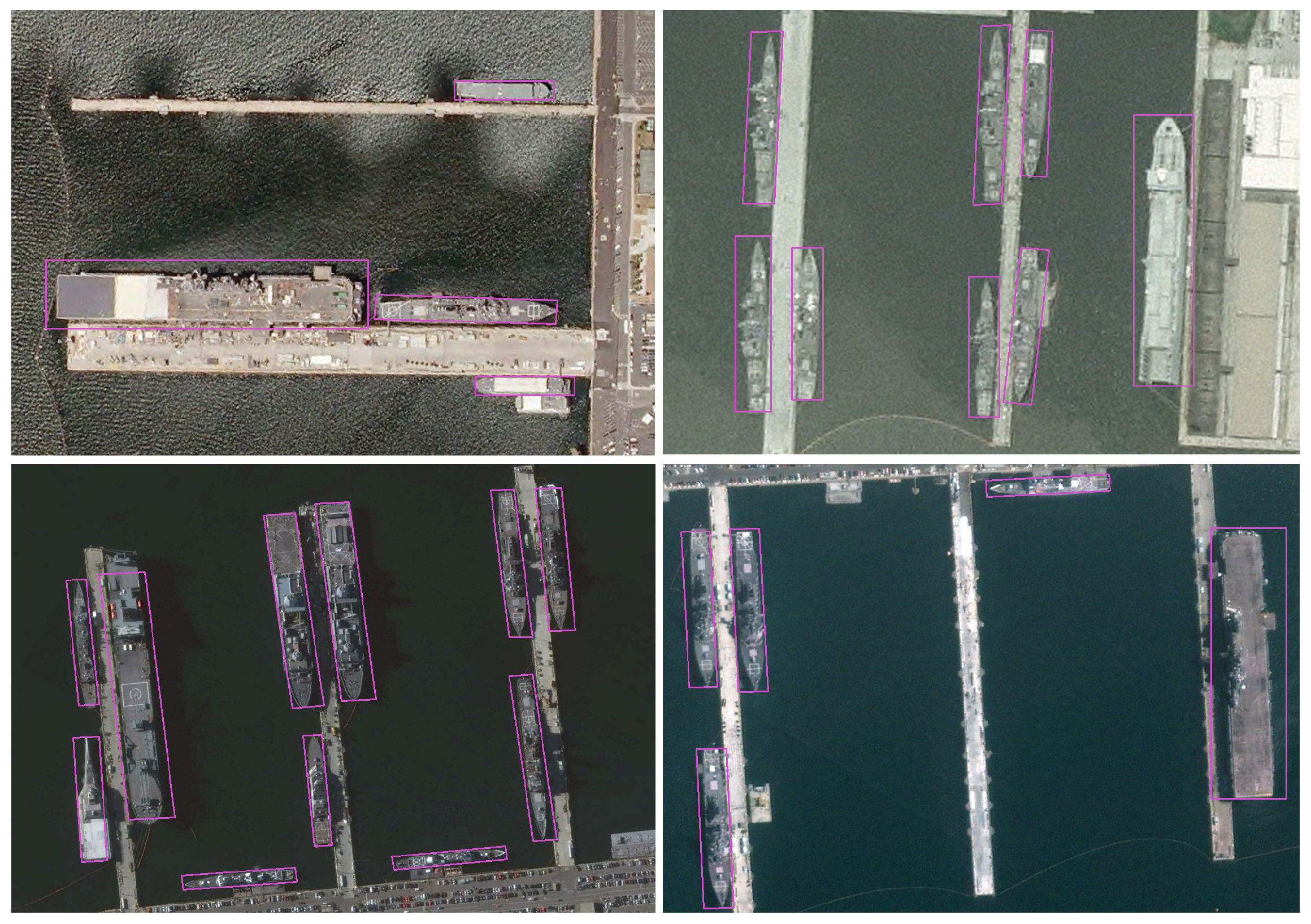
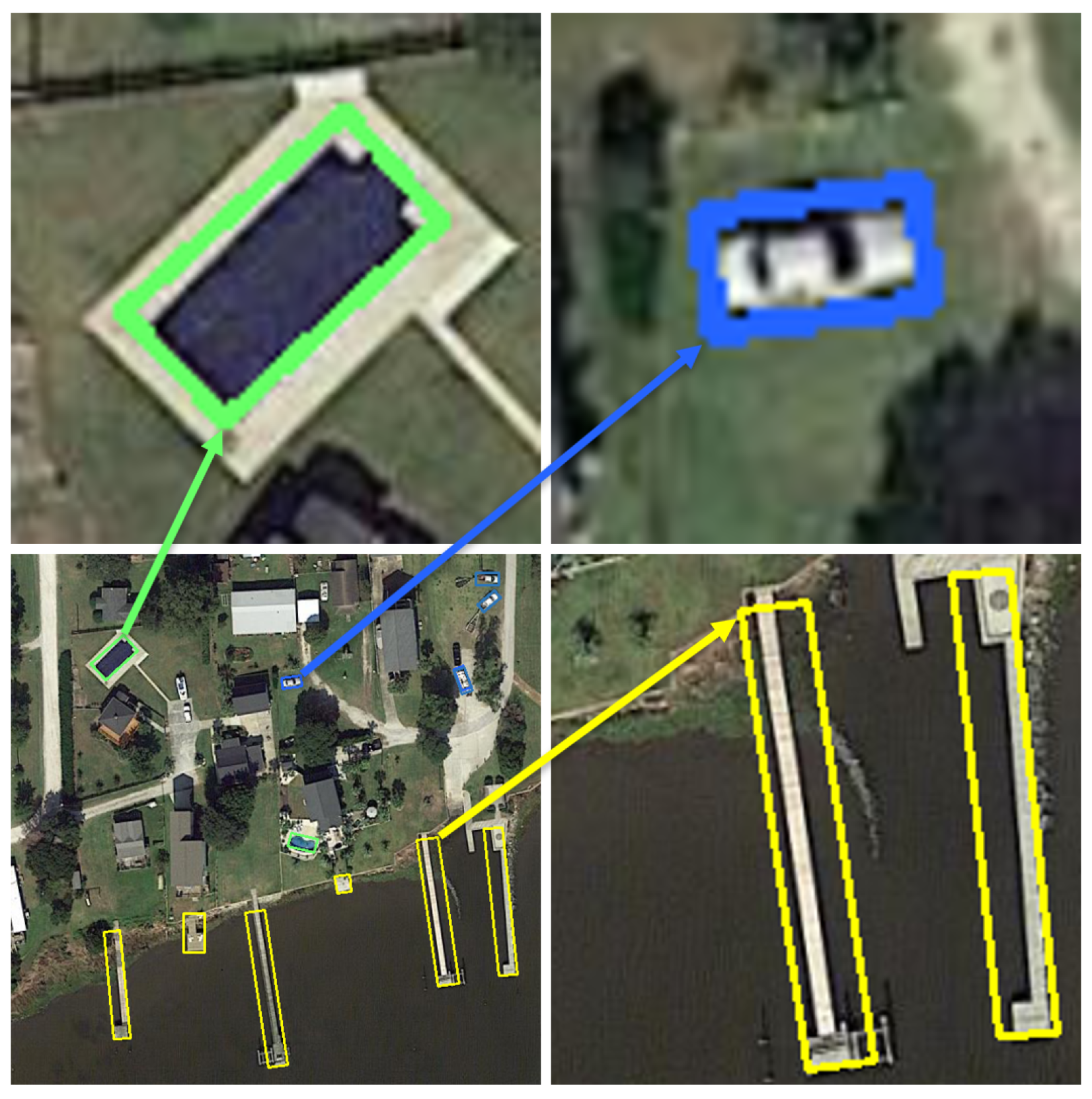
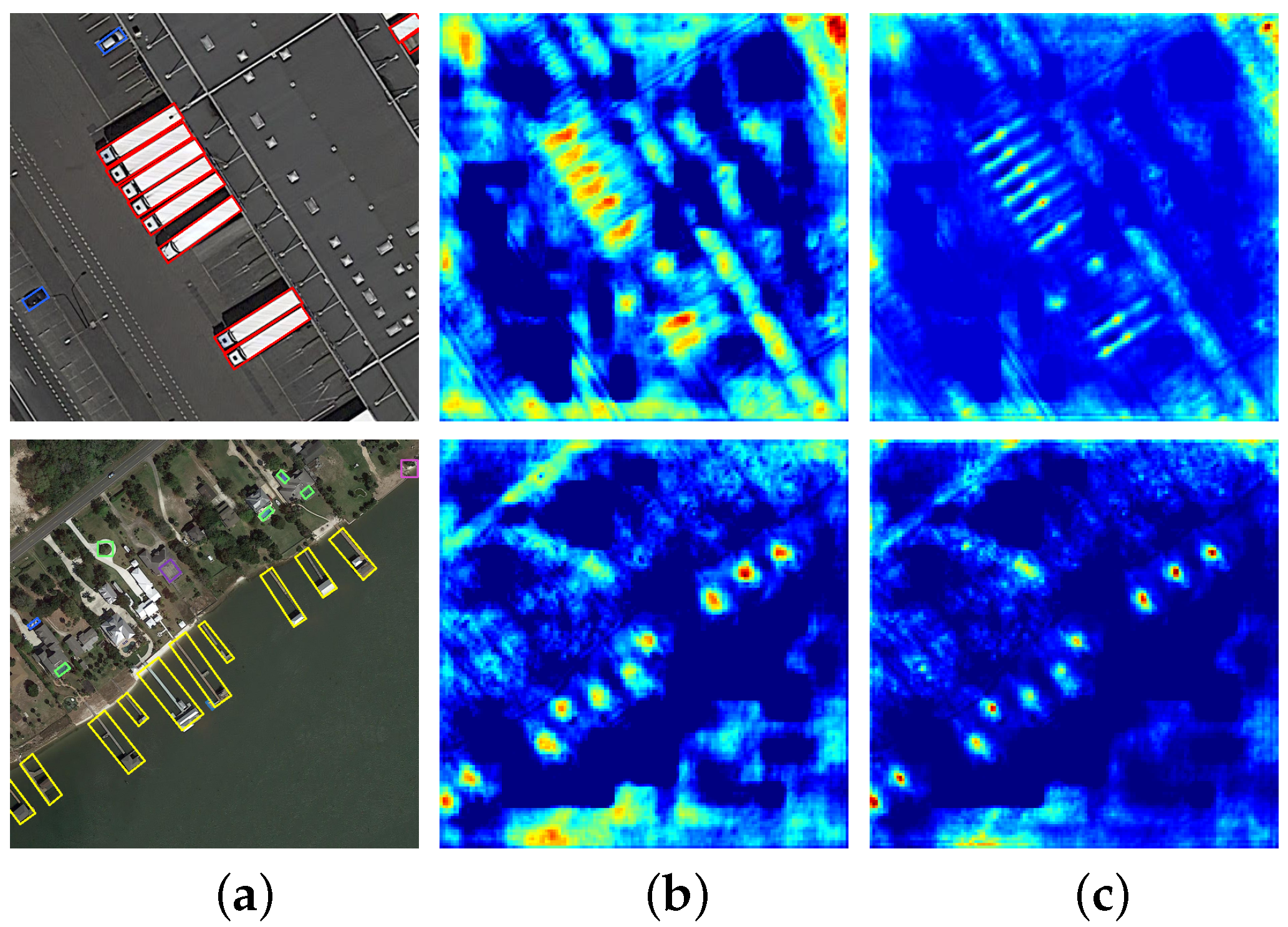
4.6. Visual Analysis
5. Conclusions
Author Contributions
Funding
Institutional Review Board Statement
Informed Consent Statement
Data Availability Statement
Conflicts of Interest
References
- Lu, W.; Chen, S.B.; Shu, Q.L.; Tang, J.; Luo, B. DecoupleNet: A Lightweight Backbone Network With Efficient Feature Decoupling for Remote Sensing Visual Tasks. IEEE Trans. Geosci. Remote Sens. 2024, 62, 4414613. [Google Scholar] [CrossRef]
- Wang, D.; Zhang, J.; Xu, M.; Liu, L.; Wang, D.; Gao, E.; Han, C.; Guo, H.; Du, B.; Tao, D.; et al. Mtp: Advancing remote sensing foundation model via multi-task pretraining. IEEE J. Sel. Top. Appl. Earth Obs. Remote Sens. 2024, 17, 11632–11654. [Google Scholar] [CrossRef]
- Hou, L.; Lu, K.; Xue, J.; Li, Y. Shape-adaptive selection and measurement for oriented object detection. In Proceedings of the AAAI Conference on Artificial Intelligence, Online, 22 February–1 March 2022; Volume 36, pp. 923–932. [Google Scholar]
- Yang, Z.; Liu, S.; Hu, H.; Wang, L.; Lin, S. Reppoints: Point set representation for object detection. In Proceedings of the IEEE/CVF International Conference on Computer Vision, Seoul, Republic of Korea, 27 October–2 November 2019; pp. 9657–9666. [Google Scholar]
- Zhao, Z.; Xue, Q.; He, Y.; Bai, Y.; Wei, X.; Gong, Y. Projecting points to axes: Oriented object detection via point-axis representation. In Proceedings of the European Conference on Computer Vision, Milan, Italy, 29 September–4 October 2024; Springer: Berlin/Heidelberg, Germany, 2024; pp. 161–179. [Google Scholar]
- Law, H.; Deng, J. Cornernet: Detecting objects as paired keypoints. In Proceedings of the European Conference on Computer Vision (ECCV), Munich, Germany, 8–14 September 2018; pp. 734–750. [Google Scholar]
- Zhou, X.; Zhuo, J.; Krahenbuhl, P. Bottom-up object detection by grouping extreme and center points. In Proceedings of the IEEE/CVF Conference on Computer Vision and Pattern Recognition, Long Beach, CA, USA, 15–20 June 2019; pp. 850–859. [Google Scholar]
- Duan, K.; Bai, S.; Xie, L.; Qi, H.; Huang, Q.; Tian, Q. Centernet: Keypoint triplets for object detection. In Proceedings of the IEEE/CVF International Conference on Computer Vision, Seoul, Republic of Korea, 27 October–2 November 2019; pp. 6569–6578. [Google Scholar]
- Ren, S.; He, K.; Girshick, R.; Sun, J. Faster R-CNN: Towards real-time object detection with region proposal networks. IEEE Trans. Pattern Anal. Mach. Intell. 2016, 39, 1137–1149. [Google Scholar] [CrossRef]
- Yi, J.; Wu, P.; Metaxas, D.N. ASSD: Attentive single shot multibox detector. Comput. Vis. Image Underst. 2019, 189, 102827. [Google Scholar] [CrossRef]
- Xie, X.; Cheng, G.; Wang, J.; Yao, X.; Han, J. Oriented R-CNN for object detection. In Proceedings of the IEEE/CVF International Conference on Computer Vision, Montreal, QC, Canada, 10–17 October 2021; pp. 3520–3529. [Google Scholar]
- Ding, J.; Xue, N.; Long, Y.; Xia, G.S.; Lu, Q. Learning RoI transformer for oriented object detection in aerial images. In Proceedings of the IEEE/CVF Conference on Computer Vision and Pattern Recognition, Long Beach, CA, USA, 15–20 June 2019; pp. 2849–2858. [Google Scholar]
- Dai, L.; Liu, H.; Tang, H.; Wu, Z.; Song, P. Ao2-detr: Arbitrary-oriented object detection transformer. IEEE Trans. Circuits Syst. Video Technol. 2022, 33, 2342–2356. [Google Scholar] [CrossRef]
- Xu, Y.; Fu, M.; Wang, Q.; Wang, Y.; Chen, K.; Xia, G.S.; Bai, X. Gliding vertex on the horizontal bounding box for multi-oriented object detection. IEEE Trans. Pattern Anal. Mach. Intell. 2020, 43, 1452–1459. [Google Scholar] [CrossRef]
- Hou, L.; Lu, K.; Yang, X.; Li, Y.; Xue, J. G-rep: Gaussian representation for arbitrary-oriented object detection. Remote Sens. 2023, 15, 757. [Google Scholar] [CrossRef]
- Fu, K.; Chang, Z.; Zhang, Y.; Xu, G.; Zhang, K.; Sun, X. Rotation-aware and multi-scale convolutional neural network for object detection in remote sensing images. ISPRS J. Photogramm. Remote Sens. 2020, 161, 294–308. [Google Scholar] [CrossRef]
- Ming, Q.; Zhou, Z.; Miao, L.; Zhang, H.; Li, L. Dynamic anchor learning for arbitrary-oriented object detection. In Proceedings of the AAAI Conference on Artificial Intelligence, Virtually, 2–9 February 2021; Volume 35, pp. 2355–2363. [Google Scholar]
- Pu, X.; Xu, F. Low-rank adaption on transformer-based oriented object detector for satellite onboard processing of remote sensing images. IEEE Trans. Geosci. Remote Sens. 2025, 63, 5202213. [Google Scholar] [CrossRef]
- Zeng, Y.; Chen, Y.; Yang, X.; Li, Q.; Yan, J. ARS-DETR: Aspect ratio-sensitive detection transformer for aerial oriented object detection. IEEE Trans. Geosci. Remote Sens. 2024, 62, 5610315. [Google Scholar] [CrossRef]
- Cheng, G.; Zhou, P.; Han, J. Learning rotation-invariant convolutional neural networks for object detection in VHR optical remote sensing images. IEEE Trans. Geosci. Remote Sens. 2016, 54, 7405–7415. [Google Scholar] [CrossRef]
- Cheng, G.; Han, J. A survey on object detection in optical remote sensing images. ISPRS J. Photogramm. Remote Sens. 2016, 117, 11–28. [Google Scholar] [CrossRef]
- Deng, Z.; Sun, H.; Zhou, S.; Zhao, J.; Lei, L.; Zou, H. Multi-scale object detection in remote sensing imagery with convolutional neural networks. ISPRS J. Photogramm. Remote Sens. 2018, 145, 3–22. [Google Scholar] [CrossRef]
- Li, Y.; Mao, H.; Liu, R.; Pei, X.; Jiao, L.; Shang, R. A lightweight keypoint-based oriented object detection of remote sensing images. Remote Sens. 2021, 13, 2459. [Google Scholar] [CrossRef]
- He, X.; Ma, S.; He, L.; Ru, L.; Wang, C. Learning rotated inscribed ellipse for oriented object detection in remote sensing images. Remote Sens. 2021, 13, 3622. [Google Scholar] [CrossRef]
- Yi, J.; Wu, P.; Liu, B.; Huang, Q.; Qu, H.; Metaxas, D. Oriented object detection in aerial images with box boundary-aware vectors. In Proceedings of the IEEE/CVF Winter Conference on Applications of Computer Vision, Virtual, 5–9 January 2021; pp. 2150–2159. [Google Scholar]
- Song, F.; Ma, R.; Lei, T.; Peng, Z. RAIH-Det: An end-to-end rotated aircraft and aircraft head detector based on ConvNeXt and cyclical focal loss in optical remote sensing images. Remote Sens. 2023, 15, 2364. [Google Scholar] [CrossRef]
- Hu, Y.; Jing, Z.; Su, Y.; Zhang, F.; Jing, D. ASSK-Net: Automatic Spatial Selection Kernel Network for Faster Oriented Object Detection. J. Indian Soc. Remote Sens. 2025, 53, 3935–3948. [Google Scholar] [CrossRef]
- Liu, Z.; Mao, H.; Wu, C.Y.; Feichtenhofer, C.; Darrell, T.; Xie, S. A convnet for the 2020s. In Proceedings of the IEEE/CVF Conference on Computer Vision and Pattern Recognition, New Orleans, LA, USA, 18–24 June 18 2022; pp. 11976–11986. [Google Scholar]
- Ding, X.; Zhang, X.; Han, J.; Ding, G. Scaling up your kernels to 31x31: Revisiting large kernel design in cnns. In Proceedings of the IEEE/CVF conference on computer vision and pattern recognition, New Orleans, LA, USA, 18–24 June 2022; pp. 11963–11975. [Google Scholar]
- Liu, S.; Chen, T.; Chen, X.; Chen, X.; Xiao, Q.; Wu, B.; Kärkkäinen, T.; Pechenizkiy, M.; Mocanu, D.; Wang, Z. More convnets in the 2020s: Scaling up kernels beyond 51x51 using sparsity. arXiv 2022, arXiv:2207.03620. [Google Scholar]
- Wei, X.; Li, Z.; Wang, Y. SED-YOLO based multi-scale attention for small object detection in remote sensing. Sci. Rep. 2025, 15, 3125. [Google Scholar] [CrossRef] [PubMed]
- Hou, Q.; Lu, C.Z.; Cheng, M.M.; Feng, J. Conv2former: A simple transformer-style convnet for visual recognition. IEEE Trans. Pattern Anal. Mach. Intell. 2024, 46, 8274–8283. [Google Scholar] [CrossRef] [PubMed]
- Song, Q.; Yang, F.; Yang, L.; Liu, C.; Hu, M.; Xia, L. Learning point-guided localization for detection in remote sensing images. IEEE J. Sel. Top. Appl. Earth Obs. Remote Sens. 2020, 14, 1084–1094. [Google Scholar] [CrossRef]
- Liu, J.; Zhang, J.; Ni, Y.; Chi, W.; Qi, Z. Small-Object Detection in Remote Sensing Images with Super Resolution Perception. IEEE J. Sel. Top. Appl. Earth Obs. Remote Sens. 2024, 17, 15721–15734. [Google Scholar] [CrossRef]
- Liao, M.; Zou, Z.; Wan, Z.; Yao, C.; Bai, X. Real-time scene text detection with differentiable binarization and adaptive scale fusion. IEEE Trans. Pattern Anal. Mach. Intell. 2022, 45, 919–931. [Google Scholar] [CrossRef]
- Li, K.; Wan, G.; Cheng, G.; Meng, L.; Han, J. Object detection in optical remote sensing images: A survey and a new benchmark. ISPRS J. Photogramm. Remote Sens. 2020, 159, 296–307. [Google Scholar] [CrossRef]
- Zhuang, S.; Wang, P.; Jiang, B.; Wang, G.; Wang, C. A single shot framework with multi-scale feature fusion for geospatial object detection. Remote Sens. 2019, 11, 594. [Google Scholar] [CrossRef]
- Zhu, H.; Chen, X.; Dai, W.; Fu, K.; Ye, Q.; Jiao, J. Orientation robust object detection in aerial images using deep convolutional neural network. In Proceedings of the 2015 IEEE International Conference on Image Processing (ICIP), Quebec, QC, Canada, 27–30 September 2015; pp. 3735–3739. [Google Scholar]
- Xia, G.S.; Bai, X.; Ding, J.; Zhu, Z.; Belongie, S.; Luo, J.; Datcu, M.; Pelillo, M.; Zhang, L. DOTA: A large-scale dataset for object detection in aerial images. In Proceedings of the IEEE Conference on Computer Vision and Pattern Recognition, Salt Lake City, UT, USA, 18–23 June 2018; pp. 3974–3983. [Google Scholar]
- Liu, Z.; Yuan, L.; Weng, L.; Yang, Y. A high resolution optical satellite image dataset for ship recognition and some new baselines. In Proceedings of the International Conference on Pattern Recognition Applications and Methods; SciTePress: Setúbal, Portugal, 2017; Volume 2, pp. 324–331. [Google Scholar]
- Yang, X.; Sun, H.; Fu, K.; Yang, J.; Sun, X.; Yan, M.; Guo, Z. Automatic ship detection in remote sensing images from google earth of complex scenes based on multiscale rotation dense feature pyramid networks. Remote Sens. 2018, 10, 132. [Google Scholar] [CrossRef]
- Jiang, Y.; Zhu, X.; Wang, X.; Yang, S.; Li, W.; Wang, H.; Fu, P.; Luo, Z. R2CNN: Rotational region CNN for orientation robust scene text detection. arXiv 2017, arXiv:1706.09579. [Google Scholar] [CrossRef]
- Yang, X.; Sun, H.; Sun, X.; Yan, M.; Guo, Z.; Fu, K. Position detection and direction prediction for arbitrary-oriented ships via multitask rotation region convolutional neural network. IEEE Access 2018, 6, 50839–50849. [Google Scholar] [CrossRef]
- Azimi, S.M.; Vig, E.; Bahmanyar, R.; Körner, M.; Reinartz, P. Towards multi-class object detection in unconstrained remote sensing imagery. In Proceedings of the Asian Conference on Computer Vision; Springer: Berlin/Heidelberg, Germany, 2018; pp. 150–165. [Google Scholar]
- Hu, Z.; Gao, K.; Zhang, X.; Wang, J.; Wang, H.; Yang, Z.; Li, C.; Li, W. EMO2-DETR: Efficient-matching oriented object detection with transformers. IEEE Trans. Geosci. Remote Sens. 2023, 61, 5616814. [Google Scholar] [CrossRef]
- Zhang, Z.; Guo, W.; Zhu, S.; Yu, W. Toward arbitrary-oriented ship detection with rotated region proposal and discrimination networks. IEEE Geosci. Remote Sens. Lett. 2018, 15, 1745–1749. [Google Scholar] [CrossRef]
- Liao, M.; Zhu, Z.; Shi, B.; Xia, G.s.; Bai, X. Rotation-sensitive regression for oriented scene text detection. In Proceedings of the IEEE Conference on Computer Vision and Pattern Recognition, Salt Lake City, UT, USA, 18–23 June 2018; pp. 5909–5918. [Google Scholar]
- Han, J.; Ding, J.; Li, J.; Xia, G.S. Align deep features for oriented object detection. IEEE Trans. Geosci. Remote Sens. 2021, 60, 5602511. [Google Scholar] [CrossRef]
- Yu, Y.; Da, F. Phase-shifting coder: Predicting accurate orientation in oriented object detection. In Proceedings of the IEEE/CVF Conference on Computer Vision and Pattern Recognition, Vancouver, BC, Canada, 17–24 June 2023; pp. 13354–13363. [Google Scholar]



| Method | Backbone | mAP (↑) | FLOPs (↓) | #P (↓) | FPS (↑) |
|---|---|---|---|---|---|
| BBAVectors | ResNet-101 | 72.32 | 176.61 | 53.43 | 39.41 |
| MAK-BRNet-O | ResNet-18 | 72.14 | 83.64 | 14.33 | 64.56 |
| ResNet-34 | 74.83 | 97.30 | 24.44 | 58.62 | |
| ResNet-50 | 74.00 | 101.18 | 26.85 | 53.60 | |
| ResNet-101 | 75.72 | 128.68 | 45.84 | 43.14 | |
| ResNet-152 | 75.51 | 156.21 | 61.48 | 36.04 | |
| MAK-BRNet-R | ResNet-18 | 72.53 | 83.35 | 14.45 | 59.38 |
| ResNet-34 | 74.65 | 100.02 | 24.56 | 54.29 | |
| ResNet-50 | 74.58 | 103.89 | 26.96 | 50.96 | |
| ResNet-101 | 75.84 | 131.39 | 45.96 | 43.43 | |
| ResNet-152 | 75.82 | 158.92 | 61.60 | 34.17 | |
| MAK-BRNet-D | DecoupleNet D0 | 69.73 | 74.94 | 4.81 | 44.38 |
| DecoupleNet D2 | 73.59 | 81.11 | 9.49 | 43.46 |
| Method | Backbone | mAP (↑) | FLOPs (↓) | #P (↓) | FPS (↑) |
|---|---|---|---|---|---|
| BBAVectors | ResNet-101 | 88.22 | 176.53 | 53.43 | 49.87 |
| MAK-BRNet-O | ResNet-18 | 79.00 | 83.56 | 14.33 | 91.27 |
| ResNet-34 | 89.10 | 97.22 | 24.44 | 83.77 | |
| ResNet-50 | 88.34 | 101.09 | 26.85 | 72.03 | |
| ResNet-101 | 89.68 | 128.59 | 45.83 | 54.14 | |
| ResNet-152 | 89.97 | 156.13 | 61.48 | 39.71 | |
| MAK-BRNet-R | ResNet-18 | 86.02 | 86.27 | 14.45 | 82.61 |
| ResNet-34 | 88.16 | 99.93 | 24.55 | 72.53 | |
| ResNet-50 | 88.70 | 103.81 | 26.96 | 65.75 | |
| ResNet-101 | 89.73 | 131.31 | 45.95 | 49.48 | |
| ResNet-152 | 90.13 | 158.84 | 61.60 | 37.25 | |
| MAK-BRNet-D | DecoupleNet D0 | 73.71 | 74.86 | 4.81 | 56.46 |
| DecoupleNet D2 | 86.05 | 81.03 | 9.49 | 53.85 |
| Method | mAP | PL | BD | BR | GTF | SV | LV | SH | TC | BC | ST | SBF | RA | HA | SP | HC |
|---|---|---|---|---|---|---|---|---|---|---|---|---|---|---|---|---|
| FR-O [39] | 54.13 | 79.42 | 77.13 | 17.70 | 64.05 | 35.3 | 38.02 | 37.16 | 89.41 | 69.64 | 59.28 | 50.3 | 52.91 | 47.89 | 47.40 | 46.30 |
| R-DFPN [41] | 57.94 | 80.92 | 65.82 | 33.77 | 58.94 | 55.77 | 50.94 | 54.78 | 90.33 | 66.34 | 68.66 | 48.73 | 51.76 | 55.10 | 51.32 | 35.88 |
| [42] | 60.67 | 80.94 | 65.75 | 35.34 | 67.44 | 59.92 | 50.91 | 55.81 | 90.67 | 66.92 | 72.39 | 55.06 | 52.23 | 55.14 | 53.35 | 48.22 |
| Yang et al. [43] | 62.29 | 81.25 | 71.41 | 36.53 | 67.44 | 61.16 | 50.91 | 56.60 | 90.67 | 68.09 | 72.39 | 55.06 | 55.60 | 62.44 | 53.35 | 51.47 |
| ICN [44] | 68.16 | 81.36 | 74.30 | 47.70 | 70.32 | 64.89 | 67.82 | 69.98 | 90.70 | 79.06 | 78.20 | 53.64 | 62.90 | 67.02 | 64.17 | 50.23 |
| ROI Trans. [12] | 67.74 | 88.53 | 77.91 | 37.63 | 74.08 | 66.53 | 62.97 | 66.57 | 90.50 | 79.46 | 76.75 | 59.04 | 56.73 | 62.19 | 55.56 | 55.56 |
| ROI Trans.+FPN [12] | 69.56 | 88.64 | 78.52 | 43.44 | 75.92 | 68.81 | 73.68 | 83.59 | 90.74 | 77.27 | 81.46 | 58.39 | 53.54 | 62.83 | 58.93 | 47.67 |
| EMO2-DERT [45] | 70.91 | 87.99 | 79.46 | 45.74 | 66.64 | 78.90 | 73.90 | 73.30 | 90.40 | 80.55 | 85.89 | 55.19 | 63.62 | 51.83 | 70.15 | 60.04 |
| AO2-DETR [13] | 72.15 | 86.01 | 75.92 | 46.02 | 66.65 | 79.70 | 79.93 | 89.17 | 90.44 | 81.19 | 76.00 | 56.91 | 62.45 | 64.22 | 65.80 | 58.96 |
| SASM [3] | 74.92 | 86.42 | 78.97 | 52.47 | 69.84 | 77.30 | 75.99 | 86.72 | 90.89 | 82.63 | 85.66 | 60.13 | 68.25 | 73.98 | 72.22 | 62.37 |
| ARS-DETR [19] | 75.47 | 87.65 | 76.54 | 50.64 | 69.85 | 79.76 | 83.91 | 87.92 | 90.26 | 86.24 | 85.09 | 54.58 | 67.01 | 75.62 | 73.66 | 63.39 |
| LoRA-Det [18] | 75.07 | 89.38 | 79.56 | 51.59 | 72.10 | 77.48 | 83.13 | 87.80 | 90.88 | 84.52 | 85.42 | 60.44 | 65.35 | 66.24 | 67.28 | 64.82 |
| BBAVectors [25] | 72.32 | 88.35 | 79.96 | 50.69 | 62.18 | 78.43 | 78.98 | 87.94 | 90.85 | 83.58 | 84.35 | 54.13 | 60.24 | 65.22 | 64.28 | 55.70 |
| MAK-BRNet-R(Ours) | 75.84 | 89.22 | 83.52 | 51.25 | 67.40 | 76.78 | 81.07 | 87.13 | 90.87 | 87.48 | 86.23 | 59.07 | 64.14 | 72.48 | 69.92 | 71.09 |
| Method | Backbone | mAP (↑) |
|---|---|---|
| [46] | VGG-16 | 79.60 |
| RRD [47] | VGG-16 | 84.30 |
| ROI Trans. [12] | ResNet-101 | 86.20 |
| BBAVectors [25] | ResNet-101 | 88.22 |
| AproNet [48] | ResNet-101 | 90.06 |
| PSC [49] | DarkNet-53 | 90.00 |
| MAK-BRNet-R (Ous) | ResNet-152 | 90.13 |
Disclaimer/Publisher’s Note: The statements, opinions and data contained in all publications are solely those of the individual author(s) and contributor(s) and not of MDPI and/or the editor(s). MDPI and/or the editor(s) disclaim responsibility for any injury to people or property resulting from any ideas, methods, instructions or products referred to in the content. |
© 2026 by the authors. Licensee MDPI, Basel, Switzerland. This article is an open access article distributed under the terms and conditions of the Creative Commons Attribution (CC BY) license.
Share and Cite
Niu, G.; Yang, X.; Wang, X.; Liu, Y.; Cao, L.; Yin, E.; Guo, P. MAK-BRNet: Multi-Scale Adaptive Kernel and Boundary Refinement Network for Remote Sensing Object Detection. Appl. Sci. 2026, 16, 522. https://doi.org/10.3390/app16010522
Niu G, Yang X, Wang X, Liu Y, Cao L, Yin E, Guo P. MAK-BRNet: Multi-Scale Adaptive Kernel and Boundary Refinement Network for Remote Sensing Object Detection. Applied Sciences. 2026; 16(1):522. https://doi.org/10.3390/app16010522
Chicago/Turabian StyleNiu, Ge, Xiaolong Yang, Xinhui Wang, Yong Liu, Lu Cao, Erwei Yin, and Pengyu Guo. 2026. "MAK-BRNet: Multi-Scale Adaptive Kernel and Boundary Refinement Network for Remote Sensing Object Detection" Applied Sciences 16, no. 1: 522. https://doi.org/10.3390/app16010522
APA StyleNiu, G., Yang, X., Wang, X., Liu, Y., Cao, L., Yin, E., & Guo, P. (2026). MAK-BRNet: Multi-Scale Adaptive Kernel and Boundary Refinement Network for Remote Sensing Object Detection. Applied Sciences, 16(1), 522. https://doi.org/10.3390/app16010522