Next Article in Journal
Molecular Mechanisms of Chemoresistance in Oral Squamous Cell Carcinoma: A Narrative Review with Present and Future Perspectives
Previous Article in Journal
MAK-BRNet: Multi-Scale Adaptive Kernel and Boundary Refinement Network for Remote Sensing Object Detection
error_outline You can access the new MDPI.com website here. Explore and share your feedback with us.
 
 
Article

Topological Optimization of Lumbar Intervertebral Fusion Cage with Posterior Pedicle Screw Oblique Insertion Fixation


1
Zhan Tianyou College, Dalian Jiaotong University, Dalian 116028, China
2
School of Mechanical Engineering, Dalian Jiaotong University, Dalian 116028, China
*
Authors to whom correspondence should be addressed.
Appl. Sci. 2026, 16(1), 524; https://doi.org/10.3390/app16010524
Submission received: 20 November 2025 / Revised: 27 December 2025 / Accepted: 29 December 2025 / Published: 4 January 2026

Abstract

Objective: Lumbar interbody fusion (LIF) is widely used to treat degenerative spinal disorders; however, both fixation strategies and interbody Cage designs still present biomechanical limitations. This study aimed to develop a posterior lumbar interbody fusion Cage using topology optimization and to compare the biomechanical performance of oblique pedicle screw fixation with conventional fixation. Methods: A validated three-dimensional nonlinear finite element model of the L1–L5 lumbar spine was established based on CT data. A two-step weighted topology optimization was applied to the L3–L4 interbody Cage to determine both the external contour and the internal bone graft window. Finite element models with oblique pedicle screw fixation and conventional pedicle screw–rod fixation were constructed and evaluated under static physiological loads and whole-body vibration conditions. Results: Compared with the conventional Cage, the topology-optimized Cage combined with oblique fixation significantly reduced the maximum von Mises stress on adjacent endplates and decreased Cage displacement under both static and dynamic loading. Although stresses in the Cage and screws increased relative to traditional fixation, all values remained well below material yield limits. Conclusions: The combination of a topology-optimized Cage and oblique pedicle screw fixation improves load transfer and structural stability while reducing the risk of endplate damage and Cage subsidence. This approach provides a promising alternative design strategy for posterior lumbar interbody fusion.

1. Introduction

Posterior lumbar interbody fusion (PLIF) is a widely used surgical technique for treating degenerative spinal disorders such as lumbar spinal stenosis and spondylolisthesis [1]. In this procedure, a combination of dual interbody fusion Cages with posterior internal fixation is commonly adopted. Biomechanically, the interbody Cage provides structural support between adjacent vertebrae, shares axial spinal loads, and ideally maintains long-term stability while delivering sufficient mechanical stimulation to promote intervertebral bone fusion and reduce adverse effects on adjacent segments [2].
The development of interbody Cages has progressed from autologous and allogeneic bone grafts to machined metallic and non-metallic implants. However, each generation has faced limitations, including immune rejection, inadequate interfacial bonding, and stress shielding [3]. With the rapid advancement of medical 3D printing, porous metallic Cages and polyetheretherketone (PEEK) Cages have become increasingly prevalent in clinical practice [4,5]. Despite these advances, complications such as endplate mismatch, endplate fracture, and Cage subsidence or migration remain unresolved.
In general, the balance between interfacial stress and support strength at the Cage–endplate interface is a key determinant of Cage subsidence and endplate failure [6]. Biomechanical evidence suggests that implants covering more than 30% of the endplate area can improve load-bearing capacity and fusion rates [7,8]. Similarly, Wu Jincheng et al. [9] designed three Cages with identical shapes but different sizes and demonstrated via finite element analysis (FEA) that increasing the axial contact area effectively reduces endplate stress. However, most conventional Cage designs primarily rely on enlarging implant size to increase contact area and restore disc height [10] while overlooking the mismatch between Cage geometry and physiological load distribution, which may be a major contributor to these complications. Choi et al. [11] reported that a banana-shaped Cage reduced endplate stress compared with a rectangular Cage in minimally invasive transforaminal lumbar interbody fusion (MIS-TLIF). Nevertheless, Cage geometry is constrained by surgical approach and anatomical limitations, making the identification of an optimal shape that accommodates physiological load distribution within the confined intervertebral space a critical challenge.
Achieving an optimal Cage design requires an accurate representation of physiological loading conditions. Most previous studies evaluated Cage performance based on endplate stress under static loading. However, whole-body vibration (WBV), which commonly occurs during activities such as vehicle riding, introduces dynamic loading that cannot be neglected. Guo Lixin et al. [12] investigated WBV effects on a healthy lumbar spine and observed significant increases in vertebral axial displacement, intradiscal pressure, and disc herniation risk. In patients undergoing lumbar fusion, the presence of implants and reduced spinal stability may further exacerbate the detrimental effects of WBV. Therefore, the mechanical behavior of interbody Cages under WBV conditions represents a critical yet underexplored evaluation criterion. Shen Hangkai et al. [13] assessed different internal fixation fusion constructs under vibrational loading, highlighting the biomechanical advantages and limitations of various fixation strategies.
Using a phantom-based L1–L5 finite element model in conjunction with a two-step weighted topology optimization framework, this study aims to design and validate an interbody fusion cage tailored for posterior-approach oblique screw fixation. Its mechanical performance is systematically compared with that of a conventional cage and a traditional screw–rod fixation system under both static physiological loading and whole-body vibration loading. The evaluation focuses on its ability to reduce endplate stress, limit cage displacement, and enhance dynamic stability.
Furthermore, as long-term postoperative stability is closely related to adaptive bone remodeling at the cage–endplate interface, the optimized stress distribution obtained in this study aligns with mechanobiological principles underlying Wolff’s law. In particular, recent continuum models with evolving orthotropic substructure have shown how trabecular orientation and density adapt directly to mechanical loading patterns, supporting the relevance of designing Cages that promote favorable, uniform stress fields [14].
Since successful interbody fusion depends not only on initial mechanical stability but also on the subsequent adaptive response of bone, it is essential to consider the mechanobiological environment induced by the Cage. Recent work in theramechanics has shown that bone remodeling is strongly regulated by coupled mechanical and biological stimuli, which govern how tissue reorganizes over the long term [15].
Accordingly, this study hypothesizes that, under equivalent contact area conditions, a weighted topology-optimized cage combined with oblique screw fixation can achieve a more uniform endplate stress distribution and superior dynamic stability than conventional designs, thereby reducing the risks of endplate fracture and cage subsidence.

2. Materials and Methods

2.1. Construction and Validation of a Complete Lumbar Finite Element Model

This study is a phantom-based numerical experimental investigation (in silico study) conducted in three sequential phases. (1) A nonlinear L1–L5 finite element model was constructed and validated based on CT data from a single healthy volunteer. (2) A two-step weighted topology optimization was performed at the L3–L4 intervertebral level to obtain the external contour and the internal bone-grafting window of the cage. (3) The optimized cage and a conventional cage were compared under three fixation strategies (corresponding to three models) through static and dynamic mechanical analyses, including vertical vibration loading. The key parameters, boundary conditions, and validation metrics for each phase are described in detail in the following sections.
The CT data from a healthy 30-year-old male volunteer, with no history of low back pain, spinal degeneration, or malformation, were acquired and utilized to construct a three-dimensional nonlinear finite element model of the lumbar spine segments from L1 to L5 in ABAQUS 2020. The model comprises five vertebrae (including cortical bone, cancellous bone, and endplates), four intervertebral discs (consisting of 56% annulus fibrosus and 44% nucleus pulposus [16]), four pairs of articular cartilages, and seven sets of ligaments (including anterior longitudinal ligament, posterior longitudinal ligament, ligamentum flavum, intertransverse ligament, interspinous ligament, supraspinous ligament, and facet joint ligament). All relevant ligaments were constructed based on their anatomical positions, referencing the findings of Chazal et al. [17]. Ligaments were simulated using two-node truss elements to represent their tension-only behavior, while the annulus fibrosus, nucleus pulposus, and articular cartilages were modeled with eight-node hexahedral elements (C3D8H), and the remaining parts were modeled with four-node tetrahedral elements (C3D4).
The topology optimization procedure was implemented using the density-based method embedded in ABAQUS 2020. The Solid Isotropic Material with Penalization (SIMP) approach was adopted, in which the elastic modulus of each element was expressed as a function of its density. A penalization factor of 3.0 was applied during the optimization process to promote a clear separation between solid and void regions. Both stages of the topology optimization were solved using the ABAQUS Standard implicit solver, and a linear static analysis was performed at each optimization iteration. Convergence was achieved when the relative change in the objective function between successive iterations was less than 1%. The maximum number of optimization iterations was set to 25 to ensure sufficient stabilization of the density field. Prior to optimization, a mesh sensitivity analysis was conducted.
The initial Cage design domain was discretized using four-node tetrahedral elements (C3D4) with an average element size of approximately 0.5 mm. Local mesh refinement was applied near the endplate contact surfaces and around the screw channel boundaries to ensure accurate stress transfer. Further mesh refinement resulted in changes of less than 5% in the peak von Mises stress, indicating that mesh convergence had been achieved. The meshing of cortical bone, cancellous bone, and screws was performed in HyperMesh 14.0. The mesh size was set to 0.4 mm in the screw regions and the surrounding vertebral bone, while the remaining vertebral regions employed mesh sizes ranging from 0.5 to 2 mm. The total model consisted of 644,896 elements, all of which were C3D4 elements.
Symmetric design constraints were imposed on the density field to ensure bilateral symmetry of the optimized Cage with respect to the midsagittal plane. In the second optimization stage, the external Cage contour, screw channels, and posterior implantation-related regions were defined as non-design domains to guarantee surgical accessibility and compatibility with the internal fixation system. After completion of the topology optimization, a density threshold smoothing method was applied to convert the continuous density field into a manufacturable Cage geometry. Elements with a normalized density greater than 0.5 were retained as solid material, while the remaining elements were removed. The resulting geometry was then subjected to surface reconstruction and smoothing to eliminate numerical artifacts and sharp edges, ultimately yielding a continuous Cage structure suitable for additive manufacturing.
The design variable in the optimization process was the element-wise relative density, with values ranging from 0 to 1. The primary constraints included a prescribed volume fraction to limit material removal, fixed non-design regions that excluded the outer surface of the cage and the endplate contact areas, and loading and boundary conditions consistent with those used in the subsequent finite element validation. Manufacturing constraints and minimum feature size constraints were not explicitly incorporated into the optimization formulation, but were instead addressed during post-processing and geometric reconstruction. Convergence of the optimization process was monitored by tracking the stabilization of the overall structural compliance and the material distribution between successive iterations.
Tie constraints were applied between cortical and cancellous bone within the vertebrae, between endplates and adjacent cortical bone as well as the disc surfaces, and between the annulus fibrosus and nucleus pulposus within the discs. The contact of articular cartilage is set as one side is bound to the upper articular process of the lower vertebrae, and the other side is in contact with the lower articular process of the upper vertebrae. The penalty friction coefficient is 0.20 [18]. The element types and assigned finite element material parameters for each component are detailed in Table 1 and Table 2 [18,19,20,21,22,23].
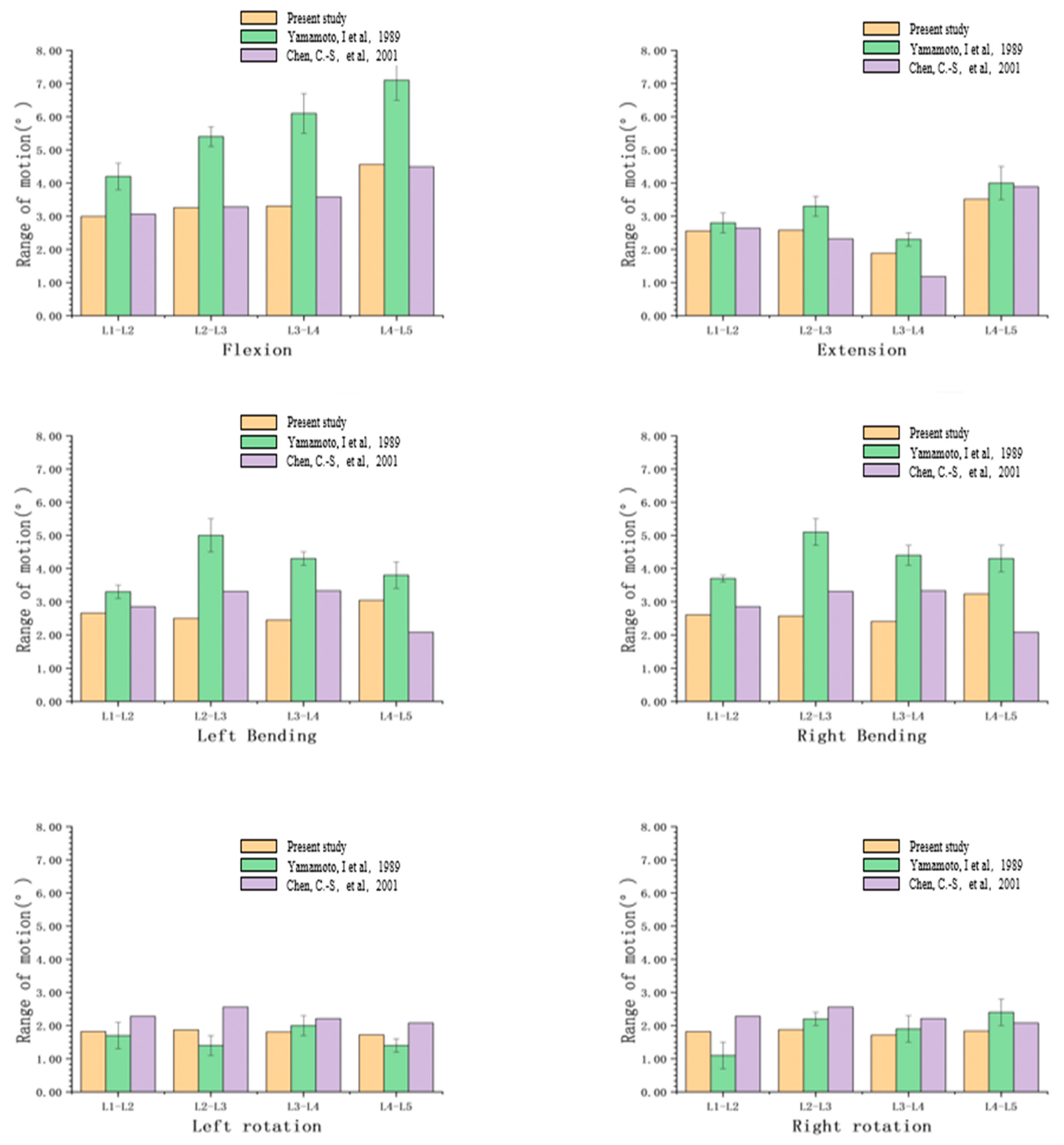
The nodes at the bottom of the L5 vertebrae in all directions were fully restrained in all degrees of freedom. In addition to an axial load of 150 N on the upper surface of L1, six different loading conditions of 10 Nm were applied for flexion-extension (±Rx), lateral bending (±Ry), and axial rotation (±Rz), respectively [24,25]. The L1–L5 intervertebral mobility (ROM) was calculated to validate our finite element model.

2.2. Weighted Topology Optimization for Cage Design

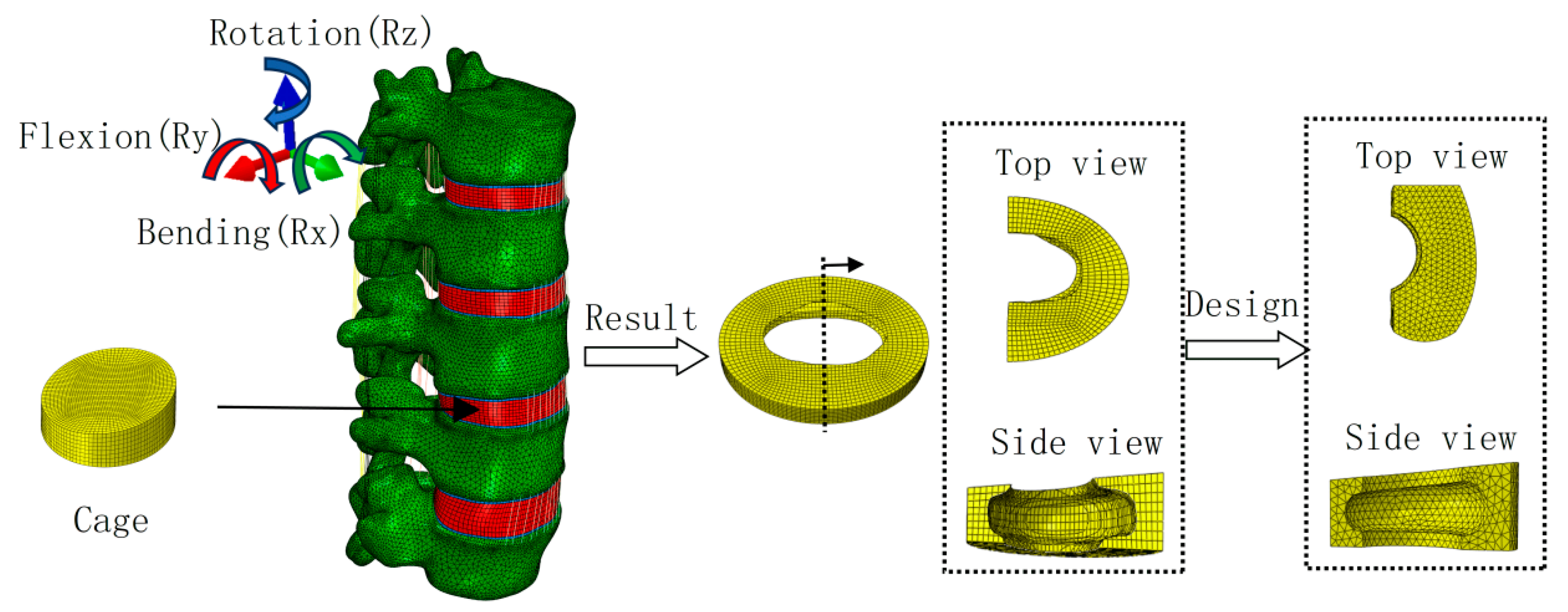
To investigate a more rational Cage structure for oblique posterior lumbar interbody fusion (PLIF), in this paper, the Cage structure which makes the endplate stress distribution smaller and more uniform under the action of human physiological load is discussed. On the basis of the verified complete lumbar finite element model, this goal is achieved by carrying out two structural topological optimization.
To obtain an optimal Cage outline that conforms to the normal lumbar biomechanical properties, the Cage was initially designed as an elliptical disk filling the intervertebral space at L3–L4, replacing the disc tissue for structural optimization. The first topology optimization was conducted with the L5 vertebral inferior surface fully fixed as the boundary condition. An axial load of 400 N was applied to simulate the body’s upper torso weight, and six moments of 10 Nm each were applied to the superior surface of the L1 vertebra in flexion, extension, left and right lateral bending, and left and right axial rotation to mimic the six modes of lumbar spontaneous motion during daily activities. The strain energy and Cage volume under these six conditions were set as design responses, with weights of 21.5% for flexion and extension, 33% for bending, and 24% for axial rotation. This weighting scheme is commonly adopted in the literature to represent the load distribution associated with activities of daily living [26].
Under the constraint condition that the volume response of Cage is limited to about 50% of the initial value, an objective function is created to obtain the minimum design response value. This completes the model setting for the first topology optimization.
From a mechanical perspective, a volume fraction of approximately 50% is widely adopted in topology optimization studies of load-bearing implants, as it allows significant material removal while preserving the primary load-transfer paths. Our preliminary parametric tests indicated that further reduction of the volume fraction (e.g., to 30%) led to pronounced stress concentration around the internal openings, particularly under bending conditions, which may compromise structural safety. In contrast, higher volume fractions resulted in overly conservative designs with limited structural differentiation.
From a biological and clinical standpoint, reducing the cage volume to 50% provides sufficient internal space for bone grafting and facilitates potential bone ingrowth, while maintaining adequate structural stiffness to support physiological loads during the early postoperative period.
Therefore, the 50% volume constraint represents a reasonable compromise between mechanical integrity, biological functionality, and practical manufacturability, and was chosen as the baseline setting for the first-step topology optimization. The influence of further volume reduction was subsequently discussed to illustrate the trade-off between mechanical performance and grafting space.
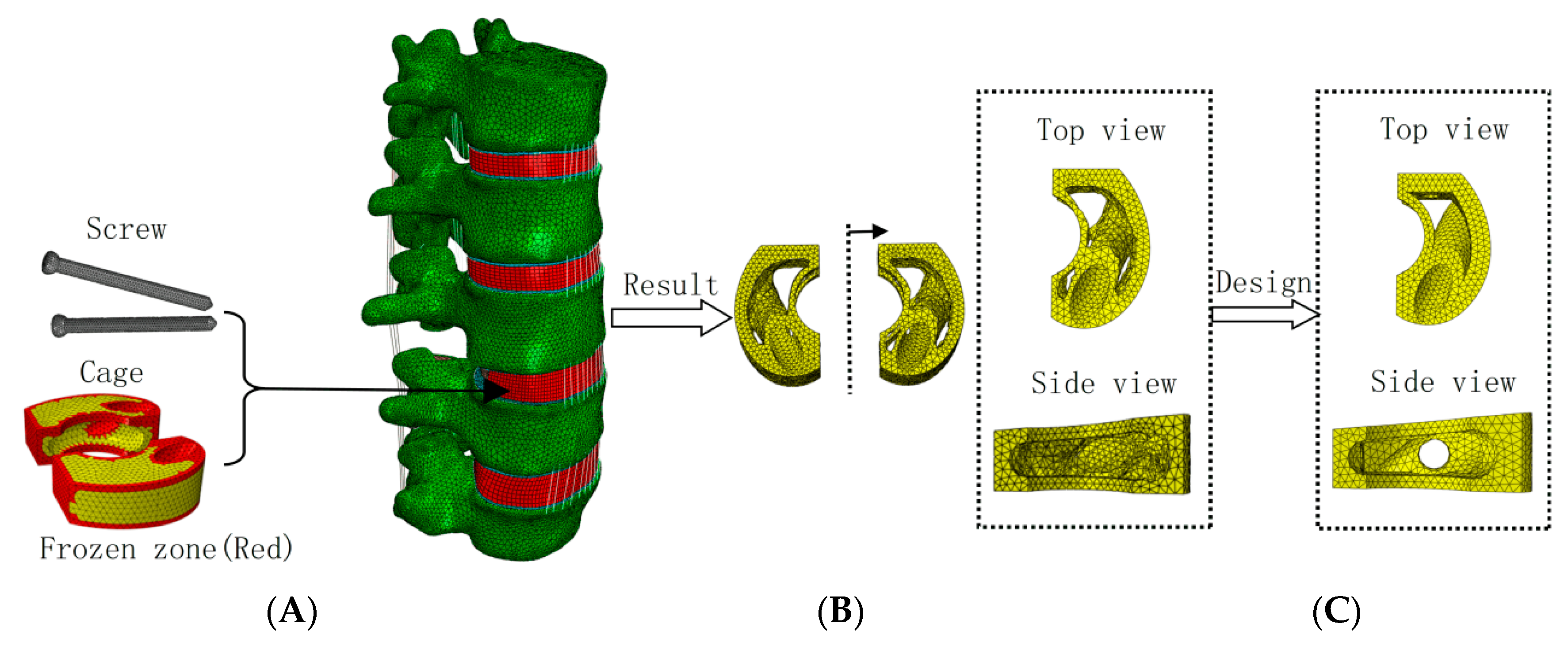
Given the presence of tissues such as the spinal canal in the vertebral center, the Cage for posterior fusion is often designed in two parts, implanted from both sides of the spinal canal. Therefore, the ring-shaped structure obtained from the first topology optimization was divided into two symmetrical parts, and the posterior Cage was redesigned based on the topological outline features, as shown in Figure 1.
The Cage screw channel positions and structural dimensions were designed according to the pedicle screw insertion angle, Cage placement within the intervertebral space, and screw diameter, as illustrated in Figure 2A. Based on a normal finite element model of the lumbar spine, the articular processes and spinous processes of L3 and L4 were resected, along with the removal of the attached ligaments, nucleus pulposus, and posterior annulus fibrosus. Subsequently, a designed Cage (Figure 2A) and internal fixation screws (Ø5 mm × 50 mm in size) were implanted, thereby establishing an analytical model for oblique posterior lumbar interbody fusion (PLIF) surgery. In this model, it was assumed that the Cage was fully integrated with the endplates [27], and there was no slipping between the screws, vertebrae, and Cage. Therefore, bonded contacts were defined between the Cage and endplate surfaces, as well as between the screws, vertebrae, and Cage.
In the finite element model, the pedicle screws were represented using a simplified non-threaded geometry. This simplification was adopted because the primary focus of the present study was the overall load transfer and stress distribution within the fixation–cage–vertebra construct, rather than the local stress concentrations at the screw–bone interface. Previous biomechanical studies have demonstrated that explicit modeling of screw threads mainly affects local stress concentrations and microdamage patterns in the surrounding cancellous bone, while having a limited influence on the global structural stiffness and overall stress trends. Therefore, a non-threaded screw model was considered sufficient to capture the comparative biomechanical behavior investigated in this study. A sensitivity analysis comparing threaded and non-threaded screw geometries was not performed in the present work and is acknowledged as a limitation.
The cage–endplate contact surfaces were modeled as smooth and without serrations. This assumption was made to avoid introducing geometric irregularities that could generate artificial local stress peaks and adversely affect numerical convergence. Although surface serrations can increase local contact stresses and enhance direct mechanical interlocking, their effects are largely confined to the contact interface. Since this study focused on internal stress redistribution within the cage and the overall biomechanical performance of the construct, the smooth-surface assumption is unlikely to alter the comparative conclusions.
Fully bonded contact conditions were assumed at both the fixation–endplate interface and the screw–bone interface. This assumption represents an idealized early postoperative condition without relative sliding or separation and was primarily adopted to ensure numerical stability and convergence. It is acknowledged that this assumption may lead to an overestimation of construct stiffness and a more uniform stress transfer, potentially underestimating local micromotion at the interfaces. However, because the primary objective of this study was to compare stress distribution patterns among different cage designs under identical modeling assumptions, the bonded interfaces provide a consistent baseline and do not compromise the validity of the comparative analysis.
No dedicated sensitivity analyses were conducted to assess the influence of these geometric and contact simplifications. Nevertheless, the adopted assumptions are consistent with those commonly used in finite element studies focused on comparative biomechanical evaluation rather than interface failure prediction. Similar simplifications have been widely employed in previous finite element analyses of spinal fixation systems, where the emphasis was placed on global structural behavior rather than local interface mechanics. In summary, the geometric and contact simplifications adopted in this study are aligned with its objectives and enable stable and effective numerical analyses of overall biomechanical behavior. While their potential influence on absolute stress magnitudes is acknowledged, they do not affect the relative comparisons or the main conclusions of this work.
For computational convenience, the serrations on the upper and lower surfaces of the Cage and the screw threads were not considered in the finite element model [28]. The material parameters for the Cage, pedicle screws, and titanium rods are presented in Table 1.
A second topological optimization of the Cage structure was conducted on this model, preserving the designed Cage screw channels and outer contour structure. The remaining load conditions, boundary conditions, response weights, and objective function settings were the same as those in the first optimization, with the imposed constraints illustrated in Figure 2A.The result of the second topological optimization of the Cage is shown in Figure 2B. Based on this optimization, an internal bone graft window structure for the Cage was designed, as depicted in Figure 2C.

2.3. Static Analysis of Topologically Optimized Cage Structure and Internal Fixation System

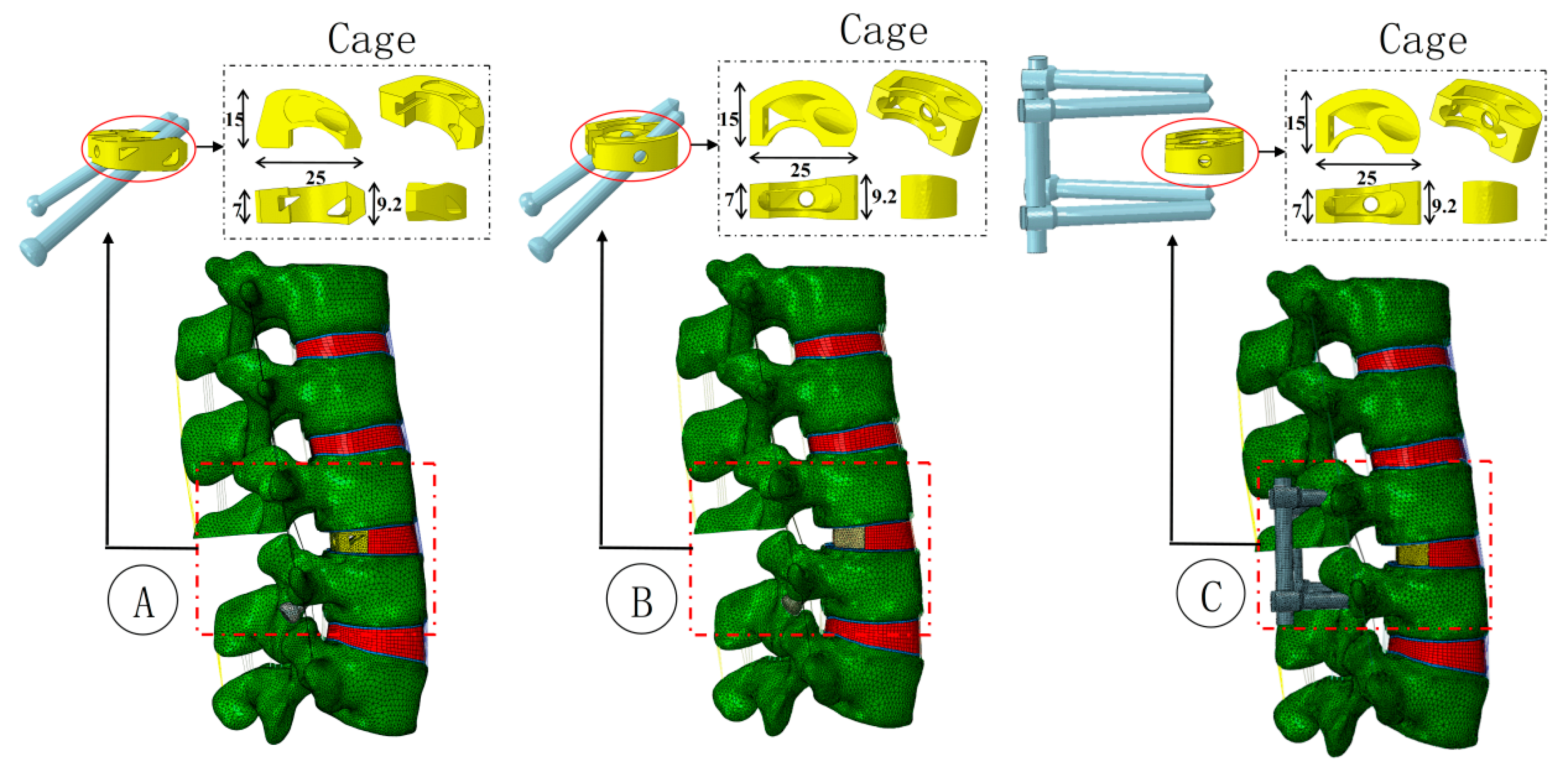
To validate the topological optimization results and oblique insertion internal fixation method, three finite element models were established (Figure 3), with equal contact areas between the Cage and endplates in all three models.
(A)
Conventional Cage combined with pedicle screw oblique insertion internal fixation surgical model (using Ø5 × 50 mm screws), where the conventional Cage structure was designed considering screw configuration and surgical space constraints.
(B)
Topologically optimized Cage combined with pedicle screw oblique insertion internal fixation surgical model (using Ø5 × 50 mm screws).
(C)
Topologically optimized Cage combined with traditional pedicle screw and titanium rod internal fixation surgical model (using Ø5 × 50 mm screws and a Ø6 mm titanium rod).
The material parameters, constraints, and contact relationships in Figure 3 were consistent with those in the validated full lumbar finite element model. Under an axial load of 400 N applied to the upper surface of L1, six different bending moments (10 Nm each) were applied to simulate flexion, extension, lateral bending, and axial rotation, completing the loading settings for six physiological motion conditions. Implicit static analysis methods were used to calculate the mechanical responses of the different models under physiological loads.

3. Results

3.1. Validation

As shown in Figure 4, the total range of motion (ROM) for the intact lumbar model under flexion-extension, lateral bending, and axial rotation was 14.123°, 10.527°, 10.639°, 10.812°, 7.219°, and 7.242°, respectively. The trend of ROM changes under various conditions was consistent with previous studies, with the largest ROM observed in flexion and the smallest in axial rotation. The ROM values of anterior flexion and left and right lateral flexion was less than previous in vitro data because the finite element model took into account the elastic constraints of intervertebral ligaments and intervertebral disc structures, and the elastic constraints of ligaments and intervertebral disc structures were more relaxed in vitro cadaver experiments. Compared to previous finite element results, the total ROM and segmental ROM data under various conditions were similar, confirming the validity of the model [24,29].

3.2. Static Results

3.2.1. Endplate Stress

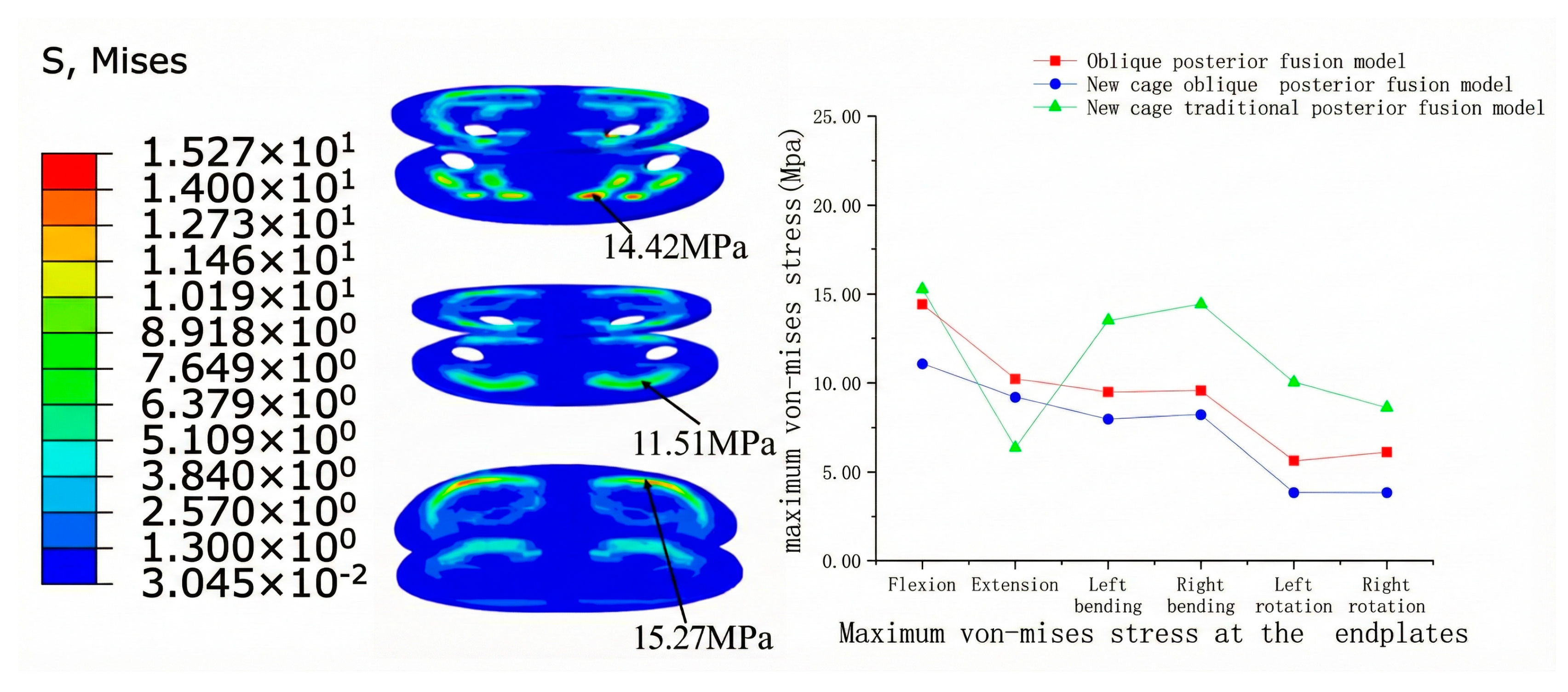
Figure 5 illustrates the maximum von Mises stress on the endplates of the surgical segment for the conventional Cage oblique posterior lumbar interbody fusion model, the new Cage oblique posterior lumbar interbody fusion model, and the new Cage traditional posterior lumbar interbody fusion model under six loading conditions: flexion, extension, left lateral bending, right lateral bending, left axial rotation, and right axial rotation. Under these six conditions, the maximum stresses on the L3–L4 endplate of the new Cage oblique posterior lumbar interbody fusion model are 11.51 MPa, 9.92 MPa, 7.96 MPa, 9.02 MPa, 3.74 MPa, and 3.68 MPa, respectively. Compared to the conventional Cage oblique posterior lumbar interbody fusion model, the maximum von Mises stresses on the adjacent endplates of the model decrease under all conditions, with reductions of 20.18%, 2.90%, 16.01%, 5.44%, 33.43%, and 39.55%, respectively. In contrast, compared to the new Cage traditional posterior lumbar interbody fusion model, the maximum von Mises stresses on the adjacent endplates increase in extension by 56.54% but decrease under the other conditions, with reductions of 24.62%, 41.08%, 37.47%, 62.67%, and 57.24%, respectively.

3.2.2. Cage Stress

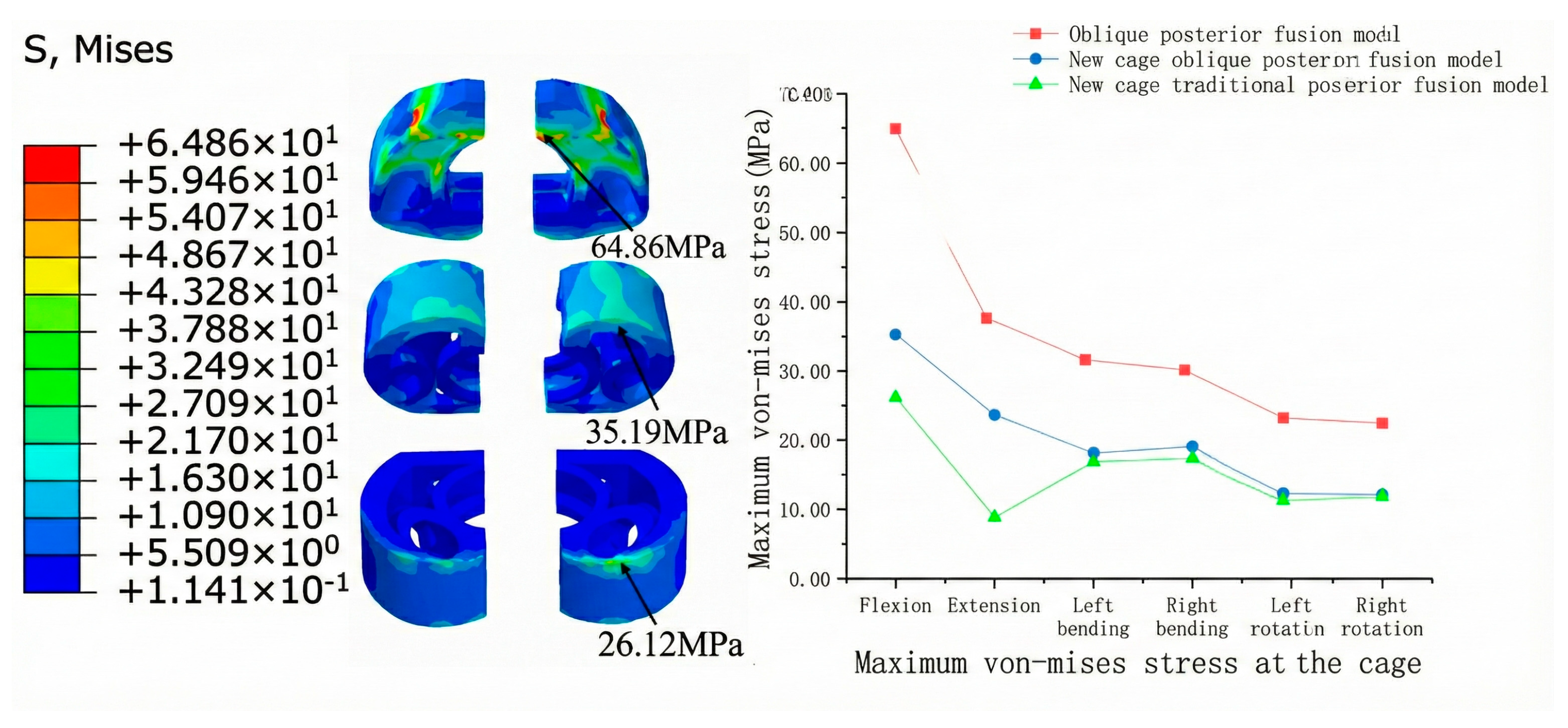
Figure 6 displays the maximum von Mises stress on the Cages of the three model under six loading conditions: flexion, extension, left lateral bending, right lateral bending, left axial rotation, and right axial rotation. In terms of maximum Cage stress, the new Cage oblique posterior lumbar interbody fusion model exhibits maximum von Mises stress values of 35.19 MPa, 23.64 MPa, 18.13 MPa, 18.99 MPa, 12.29 MPa, and 12.04 MPa under various conditions, all significantly lower than the yield limit of PEEK material, which is 120 MPa [30]. Additionally, the maximum von Mises stresses of the model are significantly reduced compared to the conventional Cage oblique posterior lumbar interbody fusion model, with decreases of 45.74%, 37.14%, 42.52%, 36.87%, 46.87%, and 46.23%, respectively. When compared to the new Cage traditional posterior lumbar interbody fusion model, the maximum von Mises stresses on the Cage increase under all conditions, with increases of 34.12%, 165.77%, 7.72%, 9.71%, 8.86%, and 0.67%, respectively.

3.2.3. Internal Fixation Stress

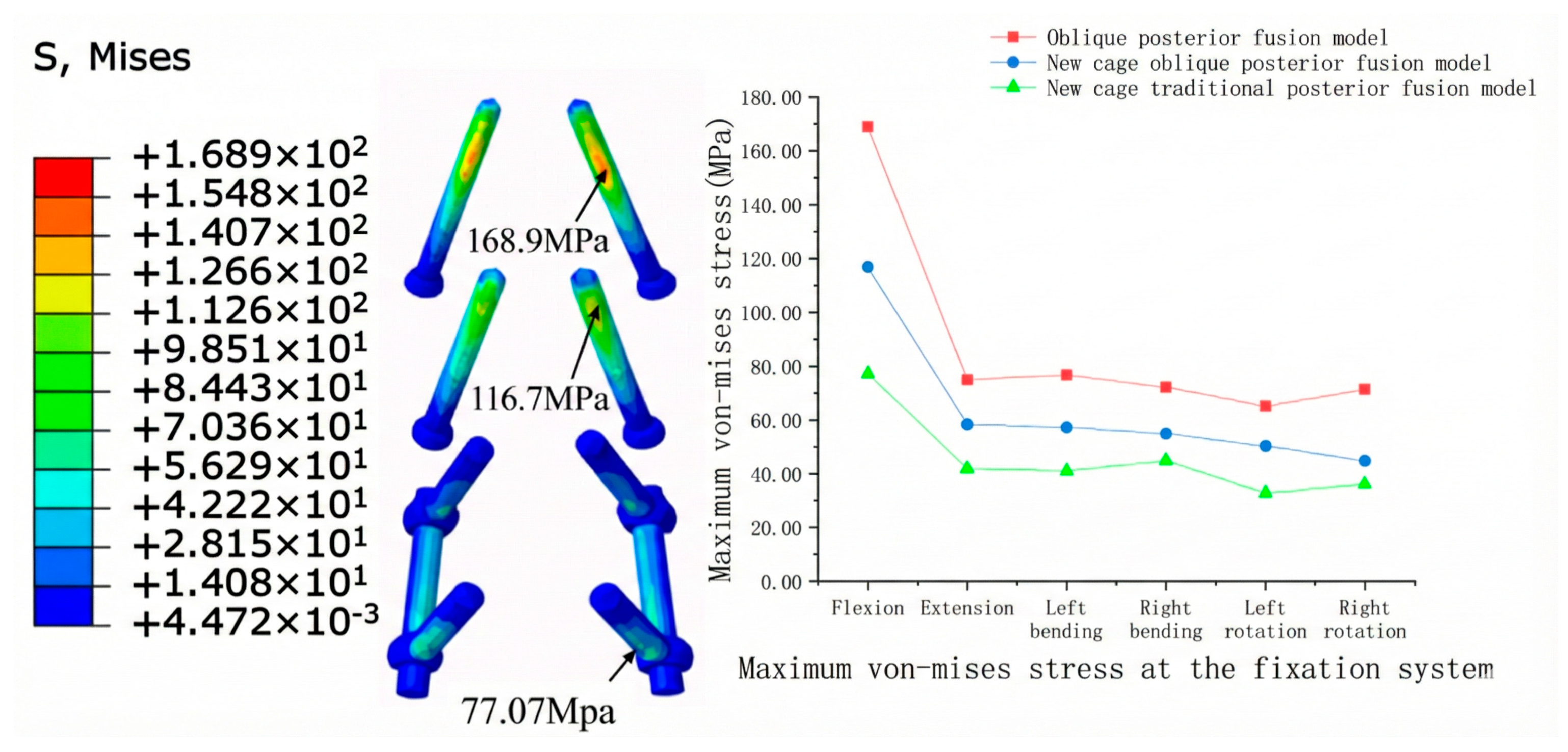
Figure 7 presents the maximum von Mises stress on the internal fixation screws for three model under six loading conditions: flexion, extension, left and right lateral bending, and left and right axial rotation. The new Cage oblique posterior lumbar interbody fusion model demonstrates maximum von Mises stresses on the internal fixation screws of 116.7 MPa, 58.32 MPa, 57.2 MPa, 54.78 MPa, 50.17 MPa, and 44.73 MPa under various conditions, far below the allowable stress of the screw-rod system. Compared to the conventional Cage oblique posterior lumbar interbody fusion model, the maximum von Mises stresses on the internal fixation screws are significantly reduced in the model, with decreases of 30.91%, 22.09%, 25.32%, 23.92%, 22.92%, and 37.18%, respectively. However, compared to the new Cage traditional posterior lumbar interbody fusion model, the maximum von Mises stresses on the internal fixation system increase under all conditions, with increases of 51.42%, 39.66%, 39.14%, 22.17%, 53.38%, and 24.08%, respectively.

4. Dynamic Results

4.1. Cage Dynamic Response

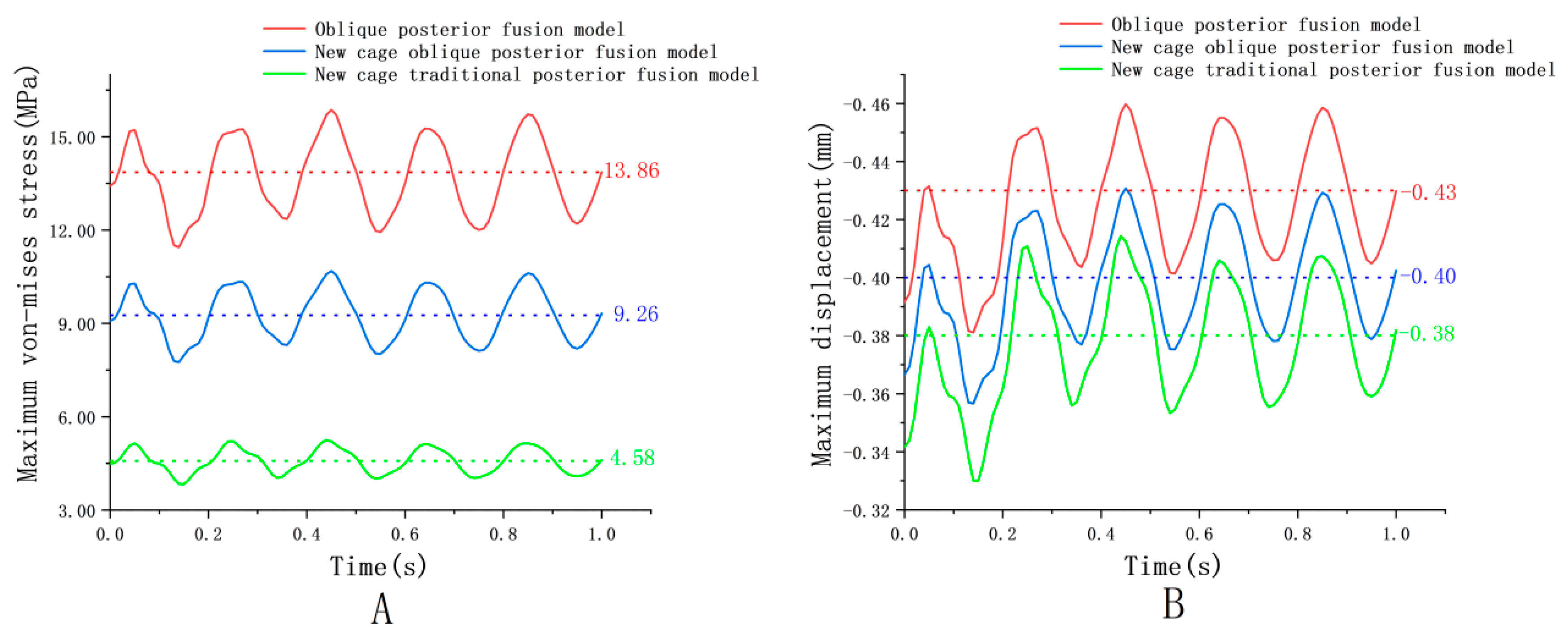
As can be observed from Figure 8 and Table 3, during the vertical vibration loading process, the maximum von Mises stress in the Cage of the new Cage oblique posterior lumbar interbody fusion model with the optimized Cage averaged at 9.26 MPa, with a mean maximum displacement of −0.40 mm. In contrast, the conventional Cage oblique posterior lumbar interbody fusion model exhibited a maximum stress mean of 13.86 MPa and a mean maximum displacement of −0.43 mm. The new Cage oblique posterior lumbar interbody fusion model demonstrated a reduction of 33.19% in maximum stress mean and 6.98% in maximum displacement compared to the conventional Cage oblique posterior lumbar interbody fusion model. During vibration, the stress amplitude in the Cage of the new model also decreased by 33.94%, while the displacement amplitude decreased by 12.50% compared to the conventional model. When compared to the new Cage traditional posterior lumbar interbody fusion model, the maximum von-Mises stress and maximum displacement response mean on the Cage increased. Moreover, the stress amplitude in the Cage of the new Cage oblique posterior lumbar interbody fusion model increased by 105.63% during vibration, but the displacement amplitude remained 12.50% lower than that of the new Cage traditional posterior lumbar interbody fusion model.

4.2. Endplate Dynamic Response

All degrees of freedom at the inferior surface of the L5 vertebral body were fully constrained as boundary conditions. A downward axial compressive load of 400 N was applied to the superior surface of the L1 vertebral [31] body to simulate the weight of the upper human body, and bending moments of 10 N·m were superimposed in different directions to represent flexion–extension, left–right lateral bending, and axial rotation of the lumbar spine during normal physiological activities. Under these loading conditions, the mechanical responses of all components of the model were calculated using an implicit static analysis.
To further evaluate the biomechanical behavior of the fusion model under whole-body vertical vibration conditions, a dynamic analysis was performed. A vertical sinusoidal load with an amplitude of 40 N was applied to the superior surface of the L1 vertebral body to simulate vibration excitation transmitted from the pelvis to the lumbar spine during sitting or vehicle driving conditions [31,32,33,34,35,36,37]. Meanwhile, a sinusoidal axial load was applied to the inferior surface of the cage to represent the loading state of the interbody fusion construct in a vibrational environment. Based on previous experimental and numerical studies on lumbar spine vibration, the excitation frequency was set to 5 Hz to cover the resonance-sensitive frequency range of the human lumbar spine.
Energy dissipation in spinal tissues was described using a Rayleigh damping model. The mass- and stiffness-proportional damping coefficients were appropriately selected to achieve an equivalent damping ratio of approximately 5%, which is consistent with the dynamic characteristics of the lumbar spine reported in the literature. The dynamic analysis was conducted using an implicit time integration scheme with a time step of 0.01 s and a total simulation duration of 1 s, ensuring that the vibration response reached a stable state.
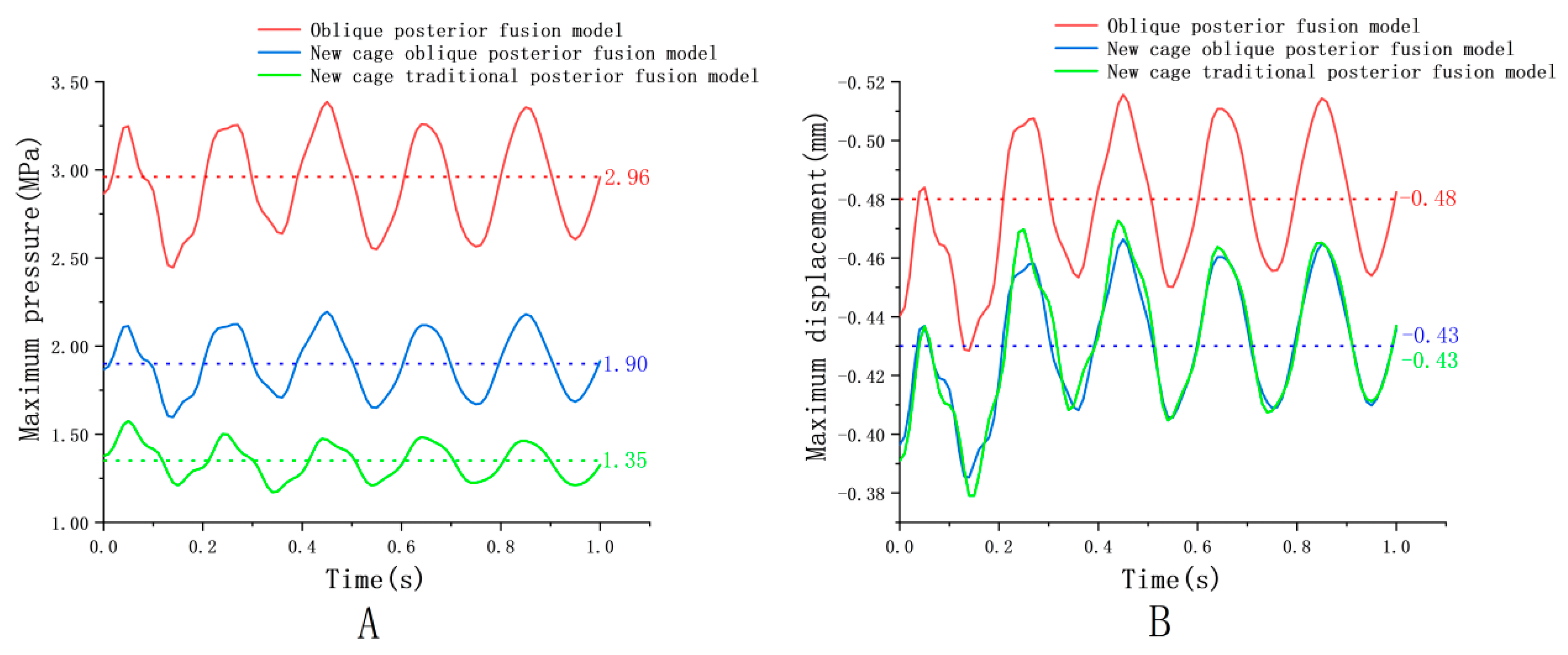
As evident from Figure 9 and Table 3, at various moments during vertical vibration loading, the maximum compressive stress dynamic response in the adjacent endplates of the new Cage oblique posterior lumbar interbody fusion model was lower than that of the conventional Cage oblique posterior lumbar interbody fusion model. The mean maximum compressive stress in the endplates of the model during the process was 1.90 MPa, while the conventional model showed a mean of 2.96 MPa. Additionally, the compressive stress amplitude during vibration decreased by 36.17% compared to the conventional model. When compared to the new Cage traditional posterior lumbar interbody fusion model, the maximum von-Mises stress on the adjacent endplates increased, and the stress amplitude during vibration in the new Cage oblique posterior lumbar interbody fusion model also increased by 46.34%.
After the vibration process stabilized, the maximum displacement of the adjacent endplates to the Cage in the new Cage oblique posterior lumbar interbody fusion model was smaller than that of the conventional Cage oblique posterior lumbar interbody fusion model. The mean maximum displacement of the new model was −0.43 mm, while the conventional model had a mean of −0.48 mm, with a reduction of 11.11% in maximum displacement amplitude during vibration. Compared to the new Cage traditional posterior lumbar interbody fusion model, the mean maximum displacement on the adjacent endplates during vibration was identical, with consistent vibration amplitudes and frequencies.

5. Discussion

This study proposed a secondary topology-optimized posterior lumbar interbody fusion Cage combined with an oblique pedicle screw fixation strategy and evaluated its biomechanical performance under static physiological loading and whole-body vibration. In contrast to the original Discussion, the following analysis places the findings in direct comparison with existing biomechanical studies and clinical observations.
Previous research has shown that Cage subsidence and endplate fracture are primarily caused by stress concentration at the Cage–endplate interface and that increasing Cage footprint or contact area can effectively reduce these risks. Finite element and experimental studies have reported that implants covering more than approximately 30% of the endplate area significantly lower endplate stress. However, most conventional design approaches rely on increasing Cage size, which is constrained by posterior surgical space and may increase invasiveness.
The present results demonstrate that topology optimization can reduce endplate stress without enlarging Cage dimensions. Although the maximum Cage width was unchanged, redistributing load-bearing material from the posterior region toward the mid-anterior region significantly reduced peak endplate stress under flexion and lateral bending. This finding is consistent with previous reports that anterior load sharing plays a dominant role in limiting endplate overload, and it extends earlier work by showing that such redistribution can be achieved through structural optimization rather than geometric enlargement.
Comparisons between fixation strategies further highlight the importance of load-sharing mechanisms. Traditional bilateral pedicle screw–rod systems have been shown to transfer a large proportion of spinal load to posterior instrumentation, thereby reducing Cage stress but increasing implant dependency. Consistent with this mechanism, the traditional fixation model in this study exhibited lower Cage stress but higher reliance on posterior fixation. In contrast, oblique pedicle screw fixation increased load transmission through the Cage and screws while reducing endplate stress. When combined with the topology-optimized Cage, this load redistribution did not produce excessive stress concentrations, indicating that the optimized Cage geometry effectively accommodates the oblique load path.
Dynamic analysis under whole-body vibration revealed trends similar to those reported in prior vibration studies, in which cyclic loading amplifies implant stress and displacement. Compared with the conventional Cage, the topology-optimized Cage significantly reduced peak stress, stress amplitude, and displacement under vibration, indicating improved resistance to fatigue-related damage and subsidence. Although the oblique fixation model showed higher Cage stress than the traditional fixation model, it consistently exhibited lower displacement amplitudes of both the Cage and endplates, suggesting enhanced construct stability during vibration [38].
The second-stage topology optimization explored the biomechanical limits of increasing bone graft window volume. Excessive volume reduction resulted in stress concentration around window edges, particularly under lateral bending, even though stresses remained below the material yield limit. This finding provides a biomechanical explanation for reported Cage fractures near graft windows and supports the need to balance osteogenic capacity with structural integrity.
Overall, this study demonstrates that topology optimization enables posterior fusion Cages to achieve improved stress distribution under both static and dynamic conditions without increasing implant size. Moreover, it shows that oblique pedicle screw fixation can be biomechanically advantageous when paired with a Cage specifically optimized for its load path. These findings extend the existing literature by integrating Cage design and fixation strategy into a unified, mechanics-based framework. Despite limitations inherent to finite element modeling, the observed comparative trends are consistent with previously reported mechanisms and provide a foundation for future experimental and clinical validation.

6. Limitations

Several limitations of this study should be acknowledged. First, the finite element model was validated only under the intact lumbar spine configuration by comparing the segmental range of motion with previously published experimental data. This validation step was intended to ensure that the baseline anatomy, material properties, and boundary conditions reasonably reproduced physiological behavior. Validation of the intact model is a common prerequisite in spinal finite element studies, as standardized experimental benchmarks for specific surgical and instrumentation configurations are generally unavailable, and postoperative models are typically constructed upon a validated intact baseline. However, the surgical models introduced substantial modifications, including removal of posterior elements to simulate decompression, implantation of an interbody cage, and fixation using oblique-trajectory pedicle screws. These alterations inevitably reduce segmental stiffness and modify load sharing between the anterior and posterior columns, potentially affecting the absolute magnitudes of predicted stresses and displacements. Nevertheless, because identical assumptions, boundary conditions, material properties, and posterior resection strategies were consistently applied to all postoperative models, the influence of these simplifications is systematic rather than differential and therefore does not compromise the relative comparisons among different cage designs and fixation strategies.
Second, several modeling simplifications were adopted to improve computational efficiency. Screw threads and cage surface serrations were not explicitly modeled, and fully bonded contact conditions were assumed at both the cage–endplate and screw–bone interfaces. These assumptions may overestimate initial construct stiffness and underestimate micromotion at the bone–implant interfaces, particularly during the early postoperative period prior to solid fusion. Accordingly, the present results should be interpreted as representing a relatively stable fusion condition rather than the immediate postoperative state. In addition, screws were inserted along nonstandard trajectories to reflect the specific surgical technique investigated in this study. Although such trajectories may alter local stress distributions along the screw–bone interface and affect load transfer within the fixation system, the objective of this work was not to predict screw loosening or interface failure, but to evaluate the overall biomechanical behavior of the instrumented segment. Within this scope, the modeled screw trajectories are considered appropriate for comparative structural-level stress analysis.
Third, the material properties of biological tissues were assumed to be homogeneous, isotropic, and linearly elastic, except for the hyperelastic formulation used for the nucleus pulposus. In reality, spinal tissues exhibit anisotropic and viscoelastic behavior, and bone quality varies substantially among individuals, particularly in osteoporotic populations. These factors may influence stress distributions and implant performance but were not explicitly considered in the present model. Finally, the model was constructed based on anatomical data from a single healthy adult subject, and only one lumbar segment (L3–L4) was analyzed. Therefore, the findings may not be directly generalizable to other spinal levels, patient populations, or pathological conditions. To enhance the clinical applicability of the proposed cage designs and fixation strategies, future studies incorporating cadaveric validation, patient-specific modeling, variable bone quality, and multilevel fusion scenarios are warranted.

7. Conclusions

The secondary topology-optimized Cage exhibited a more uniform stress distribution on adjacent endplates and lower peak stresses under both static physiological loading and whole-body vibration compared with a conventional posterior fusion Cage, suggesting a reduced risk of Cage subsidence and endplate fracture. When combined with oblique pedicle screw fixation, the optimized Cage effectively accommodated the altered load-transfer path, decreasing endplate stress and vibration-induced displacement while maintaining stresses within safe limits for both the Cage and fixation system. Although oblique fixation increased stresses in the Cage and screws relative to traditional screw–rod fixation, it enhanced overall construct stability and reduced micromotion at the Cage–endplate interface. Furthermore, topology optimization of the internal bone graft window indicated that excessive volume reduction leads to stress concentrations, particularly under lateral bending, highlighting the need to balance graft capacity and structural integrity. Overall, these results demonstrate that a topology-optimized Cage tailored for oblique posterior fixation can improve biomechanical performance under both static and dynamic conditions without increasing implant size, providing a mechanics-based rationale for next-generation posterior fusion Cage design and supporting oblique fixation as a stable and effective alternative to conventional posterior instrumentation.

Author Contributions

Conceptualization, H.H. and J.D.; methodology, H.H. and J.F.; software, H.H.; validation, H.H., J.D. and X.Z.; formal analysis, H.H.; writing—original draft preparation, H.H.; writing—review and editing, H.H.; funding acquisition, the authors. All authors have read and agreed to the published version of the manuscript.

Funding

This research was funded by National Natural Science Foundation Youth Science Fund project, (No. 52305449), Scientific research project of Education Department of Liaoning Province, (No. LJKQZ20222336) and Natural Science Foundation of Liaoning Province, (No. 2024-MS-169). National Natural Science Foundation of China Youth Science Fund Project (Class C) (No. 52505467).

Data Availability Statement

No new data were created or analyzed in this study. All data supporting the findings of this study are contained within the article.

Conflicts of Interest

The authors declare no conflicts of interest.

References

  1. Meng, B.; Bunch, J.; Burton, D.; Wang, J. Lumbar interbody fusion: Recent advances in surgical techniques and bone healing strategies. Eur. Spine J. 2021, 30, 22–33. [Google Scholar] [CrossRef] [PubMed]
  2. Kaiser, M.G.; Haid, R.W., Jr.; Subach, B.R.; Barnes, B.; Rodts, G.E., Jr. Anterior cervical plating enhances arthrodesis after discectomy and fusion with cortical allograft. Neurosurgery 2002, 50, 229–236. [Google Scholar]
  3. Zhang, H.; Wang, Z.; Wang, Y.; Li, Z.; Chao, B.; Liu, S.; Luo, W.; Jiao, J.; Wu, M. Biomaterials for Interbody Fusion in Bone Tissue Engineering. Front. Bioeng. Biotechnol. 2022, 10, 900992. [Google Scholar] [CrossRef]
  4. Yang, S.-D.; Chen, Q.; Ding, W.-Y.; Zhao, J.-Q.; Zhang, Y.-Z.; Shen, Y.; Yang, D.-L. Unilateral Pedicle Screw Fixation with Bone Graft vs. Bilateral Pedicle Screw Fixation with Bone Graft or Cage: A Comparative Study. Med. Sci. Monit. 2016, 22, 890–897. [Google Scholar] [CrossRef]
  5. Zhang, Z.; Li, H.; Fogel, G.R.; Xiang, D.; Liao, Z.; Liu, W. Finite element model predicts the biomechanical performance of transforaminal lumbar interbody fusion with various porous additive manufactured Cages. Comput. Biol. Med. 2018, 95, 167–174. [Google Scholar] [CrossRef] [PubMed]
  6. Hou, Y.; Luo, Z. A study on the structural properties of the lumbar endplate: Histological structure, the effect of bone density, and spinal level. Spine 2009, 34, E427–E433. [Google Scholar] [CrossRef] [PubMed]
  7. Phan, K.; Mobbs, R.J. Evolution of Design of Interbody Cages for Anterior Lumbar Interbody Fusion. Orthop. Surg. 2016, 8, 270–277. [Google Scholar] [CrossRef]
  8. Closkey, R.F.; Parsons, J.R.; Lee, C.K.; Blacksin, M.F.; Zimmermant, M.C. Mechanics of Interbody Spinal Fusion: Analysis of Critical Bone Graft Area. Spine 1993, 18, 1011–1015. [Google Scholar] [CrossRef]
  9. Wu, J.; Feng, Q.; Yang, D.; Xu, H.; Wen, W.; Xu, H.; Miao, J. Biomechanical evaluation of different sizes of 3D printed Cage in lumbar interbody fusion—A finite element analysis. BMC Musculoskelet. Disord. 2023, 24, 85. [Google Scholar] [CrossRef]
  10. Zhang, X.; Li, Y.; Wang, J.; Liu, S.; Chen, H.; Guo, Q. Biomechanical Optimization of Lumbar Fusion Cages with a Porous Design: A Finite Element Analysis. Appl. Sci. 2023, 15, 5384. [Google Scholar]
  11. Young, C.J.; Hoon, S.K. Subsidence after anterior lumbar interbody fusion using paired stand-alone rectangular Cages. Eur. Spine J. 2006, 15, 16–22. [Google Scholar]
  12. Guo, L.X.; Fan, W. Dynamic Response of the Lumbar Spine to Whole-body Vibration Under a Compressive Follower Preload. Spine 2018, 43, E143–E153. [Google Scholar] [CrossRef] [PubMed]
  13. Shen, H.; Zhu, J.; Huang, C.; Xiang, D.; Liu, W. Effect of Interbody Implants on the Biomechanical Behavior of Lateral Lumbar Interbody Fusion: A Finite Element Study. J. Funct. Biomater. 2023, 14, 113. [Google Scholar] [CrossRef] [PubMed]
  14. Giorgiou, I.; Delisola, F.; Andreos, U.; Misra, A. A orthotropic evolving substructure continuum model for bone remodeling: Mechanistic explanations behind Wolff’s law. Biomech. Model. Mechanobiol. 2023, 22, 2135–2152. [Google Scholar] [CrossRef]
  15. Allena, R.; Rémond, Y. How mechanotherapy drives bone remodeling? Math. Mech. Complex Syst. 2025, 13, 55–71. [Google Scholar] [CrossRef]
  16. Schmidt, H.; Kettler, A.; Heuer, F.; Simon, U.; Claes, L.; Wilke, H.-J. Intradiscal pressure, shear strain, and fiber strain in the intervertebral disc under combined loading. Spine 2007, 32, 748–755. [Google Scholar] [CrossRef]
  17. Chazal, J.; Tanguy, A.; Bourges, M.; Gaurel, G.; Escande, G.; Guillot, G.; Vanneuville, G. Biomechanical properties of spinal ligaments and a histological study of the supraspinal ligament in traction. J. Biomech. 1985, 18, 167–176. [Google Scholar] [CrossRef]
  18. Huang, S.F.; Chang, C.M.; Liao, C.Y.; Chan, Y.T.; Li, Z.Y.; Lin, C.L. Biomechanical evaluation of an osteoporotic anatomical 3D printed posterior lumbar interbody fusion Cage with internal lattice design based on weighted topology optimization. Int. J. Bioprint. 2023, 9, 697. [Google Scholar] [CrossRef]
  19. Kuo, C.-S.; Hu, H.-T.; Lin, R.-M.; Lee, H.-C.; Lai, P.-L.; Chen, W.-W. Biomechanical analysis of the lumbar spine on facet joint force and intradiscal pressure: A finite element study. BMC Musculoskelet. Disord. 2010, 11, 151. [Google Scholar] [CrossRef]
  20. El-Rich, M.; Arnoux, P.-J.; Wagnac, E.; Brunet, C.; Aubin, C.-E. Finite element investigation of the loading rate effect on the spinal load-sharing changes under impact conditions. J. Biomech. 2009, 42, 1252–1262. [Google Scholar] [CrossRef]
  21. Fan, W.; Guo, L.X.; Zhang, M. Biomechanical analysis of lumbar interbody fusion supplemented with various posterior stabilization systems. Eur. Spine J. 2021, 30, 2342–2350. [Google Scholar] [CrossRef] [PubMed]
  22. Kahaer, A.; Zhang, R.; Wang, Y.; Luan, H.; Maimaiti, A.; Liu, D.; Shi, W.; Zhang, T.; Guo, H.; Rexiti, P. Hybrid pedicle screw and modified cortical bone trajectory technique in transforaminal lumbar interbody fusion at L4-L5 segment: Finite element analysis. BMC Musculoskelet. Disord. 2023, 24, 288. [Google Scholar] [CrossRef] [PubMed]
  23. Shen, H.; Chen, Y.; Liao, Z.; Liu, W. Biomechanical evaluation of anterior lumbar interbody fusion with various fixation options: Finite element analysis of static and vibration conditions. Clin. Biomech. 2021, 84, 105339. [Google Scholar] [CrossRef]
  24. Yamamoto, I.; Panjabi, M.M.; Crisco, T.; Oxland, T. Three-dimensional movements of the whole lumbar spine and lumbosacral joint. Spine 1989, 14, 1256–1260. [Google Scholar] [CrossRef]
  25. Schmoelz, W.; Huber, J.F.; Nydegger, T.; Claes, L.; Wilke, H.J. Dynamic Stabilization of the Lumbar Spine and Its Effects on Adjacent Segments: An In Vitro Experiment. Clin. Spine Surg. 2003, 16, 418–423. [Google Scholar]
  26. Li, C.-H.; Wu, C.-H.; Lin, C.-L. Design of a patient-specific mandible reconstruction implant with dental prosthesis for metal 3D printing using integrated weighted topology optimization and finite element analysis. J. Mech. Behav. Biomed. Mater. 2020, 105, 103700. [Google Scholar] [CrossRef] [PubMed]
  27. Fan, W.; Zhang, C.; Zhang, D.-X.; Guo, L.-X.; Zhang, M.; Wang, Q.-D. Biomechanical Evaluation of Rigid Interspinous Process Fixation Combined with Lumbar Interbody Fusion Using Hybrid Testing Protocol. J. Biomech. Eng. 2023, 145, 064501. [Google Scholar] [CrossRef]
  28. Han, X.; Chen, X.; Li, K.; Li, Z.; Li, S. Finite analysis of stability between modified articular fusion technique, posterior lumbar interbody fusion and posteriorlateral lumbar fusion. BMC Musculoskelet. Disord. 2021, 22, 1015. [Google Scholar] [CrossRef]
  29. Chen, C.-S.; Cheng, C.-K.; Liu, C.-L.; Lo, W.-H. Stress analysis of the disc adjacent to interbody fusion in lumbar spine. Med. Eng. Phys. 2001, 23, 485–493. [Google Scholar] [CrossRef]
  30. Li, X.-F.; Liu, Z.-D.; Dai, L.-Y.; Zhong, G.-B.; Zang, W.-P. Dynamic response of the idiopathic scoliotic spine to axial cyclic loads. Spine 2011, 36, 521–528. [Google Scholar] [CrossRef]
  31. Xu, M.; Yang, J.; Lieberman, I.; Haddas, R. Finite element method-based study for effect of adult degenerative scoliosis on the spinal vibration characteristics. Comput. Biol. Med. 2017, 84, 53–58. [Google Scholar] [CrossRef]
  32. Xu, Z.; Zheng, Q.; Zhang, L.; Chen, R.; Li, Z.; Xu, W. Biomechanical evaluation of different oblique lumbar interbody fusion constructs: A finite element analysis. BMC Musculoskelet. Disord. 2024, 25, 97. [Google Scholar] [CrossRef] [PubMed]
  33. Goel, V.K.; Park, H.; Kong, W. Investigation of Vibration Characteristics of the Ligamentous Lumbar Spine Using the Finite Element Approach. J. Biomech. Eng. 1994, 116, 377–383. [Google Scholar] [CrossRef] [PubMed]
  34. Kong, W.Z.; Goel, V.K. Ability of the finite element models to predict response of the human spine to sinusoidal vertical vibration. Spine 2003, 28, 1961–1967. [Google Scholar] [CrossRef]
  35. Guo, L.-X.; Teo, E.-C. Prediction of the Modal Characteristics of the Human Spine at Resonant Frequency Using Finite Element Models. Proc. Inst. Mech. Eng. Part H J. Eng. Med. 2005, 219, 277–284. [Google Scholar] [CrossRef] [PubMed]
  36. Guo, L.-X.; Wang, Z.-W.; Zhang, Y.-M.; Lee, K.-K.; Teo, E.-C.; Li, H.; Wen, B.-C. Material property sensitivity analysis on resonant frequency characteristics of the human spine. J. Appl. Biomech. 2009, 25, 64–72. [Google Scholar] [CrossRef]
  37. Prabaha, S.; Tej, C.B.; Kumar, G.S. A comprehensive analysis on the processing-structure-property relationships of FDM-based 3-D printed polyetheretherketone (PEEK) structures. Materialia 2022, 22, 101427. [Google Scholar]
  38. Kumar, N.; Judith, M.R.; Kumar, A.; Mishra, V.; Robert, M.C. Analysis of stress distribution in lumbar interbody fusion. Spine 2005, 30, 1731–1735. [Google Scholar] [CrossRef]
Figure 1. First topology optimization process (vertebral body model is normal lumbar spine model).
Applsci 16 00524 g001
Figure 2. Second topology optimization process for oblique posterior lumbar fusion model. (A) Initial redesigned posterior Cage with screw channel positions and surgical constraints (schematic and CAD). (B) Resulting topology-optimized outer contour for the oblique fusion model (density/solid map). (C) Final internal bone-graft window design derived from the second optimization (detailed CAD for implantation).
Applsci 16 00524 g002
Figure 3. Three posterior fusion finite element models used for mechanical comparison. (A) Conventional Cage + oblique pedicle screw fixation (Ø5 × 50 mm screws). (B) Topology-optimized Cage + oblique pedicle screw fixation (Ø5 × 50 mm screws). (C) Topology-optimized Cage + traditional bilateral pedicle screw–rod fixation (Ø5 × 50 mm screws + Ø6 mm titanium rod).
Applsci 16 00524 g003
Figure 4. Validation results [24,29].
Applsci 16 00524 g004
Figure 5. Maximum end-plate stress of the three models.
Applsci 16 00524 g005
Figure 6. Maximum stress of Cage in three models.
Applsci 16 00524 g006
Figure 7. Maximum internal fixed stress in three models.
Applsci 16 00524 g007
Figure 8. Cage maximum von-mise stress (A) and displacement (B) of the three models during the whole vibration process.
Applsci 16 00524 g008
Figure 9. The maximum compressive stress (A) and displacement (B) of the end plate of the three models during the whole vibration process.
Applsci 16 00524 g009
Table 1. Material properties of finite element models of lumbar spine and implants.
ComponentElement TypeYoung’s Modulus (MPa)Poisson’s RatioDensity (kg/mm3)Reference
Cortical boneC3D412,0000.31.83 × 10−6[18,20]
Cancellous boneC3D41000.21.70 × 10−7[18,20]
EndplateC3D45000.251.20 × 10−6[19,23]
Annulus ground substanceC3D8H4.20.451.05 × 10−6[18,23]
Nucleus pulpousC3D8HHyperelastic, Mooney–Rivlin C10 = 0.12, C01 = 0.03 1.02 × 10⁻⁶[21,23]
Facet joint cartilageC3D8H240.41.0 × 10−6[22,23]
Cage (PEEK)C3D436000.251.32 × 10−6[21,23]
Pedicle ScrewsC3D4110,0000.34.5 × 10−6[18,23]
Titanium rodsC3D4110,0000.34.5 × 10−6[18,23]
Table 2. Finite element material parameters of lumbar ligaments.
LigamentsElement TypeYoung’s Modulus (MPa)Poisson’s RatioDensity (kg/mm3)Reference
Anterior longitudinalT3D27.863.71.0 × 10−6[21,23]
Posterior longitudinalT3D210201.0 × 10−6[22,23]
Ligamentum flavumT3D215401.0 × 10−6[21,23]
SupraspinousT3D28301.0 × 10−6[21,23]
InterspinousT3D24.56401.0 × 10−6[20,21,23]
IntertransverseT3D2101.81.0 × 10−6[21,23]
CapsularT3D27.5301.0 × 10−6[21,23]
Table 3. Maximum and minimum values of dynamic response and amplitude of vibration.
Dynamic ResponsesOblique ModelNew Cage Oblique ModelNew Cage Traditional Model
MaxMinAmplitudeMaxMinAmplitudeMaxMinAmplitude
Von-mises (MPa)
Cage15.8711.454.4210.687.762.925.253.831.42
Displacement (mm)
Cage−0.46−0.380.08−0.43−0.360.07−0.41−0.330.08
Endplate−0.52−0.430.09−0.47−0.390.08−0.47−0.380.09
Pressure (MPa)
Endplate3.392.450.942.201.600.601.581.170.41
Disclaimer/Publisher’s Note: The statements, opinions and data contained in all publications are solely those of the individual author(s) and contributor(s) and not of MDPI and/or the editor(s). MDPI and/or the editor(s) disclaim responsibility for any injury to people or property resulting from any ideas, methods, instructions or products referred to in the content.