Article

Study of the Viscoelastic Performance of Cold Recycling Mixtures with Bitumen Emulsion

by
Katarzyna Konieczna
1,
Jan B. Król
1,* and
Wojciech Sorociak
2
1
Faculty of Civil Engineering, Warsaw University of Technology, Al. Armii Ludowej 16, 00-637 Warsaw, Poland
2
Faculty of Civil Engineering, Silesian University of Technology, ul. Akademicka 5, 44-100 Gliwice, Poland
*
Author to whom correspondence should be addressed.
Appl. Sci. 2026, 16(1), 521; https://doi.org/10.3390/app16010521
Submission received: 30 November 2025 / Revised: 23 December 2025 / Accepted: 26 December 2025 / Published: 4 January 2026
(This article belongs to the Special Issue Recent Advances in Asphalt Materials and Their Applications)

Abstract

To limit reflective cracking in asphalt pavements with cold-recycled base courses, cold recycling mixtures (CRMs) are designed to provide predominantly bituminous bonding, making their viscoelastic behaviour of paramount importance. This study presents an experimental evaluation of the viscoelasticity of CRMs containing 0–90% RAP, 5.5–7.4% bitumen emulsion, and 1% cement. The dynamic modulus and phase angle were determined according to AASHTO T 378-22 across temperatures of 5–40 °C and loading frequencies of 0.1–25 Hz. To assess the applicability of the time–temperature superposition principle (TTSP) for describing the CRMs’ mechanical behaviour, master curves were constructed and the statistical analysis of the model fit quality was performed. The research findings demonstrate that CRMs’ mechanical behaviour can be effectively modelled using TTSP, with their viscoelastic response being influenced by RAP and bitumen emulsion content. CRMs showed lower temperature sensitivity than HMA, yet changes in dynamic modulus and phase angle remained statistically significant. This study advances the performance-based design of CRMs and points to the potential of rheological modelling for their constitutive characterization.

1. Introduction

As part of the natural lifecycle of pavements, the expanding road network will increasingly require systematic reconstruction and maintenance. Addressing this challenge calls for effective strategies for reusing various waste materials [1]. Particular attention should be given to the reclaimed asphalt pavement (RAP) obtained from milling of deteriorated pavement layers. Cold recycling technology, applied both in-place and in-plant, enables the successful incorporation of RAP into new pavement structures or its use in rehabilitation strategies such as full-depth reclamation (FDR) [2,3,4,5]. Cold recycling mixtures (CRMs) produced using this technology represent a noteworthy alternative to hot mix asphalt (HMA) mixtures for use in base courses, offering a range of environmental and economic benefits. By allowing the reuse of up to 100% of RAP, cold recycling technology contributes to limiting the utilisation of non-renewable resources, as well as reducing energy consumption and occupational hazards, since no heating is required during the CRMs’ manufacturing and paving stage [6,7,8,9].
The mechanical properties of CRMs depend on the qualitative and quantitative selection of their components, namely RAP, virgin aggregates, bituminous binder (bitumen emulsion or foamed bitumen), water, and an active filler (e.g., cement). Cold recycling mixtures containing exclusively cementitious binders are highly susceptible to shrinkage cracking, whereas the use of bituminous binders reduces this tendency by enhancing the mixture’s flexibility [10]. Among CRMs, mixtures containing a limited amount of cement and characterised by a bitumen-to-cement ratio greater than one can be distinguished, including bitumen-stabilised materials (BSMs) and cold mix asphalt (CMA) [11,12]. The design of these mixtures aims to promote predominantly bituminous bonding, with the primary goal of reducing reflective cracking in pavements with cold-recycled base courses [13]. A key limitation in designing flexible pavements with such layers—especially for high-traffic roads—is the limited understanding of their mechanical behaviour, which can range from predominantly granular to viscoelastic, presenting both stress-dependent, as well as time- and temperature-dependent responses [14,15,16,17]. Given the presence of asphalt mastic—formed by the finest aggregate fraction and bitumen—their mechanical response is expected to be time- and temperature-dependent, similarly to HMA, in which bitumen forms a continuous film on virgin aggregates. However, the continuity of bituminous bonding and the interfacial transition zones in cold recycling mixtures are developed under fundamentally different conditions. This is due to limitations of the production process, including reduced processing temperatures, the presence of water during mixing and curing, and the constrained binder distribution associated with the characteristics of the bituminous binders used [18]. It should be noted that the mechanical performance of cold recycling mixtures, apart from the qualitative and quantitative composition of the binding agents, may also be affected by a range of other material- and processing-related factors, such as the characteristics of RAP and virgin aggregates, particle size distribution, compaction method, and curing process [2,19,20,21,22]. Therefore, the mechanical performance of CRMs should be evaluated with caution, taking into account the heterogeneity of their structure, particularly when incorporating tests designed for viscoelastic materials [23].
Provided that the mechanical properties of CRMs are characterised within the linear viscoelastic (LVE) range, the materials may be treated as thermorheologically simple and their mechanical response can be described using the time–temperature superposition principle (TTSP) [24,25]. Verification of the time- and temperature-dependency of CRMs has become a frequently addressed topic in recent research on mixtures with highly diverse material compositions, particularly in terms of RAP, bitumen, and active filler content. The studies involve the determination of dynamic modulus |E*| and phase angle using testing setups such as cyclic compression and/or tension [12,25,26,27,28,29,30] and bending (four-point bending beam tests) [31,32].
By applying a viscoelastic material approach, the obtained dynamic test results can be used to characterise the mechanical performance of CRMs through mathematical regression models. Consequently, master curves describing the material’s response over a broad range of loading times or frequencies at a selected reference temperature can be developed for CRMs using methods commonly applied to asphalt mixtures. Representative examples of such a dynamic modulus master curve construction are presented in the works of Kuchiishi et al. [12], Chomicz-Kowalska and Maciejewski [24], Meneses et al. [28], Mathaniya et al. [31], and Gomez-Mejide et al. [33], where sigmoidal functions (logistic/S-shaped) with horizontal shift factors ( a T ) determined using the Arrhenius equation, the WLF equation, or a second-degree polynomial fit were successfully applied. Literature sources devote significantly less attention to modelling the phase angle of CRM mixtures [26], which can be performed using, e.g., Gauss-type functions [34].
While the mechanical performance of HMA traditionally used in base courses of flexible asphalt pavements is well-recognised and widely studied, comprehensive characterisation of the properties of CRMs remains challenging. Among the factors contributing to this limitation in the design of flexible pavements with cold-recycled base courses are the lack of a consistent international specification for performance evaluation and an incomplete understanding of the evolutive behaviour of these materials under in-service conditions [35]. Despite the growing interest in investigating the CRMs’ mechanical performance, a notable knowledge gap remains in the modelling of the viscoelastic behaviour of mixtures characterised by predominantly bituminous bonding. This is largely due to the inherent complexity of these materials, which arises from interactions among components with highly variable quality and proportions within the mix composition. This study examines the influence of key material parameters, including bitumen emulsion and RAP content, on the mechanical behaviour of mixtures with limited cement content. The findings complement the existing state of knowledge by providing experimental, quantitative evidence for CRMs exhibiting viscoelastic behaviour, thereby supporting more informed, performance-based design of pavement structures with cold-recycled base courses and promoting the wider adoption of this sustainable technology. The aim of this study was to evaluate the viscoelastic properties of CRMs with varying RAP content (0–90%), different amounts of bitumen emulsion (BE) (5.5–7.4%), and a fixed 1% cement content. Dynamic modulus E * and phase angle were determined in accordance with AASHTO T 378-22 [36] over a wide range of temperatures (5 °C to 40 °C) and loading frequencies (0.1 Hz to 25 Hz). The results were analysed to assess the temperature sensitivity of the mixtures and to evaluate the applicability of the generalized modelling approach—master curves—for describing the behaviour of cold recycling mixtures based on the time–temperature superposition principle.

2. Materials and Methods

2.1. Materials

Five cold recycling mixtures (A–E) were examined, differing in the contents of RAP and bitumen emulsion. The BE contents were determined based on the maximum indirect tensile strength (ITS) values identified in the mix design procedure presented in the Wirtgen Cold Recycling Manual [4]. The design procedure was directly applied to mixtures C–E of the BSM-type and extended to CMA-type mixtures (A,B). This approach enabled the development of mixtures with systematically varying RAP and BE contents, where the emulsion content decreases progressively as the RAP content increases. Therefore, to provide a systematic evaluation, an additional parameter—total binder content (TBC)—was introduced, which includes the estimated content of the aged RAP binder and “fresh” residual binder from bitumen emulsion, expressed as a percentage of the mineral mixture mass.
Additionally, a reference asphalt concrete mixture AC 22 35/50, designated as HMA, characterized by a 4.0% bitumen content and an air void content of 4.5%, was included for comparison as a typical mixture with viscoelastic response. Table 1 presents the composition of the tested CRMs and summarizes their key mechanical and volumetric properties (ITS—indirect tensile strength, Vm—air void content, and OFC—optimum fluid content).
The presented ITS results were obtained from tests performed on cylindrical specimens (height 63.5 ± 3.5 mm, diameter 101.6 mm) compacted to the Marshall compaction density (75 blows per side). After compaction, the specimens were subjected to accelerated curing by oven-drying at 40 °C for 72 h, in accordance with the Wirtgen procedure [4]. Prior to testing, samples were subjected to 4 h conditioning at the test temperature under air conditions.
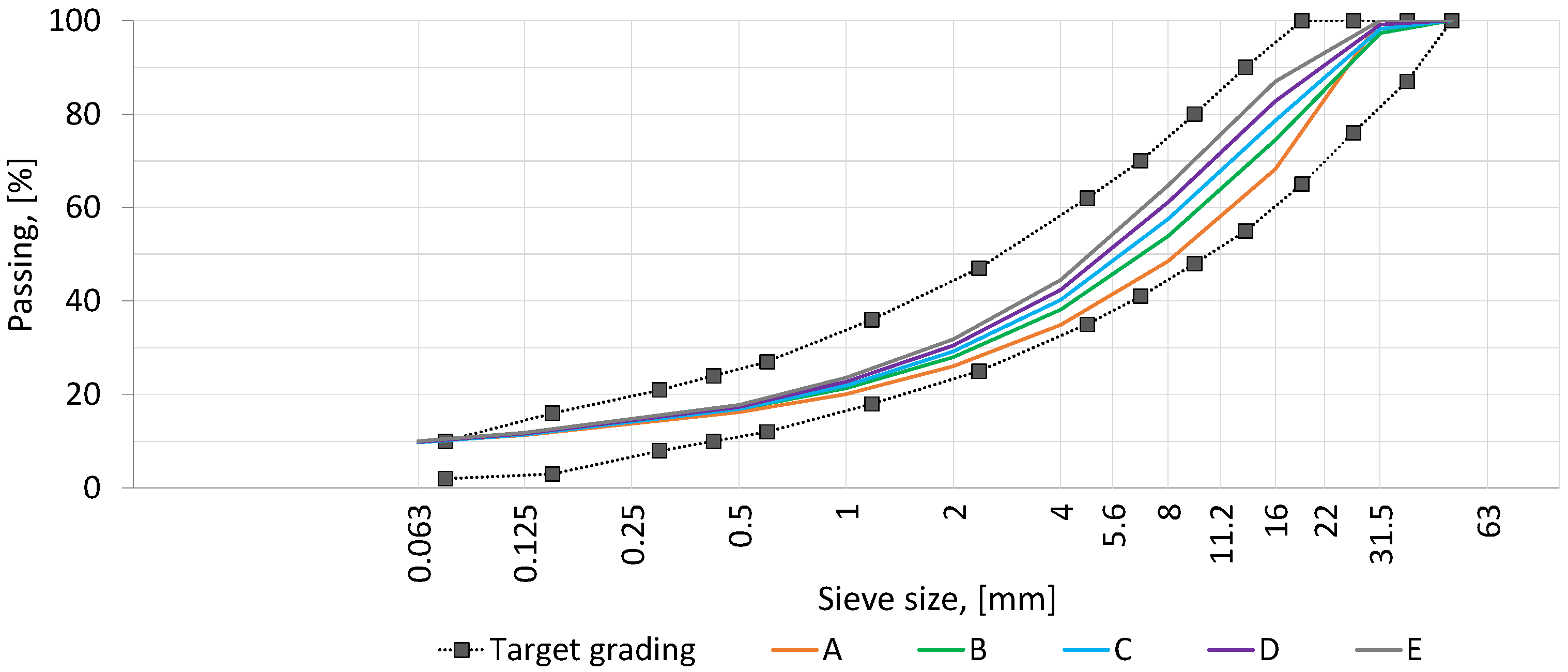
RAP, with a density of 2.599 g/cm3 and an average binder content of 4.8%, was obtained from the milling of asphalt wearing and binder courses. Virgin aggregates included continuously graded dolomite aggregate (0/31.5 mm), continuously graded limestone aggregate (0/4 mm), and limestone filler. Bitumen emulsion type C60 B10 ZM/R with 70/100 penetration grade bitumen was used. The cement content (CEM III/A 42.5N–LH/HSR/NA) was kept constant at 1.0% across all mixtures. The mineral mixtures were designed to fall within the target grading specified in the Wirtgen Cold Recycling Manual [4] and to have a similar content of fines (<0.063 mm), maintained at approximately 10%. Grading curves for the designed CRMs are shown in Figure 1. The OFC was determined according to the modified Proctor moisture–density relationship. The amount of water added to each mixture was calculated in accordance with the national cold recycling mixtures design guidelines [37].

2.2. Testing Methodology and Data Analysis

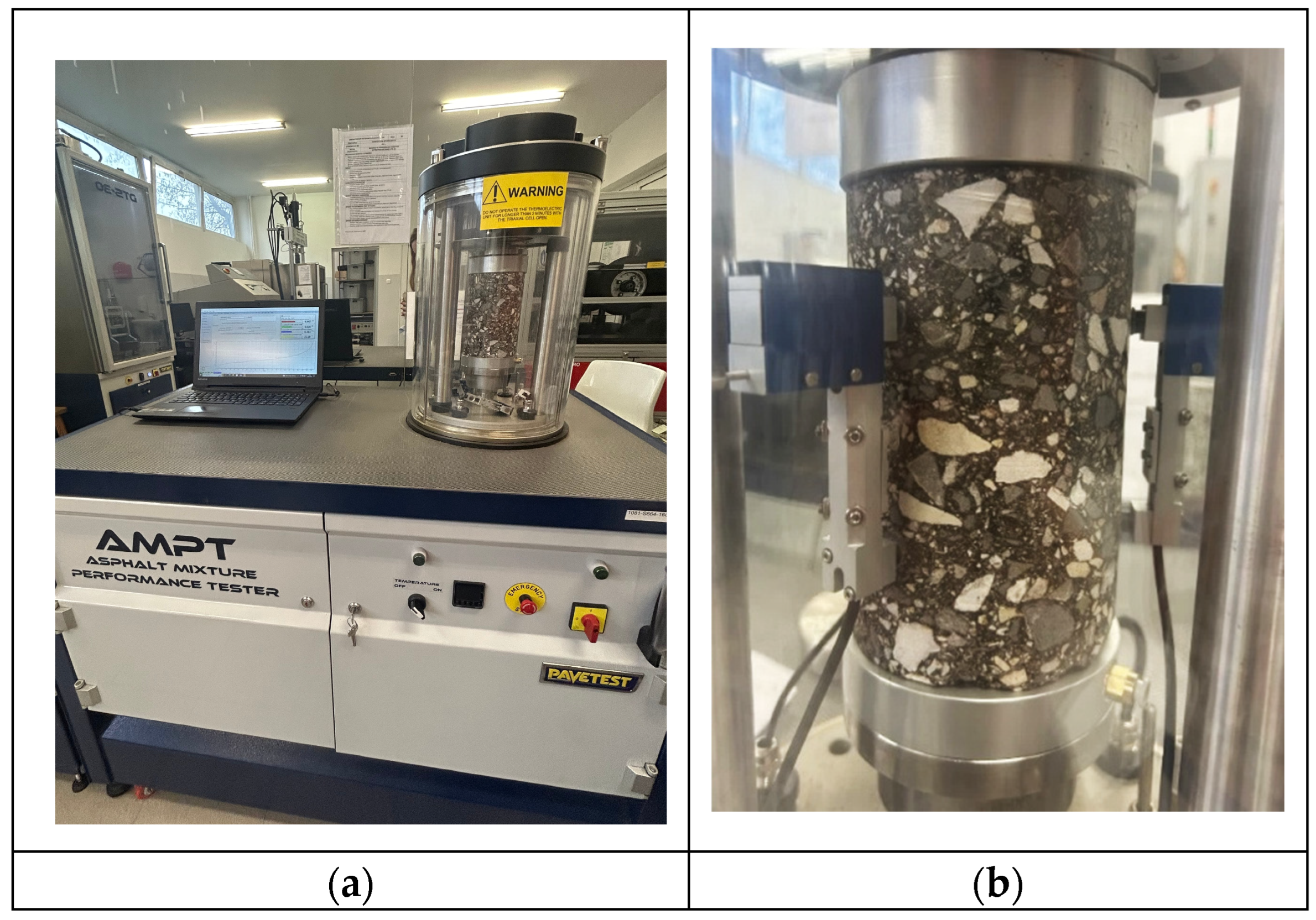
Dynamic modulus E * and phase angle testing were performed using the Asphalt Mixture Performance Tester (AMPT) (Figure 2a) following the AASHTO T 378-22 [36] procedure. Cylindrical specimens with a diameter of 100 mm and a height of 150 mm were cut from parent specimens measuring 150 mm in diameter and 170 mm in height, prepared using a gyratory compactor (vertical pressure of 600 kPa, rotation speed of 30 rpm, and inclination angle of 1.25°) at ambient temperature (25 ± 2) °C. After compaction, the parent specimens were subjected to accelerated curing by oven-drying at 40 °C until constant mass was achieved. Subsequently, the cured specimens were cored and cut to obtain the final test specimens, which were then dried at room temperature to constant mass. The curing procedure was adopted based on literature data on curing protocols commonly applied to cold recycling mixtures [4,12,26,27].
Tests were conducted in the stress-controlled domain at 5 °C, 10 °C, 20 °C, and 40 °C, across frequencies from 0.1 Hz to 25 Hz, with the resultant strain range of 50–100 με on specimens conditioned for four hours at test temperature. Samples’ vertical deformation under cyclic loading was measured using three linear variable displacement transducers (LVDTs) placed 120° apart around the specimen. The testing setup is shown in Figure 2b. Measurements followed a low-to-high temperature sequence, starting with the highest frequency at each level. Three specimens per mixture type were tested.
Dynamic modulus master curves were constructed using the Standard Logistic Sigmoidal (SLS) model (1) at a reference temperature of 20 °C. The shift factor ( a T ) was determined based on the Arrhenius Equation (2), while the reduced frequency was calculated using Equation (3) [24,27,34]:
l o g E * = δ +   E m a x * δ 1 + e β + γ l o g f r
l o g a T = E a 2.303 R 1 T 1 T r
l o g f r = l o g f + l o g a T
where
f—frequency (Hz), f r —reduced frequency (Hz), E m a x * —maximum dynamic modulus limiting the master curve–upper asymptote (MPa), δ —minimum dynamic modulus (model fitting coefficient) (MPa) β and γ —curve shape parameters (model fitting coefficients) (−), T —temperature (K), T r —the reference temperature (K), E a —activation energy (fitting parameter) (J∙mol−1), and R —gas constant: 8.314 J·mol−1·K−1.
The phase angle master curve was fitted according to the Gauss model [34] shown in Equation (4):
φ = φ 0 + A e log f r f c 2 2 f 2
where
φ—phase angle (°); f r —frequency at the reference temperature (Hz); and f , f c , φ 0 , and A —model fitting parameters, respectively, spread (width of the Gaussian curve) (Hz), frequency at peak of the phase angle(Hz), baseline phase angle (°), and phase angle amplitude peak rise above baseline (°). For the Gauss-type model curve construction, the same shift factors ( a T ) calculated for the dynamic modulus master curves were applied.
Curve fitting parameters were optimized to minimize the deviation between measured and predicted values. The analysed master curve goodness-of-fit parameters included R2 and the Se/Sy ratio. The Se/Sy ratio compares the model’s fitting error (Se) to the data’s variability (Sy). A value close to zero indicates a very good fit, values below 0.5 are considered acceptable, while values approaching or exceeding one suggest that the model fails to explain the variability in the data. The fitting accuracy was considered sufficient for the R2 higher or equal to 0.70 (70%).

3. Results and Discussion

3.1. Evaluation of the Viscoelastic Response in Dynamic Testing

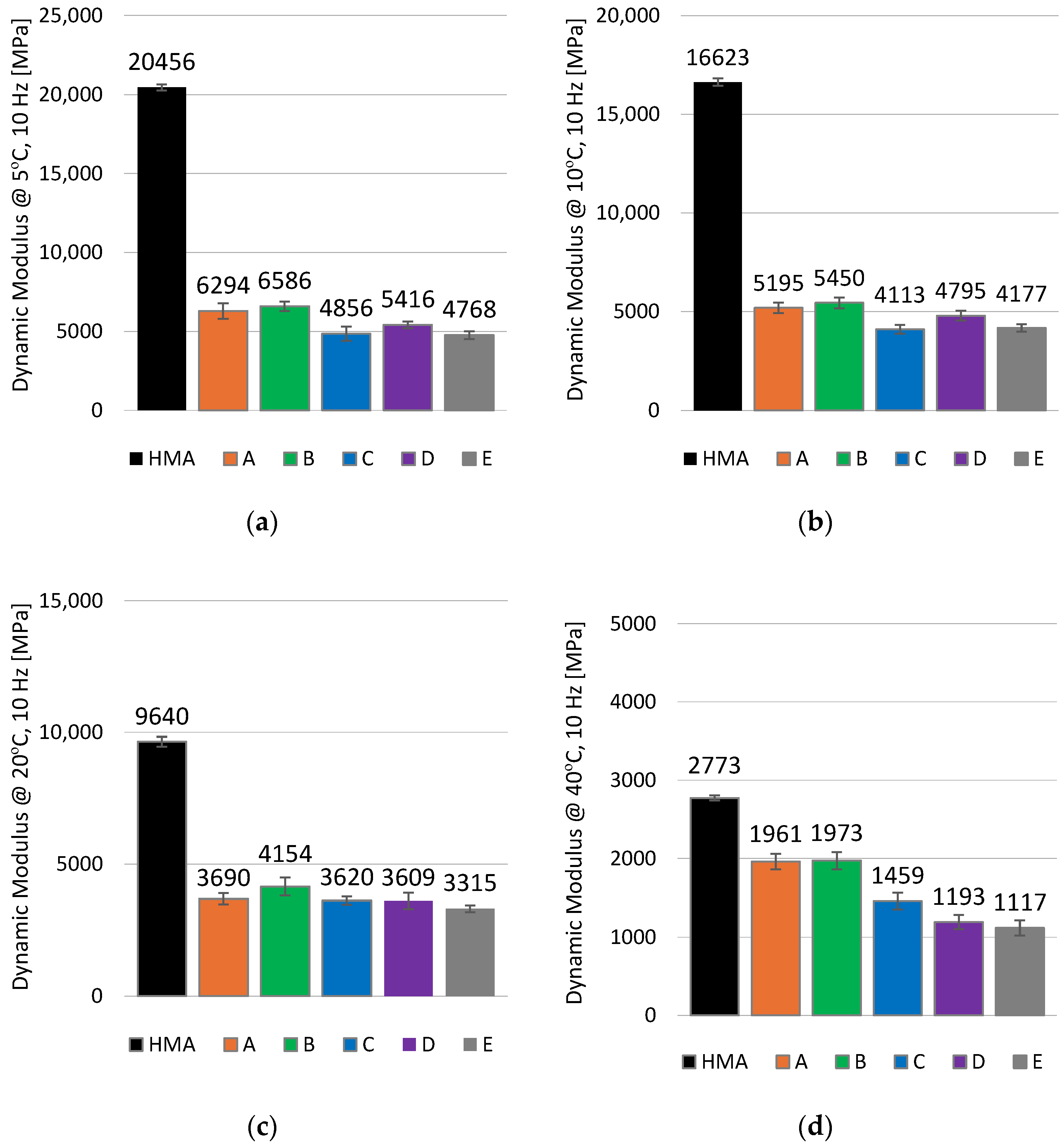
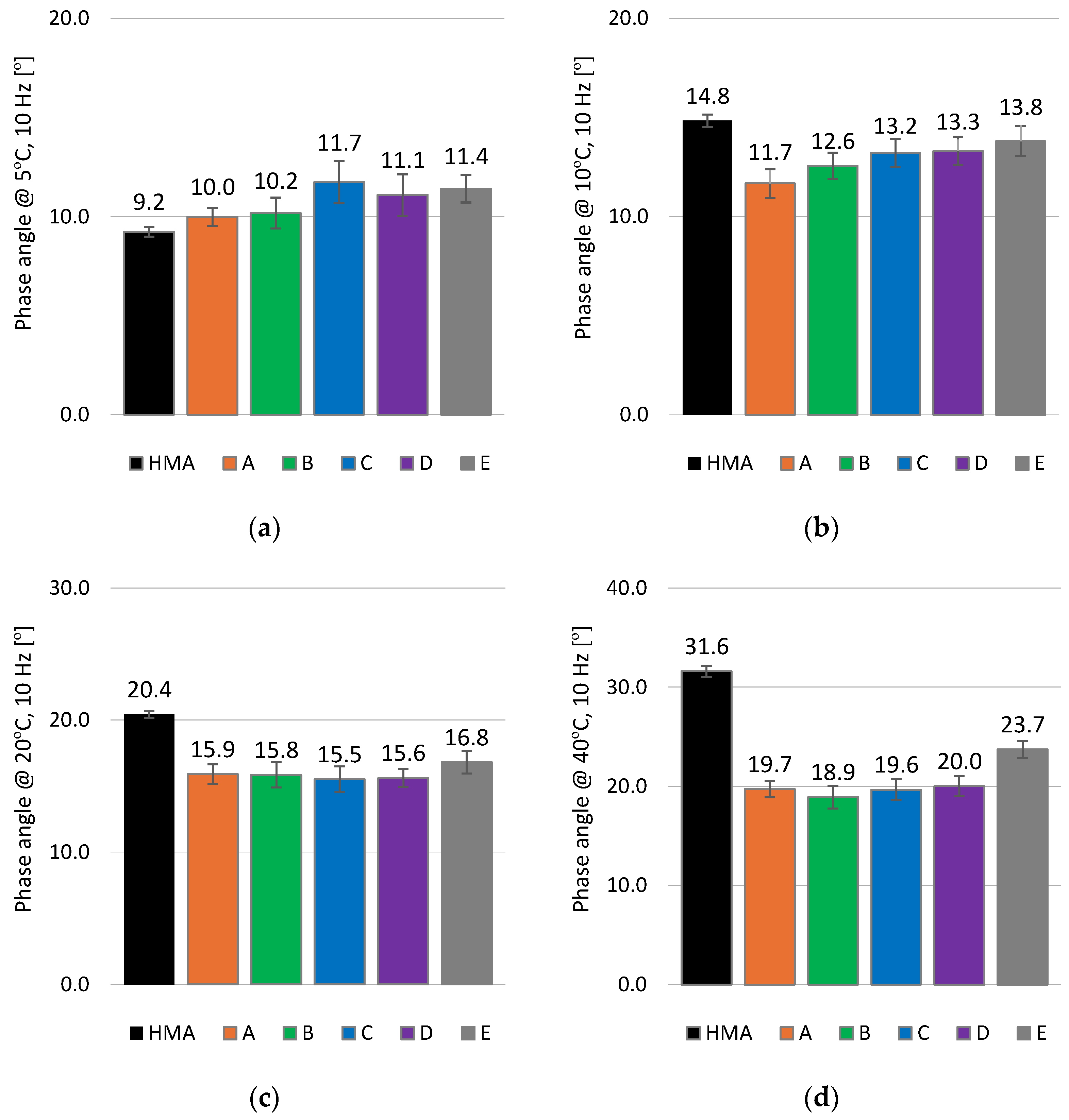
The first step of the viscoelasticity assessment included a comparison of the average dynamic modulus (Figure 3) and phase angle values (Figure 4) between the CRMs and the reference HMA. The results obtained at 10 Hz and at temperatures of 5 °C, 10 °C, 20 °C, and 40 °C were analysed, with ANOVA and Tukey’s HSD post hoc test employed to support the statistical evaluation.
Based on the results presented in Figure 3, it can be concluded that cold recycling mixtures exhibited lower levels of dynamic modulus compared to the reference HMA mixture at all testing temperatures. The most significant percentage differences in the DM values were observed at the lowest test temperatures (5 °C and 10 °C) (Figure 3a,b). In extreme cases for the 5–10 °C temperature range, CRMs exhibited more than four times lower values than HMA, while the smallest differences were observed at 40 °C, corresponding to an approximately 2.5-fold reduction in DM (Figure 3d). This trend may be related to the inherent temperature dependency of bitumen in terms of stiffness and viscosity—characterised by stiffening at low temperatures and softening at high temperatures—which, however, manifests differently in these two types of materials. This observation highlights a distinction in the structure and bituminous binder distribution between CRMs and HMA. The reduced stiffness of CRMs can be attributed to the lower continuity of their asphalt mastic phase, while in the asphalt concrete mixture, the well-developed, cohesive mastic ensures more effective stress transfer between aggregate particles.
Considering CRMs solely, the ANOVA statistical analysis revealed statistically significant differences between five separate dynamic modulus means (A–E) at a 95% confidence level for all test temperatures (Table 2), indicating the sensitivity of this parameter to changes in the CRM material composition.
Based on the post hoc analysis performed using Tukey’s HSD procedure, the low-RAP and high-BE mixtures A and B were identified to form a statistically homogeneous group for the temperatures of 5 °C, 10 °C, and 40 °C, exhibiting higher DM values than mixtures C–E, while for 20 °C, the differentiation between these two mixtures’ groups was less evident. The observed differences in the CRMs’ performance at the lowest and the highest test temperatures may indicate a significant influence of the higher content of the residual binder from bitumen emulsion—more sensitive to temperature changes than aged RAP binder—on the material stiffness development. Lower dynamic moduli recorded for mixtures with higher RAP contents and lower amounts of bitumen emulsion (C–E) indicate their tendency to exhibit a viscous rather than the elastic behaviour, which may, in turn, be associated with the higher total binder content in these mixtures (see Table 1).Although, due to the technological conditions of cold recycling, blending or activation of aged RAP binder is not likely to occur, and the potential for full coating of aggregates with residual binder can be hindered; a different nature of bituminous bonding within mixtures with various RAP contents can be expected. This may be attributed, for instance, to the effectiveness and dynamics of the bitumen emulsion breaking on the surfaces of virgin aggregates and RAP particles, which differ in polarity [38].
Despite the CRMs’ significantly lower levels of dynamic modulus compared to HMA, the differences between the phase angle values of these materials were considerably less pronounced (Figure 4). Moreover, as revealed by ANOVA results (Table 2), no statistically significant changes were observed for the phase angle between the five types of cold recycling mixtures for the test temperatures of 5 °C, 10 °C, and 20 °C. This allows the tested CRMs to be considered, in the low- to medium-temperature range, as a homogeneous group of materials, while also indicating a lower sensitivity of the phase angle parameter to variations in material composition.
As shown in Figure 4a, at 5 °C slightly higher phase angle values were recorded for CRMs compared to HMA, suggesting their relatively more pronounced viscous response. This may be due to the presence of softer fresh binder in localised regions, which, although not contributing significantly to overall stiffness, still affects the phase relationship between stress and strain. Additionally, the absence of a fully continuous mastic phase in CRMs may lead to increased micro-slippage at the aggregate–binder interfaces under cyclic loading, further increasing energy dissipation. In contrast, at temperatures of 10 °C and 20 °C, the average reductions of 13% and 22% in the phase angle values for CRMs compared to HMA were noted, respectively. At 40 °C, based on the Tukey’s HSD test, the differentiation in phase angle values between the group of mixtures A–D and mixture E was observed. This 90%-RAP CRM showed the highest phase angle among all CRMs, which remained 25% lower than that of the HMA mixture.
Based on the combined observations for the dynamic modulus and phase angle values, it can be stated that the reduced stiffness of CRMs compared to HMA may indicate limited continuity of the asphalt mastic phase in cold recycling mixtures, which may affect the mechanisms of internal friction and cohesion in the material. As a result, stress transfer between aggregate particles through the bitumen phase may be less effective, despite a considerable amount (5.5–7.4%) of bitumen emulsion in these mixtures. Considering the CRMs’ mechanical response based on phase angle values, a likely different pattern of load transfer compared to asphalt mixtures can be suggested. Assuming that the system of the localised bituminous bonds and the bitumen coating of coarse aggregate particles in CRMs responds under mechanical loading more independently than the continuous HMA binder film, a more heterogeneous and less structurally integrated viscoelastic behaviour of these materials can be expected. This, consequently, may result in the absence of significant differences in phase angle between the tested CRMs for the majority of analysed cases.
However, the abovementioned observations do not preclude the potential of these mixtures to exhibit viscoelastic behaviour and the applicability of the TTSP to describe their response. To enable a more comprehensive evaluation, the percentage changes in the mixtures’ dynamic modulus and phase angle, measured at a frequency of 10 Hz across the temperature range of 5–40 °C, were analysed (Table 3 and Table 4). Statistically significant differences in parameter values at the 95% confidence level were marked in bold.
Analysing changes in dynamic modulus values (Table 3), it can be stated that cold recycling mixtures exhibited a less sensitive response to temperature changes compared to HMA. Nevertheless, all of the observed changes were statistically significant. For the temperature range of 5–10 °C, the highest temperature sensitivity (close to the one recorded for the asphalt mixture) was observed for the mixtures with the highest BE contents (A and B), highlighting the influence of the BE content on the development of viscoelastic properties at low to moderate service temperatures. This might be attributed to the fact that the “fresh” residual binder from bitumen emulsion is more thermally responsive than the aged RAP binder and plays a more prominent role in determining material stiffness at low temperatures. For the 10–20 °C temperature range, no clear trend in dynamic modulus changes was observed with respect to BE content, in contrast to the behaviour noted at lower temperatures. Similarly, no consistent pattern related to RAP content was identified. At the highest test temperatures (20–40 °C), the greatest percentage reductions in modulus values (ranging from 60% to 67%) were recorded for mixtures C-E with intermediate to high RAP content (50–90%) and consequently, the highest TBC (6.2–7.6%).
As presented in Table 4, the phase angle of CRMs was less sensitive to temperature variations than the dynamic modulus. Within the lowest test temperature range (5–10 °C), statistically significant changes were observed for all mixtures except for mixture C. Nevertheless, the observed range of changes (17–24% increase) was markedly lower than that recorded for HMA, which reached 61%. The level of change in the average phase angle values at 10 °C and 20 °C for most mixtures was similar to that observed at lower temperatures, ranging from 14% to 26%. The highest increase comparable to that of HMA (36%)–was observed for mixture A with the highest BE content and no RAP addition. In the highest temperature range of the study (20–40 °C), the greatest increases in phase angle—indicating the most pronounced transition of the material toward a viscous state—were observed for mixture E with the 90% RAP content.
The temperature sensitivity of CRMs in terms of changes in mechanical properties observed in this study aligns with the results of the authors’ previous research as well as with international literature [39,40]. Based on the presented data, it can be concluded that, while the absolute changes in the CRMs’ parameter values indicate a lower temperature sensitivity compared to the reference viscoelastic material, their thermal response is consistent enough to produce statistically significant differences in the vast majority of analysed cases. This, in consequence, confirms the relevance of further analysing the viscoelastic properties of these materials via TTSP, taking into account the results obtained in the frequency-sweep testing mode.

3.2. Application of the Time–Temperature Superposition Principle to the CRMs’ Mechanical Behaviour

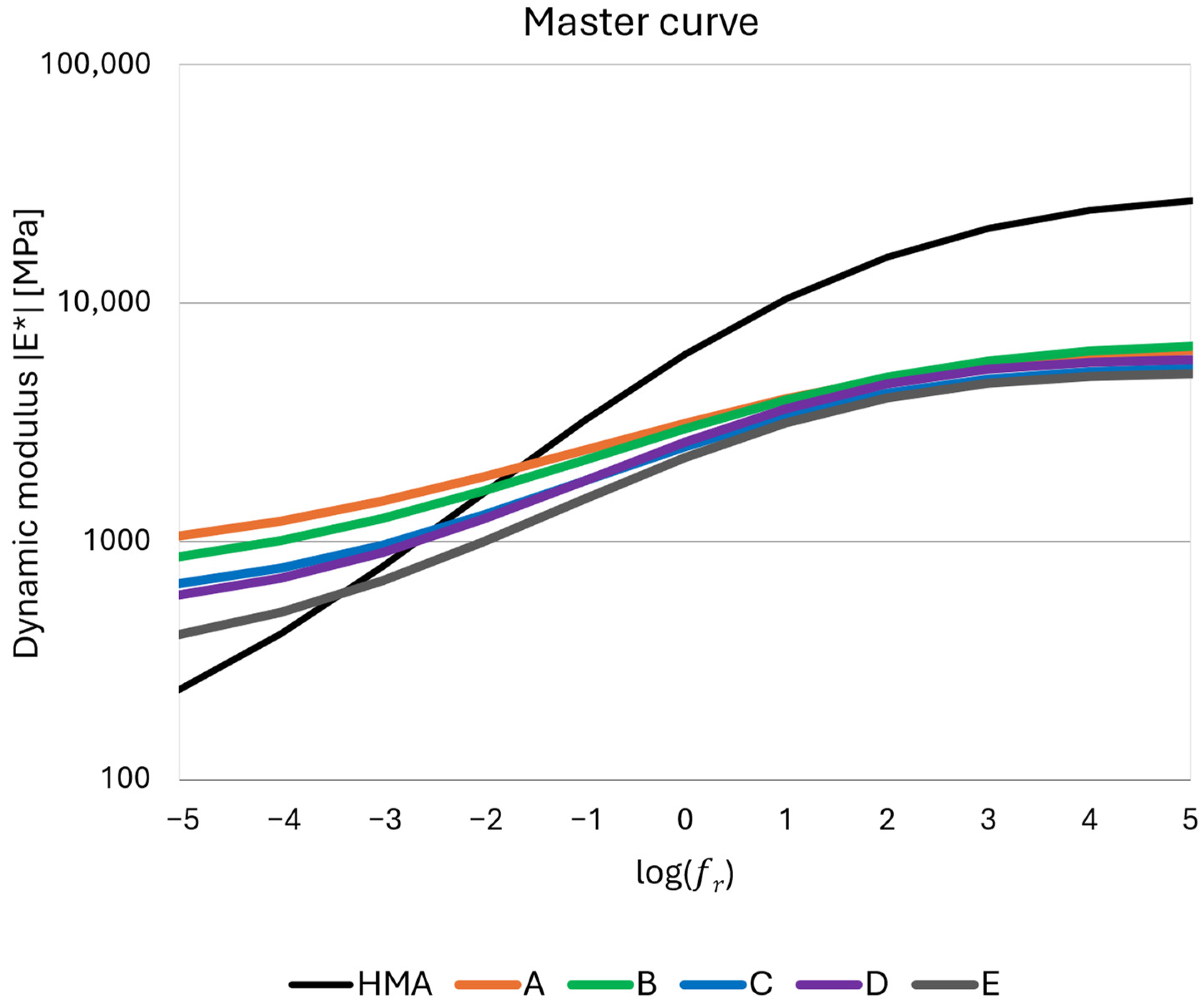
The master curve fitting for BSM-Es was carried out using an approach commonly applied to asphalt mixtures. For the dynamic modulus, the Standard Logistic Sigmoidal model was applied, while for the phase angle, the Gauss model was used to fit the experimental data. In both cases, the shift factors at a reference temperature of 20 °C were calculated using the Arrhenius equation. Figure 5 presents the representative examples of dynamic modulus master curves constructed for the CRMs and the reference asphalt mixture.
Based on the presented master curve of the dynamic modulus E * as a function of reduced frequency log( f r ), it can be stated that both HMA and CRM mixtures exhibited a smooth S-shaped curve characteristic of viscoelastic materials, confirming a typical dependence of stiffness on frequency (i.e., indirectly on loading time and temperature). Nevertheless, cold recycling mixtures showed lower ranges of the dynamic modulus variation compared to asphalt concrete, indicating a more attenuated response and reduced sensitivity to temperature and loading duration. These observations are consistent with the conclusions reported by Kuna and Gottumukkala [27] for the dynamic modulus master curve fitting performed for CRMs containing ≤ 1% cement.
Considering the group of CRM mixtures, a distinctly greater variation in the predicted dynamic modulus values was observed at the lowest frequencies, corresponding to high-temperature conditions, compared to the highest frequencies associated with low testing temperatures. The calculated goodness-of-fit measures for the SLS model used (Table 5) confirm the applicability of TTSP for describing mechanical behaviour of CRMs. The obtained values of the coefficient of determination R2, ranging from 0.980 to 0.988, indicate a very good agreement between the model and the experimental data. Additionally, the low values of the goodness-of-fit indicator Se/Sy (ranging from 0.114 to 0.149) further confirm the high quality of the model fit to the measured results. As observed for CRMs with bitumen emulsion in the study by Kuchiishi et al. [12], the variation in dynamic modulus values across the tested frequency and temperature range confirms their viscoelastic nature and supports the assumption that the use of bitumen emulsion promotes the formation of a continuous bitumen coating of aggregate particles.
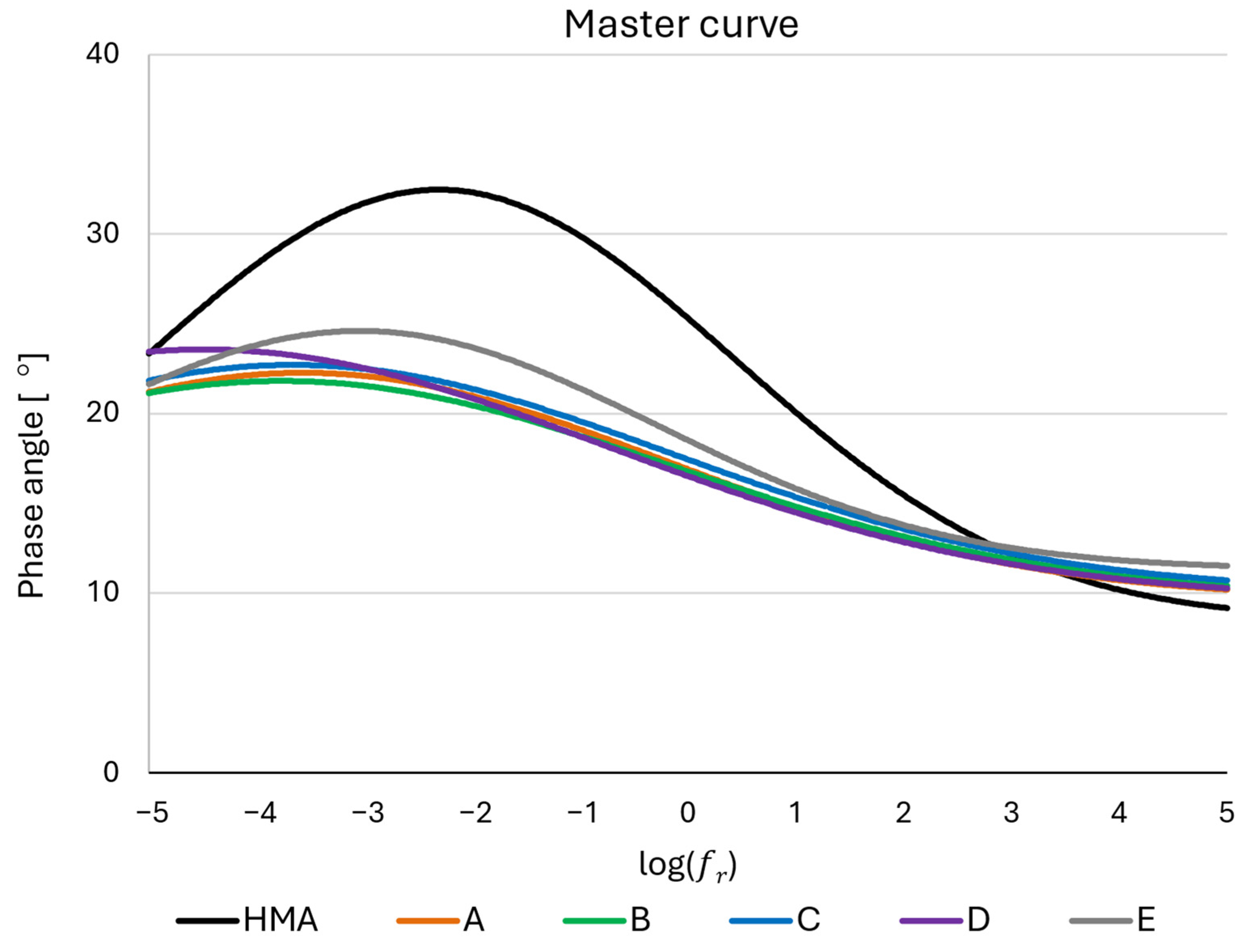
The representative examples of the phase angle master curves constructed for CRMs and HMA are presented in Figure 6. Consistently with the trends noted for the dynamic modulus, the broadest range of phase angle variability was observed for the asphalt mixture. However, in this instance, a greater variation in the shape and distribution of the curves was observed within the group of CRMs. In general, the analysed cold recycling mixtures were characterised with the lower values of curve peaks shifted towards lower frequencies (log( f r ) in the range of −4 to −2) compared to the HMA, which corresponds to longer loading times and/or higher temperatures. The master curve most closely resembling the characteristics of the HMA curve was observed for mixture E, presenting the highest phase angle peak and the widest range of the phase angle values. For mixtures containing 0% to 50% RAP (A–C), similarly shaped master curves were observed. However, compared to the 90% RAP mixture, significantly lower phase angle peak values were noted with their simultaneous shift to the log( f r ) range of −3 to −4. On the other hand, the master curve fitted for mixture D did not present a full Gauss shape within the analysed frequency range, reaching the peak at the lowest log( f r ) values.
Analysing the data presented in Table 6, it can be stated that the quality of fit slightly decreased in comparison to the dynamic modulus master curve, with the R2 values ranging from 0.875 to 0.977 and the Se/Sy ranging from 0.158 to 0.366. Nevertheless, the obtained fitting of the Gauss model to the experimental data can be still considered highly satisfactory for CRM mixtures, proving that their mechanical performance in terms of phase angle variability can be modelled and described using approaches traditionally applied to HMA.
With reference to the literature data, the findings of the study are consistent with previous research confirming the applicability of the TTSP to cold recycling mixtures containing from 50% to 100% RAP and approximately 1.5% to 3.5% residual bitumen. Based on the analysis of both the dynamic modulus and phase angle master curves presented in the work of Meneses et al. [26], compared to asphalt concrete, cold recycling mixtures with bitumen emulsion and 1% cement exhibited a lower dynamic modulus across the entire frequency and temperature range tested. Phase angle results indicated that at intermediate and high frequencies, CRMs behaved even more viscously, showing a lower capacity to recover from deformation than the asphalt concrete mixture. Under low-frequency and high-temperature conditions, cold recycling mixtures exhibited more elastic behaviour, reflected in lower phase angle values. The applicability of the Generalized Sigmoidal model to fitting the CRM dynamic modulus data across a wide range of material-related factors was also confirmed in the study conducted by Meneses et al. [28].

4. Conclusions

This study evaluated the viscoelastic performance of cold recycling mixtures (CRMs) with bitumen emulsion by means of dynamic modulus and phase angle testing according to the AASHTO T 378-22 [36] standard, followed by master curve modelling based on the time–temperature superposition principle.
Based on the findings obtained in this study, the following key insights can be provided:
  • The mechanical behaviour of CRMs, despite their inherently more heterogeneous internal structure compared to HMA, can be effectively modelled using TTSP. The master curves of the dynamic modulus and phase angle exhibited viscoelastic trends, with high-quality fitting achieved for the Standard Logistic Sigmoidal (R2 = 0.980–0.988, Se/Sy = 0.114–0.149) and Gauss models (R2 = 0.875–0.977, Se/Sy = 0.158–0.366), respectively.
  • CRMs demonstrated lower temperature sensitivity than HMA with respect to dynamic modulus and phase angle, while still exhibiting statistically significant differences across the tested temperature range.
  • BE content and RAP content significantly affect the viscoelastic properties of CRMs, especially in terms of the dynamic modulus. The influence of BE content was dominant, especially at lower temperatures, for which mixtures with high BE contents (7.1–7.4%) and low RAP content (0–30%) showed the most notable E * changes. CRMs with 5.5–6.4% BE and intermediate to high RAP contents (50–90%) exhibited more pronounced viscous behaviour at elevated temperatures.
  • Based on the analysis of the dynamic modulus and phase angle master curves, greater differentiation among CRMs was observed at lower frequencies (corresponding to high-temperature and long loading time conditions). In contrast, at high frequencies (low temperatures), the response of the cold recycling mixtures was more uniform, indicating more elastic-like behaviour.
In summary, this research advances the understanding of the viscoelastic behaviour of cold recycling mixtures and contributes to the development of the performance-based design approaches for CRMs by confirming the feasibility of extending established asphalt mixture modelling frameworks to these materials. The potential of CRMs with bitumen emulsion for use in pavement base courses is highlighted, where controlled viscoelasticity is beneficial for reflective cracking mitigation and effective load distribution. However, the limitations of this study should be acknowledged, particularly with respect to the use of only selected types of locally available RAP, virgin aggregates, bitumen emulsion, and cement. Future research will focus on the influence of a broader spectrum of key material characteristics on the viscoelastic behaviour of CRMs, considering the qualitative and quantitative selection of the mix components. The extension of the research to field-scale studies, including long-term monitoring of CRMs’ performance evolution in trial pavement sections will be addressed in future work. Moreover, the results indicate the potential to extend the description of CRMs’ mechanical behaviour beyond mathematical function fitting toward constitutive characterisation of their time- and temperature-dependent response using rheological models, such as the Huet–Sayegh and generalized Kelvin–Voigt (GKV).

Author Contributions

Conceptualization, K.K., J.B.K. and W.S.; methodology, K.K. and J.B.K.; software, K.K.; validation, J.B.K. and W.S.; formal analysis, K.K. and J.B.K.; investigation, K.K.; resources, K.K. and J.B.K.; data curation, K.K.; writing—original draft preparation, K.K.; writing—review and editing, J.B.K. and W.S.; visualization, K.K.; supervision, J.B.K. and W.S.; project administration, K.K., J.B.K. and W.S.; funding acquisition, J.B.K. All authors have read and agreed to the published version of the manuscript.

Funding

This research received no external funding.

Institutional Review Board Statement

Not applicable.

Informed Consent Statement

Not applicable.

Data Availability Statement

The data presented in this study are available on request from the corresponding author.

Acknowledgments

The authors would like to thank CEMEX Polska Sp. z o.o. for providing free samples of the virgin aggregate (continuously graded crushed dolomite aggregate M’80 0/31,5 mm Jaroszowiec) used in the research and BITUNOVA Sp. z o.o. for providing free bitumen emulsion samples.

Conflicts of Interest

This study used materials provided by CEMEX Polska Sp. z o.o. and BITUNOVA Sp. z o.o. The authors declare that the research was conducted in the absence of any commercial or financial relationships that could be construed as a potential conflict of interest.

References

  1. Gunka, V.; Hidei, V.; Sidun, I.; Demchuk, Y.; Stadnik, V.; Shapoval, P.; Sobol, K.; Vytrykush, N.; Bratychak, M. Wastepaper Sludge Ash and Acid Tar as Activated Filler Aggregates for Stone Mastic Asphalt. Coatings 2023, 13, 1183. [Google Scholar] [CrossRef]
  2. Coelho, L.M.; Kox, R.P.; Guimarães, A.C.R.; Travincas, R.; Monteiro, S.N. Influence of Curing Time on the Mechanical Behavior of Cold Recycled Bituminous Mix in Flexible Pavement Base Layer. Appl. Sci. 2024, 14, 7612. [Google Scholar] [CrossRef]
  3. Charmot, S.; Teh, S.Y.; Abu Haris, R.E.; Ayob, M.A.; Ramzi, M.R.; Kamal, D.D.M.; Atan, A. Field performance of bitumen emulsion Cold Central Plant Recycling (CCPR) mixture with same day and delayed overlay compared with traditional rehabilitation procedures. Case Stud. Constr. Mater. 2022, 17, e01365. [Google Scholar] [CrossRef]
  4. Wirtgen Group. Wirtgen Cold Recycling Technology, 1st ed.; Wirtgen GmbH: Windhagen, Germany, 2012. [Google Scholar]
  5. Godenzoni, C.; Graziani, A.; Bocci, E.; Bocci, M. The evolution of the mechanical behaviour of cold recycled mixtures stabilised with cement and bitumen: Field and laboratory study. Road Mater. Pavement Des. 2017, 19, 856–877. [Google Scholar] [CrossRef]
  6. Shanbara, H.K.; Dulaimi, A.; Al-Mansoori, T.; Al-Busaltan, S.; Herez, M.; Sadique, M.; Abdel-Wahed, T. The future of eco-friendly cold mix asphalt. Renew. Sustain. Energy Rev. 2021, 149, 111318. [Google Scholar] [CrossRef]
  7. Xiao, F.; Yao, S.; Wang, J.; Li, X.; Amirkhanian, S. A literature review on cold recycling technology of asphalt pavement. Constr. Build. Mater. 2018, 180, 579–604. [Google Scholar] [CrossRef]
  8. Valentin, J.; Snížek, J.; Hradil, J.; Engels, M. CoRePaSol Project. Guide for Using Suitable Eco-Balance Tools to Evaluate the Environmental Compatibility of Cold Recycling. CEDR Transnational Road Research Programme. 2015. Available online: https://www.cedr.eu/download/other_public_files/research_programme/call_2012/recycling/corepasol/Report-D5.2-Guide-for-using-suitable-eco-balance-tools-to-evaluate-the-environmental-compatibility-of-cold-recycling.pdf (accessed on 1 November 2025).
  9. Liu, Z.; Sun, L.; Zhai, J.; Huang, W. A review of design methods for cold in-place recycling asphalt mixtures: Design processes, key parameters, and evaluation. J. Clean. Prod. 2022, 370, 287–296. [Google Scholar] [CrossRef]
  10. Fedrigo, W.; Kleinert, T.R.; Núñez, W.P.; Graeff, Â.G.; Filho, L.C.P.D.S.; Brito, L.A.T. Shrinkage of Cold Recycled Cement-Treated Mixtures of Asphalt Pavement Materials. J. Test. Eval. 2022, 51, 2230–2244. [Google Scholar] [CrossRef]
  11. Graziani, A.; Bocci, M. Compactability and thermal sensitivity of cement–bitumen-treated materials. Road Mater. Pavement Des. 2012, 13, 599–617. [Google Scholar] [CrossRef]
  12. Kuchiishi, A.K.; Vasconcelos, K.; Bernucci, L.L.B. Effect of mixture composition on the mechanical behaviour of cold recycled asphalt mixtures. Int. J. Pavement Eng. 2019, 22, 984–994. [Google Scholar] [CrossRef]
  13. Dołżycki, B.; Jaskuła, P. Review and evaluation of cold recycling with bitumen emulsion and cement for rehabilitation of old pavements. J. Traffic Transp. Eng. (Engl. Ed.) 2019, 6, 311–323. [Google Scholar] [CrossRef]
  14. Bisanti, F.; Carbutti, N.; Dave, E.V.; Sias, J.E.; Romeo, E.; Tebaldi, G. Influence of compaction methods on physical-mechanical properties of cold recycled asphalt mixtures and pavement life. Road Mater. Pavement Des. 2025, 26, 400–416. [Google Scholar] [CrossRef]
  15. Smith, S.; Braham, A. Comparing layer types for the use of PavementME for asphalt emulsion Full Depth Reclamation design. Constr. Build. Mater. 2018, 158, 481–489. [Google Scholar] [CrossRef]
  16. Collings, D. Technical Guideline: Bitumen Stabilised Materials. A Guideline for the Design and Construction of Bitumen Emulsion and Foamed Bitumen Stabilised Materials; Southern African Bitumen Association (Sabita), Asphalt Academy: Pretoria, South Africa, 2020. [Google Scholar]
  17. Jaczewski, M.; Szydłowski, C.; Dołżycki, B. Stiffness of cold-recycled mixtures under variable deformation conditions in the IT-CY test. Case Stud. Constr. Mater. 2023, 18, e02066. [Google Scholar] [CrossRef]
  18. Dong, Z.; Xu, G.; Xu, S.; Ma, S.; Ma, T.; Luan, Y.; Liu, J. Study on the strength composition mechanism and interface microscopic characteristics of cold recycling asphalt mixture. Front. Mater. 2024, 11, 1397335. [Google Scholar] [CrossRef]
  19. Tebaldi, G.; Dave, E.; Hugener, M.; Falchetto, A.C.; Perraton, D.; Grilli, A.; Presti, D.L.; Pasetto, M.; Loizos, A.; Jenkins, K.; et al. Cold Recycling of Reclaimed Asphalt Pavements. In Testing and Characterization of Sustainable Innovative Bituminous Materials and Systems. State-of-the-Art Report of the RILEM Technical Committee; Springer: Berlin/Heidelberg, Germany, 2018. [Google Scholar]
  20. Simnofske, D.; Mollenhauer, K.; Engels, M.; Valentin, J. CoRePaSol Project. Activity of RA Bitumen in Cold-Recycled Mixes. CEDR Transnational Road Research Programme. 2014. Available online: https://www.cedr.eu/download/other_public_files/research_programme/call_2012/recycling/corepasol/D4.1-Activity-of-RA-bitumen-in-cold-recycled-mixes.pdf (accessed on 1 November 2025).
  21. Tebaldi, G.; Dave, E.; Falchetto, A.C.; Hugener, M.; Perraton, D.; Grilli, A.; Presti, D.L.; Pasetto, M.; Loizos, A.; Jenkins, K.; et al. Recommendation of RILEM TC237-SIB on fragmentation test for recycled asphalt. Mater. Struct. 2019, 52, 82. [Google Scholar] [CrossRef]
  22. Andrews, J.K.; Radhakrishnan, V.; Koshy, R.Z. Laboratory Evaluation of Emulsion-Treated Base Layer Mixes Incorporating Reclaimed Asphalt Pavement Materials. J. Mater. Civ. Eng. 2023, 35, 04023198. [Google Scholar] [CrossRef]
  23. Konieczna, K.; Król, J. Investigation of tertiary Flow Behavior of bitumen stabilised materials with bitumen emulsion. Roads Bridg.-Drog. I Most. 2023, 22, 491–502. [Google Scholar] [CrossRef]
  24. Chomicz-Kowalska, A.; Maciejewski, K. Performance and viscoelastic assessment of high-recycle rate cold foamed bitumen mixtures produced with different penetration binders for rehabilitation of deteriorated pavements. J. Clean. Prod. 2020, 258, 120517. [Google Scholar] [CrossRef]
  25. Jaczewski, M.; Szydlowski, C.; Dolzycki, B. Preliminary study of linear viscoelasticity limits of cold recycled mixtures determined in Simple Performance Tester (SPT). Constr. Build. Mater. 2022, 357, 129432. [Google Scholar] [CrossRef]
  26. Meneses, J.P.C.; Vasconcelos, K.; Bernucci, L.L.B. Stiffness assessment of cold recycled asphalt mixtures–Aspects related to filler type, stress state, viscoelasticity, and suction. Constr. Build. Mater. 2022, 318, 126003. [Google Scholar] [CrossRef]
  27. Kuna, K.; Gottumukkala, B. Viscoelastic characterization of cold recycled bituminous mixtures. Constr. Build. Mater. 2019, 199, 298–306. [Google Scholar] [CrossRef]
  28. Meneses, J.; Vasconcelos, K.; Kuchiishi, K.; Bernucci, L. Dynamic Modulus Regression Models for Cold Recycled Asphalt Mixtures. Infrastructures 2025, 10, 143. [Google Scholar] [CrossRef]
  29. Godenzoni, C.; Graziani, A.; Perraton, D. Complex modulus characterisation of cold-recycled mixtures with foamed bitumen and different contents of reclaimed asphalt. Road Mater. Pavement Des. 2016, 18, 130–150. [Google Scholar] [CrossRef]
  30. Graziani, A.; Spadoni, S.; Ingrassia, L.P.; Virgili, A.; Canestrari, F. Composite fatigue failure of cold recycled material mixtures: New insights into the role of bitumen and cement. Mater. Struct. 2023, 57, 10. [Google Scholar] [CrossRef]
  31. Mathaniya, E.; Jenkins, K.; Ebels, L. Characterisation of Fatigue Performance of Selected Cold Bituminous Mixes. In Proceedings of the 10th International Conference on Asphalt Pavements, Quebec City, QC, Canada, 12–17 August 2006; pp. 429–438. [Google Scholar]
  32. Valentin, J.; Suda, J.; Žák, J. CoRePaSol Project. Report on Durability of Cold-Recycled Mixes: Complex Dynamic Modulus and Master Curves of Cold Recycling Mixes. CEDR Transnational Road Research Programme. 2014. Available online: https://www.researchgate.net/publication/278024365_Report_on_Durability_of_cold-recycled_mixes_Complex_dynamic_modulus_and_master_curves_of_cold_recycling_mixes (accessed on 2 November 2025).
  33. Gómez-Meijide, B.; Pérez, I.; Airey, G.; Thom, N. Stiffness of cold asphalt mixtures with recycled aggregates from construction and demolition waste. Constr. Build. Mater. 2015, 77, 168–178. [Google Scholar] [CrossRef]
  34. Ma, S.; Fan, L.; Ma, T.; Dong, Z.; Zhang, Y.; Zhang, X. Dynamic Characteristic Master Curve and Parameters of Different Asphalt Mixtures. Appl. Sci. 2022, 12, 3619. [Google Scholar] [CrossRef]
  35. Doyle, T.A.; McNally, C.; Gibney, A.; Tabaković, A. Developing maturity methods for the assessment of cold-mix bituminous materials. Constr. Build. Mater. 2013, 38, 524–529. [Google Scholar] [CrossRef]
  36. T378-22; Standard Method of Test for Determining Dynamic Modulus and Flow Number for Asphalt Mixtures Using the Asphalt Mixture Performance Tester (AMPT). American Association of State Highway and Transportation Officials—AASHTO: Washington, DC, USA, 2022.
  37. Dołżycki, B. Guidelines for Design and Paving of Mineral-Cement-Emulsion Mixes (MCE) (in Polish). General Directorate for National Roads and Motorways. 2014. Available online: https://www.gov.pl/attachment/53271a14-f9a8-41ca-a6e2-68c264d2f202 (accessed on 2 November 2025).
  38. Asphalt Institute. Breaking and curing. In A Basic Asphalt Emulsion Manual; Asphalt Institute: Lexington, KY, USA, 2008; pp. 12–13. [Google Scholar]
  39. Zaková, J.; Valentin, J.; Suda, J. CoRePaSol Project. Report on Durability of Cold-Recycled Mixes: Test Procedures for Stiffness Determination. CEDR Transnational Road Research Programme. 2014. Available online: https://www.cedr.eu/download/other_public_files/research_programme/call_2012/recycling/corepasol/D2.1-Durability-of-cold-recycled-mixes-%25E2%2580%2593-Test-procedures-for-moisture-stiffness-determination.pdf (accessed on 1 November 2025).
  40. Konieczna, K.; Pokorski, P.; Sorociak, W.; Radziszewski, P.; Żymełka, D.; Król, J.B. Study of the Stiffness of the Bitumen Emulsion Based Cold Recycling Mixes for Road Base Courses. Materials 2020, 13, 5473. [Google Scholar] [CrossRef] [PubMed]
Figure 1. Grading curves of CRMs.
Applsci 16 00521 g001
Figure 2. Dynamic modulus (DM) testing: (a) AMPT device; (b) CRM specimen testing setup.
Applsci 16 00521 g002
Figure 3. Dynamic modulus of HMA and CRMs at (a) 5 °C; (b) 10 °C; (c) 20 °C; and (d) 40 °C.
Applsci 16 00521 g003
Figure 4. Phase angle of HMA and CRMs at (a) 5 °C; (b) 10 °C; (c) 20 °C; and (d) 40 °C.
Applsci 16 00521 g004
Figure 5. Dynamic modulus master curves of CRMs and the HMA mixture.
Applsci 16 00521 g005
Figure 6. Phase angle master curves of the selected CRMs and the HMA mixture.
Applsci 16 00521 g006
Table 1. CRMs’ mix composition with mechanical and volumetric properties.
Mixture CodeRAP
Content [%]
BE
Content [%]
Total Binder Content [%]OFC [%]ITS Avg.* [kPa]ITS St. Dev.** [kPa]Vm Avg.* [%]Vm
St. Dev.** [%]
A07.44.46.45072112.30.9
B307.15.76.15432911.00.8
C506.46.26.05392410.80.5
D705.76.85.85402810.30.7
E905.57.65.95022210.70.5
*—average value; **—standard deviation.
Table 2. ANOVA results for CRM dynamic modulus and phase angle.
Temperature [°C]ANOVA p-Value
Dynamic ModulusPhase Angle
50.0002 *0.1557
100.0001 *0.0749
200.0184 *0.3227
400.0000 *0.0011 *
*—statistically significant difference.
Table 3. Percentage changes in dynamic modulus values of HMA and CRM mixtures in relation to test temperature.
Mixture CodeHMAABCDE
Temperature [°C]Average Decrease in Dynamic Modulus @ 10 Hz
5–1019%17%17%12%11%12%
10–2042%29%24%12%25%21%
20–4071%47%53%60%67%66%
Table 4. Percentage changes in phase angle values of HMA and CRM mixtures in relation to test temperature.
Mixture CodeHMAABCDE
Temperature [°C]Average Increase in Phase Angle @ 10 Hz
5–1061%17%24%13%20%21%
10–2038%36%26%17%17%22%
20–4055%24%19%27%28%41%
Table 5. Dynamic modulus master curve fitting parameters and goodness-of-fit measures.
Mixture β δ γ E a R2Se/Sy
A−0.4102.965−0.522280,1720.9800.149
B−0.3862.892−0.551278,6830.9860.124
C−0.4582.830−0.644236,3660.9880.114
D−0.2752.920−0.697243,4290.9850.130
E−0.6322.633−0.661223,9420.9830.135
HMA−0.6352.399−0.523224,7740.9960.071
Table 6. Phase angle master curve fitting parameters and goodness-of-fit measures.
Mixture φ 0 A l o g ( f c ) f R2Se/Sy
A9.5312.58−3.5723.3830.9410.251
B9.7712.05−3.7743.6260.8750.366
C10.1112.61−3.6663.5240.9070.316
D9.7013.88−4.4933.7700.9770.158
E11.3513.26−3.0442.7460.9650.195
HMA8.4923.99−2.3132.7460.9760.163
Disclaimer/Publisher’s Note: The statements, opinions and data contained in all publications are solely those of the individual author(s) and contributor(s) and not of MDPI and/or the editor(s). MDPI and/or the editor(s) disclaim responsibility for any injury to people or property resulting from any ideas, methods, instructions or products referred to in the content.