Article

Siderite as a Functional Substrate for Enhanced Nitrate and Phosphate Removal in Tidal Flow Constructed Wetlands


1
College of Resources and Environmental Science, Yunnan Agricultural University, Kunming 650201, China
2
Key Laboratory of Textile Fiber and Products (Wuhan Textile University), Ministry of Education, Wuhan 430200, China
*
Author to whom correspondence should be addressed.
These authors contributed equally to this work.
Appl. Sci. 2026, 16(1), 515; https://doi.org/10.3390/app16010515
Submission received: 27 November 2025 / Revised: 29 December 2025 / Accepted: 2 January 2026 / Published: 4 January 2026
(This article belongs to the Section Environmental Sciences)

Abstract

Constructed wetlands (CWs) are acknowledged as an effective and sustainable ecological technology for the treatment of wastewater, especially in the removal of nitrate and phosphate. This study investigated the application of natural siderite as a substrate in laboratory-scale tidal flow CWs to enhance simultaneous nitrate and phosphate removal. A systematic study was conducted to evaluate the impact of critical operational parameters, including siderite dosage, influent COD/N ratio, and hydraulic retention time (HRT) on system performance. Moreover, the corresponding changes in microbial community structure were explored. The results indicated that siderite significantly improved the elimination of nitrate and phosphate. Denitrification efficiency exhibited a strong dependence on both siderite dosage and organic carbon availability. The nitrate removal increased by 19.01 ± 6.37% compared to the non-siderite control under an optimal condition. Phosphorus removal demonstrated a primary reliance on the proportion of siderite, reaching a maximum removal improvement of 77.68 ± 26.27%. Analysis of microbial diversity revealed that siderite enhanced both richness and evenness of the microbial community and facilitated the proliferation of essential denitrifying genera, specifically Dechloromonas and Thiobacillus.

1. Introduction

Constructed wetlands (CWs) are engineered systems that replicate the processes of natural wetlands. As an ecological engineering approach, CWs have been widely utilized for water remediation worldwide [1,2]. Nonetheless, continuous industrial expansion and intensive agriculture contribute significant nutrients to aquatic ecosystems. This situation creates a pressing need to enhance CWs for improved nutrient removal [3,4]. The limited effectiveness of nitrate removal in constructed wetlands is typically associated with a deficiency of electron donors in wastewaters characterized by low COD/N ratios [5]. Simultaneously, the elimination of phosphate in traditional constructed wetlands primarily depends on plant absorption and substrate retention [6]. Long-term operation frequently leads to the adsorption saturation of phosphate in conventional substrates. Moreover, phosphate removal efficiency significantly deteriorates and becomes unstable during colder seasons when plant metabolic activity diminishes [7]. Wetland substrates provide foundational support for microorganisms and plants. The physicochemical properties directly govern the removal efficiencies of nitrate and phosphate. Also, the substrates indirectly influence the system’s treatment performance by shaping microbial community assembly and affecting plant physiological responses [8,9]. Therefore, exploring and validating substrates that can simultaneously improve nitrate and phosphate removal is a crucial research focus in CW technology.
Siderite, a naturally occurring iron carbonate mineral composed primarily of FeCO3, is integral to the biogeochemical cycling of iron and carbon. In natural settings, iron within the siderite lattice frequently undergoes isomorphous substitution by elements including calcium, magnesium, and manganese [10]. Consequently, siderite generally exhibits a low iron content, making it largely inappropriate for steel production and categorizing it as a low-grade iron ore [11]. Fe(II) released from the anaerobic corrosion of siderite can theoretically function as an inorganic electron donor for nitrate reduction, while the simultaneous release of CO2 may offer an inorganic carbon source for microbial metabolism [12,13,14,15]. The presence of siderite, coupled with minimal additions of organic carbon, may improve denitrification performance via the Fe-C coupling mechanism [16]. Moreover, the oxidation of Fe(II) to Fe(III) and its subsequent hydrolysis yield Fe(OH)3 precipitates with high specific surface areas, which are highly efficient in adsorbing and eliminating phosphate from water, thus promoting the concurrent removal of nitrate and phosphate [9,10]. Beyond phosphate adsorption, the application of both natural and modified siderite has been extensively documented for the adsorptive removal of diverse contaminants, including Cr(VI), As(III), As(V), and fluorides [17,18,19,20,21]. Additionally, siderite has been demonstrated to accelerate the degradation of organic compounds in aquatic environments. Previous studies indicate that siderite can facilitate extracellular electron transfer among wetland microorganisms, thereby promoting the degradation of persistent organic pollutants such as perfluorooctanoic acid and perfluorooctane sulfonic acid [22].
Recently, a nitrate-dependent anaerobic iron-oxidizing bacterium (Citrobacter freundii strain PXL1) was immobilized on siderite surfaces, achieving simultaneous removal of nitrate and phosphate from wastewater [23]. This demonstrates the potential of siderite to improve concurrent nitrate and phosphate removal in bioreactor systems. Conversely, a separate study incorporated siderite into a laboratory-scale upflow anaerobic sludge bed, where the inoculation of sulfur-based autotrophic denitrifiers showed no significant enhancement in nitrate or phosphate removal [24]. Much research suggested that low-valent sulfur generally functions as the principal electron donor for biological denitrification in the autotrophic denitrification systems employing composite fillers of sulfur-siderite [25,26]. Although the denitrification efficiency obtained with siderite as the sole electron donor is inferior to that of sulfur-siderite systems, the combined use of sulfur-based substrates with siderite results in significant sulfate accumulation in effluents [27]. This posed a risk of secondary aquatic contamination. In contrast to its debated role in enhancing denitrification, numerous studies consistently confirm that siderite possesses considerable ability for phosphate adsorption [28]. Modification techniques, such as thermal activation and hydrothermal treatment, have demonstrated varying degrees of enhancement in their phosphate adsorption properties. Siderite modified via Ca2+ surface precipitation achieved a phosphate adsorption capacity of 33.4 mg/g [29]. Owing to its relative cost-effectiveness as an iron-based functional substrate, high mechanical strength, and resistance to clogging, siderite presents a promising filling material for CWs and bio-filters [30]. However, current research on siderite predominantly focuses on its adsorptive capabilities for various pollutants, while investigations into its utilization as a substrate in CWs, especially regarding its effectiveness for nitrate and phosphate removal in vertical subsurface flow microcosms, are scarce.
The present study aims to explore the application of siderite as a supplementary substrate in vertical subsurface flow CWs. The impact of siderite dosage, influent COD concentration, and hydraulic retention time (HRT) on the elimination of nitrate and phosphate was investigated. Additionally, the shifts in microbial community composition within the CWs were analyzed. The findings of this study offer a novel perspective for optimizing wetland substrates, providing a feasible approach to enhance simultaneous nitrate and phosphate removal in CWs, and propose a new strategy for the rational utilization of siderite resources in wastewater treatment.

2. Materials and Methods

2.1. Siderite, Wetland Plants, and Microbial Inoculum Source

The natural siderite obtained from Qiannan Buyi and Miao Autonomous Prefecture in Guizhou province had a particle size of approximately 3–5 mm and contained FeCO3 in a range of 35% to 45%. EDS analysis (Figure 1A) revealed that oxygen (36.4%) was the predominant element in this siderite, followed by iron (25.6%) and carbon (14.7%). Additionally, this low-grade siderite comprised magnesium, aluminum, silicon, and calcium. Figure 1C,D present the morphology of the siderite at magnifications of 500× and 10,000×, respectively, using environmental scanning electron microscopy (ESEM, Quanta-250, EFI, CZ). At 500× magnification, the siderite surface exhibited a rough, compact texture, without significant pores, and was interspersed with laminated minerals, which have been previously identified as illite-smectite clay minerals [31]. The SEM image at 10,000× magnification revealed that the siderite consisted of lamellar minerals. The X-ray diffractometer (XRD, D/max 2550 PC, Rigaku, Japan) pattern of the powdered siderite (Figure 1B) verified the existence of quartz and ankerite alongside siderite. Quartz sand (3–5 mm), the primary substrate for the CWs, was purchased from Jiuting, Shanghai. Canna indica L. was collected from the Songjiang district of Shanghai and served as the wetland vegetation. Their roots were rinsed with tap water to remove soil and were then hydroponically pre-cultured in a half-strength Hoagland nutrient solution before being transplanted into the CWs. The microbial inoculum was derived from activated sludge obtained from the secondary sedimentation tank of a municipal wastewater treatment plant in Songjiang. Before inoculation, the sludge was preserved in a sealed polyethylene barrel for 15 days to facilitate the growth and proliferation of anaerobic microorganisms.

2.2. Constructed Wetland Setup, Synthetic Wastewater Preparation, and Operation

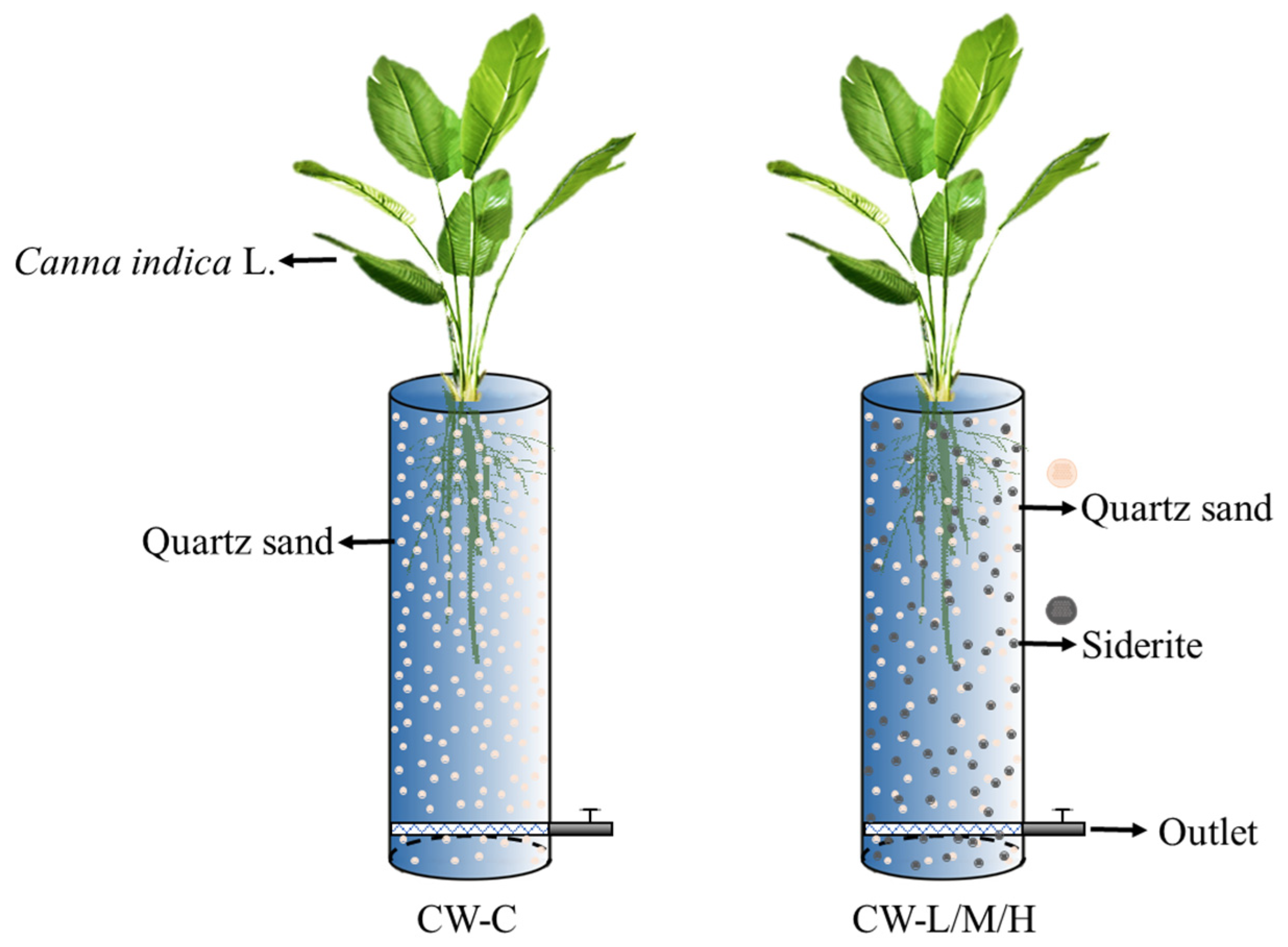
Four laboratory-scale vertical-flow CWs were established using polyethylene columns (inner diameter Φ = 16 cm, height H = 50 cm), as depicted in Figure 2. Each CW was equipped with a perforated collection tube positioned 8 cm above the base, connected to an external effluent outlet. The height of the substrate bed was 45 cm, with an average porosity of approximately 40%. A control system (CW-Q) was packed solely with quartz sand. The remaining three systems, labeled CW-L, CW-M, and CW-H, were filled with homogeneous mixtures of siderite and quartz sand at mass ratios (m/m) of 1:10, 1:5, and 1:1, respectively. Canna indica L. with similar fresh weight (approximately 180 g) and height (approximately 65 cm) were transplanted into the CWs, with their roots positioned 10–15 cm below the substrate surface. The activated sludge, after 15 days of anaerobic cultivation, was inoculated by diluting 500 mL of the sludge in 20 L of synthetic wastewater. Approximately 4.3 L of this mixture was added to each CW. The CWs were constructed and initiated in December and experienced an acclimation period until early March of the following year. Effluent sampling and analysis were performed from March to July, divided into four distinct operational phases: Period I, Period II, Period III, and Period IV. The hydraulic retention time (HRT) was sustained at 24 h for the initial three periods and extended to 36 h for Period IV. During the experimental period, all CWs were maintained in a temperature-controlled room at 25 °C with north-facing windows. The pH of the synthetic wastewater used in the acclimation and sampling phases was adjusted to neutral. The precise formulation of the synthetic wastewater for each operational phase is detailed in Table 1.

2.3. Effluent Sampling and Analysis

During each operational cycle, approximately 500 mL of influent and effluent samples were collected in beakers for the immediate measurement of pH, dissolved oxygen (DO), and oxidation-reduction potential (ORP) using a multi-parameter water quality analyzer (HQ-40d, HACH, Loveland, CO, USA). Before the determination of NO3-N, NO2-N, and NH4+-N concentrations, the water samples were filtered through 0.45 μm membrane filters. The NO3-N concentration was directly determined using ultraviolet spectrophotometry (UV-2000, Unico, China), in accordance with the method stipulated in the Environmental Quality Standards for Surface Water (GB3838-2002). The concentrations of NO2-N and NH4+-N were quantified using the N-(1-naphthyl) ethylenediamine dihydrochloride spectrophotometric method and the Nessler’s reagent spectrophotometric method, respectively. The chemical oxygen demand (COD) was assessed using the potassium dichromate method with a COD analyzer (HH-6, Jiangfen, China).

2.4. Determination of Microbial Community Diversity

Following the completion of the water sampling and analysis phase, the bacterial diversity of the biofilm attached to the substrate surfaces in CW-Q and CW-H was analyzed. Substrate samples were collected from a depth of 15 cm above the bottom of the wetland units. For biofilm sampling, 75 g of wetland substrate was transferred into a 500 mL conical flask. A phosphate buffer (10 mM, pH = 7.0) was introduced, and the mixture was shaken at 120 rpm and 4 °C for 2.5 h. The resulting suspension was centrifuged at 6500 rpm for 2 min. After discarding the supernatant, the precipitation was collected as the biofilm sample. Bacterial DNA from the biofilm was extracted using a bacterial DNA Extraction Kit (DP302, TIANGEN, Beijing, China). The V3-V4 regions of the 16S rDNA gene were amplified using the primers 341F (5′-CCTACGGGNGGCWGCAG-3′) and 805R (5′-GACTACHVGGGTATCTAATCC-3′). High-throughput sequencing was conducted using the Illumina MiSeq platform (Illumina, San Diego, CA, USA).

2.5. Statistical Analysis

Experimental data were statistically processed using Excel 2016. Significant differences were examined using IBM SPSS Statistics 20.0. Duncan’s multiple range test was employed to calculate the statistically significant differences for different CWs at significance levels of p < 0.05 and 0.01. The raw XRD data were processed with MDI Jade 6.5 software. The sequencing data were organized into operational taxonomic units (OTUs) at a 97% similarity threshold. Taxonomic annotation was subsequently conducted utilizing the RDP (Ribosomal Database Project) classifier to annotate within the Silva 128/16s_bacteria database.

3. Results and Discussion

3.1. Impact of Siderite Dosage and Influent COD/N on the Elimination and Conversion of NO3-N

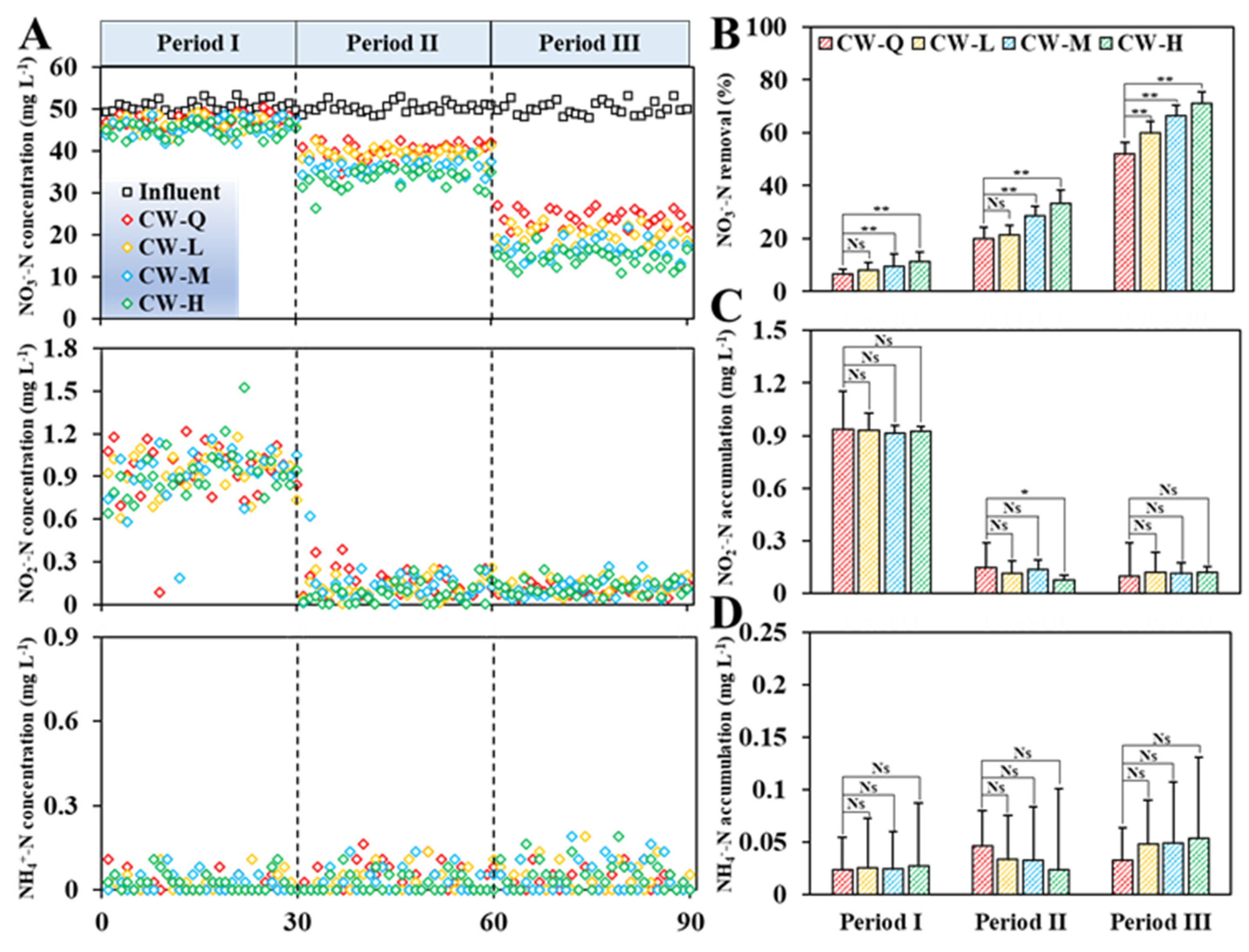
Figure 3 illustrates the effluent NO3-N concentrations and the average removal efficiencies during Periods I–III. The average influent NO3-N concentration during these periods was 50.4 ± 1.4 mg L−1. No external organic carbon source was supplemented in Period I. In Periods II and III, a combination of glucose and sodium acetate was introduced as an organic carbon source for denitrification, yielding average influent COD concentrations of 111.4 ± 5.4 and 254.8 ± 8.1 mg L−1, respectively. All data for Periods I-III were acquired under a constant HRT of 24 h. Figure 3A depicts the effluent concentrations of NO3-N, NO2-N, and NH4+-N. All the CWs demonstrated elevated effluent NO3-N concentrations during Period I. The effluent NO3-N from the control system (CW-Q) varied between 44.0 and 50.5 mg L−1, whereas the concentrations in the siderite-amended CWs ranged from 41.8 to 49.2 mg L−1. In terms of average NO3-N removal performance (Figure 3B), the CW with the highest siderite dosage (CW-H) achieved a removal rate of 11.2 ± 3.7% during Period I, which was significantly superior (p < 0.01) to that of the CW-Q (6.6 ± 1.9%). The findings indicated that siderite enhanced denitrification in CW under a carbon-limited condition, probably facilitated by Fe(II)-mediated autotrophic denitrification [32]. In addition, the removal efficiencies in the other CWs were all below 10%.
During Period II, the influent COD/N was approximately 2. The denitrification performance of all CWs improved in comparison to Period I after the addition of the organic carbon source. The effluent NO3-N concentration of CW-Q varied between 34.6 and 42.7 mg L−1. In relation to the increasing siderite dosage in CW-L, CW-M, and CW-H, the effluent NO3-N concentrations were 36.2–42.5 mg L−1, 32.2–39.5 mg L−1, and 26.4–38.9 mg L−1, respectively. The examination of average NO3-N removal efficiencies during Period II (Figure 3B) revealed that the CW with a quartz sand-to-siderite mass ratio of 10:1 (CW-L) attained an efficiency of 20.2 ± 4.2%, which is comparable to that of CW-Q at 21.6 ± 3.3%. With the increase in siderite dosage, the removal efficiencies of CW-M and CW-H were significantly improved to 28.6 ± 3.7% and 33.2 ± 5.2%, respectively, both considerably exceeding that of CW-Q. During Period III, with the influent COD/N ratio increased to approximately 5, a significant decrease in effluent NO3-N concentrations was noted in all CWs compared to the previous phases. CW-H demonstrated the minimal effluent NO3-N concentration, varying from 10.9 to 19.4 mg L−1. During this period, the average NO3-N removal efficiency of CW-Q rose to 52.1 ± 4.4%. CWs containing siderite demonstrated markedly superior removal efficiencies compared to CW-Q (p < 0.01). A positive correlation was noted between siderite dosage and NO3-N removal efficiency, with the highest average removal efficiency recorded in CW-H (71.1 ± 4.3%).
The accumulation of NO2-N and NH4+-N was observed in all CWs, with peak levels recorded in Period I. This exhibited the limitation of siderite as the exclusive electron donor for denitrification in the treatment of high-strength NO3-N wastewater (approximately 50 mg L−1) [33]. The average accumulation of NO2-N exhibited no statistically significant differences across the experimental groups during this phase (p > 0.05). The introduction of the organic carbon source during Periods II and III resulted in a significant reduction in effluent NO2-N across all CWs. The NO2-N levels in all CWs were reduced to below 0.15 mg L−1. During Periods I-III, all the CWs exhibited a low concentration of NH4+-N, ranging from 0.02 to 0.05 mg L−1. No statistically significant differences in NH4+-N concentrations were detected among the various CWs (p > 0.05).

3.2. Impact of Siderite Dosage and Influent COD on PO43−-P Removal

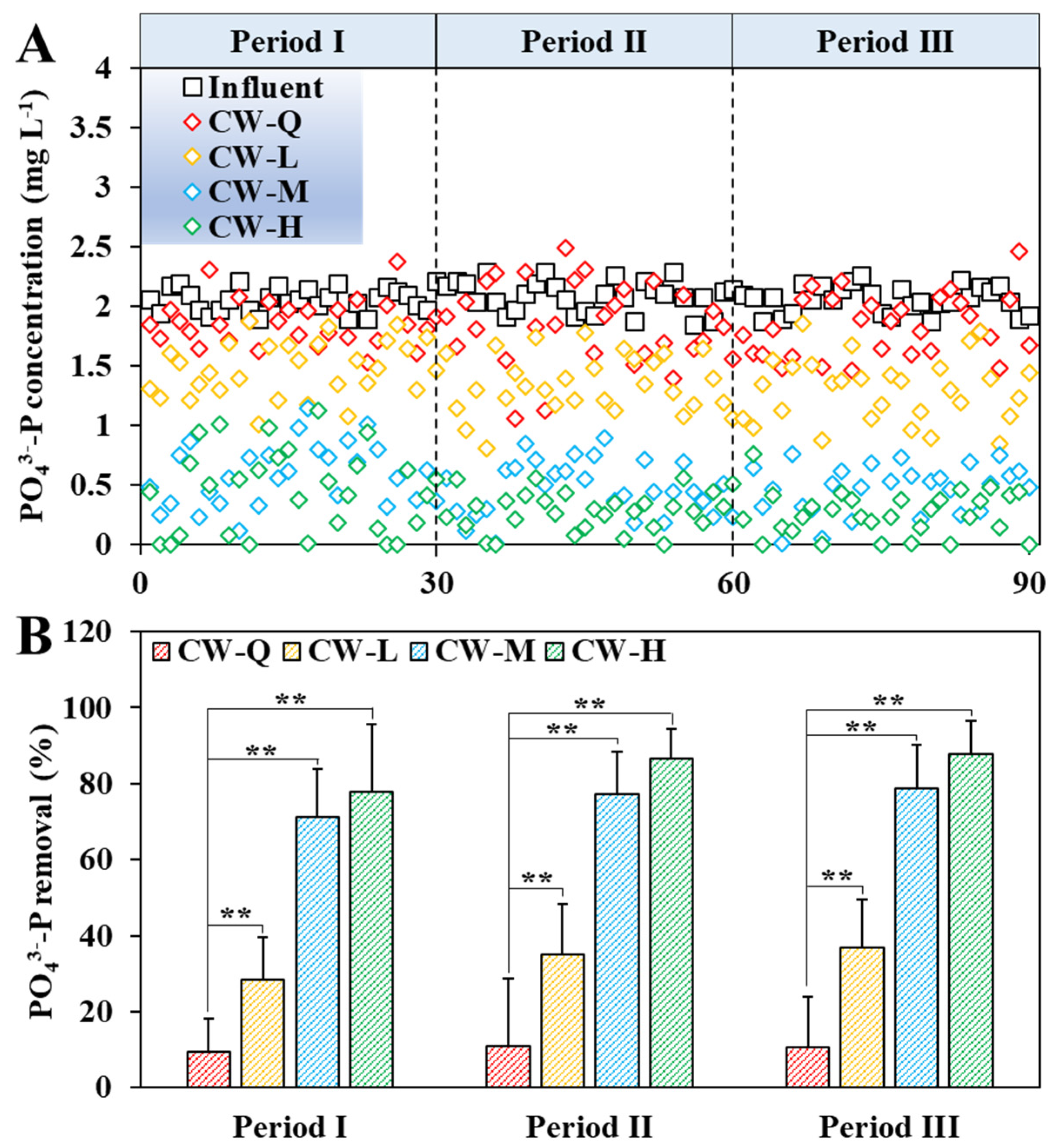
Figure 4 displays the effluent PO43−-P concentrations and the corresponding average removal efficiencies for Periods I-III. The influent PO43−-P concentration in the CWs was consistently at 2.1 ± 0.1 mg L−1 during Periods I-III. The data for PO43−-P indicated that CW-Q maintained a high effluent PO43−-P. During Periods I-III, CW-Q exhibited unstable PO43−-P removal performance; the effluent PO43−-P concentrations repeatedly exceeded those in the influent. This phenomenon may be ascribed to the tidal flow operation, which potentially dislodges loosely-bound PO43−-P accumulated on the substrate surface into the effluent [34]. Moreover, CW-Q exhibited consistently low removal efficiencies (between 9.6% and 11.0%) with no statistically significant variations across Periods I-III. The addition of siderite markedly improved the PO43−-P removal in CWs (p < 0.01). As noted in previous research, siderite can oxidize in aquatic environments to produce iron oxyhydroxides, thereby maintaining a consistent and stable capacity for phosphate removal even after the theoretical adsorption saturation of the substrate is attained [35,36]. In each experimental phase, the phosphate removal efficiency markedly improved with increased dosages of siderite. For instance, in Period III, the average PO43−-P removal was only 10.7 ± 13.1% in CW-Q, while it was 36.7 ± 12.8%, 79.0 ± 11.9%, and 87.6 ± 8.8% in CW-L, CW-M, and CW-H, respectively. The influent COD concentration also affected the PO43−-P removal. In the absence of an external carbon source (Period I), CW-H achieved an average removal efficiency of 77.7 ± 17.8%. Nonetheless, its performance was superior in Periods II and III, exhibiting efficiencies of 86.5 ± 7.7% and 87.6 ± 8.8%, respectively. Similarly, CW-L exhibited superior performance in Period II (35.0 ± 13.1%) and III (36.7 ± 12.8%) compared to Period I (28.3 ± 11.2%). CW-M demonstrated comparable PO43−-P performance in Period II (77.2 ± 11.3%) and III (79.0 ± 11.9%), both of which were superior to its efficiency in Period I (71.2 ± 12.6%). This observation suggests that the addition of an organic carbon source probably enhanced the microbial growth, consequently augmenting the assimilation of PO43−-P by microorganisms [30].

3.3. Impact of Hydraulic Retention Time (HRT) on NO3-N and PO43−-P Removal

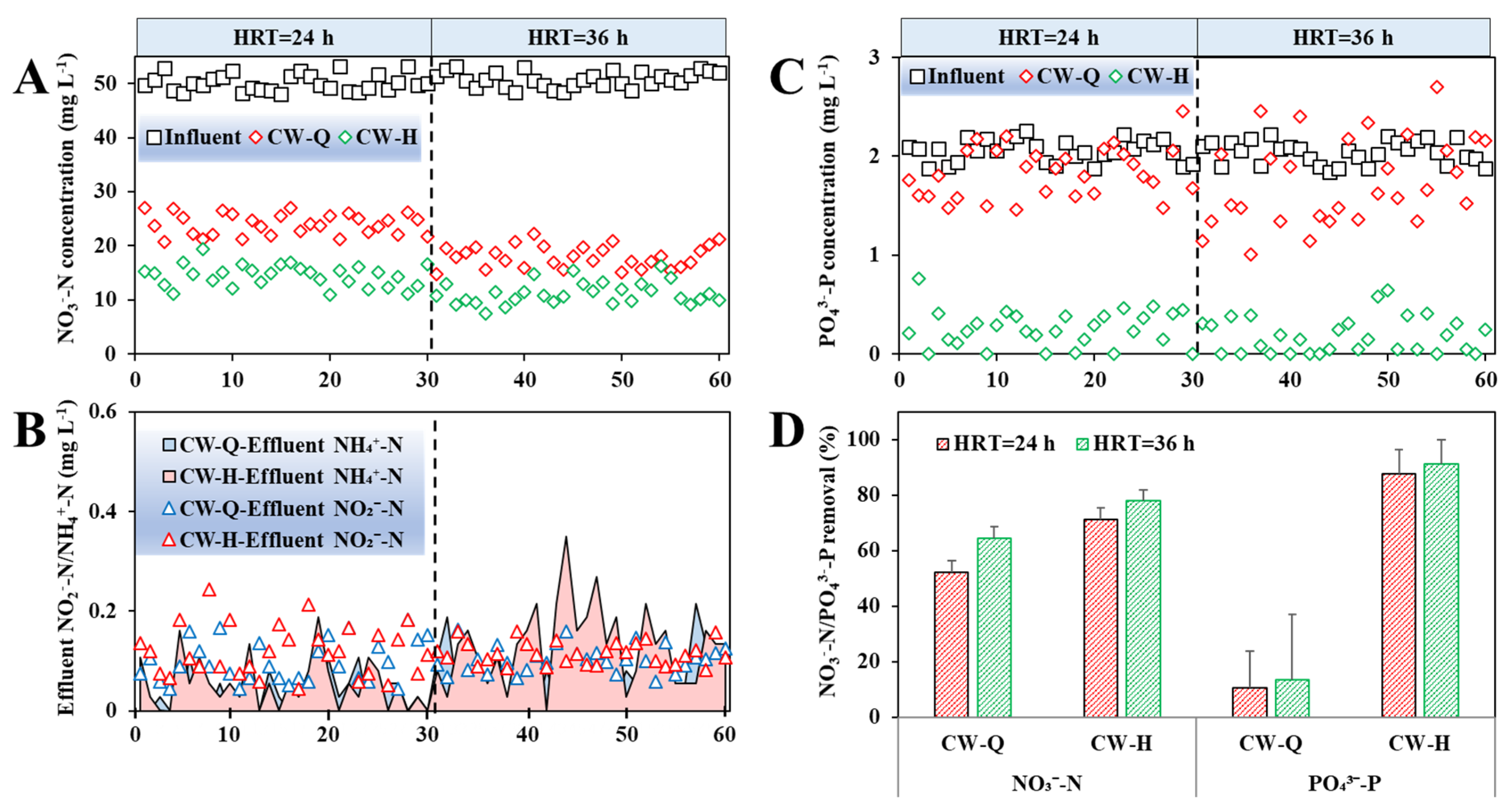
Period III and Period IV shared the same influent conditions. Despite achieving the highest denitrification performance, the effluent NO3-N from CW-H consistently surpassed 10 mg L−1 in Period III. Thus, the HRT was extended to 36 h in Period IV to evaluate its impact on NO3-N and PO43−-P removal in CW-Q and CW-H. As shown in Figure 5A, increasing the HRT from 24 to 36 h reduced the effluent NO3-N concentration in CW-Q from a range of 20.7–27.0 mg L−1 to 14.7–22.3 mg L−1. The effluent NO3-N in CW-H decreased from 10.9–19.4 mg L−1 to 7.5–16.3 mg L−1. Consequently, the average NO3-N removal efficiencies for CW-Q and CW-H increased by only 12.4% and 6.8%, respectively (Figure 5D). The results indicate that prolonging the HRT from 24 to 36 h yielded only a limited improvement in NO3-N removal. The average NO3-N removal in CW-H reached only 77.9 ± 4.1%. The accumulation of NO2-N and NH4+-N was monitored during Periods III and IV (Figure 5B). The results demonstrated that the levels of NO2-N and NH4+-N in the effluent were substantially low. The two systems exhibited similar effluent NO2-N levels, at approximately 0.1 mg L−1. After the HRT extension, NH4+-N accumulation exhibited a modest increase in both CW-Q and CW-H, rising from 0.03 ± 0.04 mg L−1 to 0.07 ± 0.06 mg L−1 and from 0.05 ± 0.05 mg L−1 to 0.13 ± 0.08 mg L−1, respectively.
Figure 5C depicts the effluent PO43−-P concentrations for CW-Q and CW-H during Periods III and IV. Overall, following the extension of HRT from 24 to 36 h, the effluent PO43−-P concentration in CW-Q demonstrated increased variability, in contrast to the prior range of 1.5–2.5 mg L−1. However, the corresponding average PO43−-P removal efficiencies in CW-Q showed no significant difference (p > 0.05), recorded at 10.7 ± 13.1% and 13.5 ± 23.5%, respectively. Furthermore, with an HRT of 36 h, instances of effluent PO43−-P concentrations exceeding influent levels persisted in CW-Q. In contrast, the effluent PO43−-P concentration in CW-H was low, averaging around 0.3 mg L−1 with a 24 h-HRT. Following the extension of the HRT to 36 h in CW-H, the average PO43−-P effluent decreased further to below 0.2 mg L−1, achieving a removal efficiency exceeding 90% (Figure 5D).

3.4. Quantitative Assessment of the Improvement in NO3-N and PO43−-P Removal in CWs

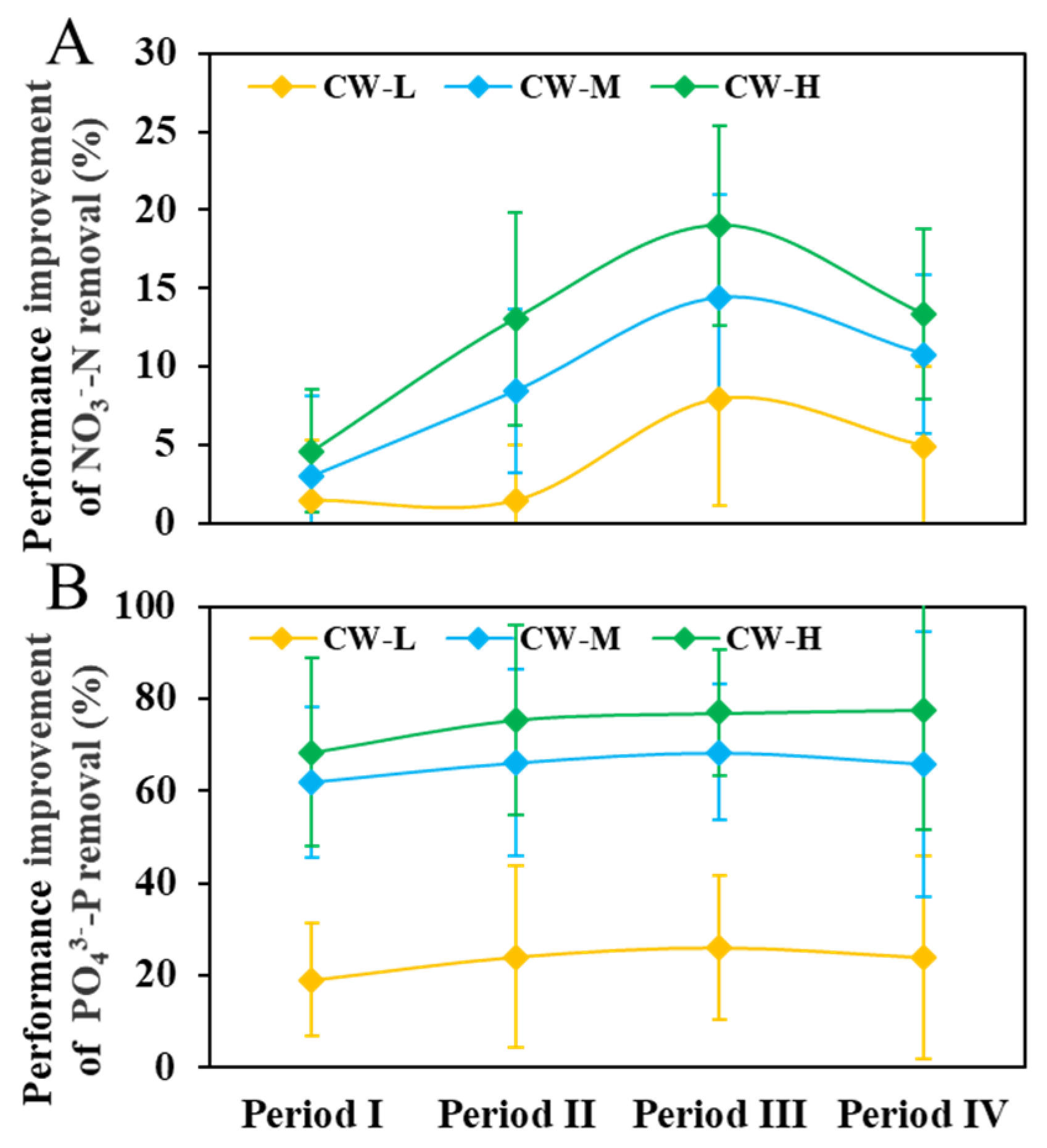
The quality fractions of siderite for CW-Q, CW-L, CW-M, and CW-H were 0%, 9.09%, 16.67%, and 50%, respectively. The improvements in the removal of NO3-N and PO43−-P in siderite-amended CWs were calculated in relation to the average removal efficiency of NO3-N and PO43−-P in CW-Q under the same operational conditions. Figure 6 presents the improvement of NO3-N and PO43−-P removal in the CWs under varying siderite dosages, COD/N ratios, and HRTs. As shown in Figure 6A, during Period I, the average NO3-N removal improvement in CW-H was only 4.57 ± 3.91%. Consequently, siderite exhibited a restricted ability to enhance denitrification in CW under conditions limited by organic carbon. Previous research had shown that the co-presence of Fe(II) and organic carbon drives Fe(II)-assisted mixotrophic NO3-N reduction. This markedly enhanced denitrification performance [37]. During Period II, when the COD/N ratio was approximately 2, a low siderite dosage (CW-L) yielded only a marginal enhancement in NO3-N removal (1.42 ± 3.55%). As the siderite proportion increased to 16.67% (CW-M) and 50% (CW-H), the improvement in NO3-N removal rose substantially to 8.43 ± 5.27% and 13.07 ± 6.80%, respectively. This implies that the addition of a small quantity of organic carbon may augment denitrification in CWs containing siderite, potentially through an iron-carbon coupling mechanism. When the COD/N increased to 5 (Period III), the addition of 9.09% siderite (CW-L) resulted in an average improvement of 7.91 ± 6.77% in NO3-N removal compared to CW-Q. This finding indicated that small-quantity siderite supplementation remains effective in promoting denitrification in carbon-abundant CWs. During period III, the maximum average improvement rate of NO3-N removal reached 19.01 ± 6.37%. Subsequently, the HRT was extended to 36 h in Period IV. As the CW-H achieved an NO3-N removal exceeding 75% in Period III, the NO3-N removal improvement was only 13.37 ± 5.47%.
Figure 6B demonstrates that introducing siderite into CWs enhanced the PO43−-P removal performance, with minimal influence from organic carbon sources or variations in HRT. In the absence of an external organic carbon source (Period I), CW-H exhibited an improvement of 68.42 ± 20.49%. In Periods III and IV, the removal improvements for CW-H relative to CW-Q were 76.98 ± 13.82% and 77.68 ± 26.27%, respectively. The improvement rates for both NO3-N and PO43−-P removal showed a decreasing trend with the increase in siderite proportion. Notably, the improvement in PO43−-P removal was consistently more pronounced than that observed for NO3-N removal. The improvement of NO3-N removal was notably affected by siderite dosage, influent COD/N ratio, and HRT. In contrast, the improvement in PO43−-P removal was primarily governed by the mass proportion of siderite [38].

3.5. Microbial Communities on Wetland Substrate Surfaces

Alpha diversity indices quantify the microbial diversity within an individual community. Analyzing various alpha diversity indices provides insights into distinct aspects of microbial community diversity. Good’s coverage estimates the sequencing depth by calculating the proportion of non-singleton OTUs (those represented by more than one sequence) in the total OTUs; a higher value indicates a lower proportion of undetected species within the samples. As shown in Table 2, Good’s coverage indices for both CW-Q and CW-H exceeded 99.5%, demonstrating that the majority of microbial species in these systems were captured. The Chao1 and Observed species indices are estimators of community richness. The richness indices were higher in CW-H compared to CW-Q, indicating that siderite presence increased microbial species diversity in CWs. Pielou’s evenness index quantifies the uniformity of species abundance distribution. The Simpson and Shannon diversity indices account for both richness and evenness through distinct algorithms. All three indices were all higher in CW-Q than in CW-H. Therefore, the siderite-amended wetland (CW-H) supported superior microbial richness and evenness compared to CW-Q.
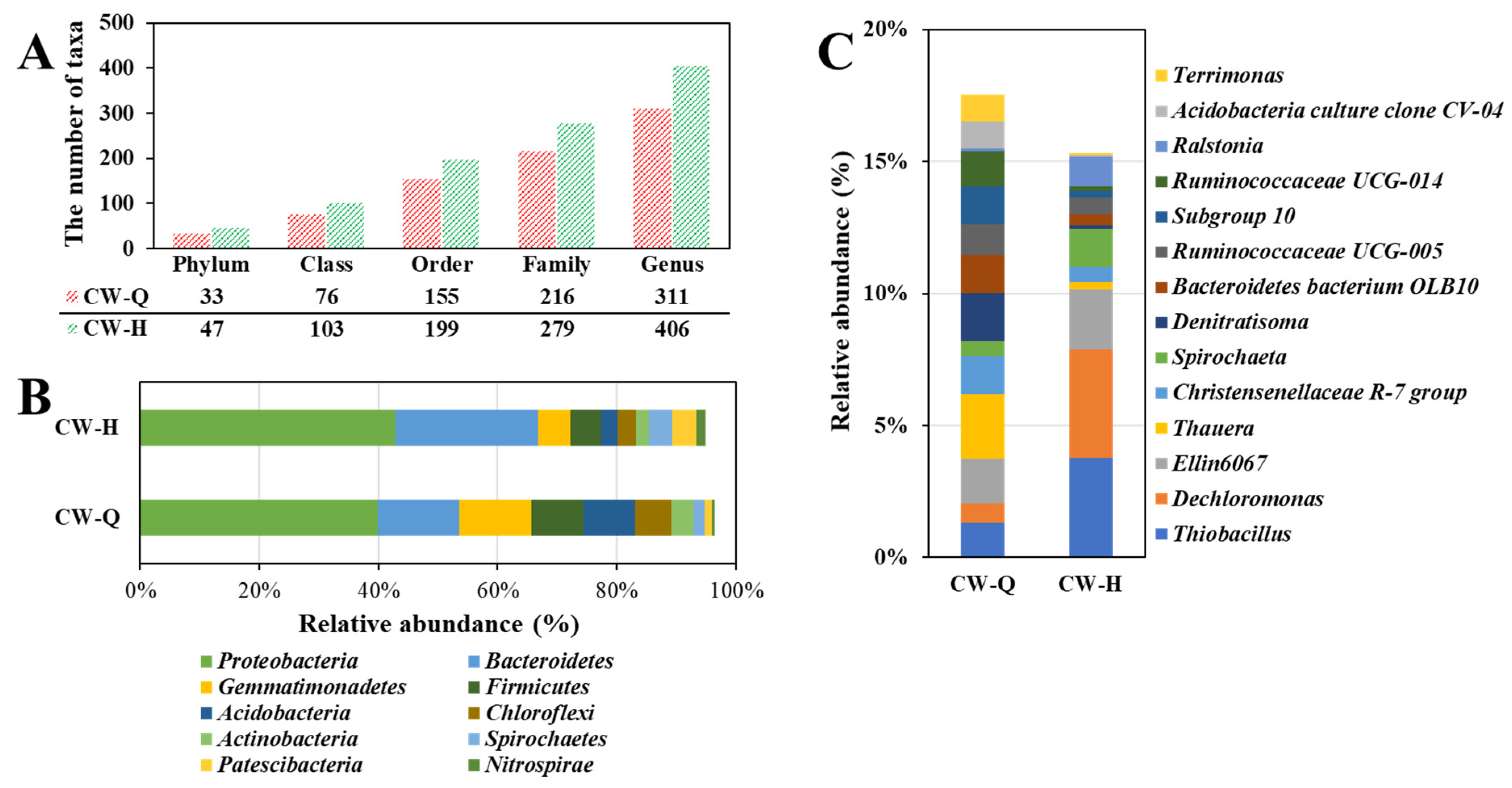
Due to the read length constraints of the second-generation sequencing technology, which generally focuses on one or a few contiguous hypervariable regions rather than the full-length 16S rDNA gene, accurate taxonomic classification in this study was confined to the genus level. To investigate the divergence in bacterial community composition between CWs with and without siderite application, the V3-V4 hypervariable regions (approximately 470 bp) of the 16S rDNA from substrate surface biofilms were sequenced using an Illumina MiSeq platform. Figure 7A displays the quantity of observed species across five taxonomic levels (phylum, class, order, family, and genus) in CW-Q and CW-H. The siderite-amended CW (CW-H) exhibited more species across all five taxonomic levels in comparison to the control (CW-Q). This finding is consistent with the OTU-based richness analysis presented in Table 2.
Figure 7B lists the bacterial phyla with a relative abundance exceeding 1% in the two CWs. Consistent with the majority of bioreactors engineered for denitrification, Proteobacteria emerged as the predominant phylum in both systems, as it includes the majority of prevalent denitrifying microorganisms. Its relative abundance was 42.9% in CW-H and 39.9% in CW-Q. Moreover, the relative abundances of Bacteroidetes (23.9%), Patescibacteria (4.0%), Spirochaetes (3.8%), and Nitrospirae (1.6%) were higher in CW-H compared to CW-Q. Conversely, CW-Q exhibited higher relative abundances of Gemmatimonadetes (12.2%), Firmicutes (8.7%), Acidobacteria (8.7%), Chloroflexi (6.0%), and Actinobacteria (3.7%).
After eliminating sequences that could not be reliably classified at the genus level or lacked clear taxonomic designations, the dominant genera (relative abundance >1%) in the two wetland systems were examined. Figure 7C distinctly illustrates the differences in microbial community structure at the genus level between the two systems. In CW-H, the predominant denitrifying genera were Dechloromonas (4.1%) and Thiobacillus (3.8%). Dechloromonas is recognized for its capability to perform simultaneous denitrification and phosphorus accumulation [39,40]. Notably, certain strains within this genus, including Dechloromonas sp. strain UWNR4 [41] and Dechlorimonas agitatus strain CKB [42], have been identified as nitrate-dependent anaerobic iron-oxidizing bacteria. Thiobacillus, a key genus of chemoautotrophic denitrifying bacteria, belongs to the class Gammaproteobacteria. This genus is recognized for its sulfur-oxidizing ability and can employ NaHCO3 as an inorganic carbon source [43]. It fixes CO2 in the absence of light via the Calvin cycle, utilizing form II ribulose-1,5-bisphosphate carboxylase/oxygenase (Rubisco) [44]. In contrast, Dechloromonas and Thiobacillus accounted for only 1.3% and 0.7%, respectively, of the total microbial community in CW-Q. Additionally, the ammonia-oxidizing bacterium Ellin6067 [45], the bacterium Spirochaeta, and the plant rhizosphere microbe Ralstonia [46] demonstrated relative abundances exceeding 1% in CW-H (2.3%, 1.4%, and 1.1%, respectively), surpassing their corresponding abundances in CW-Q (1.7%, 0.6%, and 0.1%). The predominant denitrifying genera in CW-Q were Thauera (2.5%), Denitratisoma (1.8%), Thiobacillus (1.3%), and Terrimonas (1.0%). Among these, Thauera [47] and Denitratisoma [48] are primarily heterotrophic denitrifiers, while Terrimonas is recognized as an aerobic denitrifier [49]. In summary, microorganisms are the primary influencing factor for pollutant removal in CWs. The introduction of siderite shifted the composition of the denitrifying microbial community, leading to an increased relative abundance of autotrophic denitrification potential. This facilitated the enhanced NO3-N removal performance of CW-H compared to CW-Q during Periods I-IV.

4. Conclusions

This study evaluated the viability of improving nitrate and phosphate removal in CWs through the integration of siderite into the substrate. The performance in removing NO3-N and PO43−-P was assessed under varying siderite dosages, influent COD concentrations, and HRT. Coupled with microbial community sequencing, the fundamental mechanisms for the improved nitrate and phosphate removal were initially examined. The primary conclusions are as follows:
(1)
Siderite enhanced the NO3-N removal performance in CWs. The improvement is predominantly influenced by the dosage of siderite and the presence of organic carbon in the influent. Under carbon-limited conditions, the improvement in denitrification facilitated by siderite-driven autotrophic pathways is constrained. However, when an external organic carbon source is introduced, siderite-amended CWs demonstrate markedly superior NO3-N removal efficiency compared to non-siderite CWs. Under an influent NO3-N concentration of approximately 50 mg L−1 and COD/N ratios of 2 and 5, a 50% siderite substrate mass ratio yielded average NO3-N removal enhancements of 13.07 ± 6.80% and 19.01 ± 6.37%, respectively, at a 24 h-HRT.
(2)
The improvement of PO43−-P removal by siderite was directly influenced by its dosage. At a 50% siderite proportion and an influent PO43−-P of 2 mg L−1, the PO43−-P removal efficiency was increased by 76.98 ± 13.82% over the control at 24 h-HRT.
(3)
The application of siderite increased both richness and evenness of the wetland microbial community. Prominent functional genera, including Dechloromonas (a denitrifying polyphosphate-accumulating organism) and Thiobacillus (an autotrophic denitrifier capable of utilizing CO2 as a carbon source), exhibited increased relative abundances in the siderite-amended CW compared to the control.

Author Contributions

Conceptualization and investigation, Z.S.; writing—original draft preparation, C.L.; writing—review and editing, Q.G.; visualization, S.H.; funding acquisition, Z.S. All authors have read and agreed to the published version of the manuscript.

Funding

This research was funded by the Yunnan Fundamental Research Project (Grant NO. 202301AU070113) and the Major Science and Technology Project of Yunnhan Province (Grant NO. 202202AE090034).

Data Availability Statement

The data supporting the research findings of this study are available from the corresponding author upon request.

Acknowledgments

This work was supported by the College of Environmental Science and Engineering, State Environmental Protection Engineering Center for Pollution Treatment and Control in Textile Industry, Donghua University.

Conflicts of Interest

The authors declare there is no conflict.

References

  1. Zhang, G.; Li, Q.; Cai, R.; Mao, G.; Miao, R.; Liu, M.; Li, D.; Song, C. Quantitative effects of substrate, vegetation, and hydraulic loading on pollutant removal in constructed wetlands. Ecol. Eng. 2026, 223, 107836. [Google Scholar] [CrossRef]
  2. Ntountounakis, I.; Margaritou, I.E.; Pervelis, I.; Kyrou, P.; Parlakidis, P.; Gikas, G.D. Pollutant removal efficiency of pilot-scale horizontal subsurface flow constructed wetlands treating landfill leachate. Appl. Sci. 2025, 15, 2595. [Google Scholar] [CrossRef]
  3. Liu, T.; Liu, G.; Qiu, Y.; Zhou, J.; Li, J.; Ma, J.; Feng, Y. A review of enhanced strategies for nitrogen removal in constructed wetlands: From design, influencing factors to full-scale applications and challenges. Water Res. 2026, 288, 124662. [Google Scholar] [CrossRef]
  4. Wu, H.; Wang, R.; Yan, P.; Wu, S.; Chen, Z.; Zhao, Y.; Cheng, C.; Hu, Z.; Zhuang, L.; Guo, Z.; et al. Constructed wetlands for pollution control. Nat. Rev. Earth Environ. 2023, 4, 218–234. [Google Scholar] [CrossRef]
  5. Vymazal, J. Nitrogen removal in constructed wetlands. Curr. Opin. Environ. Sci. Health 2025, 48, 100668. [Google Scholar] [CrossRef]
  6. Wang, Z.; Dong, J.; Liu, L.; Zhu, G.; Liu, C. Screening of phosphate-removing substrates for use in constructed wetlands treating swine wastewater. Ecol. Eng. 2013, 54, 57–65. [Google Scholar] [CrossRef]
  7. Hao, K.; Zhao, Y.; Wei, T.; Wen, D.; Liu, A.; Huang, Y.; Chen, Z. Recent advances of constructed wetlands utilization under cold environment: Strategies and measures. Process Saf. Environ. Prot. 2025, 201, 107530. [Google Scholar] [CrossRef]
  8. Yang, C.; Zhang, X.; Tang, Y.; Jiang, Y.; Xie, S.; Zhang, Y.; Qin, Y. Selection and optimization of the substrate in constructed wetland: A review. J. Water Process Eng. 2022, 49, 103140. [Google Scholar] [CrossRef]
  9. Jiang, C.; Qiu, L.; Wu, H.; Liu, Y.; Nie, F.; Jiang, Q.; Cao, W. Study on substrates purification effect and microbial community structure of vertical subsurface flow constructed wetland under siphon effect. J. Water Process Eng. 2024, 68, 106594. [Google Scholar] [CrossRef]
  10. Sun, F.; Liu, H.; Chu, Z.; Zhai, P.; Chen, T.; Wang, H.; Zou, X.; Chen, D. The effect of isomorphic substitution on siderite activation of hydrogen peroxide: The decomposition of H2O2 and the yield of ·OH. Chem. Geol. 2021, 585, 120555. [Google Scholar] [CrossRef]
  11. Qiu, Y.; Zhu, X.; Jin, J.; Han, Y.; Tao, Y.; Lu, C. Sustainable exploitation of siderite ore using fluidization roasting technology without reductant. Miner. Eng. 2025, 234, 109749. [Google Scholar] [CrossRef]
  12. Mora, M.E.Y.; Sarmiento, S.A.; Vera, L.E.; Drozd, V.; Durygin, A.; Chen, J.; Saxena, S.K. Siderite decomposition at room temperature conditions for CO2 capture applications. Braz. J. Chem. Eng. 2021, 38, 351–359. [Google Scholar] [CrossRef]
  13. Renard, F.; Putnis, C.V.; Montes-Hernandez, G.; King, H.E. Siderite dissolution coupled to iron oxyhydroxide precipitation in the presence of arsenic revealed by nanoscale imaging. Chem. Geol. 2017, 449, 123–134. [Google Scholar] [CrossRef]
  14. Kiskira, K.; Papirio, S.; van Hullebusch, E.D.; Esposito, G. Fe(II)-mediated autotrophic denitrification: A new bioprocess for iron bioprecipitation/biorecovery and simultaneous treatment of nitrate-containing wastewaters. Int. Biodeter. Biodegr. 2017, 119, 631–648. [Google Scholar] [CrossRef]
  15. Huang, Z.; Gao, J.; Liu, L.; Mao, Y.; Kang, H.; Song, Z.; Cai, M.; Guo, P.; Chen, K. Performance and by-product generation in sulfur-siderite/limestone autotrophic denitrification systems: Enhancing nitrogen removal efficiency and operational insights. J. Environ. Manag. 2024, 370, 123042. [Google Scholar] [CrossRef]
  16. Wang, R.; Zhang, X.; Yang, S.; Xu, Z.; Feng, C.; Zhao, F. Enhanced nitrogen removal driven by S/Fe2+ cycle in a novel hybrid constructed wetland. J. Clean. Prod. 2023, 426, 139113. [Google Scholar] [CrossRef]
  17. Chen, M.; Hu, H.; Chen, M.; Wang, C.; Wang, Q.; Zeng, C.; Shi, Q.; Song, W.; Li, X.; Zhang, Q. In-situ production of iron flocculation and reactive oxygen species by electrochemically decomposing siderite: An innovative Fe-EC route to remove trivalent arsenic. J. Hazard. Mater. 2023, 441, 129884. [Google Scholar] [CrossRef]
  18. Guo, H.; Ren, Y.; Liu, Q.; Zhao, K.; Li, Y. Enhancement of arsenic adsorption during mineral transformation from siderite to goethite: Mechanism and application. Environ. Sci. Technol. 2013, 47, 1009–1016. [Google Scholar] [CrossRef]
  19. Erdem, M.; Gür, F.; Tümen, F. Cr(VI) reduction in aqueous solutions by siderite. J. Hazard. Mater. 2004, 113, 217–222. [Google Scholar] [CrossRef]
  20. Danková, Z.; Bekényiová, A.; Štyriaková, I.; Fedorová, E. Study of Cu(II) adsorption by siderite and kaolin. Procedia Earth Planet. Sci. 2015, 15, 821–826. [Google Scholar] [CrossRef]
  21. Shan, Y.; Guo, H. Fluoride adsorption on modified natural siderite: Optimization and performance. Chem. Eng. J. 2013, 223, 183–191. [Google Scholar] [CrossRef]
  22. Ma, H.; Zhang, L.; Wang, Y.; Kong, G.; Yu, X.; Guo, Z.; Kang, Y.; Kuang, S.; Zhang, J. Strengthening effect of different iron minerals for perfluorooctanoic acid and perfluorooctane sulphonic acid removal in constructed wetlands: Mechanisms of electron transfer and microbial effect. Chem. Eng. J. 2024, 486, 150199. [Google Scholar] [CrossRef]
  23. Yang, Y.; Chen, T.; Zhang, X.; Qing, C.; Wang, J.; Yue, Z.; Liu, H.; Yang, Z. Simultaneous removal of nitrate and phosphate from wastewater by siderite based autotrophic denitrification. Chemosphere 2018, 199, 130–137. [Google Scholar] [CrossRef]
  24. Wang, W.; Wei, D.; Li, F.; Zhang, Y.; Li, R. Sulfur-siderite autotrophic denitrification system for simultaneous nitrate and phosphate removal: From feasibility to pilot experiments. Water Res. 2019, 160, 52–59. [Google Scholar] [CrossRef] [PubMed]
  25. Zhang, X.; Feng, C.; Wei, D.; Liu, X.; Luo, W. Optimization of “sulfur–iron–nitrogen” cycle in constructed wetlands by adjusting siderite/sulfur (Fe/S) ratio. J. Environ. Manag. 2024, 363, 121336. [Google Scholar] [CrossRef]
  26. Liu, Y.; Wang, H.C.; Sun, Y.L.; Cheng, H.Y.; Lu, S.Y.; Wang, A.J. Application of the sulfur-siderite composite filler: A case study of augmented performance and synergistic mechanism for low C/N wastewater treatment in constructed wetland. Chem. Eng. J. 2023, 475, 146376. [Google Scholar] [CrossRef]
  27. Yang, Y.; Chen, T.; Sumona, M.; Gupta, B.S.; Sun, Y.; Hu, Z.; Zhan, X. Utilization of iron sulfides for wastewater treatment: A critical review. Rev. Environ. Sci. Bio/Technol. 2017, 16, 289–308. [Google Scholar] [CrossRef]
  28. Xing, B.; Ouyang, M.; Graham, N.; Yu, W. Enhancement of phosphate adsorption during mineral transformation of natural siderite induced by humic acid: Mechanism and application. Chem. Eng. J. 2020, 393, 124730. [Google Scholar] [CrossRef]
  29. Yang, C.; Wang, Y.; Wan, J.; Zhu, B. Natural siderite and calcium-derived Siderite/Ca composites for wastewater phosphate adsorption: Preparation, properties and mechanism. Colloid. Surf. A 2025, 723, 137314. [Google Scholar] [CrossRef]
  30. Sun, H.; Yao, J.; Ma, B.; Knudsen, T.S.; Yuan, C. Siderite’s green revolution: From tailings to an eco-friendly material for the green economy. Sci. Total Environ. 2024, 914, 169922. [Google Scholar] [CrossRef]
  31. Schaffer, C.R.; Cravotta, C.A.; Capo, R.C.; Hedin, B.C.; Vesper, D.J.; Stewart, B.W. Multi-decadal geochemical evolution of drainage from underground coal mines in the Appalachian basin, USA. Sci. Total Environ. 2024, 947, 174681. [Google Scholar] [CrossRef]
  32. Wang, Y.; Ren, S.; Wang, P.; Wang, B.; Hu, K.; Li, J.; Wang, Y.; Li, Z.; Li, S.; Li, W.; et al. Autotrophic denitrification using Fe(II) as an electron donor: A novel prospective denitrification process. Sci. Total Environ. 2023, 858, 159721. [Google Scholar] [CrossRef] [PubMed]
  33. Sun, J.; Li, H.; Dong, H.; Liu, L.; Zhou, C.; Du, Z.; Dang, Y.; Holmes, D.E. Magnetite-augmented sulfur-siderite autotrophic denitrification: Deep nitrogen removal at ultra-low HRT from lab to pilot scale. Water Res. 2025, 284, 124034. [Google Scholar] [CrossRef] [PubMed]
  34. Saeed, T.; Miah, M.J.; Khan, T.; Ove, A. Pollutant removal employing tidal flow constructed wetlands: Media and feeding strategies. Chem. Eng. J. 2020, 382, 122874. [Google Scholar] [CrossRef]
  35. Chen, M.; Li, X.; Zhang, Q.; Wang, C.; Hu, H.; Wang, Q.; Zeng, C. Phosphate removal from aqueous solution by electrochemical coupling siderite packed column. Chemosphere 2021, 280, 130805. [Google Scholar] [CrossRef]
  36. Xing, B.; Chen, T.; Liu, H.; Qing, C.; Xie, J.; Xie, Q. Removal of phosphate from aqueous solution by activated siderite ore: Preparation, performance and mechanism. J. Taiwan Inst. Chem. Eng. 2017, 80, 875–882. [Google Scholar] [CrossRef]
  37. Pan, Y.; Fu, Y.Y.; Zhou, K.; Tian, T.; Li, Y.S.; Yu, H.Q. Microbial mixotrophic denitrification using iron(II) as an assisted electron donor. Water Res. X 2023, 19, 100176. [Google Scholar] [CrossRef]
  38. Ma, H.; Gao, X.; Chen, Y.; Zhu, J.; Liu, T. Fe(II) enhances simultaneous phosphorus removal and denitrification in heterotrophic denitrification by chemical precipitation and stimulating denitrifiers activity. Environ. Pollut. 2021, 287, 117668. [Google Scholar] [CrossRef]
  39. Duffner, C.; Holzapfel, S.; Wunderlich, A.; Einsiedl, F.; Schloter, M.; Schulz, S. Dechloromonas and close relatives prevail during hydrogenotrophic denitrification in stimulated microcosms with oxic aquifer material. FEMS Microbiol. Ecol. 2021, 97, fiab004. [Google Scholar] [CrossRef]
  40. Petriglieri, F.; Singleton, C.; Peces, M.; Petersen, J.F.; Nierychlo, M.; Nielsen, P.H. “Candidatus Dechloromonas phosphoritropha” and “Ca. D. phosphorivorans”, novel polyphosphate accumulating organisms abundant in wastewater treatment systems. ISME J. 2021, 15, 3605–3614. [Google Scholar] [CrossRef]
  41. Chakraborty, A.; Picardal, F. Neutrophilic, nitrate-dependent, Fe(II) oxidation by a Dechloromonas species. World J. Microb. Biotechnol. 2013, 29, 617–623. [Google Scholar] [CrossRef] [PubMed]
  42. Bruce, R.A.; Achenbach, L.A.; Coates, J.D. Reduction of (per)chlorate by a novel organism isolated from paper mill waste. Environ. Microbiol. 1999, 1, 319–329. [Google Scholar] [CrossRef]
  43. Li, H.; Xu, Y.; Dong, H.; Min, J.; Xu, H.; Sun, D.; Liu, X.; Dang, Y.; Qiu, B.; Mennella, T.; et al. Evidence of autotrophic direct electron transfer denitrification (DETD) by Thiobacillus species enriched on biocathodes during deep polishing of effluent from a municipal wastewater treatment plant. Chem. Eng. J. 2024, 495, 153389. [Google Scholar] [CrossRef]
  44. Gale, N.L.; Beck, J.V. Evidence for the calvin cycle and hexose monophosphate pathway in Thiobacillus ferrooxidans. J. Bacteriol. 1967, 94, 1052–1059. [Google Scholar] [CrossRef]
  45. Wang, L.; Qiu, S.; Guo, J.; Ge, S. Light irradiation enables rapid start-up of nitritation through suppressing nxrB gene expression and stimulating ammonia-oxidizing bacteria. Environ. Sci. Technol. 2021, 55, 13297–13305. [Google Scholar] [CrossRef]
  46. Hao, T.; Cui, L.; Wang, J.; Lei, Y.; Li, W.; Wang, R.; Wang, S.; Li, J.; Zhai, X.; Zhang, M.; et al. Effects of low temperature on rhizosphere phosphate-mineralizing microbial populations in constructed wetlands. J. Environ. Manag. 2025, 376, 124243. [Google Scholar] [CrossRef] [PubMed]
  47. Ren, T.; Jin, X.; Deng, S.; Guo, K.; Gao, Y.; Shi, X.; Xu, L.; Bai, X.; Shang, Y.; Jin, P.; et al. Oxygen sensing regulation mechanism of Thauera bacteria in simultaneous nitrogen and phosphorus removal process. J. Clean. Prod. 2024, 434, 140332. [Google Scholar] [CrossRef]
  48. Bao, Y.; Zhao, S.; Wu, N.; Yuan, Y.; Ruan, L.; He, J. Degradation of atrazine by an anaerobic microbial consortium enriched from soil of an herbicide-manufacturing plant. Curr. Microbiol. 2024, 81, 117. [Google Scholar] [CrossRef] [PubMed]
  49. Elad, T.; Tang, K.; Pierrelée, M.; Jensen, M.M.; Bentzon, T.M.; Smets, B.F.; Dechesne, A.; Valverde, P.B. An integrated meta-omics approach for identifying candidate organic micropollutant degraders in complex microbial communities. Water Res. 2025, 286, 124217. [Google Scholar] [CrossRef]
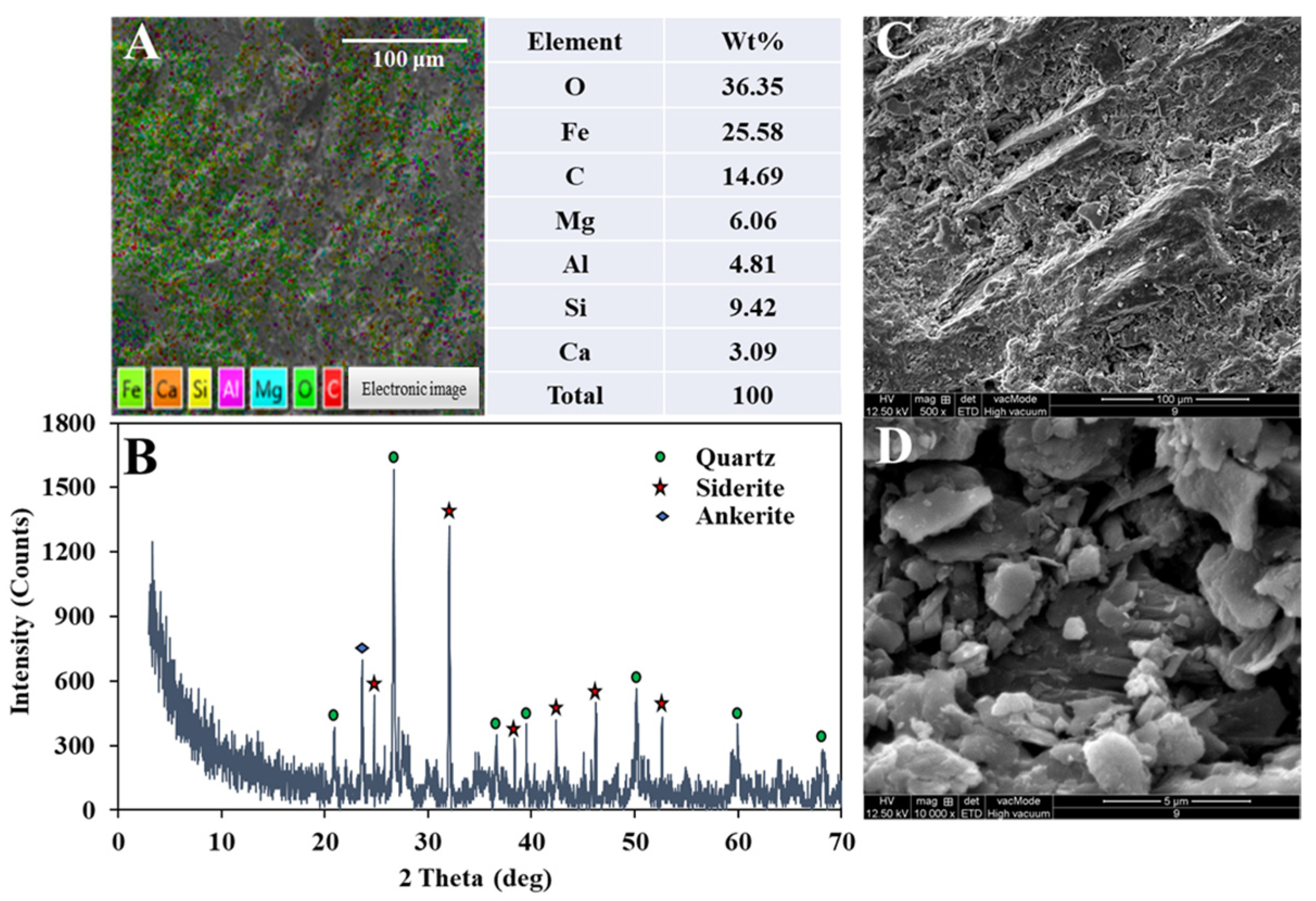
Figure 1. Characterization of natural siderite by EDS (A), XRD (B), and SEM (C,D).
Applsci 16 00515 g001
Figure 2. Schematic diagram of CWs.
Applsci 16 00515 g002
Figure 3. Impact of siderite dosage and influent COD concentration on NO3-N removal and the accumulation of NO2-N and NH4+-N (* p < 0.05, ** p < 0.01, Ns represents no significance): (A) effluent concentration of NO3-N, NO2-N and NH4+-N, (B) average removal of NO3-N, (C) average accumulation of NO2-N, (D) average accumulation of NH4+-N.
Applsci 16 00515 g003
Figure 4. Impact of siderite dosage and influent COD on PO43−-P removal (** p < 0.01): (A) effluent concentration of PO43−-P, (B) average removal of PO43−-P.
Applsci 16 00515 g004
Figure 5. Impact of hydraulic retention time on NO3-N and PO43−-P removal: (A) effluent concentration of NO3-N; (B) effluent concentration of NO2-N/ NH4+-N; (C) effluent concentration of PO43−-P; (D) average removal of NO3-N and PO43−-P.
Applsci 16 00515 g005
Figure 6. Performance improvement of NO3-N (A) and PO43−-P (B) removal in CWs.
Applsci 16 00515 g006
Figure 7. Microbial community analysis based on OTUs (A), composition at the phylum level (B), and composition at the genus level (C).
Applsci 16 00515 g007
Table 1. Composition of the synthetic wastewater during the acclimation and sampling phases.
ComponentsInfluent Concentration (mg L−1)
Startup PeriodPeriod IPeriod IIPeriod IIIPeriod IV
ZnSO4·2H2O10.810.810.810.810.8
CuSO4·5H2O0.030.030.030.030.03
Na2MoO4·2H2O0.30.30.30.30.3
MnSO4·H2O1.01.01.01.01.0
CoCl2·6H2O0.030.030.030.030.03
H3BO46.26.26.26.26.2
MgCl260.060.060.060.060.0
CaCl216.616.616.616.616.6
KNO3361.0361.0361.0361.0361.0
KH2PO42.92.92.92.92.9
C6H12O6·H2O80.0080.0200.0200.0
CH3COONa25.7025.764.364.3
Table 2. Alpha-diversity estimators in biofilms of CW-Q and CW-H.
SampleGood’s CoverageChao1Observed SpeciesPielou’s EvennessSimpsonShannon
CW-Q0.9983280.433274.40.7860.9929.173
CW-H0.9953751.753642.10.8110.9939.593
Disclaimer/Publisher’s Note: The statements, opinions and data contained in all publications are solely those of the individual author(s) and contributor(s) and not of MDPI and/or the editor(s). MDPI and/or the editor(s) disclaim responsibility for any injury to people or property resulting from any ideas, methods, instructions or products referred to in the content.