Article

Dynamic Response of a Double-Beam System Subjected to a Harmonic Moving Load

1
CCCC Tunnel Engineering Company Limited, Beijing 100024, China
2
China First Highway Engineering Co., Ltd., Beijing 100024, China
*
Author to whom correspondence should be addressed.
Appl. Sci. 2026, 16(1), 514; https://doi.org/10.3390/app16010514
Submission received: 3 December 2025 / Revised: 22 December 2025 / Accepted: 25 December 2025 / Published: 4 January 2026

Abstract

The dynamic behavior of a double-beam configuration subjected to a harmonic moving load was studied in this paper. The model was built to represent the wheel–track system that was composed of two infinite Timoshenko beams joined by uniformly spaced sleepers and supported by a continuous viscoelastic foundation. The response of the coupled beams to a moving harmonic excitation was first derived, after which the wheel–rail interaction was incorporated through a generalized Fourier series formulation. The associated Fourier coefficients were obtained from a finite system of algebraic equations imposed by the wheel–track contact conditions. The numerical simulation was carried out to compare the predictions of the Timoshenko and Euler–Bernoulli beam assumptions and to explore the influence of load speed and excitation frequency on the dynamic characteristics of the double-beam system. Comparative analysis reveals that Timoshenko beam theory predicts larger vertical displacements for rail, slab, and sleeper near the model’s cut-off frequencies (20 Hz and 30 Hz) than Euler–Bernoulli theory, with higher load velocities reducing the first cut-off frequency and amplifying peak amplitudes. The dynamic response exhibits two critical velocities at sub-cut-off frequencies, where rail displacements increase with load velocity, whereas this trend reverses when the load frequency meets or exceeds the cut-off frequencies, and no distinct peaks occur at 25 Hz and 40 Hz. The research findings are of great significance for the vibration propagation and vibration disaster prevention for shield tunnels during the train operation.

1. Introduction

The expansion of global high-speed rail infrastructure has intensified focus on vibration-related challenges in track systems. When operating speeds approach certain thresholds—determined by track–soil interaction—trains can trigger pronounced dynamic responses, leading to substantial rail distortions that risk systemic damage. This phenomenon has spurred decades of multidisciplinary research, aiming to mitigate risks through improved design and monitoring.
The analytical modeling of infinite beams predominantly utilizes the Euler–Bernoulli and Timoshenko theories. The former is often favored because of its mathematical tractability. A fundamental step in analyzing such systems under harmonic moving loads involves determining their steady-state response, which provides the groundwork for more complex investigations. Extensive research efforts have been dedicated to investigating analytical steady-state solutions for Euler–Bernoulli beams under various conditions, including axial loads, damping [1], interactions with different base models [2,3,4,5,6], and the moving load itself [7]. A crucial focus within this research domain is the determination of the velocity thresholds. For instance, Nechitailo and Lewis [8] employed a hybrid approach integrating analytical methods with finite element modeling to compute the threshold velocities. Extending the analysis to non-uniform supports, Koroma et al. [9] demonstrated that beams on supports with spatially varying stiffness and damping can exhibit distinct resonant frequencies at different sections. Complementing this, Dimitrovová [10] investigated the dynamics of beams on piece-wise homogeneous viscoelastic foundations. The practical relevance of these theoretical developments is evident in applications ranging from the analysis of underground subway structures [11,12,13,14] to the design of railway infrastructures [15,16].
The Euler–Bernoulli formulation, relying on the “plane sections remain plane” hypothesis, does not account for shear deformation and links cross-sectional rotation directly to the deflection gradient. A consequential limitation of this formulation is its exclusion of inertial forces stemming from cross-sectional rotations. Consequently, the theory is strictly applicable to scenarios where bending deformation dominates, and effects of shear and rotatory inertia are negligible. In numerous practical applications, particularly those involving short beams or high-frequency response, the Timoshenko beam theory [17,18], which incorporates these effects, provides greater accuracy. Comparative studies [19,20,21,22], which analyzed both theories on a Winkler foundation, have been conducted to elucidate the differences and confirm the advantages of the Timoshenko model. While linear foundation models are commonly adopted for simplicity, the nonlinear foundation behaviors have also been explored [23,24].
The significance of wheel–track interactions is underscored by their contribution to noise generation at the wheel/rail interface. Several researchers [25,26,27] have proposed comprehensive models for wheel–track interaction analysis. However, a limitation of conventional wheel–track models is their failure to account for the discrete nature of sleeper support, where sleepers are spaced at constant intervals along the rail. Belotserkovskii [28] applied the generalized Fourier series method to develop an enhanced wheel–track model, representing the rail as an infinite Timoshenko beam supported by equally spaced massive viscoelastic elements. This work was later extended [29] to incorporate an infinite train of wheels connected to the rail through elastic springs.
The complete track system includes rails, sleepers, and slabs. Nevertheless, prior research highlighted in the literature survey primarily relies on single-beam models to simulate the rail component alone. For high-frequency dynamic analysis, models capturing the full track system offer superior accuracy compared to the single-beam model [30]. This is principally due to the distinct mechanical properties (e.g., mass, stiffness) of the rail and the slab, which lead to their differing dynamic responses. While studies on double-beam systems exist [31], they often incorporate simplifying assumptions—like identical flexural rigidity and mass per unit length for both beams—that limit their practical applicability. Although contributions have advanced the study of double-beam systems [30,32], these models frequently lack the systematic rigor needed to fully represent actual track behavior. This shortcoming often stems from the considerable complexity inherent in the governing equations for double-beam systems, leading researchers to base analyses on specific cases or assumptions. As a result, the solution methodologies and findings can differ substantially. Moreover, complementing conventional theoretical and numerical approaches, the growing field of big data science has catalyzed interest in data-driven methods for exploring the intricate behavior of structures [33,34].
This research develops an integrated wheel–track interaction model that combines a realistic double-track representation with detailed wheel–rail contact mechanics. The track subsystem is formulated using a double-Timoshenko beam approach, where sleeper rests on a viscoelastic foundation and engage with a mass-based wheel representation. Analytical solutions for the governing equations are obtained through Fourier transform methods. Notably, the proposed methodology supports different parameter specifications for both beams, offering significant modeling flexibility. A complete closed-form solution is established, thoroughly characterizing the system’s dynamic performance. To properly account for wheel–track interactive effects, a moving harmonic load formulation is incorporated within the framework, with interaction forces quantified using generalized Fourier series techniques. Complementary numerical investigations are performed to assess how critical parameters—particularly load frequency and velocity—influence the dynamic response characteristics of the coupled wheel–track system.
The structure of this paper is outlined below. Section 2 provides a comprehensive description of the complete model formulation. Section 3 develops the governing equations and boundary conditions for the double-beam system subjected to moving harmonic loads, with analytical solutions derived using appropriate mathematical techniques. Section 4 addresses the wheel–track interaction mechanism, building upon the analytical framework established in Section 3. A numerical case study is subsequently conducted, utilizing the analytical solutions from Section 3 and Section 4 to validate the proposed methodology. Section 5 analyzes and interprets the numerical findings, with particular emphasis on how critical parameters influence the system’s dynamic behavior. Finally, the main conclusions and implications of this research on double-beam modeling are summarized.

2. Description of the Whole Model

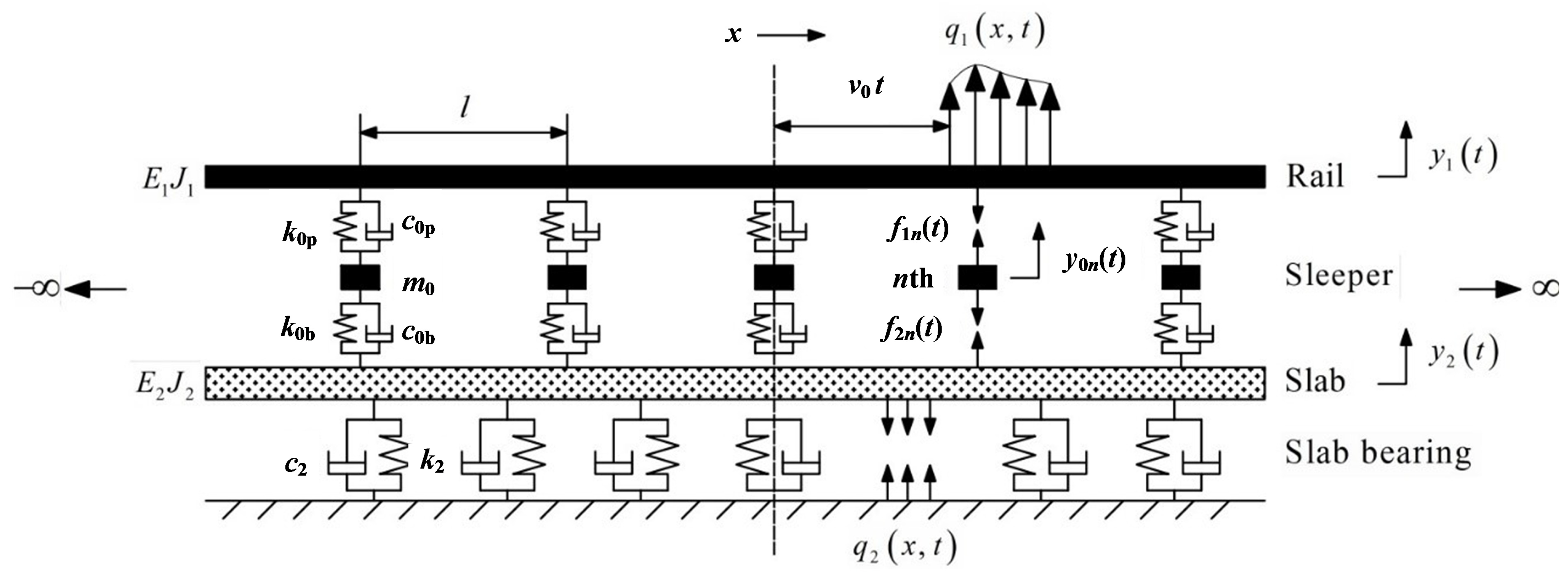
As shown in Figure 1, the wheel–track is modeled as a double-beam system. The rail and the slab are modeled as two infinite Timoshenko beams with different beam parameters. In the theoretical model, both the rail and the slab (concrete) are treated as homogeneous, continuous, and linearly elastic Timoshenko beams, utilizing equivalent cross-sectional macro-mechanical parameters. The contribution of reinforcement to the stiffness (EJ) and mass of the concrete slab is implicitly reflected in these equivalent macro-parameters. The sleeper, connected with the slab by a parallel spring and damper, is spaced at a constant distance of l along the rail track and is represented as a concentrated mass, supporting the rail by another parallel spring and damper. The slab rests on the slab bearing, which is modeled as the continuous spring and damper along the rail track. In Figure 1, the physical meanings represented by the individual symbols are detailed in Section 3.
In this paper, a wheel, represented as a rigid mass, uniformly moves on the rail along the track in the positive x-direction at a constant velocity without detachment and a vertical harmonic load acts at the wheel.

3. Double-Beam System with a Moving Harmonic Load

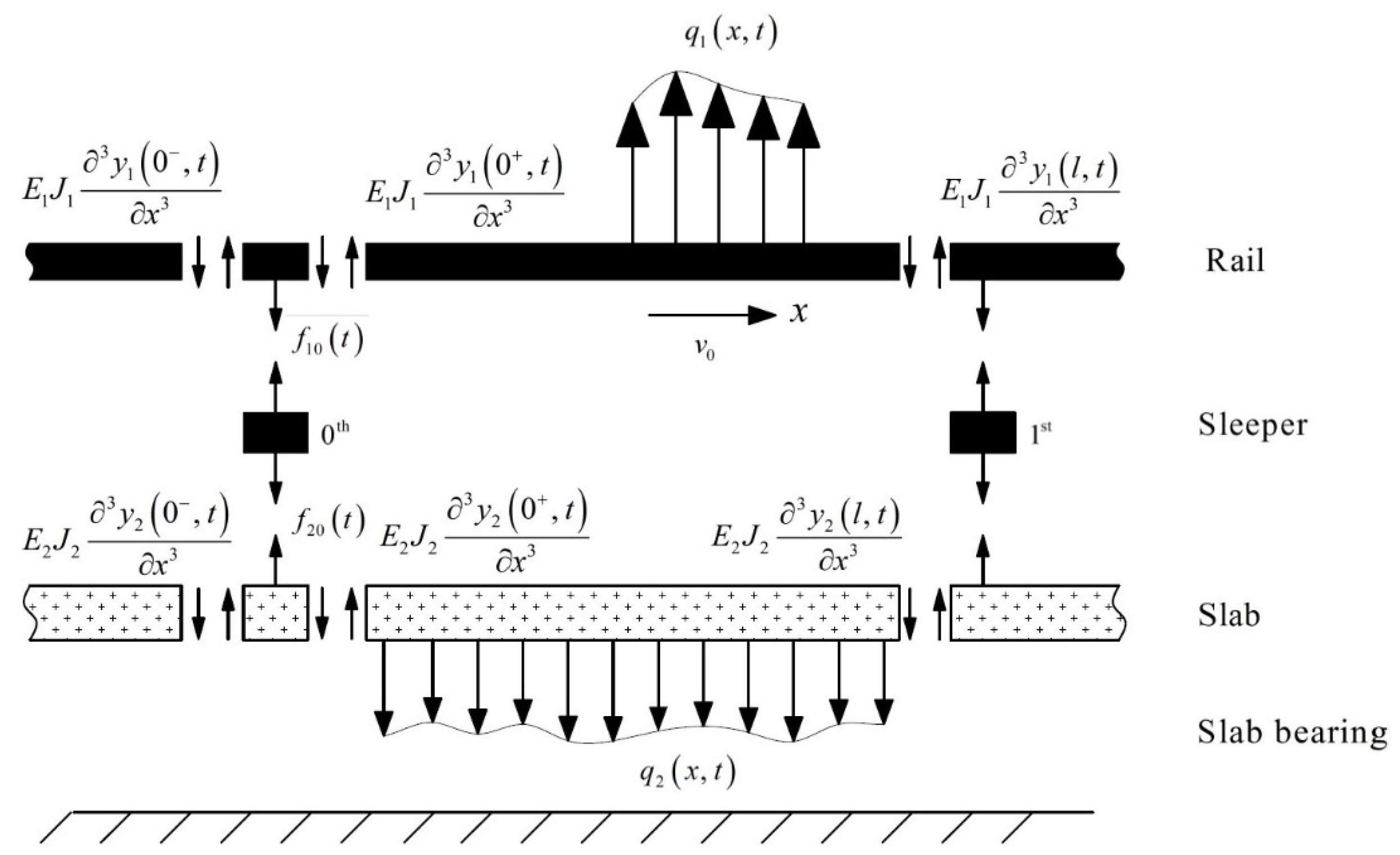
To simplify the derivation, the mass wheel is removed, and only the double system with a moving harmonic load is first considered in this section. All the positive directions are shown in Figure 2. The sign convention of all the displacements and the forces are shown in Figure 3. Assuming that the vertical displacements of the rail and the slab are denoted as y1(x, y) and y2(x, y), respectively, the governing equations for the rail and the slab are
E 1 J 1 4 y 1 x ,   t x 4 + ρ 1 2 y 1 x ,   t t 2 ρ 1 J 1 S 1 + E 1 J 1 R 1 4 y 1 x ,   t x 2 t 2 + ρ 1 2 J 1 R 1 S 1 4 y 1 x ,   t t 4 = q 1 x + ρ 1 J 1 R 1 S 1 2 q 1 x ,   t t 2 E 1 J 1 R 1 2 q 1 x ,   t x 2
E 2 J 2 4 y 2 x ,   t x 4 + ρ 2 2 y 2 x ,   t t 2 ρ 2 J 2 S 2 + E 2 J 2 R 2 4 y 2 x ,   t x 2 t 2 + ρ 2 2 J 2 R 2 S 2 4 y 2 x ,   t t 4 = q 2 x + ρ 2 J 2 R 2 S 2 2 q 2 x ,   t t 2 E 2 J 2 R 2 2 q 2 x ,   t x 2
In Equation (1) and (2), E i J i , ρ i , and S i ( i = 1 ,   2 ) are the flexural stiffness, the mass per unit length and the cross-section area, respectively. Notations with i = 1 and i = 2 refer to the rail and the slab, respectively. R i = k i G i S i ( i = 1 ,   2 ) denotes the shear stiffness, where G i is the shear modulus and k i is a coefficient taking into account the non-uniformed distribution of the shear force over the cross-section. q 1 x ,   t is the applied external dynamic distributed load on the top rail and q 2 x ,   t is the subgrade’s distributed reaction under the bottom slab. In this paper, a time-harmonic concentrated load moving on the rail along the rail track at constant velocity is considered. In terms of q 1 x ,   t , it can be written as
q 1 x ,   t = a 0 e i ω 0 t δ x v 0 t
where a 0 and ω0 are the constant amplitude and angular frequency of the external load, respectively. By virtue of the Winkler foundation model, the subgrade distributed reaction acting on the base slab will be represented
q 2 x ,   t = k 2 y 2 x ,   t c 2 y 2 x ,   t t
where k 2 is the distributed subgrade spring stiffness and c 2 is the distributed damper constant. Denoting the discrete mass of the nth sleeper as m 0 , its displacement as y 0 n t , and f 1 n x ,   t and f 2 n x ,   t as the reaction forces of the nth sleeper’s spring and dashpot contact model with the rail above and the slab below it, the equation motioning the sleepers is
m 0 d 2 y 0 n t d t 2 = f 1 n t f 2 n t   ,   n = 0 ,   ± 1 ,   ± 2 ,   .
where
f 1 n t = k 0 p l y 1 n l ,   t y 0 n t + c 0 p l y 1 n l ,   t y 0 n t t f 2 n t = k 0 b l y 0 n t y 2 n l ,   t + c 0 b l y 0 n t y 2 n l ,   t t ,   n = 0 ,   ± 1 ,   ± 2 ,   .
k 0 p and c 0 p are the spring stiffness and the dashpot constant above the sleeper; k 0 b and c 0 b are the spring stiffness and the dashpot constant below the sleeper; y 0 n t is the displacement of the nth sleeper.
With the train speed at v 0 , the time it takes for the concentrated load passing over one interval of the sleeper is l / v 0 , during which the magnitude of q 1 x ,   t acquires a quantity e i Ω 0 , where Ω 0 = ω 0 l v 0 . Assuming that the vertical displacements of the rail y 1 x ,   t and the slab y 2 x ,   t acquire the same quantity leads to the periodic conditions.
The time for the load passing through one interval of the sleeper is l v 0 , during which the force F acquires a quantity e i Ω 0 , where Ω 0 = ω 0 l v 0 . Assuming that the vertical displacements of the rail y 1 x ,   t and the slab acquire the same quantity leads to the periodic conditions [35,36].
y 1 x + l ,   t + l v 0 = e i Ω 0 y 1 x ,   t y 2 x + l ,   t + l v 0 = e i Ω 0 y 2 x ,   t
Considering this periodic condition, only the track segment 0 x < l can be analyzed as the dynamic response of the other track segments beyond 0 x < l can be obtained by Equation (7). With the train speed at v 0 , the time interval corresponding to the track segment 0 x < l is 0 t < l v 0 .
The shear force presents discontinuity due to the support of the sleeper from the left of the sleeper to the right of the sleeper, while the vertical displacement, the angle of rotation and the moment are continuous (see Figure 3). Considering the periodic conditions and the dynamic response at the right of x = 0 and at the left of x = l , the boundary conditions are
y 1 l ,   t + l v 0 = e i Ω 0 y 1 0 ,   t y 1 l ,   t + l v 0 x = e i Ω 0 y 1 0 ,   t x 2 y 1 l ,   t + l v 0 x 2 = e i Ω 0 2 y 1 0 ,   t x 2 3 y 1 l ,   t + l v 0 x 3 = e i Ω 0 3 y 1 0 ,   t x 3 + 1 E 1 J 1 f 10 t ,   y 2 ,   l ,   t + l v 0 = e i Ω 0 y 2 0 ,   t y 2 l ,   t + l v 0 x = e i Ω 0 y 2 0 ,   t x 2 y 2 l ,     t + l v 0 x 2 = e i Ω 0 2 y 2 0 ,   t x 2 3 y 2 l ,   t + l v 0 x 3 = e i Ω 0 3 y 2 0 ,   t x 3 1 E 2 J 2 f 20 t
In order to change to dimensionless variables, the following dimensionless parameters are used.
Ω 0 = ω 0 l v 0 , T = v 0 t l , X = x l , Y 00 T = y 00 t l , Y i x ,   t = y i x ,   t l , α i = ρ i v 0 2 l 2 E i J i , β i = ρ i v 0 2 E i S i , γ i = ρ i v 0 2 R i , A 0 = a 0 l 2 E 1 J 1 , ψ i = γ i α i , K 2 = k 2 l 4 E 2 J 2 , C 2 = c 2 v 0 l 3 E 2 J 2 , K 0 p = k o p l 4 E 1 J 1 , C 0 p = c 0 p v 0 l 3 E 1 J 1 , K 0 b = k o b l 4 E 1 J 1 , C 0 b = c 0 b v 0 l 3 E 1 J 1 , F 10 T = f 10 t l 2 E 1 J 1 , F 20 T = f 20 t l 2 E 1 J 1 , M 0 = m 0 v 0 2 l E 1 J 1 , S = E 1 J 1 E 2 J 2 , H = R 1 R 2 , where, i = 1 , 2 .
Changing the symbols in Equations (1), (2) and (5) yields to the dimensionless governing equations
4 Y 1 X ,   T X 4 + α 1 2 Y 1 X ,   T T 2 β 1 + γ 1 4 Y 1 X ,   T X 2 T 2 + β 1 γ 1 4 Y 1 X ,   T T 4 = A 0 1 + ψ 1 β 1 2 T 2 2 X 2 e i Ω 0 T δ X T
4 Y 2 X ,   T X 4 + α 2 2 Y 2 X ,   T T 2 β 2 + γ 2 4 Y 2 X ,   T X 2 T 2 + β 2 γ 2 4 Y 2 X ,   T T 4 = 1 + ψ 2 β 2 2 T 2 2 X 2 K 2 Y 2 X ,   T + C 2 Y 2 X ,   T T
M 0 d 2 Y 00 T d T 2 = F 10 T F 20 T
where
F 10 T = K 0 p Y 1 0 ,   T Y 00 T + C 0 p Y 1 0 ,   T Y 00 T T ;
F 20 T = K 0 b Y 00 T Y 2 0 ,   T + C 0 b Y 00 T Y 2 0 ,   T T .
The dimensionless periodic condition and the dimensionless boundary conditions are:
Y 1 X + 1 ,   T + 1 = e i Ω 0 Y 1 X ,   T Y 2 X + 1 ,   T + 1 = e i Ω 0 Y 2 X ,   T , 0 X < 1 , 0 T < 1
Y 1 1 ,   T + 1 = e i Ω 0 Y 1 0 ,   T Y 1 1 ,   T + 1 X = e i Ω 0 Y 1 0 ,   T X 2 Y 1 1 ,   T + 1 X 2 = e i Ω 0 2 Y 1 0 ,   T X 2 3 Y 1 1 ,   T + 1 X 3 = e i Ω 0 3 Y 1 0 ,   T X 3 + F 10 T Y 2 1 ,   T + 1 = e i Ω 0 Y 2 0 ,   T Y 2 1 ,   T + 1 X = e i Ω 0 Y 2 0 ,   T X 2 Y 2 1 ,   T + 1 X 2 = e i Ω 0 2 Y 2 0 ,   T X 2 3 Y 2 1 ,   T + 1 X 3 = e i Ω 0 3 Y 2 0 ,   T X 3 S F 20 T
Taking Fourier transformations with regards to T in the dimensionless governing equations, the dimensionless periodic condition and the dimensionless boundary conditions can eliminate the variable T from the above equations. Now, the governing equations can be given
d 4 Y ^ 1 X ,   ω d X 4 + A 1 d 2 Y ^ 1 X ,   ω d X 2 + B 1 Y ^ 1 X ,   ω = A 0 C 1 e i Ω 0 ω X
d 4 Y ^ 2 X ,   ω d X 4 + A 2 ψ 2 D 2 d 2 Y ^ 2 X ,   ω d X 2 + B 2 C 2 D 2 Y ^ 2 X ,   ω = 0
M 0 ω 2 Y ^ 00 ω = F ^ 10 ω F ^ 20 ω
where F ^ 10 ω = D 0 p Y ^ 1 0 ,   ω Y ^ 00 ω ; F ^ 20 ω = D 0 b Y ^ 00 ω Y ^ 2 X ,   ω ; Y ^ 1 X ,   ω , Y ^ 2 X ,   ω and Y ^ 00 ω are the Fourier transformations of Y 1 ( X ,   T ) , Y 2 ( X ,   T ) and Y 00 ( T ) respectively; A i = ω 2 β i + γ i ; B i = ω 2 β i γ i ω 2 α i ; C 1 = 1 ψ 1 β 1 ω 2 Ω 0 ω 2 ; C 2 = ψ 2 β 2 ω 2 1 ; D 2 = K 2 + i C 2 ω ; D 0 p = K 0 p + i C 0 p ω ; D 0 b = K 0 b + i C 0 b ω .
Similarly, the dimensionless periodic condition and dimensionless boundary conditions after the Fourier transformations give
Y ^ 1 X + 1 ,   ω = e i Ω 0 ω Y ^ 1 X ,   ω Y ^ 2 X + 1 ,   ω = e i Ω 0 ω Y ^ 2 X ,   ω ,   0 X < 1
Y ^ 1 1 , ω = e i Ω 0 ω Y ^ 1 0 ,   ω d Y ^ 1 1 , ω d X = d Y ^ 1 0 , ω d X d 2 Y ^ 1 1 , ω d X 2 = e i Ω 0 ω d 2 Y ^ 1 0 , ω d X 2 d 3 Y ^ 1 1 , ω d X 3 = e i Ω 0 ω d 3 Y ^ 1 0 , ω d X 3 + F ^ 10 ω Y ^ 2 1 , ω = e i Ω 0 ω Y ^ 2 0 ,   ω d Y ^ 2 1 , ω d X = e i Ω 0 ω d Y ^ 2 0 , ω d X d 2 Y ^ 2 1 , ω d X 2 = e i Ω 0 ω d 2 Y ^ 2 0 , ω d X 2 d 3 Y ^ 2 1 , ω d X 3 = e i Ω 0 ω d 3 Y ^ 2 0 , ω d X 3 S F ^ 20 ω
When ω 0 , the governing Equation (14) are ordinary differential equations, and can be solved as follows.
Y ^ 1 X ,   ω = i = 1 4 m i e p i X + Γ e i Ω 0 ω X Y ^ 2 X ,   ω = i = 1 4 n i e q i X Y ^ 00 ω = D 00 p Y ^ 1 0 ,   ω + D 00 b Y ^ 2 0 ,   ω                   = D 00 p i = 1 4 m i + Γ + D 0 0 b i = 1 4 n i
F ^ 10 ω = D 0 p D Δ 0 p Y ^ 1 0 ,   ω D 0 p D 00 b Y ^ 2 0 ,   ω                   = D 0 p D Δ 0 p i = 1 4 m i + Γ D 0 p D 00 b i = 1 4 n i F ^ 20 ω = D 0 b D 00 p Y ^ 1 0 ,   ω + D 0 b D Δ 0 b Y ^ 2 0 ,   ω                   = D 0 b D 00 p i = 1 4 m i + Γ + D 0 b D Δ 0 b i = 1 4 n i
where Γ = A 0 C 1 Ω 0 ω 4 A 1 Ω 0 ω 2 + B 1 ; m i and n i are coefficients to be determined; p i can be obtained by p 4 + A 1 p 2 + B 1 = 0 ; q i can be obtained by q 4 + A 2 ψ 2 D 2 q 2 + B 2 C 2 D 2 = 0 ; D 00 p = D 0 p D 0 ; D 00 b = D 0 b D 0 ; D Δ 0 p = D 0 p D 0 D 0 ; D Δ 0 b = D 0 b D 0 D 0 ; D 0 = D 0 p + D 0 b M 0 ω 2 ; i = 1 ,   2 ,   3 ,   4 .
Putting the above results (19) and (20) into the boundary conditions (18), the unknown coefficients m i and n i ( i = 1 ,   2 ,   3 ,   4 ) can be determined as follows.
M p + M D p , N D p   M D q , N q + N D q M N = F M F N
where
E p = e i ω Ω 0 + p 1 1 ,     e i ω Ω 0 + p 2 1 ,     e i ω Ω 0 + p 3 1 ,     e i ω Ω 0 + p 4 1 T ;
E q = e i ω Ω 0 + q 1 1 ,     e i ω Ω 0 + q 2 1 ,     e i ω Ω 0 + q 3 1 ,     e i ω Ω 0 + q 4 1 T ;
I 4 × 1 = 1 ,     1 ,     1 ,     1 T ; P = p 1 ,     p 2 ,     p 3 ,     p 4 T ; Q = q 1 ,     q 2 ,     q 3 ,     q 4 T ;
M = m 1 ,     m 2 ,     m 3 ,     m 4 T ; N = n 1 ,     n 2 ,     n 3 ,     n 4 T ;
M p = E p ,     E p P ,     E p P P ,     E p P P P T ;
M D p = D 0 p D Δ 0 p O 4 × 1 ,     O 4 × 1 ,     O 4 × 1 ,     I 4 × 1 T ;
N D p = D 0 p D 00 b O 4 × 1 ,     O 4 × 1 ,     O 4 × 1 ,     I 4 × 1 T ;
M D q = D 0 b D 00 p O 4 × 1 ,     O 4 × 1 ,     O 4 × 1 ,     S I 4 × 1 T ;
N q = E q ,     E q Q ,     E q Q Q ,     E q Q Q Q T ;
N D q = D 0 b D Δ 0 b O 4 × 1 ,     O 4 × 1 ,     O 4 × 1 ,     S I 4 × 1 T ;
F M = 0 ,     0 ,     0 ,     D 0 p D Δ 0 p Γ T ;
F N = 0 ,     0 ,     0 ,     S D 0 b D 00 p Γ T .
In M p and N q , the operation is called Hadamard product or Schur product, which is a binary operation that takes two matrices of the same dimensions, and produces another matrix where each element ij is the product of elements ij of the original two matrices.
When ω = 0 and Ω 0 0 , the governing Equation (14) yields to d 4 Y ^ 1 X ,   ω d X 4 = A 0 C 1 e i Ω 0 X
The solution for the governing Equation (14) is as follows.
Y ^ 1 X ,   ω = i = 1 4 m i X i 1 + Γ e i Ω 0 X Y ^ 2 X ,   ω = i = 1 4 n i e q i X Y ^ 00 ω = D 00 p Y ^ 1 0 ,   ω + D 00 b Y ^ 2 0 ,   ω                   = D 00 p m 1 + Γ + D 00 b i = 1 4 n i
F ^ 10 ω = D 0 p D Δ 0 p Y ^ 1 0 ,   ω D 0 p D 00 b Y ^ 2 0 ,   ω                   = D 0 p D Δ 0 p m 1 + Γ D 0 p D 0 0 b i = 1 4 n i F ^ 20 ω = D 0 b D 0 0 p Y ^ 1 0 ,   ω + D 0 b D Δ 0 b Y ^ 2 0 ,   ω                   = D 0 b D 00 p m 1 + Γ + D 0 b D Δ 0 b i = 1 4 n i
Putting the above results (22) and (23) into the boundary conditions (18) has
e i Ω 0 1 m 1 + e i Ω 0 i = 2 4 m i = 0 e i Ω 0 1 m 2 + e i Ω 0 2 m 3 + 3 m 4 = 0 2 e i Ω 0 1 m 3 + 6 e i Ω 0 m 4 = 0 D 0 p D Δ 0 p m 1 + 6 e i Ω 0 1 m 4 + D 0 p D 00 b i = 1 4 n i = D 0 p D Δ 0 p Γ
i = 1 4 e i Ω 0 + q i 1 n i = 0 i = 1 4 e i Ω 0 + q i 1 q i n i = 0 i = 1 4 e i Ω 0 + q i 1 q i 2 n i = 0 S D 0 b D 00 p m 1 + i = 1 4 e i Ω 0 + q i 1 q i 3 + S D 0 b D Δ 0 b n i = S D 0 b D 00 p Γ
When ω = 0 ,   Ω 0 = 0 , the governing Equation (14) yields to d 4 Y ^ 1 X ,   ω d X 4 = A 0
The solution for the governing Equation (14) is as follows.
Y ^ 1 X ,   ω = i = 1 4 m i X i 1 + 1 24 A 0 X 4 Y ^ 2 X ,   ω = i = 1 4 n i e q i X Y ^ 00 ω = D 0 0 p Y ^ 1 0 ,   ω + D 0 0 b Y ^ 2 0 ,   ω                   = D 0 0 p m 1 + D 0 0 b i = 1 4 n i
F ^ 10 ω = D 0 p D Δ 0 p Y ^ 1 0 ,   ω D 0 p D 00 b Y ^ 2 0 ,   ω                   = D 0 p D Δ 0 p m 1 D 0 p D 00 b i = 1 4 n i F ^ 20 ω = D 0 b D 00 p Y ^ 1 0 ,   ω + D 0 b D Δ 0 b Y ^ 2 0 ,   ω                   = D 0 b D 00 p m 1 + D 0 b D Δ 0 b i = 1 4 n i
Putting the above results (26) and (27) into the boundary conditions (18), we can get
i = 2 4 m i = 1 24 A 0 2 m 3 + 3 m 4 = 1 6 A 0 6 m 4 = 1 2 A 0 D 0 p D Δ 0 p m 1 + D 0 p D 00 b i = 1 4 n i = A 0
i = 1 4 e q i 1 n i = 0 i = 1 4 e q i 1 q i n i = 0 i = 1 4 e q i 1 q i 2 n i = 0 S D 0 b D 00 p m 1 + i = 1 4 e q i 1 q i 3 + S D 0 b D Δ 0 b n i = 0
After the determination of the unknown coefficients m i and n i ( i = 1 ,   2 ,   3 ,   4 ), the solution in time domain can be acquired by taking inverse Fourier transformations.
Y 1 X , T = 1 2 π + Y ^ 1 X ,   ω e i ω T d ω Y 2 X , T = 1 2 π + Y ^ 2 X ,   ω e i ω T d ω Y 00 T = 1 2 π + Y ^ 00 ω e i ω T d ω
Replacing X by T , the dimensionless transverse deflection of the rail at the point of contact with the force can be obtained.
Y 1 T = Y 1 T ,   T = 1 2 π + Y ^ 1 X , ω e i ω T d ω X = T Y 2 T = Y 2 T ,   T = 1 2 π + Y ^ 2 X , ω e i ω T d ω X = T Y 00 T = 1 2 π + Y ^ 00 ω e i ω T d ω

4. Interaction Between Wheel and Track

The governing equation of the wheel is
m s d 2 y s t d t 2 = a 0 e i ω 0 t f s t
where y s t is the vertical displacement of the wheel; m s is the mass of the wheel; f s t is the wheel–track interaction force.
Based on Equation (7), y s t and f s t satisfy the periodic condition.
y s t + l v 0 = e i Ω 0 y s t ,   f s t + l v 0 = e i Ω 0 f s t
In order to use the solution in Section 3, represent the wheel–track interaction force f s t as Fourier series.
f s t = a 0 m = + F m e i 2 π m v 0 l + ω 0 t
Obviously, Equation (34) satisfies the periodic condition (33).
Introducing Y s T = y s t l , M s = m s v 0 2 l E 1 J 1 and F s T = f s t l 2 E 1 J 1 can change Equations (32) and (34) to dimensionless ones.
M s d 2 Y s T d T 2 = A 0 e i Ω 0 T F s T
F s T = A 0 m = + F m e i Ω m T
where Ω m = 2 π m + Ω 0 ; infinite unknown coefficients F m are to be determined.
Similarly, the dimensionless periodic condition is
Y s T + 1 = e i Ω 0 Y s T
The solution for Equation (35) is
Y s T = A 0 M s Ω 0 2 e i Ω 0 T + A 0 M s m = + F m Ω m 2 e i Ω m T + g 1 T + g 2
where g 1 and g 2 are coefficients to be determined.
Putting Equation (38) into the dimensionless periodic condition (37) has
e i Ω 0 1 T 1 g 1 + e i Ω 0 1 g 2 = 0
The Equation (38) should also satisfy the derivation of the periodic condition.
d Y s T + 1 d T = e i Ω 0 d Y s T d T
Putting Equation (38) into the condition for periodic vibrations (40) has
e i Ω 0 1 g 1 = 0
When Ω 0 0 , based on Equations (39) and (41), we can obtain g 1 = 0 and g 2 = 0 . Equation (38) can then be represented as
Y s T = A 0 M s Ω 0 2 e i Ω 0 T + A 0 M s m = + F m Ω m 2 e i Ω m T
Assume that the vertical displacement of the rail at the point of the contact with the force F s m T = A 0 e i Ω m T is denoted as Y 1 m T . Based on Equation (31), Y 1 m T can be written as
Y 1 m T = Y 1 m T ,   T = F 1 Y ^ 1 X , ω , Ω m X = T
where F 1 denotes taking inverse Fourier transformations and F denotes taking Fourier transformations.
The vertical displacement of the rail Y 1 T at the point of the contact with the force F s T can then be represented as
Y 1 T = m = + F m Y 1 m T
Considering the nondetachment between the rail and the wheel, the vertical displacement of the rail Y 1 T and the wheel Y s T should satisfy the compatible condition.
Y s T = Y 1 T
Putting Equations (42) and (44) into Equation (45) has
A 0 F 0 1 M s Ω 0 2 e i Ω 0 T + A 0 M s m 0 F m Ω m 2 e i Ω m T = m = + F m Y 1 m T
The infinite coefficients F m can be determined as follows.
The vertical displacement of the rail Y 1 m T also satisfy the periodic conditions.
Y 1 m T + 1 = e i Ω m Y 1 m T
The Fourier series of the periodic function Y 1 m T can be represented as
Y 1 m T = n = + G m ,   n e i Ω n T
where G m ,   n = 0 1 Y 1 m T e - i Ω n T d T , n = 0 ,   ± 1 ,   ± 2 ,   ; Ω n = 2 π n + Ω 0 .
Putting Equation (48) into Equation (46), we can obtain
A 0 F 0 1 M s Ω 0 2 e i Ω 0 T + A 0 M s m 0 F m Ω m 2 e i Ω m T = m = + F m n = + G m , n e i Ω n T
Taking Fourier transformations in the two sides of Equation (49) yields to
A 0 F 0 1 M s Ω 0 2 δ ω Ω 0 + A 0 M s m 0 F m Ω m 2 δ ω Ω m = m = + F m n = + G m , n δ ω Ω n
When ω = Ω 0 , Equation (50) yields to
M s Ω 0 2 m = + F m G m ,   0 = A 0 F 0 1
When ω = Ω m ( m 0 ), Equation (44) yields to
M s Ω m 2 m = + F m G m ,   n = m = A 0 F m
In order to avoid confusion in Equation (46), the subscript m in Equations (51) and (52) is replaced by k .
M s Ω 0 2 k = + F k G k ,   0 = A 0 F 0 1 , m = 0 M s Ω m 2 k = + F k G k ,   m = A 0 F m , m 0
Equation (53) can be solved by using a finite system of equations to approximate the infinite one (53). Assuming m M ( M is positive integer), 2 M + 1 linear algebraic equations can be obtained.
C A 0 I 2 M + 1 × 2 M + 1 F = B
where
C = M s Ω M 2 G M ,   M ,       Ω M 2 G M + 1 ,   M ,     , Ω M 2 G M ,   M Ω M + 1 2 G M ,   M + 1 , Ω M + 1 2 G M + 1 ,   M + 1 , , Ω M + 1 2 G M ,   M + 1 ,                       ,                             , Ω M 2 G M ,   M ,       Ω M 2 G M + 1 ,   M ,     , Ω M 2 G M ,   M ;
F = F M , F M + 1 , , F M T ; B = O 1 × M , A 0 , O 1 × M T .
The vertical displacement of the rail Y 1 T , the slab Y 2 T and the sleeper Y 00 T at the point of the contact with the force F s T can then be obtained by
Y 1 T = m = M + M F m Y 1 m T Y 2 T = m = M + M F m Y 2 m T Y 00 T = m = M + M F m Y 00 m T
where Y 2 m T and Y 00 m T are the vertical displacements of the slab and the sleeper at the point of the contact with the force F s m T = A 0 e i Ω m T .
The general procedure adopted in this paper to calculate the numerical dynamic response of this double-beam system is summarized as follows
(1)
Calculate the displacement of the rail in frequency domain for a series of discretized X in 0 ,   1 , for each Ω m ;
(2)
Obtain Y 1 m T by selecting the value that corresponds to X = T for each Ω m ;
(3)
Calculate G m ,   n = 0 1 Y 1 m T e - i Ω n T d T by Simpson integration;
(4)
Calculate F m by Equation (48);
(5)
Calculate the dynamic response of this track-wheel system by the superposition of the response for each Ω m by Equation (49).

5. Numerical Results for Wheel–Track System

In this section, one numerical example is introduced and analyzed. The parameters for the wheel–track system are listed in Table 1. The rail parameters and the slab parameters are steel and concrete, respectively.
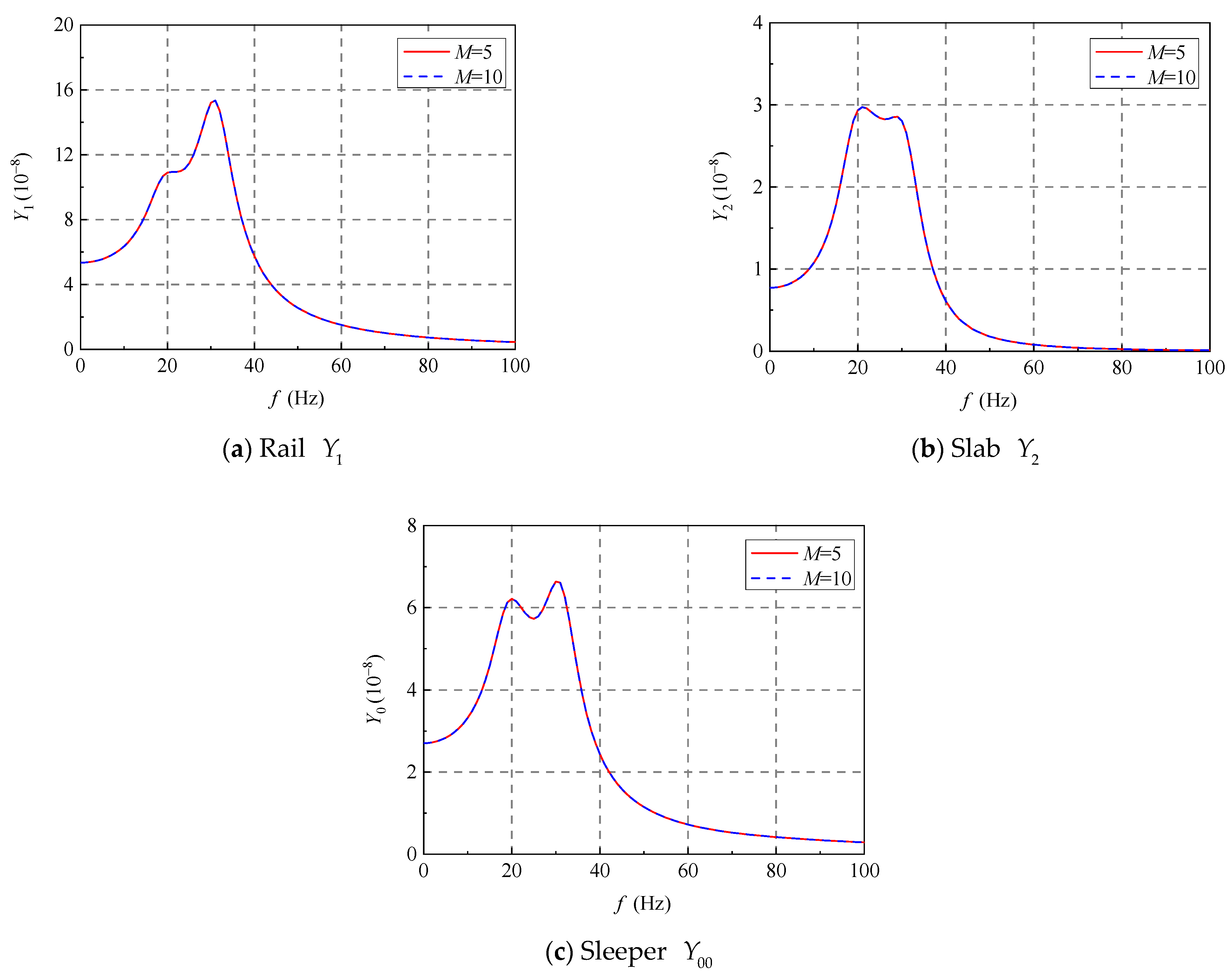
In order to choose a suitable M used in Equation (49), the numerical results based on assuming M = 5 and M = 10 are calculated, respectively. The vertical displacements of the rail, the slab and the sleeper calculated by Equation (49) at T = 0.5 and load velocity v 0 = 200   km / h with M = 5 and M = 10 are presented in Figure 4. It can be seen that there are nearly no discrepancies between these two cases. Therefore, considering the computational efficiency, M = 5 is used in the following computation.

5.1. Comparison Between Timoshenko Beams and Euler–Bernoulli Beams

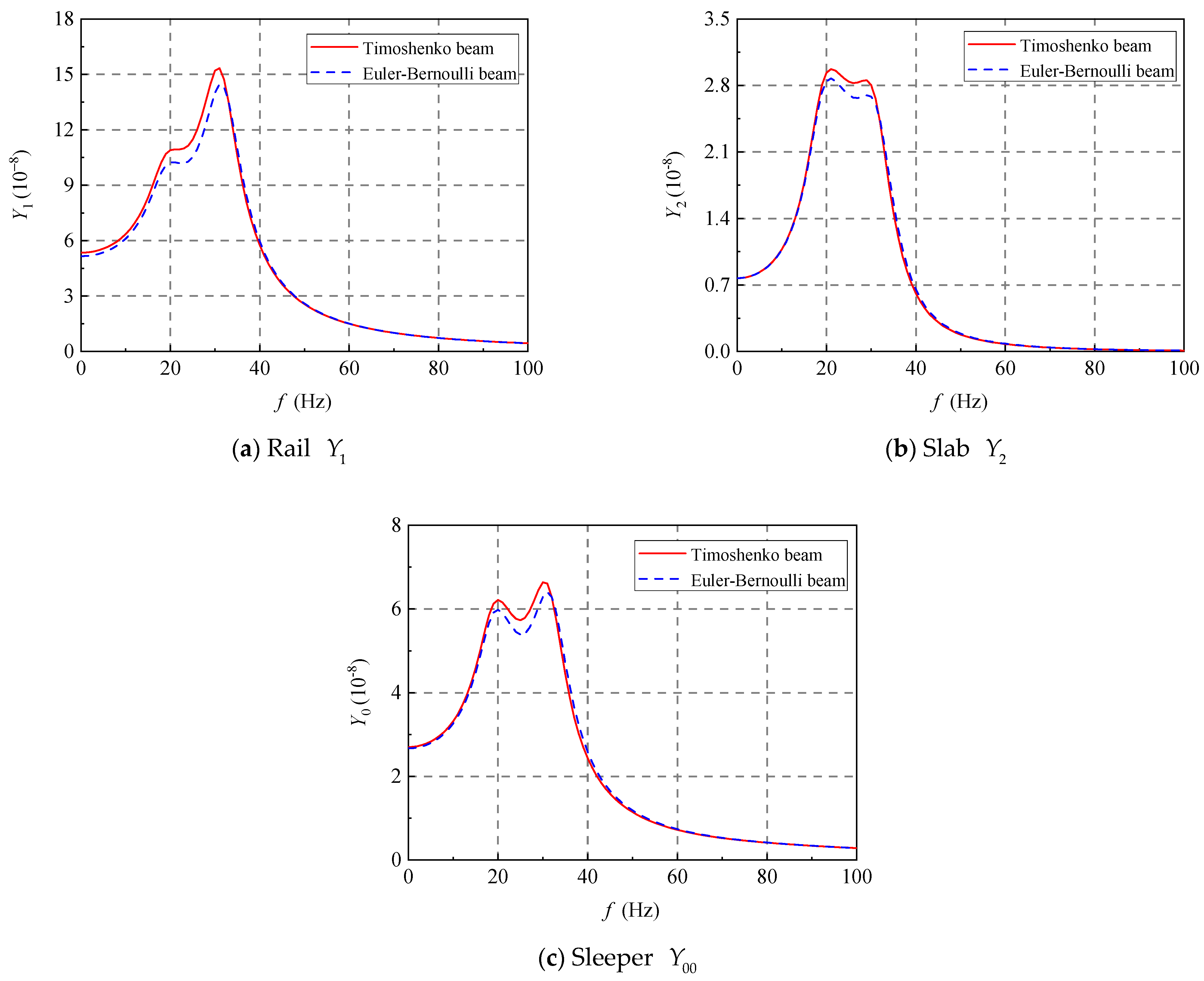
In order to investigate the dynamic response of this wheel–track model, the dimensionless transverse deflections of the rail, the slab and the sleeper at the point of contact with the force (see Equation (49)) at T = 0.5 are calculated. Figure 5 shows the comparison of the vertical displacements of the rail, the slab and the sleeper calculated by Equation (49) at T = 0.5 and load velocity v 0 = 200   km / h using the Timoshenko beam theory and the Euler–Bernoulli beam theory.
It can be seen from Figure 5 that the displacements of the rail, the slab, and the sleeper calculated by the Timoshenko beam theory are all bigger than the corresponding ones calculated by the Euler–Bernoulli theory when the load frequency is between 20 Hz and 30 Hz, while in the other load frequency spectrum, the overall difference between the Timoshenko beams and the Euler–Bernoulli beams is quite small. It seems that the Timoshenko beams are a bit softer than the Euler–Bernoulli beams when the load frequency is near the cut-off frequencies. The great discrepancy is near the peak values, which are also the focus in the practical applications. Therefore, the results calculated by the Timoshenko beam theory are much more conservative. In the following sections, all the results are calculated by the Timoshenko beam theory.

5.2. Effect of Load Velocity

5.2.1. Vertical Displacements and Wheel–Track Interaction Force

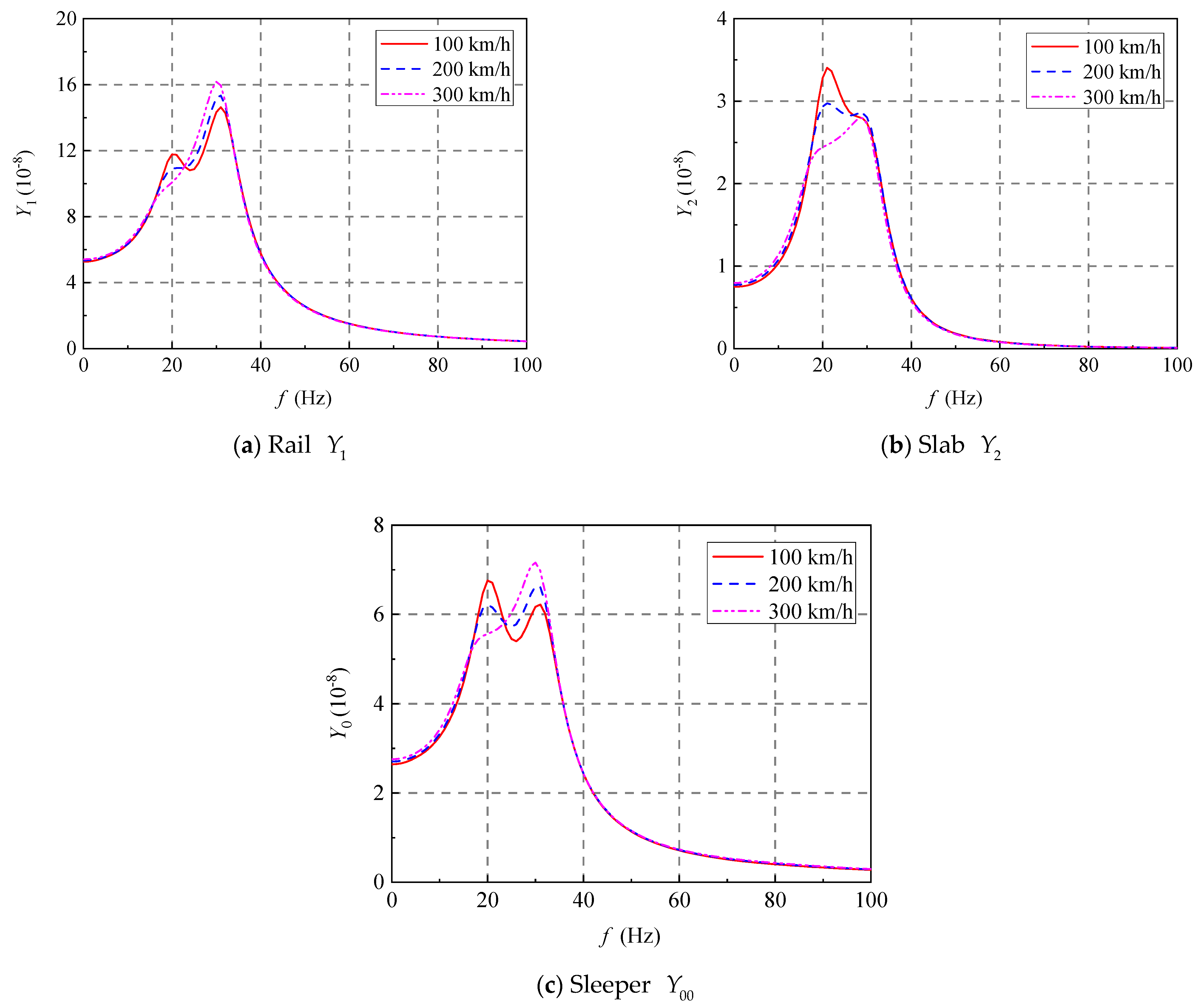
Figure 6 presents a comparative analysis of the vertical displacement characteristics for the rail, slab, and sleeper components, derived from Equation (49) at T = 0.5 under three distinct load velocities (100 km/h, 200 km/h, and 300 km/h). As the excitation frequency nears the system’s cut-off frequency, the model’s dynamic response at the loading location reaches its maximum amplitude. The frequency spectrum in Figure 6 reveals two distinct resonant peaks, corresponding to cut-off frequencies of approximately 20 Hz and 30 Hz. The vibrational response of the rail is predominantly governed by the higher cut-off frequency (around 30 Hz), whereas the slab’s behavior is mainly influenced by the lower cut-off frequency (approximately 20 Hz). Notably, an isolated slab beam on the same bearing exhibits a natural frequency of f slab = 1 2 π k 2 ρ 2 = 22.3   Hz , which aligns closely with the first cut-off frequency. Furthermore, as illustrated in Figure 5c, the sleeper’s peak responses are co-modulated by both cut-off frequencies.
Figure 6 clearly demonstrates that variations in load velocity exert a significant impact on the dynamic behavior of the double-beam system. The amplitude associated with the second cut-off frequency exhibits a positive correlation with increasing load velocity. Conversely, the peak amplitude related to the first cut-off frequency demonstrates an inverse relationship, diminishing as velocity rises. This pattern suggests that elevated load velocities have a reduced effect on the slab component, a conclusion further supported by the data presented in Figure 6b. Analysis of the three distinct load velocity conditions reveals that increasing velocity results in a downward shift of the system’s cut-off frequencies. Throughout the investigated parameter range, the rail exhibits consistently greater displacement amplitudes compared to the slab component. This displacement disparity primarily stems from the substantial differences in material properties, specifically the rail’s considerably lower bending stiffness and reduced mass per unit length relative to the slab. Additionally, energy dissipation occurs through the damping mechanisms, resulting in reduced energy transmission to the slab subsystem.
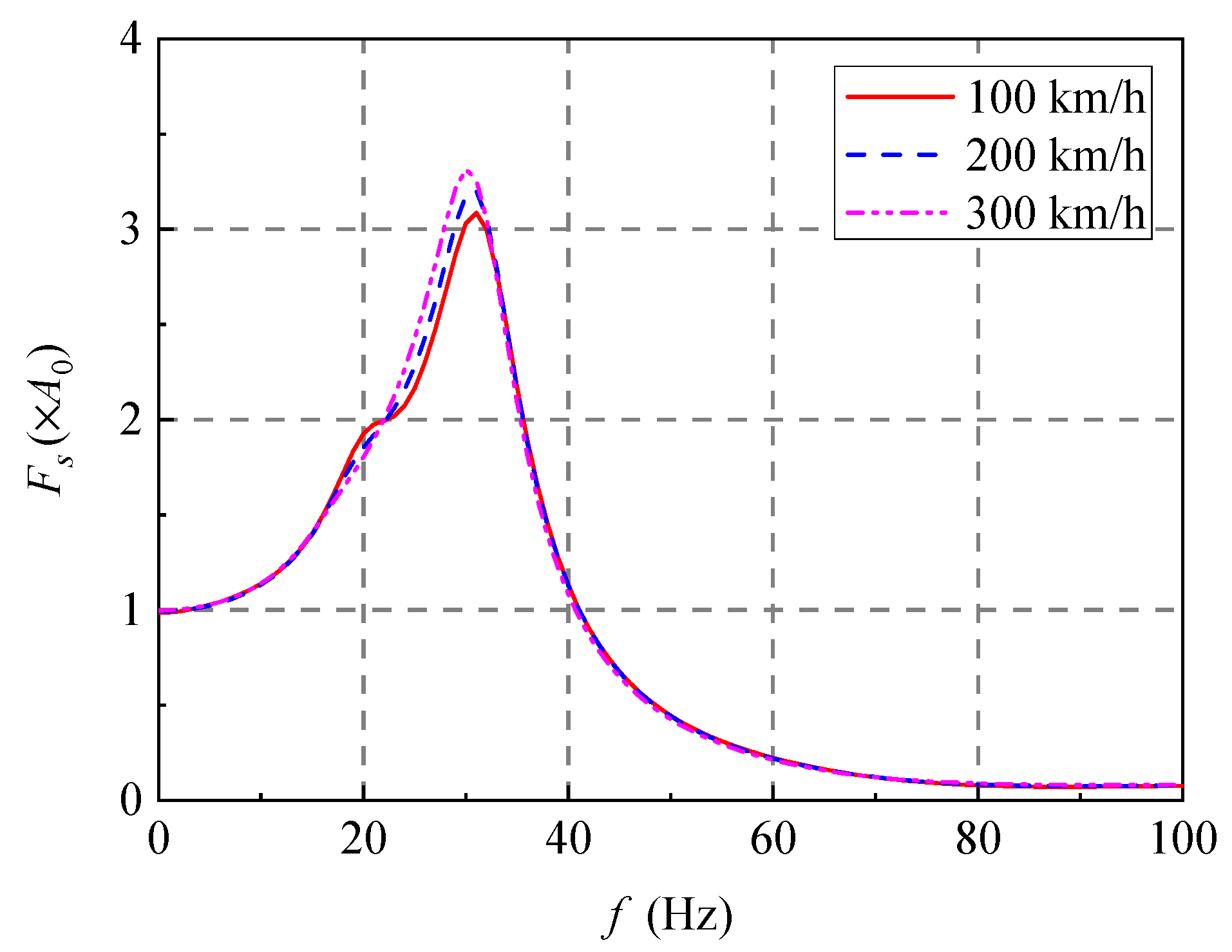
Figure 7 presents a comparative analysis of wheel–track interaction forces, as computed using Equation (30) at T = 0.5 for three distinct load velocities (100 km/h, 200 km/h, and 300 km/h). The results in Figure 7 demonstrate that the wheel–track interaction force profiles across the three load velocities exhibit strong similarity to the rail’s vertical displacement patterns (Figure 6a), with the notable exception of a less pronounced first cut-off frequency. Beyond the 80 Hz threshold, the wheel–track interaction force diminishes significantly, approaching negligible magnitudes. Consequently, the double-beam system is predominantly influenced by low- and intermediate-frequency components, whereas high-frequency excitations contribute minimally to the overall dynamic response.

5.2.2. Vertical Displacements and Wheel–Track Interaction Force

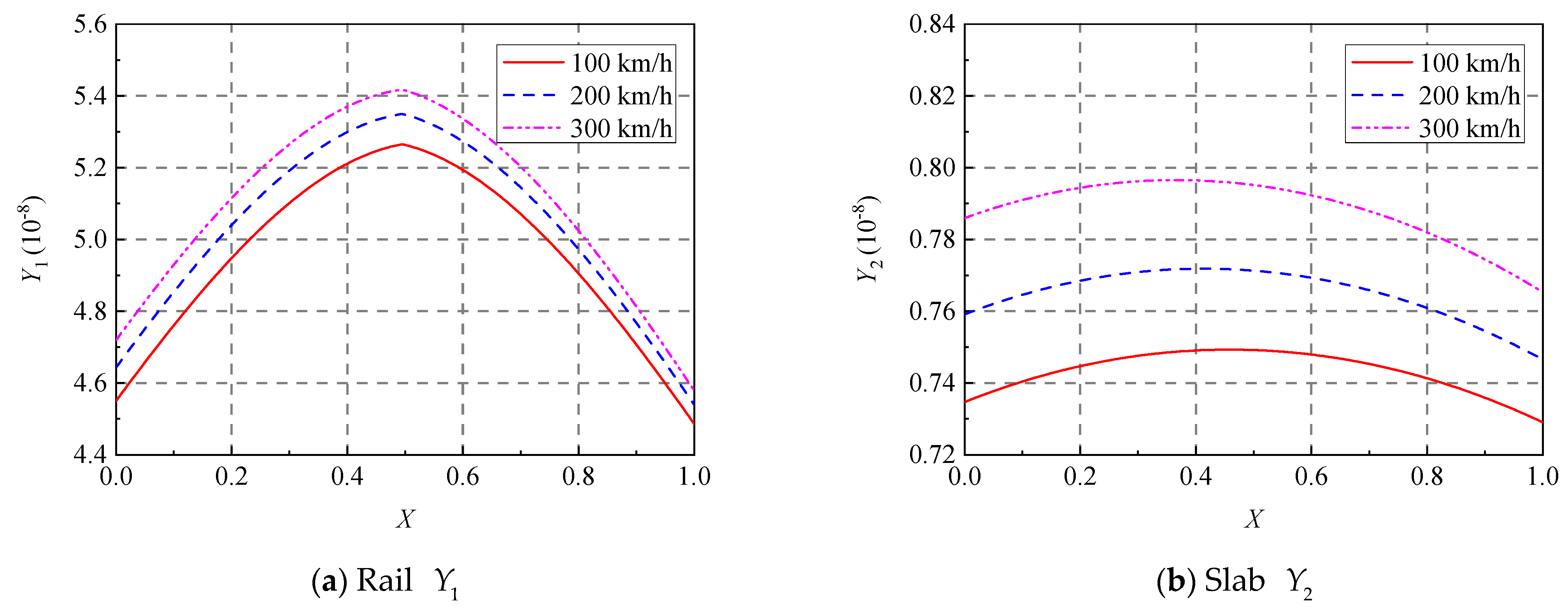
Figure 8 illustrates the deflections of the rail and the slab at T = 0.5 and f = 0 at three different load velocities (100 km/h, 200 km/h, and 300 km/h). It can be seen from Figure 8 that the peak of the rail deflection is near X = 0.5 as the mass wheel is located at X = 0.5 of the rail at T = 0.5, while the position corresponding to the peak of the slab deflection is less than X = 0.5 due to the fact that it takes time for the energy to propagate to the slab from the loading point. The deflection curves of the rail are not symmetrical about X = 0.5 due to the load velocity. The higher load velocity consistently leads to the higher rail deflections and slab deflections.
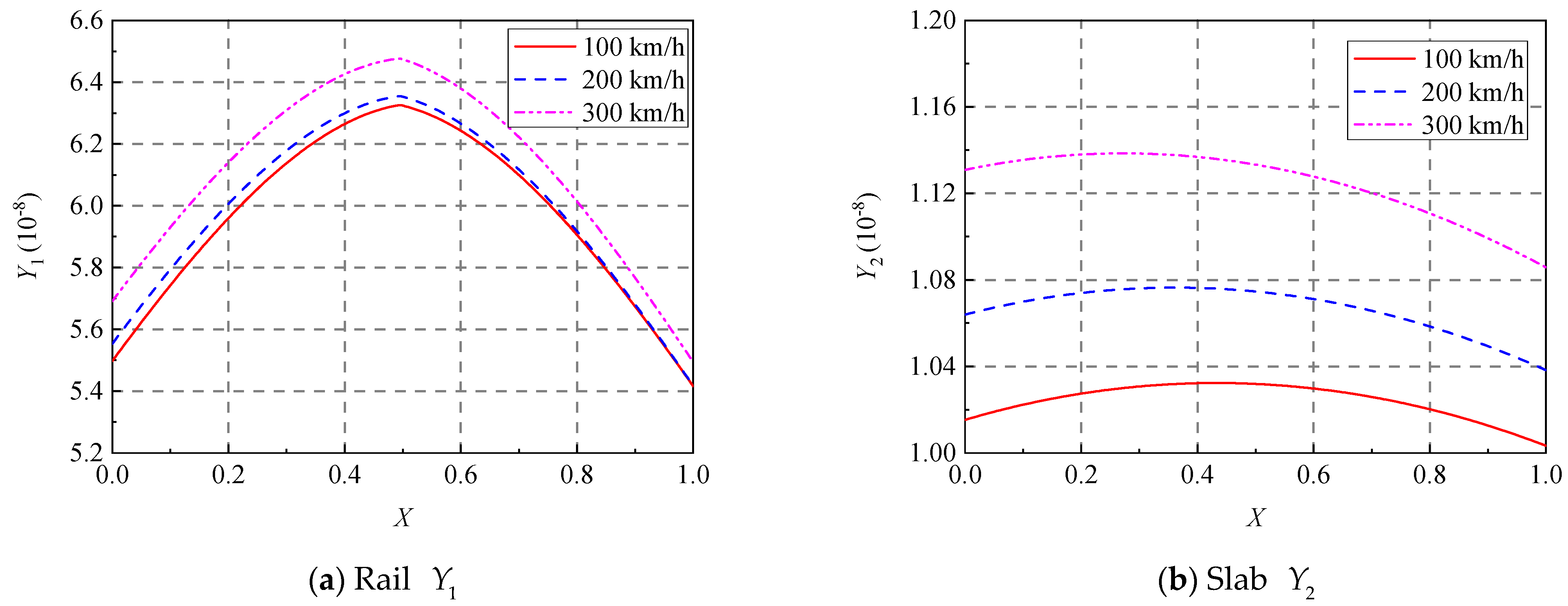
Figure 9 presents the deflections of the rail and the slab at T = 0.5 and f = 10 Hz at three different load velocities (100 km/h, 200 km/h, and 300 km/h). Compared with Figure 8, the rail deflections and the slab deflections at load frequency f = 10 Hz are higher than those under a constant load (f = 0). The rail deflections at load velocity v0 = 100 km/h and v0 = 200 km/h are nearly the same except for some discrepancy at X < 0.5.

5.3. Effect of Load Frequency

5.3.1. Vertical Displacements and Wheel–Track Interaction Force

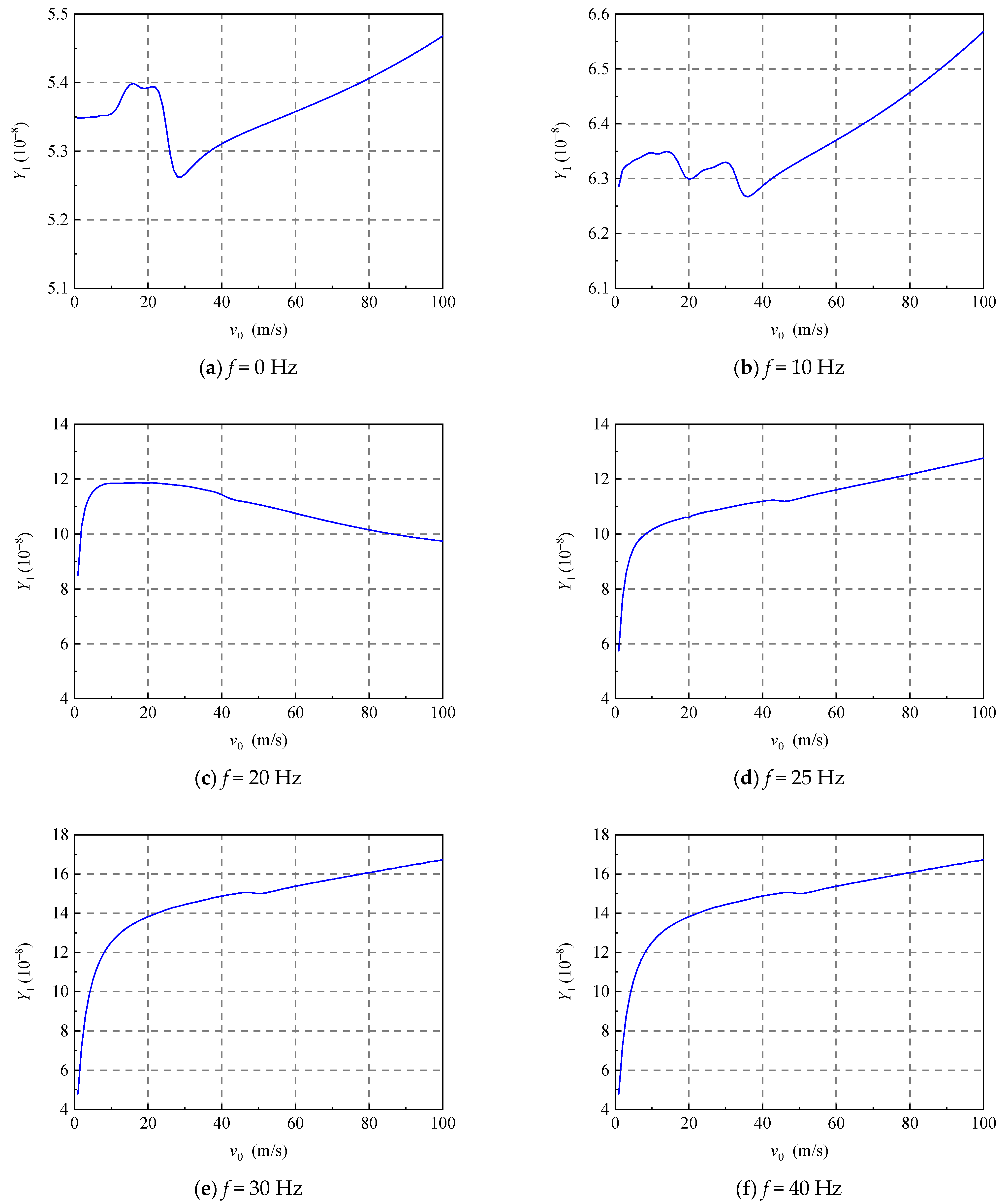
Figure 10 shows the vertical displacements of the rail calculated by Equation (49) at T = 0.5 at six different load frequencies (0, 10 Hz, 20 Hz, 25 Hz, 30 Hz, and 40 Hz), and Figure 11 is the comparison of these six cases. In the case of load frequency f = 0, the mass wheel moves constantly on the rail. As described in the previous section (Section 5.2), the two cut-off frequencies of this track-wheel model are near 20 Hz and 30 Hz, so in this section, three of the chosen load frequencies (20 Hz, 25 Hz, and 30 Hz) are near the cut-off frequencies, and the other two load frequencies are smaller (10 Hz) and higher (40 Hz) than the cut-off frequencies, respectively.
In fact, this model should have two critical velocities at a certain load frequency, which is similar to its cut-off frequencies. The critical velocity is a velocity at which the dynamic response of the model reaches the peak values. As can be seen from Figure 10a, the load velocities corresponding to the peak values are about 15 m/s (54 km/h) and 22 m/s (79.2 km/h). Compared with Figure 10b, the first critical velocity decreases while the second critical velocity increases.
As can be seen from Figure 10c,d, when the load frequency (f = 20 Hz, 25 Hz, 30 Hz, and 40 Hz) is not smaller than the cut-off frequencies, there are no obvious peak values. The vertical displacements of the rail in Figure 10c,d increases sharply with the load velocity before remaining relatively stable after v0 = 20 m/s (72 km/h).
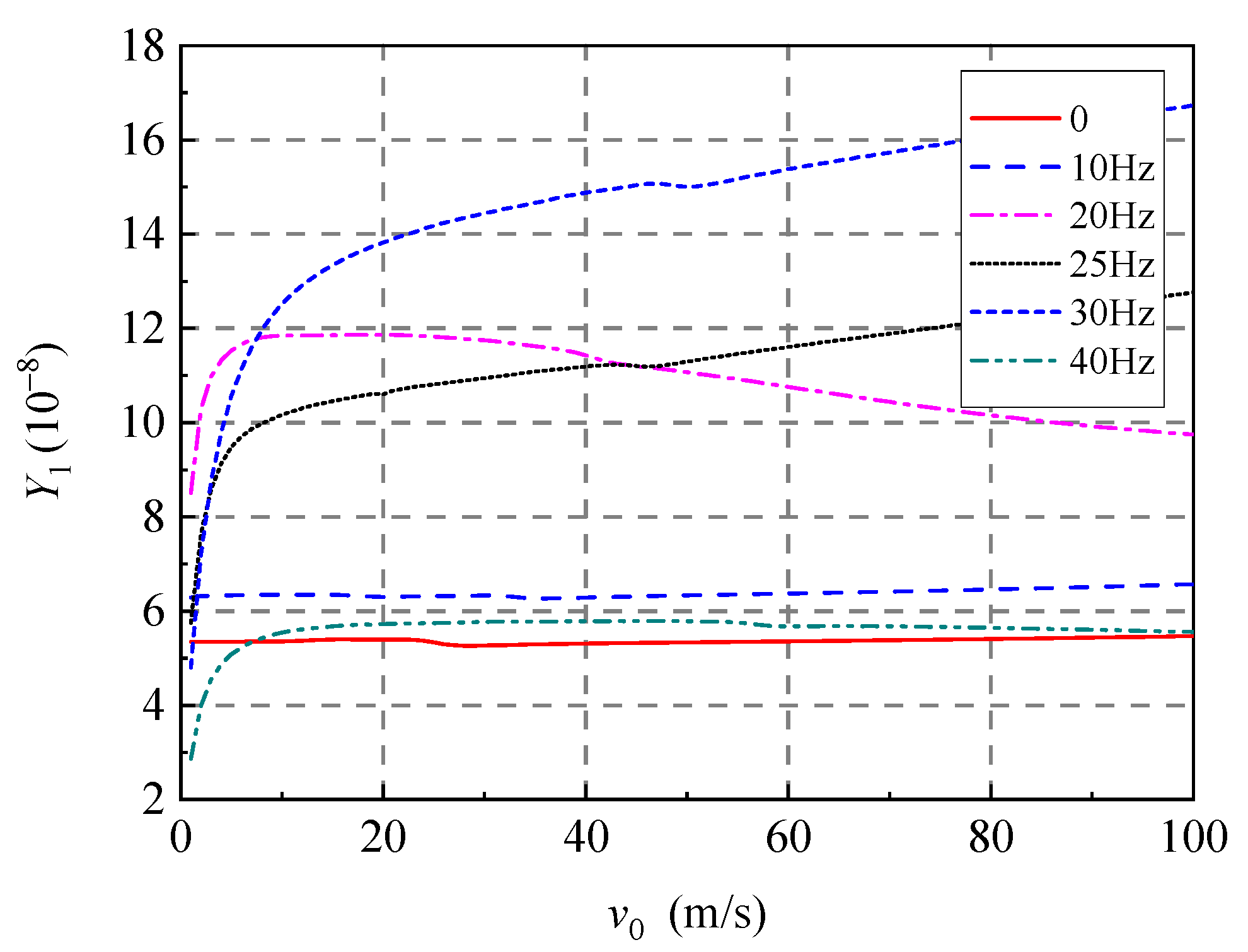
As can be seen from Figure 11, when the load frequency (0 and 10 Hz) is smaller than the cut-off frequencies, the rail displacements remain relatively constant with the load velocity, and when the load frequencies (20 Hz, 25 Hz, 30 Hz, and 40 Hz) are not smaller than the cut-off frequencies, the rail displacements seem like a logarithmic relationship. Moreover, the rail displacements increase with the load velocity when the load frequency is smaller than the cut-off frequencies, while an opposite trend can be seen when the load frequency reaches and exceeds the cut-off frequencies. The rail displacements are the highest when the load frequency is near the cut-off frequencies. Therefore, in the practical applications, the load containing frequencies that are near the cut-off frequencies can lead to great dynamic response even when the load velocity is quite low.
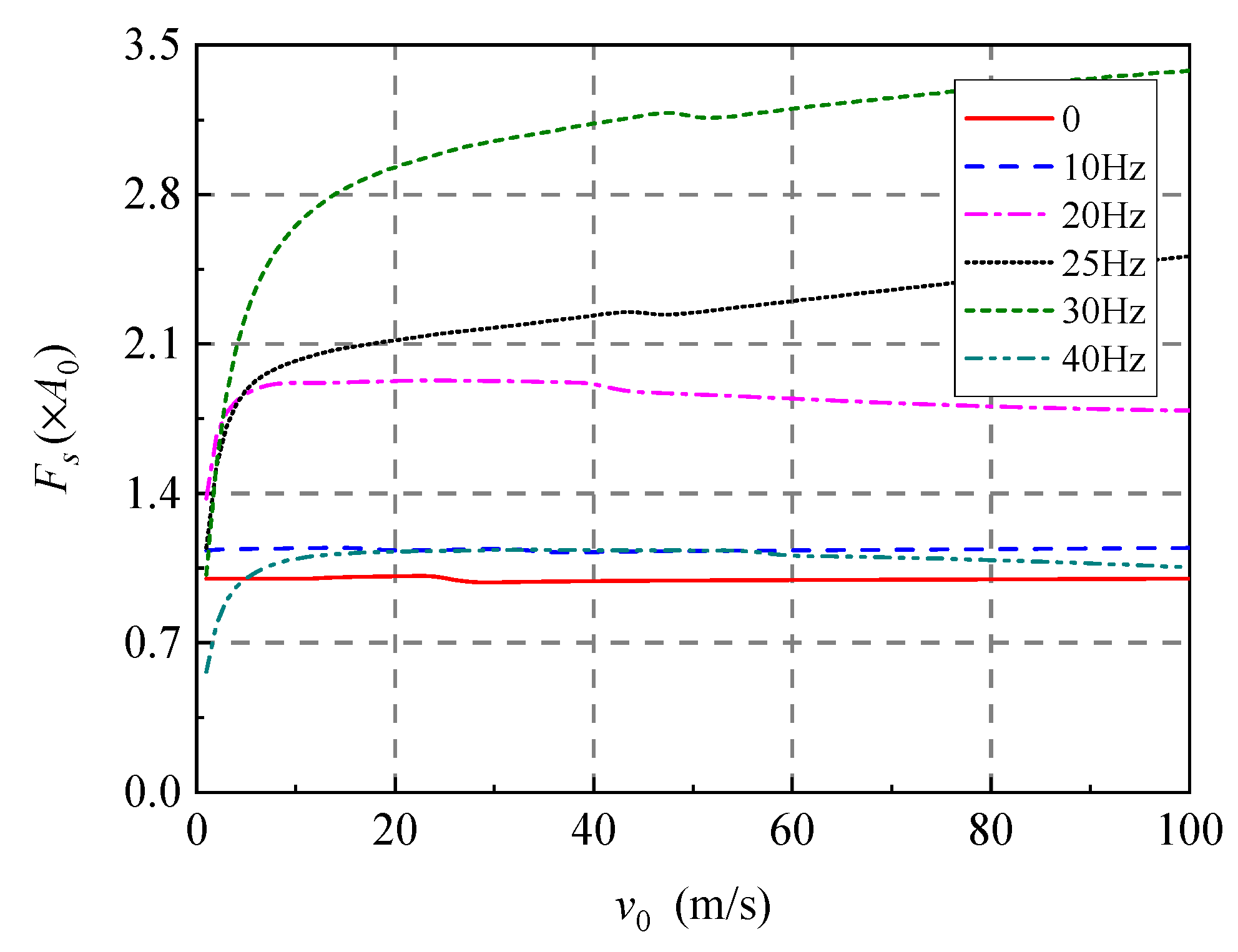
Figure 12 shows the comparison of the wheel–track interaction force calculated by Equation (30) at T = 0.5 at these six different load frequencies (0, 10 Hz, 20 Hz, 25 Hz, 30 Hz, and 40 Hz). It can be seen from Figure 12 that the wheel–track interaction force is similar to the vertical displacements of the rail in Figure 11.

5.3.2. Deflections of the Rail and the Slab

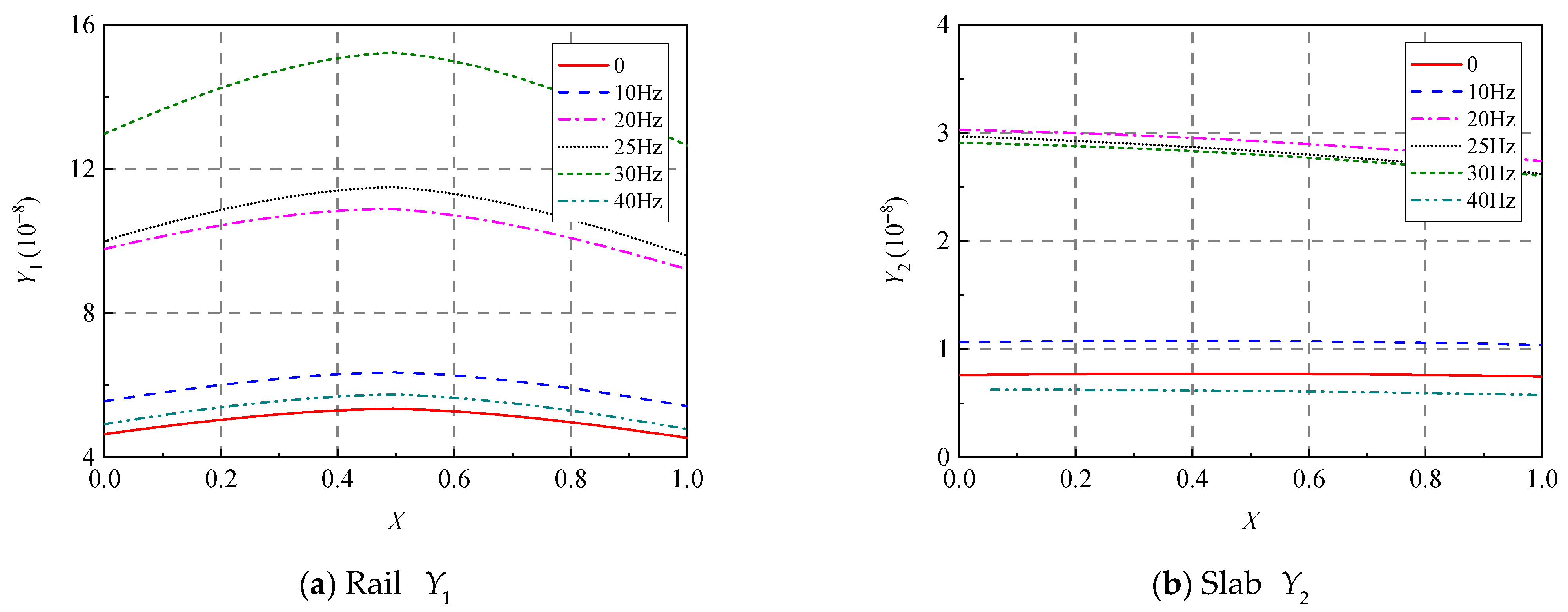
Figure 13 illustrates the deflections of the rail and the slab at T = 0.5 and load velocity v0 = 200 km/h at the six different load frequencies (0, 10 Hz, 20 Hz, 25 Hz, 30 Hz, and 40 Hz). It can be seen from Figure 13 that the vertical displacements of the rail and the slab are higher when the load frequencies (20 Hz, 25 Hz, and 30 Hz) are near the cut-off frequencies. As shown in Figure 13a, the vertical displacements of the rail are the highest at load frequency f = 30 Hz (near the second cut-off frequency), as the rail determines the second cut-off frequency. While, as shown in Figure 13b, the vertical displacements of the slab are the highest at load frequency f = 20 Hz (near the first cut-off frequency), as the slab determines the first cut-off frequency. The deflection curves of the slab are nearly straight lines, exhibiting no peak values.

6. Conclusions

A more reasonable and complicated wheel–track model is established and analyzed in this paper. In this model, the rail and the slab are assumed to be two Timoshenko beams with different parameters. The sleepers connecting the rail and the slab are modeled as discretized masses equally spaced at the same distance. The wheel of mass moves to the x-positive direction on the rail without detachment at a constant velocity. The whole model lies on a viscoelastic foundation.
The solution for this double-beam under a moving harmonic load is investigated based on Fourier transformations and specific boundary conditions. The interaction between the wheel and the rail is then considered by using a Fourier series. The infinite Fourier coefficients are then determined by 2M + 1 finite linear algebraic equations obtained by the contact condition between the wheel and the rail.
A numerical example is then produced to study the comparison between Timoshenko beams and Euler–Bernoulli beams and the effect of load velocity and frequency on the dynamic response of this double-beam model. The comparison of the results calculated by the Timoshenko beam theory and the Euler–Bernoulli beam theory shows that the vertical displacements of the rail, the slab, and the sleeper calculated by the Timoshenko beam theory are all bigger than the corresponding ones calculated by the Euler–Bernoulli theory when the load frequency is near the cut-off frequencies (20 Hz and 30 Hz). This whole model has two cut-off frequencies controlling the two beams (the rail and the slab) of this model, respectively. Moreover, the higher load velocity leads to the lower first cut-off frequencies and the higher peak amplitudes. The comparison of the dynamic response of this model at six different load frequencies shows that there are two critical velocities when the load frequency is smaller than the cut-off frequencies. While there are no obvious peak values in the case of 25 Hz and 40 Hz. Furthermore, the rail displacements increase with the load velocity when the load frequency is smaller than the cut-off frequencies, while an opposite trend can be found when the load frequency reaches and exceeds the cut-off frequencies.
The main findings and conclusions of this study provide valuable insights for several key areas in railway engineering, including the analysis of transient dynamic responses of tracks under train loads, the assessment of long-term track settlement due to rail traffic, and the control of train frequency and operational safety. Nevertheless, this research is subject to certain limitations arising from simplifying assumptions, such as: (1) the assumption of constant wheel velocity; (2) the uniformity of track support stiffness; (3) the adoption of a linear constitutive model for the subgrade; and (4) the consideration of only a single-wheel loading scenario. Future work may extend the present study in the following directions: extending the constant-velocity model to include acceleration and braking conditions; accounting for spatial inhomogeneity in track support stiffness (e.g., bridge–embankment transition zones); incorporating nonlinearities in wheel–rail contact or subgrade material behavior; generalizing the single-wheel model to multiple wheelsets or a full-vehicle model; validating the model with field or experimental data; and exploring hybrid modeling approaches that combine data-driven methods with physical principles.

Author Contributions

Conceptualization, M.L.; Methodology, M.L.; Software, X.W.; Validation, X.W.; Formal analysis, H.L.; Writing—original draft, H.L.; Visualization, H.L. All authors have read and agreed to the published version of the manuscript.

Funding

The work presented in this paper was funded by the National Natural Science Foundation of China (Grant No. 52378381).

Institutional Review Board Statement

Not applicable.

Informed Consent Statement

Not applicable.

Data Availability Statement

The original contributions presented in this study are included in the article. Further inquiries can be directed to the corresponding author.

Acknowledgments

The authors gratefully acknowledge the contributions of Zhendong Cui’s research group and Pengpeng He from the China University of Mining and Technology to this paper.

Conflicts of Interest

All Authors were employed by the company CCCC Tunnel Engineering Company Limited and China First Highway Engineering Co., Ltd. All authors declare that the research was conducted in the absence of any commercial or financial relationships that could be construed as a potential conflict of interest.

References

  1. Sheehan, J.P.; Debnath, L. On the dynamic response of an infinite Bernoulli-Euler beam. Pure Appl. Geophys. 1972, 97, 100–110. [Google Scholar] [CrossRef]
  2. Sun, L. A closed-form solution of a Bernoulli-Euler beam on a viscoelastic foundation under harmonic line loads. J. Sound Vib. 2001, 242, 619–627. [Google Scholar] [CrossRef]
  3. Xu, L. On dynamic analysis method for large-scale train-track-substructure interaction. Railw. Eng. Sci. 2022, 30, 162–182. [Google Scholar] [CrossRef]
  4. Sun, L. An explicit representation of steady state response of a beam on an elastic foundation to moving harmonic line loads. Int. J. Numer. Anal. Methods Geomech. 2003, 27, 69–84. [Google Scholar] [CrossRef]
  5. Lulu, G.B.; Chen, R.; Wang, P.; Xu, J.M.; Chen, J.Y. Effect of polygonal wheel on the vehicle-track dynamic interaction in turnout and its transmission to the trailer bogie wheels. Veh. Syst. Dyn. 2024, 62, 1713–1738. [Google Scholar] [CrossRef]
  6. Andersen, L.; Nielsen, S.R.K. Vibrations of a track caused by variation of the foundation stiffness. Probabilistic Eng. Mech. 2003, 18, 171–184. [Google Scholar] [CrossRef]
  7. Mallik, A.K.; Chandra, S.; Singh, A.B. Steady-state response of an elastically supported infinite beam to a moving load. J. Sound Vib. 2006, 291, 1148–1169. [Google Scholar] [CrossRef]
  8. Nechitailo, N.V.; Lewis, K.B. Critical velocity for rails in hypervelocity launchers. J. Impact Eng. 2006, 33, 485–495. [Google Scholar] [CrossRef]
  9. Koroma, S.G.; Hussein, M.F.M.; Owen, J.S. Vibration of a beam on continuous elastic foundation with nonhomogeneous stiffness and damping under a harmonically excited mass. J. Sound Vib. 2004, 333, 2571–2587. [Google Scholar] [CrossRef]
  10. Dimitrovová, Z. A general procedure for the dynamic analysis of finite and infinite beams on piece-wise homogeneous foundation under moving loads. J. Sound Vib. 2010, 329, 2635–2653. [Google Scholar] [CrossRef]
  11. Forrest, J.A.; Hunt, H.E.M. Ground vibration generated by trains in underground tunnels. J. Sound Vib. 2006, 294, 706–736. [Google Scholar] [CrossRef]
  12. Hussein, M.F.M.; Hunt, H.E.M. A power flow method for evaluating vibration from underground railways. J. Sound Vib. 2006, 293, 667–679. [Google Scholar] [CrossRef]
  13. Iordan, P.; Mihaela, S.Q.; Marian, S.R. Dynamic Behavior of Railway Bridges Under High-Speed Traffic Loads. Rom. J. Transp. Infrastruct. 2024, 13, 18. [Google Scholar] [CrossRef]
  14. Li, Z.; Xu, L.; Deng, X.Y. An improved method for slab track-soil interaction considering soil surface deformation. Mech. Based Des. Struct. Mach. 2024, 52, 4260–4283. [Google Scholar] [CrossRef]
  15. Sheng, X.; Jones, C.J.C.; Thompson, D.J. A theoretical study on the influence of the track on train-induced ground vibration. J. Sound Vib. 2004, 272, 909–936. [Google Scholar] [CrossRef]
  16. Karlström, A.; Boström, A. Efficiency of trenches along railways for trains moving at sub- or supersonic speeds. Soil Dyn. Earthq. Eng. 2007, 27, 625–641. [Google Scholar] [CrossRef]
  17. Stephen, N.G. Considerations on second order beam theories. Int. J. Solids Struct. 1981, 17, 325–333. [Google Scholar] [CrossRef]
  18. Moreles, M.A.; Botello, S.; Salinas, R. A root-finding technique to compute eigenfrequencies for elastic beams. J. Sound Vib. 2005, 284, 1119–1129. [Google Scholar] [CrossRef]
  19. Ruge, P.; Birk, C. A comparison of infinite Timoshenko and Euler-Bernoulli beam models on Winkler foundation in the frequency- and time-domain. J. Sound Vib. 2007, 304, 932–947. [Google Scholar] [CrossRef]
  20. Chen, Y.H.; Huang, Y.H.; Shih, C.T. Response of an infinite Timoshenko beam on a viscoelastic foundation to a harmonic moving load. J. Sound Vib. 2001, 241, 809–824. [Google Scholar] [CrossRef]
  21. Liu, T.; Li, Q. Transient elastic wave propagation in an infinite Timoshenko beam on viscoelastic foundation. Int. J. Solids Struct. 2003, 40, 3211–3228. [Google Scholar] [CrossRef]
  22. Carvalho, M.O.M.; Zindeluk, M. Active control of waves in a Timoshenko beam. Int. J. Solids Struct. 2001, 38, 1749–1764. [Google Scholar] [CrossRef]
  23. Kargarnovin, M.H.; Younesian, D.; Thompson, D.J.; Jones, C.J.C. Response of beams on nonlinear viscoelastic foundations to harmonic moving loads. Comput. Struct. 2005, 83, 1865–1877. [Google Scholar] [CrossRef]
  24. Şimşek, M. Non-linear vibration analysis of a functionally graded Timoshenko beam under action of a moving harmonic load. Compos. Struct. 2010, 92, 2532–2546. [Google Scholar] [CrossRef]
  25. Remington, P.J. Wheel/rail rolling noise—Part I: Theoretical analysis. J. Acoust. Soc. Am. 1987, 81, 1805–1823. [Google Scholar] [CrossRef]
  26. Muller, S. A linear wheel-track model to predict instability and short pitch corrugation. J. Sound Vib. 1999, 227, 899–913. [Google Scholar] [CrossRef]
  27. Hempelmann, K.; Knothe, K. An extended linear model for the prediction of short-pitch corrugation. Wear 1996, 191, 161–169. [Google Scholar] [CrossRef]
  28. Belotserkovskii, P.M. The steady vibrations and resistance of a railway track to the uniform motion of an unbalanced wheel. J. Appl. Math. Mech. 2003, 67, 763–773. [Google Scholar] [CrossRef]
  29. Belotserkovskii, P.M. The interaction of an infinite wheel-train with a constant spacing between the wheels moving uniformly over a rail track. J. Appl. Math. Mech. 2004, 68, 1025–1034. [Google Scholar] [CrossRef]
  30. Wu, T.X.; Thompson, D.J. A double Timoshenko beam model for vertical vibration analysis of railway track at high frequencies. J. Sound Vib. 1999, 224, 329–348. [Google Scholar] [CrossRef]
  31. Vu, H.V.; Ordóñez, A.M.; Karnopp, B.H. Vibration of a double-beam system. J. Sound Vib. 2000, 229, 807–822. [Google Scholar] [CrossRef]
  32. Zhang, Y.Q.; Lu, Y.; Wang, S.L.; Liu, X. Vibration and buckling of a double-beam system under compressive axial loading. J. Sound Vib. 2008, 318, 341–352. [Google Scholar] [CrossRef]
  33. Bhatta, S.; Dang, J. Seismic damage prediction of RC buildings using machine learning. Earthq. Eng. Struct. Dyn. 2023, 52, 3504–3527. [Google Scholar] [CrossRef]
  34. Lazaridis, P.C.; Kavvadias, I.E.; Demertzis, K.; Iliadis, L.; Vasiliadis, L.K. Structural damage prediction of a reinforced concrete frame under single and multiple seismic events using machine learning algorithms. Appl. Sci. 2022, 12, 3845. [Google Scholar] [CrossRef]
  35. Mead, D.J. Vibration response and wave propagation in periodic structures. J. Eng. Ind. 1971, 93, 783–792. [Google Scholar] [CrossRef]
  36. Belotserkovskiy, P.M. On the oscillations of infinite periodic beams subjected to a moving concentrated force. J. Sound Vib. 1996, 193, 705–712. [Google Scholar] [CrossRef]
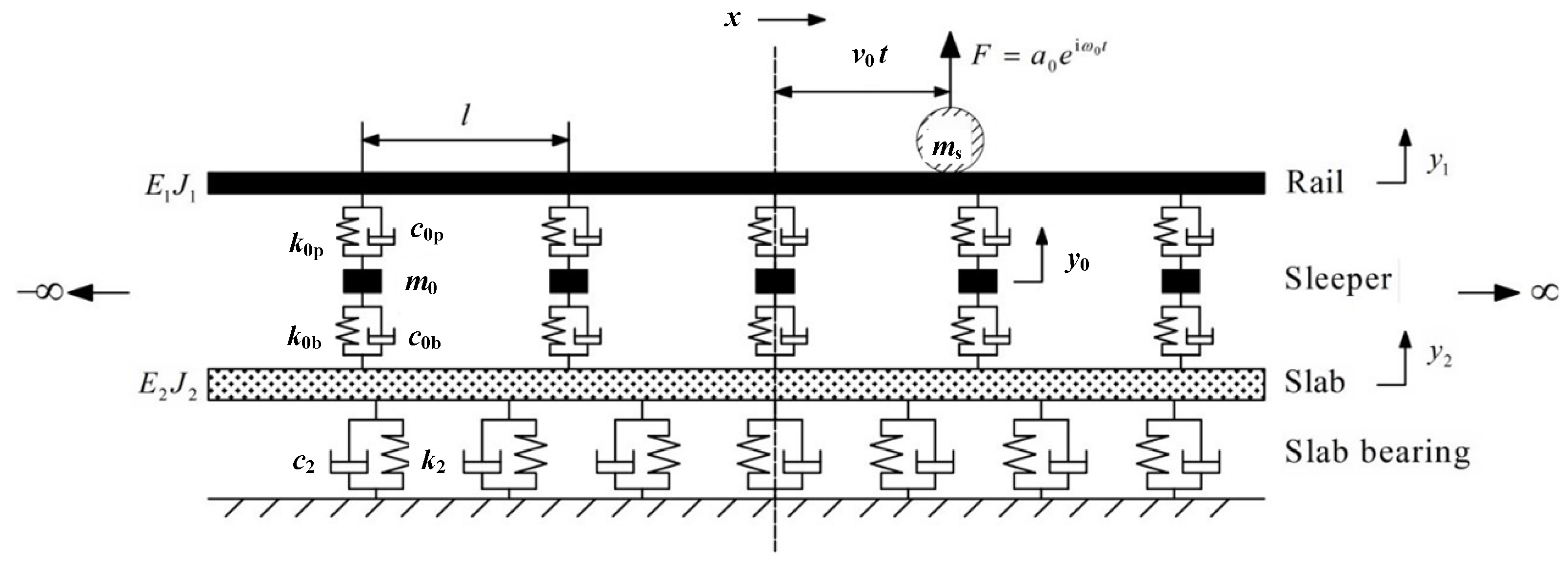
Figure 1. Wheel–track model.
Applsci 16 00514 g001
Figure 2. Double-beam system with a moving harmonic load.
Applsci 16 00514 g002
Figure 3. Force analysis.
Applsci 16 00514 g003
Figure 4. Vertical displacements of the rail, the slab and the sleeper calculated by Equations (4)–(24) at T = 0.5 by assuming M = 5 and M = 10. (a) Rail Y 1 ; (b) Slab Y 2 ; (c) Sleeper Y 00 .
Applsci 16 00514 g004
Figure 5. Comparison of the vertical displacements of the rail, the slab and the sleeper calculated by Equation (49) at T = 0.5 and load velocity v0 = 200 km/h using the Timoshenko beam theory and the Euler–Bernoulli beam theory. (a) Rail Y 1 ; (b) Slab Y 2 ; (c) Sleeper Y 00 .
Applsci 16 00514 g005
Figure 6. Comparison of the vertical displacements of the rail, the slab and the sleeper calculated by Equations (4)–(24) at T = 0.5 at different load velocities. (a) Rail Y 1 ; (b) Slab Y 2 ; (c) Sleeper Y 00 .
Applsci 16 00514 g006
Figure 7. Comparison of the wheel–track interaction force calculated by Equation (30) at T = 0.5 at different load velocities.
Applsci 16 00514 g007
Figure 8. Deflections of the rail and the slab at T = 0.5 and f = 0 at different load velocities. (a) Rail Y 1 ; (b) slab Y 2 .
Applsci 16 00514 g008
Figure 9. Deflections of the rail and the slab at T = 0.5 and f = 10 Hz at different load velocities. (a) Rail Y 1 ; (b) slab Y 2 .
Applsci 16 00514 g009
Figure 10. Vertical displacements of the rail calculated by Equations (4)–(24) at T = 0.5 at different load frequencies. (a) f = 0; (b) f = 10 Hz; (c) f = 20 Hz; (d) f = 25 Hz; (e) f = 30 Hz; (f) f = 40 Hz.
Applsci 16 00514 g010
Figure 11. Comparison of the vertical displacements of the rail calculated by Equations (4)–(24) at T = 0.5 at different load frequencies.
Applsci 16 00514 g011
Figure 12. Comparison of the wheel–track interaction force calculated by Equations (4) and (5) at T = 0.5 at different load frequencies.
Applsci 16 00514 g012
Figure 13. Deflections of the rail and the slab at T = 0.5 and load velocity v0 = 200 km/h at different load frequencies. (a) Rail Y 1 ; (b) slab Y 2 .
Applsci 16 00514 g013
Table 1. Parameters for the wheel–track system.
Wheel:
Mass of the wheel m s = 700   kg
Constant velocity of the wheel v 0 = 200   km / h
Constant amplitude of the vertical concentrated force a 0 = 1
Angular frequency of the vertical concentrated force ω 0 = 2 π × 5   rad / s
Rail:
Young’s modulus of the rail E 1 = 206   GPa
Second moment of area of the rail cross-section J 1 = 1.489 × 10 5   m 4
Shear modulus of the rail G 1 = 79   GPa
Mass of the rail per unit length ρ 1 = 44.653   kg / m
Cross-sectional area of the rail S 1 = 5.7 × 10 3   m 2
Shear force coefficient of the rail k 1 = 0.34
Sleeper:
Sleeper spacing l = 0.8   m
Concentrated mass of the sleeper m 0 = 34.88   kg
Spring stiffness above and below the sleeper k 0 p = k 0 b = 30 × 10 6   N / m 2
Damper viscosity above and below the sleeper c 0 p = c 0 b = 20 × 10 3   N s / m 2
Slab:
Young’s modulus of the slab E 2 = 32.5   GPa
Second moment of area of the slab cross-section J 2 = 4.29 × 10 3   m 4
Shear modulus of the slab G 2 = 13   GPa
Mass of the slab per unit length ρ 2 = 2041   kg / m
Cross-sectional area of the slab S 2 = 0.84   m 2
Shear force coefficient of the slab k 2 = 0.22
Slab bearing:
Spring stiffness of the slab bearing k 2 = 40 × 10 6   N / m 2
Damper viscosity of the slab bearing c 2 = 110 × 10 3   N s / m 2
Disclaimer/Publisher’s Note: The statements, opinions and data contained in all publications are solely those of the individual author(s) and contributor(s) and not of MDPI and/or the editor(s). MDPI and/or the editor(s) disclaim responsibility for any injury to people or property resulting from any ideas, methods, instructions or products referred to in the content.