Review

Oleanolic Acid and Alzheimer’s Disease: Mechanistic Hypothesis of Therapeutic Potential

by
Juan M. Espinosa-Cabello
1,
Ángel Fernández-Aparicio
2,3,
Emilio González-Jiménez
2,3,*,
Gisela Perez-Muñoz
1,
José María Castellano
1 and
Javier S. Perona
1
1
Department of Food and Health, Instituto de la Grasa-CSIC, Campus of the University Pablo de Olavide, 41013 Seville, Spain
2
Department of Nursing, Faculty of Health Sciences, University of Granada, 18016 Granada, Spain
3
Instituto de Investigación Biosanitaria (ibs.GRANADA), 18014 Granada, Spain
*
Author to whom correspondence should be addressed.
Appl. Sci. 2026, 16(1), 494; https://doi.org/10.3390/app16010494
Submission received: 2 December 2025 / Revised: 23 December 2025 / Accepted: 28 December 2025 / Published: 4 January 2026
(This article belongs to the Special Issue Dietary Bioactive Compounds and Their Neuroprotective Potential)

Featured Application

This work highlights the potential application of oleanolic acid (OA) and its synthetic derivatives as multitarget agents for the prevention and treatment of Alzheimer’s disease. By targeting key pathological mechanisms—such as β-amyloid and Tau aggregation, neuroinflammation, oxidative stress, and metabolic dysregulation—OA could serve as a basis for developing novel therapeutic strategies aimed at slowing or mitigating AD progression.

Abstract

Numerous hypotheses have been proposed to explain the origin of Alzheimer’s disease (AD), a chronic neurodegenerative disorder that currently has no curative treatment. These hypotheses include the abnormal accumulation of β-amyloid and hyperphosphorylated Tau, degeneration of cholinergic neurons associated with chronic neuroinflammation and oxidative stress, and dysregulation of lipid and carbohydrate metabolism. oleanolic acid (OA), a pentacyclic triterpenoid widely distributed across plant species, has demonstrated anti-inflammatory and antioxidant activities, anti-aggregation properties, together with regulatory effects on carbohydrate and lipid metabolism. Given the diversity of hypotheses proposed for AD and its multifactorial nature, the pleiotropic actions of OA positions it as a promising candidate for preventive and therapeutic strategies. This review compiles evidence on OA and selected synthetic derivatives, analyzing their impact across the major mechanistic hypotheses of AD pathogenesis. Collectively, these findings support OA as a promising candidate to address protein aggregation, metabolic imbalance, and neuroinflammation in AD.

1. Introduction

“Whenever a theory appears to you as the only possible one, take this as a sign that you have neither understood the theory nor the problem which it was intended to solve.”
These words by Karl Popper are perfectly applicable to the multiple hypotheses formulated in the race to explain the origin and development of one of the most devastating diseases that humanity has faced: Alzheimer’s disease (AD).
Due to this enormous uncertainty and the relentless advance of a disease whose greatest risk factor is age, AD is considered a multifactorial disease of unknown origins. It involves the abnormal accumulation of protein aggregates, including Aβ and neurofibrillary tangles (NFTs) of hyperphosphorylated Tau protein, chronic neuroinflammatory states, high levels of oxidative stress, mitochondrial dysfunction, and dysregulation of glucose, lipid, and metal homeostasis [1]. Official reports identify AD as the sixth leading cause of death worldwide, affecting approximately 1 in every 9 individuals in the United States [2]. The prevalence of AD increases significantly with age, rising from 11% among individuals aged 65 years to 33.4% in those aged over 85 years. In 2021, an estimated 57 million people worldwide were living with dementia, and nearly 10 million new cases occur each year, primarily as a result of various brain diseases and injuries, with AD being the most common form, accounting for 60–70% of all cases [2]. This trend is expected to impose an enormous economic and psychological burden on healthcare systems, as well as on caregivers; the cost per affected person is estimated at around USD 35,000 per year, which is much higher in more advanced stages of the disease. In 87% of cases, this cost is borne by families, who are often forced to leave their jobs to provide full-time care.
Beyond these socioeconomic implications, the most devastating impact of the disease falls on patients themselves, who progressively lose their identity as memories and core aspects of their personhood are erased.
A wide range of hypotheses have been proposed to explain the etiopathogenesis of the disease, from bacterial and viral infections to, more recently, the exposome hypothesis, which proposes that lifelong exposure to modifiable environmental factors influences the genetic foundations of cognitive aging and AD [3]. However, none of these approaches can fully explain the pathology, and very few have succeeded in halting its progression. Evidence of this includes the use of drugs aimed at improving cholinergic signaling, which only alleviates symptoms, or monoclonal antibodies designed to eliminate Aβ aggregates, which, despite reducing the amyloid plaque burden, fail to restore cognitive functions [4,5]. A key point in AD is that, being a neurodegenerative disease, even if the underlying causes are removed, the damage caused becomes irreversible. Therefore, given that a curative treatment has not yet been found, prevention plays a crucial role, positioning it as the only viable approach to delay the onset of the disease and slow its development. Consequently, the search for multitarget drugs with preventive effects and minimal side effects is vital.
Oleanolic acid (OA), a pentacyclic triterpenoid found in many plant species, was originally used in traditional Chinese medicine to treat liver diseases [6]. OA is commonly found in the form of saponins, composed of an aglycone (OA) linked to glycosides (Figure 1). However, in some species, such as the olive tree (Olea europaea), OA is found as a free acid, forming part of the leaf cuticle and fruit skin. OA exhibits a wide range of biological properties, including antioxidant, anti-inflammatory, antidiabetic, bactericidal, and anticancer effects [7]. Research on the potential uses of OA has surged in the last decade, and there is now evidence of its potential in diverse diseases, such as diabetes mellitus and certain types of cancer. These diseases are associated with metabolic disorders, including mitochondrial and energy flow impairments, as well as alterations in inflammation and oxidative stress. All these pathophysiological states are present to varying degrees in AD, and OA has been proposed as a potential preventive compound in the fight against the disease because of its ability to address it from multiple pathological angles. This review compiles the available evidence from various studies on OA and its derivatives across the main hypotheses described in AD, highlighting the amyloid, tau, neuroinflammatory, oxidative, cholinergic, and metabolic hypotheses.

2. Amyloid Hypothesis

The amyloid hypothesis has been the predominant theory explaining AD for decades, and much research has focused on it. This hypothesis, developed from the works of Beyreuther & Masters, Hardy & Allsop, and Selkoe in 1991, and Hardy & Higgins in 1992 [8], proposes that the deposition of Aβ, the main component of amyloid plaques, is the primary cause of the disease. From its extracellular accumulation, other pathological mechanisms arise, such as the formation of neurofibrillary tangles of hyperphosphorylated Tau protein, neuronal loss, neuroinflammatory states, and vascular damage, ultimately leading to dementia.
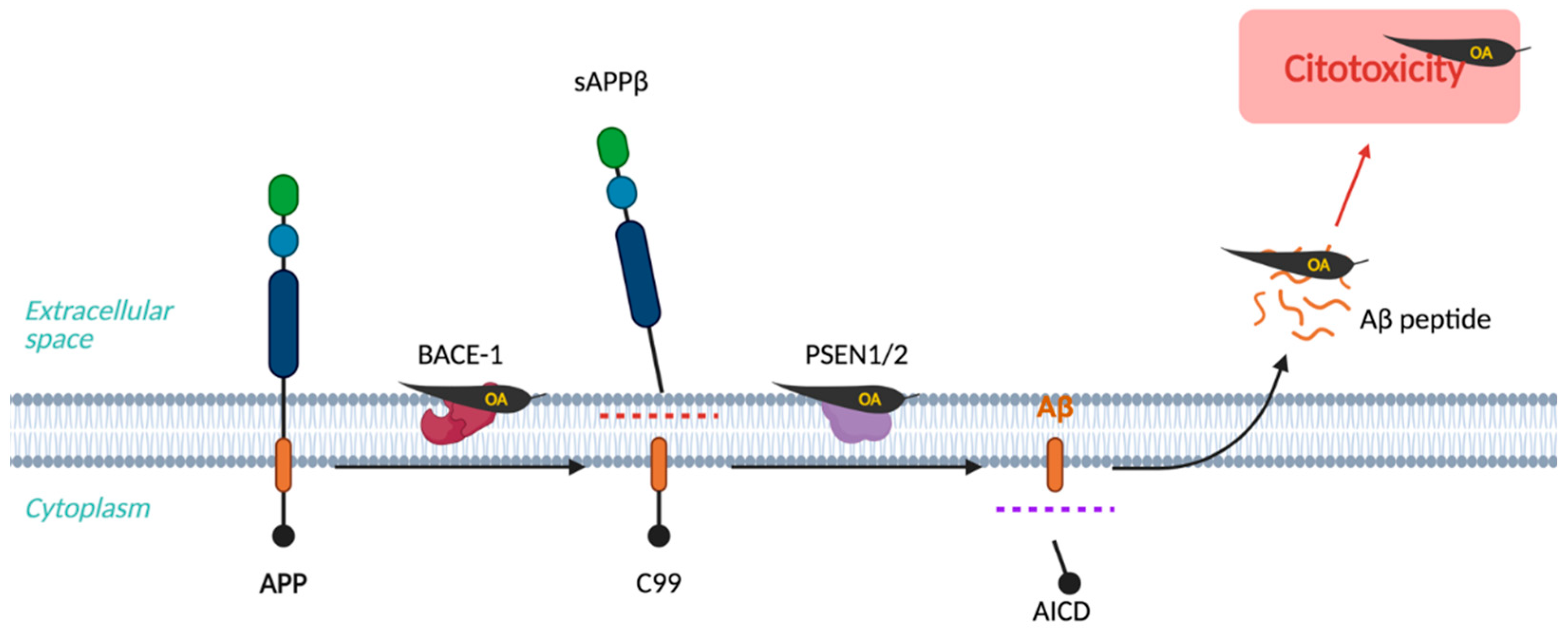
Aβ synthesis is a physiological process resulting from the processing of amyloid precursor protein (APP), which is highly expressed in the brain, especially in neurons [9]; however, isoforms also appear in the intestine and liver [10]. On the cell surface, APP can be processed via an amyloidogenic or non-amyloidogenic pathway [11]. In the former, β- and γ-secretase activity primarily generates Aβ40 and Aβ42 fragments, with Aβ42 being particularly prone to aggregation and oligomerization [12]. Although the exact mechanism responsible for cognitive decline remains unknown, Aβ accumulation in the brain is considered the main triggering factor of AD, as high levels of Aβ have been observed to disrupt synaptic function and plasticity [13], impair cognition, block long-term potentiation (LTP) [14], and induce long-term depression (LTD), both of which are involved in memory formation [15,16].
However, recent evidence suggests a shift in the understanding of the onset of AD, moving from considering amyloid fibrils as the predominant toxic form of Aβ to smaller, soluble oligomers (AβO) [8]. This updated view is gaining increasing consensus based on findings that the correlation between soluble AβO levels and dementia severity is high [9]. Additionally, several studies have demonstrated in rodents that when these human Aβ oligomers are introduced into the hippocampus, they can disrupt synaptic plasticity, impair the critical electrophysiological and structural mechanisms underlying synaptic plasticity, and contribute to synaptic degeneration [17,18,19].
Consequently, it is hypothesized that dysregulation of Aβ synthesis and clearance processes favors the formation of protein aggregates and the extracellular accumulation of Aβ oligomers, protofibrils, and fibrils, negatively affecting cellular and synaptic activity and altering cerebral blood flow [20]. Indeed, between 62% and 92% of patients with AD develop cerebral amyloid angiopathy, resulting from Aβ deposition in the parenchymal and leptomeningeal arteries, increasing vascular risk [21]. Thus, it is hypothesized that vascular brain lesions and Aβ may have an additive impact on brain integrity, increasing the risk of developing AD [22].
Several studies have been conducted using OA or its derivatives extracted from various plant sources owing to their potential protective role against Aβ-induced toxicity, anti-aggregation properties, and ability to reduce Aβ synthesis in different experimental models (Figure 2). Turgut et al. [23] recently tested OA and various nitrogen-substituted derivatives in SH-SY5Y neuroblastoma cells stimulated with lipopolysaccharide (LPS). They observed significant reductions in APP expression and inhibition of PSEN1 and PSEN2 both implicated in the modulation of γ-secretase activity. Similarly, Cho et al. [24] tested an ethanolic extract of Aralia cordata, which was fractionated to obtain an OA-rich extract. This extract was used prior to treatment with Aβ(25–35) in primary brain cultures from Sprague-Dawley rats. They observed a reduction in cell viability to 67.8% following Aβ(25–35) treatment, while pre-treatment with OA at 1 and 5 μM restored viability to 76.2% and 80%, respectively. Likewise, Fujihara et al. [25] tested a methanolic extract of Polaskia chichipe, from which they isolated six saponins, two of which contained OA as the aglycone. Treatment with Aβ42 reduced SH-SY5Y cell viability to 60%, whereas the compounds containing OA restored their viability to 76% and 74%, respectively. Finally, De Ji et al. [26] tested a root extract of Dipsacus asper and isolated a saponin with OA as the aglycone. This compound reduced Aβ(25–35)-induced cytotoxicity in PC12 neuronal cells by 26.7%, compared to 4.3% for salvianolic acid, which was used as a positive control.
OA also exhibits Aβ anti-aggregation activity. Fujihara et al. [27] reported that saponins containing OA reduced Aβ42 aggregation by 80%, whereas OA in its aglycone form had no effect. The authors concluded that a complete saponin structure is necessary to induce a reduction in Aβ42 aggregation. To support this conclusion, Chowdhury et al. [28] tested an extract of Akebia quinata, from which they isolated ten compounds. Compound 7, identified as asperosaponin C, contained OA aglycone. Using the same Thioflavin-T assay as Fujihara et al. [27], they found that asperosaponin C significantly reduced Aβ42 aggregation. In contrast, Srivatsa et al. [29] showed that OA exerted an anti-aggregation effect on Aβ1–42 comparable to that of donepezil and inhibited BACE1 activity, thereby reducing Aβ synthesis. In this study, the aglycone part was utilized rather than the complete saponin, yielding similar results. The discrepancies regarding the anti-aggregation activity of OA may stem from a complex interplay between structural glycosylation and experimental sensitivity. Specifically, these inconsistencies might be exacerbated by subtle variations in Thioflavin-T assay parameters—such as pH, incubation time, or agitation—which could fundamentally alter the aggregation kinetics of the Aβ peptides and the perceived efficacy of the compound.
Van Kenegan et al. [30] evaluated PBI-05204, a supercritical CO2 extract of Nerium oleander, in rat brain slices exposed to oxygen-glucose deprivation (OGD). Subfractionation identified fraction 4, composed mainly of OA (35%), as responsible for neuroprotective effects. In addition, biolistic transfection models inducing cortical neuron degeneration through genes such as APP and Tau treatment with fraction 4 produced significant, dose-dependent neuroprotection, as observed via pyramidal neuron morphology under fluorescence microscopy. Neither ursolic acid (UA) nor betulinic acid, also present in fraction 4, reproduced these effects, suggesting that OA is the main contributor to APP- and Tau-related neuroprotection.
OA derivatives have also been studied for their neuroprotective effects. Dumont et al. [31] investigated the neuroprotective potential of 2-cyano-3,12-dioxooleana-1,9-dien-28-oic acid (CDDO) in Tg19959 mice expressing human APP with two mutations (KM670/671NL and V717F). This animal model develops extensive amyloid deposition in the neocortex, amygdala, and hippocampus, along with clusters of microglia and astrocytes surrounding the plaques, and learning and memory deficits by three months of age. The authors observed that administering CDDO from months 1 to 4 improved spatial memory [32]. Moreover, they reported a decrease in Aβ42 concentrations that was not associated with changes in APP processing or degradation, as no alterations were found in APP fragments or in the activity of degrading enzymes, such as neprilysin and IDE. Based on these findings, the authors suggested that the effects of CDDO treatment may be exerted downstream, reducing Aβ-induced toxicity and enhancing microglial phagocytic activity—mechanisms previously demonstrated by Tran et al. [33].
Beyond the direct effects of OA on Aβ aggregation and cytotoxicity, several studies have evaluated its effects on downstream dysfunctions caused by Aβ. Wang et al. [34] administered OA via drinking water to rats that had received intracerebroventricular injections of Aβ. This experimental model exhibits memory deficits and reduced cholinergic activity, suggesting that Aβ disrupts synaptic functions [35]. The researchers found that rats treated with OA performed better in maze and spatial tests than water-treated controls. Additionally, transmission electron microscopy (TEM) revealed that control animals had neurons with dysmorphic nuclei and mitochondria, lysed endoplasmic reticulum, ribosome loss, reduced number of synaptic vesicles, and widened postsynaptic clefts. In contrast, the OA-treated group, despite some mitochondrial changes, showed a cellular morphology similar to that of the healthy controls. Furthermore, OA treatment restored the protein expression levels of the NMDAR2B receptor, as well as CaMKII and PKC, which are proteins involved in maintaining synaptic plasticity, in the OA-treated group. These molecular changes were accompanied by improved synaptic transmission, reinforcing the potential of OA to counteract Aβ-induced synaptic dysfunction.
Therefore, the current evidence points to the neuroprotective potential of OA and its derivatives against β-amyloid (Aβ)-induced toxicity, a hallmark of AD, by reducing Aβ synthesis, inhibiting aggregation, and improving neuronal viability in vitro and in vivo (Table 1). Notably, saponins containing OA as the aglycone exhibit enhanced anti-aggregation effects compared to OA alone, suggesting the importance of the complete molecular structure.

3. Tau Hypothesis

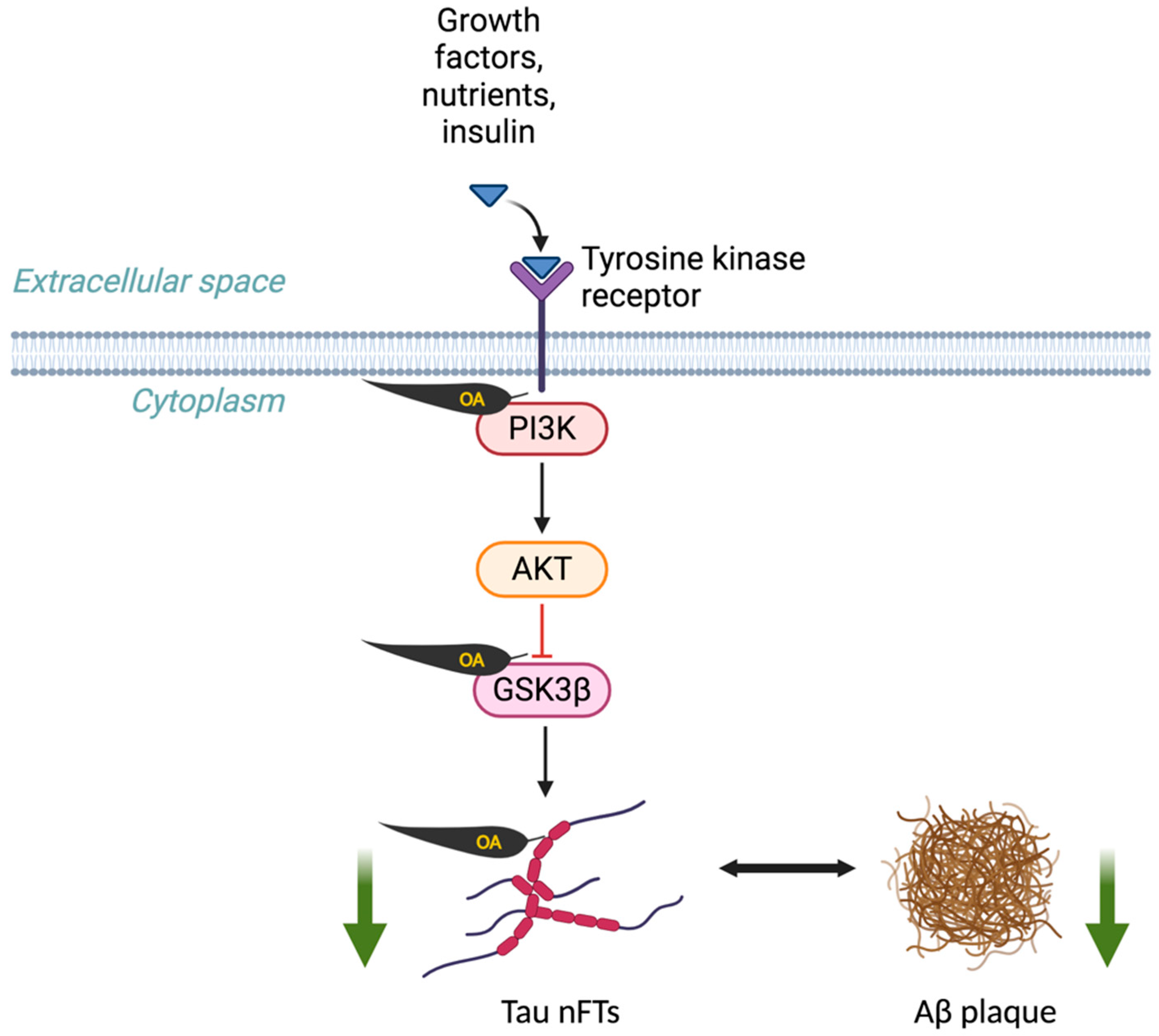
Another pathological process associated with AD is the formation and accumulation of NFTs, which are composed of aggregates of hyperphosphorylated Tau proteins (Figure 3). Tau is a microtubule-associated protein involved in tubulin polymerization, primarily in axons, and plays a role in maintaining the structural integrity of neurons. Its activity depends on its phosphorylation state, which is regulated by enzymes such as glycogen synthase kinase-3β (GSK3-β), cyclin-dependent kinase 5 (CDK5), and protein phosphatase 2A (PP2A), all of which are influenced by the metabolic status of the cell [36]. Dysregulation of these enzymes, as well as mutations in the Tau protein, can increase its susceptibility to phosphorylation, potentially leading to a pathological process in which hyperphosphorylated Tau proteins aggregate. In the brains of patients with AD, Tau pathology is observed as intraneuronal NFTs composed of paired helical filaments, sometimes mixed with straight filaments. These Tau aggregates prevent microtubule assembly and sequester functional Tau proteins, disrupting axonal transport and synaptic activity, ultimately leading to neuronal degeneration [37].
Several factors contribute to increased Tau phosphorylation, including oxidative stress, mitochondrial dysfunction, inflammation, and Aβ exposure. Conversely, Tau aggregation has been linked to increased Aβ synthesis, inflammatory and apoptotic processes, elevated endoplasmic reticulum stress, activation of the unfolded protein response (UPR), and mitochondrial dysfunction [38]. Thus, current evidence suggests that Aβ and Tau do not act independently or in isolation but rather exert synergistic effects in AD pathogenesis [39]. Nevertheless, the relationship between Aβ and Tau continues to be explored in numerous studies, and much remains to be understood about the mechanisms of interaction between these two key pathological processes that define AD.
The available evidence on the effect of OA on Tau aggregation is limited (Table 2), and mainly derived from studies such as that of Turgut et al. [23], who tested the impact of nitrogen-substituted OA derivatives on Tau protein accumulation in SH-SY5Y neuroblastoma cell cultures. Following treatment, significant reductions in Tau protein expression were observed. Similarly, Zhu et al. [40] recently evaluated the effect of a heparan sulfate derivative linked to OA as a potential Tau aggregation inhibitor. Viability assays conducted in SH-SY5Y cell cultures showed that treatment with the OA derivative reduced the cytotoxic effects of p-Tau incubation and decreased endoplasmic reticulum stress and activation of the UPR. This effect is consistent with the findings of Van Kanegan et al. [30], who further investigated the previously mentioned supercritical CO2 extract of Nerium oleander, rich in OA.
Additionally, there is evidence suggesting that OA may act on key enzymes involved in regulating Tau phosphorylation states, such as GSK-3β, which plays a well-established role in AD pathogenesis. GSK-3β is a serine/threonine protein kinase that phosphorylates and regulates several signaling proteins. It serves as a convergence point for multiple cellular pathways involved in essential functions, such as glycogen metabolism, cell cycle regulation, apoptosis, differentiation, cell motility, and inflammation, the last of which is partly mediated by the regulation of the NF-κB pathway [40].
Various GSK-3 inhibitors have demonstrated the ability to prevent AD pathology in animal models. Ahamed et al. [41] investigated the wound-healing potential of a methanolic extract of Grewia tiliaefolia, which was found to contain a high concentration of OA. The effects of these compounds were compared with those of sulfathiazole (positive control) and pure OA. Animals treated with either the extract or OA showed enhanced wound-healing activity, including a significant reduction in epithelialization time and increased wound contraction rate compared to controls. Additionally, the authors conducted a molecular docking study of OA on GSK-3β. The docking study revealed lower docked energy, intermolecular energy, and inhibition constants for OA than for sulfathiazole, indicating a strong theoretical capacity of OA to inhibit GSK-3β. Consistent with these findings, Lin et al. [42] reported improvements in hippocampal neurogenesis via the Wnt/GSK3-β pathway in OA-treated APP/PS1 transgenic mice.
Despite enormous research efforts in recent years focused primarily on these two protein species (Aβ and Tau), recent studies suggest that they may only represent the tip of the iceberg and that many other misfolded proteins could be involved in the origin and progression of the disease [43]. AD presents with other associated pathologies that have emerged over time as possible contributors to the disease’s origin, such as cholinergic dysfunction, chronic activation of neuroinflammatory states, and elevated levels of oxidative stress.

4. Cholinergic Hypothesis

The cholinergic hypothesis is one of the earliest hypotheses described in the pathology of AD (Figure 4). It is based on the progressive and continuous loss of cholinergic innervation as the driving phenomenon of the disease [44]. The basal nucleus of Meynert (nbM), located in the basal forebrain, contains a high concentration of cholinergic neurons, that is, neurons that use acetylcholine (ACh) as their main neurotransmitter. These neurons project their axons to innervate the hippocampus, amygdala, and frontal, parietal, temporal, and occipital cortex, and contain choline acetyltransferase (CAT) and acetylcholinesterase (ACE), enzymes responsible for the synthesis and hydrolysis, respectively, of ACh.
Cholinergic neurons are crucial for cognitive processes, memory, and learning, as they regulate signal transmission to limbic regions, including the hippocampus, amygdala, and neocortex, which are involved in these tasks [45]. Neuronal loss in the nbM is well established in dementia disorders, with profound degeneration observed in patients with AD, suggesting a correlation between this loss and the decline in cognitive functions typical of the disease. Thus, dysfunction of synaptic communication between these regions is considered the main cause of cognitive deterioration [46].
ACh levels depend on its synthesis, release, and degradation in the synaptic space, and dysfunctions in all three mechanisms have been observed in AD [47]. Consequently, various drugs have been developed to stabilize ACh concentrations in the synaptic space to counteract the deleterious effects of its deficiency. Among these, the most commonly used symptomatic treatments focus on regulating ACh degradation. In this process, ACh released into the synaptic cleft is hydrolyzed by the enzyme acetylcholinesterase (AChE) and, to a lesser extent, by butyrylcholinesterase (BChE), which breaks down the ACh molecule into acetic acid and choline, thereby blocking postsynaptic transmission [48]. Evidence suggests that in cases of AChE activity deficit, BChE may partially compensate, with observed ratios ranging from 0.2 in healthy individuals to 11 in patients with AD [49]. In this context, cholinesterase inhibitors were the first drugs developed as symptomatic treatments for AD.
These drugs reduce ACh hydrolysis, causing a transient increase in ACh concentrations in the synaptic space to maintain synaptic function [48]. The first AChE inhibitor approved by the FDA was tacrine, which was later withdrawn due to reports of hepatotoxic events [50]. Currently, second-generation cholinergic drugs, particularly rivastigmine and donepezil, are first-line treatments for AD and other neurodegenerative diseases involving cholinergic system dysfunction. Nevertheless, the search for natural alternatives continues, aiming to provide the benefits of these drugs while reducing side effects such as nausea, apathy, low dose tolerance, and short duration [51]. In recent years, this search has intensified, especially since galantamine, which is extracted from the bulb of Galanthus caucasicus and traditionally used in Caucasian medicine to treat neurological conditions such as post-polio paralysis and myasthenia gravis, has been approved by the FDA as an AChE inhibitor for the symptomatic treatment of AD [52]. Additionally, AChE and BChE inhibitory effects have been reported for various bioactive compounds from other plant species [53], particularly among alkaloids and terpenoids. Within the latter group, triterpenes, including OA and its derivatives, represent a pharmacologically active class with proven cholinergic activity [54].
Various extracts containing high concentrations of OA have been evaluated. For instance, Liu et al. [55] observed AChE inhibitory effects from an ethyl acetate extract of Elsholtzia rugulosa, and Balaei-Kahnamoei et al. [56] observed that a seed extract of Lawsonia inermis, containing OA, showed the strongest AChE inhibitory effect. Similar results have been obtained using OA extracts from different plants, such as Crataegus oxyacantha (Ali et al. [57]), Sambucus nigra (Krüger et al. [58]), Micromeria benthami (Bermejo et al. [59]) and Nepeta sorgerae (Yilmaz et al. [54]), among others. Some of these extracts have been used in traditional medicine for their mood-stabilizing properties. Current scientific evidence suggests that these effects are partly due to modulatory action on cholinergic pathways [60]. In this context, Çulhaoğlu et al. [61] tested a dichloromethane extract from the aerial parts of Salvia chrysophylla as an AChE activity inhibitor. The extract contained sclareol, β-sitosterol, salvigenin, OA, UA. The compounds were later isolated and tested individually. Both OA and UA showed high AChE inhibitory activity, comparable to that of galantamine, which was used as positive control. These results aligned with those obtained in the study by Srikanth Srivatsa et al. [29], where treatment with OA at a concentration of 20 µM demonstrated AChE inhibitory activity similar to donepezil. Similar findings were reported by Puri et al. [62] who assayed the AChE inhibitory activity of 51 different terpenoid saponins extracted from Achyranthes bidentata, including four OA saponins and pure OA. Loesche et al. [63] calculated the inhibition constants of OA, finding competitive inhibition with a Ki value of 11.62 ± 2.82 µM, in contrast to galantamine’s mixed-type inhibition with a Ki of 0.54 ± 0.01 µM. Conversely, others were unable to find inhibitory effects of OA against either AChE or BChE (Szwajgier et al. [64], García-Morales et al., [65]). The lack of inhibitory activity observed by García-Morales et al. may be attributed to the negligible concentration of OA within the extracts (only 20.8 mg/g), which is statistically marginal when compared to dominant constituents like glucopyranoside (415 mg/g) or rutin (229.9 mg/g).
In the search for molecules with greater inhibitory activity, various in silico experiments have demonstrated the theoretical ability of OA and some synthetic derivatives to interact with the active site of AChE, acting as selective inhibitors [66]. In this regard, Stepnik et al. [67] conducted an extensive molecular docking analysis, finding a high binding energy value for OA to AChE, indicating a theoretically strong ligand-protein interaction, as well as inhibitory properties on the enzyme. Heise et al. [68] tested a 3-O-acetylated OA derivative containing 1,3- or 1,4-diazabicyclo [3.2.2]nonane, which proved to be an excellent BChE inhibitor. Another phosphoryloxy derivative, diethoxyphosphoryloxy-OA, showed strong BChE inhibition with very low Ki values (Ki = 6.59 nM and Ki′ = 1.97 nM). Petrova et al. [69] tested various phosphoryloxy and furoyloxy derivatives of OA, erythrodiol (Ery), and lupeol, finding that the diethoxyphosphoryloxy-OA derivative significantly inhibited both AChE and BChE activity. Comparable results were found for other semisynthetic OA derivatives (Loesche et al. [63,70]; Şenol et al. [71], Petrova et al. [72]). Among them, the aminoethyl-substituted derivative of diazabicyclo [3.2.2]nonane was the best AChE inhibitor, while the 2-pyrrolidin-1-ylethyl derivative showed the highest BChE inhibitory activity. Unfortunately, some of these derivatives have shown different degrees of cytotoxicity, and are therefore not currently considered viable candidates for the symptomatic treatment of cholinergic dysfunction [73,74].
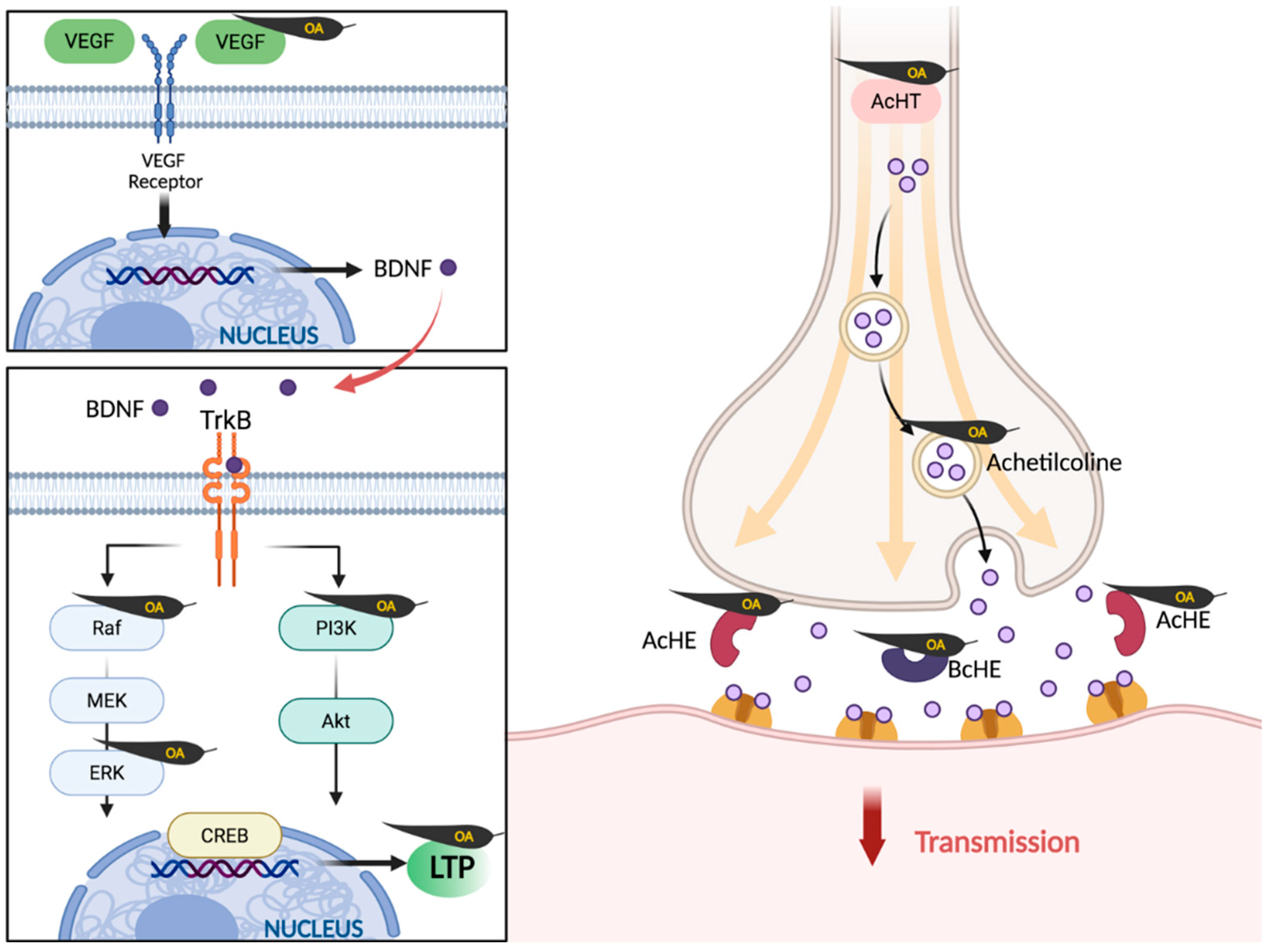
Additionally, OA has been shown to enhance both the synthesis and release of ACh into the synaptic space. Moreover, it has demonstrated the ability to modulate downstream pathways, improving cognitive deficits resulting from cholinergic system dysregulation. In this regard, Jeon et al. [75], demonstrated the potential of OA to reverse ACh deficits by acting on TrkB receptors, increasing BDNF expression and inducing LTP. This was further validated using an animal model of cognitive impairment induced by scopolamine—a muscarinic ACh receptor antagonist that causes cognitive deficits associated with cholinergic transmission dysregulation [76]. Treatment with OA led to behavioral recovery and improved cognitive functions. BDNF is known to play a crucial role in learning and memory processes, particularly in LTP events [77], and activation of its receptor TrkB affects the MAPK ERK1/2 pathway [78]. The authors suggested that OA may activate this pathway through its proven ability to modulate MAPKs, thereby triggering the downstream ERK1/2-CREB-BDNF cascade (Figure 3).
Other mechanisms for the effect of OA have also been suggested. In olfactory bulbectomized (OBX) mice, a model of cognitive dysfunction, OA significantly improved short- and long-term spatial memory [79]. Mechanistically, OA treatment led to increased expression of vascular endothelial growth factor (VEGF), a neuroprotective molecule associated with healthy brain aging and resistance to neurodegeneration [80]. VEGF is also involved in acetylcholine-mediated neuronal protection, suggesting a link between the action of OA and cholinergic signaling. Additionally, OA restored hippocampal expression of choline acetyltransferase (ChAT), a key enzyme in ACh synthesis, further supporting its role in enhancing cholinergic function. More specifically, in vitro studies using hippocampal slice cultures have shown that VEGF is involved in ACh-induced neuronal protection [81,82]. In fact, Nguyen et al. found restored expression of ChAT in the hippocampus following OA treatment [83].
In consequence, OA and its derivatives have shown promising cholinergic activity, including inhibition of AChE and BChE, enhancement of ACh synthesis and release, and modulation of neuroprotective signaling pathways (Table 3). Therefore, considering the cholinergic hypothesis, OA might represent a multifaceted therapeutic candidate for AD, capable of targeting both enzymatic and downstream mechanisms.

5. Neuroinflammatory Hypothesis

One of the most relevant research areas on AD has been the involvement of neuroinflammatory states in the etiology and progression of the disease. Neuroinflammatory events play a crucial role in resolving central nervous system (CNS) injuries, while their dysregulation significantly contributes to exacerbated tissue damage [84]. Numerous studies support the active participation of the CNS-specific innate immune system—primarily represented by microglia and astrocytes—in the pathological processes associated with AD [85].
Microglia are considered the first line of defense against invading pathogens and other forms of brain tissue damage, acting as the resident mononuclear phagocytes of the CNS. Similarly to peripheral macrophages, microglia exhibit two main states: the miss-called “active” M1 state, associated with cytotoxic gene expression, high levels of proinflammatory mediators, and reduced phagocytic capacity; and the also miss-called “inactive” M2 state, associated with tissue repair, phagocytosis, and anti-inflammatory actions. These states are increasingly referred to as M1-reactive and M2-homeostatic, reflecting their distinct but equally active roles in supporting vital functions necessary for the proper maintenance and operation of the CNS. However, evidence suggests a broader spectrum of phenotypes, as microglia modulate gene expression based on the stimuli detected. Mixed M1/M2 phenotypes may coexist, along with progressive activation states ranging from partial to full activation, and intermediate phenotypes such as M2a, M2b, and M2c, which may also vary across different CNS regions [86].
Accumulating evidence suggests that dysregulated microglial activation, along with excessive production of proinflammatory cytokines induced by exposure to Aβ, may represent a critical step in the initiation and progression of AD through neuroinflammatory processes [87]. In this context, several meta-analyses have reported elevated levels of proinflammatory cytokines and vascular adhesion molecules in the cerebrospinal fluid (CSF) of AD patients compared to control groups [88]. Furthermore, clusters of activated microglia and reactive astrocytes have been observed surrounding amyloid deposits in the brains of AD patients [89]. In addition, in situ hybridization studies of cortical samples from AD patients reveal associations between amyloid plaques and microglia expressing high levels of proinflammatory cytokines (IL-1β, IL-6, TNF-α, and monocyte chemoattractant protein-1, MCP1). Furthermore, genome-wide association studies (GWAS) have identified several inflammation-related genes as risk factors for late-onset AD (LOAD), all of which are expressed in the CNS, primarily in microglia, reinforcing their crucial role in AD development. It is important to note that although microglia may remain reactive for extended periods at lesion sites, the synthesis of proinflammatory mediators is tightly time-restricted; otherwise, the immune response may become harmful. In fact, evidence suggests that chronic microglial activation due to ongoing neuronal degeneration and Aβ presence induces a distinct phenotype from acute injury—recently described as disease-associated microglia (DAM)—which differs from the classical M1/M2 states [90]. Given the central role of microglia in AD pathogenesis, several strategies could be considered to control the onset and/or progression of the disease, such as reducing microglial inflammatory capacity to limit harmful effects, modulating microglial phenotype to promote anti-inflammatory properties or preventing priming processes in early disease stages. The concept of priming refers to the phenotypic alterations that occur following exposure to activating stimuli. In the case of microglia, it has been shown that the induction of reactive states leads to phenotypic changes characterized by increased sensitivity and an exaggerated response to subsequent stimulation. As a result, primed microglia require a lower threshold of activation and may exhibit an amplified inflammatory response upon re-exposure to the same or even milder stimuli [91].
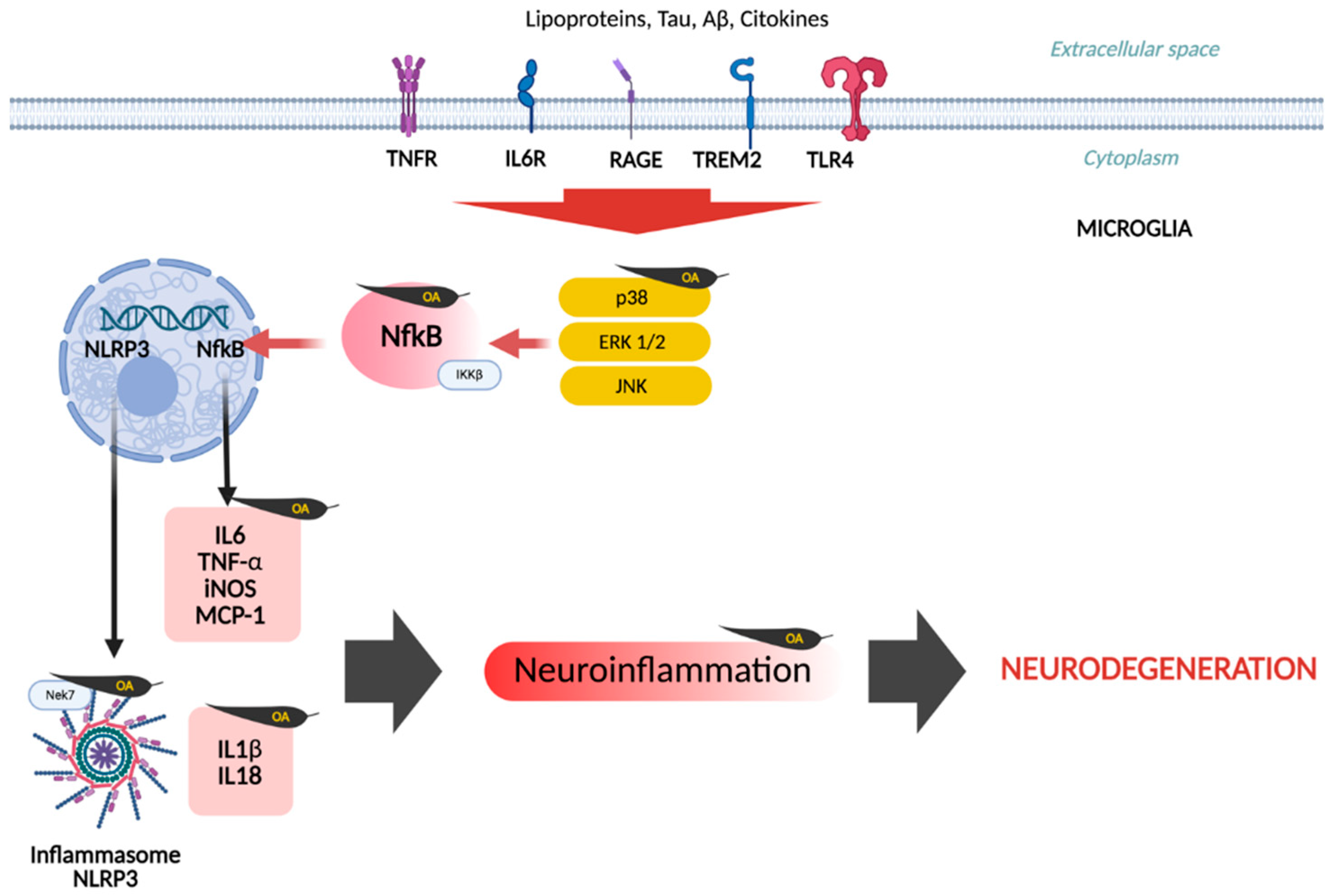
The anti-inflammatory effect of OA has been studied for years, with numerous assays conducted to explore its potential effect in the modulation of the systemic immune system, primarily with a cardiovascular focus [92]. In parallel, since 1999, Suh et al. have explored the anti-inflammatory potential of synthetic oleanane triterpenoids within neurological frameworks [93]. While research into these synthetic derivatives intensified after 2008 [33], studies focusing on the native precursor, OA, remained relatively scarce. A significant advancement occurred in 2012, when Martín et al. [94] evaluated the immunomodulatory effects of OA and Ery on BV2 microglial cells. Their findings demonstrated that pretreatment with these triterpenes significantly attenuated the production of TNF-α and downregulated the expression of COX-2 and iNOS after stimulation with LPS or IFN-γ. With this exact same approach, our research tested OA at various concentrations as a preventive treatment in BV2 cells [95]. ELISA and qPCR assays showed dose-dependent reductions in IL-6, TNF-α, and IL-1β expression after stimulation with LPS. OA also reduced iNOS expression and NO synthesis. Subsequently, Li et al. [96] found decreased expression of reactive microglial markers IBA-1, CD16, and CD86, and reduced activation of the TLR4-NF-κB pathway, together with increased Arg-1 expression and IL-10 synthesis (homeostatic microglial markers). In line with this, in 2018, Zhang et al. [97], conducted co-culture experiments with DI-TNC1 astrocytes and SH-SY5Y neurons. Pre-treatment of astrocytes with OA followed by Aβ1–42 exposure led to a conditioned medium that improved neuronal viability and reduced IL-6, TNF-α, and IL-1β expression. This neuroprotective effect was linked to reduced intracellular Ca2+ fluxes due to inhibition of secretory phospholipase A2 type IIA (Figure 5). In parallel with these approaches, various plant extracts containing OA among other bioactive compounds have been tested (Table 4). Medrano-Jiménez et al. [98] studied a hydroalcoholic extract of Malva parviflora in 5XFAD transgenic mice, an AD model. The extract, containing scopoletin and OA as main bioactives, effectively reduced astrogliosis, insoluble Aβ accumulation in the hippocampus, and spatial learning deficits. These effects were accompanied by increased microglial clustering around Aβ plaques in the cortex and hippocampus, and reduced expression of reactive microglia-associated inflammatory markers.
As spotted before, early studies were mainly focused on OA-derived CDDO compounds. Tran et al. [33] investigated CDDO-Methyl ester (CDDO-Me) in various in vitro models, including BV2 microglial cell cultures, primary mouse microglia, peritoneal macrophages, and primary neurons from the basal forebrain and ventral midbrain. They analyzed gene expression, inflammatory cytokine secretion, and phagocytosis following treatment with the compound and inflammatory stimuli. CDDO-Me significantly reduced microglial activation and proinflammatory gene expression induced by LPS, TNF, or Aβ42, without affecting cell viability. Additionally, CDDO-Me prevented neuronal death caused by conditioned medium from LPS-stimulated BV2 microglia and enhanced stimulus-dependent phagocytic activity while inhibiting ROS generation in mixed neuron-glia cultures. Similar results were obtained by Dumont et al. in Tg19959 mice treated with CDDO-methylamide (CDDO-MA) [31]. Interestingly, in that study mice improved their cognitive abilities despite no reduction in Aβ level was observed. The authors attributed the effect to reduced neuroinflammatory and oxidative stress toxicity. These findings are in agreement with those reported by Turgut et al. [23], who observed that both OA and nitrogen-substituted OA derivatives reduced TNF-α, IL-6, IL-17, iBA1, and iNOS expression in phorbol 12-myristate 13-acetate (PMA) induced THP-1 monocytes and RAW 264.7 macrophages. They also evidenced that both OA and OA derivatives significantly inhibited the activation of the NF-κB signaling pathway, which is critical for regulating neuroinflammatory responses [99].
Multiple models have been employed to analyze the effect of OA in modulating neuroinflammatory processes (Figure 5). Examples include the use of a chronic unpredictable stress-induced depression model [100], and a maternal separation-induced depression model (Chang Hyeon Kong et al. [101]); multiple sclerosis model (Minju Kim et al. [102] and Tej K. Pareek et al. [103]), an LPS-induced anxiety and depression model (Yongli Lan et al. [104] and an epilepsy model (Ji-Eun Kim et al. [105]. Overall, the experimental models used share the characteristic of inducing a pronounced shift toward a reactive microglial phenotype, triggering intense neuroinflammatory processes. Same way, the semisynthetic CDDO derivatives of OA have also been assessed on neuroinflammation. CDDO trifluoroethylamide (CDDO-TFEA) demonstrated its preventive potential in neuroinflammatory processes and myelin remodeling in autoimmune encephalomyelitis models and against oxidative and mitochondrial damage in an amyotrophic lateral sclerosis model [106]. In addition, the methylated derivative of CDDO reduced TNF-α expression and synthesis, p38 activation, NFκB-S276 signaling, and MAPK pathways, while increasing nuclear factor erythroid 2–related factor 2 (Nrf2) pathway expression in an epilepsy model using Sprague-Dawley rats [105]. Treatments with OA, OA saponins, or OA-derived CDDO compounds demonstrated significant reductions in cytokine synthesis and proinflammatory gene expression, along with improvements in synaptic transmission and plasticity, contributing to the mitigation of neuroinflammatory states in each case.
Table 4. Evidence of the anti-inflammatory properties of OA in neurodegenerative contexts.
CompoundKey FindingsExperimental ModelReference
CDDOSuppression of iNOS, COX2.Microglia primary culture[93]
Intraperitoneal injection 50 mg/kg/dayOA and EryLower leukocyte recruitment, improved BBB integrity, attenuated TNF-α production; downregulated COX-2 and iNOS expression.C57BL/J6 female mice,
BV2 microglial cells (LPS or IFN-γ stimulation)
[94]
OA 0.5–10.0 μMDose-dependent reduction in IL-6, TNF-α, and IL-1β expression; reduced iNOS and NO synthesis.BV2 cells (LPS stimulation)[95]
10, 20, 40 mg/kg (In vivo) 10, 20, 40 μM (In vitro)Alleviated pain. Shifted microglia from M1 to M2. Inhibition of HMGB1/TLR4/NF-κBSNL-induced neuropathic pain mice
& BV2 cells (LPS-stimulation)
[96]
OA
(1, 10, 20, 30, 40 μM)
Improved neuronal viability; reduced IL-6, TNF-α, and IL-1β; inhibited sPLA2-IIA and intracellular Ca2+ fluxes.DI-TNC1 astrocytes & SH-SY5Y neurons (Co-culture)[97]
Malva parviflora extract (OA & Scopoletin)Reduced astrogliosis, insoluble Aβ, and spatial learning deficits; improved phagocytosis, reduced microglial activation.5XFAD transgenic mice (AD model), microglia primary culture[98]
100 nM CDDO-MeReduced microglial activation and pro-inflammatory genes; enhanced phagocytosis and inhibited ROS.BV2 cells, primary microglia, macrophages, and neurons[33]
CDDO-MA (800 mg/kg)Improved cognitive abilities; reduced neuroinflammatory and oxidative stress toxicity (no change in Aβ levels).Tg19959 transgenic mice (AD model)[31]
OA and N-substituted OA derivativesReduced TNF-α, IL-6, IL-17, IBA1, and iNOS expression; inhibited NF-κB signaling pathway.THP-1 monocytes and RAW 264.7 macrophages[23]
OA (5, 10, and 20 mg/kg)Ameliorated motor deficits and depressive behaviors by reducing synuclein/neuroinflammation, restoring neurotransmitter levels, and activating the Nrf2-BDNF-Dopaminergic signaling pathways.Male Swiss Albino mice (Rotenone-induced Parkinsonism + Chronic Unpredictable Stress).[100]
OA (3, 10, and 30 mg/kg)Antidepressant-like effects by reducing immobility time, increasing hippocampal BDNF levels, and reducing neuroinflammation (TNF-α
and IL-6).
Female and male Swiss mice (Depression-like behavior induced by Maternal Separation).[101]
Quinoa Saponins (OA-glucopyranosides)Attenuated anxiety and depression-like behaviors by inhibiting the TLR4/NFkB pathway, reducing neuroinflammation, restoring the intestinal barrier, and modulating gut microbiota (increasing Lactobacillus).Male C57BL/6J mice (LPS stimulation).[104]
CDDO-TFEA 100 nMAttenuated EAE clinical severity by suppressing Th1/Th17 cytokines (IL-17, IFN-γ), activating the Nrf2/HO-1 antioxidant pathway, and promoting remyelination and oligodendrocyte preservation.Female C57BL/6 mice (Experimental Induced Autoimmune Encephalomyelitis).[103]
CDDO-Me
10 μM
Inhibited microglial activation and monocyte infiltration by suppressing NFkB and p38 MAPK phosphorylation; exerted neuroprotective effects by reducing vasogenic edema and neuronal death.Male Sprague-Dawley rats (Status Epilepticus induced by Pilocarpine).[105]
OA-Acetate. 10 mg/kg, 30 mg/kgAttenuated EAE symptoms by inhibiting TLR2 signaling, reducing Th1/Th17 differentiation, and decreasing the expression of adhesion molecules and pro-inflammatory cytokines (IFN-γ IL-17).Female C57BL/6 mice (Experimental Induced Autoimmune Encephalomyelitis)[102]
CDDO-EA and CDDO-TFEA. (400 or 800 mg/kg)Significantly extended survival and delayed onset of motor symptoms; reduced oxidative stress, inhibited microglial/astrocytic activation, and strongly induced Nrf2/ARE target genes in the spinal cord.G93A-SOD1 Transgenic Mice (Model for Amyotrophic Lateral Sclerosis), NSC-34 Cell Culture[106]

6. Oxidative Stress Hypothesis

Oxidative stress is defined as an imbalance between the antioxidant capacity of the cell and the production of oxidizing species, particularly reactive oxygen species (ROS), which include superoxide radical (O2), hydrogen peroxide (H2O2), and hydroxyl radical (HO), among others, as well as reactive nitrogen species (RNS), such as nitric oxide (NO) and peroxynitrite (ONOO) [107]. Oxidative stress appears in the early stages of AD, both in humans [108] and in animal models [109], and has been established as a key mechanism in protein misfolding in neurodegenerative diseases [110]. Additionally, oxidative stress is associated with molecular damage, lipid peroxidation, and oxidation of proteins and DNA—all markers of oxidative damage found in AD [111,112]. Due to the high metabolic rate and oxygen consumption of the brain, this organ is more susceptible to oxidative stress than others, with neurons being particularly vulnerable [112]. Various studies suggest that mitochondrial dysfunction, Tau hyperphosphorylation, and Aβ accumulation are mechanisms involved in the induction of oxidative stress, although there is no consensus on the sequence of these events [113].
Moreover, oxidative stress activates the CNS-specific immune system, triggering inflammatory processes that increase Aβ accumulation, which in turn raises oxidative stress levels, creating a feedback loop that leads to neuronal degeneration. This degenerative process involves the activation of several signaling pathways, including those mediated by NF-κB and receptors for advanced glycation end-products (RAGE), as well as apoptotic processes [114].
In this scenario, mitochondria are key sources of ROS generation. Due to dysregulation of ATP synthesis or dysfunction in any of the respiratory chain complexes [115]. Importantly, mitochondrial quality and functionality decline with age, and mitochondrial dysfunction is associated with numerous neurodegenerative disorders, particularly AD [116,117].
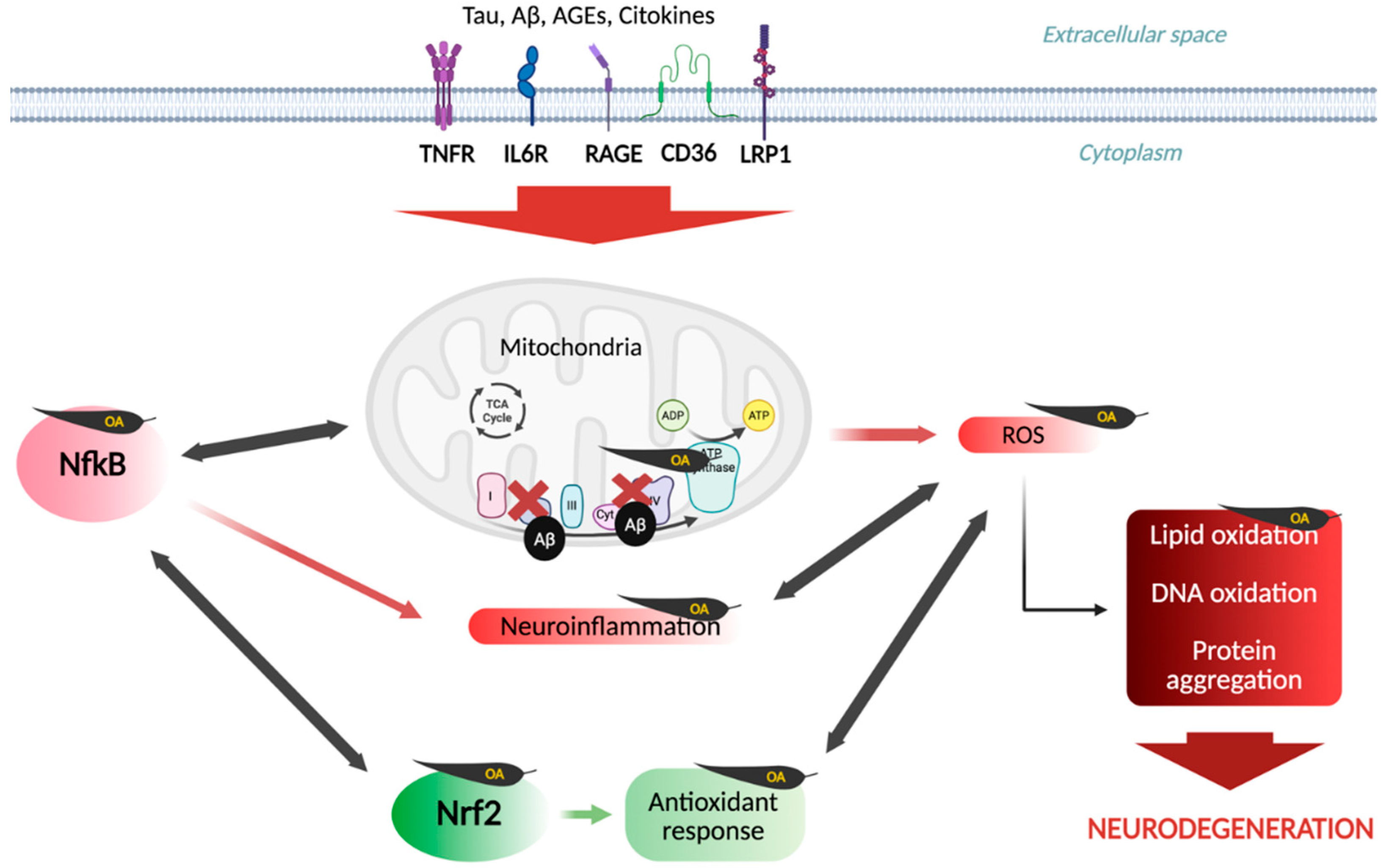
In this regard, OA has shown limited chelating, antioxidant, and scavenging activity in various assays [118]. Existing evidence (Figure 6) indicates that OA does not possess notable scavenging activity. In fact, we demonstrated the limited ability of OA to directly neutralize radical species using ABTS, DPPH, and AAPH assays [119], a finding corroborated by Srivatsa et al. [29]. Nevertheless, this apparent limitation is offset by the potent ability of OA to induce phase II responses, promoting the strengthening of cellular adaptive mechanisms against oxidative stress [120], but specific evidence within the context of AD remains limited. Guo et al. [121] assayed OA in N2a/APP695swe cells, which express the APP695 mutation. As a result, these cells exhibit elevated Aβ synthesis and are used as an in vitro model of AD. Treatment with OA significantly reduced apoptosis, caspase-3 activity, ROS levels, and Aβ content, while increasing cell viability. Additional experiments showed increased protein synthesis of stanniocalcin-1 (STC-1) and uncoupling protein-2 (UCP2) when cells were treated with OA (10 μM) for 24 h. STC-1 modulates the expression of UCP2, a class of mitochondrial membrane proteins that uncouple electron transport, reducing proton leakage and thereby decreasing mitochondrial ROS generation [122]. This mechanism partly explains the results obtained by us [95], since we reported reduced ROS production in BV2 cells treated with OA at 10 μM.
Çulhaoğlu et al. [61] also found significant scavenging activity and strong reduction of lipid peroxidation of a dichloromethane extract of Salvia chrysophylla, rich in OA. Another OA-containing extract, from Dipsacus asperoides, prevented the loss of lactate dehydrogenase activity in primary cortical and hippocampal neurons treated with Aβ, indicating preserved cell viability [123]. This was accompanied by a dose-dependent reduction in malondialdehyde (MDA) concentration. The authors concluded that OA modulates Aβ toxicity by alleviating oxidative stress directly and indirectly, or by inhibiting Aβ-induced free radical generation. MDA concentrations were also used as an indirect measure of oxidative stress by Désiré et al. [124] who found reduced MDA concentrations in Wistar rats subjected to unpredictable chronic mild stress after treatment with an ethanolic extract of Anacardium occidentale, containing β-sitosterol, OA, and UA. In addition, in Tg19959 transgenic mice, a model of AD, the OA derivative CDDO-MA reduced the levels of carbonylated proteins, a marker of oxidative stress, while increased the expression of heme oxygenase-1 (HO-1) [31]. Moreover, in PC12 cells stimulated with 6-hydroxydopamine (6-OHDA), which induces strong ROS production, OA showed reduced ROS generation across all conditions [125] (Table 5).
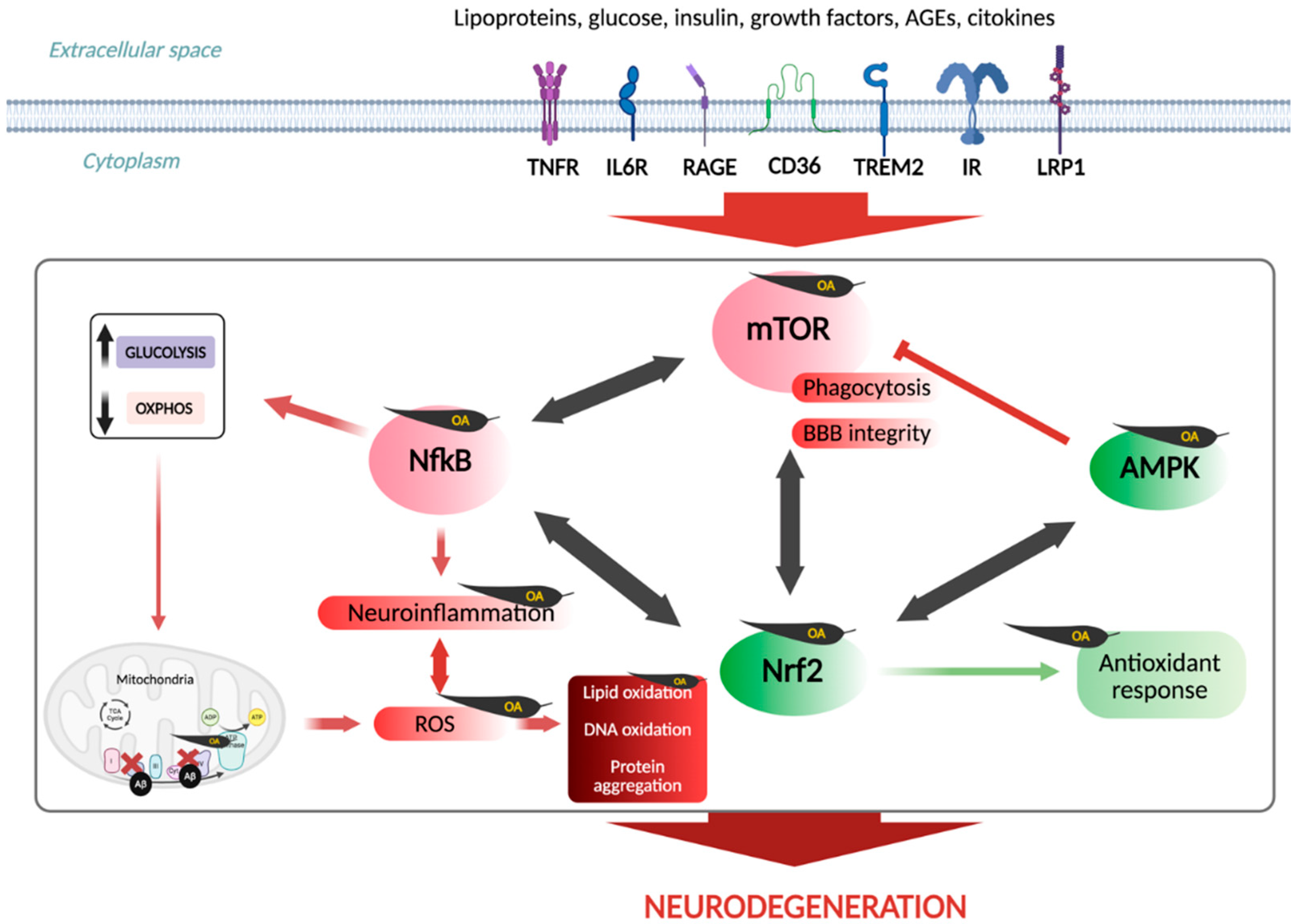
Many of the effects of OA on oxidative stress appear to be mediated by the Nrf2, [100,120,126,127] and promising results have been reported following treatment with OA in various experimental models [100,127], as well as with its derivatives CDDO-TFEA, CDDO-EA [103,106], and CDDO-2P-Im [128], resulting in increased Nrf2 expression and enhancement of endogenous antioxidant mechanisms (Figure 6).
It is now known that Nrf2 activation induces the expression of nearly 250 genes encoding antioxidant enzymes (e.g., glutamate-cysteine ligase, GCL), drug-metabolizing enzymes (e.g., cytochrome P450, glutathione S-transferases, GST), chaperones, and DNA repair enzymes [129]. Activation of these protective genes in response to Nrf2 allows cells to maintain redox balance and eliminate damaged proteins under oxidative and xenobiotic stress conditions. However, proper regulation of this pathway is crucial, as excessive activation has been shown to be toxic in certain tissues and conditions [130]. Therefore, appropriate modulation of Nrf2 could help reduce cellular damage associated with excessive ROS and mitochondrial dysfunction in AD, as demonstrated by various studies [131].
Taken together, these findings underscore the central role of oxidative stress in AD pathophysiology and highlight OA as a promising modulator of this process. The upregulating effect of Nrf2 by OA and its derivatives not only contributes reduced ROS and protein carbonylation but also modulates key signaling pathways such as NF-κB, mTOR, and AMPK, which are implicated in inflammation, energy metabolism, and synaptic plasticity (Table 5). In this context, AD is increasingly viewed as a multifactorial metabolic disorder, and the ability of OA to restore mitochondrial function, reduce oxidative damage, and improve metabolic signaling positions it as a compelling candidate for preventive and therapeutic strategies targeting the metabolic hypothesis of AD.
Table 5. Antioxidant mechanisms of Oleanolic Acid (OA) identified in Alzheimer’s disease.
CompoundKey FindingsExperimental ModelReference
OA, 10 μM, 15 μM, 25 μMIncreased STC-1 and UCP2 protein synthesis; reduced ROS, apoptosis, and Caspase-3 activity.N2a/APP695swe cells (AD in vitro model)[121]
S. chrysophylla extract (OA)Strong scavenging activity and significant reduction in lipid peroxidation.DPPH radical scavenging, lipid peroxidation (LPO) inhibition[61]
Dipsacus asperoides saponins 1–300 mg/LPreserved LDH activity; dose-dependent reduction in MDA concentrations.Primary cortical and hippocampal neurons (Aβ treated)[123]
CDDO-MA. 800 mg/kg in dietReduced carbonylated proteins; increased HO-1 expression.Tg19959 transgenic mice (overexpressing human APP)[31]
OA 10 μMReduced mitochondrial ROS in BV2 cells. Reestablished GSH levels.BV2 microglial cells; Chemical radical assays[95]
OA 0.5–10 μMLimited direct radical scavenging.ABTS/DPPH/ORAC/Rancimat[119]
OA. 5–320 μMOA demonstrated potent antioxidant activity (comparable to ascorbic acid at 320 μM).DPPH, ABTS, and LPO inhibition[29]
OA; CDDO-TFEA; CDDO-EA; CDDO-2P-ImPotent induction of Phase II responses multitarget neuroprotectors by activating the Nrf2/ARE pathway and inhibiting NF-κB.Maternal separation (mice), EAE (MS model), ALS (G93A mice), SAH (rat/mouse), AD (APP/PS1 mice).[101,103,120,126,127,128]

7. Metabolic Hypothesis

Recent studies adopting a metabolic perspective continue to emerge, linking the onset of AD to alterations in glucose metabolism [132], insulin signaling [133], lipid metabolism [134] and the accumulation of ROS [135], which promote oxidative stress and protein aggregation [136] (Table 6). Regarding alterations in glucose metabolism, a strong association has been established between AD and brain insulin resistance [137]. Indeed, some researchers have proposed classifying AD as a novel form of diabetes—termed type 3 diabetes (T3DM), to highlight its close connection with cerebral metabolic dysfunction [138]. In this regard, both AD and type 2 diabetes mellitus (T2DM) are characterized by dysregulation of key signaling pathways, including PI3K/Akt, GSK-3β [139], and mTOR; increased formation of AGEs [140]; saturation of insulin-degrading enzyme (IDE) [141], elevated expression of APP, BACE1, and enhanced synthesis and aggregation of Aβ; hyperphosphorylation of Tau protein; endothelial damage; mitochondrial dysfunction; and oxidative stress [142]. Moreover, both pathologies exhibit an impaired clearance of Aβ [143], largely due to reduced phagocytic activity, a lysosome-dependent degradative process used by cells to eliminate dysfunctional components [144], thereby contributing to the accumulation of Aβ and Tau aggregates [145].
In this context, OA has demonstrated a marked capacity to reduce postprandial glucose concentrations, enhancing pancreatic β-cell function, and improving insulin responsiveness. These effects ultimately contribute to a reduction in oxidative stress and the formation of AGEs [146]. Both OA and several of its derivatives have demonstrated significant inhibitory activity against α-glucosidase and α-amylase enzymes, as shown both in vitro and in vivo models [147,148,149]. Additionally, OA enhances insulin biosynthesis and secretion, and improves glucose tolerance through a multifactorial mechanism. Notably, this includes the activation of pancreatic β-cell M3 muscarinic receptors [81]. Furthermore, OA acts as an insulin mimetic by activating the insulin receptor (IR) and improving insulin responsiveness through modulation of the PI3K/Akt and GSK-3β signaling pathways [150].
Within this metabolic framework, in recent years, scientific research has uncovered strong associations between disruptions in lipid metabolism, accumulation of amyloid-β (Aβ) and Tau proteins, and the persistence of chronic neuroinflammatory states in AD [151,152]. One of the most extensively studied and well-established associations between lipid metabolism and AD is the presence of the apolipoprotein E4 (ApoE4) allele. Under physiological conditions, ApoE functions as a signaling molecule in the internalization of lipoproteins, as well as in the lipid recycling process within the CNS [153]. It has been established that the different alleles present in humans affect the development of AD differently, with ApoE4 homozygosity being a risk factor that increases the likelihood of developing AD by up to 15-fold [154]. Recently, this genotype has even been proposed as a distinct genetic form of AD [155]. Although the physiological basis of this association remains under investigation, current evidence suggests that ApoE4 exhibits a reduced binding affinity for low density lipoprotein receptor (LDLR) and low-density lipoprotein receptor related protein 1 (LRP1), resulting in prolonged lipoprotein residence time in the bloodstream and consequently increasing oxidative events, chemotaxis, and inflammation [156]. Additionally, ApoE4 exhibits a lower lipid-loading capacity, impairing lipid recycling functions (including cholesterol) in the CNS. This may lead to the dysregulation of lipid raft stability, which is essential for governing cellular signal transduction. Such instability facilitates the establishment of the so-called ‘inflammarafts’—specialized lipid rafts characterized by altered cholesterol concentrations that promote the assembly of potentiated inflammatory signaling platforms [157]. Moreover, the ApoE4 allele enhances Aβ deposition by co-aggregating with it [108]. It has even been suggested that dysregulation of ApoE by microglia may initiate the aggregation cascade [158]. Additionally, over the past two decades, a robust body of evidence has highlighted the pathophysiological interplay between lipid metabolism and Aβ. This is based on the co-localization of Aβ in the perinuclear region of absorptive cells in the small intestine—the exact site of chylomicron (CM) assembly—as well as the co-kinetics of Aβ and apolipoprotein ApoB, and a positive correlation between their levels [159,160,161]. It is hypothesized that this complex may originate during lipoprotein synthesis, which could account for the observed correlation between elevated ApoB-48—the structural protein specific to chylomicrons—following a high-fat meal and increased enterocytic Aβ levels [160]. Supporting this hypothesis, it has been shown that most Aβ synthesized postprandially is associated with triglyceride-rich lipoproteins (TRLs) [162]. Moreover, recent findings suggest that most Aβ reaching the CNS does not enter via the vagus nerve, as previously thought, but originates from the intestine [163]. Thus, it is proposed that Aβ deposition and accumulation events are linked to lipid metabolism, and that lipoproteins partly regulate Aβ metabolism. Conversely, different concentrations of Aβ40 have been shown to influence lipid synthesis in HepG2 liver cells, suggesting a regulatory role of Aβ in hepatic lipid metabolism [164]. In both cases, this association raises the possibility that, under physiological conditions, TRL-Aβ complexes are formed, but that failures in their regulation, distribution, or elevated levels may increase cerebral deposition and amyloidosis.
Additionally, it has been observed that, at physiological concentrations, TRL lipolysis products are harmful to human aortic endothelial cells, causing disruptions in binding proteins that lead to increased permeability, inflammation, and apoptosis [165]. This phenomenon has also been observed in animal models, where a transient increase in blood–brain barrier (BBB) transport coefficient was seen following TRL lipolysis product infusion in rats [166]. All these findings could significantly enhance TRL-Aβ particle extravasation into the CNS, increasing deposition processes that contribute to amyloidosis. In this regard, available human studies correlate BBB integrity alterations with AD progression [167].
Taking all these into account, we propose that excessive synthesis of TRLs, resulting from a high and sustained dietary fat intake, may contribute to the extravasation of TRLs into the CNS. This infiltration likely triggers the chronic activation of microglia and the adoption of neurotoxic reactive phenotypes, effectively bridging systemic lipid dysmetabolism with the inflammatory and oxidative cascades characteristic of AD pathogenesis. In this context, targeting TRL metabolism, specifically by reducing their synthesis, and limiting their capacity to activate microglia, and preserving BBB integrity, may constitute a promising therapeutic strategy to mitigate neuroinflammatory processes. In this regard, it has been observed that the triglyceride (TG) composition of TRLs influences the inflammatory response triggered by BV2 microglial cells [168]. Additionally, our group demonstrated that the inclusion of lipophilic bioactive compounds with anti-inflammatory and antioxidant properties (β-sitosterol, α-tocopherol and OA) in TRLs, led to a reduced inflammatory response and lower synthesis of ROS and NO compared to TRLs lacking these compounds [169].

Crosstalk Mechanisms

The primary metabolic pathway involved in the regulation of phagocytosis is the mTOR pathway, which is activated according to the organism’s metabolic state. Under fasting conditions, mTOR remains inactive, thereby permitting autophagic and phagocytic processes. In contrast, during the postprandial state, mTOR becomes active, inhibiting phagocytosis and other cellular repair mechanisms while promoting anabolic metabolic pathways [170]. Western dietary patterns—and with them, the prolonged postprandial state in which much of the population remains—play a decisive role. This state is critical in the development of T2DM, and even more so in AD, where mTOR has been identified as the principal gerogene—a gene or signaling pathway that directly promotes the aging process and its associated cellular senescence. This term is of particular relevance in a disease where aging is the strongest risk factor. Sedentary behavior, excess nutrients, growth factors, cytokines, and insulin are all gero-promoting factors that activate the mTOR pathway. These same factors also contribute to a reduced sensitivity to AMPK activation, whose opposing activity promotes longevity, metabolic health, and cellular repair processes [171]. It is important to note that aging is characterized by the gradual decline of physiological functions in tissues. Age is one of the major risk factors for disorders caused by protein misfolding—such as AD [172]—which ultimately result in organ dysfunction, particularly of neurons [173]. The acceleration of aging is therefore a key determinant, as it may precipitate the onset of these disorders [174]. Research has shown that lifespan potential is shaped by a specific set of genes involved in stress response, metabolic regulation, and the silencing of pro-aging genes, with mTOR being the central node. In this context, several authors have proposed that aging is an almost programmatic process driven by chronic mTOR overactivation [175] which coordinates cell growth and plays a central role in balancing anabolic and catabolic processes in response to nutrient availability [170] (Figure 7).
In experimental models of AD, various therapeutic approaches have been tested to inhibit mTOR signaling. It has been demonstrated that pharmacological inhibition of mTOR reduces Aβ accumulation and amyloid plaque formation in transgenic mouse models of AD [176] although therapeutic efficacy strongly depends on the timing of intervention, with early treatment proving more effective [177]. It is crucial to recognize that the mTOR pathway serves as a central regulatory axis, influencing both phagocytosis and memory formation [178], two processes fundamentally altered in AD. Therefore, fine-tuned modulation of this pathway is essential. One promising strategy involves regulating mTOR through its crosstalk with the Nrf2 pathway [179], which may represent a viable preventive approach against aging and metabolic diseases driven by nutrient excess—namely AD and T2DM under the framework of our hypothesis. In this regard, recent research suggests that Nrf2 acts as a protective factor against key early pathological events in AD, including Aβ accumulation [128,180]. Nrf2 activity is tightly regulated by two main inhibitors: Keap1 and GSK-3 [181]. While its role in regulating antioxidant and detoxification proteins is well established, the ability of Nrf2 to influence BACE1 activity, as well as Aβ and p-Tau levels, represents a significant advancement. In this context, several research groups have conducted studies that have expanded the current understanding of the role of Nrf2 in AD pathophysiology [182,183], and emerging evidence suggests that inhibiting these regulators may alleviate neurodegenerative processes in various experimental models [180,184]. Therefore, both GSK-3 and Keap1 could be valid targets for modulating Nrf2 in neurodegenerative diseases, helping to prevent neuronal stress and degeneration. Within this field, pentacyclic triterpenes are recognized as highly potent inducers of the Nrf2 pathway. Specifically, at the neuronal level, OA and its derivatives have demonstrated consistent Nrf2 induction across various animal models [100,106,185]. This activation is mechanistically driven by the specific inhibition of Keap1, which facilitates the stabilization and nuclear translocation of Nrf2 [126]. The inhibitory activity of OA on GSK-3β is well-established [150], with reinforcing evidence derived from extensive research into its role in glucose homeostasis. A central mechanism in this regulation involves the activation of the PI3K/Akt signaling pathway, which subsequently suppresses GSK-3β activity [186]. These studies indicate that the beneficial effects of OA on glucose metabolism are mediated, in part, by its capacity to inhibit this kinase [146], which, as previously mentioned, constitutes one of the primary kinases implicated in Tau phosphorylation. Therefore, despite the limited direct evidence on the impact of OA on Tau phosphorylation, there are indications that this compound could help reduce NFT formation by lowering the activity of the key enzyme involved in Tau phosphorylation. Another important aspect to consider is the role of GSK-3β in activating inflammatory processes through its crosstalk with NF-κB, which is crucial for the initiation and maintenance of inflammation. Thus, the potential of OA to modulate the GSK-3β/NF-κB axis could contribute to reducing NFT formation by regulating inflammation and disrupting the positive feedback loop between these phenomena, a mechanism widely demonstrated in numerous studies [150,187,188]. Moreover, OA has been shown to modulate the NF-κB pathway through its interaction with IκBα, preventing its translocation to the nucleus and thereby blocking pathway activation. OA also modulates the activation of the mTOR and AMPK pathways, both of which are fundamental to cellular energy homeostasis. These signaling routes are directly involved in the regulation, mobilization, and metabolism of nutrients—processes essential for cell survival and function [6].
Table 6. Regulatory effects of OA on metabolic hypotheses of Alzheimer’s disease.
CompoundKey FindingsExperimental ModelReference
OA 5, 10, 20 mg/kg from Cornus officinalisLower plasma glucose by stimulating acetylcholine (ACh) release that activates muscarinic M3 receptors on pancreatic beta-cells, leading to an increase in insulin secretionNormal and STZ-induced diabetic Wistar rats; Isolated pancreatic islets[81]
OA. 25, 50, and 100 mg/kgSignificant neuroprotection by modulating the PI3K/Akt/mTOR and STAT-3/GSK-3βWistar rats. Neurotoxicity induced by Methylmercury[150]
Pyrazole-fused OAPotent selective alpha-glucosidase inhibition. IC50 = 2.64 ± 0.13 μMIn vitro assay. In silico: Molecular docking and SAR analysis[149]
Indole-OA and methyl ester derivativesSelective alpha-glucosidase inhibition Indole OA derivatives 4.02–5.30 μM, OA methyl ester derivatives 10 μM and 5.52 µMIn vitro: alpha-glucosidase inhibition assays; Kinetics: Lineweaver-Burk plots[148]
OA (5, 10, and 20 mg/kg)Activated the Nrf2-BDNF-Dopaminergic signaling pathways.Male Swiss Albino mice (Rotenone-induced Parkinsonism + Chronic Unpredictable Stress).[100]
CDDO-EA and CDDO-TFEA (400 or 800 mg/kg)Reduced oxidative stress, strongly induced Nrf2/ARE target genes in the spinal cord.G93A-SOD1 Transgenic Mice (Model for Amyotrophic Lateral Sclerosis), NSC-34 Cell Culture[106]
CDDO-Im 0.5 mg/kgImproved neurological function by activating the Nrf2/ARE pathway.Rat model of Post-Stroke Depression induced by Middle Cerebral Artery Occlusion[185]
10 μM OA in TRLsInclusion of lipophilic bioactives in TRLs reduces microglial inflammatory response and ROS/NO synthesis.BV2 microglial cells treated with synthetic TRLs[169]
OA 80 mg/kgEnhanced insulin signaling pathway by increasing the expression of insulin receptor and GLUT4STZ-induced diabetic male rats (Type 1 Diabetes model)[186]
OA (10–200 μΜ)Upregulation of AMPK and its downstream targets (TSC2, ULK1) while inhibition of mTORColon Cancer (CC) cells (HCT116, SW480)[189]

8. Bioavailability

One of the main limitations of using OA as a therapeutic agent for the prevention of metabolic disorders in humans has been its questionable bioavailability, primarily due to its pronounced lipophilicity and resulting poor aqueous solubility. Studies conducted by Song et al. [190] and Zhang et al. [191] reported postprandial serum concentrations of OA considered sub-therapeutic after ingestion of solid OA tablets (12.1 ± 6.8 ng/mL, 18.9 ± 8.0 ng/mL, and 17.8 ± 7.5 ng/mL, respectively). However, other formulations have been shown to successfully increase the compound’s bioavailability and achieve therapeutically effective concentrations. In this context, various formulation strategies, including microemulsions and nanoemulsions, have been reported to enhance the oral bioavailability of OA and to reach therapeutically relevant systemic levels [192,193].
Alternatively, our research group developed an OA-enriched olive oil (600 mg/kg), which improved the oral bioavailability of OA and thereby may augment its therapeutic efficacy. This enriched oil was evaluated in a pioneering pilot study—the first of its kind worldwide—in which it was administered to nine healthy adults to characterize the pharmacokinetics of OA [194]. A marked increase in the maximum plasma concentration of the triterpene—up to 40-fold—was observed at 2.5 h post-ingestion, with OA predominantly associated with the serum protein fraction. Further evidence of enhanced OA bioavailability with the olive oil-based formulation was provided by the BIO-OLTRAD trial (CNT05529953), which assessed postprandial OA distribution across serum protein subfractions, mainly albumin and triglyceride-rich lipoproteins (TRL). Of the 600 ng/mL detected as maximum OA concentration in serum, approximately 23% (about 140 ng/mL) was associated with the TRL fraction, indicating effective encapsulation of the compound within lipid metabolic pathways [195].
The therapeutic efficacy of this OA-enriched olive oil was evaluated against its non-enriched counterpart in a long-term clinical trial involving 176 prediabetic individuals, diagnosed of impaired fasting glucose and impaired glucose tolerance. The PREDIABOLE (PREvention of DIABetes with OLEanolic acid) Study demonstrated that a daily intake of 55 mL of OA-enriched olive oil (equivalent to 30 mg OA) led to a 55% reduction in the risk of developing type 2 diabetes compared with the same olive oil without OA [196]. Furthermore, in a clinical trial conducted in 2022, we have shown that the intake of two oils with identical fatty acid compositions but differing profiles of minor components resulted in changes in the compositional characteristics of TRLs synthesized during the postprandial period [197]. When these particles were used to treat BV2 cell cultures, we observed that TRLs extracted after the intake of the oil rich in the minor components OA and erythrodiol, induced lower activation of BV2 cells, as evidenced by reduced synthesis and expression of pro-inflammatory cytokines and genes. In these clinical trials, OA-enriched olive oil was well tolerated by the participants and we have evidence submitted for publication showing that OA intake at experimental doses are safe.
Considering all the evidence presented, the incorporation of lipophilic compounds with antioxidant and anti-inflammatory properties into TRLs synthesized as a result of lipid metabolism following the intake of a lipid matrix rich in OA may function as a Trojan horse in attenuating postprandial inflammatory responses. This way of administration could mitigate the pathological consequences arising from chronic overstimulation of the innate immune system in the central nervous system, while simultaneously modulating the activated metabolic pathways and addressing the additional targets described for OA across the different hypotheses of AD.

9. Conclusions and Future Directions

AD represents one of the foremost challenges in contemporary biomedicine, primarily due to its complex multifactorial etiology and the lack of effective curative therapies. Within this context, OA has emerged as a promising candidate owing to its ability to modulate multiple pathophysiological mechanisms involved in AD progression.
Accumulated evidence suggests that OA exerts modulatory effects across several hypotheses proposed to explain the origin and development of AD, including the Aβ, tau, cholinergic, neuroinflammatory, oxidative stress, and metabolic hypotheses, as well as key risk factors such as T2DM and cardiovascular disease. These effects encompass a reduction in Aβ-induced cytotoxicity, inhibition of its synthesis and aggregation, enhancement of phagocytic clearance, attenuation of tau toxicity and phosphorylation, suppression of reactive microglial phenotypes and proinflammatory cytokine and gene expression, decreased generation of ROS and RNS along with lipid peroxidation, metabolic improvements linked to T2DM, enhanced insulin sensitivity and glucose metabolism, reduced macrophage reactivity and foam cell formation, and modulation of critical signaling pathways including mTOR, AMPK, Nrf2, GSK3-β, ERK1/2, MAPK, BDNF/TrkB, and VEGF. However, it is imperative to acknowledge that the available evidence regarding the specific effect of OA on Tau protein aggregation remains scarce as there is a notable lack of direct evidence on the impact of OA on the phosphorylation states of this protein.
Over the course of AD research, numerous potential treatments have been tested, leading to the identification of therapeutic targets that primarily address neuronal damage, focusing on aggregated protein deposits or alleviating symptoms resulting from impaired neuronal function caused by irreversible injury. The central challenge in treating AD lies in its neurodegenerative nature: even if the causative agents are eliminated, the neuronal damage cannot be reversed. While regenerative therapies hold promise, the prospect of restoring lost synaptic connections to fully recover cognitive function remains highly improbable. Consequently, prevention stands as the only currently viable strategy.
Within this framework, OA has emerged as a promising therapeutic candidate due to its ability to act on multiple molecular targets. These targets are located at the core of metabolic and signaling pathways associated with the production of neurotoxic agents. Thus, OA appears to mitigate the generation of these harmful compounds while enhancing protective mechanisms responsible for their clearance. The majority of available evidence regarding the use of OA or its derivatives stems from preclinical models. Nonetheless, some clinical trials exist in which OA has been administered in various formulations and dosages. In this regard, studies such as NUTRAOLEUM (NCT02520739) [198], PREDIABOLE [197], and OLTRAD (NCT06030544) have strengthened the rationale for the preventive potential of OA in the onset and progression of chronic diseases with a strong inflammatory component. In this context, the CORDIAL study (NCT06245616) is currently assessing the potential neuroprotective effect of pomace olive oil—naturally rich in OA and its precursor Ery—on neuroinflammatory states associated with AD development. Additionally, the NEUROLEA+ trial—structured as a long-term, double-blind intervention—will assess the effects of consuming olive oil enriched with OA (600 mg/L) compared to a non-enriched formulation and pomace olive oil in patients with AD. Over a 12-month follow-up period, the study will monitor cognition and biomarkers of inflammation, oxidative stress, protein aggregation and AGEs in both serum and cerebrospinal fluid. Through the CORDIAL and NEUROLEA+ trials, we aim to elucidate the molecular mechanisms potentially linking glucose and lipid metabolism to AD pathology, and to determine whether OA can effectively modulate these pathways under physiological conditions in humans. In doing so, we seek to demonstrate that OA, when formulated within a matrix that ensures high bioavailability, may represent a viable therapeutic strategy for preventing the onset and progression of AD.
Therefore, contrary to Karl Popper’s assertion, OA emerges as a compelling candidate capable of acting across all currently recognized pathological fronts of AD. This broad-spectrum activity suggests that OA may offer a unique therapeutic advantage in addressing the multifactorial nature of AD. However, low aqueous solubility remains a primary hurdle for OA, highlighting the urgent need for clinical investigations into novel formulations that enhance its bioavailability. By optimizing its systemic transport and central nervous system delivery, we can bridge the gap between its proven pleiotropic effects and its practical application. Such advancements are essential to validate OA as a multi-target agent capable of altering the clinical course of neurodegeneration.

Author Contributions

Conceptualization, E.G.-J. and J.S.P.; methodology, J.M.E.-C. and J.M.C.; validation, E.G.-J., J.S.P. and J.M.C.; formal analysis, J.M.E.-C., Á.F.-A. and G.P.-M.; investigation, J.M.E.-C., Á.F.-A. and G.P.-M.; data curation, E.G.-J., J.S.P. and J.M.C.; writing—original draft preparation, J.M.E.-C., J.S.P., G.P.-M. and J.M.C.; writing—review and editing, all authors; visualization, J.M.E.-C., J.S.P.; supervision, E.G.-J., J.S.P. and J.M.C. All authors have read and agreed to the published version of the manuscript.

Funding

This research received no external funding.

Institutional Review Board Statement

Not applicable.

Informed Consent Statement

Not applicable.

Data Availability Statement

Not applicable.

Acknowledgments

During the preparation of this manuscript/study, the authors used Microsoft Copilot GPT-5 GenAI for the purposes of refining the text. The authors have reviewed and edited the output and take full responsibility for the content of this publication.

Conflicts of Interest

The authors declare no conflicts of interest.

Abbreviations

Amyloid-β
AChAcetylcholine
AChEAcetylcholinesterase
ADAlzheimer’s disease
AMPKAdenosine monophosphate-activated protein kinase
APPAmyloid precursor protein
BACE1Beta-secretase 1
BChEButyrylcholinesterase
BDNFBrain-derived neurotrophic factor
CaMKIICa2+/calmodulin-dependent protein kinase II
CATCholine acetyltransferase
CDDO2-cyano-3,12-dioxooleana-1,9-dien-28-oic acid
CDDO-ImCDDO Imidazoline
CDDO-MACDDO-methylamide
CDDO-MeCDDO Methyl-ester
CDDO-TFEACDDO trifluoroethylamide
CDK5Cyclin-dependent kinase 5
GSK-3βGlycogen synthase kinase-3 beta
IDEInsulin-degrading enzyme
IL1βInterleukin-1beta
IL6Interleukin-6
KEAP1Kelch-like ECH-associated protein 1
LTDLong-term depression
LTPLong-term potentiation
MTBR-Tau243Microtubule-binding region Tau containing residue 243
NbMNucleus basalis of Meynert
NFTNeurofibrillary tangle
NF-κBNuclear factor kappa-light-chain-enhancer of activated B
NMDAR2BN-methyl-D-aspartate receptor subunit 2B
Nrf2Nuclear factor erythroid 2-related factor 2
OAoleanolic acid
PI3K/AktPhosphoinositide 3-kinase/Protein kinase B
PKCProtein kinase C
PSEN1/PSEN2Presenilin 1/Presenilin 2
ROSReactive Oxygen Species
STC-1Stanniocalcin-1
TauMicrotubule-associated protein Tau
TEMTransmission electron microscopy
TNF-αTumor necrosis factor alpha
TrkBTropomyosin receptor kinase B
TRLTriglyceride-rich lipoproteins
UAUrsolic acid
UCP-2Uncoupling protein-2
UPRUnfolded protein response

References

  1. Ferrari, C.; Sorbi, S. the Complexity of Alzheimer’S Disease: An Evolving Puzzle. Physiol. Rev. 2021, 101, 1047–1081. [Google Scholar] [CrossRef]
  2. Alzheimer’s Association. 2025 Alzheimer’s disease facts and figures. Alzheimer’s Dement. 2025, 11, 332–384. [Google Scholar]
  3. Finch, C.E.; Kulminski, A.M. The Alzheimer’s Disease Exposome. Alzheimer’s Dement. 2019, 15, 1123–1132. [Google Scholar] [CrossRef] [PubMed]
  4. Avgerinos, K.I.; Manolopoulos, A.; Ferrucci, L.; Kapogiannis, D. Critical assessment of anti-amyloid-β monoclonal antibodies effects in Alzheimer’s disease: A systematic review and meta-analysis highlighting target engagement and clinical meaningfulness. Sci. Rep. 2024, 14, 25741. [Google Scholar] [CrossRef]
  5. Van Bulck, M.; Sierra-Magro, A.; Alarcon-Gil, J.; Perez-Castillo, A.; Morales-Garcia, J.A. Novel approaches for the treatment of alzheimer’s and parkinson’s disease. Int. J. Mol. Sci. 2019, 20, 719. [Google Scholar] [CrossRef] [PubMed]
  6. Castellano, J.M.; Ramos-Romero, S.; Perona, J.S. Oleanolic Acid: Extraction, Characterization and Biological Activity. Nutrients 2022, 14, 623. [Google Scholar] [CrossRef] [PubMed]
  7. Fernández-Aparicio, Á.; Correa-Rodríguez, M.; Castellano, J.M.; Schmidt-RioValle, J.; Perona, J.S.; González-Jiménez, E. Potential Molecular Targets of Oleanolic Acid in Insulin Resistance and Underlying Oxidative Stress: A Systematic Review. Antioxidants 2022, 11, 1517. [Google Scholar] [CrossRef]
  8. Selkoe, D.J.; Hardy, J. The amyloid hypothesis of Alzheimer’s disease at 25 years. EMBO Mol. Med. 2016, 8, 595–608. [Google Scholar] [CrossRef]
  9. Tolar, M.; Hey, J.; Power, A.; Abushakra, S. Neurotoxic Soluble Amyloid Oligomers Drive Alzheimer’s Pathogenesis and Represent a Clinically Validated Target for Slowing Disease Progression. Int. J. Mol. Sci. 2021, 22, 6355. [Google Scholar] [CrossRef]
  10. Cabal, A.; Alonso-Cortina, V.; Gonzalez-Vazquez, L.O.; Naves, F.J.; Del Valle, M.E.; Vega, J.A. β-Amyloid precursor protein (βAPP) in human gut with special reference to the enteric nervous system. Brain Res. Bull. 1995, 38, 417–423. [Google Scholar] [CrossRef]
  11. Guénette, S.; Strecker, P.; Kins, S. APP Protein Family Signaling at the Synapse: Insights from Intracellular APP-Binding Proteins. Front. Mol. Neurosci. 2017, 10, 87. [Google Scholar] [CrossRef]
  12. Iannuzzi, C.; Irace, G.; Sirangelo, I. Differential effects of glycation on protein aggregation and amyloid formation. Front. Mol. Biosci. 2014, 1, 9. [Google Scholar] [CrossRef]
  13. Kamenetz, F.; Tomita, T.; Hsieh, H.; Seabrook, G.; Borchelt, D.; Iwatsubo, T.; Sisodia, S.; Malinow, R. APP Processing and Synaptic Function. Neuron 2003, 37, 925–937. [Google Scholar] [CrossRef]
  14. Cleary, J.P.; Walsh, D.M.; Hofmeister, J.J.; Shankar, G.M.; Kuskowski, M.A.; Selkoe, D.J.; Ashe, K.H. Natural oligomers of the amyloid-β protein specifically disrupt cognitive function. Nat. Neurosci. 2005, 8, 79–84. [Google Scholar] [CrossRef] [PubMed]
  15. Walsh, D.M.; Klyubin, I.; Fadeeva, J.V.; Cullen, W.K.; Anwyl, R.; Wolfe, M.S.; Rowan, M.J.; Selkoe, D.J. Naturally secreted oligomers of amyloid b protein potently inhibit hippocampal long-term potentiation in vivo. Nature 2002, 416, 535–539. [Google Scholar] [CrossRef]
  16. Hsieh, H.; Boehm, J.; Sato, C.; Iwatsubo, T.; Tomita, T.; Sisodia, S.; Malinow, R. AMPA-R Removal Underlies Aβ-induced Synaptic Depression and Dendritic Spine Loss. Neuron 2006, 52, 831–843. [Google Scholar] [CrossRef]
  17. Shankar, G.M.; Li, S.; Mehta, T.H.; Garcia-Munoz, A.; Shepardson, N.E.; Smith, I.; Brett, F.M.; Farrell, M.A.; Rowan, M.J.; Lemere, C.A.; et al. Amyloid-β protein dimers isolated directly from Alzheimer’s brains impair synaptic plasticity and memory. Nat. Med. 2008, 14, 837–842. [Google Scholar] [CrossRef]
  18. Brinkmalm, G.; Hong, W.; Wang, Z.; Liu, W.; O’Malley, T.T.; Sun, X.; Frosch, M.P.; Selkoe, D.J.; Portelius, E.; Zetterberg, H.; et al. Identification of neurotoxic cross-linked amyloid-β dimers in the Alzheimer’s brain. Brain 2019, 142, 1441–1457. [Google Scholar] [CrossRef]
  19. Li, S.; Selkoe, D.J. A mechanistic hypothesis for the impairment of synaptic plasticity by soluble Aβ oligomers from Alzheimer’s brain. J. Neurochem. 2020, 154, 583–597. [Google Scholar] [CrossRef] [PubMed]
  20. Hardy, J.; Selkoe, D.J. The Amyloid Hypothesis of Alzheimer’s Disease: Progress and Problems on the Road to Therapeutics. Science 2002, 297, 353–356. [Google Scholar] [CrossRef] [PubMed]
  21. Villeneuve, S.; Jagust, W.J. Imaging vascular disease and amyloid in the aging brain: Implications for treatment. J. Prev. Alzheimers Dis. 2015, 2, 64. [Google Scholar] [CrossRef]
  22. Gagno, G.; Ferro, F.; Fluca, A.L.; Janjusevic, M.; Rossi, M.; Sinagra, G.; Beltrami, A.P.; Moretti, R.; Aleksova, A. From brain to heart: Possible role of amyloid-β in ischemic heart disease and ischemia-reperfusion injury. Int. J. Molec. Sci. 2020, 21, 9655. [Google Scholar] [CrossRef] [PubMed]
  23. Turgut, G.Ç.; Pepe, N.A.; Ekiz, Y.C.; Şenol, H.; Şen, A. Therapeutic Potential of Nitrogen-Substituted Oleanolic Acid Derivatives in Neuroinflammatory and Cytokine Pathways: Insights From Cell-Based and Computational Models. Chem. Biodivers. 2025, 22, e202500269. [Google Scholar] [CrossRef] [PubMed]
  24. Cho, S.O.; Ban, J.Y.; Kim, J.Y.; Jeong, H.Y.; Lee, I.S.; Song, K.S.; Bae, K.; Seong, Y.H. Aralia cordata Protects Against Amyloid β Protein (25–35)–Induced Neurotoxicity in Cultured Neurons and Has Antidementia Activities in Mice. J. Pharmacol. Sci. 2009, 111, 22–32. [Google Scholar] [CrossRef]
  25. Fujihara, K.; Koike, S.; Ogasawara, Y.; Takahashi, K.; Koyama, K.; Kinoshita, K. Inhibition of amyloid β aggregation and protective effect on SH-SY5Y cells by triterpenoid saponins from the cactus Polaskia chichipe. Bioorg. Med. Chem. 2017, 25, 3377–3383. [Google Scholar] [CrossRef]
  26. Ji, D.; Wu, Y.; Zhang, B.; Zhang, C.F.; Yang, Z.L. Triterpene saponins from the roots of Dipsacus asper and their protective effects against the Aβ25–35 induced cytotoxicity in PC12 cells. Fitoterapia 2012, 83, 843–848. [Google Scholar] [CrossRef]
  27. Fujihara, K.; Shimoyama, T.; Kawazu, R.; Sasaki, H.; Koyama, K.; Takahashi, K.; Kinoshita, K. Amyloid β aggregation inhibitory activity of triterpene saponins from the cactus Stenocereus pruinosus. J. Nat. Med. 2021, 75, 284–298. [Google Scholar] [CrossRef]
  28. Chowdhury, M.d.A.; Ko, H.J.; Lee, H.; Aminul Haque, M.; Park, I.S.; Lee, D.S.; Woo, E. Oleanane triterpenoids from Akebiae Caulis exhibit inhibitory effects on Aβ42 induced fibrillogenesis. Arch. Pharm. Res. 2017, 40, 318–327. [Google Scholar] [CrossRef]
  29. Srivatsa, V.S.; Parameswari, R.P.; Roy, A. Evaluation of the Antioxidant and Anti-Alzheimer’s Activity of Oleanolic Acid: An In-vitro Study. J. Clin. Diagnost. Res. 2025, 19, 1. [Google Scholar] [CrossRef]
  30. Van Kanegan, M.J.; Dunn, D.E.; Kaltenbach, L.S.; Shah, B.; He, D.N.; McCoy, D.D.; Yang, P.; Peng, J.; Shen, L.; Du, L.; et al. Dual activities of the anti-cancer drug candidate PBI-05204 provide neuroprotection in brain slice models for neurodegenerative diseases and stroke. Sci. Rep. 2016, 6, 25626. [Google Scholar] [CrossRef] [PubMed]
  31. Dumont, M.; Wille, E.; Calingasan, N.Y.; Tampellini, D.; Williams, C.; Gouras, G.K.; Liby, K.; Sporn, M.; Nathan, C.; Beal, M.F.; et al. Triterpenoid CDDO-methylamide improves memory and decreases amyloid plaques in a transgenic mouse model of Alzheimer’s disease. J. Neurochem. 2009, 109, 502–512. [Google Scholar] [CrossRef] [PubMed]
  32. Chishti, M.A.; Yang, D.S.; Janus, C.; Phinney, A.L.; Horne, P.; Pearson, J.; Strome, R.; Zuker, N.; Loukides, J.; French, J.; et al. Early-onset Amyloid Deposition and Cognitive Deficits in Transgenic Mice Expressing a Double Mutant Form of Amyloid Precursor Protein 695. J. Biol. Chem. 2001, 276, 21562–21570. [Google Scholar] [CrossRef]
  33. Tran, T.A.; McCoy, M.K.; Sporn, M.B.; Tansey, M.G. The synthetic triterpenoid CDDO-methyl ester modulates microglial activities, inhibits TNF production, and provides dopaminergic neuroprotection. J. Neuroinflamm. 2008, 5, 14. [Google Scholar] [CrossRef]
  34. Wang, K.; Sun, W.; Zhang, L.; Guo, W.; Xu, J.; Liu, S.; Zhou, Z.; Zhang, Y. Oleanolic Acid Ameliorates Aβ25-35 Injection-induced Memory Deficit in Alzheimer’s Disease Model Rats by Maintaining Synaptic Plasticity. CNS Neurol. Disord. Drug Targets 2018, 17, 389–399. [Google Scholar] [CrossRef]
  35. Nitta, A.; Fukuta, T.; Hasegawa, T.; Nabeshima, T. Continuous Infusion of BETA-Amyloid Protein into the Rat Cerebral Ventricle Induces Learning Impairment and Neuronal and Morphological Degeneration. Jpn. J. Pharmacol. 1997, 73, 51–57. [Google Scholar] [CrossRef]
  36. McGregor, E.R.; Lasky, D.J.; Rippentrop, O.J.; Clark, J.P.; Wright, S.; Jones, M.V.; Anderson, R.M. Reversal of neuronal tau pathology via adiponectin receptor activation. Commun. Biol. 2025, 8, 8. [Google Scholar] [CrossRef]
  37. Iqbal, K.; Liu, F.; Gong, C.X.; Grundke-Iqbal, I. Tau in Alzheimer Disease and Related Tauopathies. Curr. Alzheimer Res. 2010, 7, 656–664. [Google Scholar] [CrossRef] [PubMed]
  38. Uddin, M.S.; Tewari, D.; Sharma, G.; Kabir, M.T.; Barreto, G.E.; Bin-Jumah, M.N.; Perveen, A.; Abdel-Daim, M.M.; Ashraf, G.M. Molecular Mechanisms of ER Stress and UPR in the Pathogenesis of Alzheimer’s Disease. Mol. Neurobiol. 2020, 57, 2902–2919. [Google Scholar] [CrossRef]
  39. Busche, M.A.; Hyman, B.T. Synergy between amyloid-β and tau in Alzheimer’s disease. Nat. Neurosci. 2020, 23, 1183–1193. [Google Scholar] [CrossRef] [PubMed]
  40. Zhu, S.; Song, Z.; Tapayan, A.S.; Singh, K.; Wang, K.W.; Chien Hagar, H.T.; Zhang, J.; Kim, H.; Thepsuwan, P.; Kuo, M.; et al. Effects of Heparan Sulfate Trisaccharide Containing Oleanolic Acid in Attenuating Hyperphosphorylated Tau-Induced Cell Dysfunction Associated with Alzheimer’s Disease. J. Med. Chem. 2025, 68, 3356–3372. [Google Scholar] [CrossRef]
  41. Kandar, C.C.; Sen, D.; Maity, A. Anti-inflammatory Potential of GSK-3 Inhibitors. Curr. Drug Targets 2021, 22, 1464–1476. [Google Scholar] [CrossRef]
  42. Lin, K.; Sze, S.C.W.; Liu, B.; Zhang, Z.; Zhang, Z.; Zhu, P.; Wang, Y.; Deng, Q.; Yung, K.K.; Zhang, S. 20(S)-protopanaxadiol and oleanolic acid ameliorate cognitive deficits in APP/PS1 transgenic mice by enhancing hippocampal neurogenesis. J. Ginseng Res. 2021, 45, 325–333. [Google Scholar] [CrossRef]
  43. Tarbox, H.E.; Branch, A.; Fried, S.D. Proteins with cognition-associated structural changes in a rat model of aging exhibit reduced refolding capacity. Sci. Adv. 2025, 11, eadt3778. [Google Scholar] [CrossRef]
  44. Hampel, H.; Mesulam, M.M.; Cuello, A.C.; Farlow, M.R.; Giacobini, E.; Grossberg, G.T.; Khachaturian, A.S.; Vergallo, A.; Cavedo, E.; Snyder, P.J.; et al. The cholinergic system in the pathophysiology and treatment of Alzheimer’s disease. Brain 2018, 141, 1917–1933. [Google Scholar] [CrossRef]
  45. Picciotto, M.R.; Higley, M.J.; Mineur, Y.S. Acetylcholine as a Neuromodulator: Cholinergic Signaling Shapes Nervous System Function and Behavior. Neuron 2012, 76, 116–129. [Google Scholar] [CrossRef]
  46. Fahnestock, M.; Shekari, A. ProNGF and Neurodegeneration in Alzheimer’s Disease. Front. Neurosci. 2019, 13, 129. [Google Scholar] [CrossRef]
  47. Haam, J.; Yakel, J.L. Cholinergic modulation of the hippocampal region and memory function. J. Neurochem. 2017, 142, 111–121. [Google Scholar] [CrossRef]
  48. Sam, C.; Bordoni, B. Physiology, Acetylcholine; StatPearls: Treasure Island, FL, USA, 2025. [Google Scholar]
  49. Mesulam, M.M.; Guillozet, A.; Shaw, P.; Levey, A.; Duysen, E.G.; Lockridge, O. Acetylcholinesterase knockouts establish central cholinergic pathways and can use butyrylcholinesterase to hydrolyze acetylcholine. Neuroscience 2002, 110, 627–639. [Google Scholar] [CrossRef] [PubMed]
  50. Watkins, P.B. Hepatotoxic Effects of Tacrine Administration in Patients With Alzheimer’s Disease. JAMA J. Am. Med. Assoc. 1994, 271, 992. [Google Scholar] [CrossRef]
  51. Hussain, A.; Bloemer, J. Side effects of drugs used in the treatment of Alzheimer’s disease. In Side Effects of Drugs Annual; Elsevier: Amsterdam, The Netherlands, 2023; pp. 27–32. [Google Scholar]
  52. Shah, A.A.; Dar, T.A.; Dar, P.A.; Ganie, S.A.; Kamal, M.A. A Current Perspective on the Inhibition of Cholinesterase by Natural and Synthetic Inhibitors. Curr. Drug Metab. 2017, 18, 96–111. [Google Scholar] [CrossRef] [PubMed]
  53. Bhadra, S.; Dalai, M.K.; Chanda, J.; Mukherjee, P.K. Evaluation of Bioactive Compounds as Acetylcholinesterase Inhibitors from Medicinal Plants. In Evidence-Based Validation of Herbal Medicine; Elsevier: Amsterdam, The Netherlands, 2015; pp. 273–306. [Google Scholar]
  54. Yılmaz, A.; Çağlar, P.; Dirmenci, T.; Gören, N.; Topçu, G. A Novel Isopimarane Diterpenoid with Acetylcholinesterase Inhibitory Activity from Nepeta sorgerae, an Endemic Species to the Nemrut Mountain. Nat. Prod. Commun. 2012, 7, 693–696. [Google Scholar] [CrossRef]
  55. Liu, L.; Gao, Q.; Zhang, Z.; Zhang, X. Elsholtzia rugulosa: Phytochemical Profile and Antioxidant, Anti-Alzheimer’s Disease, Antidiabetic, Antibacterial, Cytotoxic and Hepatoprotective Activities. Plant Foods Hum. Nutr. 2022, 77, 62–67. [Google Scholar] [CrossRef] [PubMed]
  56. Balaei-Kahnamoei, M.; Saeedi, M.; Rastegari, A.; Shams Ardekani, M.R.; Akbarzadeh, T.; Khanavi, M. Phytochemical Analysis and Evaluation of Biological Activity of Lawsonia inermis Seeds Related to Alzheimer’s Disease. Evid.-Based Complement. Altern. Med. 2021, 2021, 5965061. [Google Scholar] [CrossRef]
  57. Ali, M.; Muhammad, S.; Shah, M.R.; Khan, A.; Rashid, U.; Farooq, U.; Ullah, F.; Sadiq, A.; Ayaz, M.; Ali, M.; et al. Neurologically Potent Molecules from Crataegus oxyacantha; Isolation, Anticholinesterase Inhibition, and Molecular Docking. Front. Pharmacol. 2017, 8, 327. [Google Scholar] [CrossRef]
  58. Krüger, S.; Mirgos, M.; Morlock, G.E. Effect-directed analysis of fresh and dried elderberry (Sambucus nigra L.) via hyphenated planar chromatography. J. Chromatogr. A 2015, 1426, 209–219. [Google Scholar] [CrossRef]
  59. Bermejo, J.; Bretón, J.L.; de la Fuente, G.; González, A.G. Terpenoids of the micromerias.-I. Two new triterpenic acids isolatedfrom micromeria benthami webb et berth. Tetrahedron Lett. 1967, 8, 4649–4655. [Google Scholar] [CrossRef]
  60. Patel, S. An updated review on the parasitic herb of Cuscuta reflexa Roxb. J. Chin. Integr. Med. 2012, 10, 249–255. [Google Scholar] [CrossRef] [PubMed]
  61. Çulhaoğlu, B.; Yapar, G.; Dirmenci, T.; Topçu, G. Bioactive constituents of Salvia chrysophylla Stapf. Nat. Prod. Res. 2013, 27, 438–447. [Google Scholar] [CrossRef]
  62. Puri, S.; Singh, P.P.; Bora, P.S.; Sharma, U. Chemometric guided isolation of new triterpenoid saponins as acetylcholinesterase inhibitors from seeds of Achyranthes bidentata Blume. Fitoterapia 2024, 175, 105925. [Google Scholar] [CrossRef] [PubMed]
  63. Loesche, A.; Köwitsch, A.; Lucas, S.D.; Al-Halabi, Z.; Sippl, W.; Al-Harrasi, A.; Csuk, R. Ursolic and oleanolic acid derivatives with cholinesterase inhibiting potential. Bioorg. Chem. 2019, 85, 23–32. [Google Scholar] [CrossRef]
  64. Szwajgier, D.; Baranowska-Wójcik, E. Terpenes and Phenylpropanoids as Acetyl- and Butyrylcholinesterase Inhibitors: A Comparative Study. Curr. Alzheimer Res. 2019, 16, 963–973. [Google Scholar] [CrossRef]
  65. García-Morales, G.; Huerta-Reyes, M.; González-Cortazar, M.; Zamilpa, A.; Jiménez-Ferrer, E.; Silva-García, R.; Román-Ramos, R.; Aguilar-Rojas, A. Anti-inflammatory, antioxidant and anti-acetylcholinesterase activities of Bouvardia ternifolia: Potential implications in Alzheimer’s disease. Arch. Pharm. Res. 2015, 38, 1369–1379. [Google Scholar] [CrossRef] [PubMed]
  66. Thandivel, S.; Rajan, P.; Gunasekar, T.; Arjunan, A.; Khute, S.; Kareti, S.R.; Paranthaman, S. In silico molecular docking and dynamic simulation of anti-cholinesterase compounds from the extract of Catunaregam spinosa for possible treatment of Alzheimer’s disease. Heliyon 2024, 10, e27880. [Google Scholar] [CrossRef]
  67. Stępnik, K.; Kukula-Koch, W.; Plazinski, W.; Rybicka, M.; Gawel, K. Neuroprotective Properties of Oleanolic Acid—Computational-Driven Molecular Research Combined with In Vitro and In Vivo Experiments. Pharmaceuticals 2023, 16, 1234. [Google Scholar] [CrossRef]
  68. Heise, N.; Friedrich, S.; Temml, V.; Schuster, D.; Siewert, B.; Csuk, R. N-methylated diazabicyclo [3.2.2]nonane substituted triterpenoic acids are excellent, hyperbolic and selective inhibitors for butyrylcholinesterase. Eur. J. Med. Chem. 2022, 227, 113947. [Google Scholar] [CrossRef]
  69. Petrova, A.V.; Poptsov, A.I.; Heise, N.V.; Csuk, R.; Kazakova, O.B. Diethoxyphosphoryloxy-oleanolic acid is a nanomolar-inhibitor of butyrylcholinesterase. Chem. Biol. Drug Des. 2024, 103, e14506. [Google Scholar] [CrossRef]
  70. Loesche, A.; Kahnt, M.; Serbian, I.; Brandt, W.; Csuk, R. Triterpene-Based Carboxamides Act as Good Inhibitors of Butyrylcholinesterase. Molecules 2019, 24, 948. [Google Scholar] [CrossRef]
  71. Şenol, H.; Çelik Turgut, G.; Şen, A.; Sağlamtaş, R.; Tuncay, S.; Gülçin, İ.; Gülaçtı, T. Synthesis of nitrogen-containing oleanolic acid derivatives as carbonic anhydrase and acetylcholinesterase inhibitors. Med. Chem. Res. 2023, 32, 694–704. [Google Scholar] [CrossRef]
  72. Petrova, A.V.; Zueva, I.V.; Petrov, K.A. Synthesis and Cholinesterase Inhibitory Potency of 2,3-Indolo-oleanolic Acid and Some Related Derivatives. Molbank 2023, 2023, M1739. [Google Scholar] [CrossRef]
  73. Brandes, B.; Koch, L.; Hoenke, S.; Deigner, H.P.; Csuk, R. The presence of a cationic center is not alone decisive for the cytotoxicity of triterpene carboxylic acid amides. Steroids 2020, 163, 108713. [Google Scholar] [CrossRef]
  74. Hoenke, S.; Christoph, M.A.; Friedrich, S.; Heise, N.; Brandes, B.; Deigner, H.P.; Al-Harrasi, A.; Csuk, R. The Presence of a Cyclohexyldiamine Moiety Confers Cytotoxicity to Pentacyclic Triterpenoids. Molecules 2021, 26, 2102. [Google Scholar] [CrossRef] [PubMed]
  75. Jeon, S.J.; Lee, H.J.; Lee, H.E.; Park, S.J.; Gwon, Y.; Kim, H.; Zhang, J.; Shin, C.Y.; Kim, D.H.; Ryu, J.H. Oleanolic acid ameliorates cognitive dysfunction caused by cholinergic blockade via TrkB-dependent BDNF signaling. Neuropharmacology 2017, 113, 100–109. [Google Scholar] [CrossRef] [PubMed]
  76. Toide, K. Effects of scopolamine on extracellular acetylcholine and choline levels and on spontaneous motor activity in freely moving rats measured by brain dialysis. Pharmacol. Biochem. Behav. 1989, 33, 109–113. [Google Scholar] [CrossRef]
  77. Leal, G.; Comprido, D.; Duarte, C.B. BDNF-induced local protein synthesis and synaptic plasticity. Neuropharmacology 2014, 76, 639–656. [Google Scholar] [CrossRef]
  78. Revest, J.M.; Le Roux, A.; Roullot-Lacarrière, V.; Kaouane, N.; Vallée, M.; Kasanetz, F.; Rougé-Pont, F.; Tronche, F.; Desmedt, A.; Piazza, P.V. BDNF-TrkB signaling through Erk1/2MAPK phosphorylation mediates the enhancement of fear memory induced by glucocorticoids. Mol. Psychiatry 2014, 19, 1001–1009. [Google Scholar] [CrossRef]
  79. Nguyen, H.T.; Le, X.T.; Van Nguyen, T.; Phung, H.N.; Pham, H.T.N.; Nguyen, K.M.; Matsumoto, K. Ursolic acid and its isomer oleanolic acid are responsible for the anti-dementia effects of Ocimum sanctum in olfactory bulbectomized mice. J. Nat. Med. 2022, 76, 621–633. [Google Scholar] [CrossRef]
  80. Thompson, M.B.; Tirupattur, S.P.; Vishwakarma, N.; Katwa, L.C. Essential Pieces of the Puzzle: The Roles of VEGF and Dopamine in Aging. Cells 2025, 14, 1178. [Google Scholar] [CrossRef]
  81. Inada, C.; Niu, Y.; Matsumoto, K.; Le, X.T.; Fujiwara, H. Possible involvement of VEGF signaling system in rescuing effect of endogenous acetylcholine on NMDA-induced long-lasting hippocampal cell damage in organotypic hippocampal slice cultures. Neurochem. Int. 2014, 75, 39–47. [Google Scholar] [CrossRef]
  82. Kimura, K.; Matsumoto, K.; Ohtake, H.; Oka, J.I.; Fujiwara, H. Endogenous acetylcholine regulates neuronal and astrocytic vascular endothelial growth factor expression levels via different acetylcholine receptor mechanisms. Neurochem. Int. 2018, 118, 42–51. [Google Scholar] [CrossRef]
  83. Hsu, J.H.; Wu, Y.C.; Liu, I.M.; Cheng, J.T. Release of acetylcholine to raise insulin secretion in Wistar rats by oleanolic acid, one of the active principles contained in Cornus officinalis. Neurosci. Lett. 2006, 404, 112–116. [Google Scholar] [CrossRef] [PubMed]
  84. Heneka, M.T.; van der Flier, W.M.; Jessen, F.; Hoozemanns, J.; Thal, D.R.; Boche, D.; Brosseron, F.; Teunissen, C.; Zetterberg, H.; Jacobs, A.H.; et al. Neuroinflammation in Alzheimer disease. Nat. Rev. Immunol. 2025, 25, 321–352. [Google Scholar] [CrossRef]
  85. Solito, E.; Sastre, M. Microglia function in Alzheimer’s disease. Front. Pharmacol. 2012, 3, 14. [Google Scholar] [CrossRef]
  86. Sierra, A.; Tremblay, M.Ã.; Wake, H. Never-resting microglia: Physiological roles in the healthy brain and pathological implications. Front. Cell Neurosci. 2014, 8, 240. [Google Scholar] [CrossRef] [PubMed]
  87. Heneka, M.T.; Carson, M.J.; Khoury, J.E.; Landreth, G.E.; Brosseron, F.; Feinstein, D.L.; Jacobs, A.H.; Wyss-Coray, T.; Vitorica, J.; Ransohoff, R.M.; et al. Neuroinflammation in Alzheimer’s disease. Lancet Neurol. 2015, 14, 388–405. [Google Scholar] [CrossRef]
  88. Swardfager, W.; Lanctt, K.; Rothenburg, L.; Wong, A.; Cappell, J.; Herrmann, N. A meta-analysis of cytokines in Alzheimer’s disease. Biol. Psychiatry 2010, 68, 930–941. [Google Scholar] [CrossRef] [PubMed]
  89. Fruhwürth, S.; Zetterberg, H.; Paludan, S.R. Microglia and amyloid plaque formation in Alzheimer’s disease—Evidence, possible mechanisms, and future challenges. J. Neuroimmunol. 2024, 390, 578342. [Google Scholar] [CrossRef] [PubMed]
  90. Bisht, K.; Sharma, K.P.; Lecours, C.; Gabriela Sánchez, M.; El Hajj, H.; Milior, G.; Olmos-Alonso, A.; Gómez-Nicola, D.; Luheshi, G.; Vallières, L.; et al. Dark microglia: A new phenotype predominantly associated with pathological states. Glia 2016, 64, 826–839. [Google Scholar] [CrossRef]
  91. Perry, V.H.; Holmes, C. Microglial priming in neurodegenerative disease. Nat. Rev. Neurol. 2014, 10, 217–224. [Google Scholar] [CrossRef]
  92. Rodriguez-Rodriguez, R. Oleanolic Acid and Related Triterpenoids from Olives on Vascular Function: Molecular Mechanisms and Therapeutic Perspectives. Curr. Med. Chem. 2015, 22, 1414–1425. [Google Scholar] [CrossRef]
  93. Suh, N.; Wang, Y.; Honda, T.; Gribble, G.W.; Dmitrovsky, E.; Hickey, W.F.; Maue, R.A.; Place, A.E.; Porter, D.M.; Spinella, M.J.; et al. A novel synthetic oleanane triterpenoid, 2-cyano-3,12-dioxoolean-1,9-dien-28-oic acid, with potent differentiating, antiproliferative, and anti-inflammatory activity. Cancer Res. 1999, 59, 336–341. [Google Scholar]
  94. Martín, R.; Hernández, M.; Córdova, C.; Nieto, M. Natural triterpenes modulate immune-inflammatory markers of experimental autoimmune encephalomyelitis: Therapeutic implications for multiple sclerosis. Br. J. Pharmacol. 2012, 166, 1708–1723. [Google Scholar] [CrossRef]
  95. Castellano, J.M.; Garcia-Rodriguez, S.; Espinosa, J.M.; Millan-Linares, M.C.; Rada, M.; Perona, J.S. Oleanolic acid exerts a neuroprotective effect against microglial cell activation by modulating cytokine release and antioxidant defense systems. Biomolecules 2019, 9, 683. [Google Scholar] [CrossRef]
  96. Li, X.; Wu, G.; Li, M.; Zhang, Z. Oleanolic acid administration alleviates neuropathic pain after a peripheral nerve injury by regulating microglia polarization-mediated neuroinflammation. RSC Adv. 2020, 10, 12920–12928. [Google Scholar] [CrossRef]
  97. Zhang, L.; Xia, R.; Jia, J.; Wang, L.; Li, K.; Li, Y.; Zhang, J. Oleanolic acid protects against cognitive decline and neuroinflammation-mediated neurotoxicity by blocking secretory phospholipase A2 IIA-activated calcium signals. Mol. Immunol. 2018, 99, 95–103. [Google Scholar] [CrossRef]
  98. Medrano-Jiménez, E.; Jiménez-Ferrer Carrillo, I.; Pedraza-Escalona, M.; Ramírez-Serrano, C.E.; Álvarez-Arellano, L.; Cortés-Mendoza, J.; Herrera-Ruiz, M.; Jiménez-Ferrer, E.; Zamilpa, A.; Tortoriello, J.; et al. Malva parviflora extract ameliorates the deleterious effects of a high fat diet on the cognitive deficit in a mouse model of Alzheimer’s disease by restoring microglial function via a PPAR-γ-dependent mechanism. J. Neuroinflamm. 2019, 16, 143. [Google Scholar] [CrossRef] [PubMed]
  99. Liu, T.; Zhang, L.; Joo, D.; Sun, S.C. NF-κB signaling in inflammation. Signal Transduct. Target. Ther. 2017, 2, 17023. [Google Scholar] [CrossRef]
  100. Pingale, T.D.; Gupta, G.L. Oleanolic acid-based therapeutics ameliorate rotenone-induced motor and depressive behaviors in parkinsonian male mice via controlling neuroinflammation and activating Nrf2-BDNF-dopaminergic signaling pathways. Toxicol. Mech Methods 2024, 34, 335–349. [Google Scholar] [CrossRef]
  101. Kong, C.H.; Park, K.; Kim, D.Y.; Kim, J.Y.; Kang, W.C.; Jeon, M.; Min, J.W.; Lee, W.H.; Jung, S.Y.; Ryu, J.H. Effects of oleanolic acid and ursolic acid on depression-like behaviors induced by maternal separation in mice. Eur. J. Pharmacol. 2023, 956, 175954. [Google Scholar] [CrossRef] [PubMed]
  102. Kim, M.; Lee, S.; Lim, H.; Lee, J.; Park, J.Y.; Kwon, H.J.; Lee, I.; Ryu, Y.; Kim, J.; Shin, T.; et al. Oleanolic Acid Acetate Alleviates Symptoms of Experimental Autoimmune Encephalomyelitis in Mice by Regulating Toll-Like Receptor 2 Signaling. Front. Pharmacol. 2020, 11, 556391. [Google Scholar] [CrossRef]
  103. Pareek, T.K.; Belkadi, A.; Kesavapany, S.; Zaremba, A.; Loh, S.L.; Bai, L.; Cohen, M.L.; Meyer, C.; Liby, K.T.; Miller, R.H.; et al. Triterpenoid modulation of IL-17 and Nrf-2 expression ameliorates neuroinflammation and promotes remyelination in autoimmune encephalomyelitis. Sci. Rep. 2011, 1, 201. [Google Scholar] [CrossRef] [PubMed]
  104. Lan, Y.; Wang, X.; Yan, F.; Zhang, W.; Zhao, S.; Song, Y.; Wang, S.; Zhu, Z.; Wang, Y.; Liu, X. Quinoa Saponin Ameliorates Lipopolysaccharide-Induced Behavioral Disorders in Mice by Inhibiting Neuroinflammation, Modulating Gut Microbiota, and Counterbalancing Intestinal Inflammation. J. Agric. Food Chem. 2025, 73, 4700–4715. [Google Scholar] [CrossRef] [PubMed]
  105. Kim, J.E.; Park, H.; Lee, J.E.; Kang, T.C. CDDO-Me Inhibits Microglial Activation and Monocyte Infiltration by Abrogating NFκB- and p38 MAPK-Mediated Signaling Pathways Following Status Epilepticus. Cells 2020, 9, 1123. [Google Scholar] [CrossRef] [PubMed]
  106. Neymotin, A.; Calingasan, N.Y.; Wille, E.; Naseri, N.; Petri, S.; Damiano, M.; Liby, K.T.; Risingsong, R.; Sporn, M.; Beal, M.F.; et al. Neuroprotective effect of Nrf2/ARE activators, CDDO ethylamide and CDDO trifluoroethylamide, in a mouse model of amyotrophic lateral sclerosis. Free Radic. Biol. Med. 2011, 51, 88–96. [Google Scholar] [CrossRef]
  107. Perry, E.K.; Perry, R.H.; Blessed, G.; Tomlinson, B.E. Changes in brain cholinesterases in senile dementia of Alzheimer type. Neuropathol. Appl. Neurobiol. 1978, 4, 273–277. [Google Scholar] [CrossRef]
  108. Keller, J.N.; Schmitt, F.A.; Scheff, S.W.; Ding, Q.; Chen, Q.; Butterfield, D.A.; Markesbery, W.R. Evidence of increased oxidative damage in subjects with mild cognitive impairment. Neurology 2005, 64, 1152–1156. [Google Scholar] [CrossRef] [PubMed]
  109. Manczak, M.; Anekonda, T.S.; Henson, E.; Park, B.S.; Quinn, J.; Reddy, P.H. Mitochondria are a direct site of Aβ accumulation in Alzheimer’s disease neurons: Implications for free radical generation and oxidative damage in disease progression. Hum. Mol. Genet. 2006, 15, 1437–1449. [Google Scholar] [CrossRef]
  110. Abramov, A.Y.; Potapova, E.V.; Dremin, V.V.; Dunaev, A.V. Interaction of Oxidative Stress and Misfolded Proteins in the Mechanism of Neurodegeneration. Life 2020, 10, 101. [Google Scholar] [CrossRef]
  111. Praticò, D.; Uryu, K.; Leight, S.; Trojanoswki, J.Q.; Lee, V.M.Y. Increased Lipid Peroxidation Precedes Amyloid Plaque Formation in an Animal Model of Alzheimer Amyloidosis. J. Neurosci. 2001, 21, 4183–4187. [Google Scholar] [CrossRef]
  112. Camandola, S.; Mattson, M.P. Brain metabolism in health, aging, and neurodegeneration. EMBO J. 2017, 36, 1474–1492. [Google Scholar] [CrossRef]
  113. Bai, R.; Guo, J.; Ye, X.Y.; Xie, Y.; Xie, T. Oxidative stress: The core pathogenesis and mechanism of Alzheimer’s disease. Ageing Res. Rev. 2022, 77, 101619. [Google Scholar] [CrossRef]
  114. Agostinho, P.; Cunha, R.A.; Oliveira, C. Neuroinflammation, oxidative stress and the pathogenesis of Alzheimer’s disease. Curr. Pharm. Des. 2010, 16, 2766–2778. [Google Scholar] [CrossRef]
  115. Palma, F.R.; Gantner, B.N.; Sakiyama, M.J.; Kayzuka, C.; Shukla, S.; Lacchini, R.; Cunniff, B.; Bonini, M.G. ROS production by mitochondria: Function or dysfunction? Oncogene 2024, 43, 295–303. [Google Scholar] [CrossRef] [PubMed]
  116. Swerdlow, R.H. Mitochondria and Mitochondrial Cascades in Alzheimer’s Disease. J. Alzheimer’s Dis. 2018, 62, 1403–1416. [Google Scholar] [CrossRef] [PubMed]
  117. Payne, B.A.I.; Chinnery, P.F. Mitochondrial dysfunction in aging: Much progress but many unresolved questions. Biochim. Biophys. Acta (BBA)-Bioenerg. 2015, 1847, 1347–1353. [Google Scholar] [CrossRef] [PubMed]
  118. Sut, S.; Dall’Acqua, S.; Flores, G.A.; Cusumano, G.; Koyuncu, İ.; Yuksekdag, O.; Emiliani, C.; Venanzoni, R.; Angelini, P.; Selvi, S.; et al. Hypericum empetrifolium and H. lydium as Health Promoting Nutraceuticals: Assessing Their Role Combining In Vitro In Silico and Chemical Approaches. Food Sci. Nutr. 2025, 13, e70053. [Google Scholar] [CrossRef]
  119. Castellano, J.M.; Guinda, A.; MacÍas, L.; Santos-Lozano, J.M.; Lapetra, J.; Rada, M. Free radical scavenging and a-glucosidase inhibition, two potential mechanisms involved in the anti-diabetic activity of oleanolic acid. Grasas Aceites 2016, 67, e142. [Google Scholar] [CrossRef]
  120. Wang, X.; Ye, X.; Liu, R.; Chen, H.L.; Bai, H.; Liang, X.; Zhang, X.; Wang, Z.; Li, W.; Hai, C. Antioxidant activities of oleanolic acid in vitro: Possible role of Nrf2 and MAP kinases. Chem. Biol. Interact. 2010, 184, 328–337. [Google Scholar] [CrossRef]
  121. Guo, Q.; He, J.; Zhang, H.; Yao, L.; Li, H. Oleanolic acid alleviates oxidative stress in Alzheimer’s disease by regulating stanniocalcin-1 and uncoupling protein-2 signalling. Clin. Exp. Pharmacol. Physiol. 2020, 47, 1263–1271. [Google Scholar] [CrossRef]
  122. Varela, L.; Schwartz, M.L.; Horvath, T.L. Mitochondria controlled by UCP2 determine hypoxia-induced synaptic remodeling in the cortex and hippocampus. Neurobiol. Dis. 2016, 90, 68–74. [Google Scholar] [CrossRef]
  123. Qian, Y.H.; Liu, Y.; Hu, H.T.; Ren, H.M.; Chen, X.L.; Xu, J.H. The effects of the total saponin of Dipsacus asperoides on the damage of cultured neurons induced by beta-amyloid protein 25-35. Anat. Sci Int. 2002, 77, 196–200. [Google Scholar] [CrossRef]
  124. Désiré, G.N.S.; Simplice, F.H.; Guillaume, C.W.; Kamal, F.Z.; Parfait, B.; Hermann, T.D.S.; Hervé, N.A.H.; Eglantine, K.W.; Linda, D.K.J.; Roland, R.N.; et al. Cashew (Anacardium occidentale) Extract: Possible Effects on Hypothalamic–Pituitary–Adrenal (HPA) Axis in Modulating Chronic Stress. Brain Sci. 2023, 13, 1561. [Google Scholar] [CrossRef] [PubMed]
  125. Msibi, Z.N.P.; Mabandla, M.V. Oleanolic Acid Mitigates 6-Hydroxydopamine Neurotoxicity by Attenuating Intracellular ROS in PC12 Cells and Striatal Microglial Activation in Rat Brains. Front. Physiol. 2019, 10, 1059. [Google Scholar] [CrossRef] [PubMed]
  126. Bojuan, L.; Youdong, Z.; Lei, W.; Lixin, X.; Jinyang, M. Oleanolic Acid Alleviates Neuronal Ferroptosis in Subarachnoid Hemorrhage by Inhibiting KEAP1-Nrf2 and NF-κB Pathways. Drug Dev Res. 2025, 86, e70105. [Google Scholar] [CrossRef] [PubMed]
  127. Chung, S.; Yoon, H.E.; Kim, S.J.; Kim, S.J.; Koh, E.S.; Hong, Y.A.; Park, C.W.; Chang, Y.S.; Shin, S.J. Oleanolic acid attenuates renal fibrosis in mice with unilateral ureteral obstruction via facilitating nuclear translocation of Nrf2. Nutr. Metab. 2014, 11, 2. [Google Scholar] [CrossRef]
  128. Uruno, A.; Kadoguchi-Igarashi, S.; Saito, R.; Koiso, S.; Saigusa, D.; Chu, C.T.; Suzuki, T.; Saito, T.; Saido, T.C.; Cuadrado, A.; et al. The NRF2 inducer CDDO-2P-Im provokes a reduction in amyloid β levels in Alzheimer’s disease model mice. J. Biochem. 2024, 176, 405–414. [Google Scholar] [CrossRef]
  129. Osama, A.; Zhang, J.; Yao, J.; Yao, X.; Fang, J. Nrf2: A dark horse in Alzheimer’s disease treatment. Ageing Res. Rev. 2020, 64, 101206. [Google Scholar] [CrossRef]
  130. Zang, H.; Mathew, R.O.; Cui, T. The Dark Side of Nrf2 in the Heart. Front. Physiol. 2020, 11, 722. [Google Scholar] [CrossRef]
  131. Eftekharzadeh, B.; Maghsoudi, N.; Khodagholi, F. Stabilization of transcription factor Nrf2 by tBHQ prevents oxidative stress-induced amyloid β formation in NT2N neurons. Biochimie 2010, 92, 245–253. [Google Scholar] [CrossRef]
  132. Gentry, M.S. Perturbed glycogen metabolism is an Alzheimer’s disease therapeutic target. Alzheimer’s Dement. 2023, 19, e071567. [Google Scholar] [CrossRef]
  133. De Felice, F.G.; Gonçalves, R.A.; Ferreira, S.T. Impaired insulin signalling and allostatic load in Alzheimer disease. Nat. Rev. Neurosci. 2022, 23, 215–230. [Google Scholar] [CrossRef]
  134. Yin, F. Lipid metabolism and Alzheimer’s disease: Clinical evidence, mechanistic link and therapeutic promise. FEBS J. 2023, 290, 1420–1453. [Google Scholar] [CrossRef]
  135. Nie, Y.; Chu, C.; Qin, Q.; Shen, H.; Wen, L.; Tang, Y.; Qu, M. Lipid metabolism and oxidative stress in patients with Alzheimer’s disease and amnestic mild cognitive impairment. Brain Pathol. 2024, 34, e13202. [Google Scholar] [CrossRef]
  136. Squier, T.C. Oxidative stress and protein aggregation during biological aging. Exp. Gerontol. 2001, 36, 1539–1550. [Google Scholar] [CrossRef] [PubMed]
  137. Chen, W.; Johansen, V.B.I.; Legido-Quigley, C. Bridging brain insulin resistance to Alzheimer’s pathogenesis. Trends Biochem. Sci. 2024, 49, 939–941. [Google Scholar] [CrossRef]
  138. Atabi, F.; Moassesfar, M.; Nakhaie, T.; Bagherian, M.; Hosseinpour, N.; Hashemi, M. A systematic review on type 3 diabetes: Bridging the gap between metabolic dysfunction and Alzheimer’s disease. Diabetol. Metab. Syndr. 2025, 17, 356. [Google Scholar] [CrossRef] [PubMed]
  139. Avila, J.; Wandosell, F.; Hernández, F. Role of glycogen synthase kinase-3 in Alzheimer’s disease pathogenesis and glycogen synthase kinase-3 inhibitors. Expert Rev. Neurother. 2010, 10, 703–710. [Google Scholar] [CrossRef] [PubMed]
  140. Kothandan, D.; Singh, D.S.; Yerrakula, G.; Backkiyashree, D.; Pratibha, N.; Sophia, V.S.; Ramya, A.; Ramya, S.; Keshavini, S.; Jagadheeshwari, M. Advanced Glycation End Products-Induced Alzheimer’s Disease and Its Novel Therapeutic Approaches: A Comprehensive Review. Cureus 2024, 16, e61373. [Google Scholar] [CrossRef]
  141. Qiu, W.; Folstein, M. Insulin, insulin-degrading enzyme and amyloid-β peptide in Alzheimer’s disease: Review and hypothesis. Neurobiol. Aging 2006, 27, 190–198. [Google Scholar] [CrossRef]
  142. Han, W.; Li, C. Linking type 2 diabetes and Alzheimer’s disease. Proc. Natl. Acad. Sci. USA 2010, 107, 6557–6558. [Google Scholar] [CrossRef]
  143. Klionsky, D.J. Autophagy revisited: A conversation with Christian de Duve. Autophagy 2008, 4, 740–743. [Google Scholar] [CrossRef]
  144. Zhao, W.; De Felice, F.G.; Fernandez, S.; Chen, H.; Lambert, M.P.; Quon, M.J.; Krafft, G.A.; Klein, W.L. Amyloid beta oligomers induce impairment of neuronal insulin receptors. FASEB J. 2008, 22, 246–260. [Google Scholar] [CrossRef] [PubMed]
  145. Jung, H.J.; Park, S.S.; Mok, J.O.; Lee, T.K.; Park, C.S.; Park, S.A. Increased expression of three-repeat isoforms of tau contributes to tau pathology in a rat model of chronic type 2 diabetes. Exp. Neurol. 2011, 228, 232–241. [Google Scholar] [CrossRef]
  146. Castellano, J.M.; Guinda, A.; Delgado, T.; Rada, M.; Cayuela, J.A. Biochemical basis of the antidiabetic activity of oleanolic acid and related pentacyclic triterpenes. Diabetes 2013, 62, 1791–1799. [Google Scholar] [CrossRef]
  147. Mwakalukwa, R.; Amen, Y.; Nagata, M.; Shimizu, K. Postprandial Hyperglycemia Lowering Effect of the Isolated Compounds from Olive Mill Wastes—An Inhibitory Activity and Kinetics Studies on α-Glucosidase and α-Amylase Enzymes. ACS Omega 2018, 5, 20070–20079. [Google Scholar] [CrossRef]
  148. Wu, P.; He, H.; Ma, H.; Tu, B.; Li, J.; Guo, S.; Chen, S.; Cao, N.; Zheng, W.; Tang, X.; et al. Oleanolic acid indole derivatives as novel α-glucosidase inhibitors: Synthesis, biological evaluation, and mechanistic analysis. Bioorg. Chem. 2021, 107, 104580. [Google Scholar] [CrossRef]
  149. Gao, M.; Ma, H.; Liu, X.; Zhang, Y.; Tang, L.; Zheng, Z.; Zhang, X.; Jiang, C.; Lin, L.; Sun, H.; et al. Synthesis and Biological Evaluation of Substituted Pyrazole-Fused Oleanolic Acid Derivatives as Novel Selective α-Glucosidase Inhibitors. Chem. Biodivers. 2023, 20, e202201178. [Google Scholar] [CrossRef] [PubMed]
  150. Sharma, R.; Mehan, S.; Khan, Z.; Das Gupta, G.; Narula, A.S. Therapeutic potential of oleanolic acid in modulation of PI3K/Akt/mTOR/STAT-3/GSK-3β signaling pathways and neuroprotection against methylmercury-induced neurodegeneration. Neurochem. Int. 2024, 180, 105876. [Google Scholar] [CrossRef] [PubMed]
  151. Yue, C.; Fu, Y.; Zhao, Y.; Ou, Y.; Sun, Y.; Tan, L. Association between Alzheimer’s disease and metabolic syndrome: Unveiling the role of dyslipidemia mechanisms. Brain Netw. Disord. 2025, 1, 21–27. [Google Scholar] [CrossRef]
  152. Wang, Z.; Zhang, L.; Qin, C. Alzheimer’s disease pathogenesis: Standing at the crossroad of lipid metabolism and immune response. Mol. Neurodegener. 2025, 20, 67. [Google Scholar] [CrossRef]
  153. Husain, M.A.; Laurent, B.; Plourde, M.; Wood, L. APOE and Alzheimer ’ s Disease: From Lipid Transport to Physiopathology and Therapeutics. Front. Neurosci. 2021, 15, 630502. [Google Scholar] [CrossRef]
  154. Genin, E.; Hannequin, D.; Wallon, D.; Sleegers, K.; Hiltunen, M.; Combarros, O.; Bullido, M.J.; Engelborghs, S.; Deyn, P.; Berr, C.; et al. APOE and Alzheimer disease: A major gene with semi-dominant inheritance. Mol. Psychiatry 2011, 16, 903–907. [Google Scholar] [CrossRef]
  155. Xu, Q.; Liang, Z.; Huang, Y. APOE4 homozygosity is a new genetic form of Alzheimer’s disease. Nat. Med. 2024, 30, 1241–1242. [Google Scholar] [CrossRef] [PubMed]
  156. Raulin, A.C.; Doss, S.V.; Trottier, Z.A.; Ikezu, T.C.; Bu, G.; Liu, C.C. ApoE in Alzheimer’s disease: Pathophysiology and therapeutic strategies. Mol. Neurodegener. 2022, 17, 72. [Google Scholar] [CrossRef]
  157. Li, S.; Navia-Pelaez, J.M.; Choi SHo Miller, Y.I. Macrophage inflammarafts in atherosclerosis. Curr. Opin. Lipidol. 2023, 34, 189–195. [Google Scholar] [CrossRef] [PubMed]
  158. Kaji, S.; Berghoff, S.A.; Spieth, L.; Schlaphoff, L.; Sasmita, A.O.; Vitale, S.; Büschgens, L.; Kedia, S.; Zirngibl, M.; Nazarenko, T.; et al. Apolipoprotein E aggregation in microglia initiates Alzheimer’s disease pathology by seeding β-amyloidosis. Immunity 2024, 57, 2651–2668.e12. [Google Scholar] [CrossRef]
  159. Galloway, S.; Jian, L.; Johnsen, R.; Chew, S.; Mamo, J.C.L. β-Amyloid or its precursor protein is found in epithelial cells of the small intestine and is stimulated by high-fat feeding. J. Nutr. Biochem. 2007, 18, 279–284. [Google Scholar] [CrossRef] [PubMed]
  160. Takechi, R.; Galloway, S.; Pallebage-Gamarallage, M.; Wellington, C.; Johnsen, R.; Mamo, J.C. Three-dimensional colocalization analysis of plasma-derived apolipoprotein B with amyloid plaques in APP/PS1 transgenic mice. Histochem. Cell Biol. 2009, 131, 661–666. [Google Scholar] [CrossRef]
  161. James, A.P.; Pal, S.; Gennat, H.C.; Vine, D.F.; Mamo, J.C.L. The incorporation and metabolism of amyloid-β into chylomicron-like lipid emulsions. J. Alzheimer’s Dis. 2003, 5, 179–188. [Google Scholar] [CrossRef]
  162. Mamo, J.C.L.; Jian, L.; James, A.P.; Flicker, L.; Esselmann, H.; Wiltfang, J. Plasma lipoprotein β-amyloid in subjects with Alzheimer’s disease or mild cognitive impairment. Ann. Clin. Biochem. Int. J. Lab. Med. 2008, 45, 395–403. [Google Scholar] [CrossRef]
  163. Jin, J.; Xu, Z.; Zhang, L.; Zhang, C.; Zhao, X.; Mao, Y.; Zhang, H.; Liang, X.; Wu, J.; Yang, Y.; et al. Gut-derived β-amyloid: Likely a centerpiece of the gut–brain axis contributing to Alzheimer’s pathogenesis. Gut Microbes 2023, 15, 2167172. [Google Scholar] [CrossRef]
  164. Koudinova, N.V.; Berezov, T.T.; Koudinov, A.R. Multiple inhibitory effects of Alzheimer’s peptide Abeta1-40 on lipid biosynthesis in cultured human HepG2 cells. FEBS Lett. 1996, 395, 204–206. [Google Scholar] [CrossRef]
  165. Lee, L.L.; Aung, H.H.; Wilson, D.W.; Anderson, S.E.; Rutledge, J.C.; Rutkowsky, J.M. Triglyceride-Rich lipoprotein lipolysis products increase Blood-Brain barrier transfer coefficient and induce astrocyte lipid droplets and cell stress. Am. J. Physiol. Cell Physiol. 2017, 312, C500–C516. [Google Scholar] [CrossRef]
  166. Ng, K.F.; Anderson, S.; Mayo, P.; Aung, H.H.; Walton, J.H.; Rutledge, J.C. Characterizing blood–brain barrier perturbations after exposure to human triglyceride-rich lipoprotein lipolysis products using MRI in a rat model. Magn. Reson. Med. 2016, 76, 1246–1251. [Google Scholar] [CrossRef] [PubMed]
  167. Bowman, G.L.; Kaye, J.A.; Moore, M.; Waichunas, D.; Carlson, N.E.; Quinn, J.F. Blood-brain barrier impairment in Alzheimer disease: Stability and functional significance. Neurology 2007, 68, 1809–1814. [Google Scholar] [CrossRef] [PubMed]
  168. Toscano, R.; Millan-Linares, M.C.; Lemus-Conejo, A.; Claro, C.; Sanchez-Margalet, V.; Montserrat-de la Paz, S. Postprandial triglyceride-rich lipoproteins promote M1/M2 microglia polarization in a fatty-acid-dependent manner. J. Nutr. Biochem. 2020, 75, 108248. [Google Scholar] [CrossRef] [PubMed]
  169. Espinosa, J.M.; Castellano, J.M.; Garcia-Rodriguez, S.; Quintero-Flórez, A.; Carrasquilla, N.; Perona, J.S. Lipophilic Bioactive Compounds Transported in Triglyceride-Rich Lipoproteins Modulate Microglial Inflammatory Response. Int. J. Mol. Sci. 2022, 23, 7706. [Google Scholar] [CrossRef]
  170. Chatterjee, S.; Mudher, A. Alzheimer’s Disease and Type 2 Diabetes: A Critical Assessment of the Shared Pathological Traits. Front. Neurosci. 2018, 12, 383. [Google Scholar] [CrossRef]
  171. Saxton, R.A.; Sabatini, D.M. mTOR Signaling in Growth, Metabolism, and Disease. Cell 2017, 168, 960–976. [Google Scholar] [CrossRef]
  172. Trefts, E.; Shaw, R.J. AMPK: Restoring metabolic homeostasis over space and time. Mol. Cell 2021, 81, 3677–3690. [Google Scholar] [CrossRef]
  173. Soto, C. Unfolding the role of protein misfolding in neurodegenerative diseases. Nat. Rev. Neurosci. 2003, 4, 49–60. [Google Scholar] [CrossRef] [PubMed]
  174. Cuanalo-Contreras, K.; Schulz, J.; Mukherjee, A.; Park, K.W.; Armijo, E.; Soto, C. Extensive accumulation of misfolded protein aggregates during natural aging and senescence. Front. Aging Neurosci. 2023, 14, 1090109. [Google Scholar] [CrossRef]
  175. Niccoli, T.; Partridge, L. Ageing as a Risk Factor for Disease. Curr. Biol. 2012, 22, R741–R752. [Google Scholar] [CrossRef]
  176. Papadopoli, D.; Boulay, K.; Kazak, L.; Pollak, M.; Mallette, F.; Topisirovic, I.; Hulea, L. mTOR as a central regulator of lifespan and aging. F1000Research 2019, 8, 998. [Google Scholar] [CrossRef]
  177. Spilman, P.; Podlutskaya, N.; Hart, M.J.; Debnath, J.; Gorostiza, O.; Bredesen, D.; Richardson, A.; Strong, R.; Galvan, V. Inhibition of mTOR by Rapamycin Abolishes Cognitive Deficits and Reduces Amyloid-β Levels in a Mouse Model of Alzheimer’s Disease. PLoS ONE 2010, 5, e9979. [Google Scholar] [CrossRef]
  178. Majumder, S.; Richardson, A.; Strong, R.; Oddo, S. Inducing Autophagy by Rapamycin Before, but Not After, the Formation of Plaques and Tangles Ameliorates Cognitive Deficits. PLoS ONE 2011, 6, e25416. [Google Scholar] [CrossRef]
  179. Hoeffer, C.A.; Klann, E. mTOR signaling: At the crossroads of plasticity, memory and disease. Trends Neurosci. 2010, 33, 67–75. [Google Scholar] [CrossRef] [PubMed]
  180. Cuadrado, A.; Kügler, S.; Lastres-Becker, I. Pharmacological targeting of GSK-3 and NRF2 provides neuroprotection in a preclinical model of tauopathy. Redox Biol. 2018, 14, 522–534. [Google Scholar] [CrossRef] [PubMed]
  181. Cuadrado, A. Structural and functional characterization of Nrf2 degradation by glycogen synthase kinase 3/β-TrCP. Free Radic. Biol. Med. 2015, 88, 147–157. [Google Scholar] [CrossRef] [PubMed]
  182. Sotolongo, K.; Ghiso, J.; Rostagno, A. Nrf2 activation through the PI3K/GSK-3 axis protects neuronal cells from Aβ-mediated oxidative and metabolic damage. Alzheimers Res. Ther. 2020, 12, 13. [Google Scholar] [CrossRef]
  183. Bahn, G.; Park, J.S.; Yun, U.J.; Lee, Y.J.; Choi, Y.; Park, J.S.; Baek, S.H.; Choi, B.Y.; Cho, Y.S.; Kim, H.K.; et al. NRF2/ARE pathway negatively regulates BACE1 expression and ameliorates cognitive deficits in mouse Alzheimer’s models. Proc. Natl. Acad. Sci. USA 2019, 116, 12516–12523. [Google Scholar] [CrossRef]
  184. Williamson, T.P.; Johnson, D.A.; Johnson, J.A. Activation of the Nrf2-ARE pathway by siRNA knockdown of Keap1 reduces oxidative stress and provides partial protection from MPTP-mediated neurotoxicity. Neurotoxicology 2012, 33, 272–279. [Google Scholar] [CrossRef] [PubMed]
  185. Hou, X.; Liu, H.; Ping, Y.; Zhang, F.; Zhi, L.; Jiang, X.; Zhang, F.; Song, C.; Zhang, Z.; Song, J. CDDO-Im exerts antidepressant-like effects via the Nrf2/ARE pathway in a rat model of post-stroke depression. Brain Res. Bull. 2021, 173, 74–81. [Google Scholar] [CrossRef]
  186. Mukundwa, A.; Mukaratirwa, S.; Masola, B. Effects of oleanolic acid on the insulin signaling pathway in skeletal muscle of streptozotocin-induced diabetic male Sprague-Dawley rats. J. Diabetes 2016, 8, 98–108. [Google Scholar] [CrossRef]
  187. Barron, M.; Gartlon, J.; Dawson, L.A.; Atkinson, P.J.; Pardon, M.C. A state of delirium: Deciphering the effect of inflammation on tau pathology in Alzheimer’s disease. Exp. Gerontol. 2017, 94, 103–107. [Google Scholar] [CrossRef] [PubMed]
  188. Xin, Y.; Yuan, Q.; Liu, C.; Zhang, C.; Yuan, D. MiR-155/GSK-3β mediates anti-inflammatory effect of Chikusetsusaponin IVa by inhibiting NF-κB signaling pathway in LPS-induced RAW264.7 cell. Sci. Rep. 2020, 10, 18303. [Google Scholar] [CrossRef] [PubMed]
  189. Hu, C.; Cao, Y.; Li, P.; Tang, X.; Yang, M.; Gu, S.; Xiong, K.; Li, T.; Xiao, T. Oleanolic Acid Induces Autophagy and Apoptosis via the AMPK-mTOR Signaling Pathway in Colon Cancer. J. Oncol. 2021, 2021, 8281718. [Google Scholar] [CrossRef]
  190. Song, M.; Hang, T.J.; Wang, Y.; Jiang, L.; Wu, X.L.; Zhang, Z.; Shen, J.; Zhang, Y. Determination of oleanolic acid in human plasma and study of its pharmacokinetics in Chinese healthy male volunteers by HPLC tandem mass spectrometry. J. Pharm. Biomed. Anal. 2006, 40, 190–196. [Google Scholar] [CrossRef]
  191. Chen, R.J.; Liu, X.; Li, P.M.; Zhang, L.; Zhao, L.; Zhang, X.L. Pharmacokinetic profiles of oleanolic acid formulations in healthy Chinese male volunteers. Chin. Pharm. J. 2010, 45, 621–626. [Google Scholar]
  192. Xi, J.; Chang, Q.; Chan, C.K.; Meng, Z.Y.; Wang, G.N.; Sun, J.B.; Wang, Y.T.; Tong, H.H.Y.; Zheng, Y. Formulation development and bioavailability evaluation of a self-nanoemulsified drug delivery system of oleanolic acid. AAPS PharmSciTech 2009, 10, 172–182. [Google Scholar] [CrossRef]
  193. Yang, R.; Huang, X.; Dou, J.; Zhai, G.; Lequn, S. Self-microemulsifying drug delivery system for improved oral bioavailability of oleanolic acid: Design and evaluation. Int. J. Nanomed. 2013, 8, 2917–2926. [Google Scholar] [CrossRef]
  194. Rada, M.; Castellano, J.M.; Perona, J.S.; Guinda, Á. GC-FID determination and pharmacokinetic studies of oleanolic acid in human serum. Biomed. Chromatogr. 2015, 29, 1687–1692. [Google Scholar] [CrossRef] [PubMed]
  195. García-González, A.; Espinosa-Cabello, J.M.; Cerrillo, I.; Montero-Romero, E.; Rivas-Melo, J.J.; Romero-Báez, A.; Jiménez-Andreu, M.D.; Ruíz-Trillo, C.A.; Rodríguez-Rodríguez, A.; Martínez-Ortega, A.J.; et al. Bioavailability and systemic transport of oleanolic acid in humans, formulated as a functional olive oil. Food Funct. 2023, 14, 9681–9694. [Google Scholar] [CrossRef] [PubMed]
  196. Santos-Lozano, J.M.; Rada, M.; Lapetra, J.; Guinda, Á.; Jiménez-Rodríguez, M.C.; Cayuela, J.A.; Lugo, A.A.; Vilches-Arenas, A.; Gómez-Martín, A.M.; Ortega-Calvo, M.; et al. Prevention of type 2 diabetes in prediabetic patients by using functional olive oil enriched in oleanolic acid: The PREDIABOLE study, a randomized controlled trial. Diabetes Obes. Metab. 2019, 21, 2526–2534. [Google Scholar] [CrossRef] [PubMed]
  197. Espinosa, J.M.; Quintero-Flórez, A.; Carrasquilla, N.; Montero, E.; Rodríguez-Rodríguez, A.; Castellano, J.M.; Perona, J.S. Bioactive compounds in pomace olive oil modulate the inflammatory response elicited by postprandial triglyceride-rich lipoproteins in BV-2 cells. Food Funct. 2023, 14, 8987–8999. [Google Scholar] [CrossRef]
  198. Pozo, O.J.; Pujadas, M.; Gleeson, S.B.; Mesa-García, M.D.; Pastor, A.; Kotronoulas, A.; Fitó, M.; Covas, M.I.; Fernández Navarro, J.R.; Espejo, J.A.; et al. Liquid chromatography tandem mass spectrometric determination of triterpenes in human fluids: Evaluation of markers of dietary intake of olive oil and metabolic disposition of oleanolic acid and maslinic acid in humans. Anal. Chim. Acta. 2017, 990, 84–95. [Google Scholar] [CrossRef]
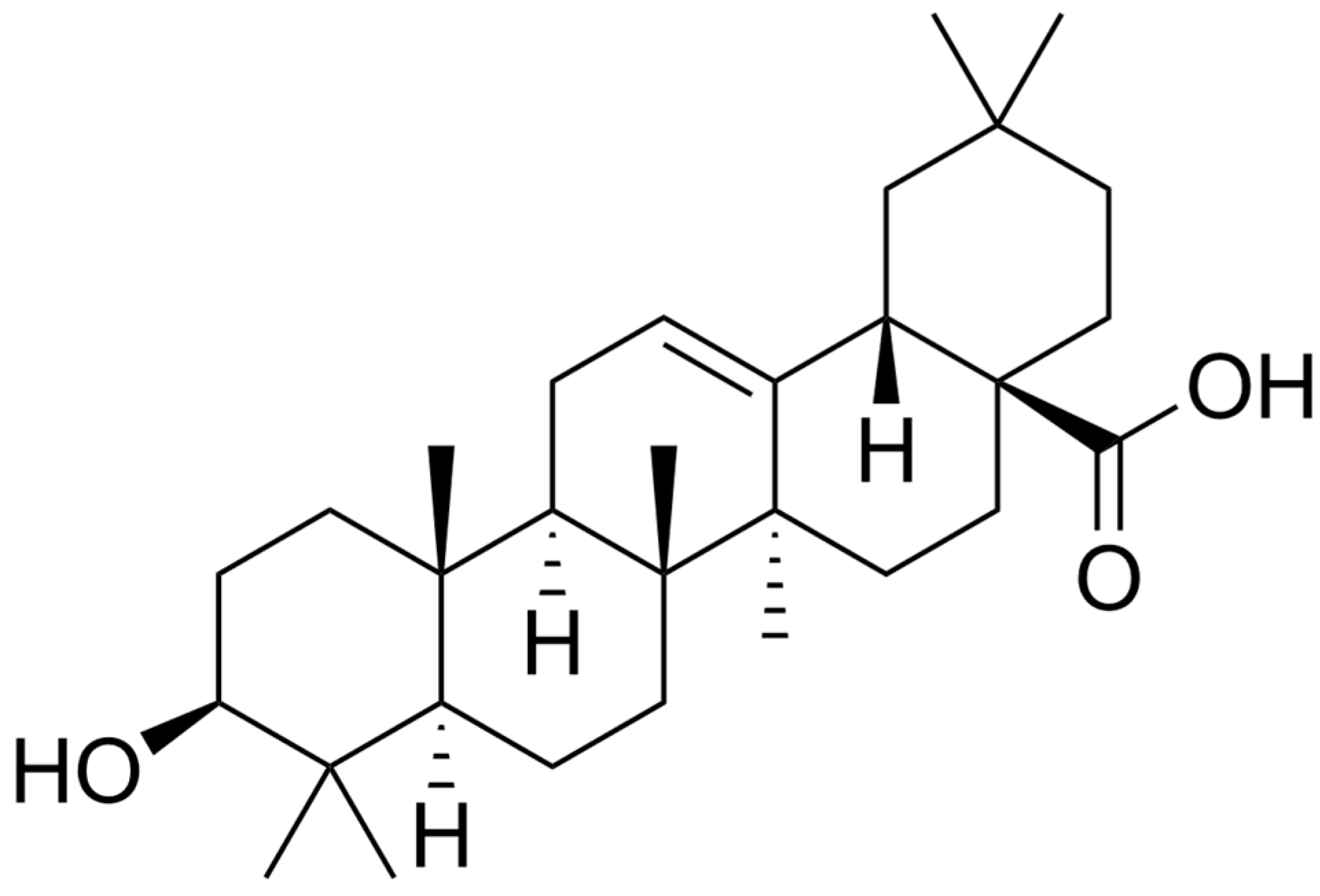
Figure 1. Molecular structure of oleanolic acid (3B-hidroxyolean-12-en-28-oic acid, C30H48O3). Molecular weight: 456.7 g/mol. PubChem SID: 87558857.
Applsci 16 00494 g001
Figure 2. Evidence of oleanolic acid (OA) effects on the amyloid hypothesis in Alzheimer’s disease. The olive leaf-shaped diagram centralizes OA, illustrating its primary molecular targets and its multitarget potential in modulating amyloid-beta (Aβ)pathology. APP, amyloid precursor protein; sAPPβ, serum APP; BACE-1, beta-secretase1; PSEN1/2, presenilin-1/2; AICD, app intracellular domain.
Applsci 16 00494 g002
Figure 3. Available evidence on the effects of OA on the Tau hypothesis in Alzheimer’s disease. The diagram, designed in the shape of an olive leaf with the acronym “OA” at its center, illustrates the molecular targets through which OA modulates Tau pathology and microtubule stability. PI3K, phosphoinositol-3-kinase; AKT, protein kinase B; GSK3β, glycogen synthase kinase-3 beta; nFTs, neurofibrillary tangles; Aβ, amyloid beta.
Applsci 16 00494 g003
Figure 4. Available evidence on the effects of OA on the cholinergic hypothesis in Alzheimer’s disease. An olive leaf-shaped diagram, featuring the acronym “OA” at its core, represents the molecular targets through which OA modulates cholinergic neurotransmission. VEGF, vacular endothelium growth factor; BDNF, brain-derived neurotrophic factor; PI3K, phosphoinositol-3-kinase; AKT, protein kinase beta; ERK, extracellular-signal regulated kinase; MEK, mitogen-activated protein kinase; Raf, rapidly accelerated fibrosarcoma; CREB, cAMP response element binding protein; LTP, long-term potentiation; AcHT, acetycholine-transferase; AcHE; acetylcholine-esterase; BcHE, butitylcholine-esterase.
Applsci 16 00494 g004
Figure 5. Available evidence on the effects of OA on the neuroinflammatory hypothesis in Alzheimer’s disease. An olive leaf-shaped diagram, with “OA” at its center, illustrates the molecular targets through which OA modulates glial activation and the release of proinflammatory mediators. TNFR, tumor necrosis factor receptor; IL6R, interleukin-6 receptor; RAGE, advanced-glycation end-product receptor; TREM2, triggering receptor expressed on myeloid cells 2; TRL4, toll-like receptor 4; NLRP3, inflammasome; NfκB, nuclear factor kappa B; ERK, extracellular signal-regulated kinase; c-JUN N-termina kinase; iNOS, inducible nitric oxide synthase; MCP-1, monocyte chemoattractant protein-1.
Applsci 16 00494 g005
Figure 6. Available evidence on the effects of OA on the oxidative stress hypothesis in Alzheimer’s disease. An olive leaf-shaped diagram, featuring the acronym “OA” at its core, illustrates the molecular targets and antioxidant pathways through which OA neutralizes reactive oxygen species (ROS) and enhances cellular defense mechanisms. TNFR, tumor necrosis factor receptor; IL6R, interleukin-6 receptor; RAGE, advanced-glycation end-product receptor; LRP-1; LDL receptor-like protein 1; NfκB, nuclear factor kappa B; Nrf2, nuclear factor erythroid 2–related factor 2; Aβ, amyloid beta, ROS, reactive oxygen species.
Applsci 16 00494 g006
Figure 7. Available evidence on the effects of OA on the metabolic hypothesis in Alzheimer’s disease. An olive leaf-shaped diagram, featuring the acronym “OA” at its core, illustrates the molecular targets through which OA modulates cerebral glucose metabolism and insulin signaling pathways. TNFR, tumor necrosis factor receptor; IL6R, interleukin-6 receptor; RAGE, advanced-glycation end-product receptor; TREM2, triggering receptor expressed on myeloid cells 2; IR, insulin receptor; LRP-1; LDL receptor-like protein 1; NfκB, nuclear factor kappa B; Nrf2, nuclear factor erythroid 2–related factor 2; ROS, reactive oxygen species; AMPK, AMP-activated protein kinase; BBB, blood–brain barrier.
Applsci 16 00494 g007
Table 1. Summary of evidence regarding the effects of OA on the amyloid cascade in Alzheimer’s disease models.
CompoundMain FindingsExperimental ModelReference
OA and nitrogen-substituted derivativesSignificant reduction in APP expression; inhibition of PSEN1 and PSEN2LPS-stimulated SH-SY5Y neuroblastoma cells[23]
OA-rich ethanolic extract from Aralia cordataRestored cell viability to 76.2% and 80% (at 1 and 5 μM) against Aβ(25–35) toxicityPrimary Sprague-Dawley rat brain cultures[24]
OA saponins from
Polaskia chichipe
Restored cell viability (76% and 74%); reduced Aβ(42) aggregation by 80%SH-SY5Y cells and Thioflavin-T assay[25]
OA saponins from
Dipsacus asper
Reduced Aβ(25–35)-induced cytotoxicity by 26.7%PC12 neuronal cells[26]
Asperosaponin C from Akebia quinataSignificant reduction in Aβ(42) aggregationThioflavin-T (Th-T) assay[28]
OA ranging from 5 μM to 320 μMAnti-aggregation effect on Aβ(1–42); inhibition of BACE1 activityIn vitro assays (DPPH, ABTS, LPO)[29]
0.4 μg/mL Nerium oleander Fraction 4 (35% OA)Neuroprotective effects against ischemic-like injuryRat brain slices (Oxygen-glucose deprivation)[30]
800 mg of CDDO-MA/kg of chowImproved spatial memory; decreased Aβ(42) concentrations; enhanced microglial phagocytic activityTg19959 mice (expressing human APP with KM670/671NL and V717F mutations)[31]
OA (21.6 mg/kg)Improved performance in maze and spatial tests; preserved neuronal and mitochondrial morphology; restored NMDAR2B, CaMKII, and PKC levelsRats with intracerebroventricular (ICV) injections of Aβ[34]
10 nM CDDO (2-cyano-3,12-dioxooleana-1,9-dien-28-oic acid)Enhanced microglial phagocytic activityTNF or LPS stimulated BV2 microglial cells[33]
Table 2. Experimental evidence of OA modulation of Tau pathology in Alzheimer’s disease.
CompoundMain FindingsExperimental ModelReference
Nitrogen-substituted OA derivatives90% reduction in Tau expressionSH-SY5Y neuroblastoma cell cultures[23]
5 μM OA-linked heparan sulfate derivativeTau aggregation inhibition; reduced p-Tau-induced cytotoxicity; decreased ER stress and UPR activation0.5 μM p-Tau treated SH-SY5Y neuroblastoma cell cultures[40]
30 μM Nerium oleander Fraction 4 (35% OA)Restored cell viability against Tau-induced neuronal degenerationBiolistic transfection of Tau in neuronal models[30]
Table 3. Documented effects of OA and its derivatives on cholinergic neurotransmission.
CompoundMain FindingsExperimental ModelReference
OA-rich plant extracts (Elsholtzia rugulosa, Lawsonia inermis, Crataegus oxyacantha)Significant AChE inhibitory effects; associated with mood-stabilizing propertiesIn vitro Ellman’s assay, modified Ellman’s assay[55,56,57]
Isolated OA from Salvia chrysophylla (25–200 μg/mL)High AChE inhibitory activity, comparable to galantamine (positive control)In vitro Ellman’s assay[61]
OA ranging from 5 μM to 320 μM17.27 ± 0.05% at 20 μM, 84.82 ± 0.08%
At 320 μM AChE inhibitory activity similar to donepezil
In vitro enzymatic assay[29]
OA, 11-oxo-OA, methyl esters-OAAChE inhibition, 11.62 ± 2.82, 4.22 ± 0.68, 3.46 ± 0.56 respectively.
BChE inhibition inactive
In vitro Ellman’s assay[63]
3-O-acetylated-OAHigh binding energy to BChE; theoretical strong ligand-protein interactionIn silico molecular docking analysis[68]
OAAChE inhibition IC50 9.22 µMTLC-bioautography[67]
OA derivativesAChE inhibition 0.78 ± 0.09 (compound 9), BChE 38.8 ± 6.7 (compound 1) vs. donezepil 0.01 ± 0.0001, 5.26 ± 0.27In vitro Ellman’s assay[72]
diethoxyphosphoryloxy-OABChE inhibitor Ki = 6.59 nM and Ki′ = 1.97 nMIn vitro Ellman’s assay[69]
(3β)-Acetyloxy-OA derivativesPotent BChE inhibition (95%), AChE marginal inhibition (25%)In vitro Ellman’s assay[68]
OA (0.625, 1.25, 2.5, or 5 mg/kg in ICR mice), OA 30 μM in primary neuron cultureReversal of ACh deficits via TrkB receptor activation; increased BDNF expression and induction of LTP via MAPK ERK1/2 pathwayMale ICR mice scopolamine-induced cognitive impairment. Primary neuron culture from Sprague-Dawley[75]
OA 24 mg/kg from Ocimum sanctumImproved short- and long-term spatial memoryOlfactory bulbectomized (OBX) Swiss albino mice[79]
Disclaimer/Publisher’s Note: The statements, opinions and data contained in all publications are solely those of the individual author(s) and contributor(s) and not of MDPI and/or the editor(s). MDPI and/or the editor(s) disclaim responsibility for any injury to people or property resulting from any ideas, methods, instructions or products referred to in the content.