

Next Article in Journal
Comparative Evaluation of Digital Accuracy Among Three Intraoral Scanners for Posterior Implant and Tooth Scans
Previous Article in Journal
Experimental Investigation of Acoustic Signal Characteristics of Blockages in Highway Tunnel Drainage Pipelines Using Distributed Acoustic Sensing
Previous Article in Special Issue
3D-Printed Helmet for Electromagnetic Articulograph Applied in the Study of Oral Physiology
error_outline You can access the new MDPI.com website here. Explore and share your feedback with us.
 
 
Article

Impact of Visual Magnification on MB2 Canal Detection in a Laboratory-Based Study Using Standardized 3D-Printed Maxillary Molars

1
Department of Endodontics, Faculty of Dentistry, King Abdulaziz University, P.O. Box 80209, Jeddah 21589, Saudi Arabia
2
Dental Clinics, Khulais General Hospital, Ministry of Health, P.O. Box 11413, Khulais 25525, Saudi Arabia
*
Author to whom correspondence should be addressed.
Appl. Sci. 2026, 16(1), 493; https://doi.org/10.3390/app16010493
Submission received: 3 December 2025 / Revised: 17 December 2025 / Accepted: 23 December 2025 / Published: 4 January 2026
(This article belongs to the Special Issue 3D Printed Materials Dentistry II)

Abstract

Background: Missed second mesiobuccal second (MB2) canals are a recognized contributor to endodontic failure, and enhanced visualization may facilitate their detection. This study evaluated the influence of magnification devices and operator experience on MB2 detection using anatomically standardized 3D-printed maxillary first molar models. Methods: Fifty-nine endodontists and endodontic residents evaluated anatomically standardized TrueTooth® 3D-printed maxillary first molars incorporating Vertucci Type II and IV configurations. Participants were assigned to naked-eye (NE), dental loupe (DL; 3.5×), or dental operating microscope (DOM) visualization. Access cavity preparation and MB2 canal scouting times were recorded, and MB2 detection was confirmed by insertion of a size-10 K-file. Use of ultrasonic tips and long-shank burs was documented. Statistical analyses included two-way ANOVA for procedural time comparisons, chi-square or Fisher’s exact tests for categorical variables, and logistic regression to evaluate factors associated with MB2 detection (α = 0.05). Results: The overall MB2 detection rate was 49.2%. Detection varied by magnification modality, with rates of 25.0% for naked-eye visualization, 45.0% for dental loupes, and 70.0% for the dental operating microscope. In multivariable analysis using a parsimonious model, DOM use was associated with higher odds of MB2 detection; however, the confidence interval included unity, indicating a borderline association. MB2 detection rates were similar between endodontists and residents (50.0% vs. 47.6%), with no statistically significant difference between groups. Ultrasonic tip use was associated with a higher frequency of scouting-related perforations but did not improve detection. Operators who successfully detected MB2 completed scouting in significantly less time. Conclusions: Under controlled, anatomically standardized laboratory conditions, visual magnification, particularly use of the dental operating microscope, was associated with greater efficiency of MB2 canal detection and shorter scouting times, beyond non-significant trends related to operator experience. Although 3D-printed models do not fully replicate the mechanical and tactile properties of natural dentin, their reproducible anatomy allows reliable assessment of operator- and device-related factors in a controlled setting. Given the simulated environment and the presence of borderline statistical associations, these findings should be interpreted cautiously and should not be directly extrapolated to clinical outcomes without further validation in clinical studies.

1. Introduction

Visual acuity (defined as the clarity and sharpness of vision) is influenced by age, lighting, ergonomics, and the use of magnification devices [1]. Dentistry involves a restricted working field and fine-detail manipulation, making it particularly suited to optical magnification. Although dental loupes and operating microscopes have become increasingly popular in clinical practice [2,3,4,5], evidence supporting their impact on diagnostic accuracy and procedural outcomes remains limited, as much of the existing literature relies on observational studies or expert opinion rather than controlled experimental designs [6,7,8].
Endodontic procedures, in particular, benefit from enhanced visualization because clinicians often work without direct visual access to internal tooth anatomy and depend on tactile feedback and radiographic interpretation [9]. The introduction of the dental operating microscope (DOM) has therefore been considered a major advancement in endodontics [4,10], and professional organizations such as the American Association of Endodontists recognize magnification tools as integral to contemporary endodontic care [11]. Improved visualization has been associated with enhanced detection of fine anatomical features, including additional canals, perforations, vertical root fractures, and intracanal obstructions [12,13,14,15]. While some studies suggest that dental loupes may provide performance comparable to DOMs for selected tasks [3,16], the superiority of DOMs in identifying complex canal anatomy remains widely reported [17].
The second mesiobuccal (MB2) canal of maxillary first molars represents a well-recognized anatomical challenge. Previous studies have demonstrated higher MB2 detection rates with magnification compared with unaided vision. For example, Buhrley et al. reported detection rates of 17.2%, 62.5%, and 71.1% using the naked eye, dental loupes, and DOMs, respectively [17]. Other investigations have shown that direct visual exploration under magnification may identify MB2 canals more reliably than advanced imaging alone, such as cone-beam computed tomography [18]. Despite these findings, magnification remains underutilized in general practice, with reported adoption rates ranging from 9% to 44% [19,20].
A major limitation of prior MB2 detection studies is their reliance on extracted natural teeth, which introduces substantial anatomical variability and limits experimental control. Recent advances in 3D printing have enabled the production of anatomically standardized artificial teeth with reproducible internal canal morphology, providing a controlled platform for endodontic training and research [9,21]. These models eliminate inter-tooth variability and allow operator- and device-related factors to be evaluated under standardized conditions. However, 3D-printed teeth do not fully replicate the biomechanical and tactile properties of natural dentin. Differences in hardness, drilling resistance, and haptic feedback have been reported, reflecting the inherent limitations of resin-based materials [22]. Accordingly, findings derived from artificial models should be interpreted within a simulated experimental context.
To date, no study has combined anatomically standardized 3D-printed maxillary first molars with a direct three-way comparison of naked-eye vision, dental loupes, and the dental operating microscope while simultaneously examining the influence of operator experience. Addressing this gap allows the effect of magnification to be assessed independently of anatomical variability, which has confounded previous investigations.
Therefore, the primary aim of this study was to evaluate the effect of different visual magnification modalities (naked eye, dental loupes, and dental operating microscope) on MB2 canal detection using standardized 3D-printed maxillary first molars. A secondary aim was to assess whether operator experience (endodontic resident versus endodontist) influenced procedural performance under these controlled conditions.
Null hypotheses:
  • There is no difference in MB2 detection rates among the three magnification groups.
  • Operator experience has no effect on MB2 detection or procedural performance.
  • The use of ultrasonic tips has no effect on the frequency of procedural errors, including access cavity perforation or MB2 scouting perforation.

2. Materials and Methods

This study was approved by the Research and Ethics Committee of the Faculty of Dentistry, King Abdulaziz University, Jeddah, Saudi Arabia (Approval No.: 237-03-21).

2.1. 3D-Printed Tooth Model

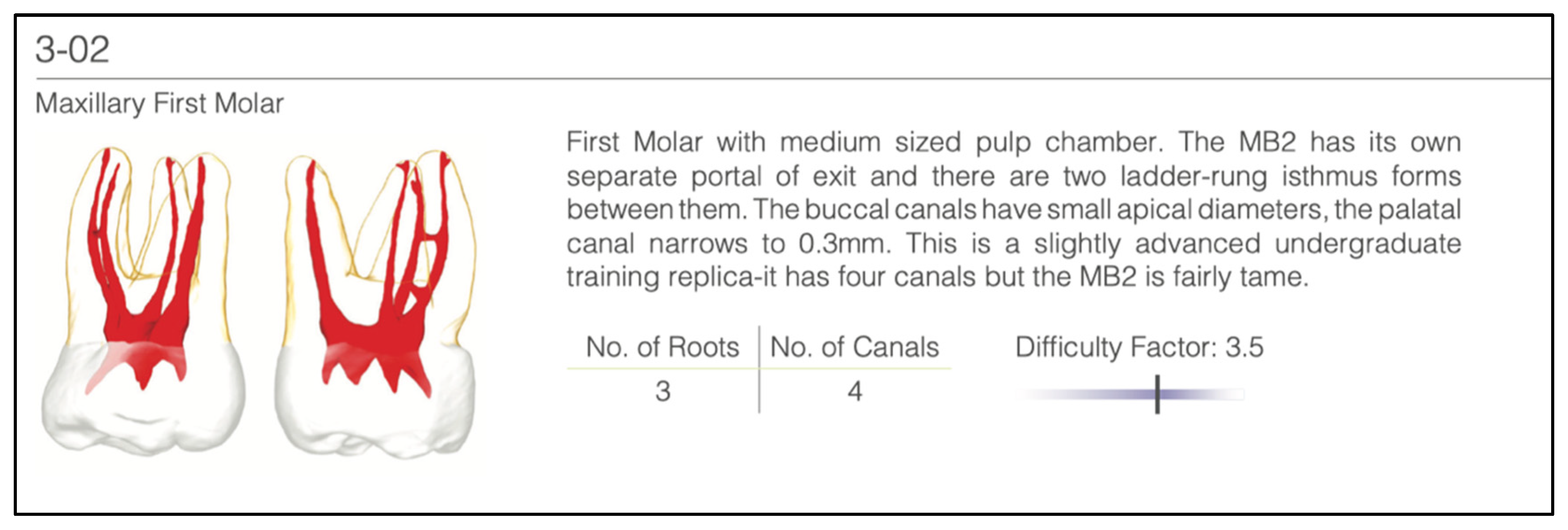
A total of 59 opaque 3D-printed maxillary first molar teeth (TrueTooth®, model 3-02, Dental Engineering Labs, Santa Barbara, CA, USA) were used in this study (Figure 1). Each model had three roots and four canals, with the MB2 canal possessing its own separate portal of entrance and exit. The MB1 and MB2 canals were connected by two ‘ladder-rung’ transverse isthmuses, as described in the manufacturer’s anatomical specification for the 3-02 model [23] and consistent with the isthmus morphology reported in maxillary molars [24,25]. The buccal canals had small apical diameters, and the palatal canal narrowed to 0.3 mm. All replicas featured a medium-sized pulp chamber and were manufactured in opaque radiopaque resin designed to simulate dentin hardness, providing a standardized platform for training and experimental evaluation.
The simulated difficulty level of the 3D-printed replicas was determined by the manufacturer’s anatomical design of model 3-02, which incorporates narrow MB1–MB2 isthmuses, reduced canal diameters, and calcification-like resin structures intended to mimic moderate clinical difficulty. Although artificial teeth cannot fully replicate natural dentin hardness or irregular calcification patterns, previous studies have demonstrated that anatomically standardized 3D-printed teeth provide reproducible internal morphology, consistent tactile resistance, and reliable conditions for evaluating endodontic performance [26]. In this study, simulated difficulty was standardized by using identical models produced in a single manufacturing batch.

2.2. Participants and Group Allocation

Fifty-nine examiners participated in the study, including 38 endodontists and 21 endodontic residents from the Faculty of Dentistry, King Abdulaziz University. Participants were randomly assigned to one of three magnification groups:
  • Naked eye (NE)-no magnification
  • Dental loupes (DL)-3.5× magnification (Zumax, Suzhou, China)
  • Dental operating microscope (DOM)-variable magnification (Zeiss, Oberkochen, Germany)
Each examiner evaluated a single tooth under their assigned magnification condition. Randomization was performed using a computer-generated sequence with balanced allocation to ensure approximately equal group sizes across magnification groups. Allocation was implemented by an independent coordinator not involved in data collection, and group assignment was revealed to participants only at the time of the procedure.

2.3. Phantom Head and Clinical Setup

Each tooth was mounted in a plastic jaw using putty material (3M™ Express™, Saudi Arabia), allowing repeated insertion and removal without damaging the replicas. The jaw was positioned in a phantom head mannequin to simulate patient treatment.
The clinical setup included:
  • high-speed and low-speed handpieces,
  • suction and air spray,
  • stainless steel size-10 K-files (Dentsply Sirona, Charlotte, NC, USA),
  • DG16 endodontic explorer (Dentsply Sirona, Charlotte, NC, USA),
  • low-speed long-shank round bur (CJM Engineering, Ojai, CA, USA),
  • high-speed endo access bur, (Dentsply Sirona, Charlotte, NC, USA),
  • ultrasonic (US) tip No. 3 from the StartX tips kit (Dentsply Maillefer, Tulsa, OK, USA),
  • 0.9% normal saline for irrigation.
Overhead operatory lighting was standardized for all participants by using the same fixed-intensity LED dental unit light, positioned at a constant distance and angle for every procedure. No additional illumination was provided for the NE or DL groups beyond the operatory light, whereas DOM users relied solely on the microscope’s integrated coaxial light source, as per normal clinical use.

2.4. Clinical Procedures

2.4.1. Step 1: Access Cavity Preparation

Step 1 began at initiation of access preparation and ended when the three main canals (MB1, DB, and palatal) were identified. Examiners used the instruments required for canal scouting according to their assigned magnification condition.

2.4.2. Step 2: MB2 Canal Detection

Step 2 began immediately after Step 1 and ended when MB2 canal detection was confirmed by inserting a size-10 K-file into the MB2 canal orifice, followed by periapical radiographic confirmation of canal location. Although ultrasonic tips and long-shank burs were available to all participants, their use was not standardized and was left to operator discretion. This intentional design allowed the study to record these instruments as independent variables (yes/no) and evaluate their potential influence on MB2 detection and procedural errors.

2.5. Time Recording

For each examiner, the time required to complete each step was recorded with a digital stopwatch:
  • Step 1 time: from the start of access preparation to identification of the three main canals.
  • Step 2 time: from completion of Step 1 to confirmed MB2 detection.
For cases in which the MB2 canal was not identified, Step 2 was terminated when the examiner judged that further troughing or scouting would risk procedural error or perforation, based on visual and tactile feedback. No predefined time limit was imposed in order to reflect realistic clinical decision-making. MB2 was classified as “not detected” when the examiner discontinued scouting without successful placement of a size 10 K-file into the MB2 canal orifice. All procedures were then stopped immediately, and the outcome was recorded.
All times were recorded in seconds.
Procedural time was included as a performance metric because prolonged access refinement or canal scouting is clinically associated with increased operator fatigue, higher risk of procedural errors, and reduced treatment efficiency.

2.6. Collected Variables

The following variables were recorded for each participant:
  • age and gender,
  • professional experience level (endodontic resident/endodontist),
  • assigned magnification group (NE, DL, DOM),
  • use of ultrasonic tips (yes/no),
  • use of long shank round burs (yes/no),
  • MB2 detection (yes/no),
  • procedural errors:
    none,
    perforation during access cavity preparation,
    perforation during MB2 scouting.
Perforation classification was standardized using predefined diagnostic criteria. An ‘access cavity perforation’ was recorded when the bur or instrument created a communication outside the normal anatomical boundaries of the pulp chamber before MB2 scouting. A ‘scouting perforation’ was defined as the creation of a false path or external communication during troughing or file insertion in search of MB2.
All perforations were verified immediately after each procedure by the investigator through visual inspection under DOM magnification and confirmed by inserting a size-10 K-file to determine whether the file trajectory exited the expected canal path. The investigator was blinded to the magnification modality used during the experimental procedure. Operators did not classify their own perforations, thereby minimizing detection bias.

2.7. Statistical Analysis

All statistical analyses were performed using SPSS version 23 (IBM Corp., Armonk, NY, USA). Continuous variables were presented as mean ± standard deviation (SD), and categorical variables as frequencies and percentages. Independent-samples t-tests were used to compare continuous variables between examiners who detected and did not detect the MB2 canal. Associations between categorical variables were assessed using Pearson’s chi-square test or Fisher’s exact test when expected cell counts were <5.
Two-way analysis of variance (ANOVA) was used for exploratory comparison of procedural time differences between groups defined by operator experience level and MB2 detection outcome. Because MB2 detection status represents an observed outcome rather than a predictive factor, these analyses were interpreted descriptively to assess procedural efficiency and were not used to infer predictors of MB2 detection.
Bivariate logistic regression analyses were performed to estimate crude odds ratios (ORs) with 95% confidence intervals (CIs) for factors potentially associated with MB2 detection. To reduce the risk of model overfitting, given the limited number of MB2 detection events, a parsimonious multivariable logistic regression model was constructed based on variables defined a priori to the study aims, including magnification modality (DOM vs. non-DOM) and operator experience level (endodontist vs. resident). These variables were selected because they represent the primary exposures of interest and are biologically and clinically relevant to the study objectives.
Both experience level (resident vs. endodontist) and years of clinical experience were retained in the multivariate model because they capture conceptually distinct dimensions of operator expertise. Experience level reflects formal training status and scope of practice, whereas years of experience represent cumulative clinical exposure. Including both variables allowed assessment of their independent contributions after confirming the absence of problematic multicollinearity.
When normality assumptions were violated, non-parametric Mann–Whitney U tests were performed as sensitivity analyses to assess the robustness of parametric findings, particularly for right-skewed procedural time data.

2.8. Sample Size Considerations

A formal a priori sample size calculation could not be performed because no published estimates of effect size or variance exist for MB2 detection using standardized 3D-printed tooth models. Therefore, all eligible operators available during the data-collection period were invited to participate.
The final sample of 59 examiners. Although commonly cited recommendations suggest a minimum of 10 outcome events per predictor variable (EPV) for logistic regression stability [27,28], the multivariable analysis in the present study was intentionally restricted to a reduced set of predictors selected a priori (magnification modality and operator experience level) to mitigate the risk of overfitting and unstable estimates. Similar simulation-based endodontic studies have relied on convenience samples of comparable size in the absence of prior parameter estimates, particularly when using standardized experimental models designed to reduce biological variability [29,30].

3. Results

A total of 59 examiners participated in the study, with a mean age of 35.6 ± 9.6 years (range: 25–67) and a mean clinical experience of 7.0 ± 6.0 years (range: 1–30). Participant demographics are summarized in Table 1.
Among the participants, 54.2% were female and 64.4% were endodontists, while 35.6% were endodontic residents. One-third of the examiners worked without magnification (33.9%), 32.2% used dental loupes, and 33.9% used a dental operating microscope (DOM). Ultrasonic tips were used by 47.5% of participants, and long-shank burs by 66.1%. Procedural errors occurred in 18.7% of cases, most commonly during MB2 scouting. These categorical characteristics are presented in Table 2.
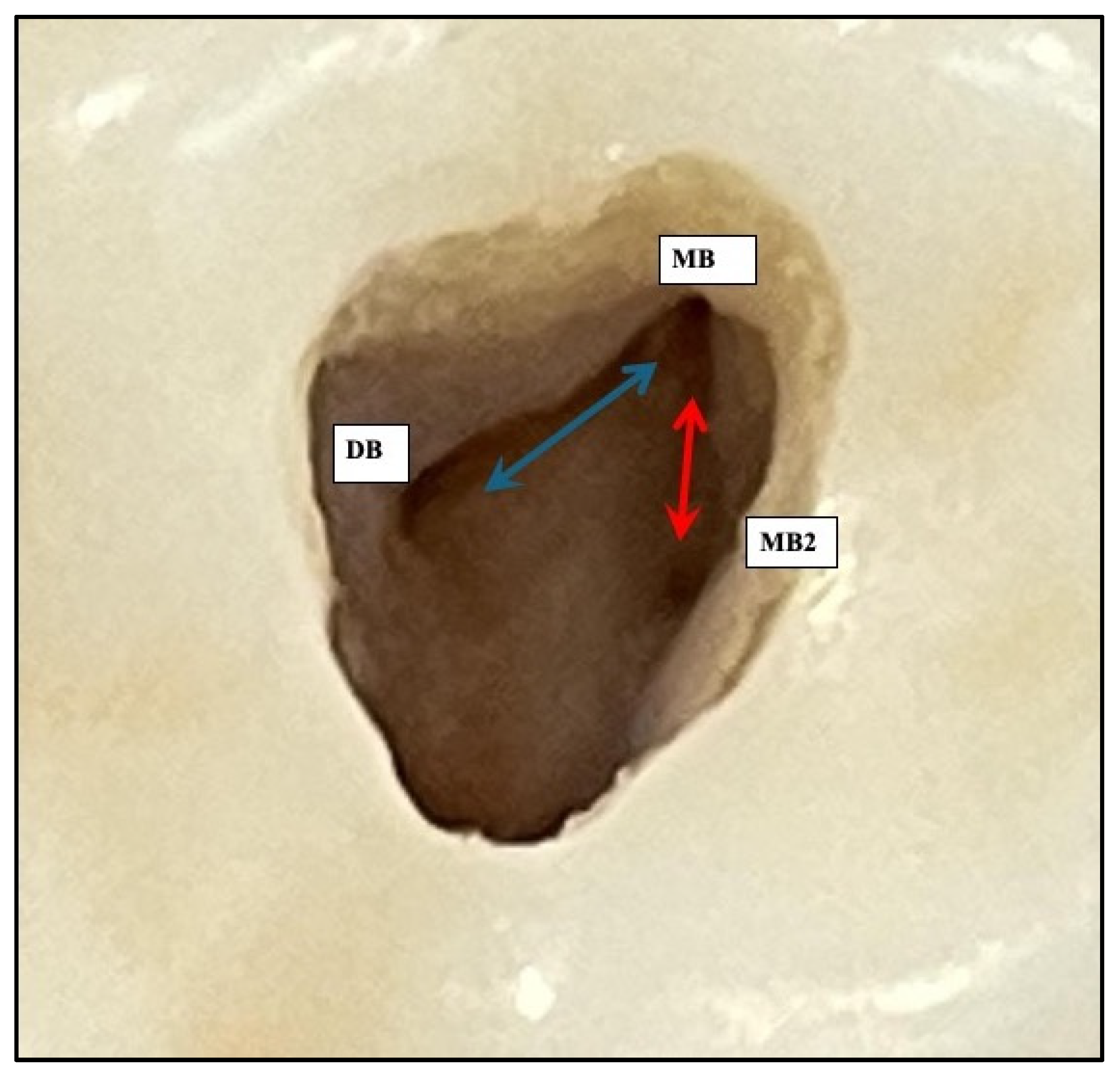
Visual inspection of all 3D-printed replicas showed a consistent pulp chamber floor configuration. The MB2 orifice was located palatally to the MB canal and in close proximity to the distobuccal (DB) canal, providing a stable anatomical landmark during canal scouting (Figure 2).
The mean access cavity preparation time (Step 1) across all operators was 382.0 ± 302.7 s, and the mean time required for MB2 canal scouting (Step 2) was 343.9 ± 249.7 s. Endodontists tended to complete both procedural steps faster than residents, and operators who successfully detected the MB2 canal tended to complete Step 2 more quickly than those who did not. Among endodontists, Step-2 time averaged 193.3 ± 130.0 s for MB2 detectors compared with 328.2 ± 289.3 s for non-detectors, whereas residents required 403.3 ± 185.8 s and 507.7 ± 265.8 s, respectively (Table 3).
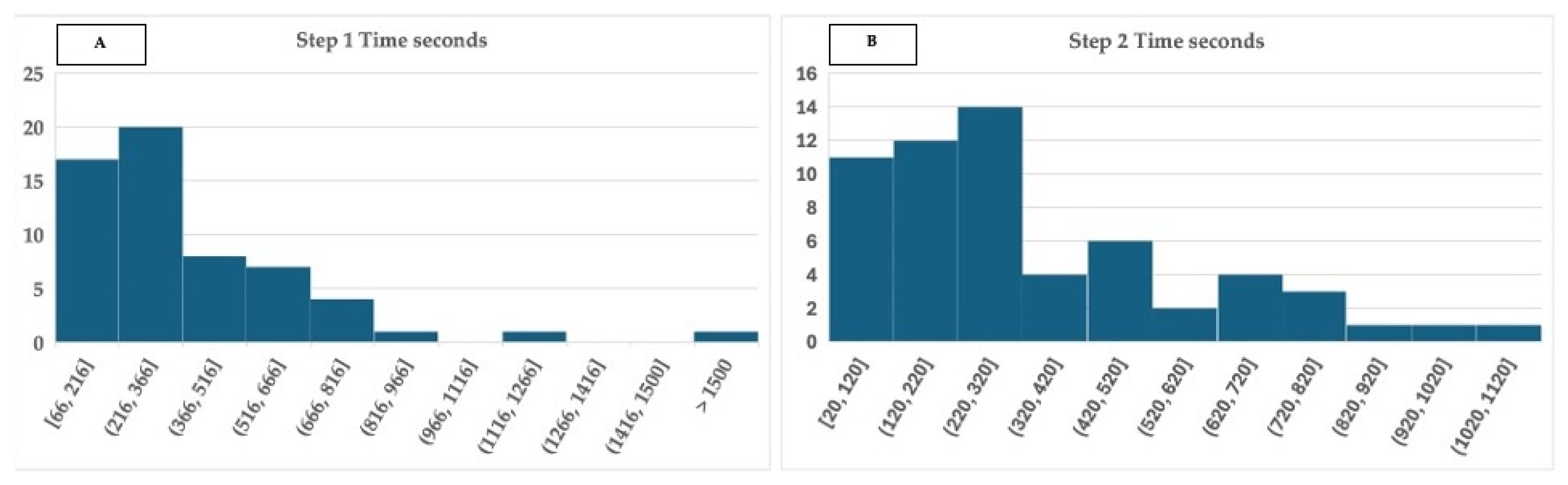
Visual inspection of procedural time distributions demonstrated right-skewed patterns for both Step 1 and Step 2, with skewness and prolonged outliers being more pronounced for Step 2 scouting times (Figure 3A,B). These findings support the inclusion of distributional plots in addition to mean ± standard deviation reporting.
Two-way ANOVA identified a significant main effect of operator experience level on both Step 1 (p = 0.0012) and Step 2 times (p = 0.0019). MB2 detection status had no effect on Step 1 time (p = 0.8600) but was associated with significantly shorter Step 2 scouting time (p = 0.0446). No significant interaction was observed between experience level and MB2 detection. Because MB2 detection represents an observed outcome rather than a predictive factor, these analyses were interpreted descriptively with respect to procedural efficiency rather than as inferential predictors of detection (Table 3).
Given the marked right-skewness of Step 2 time data, a non-parametric Mann–Whitney U test was performed as a sensitivity analysis. Operators who detected the MB2 canal had significantly shorter scouting times than those who did not (median [IQR]: 212.5 [106.3–324.6] s vs. 304.0 [248.4–654.0] s; p = 0.016), confirming the robustness of the parametric findings.

3.1. Demographic Associations

Operators who detected MB2 were slightly older (37.17 ± 10.58 vs. 34.13 ± 8.38 years; p = 0.226) and more experienced (8.55 ± 7.89 vs. 5.70 ± 3.96 years; p = 0.089), although differences were not statistically significant (Table 4).

3.2. MB2 Detection and Categorical Variables

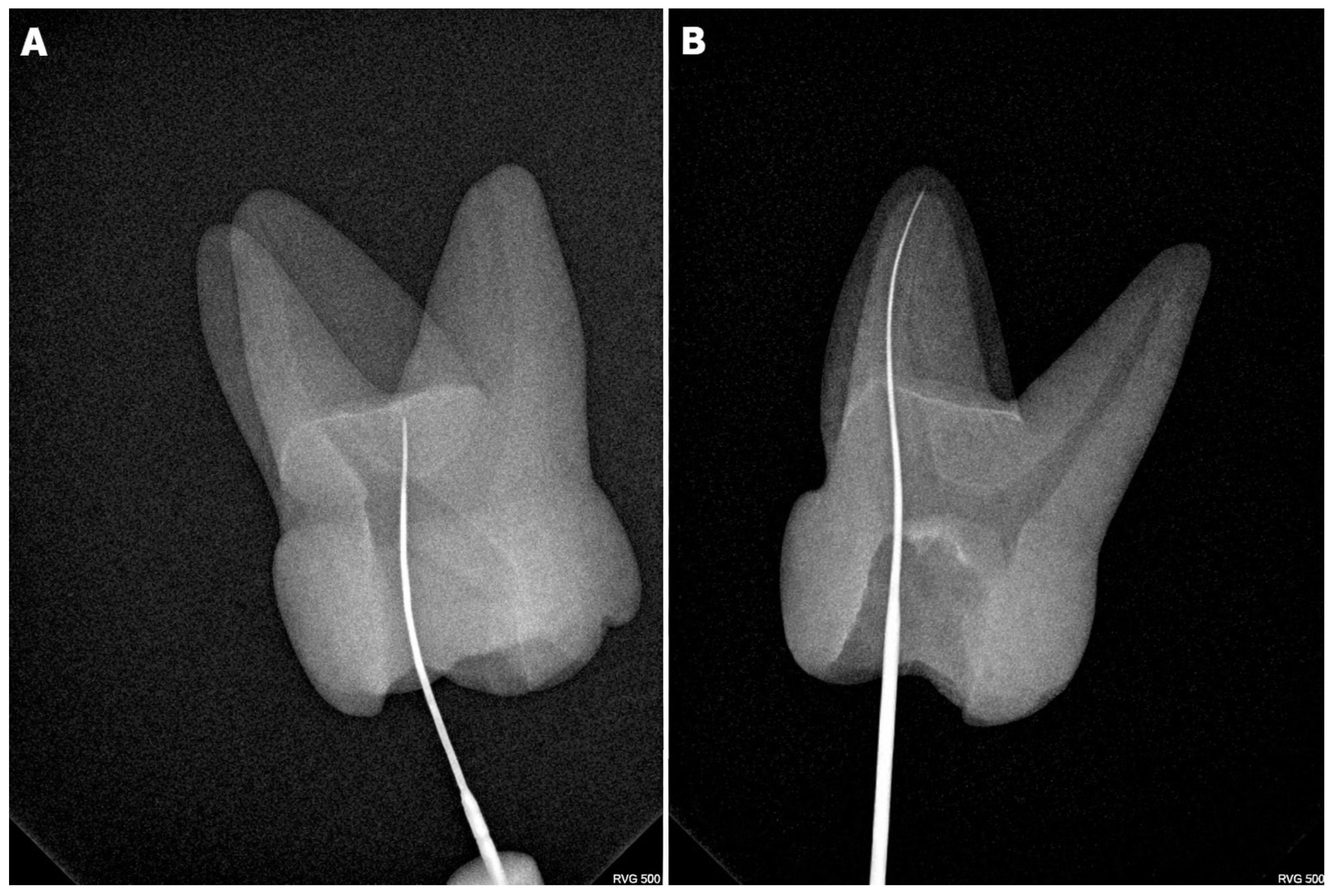
MB2 detection differed across magnification groups, with the highest detection rate observed among DOM users (70.0%), followed by NE (40.0%) and DL (36.8%). Although this pattern suggested a trend favoring DOM use, the difference did not reach statistical significance in univariate analysis (p = 0.071). Ultrasonic use was significantly associated with MB2 detection (p = 0.009), with lower detection rates among ultrasonic users. Procedural errors were also strongly associated with detection status (p = 0.003). All access perforations occurred in cases where MB2 was detected, whereas all MB2 scouting perforations occurred in cases where MB2 was not detected (Figure 4). These findings are summarized in Table 5.
Procedural errors did not differ significantly by gender, experience level, magnification, ultrasonic use, or long-shank bur use (all p > 0.05). Access perforations were rare (3.4%), while most errors occurred during MB2 scouting (15.3%) (Table 6).

3.3. Regression Analysis

Bivariate logistic regression analyses showed no statistically significant associations between MB2 detection and demographic variables (age, gender), operator experience variables (experience level and years of experience), ultrasonic use, or long-shank bur use (all p > 0.05). Dental operating microscope (DOM) use demonstrated higher odds of MB2 detection compared with naked-eye visualization; however, this association did not reach statistical significance in unadjusted analysis (OR = 3.50; 95% CI: 0.95–12.96; p = 0.061), indicating a non-significant trend (Table 7).
To reduce the risk of model overfitting, given the limited number of MB2 detection events, a parsimonious multivariable logistic regression model was constructed based on variables defined a priori to the study aims, including magnification modality (DOM vs. non-DOM) and operator experience level (endodontist vs. resident). These variables were selected based on biological plausibility and direct relevance to the primary research question.
In this reduced model, DOM use remained associated with higher odds of MB2 detection (adjusted OR ≈ 3.4). However, the 95% confidence interval included unity, indicating that the magnitude of the association should be interpreted cautiously as borderline. Operator experience level did not demonstrate a statistically significant independent association with MB2 detection.
Overall, these findings suggest that magnification, particularly DOM use, may facilitate MB2 detection under anatomically standardized experimental conditions, although the strength and precision of this association are limited by sample size and event frequency.

4. Discussion

Root canal morphology, particularly in multirooted teeth, is highly variable [31]. Identifying all root canals is essential for the success of endodontic treatment, and the second mesiobuccal (MB2) canal in maxillary first molars presents one of the greatest anatomical challenges. Its high prevalence and frequent omission during treatment have been well documented, with missed MB2 canals strongly associated with persistent periapical disease and endodontic failure [32,33,34]. Previous studies have consistently emphasized the difficulty of locating the MB2 canal due to its complex morphology, variable orifice location, and frequent calcification [35,36,37].
Cone-beam computed tomography (CBCT) has provided valuable insight into this complexity [38], revealing a high global prevalence of second mesiobuccal (MB2) canals in maxillary first molars-up to 74% in a large international CBCT cohort [39]. Even higher rates have been reported in Middle Eastern populations, including Kuwait and Syria [40,41,42]. While CBCT enhances anatomical understanding, it does not replace direct clinical visualization during access cavity preparation, underscoring the continued importance of magnification-assisted canal detection.
Most prior MB2 detection studies have relied on naturally extracted teeth, which introduce substantial variability in anatomy and limit experimental control [39,43]. To overcome this limitation, the present study used anatomically standardized 3D-printed maxillary first molar replicas. These models eliminated inter-tooth variability and incorporated MB root configurations corresponding to Vertucci’s commonly observed Type II and IV patterns [18,44]. This standardization allowed the effect of visual magnification and operator-related variables to be examined under controlled conditions. However, resin-based replicas do not fully replicate natural dentin behavior, particularly in hardness, tactile resistance, or cutting patterns, factors that can influence detection dynamics and procedural errors [26].
In this study, the overall MB2 detection rate was 49.2%, and endodontists detected MB2 more frequently than residents (65.5% vs. 34.5%). Although this difference did not reach statistical significance, it represents a non-significant trend rather than evidence of a true group effect, consistent with previous literature suggesting that clinical experience may influence anatomical recognition and procedural efficiency. Park et al. reported that dental students using loupes detected MB2 canals in only 15.8% of cases, whereas postgraduate clinicians using a DOM achieved higher detection rates [45,46]. Accordingly, experience appears to influence performance tendencies, while magnification remains the more consistent facilitating factor.
It should also be acknowledged that the present study did not evaluate participants’ prior loupe-training exposure or their frequency of loupe use. Therefore, any interpretation related to insufficient loupe training among residents must be regarded as speculative. Nevertheless, published evidence indicates that magnification proficiency improves with structured training and repeated clinical use, which may partially explain observed performance differences [47,48].
Consistent with earlier reports [49,50,51,52], the dental operating microscope (DOM) demonstrated the highest MB2 detection rate (70.0%), outperforming both dental loupes and the naked eye. Regression analyses showed that DOM use was associated with approximately a 3.4-fold increase in the odds of MB2 detection; however, because the confidence interval included unity, this association should be interpreted cautiously as borderline. These findings align with established evidence that DOM use enhances visualization of fine anatomical features and may facilitate the detection of additional canals [17,18,53,54].
Differences between unadjusted and adjusted effect estimates reflect covariate adjustment in regression modeling, particularly for operator experience and adjunctive instrument use. Such changes are expected in parsimonious multivariable analyses and do not indicate statistical inconsistency but rather highlight the influence of covariate control when sample size and event frequency are limited.
Interestingly, the use of ultrasonic (US) tips in this study did not improve MB2 detection and was associated with higher perforation rates during scouting. This contrasts with studies on natural teeth that highlight the benefit of troughing and ultrasonics in uncovering hidden or calcified MB2 canals [55,56,57]. However, this association should not be interpreted as evidence of a causal detrimental effect of ultrasonic instrumentation. Because the use of ultrasonic tips and long-shank burs was discretionary and left to operator judgment, these findings are subject to confounding by indication, whereby operators encountering greater anatomical difficulty or uncertainty were more likely to employ adjunctive instruments.
This discrepancy is likely attributable, at least in part, to the physical properties of 3D-printed resin, which lacks anisotropic dentin hardness, natural landmarks, and realistic tactile feedback. Experimental resin models have been shown to exhibit altered bur–surface interactions and smear formation, potentially increasing false tactile cues during ultrasonic use [26,29]. In addition to material-related factors, operator familiarity, hand stability, and troughing technique may also have influenced MB2 detection and perforation outcomes. Accordingly, the observed associations should be interpreted as associative rather than causal, and as reflective of procedural difficulty within a simulated environment rather than true clinical risk.
The performance of residents in the current study also provides insight into magnification-training needs. In descriptive terms, MB2 detection among residents was more frequently observed when higher magnification was used; however, the study was not designed or powered to formally evaluate experience level by magnification interactions. Accordingly, no definitive conclusions can be drawn regarding the superiority of one magnification modality for residents, and these observations should be regarded as hypothesis-generating rather than evidence-based guidance. Prior studies have shown that higher magnification levels (3.5×–4.5×) improve detail recognition [47]. Wajngarten and Garcia similarly emphasized that advanced loupe systems and DOMs produce superior visual acuity and procedural precision [48]. Standardized 3D-printed models may therefore serve as valuable platforms for objective training and assessment under controlled conditions, without implying definitive recommendations regarding optimal training strategies.
Additionally, the optional use of ultrasonic tips and long-shank burs may have acted as moderating variables in the relationship between magnification and MB2 detection. While these adjunctive instruments were available to all participants, their non-standardized use may have influenced operator decision-making, tactile perception, and the likelihood of false-positive canal entry points. The present study was not designed to evaluate interaction effects between magnification and adjunctive instruments, and future investigations should explore these relationships systematically.
Several limitations should be acknowledged. First, only one tooth model was assigned per examiner. Although all replicas were anatomically identical, this design increases inter-operator variability and may obscure subtle performance differences. Using multiple teeth per participant in future studies would improve within-operator reliability. Additionally, 3D-printed resin models do not fully replicate dentin hardness, tactile feedback, or biological calcifications, and the simulated environment lacks patient-related constraints such as limited mouth opening or movement. Finally, the sample included only endodontists and residents, limiting extrapolation to general practitioners or less-experienced clinicians. While the use of 3D-printed maxillary molar replicas enabled controlled comparisons by eliminating anatomical variability, these models do not fully reproduce natural dentin hardness, tactile feedback, or biological calcification patterns. Additionally, assigning only one tooth per operator represents a methodological limitation that may increase inter-operator variability. Future studies should incorporate multiple repetitions per examiner to improve within-operator reliability, as well as hybrid or natural tooth models to enhance clinical relevance.
Taken together, these findings indicate that magnification, particularly DOM use, was associated with improved MB2 detection under standardized experimental conditions. However, effect sizes should be interpreted cautiously given the borderline statistical findings and simulated study design. Future studies incorporating natural teeth, larger samples, and true clinical settings are warranted to validate and extend these observations.

5. Conclusions

This study demonstrates that visual magnification—particularly the dental operating microscope (DOM), was associated with improved accuracy and procedural efficiency in MB2 canal detection and scouting under anatomically standardized experimental conditions. Although operator experience influenced performance trends, magnification emerged as the most consistent facilitating factor, with the observed DOM effect requiring cautious interpretation due to borderline statistical robustness.
Ultrasonic troughing did not improve MB2 detection and was associated with a higher frequency of scouting-related perforations. These findings highlight the importance of careful adjunctive instrument selection, particularly when operating in simulated calcified anatomy, and should not be interpreted as evidence of a causal relationship or directly extrapolated to natural dentin or clinical settings without caution.
Within these limitations, the findings support the judicious integration of high-quality magnification, particularly the DOM, into endodontic practice and structured training environments, where standardized models may serve as valuable tools for skill development, assessment, and objective comparison of detection strategies. Further clinical and translational research is required to determine whether these experimental findings translate into meaningful improvements in patient outcomes.
Beyond its clinical implications, this study demonstrates the potential value of anatomically standardized 3D-printed tooth models in endodontic education. Because these replicas eliminate anatomical variability, they enable fair, reproducible assessment of access cavity performance and canal detection skills among trainees. Such applications should be viewed as complementary training tools rather than substitutes for clinical experience. Future educational programs may incorporate such models for competency-based assessment, instructor calibration, and structured magnification training.

Clinical Significance

The use of a dental operating microscope may improve MB2 canal detection under standardized, simulated conditions. While these findings suggest potential benefits for reducing missed canal anatomy, they should be interpreted cautiously due to the laboratory-based study design and borderline statistical robustness. Further well-designed clinical studies are required before direct extrapolation to routine endodontic practice.

Author Contributions

L.A.—Draft preparation, writing, review, and editing. H.S.F.—Formal analysis, methodology, and investigation. L.A. and H.S.F.—Writing, review, and editing. H.S.F.—Data curation. L.A.—Resources. K.B. and L.A.—Project administration and validation. All authors have read and agreed to the published version of the manuscript.

Funding

The project was funded by KAU Endowment (WAQF) at king Abdulaziz University, Jeddah, Saudi Arabia. The authors, therefore, acknowledge with thanks WAQF and the Deanship of Scientific Research (DSR) for technical and financial support.

Institutional Review Board Statement

This study was approved by the Research Ethics Committee of the Faculty of Dentistry, King Abdulaziz University (Proposal No. 237-03-21). All procedures involving human participants were conducted in accordance with the ethical standards of the institutional research committee and with the 1964 Declaration of Helsinki and its later amendments.

Informed Consent Statement

Written informed consent was obtained from all participants before inclusion in the study.

Data Availability Statement

The datasets generated and/or analyzed during the current study are available from the corresponding author on reasonable request. Due to participant confidentiality and institutional regulations, raw examiner-related data cannot be publicly shared; however, anonymized data underlying the findings of this article can be provided upon request.

Conflicts of Interest

The authors declare that they have no competing interests.

References

  1. Eichenberger, M.; Perrin, P.; Neuhaus, K.W.; Bringolf, U.; Lussi, A. Visual acuity of dentists under simulated clinical conditions. Clin. Oral Investig. 2013, 17, 725–729. [Google Scholar] [CrossRef] [PubMed]
  2. Friedman, M.; Mora, A.F.; Schmidt, R. Microscope-assisted precision dentistry. Compend. Contin. Educ. Dent. 1999, 20, 723–728, 730–731, 735–736; quiz 737. [Google Scholar]
  3. Friedman, M.J. Magnification in a restorative dental practice: From loupes to microscopes. Compend. Contin. Educ. Dent. 2004, 25, 48, 50, 53–55. [Google Scholar]
  4. Carr, G.B. Microscopes in endodontics. J. Calif. Dent. Assoc. 1992, 20, 55–61. [Google Scholar]
  5. Perrin, P.; Eichenberger, M.; Neuhaus, K.W.; Lussi, A. Visual acuity and magnification devices in dentistry. Swiss Dent. J. 2016, 126, 222–235. [Google Scholar] [CrossRef] [PubMed]
  6. Eichenberger, M.; Perrin, P.; Neuhaus, K.W.; Bringolf, U.; Lussi, A. Influence of loupes and age on the near visual acuity of practicing dentists. J. Biomed. Opt. 2011, 16, 035003. [Google Scholar] [CrossRef]
  7. Forgie, A.H. Magnification: What is available, and will it aid your clinical practice? Dent. Update 2001, 28, 125–128, 130. [Google Scholar] [CrossRef]
  8. Chauhan, S.; Chauhan, R.; Bhasin, P.; Bhasin, M. Magnification: The game changer in dentistry. World J. Methodol. 2025, 15, 100937. [Google Scholar] [CrossRef]
  9. Perrin, P.; Neuhaus, K.W.; Lussi, A. The impact of loupes and microscopes on vision in endodontics. Int. Endod. J. 2014, 47, 425–429. [Google Scholar] [CrossRef]
  10. Mohammadi, Z.; Asgary, S.; Shalavi, S.; Abbott, P.V. Clinical Update on the Different Methods to Decrease the Occurrence of Missed Root Canals. Iran. Endod. J. 2016, 11, 208–213. [Google Scholar]
  11. AAE Special Committee to Develop a Microscope Position Paper. AAE Position Statement. Use of microscopes and other magnification techniques. J. Endod. 2012, 38, 1153–1155. [CrossRef]
  12. Wolf, T.G.; Wentaschek, S.; Wierichs, R.J.; Briseño-Marroquín, B. Interradicular Root Canals in Mandibular First Molars: A Literature Review and Ex Vivo Study. J. Endod. 2019, 45, 129–135. [Google Scholar] [CrossRef]
  13. de Oliveira, L.O.; Silva, M.H.C.; Bastos, H.J.S.; de Jesus Soares, A.; Frozoni, M. The impact of a dental operating microscope on the identification of mesiolingual canals in maxillary first molars. Gen. Dent. 2019, 67, 73–75. [Google Scholar]
  14. Schmidt, B.S.; Zaccara, I.M.; Reis Só, M.V.; Kuga, M.C.; Palma-Dibb, R.G.; Kopper, P.M. Influence of operating microscope in the sealing of cervical perforations. J. Conserv. Dent. JCD 2016, 19, 152–156. [Google Scholar]
  15. Sharma, S.; Haldar, P.; Kumar, V.; Chawla, A.; Logani, A. Learning Curve for Dynamic Navigation Procedure during Endodontic Management of Permanent Maxillary Anterior Teeth with Pulp Canal Calcification: A Risk-Adjusted Cumulative Summation Analysis of a Single Operator’s Experience. J. Endod. 2025, 51, 295–302. [Google Scholar] [CrossRef]
  16. Schwarze, T.; Baethge, C.; Stecher, T.; Geurtsen, W. Identification of second canals in the mesiobuccal root of maxillary first and second molars using magnifying loupes or an operating microscope. Aust. Endod. J. 2002, 28, 57–60. [Google Scholar] [CrossRef] [PubMed]
  17. Buhrley, L.J.; Barrows, M.J.; BeGole, E.A.; Wenckus, C.S. Effect of magnification on locating the MB2 canal in maxillary molars. J. Endod. 2002, 28, 324–327. [Google Scholar] [CrossRef] [PubMed]
  18. Hiebert, B.M.; Abramovitch, K.; Rice, D.; Torabinejad, M. Prevalence of Second Mesiobuccal Canals in Maxillary First Molars Detected Using Cone-beam Computed Tomography, Direct Occlusal Access, and Coronal Plane Grinding. J. Endod. 2017, 43, 1711–1715. [Google Scholar] [CrossRef] [PubMed]
  19. Forgie, A.H.; Pine, C.M.; Longbottom, C.; Pitts, N.B. The use of magnification in general dental practice in Scotland--a survey report. J. Dent. 1999, 27, 497–502. [Google Scholar] [CrossRef]
  20. Farook, S.A.; Stokes, R.J.; Davis, A.K.; Sneddon, K.; Collyer, J. Use of dental loupes among dental trainers and trainees in the UK. J. Investig. Clin. Dent. 2013, 4, 120–123. [Google Scholar] [CrossRef]
  21. Anderson, J.; Wealleans, J.; Ray, J. Endodontic applications of 3D printing. Int. Endod. J. 2018, 51, 1005–1018. [Google Scholar] [CrossRef]
  22. Cresswell-Boyes, A.; Davis, G.; Baysan, A. Students’ perceptions of endodontic typodont teeth with simulated canals printed from novel materials. Front. Dent. Med. 2024, 5, 1373922. [Google Scholar] [CrossRef] [PubMed]
  23. Dental Engineering Laboratories. TrueTooth® Endodontic Training Replicas-Product Catalogue; Dental Engineering Laboratories: Santa Barbara, CA, USA, 2004; Available online: https://delendo.com/ (accessed on 22 December 2025).
  24. Teixeira, F.B.; Sano, C.L.; Gomes, B.P.; Zaia, A.A.; Ferraz, C.C.; Souza-Filho, F.J. A preliminary in vitro study of the incidence and position of the root canal isthmus in maxillary and mandibular first molars. Int. Endod. J. 2003, 36, 276–280. [Google Scholar] [CrossRef] [PubMed]
  25. von Arx, T. Frequency and type of canal isthmuses in first molars detected by endoscopic inspection during periradicular surgery. Int. Endod. J. 2005, 38, 160–168. [Google Scholar] [CrossRef]
  26. Di Lorenzo, I.; del Hougne, M.; Krastl, G.; Schmitter, M.; Höhne, C. 3D printed tooth for endodontic training in dental education. Sci. Rep. 2025, 15, 20185. [Google Scholar] [CrossRef] [PubMed]
  27. Peduzzi, P.; Concato, J.; Kemper, E.; Holford, T.R.; Feinstein, A.R. A simulation study of the number of events per variable in logistic regression analysis. J. Clin. Epidemiol. 1996, 49, 1373–1379. [Google Scholar] [CrossRef]
  28. Vittinghoff, E.; McCulloch, C.E. Relaxing the rule of ten events per variable in logistic and Cox regression. Am. J. Epidemiol. 2007, 165, 710–718. [Google Scholar] [CrossRef]
  29. Reis, T.; Barbosa, C.; Franco, M.; Baptista, C.; Alves, N.; Castelo-Baz, P.; Martin-Cruces, J.; Martin-Biedma, B. 3D-Printed Teeth in Endodontics: Why, How, Problems and Future—A Narrative Review. Int. J. Environ. Res. Public Health 2022, 19, 7966. [Google Scholar] [CrossRef]
  30. Duan, M.; Lv, S.; Fan, B.; Fan, W. Effect of 3D printed teeth and virtual simulation system on the pre-clinical access cavity preparation training of senior dental undergraduates. BMC Med. Educ. 2024, 24, 913. [Google Scholar] [CrossRef]
  31. Monsarrat, P.; Arcaute, B.; Peters, O.A.; Maury, E.; Telmon, N.; Georgelin-Gurgel, M.; Maret, D. Interrelationships in the Variability of Root Canal Anatomy among the Permanent Teeth: A Full-Mouth Approach by Cone-Beam CT. PLoS ONE 2016, 11, e0165329. [Google Scholar] [CrossRef]
  32. Wolcott, J.; Ishley, D.; Kennedy, W.; Johnson, S.; Minnich, S.; Meyers, J. A 5 Yr Clinical Investigation of Second Mesiobuccal Canals in Endodontically Treated and Retreated Maxillary Molars. J. Endod. 2005, 31, 262–264. [Google Scholar] [CrossRef]
  33. Song, M.; Kim, H.C.; Lee, W.; Kim, E. Analysis of the cause of failure in nonsurgical endodontic treatment by microscopic inspection during endodontic microsurgery. J. Endod. 2011, 37, 1516–1519. [Google Scholar] [CrossRef]
  34. Alotaibi, B.B.; Khan, K.I.; Javed, M.Q.; Dutta, S.D.; Shaikh, S.S.; Almutairi, N.M. Relationship between apical periodontitis and missed canals in mesio-buccal roots of maxillary molars: CBCT study. J. Taibah Univ. Med. Sci. 2024, 19, 18–27. [Google Scholar] [CrossRef]
  35. Huang, D.; Wang, X.; Liang, J.; Ling, J.; Bian, Z.; Yu, Q.; Hou, B.; Chen, X.; Li, J.; Ye, L.; et al. Expert consensus on difficulty assessment of endodontic therapy. Int. J. Oral Sci. 2024, 16, 22. [Google Scholar] [CrossRef]
  36. Nouroloyouni, A.; Nazi, Y.; Mikaieli Xiavi, H.; Noorolouny, S.; Kuzekanani, M.; Plotino, G.; Walsh, J.L.; Sheikhfaal, B.; Alyali, R.; Tavakkol, E. Cone-Beam Computed Tomography Assessment of Prevalence of Procedural Errors in Maxillary Posterior Teeth. Biomed. Res. Int. 2023, 2023, 4439890. [Google Scholar] [CrossRef]
  37. Baruwa, A.O.; Martins, J.N.R.; Meirinhos, J.; Pereira, B.; Gouveia, J.; Quaresma, S.A.; Monroe, A.; Ginjeira, A. The Influence of Missed Canals on the Prevalence of Periapical Lesions in Endodontically Treated Teeth: A Cross-sectional Study. J. Endod. 2020, 46, 34–39.e1. [Google Scholar] [CrossRef] [PubMed]
  38. Vizzotto, M.B.; Silveira, P.F.; Arus, N.A.; Montagner, F.; Gomes, B.P.; da Silveira, H.E. CBCT for the assessment of second mesiobuccal (MB2) canals in maxillary molar teeth: Effect of voxel size and presence of root filling. Int. Endod. J. 2013, 46, 870–876. [Google Scholar] [CrossRef] [PubMed]
  39. Martins, J.N.R.; Alkhawas, M.A.M.; Altaki, Z.; Bellardini, G.; Berti, L.; Boveda, C.; Chaniotis, A.; Flynn, D.; Gonzalez, J.A.; Kottoor, J.; et al. Worldwide Analyses of Maxillary First Molar Second Mesiobuccal Prevalence: A Multicenter Cone-beam Computed Tomographic Study. J. Endod. 2018, 44, 1641–1649.e1. [Google Scholar] [CrossRef]
  40. Al-Shehri, S.; Al-Nazhan, S.; Shoukry, S.; Alshwaimi, E.; Al-Sadhan, R.E.; Al-Shemmery, B. Root and canal configuration of the maxillary first molar in a Saudi subpopulation: A cone-beam computed tomography study. Saudi Endod. J. 2017, 7, 69–76. [Google Scholar]
  41. Alfouzan, K.; Alfadley, A.; Alkadi, L.; Alhezam, A.; Jamleh, A. Detecting the Second Mesiobuccal Canal in Maxillary Molars in a Saudi Arabian Population: A Micro-CT Study. Scanning 2019, 2019, 9568307. [Google Scholar] [CrossRef] [PubMed]
  42. Abduljabbar, F.; Mengari, L.F.; Bahkali, A.; Essa, G.M.F.; Farahat, F.M.; Abdelaal, R.M. Long Term Study of the Prevalence of Second Mesiobuccal canal in Maxillary First Molar of Saudi Population. EC Dental Sci. 2019, 18, 1014–1020. [Google Scholar]
  43. Su, C.C.; Huang, R.Y.; Wu, Y.C.; Cheng, W.C.; Chiang, H.S.; Chung, M.P.; Cathy Tsai, Y.W.; Chung, C.H.; Shieh, Y.S. Detection and location of second mesiobuccal canal in permanent maxillary teeth: A cone-beam computed tomography analysis in a Taiwanese population. Arch. Oral Biol. 2019, 98, 108–114. [Google Scholar] [CrossRef]
  44. Barbhai, S.; Shetty, R.; Joshi, P.; Mehta, V.; Mathur, A.; Sharma, T.; Chakraborty, D.; Porwal, P.; Meto, A.; Wahjuningrum, D.A.; et al. Evaluation of Root Anatomy and Canal Configuration of Human Permanent Maxillary First Molar Using Cone-Beam Computed Tomography: A Systematic Review. Int. J. Environ. Res. Public Health 2022, 19, 10160. [Google Scholar] [CrossRef]
  45. Misuriya, A.; Bhardwaj, A.; Bhardwaj, A.; Aggrawal, S.; Kumar, P.P.; Gajjarepu, S. A comparative antimicrobial analysis of various root canal irrigating solutions on endodontic pathogens: An in vitro study. J. Contemp. Dent. Pract. 2014, 15, 153–160. [Google Scholar] [CrossRef] [PubMed]
  46. Park, E.; Chehroudi, B.; Coil, J. Identification of Possible Factors Impacting Dental Students’ Ability to Locate MB2 Canals in Maxillary Molars. J. Dent. Educ. 2014, 78, 789–795. [Google Scholar] [CrossRef]
  47. Pazos, J.M.; Regalo, S.C.H.; de Vasconcelos, P.; Campos, J.; Garcia, P. Effect of magnification factor by Galilean loupes on working posture of dental students in simulated clinical procedures: Associations between direct and observational measurements. PeerJ 2022, 10, e13021. [Google Scholar] [CrossRef] [PubMed]
  48. Wajngarten, D.; Garcia, P. Effect of magnification devices on dental students’ visual acuity. PLoS ONE 2019, 14, e0212793. [Google Scholar] [CrossRef] [PubMed]
  49. Leggat, P.; Smith, D. Musculoskeletal disorders self-reported by dentists in Queensland, Australia. Aust. Dent. J. 2007, 51, 324–327. [Google Scholar] [CrossRef]
  50. Swartz, D.B.; Skidmore, A.E.; Griffin, J.A., Jr. Twenty years of endodontic success and failure. J. Endod. 1983, 9, 198–202. [Google Scholar] [CrossRef]
  51. Manigandan, K.; Ravishankar, P.; Sridevi, K.; Keerthi, V.; Prashanth, P.; Pradeep Kumar, A.R. Impact of dental operating microscope, selective dentin removal and cone beam computed tomography on detection of second mesiobuccal canal in maxillary molars: A clinical study. Indian. J. Dent. Res. 2020, 31, 526–530. [Google Scholar]
  52. Parirokh, M.; Manochehrifar, H.; Kakooei, S.; Nakhaei, N.; Abbott, P. Variables That Affect the Ability to Find the Second Mesiobuccal Root Canals in Maxillary Molars. Iran. Endod. J. 2023, 18, 248–253. [Google Scholar]
  53. Mulay, S.; Kadam, G.; Jain, H. Accuracy of various diagnostic aids in detection of MB2 canal in maxillary first molar: In vivo. World J. Dent. 2016, 7, 78–82. [Google Scholar] [CrossRef]
  54. Nath, K.; Shetty, K. Comparative evaluation of second mesiobuccal canal detection in maxillary first molars using magnification and illumination. Saudi Endod. J. 2017, 7, 166–169. [Google Scholar] [CrossRef]
  55. Plotino, G.; Pameijer, C.H.; Grande, N.M.; Somma, F. Ultrasonics in endodontics: A review of the literature. J. Endod. 2007, 33, 81–95. [Google Scholar] [CrossRef] [PubMed]
  56. Studebaker, B.; Hollender, L.; Mancl, L.; Johnson, J.D.; Paranjpe, A. The Incidence of Second Mesiobuccal Canals Located in Maxillary Molars with the Aid of Cone-beam Computed Tomography. J. Endod. 2018, 44, 565–570. [Google Scholar] [CrossRef]
  57. Coelho, M.S.; Lacerda, M.; Silva, M.H.C.; Rios, M.A. Locating the second mesiobuccal canal in maxillary molars: Challenges and solutions. Clin. Cosmet. Investig. Dent. 2018, 10, 195–202. [Google Scholar] [CrossRef]
Figure 1. TrueTooth® 3D-printed maxillary first molar model 3-02 used in this study, featuring three roots and four canals with a separate mesiobuccal second (MB2) canal portal of entrance and exit. Manufactured by Dental Engineering Labs, Santa Barbara, CA, USA [23].
Applsci 16 00493 g001
Figure 2. Floor map of the pulp chamber after access cavity preparation showing the location of the mesiobuccal (MB), mesiobuccal second (MB2), and distobuccal (DB) canals. The red arrow indicates the relationship between the MB and MB2 canals, while the blue arrow indicates the relationship between the MB and DB canals.
Applsci 16 00493 g002
Figure 3. Distribution of procedural times. (A) Step 1: Access cavity preparation time. (B) Step 2: MB2 canal scouting time. Right-skewed distributions with overflow bins are shown.
Applsci 16 00493 g003
Figure 4. (A) Periapical radiograph showing a size 10 K-file inserted into a perforation site. (B) Periapical radiograph showing a size 10 K-file inserted into the mesiobuccal second (MB2) canal.
Applsci 16 00493 g004
Table 1. Participant demographics (n = 59).
VariableMean ± SDRange
Age (years)35.6 ± 9.625–67
Clinical experience (years)7.0 ± 6.01–30
Table 2. Baseline categorical characteristics of the study participants (n = 59).
VariableCategoryn%
GenderMale2745.8%
Female3254.2%
Experience levelResident2135.6%
Endodontist3864.4%
Magnification groupNE2033.9%
DL1932.2%
DOM2033.9%
Ultrasonic useYes2847.5%
No3152.5%
Long-shank bur useYes3966.1%
No2033.9%
Procedural errorsNone4881.4%
Access cavity23.4%
MB2 scouting915.3%
Table 3. Procedure times by experience level and MB2 detection.
Experience LevelMB2 DetectedStep 1 (Mean ± SD)Step 2 (Mean ± SD)p-Value (Detection Effect) *
EndodontistYes276.97 ± 157.24193.30 ± 130.01Step 1: 0.8600
Step 2: 0.0446
No257.22 ± 135.96328.15 ± 289.25
ResidentYes528.30 ± 254.02403.30 ± 185.78Step 1: 0.8600
Step 2: 0.0446
No523.22 ± 453.50507.69 ± 265.80
* Main effect of MB2 detection from the two-way ANOVA.
Table 4. Age and experience by MB2 detection (n = 59).
VariableMB2 DetectedNo MB2 Detectedp-Value *
Age (years)37.17 ± 10.5834.13 ± 8.380.226
Clinical experience (years)8.55 ± 7.895.70 ± 3.960.089
* Independent-samples t-test.
Table 5. Association between MB2 detection and categorical variables (n = 59).
VariableCategoryMB2 Detected n (%)Not Detected n (%)p-Value *
GenderMale14 (51.9%)13 (48.1%)0.703
Female15 (46.9%)17 (53.1%)
Experience levelResident10 (47.6%)11 (52.4%)0.861
Endodontist19 (50.0%)19 (50.0%)
MagnificationNE8 (40.0%)12 (60.0%)0.071
DL7 (36.8%)12 (63.2%)
DOM14 (70.0%)6 (30.0%)
Ultrasonic useYes12 (42.9%)16 (57.1%)0.009
No17 (54.8%)14 (45.2%)
Long-shank bur useYes19 (48.7%)20 (51.3%)0.926
No10 (50.0%)10 (50.0%)
Procedural errorsNone27 (56.3%)21 (43.8%)0.003
Access perforation2 (100.0%)0 (0.0%)
MB2 scouting perforation0 (0.0%)9 (100.0%)
* Chi-square or Fisher’s exact test.
Table 6. Association between procedural errors and categorical variables (n = 59).
VariableCategoryNo PerforationAccess PerforationMB2 Scouting Perforationp-Value
GenderMale22 (81.5%)1 (3.7%)4 (14.8%)0.990
Female26 (81.3%)1 (3.1%)5 (15.6%)
Experience levelResident19 (90.5%)0 (0.0%)2 (9.5%)0.343
Endodontist29 (76.3%)2 (5.3%)7 (18.4%)
MagnificationNE16 (80.0%)1 (5.0%)3 (15.0%)0.897
DL15 (78.9%)1 (5.3%)3 (15.8%)
DOM17 (85.0%)0 (0.0%)3 (15.0%)
Ultrasonic useYes24 (85.7%)1 (3.6%)3 (10.7%)0.654
No24 (77.4%)1 (3.2%)6 (19.4%)
Long-shank bur useYes32 (82.1%)1 (2.6%)6 (15.4%)0.887
No16 (80.0%)1 (5.0%)3 (15.0%)
Table 7. Bivariate logistic regression analysis of factors associated with MB2 detection.
PredictorCategory/UnitOR95% CIp-Value
Age (years)Continuous1.040.98–1.090.229
GenderFemale vs. Male0.820.29–2.280.703
Experience levelEndodontist vs. Resident1.100.38–3.190.861
Years of experienceContinuous1.080.99–1.190.095
Magnification (ref = NE)DL0.880.24–3.190.839
DOM3.500.95–12.960.061
Ultrasonic useNo vs. Yes1.620.58–4.530.359
Long-shank bur useNo vs. Yes1.050.36–3.090.926
Odds ratios (OR) and 95% confidence intervals (CI) derived from unadjusted (bivariate) logistic regression analyses. Reference categories are shown in parentheses. Statistical significance was set at p ≤ 0.05.
Disclaimer/Publisher’s Note: The statements, opinions and data contained in all publications are solely those of the individual author(s) and contributor(s) and not of MDPI and/or the editor(s). MDPI and/or the editor(s) disclaim responsibility for any injury to people or property resulting from any ideas, methods, instructions or products referred to in the content.