Article

Experimental Investigation of Acoustic Signal Characteristics of Blockages in Highway Tunnel Drainage Pipelines Using Distributed Acoustic Sensing


1
Research Institute of Highway Ministry of Transport, Beijing 100088, China
2
College of Civil Engineering, Taiyuan University of Technology, Taiyuan 030024, China
3
Research Center of Tunneling and Underground Engineering of Ministry of Education, Beijing Jiaotong University, Beijing 100044, China
*
Authors to whom correspondence should be addressed.
Appl. Sci. 2026, 16(1), 491; https://doi.org/10.3390/app16010491
Submission received: 10 December 2025 / Revised: 29 December 2025 / Accepted: 30 December 2025 / Published: 4 January 2026
(This article belongs to the Special Issue New Challenges in Urban Underground Engineering)

Abstract

This study aims to quantitatively assess blockage conditions in highway tunnel drainage pipelines using acoustic wave signals. A full-scale physical model of a drainage pipeline was constructed to simulate six blockage ratio conditions ranging from 12.5% to 75%. Distributed Acoustic Sensing (DAS) technology was employed to collect acoustic signals along the pipeline. Time-domain analysis and Fast Fourier Transform (FFT)-based frequency-domain analysis were conducted to compare the waveform amplitude and dominant frequency components between blocked and unobstructed pipeline sections. The results demonstrate a significant increase in time-domain amplitude at the blockage location, with a maximum enhancement of up to 50% compared to unobstructed sections. In the frequency domain, this phenomenon is particularly pronounced within specific dominant frequency bands (core frequency bands). For instance, the 395–405 Hz band was identified as the core band under the 50% blockage ratio condition. Furthermore, the time-domain amplitude at the blockage shows a positive correlation with the blockage ratio (12.5–75%). The comprehensive analysis indicates that the time-domain characteristics of DAS-based acoustic signals can effectively identify both the location and severity of blockages in highway tunnel drainage pipelines. This research provides fundamental data for evaluating the blockage state of tunnel drainage systems based on acoustic signatures.

1. Introduction

Highway tunnel drainage pipelines, serving as the core component of tunnel drainage systems, are prone to blockages during long-term operation due to factors such as sediment deposition, debris accumulation, and freeze thaw cycles. These blockages can subsequently induce a series of issues including road surface ponding, lining leakage, and concrete freeze thaw damage [1,2,3,4,5]. Statistics indicate that among highway tunnels in China with over 10 years of service, 68% experience drainage system blockages to varying degrees, resulting in annual maintenance costs exceeding 100 million yuan [6]. Consequently, monitoring pipeline blockages has become a critical demand in tunnel operation and maintenance management. Current inspection methods for blockages in highway tunnel drainage systems primarily rely on techniques adopted from the municipal engineering sector, such as closed-circuit television inspection [7], sonar detection, periscopic inspection, and manual inspection. In practical applications, these methods exhibit poor adaptability, leading to widespread problems such as ineffective inspections, traffic disruption, and high operational risks [8,9]. An economical and efficient solution has yet to be established.
Distributed Acoustic Sensing (DAS) technology, based on the principle of phase-sensitive Optical Time-Domain Reflectometry (Φ-OTDR), enables real-time, distributed, and non-contact capture of signals generated by structural vibrations through demodulating phase changes in backscattered Rayleigh light within an optical fiber. He et al. [10] addressed the phase fading issue in heterodyne DAS systems by proposing a weighted multi-channel superposition algorithm, effectively suppressing phase noise and successfully achieving distortion-free reconstruction of wideband audio signals, thereby demonstrating the high-fidelity detection capability of DAS systems for broadband vibration signals in complex acoustic environments. Novel DAS architectures such as multi-core fiber (MCF) [11] and binary-tree structure systems [12] show potential in enhancing spatial resolution, suppressing noise, and extending monitoring distance, making them particularly suitable for long-distance, high-noise environments like tunnels. Early field tests for perimeter intrusion monitoring by Juarez et al. [13], and the validation of real-time acquisition stability for single-mode/multi-mode fibers in Vertical Seismic Profiling (VSP) by Ellmauthaler et al. [14], established the reliability foundation of DAS for long-distance, complex environment monitoring. The research by Merlo et al. [15] demonstrated the successful application of a Φ-OTDR system in airport runway ground monitoring, where sensing fibers buried underground effectively detected vibrations and pressure waves induced by aircraft and vehicle movement, verifying the feasibility of this technology for high-spatial-resolution localization and monitoring of ground vibration events. This provides an important reference for applying DAS technology to similar underground or concealed pipeline condition monitoring. With the successful application of DAS technology in related fields, scholars have begun to explore its use in multi-parameter monitoring for pipeline leaks and blockages [16,17,18,19]. Fu et al. [20] achieved precise leak localization in gas pipelines (with an accuracy of 0.24 m) using DAS combined with Fast Fourier Transform (FFT). Xian [21] established a 2000 m fiber-optic test system, validating the real-time monitoring capability of DAS for pipeline leaks and identifying multiple leak points within the 248–600 Hz frequency band. Wang [22] analyzed signal characteristics under different leak apertures and fluid phases, proposing a noise reduction method combining acoustic filtering and spectral subtraction to enhance sensitivity for small-aperture leak detection. In the field of pipeline blockage and multi-parameter monitoring, Zhu et al. [23] developed a test platform for blockages in filling pipelines, determining that a 60° helical fiber wrapping angle yields optimal identification performance with a localization accuracy of 0.6 m. Wu et al. [24] employed Fiber Bragg Grating (FBG) technology to achieve blockage localization in filled pipelines based on strain mutation characteristics, providing a reference for multi-sensor approaches to blockage monitoring. Li [25] integrated flow-induced vibration effects to accomplish non-invasive flow velocity measurement (error < 10%) and leak localization (error 4.5%). Ashry et al. [26] systematically reviewed the application of DAS in pipeline leakage and multiphase flow monitoring, emphasizing the critical impact of fiber deployment and acoustic energy coupling on the signal-to-noise ratio.
The aforementioned research outcomes indicate the applicability and reliability of this technology for monitoring highway tunnel drainage systems. However, given the complex operational environment and numerous influencing factors specific to highway tunnel drainage facilities, targeted investigation into the signal characteristics of blockages in these pipelines is still required. Therefore, to address the problems of blockage identification and severity assessment in highway tunnel drainage pipelines, this study constructs a full-scale drainage pipeline test platform. Based on DAS technology and flow-induced vibration theory, for blockage identification, we comparatively analyze the time-domain waveform amplitude and dominant frequency components of the fiber channel at the blockage location (hereinafter referred to as the “blocked channel”) and those at non-blocked locations (hereinafter referred to as “non-blocked channels”). For blockage severity discrimination, we analyze the variations in these signal characteristics under different blockage ratios. Finally, recommendations for acoustic signal-based monitoring of blockages in highway tunnel drainage pipelines are proposed. Based on studies conducted by earlier scholars using DAS technology, this experiment anticipates that the amplitude contrast between blocked and unblocked channels will exhibit statistical significance, and a linear relationship may exist across different blockage ratios.

2. Experimental Methodology

2.1. Theoretical Background

Flow-Induced Vibration (FIV) occurs when fluid flowing inside a drainage pipeline interacts with the pipe wall. A blockage reduces the effective flow area at the constriction, causing significant fluctuations in flow velocity and pressure, thereby intensifying pipe wall vibration [27]. The relationship between pressure fluctuation and flow velocity can be conceptually described by the following expression, highlighting the involvement of key fluid and structural parameters:
P = 2 ρ b r I 2 u i t v i t
where P is the pressure fluctuation, ρ is the fluid density, b is the pipe wall thickness, r is the pipe inner radius, I is the pipe material stiffness, u i ( t ) is the fluctuating axial velocity component, and v i ( t ) is the fluctuating longitudinal velocity component.
An optical fiber deployed along the pipeline is subjected to length and refractive index changes when the pipe vibrates, inducing phase changes in the backscattered light. The DAS system demodulates these phase changes to quantitatively characterize the vibration signal. The relationship between the phase change and the dynamic strain on the fiber is given by:
ε = λ Δ φ 4 π n ξ L g
where ε is the dynamic strain experienced by the fiber, λ is the wavelength of the laser pulse (nm), Δ φ is the phase change of the backscattered light, n is the effective refractive index of the fiber, ξ is the photoelastic coefficient, and L g is the gauge length (m).

2.2. Experimental Setup

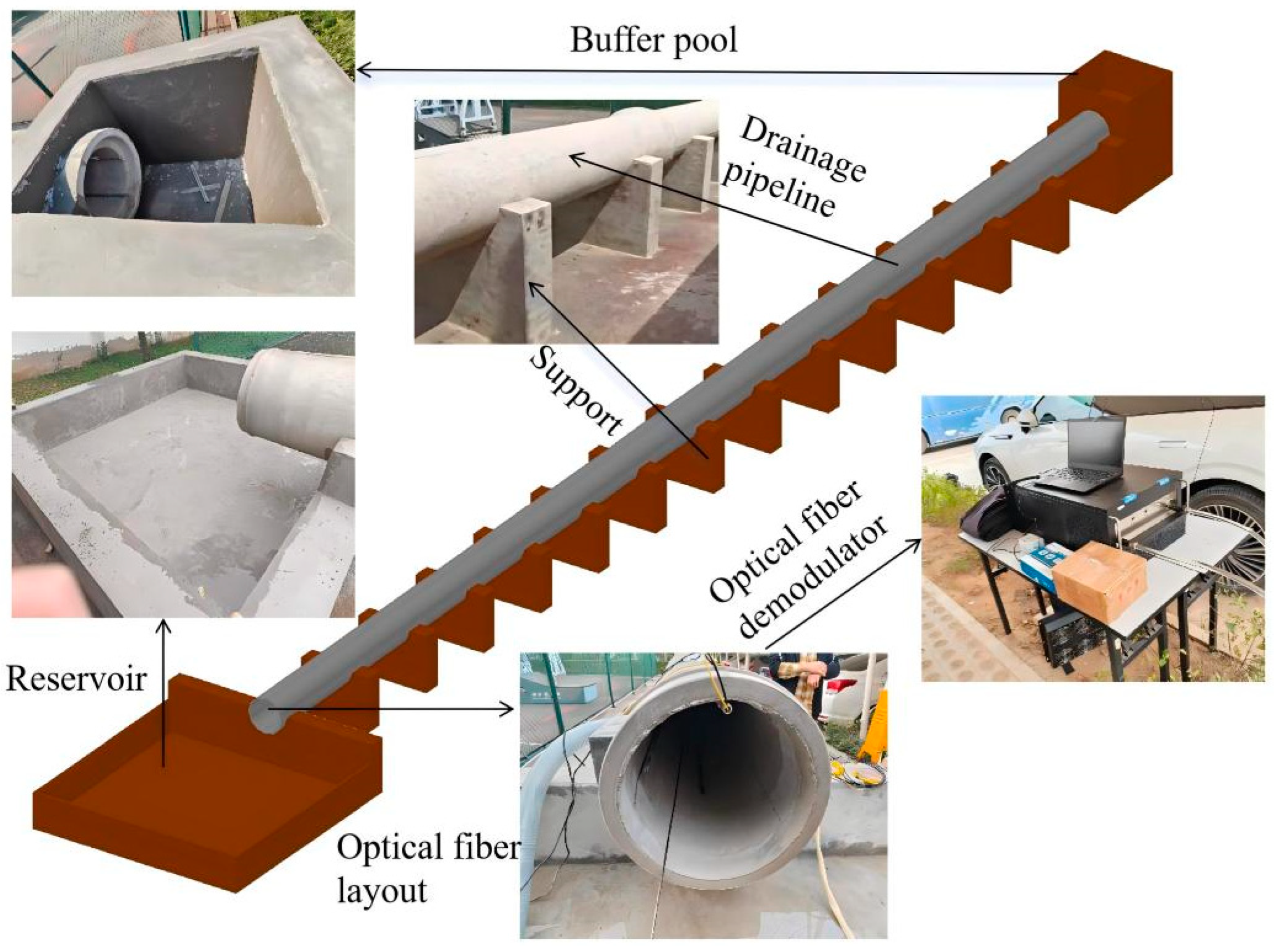
The experimental setup comprised a water circulation system, a concrete pipeline section, and the DAS acquisition system. Key components included a reservoir tank, a buffer tank, water pumps, circulation hoses, a drainage pipeline, a computer, optical fibers, and a fiber-optic acoustic demodulator. The test pipeline section had a total length of 18 m, formed by connecting six segments of 3.0 m long, 500 mm diameter concrete pipes. The upstream end of the model connected to the buffer tank, and the downstream end to the reservoir tank. The pipeline was supported by brick piers, with a constant slope of 0.3% from inlet to outlet. Two submersible pumps in the reservoir circulated water to the buffer tank via delivery hoses. After stabilization in the buffer tank, water entered the pipeline inlet, flowed through the test section, and returned to the reservoir, forming a closed loop. The parameters of the main model components and equipment are listed in Table 1, and a schematic of the setup is shown in Figure 1.
The HIF-DAS V2 distributed acoustic sensing system was used, paired with a single-mode G.657A optical fiber. The sensing fiber was axially bonded along the top centerline on the interior wall of the pipeline. The system’s spatial sampling interval was set to 0.2 m, and the temporal sampling frequency was 4 kHz. Data for each test condition were recorded for 30 min in differential signal mode. Prior to acoustic data collection, the fiber channel numbering was calibrated by tapping the pipe at known locations (inlet, outlet, midpoint). The final effective sensing range corresponded to channels 28 (outlet) through 118 (inlet), with channel 73 located at the physical midpoint of the pipeline. The specific channel-distance relationship is summarized in Table 2.

2.3. Test Conditions and Data Analysis

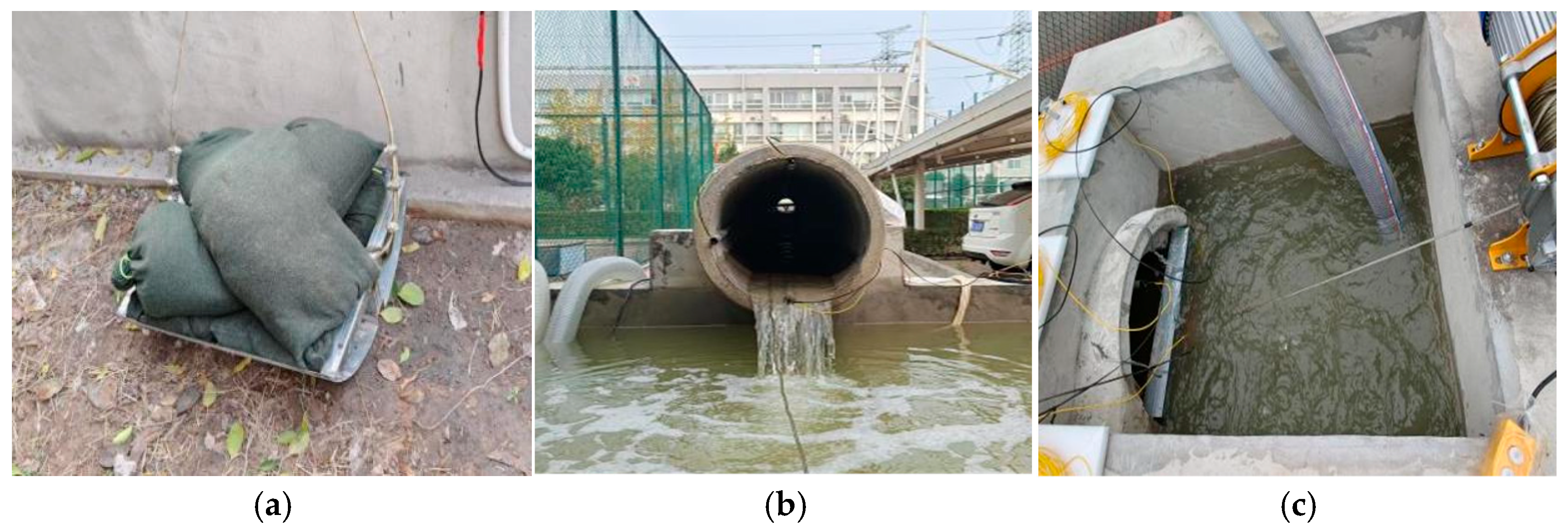
Experiments were conducted under a constant flow rate of 100 m3/h (achieved by operating both pumps). Six blockage conditions were simulated, with blockage ratios (defined as the cross-sectional area of the obstruction divided by the pipe’s internal cross-sectional area) of 12.5%, 25%, 37.5%, 50%, 62.5%, and 75%. Blockages were created by placing semi-circular steel trays of varying heights at the midpoint (channel 73 region) of the pipeline. The test site for the 50% blockage condition is shown in Figure 2.
A single-mode G.657A optical fiber was deployed along the top interior of the pipe to collect acoustic data. The data for each test condition comprised multiple records, with each individual record having a duration of 10 s. The total sampling time accumulated for one test condition was 30 min. The data type was differential signal. The system comprised 118 spatial sampling channels with a spatial sampling interval of 0.2 m. Each channel contained 40,000 data points, corresponding to a sampling rate of 4000 Hz per channel. During the experiment, tests were conducted sequentially for each blockage ratio. Under each blockage condition, after allowing the flow to stabilize for 10 min, data acquisition commenced to ensure uniform and steady flow conditions. The acoustic signals were processed by the HIF-DAS V2 (PUNIU TECH, Shanghai, China) demodulator and stored on a local server. A joint time–frequency analysis approach was adopted: time-domain analysis was used to quantify the relationship between vibration intensity and time, while frequency-domain analysis employed the Fast Fourier Transform (FFT) to extract dominant frequency components and energy distribution. Visualization of signal characteristics was achieved by plotting time-domain waveforms, frequency spectra, and waterfall diagrams using the Python 3.12 platform.

3. Signal Characteristics for Blockage Identification

To distinguish the signal features between blocked and unobstructed pipeline sections, the 50% blockage condition was analyzed as a representative case, comparing the channel at the blockage location with channels at unobstructed locations.

3.1. Time-Domain Characteristics

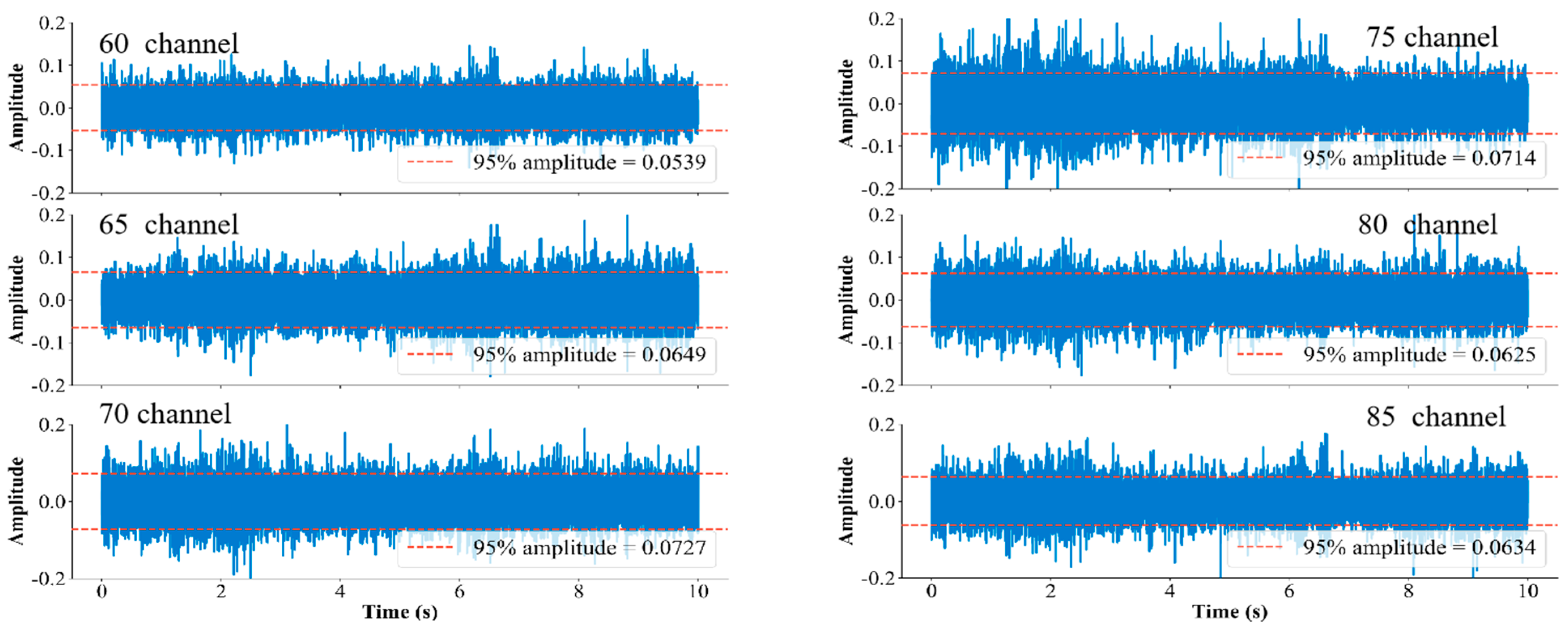
Based on extensive statistical analysis across various blockage ratios, it was found that the time-domain amplitude at the blocked channel remains higher than that at unblocked channels, even under different blockage conditions. Here, only the 50% blockage condition is selected as a representative case to illustrate this common time-domain characteristic. For the analysis, channels at the blockage location (channel 70) and its vicinity within the range of channels 60 to 80 were selected. The time-domain amplitude variation was examined using data from representative individual 10 s records at an interval of five channels. To mitigate the influence of non-persistent disturbances, such as transient extreme noise, and to highlight the core characteristics of the actual vibration, the 95th percentile amplitude value of an individual record was calculated and defined as the “Characteristic Amplitude.” The time-domain waveforms for channels 60, 65, 70, 75, and 80 are plotted in Figure 3 accordingly.
Figure 3 reveals a pronounced amplification of the acoustic/vibration amplitude at the blockage. The Characteristic Amplitudes for channels 70 and 75 (within the blockage zone) are 0.0727 and 0.0714, respectively. In contrast, values for upstream channels 80 and 85 are 0.0625 and 0.0634, and for downstream channels 65 and 60 are 0.0539 and 0.0649. This represents an increase of approximately 28.6% relative to the upstream channel 85 and about 50% relative to the downstream channel 60. This amplitude peak is attributed to the most severe fluctuations in fluid velocity and pressure occurring at the throat of the constriction, with vibrational energy dissipating progressively along the flow direction downstream of the blockage.

3.2. Frequency-Domain Characteristics

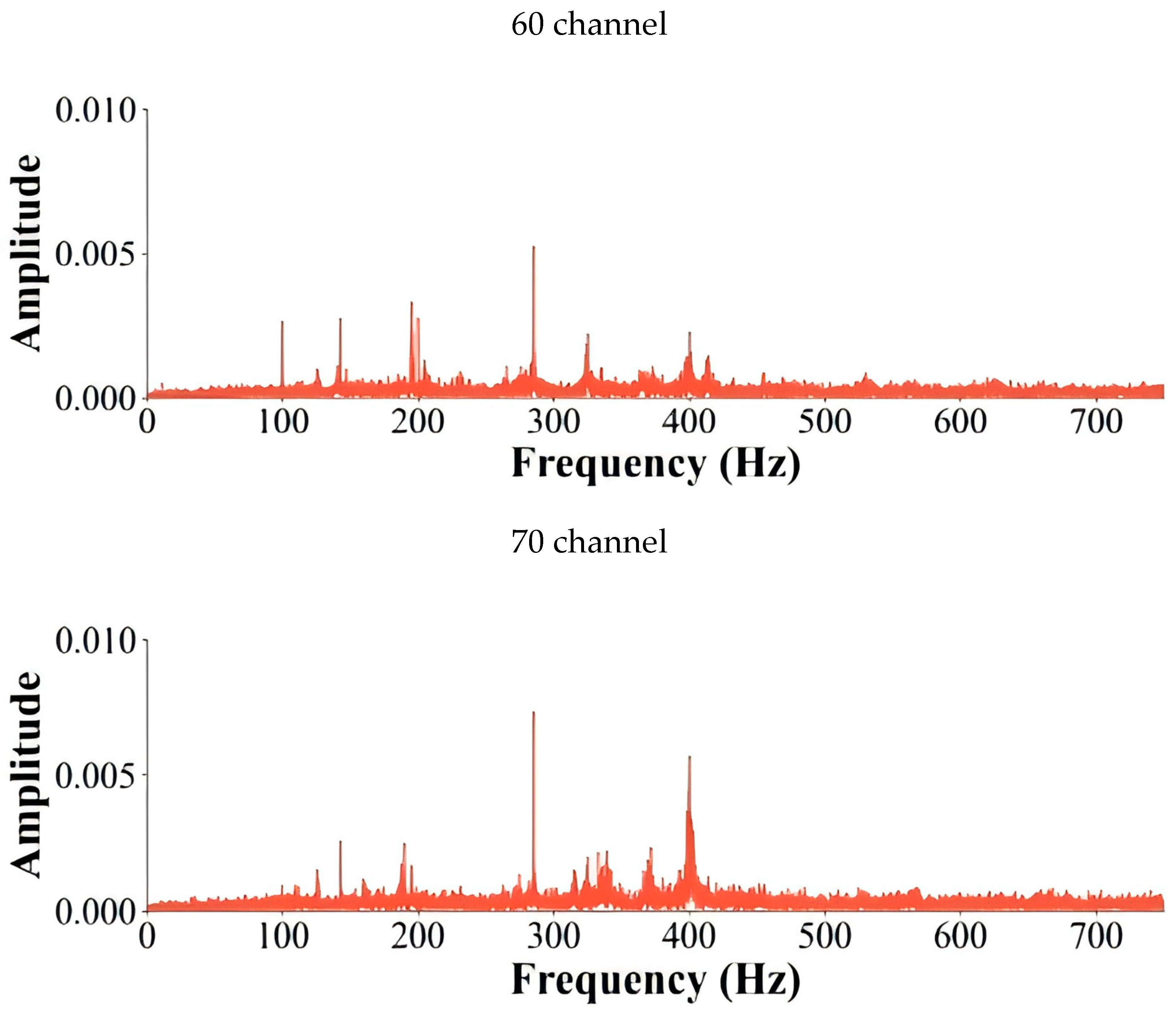
FFT was applied to the time-domain signals to obtain the frequency spectra. Figure 4 compares the spectra for the blocked channel (70) and a non-blocked channel (60), focusing on the 0–750 Hz range where dominant features were observed.
The spectra for both channels share common dominant frequency bands below 400 Hz, primarily around 100–200 Hz, 280–290 Hz, and 395–405 Hz. However, the blocked channel exhibits markedly higher spectral amplitudes in the 280–290 Hz and, more distinctly, the 395–405 Hz bands. For instance, the amplitude near 400 Hz increases from ~0.002 (channel 60) to ~0.006 (channel 70).
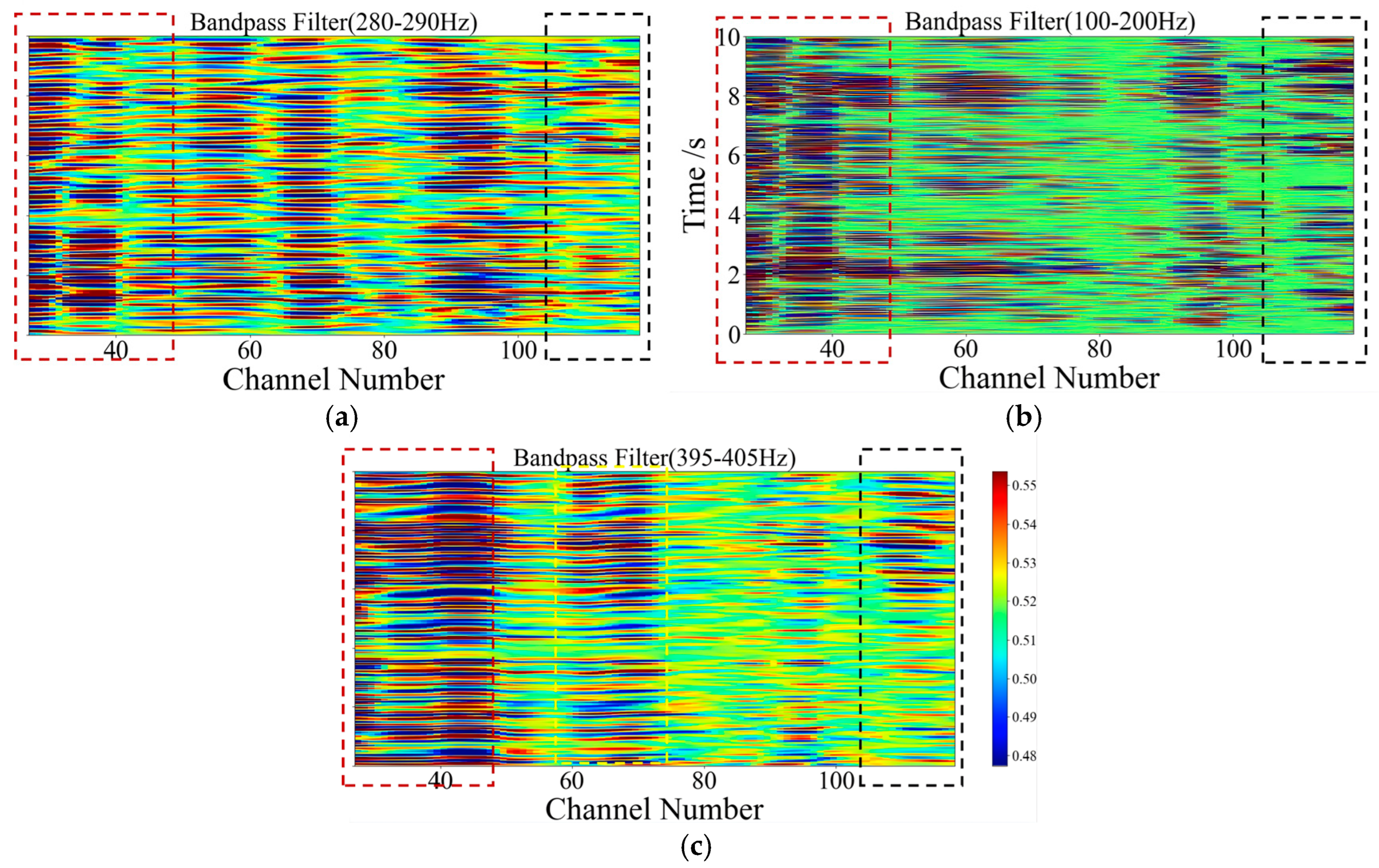
To investigate the spatial distribution of energy in these key bands, waterfall plots depicting signal intensity across all channels over time were generated for the three frequency bands (Figure 5).
Figure 5 leads to the following observations:
(1)
The inlet (channels 106–118) and outlet (channels 28–50) regions exhibit persistent or intermittent high-intensity signals across all bands due to flow entry and exit effects.
(2)
In the 100–200 Hz and 280–290 Hz bands, high-intensity signals are not unique to the blockage region; they also appear in other unobstructed sections (e.g., channels 50–60, 90–100), making these bands unreliable for blockage localization.
(3)
The 395–405 Hz band served as the core frequency band for the blockage region under the 50% blockage condition. Within this band, only the blockage region (channels 70–75) exhibited strong, temporally continuous high-amplitude signals, showing a distinct energy difference compared to unobstructed regions. This clear contrast in acoustic intensity allows for reliable discrimination between blocked and unblocked channel areas.

4. Signal Characteristics for Blockage Severity Assessment

To investigate the relationship between signal features and blockage severity, the signals from the blockage location channel (70) were analyzed across all six blockage ratios.

4.1. Time-Domain Characteristics

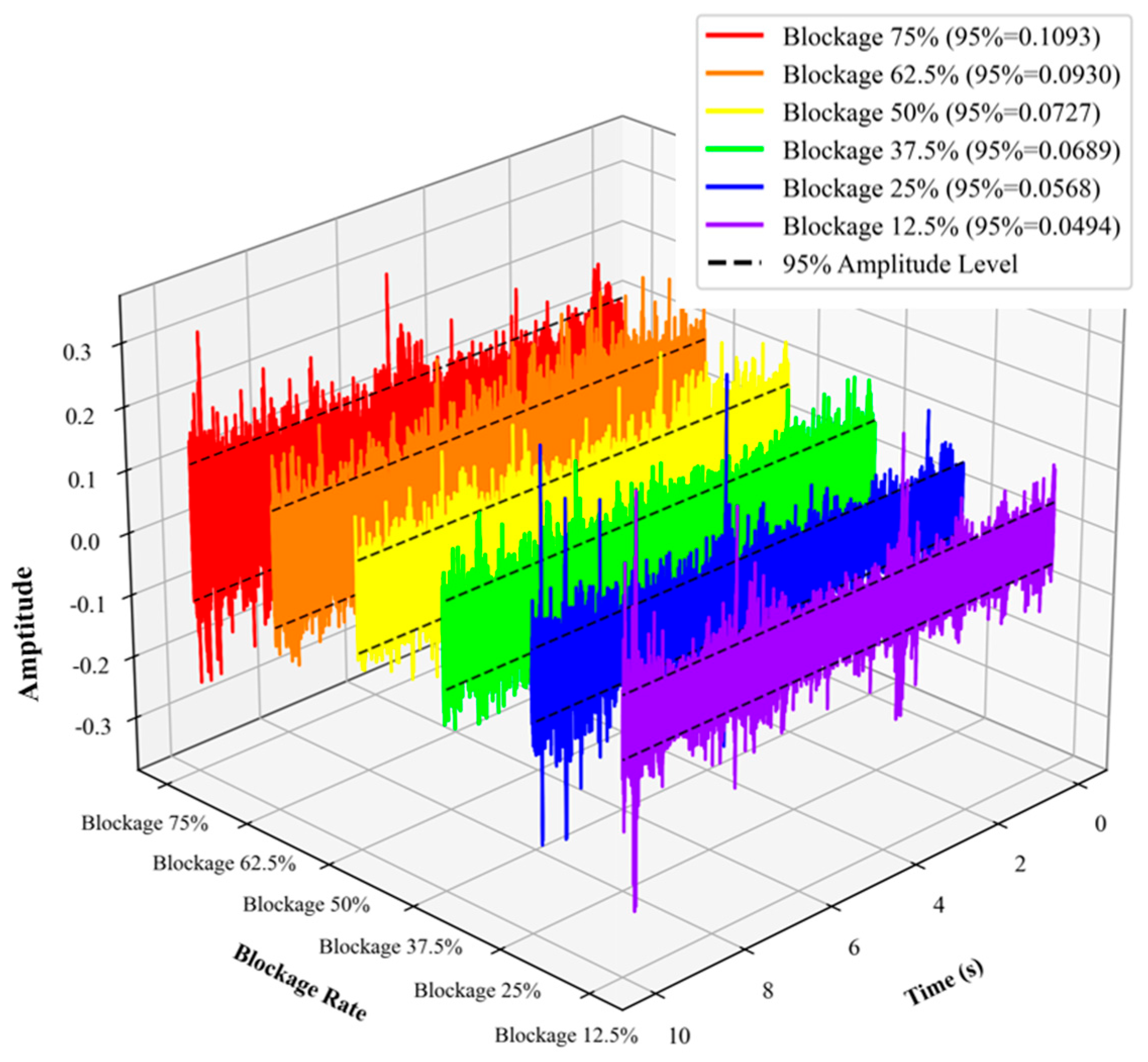
Figure 6 presents a 3D visualization of the time-domain waveforms for channel 70 under different blockage ratios, clearly showing the growth in amplitude.
As shown in Figure 6, the amplitude at the blocked channel exhibits a three-stage stepwise increase with increasing blockage ratio. The Characteristic Amplitude ranges from 0.0494 to 0.0568 for blockage ratios of 12.5% to 25%, from 0.0698 to 0.0727 for 37.5% to 50%, and from 0.0930 to 0.1093 for 62.5% to 75%. The underlying mechanism is analyzed as follows: at low blockage ratios, water flow can pass relatively smoothly around the obstruction, primarily exhibiting weak turbulence or near-laminar flow. The friction and impact between the water and the pipe wall are minimal, resulting in low vibrational energy. In contrast, at high blockage ratios, the obstruction occupies a significant portion of the pipe’s cross-section, leading to a sharp reduction in the effective flow area. Flow disturbances, such as turbulent impact and vortex shedding, transmit vibration through the pipe wall. The greater the vibrational energy transferred to the pipeline per unit time, the larger the amplitude of the time-domain signal.

4.2. Frequency-Domain Characteristics

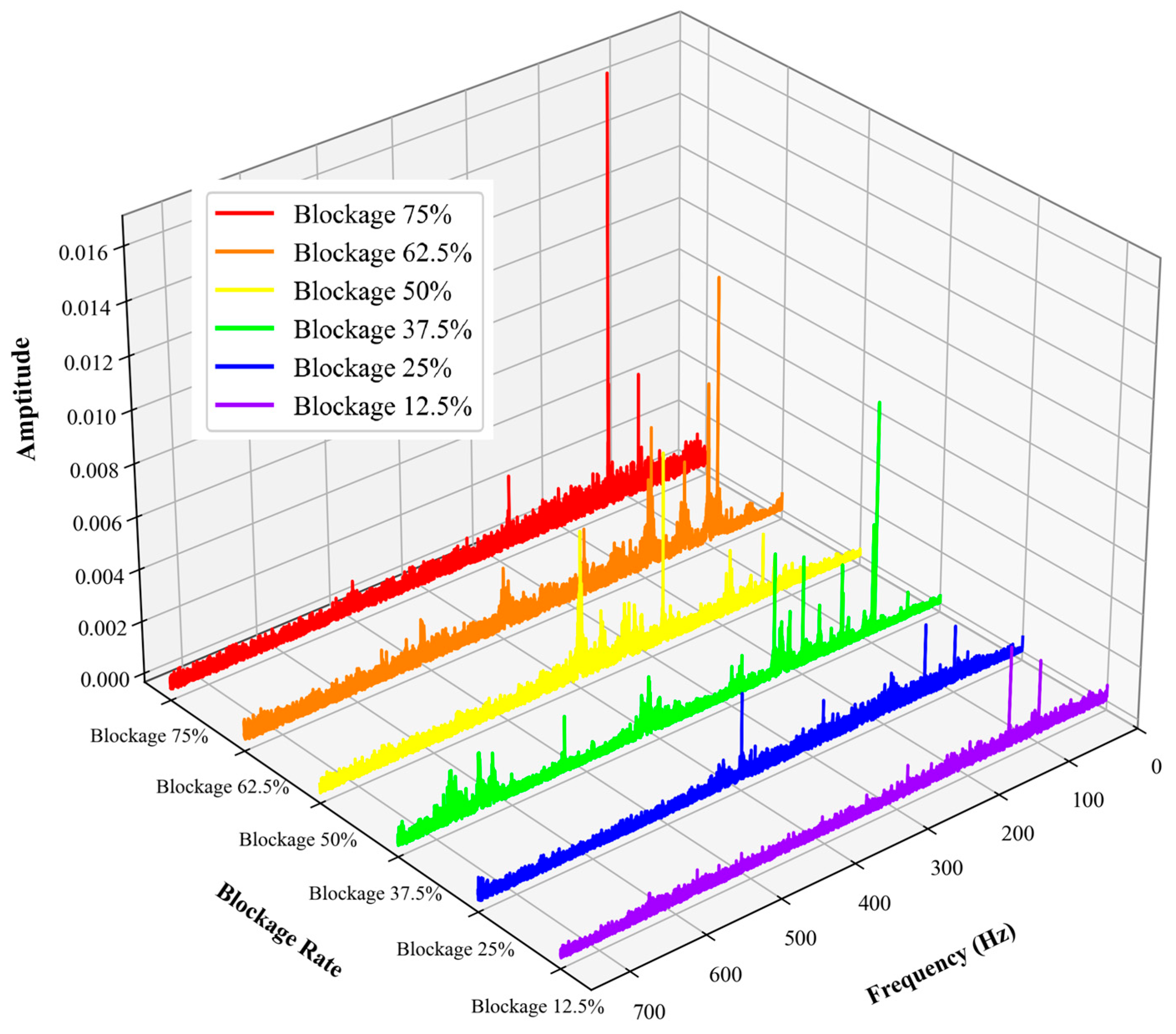
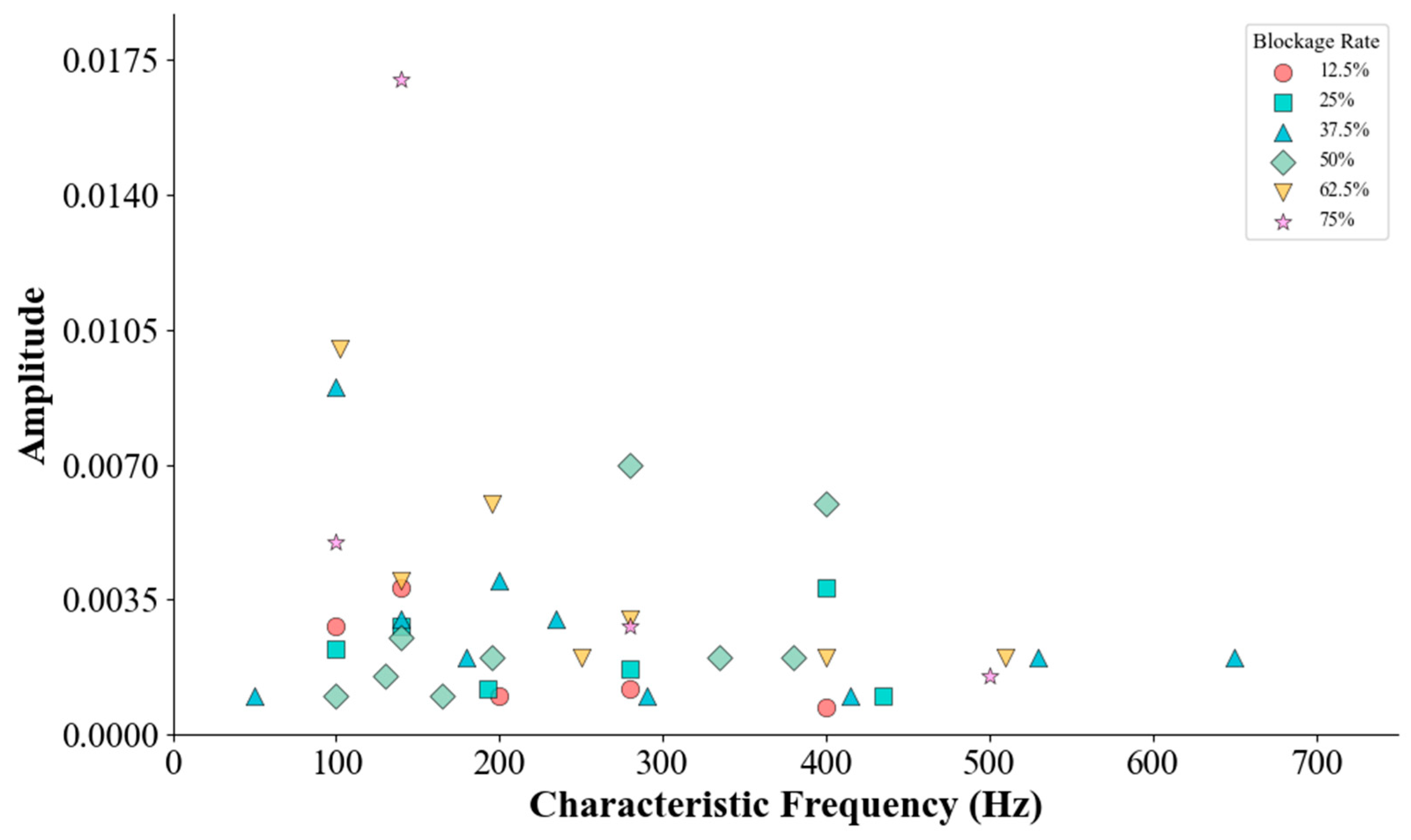
The frequency spectra for the blockage location across different blockage ratios are compiled in Figure 7 (3D view) and Figure 8 (scatter plot of dominant frequencies).
Figure 7 and Figure 8 show that across blockage ratios from 12.5% to 75%, multiple dominant frequency components lie within the 100–400 Hz range. At higher blockage ratios of 62.5% and 75%, these components shift towards higher frequencies, with new components emerging near 500 Hz and 580 Hz. Frequencies of 100 Hz, 140 Hz, 200 Hz, 280 Hz, and 400 Hz are common to all tested ratios. This shift towards a broader frequency range, compared with the concentrated low-frequency (0–50 Hz) signature typically observed under noise-free conditions, is attributed to the following flow mechanisms: at low blockage ratios, the flow remains predominantly steady, passing smoothly around the obstruction. In contrast, at high blockage ratios, the “bottleneck effect” induces intensified turbulence and vortex shedding, which excites a wider spectrum of frequencies. Consequently, the dominant frequency signature evolves from a concentrated set to a more dispersed one, extending from lower to higher frequencies.

5. Conclusions

Based on experiments conducted using a full-scale physical model test platform for drainage pipelines at a flow rate of 100 m3/h, it was found that water flow passing a blockage inside the pipe causes a marked increase in acoustic wave amplitude. This manifests as higher acoustic amplitude in the blockage region compared to the non-blockaged regions on either side. This phenomenon is particularly pronounced within specific dominant frequency bands (core frequency bands). For instance, during the 50% blockage rate test, the core band was 395–405 Hz. Furthermore, it was observed that as the pipeline blockage rate increases, the amplitude at the blocked channel continually increases, and the dominant frequencies extend from low to high frequencies. Considering the instability of dominant frequencies, it is recommended that in practical applications, time-domain characteristics should be primarily used to identify the signal features corresponding to different blockage rates. This approach helps avoid the risk of misjudgment caused by complex fluctuations in frequency-domain characteristics, thereby improving identification accuracy and engineering applicability.

Author Contributions

Conceptualization, F.W., S.L. and N.Z.; methodology, F.W., S.L., H.S. and N.Z.; software, S.L., N.Z. and W.X.; formal analysis and investigation, F.W., S.L., W.X., N.Z., X.Z. and H.S.; writing—original draft preparation, F.W., S.L., N.Z., X.Z. and W.X.; writing—review and editing, F.W., S.L., H.S., X.Z. and Y.Y.; funding acquisition, N.Z. and F.W.; and resources, F.W., H.S. and Y.Y. All authors have read and agreed to the published version of the manuscript.

Funding

This research was supported in part by the Basic Research Fund of Central Research Institute (No. 2024-9006), in part by the Central Government Guides Local Science and Technology Development Fund Project (No. YDZJSX20231A021), and in part by the Open Fund of Engineering Research Center for Tunnel and Underground Engineering, Ministry of Education (Beijing Jiaotong University) (No. TUC2024-03).

Institutional Review Board Statement

Not applicable.

Informed Consent Statement

Not applicable.

Data Availability Statement

The data presented in this study are available upon request from the corresponding author. The data are not publicly available due to privacy.

Acknowledgments

The authors are grateful for the comments provided by the anonymous reviewers.

Conflicts of Interest

Author Fei Wan was employed by the company Research Institute of Highway Ministry of Transport. The remaining authors declare that the research was conducted in the absence of any commercial or financial relationships that could be construed as a potential conflict of interest.

References

  1. Li, H.S.; Yu, S.F.; Zhou, K.; Liu, X.B.; Zhang, Y.L. Blockage Inspection Technology and Its Adaptability for Drainage System in Highway Tunnels. Guangdong Highw. Commun. 2024, 50, 72–77. [Google Scholar]
  2. Jiang, Y.J.; Du, K.; Chen, X.; Xiao, R.H. Preliminary Study on Inspection and Assessment Technologies for Tunnel Drainage Systems. Tunn. Rail Transit 2019, S1, 5–9. [Google Scholar]
  3. Wang, Z.L. Influencing Factors of Crystalline Blockage in Highway Tunnel Drainage Pipes and Prevention Countermeasures. Master’s Thesis, Xi’an University of Architecture and Technology, Xi’an, China, 2023. [Google Scholar]
  4. Zhang, X.H.; Zhong, W.J.; Wang, H.; Song, H.X.; Liu, X.B. Study on Treatment of Crystallization Blockage in Drainage Systems of Highway Tunnel. Guangdong Highw. Commun. 2023, 49, 61–66. [Google Scholar]
  5. Li, N.Q.; Jiang, Y.J.; Liu, S.G.; Zeng, C.Y.; Xiao, R.H. Cleaning Technology of Central Drainage Pipe of Operating Highway Tunnel Based on High Pressure Cleaning Technology. Tunn. Constr. 2021, 41, 647–654. [Google Scholar]
  6. Research Institute of Highway, Ministry of Transport. JTG H12-2015; Technical Code of Maintenance for Highway Tunnel. People’s Communications Press: Beijing, China, 2015.
  7. Cheng, C.J.; Wang, M. Automated detection of sewer pipe defects in closed-circuit television images using deep learning techniques. Autom. Constr. 2018, 95, 155–171. [Google Scholar] [CrossRef]
  8. Zhu, X.F.; Feng, Z.; Huang, G.Y.; Li, Y. A clustering method for underground drainage pipeline blockage identification based on acoustic features. J. Yunnan Univ. (Nat. Sci. Ed.) 2018, 40, 665–675. [Google Scholar]
  9. Lu, H.; Zhu, Z.; Xing, L.W. Residual stress measurement of high-grade steel pipeline via ultrasonic method and verification by small hole method. Oil Gas Storage Transp. 2021, 40, 533–538. [Google Scholar]
  10. He, X.; Zhang, M.; Gu, L.; Xie, S.; Liu, F.; Lu, H. Performance Improvement of Dual-Pulse Heterodyne Distributed Acoustic Sensor for Sound Detection. Sensors 2020, 20, 999. [Google Scholar] [CrossRef]
  11. Wang, P.; Liu, W.; Yao, G.F.; Pang, Y.D.; Wu, J.; Xu, D.; Wu, S.; Huang, J.B.; Xu, C.R. Equivalent Self-Noise Suppression of DAS System Integrated with Multi-Core Fiber Based on Phase Matching Scheme. Appl. Sci. 2025, 15, 9806. [Google Scholar] [CrossRef]
  12. He, X.G.; Cao, Z.; Zhang, M.; Lu, H.L. Binary-Tree Structure for Extended Range-Distributed Acoustic Sensing. Appl. Sci. 2025, 15, 11748. [Google Scholar] [CrossRef]
  13. Juarez, J.C.; Taylor, H.F. Field Test of a Distributed Fiber-Optic Intrusion Sensor System for Long Perimeters. Appl. Opt. 2007, 46, 1968–1971. [Google Scholar] [CrossRef]
  14. Ellmauthaler, A.; LeBlanc, M.; Bush, J.; Willis, M.E.; Maida, J.L.; Wilson, G.A. Real-Time DAS VSP Acquisition and Processing on Single- and Multi-Mode Fibers. IEEE Sens. J. 2021, 21, 14847–14852. [Google Scholar] [CrossRef]
  15. Merlo, S.; Malcovati, P.; Norgia, M.; Pesatori, A.; Svelto, C.; Pniov, A.; Zhimov, A.; Nesterov, E.; Karassik, V. Runways Ground Monitoring System by Phase-Sensitive Optical-Fiber OTDR. In Proceedings of the 2017 IEEE International Symposium on Inertial Sensors and Systems (INERTIAL), Kauai, HI, USA, 27–30 March 2017; pp. 523–529. [Google Scholar]
  16. Wang, C.; Liu, Q.W.; Chen, D.; Li, H.; Liang, W.B.; He, Z.Y. Monitoring Pipeline Leakage Using Fiber-Optic Distributed Acoustic Sensor. Acta Optica Sinica 2019, 39, 119–125. [Google Scholar] [CrossRef]
  17. Zhang, X.; Zhang, Y.X.; Wang, L. Current Status and Future of Research and Applications for Distributed Fiber Optic Sensing Technology. Acta Optica Sinica 2024, 44, 11–73. [Google Scholar]
  18. Zhao, N.Z.; Guo, G.C. Study on optical fiber sensor for detection and positioning of oil pipeline ice-blocking. Transducer Microsyst. Technol. 2010, 29, 30–32. [Google Scholar]
  19. Li, T.D.; Fan, C.Z.; Li, H. Nonintrusive Distributed Flow Rate Sensing System Based on Flow-Induced Vibrations Detection. IEEE Trans. Instrum. Meas. 2021, 70, 1–8. [Google Scholar] [CrossRef]
  20. Fu, S.C.; Zhang, D.; Luo, Q. Leakage Identification and Localization Method for Gas Pipeline Based on Distributed Acoustic Sensing. Laser Optoelectron. Prog. 2025, 62, 111–117. [Google Scholar]
  21. Xian, F. Application of Pipeline Leakage Detection Based on Distributed Fiber Optic Acoustic Sensing Technology. Water Purif. Technol. 2024, 43, 154–159. [Google Scholar]
  22. Wang, S. Research on Pipeline Leakage Monitoring Technology Based on Distributed Acoustic Sensing Fiber. Master’s Thesis, Dalian University of Technology, Dalian, China, 2024. [Google Scholar]
  23. Zhu, L.; Zhang, D.D.; Liu, C.Y. Research on the Influencing Factors of Blockage Identification in Filling Pipeline based on DAS Sensing. Study Opt. Commun. 2024, in press. [Google Scholar]
  24. Wu, Y.Y.; Yang, Y.W.; Liu, C.Y. Experimental Study on Plugging Identification of Filling Pipeline based on FBG Monitoring. Study Opt. Commun. 2025, in press. [Google Scholar]
  25. Li, T.D. Research on Monitoring Technology of Pipeline Flow Rate and Leakage Based on Optical Fiber Distributed Acoustic Sensor. Master’s Thesis, Huazhong University of Science & Technology, Wuhan, China, 2021. [Google Scholar]
  26. Ashry, I.; Mao, Y.; Wang, B.W.; Hveding, F.; Bukhamsin, A.Y.; Ng, T.K.; Ooi, B.S. A Review of Distributed Fiber-optic Sensing in the Oil and Gas Industry. J. Light. Technol. 2021, 40, 1407–1431. [Google Scholar] [CrossRef]
  27. Nemes, A.; Zhao, J.; Jacono, D.L. The interaction between flow-induced vibration mechanisms of a square cylinder with varying angles of attack. J. Fluid Mech. 2012, 710, 102–130. [Google Scholar] [CrossRef]
Figure 1. Schematic diagram of the full-scale drainage pipeline test platform with DAS system layout.
Applsci 16 00491 g001
Figure 2. Photographs of the test setup for the 50% blockage condition: (a) Obstruction tray placed inside the pipe; (b) Outlet view; (c) Inlet view.
Applsci 16 00491 g002
Figure 3. Time−domain waveforms for selected channels under the 50% blockage condition. The dashed horizontal line indicates the Characteristic Amplitude (95th percentile) for each channel.
Applsci 16 00491 g003
Figure 4. Frequency spectra for a non-blocked channel (60) and the blocked channel (70) under the 50% blockage condition.
Applsci 16 00491 g004
Figure 5. Waterfall plots showing the spatial (channel) and temporal distribution of signal intensity within three filtered frequency bands: (a) 100–200 Hz, (b) 280–290 Hz, (c) 395–405 Hz. The yellow dashed rectangle marks the blockage region (channels 70–75), the red rectangle marks the outlet region, and the black rectangle marks the inlet region.
Applsci 16 00491 g005
Figure 6. Three−dimensional representation of time-domain waveforms at the blockage location (channel 70) for different blockage ratios, illustrating the stepwise increase in amplitude.
Applsci 16 00491 g006
Figure 7. Three-dimensional frequency spectra at the blockage location (channel 70) for different blockage ratios.
Applsci 16 00491 g007
Figure 8. Scatter plot of the dominant frequency components identified at the blockage location for each blockage ratio.
Applsci 16 00491 g008
Table 1. Parameters of the experimental model and key equipment.
ComponentModel/MaterialKey ParametersQuantity/LengthRemarks
Drainage PipelineConcrete, DN500Diameter: 0.5 m6 × 3 mAssembled from six 3 m segments
Reservoir TankBrick construction3.5 m × 3.5 m × 1 m1Water source for circulation
Buffer TankBrick construction1 m × 1 m × 1 m1Stabilizes inflow to pipeline
Circulation PipesPVC Reinforced HoseDiameter: 10 cm2 × 20 mConnects pumps and tanks
Water PumpQDX50-7-1.5Flow rate: 50 m3/h1Provides circulating flow
Support PiersBrick construction0.5 m × 0.2 m × 0.5 mSeveralSupports the pipeline
Obstruction TraySteelDiameter: 0.5 m1Semi-circular, matches pipe ID
DAS InterrogatorHIF-DAS V21Acquires and demodulates fiber signal
Sensing FiberG.657A Butterfly-shaped skin-line optical fiber7 mm20 mDeployed along the interior top of the pipeline
Table 2. Channel Number Acquisition Table.
Pipeline SectionOptical Fiber Start (Outlet)Midpoint (Pipeline Center)Optical Fiber End (Inlet)Channel Acquisition Range
Upper Pipe28 (18 m)73 (9 m)118 (0 m)28~118
(0–18 m)
Applsci 16 00491 i001(the direction of laser propagation)
Disclaimer/Publisher’s Note: The statements, opinions and data contained in all publications are solely those of the individual author(s) and contributor(s) and not of MDPI and/or the editor(s). MDPI and/or the editor(s) disclaim responsibility for any injury to people or property resulting from any ideas, methods, instructions or products referred to in the content.