Article

External Load in High-Level Tennis Training: Influence of Game-Specific Drills in Junior and Professional Players Across Playing Situations


by
Francisco José Penalva-Salmerón
1,*,
Miguel Crespo
2,
Rafael Martínez-Gallego
3,
Jesús Ramón-Llin
3 and
José Francisco Guzmán
3
1
Academia de Tenis Juan Carlos Ferrero, 03400 Villena, Spain
2
Development Department, International Tennis Federation Bank Lane, Roehampton, London SW15 5XZ, UK
3
Research Group on Sports Technique and Tactics, University of Valencia, 46010 Valencia, Spain
*
Author to whom correspondence should be addressed.
Appl. Sci. 2026, 16(1), 492; https://doi.org/10.3390/app16010492
Submission received: 21 October 2025 / Revised: 13 December 2025 / Accepted: 29 December 2025 / Published: 4 January 2026
(This article belongs to the Special Issue Technologies in Sports and Physical Activity)

Abstract

This study explored the influence of game-specific on-court drills on external load in junior and professional male tennis players. Using wearable inertial technology, a total of 345 drills performed during a training microcycle were analyzed. Drills were classified according to the usual tennis game situations (i.e., serve, return, baseline, net play, and all-court), and load was quantified through distance covered, explosive distance, accelerations, decelerations, and Player Load. Significant differences were found in load across playing situations, with baseline and all-court drills producing the highest demands, especially in distance and Player Load. Serve drills consistently showed the lowest external load, while acceleration and deceleration values remained stable. Age group comparisons revealed that juniors covered more distance and experienced higher overall load in return and baseline situations, while professionals showed greater acceleration and deceleration values. These findings highlight the relevance of adapting training load to the specific demands of the game situations, the developmental stage, and the skill level of players. Coaches and sports scientists can use these insights to better plan, monitor, and individualize training programs for injury prevention and performance optimization in high-performance tennis.

1. Introduction

Understanding workload in tennis training is crucial for optimizing player performance and ensuring effective adaptation to match conditions. Workload refers to the physical and mental demands placed on a player during training sessions. It encompasses various factors such as intensity, duration, and frequency of exercises, as well as the specific objectives of each drill [1].
The study of workload is essential for several reasons. Firstly, it allows coaches and sports scientists to accurately gauge the effort exerted by players, ensuring that training sessions are representative of real match conditions. This understanding helps in designing exercises that closely mimic the demands of competitive play, thereby facilitating appropriate physiological and psychological adaptations [2]. Moreover, analyzing workload provides valuable insights into the effectiveness of different training methods. By comparing traditional isolated drills with integrated game-play situations, coaches can determine which approaches best enhance technical, tactical, physical, and mental skills. This knowledge is vital for developing training programs that not only improve performance but also prevent overtraining and reduce the risk of injuries [3].
For instance, the total distance covered during training sessions can indicate the endurance demands placed on the player, while metrics such as explosive distance (distance covered at high speeds or accelerations) reflect the need for explosive power and agility [4]. The number of accelerations and decelerations is a critical measure of a player’s ability to quickly change direction, which is essential in tennis, even more important than maximal sprint speed [5]. Metrics like Player Load, derived from a triaxial accelerometer, aim to provide a global quantification of the mechanical stress experienced by the player [6]. Understanding the cumulative stress placed on the body through these variables is vital for preventing overtraining and injuries [7].
Research has explored the influence of workload in tennis practice from a variety of perspectives. Several studies have analyzed match load in elite players, and high-performance female players even during the COVID period [8], while others have focused on the junior game [9,10,11]. These studies have employed diverse methodologies, from RPE sessions [12] to more sophisticated instruments such as inertial sensors and machine learning [13,14].
While existing literature was characterized internal and external loads for specific elite-level tennis drills [10] and compared perceptual and technical demands between training, simulated match-play, and tournaments [15], a comprehensive understanding of how different game-specific situations (e.g., serve, return, baseline, net play, all-court) influence a range of external load parameters, particularly using contemporary wearable technology, remains less defined. Furthermore, there is a paucity of research directly comparing these situational demands between distinct developmental stages, specifically junior and professional male players, within the same training environment and analytical framework. Such comparisons are critical, as training adaptations and injury risks may differ significantly based on age, experience, and physical maturation [5,16]. Understanding these nuances can help tailor training programs to be more specific to the demands of different game phases and to the developmental needs of the players. Furthermore, the transition from junior to professional tennis is gaining attention due to the significantly higher demands junior players face when competing against professionals [17].
Therefore, the primary objective of this study was to investigate the differences in external workload across various on-court game-specific drill situations in high-level male tennis players. A secondary objective was to compare these external load responses between junior and professional players within each game situation. In accordance with the study’s objectives, the following hypotheses were established:
  • It was hypothesized that baseline and all-court drills would produce the highest external loads compared to the other game-specific situations (serve, return, net play).
  • It was further hypothesized that distinct differences in load profiles would be observed between junior and professional players within each game situation, reflecting their developmental and skill-level disparities.

2. Materials and Methods

Twenty high-performance male tennis players from a top-level international academy were purposively sampled, comprising 12 professional (age: 20.83 ± 3.74 years; ATP ranking: 20-1745) and 8 junior players (age: 16.13 ± 1.25 years; ITF junior ranking: 297-2031). All were actively competing internationally (ATP/ITF tours) and injury-free during data collection. Data were collected from a total of 345 on-court drill instances (defined as a single player’s participation in one drill) performed during a pre-defined pre-season training microcycle.
Participation was voluntary. Informed consent (and assent for minors, with guardian consent) was obtained from all participants. The study adhered to the Declaration of Helsinki (2013) and was approved by the University of Valencia Ethics Committee (2023-FIS-3056077).

2.1. Schedule, Preparation and Delivery

On-court drills were analyzed from daily 2-h AM and 1-h PM sessions during a 7-day mid-preparatory microcycle. To ensure methodological rigor and control for potential confounding variables, this microcycle was identical for both the junior and professional groups. All training sessions occurred at the same academy within this same 7-day period, meaning all players were subject to the same environmental conditions.
Furthermore, all drills for all participants were conducted on the same court surface (hard courts), following standard warm-ups. The daily distribution of drill types (e.g., baseline, serve, net play) was not randomized; rather, it was systematically balanced according to the daily training objective of the microcycle. This objective, which represented a focused physical/technical/tactical development period, was the same for both the junior and professional cohorts on any given day, ensuring both groups were exposed to the same training stimuli.
Drills were coach-led (first author). To mitigate implementation bias, the coach provided structured explanations of physical/technical/tactical goals, ensuring consistency via predefined patterns, target areas, and feedback for all players. Players rested and followed usual routines (hydration, cool-down) post-drill. The work-to-rest ratio was designed to mimic match play, with 25 s of rest between repetitions (akin to points) and 90 s of rest between distinct drills (akin to changeovers).

2.2. Drill Classification and Measurements

Each drill performed during the training sessions of the one-week preparatory microcycle was classified using a tennis-specific technical and tactical content-based classification tool [18]. This methodology allowed the categorization of on-court tennis drills according to the primary game situation they aimed to replicate. The game situations used, adapted from this previous study, were:
Serve: Drills focusing primarily on the execution and immediate follow-up of the serve (e.g., serve and first shot, serve and volley practice from a fed ball).
Return: Drills emphasizing the return of serve and the subsequent development of the point from the returner’s perspective.
Baseline Play: Drills involving extended rallies predominantly from the baseline, including both offensive and defensive scenarios (e.g., cross-court rallies, down-the-line exchanges, pattern play).
Net Play: Drills focused on volleys, smashes, and tactical play at the net, often initiated by an approach shot or a fed ball to the net player.
All-court: Drills integrating multiple game situations within the same sequence, requiring transitions between baseline, mid-court, and net play, designed to simulate the dynamic nature of a full point.
The number of drills performed varied across these categories based on the daily training objectives set by the coaching staff during the microcycle. A total of 345 drill instances were analyzed across all players and categories.
The following external load variables, selected for their relevance in quantifying key physical demands in tennis (distance, explosive actions, changes in direction, and overall mechanical load) [4,6], were analyzed using data from the WIMU PRO™ system Realtrack Systems, Almeria, Spain:
Distance (m/min): Total distance covered by the player per minute. This variable reflects the overall volume of locomotor activity.
Explosive distance (m/min): Total distance covered with an acceleration above 1.12 m·s−2. This metric quantifies high-intensity running and efforts requiring rapid force production.
Accelerations (n/min): Number of accelerations per minute.
Decelerations (n/min): Number of decelerations per minute. Accelerations and decelerations represent the frequency of changes in speed and direction, crucial for court coverage and recovery.
Player Load (a.u./min): A metric calculated as:
P l a y e r   L o a d = ( a y i     a y i 1 ) 2 + ( a x i     a x i 1 ) 2 + ( a z i     a z i 1 ) 2 100
All variables were normalized per minute to account for differences in drill duration and ensure comparability across exercises.

2.3. Technology

Players were monitored using a validated WIMU PRO™ system (RealTrack Systems, Almería, Spain) [19], a multi-sensor EPTS (GPS, accelerometers, etc.). Players wore a tight-fit vest with the device in an interscapular compartment. An ANT+ button marked drill start/end for precise segmentation.
Data were processed via SPRO software (v1.0.0, Comp. 989). To ensure a fully auditable signal-processing pipeline, we confirm that all derived variables were computed using the manufacturer’s validated and proprietary algorithms. These algorithms were applied directly to the raw 100 Hz accelerometer data. Accelerations and decelerations were identified by these proprietary algorithms applying specific, internal thresholds.
Crucially, no additional data filtering, smoothing, or custom window lengths were applied by the research team beyond the manufacturer’s standard processing. The explosive distance threshold was 1.12 m·s−2, which is the manufacturer-defined default threshold within the SPRO software. This threshold has been previously used to quantify explosive actions in other professional racket sports [6]. Therefore, it was used to maintain methodological consistency and allow for comparison with emerging literature in this field.

2.4. Statistical Analysis

All statistical analyses were performed using RStudio (Version 2024.04.1+748), with significance set at p < 0.05. For the analysis of playing situations, data are presented as median and interquartile range (IQR) due to the non-normal distribution of some variables, which was assessed using the Shapiro–Wilk test. A Kruskal–Wallis test was conducted to compare external load variables across playing situations, followed by Dunn’s post hoc tests with Holm adjustment for multiple comparisons. Effect sizes were calculated using eta-squared (ε2), interpreted as small (0.01), medium (0.06), and large (0.14). The visualization of differences across playing situations was performed using the ‘ggstatsplot’ package [20]. For the comparison between junior and professional players, data are presented as mean and standard deviation (SD). The distribution of the variables was assessed using the Shapiro–Wilk test. Differences between groups were assessed using independent t-tests for normally distributed variables and Mann–Whitney U tests for non-normally distributed data. Effect sizes for t-tests were reported as Cohen’s d (d) (small: 0.2, medium: 0.5, large: 0.8), while for Mann–Whitney U tests, rank-biserial correlation (r) was used (small: 0.1, medium: 0.3, large: 0.5). All effect sizes are reported with their 95% Confidence Intervals (CIs).

3. Results

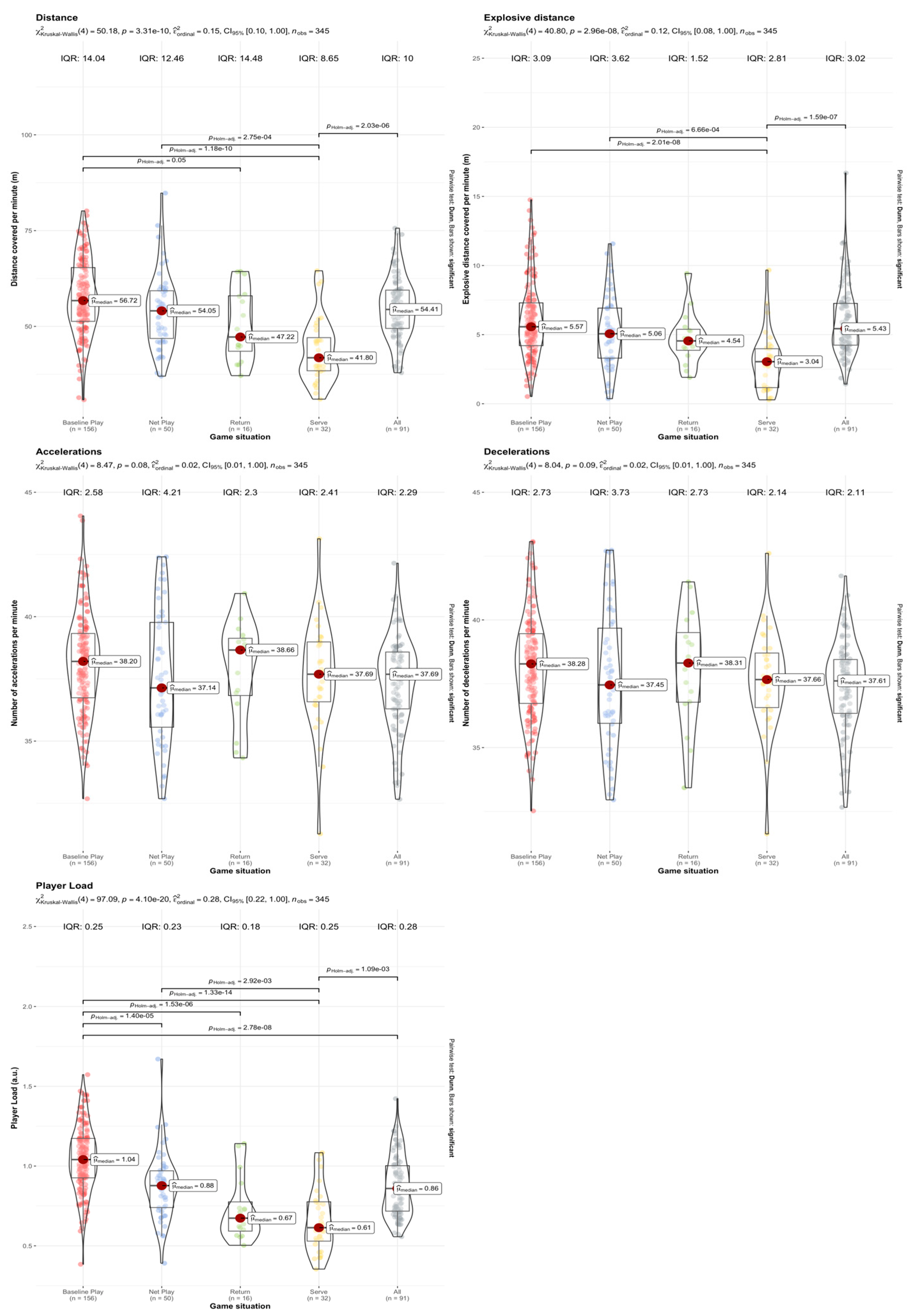
The results revealed significant differences in external load variables depending on the game situation practiced in the drills (Figure 1). Distance covered showed the highest values in baseline play (median = 56.72 m) and All (median = 54.41 m), followed by net play (median = 54.05 m). Lower values were observed in return (median = 47.22 m) and serve (median = 41.80 m), with return being significantly lower than baseline play. The Kruskal–Wallis test indicated a significant effect of the game situation (χ2(4) = 50.18, p < 0.01, ε2 = 0.15). Dunn’s post hoc tests showed that serve had significantly lower values than baseline play (p < 0.01), net play (p < 0.01), and all (p < 0.01). Additionally, return showed significantly lower values than baseline play (p = 0.05). Explosive distance followed a similar trend, with the highest values in baseline play (median = 5.57 m) and all (median = 5.43 m), followed by net play (median = 5.06 m), return (median = 4.54 m), and the lowest in serve (median = 3.04 m). A significant effect was observed (χ2(4) = 40.80, p < 0.01, ε2 = 0.12). Post hoc comparisons showed that serve had significantly lower values than baseline play (p < 0.01), net play (p < 0.01), and all (p < 0.01).
The number of accelerations did not show statistically significant differences across game situations (χ2(4) = 8.47, p = 0.08, ε2 = 0.02). However, baseline play (median = 38.20) and return (median = 38.66) showed slightly higher values compared to other situations. The number of decelerations followed a similar pattern, with no statistically significant differences (χ2(4) = 8.04, p = 0.09, ε2 = 0.02). However, baseline play (median = 38.28) and return (median = 38.31) showed a trend of having higher values than net play, serve, and all.
Player Load showed the most pronounced differences between game situations (χ2(4) = 97.09, p < 0.01, ε2 = 0.28). The highest values were found in baseline play (median = 1.04), followed by net play (median = 0.88) and All (median = 0.86), with significantly lower values in return (median = 0.67) and serve (median = 0.61). Post hoc Dunn’s tests revealed significant differences between serve and baseline play (p < 0.01), net play (p < 0.01), and All (p < 0.01). Additionally, return had significantly lower values than baseline play (p < 0.01), net play (p < 0.01), and all (p < 0.01). These results highlight that baseline play and All-situation training involve the highest physical demands, while serve exhibits the lowest external load across all analyzed variables. The lack of significant differences in acceleration and deceleration suggests that movement intensity is relatively stable across game situations, but distance covered, explosive distance, and Player Load vary considerably depending on the drill type.
The results revealed significant differences in external load variables between junior and professional players (Table 1). Distance covered was generally higher in junior players compared to professional players in return (junior: 55.94 m, professional: 45.87 m, p = 0.04, ES = 1.23) and baseline play (junior: 59.90 m, professional: 54.15 m, p < 0.01, d = 0.61). No significant differences were found in serve (p = 0.39), net play (p = 0.61), or all-situations training (p = 0.35). Explosive distance followed a similar trend, with juniors showing higher values than professionals in all conditions, but none of the differences were statistically significant. Acceleration counts were significantly higher in professionals compared to juniors in return (junior: 36.39, professional: 39.01, p < 0.01, d = 1.74). No significant differences were found in serve, baseline play, net play, or all-situations drills. Deceleration counts were significantly higher in professionals compared to juniors in return (junior: 36.66, professional: 39.16, p = 0.04, d = 1.28). No significant differences were found in other game situations. Player Load was significantly higher in juniors during baseline play (junior: 1.08, professional: 0.99, p = 0.01, r = 0.20) and all-situations training (junior: 0.90, professional: 0.82, p = 0.04, r = 0.22). No significant differences were found in serve, return, or net play (p > 0.05). These findings suggest that junior players tend to cover more distance and experience higher physical demands in baseline play and return situations, while professional players exhibit higher acceleration and deceleration counts in return. The absence of significant differences in explosive distance suggests similar high-intensity movement patterns between both groups, while the differences in Player Load indicate variations in overall physical demand.

4. Discussion

This study aimed to investigate the external load associated with different game-specific on-court drills in junior and professional tennis players, offering valuable insights for training prescription and load management. The primary findings indicate that baseline and all-court drills impose the highest external load, particularly concerning distance covered and Player Load, while serve-centric drills consistently elicit the lowest overall external load. Furthermore, distinct differences emerged between junior and professional players, with juniors covering more distance in return and baseline situations, and professionals exhibiting greater acceleration and deceleration capacities.
The observation that baseline and all-court drills generated the highest demands aligns with previous research highlighting that tennis players spend a significant proportion of match time engaged in baseline play [13]. These drills, likely encompassing a variety of open-pattern and recovery/defensive type exercises [10], necessitate extensive court coverage and frequent high-intensity actions. This is further corroborated by Perri et al. [21], who identified accuracy and recovery/defensive drills as producing the highest total Player Load. The high metabolic demand of such drills, characterized by significant fractional utilization of VO2max and considerable energy expenditure per meter due to constant changes in direction, has also been noted [22]. From a load management perspective, these findings are critical, as such high-load drills will significantly contribute to the acute training load. This suggests that coaches should carefully consider their inclusion and volume, particularly in the context of the acute chronic workload ratio (ACWR), to help mitigate injury risk associated with rapid spikes in load [16]. This is also supported by previous studies, which categorized junior training drills into themes like ‘accuracy’ and ‘pre-determined pattern drills’ [11]. Their findings, which noted that coaches often misinterpret the accumulating effect of drills over a session, reinforce the importance of our study’s objective quantification. Coaches may perceive a ‘serve drill’ as low load (which our data confirms), but they may underestimate the cumulative load of multiple ‘baseline drills’, highlighting the need for the external load data we provide.
Conversely, serve drills consistently demonstrated the lowest external load in this study. While this might suggest a lower overall physiological stress, it is crucial to recognize that the serve imposes unique and significant biomechanical stresses on the upper extremity and trunk, even if total body movement is less [23]. Therefore, while serve drills might contribute less to the overall acute external load, careful monitoring of serving volume and intensity remains paramount for injury prevention, especially for structures like the shoulder and lower back [23].
The relatively stable acceleration and deceleration values across different drill types, with only slight trends towards higher values in baseline and return situations, suggest a consistent requirement for rapid changes in direction inherent in most dynamic tennis play. This supports the notion that the ability to repeatedly accelerate and decelerate is more critical in tennis than achieving maximal sprint speed [5,21]. The high energy expenditure per meter observed in tennis drills by Björklund et al. [22] underscores the physiological cost of these frequent changes in direction.
A critical point of discussion is the comparison between training loads and actual tournament demands. While this study analyzed loads within a training microcycle, research by [15] and the systematic review by [24] consistently indicate that many common training drills and simulated match-play scenarios often fail to adequately replicate the perceptual (RPE, mental exertion), technical (stroke rate, serve use), and durational demands of tournament matches. This suggests that even the “high-load” drills identified in our study might still be less demanding than competitive match-play in certain aspects. This “training-competition gap” highlights the need for coaches to strategically incorporate sessions that truly challenge players to match or even exceed specific tournament intensities and durations, particularly in the lead-up to competitions [15,25]. The court surface also plays a role, with clay courts typically leading to longer rallies and higher physiological load compared to hard courts [24], a factor to consider as this study was conducted on hard courts.
This training-competition gap is a critical theme in junior development. Our study highlights that training drills may not replicate match demands, and preceding junior research confirms the complex nature of this relationship. Previous studies investigated physical changes in elite juniors during 4-week international tours and found that, despite high volumes of match load, athletes showed significant reductions in speed (5–20 m sprints) upon returning. Critically, the greatest declines in speed and aerobic capacity were seen in athletes who completed the highest total and tennis-specific training loads [11]. This suggests that high match volume alone, without sufficient and specific off-court conditioning, can lead to physical maladaptation. This strongly reinforces our practical recommendation that specific, high-intensity training sessions must be intentionally programmed to complement and not just replicate competition demands.
It is important to frame these junior-versus-professional comparisons as observational and to acknowledge that they are plausibly confounded by maturation and tactical/technical differences, not just physical capacity. The finding that junior players covered more total distance, particularly in return and baseline situations, compared to their professional counterparts, is consistent with literature suggesting that experience influences court positioning and anticipatory skills [26,27]. Professionals, likely due to better anticipation and tactical awareness, may achieve similar outcomes with greater movement efficiency.
Conversely, professional players exhibited significantly higher acceleration, and deceleration counts during return drills. This likely reflects their superior neuromuscular maturation, enhanced intermuscular coordination for rapid changes in direction, and more developed sport-specific strength and power [5]. Furthermore, the cognitive aspects of the game, such as advanced observation, perception, anticipation, and decision-making skills, are more refined in professionals, allowing them to react more explosively and efficiently [28].
Our findings of distinct load profiles between developmental stages are strongly supported by research investigating transitions within the junior-elite pathway itself. Previous studies analyzed U12, U15 and U18 squads and found that the transition from U15 to U18 involved significant increases in hitting demands, specifically higher total strokes and stroke rates (strokes/min) during training [29]. While these studies highlighted a change in hitting intensity, our study identified a difference in movement intensity (higher accelerations/decelerations) when comparing late-stage juniors to professionals. This suggests a continuous developmental progression, where hitting intensity ramps up in the late junior stages, followed by an increased capacity for explosive change-of-direction as players mature into the professional ranks.
These findings offer several practical applications for tennis coaches and sports scientists. Firstly, understanding the distinct load profiles of game-specific drills allows for more precise training design. High-load baseline and all-court drills may be useful for developing physical capacities, but their significant contribution to acute load highlights the need for careful management to mitigate injury risk. While serving drills exhibit lower overall external load, their specific biomechanical stresses demand diligent monitoring of volume and technique.
Secondly, this research highlights the importance of bridging the training-competition gap. Given that typical training may not fully replicate match demands, coaches should periodize training to include sessions that intentionally expose players to higher, match-like intensities and durations, simulating “worst-case” tournament scenarios.
Thirdly, for player development, the observed differences between junior and professional players underscore the need for individualized approaches. Juniors may benefit from a focus on movement efficiency and tactical understanding to complement physical development, while professionals should continue to enhance their explosive change-of-direction capabilities. Finally, these insights contribute to injury prevention by enabling better weekly load management through appropriate drill selection and volume control, particularly concerning serve loads and high-demand baseline play.
As a brief, practical paragraph translating these findings, coaches could use this data to inform weekly periodization. For example, a coach might design a microcycle that balances a ‘high-cost’ training day (e.g., high volume of ‘baseline’ and ‘all-court’ drills) with a subsequent ‘lower-cost’ technical day (e.g., focusing on ‘serve’ and ‘net play’ tasks). As this study suggests, such a structure may help manage cumulative acute load while still achieving technical goals, although this specific periodization strategy was not tested here and remains a hypothesis for application.
Nevertheless, this study’s findings, while informative, have several limitations that must be acknowledged. First, the data is based on a single-center setting (one academy) and a short microcycle, which may limit generalizability. Second, our statistical strategy did not employ mixed-effects models to account for the hierarchical data structure (i.e., drill instances nested within players). While our non-parametric approach was justified by the data’s non-normal distribution, this may have inflated the Type I error rate. We sought to mitigate this by focusing on effect sizes with 95% CIs, but this remains a methodological limitation, and these findings should be confirmed by future research using LMMs. Finally, this study was conducted only on hard courts, did not capture internal-load metrics (e.g., RPE), and did not track long-term health outcomes, all of which are important areas for future research.

5. Conclusions

This study confirms that different game-specific drills in tennis produce distinct external load profiles, with baseline and all-court drills being the most demanding and serve drills the least in terms of overall external load. Significant differences in load responses between junior and professional players underscore the importance of adapting training to developmental stage and skill level. These insights, when combined with an understanding of the demands of competitive match-play and principles of load management, can empower coaches and sports scientists to design more effective, specific, and safer training programs to optimize player development and performance in high-level tennis. Future research should continue to refine load monitoring techniques and explore longitudinal training load patterns to further enhance our understanding of the relationship between training, performance, and injury in tennis.

Author Contributions

Conceptualization, F.J.P.S., J.F.G. and M.C.; methodology, F.J.P.S. and R.M.-G.; software, R.M.-G.; validation, J.F.G.; formal analysis, J.F.G.; investigation, F.J.P.S.; resources, F.J.P.S.; data curation, J.F.G.; writing—original draft preparation, F.J.P.S.; writing—review and editing, F.J.P.S., M.C., R.M.-G. and J.R.-L.; supervision, M.C. and R.M.-G. All authors have read and agreed to the published version of the manuscript.

Funding

This research received no external funding.

Data Availability Statement

The data that support the findings of this study are available from the corresponding author upon reasonable request.

Acknowledgments

The authors would like to express their gratitude to the players who took part in the study and to the Juan Carlos Ferrero Tennis Academy for their assistance.

Conflicts of Interest

The authors declare no conflicts of interest.

References

  1. Kovacs, M.S. Tennis physiology: Training the competitive athlete. Sports Med. 2007, 37, 189–198. [Google Scholar] [CrossRef]
  2. Reid, M.; Crespo, M.; Lay, B.; Berry, J. Skill acquisition in tennis: Research and current practice. J. Sci. Med. Sport 2007, 10, 1–10. [Google Scholar] [CrossRef]
  3. Kovacs, M. The role of scheduling and periodization in competitive tennis players. In Tennis Medicine: A Complete Guide to Evaluation, Treatment, and Rehabilitation; Springer: Cham, Switzerland, 2019; pp. 679–686. [Google Scholar] [CrossRef]
  4. Ammann, L.; Chmura, P. Internal and external load during on-field training drills with an aim of improving the physical performance of players in professional soccer: A retrospective observational study. Front. Physiol. 2023, 14, 1212573. [Google Scholar] [CrossRef]
  5. Baiget, E.; Canós-Portalés, J.; Martínez-Gallego, R.; Corbi, F.; Fernandez-Fernandez, J. The Influence of Maturity Status on the Development of Neuromuscular Performance in the Lower Body After One Season in Adolescent Tennis Players. J. Strength Cond. Res. 2025, 39, 593–601. [Google Scholar] [CrossRef]
  6. Miralles, R.; Guzmán, J.F.; Ramón-Llin, J.; Martínez-Gallego, R. Impact of Playing Position on Competition External Load in Professional Padel Players Using Inertial Devices. Sensors 2025, 25, 800. [Google Scholar] [CrossRef]
  7. Moreno-Pérez, V.; Prieto, J.; Del Coso, J.; Lidó-Micó, J.E.; Fragoso, M.; Penalva, F.J.; Reid, M.; Pluim, B.M. Association of acute and chronic workloads with injury risk in high-performance junior tennis players. Eur. J. Sport. Sci. 2021, 21, 1215–1223. [Google Scholar] [CrossRef]
  8. Méndez, D.H.; Pierobón, A.; Gabbett, T. Training load management in professional tennis players during COVID-19 lockdown: A case series study. JOSPT Cases 2022, 2, 141–148. [Google Scholar] [CrossRef]
  9. Fernandez-Fernandez, J.; Sanz-Rivas, D.; Sarabia, J.M.; Moya, M. Preseason training: The effects of a 17-day high-intensity shock microcycle in elite tennis players. J. Sports Sci. Med. 2015, 14, 783. [Google Scholar] [PubMed]
  10. Murphy, A.P.; Duffield, R.; Kellett, A.; Reid, M. Comparison of athlete–coach perceptions of internal and external load markers for elite junior tennis training. Int. J. Sports Physiol. Perform. 2014, 9, 751–756. [Google Scholar] [CrossRef] [PubMed]
  11. Murphy, A.P.; Duffield, R.; Kellett, A.; Gescheit, D.; Reid, M. The effect of predeparture training loads on posttour physical capacities in high-performance junior tennis players. Int. J. Sports Physiol. Perform. 2015, 10, 986–993. [Google Scholar] [CrossRef] [PubMed]
  12. Genevois, C.; Rogowski, I.; Le Solliec, T. Measurement and control of tennis training load: A case study. ITF Coach. Sport Sci. Rev. 2020, 28, 4–7. [Google Scholar] [CrossRef]
  13. Whiteside, D.; Cant, O.; Connolly, M.; Reid, M. Monitoring hitting load in tennis using inertial sensors and machine learning. Int. J. Sports Physiol. Perform. 2017, 12, 1212–1217. [Google Scholar] [CrossRef]
  14. Myers, N.L.; Aguilar, K.V.; Mexicano, G.; Farnsworth, J.L.; Knudson, D.V.; Kibler, W.B. The acute: Chronic workload ratio is associated with injury in junior tennis players. Med. Sci. Sports Exerc. 2020, 52, 1196–1200. [Google Scholar] [CrossRef]
  15. Murphy, A.P.; Duffield, R.; Kellett, A.; Reid, M. A Comparison of the Perceptual and Technical Demands of Tennis Training, Simulated Match Play, and Competitive Tournaments. Int. J. Sports Physiol. Perform. 2016, 11, 40–47. [Google Scholar] [CrossRef]
  16. Pluim, B.M.; Drew, M.K. It’s not the destination, it’s the ‘road to load’ that matters: A tennis injury prevention perspective. Br. J. Sports Med. 2016, 50, 641–642. [Google Scholar] [CrossRef]
  17. Kovalchik, S.A.; Reid, M. Comparing Matchplay Characteristics and Physical Demands of Junior and Professional Tennis Athletes in the Era of Big Data. J. Sports Sci. Med. 2017, 16, 489–497. [Google Scholar] [PubMed]
  18. Penalva, F.; Guzmán, J.F.; Martínez-Gallego, R.; Crespo, M. Design and validation of a tennis tool to control on-court technical and tactical training content. Int. J. Sports Sci. Coach. 2022, 17, 309–317. [Google Scholar] [CrossRef]
  19. Pino-Ortega, J.; García-Rubio, J.; Ibáñez, S.J. Validity and reliability of the WIMU inertial device for the assessment of the vertical jump. PeerJ 2018, 6, e4709. [Google Scholar] [CrossRef] [PubMed]
  20. Patil, I. Visualizations with statistical details: The ‘ggstatsplot’ approach. J. Open Source Softw. 2021, 6, 3167. [Google Scholar] [CrossRef]
  21. Perri, T.; Reid, M.; Murphy, A.; Howle, K.; Duffield, R. Differentiating Stroke and Movement Accelerometer Profiles to Improve Prescription of Tennis Training Drills. J. Strength Cond. Res. 2023, 37, 646–651. [Google Scholar] [CrossRef]
  22. Björklund, G.; Swarén, M.; Norman, M.; Alonso, J.; Johansson, F. Metabolic Demands, Center of Mass Movement and Fractional Utilization of in Elite Adolescent Tennis Players During On-Court Drills. Front. Sports Act. Living 2020, 2, 92. [Google Scholar] [CrossRef]
  23. Colomar, J.; Peña, J.; Vicens-Bordas, J.; Baiget, E. Minimizing maladaptations derived from tennis serve training and competition loads. Strength Cond. J. 2024, 46, 511–519. [Google Scholar] [CrossRef]
  24. Fleming, J.A.; Field, A.; Lui, S.; Naughton, R.J.; Harper, L.D. The demands of training and match-play on elite and highly trained junior tennis players: A systematic review. Int. J. Sports Sci. Coach. 2023, 18, 1365–1376. [Google Scholar] [CrossRef]
  25. Perri, T.; Duffield, R.; Murphy, A.; Mabon, T.; Reid, M. Periodisation in professional tennis: A macro to micro analysis of load management strategies within a cluttered calendar. Int. J. Sports Sci. Coach. 2023, 18, 772–780. [Google Scholar] [CrossRef]
  26. Caputi, M.H. Using Serve Return Training Programs to Influence Self-Efficacy Perceptions of Division III Tennis Players. Ph.D. Thesis, University of Minnesota-Twin Cities, Minneapolis, MN, USA, 2018. [Google Scholar]
  27. Pereira, T.J.C.; Nakamura, F.Y.; de Jesus, M.T.; Vieira, C.L.R.; Misuta, M.S.; de Barros, R.M.L.; Moura, F.A. Analysis of the distances covered and technical actions performed by professional tennis players during official matches. J. Sports Sci. 2017, 35, 361–368. [Google Scholar] [CrossRef]
  28. Sinkovic, F.; Novak, D.; Foretic, N.; Zemková, E. The Effects of Biological Age on Speed-Explosive Properties in Young Tennis Players. J. Funct. Morphol. Kinesiol. 2023, 8, 48. [Google Scholar] [CrossRef] [PubMed]
  29. Perri, T.; Norton, K.I.; Bellenger, C.R.; Murphy, A.P. Training loads in typical junior-elite tennis training and competition: Implications for transition periods in a high-performance pathway. Int. J. Perform. Anal. Sport 2018, 18, 327–338. [Google Scholar] [CrossRef]
Figure 1. Comparison of External Load variables across the five game situations.
Applsci 16 00492 g001
Table 1. Comparison of external load variables between junior and professional players across playing situations.
JuniorProfessional
SituationVariableNMean (SD)Median (IQR)NMean (SD)Median (IQR)TestStatisticpES [95% CI]
ServeDistance (m)2144.51 (7.88)45.79 (7.65)1142.33 (9.58)39.61 (8.19)Mann–Whitney138.000.390.16 [−0.48, 0.99]
Explosive distance (m)2.81 (1.94)2.76 (2.82)3.55 (2.39)3.38 (0.95)Mann–Whitney92.000.370.17 [0.01, 0.50]
Accelerations (n)38.23 (1.78)38.14 (1.90)36.51 (2.52)36.78 (2.94)t-test2.010.060.84 [0.07, 1.59]
Decelerations (n)38.19 (1.60)38.15 (1.84)36.68 (2.26)37.25 (2.18)t-test1.970.060.82 [0.05, 1.57]
Player Load (a.u)0.70 (0.20)0.68 (0.24)0.60 (0.19)0.56 (0.16)t-test1.430.160.26 [0.01, 0.57]
ReturnDistance (m)755.94 (9.79)57.86 (13.14)945.87 (6.69)44.89 (8.58)t-test2.330.04 *1.23 [0.13, 2.30]
Explosive distance (m)5.47 (2.14)4.74 (2.26)4.15 (1.51)4.35 (2.48)t-test1.390.190.73 [−0.30, 1.74]
Accelerations (n)36.39 (1.85)36.94 (2.66)39.02 (1.19)38.99 (0.80)t-test−3.26<0.01 *1.74 [2.89, 0.54]
Decelerations (n)36.66 (2.57)36.72 (2.24)39.17 (1.31)39.13 (1.44)t-test−2.350.04 *1.28 [2.36, 0.17]
Player Load (a.u)0.84 (0.24)0.73 (0.40)0.65 (0.12)0.62 (0.17)t-test1.900.091.04 [−0.04, 2.08]
BaselineDistance (m)6459.90 (9.95)58.76 (14.19)9254.16 (8.80)53.27 (12.98)t-test3.80<0.01 *0.61 [0.28, 0.93]
Explosive distance (m)6.29 (2.83)5.77 (3.01)5.72 (2.65)5.41 (3.41)Mann–Whitney3292.000.210.10 [0.01, 0.26]
Accelerations (n)37.94 (2.00)38.11 (2.54)38.38 (2.00)38.35 (2.67)t-test−1.350.170.22 [0.54, 0.10]
Decelerations (n)37.95 (2.03)38.31 (2.70)38.42 (1.92)38.12 (2.43)t-test−1.470.140.24 [0.56, 0.08]
Player Load (a.u)1.08 (0.22)1.08 (0.33)0.99 (0.17)1.02 (0.20)Mann–Whitney3620.00<0.01 *0.20 [0.04, 0.33]
Net playDistance (m)2554.72 (10.92)53.84 (13.56)2553.31 (8.61)54.26 (11.14)t-test0.510.610.14 [−0.41, 0.70]
Explosive distance (m)5.33 (2.97)4.98 (3.84)5.13 (2.28)5.15 (2.87)t-test0.270.780.08 [−0.48, 0.63]
Accelerations (n)38.06 (2.49)37.66 (3.78)37.04 (2.80)36.61 (4.78)t-test1.360.170.39 [−0.18, 0.94]
Decelerations (n)37.99 (2.52)37.75 (3.58)37.31 (2.86)36.41 (3.62)t-test0.900.370.25 [−0.30, 0.81]
Player Load (a.u)0.93 (0.26)0.92 (0.23)0.82 (0.14)0.85 (0.19)t-test1.760.080.50 [−0.07, 1.06]
All-courtDistance (m)4755.61 (8.28)54.68 (10.78)4454.00 (8.10)53.83 (9.03)t-test0.940.350.20 [−0.22, 0.61]
Explosive distance (m)6.02 (2.73)5.30 (3.07)5.96 (2.26)5.57 (2.84)Mann–Whitney1010.000.050.02 [0.00, 0.23]
Accelerations (n)37.38 (1.55)37.31 (2.04)37.28 (2.11)37.80 (2.63)t-test0.260.790.05 [−0.36, 0.47]
Decelerations (n)37.47 (1.48)37.35 (1.80)37.32 (2.03)37.91 (2.42)t-test0.390.690.08 [−0.33, 0.49]
Player Load (a.u)0.91 (0.19)0.87 (0.31)0.83 (0.17)0.76 (0.28)Mann–Whitney1292.000.04 *0.22 [0.02, 0.39]
SD = Standard deviation; IQR = Interquartile range; ES = Effect size; CI = Confidence interval; * = significant difference.
Disclaimer/Publisher’s Note: The statements, opinions and data contained in all publications are solely those of the individual author(s) and contributor(s) and not of MDPI and/or the editor(s). MDPI and/or the editor(s) disclaim responsibility for any injury to people or property resulting from any ideas, methods, instructions or products referred to in the content.