Article

Exploring the Potential of Lee Silverman Voice Treatment BIG for Improving Balance and Gait in Patients with Multiple Sclerosis: A Pilot Study


Physiotherapy Department, School of Health Rehabilitation Sciences, University of Patras, Rio, 26504 Patras, Greece
*
Author to whom correspondence should be addressed.
Appl. Sci. 2026, 16(1), 484; https://doi.org/10.3390/app16010484
Submission received: 1 December 2025 / Revised: 29 December 2025 / Accepted: 31 December 2025 / Published: 3 January 2026
(This article belongs to the Section Applied Biosciences and Bioengineering)

Featured Application

The study suggests that LSVT BIG, previously established for Parkinson’s Disease, may also improve balance and gait in patients with Multiple Sclerosis. Clinicians could consider incorporating LSVT BIG exercises into rehabilitation programs for MS, potentially enhancing mobility and reducing fall risk.

Abstract

Background: Lee Silverman Voice Treatment (LSVT) BIG is a well-established exercise program in Parkinson’s Disease (PD), but its effectiveness in other neurological disorders is not well studied. This pilot study examined whether LSVT-BIG similarly improves balance and gait in MS patients compared to PD. Methods: A pilot clinical trial was conducted with two participant groups: MS and PD. Assessments were performed before, during, and after the 4-week LSVT BIG intervention, which followed the established PD protocol of one-hour sessions, four consecutive days per week. Balance and gait were evaluated using the mini-Balance Evaluation Systems Test (mini-BESTest), Timed Up and Go (TUG), and Functional Gait Assessment (FGA). Single-leg stance time on firm, foam, and inclined surfaces was also measured. Data analysis was carried out using mixed ANOVA in SPSS v24. Results: Twelve participants completed the study (6 PD, 6 MS). Both groups significantly improved in mini-BESTest, FGA scores, and timed tasks (p < 0.001). Comparable between-group results revealed, with no significant differences between MS and PD groups (p > 0.5). Conclusions: Similar improvements across groups suggest that LSVT BIG may also benefit patients with MS. Larger randomized trials are needed to confirm its suitability for this population.

1. Introduction

The Lee Silverman Voice Treatment (LSVT) BIG rehabilitation method has been designed with the concept of emphasizing high-amplitude movements [1]. It is based on the principles of the LSVT LOUD method, a speech therapy program initially developed for individuals such as Lee Silverman, a Parkinson’s Disease (PD) patient with speech difficulties, for enhancing vocal loudness and addressing hypophonia [2,3].
LSVT BIG prioritizes movement amplitude rather than speed and is designed as an intensive intervention to alleviate bradykinesia and hypokinesia in individuals with PD [4]. The program consists of daily, high-intensity training (approximately 80% of the patient’s maximal effort) involving standardized whole-body movements, with progressive increases in complexity achieved through multiple repetitions [1,5]. Typically, LSVT BIG is delivered through face-to-face, one-hour sessions, combined with daily home practice and carryover exercises over a four-week period [4]. Training tasks are individualized according to patient-specific goals and progressively evolve in duration, amplitude, and complexity [4,5]. External cues, including tactile and visual feedback from physiotherapists, are critical components of LSVT BIG, facilitating recalibration of motor output and perceptual awareness to support larger-amplitude movements [6]. Sensory self-perception deficits in PD contribute to bradykinesia, and intensive, high-effort repetition in LSVT BIG encourages adoption of a new “bigger” motor output within normal movement limits [4,7,8].
Studies have demonstrated LSVT BIG’s effectiveness in increasing movement amplitude and improving coordination during functional activities in individuals with PD [4,5]. Reported improvements include gait-related parameters, including joint range of motion, stride length, functional gait, step length, and balance [9,10,11,12,13]. Evidence suggests that LSVT BIG may be more effective than traditional exercise programs in individuals with mild PD [1,14,15], and it is recommended by the Korean Society for Neurorehabilitation (KSNR) for improving balance and gait function [16]. The enhanced daily functioning observed following LSVT BIG is thought to be associated with neuroplastic changes induced by amplitude-specific and intensive training combined with sensory recalibration [5,6,11].
Given LSVT BIG’s effectiveness in PD, there is growing interest in exploring its potential benefits for other central nervous system (CNS) disorders affecting mobility and coordination, such as Multiple Sclerosis (MS). MS is a chronic autoimmune inflammatory disease affecting over one million individuals worldwide [17,18]. It leads to muscle weakness, spasticity, and fatigue, impacting balance and gait [19,20]. Individuals with MS exhibit reduced stride length, cadence, joint mobility, and increased energy expenditure during walking [21]. Cognitive–motor dual-task performance further impairs walking speed [22], highlighting the need for effective rehabilitation. Despite the underlying differences between the pathologies of MS (demyelination and immune-mediated damage) and PD (basal ganglia dopaminergic degeneration), both conditions share sensorimotor impairments that significantly affect gait, balance, and functional mobility [17,18,21]. In people with PD, LSVT BIG has been shown to induce proprioceptive recalibration, suggesting a likely physiological mechanism underlying its effects on movement amplitude and motor control [6]. Similarly, individuals with MS demonstrate proprioceptive and sensory processing impairments, such as deficits in light touch, vibration and joint position sense, that correlate with balance and gait dysfunction [23]. Studies indicate that proprioceptive deficits in MS are associated with poorer postural control and mobility, and that sensory–motor training aimed at improving central sensory integration yields improvements in balance [24,25]. These sensory–motor processing deficits in MS resonate with the sensory integration and proprioceptive recalibration targets of LSVT BIG as described in PD literature and provide a mechanistic rationale for investigating amplitude-based, intensive training approaches such as LSVT BIG in MS rehabilitation [6,7,8].
Although rehabilitation programs such as resistance training, aerobic exercise, Pilates, yoga, and Tai Chi can improve strength, endurance, and general balance in people with MS [26,27,28,29,30,31,32,33,34,35], they typically lack a structured, hierarchical progression that integrates high-intensity, whole-body movements in a standardized manner and often provide limited guidance for home-based practice [36]. Furthermore, most of these programs do not explicitly incorporate principles of motor learning that target sensorimotor integration, which is central to LSVT BIG. In contrast, the LSVT BIG program is organized around intensive, repetitive, whole-body exercises that progressively challenge motor control and coordination [6,7,8]. Its structured, task-oriented approach is standardized yet adaptable, allowing for improvements to carry over into real-life mobility. By addressing limitations of conventional programs, LSVT BIG provides a systematic framework to enhance motor performance, balance, and gait, potentially overcoming the specific functional challenges experienced by people with MS.
While LSVT LOUD has been applied successfully to address hypophonia in MS [36], LSVT BIG has not been extensively explored. Notably, it has shown efficacy in improving upper extremity motor function in stroke patients [37,38,39] but, to our knowledge, no data is available regarding its effects in individuals with MS.
The aim of this study is to investigate the potential benefits of LSVT BIG for improving balance and gait in individuals with Multiple Sclerosis (MS) and to explore its feasibility in this population. Although MS and Parkinson’s disease (PD) differ in motor control, fatigue, symptom distribution, and disease course, the study seeks to determine whether the structured, high-intensity, task-oriented principles of LSVT BIG, which have shown efficacy in PD, can translate into meaningful functional improvements in MS. It is hypothesized that LSVT BIG will lead to measurable gains in balance and gait, supporting its potential as a structured rehabilitation approach for this population. Demonstrating its feasibility and potential efficacy could have important clinical implications, providing therapists with a novel evidence-based intervention to enhance functional mobility, reduce fall risk, and improve independence and quality of life in people with MS, thereby addressing a gap in current rehabilitation practice. Moreover, such evidence could inform future guidelines and support broader adoption of evidence-based, functional motor training in MS rehabilitation.

2. Materials and Methods

2.1. Study Design

This pilot clinical trial employed a before–between–after intervention assessment design to investigate the impact of the LSVT BIG rehabilitation program (within-subjects effects) on selected outcome measures. This design enables within-participant comparisons over time, allowing the study to efficiently assess preliminary changes in balance and gait following LSVT BIG in individuals with MS. Such a before–after approach is commonly used in early-phase or pilot studies when randomized controlled trials are not yet feasible [40,41]. Both Parkinson’s Disease (PD) and Multiple Sclerosis (MS) patient groups participated in the same LSVT BIG program, enabling comparisons between the groups (between-subjects effects).

2.2. Participants

A convenience sample of individuals with PD and MS was recruited. Eligibility criteria required a diagnosis of PD or MS and ambulatory status with mild to moderate disease severity (Hoehn & Yahr stages I–III for PD [42], Expanded Disability Status Scale (EDSS) < 6 for MS [43], and a mini-BESTest score > 21 for both MS and PD participants), ensuring safe participation in the exercise program without elevated fall risk. Although a specific mini-BESTest cutoff score for individuals with multiple sclerosis has not been universally established, the cutoff score > 21 was used in the present study as a functional eligibility criterion, rather than a diagnostic or disability classification threshold. Previous studies have suggested that mini-BESTest scores around 21–22/28 represent clinically meaningful differences in dynamic balance performance and fall risk in PD [44]. Furthermore, the mini-BESTest has demonstrated good reliability and validity in people with mild to moderate MS, supporting its use as a functional measure of balance in this population [45].

Exclusion Criteria Included

  • Atypical disease characteristics
  • Previous participation in LSVT BIG
  • Use of a duodopa pump or Deep Brain Stimulation
  • Cognitive impairment or dementia affecting comprehension or ability to follow program instructions (Mini-Mental State Examination score ≤ 24) [46]
  • Cardiovascular conditions limiting engagement in high-amplitude exercise.
To allow meaningful comparisons of intervention effects between PD and MS participants required to be ambulatory and able to safely participate in high-intensity LSVT BIG exercises, ensuring a roughly comparable functional level across groups. While demographic characteristics (age, sex) and disease duration may differ due to the inherent nature of the populations, ensuring comparable functional levels at baseline minimized confounding in the evaluation of LSVT BIG effects.
Participants were encouraged to maintain their usual daily activities throughout the study. Ethical approval was obtained from the Ethics Committee of the Technological Educational Institute of Western Greece (now named University of Patras) (Reg. No. 981/14-01-2019), and written informed consent was obtained from all participants.

2.3. Measurement Outcomes

The primary outcome measure was functional balance, while secondary outcomes included functional gait and timed mobility performance (Timed Up and Go test [TUG], one-leg standing time, and balance on foam and inclined surfaces). All assessments were performed at baseline, mid-intervention, and post-intervention.

2.3.1. Balance Assessments

Balance performance was evaluated using the mini-Balance Evaluation Systems Test (mini-BESTest), which includes 14 static and dynamic tasks assessing anticipatory postural adjustments, reactive postural control, sensory orientation, and dynamic gait. The maximum score is 28 points [47]. The Greek-adapted version of the scale, which is validated for neurological patients, was used in the study [48].
One-Leg Stance: Participants were instructed to stand on one leg (both sides tested) for up to 30 s. This task assessed balance in a narrow base of support and it has been suggested as an optimal assessment of postural stability in patients with PD [49].
Standing on a Foam Surface: Participants stood with eyes closed on a 4-inch-thick foam surface, feet together, and hands on hips for a maximum of 30 s. This item was derived from the mini-BESTest, to evaluate the influence of sensory input (vision and somatosensation) on balance performance, particularly under unstable conditions [47,48].
Standing on an Inclined Surface: Balance performance was also assessed on an incline ramp, with participants standing eyes closed, feet shoulder-width apart, and arms relaxed at their sides for up to 30 s. This task, derived from the mini-BESTest, provided a timed measure of balance adaptations under challenging sensory conditions [47,49].

2.3.2. Gait Assessments

Functional gait was assessed using the Functional Gait Assessment (FGA), which includes 10 gait tasks performed under varying conditions. Each item was scored from 0 to 3, with a total maximum score of 30 [50]. A validated Greek-adapted version of the scale was used [51].
General mobility and dynamic balance were assessed with the Timed Up and Go (TUG) test, which measures the time required to stand up from a chair, walk three meters, turn, return to the chair, and sit down [52]. A typical completion time is approximately 7 s, while times above 13 s indicate an increased fall risk [52,53].

2.4. Equipment Required

The following equipment was used for the balance and gait assessments: a stopwatch for timing, floor tape for marking distances, a 6 m walking path (width: 30.48 cm), an obstacle (stacked boxes, 22.86 cm height), a medium-density foam surface (4 inches thick), a stable chair without armrests or wheels, an inclined ramp, and floor markings for the 3 m TUG test distance [47,50].

2.5. Assessors

Data collection and outcome evaluation were conducted by a licensed physiotherapist, who had been trained by the study supervisor, a specialist in neurological rehabilitation and the main researcher who had previously led the cross-cultural adaptation of mini-BESTest and FGA into the Greek language. This prior work provided extensive expertise with the assessment instruments used in the present study. Additional training for the evaluation scales was provided using official mini-BESTest manuals and instructional materials from the official website (https://www.bestest.us/training/, accessed on 1 June 2020).
All outcome assessments were performed by the same trained physiotherapist, who also delivered the intervention. Using a single assessor minimized inter-rater variability and ensured consistency of outcome measurements across both groups and all time points. All evaluations were conducted under standardized conditions to further reduce potential assessment bias.

2.6. Intervention

The intervention followed the standardized LSVT BIG protocol [4] and was delivered by a physiotherapist certified in the LSVT BIG method. LSVT BIG evolved from the motor-learning principles of LSVT LOUD; however, in LSVT BIG, vocal cueing is employed only to support movement amplitude and motor recalibration. The therapeutic focus of the program remains entirely on motor performance, balance, and gait. As LSVT BIG is a standardized and manualized intervention, individual exercises are not listed in detail; however, the core structure, components, intensity, and progression principles of the protocol are fully described and referenced, in accordance with previous LSVT BIG publications [4].
Sessions adhered to the protocol in terms of intensity, frequency, and task progression to ensure standardized and accurate implementation. The program lasted four weeks, consisting of four one-hour sessions per week (16 sessions total), conducted one-on-one at the participant’s home. Additional daily homework and carryover exercises were given to participants. The LSVT BIG program emphasized high-effort repetitions and large amplitude movements, guided by the physiotherapist’s BIG cues. The program comprised six components:
  • Maximal Daily Exercises: Seven multidirectional, high-amplitude full-body exercises performed repetitively, with two in a seated position and five standing.
  • Functional Component Tasks: Five functional activities, including a standard sit-to-stand task and four individualized exercises tailored to each patient’s daily life and goals, based on clinical evaluation.
  • Hierarchy Tasks: One to three complex, multilevel tasks progressively increased in difficulty over the four-week program, customized to each patient’s real-life goals and interests.
  • BIG Walking: Gait training emphasizing increased step length, arm swing, posture, and walking speed.
  • Carryover Assignment: Activities assigned to patients to integrate BIG movements into real-world conditions.
  • Homework: Daily independent practice of “Maximal Daily Exercises,” “Functional Component Tasks (sit-to-stand, reaching into a cupboard, turning in bed, fastening a button),” and “Hierarchy Tasks (cooking a full meal, dressing from start to finish, walking to store and back)” outside supervised sessions.
Components 5–6 were specifically designed to promote transfer of skills outside the rehabilitation setting. Patients were instructed to match the intensity and effort of supervised sessions during daily carryover and homework exercises. During in-person supervised training, participants were educated to perform movements with high effort using the Perceived Bigness Effort Scale, facilitating calibration of movement amplitude and effort. Calibration training focused on making participants comfortable with larger movements and greater effort, reinforcing that such movement amplitudes were within normal limits. This approach provided an ongoing, clinically grounded method of monitoring exercise intensity consistent with the LSVT BIG protocol. Adherence to the home exercise program was also monitored using the LSVT BIG® Home Exercise Program Log, which is structured as a daily exercise diary for the “Maximal Daily Exercises”. Participants were also provided with photographic materials illustrating correct exercise execution, as well as the official LSVT BIG® Daily Therapy Form which includes standardized repetitions for maximal daily exercises, functional tasks, and hierarchical activities, to support accurate and consistent home practice [4]. Home exercises were implemented in parallel with daily face-to-face sessions, allowing continuous clinical monitoring. During each in-person session, participants were systematically questioned regarding completion of home exercises, perceived effort, task-specific difficulties, and overall performance.
Exercise progression and task modification were guided by this previously mentioned daily feedback. Therefore, this exercise progression was individualized, incorporating increased repetitions, added complexity (e.g., dual-tasking), variable speed, reduced base of support, and directional changes, while maintaining movement amplitude and quality [14,15]. The intervention structure, intensity, and progression were identical for both MS and PD participants, with exercises individualized according to functional goals rather than diagnosis. These strategies aimed to engage neuroplasticity and reinforce the recognition and execution of large, controlled movements in functional tasks [54].

2.7. Experimental Procedure

Participants’ balance and gait were assessed at baseline, at the end of the second week, and after the fourth week of the LSVT-BIG protocol. Initial interviews and eligibility screenings were conducted prior to baseline assessment. The intervention began at the subsequent appointment following eligibility confirmation.
During the study, participants completed the supervised exercise sequence administered by the physiotherapist, as outlined in the intervention protocol. In addition, they independently performed the prescribed “homework practice” exercises at home, following the specified frequency and intensity. Each participant received an exercise brochure and a diary from the physiotherapist to document home practice sessions and adherence throughout the program.

2.8. Data Analysis

Statistical analyses were performed using IBM SPSS Statistics for Windows, Version 28.0 (IBM Corp., Armonk, NY, USA). Assumptions of normality and homogeneity of variances were verified using the Levene’s test. A mixed-design repeated-measures ANOVA was conducted to examine the effects of LSVT BIG on balance and gait outcomes over time and between groups (PD vs. MS). Estimated marginal means (EMMs) were calculated for all outcome measures, with 95% confidence intervals (CI) reported to provide information on the precision of the estimates and support clinical interpretation [55]. Effect sizes were reported as partial eta squared (np2) for time, group, and interaction effects, and were interpreted according to conventional thresholds [56], with values of approximately 0.01, 0.06, and 0.14 representing small, medium, and large effects, respectively. Confidence intervals for np2 and means were calculated to allow transparent assessment of variability and intervention impact. Data are presented as mean ± standard deviation (SD), and the level of statistical significance was set at α = 0.05 (p < 0.05).

3. Results

3.1. Patient Characteristics

In the present study, 12 patients (7 men and 6 women) participated in the LSVT program. Six patients (6 men) belonged to the group PD, while 6 patients (5 women & 1 man) had MS. The mean age of patients with MS was 45 ± 8 years, whereas patients with PD were 68 ± 3 years old. Baseline functional balance and gait measurements did not differ significantly between the two groups (p > 0.05). The demographic characteristics and baseline data of all participants are presented in Table 1.

3.2. Balance

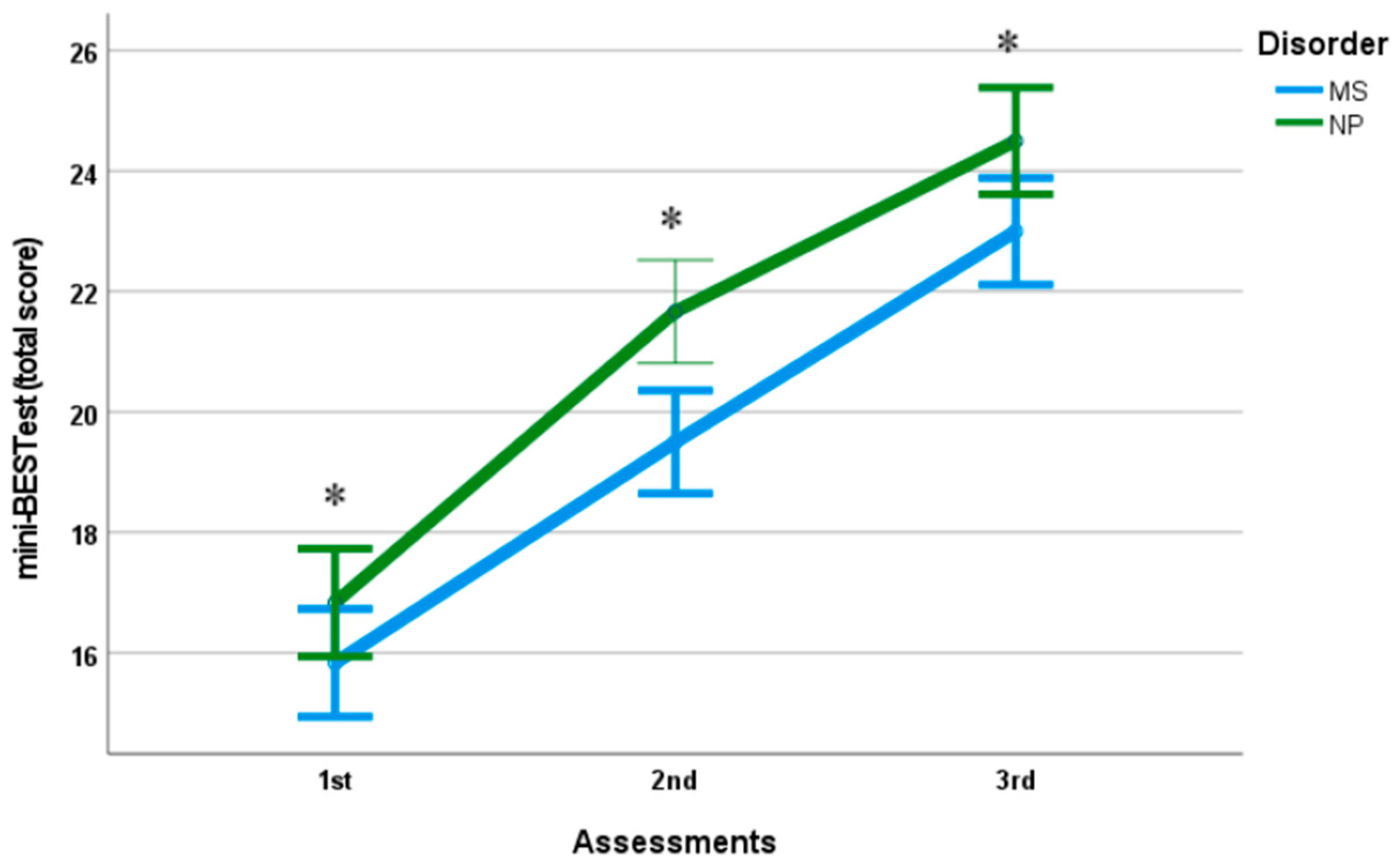
Balance improved significantly in mini-Balance Evaluation Systems Test (mini-BESTest) total score in both groups following the intervention (F(2, 20) = 325.16 p < 0.001, 95% CI [0.89, 0.98], np2 = 0.97). Figure 1 illustrates the pre-post intervention changes in mini-BESTest total scores for patients with Multiple Sclerosis (MS) and Parkinson’s Disease (PD) displayed as separate lines.
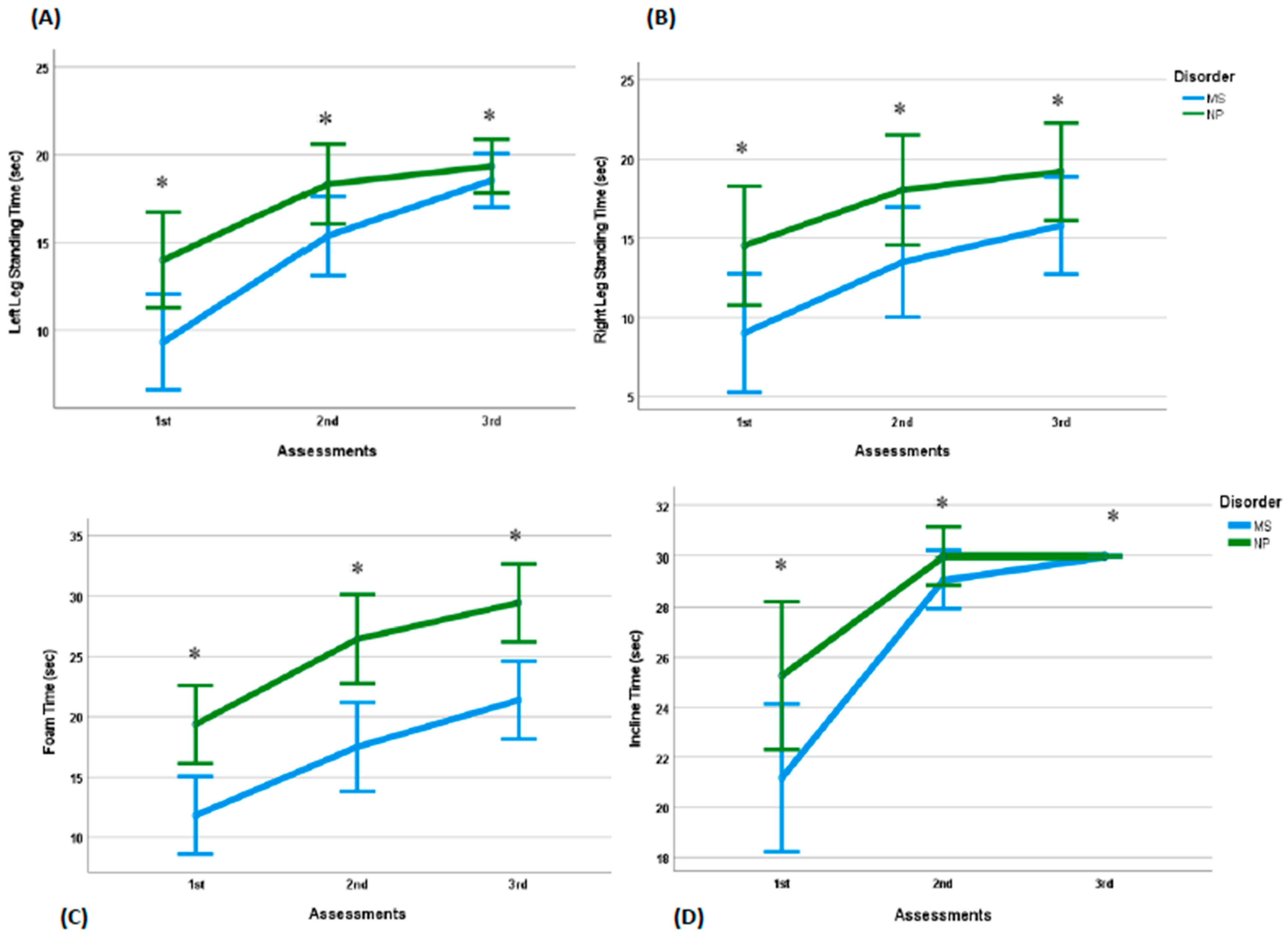
Furthermore, there was a significant increase in single-leg stance time on the left leg (F(2, 20) = 123.90, p < 0.001, 95% CI [0.74, 0.96], np2 = 0.92) and on the right leg (F(1.23, 12.33) = 43.37, p < 0.001, 95% CI [0.49, 0.88], np2 = 0.81). Improvements were also observed in tasks extracted from the mini-BESTest, such as standing time on a foam surface with eyes closed (F(2, 20) = 156.66, p < 0.001, 95% CI [0.79, 0.97], np2 = 0.94). Standing time on an incline level with eyes closed increased significantly from baseline to post intervention (F(1.12,12.16) = 43.987, p < 0.001, 95% CI [0.47, 0.88], np2 = 0.81) (Table 2).
No significant between-group differences were found for most of the measurement outcomes, including balance (F(2, 20) = 2.011, p > 0.05, 95% CI [0.00, 0.50], np2 = 0.17) (Figure 1), left-leg stance time (F(2, 20) = 8.316, p > 0.05, 95% CI [0.02, 0.69], np2 = 0.45) (Figure 2A), or right-leg stance time (F(1.23, 12.33) = 1.412, p > 0.05, 95% CI [0.00, 0.42], np2 = 0.12) (Figure 2B). Consistent with these findings, the mean difference between 1st and 3rd assessments (pre–post intervention) did not differ significantly between the two groups (Table 3).
An exception was the left-leg stance time, which showed a significant difference between groups (t9.498 = 3.411, p = 0.007). The MS group demonstrated a greater mean improvement (2.23 ± 2.19 s) compared to the PD group (5.35 ± 1.73 s) (Table 3). Improvements in foam-surface stance time (F(2, 20) = 0.775, p > 0.05, 95% CI [0.00, 0.40], np2 = 0.07) (Figure 2C) and inclined-surface stance time (F(1.22, 12.16) = 3.516, p > 0.05, 95% CI [0.00, 0.54], np2 = 0.26) were similar between groups (Figure 2D).
Table 2 presents the mean scores (±SD) for all variables across the three assessments for each groups and Table 3 presents the mean differences between the 1st and 3rd assessments.

3.3. Gait Assessment

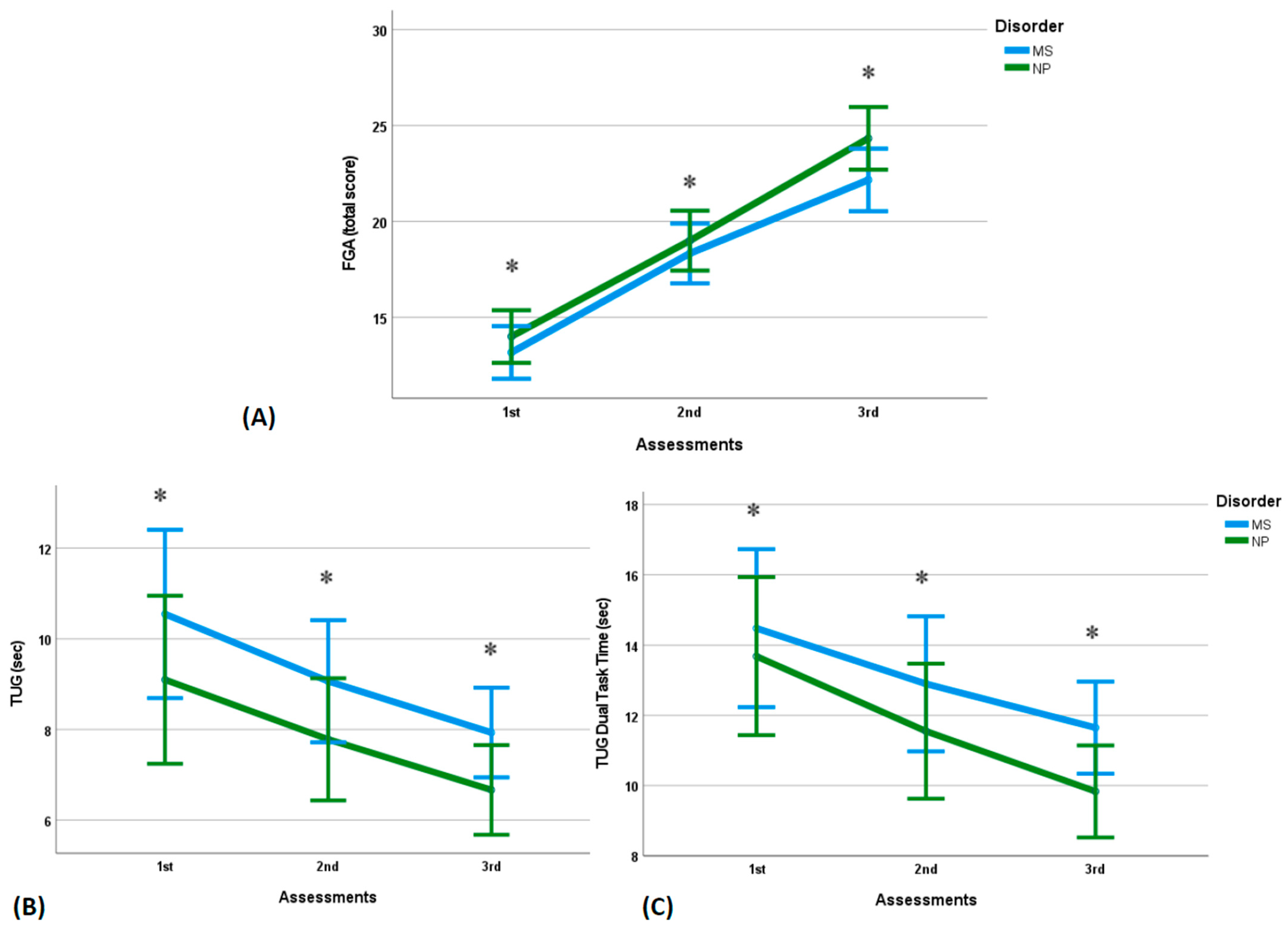
Gait performance, as this was assessed via the FGA total score, improved significantly following the intervention (F(2, 20) = 253.79, p < 0.001, 95% CI [0.87, 0.98], np2 = 0.96) (Figure 3). The TUG test duration also improved significantly across the three measurements (F(2,20) = 35.72, p < 0.001, 95% CI [0.38, 0.87], np2 = 0.78).
No significant between-group differences were identified for either the FGA total score (F(2, 20) = 1.83, p > 0.05, 95% CI [0.00, 0.48], np2 = 0.16) or TUG performance (F(2,20) = 0.057, p > 0.05, 95% CI [0.00, 0.25], np2 = 0.01) (Figure 3B).
The dual-task TUG (counting backward by threes), extracted from the mini-BESTest, also improved significantly following the intervention (F(2, 20) = 30.004, p < 0.001, 95% CI [0.32, 0.86], np2 = 0.75). This improvement did not differ significantly between groups (F(2,20) = 0.693, p > 0.05, 95% CI [0.00, 0.40], np2 = 0.06) (Figure 3C).
Mean differences between 1st and 3rd assessments were not statistically different between groups for any of the gait-related variables assessed (p > 0.05) (Table 3).

4. Discussion

This study aimed to explore whether LSVT BIG—a program originally developed for improving balance and gait in patients with Parkinson’s disease (PD) [1,6,10,57,58]—might likewise benefit individuals with Multiple Sclerosis (MS). Our findings indicate that, despite the fundamentally different pathophysiological mechanisms underlying MS (demyelination, axonal damage) and PD (basal ganglia degeneration), LSVT BIG produced significant and comparable improvements in balance and gait across both groups. On balance (as measured by the total score of mini-BESTest) and on several functional parameters—including single-leg stance time (left and right), stance on foam surface with eyes closed, and stance on inclined surfaces—both MS and PD patients demonstrated notable gains.
Most outcomes demonstrated moderate-to-large effect sizes (ηp2 > 0.12), indicating meaningful functional improvements following LSVT BIG in both MS and PD groups. Only the between-group differences in Timed Up and Go performance, which were not statistically significant, exhibited small effect sizes, consistent with comparable functional gains across groups. These effect-size patterns, together with the 95% confidence intervals for estimated marginal means, suggest that the observed changes are likely to be functionally relevant, even in the absence of formal minimal clinically important difference (MCID) thresholds for MS. This suggests that certain rehabilitative principles underlying LSVT BIG—such as task specificity, intensity, and repetitive functional practice—may operate across neurological conditions, while their expression and magnitude of benefit may still be shaped by disease-specific characteristics [59].
One likely explanation for these improvements in MS participants is the emphasis LSVT BIG places on high-effort, task-specific, amplitude-based movements tailored to activities of daily living [4,5]. Long-dose rehabilitation programs with home exercises have been effective for balance rehabilitation in neurological patients [60,61]. The observed functional gains may reflect adaptive responses of the central nervous system to this intensive practice [62,63]. While the precise neural mechanisms were not directly measured in the present study, it is plausible that repeated practice engages sensorimotor pathways, enhances proprioceptive awareness, and reinforces postural control strategies [62,63,64]. Programs targeting motor functions, upper and lower limb strength, and trunk balance have improved neural tissue integrity and activation in relevant brain regions [65,66]. In MS—where demyelination and impaired neuronal conduction disrupt coordination and postural reflexes—repetitive high-amplitude training may support compensatory neural recruitment or strengthen residual pathways, facilitating functional reorganization, contributing to improved gait and stability [61,67,68]. In this way, LSVT BIG may help mitigate certain balance and gait deficits by encouraging the central nervous system (CNS) to re-optimize motor patterns although the underlying mechanisms may differ between PD and MS due to differences in neural pathology and disease dynamics. These interpretations should be considered hypotheses rather than confirmed mechanisms, providing a rationale for future studies incorporating neurophysiological or neuroimaging assessments to clarify the underlying neural adaptations. Importantly, regardless of the specific mechanisms, the consistent improvements in balance and gait highlight the practical and clinically relevant benefits of LSVT BIG for individuals with MS.
Moreover, the one-on-one, patient-centered delivery model of LSVT BIG may contribute to increased adherence, motivation, and engagement—factors critically important in chronic and progressive conditions such as MS [69]. Personalized supervision and the setting of individual functional goals likely enhance patients’ commitment, leading to better quality of movement, fuller engagement with effortful tasks, and possibly greater neuroplastic change [37,64,70,71]. This stands in contrast to more generalized balance or strength training programs, which may lack specificity or intensity, and which, according to existing literature, often yield more modest improvements in neurological populations [72,73,74,75].
Compared to conventional physiotherapy or alternative modalities (e.g., Tai Chi or Pilates), LSVT BIG’s structured, intensive, amplitude-focused, task-oriented nature may produce larger functional gains, although direct comparisons with studies using equivalent intensity and training parameters are limited [10,15]. While holistic and lower-intensity programs can improve general mobility or well being [73], they may not sufficiently challenge the sensorimotor systems to induce the level of adaptation observed in our study. Further research with head-to-head trials is needed to directly compare LSVT BIG with other intensive, task-specific interventions. Furthermore, the ability of LSVT BIG to promote improvements under dual-task conditions (e.g., gait combined with cognitive load) is particularly relevant for real-world mobility, where walking rarely happens in isolation of other tasks [57]. Improvements in dual-task timed gait performance post-intervention suggest enhanced automaticity of gait and balance, possibly reflecting more efficient CNS control and better integration of motor and cognitive demands [56,76].
While LSVT BIG’s application in MS is limited in the literature, a study applied the LSVT LOUD program for voice rehabilitation in MS patients, showing promising results in improving hypophonia [36]. Our study extends this applicability to LSVT BIG, demonstrating its effectiveness in enhancing mobility, balance, and gait in MS patients. This innovative aspect underscores its significance and its clinical usefulness, promoting safer mobility in natural environments. Improved balance and gait in MS patients may reduce risk of falls, enhance safety during ambulation in daily life, and foster greater independence [77]. Enhanced confidence in mobility can also encourage more frequent participation in physical and social activities, mitigating sedentary behavior and potentially slowing further functional decline [5,59]. The fact that LSVT BIG can be adapted for MS suggests that rehabilitative programs developed for one neurological disorder might, with appropriate modification, be repurposed across different conditions—promoting a more unified, neuroplasticity-based approach to neurorehabilitation. LSVT BIG has already shown promise in improving hemiplegic upper extremity function after stroke [37,38,39], indicating its potential for addressing mobility in diseases affecting central motor neuronal pathways.
While the substantial improvements in balance and gait are likely attributable to the LSVT BIG intervention, it is possible that additional factors contributed. Repeated exposure to assessment tasks may have increased participants’ familiarity, and frequent, one-on-one therapist interactions could have enhanced engagement and bodily awareness. However, the structured, high-intensity, and standardized nature of LSVT BIG, along with daily monitoring of home exercises, strongly suggests that the intervention itself was the primary driver of the observed functional gains [4]. Future studies incorporating control groups or alternative interventions would help to further clarify the specific contribution of the intervention relative to these potential confounding factors.
Taken together, these findings suggest that LSVT BIG may offer meaningful functional benefits for individuals with MS. Despite the comparable functional improvements, important clinical differences between PD and MS must be acknowledged when interpreting the present findings. MS is characterized by heterogeneous disease courses (relapsing–remitting, secondary progressive, primary progressive), variable symptom distribution, conduction abnormalities, and prominent fatigue, all of which may influence motor performance, training tolerance, and responsiveness to rehabilitation [17,18,21]. In contrast, PD is typically associated with more stereotyped motor impairments and symptom fluctuations related to dopaminergic medication cycles [8,19]. These factors may affect how individuals engage with high-effort interventions such as LSVT BIG and may partially explain inter-individual variability in outcomes within the MS group. Rather than implying identical mechanisms across neurological disorders, the present results support the feasibility of adapting structured, intensive, task-oriented rehabilitation principles to different CNS conditions. To fully substantiate these promising results, future research should include larger, ideally multicenter, cohorts of MS patients, extended follow-up to assess the durability of gains, and possibly neurophysiological or neuroimaging studies to investigate underlying CNS changes. Additionally, comparing LSVT BIG to other intensive and task-specific interventions, as well as evaluating cost effectiveness and feasibility of long-term home-based application, will be important for translating these findings into routine clinical practice.
Several limitations of the present study should be acknowledged and addressed in future research. First, the sample size was relatively small, limiting the generalizability of the findings. Although the current pilot study included a number of participants comparable to previous LSVT studies [10,12,58], it does not allow for definitive, population-wide conclusions. Second, this study lacked a true control group. The group of PD patients was included as a comparative cohort to indirectly evaluate the effectiveness and validity of LSVT BIG; however, the absence of a non-intervention or alternative therapy control group limits the ability to fully attribute observed improvements to the intervention. Future studies should include randomized control groups and consider comparisons with other exercise therapy programs within the same patient population. Fatigue, a core and often activity-limiting symptom in MS, was not directly measured in the present study and may have influenced both training engagement and performance outcomes. Future studies should incorporate fatigue-specific measures to better understand its interaction with intensive amplitude-based rehabilitation. Another limitation is the absence of follow-up assessments to determine the durability of the intervention effects over time. While LSVT BIG is designed to promote neuroplasticity and motor learning, it remains unclear whether the observed gains in balance and gait are maintained in the long term. Incorporating follow-up evaluations and advanced neurophysiological assessments—such as transcranial magnetic stimulation, functional MRI, or other imaging techniques—could provide valuable insight into the neural mechanisms underlying sustained improvements.
Despite these limitations, the scientific novelty of the study lies in the first application of the standardized LSVT BIG protocol in individuals with MS. To our knowledge, this is the first investigation of this intervention in this population, demonstrating feasibility and potential benefits for balance and gait. Unlike conventional exercise programs, LSVT BIG provides a structured, intensity- and amplitude-focused protocol that integrates motor learning, sensorimotor recalibration, and neuroplasticity principles, thereby enhancing carryover to daily functional activities [12,14,15]. These preliminary results support the rationale for larger, randomized controlled trials to confirm efficacy, examine long-term retention, and explore mechanistic underpinnings, potentially informing future neurorehabilitation strategies for MS.

5. Conclusions

The comparative improvements in balance and gait observed in this pilot study suggest that LSVT BIG may confer significant benefits for patients with MS, with potential functional gains in some domains comparable to those seen in PD patients. The program’s high-intensity, task-specific, amplitude-focused exercises appear to target key motor deficits in MS, with observable carryover effects on functional activities relevant to daily living. However, the small sample size, the absence of a healthy or non-intervention control group, and lack of follow-up assessments limit the interpretability and generalizability of these findings. Given that research on LSVT BIG in MS is still preliminary, further studies employing randomized controlled trial designs with larger samples, long-term follow-up, detailed kinematic analyses, and long-term follow-up are warranted. Such research could confirm the efficacy, the durability of gains, and mechanistic underpinnings of LSVT BIG in MS, providing stronger evidence for its inclusion in routine neurorehabilitation programs for this population.

Author Contributions

Conceptualization, K.A. and S.L.; methodology, S.L.; software, K.A.; formal analysis, K.A. and S.L.; investigation, K.A.; resources, K.A. and S.L.; data curation, K.A. and S.L.; writing—original draft preparation, K.A.; writing—review and editing, S.L., T.B., E.T. (Eftychia Trachani), A.G. and E.T. (Elias Tsepis); visualization, K.A., S.L. and A.G.; supervision, S.L.; project administration, S.L. All authors have read and agreed to the published version of the manuscript.

Funding

This research received no external funding.

Institutional Review Board Statement

The study was conducted in accordance with the Declaration of Helsinki and approved by the Ethics Committee of the Technological Educational Institute of Western Greece (now named University of Patras) (Reg. No. 981/14-01-2019).

Informed Consent Statement

Informed consent was obtained from all participants involved in the study.

Data Availability Statement

The dataset presented in this study is not publicly available due to ethical restrictions. Any further reasonable requirements could be forwarded to the corresponding author.

Acknowledgments

Authors would like to thank all patients for their voluntary participation in the project.

Conflicts of Interest

The authors declare that the research was conducted in the absence of any commercial or financial relationships that could be construed as a potential conflict of interest.

References

  1. Ebersbach, G.; Ebersbach, A.; Edler, D.; Kaufhold, O.; Kusch, M.; Kupsch, A.; Wissel, J. Comparing exercise in Parkinson’s disease-the Berlin BIG Study. Mov. Disord. 2010, 25, 1902–1908. [Google Scholar] [CrossRef]
  2. Bryans, L.A.; Palmer, A.D.; Anderson, S.; Schindler, J.; Graville, D.J. The Impact of Lee Silverman Voice Treatment (LSVT LOUD®) on Voice, Communication, and Participation: Findings from a Prospective, Longitudinal Study. J. Commun. Disord. 2020, 89, 106031. [Google Scholar] [CrossRef]
  3. Pu, T.; Huang, M.; Kong, X.; Wang, M.; Chen, X.; Feng, X.; Wie, C.; Wenig, X.; Xu, F. Lee Silverman Voice Treatment to improve speech in Parkinson’s disease: A systemic review and meta-analysis. Park. Dis. 2021, 2021, e3366870. [Google Scholar] [CrossRef]
  4. Fox, C.; Ebersbach, G.; Ramig, L.; Sapir, S. LSVT LOUD and LSVT BIG: Behavioral Treatment Programs for Speech and Body Movement in Parkinson Disease. Park. Dis. 2012, 2012, e391946. [Google Scholar] [CrossRef]
  5. Farley, B.G.; Fox, C.M.; Ramig, L.O.; McFarland, D.H. Intensive Amplitude-specific Therapeutic Approaches for Parkinson’s Disease. Top. Geriatr. Rehabil. 2008, 24, 99–114. [Google Scholar] [CrossRef]
  6. Peterka, M.; Odorfer, T.; Schwab, M.; Volkmann, J.; Zeller, D. LSVT-BIG therapy in Parkinson’s disease: Physiological evidence for proprioceptive recalibration. BMC Neurol. 2020, 20, 276. [Google Scholar] [CrossRef]
  7. Konczak, J.; Krawczewski, K.; Tuite, P.; Maschke, M. The perception of passive motion in Parkinson’s disease. J. Neurol. 2007, 254, 655–663. [Google Scholar] [CrossRef]
  8. Conte, A.; Khan, N.; Defazio, G.; Rothwell, J.C.; Berardelli, A. Pathophysiology of somatosensory abnormalities in Parkinson disease. Nat. Rev. Neurol. 2013, 9, 687–697. [Google Scholar] [CrossRef] [PubMed]
  9. Matsuno, A.; Matsushima, A.; Saito, M.; Sakurai, K.; Kobayashi, K.; Yoshiki, S. Quantitative assessment of the gait improvement effect of LSVT BIG® using a wearable sensor in patients with Parkinson’s disease. Heliyon 2023, 9, e16952. [Google Scholar] [CrossRef] [PubMed]
  10. Janssens, J.; Malfroid, K.; Nyffeler, T.; Bohlhalter, S.; Vanbellingen, T. Application of LSVT BIG Intervention to Address Gait, Balance, Bed Mobility, and Dexterity in People with Parkinson Disease: A Case Series. Phys. Ther. 2014, 94, 1014–1023. [Google Scholar] [CrossRef]
  11. Clarkin, C. LSVT®BIG Exercise-Induced Neuroplasticity in People with Parkinson’s Disease: An Assessment of Physiological and Behavioral Outcomes. Bachelor’s Thesis, University of Rhode Island, Kingston, RI, USA, 2020. ProQuest Number: 27741888. [Google Scholar] [CrossRef]
  12. Flood, M.W.; O’Callaghan, B.P.F.; Diamond, P.; Liegey, J.; Hughes, G.; Lowery, M.M. Quantitative clinical assessment of motor function during and following LSVT-BIG® therapy. J. Neuroeng. Rehabil. 2020, 17, 92. [Google Scholar] [CrossRef]
  13. Doucet, B.M.; Blanchard, M.; Franc, I. Effects of LSVT BIG® on Bradykinesia During Activities of Daily Living. OTJR Occup. Ther. J. Res. 2025, 15394492251367275. [Google Scholar] [CrossRef]
  14. Sadaghiani, Z.; Tahan, N.; Ganjeh, S.; Baghban, A.A.; Khoshdel, A.; Shoeibi, A. Evaluating the Impact of Adding Lee Silverman Voice Treatment BIG into Routine Physiotherapy on Both Motor and Nonmotor Functions in Individuals with Parkinson’s Disease. Dubai Med. J. 2025, 8, 12–22. [Google Scholar] [CrossRef]
  15. McDonnell, M.N.; Rischbieth, B.; Schammer, T.T.; Seaforth, C.; Shaw, A.J.; Phillips, A.C. Lee Silverman Voice Treatment (LSVT)-BIG to improve motor function in people with Parkinson’s disease: A systematic review and meta-analysis. Clin. Rehabil. 2017, 32, 607–618. [Google Scholar] [CrossRef] [PubMed]
  16. Kim, D.Y.; Oh, H.M.; Bok, S.K.; Chang, W.H.; Choi, Y.; Chun, M.H.; Han, S.J.; Han, T.R.; Jee, S.; Jung, S.H.; et al. KSNR Clinical Consensus Statements: Rehabilitation of Patients with Parkinson’s Disease. Brain Neurorehabil. 2020, 13, e17. [Google Scholar] [CrossRef]
  17. Kantarci, O.; Wingerchuk, D. Epidemiology and natural history of multiple sclerosis: New insights. Cur. Opin. Neurol. 2006, 19, 248–254. [Google Scholar] [CrossRef] [PubMed]
  18. Amatya, B.; Khan, F.; Galea, M. Rehabilitation for people with multiple sclerosis: An overview of Cochrane Reviews. Cochrane Database Syst Rev. 2019, 14, CD012732. [Google Scholar] [CrossRef] [PubMed]
  19. Kelleher, K.J.; Spence, W.; Solomonidis, S.; Apatsidis, D. The characterisation of gait patterns of people with multiple sclerosis. Disabil. Rehabil. 2010, 32, 1242–1250. [Google Scholar] [CrossRef]
  20. Beer, S.; Khan, F.; Kesselring, J. Rehabilitation interventions in multiple sclerosis: An overview. J. Neurol. 2012, 259, 1994–2008. [Google Scholar] [CrossRef]
  21. Barin, L.; Salmen, A.; Disanto, G.; Babačić, H.; Calabrese, P.; Chan, A.; Kamm, C.P.; Kesselring, J.; Kuhle, J.; Gobbi, C.; et al. The disease burden of Multiple Sclerosis from the individual and population perspective: Which symptoms matter most? Mult. Scler. Relat. Disord. 2018, 25, 12–121. [Google Scholar] [CrossRef]
  22. Hamilton, F.; Rochester, L.; Paul, L.; Rafferty, D.; O’Leary, C.; Evans, J. Walking and talking: An investigation of cognitive—Motor dual tasking in multiple sclerosis. Mult. Scler. J. 2009, 15, 1215–1227. [Google Scholar] [CrossRef]
  23. Ozkul, C.; Eldemir, K.; Yildirim, M.S.; Cobanoglu, G.; Eldemir, S.; Guzel, N.A.; Irkec, C.; Guclu-Gunduz, A. Relationship between sensation and balance and gait in multiple sclerosis patients with mild disability. Mult. Scler. Relat. Disord. 2024, 87, 105690. [Google Scholar] [CrossRef]
  24. Fling, B.W.; Dutta, G.G.; Schlueter, H.; Cameron, M.H.; Horak, F.B. Associations between Proprioceptive Neural Pathway Structural Connectivity and Balance in People with Multiple Sclerosis. Front. Hum. Neurosci. 2014, 8, 814. [Google Scholar] [CrossRef]
  25. Gandolfi, M.; Munari, D.; Geroin, C.; Gajofatto, A.; Benedetti, M.D.; Midiri, A.; Carla, F.; Picelli, A.; Waldner, A.; Smania, N. Sensory integration balance training in patients with multiple sclerosis: A randomized, controlled trial. Mult. Scler. 2015, 21, 1453–1462. [Google Scholar] [CrossRef]
  26. White, L.J.; McCoy, S.C.; Castellano, V.; Gutierrez, G.; Stevens, J.E.; Walter, G.A.; Vandenborne, K. Resistance training improves strength and functional capacity in persons with multiple sclerosis. Mult. Scler. J. 2004, 10, 668–674. [Google Scholar] [CrossRef]
  27. Sandoval, A.E.G. Exercise in Multiple Sclerosis. Phys. Med. Rehabil. Clin. N. Am. 2013, 24, 605–618. [Google Scholar] [CrossRef] [PubMed]
  28. Feltham, M.G.; Collett, J.; Izadi, H.; Wade, D.T.; Morris, M.G.; Meaney, A.J.; Howells, K.; Sackley, C.; Dawes, H. Cardiovascular adaptation in people with multiple sclerosis following a twelve week exercise programme suggest deconditioning rather than autonomic dysfunction caused by the disease. Results from a randomized controlled trial. Eur. J. Phys. Rehabil. Med. 2013, 49, 765–774. [Google Scholar]
  29. Halabchi, F.; Alizadeh, Z.; Sahraian, M.A.; Abolhasani, M. Exercise prescription for patients with multiple sclerosis; potential benefits and practical recommendations. BMC Neurol. 2017, 17, 185. [Google Scholar] [CrossRef] [PubMed]
  30. Duff, W.R.D.; Andrushko, J.W.; Renshaw, D.W.; Chilibeck, P.D.; Farthing, J.P.; Danielson, J.; Evans, C.D. Impact of Pilates Exercise in Multiple Sclerosis. Int. J. MS Care 2018, 20, 92–100. [Google Scholar] [CrossRef] [PubMed]
  31. Kalron, A.; Rosenblum, U.; Frid, L.; Achiron, A. Pilates exercise training vs. physical therapy for improving walking and balance in people with multiple sclerosis: A randomized controlled trial. Clin. Rehabil. 2016, 31, 319–328. [Google Scholar] [CrossRef]
  32. Soysal Tomruk, M.; Zu, M.Z.; Kara, B.; İdiman, E. Effects of Pilates exercises on sensory interaction, postural control and fatigue in patients with multiple sclerosis. Mult. Scler. Relat. Disord. 2016, 7, 70–73. [Google Scholar] [CrossRef] [PubMed]
  33. Alphonsus, K.B.; Su, Y.; D’Arcy, C. The effect of exercise, yoga and physiotherapy on the quality of life of people with multiple sclerosis: Systematic review and meta-analysis. Complement Ther. Med. 2019, 43, 188–195. [Google Scholar] [CrossRef]
  34. Taylor, E.; Taylor-Piliae, R.E. The effects of Tai Chi on physical and psychosocial function among persons with multiple sclerosis: A systematic review. Complement. Ther. Med. 2017, 31, 100–108. [Google Scholar] [CrossRef]
  35. Duan, H.; Jing, Y.; Li, Y.; Lian, Y.; Li, J.; Li, Z. Rehabilitation treatment of multiple sclerosis. Front. Immunol. 2023, 14, 1168821. [Google Scholar] [CrossRef] [PubMed]
  36. Baldanzi, C.; Crispiatico, V.; Foresti, S.; Groppo, E.; Rovaris, M.; Cattaneo, D.; Vitali, C. Effects of Intensive Voice Treatment (The Lee Silverman Voice Treatment [LSVT LOUD]) in Subjects With Multiple Sclerosis: A Pilot Study. J. Voice 2022, 36, 585.e1–585.e13. [Google Scholar] [CrossRef]
  37. Metcalfe, V.; Egan, M.; Sauvé-Schenk, K. LSVT BIG in late stroke rehabilitation: A single-case experimental design study. Can. J. Occup. Ther. 2019, 86, 87–94. [Google Scholar] [CrossRef]
  38. Proffitt, R.M.; Henderson, W.; Scholl, S.; Nettleton, M. Lee Silverman Voice Treatment BIG® for a Person With Stroke. Am. J. Occup. Ther. 2018, 72, 7205210010p1–7205210010p6. [Google Scholar] [CrossRef]
  39. Proffitt, R.; Henderson, W.; Stupps, M.; Binder, L.; Irlmeier, B.; Knapp, E. Feasibility of the Lee Silverman voice treatment-BIG intervention in stroke. OTJR Occup. Particip. Health 2021, 41, 40–46. [Google Scholar] [CrossRef]
  40. Eldridge, S.M.; Lancaster, G.A.; Campbell, M.J.; Thabane, L.; Hopewell, S.; Coleman, C.L.; Bond, C.M. Defining Feasibility and Pilot Studies in Preparation for Randomised Controlled Trials: Development of a Conceptual Framework. PLoS ONE 2016, 11, e0150205. [Google Scholar] [CrossRef] [PubMed]
  41. El-Kotob, R.; Giangregorio, L.M. Pilot and feasibility studies in exercise, physical activity, or rehabilitation research. Pilot Feasibility Stud. 2018, 4, 137. [Google Scholar] [CrossRef]
  42. Goetz, C.G.; Poewe, W.; Rascol, O.; Sampaio, C.; Stebbins, G.T.; Counsell, C.; Giladi, N.; Holloway, R.G.; Moore, C.G.; Wenning, G.K.; et al. Movement Disorder Society Task Force on Rating Scales for Parkinson’s Disease. Movement Disorder Society Task Force report on the Hoehn and Yahr staging scale: Status and recommendations. Mov. Disord. 2004, 19, 1020–1028. [Google Scholar] [CrossRef]
  43. Motl, R.; Neal, W.; Backus, D.; Hebert, J.; McCully, K.; Bethoux, F.; Plummer, P.; Ng, A.; Lowman, J.; Schmidt, H.; et al. Middle-range scores from the patient determined disease steps scale reflect varying levels of walking dysfunction in multiple sclerosis. BMC Neurol. 2024, 24, 383. [Google Scholar] [CrossRef] [PubMed]
  44. Lopes, L.K.R.; Scianni, A.A.; Lima, L.O.; de Carvalho Lana, R.; Rodrigues-De-Paula, F. The Mini-BESTest is an independent predictor of falls in Parkinson Disease. Braz. J. Phys. Ther. 2020, 24, 433–440. [Google Scholar] [CrossRef] [PubMed]
  45. Wallin, A.; Kierkegaard, M.; Franzén, E.; Johansson, S. Test-Retest Reliability of the Mini-BESTest in People with Mild to Moderate Multiple Sclerosis. Phys. Ther. 2021, 101, pzab045. [Google Scholar] [CrossRef]
  46. Fiorenzato, E.; Cauzzo, S.; Weis, L.; Garon, M.; Pistonesi, F.; Cianci, V.; Nasi, L.M.; Vianello, F.; Zecchinelli, L.A.; Pezzoli, G.; et al. Optimal MMSE and MoCA cutoffs for cognitive diagnoses in Parkinson’s disease: A data-driven decision tree model. J. Neurol. Sci. 2024, 466, 123283. [Google Scholar] [CrossRef]
  47. Franchignoni, F.; Horak, F.; Godi, M.; Nardone, A.; Giordano, A. Using psychometric techniques to improve the Balance Evaluation Systems Test: The mini-BESTest. J. Rehabil. Med. 2010, 42, 323–331. [Google Scholar] [CrossRef]
  48. Lampropoulou, S.I.; Billis, E.; Gedikoglou, I.A.; Michailidou, C.; Nowicky, A.V.; Skrinou, D.; Michailidi, F.; Chandrinou, D.; Meligkoni, M. Reliability, validity and minimal detectable change of the Mini-BESTest in Greek participants with chronic stroke. Physiother. Theory Pract. 2019, 35, 171–182. [Google Scholar] [CrossRef] [PubMed]
  49. Jacobs, J.V.; Horak, F.B.; Tran, V.K.; Nutt, J.G. Multiple balance tests improve the assessment of postural stability in subjects with Parkinson’s disease. J. Neurol. Neurosurg. Psychiatry 2006, 77, 322–326. [Google Scholar] [CrossRef]
  50. Wrisley, D.M.; Marchetti, G.F.; Kuharsky, D.K.; Whitney, S.L. Reliability, internal consistency, and validity of data obtained with the functional gait assessment. Phys. Ther. 2004, 84, 906–918. [Google Scholar] [CrossRef]
  51. Lampropoulou, S.; Kellari, A.; Gedikoglou, I.A.; Kozonaki, D.G.; Nika, P.; Sakellari, V. Cross-Cultural Adaptation and Psychometric Characteristics of the Greek Functional Gait Assessment Scale in Healthy Community-Dwelling Older Adults. Appl. Sci. 2024, 14, 520. [Google Scholar] [CrossRef]
  52. Beauchet, O.; Fantino, B.; Allali, G.; Muir, S.W.; Montero-Odasso, M.; Annweiler, C. Timed Up and Go test and risk of falls in older adults: A systematic review. J. Nutr. Health Aging 2011, 15, 933–938. [Google Scholar] [CrossRef]
  53. Barry, E.; Galvin, R.; Keogh, C.; Horgan, F.; Fahey, T. Is the Timed Up and Go test a useful predictor of risk of falls in community dwelling older adults: A systematic review and meta-analysis. BMC Geriatr. 2014, 14, 14. [Google Scholar] [CrossRef]
  54. Kahya, M.; Moon, S.; Ranchet, M.; Vukas, R.R.; Lyons, E.K.; Pahwa, R.; Akinwuntan, A.; Devos, H. Brain activity during dual task gait and balance in aging and age-related neurodegenerative conditions: A systematic review. Exp. Gerontol. 2019, 128, 110756. [Google Scholar] [CrossRef]
  55. Andrade, C. How to Understand the 95% Confidence Interval Around the Relative Risk, Odds Ratio, and Hazard Ratio: As Simple as It Gets. J. Clin. Psychiatry 2023, 84, 23f14933. [Google Scholar] [CrossRef]
  56. Lakens, D. Calculating and reporting effect sizes to facilitate cumulative science: A practical primer for t-tests and ANOVAs. Front. Psychol. 2013, 4, 863. [Google Scholar] [CrossRef] [PubMed]
  57. Isaacson, S.; O’Brien, A.; Lazaro, J.D.; Ray, A.; Fluet, G. The JFK BIG study: The impact of LSVT BIG® on dual task walking and mobility in persons with Parkinson’s disease. J. Phys. Ther. Sci. 2018, 30, 636–641. [Google Scholar] [CrossRef]
  58. Fishel, S.C.; Hotchkiss, M.E.; Brown, S.A. The impact of LSVT BIG therapy on postural control for individuals with Parkinson disease: A case series. Physiother. Theory Pract. 2020, 36, 834–843. [Google Scholar] [CrossRef] [PubMed]
  59. Luna, G.; Pardo-Cocuy, L.F.; Garzón, A.; Benítez, A.; Parada-Gereda, H.M. Effectiveness of Lee Silverman Voice Treatment (LSVT®BIG) for improving motor function in patients with Parkinson’s disease: A systematic review and meta-analysis of randomised clinical trials. Am. J. Phys. Med. Rehabil. 2025, 104, 1105–1112. [Google Scholar] [CrossRef]
  60. Boissoneault, C.; Datta, S.; Rose, D.K.; Waters, M.J.; Khanna, A.; Daly, J.J. Innovative Long-Dose Neurorehabilitation for Balance and Mobility in Chronic Stroke: A Preliminary Case Series. Brain Sci. 2020, 10, 555. [Google Scholar] [CrossRef]
  61. Corrini, C.; Gervasoni, E.; Perini, G.; Cosentino, C.; Putzolu, M.; Montesano, A.; Pelosin, E.; Prosperini, L.; Cattaneo, D. Mobility and balance rehabilitation in multiple sclerosis: A systematic review and dose-response meta-analysis. Mult. Scler. Relat. Disord. 2023, 69, 104424. [Google Scholar] [CrossRef]
  62. Zemková, E.; Hamar, D. The Effect of Task-Oriented Sensorimotor Exercise on Visual Feedback Control of Body Position and Body Balance. Hum. Mov. 2010, 11, 119–123. [Google Scholar] [CrossRef]
  63. Asghari, S.H.; Ilbeigi, S.; Ahmadi, M.M.; Yousefi, M.; Mousavi-Mirzaei, M. Comparative effects of sensory motor and virtual reality interventions to improve gait, balance and quality of life MS patients. Sci. Rep. 2025, 15, 20310. [Google Scholar] [CrossRef]
  64. Petzinger, G.M.; Fisher, B.E.; McEwen, S.; Beeler, J.A.; Walsh, J.P.; Jakowec, M.W. Exercise-enhanced neuroplasticity targeting motor and cognitive circuitry in Parkinson’s disease. Lancet Neurol. 2013, 12, 716–726. [Google Scholar] [CrossRef]
  65. Procházková, M.; Tintera, J.; Špaňhelová, S.; Prokopiusova, T.; Rydlo, J.; Pavlikova, M.; Prochazka, A.; Rasova, K. Brain activity changes following neuroproprioceptive “facilitation, inhibition” physiotherapy in multiple sclerosis: A parallel group randomized comparison of two approaches. Eur. J. Phys. Rehabil. Med. 2021, 57, 356–365. [Google Scholar] [CrossRef]
  66. Tavazzi, E.; Cazzoli, M.; Pirastru, A.; Blasi, V.; Rovaris, M.; Bergsland, N.; Baglio, F. Neuroplasticity and Motor Rehabilitation in Multiple Sclerosis: A Systematic Review on MRI Markers of Functional and Structural Changes. Front. Neurosci. 2021, 15, 707675. [Google Scholar] [CrossRef]
  67. Straudi, S.; Martinuzzi, C.; Pavarelli, C.; Sabbagh Charabati, A.; Benedetti, M.G.; Foti, C.; Bonato, M.; Zancato, E.; Basaglia, N. A task-oriented circuit training in multiple sclerosis: A feasibility study. BMC Neurol. 2014, 14, 124. [Google Scholar] [CrossRef]
  68. Darwish, H.M.; Shalaby, M.N.; Ali, S.A.; Soubhy, Z.H. Effect of Task Oriented Approach on Balance in Ataxic Multiple Sclerosis Patients. Med. J. Cairo Univ. 2019, 87, 4789–4794. [Google Scholar] [CrossRef]
  69. Salmani, S.; Mousavi, S.H.; Navardi, S.; Hosseinzadeh, F.; Pashaeypoor, S. The barriers and facilitators to health-promoting lifestyle behaviors among people with multiple sclerosis during the coronavirus disease 2019 pandemic: A content analysis study. BMC Neurol. 2022, 22, 490. [Google Scholar] [CrossRef]
  70. Bombard, Y.; Baker, G.R.; Orlando, E.; Fancott, C.; Bhatia, P.; Casalino, S.; Onate, K.; Denis, J.L.; Pomey, M.P. Engaging patients to improve quality of care: A systematic review. Implement. Sci. 2018, 13, 98. [Google Scholar] [CrossRef] [PubMed]
  71. Maddocks, M.; Fettes, L.; Takemura, N.; Bayly, J.; Talbot-Rice, H.; Turner, K.; Tiberini, R.; Harding, R.; Murtagh, E.M.F.; Siegert, R.J.; et al. Functional goals and outcomes of rehabilitation within palliative care: A multicentre prospective cohort study. BMC Palliat. Care 2025, 24, 172. [Google Scholar] [CrossRef] [PubMed]
  72. Bouça-Machado, R.; Rosário, A.; Caldeira, D.; Castro Caldas, A.; Guerreiro, D.; Venturelli, M.; Tinazzi, M.; Schena, F.; Ferreira, J. Physical Activity, Exercise, and Physiotherapy in Parkinson’s Disease: Defining the Concepts. Mov. Disord. Clin. Pract. 2019, 7, 7–15. [Google Scholar] [CrossRef] [PubMed]
  73. Li, P.; He, Y.; He, M. The comprehensive impact of exercise interventions on cognitive function and quality of life in Alzheimer’s disease patients: A systematic review and meta-analysis. BMC Geriatr. 2025, 25, 871. [Google Scholar] [CrossRef] [PubMed]
  74. Paltamaa, J.; Sjögren, T.; Peurala, S.; Heinonen, A. Effects of physiotherapy interventions on balance in multiple sclerosis: A systematic review and meta-analysis of randomized controlled trials. J. Rehabil. Med. 2012, 44, 811–823. [Google Scholar] [CrossRef] [PubMed]
  75. Snook, E.M.; Motl, R.W. Effect of Exercise Training on Walking Mobility in Multiple Sclerosis: A Meta-Analysis. Neurorehabil. Neural Repair. 2008, 23, 108–116. [Google Scholar] [CrossRef]
  76. Liu, Y.C.; Yang, Y.R.; Tsai, Y.A.; Wang, R.Y. Cognitive and motor dual task gait training improve dual task gait performance after stroke—A randomized controlled pilot trial. Sci. Rep. 2017, 7, 4070. [Google Scholar] [CrossRef]
  77. Comber, L.; Peterson, E.; O’Malley, N.; Galvin, R.; Finlayson, M.; Coote, S. Development of the Better Balance Program for People with Multiple Sclerosis: A Complex Fall-Prevention Intervention. Int. J. MS Care 2021, 23, 119–127. [Google Scholar] [CrossRef]
Figure 1. Balance changes were measured with the mini-BESTest total score within the 3 assessments (baseline, two weeks, and four weeks of the intervention). Asterisks (*) indicate statistically significant differences between 1st and 2nd, 2nd and 3rd, and between 3rd and 1st repeated measures. Error bars are presented in 95% CI (n = 12 patients).
Applsci 16 00484 g001
Figure 2. Timing performance in one leg standing (A) left leg standing, (B) right leg standing and (C) standing in foam surface, and (D) in incline level within the 3 assessments (baseline, two weeks, and four weeks of the intervention). Asterisks (*) indicate statistically significant differences between 1st and 2nd, 2nd and 3rd, and between 3rd and 1st repeated measures. Error bars are presented in 95% CI (n = 12 patients).
Applsci 16 00484 g002
Figure 3. (A) Gait performance as this was assessed by Functional Gait Assessment (FGA) total score and (B) Timed Up and Go (TUG) duration (sec), (C) TUG with the dual task, the test performed together with the cognitive task of counting backward by threes within the 3 assessments (baseline, two weeks and four weeks of the intervention). Variables changes between the two groups of patients with Multiple Sclerosis (MS) and Parkinson’s Disease (PD) are presented in separate lines. Asterisks (*) indicate statistically significant differences between 1st and 2nd, 2nd and 3rd, and between 3rd and 1st repeated measures. Error bars are presented in 95% CI (n = 12 patients).
Applsci 16 00484 g003
Table 1. Group characteristics and baseline measurements between the two groups.
VariablesMS. 2 Group
Mean (SD) 1
PD 3 Group
Mean (SD) 1
p Value
N 466NA 9
Sex (W:M) 55W:1M6MNA
Age45 ± 868 ± 3NA
Mini-BESTest 615.83 ± 0.9816.83 ± 0.98p > 0.05
FGA 713.2 ± 1.614 ± 1.4p > 0.05
TUG 810.5 ± 2.79.1 ± 0.9p > 0.05
1 SD: Standard Deviation 2 MS: Multiple Sclerosis, 3 PD: Parkinson’s Disease, 4 N: Number of participants, 5 M: Men, W: Women, 6 mini-BESTest: mini-Balance Evaluation Systems Test, 7 FGA: Functional Gait Assessment, 8 TUG: Timed Up and Go, 9 NA: Not Applicable.
Table 2. Assessed variables within the 3 assessments (baseline, two weeks of intervention, and at the end of four weeks of intervention) for the two groups of patients separately (n = 12 patients in total).
VariablesMS. 2 Group—Mean (SD) 1—[95% CI]PD 3 Group—Mean (SD) 1
1st Ass 42nd Ass3rd Ass1st Ass2nd Ass3rd Ass
mini-BESTest 5
(from total score/28)
15.83 (0.98)
[15.046–16.614]
19.50 (0.84) *
[18.8, 20.2]
23.00 (0.89) *
[22.3, 23.7]
16.83 (0.98)
[16, 17.6]
21.67 (1.03) *
[20.8, 22.5]
24.50 (1.05) *
[23.7, 25.3]
R leg standing time (sec)9.02 (4.68)
[5.28, 12.8]
13.50 (5.04) *
[9.47, 17.5]
15.80 (4.54) *
[12.2, 19.4]
14.53 (3.46)
[11.8, 17.3]
18.05 (1.94) *
[16.5, 19.6]
19.20 (1.49) *
[18, 20.4
L leg standing time (sec)9.32 (3.40) *
[6.6, 12]
15.38 (3.16) *
[12.9, 17.9]
18.55 (2.09) *
[16.9, 20.2]
14.00 (2.54)
[11.3, 16.7]
18.33 (1.55) *
[17.1, 19.6]
19.35 (1.09) *
[18.5, 20.2]
Foam standing time (sec)11.82 (4.11) *
[8.53, 15.1]
17.50 (5.27) *
[13.3, 21.7]
21.38 (4.94) *
[17.4, 25.3]
19.37 (2.87) *
[17.1, 21.7]
26.43 (2.27) *
[24.6, 28.3]
29.43 (0.91) *
[28.7, 30.2]
Incline Standing Time (sec)21.18 (2.65) *
[19.1, 23.3]
29.07 (1.76) *
[27.7, 30.5]
30.00 (0.00) *
[30, 30]
25.27 (3.75) *
[22.3, 28.3]
30.00 (0.00) *
[30, 30]
30.00 (0.00) *
[30, 30]
FGA 6
(from total score/30)
13.17 (1.60)
[11.9, 14.4]
18.33 (2.34) *
[16.5, 20.2]
22.17 (2.04) *
[20.5, 23.8]
14.00 (1.41)
[12.9, 15.1]
19.00 (0.63) *
[18.5, 19.5]
24.33 (1.50) *
[23.1, 25.5]
TUG (sec)10.55 (2.73)
[8.37, 12.7]
9.07 (1.76) *
[7.66, 10.5]
7.93 (1.49) *
[6.74, 9.12]
9.10 (0.92)
[8.36, 9.84]
7.78 (1.14) *
[6.87, 8.69]
6.66 (0.37) *
[6.36, 6.96]
1 SD: Standard Deviation 2 MS: Multiple Sclerosis, 3 PD: Parkinson’s Disease, 4 ass: assessment, 5 mini-BESTest: mini-Balance Evaluation Systems Test, 6 FGA: Functional Gait Assessment (*) p < 0.05.
Table 3. Mean differences with 95% Confidence Intervals between 1st (baseline) and 3rd (at the end of the intervention) assessment for the assessed variables for the two groups of patients separately.
VariablesGroupN 1Mean Difference ± SD 2, [95% CI]Leven’s Test
miniBEST 3MS 467.17 ± 0.98, [6.39, 7.95]t(9.976) = −0.859, p > 0.05
NP 567.67 ± 1.03, [6.85, 8.49]
TUG 6MS62.617 ± 1.60, [1.34, 3.9]t(7.200) = 0.253, p > 0.05
NP62.433 ± 0.77, [1.82, 3.05]
TUGdual 7MS62.833 ± 2.00, [1.23, 4.43]t(9.337) = 0.986, p > 0.05
NP63.850 ± 1.53, [2.63, 5.07]
FGA 8MS69.00 ± 1.26, [7.99, 10]t(8.805) = −1.451, p > 0.05
NP610.33 ± 1.86, [8.84, 11.8]
Foam 9MS69.577 ± 1.33, [8.52, 10.6]t(7.902) = −0.451, p > 0.05
NP610.067 ± 2.36, [8.18, 12]
Incline 10MS68.817 ± 2.64, [6.71, 10.9]t(8.988) = 2.178, p > 0.05
NP64.733 ± 3.75, [1.73, 7.73]
RLegStand 11MS66.783 ± 3.24, [4.19, 9.37]t(9.351) = 1.270, p > 0.05
NP64.667 ± 2.47, [2.69, 6.65]
LLegStand 12MS69.233 ± 2.19, [7.48, 11]t(9.498) = 3.411, p = 0.007
NP65.35 ± 1.73, [3.97, 6.73]
1 N: Number of participants, 2 SD: Standard Deviation 3 mini-BESTest: mini-Balance Evaluation Systems Test, 4 MS: Multiple Sclerosis, 5 PD: Parkinson’s Disease, 6 TUG: Timed Up and Go, 7 TUGdual: TUG with dual task, the test performed together with a cognitive task,8 FGA: Functional Gait Assessment, 9 Foam: time (sec) kept the standing position on a foam surface with eyes closed, 10 Incline: time (sec) kept the standing position on an inclined surface (ramp) with eyes closed, 11 RLegStand: time (sec) kept the one leg (right) standing position, 12 LLeg Stand: time (sec) kept the one leg (left) standing position.
Disclaimer/Publisher’s Note: The statements, opinions and data contained in all publications are solely those of the individual author(s) and contributor(s) and not of MDPI and/or the editor(s). MDPI and/or the editor(s) disclaim responsibility for any injury to people or property resulting from any ideas, methods, instructions or products referred to in the content.