Review

Towards Intelligent Manufacturing: Machine Learning, Deep Learning, and Computer Vision for Tool Wear Estimation in Milling and Micromilling Processes


1
Symbiosis Institute of Technology, Symbiosis International (Deemed University), Pune 412115, India
2
Symbiosis Center for Applied Artificial Intelligence, Symbiosis International (Deemed University), Pune 412115, India
3
Department of Mechanical and Manufacturing Engineering, M S Ramaiah University of Applied Sciences, Peenya, Bangalore 560058, India
*
Author to whom correspondence should be addressed.
Appl. Sci. 2026, 16(1), 485; https://doi.org/10.3390/app16010485
Submission received: 11 November 2025 / Revised: 23 December 2025 / Accepted: 31 December 2025 / Published: 3 January 2026
(This article belongs to the Special Issue Advances in Manufacturing and Machining Processes)

Abstract

In modern manufacturing, milling and micromilling processes play a central role in precision production. However, rapid wear of cutting tools often leads to sudden tool breakage, unplanned downtime, and part rejection. Maintenance is therefore essential to ensure efficiency, safety, and cost-effectiveness across industries. Traditional maintenance strategies have gradually evolved into predictive maintenance approaches supported by advanced technologies, creating a strong industrial demand for accurate and reliable predictive solutions. This review systematically analyzes studies from the past decade on predictive maintenance in milling and micromilling processes, with a particular focus on the performance of machine learning and deep learning algorithms integrated with computer vision techniques. The study evaluates model performance, prediction accuracy, and industrial applicability to identify key strengths and existing research gaps. The findings indicate that multi-sensor data fusion, deep learning methods, and hybrid models achieve the highest performance in tool wear monitoring and remaining useful life prediction of cutting tools.

1. Introduction

Every industry depends on maintenance, not only to manage costs but also to ensure a smooth production process. Maintenance is the regular inspection and necessary repairs of machinery, equipment, and other devices. This keeps them running smoothly and increases their lifespan. The main objective of maintenance is to prevent sudden breakdowns and maintain efficiency. Regular maintenance can prevent major expenses, reduce the chances of accidents, and prevent work interruptions. In the manufacturing industry, metal cutting is an important process, and its cost depends on the cutting tools [1].
At present, rapid tool wear is a major challenge in modern manufacturing systems. Accurate prediction of tool life reduces production costs, increases the reliability of systems, and improves the quality of the final product. In this process, machine learning and deep learning technology are proving beneficial. These technologies help gather systematic information about tool wear, which can be obtained by analyzing sensor data and predicting the impact of future tool wear. Many review papers have been published in the last five years, but most of them focus on milling machines, traditional machine learning models, or milling processes. They gave a limited analysis of recent developments, multi-sensors, and micromilling.
This review gives an updated and focused combination of studies published over the last 10 years, mostly focusing on recent years’ research, highlighting machine and deep learning algorithms and computer vision techniques, their performance, data sources used, and their industrial applicability to maintain the condition of cutting tools in the milling and micromilling processes. This helps to introduce data-driven decision-making in modern manufacturing processes. In addition, this review serves as a guide for future research, inspiring the development of more efficient, accurate, and scalable models for tool life prediction. The present study is an important step in that direction and can potentially bring about a qualitative change in the efficiency of the maintenance process in industry.
Cutting tool maintenance is a crucial factor in the production process and has evolved over time in many stages. In the early age of industrialization, tool maintenance was completely manual and reactive. Tools were repaired or replaced only when they broke down. There was no proper monitoring system. With the advent of large-scale production and the use of CNC machines, the trend towards preventive maintenance increased. Changing or sharpening tools at regular intervals became routine [2]. In the middle of the Industrial Revolution, condition monitoring systems were developed, in which an integrated system of tool management was used. In the last 20 years, predictive maintenance systems have been developed, in which data acquisition systems, such as computer systems, have become prevalent [3]. Industrial maintenance now integrates more advanced and technology-based systems than traditional repair and maintenance methods. Predictive maintenance and condition-based maintenance techniques use IoT sensors, machine learning, and artificial intelligence (AI) to continuously collect machine information and forecast machine and tool failure [4]. In addition, digital twins and multi-sensor systems are also widely used. With the help of AI, maintenance decisions are made more accurately by processing machine data. This allows industries to improve processes that are more efficient, cost-effective, and save time from breakdown.
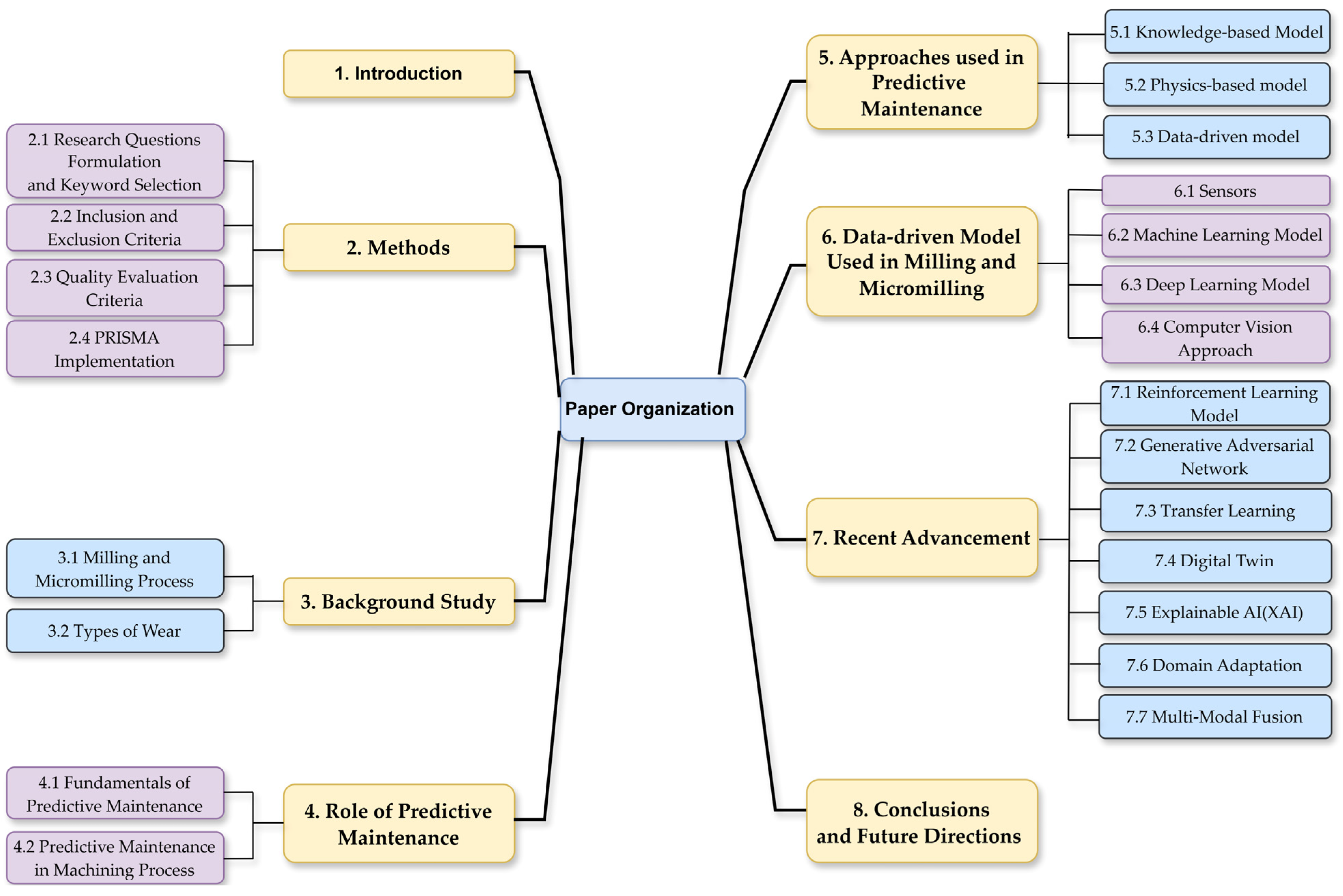
Figure 1 shows the paper organization flowchart along with the different tools and techniques used in the tool wear estimation. This review paper is divided into a total of eight sections. Section 1 addresses the introduction, which highlights the purpose, aim, need, and contribution of the paper. In Section 2, the research question, keyword selection, quality evaluation criteria, and implementation method for the review paper are described. Section 3 highlights the machining process and different types of wear in tools. Section 4 explains the types of predictive maintenance, while Section 5 explains the approaches used in predictive maintenance. Section 6 presents the different types of sensors used in milling and micromilling, along with machine learning models, deep learning models, and computer vision approaches. Section 7 highlights the recent advancement in the tool wear estimation. Finally, Section 8 gives a conclusion and future direction of the paper.

2. Methods

This review paper follows the PRISMA framework to systematically conduct and report the literature review. The “Preferred Reporting Items for Systematic Reviews and Meta-Analysis” (PRISMA) is a research methodology that provides a transparent method for article selection, analysis, and reporting. The PRISMA flowchart and checklist are used to enhance the quality and clarity of the study [5,6]. Table 1 shows the research questions, which are the initial stage of the process. The success of the study depends on the correct formulation of these questions. These questions help to think deeply and systematically about different dimensions of the research. In the second stage, articles related to the main topic of the research are searched. For this, it is decided which information sources and which databases to use. Major databases, including Scopus, Web of Science (WoS), and Institute of Electrical and Electronics Engineers (IEEE), were used for this study. While searching, articles were selected considering their titles, abstracts, and keywords. Table 2 and Table 3 show the keyword selection process based on the PIOC method and the keyword string used to search for articles. In the third stage, the selected articles were evaluated in depth. For this, some specific criteria were used so that the most useful articles related to the topic could be selected. These evaluation criteria and how they were used are clearly explained in the following sections.

2.1. Research Questions Formulation and Keyword Selection

The most important step in research is to formulate “research questions”. These questions guide what to find out and from what perspective to find out, as shown in Table 1. The entire research proceeds in a specific direction and in the right way.
Table 2 and Table 3 provide information about a specific study framework, which includes four elements: Population, Intervention, Outcome, and Context. “Population” refers to the field in which it is applied, such as “Machining”, “Milling”, “Micro-Milling” processes, etc. “Intervention” refers to the hardware and software methods used, including sensors, machine learning, artificial intelligence, deep learning, digital twins, etc. “Outcome” refers to the benefits obtained from this intervention, such as increased reliability, reduced maintenance time and cost; it includes terms such as ‘Remaining Useful Life’, ‘Tool Wear Monitoring’, and ‘Optimization’. The last element, “Context,” refers to where the intervention is delivered, such as “Machining Operations” or “Machining Methods.” Together, these elements provide a deep analysis of a research or industrial system.

2.2. Inclusion and Exclusion Criteria

The inclusion and exclusion criteria are used to select only appropriate, relevant, and reliable articles for analysis, so that the research becomes more effective and definitive. Based on these criteria, articles published between 2014 and 2025, relevant to the research topic, available in published or pre-print form, and answering the research questions are included. On the other hand, articles published in a language other than English, duplicate articles, conference papers, or book chapters in which the full text is not available are excluded. In addition, articles that are not related to the topics of machining, micromachining, predictive maintenance, or RUL (remaining useful life) estimation are also excluded. Abstract-based, full-text-based, and quality-based assessments are the three main sub-criteria used to determine in this section.

2.3. Quality Evaluation Criteria

Research articles are evaluated based on the following criteria, and any article that does not satisfy at least one of them is excluded from further analysis:
Criteria 1: Is the study discussing the milling or micromilling process, the tool wear estimation, or the remaining useful life of cutting tools?
Criteria 2: Does the study discuss sensors used during the milling or micromilling process?
Criteria 3: Does the study discuss the different machine learning and deep learning models and computer vision techniques for the prediction of tool life during the process?
Criteria 4: Does the study reflect different techniques of artificial intelligence for the tool wear estimation, RUL estimation, or prediction of tool life?

2.4. PRISMA Implementation

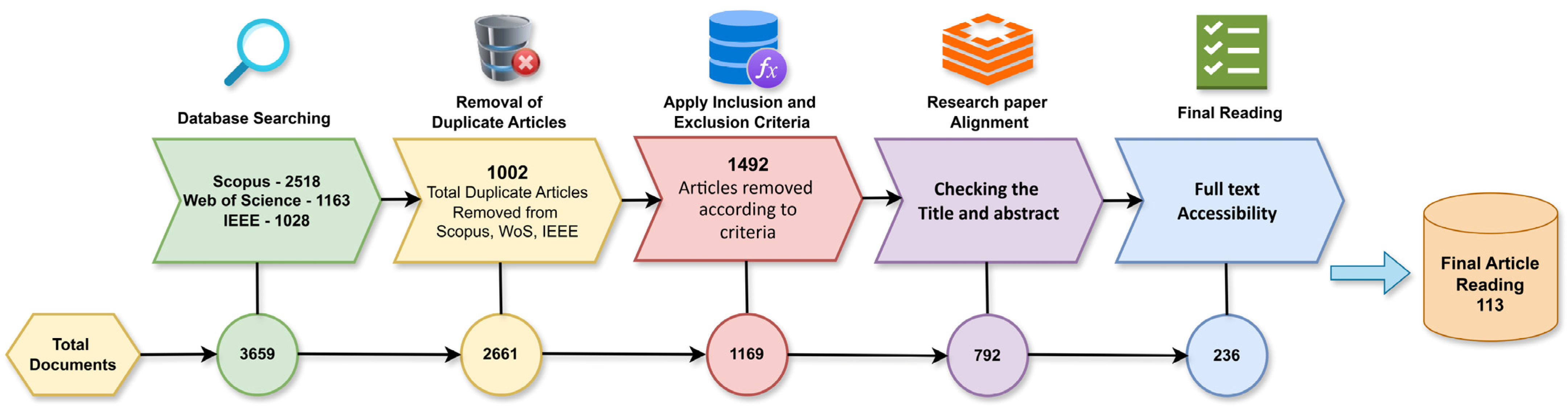
Initially, search questions and keyword searches were asked in accordance with the research topic. Then, three databases were selected: Scopus, Web of Science, and IEEE. A total of 4709 articles were found, out of which 2518 were from Scopus, 1163 from WoS, and 1028 from IEEE. Then, 1002 matching (duplicate) articles were removed. In the next stage, 1492 articles were discarded according to the inclusion and exclusion criteria, and 1169 articles were kept. Out of these, 792 articles were selected after checking the title and abstract, out of which 236 articles were considered for more relevance to the research topic. Finally, a critical review was conducted on 113 full articles. The following section analyzes these articles and answers the research questions. Figure 2 shows the PRISMA implementation flowchart in detail.

3. Background Study

The foundation of the work is to understand the machining principle used in the milling and micromilling processes. In the machining process, progress towards smaller feature size and close tolerance, and the role of conventional and advanced material removal processes, become increasingly significant. This section introduced the key machining concept relevant to the review.

3.1. Milling and Micromilling Process

Machining is a process in which unwanted material is removed from the surface of a material, thereby giving it the desired shape and dimensions. Milling, turning, drilling, boring, and grinding are the main types of machining processes. Milling is a specific type of machining process where material is removed from the workpiece by rotating cutting tools. The workpiece is moved in a specific direction, and the cutting tool is driven through it. Micromilling is an advanced technology in the manufacturing process, used to create a higher range of accuracy and precision jobs or products within the range of 1 nanometer to 1 micrometer. Micromilling is used for creating miniature components in industry, such as aerospace, medical, and electronics components [7]. In the aerospace industry, reliability and precision are very important, in which micromilling is used to manufacture the miniature components of communication and control systems [8]. To manufacture the thin-walled structure with high accuracy and close tolerance, micromilling is used in different applications like heat sinks, micro fins, stents, and tooth pins [9]. It is a feasible process for fabricating different materials like lithium niobate components at a few tens to a few hundred microns scale [10]. The watch-making industry is also a large-scale industry where tiny and complicated parts are needed. The micromachining process is very useful for creating small machined parts, such as holes in the surface, pins, and pockets in a wristwatch [11]. In the case of 3D printed parts with extrusion, especially in the green state (not fully solid), micromilling shows promising results [12]. The comparison between milling and micromilling processes on the basis of different aspects is shown in Table 4.

3.2. Types of Wear

In the machining process, when the cutting tool rotates and engages with the workpiece due to interrupted cutting, it changes the structure of the tool, which is called tool wear. There are different types of tool wear, like flank wear, crater wear, notch wear, built-up edge, thermal cracking, etc. [21]. Lu et al. studied the tool failure factors of micro milling compared with traditional milling. They found that due to high speed, the micromilling cutter generates high heat quickly, and due to tiny edges, this heat cannot dissipate, which leads to diffusion and oxidation wear, which is the main cause of tool failure [13].
Flank wear is generally observed on the flank face of the cutting tool due to contact between the tool and the workpiece. Flank wear varies tooth by tooth. It depends on the cutting conditions, but the friction energy is a key factor of flank wear [22]. Flank wear is affected by various parameters, but Atlas et al. found that the feed rate has the most significant impact on flank wear [16].
Crater wear occurs on top of the tool, which is the rake face, where chips slide away. Muhamad et al. concluded that crater wear was observed on the rake face, and it was caused by the high cutting force and temperature [14]. Lindvall et al. studied finish milling on compacted graphite iron with CVD tools, and they found that the crater wear occurred after the coating failure, which is secondary to flank wear [23].
Built-up edge occurred due to chips of the metal sticking to the tool’s cutting edge. This extra material looks like a raised area on the tool, which is called a built-up edge (BUE). Controlling BUE is very important because initially, when BUE is formed, it changes the geometry of the tool and increases the cutting force, and eventually deteriorates the tool to the point of breaking [15]. Tool wear geometry also affects the tool wear, surface tear, and roughness of the workpiece [18]. Thermal cracking occurred due to the friction between the tool and workpiece, which increased the heat and mechanical load, resulting in cracks in the tool [24].

4. Role of Predictive Maintenance

Predictive maintenance plays an important role in recent machining research using different technologies to improve productivity. This section outlines how different types of maintenance emerged in industry, analyzes current research trends using keyword-based clustering, and examines how predictive maintenance intersects with tool condition monitoring.

4.1. Fundamentals of Predictive Maintenance

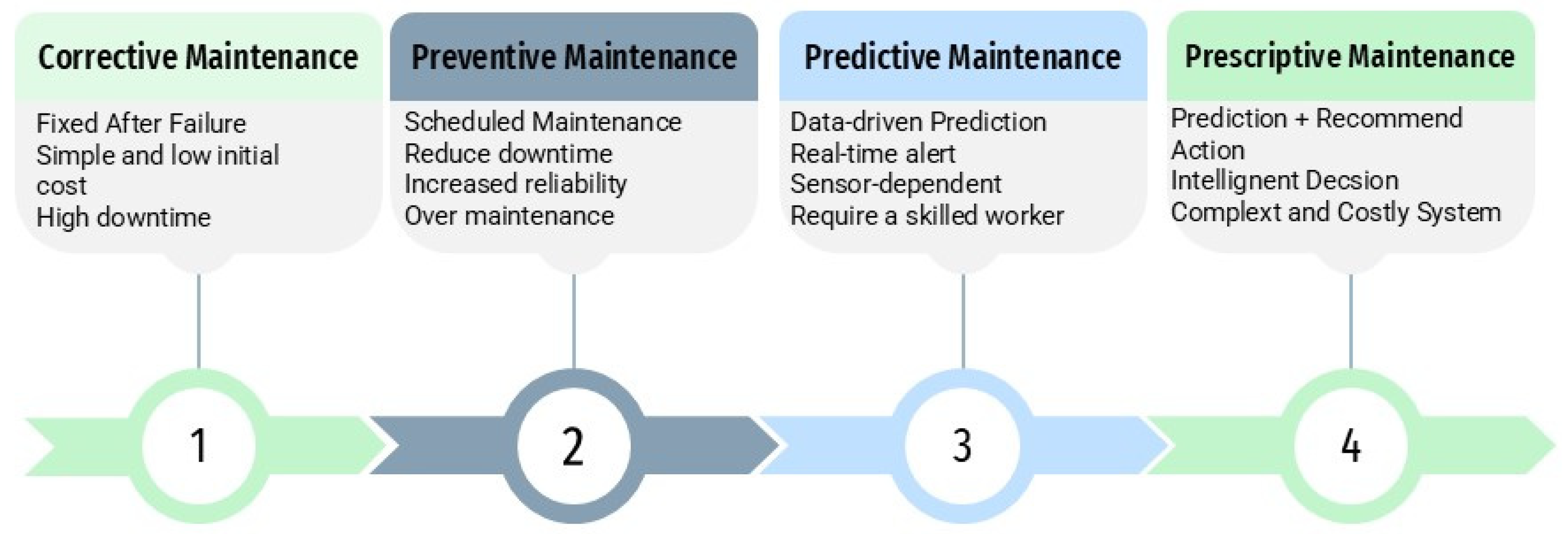
As the industry grows, new maintenance techniques are being used. The type of maintenance that evolved from corrective maintenance to prescriptive maintenance is shown in Figure 3. The industry majorly focuses on performing maintenance better to save time and money.
(a) 
Corrective Maintenance
Corrective maintenance, also known as emergency maintenance, breakdown maintenance, or unplanned maintenance, as the name indicates, is performed after the failure of a component. The advantage of this type of maintenance is the use of the full life of the components. Perhaps it also leads to increased costs due to unplanned failures occurring and wasting production time [25,26].
(b) 
Preventive Maintenance
Preventive maintenance, as the name indicates, stops the failure before it happens. It is generally based on the routine check-up and inspection of the components within the specified time interval. The time interval may be per day, week, or month, depending on the importance of the machinery and its components [25]. This type of maintenance increases the component’s durability due to regular check-ups and reduces the machine’s downtime. It also helps to detect the problem that leads to accidents [26].
(c) 
Predictive Maintenance
Predictive maintenance is a method that alerts before a machine or component breakdown so that timely maintenance can be performed. This method uses a machine learning model that uses historical data from sensors, trends, and data patterns to predict the machine components’ failure. This method helps the machine run smoothly for a longer time, reduces the chance of breakdown, and minimizes the maintenance cost of the machine [27].
(d) 
Prescriptive Maintenance
Prescriptive maintenance is the advanced stage of predictive maintenance. In predictive maintenance, the main focus is on detecting failure and using human knowledge to decide the action on that failure. Prescriptive maintenance provides the specific action for a particular failure to prevent the breakdown. The decision is dependent on the artificial intelligence system. It uses advanced algorithms to enhance the adoption and optimization [28].

4.2. Predictive Maintenance in the Machining Process

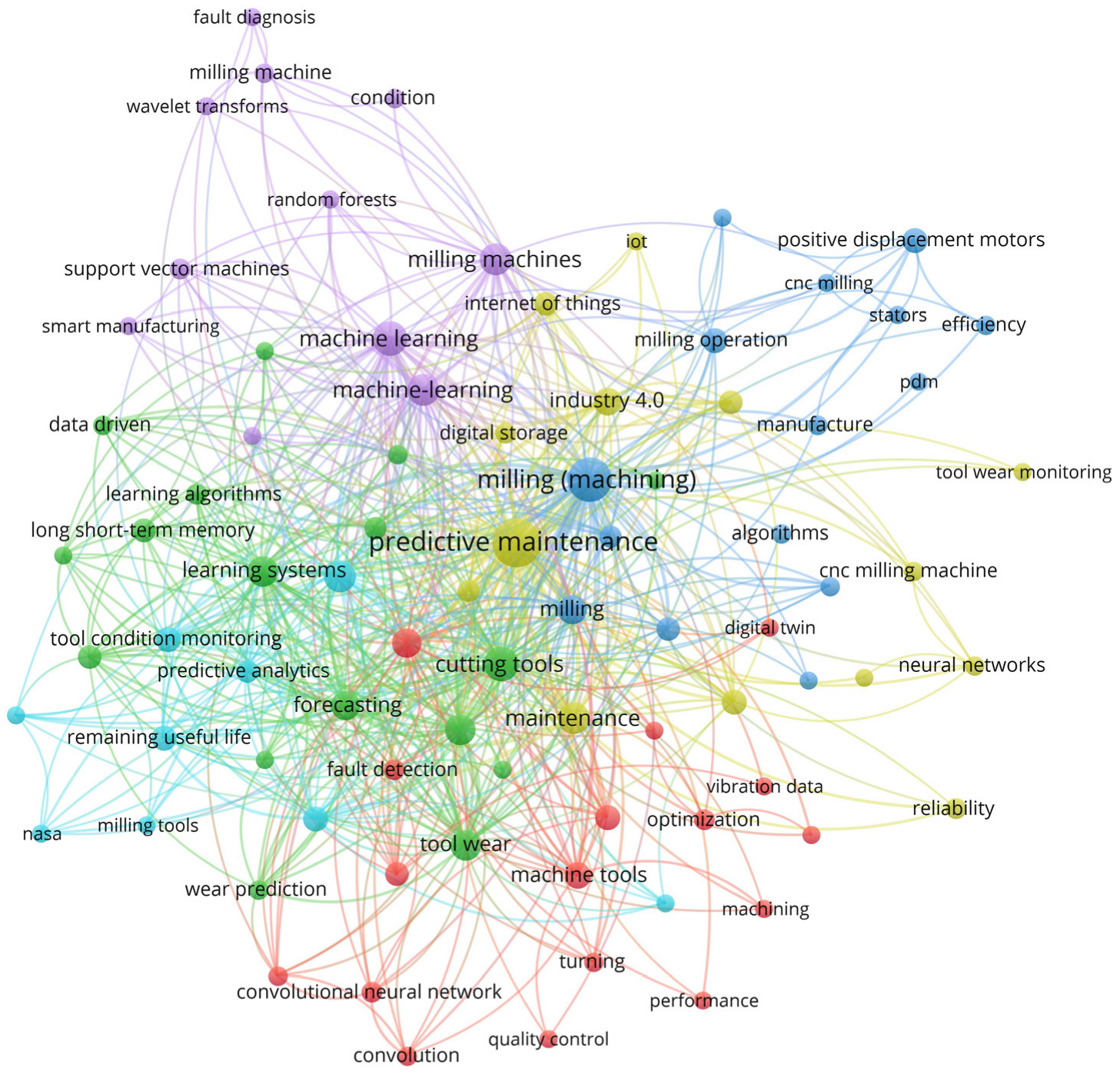
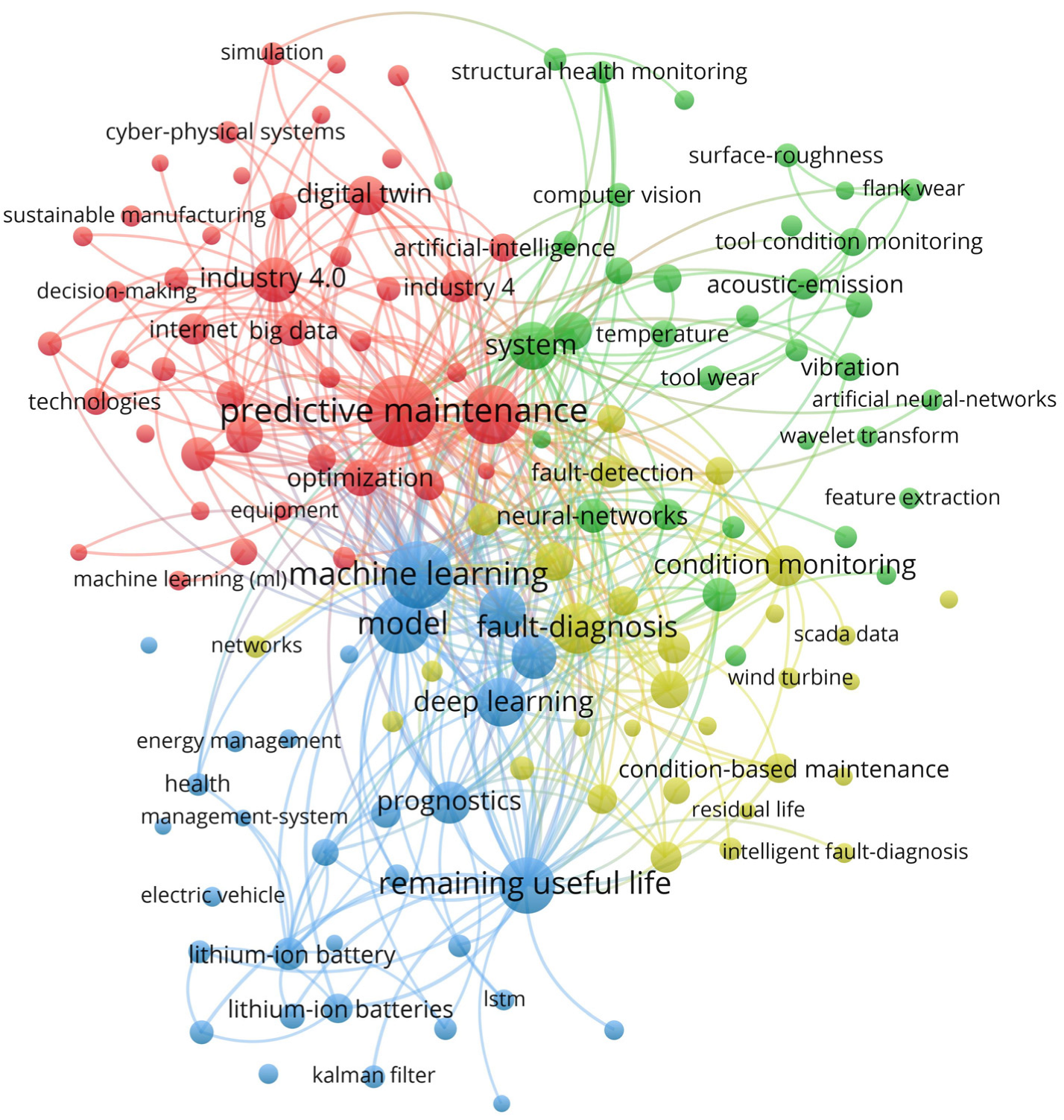
Figure 4 and Figure 5 show the relationships between key concepts in predictive maintenance using keyword co-occurrence network visualization. A dataset was compiled from Scopus and Web of Science (WoS) databases using keywords related to the topic.
In Figure 4, the largest keyword in the center represents the main topic, “predictive maintenance.” Surrounding it are clusters of different colors, representing subtopics such as “machine learning”, “deep learning”, “condition monitoring”, “remaining useful life”, “digital twin”, “computer vision”, “machine vision”, and “Industry 4.0.” The larger the cluster of each keyword, the more often it has been used in research. The lines between the clusters show the correlations between those keywords. Together, this cluster shows how predictive maintenance research spans digital infrastructure, tool condition monitoring, signal acquisition, and intelligent maintenance execution.
Figure 5 shows research trends in the field of predictive maintenance, specifically for machining and machine learning. The clusters of different colors are visual representations of different research areas and their interrelationships. This cluster diagram shows the co-occurrence of research keywords in the fields of machining, tool wear, and predictive maintenance. Each node represents a keyword, the size of which indicates how often it appears in the research, while the colors group related terms into clusters. The central and largest node, predictive maintenance and milling (machining), reflects its dominance as the most widely studied topic. The red cluster focuses on machining operations, sensor data, and deep learning models. The green cluster highlights predictive maintenance, remaining useful life (RUL), and tool condition monitoring strategies. The purple cluster emphasizes “machine learning”, including “deep learning”, “signal processing”, “computer vision”, support vector machines, and convolutional neural networks, which shows the growing role of AI in tool condition monitoring. The yellow cluster highlights the research towards digital twins and smart manufacturing systems. Together, the map shows how machining research is merging with predictive maintenance, optimization, and advanced AI-driven methods, reflecting the interdisciplinary growth of intelligent manufacturing systems.
The integration of predictive maintenance (PdM) into the machining process has grown significantly with the evolution of Industry 4.0, leveraging smart sensors that provide continuous data for analysis. This trend is amplified by the global push towards reducing energy consumption and promoting sustainability. However, challenges persist as many manufacturers hesitate to replace or upgrade their legacy systems, slowing down the transition to more efficient, modern solutions [17].
Manufacturing efficiency is significantly enhanced by integrating predictive maintenance, artificial intelligence (AI), and intelligent sensors, mainly through deep learning, the Internet of Things (IoT), and big data. The technologies implement digitalization combined with data-driven methods and digital twin technology for operation. Industry 4.0 boosts maintenance operations through both condition-based strategies and fault diagnosis methods. Predictive maintenance with IoT-connected sensors plays an important role in gaining efficiency and maintaining efficient communication systems as automation and artificial intelligence continue to advance [27].
In the machining process, different process is used to convert raw materials into finished goods. Failure or breakdown of any machine component affects the productivity and profit of the organization. Predictions of any failure save a lot of money for the organization. In the era of Industry 4.0 and Industry 5.0, researchers try to find the combination of human knowledge and artificial intelligence to figure out the remaining useful life of the machine component. In Industry 4.0, many industries depend on computer-operated machines like computer numerical control machines, so if machine component failures can be predicted in advance, this helps to save money and time.

5. Approaches Used in Predictive Maintenance

Predictive maintenance requires processing large and diverse data from different sources using appropriate technology and requires a flexible and interoperable model to work coherently across the entire Industry 4.0 environment. Predictive maintenance is mainly divided into three types: knowledge-based, physics-based, and data-driven models [29].

5.1. Knowledge-Based System

A Knowledge-based system is a system that makes decisions by thinking like an expert. It contains expert knowledge, rules, and facts, and is also based on logic that draws conclusions using the information contained in that knowledge base. Mainly, there are three subcategories in the knowledge-based system: fuzzy logic system, Weibull distribution, and Bayesian approach. A fuzzy logic system is a system that does not stop at “yes or no”, but makes decisions based on guesses, shades, and human thinking. It makes machines smart by making the right decisions even in complex situations. Gharib, Hla et al. implemented a fuzzy logic system in a marine engine to enhance the maintenance of the marine diesel engine. They found that the system can more accurately and adaptively manage various operational parameters of the engine, improving engine efficiency and reducing emissions [30]. The Weibull distribution is a statistical probability distribution mainly used for lifetime data or failure time analysis. The main advantages of the Weibull distribution are that it describes the behavior of systems with increasing and decreasing failure rates, but a major limitation is that when the failure rate has non-monotonic behavior, the classical Weibull distribution does not provide a good fit [31]. The Bayesian approach is a framework that considers everything in terms of probabilities and updates beliefs as new evidence is received. It is an effective method for data analysis with uncertain factors. The Bayesian method only estimates from current degradation data, which can reduce accuracy [32].

5.2. Physics-Based Model

A physics-based model predicts failure based on the physical behavior of the machine component. It creates a mathematical model using vibration, corrosion, temperature, and wear of the machine components. A Hidden Markov Model is one of the physics-based models in which the state of the system is not directly observable, and it can show only external observations. The internal state of the system is hidden, but that state produces observable outputs, and these changes in the state from one to another over time are based on a Markov process. Camci et al. studied failures in electromechanical systems that occur through a series of degraded health states using a hierarchical Hidden Markov Model for tracking real-time degradation and predicting RUL in devices [33]. The Kalman filter is also a physics-based method that accurately detects the state of an object, like velocity and temperature, from external measurements, even if those measurements are messy or incomplete. Liu et al. used the Kalman filter model to predict the time-varying parameters of the degradation model using the superstatistics and information fusion in the aeroengine systems [34]. The particle filter approach, also known as the sequential Monte Carlo method, is used to estimate the state of a dynamic system when the system is non-linear or non-Gaussian. Jouin et al. used particle filtering techniques in the prediction of PEM fuel cells to identify the degradation of the catalyst and membrane weakening, which are non-observable in the research results. They obtained an accuracy of 90 h around the real RUL value [35].

5.3. Data-Driven Model

In a data-driven model, sensors are mounted on the machine to monitor its operating conditions, and the data required for analysis is collected from these sensors during operation. The valuable information, like necessary features, is extracted from the raw data received from the sensor. Using these features, the condition of the machine can be predicted. This data is analyzed using different algorithms [36]. These algorithms are widely adopted in modern maintenance systems, where multiple sensors enable continuous monitoring and detect changes in patterns [27]. Advanced machine learning techniques have enhanced the accuracy of predictions by integrating multiple sensors and multi-feature datasets [37], while recent studies highlight their effectiveness in tool wear monitoring and the estimation of remaining life in machining operations [38]. These developments play an important role in the data-driven framework and in smart manufacturing. The following section gives brief information related to the data-driven model.

6. Data-Driven Model Used in Milling and Micromilling

To predict the remaining useful life of the tool, it is necessary to monitor the condition and changes in the tool using different parameters and settings. The monitoring system collects the data from the sensor and analyzes this data using different algorithms. Various types of sensors are used to measure the tool’s force, vibration, sound, and power consumption. After collecting the data, different algorithms are used to study the changes in the condition over time [39].

6.1. Sensors

The tool condition monitoring system is divided into two categories: direct and indirect. In the direct system, the output is directly measured from the interface between the tool and workpiece. An indirect system measures the output of the external regions in which there is no direct contact. The indirect system does not disturb the actual cutting process [40].

6.1.1. Accelerometer Sensor

An accelerometer measures the acceleration level and vibration signal during the machining process. Hauptfleischova et al. studied chatter detection by accelerometer, and also checked the effect of tool compliance on vibration transmission to the accelerometer [41]. For more accuracy and data, Huang et al. found that a dual accelerometer is an affordable and effective option to monitor the condition of the vibration, stability, and chatter [40].

6.1.2. Acoustic Emission Sensor

When the cutting tool is working, due to tiny cracks and plastic deformation, the microscopic sounds or vibrations are generated, which are captured by the acoustic emission (AE) sensor. The interpretation and processing of AE signals are complex due to the wide bandwidth of the signal [42]. Hase et al. studied the relationship between the AE signal in the machining process. They concluded that the amplitude of the AE signal is maximum during the discontinuous chips because the fracture occurs rapidly and irregularly, while the AE signal is minimal in the fracture in chips that are uniform and ductile [43]. Ricardo Alzugaray et al. used the acoustic sensor to determine the tool wear in milling operations. In their research, they found that the acoustic signal is more useful than the cutting force in detecting the tool wear, and it is also helpful in finding the pattern of tool wear [44]. In micro-machining, the acoustic sensor plays a significant role in monitoring the tool condition. Characteristics like high frequency and high signal-to-noise ratio at very low depth of cut are very useful in micro-machining operations. Camara et al. studied the material properties and their effect on AE signal, in which they found that the material with lower elongation produced the least AE signal intensity, which helps to study the material behavior and tool wear condition [45]. Rebeiro et al. used an AE sensor to detect the cutting instability in micromilling; its high sensitivity allowed them to capture the elastic waves produced by tool and workpiece contact. They found that the AE signal relates to the chatter, which create relation between the AE signal and cutting stability [46].

6.1.3. Current Sensor

The current sensor used this fluctuation of the spindle motor to detect the tool wear [36]. Yuan et al. proposed a method for tool condition monitoring based on spindle motor current signal, in which sensitive features in the current signal were extracted, which are directly related to tool wear, by using the time-domain, frequency-domain, and VMD (Variational Mode Decomposition) method in which VMD provides more accurate and sensitive feature extraction, because VMD works better on a nonstationary current signal [47]. Zhou et al. used the current sensor with an improved Kernel Extreme Learning Machine algorithm and validated it on the NASA milling dataset of the dry milling process on a face milling cutter. The results show that this method provides excellent monitoring performance, even using only a few current signal features, and it is also beneficial for small and medium enterprises [48]. As Schmitz et al. mentioned, the current sensor is not helpful in the micromachining spindle due to its miniature curved surfaces [49].

6.1.4. Dynamometer

A dynamometer is used for measuring the cutting force. Lacerda et al. used a dynamometer to measure the cutting force to find the value of the specific cutting energy and radial cutting constant to create a stability lobe diagram to predict chatter vibration in the cutting tool [50]. Totis et al. mentioned that the platform dynamometer is affected by the machine and workpiece vibrations. The rotating dynamometer is affected by the elasticity of the rotating parts [51]. In micromilling, De Oliveira et al. used the dynamometer to measure the cutting force of macro- and micromilling machines. He observed a repeated pattern in the dynamometer signal, which helped to understand the reason for the chip formation by measuring the force signal during cutting [52]. Gao et al. used a piezoelectric transducer at a 24 kHz sampling frequency. They found that the axial cutting force is affected most by tool wear. In micromilling, cutting dynamics change rapidly, so the setting of the frequency of the dynamometer plays a significant role in measuring the cutting force [53].
In milling and micromilling, tool wear prediction depends on different sensors. As per the review, accelerometers offer a good balance of performance, and they are available in lower cost and are easy to use. Acoustic emission sensors give the highest sensitivity for detecting early tool wear, but they are expensive compared with the other sensors. All current sensors are less expensive but also not suitable for micromilling. Dynamometer give most correct data and is largely used in the research field.

6.2. Machine Learning Model

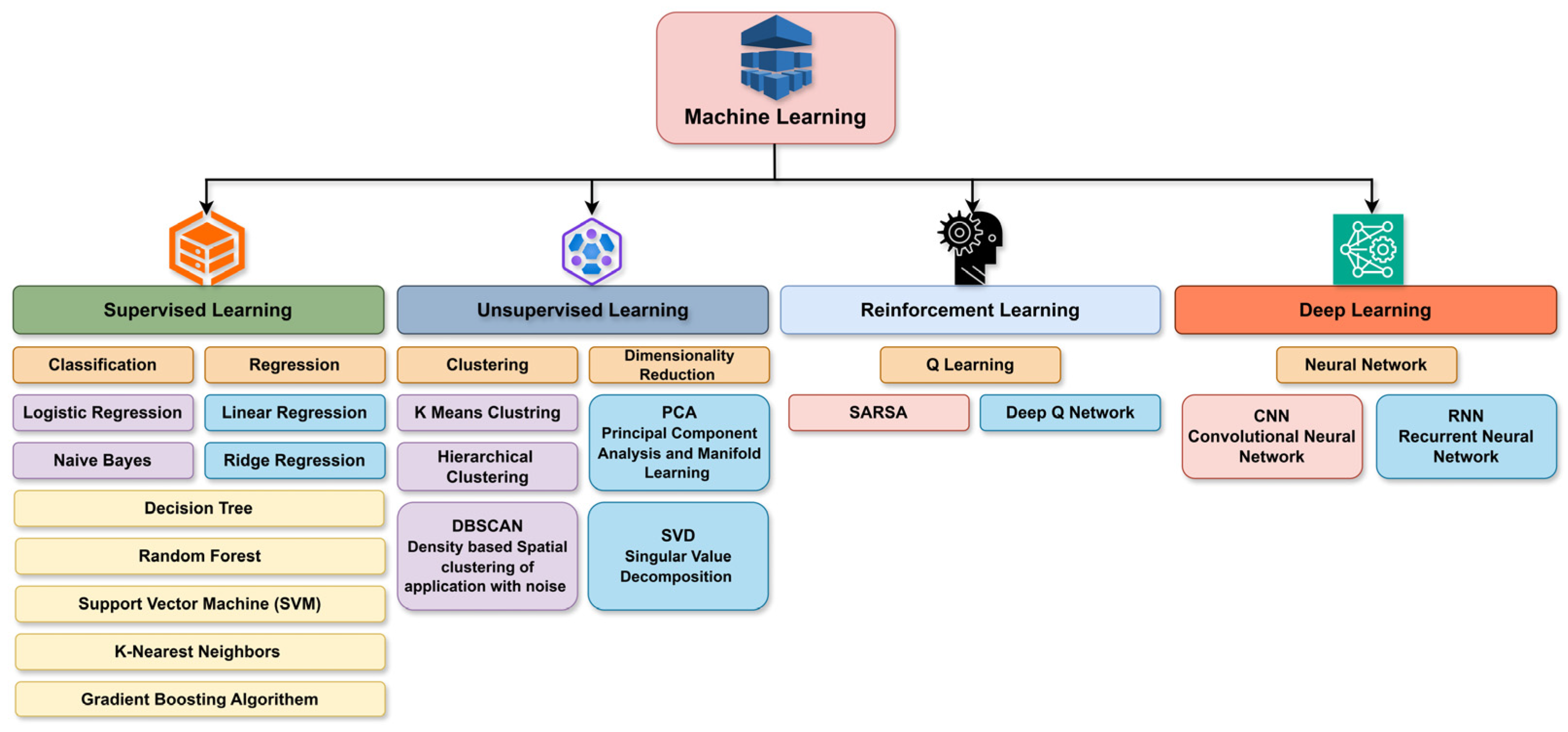
In the data-driven approach, a machine learning model is used to analyze the historical and current data, since there is no perfect framework or model to predict the remaining useful life of the machine and its components. Many researchers used different techniques and models to achieve more accurate results [54]. Figure 6 shows different types of machine learning, their subtypes, and major algorithms used in them.
Liu et al. used a combination of physics-based and data-driven models called the autoregressive integrated moving average (ARIMA) model, in which they collected data from the accelerometer and divided it into training (90%) and testing (10%) data. The ARIMA model predicted the remaining useful life of the cutting tool to be 35 min [38]. Al Refaie et al. used different machine learning regression models like Decision Tree, Random Forest, Support Vector Gradient, Support Vector Regression, and MLP for RUL in the milling operations; in all models, the MLP regressor provides almost 99% accuracy with a mean squared error of 23.13 [55]. Yu et al. highlighted that the logistic regression (LR) model has limitations of overfitting and lacks consideration of internal geometry. Therefore, they proposed LR with penalization regularization (LRPR) to stabilize the coefficients to enable feature selection and manifold regularization (LRMR) to incorporate data geometric structure for improved generalization, which achieved better results compared to back-propagation networks (BPN) [56]. Farooq et al. studied the different ML algorithms under the minimum quantity lubrication and the nanofluid minimum quantity lubrication condition; the result showed that the Decision Tree and Gradient Boosting method have lower error than the KNN, and linear regression and Decision Tree give better predictions than other models [57]. Brillinger et al. used the Random Forest, Decision Tree, and boosted random forest models for energy prediction of machines. They found that the random forest model gives an accurate energy demand for machining. Additionally, they highlighted that different machining strategies affect energy demand, which is helpful in low-volume production organizations [58]. To improve the prediction accuracy of the machine learning model, Kong. et al. used Relevance Vector Machine (RVM) and Kernel Principal Component Analysis with an Integrated Radial Basis Function (KPCA_IRBF) model. The result showed that the KPCA_IRBF technique significantly improves the prediction accuracy of the RVM model, reducing the root mean square error (RMSE) by over 30% and compressing the average width of the confidence interval by more than 90% [59]. Moore et al. used supervised (Classification Model) and unsupervised (Clustering Model) techniques to measure the health of machine tools. They found that by using sensor data, ML methods can effectively identify and classify machine faults. In certain scenarios, fault identification and classification accuracy reached almost 100% [37]. When the process is complex, it is challenging to build closed-form mathematical models. In this context, Wu et al. used the Random Forest (RF) with an ensemble learning algorithm for tool wear prediction in a study using data based on 315 milling tests. In this study, RF accuracy was higher than FFBP ANNs (Feed-Forward Backpropagation Artificial Neural Networks) and SVR. In this research, the RF model gave more accurate tool wear predictions and outperformed other algorithms in metrics such as R2 and mean squared error (MSE) [60]. To achieve more accurate, stable, and reliable results than a single model, some researchers used an ensemble learning method where multiple models, called base learners or weak learners, working on the same problem are created, and their answers are combined to make a final decision. There are three main models used in ensemble learning: Bagging (Bootstrap Aggregating), Boosting, and Stacked Generalization. Checa et al. proposed the Bagging and Random Forest ensemble learning models to select the appropriate cutting tool with different design parameters [61]. Wan et al. used the AdaBoost algorithm to detect bad chatter vibration early in milling, which combined small classifiers built using SVM to create a strong classifier. The model can also accurately identify chatter in a wide range of milling conditions without the need for a threshold [62]. Nguyen et al. used Extreme Gradient Boosting (XGB), CatBoost (CAT), Gradient Boosting Regressor (GBR), and Light Gradient Boosting (LGB), which are different methods of ensemble learning for achieving the most appropriate cutting conditions to improve machining efficiency and product quality [63]. Wang et al. extracted force signals using a minimal redundancy, maximal relevance algorithm to select the most useful features. Using these features, they created a stacking ensemble of Support Vector Machine, Hidden Markov Model, and Radial Basis Function (SVM, HMM, and RBF). The average accuracy of this model is 99.79%, and the standard deviation of error was only 0.22% [64]. Wang et al. developed an INGO-SVM model using improved NGO optimization with SVM for tool wear detection, where 97.9% accuracy and complete severe wear identification were achieved, but also mentioned that the model cannot automatically adjust wear patterns during real-time monitoring, which reduced the suitability for an autonomous monitoring system [65]. Val et al. used multiple machine learning regressor models on the ultrasonic-assisted milling method, in which the ensemble voting regressor achieved higher performance with 0.946 R-Squared, 0.243 RMSE, and 0.182 MAE [66].
In micromilling, Gomes et al. analyzed the tool wear using a Support Vector Machine, which achieves 97.54% accuracy in wear classification [67]. Ding. et al. used the Gated Recurrent Unit machine learning model and Dandelion Optimizer tool, which is based on a data-driven and physics-based model to accurately predict cutting force and tool wear in real-time in the micromilling process [19]. The traditional Hidden Markov Model (HMM) sometimes fails due to changing cutting conditions. Li et al. used the improved Hidden Markov Model, which can adapt to changing cutting conditions during the process, which helps to detect changes in the state of the instrument over time under various conditions. They found that this model effectively captures the time-varying and adaptive nature of tool wear, allowing for more accurate predictions [68]. Wang et al. used the fusion model of recursive feature elimination, Bayesian optimization, and extreme gradient boosting. This model achieved a 96.67% accuracy in identifying tool wear states, outperforming the default XGBoost model with 91.11% [69]. Varghese et al. classified tool life into three stages (initial 12.5%, middle 12.5–70%, and final 70–100%) using force data obtained during cutting. In each stage, the tool diameter decreases and the cutting force increases (Stage 1: 2.45 N, Stage 2: 4.17 N, Stage 3: 4.93 N). Using this force data, a Random Forest model was built, with an accuracy of 88.5%. The Random Forest model with edge radius achieved 89.65% accuracy and high reliability [70].

6.3. Deep Learning Model

As a part of machine learning (ML), deep learning uses networks with multiple layers of neurons, where each layer learns progressively more complex patterns from the data. While it began with simple models, it has now advanced to sophisticated neural networks capable of handling tasks such as natural language processing (NLP) and image processing. Deep learning manages large volumes of data and performs complex computations efficiently [71]. A Convolutional Neural Network (CNN) is a type of neural network that works mostly on data that has a grid-like appearance, such as photos or images. The main task of this network is to identify small patterns and structures in the input by applying various filters to it. This process allows us to understand what is in different images. Ahmad et al. used a type of CNN called a Residual Network (ResNet) in which they used an Acoustic Emission sensor to create a spectrogram of the noise emitted by a machine while it was running. They tested the model on 710 samples. The overall model accuracy was found to be 99.7% [72]. Karabacak et al. applied the Short-Time Fourier Transform (STFT) to vibration, acoustic emission, and current signals. They created spectrograms of these signals and used these spectrograms to train the CNN [73]. Feng et al. have developed a new framework, SCNN-Ex, which uses CNN to detect tool wear from different sensor signals. Synthetic features were created to work on a small dataset, and training was well-regulated. This model showed higher accuracy than the old method, with the error for steel on the NASA milling dataset reduced from 32% to 21.7% [74].
To overcome the limitation of the Decision Tree, the Support Vector Machine, and K-Nearest Neighbor, Peng et al. used TCN–LSTM (Temporal Convolutional Network—Long Short-Term Memory) based neural network model to find the wear state of milling cutters using different cutting parameters, they found that this method effectively predicts the cutting forces from spindle current signal but also it heavily depends on the spindle current signal [75]. Gong et al. used the Back Propagation Neural Network (BPNN) model, in which the model gave more than 80% accuracy by using acoustic emission with force sensor data [76]. Chen et al. used the CABLSTM model to overcome the challenges of the CNN and RNN models, in which they combine the feature extraction and temporal learning ability. The model achieved 96.97% accuracy over other ML and DL models [77]. In micro-end milling, the circular tool path has a significant impact on vibration and chip thickness due to changes in the path. Bagri et al. focused used deep learning based deep belief network (DBN), which achieved 93% to 99% accuracy in identifying tool wear state [78]. Wu et al. proposed a hybrid deep learning model that integrates a force estimation network with a CNN-based wear classifier in which cutting force is estimated directly from the fast tool surface signal and converted into a GASF image, enabling the CNN to classify wear states effectively, in this research, the hybrid model outperformed other models with an accuracy of 85% to 89% [79]. The machine learning and deep learning models and their key findings are shown in Table 5. It shows the progression from a traditional ML model to an advanced ensemble, deep learning model. Ensemble approaches such as RF Model repeatedly achieve high accuracy, while deep temporal models like HMM, TCN–LSTM, and GRU provide superior robustness for micromilling, where signal changes are more complex. Studies from 2023 to 2025 confirm that hybrid deep learning models provide the most consistent reliability and remaining useful life prediction. Overall, all these research studies indicated a clear shift towards the multi-sensor and hybrid model as a good solution for tool wear prediction in both machining processes.

6.4. Computer Vision Approach

Computer vision is a modern technology that uses cameras to observe objects or processes and analyzes them computationally to make decisions. Many researchers have found that computer vision and image processing technology have made tool wear monitoring more accurate and easily adjustable to the conditions and parameters. Pimenov et al. reviewed the monitoring of tool condition using image processing techniques, in which they found that the image processing techniques can significantly improve tool performance by enabling real-time monitoring of tool wear and cutting conditions, which leads to optimized machining parameters and high-quality surface finishes [81]. Ullah et al. used the CWT Image Augmentation and Ant Colony Optimized AlexNet model with a Support Vector Machine, which improves the fault detection capabilities in the milling machine [82]. Zhang et al. developed a GUI called ToolWearOMM, using C++ and OpenCV for online tool wear measurement of ball-end cutters. Real-time CCD images identified tool tip points, and by comparing pre-process and in-process images, wear edge points were detected at the pixel and sub-pixel level, enabling accurate tool wear calculations [83]. Laura et al. developed an automatic computer vision system to detect broken inserts in milling machines, which detects the position of the screw of the inserts, determines the expected direction and position of the cutting-edge using geometry, and measures the difference from the actual edge to detect whether the insert is broken. It does not require a reference image, and it can process 24 high-resolution images in just 3 min. This system identified broken inserts with 91.43% accuracy [84]. In micromilling, tool monitoring is challenging due to the shallow depth of field. Szydlowski et al. implemented a wavelet-based Extended Depth of Field (EDoF) method using a 2D continuous wavelet transform, which enabled automated cutting-edge detection and wear assessment without lighting issues. SEM images verified accurate tool wear monitoring [85]. Malhotra et al. developed a computer vision algorithm using ROI extraction, Fuzzy C-Means clustering, and pixel-level measurement for tool wear detection on color images of a micro-tool. Compared to K-means and RGB thresholding, it achieved 99% correlation, 92% segmentation accuracy, and 97% wear measurement accuracy [86].

7. Recent Advancement

7.1. Reinforcement Learning Model

Reinforcement learning is a machine learning method where an agent is rewarded for correct behavior and punished for errors while learning from the environment. This learning is useful for complex systems such as robotics, autonomous vehicles, manufacturing, and supply chains [87]. Kaliyannan et al. used the Reinforcement Learning model using the SARSA algorithm, in which they found that the SARSA algorithm outperformed other models in predicting tool conditions, achieving an accuracy of 98.66% against the Q-learning: 98.50%, FFNN: 98.16%, and LSTM: 94.85% [80]. Lu et al. developed a Hierarchical Reinforcement Learning (HRL) for combined optimization of cutting parameters and tool path, which reduces both energy and time required for machining. This optimization involved a higher-level agent that determined the appropriate cutting parameters for each pass, and a lower-level agent that used the parameters to design the tool path and provided feedback to the upper level [88]. Wang et al. used a reinforcement learning algorithm to find cutting parameters that achieve minimum surface roughness and maximum material removal rate in a milling process to improve quality and efficiency in the manufacturing process. In this, they made excellent predictions even from a small amount of raw data and achieved an accuracy of 0.9118 for R-squared [89].

7.2. Generative Adversarial Network

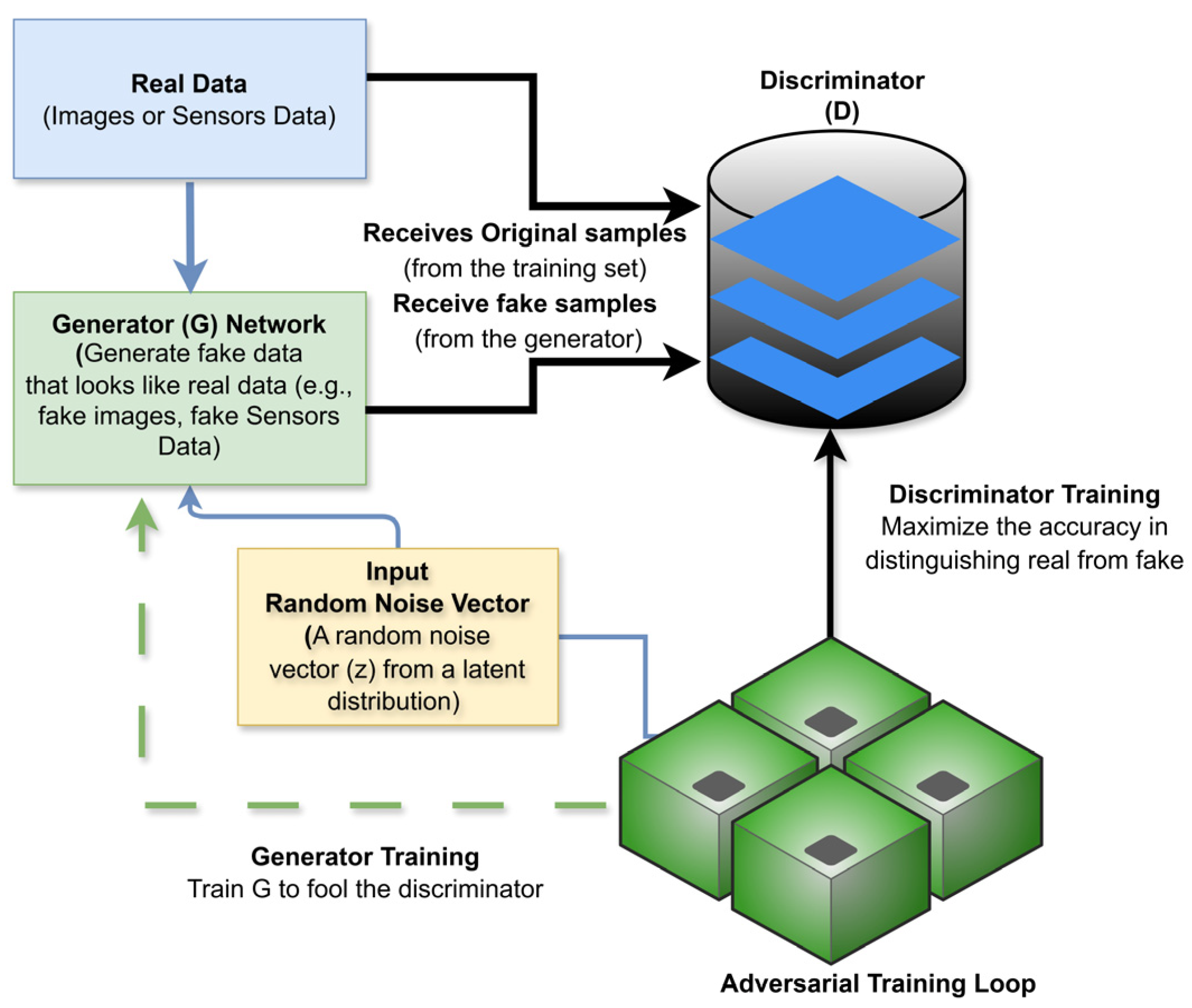
A Generative Adversarial Network (GAN) generates new, realistic data (like images or text) by using two competing neural networks: a generator, which creates false data, and a discriminator, which tries to identify whether the data is real or fake. This process improves both networks, allowing the generator to produce data that the discriminator cannot distinguish from genuine data. Performance data often shows an imbalance when assessing a tool or machine’s condition, as sensor fault data is typically limited. Training on this unbalanced data can lead to inaccurate failure predictions, as shown in Figure 7. GANs are particularly useful in fields that require artificial data generation. Cooper et al. trained a Generative Adversarial Network model using acoustic signals from healthy tools to detect tool failure in a milling machine and then used the generator of the GAN to invert the anomaly detection. It was able to detect the tool position with 90.56% accuracy. Using a GAN transformed the data into a straight-line segment, which made it easier for machine learning systems to work on it [90]. Due to the lack of experimental data, Shah et al. created synthetic images using a singular generative adversarial network (SinGAN) and then trained three types of LSTM models using feature vectors from those images. They analyzed the performance of those three models. By using this GAN, they solved the problem of low data, so the model trained well and the prediction accuracy improved a lot [91]. The stages of tool wear are unbalanced, which causes features to mix with each other in conventional neural networks, which reduces accuracy. For this, Yu et al. used GAN to improve the imbalance category labels and create synthetic signals. This resulted in balanced data for all wear stages, and as a result, the accuracy of tool wear prediction increased significantly [92].

7.3. Transfer Learning

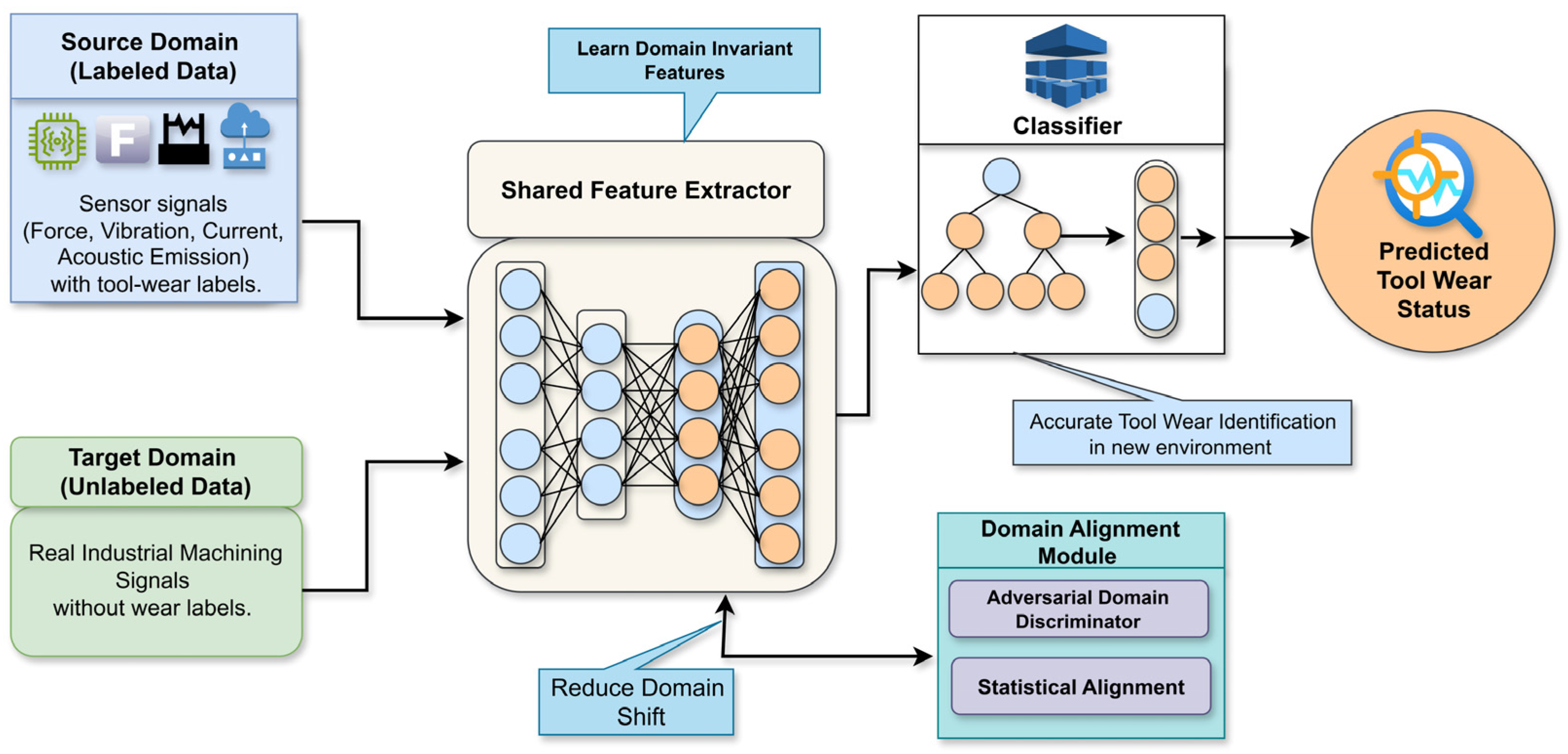
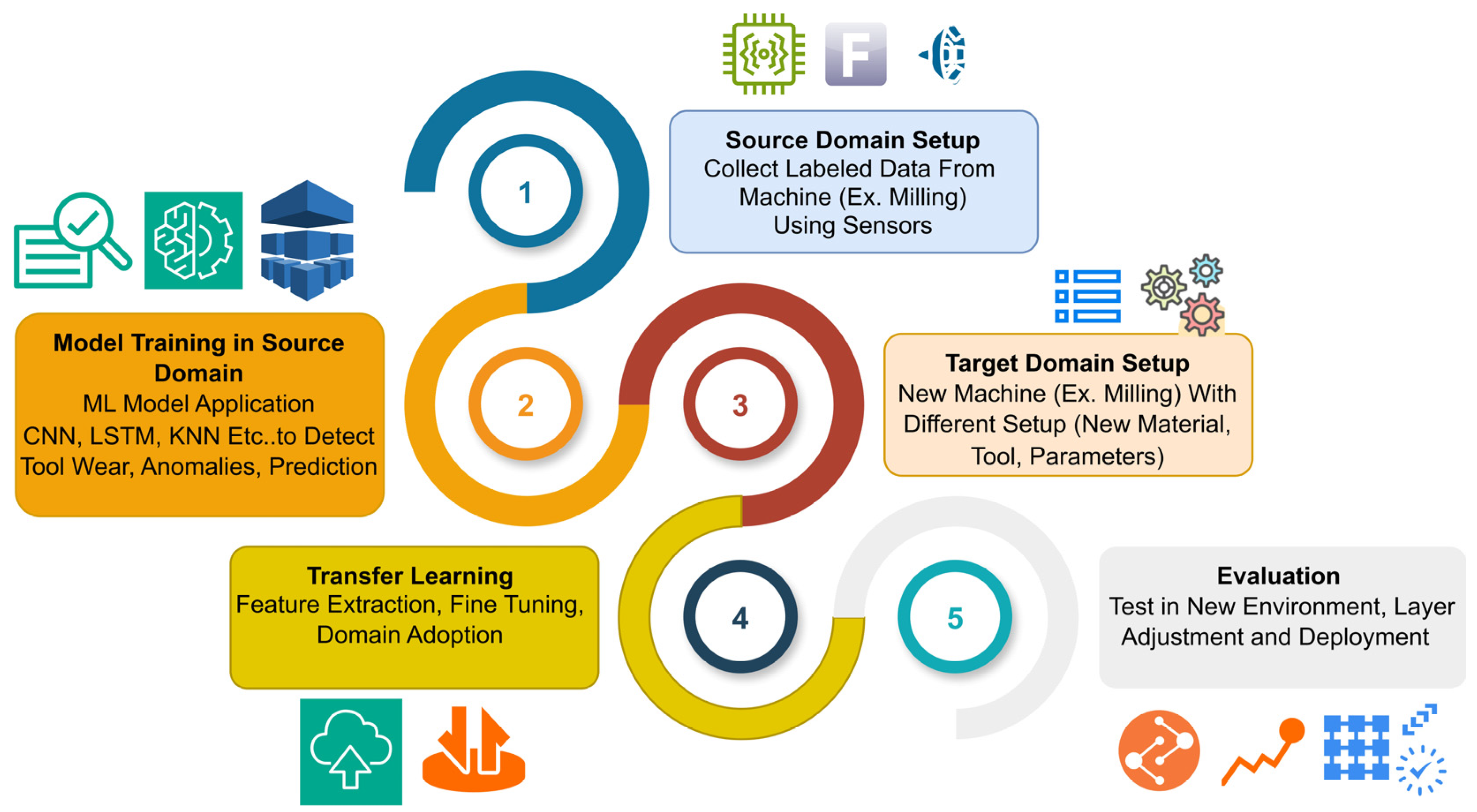
Transfer learning is a machine learning technique that can address issues in related but different domains by applying existing knowledge. It is frequently used to transfer training data from one domain to another for model training when training data is lacking, as shown in Figure 8. Li et al. developed a Weighted Adaptive Joint Distribution Adaptation method using transfer learning to predict tool tip dynamics to avoid chatter. In this, a Kriging Regression Model was created using two datasets to predict tool dynamics under different conditions, such as position and spindle speed. This method was more accurate than all other methods, with a natural frequency prediction error of only 0.48% and a damping ratio prediction error of only 7.2% [93]. Neural networks require a lot of data, and collecting cutting data is expensive and time-consuming, so cutting force prediction is easier using transfer learning. Wang et al. used the data obtained from simulations for experimental data prediction using transfer learning, in which the difference between the two domains was reduced using Maximum Mean Discrepancy. In this, the transfer network showed an error of 11% more than the ordinary neural network in the range of 5 to 90 experimental samples and 15.53% less in the range of 5–20 samples, which means that if there are at least 30 samples, transfer learning works very well [94]. Zhou et al. proposed a new technique called Time-Frequency Markov Transition Field (TFMTF). This technique takes the force signals during cutting and converts them into a 2D color image that contains both time and frequency information. Using this image, they predicted the tool condition using transfer learning on a pretrained ResNet neural network, in which the classification accuracy reached 94.3%. Transfer learning gave better results, even with minimal training data, using a pretrained ResNet [95]. To overcome the limitations of small and quality data in deep learning, Papacharalampopoulos et al. used active and transfer learning. They concluded that accuracy improved 6.9% to 18% by using 45–56% less data, but findings also indicated that transfer learning outcomes depend on the direction of the transfer [96].

7.4. Digital Twin

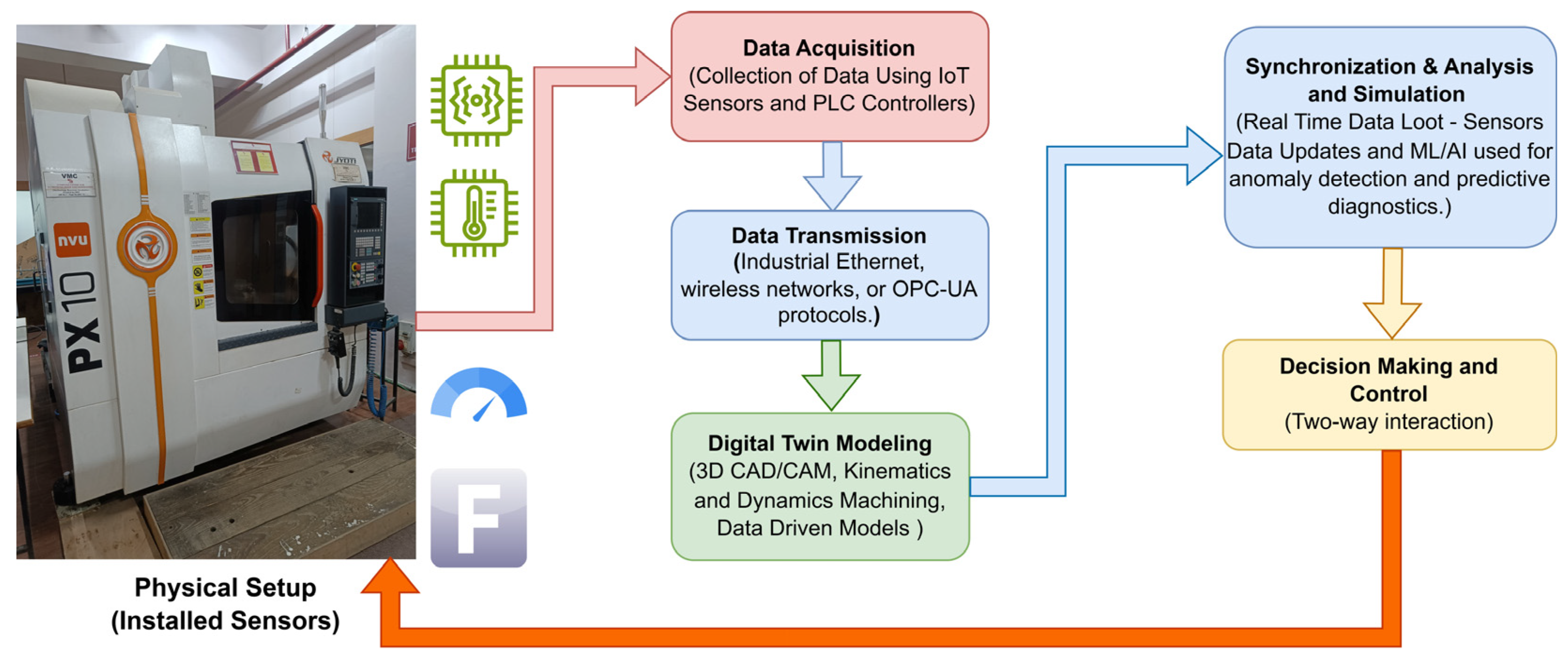
A digital twin is a digital image or replica of a physical object, system, or process. This replica is created with the help of sensors, data, and software. Through this, the performance of the physical object can be observed, analyzed, and predicted, as shown in Figure 9. Digital twin technology accelerates complex manufacturing processes with the help of AI, data, and modeling [97]. In milling, Liu et al. created a real-time data-driven model based on vibration data. In this model, they extracted Model Frequency Features (MFFs), i.e., important frequency-based features in the vibration signal. Using these MFFs, they diagnosed faults and wear in the cutting tool. In their study, they used machine learning data for offline and real-time (online) monitoring training to test the accuracy of their digital twin-based anomaly detection framework. The error in offline testing was 6.65 μm, and in online monitoring, the error was 11.05 μm. Both of these errors were below the acceptable limit of 20 μm [98]. Luo et al. developed a Hybrid Predictive Maintenance Framework for a milling machine that runs on both the digital twin model and the data-driven model. In this, they used live data collected from sensors. Then, they combined the data obtained from the model and the actual sensor measurements using a Particle Filtering Algorithm. Finally, they experimented with the same method for cutting tool life prediction. The prediction error ratio of the hybrid approach is 3.17% at the initial stage, 3.56% at the medial stage, and 6.27% at the end stage, which is smaller than that of the digital twin and data-driven model [99]. Natarajan et al. built a digital twin (DT) model in MATLAB/Simulink using a data-driven approach. The model was continuously adapted to the actual state of the physical machine and accurately identified various tool states using machine learning techniques like PNN, KNN, SVM, NB, and RF on this sensor data, and tested the prediction accuracy using a Confusion Matrix [100]. Wu et al. used a digital twin concept to continuously map the machining system to tool wear states, enabling real-time monitoring and decision support. In this research, they classified diamond-tool wear conditions with an accuracy exceeding 85% [79].
In micromilling, Christiand et al. used the DT model to create a digital model of a micromilling machine, which monitored various machine movements, sensor data, and wear progression. The system was tested on four different micromilling datasets using the Extended Kalman Filter, which showed a maximum mean error of only 0.038 mm in the wear value [101]. Low et al. created A high-fidelity digital twin of a micromilling machine using an Open Platform Communications Unified Architecture. The result showed that the digital twin and data transfer setup was able to consistently collect, process, and predict at 2 ms intervals [102].

7.5. Explainable AI (XAI)

The primary objective of explainable AI (XAI) is to guarantee the trustworthy application of AI systems, which involve the user comprehending the rationale behind and methodology of the AI’s decision-making. This makes it possible to have more faith in AI. Without sacrificing the model’s accuracy, XAI develops machine learning (ML) models that are explainable, which allows the user to clearly explain the logic behind the AI’s choice. Explainable AI investigates explainability and transparency in socio-technical systems in addition to technical issues. Its application in AI decision-making is equally crucial for ethics, law, and policy [103].
Akbari et al. used Shapley Additive Explanations (SHAP) to investigate the impact of mechanical properties in metal additive manufacturing (MAM) in an XGBoost model. It helped them to understand the importance of input data and the output characteristics and how they affected the prediction [104]. Mishra et al. used explainable AI techniques to find the effect of input parameters on surface roughness in additive manufacturing (AM) products made using polylactic acid. In this, they used a total of nine different algorithms, in which XGBoost predicted surface roughness most accurately and explained how each input variable affects the surface roughness using Partial Dependence Plots, SHAP Beeswarm Plots, and Heatmaps in XAI techniques [105]. Hasan et al. created an explainable AI-based model using the Boruta algorithm for bearing fault diagnosis. This model explained which features are actually useful. In this model, they used the k-NN classifier to diagnose faults and Shapley values to explain why each decision of the neural network was made [106].

7.6. Domain Adaptation

The industry used different machines, sensors, and operating conditions. If the same machine learning model is trained on a particular machine, it will not necessarily work as accurately on another machine. This is because the sensor setups, working speed, vibration, and temperature of the two machines may be different. Domain adaptation (DA) is a method that helps in applying the knowledge learned from the source domain to the target domain, as shown in Figure 10 [36]. Homogeneous and heterogeneous are the two main types of domain adaptation processes. In homogeneous processes, the number of features and the type of features are the same in both source and target domains. In heterogeneous processes, the source and target domains have different types or numbers of sensors [107]. Applying deep learning models to different situations is a big challenge. Transfer learning works well for homogeneous data, but it is difficult for heterogeneous data. For this reason, Gentner et al. created the Domain Adaptation Neural Network with a cyclic supervision model. In this model, there are cyclic interactions between different parts of the model, so this model not only adapts the domain, but also matches the source and target domains [108]. Shim et al. used a new method called domain-adaptive active learning to check the quality of wafers in semiconductor manufacturing. In this, they created a new virtual metrology (VM) model in which they transferred the data from the old machine to the new machine using domain adaptation. This process was performed using unsupervised learning, and then the model was gradually improved using active learning. It reduced the metrology cost of the setup [109].

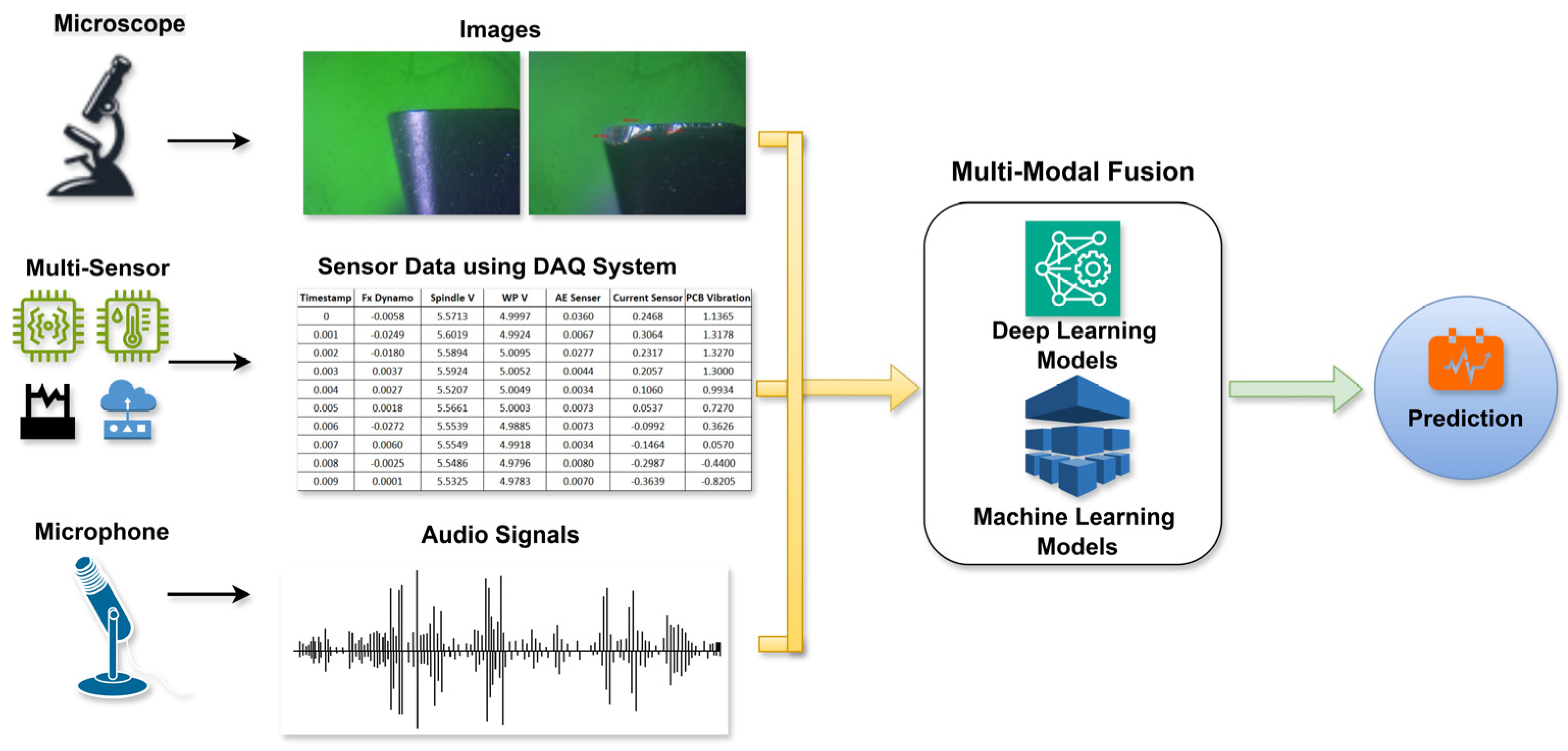
7.7. Multi-Modal Fusion

Multi-modal fusion is the process of combining information from different types of data, such as images, text, audio, and sensors, to improve predictions for tasks such as classification or regression, as shown in Figure 11. Multi-modal techniques improve prediction through robustness, combine unique information, and handle missing features [110]. Sotubadi et al. used a multi-modal neural network in which vibration, force, acoustic signals, temperature, and images were simultaneously taken to create a neural network model. They used Shapley Additive Explanations criteria from explainable AI to explain how much influence each feature has on the output decision and visualized which part of the neural network was focused on using Grad-CAM and saliency maps [111]. McKinney et al. used a novel contrastive learning based multimodal fusion method to monitor the manufacturing process, which is based on the CLIP (Contrastive Language–Image Pretraining) model. In this, they used a camera, an IMU sensor, and an audio signal to monitor the manufacturing process, and then anomaly detection was performed using Long Short-Term Memory and Random Forest machine learning models. The system became more reliable and stable by using multiple modalities [112]. Mahjourian et al. created a multimodal system that uses 2D (RGB camera) and 3D (point cloud sensor) data simultaneously. They used a Faster R-CNN deep learning model for object detection, which works only on photos. The multimodal model improved the mean average precision by 13% over the RGB-only model [113].
In recent technology, multi-modal fusion is the most modern and effective technique, used combination of different sensors with computer vision to predict highly accurate and interpretable tool wear estimation for the next generation smart manufacturing. Explainable AI also makes models interpretable, allowing the industry to have confidence and confirm the decision-making logic of the AI system. However, many problems remain, like limited high-quality datasets, high sensor costs, a real-time industrial environment, and strong signal noise in micro machining. The review still presents important factors like model utilization across different machines and materials, and stronger integration of AI methods.

8. Conclusions and Future Directions

This study has comprehensively examined and integrated prior research through the different research questions and criteria to gain insights into how technologies are driving the evolution of predictive maintenance and condition monitoring practices from data-driven automation towards sustainable, human-oriented innovation. This review studied 115 research articles published between 2014 and 2025. Approximately 65–70% of the reviewed articles addressed milling operations, while 30–35% focused on micromilling, indicating a comparatively limited but growing research emphasis on micro-machining. In terms of sensors, 60–65% of research studies are based on a single sensor, while 35–40% based on multiple sensors, which showed that the researcher slowly shifted towards the multi-sensor fusion framework. According to research trends, deep learning-based models and computer vision approaches have experienced rapid growth since 2020.
Machine learning models such as random forests, SVMs, MLPs, and ensemble techniques have consistently achieved high accuracy by effectively combining multi-sensor data and adapting to different machining conditions. Their strengths lie in robustness, error reduction, and suitability for real-time monitoring. However, they are mainly dependent on sensor data and face reliability issues in complex situations.
Deep learning models further enhance tool wear detection with the ability to automatically learn complex features from raw sensor data. DL Models such as CNN, GRUs, ResNet, SCNN-Ex, TCN–LSTM, and BPNN have achieved higher accuracies, especially when combining vibration, acoustic emission, and current signals. These methods improve reliability and adaptability. DL models face limitations such as reliance on sensor inputs, high computational cost, and the risk of overfitting on small datasets.
In addition, computer vision and image processing have made significant contributions by enabling accurate, real-time wear monitoring through approaches such as GUI-based systems, wavelet-based EDoF, and clustering algorithms. These methods improve automation and machining performance. In recent advancements, emerging approaches such as GAN, reinforcement learning, transfer learning, digital twins, and explainable AI are key enablers of sustainable, human-centric innovation in manufacturing. By addressing the challenges of data imbalance, inter-domain adaptation, and diverse sensing conditions, these techniques strengthen the accuracy, transparency, and ethical applicability of AI-driven decision-making in complex industrial systems. Together, they hold significant promise for shaping future smart manufacturing ecosystems that are adaptive, reliable, and resource-efficient. This review highlights the rapid progress of intelligent manufacturing techniques, while also identifying their limitations.
Although significant research has been conducted in predictive maintenance and tool condition monitoring, the literature showed several challenges that primarily define future research priorities. To address the challenges of small, laboratory-generated datasets collected under controlled conditions, future efforts should focus on standardized data acquisition procedures, public datasets, and scalable data collection approaches to enhance accuracy and cross-study comparison. Many studies report high accuracy in minimum data and experimental settings, but their performance decreases when applied to different materials and machining setups. These limitations are majorly shown in micromachining operations, where the size of the tool and rapid wear progression introduce process uncertainties. To overcome this issue, future work should adopt transfer learning and domain adaptation methods to reduce dependency on data and also improve cross-domain applications. Finally, the gap between laboratory validation and real-world industrial implementation remains a persistent challenge. Only a limited number of studies have demonstrated long-term validation in realistic production scenarios, while practical issues such as sensor integration, data supervision, and security have not received sufficient attention. Therefore, future research should prioritize industrial-scale case studies and closed-loop implementations that integrate predictive maintenance into Industry 4.0 and smart manufacturing infrastructures.

Author Contributions

Conceptualization: V.J., S.S., A.B., S.K., V.W. and S.R.; methodology: V.J., S.S. and V.W.; resources: S.S., A.B., S.K., V.W. and S.R.; data curation: V.J.; writing—original draft preparation: V.J.; writing—review and editing: S.S., V.W. and S.R.; supervision: S.S., A.B., S.K., V.W. and S.R.; funding acquisition: S.R. All authors have read and agreed to the published version of the manuscript.

Funding

The research was funded by the Symbiosis Research Fund (RSF) of Symbiosis International (Deemed University), Pune, Maharashtra, India.

Data Availability Statement

No new data were created in this study. All data used in this review are available in the cited published literature.

Acknowledgments

The authors gratefully acknowledge the research support provided by th Department of Robotics and Automation, Symbiosis Institute of Technology, Pune campus, Symbiosis International (Deemed University), Pune, Maharashtra, India, which made this research work possible.

Conflicts of Interest

The authors declare that they have no known competing financial interests or personal relationships that could have appeared to influence the work reported in this paper.

Abbreviations

The following abbreviations are used in this manuscript:
AIArtificial Intelligence
AEAcoustic Emission
ANNArtificial Neural Networks
ARIMA Autoregressive Integrated Moving Average
BPNNBack Propagation Neural Network
CWTContinuous Wavelet Transform
CCDCharge-Coupled Device
CNCComputer Numerical Control
CNNConvolutional Neural Network
DLDeep Learning
DTDecision Tree
EDoFExtended Depth of Field
FFBP Feed Forward Back Propagation
FFNNFeed Forward Neural Network
GANGenerative adversarial network
GBR Gradient Boosting Regressor
Grad-CAMGradient-Weighted Class Activation Mapping
HMM Hidden Markov Model
IoTInternet of Things
KNNK-Nearest Neighbors
KPCA_IRBFKernel Principal Component Analysis with an Integrated Radial Basis Function
MLMachine Learning
MLPMulti-layer Perceptron
MQLMinimum Quantity Lubrication
MSEMean Squared Error
NF-MQLNano Fluid Minimum Quantity Lubrication
PdMPredictive Maintenance
PEMProton Exchange Membrane
PIOC Population–Intervention–Outcome–Context
PRISMA Preferred Reporting Items for Systematic Reviews and Meta-Analysis
RBFRadial Basis Function
ResNetResidual Network
RFRandom Forest
RMSERoot Mean Square Error
RQResearch Question
RULRemaining Useful Life
RVMRelevance Vector Machine
SARSAState-Action-Reward-State-Action
SEM Scanning Electron Microscope
SCNN-ExStatistical Convolutional Neural Network Extension
SHAP Shapley Additive Explanations
SVGSupport Vector Gradient
SVRSupport Vector Regression
TCN–LSTM Temporal Convolutional Network–Long Short-Term Memory
VMDVariational Mode Decomposition
TFMTFTime-Frequency Markov Transition Field
XAIExplainable AI
XGBExtreme Gradient and Boosting

References

  1. Johansson, D.; Lindvall, R.; Windmark, C.; M’sAoubi, R.; Can, A.; Bushlya, V.; Ståhl, J.-E. Assessment of metal cutting tools using cost performance ratio and tool life analyses. Procedia Manuf. 2019, 38, 816–823. [Google Scholar] [CrossRef]
  2. Gackowiec, P. General overview of maintenance strategies—Concepts and approaches. Multidiscip. Asp. Prod. Eng. 2019, 2, 126–139. [Google Scholar] [CrossRef]
  3. Di Bona, G.; Cesarotti, V.; Arcese, G.; Gallo, T. Implementation of Industry 4.0 technology: New opportunities and challenges for maintenance strategy. Procedia Comput. Sci. 2021, 180, 424–429. [Google Scholar] [CrossRef]
  4. Park, S.; Lee, K.; Sung, S.; Park, D. Prediction of the CNC tool wear using the machine learning technique. In Proceedings of the 6th Annual Conference on Computational Science and Computational Intelligence, CSCI 2019, Las Vegas, NV, USA, 5–7 December 2019; Institute of Electrical and Electronics Engineers Inc.: Piscataway, NJ, USA, 2019; pp. 296–299. [Google Scholar] [CrossRef]
  5. Warke, V.; Kumar, S.; Bongale, A.; Kamat, P.; Kotecha, K.; Selvachandran, G.; Abraham, A. Improving the useful life of tools using active vibration control through data-driven approaches: A systematic literature review. Eng. Appl. Artif. Intell. 2024, 128, 107367. [Google Scholar] [CrossRef]
  6. PRISMA Transparent Reporting of Systematic Reviews and Meta-Analyses. 2018. Available online: https://www.prisma-statement.org/ (accessed on 30 June 2025).
  7. Gao, S.; Duan, X.; Zhu, K.; Zhang, Y. Generic Cutting Force Modeling with Comprehensively Considering Tool Edge Radius, Tool Flank Wear and Tool Runout in Micro-End Milling. Micromachines 2022, 13, 1805. [Google Scholar] [CrossRef] [PubMed]
  8. Ercetin, A.; Aslantaş, K.; Özgün, Ö.; Perçin, M.; Chandrashekarappa, M.P.G. Optimization of Machining Parameters to Minimize Cutting Forces and Surface Roughness in Micro-Milling of Mg13Sn Alloy. Micromachines 2023, 14, 1590. [Google Scholar] [CrossRef]
  9. Singh, K.K. Influence of Microphone Tilt Angle on Instability Identification in Micromilling of Thin-walled Ti6Al4V. Manuf. Lett. 2023, 35, 333–341. [Google Scholar] [CrossRef]
  10. Huo, D.; Choong, Z.J.; Shi, Y.; Hedley, J.; Zhao, Y. Diamond micro-milling of lithium niobate for sensing applications. J. Micromech. Microeng. 2016, 26, 095005. [Google Scholar] [CrossRef]
  11. Abeni, A.; Metelli, A.; Cappellini, C.; Attanasio, A. Experimental optimization of process parameters in CuNi18Zn20 micromachining. Micromachines 2021, 12, 1293. [Google Scholar] [CrossRef]
  12. Kuriakose, S.; Parenti, P.; Cataldo, S.; Annoni, M. Green-State Micromilling of Additive Manufactured AISI316 L. J. Micro-Nano-Manuf. 2019, 7, 010904. [Google Scholar] [CrossRef]
  13. Lu, X.; Jia, Z.; Wang, H.; Si, L.; Liu, Y.; Wu, W. Tool wear appearance and failure mechanism of coated carbide tools in micro-milling of Inconel 718 super alloy. Ind. Lubr. Tribol. 2016, 68, 267–277. [Google Scholar] [CrossRef]
  14. Muhamad, S.S.; Ghani, J.A.; Haron, C.H.C.; Yazid, H. Wear Mechanism of Multilayer Coated Carbide Cutting Tool in the Milling Process of AISI 4340 under Cryogenic Environment. Materials 2022, 15, 524. [Google Scholar] [CrossRef]
  15. Kasim, M.; Hafiz, M.; Ghani, J.; Izamshah, R.; Rahman, M.; Mohamad, W.; Mohamed, S. The effect of pulsating lubrication method on rake face cutting tool during end milling of inconel 718. Results Eng. 2023, 17, 100764. [Google Scholar] [CrossRef]
  16. Altas, E.; Gokkaya, H.; Karatas, M.A.; Ozkan, D. Analysis of surface roughness and flank wear using the taguchi method in milling of niti shape memory alloy with uncoated tools. Coatings 2020, 10, 259. [Google Scholar] [CrossRef]
  17. Chen, Z.; Wu, X.; Zeng, K.; Shen, J.; Jiang, F.; Liu, Z.; Luo, W. Investigation on the exit burr formation in micro milling. Micromachines 2021, 12, 952. [Google Scholar] [CrossRef]
  18. Joshi, S.N.; Bolar, G. Influence of End Mill Geometry on Milling Force and Surface Integrity While Machining Low Rigidity Parts. J. Inst. Eng. India Ser. C 2021, 102, 1503–1511. [Google Scholar] [CrossRef]
  19. Ding, P.; Huang, X.; Li, S.; Zhao, C.; Zhang, X. Real-time reliability analysis of micro-milling processes considering the effects of tool wear. Mech. Syst. Signal Process 2023, 200, 110582. [Google Scholar] [CrossRef]
  20. Abeni, A.; Cappellini, C.; Ginestra, P.S.; Attanasio, A. Analytical modeling of micro-milling operations on biocompatible Ti6Al4V titanium alloy. Procedia CIRP 2022, 110, 8–13. [Google Scholar] [CrossRef]
  21. Munaro, R.; Attanasio, A.; Del Prete, A. Tool Wear Monitoring with Artificial Intelligence Methods: A Review. J. Manuf. Mater. Process. 2023, 7, 129. [Google Scholar] [CrossRef]
  22. Zhang, C.; Yao, X.; Zhang, J.; Jin, H. Tool condition monitoring and remaining useful life prognostic based on awireless sensor in dry milling operations. Sensors 2016, 16, 795. [Google Scholar] [CrossRef]
  23. Lindvall, R.; Bermejo, J.M.B.; Herrero, B.C.; Sirén, S.; Åberg, L.M.; Norgren, S.; M’Saoubi, R.; Bushlya, V.; Ståhl, J.-E. Degradation of multi-layer CVD-coated cemented carbide in finish milling compacted graphite iron. Wear 2023, 522, 204724. [Google Scholar] [CrossRef]
  24. Jatakar, K.; Shah, V.; Binali, R.; Salur, E.; Sağlam, H.; Mikolajczyk, T.; Patange, A.D. Monitoring Built-Up Edge, Chipping, Thermal Cracking, and Plastic Deformation of Milling Cutter Inserts through Spindle Vibration Signals. Machines 2023, 11, 790. [Google Scholar] [CrossRef]
  25. Nunes, P.; Santos, J.; Rocha, E. Challenges in predictive maintenance—A review. CIRP J. Manuf. Sci. Technol. 2023, 40, 53–67. [Google Scholar] [CrossRef]
  26. Achouch, M.; Dimitrova, M.; Ziane, K.; Karganroudi, S.S.; Dhouib, R.; Ibrahim, H.; Adda, M. On Predictive Maintenance in Industry 4.0: Overview, Models, and Challenges. Appl. Sci. 2022, 12, 8081. [Google Scholar] [CrossRef]
  27. Pech, M.; Vrchota, J.; Bednář, J. Predictive maintenance and intelligent sensors in smart factory: Review. Sensors 2021, 21, 1470. [Google Scholar] [CrossRef]
  28. Ansari, F.; Glawar, R.; Nemeth, T. PriMa: A prescriptive maintenance model for cyber-physical production systems. Int. J. Comput. Integr. Manuf. 2019, 32, 482–503. [Google Scholar] [CrossRef]
  29. Sayyad, S.; Kumar, S.; Bongale, A.; Bongale, A.; Patil, S.; Bongale, A.M. Estimating Remaining Useful Life in Machines Using Artificial Intelligence: A Scoping Review; Libraries, University of Nebraska-Lincoln: Lincoln, NE, USA, 2021. [Google Scholar]
  30. Gharib, H.; Kovács, G. Implementation and Possibilities of Fuzzy Logic for Optimal Operation and Maintenance of Marine Diesel Engines. Machines 2024, 12, 425. [Google Scholar] [CrossRef]
  31. Ramos, P.L.; Nascimento, D.C.; Cocolo, C.; Nicola, M.J.; Alonso, C.; Ribeiro, L.G.; Ennes, A.; Louzada, F. Reliability-Centered Maintenance: Analyzing Failure in Harvest Sugarcane Machine Using Some Generalizations of the Weibull Distribution. Model. Simul. Eng. 2018, 2018, 1241856. [Google Scholar] [CrossRef]
  32. Li, T.; Pei, H.; Pang, Z.; Si, X.; Zheng, J. A Sequential Bayesian Updated Wiener Process Model for Remaining Useful Life Prediction. IEEE Access 2020, 8, 5471–5480. [Google Scholar] [CrossRef]
  33. Camci, F.; Chinnam, R.B. Health-state estimation and prognostics in machining processes. IEEE Trans. Autom. Sci. Eng. 2010, 7, 581–597. [Google Scholar] [CrossRef]
  34. Liu, J.; Zhang, M.; Zuo, H.; Xie, J. Remaining useful life prognostics for aeroengine based on superstatistics and information fusion. Chin. J. Aeronaut. 2014, 27, 1086–1096. [Google Scholar] [CrossRef]
  35. Jouin, M.; Gouriveau, R.; Hissel, D.; Péra, M.-C.; Zerhouni, N. Prognostics PEM fuel cell in a particle filtering framework. Int. J. Hydrog. Energy 2014, 39, 481–494. [Google Scholar] [CrossRef]
  36. Sayyad, S.; Kumar, S.; Bongale, A.; Kamat, P.; Patil, S.; Kotecha, K. Data-Driven Remaining Useful Life Estimation for Milling Process: Sensors, Algorithms, Datasets, and Future Directions. IEEE Access 2021, 9, 110255–110286. [Google Scholar] [CrossRef]
  37. Moore, J.; Stammers, J.; Dominguez-Caballero, J. The application of machine learning to sensor signals for machine tool and process health assessment. Proc. Inst. Mech. Eng. B J. Eng. Manuf. 2021, 235, 1543–1557. [Google Scholar] [CrossRef]
  38. Liu, Y.-C.; Chang, Y.-J.; Liu, S.-L.; Chen, S.-P. Data-driven prognostics of remaining useful life for milling machine cutting tools. In Proceedings of the 2019 IEEE International Conference on Prognostics and Health Management (ICPHM), San Francisco, CA, USA, 17–20 June 2019; pp. 1–5. [Google Scholar] [CrossRef]
  39. Mohanraj, T.; Shankar, S.; Rajasekar, R.; Sakthivel, N.R.; Pramanik, A. Tool condition monitoring techniques in milling process—A review. J. Mater. Res. Technol. 2020, 9, 1032–1042. [Google Scholar] [CrossRef]
  40. Pimenov, D.Y.; Gupta, M.K.; da Silva, L.R.R.; Kiran, M.; Khanna, N.; Krolczyk, G.M. Application of measurement systems in tool condition monitoring of Milling: A review of measurement science approach. Measurement 2022, 199, 111503. [Google Scholar] [CrossRef]
  41. Hauptfleischová, B.; Novotný, L.; Falta, J.; Machálka, M.; Sulitka, M. In-Process Chatter Detection in Milling: Comparison of the Robustness of Selected Entropy Methods. J. Manuf. Mater. Process. 2022, 6, 125. [Google Scholar] [CrossRef]
  42. Chacón, J.L.F.; de Barrena, T.F.; García, A.; de Buruaga, M.S.; Badiola, X.; Vicente, J. A novel machine learning-based methodology for tool wear prediction using acoustic emission signals. Sensors 2021, 21, 5984. [Google Scholar] [CrossRef]
  43. Hase, A.; Wada, M.; Koga, T.; Mishina, H. The relationship between acoustic emission signals and cutting phenomena in turning process. Int. J. Adv. Manuf. Technol. 2014, 70, 947–955. [Google Scholar] [CrossRef]
  44. Alzugaray-Franz, R.; Diez-Cifuentes, E.; Leal-Muñoz, E.; José, M.V.-S.; Vizán-Idoipe, A. Determination of Tool Wear in Peripheral Milling Operations Based on Acoustic Emission Signals. In Proceedings of the XV Ibero-American Congress of Mechanical Engineering, Madrid, Spain, 22–24 November 2022; Springer International Publishing: Berlin/Heidelberg, Germany, 2023; pp. 300–305. [Google Scholar] [CrossRef]
  45. Câmara, M.A.; Abrão, A.M.; Rubio, J.C.C.; Godoy, G.C.D.; Cordeiro, B.S. Determination of the critical undeformed chip thickness in micromilling by means of the acoustic emission signal. Precis. Eng. 2016, 46, 377–382. [Google Scholar] [CrossRef]
  46. Ribeiro, K.S.B.; Venter, G.S.; Rodrigues, A.R. Experimental correlation between acoustic emission and stability in micromilling of different grain-sized materials. Int. J. Adv. Manuf. Technol. 2020, 109, 2173–2187. [Google Scholar] [CrossRef]
  47. Yuan, J.; Liu, L.; Yang, Z.; Zhang, Y. Tool wear condition monitoring by combining variational mode decomposition and ensemble learning. Sensors 2020, 20, 6113. [Google Scholar] [CrossRef]
  48. Zhou, Y.; Sun, W. Tool Wear Condition Monitoring in Milling Process Based on Current Sensors. IEEE Access 2020, 8, 95491–95502. [Google Scholar] [CrossRef]
  49. Schmitz, T.; Lee, C.; Zhao, R.; Jeon, S. A Simple Optical System for Miniature Spindle Runout Monitoring. Measurement 2017, 102, 42–46. [Google Scholar] [CrossRef]
  50. Lacerda, H.B.; Lima, V.T. Evaluation of Cutting Forces and Prediction of Chatter Vibrations in Milling. J. Braz. Soc. Mech. Sci. Eng. 2004, 26, 74–81. [Google Scholar] [CrossRef]
  51. Totis, G.; Bortoluzzi, D.; Sortino, M. Development of a universal, machine tool independent dynamometer for accurate cutting force estimation in milling. Int. J. Mach. Tools Manuf. 2024, 198, 104151. [Google Scholar] [CrossRef]
  52. De Oliveira, F.B.; Rodrigues, A.R.; Coelho, R.T.; De Souza, A.F. Size effect and minimum chip thickness in micromilling. Int. J. Mach. Tools Manuf. 2015, 89, 39–54. [Google Scholar] [CrossRef]
  53. Gao, S.; Duan, X.; Zhu, K.; Zhang, Y. Investigation of the tool flank wear influence on cutter-workpiece engagement and cutting force in micro milling processes. Mech. Syst. Signal Process 2024, 209, 111104. [Google Scholar] [CrossRef]
  54. Ferreira, C.; Gonçalves, G. Remaining Useful Life prediction and challenges: A literature review on the use of Machine Learning Methods. J. Manuf. Syst. 2022, 63, 550–562. [Google Scholar] [CrossRef]
  55. Al-Refaie, A.; Al-atrash, M.; Lepkova, N. Prediction of the remaining useful life of a milling machine using machine learning. MethodsX 2025, 14, 103195. [Google Scholar] [CrossRef]
  56. Yu, J. Tool condition prognostics using logistic regression with penalization and manifold regularization. Appl. Soft Comput. J. 2018, 64, 454–467. [Google Scholar] [CrossRef]
  57. Farooq, M.U.; Kumar, R.; Khan, A.; Singh, J.; Anwar, S.; Verma, A.; Haber, R. Sustainable machining of Inconel 718 using minimum quantity lubrication: Artificial intelligence-based process modelling. Heliyon 2024, 10, e34836. [Google Scholar] [CrossRef] [PubMed]
  58. Brillinger, M.; Wuwer, M.; Hadi, M.A.; Haas, F. Energy prediction for CNC machining with machine learning. CIRP J. Manuf. Sci. Technol. 2021, 35, 715–723. [Google Scholar] [CrossRef]
  59. Kong, D.; Chen, Y.; Li, N.; Duan, C.; Lu, L.; Chen, D. Relevance vector machine for tool wear prediction. Mech. Syst. Signal Process 2019, 127, 573–594. [Google Scholar] [CrossRef]
  60. Wu, D.; Jennings, C.; Terpenny, J.; Gao, R.X.; Kumara, S. A Comparative Study on Machine Learning Algorithms for Smart Manufacturing: Tool Wear Prediction Using Random Forests. J. Manuf. Sci. Eng. Trans. ASME 2017, 139, 071018. [Google Scholar] [CrossRef]
  61. Checa, D.; Urbikain, G.; Beranoagirre, A.; Bustillo, A.; de Lacalle, L.N.L. Using Machine-Learning techniques and Virtual Reality to design cutting tools for energy optimization in milling operations. Int. J. Comput. Integr. Manuf. 2022, 35, 951–971. [Google Scholar] [CrossRef]
  62. Wan, S.; Li, X.; Yin, Y.; Hong, J. Milling chatter detection by multi-feature fusion and Adaboost-SVM. Mech. Syst. Signal Process 2021, 156, 107671. [Google Scholar] [CrossRef]
  63. Nguyen, V.-H.; Le, T.-T.; Nguyen, A.-T.; Hoang, X.-T.; Nguyen, N.-T.; Nguyen, N.-K. Optimization of milling conditions for AISI 4140 steel using an integrated machine learning-multi objective optimization-multi criteria decision making framework. Measurement 2025, 242, 115837. [Google Scholar] [CrossRef]
  64. Wang, G.; Yang, Y.; Li, Z. Force sensor based tool condition monitoring using a heterogeneous ensemble learning model. Sensors 2014, 14, 21588–21602. [Google Scholar] [CrossRef]
  65. Wang, J.; Xiang, Z.; Cheng, X.; Zhou, J.; Li, W. Tool Wear State Identification Based on SVM Optimized by the Improved Northern Goshawk Optimization. Sensors 2023, 23, 8591. [Google Scholar] [CrossRef]
  66. Val, S.; Lambán, M.P.; Lucia, J.; Royo, J. Analysis and Prediction of Wear in Interchangeable Milling Insert Tools Using Artificial Intelligence Techniques. Appl. Sci. 2024, 14, 11840. [Google Scholar] [CrossRef]
  67. Gomes, M.C.; Brito, L.C.; da Silva, M.B.; Duarte, M.A.V. Tool wear monitoring in micromilling using Support Vector Machine with vibration and sound sensors. Precis. Eng. 2021, 67, 137–151. [Google Scholar] [CrossRef]
  68. Li, W.; Liu, T. Time varying and condition adaptive hidden Markov model for tool wear state estimation and remaining useful life prediction in micro-milling. Mech. Syst. Signal Process 2019, 131, 689–702. [Google Scholar] [CrossRef]
  69. Wang, H.; Bai, Q.; Zhang, J.; Chen, S.; Xu, X.; Wang, T. Tool wear monitoring strategy during micro-milling of TC4 alloy based on a fusion model of recursive feature elimination-bayesian optimization-extreme gradient boosting. J. Mater. Res. Technol. 2024, 31, 398–411. [Google Scholar] [CrossRef]
  70. Varghese, A.; Kulkarni, V.; Joshi, S.S. Tool life stage prediction in micro-milling from force signal analysis using machine learning methods. J. Manuf. Sci. Eng. Trans. ASME 2021, 143, 054501. [Google Scholar] [CrossRef]
  71. Mienye, I.D.; Swart, T.G. A Comprehensive Review of Deep Learning: Architectures, Recent Advances, and Applications. Information 2024, 15, 755. [Google Scholar] [CrossRef]
  72. Ahmed, M.; Kamal, K.; Ratlamwala, T.A.H.; Hussain, G.; Alqahtani, M.; Alkahtani, M.; Alatefi, M.; Alzabidi, A. Tool Health Monitoring of a Milling Process Using Acoustic Emissions and a ResNet Deep Learning Model. Sensors 2023, 23, 3084. [Google Scholar] [CrossRef]
  73. Karabacak, Y.E. Deep learning-based CNC milling tool wear stage estimation with multi-signal analysis. Eksploat. I Niezawodn. 2023, 25, 168082. [Google Scholar] [CrossRef]
  74. Feng, Y. A holistic approach for improving milling machine cutting tool wear prediction. Appl. Intell. 2023, 53, 30329–30342. [Google Scholar] [CrossRef]
  75. Peng, D.; Li, H. Intelligent monitoring of milling tool wear based on milling force coefficients by prediction of instantaneous milling forces. Mech. Syst. Signal Process 2024, 208, 111033. [Google Scholar] [CrossRef]
  76. Gong, Z.; Huo, D. Tool condition monitoring in micro milling of brittle materials. Precis. Eng. 2024, 87, 11–22. [Google Scholar] [CrossRef]
  77. Chen, Q.; Xie, Q.; Yuan, Q.; Huang, H.; Li, Y. Research on a real-time monitoring method for the wear state of a tool based on a convolutional bidirectional LSTM model. Symmetry 2019, 11, 1233. [Google Scholar] [CrossRef]
  78. Bagri, S.; Manwar, A.; Varghese, A.; Mujumdar, S.; Joshi, S.S. Tool wear and remaining useful life prediction in micro-milling along complex tool paths using neural networks. J. Manuf. Process 2021, 71, 679–698. [Google Scholar] [CrossRef]
  79. Wu, L.; Sha, K.; Tao, Y.; Ju, B.; Chen, Y. A Hybrid Deep Learning Model as the Digital Twin of Ultra-Precision Diamond Cutting for In-Process Prediction of Cutting-Tool Wear. Appl. Sci. 2023, 13, 6675. [Google Scholar] [CrossRef]
  80. Kaliyannan, D.; Thangamuthu, M.; Pradeep, P.; Gnansekaran, S.; Rakkiyannan, J.; Pramanik, A. Tool Condition Monitoring in the Milling Process Using Deep Learning and Reinforcement Learning. J. Sens. Actuator Netw. 2024, 13, 42. [Google Scholar] [CrossRef]
  81. Pimenov, D.Y.; da Silva, L.R.R.; Ercetin, A.; Der, O.; Mikolajczyk, T.; Giasin, K. State-of-the-art review of applications of image processing techniques for tool condition monitoring on conventional machining processes. Int. J. Adv. Manuf. Technol. 2024, 130, 57–85. [Google Scholar] [CrossRef]
  82. Ullah, N.; Umar, M.; Kim, J.Y.; Kim, J.M. Enhanced Fault Diagnosis in Milling Machines Using CWT Image Augmentation and Ant Colony Optimized AlexNet. Sensors 2024, 24, 7466. [Google Scholar] [CrossRef] [PubMed]
  83. Zhang, C.; Zhang, J. On-line tool wear measurement for ball-end milling cutter based on machine vision. Comput. Ind. 2013, 64, 708–719. [Google Scholar] [CrossRef]
  84. Fernández-Robles, L.; Azzopardi, G.; Alegre, E.; Petkov, N. Machine-vision-based identification of broken inserts in edge profile milling heads. Robot. Comput. Integr. Manuf. 2017, 44, 276–283. [Google Scholar] [CrossRef]
  85. Szydłowski, M.; Powałka, B.; Matuszak, M.; Kochmański, P. Machine vision micro-milling tool wear inspection by image reconstruction and light reflectance. Precis. Eng. 2016, 44, 236–244. [Google Scholar] [CrossRef]
  86. Malhotra, J.; Jha, S. Fuzzy c-means clustering based colour image segmentation for tool wear monitoring in micro-milling. Precis. Eng. 2021, 72, 690–705. [Google Scholar] [CrossRef]
  87. Sarker, I.H. Machine Learning: Algorithms, Real-World Applications and Research Directions. SN Comput. Sci. 2021, 2, 160. [Google Scholar] [CrossRef]
  88. Lu, F.; Zhou, G.; Zhang, C.; Liu, Y.; Taisch, M. Integrated optimisation of multi-pass cutting parameters and tool path with hierarchical reinforcement learning towards green manufacturing. Robot. Comput. Integr. Manuf. 2025, 91, 102824. [Google Scholar] [CrossRef]
  89. Wang, Z.; Xuan, J.; Shi, T. Alternative multi-label imitation learning framework monitoring tool wear and bearing fault under different working conditions. Adv. Eng. Inform. 2022, 54, 101749. [Google Scholar] [CrossRef]
  90. Cooper, C.; Zhang, J.; Gao, R.X.; Wang, P.; Ragai, I. Anomaly detection in milling tools using acoustic signals and generative adversarial networks. Procedia Manuf. 2020, 48, 372–378. [Google Scholar] [CrossRef]
  91. Shah, M.; Vakharia, V.; Chaudhari, R.; Vora, J.; Pimenov, D.Y.; Giasin, K. Tool wear prediction in face milling of stainless steel using singular generative adversarial network and LSTM deep learning models. Int. J. Adv. Manuf. Technol. 2022, 121, 723–736. [Google Scholar] [CrossRef]
  92. Yu, W.; Huang, H.; Guo, R.; Yang, P. Tool Wear Prediction Based on Attention Long Short-term Memory Network with Small Samples. Sens. Mater. 2023, 35, 2321–2335. [Google Scholar] [CrossRef]
  93. Li, K.; Qiu, C.; Lin, Y.; Chen, M.; Jia, X.; Li, B. A weighted adaptive transfer learning for tool tip dynamics prediction of different machine tools. Comput. Ind. Eng. 2022, 169, 108273. [Google Scholar] [CrossRef]
  94. Wang, J.; Zou, B.; Liu, M.; Li, Y.; Ding, H.; Xue, K. Milling force prediction model based on transfer learning and neural network. J. Intell. Manuf. 2021, 32, 947–956. [Google Scholar] [CrossRef]
  95. Zhou, Y.; Sun, W.; Ye, C.; Peng, B.; Fang, X.; Lin, C.; Wang, G.; Kumar, A.; Sun, W. Time-frequency Representation-enhanced Transfer Learning for Tool Condition Monitoring during milling of Inconel 718. Eksploat. I Niezawodn. 2023, 25. [Google Scholar] [CrossRef]
  96. Papacharalampopoulos, A.; Alexopoulos, K.; Catti, P.; Stavropoulos, P.; Chryssolouris, G. Learning More with Less Data in Manufacturing: The Case of Turning Tool Wear Assessment through Active and Transfer Learning. Processes 2024, 12, 1262. [Google Scholar] [CrossRef]
  97. Ren, J.; Ahmad, R.; Li, D.; Ma, Y.; Hui, J. Industrial applications of digital twins: A systematic investigation based on bibliometric analysis. Adv. Eng. Inform. 2025, 65, 103264. [Google Scholar] [CrossRef]
  98. Liu, Z.; Lang, Z.Q.; Gui, Y.; Zhu, Y.P.; Laalej, H. Digital twin-based anomaly detection for real-time tool condition monitoring in machining. J. Manuf. Syst. 2024, 75, 163–173. [Google Scholar] [CrossRef]
  99. Luo, W.; Hu, T.; Ye, Y.; Zhang, C.; Wei, Y. A hybrid predictive maintenance approach for CNC machine tool driven by Digital Twin. Robot. Comput. Integr. Manuf. 2020, 65, 101974. [Google Scholar] [CrossRef]
  100. Natarajan, S.; Thangamuthu, M.; Gnanasekaran, S.; Rakkiyannan, J. Digital Twin-Driven Tool Condition Monitoring for the Milling Process. Sensors 2023, 23, 5431. [Google Scholar] [CrossRef]
  101. Christiand, C.; Kiswanto, G.; Baskoro, A.S.; Hasymi, Z.; Ko, T.J. Tool Wear Monitoring in Micro-Milling Based on Digital Twin Technology with an Extended Kalman Filter. J. Manuf. Mater. Process. 2024, 8, 108. [Google Scholar] [CrossRef]
  102. Low, D.; Wen, W.; Soon, H.G.; Kumar, A.S. Micro-milling digital twin for real-time tool condition monitoring. Manuf. Lett. 2024, 41, 1231–1236. [Google Scholar] [CrossRef]
  103. Ali, S.; Abuhmed, T.; El-Sappagh, S.; Muhammad, K.; Alonso-Moral, J.M.; Confalonieri, R.; Guidotti, R.; Del Ser, J.; Díaz-Rodríguez, N.; Herrera, F. Explainable Artificial Intelligence (XAI): What we know and what is left to attain Trustworthy Artificial Intelligence. Inf. Fusion 2023, 99, 101805. [Google Scholar] [CrossRef]
  104. Akbari, P.; Zamani, M.; Mostafaei, A. Machine learning prediction of mechanical properties in metal additive manufacturing. Addit. Manuf. 2024, 91, 104320. [Google Scholar] [CrossRef]
  105. Mishra, A.; Jatti, V.S.; Sefene, E.M.; Paliwal, S. Explainable Artificial Intelligence (XAI) and Supervised Machine Learning-based Algorithms for Prediction of Surface Roughness of Additively Manufactured Polylactic Acid (PLA) Specimens. Appl. Mech. 2023, 4, 668–698. [Google Scholar] [CrossRef]
  106. Hasan, M.J.; Sohaib, M.; Kim, J.M. An explainable ai-based fault diagnosis model for bearings. Sensors 2021, 21, 4070. [Google Scholar] [CrossRef] [PubMed]
  107. Prabono, A.G.; Yahya, B.N.; Lee, S.L. Hybrid domain adaptation for sensor-based human activity recognition in a heterogeneous setup with feature commonalities. Pattern Anal. Appl. 2021, 24, 1501–1511. [Google Scholar] [CrossRef]
  108. Gentner, N.; Susto, G.A. Heterogeneous domain adaptation and equipment matching: DANN-based Alignment with Cyclic Supervision (DBACS). Comput. Ind. Eng. 2024, 187, 109821. [Google Scholar] [CrossRef]
  109. Shim, J.; Kang, S. Domain-adaptive active learning for cost-effective virtual metrology modeling. Comput. Ind. 2022, 135, 103572. [Google Scholar] [CrossRef]
  110. Song, B.; Zhou, R.; Ahmed, F. Multi-Modal Machine Learning in Engineering Design: A Review and Future Directions. J. Comput. Inf. Sci. Eng. 2024, 24, 010801. [Google Scholar] [CrossRef]
  111. Sotubadi, S.V.; Pallissery, S.S.; Nguyen, V. Multi-Modal Explainable Artificial Intelligence for neural network-based tool wear detection in machining. Eng. Appl. Artif. Intell. 2025, 144, 110141. [Google Scholar] [CrossRef]
  112. McKinney, M.; Garland, A.; Cillessen, D.; Adamczyk, J.; Bolintineanu, D.; Heiden, M.; Fowler, E.; Boyce, B.L. Unsupervised multimodal fusion of in-process sensor data for advanced manufacturing process monitoring. J. Manuf. Syst. 2025, 78, 271–282. [Google Scholar] [CrossRef]
  113. Mahjourian, N.; Nguyen, V. Multimodal Object Detection using Depth and Image Data for Manufacturing Parts. arXiv 2024, arXiv:2411.09062. [Google Scholar] [CrossRef]
Figure 1. Paper organization flowchart.
Applsci 16 00485 g001
Figure 2. PRISMA Implementation flowchart.
Applsci 16 00485 g002
Figure 3. Types of maintenance.
Applsci 16 00485 g003
Figure 4. Cluster diagram based on keywords (Source: Web of Science/VOSviewer).
Applsci 16 00485 g004
Figure 5. Cluster diagram based on keywords (Source: Scopus/VOSviewer).
Applsci 16 00485 g005
Figure 6. Types of machine learning.
Applsci 16 00485 g006
Figure 7. Generative adversarial network framework.
Applsci 16 00485 g007
Figure 8. Transfer learning model.
Applsci 16 00485 g008
Figure 9. Digital twin framework.
Applsci 16 00485 g009
Figure 10. Domain adaptation.
Applsci 16 00485 g010
Figure 11. Multi-modal fusion framework.
Applsci 16 00485 g011
Table 1. Research questions (RQ) formulation.
RQ No.Research QuestionsDiscussion
RQ 1What is the difference between Milling and Micromilling processes? Discussion: Milling and the Micromilling Process are studied.
RQ 2What types of input data (e.g., cutting forces, vibration signals, temperature, images) are used to predict tool life?Understand the role of sensor data and image data in the prediction of tool life.
RQ 3Which machine learning, deep learning models, and computer vision techniques have been used for tool life prediction in milling and micromilling processes?Identify types of ML, DL models, and computer vision techniques.
RQ 4How effective are different algorithms in predicting tool life, and what performance metrics are commonly used?Compare accuracy, robustness, and limitations across algorithms.
RQ 5What are the current developments and future directions in the application of artificial intelligence for tool life prediction in machining industries?Provide insights into ongoing research gaps, potential improvements, or new opportunities.
Table 2. Selection of keywords for the PIOC approach.
FactorsExplanationKeywords Used
Population Area of Application “Machining” OR “Milling” OR “Milling Process” OR “Milling Operation” OR “Milling Machine” OR “Micro-Machining” OR “Micromilling” OR “Micro milling Process” OR “Micro Milling Operation” OR “Micro Milling Machine”
Intervention Types of Sensors and AI Models used in the methodology“Sensors” OR “Decision-making model” OR “Algorithms” OR “Artificial Intelligence” OR “Machine Learning” OR “Data-driven Model” OR “deep learning” OR “neural networks” OR “support vector machine” OR “random forest” OR “XGBoost” OR “Multimodal Analysis” OR “Explainable AI” OR “Fault Diagnosis” OR “Digital Twin” OR “Machine Vision” OR “Computer Vision”
Outcome Represent the Specific outcome“Remaining Useful Life” OR “Predictive Maintenance” OR “Prediction” OR “Burr Formation” OR “Tool Wear” OR “Tool Wear Monitoring” OR “Optimization” OR “tool life prediction” OR “tool wear estimation” OR “RUL estimation” OR “tool degradation” OR “cutting tool monitoring”
ContextEnvironment and Condition“Machining Operations” OR “Machining Methods”
Table 3. List of master, primary, and secondary keywords.
Database
(Scopus,
Web of Science and IEEE)
SearchQuery Number of Articles
Master Keywords“Machining” OR “Micromachining” OR “Milling” OR “Micromilling” OR “Micro-Milling”2518: Scopus
1163: Web of Science
1028: IEEE
Primary Keywords “Cutting Tools” OR “Predictive Maintenance” OR “PdM” OR “Tool Condition Monitoring” OR “Remaining Useful Life” OR “RUL” OR “Tool Wear” OR “Cutting Force” OR “Tool Wear Monitoring”
Secondary Keywords“Machine Learning” OR “ML” OR “Deep Learning” OR “Data Driven model” OR “Sensors” OR “Industry 4.0” OR “Fault Detection” OR “Multi-model Analysis” OR “Explainable AI” OR “Fault Diagnosis” OR “Machine Vision” OR “Computer Vision”
Table 4. Comparison between milling and micromilling.
AspectConventional Milling (Macro-Milling)Micromilling
Tool SizeLarge Tools; Size 6 mm to 50 mm [1]Micro Tools; Size 5 µm to 3 mm
[13]
Tool Wear BehaviorGradual flank and crater wear [14]Rapid edge rounding, micro chipping [7,13]
Chip thickness vs. edge radius Chip thickness > Edge Radius [15]Chip thickness = Edge Radius [7]
Burr formationNormal burr formation based on chip formation [16]Large burr due to plowing [17]
Surface Roughness (Ra)Typically, between 0.4 µm and 2 mmBetween 50 nm and 200 nm [8,11]
Dimensional Tolerance ±10 µm to 50 µm [18]±1 µm to 5 µm [10,19]
ApplicationsAutomotive, aerospace, structural machining [1]MEMS, micro-molds, optics, biomedical micro components [10,20]
Table 5. Machine learning and deep learning models and key findings.
Sr.No.TitleMachine TypeYearModel and Methods UsedKey FindingsReferences
1“Size effect and minimum chip thickness in micromilling”Micromilling2015Analysis of Variance (ANOVA)The minimum uncut chip thickness (h_min) was found between 22% and 36% [52]
2“A Comparative Study on Machine Learning Algorithms for Smart Manufacturing: Tool Wear Prediction Using Random Forests”Milling2017Random Forests, feed-forward back propagation (FFBP), ANN, and Support Vector Regression (SVR)RFs outperform both FFBP, ANNs, and SVR in accuracy[60]
3“Prediction of the CNC tool wear using the machine learning technique”Milling2019Support Vector Machine
XGBoost
Random Forest
Accuracy rate
SVM: 62.90%
XGBoost: 99.30%
RF: 99.30%
[4]
4“Time varying and condition adaptive hidden Markov model for tool wear state estimation and remaining useful life prediction in micromilling”Micromilling2019Improved Hidden Markov ModelAccuracy rate of RUL prediction in Test (1 to 5)
87.2%, 90.7%, 89.4%, 86.7%, 91.0
[68]
5“Relevance vector machine for tool wear prediction”Milling
Turning
2019Relevance Vector Machine (RVM) andIntegrated radial basis function-based kernel principal component analysis (KPCA_IRBF) KPCA_IRBF reduced RMSE by over 30%. Compressed the average width of the confidence interval by more than 90%.[59]
6“Tool wear monitoring in micromilling using Support Vector Machine with vibration and sound sensors”Micromilling2021Support Vector Machine
model trained using four different kernels:
Linear, Radial Basis Function (RBF), Polynomial, Sigmoid
Classification accuracy up to 97.54%. [67]
7“Energy prediction for CNC machining with machine learning”CNC Machine2021Decision Tree
Random Forest
Boosted Random Forest
RF model gives the most accurate energy demand.[58]
8“The application of machine learning to sensor signals for machine tool and process health assessment”Milling2021Supervised Classification k-Nearest Neighbor, Naive Bayes
Decision Tree
Multiclass SVM
Classification ensemble
Deep learning
Convolutional neural network
Unsupervised
Dimensionality reduction
Principal component analysis Clusteringk-Means clustering, Gaussian mixture model (GMM), Hierarchical clustering
The detection and classification accuracies of simulated failure modes approached 100% under certain conditions, indicating the potential effectiveness of these methods in real-world applications. [37]
9“Tool life stage prediction in micromilling from force signal analysis using machine learning methods”Micromilling2021Logistic RegressionRandom Forest
SVM
RF model achieved the highest accuracy of 88.5%. Accuracy increased by 40% to 73% by adding new tool force data[70]
10“Real-time reliability analysis of micromilling processes considering the effects of tool wear”Micromilling2023Multi-objective Dandelion Optimizer (MDO), Gated Recurrent Unit (GRU)
Direct Monte Carlo simulation (D-MCS)
High-dimensional model representation with stochastic configuration network (HDMR-SCN)
Reliability probability comparison:
D-MCS: 98.30%
HDMR-SCN: 98.16%
[19]
11“Intelligent monitoring of milling tool wear based on milling force coefficients by prediction of instantaneous milling forces”Milling2024Temporal Convolutional Network–Long Short-Term Memory-based neural network model. (TCN–LSTM) TCN–LSTM-based neural network model that effectively predicts milling forces from spindle current signals.
The method allows without being affected by variations in spindle speeds, feeds, and depths of cut
[75]
12“Sustainable machining of Inconel 718 using minimum quantity lubrication: Artificial intelligence-based process modeling”Micromilling2024K-Nearest Neighbor (KNN)
Gaussian Regression
Decision Tree
Logistic Regression
The Decision Tree model outperformed R2 values
MQL Dataset: 0.915
NF-MQL Dataset: 0.931
The Gaussian Regression (GR) R2 values
MQL Dataset: 0.903
NF-MQL dataset: 0.915
[57]
13“Investigation of the tool flank wear influence on cutter-workpiece engagement and cutting force in micro milling processes”Micromilling2024Cutting Force Analytical ModelThe inclusion of tool wear (VB) improves force prediction accuracy by up to 70% points, especially along the Z-axis, which is most sensitive.
Fy Force benefits the most from including VB—RMSE is reduced by about 60% at the end of the cut.
[53]
14“Tool Condition Monitoring in the Milling Process Using Deep Learning and Reinforcement Learning”Milling2024Feed Forward Neural Network (FFNN)Long Short-Term Memory (LSTM)
SARSA (State-Action-Reward-State-Action)Q-Learning
The SARSA algorithm outperformed other models and achieved an accuracy of 98.66%.
Other model accuracy
Q-learning: 98.50%
FFNN: 98.16%
LSTM: 94.85%
[80]
15“Prediction of the remaining useful life of a milling machine using machine learning”Milling2025Stochastic Gradient Descent (SGD) Regressor
Random Forest Regressor (RF Regressor)
Decision Tree Regressor (DT Regressor)
Support Vector Regression (SVR)
Multi-Layer Perceptron (MLP)
MLP Regressor provided the best performance metrics
Accuracy: 99%
Adjusted R-squared: 0.99
MAE: 3.7
MSE: 23.13
[55]
16“Research on a real-time monitoring method for the wear state of a tool based on a convolutional bidirectional LSTM model”Milling2019CLSTMCBLSTMCABLSTMAccuracy RateCLSTM 93.64%CBLSTM 95.15%CABLSTM 96.97% [77]
Disclaimer/Publisher’s Note: The statements, opinions and data contained in all publications are solely those of the individual author(s) and contributor(s) and not of MDPI and/or the editor(s). MDPI and/or the editor(s) disclaim responsibility for any injury to people or property resulting from any ideas, methods, instructions or products referred to in the content.